Akka Streams & HTTP
Dr. Roland Kuhn
@rolandkuhn — Akka Tech Lead
Streams Occur Naturally
• traditionally:
• file input/output
• network connections
• more modern:
• processing big data with finite memory
• real-time data processing (CEP)
• serving numerous clients simultaneously with bounded
resources (IoT, streaming HTTP APIs)
2
3
What is a Stream?
• ephemeral, time-dependent sequence of elements
• possibly unbounded in length
• therefore focusing on transformations
«You cannot step twice into the same stream.
For as you are stepping in, other waters are ever
flowing on to you.» — Heraclitus
Reactive Traits
4
Reactive means Message Flow
5
Reactive means Message Flow
6
37% discount
with code
kuhnco
Distributed vs. Static Typing
• in general a very tough problem
• independent entities evolving concurrently
• promising progress on Project Gålbma
• in many specific cases no type evolution necessary
• letting uniform messages flow in safe conduits
• making streams even more interesting
7
Possible Solutions
• the Traditional way: blocking calls
8
Possible Solutions
• the Push way: buffering and/or dropping

(optimized for fast consumer)
9
Possible Solutions
• the Pull way: poor performance

(optimized for fast producer)
10
Possible Solutions
• the Reactive way:

non-blocking & non-dropping & bounded
11
Reactive Streams
Origin and motivation
• all participants face the same basic problem
• all are building tools for their community
• a common solution benefits everybody
• interoperability to make best use of efforts
• propose to include in future JDK
13
Goals
• minimal interfaces—essentials only
• rigorous specification of semantics
• TCK for verification of implementation
• complete freedom for many idiomatic APIs
• specification should be efficiently implementable
14
Reactive Streams
• asynchronous & non-blocking
• flow of data
• flow of demand
• minimal coordination and contention
• message passing allows for distribution across
• applications, nodes, CPUs, threads, actors
15
A Data Market using Supply & Demand
• data elements flow downstream
• demand flows upstream
• data elements flow only when there is demand
• data in flight is bounded by signaled demand
• recipient is in control of maximal incoming data rate
16
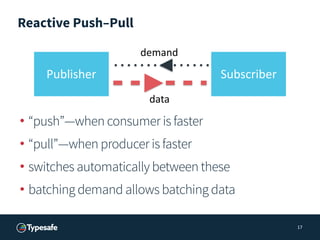
Publisher Subscriber
data
demand
Reactive Push–Pull
• “push”—when consumer is faster
• “pull”—when producer is faster
• switches automatically between these
• batching demand allows batching data
17
Publisher Subscriber
data
demand
Explicit Demand: One-to-many
18
demand
data
Splitting the data means merging the demand
Explicit Demand: Many-to-one
19
Merging the data means splitting the demand
Back-Pressure is Contagious
• C is slow
• B must slow down
• A must slow down
20
CA B
• TCP for example has it built-in
Back-Pressure can be Propagated
21
CA B
networkhosts
The Meat
22
trait Publisher[T] {
def subscribe(sub: Subscriber[T]): Unit
}
trait Subscription {
def request(n: Long): Unit
def cancel(): Unit
}
trait Subscriber[T] {
def onSubscribe(s: Subscription): Unit
def onNext(e: T): Unit
def onError(t: Throwable): Unit
def onComplete(): Unit
}
Not user-level API
Intended as SPI for interop
Akka Streams
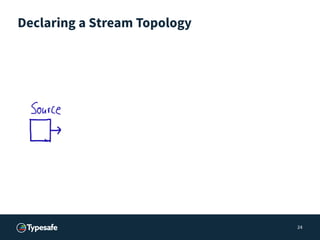
Declaring a Stream Topology
24
Declaring a Stream Topology
25
Declaring a Stream Topology
26
Declaring a Stream Topology
27
Declaring a Stream Topology
28
Declaring a Stream Topology
29
Declaring a Stream Topology
30
API Design
• goals:
• no magic
• supreme compositionality
• exhaustive model of bounded stream processing
• consequences:
• immutable and reusable stream blueprints
• explicit materialization step
31
http://doc.akka.io/docs/akka-stream-and-http-experimental/1.0-M2/stream-design.html
Declaring and Running a Stream
32
val upper = Source(Iterator from 0).take(10)
val lower = Source(1.second, 1.second, () => Tick)
val source = Source[(Int, Tick)]() { implicit b =>
val zip = Zip[Int, Tick]
val out = UndefinedSink[(Int, Tick)]
upper ~> zip.left ~> out
lower ~> zip.right
out
}
val flow = Flow[(Int, Tick)].map{ case (x, _) => s"tick $x" }
val sink = Sink.foreach(println)
val future = source.connect(flow).runWith(sink)
Declaring and Running a Stream
33
val upper = Source(Iterator from 0).take(10)
val lower = Source(1.second, 1.second, () => Tick)
val source = Source[(Int, Tick)]() { implicit b =>
val zip = Zip[Int, Tick]
val out = UndefinedSink[(Int, Tick)]
upper ~> zip.left ~> out
lower ~> zip.right
out
}
val flow = Flow[(Int, Tick)].map{ case (x, _) => s"tick $x" }
val sink = Sink.foreach(println)
val future = source.connect(flow).runWith(sink)
Declaring and Running a Stream
34
val upper = Source(Iterator from 0).take(10)
val lower = Source(1.second, 1.second, () => Tick)
val source = Source[(Int, Tick)]() { implicit b =>
val zip = Zip[Int, Tick]
val out = UndefinedSink[(Int, Tick)]
upper ~> zip.left ~> out
lower ~> zip.right
out
}
val flow = Flow[(Int, Tick)].map{ case (x, _) => s"tick $x" }
val sink = Sink.foreach(println)
val future = source.connect(flow).runWith(sink)
Materialization
• Akka Streams separate the what from the how
• declarative Source/Flow/Sink DSL to create blueprint
• FlowMaterializer turns this into running Actors
• this allows alternative materialization strategies
• optimization
• verification / validation
• cluster deployment
• only Akka Actors for now, but more to come!
35
Stream Sources
• org.reactivestreams.Publisher[T]
• org.reactivestreams.Subscriber[T]
• Iterator[T] / Iterable[T]
• Code block (function that produces Option[T])
• scala.concurrent.Future[T]
• TickSource
• ActorPublisher
• singleton / empty / failed
• … plus write your own (fully extensible)
36
Stream Sinks
• org.reactivestreams.Publisher[T]
• org.reactivestreams.Subscriber[T]
• ActorSubscriber
• scala.concurrent.Future[T]
• blackhole / foreach / fold / onComplete
• … or create your own
37
Linear Stream Transformations
• Deterministic (like for collections)
• map, filter, collect, grouped, drop, take, groupBy, …
• Time-Based
• takeWithin, dropWithin, groupedWithin, …
• Rate-Detached
• expand, conflate, buffer, …
• asynchronous
• mapAsync, mapAsyncUnordered, flatten, …
38
Nonlinear Stream Transformations
• Fan-In
• merge, concat, zip, …
• Fan-Out
• broadcast, route, balance, unzip, …
39
Akka HTTP
Why do we add an HTTP module?
• Akka is about building distributed applications
• distribution implies integration
• between internal (sub)systems

➜ akka-clusterbasedonakka-remote
• with external systems

➜ akka-http(linguafrancaoftheinternet)
41
Akka HTTP—The Origins: Spray.IO
• Fully embeddable HTTP stack based on Actors
• focused on HTTP integration (toolkit)
• server- and client-side
• seamlessly integrated with Akka
42
Spray.IO Features
• immutable, case class-based HTTP model
• fast, lightweight HTTP client and server
• powerful DSL for server-side API definition
• fully async & non-blocking, actor-friendly,

modular, testable
• based entirely on Scala & Akka Actors
43
Spray.IO Weaknesses
• handling of chunked requests is clunky, incomplete
• dealing with large message entities can be difficult
• some unintuitive corner-cases in routing DSL
• deep implicit argument chains in some cases hard
to debug
• missing features, foremost websocket support
44
Proxying Large Responses
45
Akka HTTP is Spray 2.0
• addressing the weaknesses, polishing the features
• Java API
• simplified module structure
• core improvement: fully stream-based
46
HTTP Stream Topology
47
The Application Stack
48
O/S-level network stack
Java NIO (JDK)
Akka IO
Akka HTTP Core
Akka HTTP
user-
level
Akka IO
• bridges Java NIO with Akka Actors or streams
• supports TCP, UDP and SSL
49
Akka HTTP Core
• implements HTTP/1.1 according to the RFCs
• based upon the TCP facilities of Akka IO
• exposed as freely reusable stream transformations
• low-level and extensible implementation of

HTTP model and spec
50
A Quick View of the HTTP Model
51
case class HttpRequest(
method: HttpMethod = HttpMethods.GET,
uri: Uri = Uri./,
headers: immutable.Seq[HttpHeader] = Nil,
entity: RequestEntity = HttpEntity.Empty,
protocol: HttpProtocol = HttpProtocols.`HTTP/1.1`
) extends HttpMessage
case class HttpResponse(
status: StatusCode = StatusCodes.OK,
headers: immutable.Seq[HttpHeader] = Nil,
entity: ResponseEntity = HttpEntity.Empty,
protocol: HttpProtocol = HttpProtocols.`HTTP/1.1`
) extends HttpMessage
Akka HTTP
• builds upon Akka HTTP Core
• adds (un)marshaling for HttpEntities
• adds (de)compression (gzip / deflate)
• high-level server-side routing DSL
• type-safe and flexible
• highly compositional building blocks (Directives)
• includes common behaviors pre-canned
52
Stream Pipelines
53
TCP SSL HTTP App
Requests
Responses
optional
(not yet)
A Simple Server Example
54
import Directives._
val binding = Http().bind("localhost", 8080)
binding startHandlingWith {
path("order" / HexIntNumber) { id =>
get {
complete(s"Received GET for order $id")
} ~
put {
complete((actor ? Put(id)).mapTo[String])
}
}
}
Summary
When can we have it?
• currently pre-release versions:
• reactive-streams 1.0.0-RC1
• Akka Streams & HTTP 1.0-M2
• still missing:
• Akka HTTP client features
• SSL integration
• websockets
• Akka Streams & HTTP 1.0 expected end of Feb’15
56
Resources
• https://github.com/akka/akka/tree/release-2.3-dev
• http://doc.akka.io/docs/akka-stream-and-http-
experimental/1.0-M2/
• akka-user mailing list
57
©Typesafe 2014 – All Rights Reserved

Akka Streams and HTTP

  • 1.
    Akka Streams &HTTP Dr. Roland Kuhn @rolandkuhn — Akka Tech Lead
  • 2.
    Streams Occur Naturally •traditionally: • file input/output • network connections • more modern: • processing big data with finite memory • real-time data processing (CEP) • serving numerous clients simultaneously with bounded resources (IoT, streaming HTTP APIs) 2
  • 3.
    3 What is aStream? • ephemeral, time-dependent sequence of elements • possibly unbounded in length • therefore focusing on transformations «You cannot step twice into the same stream. For as you are stepping in, other waters are ever flowing on to you.» — Heraclitus
  • 4.
  • 5.
  • 6.
    Reactive means MessageFlow 6 37% discount with code kuhnco
  • 7.
    Distributed vs. StaticTyping • in general a very tough problem • independent entities evolving concurrently • promising progress on Project Gålbma • in many specific cases no type evolution necessary • letting uniform messages flow in safe conduits • making streams even more interesting 7
  • 8.
    Possible Solutions • theTraditional way: blocking calls 8
  • 9.
    Possible Solutions • thePush way: buffering and/or dropping
 (optimized for fast consumer) 9
  • 10.
    Possible Solutions • thePull way: poor performance
 (optimized for fast producer) 10
  • 11.
    Possible Solutions • theReactive way:
 non-blocking & non-dropping & bounded 11
  • 12.
  • 13.
    Origin and motivation •all participants face the same basic problem • all are building tools for their community • a common solution benefits everybody • interoperability to make best use of efforts • propose to include in future JDK 13
  • 14.
    Goals • minimal interfaces—essentialsonly • rigorous specification of semantics • TCK for verification of implementation • complete freedom for many idiomatic APIs • specification should be efficiently implementable 14
  • 15.
    Reactive Streams • asynchronous& non-blocking • flow of data • flow of demand • minimal coordination and contention • message passing allows for distribution across • applications, nodes, CPUs, threads, actors 15
  • 16.
    A Data Marketusing Supply & Demand • data elements flow downstream • demand flows upstream • data elements flow only when there is demand • data in flight is bounded by signaled demand • recipient is in control of maximal incoming data rate 16 Publisher Subscriber data demand
  • 17.
    Reactive Push–Pull • “push”—whenconsumer is faster • “pull”—when producer is faster • switches automatically between these • batching demand allows batching data 17 Publisher Subscriber data demand
  • 18.
  • 19.
    Explicit Demand: Many-to-one 19 Mergingthe data means splitting the demand
  • 20.
    Back-Pressure is Contagious •C is slow • B must slow down • A must slow down 20 CA B
  • 21.
    • TCP forexample has it built-in Back-Pressure can be Propagated 21 CA B networkhosts
  • 22.
    The Meat 22 trait Publisher[T]{ def subscribe(sub: Subscriber[T]): Unit } trait Subscription { def request(n: Long): Unit def cancel(): Unit } trait Subscriber[T] { def onSubscribe(s: Subscription): Unit def onNext(e: T): Unit def onError(t: Throwable): Unit def onComplete(): Unit } Not user-level API Intended as SPI for interop
  • 23.
  • 24.
    Declaring a StreamTopology 24
  • 25.
    Declaring a StreamTopology 25
  • 26.
    Declaring a StreamTopology 26
  • 27.
    Declaring a StreamTopology 27
  • 28.
    Declaring a StreamTopology 28
  • 29.
    Declaring a StreamTopology 29
  • 30.
    Declaring a StreamTopology 30
  • 31.
    API Design • goals: •no magic • supreme compositionality • exhaustive model of bounded stream processing • consequences: • immutable and reusable stream blueprints • explicit materialization step 31 http://doc.akka.io/docs/akka-stream-and-http-experimental/1.0-M2/stream-design.html
  • 32.
    Declaring and Runninga Stream 32 val upper = Source(Iterator from 0).take(10) val lower = Source(1.second, 1.second, () => Tick) val source = Source[(Int, Tick)]() { implicit b => val zip = Zip[Int, Tick] val out = UndefinedSink[(Int, Tick)] upper ~> zip.left ~> out lower ~> zip.right out } val flow = Flow[(Int, Tick)].map{ case (x, _) => s"tick $x" } val sink = Sink.foreach(println) val future = source.connect(flow).runWith(sink)
  • 33.
    Declaring and Runninga Stream 33 val upper = Source(Iterator from 0).take(10) val lower = Source(1.second, 1.second, () => Tick) val source = Source[(Int, Tick)]() { implicit b => val zip = Zip[Int, Tick] val out = UndefinedSink[(Int, Tick)] upper ~> zip.left ~> out lower ~> zip.right out } val flow = Flow[(Int, Tick)].map{ case (x, _) => s"tick $x" } val sink = Sink.foreach(println) val future = source.connect(flow).runWith(sink)
  • 34.
    Declaring and Runninga Stream 34 val upper = Source(Iterator from 0).take(10) val lower = Source(1.second, 1.second, () => Tick) val source = Source[(Int, Tick)]() { implicit b => val zip = Zip[Int, Tick] val out = UndefinedSink[(Int, Tick)] upper ~> zip.left ~> out lower ~> zip.right out } val flow = Flow[(Int, Tick)].map{ case (x, _) => s"tick $x" } val sink = Sink.foreach(println) val future = source.connect(flow).runWith(sink)
  • 35.
    Materialization • Akka Streamsseparate the what from the how • declarative Source/Flow/Sink DSL to create blueprint • FlowMaterializer turns this into running Actors • this allows alternative materialization strategies • optimization • verification / validation • cluster deployment • only Akka Actors for now, but more to come! 35
  • 36.
    Stream Sources • org.reactivestreams.Publisher[T] •org.reactivestreams.Subscriber[T] • Iterator[T] / Iterable[T] • Code block (function that produces Option[T]) • scala.concurrent.Future[T] • TickSource • ActorPublisher • singleton / empty / failed • … plus write your own (fully extensible) 36
  • 37.
    Stream Sinks • org.reactivestreams.Publisher[T] •org.reactivestreams.Subscriber[T] • ActorSubscriber • scala.concurrent.Future[T] • blackhole / foreach / fold / onComplete • … or create your own 37
  • 38.
    Linear Stream Transformations •Deterministic (like for collections) • map, filter, collect, grouped, drop, take, groupBy, … • Time-Based • takeWithin, dropWithin, groupedWithin, … • Rate-Detached • expand, conflate, buffer, … • asynchronous • mapAsync, mapAsyncUnordered, flatten, … 38
  • 39.
    Nonlinear Stream Transformations •Fan-In • merge, concat, zip, … • Fan-Out • broadcast, route, balance, unzip, … 39
  • 40.
  • 41.
    Why do weadd an HTTP module? • Akka is about building distributed applications • distribution implies integration • between internal (sub)systems
 ➜ akka-clusterbasedonakka-remote • with external systems
 ➜ akka-http(linguafrancaoftheinternet) 41
  • 42.
    Akka HTTP—The Origins:Spray.IO • Fully embeddable HTTP stack based on Actors • focused on HTTP integration (toolkit) • server- and client-side • seamlessly integrated with Akka 42
  • 43.
    Spray.IO Features • immutable,case class-based HTTP model • fast, lightweight HTTP client and server • powerful DSL for server-side API definition • fully async & non-blocking, actor-friendly,
 modular, testable • based entirely on Scala & Akka Actors 43
  • 44.
    Spray.IO Weaknesses • handlingof chunked requests is clunky, incomplete • dealing with large message entities can be difficult • some unintuitive corner-cases in routing DSL • deep implicit argument chains in some cases hard to debug • missing features, foremost websocket support 44
  • 45.
  • 46.
    Akka HTTP isSpray 2.0 • addressing the weaknesses, polishing the features • Java API • simplified module structure • core improvement: fully stream-based 46
  • 47.
  • 48.
    The Application Stack 48 O/S-levelnetwork stack Java NIO (JDK) Akka IO Akka HTTP Core Akka HTTP user- level
  • 49.
    Akka IO • bridgesJava NIO with Akka Actors or streams • supports TCP, UDP and SSL 49
  • 50.
    Akka HTTP Core •implements HTTP/1.1 according to the RFCs • based upon the TCP facilities of Akka IO • exposed as freely reusable stream transformations • low-level and extensible implementation of
 HTTP model and spec 50
  • 51.
    A Quick Viewof the HTTP Model 51 case class HttpRequest( method: HttpMethod = HttpMethods.GET, uri: Uri = Uri./, headers: immutable.Seq[HttpHeader] = Nil, entity: RequestEntity = HttpEntity.Empty, protocol: HttpProtocol = HttpProtocols.`HTTP/1.1` ) extends HttpMessage case class HttpResponse( status: StatusCode = StatusCodes.OK, headers: immutable.Seq[HttpHeader] = Nil, entity: ResponseEntity = HttpEntity.Empty, protocol: HttpProtocol = HttpProtocols.`HTTP/1.1` ) extends HttpMessage
  • 52.
    Akka HTTP • buildsupon Akka HTTP Core • adds (un)marshaling for HttpEntities • adds (de)compression (gzip / deflate) • high-level server-side routing DSL • type-safe and flexible • highly compositional building blocks (Directives) • includes common behaviors pre-canned 52
  • 53.
    Stream Pipelines 53 TCP SSLHTTP App Requests Responses optional (not yet)
  • 54.
    A Simple ServerExample 54 import Directives._ val binding = Http().bind("localhost", 8080) binding startHandlingWith { path("order" / HexIntNumber) { id => get { complete(s"Received GET for order $id") } ~ put { complete((actor ? Put(id)).mapTo[String]) } } }
  • 55.
  • 56.
    When can wehave it? • currently pre-release versions: • reactive-streams 1.0.0-RC1 • Akka Streams & HTTP 1.0-M2 • still missing: • Akka HTTP client features • SSL integration • websockets • Akka Streams & HTTP 1.0 expected end of Feb’15 56
  • 57.
  • 58.
    ©Typesafe 2014 –All Rights Reserved