CHEMICAL CHANGE
Reactions in aqueous solution
Ions in aqueous solution
■ Many reactions in industrial processes and in living systems take place in aqueous
solution.
■ Water is a very good solvent and therefore many substances can dissolve in it.
■ The microscopic structure of water makes it possible to dissolve other substances.
Polarity of water
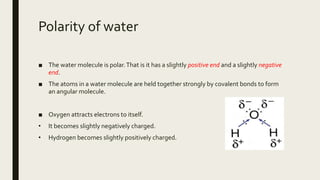
■ The water molecule is polar.That is it has a slightly positive end and a slightly negative
end.
■ The atoms in a water molecule are held together strongly by covalent bonds to form
an angular molecule.
■ Oxygen attracts electrons to itself.
• It becomes slightly negatively charged.
• Hydrogen becomes slightly positively charged.
Polarity of water
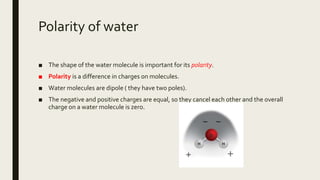
■ The shape of the water molecule is important for its polarity.
■ Polarity is a difference in charges on molecules.
■ Water molecules are dipole ( they have two poles).
■ The negative and positive charges are equal, so they cancel each other and the overall
charge on a water molecule is zero.
Dissolution process
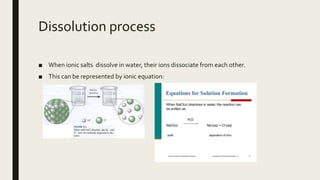
■ When ionic salts dissolve in water, their ions dissociate from each other.
■ This can be represented by ionic equation:
Dissolution processes
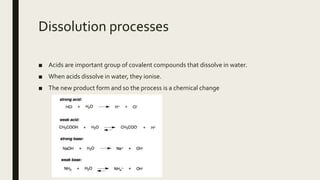
■ Acids are important group of covalent compounds that dissolve in water.
■ When acids dissolve in water, they ionise.
■ The new product form and so the process is a chemical change
Solubility in water
■ Ionic compounds are made of positive and negative ions that are tightly packed in a
crystal lattice.
■ Strong ionic bonds consists of electrostatic forces and hold the ions in position in the
solid phase.
■ Solubility is defined as the amount of a given substance that can be dissolved in a
certain amount of solvent.
■ Dissolving is a process of a solid ionic crystal breaking into its ions.
Solubility
Substances fall into three main categories of solubility
1. Generally, a substance is considered “soluble” if it dissolves into solution completely.
2. “Sparingly (or slightly) soluble” substances are partially soluble. A limited amount of
substance dissolves.
3. “Insoluble” substances do not dissolve at all (or a very tiny amount dissolves.)
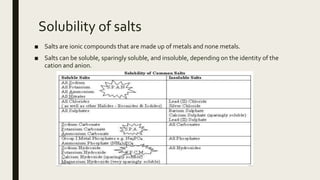
Solubility of salts
■ Salts are ionic compounds that are made up of metals and none metals.
■ Salts can be soluble, sparingly soluble, and insoluble, depending on the identity of the
cation and anion.
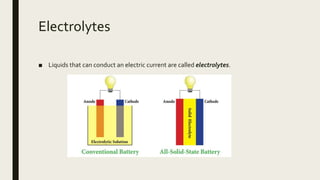
Electrolytes
■ Liquids that can conduct an electric current are called electrolytes.
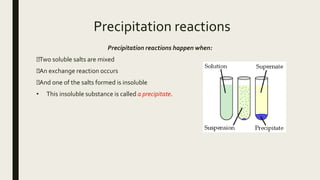
Precipitation reactions
Precipitation reactions happen when:
Two soluble salts are mixed
An exchange reaction occurs
And one of the salts formed is insoluble
• This insoluble substance is called a precipitate.
Reference
■ Itutor (2013) Solutions & solubility. Retrieved September 1, 2018, from
https://www.slideshare.net/itutor/solution-solubility
■ Janetra (2007) 9 Aqueous solutions. Retrieved 01 September 2018, from
https://www.slideshare.net/janetra/9-aqueous-solutions
■ Lauralici (2007) Solutions. Retrieved 01 September 2018, from
https://www.slideshare.net/lauralici/solutions

Reactions in aqueous solutions

  • 1.
  • 2.
    Ions in aqueoussolution ■ Many reactions in industrial processes and in living systems take place in aqueous solution. ■ Water is a very good solvent and therefore many substances can dissolve in it. ■ The microscopic structure of water makes it possible to dissolve other substances.
  • 3.
    Polarity of water ■The water molecule is polar.That is it has a slightly positive end and a slightly negative end. ■ The atoms in a water molecule are held together strongly by covalent bonds to form an angular molecule. ■ Oxygen attracts electrons to itself. • It becomes slightly negatively charged. • Hydrogen becomes slightly positively charged.
  • 4.
    Polarity of water ■The shape of the water molecule is important for its polarity. ■ Polarity is a difference in charges on molecules. ■ Water molecules are dipole ( they have two poles). ■ The negative and positive charges are equal, so they cancel each other and the overall charge on a water molecule is zero.
  • 5.
    Dissolution process ■ Whenionic salts dissolve in water, their ions dissociate from each other. ■ This can be represented by ionic equation:
  • 6.
    Dissolution processes ■ Acidsare important group of covalent compounds that dissolve in water. ■ When acids dissolve in water, they ionise. ■ The new product form and so the process is a chemical change
  • 7.
    Solubility in water ■Ionic compounds are made of positive and negative ions that are tightly packed in a crystal lattice. ■ Strong ionic bonds consists of electrostatic forces and hold the ions in position in the solid phase. ■ Solubility is defined as the amount of a given substance that can be dissolved in a certain amount of solvent. ■ Dissolving is a process of a solid ionic crystal breaking into its ions.
  • 8.
    Solubility Substances fall intothree main categories of solubility 1. Generally, a substance is considered “soluble” if it dissolves into solution completely. 2. “Sparingly (or slightly) soluble” substances are partially soluble. A limited amount of substance dissolves. 3. “Insoluble” substances do not dissolve at all (or a very tiny amount dissolves.)
  • 9.
    Solubility of salts ■Salts are ionic compounds that are made up of metals and none metals. ■ Salts can be soluble, sparingly soluble, and insoluble, depending on the identity of the cation and anion.
  • 10.
    Electrolytes ■ Liquids thatcan conduct an electric current are called electrolytes.
  • 11.
    Precipitation reactions Precipitation reactionshappen when: Two soluble salts are mixed An exchange reaction occurs And one of the salts formed is insoluble • This insoluble substance is called a precipitate.
  • 12.
    Reference ■ Itutor (2013)Solutions & solubility. Retrieved September 1, 2018, from https://www.slideshare.net/itutor/solution-solubility ■ Janetra (2007) 9 Aqueous solutions. Retrieved 01 September 2018, from https://www.slideshare.net/janetra/9-aqueous-solutions ■ Lauralici (2007) Solutions. Retrieved 01 September 2018, from https://www.slideshare.net/lauralici/solutions