CASE - Center for Social and Economic Research 
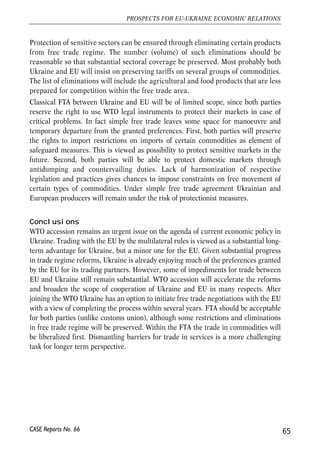
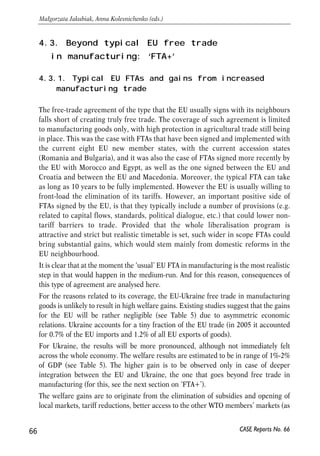
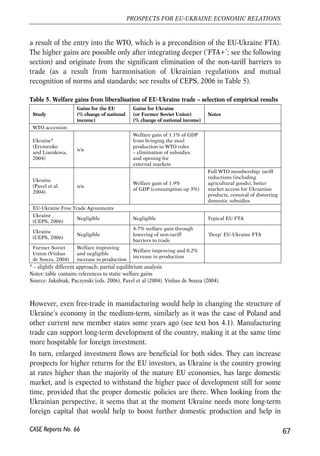
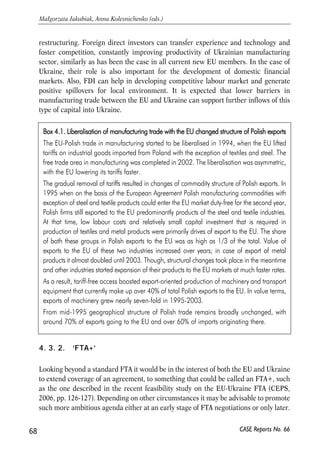
CASE Reports 
Prospects for EU-Ukraine 
Economic Relations 
Ma³gorzata Jakubiak, Anna Kolesnichenko (eds.) 
Dmytro Boyarchuk 
Inna Golodniuk 
Ma³gorzata Jakubiak 
Anna Kolesnichenko 
Mykyta Mykhaylychenko 
Wojciech Paczyñski 
Anna Tsarenko 
Vitaliy Vavryschuk 
Warsaw 2006 
No. 66/2006
The views and opinions expressed here reflect the authors' point of view and not 
necessarily those of the CASE. 
This publication is a result of the research project funded by the bank Pekao SA and co-financed 
by the Central European Initiative CEI. The views expressed here do not 
necessarily reflect those of the bank, neither the CEI. 
The authors of the report are grateful for the financial support provided by the bank 
Pekao SA. 
CASE Reports No. 66 
The publication was funded by the CEI Know-how 
Exchange Programme www.ceinet.org/KEP 
Technical editorial work: Anna Kukla-Gryz 
Keywords: Ukraine, European integration, trade, reforms, transition 
© CASE – Center for Social and Economic Research, Warsaw 2006 
Graphic Design: Agnieszka Natalia Bury 
ISBN 978-83-7178-415-6 EAN 9788371784156 
Publisher: 
CASE – Center for Social and Economic Research 
12 Sienkiewicza, 00-010 Warsaw, Poland 
tel.: (48 22) 622 66 27, 828 61 33, fax: (48 22) 828 60 69 
e-mail: case@case.com.pl 
http://www.case.com.pl/ 
Center for Social and Economic Research CASE Ukraine 
10 Starokyivska Str., Suite 15, Kyiv 04116, UKRAINE 
Tel. +38 044 213 26 14 
Fax +38 044 213 24 68 
www.case-ukraine.kiev.ua
Table of Contents 
1. Introduction. . . . . . . . . . . . . . . . . . . . . . . . . . . . . . . . . . . . . . . . . . . . . . . . . . . . . . 11 
2. Ukraine-EU economic relations: background and current shape . . . . . . . . . . . . . . 13 
2.1. Background. . . . . . . . . . . . . . . . . . . . . . . . . . . . . . . . . . . . . . . . . . . . . . . . . . . . . 13 
2.2. EU-Ukraine economic relations: basic facts and recent developments. . . . . . . . . . 15 
3. Implementation of economic articles of the Ukraine-EU action plan. . . . . . . . . . . 19 
3.1. Functioning market economy . . . . . . . . . . . . . . . . . . . . . . . . . . . . . . . . . . . . . . . 19 
3.2. Monetary and exchange rate policies . . . . . . . . . . . . . . . . . . . . . . . . . . . . . . . . . 23 
3.3. Fiscal policy and taxation . . . . . . . . . . . . . . . . . . . . . . . . . . . . . . . . . . . . . . . . . . 24 
3.3.1. Fiscal policy conduct . . . . . . . . . . . . . . . . . . . . . . . . . . . . . . . . . . . . . . . 24 
3.3.2. Taxation. . . . . . . . . . . . . . . . . . . . . . . . . . . . . . . . . . . . . . . . . . . . . . . . . 27 
3.4. Structural reforms. . . . . . . . . . . . . . . . . . . . . . . . . . . . . . . . . . . . . . . . . . . . . . . . 29 
3.4.1. Progress in privatisation . . . . . . . . . . . . . . . . . . . . . . . . . . . . . . . . . . . . 29 
3.4.2. Banking regulation and supervision . . . . . . . . . . . . . . . . . . . . . . . . . . . 32 
3.4.3. Domestic securities market . . . . . . . . . . . . . . . . . . . . . . . . . . . . . . . . . . 33 
3.4.4. Joint stock company law . . . . . . . . . . . . . . . . . . . . . . . . . . . . . . . . . . . . 35 
3.4.5. Land code . . . . . . . . . . . . . . . . . . . . . . . . . . . . . . . . . . . . . . . . . . . . . . . 37 
CASE Reports No. 66 3
3.5. Company law and establishment . . . . . . . . . . . . . . . . . . . . . . . . . . . . . . . . . . . . . 38 
3.6. Competition policy . . . . . . . . . . . . . . . . . . . . . . . . . . . . . . . . . . . . . . . . . . . . . . . 40 
3.7. Public procurement. . . . . . . . . . . . . . . . . . . . . . . . . . . . . . . . . . . . . . . . . . . . . . . 44 
3.8. Foreign trade. . . . . . . . . . . . . . . . . . . . . . . . . . . . . . . . . . . . . . . . . . . . . . . . . . . . 48 
3.9. Movement of capital and current payments. . . . . . . . . . . . . . . . . . . . . . . . . . . . . 52 
3.10. Movement of persons including movement of workers . . . . . . . . . . . . . . . . . . . 55 
3.11. Concluding remarks . . . . . . . . . . . . . . . . . . . . . . . . . . . . . . . . . . . . . . . . . . . . . 56 
4. Future prospects and challenges . . . . . . . . . . . . . . . . . . . . . . . . . . . . . . . . . . . . . . 59 
4.1. Ukraine's WTO accession. . . . . . . . . . . . . . . . . . . . . . . . . . . . . . . . . . . . . . . . . . . 59 
4.1.1. Past and current trade liberalisation with the EU . . . . . . . . . . . . . . . . . 59 
4.1.2. Ukraine's WTO offer. . . . . . . . . . . . . . . . . . . . . . . . . . . . . . . . . . . . . . . . 60 
4.1.3. Estimated effects of Ukraine's WTO entry and liberalisation progress . . . . 60 
4.2. Further liberalisation of trade: FTA between Ukraine and the European Union . . . 62 
4.3. Beyond typical EU free trade in manufacturing: ‘FTA+’ . . . . . . . . . . . . . . . . . . . 66 
4.3.1. Typical EU FTAs and gains from increased manufacturing trade . . . . . 66 
4.3.2. ‘FTA+’ . . . . . . . . . . . . . . . . . . . . . . . . . . . . . . . . . . . . . . . . . . . . . . . . . . 68 
4.4. Granting Ukraine access to the EU Internal Market . . . . . . . . . . . . . . . . . . . . . . 70 
4.4.1. What the action plan says . . . . . . . . . . . . . . . . . . . . . . . . . . . . . . . . . . . 70 
4.4.2. Better market access in goods – removing NTBs . . . . . . . . . . . . . . . . . . 72 
4.4.3. Liberalization of trade in services? . . . . . . . . . . . . . . . . . . . . . . . . . . . . 75 
4.4.4. Integration of energy networks . . . . . . . . . . . . . . . . . . . . . . . . . . . . . . . 78 
4.4.5. Financing of co-operation – the ENPI . . . . . . . . . . . . . . . . . . . . . . . . . . 79 
4.4.6. Conclusions . . . . . . . . . . . . . . . . . . . . . . . . . . . . . . . . . . . . . . . . . . . . . . 80 
4.5. Challenges for deep integration: free capital mobility . . . . . . . . . . . . . . . . . . . . . 81 
4.5.1. Introduction. . . . . . . . . . . . . . . . . . . . . . . . . . . . . . . . . . . . . . . . . . . . . . 81 
4.5.2. Potential risks of capital account liberalization . . . . . . . . . . . . . . . . . . . 82 
4.5.3. Prerequisites for capital account liberalization . . . . . . . . . . . . . . . . . . . 83 
4.5.4. Liberalizing experience of other countries. . . . . . . . . . . . . . . . . . . . . . . 85 
4.5.5. Implications for future capital account liberalizations in Ukraine . . . . . 85 
4.5.6. Conclusions . . . . . . . . . . . . . . . . . . . . . . . . . . . . . . . . . . . . . . . . . . . . . . 86 
4.6. Challenges for deep integration: movement of labour . . . . . . . . . . . . . . . . . . . . . 87 
4.6.1. Introduction. . . . . . . . . . . . . . . . . . . . . . . . . . . . . . . . . . . . . . . . . . . . . . 87 
4.6.2. Ukraine-EU labour migration regulation . . . . . . . . . . . . . . . . . . . . . . . . 88 
4.6.3. Migration trends . . . . . . . . . . . . . . . . . . . . . . . . . . . . . . . . . . . . . . . . . . 90 
4.6.4. Future policy options . . . . . . . . . . . . . . . . . . . . . . . . . . . . . . . . . . . . . . . 91 
4.6.5. Conclusions . . . . . . . . . . . . . . . . . . . . . . . . . . . . . . . . . . . . . . . . . . . . . . 95 
4 
Małgorzata Jakubiak, Anna Kolesnichenko (eds.) 
CASE Reports No. 66
4.7. Challenges for deep integration: EU perspective . . . . . . . . . . . . . . . . . . . . . . . . . 96 
4.7.1. ENP – new framework for EU external relations. . . . . . . . . . . . . . . . . . 96 
4.7.2. Determinants of EU approach to Ukraine . . . . . . . . . . . . . . . . . . . . . . . 97 
4.7.3. Prospects for EU membership? . . . . . . . . . . . . . . . . . . . . . . . . . . . . . . . 99 
4.7.4. Issues in agriculture and energy sectors . . . . . . . . . . . . . . . . . . . . . . . 101 
4.7.5. Conclusions . . . . . . . . . . . . . . . . . . . . . . . . . . . . . . . . . . . . . . . . . . . . . 102 
5. Conclusions and policy recommendations . . . . . . . . . . . . . . . . . . . . . . . . . . . . . . 103 
6. Annexes . . . . . . . . . . . . . . . . . . . . . . . . . . . . . . . . . . . . . . . . . . . . . . . . . . . . . . . 109 
7. References . . . . . . . . . . . . . . . . . . . . . . . . . . . . . . . . . . . . . . . . . . . . . . . . . . . . . . 117 
5 
PROSPECTS FOR EU-UKRAINE ECONOMIC RELATIONS 
CASE Reports No. 66
The Authors 
Dmytro Boyarchuk is an economist at CASE Ukraine. His main areas of interest are 
labor economics, social policy and fiscal sector. He obtained his Master Degree in 
2003 at EERC Master's Program in Economics at the National University of "Kyiv- 
Mohyla Academy". 
Inna Golodniuk has been working with CASE Ukraine since 2001, during the period 
of October 2005-August 2006 as the Executive Director of CASE Ukraine. She 
specializes in the economics of money and banking, financial markets and their 
influence on macroeconomic situation, tax reform in Ukraine. Inna Golodniuk 
received her M.A. degrees in Economics from Simon Fraser University (Canada) and 
Kyiv-Mohyla Academy's EERC Program and a Specialist degree in Physics from 
Chernivtsi National University. 
Małgorzata Jakubiak graduated from the University of Sussex (UK; 1997) and the 
Department of Economics at the University of Warsaw (1998). Her main areas of 
interest include foreign trade and macroeconomics. She has published texts on trade 
flows and exchange rates in emerging or transition economies, EU integration with 
its neighbours and CIS economies. During 2000-2001 she was working at the CASE 
mission in Ukraine as resident consultant. She has collaborated with the CASE 
Foundation since 1997. 
Anna Kolesnichenko has been working at CASE Ukraine since 2001. Currently she 
specializes in political economy of European integration, EU-Ukraine relations and 
energy security and efficiency. She has also worked with the NATO Parliamentary 
Assembly, the Centre for Strategic and International Studies (CSIS) in the USA, the 
United Nations Development Program (UNDP) in Ukraine and the Harvard Institute 
for International Development (HIID) in Ukraine. Anna holds an MA in European 
Studies from SAIS, Johns Hopkins University; and an MA in Economics from the 
EERC programme at the Kyiv-Mohyla Academy. She has also qualified as a Specialist 
in Environmental Management from the Donetsk State Academy of Management. 
Mykyta Mykhaylychenko graduated in 2005 with MS in Social Informatics from the 
National Taras Shevchenko Kyiv University (Ukraine) and is currently reading for an 
MA in International Economics and Finance at Brandeis International Business 
School (Boston, USA). He has been an economist at CASE since 2003. His research 
interests include: price developments, monetary policy, financial markets and 
6 
Małgorzata Jakubiak, Anna Kolesnichenko (eds.) 
CASE Reports No. 66
banking sector. He has participated in several research projects in CASE related to 
these topics and starting from 2003 he has been participating in the project 
“Ukrainian Economic Outlook”. 
Wojciech Paczyński has been an economist at CASE since 2000. His research 
interests include applied macroeconomics, international economics, international 
relations, game theory and economics of education. He has published on EU 
integration, EU enlargement, EU relations with neighbouring countries, monetary 
policy, and currency crises. He holds MA in International Economics from University 
of Sussex, MA in Economics from Warsaw University and MSc in Mathematics from 
Warsaw University. 
Anna Tsarenko is an economist at CASE Ukraine. Her major fields of specialization 
are energy security policy and macroanalysis. She has graduated from the National 
University “Kyiv-Mohyla Academy” with MA degree in economic theory. 
Vitaliy Vavryschuk is an economist at CASE Ukraine since 2003. He graduated from 
EERC program at National University of "Kyiv-Mohyla Academy" and obtained MA 
degree in economics. Fields of specialization: foreign trade and WTO, European 
integration, macroeconomics. 
7 
PROSPECTS FOR EU-UKRAINE ECONOMIC RELATIONS 
CASE Reports No. 66
List of abbreviations 
AMCU Anti-Monopoly Committee of Ukraine 
CB Central Bank 
CBI Central bank independence 
CEA Common Economic Area 
CEE Central and Eastern Europe 
CEFTA Central European Free Trade Agreement 
CEO Chief executive officer 
CGE Computable General Equilibrium 
CIS Commonwealth of Independent States 
CMU Cabinet of Ministers of Ukraine 
CRFSM Commission for Regulation of Financial Services Markets in Ukraine 
EC European Commission 
ECB European Central Bank 
ECJ European Court of Justice and Court of First Instance 
ECT Energy Charter Treaty 
EEA European Economic Area 
EMU Economic and Monetary Union 
ENP European Neighbourhood Policy 
ENPI European Neighbourhood and Partnership Instrument 
ESCB European System of Central Banks 
EU European Union 
FDI Foreign Direct Investment 
FEZ Free Economic Zones 
FIAC Foreign Investors Advisory Council 
FSU Former Soviet Union 
FTA Free Trade Area 
GATT General Agreement on Tariffs and Trade 
GATS General Agreement on Trade in Services 
GDP Gross Domestic Product 
GPS Geralised System of Tariff Preferences 
HACCP Hazard Analysis and Critical Control Point 
JSC Joint Stock Companies 
ILO International Labour Organization 
IMF International Monetary Fund 
MEDA EU financial instrument for the implementation of the Euro-Mediterranean 
Partnership 
MFN Most Favoured Nation 
INOGATE Interstate Oil and Gas Transport to Europe 
NBU National Bank of Ukraine 
NDU National Depository of Ukraine 
NFP Nicopol Ferroalloy Plant 
NGO Non-Governmental Organizations 
NIS Newly Independent States 
NTB Non-Tariff Barriers 
8 
Małgorzata Jakubiak, Anna Kolesnichenko (eds.) 
CASE Reports No. 66
PCA Partnership and Cooperation Agreement 
SAP Stabilisation and Association Process 
SPS Sanitary and Phytosanitary (measures) 
SSB State Savings Bank 
STA State Tax Administration 
TACIS Technical Assistance to the Commonwealth of Independent States 
TBT Technical Barriers to Trade 
TCU Tender Chamber of Ukraine 
TRACECA Transport corridor between Europe and Asia 
UAH Hryvnia, National currency of Ukraine 
UCTE Union for the Co-ordination of Transmission of Electricity 
URR Unremunerated Reserve requirements 
USAID United States Agency for International Development 
VAT Value-added tax 
WTO World Trade Organization 
yoy year-on-year 
9 
PROSPECTS FOR EU-UKRAINE ECONOMIC RELATIONS 
CASE Reports No. 66
10 
Małgorzata Jakubiak, Anna Kolesnichenko (eds.) 
CASE Reports No. 66
This report looks at the prospects for economic integration between Ukraine and the 
European Union. The so-called Orange Revolution of late 2004 saw the question of 
Ukraine’s future geopolitical orientation re-emerge, and the idea of closer integration 
with the EU received wide social support. Yet, already by mid-2006 the political 
support to the idea of Euro-Atlantic integration seem to diminish. It is not clear if, how 
and when the idea of deeper integration with the EU will be put into action. Although 
the main steps have been charted at the official level (Ukraine becoming WTO member 
and both sides start to gradually lower barriers to trade in manufacturing goods), 
neither their timing, nor the steps going beyond them can be specified with any degree 
of certainty. This report aims at showing the possible and optimal policy options. 
Although the integration between the EU and Ukraine can be assessed from many 
different angles, the team of researchers decided to concentrate exclusively on the 
economic issues. The focus is on future policy options that will probably be relevant 
during the next 5-10 years. 
The report treats the EU and Ukraine in an asymmetric way. The perspective of 
Ukraine and issues that are specific to the Ukrainian market are given the larger 
share. The assumption is that the reader is less familiar with the current situation of 
Ukrainian economy than with the general EU policies towards external partners. 
However, common EU policies towards its neighbours and the challenges existing at 
both sides are also outlined. 
The report starts from giving a background of the EU-Ukraine relations. There follows the 
assessment of the implementation of selected economic articles of the EU-Ukraine action 
plan. The plan of action was drafted in late 2004 and signed in early 2005. The analysis 
focuses on its main economic provisions, and the progress in respective spheres that has 
been recorded from 2004 to date. The report looks at progress made in the opening of the 
Ukrainian market, as well as in making it more friendly for local economic agents. 
CASE Reports No. 66 
11 
1 
Introduction* 
* The authors are grateful for comments and suggestions received from Marek Dabrowski and Michael Emerson. 
Opinions expressed in the report should not be attributed to any of these persons and institutions they are affiliated 
with. Sole responsibility for the content of this report rests with the editors and authors of respective sections.
The next part of the report takes more forward-looking approach. First, the 
prospects for liberalising trade in goods and for the establishment of the free trade 
zone in manufacturing between the EU and Ukraine are examined. Then the report 
team looks at the possible mid-term solution that would go beyond the standard EU 
FTA, such as: an enhanced free trade agreement and granting Ukraine wider access 
to the EU internal market. The next sections examine the most challenging areas for 
future integration, that is free mobility of labour and short-term capital. The 
analysis is done essentially by inspecting what form of economic integration can be 
the optimal one, taking into account both the possible effects of deeper cooperation 
and mutual constraints. While investigating these, the team has been exploring 
chances to lower barriers to the movement of goods, services, capital, and labour. 
The last chapter concludes. 
12 
Małgorzata Jakubiak, Anna Kolesnichenko (eds.) 
CASE Reports No. 66
Ukraine-EU economic relations: 
background and current shape 
2.1. Background 
2 
Ukrainian governments started to work on bilateral relations with the EU in the 
early 1990s, about the time when Ukraine gained its independence. In 1993, the 
Commission opened its Delegation in Ukraine and started negotiations on the 
Partnership and Cooperation Agreement (PCA), which entered into force in 1998 
and became the framework in which EU-Ukraine relations have developed up until 
present. Similar Partnership and Cooperation Agreements were signed with all 
other states that emerged from the Soviet Union (except Baltic countries) and 
aimed at encouraging democratic transition and market reforms in those 
countries. Unlike Trade and Association Agreements that the EU concluded with 
countries of Eastern Europe and Stabilization and Association Agreements 
conclude with Western Balkan countries, PCAs did not envisage EU membership. 
Neither it included any free trade provisions. 
The PCA between the EU and Ukraine declares a commitment to common values, 
establishes a framework for political cooperation and sets objectives for bilateral 
cooperation in different areas (trade, investment, cultural, scientific cooperation 
etc.). Some provisions of the PCA are binding, notably those related to movement 
of goods, services, labor and capital. Yet, overall, the agreement is rather a 
declaration of intentions and does not specify clear mechanisms for their 
achievement. 
In practice, the objectives of cooperation have been implemented through annual 
bilateral presidential Summits and ministerial Cooperation Councils, as well as 
technical assistance, provided mainly through the TACIS (Technical Assistance to the 
Commonwealth of Independent States) program. Over 1998-2004, the EU granted 
Ukraine 838 million euro of technical assistance. Large part of this money (310 
million Euros) was directed to nuclear safety program and to the Chernobyl Shelter 
CASE Reports No. 66 13
Fund; with the rest being targeted for development of civil society, economic reforms, 
regional development, education and other priority areas. 
In 2003, the EU proposed a new framework for its relations with neighbours, 
including Ukraine, called the European Neighbourhood Policy (ENP). The ENP 
geographical coverage is quite heterogeneous and covers the east of Europe, 
Caucasus and Southern Mediterranean. The current list of partners includes 
Algeria, Armenia, Azerbaijan, Belarus, Egypt, Georgia, Israel, Jordan, Lebanon, 
Libya, Moldova, Morocco, Palestinian Authority, Syria, Tunisia and Ukraine. 
Russia opted out of the ENP and instead seeks bilateral relationship with the EU 
on more equal terms. 
The main idea of the ENP is to encourage stability, security and prosperity in the 
neighbouring states without extending EU membership to them. The blueprint for the 
ENP was outlined in the Communication on Wider Europe issued in March 2003 (EC, 
2003), and then elaborated in the ENP Strategy Paper, adopted in 2004. To make the 
ENP operational, the EU agreed with each ENP country a plan of action that specifies 
priorities that should be realised in the short-to-medium term (3 or 5 years). 
The EU-Ukraine action plan was drafted in late 2004 and signed in February 2005. 
It is to be implemented over three years. The Plan sets priorities in different policy 
areas and elaborates on what should be done to achieve them. In the economic 
domain, these include WTO accession, removal of non-tariff barriers in bilateral 
trade, improvement of investment climate, tax reform and approximation of 
legislation. Both Ukraine and the EU monitor the implementation of the Plan and 
exchange their opinions. According to the conclusions of the EU-Ukraine Summit 
on 1 December 2005, Ukraine made a significant progress in implementation of the 
action plan (see EC, 2005). 
In 2008, both the PCA and the action plan expire. The EU and Ukraine decided to 
negotiate a new framework agreement that is to replace the PCA. This will be the 
opportunity to deepen the relationship. The EU is already using the language of an 
‘Enhanced Agreement’, signifying a willingness to be more ambitious. It is clear that 
this will be a new brand of multi-pillar agreement, embracing economic relations, 
political values, justice and home affairs and foreign and security policy. For the EU 
the economic content could consist of a ‘deep free trade agreement’, but it is not clear 
at this stage whether the Yanukovich government will want to go ahead on this. 
14 
Małgorzata Jakubiak, Anna Kolesnichenko (eds.) 
CASE Reports No. 66
2.2. EU-Ukraine economic relations: 
basic facts and recent developments 
According to the Partnership and Cooperation Agreement, the parties should 
adhere to GATT (General Agreement on Tariffs and Trade) principles in their trade, 
namely most favored nation clause, national treatment principle, freedom of transit, 
and general prohibition of quantitative restrictions except for textile and some coal 
and steel products and nuclear materials, on which special agreements were signed. 
Trade in textiles has been fully liberalized since 2005. In the metal sector, however, 
substantial restrictions remain: the EU establishes annual quotas for Ukraine’s 
metal imports. Moreover, the EU has repeatedly imposed antidumping duties on 
different Ukrainian metal products: so, in 2005, 10 Ukrainian chemical and steel 
products were subject to EU safeguard measures1. In December 2005, the EU 
granted Ukraine a market economy status, which is going to enhance the position 
of Ukrainian companies in the antidumping cases. 
EU-Ukraine trade and investment have been on the rise, especially in the last 
several years. In 2005 the EU was the second largest trade partner of Ukraine 
(after CIS – the Commonwealth of Independent States) accounting for 30% of 
Ukraine’s exports and 33% of its imports. Steel, energy and agricultural products 
accounted for 50% of Ukraine’s exports to the EU, while equipment, machinery, 
vehicles and chemicals constituted 54% of Ukraine’s imports from the EU. As of 
the beginning of 2006, the EU was by far the largest foreign investor in Ukraine, 
accounting for 71% of total FDI. 
However, EU-Ukraine trade relations are asymmetric. In 2005 Ukraine accounted for 
only 1.2% of the EU’s total imports and 0.6% of its total exports. Such small share of 
Ukraine in the EU trade, combined with the high significance of the EU for Ukraine’s 
trade means that Ukraine will feel much stronger any benefits or losses from closer 
economic cooperation than the EU. 
Since 2005, the EU shaped its economic cooperation with Ukraine mainly through the 
ENP and the action plan. They, in particular, envisage further trade liberalisation between 
the EU and Ukraine and a possibility of establishment of a free trade area (FTA). The EU 
and Ukraine are currently (autumn 2006) investigating the feasibility and possible 
consequences of concluding the FTA. The action plan suggests that FTA negotiations can 
start as soon as Ukraine becomes a WTO member, which might happen in 2007. Another 
keynote of the ENP in the economic domain is ‘a stake in the EU’s Internal Market’. This 
effectively concerns the substance of a ‘deep’, rather than simple free trade area. 
15 
PROSPECTS FOR EU-UKRAINE ECONOMIC RELATIONS 
1 Source: http://www.ukraine-eu.mfa.gov.ua/eu/en/publication/content/2276.htm 
CASE Reports No. 66
Figure 1. Geographical structure of Ukrainian trade, 1996-2005 
Destination of Ukrainian exports 
1996 1997 1998 1999 2000 2001 2002 2003 2004 2005 
USD bn 
CIS 
EU* 
Asia 
Africa 
America 
other 
Table 1. Composition of Ukrainian trade with EU, %, 2005 
exports to EU imports from EU 
100 100 
Agricultural products 12.2 5.6 
Energy 13.7 1.3 
Non-agricultural raw materials 0 0.5 
Office/telecom. Equipment 1.3 12.5 
Power/non-electrical mach. 1.5 15.1 
Transport equipment 2.5 10.8 
Chemicals 6.5 15.3 
Textiles and clothing 6.1 6.3 
Iron and steel 23.6 0.7 
TOTAL, EUR million 7666 13033 
Table 2. EU's FDI into Ukraine, USD million 
01.01.2004 01.01.2005 01.01.2006 
Total 6 794 9 047 16 375 
EU 3 805 4 946 11 746 
EU share, % 56.0 54.7 71.7 
Ukraine and the EU are also actively cooperating in several selected sectors, notably, 
energy, transport, telecommunications and research. Ukraine is making preparations 
to join the Union for the Co-ordination of Transmission of Electricity (UCTE). The 
action plan also envisages possibility of Ukraine’s participation in the joint 
development of the Pan-European Corridors and Areas as well as in the TRACECA 
program (a transport corridor between Europe and Asia). At the December 2005 
Summit, the EU and Ukraine signed several memoranda that envisage gradual 
16 
Małgorzata Jakubiak, Anna Kolesnichenko (eds.) 
CASE Reports No. 66 
Source: State Statistics Committee of Ukraine 
Origin of Ukrainian imports 
1996 1997 1998 1999 2000 2001 2002 2003 2004 2005 
USD bn 
CIS 
EU* 
Asia 
Africa 
America 
other 
12 
10 
8 
6 
4 
2 
0 
18 
16 
14 
12 
10 
8 
6 
4 
2 
0 
Source: http://www.europa.eu.int/comm/trade/issues/bilateral/datapdf.htm 
Source: State Statistics Committee of Ukraine
integration of Ukrainian gas and electricity sector into the domestic energy market of 
the European Union, deeper cooperation in the context of forming a single air space, 
Ukraine's participation in the Galileo project and its involvement in realization of the 
first EU Space Program. 
The following section of the report is dedicated to the analysis of the implementation 
of the EU-Ukraine action plan up until the present (i.e. mid-2006), which is followed 
by the section devoted to the discussion of possibilities for deeper cooperation. 
17 
PROSPECTS FOR EU-UKRAINE ECONOMIC RELATIONS 
CASE Reports No. 66
18 
Małgorzata Jakubiak, Anna Kolesnichenko (eds.) 
CASE Reports No. 66
3 
Implementation of economic articles 
of the Ukraine-EU action plan 
This section of the report analyses progress in the implementation of economic 
provisions of the EU-Ukraine action plan. We try to cover all the major areas: 
structural reforms, monetary and fiscal policies, trade liberalization, competition 
policy, movement of people and capital. The analysis of each subsection starts from 
the provisions of the action plan and then gives an assessment of the degree to which 
these provisions have been met (these assessments are summarised in the bracketed 
comments alongside ach section heading). 
3.1. Functioning market economy 
The EU-Ukraine action plan lists the following measures to be taken to establish a 
fully functioning market economy in Ukraine: 
• ensure free price-formation, 
• eliminate inconsistencies in existing Economic and Civic Codes, 
• improve investment climate by ensuring transparency, predictability and 
simplification of regulation, 
• carry out consultation with domestic and foreign economic operators to draw up 
a work program for further implementation of regulatory reform, 
• adopt and implement a system of impact assessment of regulatory measures and 
prior notification of regulatory changes to economic operators. 
By functioning market economy we understand an economic system where free 
markets are guided by a free price system and government intervention is limited to 
protecting property rights and maintaining a peaceful environment for the markets to 
function. 
CASE Reports No. 66 19
Price formation (worsened) 
The period of Yulia Timoshenko’s tenure as a Prime Minister in 2005 was marked with 
hard administrative interventions in economy. Government applied direct price 
setting when trying to curb the growth of fuel prices. In April 2005 gasoline prices 
increased by 15%. Refineries and traders explained it by the increase in the price of 
oil. Ministry of Economy issued a decree (Ministry of Economy, 2005) that fixed 
marginal wholesale prices via maximum trade surcharge of 13% and retail prices at 
2.75 UAH per litre of diesel oil and 2.99 UAH per litre of gasoline. Prices were 
liberalized on 25 May 20052. 
Other measures of administrative pressure were used to regulate meat and sugar 
prices. Yulia Timoshenko threatened regional governors with dismissal in the case 
that no measures would be taken to set prices at the declared level. Besides, oil 
refineries and meat producers underwent a series of check ups by the Antimonopoly 
Committee as they were suspected of collusion. All these interventions had negative 
impact on markets and undermined economic stability. Overall, the year 2005 can be 
assessed as the period when administrative pressure on setting prices increased. 
Inconsistencies in Commercial (economic) and Civic Codes 
(no change) 
Commercial and Civic Codes started to be effective on 1 January, 2004. The Civic Code 
regulates relations between natural persons and legal entities; the Commercial Code 
regulates relations between legal entities and the state. In fact the two codes apply to the 
same domain, but they are heavily inconsistent with each other as well as with other 
laws of Ukraine. As a result, this hinders further free entrepreneurial development and 
causes many legislative disputes to arise. Besides, such inconsistencies serve as a 
fertile soil to corruption 
Since coming into effect up to now 30 drafts of the laws on amendments to Civic Code 
and 9 ones to Economic Code have been considered in the Verkhovna Rada. These 
amendments are not aimed at further liberalization in economic and social domains 
and elimination of inconsistencies between the codes, but rather at resolving local 
present-day issues. In view of urgent need to bring effective civic legislation to 
practical needs, it is positive that the amendments are considered. However, the 
drawback is that a non-systematic approach is applied. 
20 
Małgorzata Jakubiak, Anna Kolesnichenko (eds.) 
2 Following major political turmoil, which in turn undermined the credibility of the Prime Minister’s capabilities 
CASE Reports No. 66 
to lead a reformist government.
Ensuring transparency, predictability and simplification 
of regulation (improvement) 
State deregulatory efforts for 2005 were outlined in the law ‘On Basic State 
Regulatory Policy in Economic Activity’ as of 11 September, 2003 No. 1160. 
As initial stage of regulation simplification two President’s decrees (President of 
Ukraine, 2005a, 2005b) defined an accelerated review of regulatory legislative rules. By 
the end of 2005, a total of 9,430 regulatory acts had been reviewed and 4,940 acts of 
these were cancelled. The majority of them were either outdated or ineffective because 
in practice they had limited impact on economic activity. The next stage of deregulation 
will require changes to regulatory legislation since there are still substantial barriers to 
private sector development. Today, more than 1,500 various permits for economic 
activity are valid in Ukraine and they are subject to more than 150 laws, about 500 state 
decrees and at least 1,500 enactments of branch departments and local authorities. 
We should also mention that a designated agency in regulatory policy, State 
Committee of Ukraine on Regulatory Measures and Entrepreneurship, is not an 
independent institution but is subordinated to the government at the same level as 
other state bodies. Such a status undermines institutional capacity of the body. During 
2005-2006 there was a set of initiatives to transform the Committee into National 
Commission on Regulatory Policy and Entrepreneurship under direct President’s 
control (President of Ukraine, 2005c, 2005d). We find it reasonable in terms of 
obtaining independence from the Cabinet of Ministers. 
Consultation with domestic and foreign economic operators 
to draw up a work program for further implementation of 
regulatory reform (negative balance) 
In 2005 the new government and President of Ukraine declared their willingness ‘to 
conduct dialog with business’. A series of round-table discussions, conferences and 
presentations with participation of government officials, domestic entrepreneurs and 
foreign investors took place. The events were aimed at revealing problems in 
entrepreneurial environment and elaborating measures to achieve progress in 
regulatory reform. 
Despite declared intention to closely examine problems of business, in opinion of 
many entrepreneurs no real dialog with power happened and now it is still difficult to 
deliver regulatory inefficiencies to authorities. 
What is more, some negative tendencies became visible in mid-2006, when the links 
between the business lobbies and the executive power strengthened, with many 
businessman supporting the Prime Minister party took vast majority of deputy 
minister positions. 
21 
PROSPECTS FOR EU-UKRAINE ECONOMIC RELATIONS 
CASE Reports No. 66
A system of impact assessment of regulatory measures 
(weak improvement) 
Prior impact assessment of regulatory acts is provided by the law of Ukraine ‘On Basic 
State Regulatory Policy on Economic Activity’ (Verkhovna Rada, 2003). In 2005 
91.4% draft regulatory acts (against 81.7% in 2004) were previously assessed by its 
authors (State Committee of Ukraine for Regulatory Policy and Entrepreneurship, 
2005). Currently in order to improve the quality of the developed regulatory acts, the 
drafts must be submitted to prior approval by State Committee of Ukraine for 
Regulatory Policy and Entrepreneurship. Ministry of Justice refuses to register 
regulatory acts without Committee’s approval. 
However, the practice is not comprehensively applied. Impact assessment is largely 
limited to qualitative analysis and very often economic effects of the regulatory 
measures are not forecasted. Besides, there are still cases when very important 
economic measures are introduces without prior assessment and public discussion, 
like changes to 2005 budget in March 2005. 
Prior notification of regulatory changes to economic 
operators (weak improvement) 
According to Ukrainian legislation (Verkhovna Rada, 2003) central, regional and local 
bodies of executive power must promulgate drafts of normative acts for public 
comment. Regulatory decrees drafts and amendments must be publicized via web-sites 
of regulatory bodies and other official mass media (Cabinet of Ministry, 2002, 
President of Ukraine, 2005a). In 2005 the majority of central executive bodies fulfilled 
the requirement, that is 89.9% of regulatory acts drafts were previously publicized 
(compared to 78% in 2004). 
But there are no unified standards on regulatory plans disclosure that causes 
difficulties in access to the information. Hence, economic operators cannot effectively 
foresee the changes and participate in regulatory activity of the bodies. 
Conclusions 
In the last two years Ukraine has not shown much progress in establishing a fully 
functioning market economy. Markets suffer administrative pressure and price 
regulation. Regulatory environment is hardly predictable, although executive bodies 
apply efforts to publicize information, conduct prior impact assessment of regulatory 
measures and consult with entrepreneurs on further regulatory reform. The problem 
is weak institutional capacity of regulatory bodies. Despite the abovementioned, in 
December 2005 Ukraine got status of ‘market economy’ from the European Union and 
22 
Małgorzata Jakubiak, Anna Kolesnichenko (eds.) 
CASE Reports No. 66
in February 2006 from USA. That achievement is due to cumulative changes in 
Ukrainian economy during the whole period starting from 1990s until the present. 
3.2. Monetary and exchange rate policies 
Experts tend to agree that the National Bank of Ukraine (NBU) lacks operational 
independence and that the main regulatory act governing its activity should be amended 
to allow the central bank more freedom in monetary policy conduct and financial sector 
oversight. The assessment of the NBU independence, done for the purpose of this report, 
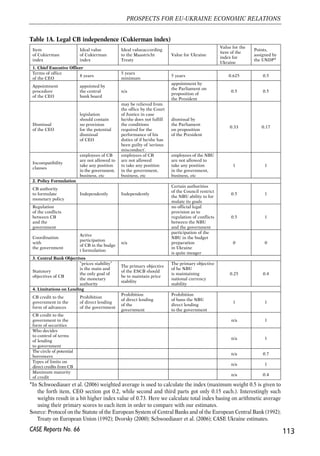
is presented in the Annex 1, and the reader is directed there for details. 
Along with these lines, the EU-Ukraine action plan specifies the primary goal of 
monetary and exchange rate policy reforms as3: 
• Strengthen the independence of the National Bank of Ukraine including, if 
necessary, by amending the ‘Law on the National Bank’ so as to bring it in line 
with EU standards. 
The same target is settled in the Action Plan Implementation Measures for 20054. 
Increasing NBU independence (no change) 
The measurement of central bank independence based on the Cukierman index (see 
Annex 1) suggests that neither the NBU, nor the Ukrainian government fully satisfy 
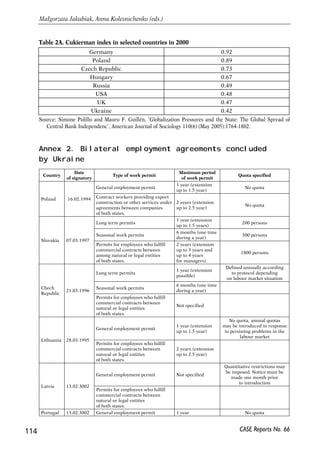
the EU criteria for CBI, both ‘legally’ and de facto. The estimations of the Cukierman 
index for Ukraine range between 0.42 and 0.69, with the estimate calculated for this 
report of 0.52 being in the middle. The result could be interpreted as that ‘degree of 
independence’ of the NBU is 52% from ideal. 
Limited NBU freedom is noticeable even without resorting to a formal analysis. For 
instance, in April 2005 the NBU pressed by the government sharply appreciated 
nominal hryvnia exchange rate. 
Another example may be given by the new draft law that should strengthen 
independent formulation of the monetary policy. At the beginning of June 2006 the 
President of Ukraine submitted to the parliament the draft of this law5 suggesting to 
increase the term of office of the NBU governor from 5 up to 7 years. Besides, it 
banned participation of politicians and Parliament members in the NBU Council. The 
23 
PROSPECTS FOR EU-UKRAINE ECONOMIC RELATIONS 
3 Chapter 2.2, article 19. 
4 The Government of Ukraine annually adopts the Action Plan Implementation Measures. The respective 
measures for 2005 have been adopted by the Regulation of the Cabinet of Ministers of 22 April 2005 No.117 
and for 2006 by the Regulation of the Cabinet of Ministers of 27 April 2006 No 243. 
5 #1039, 05 June 2006. 
CASE Reports No. 66
draft law was rejected by the Parliament. We consider the draft law as quite 
progressive and improving the NBU independence. 
In 2005 and 2006 no actual steps were taken to enhance independence of the 
Ukraine’s central bank. This is to say that no progress was made with implementing 
the respective provision of the action plan. 
Conclusions and recommendations 
On the basis of the analysis presented in the Annex 1, and in the situation where the 
central bank is heavily dependent on the executive bodies, it seems necessary that the 
monetary and exchange rate policy in Ukraine is better managed. In particular, clear 
determination of the monetary policy goal (whether inflation targeting or some other 
regime) would make the whole policy better focused and more transparent. Breaking 
the link between pure politics and decision making in the sphere of monetary policy 
would add transparency to the procedures. Moreover, the cases when the governor of 
the NBU is dismissed should be clearly specified in the law. 
3.3. Fiscal policy and taxation 
The EU/Ukraine action plan defines some general recommendations for fiscal policy 
conduct and adaptation to EU standards. In particular, for fiscal policies it is 
recommended to: 
• reinforce fiscal sustainability, including by implementing tax reforms and by 
taking measures to address medium-term trends in the pension system; 
The achievements in this direction were rather modest. The good point is that 
authorities noted the necessity to implement sustainability requirements. However, 
the political instability does not give any chances to make practical steps in 
construction of efficient medium-term fiscal policy. This section: i) describes the 
attempts of the Ministry of Finance to reinforce fiscal sustainability, ii) draws the 
picture of current problems in the pension system, which destabilise budgetary sector, 
and iii) refers to recent changes in tax policy. 
3.3.1. Fiscal policy conduct 
Fiscal sustainability (weak improvement) 
One-year budget planning has been the usual practice of the fiscal authorities of 
Ukraine during the whole period of independence. In fact political situation 
24 
Małgorzata Jakubiak, Anna Kolesnichenko (eds.) 
CASE Reports No. 66
(frequent dismissal of governments) did not allow efficient reinforcement of fiscal 
sustainability. Moreover, every election additionally destabilized state budget and 
particularly the pension fund. Only in the mid-2005 some steps were made in the 
desired direction: in August 2005 the Ministry of Finance formed a department, 
which was in charge of mid-term strategy and fiscal stability. In general it was 
expected that about four years of election-free period will allow to develop and 
maintain consistent mid-term fiscal policy. 
Pension system (worsened) 
Misbalanced pension system creates significant worries about mid-term 
sustainability of public finances. The situation got even worse after a series of 
pension rises of 2004 and 2005. In fact the Pension Fund ended the year 2005 with 
the deficit of 5% of the GDP. The deficit was financed at the expense of transfers 
from the central budget. The situation calls for the introduction of the ‘second pillar’ 
(a system of mandatory accumulation of funds at personal accounts). This would 
limit bad practices in the future. 
Till now Ukraine has the solidarity-based public pension system. Starting 2003, 
voluntary ‘third pillar’ with private pension funds was introduced; however, the role 
of the private funds is minor. 
It should be noted that successful implementation of the ‘second pillar’ requires good 
financial stance of solidarity-based system since the reform will create additional 
deficit, and require tighter fiscal spending, which are hardly possible in the near 
future. For this reason the introduction of the ‘second pillar’ (planned for the 
beginning of 2009) seems to be unrealistic in the mid-term. 
Meanwhile an improvement of the balance of the Pension Fund could be achieved 
only through the reform of the solidarity-based system. In fact, Ukrainian 
misbalanced demographic structure (2.5 working person per pensioner) create the 
major problems in the pension system. The experts project even worsening of 
demographic situation. It is expected that by 2050 there will be 1.2 persons of the 
working age for every pensioner. The situation is aggravated by large pension 
privileges. For efficient reform of the current solidarity-based system, it is essential to 
increase de jure and de facto retirement age. Moreover, the privileged payments should 
be reduced markedly or even abolished. 
25 
PROSPECTS FOR EU-UKRAINE ECONOMIC RELATIONS 
CASE Reports No. 66
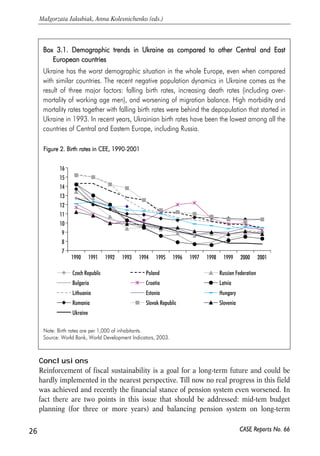
Box 33.1. DDemographic ttrends iin UUkraine aas ccompared tto oother CCentral aand EEast 
Figure 22. BBirth rrates iin CCEE, 11990-22001 
16 
15 
14 
13 
12 
11 
10 
9 
8 
7 
1990 1991 1992 1993 1994 1995 1996 1997 1998 1999 2000 2001 
Czech Republic Poland Russian Federation 
Bulgaria Croatia Latvia 
Lithuania Estonia Hungary 
Romania Slovak Republic Slovenia 
Ukraine 
Conclusions 
Reinforcement of fiscal sustainability is a goal for a long-term future and could be 
hardly implemented in the nearest perspective. Till now no real progress in this field 
was achieved and recently the financial stance of pension system even worsened. In 
fact there are two points in this issue that should be addressed: mid-tem budget 
planning (for three or more years) and balancing pension system on long-term 
26 
Małgorzata Jakubiak, Anna Kolesnichenko (eds.) 
CASE Reports No. 66 
European ccountries 
Ukraine has the worst demographic situation in the whole Europe, even when compared 
with similar countries. The recent negative population dynamics in Ukraine comes as the 
result of three major factors: falling birth rates, increasing death rates (including over-mortality 
of working age men), and worsening of migration balance. High morbidity and 
mortality rates together with falling birth rates were behind the depopulation that started in 
Ukraine in 1993. In recent years, Ukrainian birth rates have been the lowest among all the 
countries of Central and Eastern Europe, including Russia. 
Note: Birth rates are per 1,000 of inhabitants. 
Source: World Bank, World Development Indicators, 2003.
sustainable basis. Efficient implementation of these goals requires several years of 
stable political situation and a strong political will of the authorities. 
3.3.2. Taxation 
The EU/Ukraine action plan lists detailed specific steps that should be taken in the 
field of taxation. Therefore, here follows the separate section devoted to tax policy. 
The major improvement was expected in VAT administration, and in the legislation 
concerning excise taxes. In addition, it was recommended to implement a strategic 
plan of the development of the State Tax Administration. 
The key inconsistency with the EU requirements concerns VAT and excise duties. In 
particular the main discontent was evoked by large volume of privileges on VAT, 
discrimination in the use of promissory notes and arrears on reimbursement of VAT for 
exporters. The major arguments concerning excise were related to privileges for motor-car 
construction and discriminatory rates for imported alcoholic beverages (wine). 
Adoption and implementation of VAT and excise-duty 
legislation compatible with the PCA and WTO norms 
(partial fulfillment) 
Tax privileges on VAT and excise duties plus discretionary import duties on alcoholic 
beverages were the major inconsistency with the EU requirements. In fact all 
privileges were eliminated with the approval of the law ‘On amendments to the state 
budget 2005 and other legislation’ in March 2005. In addition it was introduced 
moratorium for five years on granting any privileges on VAT. 
The only point which is still unresolved concerns discriminatory rates for imported 
alcoholic beverages (wine). In the mid of 2005 there was prepared a draft law which 
suggested elimination of discriminatory rates; however, it was not even submitted for 
consideration of the parliament since the political crisis and the new parliament 
elections were on the focus. If the newly elected parliament works go smoothly, the 
law will be approved in 2006-2007. 
Compatibility of Free Economic Zones with WTO rules 
and start of alignment of Ukrainian legislation on Free 
Zones with EU legislation (fulfilled) 
The major complaints about Free Zones were related to tax privileges which created 
conditions for unfair competition. These distortions were eliminated in one go by the 
law ‘On amendments to the state budget 2005 and other legislation’ in 2005. In 
27 
PROSPECTS FOR EU-UKRAINE ECONOMIC RELATIONS 
CASE Reports No. 66
practice, the zones were abolished. Thus the requirement is completely fulfilled. There 
are risks at the moment (late-2006) that the Free Economic Zones will be brought back 
to life. However, it is yet too early to expect this with high degree of certainty. 
Elimination of discriminatory treatment (fulfilled) 
In fact the issue of discrimination in usage of promissory notes was also resolved with 
the approval of the law ‘On amendments to the state budget 2005 and other 
legislation’ in March 2005. Before enterprises with foreign capital were not eligible 
for usage of promissory notes which obviously created discrimination against specific 
companies. 
Elimination of VAT refund arrears (partial fulfilment) 
The situation with VAT reimbursement continued to be quite complex: the volume of 
VAT frauds was reduced; however, tough controlling procedures do not allow complete 
elimination of VAT arrears. The core of the problem concerns VAT frauds and 
corruption in the State Tax Administration (STA). As of the 1st July of 2006, the volume 
of reimbursement of VAT arrears was about UAH4.6 billion and about UAH0.5 billion 
were overdue. Till the end of 2004 the major volume of VAT arrears was created by STA 
bureaucrats for the purpose of rent seeking. The existence of large arrears were handy 
for the bribe seekers, for the reason that illegal reimbursement was simple to operate. 
As soon as the government of Yulia Timoshenko came into power at the beginning of 
2005, it started the campaign against illegal VAT reimbursement for exporters. In fact 
the volume of VAT frauds reduced sharply; however, arrears were still observed. The 
reason of the accumulation of new arrears was strict control on the whole chain of 
value added. If someone claims for reimbursement of VAT, STA checks all the chain in 
which the obligation occurred (invoices from the beginning of production process). 
Therefore, starting from the beginning of 2005, VAT arrears were created due to long 
bureaucratic procedures of antifraud control. In fact the STA steadily improves the 
reimbursement procedures. Specifically, for simplification of procedures the STA tries 
to use the ‘white list’ i.e. a list of enterprises that adhere to the taxation rules and 
proved to be law-abiding taxpayers. The enterprises included in the list are eligible to 
obtain VAT reimbursements without check-ups. 
Improvement of the functioning of the State Tax 
Administration (weak improvement) 
Important requirement of the EU/Ukraine action plan is implementation of a 
comprehensive strategic plan for the State Tax Administration. Virtually, Ukraine has 
strategic plan of STA development till 2013. It predetermines modernization and 
28 
Małgorzata Jakubiak, Anna Kolesnichenko (eds.) 
CASE Reports No. 66
reform of the institution. The key goals are an increase in the level of voluntary tax 
compliance, creation of partnership relations between STA and tax-payers, 
implementation of transparent and standardized methods of tax-payers servicing. The 
STA created the department of development and modernisation to tackle this issue. 
The department is in charge of the successful implementation of the strategy. 
Box 33.2. PPublic ffinances aand ttax ssystem oof UUkraine 
Budget system of Ukraine consists of consolidated budget, pension fund and three other minor 
social funds. About 44% of GDP (2005) is redistributed through the budget and social funds. 
Social spending and outlays on current needs take the major bulk of public expenditures. 
Tax system of Ukraine includes 22 national taxes and 14 different local taxes. Despite large 
number of various taxes and tollages there are only five taxes that give 90% of tax revenues 
to the consolidated budget. In addition there are mandatory charges to social security funds 
and pension fund. The most important taxes are VAT (20%), enterprise profit tax (25%), 
personal income tax (13%) and pension fund charges (31.8%). 
Conclusions 
Adaptation of taxation system of Ukraine to EU standards showed up significant 
progress recently. The main step in the direction was made after Orange Revolution 
when Timoshenko’s government eliminated almost all tax privileges for sectors and 
Free Zones. Also markedly improvement was achieved with fighting VAT frauds and 
reduction of VAT arrears. 
Still in taxation area there is much room for improvement. Specifically, the State Tax 
Administration requires reforms. In fact such issues like accumulation of arrears are 
closely related to the administrative procedures within the STA. Moreover, there are 
discriminatory rates for imported alcoholic beverages, which are expected to be 
abolished by the new parliament. 
3.4. Structural reforms 
3.4.1. Progress in privatisation 
Article 20 of the EU-Ukraine action plan stipulates to: 
• implement privatization program, including large-scale privatization, and 
• increase transparency of privatization process. 
29 
PROSPECTS FOR EU-UKRAINE ECONOMIC RELATIONS 
CASE Reports No. 66
Legislative basis for privatization (no progress) 
Neither the ‘Law on Privatization Program’ for the years of 2006-2008, nor the ‘Law 
on the State Property Fund of Ukraine’ was adopted. The currently acting outdated 
‘Law on the Program of Privatization’ for the years of 2000-2002 permits non-transparent 
procedures for large-scale privatization, which were widely used in the 
past. In the absence of a modern program of privatization adopted by the legislature, 
selection of assets going to privatization remains non-transparent, and the respective 
criteria remain vague. 
Large-scale privatization (dramatic worsening) 
Privatization of large-scale state-owned enterprises was stopped. Minor stock 
shares in previously privatized enterprises were successfully sold at the stock 
market, with more than $100 million received in revenues (about 2.6 times increase 
year-on-year, yoy). The share of 93.02% of Krivorizhstal’ steel works is a single case 
of a majority stock in a large-scale enterprise sold during this period. However, this 
case should be accounted separately, because the stock has already been sold at an 
undervalued price in 2004, but then in 2005 privatization was declared void by 
court for relatively minor and widespread violation. The end-result (higher revenues 
and more transparent procedure while re-selling) is clearly favourable. However, 
the procedure used for achieving it quickly was largely politicised, and if applied to 
other already privatised assets (as initially advocated; see the section on ‘re-privatisation’ 
below) would result in the worsening on investment climate. 
Therefore, this tender is treated as an outlier in this report. 
The other issue was that this outstanding deal has brought nearly 97% of total 
privatization revenues in 2005. Outside of it, the revenues dropped more than twelve 
times yoy. This trend continued in the first half of 2006, with no large-scale 
enterprises privatized, and revenues constituted only about USD 32 million, four 
times less than in 2005. 
Transparency of privatization process (improved) 
The ‘Law on the Program of Privatization for the years of 2000-2002’ assures that 
the transparent privatization procedures for small-scale enterprises and minor 
asset shares are implemented. Therefore, the lack of the large-scale privatization 
has automatically improved overall transparency of privatization process. A single 
large-scale deal of this period, re-selling of the Krivorizhstal’, was remarkably 
transparent too. 
30 
Małgorzata Jakubiak, Anna Kolesnichenko (eds.) 
CASE Reports No. 66
‘Re-privatization’ (largely worsened the overall situation) 
After the ‘Orange Revolution’, there was an attempt of revision or even partial 
reversal of large-scale privatization deals conducted in the previous years. It was 
motivated by suspected unfairness and losses incurred due to the lack of 
transparency and possible collusions. However, some non-transparent procedures 
were stipulated by the law, while the fact of collusion can hardly be proved. At the 
beginning of 2005 the threat of investigation of three thousands of deals announced 
by the Prime Minister Yulia Timoshenko initiated a massive campaign of complaints 
and lawsuits on less-scale cases across the country. President Yushchenko tried to 
calm down the panic of owners and would-be investors by reducing this number to 
‘thirty or forty’, although still with no transparent criteria for selection. Starting from 
May, 2005 he started distancing himself from re-privatization as such, however still 
supporting a few particular cases. Perhaps, it was a reaction on the negative trends 
in investments, augmented with growing protests against re-privatization among the 
domestic experts and foreign political leaders. In effect, re-privatization campaign 
ended with appointment of the Prime Minister Yuri Yekhanurov known as its 
opponent. Still it was never officially condemned or even stopped, nevertheless a few 
drafts of a respective law were prepared. 
As a result, the government has initiated the lawsuits against a few arbitrary 
selected scapegoats for rather minor and widespread violation of privatization 
procedures. Of them, only one, although the most important case (‘Krivorizhstal’) 
was followed to the end. 
Control over the state-owned assets (improved) 
Comprehensive register of state-owned assets, including shareholding, was mostly 
accomplished. Dividends paid on these assets increased dramatically in 2005, but 
assessment of this fact requires an analysis beyond the scope of this report. 
Conclusions 
The overall balance of progress made in the field of privatisation since late 2004 is 
close to being neutral. Although privatisation revenues in 2005 were high, the 
number was mainly due to the individual transition, that required prior withdrawal 
of the property rights of the earlier, politically-connected buyer. In spite of this, 
privatisation sales were limited to minor assets, and the comprehensive 
privatisation programme for the following years has not been adopted. However, 
there is a progress in the control over the state-owned assets that should limit future 
corruption possibilities. 
31 
PROSPECTS FOR EU-UKRAINE ECONOMIC RELATIONS 
CASE Reports No. 66
3.4.2. Banking regulation and supervision 
The action plan stipulates to (Article 20): 
• strengthen banking regulation and supervision and 
• improve performance of the State Savings Bank (SSB). 
Strengthening banking regulation and supervision 
(not changed yet) 
Strengthening of banking regulation and supervision, as a priority, indicates moving 
to consolidated prudential supervision. During 2005-2006 the central bank had to 
develop methodology of consolidated banking supervision. Apparently, this includes 
combination of conventionally prudential supervision relying on prudential standards 
and those based on risk management. The guidelines for this new approach are 
offered by Basel II recommendations. Currently the NBU is at the stage of 
development of the new methodology and training its personnel on the practicalities 
of introducing risk based supervision. Namely, risk assessment methodology to be 
used by bank inspectors is being finalized. At this point the authors of this report lack 
expertise on the effectiveness of the methodology, as it is still under development. 
The other issue is whether Basel II recommendations are optimal for Ukraine. These 
are now mandatory for all EU owned banks’ consolidate balance sheets. However, 
the requirements were judged as excessively burdensome for Ukraine’s other banks 
in the recent report by CEPS (2006). Therefore (taking also into account the stage of 
the development of the Ukrainian banking system), the efforts would be better 
matched if concentrated on improving the independence and capacities of banking 
sector regulators. 
Performance of the State Savings Bank (improved) 
Removing restrictions applied to SSB is another core direction of activities regarding 
the second part of Article 20 of the Action Plan. The restrictions were imposed in mid 
2003 as a part of conditionality under World Bank Development Loan. The limitations 
included reduction of the SSB assets, limitations on deposit interest rates, etc. As of 
March 2006 SSB still was the 7th largest bank in Ukraine according to assets and 
capital size with statutory capital of some US$ 140 million. 
In May 2006 the Ministry of Finance, the NBU and SSB signed the protocol according 
to which all restrictions on activity of the latter were cancelled. Importantly, that during 
the years restrictions were in force the financial stance of SSB has indeed improved: as 
of the beginning of 2006 its capital was 7 times as high as that in 2003. 
32 
Małgorzata Jakubiak, Anna Kolesnichenko (eds.) 
CASE Reports No. 66
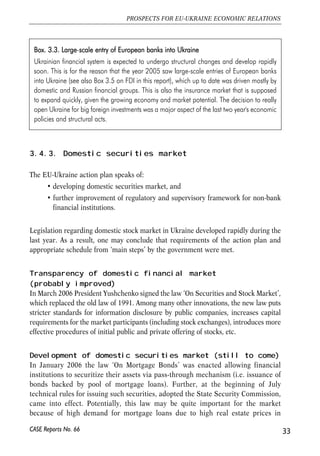
Box. 33.3. LLarge-sscale eentry oof EEuropean bbanks iinto UUkraine 
Ukrainian financial system is expected to undergo structural changes and develop rapidly 
soon. This is for the reason that the year 2005 saw large-scale entries of European banks 
into Ukraine (see also Box 3.5 on FDI in this report), which up to date was driven mostly by 
domestic and Russian financial groups. This is also the insurance market that is supposed 
to expand quickly, given the growing economy and market potential. The decision to really 
open Ukraine for big foreign investments was a major aspect of the last two year's economic 
policies and structural acts. 
3.4.3. Domestic securities market 
The EU-Ukraine action plan speaks of: 
• developing domestic securities market, and 
• further improvement of regulatory and supervisory framework for non-bank 
financial institutions. 
Legislation regarding domestic stock market in Ukraine developed rapidly during the 
last year. As a result, one may conclude that requirements of the action plan and 
appropriate schedule from ‘main steps’ by the government were met. 
Transparency of domestic financial market 
(probably improved) 
In March 2006 President Yushchenko signed the law ‘On Securities and Stock Market’, 
which replaced the old law of 1991. Among many other innovations, the new law puts 
stricter standards for information disclosure by public companies, increases capital 
requirements for the market participants (including stock exchanges), introduces more 
effective procedures of initial public and private offering of stocks, etc. 
Development of domestic securities market (still to come) 
In January 2006 the law ‘On Mortgage Bonds’ was enacted allowing financial 
institutions to securitize their assets via pass-through mechanism (i.e. issuance of 
bonds backed by pool of mortgage loans). Further, at the beginning of July 
technical rules for issuing such securities, adopted the State Security Commission, 
came into effect. Potentially, this law may be quite important for the market 
because of high demand for mortgage loans due to high real estate prices in 
33 
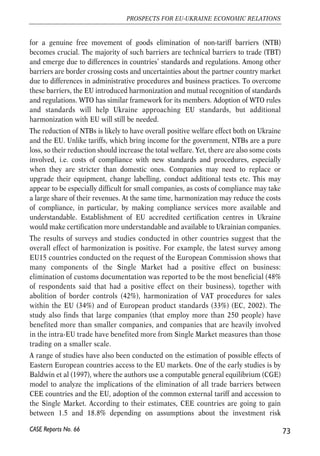
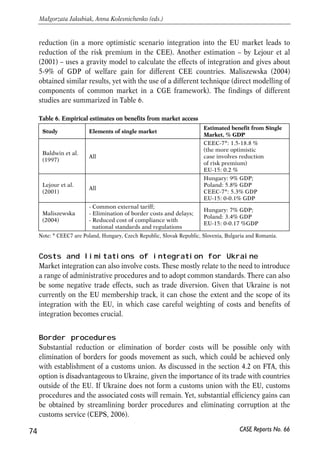
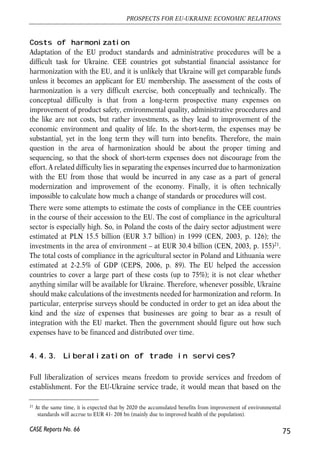
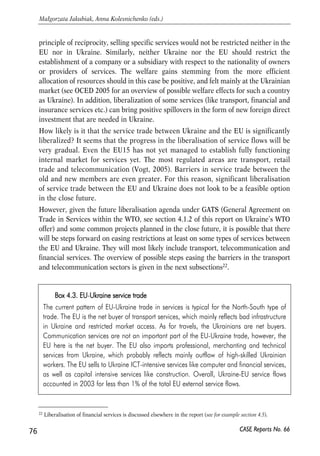
PROSPECTS FOR EU-UKRAINE ECONOMIC RELATIONS 
CASE Reports No. 66
Ukraine (according to Ukrainian National Mortgage Association, Ukrainian banks’ 
mortgage portfolios amounted to UAH 10.6 billion or 7.4% of the total credit 
portfolios as of the end of 2005). However, reliability of these securities is 
questionable because of poor risk management procedures in Ukrainian banks and 
inappropriate regulation of real estate market (recent scandals and frauds make 
mortgage credits more risky for banks). Additionally, since most of the credits are 
in dollar, it makes them more vulnerable to foreign exchange risk. Another 
problem is lack of resources in domestic market. 
The development of legislation on derivatives has been slow. Up to date, the new draft 
law on derivatives has not been yet re-submitted to the Verkhovna Rada. 
Unified register (not changed yet) 
The Ukrainian government aimed also at the improvement of the register of securities. 
The draft law ‘On the System of Depository Accounting of Securities’ is still waiting 
in the Rada. It calls for cancellation of documentary form of securities, unification of 
depository institutions (now there are two of them: registers and custodians), 
unification of the process of keeping registers of joint stock companies, etc. This 
should assist in fighting against double registers and help in protecting property rights 
of shareholders. However, the draft does not mention the transition process from the 
old system to the new one, which may paralyze the stock market for a while. 
Additionally, the role of currently functioning commercial depository in the new 
system is also unclear. However, at the moment (mid-2006), main problems of the 
depository system (such as double registers, weak protection of ownership rights etc.) 
still remain unresolved and these actions can hardly bring improvement. 
Conclusions 
Although many legislative efforts have been in place since 2004, their effects are yet 
to be seen. They will most likely first show in improved transparency of the financial 
market; as a result of stricter standards required by the new law. However, further 
steps are needed in the sphere of legislation on derivatives and unifying registers. At 
the same time, except for the above listed issues, other very important decisions 
ought to be made. Specifically, the law ‘On Joint stock Company’ seems to be the 
most important document regarding further development of domestic market of 
financial services (for more details see below). Introduction of international 
accounting standards has to be complementary, but not less important, action. 
Broadly speaking, there is still much work to be done to boost the development of 
domestic securities market. 
34 
Małgorzata Jakubiak, Anna Kolesnichenko (eds.) 
CASE Reports No. 66
3.4.4. Joint stock company law 
According to the article 20 of the EU-Ukraine action plan adoption of a new Joint 
Stock Company (JSC) law is required in order to: 
• improve the definition of the responsibilities of directors, managers and 
shareholders’ meetings, strengthening disclosure requirements, and increasing 
the protection of minority-shareholder’s rights. 
Joint stock legislation in Ukraine (no change) 
However, the law is not adopted yet. In fact, during the last 6.5 years five different 
drafts of this law were submitted to the Verkhovna Rada, but none of them was 
adopted. All the submitted drafts were firstly admitted by the Rada Main Scientific 
and Expertise Office but then rejected by the Rada itself. 
Now, the law of Ukraine ‘On Business Associations’ (adopted in 1991) directly 
regulates activities of joint stock companies. Also Civil and Commercial codes 
(adopted in 2004) as well as the law ‘On Securities and Stock Market’ (adopted at the 
beginning of 2006) regulate certain aspects of joint stock companies’ activities. The 
law ‘On Business Associations’ has become obsolete and does not cover all the 
contemporary problems of JSC. Its imperfectness is aggravated by discrepancies 
between Civil and Commercial codes. 
Under absence of the JSC law, there are some attempts to improve corporate 
governance in certain individual sectors. Specifically, the draft law #1040 (05 June 
2006) mandates that new banks must be registered as join stock companies, any other 
legal form is prohibited. Partially, some important topics (such as information 
disclosure) are also covered in the new law ‘On Securities and Stock Market’. 
However, it relates only to the public companies and solves only a small number of 
problems in corporate governance. 
Recently, not only the action plan required the law to be adopted but also President’s 
decree #300/2006 (10 April 2006) ‘Schedule of Top-Priority Actions towards 
Investment Activities’ determines this law as the urgent one (the draft should be 
developed and submitted to the Verkhovna Rada during the year 2006). However, as 
one may witness, this important law has not been adopted yet. 
Why the law ‘On Joint Stock Companies’ has not been 
adopted yet? 
Formally cited reason why all of the draft laws submitted during the past six years 
were rejected in Rada, is that they did not intend to improve functioning of joint stock 
35 
PROSPECTS FOR EU-UKRAINE ECONOMIC RELATIONS 
CASE Reports No. 66
companies and protect stockholder interests. When rejecting the last three drafts even 
this sentence was absent. 
The true reason seems to be fear of big asset owners to lose their property rights and to 
give more rights to minority shareholders. And that the big Ukrainian businesses are very 
effective lobbyists. Virtually all draft laws excluded the so called ‘closed’ JSC as a 
possible legal form, which is quite coherent with international practice. It entailed strong 
objections of ‘the biggest owners of assets’: according to the State Commission on 
Securities and Stock Market, there are approximately 36 thousand joint stock companies 
in Ukraine 24 thousand of which are ‘closed’ and only 12 thousands – ‘open’. The biggest 
commercial bank ‘Privat’, one of the biggest bear-beverage company ‘Obolon’, large 
chemical industry ‘Azot’ are among biggest ‘closed’ JSC in Ukraine. 
Consequences of the lack of the legislation 
Above mentioned drafts of the law cover following key issues: 
• Regulation of forms of organization of Joint Stock Companies: ‘closed’ vs. 
‘open’ JSC; 
• Securities of Joint Stock Companies (procedures of issuing, additional issuing); 
• Dividends payment; 
• Regulation of authorities of shareholders meeting and supervisory board; 
• Procedures of decision making by shareholders meeting; 
• Protection of minority shareholders rights; 
• Information disclosure. 
Some economic agents fear that adoption of this law may trigger corporate wars. 
However, current situation, albeit seems to be ‘stable’, is characterized by systematic 
problems of distorted relations within companies and sufficient protection to 
investors is not guaranteed. Recent bright example was the conflict among big 
shareholders (including the State) at Nikopol Ferroalloy Plant (NFP) in 2005. 
Specifically, the plant was privatized in 2003 by Mr. Pinchuk, but this deal was 
contested by the new government and 50%+1 of his shares were frozen by the court 
decision in the middle of 2005. However, at the end it occurred that there were two 
different registers of owners of NFP and even two different meeting of shareholders 
were held. Final resolution of the conflict is still an open question. Another conflict 
took place at the big metallurgical plant ‘Zaporizhstal’: major owners agreed to buy 
out stocks from minor shareholders (who did not agree with additional issuance of 
shares directed at joining of subsidiaries to the plant) at the price, which is several 
times lower than on the market before the conflict. 
36 
Małgorzata Jakubiak, Anna Kolesnichenko (eds.) 
CASE Reports No. 66
In fact, the new law may foster some redistribution of ownership in the economy, but 
this should be only short term shock and long-term ‘equilibrium’ in relations among 
owners and between owners and management will follow. 
Poor corporate governance, bad protection of investors’ rights impede domestic stock 
market development, foreign investments inflow as well. Reform of the pension 
system also suffers as non-state pension funds have no many opportunities to invest 
their resources into reliable assets. 
Currently, the new version of the draft law may be discussed in the Verkhovna Rada, 
authored by the Security Commission and Ukrainian Association of Investment 
Business. The main difference is that the authors intends to hold ‘closed’ JSC, while 
introducing ‘public companies’ with stricter requirements to them. 
Conclusions 
There have been no major change on the front of improvement of corporate 
governance and protection of the minority shareholders’ rights. Not only the long-awaited 
law banning the existence of ‘closed-stock companies’ have not been adopted. 
Even if adopted, it would have to be accompanied by other changes in order to be 
maximally efficient. This would include: the adoption of international accounting 
standards, well-performing depository system, the development of derivatives market, 
clear policy as to financial markets development, tax reforms, elimination of 
discrepancies between the Civil and the Commercial codes, etc. 
3.4.5. Land code 
The EU-Ukraine action plan addresses the problems of land sales and specifically 
restrictions on non-agricultural land ownership for enterprises with foreign capital. 
To resolve this problem it is suggested in the action plan to: 
• Adopt the accompanying legislation necessary for the effective implementation 
of the new Land Code. Remove current restrictions in article 82 of the Land 
Code to non-agricultural land ownership by Ukrainian legal entities with 
foreign stakeholders, including those with 100% foreign ownership. 
The current version of Land Code (2006) restricts non-residents in purchase of non-agricultural 
land. The foreigners are allowed to buy lands only in case of constructing 
buildings and/or purchasing real estate. The same limitations are imposed on 
enterprises with foreign capital. Important, legal entities (residents) with 100% 
foreign ownership are not allowed to buy land at all. 
37 
PROSPECTS FOR EU-UKRAINE ECONOMIC RELATIONS 
CASE Reports No. 66
Abolition of restrictions on land ownership and creation 
of land market (no change) 
The action plan requires abolition of the current restrictions on land ownership. 
There is a draft law ‘On introduction of changes to Land Code of Ukraine regarding 
sales of land to enterprises with foreign capital’. According to the draft law legal 
entities with 100% foreign ownership become eligible to purchase non-agricultural 
land with restrictions (the same as for non-residents). However, the law was not 
approved yet. 
Additional requirement of the action plan concerns creation of legislation basis for 
land market. The draft law ‘About land market’ was already developed. The document 
defines the basic principles of land market formation. Still the document was not 
approved by the parliament. 
3.5. Company law and establishment 
The major requirement of the action plan in the area of company law is creation of a 
favourable environment for company establishment and not to discriminate between 
foreign and domestic companies. In particular, Article 33 demands 
• adoption and effective implementation of competition and bankruptcy 
legislation; 
• implementation of most favoured nation treatment regarding company 
establishment, in particular, national treatment for EU companies and theirs 
Ukrainian subsidiaries; 
• stable conditions for investment; 
• progressive removal of restrictions on company establishment 
• effectiveness of a central coordinating body facilitating establishment of a 
company 
Permit system (positive record, but could be better) 
In 2005, Ukrainian authorities made significant progress in the area of regulations of 
company establishment. The most important was the adoption of the ‘Law of Ukraine 
on Business Permit System’ (Verkhovna Rada, 2005b) that laid fundamental 
principles of state policy in the sphere of business permits. Among other things, the 
law simplified permitting procedure and defined administrative liability of 
government officials in case they break the rules. Adoption of the law was among the 
priority measures that the Ukrainian Government envisaged in its Activities on 
38 
Małgorzata Jakubiak, Anna Kolesnichenko (eds.) 
CASE Reports No. 66
Implementation of the EU-Ukraine action plan. Yet, implementation of the law has 
been so far unsatisfactory: government agencies have not prepared supplementary 
documents stipulated by the law, in particular regarding the abolishment of permits 
and reduction of permit fees. Moreover, the law demanded that the government 
should conduct a legislative monitoring and make conclusions regarding the necessity 
of certain remaining permits, which it has not done. 
Bankruptcy procedures (no progress) 
Ukraine has a fairly good bankruptcy law, called ‘The Law of Ukraine On Restoration 
of Debtor Solvency or Declaration of Bankruptcy’, which came into force in 2000. It 
was repeatedly improved over last few years, yet some problems remain. In 
particular, there exist another law – ‘On Moratorium for Mandatory Sale of Assets’, 
adopted in 2001 – which substantially restricts the disposal of assets of state-owned 
enterprises in which the state share constitutes 25% or more. As a result, creditors 
find it quite difficult to sell assets of such companies during the bankruptcy 
proceedings. Another drawback of the Bankruptcy Law is that gives priority to state 
tax bodies over other creditors in the order of satisfying creditor claims, which means 
discrimination of creditors. Over the period considered (January 2005-July 2006) no 
changes in laws relating to bankruptcy procedures were adopted. 
Changes in investment conditions (improved, but with 
caveats) 
Year 2005 saw a major change in the conditions of operation of companies in free 
economic zones. At the end of March 2005, the parliament adopted changes to the 
Budget law for 2005 that, among other things, included abolition of tax privileges for 
free economic zones (FEZ) (Verkhovna Rada, 2005a). Practically all privileges for 
FEZ were abolished (exemption of imports of materials and spare parts from VAT and 
import duties, lower profit taxes and no taxes on investments, low or no land tax). 
Although the abolition of privileges was justified (it is a part of WTO requirements and 
was demanded in the action plan; see section 3.3.2 on tax reform earlier in this 
report), the way it was done is subject to criticism. Firstly, it was made without prior 
information given to those affected. Secondly, it was sometimes applied ex-post. For 
example, the decreased ceiling for application of the VAT tax was applied to the 
incomes received before the introduction of the amendments, so that many business 
entities appeared to surpass the new ceiling. These amendments were strongly 
opposed by the businesses affected and, eventually, some of the privileges were 
returned. Overall, cancelling of privileges led to the improvement of the business 
environment, but this could have been done better. 
39 
PROSPECTS FOR EU-UKRAINE ECONOMIC RELATIONS 
CASE Reports No. 66
Conclusions 
Overall, Ukraine’s record in the area of company law and establishment is mixed: 
while in some areas, such as permit system, there was a substantial progress, at least 
in terms of legislative initiatives, in other areas the progress was quite limited. 
3.6. Competition policy 
The EU-Ukraine action plan lists the following priorities in the field of competition 
policy: 
• draft and adopt state aid legislation; 
• assess adequacy and compatibility of the current legislative framework with 
the EU standards, particularly in respect to the principles of non-discrimination, 
transparency and procedural fairness; 
• continue to reinforce independence of the Anti-monopoly Committee, ensure 
adequate legal powers and resources; and reinforce staff training. 
Before moving to the analysis of what actions were taken since the release of the EU-Ukraine 
Action Plan we will give a short background of how the competition policy in 
Ukraine evolved over the last few years and what have been its successes and main 
weak points. 
Evolution of competition policy in Ukraine 
First anti-monopoly law in Ukraine was created in 1992. The Anti-Monopoly 
Committee of Ukraine (AMCU) became fully operational in 1995. Modern competition 
law was adopted in 2001. 
At present, the AMCU works on the basis of the 2001 Competition Law and deals 
with merger controls, concerted practices, abuses of dominant position, anti-competitive 
actions of state and local government authorities, and unfair 
competition. After 1998 until early 2000s, the AMCU progressed in implementation 
of competition policy: inspections were better focused – fewer and of shorter 
durations, amounts of fines paid was increasing, as well as successes in termination 
of anticompetitive practices. 
Yet, there have been also weak points in the activity of the Ukrainian competition 
office. Since mid-1990s independence of AMCU was reduced. The competition law 
has been implemented selectively, avoiding large and ‘connected’ businesses. Still 
weak judiciary has been putting too much pressure on AMCU. Moreover, AMCU has 
40 
Małgorzata Jakubiak, Anna Kolesnichenko (eds.) 
CASE Reports No. 66
functioned in very regulated environment and has often fought against consequences 
of high entry barriers instead of preventing them. As a consequence, competition 
policy has not became an integral component of the overall economic policy. Next 
four sub-sections analyse changes in the sphere of competition legislation and 
competition policy that have happened in Ukraine since 2004. 
State aid (worsened) 
The consistent law on state aid is still missing. There exist specific regulations on state 
aid in some sectors, but a general law putting all state aid under the AMCU 
jurisdiction is absent. 
The situation got even worse when compared to late 2004, when hopes about passing 
the draft law in the Rada were high. The law On State Aid was drafted in 2003 
(Verkhovna Rada, 2004a). It was much needed, for the following reasons: 
• Usually an efficient competition regulation consist of: competition and consumer 
protection regulations, and state aid monitoring. Ukraine has good regulations 
concerning the first two areas, and AMCU has accumulated some experience in 
dealing with protection of consumers and competition. It would be desirable to 
move on and monitor state aid. 
• Ukraine agreed that it would like to harmonise its competition legislation with 
that of the EU. The need for this law was not only put as a priority in the EU-Ukraine 
action plan. It was already outlined in the Partnership and Cooperation 
Agreement between the EU and Ukraine, in 1998. 
• The estimate of state aid granted to enterprises is as high as one fourth of 
Ukrainian GDP with the major part of it in an indirect form (as tax privileges for 
example), which is particularly harmful to competition (BRC, 2004). 
The draft law of 2003 was supposed to put all state aid under the AMCU jurisdiction 
and promote gradual reductions in its total size. It would have been the big step 
forward, even though it was not considered as perfect6. 
The first reading of the law took place on April 29, 2004. The law was judged as 
addressing existing problems and recommended for the second reading, after some 
minor corrections. The second reading took place on December 22, 2004. The 
decision of the Rada was surprising. The law was not passed and taken away for 
further work. The explanation was that the draft law was ‘creating a base for fraud 
and corruption’ (Verkhovna Rada, 2004a-d). 
41 
PROSPECTS FOR EU-UKRAINE ECONOMIC RELATIONS 
6 Some experts perceive that this draft law should have been reshaped as, among others, it did not fully address 
the issue of transparency and clear and well-defined procedures (BRC, 2004). 
CASE Reports No. 66
Some months later, the text of the draft law was removed from the web site of AMCU. 
The annual reports of AMCU for 2004 and 2005 stopped mentioning it. 
Compatibility of antitrust law with that of the EU: 
especially what regards principles of non-discrimination, 
transparency and procedural fairness (no change) 
The AMCU reports to work on the propositions of regulations and amendments to the 
existing acts that would make the antitrust legislation more compatible with the EU 
one. These works seem to intensify in 2006, and one of the effects is the draft law on 
the ‘procedural competition code’ (on the basis of AMCU, 2006). However, so far 
there are not any proposals registered in the Parliament which would aim to 
significantly add or change current legislation (Pustovit, Marks, 2006: p. 5). The acts 
and regulations that are binding now, date back to years 1993-2002 (Pustovit, Marks, 
2006: p. 1, AMCU, 2006). 
Reinforce the independence of the Anti-Monopoly Committee 
(no change) 
Nothing has been done in the sphere of reinforcing AMCU’s independence. Similarly 
as in 2004, the Anti-Monopoly Committee is still too much dependent on the central 
government. As a result of the changes in the 1996 law governing the role and 
operations of AMCU with the adoption of Ukraine’s constitution, the chairman is no 
longer chosen by the Rada, but is appointed and dismissed by the president, after the 
Rada’s consent. In fact, the current chairman in office since 2001, was appointed by 
the president of Ukraine. The commissioners – earlier appointed by the chairman and 
approved by the parliament, are now appointed and dismissed by the president, based 
on the proposals by the cabinet of ministers. These moves clearly increased in the past 
the Committee dependence on executive bodies, which is not a desirable outcome as 
it reduces the chances to address the issue of competition in a more effective way. No 
moves reversing the situation have been taken since 2004. 
Reinforce AMCU staff training (progress) 
During 2003-2005 the Antimonopoly Committee of Ukraine has participated in the 
TACIS project ‘Legal and Institutional basis for competition protection’. Project 
aimed – among others – at rising skills of the personnel of the Antimonopoly 
Committee, development of IT infrastructure of AMCU, and support of AMCU’s public 
relation strategy in order to disseminate knowledge about protection of competition 
(AMCU, 2006). 
42 
Małgorzata Jakubiak, Anna Kolesnichenko (eds.) 
CASE Reports No. 66
43 
PROSPECTS FOR EU-UKRAINE ECONOMIC RELATIONS 
Box. 33.4. EEnforcement oof ccompetition llaw iin UUkraine 
The number of fines imposed upon the business entities and individuals or violations of 
competition legislation and collected decreased both in 2004 and in 2005. 
Table 33. AAmounts ppaid aas ffines aand iillegal bbenefits aas aa rresult oof AAMCU aactions, 11998-22005 
1998 1999 2000 2001 2002 2003 200420 05 
in EUR million 5.55 7.043. 69 6.90 12.26 7.94 6.12 5.00 
Source: AMCU Annual Reports, various editions, converted from hryvnas at the average yearly exchange rate. 
During 2004-2005 AMCU continued to reveal more violations of competition legislation, 
as compared with earlier years. Total number of revealed violations was in the range of 2- 
2.7 thousands cases in 2002-2003. It increased to 3.4 thousands in 2004 and then fell a 
bit in 2005, to 3.2 thousand cases. 
Figure 33. RRevealed vviolations oof ccompetition llegislation, nnumber oof ccases, 11995-22003 
1800 
1600 
1400 
1200 
1000 
800 
600 
400 
200 
0 
1995 1996 1997 1998 1999 2001 2002 2003 2004 2005 2006 
Source: AMCU Annual Reports, various editions. 
Abuse of monopoly position was the most frequently revealed in 2004-2005 and number 
of revealed violations increased in recent years (see Figure 3). Then followed anticompetitive 
actions of state bodies. 
However, it seems that the actions towards the reduction of monopoly positions by the 
AMCU have not been very effective. At least in 2004. Concentration of production within 
the group of largest enterprises increased in 2004, as opposed to 2003 (Kostusev et al, 
2006: pp. 11-12). This is to say that the monopolisation of production increased. On the 
top of it, the Committee reverted to the bad old practice of price controls (like in early 
1990s), which in fact lowered competition (see part 3.1 on market economy in this report). 
CASE Reports No. 66 
abuse of monopoly 
position 
anticompetitive 
actions of state 
bodies 
anticompetitive 
collusive actions 
unfair competition
General perception of competition among entrepreneurs 
Increased monopolisation of the domestic market was apparent in 2004 (see the 
text box). Judging by the perception of Ukrainian business, this negative tendency 
continued in 2005. Ukrainian enterprises reported that they felt smaller 
competition from the side of other Ukrainian firms in 2005, as compared with 
2004. About 52% of respondents (out of the sample of 3,500 firms) replied that 
they face high competition from other domestic agents (56% gave the same 
answer in 2004). The share of enterprises perceiving ‘domestic’ competition as 
‘moderate’ increased (from 33% in 2004 to 34% in 2005). Also, the share of 
respondents perceiving domestic competition as ‘weak’ or ‘nonexistent’ rose 
(from 11% in 2004 to 14% in 2005) (Kostusev et al, 2006: pp. 25-26). Ukrainian 
firms feel that the competition from the side of firms located abroad is much 
lower than domestic one. The weaker perception of competition in 2005 is 
probably a sign of increased monopolisation and still high protection of the 
domestic market. 
Conclusions 
During the last two years, almost no significant step has been made in the field of 
competition legislation. The much needed law on state aid was rejected by the 
parliament in late 2004. Currently, the Antimonopoly Committee works on 
regulations supporting procedures of competition enforcement. The future will show 
what are the effects of these works. 
In the meantime, negative tendencies have appeared on the domestic market. The 
degree of concentration increased, number of revealed violations of competition 
legislation rose, and less firms perceived high competition from the side of other 
economic agents. On the top of it, the Committee started to use extensively price 
controls, which can only lower competition. 
Overall, meeting priorities related to the protection of competition of the EU-Ukraine 
action plan to date are assessed as unsatisfactory. It seems that the only commitment 
that was completed by the AMCU was that about the AMCU capacity building. Yet, the 
perspectives of the most important goal – state aid legislation – now look worse than 
in the period of drafting of the action plan. 
3.7. Public procurement 
List of actions of the EU-Ukraine action plan related to the government procurement 
procedures includes: 
44 
Małgorzata Jakubiak, Anna Kolesnichenko (eds.) 
CASE Reports No. 66
• improve the functioning of the current system; 
• approximate Ukrainian legislation to EU legislation on public procurement; 
• ensure the possibility of independent review in the event of disputes; 
• ensure proper dissemination of information on public procurement; 
• apply modern e-tendering technologies in public procurement; 
• facilitate the effective, reciprocal and gradual opening of public procurement 
markets. 
Current state of affairs, approximation toward EU 
legislation (worsened) 
The overall value of public procurement in Ukraine in 2005 equalled UAH 20.75 
billion (about 4.9% of GDP). Expanding capacities of state and local budgets and 
increasing number of investment projects fulfilled at the expense of public resources 
require effective control over the procurement practices. Given weak institutional 
basis for open, fair and competitive public procurement in Ukraine, it turned out one 
of most non-transparent and closed spheres of economic activities. Enormous space 
for improvement of procurement quality and reduction of related costs exists. 
However, this requires adequate legislative and administrative reforms. 
The framework law ‘On public procurement of goods, services and works’ has been 
adopted in February 2000 and since then it was amended 9 times. The law lists 
institutions which are obliged to organize tenders: public central and regional 
administrations, companies founded by state or regional power bodies, and 
companies more than 50% of whose statutory fund is owned by the state. This 
contrasts with the EU legislation on public procurement which does not cover entities 
carrying out economic activities of commercial nature. The provisions of the law are 
to be applied to public supplies or services provision if estimated value of the contract 
exceeds UAH 30 thousand and to public works contracts if their estimated value 
exceeds UAH 300 thousand. Originally the Cabinet of Ministers delegated functions of 
the procurement coordination, monitoring and control to the Ministry of Economy. 
In June 2005 the law was amended and new control body – Tender Chamber of 
Ukraine (TCU) was created. The TCU has the right to provide expertise as to the 
lawfulness of the procurement, identify printed editions and Internet portals which 
qualify for dissemination of ads on public procurement and publish a special 
informational bulletin with ads on procurement. Noteworthy, the decisions of the 
TCU can be contested only through the courts. 
As a result of the latest amendments (December 2005) Antimonopoly Committee 
became the main body responsible for smooth functioning of tender process in 
45 
PROSPECTS FOR EU-UKRAINE ECONOMIC RELATIONS 
CASE Reports No. 66
Ukraine. The functions of control over the public procurement were dispersed among 
6 executive bodies7, Parliament (controlling the process through the Accounting 
Chamber), and TCU. This makes the procurement monitoring and control system 
really cumbersome and inefficient. The major concerns about the new version of the 
law on public procurement are related to the following: 
• Antimonopoly Committee is given the rights which are out of scope of authorities 
of antimonopoly offices in the EU countries; 
• Tender Chamber of Ukraine which is a union of NGOs is given the rights which 
should be delegated to bodies of executive power, in particular, provision of 
expertise in case of procurement disputes; 
• The special Commission within the Accounting Chamber of Ukraine is a full-right 
party of public procurement. This is a violation of basic principles of 
division of functions of legislative and executive power. 
Independent review in the event of disputes (no change) 
In case of disputes the parties are given the right to appeal against the procurement 
results. The complaint is sent either to the contracting party or to the Commission as 
well as to the TCU. Interested party has the right to appeal against the decision of 
Commission or contracting authority to the court. The law does not, however, permit 
to question the lawfulness of choice of the procurement procedure and application of 
provisions related to preferences granted to national suppliers. 
Dissemination of information on public procurement 
(worsened) 
Contracting authority has to publish yearly plan on procurement and information 
about every procurement scheduled. According to the law the information has to be 
placed in three different sources: 1) one of specialized country-wide publications on 
public procurement; 2) informational bulletin of the TCU; 3) one of the public 
procurement informational system in Internet. Ads on public procurement with 
estimated value exceeding a certain threshold level are to be published in English. 
As of August 2006 the market of public procurement information services in Internet 
was monopolized by one company. In September 2006 the Antimonopoly Committee 
acknowledged the monopoly power abuse of the company which set unjustified high 
prices for its services and provided tied complementary services and fined the owner 
of the portal for UAH 100 thousand. 
46 
Małgorzata Jakubiak, Anna Kolesnichenko (eds.) 
7 Cabinet of Ministers of Ukraine, Main Control and Revision Office in Ukraine, Antimonopoly Committee of 
Ukraine, State Treasury, Ministry of Agricultural Policy, and authorized statistical agency. 
CASE Reports No. 66
Opening of public procurement markets (weak improvement) 
Until 2000 the Cabinet of Ministers of Ukraine’s (CMU) decree explicitly prohibited 
participation of non-resident suppliers in public procurement. Currently the law 
grants equal access of residents and non-residents to public tenders and information 
relevant to public procurement. However, there are substantial limits for equal 
competition between domestic and foreign suppliers in several respects: 
• domestic producers have 10% price advantage over foreign suppliers (their price 
ask is reduced by 10% when compared to proposals of foreign competitors) if the 
value of contract is lower than EURO 200 thousand for goods, EURO 300 
thousand for services and EURO 4 million for works; 
• if, according to the contract, services or works are to be performed by a non-resident, 
the contracting authority may require fulfilment of the contract with 
usage of domestic materials and labour. 
Ukrainian legislation does not discriminate between foreign suppliers based on 
country or residence. Most Favoured Nation (MFN) regime is granted for all non-resident 
procurement participants. Since the beginning of 2005 no reciprocal 
concessions as to the access of non-residents to procurement procedures in Ukraine 
or the European Union have been made. Noteworthy, Ukraine committed to start 
negotiations on joining the WTO multilateral Agreement on Government Procurement 
upon accession to the WTO. 
Public procurement trends 
According to reports of TCU, Main Control and Revision Office and Accounting 
Chamber public procurements in Ukraine are frequently linked with violation of laws. 
No significant improvement in procurement procedures was observed in recent years. 
Most of violations registered by the control bodies are related to dissemination of 
incomplete information about terms of procurement, granting access to procurement 
for suppliers which do not qualify for tender, violation of time constraints as to the 
procurement procedure. According to Main Control and Revision Office in Ukraine in 
2005 about UAH 252 million of budgetary funds were spent without a procurement 
procedure which is a direct violation of law. 
The competition between suppliers remains rather low. In 2005 on average 2.6 and 
2.17 participants competed in open tenders and tenders with limited number of 
participants respectively. This is a slight reduction compared with 2.64 and 2.24 
participants respectively in 2004. 
47 
PROSPECTS FOR EU-UKRAINE ECONOMIC RELATIONS 
CASE Reports No. 66
Conclusions 
The latest amendments to the law ‘On Public Procurement’ (December 2005) are 
step back from the situation at the beginning of 2006. Despite essential legislative 
changes implemented since the end of 2005 the institutional basis for competitive 
and transparent procurements remains very weak. Complaints about violations 
during public procurement procedures are still numerous both on the side of 
suppliers and contractors. 
Some of the provisions of the current law (i.e. those defining the circle of procurement 
participants, authorized control institutions etc.) are in direct conflict with the EU 
legislation. The previous version (in action before March 2006) of the law seems to be 
much closer to the EU standards. Although it could serve as a solid base for further 
improvements, the recent amendments led to the deterioration of the document. In 
particular, the market of services for dissemination of public procurement information 
was completely monopolized. Besides, the execution of checks and balances in the 
sphere of government procurement substantially worsened. 
Revision of the law on public procurement remains on the agenda of economic 
reforms in Ukraine. In view of this the President of Ukraine ordered the Cabinet of 
Minister to draft a new law on public procurement. 
No substantial progress in fulfilling the provisions of the EU-Ukraine action plan with 
regard to public procurement can be reported as of now. 
3.8. Foreign trade 
According to the EU-Ukraine action plan in the sphere of movement of goods Ukraine 
should concentrate on the following issues: 
• Implementation of the provisions of the PCA in the sphere of trade in goods, 
liberalization of trade in steel products; 
• Accession to the WTO, implementation of bilateral commitments; 
• Implementation of customs legislation in line with the EU standards, improvement 
of customs service functioning; 
• Alignment with the EU regulatory practices; preparation to participation in the 
EU internal market; 
• Facilitation of movement of goods through prevention of new discriminatory 
measures; 
• Increase of food safety, modernization of sanitary and phytosanitary measures. 
48 
Małgorzata Jakubiak, Anna Kolesnichenko (eds.) 
CASE Reports No. 66
Implementation of PCA in the sphere of trade in goods, 
liberalization of trade in steel products (no change) 
Strictly in line with the provisions of PCA Ukraine grants MFN regime for the EU 
producers in domestic market. Imports from the EU are not discriminated based on 
the country of origin. Ukraine does not impose any quantitative restrictions on 
imports from the EU Member States. 
Ukraine failed to liberalize trade in steel products by reducing export duties on 
ferrous scrap metal. Currently an export duty of EURO 30 per ton is imposed on scrap 
metal. The bilateral steel agreement between Ukraine and the EU envisages gradual 
removal of trade barriers in the steel sector, including phasing out export duties on 
the export of scrap metal. The Cabinet of Ministers submitted to the Parliament the 
draft law suggesting two-stage reduction of duty down to EURO 12 per ton. However, 
the Parliament refused to include the draft law to the agenda several times. Currently, 
the Cabinet of Ministers resubmitted the document. 
Accession to the WTO, implementation of bilateral 
commitments (improvement) 
As of June 2006 Ukraine completed bilateral negotiations with all WTO Working Party 
Members apart from Kyrgyzstan. In particular, in February-March 2006 the long-awaited 
bilateral agreements with the USA and Australia have been signed. 
Government declared its firm intention to reach a consensus with Kyrgyzstan in the 
shortest possible period. 
The fulfilment of commitments under bilateral agreements has been successful. The 
most significant progress was achieved in the sphere of reforming the import tariffs. 
During 2005 the Parliament amended the law on Customs Tariff four times, reducing 
import duties for over 70% of the commodity nomenclature. Most specific and 
combined tariffs have been transformed into ad valorem tariffs. According to 
government officials, most of the new tariffs are fully in line with Ukraine’s 
commitments under bilateral agreements and no drastic changes of the customs tariff 
will be required in the event of Ukraine’s accession to the WTO. However, there is 
a number of commitments, which should be implemented more systematically. The 
most important of these are the following: adoption of quota for raw cane sugar, 
allowances to establish foreign bank’s subsidiaries in Ukraine, reduction of barriers 
for export of scrap of ferrous and non-ferrous metals. 
The work on harmonization of legislation in line with WTO norms was intensified and 
resulted in an adoption of a dozen of laws and other normative acts. However, as of June 
2006 the Ukrainian Ministry of Economy still identifies about 15 draft laws which need 
to be adopted before Working Party takes final decision on Ukraine’s accession. 
49 
PROSPECTS FOR EU-UKRAINE ECONOMIC RELATIONS 
CASE Reports No. 66
Implementation of customs legislation in line with EU 
standards, improved functioning of customs service 
(some progress) 
In most respects the Customs Code of Ukraine enacted since the beginning of 2004 is 
fully compatible with the WTO and the EU customs regulations, including those in the 
area of customs valuation. However, several concerns exist about the loose and 
frequently inadequate interpretation of the norms and their practical implementation 
by the customs officers. The procedures of customs valuation are not clearly defined 
in by-laws. The problem can be settled by adopting the Order of Methodological 
Recommendations of Certain Provisions of the Customs Code of Ukraine, which has 
been drafted by the State Customs Office. 
In April 2005, the government introduced a unified approach for all international 
trade related documents. Importers and exporters have to submit one package of 
documents to the customs office and receive the required permissions. Following the 
Contraband Stop Program initiative in March 2005, the Customs service introduced 
risk based customs control. According to the statistics for the first five months of 2005, 
in about 15% of cases of customs operations the customs value of imported 
commodities has been corrected. 
Most of the reforms in the sphere of customs control were implemented in 2005. 
Unfortunately, in 2006 no new initiatives have been put forward. Neither the 
government nor the customs service made any single steps to strengthen the 
developments of 2005. The customs service seems to lack long-run oriented strategic 
planning for fulfilling the tasks specified in the EU-Ukraine action plan. 
Facilitate movement of goods through prevention of new 
discriminatory measures (weak improvement) 
Ukrainian government failed to bring licensing procedures in line with the WTO 
Agreement on Import Licensing and PCA article 20. The commodities, the import and 
export of which is subject to licensing, are determined by the Cabinet of Ministries on 
annual basis. Although most of commodities subject to obligatory licensing in 2006 is 
in full accordance with the respective agreement, some of them (for example, beef, 
pork, cows and pigs) should be excluded from the decree since their licensing cannot 
be justified as means of consumer health protection. Obligatory non-automatic 
licensing is deemed as a non-tariff trade barrier in this case. 
Several important measures have been taken to improve access of market participants to 
information relevant to external trade. Formally all interested parties are given the 
opportunity to comment on the drafts of decisions of parliament and government. 
However, in some cases decisions are taken without any prior discussion and without 
50 
Małgorzata Jakubiak, Anna Kolesnichenko (eds.) 
CASE Reports No. 66
accounting for position of exporters, importers, or manufacturers. To facilitate access of 
all interested parties to information on trade in goods, the government created national 
enquiry service in March 2006 (Center for Inquiries of WTO members and WTO). 
Increase food safety, modernize sanitary 
and phytosanitary measures (weak improvement) 
Since the beginning of 2005 Ukraine made several attempts to modernize sanitary and 
phytosanitary measures. In particular, in September 2006, an amendment of the ‘Law 
on Quality and Safety of Food Staff and Food Materials’ was adopted by the parliament. 
In its essence it fully replaces the text of the outdated law of 2002 and is aimed at 
harmonization of national food safety legislation with the requirement of the WTO SPS 
agreement (WTO Agreement on the Application of Sanitary and Phytosanitary 
Measures). Another important law on ‘Veterinary Medicine’ was adopted in December 
2005. However, the President vetoed the law. His major concerns were related to the 
status of the central body in the sphere of veterinary medicine. The law with the 
President’s comments is being currently reviewed by the Parliament. 
The Government did very modest analytical work under commitments envisaged in 
the action plan such as comparative assessment of Ukrainian legislation and revision 
of the list of measures for gradual convergence to the EU principles. Most of the 
analytical work as to the analysis and drafting of legislature is done by TACIS and 
USAID international programs of technical assistance. Similarly, there is no evidence 
that the Government took any essential measures to implement Hazard Analysis and 
Critical Control Point (HACCP) system within enterprises and controlling bodies, and 
whether it reviewed the national laboratory network and prepared for their 
accreditation in compliance with ISO standards. 
Meanwhile a first step has been made toward functioning sanitary and phytosanitary 
measures enquiry point. However, the creation and functioning of information system 
is still an on-going issue. In 2006 Ukraine adhered to the International Plant 
Protection Convention 2006 and continued to work in Codex Alimentarius 
Commission. 
In general the fulfilment of Ukraine’s commitments in the sphere of sanitary and 
phytosanitary control as of today remain unsatisfactory. Despite the adoption of the main 
regulatory act, the remaining domains of work have not been given adequate attention. 
Conclusions 
The overall progress of trade regime reforms in Ukraine is not even across different 
domains. In general it can be evaluated as satisfactory. Most of reform measures have 
been taken during 2005 with slight deceleration of trade policy reform since the 
51 
PROSPECTS FOR EU-UKRAINE ECONOMIC RELATIONS 
CASE Reports No. 66
beginning of 2006. In particular, the negotiations on Ukraine’s WTO accession were 
quite successful and Ukraine managed to demonstrate its firm intent to modernize the 
trade rules in accordance with international practices. Some problems impeding the 
dynamics of the reforms still remain. In particular, the government pays inadequate 
attention and makes insufficient efforts to speed up harmonization of sanitary and 
phytosanitary regulations and implement new HACCP system across enterprises. 
Customs procedures also remain complicated and burdensome for exporters and 
importers despite some current improvement. The overall progress in reforms gives, 
however, premises to expect successful implementation of the action plan trade-related 
provisions soon. 
3.9. Movement of capital and current payments 
The action plan specifies: 
• full removal of restrictions on flows related to direct foreign investments and 
• initiation of consultations on liberalizations of other capital movements. 
In particular, Ukraine committed to achieve free movement of capital relating to 
direct investments; guarantee the protection of foreign investments as well as 
liquidation or repatriation of these investments and associated profits8. 
These particular provisions of the action plan are not accompanied with underlying 
concrete measures in the Action Plan Implementation Measures9. Therefore, major 
regulatory changes related to capital transactions that were introduced from 2005 
until mid-2006 are analysed in this report. Te capital controls classification used here 
is that of the IMF10. 
Removing of restrictions on long-term capital flows 
(improved) 
The noticeable improvement during the last year was simplification of transaction 
rules on foreign investments, and repatriation of profits, dividends and income from 
liquidated investment. In May 2005 the National Bank of Ukraine cancelled the 
52 
Małgorzata Jakubiak, Anna Kolesnichenko (eds.) 
8 EU-Ukraine Action Plan, Article 2.3.3 Movement of capital and current payments. 
9 The Government of Ukraine annually adopts the Action Plan Implementation Measures. 
10 See, for example, Annual Report on Exchange Rate Arrangements and Exchange Restrictions, 2005, 
International Monetary Fund. Controls on capital transactions include controls on capital and money market 
instruments; controls on derivatives and other instruments; controls on credit organizations; controls on 
direct investments and their liquidation; controls on real estate transactions; controls on personal capital 
transactions; provisions specific to credit institutions; provisions specific to institutional investors; other 
controls imposed by security law. 
CASE Reports No. 66
resolution11 with numerous restrictive procedures on making, selling and 
repatriation of foreign investments in Ukraine. According to this resolution 
investments were to be made in money form only. Also, a foreign investor could not 
make direct foreign currency contributions to charter capital of a Ukrainian 
company. To make such contribution a foreign investor had to open a so called 
investment account with an authorized Ukrainian bank, then transfer hard currency 
destined for investment to that account, convert it into Ukrainian hryvnia and, 
finally, transfer the money to a recipient Ukrainian company. Similar procedures of 
using investment accounts (with an Ukrainian bank) had to be followed to buy/sell 
corporate rights in an Ukrainian company, even when the transacting parties are 
both non-residents and transaction takes place outside Ukraine. Foreign investors 
wishing to repatriate dividends or to withdraw and repatriate their investment 
faced the same requirement of opening and carrying out all the operations through 
the investment account. 
This regulation was a typical example of a poorly designed mechanism that just 
inflates transaction costs for investors and domestic banks without obvious benefit of 
helping the regulator to manage the volatility of the associated financial flows. We 
consider a cancellation of the aforementioned resolution to be an explicit step forward 
in liberalization of foreign investment flows. 
Acting NBU Resolution on foreign investment transactions12 was introduced in 
August 2005 and permits to directly transfer money from investor’s account in a 
foreign bank to recipient firm’s account. This applies to direct and portfolio 
investments. Investment accounts can be used, but they are not mandatory. Almost all 
controls related to payment of dividends, repatriation of profits, repatriation of 
liquidated investments are removed and those could be arranged through direct 
payments abroad. At the same time rules on operations between non-residents 
involving corporate rights in an Ukrainian company remained unchanged. Such 
operations have to be carried out through domestic banks via the old burdensome 
mechanism (described above). 
Having analyzed liberalization steps related to foreign investment flows we conclude 
that Ukrainian government made reasonable progress in removing capital controls on 
direct investment transactions and transactions associated with their liquidation or 
repatriation. 
53 
PROSPECTS FOR EU-UKRAINE ECONOMIC RELATIONS 
11 Resolution of the National bank of Ukraine N482 ‘On Approving the Regulations on the Procedure for Making 
Monetary Foreign Investments in Ukraine and Returning Investments to Foreign Investors, as well as 
Repatriating Profits, Income and Other Means Derived from Investment Activity in Ukraine’ dated 14 
October 2004. 
12 Resolution of the National bank of Ukraine N 280 ‘On Resolving Issues Concerning Foreign Investments into 
Ukraine’ dated 10 August 2005. 
CASE Reports No. 66
Another important amendment last year, although not directly related to foreign 
investments, is the NBU Resolution No. 29113 on ‘Mandatory Reserves on Foreign 
Currency Loans from Non-Residents’. It requires residents borrowing funds from 
non-residents for less than 180 days to reserve 20% of the loan and hold it at zero-interest 
NBU account. The reserve is released to the resident after the loan term 
expires. Thus, the effective tax rate on capital inflows declines as loan maturity 
increases. The Resolution received many negative assessments in Ukraine for the 
reason that it increases borrowing costs for domestic firms and transaction costs, 
in general. There are also concerns that the restriction is easy to circumvent by 
signing loan contract for more than 180 days followed by earlier termination of the 
contract (Dabrowski, 2006). 
Box. 33.5 CCapital fflows tto aand ffrom UUkraine 
The table below illustrates quite pronounced growth of both FDI and portfolio flows in 
2004 and, particularly, 2005. The observed could mostly be explained by post-Orange 
Revolution interest to Ukraine rather than a response to any capital control 
liberalization. For instance, the dramatic FDI increase in 2005 is a result of Kryvorizhstal 
privatization through an open bid procedure and a number of Ukrainian bank purchases 
by Western financial groups. 
Table 4. FForeign ddirect iinvestments aand pportfolio iinvestments iinto UUkrainian eeconomy, 11999-22005, 
US$ mmillion 
Conclusions 
The overview presented in this section suggests that Ukraine achieved progress in 
easing capital movements related to direct investments; liquidation or repatriation of 
these investments and associated profits. 
54 
Małgorzata Jakubiak, Anna Kolesnichenko (eds.) 
CASE Reports No. 66 
Source: National bank of Ukraine 
1999 2000 2001 2002 2003 2004 2005 
FDI 489 594 769 698 1 411 1 711 7 533 
Inflow 496 595 792 693 1 424 1 715 7 808 
Outflow -7 -1 -23 5 -13 -4 -275 
Portfolio investment -86 -201 -866 -1 716 -922 2 067 2 757 
13 NBU Resolution No. 291 ‘On Introducing Mandatory Reserve Funds under Currency Transactions Associated with 
Residents' Attraction of Foreign Currency Credits and Loans from Non-Residents’ dated 12 August 2005, 
enacted 11 September 2005.
3.10. Movement of persons including movement 
of workers 
The EU-Ukraine action plan does not speak clearly about reducing barriers on 
international labour mobility, it concentrates only on domestic measures that should 
equalise rights of foreign employees. The following commitments made by Ukraine 
are listed in the action plan: 
• Ensure equal treatment of migrant workers with respect to employment and 
working conditions; 
• Coordinate social security systems for workers. 
Equal treatment of migrant workers (no change) 
The law ‘On Occupation of Population’14 adopted in 1991 allows employment of 
foreigners in Ukraine subject to the permission of the State Employment Office of 
Ukraine. The law, however, does not contain any provisions which guarantee equal 
treatment of foreign workers with respect to employment and working conditions. 
However, the decree of Cabinet of Minister of Ukraine ‘On issuance of permits for 
employment in Ukraine for foreigners and persons without citizenship’ implicitly 
specifies relevant norms. Article 8 of the decree states that labour permit cannot be 
provided to foreign employee in case if labour contract envisages working conditions 
which are worse than those for vis-à-vis Ukrainian nationals. 
Official reports of Ministry of Labour and Social Policy and Employment Office of 
Ukraine do not provide insights about observance of migrant workers’ rights with respect 
to employment conditions. The monitoring of mass media does not reveal any evidence 
of systematic unfair treatment of migrant workers in the Ukrainian labour market. 
Coordination of social security systems for workers 
(no change) 
According to information of the Ministry of Labour and Social Protection in 2005 
more than 55,000 Ukrainians were legally employed abroad. Around 65% of them 
worked in one of the EU Member States. At the same time about 850 EU nationals 
were provided work permit for employment in Ukraine. Lack of social protection of 
foreign workers still remains an unresolved problem. In most cases workers with 
overseas employment experience are not granted social privileges in full measure 
because of gap in social contribution record. 
55 
PROSPECTS FOR EU-UKRAINE ECONOMIC RELATIONS 
14
. 
CASE Reports No. 66
According to current legislation foreign workers employed in Ukraine are obliged to 
contribute to pension, disability, and emergency insurance funds. Until insured migrant 
worker remains in Ukraine he/she is granted the respective social benefits on general 
terms. Foreign workers (and their employers) are released from making contributions to 
the unemployment insurance fund, and do not receive unemployment social benefits. 
Social benefits granted for Ukrainian migrants workers in the EU Member States differ 
across countries. But the general rule is that upon leaving the country Ukrainian 
migrant workers cannot benefit from social contributions made during the work period 
in the host countries. Temporary employment abroad leads to white spots in insurance 
payment record of workers and endangers provision of smooth social payments in case 
of adverse event. The problem of unaccounted work experience due to temporary 
employment abroad can be solved through concluding bilateral agreements between 
the states. Currently Ukraine has agreements on coordination of social security systems 
with a number of EU Member States: Spain (singed in 1996), Estonia (1997), Latvia 
(1998), Slovakia (2001), Check Republic (2001), and Lithuania (2002). Most of them 
guarantee migrant workers the right to benefit from social contributions made 
throughout the working period in countries which are the parties of agreements. 
Although Ukraine committed to continue coordination of social protection policy, since 
the beginning of 2005 no fruitful work in this respect was done. 
Conclusions 
Government and parliament should take measures to ensure legislative guarantees of 
equal treatment of foreign employees by ratifying the European Charter on Status of 
Migrant Workers. Besides, the government should intensify work on negotiating 
bilateral agreements on coordination of social security with other states. However, the 
attention should be paid not only to formal procedures (drafting, signing and ratifying 
agreements) but also to the implementation of provisions of the existing agreements. 
Given complexity of procedures needed for full-scale fulfilment of the documents, 
Ukrainian authorities need to take more focused actions in this respect. Unfortunately, 
since the beginning of 2005 no noteworthy step has been taken to advance in this 
direction. No progress in fulfilling the EU-Ukraine action plan with regard to ensuring 
freedom of movement of workers can be reported as of August 2006. 
3.11. Concluding remarks 
On the basis of the EU-Ukraine plan of action, several commitments covering broad 
range of economic issues were made. Ukraine agreed to reform its economy and 
change regulations governing economic activity in order to bring these regulations 
56 
Małgorzata Jakubiak, Anna Kolesnichenko (eds.) 
CASE Reports No. 66
closer to these of the EU. The first priority was given to international economic 
relations, that is to the lowering of barriers to the flow of goods and capital: 
• Ukraine has made good progress in the reform of its external trade regime since 
2004. In the process of its negotiations for the WTO accession it modernized its 
trade rules in accordance with international practices. This also included some 
reform of the customs service. The slowest progress ahs been noted in 
harmonization of sanitary and phytosanitary regulations, implementation of the 
new HACCP system and streamlining of customs procedures. 
• Good progress has been made in easing capital movements, in particular those related 
to direct investments, liquidation or repatriation of these investments and associated 
profits. Some advance was also made with liberalization of other capital controls. 
However, the issue of liberalisation of movement of workers remain a source of 
concern. Although the EU-Ukraine action plan is not clear at this issue, since it is a 
sensitive one for both sides, it does mention preconditions that if implemented, would 
make this liberalisation easier. However, no major changes have happened in the 
area. Ukraine at least in theory does not discriminate against foreign workers. At the 
same time, coordination of social security system for foreign workers in Ukraine and 
for Ukrainians with foreign working experience does not exist in practice. 
Having relatively good record in easing restrictions on external trade and on 
movements of capital, Ukraine has not progressed much with relation to the reform 
of its domestic market. Privatisation of the state-owned enterprises almost stopped, 
some elements of price controls have been introduced, the long-awaited law on state 
aid was abandoned. Fiscal sustainability worsened, and there is not much hope at the 
moment that the central bank will soon gain more independence that is needed if the 
monetary policy goal is to be changed. Some steps in the good direction have been 
also taken. Among them were improved transparency of the privatisation process and 
of operations at the domestic securities market, as well as large-scale entries of 
European banks and financial groups that brings hopes for the break up in the 
previous interlocking oligarch-government relationships and for the development of 
the banking sector. However, the overall balance on reforming the internal Ukrainian 
market is to date (autumn 2006) unsatisfactory. In particular: 
• Ukraine’s record on strengthening the foundations for market economy has been 
positive but weak. Abolishment of many unnecessary regulatory acts and more 
active dialogue with business were the major achievements. Yet, overall, the market 
economy foundations did not undergo any breakthrough, and in some cases, like 
with introduction of price controls or with recent re-emergence of strong links 
between large business and policy makers, were substantially undermined. 
57 
PROSPECTS FOR EU-UKRAINE ECONOMIC RELATIONS 
CASE Reports No. 66
• Central bank independence was not strengthened, and, instead, some facts point 
at its possible weakening. According to an index of central bank independence, 
NBU is half way to the complete independence. 
• The fiscal sustainability worsened, mainly due to pension increases that, not 
matched by the revenues, led to the accumulation of the large Pension Fund 
deficit. Given Ukraine’s demography, it puts additional pressure on already high 
obligations of future generations. However, in the field of taxation, several 
requirements of the action plan were partially of fully met, in particular those 
related to reduction or elimination of tax privileges. 
• The progress with structural reforms was weak. The government improved the 
transparency of privatization process, yet the process itself stopped – no major 
enterprises were privatised from 2005 until the autumn of 2006. It is too soon to 
examine the functioning of the new banking sector regulations. There have been 
no major change on the front of improvement of corporate governance and 
protection of the minority shareholders’ rights. Not only the long-awaited law 
banning the existence of ‘closed-stock companies’ have not been adopted. Even if 
adopted, it would have to be accompanied by other changes in order to be 
maximally efficient. This would include: the adoption of international accounting 
standards, well-performing depository system, the development of derivatives 
market, clear policy as to financial markets development, tax reforms, elimination 
of discrepancies between the Civil and the Commercial codes, etc. 
• In the area of company law and establishment, positive changes were observed 
in the permit system, yet, on other issues, such as land ownership by foreign 
companies and stable conditions for investment nothing improved. 
• The progress in the area of competition policy was unsatisfactory: almost no 
significant nor binding step has been made in the field of competition legislation; 
The much needed law on state aid was not adopted; and there were some 
indications of increased uncompetitive practices. 
• The amendments made to the law On Public Procurement deteriorated the 
situation in public procurement by weakening the system of checks and 
balances. Moreover, the market of services for dissemination of public 
procurement information was completely monopolized. 
To summarise, Ukraine’s progress with the implementation of the action plan has been 
very heterogeneous. In several areas, such as trade and financial liberalisation, Ukraine 
did good job. In others, related mostly to the difficult structural reforms, not much 
success was noticed. In some extreme cases, policies even led to the deterioration of 
economic conditions. The situation now calls for concentrating efforts on domestic 
reforms, alongside finalising WTO entry and trade negotiations with the EU. 
58 
Małgorzata Jakubiak, Anna Kolesnichenko (eds.) 
CASE Reports No. 66
Future prospects and challenges 
4.1. Ukraine’s WTO accession 
4 
4.1.1. Past and current trade liberalisation with the EU 
Although Ukraine applied for GATT membership in 1993, the process was frozen until 
2000. Recent success in completing bilateral and multilateral negotiations makes 
Ukraine’s WTO membership a feasible short run perspective. Joining WTO may 
substantially broaden the scope of trade relations between Ukraine and EU. 
Technically Ukraine’s WTO membership is a necessary precondition for further 
mutual liberalization of trade in goods in services with the EU. WTO accession is also 
likely to become a milestone event speeding up integration of Ukraine into the global 
economy. Such step will mark a pronounced progress in Ukraine’s economic reforms, 
and at the same time it will signal about Ukraine’s readiness to implement more 
elaborate and enhanced reforms of trade policy. 
Being out of WTO system, Ukrainian economy suffers from integration processes in 
the European continent in some respects. For example, forthcoming EU accession of 
Bulgaria and Romania will hamper trade between Ukraine and these two countries. 
The overall volume of steel supplied from Ukraine to their markets totalled about 0.6 
million tons in 2005. Since 2007 the supply of steel to the new member states will be 
regulated by the general quota determined by the EU (about 1.1 million tons per year). 
However this quota regime will have to be eliminated by the EU when Ukraine 
accedes to the WTO. This is one of the examples that explain why WTO accession is 
an urgent issue on the agenda of current economic policy in Ukraine. 
Currently the EU and Ukraine grant each other the MFN regime on the basis of the 
provisions of the Partnership and Cooperation Agreement (PCA). However, PCA 
expires in 2008 and formally all the preferences envisaged by the document should be 
renegotiated. WTO accession grants Ukraine time unlimited MFN regime in the EU 
market. Most of trade-related provisions of the PCA will no longer be a part of 
CASE Reports No. 66 59
bilateral agreements. Instead, multilateral WTO regulations will have predominant 
role in designing the trade relations between Ukraine and the EU. This gives a 
substantial long-term advantage for economies, i.e. stability, transparency and 
predictability of trade regime. Trade restrictions will not be imposed unilaterally 
without sound legal justification based on provisions of universal trade agreements. 
4.1.2. Ukraine’s WTO offer 
Ukraine’s commitments and concessions fixed in bilateral protocols cover effectively 
the whole nomenclature of commodities and service sectors. According to the 
Ministry of Economy, import tariffs for industrial products will be tied at the average 
level of about 5% by the end of transition period. The average tariff level for 
agricultural products will be more than twice higher. Ukraine will maintain export 
duties on commodities that are subject to export charges today: scrap of ferrous 
metals and alloyed steel, sunflower seeds, live animals, and skins of cattle. Ukraine, 
however, will abstain from imposing export duties towards other commodities. 
Substantial concessions will be made in service sector. Ukraine committed to fully 
liberalize cross border supply of services as well as provision of services through 
consumption abroad. Besides, the supply of services through mode 3 (commercial 
presence) will be completely liberalized in 139 out of 155 sectors. Among others 
Ukraine will open the banking market by allowing branches of foreign banks to 
operate in the country and insurance market by allowing non-resident re-insurers 
dealing with certain kinds of risks. These concessions had remained subject of hot 
debates until the end of bilateral negotiations. The limitations on commercial 
presence will be preserved in education, medical and dental services, postal services, 
law and auditing services etc. Ukraine also commits to allow access of senior 
employees within the forth mode of service supply (presence of natural persons). 
4.1.3. Estimated effects of Ukraine’s WTO entry and 
liberalisation progress 
Despite comprehensive commitments and concessions of Ukraine, WTO 
membership will not substantially alter the level of external protection. Current 
trade regime of Ukraine is deemed as rather liberal. In many respects Ukraine 
grants trading partners more liberal access to its internal market than many of the 
WTO members. Until now the country has implemented majority of reforms in 
order to fulfil commitments fixed in bilateral protocols and to comply with the WTO 
agreements. In particular, since 2004 the parliament passed a dozen of laws 
60 
Małgorzata Jakubiak, Anna Kolesnichenko (eds.) 
CASE Reports No. 66
harmonizing trade-related legislature with the WTO agreements. Adopted laws and 
regulatory acts refer to technical standards, antidumping and countervailing 
practices, customs valuation, intellectual property rights etc. During 2005 the 
parliament amended the law ‘On Customs Tariffs’ three times lowering rates for 
over 70% of the nomenclature of the Harmonized System. Some of the active tariffs 
are lower than maximum values under the schedule. Ukraine also abolished all 
restrictions as to the share of foreign capital in statutory funds of companies. Two 
remaining restrictions apply to news agencies (share of foreign capital in their 
statutory funds cannot exceed 35%), and companies distributing printed editions 
(the limit for foreign capital is 30%). The former restriction will be preserved; 
however, the latter should be abolished upon accession to WTO. 
Access of Ukrainian producers to the EU market has been also liberalized and current 
tariffs are not a binding obstacle to exports from Ukraine to EU. According to the 
World Bank estimates, Ukraine benefits substantially from the preferences granted by 
the EU under the Generalized System of Preferences (World Bank, 2004). About one 
third of exports to the EU are tariff-free under the Generalised System of Tariff 
Preferences (GPS), one third is subject to preferential tariffs under the GSP, and only 
one third is subject to MFN rates. Thus, Ukraine’s WTO accession will not affect in 
any important way the level of EU tariff barriers for Ukrainian commodities. 
Much of the progress in liberalizing commodity markets was achieved thanks to 
bilateral agreements between Ukraine and the EU. The textile agreement signed 
between the parties in 2000 required that Ukraine lower the import tariffs on textile 
and clothing products. In its turn, the EU lifted quotas on Ukrainian apparel. Bilateral 
agreement provided a good base for successful and systemic dismantling of trade 
barriers in this sector. Gradual liberalization of textile trade created preconditions for 
smooth adaptation of the economy towards functioning under terms agreed during 
the WTO accession negotiations. 
Some of the trade barriers, however, still remain an impediment to trade flows and 
Ukraine’s accession to WTO may substantially improve the situation. WTO accession 
may increase in trade volumes between Ukraine and EU in a number of ways: 
• Both parties will enjoy MFN regime in each other’s markets on a permanent 
basis. The MFN regime will cover the whole nomenclature of commodities and 
services traded between Ukraine and EU. At the same time EU will be able to 
preserve the preference granted for Ukraine under GSP; 
• The EU and Ukraine will abolish all kinds of quantitative restrictions since they 
contradict the GATT. Quotas may be further imposed only as safeguard 
measures or in case of critical balance of payments situation; 
61 
PROSPECTS FOR EU-UKRAINE ECONOMIC RELATIONS 
CASE Reports No. 66
• Customs procedures will become easier. Ukraine will have to fully comply with 
the WTO agreements on customs valuation, rules of origin, import licensing that 
are designed to simplify export and import procedures; 
• Many kinds of non-tariff barriers (unjustified technical requirements, sanitary 
and phytosanitary measures, cumbersome certification etc.) will be removed; 
• National treatment will be granted for commodities and services originating in 
the territories of the parties; 
• Harmonization of Ukrainian technical standards and international regulations 
will be intensified. 
Assessment of potential benefits of Ukraine’s WTO membership gives quite optimistic 
results. A comprehensive research based on a single country static computable 
general equilibrium (CGE) model evaluates potential increase in social welfare at the 
level of 3.0% while additional GDP growth is expected at the level of 1.9%. Three most 
important factors were taken into account by researchers: reduction in import tariffs, 
improved access of Ukrainian producers to external markets, and changes in taxation 
(elimination of prohibited and actionable subsidies to producers) (Pavel et al., 2004). 
However, thanks to the progress in trade regime reforms on the eve of WTO 
accession, most of the modelled changes have already been implemented. Thus 
quantifiable affects of joining the WTO in comparison to the current situation (2006) 
will be quite moderate. This, however, does not preclude the fact that the benefits of 
the WTO membership steaming from better competitive environment and improved 
institutions remain substantial. 
4.2. Further liberalisation of trade: 
FTA between Ukraine and the European Union 
Upon accession to the WTO Ukraine the most-favoured nation principle (MFN) will apply 
as the general rule. Thus if a certain preference is to be granted by Ukraine (the EU) for 
the EU (Ukraine) the similar preferences must be granted for other WTO members to 
ensure compliance with the MFN rule. Within the WTO a country may grant preferential 
trade regime for trading partners through two schemes: 1) under the Generalized System 
of Preferences and 2) under free trade and customs union agreements. 
Textbook free trade 
Classical free-trade area (FTA) envisages phasing out import and export tariff over the 
commodities traded between the parties of the FTA and full liberalization of trade in 
62 
Małgorzata Jakubiak, Anna Kolesnichenko (eds.) 
CASE Reports No. 66
services. Other two pillars of free trade zones (free movement of capital and labour) 
are usually seen as elements of deeper integrated economic systems. For instance, in 
case of 2004 EU enlargement free movement of labour between old and new member 
states will be unconditionally implemented only after the 7-year transition period. 
FTA functioning 
Free trade agreements may potentially complicate the customs procedures of the 
countries since customs officers have to be able to determine the country of origin of 
commodities. Technically this is more difficult than just using a single tariff over a 
certain commodity irrespective of the country of its origin. However, currently 
Ukraine and the EU use a number of different import tariff sets: rates for MFN, full 
rates, rates under the GSP (EU case). Since simple free trade zone requires nothing 
but phasing our customs tariff on commodities, FTA remains institutionally feasible 
option even in the short period of time. Implementation of the FTA will require limited 
organizational, financial and informational resources. 
If the EU and Ukraine do not form a customs union, then trade liberalization will still 
require application of rules of origin. The EU requirements on the rules of origin are 
quite strict, so proving the origin may become a substantial non-tariff barrier. They 
involve the requirement to satisfy a number of administrative procedures, to provide 
certain documentation and to maintain advanced accounting systems. Rules of origin 
also encourage companies in partner countries to use inputs from the EU (in which 
case there is no need to prove the origin). Yet, such practices may mean trade 
diversion and sub-optimal use of resources (as inputs from the EU may be more 
expensive than those from third countries). Analysis of the experience of the Balkan 
countries suggests that the rules of origin have been a significant barrier in those 
countries trade with the EU (Brenton and Manchin, 2002). 
One way for Ukraine to reduce the burden of proving the origin would be to engage in 
outward processing agreements (buying EU inputs for production and then export final 
products to the EU), as many Eastern and Southern European countries did, yet this 
may be an inefficient solution, as discussed above. The major responsibility for 
reducing the restrictiveness of the rules of origin lies within the EU. The reform should 
be directed at lessening the number and detail of technical requirements and replacing 
them by simpler ones, preferably based on change of tariff heading method. 
Concerns regarding Ukraine’s trade with third parties 
Technically any country can be a participant of unlimited number of free trade zones. 
Thus, Ukraine-EU FTA does not require abolition of preferential trade agreements 
with other trading partners of Ukraine. Ukraine will have the right to preserve free 
63 
PROSPECTS FOR EU-UKRAINE ECONOMIC RELATIONS 
CASE Reports No. 66
trade with Russia and other CIS countries without any limitations. Russian officials, 
however, expressed concerns regarding possible FTA between Ukraine and EU. The 
argument is that rules of origin will be more difficult to observe and EU-manufactured 
products will penetrate Russian market through Ukraine. Given weak institutions and 
widespread corruption, Ukrainian exporters have a number of possibilities to obtain 
false documents certifying Ukrainian origin of EU-manufactured products15. 
Similarly, the EU may express its concerns about inadequate control over rules of 
origin in Ukraine. Thus creation of FTA requires adequate institutional reforms to 
avoid fraud with documents. Otherwise, further steps to liberalize trade regime with 
the EU may endanger smooth functioning of free trade zone with Russia, and lead to 
frequent accusation of trade deflection. 
Membership in customs unions, on the other hand, requires leaving other free 
trade agreements with third countries, unless the custom union itself has free trade 
with those third countries. For instance, the three Baltic countries had to abolish 
free trade agreements with Ukraine upon their accession to the EU. Thus if 
Ukraine decided to aim at free trade with the EU it would have to align its trade 
policies towards Russia on those of the EU, and similarly in the case of a customs 
union with Russia. 
Formation of free trade areas and customs unions is compatible with the WTO 
regulations. In particular, while designing the FTA or customs union agreement all 
parties have to comply with the Article XXIV of the GATT 1994 (General Agreement 
on Tariffs and Trade 1994). Several conditions must be met to ensure that integration 
procedures correspond to the WTO rules. The main principle is that substantially all 
the trade in goods between the free trade partners has to be liberalised to the point of 
zero tariffs. WTO rules however make a clear distinction between the free trade in 
goods and free trade in services. One form of trade liberalization can be pursued 
without any progress regarding other forms. 
Implementation of the EU-Ukraine FTA 
An important consequence of such regulations is that step by step opening of 
separate markets (i.e. textile, machinery etc.) by phasing out trade tariffs and 
preserving tariff barriers in other sectors cannot go under a FTA. The only 
possibility is temporal, during transition periods, when tariffs are gradually 
lowered by both sides. But in the end, the EU and Ukraine will have to abolish 
tariffs on vast majority of products originating in Ukraine and in the EU. 
64 
Małgorzata Jakubiak, Anna Kolesnichenko (eds.) 
15 The latest Russia’s ban on import of dairy and meat products originating in Ukraine was partially motivated 
by weak control of Ukrainian authorities and producers over the origin of meat. Imported into Ukraine meat 
was re-exported to Russia as domestic products under false documents. 
CASE Reports No. 66
Protection of sensitive sectors can be ensured through eliminating certain products 
from free trade regime. The number (volume) of such eliminations should be 
reasonable so that substantial sectoral coverage be preserved. Most probably both 
Ukraine and EU will insist on preserving tariffs on several groups of commodities. 
The list of eliminations will include the agricultural and food products that are less 
prepared for competition within the free trade area. 
Classical FTA between Ukraine and EU will be of limited scope, since both parties 
reserve the right to use WTO legal instruments to protect their markets in case of 
critical problems. In fact simple free trade leaves some space for manoeuvre and 
temporary departure from the granted preferences. First, both parties will preserve 
the rights to import restrictions on imports of certain commodities as element of 
safeguard measures. This is viewed as possibility to protect sensitive markets in the 
future. Second, both parties will be able to protect domestic markets through 
antidumping and countervailing duties. Lack of harmonization of respective 
legislation and practices gives chances to impose constraints on free movement of 
certain types of commodities. Under simple free trade agreement Ukrainian and 
European producers will remain under the risk of protectionist measures. 
Conclusions 
WTO accession remains an urgent issue on the agenda of current economic policy in 
Ukraine. Trading with the EU by the multilateral rules is viewed as a substantial long-term 
advantage for Ukraine, but a minor one for the EU. Given substantial progress 
in trade regime reforms, Ukraine is already enjoying much of the preferences granted 
by the EU for its trading partners. However, some of impediments for trade between 
EU and Ukraine still remain substantial. WTO accession will accelerate the reforms 
and broaden the scope of cooperation of Ukraine and EU in many respects. After 
joining the WTO Ukraine has an option to initiate free trade negotiations with the EU 
with a view of completing the process within several years. FTA should be acceptable 
for both parties (unlike customs union), although some restrictions and eliminations 
in free trade regime will be preserved. Within the FTA the trade in commodities will 
be liberalized first. Dismantling barriers for trade in services is a more challenging 
task for longer term perspective. 
65 
PROSPECTS FOR EU-UKRAINE ECONOMIC RELATIONS 
CASE Reports No. 66
4.3. Beyond typical EU free trade 
in manufacturing: ‘FTA+’ 
4.3.1. Typical EU FTAs and gains from increased 
manufacturing trade 
The free-trade agreement of the type that the EU usually signs with its neighbours 
falls short of creating truly free trade. The coverage of such agreement is limited 
to manufacturing goods only, with high protection in agricultural trade still being 
in place. This was the case with FTAs that have been signed and implemented with 
the current eight EU new member states, with the current accession states 
(Romania and Bulgaria), and it was also the case of FTAs signed more recently by 
the EU with Morocco and Egypt, as well as the one signed between the EU and 
Croatia and between the EU and Macedonia. Moreover, the typical FTA can take 
as long as 10 years to be fully implemented. However the EU is usually willing to 
front-load the elimination of its tariffs. However, an important positive side of 
FTAs signed by the EU, is that they typically include a number of provisions (e.g. 
related to capital flows, standards, political dialogue, etc.) that could lower non-tariff 
barriers to trade. Provided that the whole liberalisation program is 
attractive and strict but realistic timetable is set, such wider in scope FTAs could 
bring substantial gains, which would stem mainly from domestic reforms in the 
EU neighbourhood. 
It is clear that at the moment the ‘usual’ EU FTA in manufacturing is the most realistic 
step in that would happen in the medium-run. And for this reason, consequences of 
this type of agreement are analysed here. 
For the reasons related to its coverage, the EU-Ukraine free trade in manufacturing 
goods is unlikely to result in high welfare gains. Existing studies suggest that the gains 
for the EU will be rather negligible (see Table 5) due to asymmetric economic 
relations. Ukraine accounts for a tiny fraction of the EU trade (in 2005 it accounted 
for 0.7% of the EU imports and 1.2% of all EU exports of goods). 
For Ukraine, the results will be more pronounced, although not immediately felt 
across the whole economy. The welfare results are estimated to be in range of 1%-2% 
of GDP (see Table 5). The higher gain is to be observed only in case of deeper 
integration between the EU and Ukraine, the one that goes beyond free trade in 
manufacturing (for this, see the next section on ‘FTA+’). 
The welfare gains are to originate from the elimination of subsidies and opening of 
local markets, tariff reductions, better access to the other WTO members’ markets (as 
66 
Małgorzata Jakubiak, Anna Kolesnichenko (eds.) 
CASE Reports No. 66
a result of the entry into the WTO, which is a precondition of the EU-Ukraine FTA). 
The higher gains are possible only after integrating deeper (‘FTA+’; see the following 
section) and originate from the significant elimination of the non-tariff barriers to 
trade (as a result from harmonisation of Ukrainian regulations and mutual 
recognition of norms and standards; see results of CEPS, 2006 in Table 5). 
Table 5. Welfare gains from liberalisation of EU-Ukraine trade – selection of empirical results 
Study 
Gains for the EU 
(% change of national 
income) 
* – slightly different approach; partial equilibrium analysis 
Notes: table contains references to static welfare gains 
Source: Jakubiak, Paczynski (eds. 2006), Pavel et al (2004), Vinhas de Souza (2004). 
However, even free-trade in manufacturing would help in changing the structure of 
Ukraine’s economy in the medium-term, similarly as it was the case of Poland and 
other current new member states some years ago (see text box 4.1). Manufacturing 
trade can support long-term development of the country, making it at the same time 
more hospitable for foreign investment. 
In turn, enlarged investment flows are beneficial for both sides. They can increase 
prospects for higher returns for the EU investors, as Ukraine is the country growing 
at rates higher than the majority of the mature EU economies, has large domestic 
market, and is expected to withstand the higher pace of development still for some 
time, provided that the proper domestic policies are there. When looking from the 
Ukrainian perspective, it seems that at the moment Ukraine needs more long-term 
foreign capital that would help to boost further domestic production and help in 
67 
PROSPECTS FOR EU-UKRAINE ECONOMIC RELATIONS 
CASE Reports No. 66 
Gains for Ukraine 
(or Former Soviet Union) 
(% change of national income) 
Notes 
WTO accession 
Ukraine* 
(Eremenko 
and Lisenkova, 
2004) 
n/a 
Welfare gain of 1.1% of GDP 
from bringing the steel 
production to WTO rules 
– elimination of subsidies 
and opening for 
external markets 
Ukraine 
(Pavel et al. 
2004) 
n/a Welfare gain of 1.9% 
of GDP (consumption up 3%) 
Full WTO membership: tariff 
reductions (including 
agricultural goods), better 
market access for Ukrainian 
products, removal of distorting 
domestic subsidies 
EU-Ukraine Free Trade Agreements 
Ukraine 
(CEPS, 2006) 
Negligible Negligible Typical EU FTA 
Ukraine 
(CEPS, 2006) 
Negligible 
4-7% welfare gain through 
lowering of non-tariff 
barriers to trade 
‘Deep’ EU-Ukraine FTA 
Former Soviet 
Union (Vinhas 
de Souza, 2004) 
Welfare improving 
and negligible 
increase in production 
Welfare improving and 0.2% 
increase in production
restructuring. Foreign direct investors can transfer experience and technology and 
foster competition, constantly improving productivity of Ukrainian manufacturing 
sector, similarly as has been the case in all current new EU members. In the case of 
Ukraine, their role is also important for the development of domestic financial 
markets. Also, FDI can help in developing competitive labour market and generate 
positive spillovers for local environment. It is expected that lower barriers in 
manufacturing trade between the EU and Ukraine can support further inflows of this 
type of capital into Ukraine. 
Box 4.1. LLiberalisation oof mmanufacturing ttrade wwith tthe EEU cchanged sstructure oof PPolish eexports 
The EU-Polish trade in manufacturing started to be liberalised in 1994, when the EU lifted 
tariffs on industrial goods imported from Poland with the exception of textiles and steel. The 
free trade area in manufacturing was completed in 2002. The liberalisation was asymmetric, 
with the EU lowering its tariffs faster. 
The gradual removal of tariffs resulted in changes of commodity structure of Polish exports. In 
1995 when on the basis of the European Agreement Polish manufacturing commodities with 
exception of steel and textile products could enter the EU market duty-free for the second year, 
Polish firms still exported to the EU predominantly products of the steel and textile industries. 
At that time, low labour costs and relatively small capital investment that is required in 
production of textiles and metal products were primarily drives of export to the EU. The share 
of both these groups in Polish exports to the EU was as high as 1/3 of the total. Value of 
exports to the EU of these two industries increased over years; in case of export of metal 
products it almost doubled until 2003. Though, structural changes took place in the meantime 
and other industries started expansion of their products to the EU markets at much faster rates. 
As a result, tariff-free access boosted export-oriented production of machinery and transport 
equipment that currently make up over 40% of total Polish exports to the EU. In value terms, 
exports of machinery grew nearly seven-fold in 1995-2003. 
From mid-1995 geographical structure of Polish trade remains broadly unchanged, with 
around 70% of exports going to the EU and over 60% of imports originating there. 
4.3.2. ‘FTA+’ 
Looking beyond a standard FTA it would be in the interest of both the EU and Ukraine 
to extend coverage of an agreement, to something that could be called an FTA+, such 
as the one described in the recent feasibility study on the EU-Ukraine FTA (CEPS, 
2006, pp. 126-127). Depending on other circumstances it may be advisable to promote 
such more ambitious agenda either at an early stage of FTA negotiations or only later. 
68 
Małgorzata Jakubiak, Anna Kolesnichenko (eds.) 
CASE Reports No. 66
The authors of this report chose the restricted number of the elements from the 
original ‘FTA+’ proposal by CEPS (2006). The choice was motivated by the 
effectiveness of the proposed package, and by the feasibility of particular actions. 
However, even such restricted list may result in income gains that are couple of times 
higher than those stemming from the pure FTA in manufacturing. The FTA+ package 
should include, among other, the following actions: 
• Support to customs service reform (an ambitious agenda was set in the EU-Ukraine 
action plan; however the functioning of the customs service remains 
huge barrier to trade); 
• Harmonisation and mutual recognition of standards reducing non-tariff barriers 
to trade; 
• The adoption of agri-food standards (with the complete integration in the sphere 
of agriculture impossible, this can lower barriers to trade, develop agricultural 
internal market and reduce scope for phyto-sanitary concerns); 
• Removing restrictions to capital mobility and opening Ukraine’s financial services 
market16; 
• Support for better implementation of competition policy – convergence with EU 
practices; (relatively good competition law is in practice not implemented or 
used very selectively17); 
• Support for implementation of good corporate governance in Ukraine (that is a 
problem issue at present18). 
There is also a scope for further integration in the network industries, such as energy 
and transport (see section 4.4.3 on services later in this report). 
In the most optimistic scenario, one can think of the integration between the EU 
and Ukraine of the type that we would call an ‘EEA light’. It could become an option 
worth considering for the EU, albeit in a more distant future. The name ‘EEA light’ 
refers to the type of integration that would be similar to the European Economic 
Area19 (Formed by the EU, Norway, Iceland and Lichtenstein), yet with less 
regulatory harmonisation. The degree of regulatory harmonisation could be decided 
on a case by case basis in view of the characteristics of each sector. For instance, 
69 
PROSPECTS FOR EU-UKRAINE ECONOMIC RELATIONS 
16 See more on this in part 4.5: Challenges for deep integration: free capital mobility. 
17 See section 3.10 on competition policy. 
18 See sections on structural reforms in chapter 3 of this report. 
19 The EEA was formed by the EU, Norway, Iceland and Lichtenstein and assures four freedoms of movements 
of: manufacturing goods (agricultural trade is excluded), services, capital and persons. Norway, Iceland and 
Lichtenstein have rights to participate during the formulation of European Community legislation, but not 
the right to a voice in decision-making, which is reserved exclusively for Member States. Because the 
countries are very closely linked to the EU, some of their national legislation is taken over by the EC rules 
(connected with trade and movement of people and companies, also about company law) and their laws, 
especially those regarding economic activity are harmonised with these of the EU. 
CASE Reports No. 66
full regulatory harmonisation could be targeted for air transport. While for example 
the regulation of financial services in Ukraine can be governed by prudent domestic 
rules that are not necessarily need to be as sophisticated as the current EU 
directives. Such an option would be very challenging, in particular for the EU, and 
would require mutual recognition of own institutions and standards. However, for 
the whole set of reasons, such an option still looks to be possible only in the longer-term, 
and is conditional on many issues. 
4.4. Granting Ukraine access to the EU 
Internal Market 
4.4.1. What the action plan says 
A prospect of improved market access is the major offer of the European 
neighbourhood policy in general and EU-Ukraine agreements in particular. While 
launching the ENP in 2003, the EU made quite an ambitious yet vague proposal 
about a prospect of the neighbours’ ‘stake in the EU’s Internal Market’ and 
promotion of ‘four freedoms’ – free movement of persons, goods, services and 
capital (EC, 2003, p. 4). The EU-Ukraine action plan also envisages ‘a perspective 
of moving beyond cooperation to a significant degree of integration, including 
through a stake in the EU’s Internal Market, and the possibility for Ukraine to 
participate progressively in key aspects of EU policies and programmes’20. The plan 
does not specify what ‘a stake in the internal market’ could mean in practice, yet 
Article 30 implies that Ukraine can get access to the common market in selected 
sectors given that it adopts EU standards and practices in these sectors. The plan 
also envisages liberalization in services sector, in particular, in financial services, 
again, conditioned on conduct of a range of reforms (Article 34). 
The idea of non-EU countries participation in the EU internal market is not new, and 
so far it was extended to the European Economic Area (EEA) countries – Norway, 
Iceland and Lichtenstein. Switzerland also has agreements with the EU on market 
access, but only in specific sectors. The experience of integration of Central and 
Eastern European (CEE) countries could also be of interest, although not directly 
transmittable to Ukraine unless it enters on the EU accession track. 
It is not clear yet what market access for ENP countries in general and for Ukraine in 
particular will involve. At maximum it could mean the same degree of integration as 
there exist among the EU members or EEA countries. We will briefly discuss what 
70 
Małgorzata Jakubiak, Anna Kolesnichenko (eds.) 
CASE Reports No. 66 
20 EU-Ukraine Action Plan, 2005, Kyiv, p. 1.
such integration may mean, i.e. what participation in the EU common market 
involves, and then will turn to discussion of what could be realistically achieved in 
case of Ukraine. 
In the rest of this chapter we analyze in more detail the opportunities for Ukraine’s 
goods and services markets integration with those of the EU; free movement of capital 
and people are discussed separately in subsequent chapters. 
71 
PROSPECTS FOR EU-UKRAINE ECONOMIC RELATIONS 
Box 4.2. SSingle EEuropean MMarket 
In simple terms, the Single European Market is free movement of people, goods, services and 
capital. The greatest degree of integration within the EU has been achieved in the goods 
market, so that all goods can be traded without restrictions within the EU. The integration in 
the sector started with abolishment of tariffs and quotas, which was done by late 1960s. Yet, 
the truly common market became possible only with elimination of non-tariff barriers. Over 
1986-1992, a major overhaul of legislation and procedures was conducted to this end. In 
some areas Member States legislation was replaced by common EU laws, in other areas a 
mutual recognition principle was applied. The first method (harmonization) was applied to 
the products that present some risks in their usage such as pharmaceuticals or construction 
products; therefore, to minimize these risks and to introduce certainty in their trade the EU 
introduced common technical regulations. With regard to low-risk products, a mutual 
recognition principle was adopted, under which Member States give each others' laws and 
technical standards the same validity as their own, so that the goods can move freely 
throughout the EU. Exceptions to this principle are possible in cases when its application 
poses a risk to public safety, health or the protection of the environment. Currently, about a 
half of the trade in goods within the EU is harmonised and the other half is a 'non-harmonised' 
sector (governed by mutual recognition principle or not regulated at all). 
Harmonized sectors are vehicles, pharmaceuticals, chemicals, construction products, 
cosmetics, electrical equipment, footwear, gas appliances, electrical equipment, mechanical 
equipment, medical devices, radio and telecommunications terminal equipment, textiles, toys 
and several others. The regulations normally have the form of directives issued by the 
European Commission (EC) that are obligatory for implementation by Member States. Full 
access to the EU market would require a partner to adopt all of them. 
Implementation of the mutual recognition principle has proven to be a challenge, as there 
are big discrepancies among standards applied in different Member States and also 
differences in interpretation of standards by governments and economic agents. The only 
way to eliminate these uncertainties seems to be to move to greater harmonization in certain 
areas and to elaborate unified procedures for assessing conformity (EC, 2001a). It is not 
difficult to envisage that extension of the mutual recognition principle to neighbour states 
CASE Reports No. 66
will face big difficulties, as the discrepancies in standards and procedures will likely be much 
larger than between member states. 
Creation of the EU single market in services started much later than that in goods. The 
internal market for services means that EU companies are free to establish themselves in any 
Member State and are free to provide services on the territory of EU Member State other 
than the one in which they are established. The main venues through which services has 
been liberalized up until recently was the case law of the European Court of Justice and 
common legislation in several areas (financial services, telecommunications, broadcasting 
and the recognition of professional qualifications). It was only in 2004 that the Commission 
started to develop a general directive on services harmonization that would allow creating 
a comprehensive single market for services. 
Capital movement in the EU was mostly liberalized in early 1990s, in particular, with adoption 
of the Maastricht Treaty. Movement of capital in the EU is governed by EC Treaty provisions 
and by the case law of the European Court of Justice and Court of First Instance (ECJ); in 
addition the Commission sometimes issues interpretative Communications. According to the 
EC Treaty, all restrictions on the movement of capital between Member States are prohibited. 
These include all operations needed for capital movements conducted as by legal so by 
physical persons, including direct investments, investments in real estate, operations with 
securities, deposits and loans in financial institutions, personal capital movements etc. 
The fourth freedom – free movement of people – can be broken down into several 
freedoms: freedom of movement of persons, of workers and of self-employed persons. The 
first of them – freedom of movement of persons – comes with the EU citizenship and allows 
the people possessing it to move and reside freely in any Member State regardless of the 
economic activity. The other two freedoms are linked to the exercise of an economic activity 
and allow people to work and live in a member state other than their own based on the fact 
of their exercising that activity. 
4.4.2. Better market access in goods – removing NTBs 
Opportunities offered by markets integration 
Accession to the EU internal market in goods means reduction of all tariff and non-tariff 
barriers to the level enjoyed within the EU. Ukraine’s accession to the WTO will 
result in removal of all quantitative restrictions and substantial reduction of tariffs on 
industrial products. Further reduction of tariffs between the EU and Ukraine can be 
agreed in the free trade agreement. Reduction or removal of tariffs for agricultural 
products may become an important part of such an agreement, as in the frames of the 
WTO this sector is liberalized only partially. Yet, as the experience of the EU suggests, 
72 
Małgorzata Jakubiak, Anna Kolesnichenko (eds.) 
CASE Reports No. 66
for a genuine free movement of goods elimination of non-tariff barriers (NTB) 
becomes crucial. The majority of such barriers are technical barriers to trade (TBT) 
and emerge due to differences in countries’ standards and regulations. Among other 
barriers are border crossing costs and uncertainties about the partner country market 
due to differences in administrative procedures and business practices. To overcome 
these barriers, the EU introduced harmonization and mutual recognition of standards 
and regulations. WTO has similar framework for its members. Adoption of WTO rules 
and standards will help Ukraine approaching EU standards, but additional 
harmonization with EU will still be needed. 
The reduction of NTBs is likely to have overall positive welfare effect both on Ukraine 
and the EU. Unlike tariffs, which bring income for the government, NTBs are a pure 
loss, so their reduction should increase the total welfare. Yet, there are also some costs 
involved, i.e. costs of compliance with new standards and procedures, especially 
when they are stricter than domestic ones. Companies may need to replace or 
upgrade their equipment, change labelling, conduct additional tests etc. This may 
appear to be especially difficult for small companies, as costs of compliance may take 
a large share of their revenues. At the same time, harmonization may reduce the costs 
of compliance, in particular, by making compliance services more available and 
understandable. Establishment of EU accredited certification centres in Ukraine 
would make certification more understandable and available to Ukrainian companies. 
The results of surveys and studies conducted in other countries suggest that the 
overall effect of harmonization is positive. For example, the latest survey among 
EU15 countries conducted on the request of the European Commission shows that 
many components of the Single Market had a positive effect on business: 
elimination of customs documentation was reported to be the most beneficial (48% 
of respondents said that had a positive effect on their business), together with 
abolition of border controls (42%), harmonization of VAT procedures for sales 
within the EU (34%) and of European product standards (33%) (EC, 2002). The 
study also finds that large companies (that employ more than 250 people) have 
benefited more than smaller companies, and companies that are heavily involved 
in the intra-EU trade have benefited more from Single Market measures than those 
trading on a smaller scale. 
A range of studies have also been conducted on the estimation of possible effects of 
Eastern European countries access to the EU markets. One of the early studies is by 
Baldwin et al (1997), where the authors use a computable general equilibrium (CGE) 
model to analyze the implications of the elimination of all trade barriers between 
CEE countries and the EU, adoption of the common external tariff and accession to 
the Single Market. According to their estimates, CEE countries are going to gain 
between 1.5 and 18.8% depending on assumptions about the investment risk 
73 
PROSPECTS FOR EU-UKRAINE ECONOMIC RELATIONS 
CASE Reports No. 66
reduction (in a more optimistic scenario integration into the EU market leads to 
reduction of the risk premium in the CEE). Another estimation – by Lejour et al 
(2001) – uses a gravity model to calculate the effects of integration and gives about 
5-9% of GDP of welfare gain for different CEE countries. Maliszewska (2004) 
obtained similar results, yet with the use of a different technique (direct modelling of 
components of common market in a CGE framework). The findings of different 
studies are summarized in Table 6. 
Note: * CEEC7 are Poland, Hungary, Czech Republic, Slovak Republic, Slovenia, Bulgaria and Romania. 
Costs and limitations of integration for Ukraine 
Market integration can also involve costs. These mostly relate to the need to introduce 
a range of administrative procedures and to adopt common standards. There can also 
be some negative trade effects, such as trade diversion. Given that Ukraine is not 
currently on the EU membership track, it can chose the extent and the scope of its 
integration with the EU, in which case careful weighting of costs and benefits of 
integration becomes crucial. 
Border procedures 
Substantial reduction or elimination of border costs will be possible only with 
elimination of borders for goods movement as such, which could be achieved only 
with establishment of a customs union. As discussed in the section 4.2 on FTA, this 
option is disadvantageous to Ukraine, given the importance of its trade with countries 
outside of the EU. If Ukraine does not form a customs union with the EU, customs 
procedures and the associated costs will remain. Yet, substantial efficiency gains can 
be obtained by streamlining border procedures and eliminating corruption at the 
customs service (CEPS, 2006). 
74 
Małgorzata Jakubiak, Anna Kolesnichenko (eds.) 
CASE Reports No. 66 
Table 6. Empirical estimates on benefits from market access 
Study Elements of single market 
Estimated benefit from Single 
Market, % GDP 
Baldwin et al. 
(1997) All 
CEEC-7*: 1.5-18.8 % 
(the more optimistic 
case involves reduction 
of risk premium) 
EU-15: 0.2 % 
Lejour et al. 
(2001) 
All 
Hungary: 9% GDP; 
Poland: 5.8% GDP 
CEEC-7*: 5.3% GDP 
EU-15: 0-0.1% GDP 
Maliszewska 
(2004) 
- Common external tariff; 
- Elimination of border costs and delays; 
- Reduced cost of compliance with 
national standards and regulations 
Hungary: 7% GDP; 
Poland: 3.4% GDP 
EU-15: 0-0.17 %GDP
Costs of harmonization 
Adaptation of the EU product standards and administrative procedures will be a 
difficult task for Ukraine. CEE countries got substantial financial assistance for 
harmonization with the EU, and it is unlikely that Ukraine will get comparable funds 
unless it becomes an applicant for EU membership. The assessment of the costs of 
harmonization is a very difficult exercise, both conceptually and technically. The 
conceptual difficulty is that from a long-term prospective many expenses on 
improvement of product safety, environmental quality, administrative procedures and 
the like are not costs, but rather investments, as they lead to improvement of the 
economic environment and quality of life. In the short-term, the expenses may be 
substantial, yet in the long term they will turn into benefits. Therefore, the main 
question in the area of harmonization should be about the proper timing and 
sequencing, so that the shock of short-term expenses does not discourage from the 
effort. A related difficulty lies in separating the expenses incurred due to harmonization 
with the EU from those that would be incurred in any case as a part of general 
modernization and improvement of the economy. Finally, it is often technically 
impossible to calculate how much a change of standards or procedures will cost. 
There were some attempts to estimate the costs of compliance in the CEE countries 
in the course of their accession to the EU. The cost of compliance in the agricultural 
sector is especially high. So, in Poland the costs of the dairy sector adjustment were 
estimated at PLN 15.5 billion (EUR 3.7 billion) in 1999 (CEN, 2003, p. 126); the 
investments in the area of environment – at EUR 30.4 billion (CEN, 2003, p. 155)21. 
The total costs of compliance in the agricultural sector in Poland and Lithuania were 
estimated at 2-2.5% of GDP (CEPS, 2006, p. 89). The EU helped the accession 
countries to cover a large part of these costs (up to 75%); it is not clear whether 
anything similar will be available for Ukraine. Therefore, whenever possible, Ukraine 
should make calculations of the investments needed for harmonization and reform. In 
particular, enterprise surveys should be conducted in order to get an idea about the 
kind and the size of expenses that businesses are going to bear as a result of 
integration with the EU market. Then the government should figure out how such 
expenses have to be financed and distributed over time. 
4.4.3. Liberalization of trade in services? 
Full liberalization of services means freedom to provide services and freedom of 
establishment. For the EU-Ukraine service trade, it would mean that based on the 
75 
PROSPECTS FOR EU-UKRAINE ECONOMIC RELATIONS 
21 At the same time, it is expected that by 2020 the accumulated benefits from improvement of environmental 
standards will accrue to EUR 41- 208 bn (mainly due to improved health of the population). 
CASE Reports No. 66
principle of reciprocity, selling specific services would not be restricted neither in the 
EU nor in Ukraine. Similarly, neither Ukraine nor the EU should restrict the 
establishment of a company or a subsidiary with respect to the nationality of owners 
or providers of services. The welfare gains stemming from the more efficient 
allocation of resources should in this case be positive, and felt mainly at the Ukrainian 
market (see OCED 2005 for an overview of possible welfare effects for such a country 
as Ukraine). In addition, liberalization of some services (like transport, financial and 
insurance services etc.) can bring positive spillovers in the form of new foreign direct 
investment that are needed in Ukraine. 
How likely is it that the service trade between Ukraine and the EU is significantly 
liberalized? It seems that the progress in the liberalisation of service flows will be 
very gradual. Even the EU15 has not yet managed to establish fully functioning 
internal market for services yet. The most regulated areas are transport, retail 
trade and telecommunication (Vogt, 2005). Barriers in service trade between the 
old and new members are even greater. For this reason, significant liberalisation 
of service trade between the EU and Ukraine does not look to be a feasible option 
in the close future. 
However, given the future liberalisation agenda under GATS (General Agreement on 
Trade in Services within the WTO, see section 4.1.2 of this report on Ukraine’s WTO 
offer) and some common projects planned in the close future, it is possible that there 
will be steps forward on easing restrictions at least on some types of services between 
the EU and Ukraine. They will most likely include transport, telecommunication and 
financial services. The overview of possible steps easing the barriers in the transport 
and telecommunication sectors is given in the next subsections22. 
76 
Małgorzata Jakubiak, Anna Kolesnichenko (eds.) 
22 Liberalisation of financial services is discussed elsewhere in the report (see for example section 4.5). 
CASE Reports No. 66 
Box 4.3. EEU-UUkraine sservice ttrade 
The current pattern of EU-Ukraine trade in services is typical for the North-South type of 
trade. The EU is the net buyer of transport services, which mainly reflects bad infrastructure 
in Ukraine and restricted market access. As for travels, the Ukrainians are net buyers. 
Communication services are not an important part of the EU-Ukraine trade, however, the 
EU here is the net buyer. The EU also imports professional, merchanting and technical 
services from Ukraine, which probably reflects mainly outflow of high-skilled Ukrainian 
workers. The EU sells to Ukraine ICT-intensive services like computer and financial services, 
as well as capital intensive services like construction. Overall, Ukraine-EU service flows 
accounted in 2003 for less than 1% of the total EU external service flows.
Transport 
Increasing the effectiveness of the transport connection between the EU and Ukraine 
is one of the major preconditions for markets integration, as well as a good 
opportunity for Ukraine to play a transport hub role. The reform effort should include 
the development of infrastructure and, even more important, institutional and 
regulatory reform of the sector. Integration into Pan-European transport networks 
may facilitate these processes; it can also help the EU with building a large integrated 
and competitive transport networks. 
EU-Ukraine cooperation in the aviation sector is quite advanced: in December 2005 
the parties agreed to form a single air space, which will mean in fact Ukraine’s 
integration into the European aviation market. Ukraine will need to fully adopt the 
EU’s acquis in this area, which will involve substantial liberalisation of the market, 
certification of Ukrainian planes and adaptation of a range of environmental and 
safety standards. 
Another priority area in the transport sector is Ukraine’s participation in the pan- 
European transport corridors of rail and roads. The EU-Ukraine action plan envisages 
integration of Ukraine’s transport infrastructure into the European transport networks 
including Pan-European Transport Corridors, the Black Sea and the TRACECA 
corridor. Pan-European Transport Corridors are ten routes in the Central and Eastern 
Europe that the EU defined as priority for investment in 1995-2010. Ukraine is a party 
to three of them23. TRACECA (TRAnsport Corridor Europe Caucasus Asia) is one of four 
Euro-Asian Land Transport Corridors, also called a ‘New Silk Road’. It should result in 
creation of a railway line that will follow the ancient Silk Road from the Chinese port of 
Lianyungang on the Yellow Sea to the Georgian ports of Poti and Batumi on the Black 
Sea and then on into Western Europe. Ukraine’s participation at these corridors will 
hopefully help attract the much needed investments in the rail and road infrastructure. 
It would be important for the EU to link the provision of assistance and investment to 
the conduct of reforms in the sector and increasing its competitiveness. 
Communications 
Ukraine’s communications sector could potentially be fully integrated with that of the 
EU. Ukraine’s WTO accession will bring substantial liberalization of the Ukrainian 
market and facilitate the mutual market access between the EU and Ukraine. Ukraine 
could then further integrate with the EU by adopting EU’s acquis on 
telecommunications. As with all other infrastructure sectors, the challenge for 
77 
PROSPECTS FOR EU-UKRAINE ECONOMIC RELATIONS 
23 They are Corridor III: Brussels-Aachen-Köln-Dresden-Wrocław-Katowice-Kraków-Lviv-Kiev; Corridor V: 
Venice-Trieste/Koper-Ljubljana-Maribor-Budapest-Uzhhorod-Lviv-Kiev; and Corridor IX: Branch B – 
Kaliningrad to Kiev. 
CASE Reports No. 66
Ukraine would be to upgrade the infrastructure and to make the sector more 
competitive. Ukraine’s mobile communications sector is quite competitive and has 
attracted substantial foreign investment. Yet, its fixed telephony is still monopolized 
by the state company Ukrtelecom. To make this segment efficient and to attract the 
much needed investment, Ukraine should speed up Ukrtelecom’ privatization. The EU 
could also help Ukraine strengthen its regulatory bodies – the Antimonopoly 
Committee and the Communications Regulation Commission so as to make them 
capable of ensuring a proper competitive environment in the sector. 
4.4.4. Integration of energy networks 
The EU sees integration of its neighbours in the Pan-European energy markets as 
an important component of enhancing EU’s energy security. The EU itself does not 
have yet an integrated energy market of its own and is currently undertaking major 
reform and integration efforts aimed at creating a common energy market in the 
EU. In particular, the Green Paper on energy, launched in March 2006, suggest 
that the EU should create common gas and electricity markets. Importantly, the 
integration agenda involves many reform elements directed at raising the 
efficiency of the sector. 
Ukraine’s energy situation makes it very desirable for Ukraine to join the integrated 
European energy market. First, Ukraine is by far the most important transit country 
for Russian gas (about 80% of Russian gas exports to the EU go through Ukraine). 
Second, Ukraine has big gas storage capacity that could be used for creation of gas 
reserves not only for Ukraine, but also for the EU. Third, Ukraine is not self-sufficient 
in energy and, thus, need to cooperate closely with others to ensure its energy security. 
Fourth, Ukraine has substantial electricity generation capacity and, therefore, could 
trade in electricity. Yet, most importantly, Ukrainian energy sector needs reform, and 
integration In the European market can serve as a powerful catalyst of the much 
needed reforms. In particular, there is a need to introduce market pricing for energy 
and to introduce more competition in the sector. The current EU energy policy 
initiatives are directed exactly at these goals, so that by adopting the EU acquis on 
energy would help Ukraine make its energy sector efficient. 
Ukraine is already participating in several European energy initiatives, the major of 
them being Energy Charter Treaty and INOGATE program. The Energy Charter Treaty 
(ECT) is an international24 institution that sets common rules for the energy sector. They 
include rules on trade, transit, investment and movement of key personnel. The ECT 
also includes a dispute settlement mechanism for private-state disputes in the energy 
78 
Małgorzata Jakubiak, Anna Kolesnichenko (eds.) 
24 Currently, the ECT signatories are predominantly European and NIS countries, plus Japan and Mongolia. 
CASE Reports No. 66
sector. INOGATE (Interstate Oil and Gas Transport to Europe) program covers 
primarily NIS region and is financed by the EU. Its goal is to strengthen the European 
energy security by assisting oil and gas networks integration and development. 
Ukraine’s participation in both of these initiatives is useful in that they provide a 
framework for solution of energy problems and promoting regional energy integration. 
Yet, both of them fall short of supporting Ukraine’s deep integration into the EU energy 
market. An example of the arrangement that would do so is the Energy Community 
Treaty for Southeast Europe. The Treaty was signed in October 2005 and envisages full 
integration of South Eastern European Countries in the European gas and electricity 
markets. The Treaty envisages that countries-participants will fully adopt EU’s energy 
acquis. The idea of Ukraine’s inclusion in this Treaty should be given serious thought, 
as it will provide fuller integration with the EU and will be more efficient in stimulating 
reforms due to it binding nature. At the December 2005 Summit, the EU and Ukraine 
have signed a memorandum that envisages gradual integration of Ukrainian gas and 
electricity sector into the European market. Ukraine’s integration in the EU electricity 
sector is already quite advanced and Ukraine is making preparations to join the Union 
for the Co-ordination of Transmission of Electricity (UCTE). 
4.4.5. Financing of co-operation – the ENPI 
The co-operation between EU and Ukraine has been financially supported by the EU 
and this will continue. In fact, available resources are expected to increase 
significantly starting from 2007. 
The EU has been the largest donor to Ukraine, with the assistance amounting close to 
2.5 billion euro since 1991. The major instrument for this was a TACIS programme, 
including its nuclear safety component. In 2005-2006, annual assistance amounted to 
around 150 million euro annually, almost entirely in the TACIS framework. The 
priorities of EU assistance were set in ‘National Indicative Programmes’. 2002-2003 
programme identified as its priorities: legal, judicial and administrative reform, border 
management, business, trade and investment promotion, civil society, training and 
education, and social reform. 
Starting from 2007 TACIS will be replaced by a new assistance instrument: European 
Neighbourhood and Partnership Instrument (ENPI), directly related to the ENP. The 
idea behind its creation draws lessons from the experience of implementation of TACIS, 
MEDA and other EU programmes – the need for more room for country-specific 
approach, better co-ordination between various EU aid instruments and better 
institutional setup for implementation (Commission staff, 2004). Overall level of funding 
from ENPI during 2007-2013 is expected to increase by some 30% compared to the 
79 
PROSPECTS FOR EU-UKRAINE ECONOMIC RELATIONS 
CASE Reports No. 66
previous financial perspective. The details on the final shape of ENPI resources that will 
be made available for Ukrainian programs are yet to be decided. The allocation of 
resources will be primarily determined by (1) the priorities set up in the Action plan 
taking into account evaluation of the progress in fulfilling the Plan, (2) Ukrainian 
initiative in suggesting specific fields or types of programmes, (3) EU and EU member 
states initiative in promoting particular fields or types of programmes, and, at a later 
stage (4) overall developments in the EU-Ukrainian relations and experience with 
implementations of earlier TACIS and ENPI programmes. 
ENPI funds and closer integration in the ENP framework are likely to be concentrated 
on neighbour countries making most progress in political and economic reforms. Such 
a strategy is perceived by many actors as the best way to motivate non-EU countries to 
work on improved relations with the EU and on domestic reform agenda, although 
introduction of conditionality elements may be controversial and difficult to accept by 
some neighbour countries – e.g. from North Africa (see discussion in Jakubiak and 
Paczynski, 2006). Interestingly, there appears to be general public support for applying 
such an incentive mechanism in EU relations with its neighbours. In a recent 
Eurobarometer survey (Eurobarometer, 2006) 64% of respondents in the EU25 agreed 
with a statement that the EU should reduce its relations with the neighbouring 
countries showing no willingness to progress in reforms. 
4.4.6. Conclusions 
Ukraine’s integration into the EU common market can potentially bring large 
benefits, and it is surely the way to follow in the longer term. Experience of CEE 
countries suggest that such gains could be in the range of 3-9% of GDP. They come 
from the reduction in border costs and non-tariff barriers. Yet, the extent of Ukraine’s 
integration in the European market is going to be limited, at least for the near future, 
as deeper integration takes time and requires many internal regulatory reforms, done 
according to the European template. 
Ukraine can potentially go as far as full integration in the European energy, transport 
and telecommunication sectors. The integration will stimulate liberalisation and 
reform of these sectors in Ukraine. Upgrading infrastructure and enhancing 
competition in the infrastructure sectors will be the major challenges for Ukraine and, 
therefore, should be the focus of the EU assistance. 
ENPI can provide sufficient resources for financing projects that important for both 
sides. The extent to which Ukraine will be able to use the full potential of ENPI will be 
partly determined by the ability of the country to formulate and promote its priorities. 
80 
Małgorzata Jakubiak, Anna Kolesnichenko (eds.) 
CASE Reports No. 66
4.5. Challenges for deep integration: free 
capital mobility 
4.5.1. Introduction 
Removing impediments to foreign investment flows, discussed in section 3.9, is the 
first step of a broader capital account liberalization implied by the action plan. The 
sides also had to start consultations to determine the goals of future liberalization. 
While the official reports on action plan offer little information on the progress of such 
consultations, there were several announcements by the NBU representatives to 
liberalize the capital account by 200925. Besides, the ‘Partnership and Cooperation 
Agreement’ (article 2.3.3) explicitly maintains the requirements of non-restricted 
payments in foreign currency, free movement of capital connected to FDI, abstaining 
from additional restrictions, and guaranteed protection of foreign investments. 
Here, in this section, we go beyond the commitments of the PCA and examine 
prospects for full capital account liberalisation in Ukraine. We analyze potential 
challenges Ukraine can face in planning and implementing the liberalization of capital 
flows. We first discuss briefly the fundamental preconditions for capital account 
liberalization and diagnose readiness of the Ukrainian economy and institutions to 
support it. Then we examine experience of the new EU members and accession 
countries in sequencing the liberalization and coordinating it with other policies to 
conclude on the most likely scenario and prospects for the liberalization in Ukraine. 
With growing integration of Ukraine into the European and global financial markets 
capital controls are losing their effectiveness and tend to become a matter of higher 
transaction costs rather than a binding constraint. Currently Ukraine controls almost 
each type of capital transactions26, at the same time the existing numerous controls 
are not systematic, lack consistency and symmetry in treating inflows vs. outflows, 
residents vs. non residents. The framework regulation in the NBU decree ‘About the 
system of foreign exchange regulation and foreign exchange control’27 is extended by 
numerous idiosyncratic legislative acts thus making the system quite cumbersome and 
complicated. Current restrictions on the outflows are stricter than those on the 
81 
PROSPECTS FOR EU-UKRAINE ECONOMIC RELATIONS 
25 Announcement by Oleksandr Savchenko, Deputy Governor of the National Bank of Ukraine on ‘Ukraine’s 
Capital Markets 2006’ International Forum, June 14, 2006, 
http://www.ufs.kiev.ua/news/archive.php?Date=20060614#103109. 
26 See classification in Annual Report on Exchange Rate Arrangements and Exchange Restrictions, 2005, 
International Monetary Fund. 
27 Decree of the National bank of Ukraine #15-93 ‘About the system of foreign exchange regulation and foreign 
exchange control’, February 19, 2003. 
CASE Reports No. 66
inflows trying to discourage capital flight from the country. Restrictions on outflows, 
naturally, discourage inflows also, thus creating additional bottlenecks for foreign 
investments. At the same time, enforcement of controls rests on purely administrative 
tools – licenses of regulators to perform a certain transaction. 
Easing of a bulk of the existing restrictions is an inevitable step to make given that the 
European Commission asked the potential member countries for opening their capital 
accounts prior to accession. More important, most economists agree that capital 
account liberalization is likely to increase the volume of investment inflow as 
international investors react to the improved investment environment (Buiter and 
Taci, 2002; B.Johnson, 1998). Other probable benefits are better portfolio 
diversification and lower financing costs and stronger fiscal discipline because of 
capital flight threat (Buiter and Taci, 2002). Besides, capital controls proved 
ineffective in many countries and simply inflate the costs of capital movement, 
because it is technically hard to prevent illegal transactions (Arvai, 2005). 
4.5.2. Potential risks of capital account liberalization 
There are widespread fears that in a country such as Ukraine, the liberalization of 
short-term flows can be risky. These fears are based on the fact that if the liberalization 
lacks coordination with macroeconomic policies, its costs can also be quite 
pronounced. Namely, if prudent macroeconomic policies are not in place and the 
regulatory environment is bad and unstable, free cross-border capital movements 
entail higher volatility of both inflows and outflows. Therefore, the opinion is that a 
country should have mature financial system in place prior to large scale liberalization. 
A liberalizing country needs also to achieve sound macroeconomic fundamentals 
before opening up. Classical textbook impossible trinity argument suggests that in 
case of fixed exchange rate, simultaneously controlled exchange rate (like it is in the 
case of Ukraine) and free capital mobility, the risk of financial crisis is increasing. In 
other words, fixed exchange rate under free capital mobility means abandoned 
independent monetary policy. Or – to change monetary target and stop fixing the 
exchange rate. However, if we stay with the pegged exchange rate, like in nowadays 
Ukraine, it requires that the central bank changes money supply in response to capital 
inflow/outflow to keep the exchange rate stable and cannot use that instrument to 
maintain stability of domestic prices. For the commitment to be credible, it also 
requires sound public finances. This is clearly not the issue in Ukraine now, hence the 
criticism of 'early liberalizations'. 
However, even this criticism does not prevent fast liberalization of capital flows. The 
major challenges is to plan the liberalization in a way that potential risks and costs 
82 
Małgorzata Jakubiak, Anna Kolesnichenko (eds.) 
CASE Reports No. 66
are minimized and well managed, including the diminished ability to pursue 
autonomous monetary policy and exchange rate stability simultaneously, together 
with unbalanced public finances. If this is done, the vulnerability of the domestic 
financial system to volatile financial flows will not be high. 
4.5.3. Prerequisites for capital account liberalization 
Capacity of the financial system to manage risks 
This includes implementing risk-based supervision, strengthened risk management 
skills of financial institutions and regulators, modern accounting standards. 
• Risk-based approach. Prudential supervision and regulation have to rely on risk-based 
methodologies rather than retrospective approach of monitoring 
prudential indicators. In simple words, when assessing soundness of a financial 
institution the NBU and the State Commission for Regulation of Financial 
Services Markets in Ukraine (CRFSM)28 have to put substantial weight on 
quality of its risk management procedures (see section 3.4.3 of this report). 
• Risk management in financial institutions. Free (or semi-free) capital flows 
complicate risk management because of increased macroeconomic risks and 
more volatile financial flows. To meet the challenge the Ukrainian banks, first of 
all, will have to upgrade management of exchange rate and maturity risks. We 
perceive those as priorities given current mismatches in both areas. 
Dollarization of assets and liabilities of Ukrainian banks is persistently increasing for 
the last several years. As of end 2006 Q2 foreign currency denominated loans made 
some 45% of total credit portfolio and deposits in foreign currency - almost 40% of total 
deposits. Banks bear noticeable exchange rate risks and in the nearest future will have 
to address the problem, aggravated by the absence of hedging instruments on the 
market – derivative securities are barely used. And it is unlikely those can become 
available soon – issuing and circulation of derivatives remains unregulated. State Stock 
Market and Securities Commission is responsible agency for preparing a draft law on 
derivatives and had to pass a draft law to the Parliament for their consideration in July 
2006. Currently the draft law is available for revision by the public on the 
Commission’s webpage, however it has not been passed to the Parliament yet and the 
perspectives of its consideration are vague. Meanwhile, the banks and other deposit-taking 
institutions need to resort to less reliable methods to control exchange rate risks, 
like constant monitoring and matching of foreign currency assets and liabilities. 
83 
PROSPECTS FOR EU-UKRAINE ECONOMIC RELATIONS 
28 Regulates and supervises non-banking financial institutions in Ukraine. 
CASE Reports No. 66
Maturity risks emanate from limited possibilities for Ukrainian banks to attract long-term 
debt and deposits. At the same time since 2003 one has been observing rampant (long 
term) mortgage crediting and expanding investment. In 2005 mortgage credits of 
Ukrainian banks grew 340% and reached some 8% of the total credit portfolio. The 
demand for long term loans should persist in the near perspective as retail banking is now 
a main driving force of bank portfolio expansion. In 2006Q1 household credits grew at 
16.3% yoy (+7.4% 2005 Q1). Therefore, even under controlled capital transactions high-skill 
maturity risks management becomes critical. Opening capital account can bring 
much more short-term inflows and pose much tighter requirements to curb maturity risks. 
Obviously quality of risk management procedures has to be reflected in prudential 
assessments of the NBU. While those are at the mere development stage, NBU announced 
several times that they considered restrictions on the banks to provide foreign currency 
denominated loans to households. Such restriction, if exercised, can increase the costs of 
credits to borrowers, while failing to address deeper problems of macroeconomic 
misbalances and inadequate exchange rate management by domestic banks. 
• Management of risks by regulators. Responding to the surge in private capital 
flows to the transition countries in early 90s, many countries tried different 
policies to manage the excessive flows. Options considered included sterilization 
through open market operations, changing reserve requirements, fiscal 
tightening/easing. The consensus seems to be that each of policies tried involved 
significant side effects, sometimes larger than costs of large scale capital inflows 
(IMF Approach to Capital Account liberalization). Price-based controls, like 
unremunerated reserve requirements discussed in section 3, showed some 
effectiveness in discouraging speculative inflows. 
While usefulness of policy tools is questioned in academic literature, the ability of 
regulators to monitor and analyze cross-border transactions is perceived critical. 
Ukrainian regulators, first of all, will need to improve balance of payments statistics 
and monitoring of cross-border financial flows. 
Change of monetary policy regime. 
As already discussed free capital movement leave two monetary policy options – 
floating exchange rate – inflation targeting and fixed exchange rate – abandoned 
84 
Małgorzata Jakubiak, Anna Kolesnichenko (eds.) 
29 Announcement by Oleksandr Savchenko, Deputy Governor of the National Bank of Ukraine on ‘Ukraine’s 
CASE Reports No. 66 
Capital Markets 2006’ International Forum, June 14, 2006, 
http://www.ufs.kiev.ua/news/archive.php?Date=20060614#103109
inflation management. The central bank of Ukraine declared plans to move to 
inflation targeting29. There is little certainty when inflation targeting can be 
implemented and whether the NBU makes any attempts to coordinate the transition 
to inflation targeting with capital account liberalization measures. Experience of CEE 
countries (see next subsection) suggests that inflation targeting sets strict 
requirements to quality of statistics collected by the central bank and to its analytic 
and macroeconomic forecasting capacities. Functioning securities market is another 
necessary condition to avail reliable instruments for open market operations. Those 
are the steps yet to be completed by the Ukrainian monetary authority. Development 
of the respective capacities, in our opinion, can take at least 2-3 years. 
4.5.4. Liberalizing experience of other countries 
During the 1990s, the eight new EU members30 were liberalizing their capital 
accounts as they were integrating into the EU economy. The speed and sequence of 
liberalization varied depending on country’s starting conditions and macroeconomic 
developments during the transition period. The IMF and EU encouraged 
liberalization in general; the specifics, however, were driven mostly by the country 
authorities’ agenda, in some cases purely ideological. 
Two main groups can be distinguished among eight new EU members: rapid 
liberalizers (the Czech Republic, Estonia, Latvia, and Lithuania) and cautious 
liberalizers (Hungary, Poland, the Slovak Republic, and Slovenia). Different starting 
conditions played an important role in developing a liberalization strategy. For 
instance, relatively high external debt in Hungary and Poland made these countries 
more vulnerable to external shocks and their authorities opted for a more cautious 
approach toward liberalizing capital flows. 
4.5.5. Implications for future capital account 
liberalizations in Ukraine 
As comparative analysis of eight new EU members suggests almost all countries 
liberalized: 
• direct investments prior to other capital movements, 
• inflows before outflows, 
• long term flows before short-term flows. 
85 
PROSPECTS FOR EU-UKRAINE ECONOMIC RELATIONS 
30 Eight new EU members – new member states of EU: Poland, Hungary, Czech Republic, Lithuania, Latvia, 
Estonia, Slovakia, Slovenia. 
CASE Reports No. 66
Even if asymmetric liberalization of inflows vis-à-vis outflows can be justified by 
potential capital flights, recent macroeconomic performance of the Ukrainian 
economy and high return to capital (relative to the EU economies) should allow to 
keep symmetry in liberalizing an inflow simultaneously with the respective outflow. 
This way residents are treated in the same way as non-residents, but more importantly 
postponing liberalization of outflow wipes out benefits of free capital inflows. 
Ukraine has already made reasonable progress in liberalizing direct investment flows 
(section 3.9). Likewise in eight new EU members foreign investments were the 
starting point of liberalization sequence well before the liberalization of other capital 
movements. Now the challenge is to carefully sequence future liberalization of capital 
flows and, more important, start such liberalization in a concerted effort with 
introducing inflation targeting and broader financial sector reform agenda. 
4.5.6. Conclusions 
Macroeconomic performance and institutional capacities of the financial market 
regulators allow to begin liberalization of capital flows in the nearest future. First of all, 
a new framework law regulating trans-border capital flows is needed to replace the 
current numerous idiosyncratic regulations. A new law should unambiguously declare 
free capital mobility and absence of control of any kind as an ultimate objective of 
liberalization. Stock market operations, long-term credits, purchase of real estate for 
investments and other long term flows can be eased already in 2007. 
Liberalization of short-term flows should be postponed until inflation targeting and 
floating exchange rate regime are operational. Simultaneously, the central bank 
should work to introduce risk based supervision of financial institutional and 
enhances internal capacity to forecast and manage volatile short-term inflows. This 
will require coordination of liberalization policy with introducing inflation targeting 
and broader financial sector development program. We believe that it is realistic to 
implement all complementary measures within the next three years so that by 2009 
Ukraine can have regulation of capital flows coherent with OECD standards provided 
convertible currency combined with inflation targeting. 
86 
Małgorzata Jakubiak, Anna Kolesnichenko (eds.) 
CASE Reports No. 66
4.6. Challenges for deep integration: movement 
of labour 
The goal of this section is to discuss institutional impediments for liberalization of 
labour markets of Ukraine and EU. Obviously, the long-run strategy to deal with the 
problem of labour emigration is to improve the welfare of Ukrainian population. 
However, as of now the state has no tools to limit emigration of labour force from 
Ukraine (except for administrative ones). Thus, the primary goal of Ukrainian 
government should be to protect those Ukrainians which chose to work abroad. This 
chapter discusses how this can be done given current institutional constrains. 
4.6.1. Introduction 
Since early 1990’s labour emigration from Ukraine to Central and Western European 
countries became an essential element of labour flows on the European continent. 
Driven by the necessity to improve living conditions following deep transitory 
economic crises migrants were searching for employment opportunities abroad. 
Given geographical proximity, stable demand for cheap eastern labour and tolerable 
migration policies, EU and EU candidate countries became one of the major 
destinations for Ukrainian labour migrants. 
The importance of labour migration from Ukraine to the EU labour market can be 
illustrated by such a fact: according to the EU Commission estimates, on the eve of 
the EU enlargement about 0.6 million of workers from 10 candidate countries were 
illegally working in the EU market (European Commission, 2001b). At the same time, 
all estimates of Ukrainian illegal labour emigration to EU give comparable or much 
higher numbers. 
Immigration of third-country nationals for employment in EU has always raised acute 
political and economic debates. In its recent report on the Functioning of the 
Transitional Arrangements set out in the 2003 Accession Treaty the European 
Commission concludes than two years after the EU enlargement labour ‘immigration 
from non-EU countries is a much more important phenomenon than intra-EU 
mobility, both within the EU-15 and the EU-25’ (European Commission, 2006). 
Obviously, Ukrainian labour migrants contribute substantially to formation of 
overall labour movements within the Europe. Being one of the mostly populated 
87 
PROSPECTS FOR EU-UKRAINE ECONOMIC RELATIONS 
CASE Reports No. 66
European states and given wide gaps in economic and social indicators between 
Ukraine and EU, the country’s potential impact over the European labour market 
can hardly be overestimated. However, up to now Ukraine has been known in 
Europe as a source of cheap workforce employed in labour intensive sectors with 
minimum utilization of human capital. Such a reputation results from the fact that 
overwhelming majority of labour migrants from Ukraine take illegal jobs in 
construction, agriculture or domestic sector. 
Ukrainian labour market underwent substantial changes in 1990s. The share of labour 
employed in industry and agriculture sharply reduced. Structural reforms led to 
drastic increase in the number of unemployed. According to ILO (International 
Labour Organization) methodology, the unemployment rate exceeded 7% in the latest 
decade and in 1999 it reached the maximum of 11.9%. Increasing income gaps in 
Ukraine and EU countries heated up the interest of Ukrainians toward employment 
opportunities abroad. Dismantling of migration barriers after fall of communist 
regime opened the labour market of Eastern and Western European countries to 
Ukrainian nationals. This started a long and controversial history of modern labour 
emigration from Ukraine. 
4.6.2. Ukraine-EU labour migration regulation 
In most cases legislation of the EU Member States treats Ukrainian migrant workers 
as other third-country nationals with no specific preferences. A Ukrainian worker 
seeking admission to the labour market of one of the EU Member States for purposes 
of employment or self-employment has to comply with national regulations of the that 
Member on general terms. 
A typical tool to restrain access of third-country nationals to the EU labour market is 
labour market need test. Only if an EU employer cannot satisfy demand for a worker 
with a particular qualification at the expense of the overall EU labour market 
resources, Ukrainians (or any third-country national) can be granted permission for 
employment. Some EU countries also introduce general yearly quotas for admission 
of third-country nationals. In that case a Ukrainian worker must also fall in the 
general quota unless special quotas for Ukrainians are introduced. 
The only document containing provisions on terms of labour migration between EU 
and Ukraine is PCA. The PCA grants Community company or company in Ukraine 
established in the territory of Ukraine or the Community respectively employ or have 
employed by one of its subsidiaries or branches key personnel (persons occupying 
senior position within a company or person who processes uncommon knowledge). 
88 
Małgorzata Jakubiak, Anna Kolesnichenko (eds.) 
CASE Reports No. 66
In its essence the provision of PCA regarding intra-corporate transferees is identical to 
the commitment that the EU made during negotiations on Mode 4 of service provision 
under GATS, and which is included in the EU’s Schedule of commitments. However, 
under the PCA Ukrainian companies do not have all preferences that are provided for 
companies located in WTO member states. Ukraine’s accession to the WTO will widen 
the scope of labour mobility since Ukrainian companies will have preferences related 
to 4th mode of service supply. 
Some regulations relevant to labour mobility between Ukraine and EU are 
specified in bilateral agreements between Ukraine and individual Member States. 
As of June 2006 Ukraine has bilateral employment agreement with 6 EU countries: 
Portugal, Poland, Check Republic, Slovakia, Latvia and Lithuania (see Annex 2). 
Although bilateral agreements with five latter countries were signed before EU 
enlargement in 2004, these countries’ accession to the EU did not alter the validity 
of the documents. 
The EU enlargement affected the institutional setting for legal migration between the EU 
and Ukraine in a marginal way. The major changes are related to the following areas: 
• All the EU-10 countries introduced visa for Ukrainians while before May 2004 a 
number of countries (e.g. Poland, Hungary) provided visa-free short-term travel 
regime. As a rule these countries temporarily provide all or some types of visas 
free of charge. Since 2004 transaction costs related to both legal and illegal 
labour migration to the EU-10 increased. 
• All the EU-10 members became signatories to PCA agreement and are obliged to 
provide preferences for labour movement specified in the document. Ukraine, in 
turn, provides similar treatment toward EU-10 workers. 
• After the EU enlargement, the EU-10 nationals must be, ceteris paribus preferred 
over third-country nationals by the EU-15 employers. Ukrainians searching for a 
legal employment in EU-15 since May 2004 have lower chances of passing labour 
market need test due to tougher competition on the side of EU-10 nationals. 
Two latter changes did not have noticeable impact over dynamics of labour migration 
between EU and Ukraine. However, introduction of visa regime with EU-10 countries 
affected both legal and illegal migrants moving to the EU-10 countries. EU-10’s 
joining to Schengen agreement will alter the preferential visa arrangements for 
Ukrainians. All EU-10 countries will have to charge fees for visas and establish more 
rigid visa regulations. As part of the Schengen deal new Member States will have to 
strengthen border controls with its neighbours including Ukraine. 
Social protection agreement are usually complementary to international employment 
agreements and guarantee migrant workers the right to benefit from social 
89 
PROSPECTS FOR EU-UKRAINE ECONOMIC RELATIONS 
CASE Reports No. 66
contributions made throughout the working period in countries which are the parties 
of agreements. Currently Ukraine has agreements on coordination of social security 
systems with a number of EU Member States: Spain (singed in 1996), Estonia (1997), 
Latvia (1998), Slovakia (2001), Check Republic (2001), and Lithuania (2002). 
4.6.3. Migration trends 
According to several alternative studies, the overall stock of Ukrainian labour 
migrants accumulated from late 1990s until early 2000s is estimated at the level of 
0.8-2 million persons. Although some sources provide much higher numbers (up to 
7 million), such information is based purely on guesses and intuition and has no 
reliable analytical underpinnings. One should keep in mind that recently little 
attention and very limited resources have been given to conduct in-depth analysis of 
labour out-migration trends in Ukraine and most of reliable researches date back to 
years 2001-2002. 
The latest dull-fledged research of labour migration trends was completed in 2001. 
The State Statistics Committee of Ukraine conducted a survey of 18 000 households 
in 8 regions (oblasts). The number of labour emigrants in the selected 8 oblasts was 
estimated at the level of 380 000 persons. Extrapolation to the whole country gives 
about 800 000 labour migrants. Although Russia accounted for about 37% of total 
labour emigrants from Ukraine, the geographical structure of migration was 
obviously biased toward Europe. According to the survey about 60% of all migrants 
were employed in countries which are currently the members of the enlarged EU. The 
most attractive destinations for Ukrainians were Poland (about 18% of migrants), 
Check Republic (17%), Italy (8.5%), and Portugal (3.8%). 
According to the most recent survey of 300 households in 8 western regions of 
Ukraine the ranking of most popular immigration countries changed somewhat. Out 
of 10 most frequently popular immigration countries, 7 are the EU member state. Italy 
tops the list of most desired destinations with 60% of votes, than come Portugal (31%), 
Spain (24%) and Poland (23%)31. 
Estimated number of migrants contrasts with official statistics on labour migration 
provided by State Statistics Committee. Official data on Ukrainian legal labour 
migrants show much more modest numbers. In 2005 more than 56 500 permits have 
been given to Ukrainian nationals for employment abroad. Current EU Member 
States have been among the most attractive destinations for Ukrainians throughout 
last decade (see Annexes 3 and 4). 
90 
Małgorzata Jakubiak, Anna Kolesnichenko (eds.) 
CASE Reports No. 66 
31 Respondents could pick more than one country.
Since 1996 over 65% of work permits have been given to workers going to EU 
countries. The role of EU-15 in providing Ukrainians with legal working places 
decreased, however, during 2004, the year of EU enlargement. At the same time the 
EU-10 countries became relatively more attractive to migrant workers from Ukraine. 
One, however, should be cautious in interpreting the official statistics since there is a 
big deal of inconsistency between Ukrainian data and data of destination EU 
countries. For example, while domestic data say that in 2005 about 11 700 of 
Ukrainian worked in Greece and 5 400 in UK the letter countries’ statistics does not 
give any evidence of presence of Ukrainian legal workers in their labour market. One 
the other hand, in some countries Ukrainian statistics underestimates the migration 
size (see Annex 6 for example of Check Republic). 
The true scale of Ukrainian labour migrants’ presence in Italy and Portugal was 
revealed during regularization programs. In 2002 the Italian government ran a two-month 
regularization program for domestic workers and contract workers. By the 
deadline about 702 000 applications were received. Out of 341 000 of applications 
from domestic workers, 27% (about 92 000) were submitted by Ukrainians. The 
regularization program in Portugal lasted since January 2001 till March 2003. During 
this period Ukrainian labour migrants submitted the largest number of applications 
compared with other national migrant groups in Portugal. Out of 180 000 of 
temporary work permits, over 62 000 were granted to Ukrainian. 
4.6.4. Future policy options 
Although intensive labour emigration has become an important element of transition 
process the issue has never been given proper attention by Ukrainian authorities. All 
initiatives of Government and Parliament addressing the problem of workforce out-migration 
usually ended up with declarative documents or superficial measures. 
Thus, concerns about inadequate authorities’ efforts in the sphere of labour migration 
policy are justified. Government did not draft any single document giving 
understanding and providing strategic vision of the state migration policy in short and 
long run. As discussed earlier the institutional basis for managing labour migration 
between Ukraine and EU remains very weak. Given intensive migratory outflows to 
the labour market of several EU Member States, the Ukrainian government’s priority 
should be to intensify analytical and regulatory work necessary to settle the migration-related 
problem. This chapter is meant to give basic recommendation about possible 
options of migration policy under existing institutional constraints. 
Before developing recommendations about future policy options on mutual 
liberalization of labour markets by Ukraine and EU we propose review of major 
91 
PROSPECTS FOR EU-UKRAINE ECONOMIC RELATIONS 
CASE Reports No. 66
impediments that complicate full-scale dismantling of barriers for movement of labour 
between Ukraine and EU. We distinguish impediments which are specific to (i) Ukraine, 
(ii) EU and (iii) equally important for both parties. Major obstacles for Ukraine’s 
participation in common Ukraine-EU labour market can be summarized as follows: 
• Ukraine has no experience of functioning zones of free movement of labour with 
other countries. No essential progress in liberalization of labour markets was 
achieved with FSU (Former Soviet Union) countries within the CIS or CEA32. 
Although the FSU countries have very similar labour market institutions and 
comparable economic indicators (which makes migration potential moderate), 
the issue of zone of free movement of labour remains one of the most 
problematic and disputable one. Functioning ‘zone of free movement of labour’ 
between Ukraine and other FSU countries could serve as a ‘natural’ experiment 
and provide a valuable informational base for negotiations between EU and 
Ukraine on labour market liberalization. 
• Ukraine’s labour market lacks efficient institutions providing flexibility to it. Once 
barriers for movement of workers are substantially reduced, EU employers are 
likely to be more efficient in recruiting high-skilled labour from Ukraine. This 
might lead to sustainable selective outflows of high-skilled workers from Ukraine. 
• High school standards of Ukraine are not always consistent with those valid in the 
EU countries. Procedures of mutual recognitions of diplomas are complicated, 
expensive, and time-consuming. High-skilled workers might experience 
difficulties in obtaining positions adequate to their educational level and 
qualification. This might lead to loss of skills and experience, and subsequently 
reduce human capital of migrant employees in the long run. 
Impediments on the side of EU can be summarized as follows: 
• During four waves of the EU enlargement certain formal and informal rules and 
procedures of labour market liberalization have been established. The common 
rule is that zone of free movement of labour is a feasible option only after zone 
of free movement of goods, services and capital has been formed. 
• Population and policy makers of most EU countries are sceptical about further 
opening of labour market for third-country nationals. The general tendency is to 
toughen the migration policy and limit access of third-country national to the EU 
countries. Recent disorders in France, organized by migrant population 
dissatisfied with their social status, aggravated the situation. Following such 
92 
Małgorzata Jakubiak, Anna Kolesnichenko (eds.) 
32 CEA – Common Economic Area established by Russia, Ukraine, Belarus and Kazakhstan in 2003, aiming at 
deeper integration of the four market. The integration will start from the establishment of free trade zone. 
However, the most possible final shape of such union is still unknown. 
CASE Reports No. 66
disorders, negative label of ‘migrant’ is usually attached to all third-country 
nationals irrespective of religion and nationality. 
• Politicians are very cautious about opening of labour markets even in case when 
migration potential is estimated to be minimal. On the eve of 2004 EU 
enlargement most estimates predicted that labour migration from EU-10 to EU- 
15 will be at the level of 1-1.5% of total EU-15 labour force. However, such 
estimates were not perceived as trustworthy by populations and policy-makers. 
• Any option of labour market liberalization is subject to long-term discussion 
within the EU as well as between the EU and a negotiating country. Given that 
EU Member States still have no common vision of policy toward migration of 
third-country nationals for the purpose of employment or self-employment, any 
substantial concessions in this sphere are possible only as a long-run (probably 
a decade) perspective. No quick decision is possible in the short run. 
Mutual impediments: 
• Ukraine and EU have no experience of cooperation in the sphere of labour 
market liberalization. PCA and Ukraine-EU action plan do not envisage any 
substantial commitments as to the labour market opening. Besides, substantial 
gap in labour market institutions of the EU and Ukraine complicates any quick 
progress in this direction. 
• Ukrainian is not a member of WTO by this time. Thus, its service providers are 
not granted MFN regime in the EU market. EU still can not grant Ukraine 
preferences as to the 4th mode of service provision (through temporary 
migration of workers) defined in the GATS. 
• Fulfilment of some of the obligations taken by Ukraine within the EU-Ukraine 
action plan is not sufficient. In particular, Ukraine did not speed up coordination 
of social policy with respect to persons employed legally abroad. This is an 
impediment for further progress in liberalizing labour market between Ukraine 
and EU since it creates a problem of lack of credibility as to the Ukraine’s 
subsequent commitments. 
Despite numerous obstacles for speedy liberalization of labour market between 
Ukraine and EU, there are still a number of feasible options for further cooperation. 
The actions proposed below should be viewed as a minimum set of priority 
undertakings aimed on deeper integration of labour markets. If proposed measures 
are not systematically implemented within reasonable period of time, perspectives of 
successful integration of labour markets will remain vague and remote. The emphasis 
93 
PROSPECTS FOR EU-UKRAINE ECONOMIC RELATIONS 
CASE Reports No. 66
should be made on systematic character and consistency of measures within the 
process rather than on the speed of the liberalization. Proposed measures include: 
• Negotiate preferential access of Ukrainian workers to the EU labour market on 
bilateral basis with individual Member States. Typically the preferences are 
established though special quotas. If already specified quotas are fulfilled, 
consider their extension. 
• Negotiate bilateral agreements with EU Member States on coordination of social 
protection of Ukrainian workers legally employed in the EU and EU workers 
employed in Ukraine. 
• Join WTO to receive the preferences granted by the EU under the Schedule of 
commitments and concessions as to the temporary entry of service providers 
(the 4th mode of service provision defined in GATS). Upon accession to the 
WTO join the multilateral negotiations on the service market liberalization 
within the Doha Round. Consider possible desired horizontal of sector-specific 
requests to the EU concerning further liberalization of service 
suppliers’ access to the EU markets. 
• Ensure functioning of zone of free movement of goods, services, and capital 
between the EU and Ukraine. Fruitful negotiations on liberalization of labour 
markets are feasible only after successful implementation of other three pillars 
of common market. 
All these measures should be implemented as a part of a long-run strategy of labour 
market reforms. To ensure proper and in-time implementation of reforms a set of 
intermediate success indicator must be designed and tough monitoring of the 
implementation process must be ensured. At the same time, the government should 
actively implement complementary measures, primarily taking unilateral actions 
aimed on reduction of transaction costs related to labour migration. In particular, 
special attention should be paid to: 
• Reduction of transportation costs incurred by labour migrants. The strategy 
should be to develop transport infrastructure, favour improvement of public 
transportation services, and enhance competition of international carriers. 
• Reduction of costs of remittances transfers. The strategy should be to foster 
competition of financial intermediaries, favour internationalization of financial 
services markets. 
• Creation of preconditions for return labour migration through improving 
business climate for SME development and favouring start-ups of micro 
enterprises. Return migration will reduce the number of Ukrainian workers 
94 
Małgorzata Jakubiak, Anna Kolesnichenko (eds.) 
CASE Reports No. 66
abroad and will weaken effects of migration networks in stimulating out-migration 
from Ukraine. 
• Harmonization of Higher Education standards with European ones. Implement 
high school reforms in line with recommendations developed within Bologna 
process. This will reduce costs of mutual recognition of diplomas of high-skilled 
workers and favour search of job adequate to their educational level. 
• Minimization of informational uncertainty for potential migrants. Disseminate 
information through multiple sources, including web-portals of the 
governmental bodies. As of now obtaining information related to migration 
opportunities through open sources is a challenging task. 
• Provision of legal support for potential migrants through specialized agencies; more 
active involvement of consulates for protecting labour migrants’ interests abroad. 
• Negotiation of simplified visa regime for Ukrainians coming to work abroad. 
Ukraine granted short term visa-free regime for citizens of the EU and should 
bargain for adequate concessions on the side of the EU. 
4.6.5. Conclusions 
Intensive labour emigration has become an important element of transition process 
in Ukraine since early 1990s. According to different estimates, the overall number of 
Ukrainian migrants working abroad equals to 0.8-2 million persons. Despite this, the 
issue has never been given proper attention by Ukrainian authorities. All initiatives 
of Government and Parliament were not efficient in addressing the problems of 
labour migration from Ukraine. Given intensive migratory outflows to the labour 
market of several EU Member States, the Ukrainian government’s priority should be 
to intensify analytical and regulatory work necessary to settle the migration-related 
problem. There are several possible options of labour migration policy that can be 
implemented by Ukraine within short period of time unilaterally or in cooperation 
with the EU. In particular, Ukraine may negotiate preferential access of Ukrainian 
workers to the EU labour market on bilateral basis with individual Member States as 
well as agreements on coordination of social protection of Ukrainian workers legally 
employed in the EU. Ukraine’s joining WTO should also be perceived as a necessary 
step toward further liberalization of movement of workers among Ukraine and the 
EU. All these measures should be implemented as a part of a long-run strategy of 
labour market reforms. 
95 
PROSPECTS FOR EU-UKRAINE ECONOMIC RELATIONS 
CASE Reports No. 66
4.7. Challenges for deep integration: 
EU perspective 
Relations with Ukraine and deepening of integration in economic and other spheres is 
clearly very important for the EU, as evident from various official declarations. Ukraine 
is one the most populous countries bordering the enlarged EU, it plays an important 
transit role for several goods imported by the EU from the east (notably, natural gas), 
and is a significant player from the perspective of foreign and security policy. However, 
one should also keep in mind that EU carries extensive dialogue with several other 
countries, and for instance only the European Neighbourhood Policy applies to no less 
than 16 countries. In economic terms, EU relations with Ukraine, while intensifying 
over the last years are still a tiny fraction of EU relations with the rest of the world. For 
example, in 2005, Ukraine ranked 32nd among major EU import markets (with a 0.7% 
share in total EU imports, excluding intra-EU trade) and 21st among major EU export 
markets (with a 1.2% share in total EU exports). EU foreign direct investments in 
Ukraine were relatively low until 2005, when two big transactions significantly 
increased inflows. It remains to be seen if Ukraine will be able to build an investment 
climate that could ensure sustainable high FDI inflows. 
4.7.1. ENP – new framework for EU external relations 
The EU relations with its southern and eastern neighbours are carried in the ENP 
framework, an initiative explicitly aiming at inclusion of non-EU neighbour states in 
dialogue and co-operation so that no new dividing lines are built in Europe following 
the 2004 and 2007 EU enlargement waves. The EU offers a privileged relationship to 
all neighbours effectively committed to common values (democracy and human 
rights, rule of law, good governance, market economy principles and sustainable 
development). Apart from creating a mechanism for closer political dialogue, ENP 
also envisages economic integration. On the other hand, it does not offer an accession 
perspective to participating countries. In terms of practical implementation ENP is 
designed as a de facto bilateral mechanism with the level of ambition of relationships 
depending on the extent of political will and ability on the side of partner countries to 
effectively work towards goals jointly agreed in action plans. Major differences in the 
intensity of the dialogue are already visible and for example ENP has not yet been 
activated in case of 3 out of 16 countries to which the initiative applied (Belarus, Libya 
and Syria). By construction there is therefore large room for manoeuvre for 
neighbouring countries in shaping relations in the way they consider most 
advantageous and also an element of positive competition between a few EU 
96 
Małgorzata Jakubiak, Anna Kolesnichenko (eds.) 
CASE Reports No. 66
neighbours interested in major intensification of relations with the EU. Russia is not 
part of the ENP, since its relations with the EU have already earlier been shaped by 
purely bilateral dialogue through a strategic partnership covering four ‘common 
spaces’. Russia is, however, included in the same financial mechanism or de facto 
ENP budget – the European Neighbourhood and Partnership Instrument (ENPI). 
Relations with Mediterranean countries have been governed by the Euro- 
Mediterranean Partnership, launched at the 1995 Barcelona summit. There has never 
been any serious debate on EU membership of EU Mediterranean partners. Instead 
relations have focused on deepening economic co-operation in a very practical way. 
A long-standing goal of the Euro-Mediterranean partnership was creating a Euro- 
Mediterranean Free Trade Area by 2010. All involved sides have been confirming their 
commitment to achieving this objective. Naturally, the progress in economic 
integration differs between partners. Morocco is one relatively positive example. The 
country is also actively involved in ENP, joining Ukraine and other countries that 
have adopted action plans already in early 2005. One important lessons stemming 
from the experience of EU-Mediterranean partnership is that deepening economic 
integration is possible even without political integration. 
4.7.2. Determinants of EU approach to Ukraine 
The EU approach to the relations with Ukraine (and other neighbour states) has been 
driven by the following factors: 
• willingness to effectively support social, economic and institutional transformation 
of the country, 
• political developments in Ukraine leading to at times somewhat vague Ukrainian 
stance on the model of political relations with the EU, US, CIS (in particular 
Russia) and other partners, 
• differences in the EU member states perceptions on the optimal strategy that 
could motivate Ukraine to pursue political and economic reforms and become a 
friendly and solid EU partner in approaching various challenges faced by Europe. 
EU relations with Ukraine are also – to a limited extent – linked to the EU relations 
with Russia. This is because Ukraine plays a vital transit role bringing Russian (and 
Central Asian) natural gas to EU customers. Natural oil and gas supplies are very 
important in EU-Russia relations but also in Russia-Ukrainian relations (Ukraine is a 
very large consumer of imported energy commodities). This is occasionally causing 
tensions in Russia-Ukraine relations – the recent example is a conflict leading to gas 
supply cuts at the turn of 2005/2006. Such conflicts are potentially dangerous for 
97 
PROSPECTS FOR EU-UKRAINE ECONOMIC RELATIONS 
CASE Reports No. 66
security of supplies to the EU which is therefore interested in basing Russia-Ukraine 
energy commodity relations on stable grounds that would be mutually beneficial and 
did not leave room for conflicts. 
One important event pushing Ukraine (along with other countries east of EU 
borders) higher in the EU external relations agenda was 2004 EU enlargement. The 
reasons behind are clear. A very recent survey by Eurobarometer (2006) confirms 
the existence of large differences in the intensity of contacts and attitudes to 
Ukrainians and Ukraine among EU member states. For example only 19% of 
respondents from EU15 confirm that they have met people from Ukraine (compared 
to 36% in case of people from Morocco, 25% from Tunisia and 21% from Algeria), 
but 40% of respondents from EU member states confirm that they have encountered 
Ukrainians. Another Eurobarometer question considered subjective perceptions of 
selected European, Central Asian and North African countries as EU neighbours. 
Interestingly, Ukraine tops the list of subjectively perceived EU neighbours with 
58% of respondents in EU25 considering Ukraine as EU neighbour. Not 
surprisingly, perceptions of citizens of new EU member states played an important 
role in this result with 91% of Polish and 85% of Slovak respondents declaring their 
perception of Ukraine as a neighbour33. 
Other evidence on increased importance of Ukraine in EU’s political agenda can be 
provided the he analysis of EU involvement in developments surrounding 
presidential elections in Ukraine (Orange revolution: November 2004 – January 
2005). EU leaders (EU High Representative for the CFSP and presidents of Poland 
and Lithuania) got deeply involved in negotiations between the sides and working 
out of the compromise (rerun of second round of elections). One could speculate 
that this more active approach taken by the EU was linked to the EU enlargement 
half a year earlier that brought the EU to the Ukrainian borders. Indeed, two EU 
heads of states helping Ukrainians work out a compromise came from new EU 
member states – the largest EU neighbour (Poland) and a country that shared a 
Soviet past with Ukraine (Lithuania). 
From the perspective of EU-Ukraine relations it is particularly significant that a group 
of EU member states – Poland, Sweden, Baltic countries – has been supporting (albeit 
with different conditionality attached to these positions) the idea that future EU 
membership of Ukraine should not be excluded from the menu of available options. 
Other member states (majority of them) have not perceived this a realistic option or 
considered that it may simply be too early for any declarations concerning EU 
membership perspective. As a result joint EU positions on the vision for future model 
98 
Małgorzata Jakubiak, Anna Kolesnichenko (eds.) 
33 Majority of EU25 citizens also view Russia (57%) and Belarus (50%) as neighbours. Subsequent places were 
taken by Moldova (32%), Morocco (32%), Tunisia (28%), Georgia (28%) and Armenia (26%). 
CASE Reports No. 66
of EU relations with Ukraine have always avoided statements suggesting a possibility 
that Ukraine could be regarded as a candidate for EU membership. The primary 
motivation behind such a cautious approach is probably a (rational) expectation that 
any declarations in this sphere would be very difficult to withdraw or that too early 
commitments could erode the (already weak) political will in Ukraine for pursuing 
difficult reforms necessary for making a ‘European option’ realistic. 
In mid-September 2006 the European Commission has come out with negotiation 
directives for a new framework agreement with Ukraine that could replace the 
existing Partnership and Co-operation Agreement. Theoretically, negotiations on 
the new agreement could offer a good opportunity for defining the possible changes 
in the model of bilateral relations – now and in the future. It is unlikely that any 
declarations on the future EU membership of Ukraine could be included in the 
document. However, the EU appears to be willing to make the co-operation more 
concrete, at least in the spheres that are identified as EU priorities. The information 
on negotiation directives that were announced help to identify the EU priorities as 
defined by the Commission. Energy is one of them and the new agreement is 
suggested to contain ‘extensive provisions on energy’ (Commission, 2006a). Other 
important spheres include transport, environment, and justice and security issues 
(see chapter 4 of this report). 
4.7.3. Prospects for EU membership? 
Since the question on the EU membership perspective is likely to continue playing a 
role in EU-Ukrainian relations it may be useful to briefly review current overall 
approach to future EU enlargements. EU27 (after Bulgaria and Romania join the 
Union in January 2007) will continue accession negotiations with two candidate 
counties: Croatia and Turkey. Relatively high economic development level of Croatia 
(comparable with new member states that joined in 2004 rather than Bulgaria and 
Romania) makes its accession possible around 2009-2010, albeit no binding 
declarations on this have been made. The prospects of negotiations with Turkey are 
less clear as governments and major political forces in several EU members states 
have recently expressed doubts on the prospects of Turkey’s EU membership. This is 
related to several political processes in the EU (e.g. failure of the ratification process 
of the Constitutional Treaty) and internal political dynamics in several member states. 
As a result, the term ‘absorption capacity’ has become popular in the public debate on 
EU enlargement34. There are clearly signs of an ‘enlargement fatigue’ (another 
99 
PROSPECTS FOR EU-UKRAINE ECONOMIC RELATIONS 
34 Emerson et al (2006) contain an interesting discussion on the misuse of the term ‘absorption capacity’ which 
– unless deconstructed into meaningful elements, should, in view of the authors, be avoided. 
CASE Reports No. 66
popular term) in the EU, making it very difficult to discuss enlargement options for 
countries that were not already offered membership perspective. 
One should remember that a group of countries expecting future EU membership is 
already quite large. Apart from Croatia and Turkey, also Macedonia already has a 
candidate status, although it has not yet started accession negotiations. Moreover, 
several other Balkan countries have a ‘potential candidate’ status: Albania, Bosnia 
and Herzegovina, Montenegro and Serbia including Kosovo. The EU policy in the 
South Eastern Europe has been shaped as a response to Balkan wars of 1990s. The 
primary objective of the EU policies in the region is to secure sustainable peace, 
which in turn requires on-going political, institutional, social and economic reforms. 
The relations are part of the Stabilisation and Association Process (SAP), a 
mechanism somewhat similar Europe Agreements that were signed with Central and 
East European countries in 1990s at the early stage of their way to EU accession in 
2004. The major difference between SAP and ENP is that SAP explicitly includes 
provisions on future EU membership. 
Co-operation and integration process with each SAP partner country is determined 
mainly by the progress in fulfilling certain political and institutional criteria and 
progress in economic reforms. The framework of relations is defined in Stabilisation 
and Association Agreements that so far have been signed with Croatia, Macedonia 
and Albania. Serbia, Montenegro and Bosnia and Herzegovina are still negotiating 
their agreements. There is also a very important economic integration dimension 
related to the SAP process, which is partly realised in the contexts of another 
initiative – Stability Pact for South Eastern Europe covering one ENP country – 
Moldova in addition to current accession, candidate and potential candidate 
countries. On the other hand, Turkey is not part of the Stability Pact. The exports 
from these countries already enjoy largely free access for EU markets, while their 
opening to imports from the EU is gradual. There are also advanced negotiations on 
the creation of South Eastern Europe Free Trade Area (which is likely to be created 
on the basis of CEFTA and a network of 27 bilateral free trade agreements). Another 
important initiative led to signing a Treaty establishing the Energy Community 
between the EU and South Eastern Europe. The Treaty signatories included EU, 
Albania, Bosnia and Herzegovina, Bulgaria, Croatia, Macedonia, Romania, Serbia 
and Montenegro. Moldova has an observer status. 
Between 2004 and 2007 the EU will almost double in size measured by the number of 
participating countries. Besides, new member states are less developed economically. 
Quite naturally such a major enlargement of the EU poses several challenges to the 
efficient functioning of the Union. Institutional structure and decision making process 
will need to change before any new enlargement if only because currently binding rules 
only foresee solutions for the Union of up to 27 member states. Thus, there are 
100 
Małgorzata Jakubiak, Anna Kolesnichenko (eds.) 
CASE Reports No. 66
objective reasons to talk about enlargement fatigue and in certain fields (e.g. 
institutional framework) there are clearly problems with EU capacity to absorb new 
member states35. On the other hand, among the current candidate and potential 
candidate countries only Croatia has chances to join the Union in 2009-2010 whereas 
remaining reform agenda in all other countries makes their accession unlikely before 
2015 or so. Thus, while some changes in the EU will be needed before it can invite new 
members, quite likely these will be domestic developments in countries contemplating 
EU membership that will determine future shape of the Union. 
4.7.4. Issues in agriculture and energy sectors 
The balance of gains from deepening economic integration between Ukraine and the 
EU will depend on specific solutions adopted at sectoral level. CEPS (2006) contains 
a detailed analysis of this. Not surprisingly, developments in services sector will be 
particularly important for determining economic rewards. Below we focus on two 
traditional sectors which may be sensitive from the EU perspective. 
One sector where ensuring market access for Ukrainian products could have 
significant consequences for Ukraine but also on the EU is agriculture. The key 
question is on Ukraine’s ability to meet EU standards on which the EU will not be 
willing to compromise. One should also realise the substantial costs of investments in 
infrastructure that could enable compliance of Ukrainian food products with EU 
sanitary and phytosanitary standards. The question is how to share the burden of 
these costs, or more precisely to what extent the EU could be willing to support the 
costly process of upgrading the standards of Ukrainian food production. The EU (and 
its member states) have been financially engaged in technical assistance supporting 
building the institutional capacity to cope with EU rules. An example concerning the 
fisheries and focusing on a group of African countries is provided by the SFP 
ACP/OCT programme36 with a budget of around 57 million EUR over 5 years. 
At the time of writing this report (October 2006) only one Ukrainian company (based in 
Lviv) was put on the Third Country Establishments' List (in the category Animal Casings). 
Food products of animal origin can only enter the EU if they come from an approved 
establishment. A comparison with other CIS countries (Russia, Kazakhstan) indicates 
that in the category ‘fish and fisheries products’ relatively many companies managed to 
get approval for being enlisted among third country establishments37. 
101 
PROSPECTS FOR EU-UKRAINE ECONOMIC RELATIONS 
35 Similar point was recently made by Jose Manuel Barroso, president of the EU Commission – see ‘EU chief 
urges enlargement pause’, BBC News, 25 September 2006. 
36 http://www.sfp-acp.org 
37 The full list is available at http://ec.europa.eu/food/international/trade/third_en.htm 
CASE Reports No. 66
The action plan lists a number of specific activities in the sphere of sanitary and 
phytosanitary issues that should be tackled (article 32). Generally, it envisages 
carrying analyses of Ukrainian legislation and implementation capacity in this field 
with a view defining steps that could lead to veterinary and phytosanitary agreements. 
In view of this it is possible that the ENPI can contain technical assistance component 
related to veterinary and phytosanitary issues. It appears reasonable to expect that 
Ukrainian requests and suggestions concerning the scope and modalities of technical 
assistance in this field (if clearly spelled out on the basis of the proper assessment of 
needs) could be take into account leading to optimal design of assistance. 
Another sector where Ukraine plays a role in broader EU’s policies covering several 
countries is energy. Increasing EU dependence on imported gas and oil and signs that 
energy commodities have been increasingly used as tools for exerting political 
influence by some commodity exporters have motivated renewed EU interest in 
working out a common external energy policy (Commission, 2006b). Relations with 
Russia play a key role in this initiative, with EU trying to persuade Russia to ratify 
Energy Charter Treaty and the Transit Protocol. Another important aspects concern 
opening of energy sector to foreign investors enabling investment in production and 
transit capacity, and domestic energy pricing and energy efficiency in countries such 
Russia or Ukraine. Experience with functioning of the Energy Community between 
the EU and South Eastern Europe may offer interesting models for shaping co-operation 
in the energy fields also with CIS countries. 
4.7.5. Conclusions 
Summing up, from the EU perspective Ukraine is an important partner in the political 
dialogue, just as several other partner countries covered either by the accession process, 
SAP or ENP. In the next few years it appears unlikely that Ukraine could be offered 
membership perspective. Future EU policy towards enlargement can evolve depending 
primarily on experience with functioning of the enlarged EU on one hand and reform 
progress in countries interested in membership on the other. ENP offers a flexible basis 
for Ukraine’s shaping bilateral relations with the EU. This can be viewed as a chance 
but also as a challenge since much will depend on Ukrainian initiative, and its ability to 
foster ambitious reform agenda. However, there are good prospects for deepening of 
economic integration with the EU. The coverage of the expected free trade agreement 
will be important in determining economic gains for both sides. From the EU 
perspective co-operation in the field of energy is particularly important. 
102 
Małgorzata Jakubiak, Anna Kolesnichenko (eds.) 
CASE Reports No. 66
Progress and problems encountered in implementation of 
the economic part of the action plan 
The implementation of the economic articles of the action plan to date (mid-2006) 
shows that in some areas, connected mainly with external liberalization, Ukraine has 
progressed substantially. These are primarily trade and financial liberalisation. In 
areas, related mostly to the difficult structural reforms, not much success was noticed. 
In some extreme cases, policies even led to the deterioration of economic conditions. 
The situation now calls for concentrating efforts on domestic reforms, alongside 
finalising efforts aimed at WTO entry. 
Domestic reforms should be the first priority. If the economy is open and the internal 
market is not liberalised, the country can be severely affected in case of adverse 
external shock. This is to say that in the case of Ukraine, there is the need for action 
in the following areas: 
• There is a scope for the improvement of fiscal sustainability of the country. Last 
years’ pension rises led to the accumulation of large deficit in the Pension Fund. 
Given that the Ukraine demography is the worst in Europe, and that the pension 
system is still based on the solidarity principle, additional Pension Fund deficits 
should be avoided in the future at all costs. Future obligations will be high anyway. 
• The independence of the central bank is to be strengthened, if Ukraine wants to 
adhere to its earlier declarations about changing the monetary policy goal and 
switch to direct inflation targeting. 
• The governments should not revert to the old practice of price controls. In the 
situation of volatile inflation rates and external liberalisation, fixing prices may 
have an adverse effect on the economy. It not only add to inflation expectations, 
but also to uncertainty regarding the general economic policy, as perceived by 
the producers and consumers. 
103 
PROSPECTS FOR EU-UKRAINE ECONOMIC RELATIONS 
CASE Reports No. 66 
5 
Conclusions and policy 
recommendations
• Attempts to create stable and friendly conditions for investment are worth being 
made. 
• The pace of privatisation of state-owned enterprises should be higher. 
• The much needed law on state aid should be adopted. The estimate of state aid 
granted to enterprises is very high with the major part of it in an indirect form. 
Such situation is particularly harmful to competition. It would be thus desirable 
to have the state aid under one jurisdiction. 
• There is also a need to improve public procurement practices; and 
• to pass the law on joint stock companies and other relevant laws that would 
guarantee property rights for players at the domestic financial market and the 
development of the market itself. 
Options of future economic integration between the EU 
and Ukraine 
When thinking about the exact form of the economic integration that is going to take 
place between the EU and Ukraine during the next 5-10 years, a typical EU’s FTA in 
manufacturing sector is the most realistic option. Assuming that such FTA is started 
to be implemented in 2008, it can take as long as 10 more years before the trade in 
manufacturing products is fully liberalised. However, it is both in the interest of the 
Commission and the Ukraine authorities that the transition period is shorter. 
While the EU-Ukraine free trade in manufacturing goods is unlikely to result directly 
in high welfare gains, it would help in changing the structure of Ukraine’s economy 
and support its long-term development making it at the same time more hospitable for 
foreign investment. As the WTO membership is a precondition for Ukraine before 
signing an FTA with the EU, any actions that would support Ukraine’s efforts to join 
WTO are worth considering. 
Looking beyond a standard FTA it would be in the interest of both the EU and Ukraine 
to extend coverage of an agreement, to something that could be called an FTA+, such 
as the one described in the recent feasibility study on the EU-Ukraine FTA (CEPS, 
2006, pp. 126-127). Depending on other circumstances it may be advisable to promote 
such more ambitious agenda even at an early stage of FTA negotiations. The FTA+ 
package should include, among other, the following actions: 
• support to customs service reform (an ambitious agenda was set in the EU-Ukraine 
action plan; however the functioning of the customs service remains 
huge barrier to trade); 
• harmonisation and mutual recognition of standards reducing non-tariff barriers 
to trade; 
104 
Małgorzata Jakubiak, Anna Kolesnichenko (eds.) 
CASE Reports No. 66
• the adoption of agri-food standards (with the complete integration in the sphere 
of agriculture impossible, this can lower barriers to trade, develop agricultural 
internal market and reduce scope for phyto-sanitary concerns); 
• removing restrictions to capital mobility and opening Ukraine’s financial 
services market; 
• support for better implementation of competition policy – convergence with EU 
practices; (relatively good competition law is in practice not implemented or 
used very selectively); 
• support for implementation of good corporate governance in Ukraine (that is 
a problem issue at present). 
Deeper free trade would boost the development of processing industries in Ukraine, 
and could lead to a major growth of intra-industry trade with the EU, as Ukraine 
would become incorporated in the European supply chain. 
There is also a scope for further integration in the network industries, such as energy, 
telecommunications and transport. Upgrading infrastructure and enhancing 
competition in the infrastructure sectors will be the major challenges for Ukraine and, 
therefore, should be the focus of the EU assistance. If successful, such integration can 
bring significant gains to the EU and Ukrainian actors. 
In the most ambitious scenario something like an ‘EEA light’ could become an option 
worth considering, albeit in a more distant future. If such an option happened, it 
could potentially bring large benefits. Experience of CEE countries suggest that these 
benefits for Ukraine could be in the range of 3-9% of GDP. They would come from the 
reduction in border costs and non-tariff barriers. 
Besides this, the extent of Ukraine’s integration in the European market is going to be 
limited, at least for the near future, as it is unlikely to create a customs union with the 
EU. As a result, border costs and costs related to the proof of the rules of origin will 
remain. Also, the investments needed to comply with the EU standards and 
regulations have to be carefully distributed over time so as to downplay the high costs 
of compliance in the short term. 
Challenges on both sides 
Looking beyond liberalisation of trade in manufacturing goods, the main challenges 
at the moment rest in the sphere of easing capital mobility, removing restrictions on 
the movement of labour and offering proper incentives by the EU. 
Easing short-term capital flows make a challenge for Ukraine. The country has 
already made reasonable progress in liberalizing direct investment flows. Now the 
challenge is to carefully sequence future liberalization of capital flows and, more 
105 
PROSPECTS FOR EU-UKRAINE ECONOMIC RELATIONS 
CASE Reports No. 66
important, start such liberalization in a concerted effort with introducing inflation 
targeting and broader financial sector reform agenda. 
Macroeconomic performance and institutional capacities of the financial market 
regulators allow to begin liberalization of capital flows in the nearest future. First of 
all, a new framework law regulating trans-border capital flows is needed to replace the 
current numerous idiosyncratic regulations. A new law should unambiguously declare 
free capital mobility and absence of control of any kind as an ultimate objective of 
liberalization. Stock market operations, long-term credits, purchase of real estate for 
investments and restrictions on other long-term flows can be eased already in 2007. 
Simultaneously with the liberalisation of the short-term flows, the central bank should 
work to introduce risk based supervision of financial institutional and enhances 
internal capacity to forecast and manage volatile flows. This will require coordination 
of liberalization policy with introducing inflation targeting and broader financial 
sector development program. We believe that it is realistic to implement all 
complementary measures within the next three years so that by 2009 Ukraine can 
have regulation of capital flows coherent with OECD standards provided convertible 
currency combined with inflation targeting. 
The idea of legalising large labour migration from Ukraine is not new. Although 
sustainable economic growth in Ukraine can limit the motivation for looking for 
work abroad, the numbers of Ukrainian (often illegal) labour migration are high. 
Intensive labour emigration has become an important element of transition process 
in Ukraine since early 1990s. According to different estimates, the overall number of 
Ukrainian migrants working abroad equals to 0.8-2 million persons. Despite this, the 
issue has never been given proper attention by Ukrainian authorities. All initiatives 
up to date have not been efficient in addressing the problems of labour emigration. 
Given intensive migratory outflows to the labour market of several EU Member 
States, the Ukrainian government’s priority should be to intensify analytical and 
regulatory work necessary to settle the migration-related problem. There are several 
possible options of labour migration policy that can be implemented by Ukraine 
within short period of time unilaterally or in cooperation with the EU. In particular, 
Ukraine may negotiate preferential access of Ukrainian workers engaged at least in 
some types of occupations to the EU labour market on bilateral basis with individual 
Member States as well as agreements on coordination of social protection of 
Ukrainian workers legally employed in the EU. Ukraine’s joining WTO should also 
be perceived as a necessary step toward further liberalization of movement of 
workers among Ukraine and the EU. All these measures should be implemented as a 
part of a long-run strategy of labour market reforms. 
106 
Małgorzata Jakubiak, Anna Kolesnichenko (eds.) 
CASE Reports No. 66
Looking from the EU perspective Ukraine is an important partner in the political 
dialogue, just as several other partner countries covered either by the accession 
process, SAP or ENP. In the next few years it appears unlikely that Ukraine could be 
offered membership perspective. Future EU policy towards enlargement can evolve 
depending primarily on experience with functioning of the enlarged EU on one hand 
and reform progress in countries interested in membership on the other, on which 
Ukraine has little influence. However, the ENP offers a flexible basis for Ukraine’s 
shaping bilateral relations with the EU. This can be viewed as a chance but also as a 
challenge since much will depend on Ukrainian initiative, and its ability to foster 
ambitious reform agenda. 
ENPI can provide sufficient resources for financing projects that important for both 
sides. Nevertheless, the extent to which Ukraine will be able to use the full potential 
of ENPI will be partly determined by the ability of the country to formulate and 
promote its priorities. 
107 
PROSPECTS FOR EU-UKRAINE ECONOMIC RELATIONS 
CASE Reports No. 66
108 
Małgorzata Jakubiak, Anna Kolesnichenko (eds.) 
CASE Reports No. 66
Annex 1. Measurement of CBI 
Typically, central bank independence implies whether central bank can freely (i) 
define its policy goals and (ii) choose instruments to achieve these goals. One also 
refers to ‘legal’ independence as central bank freedom formally allowed by the 
legislation as opposed to ‘actual’ independence i.e. what we observe in reality and 
how the laws are enforced in practice. 
Basic EU standards 
Two documents set a broader concept of central bank independence in EU 
countries: 
1. The Maastricht Treaty – basic notions38 regarding independence of the ECB and 
EMU Members CBs . 
2. The Statute of the European System of Central Banks (ESCB) and the European 
central Bank provides more rigorous and comprehensive description of CBI 
principles in EMU. 
In particular, the Maastricht Treaty39 the basic rule regarding CBI suggests that: 
when exercising the powers and carrying out the tasks and duties conferred 
upon them by this Treaty and the Statute of the ESCB, neither the ECB, nor 
a national central bank, nor any member of their decision-making bodies 
shall seek or take instructions from Community institutions or bodies, from 
any government of a Member State or from any other body. The 
Community institutions and bodies and the governments of the Member 
States undertake to respect this principle and not to seek to influence the 
109 
PROSPECTS FOR EU-UKRAINE ECONOMIC RELATIONS 
38 Title VI ‘Economic and Monetary Policy’. 
39 Article 107. 
CASE Reports No. 66 
6 
Annexes
members of the decision-making bodies of the ECB or of the national 
central banks in the performance of their tasks. 
The analysis below relying on Cukierman index imply that neither the NBU, nor the 
Ukrainian government fully satisfy the criterion, both ‘legally’ and de facto. However, 
limited NBU freedom is noticeable even without resorting to a formal analysis. For 
instance, in April 2005 the NBU pressed by the government sharply appreciated 
nominal hryvnia exchange rate. . 
Measuring NBU independence with the Cukierman Index40 
The Cukierman index is conventionally used to measure independence of a central 
bank. The Cukierman index consists of components: 
(i) Chief executive officer (CEO) of CB; 
(ii) Policy formulation; 
(iii) Central bank objectives; 
(iv) Limitations on lending. 
Each component, in turn, contains one to 8 items. Points from 0 to 1 are assigned to 
each item. Final value of the index is an average of points of all items. 
Similar analysis of the NBU independence was conducted by Schwoediauer et al. 
(2006) recently. Here our own conclusions are presented and points are compared 
with those from Schwoediauer et al. (2006). 
• As mentioned above, all procedures regarding CEO of the monetary authority is 
the first part of the Cukierman index. And term of office is the first part in it. The 
Governor of the National Bank of Ukraine has 5-year term of office. This fulfil 
requirement of ESCB and ECB Statute, which call for minimum 5 years term of 
office for the monetary authority governor. At the same time, according to 
Cukierman approach, the ideal term of office constitutes 8 years. Therefore, 
numerical value for this item in the Cukierman index equals 0.625 for Ukraine. 
• Appointment procedure of the CEO of the monetary authority comes next in the 
Cukierman index. ESCB and ECB Statute stipulates for the appointment of the 
ECB CEO by the Governments of the Member States on the recommendation of 
the Council (it has to consult the European Parliament and Governing Council 
before that) (Article 11.2). Simultaneously, no precise procedures are determined 
regarding appointment of CEO of CB of the Member states. According to 
110 
Małgorzata Jakubiak, Anna Kolesnichenko (eds.) 
CASE Reports No. 66 
40 Very detailed information on the Cukierman Index is from Dvorsky (2000).
Cukierman, the highest score should gain countries where CEO is appointed by 
the central bank board or by a council composed of members from executive, 
legislative branches and the CB board. Subsequently, Ukrainian legislation does 
not fit any of these requirements: Head of the NBU is appointed by the Parliament 
on proposition of the President. Following reasoning in Dvorski (2000), we assign 
0.5 for Ukraine for this item. 
• The Statute of the ESCB and ECB defines that CEO of the CB may be relieved 
from the office by the Court of Justice in case he/she does not fulfill the 
conditions required for the performance of his duties of if he/she has been guilty 
of ‘serious misconduct’. Cukierman’s methodology requires legislation contains 
no provision for the potential dismissal of CEO. According to the Law ‘On the 
NBU’ the Governor of the National Bank could be dismissed by the Parliament 
on proposition of the President. The cases of such proposition are limited to 
nonpolitical issues (such as termination of term of office, death, etc.) but also 
contain such paragraph: ‘on proposition of the President within his/her 
constitutional authorities’. Apparently, this creates the possibility to dismiss the 
CEO with no apparent and significant reason (this was the case when Stelmah 
was dismissed at the end of 2002). Taking this into account, we assign only one 
third of the maximum for this item of Cukierman index. 
• According to the law ‘On the National Bank of Ukraine’ employees of the NBU 
are not allowed to take any position in the government, business, etc. (article 65 
of the law), which corresponds to EU legislation and the Cukierman 
methodology. Therefore, maximum score (1) is assigned for this item. 
• Ukrainian legislation does not give unambiguous answers to the questions from 
‘Policy Formulation’ part of the index. According to the law ‘On the National 
Bank of Ukraine’ the Council of the NBU is responsible for the preparation of 
the ‘The General Principles of the Monetary Policy’ for the next year. Further 
activities of the Board of the NBU should be in line with these Principles. 
Although the Council is not eligible to intervene into the ‘everyday activities’ of 
the Board, it is entitled to impose a ‘delayed’ veto on the decisions of the Board 
in order to guarantee execution of the Principles. Due to quite diverse staff of the 
Council (see above) such authorities may be treated as those that restrict the 
NBU ability to formulate its goals independently. Although the Council does not 
use its veto authority in practice (because of lack of quorum) it seems logically 
to assign only half of points to this item. 
• The NBU has the right to decide on goals and instruments for their reaching 
itself. However, as recent events showed, the government and other authorities 
may influence decisions of the NBU (drastic hryvnia appreciation in April 2005 
111 
PROSPECTS FOR EU-UKRAINE ECONOMIC RELATIONS 
CASE Reports No. 66
could serve as evidence). Also there are other potential areas for the conflicts 
including distribution of the NBU revenues. Moreover, conflicts between the 
NBU and the government could emerge and their resolution is quite vague in 
practice. Therefore, 0.5 points are to be scored to this item. 
• According to the Cukierman procedure, coordination of the NBU with the 
government is about participation of the former in the preparation of the budget. 
As the participation of the NBU in the budget preparation in Ukraine is quite 
meager, we assign zero to this item. 
• Cukierman determines that maximum score on the statutory objectives of the CB 
should be assigned if ‘prices stability’ is the main and the only goal of the 
monetary authority. However, according to the Constitution of Ukraine and the 
law ‘On the NBU’, its primary responsibility is ‘maintaining national currency 
stability’. It also should contribute to Prices stability but this is not a primary 
goal. Moreover, as noted before, key principles of the policy directions are 
determined by the Council that could politically biased. Therefore, only one forth 
of the maximum score may be given at this item. 
• Ukrainian law ‘On the National Bank pf Ukraine’ bans the NBU direct lending 
to the government (Article 54 of the law). Subsequently, we assign maximum 
score to the first point of the forth section of the index while skipping other ones 
of ‘Limitations on Lending’ section. Therefore, rest of the ‘Limitations on 
lending’ is skipped. 
Therefore, total score for the Cukierman index, which calculated as arithmetic 
average, equals 0.52 (see Table 1). This is somewhat lower than the value calculated 
by Blue Ribbon Commission experts (0.69) but higher than the figure got by foreign 
experts (0.42)41 (see Table 2). The result could be interpreted as that ‘degree of 
independence’ of the NBU is only 52% from ideal case and further reforms are 
obviously needed to guarantee better CBI in Ukraine. 
It should be noted scores for other developed countries (e.g. USA and UK) are also low 
sometimes (see Table 2). On the one hand this means that their monetary authority is 
not as independent as one might expect (if so, this by far could be treated as disproof 
of the fact that CB independence leads to better macroeconomic and inflation 
performance). On the other hand, the index should be interpreted with some caution. 
112 
Małgorzata Jakubiak, Anna Kolesnichenko (eds.) 
41 Although this value was calculated in 2000 the figures are comparable since the new law ‘On the NBU’ came 
CASE Reports No. 66 
into effect in 1999.
113 
PROSPECTS FOR EU-UKRAINE ECONOMIC RELATIONS 
Table 1A. Legal CB independence (Cukierman index) 
Item 
of Cukierman 
index 
Ideal value 
of Cukierman 
index 
*In Schwoediauer et al. (2006) weighted average is used to calculate the index (maximum weight 0.5 is given to 
the forth item, CEO section got 0.2, while second and third parts got only 0.15 each.). Interestingly such 
weights result in a bit higher index value of 0.73. Here we calculate total index basing on arithmetic average 
using their primary scores to each item in order to compare with our estimates. 
Source: Protocol on the Statute of the European System of Central Banks and of the European Central Bank (1992); 
Treaty on European Union (1992); Dvorsky (2000); Schwoediauer et al. (2006); CASE Ukraine estimates. 
CASE Reports No. 66 
Ideal valueaccording 
to the Maastricht 
Treaty 
Value for Ukraine 
Value for the 
item of the 
index for 
Ukraine 
Points, 
assigned by 
the UNDP* 
1. Chief Executive Officer 
Terms of office 
of the CEO 8 years 
5 years 
minimum 5 years 0.625 0.5 
Appointment 
procedure 
of the CEO 
appointed by 
the central 
bank board 
n/a 
appointment by 
the Parliament on 
proposition of 
the President 
0.5 0.5 
Dismissal 
of the CEO 
legislation 
should contain 
no provision 
for the potential 
dismissal 
of CEO 
may be relieved from 
the office by the Court 
of Justice in case 
he/she does not fulfill 
the conditions 
required for the 
performance of his 
duties of if he/she has 
been guilty of 'serious 
misconduct'. 
dismissal by 
the Parliament 
on proposition 
of the President 
0.33 0.17 
Incompatibility 
clauses 
employees of CB 
are not allowed to 
take any position 
in the government, 
business, etc 
employees of CB 
are not allowed 
to take any position 
in the government, 
business, etc 
employees of the NBU 
are not allowed to 
take any position 
in the government, 
business, etc 
1 1 
2. Policy Formulation 
CB authority 
to formulate 
monetary policy 
Independently Independently 
Certain authorities 
of the Council restrict 
the NBU ability to for 
mulate its goals 
0.5 1 
Regulation 
of the conflicts 
between CB 
and the 
government 
no official legal 
provision as to 
regulation of conflicts 
between the NBU 
and the government 
0.5 1 
Coordination 
with 
the government 
Active 
participation 
of CB in the budge 
t formulation 
n/a 
participation of the 
NBU in the budget 
preparation 
in Ukraine 
is quite meager 
0 0 
3. Central Bank Objectives 
Statutory 
objectives of CB 
“prices stability” 
is the main and 
the only goal of 
the monetary 
authority 
The primary objective 
of the ESCB should 
be to maintain price 
stability 
The primary objective 
of he NBU 
is maintaining 
national currency 
stability 
0.25 0.4 
4. Limitations on Lending 
CB credit to the 
government in the 
form of advances 
Prohibition 
of direct lending 
of the government 
Prohibition 
of direct lending 
of the 
government 
Prohibition 
of bans the NBU 
direct lending 
to the government 
1 1 
CB credit to the 
government in the 
form of securities 
n/a 1 
Who decides 
to control of terms 
of lending 
to government 
n/a 1 
The circle of potential 
borrowers n/a 0.7 
Types of limits on 
direct credits from CB n/a 1 
Maximum maturity 
of credit n/a 0.4
Source: Simone Polillo and Mauro F. Guillén, ‘Globalization Pressures and the State: The Global Spread of 
Central Bank Independenc’, American Journal of Sociology 110(6) (May 2005):1764-1802. 
Annex 2. Bilateral employment agreements concluded 
by Ukraine 
114 
Małgorzata Jakubiak, Anna Kolesnichenko (eds.) 
CASE Reports No. 66 
Table 2A. Cukierman index in selected countries in 2000 
Germany 0.92 
Poland 0.89 
Czech Republic 0.73 
Hungary 0.67 
Russia 0.49 
USA 0.48 
UK 0.47 
Ukraine 0.42 
Country 
Date 
of signatory 
Type of work permit 
Maximum period 
of work permit 
Quota specified 
General employment permit 
1 year (extension 
up to 1.5 year) No quota 
Poland 16.02.1994 Contract workers providing export 
construction or other services under 
agreements between companies 
of both states. 
2 years (extension 
up to 2.5 year) 
No quota 
Long term permits 
1 year (extension 
up to 1.5 years) 200 persons 
Seasonal work permits 
6 months (one time 
during a year) 300 persons 
Slovakia 07.03.1997 
Permits for employees who fulfill 
commercial contracts between 
among natural or legal entities 
of both states. 
2 years (extension 
up to 3 years and 
up to 4 years 
for managers) 
1800 persons 
Long term permits 
1 year (extension 
possible) 
Defined annually according 
to protocol depending 
on labour market situation 
Seasonal work permits 
6 months (one time 
during a year) 
Chech 
Republic 
21.03.1996 
Permits for employees who fulfill 
commercial contracts between 
natural or legal entities 
of both states. 
Not specified 
General employment permit 
1 year (extension 
up to 1.5 year) 
No quota, annual quotas 
may be introduced in response 
to persisting problems in the 
labour market 
Lithuania 28.03.1995 
Permits for employees who fulfill 
commercial contracts between 
natural or legal entities 
of both states. 
2 years (extension 
up to 2.5 year) 
General employment permit Not specified 
Quantitative restrictions may 
be imposed. Notice must be 
made one month prior 
to introduction 
Latvia 13.02.3002 
Permits for employees who fulfill 
commercial contracts between 
natural or legal entities 
of both states. 
Portugal 13.02.3002 General employment permit 1 year No quota
Annex 3. Number of work permits provided for emigrants 
from Ukraine to EU 
Source: State Statistics Committee of Ukraine. 
Annex 4. Distribution of legal Ukrainian migrant 
workers across countries of EU-25 
Annex 5. Number of legal Ukrainian labour migrants 
in Check Republic according to different sources 
(ths, persons) 
115 
PROSPECTS FOR EU-UKRAINE ECONOMIC RELATIONS 
Statistics office of Check Republic 15.8 17.5 20.0 20.1 
Statistics office of Ukraine 3,5 1,2 0,5 0,3 
CASE Reports No. 66 
Employed (total) EU-15 EU-10 
year 
persons % persons % persons % 
1996 11 816 100 5 227 44,2 3 457 29,3 
1997 18 741 100 6 768 36,1 5 012 26,7 
1998 24 397 100 9 735 39,9 7 949 32,6 
1999 28 22410 0 11 633 41,2 9 395 33,3 
2000 33 735 100 15 744 46,7 5 056 15,0 
2001 36 329 100 18 465 50,8 5 404 14,9 
2002 40 683 100 19 701 48,4 8 144 20,0 
2003 38 161 100 19 957 52,3 7 855 20,6 
20044 5 727 100 18 022 39,4 13 316 29,1 
2005 56 549 100 20 301 35,9 16 141 28,5 
Source: State Statistics Committee of Ukraine. 
% of EU-25 
year 
Greece Cyprus UK Latvia Malta Germany Spain 
Chech 
Republic other 
1996 56,8 27,8 1,4 0,0 0,1 1,6 0,0 3,9 8,3 
1997 48,4 4,0 2,0 0,0 3,2 4,2 0,1 27,9 10,2 
1998 41,4 6,7 4,2 0,0 0,5 3,6 0,3 35,2 8,0 
1999 41,0 13,5 4,4 0,5 4,4 6,1 0,3 23,2 6,6 
2000 54,6 20,9 13,1 0,5 0,0 6,6 0,7 0,0 3,7 
2001 52,1 20,9 14,7 0,3 0,0 5,2 4,2 0,0 2,7 
2002 50,8 22,5 8,2 1,3 2,5 5,0 3,4 1,7 4,7 
2003 48,8 20,8 9,9 3,2 2,1 5,6 3,3 1,0 5,2 
2004 33,1 31,9 16,3 5,7 1,9 2,8 2,4 1,2 4,8 
2005 32,1 32,9 14,7 5,4 3,1 2,6 2,6 0,8 5,8 
2000 2001 2002 2003 
Source: State Statistics Committee of Ukraine, International migration trends, OECD, SOPEMI edition.
116 
Małgorzata Jakubiak, Anna Kolesnichenko (eds.) 
CASE Reports No. 66
References 
AMCU (2006). Informations about the Antimonopoly Commitee of Ukraine at www.amcu.gov.ua 
Arvai, Zsofia (2005). Capital Account Liberalization, Capital Flow Patterns, and Policy Responses in 
the EU’s New Member States, IMF Working Paper. 
Baldwin, R.E., J.F. Francois, R. Portes (1997). The Cost and Benefits of Eastern Enlargement: The 
Impact on the EU and Central Europe, Economic Policy, April. 
BRC (2004). Blue Ribbon Commission for Ukraine. New Wave of Reforms. At www.un.kiev.ua/brc/ 
Bekaert, G., Campbell Harvey, and Ch. Lundblad (2001). Does Financial Liberalization Spur 
Growth? NBER Working Paper No. 8245, Cambridge, Massachusetts: National Bureau of 
Economic Research. 
Bosworth, B.P., und S.M. Collins (1999). Capital Flows to Developing Countries: Implications for 
Savings and Investment, Brookings Papers on Economic Activity 1: 143-165. 
Brenton, P., J. Sheehy and M. Vancauteren (2001). Technical Barriers to Trade in the European 
Union: Importance for Accession Countries, Journal of Common Market Studies 39(2): 265-284. 
Brenton, P. and M. Manchin (2002). Making EU Trade Agreements Work: The Role of Rules of Origin, 
CEPS Working Document # 183, Centre for European Policy Studies (CEPS), Brussels. 
Buiter, W. and Taci, A., (2002). Capital account liberalization and financial sector development in 
transition countries. 
Cabinet of Ministry (2002). Decree ‘On the Procedure of Information Disclosure of Executive Power 
Bodies’ Activity in Internet’ as of 3 January, No. 3 www.rada.gov.ua 
CEN (2003). Costs and Benefits of Poland’s membership in the European Union. Centrum Europejskie 
Natolin, Warsaw. 
CEPS (2006). The Prospect of Deep Free Trade between the European Union and Ukraine, Michael 
Emerson (Ed.), Centre for European Policy Studies (CEPS), Brussels. 
Commission (2006a). Commission proposes negotiating directives for enhanced agreement with 
Ukraine, Press release IP/06/1184, 13 September, available at http://europa.eu.int/rapid/ 
Commission (2006b), Green Paper. A European Strategy for Sustainable, Competitive and Secure 
Energy, Brussels, 8 March, COM(2006) 105 final. 
Commission staff (2004), Towards a new Tacis concept and regulation: outline of issues for web-based 
consultation, Commission staff working paper, available at 
http://ec.europa.eu/comm/external_relations/consultations/cswp_tacis.htm 
Dabrowski M. (2006). Perspectives of Capital Account Liberalization in Ukraine, 
www.case-ukraine.kiev.ua 
Dianu, D., and Radu Vranceaunu (2002). Opening capital Account of Transition Economies: How 
Much and How Fast? William Davidson Institute Working Paper # 511. 
Dvorsky, S. (2000). Measuring central bank independence in selected transition countries and the 
disinflation process. BOFIT discussion papers, #13. 
CASE Reports No. 66 117
EBA (2006). Barriers to Investment in Ukraine, European Business Association, Kyiv, May. 
Edwards, S. (2001). Capital Mobility and Economic Perfomance: Are Emerging Economies Different? 
NBER Working Paper No. 8076, Cambridge, Massachusetts: National Bureau of Economic 
Research 
Emerson, M. et al (2006). Just what is this ‘absorption capacity’ of the European Union? CEPS Policy 
Brief No. 113, September 
Eurobarometer (2006). The European Union and its Neighbours, European Commission, Special 
Eurobarometer 259, available at http://ec.europa.eu/public_opinion/ 
European Commission (2006). Communication from the commission to the council, the European 
Parliament, the European Economic and Social Council Committee and the Committee of the 
Regions, Report on the Functioning of the Transitional Arrangements set out in the 2003 
Accession Treaty (period 1 May 2004-30 April). 
European Commission (2005). Joint statement. EU-Ukraine Summit, Kiev, 1 December, The press 
release No. 15222/05 (Presse 337), European Commission. 
European Commission (2003). Wider Europe – Neighborhood: A New Framework for Relations with 
Our eastern and Southern Neighbours, Communication from the Commission to the Council and 
the European Parliament, Brussels, COM (2003)104. 
European Commission (2002). FLASH EUROBAROMETER 130 ‘INTERNAL MARKET BUSINESS 
SURVEY’, Realised by EOS Gallup Europe upon request of the European Commission DG 
Internal Market’. 
European Commission (2001b). The Free Movement of Workers in the Context of Enlargement, 
Information Note. 
European Commission (2001a). Round tables on mutual recognition and industrial products. 6 
September, SUMMARY OF THE DISCUSSIONS, Internal Market DG, EUROPEAN 
COMMISSION 
Forbes, K. (2003). One Cost of the Chilean Capital Controls: Increased Financial Constraints for 
Smaller Traded Firms, Working Paper No. 9777, National Bureau of Economic Research, June. 
Gallego, F. and F. Hernandez. (2003). Microeconomic Effects of Capital Controls: The Chilean 
Experience during the 1990s, International Journal of Finance and Economics, Vol. 8, pp. 225-254. 
Grilli, Vittorio, and Gian Maria Milesi-Ferretti (1995). Economic Effects and Structural 
Determinants of Capital Controls, Staff Papers, International Monetary Fund, Vol.42, pp. 517-51
. Available at 
http://amc.gov.ua/, news release dated 20 June. 
Jakubiak, M. and W. Paczynski (eds.) (2006). Countries Bordering the EU and Enhanced Economic 
Integration, forthcoming in CASE Reports, will be available at www.case.com.pl 
Johnston, Barry (1998). Sequencing Capital Account Liberalization and Financial Sector Reform, 
l IMF Paper on Policy Analysis and Assessment . 
Joint statement (2005). EU-Ukraine Summit, Kiev, 1 December, No. 15222/05, Presse 337. 
Klein, Michael W., and Giovanni Olivei (2000). Capital Account Liberalization, Financial Depth and 
Economic Growth, unpublished, Boston: Fletcher School of Law and Diplomacy, Tufts University.

CASE Network Report 66 - Prospects for EU-Ukraine Economic Relations

  • 1.
    CASE - Centerfor Social and Economic Research CASE Reports Prospects for EU-Ukraine Economic Relations Ma³gorzata Jakubiak, Anna Kolesnichenko (eds.) Dmytro Boyarchuk Inna Golodniuk Ma³gorzata Jakubiak Anna Kolesnichenko Mykyta Mykhaylychenko Wojciech Paczyñski Anna Tsarenko Vitaliy Vavryschuk Warsaw 2006 No. 66/2006
  • 2.
    The views andopinions expressed here reflect the authors' point of view and not necessarily those of the CASE. This publication is a result of the research project funded by the bank Pekao SA and co-financed by the Central European Initiative CEI. The views expressed here do not necessarily reflect those of the bank, neither the CEI. The authors of the report are grateful for the financial support provided by the bank Pekao SA. CASE Reports No. 66 The publication was funded by the CEI Know-how Exchange Programme www.ceinet.org/KEP Technical editorial work: Anna Kukla-Gryz Keywords: Ukraine, European integration, trade, reforms, transition © CASE – Center for Social and Economic Research, Warsaw 2006 Graphic Design: Agnieszka Natalia Bury ISBN 978-83-7178-415-6 EAN 9788371784156 Publisher: CASE – Center for Social and Economic Research 12 Sienkiewicza, 00-010 Warsaw, Poland tel.: (48 22) 622 66 27, 828 61 33, fax: (48 22) 828 60 69 e-mail: case@case.com.pl http://www.case.com.pl/ Center for Social and Economic Research CASE Ukraine 10 Starokyivska Str., Suite 15, Kyiv 04116, UKRAINE Tel. +38 044 213 26 14 Fax +38 044 213 24 68 www.case-ukraine.kiev.ua
  • 3.
    Table of Contents 1. Introduction. . . . . . . . . . . . . . . . . . . . . . . . . . . . . . . . . . . . . . . . . . . . . . . . . . . . . . 11 2. Ukraine-EU economic relations: background and current shape . . . . . . . . . . . . . . 13 2.1. Background. . . . . . . . . . . . . . . . . . . . . . . . . . . . . . . . . . . . . . . . . . . . . . . . . . . . . 13 2.2. EU-Ukraine economic relations: basic facts and recent developments. . . . . . . . . . 15 3. Implementation of economic articles of the Ukraine-EU action plan. . . . . . . . . . . 19 3.1. Functioning market economy . . . . . . . . . . . . . . . . . . . . . . . . . . . . . . . . . . . . . . . 19 3.2. Monetary and exchange rate policies . . . . . . . . . . . . . . . . . . . . . . . . . . . . . . . . . 23 3.3. Fiscal policy and taxation . . . . . . . . . . . . . . . . . . . . . . . . . . . . . . . . . . . . . . . . . . 24 3.3.1. Fiscal policy conduct . . . . . . . . . . . . . . . . . . . . . . . . . . . . . . . . . . . . . . . 24 3.3.2. Taxation. . . . . . . . . . . . . . . . . . . . . . . . . . . . . . . . . . . . . . . . . . . . . . . . . 27 3.4. Structural reforms. . . . . . . . . . . . . . . . . . . . . . . . . . . . . . . . . . . . . . . . . . . . . . . . 29 3.4.1. Progress in privatisation . . . . . . . . . . . . . . . . . . . . . . . . . . . . . . . . . . . . 29 3.4.2. Banking regulation and supervision . . . . . . . . . . . . . . . . . . . . . . . . . . . 32 3.4.3. Domestic securities market . . . . . . . . . . . . . . . . . . . . . . . . . . . . . . . . . . 33 3.4.4. Joint stock company law . . . . . . . . . . . . . . . . . . . . . . . . . . . . . . . . . . . . 35 3.4.5. Land code . . . . . . . . . . . . . . . . . . . . . . . . . . . . . . . . . . . . . . . . . . . . . . . 37 CASE Reports No. 66 3
  • 4.
    3.5. Company lawand establishment . . . . . . . . . . . . . . . . . . . . . . . . . . . . . . . . . . . . . 38 3.6. Competition policy . . . . . . . . . . . . . . . . . . . . . . . . . . . . . . . . . . . . . . . . . . . . . . . 40 3.7. Public procurement. . . . . . . . . . . . . . . . . . . . . . . . . . . . . . . . . . . . . . . . . . . . . . . 44 3.8. Foreign trade. . . . . . . . . . . . . . . . . . . . . . . . . . . . . . . . . . . . . . . . . . . . . . . . . . . . 48 3.9. Movement of capital and current payments. . . . . . . . . . . . . . . . . . . . . . . . . . . . . 52 3.10. Movement of persons including movement of workers . . . . . . . . . . . . . . . . . . . 55 3.11. Concluding remarks . . . . . . . . . . . . . . . . . . . . . . . . . . . . . . . . . . . . . . . . . . . . . 56 4. Future prospects and challenges . . . . . . . . . . . . . . . . . . . . . . . . . . . . . . . . . . . . . . 59 4.1. Ukraine's WTO accession. . . . . . . . . . . . . . . . . . . . . . . . . . . . . . . . . . . . . . . . . . . 59 4.1.1. Past and current trade liberalisation with the EU . . . . . . . . . . . . . . . . . 59 4.1.2. Ukraine's WTO offer. . . . . . . . . . . . . . . . . . . . . . . . . . . . . . . . . . . . . . . . 60 4.1.3. Estimated effects of Ukraine's WTO entry and liberalisation progress . . . . 60 4.2. Further liberalisation of trade: FTA between Ukraine and the European Union . . . 62 4.3. Beyond typical EU free trade in manufacturing: ‘FTA+’ . . . . . . . . . . . . . . . . . . . 66 4.3.1. Typical EU FTAs and gains from increased manufacturing trade . . . . . 66 4.3.2. ‘FTA+’ . . . . . . . . . . . . . . . . . . . . . . . . . . . . . . . . . . . . . . . . . . . . . . . . . . 68 4.4. Granting Ukraine access to the EU Internal Market . . . . . . . . . . . . . . . . . . . . . . 70 4.4.1. What the action plan says . . . . . . . . . . . . . . . . . . . . . . . . . . . . . . . . . . . 70 4.4.2. Better market access in goods – removing NTBs . . . . . . . . . . . . . . . . . . 72 4.4.3. Liberalization of trade in services? . . . . . . . . . . . . . . . . . . . . . . . . . . . . 75 4.4.4. Integration of energy networks . . . . . . . . . . . . . . . . . . . . . . . . . . . . . . . 78 4.4.5. Financing of co-operation – the ENPI . . . . . . . . . . . . . . . . . . . . . . . . . . 79 4.4.6. Conclusions . . . . . . . . . . . . . . . . . . . . . . . . . . . . . . . . . . . . . . . . . . . . . . 80 4.5. Challenges for deep integration: free capital mobility . . . . . . . . . . . . . . . . . . . . . 81 4.5.1. Introduction. . . . . . . . . . . . . . . . . . . . . . . . . . . . . . . . . . . . . . . . . . . . . . 81 4.5.2. Potential risks of capital account liberalization . . . . . . . . . . . . . . . . . . . 82 4.5.3. Prerequisites for capital account liberalization . . . . . . . . . . . . . . . . . . . 83 4.5.4. Liberalizing experience of other countries. . . . . . . . . . . . . . . . . . . . . . . 85 4.5.5. Implications for future capital account liberalizations in Ukraine . . . . . 85 4.5.6. Conclusions . . . . . . . . . . . . . . . . . . . . . . . . . . . . . . . . . . . . . . . . . . . . . . 86 4.6. Challenges for deep integration: movement of labour . . . . . . . . . . . . . . . . . . . . . 87 4.6.1. Introduction. . . . . . . . . . . . . . . . . . . . . . . . . . . . . . . . . . . . . . . . . . . . . . 87 4.6.2. Ukraine-EU labour migration regulation . . . . . . . . . . . . . . . . . . . . . . . . 88 4.6.3. Migration trends . . . . . . . . . . . . . . . . . . . . . . . . . . . . . . . . . . . . . . . . . . 90 4.6.4. Future policy options . . . . . . . . . . . . . . . . . . . . . . . . . . . . . . . . . . . . . . . 91 4.6.5. Conclusions . . . . . . . . . . . . . . . . . . . . . . . . . . . . . . . . . . . . . . . . . . . . . . 95 4 Małgorzata Jakubiak, Anna Kolesnichenko (eds.) CASE Reports No. 66
  • 5.
    4.7. Challenges fordeep integration: EU perspective . . . . . . . . . . . . . . . . . . . . . . . . . 96 4.7.1. ENP – new framework for EU external relations. . . . . . . . . . . . . . . . . . 96 4.7.2. Determinants of EU approach to Ukraine . . . . . . . . . . . . . . . . . . . . . . . 97 4.7.3. Prospects for EU membership? . . . . . . . . . . . . . . . . . . . . . . . . . . . . . . . 99 4.7.4. Issues in agriculture and energy sectors . . . . . . . . . . . . . . . . . . . . . . . 101 4.7.5. Conclusions . . . . . . . . . . . . . . . . . . . . . . . . . . . . . . . . . . . . . . . . . . . . . 102 5. Conclusions and policy recommendations . . . . . . . . . . . . . . . . . . . . . . . . . . . . . . 103 6. Annexes . . . . . . . . . . . . . . . . . . . . . . . . . . . . . . . . . . . . . . . . . . . . . . . . . . . . . . . 109 7. References . . . . . . . . . . . . . . . . . . . . . . . . . . . . . . . . . . . . . . . . . . . . . . . . . . . . . . 117 5 PROSPECTS FOR EU-UKRAINE ECONOMIC RELATIONS CASE Reports No. 66
  • 6.
    The Authors DmytroBoyarchuk is an economist at CASE Ukraine. His main areas of interest are labor economics, social policy and fiscal sector. He obtained his Master Degree in 2003 at EERC Master's Program in Economics at the National University of "Kyiv- Mohyla Academy". Inna Golodniuk has been working with CASE Ukraine since 2001, during the period of October 2005-August 2006 as the Executive Director of CASE Ukraine. She specializes in the economics of money and banking, financial markets and their influence on macroeconomic situation, tax reform in Ukraine. Inna Golodniuk received her M.A. degrees in Economics from Simon Fraser University (Canada) and Kyiv-Mohyla Academy's EERC Program and a Specialist degree in Physics from Chernivtsi National University. Małgorzata Jakubiak graduated from the University of Sussex (UK; 1997) and the Department of Economics at the University of Warsaw (1998). Her main areas of interest include foreign trade and macroeconomics. She has published texts on trade flows and exchange rates in emerging or transition economies, EU integration with its neighbours and CIS economies. During 2000-2001 she was working at the CASE mission in Ukraine as resident consultant. She has collaborated with the CASE Foundation since 1997. Anna Kolesnichenko has been working at CASE Ukraine since 2001. Currently she specializes in political economy of European integration, EU-Ukraine relations and energy security and efficiency. She has also worked with the NATO Parliamentary Assembly, the Centre for Strategic and International Studies (CSIS) in the USA, the United Nations Development Program (UNDP) in Ukraine and the Harvard Institute for International Development (HIID) in Ukraine. Anna holds an MA in European Studies from SAIS, Johns Hopkins University; and an MA in Economics from the EERC programme at the Kyiv-Mohyla Academy. She has also qualified as a Specialist in Environmental Management from the Donetsk State Academy of Management. Mykyta Mykhaylychenko graduated in 2005 with MS in Social Informatics from the National Taras Shevchenko Kyiv University (Ukraine) and is currently reading for an MA in International Economics and Finance at Brandeis International Business School (Boston, USA). He has been an economist at CASE since 2003. His research interests include: price developments, monetary policy, financial markets and 6 Małgorzata Jakubiak, Anna Kolesnichenko (eds.) CASE Reports No. 66
  • 7.
    banking sector. Hehas participated in several research projects in CASE related to these topics and starting from 2003 he has been participating in the project “Ukrainian Economic Outlook”. Wojciech Paczyński has been an economist at CASE since 2000. His research interests include applied macroeconomics, international economics, international relations, game theory and economics of education. He has published on EU integration, EU enlargement, EU relations with neighbouring countries, monetary policy, and currency crises. He holds MA in International Economics from University of Sussex, MA in Economics from Warsaw University and MSc in Mathematics from Warsaw University. Anna Tsarenko is an economist at CASE Ukraine. Her major fields of specialization are energy security policy and macroanalysis. She has graduated from the National University “Kyiv-Mohyla Academy” with MA degree in economic theory. Vitaliy Vavryschuk is an economist at CASE Ukraine since 2003. He graduated from EERC program at National University of "Kyiv-Mohyla Academy" and obtained MA degree in economics. Fields of specialization: foreign trade and WTO, European integration, macroeconomics. 7 PROSPECTS FOR EU-UKRAINE ECONOMIC RELATIONS CASE Reports No. 66
  • 8.
    List of abbreviations AMCU Anti-Monopoly Committee of Ukraine CB Central Bank CBI Central bank independence CEA Common Economic Area CEE Central and Eastern Europe CEFTA Central European Free Trade Agreement CEO Chief executive officer CGE Computable General Equilibrium CIS Commonwealth of Independent States CMU Cabinet of Ministers of Ukraine CRFSM Commission for Regulation of Financial Services Markets in Ukraine EC European Commission ECB European Central Bank ECJ European Court of Justice and Court of First Instance ECT Energy Charter Treaty EEA European Economic Area EMU Economic and Monetary Union ENP European Neighbourhood Policy ENPI European Neighbourhood and Partnership Instrument ESCB European System of Central Banks EU European Union FDI Foreign Direct Investment FEZ Free Economic Zones FIAC Foreign Investors Advisory Council FSU Former Soviet Union FTA Free Trade Area GATT General Agreement on Tariffs and Trade GATS General Agreement on Trade in Services GDP Gross Domestic Product GPS Geralised System of Tariff Preferences HACCP Hazard Analysis and Critical Control Point JSC Joint Stock Companies ILO International Labour Organization IMF International Monetary Fund MEDA EU financial instrument for the implementation of the Euro-Mediterranean Partnership MFN Most Favoured Nation INOGATE Interstate Oil and Gas Transport to Europe NBU National Bank of Ukraine NDU National Depository of Ukraine NFP Nicopol Ferroalloy Plant NGO Non-Governmental Organizations NIS Newly Independent States NTB Non-Tariff Barriers 8 Małgorzata Jakubiak, Anna Kolesnichenko (eds.) CASE Reports No. 66
  • 9.
    PCA Partnership andCooperation Agreement SAP Stabilisation and Association Process SPS Sanitary and Phytosanitary (measures) SSB State Savings Bank STA State Tax Administration TACIS Technical Assistance to the Commonwealth of Independent States TBT Technical Barriers to Trade TCU Tender Chamber of Ukraine TRACECA Transport corridor between Europe and Asia UAH Hryvnia, National currency of Ukraine UCTE Union for the Co-ordination of Transmission of Electricity URR Unremunerated Reserve requirements USAID United States Agency for International Development VAT Value-added tax WTO World Trade Organization yoy year-on-year 9 PROSPECTS FOR EU-UKRAINE ECONOMIC RELATIONS CASE Reports No. 66
  • 10.
    10 Małgorzata Jakubiak,Anna Kolesnichenko (eds.) CASE Reports No. 66
  • 11.
    This report looksat the prospects for economic integration between Ukraine and the European Union. The so-called Orange Revolution of late 2004 saw the question of Ukraine’s future geopolitical orientation re-emerge, and the idea of closer integration with the EU received wide social support. Yet, already by mid-2006 the political support to the idea of Euro-Atlantic integration seem to diminish. It is not clear if, how and when the idea of deeper integration with the EU will be put into action. Although the main steps have been charted at the official level (Ukraine becoming WTO member and both sides start to gradually lower barriers to trade in manufacturing goods), neither their timing, nor the steps going beyond them can be specified with any degree of certainty. This report aims at showing the possible and optimal policy options. Although the integration between the EU and Ukraine can be assessed from many different angles, the team of researchers decided to concentrate exclusively on the economic issues. The focus is on future policy options that will probably be relevant during the next 5-10 years. The report treats the EU and Ukraine in an asymmetric way. The perspective of Ukraine and issues that are specific to the Ukrainian market are given the larger share. The assumption is that the reader is less familiar with the current situation of Ukrainian economy than with the general EU policies towards external partners. However, common EU policies towards its neighbours and the challenges existing at both sides are also outlined. The report starts from giving a background of the EU-Ukraine relations. There follows the assessment of the implementation of selected economic articles of the EU-Ukraine action plan. The plan of action was drafted in late 2004 and signed in early 2005. The analysis focuses on its main economic provisions, and the progress in respective spheres that has been recorded from 2004 to date. The report looks at progress made in the opening of the Ukrainian market, as well as in making it more friendly for local economic agents. CASE Reports No. 66 11 1 Introduction* * The authors are grateful for comments and suggestions received from Marek Dabrowski and Michael Emerson. Opinions expressed in the report should not be attributed to any of these persons and institutions they are affiliated with. Sole responsibility for the content of this report rests with the editors and authors of respective sections.
  • 12.
    The next partof the report takes more forward-looking approach. First, the prospects for liberalising trade in goods and for the establishment of the free trade zone in manufacturing between the EU and Ukraine are examined. Then the report team looks at the possible mid-term solution that would go beyond the standard EU FTA, such as: an enhanced free trade agreement and granting Ukraine wider access to the EU internal market. The next sections examine the most challenging areas for future integration, that is free mobility of labour and short-term capital. The analysis is done essentially by inspecting what form of economic integration can be the optimal one, taking into account both the possible effects of deeper cooperation and mutual constraints. While investigating these, the team has been exploring chances to lower barriers to the movement of goods, services, capital, and labour. The last chapter concludes. 12 Małgorzata Jakubiak, Anna Kolesnichenko (eds.) CASE Reports No. 66
  • 13.
    Ukraine-EU economic relations: background and current shape 2.1. Background 2 Ukrainian governments started to work on bilateral relations with the EU in the early 1990s, about the time when Ukraine gained its independence. In 1993, the Commission opened its Delegation in Ukraine and started negotiations on the Partnership and Cooperation Agreement (PCA), which entered into force in 1998 and became the framework in which EU-Ukraine relations have developed up until present. Similar Partnership and Cooperation Agreements were signed with all other states that emerged from the Soviet Union (except Baltic countries) and aimed at encouraging democratic transition and market reforms in those countries. Unlike Trade and Association Agreements that the EU concluded with countries of Eastern Europe and Stabilization and Association Agreements conclude with Western Balkan countries, PCAs did not envisage EU membership. Neither it included any free trade provisions. The PCA between the EU and Ukraine declares a commitment to common values, establishes a framework for political cooperation and sets objectives for bilateral cooperation in different areas (trade, investment, cultural, scientific cooperation etc.). Some provisions of the PCA are binding, notably those related to movement of goods, services, labor and capital. Yet, overall, the agreement is rather a declaration of intentions and does not specify clear mechanisms for their achievement. In practice, the objectives of cooperation have been implemented through annual bilateral presidential Summits and ministerial Cooperation Councils, as well as technical assistance, provided mainly through the TACIS (Technical Assistance to the Commonwealth of Independent States) program. Over 1998-2004, the EU granted Ukraine 838 million euro of technical assistance. Large part of this money (310 million Euros) was directed to nuclear safety program and to the Chernobyl Shelter CASE Reports No. 66 13
  • 14.
    Fund; with therest being targeted for development of civil society, economic reforms, regional development, education and other priority areas. In 2003, the EU proposed a new framework for its relations with neighbours, including Ukraine, called the European Neighbourhood Policy (ENP). The ENP geographical coverage is quite heterogeneous and covers the east of Europe, Caucasus and Southern Mediterranean. The current list of partners includes Algeria, Armenia, Azerbaijan, Belarus, Egypt, Georgia, Israel, Jordan, Lebanon, Libya, Moldova, Morocco, Palestinian Authority, Syria, Tunisia and Ukraine. Russia opted out of the ENP and instead seeks bilateral relationship with the EU on more equal terms. The main idea of the ENP is to encourage stability, security and prosperity in the neighbouring states without extending EU membership to them. The blueprint for the ENP was outlined in the Communication on Wider Europe issued in March 2003 (EC, 2003), and then elaborated in the ENP Strategy Paper, adopted in 2004. To make the ENP operational, the EU agreed with each ENP country a plan of action that specifies priorities that should be realised in the short-to-medium term (3 or 5 years). The EU-Ukraine action plan was drafted in late 2004 and signed in February 2005. It is to be implemented over three years. The Plan sets priorities in different policy areas and elaborates on what should be done to achieve them. In the economic domain, these include WTO accession, removal of non-tariff barriers in bilateral trade, improvement of investment climate, tax reform and approximation of legislation. Both Ukraine and the EU monitor the implementation of the Plan and exchange their opinions. According to the conclusions of the EU-Ukraine Summit on 1 December 2005, Ukraine made a significant progress in implementation of the action plan (see EC, 2005). In 2008, both the PCA and the action plan expire. The EU and Ukraine decided to negotiate a new framework agreement that is to replace the PCA. This will be the opportunity to deepen the relationship. The EU is already using the language of an ‘Enhanced Agreement’, signifying a willingness to be more ambitious. It is clear that this will be a new brand of multi-pillar agreement, embracing economic relations, political values, justice and home affairs and foreign and security policy. For the EU the economic content could consist of a ‘deep free trade agreement’, but it is not clear at this stage whether the Yanukovich government will want to go ahead on this. 14 Małgorzata Jakubiak, Anna Kolesnichenko (eds.) CASE Reports No. 66
  • 15.
    2.2. EU-Ukraine economicrelations: basic facts and recent developments According to the Partnership and Cooperation Agreement, the parties should adhere to GATT (General Agreement on Tariffs and Trade) principles in their trade, namely most favored nation clause, national treatment principle, freedom of transit, and general prohibition of quantitative restrictions except for textile and some coal and steel products and nuclear materials, on which special agreements were signed. Trade in textiles has been fully liberalized since 2005. In the metal sector, however, substantial restrictions remain: the EU establishes annual quotas for Ukraine’s metal imports. Moreover, the EU has repeatedly imposed antidumping duties on different Ukrainian metal products: so, in 2005, 10 Ukrainian chemical and steel products were subject to EU safeguard measures1. In December 2005, the EU granted Ukraine a market economy status, which is going to enhance the position of Ukrainian companies in the antidumping cases. EU-Ukraine trade and investment have been on the rise, especially in the last several years. In 2005 the EU was the second largest trade partner of Ukraine (after CIS – the Commonwealth of Independent States) accounting for 30% of Ukraine’s exports and 33% of its imports. Steel, energy and agricultural products accounted for 50% of Ukraine’s exports to the EU, while equipment, machinery, vehicles and chemicals constituted 54% of Ukraine’s imports from the EU. As of the beginning of 2006, the EU was by far the largest foreign investor in Ukraine, accounting for 71% of total FDI. However, EU-Ukraine trade relations are asymmetric. In 2005 Ukraine accounted for only 1.2% of the EU’s total imports and 0.6% of its total exports. Such small share of Ukraine in the EU trade, combined with the high significance of the EU for Ukraine’s trade means that Ukraine will feel much stronger any benefits or losses from closer economic cooperation than the EU. Since 2005, the EU shaped its economic cooperation with Ukraine mainly through the ENP and the action plan. They, in particular, envisage further trade liberalisation between the EU and Ukraine and a possibility of establishment of a free trade area (FTA). The EU and Ukraine are currently (autumn 2006) investigating the feasibility and possible consequences of concluding the FTA. The action plan suggests that FTA negotiations can start as soon as Ukraine becomes a WTO member, which might happen in 2007. Another keynote of the ENP in the economic domain is ‘a stake in the EU’s Internal Market’. This effectively concerns the substance of a ‘deep’, rather than simple free trade area. 15 PROSPECTS FOR EU-UKRAINE ECONOMIC RELATIONS 1 Source: http://www.ukraine-eu.mfa.gov.ua/eu/en/publication/content/2276.htm CASE Reports No. 66
  • 16.
    Figure 1. Geographicalstructure of Ukrainian trade, 1996-2005 Destination of Ukrainian exports 1996 1997 1998 1999 2000 2001 2002 2003 2004 2005 USD bn CIS EU* Asia Africa America other Table 1. Composition of Ukrainian trade with EU, %, 2005 exports to EU imports from EU 100 100 Agricultural products 12.2 5.6 Energy 13.7 1.3 Non-agricultural raw materials 0 0.5 Office/telecom. Equipment 1.3 12.5 Power/non-electrical mach. 1.5 15.1 Transport equipment 2.5 10.8 Chemicals 6.5 15.3 Textiles and clothing 6.1 6.3 Iron and steel 23.6 0.7 TOTAL, EUR million 7666 13033 Table 2. EU's FDI into Ukraine, USD million 01.01.2004 01.01.2005 01.01.2006 Total 6 794 9 047 16 375 EU 3 805 4 946 11 746 EU share, % 56.0 54.7 71.7 Ukraine and the EU are also actively cooperating in several selected sectors, notably, energy, transport, telecommunications and research. Ukraine is making preparations to join the Union for the Co-ordination of Transmission of Electricity (UCTE). The action plan also envisages possibility of Ukraine’s participation in the joint development of the Pan-European Corridors and Areas as well as in the TRACECA program (a transport corridor between Europe and Asia). At the December 2005 Summit, the EU and Ukraine signed several memoranda that envisage gradual 16 Małgorzata Jakubiak, Anna Kolesnichenko (eds.) CASE Reports No. 66 Source: State Statistics Committee of Ukraine Origin of Ukrainian imports 1996 1997 1998 1999 2000 2001 2002 2003 2004 2005 USD bn CIS EU* Asia Africa America other 12 10 8 6 4 2 0 18 16 14 12 10 8 6 4 2 0 Source: http://www.europa.eu.int/comm/trade/issues/bilateral/datapdf.htm Source: State Statistics Committee of Ukraine
  • 17.
    integration of Ukrainiangas and electricity sector into the domestic energy market of the European Union, deeper cooperation in the context of forming a single air space, Ukraine's participation in the Galileo project and its involvement in realization of the first EU Space Program. The following section of the report is dedicated to the analysis of the implementation of the EU-Ukraine action plan up until the present (i.e. mid-2006), which is followed by the section devoted to the discussion of possibilities for deeper cooperation. 17 PROSPECTS FOR EU-UKRAINE ECONOMIC RELATIONS CASE Reports No. 66
  • 18.
    18 Małgorzata Jakubiak,Anna Kolesnichenko (eds.) CASE Reports No. 66
  • 19.
    3 Implementation ofeconomic articles of the Ukraine-EU action plan This section of the report analyses progress in the implementation of economic provisions of the EU-Ukraine action plan. We try to cover all the major areas: structural reforms, monetary and fiscal policies, trade liberalization, competition policy, movement of people and capital. The analysis of each subsection starts from the provisions of the action plan and then gives an assessment of the degree to which these provisions have been met (these assessments are summarised in the bracketed comments alongside ach section heading). 3.1. Functioning market economy The EU-Ukraine action plan lists the following measures to be taken to establish a fully functioning market economy in Ukraine: • ensure free price-formation, • eliminate inconsistencies in existing Economic and Civic Codes, • improve investment climate by ensuring transparency, predictability and simplification of regulation, • carry out consultation with domestic and foreign economic operators to draw up a work program for further implementation of regulatory reform, • adopt and implement a system of impact assessment of regulatory measures and prior notification of regulatory changes to economic operators. By functioning market economy we understand an economic system where free markets are guided by a free price system and government intervention is limited to protecting property rights and maintaining a peaceful environment for the markets to function. CASE Reports No. 66 19
  • 20.
    Price formation (worsened) The period of Yulia Timoshenko’s tenure as a Prime Minister in 2005 was marked with hard administrative interventions in economy. Government applied direct price setting when trying to curb the growth of fuel prices. In April 2005 gasoline prices increased by 15%. Refineries and traders explained it by the increase in the price of oil. Ministry of Economy issued a decree (Ministry of Economy, 2005) that fixed marginal wholesale prices via maximum trade surcharge of 13% and retail prices at 2.75 UAH per litre of diesel oil and 2.99 UAH per litre of gasoline. Prices were liberalized on 25 May 20052. Other measures of administrative pressure were used to regulate meat and sugar prices. Yulia Timoshenko threatened regional governors with dismissal in the case that no measures would be taken to set prices at the declared level. Besides, oil refineries and meat producers underwent a series of check ups by the Antimonopoly Committee as they were suspected of collusion. All these interventions had negative impact on markets and undermined economic stability. Overall, the year 2005 can be assessed as the period when administrative pressure on setting prices increased. Inconsistencies in Commercial (economic) and Civic Codes (no change) Commercial and Civic Codes started to be effective on 1 January, 2004. The Civic Code regulates relations between natural persons and legal entities; the Commercial Code regulates relations between legal entities and the state. In fact the two codes apply to the same domain, but they are heavily inconsistent with each other as well as with other laws of Ukraine. As a result, this hinders further free entrepreneurial development and causes many legislative disputes to arise. Besides, such inconsistencies serve as a fertile soil to corruption Since coming into effect up to now 30 drafts of the laws on amendments to Civic Code and 9 ones to Economic Code have been considered in the Verkhovna Rada. These amendments are not aimed at further liberalization in economic and social domains and elimination of inconsistencies between the codes, but rather at resolving local present-day issues. In view of urgent need to bring effective civic legislation to practical needs, it is positive that the amendments are considered. However, the drawback is that a non-systematic approach is applied. 20 Małgorzata Jakubiak, Anna Kolesnichenko (eds.) 2 Following major political turmoil, which in turn undermined the credibility of the Prime Minister’s capabilities CASE Reports No. 66 to lead a reformist government.
  • 21.
    Ensuring transparency, predictabilityand simplification of regulation (improvement) State deregulatory efforts for 2005 were outlined in the law ‘On Basic State Regulatory Policy in Economic Activity’ as of 11 September, 2003 No. 1160. As initial stage of regulation simplification two President’s decrees (President of Ukraine, 2005a, 2005b) defined an accelerated review of regulatory legislative rules. By the end of 2005, a total of 9,430 regulatory acts had been reviewed and 4,940 acts of these were cancelled. The majority of them were either outdated or ineffective because in practice they had limited impact on economic activity. The next stage of deregulation will require changes to regulatory legislation since there are still substantial barriers to private sector development. Today, more than 1,500 various permits for economic activity are valid in Ukraine and they are subject to more than 150 laws, about 500 state decrees and at least 1,500 enactments of branch departments and local authorities. We should also mention that a designated agency in regulatory policy, State Committee of Ukraine on Regulatory Measures and Entrepreneurship, is not an independent institution but is subordinated to the government at the same level as other state bodies. Such a status undermines institutional capacity of the body. During 2005-2006 there was a set of initiatives to transform the Committee into National Commission on Regulatory Policy and Entrepreneurship under direct President’s control (President of Ukraine, 2005c, 2005d). We find it reasonable in terms of obtaining independence from the Cabinet of Ministers. Consultation with domestic and foreign economic operators to draw up a work program for further implementation of regulatory reform (negative balance) In 2005 the new government and President of Ukraine declared their willingness ‘to conduct dialog with business’. A series of round-table discussions, conferences and presentations with participation of government officials, domestic entrepreneurs and foreign investors took place. The events were aimed at revealing problems in entrepreneurial environment and elaborating measures to achieve progress in regulatory reform. Despite declared intention to closely examine problems of business, in opinion of many entrepreneurs no real dialog with power happened and now it is still difficult to deliver regulatory inefficiencies to authorities. What is more, some negative tendencies became visible in mid-2006, when the links between the business lobbies and the executive power strengthened, with many businessman supporting the Prime Minister party took vast majority of deputy minister positions. 21 PROSPECTS FOR EU-UKRAINE ECONOMIC RELATIONS CASE Reports No. 66
  • 22.
    A system ofimpact assessment of regulatory measures (weak improvement) Prior impact assessment of regulatory acts is provided by the law of Ukraine ‘On Basic State Regulatory Policy on Economic Activity’ (Verkhovna Rada, 2003). In 2005 91.4% draft regulatory acts (against 81.7% in 2004) were previously assessed by its authors (State Committee of Ukraine for Regulatory Policy and Entrepreneurship, 2005). Currently in order to improve the quality of the developed regulatory acts, the drafts must be submitted to prior approval by State Committee of Ukraine for Regulatory Policy and Entrepreneurship. Ministry of Justice refuses to register regulatory acts without Committee’s approval. However, the practice is not comprehensively applied. Impact assessment is largely limited to qualitative analysis and very often economic effects of the regulatory measures are not forecasted. Besides, there are still cases when very important economic measures are introduces without prior assessment and public discussion, like changes to 2005 budget in March 2005. Prior notification of regulatory changes to economic operators (weak improvement) According to Ukrainian legislation (Verkhovna Rada, 2003) central, regional and local bodies of executive power must promulgate drafts of normative acts for public comment. Regulatory decrees drafts and amendments must be publicized via web-sites of regulatory bodies and other official mass media (Cabinet of Ministry, 2002, President of Ukraine, 2005a). In 2005 the majority of central executive bodies fulfilled the requirement, that is 89.9% of regulatory acts drafts were previously publicized (compared to 78% in 2004). But there are no unified standards on regulatory plans disclosure that causes difficulties in access to the information. Hence, economic operators cannot effectively foresee the changes and participate in regulatory activity of the bodies. Conclusions In the last two years Ukraine has not shown much progress in establishing a fully functioning market economy. Markets suffer administrative pressure and price regulation. Regulatory environment is hardly predictable, although executive bodies apply efforts to publicize information, conduct prior impact assessment of regulatory measures and consult with entrepreneurs on further regulatory reform. The problem is weak institutional capacity of regulatory bodies. Despite the abovementioned, in December 2005 Ukraine got status of ‘market economy’ from the European Union and 22 Małgorzata Jakubiak, Anna Kolesnichenko (eds.) CASE Reports No. 66
  • 23.
    in February 2006from USA. That achievement is due to cumulative changes in Ukrainian economy during the whole period starting from 1990s until the present. 3.2. Monetary and exchange rate policies Experts tend to agree that the National Bank of Ukraine (NBU) lacks operational independence and that the main regulatory act governing its activity should be amended to allow the central bank more freedom in monetary policy conduct and financial sector oversight. The assessment of the NBU independence, done for the purpose of this report, is presented in the Annex 1, and the reader is directed there for details. Along with these lines, the EU-Ukraine action plan specifies the primary goal of monetary and exchange rate policy reforms as3: • Strengthen the independence of the National Bank of Ukraine including, if necessary, by amending the ‘Law on the National Bank’ so as to bring it in line with EU standards. The same target is settled in the Action Plan Implementation Measures for 20054. Increasing NBU independence (no change) The measurement of central bank independence based on the Cukierman index (see Annex 1) suggests that neither the NBU, nor the Ukrainian government fully satisfy the EU criteria for CBI, both ‘legally’ and de facto. The estimations of the Cukierman index for Ukraine range between 0.42 and 0.69, with the estimate calculated for this report of 0.52 being in the middle. The result could be interpreted as that ‘degree of independence’ of the NBU is 52% from ideal. Limited NBU freedom is noticeable even without resorting to a formal analysis. For instance, in April 2005 the NBU pressed by the government sharply appreciated nominal hryvnia exchange rate. Another example may be given by the new draft law that should strengthen independent formulation of the monetary policy. At the beginning of June 2006 the President of Ukraine submitted to the parliament the draft of this law5 suggesting to increase the term of office of the NBU governor from 5 up to 7 years. Besides, it banned participation of politicians and Parliament members in the NBU Council. The 23 PROSPECTS FOR EU-UKRAINE ECONOMIC RELATIONS 3 Chapter 2.2, article 19. 4 The Government of Ukraine annually adopts the Action Plan Implementation Measures. The respective measures for 2005 have been adopted by the Regulation of the Cabinet of Ministers of 22 April 2005 No.117 and for 2006 by the Regulation of the Cabinet of Ministers of 27 April 2006 No 243. 5 #1039, 05 June 2006. CASE Reports No. 66
  • 24.
    draft law wasrejected by the Parliament. We consider the draft law as quite progressive and improving the NBU independence. In 2005 and 2006 no actual steps were taken to enhance independence of the Ukraine’s central bank. This is to say that no progress was made with implementing the respective provision of the action plan. Conclusions and recommendations On the basis of the analysis presented in the Annex 1, and in the situation where the central bank is heavily dependent on the executive bodies, it seems necessary that the monetary and exchange rate policy in Ukraine is better managed. In particular, clear determination of the monetary policy goal (whether inflation targeting or some other regime) would make the whole policy better focused and more transparent. Breaking the link between pure politics and decision making in the sphere of monetary policy would add transparency to the procedures. Moreover, the cases when the governor of the NBU is dismissed should be clearly specified in the law. 3.3. Fiscal policy and taxation The EU/Ukraine action plan defines some general recommendations for fiscal policy conduct and adaptation to EU standards. In particular, for fiscal policies it is recommended to: • reinforce fiscal sustainability, including by implementing tax reforms and by taking measures to address medium-term trends in the pension system; The achievements in this direction were rather modest. The good point is that authorities noted the necessity to implement sustainability requirements. However, the political instability does not give any chances to make practical steps in construction of efficient medium-term fiscal policy. This section: i) describes the attempts of the Ministry of Finance to reinforce fiscal sustainability, ii) draws the picture of current problems in the pension system, which destabilise budgetary sector, and iii) refers to recent changes in tax policy. 3.3.1. Fiscal policy conduct Fiscal sustainability (weak improvement) One-year budget planning has been the usual practice of the fiscal authorities of Ukraine during the whole period of independence. In fact political situation 24 Małgorzata Jakubiak, Anna Kolesnichenko (eds.) CASE Reports No. 66
  • 25.
    (frequent dismissal ofgovernments) did not allow efficient reinforcement of fiscal sustainability. Moreover, every election additionally destabilized state budget and particularly the pension fund. Only in the mid-2005 some steps were made in the desired direction: in August 2005 the Ministry of Finance formed a department, which was in charge of mid-term strategy and fiscal stability. In general it was expected that about four years of election-free period will allow to develop and maintain consistent mid-term fiscal policy. Pension system (worsened) Misbalanced pension system creates significant worries about mid-term sustainability of public finances. The situation got even worse after a series of pension rises of 2004 and 2005. In fact the Pension Fund ended the year 2005 with the deficit of 5% of the GDP. The deficit was financed at the expense of transfers from the central budget. The situation calls for the introduction of the ‘second pillar’ (a system of mandatory accumulation of funds at personal accounts). This would limit bad practices in the future. Till now Ukraine has the solidarity-based public pension system. Starting 2003, voluntary ‘third pillar’ with private pension funds was introduced; however, the role of the private funds is minor. It should be noted that successful implementation of the ‘second pillar’ requires good financial stance of solidarity-based system since the reform will create additional deficit, and require tighter fiscal spending, which are hardly possible in the near future. For this reason the introduction of the ‘second pillar’ (planned for the beginning of 2009) seems to be unrealistic in the mid-term. Meanwhile an improvement of the balance of the Pension Fund could be achieved only through the reform of the solidarity-based system. In fact, Ukrainian misbalanced demographic structure (2.5 working person per pensioner) create the major problems in the pension system. The experts project even worsening of demographic situation. It is expected that by 2050 there will be 1.2 persons of the working age for every pensioner. The situation is aggravated by large pension privileges. For efficient reform of the current solidarity-based system, it is essential to increase de jure and de facto retirement age. Moreover, the privileged payments should be reduced markedly or even abolished. 25 PROSPECTS FOR EU-UKRAINE ECONOMIC RELATIONS CASE Reports No. 66
  • 26.
    Box 33.1. DDemographicttrends iin UUkraine aas ccompared tto oother CCentral aand EEast Figure 22. BBirth rrates iin CCEE, 11990-22001 16 15 14 13 12 11 10 9 8 7 1990 1991 1992 1993 1994 1995 1996 1997 1998 1999 2000 2001 Czech Republic Poland Russian Federation Bulgaria Croatia Latvia Lithuania Estonia Hungary Romania Slovak Republic Slovenia Ukraine Conclusions Reinforcement of fiscal sustainability is a goal for a long-term future and could be hardly implemented in the nearest perspective. Till now no real progress in this field was achieved and recently the financial stance of pension system even worsened. In fact there are two points in this issue that should be addressed: mid-tem budget planning (for three or more years) and balancing pension system on long-term 26 Małgorzata Jakubiak, Anna Kolesnichenko (eds.) CASE Reports No. 66 European ccountries Ukraine has the worst demographic situation in the whole Europe, even when compared with similar countries. The recent negative population dynamics in Ukraine comes as the result of three major factors: falling birth rates, increasing death rates (including over-mortality of working age men), and worsening of migration balance. High morbidity and mortality rates together with falling birth rates were behind the depopulation that started in Ukraine in 1993. In recent years, Ukrainian birth rates have been the lowest among all the countries of Central and Eastern Europe, including Russia. Note: Birth rates are per 1,000 of inhabitants. Source: World Bank, World Development Indicators, 2003.
  • 27.
    sustainable basis. Efficientimplementation of these goals requires several years of stable political situation and a strong political will of the authorities. 3.3.2. Taxation The EU/Ukraine action plan lists detailed specific steps that should be taken in the field of taxation. Therefore, here follows the separate section devoted to tax policy. The major improvement was expected in VAT administration, and in the legislation concerning excise taxes. In addition, it was recommended to implement a strategic plan of the development of the State Tax Administration. The key inconsistency with the EU requirements concerns VAT and excise duties. In particular the main discontent was evoked by large volume of privileges on VAT, discrimination in the use of promissory notes and arrears on reimbursement of VAT for exporters. The major arguments concerning excise were related to privileges for motor-car construction and discriminatory rates for imported alcoholic beverages (wine). Adoption and implementation of VAT and excise-duty legislation compatible with the PCA and WTO norms (partial fulfillment) Tax privileges on VAT and excise duties plus discretionary import duties on alcoholic beverages were the major inconsistency with the EU requirements. In fact all privileges were eliminated with the approval of the law ‘On amendments to the state budget 2005 and other legislation’ in March 2005. In addition it was introduced moratorium for five years on granting any privileges on VAT. The only point which is still unresolved concerns discriminatory rates for imported alcoholic beverages (wine). In the mid of 2005 there was prepared a draft law which suggested elimination of discriminatory rates; however, it was not even submitted for consideration of the parliament since the political crisis and the new parliament elections were on the focus. If the newly elected parliament works go smoothly, the law will be approved in 2006-2007. Compatibility of Free Economic Zones with WTO rules and start of alignment of Ukrainian legislation on Free Zones with EU legislation (fulfilled) The major complaints about Free Zones were related to tax privileges which created conditions for unfair competition. These distortions were eliminated in one go by the law ‘On amendments to the state budget 2005 and other legislation’ in 2005. In 27 PROSPECTS FOR EU-UKRAINE ECONOMIC RELATIONS CASE Reports No. 66
  • 28.
    practice, the zoneswere abolished. Thus the requirement is completely fulfilled. There are risks at the moment (late-2006) that the Free Economic Zones will be brought back to life. However, it is yet too early to expect this with high degree of certainty. Elimination of discriminatory treatment (fulfilled) In fact the issue of discrimination in usage of promissory notes was also resolved with the approval of the law ‘On amendments to the state budget 2005 and other legislation’ in March 2005. Before enterprises with foreign capital were not eligible for usage of promissory notes which obviously created discrimination against specific companies. Elimination of VAT refund arrears (partial fulfilment) The situation with VAT reimbursement continued to be quite complex: the volume of VAT frauds was reduced; however, tough controlling procedures do not allow complete elimination of VAT arrears. The core of the problem concerns VAT frauds and corruption in the State Tax Administration (STA). As of the 1st July of 2006, the volume of reimbursement of VAT arrears was about UAH4.6 billion and about UAH0.5 billion were overdue. Till the end of 2004 the major volume of VAT arrears was created by STA bureaucrats for the purpose of rent seeking. The existence of large arrears were handy for the bribe seekers, for the reason that illegal reimbursement was simple to operate. As soon as the government of Yulia Timoshenko came into power at the beginning of 2005, it started the campaign against illegal VAT reimbursement for exporters. In fact the volume of VAT frauds reduced sharply; however, arrears were still observed. The reason of the accumulation of new arrears was strict control on the whole chain of value added. If someone claims for reimbursement of VAT, STA checks all the chain in which the obligation occurred (invoices from the beginning of production process). Therefore, starting from the beginning of 2005, VAT arrears were created due to long bureaucratic procedures of antifraud control. In fact the STA steadily improves the reimbursement procedures. Specifically, for simplification of procedures the STA tries to use the ‘white list’ i.e. a list of enterprises that adhere to the taxation rules and proved to be law-abiding taxpayers. The enterprises included in the list are eligible to obtain VAT reimbursements without check-ups. Improvement of the functioning of the State Tax Administration (weak improvement) Important requirement of the EU/Ukraine action plan is implementation of a comprehensive strategic plan for the State Tax Administration. Virtually, Ukraine has strategic plan of STA development till 2013. It predetermines modernization and 28 Małgorzata Jakubiak, Anna Kolesnichenko (eds.) CASE Reports No. 66
  • 29.
    reform of theinstitution. The key goals are an increase in the level of voluntary tax compliance, creation of partnership relations between STA and tax-payers, implementation of transparent and standardized methods of tax-payers servicing. The STA created the department of development and modernisation to tackle this issue. The department is in charge of the successful implementation of the strategy. Box 33.2. PPublic ffinances aand ttax ssystem oof UUkraine Budget system of Ukraine consists of consolidated budget, pension fund and three other minor social funds. About 44% of GDP (2005) is redistributed through the budget and social funds. Social spending and outlays on current needs take the major bulk of public expenditures. Tax system of Ukraine includes 22 national taxes and 14 different local taxes. Despite large number of various taxes and tollages there are only five taxes that give 90% of tax revenues to the consolidated budget. In addition there are mandatory charges to social security funds and pension fund. The most important taxes are VAT (20%), enterprise profit tax (25%), personal income tax (13%) and pension fund charges (31.8%). Conclusions Adaptation of taxation system of Ukraine to EU standards showed up significant progress recently. The main step in the direction was made after Orange Revolution when Timoshenko’s government eliminated almost all tax privileges for sectors and Free Zones. Also markedly improvement was achieved with fighting VAT frauds and reduction of VAT arrears. Still in taxation area there is much room for improvement. Specifically, the State Tax Administration requires reforms. In fact such issues like accumulation of arrears are closely related to the administrative procedures within the STA. Moreover, there are discriminatory rates for imported alcoholic beverages, which are expected to be abolished by the new parliament. 3.4. Structural reforms 3.4.1. Progress in privatisation Article 20 of the EU-Ukraine action plan stipulates to: • implement privatization program, including large-scale privatization, and • increase transparency of privatization process. 29 PROSPECTS FOR EU-UKRAINE ECONOMIC RELATIONS CASE Reports No. 66
  • 30.
    Legislative basis forprivatization (no progress) Neither the ‘Law on Privatization Program’ for the years of 2006-2008, nor the ‘Law on the State Property Fund of Ukraine’ was adopted. The currently acting outdated ‘Law on the Program of Privatization’ for the years of 2000-2002 permits non-transparent procedures for large-scale privatization, which were widely used in the past. In the absence of a modern program of privatization adopted by the legislature, selection of assets going to privatization remains non-transparent, and the respective criteria remain vague. Large-scale privatization (dramatic worsening) Privatization of large-scale state-owned enterprises was stopped. Minor stock shares in previously privatized enterprises were successfully sold at the stock market, with more than $100 million received in revenues (about 2.6 times increase year-on-year, yoy). The share of 93.02% of Krivorizhstal’ steel works is a single case of a majority stock in a large-scale enterprise sold during this period. However, this case should be accounted separately, because the stock has already been sold at an undervalued price in 2004, but then in 2005 privatization was declared void by court for relatively minor and widespread violation. The end-result (higher revenues and more transparent procedure while re-selling) is clearly favourable. However, the procedure used for achieving it quickly was largely politicised, and if applied to other already privatised assets (as initially advocated; see the section on ‘re-privatisation’ below) would result in the worsening on investment climate. Therefore, this tender is treated as an outlier in this report. The other issue was that this outstanding deal has brought nearly 97% of total privatization revenues in 2005. Outside of it, the revenues dropped more than twelve times yoy. This trend continued in the first half of 2006, with no large-scale enterprises privatized, and revenues constituted only about USD 32 million, four times less than in 2005. Transparency of privatization process (improved) The ‘Law on the Program of Privatization for the years of 2000-2002’ assures that the transparent privatization procedures for small-scale enterprises and minor asset shares are implemented. Therefore, the lack of the large-scale privatization has automatically improved overall transparency of privatization process. A single large-scale deal of this period, re-selling of the Krivorizhstal’, was remarkably transparent too. 30 Małgorzata Jakubiak, Anna Kolesnichenko (eds.) CASE Reports No. 66
  • 31.
    ‘Re-privatization’ (largely worsenedthe overall situation) After the ‘Orange Revolution’, there was an attempt of revision or even partial reversal of large-scale privatization deals conducted in the previous years. It was motivated by suspected unfairness and losses incurred due to the lack of transparency and possible collusions. However, some non-transparent procedures were stipulated by the law, while the fact of collusion can hardly be proved. At the beginning of 2005 the threat of investigation of three thousands of deals announced by the Prime Minister Yulia Timoshenko initiated a massive campaign of complaints and lawsuits on less-scale cases across the country. President Yushchenko tried to calm down the panic of owners and would-be investors by reducing this number to ‘thirty or forty’, although still with no transparent criteria for selection. Starting from May, 2005 he started distancing himself from re-privatization as such, however still supporting a few particular cases. Perhaps, it was a reaction on the negative trends in investments, augmented with growing protests against re-privatization among the domestic experts and foreign political leaders. In effect, re-privatization campaign ended with appointment of the Prime Minister Yuri Yekhanurov known as its opponent. Still it was never officially condemned or even stopped, nevertheless a few drafts of a respective law were prepared. As a result, the government has initiated the lawsuits against a few arbitrary selected scapegoats for rather minor and widespread violation of privatization procedures. Of them, only one, although the most important case (‘Krivorizhstal’) was followed to the end. Control over the state-owned assets (improved) Comprehensive register of state-owned assets, including shareholding, was mostly accomplished. Dividends paid on these assets increased dramatically in 2005, but assessment of this fact requires an analysis beyond the scope of this report. Conclusions The overall balance of progress made in the field of privatisation since late 2004 is close to being neutral. Although privatisation revenues in 2005 were high, the number was mainly due to the individual transition, that required prior withdrawal of the property rights of the earlier, politically-connected buyer. In spite of this, privatisation sales were limited to minor assets, and the comprehensive privatisation programme for the following years has not been adopted. However, there is a progress in the control over the state-owned assets that should limit future corruption possibilities. 31 PROSPECTS FOR EU-UKRAINE ECONOMIC RELATIONS CASE Reports No. 66
  • 32.
    3.4.2. Banking regulationand supervision The action plan stipulates to (Article 20): • strengthen banking regulation and supervision and • improve performance of the State Savings Bank (SSB). Strengthening banking regulation and supervision (not changed yet) Strengthening of banking regulation and supervision, as a priority, indicates moving to consolidated prudential supervision. During 2005-2006 the central bank had to develop methodology of consolidated banking supervision. Apparently, this includes combination of conventionally prudential supervision relying on prudential standards and those based on risk management. The guidelines for this new approach are offered by Basel II recommendations. Currently the NBU is at the stage of development of the new methodology and training its personnel on the practicalities of introducing risk based supervision. Namely, risk assessment methodology to be used by bank inspectors is being finalized. At this point the authors of this report lack expertise on the effectiveness of the methodology, as it is still under development. The other issue is whether Basel II recommendations are optimal for Ukraine. These are now mandatory for all EU owned banks’ consolidate balance sheets. However, the requirements were judged as excessively burdensome for Ukraine’s other banks in the recent report by CEPS (2006). Therefore (taking also into account the stage of the development of the Ukrainian banking system), the efforts would be better matched if concentrated on improving the independence and capacities of banking sector regulators. Performance of the State Savings Bank (improved) Removing restrictions applied to SSB is another core direction of activities regarding the second part of Article 20 of the Action Plan. The restrictions were imposed in mid 2003 as a part of conditionality under World Bank Development Loan. The limitations included reduction of the SSB assets, limitations on deposit interest rates, etc. As of March 2006 SSB still was the 7th largest bank in Ukraine according to assets and capital size with statutory capital of some US$ 140 million. In May 2006 the Ministry of Finance, the NBU and SSB signed the protocol according to which all restrictions on activity of the latter were cancelled. Importantly, that during the years restrictions were in force the financial stance of SSB has indeed improved: as of the beginning of 2006 its capital was 7 times as high as that in 2003. 32 Małgorzata Jakubiak, Anna Kolesnichenko (eds.) CASE Reports No. 66
  • 33.
    Box. 33.3. LLarge-sscaleeentry oof EEuropean bbanks iinto UUkraine Ukrainian financial system is expected to undergo structural changes and develop rapidly soon. This is for the reason that the year 2005 saw large-scale entries of European banks into Ukraine (see also Box 3.5 on FDI in this report), which up to date was driven mostly by domestic and Russian financial groups. This is also the insurance market that is supposed to expand quickly, given the growing economy and market potential. The decision to really open Ukraine for big foreign investments was a major aspect of the last two year's economic policies and structural acts. 3.4.3. Domestic securities market The EU-Ukraine action plan speaks of: • developing domestic securities market, and • further improvement of regulatory and supervisory framework for non-bank financial institutions. Legislation regarding domestic stock market in Ukraine developed rapidly during the last year. As a result, one may conclude that requirements of the action plan and appropriate schedule from ‘main steps’ by the government were met. Transparency of domestic financial market (probably improved) In March 2006 President Yushchenko signed the law ‘On Securities and Stock Market’, which replaced the old law of 1991. Among many other innovations, the new law puts stricter standards for information disclosure by public companies, increases capital requirements for the market participants (including stock exchanges), introduces more effective procedures of initial public and private offering of stocks, etc. Development of domestic securities market (still to come) In January 2006 the law ‘On Mortgage Bonds’ was enacted allowing financial institutions to securitize their assets via pass-through mechanism (i.e. issuance of bonds backed by pool of mortgage loans). Further, at the beginning of July technical rules for issuing such securities, adopted the State Security Commission, came into effect. Potentially, this law may be quite important for the market because of high demand for mortgage loans due to high real estate prices in 33 PROSPECTS FOR EU-UKRAINE ECONOMIC RELATIONS CASE Reports No. 66
  • 34.
    Ukraine (according toUkrainian National Mortgage Association, Ukrainian banks’ mortgage portfolios amounted to UAH 10.6 billion or 7.4% of the total credit portfolios as of the end of 2005). However, reliability of these securities is questionable because of poor risk management procedures in Ukrainian banks and inappropriate regulation of real estate market (recent scandals and frauds make mortgage credits more risky for banks). Additionally, since most of the credits are in dollar, it makes them more vulnerable to foreign exchange risk. Another problem is lack of resources in domestic market. The development of legislation on derivatives has been slow. Up to date, the new draft law on derivatives has not been yet re-submitted to the Verkhovna Rada. Unified register (not changed yet) The Ukrainian government aimed also at the improvement of the register of securities. The draft law ‘On the System of Depository Accounting of Securities’ is still waiting in the Rada. It calls for cancellation of documentary form of securities, unification of depository institutions (now there are two of them: registers and custodians), unification of the process of keeping registers of joint stock companies, etc. This should assist in fighting against double registers and help in protecting property rights of shareholders. However, the draft does not mention the transition process from the old system to the new one, which may paralyze the stock market for a while. Additionally, the role of currently functioning commercial depository in the new system is also unclear. However, at the moment (mid-2006), main problems of the depository system (such as double registers, weak protection of ownership rights etc.) still remain unresolved and these actions can hardly bring improvement. Conclusions Although many legislative efforts have been in place since 2004, their effects are yet to be seen. They will most likely first show in improved transparency of the financial market; as a result of stricter standards required by the new law. However, further steps are needed in the sphere of legislation on derivatives and unifying registers. At the same time, except for the above listed issues, other very important decisions ought to be made. Specifically, the law ‘On Joint stock Company’ seems to be the most important document regarding further development of domestic market of financial services (for more details see below). Introduction of international accounting standards has to be complementary, but not less important, action. Broadly speaking, there is still much work to be done to boost the development of domestic securities market. 34 Małgorzata Jakubiak, Anna Kolesnichenko (eds.) CASE Reports No. 66
  • 35.
    3.4.4. Joint stockcompany law According to the article 20 of the EU-Ukraine action plan adoption of a new Joint Stock Company (JSC) law is required in order to: • improve the definition of the responsibilities of directors, managers and shareholders’ meetings, strengthening disclosure requirements, and increasing the protection of minority-shareholder’s rights. Joint stock legislation in Ukraine (no change) However, the law is not adopted yet. In fact, during the last 6.5 years five different drafts of this law were submitted to the Verkhovna Rada, but none of them was adopted. All the submitted drafts were firstly admitted by the Rada Main Scientific and Expertise Office but then rejected by the Rada itself. Now, the law of Ukraine ‘On Business Associations’ (adopted in 1991) directly regulates activities of joint stock companies. Also Civil and Commercial codes (adopted in 2004) as well as the law ‘On Securities and Stock Market’ (adopted at the beginning of 2006) regulate certain aspects of joint stock companies’ activities. The law ‘On Business Associations’ has become obsolete and does not cover all the contemporary problems of JSC. Its imperfectness is aggravated by discrepancies between Civil and Commercial codes. Under absence of the JSC law, there are some attempts to improve corporate governance in certain individual sectors. Specifically, the draft law #1040 (05 June 2006) mandates that new banks must be registered as join stock companies, any other legal form is prohibited. Partially, some important topics (such as information disclosure) are also covered in the new law ‘On Securities and Stock Market’. However, it relates only to the public companies and solves only a small number of problems in corporate governance. Recently, not only the action plan required the law to be adopted but also President’s decree #300/2006 (10 April 2006) ‘Schedule of Top-Priority Actions towards Investment Activities’ determines this law as the urgent one (the draft should be developed and submitted to the Verkhovna Rada during the year 2006). However, as one may witness, this important law has not been adopted yet. Why the law ‘On Joint Stock Companies’ has not been adopted yet? Formally cited reason why all of the draft laws submitted during the past six years were rejected in Rada, is that they did not intend to improve functioning of joint stock 35 PROSPECTS FOR EU-UKRAINE ECONOMIC RELATIONS CASE Reports No. 66
  • 36.
    companies and protectstockholder interests. When rejecting the last three drafts even this sentence was absent. The true reason seems to be fear of big asset owners to lose their property rights and to give more rights to minority shareholders. And that the big Ukrainian businesses are very effective lobbyists. Virtually all draft laws excluded the so called ‘closed’ JSC as a possible legal form, which is quite coherent with international practice. It entailed strong objections of ‘the biggest owners of assets’: according to the State Commission on Securities and Stock Market, there are approximately 36 thousand joint stock companies in Ukraine 24 thousand of which are ‘closed’ and only 12 thousands – ‘open’. The biggest commercial bank ‘Privat’, one of the biggest bear-beverage company ‘Obolon’, large chemical industry ‘Azot’ are among biggest ‘closed’ JSC in Ukraine. Consequences of the lack of the legislation Above mentioned drafts of the law cover following key issues: • Regulation of forms of organization of Joint Stock Companies: ‘closed’ vs. ‘open’ JSC; • Securities of Joint Stock Companies (procedures of issuing, additional issuing); • Dividends payment; • Regulation of authorities of shareholders meeting and supervisory board; • Procedures of decision making by shareholders meeting; • Protection of minority shareholders rights; • Information disclosure. Some economic agents fear that adoption of this law may trigger corporate wars. However, current situation, albeit seems to be ‘stable’, is characterized by systematic problems of distorted relations within companies and sufficient protection to investors is not guaranteed. Recent bright example was the conflict among big shareholders (including the State) at Nikopol Ferroalloy Plant (NFP) in 2005. Specifically, the plant was privatized in 2003 by Mr. Pinchuk, but this deal was contested by the new government and 50%+1 of his shares were frozen by the court decision in the middle of 2005. However, at the end it occurred that there were two different registers of owners of NFP and even two different meeting of shareholders were held. Final resolution of the conflict is still an open question. Another conflict took place at the big metallurgical plant ‘Zaporizhstal’: major owners agreed to buy out stocks from minor shareholders (who did not agree with additional issuance of shares directed at joining of subsidiaries to the plant) at the price, which is several times lower than on the market before the conflict. 36 Małgorzata Jakubiak, Anna Kolesnichenko (eds.) CASE Reports No. 66
  • 37.
    In fact, thenew law may foster some redistribution of ownership in the economy, but this should be only short term shock and long-term ‘equilibrium’ in relations among owners and between owners and management will follow. Poor corporate governance, bad protection of investors’ rights impede domestic stock market development, foreign investments inflow as well. Reform of the pension system also suffers as non-state pension funds have no many opportunities to invest their resources into reliable assets. Currently, the new version of the draft law may be discussed in the Verkhovna Rada, authored by the Security Commission and Ukrainian Association of Investment Business. The main difference is that the authors intends to hold ‘closed’ JSC, while introducing ‘public companies’ with stricter requirements to them. Conclusions There have been no major change on the front of improvement of corporate governance and protection of the minority shareholders’ rights. Not only the long-awaited law banning the existence of ‘closed-stock companies’ have not been adopted. Even if adopted, it would have to be accompanied by other changes in order to be maximally efficient. This would include: the adoption of international accounting standards, well-performing depository system, the development of derivatives market, clear policy as to financial markets development, tax reforms, elimination of discrepancies between the Civil and the Commercial codes, etc. 3.4.5. Land code The EU-Ukraine action plan addresses the problems of land sales and specifically restrictions on non-agricultural land ownership for enterprises with foreign capital. To resolve this problem it is suggested in the action plan to: • Adopt the accompanying legislation necessary for the effective implementation of the new Land Code. Remove current restrictions in article 82 of the Land Code to non-agricultural land ownership by Ukrainian legal entities with foreign stakeholders, including those with 100% foreign ownership. The current version of Land Code (2006) restricts non-residents in purchase of non-agricultural land. The foreigners are allowed to buy lands only in case of constructing buildings and/or purchasing real estate. The same limitations are imposed on enterprises with foreign capital. Important, legal entities (residents) with 100% foreign ownership are not allowed to buy land at all. 37 PROSPECTS FOR EU-UKRAINE ECONOMIC RELATIONS CASE Reports No. 66
  • 38.
    Abolition of restrictionson land ownership and creation of land market (no change) The action plan requires abolition of the current restrictions on land ownership. There is a draft law ‘On introduction of changes to Land Code of Ukraine regarding sales of land to enterprises with foreign capital’. According to the draft law legal entities with 100% foreign ownership become eligible to purchase non-agricultural land with restrictions (the same as for non-residents). However, the law was not approved yet. Additional requirement of the action plan concerns creation of legislation basis for land market. The draft law ‘About land market’ was already developed. The document defines the basic principles of land market formation. Still the document was not approved by the parliament. 3.5. Company law and establishment The major requirement of the action plan in the area of company law is creation of a favourable environment for company establishment and not to discriminate between foreign and domestic companies. In particular, Article 33 demands • adoption and effective implementation of competition and bankruptcy legislation; • implementation of most favoured nation treatment regarding company establishment, in particular, national treatment for EU companies and theirs Ukrainian subsidiaries; • stable conditions for investment; • progressive removal of restrictions on company establishment • effectiveness of a central coordinating body facilitating establishment of a company Permit system (positive record, but could be better) In 2005, Ukrainian authorities made significant progress in the area of regulations of company establishment. The most important was the adoption of the ‘Law of Ukraine on Business Permit System’ (Verkhovna Rada, 2005b) that laid fundamental principles of state policy in the sphere of business permits. Among other things, the law simplified permitting procedure and defined administrative liability of government officials in case they break the rules. Adoption of the law was among the priority measures that the Ukrainian Government envisaged in its Activities on 38 Małgorzata Jakubiak, Anna Kolesnichenko (eds.) CASE Reports No. 66
  • 39.
    Implementation of theEU-Ukraine action plan. Yet, implementation of the law has been so far unsatisfactory: government agencies have not prepared supplementary documents stipulated by the law, in particular regarding the abolishment of permits and reduction of permit fees. Moreover, the law demanded that the government should conduct a legislative monitoring and make conclusions regarding the necessity of certain remaining permits, which it has not done. Bankruptcy procedures (no progress) Ukraine has a fairly good bankruptcy law, called ‘The Law of Ukraine On Restoration of Debtor Solvency or Declaration of Bankruptcy’, which came into force in 2000. It was repeatedly improved over last few years, yet some problems remain. In particular, there exist another law – ‘On Moratorium for Mandatory Sale of Assets’, adopted in 2001 – which substantially restricts the disposal of assets of state-owned enterprises in which the state share constitutes 25% or more. As a result, creditors find it quite difficult to sell assets of such companies during the bankruptcy proceedings. Another drawback of the Bankruptcy Law is that gives priority to state tax bodies over other creditors in the order of satisfying creditor claims, which means discrimination of creditors. Over the period considered (January 2005-July 2006) no changes in laws relating to bankruptcy procedures were adopted. Changes in investment conditions (improved, but with caveats) Year 2005 saw a major change in the conditions of operation of companies in free economic zones. At the end of March 2005, the parliament adopted changes to the Budget law for 2005 that, among other things, included abolition of tax privileges for free economic zones (FEZ) (Verkhovna Rada, 2005a). Practically all privileges for FEZ were abolished (exemption of imports of materials and spare parts from VAT and import duties, lower profit taxes and no taxes on investments, low or no land tax). Although the abolition of privileges was justified (it is a part of WTO requirements and was demanded in the action plan; see section 3.3.2 on tax reform earlier in this report), the way it was done is subject to criticism. Firstly, it was made without prior information given to those affected. Secondly, it was sometimes applied ex-post. For example, the decreased ceiling for application of the VAT tax was applied to the incomes received before the introduction of the amendments, so that many business entities appeared to surpass the new ceiling. These amendments were strongly opposed by the businesses affected and, eventually, some of the privileges were returned. Overall, cancelling of privileges led to the improvement of the business environment, but this could have been done better. 39 PROSPECTS FOR EU-UKRAINE ECONOMIC RELATIONS CASE Reports No. 66
  • 40.
    Conclusions Overall, Ukraine’srecord in the area of company law and establishment is mixed: while in some areas, such as permit system, there was a substantial progress, at least in terms of legislative initiatives, in other areas the progress was quite limited. 3.6. Competition policy The EU-Ukraine action plan lists the following priorities in the field of competition policy: • draft and adopt state aid legislation; • assess adequacy and compatibility of the current legislative framework with the EU standards, particularly in respect to the principles of non-discrimination, transparency and procedural fairness; • continue to reinforce independence of the Anti-monopoly Committee, ensure adequate legal powers and resources; and reinforce staff training. Before moving to the analysis of what actions were taken since the release of the EU-Ukraine Action Plan we will give a short background of how the competition policy in Ukraine evolved over the last few years and what have been its successes and main weak points. Evolution of competition policy in Ukraine First anti-monopoly law in Ukraine was created in 1992. The Anti-Monopoly Committee of Ukraine (AMCU) became fully operational in 1995. Modern competition law was adopted in 2001. At present, the AMCU works on the basis of the 2001 Competition Law and deals with merger controls, concerted practices, abuses of dominant position, anti-competitive actions of state and local government authorities, and unfair competition. After 1998 until early 2000s, the AMCU progressed in implementation of competition policy: inspections were better focused – fewer and of shorter durations, amounts of fines paid was increasing, as well as successes in termination of anticompetitive practices. Yet, there have been also weak points in the activity of the Ukrainian competition office. Since mid-1990s independence of AMCU was reduced. The competition law has been implemented selectively, avoiding large and ‘connected’ businesses. Still weak judiciary has been putting too much pressure on AMCU. Moreover, AMCU has 40 Małgorzata Jakubiak, Anna Kolesnichenko (eds.) CASE Reports No. 66
  • 41.
    functioned in veryregulated environment and has often fought against consequences of high entry barriers instead of preventing them. As a consequence, competition policy has not became an integral component of the overall economic policy. Next four sub-sections analyse changes in the sphere of competition legislation and competition policy that have happened in Ukraine since 2004. State aid (worsened) The consistent law on state aid is still missing. There exist specific regulations on state aid in some sectors, but a general law putting all state aid under the AMCU jurisdiction is absent. The situation got even worse when compared to late 2004, when hopes about passing the draft law in the Rada were high. The law On State Aid was drafted in 2003 (Verkhovna Rada, 2004a). It was much needed, for the following reasons: • Usually an efficient competition regulation consist of: competition and consumer protection regulations, and state aid monitoring. Ukraine has good regulations concerning the first two areas, and AMCU has accumulated some experience in dealing with protection of consumers and competition. It would be desirable to move on and monitor state aid. • Ukraine agreed that it would like to harmonise its competition legislation with that of the EU. The need for this law was not only put as a priority in the EU-Ukraine action plan. It was already outlined in the Partnership and Cooperation Agreement between the EU and Ukraine, in 1998. • The estimate of state aid granted to enterprises is as high as one fourth of Ukrainian GDP with the major part of it in an indirect form (as tax privileges for example), which is particularly harmful to competition (BRC, 2004). The draft law of 2003 was supposed to put all state aid under the AMCU jurisdiction and promote gradual reductions in its total size. It would have been the big step forward, even though it was not considered as perfect6. The first reading of the law took place on April 29, 2004. The law was judged as addressing existing problems and recommended for the second reading, after some minor corrections. The second reading took place on December 22, 2004. The decision of the Rada was surprising. The law was not passed and taken away for further work. The explanation was that the draft law was ‘creating a base for fraud and corruption’ (Verkhovna Rada, 2004a-d). 41 PROSPECTS FOR EU-UKRAINE ECONOMIC RELATIONS 6 Some experts perceive that this draft law should have been reshaped as, among others, it did not fully address the issue of transparency and clear and well-defined procedures (BRC, 2004). CASE Reports No. 66
  • 42.
    Some months later,the text of the draft law was removed from the web site of AMCU. The annual reports of AMCU for 2004 and 2005 stopped mentioning it. Compatibility of antitrust law with that of the EU: especially what regards principles of non-discrimination, transparency and procedural fairness (no change) The AMCU reports to work on the propositions of regulations and amendments to the existing acts that would make the antitrust legislation more compatible with the EU one. These works seem to intensify in 2006, and one of the effects is the draft law on the ‘procedural competition code’ (on the basis of AMCU, 2006). However, so far there are not any proposals registered in the Parliament which would aim to significantly add or change current legislation (Pustovit, Marks, 2006: p. 5). The acts and regulations that are binding now, date back to years 1993-2002 (Pustovit, Marks, 2006: p. 1, AMCU, 2006). Reinforce the independence of the Anti-Monopoly Committee (no change) Nothing has been done in the sphere of reinforcing AMCU’s independence. Similarly as in 2004, the Anti-Monopoly Committee is still too much dependent on the central government. As a result of the changes in the 1996 law governing the role and operations of AMCU with the adoption of Ukraine’s constitution, the chairman is no longer chosen by the Rada, but is appointed and dismissed by the president, after the Rada’s consent. In fact, the current chairman in office since 2001, was appointed by the president of Ukraine. The commissioners – earlier appointed by the chairman and approved by the parliament, are now appointed and dismissed by the president, based on the proposals by the cabinet of ministers. These moves clearly increased in the past the Committee dependence on executive bodies, which is not a desirable outcome as it reduces the chances to address the issue of competition in a more effective way. No moves reversing the situation have been taken since 2004. Reinforce AMCU staff training (progress) During 2003-2005 the Antimonopoly Committee of Ukraine has participated in the TACIS project ‘Legal and Institutional basis for competition protection’. Project aimed – among others – at rising skills of the personnel of the Antimonopoly Committee, development of IT infrastructure of AMCU, and support of AMCU’s public relation strategy in order to disseminate knowledge about protection of competition (AMCU, 2006). 42 Małgorzata Jakubiak, Anna Kolesnichenko (eds.) CASE Reports No. 66
  • 43.
    43 PROSPECTS FOREU-UKRAINE ECONOMIC RELATIONS Box. 33.4. EEnforcement oof ccompetition llaw iin UUkraine The number of fines imposed upon the business entities and individuals or violations of competition legislation and collected decreased both in 2004 and in 2005. Table 33. AAmounts ppaid aas ffines aand iillegal bbenefits aas aa rresult oof AAMCU aactions, 11998-22005 1998 1999 2000 2001 2002 2003 200420 05 in EUR million 5.55 7.043. 69 6.90 12.26 7.94 6.12 5.00 Source: AMCU Annual Reports, various editions, converted from hryvnas at the average yearly exchange rate. During 2004-2005 AMCU continued to reveal more violations of competition legislation, as compared with earlier years. Total number of revealed violations was in the range of 2- 2.7 thousands cases in 2002-2003. It increased to 3.4 thousands in 2004 and then fell a bit in 2005, to 3.2 thousand cases. Figure 33. RRevealed vviolations oof ccompetition llegislation, nnumber oof ccases, 11995-22003 1800 1600 1400 1200 1000 800 600 400 200 0 1995 1996 1997 1998 1999 2001 2002 2003 2004 2005 2006 Source: AMCU Annual Reports, various editions. Abuse of monopoly position was the most frequently revealed in 2004-2005 and number of revealed violations increased in recent years (see Figure 3). Then followed anticompetitive actions of state bodies. However, it seems that the actions towards the reduction of monopoly positions by the AMCU have not been very effective. At least in 2004. Concentration of production within the group of largest enterprises increased in 2004, as opposed to 2003 (Kostusev et al, 2006: pp. 11-12). This is to say that the monopolisation of production increased. On the top of it, the Committee reverted to the bad old practice of price controls (like in early 1990s), which in fact lowered competition (see part 3.1 on market economy in this report). CASE Reports No. 66 abuse of monopoly position anticompetitive actions of state bodies anticompetitive collusive actions unfair competition
  • 44.
    General perception ofcompetition among entrepreneurs Increased monopolisation of the domestic market was apparent in 2004 (see the text box). Judging by the perception of Ukrainian business, this negative tendency continued in 2005. Ukrainian enterprises reported that they felt smaller competition from the side of other Ukrainian firms in 2005, as compared with 2004. About 52% of respondents (out of the sample of 3,500 firms) replied that they face high competition from other domestic agents (56% gave the same answer in 2004). The share of enterprises perceiving ‘domestic’ competition as ‘moderate’ increased (from 33% in 2004 to 34% in 2005). Also, the share of respondents perceiving domestic competition as ‘weak’ or ‘nonexistent’ rose (from 11% in 2004 to 14% in 2005) (Kostusev et al, 2006: pp. 25-26). Ukrainian firms feel that the competition from the side of firms located abroad is much lower than domestic one. The weaker perception of competition in 2005 is probably a sign of increased monopolisation and still high protection of the domestic market. Conclusions During the last two years, almost no significant step has been made in the field of competition legislation. The much needed law on state aid was rejected by the parliament in late 2004. Currently, the Antimonopoly Committee works on regulations supporting procedures of competition enforcement. The future will show what are the effects of these works. In the meantime, negative tendencies have appeared on the domestic market. The degree of concentration increased, number of revealed violations of competition legislation rose, and less firms perceived high competition from the side of other economic agents. On the top of it, the Committee started to use extensively price controls, which can only lower competition. Overall, meeting priorities related to the protection of competition of the EU-Ukraine action plan to date are assessed as unsatisfactory. It seems that the only commitment that was completed by the AMCU was that about the AMCU capacity building. Yet, the perspectives of the most important goal – state aid legislation – now look worse than in the period of drafting of the action plan. 3.7. Public procurement List of actions of the EU-Ukraine action plan related to the government procurement procedures includes: 44 Małgorzata Jakubiak, Anna Kolesnichenko (eds.) CASE Reports No. 66
  • 45.
    • improve thefunctioning of the current system; • approximate Ukrainian legislation to EU legislation on public procurement; • ensure the possibility of independent review in the event of disputes; • ensure proper dissemination of information on public procurement; • apply modern e-tendering technologies in public procurement; • facilitate the effective, reciprocal and gradual opening of public procurement markets. Current state of affairs, approximation toward EU legislation (worsened) The overall value of public procurement in Ukraine in 2005 equalled UAH 20.75 billion (about 4.9% of GDP). Expanding capacities of state and local budgets and increasing number of investment projects fulfilled at the expense of public resources require effective control over the procurement practices. Given weak institutional basis for open, fair and competitive public procurement in Ukraine, it turned out one of most non-transparent and closed spheres of economic activities. Enormous space for improvement of procurement quality and reduction of related costs exists. However, this requires adequate legislative and administrative reforms. The framework law ‘On public procurement of goods, services and works’ has been adopted in February 2000 and since then it was amended 9 times. The law lists institutions which are obliged to organize tenders: public central and regional administrations, companies founded by state or regional power bodies, and companies more than 50% of whose statutory fund is owned by the state. This contrasts with the EU legislation on public procurement which does not cover entities carrying out economic activities of commercial nature. The provisions of the law are to be applied to public supplies or services provision if estimated value of the contract exceeds UAH 30 thousand and to public works contracts if their estimated value exceeds UAH 300 thousand. Originally the Cabinet of Ministers delegated functions of the procurement coordination, monitoring and control to the Ministry of Economy. In June 2005 the law was amended and new control body – Tender Chamber of Ukraine (TCU) was created. The TCU has the right to provide expertise as to the lawfulness of the procurement, identify printed editions and Internet portals which qualify for dissemination of ads on public procurement and publish a special informational bulletin with ads on procurement. Noteworthy, the decisions of the TCU can be contested only through the courts. As a result of the latest amendments (December 2005) Antimonopoly Committee became the main body responsible for smooth functioning of tender process in 45 PROSPECTS FOR EU-UKRAINE ECONOMIC RELATIONS CASE Reports No. 66
  • 46.
    Ukraine. The functionsof control over the public procurement were dispersed among 6 executive bodies7, Parliament (controlling the process through the Accounting Chamber), and TCU. This makes the procurement monitoring and control system really cumbersome and inefficient. The major concerns about the new version of the law on public procurement are related to the following: • Antimonopoly Committee is given the rights which are out of scope of authorities of antimonopoly offices in the EU countries; • Tender Chamber of Ukraine which is a union of NGOs is given the rights which should be delegated to bodies of executive power, in particular, provision of expertise in case of procurement disputes; • The special Commission within the Accounting Chamber of Ukraine is a full-right party of public procurement. This is a violation of basic principles of division of functions of legislative and executive power. Independent review in the event of disputes (no change) In case of disputes the parties are given the right to appeal against the procurement results. The complaint is sent either to the contracting party or to the Commission as well as to the TCU. Interested party has the right to appeal against the decision of Commission or contracting authority to the court. The law does not, however, permit to question the lawfulness of choice of the procurement procedure and application of provisions related to preferences granted to national suppliers. Dissemination of information on public procurement (worsened) Contracting authority has to publish yearly plan on procurement and information about every procurement scheduled. According to the law the information has to be placed in three different sources: 1) one of specialized country-wide publications on public procurement; 2) informational bulletin of the TCU; 3) one of the public procurement informational system in Internet. Ads on public procurement with estimated value exceeding a certain threshold level are to be published in English. As of August 2006 the market of public procurement information services in Internet was monopolized by one company. In September 2006 the Antimonopoly Committee acknowledged the monopoly power abuse of the company which set unjustified high prices for its services and provided tied complementary services and fined the owner of the portal for UAH 100 thousand. 46 Małgorzata Jakubiak, Anna Kolesnichenko (eds.) 7 Cabinet of Ministers of Ukraine, Main Control and Revision Office in Ukraine, Antimonopoly Committee of Ukraine, State Treasury, Ministry of Agricultural Policy, and authorized statistical agency. CASE Reports No. 66
  • 47.
    Opening of publicprocurement markets (weak improvement) Until 2000 the Cabinet of Ministers of Ukraine’s (CMU) decree explicitly prohibited participation of non-resident suppliers in public procurement. Currently the law grants equal access of residents and non-residents to public tenders and information relevant to public procurement. However, there are substantial limits for equal competition between domestic and foreign suppliers in several respects: • domestic producers have 10% price advantage over foreign suppliers (their price ask is reduced by 10% when compared to proposals of foreign competitors) if the value of contract is lower than EURO 200 thousand for goods, EURO 300 thousand for services and EURO 4 million for works; • if, according to the contract, services or works are to be performed by a non-resident, the contracting authority may require fulfilment of the contract with usage of domestic materials and labour. Ukrainian legislation does not discriminate between foreign suppliers based on country or residence. Most Favoured Nation (MFN) regime is granted for all non-resident procurement participants. Since the beginning of 2005 no reciprocal concessions as to the access of non-residents to procurement procedures in Ukraine or the European Union have been made. Noteworthy, Ukraine committed to start negotiations on joining the WTO multilateral Agreement on Government Procurement upon accession to the WTO. Public procurement trends According to reports of TCU, Main Control and Revision Office and Accounting Chamber public procurements in Ukraine are frequently linked with violation of laws. No significant improvement in procurement procedures was observed in recent years. Most of violations registered by the control bodies are related to dissemination of incomplete information about terms of procurement, granting access to procurement for suppliers which do not qualify for tender, violation of time constraints as to the procurement procedure. According to Main Control and Revision Office in Ukraine in 2005 about UAH 252 million of budgetary funds were spent without a procurement procedure which is a direct violation of law. The competition between suppliers remains rather low. In 2005 on average 2.6 and 2.17 participants competed in open tenders and tenders with limited number of participants respectively. This is a slight reduction compared with 2.64 and 2.24 participants respectively in 2004. 47 PROSPECTS FOR EU-UKRAINE ECONOMIC RELATIONS CASE Reports No. 66
  • 48.
    Conclusions The latestamendments to the law ‘On Public Procurement’ (December 2005) are step back from the situation at the beginning of 2006. Despite essential legislative changes implemented since the end of 2005 the institutional basis for competitive and transparent procurements remains very weak. Complaints about violations during public procurement procedures are still numerous both on the side of suppliers and contractors. Some of the provisions of the current law (i.e. those defining the circle of procurement participants, authorized control institutions etc.) are in direct conflict with the EU legislation. The previous version (in action before March 2006) of the law seems to be much closer to the EU standards. Although it could serve as a solid base for further improvements, the recent amendments led to the deterioration of the document. In particular, the market of services for dissemination of public procurement information was completely monopolized. Besides, the execution of checks and balances in the sphere of government procurement substantially worsened. Revision of the law on public procurement remains on the agenda of economic reforms in Ukraine. In view of this the President of Ukraine ordered the Cabinet of Minister to draft a new law on public procurement. No substantial progress in fulfilling the provisions of the EU-Ukraine action plan with regard to public procurement can be reported as of now. 3.8. Foreign trade According to the EU-Ukraine action plan in the sphere of movement of goods Ukraine should concentrate on the following issues: • Implementation of the provisions of the PCA in the sphere of trade in goods, liberalization of trade in steel products; • Accession to the WTO, implementation of bilateral commitments; • Implementation of customs legislation in line with the EU standards, improvement of customs service functioning; • Alignment with the EU regulatory practices; preparation to participation in the EU internal market; • Facilitation of movement of goods through prevention of new discriminatory measures; • Increase of food safety, modernization of sanitary and phytosanitary measures. 48 Małgorzata Jakubiak, Anna Kolesnichenko (eds.) CASE Reports No. 66
  • 49.
    Implementation of PCAin the sphere of trade in goods, liberalization of trade in steel products (no change) Strictly in line with the provisions of PCA Ukraine grants MFN regime for the EU producers in domestic market. Imports from the EU are not discriminated based on the country of origin. Ukraine does not impose any quantitative restrictions on imports from the EU Member States. Ukraine failed to liberalize trade in steel products by reducing export duties on ferrous scrap metal. Currently an export duty of EURO 30 per ton is imposed on scrap metal. The bilateral steel agreement between Ukraine and the EU envisages gradual removal of trade barriers in the steel sector, including phasing out export duties on the export of scrap metal. The Cabinet of Ministers submitted to the Parliament the draft law suggesting two-stage reduction of duty down to EURO 12 per ton. However, the Parliament refused to include the draft law to the agenda several times. Currently, the Cabinet of Ministers resubmitted the document. Accession to the WTO, implementation of bilateral commitments (improvement) As of June 2006 Ukraine completed bilateral negotiations with all WTO Working Party Members apart from Kyrgyzstan. In particular, in February-March 2006 the long-awaited bilateral agreements with the USA and Australia have been signed. Government declared its firm intention to reach a consensus with Kyrgyzstan in the shortest possible period. The fulfilment of commitments under bilateral agreements has been successful. The most significant progress was achieved in the sphere of reforming the import tariffs. During 2005 the Parliament amended the law on Customs Tariff four times, reducing import duties for over 70% of the commodity nomenclature. Most specific and combined tariffs have been transformed into ad valorem tariffs. According to government officials, most of the new tariffs are fully in line with Ukraine’s commitments under bilateral agreements and no drastic changes of the customs tariff will be required in the event of Ukraine’s accession to the WTO. However, there is a number of commitments, which should be implemented more systematically. The most important of these are the following: adoption of quota for raw cane sugar, allowances to establish foreign bank’s subsidiaries in Ukraine, reduction of barriers for export of scrap of ferrous and non-ferrous metals. The work on harmonization of legislation in line with WTO norms was intensified and resulted in an adoption of a dozen of laws and other normative acts. However, as of June 2006 the Ukrainian Ministry of Economy still identifies about 15 draft laws which need to be adopted before Working Party takes final decision on Ukraine’s accession. 49 PROSPECTS FOR EU-UKRAINE ECONOMIC RELATIONS CASE Reports No. 66
  • 50.
    Implementation of customslegislation in line with EU standards, improved functioning of customs service (some progress) In most respects the Customs Code of Ukraine enacted since the beginning of 2004 is fully compatible with the WTO and the EU customs regulations, including those in the area of customs valuation. However, several concerns exist about the loose and frequently inadequate interpretation of the norms and their practical implementation by the customs officers. The procedures of customs valuation are not clearly defined in by-laws. The problem can be settled by adopting the Order of Methodological Recommendations of Certain Provisions of the Customs Code of Ukraine, which has been drafted by the State Customs Office. In April 2005, the government introduced a unified approach for all international trade related documents. Importers and exporters have to submit one package of documents to the customs office and receive the required permissions. Following the Contraband Stop Program initiative in March 2005, the Customs service introduced risk based customs control. According to the statistics for the first five months of 2005, in about 15% of cases of customs operations the customs value of imported commodities has been corrected. Most of the reforms in the sphere of customs control were implemented in 2005. Unfortunately, in 2006 no new initiatives have been put forward. Neither the government nor the customs service made any single steps to strengthen the developments of 2005. The customs service seems to lack long-run oriented strategic planning for fulfilling the tasks specified in the EU-Ukraine action plan. Facilitate movement of goods through prevention of new discriminatory measures (weak improvement) Ukrainian government failed to bring licensing procedures in line with the WTO Agreement on Import Licensing and PCA article 20. The commodities, the import and export of which is subject to licensing, are determined by the Cabinet of Ministries on annual basis. Although most of commodities subject to obligatory licensing in 2006 is in full accordance with the respective agreement, some of them (for example, beef, pork, cows and pigs) should be excluded from the decree since their licensing cannot be justified as means of consumer health protection. Obligatory non-automatic licensing is deemed as a non-tariff trade barrier in this case. Several important measures have been taken to improve access of market participants to information relevant to external trade. Formally all interested parties are given the opportunity to comment on the drafts of decisions of parliament and government. However, in some cases decisions are taken without any prior discussion and without 50 Małgorzata Jakubiak, Anna Kolesnichenko (eds.) CASE Reports No. 66
  • 51.
    accounting for positionof exporters, importers, or manufacturers. To facilitate access of all interested parties to information on trade in goods, the government created national enquiry service in March 2006 (Center for Inquiries of WTO members and WTO). Increase food safety, modernize sanitary and phytosanitary measures (weak improvement) Since the beginning of 2005 Ukraine made several attempts to modernize sanitary and phytosanitary measures. In particular, in September 2006, an amendment of the ‘Law on Quality and Safety of Food Staff and Food Materials’ was adopted by the parliament. In its essence it fully replaces the text of the outdated law of 2002 and is aimed at harmonization of national food safety legislation with the requirement of the WTO SPS agreement (WTO Agreement on the Application of Sanitary and Phytosanitary Measures). Another important law on ‘Veterinary Medicine’ was adopted in December 2005. However, the President vetoed the law. His major concerns were related to the status of the central body in the sphere of veterinary medicine. The law with the President’s comments is being currently reviewed by the Parliament. The Government did very modest analytical work under commitments envisaged in the action plan such as comparative assessment of Ukrainian legislation and revision of the list of measures for gradual convergence to the EU principles. Most of the analytical work as to the analysis and drafting of legislature is done by TACIS and USAID international programs of technical assistance. Similarly, there is no evidence that the Government took any essential measures to implement Hazard Analysis and Critical Control Point (HACCP) system within enterprises and controlling bodies, and whether it reviewed the national laboratory network and prepared for their accreditation in compliance with ISO standards. Meanwhile a first step has been made toward functioning sanitary and phytosanitary measures enquiry point. However, the creation and functioning of information system is still an on-going issue. In 2006 Ukraine adhered to the International Plant Protection Convention 2006 and continued to work in Codex Alimentarius Commission. In general the fulfilment of Ukraine’s commitments in the sphere of sanitary and phytosanitary control as of today remain unsatisfactory. Despite the adoption of the main regulatory act, the remaining domains of work have not been given adequate attention. Conclusions The overall progress of trade regime reforms in Ukraine is not even across different domains. In general it can be evaluated as satisfactory. Most of reform measures have been taken during 2005 with slight deceleration of trade policy reform since the 51 PROSPECTS FOR EU-UKRAINE ECONOMIC RELATIONS CASE Reports No. 66
  • 52.
    beginning of 2006.In particular, the negotiations on Ukraine’s WTO accession were quite successful and Ukraine managed to demonstrate its firm intent to modernize the trade rules in accordance with international practices. Some problems impeding the dynamics of the reforms still remain. In particular, the government pays inadequate attention and makes insufficient efforts to speed up harmonization of sanitary and phytosanitary regulations and implement new HACCP system across enterprises. Customs procedures also remain complicated and burdensome for exporters and importers despite some current improvement. The overall progress in reforms gives, however, premises to expect successful implementation of the action plan trade-related provisions soon. 3.9. Movement of capital and current payments The action plan specifies: • full removal of restrictions on flows related to direct foreign investments and • initiation of consultations on liberalizations of other capital movements. In particular, Ukraine committed to achieve free movement of capital relating to direct investments; guarantee the protection of foreign investments as well as liquidation or repatriation of these investments and associated profits8. These particular provisions of the action plan are not accompanied with underlying concrete measures in the Action Plan Implementation Measures9. Therefore, major regulatory changes related to capital transactions that were introduced from 2005 until mid-2006 are analysed in this report. Te capital controls classification used here is that of the IMF10. Removing of restrictions on long-term capital flows (improved) The noticeable improvement during the last year was simplification of transaction rules on foreign investments, and repatriation of profits, dividends and income from liquidated investment. In May 2005 the National Bank of Ukraine cancelled the 52 Małgorzata Jakubiak, Anna Kolesnichenko (eds.) 8 EU-Ukraine Action Plan, Article 2.3.3 Movement of capital and current payments. 9 The Government of Ukraine annually adopts the Action Plan Implementation Measures. 10 See, for example, Annual Report on Exchange Rate Arrangements and Exchange Restrictions, 2005, International Monetary Fund. Controls on capital transactions include controls on capital and money market instruments; controls on derivatives and other instruments; controls on credit organizations; controls on direct investments and their liquidation; controls on real estate transactions; controls on personal capital transactions; provisions specific to credit institutions; provisions specific to institutional investors; other controls imposed by security law. CASE Reports No. 66
  • 53.
    resolution11 with numerousrestrictive procedures on making, selling and repatriation of foreign investments in Ukraine. According to this resolution investments were to be made in money form only. Also, a foreign investor could not make direct foreign currency contributions to charter capital of a Ukrainian company. To make such contribution a foreign investor had to open a so called investment account with an authorized Ukrainian bank, then transfer hard currency destined for investment to that account, convert it into Ukrainian hryvnia and, finally, transfer the money to a recipient Ukrainian company. Similar procedures of using investment accounts (with an Ukrainian bank) had to be followed to buy/sell corporate rights in an Ukrainian company, even when the transacting parties are both non-residents and transaction takes place outside Ukraine. Foreign investors wishing to repatriate dividends or to withdraw and repatriate their investment faced the same requirement of opening and carrying out all the operations through the investment account. This regulation was a typical example of a poorly designed mechanism that just inflates transaction costs for investors and domestic banks without obvious benefit of helping the regulator to manage the volatility of the associated financial flows. We consider a cancellation of the aforementioned resolution to be an explicit step forward in liberalization of foreign investment flows. Acting NBU Resolution on foreign investment transactions12 was introduced in August 2005 and permits to directly transfer money from investor’s account in a foreign bank to recipient firm’s account. This applies to direct and portfolio investments. Investment accounts can be used, but they are not mandatory. Almost all controls related to payment of dividends, repatriation of profits, repatriation of liquidated investments are removed and those could be arranged through direct payments abroad. At the same time rules on operations between non-residents involving corporate rights in an Ukrainian company remained unchanged. Such operations have to be carried out through domestic banks via the old burdensome mechanism (described above). Having analyzed liberalization steps related to foreign investment flows we conclude that Ukrainian government made reasonable progress in removing capital controls on direct investment transactions and transactions associated with their liquidation or repatriation. 53 PROSPECTS FOR EU-UKRAINE ECONOMIC RELATIONS 11 Resolution of the National bank of Ukraine N482 ‘On Approving the Regulations on the Procedure for Making Monetary Foreign Investments in Ukraine and Returning Investments to Foreign Investors, as well as Repatriating Profits, Income and Other Means Derived from Investment Activity in Ukraine’ dated 14 October 2004. 12 Resolution of the National bank of Ukraine N 280 ‘On Resolving Issues Concerning Foreign Investments into Ukraine’ dated 10 August 2005. CASE Reports No. 66
  • 54.
    Another important amendmentlast year, although not directly related to foreign investments, is the NBU Resolution No. 29113 on ‘Mandatory Reserves on Foreign Currency Loans from Non-Residents’. It requires residents borrowing funds from non-residents for less than 180 days to reserve 20% of the loan and hold it at zero-interest NBU account. The reserve is released to the resident after the loan term expires. Thus, the effective tax rate on capital inflows declines as loan maturity increases. The Resolution received many negative assessments in Ukraine for the reason that it increases borrowing costs for domestic firms and transaction costs, in general. There are also concerns that the restriction is easy to circumvent by signing loan contract for more than 180 days followed by earlier termination of the contract (Dabrowski, 2006). Box. 33.5 CCapital fflows tto aand ffrom UUkraine The table below illustrates quite pronounced growth of both FDI and portfolio flows in 2004 and, particularly, 2005. The observed could mostly be explained by post-Orange Revolution interest to Ukraine rather than a response to any capital control liberalization. For instance, the dramatic FDI increase in 2005 is a result of Kryvorizhstal privatization through an open bid procedure and a number of Ukrainian bank purchases by Western financial groups. Table 4. FForeign ddirect iinvestments aand pportfolio iinvestments iinto UUkrainian eeconomy, 11999-22005, US$ mmillion Conclusions The overview presented in this section suggests that Ukraine achieved progress in easing capital movements related to direct investments; liquidation or repatriation of these investments and associated profits. 54 Małgorzata Jakubiak, Anna Kolesnichenko (eds.) CASE Reports No. 66 Source: National bank of Ukraine 1999 2000 2001 2002 2003 2004 2005 FDI 489 594 769 698 1 411 1 711 7 533 Inflow 496 595 792 693 1 424 1 715 7 808 Outflow -7 -1 -23 5 -13 -4 -275 Portfolio investment -86 -201 -866 -1 716 -922 2 067 2 757 13 NBU Resolution No. 291 ‘On Introducing Mandatory Reserve Funds under Currency Transactions Associated with Residents' Attraction of Foreign Currency Credits and Loans from Non-Residents’ dated 12 August 2005, enacted 11 September 2005.
  • 55.
    3.10. Movement ofpersons including movement of workers The EU-Ukraine action plan does not speak clearly about reducing barriers on international labour mobility, it concentrates only on domestic measures that should equalise rights of foreign employees. The following commitments made by Ukraine are listed in the action plan: • Ensure equal treatment of migrant workers with respect to employment and working conditions; • Coordinate social security systems for workers. Equal treatment of migrant workers (no change) The law ‘On Occupation of Population’14 adopted in 1991 allows employment of foreigners in Ukraine subject to the permission of the State Employment Office of Ukraine. The law, however, does not contain any provisions which guarantee equal treatment of foreign workers with respect to employment and working conditions. However, the decree of Cabinet of Minister of Ukraine ‘On issuance of permits for employment in Ukraine for foreigners and persons without citizenship’ implicitly specifies relevant norms. Article 8 of the decree states that labour permit cannot be provided to foreign employee in case if labour contract envisages working conditions which are worse than those for vis-à-vis Ukrainian nationals. Official reports of Ministry of Labour and Social Policy and Employment Office of Ukraine do not provide insights about observance of migrant workers’ rights with respect to employment conditions. The monitoring of mass media does not reveal any evidence of systematic unfair treatment of migrant workers in the Ukrainian labour market. Coordination of social security systems for workers (no change) According to information of the Ministry of Labour and Social Protection in 2005 more than 55,000 Ukrainians were legally employed abroad. Around 65% of them worked in one of the EU Member States. At the same time about 850 EU nationals were provided work permit for employment in Ukraine. Lack of social protection of foreign workers still remains an unresolved problem. In most cases workers with overseas employment experience are not granted social privileges in full measure because of gap in social contribution record. 55 PROSPECTS FOR EU-UKRAINE ECONOMIC RELATIONS 14
  • 56.
  • 57.
    According to currentlegislation foreign workers employed in Ukraine are obliged to contribute to pension, disability, and emergency insurance funds. Until insured migrant worker remains in Ukraine he/she is granted the respective social benefits on general terms. Foreign workers (and their employers) are released from making contributions to the unemployment insurance fund, and do not receive unemployment social benefits. Social benefits granted for Ukrainian migrants workers in the EU Member States differ across countries. But the general rule is that upon leaving the country Ukrainian migrant workers cannot benefit from social contributions made during the work period in the host countries. Temporary employment abroad leads to white spots in insurance payment record of workers and endangers provision of smooth social payments in case of adverse event. The problem of unaccounted work experience due to temporary employment abroad can be solved through concluding bilateral agreements between the states. Currently Ukraine has agreements on coordination of social security systems with a number of EU Member States: Spain (singed in 1996), Estonia (1997), Latvia (1998), Slovakia (2001), Check Republic (2001), and Lithuania (2002). Most of them guarantee migrant workers the right to benefit from social contributions made throughout the working period in countries which are the parties of agreements. Although Ukraine committed to continue coordination of social protection policy, since the beginning of 2005 no fruitful work in this respect was done. Conclusions Government and parliament should take measures to ensure legislative guarantees of equal treatment of foreign employees by ratifying the European Charter on Status of Migrant Workers. Besides, the government should intensify work on negotiating bilateral agreements on coordination of social security with other states. However, the attention should be paid not only to formal procedures (drafting, signing and ratifying agreements) but also to the implementation of provisions of the existing agreements. Given complexity of procedures needed for full-scale fulfilment of the documents, Ukrainian authorities need to take more focused actions in this respect. Unfortunately, since the beginning of 2005 no noteworthy step has been taken to advance in this direction. No progress in fulfilling the EU-Ukraine action plan with regard to ensuring freedom of movement of workers can be reported as of August 2006. 3.11. Concluding remarks On the basis of the EU-Ukraine plan of action, several commitments covering broad range of economic issues were made. Ukraine agreed to reform its economy and change regulations governing economic activity in order to bring these regulations 56 Małgorzata Jakubiak, Anna Kolesnichenko (eds.) CASE Reports No. 66
  • 58.
    closer to theseof the EU. The first priority was given to international economic relations, that is to the lowering of barriers to the flow of goods and capital: • Ukraine has made good progress in the reform of its external trade regime since 2004. In the process of its negotiations for the WTO accession it modernized its trade rules in accordance with international practices. This also included some reform of the customs service. The slowest progress ahs been noted in harmonization of sanitary and phytosanitary regulations, implementation of the new HACCP system and streamlining of customs procedures. • Good progress has been made in easing capital movements, in particular those related to direct investments, liquidation or repatriation of these investments and associated profits. Some advance was also made with liberalization of other capital controls. However, the issue of liberalisation of movement of workers remain a source of concern. Although the EU-Ukraine action plan is not clear at this issue, since it is a sensitive one for both sides, it does mention preconditions that if implemented, would make this liberalisation easier. However, no major changes have happened in the area. Ukraine at least in theory does not discriminate against foreign workers. At the same time, coordination of social security system for foreign workers in Ukraine and for Ukrainians with foreign working experience does not exist in practice. Having relatively good record in easing restrictions on external trade and on movements of capital, Ukraine has not progressed much with relation to the reform of its domestic market. Privatisation of the state-owned enterprises almost stopped, some elements of price controls have been introduced, the long-awaited law on state aid was abandoned. Fiscal sustainability worsened, and there is not much hope at the moment that the central bank will soon gain more independence that is needed if the monetary policy goal is to be changed. Some steps in the good direction have been also taken. Among them were improved transparency of the privatisation process and of operations at the domestic securities market, as well as large-scale entries of European banks and financial groups that brings hopes for the break up in the previous interlocking oligarch-government relationships and for the development of the banking sector. However, the overall balance on reforming the internal Ukrainian market is to date (autumn 2006) unsatisfactory. In particular: • Ukraine’s record on strengthening the foundations for market economy has been positive but weak. Abolishment of many unnecessary regulatory acts and more active dialogue with business were the major achievements. Yet, overall, the market economy foundations did not undergo any breakthrough, and in some cases, like with introduction of price controls or with recent re-emergence of strong links between large business and policy makers, were substantially undermined. 57 PROSPECTS FOR EU-UKRAINE ECONOMIC RELATIONS CASE Reports No. 66
  • 59.
    • Central bankindependence was not strengthened, and, instead, some facts point at its possible weakening. According to an index of central bank independence, NBU is half way to the complete independence. • The fiscal sustainability worsened, mainly due to pension increases that, not matched by the revenues, led to the accumulation of the large Pension Fund deficit. Given Ukraine’s demography, it puts additional pressure on already high obligations of future generations. However, in the field of taxation, several requirements of the action plan were partially of fully met, in particular those related to reduction or elimination of tax privileges. • The progress with structural reforms was weak. The government improved the transparency of privatization process, yet the process itself stopped – no major enterprises were privatised from 2005 until the autumn of 2006. It is too soon to examine the functioning of the new banking sector regulations. There have been no major change on the front of improvement of corporate governance and protection of the minority shareholders’ rights. Not only the long-awaited law banning the existence of ‘closed-stock companies’ have not been adopted. Even if adopted, it would have to be accompanied by other changes in order to be maximally efficient. This would include: the adoption of international accounting standards, well-performing depository system, the development of derivatives market, clear policy as to financial markets development, tax reforms, elimination of discrepancies between the Civil and the Commercial codes, etc. • In the area of company law and establishment, positive changes were observed in the permit system, yet, on other issues, such as land ownership by foreign companies and stable conditions for investment nothing improved. • The progress in the area of competition policy was unsatisfactory: almost no significant nor binding step has been made in the field of competition legislation; The much needed law on state aid was not adopted; and there were some indications of increased uncompetitive practices. • The amendments made to the law On Public Procurement deteriorated the situation in public procurement by weakening the system of checks and balances. Moreover, the market of services for dissemination of public procurement information was completely monopolized. To summarise, Ukraine’s progress with the implementation of the action plan has been very heterogeneous. In several areas, such as trade and financial liberalisation, Ukraine did good job. In others, related mostly to the difficult structural reforms, not much success was noticed. In some extreme cases, policies even led to the deterioration of economic conditions. The situation now calls for concentrating efforts on domestic reforms, alongside finalising WTO entry and trade negotiations with the EU. 58 Małgorzata Jakubiak, Anna Kolesnichenko (eds.) CASE Reports No. 66
  • 60.
    Future prospects andchallenges 4.1. Ukraine’s WTO accession 4 4.1.1. Past and current trade liberalisation with the EU Although Ukraine applied for GATT membership in 1993, the process was frozen until 2000. Recent success in completing bilateral and multilateral negotiations makes Ukraine’s WTO membership a feasible short run perspective. Joining WTO may substantially broaden the scope of trade relations between Ukraine and EU. Technically Ukraine’s WTO membership is a necessary precondition for further mutual liberalization of trade in goods in services with the EU. WTO accession is also likely to become a milestone event speeding up integration of Ukraine into the global economy. Such step will mark a pronounced progress in Ukraine’s economic reforms, and at the same time it will signal about Ukraine’s readiness to implement more elaborate and enhanced reforms of trade policy. Being out of WTO system, Ukrainian economy suffers from integration processes in the European continent in some respects. For example, forthcoming EU accession of Bulgaria and Romania will hamper trade between Ukraine and these two countries. The overall volume of steel supplied from Ukraine to their markets totalled about 0.6 million tons in 2005. Since 2007 the supply of steel to the new member states will be regulated by the general quota determined by the EU (about 1.1 million tons per year). However this quota regime will have to be eliminated by the EU when Ukraine accedes to the WTO. This is one of the examples that explain why WTO accession is an urgent issue on the agenda of current economic policy in Ukraine. Currently the EU and Ukraine grant each other the MFN regime on the basis of the provisions of the Partnership and Cooperation Agreement (PCA). However, PCA expires in 2008 and formally all the preferences envisaged by the document should be renegotiated. WTO accession grants Ukraine time unlimited MFN regime in the EU market. Most of trade-related provisions of the PCA will no longer be a part of CASE Reports No. 66 59
  • 61.
    bilateral agreements. Instead,multilateral WTO regulations will have predominant role in designing the trade relations between Ukraine and the EU. This gives a substantial long-term advantage for economies, i.e. stability, transparency and predictability of trade regime. Trade restrictions will not be imposed unilaterally without sound legal justification based on provisions of universal trade agreements. 4.1.2. Ukraine’s WTO offer Ukraine’s commitments and concessions fixed in bilateral protocols cover effectively the whole nomenclature of commodities and service sectors. According to the Ministry of Economy, import tariffs for industrial products will be tied at the average level of about 5% by the end of transition period. The average tariff level for agricultural products will be more than twice higher. Ukraine will maintain export duties on commodities that are subject to export charges today: scrap of ferrous metals and alloyed steel, sunflower seeds, live animals, and skins of cattle. Ukraine, however, will abstain from imposing export duties towards other commodities. Substantial concessions will be made in service sector. Ukraine committed to fully liberalize cross border supply of services as well as provision of services through consumption abroad. Besides, the supply of services through mode 3 (commercial presence) will be completely liberalized in 139 out of 155 sectors. Among others Ukraine will open the banking market by allowing branches of foreign banks to operate in the country and insurance market by allowing non-resident re-insurers dealing with certain kinds of risks. These concessions had remained subject of hot debates until the end of bilateral negotiations. The limitations on commercial presence will be preserved in education, medical and dental services, postal services, law and auditing services etc. Ukraine also commits to allow access of senior employees within the forth mode of service supply (presence of natural persons). 4.1.3. Estimated effects of Ukraine’s WTO entry and liberalisation progress Despite comprehensive commitments and concessions of Ukraine, WTO membership will not substantially alter the level of external protection. Current trade regime of Ukraine is deemed as rather liberal. In many respects Ukraine grants trading partners more liberal access to its internal market than many of the WTO members. Until now the country has implemented majority of reforms in order to fulfil commitments fixed in bilateral protocols and to comply with the WTO agreements. In particular, since 2004 the parliament passed a dozen of laws 60 Małgorzata Jakubiak, Anna Kolesnichenko (eds.) CASE Reports No. 66
  • 62.
    harmonizing trade-related legislaturewith the WTO agreements. Adopted laws and regulatory acts refer to technical standards, antidumping and countervailing practices, customs valuation, intellectual property rights etc. During 2005 the parliament amended the law ‘On Customs Tariffs’ three times lowering rates for over 70% of the nomenclature of the Harmonized System. Some of the active tariffs are lower than maximum values under the schedule. Ukraine also abolished all restrictions as to the share of foreign capital in statutory funds of companies. Two remaining restrictions apply to news agencies (share of foreign capital in their statutory funds cannot exceed 35%), and companies distributing printed editions (the limit for foreign capital is 30%). The former restriction will be preserved; however, the latter should be abolished upon accession to WTO. Access of Ukrainian producers to the EU market has been also liberalized and current tariffs are not a binding obstacle to exports from Ukraine to EU. According to the World Bank estimates, Ukraine benefits substantially from the preferences granted by the EU under the Generalized System of Preferences (World Bank, 2004). About one third of exports to the EU are tariff-free under the Generalised System of Tariff Preferences (GPS), one third is subject to preferential tariffs under the GSP, and only one third is subject to MFN rates. Thus, Ukraine’s WTO accession will not affect in any important way the level of EU tariff barriers for Ukrainian commodities. Much of the progress in liberalizing commodity markets was achieved thanks to bilateral agreements between Ukraine and the EU. The textile agreement signed between the parties in 2000 required that Ukraine lower the import tariffs on textile and clothing products. In its turn, the EU lifted quotas on Ukrainian apparel. Bilateral agreement provided a good base for successful and systemic dismantling of trade barriers in this sector. Gradual liberalization of textile trade created preconditions for smooth adaptation of the economy towards functioning under terms agreed during the WTO accession negotiations. Some of the trade barriers, however, still remain an impediment to trade flows and Ukraine’s accession to WTO may substantially improve the situation. WTO accession may increase in trade volumes between Ukraine and EU in a number of ways: • Both parties will enjoy MFN regime in each other’s markets on a permanent basis. The MFN regime will cover the whole nomenclature of commodities and services traded between Ukraine and EU. At the same time EU will be able to preserve the preference granted for Ukraine under GSP; • The EU and Ukraine will abolish all kinds of quantitative restrictions since they contradict the GATT. Quotas may be further imposed only as safeguard measures or in case of critical balance of payments situation; 61 PROSPECTS FOR EU-UKRAINE ECONOMIC RELATIONS CASE Reports No. 66
  • 63.
    • Customs procedureswill become easier. Ukraine will have to fully comply with the WTO agreements on customs valuation, rules of origin, import licensing that are designed to simplify export and import procedures; • Many kinds of non-tariff barriers (unjustified technical requirements, sanitary and phytosanitary measures, cumbersome certification etc.) will be removed; • National treatment will be granted for commodities and services originating in the territories of the parties; • Harmonization of Ukrainian technical standards and international regulations will be intensified. Assessment of potential benefits of Ukraine’s WTO membership gives quite optimistic results. A comprehensive research based on a single country static computable general equilibrium (CGE) model evaluates potential increase in social welfare at the level of 3.0% while additional GDP growth is expected at the level of 1.9%. Three most important factors were taken into account by researchers: reduction in import tariffs, improved access of Ukrainian producers to external markets, and changes in taxation (elimination of prohibited and actionable subsidies to producers) (Pavel et al., 2004). However, thanks to the progress in trade regime reforms on the eve of WTO accession, most of the modelled changes have already been implemented. Thus quantifiable affects of joining the WTO in comparison to the current situation (2006) will be quite moderate. This, however, does not preclude the fact that the benefits of the WTO membership steaming from better competitive environment and improved institutions remain substantial. 4.2. Further liberalisation of trade: FTA between Ukraine and the European Union Upon accession to the WTO Ukraine the most-favoured nation principle (MFN) will apply as the general rule. Thus if a certain preference is to be granted by Ukraine (the EU) for the EU (Ukraine) the similar preferences must be granted for other WTO members to ensure compliance with the MFN rule. Within the WTO a country may grant preferential trade regime for trading partners through two schemes: 1) under the Generalized System of Preferences and 2) under free trade and customs union agreements. Textbook free trade Classical free-trade area (FTA) envisages phasing out import and export tariff over the commodities traded between the parties of the FTA and full liberalization of trade in 62 Małgorzata Jakubiak, Anna Kolesnichenko (eds.) CASE Reports No. 66
  • 64.
    services. Other twopillars of free trade zones (free movement of capital and labour) are usually seen as elements of deeper integrated economic systems. For instance, in case of 2004 EU enlargement free movement of labour between old and new member states will be unconditionally implemented only after the 7-year transition period. FTA functioning Free trade agreements may potentially complicate the customs procedures of the countries since customs officers have to be able to determine the country of origin of commodities. Technically this is more difficult than just using a single tariff over a certain commodity irrespective of the country of its origin. However, currently Ukraine and the EU use a number of different import tariff sets: rates for MFN, full rates, rates under the GSP (EU case). Since simple free trade zone requires nothing but phasing our customs tariff on commodities, FTA remains institutionally feasible option even in the short period of time. Implementation of the FTA will require limited organizational, financial and informational resources. If the EU and Ukraine do not form a customs union, then trade liberalization will still require application of rules of origin. The EU requirements on the rules of origin are quite strict, so proving the origin may become a substantial non-tariff barrier. They involve the requirement to satisfy a number of administrative procedures, to provide certain documentation and to maintain advanced accounting systems. Rules of origin also encourage companies in partner countries to use inputs from the EU (in which case there is no need to prove the origin). Yet, such practices may mean trade diversion and sub-optimal use of resources (as inputs from the EU may be more expensive than those from third countries). Analysis of the experience of the Balkan countries suggests that the rules of origin have been a significant barrier in those countries trade with the EU (Brenton and Manchin, 2002). One way for Ukraine to reduce the burden of proving the origin would be to engage in outward processing agreements (buying EU inputs for production and then export final products to the EU), as many Eastern and Southern European countries did, yet this may be an inefficient solution, as discussed above. The major responsibility for reducing the restrictiveness of the rules of origin lies within the EU. The reform should be directed at lessening the number and detail of technical requirements and replacing them by simpler ones, preferably based on change of tariff heading method. Concerns regarding Ukraine’s trade with third parties Technically any country can be a participant of unlimited number of free trade zones. Thus, Ukraine-EU FTA does not require abolition of preferential trade agreements with other trading partners of Ukraine. Ukraine will have the right to preserve free 63 PROSPECTS FOR EU-UKRAINE ECONOMIC RELATIONS CASE Reports No. 66
  • 65.
    trade with Russiaand other CIS countries without any limitations. Russian officials, however, expressed concerns regarding possible FTA between Ukraine and EU. The argument is that rules of origin will be more difficult to observe and EU-manufactured products will penetrate Russian market through Ukraine. Given weak institutions and widespread corruption, Ukrainian exporters have a number of possibilities to obtain false documents certifying Ukrainian origin of EU-manufactured products15. Similarly, the EU may express its concerns about inadequate control over rules of origin in Ukraine. Thus creation of FTA requires adequate institutional reforms to avoid fraud with documents. Otherwise, further steps to liberalize trade regime with the EU may endanger smooth functioning of free trade zone with Russia, and lead to frequent accusation of trade deflection. Membership in customs unions, on the other hand, requires leaving other free trade agreements with third countries, unless the custom union itself has free trade with those third countries. For instance, the three Baltic countries had to abolish free trade agreements with Ukraine upon their accession to the EU. Thus if Ukraine decided to aim at free trade with the EU it would have to align its trade policies towards Russia on those of the EU, and similarly in the case of a customs union with Russia. Formation of free trade areas and customs unions is compatible with the WTO regulations. In particular, while designing the FTA or customs union agreement all parties have to comply with the Article XXIV of the GATT 1994 (General Agreement on Tariffs and Trade 1994). Several conditions must be met to ensure that integration procedures correspond to the WTO rules. The main principle is that substantially all the trade in goods between the free trade partners has to be liberalised to the point of zero tariffs. WTO rules however make a clear distinction between the free trade in goods and free trade in services. One form of trade liberalization can be pursued without any progress regarding other forms. Implementation of the EU-Ukraine FTA An important consequence of such regulations is that step by step opening of separate markets (i.e. textile, machinery etc.) by phasing out trade tariffs and preserving tariff barriers in other sectors cannot go under a FTA. The only possibility is temporal, during transition periods, when tariffs are gradually lowered by both sides. But in the end, the EU and Ukraine will have to abolish tariffs on vast majority of products originating in Ukraine and in the EU. 64 Małgorzata Jakubiak, Anna Kolesnichenko (eds.) 15 The latest Russia’s ban on import of dairy and meat products originating in Ukraine was partially motivated by weak control of Ukrainian authorities and producers over the origin of meat. Imported into Ukraine meat was re-exported to Russia as domestic products under false documents. CASE Reports No. 66
  • 66.
    Protection of sensitivesectors can be ensured through eliminating certain products from free trade regime. The number (volume) of such eliminations should be reasonable so that substantial sectoral coverage be preserved. Most probably both Ukraine and EU will insist on preserving tariffs on several groups of commodities. The list of eliminations will include the agricultural and food products that are less prepared for competition within the free trade area. Classical FTA between Ukraine and EU will be of limited scope, since both parties reserve the right to use WTO legal instruments to protect their markets in case of critical problems. In fact simple free trade leaves some space for manoeuvre and temporary departure from the granted preferences. First, both parties will preserve the rights to import restrictions on imports of certain commodities as element of safeguard measures. This is viewed as possibility to protect sensitive markets in the future. Second, both parties will be able to protect domestic markets through antidumping and countervailing duties. Lack of harmonization of respective legislation and practices gives chances to impose constraints on free movement of certain types of commodities. Under simple free trade agreement Ukrainian and European producers will remain under the risk of protectionist measures. Conclusions WTO accession remains an urgent issue on the agenda of current economic policy in Ukraine. Trading with the EU by the multilateral rules is viewed as a substantial long-term advantage for Ukraine, but a minor one for the EU. Given substantial progress in trade regime reforms, Ukraine is already enjoying much of the preferences granted by the EU for its trading partners. However, some of impediments for trade between EU and Ukraine still remain substantial. WTO accession will accelerate the reforms and broaden the scope of cooperation of Ukraine and EU in many respects. After joining the WTO Ukraine has an option to initiate free trade negotiations with the EU with a view of completing the process within several years. FTA should be acceptable for both parties (unlike customs union), although some restrictions and eliminations in free trade regime will be preserved. Within the FTA the trade in commodities will be liberalized first. Dismantling barriers for trade in services is a more challenging task for longer term perspective. 65 PROSPECTS FOR EU-UKRAINE ECONOMIC RELATIONS CASE Reports No. 66
  • 67.
    4.3. Beyond typicalEU free trade in manufacturing: ‘FTA+’ 4.3.1. Typical EU FTAs and gains from increased manufacturing trade The free-trade agreement of the type that the EU usually signs with its neighbours falls short of creating truly free trade. The coverage of such agreement is limited to manufacturing goods only, with high protection in agricultural trade still being in place. This was the case with FTAs that have been signed and implemented with the current eight EU new member states, with the current accession states (Romania and Bulgaria), and it was also the case of FTAs signed more recently by the EU with Morocco and Egypt, as well as the one signed between the EU and Croatia and between the EU and Macedonia. Moreover, the typical FTA can take as long as 10 years to be fully implemented. However the EU is usually willing to front-load the elimination of its tariffs. However, an important positive side of FTAs signed by the EU, is that they typically include a number of provisions (e.g. related to capital flows, standards, political dialogue, etc.) that could lower non-tariff barriers to trade. Provided that the whole liberalisation program is attractive and strict but realistic timetable is set, such wider in scope FTAs could bring substantial gains, which would stem mainly from domestic reforms in the EU neighbourhood. It is clear that at the moment the ‘usual’ EU FTA in manufacturing is the most realistic step in that would happen in the medium-run. And for this reason, consequences of this type of agreement are analysed here. For the reasons related to its coverage, the EU-Ukraine free trade in manufacturing goods is unlikely to result in high welfare gains. Existing studies suggest that the gains for the EU will be rather negligible (see Table 5) due to asymmetric economic relations. Ukraine accounts for a tiny fraction of the EU trade (in 2005 it accounted for 0.7% of the EU imports and 1.2% of all EU exports of goods). For Ukraine, the results will be more pronounced, although not immediately felt across the whole economy. The welfare results are estimated to be in range of 1%-2% of GDP (see Table 5). The higher gain is to be observed only in case of deeper integration between the EU and Ukraine, the one that goes beyond free trade in manufacturing (for this, see the next section on ‘FTA+’). The welfare gains are to originate from the elimination of subsidies and opening of local markets, tariff reductions, better access to the other WTO members’ markets (as 66 Małgorzata Jakubiak, Anna Kolesnichenko (eds.) CASE Reports No. 66
  • 68.
    a result ofthe entry into the WTO, which is a precondition of the EU-Ukraine FTA). The higher gains are possible only after integrating deeper (‘FTA+’; see the following section) and originate from the significant elimination of the non-tariff barriers to trade (as a result from harmonisation of Ukrainian regulations and mutual recognition of norms and standards; see results of CEPS, 2006 in Table 5). Table 5. Welfare gains from liberalisation of EU-Ukraine trade – selection of empirical results Study Gains for the EU (% change of national income) * – slightly different approach; partial equilibrium analysis Notes: table contains references to static welfare gains Source: Jakubiak, Paczynski (eds. 2006), Pavel et al (2004), Vinhas de Souza (2004). However, even free-trade in manufacturing would help in changing the structure of Ukraine’s economy in the medium-term, similarly as it was the case of Poland and other current new member states some years ago (see text box 4.1). Manufacturing trade can support long-term development of the country, making it at the same time more hospitable for foreign investment. In turn, enlarged investment flows are beneficial for both sides. They can increase prospects for higher returns for the EU investors, as Ukraine is the country growing at rates higher than the majority of the mature EU economies, has large domestic market, and is expected to withstand the higher pace of development still for some time, provided that the proper domestic policies are there. When looking from the Ukrainian perspective, it seems that at the moment Ukraine needs more long-term foreign capital that would help to boost further domestic production and help in 67 PROSPECTS FOR EU-UKRAINE ECONOMIC RELATIONS CASE Reports No. 66 Gains for Ukraine (or Former Soviet Union) (% change of national income) Notes WTO accession Ukraine* (Eremenko and Lisenkova, 2004) n/a Welfare gain of 1.1% of GDP from bringing the steel production to WTO rules – elimination of subsidies and opening for external markets Ukraine (Pavel et al. 2004) n/a Welfare gain of 1.9% of GDP (consumption up 3%) Full WTO membership: tariff reductions (including agricultural goods), better market access for Ukrainian products, removal of distorting domestic subsidies EU-Ukraine Free Trade Agreements Ukraine (CEPS, 2006) Negligible Negligible Typical EU FTA Ukraine (CEPS, 2006) Negligible 4-7% welfare gain through lowering of non-tariff barriers to trade ‘Deep’ EU-Ukraine FTA Former Soviet Union (Vinhas de Souza, 2004) Welfare improving and negligible increase in production Welfare improving and 0.2% increase in production
  • 69.
    restructuring. Foreign directinvestors can transfer experience and technology and foster competition, constantly improving productivity of Ukrainian manufacturing sector, similarly as has been the case in all current new EU members. In the case of Ukraine, their role is also important for the development of domestic financial markets. Also, FDI can help in developing competitive labour market and generate positive spillovers for local environment. It is expected that lower barriers in manufacturing trade between the EU and Ukraine can support further inflows of this type of capital into Ukraine. Box 4.1. LLiberalisation oof mmanufacturing ttrade wwith tthe EEU cchanged sstructure oof PPolish eexports The EU-Polish trade in manufacturing started to be liberalised in 1994, when the EU lifted tariffs on industrial goods imported from Poland with the exception of textiles and steel. The free trade area in manufacturing was completed in 2002. The liberalisation was asymmetric, with the EU lowering its tariffs faster. The gradual removal of tariffs resulted in changes of commodity structure of Polish exports. In 1995 when on the basis of the European Agreement Polish manufacturing commodities with exception of steel and textile products could enter the EU market duty-free for the second year, Polish firms still exported to the EU predominantly products of the steel and textile industries. At that time, low labour costs and relatively small capital investment that is required in production of textiles and metal products were primarily drives of export to the EU. The share of both these groups in Polish exports to the EU was as high as 1/3 of the total. Value of exports to the EU of these two industries increased over years; in case of export of metal products it almost doubled until 2003. Though, structural changes took place in the meantime and other industries started expansion of their products to the EU markets at much faster rates. As a result, tariff-free access boosted export-oriented production of machinery and transport equipment that currently make up over 40% of total Polish exports to the EU. In value terms, exports of machinery grew nearly seven-fold in 1995-2003. From mid-1995 geographical structure of Polish trade remains broadly unchanged, with around 70% of exports going to the EU and over 60% of imports originating there. 4.3.2. ‘FTA+’ Looking beyond a standard FTA it would be in the interest of both the EU and Ukraine to extend coverage of an agreement, to something that could be called an FTA+, such as the one described in the recent feasibility study on the EU-Ukraine FTA (CEPS, 2006, pp. 126-127). Depending on other circumstances it may be advisable to promote such more ambitious agenda either at an early stage of FTA negotiations or only later. 68 Małgorzata Jakubiak, Anna Kolesnichenko (eds.) CASE Reports No. 66
  • 70.
    The authors ofthis report chose the restricted number of the elements from the original ‘FTA+’ proposal by CEPS (2006). The choice was motivated by the effectiveness of the proposed package, and by the feasibility of particular actions. However, even such restricted list may result in income gains that are couple of times higher than those stemming from the pure FTA in manufacturing. The FTA+ package should include, among other, the following actions: • Support to customs service reform (an ambitious agenda was set in the EU-Ukraine action plan; however the functioning of the customs service remains huge barrier to trade); • Harmonisation and mutual recognition of standards reducing non-tariff barriers to trade; • The adoption of agri-food standards (with the complete integration in the sphere of agriculture impossible, this can lower barriers to trade, develop agricultural internal market and reduce scope for phyto-sanitary concerns); • Removing restrictions to capital mobility and opening Ukraine’s financial services market16; • Support for better implementation of competition policy – convergence with EU practices; (relatively good competition law is in practice not implemented or used very selectively17); • Support for implementation of good corporate governance in Ukraine (that is a problem issue at present18). There is also a scope for further integration in the network industries, such as energy and transport (see section 4.4.3 on services later in this report). In the most optimistic scenario, one can think of the integration between the EU and Ukraine of the type that we would call an ‘EEA light’. It could become an option worth considering for the EU, albeit in a more distant future. The name ‘EEA light’ refers to the type of integration that would be similar to the European Economic Area19 (Formed by the EU, Norway, Iceland and Lichtenstein), yet with less regulatory harmonisation. The degree of regulatory harmonisation could be decided on a case by case basis in view of the characteristics of each sector. For instance, 69 PROSPECTS FOR EU-UKRAINE ECONOMIC RELATIONS 16 See more on this in part 4.5: Challenges for deep integration: free capital mobility. 17 See section 3.10 on competition policy. 18 See sections on structural reforms in chapter 3 of this report. 19 The EEA was formed by the EU, Norway, Iceland and Lichtenstein and assures four freedoms of movements of: manufacturing goods (agricultural trade is excluded), services, capital and persons. Norway, Iceland and Lichtenstein have rights to participate during the formulation of European Community legislation, but not the right to a voice in decision-making, which is reserved exclusively for Member States. Because the countries are very closely linked to the EU, some of their national legislation is taken over by the EC rules (connected with trade and movement of people and companies, also about company law) and their laws, especially those regarding economic activity are harmonised with these of the EU. CASE Reports No. 66
  • 71.
    full regulatory harmonisationcould be targeted for air transport. While for example the regulation of financial services in Ukraine can be governed by prudent domestic rules that are not necessarily need to be as sophisticated as the current EU directives. Such an option would be very challenging, in particular for the EU, and would require mutual recognition of own institutions and standards. However, for the whole set of reasons, such an option still looks to be possible only in the longer-term, and is conditional on many issues. 4.4. Granting Ukraine access to the EU Internal Market 4.4.1. What the action plan says A prospect of improved market access is the major offer of the European neighbourhood policy in general and EU-Ukraine agreements in particular. While launching the ENP in 2003, the EU made quite an ambitious yet vague proposal about a prospect of the neighbours’ ‘stake in the EU’s Internal Market’ and promotion of ‘four freedoms’ – free movement of persons, goods, services and capital (EC, 2003, p. 4). The EU-Ukraine action plan also envisages ‘a perspective of moving beyond cooperation to a significant degree of integration, including through a stake in the EU’s Internal Market, and the possibility for Ukraine to participate progressively in key aspects of EU policies and programmes’20. The plan does not specify what ‘a stake in the internal market’ could mean in practice, yet Article 30 implies that Ukraine can get access to the common market in selected sectors given that it adopts EU standards and practices in these sectors. The plan also envisages liberalization in services sector, in particular, in financial services, again, conditioned on conduct of a range of reforms (Article 34). The idea of non-EU countries participation in the EU internal market is not new, and so far it was extended to the European Economic Area (EEA) countries – Norway, Iceland and Lichtenstein. Switzerland also has agreements with the EU on market access, but only in specific sectors. The experience of integration of Central and Eastern European (CEE) countries could also be of interest, although not directly transmittable to Ukraine unless it enters on the EU accession track. It is not clear yet what market access for ENP countries in general and for Ukraine in particular will involve. At maximum it could mean the same degree of integration as there exist among the EU members or EEA countries. We will briefly discuss what 70 Małgorzata Jakubiak, Anna Kolesnichenko (eds.) CASE Reports No. 66 20 EU-Ukraine Action Plan, 2005, Kyiv, p. 1.
  • 72.
    such integration maymean, i.e. what participation in the EU common market involves, and then will turn to discussion of what could be realistically achieved in case of Ukraine. In the rest of this chapter we analyze in more detail the opportunities for Ukraine’s goods and services markets integration with those of the EU; free movement of capital and people are discussed separately in subsequent chapters. 71 PROSPECTS FOR EU-UKRAINE ECONOMIC RELATIONS Box 4.2. SSingle EEuropean MMarket In simple terms, the Single European Market is free movement of people, goods, services and capital. The greatest degree of integration within the EU has been achieved in the goods market, so that all goods can be traded without restrictions within the EU. The integration in the sector started with abolishment of tariffs and quotas, which was done by late 1960s. Yet, the truly common market became possible only with elimination of non-tariff barriers. Over 1986-1992, a major overhaul of legislation and procedures was conducted to this end. In some areas Member States legislation was replaced by common EU laws, in other areas a mutual recognition principle was applied. The first method (harmonization) was applied to the products that present some risks in their usage such as pharmaceuticals or construction products; therefore, to minimize these risks and to introduce certainty in their trade the EU introduced common technical regulations. With regard to low-risk products, a mutual recognition principle was adopted, under which Member States give each others' laws and technical standards the same validity as their own, so that the goods can move freely throughout the EU. Exceptions to this principle are possible in cases when its application poses a risk to public safety, health or the protection of the environment. Currently, about a half of the trade in goods within the EU is harmonised and the other half is a 'non-harmonised' sector (governed by mutual recognition principle or not regulated at all). Harmonized sectors are vehicles, pharmaceuticals, chemicals, construction products, cosmetics, electrical equipment, footwear, gas appliances, electrical equipment, mechanical equipment, medical devices, radio and telecommunications terminal equipment, textiles, toys and several others. The regulations normally have the form of directives issued by the European Commission (EC) that are obligatory for implementation by Member States. Full access to the EU market would require a partner to adopt all of them. Implementation of the mutual recognition principle has proven to be a challenge, as there are big discrepancies among standards applied in different Member States and also differences in interpretation of standards by governments and economic agents. The only way to eliminate these uncertainties seems to be to move to greater harmonization in certain areas and to elaborate unified procedures for assessing conformity (EC, 2001a). It is not difficult to envisage that extension of the mutual recognition principle to neighbour states CASE Reports No. 66
  • 73.
    will face bigdifficulties, as the discrepancies in standards and procedures will likely be much larger than between member states. Creation of the EU single market in services started much later than that in goods. The internal market for services means that EU companies are free to establish themselves in any Member State and are free to provide services on the territory of EU Member State other than the one in which they are established. The main venues through which services has been liberalized up until recently was the case law of the European Court of Justice and common legislation in several areas (financial services, telecommunications, broadcasting and the recognition of professional qualifications). It was only in 2004 that the Commission started to develop a general directive on services harmonization that would allow creating a comprehensive single market for services. Capital movement in the EU was mostly liberalized in early 1990s, in particular, with adoption of the Maastricht Treaty. Movement of capital in the EU is governed by EC Treaty provisions and by the case law of the European Court of Justice and Court of First Instance (ECJ); in addition the Commission sometimes issues interpretative Communications. According to the EC Treaty, all restrictions on the movement of capital between Member States are prohibited. These include all operations needed for capital movements conducted as by legal so by physical persons, including direct investments, investments in real estate, operations with securities, deposits and loans in financial institutions, personal capital movements etc. The fourth freedom – free movement of people – can be broken down into several freedoms: freedom of movement of persons, of workers and of self-employed persons. The first of them – freedom of movement of persons – comes with the EU citizenship and allows the people possessing it to move and reside freely in any Member State regardless of the economic activity. The other two freedoms are linked to the exercise of an economic activity and allow people to work and live in a member state other than their own based on the fact of their exercising that activity. 4.4.2. Better market access in goods – removing NTBs Opportunities offered by markets integration Accession to the EU internal market in goods means reduction of all tariff and non-tariff barriers to the level enjoyed within the EU. Ukraine’s accession to the WTO will result in removal of all quantitative restrictions and substantial reduction of tariffs on industrial products. Further reduction of tariffs between the EU and Ukraine can be agreed in the free trade agreement. Reduction or removal of tariffs for agricultural products may become an important part of such an agreement, as in the frames of the WTO this sector is liberalized only partially. Yet, as the experience of the EU suggests, 72 Małgorzata Jakubiak, Anna Kolesnichenko (eds.) CASE Reports No. 66
  • 74.
    for a genuinefree movement of goods elimination of non-tariff barriers (NTB) becomes crucial. The majority of such barriers are technical barriers to trade (TBT) and emerge due to differences in countries’ standards and regulations. Among other barriers are border crossing costs and uncertainties about the partner country market due to differences in administrative procedures and business practices. To overcome these barriers, the EU introduced harmonization and mutual recognition of standards and regulations. WTO has similar framework for its members. Adoption of WTO rules and standards will help Ukraine approaching EU standards, but additional harmonization with EU will still be needed. The reduction of NTBs is likely to have overall positive welfare effect both on Ukraine and the EU. Unlike tariffs, which bring income for the government, NTBs are a pure loss, so their reduction should increase the total welfare. Yet, there are also some costs involved, i.e. costs of compliance with new standards and procedures, especially when they are stricter than domestic ones. Companies may need to replace or upgrade their equipment, change labelling, conduct additional tests etc. This may appear to be especially difficult for small companies, as costs of compliance may take a large share of their revenues. At the same time, harmonization may reduce the costs of compliance, in particular, by making compliance services more available and understandable. Establishment of EU accredited certification centres in Ukraine would make certification more understandable and available to Ukrainian companies. The results of surveys and studies conducted in other countries suggest that the overall effect of harmonization is positive. For example, the latest survey among EU15 countries conducted on the request of the European Commission shows that many components of the Single Market had a positive effect on business: elimination of customs documentation was reported to be the most beneficial (48% of respondents said that had a positive effect on their business), together with abolition of border controls (42%), harmonization of VAT procedures for sales within the EU (34%) and of European product standards (33%) (EC, 2002). The study also finds that large companies (that employ more than 250 people) have benefited more than smaller companies, and companies that are heavily involved in the intra-EU trade have benefited more from Single Market measures than those trading on a smaller scale. A range of studies have also been conducted on the estimation of possible effects of Eastern European countries access to the EU markets. One of the early studies is by Baldwin et al (1997), where the authors use a computable general equilibrium (CGE) model to analyze the implications of the elimination of all trade barriers between CEE countries and the EU, adoption of the common external tariff and accession to the Single Market. According to their estimates, CEE countries are going to gain between 1.5 and 18.8% depending on assumptions about the investment risk 73 PROSPECTS FOR EU-UKRAINE ECONOMIC RELATIONS CASE Reports No. 66
  • 75.
    reduction (in amore optimistic scenario integration into the EU market leads to reduction of the risk premium in the CEE). Another estimation – by Lejour et al (2001) – uses a gravity model to calculate the effects of integration and gives about 5-9% of GDP of welfare gain for different CEE countries. Maliszewska (2004) obtained similar results, yet with the use of a different technique (direct modelling of components of common market in a CGE framework). The findings of different studies are summarized in Table 6. Note: * CEEC7 are Poland, Hungary, Czech Republic, Slovak Republic, Slovenia, Bulgaria and Romania. Costs and limitations of integration for Ukraine Market integration can also involve costs. These mostly relate to the need to introduce a range of administrative procedures and to adopt common standards. There can also be some negative trade effects, such as trade diversion. Given that Ukraine is not currently on the EU membership track, it can chose the extent and the scope of its integration with the EU, in which case careful weighting of costs and benefits of integration becomes crucial. Border procedures Substantial reduction or elimination of border costs will be possible only with elimination of borders for goods movement as such, which could be achieved only with establishment of a customs union. As discussed in the section 4.2 on FTA, this option is disadvantageous to Ukraine, given the importance of its trade with countries outside of the EU. If Ukraine does not form a customs union with the EU, customs procedures and the associated costs will remain. Yet, substantial efficiency gains can be obtained by streamlining border procedures and eliminating corruption at the customs service (CEPS, 2006). 74 Małgorzata Jakubiak, Anna Kolesnichenko (eds.) CASE Reports No. 66 Table 6. Empirical estimates on benefits from market access Study Elements of single market Estimated benefit from Single Market, % GDP Baldwin et al. (1997) All CEEC-7*: 1.5-18.8 % (the more optimistic case involves reduction of risk premium) EU-15: 0.2 % Lejour et al. (2001) All Hungary: 9% GDP; Poland: 5.8% GDP CEEC-7*: 5.3% GDP EU-15: 0-0.1% GDP Maliszewska (2004) - Common external tariff; - Elimination of border costs and delays; - Reduced cost of compliance with national standards and regulations Hungary: 7% GDP; Poland: 3.4% GDP EU-15: 0-0.17 %GDP
  • 76.
    Costs of harmonization Adaptation of the EU product standards and administrative procedures will be a difficult task for Ukraine. CEE countries got substantial financial assistance for harmonization with the EU, and it is unlikely that Ukraine will get comparable funds unless it becomes an applicant for EU membership. The assessment of the costs of harmonization is a very difficult exercise, both conceptually and technically. The conceptual difficulty is that from a long-term prospective many expenses on improvement of product safety, environmental quality, administrative procedures and the like are not costs, but rather investments, as they lead to improvement of the economic environment and quality of life. In the short-term, the expenses may be substantial, yet in the long term they will turn into benefits. Therefore, the main question in the area of harmonization should be about the proper timing and sequencing, so that the shock of short-term expenses does not discourage from the effort. A related difficulty lies in separating the expenses incurred due to harmonization with the EU from those that would be incurred in any case as a part of general modernization and improvement of the economy. Finally, it is often technically impossible to calculate how much a change of standards or procedures will cost. There were some attempts to estimate the costs of compliance in the CEE countries in the course of their accession to the EU. The cost of compliance in the agricultural sector is especially high. So, in Poland the costs of the dairy sector adjustment were estimated at PLN 15.5 billion (EUR 3.7 billion) in 1999 (CEN, 2003, p. 126); the investments in the area of environment – at EUR 30.4 billion (CEN, 2003, p. 155)21. The total costs of compliance in the agricultural sector in Poland and Lithuania were estimated at 2-2.5% of GDP (CEPS, 2006, p. 89). The EU helped the accession countries to cover a large part of these costs (up to 75%); it is not clear whether anything similar will be available for Ukraine. Therefore, whenever possible, Ukraine should make calculations of the investments needed for harmonization and reform. In particular, enterprise surveys should be conducted in order to get an idea about the kind and the size of expenses that businesses are going to bear as a result of integration with the EU market. Then the government should figure out how such expenses have to be financed and distributed over time. 4.4.3. Liberalization of trade in services? Full liberalization of services means freedom to provide services and freedom of establishment. For the EU-Ukraine service trade, it would mean that based on the 75 PROSPECTS FOR EU-UKRAINE ECONOMIC RELATIONS 21 At the same time, it is expected that by 2020 the accumulated benefits from improvement of environmental standards will accrue to EUR 41- 208 bn (mainly due to improved health of the population). CASE Reports No. 66
  • 77.
    principle of reciprocity,selling specific services would not be restricted neither in the EU nor in Ukraine. Similarly, neither Ukraine nor the EU should restrict the establishment of a company or a subsidiary with respect to the nationality of owners or providers of services. The welfare gains stemming from the more efficient allocation of resources should in this case be positive, and felt mainly at the Ukrainian market (see OCED 2005 for an overview of possible welfare effects for such a country as Ukraine). In addition, liberalization of some services (like transport, financial and insurance services etc.) can bring positive spillovers in the form of new foreign direct investment that are needed in Ukraine. How likely is it that the service trade between Ukraine and the EU is significantly liberalized? It seems that the progress in the liberalisation of service flows will be very gradual. Even the EU15 has not yet managed to establish fully functioning internal market for services yet. The most regulated areas are transport, retail trade and telecommunication (Vogt, 2005). Barriers in service trade between the old and new members are even greater. For this reason, significant liberalisation of service trade between the EU and Ukraine does not look to be a feasible option in the close future. However, given the future liberalisation agenda under GATS (General Agreement on Trade in Services within the WTO, see section 4.1.2 of this report on Ukraine’s WTO offer) and some common projects planned in the close future, it is possible that there will be steps forward on easing restrictions at least on some types of services between the EU and Ukraine. They will most likely include transport, telecommunication and financial services. The overview of possible steps easing the barriers in the transport and telecommunication sectors is given in the next subsections22. 76 Małgorzata Jakubiak, Anna Kolesnichenko (eds.) 22 Liberalisation of financial services is discussed elsewhere in the report (see for example section 4.5). CASE Reports No. 66 Box 4.3. EEU-UUkraine sservice ttrade The current pattern of EU-Ukraine trade in services is typical for the North-South type of trade. The EU is the net buyer of transport services, which mainly reflects bad infrastructure in Ukraine and restricted market access. As for travels, the Ukrainians are net buyers. Communication services are not an important part of the EU-Ukraine trade, however, the EU here is the net buyer. The EU also imports professional, merchanting and technical services from Ukraine, which probably reflects mainly outflow of high-skilled Ukrainian workers. The EU sells to Ukraine ICT-intensive services like computer and financial services, as well as capital intensive services like construction. Overall, Ukraine-EU service flows accounted in 2003 for less than 1% of the total EU external service flows.
  • 78.
    Transport Increasing theeffectiveness of the transport connection between the EU and Ukraine is one of the major preconditions for markets integration, as well as a good opportunity for Ukraine to play a transport hub role. The reform effort should include the development of infrastructure and, even more important, institutional and regulatory reform of the sector. Integration into Pan-European transport networks may facilitate these processes; it can also help the EU with building a large integrated and competitive transport networks. EU-Ukraine cooperation in the aviation sector is quite advanced: in December 2005 the parties agreed to form a single air space, which will mean in fact Ukraine’s integration into the European aviation market. Ukraine will need to fully adopt the EU’s acquis in this area, which will involve substantial liberalisation of the market, certification of Ukrainian planes and adaptation of a range of environmental and safety standards. Another priority area in the transport sector is Ukraine’s participation in the pan- European transport corridors of rail and roads. The EU-Ukraine action plan envisages integration of Ukraine’s transport infrastructure into the European transport networks including Pan-European Transport Corridors, the Black Sea and the TRACECA corridor. Pan-European Transport Corridors are ten routes in the Central and Eastern Europe that the EU defined as priority for investment in 1995-2010. Ukraine is a party to three of them23. TRACECA (TRAnsport Corridor Europe Caucasus Asia) is one of four Euro-Asian Land Transport Corridors, also called a ‘New Silk Road’. It should result in creation of a railway line that will follow the ancient Silk Road from the Chinese port of Lianyungang on the Yellow Sea to the Georgian ports of Poti and Batumi on the Black Sea and then on into Western Europe. Ukraine’s participation at these corridors will hopefully help attract the much needed investments in the rail and road infrastructure. It would be important for the EU to link the provision of assistance and investment to the conduct of reforms in the sector and increasing its competitiveness. Communications Ukraine’s communications sector could potentially be fully integrated with that of the EU. Ukraine’s WTO accession will bring substantial liberalization of the Ukrainian market and facilitate the mutual market access between the EU and Ukraine. Ukraine could then further integrate with the EU by adopting EU’s acquis on telecommunications. As with all other infrastructure sectors, the challenge for 77 PROSPECTS FOR EU-UKRAINE ECONOMIC RELATIONS 23 They are Corridor III: Brussels-Aachen-Köln-Dresden-Wrocław-Katowice-Kraków-Lviv-Kiev; Corridor V: Venice-Trieste/Koper-Ljubljana-Maribor-Budapest-Uzhhorod-Lviv-Kiev; and Corridor IX: Branch B – Kaliningrad to Kiev. CASE Reports No. 66
  • 79.
    Ukraine would beto upgrade the infrastructure and to make the sector more competitive. Ukraine’s mobile communications sector is quite competitive and has attracted substantial foreign investment. Yet, its fixed telephony is still monopolized by the state company Ukrtelecom. To make this segment efficient and to attract the much needed investment, Ukraine should speed up Ukrtelecom’ privatization. The EU could also help Ukraine strengthen its regulatory bodies – the Antimonopoly Committee and the Communications Regulation Commission so as to make them capable of ensuring a proper competitive environment in the sector. 4.4.4. Integration of energy networks The EU sees integration of its neighbours in the Pan-European energy markets as an important component of enhancing EU’s energy security. The EU itself does not have yet an integrated energy market of its own and is currently undertaking major reform and integration efforts aimed at creating a common energy market in the EU. In particular, the Green Paper on energy, launched in March 2006, suggest that the EU should create common gas and electricity markets. Importantly, the integration agenda involves many reform elements directed at raising the efficiency of the sector. Ukraine’s energy situation makes it very desirable for Ukraine to join the integrated European energy market. First, Ukraine is by far the most important transit country for Russian gas (about 80% of Russian gas exports to the EU go through Ukraine). Second, Ukraine has big gas storage capacity that could be used for creation of gas reserves not only for Ukraine, but also for the EU. Third, Ukraine is not self-sufficient in energy and, thus, need to cooperate closely with others to ensure its energy security. Fourth, Ukraine has substantial electricity generation capacity and, therefore, could trade in electricity. Yet, most importantly, Ukrainian energy sector needs reform, and integration In the European market can serve as a powerful catalyst of the much needed reforms. In particular, there is a need to introduce market pricing for energy and to introduce more competition in the sector. The current EU energy policy initiatives are directed exactly at these goals, so that by adopting the EU acquis on energy would help Ukraine make its energy sector efficient. Ukraine is already participating in several European energy initiatives, the major of them being Energy Charter Treaty and INOGATE program. The Energy Charter Treaty (ECT) is an international24 institution that sets common rules for the energy sector. They include rules on trade, transit, investment and movement of key personnel. The ECT also includes a dispute settlement mechanism for private-state disputes in the energy 78 Małgorzata Jakubiak, Anna Kolesnichenko (eds.) 24 Currently, the ECT signatories are predominantly European and NIS countries, plus Japan and Mongolia. CASE Reports No. 66
  • 80.
    sector. INOGATE (InterstateOil and Gas Transport to Europe) program covers primarily NIS region and is financed by the EU. Its goal is to strengthen the European energy security by assisting oil and gas networks integration and development. Ukraine’s participation in both of these initiatives is useful in that they provide a framework for solution of energy problems and promoting regional energy integration. Yet, both of them fall short of supporting Ukraine’s deep integration into the EU energy market. An example of the arrangement that would do so is the Energy Community Treaty for Southeast Europe. The Treaty was signed in October 2005 and envisages full integration of South Eastern European Countries in the European gas and electricity markets. The Treaty envisages that countries-participants will fully adopt EU’s energy acquis. The idea of Ukraine’s inclusion in this Treaty should be given serious thought, as it will provide fuller integration with the EU and will be more efficient in stimulating reforms due to it binding nature. At the December 2005 Summit, the EU and Ukraine have signed a memorandum that envisages gradual integration of Ukrainian gas and electricity sector into the European market. Ukraine’s integration in the EU electricity sector is already quite advanced and Ukraine is making preparations to join the Union for the Co-ordination of Transmission of Electricity (UCTE). 4.4.5. Financing of co-operation – the ENPI The co-operation between EU and Ukraine has been financially supported by the EU and this will continue. In fact, available resources are expected to increase significantly starting from 2007. The EU has been the largest donor to Ukraine, with the assistance amounting close to 2.5 billion euro since 1991. The major instrument for this was a TACIS programme, including its nuclear safety component. In 2005-2006, annual assistance amounted to around 150 million euro annually, almost entirely in the TACIS framework. The priorities of EU assistance were set in ‘National Indicative Programmes’. 2002-2003 programme identified as its priorities: legal, judicial and administrative reform, border management, business, trade and investment promotion, civil society, training and education, and social reform. Starting from 2007 TACIS will be replaced by a new assistance instrument: European Neighbourhood and Partnership Instrument (ENPI), directly related to the ENP. The idea behind its creation draws lessons from the experience of implementation of TACIS, MEDA and other EU programmes – the need for more room for country-specific approach, better co-ordination between various EU aid instruments and better institutional setup for implementation (Commission staff, 2004). Overall level of funding from ENPI during 2007-2013 is expected to increase by some 30% compared to the 79 PROSPECTS FOR EU-UKRAINE ECONOMIC RELATIONS CASE Reports No. 66
  • 81.
    previous financial perspective.The details on the final shape of ENPI resources that will be made available for Ukrainian programs are yet to be decided. The allocation of resources will be primarily determined by (1) the priorities set up in the Action plan taking into account evaluation of the progress in fulfilling the Plan, (2) Ukrainian initiative in suggesting specific fields or types of programmes, (3) EU and EU member states initiative in promoting particular fields or types of programmes, and, at a later stage (4) overall developments in the EU-Ukrainian relations and experience with implementations of earlier TACIS and ENPI programmes. ENPI funds and closer integration in the ENP framework are likely to be concentrated on neighbour countries making most progress in political and economic reforms. Such a strategy is perceived by many actors as the best way to motivate non-EU countries to work on improved relations with the EU and on domestic reform agenda, although introduction of conditionality elements may be controversial and difficult to accept by some neighbour countries – e.g. from North Africa (see discussion in Jakubiak and Paczynski, 2006). Interestingly, there appears to be general public support for applying such an incentive mechanism in EU relations with its neighbours. In a recent Eurobarometer survey (Eurobarometer, 2006) 64% of respondents in the EU25 agreed with a statement that the EU should reduce its relations with the neighbouring countries showing no willingness to progress in reforms. 4.4.6. Conclusions Ukraine’s integration into the EU common market can potentially bring large benefits, and it is surely the way to follow in the longer term. Experience of CEE countries suggest that such gains could be in the range of 3-9% of GDP. They come from the reduction in border costs and non-tariff barriers. Yet, the extent of Ukraine’s integration in the European market is going to be limited, at least for the near future, as deeper integration takes time and requires many internal regulatory reforms, done according to the European template. Ukraine can potentially go as far as full integration in the European energy, transport and telecommunication sectors. The integration will stimulate liberalisation and reform of these sectors in Ukraine. Upgrading infrastructure and enhancing competition in the infrastructure sectors will be the major challenges for Ukraine and, therefore, should be the focus of the EU assistance. ENPI can provide sufficient resources for financing projects that important for both sides. The extent to which Ukraine will be able to use the full potential of ENPI will be partly determined by the ability of the country to formulate and promote its priorities. 80 Małgorzata Jakubiak, Anna Kolesnichenko (eds.) CASE Reports No. 66
  • 82.
    4.5. Challenges fordeep integration: free capital mobility 4.5.1. Introduction Removing impediments to foreign investment flows, discussed in section 3.9, is the first step of a broader capital account liberalization implied by the action plan. The sides also had to start consultations to determine the goals of future liberalization. While the official reports on action plan offer little information on the progress of such consultations, there were several announcements by the NBU representatives to liberalize the capital account by 200925. Besides, the ‘Partnership and Cooperation Agreement’ (article 2.3.3) explicitly maintains the requirements of non-restricted payments in foreign currency, free movement of capital connected to FDI, abstaining from additional restrictions, and guaranteed protection of foreign investments. Here, in this section, we go beyond the commitments of the PCA and examine prospects for full capital account liberalisation in Ukraine. We analyze potential challenges Ukraine can face in planning and implementing the liberalization of capital flows. We first discuss briefly the fundamental preconditions for capital account liberalization and diagnose readiness of the Ukrainian economy and institutions to support it. Then we examine experience of the new EU members and accession countries in sequencing the liberalization and coordinating it with other policies to conclude on the most likely scenario and prospects for the liberalization in Ukraine. With growing integration of Ukraine into the European and global financial markets capital controls are losing their effectiveness and tend to become a matter of higher transaction costs rather than a binding constraint. Currently Ukraine controls almost each type of capital transactions26, at the same time the existing numerous controls are not systematic, lack consistency and symmetry in treating inflows vs. outflows, residents vs. non residents. The framework regulation in the NBU decree ‘About the system of foreign exchange regulation and foreign exchange control’27 is extended by numerous idiosyncratic legislative acts thus making the system quite cumbersome and complicated. Current restrictions on the outflows are stricter than those on the 81 PROSPECTS FOR EU-UKRAINE ECONOMIC RELATIONS 25 Announcement by Oleksandr Savchenko, Deputy Governor of the National Bank of Ukraine on ‘Ukraine’s Capital Markets 2006’ International Forum, June 14, 2006, http://www.ufs.kiev.ua/news/archive.php?Date=20060614#103109. 26 See classification in Annual Report on Exchange Rate Arrangements and Exchange Restrictions, 2005, International Monetary Fund. 27 Decree of the National bank of Ukraine #15-93 ‘About the system of foreign exchange regulation and foreign exchange control’, February 19, 2003. CASE Reports No. 66
  • 83.
    inflows trying todiscourage capital flight from the country. Restrictions on outflows, naturally, discourage inflows also, thus creating additional bottlenecks for foreign investments. At the same time, enforcement of controls rests on purely administrative tools – licenses of regulators to perform a certain transaction. Easing of a bulk of the existing restrictions is an inevitable step to make given that the European Commission asked the potential member countries for opening their capital accounts prior to accession. More important, most economists agree that capital account liberalization is likely to increase the volume of investment inflow as international investors react to the improved investment environment (Buiter and Taci, 2002; B.Johnson, 1998). Other probable benefits are better portfolio diversification and lower financing costs and stronger fiscal discipline because of capital flight threat (Buiter and Taci, 2002). Besides, capital controls proved ineffective in many countries and simply inflate the costs of capital movement, because it is technically hard to prevent illegal transactions (Arvai, 2005). 4.5.2. Potential risks of capital account liberalization There are widespread fears that in a country such as Ukraine, the liberalization of short-term flows can be risky. These fears are based on the fact that if the liberalization lacks coordination with macroeconomic policies, its costs can also be quite pronounced. Namely, if prudent macroeconomic policies are not in place and the regulatory environment is bad and unstable, free cross-border capital movements entail higher volatility of both inflows and outflows. Therefore, the opinion is that a country should have mature financial system in place prior to large scale liberalization. A liberalizing country needs also to achieve sound macroeconomic fundamentals before opening up. Classical textbook impossible trinity argument suggests that in case of fixed exchange rate, simultaneously controlled exchange rate (like it is in the case of Ukraine) and free capital mobility, the risk of financial crisis is increasing. In other words, fixed exchange rate under free capital mobility means abandoned independent monetary policy. Or – to change monetary target and stop fixing the exchange rate. However, if we stay with the pegged exchange rate, like in nowadays Ukraine, it requires that the central bank changes money supply in response to capital inflow/outflow to keep the exchange rate stable and cannot use that instrument to maintain stability of domestic prices. For the commitment to be credible, it also requires sound public finances. This is clearly not the issue in Ukraine now, hence the criticism of 'early liberalizations'. However, even this criticism does not prevent fast liberalization of capital flows. The major challenges is to plan the liberalization in a way that potential risks and costs 82 Małgorzata Jakubiak, Anna Kolesnichenko (eds.) CASE Reports No. 66
  • 84.
    are minimized andwell managed, including the diminished ability to pursue autonomous monetary policy and exchange rate stability simultaneously, together with unbalanced public finances. If this is done, the vulnerability of the domestic financial system to volatile financial flows will not be high. 4.5.3. Prerequisites for capital account liberalization Capacity of the financial system to manage risks This includes implementing risk-based supervision, strengthened risk management skills of financial institutions and regulators, modern accounting standards. • Risk-based approach. Prudential supervision and regulation have to rely on risk-based methodologies rather than retrospective approach of monitoring prudential indicators. In simple words, when assessing soundness of a financial institution the NBU and the State Commission for Regulation of Financial Services Markets in Ukraine (CRFSM)28 have to put substantial weight on quality of its risk management procedures (see section 3.4.3 of this report). • Risk management in financial institutions. Free (or semi-free) capital flows complicate risk management because of increased macroeconomic risks and more volatile financial flows. To meet the challenge the Ukrainian banks, first of all, will have to upgrade management of exchange rate and maturity risks. We perceive those as priorities given current mismatches in both areas. Dollarization of assets and liabilities of Ukrainian banks is persistently increasing for the last several years. As of end 2006 Q2 foreign currency denominated loans made some 45% of total credit portfolio and deposits in foreign currency - almost 40% of total deposits. Banks bear noticeable exchange rate risks and in the nearest future will have to address the problem, aggravated by the absence of hedging instruments on the market – derivative securities are barely used. And it is unlikely those can become available soon – issuing and circulation of derivatives remains unregulated. State Stock Market and Securities Commission is responsible agency for preparing a draft law on derivatives and had to pass a draft law to the Parliament for their consideration in July 2006. Currently the draft law is available for revision by the public on the Commission’s webpage, however it has not been passed to the Parliament yet and the perspectives of its consideration are vague. Meanwhile, the banks and other deposit-taking institutions need to resort to less reliable methods to control exchange rate risks, like constant monitoring and matching of foreign currency assets and liabilities. 83 PROSPECTS FOR EU-UKRAINE ECONOMIC RELATIONS 28 Regulates and supervises non-banking financial institutions in Ukraine. CASE Reports No. 66
  • 85.
    Maturity risks emanatefrom limited possibilities for Ukrainian banks to attract long-term debt and deposits. At the same time since 2003 one has been observing rampant (long term) mortgage crediting and expanding investment. In 2005 mortgage credits of Ukrainian banks grew 340% and reached some 8% of the total credit portfolio. The demand for long term loans should persist in the near perspective as retail banking is now a main driving force of bank portfolio expansion. In 2006Q1 household credits grew at 16.3% yoy (+7.4% 2005 Q1). Therefore, even under controlled capital transactions high-skill maturity risks management becomes critical. Opening capital account can bring much more short-term inflows and pose much tighter requirements to curb maturity risks. Obviously quality of risk management procedures has to be reflected in prudential assessments of the NBU. While those are at the mere development stage, NBU announced several times that they considered restrictions on the banks to provide foreign currency denominated loans to households. Such restriction, if exercised, can increase the costs of credits to borrowers, while failing to address deeper problems of macroeconomic misbalances and inadequate exchange rate management by domestic banks. • Management of risks by regulators. Responding to the surge in private capital flows to the transition countries in early 90s, many countries tried different policies to manage the excessive flows. Options considered included sterilization through open market operations, changing reserve requirements, fiscal tightening/easing. The consensus seems to be that each of policies tried involved significant side effects, sometimes larger than costs of large scale capital inflows (IMF Approach to Capital Account liberalization). Price-based controls, like unremunerated reserve requirements discussed in section 3, showed some effectiveness in discouraging speculative inflows. While usefulness of policy tools is questioned in academic literature, the ability of regulators to monitor and analyze cross-border transactions is perceived critical. Ukrainian regulators, first of all, will need to improve balance of payments statistics and monitoring of cross-border financial flows. Change of monetary policy regime. As already discussed free capital movement leave two monetary policy options – floating exchange rate – inflation targeting and fixed exchange rate – abandoned 84 Małgorzata Jakubiak, Anna Kolesnichenko (eds.) 29 Announcement by Oleksandr Savchenko, Deputy Governor of the National Bank of Ukraine on ‘Ukraine’s CASE Reports No. 66 Capital Markets 2006’ International Forum, June 14, 2006, http://www.ufs.kiev.ua/news/archive.php?Date=20060614#103109
  • 86.
    inflation management. Thecentral bank of Ukraine declared plans to move to inflation targeting29. There is little certainty when inflation targeting can be implemented and whether the NBU makes any attempts to coordinate the transition to inflation targeting with capital account liberalization measures. Experience of CEE countries (see next subsection) suggests that inflation targeting sets strict requirements to quality of statistics collected by the central bank and to its analytic and macroeconomic forecasting capacities. Functioning securities market is another necessary condition to avail reliable instruments for open market operations. Those are the steps yet to be completed by the Ukrainian monetary authority. Development of the respective capacities, in our opinion, can take at least 2-3 years. 4.5.4. Liberalizing experience of other countries During the 1990s, the eight new EU members30 were liberalizing their capital accounts as they were integrating into the EU economy. The speed and sequence of liberalization varied depending on country’s starting conditions and macroeconomic developments during the transition period. The IMF and EU encouraged liberalization in general; the specifics, however, were driven mostly by the country authorities’ agenda, in some cases purely ideological. Two main groups can be distinguished among eight new EU members: rapid liberalizers (the Czech Republic, Estonia, Latvia, and Lithuania) and cautious liberalizers (Hungary, Poland, the Slovak Republic, and Slovenia). Different starting conditions played an important role in developing a liberalization strategy. For instance, relatively high external debt in Hungary and Poland made these countries more vulnerable to external shocks and their authorities opted for a more cautious approach toward liberalizing capital flows. 4.5.5. Implications for future capital account liberalizations in Ukraine As comparative analysis of eight new EU members suggests almost all countries liberalized: • direct investments prior to other capital movements, • inflows before outflows, • long term flows before short-term flows. 85 PROSPECTS FOR EU-UKRAINE ECONOMIC RELATIONS 30 Eight new EU members – new member states of EU: Poland, Hungary, Czech Republic, Lithuania, Latvia, Estonia, Slovakia, Slovenia. CASE Reports No. 66
  • 87.
    Even if asymmetricliberalization of inflows vis-à-vis outflows can be justified by potential capital flights, recent macroeconomic performance of the Ukrainian economy and high return to capital (relative to the EU economies) should allow to keep symmetry in liberalizing an inflow simultaneously with the respective outflow. This way residents are treated in the same way as non-residents, but more importantly postponing liberalization of outflow wipes out benefits of free capital inflows. Ukraine has already made reasonable progress in liberalizing direct investment flows (section 3.9). Likewise in eight new EU members foreign investments were the starting point of liberalization sequence well before the liberalization of other capital movements. Now the challenge is to carefully sequence future liberalization of capital flows and, more important, start such liberalization in a concerted effort with introducing inflation targeting and broader financial sector reform agenda. 4.5.6. Conclusions Macroeconomic performance and institutional capacities of the financial market regulators allow to begin liberalization of capital flows in the nearest future. First of all, a new framework law regulating trans-border capital flows is needed to replace the current numerous idiosyncratic regulations. A new law should unambiguously declare free capital mobility and absence of control of any kind as an ultimate objective of liberalization. Stock market operations, long-term credits, purchase of real estate for investments and other long term flows can be eased already in 2007. Liberalization of short-term flows should be postponed until inflation targeting and floating exchange rate regime are operational. Simultaneously, the central bank should work to introduce risk based supervision of financial institutional and enhances internal capacity to forecast and manage volatile short-term inflows. This will require coordination of liberalization policy with introducing inflation targeting and broader financial sector development program. We believe that it is realistic to implement all complementary measures within the next three years so that by 2009 Ukraine can have regulation of capital flows coherent with OECD standards provided convertible currency combined with inflation targeting. 86 Małgorzata Jakubiak, Anna Kolesnichenko (eds.) CASE Reports No. 66
  • 88.
    4.6. Challenges fordeep integration: movement of labour The goal of this section is to discuss institutional impediments for liberalization of labour markets of Ukraine and EU. Obviously, the long-run strategy to deal with the problem of labour emigration is to improve the welfare of Ukrainian population. However, as of now the state has no tools to limit emigration of labour force from Ukraine (except for administrative ones). Thus, the primary goal of Ukrainian government should be to protect those Ukrainians which chose to work abroad. This chapter discusses how this can be done given current institutional constrains. 4.6.1. Introduction Since early 1990’s labour emigration from Ukraine to Central and Western European countries became an essential element of labour flows on the European continent. Driven by the necessity to improve living conditions following deep transitory economic crises migrants were searching for employment opportunities abroad. Given geographical proximity, stable demand for cheap eastern labour and tolerable migration policies, EU and EU candidate countries became one of the major destinations for Ukrainian labour migrants. The importance of labour migration from Ukraine to the EU labour market can be illustrated by such a fact: according to the EU Commission estimates, on the eve of the EU enlargement about 0.6 million of workers from 10 candidate countries were illegally working in the EU market (European Commission, 2001b). At the same time, all estimates of Ukrainian illegal labour emigration to EU give comparable or much higher numbers. Immigration of third-country nationals for employment in EU has always raised acute political and economic debates. In its recent report on the Functioning of the Transitional Arrangements set out in the 2003 Accession Treaty the European Commission concludes than two years after the EU enlargement labour ‘immigration from non-EU countries is a much more important phenomenon than intra-EU mobility, both within the EU-15 and the EU-25’ (European Commission, 2006). Obviously, Ukrainian labour migrants contribute substantially to formation of overall labour movements within the Europe. Being one of the mostly populated 87 PROSPECTS FOR EU-UKRAINE ECONOMIC RELATIONS CASE Reports No. 66
  • 89.
    European states andgiven wide gaps in economic and social indicators between Ukraine and EU, the country’s potential impact over the European labour market can hardly be overestimated. However, up to now Ukraine has been known in Europe as a source of cheap workforce employed in labour intensive sectors with minimum utilization of human capital. Such a reputation results from the fact that overwhelming majority of labour migrants from Ukraine take illegal jobs in construction, agriculture or domestic sector. Ukrainian labour market underwent substantial changes in 1990s. The share of labour employed in industry and agriculture sharply reduced. Structural reforms led to drastic increase in the number of unemployed. According to ILO (International Labour Organization) methodology, the unemployment rate exceeded 7% in the latest decade and in 1999 it reached the maximum of 11.9%. Increasing income gaps in Ukraine and EU countries heated up the interest of Ukrainians toward employment opportunities abroad. Dismantling of migration barriers after fall of communist regime opened the labour market of Eastern and Western European countries to Ukrainian nationals. This started a long and controversial history of modern labour emigration from Ukraine. 4.6.2. Ukraine-EU labour migration regulation In most cases legislation of the EU Member States treats Ukrainian migrant workers as other third-country nationals with no specific preferences. A Ukrainian worker seeking admission to the labour market of one of the EU Member States for purposes of employment or self-employment has to comply with national regulations of the that Member on general terms. A typical tool to restrain access of third-country nationals to the EU labour market is labour market need test. Only if an EU employer cannot satisfy demand for a worker with a particular qualification at the expense of the overall EU labour market resources, Ukrainians (or any third-country national) can be granted permission for employment. Some EU countries also introduce general yearly quotas for admission of third-country nationals. In that case a Ukrainian worker must also fall in the general quota unless special quotas for Ukrainians are introduced. The only document containing provisions on terms of labour migration between EU and Ukraine is PCA. The PCA grants Community company or company in Ukraine established in the territory of Ukraine or the Community respectively employ or have employed by one of its subsidiaries or branches key personnel (persons occupying senior position within a company or person who processes uncommon knowledge). 88 Małgorzata Jakubiak, Anna Kolesnichenko (eds.) CASE Reports No. 66
  • 90.
    In its essencethe provision of PCA regarding intra-corporate transferees is identical to the commitment that the EU made during negotiations on Mode 4 of service provision under GATS, and which is included in the EU’s Schedule of commitments. However, under the PCA Ukrainian companies do not have all preferences that are provided for companies located in WTO member states. Ukraine’s accession to the WTO will widen the scope of labour mobility since Ukrainian companies will have preferences related to 4th mode of service supply. Some regulations relevant to labour mobility between Ukraine and EU are specified in bilateral agreements between Ukraine and individual Member States. As of June 2006 Ukraine has bilateral employment agreement with 6 EU countries: Portugal, Poland, Check Republic, Slovakia, Latvia and Lithuania (see Annex 2). Although bilateral agreements with five latter countries were signed before EU enlargement in 2004, these countries’ accession to the EU did not alter the validity of the documents. The EU enlargement affected the institutional setting for legal migration between the EU and Ukraine in a marginal way. The major changes are related to the following areas: • All the EU-10 countries introduced visa for Ukrainians while before May 2004 a number of countries (e.g. Poland, Hungary) provided visa-free short-term travel regime. As a rule these countries temporarily provide all or some types of visas free of charge. Since 2004 transaction costs related to both legal and illegal labour migration to the EU-10 increased. • All the EU-10 members became signatories to PCA agreement and are obliged to provide preferences for labour movement specified in the document. Ukraine, in turn, provides similar treatment toward EU-10 workers. • After the EU enlargement, the EU-10 nationals must be, ceteris paribus preferred over third-country nationals by the EU-15 employers. Ukrainians searching for a legal employment in EU-15 since May 2004 have lower chances of passing labour market need test due to tougher competition on the side of EU-10 nationals. Two latter changes did not have noticeable impact over dynamics of labour migration between EU and Ukraine. However, introduction of visa regime with EU-10 countries affected both legal and illegal migrants moving to the EU-10 countries. EU-10’s joining to Schengen agreement will alter the preferential visa arrangements for Ukrainians. All EU-10 countries will have to charge fees for visas and establish more rigid visa regulations. As part of the Schengen deal new Member States will have to strengthen border controls with its neighbours including Ukraine. Social protection agreement are usually complementary to international employment agreements and guarantee migrant workers the right to benefit from social 89 PROSPECTS FOR EU-UKRAINE ECONOMIC RELATIONS CASE Reports No. 66
  • 91.
    contributions made throughoutthe working period in countries which are the parties of agreements. Currently Ukraine has agreements on coordination of social security systems with a number of EU Member States: Spain (singed in 1996), Estonia (1997), Latvia (1998), Slovakia (2001), Check Republic (2001), and Lithuania (2002). 4.6.3. Migration trends According to several alternative studies, the overall stock of Ukrainian labour migrants accumulated from late 1990s until early 2000s is estimated at the level of 0.8-2 million persons. Although some sources provide much higher numbers (up to 7 million), such information is based purely on guesses and intuition and has no reliable analytical underpinnings. One should keep in mind that recently little attention and very limited resources have been given to conduct in-depth analysis of labour out-migration trends in Ukraine and most of reliable researches date back to years 2001-2002. The latest dull-fledged research of labour migration trends was completed in 2001. The State Statistics Committee of Ukraine conducted a survey of 18 000 households in 8 regions (oblasts). The number of labour emigrants in the selected 8 oblasts was estimated at the level of 380 000 persons. Extrapolation to the whole country gives about 800 000 labour migrants. Although Russia accounted for about 37% of total labour emigrants from Ukraine, the geographical structure of migration was obviously biased toward Europe. According to the survey about 60% of all migrants were employed in countries which are currently the members of the enlarged EU. The most attractive destinations for Ukrainians were Poland (about 18% of migrants), Check Republic (17%), Italy (8.5%), and Portugal (3.8%). According to the most recent survey of 300 households in 8 western regions of Ukraine the ranking of most popular immigration countries changed somewhat. Out of 10 most frequently popular immigration countries, 7 are the EU member state. Italy tops the list of most desired destinations with 60% of votes, than come Portugal (31%), Spain (24%) and Poland (23%)31. Estimated number of migrants contrasts with official statistics on labour migration provided by State Statistics Committee. Official data on Ukrainian legal labour migrants show much more modest numbers. In 2005 more than 56 500 permits have been given to Ukrainian nationals for employment abroad. Current EU Member States have been among the most attractive destinations for Ukrainians throughout last decade (see Annexes 3 and 4). 90 Małgorzata Jakubiak, Anna Kolesnichenko (eds.) CASE Reports No. 66 31 Respondents could pick more than one country.
  • 92.
    Since 1996 over65% of work permits have been given to workers going to EU countries. The role of EU-15 in providing Ukrainians with legal working places decreased, however, during 2004, the year of EU enlargement. At the same time the EU-10 countries became relatively more attractive to migrant workers from Ukraine. One, however, should be cautious in interpreting the official statistics since there is a big deal of inconsistency between Ukrainian data and data of destination EU countries. For example, while domestic data say that in 2005 about 11 700 of Ukrainian worked in Greece and 5 400 in UK the letter countries’ statistics does not give any evidence of presence of Ukrainian legal workers in their labour market. One the other hand, in some countries Ukrainian statistics underestimates the migration size (see Annex 6 for example of Check Republic). The true scale of Ukrainian labour migrants’ presence in Italy and Portugal was revealed during regularization programs. In 2002 the Italian government ran a two-month regularization program for domestic workers and contract workers. By the deadline about 702 000 applications were received. Out of 341 000 of applications from domestic workers, 27% (about 92 000) were submitted by Ukrainians. The regularization program in Portugal lasted since January 2001 till March 2003. During this period Ukrainian labour migrants submitted the largest number of applications compared with other national migrant groups in Portugal. Out of 180 000 of temporary work permits, over 62 000 were granted to Ukrainian. 4.6.4. Future policy options Although intensive labour emigration has become an important element of transition process the issue has never been given proper attention by Ukrainian authorities. All initiatives of Government and Parliament addressing the problem of workforce out-migration usually ended up with declarative documents or superficial measures. Thus, concerns about inadequate authorities’ efforts in the sphere of labour migration policy are justified. Government did not draft any single document giving understanding and providing strategic vision of the state migration policy in short and long run. As discussed earlier the institutional basis for managing labour migration between Ukraine and EU remains very weak. Given intensive migratory outflows to the labour market of several EU Member States, the Ukrainian government’s priority should be to intensify analytical and regulatory work necessary to settle the migration-related problem. This chapter is meant to give basic recommendation about possible options of migration policy under existing institutional constraints. Before developing recommendations about future policy options on mutual liberalization of labour markets by Ukraine and EU we propose review of major 91 PROSPECTS FOR EU-UKRAINE ECONOMIC RELATIONS CASE Reports No. 66
  • 93.
    impediments that complicatefull-scale dismantling of barriers for movement of labour between Ukraine and EU. We distinguish impediments which are specific to (i) Ukraine, (ii) EU and (iii) equally important for both parties. Major obstacles for Ukraine’s participation in common Ukraine-EU labour market can be summarized as follows: • Ukraine has no experience of functioning zones of free movement of labour with other countries. No essential progress in liberalization of labour markets was achieved with FSU (Former Soviet Union) countries within the CIS or CEA32. Although the FSU countries have very similar labour market institutions and comparable economic indicators (which makes migration potential moderate), the issue of zone of free movement of labour remains one of the most problematic and disputable one. Functioning ‘zone of free movement of labour’ between Ukraine and other FSU countries could serve as a ‘natural’ experiment and provide a valuable informational base for negotiations between EU and Ukraine on labour market liberalization. • Ukraine’s labour market lacks efficient institutions providing flexibility to it. Once barriers for movement of workers are substantially reduced, EU employers are likely to be more efficient in recruiting high-skilled labour from Ukraine. This might lead to sustainable selective outflows of high-skilled workers from Ukraine. • High school standards of Ukraine are not always consistent with those valid in the EU countries. Procedures of mutual recognitions of diplomas are complicated, expensive, and time-consuming. High-skilled workers might experience difficulties in obtaining positions adequate to their educational level and qualification. This might lead to loss of skills and experience, and subsequently reduce human capital of migrant employees in the long run. Impediments on the side of EU can be summarized as follows: • During four waves of the EU enlargement certain formal and informal rules and procedures of labour market liberalization have been established. The common rule is that zone of free movement of labour is a feasible option only after zone of free movement of goods, services and capital has been formed. • Population and policy makers of most EU countries are sceptical about further opening of labour market for third-country nationals. The general tendency is to toughen the migration policy and limit access of third-country national to the EU countries. Recent disorders in France, organized by migrant population dissatisfied with their social status, aggravated the situation. Following such 92 Małgorzata Jakubiak, Anna Kolesnichenko (eds.) 32 CEA – Common Economic Area established by Russia, Ukraine, Belarus and Kazakhstan in 2003, aiming at deeper integration of the four market. The integration will start from the establishment of free trade zone. However, the most possible final shape of such union is still unknown. CASE Reports No. 66
  • 94.
    disorders, negative labelof ‘migrant’ is usually attached to all third-country nationals irrespective of religion and nationality. • Politicians are very cautious about opening of labour markets even in case when migration potential is estimated to be minimal. On the eve of 2004 EU enlargement most estimates predicted that labour migration from EU-10 to EU- 15 will be at the level of 1-1.5% of total EU-15 labour force. However, such estimates were not perceived as trustworthy by populations and policy-makers. • Any option of labour market liberalization is subject to long-term discussion within the EU as well as between the EU and a negotiating country. Given that EU Member States still have no common vision of policy toward migration of third-country nationals for the purpose of employment or self-employment, any substantial concessions in this sphere are possible only as a long-run (probably a decade) perspective. No quick decision is possible in the short run. Mutual impediments: • Ukraine and EU have no experience of cooperation in the sphere of labour market liberalization. PCA and Ukraine-EU action plan do not envisage any substantial commitments as to the labour market opening. Besides, substantial gap in labour market institutions of the EU and Ukraine complicates any quick progress in this direction. • Ukrainian is not a member of WTO by this time. Thus, its service providers are not granted MFN regime in the EU market. EU still can not grant Ukraine preferences as to the 4th mode of service provision (through temporary migration of workers) defined in the GATS. • Fulfilment of some of the obligations taken by Ukraine within the EU-Ukraine action plan is not sufficient. In particular, Ukraine did not speed up coordination of social policy with respect to persons employed legally abroad. This is an impediment for further progress in liberalizing labour market between Ukraine and EU since it creates a problem of lack of credibility as to the Ukraine’s subsequent commitments. Despite numerous obstacles for speedy liberalization of labour market between Ukraine and EU, there are still a number of feasible options for further cooperation. The actions proposed below should be viewed as a minimum set of priority undertakings aimed on deeper integration of labour markets. If proposed measures are not systematically implemented within reasonable period of time, perspectives of successful integration of labour markets will remain vague and remote. The emphasis 93 PROSPECTS FOR EU-UKRAINE ECONOMIC RELATIONS CASE Reports No. 66
  • 95.
    should be madeon systematic character and consistency of measures within the process rather than on the speed of the liberalization. Proposed measures include: • Negotiate preferential access of Ukrainian workers to the EU labour market on bilateral basis with individual Member States. Typically the preferences are established though special quotas. If already specified quotas are fulfilled, consider their extension. • Negotiate bilateral agreements with EU Member States on coordination of social protection of Ukrainian workers legally employed in the EU and EU workers employed in Ukraine. • Join WTO to receive the preferences granted by the EU under the Schedule of commitments and concessions as to the temporary entry of service providers (the 4th mode of service provision defined in GATS). Upon accession to the WTO join the multilateral negotiations on the service market liberalization within the Doha Round. Consider possible desired horizontal of sector-specific requests to the EU concerning further liberalization of service suppliers’ access to the EU markets. • Ensure functioning of zone of free movement of goods, services, and capital between the EU and Ukraine. Fruitful negotiations on liberalization of labour markets are feasible only after successful implementation of other three pillars of common market. All these measures should be implemented as a part of a long-run strategy of labour market reforms. To ensure proper and in-time implementation of reforms a set of intermediate success indicator must be designed and tough monitoring of the implementation process must be ensured. At the same time, the government should actively implement complementary measures, primarily taking unilateral actions aimed on reduction of transaction costs related to labour migration. In particular, special attention should be paid to: • Reduction of transportation costs incurred by labour migrants. The strategy should be to develop transport infrastructure, favour improvement of public transportation services, and enhance competition of international carriers. • Reduction of costs of remittances transfers. The strategy should be to foster competition of financial intermediaries, favour internationalization of financial services markets. • Creation of preconditions for return labour migration through improving business climate for SME development and favouring start-ups of micro enterprises. Return migration will reduce the number of Ukrainian workers 94 Małgorzata Jakubiak, Anna Kolesnichenko (eds.) CASE Reports No. 66
  • 96.
    abroad and willweaken effects of migration networks in stimulating out-migration from Ukraine. • Harmonization of Higher Education standards with European ones. Implement high school reforms in line with recommendations developed within Bologna process. This will reduce costs of mutual recognition of diplomas of high-skilled workers and favour search of job adequate to their educational level. • Minimization of informational uncertainty for potential migrants. Disseminate information through multiple sources, including web-portals of the governmental bodies. As of now obtaining information related to migration opportunities through open sources is a challenging task. • Provision of legal support for potential migrants through specialized agencies; more active involvement of consulates for protecting labour migrants’ interests abroad. • Negotiation of simplified visa regime for Ukrainians coming to work abroad. Ukraine granted short term visa-free regime for citizens of the EU and should bargain for adequate concessions on the side of the EU. 4.6.5. Conclusions Intensive labour emigration has become an important element of transition process in Ukraine since early 1990s. According to different estimates, the overall number of Ukrainian migrants working abroad equals to 0.8-2 million persons. Despite this, the issue has never been given proper attention by Ukrainian authorities. All initiatives of Government and Parliament were not efficient in addressing the problems of labour migration from Ukraine. Given intensive migratory outflows to the labour market of several EU Member States, the Ukrainian government’s priority should be to intensify analytical and regulatory work necessary to settle the migration-related problem. There are several possible options of labour migration policy that can be implemented by Ukraine within short period of time unilaterally or in cooperation with the EU. In particular, Ukraine may negotiate preferential access of Ukrainian workers to the EU labour market on bilateral basis with individual Member States as well as agreements on coordination of social protection of Ukrainian workers legally employed in the EU. Ukraine’s joining WTO should also be perceived as a necessary step toward further liberalization of movement of workers among Ukraine and the EU. All these measures should be implemented as a part of a long-run strategy of labour market reforms. 95 PROSPECTS FOR EU-UKRAINE ECONOMIC RELATIONS CASE Reports No. 66
  • 97.
    4.7. Challenges fordeep integration: EU perspective Relations with Ukraine and deepening of integration in economic and other spheres is clearly very important for the EU, as evident from various official declarations. Ukraine is one the most populous countries bordering the enlarged EU, it plays an important transit role for several goods imported by the EU from the east (notably, natural gas), and is a significant player from the perspective of foreign and security policy. However, one should also keep in mind that EU carries extensive dialogue with several other countries, and for instance only the European Neighbourhood Policy applies to no less than 16 countries. In economic terms, EU relations with Ukraine, while intensifying over the last years are still a tiny fraction of EU relations with the rest of the world. For example, in 2005, Ukraine ranked 32nd among major EU import markets (with a 0.7% share in total EU imports, excluding intra-EU trade) and 21st among major EU export markets (with a 1.2% share in total EU exports). EU foreign direct investments in Ukraine were relatively low until 2005, when two big transactions significantly increased inflows. It remains to be seen if Ukraine will be able to build an investment climate that could ensure sustainable high FDI inflows. 4.7.1. ENP – new framework for EU external relations The EU relations with its southern and eastern neighbours are carried in the ENP framework, an initiative explicitly aiming at inclusion of non-EU neighbour states in dialogue and co-operation so that no new dividing lines are built in Europe following the 2004 and 2007 EU enlargement waves. The EU offers a privileged relationship to all neighbours effectively committed to common values (democracy and human rights, rule of law, good governance, market economy principles and sustainable development). Apart from creating a mechanism for closer political dialogue, ENP also envisages economic integration. On the other hand, it does not offer an accession perspective to participating countries. In terms of practical implementation ENP is designed as a de facto bilateral mechanism with the level of ambition of relationships depending on the extent of political will and ability on the side of partner countries to effectively work towards goals jointly agreed in action plans. Major differences in the intensity of the dialogue are already visible and for example ENP has not yet been activated in case of 3 out of 16 countries to which the initiative applied (Belarus, Libya and Syria). By construction there is therefore large room for manoeuvre for neighbouring countries in shaping relations in the way they consider most advantageous and also an element of positive competition between a few EU 96 Małgorzata Jakubiak, Anna Kolesnichenko (eds.) CASE Reports No. 66
  • 98.
    neighbours interested inmajor intensification of relations with the EU. Russia is not part of the ENP, since its relations with the EU have already earlier been shaped by purely bilateral dialogue through a strategic partnership covering four ‘common spaces’. Russia is, however, included in the same financial mechanism or de facto ENP budget – the European Neighbourhood and Partnership Instrument (ENPI). Relations with Mediterranean countries have been governed by the Euro- Mediterranean Partnership, launched at the 1995 Barcelona summit. There has never been any serious debate on EU membership of EU Mediterranean partners. Instead relations have focused on deepening economic co-operation in a very practical way. A long-standing goal of the Euro-Mediterranean partnership was creating a Euro- Mediterranean Free Trade Area by 2010. All involved sides have been confirming their commitment to achieving this objective. Naturally, the progress in economic integration differs between partners. Morocco is one relatively positive example. The country is also actively involved in ENP, joining Ukraine and other countries that have adopted action plans already in early 2005. One important lessons stemming from the experience of EU-Mediterranean partnership is that deepening economic integration is possible even without political integration. 4.7.2. Determinants of EU approach to Ukraine The EU approach to the relations with Ukraine (and other neighbour states) has been driven by the following factors: • willingness to effectively support social, economic and institutional transformation of the country, • political developments in Ukraine leading to at times somewhat vague Ukrainian stance on the model of political relations with the EU, US, CIS (in particular Russia) and other partners, • differences in the EU member states perceptions on the optimal strategy that could motivate Ukraine to pursue political and economic reforms and become a friendly and solid EU partner in approaching various challenges faced by Europe. EU relations with Ukraine are also – to a limited extent – linked to the EU relations with Russia. This is because Ukraine plays a vital transit role bringing Russian (and Central Asian) natural gas to EU customers. Natural oil and gas supplies are very important in EU-Russia relations but also in Russia-Ukrainian relations (Ukraine is a very large consumer of imported energy commodities). This is occasionally causing tensions in Russia-Ukraine relations – the recent example is a conflict leading to gas supply cuts at the turn of 2005/2006. Such conflicts are potentially dangerous for 97 PROSPECTS FOR EU-UKRAINE ECONOMIC RELATIONS CASE Reports No. 66
  • 99.
    security of suppliesto the EU which is therefore interested in basing Russia-Ukraine energy commodity relations on stable grounds that would be mutually beneficial and did not leave room for conflicts. One important event pushing Ukraine (along with other countries east of EU borders) higher in the EU external relations agenda was 2004 EU enlargement. The reasons behind are clear. A very recent survey by Eurobarometer (2006) confirms the existence of large differences in the intensity of contacts and attitudes to Ukrainians and Ukraine among EU member states. For example only 19% of respondents from EU15 confirm that they have met people from Ukraine (compared to 36% in case of people from Morocco, 25% from Tunisia and 21% from Algeria), but 40% of respondents from EU member states confirm that they have encountered Ukrainians. Another Eurobarometer question considered subjective perceptions of selected European, Central Asian and North African countries as EU neighbours. Interestingly, Ukraine tops the list of subjectively perceived EU neighbours with 58% of respondents in EU25 considering Ukraine as EU neighbour. Not surprisingly, perceptions of citizens of new EU member states played an important role in this result with 91% of Polish and 85% of Slovak respondents declaring their perception of Ukraine as a neighbour33. Other evidence on increased importance of Ukraine in EU’s political agenda can be provided the he analysis of EU involvement in developments surrounding presidential elections in Ukraine (Orange revolution: November 2004 – January 2005). EU leaders (EU High Representative for the CFSP and presidents of Poland and Lithuania) got deeply involved in negotiations between the sides and working out of the compromise (rerun of second round of elections). One could speculate that this more active approach taken by the EU was linked to the EU enlargement half a year earlier that brought the EU to the Ukrainian borders. Indeed, two EU heads of states helping Ukrainians work out a compromise came from new EU member states – the largest EU neighbour (Poland) and a country that shared a Soviet past with Ukraine (Lithuania). From the perspective of EU-Ukraine relations it is particularly significant that a group of EU member states – Poland, Sweden, Baltic countries – has been supporting (albeit with different conditionality attached to these positions) the idea that future EU membership of Ukraine should not be excluded from the menu of available options. Other member states (majority of them) have not perceived this a realistic option or considered that it may simply be too early for any declarations concerning EU membership perspective. As a result joint EU positions on the vision for future model 98 Małgorzata Jakubiak, Anna Kolesnichenko (eds.) 33 Majority of EU25 citizens also view Russia (57%) and Belarus (50%) as neighbours. Subsequent places were taken by Moldova (32%), Morocco (32%), Tunisia (28%), Georgia (28%) and Armenia (26%). CASE Reports No. 66
  • 100.
    of EU relationswith Ukraine have always avoided statements suggesting a possibility that Ukraine could be regarded as a candidate for EU membership. The primary motivation behind such a cautious approach is probably a (rational) expectation that any declarations in this sphere would be very difficult to withdraw or that too early commitments could erode the (already weak) political will in Ukraine for pursuing difficult reforms necessary for making a ‘European option’ realistic. In mid-September 2006 the European Commission has come out with negotiation directives for a new framework agreement with Ukraine that could replace the existing Partnership and Co-operation Agreement. Theoretically, negotiations on the new agreement could offer a good opportunity for defining the possible changes in the model of bilateral relations – now and in the future. It is unlikely that any declarations on the future EU membership of Ukraine could be included in the document. However, the EU appears to be willing to make the co-operation more concrete, at least in the spheres that are identified as EU priorities. The information on negotiation directives that were announced help to identify the EU priorities as defined by the Commission. Energy is one of them and the new agreement is suggested to contain ‘extensive provisions on energy’ (Commission, 2006a). Other important spheres include transport, environment, and justice and security issues (see chapter 4 of this report). 4.7.3. Prospects for EU membership? Since the question on the EU membership perspective is likely to continue playing a role in EU-Ukrainian relations it may be useful to briefly review current overall approach to future EU enlargements. EU27 (after Bulgaria and Romania join the Union in January 2007) will continue accession negotiations with two candidate counties: Croatia and Turkey. Relatively high economic development level of Croatia (comparable with new member states that joined in 2004 rather than Bulgaria and Romania) makes its accession possible around 2009-2010, albeit no binding declarations on this have been made. The prospects of negotiations with Turkey are less clear as governments and major political forces in several EU members states have recently expressed doubts on the prospects of Turkey’s EU membership. This is related to several political processes in the EU (e.g. failure of the ratification process of the Constitutional Treaty) and internal political dynamics in several member states. As a result, the term ‘absorption capacity’ has become popular in the public debate on EU enlargement34. There are clearly signs of an ‘enlargement fatigue’ (another 99 PROSPECTS FOR EU-UKRAINE ECONOMIC RELATIONS 34 Emerson et al (2006) contain an interesting discussion on the misuse of the term ‘absorption capacity’ which – unless deconstructed into meaningful elements, should, in view of the authors, be avoided. CASE Reports No. 66
  • 101.
    popular term) inthe EU, making it very difficult to discuss enlargement options for countries that were not already offered membership perspective. One should remember that a group of countries expecting future EU membership is already quite large. Apart from Croatia and Turkey, also Macedonia already has a candidate status, although it has not yet started accession negotiations. Moreover, several other Balkan countries have a ‘potential candidate’ status: Albania, Bosnia and Herzegovina, Montenegro and Serbia including Kosovo. The EU policy in the South Eastern Europe has been shaped as a response to Balkan wars of 1990s. The primary objective of the EU policies in the region is to secure sustainable peace, which in turn requires on-going political, institutional, social and economic reforms. The relations are part of the Stabilisation and Association Process (SAP), a mechanism somewhat similar Europe Agreements that were signed with Central and East European countries in 1990s at the early stage of their way to EU accession in 2004. The major difference between SAP and ENP is that SAP explicitly includes provisions on future EU membership. Co-operation and integration process with each SAP partner country is determined mainly by the progress in fulfilling certain political and institutional criteria and progress in economic reforms. The framework of relations is defined in Stabilisation and Association Agreements that so far have been signed with Croatia, Macedonia and Albania. Serbia, Montenegro and Bosnia and Herzegovina are still negotiating their agreements. There is also a very important economic integration dimension related to the SAP process, which is partly realised in the contexts of another initiative – Stability Pact for South Eastern Europe covering one ENP country – Moldova in addition to current accession, candidate and potential candidate countries. On the other hand, Turkey is not part of the Stability Pact. The exports from these countries already enjoy largely free access for EU markets, while their opening to imports from the EU is gradual. There are also advanced negotiations on the creation of South Eastern Europe Free Trade Area (which is likely to be created on the basis of CEFTA and a network of 27 bilateral free trade agreements). Another important initiative led to signing a Treaty establishing the Energy Community between the EU and South Eastern Europe. The Treaty signatories included EU, Albania, Bosnia and Herzegovina, Bulgaria, Croatia, Macedonia, Romania, Serbia and Montenegro. Moldova has an observer status. Between 2004 and 2007 the EU will almost double in size measured by the number of participating countries. Besides, new member states are less developed economically. Quite naturally such a major enlargement of the EU poses several challenges to the efficient functioning of the Union. Institutional structure and decision making process will need to change before any new enlargement if only because currently binding rules only foresee solutions for the Union of up to 27 member states. Thus, there are 100 Małgorzata Jakubiak, Anna Kolesnichenko (eds.) CASE Reports No. 66
  • 102.
    objective reasons totalk about enlargement fatigue and in certain fields (e.g. institutional framework) there are clearly problems with EU capacity to absorb new member states35. On the other hand, among the current candidate and potential candidate countries only Croatia has chances to join the Union in 2009-2010 whereas remaining reform agenda in all other countries makes their accession unlikely before 2015 or so. Thus, while some changes in the EU will be needed before it can invite new members, quite likely these will be domestic developments in countries contemplating EU membership that will determine future shape of the Union. 4.7.4. Issues in agriculture and energy sectors The balance of gains from deepening economic integration between Ukraine and the EU will depend on specific solutions adopted at sectoral level. CEPS (2006) contains a detailed analysis of this. Not surprisingly, developments in services sector will be particularly important for determining economic rewards. Below we focus on two traditional sectors which may be sensitive from the EU perspective. One sector where ensuring market access for Ukrainian products could have significant consequences for Ukraine but also on the EU is agriculture. The key question is on Ukraine’s ability to meet EU standards on which the EU will not be willing to compromise. One should also realise the substantial costs of investments in infrastructure that could enable compliance of Ukrainian food products with EU sanitary and phytosanitary standards. The question is how to share the burden of these costs, or more precisely to what extent the EU could be willing to support the costly process of upgrading the standards of Ukrainian food production. The EU (and its member states) have been financially engaged in technical assistance supporting building the institutional capacity to cope with EU rules. An example concerning the fisheries and focusing on a group of African countries is provided by the SFP ACP/OCT programme36 with a budget of around 57 million EUR over 5 years. At the time of writing this report (October 2006) only one Ukrainian company (based in Lviv) was put on the Third Country Establishments' List (in the category Animal Casings). Food products of animal origin can only enter the EU if they come from an approved establishment. A comparison with other CIS countries (Russia, Kazakhstan) indicates that in the category ‘fish and fisheries products’ relatively many companies managed to get approval for being enlisted among third country establishments37. 101 PROSPECTS FOR EU-UKRAINE ECONOMIC RELATIONS 35 Similar point was recently made by Jose Manuel Barroso, president of the EU Commission – see ‘EU chief urges enlargement pause’, BBC News, 25 September 2006. 36 http://www.sfp-acp.org 37 The full list is available at http://ec.europa.eu/food/international/trade/third_en.htm CASE Reports No. 66
  • 103.
    The action planlists a number of specific activities in the sphere of sanitary and phytosanitary issues that should be tackled (article 32). Generally, it envisages carrying analyses of Ukrainian legislation and implementation capacity in this field with a view defining steps that could lead to veterinary and phytosanitary agreements. In view of this it is possible that the ENPI can contain technical assistance component related to veterinary and phytosanitary issues. It appears reasonable to expect that Ukrainian requests and suggestions concerning the scope and modalities of technical assistance in this field (if clearly spelled out on the basis of the proper assessment of needs) could be take into account leading to optimal design of assistance. Another sector where Ukraine plays a role in broader EU’s policies covering several countries is energy. Increasing EU dependence on imported gas and oil and signs that energy commodities have been increasingly used as tools for exerting political influence by some commodity exporters have motivated renewed EU interest in working out a common external energy policy (Commission, 2006b). Relations with Russia play a key role in this initiative, with EU trying to persuade Russia to ratify Energy Charter Treaty and the Transit Protocol. Another important aspects concern opening of energy sector to foreign investors enabling investment in production and transit capacity, and domestic energy pricing and energy efficiency in countries such Russia or Ukraine. Experience with functioning of the Energy Community between the EU and South Eastern Europe may offer interesting models for shaping co-operation in the energy fields also with CIS countries. 4.7.5. Conclusions Summing up, from the EU perspective Ukraine is an important partner in the political dialogue, just as several other partner countries covered either by the accession process, SAP or ENP. In the next few years it appears unlikely that Ukraine could be offered membership perspective. Future EU policy towards enlargement can evolve depending primarily on experience with functioning of the enlarged EU on one hand and reform progress in countries interested in membership on the other. ENP offers a flexible basis for Ukraine’s shaping bilateral relations with the EU. This can be viewed as a chance but also as a challenge since much will depend on Ukrainian initiative, and its ability to foster ambitious reform agenda. However, there are good prospects for deepening of economic integration with the EU. The coverage of the expected free trade agreement will be important in determining economic gains for both sides. From the EU perspective co-operation in the field of energy is particularly important. 102 Małgorzata Jakubiak, Anna Kolesnichenko (eds.) CASE Reports No. 66
  • 104.
    Progress and problemsencountered in implementation of the economic part of the action plan The implementation of the economic articles of the action plan to date (mid-2006) shows that in some areas, connected mainly with external liberalization, Ukraine has progressed substantially. These are primarily trade and financial liberalisation. In areas, related mostly to the difficult structural reforms, not much success was noticed. In some extreme cases, policies even led to the deterioration of economic conditions. The situation now calls for concentrating efforts on domestic reforms, alongside finalising efforts aimed at WTO entry. Domestic reforms should be the first priority. If the economy is open and the internal market is not liberalised, the country can be severely affected in case of adverse external shock. This is to say that in the case of Ukraine, there is the need for action in the following areas: • There is a scope for the improvement of fiscal sustainability of the country. Last years’ pension rises led to the accumulation of large deficit in the Pension Fund. Given that the Ukraine demography is the worst in Europe, and that the pension system is still based on the solidarity principle, additional Pension Fund deficits should be avoided in the future at all costs. Future obligations will be high anyway. • The independence of the central bank is to be strengthened, if Ukraine wants to adhere to its earlier declarations about changing the monetary policy goal and switch to direct inflation targeting. • The governments should not revert to the old practice of price controls. In the situation of volatile inflation rates and external liberalisation, fixing prices may have an adverse effect on the economy. It not only add to inflation expectations, but also to uncertainty regarding the general economic policy, as perceived by the producers and consumers. 103 PROSPECTS FOR EU-UKRAINE ECONOMIC RELATIONS CASE Reports No. 66 5 Conclusions and policy recommendations
  • 105.
    • Attempts tocreate stable and friendly conditions for investment are worth being made. • The pace of privatisation of state-owned enterprises should be higher. • The much needed law on state aid should be adopted. The estimate of state aid granted to enterprises is very high with the major part of it in an indirect form. Such situation is particularly harmful to competition. It would be thus desirable to have the state aid under one jurisdiction. • There is also a need to improve public procurement practices; and • to pass the law on joint stock companies and other relevant laws that would guarantee property rights for players at the domestic financial market and the development of the market itself. Options of future economic integration between the EU and Ukraine When thinking about the exact form of the economic integration that is going to take place between the EU and Ukraine during the next 5-10 years, a typical EU’s FTA in manufacturing sector is the most realistic option. Assuming that such FTA is started to be implemented in 2008, it can take as long as 10 more years before the trade in manufacturing products is fully liberalised. However, it is both in the interest of the Commission and the Ukraine authorities that the transition period is shorter. While the EU-Ukraine free trade in manufacturing goods is unlikely to result directly in high welfare gains, it would help in changing the structure of Ukraine’s economy and support its long-term development making it at the same time more hospitable for foreign investment. As the WTO membership is a precondition for Ukraine before signing an FTA with the EU, any actions that would support Ukraine’s efforts to join WTO are worth considering. Looking beyond a standard FTA it would be in the interest of both the EU and Ukraine to extend coverage of an agreement, to something that could be called an FTA+, such as the one described in the recent feasibility study on the EU-Ukraine FTA (CEPS, 2006, pp. 126-127). Depending on other circumstances it may be advisable to promote such more ambitious agenda even at an early stage of FTA negotiations. The FTA+ package should include, among other, the following actions: • support to customs service reform (an ambitious agenda was set in the EU-Ukraine action plan; however the functioning of the customs service remains huge barrier to trade); • harmonisation and mutual recognition of standards reducing non-tariff barriers to trade; 104 Małgorzata Jakubiak, Anna Kolesnichenko (eds.) CASE Reports No. 66
  • 106.
    • the adoptionof agri-food standards (with the complete integration in the sphere of agriculture impossible, this can lower barriers to trade, develop agricultural internal market and reduce scope for phyto-sanitary concerns); • removing restrictions to capital mobility and opening Ukraine’s financial services market; • support for better implementation of competition policy – convergence with EU practices; (relatively good competition law is in practice not implemented or used very selectively); • support for implementation of good corporate governance in Ukraine (that is a problem issue at present). Deeper free trade would boost the development of processing industries in Ukraine, and could lead to a major growth of intra-industry trade with the EU, as Ukraine would become incorporated in the European supply chain. There is also a scope for further integration in the network industries, such as energy, telecommunications and transport. Upgrading infrastructure and enhancing competition in the infrastructure sectors will be the major challenges for Ukraine and, therefore, should be the focus of the EU assistance. If successful, such integration can bring significant gains to the EU and Ukrainian actors. In the most ambitious scenario something like an ‘EEA light’ could become an option worth considering, albeit in a more distant future. If such an option happened, it could potentially bring large benefits. Experience of CEE countries suggest that these benefits for Ukraine could be in the range of 3-9% of GDP. They would come from the reduction in border costs and non-tariff barriers. Besides this, the extent of Ukraine’s integration in the European market is going to be limited, at least for the near future, as it is unlikely to create a customs union with the EU. As a result, border costs and costs related to the proof of the rules of origin will remain. Also, the investments needed to comply with the EU standards and regulations have to be carefully distributed over time so as to downplay the high costs of compliance in the short term. Challenges on both sides Looking beyond liberalisation of trade in manufacturing goods, the main challenges at the moment rest in the sphere of easing capital mobility, removing restrictions on the movement of labour and offering proper incentives by the EU. Easing short-term capital flows make a challenge for Ukraine. The country has already made reasonable progress in liberalizing direct investment flows. Now the challenge is to carefully sequence future liberalization of capital flows and, more 105 PROSPECTS FOR EU-UKRAINE ECONOMIC RELATIONS CASE Reports No. 66
  • 107.
    important, start suchliberalization in a concerted effort with introducing inflation targeting and broader financial sector reform agenda. Macroeconomic performance and institutional capacities of the financial market regulators allow to begin liberalization of capital flows in the nearest future. First of all, a new framework law regulating trans-border capital flows is needed to replace the current numerous idiosyncratic regulations. A new law should unambiguously declare free capital mobility and absence of control of any kind as an ultimate objective of liberalization. Stock market operations, long-term credits, purchase of real estate for investments and restrictions on other long-term flows can be eased already in 2007. Simultaneously with the liberalisation of the short-term flows, the central bank should work to introduce risk based supervision of financial institutional and enhances internal capacity to forecast and manage volatile flows. This will require coordination of liberalization policy with introducing inflation targeting and broader financial sector development program. We believe that it is realistic to implement all complementary measures within the next three years so that by 2009 Ukraine can have regulation of capital flows coherent with OECD standards provided convertible currency combined with inflation targeting. The idea of legalising large labour migration from Ukraine is not new. Although sustainable economic growth in Ukraine can limit the motivation for looking for work abroad, the numbers of Ukrainian (often illegal) labour migration are high. Intensive labour emigration has become an important element of transition process in Ukraine since early 1990s. According to different estimates, the overall number of Ukrainian migrants working abroad equals to 0.8-2 million persons. Despite this, the issue has never been given proper attention by Ukrainian authorities. All initiatives up to date have not been efficient in addressing the problems of labour emigration. Given intensive migratory outflows to the labour market of several EU Member States, the Ukrainian government’s priority should be to intensify analytical and regulatory work necessary to settle the migration-related problem. There are several possible options of labour migration policy that can be implemented by Ukraine within short period of time unilaterally or in cooperation with the EU. In particular, Ukraine may negotiate preferential access of Ukrainian workers engaged at least in some types of occupations to the EU labour market on bilateral basis with individual Member States as well as agreements on coordination of social protection of Ukrainian workers legally employed in the EU. Ukraine’s joining WTO should also be perceived as a necessary step toward further liberalization of movement of workers among Ukraine and the EU. All these measures should be implemented as a part of a long-run strategy of labour market reforms. 106 Małgorzata Jakubiak, Anna Kolesnichenko (eds.) CASE Reports No. 66
  • 108.
    Looking from theEU perspective Ukraine is an important partner in the political dialogue, just as several other partner countries covered either by the accession process, SAP or ENP. In the next few years it appears unlikely that Ukraine could be offered membership perspective. Future EU policy towards enlargement can evolve depending primarily on experience with functioning of the enlarged EU on one hand and reform progress in countries interested in membership on the other, on which Ukraine has little influence. However, the ENP offers a flexible basis for Ukraine’s shaping bilateral relations with the EU. This can be viewed as a chance but also as a challenge since much will depend on Ukrainian initiative, and its ability to foster ambitious reform agenda. ENPI can provide sufficient resources for financing projects that important for both sides. Nevertheless, the extent to which Ukraine will be able to use the full potential of ENPI will be partly determined by the ability of the country to formulate and promote its priorities. 107 PROSPECTS FOR EU-UKRAINE ECONOMIC RELATIONS CASE Reports No. 66
  • 109.
    108 Małgorzata Jakubiak,Anna Kolesnichenko (eds.) CASE Reports No. 66
  • 110.
    Annex 1. Measurementof CBI Typically, central bank independence implies whether central bank can freely (i) define its policy goals and (ii) choose instruments to achieve these goals. One also refers to ‘legal’ independence as central bank freedom formally allowed by the legislation as opposed to ‘actual’ independence i.e. what we observe in reality and how the laws are enforced in practice. Basic EU standards Two documents set a broader concept of central bank independence in EU countries: 1. The Maastricht Treaty – basic notions38 regarding independence of the ECB and EMU Members CBs . 2. The Statute of the European System of Central Banks (ESCB) and the European central Bank provides more rigorous and comprehensive description of CBI principles in EMU. In particular, the Maastricht Treaty39 the basic rule regarding CBI suggests that: when exercising the powers and carrying out the tasks and duties conferred upon them by this Treaty and the Statute of the ESCB, neither the ECB, nor a national central bank, nor any member of their decision-making bodies shall seek or take instructions from Community institutions or bodies, from any government of a Member State or from any other body. The Community institutions and bodies and the governments of the Member States undertake to respect this principle and not to seek to influence the 109 PROSPECTS FOR EU-UKRAINE ECONOMIC RELATIONS 38 Title VI ‘Economic and Monetary Policy’. 39 Article 107. CASE Reports No. 66 6 Annexes
  • 111.
    members of thedecision-making bodies of the ECB or of the national central banks in the performance of their tasks. The analysis below relying on Cukierman index imply that neither the NBU, nor the Ukrainian government fully satisfy the criterion, both ‘legally’ and de facto. However, limited NBU freedom is noticeable even without resorting to a formal analysis. For instance, in April 2005 the NBU pressed by the government sharply appreciated nominal hryvnia exchange rate. . Measuring NBU independence with the Cukierman Index40 The Cukierman index is conventionally used to measure independence of a central bank. The Cukierman index consists of components: (i) Chief executive officer (CEO) of CB; (ii) Policy formulation; (iii) Central bank objectives; (iv) Limitations on lending. Each component, in turn, contains one to 8 items. Points from 0 to 1 are assigned to each item. Final value of the index is an average of points of all items. Similar analysis of the NBU independence was conducted by Schwoediauer et al. (2006) recently. Here our own conclusions are presented and points are compared with those from Schwoediauer et al. (2006). • As mentioned above, all procedures regarding CEO of the monetary authority is the first part of the Cukierman index. And term of office is the first part in it. The Governor of the National Bank of Ukraine has 5-year term of office. This fulfil requirement of ESCB and ECB Statute, which call for minimum 5 years term of office for the monetary authority governor. At the same time, according to Cukierman approach, the ideal term of office constitutes 8 years. Therefore, numerical value for this item in the Cukierman index equals 0.625 for Ukraine. • Appointment procedure of the CEO of the monetary authority comes next in the Cukierman index. ESCB and ECB Statute stipulates for the appointment of the ECB CEO by the Governments of the Member States on the recommendation of the Council (it has to consult the European Parliament and Governing Council before that) (Article 11.2). Simultaneously, no precise procedures are determined regarding appointment of CEO of CB of the Member states. According to 110 Małgorzata Jakubiak, Anna Kolesnichenko (eds.) CASE Reports No. 66 40 Very detailed information on the Cukierman Index is from Dvorsky (2000).
  • 112.
    Cukierman, the highestscore should gain countries where CEO is appointed by the central bank board or by a council composed of members from executive, legislative branches and the CB board. Subsequently, Ukrainian legislation does not fit any of these requirements: Head of the NBU is appointed by the Parliament on proposition of the President. Following reasoning in Dvorski (2000), we assign 0.5 for Ukraine for this item. • The Statute of the ESCB and ECB defines that CEO of the CB may be relieved from the office by the Court of Justice in case he/she does not fulfill the conditions required for the performance of his duties of if he/she has been guilty of ‘serious misconduct’. Cukierman’s methodology requires legislation contains no provision for the potential dismissal of CEO. According to the Law ‘On the NBU’ the Governor of the National Bank could be dismissed by the Parliament on proposition of the President. The cases of such proposition are limited to nonpolitical issues (such as termination of term of office, death, etc.) but also contain such paragraph: ‘on proposition of the President within his/her constitutional authorities’. Apparently, this creates the possibility to dismiss the CEO with no apparent and significant reason (this was the case when Stelmah was dismissed at the end of 2002). Taking this into account, we assign only one third of the maximum for this item of Cukierman index. • According to the law ‘On the National Bank of Ukraine’ employees of the NBU are not allowed to take any position in the government, business, etc. (article 65 of the law), which corresponds to EU legislation and the Cukierman methodology. Therefore, maximum score (1) is assigned for this item. • Ukrainian legislation does not give unambiguous answers to the questions from ‘Policy Formulation’ part of the index. According to the law ‘On the National Bank of Ukraine’ the Council of the NBU is responsible for the preparation of the ‘The General Principles of the Monetary Policy’ for the next year. Further activities of the Board of the NBU should be in line with these Principles. Although the Council is not eligible to intervene into the ‘everyday activities’ of the Board, it is entitled to impose a ‘delayed’ veto on the decisions of the Board in order to guarantee execution of the Principles. Due to quite diverse staff of the Council (see above) such authorities may be treated as those that restrict the NBU ability to formulate its goals independently. Although the Council does not use its veto authority in practice (because of lack of quorum) it seems logically to assign only half of points to this item. • The NBU has the right to decide on goals and instruments for their reaching itself. However, as recent events showed, the government and other authorities may influence decisions of the NBU (drastic hryvnia appreciation in April 2005 111 PROSPECTS FOR EU-UKRAINE ECONOMIC RELATIONS CASE Reports No. 66
  • 113.
    could serve asevidence). Also there are other potential areas for the conflicts including distribution of the NBU revenues. Moreover, conflicts between the NBU and the government could emerge and their resolution is quite vague in practice. Therefore, 0.5 points are to be scored to this item. • According to the Cukierman procedure, coordination of the NBU with the government is about participation of the former in the preparation of the budget. As the participation of the NBU in the budget preparation in Ukraine is quite meager, we assign zero to this item. • Cukierman determines that maximum score on the statutory objectives of the CB should be assigned if ‘prices stability’ is the main and the only goal of the monetary authority. However, according to the Constitution of Ukraine and the law ‘On the NBU’, its primary responsibility is ‘maintaining national currency stability’. It also should contribute to Prices stability but this is not a primary goal. Moreover, as noted before, key principles of the policy directions are determined by the Council that could politically biased. Therefore, only one forth of the maximum score may be given at this item. • Ukrainian law ‘On the National Bank pf Ukraine’ bans the NBU direct lending to the government (Article 54 of the law). Subsequently, we assign maximum score to the first point of the forth section of the index while skipping other ones of ‘Limitations on Lending’ section. Therefore, rest of the ‘Limitations on lending’ is skipped. Therefore, total score for the Cukierman index, which calculated as arithmetic average, equals 0.52 (see Table 1). This is somewhat lower than the value calculated by Blue Ribbon Commission experts (0.69) but higher than the figure got by foreign experts (0.42)41 (see Table 2). The result could be interpreted as that ‘degree of independence’ of the NBU is only 52% from ideal case and further reforms are obviously needed to guarantee better CBI in Ukraine. It should be noted scores for other developed countries (e.g. USA and UK) are also low sometimes (see Table 2). On the one hand this means that their monetary authority is not as independent as one might expect (if so, this by far could be treated as disproof of the fact that CB independence leads to better macroeconomic and inflation performance). On the other hand, the index should be interpreted with some caution. 112 Małgorzata Jakubiak, Anna Kolesnichenko (eds.) 41 Although this value was calculated in 2000 the figures are comparable since the new law ‘On the NBU’ came CASE Reports No. 66 into effect in 1999.
  • 114.
    113 PROSPECTS FOREU-UKRAINE ECONOMIC RELATIONS Table 1A. Legal CB independence (Cukierman index) Item of Cukierman index Ideal value of Cukierman index *In Schwoediauer et al. (2006) weighted average is used to calculate the index (maximum weight 0.5 is given to the forth item, CEO section got 0.2, while second and third parts got only 0.15 each.). Interestingly such weights result in a bit higher index value of 0.73. Here we calculate total index basing on arithmetic average using their primary scores to each item in order to compare with our estimates. Source: Protocol on the Statute of the European System of Central Banks and of the European Central Bank (1992); Treaty on European Union (1992); Dvorsky (2000); Schwoediauer et al. (2006); CASE Ukraine estimates. CASE Reports No. 66 Ideal valueaccording to the Maastricht Treaty Value for Ukraine Value for the item of the index for Ukraine Points, assigned by the UNDP* 1. Chief Executive Officer Terms of office of the CEO 8 years 5 years minimum 5 years 0.625 0.5 Appointment procedure of the CEO appointed by the central bank board n/a appointment by the Parliament on proposition of the President 0.5 0.5 Dismissal of the CEO legislation should contain no provision for the potential dismissal of CEO may be relieved from the office by the Court of Justice in case he/she does not fulfill the conditions required for the performance of his duties of if he/she has been guilty of 'serious misconduct'. dismissal by the Parliament on proposition of the President 0.33 0.17 Incompatibility clauses employees of CB are not allowed to take any position in the government, business, etc employees of CB are not allowed to take any position in the government, business, etc employees of the NBU are not allowed to take any position in the government, business, etc 1 1 2. Policy Formulation CB authority to formulate monetary policy Independently Independently Certain authorities of the Council restrict the NBU ability to for mulate its goals 0.5 1 Regulation of the conflicts between CB and the government no official legal provision as to regulation of conflicts between the NBU and the government 0.5 1 Coordination with the government Active participation of CB in the budge t formulation n/a participation of the NBU in the budget preparation in Ukraine is quite meager 0 0 3. Central Bank Objectives Statutory objectives of CB “prices stability” is the main and the only goal of the monetary authority The primary objective of the ESCB should be to maintain price stability The primary objective of he NBU is maintaining national currency stability 0.25 0.4 4. Limitations on Lending CB credit to the government in the form of advances Prohibition of direct lending of the government Prohibition of direct lending of the government Prohibition of bans the NBU direct lending to the government 1 1 CB credit to the government in the form of securities n/a 1 Who decides to control of terms of lending to government n/a 1 The circle of potential borrowers n/a 0.7 Types of limits on direct credits from CB n/a 1 Maximum maturity of credit n/a 0.4
  • 115.
    Source: Simone Polilloand Mauro F. Guillén, ‘Globalization Pressures and the State: The Global Spread of Central Bank Independenc’, American Journal of Sociology 110(6) (May 2005):1764-1802. Annex 2. Bilateral employment agreements concluded by Ukraine 114 Małgorzata Jakubiak, Anna Kolesnichenko (eds.) CASE Reports No. 66 Table 2A. Cukierman index in selected countries in 2000 Germany 0.92 Poland 0.89 Czech Republic 0.73 Hungary 0.67 Russia 0.49 USA 0.48 UK 0.47 Ukraine 0.42 Country Date of signatory Type of work permit Maximum period of work permit Quota specified General employment permit 1 year (extension up to 1.5 year) No quota Poland 16.02.1994 Contract workers providing export construction or other services under agreements between companies of both states. 2 years (extension up to 2.5 year) No quota Long term permits 1 year (extension up to 1.5 years) 200 persons Seasonal work permits 6 months (one time during a year) 300 persons Slovakia 07.03.1997 Permits for employees who fulfill commercial contracts between among natural or legal entities of both states. 2 years (extension up to 3 years and up to 4 years for managers) 1800 persons Long term permits 1 year (extension possible) Defined annually according to protocol depending on labour market situation Seasonal work permits 6 months (one time during a year) Chech Republic 21.03.1996 Permits for employees who fulfill commercial contracts between natural or legal entities of both states. Not specified General employment permit 1 year (extension up to 1.5 year) No quota, annual quotas may be introduced in response to persisting problems in the labour market Lithuania 28.03.1995 Permits for employees who fulfill commercial contracts between natural or legal entities of both states. 2 years (extension up to 2.5 year) General employment permit Not specified Quantitative restrictions may be imposed. Notice must be made one month prior to introduction Latvia 13.02.3002 Permits for employees who fulfill commercial contracts between natural or legal entities of both states. Portugal 13.02.3002 General employment permit 1 year No quota
  • 116.
    Annex 3. Numberof work permits provided for emigrants from Ukraine to EU Source: State Statistics Committee of Ukraine. Annex 4. Distribution of legal Ukrainian migrant workers across countries of EU-25 Annex 5. Number of legal Ukrainian labour migrants in Check Republic according to different sources (ths, persons) 115 PROSPECTS FOR EU-UKRAINE ECONOMIC RELATIONS Statistics office of Check Republic 15.8 17.5 20.0 20.1 Statistics office of Ukraine 3,5 1,2 0,5 0,3 CASE Reports No. 66 Employed (total) EU-15 EU-10 year persons % persons % persons % 1996 11 816 100 5 227 44,2 3 457 29,3 1997 18 741 100 6 768 36,1 5 012 26,7 1998 24 397 100 9 735 39,9 7 949 32,6 1999 28 22410 0 11 633 41,2 9 395 33,3 2000 33 735 100 15 744 46,7 5 056 15,0 2001 36 329 100 18 465 50,8 5 404 14,9 2002 40 683 100 19 701 48,4 8 144 20,0 2003 38 161 100 19 957 52,3 7 855 20,6 20044 5 727 100 18 022 39,4 13 316 29,1 2005 56 549 100 20 301 35,9 16 141 28,5 Source: State Statistics Committee of Ukraine. % of EU-25 year Greece Cyprus UK Latvia Malta Germany Spain Chech Republic other 1996 56,8 27,8 1,4 0,0 0,1 1,6 0,0 3,9 8,3 1997 48,4 4,0 2,0 0,0 3,2 4,2 0,1 27,9 10,2 1998 41,4 6,7 4,2 0,0 0,5 3,6 0,3 35,2 8,0 1999 41,0 13,5 4,4 0,5 4,4 6,1 0,3 23,2 6,6 2000 54,6 20,9 13,1 0,5 0,0 6,6 0,7 0,0 3,7 2001 52,1 20,9 14,7 0,3 0,0 5,2 4,2 0,0 2,7 2002 50,8 22,5 8,2 1,3 2,5 5,0 3,4 1,7 4,7 2003 48,8 20,8 9,9 3,2 2,1 5,6 3,3 1,0 5,2 2004 33,1 31,9 16,3 5,7 1,9 2,8 2,4 1,2 4,8 2005 32,1 32,9 14,7 5,4 3,1 2,6 2,6 0,8 5,8 2000 2001 2002 2003 Source: State Statistics Committee of Ukraine, International migration trends, OECD, SOPEMI edition.
  • 117.
    116 Małgorzata Jakubiak,Anna Kolesnichenko (eds.) CASE Reports No. 66
  • 118.
    References AMCU (2006).Informations about the Antimonopoly Commitee of Ukraine at www.amcu.gov.ua Arvai, Zsofia (2005). Capital Account Liberalization, Capital Flow Patterns, and Policy Responses in the EU’s New Member States, IMF Working Paper. Baldwin, R.E., J.F. Francois, R. Portes (1997). The Cost and Benefits of Eastern Enlargement: The Impact on the EU and Central Europe, Economic Policy, April. BRC (2004). Blue Ribbon Commission for Ukraine. New Wave of Reforms. At www.un.kiev.ua/brc/ Bekaert, G., Campbell Harvey, and Ch. Lundblad (2001). Does Financial Liberalization Spur Growth? NBER Working Paper No. 8245, Cambridge, Massachusetts: National Bureau of Economic Research. Bosworth, B.P., und S.M. Collins (1999). Capital Flows to Developing Countries: Implications for Savings and Investment, Brookings Papers on Economic Activity 1: 143-165. Brenton, P., J. Sheehy and M. Vancauteren (2001). Technical Barriers to Trade in the European Union: Importance for Accession Countries, Journal of Common Market Studies 39(2): 265-284. Brenton, P. and M. Manchin (2002). Making EU Trade Agreements Work: The Role of Rules of Origin, CEPS Working Document # 183, Centre for European Policy Studies (CEPS), Brussels. Buiter, W. and Taci, A., (2002). Capital account liberalization and financial sector development in transition countries. Cabinet of Ministry (2002). Decree ‘On the Procedure of Information Disclosure of Executive Power Bodies’ Activity in Internet’ as of 3 January, No. 3 www.rada.gov.ua CEN (2003). Costs and Benefits of Poland’s membership in the European Union. Centrum Europejskie Natolin, Warsaw. CEPS (2006). The Prospect of Deep Free Trade between the European Union and Ukraine, Michael Emerson (Ed.), Centre for European Policy Studies (CEPS), Brussels. Commission (2006a). Commission proposes negotiating directives for enhanced agreement with Ukraine, Press release IP/06/1184, 13 September, available at http://europa.eu.int/rapid/ Commission (2006b), Green Paper. A European Strategy for Sustainable, Competitive and Secure Energy, Brussels, 8 March, COM(2006) 105 final. Commission staff (2004), Towards a new Tacis concept and regulation: outline of issues for web-based consultation, Commission staff working paper, available at http://ec.europa.eu/comm/external_relations/consultations/cswp_tacis.htm Dabrowski M. (2006). Perspectives of Capital Account Liberalization in Ukraine, www.case-ukraine.kiev.ua Dianu, D., and Radu Vranceaunu (2002). Opening capital Account of Transition Economies: How Much and How Fast? William Davidson Institute Working Paper # 511. Dvorsky, S. (2000). Measuring central bank independence in selected transition countries and the disinflation process. BOFIT discussion papers, #13. CASE Reports No. 66 117
  • 119.
    EBA (2006). Barriersto Investment in Ukraine, European Business Association, Kyiv, May. Edwards, S. (2001). Capital Mobility and Economic Perfomance: Are Emerging Economies Different? NBER Working Paper No. 8076, Cambridge, Massachusetts: National Bureau of Economic Research Emerson, M. et al (2006). Just what is this ‘absorption capacity’ of the European Union? CEPS Policy Brief No. 113, September Eurobarometer (2006). The European Union and its Neighbours, European Commission, Special Eurobarometer 259, available at http://ec.europa.eu/public_opinion/ European Commission (2006). Communication from the commission to the council, the European Parliament, the European Economic and Social Council Committee and the Committee of the Regions, Report on the Functioning of the Transitional Arrangements set out in the 2003 Accession Treaty (period 1 May 2004-30 April). European Commission (2005). Joint statement. EU-Ukraine Summit, Kiev, 1 December, The press release No. 15222/05 (Presse 337), European Commission. European Commission (2003). Wider Europe – Neighborhood: A New Framework for Relations with Our eastern and Southern Neighbours, Communication from the Commission to the Council and the European Parliament, Brussels, COM (2003)104. European Commission (2002). FLASH EUROBAROMETER 130 ‘INTERNAL MARKET BUSINESS SURVEY’, Realised by EOS Gallup Europe upon request of the European Commission DG Internal Market’. European Commission (2001b). The Free Movement of Workers in the Context of Enlargement, Information Note. European Commission (2001a). Round tables on mutual recognition and industrial products. 6 September, SUMMARY OF THE DISCUSSIONS, Internal Market DG, EUROPEAN COMMISSION Forbes, K. (2003). One Cost of the Chilean Capital Controls: Increased Financial Constraints for Smaller Traded Firms, Working Paper No. 9777, National Bureau of Economic Research, June. Gallego, F. and F. Hernandez. (2003). Microeconomic Effects of Capital Controls: The Chilean Experience during the 1990s, International Journal of Finance and Economics, Vol. 8, pp. 225-254. Grilli, Vittorio, and Gian Maria Milesi-Ferretti (1995). Economic Effects and Structural Determinants of Capital Controls, Staff Papers, International Monetary Fund, Vol.42, pp. 517-51
  • 120.
    . Available at http://amc.gov.ua/, news release dated 20 June. Jakubiak, M. and W. Paczynski (eds.) (2006). Countries Bordering the EU and Enhanced Economic Integration, forthcoming in CASE Reports, will be available at www.case.com.pl Johnston, Barry (1998). Sequencing Capital Account Liberalization and Financial Sector Reform, l IMF Paper on Policy Analysis and Assessment . Joint statement (2005). EU-Ukraine Summit, Kiev, 1 December, No. 15222/05, Presse 337. Klein, Michael W., and Giovanni Olivei (2000). Capital Account Liberalization, Financial Depth and Economic Growth, unpublished, Boston: Fletcher School of Law and Diplomacy, Tufts University.