See	discussions,	stats,	and	author	profiles	for	this	publication	at:	https://www.researchgate.net/publication/260895472
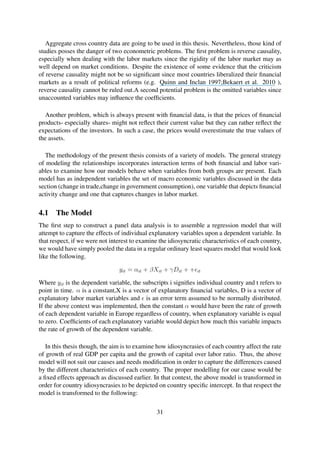
Labor,	Finance,	and	Economic	Growth	in
Europe.	Panel	Data	Evidence	From	13	European
Union	Countries
Thesis	·	June	2011
CITATIONS
0
READS
16
1	author:
Christos	Vassis
Uppsala	University
2	PUBLICATIONS			0	CITATIONS			
SEE	PROFILE
All	in-text	references	underlined	in	blue	are	linked	to	publications	on	ResearchGate,
letting	you	access	and	read	them	immediately.
Available	from:	Christos	Vassis
Retrieved	on:	25	October	2016
Master Programme in Economic Growth,
Innovation and Spatial Dynamics
Labor, Finance,
and Economic Growth in Europe.
Panel Data Evidence From 13 European Union
Countries.
Christos Vassis
mas09cva@student.lu.se
Abstract
During the contemporary crisis in Europe, a heated debate has started as how Europe has to
become more efficient and what Europe has to do to improve its position and achieve economic
growth again. The sector that has receive much attention is the financial one, while in the
“real“ economy, labor rigidities have been thought for many years as an obstacle to European
economic growth. The study examines the interrelationship between financial sector interna-
tionalization and labor market structures, in an attempt to examine their combined impact upon
economic growth. Some evidences that financial internationalization and labor market rigidi-
ties work in opposite directions were found.
Keywords:Financial Integration, Institutions, Labor Markets, Economic Growth, European
Union
Website: www.ekh.lu
EKHR 22
Master Thesis (15 Credits ECTS)
June 2011
Supervisor: Lennart Sch¨on
Examiner:Jonas Ljungberg
i
Contents
1 Introduction 1
1.1 Scope of the Research . . . . . . . . . . . . . . . . . . . . . . . . . . . . . . . 1
1.2 Research Question . . . . . . . . . . . . . . . . . . . . . . . . . . . . . . . . 1
1.3 Theoretical Framework regarding International Financial Flows . . . . . . . . . 2
1.3.1 The Finance-Growth Nexus . . . . . . . . . . . . . . . . . . . . . . . 3
1.3.2 Economic Consequences of Financial Liberalization . . . . . . . . . . 3
1.3.3 Political Consequences of Financial Liberalization . . . . . . . . . . . 4
1.4 Types of International Finance . . . . . . . . . . . . . . . . . . . . . . . . . . 4
1.4.1 Debt . . . . . . . . . . . . . . . . . . . . . . . . . . . . . . . . . . . . 4
1.4.2 External Debt . . . . . . . . . . . . . . . . . . . . . . . . . . . . . . . 5
1.4.3 Portfolio Equity . . . . . . . . . . . . . . . . . . . . . . . . . . . . . . 6
1.5 Theoretical Framework on the Structure of Labor Markets . . . . . . . . . . . 7
1.5.1 Rigid labor Markets . . . . . . . . . . . . . . . . . . . . . . . . . . . 8
1.5.2 Flexible Labor Markets . . . . . . . . . . . . . . . . . . . . . . . . . . 9
1.6 Possible Channels of Interaction between Financial and Labor Markets . . . . . 9
2 Literature Review 11
2.1 Literature Review of the Impact of financial opening on European Growth. . . . 11
2.2 Literature Review on the Impact of Labor Markets on European Growth. . . . . 13
3 Data Sources and Variables’ description 16
3.1 Sources . . . . . . . . . . . . . . . . . . . . . . . . . . . . . . . . . . . . . . 16
3.2 Dependent Variable . . . . . . . . . . . . . . . . . . . . . . . . . . . . . . . . 16
3.2.1 Real GDP per Capita Growth . . . . . . . . . . . . . . . . . . . . . . 16
3.3 Macroeconomic Variables . . . . . . . . . . . . . . . . . . . . . . . . . . . . 20
3.3.1 Trade Openness . . . . . . . . . . . . . . . . . . . . . . . . . . . . . . 20
3.3.2 Government Consumption . . . . . . . . . . . . . . . . . . . . . . . . 21
3.4 Financial Variables . . . . . . . . . . . . . . . . . . . . . . . . . . . . . . . . 22
3.4.1 International Financial Integration Index . . . . . . . . . . . . . . . . . 22
3.4.2 Equity Integration Index . . . . . . . . . . . . . . . . . . . . . . . . . 22
3.4.3 FDI Participation . . . . . . . . . . . . . . . . . . . . . . . . . . . . . 23
3.5 Labor Variables . . . . . . . . . . . . . . . . . . . . . . . . . . . . . . . . . . 24
3.5.1 Trade Union Participation . . . . . . . . . . . . . . . . . . . . . . . . 24
3.5.2 Union Coverage . . . . . . . . . . . . . . . . . . . . . . . . . . . . . 24
3.5.3 Employment Protection . . . . . . . . . . . . . . . . . . . . . . . . . 24
3.5.4 Unemployment . . . . . . . . . . . . . . . . . . . . . . . . . . . . . . 25
3.5.5 Youth Unemployment . . . . . . . . . . . . . . . . . . . . . . . . . . 26
3.6 Variables Captured By the Fixed Effects . . . . . . . . . . . . . . . . . . . . . 26
3.6.1 Legal Origin . . . . . . . . . . . . . . . . . . . . . . . . . . . . . . . 26
3.6.2 Initial Per Capita Output . . . . . . . . . . . . . . . . . . . . . . . . . 27
3.6.3 Average Schooling . . . . . . . . . . . . . . . . . . . . . . . . . . . . 28
3.7 Data Quality . . . . . . . . . . . . . . . . . . . . . . . . . . . . . . . . . . . . 29
4 Methodology 30
4.1 The Model . . . . . . . . . . . . . . . . . . . . . . . . . . . . . . . . . . . . . 31
ii
5 Results 33
5.1 Results for Real GDP per capita . . . . . . . . . . . . . . . . . . . . . . . . . 33
5.1.1 Aggregate Financial Activity Impact on Real per capita GDP . . . . . . 33
5.1.2 Equity Trade Impact on Real per capita GDP . . . . . . . . . . . . . . 36
5.1.3 Impact of FDI on Real per capita GDP . . . . . . . . . . . . . . . . . . 38
5.1.4 The Impact of Debt upon Real GDP per capita . . . . . . . . . . . . . 41
5.2 Robustness of the results . . . . . . . . . . . . . . . . . . . . . . . . . . . . . 42
5.3 Summary . . . . . . . . . . . . . . . . . . . . . . . . . . . . . . . . . . . . . 42
6 Conclusion 43
6.1 Further Research . . . . . . . . . . . . . . . . . . . . . . . . . . . . . . . . . 44
List of Figures
1 Percentage Contribution to European GDP 1980 . . . . . . . . . . . . . . . . . 17
2 Percentage Contribution to European GDP 2000 . . . . . . . . . . . . . . . . . 18
3 European Real Per Capita GDP Growth Rates . . . . . . . . . . . . . . . . . . 19
4 Number of Countries By Legal Origin . . . . . . . . . . . . . . . . . . . . . . 27
5 GDP per Capita 1980,Constant 2000 Dollars . . . . . . . . . . . . . . . . . . . 28
List of Tables
1 Summary statistics for Real GDP per Capita Growth . . . . . . . . . . . . . . 19
2 Summary statistics for Annual Trade Growth . . . . . . . . . . . . . . . . . . 20
3 Summary statistics for Government Consumption Growth,in pct of GDP . . . . 21
4 Summary statistics for Total Financial Growth,as pct of GDP . . . . . . . . . . 22
5 Summary statistics for Equity Activity Growth,as pct of GDP . . . . . . . . . . 23
6 Summary statistics for FDI, as pct of GDP . . . . . . . . . . . . . . . . . . . . 23
7 Summary statistics for Union Density Growth . . . . . . . . . . . . . . . . . . 24
8 Summary statistics for Union Coverage Growth . . . . . . . . . . . . . . . . . 25
9 Summary statistics of Unemployment Change . . . . . . . . . . . . . . . . . . 25
10 Summary statistics of Youth Unemployment Change . . . . . . . . . . . . . . 26
11 Summary statistics for Average Schooling . . . . . . . . . . . . . . . . . . . . 28
12 Fixed Effects for Total Finance models . . . . . . . . . . . . . . . . . . . . . . 34
13 The Impact of Aggregate Financial Activity . . . . . . . . . . . . . . . . . . . 35
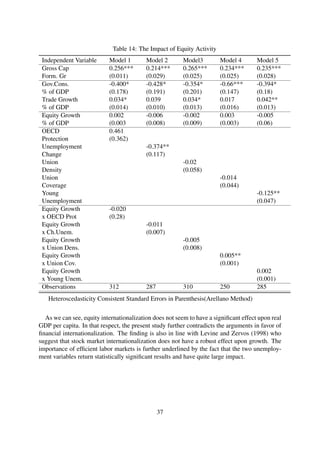
14 The Impact of Equity Activity . . . . . . . . . . . . . . . . . . . . . . . . . . 37
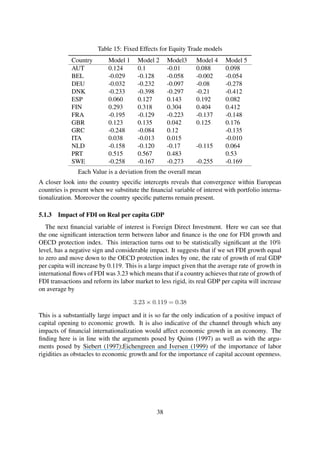
15 Fixed Effects for Equity Trade models . . . . . . . . . . . . . . . . . . . . . . 38
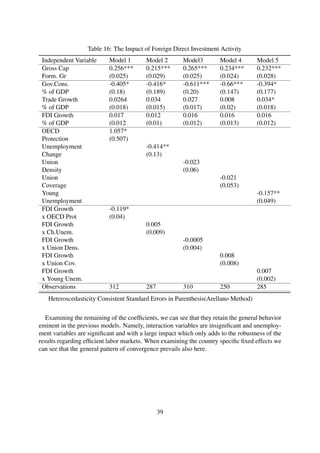
16 The Impact of Foreign Direct Investment Activity . . . . . . . . . . . . . . . . 39
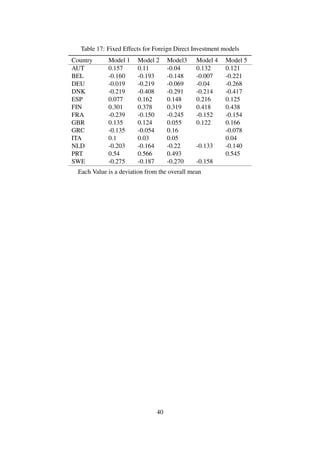
17 Fixed Effects for Foreign Direct Investment models . . . . . . . . . . . . . . . 40
18 The Impact of Debt Activity . . . . . . . . . . . . . . . . . . . . . . . . . . . 41
19 Fixed Effects for Debt Activity models . . . . . . . . . . . . . . . . . . . . . . 42
iii
1 Introduction
The financial sector has been for a while now the sector that everybody sees as the major
under-minor of Europe’s lifestyle, and as the major force behind the austerity measures over
the continent that threatens the welfare state policies Europe-wide. As the current crises goes
on, the discussion of the relationship between credit and productivity dominates the public
debate in popular and scientific media alike. The increased financial activity that mobilizes
enormous amount of money, coexists in Europe with a persistence of unemployment and other
distortions in labor markets. In that respect, the present thesis has as an aim to investigate the
possible existence, size and effect of an interrelationship between the financial sector and the
labor market, in a group of thirteen European countries that were European Union members
before the 2004 EU enlargement. The main focus of the present study is to investigate the
finance-growth nexus by putting the emphasis on labor market structures and their interplay
with the financial sector.
1.1 Scope of the Research
The scope of the research is to examine the combined effect that labor and financial markets’
internationalization can have upon economic growth. While both those markets have been sep-
arately examined extensively in the past for their impact on economic growth through different
channels, the mechanics of their interaction remain much of an uncharted area. The thesis
starts its quest from the observation that financial markets when they function effectively have
the effect to expand total output in an economy, increase levels of investment and increase em-
ployment. On the other hand, finance through its reallocation process can force inefficient firms
to shut down or undergo heavy restructuring. Those two functions though have quite different
effects, with the first effect been in favor of and the second effect been against of labor inter-
ests. The present thesis has as an aim to shed some light in the relationship between those two
elements, and how differences in European labor markets affect this relationship.
1.2 Research Question
In that respect, the present thesis is going to look in the relationship and dynamics between
financial internationalization of an economy and its interaction with the labor market, and how
those elements affect the growth dynamics of the European economy. The main research ques-
tion the present study is aiming to answer is whether or not this relationship has any significant
impact upon growth rates, and which element play the most crucial role in defining that impact.
In that respect, the findings of the present study can be used not only to enhance the body of
knowledge regarding the interplay between financial and labor markets, but it can also pro-
vide policy makers with useful insights regarding the scope aims and targets of several reform
efforts in the markets under consideration. Results from the current thesis could be used to
clarify the expectations of reforms in either of the two markets under consideration. It should
be noted however, that making inferences of the results of the current study for less developed
countries is not directly applicable, since the countries under consideration here have specific
institutional arrangements that less developed ones do not posses.
1
The present study will focus on 13 countries that were part of the European Union before
2004 1
. The selection of those countries was made on the basis of excluding post-2004 mem-
bers as well as countries that were significant financial centers in respect to their real economy,
namely Ireland after approximately 1995 and Luxembourg for the whole of the period. More-
over, regarding the aspect of financial integration, the thesis is going examine the aspect taking
into account the total gross external position of an economy. This has been done with the aim
to provide an economy wide picture of the interrelationship, and capture the impact of financial
flows and openness rather than the impact of a nation being a net creditor of borrower.
The thesis will not look into the developments of nations that became members of the Eu-
ropean Union after 2004. The exclusion of the newer members was decided on the basis that
most of those economies were largely in transition for the most part of the period under con-
sideration. The period of focus starts at 1980 and ends at 2004. The selection of those years as
the starting and the ending point of the research was made on the basis that approximately in
the end of 1970’s we have a movement, in Europe and in other places as well, towards capital
account liberalization (Eichengreen 2001). Capital account liberalization refers to the abolition
of restrictions in the movement of capital by a sovereign government. This is another argument
towards the exclusion of the post-2004 members of the European Union, since their capital
liberalization is deemed as highly restricted during much of the period under consideration.
The period ends at 2004, the year of the last major enlargement of the European Union. Thus,
the current (2008+) financial crisis is not part of the project, but some of the conclusions may
nevertheless apply.
1.3 Theoretical Framework regarding International Financial Flows
One of the fundamental suggestions of economic theory is that free and unhindered interna-
tional capital flows can help towards a more efficient allocation of resources among nations,
can enhance financial development, and can ultimately lesser the gap between developed and
developing economies and reduce inequality within a given economy. Industrial countries were
fast to realize those potential benefits and took steps to open up and integrate their capital mar-
kets. Many researchers and organizations advocate less developed countries to open up their
capital accounts as a measure to boost development. Albeit, for developing countries the ad-
vantages of capital account opening are not evident since a large amount of literature devoted
on the subject has produce ambiguous results. As Jagdish Bhagwati argued in 1998, “gains
from capital account liberalization have been asserted, not demonstrated”. Financial markets
are divided into two broad categories. The first category called market-based refers to financial
activities that take place mostly through equity transactions and make use of institutions like
stock exchanges. The second category is called bank-based finance and it is mostly focused on
instruments of debt and loans, and transactions are completed through banking institutions.
1
The countries under consideration and their respective ISO 3166-1 Alpha 3 coding are :Austria-AUT,
Belgium-BEL, Denmark-DNK, Finland-FIN, France-FRA, Germany-DEU, Greece-GRC, Italy-ITA, Netherlands-
NLD, Portugal-PRT, Spain-ESP, Sweden-SWE and Great Britain-GBR
2
1.3.1 The Finance-Growth Nexus
The relationship between financial development and economic growth has for a long time been
the focus of a large number of researchers. Besides this extended focus though, there is no
definite conclusion on the role of financial markets on economic growth. One school of thought
supports the belief that financial markets and services always follow the development of the
real sector. On the other extreme lie those who believe that the importance of finance for
growth is very large. The ideas of such thinkers like Bagehot and Schumpeter though, suggest
that the connection between financial and economic growth is quite substantial to be ignored.
According to Levine (2005,p.5), a developed financial market performs the following functions:
• Produces information about possible investments and allocate capital
• Monitor investments and corporate management
• Facilitate the trade, diversification and management of risk
• Mobilize and pools savings
• Facilitates the exchange of goods and services
In that respect financial markets are influential upon the way societies allocate resources. Al-
beit, different financial markets in different places or in different points in time are expected
to produce different results. International financial markets differ significantly from domestic
ones in the amount of capital that they are able to mobilize and in the respect that their focus is
on governments and large organizations.
International capital flows in the past were not involving the large sums of money that one
encounters in the present, neither were international investments easy to take place. After the
end of Second World War many countries implied restrictions on the movement of capital,
and Europe was not an exception to that trend. Governments elaborated financial controls in
order to prevent domestic savers from seeking higher returns abroad and in order to prevent
foreign firms to compete with local ones for domestic markets. Despite the large increase
of integration among geographically distant and diverse financial markets, imperfections in
integration remain a central point that has receive the attention of various researchers. One
major result of this imperfect integration is that developing countries have not been able to reap
the benefits of this intensive trade. This results in investment per capita of $6000 for developed
countries, but only $400 for developing ones as of 2000 (Stulz 2005), since capital moves are
disproportionally large among industrial countries.
1.3.2 Economic Consequences of Financial Liberalization
A large body of literature suggests that financial constraints are quite harmful for economic
growth through many channels. Acemoglu (2001) suggests that finance constraints play an
instrumental role in hindering the creation of innovative firms. Since innovative firms are par-
ticularly significant in job creation but also are significant and instrumental in figuring out new
ways to increase productivity, it follows that through this particular channel, capital constraints
have a negative impact on growth. The European Union has capital liberalization as a prereq-
uisite to grant membership in a candidate state, and freedom of capital mobility is one of the
3
cornerstones of European Union incorporated in each and everyone of the significant treaties
that regulate European politics (in chronological order, Treaty of Rome, Maastricht and Lis-
bon). The argument behind the capital account liberalization was that it will enable capital
to be better allocated and thus it will lead to lower interest rates that will be beneficially for
economic growth.
1.3.3 Political Consequences of Financial Liberalization
One reason that states and governments had been eager to liberalize their financial sectors, is the
fact that by doing so it enables governments of states with low savings rates to take advantage
of foreign savings, without crowding out domestic savings. As evidence of this tendency can
be seen the fact that after liberalization the public sector debt of OECD countries rose from an
average of 15% in 1974 to an average of 40% in 1995 (Quinn and Inclan 1997). Besides the
aforementioned evidence though, one should be cautious to blame the increase of public debt
to financial liberalization alone. Given that the era of liberalization coincided with events with
huge economic impact - like the two oil crises of the 1970’s- the increase of public debt might
reflect those developments. Moreover, the lower growth rates after the oil crises on the one
hand and the existence of a stream of capital that was looking for investment opportunities on
the other hand, coupled by the need to finance the European social state might as well explain
much of the increase in public debt. It is thus quite possible for synergies to exist between those
two events.
On the other hand, there are some political costs also that financial liberalization might bear.
One problem is that with open capital markets it is easy for economic agents to undermine
capital and wealth taxation policies by moving in and out of a country at will. This creates
imbalances since companies will over-invest in countries with low taxation and under-invest
in those with high taxation. By fully liberalizing capital movements, a government might
surrender a significant tool of conducting macroeconomic policy and thus, national sovereignty
and democratic choice might lose some of their importance if a government becomes overly
dependent on the owners of capital.
Moreover, there are further political complications to add to the resistance of free capital
flows. In an excessive review of the developments regarding financial liberalization during the
twentieth century, Rajan and Zingales (2003) arrive in four conclusions. One is that there very
well could be a reversal of financial liberalization with profound negative implications, like
those after the first world war. Another significant finding is that financial liberalization has
to be in parallel with trade liberalization in order to provide significant benefits. They also
stress the fact, that from historical evidence, the factors that impede financial liberalization
from succeeding is low institutional quality as well as resistance of certain interest groups.
1.4 Types of International Finance
1.4.1 Debt
Debt is a major instrument of finance for firms, individuals and governments. Governments
and firms can engage in debt obligations through the issuance of bonds and loans in the case of
4
firms, in addition to treasury bills in the case of governments. Governments also can engage in
debt through international agreements either with another sovereign state or through an inter-
national organization like the IMF. Individuals engage in debt contracts in the form of personal
loans, credit cards, mortgages etc.
The basic function of a loan is to allocate resources from one economic agent with surplus
capital to another with a need in capital. The usual arrangement implies that there will be
a payment of a specified amount X from the creditor to the debtor at time t, for a return by
the debtor to the creditor of an amount X+r, where r is the agreed interest rate. The rate of
interest as well as the duration of credit contracts vary considerable and are subject to numerous
determinants.
1.4.2 External Debt
In order to be able to make inferences regarding impact of debt, one has first to clearly define
what external debt is. The thesis will follow the general guidelines regarding external debt
as those have been laid out by IMF’s handbook of external debt (2003). According to IMF,
external debt is defined as
Gross external debt, at any given time, is the outstanding amount of those actual
current, and not contingent, liabilities that require payment(s) of principal and/or
interest by the debtor at some point(s) in the future and that are owed to non-
residents by residents of an economy. (IMF,2003 p.7)
From the above definition we can extract that a liability, in order to be classified as external
debt has to posses certain characteristics. First, it has to be an actual liability i.e. the creditor
has to be able to prove that had provide credit to the debtor. Usually, there are legal documents
that ensure the above condition. Credit can take several forms and is not confined to the form of
financial assets like currency, but it can also be in the form of goods and/or services. Moreover,
a liability has to be actual and not contingent. A contingent liability is one that requires one
or more conditions to be fulfilled before the financial transaction takes place. Principal amount
and/or interest have to be repaid for a transaction to be classified as external debt. The creditor
has to reside to another country than the debtor.
External debt of a country can be separated into two broad and distinct categories as to
who is the recipient of credit. One category is the public or sovereign debt which consists
of obligations to international creditors by a sovereign government. The instruments through
a government can borrow on international capital markets is through the issuance of bonds,
treasury bills or other financial securities, through bilateral loans with other governments or
international banks and through international organizations like the IMF and the World Bank.
This kind of credit can further categorized to central government debt and municipal debt or
state debt in the case of federal states (like the USA or Canada). Credit to the private sector
that is guaranteed by the public sector consists of a contingent liability as explained above and
can be thought as possible public debt.
5
It should be noted that public debt in general was traditionally viewed as a far more secure
investment option than private credit 2
. This perception of public debt as a ‘safe asset’ can have
serious implications on the financial development of an economy and thus, a direct impact
on its economic growth. One reason for that is that viewing public debt as a safe investment
induces banks to over-allocate credit to the public sector. Such a tendency though turns the
banking and financial system of an economy to suboptimal levels and has a negative impact on
the growth of an economy by creating ’lazy banks’ phenomenon (Hauner 2009). Besides that
potentially negative effect of public debt, it is widely accepted that its use can have a signifi-
cantly positive impact on the financial development of an economy. It can be used to overcome
several institutional imperfections in an economy that often hinder the use of other collateral
(De Soto H. 2000). Additionally, the availability of liquid collateral is a key prerequisite for
the development of derivative markets and further financial deepening and public debt has been
used substantially in that end. Also, another use of it is the provision of benchmark pricing for
the yields of other entities and instruments like corporate bonds, and provides a strong asset on
the balance sheet of financial institutions (Reinhart and Sack 2000). Those two views however,
have not to be mutually exhaustive since there are evidence of non-linearity in the relationship
between public debt and financial development.
There are two extreme views of debt that have traditionally dominated modern history. One
conservative view is that debt is always harmful and governments and individuals should avoid
indebtedness. The other view, often associated with Keynsianism, advocates that debt is in
essence a resource or just another use of governmental policy and should be used when deemed
necessary.
The other major category of external debt is credit allocated to the private sector. This cate-
gory includes loans by international creditors to businesses located in a given economy as well
as credit that goes towards final consumption like personal loans, credit cards and mortgages.
Historically, the vast majority of external credit to the private sector went to the funding of
relatively large projects like the construction of factories or the acquisition of ships and not to
everyday retail banking activities.
1.4.3 Portfolio Equity
Equity is another channel through which an economy can interact with other economies. Eq-
uity transactions are performed through special markets known as stock exchanges. Financing
through equity is usually called market based as opposed to bank based financing which refers
to financing through (bank) loans. Those two ways of financing are considered substitute.
When a country internationalizes its stock market it lifts all official barriers to foreigners that
prohibit them from acquiring shares in that stock market. There are certain theoretical contri-
butions that suggest stock markets may play a crucial role in promoting long-run growth. The
arguments suggest that stock markets encourage specialization and lower information asymme-
tries. Moreover, their internationalization is seen as a good way to reduce the costs of savings
mobilization and enhance corporate and management control by increasing transparency upon
2
’Countries do not go bankrupt’ as Citibank’s CEO Walter Wriston famously declared in 1982, though he was
proven wrong.
6
management’s actions. Additionally, developed stock markets can secure investors from id-
iosyncratic risk3
and thus enable them to finance more risky companies that yield larger returns.
For the above reasons, an increase in physical capital is expected to follow a stock market lib-
eralization and generate larger growth rates. Atje and Jovanovic (1993) and Levine and Zervos
(1998) are among a number of studies that have found that there is a strong correlation between
various measures of stock market activity and real economic growth. Their evidence in the case
of Levine and Zervos study is particularly strong for developed countries. Despite the above
there are also evidences that their effect is quite weak and that banking based financial systems
might perform better (Arestis et al. 2001). To add to the confusion regarding which kind of
financial market has more significant effects on growth, Bekaert et al. (2001b) suggest that -at
least for the emerging markets they focused on- the equity markets were more significant. A
more concise insight on the aspect is provided in the literature review.
1.5 Theoretical Framework on the Structure of Labor Markets
The characteristics of a labor market has been thoroughly examined for their impact upon
economic growth. The rigidity or not of a labor market has receive a lot of attention and labor
markets are among the first areas governments consider for reform. Many economists stress
out the relationship between the structure of labor markets and economic growth. The major
function of a labor market is to allow people to find employment that best fits their talents and
abilities. The rate of technological change also creates opportunities for some individuals and
unemployment for others, challenges that can only be overcome with a competitive and well
functioning labor market. In that respect, a well functioning labor market is considered one
that posses the characteristic of free and easy labor mobility. Labor mobility enables people
to voluntarily leave a stagnating sector for joining a thriving one or it forces them to do so
through lay offs. The above policy recipe is heavily favored by economists and politicians of
the neoclassical school. They claim that lifting labor market distortions and by abolishing labor
protection laws will lead to an increased output as well as to a lower level of unemployment.
There are certain characteristics of a labor market that are thought to play a significant role
in determining labor market’s economic impact. The protection of labor can be seen as an
aggregate that incorporates several characteristics of the labor market. The power of trade
unions has been one of those elements of a labor market that is considered vital. Generally,
the power of unions can be proxied with two measures, union density and union coverage.
The first refers to the percentage of employees that are members of a trade union and the
second refers to the percentage of employees that are covered by agreements signed by the
union. Another aspect is if the unions are coordinated centrally and their decisions apply to
the whole economy, or if their decisions are applied only to a specific sector or firm. This
characteristic is significant since it can hinder stagnating sectors from lowering their labor cost
or can induce sectors with little or negative gains in productivity to pay wages significantly
higher than productivity gains would allow. A consensus seems to exist that at least in some
countries a reduction in union density has take place. This reduction is generally thought to
be the result of skill-biased technological change, since skillful employees are not in need of a
labor union that generally compresses wages downwards and their skills makes them less prone
3
Risk connected with a specific security
7
to unemployment Acemoglu et al. (2001).
Other labor market characteristics that have been considered to hinder economic growth are
hiring and firing costs, since they hinder human capital flows. Minimum wage legislation since
stagnating sectors have to pay larger wages and cannot move wages downwards. Also, un-
employment benefits are considered to add to the distortion since they induce individuals to
refrain from economic activity. The institution of unemployment benefits has receive a lot of
criticism in the public debate. One reason is that it reinforces wage inflexibility by providing an
alternative source of income. A second channel is that it prolongs unemployment and results
in depreciation of human capital. Additionally, the critics claim that unemployment benefits
lighten the pressures on trade unions for measures that will favor re-employment. Hiring and
firing restrictions have also be considered as an obstacle to economic growth as they disincen-
tivise companies from hiring, since they cannot easily lay off additional labor in the case of an
economic downturn.
The minimum wage legislation is also a characteristic that has been blamed for Europe’s low
growth. The reason is that it effectively puts a minimum in the cost of labor regarding labor’s
productivity. The reasoning behind this institution is social and not economical as its goal is to
protect employees from unethical employers. The minimum wage has large disparities among
European countries both in the way it is decided and on the portion of the labor force it covers.
In France, the Netherlands, Spain and Portugal is the government that sets the minimum wage.
In Belgium, Greece and Denmark is bargaining with the unions in national level. Austria,
Germany and Italy have sectoral bargaining schemes. Some of the countries do not have an
official minimum.
1.5.1 Rigid labor Markets
Labor markets that in general extent labor protection in large segments of their labor force are
considered rigid. A rigid labor market is considered one where an employer has large trans-
action costs in order to dismiss labor. This kind of labor market is widespread in continental
Europe, and its primary aim is to protect employees from employers potential harassment and
unnecessary firing. The instruments and the specific rules through which labor laws rule the
relationship between employer and employee differ wildly from country to country. Major in-
struments are prohibition of group lay offs, severance payments, justification of firing and a
variety of other rules and prohibitions. Most of the opposition to the rigid labor markets claims
that by taking away the fear of firing from employees and by hindering employers from firing
unproductive employees, societies disincentivise workers and thus lower labor productivity.
Additionally, with rigid labor markets employees engage in rent-seeking activities. Moreover,
by hindering labor flow from one job position to another results in a non-optimal match of
skills.
Proponents of the rigid labor market model claim that it has certain advantages over a com-
plete free labor market. One argument suggests that it enables job relation to have a long term
approach and thus enables trust between the parties. Moreover, the enhanced security of such
a job incentivizes workers to acquire firm specific knowledge. This firm specific knowledge
will result in increased productivity, albeit with a delay (Belot et al. 2007). Another line of
8
argument claims that even if a lawmaker lift up all the regulations, the impact upon the labor
markets would be minimal since some of the rules are simply legal representations of informal
institutions (Agell 1999). In addition, more stringent rules of firing may induce companies to
better scrutinize candidates before hiring resulting in higher productivity as it is the claim by
Lagos (2006). Another claim is that not all of the perceived distortions are in reality harmful for
the economy, and many of them function as a counteraction to the absence of unemployment
insurance markets.
1.5.2 Flexible Labor Markets
Reform of the labor markets towards a more flexible model have been proposed as a standard
remedy for many of the maladies faced by the European economies. The neoclassical school of
thought prevails in backing this view. There are some evidences though, that liberalization may
be beneficial for a number of industry or countries. Cunat and Melitz (2007) among others,
claim that liberalization of the labor market towards more flexible models could create com-
parative advantages for a country or industry in the sectors characterized by high variance of
exports. In an influential study Botero et al. (2004), examined 85 countries and located signif-
icant differences between poor and developed countries. Specifically, their findings regarding
labor markets were that less developed countries levy heavier regulation on their labor markets.
They also claim heavier regulation to be parallel with higher unemployment, higher unofficial
economy and lower labor force participation.
1.6 Possible Channels of Interaction between Financial and Labor Mar-
kets
The interaction of capital markets and labor markets have gave rise to a number of theoretical
contributions in the literature. Despite their great potential, those theoretical concepts have sel-
dom undergo empirical research. Some of the most significant theoretical views are described
in this section.
Capital markets are also thought to be instrumental in determining the amount of human
capital that an economy is bound to have. One paper that examines this line of interaction is

Galor and Zeira (1993) which suggests that capital market imperfections can have substantial
impact on human capital. The resulting inequality has also been further examined in Aghion
and Williamson (1998) who further elaborate the effects more thoroughly and in interaction
with additional factors like institutions. Another treatment in the similar line of thought is the
one by Banerjee and Newman (1993) who provide a theoretical proposition of how imperfect
credit markets can affect human capital investment and perpetuate an impediment to growth
through that channel.
Further theoretical contributions on the subject comes from Acemoglu and Pischke (1999).
In their paper they develop a model where tight labor markets combined with tight credit in-
duces firm to invest in human capital. If correct, this model suggests that deregulation of both
labor and credit markets might create losses in productivity since firms will become willing to
pass some of the cost of human capital investments on employees. Unfortunately, an empirical
investigation of this hypothesis has not been located.
9
Another effort to explain the impact of labor regulations upon productivity was undertaken
by Saint-Paul (2002) who focus on the effect of labor market rigidities upon innovation. He
suggests that a potential impact comes through the increased risk for a firm that derives from
high separations or matching costs. The argument in this study is that such high costs might
induce companies to invest more in existing products rather than introducing new, riskier and
more productive ones.
Perhaps the major channel of interaction between financial and labor markets that has re-
ceive a lot of research focus is the one that examines the relationship between financial market
development and unemployment. In that respect, both theoretical constructs but also many
empirical studies have been conducted. A limited number of the empirical studies from this
body of research are examined on the literature review section of the present study. The line of
thought of the theoretical constructs that try to explain the relationship departure from the point
that financial imperfections and institutions might have significant impact upon job creation. It
is suggested that those imperfections bias the decisions of firm and job creation and through
that process they impact unemployment. The theoretical assumptions are that the direction and
size of that bias differs according to the institutional set of a given economy.
10
2 Literature Review
Despite the extreme importance of financial and labor markets, their interrelation has receive
only limited focus by researchers. Especially, the large body of literature is mainly focused
on financial development and capital account liberalization, and their impact upon developing
countries. Subsequently the developed ones have not been in the epicenter of research attention.
Despite though the relative preference of researchers to focus on financial developments in de-
veloping countries, the body of literature that focus on the developed ones remains substantially
large.
2.1 Literature Review of the Impact of financial opening on European
Growth.
The interest of economists on the impact of financial markets upon real economy is quite old
and can be traced back to the “Founding Fathers“ of the discipline like Adam Smith and David
Hume (Churchman 2001). As the discipline of economics was developing a lot of interest
concentrated on how initially debt and subsequently other financial instruments affect eco-
nomic growth. Many variables that are counting for financial development and its dynamics are
thought to have been examined thoroughly. Financial opening alone of course is not sufficient
to initiate and sustain economic growth, since it needs an appropriate institutional framework
in order to be beneficial. Such an institutional framework is thought to be largely lacking in
developing countries but to be in place in developed ones like those of our interest (Easterly
2002). Economists try to measure the effectiveness of institutions of credit in an economy
using the concept of financial deepening, which is approximated by the size of the financial
sector relative to the GDP of a country (Mishkin 2007). Despite the large literature that tries
to shed light in the relationship between financial development and economic growth, there
are not conclusive evidence as whether financial development strictly benefits or works against
economic development in a given economy. From the following literature review, which is by
no means exhaustive, the conclusion is that financial liberalization alone could not work in a
vacuum and promote growth. Clearly it needs synergies from other sectors of an economy.
One of the most influential studies that examined the role of capital account liberalization
upon economic growth was the on by Quinn (1997). The approach Quinn elaborated was first to
construct a dataset of variables that aim to capture the degree of financial openness of a country
(most of the variables take the value of 0 for a completely closed country, and the value of 2 for
a completely open country. The second step was to construct a growth regression augmented by
some variable of his dataset. He used data for the period 1960-1989. The results suggest that an
open has much to gain in terms of economic growth from opening up. The major fault of this
study though is that it is impossible to distinguish the impact of financial and capital account
liberalization from the impact of trade openness and current account liberalization. The reason
for this is that Quinn has not include trade variables in his model, thus making the impact of
financial development difficult to isolate.
A second study that supports the notion of a positive impact on financial liberalization and
growth is the one by Klein and Olivei (1999). The basic finding in that study is that capital
11
account liberalization and financial deepening promotes growth in the already developed coun-
tries, but it does not do so in the developing ones. They followed an interesting two stages
approach in first examining the effect of capital account liberalization upon financial develop-
ment and then they examined the impact of financial development upon growth. Their focus
were on 82 developing and developed nations over the period 1986-1995 and they found signif-
icant effects of capital account liberalization on financial deepening for a cross-sectional study
of all of them, but this result was because of the present of developed countries in the sample.
In a cross-section of non-OECD countries not significant impact of capital account liberaliza-
tion on financial deepening was found. The same was true also for a group of Latin American
countries were capital account liberalization was the norm during their focus period. They con-
clude that liberalization is beneficial only in the presence of other institutions that facilitate a
well functioning economy.
The conclusion that capital account openness is instrumental in developed but not developing
countries is supported by further evidence from Edwards (2001). In his study, he founds that
openness as captured by the Quinn variables had a positive and statistically significant impact
on income per capita during the 1980’s for a group of 60 countries. More specifically, his
findings were a negative coefficient for the capital account openness, but a positive one when
openness was interacting with initial income. His conclusion was that openness has a positive
impact on already developed countries and a negative in poor countries. The methodology used
by Edwards has been thoroughly scrutinized and criticized by a subsequent study by Arteta,
Eichengreen and Wyplosz (2001). In their study they point out to a number of methodological
problems that Edwards study has. They suggests that his evidences are fragile to scrutiny and
they dismissed the notion of different effects of capital account liberalization because of income
differences. Instead they found that macroeconomic stability might play a more decisive role
on determining the impact of openness on growth.
A paper that looks into a more specific aspect of financial opening is the one by Bekaert,
Harvey, and Lundblad (2001). The element of financial liberalization that they were inter-
ested about was the stock market liberalization and its impact upon economic growth. Their
conclusion was that stock market liberalization was enhancing growth and that this result was
generally robust. On the same line of thought, Henry (2000) also concludes that stock market
internationalization enhances economic growth through significantly boosting private invest-
ment.
A paper of great importance is the one by Pattillo et al. (2004). In their paper those re-
searchers apply statistical tools in order to examine the interrelationship between debt and
economic growth, putting special emphasis in the channels through which debt can have an
impact i.e Total Factor Productivity, Capital Accumulation, as well as they tried to determine
the form of the relationship, providing evidence of non-linearity
Another line of literature emphasizes the fact that openness has not the same impact nor
the relationship seem to be universally linear for all countries, and aims to investigate this
findings further. In that respect, Klein (2003) allows for nonlinear impacts for capital account
liberalization and quality of governments variables and their interactions. His findings suggest
12
that in addition to rich countries, middle income ones can also benefit from opening but poor
ones cannot do so. In another study by Chanda (2005), the findings are that the impact of
opening up depends significantly on how homogeneous a country is. Additionally, he provides
evidence that the presence of capital controls lower growth. The above body of literature can
be seen as backing up the point made by Rodrik (1999), that countries need a functioning set of
institutions in order to be able to take advantage of financial opening and integration. Rodrik
(1998) elaborates a regression of 100 countries over the period between 1975 and 1989 and
fails to find any significant effects stemming from openness to real per capita income growth.
Additionally to proxies for openness he also uses proxies that capture the effect of quality of
government, initial income level, literacy and regional dummies but nevertheless fails to find a
connection between liberalization and development through any channel. Furthermore, Rodrik
and Subramanian (2008) argue that there exist inconclusive evidences in favor of financial
globalization. They demonstrate that many financially open countries failed to materialize any
gains in growth while others that exhibit capital controls were able to attend higher growth
rates.
Kraay (1998) also fails to establish a positive connection between capital openness and
growth in output for the period 1985 to 1997. He also makes use of the Quinn indicator.
Nevertheless, when the explanatory variable comes from statistics derived from balances of
payments he finds some significant results.
2.2 Literature Review on the Impact of Labor Markets on European
Growth.
The structure of the European labor markets have seen a lot of focus from economists and not
only from those specializing in labor economics. The different labor market arrangements that
had emerge in Europe in the post war period gave rise to a large and heterogeneous body of
literature. Providing a literature review that could cover a small part of the research dealing
with European labor markets would have been consider by many a futile exercise. Neverthe-
less, this section will attempt to provide a description of the main body of literature that deals
with European labor markets. The major conclusion from the surveyed literature below is that
contrary to the perceived wisdom regarding labor market rigidities, there is no definite answer
among scientists whether those rigidities actually harm the efficiency of an economy.
Siebert (1997) is one study that looks into the persistence of unemployment in Europe and
suggests that rigidities in its labor markets are the major culprit. The study is considered one of
the first that point to labor markets as a potential explanation for Europe’s lower growth. The
line of reasoning is that Europe has been stuck with redundant institutions from the ’Golden
Ages’ which are no longer a proper approach for the era of globalization. He concludes that
the labor market does not function for a lot of Europeans.
Another influential study in the same line comes from Elmeskov et al. (1998). Their purpose
was to evaluate the results of policy implemented by OECD members and to explain some
reductions in the level of unemployment. One significant characteristic of this study is that it
uses annual data and several variables to proxy labor protection. Their finding suggests that
13
there is a statistically significant, positive and large impact of employment protection upon un-
employment. They examine for Granger causality between unemployment and unemployment
benefits. They generally found mixed results regarding causality which in some countries were
running from high unemployment to unemployment benefits and vice-versa in others. Though
they found a significant effect of employment protection upon unemployment, this effect can
explain only a small fraction of the reduction and the rest is attributed to country specific effects.
On a similar line with Siebert (1997), Eichengreen and Iversen (1999) give us a comprehen-
sive review of the role of labor market institutions on the economic development in Europe. In
their review of the course of post war European economy, they assess that the institutions that
govern the functioning of the labor market have been instrumental both in enhancing growth in
the first half of the post war period but also in hampering growth as those institutions became
subsequently obsolete but persistent.
Another study that added significantly to our knowledge of European labor markets comes
from Blanchard and Wolfers (2000). The study focuses on the heterogeneity of European labor
institutions and tries to shed light to the phenomenon of the very different levels of unem-
ployment across the continent, as well as to the different reactions of European labor mar-
kets to exogenous shocks like the oil crisis of the 1970’s. They concluded that differences in
unemployment can be a product of differences of institutions. Nevertheless, they claim that
those differences do not posses inter-temporal characteristics since labor market institutions
and rigidities have not been stable in time and thus they cannot be held accountable for changes
in the courses of unemployment and economic growth.
In another article by Blanchard and Giavazzi (2003) the experiment of deregulation of the
labor market was carried out. The motivation behind this experiment was the widespread no-
tion that for the European poor performance (in comparison with the USA) the over-regulated
markets of goods and labor are to blame. They suggest that deregulation of the one or the other
market would not work out since there would be friction and half reforms. They propose that
the deregulation of the goods market has to come prior to that of the labor markets. In that way
reforms will increase real wage and decrease barriers to entry in product markets. Then lower
barriers to entry will lead to lower unemployment but it could result in unemployment in the
now unprotected sectors or firms.
Ichino and Riphahn (2005) focus on the impact of job protection regarding office employees
in Italy, in an effort to examine how job protection legislation could affect productivity. They
count job security as the end of probation period for those office employees and they found that
after the end of probation absenteeism increases. Despite the suggestive evidence, one should
remember that they control only for job security through firing restrictions.
Djankov et al. (2006) are looking into general policies that regulate the economy and their
impact on economic growth. Among a number of things that they are checking is the labor
market rigidities. Some aspects of their indicators for labor market rigidities were found to
be statistically significant obstacles to economic growth. Specifically for Europe they found a
14
negative impact on severances and firing restrictions. Some attention should be paid here since
their sample of European countries might be different than that of the present study.
Bassanini et al. (2009) conduct a two level investigation for OECD countries from 1983 to
2003. They found that lay off protection legislation has a negative impact on productivity.
They check their conclusion not only on the aggregate level, but they also used industry level
data in order to examine how legislation that affects differently certain industries has a role on
productivity growth.
One paper that comes close to the present study is the one from Cingano et al. (2010) which
examines the impact of imperfect financial markets on investment for European countries. The
main differences are that the above mentioned study focuses on firm level data while the present
looks on macroeconomic aggregates and the present has as its prime interest the international-
ization of the financial market rather its imperfections.
There is another body of literature that looks into the differences in labor markets between
Europe and the United States. Although not of immediate interest for this thesis, some gen-
eral findings might be able to account also for differences between European countries. For
example, Alesina and Zeira (2003) suggest a model of technological bias that might be able not
only to explain differences in technology used between United States and Europe, but also dif-
ferences in technology used among different European countries. In the same line of thinking
Nickell (1997) examine the differences in performance between European and North American
labor markets, claiming that the view of inferior performance for European ones might have
a base but one should be very cautious in making such inferences given the disparities among
European labor markets. One of the main findings of his research is that many of the institu-
tional characteristics that are pointed out as impediments to lower unemployment were present
both in high and low unemployment European countries suggesting mixed and weak results re-
garding employment protection and unemployment. In a future attempt to shed lights on those
results and to provide more evidence if institutions have something to do with unemployment
in industrial countries, Nickell et al. (2005) suggest that indeed changes in unemployment were
correlated with changes in institutions. Those changes were found to account for slightly more
than half of the change in unemployment.
15
3 Data Sources and Variables’ description
3.1 Sources
A variety of sources have been elaborated in the present paper. The major source for economic
data is the World Bank Database. The main dataset used for the thesis was the World Develop-
ment Index and Financial Development Index dataset which contains a vast array of variables
spanning from the 1960’s for some countries, and covering each and every country of the world.
While the World Bank Database provides a vast array of economic variables, it posses certain
limitations regarding the goals of the present paper. Namely, the debt positions of industrial
countries are not incorporated. The Quarterly External Debt Database (QEDS), although it in-
cludes data on industrial countries, has the deficiency of covering a very short period of time
which varies from country to country. In order to overcome those problems, the thesis makes
use of the External Wealth of Nations Mark II Dataset (Lane and Milesi-Ferretti 2007). This
dataset has been constructed in order to overcome the above mentioned problems, and although
not perfect in doing so, it significantly enhances our knowledge of the matters under question.
The dataset reconstructs the financial positions of 178 countries by essentially working back-
wards from the declared figures and by taking into consideration a large number of parameters
reconstructs data for the financial position of a given country back since 1970. The indicator
variable for “Employment Protection” was taken for the relevant OECD table (Venn 2009) and
the Union coverage variable was extracted from the ICWTSS dataset produced by the Univer-
sity of Amsterdam.
3.2 Dependent Variable
The variable of interest in this study is real GDP per capita growth This is done in an attempt to
examine the impact of financial and labor markets upon economic growth. The growth of Real
GDP per Capita is going to be the first dependent variable elaborated in the study. This variable
depicts the impact of financial and labor markets developments upon economic growth.
3.2.1 Real GDP per Capita Growth
GDP per capita refers to the average final production of goods and services of a resident in a
given economy. It has been used extensively in economic studies to allow researchers to study
the process of economic growth. The aggregate GDP, GDP per capita and their respective
growth rates are measurements of the level, direction and intensity of economic activity in a
country. The source of this variable is the World Development Index.
16
Figure 1: Percentage Contribution to European GDP 1980
AUT
DNK
BEL
FIN
FRA
DEU
GRC
IRL
ITA
NLD
PRT
ESP
SWE
GBR
q
q
q
q
q
q
q
q
q
q
q
q
q
q
0 5 10 15 20 25
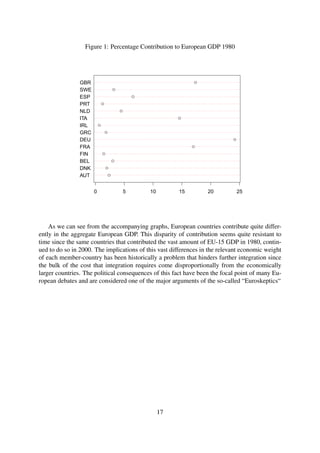
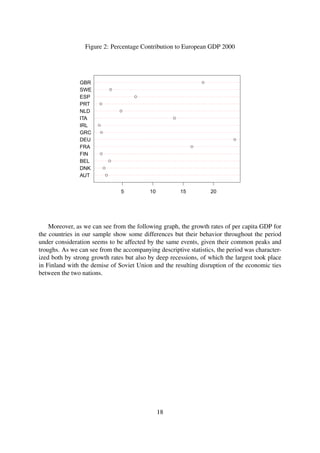
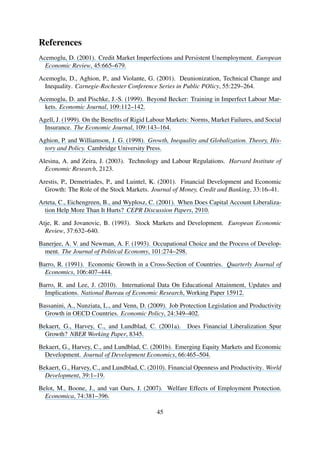
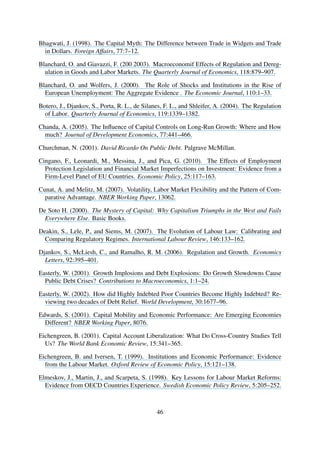
As we can see from the accompanying graphs, European countries contribute quite differ-
ently in the aggregate European GDP. This disparity of contribution seems quite resistant to
time since the same countries that contributed the vast amount of EU-15 GDP in 1980, contin-
ued to do so in 2000. The implications of this vast differences in the relevant economic weight
of each member-country has been historically a problem that hinders further integration since
the bulk of the cost that integration requires come disproportionally from the economically
larger countries. The political consequences of this fact have been the focal point of many Eu-
ropean debates and are considered one of the major arguments of the so-called “Euroskeptics“
17
Figure 2: Percentage Contribution to European GDP 2000
AUT
DNK
BEL
FIN
FRA
DEU
GRC
IRL
ITA
NLD
PRT
ESP
SWE
GBR
q
q
q
q
q
q
q
q
q
q
q
q
q
q
5 10 15 20
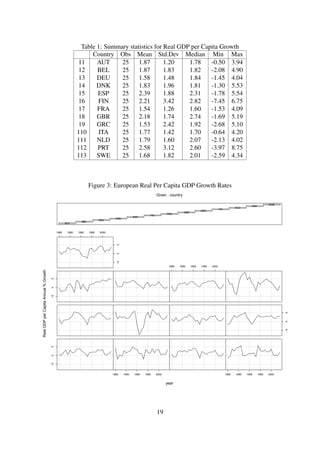
Moreover, as we can see from the following graph, the growth rates of per capita GDP for
the countries in our sample show some differences but their behavior throughout the period
under consideration seems to be affected by the same events, given their common peaks and
troughs. As we can see from the accompanying descriptive statistics, the period was character-
ized both by strong growth rates but also by deep recessions, of which the largest took place
in Finland with the demise of Soviet Union and the resulting disruption of the economic ties
between the two nations.
18
Table 1: Summary statistics for Real GDP per Capita Growth
Country Obs Mean Std.Dev Median Min Max
11 AUT 25 1.87 1.20 1.78 -0.50 3.94
12 BEL 25 1.87 1.83 1.82 -2.08 4.90
13 DEU 25 1.58 1.48 1.84 -1.45 4.04
14 DNK 25 1.83 1.96 1.81 -1.30 5.53
15 ESP 25 2.39 1.88 2.31 -1.78 5.54
16 FIN 25 2.21 3.42 2.82 -7.45 6.75
17 FRA 25 1.54 1.26 1.60 -1.53 4.09
18 GBR 25 2.18 1.74 2.74 -1.69 5.19
19 GRC 25 1.53 2.42 1.92 -2.68 5.10
110 ITA 25 1.77 1.42 1.70 -0.64 4.20
111 NLD 25 1.79 1.60 2.07 -2.13 4.02
112 PRT 25 2.58 3.12 2.60 -3.97 8.75
113 SWE 25 1.68 1.82 2.01 -2.59 4.34
Figure 3: European Real Per Capita GDP Growth Rates
−505
1980 1985 1990 1995 2000 1980 1985 1990 1995 2000
−505
−505
1980 1985 1990 1995 2000
1980 1985 1990 1995 2000
−505
year
RealGDPperCapitaAnnual%Growth
AUT
BEL
DEU
DNK
ESP
FIN
FRA
GBR
GRC
ITA
NLD
PRT
SWE
Given : country
19
3.3 Macroeconomic Variables
A set of macroeconomic variables are to be employed in this thesis in order to examine the
several hypotheses. Unless otherwise stated, all of the variables included are in constant 2000
dollars. The inclusion of those variables in the models has the purpose to control for the dif-
ferent characteristics those variables capture, rather than make inferences about their impact.
Omitting them would have lead their impact to be erroneously depicted by the remaining vari-
ables in the model.
3.3.1 Trade Openness
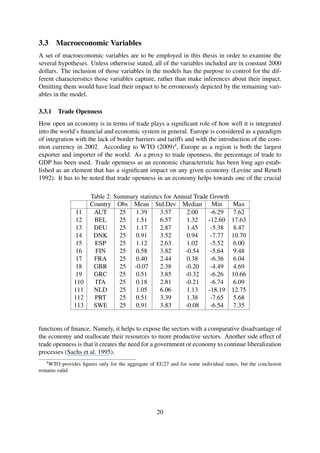
How open an economy is in terms of trade plays a significant role of how well it is integrated
into the world’s financial and economic system in general. Europe is considered as a paradigm
of integration with the lack of border barriers and tariffs and with the introduction of the com-
mon currency in 2002. According to WTO (2009)4
, Europe as a region is both the largest
exporter and importer of the world. As a proxy to trade openness, the percentage of trade to
GDP has been used. Trade openness as an economic characteristic has been long ago estab-
lished as an element that has a significant impact on any given economy (Levine and Renelt
1992). It has to be noted that trade openness in an economy helps towards one of the crucial
Table 2: Summary statistics for Annual Trade Growth
Country Obs Mean Std.Dev Median Min Max
11 AUT 25 1.39 3.57 2.00 -6.29 7.62
12 BEL 25 1.51 6.57 1.32 -12.60 17.63
13 DEU 25 1.17 2.87 1.45 -5.38 8.47
14 DNK 25 0.91 3.52 0.94 -7.77 10.70
15 ESP 25 1.12 2.63 1.02 -5.52 6.00
16 FIN 25 0.58 3.82 -0.54 -5.64 9.48
17 FRA 25 0.40 2.44 0.38 -6.36 6.04
18 GBR 25 -0.07 2.38 -0.20 -4.49 4.69
19 GRC 25 0.51 3.85 -0.32 -6.26 10.66
110 ITA 25 0.18 2.81 -0.21 -6.74 6.09
111 NLD 25 1.05 6.06 1.13 -18.19 12.75
112 PRT 25 0.51 3.39 1.38 -7.65 5.68
113 SWE 25 0.91 3.83 -0.08 -6.54 7.35
functions of finance. Namely, it helps to expose the sectors with a comparative disadvantage of
the economy and reallocate their resources to more productive sectors. Another side effect of
trade openness is that it creates the need for a government or economy to continue liberalization
processes (Sachs et al. 1995).
4
WTO provides figures only for the aggregate of EU27 and for some individual states, but the conclusion
remains valid
20
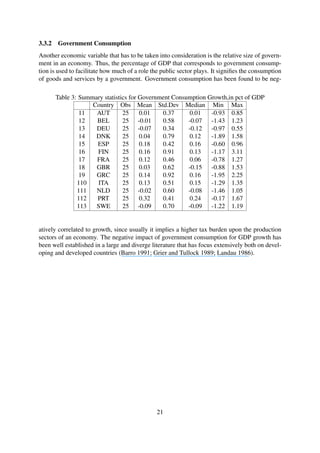
3.3.2 Government Consumption
Another economic variable that has to be taken into consideration is the relative size of govern-
ment in an economy. Thus, the percentage of GDP that corresponds to government consump-
tion is used to facilitate how much of a role the public sector plays. It signifies the consumption
of goods and services by a government. Government consumption has been found to be neg-
Table 3: Summary statistics for Government Consumption Growth,in pct of GDP
Country Obs Mean Std.Dev Median Min Max
11 AUT 25 0.01 0.37 0.01 -0.93 0.85
12 BEL 25 -0.01 0.58 -0.07 -1.43 1.23
13 DEU 25 -0.07 0.34 -0.12 -0.97 0.55
14 DNK 25 0.04 0.79 0.12 -1.89 1.58
15 ESP 25 0.18 0.42 0.16 -0.60 0.96
16 FIN 25 0.16 0.91 0.13 -1.17 3.11
17 FRA 25 0.12 0.46 0.06 -0.78 1.27
18 GBR 25 0.03 0.62 -0.15 -0.88 1.53
19 GRC 25 0.14 0.92 0.16 -1.95 2.25
110 ITA 25 0.13 0.51 0.15 -1.29 1.35
111 NLD 25 -0.02 0.60 -0.08 -1.46 1.05
112 PRT 25 0.32 0.41 0.24 -0.17 1.67
113 SWE 25 -0.09 0.70 -0.09 -1.22 1.19
atively correlated to growth, since usually it implies a higher tax burden upon the production
sectors of an economy. The negative impact of government consumption for GDP growth has
been well established in a large and diverge literature that has focus extensively both on devel-
oping and developed countries (Barro 1991; Grier and Tullock 1989; Landau 1986).
21
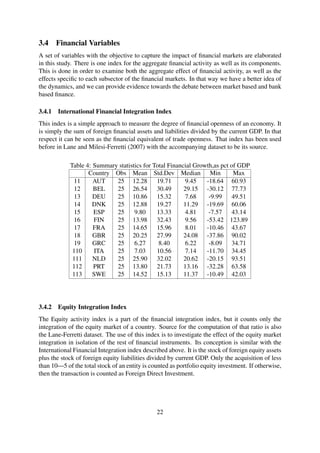
3.4 Financial Variables
A set of variables with the objective to capture the impact of financial markets are elaborated
in this study. There is one index for the aggregate financial activity as well as its components.
This is done in order to examine both the aggregate effect of financial activity, as well as the
effects specific to each subsector of the financial markets. In that way we have a better idea of
the dynamics, and we can provide evidence towards the debate between market based and bank
based finance.
3.4.1 International Financial Integration Index
This index is a simple approach to measure the degree of financial openness of an economy. It
is simply the sum of foreign financial assets and liabilities divided by the current GDP. In that
respect it can be seen as the financial equivalent of trade openness. That index has been used
before in Lane and Milesi-Ferretti (2007) with the accompanying dataset to be its source.
Table 4: Summary statistics for Total Financial Growth,as pct of GDP
Country Obs Mean Std.Dev Median Min Max
11 AUT 25 12.28 19.71 9.45 -18.64 60.93
12 BEL 25 26.54 30.49 29.15 -30.12 77.73
13 DEU 25 10.86 15.32 7.68 -9.99 49.51
14 DNK 25 12.88 19.27 11.29 -19.69 60.06
15 ESP 25 9.80 13.33 4.81 -7.57 43.14
16 FIN 25 13.98 32.43 9.56 -53.42 123.89
17 FRA 25 14.65 15.96 8.01 -10.46 43.67
18 GBR 25 20.25 27.99 24.08 -37.86 90.02
19 GRC 25 6.27 8.40 6.22 -8.09 34.71
110 ITA 25 7.03 10.56 7.14 -11.70 34.45
111 NLD 25 25.90 32.02 20.62 -20.15 93.51
112 PRT 25 13.80 21.73 13.16 -32.28 63.58
113 SWE 25 14.52 15.13 11.37 -10.49 42.03
3.4.2 Equity Integration Index
The Equity activity index is a part of the financial integration index, but it counts only the
integration of the equity market of a country. Source for the computation of that ratio is also
the Lane-Ferretti dataset. The use of this index is to investigate the effect of the equity market
integration in isolation of the rest of financial instruments. Its conception is similar with the
International Financial Integration index described above. It is the stock of foreign equity assets
plus the stock of foreign equity liabilities divided by current GDP. Only the acquisition of less
than 10—5 of the total stock of an entity is counted as portfolio equity investment. If otherwise,
then the transaction is counted as Foreign Direct Investment.
22
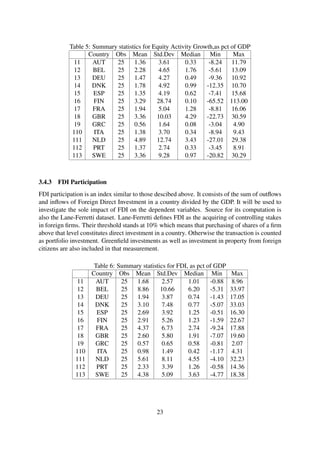
Table 5: Summary statistics for Equity Activity Growth,as pct of GDP
Country Obs Mean Std.Dev Median Min Max
11 AUT 25 1.36 3.61 0.33 -8.24 11.79
12 BEL 25 2.28 4.65 1.76 -5.61 13.09
13 DEU 25 1.47 4.27 0.49 -9.36 10.92
14 DNK 25 1.78 4.92 0.99 -12.35 10.70
15 ESP 25 1.35 4.19 0.62 -7.41 15.68
16 FIN 25 3.29 28.74 0.10 -65.52 113.00
17 FRA 25 1.94 5.04 1.28 -8.81 16.06
18 GBR 25 3.36 10.03 4.29 -22.73 30.59
19 GRC 25 0.56 1.64 0.08 -3.04 4.90
110 ITA 25 1.38 3.70 0.34 -8.94 9.43
111 NLD 25 4.89 12.74 3.43 -27.01 29.38
112 PRT 25 1.37 2.74 0.33 -3.45 8.91
113 SWE 25 3.36 9.28 0.97 -20.82 30.29
3.4.3 FDI Participation
FDI participation is an index similar to those descibed above. It consists of the sum of outflows
and inflows of Foreign Direct Investment in a country divided by the GDP. It will be used to
investigate the sole impact of FDI on the dependent variables. Source for its computation is
also the Lane-Ferretti dataset. Lane-Ferretti defines FDI as the acquiring of controlling stakes
in foreign firms. Their threshold stands at 10% which means that purchasing of shares of a firm
above that level constitutes direct investment in a country. Otherwise the transaction is counted
as portfolio investment. Greenfield investments as well as investment in property from foreign
citizens are also included in that measurement.
Table 6: Summary statistics for FDI, as pct of GDP
Country Obs Mean Std.Dev Median Min Max
11 AUT 25 1.68 2.57 1.01 -0.88 8.96
12 BEL 25 8.86 10.66 6.20 -5.31 33.97
13 DEU 25 1.94 3.87 0.74 -1.43 17.05
14 DNK 25 3.10 7.48 0.77 -5.07 33.03
15 ESP 25 2.69 3.92 1.25 -0.51 16.30
16 FIN 25 2.91 5.26 1.23 -1.59 22.67
17 FRA 25 4.37 6.73 2.74 -9.24 17.88
18 GBR 25 2.60 5.80 1.91 -7.07 19.60
19 GRC 25 0.57 0.65 0.58 -0.81 2.07
110 ITA 25 0.98 1.49 0.42 -1.17 4.31
111 NLD 25 5.61 8.11 4.55 -4.10 32.23
112 PRT 25 2.33 3.39 1.26 -0.58 14.36
113 SWE 25 4.38 5.09 3.63 -4.77 18.38
23
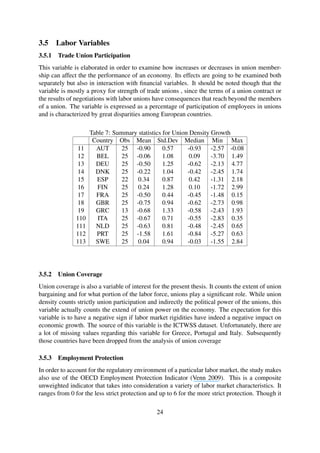
3.5 Labor Variables
3.5.1 Trade Union Participation
This variable is elaborated in order to examine how increases or decreases in union member-
ship can affect the the performance of an economy. Its effects are going to be examined both
separately but also in interaction with financial variables. It should be noted though that the
variable is mostly a proxy for strength of trade unions , since the terms of a union contract or
the results of negotiations with labor unions have consequences that reach beyond the members
of a union. The variable is expressed as a percentage of participation of employees in unions
and is characterized by great disparities among European countries.
Table 7: Summary statistics for Union Density Growth
Country Obs Mean Std.Dev Median Min Max
11 AUT 25 -0.90 0.57 -0.93 -2.57 -0.08
12 BEL 25 -0.06 1.08 0.09 -3.70 1.49
13 DEU 25 -0.50 1.25 -0.62 -2.13 4.77
14 DNK 25 -0.22 1.04 -0.42 -2.45 1.74
15 ESP 22 0.34 0.87 0.42 -1.31 2.18
16 FIN 25 0.24 1.28 0.10 -1.72 2.99
17 FRA 25 -0.50 0.44 -0.45 -1.48 0.15
18 GBR 25 -0.75 0.94 -0.62 -2.73 0.98
19 GRC 13 -0.68 1.33 -0.58 -2.43 1.93
110 ITA 25 -0.67 0.71 -0.55 -2.83 0.35
111 NLD 25 -0.63 0.81 -0.48 -2.45 0.65
112 PRT 25 -1.58 1.61 -0.84 -5.27 0.63
113 SWE 25 0.04 0.94 -0.03 -1.55 2.84
3.5.2 Union Coverage
Union coverage is also a variable of interest for the present thesis. It counts the extent of union
bargaining and for what portion of the labor force, unions play a significant role. While union
density counts strictly union participation and indirectly the political power of the unions, this
variable actually counts the extend of union power on the economy. The expectation for this
variable is to have a negative sign if labor market rigidities have indeed a negative impact on
economic growth. The source of this variable is the ICTWSS dataset. Unfortunately, there are
a lot of missing values regarding this variable for Greece, Portugal and Italy. Subsequently
those countries have been dropped from the analysis of union coverage
3.5.3 Employment Protection
In order to account for the regulatory environment of a particular labor market, the study makes
also use of the OECD Employment Protection Indicator (Venn 2009). This is a composite
unweighted indicator that takes into consideration a variety of labor market characteristics. It
ranges from 0 for the less strict protection and up to 6 for the more strict protection. Though it
24
Table 8: Summary statistics for Union Coverage Growth
Country Obs Mean Std.Dev Median Min Max
11 AUT 25 0.16 0.37 0.00 0.00 1.00
12 BEL 25 0.02 0.30 0.00 -0.20 1.40
13 DEU 25 -0.60 0.65 -0.60 -3.00 0.00
14 DNK 25 0.42 1.24 0.00 -1.00 3.00
15 ESP 25 0.56 0.65 0.50 -1.00 1.70
16 FIN 25 0.52 0.52 0.50 -0.60 1.40
17 FRA 25 0.48 0.62 0.60 -0.70 2.00
18 GBR 25 -1.44 1.64 -1.20 -4.00 3.90
19 NLD 25 0.16 0.85 0.00 -1.00 2.00
110 SWE 25 0.88 1.49 0.00 0.00 4.00
has the disadvantage of incorporating subjective judgments in its creation, it has been found to
have a strong correlation (i.e generally more 0.95) with alternative indexes used in the literature.
Caution should be applied to any results, since this particular index is an ordinal variable and as
such, an increase by say, one unit would not be the same for every country nor it would depict
the same development.
3.5.4 Unemployment
Unemployment is defined as the percentage of individuals that are able and willing to have a
job position, but unable to find one. In this paper, unemployment is used as a proxy of the
efficiency of the labor market. As it has been discussed above, this variable and its interrelation
with financial markets has receive a lot of attention in the literature. Since no definite answer
exist on the nature of this interrelation, its inclusion is of high interest. This variable has been
extracted from the World Development Index.
Table 9: Summary statistics of Unemployment Change
Country Obs Mean Std.Dev Median Min Max
11 AUT 22 0.09 0.54 0.05 -0.80 1.00
12 BEL 22 -0.22 0.87 -0.30 -2.00 1.50
13 DEU 13 0.42 0.83 0.70 -1.00 1.40
14 DNK 21 -0.21 1.07 -0.20 -2.70 1.70
15 ESP 24 -0.00 1.92 -0.35 -3.40 4.30
16 FIN 24 0.17 1.74 -0.10 -1.80 5.10
17 FRA 24 0.13 0.86 0.10 -1.80 1.60
18 GBR 21 -0.31 0.85 -0.40 -2.00 1.60
19 GRC 23 0.27 0.77 0.20 -0.80 2.00
110 ITA 24 0.01 0.68 0.10 -1.20 1.20
111 NLD 21 -0.42 0.89 -0.50 -2.60 1.20
112 PRT 24 -0.00 0.91 0.05 -1.90 1.40
113 SWE 24 0.18 1.16 0.15 -1.70 3.60
25
3.5.5 Youth Unemployment
This variable has as a purpose to examine how difficulties entering the labor market can have
an impact on the dependent variables. The degree of difficulties of entrance into the labor
market is of great importance for a countries economy since it is widely believed that young
individuals tent to be better with technological innovations, bearers of new ideas and generally
more educated than their preceding generations. Their smooth incorporation into the labor
market is a characteristic of a renewed and economy and of a flexible labor market. It describes
the percentage of young individuals that are willing and able to find employment but unable to
do so. This variable has been extracted from the World Development Index.
Table 10: Summary statistics of Youth Unemployment Change
Country Obs Mean Std.Dev Median Min Max
11 AUT 22 0.26 1.04 0.20 -1.60 3.50
12 BEL 20 -0.25 2.71 -0.40 -7.30 5.30
13 DEU 13 0.58 1.10 1.10 -0.90 2.00
14 DNK 21 -0.53 2.36 -0.30 -4.90 3.00
15 ESP 24 -0.14 3.61 -0.85 -5.60 8.60
16 FIN 24 0.78 3.85 0.10 -6.20 10.00
17 FRA 24 0.19 2.38 0.60 -5.80 4.80
18 GBR 21 -0.45 1.56 -0.70 -3.00 3.50
19 GRC 23 0.55 1.87 0.50 -2.10 5.30
110 ITA 24 -0.07 1.73 0.00 -3.90 2.50
111 NLD 21 -0.69 1.59 -0.90 -3.50 2.30
112 PRT 24 -0.05 1.97 -0.10 -4.30 3.10
113 SWE 24 0.51 3.22 0.55 -6.80 9.00
3.6 Variables Captured By the Fixed Effects
The fixed effect coefficient of our model is bound to depict some individual characteristics,
specific to each country. Some of those characteristics that have been found to be correlated
with economic growth are examined below. One major function that the intercept performs
in those kind of models, is that it can also to some extent depict differences in the quality of
financial variables and institutions in a country.
3.6.1 Legal Origin
Legal origin indicates if the legal system of a given country is based on the French, English,
Scandinavian or German tradition. The importance of this characteristic in examining eco-
nomic growth lies on the fact that legal origin has a particular effect on shaping the relationship
between a creditor and debtor, and thus it is instrumental in the financial development path
of a country. The significance of the legal origins for the financial development of a country
was initially discussed by La Porta et. al (1997) and it has received further implementation
in numerous studies e.g. Levine et al. (2000). Additionally to the shaping of the relationship
26
between creditors and debtors, legal origin is very likely to shape also the relationship between
employer and employee and thus it serves very good the aims of the present study. Indeed, a
growing body of literature suggests that legal origin has a role to play in the shaping of labor
market institutions. More specificaly, Hefeker and Neugart (2007) find that governments of
common law countries make more reforms in the labor market than governments of civil law
countries. On the other hand, Deakin et al. (2007) argue that legal systems are time invariant
and cannot hold responsible for contemporary changes in the labor markets. This characteristic
of the legal origins, their stability through time is the main disadvantage when it comes to fixed
effects panel data analysis like the one here. The problem is that time invariant variables are
impossible to capture with fixed effects, since any impact they may have, will show up into the
respective country coefficient.
From the following graph we can see that the Napoleonic Code and the subsequent French
legal tradition have influenced almost half of the European countries.
Figure 4: Number of Countries By Legal Origin
Scandinavian German French English
NumberofCountries
0123456
3.6.2 Initial Per Capita Output
European countries were by no means uniform in their developments prior to 1980 and many
of them were at the time relatively poor. Most of those disparities in the initial level of devel-
opment have played a substantial role in the way those countries adapted to the new European
reality, as well as those initial levels were instrumental to shape the path that those countries
were bound to follow in the period after their acceptance in the European community. Since
different countries started from different levels of economic development, the GDP per Capita
in the initial year of the period (1980) is of significant interest. Since a fixed effect model can-
not account for time invariant variables such as this one, we expect its impact to be manifested
through the intercept of each individual country.
27
Figure 5: GDP per Capita 1980,Constant 2000 Dollars
AUT DNK BEL FIN FRA DEU GRC IRL ITA NLD PRT ESP SWE GBR
GDPperCapitain1980,2000ConstantDollars
050001000015000
3.6.3 Average Schooling
Average schooling refers to the average per capita years of education in an economy. It has
been used extensively in the literature as a proxy to human capital. Despite its wide use, it
posses certain problems as it is unable to count for unofficial investments in human capital and
firm specific knowledge and experience. While it would be very helpfull for the present study
to take into consideration gains in human capital through average schooling, the slow change
of it as well as the fact that it is available only for 5-year intervals makes it inappropriate for
inclusion in a fixed effects model. The variable is taken from the Barro-Lee dataset..
Table 11: Summary statistics for Average Schooling
Country Obs Mean Std.Dev Median Min Max
11 AUT 5 8.25 0.64 8.26 7.43 9.06
12 BEL 5 9.13 0.85 9.39 8.03 10.04
13 DEU 5 7.94 2.09 8.05 5.73 10.50
14 DNK 5 9.68 0.40 9.80 9.02 10.01
15 ESP 5 6.59 1.75 5.63 4.98 9.09
16 FIN 5 8.43 0.42 8.24 8.22 9.17
17 FRA 5 7.44 1.35 7.14 6.02 9.30
18 GBR 5 8.31 0.32 8.26 7.97 8.76
19 GRC 5 7.70 0.79 7.92 6.56 8.57
110 ITA 5 7.67 1.17 7.85 5.98 8.97
111 NLD 5 10.10 0.61 10.16 9.27 10.81
112 PRT 5 6.13 1.00 6.22 4.78 7.28
113 SWE 5 10.04 0.75 10.03 9.13 11.00
28
3.7 Data Quality
In the present study, as it is evident by now, a vast array of data sources have been used. This
is unavoidable to the extent that the study tries to look into the combined effects of finance and
labor. Comprehensive datasets that incorporate data for both of the markets are rare and do not
cover all of the variables of interest or the whole period, or even some countries are missing.
This suggests that in order to undertake the study, one has to use various sources of data. This
might posses some challenges since the sources are inevitably of different quality and the same
holds true for some of the variables.
The first source of data for the present study is the World Development Indicator from the
World Bank Database. The macroeconomic variables and the unemployment rates were ex-
tracted from that source which is considered of superb quality and it is used extensively in
macroeconomic research. The second source is the Lane-Ferretti dataset from which the finan-
cial variables were taken. The considerations for this dataset are that it is a reconstruction of
the series it incorporates. This results in possible accumulated measurement errors, especially
for countries that do not reveal their financial positions. In such cases, there is always the
possibility that feature improvements in data availability reveal deviations of the Lane-Ferretti
dataset from the actual figures. This problem however, although always a potential problem, is
thought to be less severe in European and OECD countries which posses advanced mechanisms
in tracking capital movement and their capital markets are considered well organized, deep and
able to track and report capital movements.
The data that posses the greater challenges are those regarding Union Coverage and the
OECD Protection index. In the case of union coverage the variable posses the characteristic
of low variation. Additionally, there is always the problem of labor regulation enforcement
which may further complicate the variable. Perhaps the most challenging variable is the one
for OECD Protection index. There are several reasons for that. First, it is an ordinal variable
which suggests that the the distance of moving from say, 2 to 3 on that index is not the same as
moving from 3 to 4 in the essence that this movement represent different developments in the
underlying labor market environment. Secondly, the index is a construct derived from a variety
of statistics that try to evaluate labor market environments in the country under consideration.
Such characteristics may be difficulty of employee dismissal, height of severance payments and
so forth. Clearly, assessing those characteristics incorporates the use of human judgment which
is destined to be subjective. One third potential problem with the index is its low variation.
29
4 Methodology
A panel data econometric approach has been chosen as the most appropriate technique in or-
der to examine the developments among financial internationalization, labor markets and their
impact on the economy. Estimating models using panel data -pooled cross-sectional and time-
series data- poses several significant advantages over both pure cross sectional and pure time-
series data. First, it enables the researcher to take into account not only the cross-country
relationship between external financial position, labor market structure and economic growth
but it also gives the opportunity to study those elements over time and within a country. Mak-
ing use of panel data methods adds degrees of freedom by elaborating the variability of the
cross sectional dimension. Another benefit that derives from panel data approach is that the re-
searcher can estimate country specific effects, while in a pure cross sectional framework those
country specific effects would have been depicted in the error term. In other words, panel data
models take into account the heterogeneity of the sample. This property of panel methodology
is crucial for the present study, since by elaborating the fixed-effect model of panel data, can
depict the individual effects due to country specific characteristics. Moreover, panel data can
identify and measure the impact of characteristics that are difficult to measure by pure cross
sectional or pure time-series analysis.
Besides the above mentioned benefits there are some shortcomings, that derive from the na-
ture of the markets. The basic problem is that those two markets adjust with a completely
different pace. While financial markets are notoriously quick and almost under constant chang-
ing, labor markets are notoriously slow since institutional changes in this market takes quite a
lot of time to happen. Unfortunately, there is no straightforward and perfect solution to address
that issue. Instead, the standard procedure followed in the literature is to average out several
periods to one business cycle. That is five-year periods. In that way, one can remove the effect
of short and medium run effects of financial markets and focus only on their long-run impact.
This method also removes partially the impact of speculation on the financial markets. Unfor-
tunately though, this approach has a huge cost in terms of degrees of freedom since one would
needs five observations for each degree of freedom. Given also the increased number of the
estimated parameters in the models this approach was simply not feasible and thus it was not
chosen.
One major methodological assumption of the paper is that the economies under considera-
tion can be seen as purely neoclassical, in the sense that those economies are thought to have
access to the same technology and physical capital. Considering that the thirteen countries
have undergo the quite lengthy procedure of European integration such an assumption is not
far from reality. Specifically, since movement of labor and capital are essentially perfectly free
among those countries we can safely assume that all of them have access to the same qual-
ity of capital. The only major obstacles can be traced on human capital and have to do more
with non-economic barriers like different languages and cultures rather than official barriers.
Moreover, due to the bundling of the individual economies to one another we can assume that
a development will have a similar impact regardless of country. In econometric language this
suggests that the slope of a regression line would be essentially the same, regardless of country.
30
Aggregate cross country data are going to be used in this thesis. Nevertheless, those kind of
studies posses the danger of two econometric problems. The first problem is reverse causality,
especially when dealing with the labor markets since the rigidity of the labor market may as
well depend on market conditions. Despite the existence of some evidence that the criticism
of reverse causality might not be so significant since most countries liberalized their financial
markets as a result of political reforms (e.g. Quinn and Inclan 1997;Bekaert et al. 2010 ),
reverse causality cannot be ruled out.A second potential problem is the omitted variables since
unaccounted variables may influence the coefficients.
Another problem, which is always present with financial data, is that the prices of financial
products- especially shares- might not reflect their current value but they can rather reflect the
expectations of the investors. In such a case, the prices would overestimate the true values of
the assets.
The methodology of the present thesis consists of a variety of models. The general strategy
of modeling the relationships incorporates interaction terms of both financial and labor vari-
ables to examine how our models behave when variables from both groups are present. Each
model has as independent variables the set of macro economic variables discussed in the data
section (change in trade,change in government consumption), one variable that depicts financial
activity change and one that captures changes in labor market.
4.1 The Model
The first step to construct a panel data analysis is to assemble a regression model that will
attempt to capture the effects of individual explanatory variables upon a dependent variable. In
that respect, if we were not interest to examine the idiosyncratic characteristics of each country,
we would have simply pooled the data in a regular ordinary least squares model that would look
like the following.
yit = αit + βXit + γDit + + it
Where yit is the dependent variable, the subscripts i signifies individual country and t refers to
point in time. α is a constant,X is a vector of explanatory financial variables, D is a vector of
explanatory labor market variables and is an error term assumed to be normally distributed.
If the above context was implemented, then the constant α would have been the rate of growth
of each dependent variable in Europe regardless of country, when explanatory variable is equal
to zero. Coefficients of each explanatory variable would depict how much this variable impacts
the rate of growth of the dependent variable.
In this thesis though, the aim is to examine how idiosyncrasies of each country affect the rate
of growth of real GDP per capita and the growth of capital over labor ratio. Thus, the above
model will not suit our causes and needs modification in order to capture the differences caused
by the different characteristics of each country. The proper modelling for our cause would be
a fixed effects approach as discussed earlier. In that context, the above model is transformed in
order for country idiosyncrasies to be depicted on country specific intercept. In that respect the
model is transformed to the following:
31
yit − ¯y = β(Xit − ¯X) + γ(Dit − ¯D) + δ(Zit − ¯Z) + ( it − ¯)
Where y is again the dependent variable, X is the explanatory variable of interest, D is the labor
variable of interest, Z is their interaction term and is the normally distributed error term. The
above model uses deviations from the mean in order to save degrees of freedom and achieve
increased accuracy. Caution is needed in the interpretation of the model. In order to find the
predicted value from the above one has to subtract the mean from an observation and multiply
that residual with the relevant variable coefficient.
32
5 Results
In this section the results of the previously described models are given below. An examination
of the impact of financial and labor market variables upon real GDP per capita is examined .
5.1 Results for Real GDP per capita
5.1.1 Aggregate Financial Activity Impact on Real per capita GDP
The variable of interest that is going to be examined is the aggregate financial activity in a
country. In order to do so we elaborate five different model specifications. The basic strategy
is to keep constant the financial variable and alter the labor market variable as well as their
interaction. The first step is to check our variables for unit root. As it is usually the case with
differenced variables like the ones used in this study, Unit root proved not to be a problem.
Each model was checked with an F test against an OLS model with the same specifications,
in order to secure that there are significant individual effects. The next step is to implement a
Breusch-Pagan/ Wooldridge test for serial correlation in panel models. Finaly,a Breusch-Pagan
test for heteroscedasticity was implemented. Whenever the presence of heteroscedasticity is
detected, heteroscedasticity consistent coefficients using the Arellano method are provided.
The R statistical package was used for the computations..
As we can see from the following table, intercept for each country varies considerably. This
is an expected behavior since the intercepts capture the country specific idiosyncrasies. One
interesting conclusion from the examination of the fixed effects coefficients is that they provide
evidence of convergence within Europe. As one can see by contradicting the coefficients by
the level of real GDP per capita in 1980, the countries with the higher real GDP per capita in
1980, Denmark and Sweden, have consistently real GDP growth coefficients below the sample
mean. Initially poorer countries have coefficients that are almost always larger than the average
European growth rate, with Portugal showing the larger positive deviation. Spain also exibits
signs of convergence, while Greece seems to diverge rather than converge. United Kingdom
and Finland also exhibit strong growth dynamics in every and each model.
33
Table 12: Fixed Effects for Total Finance models
Country Model 1 Model 2 Model3 Model 4 Model 5
AUT -0.050 0.089 -0.0001 0.097 0.089
BEL -0.174 -0.107 -0.059 -0.025 -0.051
DEU -0.286 -0.241 -0.076 -0.05 -0.281
DNK -0.146 -0.388 -0.271 -0.209 -0.420
ESP 0.142 0.137 0.155 0.198 0.080
FIN 0.413 0.367 0.348 0.401 0.41
FRA -0.333 -0.140 -0.237 -0.147 -0.150
GBR 0.307 0.133 0.041 0.15 0.169
GRC -0.216 -0.107 0.121 -0.141
ITA -0.104 -0.007 0.001 -0.007
NLD -0.130 -0.120 0.181 -0.137 0.052
PRT 0.941 0.578 0.444 0.52
SWE -0.361 -0.193 -0.286 -0.270 -0.179
Each Value is a deviation from the overall mean
34
Table 13: The Impact of Aggregate Financial Activity
Independent Variable Model 1 Model 2 Model3 Model 4 Model 5
Gross Cap
Form. Gr
1.135***
(0.109)
0.212***
(0.028)
0.266***
(0.011)
0.224***
(0.025)
0.233****
(0.026)
Gov.Cons.
% of GDP
-0.813***
(0.174)
-0.436*
(0.203)
-0.352*
(0.202)
-0.67***
(0.150)
-0.385*
(0.189)
Trade Growth
% of GDP
0.017
(0.021)
-0.039
(0.014)
0.037*
(0.020)
0.013
(0.021)
0.043*
(0.012)
Fin. Growth
% of GDP
-0.03
(0.005)
-0.002
(0.003)
0.001
(0.003)
0.002
(0.002)
-0.001
(0.036)
OECD
Protection
-0.659
(0.389)
Unemployment
Change
-0.359**
(0.116)
Union
Density
-0.075
(0.067)
Union
Coverage
0.005
(0.043)
Young
Unemployment
-0.139***
(0.044)
Fin.Growth
x OECD Prot
-0.016*
(0.009)
Fin.Growth
x Ch.Unem.
-0.003**
(0.001)
Fin.Growth
x Union Dens.
-0.003
(0.005)
Fin.Growth
x Union Cov.
0.005
(0.04)
Fin.Growth
x Young Unem.
0.00
(0.00)
Observations 312 287 310 250 285
Heteroscedasticity Consistent Standard Errors in Parenthesis(Arellano Method)
Examining the coefficients of the models, one can extract some interesting conclusions. First,
we have to notice that the macroeconomic variables of Government Consumption, Gross Fixed
Capital formation and trade, enter in the regression with significant explanatory power and with
the expected sign. The result of interest here is the interaction terms between financial activity
and the labor market variables. As we can see, those interactions are not statistically significant
except for the interaction between total financial internationalization growth and changes in
the OECD employment protection index at the 10% level of significance. The coefficient of
financial variables and their products in the study has to be interpreted with increased caution.
The reason is that despite the fact that a coefficient is small in the models, the effect of the
economic activity it catches can be quite larger. Initially, the coefficient of -.016 might seem of
little economic impact but given that the mean growth rate of financial internationalization for
35
our group of countries was 14.52 this result in a loss of
14.52 × −0.016 = −0.23 on average per year.
Thus, moving down to the OECD Protection Index by 1, which requires a substantial reform
towards more flexible labor markets, would have result in an increase of 0.23 for the growth
rate. This finding is in line with the literature that claims labor market rigidities as the major
culprit of the lower European growth rates and in that respect reinforces the arguments brought
forward by Siebert (1997) and Eichngreen and Iversen (1999) regarding the negative impact of
labor market inflexibility upon economic growth. Another interesting finding is that the effect
of aggregate financial activity alone is not statistically significant. This might be an indication
that financial internationalization is not as growth enhancing as it is commonly thought and is
in line with the argument of Jagdish Bagwati that gains from financial globalization are more
appreciated than proven. More over, this finding is in line with Kraay (1998) who failed to find
any significant positive effects from financial internationalization to growth.
The significant result for the interaction of total financial activity and its interaction with
unemployment suggests perhaps the importance of efficient labor markets. It is also an indica-
tion of the loss in an economy caused by unemployment. Assessing this cost the same way as
with the OECD Protection Index above, by assuming average growth of financial activity and
keeping unemployment constant, one can see that unemployment has an impact of
14.52 × −0.003 = −0.043
Thus, lowering unemployment by 1% will increase real GDP per capita growth by 0.043. Con-
sidering that the average rate of growth for real GDP per capita in the period is approximately
2.1%, a gain of 0.043 is not to be neglected.
5.1.2 Equity Trade Impact on Real per capita GDP
When looking into the isolated impact of equity trade, one can see that the behavior of the vari-
ables does not change significantly since the interaction terms remain statistically insignificant.
The only exception to that is the interaction term between equity and union coverage which
turns out statistically significant. The sign of the coefficient however is not the expected one,
since theory suggests a negative impact of union coverage but instead there is a positive inter-
action in the model. The interaction suggests that if an economy increases its union coverage
to an additional 1% of the labor force and achieve the average rate of growth in equity trade,
the country will increase its rate of real GDP per capita growth by
2.18 × 0.005 = 0.01
One reason for that might be that increased union coverage comes along with increased job
security, and thus enables savings kept as unemployment insurance to be channeled to the con-
sumption and subsequently real GDP growth. Caution should be applied to this interpretation
though since it has not been empirically tested and its validity is conditional to the extend that
union coverage lowers to probability of unemployment and/or raises the available capital to be
invested in stock markets.
36
Table 14: The Impact of Equity Activity
Independent Variable Model 1 Model 2 Model3 Model 4 Model 5
Gross Cap
Form. Gr
0.256***
(0.011)
0.214***
(0.029)
0.265***
(0.025)
0.234***
(0.025)
0.235***
(0.028)
Gov.Cons.
% of GDP
-0.400*
(0.178)
-0.428*
(0.191)
-0.354*
(0.201)
-0.66***
(0.147)
-0.394*
(0.18)
Trade Growth
% of GDP
0.034*
(0.014)
0.039
(0.010)
0.034*
(0.013)
0.017
(0.016)
0.042**
(0.013)
Equity Growth
% of GDP
0.002
(0.003
-0.006
(0.008)
-0.002
(0.009)
0.003
(0.003)
-0.005
(0.06)
OECD
Protection
0.461
(0.362)
Unemployment
Change
-0.374**
(0.117)
Union
Density
-0.02
(0.058)
Union
Coverage
-0.014
(0.044)
Young
Unemployment
-0.125**
(0.047)
Equity Growth
x OECD Prot
-0.020
(0.28)
Equity Growth
x Ch.Unem.
-0.011
(0.007)
Equity Growth
x Union Dens.
-0.005
(0.008)
Equity Growth
x Union Cov.
0.005**
(0.001)
Equity Growth
x Young Unem.
0.002
(0.001)
Observations 312 287 310 250 285
Heteroscedasticity Consistent Standard Errors in Parenthesis(Arellano Method)
As we can see, equity internationalization does not seem to have a significant effect upon real
GDP per capita. In that respect, the present study further contradicts the arguments in favor of
financial internationalization. The finding is also in line with Levine and Zervos (1998) who
suggest that stock market internationalization does not have a robust effect upon growth. The
importance of efficient labor markets is further underlined by the fact that the two unemploy-
ment variables return statistically significant results and have quite large impact.
37
Table 15: Fixed Effects for Equity Trade models
Country Model 1 Model 2 Model3 Model 4 Model 5
AUT 0.124 0.1 -0.01 0.088 0.098
BEL -0.029 -0.128 -0.058 -0.002 -0.054
DEU -0.032 -0.232 -0.097 -0.08 -0.278
DNK -0.233 -0.398 -0.297 -0.21 -0.412
ESP 0.060 0.127 0.143 0.192 0.082
FIN 0.293 0.318 0.304 0.404 0.412
FRA -0.195 -0.129 -0.223 -0.137 -0.148
GBR 0.123 0.135 0.042 0.125 0.176
GRC -0.248 -0.084 0.12 -0.135
ITA 0.038 -0.013 0.015 -0.010
NLD -0.158 -0.120 -0.17 -0.115 0.064
PRT 0.515 0.567 0.483 0.53
SWE -0.258 -0.167 -0.273 -0.255 -0.169
Each Value is a deviation from the overall mean
A closer look into the country specific intercepts reveals that convergence within European
countries is present when we substitute the financial variable of interest with portfolio interna-
tionalization. Moreover the country specific patterns remain present.
5.1.3 Impact of FDI on Real per capita GDP
The next financial variable of interest is Foreign Direct Investment. Here we can see that
the one significant interaction term between labor and finance is the one for FDI growth and
OECD protection index. This interaction turns out to be statistically significant at the 10%
level, has a negative sign and considerable impact. It suggests that if we set FDI growth equal
to zero and move down to the OECD protection index by one, the rate of growth of real GDP
per capita will increase by 0.119. This is a large impact given that the average rate of growth in
international flows of FDI was 3.23 which means that if a country achieves that rate of growth of
FDI transactions and reform its labor market to less rigid, its real GDP per capita will increase
on average by
3.23 × 0.119 = 0.38
This is a substantially large impact and it is so far the only indication of a positive impact of
capital opening to economic growth. It is also indicative of the channel through which any
impacts of financial internationalization would affect economic growth in an economy. The
finding here is in line with the arguments posed by Quinn (1997) as well as with the argu-
ments posed by Siebert (1997);Eichengreen and Iversen (1999) of the importance of labor
rigidities as obstacles to economic growth and for the importance of capital account openness.
38
Table 16: The Impact of Foreign Direct Investment Activity
Independent Variable Model 1 Model 2 Model3 Model 4 Model 5
Gross Cap
Form. Gr
0.256***
(0.025)
0.215***
(0.029)
0.265***
(0.025)
0.234***
(0.024)
0.232***
(0.028)
Gov.Cons.
% of GDP
-0.405*
(0.18)
-0.416*
(0.189)
-0.611***
(0.20)
-0.66***
(0.147)
-0.394*
(0.177)
Trade Growth
% of GDP
0.0264
(0.018)
0.034
(0.015)
0.027
(0.017)
0.008
(0.02)
0.034*
(0.018)
FDI Growth
% of GDP
0.017
(0.012
0.012
(0.01)
0.016
(0.012)
0.016
(0.013)
0.016
(0.012)
OECD
Protection
1.057*
(0.507)
Unemployment
Change
-0.414**
(0.13)
Union
Density
-0.023
(0.06)
Union
Coverage
-0.021
(0.053)
Young
Unemployment
-0.157**
(0.049)
FDI Growth
x OECD Prot
-0.119*
(0.04)
FDI Growth
x Ch.Unem.
0.005
(0.009)
FDI Growth
x Union Dens.
-0.0005
(0.004)
FDI Growth
x Union Cov.
0.008
(0.008)
FDI Growth
x Young Unem.
0.007
(0.002)
Observations 312 287 310 250 285
Heteroscedasticity Consistent Standard Errors in Parenthesis(Arellano Method)
Examining the remaining of the coefficients, we can see that they retain the general behavior
eminent in the previous models. Namely, interaction variables are insignificant and unemploy-
ment variables are significant and with a large impact which only adds to the robustness of the
results regarding efficient labor markets. When examining the country specific fixed effects we
can see that the general pattern of convergence prevails also here.
39
Table 17: Fixed Effects for Foreign Direct Investment models
Country Model 1 Model 2 Model3 Model 4 Model 5
AUT 0.157 0.11 -0.04 0.132 0.121
BEL -0.160 -0.193 -0.148 -0.007 -0.221
DEU -0.019 -0.219 -0.069 -0.04 -0.268
DNK -0.219 -0.408 -0.291 -0.214 -0.417
ESP 0.077 0.162 0.148 0.216 0.125
FIN 0.301 0.378 0.319 0.418 0.438
FRA -0.239 -0.150 -0.245 -0.152 -0.154
GBR 0.135 0.124 0.055 0.122 0.166
GRC -0.135 -0.054 0.16 -0.078
ITA 0.1 0.03 0.05 0.04
NLD -0.203 -0.164 -0.22 -0.133 -0.140
PRT 0.54 0.566 0.493 0.545
SWE -0.275 -0.187 -0.270 -0.158
Each Value is a deviation from the overall mean
40
Table 18: The Impact of Debt Activity
Independent Variable Model 1 Model 2 Model3 Model 4 Model 5
Gross Cap
Form. Gr
0.255***
(0.023)
0.21***
(0.027)
0.264***
(0.022)
0.235***
(0.025)
0.231***
(0.026)
Gov.Cons.
% of GDP
-0.388*
(0.18)
-0.422*
(0.209)
-0.350*
(0.188)
-0.649***
(0.152)
-0.366*
(0.199)
Trade Growth
% of GDP
0.04*
(0.016)
0.042***
(0.012)
0.04*
(0.015)
0.019
(0.018)
0.046**
(0.015)
Debt Growth
% of GDP
0.006
(0.006
-0.006
(0.005)
-0.001
(0.08)
-0.001
(0.005
-0.006
(0.005)
OECD
Protection
.0644*
(0.362)
Unemployment
Change
-0.379***
(0.106)
Union
Density
-0.093
(0.08)
Union
Coverage
0.028
(0.046)
Young
Unemployment
-0.144**
(0.038)
Debt Growth
x OECD Prot.Chang
-0.027
(0.021)
Debt Growth
x Ch.Unem.
0.003
(0.002)
Debt Growth
x Union Dens.
0.01
(0.007)
Debt Growth
x Union Cov.
-0.002
(0.002)
Debt Growth
x Young Unem.
0.009
(0.1)
Observations 312 287 297 250 285
Heteroscedasticity Consistent Standard Errors in Parenthesis(Arellano Method)
5.1.4 The Impact of Debt upon Real GDP per capita
The next financial variable that the study takes into consideration is debt assets and liabilities as
a percentage of GDP. The interaction terms of debt with labor market variables were found to be
statistically insignificant. This outcome only adds to the previous conclusions that there are no
significant combined effects of financial internationalization and labor market rigidities upon
the economic growth of Europe. Moreover, the coefficient for debt financing alone turns out
statistically insignificant further reinforcing the notion of no impact of debt upon the economic
growth rates of European countries. The negative sign of the debt coefficient suggests that there
might be a negative impact of debt on real GDP per capita, a conclusion in line with previous
research like Pattillo et al. (2004); Easterly (2001) who documented a negative impact of debt
41
upon real GDP per capita, albeit for poor and middle income countries.
Table 19: Fixed Effects for Debt Activity models
Country Model 1 Model 2 Model3 Model 4 Model 5
AUT 0.120 0.89 0.02 0.085 0.096
BEL -0.007 -0.102 -0.043 0.008 -0.038
DEU -0.049 -0.232 -0.062 -0.067 -0.272
DNK -0.229 -0.398 -0.258 -0.203 -0.432
ESP 0.046 0.138 0.140 0.171 0.064
FIN 0.274 0.372 0.318 0.406 0.396
FRA -0.197 -0.152 -0.251 -0.152 -0.156
GBR 0.176 0.150 0.047 0.149 0.197
GRC -0.274 -0.114 0.132 -0.142
ITA 0.008 -0.022 0.015 -0.017
NLD -0.115 -0.105 -0.12 -0.123 -0.029
PRT 0.527 0.584 0.435 0.53
SWE -0.28 -0.208 -0.306 -0.274 -0.196
Each Value is a deviation from the overall mean
5.2 Robustness of the results
In order to examine the power of the above results, datasets that include different countries
were created. This was done in order to examine if a country has an extreme impact on the
coefficients and thus contaminates the results. The first step was to drop the observations for
Italy, Portugal and Greece. Under this specification, the results did not show large alterations
when compared to the whole sample. The main alteration was that the coefficient of the inter-
action for Foreign Direct Investment and OECD protection became larger (-.143) and gained
in significance. When Spain was also dropped from the data set the coefficient moved towards
a even greater impact(-.151). None of the other interaction coefficients became significant.
When the subgroup of countries with French legal origin is considered, the same tendency re-
mains but the coefficient of interaction of FDI with OECD labor protection becomes -.112 and
remains significant at the 5% level. Also, in that sample the coefficient of interaction for total
portfolio equity with union coverage is found to be statistically significant and positive with a
size of 0.005. It is evident from the above that the initial results are quite robust when tested on
different country groups.
5.3 Summary
Concluding the examination of the results regarding Real per capita GDP, the study has found
some limited evidence of interaction between financial internationalization and labor market
variables that have a significant impact upon real GDP per capita. The main interrelation seems
to lie in to the interaction of the OECD Protection Index with Foreign Direct Investment. The
interaction terms of the proxies destined to capture the impact of those markets, have turned
out statistically significant but only in the 10% level.
42
Given the enormous volatility of the international financial markets, the economic impact of
potential interactions can be quite significant. The lack of statistical significance though might
be as well a result of the rigid labor markets. Given that rigid labor market poses little variation
by definition since this was the aim of their institution, it might be this lack of variation that
in turn causes econometric models to return insignificant coefficients. It might be the case that
if in the future the countries reform their labor markets towards more flexible models, and the
new data is incorporated into the model, the coefficients might turn statistically significant.
6 Conclusion
This study has tried to provide some insights in the interaction of financial market internation-
alization and labor market structure. The major focal points of the study were to examine the
combined impacts of financial and labor markets upon real GDP per capita as well as upon
capital to labor growth. The findings suggest that there might exists only a limited impact. A
combined effect of internationalization of finance, capital account opening and labor market
rigidities in Europe for the period 1980-2004 was not evident in the present study. Regarding
the impact upon real GDP per capita, only the interaction between Foreign Direct Investment
and OECD protection was found to have a substantial effect. Obviously, if there is an interrela-
tion between labor markets and financial markets it seems to be through the channel of Foreign
Direct Investment. If this is true, then reforming substantially a labor market towards a more
flexible model might indeed produce gains in real GDP per capita. Evidence from the present
study found only limited support for the claim that financially open countries can enhance their
growth rates more than financially closed ones. There is not enough evidence for such an ef-
fect taking place in European Union in the period under consideration. In that respect, the
study casts doubts to the conventional wisdom that claims financial openness as a source that
enhances economic growth. Moreover, the European rigid markets do not seem to hinder the
effects of finance from taking place. This is not to say that closed financial markets would have
perform better.
A second conclusion is that idiosyncrasies continue to matter a lot inside Europe, and some-
times they can have the larger impact on the sign and size of real GDP per capita change. The
present study also offers a reinforcement to the claim that convergence happened in Europe
during the period. As it is evident from the examination of the fixed effects coefficients, that
poor countries show the tendency to grow faster than those that were reach in 1980, albeit with
some exceptions.
Despite the above, one has to remember that the present results are highly unlikely to be
universal. Examining other sets of countries is almost certain to produce different results. One
reason for this is the European labor markets which are unique in their nature and in their
employee protection spirit, that give them their characteristic institutional stability. Applying
the methods in turbulent labor markets will almost certainly produce different results and might
as well proved interaction effects present.
43
6.1 Further Research
The examination of finance internationalization and its interaction with labor markets is still an
uncharted area. There is room for much exploration. The present study took just a quick look
in only a part of it. Future research could focus on to the compound effect of more interrela-
tionships. Room for improvement exists with the elaboration of higher order interactions. The
existence of nonlinearities and structural breaks shall also attract interest, as well as the impact
of financial crises like the contemporary one.
Other areas of interest might as well be the channels through which financial international-
ization and labor markets affect real GDP per capita. Up to now the author is aware of studies
that look either into the one element or into the other. Clearly, the mechanics of the interaction
might be as interesting as the interaction itself or as it is usual, even more.
Regarding the evidence of convergence within Europe, the question of its mechanics is of
extreme interest. Knowing how this convergence happens, if it is a result of factor accumulation
or productivity gains, is of great use for the future of the European Union.
44
References
Acemoglu, D. (2001). Credit Market Imperfections and Persistent Unemployment. European
Economic Review, 45:665–679.
Acemoglu, D., Aghion, P., and Violante, G. (2001). Deunionization, Technical Change and
Inequality. Carnegie-Rochester Conference Series in Public POlicy, 55:229–264.
Acemoglu, D. and Pischke, J.-S. (1999). Beyond Becker: Training in Imperfect Labour Mar-
kets. Economic Journal, 109:112–142.
Agell, J. (1999). On the Benefits of Rigid Labour Markets: Norms, Market Failures, and Social
Insurance. The Economic Journal, 109:143–164.
Aghion, P. and Williamson, J. G. (1998). Growth, Inequality and Globalization. Theory, His-
tory and Policy. Cambridge University Press.
Alesina, A. and Zeira, J. (2003). Technology and Labour Regulations. Harvard Institute of
Economic Research, 2123.
Arestis, P., Demetriades, P., and Luintel, K. (2001). Financial Development and Economic
Growth: The Role of the Stock Markets. Journal of Money, Credit and Banking, 33:16–41.
Arteta, C., Eichengreen, B., and Wyplosz, C. (2001). When Does Capital Account Liberaliza-
tion Help More Than It Hurts? CEPR Discussion Papers, 2910.
Atje, R. and Jovanovic, B. (1993). Stock Markets and Development. European Economic
Review, 37:632–640.
Banerjee, A. V. and Newman, A. F. (1993). Occupational Choice and the Process of Develop-
ment. The Journal of Political Economy, 101:274–298.
Barro, R. (1991). Economic Growth in a Cross-Section of Countries. Quarterly Journal of
Economics, 106:407–444.
Barro, R. and Lee, J. (2010). International Data On Educational Attainment, Updates and
Implications. National Bureau of Economic Research, Working Paper 15912.
Bassanini, A., Nunziata, L., and Venn, D. (2009). Job Protection Legislation and Productivity
Growth in OECD Countries. Economic Policy, 24:349–402.
Bekaert, G., Harvey, C., and Lundblad, C. (2001a). Does Financial Liberalization Spur
Growth? NBER Working Paper, 8345.
Bekaert, G., Harvey, C., and Lundblad, C. (2001b). Emerging Equity Markets and Economic
Development. Journal of Development Economics, 66:465–504.
Bekaert, G., Harvey, C., and Lundblad, C. (2010). Financial Openness and Productivity. World
Development, 39:1–19.
Belot, M., Boone, J., and van Ours, J. (2007). Welfare Effects of Employment Protection.
Economica, 74:381–396.
45
Bhagwati, J. (1998). The Capital Myth: The Difference between Trade in Widgets and Trade
in Dollars. Foreign Affairs, 77:7–12.
Blanchard, O. and Giavazzi, F. (200 2003). Macroeconomif Effects of Regulation and Dereg-
ulation in Goods and Labor Markets. The Quarterly Journal of Economics, 118:879–907.
Blanchard, O. and Wolfers, J. (2000). The Role of Shocks and Institutions in the Rise of
European Unemployment: The Aggregate Evidence . The Economic Journal, 110:1–33.
Botero, J., Djankov, S., Porta, R. L., de Silanes, F. L., and Shleifer, A. (2004). The Regulation
of Labor. Quarterly Journal of Economics, 119:1339–1382.
Chanda, A. (2005). The Influence of Capital Controls on Long-Run Growth: Where and How
much? Journal of Development Economics, 77:441–466.
Churchman, N. (2001). David Ricardo On Public Debt. Palgrave McMillan.
Cingano, F., Leonardi, M., Messina, J., and Pica, G. (2010). The Effects of Employment
Protection Legislation and Financial Market Imperfections on Investment: Evidence from a
Firm-Level Panel of EU Countries. Economic Policy, 25:117–163.
Cunat, A. and Melitz, M. (2007). Volatility, Labor Market Flexibility and the Pattern of Com-
parative Advantage. NBER Working Paper, 13062.
De Soto H. (2000). The Mystery of Capital: Why Capitalism Triumphs in the West and Fails
Everywhere Else. Basic Books.
Deakin, S., Lele, P., and Siems, M. (2007). The Evolution of Labour Law: Calibrating and
Comparing Regulatory Regimes. International Labour Review, 146:133–162.
Djankov, S., McLiesh, C., and Ramalho, R. M. (2006). Regulation and Growth. Economics
Letters, 92:395–401.
Easterly, W. (2001). Growth Implosions and Debt Explosions: Do Growth Slowdowns Cause
Public Debt Crises? Contributions to Macroeconomics, 1:1–24.
Easterly, W. (2002). How did Highly Indebted Poor Countries Become Highly Indebted? Re-
viewing two decades of Debt Relief. World Development, 30:1677–96.
Edwards, S. (2001). Capital Mobility and Economic Performance: Are Emerging Economies
Different? NBER Working Paper, 8076.
Eichengreen, B. (2001). Capital Account Liberalization: What Do Cross-Country Studies Tell
Us? The World Bank Economic Review, 15:341–365.
Eichengreen, B. and Iversen, T. (1999). Institutions and Economic Performance: Evidence
from the Labour Market. Oxford Review of Economic Policy, 15:121–138.
Elmeskov, J., Martin, J., and Scarpeta, S. (1998). Key Lessons for Labour Market Reforms:
Evidence from OECD Countries Experience. Swedish Economic Policy Review, 5:205–252.
46
Galor, O. and Zeira, J. (1993). Income Distribution and Macroeconomics. The Review of
Economic Studies, 60:35–52.
Grier, K. and Tullock, G. (1989). An Empirical Analysis of cross-national Economic Growth.
1951-1980. Journal of Monetary Economics, 24:259–274.
Hauner, D. (2009). Public Debt and Financial Development. Jourrnal of Development Eco-
nomics, 88:171–183.
Hefeker, C. and Neugart, M. (2007). Labor Market Regulation and the Legal System. Interna-
tional Review of Law and Economics, 30:216–225.
Henry, P. B. (2000). Do Stock Market Liberalizations Cause Investment Booms? Journal of
Financial Economics, 58:301–334.
Ichino, A. and Riphahn, R. (2005). The Effect of Employment Protection on Worker Effort:
A Comparison of Absenteeism During and After Probation. Journal of European Economic
Association, 3:120–143.
International Monetary Fund (2003). External Debt Statistics-Guide for Compilers and Users.
Klein, M. (2003). Capital Account openness and the Varieties of Growth Experience. NBER
Working Paper, 9500.
Klein, M. and Olivei, G. (1999). Capital Account Liberalization, Financial Depth and Eco-
nomic Growth”. NBER Working Paper, 7384.
Kraay, A. (1998). In Search of the Macroeconomic Effects of Capital Account Liberalization.
In Milesi-Ferretti, Forthcoming, The External Wealth of Nations, Journal of International
Economics. World.
La Porta R. and Lopez-de-Silanes F. and A. Shleifer and R.W. Vishny (1997). Legal Determi-
nants of External Finance. Journal of Finance, 52:1131–1150.
Lagos, R. (2006). A Model of TFP. Review of Economic Studies, 74:983–1007.
Landau, D. (1986). Government and Economic Growth in the Less Developed Countries. An
Empirical Study for 1960-1980. Economic Development and Cultural Change, 35:35–75.
Lane, P. R. and Milesi-Ferretti, G. M. (2007). The External Wealth of Nations Mark II:Revised
and Extended Estimates of Foreign Assets and Liabilities,1970-2004. Journal of Interna-
tional Economics, 73:223–250.
Levine, R. (2005). Finance and growth: Theory and evidence. In Aghion, P. and Durlauf, S.,
editors, Handbook of Economic Growth, chapter Finance and Growth: Theory and Evidence,
pages 865–934. Elsevier.
Levine, R., Loayza, N., and Beck, T. (2000). Financial Intermediation and Growth: Causality
and Causes. Journal of Monetary Economics, 46:31–77.
Levine, R. and Renelt, D. (1992). A Sensitivity Analysis of Cross-Country Regressions. Amer-
ican Economic Review, 82:942–963.
47
Levine, R. and Zervos, S. (1998). Stock Markets, Banks, and Economic Growth. American
Economic Review, 88:537–558.
Mishkin, F. (2007). Is Financial Globalization Beneficial? Journal of Money, Credit and
Banking, 39:259–295.
Nickell, S. (1997). Unemployment and Labor Market Rigidities: Europe versus North America.
Journal of Economic Perspectives, 11:55–74.
Nickell, S., Nunziata, L., and Ochel, W. (2005). Unemployment in the OECD Since the 1960’s.
What do We know? The Economic Journal, 115:1–27.
Pattillo, C., Poirson, H., and Ricci, L. (2004). What Are the Channels Through Which External
Debt Affects Growth? International Monetary Fund, Working Paper 04/15.
Quinn, D. P. (1997). The Correlates of Change in International Financial Regulation. American
Political Science Review, 91:531–551.
Quinn, D. P. and Inclan, C. (1997). The Origins of Financial Openness: A Study of Current
and Capital Account Liberalization. American Journal of Political Science, 41:771–813.
Rajan, R. and Zingales, L. (2003). The Great Reversals: The Politics of Financial Development
in the Twentieth Century. Journal of Financial Economics, 69:5–50.
Reinhart, V. and Sack, B. (2000). The Economic Consequences of Disappearing Government
Debt. Brookings Papers on Economic Activity, 2:163–220.
Rodrik, D. (1998). Who Needs Capital Account Convertibility? In Essays in International
Finance No. 207. Princeton University Press.
Rodrik, D. (1999). The New Global Economy and Developing Countries: Making Openness
Work. Overseas Development Council, Policy Essay, 24.
Rodrik, D. and Subramanian, A. (2008). Why did Financial Globalization Disappoint?
Sachs, J., Warner, A., Aslund, A., and Fischer, S. (1995). Economic Reform and the Process of
Global Integration. Brookings Papers on Economic Activity, 1995:1–118.
Saint-Paul, G. (2002). Employment Protection, International Specialization, and Innovation.
European Economic Review, 46:375–395.
Siebert, H. (1997). Labor Market Rigidities: At the Root of Unemployment in Europe. The
Journal of Economic Perspectives, 11:37–54.
Stulz, R. (2005). The Limits of Financial Globalization. The Journal of Finance, LX:1595–
1638.
Team, R. D. C. (2011). R: A Language and Environment for Statistical Computing. R Founda-
tion for Statistical Computing, Vienna, Austria.
Venn, D. (2009). Legislation, Collective Bargaining and Enforcement: Updating the OECD
Employment and Protection Indicatiors.
48
Visser, J. (2009). The ICWTSS Database: Database on Institutional Characteristics of Trade
Unions, Wage Setting, State Intervention and Social Pacts in 34 Countries between 1960 and
2007.
49

Christos_Vassis_2011

  • 1.
  • 2.
    Master Programme inEconomic Growth, Innovation and Spatial Dynamics Labor, Finance, and Economic Growth in Europe. Panel Data Evidence From 13 European Union Countries. Christos Vassis mas09cva@student.lu.se Abstract During the contemporary crisis in Europe, a heated debate has started as how Europe has to become more efficient and what Europe has to do to improve its position and achieve economic growth again. The sector that has receive much attention is the financial one, while in the “real“ economy, labor rigidities have been thought for many years as an obstacle to European economic growth. The study examines the interrelationship between financial sector interna- tionalization and labor market structures, in an attempt to examine their combined impact upon economic growth. Some evidences that financial internationalization and labor market rigidi- ties work in opposite directions were found. Keywords:Financial Integration, Institutions, Labor Markets, Economic Growth, European Union Website: www.ekh.lu
  • 3.
    EKHR 22 Master Thesis(15 Credits ECTS) June 2011 Supervisor: Lennart Sch¨on Examiner:Jonas Ljungberg i
  • 4.
    Contents 1 Introduction 1 1.1Scope of the Research . . . . . . . . . . . . . . . . . . . . . . . . . . . . . . . 1 1.2 Research Question . . . . . . . . . . . . . . . . . . . . . . . . . . . . . . . . 1 1.3 Theoretical Framework regarding International Financial Flows . . . . . . . . . 2 1.3.1 The Finance-Growth Nexus . . . . . . . . . . . . . . . . . . . . . . . 3 1.3.2 Economic Consequences of Financial Liberalization . . . . . . . . . . 3 1.3.3 Political Consequences of Financial Liberalization . . . . . . . . . . . 4 1.4 Types of International Finance . . . . . . . . . . . . . . . . . . . . . . . . . . 4 1.4.1 Debt . . . . . . . . . . . . . . . . . . . . . . . . . . . . . . . . . . . . 4 1.4.2 External Debt . . . . . . . . . . . . . . . . . . . . . . . . . . . . . . . 5 1.4.3 Portfolio Equity . . . . . . . . . . . . . . . . . . . . . . . . . . . . . . 6 1.5 Theoretical Framework on the Structure of Labor Markets . . . . . . . . . . . 7 1.5.1 Rigid labor Markets . . . . . . . . . . . . . . . . . . . . . . . . . . . 8 1.5.2 Flexible Labor Markets . . . . . . . . . . . . . . . . . . . . . . . . . . 9 1.6 Possible Channels of Interaction between Financial and Labor Markets . . . . . 9 2 Literature Review 11 2.1 Literature Review of the Impact of financial opening on European Growth. . . . 11 2.2 Literature Review on the Impact of Labor Markets on European Growth. . . . . 13 3 Data Sources and Variables’ description 16 3.1 Sources . . . . . . . . . . . . . . . . . . . . . . . . . . . . . . . . . . . . . . 16 3.2 Dependent Variable . . . . . . . . . . . . . . . . . . . . . . . . . . . . . . . . 16 3.2.1 Real GDP per Capita Growth . . . . . . . . . . . . . . . . . . . . . . 16 3.3 Macroeconomic Variables . . . . . . . . . . . . . . . . . . . . . . . . . . . . 20 3.3.1 Trade Openness . . . . . . . . . . . . . . . . . . . . . . . . . . . . . . 20 3.3.2 Government Consumption . . . . . . . . . . . . . . . . . . . . . . . . 21 3.4 Financial Variables . . . . . . . . . . . . . . . . . . . . . . . . . . . . . . . . 22 3.4.1 International Financial Integration Index . . . . . . . . . . . . . . . . . 22 3.4.2 Equity Integration Index . . . . . . . . . . . . . . . . . . . . . . . . . 22 3.4.3 FDI Participation . . . . . . . . . . . . . . . . . . . . . . . . . . . . . 23 3.5 Labor Variables . . . . . . . . . . . . . . . . . . . . . . . . . . . . . . . . . . 24 3.5.1 Trade Union Participation . . . . . . . . . . . . . . . . . . . . . . . . 24 3.5.2 Union Coverage . . . . . . . . . . . . . . . . . . . . . . . . . . . . . 24 3.5.3 Employment Protection . . . . . . . . . . . . . . . . . . . . . . . . . 24 3.5.4 Unemployment . . . . . . . . . . . . . . . . . . . . . . . . . . . . . . 25 3.5.5 Youth Unemployment . . . . . . . . . . . . . . . . . . . . . . . . . . 26 3.6 Variables Captured By the Fixed Effects . . . . . . . . . . . . . . . . . . . . . 26 3.6.1 Legal Origin . . . . . . . . . . . . . . . . . . . . . . . . . . . . . . . 26 3.6.2 Initial Per Capita Output . . . . . . . . . . . . . . . . . . . . . . . . . 27 3.6.3 Average Schooling . . . . . . . . . . . . . . . . . . . . . . . . . . . . 28 3.7 Data Quality . . . . . . . . . . . . . . . . . . . . . . . . . . . . . . . . . . . . 29 4 Methodology 30 4.1 The Model . . . . . . . . . . . . . . . . . . . . . . . . . . . . . . . . . . . . . 31 ii
  • 5.
    5 Results 33 5.1Results for Real GDP per capita . . . . . . . . . . . . . . . . . . . . . . . . . 33 5.1.1 Aggregate Financial Activity Impact on Real per capita GDP . . . . . . 33 5.1.2 Equity Trade Impact on Real per capita GDP . . . . . . . . . . . . . . 36 5.1.3 Impact of FDI on Real per capita GDP . . . . . . . . . . . . . . . . . . 38 5.1.4 The Impact of Debt upon Real GDP per capita . . . . . . . . . . . . . 41 5.2 Robustness of the results . . . . . . . . . . . . . . . . . . . . . . . . . . . . . 42 5.3 Summary . . . . . . . . . . . . . . . . . . . . . . . . . . . . . . . . . . . . . 42 6 Conclusion 43 6.1 Further Research . . . . . . . . . . . . . . . . . . . . . . . . . . . . . . . . . 44 List of Figures 1 Percentage Contribution to European GDP 1980 . . . . . . . . . . . . . . . . . 17 2 Percentage Contribution to European GDP 2000 . . . . . . . . . . . . . . . . . 18 3 European Real Per Capita GDP Growth Rates . . . . . . . . . . . . . . . . . . 19 4 Number of Countries By Legal Origin . . . . . . . . . . . . . . . . . . . . . . 27 5 GDP per Capita 1980,Constant 2000 Dollars . . . . . . . . . . . . . . . . . . . 28 List of Tables 1 Summary statistics for Real GDP per Capita Growth . . . . . . . . . . . . . . 19 2 Summary statistics for Annual Trade Growth . . . . . . . . . . . . . . . . . . 20 3 Summary statistics for Government Consumption Growth,in pct of GDP . . . . 21 4 Summary statistics for Total Financial Growth,as pct of GDP . . . . . . . . . . 22 5 Summary statistics for Equity Activity Growth,as pct of GDP . . . . . . . . . . 23 6 Summary statistics for FDI, as pct of GDP . . . . . . . . . . . . . . . . . . . . 23 7 Summary statistics for Union Density Growth . . . . . . . . . . . . . . . . . . 24 8 Summary statistics for Union Coverage Growth . . . . . . . . . . . . . . . . . 25 9 Summary statistics of Unemployment Change . . . . . . . . . . . . . . . . . . 25 10 Summary statistics of Youth Unemployment Change . . . . . . . . . . . . . . 26 11 Summary statistics for Average Schooling . . . . . . . . . . . . . . . . . . . . 28 12 Fixed Effects for Total Finance models . . . . . . . . . . . . . . . . . . . . . . 34 13 The Impact of Aggregate Financial Activity . . . . . . . . . . . . . . . . . . . 35 14 The Impact of Equity Activity . . . . . . . . . . . . . . . . . . . . . . . . . . 37 15 Fixed Effects for Equity Trade models . . . . . . . . . . . . . . . . . . . . . . 38 16 The Impact of Foreign Direct Investment Activity . . . . . . . . . . . . . . . . 39 17 Fixed Effects for Foreign Direct Investment models . . . . . . . . . . . . . . . 40 18 The Impact of Debt Activity . . . . . . . . . . . . . . . . . . . . . . . . . . . 41 19 Fixed Effects for Debt Activity models . . . . . . . . . . . . . . . . . . . . . . 42 iii
  • 6.
    1 Introduction The financialsector has been for a while now the sector that everybody sees as the major under-minor of Europe’s lifestyle, and as the major force behind the austerity measures over the continent that threatens the welfare state policies Europe-wide. As the current crises goes on, the discussion of the relationship between credit and productivity dominates the public debate in popular and scientific media alike. The increased financial activity that mobilizes enormous amount of money, coexists in Europe with a persistence of unemployment and other distortions in labor markets. In that respect, the present thesis has as an aim to investigate the possible existence, size and effect of an interrelationship between the financial sector and the labor market, in a group of thirteen European countries that were European Union members before the 2004 EU enlargement. The main focus of the present study is to investigate the finance-growth nexus by putting the emphasis on labor market structures and their interplay with the financial sector. 1.1 Scope of the Research The scope of the research is to examine the combined effect that labor and financial markets’ internationalization can have upon economic growth. While both those markets have been sep- arately examined extensively in the past for their impact on economic growth through different channels, the mechanics of their interaction remain much of an uncharted area. The thesis starts its quest from the observation that financial markets when they function effectively have the effect to expand total output in an economy, increase levels of investment and increase em- ployment. On the other hand, finance through its reallocation process can force inefficient firms to shut down or undergo heavy restructuring. Those two functions though have quite different effects, with the first effect been in favor of and the second effect been against of labor inter- ests. The present thesis has as an aim to shed some light in the relationship between those two elements, and how differences in European labor markets affect this relationship. 1.2 Research Question In that respect, the present thesis is going to look in the relationship and dynamics between financial internationalization of an economy and its interaction with the labor market, and how those elements affect the growth dynamics of the European economy. The main research ques- tion the present study is aiming to answer is whether or not this relationship has any significant impact upon growth rates, and which element play the most crucial role in defining that impact. In that respect, the findings of the present study can be used not only to enhance the body of knowledge regarding the interplay between financial and labor markets, but it can also pro- vide policy makers with useful insights regarding the scope aims and targets of several reform efforts in the markets under consideration. Results from the current thesis could be used to clarify the expectations of reforms in either of the two markets under consideration. It should be noted however, that making inferences of the results of the current study for less developed countries is not directly applicable, since the countries under consideration here have specific institutional arrangements that less developed ones do not posses. 1
  • 7.
    The present studywill focus on 13 countries that were part of the European Union before 2004 1 . The selection of those countries was made on the basis of excluding post-2004 mem- bers as well as countries that were significant financial centers in respect to their real economy, namely Ireland after approximately 1995 and Luxembourg for the whole of the period. More- over, regarding the aspect of financial integration, the thesis is going examine the aspect taking into account the total gross external position of an economy. This has been done with the aim to provide an economy wide picture of the interrelationship, and capture the impact of financial flows and openness rather than the impact of a nation being a net creditor of borrower. The thesis will not look into the developments of nations that became members of the Eu- ropean Union after 2004. The exclusion of the newer members was decided on the basis that most of those economies were largely in transition for the most part of the period under con- sideration. The period of focus starts at 1980 and ends at 2004. The selection of those years as the starting and the ending point of the research was made on the basis that approximately in the end of 1970’s we have a movement, in Europe and in other places as well, towards capital account liberalization (Eichengreen 2001). Capital account liberalization refers to the abolition of restrictions in the movement of capital by a sovereign government. This is another argument towards the exclusion of the post-2004 members of the European Union, since their capital liberalization is deemed as highly restricted during much of the period under consideration. The period ends at 2004, the year of the last major enlargement of the European Union. Thus, the current (2008+) financial crisis is not part of the project, but some of the conclusions may nevertheless apply. 1.3 Theoretical Framework regarding International Financial Flows One of the fundamental suggestions of economic theory is that free and unhindered interna- tional capital flows can help towards a more efficient allocation of resources among nations, can enhance financial development, and can ultimately lesser the gap between developed and developing economies and reduce inequality within a given economy. Industrial countries were fast to realize those potential benefits and took steps to open up and integrate their capital mar- kets. Many researchers and organizations advocate less developed countries to open up their capital accounts as a measure to boost development. Albeit, for developing countries the ad- vantages of capital account opening are not evident since a large amount of literature devoted on the subject has produce ambiguous results. As Jagdish Bhagwati argued in 1998, “gains from capital account liberalization have been asserted, not demonstrated”. Financial markets are divided into two broad categories. The first category called market-based refers to financial activities that take place mostly through equity transactions and make use of institutions like stock exchanges. The second category is called bank-based finance and it is mostly focused on instruments of debt and loans, and transactions are completed through banking institutions. 1 The countries under consideration and their respective ISO 3166-1 Alpha 3 coding are :Austria-AUT, Belgium-BEL, Denmark-DNK, Finland-FIN, France-FRA, Germany-DEU, Greece-GRC, Italy-ITA, Netherlands- NLD, Portugal-PRT, Spain-ESP, Sweden-SWE and Great Britain-GBR 2
  • 8.
    1.3.1 The Finance-GrowthNexus The relationship between financial development and economic growth has for a long time been the focus of a large number of researchers. Besides this extended focus though, there is no definite conclusion on the role of financial markets on economic growth. One school of thought supports the belief that financial markets and services always follow the development of the real sector. On the other extreme lie those who believe that the importance of finance for growth is very large. The ideas of such thinkers like Bagehot and Schumpeter though, suggest that the connection between financial and economic growth is quite substantial to be ignored. According to Levine (2005,p.5), a developed financial market performs the following functions: • Produces information about possible investments and allocate capital • Monitor investments and corporate management • Facilitate the trade, diversification and management of risk • Mobilize and pools savings • Facilitates the exchange of goods and services In that respect financial markets are influential upon the way societies allocate resources. Al- beit, different financial markets in different places or in different points in time are expected to produce different results. International financial markets differ significantly from domestic ones in the amount of capital that they are able to mobilize and in the respect that their focus is on governments and large organizations. International capital flows in the past were not involving the large sums of money that one encounters in the present, neither were international investments easy to take place. After the end of Second World War many countries implied restrictions on the movement of capital, and Europe was not an exception to that trend. Governments elaborated financial controls in order to prevent domestic savers from seeking higher returns abroad and in order to prevent foreign firms to compete with local ones for domestic markets. Despite the large increase of integration among geographically distant and diverse financial markets, imperfections in integration remain a central point that has receive the attention of various researchers. One major result of this imperfect integration is that developing countries have not been able to reap the benefits of this intensive trade. This results in investment per capita of $6000 for developed countries, but only $400 for developing ones as of 2000 (Stulz 2005), since capital moves are disproportionally large among industrial countries. 1.3.2 Economic Consequences of Financial Liberalization A large body of literature suggests that financial constraints are quite harmful for economic growth through many channels. Acemoglu (2001) suggests that finance constraints play an instrumental role in hindering the creation of innovative firms. Since innovative firms are par- ticularly significant in job creation but also are significant and instrumental in figuring out new ways to increase productivity, it follows that through this particular channel, capital constraints have a negative impact on growth. The European Union has capital liberalization as a prereq- uisite to grant membership in a candidate state, and freedom of capital mobility is one of the 3
  • 9.
    cornerstones of EuropeanUnion incorporated in each and everyone of the significant treaties that regulate European politics (in chronological order, Treaty of Rome, Maastricht and Lis- bon). The argument behind the capital account liberalization was that it will enable capital to be better allocated and thus it will lead to lower interest rates that will be beneficially for economic growth. 1.3.3 Political Consequences of Financial Liberalization One reason that states and governments had been eager to liberalize their financial sectors, is the fact that by doing so it enables governments of states with low savings rates to take advantage of foreign savings, without crowding out domestic savings. As evidence of this tendency can be seen the fact that after liberalization the public sector debt of OECD countries rose from an average of 15% in 1974 to an average of 40% in 1995 (Quinn and Inclan 1997). Besides the aforementioned evidence though, one should be cautious to blame the increase of public debt to financial liberalization alone. Given that the era of liberalization coincided with events with huge economic impact - like the two oil crises of the 1970’s- the increase of public debt might reflect those developments. Moreover, the lower growth rates after the oil crises on the one hand and the existence of a stream of capital that was looking for investment opportunities on the other hand, coupled by the need to finance the European social state might as well explain much of the increase in public debt. It is thus quite possible for synergies to exist between those two events. On the other hand, there are some political costs also that financial liberalization might bear. One problem is that with open capital markets it is easy for economic agents to undermine capital and wealth taxation policies by moving in and out of a country at will. This creates imbalances since companies will over-invest in countries with low taxation and under-invest in those with high taxation. By fully liberalizing capital movements, a government might surrender a significant tool of conducting macroeconomic policy and thus, national sovereignty and democratic choice might lose some of their importance if a government becomes overly dependent on the owners of capital. Moreover, there are further political complications to add to the resistance of free capital flows. In an excessive review of the developments regarding financial liberalization during the twentieth century, Rajan and Zingales (2003) arrive in four conclusions. One is that there very well could be a reversal of financial liberalization with profound negative implications, like those after the first world war. Another significant finding is that financial liberalization has to be in parallel with trade liberalization in order to provide significant benefits. They also stress the fact, that from historical evidence, the factors that impede financial liberalization from succeeding is low institutional quality as well as resistance of certain interest groups. 1.4 Types of International Finance 1.4.1 Debt Debt is a major instrument of finance for firms, individuals and governments. Governments and firms can engage in debt obligations through the issuance of bonds and loans in the case of 4
  • 10.
    firms, in additionto treasury bills in the case of governments. Governments also can engage in debt through international agreements either with another sovereign state or through an inter- national organization like the IMF. Individuals engage in debt contracts in the form of personal loans, credit cards, mortgages etc. The basic function of a loan is to allocate resources from one economic agent with surplus capital to another with a need in capital. The usual arrangement implies that there will be a payment of a specified amount X from the creditor to the debtor at time t, for a return by the debtor to the creditor of an amount X+r, where r is the agreed interest rate. The rate of interest as well as the duration of credit contracts vary considerable and are subject to numerous determinants. 1.4.2 External Debt In order to be able to make inferences regarding impact of debt, one has first to clearly define what external debt is. The thesis will follow the general guidelines regarding external debt as those have been laid out by IMF’s handbook of external debt (2003). According to IMF, external debt is defined as Gross external debt, at any given time, is the outstanding amount of those actual current, and not contingent, liabilities that require payment(s) of principal and/or interest by the debtor at some point(s) in the future and that are owed to non- residents by residents of an economy. (IMF,2003 p.7) From the above definition we can extract that a liability, in order to be classified as external debt has to posses certain characteristics. First, it has to be an actual liability i.e. the creditor has to be able to prove that had provide credit to the debtor. Usually, there are legal documents that ensure the above condition. Credit can take several forms and is not confined to the form of financial assets like currency, but it can also be in the form of goods and/or services. Moreover, a liability has to be actual and not contingent. A contingent liability is one that requires one or more conditions to be fulfilled before the financial transaction takes place. Principal amount and/or interest have to be repaid for a transaction to be classified as external debt. The creditor has to reside to another country than the debtor. External debt of a country can be separated into two broad and distinct categories as to who is the recipient of credit. One category is the public or sovereign debt which consists of obligations to international creditors by a sovereign government. The instruments through a government can borrow on international capital markets is through the issuance of bonds, treasury bills or other financial securities, through bilateral loans with other governments or international banks and through international organizations like the IMF and the World Bank. This kind of credit can further categorized to central government debt and municipal debt or state debt in the case of federal states (like the USA or Canada). Credit to the private sector that is guaranteed by the public sector consists of a contingent liability as explained above and can be thought as possible public debt. 5
  • 11.
    It should benoted that public debt in general was traditionally viewed as a far more secure investment option than private credit 2 . This perception of public debt as a ‘safe asset’ can have serious implications on the financial development of an economy and thus, a direct impact on its economic growth. One reason for that is that viewing public debt as a safe investment induces banks to over-allocate credit to the public sector. Such a tendency though turns the banking and financial system of an economy to suboptimal levels and has a negative impact on the growth of an economy by creating ’lazy banks’ phenomenon (Hauner 2009). Besides that potentially negative effect of public debt, it is widely accepted that its use can have a signifi- cantly positive impact on the financial development of an economy. It can be used to overcome several institutional imperfections in an economy that often hinder the use of other collateral (De Soto H. 2000). Additionally, the availability of liquid collateral is a key prerequisite for the development of derivative markets and further financial deepening and public debt has been used substantially in that end. Also, another use of it is the provision of benchmark pricing for the yields of other entities and instruments like corporate bonds, and provides a strong asset on the balance sheet of financial institutions (Reinhart and Sack 2000). Those two views however, have not to be mutually exhaustive since there are evidence of non-linearity in the relationship between public debt and financial development. There are two extreme views of debt that have traditionally dominated modern history. One conservative view is that debt is always harmful and governments and individuals should avoid indebtedness. The other view, often associated with Keynsianism, advocates that debt is in essence a resource or just another use of governmental policy and should be used when deemed necessary. The other major category of external debt is credit allocated to the private sector. This cate- gory includes loans by international creditors to businesses located in a given economy as well as credit that goes towards final consumption like personal loans, credit cards and mortgages. Historically, the vast majority of external credit to the private sector went to the funding of relatively large projects like the construction of factories or the acquisition of ships and not to everyday retail banking activities. 1.4.3 Portfolio Equity Equity is another channel through which an economy can interact with other economies. Eq- uity transactions are performed through special markets known as stock exchanges. Financing through equity is usually called market based as opposed to bank based financing which refers to financing through (bank) loans. Those two ways of financing are considered substitute. When a country internationalizes its stock market it lifts all official barriers to foreigners that prohibit them from acquiring shares in that stock market. There are certain theoretical contri- butions that suggest stock markets may play a crucial role in promoting long-run growth. The arguments suggest that stock markets encourage specialization and lower information asymme- tries. Moreover, their internationalization is seen as a good way to reduce the costs of savings mobilization and enhance corporate and management control by increasing transparency upon 2 ’Countries do not go bankrupt’ as Citibank’s CEO Walter Wriston famously declared in 1982, though he was proven wrong. 6
  • 12.
    management’s actions. Additionally,developed stock markets can secure investors from id- iosyncratic risk3 and thus enable them to finance more risky companies that yield larger returns. For the above reasons, an increase in physical capital is expected to follow a stock market lib- eralization and generate larger growth rates. Atje and Jovanovic (1993) and Levine and Zervos (1998) are among a number of studies that have found that there is a strong correlation between various measures of stock market activity and real economic growth. Their evidence in the case of Levine and Zervos study is particularly strong for developed countries. Despite the above there are also evidences that their effect is quite weak and that banking based financial systems might perform better (Arestis et al. 2001). To add to the confusion regarding which kind of financial market has more significant effects on growth, Bekaert et al. (2001b) suggest that -at least for the emerging markets they focused on- the equity markets were more significant. A more concise insight on the aspect is provided in the literature review. 1.5 Theoretical Framework on the Structure of Labor Markets The characteristics of a labor market has been thoroughly examined for their impact upon economic growth. The rigidity or not of a labor market has receive a lot of attention and labor markets are among the first areas governments consider for reform. Many economists stress out the relationship between the structure of labor markets and economic growth. The major function of a labor market is to allow people to find employment that best fits their talents and abilities. The rate of technological change also creates opportunities for some individuals and unemployment for others, challenges that can only be overcome with a competitive and well functioning labor market. In that respect, a well functioning labor market is considered one that posses the characteristic of free and easy labor mobility. Labor mobility enables people to voluntarily leave a stagnating sector for joining a thriving one or it forces them to do so through lay offs. The above policy recipe is heavily favored by economists and politicians of the neoclassical school. They claim that lifting labor market distortions and by abolishing labor protection laws will lead to an increased output as well as to a lower level of unemployment. There are certain characteristics of a labor market that are thought to play a significant role in determining labor market’s economic impact. The protection of labor can be seen as an aggregate that incorporates several characteristics of the labor market. The power of trade unions has been one of those elements of a labor market that is considered vital. Generally, the power of unions can be proxied with two measures, union density and union coverage. The first refers to the percentage of employees that are members of a trade union and the second refers to the percentage of employees that are covered by agreements signed by the union. Another aspect is if the unions are coordinated centrally and their decisions apply to the whole economy, or if their decisions are applied only to a specific sector or firm. This characteristic is significant since it can hinder stagnating sectors from lowering their labor cost or can induce sectors with little or negative gains in productivity to pay wages significantly higher than productivity gains would allow. A consensus seems to exist that at least in some countries a reduction in union density has take place. This reduction is generally thought to be the result of skill-biased technological change, since skillful employees are not in need of a labor union that generally compresses wages downwards and their skills makes them less prone 3 Risk connected with a specific security 7
  • 13.
    to unemployment Acemogluet al. (2001). Other labor market characteristics that have been considered to hinder economic growth are hiring and firing costs, since they hinder human capital flows. Minimum wage legislation since stagnating sectors have to pay larger wages and cannot move wages downwards. Also, un- employment benefits are considered to add to the distortion since they induce individuals to refrain from economic activity. The institution of unemployment benefits has receive a lot of criticism in the public debate. One reason is that it reinforces wage inflexibility by providing an alternative source of income. A second channel is that it prolongs unemployment and results in depreciation of human capital. Additionally, the critics claim that unemployment benefits lighten the pressures on trade unions for measures that will favor re-employment. Hiring and firing restrictions have also be considered as an obstacle to economic growth as they disincen- tivise companies from hiring, since they cannot easily lay off additional labor in the case of an economic downturn. The minimum wage legislation is also a characteristic that has been blamed for Europe’s low growth. The reason is that it effectively puts a minimum in the cost of labor regarding labor’s productivity. The reasoning behind this institution is social and not economical as its goal is to protect employees from unethical employers. The minimum wage has large disparities among European countries both in the way it is decided and on the portion of the labor force it covers. In France, the Netherlands, Spain and Portugal is the government that sets the minimum wage. In Belgium, Greece and Denmark is bargaining with the unions in national level. Austria, Germany and Italy have sectoral bargaining schemes. Some of the countries do not have an official minimum. 1.5.1 Rigid labor Markets Labor markets that in general extent labor protection in large segments of their labor force are considered rigid. A rigid labor market is considered one where an employer has large trans- action costs in order to dismiss labor. This kind of labor market is widespread in continental Europe, and its primary aim is to protect employees from employers potential harassment and unnecessary firing. The instruments and the specific rules through which labor laws rule the relationship between employer and employee differ wildly from country to country. Major in- struments are prohibition of group lay offs, severance payments, justification of firing and a variety of other rules and prohibitions. Most of the opposition to the rigid labor markets claims that by taking away the fear of firing from employees and by hindering employers from firing unproductive employees, societies disincentivise workers and thus lower labor productivity. Additionally, with rigid labor markets employees engage in rent-seeking activities. Moreover, by hindering labor flow from one job position to another results in a non-optimal match of skills. Proponents of the rigid labor market model claim that it has certain advantages over a com- plete free labor market. One argument suggests that it enables job relation to have a long term approach and thus enables trust between the parties. Moreover, the enhanced security of such a job incentivizes workers to acquire firm specific knowledge. This firm specific knowledge will result in increased productivity, albeit with a delay (Belot et al. 2007). Another line of 8
  • 14.
    argument claims thateven if a lawmaker lift up all the regulations, the impact upon the labor markets would be minimal since some of the rules are simply legal representations of informal institutions (Agell 1999). In addition, more stringent rules of firing may induce companies to better scrutinize candidates before hiring resulting in higher productivity as it is the claim by Lagos (2006). Another claim is that not all of the perceived distortions are in reality harmful for the economy, and many of them function as a counteraction to the absence of unemployment insurance markets. 1.5.2 Flexible Labor Markets Reform of the labor markets towards a more flexible model have been proposed as a standard remedy for many of the maladies faced by the European economies. The neoclassical school of thought prevails in backing this view. There are some evidences though, that liberalization may be beneficial for a number of industry or countries. Cunat and Melitz (2007) among others, claim that liberalization of the labor market towards more flexible models could create com- parative advantages for a country or industry in the sectors characterized by high variance of exports. In an influential study Botero et al. (2004), examined 85 countries and located signif- icant differences between poor and developed countries. Specifically, their findings regarding labor markets were that less developed countries levy heavier regulation on their labor markets. They also claim heavier regulation to be parallel with higher unemployment, higher unofficial economy and lower labor force participation. 1.6 Possible Channels of Interaction between Financial and Labor Mar- kets The interaction of capital markets and labor markets have gave rise to a number of theoretical contributions in the literature. Despite their great potential, those theoretical concepts have sel- dom undergo empirical research. Some of the most significant theoretical views are described in this section. Capital markets are also thought to be instrumental in determining the amount of human capital that an economy is bound to have. One paper that examines this line of interaction is Galor and Zeira (1993) which suggests that capital market imperfections can have substantial impact on human capital. The resulting inequality has also been further examined in Aghion and Williamson (1998) who further elaborate the effects more thoroughly and in interaction with additional factors like institutions. Another treatment in the similar line of thought is the one by Banerjee and Newman (1993) who provide a theoretical proposition of how imperfect credit markets can affect human capital investment and perpetuate an impediment to growth through that channel. Further theoretical contributions on the subject comes from Acemoglu and Pischke (1999). In their paper they develop a model where tight labor markets combined with tight credit in- duces firm to invest in human capital. If correct, this model suggests that deregulation of both labor and credit markets might create losses in productivity since firms will become willing to pass some of the cost of human capital investments on employees. Unfortunately, an empirical investigation of this hypothesis has not been located. 9
  • 15.
    Another effort toexplain the impact of labor regulations upon productivity was undertaken by Saint-Paul (2002) who focus on the effect of labor market rigidities upon innovation. He suggests that a potential impact comes through the increased risk for a firm that derives from high separations or matching costs. The argument in this study is that such high costs might induce companies to invest more in existing products rather than introducing new, riskier and more productive ones. Perhaps the major channel of interaction between financial and labor markets that has re- ceive a lot of research focus is the one that examines the relationship between financial market development and unemployment. In that respect, both theoretical constructs but also many empirical studies have been conducted. A limited number of the empirical studies from this body of research are examined on the literature review section of the present study. The line of thought of the theoretical constructs that try to explain the relationship departure from the point that financial imperfections and institutions might have significant impact upon job creation. It is suggested that those imperfections bias the decisions of firm and job creation and through that process they impact unemployment. The theoretical assumptions are that the direction and size of that bias differs according to the institutional set of a given economy. 10
  • 16.
    2 Literature Review Despitethe extreme importance of financial and labor markets, their interrelation has receive only limited focus by researchers. Especially, the large body of literature is mainly focused on financial development and capital account liberalization, and their impact upon developing countries. Subsequently the developed ones have not been in the epicenter of research attention. Despite though the relative preference of researchers to focus on financial developments in de- veloping countries, the body of literature that focus on the developed ones remains substantially large. 2.1 Literature Review of the Impact of financial opening on European Growth. The interest of economists on the impact of financial markets upon real economy is quite old and can be traced back to the “Founding Fathers“ of the discipline like Adam Smith and David Hume (Churchman 2001). As the discipline of economics was developing a lot of interest concentrated on how initially debt and subsequently other financial instruments affect eco- nomic growth. Many variables that are counting for financial development and its dynamics are thought to have been examined thoroughly. Financial opening alone of course is not sufficient to initiate and sustain economic growth, since it needs an appropriate institutional framework in order to be beneficial. Such an institutional framework is thought to be largely lacking in developing countries but to be in place in developed ones like those of our interest (Easterly 2002). Economists try to measure the effectiveness of institutions of credit in an economy using the concept of financial deepening, which is approximated by the size of the financial sector relative to the GDP of a country (Mishkin 2007). Despite the large literature that tries to shed light in the relationship between financial development and economic growth, there are not conclusive evidence as whether financial development strictly benefits or works against economic development in a given economy. From the following literature review, which is by no means exhaustive, the conclusion is that financial liberalization alone could not work in a vacuum and promote growth. Clearly it needs synergies from other sectors of an economy. One of the most influential studies that examined the role of capital account liberalization upon economic growth was the on by Quinn (1997). The approach Quinn elaborated was first to construct a dataset of variables that aim to capture the degree of financial openness of a country (most of the variables take the value of 0 for a completely closed country, and the value of 2 for a completely open country. The second step was to construct a growth regression augmented by some variable of his dataset. He used data for the period 1960-1989. The results suggest that an open has much to gain in terms of economic growth from opening up. The major fault of this study though is that it is impossible to distinguish the impact of financial and capital account liberalization from the impact of trade openness and current account liberalization. The reason for this is that Quinn has not include trade variables in his model, thus making the impact of financial development difficult to isolate. A second study that supports the notion of a positive impact on financial liberalization and growth is the one by Klein and Olivei (1999). The basic finding in that study is that capital 11
  • 17.
    account liberalization andfinancial deepening promotes growth in the already developed coun- tries, but it does not do so in the developing ones. They followed an interesting two stages approach in first examining the effect of capital account liberalization upon financial develop- ment and then they examined the impact of financial development upon growth. Their focus were on 82 developing and developed nations over the period 1986-1995 and they found signif- icant effects of capital account liberalization on financial deepening for a cross-sectional study of all of them, but this result was because of the present of developed countries in the sample. In a cross-section of non-OECD countries not significant impact of capital account liberaliza- tion on financial deepening was found. The same was true also for a group of Latin American countries were capital account liberalization was the norm during their focus period. They con- clude that liberalization is beneficial only in the presence of other institutions that facilitate a well functioning economy. The conclusion that capital account openness is instrumental in developed but not developing countries is supported by further evidence from Edwards (2001). In his study, he founds that openness as captured by the Quinn variables had a positive and statistically significant impact on income per capita during the 1980’s for a group of 60 countries. More specifically, his findings were a negative coefficient for the capital account openness, but a positive one when openness was interacting with initial income. His conclusion was that openness has a positive impact on already developed countries and a negative in poor countries. The methodology used by Edwards has been thoroughly scrutinized and criticized by a subsequent study by Arteta, Eichengreen and Wyplosz (2001). In their study they point out to a number of methodological problems that Edwards study has. They suggests that his evidences are fragile to scrutiny and they dismissed the notion of different effects of capital account liberalization because of income differences. Instead they found that macroeconomic stability might play a more decisive role on determining the impact of openness on growth. A paper that looks into a more specific aspect of financial opening is the one by Bekaert, Harvey, and Lundblad (2001). The element of financial liberalization that they were inter- ested about was the stock market liberalization and its impact upon economic growth. Their conclusion was that stock market liberalization was enhancing growth and that this result was generally robust. On the same line of thought, Henry (2000) also concludes that stock market internationalization enhances economic growth through significantly boosting private invest- ment. A paper of great importance is the one by Pattillo et al. (2004). In their paper those re- searchers apply statistical tools in order to examine the interrelationship between debt and economic growth, putting special emphasis in the channels through which debt can have an impact i.e Total Factor Productivity, Capital Accumulation, as well as they tried to determine the form of the relationship, providing evidence of non-linearity Another line of literature emphasizes the fact that openness has not the same impact nor the relationship seem to be universally linear for all countries, and aims to investigate this findings further. In that respect, Klein (2003) allows for nonlinear impacts for capital account liberalization and quality of governments variables and their interactions. His findings suggest 12
  • 18.
    that in additionto rich countries, middle income ones can also benefit from opening but poor ones cannot do so. In another study by Chanda (2005), the findings are that the impact of opening up depends significantly on how homogeneous a country is. Additionally, he provides evidence that the presence of capital controls lower growth. The above body of literature can be seen as backing up the point made by Rodrik (1999), that countries need a functioning set of institutions in order to be able to take advantage of financial opening and integration. Rodrik (1998) elaborates a regression of 100 countries over the period between 1975 and 1989 and fails to find any significant effects stemming from openness to real per capita income growth. Additionally to proxies for openness he also uses proxies that capture the effect of quality of government, initial income level, literacy and regional dummies but nevertheless fails to find a connection between liberalization and development through any channel. Furthermore, Rodrik and Subramanian (2008) argue that there exist inconclusive evidences in favor of financial globalization. They demonstrate that many financially open countries failed to materialize any gains in growth while others that exhibit capital controls were able to attend higher growth rates. Kraay (1998) also fails to establish a positive connection between capital openness and growth in output for the period 1985 to 1997. He also makes use of the Quinn indicator. Nevertheless, when the explanatory variable comes from statistics derived from balances of payments he finds some significant results. 2.2 Literature Review on the Impact of Labor Markets on European Growth. The structure of the European labor markets have seen a lot of focus from economists and not only from those specializing in labor economics. The different labor market arrangements that had emerge in Europe in the post war period gave rise to a large and heterogeneous body of literature. Providing a literature review that could cover a small part of the research dealing with European labor markets would have been consider by many a futile exercise. Neverthe- less, this section will attempt to provide a description of the main body of literature that deals with European labor markets. The major conclusion from the surveyed literature below is that contrary to the perceived wisdom regarding labor market rigidities, there is no definite answer among scientists whether those rigidities actually harm the efficiency of an economy. Siebert (1997) is one study that looks into the persistence of unemployment in Europe and suggests that rigidities in its labor markets are the major culprit. The study is considered one of the first that point to labor markets as a potential explanation for Europe’s lower growth. The line of reasoning is that Europe has been stuck with redundant institutions from the ’Golden Ages’ which are no longer a proper approach for the era of globalization. He concludes that the labor market does not function for a lot of Europeans. Another influential study in the same line comes from Elmeskov et al. (1998). Their purpose was to evaluate the results of policy implemented by OECD members and to explain some reductions in the level of unemployment. One significant characteristic of this study is that it uses annual data and several variables to proxy labor protection. Their finding suggests that 13
  • 19.
    there is astatistically significant, positive and large impact of employment protection upon un- employment. They examine for Granger causality between unemployment and unemployment benefits. They generally found mixed results regarding causality which in some countries were running from high unemployment to unemployment benefits and vice-versa in others. Though they found a significant effect of employment protection upon unemployment, this effect can explain only a small fraction of the reduction and the rest is attributed to country specific effects. On a similar line with Siebert (1997), Eichengreen and Iversen (1999) give us a comprehen- sive review of the role of labor market institutions on the economic development in Europe. In their review of the course of post war European economy, they assess that the institutions that govern the functioning of the labor market have been instrumental both in enhancing growth in the first half of the post war period but also in hampering growth as those institutions became subsequently obsolete but persistent. Another study that added significantly to our knowledge of European labor markets comes from Blanchard and Wolfers (2000). The study focuses on the heterogeneity of European labor institutions and tries to shed light to the phenomenon of the very different levels of unem- ployment across the continent, as well as to the different reactions of European labor mar- kets to exogenous shocks like the oil crisis of the 1970’s. They concluded that differences in unemployment can be a product of differences of institutions. Nevertheless, they claim that those differences do not posses inter-temporal characteristics since labor market institutions and rigidities have not been stable in time and thus they cannot be held accountable for changes in the courses of unemployment and economic growth. In another article by Blanchard and Giavazzi (2003) the experiment of deregulation of the labor market was carried out. The motivation behind this experiment was the widespread no- tion that for the European poor performance (in comparison with the USA) the over-regulated markets of goods and labor are to blame. They suggest that deregulation of the one or the other market would not work out since there would be friction and half reforms. They propose that the deregulation of the goods market has to come prior to that of the labor markets. In that way reforms will increase real wage and decrease barriers to entry in product markets. Then lower barriers to entry will lead to lower unemployment but it could result in unemployment in the now unprotected sectors or firms. Ichino and Riphahn (2005) focus on the impact of job protection regarding office employees in Italy, in an effort to examine how job protection legislation could affect productivity. They count job security as the end of probation period for those office employees and they found that after the end of probation absenteeism increases. Despite the suggestive evidence, one should remember that they control only for job security through firing restrictions. Djankov et al. (2006) are looking into general policies that regulate the economy and their impact on economic growth. Among a number of things that they are checking is the labor market rigidities. Some aspects of their indicators for labor market rigidities were found to be statistically significant obstacles to economic growth. Specifically for Europe they found a 14
  • 20.
    negative impact onseverances and firing restrictions. Some attention should be paid here since their sample of European countries might be different than that of the present study. Bassanini et al. (2009) conduct a two level investigation for OECD countries from 1983 to 2003. They found that lay off protection legislation has a negative impact on productivity. They check their conclusion not only on the aggregate level, but they also used industry level data in order to examine how legislation that affects differently certain industries has a role on productivity growth. One paper that comes close to the present study is the one from Cingano et al. (2010) which examines the impact of imperfect financial markets on investment for European countries. The main differences are that the above mentioned study focuses on firm level data while the present looks on macroeconomic aggregates and the present has as its prime interest the international- ization of the financial market rather its imperfections. There is another body of literature that looks into the differences in labor markets between Europe and the United States. Although not of immediate interest for this thesis, some gen- eral findings might be able to account also for differences between European countries. For example, Alesina and Zeira (2003) suggest a model of technological bias that might be able not only to explain differences in technology used between United States and Europe, but also dif- ferences in technology used among different European countries. In the same line of thinking Nickell (1997) examine the differences in performance between European and North American labor markets, claiming that the view of inferior performance for European ones might have a base but one should be very cautious in making such inferences given the disparities among European labor markets. One of the main findings of his research is that many of the institu- tional characteristics that are pointed out as impediments to lower unemployment were present both in high and low unemployment European countries suggesting mixed and weak results re- garding employment protection and unemployment. In a future attempt to shed lights on those results and to provide more evidence if institutions have something to do with unemployment in industrial countries, Nickell et al. (2005) suggest that indeed changes in unemployment were correlated with changes in institutions. Those changes were found to account for slightly more than half of the change in unemployment. 15
  • 21.
    3 Data Sourcesand Variables’ description 3.1 Sources A variety of sources have been elaborated in the present paper. The major source for economic data is the World Bank Database. The main dataset used for the thesis was the World Develop- ment Index and Financial Development Index dataset which contains a vast array of variables spanning from the 1960’s for some countries, and covering each and every country of the world. While the World Bank Database provides a vast array of economic variables, it posses certain limitations regarding the goals of the present paper. Namely, the debt positions of industrial countries are not incorporated. The Quarterly External Debt Database (QEDS), although it in- cludes data on industrial countries, has the deficiency of covering a very short period of time which varies from country to country. In order to overcome those problems, the thesis makes use of the External Wealth of Nations Mark II Dataset (Lane and Milesi-Ferretti 2007). This dataset has been constructed in order to overcome the above mentioned problems, and although not perfect in doing so, it significantly enhances our knowledge of the matters under question. The dataset reconstructs the financial positions of 178 countries by essentially working back- wards from the declared figures and by taking into consideration a large number of parameters reconstructs data for the financial position of a given country back since 1970. The indicator variable for “Employment Protection” was taken for the relevant OECD table (Venn 2009) and the Union coverage variable was extracted from the ICWTSS dataset produced by the Univer- sity of Amsterdam. 3.2 Dependent Variable The variable of interest in this study is real GDP per capita growth This is done in an attempt to examine the impact of financial and labor markets upon economic growth. The growth of Real GDP per Capita is going to be the first dependent variable elaborated in the study. This variable depicts the impact of financial and labor markets developments upon economic growth. 3.2.1 Real GDP per Capita Growth GDP per capita refers to the average final production of goods and services of a resident in a given economy. It has been used extensively in economic studies to allow researchers to study the process of economic growth. The aggregate GDP, GDP per capita and their respective growth rates are measurements of the level, direction and intensity of economic activity in a country. The source of this variable is the World Development Index. 16
  • 22.
    Figure 1: PercentageContribution to European GDP 1980 AUT DNK BEL FIN FRA DEU GRC IRL ITA NLD PRT ESP SWE GBR q q q q q q q q q q q q q q 0 5 10 15 20 25 As we can see from the accompanying graphs, European countries contribute quite differ- ently in the aggregate European GDP. This disparity of contribution seems quite resistant to time since the same countries that contributed the vast amount of EU-15 GDP in 1980, contin- ued to do so in 2000. The implications of this vast differences in the relevant economic weight of each member-country has been historically a problem that hinders further integration since the bulk of the cost that integration requires come disproportionally from the economically larger countries. The political consequences of this fact have been the focal point of many Eu- ropean debates and are considered one of the major arguments of the so-called “Euroskeptics“ 17
  • 23.
    Figure 2: PercentageContribution to European GDP 2000 AUT DNK BEL FIN FRA DEU GRC IRL ITA NLD PRT ESP SWE GBR q q q q q q q q q q q q q q 5 10 15 20 Moreover, as we can see from the following graph, the growth rates of per capita GDP for the countries in our sample show some differences but their behavior throughout the period under consideration seems to be affected by the same events, given their common peaks and troughs. As we can see from the accompanying descriptive statistics, the period was character- ized both by strong growth rates but also by deep recessions, of which the largest took place in Finland with the demise of Soviet Union and the resulting disruption of the economic ties between the two nations. 18
  • 24.
    Table 1: Summarystatistics for Real GDP per Capita Growth Country Obs Mean Std.Dev Median Min Max 11 AUT 25 1.87 1.20 1.78 -0.50 3.94 12 BEL 25 1.87 1.83 1.82 -2.08 4.90 13 DEU 25 1.58 1.48 1.84 -1.45 4.04 14 DNK 25 1.83 1.96 1.81 -1.30 5.53 15 ESP 25 2.39 1.88 2.31 -1.78 5.54 16 FIN 25 2.21 3.42 2.82 -7.45 6.75 17 FRA 25 1.54 1.26 1.60 -1.53 4.09 18 GBR 25 2.18 1.74 2.74 -1.69 5.19 19 GRC 25 1.53 2.42 1.92 -2.68 5.10 110 ITA 25 1.77 1.42 1.70 -0.64 4.20 111 NLD 25 1.79 1.60 2.07 -2.13 4.02 112 PRT 25 2.58 3.12 2.60 -3.97 8.75 113 SWE 25 1.68 1.82 2.01 -2.59 4.34 Figure 3: European Real Per Capita GDP Growth Rates −505 1980 1985 1990 1995 2000 1980 1985 1990 1995 2000 −505 −505 1980 1985 1990 1995 2000 1980 1985 1990 1995 2000 −505 year RealGDPperCapitaAnnual%Growth AUT BEL DEU DNK ESP FIN FRA GBR GRC ITA NLD PRT SWE Given : country 19
  • 25.
    3.3 Macroeconomic Variables Aset of macroeconomic variables are to be employed in this thesis in order to examine the several hypotheses. Unless otherwise stated, all of the variables included are in constant 2000 dollars. The inclusion of those variables in the models has the purpose to control for the dif- ferent characteristics those variables capture, rather than make inferences about their impact. Omitting them would have lead their impact to be erroneously depicted by the remaining vari- ables in the model. 3.3.1 Trade Openness How open an economy is in terms of trade plays a significant role of how well it is integrated into the world’s financial and economic system in general. Europe is considered as a paradigm of integration with the lack of border barriers and tariffs and with the introduction of the com- mon currency in 2002. According to WTO (2009)4 , Europe as a region is both the largest exporter and importer of the world. As a proxy to trade openness, the percentage of trade to GDP has been used. Trade openness as an economic characteristic has been long ago estab- lished as an element that has a significant impact on any given economy (Levine and Renelt 1992). It has to be noted that trade openness in an economy helps towards one of the crucial Table 2: Summary statistics for Annual Trade Growth Country Obs Mean Std.Dev Median Min Max 11 AUT 25 1.39 3.57 2.00 -6.29 7.62 12 BEL 25 1.51 6.57 1.32 -12.60 17.63 13 DEU 25 1.17 2.87 1.45 -5.38 8.47 14 DNK 25 0.91 3.52 0.94 -7.77 10.70 15 ESP 25 1.12 2.63 1.02 -5.52 6.00 16 FIN 25 0.58 3.82 -0.54 -5.64 9.48 17 FRA 25 0.40 2.44 0.38 -6.36 6.04 18 GBR 25 -0.07 2.38 -0.20 -4.49 4.69 19 GRC 25 0.51 3.85 -0.32 -6.26 10.66 110 ITA 25 0.18 2.81 -0.21 -6.74 6.09 111 NLD 25 1.05 6.06 1.13 -18.19 12.75 112 PRT 25 0.51 3.39 1.38 -7.65 5.68 113 SWE 25 0.91 3.83 -0.08 -6.54 7.35 functions of finance. Namely, it helps to expose the sectors with a comparative disadvantage of the economy and reallocate their resources to more productive sectors. Another side effect of trade openness is that it creates the need for a government or economy to continue liberalization processes (Sachs et al. 1995). 4 WTO provides figures only for the aggregate of EU27 and for some individual states, but the conclusion remains valid 20
  • 26.
    3.3.2 Government Consumption Anothereconomic variable that has to be taken into consideration is the relative size of govern- ment in an economy. Thus, the percentage of GDP that corresponds to government consump- tion is used to facilitate how much of a role the public sector plays. It signifies the consumption of goods and services by a government. Government consumption has been found to be neg- Table 3: Summary statistics for Government Consumption Growth,in pct of GDP Country Obs Mean Std.Dev Median Min Max 11 AUT 25 0.01 0.37 0.01 -0.93 0.85 12 BEL 25 -0.01 0.58 -0.07 -1.43 1.23 13 DEU 25 -0.07 0.34 -0.12 -0.97 0.55 14 DNK 25 0.04 0.79 0.12 -1.89 1.58 15 ESP 25 0.18 0.42 0.16 -0.60 0.96 16 FIN 25 0.16 0.91 0.13 -1.17 3.11 17 FRA 25 0.12 0.46 0.06 -0.78 1.27 18 GBR 25 0.03 0.62 -0.15 -0.88 1.53 19 GRC 25 0.14 0.92 0.16 -1.95 2.25 110 ITA 25 0.13 0.51 0.15 -1.29 1.35 111 NLD 25 -0.02 0.60 -0.08 -1.46 1.05 112 PRT 25 0.32 0.41 0.24 -0.17 1.67 113 SWE 25 -0.09 0.70 -0.09 -1.22 1.19 atively correlated to growth, since usually it implies a higher tax burden upon the production sectors of an economy. The negative impact of government consumption for GDP growth has been well established in a large and diverge literature that has focus extensively both on devel- oping and developed countries (Barro 1991; Grier and Tullock 1989; Landau 1986). 21
  • 27.
    3.4 Financial Variables Aset of variables with the objective to capture the impact of financial markets are elaborated in this study. There is one index for the aggregate financial activity as well as its components. This is done in order to examine both the aggregate effect of financial activity, as well as the effects specific to each subsector of the financial markets. In that way we have a better idea of the dynamics, and we can provide evidence towards the debate between market based and bank based finance. 3.4.1 International Financial Integration Index This index is a simple approach to measure the degree of financial openness of an economy. It is simply the sum of foreign financial assets and liabilities divided by the current GDP. In that respect it can be seen as the financial equivalent of trade openness. That index has been used before in Lane and Milesi-Ferretti (2007) with the accompanying dataset to be its source. Table 4: Summary statistics for Total Financial Growth,as pct of GDP Country Obs Mean Std.Dev Median Min Max 11 AUT 25 12.28 19.71 9.45 -18.64 60.93 12 BEL 25 26.54 30.49 29.15 -30.12 77.73 13 DEU 25 10.86 15.32 7.68 -9.99 49.51 14 DNK 25 12.88 19.27 11.29 -19.69 60.06 15 ESP 25 9.80 13.33 4.81 -7.57 43.14 16 FIN 25 13.98 32.43 9.56 -53.42 123.89 17 FRA 25 14.65 15.96 8.01 -10.46 43.67 18 GBR 25 20.25 27.99 24.08 -37.86 90.02 19 GRC 25 6.27 8.40 6.22 -8.09 34.71 110 ITA 25 7.03 10.56 7.14 -11.70 34.45 111 NLD 25 25.90 32.02 20.62 -20.15 93.51 112 PRT 25 13.80 21.73 13.16 -32.28 63.58 113 SWE 25 14.52 15.13 11.37 -10.49 42.03 3.4.2 Equity Integration Index The Equity activity index is a part of the financial integration index, but it counts only the integration of the equity market of a country. Source for the computation of that ratio is also the Lane-Ferretti dataset. The use of this index is to investigate the effect of the equity market integration in isolation of the rest of financial instruments. Its conception is similar with the International Financial Integration index described above. It is the stock of foreign equity assets plus the stock of foreign equity liabilities divided by current GDP. Only the acquisition of less than 10—5 of the total stock of an entity is counted as portfolio equity investment. If otherwise, then the transaction is counted as Foreign Direct Investment. 22
  • 28.
    Table 5: Summarystatistics for Equity Activity Growth,as pct of GDP Country Obs Mean Std.Dev Median Min Max 11 AUT 25 1.36 3.61 0.33 -8.24 11.79 12 BEL 25 2.28 4.65 1.76 -5.61 13.09 13 DEU 25 1.47 4.27 0.49 -9.36 10.92 14 DNK 25 1.78 4.92 0.99 -12.35 10.70 15 ESP 25 1.35 4.19 0.62 -7.41 15.68 16 FIN 25 3.29 28.74 0.10 -65.52 113.00 17 FRA 25 1.94 5.04 1.28 -8.81 16.06 18 GBR 25 3.36 10.03 4.29 -22.73 30.59 19 GRC 25 0.56 1.64 0.08 -3.04 4.90 110 ITA 25 1.38 3.70 0.34 -8.94 9.43 111 NLD 25 4.89 12.74 3.43 -27.01 29.38 112 PRT 25 1.37 2.74 0.33 -3.45 8.91 113 SWE 25 3.36 9.28 0.97 -20.82 30.29 3.4.3 FDI Participation FDI participation is an index similar to those descibed above. It consists of the sum of outflows and inflows of Foreign Direct Investment in a country divided by the GDP. It will be used to investigate the sole impact of FDI on the dependent variables. Source for its computation is also the Lane-Ferretti dataset. Lane-Ferretti defines FDI as the acquiring of controlling stakes in foreign firms. Their threshold stands at 10% which means that purchasing of shares of a firm above that level constitutes direct investment in a country. Otherwise the transaction is counted as portfolio investment. Greenfield investments as well as investment in property from foreign citizens are also included in that measurement. Table 6: Summary statistics for FDI, as pct of GDP Country Obs Mean Std.Dev Median Min Max 11 AUT 25 1.68 2.57 1.01 -0.88 8.96 12 BEL 25 8.86 10.66 6.20 -5.31 33.97 13 DEU 25 1.94 3.87 0.74 -1.43 17.05 14 DNK 25 3.10 7.48 0.77 -5.07 33.03 15 ESP 25 2.69 3.92 1.25 -0.51 16.30 16 FIN 25 2.91 5.26 1.23 -1.59 22.67 17 FRA 25 4.37 6.73 2.74 -9.24 17.88 18 GBR 25 2.60 5.80 1.91 -7.07 19.60 19 GRC 25 0.57 0.65 0.58 -0.81 2.07 110 ITA 25 0.98 1.49 0.42 -1.17 4.31 111 NLD 25 5.61 8.11 4.55 -4.10 32.23 112 PRT 25 2.33 3.39 1.26 -0.58 14.36 113 SWE 25 4.38 5.09 3.63 -4.77 18.38 23
  • 29.
    3.5 Labor Variables 3.5.1Trade Union Participation This variable is elaborated in order to examine how increases or decreases in union member- ship can affect the the performance of an economy. Its effects are going to be examined both separately but also in interaction with financial variables. It should be noted though that the variable is mostly a proxy for strength of trade unions , since the terms of a union contract or the results of negotiations with labor unions have consequences that reach beyond the members of a union. The variable is expressed as a percentage of participation of employees in unions and is characterized by great disparities among European countries. Table 7: Summary statistics for Union Density Growth Country Obs Mean Std.Dev Median Min Max 11 AUT 25 -0.90 0.57 -0.93 -2.57 -0.08 12 BEL 25 -0.06 1.08 0.09 -3.70 1.49 13 DEU 25 -0.50 1.25 -0.62 -2.13 4.77 14 DNK 25 -0.22 1.04 -0.42 -2.45 1.74 15 ESP 22 0.34 0.87 0.42 -1.31 2.18 16 FIN 25 0.24 1.28 0.10 -1.72 2.99 17 FRA 25 -0.50 0.44 -0.45 -1.48 0.15 18 GBR 25 -0.75 0.94 -0.62 -2.73 0.98 19 GRC 13 -0.68 1.33 -0.58 -2.43 1.93 110 ITA 25 -0.67 0.71 -0.55 -2.83 0.35 111 NLD 25 -0.63 0.81 -0.48 -2.45 0.65 112 PRT 25 -1.58 1.61 -0.84 -5.27 0.63 113 SWE 25 0.04 0.94 -0.03 -1.55 2.84 3.5.2 Union Coverage Union coverage is also a variable of interest for the present thesis. It counts the extent of union bargaining and for what portion of the labor force, unions play a significant role. While union density counts strictly union participation and indirectly the political power of the unions, this variable actually counts the extend of union power on the economy. The expectation for this variable is to have a negative sign if labor market rigidities have indeed a negative impact on economic growth. The source of this variable is the ICTWSS dataset. Unfortunately, there are a lot of missing values regarding this variable for Greece, Portugal and Italy. Subsequently those countries have been dropped from the analysis of union coverage 3.5.3 Employment Protection In order to account for the regulatory environment of a particular labor market, the study makes also use of the OECD Employment Protection Indicator (Venn 2009). This is a composite unweighted indicator that takes into consideration a variety of labor market characteristics. It ranges from 0 for the less strict protection and up to 6 for the more strict protection. Though it 24
  • 30.
    Table 8: Summarystatistics for Union Coverage Growth Country Obs Mean Std.Dev Median Min Max 11 AUT 25 0.16 0.37 0.00 0.00 1.00 12 BEL 25 0.02 0.30 0.00 -0.20 1.40 13 DEU 25 -0.60 0.65 -0.60 -3.00 0.00 14 DNK 25 0.42 1.24 0.00 -1.00 3.00 15 ESP 25 0.56 0.65 0.50 -1.00 1.70 16 FIN 25 0.52 0.52 0.50 -0.60 1.40 17 FRA 25 0.48 0.62 0.60 -0.70 2.00 18 GBR 25 -1.44 1.64 -1.20 -4.00 3.90 19 NLD 25 0.16 0.85 0.00 -1.00 2.00 110 SWE 25 0.88 1.49 0.00 0.00 4.00 has the disadvantage of incorporating subjective judgments in its creation, it has been found to have a strong correlation (i.e generally more 0.95) with alternative indexes used in the literature. Caution should be applied to any results, since this particular index is an ordinal variable and as such, an increase by say, one unit would not be the same for every country nor it would depict the same development. 3.5.4 Unemployment Unemployment is defined as the percentage of individuals that are able and willing to have a job position, but unable to find one. In this paper, unemployment is used as a proxy of the efficiency of the labor market. As it has been discussed above, this variable and its interrelation with financial markets has receive a lot of attention in the literature. Since no definite answer exist on the nature of this interrelation, its inclusion is of high interest. This variable has been extracted from the World Development Index. Table 9: Summary statistics of Unemployment Change Country Obs Mean Std.Dev Median Min Max 11 AUT 22 0.09 0.54 0.05 -0.80 1.00 12 BEL 22 -0.22 0.87 -0.30 -2.00 1.50 13 DEU 13 0.42 0.83 0.70 -1.00 1.40 14 DNK 21 -0.21 1.07 -0.20 -2.70 1.70 15 ESP 24 -0.00 1.92 -0.35 -3.40 4.30 16 FIN 24 0.17 1.74 -0.10 -1.80 5.10 17 FRA 24 0.13 0.86 0.10 -1.80 1.60 18 GBR 21 -0.31 0.85 -0.40 -2.00 1.60 19 GRC 23 0.27 0.77 0.20 -0.80 2.00 110 ITA 24 0.01 0.68 0.10 -1.20 1.20 111 NLD 21 -0.42 0.89 -0.50 -2.60 1.20 112 PRT 24 -0.00 0.91 0.05 -1.90 1.40 113 SWE 24 0.18 1.16 0.15 -1.70 3.60 25
  • 31.
    3.5.5 Youth Unemployment Thisvariable has as a purpose to examine how difficulties entering the labor market can have an impact on the dependent variables. The degree of difficulties of entrance into the labor market is of great importance for a countries economy since it is widely believed that young individuals tent to be better with technological innovations, bearers of new ideas and generally more educated than their preceding generations. Their smooth incorporation into the labor market is a characteristic of a renewed and economy and of a flexible labor market. It describes the percentage of young individuals that are willing and able to find employment but unable to do so. This variable has been extracted from the World Development Index. Table 10: Summary statistics of Youth Unemployment Change Country Obs Mean Std.Dev Median Min Max 11 AUT 22 0.26 1.04 0.20 -1.60 3.50 12 BEL 20 -0.25 2.71 -0.40 -7.30 5.30 13 DEU 13 0.58 1.10 1.10 -0.90 2.00 14 DNK 21 -0.53 2.36 -0.30 -4.90 3.00 15 ESP 24 -0.14 3.61 -0.85 -5.60 8.60 16 FIN 24 0.78 3.85 0.10 -6.20 10.00 17 FRA 24 0.19 2.38 0.60 -5.80 4.80 18 GBR 21 -0.45 1.56 -0.70 -3.00 3.50 19 GRC 23 0.55 1.87 0.50 -2.10 5.30 110 ITA 24 -0.07 1.73 0.00 -3.90 2.50 111 NLD 21 -0.69 1.59 -0.90 -3.50 2.30 112 PRT 24 -0.05 1.97 -0.10 -4.30 3.10 113 SWE 24 0.51 3.22 0.55 -6.80 9.00 3.6 Variables Captured By the Fixed Effects The fixed effect coefficient of our model is bound to depict some individual characteristics, specific to each country. Some of those characteristics that have been found to be correlated with economic growth are examined below. One major function that the intercept performs in those kind of models, is that it can also to some extent depict differences in the quality of financial variables and institutions in a country. 3.6.1 Legal Origin Legal origin indicates if the legal system of a given country is based on the French, English, Scandinavian or German tradition. The importance of this characteristic in examining eco- nomic growth lies on the fact that legal origin has a particular effect on shaping the relationship between a creditor and debtor, and thus it is instrumental in the financial development path of a country. The significance of the legal origins for the financial development of a country was initially discussed by La Porta et. al (1997) and it has received further implementation in numerous studies e.g. Levine et al. (2000). Additionally to the shaping of the relationship 26
  • 32.
    between creditors anddebtors, legal origin is very likely to shape also the relationship between employer and employee and thus it serves very good the aims of the present study. Indeed, a growing body of literature suggests that legal origin has a role to play in the shaping of labor market institutions. More specificaly, Hefeker and Neugart (2007) find that governments of common law countries make more reforms in the labor market than governments of civil law countries. On the other hand, Deakin et al. (2007) argue that legal systems are time invariant and cannot hold responsible for contemporary changes in the labor markets. This characteristic of the legal origins, their stability through time is the main disadvantage when it comes to fixed effects panel data analysis like the one here. The problem is that time invariant variables are impossible to capture with fixed effects, since any impact they may have, will show up into the respective country coefficient. From the following graph we can see that the Napoleonic Code and the subsequent French legal tradition have influenced almost half of the European countries. Figure 4: Number of Countries By Legal Origin Scandinavian German French English NumberofCountries 0123456 3.6.2 Initial Per Capita Output European countries were by no means uniform in their developments prior to 1980 and many of them were at the time relatively poor. Most of those disparities in the initial level of devel- opment have played a substantial role in the way those countries adapted to the new European reality, as well as those initial levels were instrumental to shape the path that those countries were bound to follow in the period after their acceptance in the European community. Since different countries started from different levels of economic development, the GDP per Capita in the initial year of the period (1980) is of significant interest. Since a fixed effect model can- not account for time invariant variables such as this one, we expect its impact to be manifested through the intercept of each individual country. 27
  • 33.
    Figure 5: GDPper Capita 1980,Constant 2000 Dollars AUT DNK BEL FIN FRA DEU GRC IRL ITA NLD PRT ESP SWE GBR GDPperCapitain1980,2000ConstantDollars 050001000015000 3.6.3 Average Schooling Average schooling refers to the average per capita years of education in an economy. It has been used extensively in the literature as a proxy to human capital. Despite its wide use, it posses certain problems as it is unable to count for unofficial investments in human capital and firm specific knowledge and experience. While it would be very helpfull for the present study to take into consideration gains in human capital through average schooling, the slow change of it as well as the fact that it is available only for 5-year intervals makes it inappropriate for inclusion in a fixed effects model. The variable is taken from the Barro-Lee dataset.. Table 11: Summary statistics for Average Schooling Country Obs Mean Std.Dev Median Min Max 11 AUT 5 8.25 0.64 8.26 7.43 9.06 12 BEL 5 9.13 0.85 9.39 8.03 10.04 13 DEU 5 7.94 2.09 8.05 5.73 10.50 14 DNK 5 9.68 0.40 9.80 9.02 10.01 15 ESP 5 6.59 1.75 5.63 4.98 9.09 16 FIN 5 8.43 0.42 8.24 8.22 9.17 17 FRA 5 7.44 1.35 7.14 6.02 9.30 18 GBR 5 8.31 0.32 8.26 7.97 8.76 19 GRC 5 7.70 0.79 7.92 6.56 8.57 110 ITA 5 7.67 1.17 7.85 5.98 8.97 111 NLD 5 10.10 0.61 10.16 9.27 10.81 112 PRT 5 6.13 1.00 6.22 4.78 7.28 113 SWE 5 10.04 0.75 10.03 9.13 11.00 28
  • 34.
    3.7 Data Quality Inthe present study, as it is evident by now, a vast array of data sources have been used. This is unavoidable to the extent that the study tries to look into the combined effects of finance and labor. Comprehensive datasets that incorporate data for both of the markets are rare and do not cover all of the variables of interest or the whole period, or even some countries are missing. This suggests that in order to undertake the study, one has to use various sources of data. This might posses some challenges since the sources are inevitably of different quality and the same holds true for some of the variables. The first source of data for the present study is the World Development Indicator from the World Bank Database. The macroeconomic variables and the unemployment rates were ex- tracted from that source which is considered of superb quality and it is used extensively in macroeconomic research. The second source is the Lane-Ferretti dataset from which the finan- cial variables were taken. The considerations for this dataset are that it is a reconstruction of the series it incorporates. This results in possible accumulated measurement errors, especially for countries that do not reveal their financial positions. In such cases, there is always the possibility that feature improvements in data availability reveal deviations of the Lane-Ferretti dataset from the actual figures. This problem however, although always a potential problem, is thought to be less severe in European and OECD countries which posses advanced mechanisms in tracking capital movement and their capital markets are considered well organized, deep and able to track and report capital movements. The data that posses the greater challenges are those regarding Union Coverage and the OECD Protection index. In the case of union coverage the variable posses the characteristic of low variation. Additionally, there is always the problem of labor regulation enforcement which may further complicate the variable. Perhaps the most challenging variable is the one for OECD Protection index. There are several reasons for that. First, it is an ordinal variable which suggests that the the distance of moving from say, 2 to 3 on that index is not the same as moving from 3 to 4 in the essence that this movement represent different developments in the underlying labor market environment. Secondly, the index is a construct derived from a variety of statistics that try to evaluate labor market environments in the country under consideration. Such characteristics may be difficulty of employee dismissal, height of severance payments and so forth. Clearly, assessing those characteristics incorporates the use of human judgment which is destined to be subjective. One third potential problem with the index is its low variation. 29
  • 35.
    4 Methodology A paneldata econometric approach has been chosen as the most appropriate technique in or- der to examine the developments among financial internationalization, labor markets and their impact on the economy. Estimating models using panel data -pooled cross-sectional and time- series data- poses several significant advantages over both pure cross sectional and pure time- series data. First, it enables the researcher to take into account not only the cross-country relationship between external financial position, labor market structure and economic growth but it also gives the opportunity to study those elements over time and within a country. Mak- ing use of panel data methods adds degrees of freedom by elaborating the variability of the cross sectional dimension. Another benefit that derives from panel data approach is that the re- searcher can estimate country specific effects, while in a pure cross sectional framework those country specific effects would have been depicted in the error term. In other words, panel data models take into account the heterogeneity of the sample. This property of panel methodology is crucial for the present study, since by elaborating the fixed-effect model of panel data, can depict the individual effects due to country specific characteristics. Moreover, panel data can identify and measure the impact of characteristics that are difficult to measure by pure cross sectional or pure time-series analysis. Besides the above mentioned benefits there are some shortcomings, that derive from the na- ture of the markets. The basic problem is that those two markets adjust with a completely different pace. While financial markets are notoriously quick and almost under constant chang- ing, labor markets are notoriously slow since institutional changes in this market takes quite a lot of time to happen. Unfortunately, there is no straightforward and perfect solution to address that issue. Instead, the standard procedure followed in the literature is to average out several periods to one business cycle. That is five-year periods. In that way, one can remove the effect of short and medium run effects of financial markets and focus only on their long-run impact. This method also removes partially the impact of speculation on the financial markets. Unfor- tunately though, this approach has a huge cost in terms of degrees of freedom since one would needs five observations for each degree of freedom. Given also the increased number of the estimated parameters in the models this approach was simply not feasible and thus it was not chosen. One major methodological assumption of the paper is that the economies under considera- tion can be seen as purely neoclassical, in the sense that those economies are thought to have access to the same technology and physical capital. Considering that the thirteen countries have undergo the quite lengthy procedure of European integration such an assumption is not far from reality. Specifically, since movement of labor and capital are essentially perfectly free among those countries we can safely assume that all of them have access to the same qual- ity of capital. The only major obstacles can be traced on human capital and have to do more with non-economic barriers like different languages and cultures rather than official barriers. Moreover, due to the bundling of the individual economies to one another we can assume that a development will have a similar impact regardless of country. In econometric language this suggests that the slope of a regression line would be essentially the same, regardless of country. 30
  • 36.
    Aggregate cross countrydata are going to be used in this thesis. Nevertheless, those kind of studies posses the danger of two econometric problems. The first problem is reverse causality, especially when dealing with the labor markets since the rigidity of the labor market may as well depend on market conditions. Despite the existence of some evidence that the criticism of reverse causality might not be so significant since most countries liberalized their financial markets as a result of political reforms (e.g. Quinn and Inclan 1997;Bekaert et al. 2010 ), reverse causality cannot be ruled out.A second potential problem is the omitted variables since unaccounted variables may influence the coefficients. Another problem, which is always present with financial data, is that the prices of financial products- especially shares- might not reflect their current value but they can rather reflect the expectations of the investors. In such a case, the prices would overestimate the true values of the assets. The methodology of the present thesis consists of a variety of models. The general strategy of modeling the relationships incorporates interaction terms of both financial and labor vari- ables to examine how our models behave when variables from both groups are present. Each model has as independent variables the set of macro economic variables discussed in the data section (change in trade,change in government consumption), one variable that depicts financial activity change and one that captures changes in labor market. 4.1 The Model The first step to construct a panel data analysis is to assemble a regression model that will attempt to capture the effects of individual explanatory variables upon a dependent variable. In that respect, if we were not interest to examine the idiosyncratic characteristics of each country, we would have simply pooled the data in a regular ordinary least squares model that would look like the following. yit = αit + βXit + γDit + + it Where yit is the dependent variable, the subscripts i signifies individual country and t refers to point in time. α is a constant,X is a vector of explanatory financial variables, D is a vector of explanatory labor market variables and is an error term assumed to be normally distributed. If the above context was implemented, then the constant α would have been the rate of growth of each dependent variable in Europe regardless of country, when explanatory variable is equal to zero. Coefficients of each explanatory variable would depict how much this variable impacts the rate of growth of the dependent variable. In this thesis though, the aim is to examine how idiosyncrasies of each country affect the rate of growth of real GDP per capita and the growth of capital over labor ratio. Thus, the above model will not suit our causes and needs modification in order to capture the differences caused by the different characteristics of each country. The proper modelling for our cause would be a fixed effects approach as discussed earlier. In that context, the above model is transformed in order for country idiosyncrasies to be depicted on country specific intercept. In that respect the model is transformed to the following: 31
  • 37.
    yit − ¯y= β(Xit − ¯X) + γ(Dit − ¯D) + δ(Zit − ¯Z) + ( it − ¯) Where y is again the dependent variable, X is the explanatory variable of interest, D is the labor variable of interest, Z is their interaction term and is the normally distributed error term. The above model uses deviations from the mean in order to save degrees of freedom and achieve increased accuracy. Caution is needed in the interpretation of the model. In order to find the predicted value from the above one has to subtract the mean from an observation and multiply that residual with the relevant variable coefficient. 32
  • 38.
    5 Results In thissection the results of the previously described models are given below. An examination of the impact of financial and labor market variables upon real GDP per capita is examined . 5.1 Results for Real GDP per capita 5.1.1 Aggregate Financial Activity Impact on Real per capita GDP The variable of interest that is going to be examined is the aggregate financial activity in a country. In order to do so we elaborate five different model specifications. The basic strategy is to keep constant the financial variable and alter the labor market variable as well as their interaction. The first step is to check our variables for unit root. As it is usually the case with differenced variables like the ones used in this study, Unit root proved not to be a problem. Each model was checked with an F test against an OLS model with the same specifications, in order to secure that there are significant individual effects. The next step is to implement a Breusch-Pagan/ Wooldridge test for serial correlation in panel models. Finaly,a Breusch-Pagan test for heteroscedasticity was implemented. Whenever the presence of heteroscedasticity is detected, heteroscedasticity consistent coefficients using the Arellano method are provided. The R statistical package was used for the computations.. As we can see from the following table, intercept for each country varies considerably. This is an expected behavior since the intercepts capture the country specific idiosyncrasies. One interesting conclusion from the examination of the fixed effects coefficients is that they provide evidence of convergence within Europe. As one can see by contradicting the coefficients by the level of real GDP per capita in 1980, the countries with the higher real GDP per capita in 1980, Denmark and Sweden, have consistently real GDP growth coefficients below the sample mean. Initially poorer countries have coefficients that are almost always larger than the average European growth rate, with Portugal showing the larger positive deviation. Spain also exibits signs of convergence, while Greece seems to diverge rather than converge. United Kingdom and Finland also exhibit strong growth dynamics in every and each model. 33
  • 39.
    Table 12: FixedEffects for Total Finance models Country Model 1 Model 2 Model3 Model 4 Model 5 AUT -0.050 0.089 -0.0001 0.097 0.089 BEL -0.174 -0.107 -0.059 -0.025 -0.051 DEU -0.286 -0.241 -0.076 -0.05 -0.281 DNK -0.146 -0.388 -0.271 -0.209 -0.420 ESP 0.142 0.137 0.155 0.198 0.080 FIN 0.413 0.367 0.348 0.401 0.41 FRA -0.333 -0.140 -0.237 -0.147 -0.150 GBR 0.307 0.133 0.041 0.15 0.169 GRC -0.216 -0.107 0.121 -0.141 ITA -0.104 -0.007 0.001 -0.007 NLD -0.130 -0.120 0.181 -0.137 0.052 PRT 0.941 0.578 0.444 0.52 SWE -0.361 -0.193 -0.286 -0.270 -0.179 Each Value is a deviation from the overall mean 34
  • 40.
    Table 13: TheImpact of Aggregate Financial Activity Independent Variable Model 1 Model 2 Model3 Model 4 Model 5 Gross Cap Form. Gr 1.135*** (0.109) 0.212*** (0.028) 0.266*** (0.011) 0.224*** (0.025) 0.233**** (0.026) Gov.Cons. % of GDP -0.813*** (0.174) -0.436* (0.203) -0.352* (0.202) -0.67*** (0.150) -0.385* (0.189) Trade Growth % of GDP 0.017 (0.021) -0.039 (0.014) 0.037* (0.020) 0.013 (0.021) 0.043* (0.012) Fin. Growth % of GDP -0.03 (0.005) -0.002 (0.003) 0.001 (0.003) 0.002 (0.002) -0.001 (0.036) OECD Protection -0.659 (0.389) Unemployment Change -0.359** (0.116) Union Density -0.075 (0.067) Union Coverage 0.005 (0.043) Young Unemployment -0.139*** (0.044) Fin.Growth x OECD Prot -0.016* (0.009) Fin.Growth x Ch.Unem. -0.003** (0.001) Fin.Growth x Union Dens. -0.003 (0.005) Fin.Growth x Union Cov. 0.005 (0.04) Fin.Growth x Young Unem. 0.00 (0.00) Observations 312 287 310 250 285 Heteroscedasticity Consistent Standard Errors in Parenthesis(Arellano Method) Examining the coefficients of the models, one can extract some interesting conclusions. First, we have to notice that the macroeconomic variables of Government Consumption, Gross Fixed Capital formation and trade, enter in the regression with significant explanatory power and with the expected sign. The result of interest here is the interaction terms between financial activity and the labor market variables. As we can see, those interactions are not statistically significant except for the interaction between total financial internationalization growth and changes in the OECD employment protection index at the 10% level of significance. The coefficient of financial variables and their products in the study has to be interpreted with increased caution. The reason is that despite the fact that a coefficient is small in the models, the effect of the economic activity it catches can be quite larger. Initially, the coefficient of -.016 might seem of little economic impact but given that the mean growth rate of financial internationalization for 35
  • 41.
    our group ofcountries was 14.52 this result in a loss of 14.52 × −0.016 = −0.23 on average per year. Thus, moving down to the OECD Protection Index by 1, which requires a substantial reform towards more flexible labor markets, would have result in an increase of 0.23 for the growth rate. This finding is in line with the literature that claims labor market rigidities as the major culprit of the lower European growth rates and in that respect reinforces the arguments brought forward by Siebert (1997) and Eichngreen and Iversen (1999) regarding the negative impact of labor market inflexibility upon economic growth. Another interesting finding is that the effect of aggregate financial activity alone is not statistically significant. This might be an indication that financial internationalization is not as growth enhancing as it is commonly thought and is in line with the argument of Jagdish Bagwati that gains from financial globalization are more appreciated than proven. More over, this finding is in line with Kraay (1998) who failed to find any significant positive effects from financial internationalization to growth. The significant result for the interaction of total financial activity and its interaction with unemployment suggests perhaps the importance of efficient labor markets. It is also an indica- tion of the loss in an economy caused by unemployment. Assessing this cost the same way as with the OECD Protection Index above, by assuming average growth of financial activity and keeping unemployment constant, one can see that unemployment has an impact of 14.52 × −0.003 = −0.043 Thus, lowering unemployment by 1% will increase real GDP per capita growth by 0.043. Con- sidering that the average rate of growth for real GDP per capita in the period is approximately 2.1%, a gain of 0.043 is not to be neglected. 5.1.2 Equity Trade Impact on Real per capita GDP When looking into the isolated impact of equity trade, one can see that the behavior of the vari- ables does not change significantly since the interaction terms remain statistically insignificant. The only exception to that is the interaction term between equity and union coverage which turns out statistically significant. The sign of the coefficient however is not the expected one, since theory suggests a negative impact of union coverage but instead there is a positive inter- action in the model. The interaction suggests that if an economy increases its union coverage to an additional 1% of the labor force and achieve the average rate of growth in equity trade, the country will increase its rate of real GDP per capita growth by 2.18 × 0.005 = 0.01 One reason for that might be that increased union coverage comes along with increased job security, and thus enables savings kept as unemployment insurance to be channeled to the con- sumption and subsequently real GDP growth. Caution should be applied to this interpretation though since it has not been empirically tested and its validity is conditional to the extend that union coverage lowers to probability of unemployment and/or raises the available capital to be invested in stock markets. 36
  • 42.
    Table 14: TheImpact of Equity Activity Independent Variable Model 1 Model 2 Model3 Model 4 Model 5 Gross Cap Form. Gr 0.256*** (0.011) 0.214*** (0.029) 0.265*** (0.025) 0.234*** (0.025) 0.235*** (0.028) Gov.Cons. % of GDP -0.400* (0.178) -0.428* (0.191) -0.354* (0.201) -0.66*** (0.147) -0.394* (0.18) Trade Growth % of GDP 0.034* (0.014) 0.039 (0.010) 0.034* (0.013) 0.017 (0.016) 0.042** (0.013) Equity Growth % of GDP 0.002 (0.003 -0.006 (0.008) -0.002 (0.009) 0.003 (0.003) -0.005 (0.06) OECD Protection 0.461 (0.362) Unemployment Change -0.374** (0.117) Union Density -0.02 (0.058) Union Coverage -0.014 (0.044) Young Unemployment -0.125** (0.047) Equity Growth x OECD Prot -0.020 (0.28) Equity Growth x Ch.Unem. -0.011 (0.007) Equity Growth x Union Dens. -0.005 (0.008) Equity Growth x Union Cov. 0.005** (0.001) Equity Growth x Young Unem. 0.002 (0.001) Observations 312 287 310 250 285 Heteroscedasticity Consistent Standard Errors in Parenthesis(Arellano Method) As we can see, equity internationalization does not seem to have a significant effect upon real GDP per capita. In that respect, the present study further contradicts the arguments in favor of financial internationalization. The finding is also in line with Levine and Zervos (1998) who suggest that stock market internationalization does not have a robust effect upon growth. The importance of efficient labor markets is further underlined by the fact that the two unemploy- ment variables return statistically significant results and have quite large impact. 37
  • 43.
    Table 15: FixedEffects for Equity Trade models Country Model 1 Model 2 Model3 Model 4 Model 5 AUT 0.124 0.1 -0.01 0.088 0.098 BEL -0.029 -0.128 -0.058 -0.002 -0.054 DEU -0.032 -0.232 -0.097 -0.08 -0.278 DNK -0.233 -0.398 -0.297 -0.21 -0.412 ESP 0.060 0.127 0.143 0.192 0.082 FIN 0.293 0.318 0.304 0.404 0.412 FRA -0.195 -0.129 -0.223 -0.137 -0.148 GBR 0.123 0.135 0.042 0.125 0.176 GRC -0.248 -0.084 0.12 -0.135 ITA 0.038 -0.013 0.015 -0.010 NLD -0.158 -0.120 -0.17 -0.115 0.064 PRT 0.515 0.567 0.483 0.53 SWE -0.258 -0.167 -0.273 -0.255 -0.169 Each Value is a deviation from the overall mean A closer look into the country specific intercepts reveals that convergence within European countries is present when we substitute the financial variable of interest with portfolio interna- tionalization. Moreover the country specific patterns remain present. 5.1.3 Impact of FDI on Real per capita GDP The next financial variable of interest is Foreign Direct Investment. Here we can see that the one significant interaction term between labor and finance is the one for FDI growth and OECD protection index. This interaction turns out to be statistically significant at the 10% level, has a negative sign and considerable impact. It suggests that if we set FDI growth equal to zero and move down to the OECD protection index by one, the rate of growth of real GDP per capita will increase by 0.119. This is a large impact given that the average rate of growth in international flows of FDI was 3.23 which means that if a country achieves that rate of growth of FDI transactions and reform its labor market to less rigid, its real GDP per capita will increase on average by 3.23 × 0.119 = 0.38 This is a substantially large impact and it is so far the only indication of a positive impact of capital opening to economic growth. It is also indicative of the channel through which any impacts of financial internationalization would affect economic growth in an economy. The finding here is in line with the arguments posed by Quinn (1997) as well as with the argu- ments posed by Siebert (1997);Eichengreen and Iversen (1999) of the importance of labor rigidities as obstacles to economic growth and for the importance of capital account openness. 38
  • 44.
    Table 16: TheImpact of Foreign Direct Investment Activity Independent Variable Model 1 Model 2 Model3 Model 4 Model 5 Gross Cap Form. Gr 0.256*** (0.025) 0.215*** (0.029) 0.265*** (0.025) 0.234*** (0.024) 0.232*** (0.028) Gov.Cons. % of GDP -0.405* (0.18) -0.416* (0.189) -0.611*** (0.20) -0.66*** (0.147) -0.394* (0.177) Trade Growth % of GDP 0.0264 (0.018) 0.034 (0.015) 0.027 (0.017) 0.008 (0.02) 0.034* (0.018) FDI Growth % of GDP 0.017 (0.012 0.012 (0.01) 0.016 (0.012) 0.016 (0.013) 0.016 (0.012) OECD Protection 1.057* (0.507) Unemployment Change -0.414** (0.13) Union Density -0.023 (0.06) Union Coverage -0.021 (0.053) Young Unemployment -0.157** (0.049) FDI Growth x OECD Prot -0.119* (0.04) FDI Growth x Ch.Unem. 0.005 (0.009) FDI Growth x Union Dens. -0.0005 (0.004) FDI Growth x Union Cov. 0.008 (0.008) FDI Growth x Young Unem. 0.007 (0.002) Observations 312 287 310 250 285 Heteroscedasticity Consistent Standard Errors in Parenthesis(Arellano Method) Examining the remaining of the coefficients, we can see that they retain the general behavior eminent in the previous models. Namely, interaction variables are insignificant and unemploy- ment variables are significant and with a large impact which only adds to the robustness of the results regarding efficient labor markets. When examining the country specific fixed effects we can see that the general pattern of convergence prevails also here. 39
  • 45.
    Table 17: FixedEffects for Foreign Direct Investment models Country Model 1 Model 2 Model3 Model 4 Model 5 AUT 0.157 0.11 -0.04 0.132 0.121 BEL -0.160 -0.193 -0.148 -0.007 -0.221 DEU -0.019 -0.219 -0.069 -0.04 -0.268 DNK -0.219 -0.408 -0.291 -0.214 -0.417 ESP 0.077 0.162 0.148 0.216 0.125 FIN 0.301 0.378 0.319 0.418 0.438 FRA -0.239 -0.150 -0.245 -0.152 -0.154 GBR 0.135 0.124 0.055 0.122 0.166 GRC -0.135 -0.054 0.16 -0.078 ITA 0.1 0.03 0.05 0.04 NLD -0.203 -0.164 -0.22 -0.133 -0.140 PRT 0.54 0.566 0.493 0.545 SWE -0.275 -0.187 -0.270 -0.158 Each Value is a deviation from the overall mean 40
  • 46.
    Table 18: TheImpact of Debt Activity Independent Variable Model 1 Model 2 Model3 Model 4 Model 5 Gross Cap Form. Gr 0.255*** (0.023) 0.21*** (0.027) 0.264*** (0.022) 0.235*** (0.025) 0.231*** (0.026) Gov.Cons. % of GDP -0.388* (0.18) -0.422* (0.209) -0.350* (0.188) -0.649*** (0.152) -0.366* (0.199) Trade Growth % of GDP 0.04* (0.016) 0.042*** (0.012) 0.04* (0.015) 0.019 (0.018) 0.046** (0.015) Debt Growth % of GDP 0.006 (0.006 -0.006 (0.005) -0.001 (0.08) -0.001 (0.005 -0.006 (0.005) OECD Protection .0644* (0.362) Unemployment Change -0.379*** (0.106) Union Density -0.093 (0.08) Union Coverage 0.028 (0.046) Young Unemployment -0.144** (0.038) Debt Growth x OECD Prot.Chang -0.027 (0.021) Debt Growth x Ch.Unem. 0.003 (0.002) Debt Growth x Union Dens. 0.01 (0.007) Debt Growth x Union Cov. -0.002 (0.002) Debt Growth x Young Unem. 0.009 (0.1) Observations 312 287 297 250 285 Heteroscedasticity Consistent Standard Errors in Parenthesis(Arellano Method) 5.1.4 The Impact of Debt upon Real GDP per capita The next financial variable that the study takes into consideration is debt assets and liabilities as a percentage of GDP. The interaction terms of debt with labor market variables were found to be statistically insignificant. This outcome only adds to the previous conclusions that there are no significant combined effects of financial internationalization and labor market rigidities upon the economic growth of Europe. Moreover, the coefficient for debt financing alone turns out statistically insignificant further reinforcing the notion of no impact of debt upon the economic growth rates of European countries. The negative sign of the debt coefficient suggests that there might be a negative impact of debt on real GDP per capita, a conclusion in line with previous research like Pattillo et al. (2004); Easterly (2001) who documented a negative impact of debt 41
  • 47.
    upon real GDPper capita, albeit for poor and middle income countries. Table 19: Fixed Effects for Debt Activity models Country Model 1 Model 2 Model3 Model 4 Model 5 AUT 0.120 0.89 0.02 0.085 0.096 BEL -0.007 -0.102 -0.043 0.008 -0.038 DEU -0.049 -0.232 -0.062 -0.067 -0.272 DNK -0.229 -0.398 -0.258 -0.203 -0.432 ESP 0.046 0.138 0.140 0.171 0.064 FIN 0.274 0.372 0.318 0.406 0.396 FRA -0.197 -0.152 -0.251 -0.152 -0.156 GBR 0.176 0.150 0.047 0.149 0.197 GRC -0.274 -0.114 0.132 -0.142 ITA 0.008 -0.022 0.015 -0.017 NLD -0.115 -0.105 -0.12 -0.123 -0.029 PRT 0.527 0.584 0.435 0.53 SWE -0.28 -0.208 -0.306 -0.274 -0.196 Each Value is a deviation from the overall mean 5.2 Robustness of the results In order to examine the power of the above results, datasets that include different countries were created. This was done in order to examine if a country has an extreme impact on the coefficients and thus contaminates the results. The first step was to drop the observations for Italy, Portugal and Greece. Under this specification, the results did not show large alterations when compared to the whole sample. The main alteration was that the coefficient of the inter- action for Foreign Direct Investment and OECD protection became larger (-.143) and gained in significance. When Spain was also dropped from the data set the coefficient moved towards a even greater impact(-.151). None of the other interaction coefficients became significant. When the subgroup of countries with French legal origin is considered, the same tendency re- mains but the coefficient of interaction of FDI with OECD labor protection becomes -.112 and remains significant at the 5% level. Also, in that sample the coefficient of interaction for total portfolio equity with union coverage is found to be statistically significant and positive with a size of 0.005. It is evident from the above that the initial results are quite robust when tested on different country groups. 5.3 Summary Concluding the examination of the results regarding Real per capita GDP, the study has found some limited evidence of interaction between financial internationalization and labor market variables that have a significant impact upon real GDP per capita. The main interrelation seems to lie in to the interaction of the OECD Protection Index with Foreign Direct Investment. The interaction terms of the proxies destined to capture the impact of those markets, have turned out statistically significant but only in the 10% level. 42
  • 48.
    Given the enormousvolatility of the international financial markets, the economic impact of potential interactions can be quite significant. The lack of statistical significance though might be as well a result of the rigid labor markets. Given that rigid labor market poses little variation by definition since this was the aim of their institution, it might be this lack of variation that in turn causes econometric models to return insignificant coefficients. It might be the case that if in the future the countries reform their labor markets towards more flexible models, and the new data is incorporated into the model, the coefficients might turn statistically significant. 6 Conclusion This study has tried to provide some insights in the interaction of financial market internation- alization and labor market structure. The major focal points of the study were to examine the combined impacts of financial and labor markets upon real GDP per capita as well as upon capital to labor growth. The findings suggest that there might exists only a limited impact. A combined effect of internationalization of finance, capital account opening and labor market rigidities in Europe for the period 1980-2004 was not evident in the present study. Regarding the impact upon real GDP per capita, only the interaction between Foreign Direct Investment and OECD protection was found to have a substantial effect. Obviously, if there is an interrela- tion between labor markets and financial markets it seems to be through the channel of Foreign Direct Investment. If this is true, then reforming substantially a labor market towards a more flexible model might indeed produce gains in real GDP per capita. Evidence from the present study found only limited support for the claim that financially open countries can enhance their growth rates more than financially closed ones. There is not enough evidence for such an ef- fect taking place in European Union in the period under consideration. In that respect, the study casts doubts to the conventional wisdom that claims financial openness as a source that enhances economic growth. Moreover, the European rigid markets do not seem to hinder the effects of finance from taking place. This is not to say that closed financial markets would have perform better. A second conclusion is that idiosyncrasies continue to matter a lot inside Europe, and some- times they can have the larger impact on the sign and size of real GDP per capita change. The present study also offers a reinforcement to the claim that convergence happened in Europe during the period. As it is evident from the examination of the fixed effects coefficients, that poor countries show the tendency to grow faster than those that were reach in 1980, albeit with some exceptions. Despite the above, one has to remember that the present results are highly unlikely to be universal. Examining other sets of countries is almost certain to produce different results. One reason for this is the European labor markets which are unique in their nature and in their employee protection spirit, that give them their characteristic institutional stability. Applying the methods in turbulent labor markets will almost certainly produce different results and might as well proved interaction effects present. 43
  • 49.
    6.1 Further Research Theexamination of finance internationalization and its interaction with labor markets is still an uncharted area. There is room for much exploration. The present study took just a quick look in only a part of it. Future research could focus on to the compound effect of more interrela- tionships. Room for improvement exists with the elaboration of higher order interactions. The existence of nonlinearities and structural breaks shall also attract interest, as well as the impact of financial crises like the contemporary one. Other areas of interest might as well be the channels through which financial international- ization and labor markets affect real GDP per capita. Up to now the author is aware of studies that look either into the one element or into the other. Clearly, the mechanics of the interaction might be as interesting as the interaction itself or as it is usual, even more. Regarding the evidence of convergence within Europe, the question of its mechanics is of extreme interest. Knowing how this convergence happens, if it is a result of factor accumulation or productivity gains, is of great use for the future of the European Union. 44
  • 50.
    References Acemoglu, D. (2001).Credit Market Imperfections and Persistent Unemployment. European Economic Review, 45:665–679. Acemoglu, D., Aghion, P., and Violante, G. (2001). Deunionization, Technical Change and Inequality. Carnegie-Rochester Conference Series in Public POlicy, 55:229–264. Acemoglu, D. and Pischke, J.-S. (1999). Beyond Becker: Training in Imperfect Labour Mar- kets. Economic Journal, 109:112–142. Agell, J. (1999). On the Benefits of Rigid Labour Markets: Norms, Market Failures, and Social Insurance. The Economic Journal, 109:143–164. Aghion, P. and Williamson, J. G. (1998). Growth, Inequality and Globalization. Theory, His- tory and Policy. Cambridge University Press. Alesina, A. and Zeira, J. (2003). Technology and Labour Regulations. Harvard Institute of Economic Research, 2123. Arestis, P., Demetriades, P., and Luintel, K. (2001). Financial Development and Economic Growth: The Role of the Stock Markets. Journal of Money, Credit and Banking, 33:16–41. Arteta, C., Eichengreen, B., and Wyplosz, C. (2001). When Does Capital Account Liberaliza- tion Help More Than It Hurts? CEPR Discussion Papers, 2910. Atje, R. and Jovanovic, B. (1993). Stock Markets and Development. European Economic Review, 37:632–640. Banerjee, A. V. and Newman, A. F. (1993). Occupational Choice and the Process of Develop- ment. The Journal of Political Economy, 101:274–298. Barro, R. (1991). Economic Growth in a Cross-Section of Countries. Quarterly Journal of Economics, 106:407–444. Barro, R. and Lee, J. (2010). International Data On Educational Attainment, Updates and Implications. National Bureau of Economic Research, Working Paper 15912. Bassanini, A., Nunziata, L., and Venn, D. (2009). Job Protection Legislation and Productivity Growth in OECD Countries. Economic Policy, 24:349–402. Bekaert, G., Harvey, C., and Lundblad, C. (2001a). Does Financial Liberalization Spur Growth? NBER Working Paper, 8345. Bekaert, G., Harvey, C., and Lundblad, C. (2001b). Emerging Equity Markets and Economic Development. Journal of Development Economics, 66:465–504. Bekaert, G., Harvey, C., and Lundblad, C. (2010). Financial Openness and Productivity. World Development, 39:1–19. Belot, M., Boone, J., and van Ours, J. (2007). Welfare Effects of Employment Protection. Economica, 74:381–396. 45
  • 51.
    Bhagwati, J. (1998).The Capital Myth: The Difference between Trade in Widgets and Trade in Dollars. Foreign Affairs, 77:7–12. Blanchard, O. and Giavazzi, F. (200 2003). Macroeconomif Effects of Regulation and Dereg- ulation in Goods and Labor Markets. The Quarterly Journal of Economics, 118:879–907. Blanchard, O. and Wolfers, J. (2000). The Role of Shocks and Institutions in the Rise of European Unemployment: The Aggregate Evidence . The Economic Journal, 110:1–33. Botero, J., Djankov, S., Porta, R. L., de Silanes, F. L., and Shleifer, A. (2004). The Regulation of Labor. Quarterly Journal of Economics, 119:1339–1382. Chanda, A. (2005). The Influence of Capital Controls on Long-Run Growth: Where and How much? Journal of Development Economics, 77:441–466. Churchman, N. (2001). David Ricardo On Public Debt. Palgrave McMillan. Cingano, F., Leonardi, M., Messina, J., and Pica, G. (2010). The Effects of Employment Protection Legislation and Financial Market Imperfections on Investment: Evidence from a Firm-Level Panel of EU Countries. Economic Policy, 25:117–163. Cunat, A. and Melitz, M. (2007). Volatility, Labor Market Flexibility and the Pattern of Com- parative Advantage. NBER Working Paper, 13062. De Soto H. (2000). The Mystery of Capital: Why Capitalism Triumphs in the West and Fails Everywhere Else. Basic Books. Deakin, S., Lele, P., and Siems, M. (2007). The Evolution of Labour Law: Calibrating and Comparing Regulatory Regimes. International Labour Review, 146:133–162. Djankov, S., McLiesh, C., and Ramalho, R. M. (2006). Regulation and Growth. Economics Letters, 92:395–401. Easterly, W. (2001). Growth Implosions and Debt Explosions: Do Growth Slowdowns Cause Public Debt Crises? Contributions to Macroeconomics, 1:1–24. Easterly, W. (2002). How did Highly Indebted Poor Countries Become Highly Indebted? Re- viewing two decades of Debt Relief. World Development, 30:1677–96. Edwards, S. (2001). Capital Mobility and Economic Performance: Are Emerging Economies Different? NBER Working Paper, 8076. Eichengreen, B. (2001). Capital Account Liberalization: What Do Cross-Country Studies Tell Us? The World Bank Economic Review, 15:341–365. Eichengreen, B. and Iversen, T. (1999). Institutions and Economic Performance: Evidence from the Labour Market. Oxford Review of Economic Policy, 15:121–138. Elmeskov, J., Martin, J., and Scarpeta, S. (1998). Key Lessons for Labour Market Reforms: Evidence from OECD Countries Experience. Swedish Economic Policy Review, 5:205–252. 46
  • 52.
    Galor, O. andZeira, J. (1993). Income Distribution and Macroeconomics. The Review of Economic Studies, 60:35–52. Grier, K. and Tullock, G. (1989). An Empirical Analysis of cross-national Economic Growth. 1951-1980. Journal of Monetary Economics, 24:259–274. Hauner, D. (2009). Public Debt and Financial Development. Jourrnal of Development Eco- nomics, 88:171–183. Hefeker, C. and Neugart, M. (2007). Labor Market Regulation and the Legal System. Interna- tional Review of Law and Economics, 30:216–225. Henry, P. B. (2000). Do Stock Market Liberalizations Cause Investment Booms? Journal of Financial Economics, 58:301–334. Ichino, A. and Riphahn, R. (2005). The Effect of Employment Protection on Worker Effort: A Comparison of Absenteeism During and After Probation. Journal of European Economic Association, 3:120–143. International Monetary Fund (2003). External Debt Statistics-Guide for Compilers and Users. Klein, M. (2003). Capital Account openness and the Varieties of Growth Experience. NBER Working Paper, 9500. Klein, M. and Olivei, G. (1999). Capital Account Liberalization, Financial Depth and Eco- nomic Growth”. NBER Working Paper, 7384. Kraay, A. (1998). In Search of the Macroeconomic Effects of Capital Account Liberalization. In Milesi-Ferretti, Forthcoming, The External Wealth of Nations, Journal of International Economics. World. La Porta R. and Lopez-de-Silanes F. and A. Shleifer and R.W. Vishny (1997). Legal Determi- nants of External Finance. Journal of Finance, 52:1131–1150. Lagos, R. (2006). A Model of TFP. Review of Economic Studies, 74:983–1007. Landau, D. (1986). Government and Economic Growth in the Less Developed Countries. An Empirical Study for 1960-1980. Economic Development and Cultural Change, 35:35–75. Lane, P. R. and Milesi-Ferretti, G. M. (2007). The External Wealth of Nations Mark II:Revised and Extended Estimates of Foreign Assets and Liabilities,1970-2004. Journal of Interna- tional Economics, 73:223–250. Levine, R. (2005). Finance and growth: Theory and evidence. In Aghion, P. and Durlauf, S., editors, Handbook of Economic Growth, chapter Finance and Growth: Theory and Evidence, pages 865–934. Elsevier. Levine, R., Loayza, N., and Beck, T. (2000). Financial Intermediation and Growth: Causality and Causes. Journal of Monetary Economics, 46:31–77. Levine, R. and Renelt, D. (1992). A Sensitivity Analysis of Cross-Country Regressions. Amer- ican Economic Review, 82:942–963. 47
  • 53.
    Levine, R. andZervos, S. (1998). Stock Markets, Banks, and Economic Growth. American Economic Review, 88:537–558. Mishkin, F. (2007). Is Financial Globalization Beneficial? Journal of Money, Credit and Banking, 39:259–295. Nickell, S. (1997). Unemployment and Labor Market Rigidities: Europe versus North America. Journal of Economic Perspectives, 11:55–74. Nickell, S., Nunziata, L., and Ochel, W. (2005). Unemployment in the OECD Since the 1960’s. What do We know? The Economic Journal, 115:1–27. Pattillo, C., Poirson, H., and Ricci, L. (2004). What Are the Channels Through Which External Debt Affects Growth? International Monetary Fund, Working Paper 04/15. Quinn, D. P. (1997). The Correlates of Change in International Financial Regulation. American Political Science Review, 91:531–551. Quinn, D. P. and Inclan, C. (1997). The Origins of Financial Openness: A Study of Current and Capital Account Liberalization. American Journal of Political Science, 41:771–813. Rajan, R. and Zingales, L. (2003). The Great Reversals: The Politics of Financial Development in the Twentieth Century. Journal of Financial Economics, 69:5–50. Reinhart, V. and Sack, B. (2000). The Economic Consequences of Disappearing Government Debt. Brookings Papers on Economic Activity, 2:163–220. Rodrik, D. (1998). Who Needs Capital Account Convertibility? In Essays in International Finance No. 207. Princeton University Press. Rodrik, D. (1999). The New Global Economy and Developing Countries: Making Openness Work. Overseas Development Council, Policy Essay, 24. Rodrik, D. and Subramanian, A. (2008). Why did Financial Globalization Disappoint? Sachs, J., Warner, A., Aslund, A., and Fischer, S. (1995). Economic Reform and the Process of Global Integration. Brookings Papers on Economic Activity, 1995:1–118. Saint-Paul, G. (2002). Employment Protection, International Specialization, and Innovation. European Economic Review, 46:375–395. Siebert, H. (1997). Labor Market Rigidities: At the Root of Unemployment in Europe. The Journal of Economic Perspectives, 11:37–54. Stulz, R. (2005). The Limits of Financial Globalization. The Journal of Finance, LX:1595– 1638. Team, R. D. C. (2011). R: A Language and Environment for Statistical Computing. R Founda- tion for Statistical Computing, Vienna, Austria. Venn, D. (2009). Legislation, Collective Bargaining and Enforcement: Updating the OECD Employment and Protection Indicatiors. 48
  • 54.
    Visser, J. (2009).The ICWTSS Database: Database on Institutional Characteristics of Trade Unions, Wage Setting, State Intervention and Social Pacts in 34 Countries between 1960 and 2007. 49