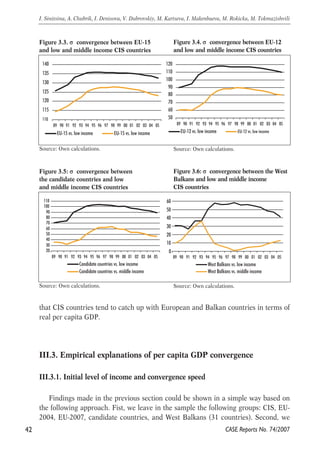
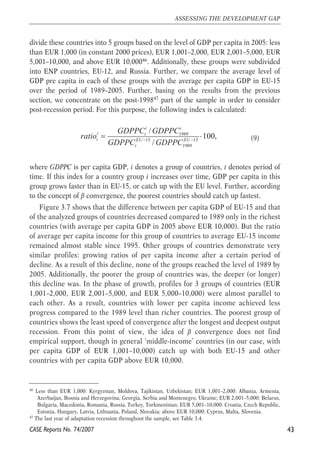
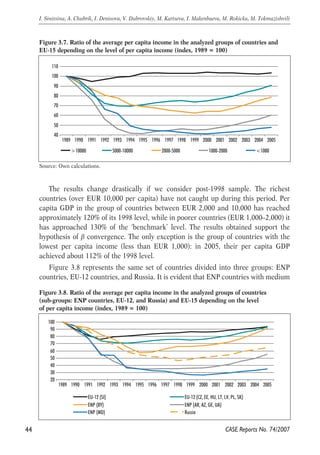
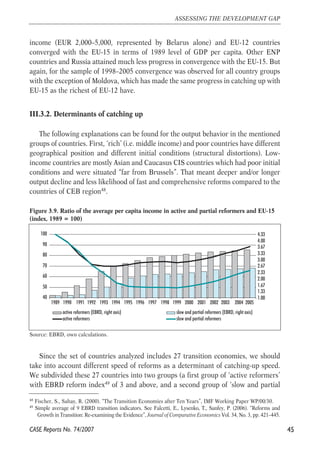
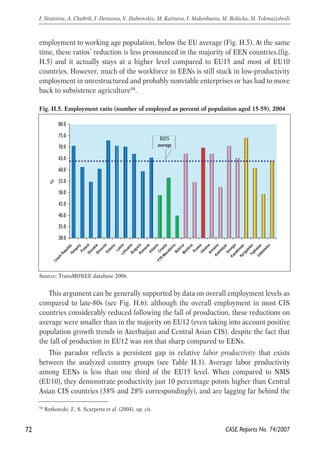
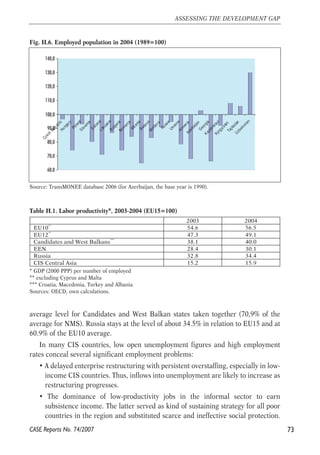
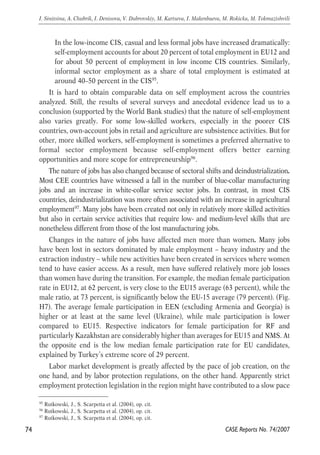
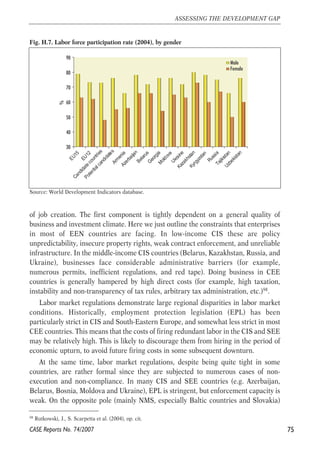
The views and opinions expressed here reflect the authors' point of view and not 
necessarily those of CASE Network. 
This report has been prepared within the project ENEPO - EU Eastern Neighbourhood: 
Economic Potential and Future Development funded by the Sixth Framework 
Programme of the European Union. 
The content of this publication is the sole responsibility of the authors and can in no way 
be taken to reflect the views of the European Union, CASE or other institutions the author 
may be affiliated to. 
Keywords: EU, CIS, development gap, GDP, convergence, quality of life, human 
capital, innovation, environment, institutions, Principal Components Method. 
CASE Reports No. 74/2007 
Jel codes: O11, O52, O57, P27 
Graphic Design: Agnieszka Natalia Bury 
© CASE – Center for Social and Economic Research, Warsaw, 2007 
ISBN 978-83-7178-444-6 
EAN 9788371784446 
Publisher: 
CASE – Center for Social and Economic Research on behalf of CASE Network 
12 Sienkiewicza, 00-010 Warsaw, Poland 
tel.: (48 22) 622 66 27, 828 61 33, fax: (48 22) 828 60 69 
e-mail: case@case-research.eu 
http://www.case-research.eu
This report is part of the CASE Network Report series. 
The CASE Network is a group of economic and social research centers in Poland, Kyrgyzstan, 
Ukraine, Georgia, Moldova, and Belarus. Organizations in the network regularly conduct 
joint research and advisory projects. The research covers a wide spectrum of economic and 
social issues, including economic effects of the European integration process, economic 
relations between the EU and CIS, monetary policy and euro-accession, innovation and 
competitiveness, and labour markets and social policy. The network aims to increase the 
range and quality of economic research and information available to policy-makers and civil 
society, and takes an active role in on-going debates on how to meet the economic challenges 
facing the EU, post-transition countries and the global economy. 
The CASE network consists of: 
• CASE – Center for Social and Economic Research, Warsaw, est. 1991, 
www.case-research.eu 
• CASE – Center for Social and Economic Research – Kyrgyzstan, est. 1998, 
www.case.elcat.kg 
• Center for Social and Economic Research – CASE Ukraine, est. 1999, 
www.case-ukraine.kiev.ua 
• CASE – Transcaucasus Center for Social and Economic Research, est. 2000, 
www.case-transcaucasus.org.ge 
• Foundation for Social and Economic Research CASE Moldova, est. 2003, 
www.case.com.md 
• CASE Belarus – Center for Social and Economic Research Belarus, est. 2007. 
CASE Reports No. 74/2007 3
Contents 
ABSTRACT . . . . . . . . . . . . . . . . . . . . . . . . . . . . . . . . . . . . . . . . . . . . . . . . . . . . . . . . . . . . 8 
I. INTRODUCTION . . . . . . . . . . . . . . . . . . . . . . . . . . . . . . . . . . . . . . . . . . . . . . . . . . . . 10 
II. ORIGINS OF THE DEVELOPMENT GAP . . . . . . . . . . . . . . . . . . . . . . . . . . . . . . . 17 
II.1. Some theoretical reasons. . . . . . . . . . . . . . . . . . . . . . . . . . . . . . . . . . . . . . . 17 
II.2. History of the development gap . . . . . . . . . . . . . . . . . . . . . . . . . . . . . . . . . 20 
II.3. Differences between Soviet republics . . . . . . . . . . . . . . . . . . . . . . . . . . . . . 30 
III. ECONOMIC DEVELOPMENT GAP: MEASURING CONVERGENCE 
OF PER CAPITA INCOME . . . . . . . . . . . . . . . . . . . . . . . . . . . . . . . . . . . . . . . . . . . . . . 34 
III.1. The data . . . . . . . . . . . . . . . . . . . . . . . . . . . . . . . . . . . . . . . . . . . . . . . . . . . 34 
III.2. Testing for convergence between per capita income in low 
and middle income countries of CIS, and European 
and Balkan countries . . . . . . . . . . . . . . . . . . . . . . . . . . . . . . . . . . . . . . . . . 38 
III.3. Empirical explanations of per capita GDP convergence . . . . . . . . . . . . . 42 
III.4. Conclusions. . . . . . . . . . . . . . . . . . . . . . . . . . . . . . . . . . . . . . . . . . . . . . . . . 49 
IV. GAPS IN SPECIFIC DIMENSIONS . . . . . . . . . . . . . . . . . . . . . . . . . . . . . . . . . . . 50 
IV.1. Quality of life: Income, poverty, and health . . . . . . . . . . . . . . . . . . . . . . . 51 
IV. 2. Human capital: education and labor market . . . . . . . . . . . . . . . . . . . . . . 64 
IV.3. Innovation, technological and infrastructural gap . . . . . . . . . . . . . . . . . . 76 
IV.4. Gaps in environmental performance . . . . . . . . . . . . . . . . . . . . . . . . . . . . . 89 
IV.5. Institutional dimension of the development gap: analysis of indicators. . . . 99 
V. MEASURING THE GAP . . . . . . . . . . . . . . . . . . . . . . . . . . . . . . . . . . . . . . . . . . . . . 112 
V.1 Macroeconomic Structure . . . . . . . . . . . . . . . . . . . . . . . . . . . . . . . . . . . . . 112 
V.2 Openness . . . . . . . . . . . . . . . . . . . . . . . . . . . . . . . . . . . . . . . . . . . . . . . . . . . 116 
4 
I. Sinitsina, A. Chubrik, I. Denisova, V. Dubrovskiy, M. Kartseva, I. Makenbaeva, M. Rokicka, M. Tokmazishvili 
CASE Reports No. 74/2007
V.3 Institutions. . . . . . . . . . . . . . . . . . . . . . . . . . . . . . . . . . . . . . . . . . . . . . . . . . 119 
V.4 Demography and Human Capital. . . . . . . . . . . . . . . . . . . . . . . . . . . . . . . . 123 
V.5 Health . . . . . . . . . . . . . . . . . . . . . . . . . . . . . . . . . . . . . . . . . . . . . . . . . . . . . 126 
V.6 Infrastructure . . . . . . . . . . . . . . . . . . . . . . . . . . . . . . . . . . . . . . . . . . . . . . . 128 
V.7 Characterization of the gap for the neighboring countries . . . . . . . . . . . . 131 
Appendix. . . . . . . . . . . . . . . . . . . . . . . . . . . . . . . . . . . . . . . . . . . . . . . . . . . . . . . 135 
VI. CONCLUDING REMARKS . . . . . . . . . . . . . . . . . . . . . . . . . . . . . . . . . . . . . . . . . . 139 
5 
ASSESSING THE DEVELOPMENT GAP 
CASE Reports No. 74/2007
The Authors 
Irina Sinitsina (coordinator), Ph.D., is a leading researcher at the Institute of 
Economics, Russian Academy of Sciences (Moscow, Russia) and CASE's permanent 
representative in Russia, as well as a member of the Board of Directors of CASE - 
Transcaucasus in Tbilisi, Georgia. She specializes in the analysis of social policy, 
including social security systems, social services, labour market, income and 
employment policies in Russia, Poland, Georgia, Ukraine and other FSU and CEE 
countries. She has also carried out extensive comparative macroeconomic studies of the 
economies in transition in these countries. Irina Sinitsina has participated in many 
international advisory projects on fiscal and social policy in Georgia and Ukraine. 
Alexander Chubrik is an expert at the Research Centre of the Institute for Privatisation 
and Management (IPM-CASE Research Centre). He is also an Executive Editor of the 
Belarusian Economic Outlook (BEO) and the Belarusian Monthly Economic Review 
(BMER). He specializes in macroeconomics and private sector development. Alexander 
Chubrik has graduated from Belarussian State University (M.S., Economics) in 2000 
and is currently a lecturer and a PhD student at the same University. 
Irina Denisova is a Lead Economist at the Centre for Economic and Financial 
Research (CEFIR) at New Economic School (NES), Moscow, Russia. She is also a 
professor at the New Economic School and a researcher at the Central Institute of 
Economics and Mathematics (CEMI), Russian Academy of Science. Her research 
interests are focused on labor markets, microeconomics of unemployment, 
effectiveness of government labor market programs, poverty and inequality, and social 
policy issues. At CEFIR, Irina Denisova has led projects on the impact of active labor 
market programs in transition economies and the development of unemployed 
profiling procedures as a basis for planning and implementation of active labor market 
programs. A recipient of Swedish Professorship Award for CEFIR and NES (2000- 
2002) as well as of numerous research grants from leading research foundations. 
Vladimir Dubrovskiy is a senior economist and a member of supervisory board of 
CASE Ukraine. Mr. Dubrovskiy specializes in the issues of business climate, enterprise 
restructuring, privatization, political economy, institutional economics, governance, 
and corruption. His recent work includes participation in developing the World Bank 
Country Economic Memorandum, as well as in GDN study "Understanding Reforms". 
Vladimir is also managing CASE Ukraine partnership with the World Economic 
Forum. He is an author of several books and studies on the process of transformation 
6 
I. Sinitsina, A. Chubrik, I. Denisova, V. Dubrovskiy, M. Kartseva, I. Makenbaeva, M. Rokicka, M. Tokmazishvili 
CASE Reports No. 74/2007
in Ukraine, including assessments of the economic consequences of privatization 
contracted by the State Property Fund of Ukraine. 
Marina Kartseva is an economist at the Centre for Economic and Financial Research 
(CEFIR) in Moscow, Russia. She specializes in labor economics and social policy. 
Irina Makenbaeva is a member of the Board of Directors of CASE-Kyrgyzstan. She 
also works as an associate professor of Kyrgyz State National University and Kyrgyz- 
Russian Slavonic University, and as a coordinator of the World Bank training 
programs for government officials in Kyrgyzstan. Areas of her scientific interests 
include macroeconomics and labor economics. Ms. Makenbaeva studied at Kyrgyz 
State University and received her Ph.D. degree at Leningrad (St. Petersburg) Institute 
of Finance and Economy. In 2003-05, she has participated in the development of the 
UNDP National Strategy for Poverty Reduction in Kyrgyzstan. 
Magdalena Rokicka is a researcher at CASE (Warsaw). A graduate of University of 
Warsaw (2001, M.A. in International Economics), she has participated as a researcher 
in several international projects which included studying consequences of industrial 
restructuring in Russia and Ukraine, and non-tariff barriers for Ukrainian exports to 
the EU. Magda's research interests are focused on applied macroeconomics, gender 
inequalities and social issues, and economics of education. 
Michael Tokmazishvili is the Head of Macroeconomic Division - Budget office, 
Parliament of Georgia and a Senior Researcher at CASE-Transcaucasus (Tbilisi). 
Holds a Ph.D. in Economics (1995, Tbilisi State University). He is an economist and 
researcher with over ten years' experience of participating in international projects: 
in 1997-1999 he worked with the World Bank as Country Program Manager in 
Georgia. With CASE, Mr. Tokmazishvili worked as a consultant on technical 
assistance for enterprise level in restructuring, revitalization and antimonopoly in 
Georgia, and in Post-privatization Development Center Program. 
CASE Reports No. 74/2007 7
Current report aims to identify major existing gaps in the four socio-economic 
dimensions (economic, human, environmental, and institutional) and to reveal those 
gaps which could potentially hinder social and economic integration of neighbor 
states with the EU. To achieve this, the authors aim to assess the existing trends in the 
size of the gaps across countries and problem areas, taking into consideration the 
specific origin of the gap between EU15/EU12, on the one hand, and FSU republics, 
EU candidates and West Balkan countries, on the other hand. 
The paper is structured as follows: 
(1) An analysis of the historic roots and origins of the development gap, and its 
evolvement over time. 
(2) A review of literature sources, draft analysis of primary statistical data, and 
qualitative explanations of gaps and divergences in selected development issues 
across four socio-economic dimensions: 
• level of economic development and convergence rates based on real GDP 
(application of methodology testing β and σ convergence to the set of 
countries analyzed); 
• quality of life and its components (poverty, inequality, health status and health 
care, access to fresh water and sanitation facilities, subjective perceptions of 
well-being); 
• human capital and labor market development, including level of education 
and public spending on education, its accessibility and quality, main 
differences in labor market development (employment participation rates and 
levels of unemployment, new jobs creation and labor protection legislation); 
• innovation potential, including R&D, information and communication 
technologies, and institutional environment; 
• environmental performance in terms of environmental stresses, efforts aimed 
at their reduction, and institutional capacity; 
• business climate, political institutions, and other institutional indicators 
(econometric analysis). 
8 
I. Sinitsina, A. Chubrik, I. Denisova, V. Dubrovskiy, M. Kartseva, I. Makenbaeva, M. Rokicka, M. Tokmazishvili 
CASE Reports No. 74/2007 
ABSTRACT
(3) A test econometric analysis of development gaps across selected dimensions by 
using a Principal Components Method (PCM). The results are further presented 
in the form of ranks of countries analyzed reflecting their distances from EU15 
in respective aggregate averages. 
Special attention is paid to gender-related development issues. Respective issues 
in human capital and labor market study, as well as variables included into PCM 
analysis were supplemented with relative gender data. Several preliminary 
conclusions finalize the report. 
9 
ASSESSING THE DEVELOPMENT GAP 
CASE Reports No. 74/2007
Following the UN approach to monitoring development processes, in this Work- 
Package we attempt to assess the development gap across four dimensions: (i) 
economic, (ii) human, (iii) environmental, and (iv) institutional. In each dimension we 
specify the key sub-themes: 
• in economic dimension: (i) Production level, (ii) Economic growth, (iii) openness 
and infrastructure, (iv) innovation potential; 
• in human dimension: (i) Poverty, (ii) Human security, (iii) Education, (iv) Health 
(v) Equity/social exclusion (vi) Welfare and quality of life; 
• in environmental dimension: (i) State of environmental systems, (ii) Reduction 
of environmental stresses, (iii) Institutional capacity to respond to 
environmental challenges; 
• in institutional dimension: (i) Governance, (ii) Democracy, civil society and 
public participation. 
Major tasks of Work-Package 1: 
(1) to identify the major existing gaps in the four socio-economic dimensions 
and their origin as well as to assess the scope of the development lag; 
(2) to identify those existing gaps which could potentially hinder social and 
economic integration of neighbor states with the EU, and the most urgent 
problems to be solved in National Development Strategies; 
(3) to assess the existing trends in the size of the gaps across countries and 
problem areas, taking into consideration the specific origin of the gap 
between EU15/EU12, on the one hand, and FSU republics, EU candidates and 
West Balkan countries, on the other hand. 
Geographical dimension of analysis 
The geographical scope of the analysis includes transition countries located to the 
East and South-East of the EU borders which have not acquired a status of an EU 
Member. These include groups of countries on different stages of cooperation with the 
EU: candidates to EU membership, potential candidates (West Balkan countries), the 
10 
I. Sinitsina, A. Chubrik, I. Denisova, V. Dubrovskiy, M. Kartseva, I. Makenbaeva, M. Rokicka, M. Tokmazishvili 
CASE Reports No. 74/2007 
1. INTRODUCTION
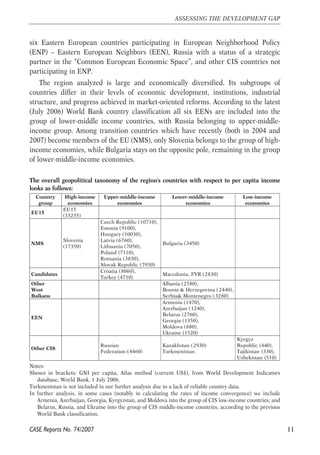
six Eastern European countries participating in European Neighborhood Policy 
(ENP) – Eastern European Neighbors (EEN), Russia with a status of a strategic 
partner in the “Common European Economic Space”, and other CIS countries not 
participating in ENP. 
The region analyzed is large and economically diversified. Its subgroups of 
countries differ in their levels of economic development, institutions, industrial 
structure, and progress achieved in market-oriented reforms. According to the latest 
(July 2006) World Bank country classification all six EENs are included into the 
group of lower-middle income countries, with Russia belonging to upper-middle-income 
group. Among transition countries which have recently (both in 2004 and 
2007) become members of the EU (NMS), only Slovenia belongs to the group of high-income 
economies, while Bulgaria stays on the opposite pole, remaining in the group 
of lower-middle-income economies. 
11 
ASSESSING THE DEVELOPMENT GAP 
The overall geopolitical taxonomy of the region's countries with respect to per capita income 
looks as follows: 
Country 
group 
High-income 
economies 
Notes: 
Shown in brackets: GNI per capita, Atlas method (current US$), from World Development Indicators 
database, World Bank, 1 July 2006. 
Turkmenistan is not included in our further analysis due to a lack of reliable country data. 
In further analysis, in some cases (notably in calculating the rates of income convergence) we include 
Armenia, Azerbaijan, Georgia, Kyrgyzstan, and Moldova into the group of CIS low-income countries; and 
Belarus, Russia, and Ukraine into the group of CIS middle-income countries, according to the previous 
World Bank classification. 
CASE Reports No. 74/2007 
Upper-middle-income 
economies 
Lower-middle-income 
economies 
Low-income 
economies 
EU15 
EU15 
(33235) 
NMS 
Slovenia 
(17350) 
Czech Republic (10710), 
Estonia (9100), 
Hungary (10030), 
Latvia (6760), 
Lithuania (7050), 
Poland (7110), 
Romania (3830), 
Slovak Republic (7950) 
Bulgaria (3450) 
Candidates 
Croatia (8060), 
Turkey (4710) 
Macedonia, FYR (2830) 
Other 
West 
Balkans 
Albania (2580), 
Bosnia & Herzegovina ( 2440), 
Serbia& Montenegro (3280) 
EEN 
Armenia (1470), 
Azerbaijan (1240), 
Belarus (2760), 
Georgia (1350), 
Moldova (880), 
Ukraine (1520) 
Other CIS Russian 
Federation (4460) 
Kazakhstan (2930) 
Turkmenistan 
Kyrgyz 
Republic (440), 
Tajikistan (330), 
Uzbekistan (510)
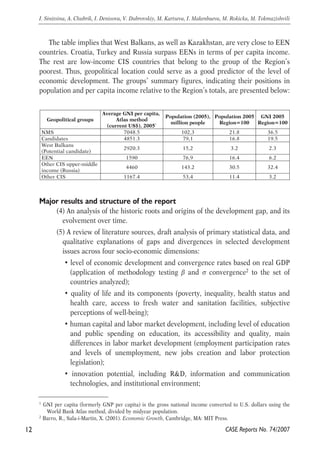
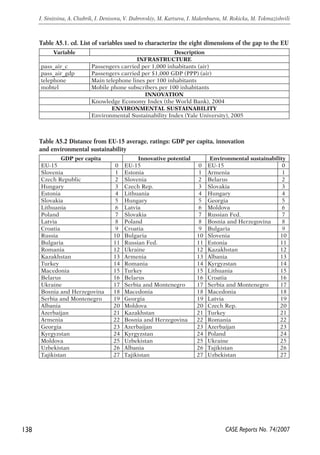
The table implies that West Balkans, as well as Kazakhstan, are very close to EEN 
countries. Croatia, Turkey and Russia surpass EENs in terms of per capita income. 
The rest are low-income CIS countries that belong to the group of the Region’s 
poorest. Thus, geopolitical location could serve as a good predictor of the level of 
economic development. The groups’ summary figures, indicating their positions in 
population and per capita income relative to the Region’s totals, are presented below: 
Geopolitical groups 
Average GNI per capita, 
Atlas method 
(current US$), 20051 
Population (2005), 
million people 
Major results and structure of the report 
Population 2005 
Region=100 
(4) An analysis of the historic roots and origins of the development gap, and its 
evolvement over time. 
(5) A review of literature sources, draft analysis of primary statistical data, and 
qualitative explanations of gaps and divergences in selected development 
issues across four socio-economic dimensions: 
• level of economic development and convergence rates based on real GDP 
(application of methodology testing β and σ convergence2 to the set of 
countries analyzed); 
• quality of life and its components (poverty, inequality, health status and 
health care, access to fresh water and sanitation facilities, subjective 
perceptions of well-being); 
• human capital and labor market development, including level of education 
and public spending on education, its accessibility and quality, main 
differences in labor market development (employment participation rates 
and levels of unemployment, new jobs creation and labor protection 
legislation); 
• innovation potential, including R&D, information and communication 
technologies, and institutional environment; 
12 
I. Sinitsina, A. Chubrik, I. Denisova, V. Dubrovskiy, M. Kartseva, I. Makenbaeva, M. Rokicka, M. Tokmazishvili 
1 GNI per capita (formerly GNP per capita) is the gross national income converted to U.S. dollars using the 
CASE Reports No. 74/2007 
World Bank Atlas method, divided by midyear population. 
2 Barro, R., Sala-i-Martin, X. (2001). Economic Growth, Cambridge, MA: MIT Press. 
GNI 2005 
Region=100 
NMS 7048.5 102,3 21.8 36.5 
Candidates 4851.3 79,1 16.8 19.5 
West Balkans 
(Potential candidate) 2920.3 15,2 3.2 2.3 
EEN 1590 76,9 16.4 6.2 
Other CIS upper-middle 
4460 143.2 30.5 32.4 
income (Russia) 
Other CIS 1167.4 53,4 11.4 3.2
• environmental performance in terms of environmental stresses, efforts 
aimed at their reduction, and institutional capacity; 
• business climate, political institutions, and other institutional indicators 
(econometric analysis). 
(6) A test econometric analysis of development gaps across selected dimensions 
by using a Principal Components Method (PCM). The results were further 
presented in the form of ranks of countries analyzed reflecting their distances 
from EU15 in respective aggregate averages. 
(7) Special attention was paid to gender-related development issues. Respective 
issues in human capital and labor market study, as well as variables included 
into PCM analysis were supplemented with relative gender data. 
Sources of statistical and other data 
Current analysis is based on the extensive body of literature describing and analyzing 
differences in levels of economic and institutional development, industrial structure, 
and progress in market-oriented reforms among countries of the region. A large portion 
of comparative worldwide and regional studies is provided by World Bank reports and 
background papers. Another important source of information, as well as of appropriate 
methods of analysis are comparative studies on human development across regions and 
subregions provided by UNDP. Research provided by global and European centers on 
various aspects of transition process (CEPS and other European networks, World 
Economic Forum, CATO institute, etc.) has also proved to be of high value. 
In order to ensure comparability, most of raw statistical data were provided by 
online databases supported by international organizations: the World Bank World 
Development Indicators database, UNICEF, UNCTAD, UNESCO, ITU, EBRD, IFC and 
IMF databases, a number of statistical data collections supported by the UN Statistics 
Division, including the database of Millenium Development Goals Indicators, etc.3 
Current research would hardly be possible without an extensive use of: 
• a wide set of composite indices measuring various aspects of institutional 
development (World Economic Forum’s Global Executive Opinion Survey, the 
World Bank/IFC Enterprise Survey, the World Bank’s Cost of Doing Business 
survey, The Freedom House „Freedom in the World“ ratings, and other indices 
provided by international NGOs); 
• a widely known and often referred to UNDP approach to measuring human 
development, including Human Development Index (HDI) and Human Poverty 
Index (HPI); 
13 
ASSESSING THE DEVELOPMENT GAP 
3 http://millenniumindiators.un.org/unsd/mi/mi_series_list.asp 
CASE Reports No. 74/2007
• UN sustainable development indicators and underlying methodology. 
• comprehensive environmental indicator sets permitting cross-national 
comparisons, produced by Yale Center for Environmental Law and Policy and 
Columbia University4; 
• the Knowledge Assessment Methodology (KAM) developed by the World Bank 
that measures a country’s ability to generate, adopt and diffuse knowledge5; 
• a dataset of World Values Survey, the most comprehensive and wide-ranging 
survey of human values ever undertaken6. 
Despite this substantial background of research and at first glance abundant body 
of statistical information, we faced a serious problem of comparable data availability 
for our primary research object – EENs, Russia, FSU and West Balkan countries. This 
is due to the following reasons. 
First, in the majority of FSU countries, statistical reporting formats and methods 
of data collection are still not adapted completely to uniform international standards, 
resulting in incomparability of datasets. Thus often seemingly available data could not 
be incorporated into our database, with the result that the datasets used are patchy 
and incomplete. 
The existing incomparability of datasets between EUROSTAT and other databases 
(e.g. TransMONEE database) did not allow in most cases to use the extensive 
EUROSTAT data system with its well developed integrated indicators’ structure for 
our comparative research, as we initially planned to. 
Second, omissions of data for several countries, especially those that recently 
underwent war conflicts, in many regular statistical datasets (e.g. WDI) often could 
not be compensated by data provided by other international organizations in view of 
their incomparability (e.g. difference by several percentage points). Thus, in some 
cases we had to refer to expert assessments (from special publications or interviews). 
Data omission is the main reason why several important variables are missing 
from the aggregate PCM analysis. In some cases, in order to avoid the exclusion of a 
country from this analysis, we had to fill in the missing data from other sources, but 
only when we were able to check the respective data on comparability. In cases when 
the relevant data were not available (which was most often the case with other CIS 
countries or West Balkans), we calculated final average ratings omitting the missing 
dimension for this specific country. 
14 
I. Sinitsina, A. Chubrik, I. Denisova, V. Dubrovskiy, M. Kartseva, I. Makenbaeva, M. Rokicka, M. Tokmazishvili 
4 The 2005 Environmental Sustainability Index Report, available at www.yale.edu/esi. 
5 World Bank Knowledge Assessment Methodology (http://info.worldbank.org/etools/kam2/KAM_page5.asp) 
6 www.worldvaluessurvey.org/ 
CASE Reports No. 74/2007
Third, a lack of comparable time series of data for several countries (e.g. some of 
EENs or republics of former Yugoslavia) did not allow us to provide a sound statistical 
background for trends in the evolvement of specific gaps in the course of transition. 
Thus, in some cases, we were forced to rely on more aggregate indicators available or 
on anecdotal examples. 
Methods tested 
Aiming to produce a more or less clear picture of most vivid and critical existing 
differences in countries’ development, based on sets of indicators and indices 
available, we involved a variety of methods tested by other researchers. 
The methods used include: (1) a descriptive comparative analysis of the raw data 
indicators, (2) correlation analysis between the available variables, (3) econometric 
analysis of composite indicators characterizing specific dimensions, (4) analysis of β 
and σ convergence between per capita income in selected country groups, and (5) 
methods of factor analysis (Principal Components Method). All of methodologies 
mentioned above have certain advantages and deficiencies in terms of data coverage 
or difficulties of results interpretation. 
PCM allows mapping from the space of raw indicators (which are often highly 
correlated with each other) into a space of principal components (which are 
orthogonal to each other). To come up with a measure of a gap along each of the 
dimensions, we estimated the first two principal components based on the variables 
that characterize the dimension. The first two components in the majority of cases 
explain the main variation in the raw indicators. 
The principal components, being the weighted sums of the raw indicators, allow 
to reduce the dimensionality of analysis. Application of PCM is also justified in our 
case since it makes the discussion of inter-country variation more tractable by 
allowing to identify the clusters of countries based on the distance from the EU along 
the chosen dimensions. The components are then used to measure distances from the 
EU15 average which, in turn, are converted into ratings of countries in terms of their 
closeness to the EU. As a result, the ratings along the nine dimensions characterize 
the EU-average gap for each of the neighboring countries. 
We use averages for EU15 as a base for comparisons assuming that this group of 
countries (despite being quite heterogeneous) still provides a more homogenous 
background than it would be if we used the EU27 group. Another point is that we can 
provide additional comparisons on relative position of NMS, which are very divergent in 
many instances and display quite manifold characteristics across specified dimensions. 
The current draft report is in fact a first stage of the total work, representing rather 
an effort aimed at data collection and the preliminary assessment of current inter- 
15 
ASSESSING THE DEVELOPMENT GAP 
CASE Reports No. 74/2007
country differences (gaps) across selected dimensions. This is the reason why we tested 
different approaches to data analysis (descriptive, statistical, econometrical), not 
necessarily mutually integrated. At this stage of work we also have not managed to 
provide an in-depth analysis of important interrelations between various dimensions, 
including one of the most important ones – the role of institutions in specific spheres 
of social and economic development. Instead, we performed an analysis of major 
differences in institutional development across analyzed country groups. A more 
aggregated approach is to be provided in the course of the second year research. 
The draft report is organized as follows: a historical background is followed by the 
analysis of convergence trends in per capita incomes under transition, an exploration 
of most important differences (gaps) between countries across specific dimensions of 
development (quality of life, human capita, innovation, environment, and 
institutions), with an application of PCM for measuring development gaps in different 
dimensions concluding the report. At the current stage of analysis we felt that it would 
be premature to draw final policy recommendations: for that, an in-depth analysis of 
interrelations between gaps in various dimensions is yet to be completed, and a better 
integration with other WPs is required. Thus we finalize the current intermediate 
report with a brief summary of results of our data analysis and the preliminary 
assessment of the existing gaps. 
16 
I. Sinitsina, A. Chubrik, I. Denisova, V. Dubrovskiy, M. Kartseva, I. Makenbaeva, M. Rokicka, M. Tokmazishvili 
CASE Reports No. 74/2007
1I. ORIGINS OF THE 
DEVELOPMENT GAP 
A development gap between present CIS countries (and Eastern Europe in 
general) and Western Europe was in place at least since the 13th century7. It became 
quickly widening mostly in the course of the Industrial Revolution, starting from the 
19th century. However, the reasons for inability to catch up within almost two 
centuries were rooted deeply in history. 
By the beginning of the 19th century, before the Industrial Revolution, most of FSU 
countries became parts of the Russian Empire. Since then, despite multiple territorial 
and border changes, these countries have been developing under a direct impact of 
Russian (later Soviet) institutions and largely shared a common economic history. 
The USSR launched a large-scale forced industrialization in 1930s-60s, but despite 
desperate attempts failed to overcome the development gap: between late 1920s and 
late 1960s, the main goal of modernization was military superiority rather than 
development per se. Although successful in fighting illiteracy and creation of modern 
industries, the Soviet economic policy generated enormous distortions and 
inefficiencies. The latter caused the gap widening again in 1960s because of the 
USSR’s failure to meet the challenges of post-industrialization. 
Following the USSR breakdown at the end of 1991 and the emergence of post- 
Soviet countries, a profound economic and political crisis, accompanied by armed 
conflicts in some territories have severely damaged physical and human capital of the 
respective countries contributing to a deepening of the development gap during the 
first years of transition. 
II.1. Some theoretical reasons 
Following North8, we consider persistent development gap as caused primarily by 
institutional factors. Institutional gap, in turn, was most probably primarily related to 
17 
ASSESSING THE DEVELOPMENT GAP 
7 Author is grateful to Gennadi Poberezny for his kind help in data mining. 
8 North, D.C. (1991). ‘Institutions’, The Journal of Economic Perspectives, Vol. 5, No. 1, pp. 97-112. 
CASE Reports No. 74/2007
the abundance of natural resources, initially arable land. Among other important 
factors discussed in the literature we also consider a lack of traditions of urban self-governing, 
and remoteness from the sea. 
There are at least four factors tending to impede the development of resource-abundant 
countries and therefore make the resource abundance a “mixed blessing” (a 
“resource curse”). 
1. Macroeconomics. Export of resources or raw materials tends to appreciate the 
domestic currency comparing to foreign ones, and in this way make domestic 
production of more sophisticated goods and services non-competitive at the 
world market, or even at the domestic market (so called “Dutch disease” in the 
narrow meaning)9. This factor was hardly important in the case of Russia, since 
its historically inherited extent of foreign trade was relatively small10. 
2. Policies. Rents stemming from natural resources allow the authorities to 
postpone the necessary reforms, neglect important components of development, 
such as education and governance, etc.11 This factor seems to be particularly 
relevant to the case in question. 
3. Political economy. Natural resources are sources of rents. On the one hand, they feed 
the rent seeking aspirations and respective interests, which, in turn, tend to divert 
human and financial resources from productive activities12. On the other hand, 
competition for rents not only results in dissipation of rents themselves, but also 
brings overall insecurity. Prevention of such a competition may need an authoritarian 
arbiter to be in place, which brings all of the fallacies of authoritarianism13. 
4. Institutions. Property rights are needed to protect the renewable natural 
resources from devastating exploitation that can lead to their exhaustion14. 
However, the rights over natural resources are inherently somewhat weaker 
than the ones established over the outputs of various kinds, including fixed assets 
and other capital goods. 
Property rights under feudalism become eventually legitimized by protection 
against plundering. This was the case in the medieval Western Europe, as well as in the 
Kievan Rus’. But this reason lost its force after the Tartar-Mongol invasion (mid 13th 
18 
I. Sinitsina, A. Chubrik, I. Denisova, V. Dubrovskiy, M. Kartseva, I. Makenbaeva, M. Rokicka, M. Tokmazishvili 
9 Sachs J.D., Warner A.M. (2001). “The curse of natural resources”, European Economic Review, Vol. 45, pp. 827-838. 
10 In 1850 Russian exports per capita were 23 times lower than in Great Britain, and 2.7 times lower than in 
Spain. Twenty years after it has increased almost 4.5 times, but still remained 4.4 times less than in Germany. 
11 Gylfason, T. (2001). “Natural resources, education and economic development”, European Economic Review, 
CASE Reports No. 74/2007 
Vol. 45, May, pp. 847-859. 
12 Murphy, K., Shleifer, A., Vishny, R. (1993). “Why Is Rent-Seeking So Costly to Growth?” American Economic 
Review, Vol. 83, pp. 409-14. 
13 Dubrovskiy, V., J. Szyrmer, W. Graves III et al. (2007). “The Reform Driving Forces in a Rent-Seeking Society: 
Lessons From the Ukrainian Transition”, forthcoming in Understanding Market Reforms, Palgrave Macmillan. 
14 Demsetz, H. (1967). “Toward a theory of property rights”, American Economic Review, Vol. 75, pp. 332- 337.
century) onward. Instead, in the Muscovite Rus’ the abundant lands were granted to 
aristocrats along with titles as a reward for their service to a Tsar. Tsar’s discretionary 
power therefore became the only source of legitimacy for land ownership. 
In the case of arable land, there was at least one more important factor. The 
landlords needed labor to cultivate their land, and serfdom was a means to make this 
labor cheaper. But in Western Europe it could be partly substituted by a sort of 
“cartel” of landowners that were almost exclusive employers of those times. When 
labor became scarce because of wars and epidemic diseases, such a cartel took the 
form of legal wage limitations in agriculture – which, however, stimulated the 
urbanization. On the other hand, under land abundance the peasants had an 
alternative of resettling to the virgin lands, thus in Russia serfdom had no alternative. 
In Western Europe, cities served as shelters for the peasants escaped from serfdom 
and the region has inherited an ancient liberal democratic tradition of self-governing 
city-states. Competition for military superiority characteristic for Western Europe 
could be won only by technological progress, so the “arms race” between states, 
duchies, and cities became a powerful engine for development. New weapons’ 
production required advanced technologies that were mostly developed in the cities. 
In the agrarian land-abundant empires (like the Russian one), the cities were 
rather military and administrative centers representing very strong central 
authorities. Their citizens did not enjoy more freedoms than other populace, and 
never constituted a sizable part of the whole population. Until the invention of 
firearms, there were no effective means of fighting the nomads, hence technical 
advance did not make much difference. For these reasons, the agrarian empires of the 
past, although often richer and far more advanced in arts and science than medieval 
Western European countries, nonetheless failed to develop modern institutions that 
later on allowed Western Europe to outperform them in the long run. 
Finally, several scholars15 emphasize proximity to the sea coast as an important 
factor of economic, and especially institutional, development. They associate 
proximity to the sea with better conditions for trade, due to lower cost of sea 
transport, and its lesser vulnerability to plundering, extortion and other kinds of trade 
barriers. In this sense, Western Europe is a unique geographic region with none of the 
cities located in more than 300 kilometers from the sea coast16 and plentiful of rivers 
providing convenient ways to sea ports. Ancient Russian self-governing cities-states of 
Pskov and Novgorod were in this sense similar to their Western European 
counterparts and trade partners. Unlike these, most of the territory of Muscovite Rus’ 
but sub-polar regions had difficult access to sea, hence needed to lean on land trade. 
19 
ASSESSING THE DEVELOPMENT GAP 
15 Mellinger, A.D., Sachs J.D., Gallup J.L. (1999). ‘Climate, Water Navigability, and Economic Development’, 
Center for International Development at Harvard University. CID Working Paper No. 24. 
16 Gaydar, Ye.T. (2005). Rossiya v mire: Ocherki ekonomicheskoy istorii. Moscow, Delo. 
CASE Reports No. 74/2007
II.2. History of the development gap 
Before the Industrial Revolution economic growth was very slow worldwide. Due 
to this reason the countries that had modernized earlier have outperformed the others 
in the beginning of 19th century. At the same time, industrialization gave a chance to 
many other countries to catch up. Therefore, history of the development gap may be 
divided in two periods: before and after the Industrial Revolution. 
Why the industrialization was delayed 
Although initially the Kievan Rus’ of IX-XIII centuries has been rather following 
the European path, later on land abundance, plundering by the Tartars and Mongols, 
and then exposure to Genghis Khan’s empire (succeeded by the “Golden Horde”) 
institutions have turned it to a different path for almost three centuries. The defeat of 
the Horde provided the Muscovite Rus’ with unlimited access to virgin fertile lands, 
which resulted in institutional and technological stagnation and even regress. In 
particular, serfdom that was rather uncommon in the Kievan Rus’ has become much 
more severe compared to Western Europe. 
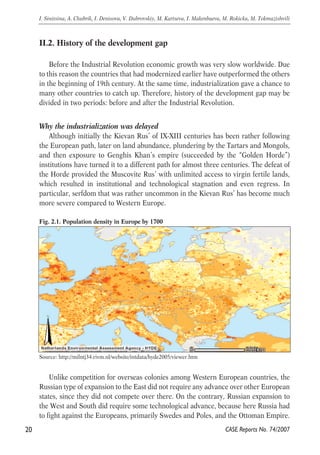
Fig. 2.1. Population density in Europe by 1700 
Unlike competition for overseas colonies among Western European countries, the 
Russian type of expansion to the East did not require any advance over other European 
states, since they did not compete over there. On the contrary, Russian expansion to 
the West and South did require some technological advance, because here Russia had 
to fight against the Europeans, primarily Swedes and Poles, and the Ottoman Empire. 
20 
I. Sinitsina, A. Chubrik, I. Denisova, V. Dubrovskiy, M. Kartseva, I. Makenbaeva, M. Rokicka, M. Tokmazishvili 
CASE Reports No. 74/2007 
Source: http://milntj34.rivm.nl/website/intdata/hyde2005/viewer.htm
Still, despite Peter the Great’s attempt of institutional and technological catch-up in the 
beginning of the 18th century, by the beginning of Industrial Revolution the Russian 
Empire remained mostly agrarian. It remained such for quite a long period of time 
with less than one percent of urban population compared to fifteen percent in the 
Western Europe, and 5.65% in the Eastern Europe by 1720. 
Authoritarianism was an essential part of any agrarian empire, and Russia was not 
an exception, remaining an absolute monarchy until the early 20th century. Serfdom 
that lasted until 1861 made labor mobility close to zero. Instead, modern industries 
were run mostly by the state that, in its turn, was also using mostly forced labor. At the 
same time, the bureaucracy and other institutions of rational rule were largely formal, 
while the actual rules remained inherited from the patrimonial state17. The rule of law 
and other institutions needed for complex transactions going beyond simple bazaar 
exchange remained weak, so the financial markets were non-existing. Therefore, not 
only the industrialization did not start, but the most necessary preconditions for a 
“market capitalist” kind of industrialization were missed along with driving forces for it. 
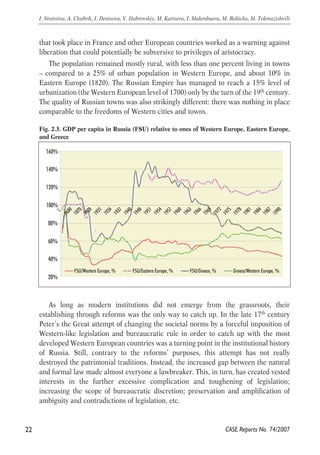
Fig. 2.2. GDP per capita in Russia (FSU) compared to Europe and Greece 
18,000 
16,000 
14,000 
12,000 
10,000 
8,000 
6,000 
4,000 
2,000 
0 
1 
1600 
1870 
1928 
1931 
1954 
1957 
1960 
1963 
1966 
1969 
1972 
1975 
1978 
By this time the Russian Empire was already one of the largest in the world by its 
territory having, however, very little density of population even in its most developed 
European part (Fig. 2.1), abundant with virgin lands, having a severe serfdom and 
with very weak incentives for entrepreneurship. Examples of bourgeois revolutions 
21 
ASSESSING THE DEVELOPMENT GAP 
17 Volkov, V. (2000). “Patrimonialism versus Rational Bureaucracy: on the Historical Relativity of Corruption” 
[in:] S. Lovell, A. V. Ledeneva, and A. Rogachevskii (ed.), Bribery and Blat in Russia: Negotiating Reciprocity 
from the Middle Ages to the 1990, School of Slavonic and Eastern European Studies, University of London. 
McMillan. 
CASE Reports No. 74/2007 
1934 
1937 
1940 
1948 
1951 
1981 
1984 
1987 
1990 
1990 Int'l Geary-Khamis $ 
Greece 
Western Europe (29 countries) 
FSU/Russia
that took place in France and other European countries worked as a warning against 
liberation that could potentially be subversive to privileges of aristocracy. 
The population remained mostly rural, with less than one percent living in towns 
– compared to a 25% of urban population in Western Europe, and about 10% in 
Eastern Europe (1820). The Russian Empire has managed to reach a 15% level of 
urbanization (the Western European level of 1700) only by the turn of the 19th century. 
The quality of Russian towns was also strikingly different: there was nothing in place 
comparable to the freedoms of Western cities and towns. 
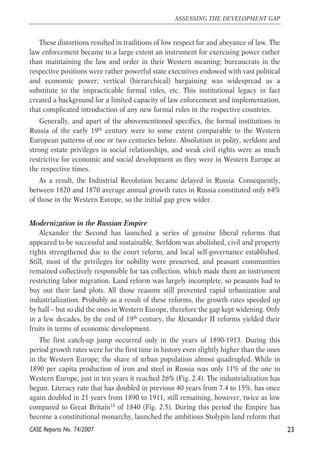
Fig. 2.3. GDP per capita in Russia (FSU) relative to ones of Western Europe, Eastern Europe, 
and Greece 
160% 
140% 
120% 
100% 
1 
1600 
80% 
60% 
40% 
As long as modern institutions did not emerge from the grassroots, their 
establishing through reforms was the only way to catch up. In the late 17th century 
Peter’s the Great attempt of changing the societal norms by a forceful imposition of 
Western-like legislation and bureaucratic rule in order to catch up with the most 
developed Western European countries was a turning point in the institutional history 
of Russia. Still, contrary to the reforms’ purposes, this attempt has not really 
destroyed the patrimonial traditions. Instead, the increased gap between the natural 
and formal law made almost everyone a lawbreaker. This, in turn, has created vested 
interests in the further excessive complication and toughening of legislation; 
increasing the scope of bureaucratic discretion; preservation and amplification of 
ambiguity and contradictions of legislation, etc. 
22 
I. Sinitsina, A. Chubrik, I. Denisova, V. Dubrovskiy, M. Kartseva, I. Makenbaeva, M. Rokicka, M. Tokmazishvili 
CASE Reports No. 74/2007 
20% 
1870 
1928 
1931 
1934 
1937 
1940 
1948 
1951 
1954 
1957 
1960 
1963 
1966 
1969 
1972 
1975 
1978 
1981 
1984 
1987 
1990 
FSU/Western Europe, % FSU/Eastern Europe, % FSU/Greece, % Greece/Western Europe, %
These distortions resulted in traditions of low respect for and abeyance of law. The 
law enforcement became to a large extent an instrument for exercising power rather 
than maintaining the law and order in their Western meaning; bureaucrats in the 
respective positions were rather powerful state executives endowed with vast political 
and economic power; vertical (hierarchical) bargaining was widespread as a 
substitute to the impracticable formal rules, etc. This institutional legacy in fact 
created a background for a limited capacity of law enforcement and implementation, 
that complicated introduction of any new formal rules in the respective countries. 
Generally, and apart of the abovementioned specifics, the formal institutions in 
Russia of the early 19th century were to some extent comparable to the Western 
European patterns of one or two centuries before. Absolutism in polity, serfdom and 
strong estate privileges in social relationships, and weak civil rights were as much 
restrictive for economic and social development as they were in Western Europe at 
the respective times. 
As a result, the Industrial Revolution became delayed in Russia. Consequently, 
between 1820 and 1870 average annual growth rates in Russia constituted only 64% 
of those in the Western Europe, so the initial gap grew wider. 
Modernization in the Russian Empire 
Alexander the Second has launched a series of genuine liberal reforms that 
appeared to be successful and sustainable. Serfdom was abolished, civil and property 
rights strengthened due to the court reform, and local self-governance established. 
Still, most of the privileges for nobility were preserved, and peasant communities 
remained collectively responsible for tax collection, which made them an instrument 
restricting labor migration. Land reform was largely incomplete, so peasants had to 
buy out their land plots. All those reasons still prevented rapid urbanization and 
industrialization. Probably as a result of these reforms, the growth rates speeded up 
by half – but so did the ones in Western Europe, therefore the gap kept widening. Only 
in a few decades, by the end of 19th century, the Alexander II reforms yielded their 
fruits in terms of economic development. 
The first catch-up jump occurred only in the years of 1890-1913. During this 
period growth rates were for the first time in history even slightly higher than the ones 
in the Western Europe; the share of urban population almost quadrupled. While in 
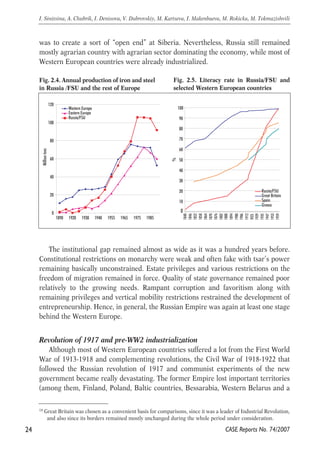
1890 per capita production of iron and steel in Russia was only 11% of the one in 
Western Europe, just in ten years it reached 26% (Fig. 2.4). The industrialization has 
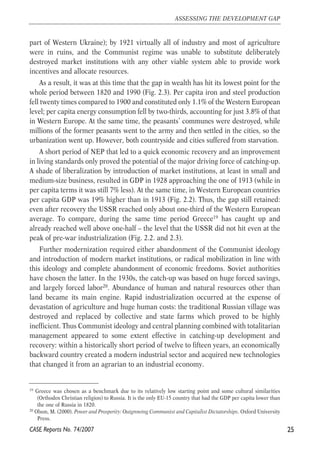
begun. Literacy rate that has doubled in previous 40 years from 7.4 to 15%, has once 
again doubled in 21 years from 1890 to 1911, still remaining, however, twice as low 
compared to Great Britain18 of 1840 (Fig. 2.5). During this period the Empire has 
become a constitutional monarchy, launched the ambitious Stolypin land reform that 
23 
ASSESSING THE DEVELOPMENT GAP 
CASE Reports No. 74/2007
was to create a sort of “open end” at Siberia. Nevertheless, Russia still remained 
mostly agrarian country with agrarian sector dominating the economy, while most of 
Western European countries were already industrialized. 
120 
100 
80 
60 
40 
20 
100 
90 
80 
70 
60 
50 
40 
30 
20 
10 
The institutional gap remained almost as wide as it was a hundred years before. 
Constitutional restrictions on monarchy were weak and often fake with tsar’s power 
remaining basically unconstrained. Estate privileges and various restrictions on the 
freedom of migration remained in force. Quality of state governance remained poor 
relatively to the growing needs. Rampant corruption and favoritism along with 
remaining privileges and vertical mobility restrictions restrained the development of 
entrepreneurship. Hence, in general, the Russian Empire was again at least one stage 
behind the Western Europe. 
Revolution of 1917 and pre-WW2 industrialization 
Although most of Western European countries suffered a lot from the First World 
War of 1913-1918 and complementing revolutions, the Civil War of 1918-1922 that 
followed the Russian revolution of 1917 and communist experiments of the new 
government became really devastating. The former Empire lost important territories 
(among them, Finland, Poland, Baltic countries, Bessarabia, Western Belarus and a 
24 
I. Sinitsina, A. Chubrik, I. Denisova, V. Dubrovskiy, M. Kartseva, I. Makenbaeva, M. Rokicka, M. Tokmazishvili 
18 Great Britain was chosen as a convenient basis for comparisons, since it was a leader of Industrial Revolution, 
and also since its borders remained mostly unchanged during the whole period under consideration. 
CASE Reports No. 74/2007 
Fig. 2.4. Annual production of iron and steel 
in Russia /FSU and the rest of Europe 
Fig. 2.5. Literacy rate in Russia/FSU and 
selected Western European countries 
0 
1890 1920 1930 1940 1955 1965 1975 1985 
Million tons 
Western Europe 
Eastern Europe 
Russia/FSU 
0 
1840 
1846 
1852 
1858 
1864 
1870 
1876 
1882 
1888 
1894 
1900 
1906 
1912 
1923 
1929 
1935 
1947 
1953 
1959 
% 
Russia/FSU 
Great Britain 
Spain 
Greece
part of Western Ukraine); by 1921 virtually all of industry and most of agriculture 
were in ruins, and the Communist regime was unable to substitute deliberately 
destroyed market institutions with any other viable system able to provide work 
incentives and allocate resources. 
As a result, it was at this time that the gap in wealth has hit its lowest point for the 
whole period between 1820 and 1990 (Fig. 2.3). Per capita iron and steel production 
fell twenty times compared to 1900 and constituted only 1.1% of the Western European 
level; per capita energy consumption fell by two-thirds, accounting for just 3.8% of that 
in Western Europe. At the same time, the peasants’ communes were destroyed, while 
millions of the former peasants went to the army and then settled in the cities, so the 
urbanization went up. However, both countryside and cities suffered from starvation. 
A short period of NEP that led to a quick economic recovery and an improvement 
in living standards only proved the potential of the major driving force of catching-up. 
A shade of liberalization by introduction of market institutions, at least in small and 
medium-size business, resulted in GDP in 1928 approaching the one of 1913 (while in 
per capita terms it was still 7% less). At the same time, in Western European countries 
per capita GDP was 19% higher than in 1913 (Fig. 2.2). Thus, the gap still retained: 
even after recovery the USSR reached only about one-third of the Western European 
average. To compare, during the same time period Greece19 has caught up and 
already reached well above one-half – the level that the USSR did not hit even at the 
peak of pre-war industrialization (Fig. 2.2. and 2.3). 
Further modernization required either abandonment of the Communist ideology 
and introduction of modern market institutions, or radical mobilization in line with 
this ideology and complete abandonment of economic freedoms. Soviet authorities 
have chosen the latter. In the 1930s, the catch-up was based on huge forced savings, 
and largely forced labor20. Abundance of human and natural resources other than 
land became its main engine. Rapid industrialization occurred at the expense of 
devastation of agriculture and huge human costs: the traditional Russian village was 
destroyed and replaced by collective and state farms which proved to be highly 
inefficient. Thus Communist ideology and central planning combined with totalitarian 
management appeared to some extent effective in catching-up development and 
recovery: within a historically short period of twelve to fifteen years, an economically 
backward country created a modern industrial sector and acquired new technologies 
that changed it from an agrarian to an industrial economy. 
25 
ASSESSING THE DEVELOPMENT GAP 
19 Greece was chosen as a benchmark due to its relatively low starting point and some cultural similarities 
(Orthodox Christian religion) to Russia. It is the only EU-15 country that had the GDP per capita lower than 
the one of Russia in 1820. 
20 Olson, M. (2000). Power and Prosperity: Outgrowing Communist and Capitalist Dictatorships. Oxford University 
Press. 
CASE Reports No. 74/2007
Fighting illiteracy appeared arguably the most successful modernization effort 
with literacy rate reaching 60% in 1930 (and increasing by 133% within 20 years of 
1919-1939) (Fig. 2.5). Higher education expanded rapidly, with enrollment tripled in 
1929 comparing to 1913, and once again tripled by 1939 – probably, to some extent, 
at the expense of it quality. 
While the USSR was moving forward very quickly, the whole of Western Europe 
suffered from the Great Depression of 1930S. This, undoubtedly, contributed to Soviet 
catching-up efforts (see Fig. 2.3). By 1940 the USSR has reached the level of one-half 
of Western European per capita GDP, while producing 63% of the European level of 
steel and iron per capita (Fig. 2.4). Hence, this was a period of quick catch-up growth, 
although based mostly on forceful mobilization. 
Post-war industrialization: the peak of success 
The Second World War was extremely devastating for the USSR: its losses 
exceeded 52% of total human losses borne by all war participants. However, due to 
extraordinary population losses the fall in per capita GDP was relatively small: it has 
dropped twice as less as in Western Europe (Fig. 2.2). 
The Soviet postwar economic recovery period saw a partial repetition of the 
process of primitive accumulation which had been attempted during the first two five-year 
plans of 1928–37. Living standards were forced down; millions of peasants were 
conscripted, cajoled, or driven by economic necessity into abandoning the land for 
work in industry and construction; the slave labor sector was considerably expanded 
(e.g. by German POW) – all so that ‘capital’ and labor power could be concentrated in 
core sectors of mining, iron and steel, construction, and machine-building21. 
A severe resource mobilization brought about substantial results: in 1950 the gap 
hit its lowest point with the USSR being only 37.9% less that Western Europe in per 
capita GDP (Fig. 2.3). During 1950s the development gap remained pretty stable in 
relative terms (with the USSR having per capita GDP around 60% of the Western 
European one), although widening respectively in absolute terms. The 1950s were 
also a period of rapid industrial growth in both the USSR and the Western Europe. 
Still, average growth rate for 1946-1962 (the longest period of continuous growth) 
constituted just about 4.25%, while for Germany and Italy the averages for the period 
of continuous growth (1946-1973) were 6.4% and 5.5% respectively. 
Unlike the market economies, “socialist industrialization” has prioritized heavy 
(“basic”) industries that were understood mostly in terms of the “coal and ore era” and 
“strengthening the defense capacity of the nation”. These industries were reconstructed 
26 
I. Sinitsina, A. Chubrik, I. Denisova, V. Dubrovskiy, M. Kartseva, I. Makenbaeva, M. Rokicka, M. Tokmazishvili 
21 Filtzer, D. (2002). Soviet Workers and Late Stalinism: Labour and the Restoration of the Stalinist System after 
CASE Reports No. 74/2007 
World War II. Cambridge University Press.
in the first instance, so at that moment the production of iron and steel per capita in 
the USSR constituted about 90% of the Western European average, just as much as the 
latter constituted fifteen years before (Fig. 2.4). 
Even more importantly, the Soviet Union’s postwar experience was visibly 
different from the rest of Europe not in the rate of economic recovery but in the lack 
of institutional response. Where other societies experienced radical reforms or were 
reconstituted, the USSR witnessed the rejuvenated reign of Stalinism22. The lack of 
institutional reforms in turn prevented modernization and inhibited the quality of 
economic growth. 
Soviet postwar growth occurred mainly at the expense of efficiency. Already in 1950, 
the USSR’s energy consumption per 1 dollar of GDP outpaced Western European one 
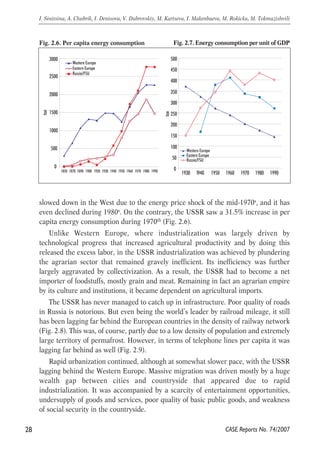
by 27%. While in Western Europe energy intensity has been permanently and almost 
evenly declining at least since 1930 (earlier data not available), in the USSR it has been 
steeply increasing until 1970 and then nearly stabilized at the level exceeding the 
Western European average of 1930 (Fig. 2.6). The same was true for many other 
components of development. For example, while having 23 inhabitants per physician 
(compared to 30 in Greece or 72 in the UK) in 1990, the USSR still had infant mortality 
three times as high, and life expectancy at birth constituting 65/74 years (male/female) 
compared to 75/80 in Greece and 72/78 in the UK respectively. 
After 1960s: the decay 
Since the late 1950s, a relative GDP per capita gap began steadily widening again 
(meaning an even faster increase in the gap in absolute terms) (Fig. 2.3). Since then, a 
smoothed trend of differences in the growth rates was permanently negative. Ironically, 
this change in trend coincided in time with the enunciation of a well-known Khrushchev’s 
slogan “Catch up and overtake the advanced capitalist countries!” (1957) that for a long 
time remained an ever-present factor in the economic and social history of the USSR. 
In general, the Soviet Union has been still pursuing the industrialization, while the 
Western countries have already become post-industrial. The USSR did outperform the 
West in per capita production of iron and steel (Fig. 2.4) – but it was not an indicator 
of modernity any more. Consumption of other materials, like aluminum or plastics, 
became indicative of technological progress. And here the USSR failed to catch up 
despite its wasteful technologies and material-intensive economy. 
Energy consumption per capita has also “caught up” and remained roughly similar 
to the Western European one during the 1960s, indicative of low energy efficiency of 
the economy and wasteful resource consumption (Fig. 2.6). But then its growth has 
27 
ASSESSING THE DEVELOPMENT GAP 
22 Harrison, M. (2006). “The Soviet Economy: War, Growth, and Dictatorship”, Paper prepared for the annual 
meeting of the Allied Social Sciences Associations, Chicago, IL, 5-7 January, 2007. 
CASE Reports No. 74/2007
Fig. 2.6. Per capita energy consumption Fig. 2.7. Energy consumption per unit of GDP 
3000 
2500 
2000 
1500 
1000 
500 
500 
450 
400 
350 
300 
250 
200 
150 
100 
50 
slowed down in the West due to the energy price shock of the mid-1970s, and it has 
even declined during 1980s. On the contrary, the USSR saw a 31.5% increase in per 
capita energy consumption during 1970th (Fig. 2.6). 
Unlike Western Europe, where industrialization was largely driven by 
technological progress that increased agricultural productivity and by doing this 
released the excess labor, in the USSR industrialization was achieved by plundering 
the agrarian sector that remained gravely inefficient. Its inefficiency was further 
largely aggravated by collectivization. As a result, the USSR had to become a net 
importer of foodstuffs, mostly grain and meat. Remaining in fact an agrarian empire 
by its culture and institutions, it became dependent on agricultural imports. 
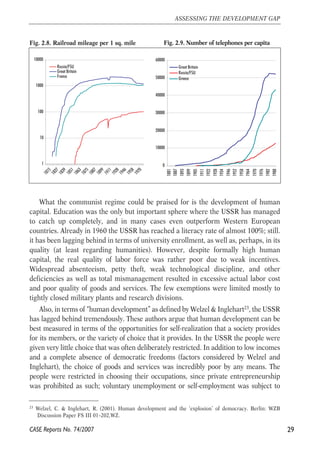
The USSR has never managed to catch up in infrastructure. Poor quality of roads 
in Russia is notorious. But even being the world’s leader by railroad mileage, it still 
has been lagging far behind the European countries in the density of railway network 
(Fig. 2.8). This was, of course, partly due to a low density of population and extremely 
large territory of permafrost. However, in terms of telephone lines per capita it was 
lagging far behind as well (Fig. 2.9). 
Rapid urbanization continued, although at somewhat slower pace, with the USSR 
lagging behind the Western Europe. Massive migration was driven mostly by a huge 
wealth gap between cities and countryside that appeared due to rapid 
industrialization. It was accompanied by a scarcity of entertainment opportunities, 
undersupply of goods and services, poor quality of basic public goods, and weakness 
of social security in the countryside. 
28 
I. Sinitsina, A. Chubrik, I. Denisova, V. Dubrovskiy, M. Kartseva, I. Makenbaeva, M. Rokicka, M. Tokmazishvili 
CASE Reports No. 74/2007 
0 
1850 1870 1890 1900 1920 1930 1940 1950 1960 1970 1980 1990 
toe 
Western Europe 
Eastern Europe 
Russia/FSU 
0 
1930 1940 1950 1960 1970 1980 1990 
toe 
Western Europe 
Eastern Europe 
Russia/FSU
Fig. 2.8. Railroad mileage per 1 sq. mile Fig. 2.9. Number of telephones per capita 
10000 
1000 
100 
10 
1 
Russia/FSU 
Great Britain 
France 
1815 
1827 
1839 
1851 
1863 
1875 
1887 
1899 
1911 
1928 
1946 
1958 
1970 
60000 
50000 
40000 
30000 
20000 
10000 
Great Britain 
Russia/FSU 
Greece 
What the communist regime could be praised for is the development of human 
capital. Education was the only but important sphere where the USSR has managed 
to catch up completely, and in many cases even outperform Western European 
countries. Already in 1960 the USSR has reached a literacy rate of almost 100%; still. 
it has been lagging behind in terms of university enrollment, as well as, perhaps, in its 
quality (at least regarding humanities). However, despite formally high human 
capital, the real quality of labor force was rather poor due to weak incentives. 
Widespread absenteeism, petty theft, weak technological discipline, and other 
deficiencies as well as total mismanagement resulted in excessive actual labor cost 
and poor quality of goods and services. The few exemptions were limited mostly to 
tightly closed military plants and research divisions. 
Also, in terms of “human development” as defined by Welzel & Inglehart23, the USSR 
has lagged behind tremendously. These authors argue that human development can be 
best measured in terms of the opportunities for self-realization that a society provides 
for its members, or the variety of choice that it provides. In the USSR the people were 
given very little choice that was often deliberately restricted. In addition to low incomes 
and a complete absence of democratic freedoms (factors considered by Welzel and 
Inglehart), the choice of goods and services was incredibly poor by any means. The 
people were restricted in choosing their occupations, since private entrepreneurship 
was prohibited as such; voluntary unemployment or self-employment was subject to 
29 
ASSESSING THE DEVELOPMENT GAP 
23 Welzel, C. & Inglehart, R. (2001). Human development and the ‘explosion’ of democracy. Berlin: WZB 
Discussion Paper FS III 01–202,WZ. 
CASE Reports No. 74/2007 
0 
1881 
1887 
1893 
1899 
1905 
1911 
1922 
1928 
1934 
1946 
1952 
1958 
1964 
1970 
1976 
1982 
1988
criminal prosecution; and those who changed their jobs too often were penalized. 
During a long period of time large categories of soviet citizens were deprived of any 
choice at all, as peasants under Stalin times. Besides, there were informal quotas 
limiting access to high education for Jews, children of the dissidents, victims of purges, 
and some other categories. Art, literature, education, and science were placed under a 
strict ideological scrutiny; censorship was pervasive and strictly enforced. 
Although formally democratic, the USSR was a totalitarian state. Market 
institutions were, at most, non-existing, with trading, private property, and 
entrepreneurship being outlawed and condemned by most of the public. No formal 
estate privileges were in place, but de facto the communist nomenklatura enjoyed 
tightly restricted privileged access not only to the goods and services in short supply, 
but also to the potential sources of rents. 
Social capital in the USSR took a very much specific form of the so-called blat24. 
The reputation-based interpersonal networks of informal reciprocal exchange with 
favors of access to scarce goods and services penetrated the whole Soviet society. 
Remarkably, by the end of the 1980s the relative GDP per capita gap became as 
wide as it was in 1913 (Figure 2.3). By that time the idea of ‘overtaking’ was clearly 
an illusion, and catch-up itself was failing, with the result that the gap between the 
West and the East in Europe was growing again. Moreover, the fact that ‘the success’ 
that had been obtained was based on an enormous consumption squeeze meant that 
for ordinary citizens, even though the per capita income figures might prima facie 
suggest progress, their own patterns of consumption remained far behind of what, in 
societies increasingly penetrated by images of the West, they aspired to25. 
II.3. Differences between Soviet republics 
Since the beginning of the Industrial Revolution most of the territories of the 
present EEN countries were subject to the Russian Empire’s and later Soviet 
institutional environment. They have been modernized under prevailing influence of 
Russian/Soviet policies, and the origin of development gap in these countries was 
associated mostly with these patterns. However, these countries and territories varied 
in maturing and intensity of this influence. 
While Eastern edges of present Belarus and Ukraine were directly exposed to the 
Russian both formal and informal institutions, in the Caucasus part of the Empire, as 
30 
I. Sinitsina, A. Chubrik, I. Denisova, V. Dubrovskiy, M. Kartseva, I. Makenbaeva, M. Rokicka, M. Tokmazishvili 
24 Ledeneva, A.V. (1998). Russia’s Economy of Favours. Cambridge University Press. 
25 Haynes M. & R. Husan (2002). “Somewhere Over the Rainbow: The Post-Soviet Transition, the Market and 
the Mythical Process of Convergence”, Post-Communist Economies, Vol. 14, No. 3. 
CASE Reports No. 74/2007
well as in non-Slavic-Orthodox peripheries traditional establishments remained 
largely intact, although of course influenced by the Russian institutions. Such parts, 
although sometimes better developed than the parent state was, were treated as a sort 
of “colonies”, while Ukraine and Belarus considered as “sisters” parts of its mainland. 
This tradition, although weakened, remained during the Soviet times and became the 
main reason behind persisting differences in the development performance, despite 
some deliberate policies of “equalization” conducted by Soviet authorities. 
While most of the territories were under the Soviet system for seventy years, the 
Western parts of Ukraine and Belarus, and the whole Moldova but the Transnistria, lived 
under the Soviets for only 50 years or so, which seems to explain a great deal of their 
later economic performance under transition. In particular, as was clearly demonstrated 
by Fischer and Sahay, the size of the development gap was directly related to the time 
squandered during the socialist experiment26. Certainly, the socialist system in the Soviet 
Union differed under Stalin and Khrushchev, both of which differed from Hungarian 
socialism or from the Polish socialism of Gomulka, Gierek and Jaruzelski27. The same 
was true, albeit to a somewhat lesser extent, for the republics of the FSU. 
The USSR was not homogeneous: tremendous spatial differences in various 
dimensions of development were inherited from previous times. But despite several 
decades of deliberate policies aimed at equalization and unification of standards, the 
31 
ASSESSING THE DEVELOPMENT GAP 
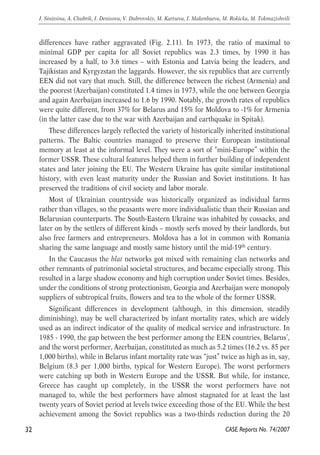
Fig. 2.10. Per capita GDP in FSU Republics (1990 International Geary-Khamis dollars) 
12,000 
10,000 
8,000 
6,000 
4,000 
2,000 
0 
Armenia 
Azerbaijan 
Belarus 
26 Fischer, S. and Sahay, R. (2000) „The Transition Economies After Ten Years“. IMF Working Paper No. 00/30. 
27 Kornai, Janos. (2000). “What the Change of System from Socialism to Capitalism Does and Does Not Mean”, 
The Journal of Economic Perspectives, Vol. 14, No. 1, pp. 27-42. 
CASE Reports No. 74/2007 
Georgia 
Moldova 
Ukraine 
Tajikistan 
Turkmenistan 
Uzbekistan 
Kazakhstan 
Kyrgyzstan 
Lithuania 
Estonia 
Latvia 
Total Former 
USSR 
EEN countries Russia Other CIS Baltia 
1973 
1990
differences have rather aggravated (Fig. 2.11). In 1973, the ratio of maximal to 
minimal GDP per capita for all Soviet republics was 2.3 times, by 1990 it has 
increased by a half, to 3.6 times – with Estonia and Latvia being the leaders, and 
Tajikistan and Kyrgyzstan the laggards. However, the six republics that are currently 
EEN did not vary that much. Still, the difference between the richest (Armenia) and 
the poorest (Azerbaijan) constituted 1.4 times in 1973, while the one between Georgia 
and again Azerbaijan increased to 1.6 by 1990. Notably, the growth rates of republics 
were quite different, from 37% for Belarus and 15% for Moldova to -1% for Armenia 
(in the latter case due to the war with Azerbaijan and earthquake in Spitak). 
These differences largely reflected the variety of historically inherited institutional 
patterns. The Baltic countries managed to preserve their European institutional 
memory at least at the informal level. They were a sort of “mini-Europe” within the 
former USSR. These cultural features helped them in further building of independent 
states and later joining the EU. The Western Ukraine has quite similar institutional 
history, with even least maturity under the Russian and Soviet institutions. It has 
preserved the traditions of civil society and labor morale. 
Most of Ukrainian countryside was historically organized as individual farms 
rather than villages, so the peasants were more individualistic than their Russian and 
Belarusian counterparts. The South-Eastern Ukraine was inhabited by cossacks, and 
later on by the settlers of different kinds – mostly serfs moved by their landlords, but 
also free farmers and entrepreneurs. Moldova has a lot in common with Romania 
sharing the same language and mostly same history until the mid-19th century. 
In the Caucasus the blat networks got mixed with remaining clan networks and 
other remnants of patrimonial societal structures, and became especially strong. This 
resulted in a large shadow economy and high corruption under Soviet times. Besides, 
under the conditions of strong protectionism, Georgia and Azerbaijan were monopoly 
suppliers of subtropical fruits, flowers and tea to the whole of the former USSR. 
Significant differences in development (although, in this dimension, steadily 
diminishing), may be well characterized by infant mortality rates, which are widely 
used as an indirect indicator of the quality of medical service and infrastructure. In 
1985 - 1990, the gap between the best performer among the EEN countries, Belarus’, 
and the worst performer, Azerbaijan, constituted as much as 5.2 times (16.2 vs. 85 per 
1,000 births), while in Belarus infant mortality rate was “just” twice as high as in, say, 
Belgium (8.3 per 1,000 births, typical for Western Europe). The worst performers 
were catching up both in Western Europe and the USSR. But while, for instance, 
Greece has caught up completely, in the USSR the worst performers have not 
managed to, while the best performers have almost stagnated for at least the last 
twenty years of Soviet period at levels twice exceeding those of the EU. While the best 
achievement among the Soviet republics was a two-thirds reduction during the 20 
32 
I. Sinitsina, A. Chubrik, I. Denisova, V. Dubrovskiy, M. Kartseva, I. Makenbaeva, M. Rokicka, M. Tokmazishvili 
CASE Reports No. 74/2007
years between 1970 and 1990 (from 130 to 80 per 1,000 births in Kyrgyz Republic), 
Greece has reduced mortality rate more than five times (from 54.4 to a European 
average of 10.7 during the same period). 
33 
ASSESSING THE DEVELOPMENT GAP 
CASE Reports No. 74/2007
1II. ECONOMIC DEVELOPMENT 
GAP: MEASURING CONVERGENCE 
OF PER CAPITA INCOME 
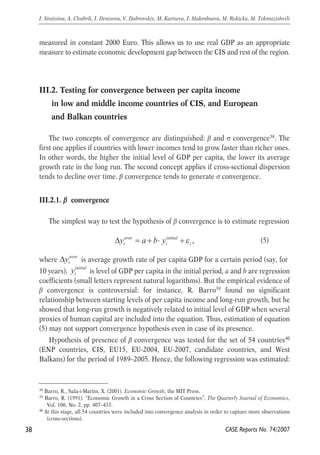
Do ENP countries tend to catch up with the EU in terms of per capita income during 
the transition from planned to market economy? One of the possible ways to answer this 
question is to test for the convergence of per capita incomes between the ENP countries 
and EU, exploring concepts of β and σ convergence. In addition, specifics of the 
analyzed period should be taken into account, including the depth of the adaptation 
recession and reforms progress in post-communist countries of the region. 
The analysis is organized as follows: (1) analysis of properties of the data used; (2) 
analysis of β and σ convergence of per capita income in low and middle income CIS, 
EU candidates and West Balkan countries; (3) empirical explanations of per capita 
GDP convergence, including its relationship with market reforms, FDI inflow, and 
initial level of development; (4) conclusions about the speed of catching up and the 
ways of bridging the development gap between the countries of the region. 
III.1. The data 
For the purposes of this analysis, the data on GDP per capita in constant 2000 
Euro were used. The whole set of 54 analyzed countries could be divided into the 
following groups: ENP countries, CIS, EU15, EU-2004, EU-2007, candidate 
countries, and West Balkans28. The maximum number of observations for each 
country is 17 (1989–2005). 
34 
I. Sinitsina, A. Chubrik, I. Denisova, V. Dubrovskiy, M. Kartseva, I. Makenbaeva, M. Rokicka, M. Tokmazishvili 
28 ENP countries: Algeria, Armenia, Azerbaijan, Belarus, Egypt, Georgia, Israel, Jordan, Lebanon, Libya, 
Moldova, Morocco, Syria, Tunisia, Ukraine. CIS: Armenia, Azerbaijan, Belarus, Georgia, Kazakhstan, 
Kyrgyzstan, Moldova, Russia, Tajikistan, Turkmenistan, Ukraine, Uzbekistan. EU-15: Austria, Belgium, 
Denmark, Finland, France, Germany, Greece, Ireland, Italy, Luxembourg, Netherlands, Portugal, Spain, 
Sweden, United Kingdom. EU-2004: Cyprus, Czech Republic, Estonia, Hungary, Latvia, Lithuania, Malta, 
Poland, Slovakia, Slovenia. EU-2007: Bulgaria, Romania. Candidate countries: Croatia, Macedonia, Turkey. 
West Balkans: Albania, Bosnia and Herzegovina, Serbia and Montenegro. 
CASE Reports No. 74/2007
Choice of real GDP data instead of GDP measured in PPP terms was made due to 
he following reasons: (1) data are available for the whole analyzed period for all 
countries29, which gives us a balanced panel with 17 annual observations for each 
object. PPP data are available for the whole period only for EU-15, while for other 
countries/regions it is far more restricted (for instance, data for Serbia and 
Montenegro are available only since 2000); (2) if we find that real GDP and GDP 
(PPP) are closely correlated, we could argue that real GDP is as appropriate for 
measuring development gap as GDP (PPP). 
We tested both the long run and short run relationships between these two measures 
of income. In order to test the long-run relationship, we used Pedroni cointegration test30. 
For testing the short-run relationship, an error correction model was used31. 
III.1.1. Long-run relationship 
First, we implemented unit root tests in order to determine the order of integration 
of the variables. According to the tests, both of the variables are I(1), i.e. their levels 
contain unit root, while first differences are stationary32 (Table 3.1). 
Second, we implemented Pedroni test for cointegration. Within this test, 7 
statistics were calculated for the two alternative hypotheses: common autoregressive 
coefficients (4 statistics) and individual autoregressive coefficients (3 statistics). For 
the panel variance statistic (v-Statistic), large positive values imply that the null 
hypothesis of no cointegration is rejected, while for other six statistics large negative 
values imply that the null hypothesis is rejected33. Finally, the literature on panel 
cointegration argues that the most reliable statistics (especially in the case of a short 
panel) are panel and group ADF-statistics34, and v-Statistics35. In accordance with 
these statistics and non-parametric PP-statistics, the null hypothesis about the absence 
of cointegration is rejected at 1% significance level (see Table 3.2). 
35 
ASSESSING THE DEVELOPMENT GAP 
29 Except Bosnia and Herzegovina. 
30 Pedroni, P. (1997) “Panel Cointegration: Asympotic and Finite Sample Properties of Pooled Time Series Tests 
with an Application to the PPP Hypothesis. New Results” Indiana University, mimeo; Pedroni, P. (1999). 
“Critical Values for Cointegration Tests in Heterogeneous Panels with Multiple Regressors”, Oxford Bulletin 
of Economics and Statistics, 61, 653–670. 
31 Similar technique is used in Pelipas, I., Chubrik, A. (2007). “Market Reforms and Economic Growth in 
Transition: Evidence from Cointegration Analysis and Equilibrium Correction Model”, mimeo. 
32 According to Choi Z-statistics (Philips-Perron test), the level of GDP (PPP) is stationary, but two other tests 
show its non-stationarity. 
33 Pedroni, P. (1997), op. cit. 
34 Kelly, R., Mavrotas, G. (2003). Savings and Financial Sector Development: Panel Cointegration Evidence from 
Africa World Institute for Development Economics Research Discussion Paper 2003/12; Kappler, M. (2004). 
Determination of Potential Growth Using Panel Techniques, Centre for European Economic Research 
Discussion Paper 04-69. 
35 Bénassy-Quéré A. & M. Coupet & Th. Mayer (2005). „Institutional Determinants of Foreign Direct Investment,“ 
CEPII Working Papers No. 2005-05. 
CASE Reports No. 74/2007
Table 3.1. Unit root tests36 
Levels First differences 
Statistic Probability Number 
of observations 
Note. Specifications: unit root rests for levels of the variables include trend and intercept, for the first 
differences - intercept. Lag length was selected basing on modified Akaike information criteria. Probabilities 
are computed assuming asymptotic normality. 
Table 3.2. Pedroni cointegration test37 
Ha: common AR coefficients 
(within-dimension) 
Statistic Probability 
Weighted 
statistic 
Probability 
Panel v-Statistic 37.26 0.00 16.06 0.00 
Panel ρ-Statistic 7.47 0.00 8.04 0.00 
Panel PP-Statistic -7.48 0.00 -4.75 0.00 
Panel ADF-Statistic -6.82 0.00 -4.62 0.00 
Ha: individual AR coefficients 
(between-dimension) 
Group ρ-Statistic 9.92 0.00 -- -- 
Group PP-Statistic -3.88 0.00 -- -- 
Group ADF-Statistic -5.54 0.00 -- -- 
Taking into account the results of Pedroni cointegration test, we built the model of 
long-run relationship between the variables similar to Engle-Granger approach for 
time-series analyses: 
(1) 
i,t i i i LR i,t i,t , yppp =α + β T + b ⋅ y +ε 
where αi are individual intercepts (individual effects), Ti are individual trends, εi,t is 
the error term which would be used in the error correction model as the error 
correction mechanism (ECMi,t). Estimation of this model shows a very strong 
relationship between the two variables (all coefficients are highly significant): 
36 
I. Sinitsina, A. Chubrik, I. Denisova, V. Dubrovskiy, M. Kartseva, I. Makenbaeva, M. Rokicka, M. Tokmazishvili 
CASE Reports No. 74/2007 
36 Calculations were made in EViews 5.1, unless otherwise indicated. 
37 Calculations were made in EViews 6 beta. 
Statistic Probability Number 
of observations 
y (log of real GDP 
per capita): 
Im, Pesaran and Shin 
W-statistics 
-0.31 0.38 829 -7.05 0.00 781 
ADF – Choi Z-statistics 1.55 0.94 839 -5.59 0.00 781 
PP – Choi Z-statistics 0.05 0.52 857 -7.90 0.00 803 
yppp (log of GDP PPP 
per capita) 
Im, Pesaran and Shin 
W-stat -1.27 0.10 756 -9.16 0.00 709 
ADF – Choi Z-statistics -0.82 0.21 756 -8.29 0.00 709 
PP – Choi Z-statistics -6.76 0.00 786 -12.13 0.00 732 
Note. H0: no cointegration. Specification: individual intercept and individual trends, automatic lag selection 
based on the Akaike information criteria. Number of observations: 918 (54 cross-sections, unbalanced panel).
(2) 
yppp = + ⋅ y +α + β T +ε 
i t 0.47 1.00 i t i i i i t , , , , 
(6.67) (115.00) 
where αi are estimated as fixed effects (heteroskedasticity-consistent t-statistics are in 
parentheses). 
III.1.2. Error correction model 
Further, we implemented unit root tests for the error term from (2) in order to 
include it in the error correction model for revealing the short-run relationship. All 
tests show that ECMi,t is stationary (Table 3.3). 
Table 3.3. Unit root tests for error correction mechanism 
Note. Im, Pesaran and Shin test can be calculated only with exogenous variables (intercept or trend and 
intercept). Lag length was selected basing on modified Akaike information criteria. Probabilities are 
computed assuming asymptotic normality. 
Stationarity of the error correction mechanism is another proof of the long-run 
relationship between the real and PPP-based GDP per capita, and it allows us to build 
up the error correction model: 
(3) 
, , , 1 , i t i t SR i t i t i t , yppp α β b y γ ECM v − Δ = + + ⋅Δ + ⋅ + 
where Δ is difference operator, βt are period dummies (period effects), νi,t is the error 
term. Estimation of this model shows that the relationship between the analyzed 
variables exists both in the short and the long run (all coefficients are highly 
significant; coefficient at the error correction mechanism is negative and less than 1 
in absolute value): 
(4) 
i t 0.02 0.98 i t 0.41 i t i t i t , yppp y ECM α β v − − 
Δ = + ⋅Δ − ⋅ + + + 
, , , 1 , 
(49.10) (98.28) ( 3.94) 
where αi and βt are estimated as fixed effects (heteroskedasticity-consistent t-statistics 
are in parentheses). 
Thus, econometric analysis demonstrates that there exist both short- and long-run 
relationships between per capita GDP measured in PPP and real per capita GDP 
37 
ASSESSING THE DEVELOPMENT GAP 
CASE Reports No. 74/2007 
Statistic Probability 
Exogenous 
variables 
Number 
of observations 
y (log of real GDP per capita): 
Im, Pesaran and Shin W-statistics -8.79 0.00 intercept 716 
ADF – Choi Z-statistics -17.54 0.00 none 718 
PP – Choi Z-statistics -19.90 0.00 none 732
measured in constant 2000 Euro. This allows us to use real GDP as an appropriate 
measure to estimate economic development gap between the CIS and rest of the region. 
III.2. Testing for convergence between per capita income 
in low and middle income countries of CIS, and European 
and Balkan countries 
The two concepts of convergence are distinguished: β and σ convergence38. The 
first one applies if countries with lower incomes tend to grow faster than richer ones. 
In other words, the higher the initial level of GDP per capita, the lower its average 
growth rate in the long run. The second concept applies if cross-sectional dispersion 
tends to decline over time. β convergence tends to generate σ convergence. 
III.2.1. β convergence 
The simplest way to test the hypothesis of β convergence is to estimate regression 
(5) 
aver 
Δyi 
, aver initial 
i i i Δy = a + b⋅ y +ε 
where is average growth rate of per capita GDP for a certain period (say, for 
10 years), y 
initial 
i is level of GDP per capita in the initial period, a and b are regression 
coefficients (small letters represent natural logarithms). But the empirical evidence of 
β convergence is controversial: for instance, R. Barro39 found no significant 
relationship between starting levels of per capita income and long-run growth, but he 
showed that long-run growth is negatively related to initial level of GDP when several 
proxies of human capital are included into the equation. Thus, estimation of equation 
(5) may not support convergence hypothesis even in case of its presence. 
Hypothesis of presence of β convergence was tested for the set of 54 countries40 
(ENP countries, CIS, EU15, EU-2004, EU-2007, candidate countries, and West 
Balkans) for the period of 1989–2005. Hence, the following regression was estimated: 
38 
I. Sinitsina, A. Chubrik, I. Denisova, V. Dubrovskiy, M. Kartseva, I. Makenbaeva, M. Rokicka, M. Tokmazishvili 
38 Barro, R., Sala-i-Martin, X. (2001). Economic Growth, the MIT Press. 
39 Barro, R. (1991). “Economic Growth in a Cross Section of Countries”, The Quarterly Journal of Economics, 
CASE Reports No. 74/2007 
Vol. 106, No. 2, pp. 407–433. 
40 At this stage, all 54 countries were included into convergence analysis in order to capture more observations 
(cross-sections).
(6) 
y 0.058 0.008 y , − − 
Δ =− + ⋅ 
1990 2005 1989 
( 3.245) (4.127) 
where y is GDP per capita in constant 2000 Euro, t-statistics are in parentheses41. The 
results of this estimation show that there is no evidence of convergence among 
considered countries; moreover, they diverge in terms of GDP per capita. This is 
supported by the Figure 3.1 demonstrating that the higher the initial per capita 
income, the higher its average growth rate. 
Figure 3.1. Testing for β convergence (full sample) 
Note. OX axis: log of GDP per capita in 1989; OY axis: average (per capita) growth rate for 1990-2005 (first 
logarithmic differences). 
However, the analyzed set of countries includes 27 post-communist economies. All of 
them faced adaptation (or transition) recession, followed by a period of recovery growth42 
and (in some cases) by a certain long-run growth path. Adaptation recession is not related 
to long-run growth, because it has resulted from distortions inherited by these countries 
from the period of socialism43. Thus, it looks reasonable to exclude periods of adaptation 
recession from the consideration, and re-estimate the regression (6). 
39 
ASSESSING THE DEVELOPMENT GAP 
41 Bosnia and Herzegovina was excluded from this estimate, as GDP data for it is available since 1995. 
42 Gaidar, Y. (2005). “Recovery Growth as a Stage of Post-Socialist Transition?” CASE – Center for Social and 
Economic Research, Studies and Analyses No. 292. 
43 De Melo, M., Denizer, C., Gelb, A., Tenev, S. (1997). Circumstance and Choice: the Role of Initial Condition 
and Policies in Transition Economies, World Bank Policy Research Working Paper 1866. 
CASE Reports No. 74/2007 
0 2 4 6 8 10 12 
0.06 
0.04 
0.02 
0.00 
-0.02 
-0.04 
-0.06
Table 3.4. Last year of adaptation recession in post-communist economies 
Note. The last year of adaptation recession is defined as the last year of sustainable (equal to or more than 2 years) 
Average growth rates were calculated for these countries for the period 
starting from the year following those presented in Table 3.4. Additionally, GDP 
per capita in the last year of adaptation recession was taken as an initial one. For 
the rest of the countries, averages were calculated for the whole sample 
(1990–2005), and initial GDP was that of 1989. As a result, the following 
regression was estimated: 
(7) 
aver 0.116 0.010 initial . y y 
Δ = − ⋅ 
− 
(6.313) ( 4.863) 
The new results differ from the previous ones dramatically: the convergence is 
revealed. The lower the initial level of GDP per capita, the faster its subsequent 
growth is. The results are shown at Figure 3.2. 
40 
I. Sinitsina, A. Chubrik, I. Denisova, V. Dubrovskiy, M. Kartseva, I. Makenbaeva, M. Rokicka, M. Tokmazishvili 
CASE Reports No. 74/2007 
decline of per capita GDP. 
Last year of adaptation recession 
Albania 1992 
Armenia 1993 
Azerbaijan 1996 
Belarus 1995 
Bosnia and Herzegovina 1996 
Bulgaria 1993 
Croatia 1993 
Czech Republic 1993 
Estonia 1993 
Georgia 1994 
Hungary 1993 
Kazakhstan 1995 
Kyrgyzstan 1995 
Latvia 1993 
Lithuania 1994 
Macedonia 1995 
Moldova 1996 
Poland 1991 
Romania 1992 
Russia 1996 
Serbia and Montenegro 1993 
Slovakia 1992 
Slovenia 1992 
Tajikistan 1996 
Turkmenistan 1997 
Ukraine 1998 
Uzbekistan 1996
Figure 3.2. Testing for β convergence (taking into account adaptation recession 
in post-communist economies) 
Note. OX axis: log of GDP per capita in the initial year; OY axis: average (per capita) growth rate for the 
selected period (first logarithmic differences). 
III.2.2. σ convergence 
This type of convergence can be revealed basing on the formula proposed in 
Kaitila (2004)44: 
(8) 
where σt 
Y Y 
( , ) 
100, 
σ 
t i j 
mean Y Y 
( , ) 
t i j 
⋅ 
is standard deviation, Yi, Yj are real per capita GDP in groups of countries i 
and j. We calculated standard deviations for the following pairs of the countries’ groups: 
The results are presented at Figures 3.3-3.6. In almost all cases they support a 
theoretical expectation that β convergence tends to generate σ convergence (the only 
exception is CIS middle income countries vs. West Balkans). Thus, we can conclude 
41 
ASSESSING THE DEVELOPMENT GAP 
44 Kaitila, V. (2004). “Convergence of Real GDP Per Capita in the EU15. How do the Accession Countries Fit 
in?”, European Network of Economic Policy Research Institutes Working Paper No. 25. 
45 CIS low income countries include Armenia, Azerbaijan, Georgia, Kyrgyzstan, and Moldova, and CIS middle-income 
countries are Belarus, Russia, and Ukraine. Last World Bank papers tend to place Armenia in the group 
of middle income countries, but during the whole sample its income was too low to include it into this group. 
CASE Reports No. 74/2007 
0 2 4 6 8 10 12 
0.14 
0.12 
0.10 
0.08 
0.06 
0.04 
0.02 
0.00 
-0.02 
EU-2004 or EU-12 (EU-2004 plus Bulgaria and Romania); 
Candidate countries (Croatia, Macedonia, Turkey); 
Potential candidate countries (West Balkans); 
CIS (low or middle 
income countries45) vs.: 
EU-15.
140 
135 
130 
125 
120 
115 
120 
110 
100 
90 
80 
70 
60 
Source: Own calculations. Source: Own calculations. 
Figure 3.5: σ convergence between 
the candidate countries and low 
and middle income CIS countries 
Figure 3.6: σ convergence between the West 
Balkans and low and middle income 
CIS countries 
110 
100 
90 
80 
70 
60 
50 
40 
30 
20 
89 90 91 92 93 94 95 96 97 98 99 00 01 02 03 04 05 
Candidate countries vs. low income 
Candidate countries vs. middle income 
60 
50 
40 
30 
20 
10 
0 
89 90 91 92 93 94 95 96 97 98 99 00 01 02 03 04 05 
West Balkans vs. low income 
West Balkans vs. middle income 
that CIS countries tend to catch up with European and Balkan countries in terms of 
real per capita GDP. 
III.3. Empirical explanations of per capita GDP convergence 
III.3.1. Initial level of income and convergence speed 
Findings made in the previous section could be shown in a simple way based on 
the following approach. Fist, we leave in the sample the following groups: CIS, EU- 
2004, EU-2007, candidate countries, and West Balkans (31 countries). Second, we 
42 
I. Sinitsina, A. Chubrik, I. Denisova, V. Dubrovskiy, M. Kartseva, I. Makenbaeva, M. Rokicka, M. Tokmazishvili 
CASE Reports No. 74/2007 
Figure 3.3. σ convergence between EU-15 
and low and middle income CIS countries 
Figure 3.4. σ convergence between EU-12 
and low and middle income CIS countries 
110 
89 90 91 92 93 94 95 96 97 98 99 00 01 02 03 04 05 
EU-15 vs. low income EU-15 vs. low income 
50 
89 90 91 92 93 94 95 96 97 98 99 00 01 02 03 04 05 
EU-12 vs. low income EU-12 vs. low income 
Source: Own calculations. Source: Own calculations.
divide these countries into 5 groups based on the level of GDP per capita in 2005: less 
than EUR 1,000 (in constant 2000 prices), EUR 1,001–2,000, EUR 2,001–5,000, EUR 
5,001–10,000, and above EUR 10,00046. Additionally, these groups were subdivided 
into ENP countries, EU-12, and Russia. Further, we compare the average level of 
GDP pre capita in each of these groups with the average per capita GDP in EU-15 
over the period of 1989–2005. Further, basing on the results from the previous 
section, we concentrate on the post-199847 part of the sample in order to consider 
post-recession period. For this purpose, the following index is calculated: 
(9) 
i i 
ratio GDPPC GDPPC 
i t 
t EU EU 
= 1989 
⋅ 
GDPPC − GDPPC − / 
15 15 
1989 
100, 
/ 
t 
where GDPPC is per capita GDP, i denotes a group of countries, t denotes period of 
time. If this index for a country group i increases over time, GDP per capita in this 
group grows faster than in EU-15, or catch up with the EU level. Further, according 
to the concept of β convergence, the poorest countries should catch up fastest. 
Figure 3.7 shows that the difference between per capita GDP of EU-15 and that 
of the analyzed groups of countries decreased compared to 1989 only in the richest 
countries (with average per capita GDP in 2005 above EUR 10,000). But the ratio 
of average per capita income for this group of countries to average EU-15 income 
remained almost stable since 1995. Other groups of countries demonstrate very 
similar profiles: growing ratios of per capita income after a certain period of 
decline. As a result of this decline, none of the groups reached the level of 1989 by 
2005. Additionally, the poorer the group of countries was, the deeper (or longer) 
this decline was. In the phase of growth, profiles for 3 groups of countries (EUR 
1,001–2,000, EUR 2,001–5,000, and EUR 5,000–10,000) were almost parallel to 
each other. As a result, countries with lower per capita income achieved less 
progress compared to the 1989 level than richer countries. The poorest group of 
countries shows the least speed of convergence after the longest and deepest output 
recession. From this point of view, the idea of β convergence does not find 
empirical support, though in general ‘middle-income’ countries (in our case, with 
per capita GDP of EUR 1,001–10,000) catch up with both EU-15 and other 
countries with per capita GDP above EUR 10,000. 
43 
ASSESSING THE DEVELOPMENT GAP 
46 Less than EUR 1,000: Kyrgyzstan, Moldova, Tajikistan, Uzbekistan; EUR 1,001–2,000: Albania, Armenia, 
Azerbaijan, Bosnia and Herzegovina, Georgia, Serbia and Montenegro, Ukraine; EUR 2,001–5,000: Belarus, 
Bulgaria, Macedonia, Romania, Russia, Turkey, Turkmenistan; EUR 5,001–10,000: Croatia, Czech Republic, 
Estonia, Hungary, Latvia, Lithuania, Poland, Slovakia; above EUR 10,000: Cyprus, Malta, Slovenia. 
47 The last year of adaptation recession throughout the sample, see Table 3.4. 
CASE Reports No. 74/2007
Figure 3.7. Ratio of the average per capita income in the analyzed groups of countries and 
EU-15 depending on the level of per capita income (index, 1989 = 100) 
110 
100 
90 
80 
70 
60 
50 
40 
1989 1990 1991 1992 1993 1994 1995 1996 1997 1998 1999 2000 2001 2002 2003 2004 2005 
>10000 5000-10000 2000-5000 1000-2000 <1000 
The results change drastically if we consider post-1998 sample. The richest 
countries (over EUR 10,000 per capita) have not caught up during this period. Per 
capita GDP in the group of countries between EUR 2,000 and 10,000 has reached 
approximately 120% of its 1998 level, while in poorer countries (EUR 1,000–2,000) it 
has approached 130% of the ‘benchmark’ level. The results obtained support the 
hypothesis of β convergence. The only exception is the group of countries with the 
lowest per capita income (less than EUR 1,000): in 2005, their per capita GDP 
achieved about 112% of the 1998 level. 
Figure 3.8 represents the same set of countries divided into three groups: ENP 
countries, EU-12 countries, and Russia. It is evident that ENP countries with medium 
44 
I. Sinitsina, A. Chubrik, I. Denisova, V. Dubrovskiy, M. Kartseva, I. Makenbaeva, M. Rokicka, M. Tokmazishvili 
CASE Reports No. 74/2007 
Source: Own calculations. 
Figure 3.8. Ratio of the average per capita income in the analyzed groups of countries 
(sub-groups: ENP countries, EU-12, and Russia) and EU-15 depending on the level 
of per capita income (index, 1989 = 100) 
100 
90 
80 
70 
60 
50 
40 
30 
20 
1989 1990 1991 1992 1993 1994 1995 1996 1997 1998 1999 2000 2001 2002 2003 2004 2005 
EU-12 (SI) EU-12 (CZ, EE, HU, LT, LV, PL, SK) 
ENP (BY) ENP (AR, AZ, GE, UA) 
ENP (MD) Russia
income (EUR 2,000–5,000, represented by Belarus alone) and EU-12 countries 
converged with the EU-15 in terms of 1989 level of GDP per capita. Other ENP 
countries and Russia attained much less progress in convergence with the EU-15. But 
again, for the sample of 1998–2005 convergence was observed for all country groups 
with the exception of Moldova, which has made the same progress in catching up with 
EU-15 as the richest of EU-12 have. 
III.3.2. Determinants of catching up 
The following explanations can be found for the output behavior in the mentioned 
groups of countries. First, ‘rich’ (i.e. middle income) and poor countries have different 
geographical position and different initial conditions (structural distortions). Low-income 
countries are mostly Asian and Caucasus CIS countries which had poor initial 
conditions and were situated “far from Brussels”. That meant deeper and/or longer 
output decline and less likelihood of fast and comprehensive reforms compared to the 
countries of CEB region48. 
Figure 3.9. Ratio of the average per capita income in active and partial reformers and EU-15 
(index, 1989 = 100) 
100 
90 
80 
70 
60 
50 
40 
1989 1990 1991 1992 1993 1994 1995 1996 1997 1998 1999 2000 2001 2002 2003 2004 2005 
Source: EBRD, own calculations. 
4.33 
4.00 
3.67 
3.33 
3.00 
2.67 
2.33 
2.00 
1.67 
1.33 
Since the set of countries analyzed includes 27 transition economies, we should 
take into account different speed of reforms as a determinant of catching-up speed. 
We subdivided these 27 countries into two groups (a first group of ‘active reformers’ 
with EBRD reform index49 of 3 and above, and a second group of ‘slow and partial 
45 
ASSESSING THE DEVELOPMENT GAP 
48 Fischer, S., Sahay, R. (2000). “The Transition Economies after Ten Years”, IMF Working Paper WP/00/30. 
49 Simple average of 9 EBRD transition indicators. See Falcetti, E., Lysenko, T., Sanfey, P. (2006). “Reforms and 
Growth in Transition: Re-examining the Evidence”, Journal of Comparative Economics Vol. 34, No. 3, pp. 421–445. 
CASE Reports No. 74/2007 
1.00 
active reformers (EBRD, right axis) slow and partial reformers (EBRD, right axis) 
active reformers slow and partial reformers
reformers’ with EBRD reform index less than 3)50, and compared average per capita 
GDP in each of these groups to its average level of EU-15 as it was done before. The 
results are presented at Figures 3.10–3.11. According to these figures, the main 
problem of slow reformers was a deeper and a longer recession, while their recovery 
growth had almost the same speed as that in the group of active reformers. It should 
be noted that no significant differences within each of this groups are observed if we 
subdivide them into ENP countries and EU-12 countries. 
Figure 3.10. Ratio of the average per capita income in active and partial reformers (sub-groups: 
ENP countries, EU-12, and Russia) and EU-15 (index, 1989 = 100) 
100 
90 
80 
70 
60 
50 
40 
1989 1990 1991 1992 1993 1994 1995 1996 1997 1998 1999 2000 2001 2002 2003 2004 2005 
ENP (AR, GE) ENP (AZ, BY, MD, UA) 
EU-12 (BG, CZ, EE, LT, LV, PL, RO, SK, SI) Russia 
Active reformers started catching up in 1994 (catching up ‘record’ covers 11 years), 
while partial reformers commenced this process only in 2000 (6 years of catching up). 
In 1994, average EBRD reform index for the group of active reformers amounted to 
2.63 (which is close to EBRD rank “3–”); in 2000, this index in the group of partial 
reformers was equal to 2.34 (2+). Thus, per capita GDP in these groups of countries 
started to converge with the EU-15 level of per capita GDP after a certain set of reforms 
had been implemented. As partial reformers have made little progress in market 
reforms since 2000, it is likely that the current GDP growth in the groups of countries 
analyzed is determined by different factors: structural reforms in active reformers and 
favorable external environment51 in countries that implemented partial reforms. 
Second, a slow speed of catching-up of the poorest countries could be explained 
via different types of ‘poverty traps’. Poverty trap means that production function of 
46 
I. Sinitsina, A. Chubrik, I. Denisova, V. Dubrovskiy, M. Kartseva, I. Makenbaeva, M. Rokicka, M. Tokmazishvili 
50 Active reformers: Armenia, Bulgaria, Croatia, Czech Republic, Estonia, Georgia, Hungary, Latvia, Lithuania, 
Poland, Romania, Slovakia, Slovenia. Slow and partial reformers: Albania, Azerbaijan, Belarus, Bosnia and 
Herzegovina, Kazakhstan, Kyrgyzstan, Macedonia, Moldova, Russia, Serbia and Montenegro, Tajikistan, 
Turkmenistan, Ukraine, Uzbekistan. 
CASE Reports No. 74/2007 
51 Falcetti et al. (2006), op.cit.
an economy demonstrates diminishing returns to capital when the capital stock is 
low, increasing returns in the middle of the range of capital stock, and constant or 
diminishing returns when capital stock is high52. Thus, poor countries’ production 
functions demonstrate diminishing returns on capital, which makes investment into 
these countries unattractive and brings such countries into a kind of a ‘trap’. In order 
to make a decision about investment, an investor should expect certain returns on 
capital. In poor countries returns on inputs are low, making investment is 
unattractive and brings these countries to a ‘vicious circle’53. 
These theoretical statements have empirical support. FDI inflow can be considered 
as an indicator of a country’s attractiveness for a capital (in other words, as an 
implicit measure of returns on capital). According to the concepts of poverty traps and 
vicious circles, the poor countries should face smallest inflows of FDI per capita, 
middle income should get the largest inflows of FDI per capita, and high income 
countries – some medium inflows. This means some sort of an inverse U-shaped 
relationship demonstrated at Figure 3.9. 
Figure 3.11. Inverse U-shaped relationship between FDI per capita and GDP per capita 
FDI per capita, current USD 
2000 
1500 
1000 
500 
0 
-500 
-1000 
5000 5500 10500 15500 20500 25500 30500 35500 40500 
This relationship has been estimated on the basis of the data on 50 economies54 for 
17 years (unbalanced sample). The following regression has been estimated: 
= − + ⋅ − ⋅ + + + i t i t i t i t i t FDIpc GDPpc GDPpc 
1014.69 0.22 0.0000042 α α ε , 
− − 
(9) 2 
, , , , 
( 3.04) (3.78) ( 2.84) 
47 
ASSESSING THE DEVELOPMENT GAP 
52 Barro, R., Sala-i-Martin, X. (2001), op.cit. 
53 Easterly W., (2002) “Inequality does Cause Underdevelopment: New evidence”, Working Paper No.1, January 
2002, Center for Global Development; Easterly, W. (2001). The Elusive Quest for Growth. Economists’ 
Adventures and Misadventures in the Tropics, the MIT Press. 
54 There is no data on FDI for Serbia, Turkmenistan, and Uzbekistan. Luxemburg has been excluded as an outlier 
(in 2005, per capita FDI in Luxemburg amounted to USD 240,608. 
CASE Reports No. 74/2007 
GDP per capita, current USD 
USD 17,000 threshold
t 
where pc denotes per capita indicators, t-statistics in parentheses are heteroskedasticity 
consistent, and are individual and period effects (both specified as fixed effects). 
i 
ααAdditional empirical support can be provided with the analyses of fixed individual 
effects. These estimates are inconsistent, so usually they are not considered in the 
literature. But in our case they can provide a very clear evidence of a lower (compared 
to middle income countries) inflow of FDI to the rich economies. In all countries with 
per capita GDP in 2005 above USD 17,000 fixed effects (or dummies) were negative55, 
i.e. they have lower-than-average starting point of per capita FDI inflow. All other 
countries have positive fixed effects and higher-than-average inflow of FDI per capita. 
Finally, a hypothesis about the presence of convergence in terms of real per capita 
GDP (after the period of adaptation recession) is supported for all of the 
abovementioned pairs of the countries’ groups (see Figures 3.12–3.13). For these 
figures, ratios of average per capita GDP for the groups of countries are calculated 
based on the formula similar to (9): 
i i 
ratio GDPPC GDPPC 
i t 
t j j 
= ⋅ 
(11) 1989 
1989 
/ 
100. 
GDPPC / 
GDPPC 
t 
48 
I. Sinitsina, A. Chubrik, I. Denisova, V. Dubrovskiy, M. Kartseva, I. Makenbaeva, M. Rokicka, M. Tokmazishvili 
Figure 3.12: Ratio of the average per capita 
incomes index: CIS low income countries 
vs. others (1989 = 100) 
Figure 3.13: Ratio of the average per capita 
incomes index: CIS middle income countries 
vs. others (1989 = 100) 
120 
100 
80 
60 
40 
20 
89 90 91 92 93 94 95 96 97 98 99 00 01 02 03 04 05 
EU-15 EU-12 
Candidate countries West Balkans 
160 
140 
120 
100 
80 
60 
40 
89 90 91 92 93 94 95 96 97 98 99 00 01 02 03 04 05 
Source: Own calculations. Source: Own calculations. 
55 With the two exceptions: Belgium (positive dummy, per capita GDP in 2005 is USD 35,498) and Libya 
CASE Reports No. 74/2007 
(negative dummy, per capita GDP in 2005 is USD 6,618). 
EU-15 EU-12 
Candidate countries West Balkans
III.4. Conclusions 
In this section, an economic dimension of development gap between EU and ENP 
countries has been analyzed. For this purpose, convergence of per capita GDP has 
been tested. The two concepts of convergence have been analyzed: β convergence (do 
low-income countries tend to grow faster than richer ones) and σ convergence (does 
dispersion of per capita income tends to decline over time). Both of these hypotheses 
have been supported by empirical data. 
Convergence testing has been made on the basis of the data on real GDP per capita 
in the analyzed countries for the period of 1989–2005. This indicator has been 
analyzed instead of commonly used GDP measured by PPP. Such a ‘replacement’ 
appeared to be possible because cointegration exists between these two variables. It 
was necessary for the following reasons: (1) the concept of PPP can hardly be applied 
to developing countries or transition economies, because their economic structures 
differ substantially from those of developed countries; (2) data on GDP (PPP) for most 
of the analyzed countries are available only for a limited time sample, which reduces 
reliability of the results. 
The least progress in filling the development gap with EU-15 has been shown by the 
low income CIS economies, while EU-12 demonstrated a higher degree of catching up 
with EU-15. In general, in the course of the analyzed period countries with higher per 
capita income caught up faster than lower income ones. It has been explained by the 
impact of adaptation recession in 27 of analyzed countries (transition economies): for 
the post-recession sample we observed an evidence of β convergence between these 
countries. Another explanation relates to the ‘poverty trap’ concept, according to 
which poor countries have low attractiveness to investors because of the low level of 
returns to capital. This concept has also been empirically supported: per capita FDI 
inflows to the poor countries are lower than to the middle-income countries. 
Market reforms have appeared to be another important determinant of closing the 
gap between the EU and the rest of countries of the region. A split of the sample into 
‘active reformers’ and ‘slow and partial reformers’ demonstrated a clear positive 
relationship between the reform progress and the progress in catching up. Thus we 
can conclude that promotion of comprehensive market reforms is still very topical for 
most of the region’s economies, where some progress in catching up could be 
attributed mostly to the favorable performance of the world commodity markets. 
49 
ASSESSING THE DEVELOPMENT GAP 
CASE Reports No. 74/2007
1V. GAPS IN SPECIFIC DIMENSIONS 
Economic growth is a necessary but insufficient condition for economic development. 
Per capita GDP is used by many developmental economists as an approximation of 
general national well-being. However, this and similar measures have long been criticized 
as not measuring economic growth well enough. Nowadays it is not questionable that 
GDP per se is a narrow measure of economic development and does not take into account 
its complex multi-dimensional concept, important non-economic aspects such as income 
inequality and poverty, access to health and education, the environment, freedom, or 
social justice. Economists have long argued that development occurs with the reduction 
and elimination of poverty, inequality, and unemployment within a growing economy56; 
with producing more ‘life sustaining’ necessities such as food, shelter, and health care and 
broadening their distribution, raising standards of living and individual self esteem, 
expanding economic and social choice and reducing fear57. 
The concept of sustainable development advanced by the UN in the course of the 
past two decades encompasses, along with economic and social pillars, 
environmental sustainability implying economic growth together with the protection 
of environmental quality, each reinforcing the other. The essence of this form of 
development is a stable relationship between human activities and the natural world, 
which does not diminish the prospects for future generations to enjoy a quality of life 
at least as good as our own58. 
Further on, knowledge and information are decisive elements in all modes of 
development. However, a new development paradigm has emerged assigning 
technology and information a causal role in the social order, known as “Global village”, 
“information society” or “knowledge society”. This notion implies that “information 
generation, processing, and transmission are transformed into the fundamental 
sources of productivity and power”, with knowledge becoming crucial not only for 
economic growth but also for empowering and developing all sectors of society59. 
50 
I. Sinitsina, A. Chubrik, I. Denisova, V. Dubrovskiy, M. Kartseva, I. Makenbaeva, M. Rokicka, M. Tokmazishvili 
56 Seers, D. (1969). “The Meaning of Development”, International Development Review, Vol. 11, No.4, pp. 3-4. 
57 Todaro, M. (2000). Economic Development. 7th ed. New York: Addison-Wesley Longman, Inc. 
58 Mintzer, I.M., ed. (1992).Confronting climate change: Risks, implications, and responses. Cambridge: 
CASE Reports No. 74/2007 
Cambridge University Press. 
59 Castells, M. (1996). The Rise of the Network Society, The Information Age: Economy, Society and Culture, Vol. I. 
Cambridge, MA; Oxford, UK: Blackwell.
A compelling body of research links primary, secondary and higher education to 
development and economic growth. This research recognizes people as a type of 
economic asset – “human capital” – and shows that increased investment in health, 
skills, and knowledge provides future returns to the society not just by raising labor 
productivity, but by equipping citizens with the skills and attitudes for economic and 
civic success in an increasingly knowledge-based economy60. 
Countries’ development potential is also dependent on their openness to world 
economy (lack of trade barriers, ease of entry and exit into trade, available infrastructure, 
etc.), on the quality of life of their citizens (including availability of medical care, prenatal 
care and clean water, equality of income distribution and the scale of poverty). The notion 
of social capital preservation is also an integral part of this concept. 
Following this very schematically presented overview of specific dimensions of 
development, we arranged our examination of major differences (gaps) between the 
analyzed countries and country groups across specific dimensions which in general 
follow the underlying logic of the sustainable development concept. 
IV.1. Quality of life: Income, poverty, and health 
Income and poverty 
Major trends in per capita income convergence between the EU15, EU12, the 
candidates’ group, EEN and Russia have been explored in the preceding section. This 
analysis, however, left aside major income differentials existing between individual 
countries within the groups analyzed (Fig. Q.1). These differentials are impressive 
indeed with their amplitude growing while moving eastwards from EU15. Even 
within the NMS group, the country with the highest income, Slovenia, has an income 
less than two-thirds of the Western European average. 
With acquiring independence and under economic transition, differentials of GDP 
per capita among EEN have widened considerably with none of the countries 
reaching even a half of the EU27 average (Fig. Q.1). EEN countries also differ greatly 
when compared to Russia. Within the CIS, the two countries with the second highest 
incomes, Kazakhstan and Belarus, still have incomes only about two-thirds that of 
Russia, while Russian GDP per capita is eight times that of Tajikistan. 
Process of transition has also brought about radical changes in income 
distribution within transition economies (Fig. Q.2). When assessing income inequality 
within FSU and candidate countries, we should account for the fact that under 
51 
ASSESSING THE DEVELOPMENT GAP 
60 Schweke, W.(2004). Smart Money: Education and Economic Development. Economic Policy Institute. 
CASE Reports No. 74/2007
52 
I. Sinitsina, A. Chubrik, I. Denisova, V. Dubrovskiy, M. Kartseva, I. Makenbaeva, M. Rokicka, M. Tokmazishvili 
CASE Reports No. 74/2007 
Fig. Q.1. GDP (PPP) per capita as % of EU27 average (2005) 
50% 
45% 
40% 
35% 
30% 
25% 
20% 
15% 
10% 
5% 
0% 
Albania 
Serbia and Montenegro 
Bosnia and Herzegovina 
Macedonia 
Turkey 
Croatia 
Moldova 
Georgia 
Armenia 
Azerbaijan 
Ukraine 
Belarus 
Sources: WEO database, EBRD, EUROSTAT. 
Russia 
Tajikistan 
Uzbekistan 
Kyrgyzstan 
Kazakhstan 
Candidates & West Balkans EEN Central Asia CIS 
Fig. Q.2. Distribution of family income: Gini index (1996-2003) 
45 
40 
35 
30 
25 
20 
Hungary 
Slovakia 
Slovenia 
Romania 
Bulgaria 
Lithuania 
Estonia 
Poland 
Latvia 
Source: World Bank. Growth, poverty, and inequality: Eastern Europe and the former Soviet Union. 
Washington, D.C., 2005 
Bosnia & Herzegovina 
Macedonia 
Albania 
Croatia 
Serbia & Montenegro 
Turkey 
Ukraine 
Belarus 
Moldova 
Azerbaijan 
Georgia 
Russia 
Armenia 
Uzbekistan 
Kyrgyzstan 
Kazakhstan 
Tajikistan 
EU12 Candidates & 
West Balkans 
EEN 
EU15 
average 
Central Asian 
CIS
socialism an attempt was undertaken to equalize incomes among both social groups 
and geographic regions, which was accomplished through a massive and elaborate 
system of subsidies, transfers, and controlled prices. Initially rather egalitarian, these 
societies faced an abrupt increase in income inequality which radically changed 
relative positions of large layers of society. This process was closely associated with a 
sharp increase of poverty rates (Fig. Q.3). 
Directly comparing poverty levels between the EU15 countries and EENs is a 
methodologically difficult, if not impossible, task. National poverty lines are basically 
useless, reflecting radically different approaches to poverty definitions. International 
poverty indicators (like population below $2 a day) are not easy to employ because 
relevant population numbers in Western Europe are vanishingly small. 
Overall, for the EU15 countries, poverty levels are mostly low and confined to a 
few pockets. On the other hand, in FSU, despite a considerable decline since 1998, 
even better-off countries, such as Kazakhstan and Russia, have $2 a day poverty 
headcounts of 10–20 percent, and half of Georgia’s people are poor by this measure. 
The middle-income quartet of Kazakhstan, Russia, Turkey, and Ukraine accounts for 
more than a half of the region’s poor people. 
53 
ASSESSING THE DEVELOPMENT GAP 
Fig. Q.3. Poverty levels (2000-2003) 
100 
90 
80 
70 
60 
50 
40 
30 
20 
10 
Estonia 
Hungary 
Latvia 
Lithuania 
Poland 
Bulgaria 
Romania 
Macedonia 
Turkey 
Albania 
Sources: UNDP Human Development Report 2006; World Bank. Growth, poverty, and inequality: Eastern 
Europe and the former Soviet Union. Washington, D.C., 2005 
CASE Reports No. 74/2007 
Bosnia & Herzegovina 
Serbia & Montenegro 
Armenia 
Azerbaijan 
Belarus 
Georgia 
Moldova 
Ukraine 
Russia 
Kazakhstan 
Kyrgyz Republic 
Tajikistan 
Uzbekistan 
EU12 Candidates & West Balkans EEN FSU Central Asia 
% 
Absolute poverty ($2,15 a day, 2000 PPP) Poverty ($4,30 a day, 2000 PPP)
Interrelations between income inequality and the spread of poverty under 
transition are analyzed in detail in extensive literature, including the role and 
importance of such factors as speed and comprehensiveness of social and economic 
reforms, as well as the role of initial conditions. 
Here we should merely specify that: (1) initial lagging behind in overall 
conditions of households’ living standards was translated into a spread of poverty 
under transition; (2) economic growth of late 1990s and in the beginning of the XXI 
century was not necessarily translated into respective poverty reduction in Russia 
and most of EEN, and (3) high inequality and low living standards were 
accompanied by a growth of unemployment and the spread of shadow 
(unregistered) unemployment that adversely affected the quality of life not only in the 
majority of FSU countries, but also in the West Balkans and to a lesser extent in some 
candidate countries. In several countries a deterioration of everyday life conditions 
was additionally aggravated by military and ethnic conflicts, the resulting refugees’ 
and internally displaced persons’ (IDP) mobility, etc. 
Significant gaps in life quality become evident when looking at intensive migration 
flows across the region. Transition contributed to a rapid divergence of factors 
stimulating international migrations. This assumption stands in line with the widely 
accepted basic pull-and-push model, explaining these flows61. Initially mostly egalitarian 
socio-economic environment characteristic for FSU countries appeared to be quite 
different from the viewpoint of poverty and unemployment rates, real wages’ growth and 
their purchasing capacity (see Table Q.1), poor health and education prospects, etc. in 
low-income countries, as compared to prospects of higher living standards in middle-income 
CIS countries (or transition countries to the West of the FSU border). Among 
54 
I. Sinitsina, A. Chubrik, I. Denisova, V. Dubrovskiy, M. Kartseva, I. Makenbaeva, M. Rokicka, M. Tokmazishvili 
Table Q.1. Gross Average Monthly Wages, 2003-04 ($US, PPP-adjusted) 
61 Smith, Paul J., ed. (1997). Human Smuggling: Chinese Migrant Trafficking and the Challenge to America’s 
Immigration Tradition. Washington, D.C.: Center for Strategic International Studies. 
CASE Reports No. 74/2007 
Source: UNECE Statistical Database 
EU15=100 EU10=100 Russia =100 
Croatia 59.9 138.1 278.8 
Albania 17.2 39.7 80.1 
Bosnia and Herzegovina 60.2 138.8 280.1 
Armenia 9.5 22.0 44.3 
Azerbaijan 17.8 41.1 83.0 
Belarus 19.4 44.8 90.5 
Georgia 7.1 16.5 33.2 
Moldova 8.1 18.7 37.7 
Ukraine n.a. n.a. n.a. 
Russia 21.5 49.5 100.0 
Kazakhstan 18.8 43.4 87.6 
Kyrgyzstan 9.4 21.6 43.5 
Tajikistan 2.5 5.8 11.7
sound factors that pushed migrations were also conflicts and insecurity, violence, poor 
governance and corruption, ethnic, religion and gender discrimination, etc. 
Leaving aside huge flows of refugees and IDPs connected with war and ethnic conflicts, 
the dominant pushing factors in most of EEN countries were related to low income level in 
the home country, as well as low employment opportunities. The scale of outflow from 
candidate states and West Balkans is considerably lower (excluding Albania). 
The volume of remittances could serve as an indicator of scale and intensity of the 
process. Thus, migrants’ funds represent over 20 percent of GDP in Moldova and Bosnia 
and Herzegovina, and over 10 percent in Albania, Armenia, and Tajikistan. For Albania 
and Bosnia, the contribution of remittances is almost as large as that of exports. The EU 
and the resource-rich CIS are the main sources of remittances, with the EU accounting 
for three-quarters of the total and the better-off CIS countries for 10 percent62. 
In CEE and CIS, remittances play a significant role in poverty reduction: for some 
countries, remittances spurred a significant portion of total consumption. E.g., in 
Moldova or Albania, every fifth dollar spent in 2003 came from remittances. 
Additionally, the results of the analysis conducted by León-Ledesma and Piracha 
(2001)63 for 11 transition economies of Eastern Europe during 1990–99 show support 
for the view that remittances have a positive impact on productivity and employment, 
both directly and indirectly through their effect on investment. 
Health 
Growing poverty and inequality (which are in most cases related to reforms’ 
inconsistency) seriously affect not only the everyday life of population, but the course 
of future development as well. Huge gaps between country groups analyzed and the 
developed world are evident in most of the spheres related to social development: 
demographic trends, health care, access to fresh water, sanitation, other 
infrastructural and environmental aspects. 
Throughout the 20th century, national indicators of life expectancy were closely 
associated with GDP per capita, although this relationship does not explain the trends 
in transition countries, especially EEN: in the course of a single decade, the gap in 
average life expectancy dividing EENs and the EU15 has increased by three years, 
exceeding 10 years (Fig. Q.4). Furthermore, the situation looks striking if we compare 
the respective data on male life expectancy. At present, male life expectancy at birth 
in EENs is, on average, 12 years lower and female life expectancy – 7 years lower as 
compared to most of the EU15. The average difference in life expectancy between the 
Central Asian countries and Western Europe is respectively 11 and 10 years. 
55 
ASSESSING THE DEVELOPMENT GAP 
62 Quillin A.M.B., ed. (2006). Migration and Remittances: Eastern Europe and the Former Soviet Union. World Bank. 
63 León-Ledesma, M., and P. Matloob (2001). “International Migration and the Role of Remittances in Eastern 
Europe.” Discussion Paper 01/13, University of Kent, Canterbury. 
CASE Reports No. 74/2007
Fig. Q.4. Life expectancy at birth (2003) 
80 
78 
76 
74 
72 
70 
68 
66 
64 
62 
60 
EU15 average 
Czech Republic 
Estonia 
Hungary 
Latvia 
Lithuania 
Poland 
Slovak Republic 
Slovenia 
Bulgaria 
Romania 
Croatia 
Macedonia, FYR 
Turkey 
Albania 
Bosnia and Herzegovina 
Infant mortality rates, albeit declining, still remain very high in the broader EU 
neighborhood, well above EU member countries average rates: on average, about 30 
infants per 1000 live births die in the EEN regional bloc, while for EU countries the 
corresponding figures are at least three times lower (Fig. Q.5). 
56 
I. Sinitsina, A. Chubrik, I. Denisova, V. Dubrovskiy, M. Kartseva, I. Makenbaeva, M. Rokicka, M. Tokmazishvili 
Fig. Q.6. Incidence of tuberculosis, 
per 100,000 population 
1995 1996 1997 1998 1999 2000 2001 2002 2003 2004 
EU15 EU12 Candidates 
& West Balkans 
CASE Reports No. 74/2007 
Sources: EUROSTAT database; 2006 TransMONEE database. 
Armenia 
Azerbaijan 
Belarus 
Georgia 
Moldova 
Ukraine 
Russian Federation 
Kazakhstan 
Kyrgyz Republic 
Tajikistan 
Turkmenistan 
Uzbekistan 
New Member States Acceding 
countries 
Candidate 
countries 
Potential 
candidate 
countries 
ENP members FSU Central Asia 
Years 
Fig. Q.5. Infant mortality rate, 
per 1000 births 
80 
70 
60 
50 
40 
30 
20 
10 
0 
EU15 
EU12 
Candidates & West Balkans 
EEN 
Russia 
CIS Central Asia 
1980-1985 1985-1990 1990-1995 1995-2000 2000-2005 
160.0 
140.0 
120.0 
100.0 
80.0 
60.0 
40.0 
20.0 
0.0 
Sources: Human Development Report 2006; WHO. World Health Statistics 2006. 
EEN Russia CIS Central Asia
Death rates related to pregnancy and childbirth in the CIS region are estimated to be 
at least twice as high as those in Western Europe. In 2000, the maternal mortality rate 
adjusted per 100,000 live births averaged 15 in EU25 (24.5 in EU10, and 9,1 in EU15). 
At the same time, in EU candidate countries this rate amounted to 39.8, while in CIS 
countries (excluding Russia) it was almost five times as high compared to EU25 – 69.1. 
There is also sound statistical evidence on the spread of dangerous infectious 
diseases, especially tuberculosis, that has become a serious problem in Russia and many 
EEN countries, where TB incidence has been growing at an annual rate of 5 percent 
during the last decade (Fig. Q.6). An alarming increase in multi-drug resistant 
tuberculosis rates in some FSU countries, an increase in HIV infection and the dramatic 
situation of TB in prisons pose additional threats to TB control in the region64. 
Fig. Q.7. Regression of 'Environmental Health' on GDP (PPP) per capita 
PL LT SK HU 
SI 
RO HR 
MTKR 
RS + ME 
AM 
UZ 
Source: 2005 Environmental Sustainability Index: Benchmarking National Environmental Stewardship. 
Yale Center for Environmental Law and Policy (Yale University); Center for International Earth Science 
Information Network (Columbia University). 
To illustrate relative positions of countries analyzed vis-à-vis EU15 averages in 
terms of several health- and disease-related variables simultaneously, we could use a 
composite indicator ‘Environmental Health’, one of 21 underlying indicators for 
Environmental Sustainability Index (see Section IV.C), integrating the following 
variables: ‘Death rate from intestinal infectious diseases’, ‘Child death rate from 
57 
ASSESSING THE DEVELOPMENT GAP 
64 UN Millennium Project (2005). Investing in strategies to reverse the global incidence of TB. Task Force on 
HIV/AIDS, Malaria, TB, and Access to Essential Medicine. L.: Earthscan. 
CASE Reports No. 74/2007 
E U 51 
CZ 
EE 
LV 
BG 
AL 
BA 
AZ 
BY 
MD GE 
RU 
UA 
KZ 
KG 
TJ 
0 5000 10000 15000 20000 25000 30000 35000 
GDP (PPP) per capita 
VUL_HEA 
R2 = 0.35 
2.00 
1.50 
1.00 
0.50 
0.00 
-0.50 
-1.00 
-1.50 
-2.00 
-2.50
respiratory diseases’, and ‘Children under five mortality rate per 1,000 live births’. 
This indicator, plotted against GDP (PPP) per capita (Fig. Q.7), demonstrates positive 
correlation to per capita income, indicating at the same time that all of the EENs 
perform significantly worse in terms of environment-related diseases compared not 
only to EU15, but to NMS as well. 
A direct impact of lifestyle factors on human health is becoming considerable, 
noticeably affecting differences in life quality between European countries. The major 
risk factors contributing to the health gap include excess consumption of alcohol, 
smoking, obesity, lack of physical exercise and poor diet. Most of these factors are 
significantly more prevalent in Russia/EEN (especially in lower income countries) 
compared to Western Europe. Cigarette smoking is the single most prevalent cause of 
disease and death. CIS countries have one of the highest rates of smoking among 
males (ranging from 50 to 60 percent compared to below 40 percent in EU15), that 
could be explained by a widespread consumption of low-grade (high nicotine and tar) 
cigarettes and psychological stresses affecting men more than women. Increasing 
psycho-social problems (e.g. leading to stresses and cardiovascular diseases) were 
also brought on by the drastic changes under economic transition and reduction in 
social safety nets in the past 15 years. 
Thus, notwithstanding an improvement in some indicators, we can observe a 
considerable gap between the EU15 and EEN/CIS countries in human health, 
especially within low-income households. There is ample anecdotal evidence on lower 
life expectancy in these households, their exposure to dangerous diseases, etc. Hence, 
the visible gap in health status between the analyzed country groups could be just a 
top of an iceberg. Significantly larger health gaps are most probably hidden inside 
intra-country inequalities in CEE and moreover in CIS countries, with their 
magnitude greatly exceeding that in Western Europe. 
Major factors affecting the growing gap in human health between the EU and 
EEN/CIS countries are numerous and could be summarized as follows: 
(1) Deterioration of health care services as a result of poor financing: 
• Low government health expenditures in EEN/CIS – both as shares of GDP and 
of shrinking total government expenditures (Fig. Q.8). Low priority is given to 
health in profiles of government spending and insufficient public resources 
are allocated to this purpose. 
• Strikingly low absolute per capita figures of total health expenditures in 
EEN/CIS, differing by an order of magnitude from the EU averages (Fig. Q.9). 
• Misallocation of resources due to irrational structure of financing (e.g. 
preservation of a large number of outdated health care networks financed at 
a fraction of required support). 
58 
I. Sinitsina, A. Chubrik, I. Denisova, V. Dubrovskiy, M. Kartseva, I. Makenbaeva, M. Rokicka, M. Tokmazishvili 
CASE Reports No. 74/2007
• Delays or failure in introducing social security principles; underdeveloped 
health insurance systems; limited and inequitable health risk protection and 
coverage. In the reforms of health insurance systems, Russia/EEN are lagging 
well behind NMS. 
(2) Sound differences in the accessibility of health care services for population 
(especially low income population): 
• Shrinking availability of numbers and quality of services within public sector 
due to deterioration of health infrastructure. 
• Rapid ‘marketization’ of health services and growth of out-of-pocket payments 
stimulating escalation of health care costs for population. The structure of 
financing of medical services varies by country groups: poorer countries have 
larger (up to 50-80 percent) shares of private, out of pocket and informal 
financing, thus placing additional burden on poorer households. As a result, 
in most EEN countries health financing has become less equitable. 
(3) Rapid growth of demand for health care protection in EEN and other CIS 
countries was connected with a growth of elderly population and prevailing 
demographic trends, as well as the expansion of health risks of different origin, 
including an increase of number of low income, poor and unemployed 
population, psychological problems of adaptation to transition, etc. 
59 
ASSESSING THE DEVELOPMENT GAP 
Fig. Q.8. Total expenditure on health, 
% of GDP 
10 
9 
8 
7 
6 
5 
4 
Source: WHO. World Health Statistics 2006. 
CASE Reports No. 74/2007 
Fig. Q.9. Per capita total expenditures 
on health (2003), $ PPP 
3 
1998 1999 2000 2001 2002 2003 
% GDP 
EU15 EU12 Candidates & 
West Balkans 
EEN Russia CIS Central Asia 
3000 
2500 
2000 
1500 
1000 
500 
0 
EU15 average 
Romania 
Bulgaria 
Latvia 
Estonia 
Poland 
Lithuania 
Slovakia 
Hungary 
Czech Rep. 
Slovenia 
Turkey 
Croatia 
Bosnia and Herzegovina 
Serbia and Montenegro 
Georgia 
Moldova 
Ukraine 
Russia 
Tajikistan 
Uzbekistan 
Kyrgyzstan 
Kazakhstan 
EU12 Candidates & 
West Balkans 
EEN CIS Central Asia 
$PPP
Water supply and sanitation 
The two human development issues closely related to human health are access to 
water supply sources and sanitation. Treated generally as a problem of developing 
world, access to improved water supply65 remains one of the serious issues not only for 
low-income Central Asian CIS, but for some of the NMS as well (e.g. in Romania 
percent of households with water connection failed to improve during the last decade 
and amounts to 49 percent of households only, with particularly dramatic situation in 
rural areas, where it equals merely 13 percent). While in EU25 the gap between the 
two countries with the best and worst rates in terms of water access has decreased 
from 23 to about 20 percentage points between 1990 and 2004, within the CIS a similar 
gap (between Armenia and Tajikistan) has grown from 50 to 52 percentage points – 
with the disparity between the two groups of countries increasing accordingly. 
For CIS countries, a huge discrepancy between rural and urban areas in terms of 
water supply remains typical (Fig. Q.10). Within this country group, the proportion of 
households with water supply in urban areas exceeds one in rural areas 2.7 times (in 
EU15 this gap is only 1 percentage point, and in NMS – 11 percentage points). Among 
CIS, only two countries (Armenia and Russia) can satisfy rural households’ water 
demand by more than 50 percent, while in five out of 11 countries this rate is under 
60 
I. Sinitsina, A. Chubrik, I. Denisova, V. Dubrovskiy, M. Kartseva, I. Makenbaeva, M. Rokicka, M. Tokmazishvili 
Fig. Q.10. Percent of CIS households having permanent water connection (2004) 
100 
90 
80 
70 
60 
50 
40 
30 
20 
10 
Source: WHO - UNICEF Joint Monitoring Programme for water supply and sanitation. 
65 Access to an improved water source refers to the percentage of households with reasonable access to an 
adequate amount of water from an improved source, such as a household connection, public standpipe, 
borehole, protected well or spring, or rainwater collection. Reasonable access is defined as the availability of 
at least 20 liters a person a day from a source within 1 km of the dwelling. 
CASE Reports No. 74/2007 
0 
Armenia 
Azerbaijan 
Belarus 
Georgia 
Moldova 
Ukraine 
Uzbekistan 
Tajikistan 
Kazakhstan 
Kyrgyzstan 
EEN countries Russia CIS Central Asia 
% 
Urban 
Rural
25 percent (Azerbaijan, Belarus, Moldova, Tajikistan, Uzbekistan). A very poor 
situation is in Moldova, where rural households with improved water supply 
accounted for merely 9 percent of the total66. 
In EU10 countries, access to sanitation averages about 70 percent, while among 
EEN this rate accounts for only 59 percent. Moreover, in the course of 1990-2004 
access of CIS population to sanitation remained unchanged, despite some 
improvements in buildings’ coverage. During the same time, in EU15 access to 
sanitation improved, reaching almost 100%, and the gap with CIS countries 
increased. The disparities in sanitation access between urban and rural areas in the 
CIS are even larger compared to water supply gap: in Belarus this gap is fourfold, in 
Georgia – 8.5 times, in Kazakhstan –19.5 times, etc.67 
Measuring Quality of Life 
One of the aims of social science research is to develop a comprehensive measure 
of quality of life in nations that is analogous to GDP in development economics. For 
that purpose, a multitude of multi-dimensional indexes have been proposed68. In 
addition to economic performance, these also acknowledge the nation’s success in 
matters like education, health and social equality. The most well-known indicator of 
this type is the Human Development Index developed by UNDP. In this approach, 
quality of life is measured by input – the degree to which society provides conditions 
deemed beneficial (‘presumed’ quality of life). The basic problem, however, is that one 
never knows to what extent the conditions provided are really good for people, or at 
least perceived as such. An alternative is to measure quality of life in nations by output 
– subjective perceptions of life quality, commonly referred to by terms such as 
‘subjective well-being’, ‘life satisfaction’ and ‘happiness’ in a narrow sense of the 
word. These subjective indicators would reflect ‘apparent’ quality of life, considering 
how well people actually flourish in the country69. 
Leaving aside many controversial issues, theoretical and methodological, related to 
subjective (vis-à-vis objective) measurements of well-being70, we tend to admit that 
subjective perceptions and assessments of life quality are probably no less important 
than objective ones. People most often compare their present situation with that of 
others, with their own situation in the past or with their expectations for the future, 
thus introducing “a relative explanation” in their assessments. Importantly, in post- 
61 
ASSESSING THE DEVELOPMENT GAP 
66 WHO/UNICEF Joint Monitoring Programme for Water Supply and Sanitation (http://www.wssinfo.org.html). 
67 UNDP (2006). Beyond scarcity: Power, poverty and the global water crisis. Human Development Report 2006, 
pp. 306-307. 
68 See Booysen, F. (2002). ‘An overview and evaluation of composite indices of development’, Social Indicators 
Research, Vol. 59, pp. 115-151. 
69 Veenhoven, R. (1996).‘Happy life-expectancy’, Social Indicators Research, Vol. 39, No. 1, pp. 1-58. 
70 See Easterlin, R. A. (ed.) (2002), Happiness in Economics, Cheltenham: Edward Elgar. 
CASE Reports No. 74/2007
socialist countries both these factors – first, a dramatic break with past income and 
consumption habits, rights and guarantees, and, second, a significant rise in inequality 
and uncertainty, accompanied with the emergence of narrow groups of nouveaux riche 
on the top, and broad groups of very poor on the bottom – could have played an 
important role in subjective assessments of personal welfare and/or well-being71. 
The ‘relative dimension’ in subjective assessments of well-being could also prove 
crucial for formulating EU policies towards West Balkans/EENs. Perceptions do 
matter a great deal, creating a window for actors’ interpretation of the environment. 
Thus, a perception of a more successful neighbor as a model for one’s own country’s 
future development could contribute to an evolvement of a sort of ‘national idea’ that 
can bring down disappointment with the reforms’ results, enhance optimism, and 
prove material in shaping forward-looking expectations in the societies. 
Fig.Q.11. Satisfaction with one's life 
60 
50 
40 
30 
20 
10 
50.00 
40.00 
30.00 
None / none at all 
Yes / a great deal 
% 
20.00 
10.00 
EEN Russia Source: World Values Survey (http://www.worldvaluessurvey.org/) 
For a brief illustration of subjective measures of personal welfare, we used the data 
on “overall satisfaction with life as a whole” and “freedom of choice and control over 
peoples’ lives” based on latest available series of World Values Survey72 for the 
analyzed groups of countries (Figs. Q.11 and Q.12). As could be expected, they 
demonstrate a huge disparity in the percentage of satisfied with their lives between 
62 
I. Sinitsina, A. Chubrik, I. Denisova, V. Dubrovskiy, M. Kartseva, I. Makenbaeva, M. Rokicka, M. Tokmazishvili 
71 Franicević, V. (2003). “Real and Perceived Inequality, Poverty and Well-Being in South East Europe: Challenges 
of the Welfare State and Democracy”, paper presented at the conference “Democracy and Market Economics 
in Central and Eastern Europe: Are New Institutions Being Consolidated?”, Sapporo, Slavic Research Center, 
Hokkaido University, September 3-5 (http://src-h.slav.hokudai.ac.jp/sympo/03september/pdf/V_Franicevic.pdf). 
CASE Reports No. 74/2007 
72 http://www.worldvaluessurvey.org/ 
Fig. Q.12. Free choice and control over 
one's life 
0 
EU15 NMS West 
Balkans 
EEN Russia 
% 
Dissatisfied/ 
Rather 
dissatisfied 
Satisfied/ 
Rather 
satisfied 
0.00 
EU15 NMS West 
Balkans 
∨
Fig. Q.13. Regression of 'Subjective well-being' on per capita GDP (PPP), 2000. 
RS 
100 
90 
80 
70 
60 
50 
40 
Source: World Values Survey (http://www.worldvaluessurvey.org/), own calculations. 
the EU15 and EEN/Russia, with the shares of dissatisfied and ‘unable to control their 
lives’ growing with the distance “from Brussels”. 
Fig. Q.13 demonstrates cross-national differences in ‘subjective well-being’, 
measured as a mean of percent ‘Happy’ and percent ‘Satisfied with life as a whole’, 
based on the latest available World Values Survey data for 1999-2004. The high 
correlation with per capita incomes is striking, once again implying that objective and 
subjective well-being indicators measure basically the same phenomena, albeit from 
slightly different angles. 
The regression illustrates an important phenomenon, characteristic primarily of 
EEN/Russia – that of a comparatively lower subjective well-being compared to what 
could be expected judging by per capita incomes. This discrepancy between absolute 
measures of well-being, on the one hand, and subjective perceptions, on the other, 
could reflect societal trends not captured by income or poverty scores – a widespread 
pessimism, collapsing expectations, people’s perception of inequality as not only 
about income, but also about wealth distribution, social exclusion, perceptions of 
being on the loosing side of reforms, and, last but not least, a low level of trust in 
political and public institutions, widespread corruption and state capture. 
63 
ASSESSING THE DEVELOPMENT GAP 
CASE Reports No. 74/2007 
DE 
MK 
UA 
TR 
SE 
ES 
SL 
SK 
RU 
RO 
PT 
PL 
NL 
MD 
LT 
LV 
KG 
IT 
HU 
GR 
GE 
FR 
FI 
EE 
DK 
CZ 
HR 
BY 
BG 
BA 
BE 
AM 
AT 
AZ 
AL 
30 
0 5000 10000 15000 20000 25000 30000 
GDP (PPP) per capita, 2000 
Subjective well-being 
R2 = 0.76
IV.2. Human capital: education and labor market 
Human capital is usually defined as the knowledge, skills, and experience of 
people that make them economically productive. Human capital can be increased by 
investing in education, health care, and job training. This notion is closely related to 
the concept of sustainability: in conventional economic terms sustainable 
development might be translated as development that preserves or enhances initial 
capital endowments – both natural resources and human capital, i.e. the stock of skills 
and knowledge73. 
The conventional approach to measuring the quality of human capital usually 
includes indicators such as people’s educational attainment and their potential of 
integration to the knowledge economy reflected in lifelong learning. However, the 
availability of comparable indicators across the selected country groups limits our 
analysis to: 
(1) gross enrollment figures at various education levels (output side), and 
(2) volumes of financial resources allocated to education (input side). 
Outputs: Enrollment ratios 
The level of human capital development inherited from the socialist past in all 
transition countries was generally considered high enough relative to other countries 
with similar levels of economic development. By 1990 in CIS, as well as in CEE 
countries the adult literacy rate was above 98 percent. During the socialist period, 
post-communist states had high enrollment rates and it was widely accepted that 
basic education was of high quality. Girls had equal access to education at all levels. 
Despite a decline in the quality of life in the 90s, in many countries (especially in 
CIS), adult literacy was not radically impacted. As of 2004 adult literacy stood at 
about the same level as pre-1990. Moreover, in worse-performing countries it has 
noticeably improved: between 1990 and 2004, Albania has raised its adult literacy rate 
from 77 to 98.7 percent, while in Turkey it has increased from 77.9 to 87.4 percent74. 
The universal primary and secondary education system in all countries analyzed 
was retained from the socialist period and remained actually free. However, during 
the first decade of transition, upper secondary enrollments in these countries have 
been following two divergent paths: in CEE and West Balkans, after a brief decline in 
the late 80s – early 90s, they have steadily increased to figures exceeding 80 percent 
by 2000 (Fig. H.1). On the other hand, virtually all CIS countries (except Russia) have 
demonstrated a marked decline in secondary enrollments until 2001, with enrollment 
64 
I. Sinitsina, A. Chubrik, I. Denisova, V. Dubrovskiy, M. Kartseva, I. Makenbaeva, M. Rokicka, M. Tokmazishvili 
73 Ekins, P. (1999) Economic growth and environmental sustainability: the prospects for green growth. L.: Routledge. 
74 http://hdr.undp.org/hdr2006/statistics/indicators/109.html/ 
CASE Reports No. 74/2007
figures in some lower-income EENs, where education system was disrupted by war 
and civil unrest (Azerbaijan, Georgia, Moldova), falling well below 40 percent in mid- 
90s. As a result, the East-West gap in secondary education has expanded: in 1989 the 
average fulltime school expectancy for the whole of CEE/FSU region was 11.21 years; 
by 1997 it had declined to 10.57 years. In contrast, the fulltime school expectancy for 
OECD countries in 1998 averaged 15.4 years75. 
After 2001, the EU15/EEN education gap has somewhat reduced: the attainment 
of positive economic growth rates in CIS countries was followed by a noticeable 
recovery in secondary enrollments: in Russia they have reached 82%, in Belarus – 
78%, etc. In lower-income EEN, however, they still remain at about half the Western 
European level. At the same time, NMS and West Balkans recently witnessed a rapid 
growth in enrollment ratios, with only a few countries (e.g. Albania and Bosnia) 
exhibiting relatively poor education results. 
Fig. H.1. Secondary education enrolments (median gross rates, percent of population aged 15-18) 
120 
110 
100 
90 
80 
70 
60 
50 
40 
1991 1999 2000 2001 2002 2003 2004 
% 
EU15 EU12 Candidates & West Balkans EEN Russia CIS Central Asia 
Sources: World Development Indicators database; TransMONEE 2006 database. 
The reduction of enrollment gaps with the low-income CIS countries could also be 
observed across gender. Gender differences in enrollment existing at the secondary 
level appear to be continuing to shrink. In countries like Armenia and Moldova, where 
formal labor market opportunities are limited and migration, especially of young men, 
is common, girls tend to stay longer at school. At the same time in low-income Central 
65 
ASSESSING THE DEVELOPMENT GAP 
75 Berryman, S. (2000). Hidden Challenges to Education Systems in Transition Economies. The World Bank, 
Europe and Central Asia Region Human Development Sector. 
CASE Reports No. 74/2007
Fig. H.2. Higher education enrolments (median gross rates, percent of population aged 19-24) 
70 
60 
50 
40 
30 
20 
10 
% 
1991 1999 2000 2001 2002 2003 2004 
EU15 EU12 Candidates & West Balkans EEN Russia CIS Central Asia 
Asian republics female enrollment in secondary school is lower because of lifestyles 
and cultural relations. 
During the past decade, higher (tertiary) education programs were the fastest 
growing education sector not only in EU (and particularly in NMS), but in Russia and 
(to a somewhat lesser extent) in EEN countries as well (Fig. H.2). Despite the fact that 
the EU/Russia tertiary enrolment gap that existed in the early 1990s has remained and 
even a bit increased, the growth of the number of university students in Russia has been 
spectacular. After a heavy crisis of the early 1990s caused by a sharp (almost 3 times) 
reduction of government financing and the fall of youth’s interest in higher education, 
the situation has changed in 1995 when the decline was replaced by a fast growth. 
This change has been caused by an adaptation of population to new market 
conditions and the development of paid education (both in private and in government-owned 
higher educational institutions). In 1995, the quota of paid reception was 15 
%, and the number of students studying on a paid basis has not exceeded 9 per cent; 
in 2003 the quota has reached 40 %, while enrolment has surpassed 54 %. Between 
1997 and 2003, the number of students in Russian universities has increased almost 
twice and reached 6 million. Russia has even surpassed OECD countries in terms of 
the share of young people pursuing university education (leading to the equivalent of 
bachelor, master or diploma degrees). In OECD countries, every second young person 
begins these studies, while in Russia this proportion reaches 61 percent. Graduation 
66 
I. Sinitsina, A. Chubrik, I. Denisova, V. Dubrovskiy, M. Kartseva, I. Makenbaeva, M. Rokicka, M. Tokmazishvili 
Sources: World Development Indicators database; TransMONEE 2006 database.
rates are also at or above OECD standards – 87, 29 and 33 percent for upper 
secondary, tertiary type B and tertiary type A education, respectively76. 
Inputs: Education expenditures 
When assessing the nation’s human capital from the input side, financial resources 
provided by the state for this purpose come to the forefront. Differences in public 
spending on education (relative to GDP) across countries reflect variation in 
government efforts to increase national stocks of human capital (Fig. H.3). 
Overall, compared to EU15 and NMS countries, considerably fewer public 
resources are available to education in general, and particularly higher education in 
EEN/Russia. Post-Soviet education is habitually perceived as both one of the world’s 
largest education systems in terms of scale and coverage, and one of the worst 
afflicted by a shortage of funds77. 
During the period from 1990 to 2002-04, when EU25 countries have increased their 
share of public spending on education as a percentage GDP by more than one 
percentage point, CIS countries on average saw a decline in this share of roughly 2 
percentage points to below 4 percent. Against a backdrop of EU25 spending patterns on 
67 
ASSESSING THE DEVELOPMENT GAP 
Fig. H.3. Public expenditures on education as % of GDP 
6.5% 
6.0% 
5.5% 
5.0% 
4.5% 
4.0% 
3.5% 
3.0% 
2.5% 
2.0% 
EU15 
EU12 
Croatia 
Source: UNESCO Institute for Statistics. 
1999 2003-2004 
76 Education Trends in Perspective - Analysis of the World Education Indicators 2005 Edition, UNESCO/OECD, 
Montreal, 2005. 
77 Kuzminov, Y. (2004). Challenges and Opportunities of Education Reforms: the case of Russia. Moscow: High 
School of Economics (mimeo). 
CASE Reports No. 74/2007 
Turkey 
Serbia & Montenegro 
EEN 
Ukraine 
Armenia 
Azerbaijan 
Georgia 
Belarus 
Moldova 
Russia 
CIS Central Asia
education, only Belarus maintained government spending on education at high enough 
levels (5.8% percent in 2004); by contrast, Georgia with 2.9 percent and Kazakhstan 
with 2.4 percent are among the worst performers78. Although this trend (albeit on a 
lesser scale) is also characteristic for EU candidates and West Balkans, the CIS results 
are particularly striking in view of their lower GDP and thus a reduced spending on 
education in absolute terms. Even in more advanced EEN countries, public spending on 
education per student is an order of magnitude lower compared to EU1579. 
The ratio of expenditure per student to per capita GDP in Russia is about 27% 
compared to 34% in France and 42% in Germany. Middle-income countries usually 
maintain this ratio at much higher levels than affluent countries: around 50% of GDP 
per capita for medium professional education, and between 100% and 150% of per 
capita GDP per bachelor-type students. This enables such countries to reduce, if only 
partially, the gap in absolute financing between them and richer countries and to 
compensate for quality differences. In Russia, however, this indicator is even lower 
than in developed countries, with all the ensuing consequences80. 
Another dividing line between the country groups analyzed along this dimension 
lies in a huge growth of private spending on education in many FSU countries. This 
trend can hardly be associated with a similar worldwide tendency since differences 
between countries in public and private spending shares are enormous and do not 
seem to correlate with a country’s average income. 
Although comparable data on household spending on education in CIS and the EU 
are not available, anecdotal evidence demonstrates that this spending in EENs is 
already comparable to government expenditures allocated for this purpose. According 
to the official data, overall volume of paid education services in Russia has increased 
from 1.17 billion Euro in 2000 to 4.23 billion Euro in 2005, while the proportion of 
“budget” (i.e. government-financed) places in higher education institutions has fallen 
from about 90% in 1995 to 44% in 200581. Russian household survey data also 
demonstrate that the cost of education for families is becoming huge: in 2003, 
households invested Euro 2.17 billion in compulsory (primary & secondary) education 
(compared to budget expenditures of Euro 7.5 billion), and Euro 2 billion in higher 
education (with budget expenditures of Euro 1.43 billion)82. This is in stark contrast 
with the situation prevailing both in EU15 and NMS, where household expenditures 
on education generally do not exceed 10-15 percent of total education expenditures83. 
68 
I. Sinitsina, A. Chubrik, I. Denisova, V. Dubrovskiy, M. Kartseva, I. Makenbaeva, M. Rokicka, M. Tokmazishvili 
78 UNDP (2006). Human Develoment Report 2006. Beyond Scarcity and the Global Water Crisis. 
79 Lambert, Ń. (2006). “L’Enseignement supérieur en France et dans les pays de l’OCDE: état des lieux“, 
Education & Territoires (http://txtnet.com/educter/pics/Intervention%20Lambert.pdf). 
80 UNDP (2004). Towards a Knowledge-based Society. Human Development Report for the Russian Federation 
CASE Reports No. 74/2007 
2004. Moscow. 
81 Gerasimova, Ye. (2005). “Illuziya kachestva”, Nezavisimaya Gazeta, June 10. 
82 Kuzminov, Y. (2004), op. cit.
Private costs of education vary across EEN countries. Not surprisingly, those 
countries, which are under the greatest fiscal pressure seem to be shifting costs to 
families more than those that are less fiscally constrained. Unfortunately, it is just 
these countries that tend to have higher levels of family poverty. In Georgia, for 
example, education expenditures are the most unequally distributed item in the 
structure of family consumption. The charge of 10 lari per month for secondary 
education, an amount that is half of the average per capita consumption of poor 
families, is a factor heavily discouraging enrollment. Only 20% of individuals aged 16- 
17 from poor families are enrolled in school, compared with 78% from non-poor 
families; of all students enrolled in higher education, only 6 percent come from poor 
families84. Thus, it would be safe to conclude that the existing divergences in the 
overall accessibility of education (especially tertiary one) between the post-Soviet 
countries tend to expand. 
Input/output interrelations: a paradox of universal education 
The above paragraphs highlighted the two major features of post-Soviet education 
system prevalent in EEN countries: 1) a mass character of output – the scale of 
education (especially of higher education) that is even larger than in the world’s 
richest countries, and 2) extremely low inputs – the levels of per capita financing 
which are among the lowest in the world. The consequence is the deterioration of the 
quality of education and its inability to meet society’s growing needs85. 
A most obvious evidence of the declining quality of education in EEN/Russia is the 
inadequacy of the knowledge and skills acquired in the education system. Despite 
remarkable achievements, public education in these countries does not adequately 
provide students with the capabilities they need to compete in a market economy. The 
Soviet education system has stressed memorized factual and procedural knowledge – 
not learning skills that provide the basis for a flexible labor force able to adapt to 
changing markets and employer needs86, and current education systems have fully 
inherited this bias. 
Lately, Russia has repeatedly held closing positions in PISA (Program for 
International Student Assessment) ratings according to tests conducted by OECD 
among 15-year old pupils. In 2000, Russian teenagers ranked 27th among 32 countries 
in reading abilities (including comprehension, analysis and formulating own 
69 
ASSESSING THE DEVELOPMENT GAP 
83 OECD (2006). Education at a glance 2006, www.oecd.org/edu/ 
84 World Bank (1999). “Georgia Poverty and Income Distribution.” Vol. I. Report No. 19348-GE. Europe and 
Central Asia Region, Poverty Reduction and Economic Management Sector Unit, Washington, DC. 
85 UNDP (2004). Towards a Knowledge-based Society. Human Development Report for the Russian Federation 
2004. Moscow. 
86 World Bank (2000). Making Transition Work for Everyone: Poverty and Inequality in Europe and Central Asia, 
Oxford: Oxford University Press. 
CASE Reports No. 74/2007
viewpoint), were 26th in natural sciences and ranked 21st in math; in 2003, they 
ranked 32nd, 24th and 29th accordingly among 41 countries87. 
The same is true for higher education: according to 2006 Academic ranking of 
world universities published by the Institute of Higher Education at Shanghai Jiao 
Tong University, the top 500 list of world’s best universities includes only two 
universities from Russia: The Moscow State, 70th in the world and 21st in Europe, 
and St. Petersburg State, world’s 340th. To compare, the same rating includes 22 
universities in France, 20 in China, four in Brazil, two in Poland but none from 
EEN88. International marginalization of Russian universities is also reflected in a 
declining number of international students studying in Russia: Russian share of the 
world education market currently does not exceed 0.5 percent89. This is due to several 
factors, but primarily to a low competitiveness of Russian higher education and its 
inadequate integration into global education processes. 
Finally, a widely acknowledged evidence of the declining quality of education in 
EEN/Russia (which is actually a result of the two problems described above) is its 
inability to meet the demands of the labor market, with corresponding distortions in 
the structure of the human capital. The basis of Russian higher education system are 
newly-formed low-calibre universities (in fact, oversize colleges) and “diploma 
mills”90, where 50 to 65 percent of students will not even dream of employment 
matching their qualifications. According to the polls among university graduates, 
over 50 percent of them are not using received competencies in their work91, while 
the contents and complexity of this work quite often have little in common with the 
employee skills. Over a half of employers surveyed in 2004-05 thought that university 
graduates required additional theoretical and practical training, and according to 
recruitment agencies, only 13 to 20 percent of enterprises’ managers are ready to 
employ college graduates offhand92. 
Labor market and changing job structure 
The labor market and education are among the two most important ways to build 
human capital. Labor market exclusion – the inability to generate a livable family 
income, lack of recognition for one’s daily work, discrimination, lack of basic legal 
protections on the job – prompts a chain of social and economic effects that deepen 
70 
I. Sinitsina, A. Chubrik, I. Denisova, V. Dubrovskiy, M. Kartseva, I. Makenbaeva, M. Rokicka, M. Tokmazishvili 
87 http://pisa.oecd.org 
88 http://ed.sjtu.edu.cn/rank/2006/ARWU2006TOP500list.htm 
89 Sobolevskaya, O. (2005). ‘La Russie pourrait exporter plus activement son enseignement’, ROST, Décembre 
CASE Reports No. 74/2007 
29, www.rost.fr 
90 Tomusk, V. (1998). “Market as metaphor in Central and East European higher education”, International 
Studies in Sociology of Education, Vol. 8, No. 2. 
91 Kuzminov, Y. (2004), op. cit. 
92 Gerasimova, O. (2006). “Degradatsiya vuzovskogo statusa”, Nezavisimaya Gazeta, February 3.
and solidify social exclusion. On the other hand, improvements in human capital 
through education, training, and better quality jobs can contribute significantly to 
greater inclusion through higher income, greater social integration, and stronger 
cultural awareness and identity. 
The employment levels of the central-plan period, when employment was not only 
a right but also a duty for most of those of working age, could not be sustained in a 
market-based system. Hence, actual labor market conditions in most countries in the 
region clearly indicate significant slack. Still, open unemployment is less of a problem 
in the slower-reforming countries of the former Soviet Union, such as Azerbaijan & 
Moldova, especially when compared to South-Eastern Europe and even most of EU12 
(see Fig. H.4). On the other hand, official statistics tend to overestimate 
unemployment rates in the republics of former Yugoslavia which, when taking 
informal employment into account, are estimated to be closer to around 20%. 
Fig. H.4. Unemployment (percent of labor force) 
35 
30 
25 
20 
15 
10 
5 
0 
EU15 
EU12 
Candidates & West Balkans 
EEN 
Russia 
1993 1994 1995 1996 1997 1998 1999 2000 2001 2002 2003 2004 2005 
% 
Sources: OECD, EBRD. 
In NMS and West Balkan countries, high unemployment has been accompanied 
by a major fall in labor force participation rates, as workers became discouraged by 
lack of job opportunities and gave up their job search93. In these countries, both open 
unemployment and low labor force participation have led to a low ratio of 
71 
ASSESSING THE DEVELOPMENT GAP 
93 Rutkowski, J., S. Scarpetta et al. (2004). Enhancing Job Opportunities. Eastern Europe and the Former Soviet 
Union. World Bank, Europe and Central Asia Region. 
CASE Reports No. 74/2007
employment to working age population, below the EU average (Fig. H.5). At the same 
time, these ratios’ reduction is less pronounced in the majority of EEN countries.(fig. 
H.5) and it actually stays at a higher level compared to EU15 and most of EU10 
countries. However, much of the workforce in EENs is still stuck in low-productivity 
employment in unrestructured and probably nonviable enterprises or has had to move 
back to subsistence agriculture94. 
Fig. H.5. Employment ratio (number of employed as percent of population aged 15-59), 2004 
80.0 
75.0 
70.0 
65.0 
60.0 
55.0 
50.0 
45.0 
40.0 
35.0 
30.0 
Poland 
Slovakia 
Slovenia 
Hungary 
Czech Republic 
Bulgaria 
Romania 
Latvia 
Lithuania 
Estonia 
Source: TransMONEE database 2006. 
Albania 
Belarus 
Moldova 
Georgia 
Kazakhstan 
Tajikistan 
Uzbekistan 
This argument can be generally supported by data on overall employment levels as 
compared to late-80s (see Fig. H.6): although the overall employment in most CIS 
countries considerably reduced following the fall of prosduction, these reductions on 
average were smaller than in the majority on EU12 (even taking into account positive 
population growth trends in Azerbaijan and Central Asian CIS), despite the fact that 
the fall of production in EU12 was not that sharp compared to EENs. 
This paradox reflects a persistent gap in relative labor productivity that exists 
between the analyzed country groups (see Table H.1). Average labor productivity 
among EENs is less than one third of the EU15 level. When compared to NMS 
(EU10), they demonstrate productivity just 10 percentage points higher than Central 
Asian CIS countries (38% and 28% correspondingly), and are lagging far behind the 
72 
I. Sinitsina, A. Chubrik, I. Denisova, V. Dubrovskiy, M. Kartseva, I. Makenbaeva, M. Rokicka, M. Tokmazishvili 
CASE Reports No. 74/2007 
94 Rutkowski, J., S. Scarpetta et al. (2004), op. cit. 
Croatia 
FYR Macedonia 
Russia 
Ukraine 
Armenia 
Azerbaijan 
Kyrgyzstan 
% 
EU15 
average
Fig. H.6. Employed population in 2004 (1989=100) 
140,0 
130,0 
120,0 
110,0 
100,0 
90,0 
Republic 
ech Cz 80,0 
70,0 
60,0 
Estonia 
Lithuania 
Poland 
Slovakia 
Hu ngary 
Alb ania 
Belarus 
Ru ssia 
Ukraine 
Georgia 
Kazakhstan 
Source: TransMONEE database 2006 (for Azerbaijan, the base year is 1990). 
Tajikistan 
Uzbekistan 
Table H.1. Labor productivity*, 2003-2004 (EU15=100) 
average level for Candidates and West Balkan states taken together (70,9% of the 
average for NMS). Russia stays at the level of about 34.5% in relation to EU15 and at 
60.9% of the EU10 average. 
In many CIS countries, low open unemployment figures and high employment 
rates conceal several significant employment problems: 
• A delayed enterprise restructuring with persistent overstaffing, especially in low-income 
CIS countries. Thus, inflows into unemployment are likely to increase as 
restructuring progresses. 
• The dominance of low-productivity jobs in the informal sector to earn 
subsistence income. The latter served as kind of sustaining strategy for all poor 
countries in the region and substituted scarce and ineffective social protection. 
73 
ASSESSING THE DEVELOPMENT GAP 
CASE Reports No. 74/2007 
Bulgaria 
Romania 
Moldov a 
Armen ia 
Azerbaijan 
Kyrgyzsta n 
* GDP (2000 PPP) per number of employed 
** excluding Cyprus and Malta 
*** Croatia, Macedonia, Turkey and Albania 
Sources: OECD, own calculations. 
2003 2004 
EU10** 54.6 56.5 
EU12** 47.3 49.1 
Candidates and West Balkans*** 38.1 40.0 
EEN 28.4 30.1 
Russia 32.8 34.4 
CIS Central Asia 15.2 15.9
In the low-income CIS, casual and less formal jobs have increased dramatically: 
self-employment accounts for about 20 percent of total employment in EU12 and 
for about 50 percent of employment in low income CIS countries. Similarly, 
informal sector employment as a share of total employment is estimated at 
around 40–50 percent in the CIS95. 
It is hard to obtain comparable data on self employment across the countries 
analyzed. Still, the results of several surveys and anecdotal evidence lead us to a 
conclusion (supported by the World Bank studies) that the nature of self-employment 
also varies greatly. For some low-skilled workers, especially in the poorer CIS 
countries, own-account jobs in retail and agriculture are subsistence activities. But for 
other, more skilled workers, self-employment is sometimes a preferred alternative to 
formal sector employment because self-employment offers better earning 
opportunities and more scope for entrepreneurship96. 
The nature of jobs has also changed because of sectoral shifts and deindustrialization. 
Most CEE countries have witnessed a fall in the number of blue-collar manufacturing 
jobs and an increase in white-collar service sector jobs. In contrast, in most CIS 
countries, deindustrialization was more often associated with an increase in agricultural 
employment97. Many jobs have been created not only in relatively more skilled activities 
but also in certain service activities that require low- and medium-level skills that are 
nonetheless different from those of the lost manufacturing jobs. 
Changes in the nature of jobs have affected men more than women. Many jobs 
have been lost in sectors dominated by male employment – heavy industry and the 
extraction industry – while new activities have been created in services where women 
tend to have easier access. As a result, men have suffered relatively more job losses 
than women have during the transition. For example, the median female participation 
rate in EU12, at 62 percent, is very close to the EU15 average (63 percent), while the 
male ratio, at 73 percent, is significantly below the EU-15 average (79 percent). (Fig. 
H7). The average female participation in EEN (excluding Armenia and Georgia) is 
higher or at least at the same level (Ukraine), while male participation is lower 
compared to EU15. Respective indicators for female participation for RF and 
particularly Kazakhstan are considerably higher than averages for EU15 and NMS. At 
the opposite end is the low median female participation rate for EU candidates, 
explained by Turkey’s extreme score of 29 percent. 
Labor market development is greatly affected by the pace of job creation, on the 
one hand, and by labor protection regulations, on the other hand. Apparently strict 
employment protection legislation in the region might have contributed to a slow pace 
74 
I. Sinitsina, A. Chubrik, I. Denisova, V. Dubrovskiy, M. Kartseva, I. Makenbaeva, M. Rokicka, M. Tokmazishvili 
CASE Reports No. 74/2007 
95 Rutkowski, J., S. Scarpetta et al. (2004), op. cit. 
96 Rutkowski, J., S. Scarpetta et al. (2004), op. cit. 
97 Rutkowski, J., S. Scarpetta et al. (2004), op. cit.
Fig. H.7. Labor force participation rate (2004), by gender 
90 
80 
70 
60 
50 
40 
30 
EU15 
EU12 
Candidate countries 
Potential candidate s 
Source: World Development Indicators database. 
Ukraine 
Kazakhstan 
Russia 
Tajikistan 
Uzbekistan 
of job creation. The first component is tightly dependent on a general quality of 
business and investment climate. Here we just outline the constraints that enterprises 
in most of EEN countries are facing. In low-income CIS these are policy 
unpredictability, insecure property rights, weak contract enforcement, and unreliable 
infrastructure. In the middle-income CIS countries (Belarus, Kazakhstan, Russia, and 
Ukraine), businesses face considerable administrative barriers (for example, 
numerous permits, inefficient regulations, and red tape). Doing business in CEE 
countries is generally hampered by high direct costs (for example, high taxation, 
instability and non-transparency of tax rules, arbitrary tax administration, etc.)98. 
Labor market regulations demonstrate large regional disparities in labor market 
conditions. Historically, employment protection legislation (EPL) has been 
particularly strict in CIS and South-Eastern Europe, and somewhat less strict in most 
CEE countries. This means that the costs of firing redundant labor in the CIS and SEE 
may be relatively high. This is likely to discourage them from hiring in the period of 
economic upturn, to avoid future firing costs in some subsequent downturn. 
At the same time, labor market regulations, despite being quite tight in some 
countries, are rather formal since they are subjected to numerous cases of non-execution 
and non-compliance. In many CIS and SEE countries (e.g. Azerbaijan, 
Belarus, Bosnia, Moldova and Ukraine), EPL is stringent, but enforcement capacity is 
weak. On the opposite pole (mainly NMS, especially Baltic countries and Slovakia) 
75 
ASSESSING THE DEVELOPMENT GAP 
98 Rutkowski, J., S. Scarpetta et al. (2004), op. cit. 
CASE Reports No. 74/2007 
Armenia 
Azerbaijan 
Belarus 
Georgia 
Moldova 
Kyrgyzstan 
% 
Male 
Female
enforcement capacity is strong, while EPL is relatively flexible. EPL is more binding 
in CEE because of stronger enforcement, despite more liberal regulations. This 
assessment is consistent with the perceptions of employers, who deem labor 
regulations a significant obstacle in the NMS (and also in Turkey), but not in the other 
parts of the region. 
IV.3. Innovation, technological and infrastructural gap 
A contemporary phase of global economic development is characterized by an 
ongoing transition of numerous catching-up countries, including EEN, to a post-industrial 
stage. This transition is essentially conditioned upon these countries’ 
potential of building a knowledge economy, where the skills, experience, and 
innovation potential of the workforce have greater value than the capital equipment 
or even capital itself. These processes in turn raise questions about the role of 
innovations in development, including identification of relative innovation strengths 
and weaknesses of specific countries, of major challenges the countries are facing in 
innovation performance and innovational absorption, and the appraisal of policies in 
terms of their ability to contribute to overcoming these challenges. This is a very 
ambiguous research task indeed, and these issues are extensively studied by 
international organizations and renowned research institutions. Our research task 
here is much more simple. Since innovation potential is widely recognized nowadays 
as the most important prerequisite for both economic growth and human 
development, we see the goal of the current section within the broader framework of 
the ENEPO project in identifying those key bottlenecks and most visible gaps that 
hinder the process of innovation performance and development. 
Indicators and methodology 
Various research centers and international organizations have developed multiple 
methods and indicators to evaluate countries’ innovation performance. A widely 
accepted one is the EU methodology (European Innovation Scoreboard, EIS) which 
was developed to assess and compare the innovation performance of EU member 
countries99. Within EIS, innovation development indicators are grouped into five key 
categories: innovation drivers; knowledge creation; innovation & entrepreneurship; 
application; intellectual property rights. The main disadvantage of this method for our 
analysis is a lack of data on EEN countries. 
76 
I. Sinitsina, A. Chubrik, I. Denisova, V. Dubrovskiy, M. Kartseva, I. Makenbaeva, M. Rokicka, M. Tokmazishvili 
CASE Reports No. 74/2007 
99 http://trendchart.cordis.lu/tc_innovation_scoreboard.cfm
Results on country ranks (KEI index) produced by World Bank Knowledge 
Assessment Methodology (KAM)100 are very close to those provided by the Summary 
Innovation Index (SII) constructed by the EIS, since both include a number of similar 
indices. The advantage of the World Bank composite indices (KI & KEI) for our study 
is the availability of comparable data for the whole range of analyzed countries. 
In addition to KAM, an increasing number of indexes are used to assess a country’s 
readiness for the knowledge economy. Among the most widely cited indexes we can 
find the Technology Achievement Index (UNDP), the Competitive Industrial 
Performance Index (UNIDO), the National Innovative Capacity Index (WEF), the 
Innovation Capability Index(UNCTAD)101. The different indexes put the emphasis on 
various aspects of the science and technology realm: some, such as UNIDO’s, are 
more focused on outcome indicators, whereas others, such as UNCTAD’s, place more 
emphasis on inputs into R&D. The rankings are therefore not always the same. For 
example, the “Economic Incentive and Institutional Regime” component included in 
the KEI resulted in a lower score, compared to other indexes, for countries such as 
Belarus, Georgia, or Ukraine. 
UNIDO’s index emphasizes outcome indicators (or revealed technological 
capacity), as shown in the high rankings of countries such as Portugal, Hungary, and 
Turkey, whereas UNCTAD’s index (ICI) puts more emphasis on the inputs into 
innovation (underlying technological capacity) and therefore shows higher rankings 
for countries with well-functioning education systems (that, however, somehow failed 
to translate higher education into innovation - especially in Russia, but also Ukraine 
and Belarus). Very informative from the analytical point of view, some of these indices 
are of little value for our research task, since they do not provide any information for 
over a half of our sample of countries. 
In our research we used the following data: 
(1) Available raw data (indicators from the World Development Indicators 
database and ITU database). 
(2) Knowledge Index (KI) and the Knowledge Economy Index (KEI) calculated in 
accordance with the World Bank Knowledge Assessment Methodology (KAM). 
Inputs: Knowledge creation (R&D) 
One of the most prevalent indicators of investment in innovation is the ratio of 
R&D to GDP. This has long been used as a key measure of inputs into the innovation 
system by enterprises and governments. By comparing this ratio across our sample of 
77 
ASSESSING THE DEVELOPMENT GAP 
100 www.worldbank.org/wbi/knowledgefordevelopment/k4dcommunity.html 
101 Attempts to provide a comparative analysis of the composite indices were made in: Soubbotina T.P. (2005). 
“The Challenge of Technological Learning for Developing Countries.” Prepared for the World Bank Science 
and Technology Program. 
CASE Reports No. 74/2007
countries we can conclude that these ratios in all sample countries tend to be 
relatively stable and not related directly to GDP changes. 
Median R&D expenditures figures for EU15 countries far exceed corresponding 
values for all other country groups, staying at the level of about 2 percent, with 
considerably higher figures in most developed European countries – reaching 3 and 
even exceeding 4 percent. All other countries, including EU12, have considerably 
lower levels of expenditures. Only six of them had a ratio of 1 percent or more, 
including three NMS – Slovenia, Czech Republic and Hungary, Russia, one of EENs 
(Ukraine), and Croatia. If we exclude Ukraine from the sample, the median for the rest 
of EEN countries would stay at a level of just 0.3%. 
Fig I.1. Total R&D expenditures as % of GDP 
2 
1.8 
1.6 
1.4 
1.2 
1 
0.8 
0.6 
0.4 
1996 1997 1998 1999 2000 2001 2002 
% 
Taking into account low ratios of R&D spending to GDP in EEN, as well as the fact 
that the respective values of GDP in these countries are generally much lower 
compared to developed countries, we could hardly question the fact that R&D sphere 
in Eastern EU neighborhood remains highly underinvested (see Fig. I.1). We should 
also take into consideration that these indicators do not provide any information on 
the efficiency of R&D investments. 
Despite a tremendous fall in the number of researchers (more than twice from 1992 
to 2002), Russia traditionally stands first in the number of researchers per million 
people, so far (albeit the gap is narrowing) surpassing the EU15 median level and 
exceeding the level of EU12 more than twice. These input numbers, however, are not 
78 
I. Sinitsina, A. Chubrik, I. Denisova, V. Dubrovskiy, M. Kartseva, I. Makenbaeva, M. Rokicka, M. Tokmazishvili 
CASE Reports No. 74/2007 
Source: World Development Indicators database. 
EEN 
Russia 
EU-15 
EU-12 
Candidate countries
translated into high innovation outcomes (e.g. number of patent applications – see Fig. 
I.6), reflecting below average productivity of Russian R&D. Retaining an inherited 
from the USSR structure of R&D sphere, several EEN countries (particularly Georgia, 
Ukraine, and Belarus) also still preserve high employment in R&D, occupying a third 
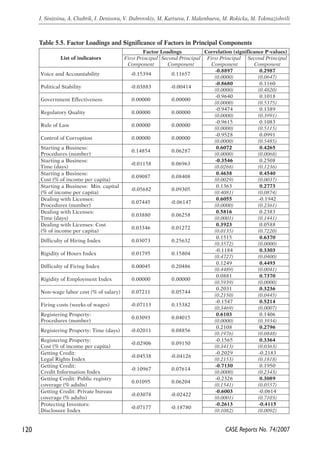
(after EU15) position in the country groups’ list (Fig. I.2). This feature comes in line 
with the mentioned above trend in human capital development. 
Fig I.2. Researchers in R&D, per million people 
4000 
3500 
3000 
2500 
2000 
1500 
1000 
500 
1997 1998 1999 2000 2001 2002 2003 
Researchers in R&D (per million people) 
Source: World Development Indicators database. 
Inputs: Innovation drivers (ICT) 
Information and communication technology – blood vessels of innovation system 
– becomes an increasingly important infrastructural component of intellectual 
capital. The number of personal computers has been growing in all country groups, 
but the relative distances since 1999 remained almost unchanged: more than two 
times – between EU15 and EU12; EU12 / Russia – 1.7 times, Russia / Candidate 
countries – 1.9 times, and almost five times – between Russia and EEN (see fig. I.3). 
The “digital divide” in international Internet bandwidth, characterizing 
accessibility of worldwide web, is tremendous: EU15 and the nearest group (EU12) 
differ by an order of magnitude; indicators for the next country group (candidate 
countries) are almost 2.5 times lower than in EU12. The distance from candidate 
countries to Russia (the next closest neighbor) is nearly twofold; the overall level of 
international Internet bandwidth in EEN countries is extremely low – three times 
lower than in the group of Balkan states (Fig. I.4). In 2003, Denmark alone had the 
79 
ASSESSING THE DEVELOPMENT GAP 
CASE Reports No. 74/2007 
EEN countries Russia 
EU-15 EU-12 
Candidate countries West Balkans
Fig. I.3. Personal computers, per 1 000 people 
500 
450 
400 
350 
300 
250 
200 
150 
100 
50 
0 
Personal computers per 1000 people 
1999 2000 2001 2002 2003 2004 
international Internet bandwidth 11 times larger than the whole of CIS. The situation 
in individual EEN and candidate / potential candidate countries, however, varies: 
though lagging in average figures for the group as a whole, Internet access could vary 
by factor if we compare the highest level in EEN (Moldova) to the lowest level in 
potential candidates’ group (Albania). 
80 
I. Sinitsina, A. Chubrik, I. Denisova, V. Dubrovskiy, M. Kartseva, I. Makenbaeva, M. Rokicka, M. Tokmazishvili 
Fig I.4. International Internet bandwidth, 
bits per person Fig. I.5. Internet users, per 1 000 people 
CASE Reports No. 74/2007 
Source: World Development Indicators database. 
EEN countries 
Russia 
EU-15 
EU-12 
Candidate countries 
West Balkans 
10000.00 
1000.00 
100.00 
10.00 
1.00 
0.10 
International Internet bandwidth (bits per person) 
EEN countries 
Russia 
EU-15 
EU-12 
Candidate countries 
West Balkans 
Source: World Development Indicators database. 
500 
450 
400 
350 
300 
250 
200 
150 
100 
50 
0 
Internet users per 1000 people 
EEN countries 
Russia 
EU-15 
EU-12 
Candidate countries 
West Balkans 
1999 2000 2001 2002 2003 2004 1999 2000 2001 2002 2003 2004
The numbers of Internet users and their trends of growth are closely correlated 
with the number of personal computers (see Fig. I.5). The gap between Western 
Europe and EEN/Russia in Internet penetration rates102 is huge: in 2003, Western 
Europe led at a high 42.9 percent, followed by the Baltic States (31.4%), CEE (16.1%) 
and trailed by remaining CIS (5.6%). At the same time CIS, the region with the lowest 
penetration, had the second highest growth rate of close to 80 percent, a development 
that suggests that the “digital divide” is to some extent narrowing103. 
Fig. I.6. ICT penetration rates as a percentage of penetration rates in Western Europe 
73 73 
80 
70 
60 
50 
40 
30 
20 
10 
Source: ITU Database. 
To characterize information infrastructure components, indicators on other 
communications infrastructure (mobile and fixed-line) are generally used. In mobile 
communications, the East-West gap in Europe, although somewhat smaller compared 
to Internet, still remains significant (Fig. I.6). The CIS average mobile penetration 
remains at a very low 17.1%: in 2003 almost half of the CIS countries – Armenia, 
Kyrgyzstan, Tajikistan, Turkmenistan and Uzbekistan – had penetration levels under 
five percent, and only in two CIS countries – Azerbaijan and Georgia – mobile had 
slightly overtaken fixed line penetration. At the same time this region with the lowest 
mobile subscribers rate has by far the highest growth rates, an average of 99.4 percent. 
European fastest growing mobile market, Russia, more than doubled the number of 
cellular subscribers during 2004, from 36.5 million to 74.4 million. During 2004, 
81 
ASSESSING THE DEVELOPMENT GAP 
102 A percentage of Internet users among the population in an age group of 15 to 74 years old. 
103 ITU (2005). Europe & CIS’s Telecommunication/ICT Markets and Trends, http://www.itu.int/ITU-D/ 
ict/statistics/at_glance/Europe_RPM_2005.pdf 
CASE Reports No. 74/2007 
49 
38 
54 
50 
13 
20 
37 
0 
Internet users, % Mobile subscribers, % Fixed-lines, % 
% 
Baltic States CEE CIS
Russia overtook Germany, France, Spain and the UK to become the largest mobile 
market in Europe. Despite Russia’s impressive subscriber numbers, it has its own 
digital divide, with the vast majority of subscribers located in large urban centers104. 
Overall, the “digital divide” that separated EEN/Russia from the rest of Europe is 
much greater in newer ICTs (mobile and Internet) than in fixed lines. Indeed, 
penetration levels for Internet use in CIS are only 13 percent of those in Western 
Europe (Fig. I.6). The gap is slightly smaller in the mobile sector, where CIS 
penetration rates stand at one fifth of those in Western Europe. The gap is smallest in 
the “traditional” ICTs of fixed lines where CIS’ penetration level represents 37 percent 
of that of Western Europe. NMS have about half the mobile and fixed line penetration 
levels of EU15, but lag further behind in Internet use. 
Outcomes: Patent Applications and Journal Articles 
The two indicators reflecting the outcomes of innovation performance are “Patent 
applications filed by residents” and “Scientific and technical journal articles per million 
people”. Both indicators point to huge gaps between EU15 and other country groups. 
In the case of patent applications they range from roughly 2.5 times between EU15 and 
Russia to 8-10 times between EU15 and other country groups (Figs. I.7-I.8). 
At the same time, the gaps in the number of patent application between Western 
Europe and EEN/Russia are not as wide as could be expected judging by relative GDP 
82 
I. Sinitsina, A. Chubrik, I. Denisova, V. Dubrovskiy, M. Kartseva, I. Makenbaeva, M. Rokicka, M. Tokmazishvili 
Fig. I.7. Resident patent applications, 
per 1 million people 
450.0 
400.0 
350.0 
300.0 
250.0 
200.0 
150.0 
100.0 
50.0 
EEN countries 
Russia 
EU-15 
EU-12 
Candidates & West Balkans 
Source: World Development Indicators database. 
600.0 
500.0 
400.0 
300.0 
200.0 
100.0 
EEN countries 
Russia 
EU-15 
EU-12 
Candidates & West Balkans 
104 ITU (2005). Europe & CIS’s Telecommunication/ICT Markets and Trends, http://www.itu.int/ITU-D/ 
CASE Reports No. 74/2007 
ict/statistics/at_glance/Europe_RPM_2005.pdf. 
Fig. I.8. Scientific and technical journal 
articles per million people 
0.0 
Patent applications ( per million people) 
0.0 
1996 1997 1998 1999 2000 2001 2002 1995 1996 1997 1998 1999 2000 2001
figures or R&D expenditures. Recent figures for 2004 published by World Intellectual 
Property Organization (WIPO) indicate that EEN countries such as Russia, Ukraine 
and Belarus also have relatively high rates of patent activity when compared with 
total GDP and with R&D expenditure. Russia ranks 6th in the world (after Japan, 
USA, Korea, Germany and China) in absolute number of resident patent filings, with 
Ukraine ranking 11th. The scores in patent filings per billion dollars of GDP (PPP) are 
17.6 for Russia (6th rank), 16.9 for Belarus and 14.7 for Ukraine (8th and 9th rank 
accordingly), while ranking on patent filings per R&D expenditure has placed Belarus 
world’s third, with Ukraine ranking 5th, and Russia ranking 6th105. 
Still, it would be premature making conclusions concerning changes in 
EEN/Russia’s patenting intensity and moreover on prospects of bridging the gap in this 
area. First, in absolute numbers of patents issued these countries (even taken together) 
still lagging far behind, say, Germany. Second, and more importantly, the structure of 
Russian patent applications radically differs from that of developed countries: just 9% 
of applications in Russia were in telecoms, IT and electronics, against 40 to 50 percent 
for OECD countries, with a majority filed in ‘food and agriculture’ and ‘materials and 
instrumentation’ sectors106. There are no grounds to believe that other EEN countries 
would demonstrate a radically different patents’ structure. 
Weighted indicators on Scientific and technical journal articles demonstrate an 
even more bleak picture (Fig. I.8): a five-fold and growing gap between EU15 and 
NMS/Russia; the latter level, in turn, is twice the median for candidate countries (this 
gap would have been much larger if we excluded Croatia with a score 1.5 times higher 
than Russia). 
Composite Indices 
To present a more generalized picture of international differences in innovation 
performance we use composite indices developed in accordance with the World Bank 
Knowledge Assessment Methodology – KAM (Knowledge Index, KI, and Knowledge 
Economy Index, KEI), as well as their main components (pillars). 
There are several reasons for using aggregate scores produced by this 
methodology. Country’s national innovation capacity depends on a certain number of 
pillars (human capital, information infrastructure, the innovation system, as well as 
the economic incentives regime), which allow a country to articulate its transition into 
a knowledge economy and use its resources efficiently in the absorption and creation 
of new knowledge. 
83 
ASSESSING THE DEVELOPMENT GAP 
105 WIPO (2006). WIPO Patent Report: Statistics on Worldwide Patent Activity (2006 Edition), 
http://www.wipo.int/ipstats/en/statistics/patents/patent_report_2006.html. 
106 Jaggi R. (2005). “Innovation in technology lags”, Financial Times, October 11. 
CASE Reports No. 74/2007
Three components of Knowledge Index (KI) represent key variables which 
characterize a country’s ability to generate, adopt and diffuse knowledge. These are: 
• Education and human resources (further on referred to as “Education”) which 
includes three variables: adult literacy rate, secondary enrollment rate and 
tertiary enrollment rate; 
• Innovation system (Innovation) which includes the following variables: 
Researchers in R&D, per million people, Patent applications granted by the 
USPTO, per million of population, Scientific and technical journal articles, per 
million of population; 
• Information and communication technology (ICT), including Telephones 
(mainlines plus mobile phones) per 1,000 persons, Computers per 1,000 persons, 
and Internet users per 1,000 persons. 
Knowledge Index (KI) is a simple average of the normalized performance scores of a 
country’s key variables in three Knowledge Economy pillars. In addition, the Knowledge 
Economy Index (KEI) takes into account whether the environment is conducive for 
knowledge to be used effectively for economic development. This is achieved by adding 
one more pillar, that is “Economic incentive and institutional regime” (Institutions) 
which includes variables on tariff and non-tariff barriers, regulatory quality and Rule of 
law. Thus KEI takes into account whether the environment is conducive for knowledge 
to be used effectively for economic development. 
The trend line in Fig. I.9 suggests that KEI scores (reflecting innovation 
performance) are closely correlated with per capita GDP levels, in particular for the 
“low-income” countries. The richest countries prove to have close GDP levels for 
significantly different innovation performance. More generally, the link between 
innovation and GDP remains difficult to establish at national level, considering the 
innovation is only one factor among other structural ones. 
By comparing countries’ (country groups’) scores for each of the pillars as well as 
scores of KI and KEI indices we can: 
(1) evaluate differences (gaps) between countries (country groups) in innovation 
performance across specific pillars; 
(2) assess overall differences in KI and KEI scores; 
(3) identify specific gaps (bottlenecks) in innovation performance for each country 
(country group). 
The results of such an exercise are presented in Figs. I.10 and I.11, where 
respective data are translated into radar diagram format (for each country group, we 
used median values as aggregate scores). 
84 
I. Sinitsina, A. Chubrik, I. Denisova, V. Dubrovskiy, M. Kartseva, I. Makenbaeva, M. Rokicka, M. Tokmazishvili 
CASE Reports No. 74/2007
Fig. I.9. Regression of Knowledge Economy Index on GDP (PPP) per capita 
KG 
UZ 
TJ 
10 
9 
8 
7 
6 
5 
4 
3 
Source: ITU Database. 
AM 
R S +M E 
BG 
LT 
EE 
LV HU 
SE 
FI DK 
Overall conclusions from Fig. I.10 could be summarized as follows: 
10 
8 
6 
4 
2 
Institutions 
As regards innovation infrastructure (ICT), country groups are distributed exactly 
in accordance with GDP per capita: EU12 are the nearest to EU15 group, next comes 
85 
ASSESSING THE DEVELOPMENT GAP 
CASE Reports No. 74/2007 
KZ 
UA 
RU 
MD GE 
BY 
AZ 
BA 
AL 
TR 
MK 
HR 
RO 
SI 
PL SK 
CZ 
GB 
ES 
PT 
NL 
IT 
IE 
GR 
DE 
FR 
BE AT 
2 
0 5000 10000 15000 20000 25000 30000 35000 40000 45000 
GPP (PPP) per capita 
KEI 
Fig. I.10. KI, KEI and constituent pillars across country groups 
0 
KI 
KEI 
Innovation 
Education 
ICT 
EU-15 
EU-12 
Candidates & West Balkans 
EEN 
Other CIS 
Russia
Russia, followed by Candidates and West Balkans, EEN and other CIS members. 
Differences within EEN group are significant: score for Belarus is as high as the 
Candidates’ median, with Ukrainian scores also close to this country group. Within 
Candidates group, the general level is very low, with Croatia alone approaching the 
lowest scores in the EU12 group. 
In “Innovation systems” relative positions of country groups change: the closest 
neighbor of EU15 is Russia, followed in turn by EU12, EEN, and Candidates & West 
Balkans’ group, with the worst results demonstrated by Central Asian CIS. Individual 
country scores for most of EENs (excluding Moldova) stay quite close to some of the 
EU12 (e.g. Latvia, Bulgaria, Romania). 
As could be expected, country groups’ distribution within Education pillar 
demonstrates that scores for EU12 and Russia are almost equal, with EEN and other 
CIS countries also exhibiting lower, but very similar results, whereas the Candidates 
& West Balkans are only catching up (due to extremely low scores displayed by 
Albania and Turkey). Scores for individual EEN countries are rather aligned 
(excluding Moldova and Azerbaijan which have lower country scores) and are much 
the same as e.g. for Romania, Bulgaria, or Slovakia. 
The Institutions pillar demonstrates a most diverse picture. After EU12, which are 
naturally located quite close to EU15, we can observe a gap of 3.5 points wide. 
Candidates & West Balkans appear to be the nearest neighbors to EU12, followed by 
EENs with very similar median score. Scores for Russia and other CIS are very close, 
but lag substantially behind. Naturally, scores for individual Candidates and EENs are 
86 
I. Sinitsina, A. Chubrik, I. Denisova, V. Dubrovskiy, M. Kartseva, I. Makenbaeva, M. Rokicka, M. Tokmazishvili 
CASE Reports No. 74/2007 
Fig. I.11. Country groups across KI, KEI and constituent pillars 
EU-15 
0 1 2 3 4 5 6 7 8 9 
EU-12 
Candidates & West Balkans 
EEN 
Russia 
Other CIS 
KI 
KEI 
Innovation 
Education 
ICT 
Institutions
quire different. If it were not for Croatia and Turkey (in the group of Candidate 
countries) and Armenia and Ukraine (EENs) that either exceed or are equal to 
respective scores for Bulgaria and Romania (EU12), the gap between the respective 
country groups would have been considerably larger. 
Fig. I.11 provides a different angle of analysis by transposing the same analyzed 
variables across country groups. In particular, the figure vividly demonstrates that the 
least developed pillar in all FSU countries, and particularly in Russia, is “Economic 
incentives and institutional regime”. This sphere appears to be least developed in the 
Candidate countries as well. This stands in contrast to EU12 where Institution pillar 
is the second most developed after Education. 
Fig. I.12. KEI variance across countries and country groups 
GE 
8 
7 
6 
5 
4 
3 
2 
1 
The four constituent pillars of KEI provide further insight into the relative 
innovation strengths and weaknesses of European countries. Many of these countries 
are characterized by an extremely uneven development of innovation dimensions. This 
is especially characteristic of Russia, Central Asia CIS and EENs (Fig. I.12). On the 
other hand, the spread of KEI pillars’ scores is minimal for EU15 and EU12, and is just 
slightly larger for Candidate countries. Meanwhile, recent evidence suggests that 
countries with an even performance on each of the key innovation dimensions perform 
better overall than countries with an uneven distribution, since a ‘blockage’ in one 
field, such as poor knowledge creation, could prevent progress. This suggests, in 
particular for countries lagging behind, that given equal costs, policy would be more 
effective in improving overall innovation performance by concentrating on improving 
areas of weakness rather than on making further improvements to areas of strength107. 
87 
ASSESSING THE DEVELOPMENT GAP 
107 EC (2006). European Innovation Progress Report 2006. Luxembourg. 
CASE Reports No. 74/2007 
RU 
UZ 
TJ 
KG 
KZ 
Other CIS 
UA 
MD 
BY 
AZ 
AM 
EEN 
Candidate 
NMS EU15 0 
2 3 4 5 6 7 8 9 
KEI 
Variance
At Fig. I.13 KEI countries’ scores are plotted against KEI percentage change over 
the preceding decade. That could introduce an intertemporal dimension into our 
analysis, providing some insight at the prospects of EEN catching up with EU in 
terms of innovation performance. 
AZ AM 
RS + ME 
PL 
IT LUIE 
50.00% 
40.00% 
30.00% 
20.00% 
10.00% 
0.00% 
2.00 3.00 4.00 5.00 6.00 7.00 8.00 9.00 10.00 
The figure shows the current innovation performance as measured by the KEI on 
the horizontal axis against the short-run trend performance of the KEI on the vertical 
axis. This enables us to select, from the viewpoint of the EU/EEN gap, at least two 
distinct groups of countries. The first one includes countries with below the average 
KEI scores but with an average or above average trend performance (Belarus, 
Ukraine, Russia, Armenia and Azerbaijan); the countries belonging to the second 
group have below average KEI values and a below average negative trend (Georgia 
and Central Asian CIS). It is evident that the first group members are more likely to 
catch up, at least in the long run, while another group is falling further behind. 
Conclusions 
(1) A comparison of differences in the four pillars underlying knowledge 
economy potential of the country groups analyzed drives us to a conclusion 
that in a number of FSU countries (e.g. Russia, Ukraine, Belarus), as well as 
in the former Yugoslav countries (Serbia, Croatia), the inherited research 
potential and human capital provide incentives for a revival of their innovation 
capacity. However, absorptive capacity remains low in all EEN (and moreover 
in FSU in general). A high variance in underlying pillar scores provides 
support for such a conclusion. 
88 
I. Sinitsina, A. Chubrik, I. Denisova, V. Dubrovskiy, M. Kartseva, I. Makenbaeva, M. Rokicka, M. Tokmazishvili 
CASE Reports No. 74/2007 
Fig. I.13. KEI trends 
RU 
UZ 
TJ 
KG 
KZ 
UA 
MD 
GE 
BY 
AL 
TR 
MK 
HR 
RO 
BG 
SI 
SK 
LT 
LV 
HU 
EE 
CZ 
GB 
SE 
ES 
PT NL 
GR DE 
FR 
FI 
DK 
BEAT 
-10.00% 
KEI 
KEI change, 1995-2004 (%)
(2) An evident competitive advantage of Russia and EEN countries is a fairly high 
human capital stock. However, there is an obvious mismatch between the number 
of researchers employed in the region and the results of their activity (at least in the 
form of publications or patents registered), as well as low expenditures on R&D. 
(3) A high variance of underlying pillar scores in EEN countries is to a great extent 
affected by striking gaps in institutional and economic incentives regime. It might 
well be that a country has a fairly high education level and a fairly well developed 
ICT infrastructure, but its institutional regime is so weak that it presents a severe 
bottleneck for a further innovation absorption and development. The evident 
shortcomings of the institutional framework, as well as inadequate governmental 
resources to support R&D and innovation are the major handicaps. 
(4) Most general features of innovation performance that could be captured by the 
analysis of sets of available comparable indicators are only a top of the iceberg of 
serious problems and striking gaps existing in this sphere. Due to a lack of reliable 
and comparable data we could not provide any sound analysis on the structure of 
R&D expenditures (applied research vs. fundamental science, public vs. private 
expenditures, defense-oriented vs. non-military research, and especially on 
commercial investment potential). Still, anecdotal evidence leads us to believe 
that principle differences existing in different fields of research between groups 
of countries are not a reflection of the unique course in innovation process, but 
rather a reflection of inadequate reforming and restructuring of R&D sector. One 
of numerous examples is the proportion of applied research with a high 
commercial potential which is in fact tremendously low compared to developed 
countries. Poor institutional environment and low entrepreneurship potential 
discourage private R&D in companies; public participation in funding private 
industrial R&D and commercialization of innovative ideas are also low, which 
markedly reduces an overall national innovation capacity. 
IV.4. Gaps in environmental performance 
The state of the environment in the CEE and EEN countries is to a great extent affected 
by the common challenges these countries are facing, including inter alia: persistence of 
inefficient polluting production structures; relatively extensive but deteriorated 
environmental infrastructure; unenforceable regulations; enforcement systems focused on 
punitive actions; a culture of top-down environmental management108. 
89 
ASSESSING THE DEVELOPMENT GAP 
108 OECD (2005). Environmental Management in Eastern Europe, Caucasus and Central Asia. 
CASE Reports No. 74/2007
The geographical region analyzed is far from being homogeneous. Countries differ 
in natural capital endowments, degree of urbanization, economic structure and 
response capacity. In the more urbanized CEE countries, pollution issues are generally 
more important, while in the poorer countries, like Azerbaijan109 or Moldova, natural 
resources management linked to the productivity of agriculture tends to be more 
prominent. While assessing specific differences in the state of the environment and 
environmental management of the country groups analyzed we should take into 
consideration that, on the one hand, the more developed the country is the greater 
environmental pressure it usually produces (remembering about huge variations in per 
capita income). On the other hand, common sense and recent studies prove that 
increased wealth is a prerequisite for environmental improvements110. Several 
empirical studies have likewise shown that wealth is an important factor in explaining 
environmental policy results, but not alone determinative of environmental policy111. 
In theory at least, the transition process is consistent with an overall improvement 
in environmental quality. The above conclusion would most likely hold in the very 
long run112. However, in the short- and medium-run, the consequences of transition 
are far from being obvious. Major closely interrelated current trends in the state of the 
environment and environmental management in the CEE and EEN countries, 
identified by scholars and international experts, could be summarized as follows: 
(1) Pollution (and environmental pressure in general) has sharply decreased in most 
CEE/NIS because of a deep decline of traditional industrial output (scale effect). 
The scale effect virtually dominates composition effects in all countries for all 
pollutants. The magnitude of this effect, however, is varied: in some countries 
(e.g. Russia and Ukraine) pollution was not reduced proportionately to the 
decrease in GDP, while in most CEE countries the trend was the opposite one113. 
(2) The new manufacturing specialization varies a lot by country, and no clear 
general pattern on transition and pollution can be easily identified (composition 
effect). In many countries, resources have been transferred from heavy 
manufacturing industries (iron and steel) towards lighter industries and less 
polluting sectors (food, beverage and tobacco products)114. Despite these 
heterogeneous patterns, two differential tendencies could be identified: 
90 
I. Sinitsina, A. Chubrik, I. Denisova, V. Dubrovskiy, M. Kartseva, I. Makenbaeva, M. Rokicka, M. Tokmazishvili 
109 An emerging important environmental issue in Azerbaijan is that of pollution of the Caspian Sea related to 
developing oil and gas production on the Caspian shelf and its impact upon the valuable marine biological 
resources. 
110 Grossman, Gene M. and Alan B. Krueger (1995). “Economic Growth and the Environment.” Quarterly Journal 
CASE Reports No. 74/2007 
of Economics, CX(2): 353-77. 
111 Esty, Daniel C. and Michael E. Porter (2005). “National Environmental Performance: an Empirical Analysis 
of Policy Results and Determinants.” Journal of Environmental Development Economics, vol. 10, pp. 391–434. 
112 Vukina T., J.C. Beghin, E. G. Solakoglu (1999). “Transition to markets and the environment: Effects of the change 
in the composition of manufacturing output”, Environment and Development Economics, Vol. 4, pp. 582-598. 
113 Golub A., D. Dudek, E. Strukova (2003). Environmental Protection in Transition Economies: The Need for 
Economic Analysis. Environmental Defense.
• a trend towards cleaner manufacturing (in Armenia, Hungary, Macedonia, 
Poland, and to a lesser extent Slovenia) that shows consistent environmental 
improvements in the composition of manufacturing output with respect to 
most pollution emission types, except for VOC and BOD; 
• a shift towards dirtier sectors based on heavy manufacturing (Azerbaijan, 
Bulgaria, Kyrgyzstan, Latvia, Slovakia, and Ukraine). For these countries, 
the compositional changes of manufacturing output were mostly 
environmentally harmful115. 
(3) In several countries market reforms driving enterprise restructuring and 
privatization had a beneficial effect on reducing the energy consumption per 
dollar of GDP and pollution per unit of production (Hungary, Latvia, Poland, 
Armenia, Belarus). In other countries that expanded their energy and/or 
petroleum-refining activities, energy and pollution intensities of their industries 
have remained relatively stable or even increased (e.g. Russia, Azerbaijan, 
Bulgaria). This was the result of the two opposite and mutually canceling trends: 
(a) increasing shares of pollution-intensive sectors such as metal smelting and oil 
production vs. less pollution intensive manufacturing and (b) decline in pollution 
intensities within several industrial sectors116. 
(4) In some countries of the region, there is a legacy of soil contaminated by heavy 
metals and stockpiles of pesticides and hazardous toxic waste; fine particulate 
matter and lead are the main pollutants, and transport is responsible for up to 
70% of emissions. Emission levels of fine particulate matter are not being 
monitored at present, but leaded gasoline has been phased out in five EEN 
countries and in Russia117. 
(5) Evident reduction of environmental pressures was accompanied by a budgetary 
crisis that affected the capacity to maintain environmental infrastructure, and 
induced environment agencies to focus on raising revenue rather than on 
changing the enterprises’ behavior. 
(6) In NMS, the desire to join the European Union acted as a powerful impetus for 
environmental improvement and adaptation of the Union’s strict environmental 
standards. On the other hand, many CIS countries still have limited access to 
international experience on environmental management outside the region and 
91 
ASSESSING THE DEVELOPMENT GAP 
114 These compositional changes towards lighter industries have been accompanied by increases in biological 
oxygen demand (BOD) and volatile organic compounds (VOC) emissions, but decreases in bio-accumulative 
emissions (e.g. toxic metals) released in soil and air. 
115 Vukina T., J.C. Beghin, E.G. Solakoglu (1999), op. cit. 
116 Cherp A., I. Kopteva, R. Mnatsakanian (2003). “Economic transition and environmental sustainability: effects 
of economic restructuring on air pollution in the Russian Federation”, Journal of Environmental 
Management, vol. 68, No. 2, pp. 141-151. 
117 OECD (2005). Environmental Management in Eastern Europe, Caucasus and Central Asia. 
CASE Reports No. 74/2007
place low priority to environmental issues in the political agenda. 
Environmental authorities have weakened considerably vis-à-vis powerful 
industrial interests. The regulatory framework is still poorly developed, 
municipalities cannot afford the required investments, and there are obstacles to 
inter-municipal co-operation. Likewise, public has generally lost interest to 
environmental issues, and these stay at the bottom of the public list of priorities, 
overshadowed by other more important concerns. 
Selected Indicators 
To quantify the existing gaps in the environmental dimension, we have selected 
Environmental Sustainability Index (ESI) which provides a composite profile of 
national environmental stewardship based on a compilation of 21 indicators that derive 
from 76 underlying data sets for 146 countries118. The 21 indicators are compiled into 
five constituent components of the ESI: 
• Environmental Systems, 
• Reducing Environmental Stresses, 
• Reducing Human Vulnerability to Environmental Stresses, 
• Societal and Institutional Capacity to Respond to Environmental Challenges, 
• Global Stewardship. 
These components, as well as values and rankings of the ESI itself provide a clear 
picture of natural resource endowments, past and present pollution levels, 
environmental management efforts, and the capacity of a society to improve its 
environmental performance. 
To assess the quality of environmental systems in the countries analyzed, we have 
selected the two sets of indicators reflecting environmental issues important for most 
countries under review: 
• Air Quality (SYS_AIR) indicator integrating the following variables: Urban 
population weighted NO2 concentration; Urban population weighted SO2 
concentration; Urban population weighted Total Suspended Particulates (TSP) 
concentration; Indoor air pollution from solid fuel use. 
• Water Quality (SYS_WQL) indicator integrating the following variables: 
Dissolved oxygen concentration, Electrical conductivity, Phosphorus 
concentration, Suspended solids. 
92 
I. Sinitsina, A. Chubrik, I. Denisova, V. Dubrovskiy, M. Kartseva, I. Makenbaeva, M. Rokicka, M. Tokmazishvili 
118 2005 Environmental Sustainability Index: Benchmarking National Environmental Stewardship. Yale Center for 
Environmental Law and Policy (Yale University); Center for International Earth Science Information 
Network (Columbia University). 
CASE Reports No. 74/2007
The other two indicators reflect efforts undertaken by countries to reduce 
environmental stress: 
• Reducing Air Pollution (STR_AIR) integrating the following variables: 
Anthropogenic NOx emissions per populated land area; Anthropogenic SO2 
emissions per populated land area; Anthropogenic volatile organic compounds 
(VOC) emissions per populated land area; Coal consumption per populated land 
area; and Vehicles in use per populated land area. 
• Reducing Water Stress (STR_WAT) integrating the following variables: Industrial 
organic water pollutant (BOD) emissions per available freshwater; Fertilizer 
consumption per hectare of arable land; Pesticide consumption per hectare of 
arable land; Percentage of country under severe water stress. 
Main gaps revealed 
The two selected variables reflecting the degree of environmental stress show 
considerable differences across countries and groups of countries. The regression of 
the two variables’ scores on GDP (PPP) per capita provides an illustration of the 
relative position of different countries with regard to environmental quality and 
income (see Figs. E.1-E.2). 
Fig. E.1. Regression of Water Quality indicator on GDP (PPP) per capita. 
BA 
AM 
GE BY 
AZ 
2.00 
1.50 
1.00 
0.50 
0.00 
-0.50 
-1.00 
As Fig. E.1 suggests, water quality is well correlated with per capita income, and 
almost 1/3 of the variance of the water quality indicator is accounted for by per capita 
GDP. At the same time, some countries (notably Russia, as well as Estonia and 
Slovenia) perform much better in terms of water quality than their per capita income 
93 
ASSESSING THE DEVELOPMENT GAP 
CASE Reports No. 74/2007 
AT 
BE 
DK 
FI 
FR 
DE 
GR 
IE 
IT 
NL 
PT 
ES 
SEGB 
CZ 
EE 
HU 
LV 
LT 
PL 
SK 
SI 
BG 
RO 
HR 
MK 
TR 
AL 
RS +ME 
MD 
RU 
UA 
KZ 
KG 
TJ 
UZ 
-1.50 
0.0 5000.0 10000.0 15000.0 20000.0 25000.0 30000.0 35000.0 40000.0 45000.0 
GDP (PPP) per capita 
SYS_WQL 
R2 = 0,32
would suggest. On the other hand, several EEN (Azerbaijan, Ukraine, and Moldova) 
and candidate (Turkey and Serbia) countries fall well below the regression line – 
indicating sub-par performance given their level of wealth. Most probably, these 
striking gaps are accounted for not only by variance in the degree of pollution 
combating efforts, but rather by natural differences in abundance (shortage) of water 
resources and correspondingly in the assimilative capacity of water environment. 
FI 
DE 
TR 
RS + ME 
TJ 
UZ 
2.00 
1.50 
1.00 
0.50 
0.00 
Fig. E.2 illustrates the case when no clear-cut causal relationship could be traced 
between the two variables – income and air pollution indicators. It is evident, 
however, that the state of atmospheric environment tends to be worse in the poorer 
FSU countries (Georgia, Kyrgyzstan, Uzbekistan) and lower middle income candidate 
countries (Turkey, Albania, Bosnia, etc.) – with some notable exceptions both on the 
positive (Moldova) and negative (Russia) sides. 
Figures E.3 and E.4 exemplify the cases with a more or less pronounced inverse 
statistical relationship between wealth and environmental results. This correlation most 
probably stems from the nature of indicators themselves which are based on emissions 
(discharges) per unit of land area or volume of freshwater available. Since wealthier 
countries (EU15) tend to have much higher population (and economy) densities and 
lower water resources availability compared to their Eastern neighbors, even 
substantially decreased emissions could still result in low indicator scores. This is 
especially true in the case of air emissions, the major sources of which (automobiles and 
energy production) are to a much greater extent associated with GDP per capita in 
comparison to water discharges that mostly originate as a result of agricultural activities. 
The above figures reflect an important fact that the EEN countries do not 
necessarily lag behind EU-15 or NMS in environmental results, primarily due to their 
94 
I. Sinitsina, A. Chubrik, I. Denisova, V. Dubrovskiy, M. Kartseva, I. Makenbaeva, M. Rokicka, M. Tokmazishvili 
CASE Reports No. 74/2007 
Fig. E.2. Regression of Air Quality indicator on GDP (PPP) per capita 
AT 
BE DK 
FR 
GR IE 
IT 
NL 
PT 
ES 
SE 
GB 
CZ 
EE 
HU 
LV 
LT 
PL 
SK 
SI 
ROBG 
MK HR 
AL 
BA 
AM 
AZ 
BY 
GE 
MD 
RU 
UA 
KZ 
KG 
R2 = 0,10 
0.0 5000.0 10000.0 15000.0 20000.0 25000.0 30000.0 35000.0 40000.0 45000.0 
GDP (PPP) per capita 
-0.50 
SYS_AIR 
2.50
Fig. E.3. Regression of Reducing 
Air Pollution indicator on GDP (PPP) 
per capita 
KZ 
GE BY 
TR 
AZ 
AM 
1.00 
0.50 
0.00 
-0.50 
-1.00 
-1.50 
-2.00 
ALBA 
RS + ME 
TJ 
KG 
AM 
RO 
MK HR 
EE 
SE 
FI 
1.00 
0.50 
0.00 
-0.50 
-1.00 
-1.50 
lower population densities and higher environmental capacities. This observation, 
however, would probably not hold when we move to a lower (regional, subregional) 
level of generalization, since well-known pollution “hot spots” are highly concentrated 
in several industrial regions of FSU countries. 
The composite index (ESI) score per se quantifies the likelihood that a country will 
be able to preserve valuable environmental resources effectively over the period of 
several decades. It enables us to make conclusions regarding and to compare the 
95 
ASSESSING THE DEVELOPMENT GAP 
KG KZ 
80.0 
75.0 
70.0 
65.0 
60.0 
55.0 
50.0 
45.0 
40.0 
35.0 
CASE Reports No. 74/2007 
Fig. E.4. Regression of Reducing Water 
Stress indicator on GDP (PPP) per capita 
AT 
BE 
DK 
FI 
FR 
DE 
GR 
IT 
NL 
PT 
ES 
SE 
GB 
CZ 
EE 
HU 
LV LT 
PL 
SK 
SI 
BG 
RO 
HR 
MK 
AL 
BA 
RS + ME 
MD 
RU 
UA 
KG 
TJ 
UZ 
-2.50 
0 5000 10000 15000 20000 25000 30000 35000 40000 
GDP (PPP) per capita 
STR_AIR 
R2 = 0,46 
UZ 
KZ 
UA 
RU 
MD 
GE 
BY 
AZ 
TR 
BG 
SI 
SK 
PL 
LT 
LV 
HU 
CZ 
GB 
ES 
PT 
NL 
IT 
IE 
GR 
FDRE 
DK 
BE 
AT 
STR_WATER 
R2 = 0,236 
45000 
-2.00 
0 5000 10000 15000 20000 25000 30000 35000 40000 
GDP (PPP) per capita 
45000 
Fig. E.5. Regression of ESI values on GDP (PPP) per capita 
AT 
DE 
PT NL 
BE 
DK 
FI 
FR 
GR 
IE 
IT 
ES 
SE 
GB 
CZ 
EE 
HU 
LV 
LT 
PL 
SK 
SI 
BG 
RO 
HR 
TR MK 
AL 
BA 
AM 
RS +ME 
AZ 
BY 
GE 
MD 
RU 
UA 
TJ 
UZ 
30.0 
ESI 
R2 = 0,26 
0 5000 10000 15000 20000 25000 30000 35000 40000 
GDP (PPP) per capita 
45000
countries’ potential to avoid major environmental deterioration. It is worth noting 
that ESI scores for the countries analyzed are positively (closer than in the world in 
general) correlated with GDP per capita (R2 = 0.26 compared to R2 = 0,23 for a set 
of 146 countries, see Fig. E.5). This result suggests that, overall, low incomes per 
capita do not stimulate environmental performance; on the contrary, high-income 
countries surpass low-income ones in this respect by investing more in pollution 
control and other environmental amenities. 
96 
I. Sinitsina, A. Chubrik, I. Denisova, V. Dubrovskiy, M. Kartseva, I. Makenbaeva, M. Rokicka, M. Tokmazishvili 
NL 
DE 
CASE Reports No. 74/2007 
Fig. E.6. Regression of Human Vulnerability 
component on GDP (PPP) per capita 
Fig. E.7. Regression of Institutional 
Capacity component on GDP (PPP) 
per capita 
AT 
BE 
DK 
FI 
GR FDRE IE 
IT 
NL 
PT 
ES 
SE 
GB 
CZ 
HU 
EE 
PL 
LV 
LT 
SK 
SI 
BA 
RS +ME 
BG 
TR 
RO 
HR 
MK 
AL 
AM 
AZ 
BY 
MD 
GE 
RU 
UA 
KG KZ 
UZ 
VULNER 
R2 = 0,34 
AT 
BE 
DK 
FI 
FR 
GR 
IT IE 
PT 
ES 
SE 
GB 
EHEUCZ 
PL SK 
LV LT 
SI 
TR 
AL 
RSBA+ME 
AM 
AZ 
RBOG 
HR 
MK 
BY 
GE 
MD 
RU 
UA KZ 
TJ KG 
UZ 
R2 = 0,82 
0 10000 20000 30000 40000 
GDP (PPP) per capita 
50000 
0 10000 20000 30000 40000 
GDP (PPP) per capita 
50000 
90.0 
80.0 
70.0 
60.0 
50.0 
40.0 
30.0 
120.0 
100.0 
CAP 
80.0 
60.0 
40.0 
20.0 
0.0 
Fig. E.8. Regression of Institutional Capacity component on ESI 
UZ 
TJ 
NL 
IT IE 
GR 
CZ HU EE 
RS+ME BA AM 
KG 
UA KZ 
RU 
GE 
BY 
MD 
AZ 
AL 
TR 
MK 
HR 
RO BG 
SI 
PL SK 
LT LV 
GB 
SE 
ES 
PT 
DE 
FR 
FI 
DK 
BE 
AT 
30.0 35.0 40.0 45.0 50.0 55.0 60.0 65.0 70.0 75.0 80.0 
CAP 
R2 = 0,37 
120.0 
100.0 
80.0 
60.0 
40.0 
20.0 
0.0
A more precise picture of the relationship to per capita income could be obtained 
by examining the five ESI components. The highest positive correlations are between 
GDP per capita and the ESI’s Human Vulnerability (Fig. E.6) and especially 
Institutional Capacity (Fig. E.7) components. As was shown above (Figs. E.3-E.4), the 
correlation is negative for environmental stresses, meaning that high-income 
countries are likely to put more stress on their environments than low-income ones. 
Analysis of available variables leads us to an important conclusion: the size of the 
gap in environmental performance and sustainability between EU-15 and EEN/Russia 
is most probably closely related to institutional factor. Overall ESI scores are 
positively correlated not only with Institutional Capacity component (R2 = 0.37, Fig. 
E.8), but with its underlying variables as well – government effectiveness, rule of law, 
participation in international environmental agreements, civil and political liberties, 
democratic institutions, suggesting that countries where robust political debate takes 
place – facilitated by fair elections, free speech, engaged press, active NGOs, vibrant 
legislatures, etc. – are more likely to focus on environmental challenges. Striking is 
the fact that at Fig. E.8 virtually all of FSU countries could be seen well below the 
regression line – indicating that it is the governance factor that is critical for their 
below average environmental performance. 
The statistical indicators analyzed go well together with anecdotal evidence of 
poor environmental legislation enforcement, inconsistent policies and inadequate 
environmental institutions in EEN/Russia. Across the region, legislation is extensive 
but largely inconsistent and unenforceable. Environmental policies are neither 
effective nor efficient in stimulating significant environmental improvements, and 
policy instruments still present serious shortcomings. Although a broad range of 
environmental management instruments is being used, the current policy packages 
are not aimed at achieving specific targets and are not streamlined. Weak, and 
weakening, institutions are deprived of incentives to achieve environmental objectives 
(weak authority, out-dated management and decision-making practices, scarcity of 
resources, high turnover of professionals and frequent restructuring, etc). 
Cooperation on the issues of mutual interest remains difficult, even in cases when the 
necessity is obvious (e.g. in the Aral and Caspian Seas)119. Public participation impact 
is of low significance, levels of public awareness and participation are low and many 
governments are still reluctant to allow for such participation. 
Attempt at typology 
Available ESI components’ scores provide a possibility to identify the major 
bottlenecks in environmental performance of the countries. Following the logic of 
97 
ASSESSING THE DEVELOPMENT GAP 
119 OECD (2005). Environmental Management in Eastern Europe, Caucasus and Central Asia. 
CASE Reports No. 74/2007
analysis provided by the authors of the ESI Report, we can conduct a cluster analysis 
which identifies statistically related groups of countries based on the similarity of 
indicator scores. As a result of the analysis, five country groupings were outlined, 
revealing clear linkages between group membership and the average performance 
along the five ESI components (Table E.1). 
Cluster 1 represents relatively high population density industrialized countries 
(mostly EU-15) with above average social and institutional capacity, sharing high to 
moderately high ESI scores. Distinct from the first set, Cluster 2 is formed by 
developed (Nordic) countries with low population density, low levels of vulnerability 
and well-developed institutional capacity. Despite comparable per capita incomes and 
good environmental governance, the average ESI scores for cluster 2 are markedly 
higher than for cluster 1 due to a much higher absorptive capacity of the environments 
of the second country group. 
Cluster 3 encompasses virtually all of the EU-12 and candidate countries which 
have moderate incomes and similar patterns of development with a moderate state of 
environmental systems but relatively high environmental stresses (which might be a 
legacy of their former economic systems as well as their high average population 
density), and relatively low human vulnerability. 
98 
I. Sinitsina, A. Chubrik, I. Denisova, V. Dubrovskiy, M. Kartseva, I. Makenbaeva, M. Rokicka, M. Tokmazishvili 
120 2005 Environmental Sustainability Index: Benchmarking National Environmental Stewardship. 
CASE Reports No. 74/2007 
Table E.1 Cluster Analysis Results120 
Cluster 1 Cluster 2 Cluster 3 Cluster 4 Cluster 5 
Low system & 
stress scores; low 
vulnerability & high 
capacity; moderate 
stewardship 
Above average 
system score; low 
vulnerability; high 
capacity; moderate 
stress & stewardship 
Moderate system, 
stress, & capacity 
scores; low 
vulnerability & 
stewardship 
Moderate system, 
stress, 
& vulnerability 
scores; low capacity 
& stewardship 
Low system score; 
moderate stress, 
vulnerability, 
capacity 
& stewardship 
EU 15 
Austria, Belgium, 
Denmark, France, 
Germany, Ireland, 
Italy, Spain, UK, 
Portugal 
Sweden, Finland Greece 
NMS 
Slovenia Czech Rep., 
Estonia, Latvia, 
Lithuania, Slovakia, 
Bulgaria, Hungary, 
Romania, Poland 
Candidates 
and potential 
candidates 
Bosnia and 
Herzegovina. 
Macedonia, Serbia 
& Montenegro, 
Croatia, Turkey 
Albania 
EEN & 
Russia 
Russia, Armenia, 
Azerbaijan, Belarus, 
Moldova, Ukraine 
Georgia 
Other CIS 
Kazakhstan, 
Kyrgyzstan, 
Turkmenistan, 
Tajikistan, 
Uzbekistan
Cluster 4 includes Russia and most ecologically burdened of the former republics 
of the Soviet Union who have average state of environmental systems, average stresses 
and human vulnerability to environmental shocks, but very low Social and 
Institutional Capacity and Global Stewardship scores. As a result, this country group 
has the lowest average ESI scores across the five clusters. 
Finally, Cluster 5 groups the least-developed countries of the region, which are 
experiencing relatively low environmental stress, but have very weak institutional 
capacity and are particularly vulnerable to natural disasters, undernourishment, and 
lack of sanitation and safe water supply. 
IV.5. Institutional dimension of the development gap: 
analysis of indicators 
The main purpose of this section is to benchmark the EU neighborhood countries 
across an array of institutional dimensions that are known to be critical determinants 
of economic growth and income convergence. These areas also served to define a 
“functioning market economy” and “capacity to withstand competitive pressures and 
market forces” mentioned in the Copenhagen criteria. The analysis thus should 
highlight the relative positioning of the EEN compared to the NMS, regarding their 
readiness for starting a convergence process with the EU. 
Although the fact that institutions are the most important and universal determinant 
of economic and human development of nations was theoretically considered since 
Adam Smith, only recently scholars came to approaching a general answer on the 
question: what particular kinds of institutions are responsible for persistence and even 
widening of the development gap between a small group of countries that constitute the 
core of contemporary world economy, and the rest of the world121. 
The most clear and comprehensive approach was recently put forward by North, 
Wallis, and Weingast122. They have distinguished all contemporary constituent 
systems, composed of economic, political, military, and religious components (all 
together called social orders) – between those belonging to what they call a “limited 
access order”, and the ones belonging to an “open access order”, that is the one based 
on competition in politics and economy123. 
99 
ASSESSING THE DEVELOPMENT GAP 
121 North, D. (1990) „Institutions, Institutions Change and Economic Performance“, Cambridge University Press; 
Easterly, W. and R. Levine (2000). “It’s Not Factor Accumulation: Stylized Facts and Growth Models”, World 
Bank working paper series (http://www.worldbank.org/research/growth/pdfiles/fact%20final.pdf), and many 
other works. 
122 North, D., J.J. Wallis, and B.R. Weingast (2005). “The Natural State: The Political-Economy Of Non- 
Development” (http://www.international.ucla.edu/cms/files/PERG.North.pdf). 
CASE Reports No. 74/2007
Under a “limited access order” the firms cannot be treated fairly (hence, uniformly), 
but always compete for various formal and informal privileges124. In statistical terms it 
means that the variations of responses concerning the business environment and some 
other parameters should be significantly higher under the limited access order, and 
this variation should decline under transition. 
The theory predicts that “open access” countries should outperform the “limited 
access” ones at least in the following kinds of indicators: 
1) Political: freedom of media; freedom, regularity, and fairness of election; 
trust in political system; plurality of political parties, transparency, 
accountability, and the like. These are standard democratic norms securing 
openness of the political system. 
2) Competition and “fairness”: easiness of starting a business; trade openness 
(as opposed to protectionism); competition policies, etc. 
3) Business environment: complying with regulations; legal protection; access 
to capital; and other tools that potentially can be used for restriction of 
business entry in a broad meaning discussed above. 
4) Corruption – in all of spheres mentioned above, and corruption per se 
(embezzlement, extortion, and so on) can characterize the integral effect of the 
quality of public service and burdensomeness of regulations (if applicable). 
Although corruption is not a necessary component of a “natural state”, we can 
argue that such kind of state can sustain higher level of corruption than an 
“open access” one. For this reason, reduction in corruption to certain level is 
a necessary condition for joining a club of the most advanced countries. 
When applying a concept of transition from a “limited access order” to an “open 
access” one125 we should remember that the countries under analysis are undergoing 
a very special kind of transition and in fact neither the USSR nor other countries of 
the communist block were natural states in the full meaning, thus responds could be 
different. Besides, the countries analyzed are currently at different stages of transition 
from a limited access order to an open access one126. 
Proceeding from historically inherited differences in the culture of governance (see 
Section II), we hypothesize that the main gap in governance and related indicators 
should be observed roughly at the borders of USSR/Russian Empire. 
100 
I. Sinitsina, A. Chubrik, I. Denisova, V. Dubrovskiy, M. Kartseva, I. Makenbaeva, M. Rokicka, M. Tokmazishvili 
123 North, D.C., J.J. Wallis, and B.R. Weingast (2006). “A Conceptual Framework For Interpreting Recorded 
Human History”, NBER Working Paper #12795 (http://www.nber.org/papers/w12795). 
CASE Reports No. 74/2007 
124 North, Wallis, and Weingast (2005), op. cit. 
125 North, Wallis, and Weingast (2006), op. cit. 
126 North, Wallis, and Weingast (2005), op. cit.
By the above listed criteria the EU15 countries should appear the most “open”; 
NMS should, on average, appear somewhat more “closed”; the “candidates” should 
occupy an intermediate position; and the CIS countries should in most cases close the 
list. The most intriguing questions are, however: (1) are the EEN significantly 
different from the rest of CIS; (2) are the EEN more or less “advanced” than the 
candidates; and (3) where the main “gap” is – between the NMS and EU15, or 
between NMS and candidates or EEN countries? In which of the abovementioned 
dimensions the institutional gap is most visible? 
For empirical analysis we used the World Bank Institute’s Governance Indicators 
(GI); the most recent (2006) data of the World Economic Forum’s Global Executive 
Opinion Survey (GEOS); the World Bank/IFC Enterprise Survey (ES) (only five of the 
EU15 countries are covered); the World Bank’s Cost of Doing Business (CODB) 
survey, and The Freedom House „Freedom in the World“ ratings (FH). 
To produce a visual illustration of sound differences in specific components 
(responses) that characterize different aspects of institutional development for each of 
the country groups, we have chosen a uniform way of data procession. We have 
calculated averages of scores for each country group and then took their percentage 
ratios to EU15 score. The results reflect the “distances” between the specified country 
group and EU15, or the magnitude of the gap and are presented in a graphic (radar) 
form. Zero point corresponds to EU15 average, while locations of the respective 
country group scores are determined by their “distance” from the EU15 group. 
The overall status quo of gaps existing in various components of institutional 
development could be drawn from the World Bank Institute’s Governance Indicators 
(GI), where governance quality is measured according to six broad areas127. These 
areas are: voice and accountability, rule of law, control of corruption, regulatory 
quality, political stability and government effectiveness. The quality of governance 
determines to a great extent the attractiveness of the business environment for 
investment and production. Good governance makes it easier to start, run and close 
a business; it reduces transaction costs and improves the predictability in the 
application of government rules and regulations. Relative distances between the 
country groups are shown at Fig. D.1. 
The results obtained seem to be fully in line with our hypothesis. Since this figure 
reflects an aggregate picture of “total“ gaps existing in institutional dimension, across 
all spheres covered by these indices EEN countries occupy an intermediate position 
between the group of candidates and the group of Central Asian CIS which is most 
distant from the EU15. EEN/Russia group is the most “close” to EU15 in political 
stability, with the furthermost distances in rule of law and control of corruption. 
101 
ASSESSING THE DEVELOPMENT GAP 
127 Kaufmann D., A. Kraay, M. Mastruzzi (2003). “Governance Matters III: Governance Indicators for 1996- 
2002”. The World Bank. June 30. 
CASE Reports No. 74/2007
Voice and Accountability 
300% 
250% 
200% 
150% 
100% 
50% 
Control of Corruption 
A more detailed incite could be driven from responses contained in World 
Economic Forum’s Global Executive Opinion Survey (GEOS) and the World 
Bank/IFC Enterprise Survey (ES). The results are not entirely the same and relative 
distances between country groups in these datasets could vary a great deal. Still, the 
overall conclusions remain very similar. Further on, we discuss the results obtained 
by selected components of the institutional dimension, and provide illustrations of the 
existing differences between the groups of countries analyzed. 
Political institutions 
GEOS data on polity component are plotted at Fig. D.2. that reflects ”distances” 
dividing the country groups analyzed from EU15 (EU15 = 0) across five specific polity 
areas (1) effectiveness of Parliament/Congress; (2) commonness of illegal donations to 
political parties; (3) influence on specific public policy outcomes by means of legal 
contributions to political parties; (4) freedom of press, and (5) public trust in the 
financial honesty of politicians. 
In the Polity component, by all of considered indicators but freedom of press, the 
gaps between EU15 and NMS are nearly twice as wide as the ones between NMS and 
EEN/Russia, with Candidates appearing in the middle (having mostly insignificant 
differences to both groups). Differences between Candidates group, EEN, and Central 
Asian CIS are generally quite low. In the case of impact of legal political contribution, 
the NMS/EEN gap is statistically insignificant, while Central Asian CIS even have a 
102 
I. Sinitsina, A. Chubrik, I. Denisova, V. Dubrovskiy, M. Kartseva, I. Makenbaeva, M. Rokicka, M. Tokmazishvili 
CASE Reports No. 74/2007 
Fig. D.1. World Bank Institute's Governance Indicators 
0% 
Political Stability 
Government Effectiveness 
Regulatory Quality 
Rule of Law 
EU15 
NMS 
Candidates & West Balkans 
EEN & Russia 
CIS Central Asia
Fig. D.2. Political institutions 
Effectiveness of 
Parliament/Congress 
300% 
250% 
200% 
150% 
100% 
50% 
Public trust in 
financial honesty 
of politicians 
EU15 
NMS 
Candidates & West Balkans 
EEN & Russia 
CIS Central Asia 
small but significant advantage over the EEN. However, this may be the case when 
the same formal institutions work in different ways. 
The NMS and Candidates are closer to EU15 in freedom of press, and respectively 
the major (and the widest) gap lies on the border of the CIS. However, individual 
scores for Ukraine and Georgia are close to NMS. In public trust in financial honesty 
of politicians, the distance between EU15 and NMS is the largest, as well as the one 
between NMS and EEN/Russia. 
If we turn to GI “Voice and accountability” indicator (Fig. D.1) we would find that 
the outline of differences in the aggregate form is almost the same, although the gap 
between NMS and EU15 is much narrower than the one between NMS and EEN, with 
Candidates appearing in between (while for other indicators the differences between 
EEN and Candidates are much smaller). Also insignificant appear the gaps in political 
stability between EEN and Candidates. Overall, the most substantial gap here lies 
between the latter two and NMS. 
Relative FH indices reveal a very similar picture: NMS and EU15 appear quite 
close, the EEN and CIS indistinguishable by most parameters, both significantly 
worse than the leaders; and Candidates in between these two groups. However, low 
scores of EEN are mostly caused by Belarus, with Ukraine, Georgia and Moldova 
being not worse than the EU Candidates. 
103 
ASSESSING THE DEVELOPMENT GAP 
CASE Reports No. 74/2007 
0% 
Commonness of 
illegal donations 
to political parties 
Influence on public policy outcomes by 
Freedom of press legal contributions to political parties
Regulations & Legal protection 
For Regulatory Burden component, we have selected from GEOS the following 
variables: (1) governmental administrative requirements (permits, regulations, 
reporting); (2) scale of unofficial or unregistered business activity, and (3) time spent 
on dealing/negotiating with government officials (see Fig. D.3) 
Governmental administrative 
requirements (permits, 
regulations, reporting) 
350% 
300% 
250% 
200% 
150% 
100% 
50% 
Property rights 
Analysis shows that compliance with regulations is most burdensome in the EU 
candidates (as compared to EU15 average), with EEN being very close to EU12 
average. In terms of the time tax EEN is still significantly worse than Candidates, and 
the rest are indistinguishable. Unregistered business activities are perceived to be 
almost equally rare in both parts of EU, while EEN and Candidates are statistically 
very close, both significantly worse than the EU. 
By World Bank/IFC Enterprise Survey (ES), on the contrary, the main and really 
wide (more than twofold) gap in time tax appears between Candidates and the EU 
countries, with the EU15 and NMS being remarkably close; EEN are significantly 
worse than EU15, and 56% worse than NMS. The inconsistency in results between the 
two surveys should most probably be attributed to the differences in their 
methodologies. Predictability and consistency of interpretations of regulations is 
almost equally good in Central Asia, Candidates and EU15, while being significantly 
more problematic in the NMS and EEN. 
104 
I. Sinitsina, A. Chubrik, I. Denisova, V. Dubrovskiy, M. Kartseva, I. Makenbaeva, M. Rokicka, M. Tokmazishvili 
CASE Reports No. 74/2007 
Fig. D.3. Regulations and Legal protection components 
0% 
Scale of unofficial 
(unregistered) 
business activity 
Time spent on 
dealing with 
government officials 
Juridical corruption Independence in judiciary 
Efficiency of legal 
framework to 
settle disputes 
EU15 
NMS 
Candidates & West Balkans 
EEN 
CIS Central Asia
According to WB CODB survey, dealing with licenses (the most relevant 
indicator with regard to business entry) takes significantly more time in Candidates 
and CIS than in EU15, and requires significantly more procedures in all other 
groups than in the EU15. 
The selected GEOS Legal Protection variables, also displayed at Fig. D.3, include: 1) 
independence in judiciary, 2) juridical corruption, 3) efficiency of the legal framework 
for private businesses to settle disputes, and 4) protection of property rights, including 
over financial assets. 
In courts’ independence, no significant differences were found between EEN and 
Central Asian CIS, while the gap observed between the latter two and NMS is one of 
the largest. NMS countries generally appear almost in the middle between EEN and 
EU15, with an important exception of, again, independence in judiciary where the 
EEN/NMS gap is wider by half than the one between NMS and EU15. In juridical 
corruption, and notably in protection of property rights EEN countries are virtually 
indistinguishable in these characteristics from Candidates and CA CIS, while the 
largest gaps are between these and NMS, and NMS and EU15. 
With respect to legal protection, CODB database focuses on contract enforcement. 
Here, differences between NMS and EU15, as well as between Candidates and NMS 
are insignificant; EEN have the same number of procedures as NMS (and about 20% 
more than EU15), but they take nearly twice less time in EENs than in both categories 
of EU countries, while bearing on average about 40% more in costs. In Central Asia, 
contract enforcement is almost equally costly as in EU15, but most burdensome in 
terms of procedures. 
Fairness 
For the analysis of the Fairness component, we have selected from GEOS 
questionnaire (and plotted at Fig. D.4) the following variables: 
1) When deciding upon policies and contracts, government officials usually favour 
well connected firms and individuals, or stay neutral; 
2) Distortion of competition by government subsidies and taxes; 
3) Impact of personal ties to political leaders on laws and regulations that have a 
substantial impact on business; 
4) In your industry, how commonly would you estimate that firms make 
undocumented extra payments or bribes connected with the influencing of laws, 
policies, regulations or decrees to favour selected business interests; 
5) Do other firms’ illegal payments to influence government policies, laws or 
regulations impose costs or otherwise negatively affect your firm. 
105 
ASSESSING THE DEVELOPMENT GAP 
CASE Reports No. 74/2007
Favoring well connected 
firms when deciding on 
policies and contracts 
300% 
250% 
200% 
150% 
100% 
50% 
Other firms' illegal payments 
negatively affect buisiness 
For most of indicators, EEN scores are statistically indistinguishable from 
Candidates and Central Asian CIS. Differences between NMS and Candidates are also 
insignificant in favoritism and distortions of competition. Most of indicators 
characterizing favoritism and state capture in the treatment of firms by the government 
demonstrate significant but not very wide gaps between EU15/NMS/EEN groups of 
countries, with the ones for EU15/NMS tending to be somewhat larger. The exception 
is the question on favoritism for well connected firms that relates also to procurement: 
the gap between EEN and EU15 is 3.5 times wider than the one between NMS and 
EEN. This corresponds well to the answers concerning corruption in procurement. 
Corruption 
To analyze and display relative differences in the perception of corruption levels, 
we used the responds to several questions selected from GEOS database (Fig. D.5). 
These referred to: (1) commonness of extra payments (bribes) to lower-level public 
servants; (2) similar payments to high ranking politicians, political parties and senior 
public servants; (3) commonness of undocumented extra payments or bribes related 
to connection to public utilities (e.g., telephone or electricity); (4) similar payments 
connected with annual tax payments; (5) making undocumented extra payments or 
bribes connected with the awarding of public contracts or investment projects; (6) an 
expected size of „additional payments“ (% of the contract value) to government 
106 
I. Sinitsina, A. Chubrik, I. Denisova, V. Dubrovskiy, M. Kartseva, I. Makenbaeva, M. Rokicka, M. Tokmazishvili 
CASE Reports No. 74/2007 
Fig. D.4. Fairness 
0% 
Government subsidies 
and tax breaks seriously 
distort competition 
Iinfluence of personal ties 
to political leaders 
on laws and regulations 
How common are bribes 
to influence laws, 
policies & regulations 
EU15 
NMS 
Candidates & West Balkans 
EEN 
CIS Central Asia
officials for the bid to succeed, and (7) commonness of diversion of public funds to 
companies, individuals or groups due to corruption. 
According to GEOS, as can be seen from Fig. D.5, EU15 and NMS significantly 
differ in all indicators, except the extent of corruption in taxation and utilities, while 
the largest differentials are observed in procurement and embezzlement. In the latter 
indicators, Candidates are significantly below NMS, while the gap between them is 
less significant in grand and petty corruption, and corruption in procurement. The 
scale of corruption in EEN, while far exceeding that of NMS, is generally fairly close 
to Candidates’ scores. However, EEN are “well ahead” of the Candidates, as well of 
other country groups, in the expected bribe size. The smallest EEN/NMS gaps are in 
grand corruption and procurement with the largest gap observed in taxation. 
According to ES data records, bribe tax (as percentage of sales) in NMS is three 
times higher than in EU15; in Candidate countries, the relative indicator is four times, 
in EEN – almost six times, and in Central Asian CIS – almost eight times higher. The 
distance between NMS and ENN countries is the most significant. 
Fig. D.5. Corruption 
Bribes to lower-level 
public servants 
300% 
250% 
200% 
150% 
100% 
50% 
Diversion of public funds 
to companies due to corruption 
According to WB Governance Indicators, the gaps between EU15/NMS and 
NMS/EEN are roughly equal, while the differences between Candidates, EEN and 
CIS are of much lower magnitude; however, all of them are statistically significant. 
Analysis of standard deviations (GEOS) is even more revealing, because here the 
contrast between EEN and EU15 is much more profound: differences in values reach 
107 
ASSESSING THE DEVELOPMENT GAP 
CASE Reports No. 74/2007 
0% 
Bribes to high-ranking politicians 
and senior public servants 
Bribes for connection 
to public utilities 
Bribes connected with 
annual tax payments 
Bribes for awarding 
of public contracts 
Expected bribe size 
as percent of contract value 
EU15 
NMS 
Candidates & West Balkans 
EEN 
CIS Central Asia
two times and more. This means that corruption in the EU15 countries, to the extent 
it exists, is far more uniform, with much less “special” treatment that can be used for 
restricting business entry. Still, most of this difference is observed between EU15 and 
NMS, again with the exception of tax payment where both gaps are roughly equal to 
each other. At the same time, in this parameter the CA CIS and EEN are 
indistinguishable in all indicators. Candidates are similar to EEN in all of indicators 
but the embezzlement and size of kick-offs, where, however, they blur with NMS. In 
the case of kick-offs both gaps are relatively low, which means that this practice is 
well-established everywhere. However, “openness” of corruption in procurement is 
significantly less in NMS than in the EU15, while the differences between NMS and 
the rest of the groups are less profound. 
Access to Capital and Competition 
For the analysis of the Access to Capital component, the following variables were 
selected from GEOS: (1) easiness to obtain a bank loan with only a good business plan 
and no collateral; (2) entrepreneurs with innovative but risky projects can generally 
find venture capital, and (3) easiness of raising money by issuing shares on the local 
stock market (Fig. D.6). 
The analysis demonstrates that NMS countries are substantially closer to the EU15 
than EEN to NMS only in one variable – more open access to banking loans not 
secured by collateral, i.e. the ones especially critical for startups. Notably, the 
unevenness in this set of indicators is generally low and rarely statistically significant. 
Access to bank loans is also the only point where there is a minor but significant 
difference between EEN and Candidates. Otherwise, Central Asian CIS, EEN, and 
Candidates are quite similar. 
CODB, on the contrary, indicates significant and profound gaps between the CIS 
and EEN, on the one hand, and EU15 and NMS, on the other hand, in terms of credit 
information, particularly in private credit bureau coverage (which is simply zero for 
most of EEN and the whole of Central Asia), and protecting investors, particularly 
control over directors. The Candidate countries are in between. However, unlike 
GEOS and ES, these results refer rather to the maturity of financial institutions, than 
reflect accessibility of capital as such. 
We consider three dimensions of competition covered by the surveys: trade 
barriers, business entry in the narrow meaning (setting up a business) and exit, and 
the level of competition and concentration as such. 
According to GEOS (Fig. D.6), in terms of formal barriers to trade all of the groups 
differ from each other with a “step” of 8-10% of the EU15 score. However, in terms of 
corruption in the foreign trade, the gaps are more profound: Candidates are exactly 
108 
I. Sinitsina, A. Chubrik, I. Denisova, V. Dubrovskiy, M. Kartseva, I. Makenbaeva, M. Rokicka, M. Tokmazishvili 
CASE Reports No. 74/2007
Fig. D.6. Access to capital and Competition 
Easiness to obtain 
a bank loan 
300% 
250% 
200% 
150% 
100% 
50% 
Ease of starting 
a new business 
Effectiveness of 
anti-monopoly policy 
twice as worse than NMS compared to EU15, and are almost the same as EEN, while 
Central Asian CIS are almost three times as worse. Here the most speaking is 
unevenness of responses: while EEN are still indistinguishable from CA CIS and 
Candidates, the NMS differ from EU15 almost by a half, while EEN differ from NMS 
for another 30%. 
Starting a new business is much easier in EU15 and NMS on the one hand, than 
in Candidates, EEN, and CIS, on the other hand, with blurred differences within both 
groups. Overall level of competition, as assessed by GEOS, supports the main 
hypothesis, while EEN is again indistinguishable from CA CIS and Candidates. In 
terms of fierceness of competition, the main gap lies between EEN and NMS; while 
in the effectiveness of antimonopoly policies and concentration the gaps are of 
roughly equal magnitudes. 
CODB reveals large and mostly significant gaps in all dimensions, all in accord 
with the main hypothesis. The exemptions are costs of import and export that are 
roughly similar in NMS and Candidates, and in both cases insignificantly differ from 
those for EU15 – maybe due to geographical proximity to the main EU markets. In the 
rest of the parameters, Candidates are also close to NMS, being significantly different 
only in time for export, where they are rather closer to EEN. In the meantime, EEN 
are indistinguishable from Candidates and NMS in the number of documents needed 
for export and import. Finally, there are significant gaps between EEN and CIS 
Central Asia across all variables. 
109 
ASSESSING THE DEVELOPMENT GAP 
CASE Reports No. 74/2007 
0% 
Finding venture capital 
for innovative projects 
Raising money by issuing 
shares on local stock market 
Tariff and non-tariff barriers 
for imported goods 
Bribes connected with 
import and export permits 
Limited competition 
in the local market 
Corporate activity dominated 
by few business groups 
EU15 
NMS 
Candidates & West Balkans 
EEN 
CIS Central Asia
Conclusions 
In general, our main hypothesis (that the main gap in governance and related 
indicators should be observed roughly at the borders of the former USSR) holds with 
one important reservation: the EEN countries are for most of the indicators 
statistically indistinguishable from EU candidates, on the one hand, and from Central 
Asian CIS, on the other hand. 
Among the most characteristic instances where the EEN are on average 
significantly worse than Candidates we should specify judiciary independence, size of 
kick-offs (GEOS); time to pay taxes (CODB); voice and accountability, government 
effectiveness, and control of corruption (GI); consistency and predictability of 
legislation (ES); civic freedoms (FH); and freedom from government (HF). At the 
same time, the EEN have significant advantages in the cost of registration of property, 
and time spent on enforcing a contract (CODB). 
Central Asian CIS countries are significantly worse than EEN in the spheres of 
corruption in public utilities, foreign trade (GEOS), and taxation (ES); all of the 
governance indicators but political stability and regulatory quality (GI). The latter is 
to some extent inconsistent with findings of the CODB (significantly worse in trade 
regulations), and FH, where the difference in rule of law is the only one that is 
significant within the whole CIS. As an integral result of some institutional 
differences, the role of internal financing is significantly more important in Central 
Asian CIS than in EEN. 
Candidates appear the worst in terms of business regulations; EEN countries – in 
the administration of taxes (although CIS Central Asia are even worse in the 
corruption in taxation). 
In terms of political institutions, the EEN countries express tremendous intra-group 
differences: from Belarus that has very low scores in all dimensions but 
political stability (that is not an advantage in this case, and hardly facilitates 
“openness of access”, rather the opposite), to Ukraine and Georgia closely followed by 
Moldova that are approaching the NMS countries. The EEN are systematically much 
worse than NMS (comparing to NMS/EU15 gap) in the freedom of (international) 
trade and tax administration (but not the tax rates). 
In corruption, however, the difference between NMS and EU15 is generally larger, 
except for corruption in taxation (although integral index provided by EFW still 
admits somewhat larger gap between NMS and EEN). In terms of business regulation 
the picture is mixed. In terms of legal protection and property rights, the integral 
indexes (EFW, HF) show that the NMS are much closer to EU15 than to EEN. 
At the same time, the raw survey data (GEOS, ES, CODB) often demonstrate the 
opposite. In terms of “fairness”, somewhat contrary to the hypothesis, the gap between 
110 
I. Sinitsina, A. Chubrik, I. Denisova, V. Dubrovskiy, M. Kartseva, I. Makenbaeva, M. Rokicka, M. Tokmazishvili 
CASE Reports No. 74/2007
NMS and the EU15 appears of similar size or wider than the one between NMS and 
the EEN countries. 
Thus our hypothesis that the main gap in governance and political institutions 
should be observed between CIS (including EEN) and the rest of countries to some 
extent comes into conflict with factual evidence. In fact, GEOS (that does not cover 
Belarus) reveals that the major gap in political institutions assessed by this survey lies 
rather between EU15 and NMS, with the EEN/NMS gap being approximately half as 
wide. By the GI and FH, the NMS are much closer to EU15, but the main gap is between 
them and the Candidates, although the EEN are still significantly worse than the latter. 
Yet, the main gap between the NMS and the EEN most probably lies at the 
informal level. This most probably refers to foreign trade procedures (twice as much 
time needed to comply with nearly the same number of documents), taxation, business 
registration, and so forth. While there are no significant differences in business 
concentration, the gap in fierceness of competition is still twice as high between NMS 
and EEN, than between EU15 and NMS. 
Should the informal patterns of unequal treatment of the firms (currently revealed 
in higher standard deviations) be eliminated, the rate of competition will increase and 
catch up in a few years; and access to capital could be made much easier – because 
in both cases the respective institutional changes could be driven by market forces, if 
just an appropriate framework would be in place. Foreign trade, capital and credit 
markets issues, and tax regulations remain the most problematic areas that prevent 
from such a catch-up most of all. 
It is also possible that the analyzed business surveys just failed to capture some of 
the real differences, since they lay at the informal level. For example, it could happen 
that the surveyed CEOs understand the notions of “difficult”, “often” and so on 
differently in different countries. Besides, the samples of CEOs are pre-selected, and 
hence biased, in all countries merely because they include only those who managed 
to survive in the respective business environment at least to the moment when the 
survey was held. Thus, for example, for them it was not too much difficult to run their 
businesses, otherwise they would hardly become CEOs. Such a bias should to some 
(unobservable and unpredictable) extent blur the contrasts between countries. The 
same refers to the problems of measurement of corruption, abuses of human rights, 
and other cultural-specific issues. 
111 
ASSESSING THE DEVELOPMENT GAP 
CASE Reports No. 74/2007
The gap between the EU and the neighboring countries, being multidimensional, 
is characterized by a variety of indicators. We suggest utilizing the principal 
component approach to reduce dimensionality and to make the discussion of inter-country 
variation more tractable. Additionally, this approach allows identifying 
clusters of countries based on the distance to the EU along the chosen dimensions. 
To measure the gap to the EU15 level, we distinguish between eight groups of 
variables that reflect the following dimensions of the gap: macroeconomic structure, 
openness, institutional development, demography and human capital, health, 
infrastructure, innovative potential and environmental sustainability. The list of 
variables that constitute each of the groups is presented in Table A5.1 in the Appendix. 
Additionally, we consider GDP per capita128 as a separate ninth dimension. 
To come up with a measure of a gap along each of the dimensions, we estimate the 
first two principal components based on the variables that characterize the dimension129. 
To remind, the principal components method allows mapping from the space of raw 
indicators (which are often highly correlated with each other) into a space of principal 
components (which are orthogonal to each other). The principal components, being the 
weighted sums of the raw indicators, allow reducing dimensionality. The first two 
components in the majority of cases explain the main variation in the raw indicators. 
The components are then used to measure distances to the EU-15 average, which, 
in turn, are converted into ratings of the countries in terms of their closeness to the 
EU. As a result, the ratings along the nine dimensions characterize the EU-average 
gap of each of the neighboring countries. 
V.1 Macroeconomic Structure 
We characterize macroeconomic structure of the countries under consideration by a 
wide range of indicators (the full list of variables is presented in Table A5.1 in Appendix). 
112 
I. Sinitsina, A. Chubrik, I. Denisova, V. Dubrovskiy, M. Kartseva, I. Makenbaeva, M. Rokicka, M. Tokmazishvili 
128 GDP per capita is measured using purchasing power parity. 
129 To characterize innovation potential and environmental sustainability, we already use composite indices. 
CASE Reports No. 74/2007 
V. MEASURING THE GAP
In particular, we use GDP growth rate (5-year average), sectoral composition of GDP, 
energy consumption indicators, estimates of informal economy, fiscal balance indicators, 
including gross external debt, CPI and real wage inflation rates, unemployment rate, 
employment and labor productivity growth rates, female and male labor force activity 
rates, and characteristics of income distribution, including gender income gap. 
Principal component analysis is used to derive a set of orthogonal factors – 
principal components – based on initial indicators. The factor loadings for the first 
two components130 and the corresponding significance ratios are presented in Table 
5.1. The table also shows correlation, and its significance, between each individual 
indicator in the list and the respective principal component. The latter allows better 
understanding which indicators in the list are the major ones (the relevant correlation 
coefficients are in bold) that form the principal components – the weighted sums. 
This, in turn, helps coming up with some interpretation of the components, though the 
interpretation task is not easy as is always with this methodology. 
As could be seen from the table, the further the countries are to the negative 
domain of the first principal component, the more they tend to have higher GDP 
growth rates, higher growth rates of labor productivity and higher labor force 
participation of males, but also lower employment growth, lower share of government 
in GDP, lower external debt and lower wages. The share of agriculture in GDP and 
that of informal economy are also relatively higher for these countries. 
The allocation of countries along the second principal component is mainly driven 
by the difference in the share of manufacturing in value added, female to male ratio 
in earnings (the higher the indicators – the higher is the coordinate), unemployment 
rate and the rich-to-poor ratio (the higher the indicators – the lower is the coordinate). 
Additionally, countries with relatively high inflation rates are to be seen in the 
right bottom part of the plane. Those with high efficiency of energy use are closer to 
the upper left part. High levels of income inequality based on Gini measure are 
observed among countries at the left bottom part of the plane. Finally, high per capita 
rates of electricity consumption and carbon dioxide emissions, as well as relatively 
high female labor force participation rates are characteristic for countries located 
closer to the upper right part of the plane. 
The overall picture of the relative positions of the countries under study with 
respect to the EU-15 average in the plane of the first two principal components is 
presented at Diagram 5.1. The allocation of the countries is in line with the 
aforementioned interpretation of the principal components and is in comfort with the 
economic intuition. 
113 
ASSESSING THE DEVELOPMENT GAP 
130 The analysis suggests that six principal components explaining 82% of variation in the factors used are to be 
retained. The first two components explain 52% of the variation. It is for the expositional benefit that we 
consider only two components. 
CASE Reports No. 74/2007
Table 5.1. Factor Loadings and Significance of Factors in Principal Components 
Factor Loadings Correlation (significance P-values) 
List of indicators First Principal 
Component 
Second Principal 
Component 
First Principal 
Component 
The graph is then used to translate the relative position of a country into a distance 
from the EU-15 average. Table 5.2 presents ratings of the distances for each of the 
countries131. It comes from the table that Croatia and Slovakia form the closest to the 
EU-15 average group. Hungary, Poland, the Czech Republic and Slovenia are in the 
next shortest distance from the EU-average. The third layer is formed by Bulgaria, 
with Lithuania, Latvia and Estonia being in the fourth group. Kyrgyzstan and 
114 
I. Sinitsina, A. Chubrik, I. Denisova, V. Dubrovskiy, M. Kartseva, I. Makenbaeva, M. Rokicka, M. Tokmazishvili 
131 Note that the groups for each of the dimensions are based solely on the distances from the EU average and 
CASE Reports No. 74/2007 
are very heterogeneous otherwise, as is clear from this and ensuing Diagrams. 
Second Principal 
Component 
-0.8422 0.1813 
GDP annual growth rate (per cent) -0.10764 0.06017 
(0.0000) (0.2972) 
Total general government expenditure, 0.8209 0.1947 
% of GDP 0.10491 0.06461 
(0.0000) (0.2624) 
-0.0309 0.5708 
General government lanbcae, % of G.D0P03-095 0.18943 
(0.8602) (0.0003) 
-0.4943 0.4069 
Inflation, consumer price index -0.06318 0.13503 
(0.0025) (0.0153) 
-0.8564 0.3132 
Real wage, annual percentage change -0.10946 0.10395 
(0.0000) (0.0669) 
0.0223 -0.5261 
Unemployment, % of labor force 0.00285 -0.17460 
(0.8989) (0.0012) 
Employment growth, annual percentage 0.3186 0.0211 
change 0.04072 0.00701 
(0.0621) (0.9042) 
Labor productivity, annual percentage -0.8188 0.1524 
change -0.10465 0.05058 
(0.0000) (0.3821) 
-0.7752 -0.0460 
Agriculture, value added (% of GDP) -0.09908 -0.01525 
(0.0000) (0.7932) 
0.1671 0.3773 
Manufacturing, value added (% of GDP) 0.02135 0.12521 
(0.3374) (0.0255) 
Electricity consumption per capita 0.7580 0.4108 
(kW-h) 0.09688 0.13634 
(0.0000) (0.0142) 
0.6261 0.3553 
Carbon dioxide emissions per capita 0.08003 0.11791 
(0.0001) (0.0362) 
0.6302 -0.6034 
GDP per unit of energy use 0.08054 -0.20025 
(0.0000) (0.0001) 
Distribution of family income: Gini inde -0.3445 -0.4140 
-0.04403 -0.13740 
x 
(0.0427) (0.0134) 
0.1426 -0.5257 
Ratio of richest 10% to poorest 10% 0.01822 -0.17447 
(0.4139) (0.0012) 
Estimated annual earned income, 0.2486 0.6214 
F/M Ratio, % 0.03177 0.20621 
(0.1499) (0.0001) 
0.7382 -0.1124 
Gross external debt, % of GDP 0.09435 -0.03729 
(0.0000) (0.5205) 
0.3636 0.6255 
Labour force activity rate (%females) 0.04647 0.20757 
(0.0318) (0.0001) 
0.4530 0.0951 
Labour force activity rate (%males) 0.05790 0.03157 
(0.0063) (0.5867) 
0.9143 -0.0154 
Gross Average Monthly Wages 0.11686 -0.00510 
(0.0000) (0.9302) 
-0.8820 0.0433 
Informal economy estimate -0.11273 0.01438 
(0.0000) (0.8048)
115 
ASSESSING THE DEVELOPMENT GAP 
Diagram 5.1. Allocation of countries in the plane of the first two principal components based 
on indicators of MACROECONOMIC STRUCTURE. 
Macroeconomic Structure 
1 1 ( EU c ) ( EU c ) f − f + f − f 
-1 
1 
132 Distance from country to EU is calculated as follows: , where f1 and f2 - 
estimated factors. 
133 EU average is calculated as population weighted average. 
CASE Reports No. 74/2007 
2 
2 2 
2 
EU-15 
CZ 
EE 
HU 
LV 
LT 
PL 
SK 
SI 
BG 
RO 
HR 
AL 
AM 
AZ 
BY 
GE 
MD 
RU 
UA 
KZ 
KG 
UZ 
-2 
0 
f1 
-2 -1 0 1 2 
f2 
Table 5.2. Ratings of the Distance from EU-15 average, MACROECONOMIC STRUCTURE 
Country Distance132 from EU-15 average, rating 
EU-15133 0 
Croatia 1 
Slovakia 1 
Hungary 2 
Poland 2 
Czech Republic 2 
Slovenia 2 
Bulgaria 3 
Lithuania 4 
Latvia 4 
Estonia 4 
Kyrgyzstan 5 
Romania 5 
Albania 6 
Kazakhstan 6 
Ukraine 7 
Moldova 7 
Russia 7 
Uzbekistan 8 
Georgia 9 
Armenia 9 
Azerbaijan 9 
Belarus 10
Romania are the next followed by Albania and Kazakhstan. Ukraine, Moldova and 
Russia are in the seventh group. Uzbekistan comes next. The next-to-last group is 
comprised of Georgia, Armenia and Azerbaijan. Belarus is at the largest distance from 
the EU-15 average. 
V.2 Openness 
We characterize openness of the economies by a set variables related mainly to the 
balance of payments. In particular, we consider exports and imports as percentage of 
GDP, proportion of visitors to population and expenditures of visitors as percentage 
of GDP, share of inward and outward flows of foreign direct investment in exports 
and imports and in gross financial capital flows, as well as share of remittances paid 
and received. Current account and capital account balances are taken into account. 
We also include characteristics of international telecommunication development in 
the countries. The full list of variables used is presented in Table A5.1 in Appendix. 
Principal component analysis is then used to derive a set of principal components 
based on initial indicators. The factor loadings for the first two components134 and the 
corresponding significance ratios are presented in Table 5.3. The table suggests that the 
larger is the coordinate of the first component the higher is the share of imports and 
exports in GDP, the proportion of visitors to the total population and the development 
of telecommunication. At the same time, the amount of remittances received is higher 
in those countries that belong to the negative domain of the first component. 
116 
I. Sinitsina, A. Chubrik, I. Denisova, V. Dubrovskiy, M. Kartseva, I. Makenbaeva, M. Rokicka, M. Tokmazishvili 
Table 5.3. Factor Loadings and Significance of Factors Principal Components 
Factor Loadings Correlation (significance P-values) 
134 The analysis suggests that six principal components explaining 90% of variation in the factors used are to be 
retained. The first two components explain 55% of the variation. It is for the expositional benefit that we 
consider only two components. 
CASE Reports No. 74/2007 
List of indicators First Principal 
Component 
Second Principal 
Component 
First Principal 
Component 
Second Principal 
Component 
0.8787 0.1723 
Openness of economy 0.42676 0.12236 
(0.0000) (0.3378) 
0.8945 0.1505 
Merchandise exports 0.00000 0.00000 
(0.0000) (0.4032) 
0.8086 0.1892 
Merchandise imports 0.01458 0.01881 
(0.0000) (0.2916) 
0.6080 0.0961 
Arrivals of visitors 0.10564 0.02688 
(0.0002) (0.5946) 
-0.0094 0.0338 
Total expenditures of visitors -0.00163 0.00945 
(0.9587) (0.8518) 
Outgoing international calls 0.8694 0.1163 
per inhabitant 0.15106 0.03250 
(0.0000) (0.5194)
117 
ASSESSING THE DEVELOPMENT GAP 
Table 5.3. Factor Loadings and Significance of Factors Principal Components 
SK 
SI 
CASE Reports No. 74/2007 
Factor Loadings Correlation (significance P-values) 
List of indicators First Principal 
Component 
Second Principal 
Component 
First Principal 
Component 
Second Principal 
Component 
0.8495 0.1389 
International Internet bandwidth 0.14760 0.03884 
(0.0000) (0.4407) 
0.7019 0.5493 
FDI: outward flows, % GFCF 0.12196 0.15356 
(0.0000) (0.0009) 
0.2290 0.6470 
FDI: outward flows, % of exports 0.03978 0.18089 
(0.2000) (0.0000) 
-0.1556 0.7194 
FDI: inward flows, % GFCF -0.02703 0.20113 
(0.3874) (0.0000) 
-0.1836 0.8311 
FDI: inward flows, % of exports -0.03190 0.23236 
(0.3064) (0.0000) 
Workers' remittances: Payments, -0.2378 0.4156 
% of trade -0.04132 0.11620 
(0.1827) (0.0161) 
Workers' remittances: Payments, -0.2324 0.6191 
% of GDP -0.04038 0.17309 
(0.1931) (0.0001) 
Workers' remittances: Receipts, -0.5025 0.0673 
% of trade -0.08731 0.01882 
(0.0029) (0.7097) 
Workers' remittances: Receipts, -0.4867 0.1020 
% of GDP -0.08457 0.02851 
(0.0041) (0.5723) 
Balance of payments: capital -0.4242 0.7394 
and financial account summaries -0.07371 0.20672 
(0.0139) (0.0000) 
0.5469 -0.6318 
Balance of current account 0.09502 -0.17664 
(0.0010) (0.0001) 
Diagram 5.2. Allocation of countries in the plane of the first two principal components based 
on indicators of OPENNESS 
EU-15 
Openness of the economy 
CZ 
EE 
HU 
LT 
LV 
PL 
HR 
RO BG 
MK 
AL 
BA 
AM 
AZ 
BY 
GE 
MD 
RU 
UA 
KZ 
KG 
-1.5 -1 -.5 0 .5 1 
f1 
-1 0 1 2 3 4 
f2
The second principal component is related mainly to the amount of remittances 
paid, visitors’ expenditures and inward and outward flows of foreign direct 
investment: the higher the level of these indicators, the further from zero the country 
will be located in the positive domain of the second component. Additionally, larger 
outflows of foreign direct investment are observed when moving to the north-east of 
the diagram. Larger and positive current account values (as % of GDP) are observed 
when moving to the north-west of the diagram, while larger and positive capital and 
financial account values (as % of GDP) could be seen when going to the south-east. 
The relative positions of the countries to the EU-15 average in the plane of the first 
two principal components are presented in Diagram 5.2. 
The allocation of the countries is in line with the aforementioned interpretation of 
the principal components and is in comfort with the economic intuition. The graph is 
then used to translate the relative position of a country into a distance from EU-15 
average. Table 5.4 presents ratings of the distances for each of the countries. According 
to the characteristics of openness used, Slovenia is the country closest to the EU-15 
average. Hungary and Croatia are the next closest, followed by the Czech Republic and 
Estonia. Next come Slovakia, Lithuania and Latvia, each forming a separate group. 
Poland and Bulgaria form the seventh group, Romania and Russia are in the eighth 
group, and Belarus and Macedonia each form the next two groups. Ukraine and 
118 
I. Sinitsina, A. Chubrik, I. Denisova, V. Dubrovskiy, M. Kartseva, I. Makenbaeva, M. Rokicka, M. Tokmazishvili 
CASE Reports No. 74/2007 
Table 5.4. Ratings of the Distance from EU-15 average, OPENNESS 
Country Distance from EU-15 average rating 
EU-15 0 
Slovenia 1 
Hungary 2 
Croatia 2 
Czech Rep. 3 
Estonia 3 
Slovakia 4 
Lithuania 5 
Latvia 6 
Poland 7 
Bulgaria 7 
Romania 8 
Russian Fed. 8 
Belarus 9 
Macedonia 10 
Ukraine 11 
Kyrgyzstan 11 
Kazakhstan 12 
Armenia 13 
Georgia 13 
Moldova 14 
Albania 15 
Bosnia and Herzegovina 16 
Azerbaijan 17
Kyrgyzstan form the eleventh group, followed by Kazakhstan. Armenia and Georgia 
are in the thirteenth group. Moldova, Albania, Bosnia and Herzegovina and Azerbaijan 
each form the group of countries most distant from the EU-15. Note that Azerbaijan is 
much further from the EU-15 indicators than the rest of the countries. 
V.3 Institutions 
To characterize a variation in institutional arrangements in the countries under 
study, we utilize the World Bank’s indicators on institutional development (indices on 
voice and accountability, political stability, government effectiveness, regulatory quality, 
rule of law and control of corruption), as well as a set of EBRD’s indicators from the 
Doing Business Survey. The indicators reflect fundamental differences in institutions 
from different sides. The full list of indicators used is in Table A5.1 in Appendix. 
The first two components based on the list of variables that characterize institutes 
explain only 42% of the total variance135, implying a significant heterogeneity in the 
indicators that characterize the institutional framework. For descriptive purposes, 
however, we will analyze only the first two components. 
The factor loadings – the weights with which every indicator in the list enters the first 
and the second components respectively – are presented in Table 5.5. The table 
demonstrates that the further the countries are to the negative domain of the first principal 
component the higher are political stability index, credit information index, and private 
bureau coverage. Director liability index and recovery rate in case of closing business are 
also higher. Similarly, the further the country is to the negative domain of the first 
principal component, the easier it is to get a license, less time required to start business, 
less procedures to register property, lower number of payments is required and less time 
spent on paying taxes. Fewer documents are also required for exports or imports, and time 
spent for imports is also less. Numbers of procedures to enforce contracts, costs of 
contract enforcement and time and cost of closing business also diminish when one moves 
to the domain of negative coordinates of the first principal component. 
The allocation of countries along the second principal component is mainly driven by 
the difference in labor market rigidity: indices of difficulty of hiring and firing, hiring and 
firing costs, rigidity of employment and hours of work all increase when one moves from 
the left to the right. In addition, the further the country is to the positive domain of the 
second principal component the larger is the minimum capital as percentage of per 
capita income needed to start business, the longer and more costly is to register property, 
the longer is the time to enforce contracts and the higher is the public registry coverage. 
119 
ASSESSING THE DEVELOPMENT GAP 
135 It is suggested that six components explaining 65% of the variation are retained. 
CASE Reports No. 74/2007
120 
I. Sinitsina, A. Chubrik, I. Denisova, V. Dubrovskiy, M. Kartseva, I. Makenbaeva, M. Rokicka, M. Tokmazishvili 
Table 5.5. Factor Loadings and Significance of Factors in Principal Components 
Factor Loadings Correlation (significance P-values) 
CASE Reports No. 74/2007 
List of indicators First Principal 
Component 
Second Principal 
Component 
First Principal 
Component 
Second Principal 
Component 
-0.8897 0.2987 
Voice and Accountability -0.15394 0.11657 
(0.0000) (0.0647) 
-0.8680 0.1160 
Political Stability -0.03883 -0.00414 
(0.0000) (0.4820) 
-0.9640 0.1018 
Government Effectiveness 0.00000 0.00000 
(0.0000) (0.5375) 
-0.9474 0.1389 
Regulatory Quality 0.00000 0.00000 
(0.0000) (0.3991) 
-0.9615 0.1083 
Rule of Law 0.00000 0.00000 
(0.0000) (0.5115) 
-0.9528 0.0991 
Control of Corruption 0.00000 0.00000 
(0.0000) (0.5485) 
Starting a Business: 0.6072 0.4265 
Procedures (number) 0.14854 0.06287 
(0.0000) (0.0068) 
Starting a Business: -0.3546 0.2508 
Time (days) -0.01158 0.06963 
(0.0268) (0.1236) 
Starting a Business: 0.4638 0.4540 
Cost (% of income per capita) 0.09087 0.08408 
(0.0029) (0.0037) 
Starting a Business: Min. capital 0.1363 0.2773 
-0.05682 0.09305 
(% of income per capita) 
(0.4081) (0.0874) 
Dealing with Licenses: 0.6055 -0.1942 
0.07445 -0.06147 
Procedures (number) 
(0.0000) (0.2361) 
Dealing with Licenses: 0.5816 0.2383 
0.03880 0.06258 
Time (days) 
(0.0001) (0.1441) 
Dealing with Licenses: Cost 0.3923 0.0588 
(% of income per capita) 0.03346 0.01272 
(0.0135) (0.7220) 
0.1515 0.6370 
Difficulty of Hiring Index 0.03073 0.25632 
(0.3572) (0.0000) 
-0.1184 0.3303 
Rigidity of Hours Index 0.01795 0.15804 
(0.4727) (0.0400) 
0.1249 0.4493 
Difficulty of Firing Index 0.00045 0.20486 
(0.4489) (0.0041) 
0.0881 0.7370 
Rigidity of Employment Index 0.00000 0.00000 
(0.5939) (0.0000) 
0.2031 0.3236 
Non-wage labor cost (% of salary) 0.07211 0.05744 
(0.2150) (0.0445) 
-0.1547 0.5214 
Firing costs (weeks of wages) -0.07113 0.15382 
(0.3469) (0.0007) 
Registering Property: 0.6103 0.1406 
Procedures (number) 0.03093 0.04015 
(0.0000) (0.3934) 
0.2108 0.2796 
Registering Property: Time (days) -0.02011 0.08856 
(0.1976) (0.0848) 
Registering Property: -0.1565 0.3364 
Cost (% of income per capita) -0.02906 0.09150 
(0.3413) (0.0363) 
Getting Credit: -0.2029 -0.2183 
Legal Rights Index -0.04538 -0.04126 
(0.2153) (0.1818) 
Getting Credit: -0.7130 0.1950 
Credit Information Index -0.10967 0.07614 
(0.0000) (0.2343) 
Getting Credit: Public registry -0.2326 0.3089 
0.01095 0.06204 
coverage (% adults) 
(0.1541) (0.0557) 
Getting Credit: Private bureau -0.6003 -0.0614 
-0.03078 -0.02422 
coverage (% adults) 
(0.0001) (0.7103) 
Protecting Investors: -0.2613 -0.4115 
-0.07177 -0.18780 
Disclosure Index 
(0.1082) (0.0092)
Table 5.5. cd. Factor Loadings and Significance of Factors in Principal Components 
Additionally, countries with higher costs of starting business and higher total tax 
rates are in the upper right part of the plane, while those with more time required for 
exports are at the upper left part of the plane. Voice and accountability index is 
relatively higher at the bottom and to the right, while disclosure index, shareholder 
suits index and investor protection index are higher at the bottom to the left. 
Diagram 5.3 shows the positions of the countries analyzed in the space of the 
first two components, that, to remind, are the weighted sums of the initial indicators 
that characterize the institutional framework in the countries. The diagram allows 
getting an idea on the relative positions of each country in this space, as well as on 
relative positions of one country to another in terms of difference or similarities 
with respect to institutions. 
121 
ASSESSING THE DEVELOPMENT GAP 
CASE Reports No. 74/2007 
Factor Loadings Correlation (significance P-values) 
First Principal 
Component 
Second Principal 
Component 
First Principal 
Component 
Second Principal 
List of indicators Component 
(0.1082) (0.0092) 
Protecting Investors: -0.2884 0.1941 
Director Liability Index -0.00174 -0.02393 
(0.0750) (0.2365) 
Protecting Investors: -0.2963 -0.4828 
Shareholder Suits Index -0.01083 -0.17715 
(0.0670) (0.0019) 
Protecting Investors: -0.5023 -0.4636 
Investor Protection Index 0.00000 0.00000 
(0.0011) (0.0030) 
Paying Taxes: 0.7440 -0.0047 
Payments (number) 0.10643 -0.03453 
(0.0000) (0.9775) 
Paying Taxes: 0.2893 0.0509 
Time (hours) -0.02901 0.03448 
(0.0740) (0.7583) 
Paying Taxes: 0.2929 0.2833 
-0.07453 0.10396 
Total tax rate (% profit) 
(0.0703) (0.0805) 
Documents for export 0.7219 -0.2245 
-0.00513 -0.03460 
(number) 
(0.0000) (0.1695) 
0.8063 -0.3435 
Time for export (days) 0.01328 -0.07040 
(0.0000) (0.0323) 
Documents for import 0.7664 0.0229 
(number) 0.06196 0.00647 
(0.0000) (0.8899) 
0.8045 -0.2561 
Time for import (days) 0.15959 -0.09565 
(0.0000) (0.1155) 
Enforcing Contracts: 0.5935 0.0605 
0.05062 0.01235 
Procedures (number) 
(0.0001) (0.7143) 
Enforcing Contracts: 0.0649 0.4659 
-0.01956 0.12275 
Time (days) 
(0.6948) (0.0028) 
Enforcing Contracts: 0.4351 0.0467 
Cost (% of debt) 0.05675 0.00133 
(0.0056) (0.7777) 
Closing a Business: 0.4884 -0.0844 
Time (years) -0.01030 -0.00232 
(0.0016) (0.6096) 
Closing a Business: 0.4102 0.2309 
Cost (% of estate) 0.03617 0.05696 
(0.0095) (0.1573) 
Closing a Business: Recovery -0.8660 0.0065 
rate (cents on the dollar) -0.18445 0.04937 
(0.0000) (0.9685)
Diagram 5.3. Allocation of countries in the plane of the first two principal components based 
on indicators of INSTITUTIONS 
EU-15 
AL 
RO 
2 
1 
0 
Institutes 
The distances of individual countries from the EU-15 average can be characterized 
as follows. Estonia has the closest position to the EU-15 average, with Lithuania being 
the next closest (Table 5.6). The third group of countries in the shortest distance from 
the EU-15 average includes Hungary and Latvia. A bit further is the group formed by 
Slovakia, Czech Republic and Poland. Slovenia, Bulgaria, Romania and Turkey are in 
the fifth group, which is followed by Moldova and Macedonia, each being a separate 
group. The Balkan countries of Bosnia and Herzegovina, Croatia and Serbia and 
Montenegro are in the next group. They are followed by a heterogeneous group of 
122 
I. Sinitsina, A. Chubrik, I. Denisova, V. Dubrovskiy, M. Kartseva, I. Makenbaeva, M. Rokicka, M. Tokmazishvili 
CASE Reports No. 74/2007 
AM 
AZ 
BY 
BA 
BG 
HR 
CZ 
EE 
GE 
HU 
KZ 
LV 
LT 
MK 
MD 
PL 
RU 
RS 
SK 
SI 
TR 
UA 
UZ 
-1 
f1 
-3 -2 -1 0 1 
f2 
Table 5.6. Ratings of the Distance from EU-15 average, INSTITUTIONS 
Country Distance from EU-15 average rating 
EU-15 0 
ESTONIA 1 
LITHUANIA 2 
HUNGARY 3 
LATVIA 3 
SLOVAK REPUBLIC 4 
CZECH REPUBLIC 4 
POLAND 4 
SLOVENIA 5 
BULGARIA 5 
ROMANIA 5
Table 5.6. cd. Ratings of the Distance from EU-15 average, INSTITUTIONS 
Country Distance from EU-15 average rating 
TURKEY 5 
MOLDOVA 6 
MACEDONIA 7 
BOSNIA-HERZEGOVINA 8 
CROATIA 8 
SERBIA AND MONTENEGRO 8 
ALBANIA 9 
RUSSIA 9 
GEORGIA 9 
ARMENIA 9 
UKRAINE 9 
AZERBAIJAN 10 
BELARUS 11 
UZBEKISTAN 12 
KAZAKHSTAN 13 
Albania, Russia, Georgia, Armenia and Ukraine. Azerbaijan and Belarus each form a 
separate group. Uzbekistan and Kazakhstan are the most distant from EU-15 average. 
V.4 Demography and Human Capital 
To characterize demographic situation in the countries, we use natural growth 
rate of population, fertility and birth rates, net migration rate, population density and 
the share of urban population. The level of human capital accumulation in the 
countries is characterized by secondary and tertiary enrollment rates and adult 
literacy rate (the full indicators’ list is in Table A5.1 in Appendix). 
The raw indicators are then used to derive the first two principal components136. The 
resulting factor loadings and the corresponding significance ratios are presented in 
Table 5.7. The table suggests that the countries with the highest fertility and birth rates 
and the highest population increase are to be located in the bottom right corner of the 
first two components plane. The countries in the right upper corner are those with the 
highest enrollment rates and population density. Net migration tends to push the first 
component up hence implying that the countries in the upper part of the panel are net 
importers of labor. An increase in literacy rate tends to increase the second component. 
The relative positions of the countries with respect to the EU-15 average in the 
plane of the first two principal components are presented in Diagram 5.4. The 
allocation of the countries is as suggested above: EU-15 average is in the upper right 
123 
ASSESSING THE DEVELOPMENT GAP 
136 The analysis suggests that three principal components explaining 80% of variation in the factors used are to 
be retained. The first two components explain almost 70% of the variation. 
CASE Reports No. 74/2007
124 
I. Sinitsina, A. Chubrik, I. Denisova, V. Dubrovskiy, M. Kartseva, I. Makenbaeva, M. Rokicka, M. Tokmazishvili 
Table 5.7. Factor Loadings and Significance of Factors in Principal Components 
Factor Loadings Correlation (significance P-values) 
CASE Reports No. 74/2007 
List of indicators First Principal 
Component 
Second Principal 
Component 
First Principal 
Component 
Second Principal 
Component 
Urban population, 0.8276 0.1544 
proportion 0.18671 0.06465 
0.0000 0.3351 
0.4489 0.3250 
Population density 0.10126 0.13607 
0.0032 0.0381 
Rate of natural -0.7156 0.6520 
-0.16145 0.27299 
population increase 
0.0000 0.0000 
Net migration rate, 0.6157 0.0514 
0.13892 0.02152 
average 
0.0000 0.7496 
-0.7614 0.6262 
Birth rate, crude -0.17179 0.26217 
0.0000 0.0000 
-0.6557 0.7285 
Fertility rate, total -0.14794 0.30500 
0.0000 0.0000 
Gross secondary 0.7156 0.6356 
enrollment ratio 0.16145 0.26610 
0.0000 0.0000 
Higher education 0.7546 0.2026 
enrolments 0.17024 0.08481 
0.0000 0.2040 
0.2344 0.2803 
Adult literacy rate 0.05288 0.11734 
0.1402 0.0759 
Combined gross 0.7131 0.6204 
0.16089 0.25975 
enrolment ratio 
0.0000 0.0000 
Diagram 5.4. Allocation of countries in the plane of the first two principal components based 
on indicators of DEMOGRAPHY AND HUMAN CAPITAL 
EU-15 
Demography and Human Capital 
HU 
PL 
LT LV CZ EE 
SK 
SI 
BG 
RM 
HR 
MK 
TR 
UA 
BA AM 
AZ 
BY 
GE MD 
KZ 
KG Z 
RU 
UZ 
1 
0 
f1 
-1 
-2 
-15 -1 -.5 f2 0 .5 1
corner, while Azerbaijan, Turkey, Kyrgyzstan, Uzbekistan and Tajikistan are in the 
right bottom part of the plane. Moldova and Bosnia and Herzegovina, having 
relatively low adult literacy rates, are in the left part of the plane. 
The relative positions of the countries are translated into distances from EU-15 
average and the relevant ratings (Table 5.8). The countries could be grouped into 11 
layers based on the distance to the EU-15 average. Slovenia is the closest to the EU- 
15 average country, Poland is the second closest. Lithuania, Estonia and Hungary 
form the next closest to the EU-15 average group of countries. The Czech Republic, 
Latvia, and the Russian Federation are in the fourth group, while Belarus forms the 
fifth. Slovakia, Bulgaria and Kazakhstan are in the sixth group. Next come Ukraine 
and Croatia followed by Macedonia, Armenia and Romania. Georgia, Azerbaijan and 
Turkey could be considered as the next, ninth, group. The most distant from the EU- 
15 average group (except Tajikistan which is even further) is formed by Bosnia and 
Herzegovina, Moldova, Kyrgyzstan and Uzbekistan. 
125 
ASSESSING THE DEVELOPMENT GAP 
Table 5.8. Ratings of the Distance from EU-15 average, DEMOGRAPHY AND HUMAN 
CAPITAL 
Country Distance from EU-15 average rating 
EU-15 0 
Slovenia 1 
Poland 2 
Lithuania 3 
Estonia 3 
Hungary 3 
Czech Rep. 4 
Latvia 4 
Russian Fed. 4 
Belarus 5 
Slovakia 6 
Bulgaria 6 
Kazakhstan 6 
Ukraine 7 
Croatia 7 
Macedonia 8 
Armenia 8 
Romania 8 
Georgia 9 
Azerbaijan 9 
Turkey 9 
Bosnia and Herzegovina 10 
Moldova 10 
Kyrgyzstan 10 
Uzbekistan 10 
Tajikistan 11 
CASE Reports No. 74/2007
V.5 Health 
We use health and life expectancy indicators to characterize variation in health 
across the countries. In particular, we use HIV and tuberculosis prevalence 
indicators, public and private health expenditure indicators, clean water accessibility 
indicator, infant mortality and low birth shares, and average female and male life 
expectancy rates. The full list of variables used is presented in Table A5.1 in Appendix. 
The raw indicators are then used to derive the first two principal components137. 
The corresponding factor loadings and significance ratios are presented in Table 5.9. 
The table suggests that the more the country is to the positive domain of the first 
principal component the less is tuberculosis prevalence, the higher is expenditure on 
health as a proportion of GDP and the smaller are out-of-pocket health expenditures. 
The shares of population with access to improved water and female life expectancy at 
birth are also higher. 
Table 5.9. Factor Loadings and Significance of Factors Principal Components 
Factor Loadings Correlation (significance P-values) 
List of indicators First Principal 
Component 
Second Principal 
Component 
The allocation of countries along the second principal component is mainly driven 
by the difference in the HIV prevalence rate. Additionally, there is a group of 
indicators that enter both components. As a result, life expectancy at birth for males 
126 
I. Sinitsina, A. Chubrik, I. Denisova, V. Dubrovskiy, M. Kartseva, I. Makenbaeva, M. Rokicka, M. Tokmazishvili 
137 The analysis suggests that three principal components explaining 68% of variation in the factors used are to 
CASE Reports No. 74/2007 
be retained. The first two components explain 59% of the variation. 
First Principal 
Component 
Second Principal 
Component 
-0.0429 0.6078 
HIV prevalence -0.00832 0.38501 
(0.8066) (0.0001) 
-0.8369 0.0548 
Tuberculosis cases -0.16213 0.03474 
(0.0000) (0.7543) 
Total expenditure on health, 0.8550 -0.0993 
0.16563 -0.06291 
% of GDP 
(0.0000) (0.5703) 
Out-of-pocket expenditures, -0.6274 0.1883 
-0.12155 0.11924 
% of private expenditures on health 
(0.0001) (0.2788) 
Population with sustainable access 0.7148 0.1123 
to an improved water source (%) 0.13848 0.07113 
(0.0000) (0.5207) 
-0.4289 -0.6552 
Newborns with low birth weight (%) -0.08309 -0.41500 
(0.0101) (0.0000) 
One-year-olds fully immunized -0.3107 0.6378 
against measles (%) -0.06019 0.40399 
(0.0693) (0.0000) 
0.6017 0.3164 
Contraceptive prevalence rate (%) 0.11656 0.20042 
(0.0001) (0.0640) 
-0.8044 -0.3079 
Infant mortality rate -0.15583 -0.19506 
(0.0000) (0.0719) 
Average life expectancy 0.8337 -0.3393 
0.16151 -0.21490 
at birth for males 
(0.0000) (0.0462) 
Average life expectancy 0.9162 -0.0473 
0.17750 -0.02995 
at birth for females 
(0.0000) (0.7874)
increases when we move north-west in the diagram, contraceptive prevalence rate – 
when we move north-east. Proportions of newborns with low weight and infant 
mortality rates increase when moving to the south-west of the two-component plane, 
while immunization rate is higher to the south-east. 
The relative positions of the countries to the EU-15 average in the plane of the first 
two principal components are presented in Diagram 5.5. Table 5.10 presents ratings 
of the distances to EU-15 average for each of the countries. Slovenia, again, is the 
closest to the EU-15 average when health indicators are considered. The Czech 
Republic comes next, followed by Croatia and Poland. Hungary forms the fourth 
group and Turkey, Slovakia and Armenia – the fifth group138. Lithuania and Bulgaria 
are the next closest, each forming a separate group. Ukraine and Romania are in the 
eighth group, followed by Latvia, Georgia and Belarus. The next shortest distance to 
EU-15 average is in Kyrgyzstan, Moldova and Azerbaijan. The last five groups each 
consist of one country and are in the following order: Estonia, Uzbekistan, Russia, 
Kazakhstan and Tajikistan, with the last one being much further from the others in 
terms of health situation. 
127 
ASSESSING THE DEVELOPMENT GAP 
Diagram 5.5. Allocation of countries in the plane of the first two principal components based 
on indicators of HEALTH 
PL SK 
UA 
1 
0 
-1 
Health 
138 We need to stress here again that the relative positions are defined as a distance from EU-average in the plane 
of the two main components, and countries in different parts of the plane could have the same distance to 
EU average. 
CASE Reports No. 74/2007 
E U - 1 5 
CZ 
HU EE 
LV 
LT 
SI 
BG 
RO 
HR 
TR BA 
RS 
AM 
AZ 
BY 
GE 
MD 
KZ 
KG 
RU 
TJ 
UZ 
-2 
f1 
-3 -2 -1 0 1 2 
f2
Table 5.10. Ratings of the Distance from EU-15 average, HEALTH 
Country Distance from EU-15 average rating 
EU-15 0 
Slovenia 1 
Czech Rep. 2 
Croatia 3 
Poland 3 
Hungary 4 
Turkey 5 
Slovakia 5 
Armenia 5 
Lithuania 6 
Bulgaria 7 
Ukraine 8 
Romania 8 
Latvia 9 
Georgia 9 
Belarus 9 
Kyrgyzstan 10 
Moldova 10 
Azerbaijan 10 
Estonia 11 
Uzbekistan 12 
Russian Fed. 13 
Kazakhstan 14 
Tajikistan 15 
V.6 Infrastructure 
Infrastructure is characterized by a set of indicators reflecting density of paved 
roads, railroads and pipelines and passenger and cargo use of roads, railroads and 
aircraft. The full list of indicators used is presented in Table A5.1 in Appendix. The 
raw indicators are then used to derive the first two principal components139. The 
corresponding factor loadings and significance ratios are presented in Table 5.11. 
The factor loadings imply that the countries with relatively high population 
density, high density of railroads and pipelines and high numbers of passengers 
carried by railroads in per capita terms should be expected in the right and upper part 
of the first two principal component plane. At the same time, the countries with a high 
ratio of passenger and cargo transportation by railroads to GDP should be positioned 
at the right and bottom part of the plane. Countries with a high number of passengers 
carried by air, both in per capita and GDP terms, are more to the upper left part. Also, 
128 
I. Sinitsina, A. Chubrik, I. Denisova, V. Dubrovskiy, M. Kartseva, I. Makenbaeva, M. Rokicka, M. Tokmazishvili 
139 The analysis suggests that five principal components explaining 85% of variation in the factors used are to be 
CASE Reports No. 74/2007 
retained. The first two components explain 75% of the variation.
Table 5.11. Factor Loadings and Significance of Factors Principal Components 
the higher is the paved road density, the number of passengers carried by cars, both 
in per capita and per GDP terms, and the number of fixed lines and mobile 
subscribers, the higher is the relevant coordinate at the first main component. At the 
same time, the higher is the volume of cargo transportation by cars the lower is the 
relevant coordinate of the first main component. The second component is 
independent of any of the paved roads characteristics and of fixed line and mobile 
phones density indicators. 
The relative positions of the countries to the EU-15 average in the plane of the first 
two principal components are presented in Diagram 5.6. 
The relative positions of the country translated into a distance from EU-15 
average and the relevant ratings are presented in Table 5.12. There are twelve groups 
of countries according to their infrastructure gap from EU-15 average. First come 
the Czech Republic, Slovenia, Slovakia, Hungary and Poland, each being in a 
distinct group. The sixth group in the shortest distance is comprised of Lithuania, 
Bulgaria and Croatia, with Romania and Latvia following. The eighth group in terms 
129 
ASSESSING THE DEVELOPMENT GAP 
CASE Reports No. 74/2007 
Factor Loadings Correlation (significance P-values) 
List of indicators First Principal 
Component 
Second Principal 
Component 
First Principal 
Component 
Second Principal 
Component 
0.7317 0.3324 
Population density 0.13543 0.13971 
(0.0000) (0.0444) 
0.7998 0.2468 
Paved roads density 0.14803 0.10373 
(0.0000) (0.1408) 
Passengers carried per capita, 0.8515 -0.0123 
0.15759 -0.00518 
cars 
(0.0000) (0.9423) 
Passengers carried per GDP, 0.3970 0.0286 
0.07347 0.01202 
cars 
(0.0150) (0.8666) 
-0.2946 0.1538 
Goods hauled, cars -0.05452 0.06464 
(0.0767) (0.3634) 
0.7273 0.3698 
Railways density 0.13461 0.15543 
(0.0000) (0.0243) 
Passengers carried, per capita, 0.3957 0.6240 
railway 0.07324 0.26228 
(0.0153) (0.0000) 
Passengers carried, per GDP, -0.3429 0.6355 
railway -0.06347 0.26707 
(0.0377) (0.0000) 
Goods hauled, per GDP, -0.6139 0.3782 
railway -0.11362 0.15896 
(0.0001) (0.0210) 
0.6067 0.4242 
Pipelines density 0.11230 0.17831 
(0.0001) (0.0089) 
Passengers carried, per capita, 0.4571 -0.6249 
0.08460 -0.26263 
air 
(0.0045) (0.0000) 
Passengers carried, per GDP, 0.3965 -0.7123 
0.07339 -0.29939 
air 
(0.0151) (0.0000) 
Main telephone lines 0.8325 -0.0076 
per capita 0.15407 -0.00321 
(0.0000) (0.9642) 
0.8070 -0.1796 
Mobile phone per capita 0.14936 -0.07550 
(0.0000) (0.2874)
130 
I. Sinitsina, A. Chubrik, I. Denisova, V. Dubrovskiy, M. Kartseva, I. Makenbaeva, M. Rokicka, M. Tokmazishvili 
Diagram 5.6. Allocation of countries in the plane of the first two principal components based 
on indicators of INFRASTRUCTURE 
CASE Reports No. 74/2007 
Infrastructure 
EU-15 
CZ 
EE 
SI SK 
HU 
LV 
LT 
PL 
BG 
RO 
HR 
TR 
AM 
AL 
AZ 
BY 
GE MD 
RU 
UA 
KZ 
KG 
-1.5 -1 -.5 0 .5 1 
f1 
-1 0 1 2 
f2 
Table 5.12. Ratings of the Distance from EU-15 average, INFRASTRUCTURE 
Country Distance from EU-15 average(rating) 
EU-15 0 
Czech Rep. 1 
Slovenia 2 
Slovakia 3 
Hungary 4 
Poland 5 
Lithuania 6 
Bulgaria 6 
Croatia 6 
Romania 7 
Latvia 7 
Azerbaijan 8 
Estonia 8 
Turkey 8 
Moldova 9 
Georgia 9 
Armenia 9 
Albania 10 
Kyrgyzstan 11 
Ukraine 11 
Russian Fed. 11 
Belarus 12 
Kazakhstan 12
of infrastructure development gap includes Azerbaijan, Estonia and Turkey. Then 
come Moldova, Georgia and Armenia, followed by Albania. Kyrgyzstan, Ukraine and 
Russia form the eleventh group, while Belarus and Kazakhstan seem to be the most 
distant from EU-15140. 
V.7 Characterization of the gap for the neighboring countries 
The ratings of EEN/Russia in terms of their closeness to the EU generated in 
sections V.1-V.6 are used to characterize gaps between the neighboring countries and 
the EU. Additionally, the ratings of the countries based on their distance to the EU 
average in terms of GDP per capita, innovative potential and environmental 
sustainability (Table A5.2) are utilized to complete the picture. 
Diagrams 5.7-5.13 plot the ratings of each of the countries along the nine 
dimensions, and Diagram 5.14 combines the positions of the seven countries. 
Armenia has a very high rating in terms of environmental sustainability, rather 
high ratings along health dimension and the dimension of innovative potential, and 
moderate ratings along the rest of dimensions (Diagram 5.7). Armenia is not rated 
high according to GDP per capita. 
Diagram 5.7 Gap to EU-15: Armenia 
Health 
30 
20 
10 
GDP 
Environment 
Innovations 
Azerbaijan is rather distant from the EU-15 average. It is only in infrastructure 
where Azerbaijan is rated much closer (it is in the eighth group, see Table 5.12), while 
its ratings are pretty low along the other eight dimensions (Diagram 5.8). 
131 
ASSESSING THE DEVELOPMENT GAP 
140 Note that Uzbekistan and Tajikistan are not included here due to gaps in some of the indicators. 
CASE Reports No. 74/2007 
0 
Infrastructure 
Demography and Human Capital 
Macroeconomic structure 
Institutes Openness
Health 
30 
20 
10 
GDP 
Environment 
Innovations 
Belarus is in relatively short distance from the EU-15 average along environmental 
sustainability, demography and human capital dimensions (Diagram 5.9). Belarus is 
more distant from the EU along openness, health, innovation and GDP per capita. The 
largest distance from the EU is along infrastructure, macroeconomic structure and 
institutional development dimensions. 
132 
I. Sinitsina, A. Chubrik, I. Denisova, V. Dubrovskiy, M. Kartseva, I. Makenbaeva, M. Rokicka, M. Tokmazishvili 
CASE Reports No. 74/2007 
Diagram 5.8. Gap to EU-15: Armenia 
0 
Infrastructure 
Demography and Human Capital 
Economic Structure 
Institutes Openness 
Diagram 5.9. Gap to EU-15: Belarus 
Health 
30 
20 
10 
0 
Infrastructure 
Demography and Human Capital 
Economic Structure 
GDP 
Environment 
Innovations 
Institutes Openness 
Diagram 5.10. Gap to EU-15: Georgia 
Health 
30 
20 
10 
0 
Infrastructure 
Demography and Human Capital 
Economic Structure 
GDP 
Environment 
Innovations 
Institutes Openness
Georgia is doing relatively well along the dimension of environmental 
sustainability (Diagram 5.10). Its developments in health and infrastructure show 
moderate distance from the EU-15 average, while along the rest six dimensions 
Georgia is among the farthest third of the countries. 
Moldova is rated high along the environmental sustainability, and rather high 
along the dimension of institutional development (Diagram 5.11). It is rated modestly 
in terms of infrastructure, economic structure and health. At the same time, 
Moldova’s GDP per capita is the lowest in the group of countries analyzed. 
Diagram 5.11. Gap to EU-15: Moldova 
Health 
30 
20 
10 
GDP 
Environment 
Innovations 
The Russian Federation is relatively close to the EU-15 average in terms of 
environmental sustainability, demography and human capital, GDP per capita, 
innovation potential and openness (Diagram 5.12). At the same time, the ratings along 
the rest of the dimensions – health, infrastructure, economic structure and 
institutional development – are rather low. The difference between the two groups of 
indicators is sizeable. 
133 
ASSESSING THE DEVELOPMENT GAP 
GDP 
Environment 
Innovations 
CASE Reports No. 74/2007 
0 
Infrastructure 
Demography and Human Capital 
Economic Structure 
Institutes Openness 
Diagram 5.12. Gap to EU-15: Russian Federation 
Health 
30 
20 
10 
0 
Infrastructure 
Demography and Human Capital 
Economic Structure 
Institutes Openness
Ukraine is moderately far from the EU-15 average in terms of health, demography 
and human capital, innovations, economic structure, openness and GDP per capita 
(Diagram 5.13). The level of development of infrastructure and institutions is much 
lower than in the EU-15. Ukraine has the lowest rating among the seven countries 
along the environmental sustainability dimension. 
Health 
30 
20 
10 
GDP 
Environment 
Innovations 
The relative positions of the seven countries-neighbors along the nine dimensions 
are presented at Diagram 5.14. It is clear that there is no country being the best along 
all the nine dimensions. Some countries lead along the health dimension (Armenia 
and Ukraine), others are at a shorter distance from the EU in terms of infrastructure 
(Azerbaijan), openness, demography and human capital (Belarus and the Russian 
Federation), institutional development (Moldova) and environmental sustainability 
(Armenia, Belarus and Georgia). 
If simply averaged, i.e., averaged using equal weights for all the nine dimensions, 
the resulting order of the neighboring countries in terms of the shortest distance to the 
EU-average is as follows: the Russian Federation (14 rating points), Armenia and 
Belarus (15 rating points), Ukraine (16 rating points), Moldova and Georgia (17 rating 
points) and Azerbaijan (20 rating points). 
To conclude, we have proposed an approach to measure the gap in development 
between the European Union and the neighboring countries. The gap is defined across 
the nine dimensions: economic structure, openness, institutions, demography and 
human capital, health, infrastructure, innovations, environmental sustainability and GDP 
per capita. Raw indicators in each of the dimensions are weighted to obtain the first two 
principal components. The coordinates of the countries under consideration in the space 
of the two principal components are then used to measure the distance of a country to 
the EU-15 average which is then converted into the ratings of the countries along the nine 
dimensions. The ratings provide a way to measure the relative development gap. Our 
results show that there is no single country which leads along the nine dimensions. 
134 
I. Sinitsina, A. Chubrik, I. Denisova, V. Dubrovskiy, M. Kartseva, I. Makenbaeva, M. Rokicka, M. Tokmazishvili 
CASE Reports No. 74/2007 
Diagram 5.13. Gap to EU-15: Ukraine 
0 
Infrastructure 
Demography and Human Capital 
Economic Structure 
Institutes Openness
Diagram 5.14. Gap to EU-15: seven neighboring countries 
GDP 
Innovations 
Appendix 
135 
ASSESSING THE DEVELOPMENT GAP 
Health 
25 
20 
15 
10 
5 
141 Data for 2002-2005 years are used. For each country the last available data point is used. Sources include 
EBRD, Heritage Foundation, IFS, OECD, WEO database, UN data, TransMONEE Database, Eurostat 
database, Human Development Report and World Development Indicators. 
CASE Reports No. 74/2007 
0 
Infrastructure 
Demography 
and Human Capital 
Economic Structure 
Institutes Openness 
Environment 
Armenia 
Azerbaijan 
Belarus 
Georgia 
Moldova 
Russian Fed. 
Ukraine 
Table A5.1. List of variables141 used to characterize the eight dimensions of the gap to the EU 
Variable Description 
MACROECONOMIC STRUCTURE 
growth GDP annual growth rate, per cent, 5-year average 
gov_exp Total general government expenditure, % of GDP 
gov_bal General government balance, % of GDP 
infl Inflation, consumer price index, 5-year average 
wage Real wage, annual percentage change, 5-year average 
unemp Unemployment, % of labor force 
empl_gr Employment growth, annual percentage change, 5-year average 
labor_pr Labor productivity, annual percentage change, 5-year average 
agri_gdp Agriculture, value added (% of GDP) 
man_gdp Manufacturing, value added (% of GDP) 
electr_cons Electricity consumption per capita (kW-h) 
carb_em Carbon dioxide emissions per capita 
energy_gdp GDP per unit of energy use (2000 PPP US$ per kg of oil equivalent) 
gini Distribution of family income: Gini index 
rich Ratio of richest 10% to poorest 10% 
inc_mf Estimated annual earned income (1,000 PPP US$) ,F/M Ratio, % 
debt Gross external debt, % of GDP 
lfp_f Labour force activity rate (%females) 
lfp_m Labour force activity rate (%males) 
wage_ppp 
Gross Average Monthly Wages ($US, at current exchange rates 
and PPP-adjusted) 
inform Informal economy estimate (%GNP)
136 
I. Sinitsina, A. Chubrik, I. Denisova, V. Dubrovskiy, M. Kartseva, I. Makenbaeva, M. Rokicka, M. Tokmazishvili 
Table A5.1. cd. List of variables used to characterize the eight dimensions of the gap to the EU 
142 Hereafter: FDI flows - three year averaged flows. 
143 Data for 2005 year are used. Source: EBRD (Doing business) and the World bank. 
CASE Reports No. 74/2007 
Variable Description 
OPENNESS 
open 
Openness of economy (merchandise exports plus imports as percentage 
of GDP PPP) 
export Merchandise exports as percentage of GDP PPP (2000) 
import Merchandise imports as percentage of GDP PPP (2000) 
arrivals Arrivals of visitors in percent to the population 
visitor_exp Total expenditures of visitors in per cent to GDP 
intercalls Outgoing international calls per inhabitant (minutes) 
internet International Internet bandwidth (bits per inhabitant) 
fdi_outfl_gfcf Foreign direct investment: outward flows142, % GFCF 
fdi_outfl_exp Foreign direct investment: outward flows, % of exports 
fdi_inwfl_gfcf Foreign direct investment: inward flows, % GFCF 
fdi_inwfl_imp Foreign direct investment: inward flows, % of imports 
work_r_pay_trade Workers' remittances: Payments, % of trade 
work_r_pay_gdp Workers' remittances: Payments, % of GDP 
wor_r_rec_trade Workers' remittances: Receipts, % of trade 
wor_r_rec_gdp Workers' remittances: Receipts, % of GDP 
bop Balance of payments: capital and financial account summaries, % of GDP 
bca Balance of current account, %of GDP 
INSTITUTIONS143 
x1 Voice and Accountability 
x2 Political Stability 
x3 Government Effectiveness 
x4 Regulatory Quality 
x5 Rule of Law 
x6 Control of Corruption 
x7 Starting a Business: Procedures (number) 
x8 Starting a Business: Time (days) 
x9 Starting a Business: Cost (% of income per capita) 
x10 Starting a Business: Min. capital (% of income per capita) 
x11 Dealing with Licenses: Procedures (number) 
x12 Dealing with Licenses: Time (days) 
x13 Dealing with Licenses: Cost (% of income per capita) 
x14 Difficulty of Hiring Index 
x15 Rigidity of Hours Index 
x16 Difficulty of Firing Index 
x17 Rigidity of Employment Index 
x18 Non-wage labor cost (% of salary) 
x19 Firing costs (weeks of wages) 
x20 Registering Property: Procedures (number) 
x21 Registering Property: Time (days) 
x22 Registering Property: Cost (% of income per capita) 
x23 Getting Credit: Legal Rights Index 
x24 Getting Credit: Credit Information Index 
x25 Getting Credit: Public registry coverage (% adults) 
x26 Getting Credit: Private bureau coverage (% adults) 
x27 Protecting Investors: Disclosure Index 
x28 Protecting Investors: Director Liability Index 
x29 Protecting Investors: Shareholder Suits Index
137 
ASSESSING THE DEVELOPMENT GAP 
Table A5.1. cd. List of variables used to characterize the eight dimensions of the gap to the EU 
Variable Description 
CASE Reports No. 74/2007 
INSTITUTIONS 
x30 Protecting Investors: Investor Protection Index 
x31 Paying Taxes: Payments (number) 
x32 Paying Taxes: Time (hours) 
x33 Paying Taxes: Total tax rate (% profit) 
x34 Documents for export (number) 
x35 Time for export (days) 
x36 Documents for import (number) 
x37 Time for import (days) 
x38 Enforcing Contracts: Procedures (number) 
x39 Enforcing Contracts: Time (days) 
x40 Enforcing Contracts: Cost (% of debt) 
x41 Closing a Business: Time (years) 
x42 Closing a Business: Cost (% of estate) 
x43 Closing a Business: Recovery rate (cents on the dollar) 
DEMOGRAHY AND HUMAN CAPITAL 
ur_pop Urban population, proportion 
pop_den Population density (persons per sq. km) 
pop_incr Rate of natural population increase 
migr Net migration rate, average (per 1,000 pop.) 
birth Birth rate, crude (per 1,000 people) 
fert Fertility rate, total (live births per woman) 
enrol_sec Gross secondary enrollment ratio (% of population aged 15-18) 
enrol_high 
Higher education enrolments (gross rates, per cent of population 
aged 19-24) 
ad_lit Adult literacy rate 
gross_enrol 
Combined gross enrolment ratio for primary, secondary and tertiary 
schools (%) 
HEALTH 
hiv HIV prevalence 
tub Tuberculosis cases per 100000 
totexph Total expenditure on health, % of GDP 
outexph Out-of-pocket expenditures, % of private expenditures on health 
water Population with sustainable access to an improved water source (%) 
lwght Newborns with low birth weight (%) 
immeasle One-year-olds fully immunized against measles (%) 
contra Contraceptive prevalence rate (%) 
infmor Infant mortality rate (per 1000 births), 5-year average 
life_m Average life expectancy at birth for males, years 
life_f Average life expectancy at birth for females, years 
INFRASTRUCTURE 
Pop_den Population density 
road_den Paved roads density per sq. km 
pass_km_cap Passengers carried, passenger-km per capita, cars 
pas_km_gdp Passengers carried, passenger-km per $1,000 GDP (PPP), cars 
good_car Goods hauled, ton-km, per $1,000 GDP (PPP), cars 
rail_den Railways density per 100 sq. km 
pass_km_r_c Passengers carried(railway), passenger-km per capita 
pass_km_r_g Passengers carried, passenger-km per $1,000 GDP (PPP) 
good_rail Goods hauled (railway), ton-km per $1,000 GDP (PPP) 
pipes Pipelines density per 100 sq. km
138 
I. Sinitsina, A. Chubrik, I. Denisova, V. Dubrovskiy, M. Kartseva, I. Makenbaeva, M. Rokicka, M. Tokmazishvili 
Table A5.1. cd. List of variables used to characterize the eight dimensions of the gap to the EU 
CASE Reports No. 74/2007 
Variable Description 
INFRASTRUCTURE 
pass_air_c Passengers carried per 1,000 inhabitants (air) 
pass_air_gdp Passengers carried per $1,000 GDP (PPP) (air) 
telephone Main telephone lines per 100 inhabitants 
mobtel Mobile phone subscribers per 100 inhabitants 
INNOVATION 
Knowledge Economy Index (the World Bank), 2004 
ENVIRONMENTAL SUSTAINABILITY 
Environmental Sustainability Index (Yale University), 2005 
Table A5.2 Distance from EU-15 average, ratings: GDP per capita, innovation 
and environmental sustainability 
GDP per capita Innovative potential Environmental sustainability 
EU-15 0 EU-15 0 EU-15 0 
Slovenia 1 Estonia 1 Armenia 1 
Czech Republic 2 Slovenia 2 Belarus 2 
Hungary 3 Czech Rep. 3 Slovakia 3 
Estonia 4 Lithuania 4 Hungary 4 
Slovakia 5 Hungary 5 Georgia 5 
Lithuania 6 Latvia 6 Moldova 6 
Poland 7 Slovakia 7 Russian Fed. 7 
Latvia 8 Poland 8 Bosnia and Herzegovina 8 
Croatia 9 Croatia 9 Bulgaria 9 
Russia 10 Bulgaria 10 Slovenia 10 
Bulgaria 11 Russian Fed. 11 Estonia 11 
Romania 12 Ukraine 12 Kazakhstan 12 
Kazakhstan 13 Armenia 13 Albania 13 
Turkey 14 Romania 14 Kyrgyzstan 14 
Macedonia 15 Turkey 15 Lithuania 15 
Belarus 16 Belarus 16 Croatia 16 
Ukraine 17 Serbia and Montenegro 17 Serbia and Montenegro 17 
Bosnia and Herzegovina 18 Macedonia 18 Macedonia 18 
Serbia and Montenegro 19 Georgia 19 Latvia 19 
Albania 20 Moldova 20 Czech Rep. 20 
Azerbaijan 21 Kazakhstan 21 Turkey 21 
Armenia 22 Bosnia and Herzegovina 22 Romania 22 
Georgia 23 Azerbaijan 23 Azerbaijan 23 
Kyrgyzstan 24 Kyrgyzstan 24 Poland 24 
Moldova 25 Uzbekistan 25 Ukraine 25 
Uzbekistan 26 Albania 26 Tajikistan 26 
Tajikistan 27 Tajikistan 27 Uzbekistan 27
VI. CONCLUDING REMARKS 
The first year draft report does not yet allow us to draw final policy 
recommendations. Still, the current stage of data collection and their preliminary 
aggregation and evaluation enable us to make several important conclusions with 
regard to the gap origins, its evolution over time and across groups of countries, its 
structure and range across various dimensions of development. 
Major findings 
1. The current development gap between the EU and EEN/Russia has a strong 
historical background, one of the major factors being the level of development 
achieved by the turn of the XIX century. Broadly speaking, the European part of 
the former Russian Empire experienced the first stage of industrialization and 
capitalism before the First World War, while Central Asia was still feudal. Socio-economic 
feudal structures and relations as well as institutional and legal 
environment remained intact until the Bolshevik revolution. The socialist period 
further contributed to a divergence of country groups in terms of economic 
structure, efficiency, etc. The number of years spent under socialism could serve 
as a proxy for the extent of the current development lag. 
2. The research has proved that in general, for the analyzed period, countries with 
higher per capita income tended to catch up faster than lower income ones. The 
least progress in filling the development gap with EU-15 has been shown by the 
low income CIS economies, while EU-12 demonstrated a higher degree of 
catching up with EU-15. This can be explained by the impact of adaptation 
recession in transition economies as well as by ‘vicious circle’ or ‘poverty traps’ 
theories, according to which poor countries have lower attractiveness to 
investors because of the low level of returns to capital. 
3. Market reforms appeared to be an important determinant of closing the gap. A 
split of the sample of the analyzed transition countries into ‘active reformers’ 
and ‘slow and partial reformers’ showed a clear positive relationship between 
the reform progress and progress in catching up. Thus we can conclude that 
promotion of comprehensive market reforms is still very topical for the most of 
the region’s economies. 
139 
ASSESSING THE DEVELOPMENT GAP 
CASE Reports No. 74/2007
4. The per capita income figures, not being able alone to measure the whole 
spectre of disparities in the quality of life among the region’s countries, display 
a close to perfect correlation with subjective indicators reflecting people’s 
perception of well-being. However, very low scores of subjective indicators in 
EEN/Russia are indicative of the societal trends not captured by income or 
poverty scores - a widespread pessimism, collapsing expectations, people’s 
perceptions of inequalities, social exclusion, as well as low level of trust in 
political and public institutions, widespread corruption and state capture. 
5. The education system in Russia/EEN is still characterized by: 1) a mass 
character of output – the scale of education (especially of higher education) that 
is even larger than in the world’s richest countries, and 2) extremely low inputs 
– the levels of per capita financing which are among the lowest in the world. The 
consequence is the deterioration of the quality of education, its inability to meet 
the society growing needs and the inferior quality of human capital compared to 
the EU countries. 
6. Despite several competitive advantages of EEN/Russia (a fairly high human 
capital stock and well-developed research institutions), their absorptive capacity 
for innovations on the whole remains low. There is an apparent mismatch 
between the large number of researchers employed in the region and the results 
of their activities, as well as low expenditures on R&D. As distinct from the EU, 
EEN countries also demonstrate a high variance in the development of the four 
pillars of ‘knowledge economy’ – innovation, education, ICT and institutional 
regime, with the latter presenting the major bottleneck for innovation absorption 
and performance. 
7. The quantitative indicators analyzed go well together with anecdotal evidence of 
poor environmental legislation enforcement, inconsistent policies and 
inadequate environmental institutions in EEN/Russia. Across the region, 
legislation is extensive but largely inconsistent and unenforceable. 
Environmental policies are neither effective nor efficient in stimulating 
significant environmental improvements. Weak, and weakening, institutions are 
deprived of incentives to achieve environmental objectives (weak authority, 
scarcity of resources, high turnover of professionals, and frequent restructuring, 
etc.). Levels of public awareness and participation are low, and their impact is 
of low significance. 
8. Although we have not included a study on foreign direct investments (FDI) as a 
separate section in the current draft report, our preliminary results show that: 
• per capita FDI inflows to the poor countries are lower than to the middle-income 
countries; 
140 
I. Sinitsina, A. Chubrik, I. Denisova, V. Dubrovskiy, M. Kartseva, I. Makenbaeva, M. Rokicka, M. Tokmazishvili 
CASE Reports No. 74/2007
• important determinants of FDI location are institutions (especially quality of 
bureaucracy and the rule of law) that override the importance of other 
economic variables; 
• in CIS countries, FDI are all the more hindered by poor infrastructure, both 
material and financial; 
• progress in external liberalization also plays a large role, thus countries more 
open to trade and with fewer restrictions on FDI have special advantages; 
• sound differences between CIS and non-CIS countries are related to the 
structure of FDI: non-CIS countries receive FDI mostly in the manufacturing 
sector, whereas in resource-abundant CIS countries (Azerbaijan and Russia) 
large FDI inflows were driven by investments in the oil sector. 
9. A preliminary research in openness and infrastructure area produced the 
following tentative findings: 
• The new EU member states, and even candidate countries are significantly 
more integrated into the world economy compared to EEN. Despite a growth 
in oil exports, trade to GDP ratio in Russia also remains low; 
• In contrast to EU10 and the SEE economies, EEN/Russia failed to diversify 
their exports structure in the course of transition, continuing to rely mainly on 
primary products or basic manufacturing; 
• A clear trend has emerged that those countries that have performed more 
effectively in terms of economic reforms are also those that have integrated 
more effectively into global economy. On the contrary, ‘slow performers’ tend 
to remain relatively closed and are being left on the periphery of the 
contemporary international division of labor. Thus, relative openness (that 
tended to grow during the past decade among NMS and SEE) in most CIS 
countries actually decreased. 
10. In institutional development, EENs/Russia overall occupy an intermediate 
position between EU candidates, on the one hand, and Central Asian CIS, on the 
other hand. 
• On average. EEN considerably lag behind Candidate countries in judiciary 
independence, size of kick-offs, time to pay taxes, voice and accountability, 
government effectiveness and control of corruption; consistency and 
predictability of legislation, civic freedoms and freedom from government. At 
the same time, EEN have significant advantages in the cost of registration of 
property, and time needed for enforcing contracts. 
• Candidates appear the worst in terms of business regulations; EEN/Russia – 
in the administration of taxes (although other CIS are even worse in 
corruption in taxation). 
141 
ASSESSING THE DEVELOPMENT GAP 
CASE Reports No. 74/2007
• The patterns of EEN/NMS gap versus NMS/EU15 gap are much less 
consistent. In terms of political institutions, the EEN countries express 
tremendous intra-group differences: from Belarus that has very low scores in 
all dimensions but political stability (that is hardly an advantage in this case), 
to Ukraine and Georgia closely followed by Moldova that are approaching the 
NMS. The EEN countries considerably lag behind NMS (compared to 
NMS/EU15 gap) in freedom of international trade and tax administration. 
• In corruption, the difference between NMS and EU15 is generally larger than 
it is between them and EEN countries, except for corruption in taxation. 
• In terms of legal protection and property rights, the integral indexes show that 
the NMS countries are much closer to EU15 than to EEN. 
11. The approach used to measure the gap in development between the EU and 
EEN by means of principal components allowed to measure relative distances 
between the countries by weighting raw indicators in each of the dimensions via 
the first two principal components. The countries’ coordinates in the space of the 
two principal components were then used to measure the distance of a country 
to the EU15 average which was then converted into the ratings of countries 
along the nine dimensions. 
12. There is no country being the best (the nearest to EU15) along all the nine 
dimensions. Some countries lead along the health dimension (Armenia and 
Ukraine), others are at a shorter distance from the EU in terms of infrastructure 
(Azerbaijan), openness and demography and human capital (Belarus and 
Russia), institutional development (Moldova) and environmental sustainability 
(Armenia, Belarus and Georgia). If averaged using equal weights across all nine 
dimensions, the resulting order of EEN in terms of their shortest distance to the 
EU is as follows: Russia (14 rating points), Armenia and Belarus (15), Ukraine 
(16), Moldova and Georgia (17), and Azerbaijan (20 points). 
142 
I. Sinitsina, A. Chubrik, I. Denisova, V. Dubrovskiy, M. Kartseva, I. Makenbaeva, M. Rokicka, M. Tokmazishvili 
CASE Reports No. 74/2007

CASE Network Reports 74 - Assessing the Development Gap

  • 2.
    The views andopinions expressed here reflect the authors' point of view and not necessarily those of CASE Network. This report has been prepared within the project ENEPO - EU Eastern Neighbourhood: Economic Potential and Future Development funded by the Sixth Framework Programme of the European Union. The content of this publication is the sole responsibility of the authors and can in no way be taken to reflect the views of the European Union, CASE or other institutions the author may be affiliated to. Keywords: EU, CIS, development gap, GDP, convergence, quality of life, human capital, innovation, environment, institutions, Principal Components Method. CASE Reports No. 74/2007 Jel codes: O11, O52, O57, P27 Graphic Design: Agnieszka Natalia Bury © CASE – Center for Social and Economic Research, Warsaw, 2007 ISBN 978-83-7178-444-6 EAN 9788371784446 Publisher: CASE – Center for Social and Economic Research on behalf of CASE Network 12 Sienkiewicza, 00-010 Warsaw, Poland tel.: (48 22) 622 66 27, 828 61 33, fax: (48 22) 828 60 69 e-mail: case@case-research.eu http://www.case-research.eu
  • 3.
    This report ispart of the CASE Network Report series. The CASE Network is a group of economic and social research centers in Poland, Kyrgyzstan, Ukraine, Georgia, Moldova, and Belarus. Organizations in the network regularly conduct joint research and advisory projects. The research covers a wide spectrum of economic and social issues, including economic effects of the European integration process, economic relations between the EU and CIS, monetary policy and euro-accession, innovation and competitiveness, and labour markets and social policy. The network aims to increase the range and quality of economic research and information available to policy-makers and civil society, and takes an active role in on-going debates on how to meet the economic challenges facing the EU, post-transition countries and the global economy. The CASE network consists of: • CASE – Center for Social and Economic Research, Warsaw, est. 1991, www.case-research.eu • CASE – Center for Social and Economic Research – Kyrgyzstan, est. 1998, www.case.elcat.kg • Center for Social and Economic Research – CASE Ukraine, est. 1999, www.case-ukraine.kiev.ua • CASE – Transcaucasus Center for Social and Economic Research, est. 2000, www.case-transcaucasus.org.ge • Foundation for Social and Economic Research CASE Moldova, est. 2003, www.case.com.md • CASE Belarus – Center for Social and Economic Research Belarus, est. 2007. CASE Reports No. 74/2007 3
  • 4.
    Contents ABSTRACT .. . . . . . . . . . . . . . . . . . . . . . . . . . . . . . . . . . . . . . . . . . . . . . . . . . . . . . . . . . . 8 I. INTRODUCTION . . . . . . . . . . . . . . . . . . . . . . . . . . . . . . . . . . . . . . . . . . . . . . . . . . . . 10 II. ORIGINS OF THE DEVELOPMENT GAP . . . . . . . . . . . . . . . . . . . . . . . . . . . . . . . 17 II.1. Some theoretical reasons. . . . . . . . . . . . . . . . . . . . . . . . . . . . . . . . . . . . . . . 17 II.2. History of the development gap . . . . . . . . . . . . . . . . . . . . . . . . . . . . . . . . . 20 II.3. Differences between Soviet republics . . . . . . . . . . . . . . . . . . . . . . . . . . . . . 30 III. ECONOMIC DEVELOPMENT GAP: MEASURING CONVERGENCE OF PER CAPITA INCOME . . . . . . . . . . . . . . . . . . . . . . . . . . . . . . . . . . . . . . . . . . . . . . 34 III.1. The data . . . . . . . . . . . . . . . . . . . . . . . . . . . . . . . . . . . . . . . . . . . . . . . . . . . 34 III.2. Testing for convergence between per capita income in low and middle income countries of CIS, and European and Balkan countries . . . . . . . . . . . . . . . . . . . . . . . . . . . . . . . . . . . . . . . . . 38 III.3. Empirical explanations of per capita GDP convergence . . . . . . . . . . . . . 42 III.4. Conclusions. . . . . . . . . . . . . . . . . . . . . . . . . . . . . . . . . . . . . . . . . . . . . . . . . 49 IV. GAPS IN SPECIFIC DIMENSIONS . . . . . . . . . . . . . . . . . . . . . . . . . . . . . . . . . . . 50 IV.1. Quality of life: Income, poverty, and health . . . . . . . . . . . . . . . . . . . . . . . 51 IV. 2. Human capital: education and labor market . . . . . . . . . . . . . . . . . . . . . . 64 IV.3. Innovation, technological and infrastructural gap . . . . . . . . . . . . . . . . . . 76 IV.4. Gaps in environmental performance . . . . . . . . . . . . . . . . . . . . . . . . . . . . . 89 IV.5. Institutional dimension of the development gap: analysis of indicators. . . . 99 V. MEASURING THE GAP . . . . . . . . . . . . . . . . . . . . . . . . . . . . . . . . . . . . . . . . . . . . . 112 V.1 Macroeconomic Structure . . . . . . . . . . . . . . . . . . . . . . . . . . . . . . . . . . . . . 112 V.2 Openness . . . . . . . . . . . . . . . . . . . . . . . . . . . . . . . . . . . . . . . . . . . . . . . . . . . 116 4 I. Sinitsina, A. Chubrik, I. Denisova, V. Dubrovskiy, M. Kartseva, I. Makenbaeva, M. Rokicka, M. Tokmazishvili CASE Reports No. 74/2007
  • 5.
    V.3 Institutions. .. . . . . . . . . . . . . . . . . . . . . . . . . . . . . . . . . . . . . . . . . . . . . . . . 119 V.4 Demography and Human Capital. . . . . . . . . . . . . . . . . . . . . . . . . . . . . . . . 123 V.5 Health . . . . . . . . . . . . . . . . . . . . . . . . . . . . . . . . . . . . . . . . . . . . . . . . . . . . . 126 V.6 Infrastructure . . . . . . . . . . . . . . . . . . . . . . . . . . . . . . . . . . . . . . . . . . . . . . . 128 V.7 Characterization of the gap for the neighboring countries . . . . . . . . . . . . 131 Appendix. . . . . . . . . . . . . . . . . . . . . . . . . . . . . . . . . . . . . . . . . . . . . . . . . . . . . . . 135 VI. CONCLUDING REMARKS . . . . . . . . . . . . . . . . . . . . . . . . . . . . . . . . . . . . . . . . . . 139 5 ASSESSING THE DEVELOPMENT GAP CASE Reports No. 74/2007
  • 6.
    The Authors IrinaSinitsina (coordinator), Ph.D., is a leading researcher at the Institute of Economics, Russian Academy of Sciences (Moscow, Russia) and CASE's permanent representative in Russia, as well as a member of the Board of Directors of CASE - Transcaucasus in Tbilisi, Georgia. She specializes in the analysis of social policy, including social security systems, social services, labour market, income and employment policies in Russia, Poland, Georgia, Ukraine and other FSU and CEE countries. She has also carried out extensive comparative macroeconomic studies of the economies in transition in these countries. Irina Sinitsina has participated in many international advisory projects on fiscal and social policy in Georgia and Ukraine. Alexander Chubrik is an expert at the Research Centre of the Institute for Privatisation and Management (IPM-CASE Research Centre). He is also an Executive Editor of the Belarusian Economic Outlook (BEO) and the Belarusian Monthly Economic Review (BMER). He specializes in macroeconomics and private sector development. Alexander Chubrik has graduated from Belarussian State University (M.S., Economics) in 2000 and is currently a lecturer and a PhD student at the same University. Irina Denisova is a Lead Economist at the Centre for Economic and Financial Research (CEFIR) at New Economic School (NES), Moscow, Russia. She is also a professor at the New Economic School and a researcher at the Central Institute of Economics and Mathematics (CEMI), Russian Academy of Science. Her research interests are focused on labor markets, microeconomics of unemployment, effectiveness of government labor market programs, poverty and inequality, and social policy issues. At CEFIR, Irina Denisova has led projects on the impact of active labor market programs in transition economies and the development of unemployed profiling procedures as a basis for planning and implementation of active labor market programs. A recipient of Swedish Professorship Award for CEFIR and NES (2000- 2002) as well as of numerous research grants from leading research foundations. Vladimir Dubrovskiy is a senior economist and a member of supervisory board of CASE Ukraine. Mr. Dubrovskiy specializes in the issues of business climate, enterprise restructuring, privatization, political economy, institutional economics, governance, and corruption. His recent work includes participation in developing the World Bank Country Economic Memorandum, as well as in GDN study "Understanding Reforms". Vladimir is also managing CASE Ukraine partnership with the World Economic Forum. He is an author of several books and studies on the process of transformation 6 I. Sinitsina, A. Chubrik, I. Denisova, V. Dubrovskiy, M. Kartseva, I. Makenbaeva, M. Rokicka, M. Tokmazishvili CASE Reports No. 74/2007
  • 7.
    in Ukraine, includingassessments of the economic consequences of privatization contracted by the State Property Fund of Ukraine. Marina Kartseva is an economist at the Centre for Economic and Financial Research (CEFIR) in Moscow, Russia. She specializes in labor economics and social policy. Irina Makenbaeva is a member of the Board of Directors of CASE-Kyrgyzstan. She also works as an associate professor of Kyrgyz State National University and Kyrgyz- Russian Slavonic University, and as a coordinator of the World Bank training programs for government officials in Kyrgyzstan. Areas of her scientific interests include macroeconomics and labor economics. Ms. Makenbaeva studied at Kyrgyz State University and received her Ph.D. degree at Leningrad (St. Petersburg) Institute of Finance and Economy. In 2003-05, she has participated in the development of the UNDP National Strategy for Poverty Reduction in Kyrgyzstan. Magdalena Rokicka is a researcher at CASE (Warsaw). A graduate of University of Warsaw (2001, M.A. in International Economics), she has participated as a researcher in several international projects which included studying consequences of industrial restructuring in Russia and Ukraine, and non-tariff barriers for Ukrainian exports to the EU. Magda's research interests are focused on applied macroeconomics, gender inequalities and social issues, and economics of education. Michael Tokmazishvili is the Head of Macroeconomic Division - Budget office, Parliament of Georgia and a Senior Researcher at CASE-Transcaucasus (Tbilisi). Holds a Ph.D. in Economics (1995, Tbilisi State University). He is an economist and researcher with over ten years' experience of participating in international projects: in 1997-1999 he worked with the World Bank as Country Program Manager in Georgia. With CASE, Mr. Tokmazishvili worked as a consultant on technical assistance for enterprise level in restructuring, revitalization and antimonopoly in Georgia, and in Post-privatization Development Center Program. CASE Reports No. 74/2007 7
  • 8.
    Current report aimsto identify major existing gaps in the four socio-economic dimensions (economic, human, environmental, and institutional) and to reveal those gaps which could potentially hinder social and economic integration of neighbor states with the EU. To achieve this, the authors aim to assess the existing trends in the size of the gaps across countries and problem areas, taking into consideration the specific origin of the gap between EU15/EU12, on the one hand, and FSU republics, EU candidates and West Balkan countries, on the other hand. The paper is structured as follows: (1) An analysis of the historic roots and origins of the development gap, and its evolvement over time. (2) A review of literature sources, draft analysis of primary statistical data, and qualitative explanations of gaps and divergences in selected development issues across four socio-economic dimensions: • level of economic development and convergence rates based on real GDP (application of methodology testing β and σ convergence to the set of countries analyzed); • quality of life and its components (poverty, inequality, health status and health care, access to fresh water and sanitation facilities, subjective perceptions of well-being); • human capital and labor market development, including level of education and public spending on education, its accessibility and quality, main differences in labor market development (employment participation rates and levels of unemployment, new jobs creation and labor protection legislation); • innovation potential, including R&D, information and communication technologies, and institutional environment; • environmental performance in terms of environmental stresses, efforts aimed at their reduction, and institutional capacity; • business climate, political institutions, and other institutional indicators (econometric analysis). 8 I. Sinitsina, A. Chubrik, I. Denisova, V. Dubrovskiy, M. Kartseva, I. Makenbaeva, M. Rokicka, M. Tokmazishvili CASE Reports No. 74/2007 ABSTRACT
  • 9.
    (3) A testeconometric analysis of development gaps across selected dimensions by using a Principal Components Method (PCM). The results are further presented in the form of ranks of countries analyzed reflecting their distances from EU15 in respective aggregate averages. Special attention is paid to gender-related development issues. Respective issues in human capital and labor market study, as well as variables included into PCM analysis were supplemented with relative gender data. Several preliminary conclusions finalize the report. 9 ASSESSING THE DEVELOPMENT GAP CASE Reports No. 74/2007
  • 10.
    Following the UNapproach to monitoring development processes, in this Work- Package we attempt to assess the development gap across four dimensions: (i) economic, (ii) human, (iii) environmental, and (iv) institutional. In each dimension we specify the key sub-themes: • in economic dimension: (i) Production level, (ii) Economic growth, (iii) openness and infrastructure, (iv) innovation potential; • in human dimension: (i) Poverty, (ii) Human security, (iii) Education, (iv) Health (v) Equity/social exclusion (vi) Welfare and quality of life; • in environmental dimension: (i) State of environmental systems, (ii) Reduction of environmental stresses, (iii) Institutional capacity to respond to environmental challenges; • in institutional dimension: (i) Governance, (ii) Democracy, civil society and public participation. Major tasks of Work-Package 1: (1) to identify the major existing gaps in the four socio-economic dimensions and their origin as well as to assess the scope of the development lag; (2) to identify those existing gaps which could potentially hinder social and economic integration of neighbor states with the EU, and the most urgent problems to be solved in National Development Strategies; (3) to assess the existing trends in the size of the gaps across countries and problem areas, taking into consideration the specific origin of the gap between EU15/EU12, on the one hand, and FSU republics, EU candidates and West Balkan countries, on the other hand. Geographical dimension of analysis The geographical scope of the analysis includes transition countries located to the East and South-East of the EU borders which have not acquired a status of an EU Member. These include groups of countries on different stages of cooperation with the EU: candidates to EU membership, potential candidates (West Balkan countries), the 10 I. Sinitsina, A. Chubrik, I. Denisova, V. Dubrovskiy, M. Kartseva, I. Makenbaeva, M. Rokicka, M. Tokmazishvili CASE Reports No. 74/2007 1. INTRODUCTION
  • 11.
    six Eastern Europeancountries participating in European Neighborhood Policy (ENP) – Eastern European Neighbors (EEN), Russia with a status of a strategic partner in the “Common European Economic Space”, and other CIS countries not participating in ENP. The region analyzed is large and economically diversified. Its subgroups of countries differ in their levels of economic development, institutions, industrial structure, and progress achieved in market-oriented reforms. According to the latest (July 2006) World Bank country classification all six EENs are included into the group of lower-middle income countries, with Russia belonging to upper-middle-income group. Among transition countries which have recently (both in 2004 and 2007) become members of the EU (NMS), only Slovenia belongs to the group of high-income economies, while Bulgaria stays on the opposite pole, remaining in the group of lower-middle-income economies. 11 ASSESSING THE DEVELOPMENT GAP The overall geopolitical taxonomy of the region's countries with respect to per capita income looks as follows: Country group High-income economies Notes: Shown in brackets: GNI per capita, Atlas method (current US$), from World Development Indicators database, World Bank, 1 July 2006. Turkmenistan is not included in our further analysis due to a lack of reliable country data. In further analysis, in some cases (notably in calculating the rates of income convergence) we include Armenia, Azerbaijan, Georgia, Kyrgyzstan, and Moldova into the group of CIS low-income countries; and Belarus, Russia, and Ukraine into the group of CIS middle-income countries, according to the previous World Bank classification. CASE Reports No. 74/2007 Upper-middle-income economies Lower-middle-income economies Low-income economies EU15 EU15 (33235) NMS Slovenia (17350) Czech Republic (10710), Estonia (9100), Hungary (10030), Latvia (6760), Lithuania (7050), Poland (7110), Romania (3830), Slovak Republic (7950) Bulgaria (3450) Candidates Croatia (8060), Turkey (4710) Macedonia, FYR (2830) Other West Balkans Albania (2580), Bosnia & Herzegovina ( 2440), Serbia& Montenegro (3280) EEN Armenia (1470), Azerbaijan (1240), Belarus (2760), Georgia (1350), Moldova (880), Ukraine (1520) Other CIS Russian Federation (4460) Kazakhstan (2930) Turkmenistan Kyrgyz Republic (440), Tajikistan (330), Uzbekistan (510)
  • 12.
    The table impliesthat West Balkans, as well as Kazakhstan, are very close to EEN countries. Croatia, Turkey and Russia surpass EENs in terms of per capita income. The rest are low-income CIS countries that belong to the group of the Region’s poorest. Thus, geopolitical location could serve as a good predictor of the level of economic development. The groups’ summary figures, indicating their positions in population and per capita income relative to the Region’s totals, are presented below: Geopolitical groups Average GNI per capita, Atlas method (current US$), 20051 Population (2005), million people Major results and structure of the report Population 2005 Region=100 (4) An analysis of the historic roots and origins of the development gap, and its evolvement over time. (5) A review of literature sources, draft analysis of primary statistical data, and qualitative explanations of gaps and divergences in selected development issues across four socio-economic dimensions: • level of economic development and convergence rates based on real GDP (application of methodology testing β and σ convergence2 to the set of countries analyzed); • quality of life and its components (poverty, inequality, health status and health care, access to fresh water and sanitation facilities, subjective perceptions of well-being); • human capital and labor market development, including level of education and public spending on education, its accessibility and quality, main differences in labor market development (employment participation rates and levels of unemployment, new jobs creation and labor protection legislation); • innovation potential, including R&D, information and communication technologies, and institutional environment; 12 I. Sinitsina, A. Chubrik, I. Denisova, V. Dubrovskiy, M. Kartseva, I. Makenbaeva, M. Rokicka, M. Tokmazishvili 1 GNI per capita (formerly GNP per capita) is the gross national income converted to U.S. dollars using the CASE Reports No. 74/2007 World Bank Atlas method, divided by midyear population. 2 Barro, R., Sala-i-Martin, X. (2001). Economic Growth, Cambridge, MA: MIT Press. GNI 2005 Region=100 NMS 7048.5 102,3 21.8 36.5 Candidates 4851.3 79,1 16.8 19.5 West Balkans (Potential candidate) 2920.3 15,2 3.2 2.3 EEN 1590 76,9 16.4 6.2 Other CIS upper-middle 4460 143.2 30.5 32.4 income (Russia) Other CIS 1167.4 53,4 11.4 3.2
  • 13.
    • environmental performancein terms of environmental stresses, efforts aimed at their reduction, and institutional capacity; • business climate, political institutions, and other institutional indicators (econometric analysis). (6) A test econometric analysis of development gaps across selected dimensions by using a Principal Components Method (PCM). The results were further presented in the form of ranks of countries analyzed reflecting their distances from EU15 in respective aggregate averages. (7) Special attention was paid to gender-related development issues. Respective issues in human capital and labor market study, as well as variables included into PCM analysis were supplemented with relative gender data. Sources of statistical and other data Current analysis is based on the extensive body of literature describing and analyzing differences in levels of economic and institutional development, industrial structure, and progress in market-oriented reforms among countries of the region. A large portion of comparative worldwide and regional studies is provided by World Bank reports and background papers. Another important source of information, as well as of appropriate methods of analysis are comparative studies on human development across regions and subregions provided by UNDP. Research provided by global and European centers on various aspects of transition process (CEPS and other European networks, World Economic Forum, CATO institute, etc.) has also proved to be of high value. In order to ensure comparability, most of raw statistical data were provided by online databases supported by international organizations: the World Bank World Development Indicators database, UNICEF, UNCTAD, UNESCO, ITU, EBRD, IFC and IMF databases, a number of statistical data collections supported by the UN Statistics Division, including the database of Millenium Development Goals Indicators, etc.3 Current research would hardly be possible without an extensive use of: • a wide set of composite indices measuring various aspects of institutional development (World Economic Forum’s Global Executive Opinion Survey, the World Bank/IFC Enterprise Survey, the World Bank’s Cost of Doing Business survey, The Freedom House „Freedom in the World“ ratings, and other indices provided by international NGOs); • a widely known and often referred to UNDP approach to measuring human development, including Human Development Index (HDI) and Human Poverty Index (HPI); 13 ASSESSING THE DEVELOPMENT GAP 3 http://millenniumindiators.un.org/unsd/mi/mi_series_list.asp CASE Reports No. 74/2007
  • 14.
    • UN sustainabledevelopment indicators and underlying methodology. • comprehensive environmental indicator sets permitting cross-national comparisons, produced by Yale Center for Environmental Law and Policy and Columbia University4; • the Knowledge Assessment Methodology (KAM) developed by the World Bank that measures a country’s ability to generate, adopt and diffuse knowledge5; • a dataset of World Values Survey, the most comprehensive and wide-ranging survey of human values ever undertaken6. Despite this substantial background of research and at first glance abundant body of statistical information, we faced a serious problem of comparable data availability for our primary research object – EENs, Russia, FSU and West Balkan countries. This is due to the following reasons. First, in the majority of FSU countries, statistical reporting formats and methods of data collection are still not adapted completely to uniform international standards, resulting in incomparability of datasets. Thus often seemingly available data could not be incorporated into our database, with the result that the datasets used are patchy and incomplete. The existing incomparability of datasets between EUROSTAT and other databases (e.g. TransMONEE database) did not allow in most cases to use the extensive EUROSTAT data system with its well developed integrated indicators’ structure for our comparative research, as we initially planned to. Second, omissions of data for several countries, especially those that recently underwent war conflicts, in many regular statistical datasets (e.g. WDI) often could not be compensated by data provided by other international organizations in view of their incomparability (e.g. difference by several percentage points). Thus, in some cases we had to refer to expert assessments (from special publications or interviews). Data omission is the main reason why several important variables are missing from the aggregate PCM analysis. In some cases, in order to avoid the exclusion of a country from this analysis, we had to fill in the missing data from other sources, but only when we were able to check the respective data on comparability. In cases when the relevant data were not available (which was most often the case with other CIS countries or West Balkans), we calculated final average ratings omitting the missing dimension for this specific country. 14 I. Sinitsina, A. Chubrik, I. Denisova, V. Dubrovskiy, M. Kartseva, I. Makenbaeva, M. Rokicka, M. Tokmazishvili 4 The 2005 Environmental Sustainability Index Report, available at www.yale.edu/esi. 5 World Bank Knowledge Assessment Methodology (http://info.worldbank.org/etools/kam2/KAM_page5.asp) 6 www.worldvaluessurvey.org/ CASE Reports No. 74/2007
  • 15.
    Third, a lackof comparable time series of data for several countries (e.g. some of EENs or republics of former Yugoslavia) did not allow us to provide a sound statistical background for trends in the evolvement of specific gaps in the course of transition. Thus, in some cases, we were forced to rely on more aggregate indicators available or on anecdotal examples. Methods tested Aiming to produce a more or less clear picture of most vivid and critical existing differences in countries’ development, based on sets of indicators and indices available, we involved a variety of methods tested by other researchers. The methods used include: (1) a descriptive comparative analysis of the raw data indicators, (2) correlation analysis between the available variables, (3) econometric analysis of composite indicators characterizing specific dimensions, (4) analysis of β and σ convergence between per capita income in selected country groups, and (5) methods of factor analysis (Principal Components Method). All of methodologies mentioned above have certain advantages and deficiencies in terms of data coverage or difficulties of results interpretation. PCM allows mapping from the space of raw indicators (which are often highly correlated with each other) into a space of principal components (which are orthogonal to each other). To come up with a measure of a gap along each of the dimensions, we estimated the first two principal components based on the variables that characterize the dimension. The first two components in the majority of cases explain the main variation in the raw indicators. The principal components, being the weighted sums of the raw indicators, allow to reduce the dimensionality of analysis. Application of PCM is also justified in our case since it makes the discussion of inter-country variation more tractable by allowing to identify the clusters of countries based on the distance from the EU along the chosen dimensions. The components are then used to measure distances from the EU15 average which, in turn, are converted into ratings of countries in terms of their closeness to the EU. As a result, the ratings along the nine dimensions characterize the EU-average gap for each of the neighboring countries. We use averages for EU15 as a base for comparisons assuming that this group of countries (despite being quite heterogeneous) still provides a more homogenous background than it would be if we used the EU27 group. Another point is that we can provide additional comparisons on relative position of NMS, which are very divergent in many instances and display quite manifold characteristics across specified dimensions. The current draft report is in fact a first stage of the total work, representing rather an effort aimed at data collection and the preliminary assessment of current inter- 15 ASSESSING THE DEVELOPMENT GAP CASE Reports No. 74/2007
  • 16.
    country differences (gaps)across selected dimensions. This is the reason why we tested different approaches to data analysis (descriptive, statistical, econometrical), not necessarily mutually integrated. At this stage of work we also have not managed to provide an in-depth analysis of important interrelations between various dimensions, including one of the most important ones – the role of institutions in specific spheres of social and economic development. Instead, we performed an analysis of major differences in institutional development across analyzed country groups. A more aggregated approach is to be provided in the course of the second year research. The draft report is organized as follows: a historical background is followed by the analysis of convergence trends in per capita incomes under transition, an exploration of most important differences (gaps) between countries across specific dimensions of development (quality of life, human capita, innovation, environment, and institutions), with an application of PCM for measuring development gaps in different dimensions concluding the report. At the current stage of analysis we felt that it would be premature to draw final policy recommendations: for that, an in-depth analysis of interrelations between gaps in various dimensions is yet to be completed, and a better integration with other WPs is required. Thus we finalize the current intermediate report with a brief summary of results of our data analysis and the preliminary assessment of the existing gaps. 16 I. Sinitsina, A. Chubrik, I. Denisova, V. Dubrovskiy, M. Kartseva, I. Makenbaeva, M. Rokicka, M. Tokmazishvili CASE Reports No. 74/2007
  • 17.
    1I. ORIGINS OFTHE DEVELOPMENT GAP A development gap between present CIS countries (and Eastern Europe in general) and Western Europe was in place at least since the 13th century7. It became quickly widening mostly in the course of the Industrial Revolution, starting from the 19th century. However, the reasons for inability to catch up within almost two centuries were rooted deeply in history. By the beginning of the 19th century, before the Industrial Revolution, most of FSU countries became parts of the Russian Empire. Since then, despite multiple territorial and border changes, these countries have been developing under a direct impact of Russian (later Soviet) institutions and largely shared a common economic history. The USSR launched a large-scale forced industrialization in 1930s-60s, but despite desperate attempts failed to overcome the development gap: between late 1920s and late 1960s, the main goal of modernization was military superiority rather than development per se. Although successful in fighting illiteracy and creation of modern industries, the Soviet economic policy generated enormous distortions and inefficiencies. The latter caused the gap widening again in 1960s because of the USSR’s failure to meet the challenges of post-industrialization. Following the USSR breakdown at the end of 1991 and the emergence of post- Soviet countries, a profound economic and political crisis, accompanied by armed conflicts in some territories have severely damaged physical and human capital of the respective countries contributing to a deepening of the development gap during the first years of transition. II.1. Some theoretical reasons Following North8, we consider persistent development gap as caused primarily by institutional factors. Institutional gap, in turn, was most probably primarily related to 17 ASSESSING THE DEVELOPMENT GAP 7 Author is grateful to Gennadi Poberezny for his kind help in data mining. 8 North, D.C. (1991). ‘Institutions’, The Journal of Economic Perspectives, Vol. 5, No. 1, pp. 97-112. CASE Reports No. 74/2007
  • 18.
    the abundance ofnatural resources, initially arable land. Among other important factors discussed in the literature we also consider a lack of traditions of urban self-governing, and remoteness from the sea. There are at least four factors tending to impede the development of resource-abundant countries and therefore make the resource abundance a “mixed blessing” (a “resource curse”). 1. Macroeconomics. Export of resources or raw materials tends to appreciate the domestic currency comparing to foreign ones, and in this way make domestic production of more sophisticated goods and services non-competitive at the world market, or even at the domestic market (so called “Dutch disease” in the narrow meaning)9. This factor was hardly important in the case of Russia, since its historically inherited extent of foreign trade was relatively small10. 2. Policies. Rents stemming from natural resources allow the authorities to postpone the necessary reforms, neglect important components of development, such as education and governance, etc.11 This factor seems to be particularly relevant to the case in question. 3. Political economy. Natural resources are sources of rents. On the one hand, they feed the rent seeking aspirations and respective interests, which, in turn, tend to divert human and financial resources from productive activities12. On the other hand, competition for rents not only results in dissipation of rents themselves, but also brings overall insecurity. Prevention of such a competition may need an authoritarian arbiter to be in place, which brings all of the fallacies of authoritarianism13. 4. Institutions. Property rights are needed to protect the renewable natural resources from devastating exploitation that can lead to their exhaustion14. However, the rights over natural resources are inherently somewhat weaker than the ones established over the outputs of various kinds, including fixed assets and other capital goods. Property rights under feudalism become eventually legitimized by protection against plundering. This was the case in the medieval Western Europe, as well as in the Kievan Rus’. But this reason lost its force after the Tartar-Mongol invasion (mid 13th 18 I. Sinitsina, A. Chubrik, I. Denisova, V. Dubrovskiy, M. Kartseva, I. Makenbaeva, M. Rokicka, M. Tokmazishvili 9 Sachs J.D., Warner A.M. (2001). “The curse of natural resources”, European Economic Review, Vol. 45, pp. 827-838. 10 In 1850 Russian exports per capita were 23 times lower than in Great Britain, and 2.7 times lower than in Spain. Twenty years after it has increased almost 4.5 times, but still remained 4.4 times less than in Germany. 11 Gylfason, T. (2001). “Natural resources, education and economic development”, European Economic Review, CASE Reports No. 74/2007 Vol. 45, May, pp. 847-859. 12 Murphy, K., Shleifer, A., Vishny, R. (1993). “Why Is Rent-Seeking So Costly to Growth?” American Economic Review, Vol. 83, pp. 409-14. 13 Dubrovskiy, V., J. Szyrmer, W. Graves III et al. (2007). “The Reform Driving Forces in a Rent-Seeking Society: Lessons From the Ukrainian Transition”, forthcoming in Understanding Market Reforms, Palgrave Macmillan. 14 Demsetz, H. (1967). “Toward a theory of property rights”, American Economic Review, Vol. 75, pp. 332- 337.
  • 19.
    century) onward. Instead,in the Muscovite Rus’ the abundant lands were granted to aristocrats along with titles as a reward for their service to a Tsar. Tsar’s discretionary power therefore became the only source of legitimacy for land ownership. In the case of arable land, there was at least one more important factor. The landlords needed labor to cultivate their land, and serfdom was a means to make this labor cheaper. But in Western Europe it could be partly substituted by a sort of “cartel” of landowners that were almost exclusive employers of those times. When labor became scarce because of wars and epidemic diseases, such a cartel took the form of legal wage limitations in agriculture – which, however, stimulated the urbanization. On the other hand, under land abundance the peasants had an alternative of resettling to the virgin lands, thus in Russia serfdom had no alternative. In Western Europe, cities served as shelters for the peasants escaped from serfdom and the region has inherited an ancient liberal democratic tradition of self-governing city-states. Competition for military superiority characteristic for Western Europe could be won only by technological progress, so the “arms race” between states, duchies, and cities became a powerful engine for development. New weapons’ production required advanced technologies that were mostly developed in the cities. In the agrarian land-abundant empires (like the Russian one), the cities were rather military and administrative centers representing very strong central authorities. Their citizens did not enjoy more freedoms than other populace, and never constituted a sizable part of the whole population. Until the invention of firearms, there were no effective means of fighting the nomads, hence technical advance did not make much difference. For these reasons, the agrarian empires of the past, although often richer and far more advanced in arts and science than medieval Western European countries, nonetheless failed to develop modern institutions that later on allowed Western Europe to outperform them in the long run. Finally, several scholars15 emphasize proximity to the sea coast as an important factor of economic, and especially institutional, development. They associate proximity to the sea with better conditions for trade, due to lower cost of sea transport, and its lesser vulnerability to plundering, extortion and other kinds of trade barriers. In this sense, Western Europe is a unique geographic region with none of the cities located in more than 300 kilometers from the sea coast16 and plentiful of rivers providing convenient ways to sea ports. Ancient Russian self-governing cities-states of Pskov and Novgorod were in this sense similar to their Western European counterparts and trade partners. Unlike these, most of the territory of Muscovite Rus’ but sub-polar regions had difficult access to sea, hence needed to lean on land trade. 19 ASSESSING THE DEVELOPMENT GAP 15 Mellinger, A.D., Sachs J.D., Gallup J.L. (1999). ‘Climate, Water Navigability, and Economic Development’, Center for International Development at Harvard University. CID Working Paper No. 24. 16 Gaydar, Ye.T. (2005). Rossiya v mire: Ocherki ekonomicheskoy istorii. Moscow, Delo. CASE Reports No. 74/2007
  • 20.
    II.2. History ofthe development gap Before the Industrial Revolution economic growth was very slow worldwide. Due to this reason the countries that had modernized earlier have outperformed the others in the beginning of 19th century. At the same time, industrialization gave a chance to many other countries to catch up. Therefore, history of the development gap may be divided in two periods: before and after the Industrial Revolution. Why the industrialization was delayed Although initially the Kievan Rus’ of IX-XIII centuries has been rather following the European path, later on land abundance, plundering by the Tartars and Mongols, and then exposure to Genghis Khan’s empire (succeeded by the “Golden Horde”) institutions have turned it to a different path for almost three centuries. The defeat of the Horde provided the Muscovite Rus’ with unlimited access to virgin fertile lands, which resulted in institutional and technological stagnation and even regress. In particular, serfdom that was rather uncommon in the Kievan Rus’ has become much more severe compared to Western Europe. Fig. 2.1. Population density in Europe by 1700 Unlike competition for overseas colonies among Western European countries, the Russian type of expansion to the East did not require any advance over other European states, since they did not compete over there. On the contrary, Russian expansion to the West and South did require some technological advance, because here Russia had to fight against the Europeans, primarily Swedes and Poles, and the Ottoman Empire. 20 I. Sinitsina, A. Chubrik, I. Denisova, V. Dubrovskiy, M. Kartseva, I. Makenbaeva, M. Rokicka, M. Tokmazishvili CASE Reports No. 74/2007 Source: http://milntj34.rivm.nl/website/intdata/hyde2005/viewer.htm
  • 21.
    Still, despite Peterthe Great’s attempt of institutional and technological catch-up in the beginning of the 18th century, by the beginning of Industrial Revolution the Russian Empire remained mostly agrarian. It remained such for quite a long period of time with less than one percent of urban population compared to fifteen percent in the Western Europe, and 5.65% in the Eastern Europe by 1720. Authoritarianism was an essential part of any agrarian empire, and Russia was not an exception, remaining an absolute monarchy until the early 20th century. Serfdom that lasted until 1861 made labor mobility close to zero. Instead, modern industries were run mostly by the state that, in its turn, was also using mostly forced labor. At the same time, the bureaucracy and other institutions of rational rule were largely formal, while the actual rules remained inherited from the patrimonial state17. The rule of law and other institutions needed for complex transactions going beyond simple bazaar exchange remained weak, so the financial markets were non-existing. Therefore, not only the industrialization did not start, but the most necessary preconditions for a “market capitalist” kind of industrialization were missed along with driving forces for it. Fig. 2.2. GDP per capita in Russia (FSU) compared to Europe and Greece 18,000 16,000 14,000 12,000 10,000 8,000 6,000 4,000 2,000 0 1 1600 1870 1928 1931 1954 1957 1960 1963 1966 1969 1972 1975 1978 By this time the Russian Empire was already one of the largest in the world by its territory having, however, very little density of population even in its most developed European part (Fig. 2.1), abundant with virgin lands, having a severe serfdom and with very weak incentives for entrepreneurship. Examples of bourgeois revolutions 21 ASSESSING THE DEVELOPMENT GAP 17 Volkov, V. (2000). “Patrimonialism versus Rational Bureaucracy: on the Historical Relativity of Corruption” [in:] S. Lovell, A. V. Ledeneva, and A. Rogachevskii (ed.), Bribery and Blat in Russia: Negotiating Reciprocity from the Middle Ages to the 1990, School of Slavonic and Eastern European Studies, University of London. McMillan. CASE Reports No. 74/2007 1934 1937 1940 1948 1951 1981 1984 1987 1990 1990 Int'l Geary-Khamis $ Greece Western Europe (29 countries) FSU/Russia
  • 22.
    that took placein France and other European countries worked as a warning against liberation that could potentially be subversive to privileges of aristocracy. The population remained mostly rural, with less than one percent living in towns – compared to a 25% of urban population in Western Europe, and about 10% in Eastern Europe (1820). The Russian Empire has managed to reach a 15% level of urbanization (the Western European level of 1700) only by the turn of the 19th century. The quality of Russian towns was also strikingly different: there was nothing in place comparable to the freedoms of Western cities and towns. Fig. 2.3. GDP per capita in Russia (FSU) relative to ones of Western Europe, Eastern Europe, and Greece 160% 140% 120% 100% 1 1600 80% 60% 40% As long as modern institutions did not emerge from the grassroots, their establishing through reforms was the only way to catch up. In the late 17th century Peter’s the Great attempt of changing the societal norms by a forceful imposition of Western-like legislation and bureaucratic rule in order to catch up with the most developed Western European countries was a turning point in the institutional history of Russia. Still, contrary to the reforms’ purposes, this attempt has not really destroyed the patrimonial traditions. Instead, the increased gap between the natural and formal law made almost everyone a lawbreaker. This, in turn, has created vested interests in the further excessive complication and toughening of legislation; increasing the scope of bureaucratic discretion; preservation and amplification of ambiguity and contradictions of legislation, etc. 22 I. Sinitsina, A. Chubrik, I. Denisova, V. Dubrovskiy, M. Kartseva, I. Makenbaeva, M. Rokicka, M. Tokmazishvili CASE Reports No. 74/2007 20% 1870 1928 1931 1934 1937 1940 1948 1951 1954 1957 1960 1963 1966 1969 1972 1975 1978 1981 1984 1987 1990 FSU/Western Europe, % FSU/Eastern Europe, % FSU/Greece, % Greece/Western Europe, %
  • 23.
    These distortions resultedin traditions of low respect for and abeyance of law. The law enforcement became to a large extent an instrument for exercising power rather than maintaining the law and order in their Western meaning; bureaucrats in the respective positions were rather powerful state executives endowed with vast political and economic power; vertical (hierarchical) bargaining was widespread as a substitute to the impracticable formal rules, etc. This institutional legacy in fact created a background for a limited capacity of law enforcement and implementation, that complicated introduction of any new formal rules in the respective countries. Generally, and apart of the abovementioned specifics, the formal institutions in Russia of the early 19th century were to some extent comparable to the Western European patterns of one or two centuries before. Absolutism in polity, serfdom and strong estate privileges in social relationships, and weak civil rights were as much restrictive for economic and social development as they were in Western Europe at the respective times. As a result, the Industrial Revolution became delayed in Russia. Consequently, between 1820 and 1870 average annual growth rates in Russia constituted only 64% of those in the Western Europe, so the initial gap grew wider. Modernization in the Russian Empire Alexander the Second has launched a series of genuine liberal reforms that appeared to be successful and sustainable. Serfdom was abolished, civil and property rights strengthened due to the court reform, and local self-governance established. Still, most of the privileges for nobility were preserved, and peasant communities remained collectively responsible for tax collection, which made them an instrument restricting labor migration. Land reform was largely incomplete, so peasants had to buy out their land plots. All those reasons still prevented rapid urbanization and industrialization. Probably as a result of these reforms, the growth rates speeded up by half – but so did the ones in Western Europe, therefore the gap kept widening. Only in a few decades, by the end of 19th century, the Alexander II reforms yielded their fruits in terms of economic development. The first catch-up jump occurred only in the years of 1890-1913. During this period growth rates were for the first time in history even slightly higher than the ones in the Western Europe; the share of urban population almost quadrupled. While in 1890 per capita production of iron and steel in Russia was only 11% of the one in Western Europe, just in ten years it reached 26% (Fig. 2.4). The industrialization has begun. Literacy rate that has doubled in previous 40 years from 7.4 to 15%, has once again doubled in 21 years from 1890 to 1911, still remaining, however, twice as low compared to Great Britain18 of 1840 (Fig. 2.5). During this period the Empire has become a constitutional monarchy, launched the ambitious Stolypin land reform that 23 ASSESSING THE DEVELOPMENT GAP CASE Reports No. 74/2007
  • 24.
    was to createa sort of “open end” at Siberia. Nevertheless, Russia still remained mostly agrarian country with agrarian sector dominating the economy, while most of Western European countries were already industrialized. 120 100 80 60 40 20 100 90 80 70 60 50 40 30 20 10 The institutional gap remained almost as wide as it was a hundred years before. Constitutional restrictions on monarchy were weak and often fake with tsar’s power remaining basically unconstrained. Estate privileges and various restrictions on the freedom of migration remained in force. Quality of state governance remained poor relatively to the growing needs. Rampant corruption and favoritism along with remaining privileges and vertical mobility restrictions restrained the development of entrepreneurship. Hence, in general, the Russian Empire was again at least one stage behind the Western Europe. Revolution of 1917 and pre-WW2 industrialization Although most of Western European countries suffered a lot from the First World War of 1913-1918 and complementing revolutions, the Civil War of 1918-1922 that followed the Russian revolution of 1917 and communist experiments of the new government became really devastating. The former Empire lost important territories (among them, Finland, Poland, Baltic countries, Bessarabia, Western Belarus and a 24 I. Sinitsina, A. Chubrik, I. Denisova, V. Dubrovskiy, M. Kartseva, I. Makenbaeva, M. Rokicka, M. Tokmazishvili 18 Great Britain was chosen as a convenient basis for comparisons, since it was a leader of Industrial Revolution, and also since its borders remained mostly unchanged during the whole period under consideration. CASE Reports No. 74/2007 Fig. 2.4. Annual production of iron and steel in Russia /FSU and the rest of Europe Fig. 2.5. Literacy rate in Russia/FSU and selected Western European countries 0 1890 1920 1930 1940 1955 1965 1975 1985 Million tons Western Europe Eastern Europe Russia/FSU 0 1840 1846 1852 1858 1864 1870 1876 1882 1888 1894 1900 1906 1912 1923 1929 1935 1947 1953 1959 % Russia/FSU Great Britain Spain Greece
  • 25.
    part of WesternUkraine); by 1921 virtually all of industry and most of agriculture were in ruins, and the Communist regime was unable to substitute deliberately destroyed market institutions with any other viable system able to provide work incentives and allocate resources. As a result, it was at this time that the gap in wealth has hit its lowest point for the whole period between 1820 and 1990 (Fig. 2.3). Per capita iron and steel production fell twenty times compared to 1900 and constituted only 1.1% of the Western European level; per capita energy consumption fell by two-thirds, accounting for just 3.8% of that in Western Europe. At the same time, the peasants’ communes were destroyed, while millions of the former peasants went to the army and then settled in the cities, so the urbanization went up. However, both countryside and cities suffered from starvation. A short period of NEP that led to a quick economic recovery and an improvement in living standards only proved the potential of the major driving force of catching-up. A shade of liberalization by introduction of market institutions, at least in small and medium-size business, resulted in GDP in 1928 approaching the one of 1913 (while in per capita terms it was still 7% less). At the same time, in Western European countries per capita GDP was 19% higher than in 1913 (Fig. 2.2). Thus, the gap still retained: even after recovery the USSR reached only about one-third of the Western European average. To compare, during the same time period Greece19 has caught up and already reached well above one-half – the level that the USSR did not hit even at the peak of pre-war industrialization (Fig. 2.2. and 2.3). Further modernization required either abandonment of the Communist ideology and introduction of modern market institutions, or radical mobilization in line with this ideology and complete abandonment of economic freedoms. Soviet authorities have chosen the latter. In the 1930s, the catch-up was based on huge forced savings, and largely forced labor20. Abundance of human and natural resources other than land became its main engine. Rapid industrialization occurred at the expense of devastation of agriculture and huge human costs: the traditional Russian village was destroyed and replaced by collective and state farms which proved to be highly inefficient. Thus Communist ideology and central planning combined with totalitarian management appeared to some extent effective in catching-up development and recovery: within a historically short period of twelve to fifteen years, an economically backward country created a modern industrial sector and acquired new technologies that changed it from an agrarian to an industrial economy. 25 ASSESSING THE DEVELOPMENT GAP 19 Greece was chosen as a benchmark due to its relatively low starting point and some cultural similarities (Orthodox Christian religion) to Russia. It is the only EU-15 country that had the GDP per capita lower than the one of Russia in 1820. 20 Olson, M. (2000). Power and Prosperity: Outgrowing Communist and Capitalist Dictatorships. Oxford University Press. CASE Reports No. 74/2007
  • 26.
    Fighting illiteracy appearedarguably the most successful modernization effort with literacy rate reaching 60% in 1930 (and increasing by 133% within 20 years of 1919-1939) (Fig. 2.5). Higher education expanded rapidly, with enrollment tripled in 1929 comparing to 1913, and once again tripled by 1939 – probably, to some extent, at the expense of it quality. While the USSR was moving forward very quickly, the whole of Western Europe suffered from the Great Depression of 1930S. This, undoubtedly, contributed to Soviet catching-up efforts (see Fig. 2.3). By 1940 the USSR has reached the level of one-half of Western European per capita GDP, while producing 63% of the European level of steel and iron per capita (Fig. 2.4). Hence, this was a period of quick catch-up growth, although based mostly on forceful mobilization. Post-war industrialization: the peak of success The Second World War was extremely devastating for the USSR: its losses exceeded 52% of total human losses borne by all war participants. However, due to extraordinary population losses the fall in per capita GDP was relatively small: it has dropped twice as less as in Western Europe (Fig. 2.2). The Soviet postwar economic recovery period saw a partial repetition of the process of primitive accumulation which had been attempted during the first two five-year plans of 1928–37. Living standards were forced down; millions of peasants were conscripted, cajoled, or driven by economic necessity into abandoning the land for work in industry and construction; the slave labor sector was considerably expanded (e.g. by German POW) – all so that ‘capital’ and labor power could be concentrated in core sectors of mining, iron and steel, construction, and machine-building21. A severe resource mobilization brought about substantial results: in 1950 the gap hit its lowest point with the USSR being only 37.9% less that Western Europe in per capita GDP (Fig. 2.3). During 1950s the development gap remained pretty stable in relative terms (with the USSR having per capita GDP around 60% of the Western European one), although widening respectively in absolute terms. The 1950s were also a period of rapid industrial growth in both the USSR and the Western Europe. Still, average growth rate for 1946-1962 (the longest period of continuous growth) constituted just about 4.25%, while for Germany and Italy the averages for the period of continuous growth (1946-1973) were 6.4% and 5.5% respectively. Unlike the market economies, “socialist industrialization” has prioritized heavy (“basic”) industries that were understood mostly in terms of the “coal and ore era” and “strengthening the defense capacity of the nation”. These industries were reconstructed 26 I. Sinitsina, A. Chubrik, I. Denisova, V. Dubrovskiy, M. Kartseva, I. Makenbaeva, M. Rokicka, M. Tokmazishvili 21 Filtzer, D. (2002). Soviet Workers and Late Stalinism: Labour and the Restoration of the Stalinist System after CASE Reports No. 74/2007 World War II. Cambridge University Press.
  • 27.
    in the firstinstance, so at that moment the production of iron and steel per capita in the USSR constituted about 90% of the Western European average, just as much as the latter constituted fifteen years before (Fig. 2.4). Even more importantly, the Soviet Union’s postwar experience was visibly different from the rest of Europe not in the rate of economic recovery but in the lack of institutional response. Where other societies experienced radical reforms or were reconstituted, the USSR witnessed the rejuvenated reign of Stalinism22. The lack of institutional reforms in turn prevented modernization and inhibited the quality of economic growth. Soviet postwar growth occurred mainly at the expense of efficiency. Already in 1950, the USSR’s energy consumption per 1 dollar of GDP outpaced Western European one by 27%. While in Western Europe energy intensity has been permanently and almost evenly declining at least since 1930 (earlier data not available), in the USSR it has been steeply increasing until 1970 and then nearly stabilized at the level exceeding the Western European average of 1930 (Fig. 2.6). The same was true for many other components of development. For example, while having 23 inhabitants per physician (compared to 30 in Greece or 72 in the UK) in 1990, the USSR still had infant mortality three times as high, and life expectancy at birth constituting 65/74 years (male/female) compared to 75/80 in Greece and 72/78 in the UK respectively. After 1960s: the decay Since the late 1950s, a relative GDP per capita gap began steadily widening again (meaning an even faster increase in the gap in absolute terms) (Fig. 2.3). Since then, a smoothed trend of differences in the growth rates was permanently negative. Ironically, this change in trend coincided in time with the enunciation of a well-known Khrushchev’s slogan “Catch up and overtake the advanced capitalist countries!” (1957) that for a long time remained an ever-present factor in the economic and social history of the USSR. In general, the Soviet Union has been still pursuing the industrialization, while the Western countries have already become post-industrial. The USSR did outperform the West in per capita production of iron and steel (Fig. 2.4) – but it was not an indicator of modernity any more. Consumption of other materials, like aluminum or plastics, became indicative of technological progress. And here the USSR failed to catch up despite its wasteful technologies and material-intensive economy. Energy consumption per capita has also “caught up” and remained roughly similar to the Western European one during the 1960s, indicative of low energy efficiency of the economy and wasteful resource consumption (Fig. 2.6). But then its growth has 27 ASSESSING THE DEVELOPMENT GAP 22 Harrison, M. (2006). “The Soviet Economy: War, Growth, and Dictatorship”, Paper prepared for the annual meeting of the Allied Social Sciences Associations, Chicago, IL, 5-7 January, 2007. CASE Reports No. 74/2007
  • 28.
    Fig. 2.6. Percapita energy consumption Fig. 2.7. Energy consumption per unit of GDP 3000 2500 2000 1500 1000 500 500 450 400 350 300 250 200 150 100 50 slowed down in the West due to the energy price shock of the mid-1970s, and it has even declined during 1980s. On the contrary, the USSR saw a 31.5% increase in per capita energy consumption during 1970th (Fig. 2.6). Unlike Western Europe, where industrialization was largely driven by technological progress that increased agricultural productivity and by doing this released the excess labor, in the USSR industrialization was achieved by plundering the agrarian sector that remained gravely inefficient. Its inefficiency was further largely aggravated by collectivization. As a result, the USSR had to become a net importer of foodstuffs, mostly grain and meat. Remaining in fact an agrarian empire by its culture and institutions, it became dependent on agricultural imports. The USSR has never managed to catch up in infrastructure. Poor quality of roads in Russia is notorious. But even being the world’s leader by railroad mileage, it still has been lagging far behind the European countries in the density of railway network (Fig. 2.8). This was, of course, partly due to a low density of population and extremely large territory of permafrost. However, in terms of telephone lines per capita it was lagging far behind as well (Fig. 2.9). Rapid urbanization continued, although at somewhat slower pace, with the USSR lagging behind the Western Europe. Massive migration was driven mostly by a huge wealth gap between cities and countryside that appeared due to rapid industrialization. It was accompanied by a scarcity of entertainment opportunities, undersupply of goods and services, poor quality of basic public goods, and weakness of social security in the countryside. 28 I. Sinitsina, A. Chubrik, I. Denisova, V. Dubrovskiy, M. Kartseva, I. Makenbaeva, M. Rokicka, M. Tokmazishvili CASE Reports No. 74/2007 0 1850 1870 1890 1900 1920 1930 1940 1950 1960 1970 1980 1990 toe Western Europe Eastern Europe Russia/FSU 0 1930 1940 1950 1960 1970 1980 1990 toe Western Europe Eastern Europe Russia/FSU
  • 29.
    Fig. 2.8. Railroadmileage per 1 sq. mile Fig. 2.9. Number of telephones per capita 10000 1000 100 10 1 Russia/FSU Great Britain France 1815 1827 1839 1851 1863 1875 1887 1899 1911 1928 1946 1958 1970 60000 50000 40000 30000 20000 10000 Great Britain Russia/FSU Greece What the communist regime could be praised for is the development of human capital. Education was the only but important sphere where the USSR has managed to catch up completely, and in many cases even outperform Western European countries. Already in 1960 the USSR has reached a literacy rate of almost 100%; still. it has been lagging behind in terms of university enrollment, as well as, perhaps, in its quality (at least regarding humanities). However, despite formally high human capital, the real quality of labor force was rather poor due to weak incentives. Widespread absenteeism, petty theft, weak technological discipline, and other deficiencies as well as total mismanagement resulted in excessive actual labor cost and poor quality of goods and services. The few exemptions were limited mostly to tightly closed military plants and research divisions. Also, in terms of “human development” as defined by Welzel & Inglehart23, the USSR has lagged behind tremendously. These authors argue that human development can be best measured in terms of the opportunities for self-realization that a society provides for its members, or the variety of choice that it provides. In the USSR the people were given very little choice that was often deliberately restricted. In addition to low incomes and a complete absence of democratic freedoms (factors considered by Welzel and Inglehart), the choice of goods and services was incredibly poor by any means. The people were restricted in choosing their occupations, since private entrepreneurship was prohibited as such; voluntary unemployment or self-employment was subject to 29 ASSESSING THE DEVELOPMENT GAP 23 Welzel, C. & Inglehart, R. (2001). Human development and the ‘explosion’ of democracy. Berlin: WZB Discussion Paper FS III 01–202,WZ. CASE Reports No. 74/2007 0 1881 1887 1893 1899 1905 1911 1922 1928 1934 1946 1952 1958 1964 1970 1976 1982 1988
  • 30.
    criminal prosecution; andthose who changed their jobs too often were penalized. During a long period of time large categories of soviet citizens were deprived of any choice at all, as peasants under Stalin times. Besides, there were informal quotas limiting access to high education for Jews, children of the dissidents, victims of purges, and some other categories. Art, literature, education, and science were placed under a strict ideological scrutiny; censorship was pervasive and strictly enforced. Although formally democratic, the USSR was a totalitarian state. Market institutions were, at most, non-existing, with trading, private property, and entrepreneurship being outlawed and condemned by most of the public. No formal estate privileges were in place, but de facto the communist nomenklatura enjoyed tightly restricted privileged access not only to the goods and services in short supply, but also to the potential sources of rents. Social capital in the USSR took a very much specific form of the so-called blat24. The reputation-based interpersonal networks of informal reciprocal exchange with favors of access to scarce goods and services penetrated the whole Soviet society. Remarkably, by the end of the 1980s the relative GDP per capita gap became as wide as it was in 1913 (Figure 2.3). By that time the idea of ‘overtaking’ was clearly an illusion, and catch-up itself was failing, with the result that the gap between the West and the East in Europe was growing again. Moreover, the fact that ‘the success’ that had been obtained was based on an enormous consumption squeeze meant that for ordinary citizens, even though the per capita income figures might prima facie suggest progress, their own patterns of consumption remained far behind of what, in societies increasingly penetrated by images of the West, they aspired to25. II.3. Differences between Soviet republics Since the beginning of the Industrial Revolution most of the territories of the present EEN countries were subject to the Russian Empire’s and later Soviet institutional environment. They have been modernized under prevailing influence of Russian/Soviet policies, and the origin of development gap in these countries was associated mostly with these patterns. However, these countries and territories varied in maturing and intensity of this influence. While Eastern edges of present Belarus and Ukraine were directly exposed to the Russian both formal and informal institutions, in the Caucasus part of the Empire, as 30 I. Sinitsina, A. Chubrik, I. Denisova, V. Dubrovskiy, M. Kartseva, I. Makenbaeva, M. Rokicka, M. Tokmazishvili 24 Ledeneva, A.V. (1998). Russia’s Economy of Favours. Cambridge University Press. 25 Haynes M. & R. Husan (2002). “Somewhere Over the Rainbow: The Post-Soviet Transition, the Market and the Mythical Process of Convergence”, Post-Communist Economies, Vol. 14, No. 3. CASE Reports No. 74/2007
  • 31.
    well as innon-Slavic-Orthodox peripheries traditional establishments remained largely intact, although of course influenced by the Russian institutions. Such parts, although sometimes better developed than the parent state was, were treated as a sort of “colonies”, while Ukraine and Belarus considered as “sisters” parts of its mainland. This tradition, although weakened, remained during the Soviet times and became the main reason behind persisting differences in the development performance, despite some deliberate policies of “equalization” conducted by Soviet authorities. While most of the territories were under the Soviet system for seventy years, the Western parts of Ukraine and Belarus, and the whole Moldova but the Transnistria, lived under the Soviets for only 50 years or so, which seems to explain a great deal of their later economic performance under transition. In particular, as was clearly demonstrated by Fischer and Sahay, the size of the development gap was directly related to the time squandered during the socialist experiment26. Certainly, the socialist system in the Soviet Union differed under Stalin and Khrushchev, both of which differed from Hungarian socialism or from the Polish socialism of Gomulka, Gierek and Jaruzelski27. The same was true, albeit to a somewhat lesser extent, for the republics of the FSU. The USSR was not homogeneous: tremendous spatial differences in various dimensions of development were inherited from previous times. But despite several decades of deliberate policies aimed at equalization and unification of standards, the 31 ASSESSING THE DEVELOPMENT GAP Fig. 2.10. Per capita GDP in FSU Republics (1990 International Geary-Khamis dollars) 12,000 10,000 8,000 6,000 4,000 2,000 0 Armenia Azerbaijan Belarus 26 Fischer, S. and Sahay, R. (2000) „The Transition Economies After Ten Years“. IMF Working Paper No. 00/30. 27 Kornai, Janos. (2000). “What the Change of System from Socialism to Capitalism Does and Does Not Mean”, The Journal of Economic Perspectives, Vol. 14, No. 1, pp. 27-42. CASE Reports No. 74/2007 Georgia Moldova Ukraine Tajikistan Turkmenistan Uzbekistan Kazakhstan Kyrgyzstan Lithuania Estonia Latvia Total Former USSR EEN countries Russia Other CIS Baltia 1973 1990
  • 32.
    differences have ratheraggravated (Fig. 2.11). In 1973, the ratio of maximal to minimal GDP per capita for all Soviet republics was 2.3 times, by 1990 it has increased by a half, to 3.6 times – with Estonia and Latvia being the leaders, and Tajikistan and Kyrgyzstan the laggards. However, the six republics that are currently EEN did not vary that much. Still, the difference between the richest (Armenia) and the poorest (Azerbaijan) constituted 1.4 times in 1973, while the one between Georgia and again Azerbaijan increased to 1.6 by 1990. Notably, the growth rates of republics were quite different, from 37% for Belarus and 15% for Moldova to -1% for Armenia (in the latter case due to the war with Azerbaijan and earthquake in Spitak). These differences largely reflected the variety of historically inherited institutional patterns. The Baltic countries managed to preserve their European institutional memory at least at the informal level. They were a sort of “mini-Europe” within the former USSR. These cultural features helped them in further building of independent states and later joining the EU. The Western Ukraine has quite similar institutional history, with even least maturity under the Russian and Soviet institutions. It has preserved the traditions of civil society and labor morale. Most of Ukrainian countryside was historically organized as individual farms rather than villages, so the peasants were more individualistic than their Russian and Belarusian counterparts. The South-Eastern Ukraine was inhabited by cossacks, and later on by the settlers of different kinds – mostly serfs moved by their landlords, but also free farmers and entrepreneurs. Moldova has a lot in common with Romania sharing the same language and mostly same history until the mid-19th century. In the Caucasus the blat networks got mixed with remaining clan networks and other remnants of patrimonial societal structures, and became especially strong. This resulted in a large shadow economy and high corruption under Soviet times. Besides, under the conditions of strong protectionism, Georgia and Azerbaijan were monopoly suppliers of subtropical fruits, flowers and tea to the whole of the former USSR. Significant differences in development (although, in this dimension, steadily diminishing), may be well characterized by infant mortality rates, which are widely used as an indirect indicator of the quality of medical service and infrastructure. In 1985 - 1990, the gap between the best performer among the EEN countries, Belarus’, and the worst performer, Azerbaijan, constituted as much as 5.2 times (16.2 vs. 85 per 1,000 births), while in Belarus infant mortality rate was “just” twice as high as in, say, Belgium (8.3 per 1,000 births, typical for Western Europe). The worst performers were catching up both in Western Europe and the USSR. But while, for instance, Greece has caught up completely, in the USSR the worst performers have not managed to, while the best performers have almost stagnated for at least the last twenty years of Soviet period at levels twice exceeding those of the EU. While the best achievement among the Soviet republics was a two-thirds reduction during the 20 32 I. Sinitsina, A. Chubrik, I. Denisova, V. Dubrovskiy, M. Kartseva, I. Makenbaeva, M. Rokicka, M. Tokmazishvili CASE Reports No. 74/2007
  • 33.
    years between 1970and 1990 (from 130 to 80 per 1,000 births in Kyrgyz Republic), Greece has reduced mortality rate more than five times (from 54.4 to a European average of 10.7 during the same period). 33 ASSESSING THE DEVELOPMENT GAP CASE Reports No. 74/2007
  • 34.
    1II. ECONOMIC DEVELOPMENT GAP: MEASURING CONVERGENCE OF PER CAPITA INCOME Do ENP countries tend to catch up with the EU in terms of per capita income during the transition from planned to market economy? One of the possible ways to answer this question is to test for the convergence of per capita incomes between the ENP countries and EU, exploring concepts of β and σ convergence. In addition, specifics of the analyzed period should be taken into account, including the depth of the adaptation recession and reforms progress in post-communist countries of the region. The analysis is organized as follows: (1) analysis of properties of the data used; (2) analysis of β and σ convergence of per capita income in low and middle income CIS, EU candidates and West Balkan countries; (3) empirical explanations of per capita GDP convergence, including its relationship with market reforms, FDI inflow, and initial level of development; (4) conclusions about the speed of catching up and the ways of bridging the development gap between the countries of the region. III.1. The data For the purposes of this analysis, the data on GDP per capita in constant 2000 Euro were used. The whole set of 54 analyzed countries could be divided into the following groups: ENP countries, CIS, EU15, EU-2004, EU-2007, candidate countries, and West Balkans28. The maximum number of observations for each country is 17 (1989–2005). 34 I. Sinitsina, A. Chubrik, I. Denisova, V. Dubrovskiy, M. Kartseva, I. Makenbaeva, M. Rokicka, M. Tokmazishvili 28 ENP countries: Algeria, Armenia, Azerbaijan, Belarus, Egypt, Georgia, Israel, Jordan, Lebanon, Libya, Moldova, Morocco, Syria, Tunisia, Ukraine. CIS: Armenia, Azerbaijan, Belarus, Georgia, Kazakhstan, Kyrgyzstan, Moldova, Russia, Tajikistan, Turkmenistan, Ukraine, Uzbekistan. EU-15: Austria, Belgium, Denmark, Finland, France, Germany, Greece, Ireland, Italy, Luxembourg, Netherlands, Portugal, Spain, Sweden, United Kingdom. EU-2004: Cyprus, Czech Republic, Estonia, Hungary, Latvia, Lithuania, Malta, Poland, Slovakia, Slovenia. EU-2007: Bulgaria, Romania. Candidate countries: Croatia, Macedonia, Turkey. West Balkans: Albania, Bosnia and Herzegovina, Serbia and Montenegro. CASE Reports No. 74/2007
  • 35.
    Choice of realGDP data instead of GDP measured in PPP terms was made due to he following reasons: (1) data are available for the whole analyzed period for all countries29, which gives us a balanced panel with 17 annual observations for each object. PPP data are available for the whole period only for EU-15, while for other countries/regions it is far more restricted (for instance, data for Serbia and Montenegro are available only since 2000); (2) if we find that real GDP and GDP (PPP) are closely correlated, we could argue that real GDP is as appropriate for measuring development gap as GDP (PPP). We tested both the long run and short run relationships between these two measures of income. In order to test the long-run relationship, we used Pedroni cointegration test30. For testing the short-run relationship, an error correction model was used31. III.1.1. Long-run relationship First, we implemented unit root tests in order to determine the order of integration of the variables. According to the tests, both of the variables are I(1), i.e. their levels contain unit root, while first differences are stationary32 (Table 3.1). Second, we implemented Pedroni test for cointegration. Within this test, 7 statistics were calculated for the two alternative hypotheses: common autoregressive coefficients (4 statistics) and individual autoregressive coefficients (3 statistics). For the panel variance statistic (v-Statistic), large positive values imply that the null hypothesis of no cointegration is rejected, while for other six statistics large negative values imply that the null hypothesis is rejected33. Finally, the literature on panel cointegration argues that the most reliable statistics (especially in the case of a short panel) are panel and group ADF-statistics34, and v-Statistics35. In accordance with these statistics and non-parametric PP-statistics, the null hypothesis about the absence of cointegration is rejected at 1% significance level (see Table 3.2). 35 ASSESSING THE DEVELOPMENT GAP 29 Except Bosnia and Herzegovina. 30 Pedroni, P. (1997) “Panel Cointegration: Asympotic and Finite Sample Properties of Pooled Time Series Tests with an Application to the PPP Hypothesis. New Results” Indiana University, mimeo; Pedroni, P. (1999). “Critical Values for Cointegration Tests in Heterogeneous Panels with Multiple Regressors”, Oxford Bulletin of Economics and Statistics, 61, 653–670. 31 Similar technique is used in Pelipas, I., Chubrik, A. (2007). “Market Reforms and Economic Growth in Transition: Evidence from Cointegration Analysis and Equilibrium Correction Model”, mimeo. 32 According to Choi Z-statistics (Philips-Perron test), the level of GDP (PPP) is stationary, but two other tests show its non-stationarity. 33 Pedroni, P. (1997), op. cit. 34 Kelly, R., Mavrotas, G. (2003). Savings and Financial Sector Development: Panel Cointegration Evidence from Africa World Institute for Development Economics Research Discussion Paper 2003/12; Kappler, M. (2004). Determination of Potential Growth Using Panel Techniques, Centre for European Economic Research Discussion Paper 04-69. 35 Bénassy-Quéré A. & M. Coupet & Th. Mayer (2005). „Institutional Determinants of Foreign Direct Investment,“ CEPII Working Papers No. 2005-05. CASE Reports No. 74/2007
  • 36.
    Table 3.1. Unitroot tests36 Levels First differences Statistic Probability Number of observations Note. Specifications: unit root rests for levels of the variables include trend and intercept, for the first differences - intercept. Lag length was selected basing on modified Akaike information criteria. Probabilities are computed assuming asymptotic normality. Table 3.2. Pedroni cointegration test37 Ha: common AR coefficients (within-dimension) Statistic Probability Weighted statistic Probability Panel v-Statistic 37.26 0.00 16.06 0.00 Panel ρ-Statistic 7.47 0.00 8.04 0.00 Panel PP-Statistic -7.48 0.00 -4.75 0.00 Panel ADF-Statistic -6.82 0.00 -4.62 0.00 Ha: individual AR coefficients (between-dimension) Group ρ-Statistic 9.92 0.00 -- -- Group PP-Statistic -3.88 0.00 -- -- Group ADF-Statistic -5.54 0.00 -- -- Taking into account the results of Pedroni cointegration test, we built the model of long-run relationship between the variables similar to Engle-Granger approach for time-series analyses: (1) i,t i i i LR i,t i,t , yppp =α + β T + b ⋅ y +ε where αi are individual intercepts (individual effects), Ti are individual trends, εi,t is the error term which would be used in the error correction model as the error correction mechanism (ECMi,t). Estimation of this model shows a very strong relationship between the two variables (all coefficients are highly significant): 36 I. Sinitsina, A. Chubrik, I. Denisova, V. Dubrovskiy, M. Kartseva, I. Makenbaeva, M. Rokicka, M. Tokmazishvili CASE Reports No. 74/2007 36 Calculations were made in EViews 5.1, unless otherwise indicated. 37 Calculations were made in EViews 6 beta. Statistic Probability Number of observations y (log of real GDP per capita): Im, Pesaran and Shin W-statistics -0.31 0.38 829 -7.05 0.00 781 ADF – Choi Z-statistics 1.55 0.94 839 -5.59 0.00 781 PP – Choi Z-statistics 0.05 0.52 857 -7.90 0.00 803 yppp (log of GDP PPP per capita) Im, Pesaran and Shin W-stat -1.27 0.10 756 -9.16 0.00 709 ADF – Choi Z-statistics -0.82 0.21 756 -8.29 0.00 709 PP – Choi Z-statistics -6.76 0.00 786 -12.13 0.00 732 Note. H0: no cointegration. Specification: individual intercept and individual trends, automatic lag selection based on the Akaike information criteria. Number of observations: 918 (54 cross-sections, unbalanced panel).
  • 37.
    (2) yppp =+ ⋅ y +α + β T +ε i t 0.47 1.00 i t i i i i t , , , , (6.67) (115.00) where αi are estimated as fixed effects (heteroskedasticity-consistent t-statistics are in parentheses). III.1.2. Error correction model Further, we implemented unit root tests for the error term from (2) in order to include it in the error correction model for revealing the short-run relationship. All tests show that ECMi,t is stationary (Table 3.3). Table 3.3. Unit root tests for error correction mechanism Note. Im, Pesaran and Shin test can be calculated only with exogenous variables (intercept or trend and intercept). Lag length was selected basing on modified Akaike information criteria. Probabilities are computed assuming asymptotic normality. Stationarity of the error correction mechanism is another proof of the long-run relationship between the real and PPP-based GDP per capita, and it allows us to build up the error correction model: (3) , , , 1 , i t i t SR i t i t i t , yppp α β b y γ ECM v − Δ = + + ⋅Δ + ⋅ + where Δ is difference operator, βt are period dummies (period effects), νi,t is the error term. Estimation of this model shows that the relationship between the analyzed variables exists both in the short and the long run (all coefficients are highly significant; coefficient at the error correction mechanism is negative and less than 1 in absolute value): (4) i t 0.02 0.98 i t 0.41 i t i t i t , yppp y ECM α β v − − Δ = + ⋅Δ − ⋅ + + + , , , 1 , (49.10) (98.28) ( 3.94) where αi and βt are estimated as fixed effects (heteroskedasticity-consistent t-statistics are in parentheses). Thus, econometric analysis demonstrates that there exist both short- and long-run relationships between per capita GDP measured in PPP and real per capita GDP 37 ASSESSING THE DEVELOPMENT GAP CASE Reports No. 74/2007 Statistic Probability Exogenous variables Number of observations y (log of real GDP per capita): Im, Pesaran and Shin W-statistics -8.79 0.00 intercept 716 ADF – Choi Z-statistics -17.54 0.00 none 718 PP – Choi Z-statistics -19.90 0.00 none 732
  • 38.
    measured in constant2000 Euro. This allows us to use real GDP as an appropriate measure to estimate economic development gap between the CIS and rest of the region. III.2. Testing for convergence between per capita income in low and middle income countries of CIS, and European and Balkan countries The two concepts of convergence are distinguished: β and σ convergence38. The first one applies if countries with lower incomes tend to grow faster than richer ones. In other words, the higher the initial level of GDP per capita, the lower its average growth rate in the long run. The second concept applies if cross-sectional dispersion tends to decline over time. β convergence tends to generate σ convergence. III.2.1. β convergence The simplest way to test the hypothesis of β convergence is to estimate regression (5) aver Δyi , aver initial i i i Δy = a + b⋅ y +ε where is average growth rate of per capita GDP for a certain period (say, for 10 years), y initial i is level of GDP per capita in the initial period, a and b are regression coefficients (small letters represent natural logarithms). But the empirical evidence of β convergence is controversial: for instance, R. Barro39 found no significant relationship between starting levels of per capita income and long-run growth, but he showed that long-run growth is negatively related to initial level of GDP when several proxies of human capital are included into the equation. Thus, estimation of equation (5) may not support convergence hypothesis even in case of its presence. Hypothesis of presence of β convergence was tested for the set of 54 countries40 (ENP countries, CIS, EU15, EU-2004, EU-2007, candidate countries, and West Balkans) for the period of 1989–2005. Hence, the following regression was estimated: 38 I. Sinitsina, A. Chubrik, I. Denisova, V. Dubrovskiy, M. Kartseva, I. Makenbaeva, M. Rokicka, M. Tokmazishvili 38 Barro, R., Sala-i-Martin, X. (2001). Economic Growth, the MIT Press. 39 Barro, R. (1991). “Economic Growth in a Cross Section of Countries”, The Quarterly Journal of Economics, CASE Reports No. 74/2007 Vol. 106, No. 2, pp. 407–433. 40 At this stage, all 54 countries were included into convergence analysis in order to capture more observations (cross-sections).
  • 39.
    (6) y 0.0580.008 y , − − Δ =− + ⋅ 1990 2005 1989 ( 3.245) (4.127) where y is GDP per capita in constant 2000 Euro, t-statistics are in parentheses41. The results of this estimation show that there is no evidence of convergence among considered countries; moreover, they diverge in terms of GDP per capita. This is supported by the Figure 3.1 demonstrating that the higher the initial per capita income, the higher its average growth rate. Figure 3.1. Testing for β convergence (full sample) Note. OX axis: log of GDP per capita in 1989; OY axis: average (per capita) growth rate for 1990-2005 (first logarithmic differences). However, the analyzed set of countries includes 27 post-communist economies. All of them faced adaptation (or transition) recession, followed by a period of recovery growth42 and (in some cases) by a certain long-run growth path. Adaptation recession is not related to long-run growth, because it has resulted from distortions inherited by these countries from the period of socialism43. Thus, it looks reasonable to exclude periods of adaptation recession from the consideration, and re-estimate the regression (6). 39 ASSESSING THE DEVELOPMENT GAP 41 Bosnia and Herzegovina was excluded from this estimate, as GDP data for it is available since 1995. 42 Gaidar, Y. (2005). “Recovery Growth as a Stage of Post-Socialist Transition?” CASE – Center for Social and Economic Research, Studies and Analyses No. 292. 43 De Melo, M., Denizer, C., Gelb, A., Tenev, S. (1997). Circumstance and Choice: the Role of Initial Condition and Policies in Transition Economies, World Bank Policy Research Working Paper 1866. CASE Reports No. 74/2007 0 2 4 6 8 10 12 0.06 0.04 0.02 0.00 -0.02 -0.04 -0.06
  • 40.
    Table 3.4. Lastyear of adaptation recession in post-communist economies Note. The last year of adaptation recession is defined as the last year of sustainable (equal to or more than 2 years) Average growth rates were calculated for these countries for the period starting from the year following those presented in Table 3.4. Additionally, GDP per capita in the last year of adaptation recession was taken as an initial one. For the rest of the countries, averages were calculated for the whole sample (1990–2005), and initial GDP was that of 1989. As a result, the following regression was estimated: (7) aver 0.116 0.010 initial . y y Δ = − ⋅ − (6.313) ( 4.863) The new results differ from the previous ones dramatically: the convergence is revealed. The lower the initial level of GDP per capita, the faster its subsequent growth is. The results are shown at Figure 3.2. 40 I. Sinitsina, A. Chubrik, I. Denisova, V. Dubrovskiy, M. Kartseva, I. Makenbaeva, M. Rokicka, M. Tokmazishvili CASE Reports No. 74/2007 decline of per capita GDP. Last year of adaptation recession Albania 1992 Armenia 1993 Azerbaijan 1996 Belarus 1995 Bosnia and Herzegovina 1996 Bulgaria 1993 Croatia 1993 Czech Republic 1993 Estonia 1993 Georgia 1994 Hungary 1993 Kazakhstan 1995 Kyrgyzstan 1995 Latvia 1993 Lithuania 1994 Macedonia 1995 Moldova 1996 Poland 1991 Romania 1992 Russia 1996 Serbia and Montenegro 1993 Slovakia 1992 Slovenia 1992 Tajikistan 1996 Turkmenistan 1997 Ukraine 1998 Uzbekistan 1996
  • 41.
    Figure 3.2. Testingfor β convergence (taking into account adaptation recession in post-communist economies) Note. OX axis: log of GDP per capita in the initial year; OY axis: average (per capita) growth rate for the selected period (first logarithmic differences). III.2.2. σ convergence This type of convergence can be revealed basing on the formula proposed in Kaitila (2004)44: (8) where σt Y Y ( , ) 100, σ t i j mean Y Y ( , ) t i j ⋅ is standard deviation, Yi, Yj are real per capita GDP in groups of countries i and j. We calculated standard deviations for the following pairs of the countries’ groups: The results are presented at Figures 3.3-3.6. In almost all cases they support a theoretical expectation that β convergence tends to generate σ convergence (the only exception is CIS middle income countries vs. West Balkans). Thus, we can conclude 41 ASSESSING THE DEVELOPMENT GAP 44 Kaitila, V. (2004). “Convergence of Real GDP Per Capita in the EU15. How do the Accession Countries Fit in?”, European Network of Economic Policy Research Institutes Working Paper No. 25. 45 CIS low income countries include Armenia, Azerbaijan, Georgia, Kyrgyzstan, and Moldova, and CIS middle-income countries are Belarus, Russia, and Ukraine. Last World Bank papers tend to place Armenia in the group of middle income countries, but during the whole sample its income was too low to include it into this group. CASE Reports No. 74/2007 0 2 4 6 8 10 12 0.14 0.12 0.10 0.08 0.06 0.04 0.02 0.00 -0.02 EU-2004 or EU-12 (EU-2004 plus Bulgaria and Romania); Candidate countries (Croatia, Macedonia, Turkey); Potential candidate countries (West Balkans); CIS (low or middle income countries45) vs.: EU-15.
  • 42.
    140 135 130 125 120 115 120 110 100 90 80 70 60 Source: Own calculations. Source: Own calculations. Figure 3.5: σ convergence between the candidate countries and low and middle income CIS countries Figure 3.6: σ convergence between the West Balkans and low and middle income CIS countries 110 100 90 80 70 60 50 40 30 20 89 90 91 92 93 94 95 96 97 98 99 00 01 02 03 04 05 Candidate countries vs. low income Candidate countries vs. middle income 60 50 40 30 20 10 0 89 90 91 92 93 94 95 96 97 98 99 00 01 02 03 04 05 West Balkans vs. low income West Balkans vs. middle income that CIS countries tend to catch up with European and Balkan countries in terms of real per capita GDP. III.3. Empirical explanations of per capita GDP convergence III.3.1. Initial level of income and convergence speed Findings made in the previous section could be shown in a simple way based on the following approach. Fist, we leave in the sample the following groups: CIS, EU- 2004, EU-2007, candidate countries, and West Balkans (31 countries). Second, we 42 I. Sinitsina, A. Chubrik, I. Denisova, V. Dubrovskiy, M. Kartseva, I. Makenbaeva, M. Rokicka, M. Tokmazishvili CASE Reports No. 74/2007 Figure 3.3. σ convergence between EU-15 and low and middle income CIS countries Figure 3.4. σ convergence between EU-12 and low and middle income CIS countries 110 89 90 91 92 93 94 95 96 97 98 99 00 01 02 03 04 05 EU-15 vs. low income EU-15 vs. low income 50 89 90 91 92 93 94 95 96 97 98 99 00 01 02 03 04 05 EU-12 vs. low income EU-12 vs. low income Source: Own calculations. Source: Own calculations.
  • 43.
    divide these countriesinto 5 groups based on the level of GDP per capita in 2005: less than EUR 1,000 (in constant 2000 prices), EUR 1,001–2,000, EUR 2,001–5,000, EUR 5,001–10,000, and above EUR 10,00046. Additionally, these groups were subdivided into ENP countries, EU-12, and Russia. Further, we compare the average level of GDP pre capita in each of these groups with the average per capita GDP in EU-15 over the period of 1989–2005. Further, basing on the results from the previous section, we concentrate on the post-199847 part of the sample in order to consider post-recession period. For this purpose, the following index is calculated: (9) i i ratio GDPPC GDPPC i t t EU EU = 1989 ⋅ GDPPC − GDPPC − / 15 15 1989 100, / t where GDPPC is per capita GDP, i denotes a group of countries, t denotes period of time. If this index for a country group i increases over time, GDP per capita in this group grows faster than in EU-15, or catch up with the EU level. Further, according to the concept of β convergence, the poorest countries should catch up fastest. Figure 3.7 shows that the difference between per capita GDP of EU-15 and that of the analyzed groups of countries decreased compared to 1989 only in the richest countries (with average per capita GDP in 2005 above EUR 10,000). But the ratio of average per capita income for this group of countries to average EU-15 income remained almost stable since 1995. Other groups of countries demonstrate very similar profiles: growing ratios of per capita income after a certain period of decline. As a result of this decline, none of the groups reached the level of 1989 by 2005. Additionally, the poorer the group of countries was, the deeper (or longer) this decline was. In the phase of growth, profiles for 3 groups of countries (EUR 1,001–2,000, EUR 2,001–5,000, and EUR 5,000–10,000) were almost parallel to each other. As a result, countries with lower per capita income achieved less progress compared to the 1989 level than richer countries. The poorest group of countries shows the least speed of convergence after the longest and deepest output recession. From this point of view, the idea of β convergence does not find empirical support, though in general ‘middle-income’ countries (in our case, with per capita GDP of EUR 1,001–10,000) catch up with both EU-15 and other countries with per capita GDP above EUR 10,000. 43 ASSESSING THE DEVELOPMENT GAP 46 Less than EUR 1,000: Kyrgyzstan, Moldova, Tajikistan, Uzbekistan; EUR 1,001–2,000: Albania, Armenia, Azerbaijan, Bosnia and Herzegovina, Georgia, Serbia and Montenegro, Ukraine; EUR 2,001–5,000: Belarus, Bulgaria, Macedonia, Romania, Russia, Turkey, Turkmenistan; EUR 5,001–10,000: Croatia, Czech Republic, Estonia, Hungary, Latvia, Lithuania, Poland, Slovakia; above EUR 10,000: Cyprus, Malta, Slovenia. 47 The last year of adaptation recession throughout the sample, see Table 3.4. CASE Reports No. 74/2007
  • 44.
    Figure 3.7. Ratioof the average per capita income in the analyzed groups of countries and EU-15 depending on the level of per capita income (index, 1989 = 100) 110 100 90 80 70 60 50 40 1989 1990 1991 1992 1993 1994 1995 1996 1997 1998 1999 2000 2001 2002 2003 2004 2005 >10000 5000-10000 2000-5000 1000-2000 <1000 The results change drastically if we consider post-1998 sample. The richest countries (over EUR 10,000 per capita) have not caught up during this period. Per capita GDP in the group of countries between EUR 2,000 and 10,000 has reached approximately 120% of its 1998 level, while in poorer countries (EUR 1,000–2,000) it has approached 130% of the ‘benchmark’ level. The results obtained support the hypothesis of β convergence. The only exception is the group of countries with the lowest per capita income (less than EUR 1,000): in 2005, their per capita GDP achieved about 112% of the 1998 level. Figure 3.8 represents the same set of countries divided into three groups: ENP countries, EU-12 countries, and Russia. It is evident that ENP countries with medium 44 I. Sinitsina, A. Chubrik, I. Denisova, V. Dubrovskiy, M. Kartseva, I. Makenbaeva, M. Rokicka, M. Tokmazishvili CASE Reports No. 74/2007 Source: Own calculations. Figure 3.8. Ratio of the average per capita income in the analyzed groups of countries (sub-groups: ENP countries, EU-12, and Russia) and EU-15 depending on the level of per capita income (index, 1989 = 100) 100 90 80 70 60 50 40 30 20 1989 1990 1991 1992 1993 1994 1995 1996 1997 1998 1999 2000 2001 2002 2003 2004 2005 EU-12 (SI) EU-12 (CZ, EE, HU, LT, LV, PL, SK) ENP (BY) ENP (AR, AZ, GE, UA) ENP (MD) Russia
  • 45.
    income (EUR 2,000–5,000,represented by Belarus alone) and EU-12 countries converged with the EU-15 in terms of 1989 level of GDP per capita. Other ENP countries and Russia attained much less progress in convergence with the EU-15. But again, for the sample of 1998–2005 convergence was observed for all country groups with the exception of Moldova, which has made the same progress in catching up with EU-15 as the richest of EU-12 have. III.3.2. Determinants of catching up The following explanations can be found for the output behavior in the mentioned groups of countries. First, ‘rich’ (i.e. middle income) and poor countries have different geographical position and different initial conditions (structural distortions). Low-income countries are mostly Asian and Caucasus CIS countries which had poor initial conditions and were situated “far from Brussels”. That meant deeper and/or longer output decline and less likelihood of fast and comprehensive reforms compared to the countries of CEB region48. Figure 3.9. Ratio of the average per capita income in active and partial reformers and EU-15 (index, 1989 = 100) 100 90 80 70 60 50 40 1989 1990 1991 1992 1993 1994 1995 1996 1997 1998 1999 2000 2001 2002 2003 2004 2005 Source: EBRD, own calculations. 4.33 4.00 3.67 3.33 3.00 2.67 2.33 2.00 1.67 1.33 Since the set of countries analyzed includes 27 transition economies, we should take into account different speed of reforms as a determinant of catching-up speed. We subdivided these 27 countries into two groups (a first group of ‘active reformers’ with EBRD reform index49 of 3 and above, and a second group of ‘slow and partial 45 ASSESSING THE DEVELOPMENT GAP 48 Fischer, S., Sahay, R. (2000). “The Transition Economies after Ten Years”, IMF Working Paper WP/00/30. 49 Simple average of 9 EBRD transition indicators. See Falcetti, E., Lysenko, T., Sanfey, P. (2006). “Reforms and Growth in Transition: Re-examining the Evidence”, Journal of Comparative Economics Vol. 34, No. 3, pp. 421–445. CASE Reports No. 74/2007 1.00 active reformers (EBRD, right axis) slow and partial reformers (EBRD, right axis) active reformers slow and partial reformers
  • 46.
    reformers’ with EBRDreform index less than 3)50, and compared average per capita GDP in each of these groups to its average level of EU-15 as it was done before. The results are presented at Figures 3.10–3.11. According to these figures, the main problem of slow reformers was a deeper and a longer recession, while their recovery growth had almost the same speed as that in the group of active reformers. It should be noted that no significant differences within each of this groups are observed if we subdivide them into ENP countries and EU-12 countries. Figure 3.10. Ratio of the average per capita income in active and partial reformers (sub-groups: ENP countries, EU-12, and Russia) and EU-15 (index, 1989 = 100) 100 90 80 70 60 50 40 1989 1990 1991 1992 1993 1994 1995 1996 1997 1998 1999 2000 2001 2002 2003 2004 2005 ENP (AR, GE) ENP (AZ, BY, MD, UA) EU-12 (BG, CZ, EE, LT, LV, PL, RO, SK, SI) Russia Active reformers started catching up in 1994 (catching up ‘record’ covers 11 years), while partial reformers commenced this process only in 2000 (6 years of catching up). In 1994, average EBRD reform index for the group of active reformers amounted to 2.63 (which is close to EBRD rank “3–”); in 2000, this index in the group of partial reformers was equal to 2.34 (2+). Thus, per capita GDP in these groups of countries started to converge with the EU-15 level of per capita GDP after a certain set of reforms had been implemented. As partial reformers have made little progress in market reforms since 2000, it is likely that the current GDP growth in the groups of countries analyzed is determined by different factors: structural reforms in active reformers and favorable external environment51 in countries that implemented partial reforms. Second, a slow speed of catching-up of the poorest countries could be explained via different types of ‘poverty traps’. Poverty trap means that production function of 46 I. Sinitsina, A. Chubrik, I. Denisova, V. Dubrovskiy, M. Kartseva, I. Makenbaeva, M. Rokicka, M. Tokmazishvili 50 Active reformers: Armenia, Bulgaria, Croatia, Czech Republic, Estonia, Georgia, Hungary, Latvia, Lithuania, Poland, Romania, Slovakia, Slovenia. Slow and partial reformers: Albania, Azerbaijan, Belarus, Bosnia and Herzegovina, Kazakhstan, Kyrgyzstan, Macedonia, Moldova, Russia, Serbia and Montenegro, Tajikistan, Turkmenistan, Ukraine, Uzbekistan. CASE Reports No. 74/2007 51 Falcetti et al. (2006), op.cit.
  • 47.
    an economy demonstratesdiminishing returns to capital when the capital stock is low, increasing returns in the middle of the range of capital stock, and constant or diminishing returns when capital stock is high52. Thus, poor countries’ production functions demonstrate diminishing returns on capital, which makes investment into these countries unattractive and brings such countries into a kind of a ‘trap’. In order to make a decision about investment, an investor should expect certain returns on capital. In poor countries returns on inputs are low, making investment is unattractive and brings these countries to a ‘vicious circle’53. These theoretical statements have empirical support. FDI inflow can be considered as an indicator of a country’s attractiveness for a capital (in other words, as an implicit measure of returns on capital). According to the concepts of poverty traps and vicious circles, the poor countries should face smallest inflows of FDI per capita, middle income should get the largest inflows of FDI per capita, and high income countries – some medium inflows. This means some sort of an inverse U-shaped relationship demonstrated at Figure 3.9. Figure 3.11. Inverse U-shaped relationship between FDI per capita and GDP per capita FDI per capita, current USD 2000 1500 1000 500 0 -500 -1000 5000 5500 10500 15500 20500 25500 30500 35500 40500 This relationship has been estimated on the basis of the data on 50 economies54 for 17 years (unbalanced sample). The following regression has been estimated: = − + ⋅ − ⋅ + + + i t i t i t i t i t FDIpc GDPpc GDPpc 1014.69 0.22 0.0000042 α α ε , − − (9) 2 , , , , ( 3.04) (3.78) ( 2.84) 47 ASSESSING THE DEVELOPMENT GAP 52 Barro, R., Sala-i-Martin, X. (2001), op.cit. 53 Easterly W., (2002) “Inequality does Cause Underdevelopment: New evidence”, Working Paper No.1, January 2002, Center for Global Development; Easterly, W. (2001). The Elusive Quest for Growth. Economists’ Adventures and Misadventures in the Tropics, the MIT Press. 54 There is no data on FDI for Serbia, Turkmenistan, and Uzbekistan. Luxemburg has been excluded as an outlier (in 2005, per capita FDI in Luxemburg amounted to USD 240,608. CASE Reports No. 74/2007 GDP per capita, current USD USD 17,000 threshold
  • 48.
    t where pcdenotes per capita indicators, t-statistics in parentheses are heteroskedasticity consistent, and are individual and period effects (both specified as fixed effects). i ααAdditional empirical support can be provided with the analyses of fixed individual effects. These estimates are inconsistent, so usually they are not considered in the literature. But in our case they can provide a very clear evidence of a lower (compared to middle income countries) inflow of FDI to the rich economies. In all countries with per capita GDP in 2005 above USD 17,000 fixed effects (or dummies) were negative55, i.e. they have lower-than-average starting point of per capita FDI inflow. All other countries have positive fixed effects and higher-than-average inflow of FDI per capita. Finally, a hypothesis about the presence of convergence in terms of real per capita GDP (after the period of adaptation recession) is supported for all of the abovementioned pairs of the countries’ groups (see Figures 3.12–3.13). For these figures, ratios of average per capita GDP for the groups of countries are calculated based on the formula similar to (9): i i ratio GDPPC GDPPC i t t j j = ⋅ (11) 1989 1989 / 100. GDPPC / GDPPC t 48 I. Sinitsina, A. Chubrik, I. Denisova, V. Dubrovskiy, M. Kartseva, I. Makenbaeva, M. Rokicka, M. Tokmazishvili Figure 3.12: Ratio of the average per capita incomes index: CIS low income countries vs. others (1989 = 100) Figure 3.13: Ratio of the average per capita incomes index: CIS middle income countries vs. others (1989 = 100) 120 100 80 60 40 20 89 90 91 92 93 94 95 96 97 98 99 00 01 02 03 04 05 EU-15 EU-12 Candidate countries West Balkans 160 140 120 100 80 60 40 89 90 91 92 93 94 95 96 97 98 99 00 01 02 03 04 05 Source: Own calculations. Source: Own calculations. 55 With the two exceptions: Belgium (positive dummy, per capita GDP in 2005 is USD 35,498) and Libya CASE Reports No. 74/2007 (negative dummy, per capita GDP in 2005 is USD 6,618). EU-15 EU-12 Candidate countries West Balkans
  • 49.
    III.4. Conclusions Inthis section, an economic dimension of development gap between EU and ENP countries has been analyzed. For this purpose, convergence of per capita GDP has been tested. The two concepts of convergence have been analyzed: β convergence (do low-income countries tend to grow faster than richer ones) and σ convergence (does dispersion of per capita income tends to decline over time). Both of these hypotheses have been supported by empirical data. Convergence testing has been made on the basis of the data on real GDP per capita in the analyzed countries for the period of 1989–2005. This indicator has been analyzed instead of commonly used GDP measured by PPP. Such a ‘replacement’ appeared to be possible because cointegration exists between these two variables. It was necessary for the following reasons: (1) the concept of PPP can hardly be applied to developing countries or transition economies, because their economic structures differ substantially from those of developed countries; (2) data on GDP (PPP) for most of the analyzed countries are available only for a limited time sample, which reduces reliability of the results. The least progress in filling the development gap with EU-15 has been shown by the low income CIS economies, while EU-12 demonstrated a higher degree of catching up with EU-15. In general, in the course of the analyzed period countries with higher per capita income caught up faster than lower income ones. It has been explained by the impact of adaptation recession in 27 of analyzed countries (transition economies): for the post-recession sample we observed an evidence of β convergence between these countries. Another explanation relates to the ‘poverty trap’ concept, according to which poor countries have low attractiveness to investors because of the low level of returns to capital. This concept has also been empirically supported: per capita FDI inflows to the poor countries are lower than to the middle-income countries. Market reforms have appeared to be another important determinant of closing the gap between the EU and the rest of countries of the region. A split of the sample into ‘active reformers’ and ‘slow and partial reformers’ demonstrated a clear positive relationship between the reform progress and the progress in catching up. Thus we can conclude that promotion of comprehensive market reforms is still very topical for most of the region’s economies, where some progress in catching up could be attributed mostly to the favorable performance of the world commodity markets. 49 ASSESSING THE DEVELOPMENT GAP CASE Reports No. 74/2007
  • 50.
    1V. GAPS INSPECIFIC DIMENSIONS Economic growth is a necessary but insufficient condition for economic development. Per capita GDP is used by many developmental economists as an approximation of general national well-being. However, this and similar measures have long been criticized as not measuring economic growth well enough. Nowadays it is not questionable that GDP per se is a narrow measure of economic development and does not take into account its complex multi-dimensional concept, important non-economic aspects such as income inequality and poverty, access to health and education, the environment, freedom, or social justice. Economists have long argued that development occurs with the reduction and elimination of poverty, inequality, and unemployment within a growing economy56; with producing more ‘life sustaining’ necessities such as food, shelter, and health care and broadening their distribution, raising standards of living and individual self esteem, expanding economic and social choice and reducing fear57. The concept of sustainable development advanced by the UN in the course of the past two decades encompasses, along with economic and social pillars, environmental sustainability implying economic growth together with the protection of environmental quality, each reinforcing the other. The essence of this form of development is a stable relationship between human activities and the natural world, which does not diminish the prospects for future generations to enjoy a quality of life at least as good as our own58. Further on, knowledge and information are decisive elements in all modes of development. However, a new development paradigm has emerged assigning technology and information a causal role in the social order, known as “Global village”, “information society” or “knowledge society”. This notion implies that “information generation, processing, and transmission are transformed into the fundamental sources of productivity and power”, with knowledge becoming crucial not only for economic growth but also for empowering and developing all sectors of society59. 50 I. Sinitsina, A. Chubrik, I. Denisova, V. Dubrovskiy, M. Kartseva, I. Makenbaeva, M. Rokicka, M. Tokmazishvili 56 Seers, D. (1969). “The Meaning of Development”, International Development Review, Vol. 11, No.4, pp. 3-4. 57 Todaro, M. (2000). Economic Development. 7th ed. New York: Addison-Wesley Longman, Inc. 58 Mintzer, I.M., ed. (1992).Confronting climate change: Risks, implications, and responses. Cambridge: CASE Reports No. 74/2007 Cambridge University Press. 59 Castells, M. (1996). The Rise of the Network Society, The Information Age: Economy, Society and Culture, Vol. I. Cambridge, MA; Oxford, UK: Blackwell.
  • 51.
    A compelling bodyof research links primary, secondary and higher education to development and economic growth. This research recognizes people as a type of economic asset – “human capital” – and shows that increased investment in health, skills, and knowledge provides future returns to the society not just by raising labor productivity, but by equipping citizens with the skills and attitudes for economic and civic success in an increasingly knowledge-based economy60. Countries’ development potential is also dependent on their openness to world economy (lack of trade barriers, ease of entry and exit into trade, available infrastructure, etc.), on the quality of life of their citizens (including availability of medical care, prenatal care and clean water, equality of income distribution and the scale of poverty). The notion of social capital preservation is also an integral part of this concept. Following this very schematically presented overview of specific dimensions of development, we arranged our examination of major differences (gaps) between the analyzed countries and country groups across specific dimensions which in general follow the underlying logic of the sustainable development concept. IV.1. Quality of life: Income, poverty, and health Income and poverty Major trends in per capita income convergence between the EU15, EU12, the candidates’ group, EEN and Russia have been explored in the preceding section. This analysis, however, left aside major income differentials existing between individual countries within the groups analyzed (Fig. Q.1). These differentials are impressive indeed with their amplitude growing while moving eastwards from EU15. Even within the NMS group, the country with the highest income, Slovenia, has an income less than two-thirds of the Western European average. With acquiring independence and under economic transition, differentials of GDP per capita among EEN have widened considerably with none of the countries reaching even a half of the EU27 average (Fig. Q.1). EEN countries also differ greatly when compared to Russia. Within the CIS, the two countries with the second highest incomes, Kazakhstan and Belarus, still have incomes only about two-thirds that of Russia, while Russian GDP per capita is eight times that of Tajikistan. Process of transition has also brought about radical changes in income distribution within transition economies (Fig. Q.2). When assessing income inequality within FSU and candidate countries, we should account for the fact that under 51 ASSESSING THE DEVELOPMENT GAP 60 Schweke, W.(2004). Smart Money: Education and Economic Development. Economic Policy Institute. CASE Reports No. 74/2007
  • 52.
    52 I. Sinitsina,A. Chubrik, I. Denisova, V. Dubrovskiy, M. Kartseva, I. Makenbaeva, M. Rokicka, M. Tokmazishvili CASE Reports No. 74/2007 Fig. Q.1. GDP (PPP) per capita as % of EU27 average (2005) 50% 45% 40% 35% 30% 25% 20% 15% 10% 5% 0% Albania Serbia and Montenegro Bosnia and Herzegovina Macedonia Turkey Croatia Moldova Georgia Armenia Azerbaijan Ukraine Belarus Sources: WEO database, EBRD, EUROSTAT. Russia Tajikistan Uzbekistan Kyrgyzstan Kazakhstan Candidates & West Balkans EEN Central Asia CIS Fig. Q.2. Distribution of family income: Gini index (1996-2003) 45 40 35 30 25 20 Hungary Slovakia Slovenia Romania Bulgaria Lithuania Estonia Poland Latvia Source: World Bank. Growth, poverty, and inequality: Eastern Europe and the former Soviet Union. Washington, D.C., 2005 Bosnia & Herzegovina Macedonia Albania Croatia Serbia & Montenegro Turkey Ukraine Belarus Moldova Azerbaijan Georgia Russia Armenia Uzbekistan Kyrgyzstan Kazakhstan Tajikistan EU12 Candidates & West Balkans EEN EU15 average Central Asian CIS
  • 53.
    socialism an attemptwas undertaken to equalize incomes among both social groups and geographic regions, which was accomplished through a massive and elaborate system of subsidies, transfers, and controlled prices. Initially rather egalitarian, these societies faced an abrupt increase in income inequality which radically changed relative positions of large layers of society. This process was closely associated with a sharp increase of poverty rates (Fig. Q.3). Directly comparing poverty levels between the EU15 countries and EENs is a methodologically difficult, if not impossible, task. National poverty lines are basically useless, reflecting radically different approaches to poverty definitions. International poverty indicators (like population below $2 a day) are not easy to employ because relevant population numbers in Western Europe are vanishingly small. Overall, for the EU15 countries, poverty levels are mostly low and confined to a few pockets. On the other hand, in FSU, despite a considerable decline since 1998, even better-off countries, such as Kazakhstan and Russia, have $2 a day poverty headcounts of 10–20 percent, and half of Georgia’s people are poor by this measure. The middle-income quartet of Kazakhstan, Russia, Turkey, and Ukraine accounts for more than a half of the region’s poor people. 53 ASSESSING THE DEVELOPMENT GAP Fig. Q.3. Poverty levels (2000-2003) 100 90 80 70 60 50 40 30 20 10 Estonia Hungary Latvia Lithuania Poland Bulgaria Romania Macedonia Turkey Albania Sources: UNDP Human Development Report 2006; World Bank. Growth, poverty, and inequality: Eastern Europe and the former Soviet Union. Washington, D.C., 2005 CASE Reports No. 74/2007 Bosnia & Herzegovina Serbia & Montenegro Armenia Azerbaijan Belarus Georgia Moldova Ukraine Russia Kazakhstan Kyrgyz Republic Tajikistan Uzbekistan EU12 Candidates & West Balkans EEN FSU Central Asia % Absolute poverty ($2,15 a day, 2000 PPP) Poverty ($4,30 a day, 2000 PPP)
  • 54.
    Interrelations between incomeinequality and the spread of poverty under transition are analyzed in detail in extensive literature, including the role and importance of such factors as speed and comprehensiveness of social and economic reforms, as well as the role of initial conditions. Here we should merely specify that: (1) initial lagging behind in overall conditions of households’ living standards was translated into a spread of poverty under transition; (2) economic growth of late 1990s and in the beginning of the XXI century was not necessarily translated into respective poverty reduction in Russia and most of EEN, and (3) high inequality and low living standards were accompanied by a growth of unemployment and the spread of shadow (unregistered) unemployment that adversely affected the quality of life not only in the majority of FSU countries, but also in the West Balkans and to a lesser extent in some candidate countries. In several countries a deterioration of everyday life conditions was additionally aggravated by military and ethnic conflicts, the resulting refugees’ and internally displaced persons’ (IDP) mobility, etc. Significant gaps in life quality become evident when looking at intensive migration flows across the region. Transition contributed to a rapid divergence of factors stimulating international migrations. This assumption stands in line with the widely accepted basic pull-and-push model, explaining these flows61. Initially mostly egalitarian socio-economic environment characteristic for FSU countries appeared to be quite different from the viewpoint of poverty and unemployment rates, real wages’ growth and their purchasing capacity (see Table Q.1), poor health and education prospects, etc. in low-income countries, as compared to prospects of higher living standards in middle-income CIS countries (or transition countries to the West of the FSU border). Among 54 I. Sinitsina, A. Chubrik, I. Denisova, V. Dubrovskiy, M. Kartseva, I. Makenbaeva, M. Rokicka, M. Tokmazishvili Table Q.1. Gross Average Monthly Wages, 2003-04 ($US, PPP-adjusted) 61 Smith, Paul J., ed. (1997). Human Smuggling: Chinese Migrant Trafficking and the Challenge to America’s Immigration Tradition. Washington, D.C.: Center for Strategic International Studies. CASE Reports No. 74/2007 Source: UNECE Statistical Database EU15=100 EU10=100 Russia =100 Croatia 59.9 138.1 278.8 Albania 17.2 39.7 80.1 Bosnia and Herzegovina 60.2 138.8 280.1 Armenia 9.5 22.0 44.3 Azerbaijan 17.8 41.1 83.0 Belarus 19.4 44.8 90.5 Georgia 7.1 16.5 33.2 Moldova 8.1 18.7 37.7 Ukraine n.a. n.a. n.a. Russia 21.5 49.5 100.0 Kazakhstan 18.8 43.4 87.6 Kyrgyzstan 9.4 21.6 43.5 Tajikistan 2.5 5.8 11.7
  • 55.
    sound factors thatpushed migrations were also conflicts and insecurity, violence, poor governance and corruption, ethnic, religion and gender discrimination, etc. Leaving aside huge flows of refugees and IDPs connected with war and ethnic conflicts, the dominant pushing factors in most of EEN countries were related to low income level in the home country, as well as low employment opportunities. The scale of outflow from candidate states and West Balkans is considerably lower (excluding Albania). The volume of remittances could serve as an indicator of scale and intensity of the process. Thus, migrants’ funds represent over 20 percent of GDP in Moldova and Bosnia and Herzegovina, and over 10 percent in Albania, Armenia, and Tajikistan. For Albania and Bosnia, the contribution of remittances is almost as large as that of exports. The EU and the resource-rich CIS are the main sources of remittances, with the EU accounting for three-quarters of the total and the better-off CIS countries for 10 percent62. In CEE and CIS, remittances play a significant role in poverty reduction: for some countries, remittances spurred a significant portion of total consumption. E.g., in Moldova or Albania, every fifth dollar spent in 2003 came from remittances. Additionally, the results of the analysis conducted by León-Ledesma and Piracha (2001)63 for 11 transition economies of Eastern Europe during 1990–99 show support for the view that remittances have a positive impact on productivity and employment, both directly and indirectly through their effect on investment. Health Growing poverty and inequality (which are in most cases related to reforms’ inconsistency) seriously affect not only the everyday life of population, but the course of future development as well. Huge gaps between country groups analyzed and the developed world are evident in most of the spheres related to social development: demographic trends, health care, access to fresh water, sanitation, other infrastructural and environmental aspects. Throughout the 20th century, national indicators of life expectancy were closely associated with GDP per capita, although this relationship does not explain the trends in transition countries, especially EEN: in the course of a single decade, the gap in average life expectancy dividing EENs and the EU15 has increased by three years, exceeding 10 years (Fig. Q.4). Furthermore, the situation looks striking if we compare the respective data on male life expectancy. At present, male life expectancy at birth in EENs is, on average, 12 years lower and female life expectancy – 7 years lower as compared to most of the EU15. The average difference in life expectancy between the Central Asian countries and Western Europe is respectively 11 and 10 years. 55 ASSESSING THE DEVELOPMENT GAP 62 Quillin A.M.B., ed. (2006). Migration and Remittances: Eastern Europe and the Former Soviet Union. World Bank. 63 León-Ledesma, M., and P. Matloob (2001). “International Migration and the Role of Remittances in Eastern Europe.” Discussion Paper 01/13, University of Kent, Canterbury. CASE Reports No. 74/2007
  • 56.
    Fig. Q.4. Lifeexpectancy at birth (2003) 80 78 76 74 72 70 68 66 64 62 60 EU15 average Czech Republic Estonia Hungary Latvia Lithuania Poland Slovak Republic Slovenia Bulgaria Romania Croatia Macedonia, FYR Turkey Albania Bosnia and Herzegovina Infant mortality rates, albeit declining, still remain very high in the broader EU neighborhood, well above EU member countries average rates: on average, about 30 infants per 1000 live births die in the EEN regional bloc, while for EU countries the corresponding figures are at least three times lower (Fig. Q.5). 56 I. Sinitsina, A. Chubrik, I. Denisova, V. Dubrovskiy, M. Kartseva, I. Makenbaeva, M. Rokicka, M. Tokmazishvili Fig. Q.6. Incidence of tuberculosis, per 100,000 population 1995 1996 1997 1998 1999 2000 2001 2002 2003 2004 EU15 EU12 Candidates & West Balkans CASE Reports No. 74/2007 Sources: EUROSTAT database; 2006 TransMONEE database. Armenia Azerbaijan Belarus Georgia Moldova Ukraine Russian Federation Kazakhstan Kyrgyz Republic Tajikistan Turkmenistan Uzbekistan New Member States Acceding countries Candidate countries Potential candidate countries ENP members FSU Central Asia Years Fig. Q.5. Infant mortality rate, per 1000 births 80 70 60 50 40 30 20 10 0 EU15 EU12 Candidates & West Balkans EEN Russia CIS Central Asia 1980-1985 1985-1990 1990-1995 1995-2000 2000-2005 160.0 140.0 120.0 100.0 80.0 60.0 40.0 20.0 0.0 Sources: Human Development Report 2006; WHO. World Health Statistics 2006. EEN Russia CIS Central Asia
  • 57.
    Death rates relatedto pregnancy and childbirth in the CIS region are estimated to be at least twice as high as those in Western Europe. In 2000, the maternal mortality rate adjusted per 100,000 live births averaged 15 in EU25 (24.5 in EU10, and 9,1 in EU15). At the same time, in EU candidate countries this rate amounted to 39.8, while in CIS countries (excluding Russia) it was almost five times as high compared to EU25 – 69.1. There is also sound statistical evidence on the spread of dangerous infectious diseases, especially tuberculosis, that has become a serious problem in Russia and many EEN countries, where TB incidence has been growing at an annual rate of 5 percent during the last decade (Fig. Q.6). An alarming increase in multi-drug resistant tuberculosis rates in some FSU countries, an increase in HIV infection and the dramatic situation of TB in prisons pose additional threats to TB control in the region64. Fig. Q.7. Regression of 'Environmental Health' on GDP (PPP) per capita PL LT SK HU SI RO HR MTKR RS + ME AM UZ Source: 2005 Environmental Sustainability Index: Benchmarking National Environmental Stewardship. Yale Center for Environmental Law and Policy (Yale University); Center for International Earth Science Information Network (Columbia University). To illustrate relative positions of countries analyzed vis-à-vis EU15 averages in terms of several health- and disease-related variables simultaneously, we could use a composite indicator ‘Environmental Health’, one of 21 underlying indicators for Environmental Sustainability Index (see Section IV.C), integrating the following variables: ‘Death rate from intestinal infectious diseases’, ‘Child death rate from 57 ASSESSING THE DEVELOPMENT GAP 64 UN Millennium Project (2005). Investing in strategies to reverse the global incidence of TB. Task Force on HIV/AIDS, Malaria, TB, and Access to Essential Medicine. L.: Earthscan. CASE Reports No. 74/2007 E U 51 CZ EE LV BG AL BA AZ BY MD GE RU UA KZ KG TJ 0 5000 10000 15000 20000 25000 30000 35000 GDP (PPP) per capita VUL_HEA R2 = 0.35 2.00 1.50 1.00 0.50 0.00 -0.50 -1.00 -1.50 -2.00 -2.50
  • 58.
    respiratory diseases’, and‘Children under five mortality rate per 1,000 live births’. This indicator, plotted against GDP (PPP) per capita (Fig. Q.7), demonstrates positive correlation to per capita income, indicating at the same time that all of the EENs perform significantly worse in terms of environment-related diseases compared not only to EU15, but to NMS as well. A direct impact of lifestyle factors on human health is becoming considerable, noticeably affecting differences in life quality between European countries. The major risk factors contributing to the health gap include excess consumption of alcohol, smoking, obesity, lack of physical exercise and poor diet. Most of these factors are significantly more prevalent in Russia/EEN (especially in lower income countries) compared to Western Europe. Cigarette smoking is the single most prevalent cause of disease and death. CIS countries have one of the highest rates of smoking among males (ranging from 50 to 60 percent compared to below 40 percent in EU15), that could be explained by a widespread consumption of low-grade (high nicotine and tar) cigarettes and psychological stresses affecting men more than women. Increasing psycho-social problems (e.g. leading to stresses and cardiovascular diseases) were also brought on by the drastic changes under economic transition and reduction in social safety nets in the past 15 years. Thus, notwithstanding an improvement in some indicators, we can observe a considerable gap between the EU15 and EEN/CIS countries in human health, especially within low-income households. There is ample anecdotal evidence on lower life expectancy in these households, their exposure to dangerous diseases, etc. Hence, the visible gap in health status between the analyzed country groups could be just a top of an iceberg. Significantly larger health gaps are most probably hidden inside intra-country inequalities in CEE and moreover in CIS countries, with their magnitude greatly exceeding that in Western Europe. Major factors affecting the growing gap in human health between the EU and EEN/CIS countries are numerous and could be summarized as follows: (1) Deterioration of health care services as a result of poor financing: • Low government health expenditures in EEN/CIS – both as shares of GDP and of shrinking total government expenditures (Fig. Q.8). Low priority is given to health in profiles of government spending and insufficient public resources are allocated to this purpose. • Strikingly low absolute per capita figures of total health expenditures in EEN/CIS, differing by an order of magnitude from the EU averages (Fig. Q.9). • Misallocation of resources due to irrational structure of financing (e.g. preservation of a large number of outdated health care networks financed at a fraction of required support). 58 I. Sinitsina, A. Chubrik, I. Denisova, V. Dubrovskiy, M. Kartseva, I. Makenbaeva, M. Rokicka, M. Tokmazishvili CASE Reports No. 74/2007
  • 59.
    • Delays orfailure in introducing social security principles; underdeveloped health insurance systems; limited and inequitable health risk protection and coverage. In the reforms of health insurance systems, Russia/EEN are lagging well behind NMS. (2) Sound differences in the accessibility of health care services for population (especially low income population): • Shrinking availability of numbers and quality of services within public sector due to deterioration of health infrastructure. • Rapid ‘marketization’ of health services and growth of out-of-pocket payments stimulating escalation of health care costs for population. The structure of financing of medical services varies by country groups: poorer countries have larger (up to 50-80 percent) shares of private, out of pocket and informal financing, thus placing additional burden on poorer households. As a result, in most EEN countries health financing has become less equitable. (3) Rapid growth of demand for health care protection in EEN and other CIS countries was connected with a growth of elderly population and prevailing demographic trends, as well as the expansion of health risks of different origin, including an increase of number of low income, poor and unemployed population, psychological problems of adaptation to transition, etc. 59 ASSESSING THE DEVELOPMENT GAP Fig. Q.8. Total expenditure on health, % of GDP 10 9 8 7 6 5 4 Source: WHO. World Health Statistics 2006. CASE Reports No. 74/2007 Fig. Q.9. Per capita total expenditures on health (2003), $ PPP 3 1998 1999 2000 2001 2002 2003 % GDP EU15 EU12 Candidates & West Balkans EEN Russia CIS Central Asia 3000 2500 2000 1500 1000 500 0 EU15 average Romania Bulgaria Latvia Estonia Poland Lithuania Slovakia Hungary Czech Rep. Slovenia Turkey Croatia Bosnia and Herzegovina Serbia and Montenegro Georgia Moldova Ukraine Russia Tajikistan Uzbekistan Kyrgyzstan Kazakhstan EU12 Candidates & West Balkans EEN CIS Central Asia $PPP
  • 60.
    Water supply andsanitation The two human development issues closely related to human health are access to water supply sources and sanitation. Treated generally as a problem of developing world, access to improved water supply65 remains one of the serious issues not only for low-income Central Asian CIS, but for some of the NMS as well (e.g. in Romania percent of households with water connection failed to improve during the last decade and amounts to 49 percent of households only, with particularly dramatic situation in rural areas, where it equals merely 13 percent). While in EU25 the gap between the two countries with the best and worst rates in terms of water access has decreased from 23 to about 20 percentage points between 1990 and 2004, within the CIS a similar gap (between Armenia and Tajikistan) has grown from 50 to 52 percentage points – with the disparity between the two groups of countries increasing accordingly. For CIS countries, a huge discrepancy between rural and urban areas in terms of water supply remains typical (Fig. Q.10). Within this country group, the proportion of households with water supply in urban areas exceeds one in rural areas 2.7 times (in EU15 this gap is only 1 percentage point, and in NMS – 11 percentage points). Among CIS, only two countries (Armenia and Russia) can satisfy rural households’ water demand by more than 50 percent, while in five out of 11 countries this rate is under 60 I. Sinitsina, A. Chubrik, I. Denisova, V. Dubrovskiy, M. Kartseva, I. Makenbaeva, M. Rokicka, M. Tokmazishvili Fig. Q.10. Percent of CIS households having permanent water connection (2004) 100 90 80 70 60 50 40 30 20 10 Source: WHO - UNICEF Joint Monitoring Programme for water supply and sanitation. 65 Access to an improved water source refers to the percentage of households with reasonable access to an adequate amount of water from an improved source, such as a household connection, public standpipe, borehole, protected well or spring, or rainwater collection. Reasonable access is defined as the availability of at least 20 liters a person a day from a source within 1 km of the dwelling. CASE Reports No. 74/2007 0 Armenia Azerbaijan Belarus Georgia Moldova Ukraine Uzbekistan Tajikistan Kazakhstan Kyrgyzstan EEN countries Russia CIS Central Asia % Urban Rural
  • 61.
    25 percent (Azerbaijan,Belarus, Moldova, Tajikistan, Uzbekistan). A very poor situation is in Moldova, where rural households with improved water supply accounted for merely 9 percent of the total66. In EU10 countries, access to sanitation averages about 70 percent, while among EEN this rate accounts for only 59 percent. Moreover, in the course of 1990-2004 access of CIS population to sanitation remained unchanged, despite some improvements in buildings’ coverage. During the same time, in EU15 access to sanitation improved, reaching almost 100%, and the gap with CIS countries increased. The disparities in sanitation access between urban and rural areas in the CIS are even larger compared to water supply gap: in Belarus this gap is fourfold, in Georgia – 8.5 times, in Kazakhstan –19.5 times, etc.67 Measuring Quality of Life One of the aims of social science research is to develop a comprehensive measure of quality of life in nations that is analogous to GDP in development economics. For that purpose, a multitude of multi-dimensional indexes have been proposed68. In addition to economic performance, these also acknowledge the nation’s success in matters like education, health and social equality. The most well-known indicator of this type is the Human Development Index developed by UNDP. In this approach, quality of life is measured by input – the degree to which society provides conditions deemed beneficial (‘presumed’ quality of life). The basic problem, however, is that one never knows to what extent the conditions provided are really good for people, or at least perceived as such. An alternative is to measure quality of life in nations by output – subjective perceptions of life quality, commonly referred to by terms such as ‘subjective well-being’, ‘life satisfaction’ and ‘happiness’ in a narrow sense of the word. These subjective indicators would reflect ‘apparent’ quality of life, considering how well people actually flourish in the country69. Leaving aside many controversial issues, theoretical and methodological, related to subjective (vis-à-vis objective) measurements of well-being70, we tend to admit that subjective perceptions and assessments of life quality are probably no less important than objective ones. People most often compare their present situation with that of others, with their own situation in the past or with their expectations for the future, thus introducing “a relative explanation” in their assessments. Importantly, in post- 61 ASSESSING THE DEVELOPMENT GAP 66 WHO/UNICEF Joint Monitoring Programme for Water Supply and Sanitation (http://www.wssinfo.org.html). 67 UNDP (2006). Beyond scarcity: Power, poverty and the global water crisis. Human Development Report 2006, pp. 306-307. 68 See Booysen, F. (2002). ‘An overview and evaluation of composite indices of development’, Social Indicators Research, Vol. 59, pp. 115-151. 69 Veenhoven, R. (1996).‘Happy life-expectancy’, Social Indicators Research, Vol. 39, No. 1, pp. 1-58. 70 See Easterlin, R. A. (ed.) (2002), Happiness in Economics, Cheltenham: Edward Elgar. CASE Reports No. 74/2007
  • 62.
    socialist countries boththese factors – first, a dramatic break with past income and consumption habits, rights and guarantees, and, second, a significant rise in inequality and uncertainty, accompanied with the emergence of narrow groups of nouveaux riche on the top, and broad groups of very poor on the bottom – could have played an important role in subjective assessments of personal welfare and/or well-being71. The ‘relative dimension’ in subjective assessments of well-being could also prove crucial for formulating EU policies towards West Balkans/EENs. Perceptions do matter a great deal, creating a window for actors’ interpretation of the environment. Thus, a perception of a more successful neighbor as a model for one’s own country’s future development could contribute to an evolvement of a sort of ‘national idea’ that can bring down disappointment with the reforms’ results, enhance optimism, and prove material in shaping forward-looking expectations in the societies. Fig.Q.11. Satisfaction with one's life 60 50 40 30 20 10 50.00 40.00 30.00 None / none at all Yes / a great deal % 20.00 10.00 EEN Russia Source: World Values Survey (http://www.worldvaluessurvey.org/) For a brief illustration of subjective measures of personal welfare, we used the data on “overall satisfaction with life as a whole” and “freedom of choice and control over peoples’ lives” based on latest available series of World Values Survey72 for the analyzed groups of countries (Figs. Q.11 and Q.12). As could be expected, they demonstrate a huge disparity in the percentage of satisfied with their lives between 62 I. Sinitsina, A. Chubrik, I. Denisova, V. Dubrovskiy, M. Kartseva, I. Makenbaeva, M. Rokicka, M. Tokmazishvili 71 Franicević, V. (2003). “Real and Perceived Inequality, Poverty and Well-Being in South East Europe: Challenges of the Welfare State and Democracy”, paper presented at the conference “Democracy and Market Economics in Central and Eastern Europe: Are New Institutions Being Consolidated?”, Sapporo, Slavic Research Center, Hokkaido University, September 3-5 (http://src-h.slav.hokudai.ac.jp/sympo/03september/pdf/V_Franicevic.pdf). CASE Reports No. 74/2007 72 http://www.worldvaluessurvey.org/ Fig. Q.12. Free choice and control over one's life 0 EU15 NMS West Balkans EEN Russia % Dissatisfied/ Rather dissatisfied Satisfied/ Rather satisfied 0.00 EU15 NMS West Balkans ∨
  • 63.
    Fig. Q.13. Regressionof 'Subjective well-being' on per capita GDP (PPP), 2000. RS 100 90 80 70 60 50 40 Source: World Values Survey (http://www.worldvaluessurvey.org/), own calculations. the EU15 and EEN/Russia, with the shares of dissatisfied and ‘unable to control their lives’ growing with the distance “from Brussels”. Fig. Q.13 demonstrates cross-national differences in ‘subjective well-being’, measured as a mean of percent ‘Happy’ and percent ‘Satisfied with life as a whole’, based on the latest available World Values Survey data for 1999-2004. The high correlation with per capita incomes is striking, once again implying that objective and subjective well-being indicators measure basically the same phenomena, albeit from slightly different angles. The regression illustrates an important phenomenon, characteristic primarily of EEN/Russia – that of a comparatively lower subjective well-being compared to what could be expected judging by per capita incomes. This discrepancy between absolute measures of well-being, on the one hand, and subjective perceptions, on the other, could reflect societal trends not captured by income or poverty scores – a widespread pessimism, collapsing expectations, people’s perception of inequality as not only about income, but also about wealth distribution, social exclusion, perceptions of being on the loosing side of reforms, and, last but not least, a low level of trust in political and public institutions, widespread corruption and state capture. 63 ASSESSING THE DEVELOPMENT GAP CASE Reports No. 74/2007 DE MK UA TR SE ES SL SK RU RO PT PL NL MD LT LV KG IT HU GR GE FR FI EE DK CZ HR BY BG BA BE AM AT AZ AL 30 0 5000 10000 15000 20000 25000 30000 GDP (PPP) per capita, 2000 Subjective well-being R2 = 0.76
  • 64.
    IV.2. Human capital:education and labor market Human capital is usually defined as the knowledge, skills, and experience of people that make them economically productive. Human capital can be increased by investing in education, health care, and job training. This notion is closely related to the concept of sustainability: in conventional economic terms sustainable development might be translated as development that preserves or enhances initial capital endowments – both natural resources and human capital, i.e. the stock of skills and knowledge73. The conventional approach to measuring the quality of human capital usually includes indicators such as people’s educational attainment and their potential of integration to the knowledge economy reflected in lifelong learning. However, the availability of comparable indicators across the selected country groups limits our analysis to: (1) gross enrollment figures at various education levels (output side), and (2) volumes of financial resources allocated to education (input side). Outputs: Enrollment ratios The level of human capital development inherited from the socialist past in all transition countries was generally considered high enough relative to other countries with similar levels of economic development. By 1990 in CIS, as well as in CEE countries the adult literacy rate was above 98 percent. During the socialist period, post-communist states had high enrollment rates and it was widely accepted that basic education was of high quality. Girls had equal access to education at all levels. Despite a decline in the quality of life in the 90s, in many countries (especially in CIS), adult literacy was not radically impacted. As of 2004 adult literacy stood at about the same level as pre-1990. Moreover, in worse-performing countries it has noticeably improved: between 1990 and 2004, Albania has raised its adult literacy rate from 77 to 98.7 percent, while in Turkey it has increased from 77.9 to 87.4 percent74. The universal primary and secondary education system in all countries analyzed was retained from the socialist period and remained actually free. However, during the first decade of transition, upper secondary enrollments in these countries have been following two divergent paths: in CEE and West Balkans, after a brief decline in the late 80s – early 90s, they have steadily increased to figures exceeding 80 percent by 2000 (Fig. H.1). On the other hand, virtually all CIS countries (except Russia) have demonstrated a marked decline in secondary enrollments until 2001, with enrollment 64 I. Sinitsina, A. Chubrik, I. Denisova, V. Dubrovskiy, M. Kartseva, I. Makenbaeva, M. Rokicka, M. Tokmazishvili 73 Ekins, P. (1999) Economic growth and environmental sustainability: the prospects for green growth. L.: Routledge. 74 http://hdr.undp.org/hdr2006/statistics/indicators/109.html/ CASE Reports No. 74/2007
  • 65.
    figures in somelower-income EENs, where education system was disrupted by war and civil unrest (Azerbaijan, Georgia, Moldova), falling well below 40 percent in mid- 90s. As a result, the East-West gap in secondary education has expanded: in 1989 the average fulltime school expectancy for the whole of CEE/FSU region was 11.21 years; by 1997 it had declined to 10.57 years. In contrast, the fulltime school expectancy for OECD countries in 1998 averaged 15.4 years75. After 2001, the EU15/EEN education gap has somewhat reduced: the attainment of positive economic growth rates in CIS countries was followed by a noticeable recovery in secondary enrollments: in Russia they have reached 82%, in Belarus – 78%, etc. In lower-income EEN, however, they still remain at about half the Western European level. At the same time, NMS and West Balkans recently witnessed a rapid growth in enrollment ratios, with only a few countries (e.g. Albania and Bosnia) exhibiting relatively poor education results. Fig. H.1. Secondary education enrolments (median gross rates, percent of population aged 15-18) 120 110 100 90 80 70 60 50 40 1991 1999 2000 2001 2002 2003 2004 % EU15 EU12 Candidates & West Balkans EEN Russia CIS Central Asia Sources: World Development Indicators database; TransMONEE 2006 database. The reduction of enrollment gaps with the low-income CIS countries could also be observed across gender. Gender differences in enrollment existing at the secondary level appear to be continuing to shrink. In countries like Armenia and Moldova, where formal labor market opportunities are limited and migration, especially of young men, is common, girls tend to stay longer at school. At the same time in low-income Central 65 ASSESSING THE DEVELOPMENT GAP 75 Berryman, S. (2000). Hidden Challenges to Education Systems in Transition Economies. The World Bank, Europe and Central Asia Region Human Development Sector. CASE Reports No. 74/2007
  • 66.
    Fig. H.2. Highereducation enrolments (median gross rates, percent of population aged 19-24) 70 60 50 40 30 20 10 % 1991 1999 2000 2001 2002 2003 2004 EU15 EU12 Candidates & West Balkans EEN Russia CIS Central Asia Asian republics female enrollment in secondary school is lower because of lifestyles and cultural relations. During the past decade, higher (tertiary) education programs were the fastest growing education sector not only in EU (and particularly in NMS), but in Russia and (to a somewhat lesser extent) in EEN countries as well (Fig. H.2). Despite the fact that the EU/Russia tertiary enrolment gap that existed in the early 1990s has remained and even a bit increased, the growth of the number of university students in Russia has been spectacular. After a heavy crisis of the early 1990s caused by a sharp (almost 3 times) reduction of government financing and the fall of youth’s interest in higher education, the situation has changed in 1995 when the decline was replaced by a fast growth. This change has been caused by an adaptation of population to new market conditions and the development of paid education (both in private and in government-owned higher educational institutions). In 1995, the quota of paid reception was 15 %, and the number of students studying on a paid basis has not exceeded 9 per cent; in 2003 the quota has reached 40 %, while enrolment has surpassed 54 %. Between 1997 and 2003, the number of students in Russian universities has increased almost twice and reached 6 million. Russia has even surpassed OECD countries in terms of the share of young people pursuing university education (leading to the equivalent of bachelor, master or diploma degrees). In OECD countries, every second young person begins these studies, while in Russia this proportion reaches 61 percent. Graduation 66 I. Sinitsina, A. Chubrik, I. Denisova, V. Dubrovskiy, M. Kartseva, I. Makenbaeva, M. Rokicka, M. Tokmazishvili Sources: World Development Indicators database; TransMONEE 2006 database.
  • 67.
    rates are alsoat or above OECD standards – 87, 29 and 33 percent for upper secondary, tertiary type B and tertiary type A education, respectively76. Inputs: Education expenditures When assessing the nation’s human capital from the input side, financial resources provided by the state for this purpose come to the forefront. Differences in public spending on education (relative to GDP) across countries reflect variation in government efforts to increase national stocks of human capital (Fig. H.3). Overall, compared to EU15 and NMS countries, considerably fewer public resources are available to education in general, and particularly higher education in EEN/Russia. Post-Soviet education is habitually perceived as both one of the world’s largest education systems in terms of scale and coverage, and one of the worst afflicted by a shortage of funds77. During the period from 1990 to 2002-04, when EU25 countries have increased their share of public spending on education as a percentage GDP by more than one percentage point, CIS countries on average saw a decline in this share of roughly 2 percentage points to below 4 percent. Against a backdrop of EU25 spending patterns on 67 ASSESSING THE DEVELOPMENT GAP Fig. H.3. Public expenditures on education as % of GDP 6.5% 6.0% 5.5% 5.0% 4.5% 4.0% 3.5% 3.0% 2.5% 2.0% EU15 EU12 Croatia Source: UNESCO Institute for Statistics. 1999 2003-2004 76 Education Trends in Perspective - Analysis of the World Education Indicators 2005 Edition, UNESCO/OECD, Montreal, 2005. 77 Kuzminov, Y. (2004). Challenges and Opportunities of Education Reforms: the case of Russia. Moscow: High School of Economics (mimeo). CASE Reports No. 74/2007 Turkey Serbia & Montenegro EEN Ukraine Armenia Azerbaijan Georgia Belarus Moldova Russia CIS Central Asia
  • 68.
    education, only Belarusmaintained government spending on education at high enough levels (5.8% percent in 2004); by contrast, Georgia with 2.9 percent and Kazakhstan with 2.4 percent are among the worst performers78. Although this trend (albeit on a lesser scale) is also characteristic for EU candidates and West Balkans, the CIS results are particularly striking in view of their lower GDP and thus a reduced spending on education in absolute terms. Even in more advanced EEN countries, public spending on education per student is an order of magnitude lower compared to EU1579. The ratio of expenditure per student to per capita GDP in Russia is about 27% compared to 34% in France and 42% in Germany. Middle-income countries usually maintain this ratio at much higher levels than affluent countries: around 50% of GDP per capita for medium professional education, and between 100% and 150% of per capita GDP per bachelor-type students. This enables such countries to reduce, if only partially, the gap in absolute financing between them and richer countries and to compensate for quality differences. In Russia, however, this indicator is even lower than in developed countries, with all the ensuing consequences80. Another dividing line between the country groups analyzed along this dimension lies in a huge growth of private spending on education in many FSU countries. This trend can hardly be associated with a similar worldwide tendency since differences between countries in public and private spending shares are enormous and do not seem to correlate with a country’s average income. Although comparable data on household spending on education in CIS and the EU are not available, anecdotal evidence demonstrates that this spending in EENs is already comparable to government expenditures allocated for this purpose. According to the official data, overall volume of paid education services in Russia has increased from 1.17 billion Euro in 2000 to 4.23 billion Euro in 2005, while the proportion of “budget” (i.e. government-financed) places in higher education institutions has fallen from about 90% in 1995 to 44% in 200581. Russian household survey data also demonstrate that the cost of education for families is becoming huge: in 2003, households invested Euro 2.17 billion in compulsory (primary & secondary) education (compared to budget expenditures of Euro 7.5 billion), and Euro 2 billion in higher education (with budget expenditures of Euro 1.43 billion)82. This is in stark contrast with the situation prevailing both in EU15 and NMS, where household expenditures on education generally do not exceed 10-15 percent of total education expenditures83. 68 I. Sinitsina, A. Chubrik, I. Denisova, V. Dubrovskiy, M. Kartseva, I. Makenbaeva, M. Rokicka, M. Tokmazishvili 78 UNDP (2006). Human Develoment Report 2006. Beyond Scarcity and the Global Water Crisis. 79 Lambert, Ń. (2006). “L’Enseignement supérieur en France et dans les pays de l’OCDE: état des lieux“, Education & Territoires (http://txtnet.com/educter/pics/Intervention%20Lambert.pdf). 80 UNDP (2004). Towards a Knowledge-based Society. Human Development Report for the Russian Federation CASE Reports No. 74/2007 2004. Moscow. 81 Gerasimova, Ye. (2005). “Illuziya kachestva”, Nezavisimaya Gazeta, June 10. 82 Kuzminov, Y. (2004), op. cit.
  • 69.
    Private costs ofeducation vary across EEN countries. Not surprisingly, those countries, which are under the greatest fiscal pressure seem to be shifting costs to families more than those that are less fiscally constrained. Unfortunately, it is just these countries that tend to have higher levels of family poverty. In Georgia, for example, education expenditures are the most unequally distributed item in the structure of family consumption. The charge of 10 lari per month for secondary education, an amount that is half of the average per capita consumption of poor families, is a factor heavily discouraging enrollment. Only 20% of individuals aged 16- 17 from poor families are enrolled in school, compared with 78% from non-poor families; of all students enrolled in higher education, only 6 percent come from poor families84. Thus, it would be safe to conclude that the existing divergences in the overall accessibility of education (especially tertiary one) between the post-Soviet countries tend to expand. Input/output interrelations: a paradox of universal education The above paragraphs highlighted the two major features of post-Soviet education system prevalent in EEN countries: 1) a mass character of output – the scale of education (especially of higher education) that is even larger than in the world’s richest countries, and 2) extremely low inputs – the levels of per capita financing which are among the lowest in the world. The consequence is the deterioration of the quality of education and its inability to meet society’s growing needs85. A most obvious evidence of the declining quality of education in EEN/Russia is the inadequacy of the knowledge and skills acquired in the education system. Despite remarkable achievements, public education in these countries does not adequately provide students with the capabilities they need to compete in a market economy. The Soviet education system has stressed memorized factual and procedural knowledge – not learning skills that provide the basis for a flexible labor force able to adapt to changing markets and employer needs86, and current education systems have fully inherited this bias. Lately, Russia has repeatedly held closing positions in PISA (Program for International Student Assessment) ratings according to tests conducted by OECD among 15-year old pupils. In 2000, Russian teenagers ranked 27th among 32 countries in reading abilities (including comprehension, analysis and formulating own 69 ASSESSING THE DEVELOPMENT GAP 83 OECD (2006). Education at a glance 2006, www.oecd.org/edu/ 84 World Bank (1999). “Georgia Poverty and Income Distribution.” Vol. I. Report No. 19348-GE. Europe and Central Asia Region, Poverty Reduction and Economic Management Sector Unit, Washington, DC. 85 UNDP (2004). Towards a Knowledge-based Society. Human Development Report for the Russian Federation 2004. Moscow. 86 World Bank (2000). Making Transition Work for Everyone: Poverty and Inequality in Europe and Central Asia, Oxford: Oxford University Press. CASE Reports No. 74/2007
  • 70.
    viewpoint), were 26thin natural sciences and ranked 21st in math; in 2003, they ranked 32nd, 24th and 29th accordingly among 41 countries87. The same is true for higher education: according to 2006 Academic ranking of world universities published by the Institute of Higher Education at Shanghai Jiao Tong University, the top 500 list of world’s best universities includes only two universities from Russia: The Moscow State, 70th in the world and 21st in Europe, and St. Petersburg State, world’s 340th. To compare, the same rating includes 22 universities in France, 20 in China, four in Brazil, two in Poland but none from EEN88. International marginalization of Russian universities is also reflected in a declining number of international students studying in Russia: Russian share of the world education market currently does not exceed 0.5 percent89. This is due to several factors, but primarily to a low competitiveness of Russian higher education and its inadequate integration into global education processes. Finally, a widely acknowledged evidence of the declining quality of education in EEN/Russia (which is actually a result of the two problems described above) is its inability to meet the demands of the labor market, with corresponding distortions in the structure of the human capital. The basis of Russian higher education system are newly-formed low-calibre universities (in fact, oversize colleges) and “diploma mills”90, where 50 to 65 percent of students will not even dream of employment matching their qualifications. According to the polls among university graduates, over 50 percent of them are not using received competencies in their work91, while the contents and complexity of this work quite often have little in common with the employee skills. Over a half of employers surveyed in 2004-05 thought that university graduates required additional theoretical and practical training, and according to recruitment agencies, only 13 to 20 percent of enterprises’ managers are ready to employ college graduates offhand92. Labor market and changing job structure The labor market and education are among the two most important ways to build human capital. Labor market exclusion – the inability to generate a livable family income, lack of recognition for one’s daily work, discrimination, lack of basic legal protections on the job – prompts a chain of social and economic effects that deepen 70 I. Sinitsina, A. Chubrik, I. Denisova, V. Dubrovskiy, M. Kartseva, I. Makenbaeva, M. Rokicka, M. Tokmazishvili 87 http://pisa.oecd.org 88 http://ed.sjtu.edu.cn/rank/2006/ARWU2006TOP500list.htm 89 Sobolevskaya, O. (2005). ‘La Russie pourrait exporter plus activement son enseignement’, ROST, Décembre CASE Reports No. 74/2007 29, www.rost.fr 90 Tomusk, V. (1998). “Market as metaphor in Central and East European higher education”, International Studies in Sociology of Education, Vol. 8, No. 2. 91 Kuzminov, Y. (2004), op. cit. 92 Gerasimova, O. (2006). “Degradatsiya vuzovskogo statusa”, Nezavisimaya Gazeta, February 3.
  • 71.
    and solidify socialexclusion. On the other hand, improvements in human capital through education, training, and better quality jobs can contribute significantly to greater inclusion through higher income, greater social integration, and stronger cultural awareness and identity. The employment levels of the central-plan period, when employment was not only a right but also a duty for most of those of working age, could not be sustained in a market-based system. Hence, actual labor market conditions in most countries in the region clearly indicate significant slack. Still, open unemployment is less of a problem in the slower-reforming countries of the former Soviet Union, such as Azerbaijan & Moldova, especially when compared to South-Eastern Europe and even most of EU12 (see Fig. H.4). On the other hand, official statistics tend to overestimate unemployment rates in the republics of former Yugoslavia which, when taking informal employment into account, are estimated to be closer to around 20%. Fig. H.4. Unemployment (percent of labor force) 35 30 25 20 15 10 5 0 EU15 EU12 Candidates & West Balkans EEN Russia 1993 1994 1995 1996 1997 1998 1999 2000 2001 2002 2003 2004 2005 % Sources: OECD, EBRD. In NMS and West Balkan countries, high unemployment has been accompanied by a major fall in labor force participation rates, as workers became discouraged by lack of job opportunities and gave up their job search93. In these countries, both open unemployment and low labor force participation have led to a low ratio of 71 ASSESSING THE DEVELOPMENT GAP 93 Rutkowski, J., S. Scarpetta et al. (2004). Enhancing Job Opportunities. Eastern Europe and the Former Soviet Union. World Bank, Europe and Central Asia Region. CASE Reports No. 74/2007
  • 72.
    employment to workingage population, below the EU average (Fig. H.5). At the same time, these ratios’ reduction is less pronounced in the majority of EEN countries.(fig. H.5) and it actually stays at a higher level compared to EU15 and most of EU10 countries. However, much of the workforce in EENs is still stuck in low-productivity employment in unrestructured and probably nonviable enterprises or has had to move back to subsistence agriculture94. Fig. H.5. Employment ratio (number of employed as percent of population aged 15-59), 2004 80.0 75.0 70.0 65.0 60.0 55.0 50.0 45.0 40.0 35.0 30.0 Poland Slovakia Slovenia Hungary Czech Republic Bulgaria Romania Latvia Lithuania Estonia Source: TransMONEE database 2006. Albania Belarus Moldova Georgia Kazakhstan Tajikistan Uzbekistan This argument can be generally supported by data on overall employment levels as compared to late-80s (see Fig. H.6): although the overall employment in most CIS countries considerably reduced following the fall of prosduction, these reductions on average were smaller than in the majority on EU12 (even taking into account positive population growth trends in Azerbaijan and Central Asian CIS), despite the fact that the fall of production in EU12 was not that sharp compared to EENs. This paradox reflects a persistent gap in relative labor productivity that exists between the analyzed country groups (see Table H.1). Average labor productivity among EENs is less than one third of the EU15 level. When compared to NMS (EU10), they demonstrate productivity just 10 percentage points higher than Central Asian CIS countries (38% and 28% correspondingly), and are lagging far behind the 72 I. Sinitsina, A. Chubrik, I. Denisova, V. Dubrovskiy, M. Kartseva, I. Makenbaeva, M. Rokicka, M. Tokmazishvili CASE Reports No. 74/2007 94 Rutkowski, J., S. Scarpetta et al. (2004), op. cit. Croatia FYR Macedonia Russia Ukraine Armenia Azerbaijan Kyrgyzstan % EU15 average
  • 73.
    Fig. H.6. Employedpopulation in 2004 (1989=100) 140,0 130,0 120,0 110,0 100,0 90,0 Republic ech Cz 80,0 70,0 60,0 Estonia Lithuania Poland Slovakia Hu ngary Alb ania Belarus Ru ssia Ukraine Georgia Kazakhstan Source: TransMONEE database 2006 (for Azerbaijan, the base year is 1990). Tajikistan Uzbekistan Table H.1. Labor productivity*, 2003-2004 (EU15=100) average level for Candidates and West Balkan states taken together (70,9% of the average for NMS). Russia stays at the level of about 34.5% in relation to EU15 and at 60.9% of the EU10 average. In many CIS countries, low open unemployment figures and high employment rates conceal several significant employment problems: • A delayed enterprise restructuring with persistent overstaffing, especially in low-income CIS countries. Thus, inflows into unemployment are likely to increase as restructuring progresses. • The dominance of low-productivity jobs in the informal sector to earn subsistence income. The latter served as kind of sustaining strategy for all poor countries in the region and substituted scarce and ineffective social protection. 73 ASSESSING THE DEVELOPMENT GAP CASE Reports No. 74/2007 Bulgaria Romania Moldov a Armen ia Azerbaijan Kyrgyzsta n * GDP (2000 PPP) per number of employed ** excluding Cyprus and Malta *** Croatia, Macedonia, Turkey and Albania Sources: OECD, own calculations. 2003 2004 EU10** 54.6 56.5 EU12** 47.3 49.1 Candidates and West Balkans*** 38.1 40.0 EEN 28.4 30.1 Russia 32.8 34.4 CIS Central Asia 15.2 15.9
  • 74.
    In the low-incomeCIS, casual and less formal jobs have increased dramatically: self-employment accounts for about 20 percent of total employment in EU12 and for about 50 percent of employment in low income CIS countries. Similarly, informal sector employment as a share of total employment is estimated at around 40–50 percent in the CIS95. It is hard to obtain comparable data on self employment across the countries analyzed. Still, the results of several surveys and anecdotal evidence lead us to a conclusion (supported by the World Bank studies) that the nature of self-employment also varies greatly. For some low-skilled workers, especially in the poorer CIS countries, own-account jobs in retail and agriculture are subsistence activities. But for other, more skilled workers, self-employment is sometimes a preferred alternative to formal sector employment because self-employment offers better earning opportunities and more scope for entrepreneurship96. The nature of jobs has also changed because of sectoral shifts and deindustrialization. Most CEE countries have witnessed a fall in the number of blue-collar manufacturing jobs and an increase in white-collar service sector jobs. In contrast, in most CIS countries, deindustrialization was more often associated with an increase in agricultural employment97. Many jobs have been created not only in relatively more skilled activities but also in certain service activities that require low- and medium-level skills that are nonetheless different from those of the lost manufacturing jobs. Changes in the nature of jobs have affected men more than women. Many jobs have been lost in sectors dominated by male employment – heavy industry and the extraction industry – while new activities have been created in services where women tend to have easier access. As a result, men have suffered relatively more job losses than women have during the transition. For example, the median female participation rate in EU12, at 62 percent, is very close to the EU15 average (63 percent), while the male ratio, at 73 percent, is significantly below the EU-15 average (79 percent). (Fig. H7). The average female participation in EEN (excluding Armenia and Georgia) is higher or at least at the same level (Ukraine), while male participation is lower compared to EU15. Respective indicators for female participation for RF and particularly Kazakhstan are considerably higher than averages for EU15 and NMS. At the opposite end is the low median female participation rate for EU candidates, explained by Turkey’s extreme score of 29 percent. Labor market development is greatly affected by the pace of job creation, on the one hand, and by labor protection regulations, on the other hand. Apparently strict employment protection legislation in the region might have contributed to a slow pace 74 I. Sinitsina, A. Chubrik, I. Denisova, V. Dubrovskiy, M. Kartseva, I. Makenbaeva, M. Rokicka, M. Tokmazishvili CASE Reports No. 74/2007 95 Rutkowski, J., S. Scarpetta et al. (2004), op. cit. 96 Rutkowski, J., S. Scarpetta et al. (2004), op. cit. 97 Rutkowski, J., S. Scarpetta et al. (2004), op. cit.
  • 75.
    Fig. H.7. Laborforce participation rate (2004), by gender 90 80 70 60 50 40 30 EU15 EU12 Candidate countries Potential candidate s Source: World Development Indicators database. Ukraine Kazakhstan Russia Tajikistan Uzbekistan of job creation. The first component is tightly dependent on a general quality of business and investment climate. Here we just outline the constraints that enterprises in most of EEN countries are facing. In low-income CIS these are policy unpredictability, insecure property rights, weak contract enforcement, and unreliable infrastructure. In the middle-income CIS countries (Belarus, Kazakhstan, Russia, and Ukraine), businesses face considerable administrative barriers (for example, numerous permits, inefficient regulations, and red tape). Doing business in CEE countries is generally hampered by high direct costs (for example, high taxation, instability and non-transparency of tax rules, arbitrary tax administration, etc.)98. Labor market regulations demonstrate large regional disparities in labor market conditions. Historically, employment protection legislation (EPL) has been particularly strict in CIS and South-Eastern Europe, and somewhat less strict in most CEE countries. This means that the costs of firing redundant labor in the CIS and SEE may be relatively high. This is likely to discourage them from hiring in the period of economic upturn, to avoid future firing costs in some subsequent downturn. At the same time, labor market regulations, despite being quite tight in some countries, are rather formal since they are subjected to numerous cases of non-execution and non-compliance. In many CIS and SEE countries (e.g. Azerbaijan, Belarus, Bosnia, Moldova and Ukraine), EPL is stringent, but enforcement capacity is weak. On the opposite pole (mainly NMS, especially Baltic countries and Slovakia) 75 ASSESSING THE DEVELOPMENT GAP 98 Rutkowski, J., S. Scarpetta et al. (2004), op. cit. CASE Reports No. 74/2007 Armenia Azerbaijan Belarus Georgia Moldova Kyrgyzstan % Male Female
  • 76.
    enforcement capacity isstrong, while EPL is relatively flexible. EPL is more binding in CEE because of stronger enforcement, despite more liberal regulations. This assessment is consistent with the perceptions of employers, who deem labor regulations a significant obstacle in the NMS (and also in Turkey), but not in the other parts of the region. IV.3. Innovation, technological and infrastructural gap A contemporary phase of global economic development is characterized by an ongoing transition of numerous catching-up countries, including EEN, to a post-industrial stage. This transition is essentially conditioned upon these countries’ potential of building a knowledge economy, where the skills, experience, and innovation potential of the workforce have greater value than the capital equipment or even capital itself. These processes in turn raise questions about the role of innovations in development, including identification of relative innovation strengths and weaknesses of specific countries, of major challenges the countries are facing in innovation performance and innovational absorption, and the appraisal of policies in terms of their ability to contribute to overcoming these challenges. This is a very ambiguous research task indeed, and these issues are extensively studied by international organizations and renowned research institutions. Our research task here is much more simple. Since innovation potential is widely recognized nowadays as the most important prerequisite for both economic growth and human development, we see the goal of the current section within the broader framework of the ENEPO project in identifying those key bottlenecks and most visible gaps that hinder the process of innovation performance and development. Indicators and methodology Various research centers and international organizations have developed multiple methods and indicators to evaluate countries’ innovation performance. A widely accepted one is the EU methodology (European Innovation Scoreboard, EIS) which was developed to assess and compare the innovation performance of EU member countries99. Within EIS, innovation development indicators are grouped into five key categories: innovation drivers; knowledge creation; innovation & entrepreneurship; application; intellectual property rights. The main disadvantage of this method for our analysis is a lack of data on EEN countries. 76 I. Sinitsina, A. Chubrik, I. Denisova, V. Dubrovskiy, M. Kartseva, I. Makenbaeva, M. Rokicka, M. Tokmazishvili CASE Reports No. 74/2007 99 http://trendchart.cordis.lu/tc_innovation_scoreboard.cfm
  • 77.
    Results on countryranks (KEI index) produced by World Bank Knowledge Assessment Methodology (KAM)100 are very close to those provided by the Summary Innovation Index (SII) constructed by the EIS, since both include a number of similar indices. The advantage of the World Bank composite indices (KI & KEI) for our study is the availability of comparable data for the whole range of analyzed countries. In addition to KAM, an increasing number of indexes are used to assess a country’s readiness for the knowledge economy. Among the most widely cited indexes we can find the Technology Achievement Index (UNDP), the Competitive Industrial Performance Index (UNIDO), the National Innovative Capacity Index (WEF), the Innovation Capability Index(UNCTAD)101. The different indexes put the emphasis on various aspects of the science and technology realm: some, such as UNIDO’s, are more focused on outcome indicators, whereas others, such as UNCTAD’s, place more emphasis on inputs into R&D. The rankings are therefore not always the same. For example, the “Economic Incentive and Institutional Regime” component included in the KEI resulted in a lower score, compared to other indexes, for countries such as Belarus, Georgia, or Ukraine. UNIDO’s index emphasizes outcome indicators (or revealed technological capacity), as shown in the high rankings of countries such as Portugal, Hungary, and Turkey, whereas UNCTAD’s index (ICI) puts more emphasis on the inputs into innovation (underlying technological capacity) and therefore shows higher rankings for countries with well-functioning education systems (that, however, somehow failed to translate higher education into innovation - especially in Russia, but also Ukraine and Belarus). Very informative from the analytical point of view, some of these indices are of little value for our research task, since they do not provide any information for over a half of our sample of countries. In our research we used the following data: (1) Available raw data (indicators from the World Development Indicators database and ITU database). (2) Knowledge Index (KI) and the Knowledge Economy Index (KEI) calculated in accordance with the World Bank Knowledge Assessment Methodology (KAM). Inputs: Knowledge creation (R&D) One of the most prevalent indicators of investment in innovation is the ratio of R&D to GDP. This has long been used as a key measure of inputs into the innovation system by enterprises and governments. By comparing this ratio across our sample of 77 ASSESSING THE DEVELOPMENT GAP 100 www.worldbank.org/wbi/knowledgefordevelopment/k4dcommunity.html 101 Attempts to provide a comparative analysis of the composite indices were made in: Soubbotina T.P. (2005). “The Challenge of Technological Learning for Developing Countries.” Prepared for the World Bank Science and Technology Program. CASE Reports No. 74/2007
  • 78.
    countries we canconclude that these ratios in all sample countries tend to be relatively stable and not related directly to GDP changes. Median R&D expenditures figures for EU15 countries far exceed corresponding values for all other country groups, staying at the level of about 2 percent, with considerably higher figures in most developed European countries – reaching 3 and even exceeding 4 percent. All other countries, including EU12, have considerably lower levels of expenditures. Only six of them had a ratio of 1 percent or more, including three NMS – Slovenia, Czech Republic and Hungary, Russia, one of EENs (Ukraine), and Croatia. If we exclude Ukraine from the sample, the median for the rest of EEN countries would stay at a level of just 0.3%. Fig I.1. Total R&D expenditures as % of GDP 2 1.8 1.6 1.4 1.2 1 0.8 0.6 0.4 1996 1997 1998 1999 2000 2001 2002 % Taking into account low ratios of R&D spending to GDP in EEN, as well as the fact that the respective values of GDP in these countries are generally much lower compared to developed countries, we could hardly question the fact that R&D sphere in Eastern EU neighborhood remains highly underinvested (see Fig. I.1). We should also take into consideration that these indicators do not provide any information on the efficiency of R&D investments. Despite a tremendous fall in the number of researchers (more than twice from 1992 to 2002), Russia traditionally stands first in the number of researchers per million people, so far (albeit the gap is narrowing) surpassing the EU15 median level and exceeding the level of EU12 more than twice. These input numbers, however, are not 78 I. Sinitsina, A. Chubrik, I. Denisova, V. Dubrovskiy, M. Kartseva, I. Makenbaeva, M. Rokicka, M. Tokmazishvili CASE Reports No. 74/2007 Source: World Development Indicators database. EEN Russia EU-15 EU-12 Candidate countries
  • 79.
    translated into highinnovation outcomes (e.g. number of patent applications – see Fig. I.6), reflecting below average productivity of Russian R&D. Retaining an inherited from the USSR structure of R&D sphere, several EEN countries (particularly Georgia, Ukraine, and Belarus) also still preserve high employment in R&D, occupying a third (after EU15) position in the country groups’ list (Fig. I.2). This feature comes in line with the mentioned above trend in human capital development. Fig I.2. Researchers in R&D, per million people 4000 3500 3000 2500 2000 1500 1000 500 1997 1998 1999 2000 2001 2002 2003 Researchers in R&D (per million people) Source: World Development Indicators database. Inputs: Innovation drivers (ICT) Information and communication technology – blood vessels of innovation system – becomes an increasingly important infrastructural component of intellectual capital. The number of personal computers has been growing in all country groups, but the relative distances since 1999 remained almost unchanged: more than two times – between EU15 and EU12; EU12 / Russia – 1.7 times, Russia / Candidate countries – 1.9 times, and almost five times – between Russia and EEN (see fig. I.3). The “digital divide” in international Internet bandwidth, characterizing accessibility of worldwide web, is tremendous: EU15 and the nearest group (EU12) differ by an order of magnitude; indicators for the next country group (candidate countries) are almost 2.5 times lower than in EU12. The distance from candidate countries to Russia (the next closest neighbor) is nearly twofold; the overall level of international Internet bandwidth in EEN countries is extremely low – three times lower than in the group of Balkan states (Fig. I.4). In 2003, Denmark alone had the 79 ASSESSING THE DEVELOPMENT GAP CASE Reports No. 74/2007 EEN countries Russia EU-15 EU-12 Candidate countries West Balkans
  • 80.
    Fig. I.3. Personalcomputers, per 1 000 people 500 450 400 350 300 250 200 150 100 50 0 Personal computers per 1000 people 1999 2000 2001 2002 2003 2004 international Internet bandwidth 11 times larger than the whole of CIS. The situation in individual EEN and candidate / potential candidate countries, however, varies: though lagging in average figures for the group as a whole, Internet access could vary by factor if we compare the highest level in EEN (Moldova) to the lowest level in potential candidates’ group (Albania). 80 I. Sinitsina, A. Chubrik, I. Denisova, V. Dubrovskiy, M. Kartseva, I. Makenbaeva, M. Rokicka, M. Tokmazishvili Fig I.4. International Internet bandwidth, bits per person Fig. I.5. Internet users, per 1 000 people CASE Reports No. 74/2007 Source: World Development Indicators database. EEN countries Russia EU-15 EU-12 Candidate countries West Balkans 10000.00 1000.00 100.00 10.00 1.00 0.10 International Internet bandwidth (bits per person) EEN countries Russia EU-15 EU-12 Candidate countries West Balkans Source: World Development Indicators database. 500 450 400 350 300 250 200 150 100 50 0 Internet users per 1000 people EEN countries Russia EU-15 EU-12 Candidate countries West Balkans 1999 2000 2001 2002 2003 2004 1999 2000 2001 2002 2003 2004
  • 81.
    The numbers ofInternet users and their trends of growth are closely correlated with the number of personal computers (see Fig. I.5). The gap between Western Europe and EEN/Russia in Internet penetration rates102 is huge: in 2003, Western Europe led at a high 42.9 percent, followed by the Baltic States (31.4%), CEE (16.1%) and trailed by remaining CIS (5.6%). At the same time CIS, the region with the lowest penetration, had the second highest growth rate of close to 80 percent, a development that suggests that the “digital divide” is to some extent narrowing103. Fig. I.6. ICT penetration rates as a percentage of penetration rates in Western Europe 73 73 80 70 60 50 40 30 20 10 Source: ITU Database. To characterize information infrastructure components, indicators on other communications infrastructure (mobile and fixed-line) are generally used. In mobile communications, the East-West gap in Europe, although somewhat smaller compared to Internet, still remains significant (Fig. I.6). The CIS average mobile penetration remains at a very low 17.1%: in 2003 almost half of the CIS countries – Armenia, Kyrgyzstan, Tajikistan, Turkmenistan and Uzbekistan – had penetration levels under five percent, and only in two CIS countries – Azerbaijan and Georgia – mobile had slightly overtaken fixed line penetration. At the same time this region with the lowest mobile subscribers rate has by far the highest growth rates, an average of 99.4 percent. European fastest growing mobile market, Russia, more than doubled the number of cellular subscribers during 2004, from 36.5 million to 74.4 million. During 2004, 81 ASSESSING THE DEVELOPMENT GAP 102 A percentage of Internet users among the population in an age group of 15 to 74 years old. 103 ITU (2005). Europe & CIS’s Telecommunication/ICT Markets and Trends, http://www.itu.int/ITU-D/ ict/statistics/at_glance/Europe_RPM_2005.pdf CASE Reports No. 74/2007 49 38 54 50 13 20 37 0 Internet users, % Mobile subscribers, % Fixed-lines, % % Baltic States CEE CIS
  • 82.
    Russia overtook Germany,France, Spain and the UK to become the largest mobile market in Europe. Despite Russia’s impressive subscriber numbers, it has its own digital divide, with the vast majority of subscribers located in large urban centers104. Overall, the “digital divide” that separated EEN/Russia from the rest of Europe is much greater in newer ICTs (mobile and Internet) than in fixed lines. Indeed, penetration levels for Internet use in CIS are only 13 percent of those in Western Europe (Fig. I.6). The gap is slightly smaller in the mobile sector, where CIS penetration rates stand at one fifth of those in Western Europe. The gap is smallest in the “traditional” ICTs of fixed lines where CIS’ penetration level represents 37 percent of that of Western Europe. NMS have about half the mobile and fixed line penetration levels of EU15, but lag further behind in Internet use. Outcomes: Patent Applications and Journal Articles The two indicators reflecting the outcomes of innovation performance are “Patent applications filed by residents” and “Scientific and technical journal articles per million people”. Both indicators point to huge gaps between EU15 and other country groups. In the case of patent applications they range from roughly 2.5 times between EU15 and Russia to 8-10 times between EU15 and other country groups (Figs. I.7-I.8). At the same time, the gaps in the number of patent application between Western Europe and EEN/Russia are not as wide as could be expected judging by relative GDP 82 I. Sinitsina, A. Chubrik, I. Denisova, V. Dubrovskiy, M. Kartseva, I. Makenbaeva, M. Rokicka, M. Tokmazishvili Fig. I.7. Resident patent applications, per 1 million people 450.0 400.0 350.0 300.0 250.0 200.0 150.0 100.0 50.0 EEN countries Russia EU-15 EU-12 Candidates & West Balkans Source: World Development Indicators database. 600.0 500.0 400.0 300.0 200.0 100.0 EEN countries Russia EU-15 EU-12 Candidates & West Balkans 104 ITU (2005). Europe & CIS’s Telecommunication/ICT Markets and Trends, http://www.itu.int/ITU-D/ CASE Reports No. 74/2007 ict/statistics/at_glance/Europe_RPM_2005.pdf. Fig. I.8. Scientific and technical journal articles per million people 0.0 Patent applications ( per million people) 0.0 1996 1997 1998 1999 2000 2001 2002 1995 1996 1997 1998 1999 2000 2001
  • 83.
    figures or R&Dexpenditures. Recent figures for 2004 published by World Intellectual Property Organization (WIPO) indicate that EEN countries such as Russia, Ukraine and Belarus also have relatively high rates of patent activity when compared with total GDP and with R&D expenditure. Russia ranks 6th in the world (after Japan, USA, Korea, Germany and China) in absolute number of resident patent filings, with Ukraine ranking 11th. The scores in patent filings per billion dollars of GDP (PPP) are 17.6 for Russia (6th rank), 16.9 for Belarus and 14.7 for Ukraine (8th and 9th rank accordingly), while ranking on patent filings per R&D expenditure has placed Belarus world’s third, with Ukraine ranking 5th, and Russia ranking 6th105. Still, it would be premature making conclusions concerning changes in EEN/Russia’s patenting intensity and moreover on prospects of bridging the gap in this area. First, in absolute numbers of patents issued these countries (even taken together) still lagging far behind, say, Germany. Second, and more importantly, the structure of Russian patent applications radically differs from that of developed countries: just 9% of applications in Russia were in telecoms, IT and electronics, against 40 to 50 percent for OECD countries, with a majority filed in ‘food and agriculture’ and ‘materials and instrumentation’ sectors106. There are no grounds to believe that other EEN countries would demonstrate a radically different patents’ structure. Weighted indicators on Scientific and technical journal articles demonstrate an even more bleak picture (Fig. I.8): a five-fold and growing gap between EU15 and NMS/Russia; the latter level, in turn, is twice the median for candidate countries (this gap would have been much larger if we excluded Croatia with a score 1.5 times higher than Russia). Composite Indices To present a more generalized picture of international differences in innovation performance we use composite indices developed in accordance with the World Bank Knowledge Assessment Methodology – KAM (Knowledge Index, KI, and Knowledge Economy Index, KEI), as well as their main components (pillars). There are several reasons for using aggregate scores produced by this methodology. Country’s national innovation capacity depends on a certain number of pillars (human capital, information infrastructure, the innovation system, as well as the economic incentives regime), which allow a country to articulate its transition into a knowledge economy and use its resources efficiently in the absorption and creation of new knowledge. 83 ASSESSING THE DEVELOPMENT GAP 105 WIPO (2006). WIPO Patent Report: Statistics on Worldwide Patent Activity (2006 Edition), http://www.wipo.int/ipstats/en/statistics/patents/patent_report_2006.html. 106 Jaggi R. (2005). “Innovation in technology lags”, Financial Times, October 11. CASE Reports No. 74/2007
  • 84.
    Three components ofKnowledge Index (KI) represent key variables which characterize a country’s ability to generate, adopt and diffuse knowledge. These are: • Education and human resources (further on referred to as “Education”) which includes three variables: adult literacy rate, secondary enrollment rate and tertiary enrollment rate; • Innovation system (Innovation) which includes the following variables: Researchers in R&D, per million people, Patent applications granted by the USPTO, per million of population, Scientific and technical journal articles, per million of population; • Information and communication technology (ICT), including Telephones (mainlines plus mobile phones) per 1,000 persons, Computers per 1,000 persons, and Internet users per 1,000 persons. Knowledge Index (KI) is a simple average of the normalized performance scores of a country’s key variables in three Knowledge Economy pillars. In addition, the Knowledge Economy Index (KEI) takes into account whether the environment is conducive for knowledge to be used effectively for economic development. This is achieved by adding one more pillar, that is “Economic incentive and institutional regime” (Institutions) which includes variables on tariff and non-tariff barriers, regulatory quality and Rule of law. Thus KEI takes into account whether the environment is conducive for knowledge to be used effectively for economic development. The trend line in Fig. I.9 suggests that KEI scores (reflecting innovation performance) are closely correlated with per capita GDP levels, in particular for the “low-income” countries. The richest countries prove to have close GDP levels for significantly different innovation performance. More generally, the link between innovation and GDP remains difficult to establish at national level, considering the innovation is only one factor among other structural ones. By comparing countries’ (country groups’) scores for each of the pillars as well as scores of KI and KEI indices we can: (1) evaluate differences (gaps) between countries (country groups) in innovation performance across specific pillars; (2) assess overall differences in KI and KEI scores; (3) identify specific gaps (bottlenecks) in innovation performance for each country (country group). The results of such an exercise are presented in Figs. I.10 and I.11, where respective data are translated into radar diagram format (for each country group, we used median values as aggregate scores). 84 I. Sinitsina, A. Chubrik, I. Denisova, V. Dubrovskiy, M. Kartseva, I. Makenbaeva, M. Rokicka, M. Tokmazishvili CASE Reports No. 74/2007
  • 85.
    Fig. I.9. Regressionof Knowledge Economy Index on GDP (PPP) per capita KG UZ TJ 10 9 8 7 6 5 4 3 Source: ITU Database. AM R S +M E BG LT EE LV HU SE FI DK Overall conclusions from Fig. I.10 could be summarized as follows: 10 8 6 4 2 Institutions As regards innovation infrastructure (ICT), country groups are distributed exactly in accordance with GDP per capita: EU12 are the nearest to EU15 group, next comes 85 ASSESSING THE DEVELOPMENT GAP CASE Reports No. 74/2007 KZ UA RU MD GE BY AZ BA AL TR MK HR RO SI PL SK CZ GB ES PT NL IT IE GR DE FR BE AT 2 0 5000 10000 15000 20000 25000 30000 35000 40000 45000 GPP (PPP) per capita KEI Fig. I.10. KI, KEI and constituent pillars across country groups 0 KI KEI Innovation Education ICT EU-15 EU-12 Candidates & West Balkans EEN Other CIS Russia
  • 86.
    Russia, followed byCandidates and West Balkans, EEN and other CIS members. Differences within EEN group are significant: score for Belarus is as high as the Candidates’ median, with Ukrainian scores also close to this country group. Within Candidates group, the general level is very low, with Croatia alone approaching the lowest scores in the EU12 group. In “Innovation systems” relative positions of country groups change: the closest neighbor of EU15 is Russia, followed in turn by EU12, EEN, and Candidates & West Balkans’ group, with the worst results demonstrated by Central Asian CIS. Individual country scores for most of EENs (excluding Moldova) stay quite close to some of the EU12 (e.g. Latvia, Bulgaria, Romania). As could be expected, country groups’ distribution within Education pillar demonstrates that scores for EU12 and Russia are almost equal, with EEN and other CIS countries also exhibiting lower, but very similar results, whereas the Candidates & West Balkans are only catching up (due to extremely low scores displayed by Albania and Turkey). Scores for individual EEN countries are rather aligned (excluding Moldova and Azerbaijan which have lower country scores) and are much the same as e.g. for Romania, Bulgaria, or Slovakia. The Institutions pillar demonstrates a most diverse picture. After EU12, which are naturally located quite close to EU15, we can observe a gap of 3.5 points wide. Candidates & West Balkans appear to be the nearest neighbors to EU12, followed by EENs with very similar median score. Scores for Russia and other CIS are very close, but lag substantially behind. Naturally, scores for individual Candidates and EENs are 86 I. Sinitsina, A. Chubrik, I. Denisova, V. Dubrovskiy, M. Kartseva, I. Makenbaeva, M. Rokicka, M. Tokmazishvili CASE Reports No. 74/2007 Fig. I.11. Country groups across KI, KEI and constituent pillars EU-15 0 1 2 3 4 5 6 7 8 9 EU-12 Candidates & West Balkans EEN Russia Other CIS KI KEI Innovation Education ICT Institutions
  • 87.
    quire different. Ifit were not for Croatia and Turkey (in the group of Candidate countries) and Armenia and Ukraine (EENs) that either exceed or are equal to respective scores for Bulgaria and Romania (EU12), the gap between the respective country groups would have been considerably larger. Fig. I.11 provides a different angle of analysis by transposing the same analyzed variables across country groups. In particular, the figure vividly demonstrates that the least developed pillar in all FSU countries, and particularly in Russia, is “Economic incentives and institutional regime”. This sphere appears to be least developed in the Candidate countries as well. This stands in contrast to EU12 where Institution pillar is the second most developed after Education. Fig. I.12. KEI variance across countries and country groups GE 8 7 6 5 4 3 2 1 The four constituent pillars of KEI provide further insight into the relative innovation strengths and weaknesses of European countries. Many of these countries are characterized by an extremely uneven development of innovation dimensions. This is especially characteristic of Russia, Central Asia CIS and EENs (Fig. I.12). On the other hand, the spread of KEI pillars’ scores is minimal for EU15 and EU12, and is just slightly larger for Candidate countries. Meanwhile, recent evidence suggests that countries with an even performance on each of the key innovation dimensions perform better overall than countries with an uneven distribution, since a ‘blockage’ in one field, such as poor knowledge creation, could prevent progress. This suggests, in particular for countries lagging behind, that given equal costs, policy would be more effective in improving overall innovation performance by concentrating on improving areas of weakness rather than on making further improvements to areas of strength107. 87 ASSESSING THE DEVELOPMENT GAP 107 EC (2006). European Innovation Progress Report 2006. Luxembourg. CASE Reports No. 74/2007 RU UZ TJ KG KZ Other CIS UA MD BY AZ AM EEN Candidate NMS EU15 0 2 3 4 5 6 7 8 9 KEI Variance
  • 88.
    At Fig. I.13KEI countries’ scores are plotted against KEI percentage change over the preceding decade. That could introduce an intertemporal dimension into our analysis, providing some insight at the prospects of EEN catching up with EU in terms of innovation performance. AZ AM RS + ME PL IT LUIE 50.00% 40.00% 30.00% 20.00% 10.00% 0.00% 2.00 3.00 4.00 5.00 6.00 7.00 8.00 9.00 10.00 The figure shows the current innovation performance as measured by the KEI on the horizontal axis against the short-run trend performance of the KEI on the vertical axis. This enables us to select, from the viewpoint of the EU/EEN gap, at least two distinct groups of countries. The first one includes countries with below the average KEI scores but with an average or above average trend performance (Belarus, Ukraine, Russia, Armenia and Azerbaijan); the countries belonging to the second group have below average KEI values and a below average negative trend (Georgia and Central Asian CIS). It is evident that the first group members are more likely to catch up, at least in the long run, while another group is falling further behind. Conclusions (1) A comparison of differences in the four pillars underlying knowledge economy potential of the country groups analyzed drives us to a conclusion that in a number of FSU countries (e.g. Russia, Ukraine, Belarus), as well as in the former Yugoslav countries (Serbia, Croatia), the inherited research potential and human capital provide incentives for a revival of their innovation capacity. However, absorptive capacity remains low in all EEN (and moreover in FSU in general). A high variance in underlying pillar scores provides support for such a conclusion. 88 I. Sinitsina, A. Chubrik, I. Denisova, V. Dubrovskiy, M. Kartseva, I. Makenbaeva, M. Rokicka, M. Tokmazishvili CASE Reports No. 74/2007 Fig. I.13. KEI trends RU UZ TJ KG KZ UA MD GE BY AL TR MK HR RO BG SI SK LT LV HU EE CZ GB SE ES PT NL GR DE FR FI DK BEAT -10.00% KEI KEI change, 1995-2004 (%)
  • 89.
    (2) An evidentcompetitive advantage of Russia and EEN countries is a fairly high human capital stock. However, there is an obvious mismatch between the number of researchers employed in the region and the results of their activity (at least in the form of publications or patents registered), as well as low expenditures on R&D. (3) A high variance of underlying pillar scores in EEN countries is to a great extent affected by striking gaps in institutional and economic incentives regime. It might well be that a country has a fairly high education level and a fairly well developed ICT infrastructure, but its institutional regime is so weak that it presents a severe bottleneck for a further innovation absorption and development. The evident shortcomings of the institutional framework, as well as inadequate governmental resources to support R&D and innovation are the major handicaps. (4) Most general features of innovation performance that could be captured by the analysis of sets of available comparable indicators are only a top of the iceberg of serious problems and striking gaps existing in this sphere. Due to a lack of reliable and comparable data we could not provide any sound analysis on the structure of R&D expenditures (applied research vs. fundamental science, public vs. private expenditures, defense-oriented vs. non-military research, and especially on commercial investment potential). Still, anecdotal evidence leads us to believe that principle differences existing in different fields of research between groups of countries are not a reflection of the unique course in innovation process, but rather a reflection of inadequate reforming and restructuring of R&D sector. One of numerous examples is the proportion of applied research with a high commercial potential which is in fact tremendously low compared to developed countries. Poor institutional environment and low entrepreneurship potential discourage private R&D in companies; public participation in funding private industrial R&D and commercialization of innovative ideas are also low, which markedly reduces an overall national innovation capacity. IV.4. Gaps in environmental performance The state of the environment in the CEE and EEN countries is to a great extent affected by the common challenges these countries are facing, including inter alia: persistence of inefficient polluting production structures; relatively extensive but deteriorated environmental infrastructure; unenforceable regulations; enforcement systems focused on punitive actions; a culture of top-down environmental management108. 89 ASSESSING THE DEVELOPMENT GAP 108 OECD (2005). Environmental Management in Eastern Europe, Caucasus and Central Asia. CASE Reports No. 74/2007
  • 90.
    The geographical regionanalyzed is far from being homogeneous. Countries differ in natural capital endowments, degree of urbanization, economic structure and response capacity. In the more urbanized CEE countries, pollution issues are generally more important, while in the poorer countries, like Azerbaijan109 or Moldova, natural resources management linked to the productivity of agriculture tends to be more prominent. While assessing specific differences in the state of the environment and environmental management of the country groups analyzed we should take into consideration that, on the one hand, the more developed the country is the greater environmental pressure it usually produces (remembering about huge variations in per capita income). On the other hand, common sense and recent studies prove that increased wealth is a prerequisite for environmental improvements110. Several empirical studies have likewise shown that wealth is an important factor in explaining environmental policy results, but not alone determinative of environmental policy111. In theory at least, the transition process is consistent with an overall improvement in environmental quality. The above conclusion would most likely hold in the very long run112. However, in the short- and medium-run, the consequences of transition are far from being obvious. Major closely interrelated current trends in the state of the environment and environmental management in the CEE and EEN countries, identified by scholars and international experts, could be summarized as follows: (1) Pollution (and environmental pressure in general) has sharply decreased in most CEE/NIS because of a deep decline of traditional industrial output (scale effect). The scale effect virtually dominates composition effects in all countries for all pollutants. The magnitude of this effect, however, is varied: in some countries (e.g. Russia and Ukraine) pollution was not reduced proportionately to the decrease in GDP, while in most CEE countries the trend was the opposite one113. (2) The new manufacturing specialization varies a lot by country, and no clear general pattern on transition and pollution can be easily identified (composition effect). In many countries, resources have been transferred from heavy manufacturing industries (iron and steel) towards lighter industries and less polluting sectors (food, beverage and tobacco products)114. Despite these heterogeneous patterns, two differential tendencies could be identified: 90 I. Sinitsina, A. Chubrik, I. Denisova, V. Dubrovskiy, M. Kartseva, I. Makenbaeva, M. Rokicka, M. Tokmazishvili 109 An emerging important environmental issue in Azerbaijan is that of pollution of the Caspian Sea related to developing oil and gas production on the Caspian shelf and its impact upon the valuable marine biological resources. 110 Grossman, Gene M. and Alan B. Krueger (1995). “Economic Growth and the Environment.” Quarterly Journal CASE Reports No. 74/2007 of Economics, CX(2): 353-77. 111 Esty, Daniel C. and Michael E. Porter (2005). “National Environmental Performance: an Empirical Analysis of Policy Results and Determinants.” Journal of Environmental Development Economics, vol. 10, pp. 391–434. 112 Vukina T., J.C. Beghin, E. G. Solakoglu (1999). “Transition to markets and the environment: Effects of the change in the composition of manufacturing output”, Environment and Development Economics, Vol. 4, pp. 582-598. 113 Golub A., D. Dudek, E. Strukova (2003). Environmental Protection in Transition Economies: The Need for Economic Analysis. Environmental Defense.
  • 91.
    • a trendtowards cleaner manufacturing (in Armenia, Hungary, Macedonia, Poland, and to a lesser extent Slovenia) that shows consistent environmental improvements in the composition of manufacturing output with respect to most pollution emission types, except for VOC and BOD; • a shift towards dirtier sectors based on heavy manufacturing (Azerbaijan, Bulgaria, Kyrgyzstan, Latvia, Slovakia, and Ukraine). For these countries, the compositional changes of manufacturing output were mostly environmentally harmful115. (3) In several countries market reforms driving enterprise restructuring and privatization had a beneficial effect on reducing the energy consumption per dollar of GDP and pollution per unit of production (Hungary, Latvia, Poland, Armenia, Belarus). In other countries that expanded their energy and/or petroleum-refining activities, energy and pollution intensities of their industries have remained relatively stable or even increased (e.g. Russia, Azerbaijan, Bulgaria). This was the result of the two opposite and mutually canceling trends: (a) increasing shares of pollution-intensive sectors such as metal smelting and oil production vs. less pollution intensive manufacturing and (b) decline in pollution intensities within several industrial sectors116. (4) In some countries of the region, there is a legacy of soil contaminated by heavy metals and stockpiles of pesticides and hazardous toxic waste; fine particulate matter and lead are the main pollutants, and transport is responsible for up to 70% of emissions. Emission levels of fine particulate matter are not being monitored at present, but leaded gasoline has been phased out in five EEN countries and in Russia117. (5) Evident reduction of environmental pressures was accompanied by a budgetary crisis that affected the capacity to maintain environmental infrastructure, and induced environment agencies to focus on raising revenue rather than on changing the enterprises’ behavior. (6) In NMS, the desire to join the European Union acted as a powerful impetus for environmental improvement and adaptation of the Union’s strict environmental standards. On the other hand, many CIS countries still have limited access to international experience on environmental management outside the region and 91 ASSESSING THE DEVELOPMENT GAP 114 These compositional changes towards lighter industries have been accompanied by increases in biological oxygen demand (BOD) and volatile organic compounds (VOC) emissions, but decreases in bio-accumulative emissions (e.g. toxic metals) released in soil and air. 115 Vukina T., J.C. Beghin, E.G. Solakoglu (1999), op. cit. 116 Cherp A., I. Kopteva, R. Mnatsakanian (2003). “Economic transition and environmental sustainability: effects of economic restructuring on air pollution in the Russian Federation”, Journal of Environmental Management, vol. 68, No. 2, pp. 141-151. 117 OECD (2005). Environmental Management in Eastern Europe, Caucasus and Central Asia. CASE Reports No. 74/2007
  • 92.
    place low priorityto environmental issues in the political agenda. Environmental authorities have weakened considerably vis-à-vis powerful industrial interests. The regulatory framework is still poorly developed, municipalities cannot afford the required investments, and there are obstacles to inter-municipal co-operation. Likewise, public has generally lost interest to environmental issues, and these stay at the bottom of the public list of priorities, overshadowed by other more important concerns. Selected Indicators To quantify the existing gaps in the environmental dimension, we have selected Environmental Sustainability Index (ESI) which provides a composite profile of national environmental stewardship based on a compilation of 21 indicators that derive from 76 underlying data sets for 146 countries118. The 21 indicators are compiled into five constituent components of the ESI: • Environmental Systems, • Reducing Environmental Stresses, • Reducing Human Vulnerability to Environmental Stresses, • Societal and Institutional Capacity to Respond to Environmental Challenges, • Global Stewardship. These components, as well as values and rankings of the ESI itself provide a clear picture of natural resource endowments, past and present pollution levels, environmental management efforts, and the capacity of a society to improve its environmental performance. To assess the quality of environmental systems in the countries analyzed, we have selected the two sets of indicators reflecting environmental issues important for most countries under review: • Air Quality (SYS_AIR) indicator integrating the following variables: Urban population weighted NO2 concentration; Urban population weighted SO2 concentration; Urban population weighted Total Suspended Particulates (TSP) concentration; Indoor air pollution from solid fuel use. • Water Quality (SYS_WQL) indicator integrating the following variables: Dissolved oxygen concentration, Electrical conductivity, Phosphorus concentration, Suspended solids. 92 I. Sinitsina, A. Chubrik, I. Denisova, V. Dubrovskiy, M. Kartseva, I. Makenbaeva, M. Rokicka, M. Tokmazishvili 118 2005 Environmental Sustainability Index: Benchmarking National Environmental Stewardship. Yale Center for Environmental Law and Policy (Yale University); Center for International Earth Science Information Network (Columbia University). CASE Reports No. 74/2007
  • 93.
    The other twoindicators reflect efforts undertaken by countries to reduce environmental stress: • Reducing Air Pollution (STR_AIR) integrating the following variables: Anthropogenic NOx emissions per populated land area; Anthropogenic SO2 emissions per populated land area; Anthropogenic volatile organic compounds (VOC) emissions per populated land area; Coal consumption per populated land area; and Vehicles in use per populated land area. • Reducing Water Stress (STR_WAT) integrating the following variables: Industrial organic water pollutant (BOD) emissions per available freshwater; Fertilizer consumption per hectare of arable land; Pesticide consumption per hectare of arable land; Percentage of country under severe water stress. Main gaps revealed The two selected variables reflecting the degree of environmental stress show considerable differences across countries and groups of countries. The regression of the two variables’ scores on GDP (PPP) per capita provides an illustration of the relative position of different countries with regard to environmental quality and income (see Figs. E.1-E.2). Fig. E.1. Regression of Water Quality indicator on GDP (PPP) per capita. BA AM GE BY AZ 2.00 1.50 1.00 0.50 0.00 -0.50 -1.00 As Fig. E.1 suggests, water quality is well correlated with per capita income, and almost 1/3 of the variance of the water quality indicator is accounted for by per capita GDP. At the same time, some countries (notably Russia, as well as Estonia and Slovenia) perform much better in terms of water quality than their per capita income 93 ASSESSING THE DEVELOPMENT GAP CASE Reports No. 74/2007 AT BE DK FI FR DE GR IE IT NL PT ES SEGB CZ EE HU LV LT PL SK SI BG RO HR MK TR AL RS +ME MD RU UA KZ KG TJ UZ -1.50 0.0 5000.0 10000.0 15000.0 20000.0 25000.0 30000.0 35000.0 40000.0 45000.0 GDP (PPP) per capita SYS_WQL R2 = 0,32
  • 94.
    would suggest. Onthe other hand, several EEN (Azerbaijan, Ukraine, and Moldova) and candidate (Turkey and Serbia) countries fall well below the regression line – indicating sub-par performance given their level of wealth. Most probably, these striking gaps are accounted for not only by variance in the degree of pollution combating efforts, but rather by natural differences in abundance (shortage) of water resources and correspondingly in the assimilative capacity of water environment. FI DE TR RS + ME TJ UZ 2.00 1.50 1.00 0.50 0.00 Fig. E.2 illustrates the case when no clear-cut causal relationship could be traced between the two variables – income and air pollution indicators. It is evident, however, that the state of atmospheric environment tends to be worse in the poorer FSU countries (Georgia, Kyrgyzstan, Uzbekistan) and lower middle income candidate countries (Turkey, Albania, Bosnia, etc.) – with some notable exceptions both on the positive (Moldova) and negative (Russia) sides. Figures E.3 and E.4 exemplify the cases with a more or less pronounced inverse statistical relationship between wealth and environmental results. This correlation most probably stems from the nature of indicators themselves which are based on emissions (discharges) per unit of land area or volume of freshwater available. Since wealthier countries (EU15) tend to have much higher population (and economy) densities and lower water resources availability compared to their Eastern neighbors, even substantially decreased emissions could still result in low indicator scores. This is especially true in the case of air emissions, the major sources of which (automobiles and energy production) are to a much greater extent associated with GDP per capita in comparison to water discharges that mostly originate as a result of agricultural activities. The above figures reflect an important fact that the EEN countries do not necessarily lag behind EU-15 or NMS in environmental results, primarily due to their 94 I. Sinitsina, A. Chubrik, I. Denisova, V. Dubrovskiy, M. Kartseva, I. Makenbaeva, M. Rokicka, M. Tokmazishvili CASE Reports No. 74/2007 Fig. E.2. Regression of Air Quality indicator on GDP (PPP) per capita AT BE DK FR GR IE IT NL PT ES SE GB CZ EE HU LV LT PL SK SI ROBG MK HR AL BA AM AZ BY GE MD RU UA KZ KG R2 = 0,10 0.0 5000.0 10000.0 15000.0 20000.0 25000.0 30000.0 35000.0 40000.0 45000.0 GDP (PPP) per capita -0.50 SYS_AIR 2.50
  • 95.
    Fig. E.3. Regressionof Reducing Air Pollution indicator on GDP (PPP) per capita KZ GE BY TR AZ AM 1.00 0.50 0.00 -0.50 -1.00 -1.50 -2.00 ALBA RS + ME TJ KG AM RO MK HR EE SE FI 1.00 0.50 0.00 -0.50 -1.00 -1.50 lower population densities and higher environmental capacities. This observation, however, would probably not hold when we move to a lower (regional, subregional) level of generalization, since well-known pollution “hot spots” are highly concentrated in several industrial regions of FSU countries. The composite index (ESI) score per se quantifies the likelihood that a country will be able to preserve valuable environmental resources effectively over the period of several decades. It enables us to make conclusions regarding and to compare the 95 ASSESSING THE DEVELOPMENT GAP KG KZ 80.0 75.0 70.0 65.0 60.0 55.0 50.0 45.0 40.0 35.0 CASE Reports No. 74/2007 Fig. E.4. Regression of Reducing Water Stress indicator on GDP (PPP) per capita AT BE DK FI FR DE GR IT NL PT ES SE GB CZ EE HU LV LT PL SK SI BG RO HR MK AL BA RS + ME MD RU UA KG TJ UZ -2.50 0 5000 10000 15000 20000 25000 30000 35000 40000 GDP (PPP) per capita STR_AIR R2 = 0,46 UZ KZ UA RU MD GE BY AZ TR BG SI SK PL LT LV HU CZ GB ES PT NL IT IE GR FDRE DK BE AT STR_WATER R2 = 0,236 45000 -2.00 0 5000 10000 15000 20000 25000 30000 35000 40000 GDP (PPP) per capita 45000 Fig. E.5. Regression of ESI values on GDP (PPP) per capita AT DE PT NL BE DK FI FR GR IE IT ES SE GB CZ EE HU LV LT PL SK SI BG RO HR TR MK AL BA AM RS +ME AZ BY GE MD RU UA TJ UZ 30.0 ESI R2 = 0,26 0 5000 10000 15000 20000 25000 30000 35000 40000 GDP (PPP) per capita 45000
  • 96.
    countries’ potential toavoid major environmental deterioration. It is worth noting that ESI scores for the countries analyzed are positively (closer than in the world in general) correlated with GDP per capita (R2 = 0.26 compared to R2 = 0,23 for a set of 146 countries, see Fig. E.5). This result suggests that, overall, low incomes per capita do not stimulate environmental performance; on the contrary, high-income countries surpass low-income ones in this respect by investing more in pollution control and other environmental amenities. 96 I. Sinitsina, A. Chubrik, I. Denisova, V. Dubrovskiy, M. Kartseva, I. Makenbaeva, M. Rokicka, M. Tokmazishvili NL DE CASE Reports No. 74/2007 Fig. E.6. Regression of Human Vulnerability component on GDP (PPP) per capita Fig. E.7. Regression of Institutional Capacity component on GDP (PPP) per capita AT BE DK FI GR FDRE IE IT NL PT ES SE GB CZ HU EE PL LV LT SK SI BA RS +ME BG TR RO HR MK AL AM AZ BY MD GE RU UA KG KZ UZ VULNER R2 = 0,34 AT BE DK FI FR GR IT IE PT ES SE GB EHEUCZ PL SK LV LT SI TR AL RSBA+ME AM AZ RBOG HR MK BY GE MD RU UA KZ TJ KG UZ R2 = 0,82 0 10000 20000 30000 40000 GDP (PPP) per capita 50000 0 10000 20000 30000 40000 GDP (PPP) per capita 50000 90.0 80.0 70.0 60.0 50.0 40.0 30.0 120.0 100.0 CAP 80.0 60.0 40.0 20.0 0.0 Fig. E.8. Regression of Institutional Capacity component on ESI UZ TJ NL IT IE GR CZ HU EE RS+ME BA AM KG UA KZ RU GE BY MD AZ AL TR MK HR RO BG SI PL SK LT LV GB SE ES PT DE FR FI DK BE AT 30.0 35.0 40.0 45.0 50.0 55.0 60.0 65.0 70.0 75.0 80.0 CAP R2 = 0,37 120.0 100.0 80.0 60.0 40.0 20.0 0.0
  • 97.
    A more precisepicture of the relationship to per capita income could be obtained by examining the five ESI components. The highest positive correlations are between GDP per capita and the ESI’s Human Vulnerability (Fig. E.6) and especially Institutional Capacity (Fig. E.7) components. As was shown above (Figs. E.3-E.4), the correlation is negative for environmental stresses, meaning that high-income countries are likely to put more stress on their environments than low-income ones. Analysis of available variables leads us to an important conclusion: the size of the gap in environmental performance and sustainability between EU-15 and EEN/Russia is most probably closely related to institutional factor. Overall ESI scores are positively correlated not only with Institutional Capacity component (R2 = 0.37, Fig. E.8), but with its underlying variables as well – government effectiveness, rule of law, participation in international environmental agreements, civil and political liberties, democratic institutions, suggesting that countries where robust political debate takes place – facilitated by fair elections, free speech, engaged press, active NGOs, vibrant legislatures, etc. – are more likely to focus on environmental challenges. Striking is the fact that at Fig. E.8 virtually all of FSU countries could be seen well below the regression line – indicating that it is the governance factor that is critical for their below average environmental performance. The statistical indicators analyzed go well together with anecdotal evidence of poor environmental legislation enforcement, inconsistent policies and inadequate environmental institutions in EEN/Russia. Across the region, legislation is extensive but largely inconsistent and unenforceable. Environmental policies are neither effective nor efficient in stimulating significant environmental improvements, and policy instruments still present serious shortcomings. Although a broad range of environmental management instruments is being used, the current policy packages are not aimed at achieving specific targets and are not streamlined. Weak, and weakening, institutions are deprived of incentives to achieve environmental objectives (weak authority, out-dated management and decision-making practices, scarcity of resources, high turnover of professionals and frequent restructuring, etc). Cooperation on the issues of mutual interest remains difficult, even in cases when the necessity is obvious (e.g. in the Aral and Caspian Seas)119. Public participation impact is of low significance, levels of public awareness and participation are low and many governments are still reluctant to allow for such participation. Attempt at typology Available ESI components’ scores provide a possibility to identify the major bottlenecks in environmental performance of the countries. Following the logic of 97 ASSESSING THE DEVELOPMENT GAP 119 OECD (2005). Environmental Management in Eastern Europe, Caucasus and Central Asia. CASE Reports No. 74/2007
  • 98.
    analysis provided bythe authors of the ESI Report, we can conduct a cluster analysis which identifies statistically related groups of countries based on the similarity of indicator scores. As a result of the analysis, five country groupings were outlined, revealing clear linkages between group membership and the average performance along the five ESI components (Table E.1). Cluster 1 represents relatively high population density industrialized countries (mostly EU-15) with above average social and institutional capacity, sharing high to moderately high ESI scores. Distinct from the first set, Cluster 2 is formed by developed (Nordic) countries with low population density, low levels of vulnerability and well-developed institutional capacity. Despite comparable per capita incomes and good environmental governance, the average ESI scores for cluster 2 are markedly higher than for cluster 1 due to a much higher absorptive capacity of the environments of the second country group. Cluster 3 encompasses virtually all of the EU-12 and candidate countries which have moderate incomes and similar patterns of development with a moderate state of environmental systems but relatively high environmental stresses (which might be a legacy of their former economic systems as well as their high average population density), and relatively low human vulnerability. 98 I. Sinitsina, A. Chubrik, I. Denisova, V. Dubrovskiy, M. Kartseva, I. Makenbaeva, M. Rokicka, M. Tokmazishvili 120 2005 Environmental Sustainability Index: Benchmarking National Environmental Stewardship. CASE Reports No. 74/2007 Table E.1 Cluster Analysis Results120 Cluster 1 Cluster 2 Cluster 3 Cluster 4 Cluster 5 Low system & stress scores; low vulnerability & high capacity; moderate stewardship Above average system score; low vulnerability; high capacity; moderate stress & stewardship Moderate system, stress, & capacity scores; low vulnerability & stewardship Moderate system, stress, & vulnerability scores; low capacity & stewardship Low system score; moderate stress, vulnerability, capacity & stewardship EU 15 Austria, Belgium, Denmark, France, Germany, Ireland, Italy, Spain, UK, Portugal Sweden, Finland Greece NMS Slovenia Czech Rep., Estonia, Latvia, Lithuania, Slovakia, Bulgaria, Hungary, Romania, Poland Candidates and potential candidates Bosnia and Herzegovina. Macedonia, Serbia & Montenegro, Croatia, Turkey Albania EEN & Russia Russia, Armenia, Azerbaijan, Belarus, Moldova, Ukraine Georgia Other CIS Kazakhstan, Kyrgyzstan, Turkmenistan, Tajikistan, Uzbekistan
  • 99.
    Cluster 4 includesRussia and most ecologically burdened of the former republics of the Soviet Union who have average state of environmental systems, average stresses and human vulnerability to environmental shocks, but very low Social and Institutional Capacity and Global Stewardship scores. As a result, this country group has the lowest average ESI scores across the five clusters. Finally, Cluster 5 groups the least-developed countries of the region, which are experiencing relatively low environmental stress, but have very weak institutional capacity and are particularly vulnerable to natural disasters, undernourishment, and lack of sanitation and safe water supply. IV.5. Institutional dimension of the development gap: analysis of indicators The main purpose of this section is to benchmark the EU neighborhood countries across an array of institutional dimensions that are known to be critical determinants of economic growth and income convergence. These areas also served to define a “functioning market economy” and “capacity to withstand competitive pressures and market forces” mentioned in the Copenhagen criteria. The analysis thus should highlight the relative positioning of the EEN compared to the NMS, regarding their readiness for starting a convergence process with the EU. Although the fact that institutions are the most important and universal determinant of economic and human development of nations was theoretically considered since Adam Smith, only recently scholars came to approaching a general answer on the question: what particular kinds of institutions are responsible for persistence and even widening of the development gap between a small group of countries that constitute the core of contemporary world economy, and the rest of the world121. The most clear and comprehensive approach was recently put forward by North, Wallis, and Weingast122. They have distinguished all contemporary constituent systems, composed of economic, political, military, and religious components (all together called social orders) – between those belonging to what they call a “limited access order”, and the ones belonging to an “open access order”, that is the one based on competition in politics and economy123. 99 ASSESSING THE DEVELOPMENT GAP 121 North, D. (1990) „Institutions, Institutions Change and Economic Performance“, Cambridge University Press; Easterly, W. and R. Levine (2000). “It’s Not Factor Accumulation: Stylized Facts and Growth Models”, World Bank working paper series (http://www.worldbank.org/research/growth/pdfiles/fact%20final.pdf), and many other works. 122 North, D., J.J. Wallis, and B.R. Weingast (2005). “The Natural State: The Political-Economy Of Non- Development” (http://www.international.ucla.edu/cms/files/PERG.North.pdf). CASE Reports No. 74/2007
  • 100.
    Under a “limitedaccess order” the firms cannot be treated fairly (hence, uniformly), but always compete for various formal and informal privileges124. In statistical terms it means that the variations of responses concerning the business environment and some other parameters should be significantly higher under the limited access order, and this variation should decline under transition. The theory predicts that “open access” countries should outperform the “limited access” ones at least in the following kinds of indicators: 1) Political: freedom of media; freedom, regularity, and fairness of election; trust in political system; plurality of political parties, transparency, accountability, and the like. These are standard democratic norms securing openness of the political system. 2) Competition and “fairness”: easiness of starting a business; trade openness (as opposed to protectionism); competition policies, etc. 3) Business environment: complying with regulations; legal protection; access to capital; and other tools that potentially can be used for restriction of business entry in a broad meaning discussed above. 4) Corruption – in all of spheres mentioned above, and corruption per se (embezzlement, extortion, and so on) can characterize the integral effect of the quality of public service and burdensomeness of regulations (if applicable). Although corruption is not a necessary component of a “natural state”, we can argue that such kind of state can sustain higher level of corruption than an “open access” one. For this reason, reduction in corruption to certain level is a necessary condition for joining a club of the most advanced countries. When applying a concept of transition from a “limited access order” to an “open access” one125 we should remember that the countries under analysis are undergoing a very special kind of transition and in fact neither the USSR nor other countries of the communist block were natural states in the full meaning, thus responds could be different. Besides, the countries analyzed are currently at different stages of transition from a limited access order to an open access one126. Proceeding from historically inherited differences in the culture of governance (see Section II), we hypothesize that the main gap in governance and related indicators should be observed roughly at the borders of USSR/Russian Empire. 100 I. Sinitsina, A. Chubrik, I. Denisova, V. Dubrovskiy, M. Kartseva, I. Makenbaeva, M. Rokicka, M. Tokmazishvili 123 North, D.C., J.J. Wallis, and B.R. Weingast (2006). “A Conceptual Framework For Interpreting Recorded Human History”, NBER Working Paper #12795 (http://www.nber.org/papers/w12795). CASE Reports No. 74/2007 124 North, Wallis, and Weingast (2005), op. cit. 125 North, Wallis, and Weingast (2006), op. cit. 126 North, Wallis, and Weingast (2005), op. cit.
  • 101.
    By the abovelisted criteria the EU15 countries should appear the most “open”; NMS should, on average, appear somewhat more “closed”; the “candidates” should occupy an intermediate position; and the CIS countries should in most cases close the list. The most intriguing questions are, however: (1) are the EEN significantly different from the rest of CIS; (2) are the EEN more or less “advanced” than the candidates; and (3) where the main “gap” is – between the NMS and EU15, or between NMS and candidates or EEN countries? In which of the abovementioned dimensions the institutional gap is most visible? For empirical analysis we used the World Bank Institute’s Governance Indicators (GI); the most recent (2006) data of the World Economic Forum’s Global Executive Opinion Survey (GEOS); the World Bank/IFC Enterprise Survey (ES) (only five of the EU15 countries are covered); the World Bank’s Cost of Doing Business (CODB) survey, and The Freedom House „Freedom in the World“ ratings (FH). To produce a visual illustration of sound differences in specific components (responses) that characterize different aspects of institutional development for each of the country groups, we have chosen a uniform way of data procession. We have calculated averages of scores for each country group and then took their percentage ratios to EU15 score. The results reflect the “distances” between the specified country group and EU15, or the magnitude of the gap and are presented in a graphic (radar) form. Zero point corresponds to EU15 average, while locations of the respective country group scores are determined by their “distance” from the EU15 group. The overall status quo of gaps existing in various components of institutional development could be drawn from the World Bank Institute’s Governance Indicators (GI), where governance quality is measured according to six broad areas127. These areas are: voice and accountability, rule of law, control of corruption, regulatory quality, political stability and government effectiveness. The quality of governance determines to a great extent the attractiveness of the business environment for investment and production. Good governance makes it easier to start, run and close a business; it reduces transaction costs and improves the predictability in the application of government rules and regulations. Relative distances between the country groups are shown at Fig. D.1. The results obtained seem to be fully in line with our hypothesis. Since this figure reflects an aggregate picture of “total“ gaps existing in institutional dimension, across all spheres covered by these indices EEN countries occupy an intermediate position between the group of candidates and the group of Central Asian CIS which is most distant from the EU15. EEN/Russia group is the most “close” to EU15 in political stability, with the furthermost distances in rule of law and control of corruption. 101 ASSESSING THE DEVELOPMENT GAP 127 Kaufmann D., A. Kraay, M. Mastruzzi (2003). “Governance Matters III: Governance Indicators for 1996- 2002”. The World Bank. June 30. CASE Reports No. 74/2007
  • 102.
    Voice and Accountability 300% 250% 200% 150% 100% 50% Control of Corruption A more detailed incite could be driven from responses contained in World Economic Forum’s Global Executive Opinion Survey (GEOS) and the World Bank/IFC Enterprise Survey (ES). The results are not entirely the same and relative distances between country groups in these datasets could vary a great deal. Still, the overall conclusions remain very similar. Further on, we discuss the results obtained by selected components of the institutional dimension, and provide illustrations of the existing differences between the groups of countries analyzed. Political institutions GEOS data on polity component are plotted at Fig. D.2. that reflects ”distances” dividing the country groups analyzed from EU15 (EU15 = 0) across five specific polity areas (1) effectiveness of Parliament/Congress; (2) commonness of illegal donations to political parties; (3) influence on specific public policy outcomes by means of legal contributions to political parties; (4) freedom of press, and (5) public trust in the financial honesty of politicians. In the Polity component, by all of considered indicators but freedom of press, the gaps between EU15 and NMS are nearly twice as wide as the ones between NMS and EEN/Russia, with Candidates appearing in the middle (having mostly insignificant differences to both groups). Differences between Candidates group, EEN, and Central Asian CIS are generally quite low. In the case of impact of legal political contribution, the NMS/EEN gap is statistically insignificant, while Central Asian CIS even have a 102 I. Sinitsina, A. Chubrik, I. Denisova, V. Dubrovskiy, M. Kartseva, I. Makenbaeva, M. Rokicka, M. Tokmazishvili CASE Reports No. 74/2007 Fig. D.1. World Bank Institute's Governance Indicators 0% Political Stability Government Effectiveness Regulatory Quality Rule of Law EU15 NMS Candidates & West Balkans EEN & Russia CIS Central Asia
  • 103.
    Fig. D.2. Politicalinstitutions Effectiveness of Parliament/Congress 300% 250% 200% 150% 100% 50% Public trust in financial honesty of politicians EU15 NMS Candidates & West Balkans EEN & Russia CIS Central Asia small but significant advantage over the EEN. However, this may be the case when the same formal institutions work in different ways. The NMS and Candidates are closer to EU15 in freedom of press, and respectively the major (and the widest) gap lies on the border of the CIS. However, individual scores for Ukraine and Georgia are close to NMS. In public trust in financial honesty of politicians, the distance between EU15 and NMS is the largest, as well as the one between NMS and EEN/Russia. If we turn to GI “Voice and accountability” indicator (Fig. D.1) we would find that the outline of differences in the aggregate form is almost the same, although the gap between NMS and EU15 is much narrower than the one between NMS and EEN, with Candidates appearing in between (while for other indicators the differences between EEN and Candidates are much smaller). Also insignificant appear the gaps in political stability between EEN and Candidates. Overall, the most substantial gap here lies between the latter two and NMS. Relative FH indices reveal a very similar picture: NMS and EU15 appear quite close, the EEN and CIS indistinguishable by most parameters, both significantly worse than the leaders; and Candidates in between these two groups. However, low scores of EEN are mostly caused by Belarus, with Ukraine, Georgia and Moldova being not worse than the EU Candidates. 103 ASSESSING THE DEVELOPMENT GAP CASE Reports No. 74/2007 0% Commonness of illegal donations to political parties Influence on public policy outcomes by Freedom of press legal contributions to political parties
  • 104.
    Regulations & Legalprotection For Regulatory Burden component, we have selected from GEOS the following variables: (1) governmental administrative requirements (permits, regulations, reporting); (2) scale of unofficial or unregistered business activity, and (3) time spent on dealing/negotiating with government officials (see Fig. D.3) Governmental administrative requirements (permits, regulations, reporting) 350% 300% 250% 200% 150% 100% 50% Property rights Analysis shows that compliance with regulations is most burdensome in the EU candidates (as compared to EU15 average), with EEN being very close to EU12 average. In terms of the time tax EEN is still significantly worse than Candidates, and the rest are indistinguishable. Unregistered business activities are perceived to be almost equally rare in both parts of EU, while EEN and Candidates are statistically very close, both significantly worse than the EU. By World Bank/IFC Enterprise Survey (ES), on the contrary, the main and really wide (more than twofold) gap in time tax appears between Candidates and the EU countries, with the EU15 and NMS being remarkably close; EEN are significantly worse than EU15, and 56% worse than NMS. The inconsistency in results between the two surveys should most probably be attributed to the differences in their methodologies. Predictability and consistency of interpretations of regulations is almost equally good in Central Asia, Candidates and EU15, while being significantly more problematic in the NMS and EEN. 104 I. Sinitsina, A. Chubrik, I. Denisova, V. Dubrovskiy, M. Kartseva, I. Makenbaeva, M. Rokicka, M. Tokmazishvili CASE Reports No. 74/2007 Fig. D.3. Regulations and Legal protection components 0% Scale of unofficial (unregistered) business activity Time spent on dealing with government officials Juridical corruption Independence in judiciary Efficiency of legal framework to settle disputes EU15 NMS Candidates & West Balkans EEN CIS Central Asia
  • 105.
    According to WBCODB survey, dealing with licenses (the most relevant indicator with regard to business entry) takes significantly more time in Candidates and CIS than in EU15, and requires significantly more procedures in all other groups than in the EU15. The selected GEOS Legal Protection variables, also displayed at Fig. D.3, include: 1) independence in judiciary, 2) juridical corruption, 3) efficiency of the legal framework for private businesses to settle disputes, and 4) protection of property rights, including over financial assets. In courts’ independence, no significant differences were found between EEN and Central Asian CIS, while the gap observed between the latter two and NMS is one of the largest. NMS countries generally appear almost in the middle between EEN and EU15, with an important exception of, again, independence in judiciary where the EEN/NMS gap is wider by half than the one between NMS and EU15. In juridical corruption, and notably in protection of property rights EEN countries are virtually indistinguishable in these characteristics from Candidates and CA CIS, while the largest gaps are between these and NMS, and NMS and EU15. With respect to legal protection, CODB database focuses on contract enforcement. Here, differences between NMS and EU15, as well as between Candidates and NMS are insignificant; EEN have the same number of procedures as NMS (and about 20% more than EU15), but they take nearly twice less time in EENs than in both categories of EU countries, while bearing on average about 40% more in costs. In Central Asia, contract enforcement is almost equally costly as in EU15, but most burdensome in terms of procedures. Fairness For the analysis of the Fairness component, we have selected from GEOS questionnaire (and plotted at Fig. D.4) the following variables: 1) When deciding upon policies and contracts, government officials usually favour well connected firms and individuals, or stay neutral; 2) Distortion of competition by government subsidies and taxes; 3) Impact of personal ties to political leaders on laws and regulations that have a substantial impact on business; 4) In your industry, how commonly would you estimate that firms make undocumented extra payments or bribes connected with the influencing of laws, policies, regulations or decrees to favour selected business interests; 5) Do other firms’ illegal payments to influence government policies, laws or regulations impose costs or otherwise negatively affect your firm. 105 ASSESSING THE DEVELOPMENT GAP CASE Reports No. 74/2007
  • 106.
    Favoring well connected firms when deciding on policies and contracts 300% 250% 200% 150% 100% 50% Other firms' illegal payments negatively affect buisiness For most of indicators, EEN scores are statistically indistinguishable from Candidates and Central Asian CIS. Differences between NMS and Candidates are also insignificant in favoritism and distortions of competition. Most of indicators characterizing favoritism and state capture in the treatment of firms by the government demonstrate significant but not very wide gaps between EU15/NMS/EEN groups of countries, with the ones for EU15/NMS tending to be somewhat larger. The exception is the question on favoritism for well connected firms that relates also to procurement: the gap between EEN and EU15 is 3.5 times wider than the one between NMS and EEN. This corresponds well to the answers concerning corruption in procurement. Corruption To analyze and display relative differences in the perception of corruption levels, we used the responds to several questions selected from GEOS database (Fig. D.5). These referred to: (1) commonness of extra payments (bribes) to lower-level public servants; (2) similar payments to high ranking politicians, political parties and senior public servants; (3) commonness of undocumented extra payments or bribes related to connection to public utilities (e.g., telephone or electricity); (4) similar payments connected with annual tax payments; (5) making undocumented extra payments or bribes connected with the awarding of public contracts or investment projects; (6) an expected size of „additional payments“ (% of the contract value) to government 106 I. Sinitsina, A. Chubrik, I. Denisova, V. Dubrovskiy, M. Kartseva, I. Makenbaeva, M. Rokicka, M. Tokmazishvili CASE Reports No. 74/2007 Fig. D.4. Fairness 0% Government subsidies and tax breaks seriously distort competition Iinfluence of personal ties to political leaders on laws and regulations How common are bribes to influence laws, policies & regulations EU15 NMS Candidates & West Balkans EEN CIS Central Asia
  • 107.
    officials for thebid to succeed, and (7) commonness of diversion of public funds to companies, individuals or groups due to corruption. According to GEOS, as can be seen from Fig. D.5, EU15 and NMS significantly differ in all indicators, except the extent of corruption in taxation and utilities, while the largest differentials are observed in procurement and embezzlement. In the latter indicators, Candidates are significantly below NMS, while the gap between them is less significant in grand and petty corruption, and corruption in procurement. The scale of corruption in EEN, while far exceeding that of NMS, is generally fairly close to Candidates’ scores. However, EEN are “well ahead” of the Candidates, as well of other country groups, in the expected bribe size. The smallest EEN/NMS gaps are in grand corruption and procurement with the largest gap observed in taxation. According to ES data records, bribe tax (as percentage of sales) in NMS is three times higher than in EU15; in Candidate countries, the relative indicator is four times, in EEN – almost six times, and in Central Asian CIS – almost eight times higher. The distance between NMS and ENN countries is the most significant. Fig. D.5. Corruption Bribes to lower-level public servants 300% 250% 200% 150% 100% 50% Diversion of public funds to companies due to corruption According to WB Governance Indicators, the gaps between EU15/NMS and NMS/EEN are roughly equal, while the differences between Candidates, EEN and CIS are of much lower magnitude; however, all of them are statistically significant. Analysis of standard deviations (GEOS) is even more revealing, because here the contrast between EEN and EU15 is much more profound: differences in values reach 107 ASSESSING THE DEVELOPMENT GAP CASE Reports No. 74/2007 0% Bribes to high-ranking politicians and senior public servants Bribes for connection to public utilities Bribes connected with annual tax payments Bribes for awarding of public contracts Expected bribe size as percent of contract value EU15 NMS Candidates & West Balkans EEN CIS Central Asia
  • 108.
    two times andmore. This means that corruption in the EU15 countries, to the extent it exists, is far more uniform, with much less “special” treatment that can be used for restricting business entry. Still, most of this difference is observed between EU15 and NMS, again with the exception of tax payment where both gaps are roughly equal to each other. At the same time, in this parameter the CA CIS and EEN are indistinguishable in all indicators. Candidates are similar to EEN in all of indicators but the embezzlement and size of kick-offs, where, however, they blur with NMS. In the case of kick-offs both gaps are relatively low, which means that this practice is well-established everywhere. However, “openness” of corruption in procurement is significantly less in NMS than in the EU15, while the differences between NMS and the rest of the groups are less profound. Access to Capital and Competition For the analysis of the Access to Capital component, the following variables were selected from GEOS: (1) easiness to obtain a bank loan with only a good business plan and no collateral; (2) entrepreneurs with innovative but risky projects can generally find venture capital, and (3) easiness of raising money by issuing shares on the local stock market (Fig. D.6). The analysis demonstrates that NMS countries are substantially closer to the EU15 than EEN to NMS only in one variable – more open access to banking loans not secured by collateral, i.e. the ones especially critical for startups. Notably, the unevenness in this set of indicators is generally low and rarely statistically significant. Access to bank loans is also the only point where there is a minor but significant difference between EEN and Candidates. Otherwise, Central Asian CIS, EEN, and Candidates are quite similar. CODB, on the contrary, indicates significant and profound gaps between the CIS and EEN, on the one hand, and EU15 and NMS, on the other hand, in terms of credit information, particularly in private credit bureau coverage (which is simply zero for most of EEN and the whole of Central Asia), and protecting investors, particularly control over directors. The Candidate countries are in between. However, unlike GEOS and ES, these results refer rather to the maturity of financial institutions, than reflect accessibility of capital as such. We consider three dimensions of competition covered by the surveys: trade barriers, business entry in the narrow meaning (setting up a business) and exit, and the level of competition and concentration as such. According to GEOS (Fig. D.6), in terms of formal barriers to trade all of the groups differ from each other with a “step” of 8-10% of the EU15 score. However, in terms of corruption in the foreign trade, the gaps are more profound: Candidates are exactly 108 I. Sinitsina, A. Chubrik, I. Denisova, V. Dubrovskiy, M. Kartseva, I. Makenbaeva, M. Rokicka, M. Tokmazishvili CASE Reports No. 74/2007
  • 109.
    Fig. D.6. Accessto capital and Competition Easiness to obtain a bank loan 300% 250% 200% 150% 100% 50% Ease of starting a new business Effectiveness of anti-monopoly policy twice as worse than NMS compared to EU15, and are almost the same as EEN, while Central Asian CIS are almost three times as worse. Here the most speaking is unevenness of responses: while EEN are still indistinguishable from CA CIS and Candidates, the NMS differ from EU15 almost by a half, while EEN differ from NMS for another 30%. Starting a new business is much easier in EU15 and NMS on the one hand, than in Candidates, EEN, and CIS, on the other hand, with blurred differences within both groups. Overall level of competition, as assessed by GEOS, supports the main hypothesis, while EEN is again indistinguishable from CA CIS and Candidates. In terms of fierceness of competition, the main gap lies between EEN and NMS; while in the effectiveness of antimonopoly policies and concentration the gaps are of roughly equal magnitudes. CODB reveals large and mostly significant gaps in all dimensions, all in accord with the main hypothesis. The exemptions are costs of import and export that are roughly similar in NMS and Candidates, and in both cases insignificantly differ from those for EU15 – maybe due to geographical proximity to the main EU markets. In the rest of the parameters, Candidates are also close to NMS, being significantly different only in time for export, where they are rather closer to EEN. In the meantime, EEN are indistinguishable from Candidates and NMS in the number of documents needed for export and import. Finally, there are significant gaps between EEN and CIS Central Asia across all variables. 109 ASSESSING THE DEVELOPMENT GAP CASE Reports No. 74/2007 0% Finding venture capital for innovative projects Raising money by issuing shares on local stock market Tariff and non-tariff barriers for imported goods Bribes connected with import and export permits Limited competition in the local market Corporate activity dominated by few business groups EU15 NMS Candidates & West Balkans EEN CIS Central Asia
  • 110.
    Conclusions In general,our main hypothesis (that the main gap in governance and related indicators should be observed roughly at the borders of the former USSR) holds with one important reservation: the EEN countries are for most of the indicators statistically indistinguishable from EU candidates, on the one hand, and from Central Asian CIS, on the other hand. Among the most characteristic instances where the EEN are on average significantly worse than Candidates we should specify judiciary independence, size of kick-offs (GEOS); time to pay taxes (CODB); voice and accountability, government effectiveness, and control of corruption (GI); consistency and predictability of legislation (ES); civic freedoms (FH); and freedom from government (HF). At the same time, the EEN have significant advantages in the cost of registration of property, and time spent on enforcing a contract (CODB). Central Asian CIS countries are significantly worse than EEN in the spheres of corruption in public utilities, foreign trade (GEOS), and taxation (ES); all of the governance indicators but political stability and regulatory quality (GI). The latter is to some extent inconsistent with findings of the CODB (significantly worse in trade regulations), and FH, where the difference in rule of law is the only one that is significant within the whole CIS. As an integral result of some institutional differences, the role of internal financing is significantly more important in Central Asian CIS than in EEN. Candidates appear the worst in terms of business regulations; EEN countries – in the administration of taxes (although CIS Central Asia are even worse in the corruption in taxation). In terms of political institutions, the EEN countries express tremendous intra-group differences: from Belarus that has very low scores in all dimensions but political stability (that is not an advantage in this case, and hardly facilitates “openness of access”, rather the opposite), to Ukraine and Georgia closely followed by Moldova that are approaching the NMS countries. The EEN are systematically much worse than NMS (comparing to NMS/EU15 gap) in the freedom of (international) trade and tax administration (but not the tax rates). In corruption, however, the difference between NMS and EU15 is generally larger, except for corruption in taxation (although integral index provided by EFW still admits somewhat larger gap between NMS and EEN). In terms of business regulation the picture is mixed. In terms of legal protection and property rights, the integral indexes (EFW, HF) show that the NMS are much closer to EU15 than to EEN. At the same time, the raw survey data (GEOS, ES, CODB) often demonstrate the opposite. In terms of “fairness”, somewhat contrary to the hypothesis, the gap between 110 I. Sinitsina, A. Chubrik, I. Denisova, V. Dubrovskiy, M. Kartseva, I. Makenbaeva, M. Rokicka, M. Tokmazishvili CASE Reports No. 74/2007
  • 111.
    NMS and theEU15 appears of similar size or wider than the one between NMS and the EEN countries. Thus our hypothesis that the main gap in governance and political institutions should be observed between CIS (including EEN) and the rest of countries to some extent comes into conflict with factual evidence. In fact, GEOS (that does not cover Belarus) reveals that the major gap in political institutions assessed by this survey lies rather between EU15 and NMS, with the EEN/NMS gap being approximately half as wide. By the GI and FH, the NMS are much closer to EU15, but the main gap is between them and the Candidates, although the EEN are still significantly worse than the latter. Yet, the main gap between the NMS and the EEN most probably lies at the informal level. This most probably refers to foreign trade procedures (twice as much time needed to comply with nearly the same number of documents), taxation, business registration, and so forth. While there are no significant differences in business concentration, the gap in fierceness of competition is still twice as high between NMS and EEN, than between EU15 and NMS. Should the informal patterns of unequal treatment of the firms (currently revealed in higher standard deviations) be eliminated, the rate of competition will increase and catch up in a few years; and access to capital could be made much easier – because in both cases the respective institutional changes could be driven by market forces, if just an appropriate framework would be in place. Foreign trade, capital and credit markets issues, and tax regulations remain the most problematic areas that prevent from such a catch-up most of all. It is also possible that the analyzed business surveys just failed to capture some of the real differences, since they lay at the informal level. For example, it could happen that the surveyed CEOs understand the notions of “difficult”, “often” and so on differently in different countries. Besides, the samples of CEOs are pre-selected, and hence biased, in all countries merely because they include only those who managed to survive in the respective business environment at least to the moment when the survey was held. Thus, for example, for them it was not too much difficult to run their businesses, otherwise they would hardly become CEOs. Such a bias should to some (unobservable and unpredictable) extent blur the contrasts between countries. The same refers to the problems of measurement of corruption, abuses of human rights, and other cultural-specific issues. 111 ASSESSING THE DEVELOPMENT GAP CASE Reports No. 74/2007
  • 112.
    The gap betweenthe EU and the neighboring countries, being multidimensional, is characterized by a variety of indicators. We suggest utilizing the principal component approach to reduce dimensionality and to make the discussion of inter-country variation more tractable. Additionally, this approach allows identifying clusters of countries based on the distance to the EU along the chosen dimensions. To measure the gap to the EU15 level, we distinguish between eight groups of variables that reflect the following dimensions of the gap: macroeconomic structure, openness, institutional development, demography and human capital, health, infrastructure, innovative potential and environmental sustainability. The list of variables that constitute each of the groups is presented in Table A5.1 in the Appendix. Additionally, we consider GDP per capita128 as a separate ninth dimension. To come up with a measure of a gap along each of the dimensions, we estimate the first two principal components based on the variables that characterize the dimension129. To remind, the principal components method allows mapping from the space of raw indicators (which are often highly correlated with each other) into a space of principal components (which are orthogonal to each other). The principal components, being the weighted sums of the raw indicators, allow reducing dimensionality. The first two components in the majority of cases explain the main variation in the raw indicators. The components are then used to measure distances to the EU-15 average, which, in turn, are converted into ratings of the countries in terms of their closeness to the EU. As a result, the ratings along the nine dimensions characterize the EU-average gap of each of the neighboring countries. V.1 Macroeconomic Structure We characterize macroeconomic structure of the countries under consideration by a wide range of indicators (the full list of variables is presented in Table A5.1 in Appendix). 112 I. Sinitsina, A. Chubrik, I. Denisova, V. Dubrovskiy, M. Kartseva, I. Makenbaeva, M. Rokicka, M. Tokmazishvili 128 GDP per capita is measured using purchasing power parity. 129 To characterize innovation potential and environmental sustainability, we already use composite indices. CASE Reports No. 74/2007 V. MEASURING THE GAP
  • 113.
    In particular, weuse GDP growth rate (5-year average), sectoral composition of GDP, energy consumption indicators, estimates of informal economy, fiscal balance indicators, including gross external debt, CPI and real wage inflation rates, unemployment rate, employment and labor productivity growth rates, female and male labor force activity rates, and characteristics of income distribution, including gender income gap. Principal component analysis is used to derive a set of orthogonal factors – principal components – based on initial indicators. The factor loadings for the first two components130 and the corresponding significance ratios are presented in Table 5.1. The table also shows correlation, and its significance, between each individual indicator in the list and the respective principal component. The latter allows better understanding which indicators in the list are the major ones (the relevant correlation coefficients are in bold) that form the principal components – the weighted sums. This, in turn, helps coming up with some interpretation of the components, though the interpretation task is not easy as is always with this methodology. As could be seen from the table, the further the countries are to the negative domain of the first principal component, the more they tend to have higher GDP growth rates, higher growth rates of labor productivity and higher labor force participation of males, but also lower employment growth, lower share of government in GDP, lower external debt and lower wages. The share of agriculture in GDP and that of informal economy are also relatively higher for these countries. The allocation of countries along the second principal component is mainly driven by the difference in the share of manufacturing in value added, female to male ratio in earnings (the higher the indicators – the higher is the coordinate), unemployment rate and the rich-to-poor ratio (the higher the indicators – the lower is the coordinate). Additionally, countries with relatively high inflation rates are to be seen in the right bottom part of the plane. Those with high efficiency of energy use are closer to the upper left part. High levels of income inequality based on Gini measure are observed among countries at the left bottom part of the plane. Finally, high per capita rates of electricity consumption and carbon dioxide emissions, as well as relatively high female labor force participation rates are characteristic for countries located closer to the upper right part of the plane. The overall picture of the relative positions of the countries under study with respect to the EU-15 average in the plane of the first two principal components is presented at Diagram 5.1. The allocation of the countries is in line with the aforementioned interpretation of the principal components and is in comfort with the economic intuition. 113 ASSESSING THE DEVELOPMENT GAP 130 The analysis suggests that six principal components explaining 82% of variation in the factors used are to be retained. The first two components explain 52% of the variation. It is for the expositional benefit that we consider only two components. CASE Reports No. 74/2007
  • 114.
    Table 5.1. FactorLoadings and Significance of Factors in Principal Components Factor Loadings Correlation (significance P-values) List of indicators First Principal Component Second Principal Component First Principal Component The graph is then used to translate the relative position of a country into a distance from the EU-15 average. Table 5.2 presents ratings of the distances for each of the countries131. It comes from the table that Croatia and Slovakia form the closest to the EU-15 average group. Hungary, Poland, the Czech Republic and Slovenia are in the next shortest distance from the EU-average. The third layer is formed by Bulgaria, with Lithuania, Latvia and Estonia being in the fourth group. Kyrgyzstan and 114 I. Sinitsina, A. Chubrik, I. Denisova, V. Dubrovskiy, M. Kartseva, I. Makenbaeva, M. Rokicka, M. Tokmazishvili 131 Note that the groups for each of the dimensions are based solely on the distances from the EU average and CASE Reports No. 74/2007 are very heterogeneous otherwise, as is clear from this and ensuing Diagrams. Second Principal Component -0.8422 0.1813 GDP annual growth rate (per cent) -0.10764 0.06017 (0.0000) (0.2972) Total general government expenditure, 0.8209 0.1947 % of GDP 0.10491 0.06461 (0.0000) (0.2624) -0.0309 0.5708 General government lanbcae, % of G.D0P03-095 0.18943 (0.8602) (0.0003) -0.4943 0.4069 Inflation, consumer price index -0.06318 0.13503 (0.0025) (0.0153) -0.8564 0.3132 Real wage, annual percentage change -0.10946 0.10395 (0.0000) (0.0669) 0.0223 -0.5261 Unemployment, % of labor force 0.00285 -0.17460 (0.8989) (0.0012) Employment growth, annual percentage 0.3186 0.0211 change 0.04072 0.00701 (0.0621) (0.9042) Labor productivity, annual percentage -0.8188 0.1524 change -0.10465 0.05058 (0.0000) (0.3821) -0.7752 -0.0460 Agriculture, value added (% of GDP) -0.09908 -0.01525 (0.0000) (0.7932) 0.1671 0.3773 Manufacturing, value added (% of GDP) 0.02135 0.12521 (0.3374) (0.0255) Electricity consumption per capita 0.7580 0.4108 (kW-h) 0.09688 0.13634 (0.0000) (0.0142) 0.6261 0.3553 Carbon dioxide emissions per capita 0.08003 0.11791 (0.0001) (0.0362) 0.6302 -0.6034 GDP per unit of energy use 0.08054 -0.20025 (0.0000) (0.0001) Distribution of family income: Gini inde -0.3445 -0.4140 -0.04403 -0.13740 x (0.0427) (0.0134) 0.1426 -0.5257 Ratio of richest 10% to poorest 10% 0.01822 -0.17447 (0.4139) (0.0012) Estimated annual earned income, 0.2486 0.6214 F/M Ratio, % 0.03177 0.20621 (0.1499) (0.0001) 0.7382 -0.1124 Gross external debt, % of GDP 0.09435 -0.03729 (0.0000) (0.5205) 0.3636 0.6255 Labour force activity rate (%females) 0.04647 0.20757 (0.0318) (0.0001) 0.4530 0.0951 Labour force activity rate (%males) 0.05790 0.03157 (0.0063) (0.5867) 0.9143 -0.0154 Gross Average Monthly Wages 0.11686 -0.00510 (0.0000) (0.9302) -0.8820 0.0433 Informal economy estimate -0.11273 0.01438 (0.0000) (0.8048)
  • 115.
    115 ASSESSING THEDEVELOPMENT GAP Diagram 5.1. Allocation of countries in the plane of the first two principal components based on indicators of MACROECONOMIC STRUCTURE. Macroeconomic Structure 1 1 ( EU c ) ( EU c ) f − f + f − f -1 1 132 Distance from country to EU is calculated as follows: , where f1 and f2 - estimated factors. 133 EU average is calculated as population weighted average. CASE Reports No. 74/2007 2 2 2 2 EU-15 CZ EE HU LV LT PL SK SI BG RO HR AL AM AZ BY GE MD RU UA KZ KG UZ -2 0 f1 -2 -1 0 1 2 f2 Table 5.2. Ratings of the Distance from EU-15 average, MACROECONOMIC STRUCTURE Country Distance132 from EU-15 average, rating EU-15133 0 Croatia 1 Slovakia 1 Hungary 2 Poland 2 Czech Republic 2 Slovenia 2 Bulgaria 3 Lithuania 4 Latvia 4 Estonia 4 Kyrgyzstan 5 Romania 5 Albania 6 Kazakhstan 6 Ukraine 7 Moldova 7 Russia 7 Uzbekistan 8 Georgia 9 Armenia 9 Azerbaijan 9 Belarus 10
  • 116.
    Romania are thenext followed by Albania and Kazakhstan. Ukraine, Moldova and Russia are in the seventh group. Uzbekistan comes next. The next-to-last group is comprised of Georgia, Armenia and Azerbaijan. Belarus is at the largest distance from the EU-15 average. V.2 Openness We characterize openness of the economies by a set variables related mainly to the balance of payments. In particular, we consider exports and imports as percentage of GDP, proportion of visitors to population and expenditures of visitors as percentage of GDP, share of inward and outward flows of foreign direct investment in exports and imports and in gross financial capital flows, as well as share of remittances paid and received. Current account and capital account balances are taken into account. We also include characteristics of international telecommunication development in the countries. The full list of variables used is presented in Table A5.1 in Appendix. Principal component analysis is then used to derive a set of principal components based on initial indicators. The factor loadings for the first two components134 and the corresponding significance ratios are presented in Table 5.3. The table suggests that the larger is the coordinate of the first component the higher is the share of imports and exports in GDP, the proportion of visitors to the total population and the development of telecommunication. At the same time, the amount of remittances received is higher in those countries that belong to the negative domain of the first component. 116 I. Sinitsina, A. Chubrik, I. Denisova, V. Dubrovskiy, M. Kartseva, I. Makenbaeva, M. Rokicka, M. Tokmazishvili Table 5.3. Factor Loadings and Significance of Factors Principal Components Factor Loadings Correlation (significance P-values) 134 The analysis suggests that six principal components explaining 90% of variation in the factors used are to be retained. The first two components explain 55% of the variation. It is for the expositional benefit that we consider only two components. CASE Reports No. 74/2007 List of indicators First Principal Component Second Principal Component First Principal Component Second Principal Component 0.8787 0.1723 Openness of economy 0.42676 0.12236 (0.0000) (0.3378) 0.8945 0.1505 Merchandise exports 0.00000 0.00000 (0.0000) (0.4032) 0.8086 0.1892 Merchandise imports 0.01458 0.01881 (0.0000) (0.2916) 0.6080 0.0961 Arrivals of visitors 0.10564 0.02688 (0.0002) (0.5946) -0.0094 0.0338 Total expenditures of visitors -0.00163 0.00945 (0.9587) (0.8518) Outgoing international calls 0.8694 0.1163 per inhabitant 0.15106 0.03250 (0.0000) (0.5194)
  • 117.
    117 ASSESSING THEDEVELOPMENT GAP Table 5.3. Factor Loadings and Significance of Factors Principal Components SK SI CASE Reports No. 74/2007 Factor Loadings Correlation (significance P-values) List of indicators First Principal Component Second Principal Component First Principal Component Second Principal Component 0.8495 0.1389 International Internet bandwidth 0.14760 0.03884 (0.0000) (0.4407) 0.7019 0.5493 FDI: outward flows, % GFCF 0.12196 0.15356 (0.0000) (0.0009) 0.2290 0.6470 FDI: outward flows, % of exports 0.03978 0.18089 (0.2000) (0.0000) -0.1556 0.7194 FDI: inward flows, % GFCF -0.02703 0.20113 (0.3874) (0.0000) -0.1836 0.8311 FDI: inward flows, % of exports -0.03190 0.23236 (0.3064) (0.0000) Workers' remittances: Payments, -0.2378 0.4156 % of trade -0.04132 0.11620 (0.1827) (0.0161) Workers' remittances: Payments, -0.2324 0.6191 % of GDP -0.04038 0.17309 (0.1931) (0.0001) Workers' remittances: Receipts, -0.5025 0.0673 % of trade -0.08731 0.01882 (0.0029) (0.7097) Workers' remittances: Receipts, -0.4867 0.1020 % of GDP -0.08457 0.02851 (0.0041) (0.5723) Balance of payments: capital -0.4242 0.7394 and financial account summaries -0.07371 0.20672 (0.0139) (0.0000) 0.5469 -0.6318 Balance of current account 0.09502 -0.17664 (0.0010) (0.0001) Diagram 5.2. Allocation of countries in the plane of the first two principal components based on indicators of OPENNESS EU-15 Openness of the economy CZ EE HU LT LV PL HR RO BG MK AL BA AM AZ BY GE MD RU UA KZ KG -1.5 -1 -.5 0 .5 1 f1 -1 0 1 2 3 4 f2
  • 118.
    The second principalcomponent is related mainly to the amount of remittances paid, visitors’ expenditures and inward and outward flows of foreign direct investment: the higher the level of these indicators, the further from zero the country will be located in the positive domain of the second component. Additionally, larger outflows of foreign direct investment are observed when moving to the north-east of the diagram. Larger and positive current account values (as % of GDP) are observed when moving to the north-west of the diagram, while larger and positive capital and financial account values (as % of GDP) could be seen when going to the south-east. The relative positions of the countries to the EU-15 average in the plane of the first two principal components are presented in Diagram 5.2. The allocation of the countries is in line with the aforementioned interpretation of the principal components and is in comfort with the economic intuition. The graph is then used to translate the relative position of a country into a distance from EU-15 average. Table 5.4 presents ratings of the distances for each of the countries. According to the characteristics of openness used, Slovenia is the country closest to the EU-15 average. Hungary and Croatia are the next closest, followed by the Czech Republic and Estonia. Next come Slovakia, Lithuania and Latvia, each forming a separate group. Poland and Bulgaria form the seventh group, Romania and Russia are in the eighth group, and Belarus and Macedonia each form the next two groups. Ukraine and 118 I. Sinitsina, A. Chubrik, I. Denisova, V. Dubrovskiy, M. Kartseva, I. Makenbaeva, M. Rokicka, M. Tokmazishvili CASE Reports No. 74/2007 Table 5.4. Ratings of the Distance from EU-15 average, OPENNESS Country Distance from EU-15 average rating EU-15 0 Slovenia 1 Hungary 2 Croatia 2 Czech Rep. 3 Estonia 3 Slovakia 4 Lithuania 5 Latvia 6 Poland 7 Bulgaria 7 Romania 8 Russian Fed. 8 Belarus 9 Macedonia 10 Ukraine 11 Kyrgyzstan 11 Kazakhstan 12 Armenia 13 Georgia 13 Moldova 14 Albania 15 Bosnia and Herzegovina 16 Azerbaijan 17
  • 119.
    Kyrgyzstan form theeleventh group, followed by Kazakhstan. Armenia and Georgia are in the thirteenth group. Moldova, Albania, Bosnia and Herzegovina and Azerbaijan each form the group of countries most distant from the EU-15. Note that Azerbaijan is much further from the EU-15 indicators than the rest of the countries. V.3 Institutions To characterize a variation in institutional arrangements in the countries under study, we utilize the World Bank’s indicators on institutional development (indices on voice and accountability, political stability, government effectiveness, regulatory quality, rule of law and control of corruption), as well as a set of EBRD’s indicators from the Doing Business Survey. The indicators reflect fundamental differences in institutions from different sides. The full list of indicators used is in Table A5.1 in Appendix. The first two components based on the list of variables that characterize institutes explain only 42% of the total variance135, implying a significant heterogeneity in the indicators that characterize the institutional framework. For descriptive purposes, however, we will analyze only the first two components. The factor loadings – the weights with which every indicator in the list enters the first and the second components respectively – are presented in Table 5.5. The table demonstrates that the further the countries are to the negative domain of the first principal component the higher are political stability index, credit information index, and private bureau coverage. Director liability index and recovery rate in case of closing business are also higher. Similarly, the further the country is to the negative domain of the first principal component, the easier it is to get a license, less time required to start business, less procedures to register property, lower number of payments is required and less time spent on paying taxes. Fewer documents are also required for exports or imports, and time spent for imports is also less. Numbers of procedures to enforce contracts, costs of contract enforcement and time and cost of closing business also diminish when one moves to the domain of negative coordinates of the first principal component. The allocation of countries along the second principal component is mainly driven by the difference in labor market rigidity: indices of difficulty of hiring and firing, hiring and firing costs, rigidity of employment and hours of work all increase when one moves from the left to the right. In addition, the further the country is to the positive domain of the second principal component the larger is the minimum capital as percentage of per capita income needed to start business, the longer and more costly is to register property, the longer is the time to enforce contracts and the higher is the public registry coverage. 119 ASSESSING THE DEVELOPMENT GAP 135 It is suggested that six components explaining 65% of the variation are retained. CASE Reports No. 74/2007
  • 120.
    120 I. Sinitsina,A. Chubrik, I. Denisova, V. Dubrovskiy, M. Kartseva, I. Makenbaeva, M. Rokicka, M. Tokmazishvili Table 5.5. Factor Loadings and Significance of Factors in Principal Components Factor Loadings Correlation (significance P-values) CASE Reports No. 74/2007 List of indicators First Principal Component Second Principal Component First Principal Component Second Principal Component -0.8897 0.2987 Voice and Accountability -0.15394 0.11657 (0.0000) (0.0647) -0.8680 0.1160 Political Stability -0.03883 -0.00414 (0.0000) (0.4820) -0.9640 0.1018 Government Effectiveness 0.00000 0.00000 (0.0000) (0.5375) -0.9474 0.1389 Regulatory Quality 0.00000 0.00000 (0.0000) (0.3991) -0.9615 0.1083 Rule of Law 0.00000 0.00000 (0.0000) (0.5115) -0.9528 0.0991 Control of Corruption 0.00000 0.00000 (0.0000) (0.5485) Starting a Business: 0.6072 0.4265 Procedures (number) 0.14854 0.06287 (0.0000) (0.0068) Starting a Business: -0.3546 0.2508 Time (days) -0.01158 0.06963 (0.0268) (0.1236) Starting a Business: 0.4638 0.4540 Cost (% of income per capita) 0.09087 0.08408 (0.0029) (0.0037) Starting a Business: Min. capital 0.1363 0.2773 -0.05682 0.09305 (% of income per capita) (0.4081) (0.0874) Dealing with Licenses: 0.6055 -0.1942 0.07445 -0.06147 Procedures (number) (0.0000) (0.2361) Dealing with Licenses: 0.5816 0.2383 0.03880 0.06258 Time (days) (0.0001) (0.1441) Dealing with Licenses: Cost 0.3923 0.0588 (% of income per capita) 0.03346 0.01272 (0.0135) (0.7220) 0.1515 0.6370 Difficulty of Hiring Index 0.03073 0.25632 (0.3572) (0.0000) -0.1184 0.3303 Rigidity of Hours Index 0.01795 0.15804 (0.4727) (0.0400) 0.1249 0.4493 Difficulty of Firing Index 0.00045 0.20486 (0.4489) (0.0041) 0.0881 0.7370 Rigidity of Employment Index 0.00000 0.00000 (0.5939) (0.0000) 0.2031 0.3236 Non-wage labor cost (% of salary) 0.07211 0.05744 (0.2150) (0.0445) -0.1547 0.5214 Firing costs (weeks of wages) -0.07113 0.15382 (0.3469) (0.0007) Registering Property: 0.6103 0.1406 Procedures (number) 0.03093 0.04015 (0.0000) (0.3934) 0.2108 0.2796 Registering Property: Time (days) -0.02011 0.08856 (0.1976) (0.0848) Registering Property: -0.1565 0.3364 Cost (% of income per capita) -0.02906 0.09150 (0.3413) (0.0363) Getting Credit: -0.2029 -0.2183 Legal Rights Index -0.04538 -0.04126 (0.2153) (0.1818) Getting Credit: -0.7130 0.1950 Credit Information Index -0.10967 0.07614 (0.0000) (0.2343) Getting Credit: Public registry -0.2326 0.3089 0.01095 0.06204 coverage (% adults) (0.1541) (0.0557) Getting Credit: Private bureau -0.6003 -0.0614 -0.03078 -0.02422 coverage (% adults) (0.0001) (0.7103) Protecting Investors: -0.2613 -0.4115 -0.07177 -0.18780 Disclosure Index (0.1082) (0.0092)
  • 121.
    Table 5.5. cd.Factor Loadings and Significance of Factors in Principal Components Additionally, countries with higher costs of starting business and higher total tax rates are in the upper right part of the plane, while those with more time required for exports are at the upper left part of the plane. Voice and accountability index is relatively higher at the bottom and to the right, while disclosure index, shareholder suits index and investor protection index are higher at the bottom to the left. Diagram 5.3 shows the positions of the countries analyzed in the space of the first two components, that, to remind, are the weighted sums of the initial indicators that characterize the institutional framework in the countries. The diagram allows getting an idea on the relative positions of each country in this space, as well as on relative positions of one country to another in terms of difference or similarities with respect to institutions. 121 ASSESSING THE DEVELOPMENT GAP CASE Reports No. 74/2007 Factor Loadings Correlation (significance P-values) First Principal Component Second Principal Component First Principal Component Second Principal List of indicators Component (0.1082) (0.0092) Protecting Investors: -0.2884 0.1941 Director Liability Index -0.00174 -0.02393 (0.0750) (0.2365) Protecting Investors: -0.2963 -0.4828 Shareholder Suits Index -0.01083 -0.17715 (0.0670) (0.0019) Protecting Investors: -0.5023 -0.4636 Investor Protection Index 0.00000 0.00000 (0.0011) (0.0030) Paying Taxes: 0.7440 -0.0047 Payments (number) 0.10643 -0.03453 (0.0000) (0.9775) Paying Taxes: 0.2893 0.0509 Time (hours) -0.02901 0.03448 (0.0740) (0.7583) Paying Taxes: 0.2929 0.2833 -0.07453 0.10396 Total tax rate (% profit) (0.0703) (0.0805) Documents for export 0.7219 -0.2245 -0.00513 -0.03460 (number) (0.0000) (0.1695) 0.8063 -0.3435 Time for export (days) 0.01328 -0.07040 (0.0000) (0.0323) Documents for import 0.7664 0.0229 (number) 0.06196 0.00647 (0.0000) (0.8899) 0.8045 -0.2561 Time for import (days) 0.15959 -0.09565 (0.0000) (0.1155) Enforcing Contracts: 0.5935 0.0605 0.05062 0.01235 Procedures (number) (0.0001) (0.7143) Enforcing Contracts: 0.0649 0.4659 -0.01956 0.12275 Time (days) (0.6948) (0.0028) Enforcing Contracts: 0.4351 0.0467 Cost (% of debt) 0.05675 0.00133 (0.0056) (0.7777) Closing a Business: 0.4884 -0.0844 Time (years) -0.01030 -0.00232 (0.0016) (0.6096) Closing a Business: 0.4102 0.2309 Cost (% of estate) 0.03617 0.05696 (0.0095) (0.1573) Closing a Business: Recovery -0.8660 0.0065 rate (cents on the dollar) -0.18445 0.04937 (0.0000) (0.9685)
  • 122.
    Diagram 5.3. Allocationof countries in the plane of the first two principal components based on indicators of INSTITUTIONS EU-15 AL RO 2 1 0 Institutes The distances of individual countries from the EU-15 average can be characterized as follows. Estonia has the closest position to the EU-15 average, with Lithuania being the next closest (Table 5.6). The third group of countries in the shortest distance from the EU-15 average includes Hungary and Latvia. A bit further is the group formed by Slovakia, Czech Republic and Poland. Slovenia, Bulgaria, Romania and Turkey are in the fifth group, which is followed by Moldova and Macedonia, each being a separate group. The Balkan countries of Bosnia and Herzegovina, Croatia and Serbia and Montenegro are in the next group. They are followed by a heterogeneous group of 122 I. Sinitsina, A. Chubrik, I. Denisova, V. Dubrovskiy, M. Kartseva, I. Makenbaeva, M. Rokicka, M. Tokmazishvili CASE Reports No. 74/2007 AM AZ BY BA BG HR CZ EE GE HU KZ LV LT MK MD PL RU RS SK SI TR UA UZ -1 f1 -3 -2 -1 0 1 f2 Table 5.6. Ratings of the Distance from EU-15 average, INSTITUTIONS Country Distance from EU-15 average rating EU-15 0 ESTONIA 1 LITHUANIA 2 HUNGARY 3 LATVIA 3 SLOVAK REPUBLIC 4 CZECH REPUBLIC 4 POLAND 4 SLOVENIA 5 BULGARIA 5 ROMANIA 5
  • 123.
    Table 5.6. cd.Ratings of the Distance from EU-15 average, INSTITUTIONS Country Distance from EU-15 average rating TURKEY 5 MOLDOVA 6 MACEDONIA 7 BOSNIA-HERZEGOVINA 8 CROATIA 8 SERBIA AND MONTENEGRO 8 ALBANIA 9 RUSSIA 9 GEORGIA 9 ARMENIA 9 UKRAINE 9 AZERBAIJAN 10 BELARUS 11 UZBEKISTAN 12 KAZAKHSTAN 13 Albania, Russia, Georgia, Armenia and Ukraine. Azerbaijan and Belarus each form a separate group. Uzbekistan and Kazakhstan are the most distant from EU-15 average. V.4 Demography and Human Capital To characterize demographic situation in the countries, we use natural growth rate of population, fertility and birth rates, net migration rate, population density and the share of urban population. The level of human capital accumulation in the countries is characterized by secondary and tertiary enrollment rates and adult literacy rate (the full indicators’ list is in Table A5.1 in Appendix). The raw indicators are then used to derive the first two principal components136. The resulting factor loadings and the corresponding significance ratios are presented in Table 5.7. The table suggests that the countries with the highest fertility and birth rates and the highest population increase are to be located in the bottom right corner of the first two components plane. The countries in the right upper corner are those with the highest enrollment rates and population density. Net migration tends to push the first component up hence implying that the countries in the upper part of the panel are net importers of labor. An increase in literacy rate tends to increase the second component. The relative positions of the countries with respect to the EU-15 average in the plane of the first two principal components are presented in Diagram 5.4. The allocation of the countries is as suggested above: EU-15 average is in the upper right 123 ASSESSING THE DEVELOPMENT GAP 136 The analysis suggests that three principal components explaining 80% of variation in the factors used are to be retained. The first two components explain almost 70% of the variation. CASE Reports No. 74/2007
  • 124.
    124 I. Sinitsina,A. Chubrik, I. Denisova, V. Dubrovskiy, M. Kartseva, I. Makenbaeva, M. Rokicka, M. Tokmazishvili Table 5.7. Factor Loadings and Significance of Factors in Principal Components Factor Loadings Correlation (significance P-values) CASE Reports No. 74/2007 List of indicators First Principal Component Second Principal Component First Principal Component Second Principal Component Urban population, 0.8276 0.1544 proportion 0.18671 0.06465 0.0000 0.3351 0.4489 0.3250 Population density 0.10126 0.13607 0.0032 0.0381 Rate of natural -0.7156 0.6520 -0.16145 0.27299 population increase 0.0000 0.0000 Net migration rate, 0.6157 0.0514 0.13892 0.02152 average 0.0000 0.7496 -0.7614 0.6262 Birth rate, crude -0.17179 0.26217 0.0000 0.0000 -0.6557 0.7285 Fertility rate, total -0.14794 0.30500 0.0000 0.0000 Gross secondary 0.7156 0.6356 enrollment ratio 0.16145 0.26610 0.0000 0.0000 Higher education 0.7546 0.2026 enrolments 0.17024 0.08481 0.0000 0.2040 0.2344 0.2803 Adult literacy rate 0.05288 0.11734 0.1402 0.0759 Combined gross 0.7131 0.6204 0.16089 0.25975 enrolment ratio 0.0000 0.0000 Diagram 5.4. Allocation of countries in the plane of the first two principal components based on indicators of DEMOGRAPHY AND HUMAN CAPITAL EU-15 Demography and Human Capital HU PL LT LV CZ EE SK SI BG RM HR MK TR UA BA AM AZ BY GE MD KZ KG Z RU UZ 1 0 f1 -1 -2 -15 -1 -.5 f2 0 .5 1
  • 125.
    corner, while Azerbaijan,Turkey, Kyrgyzstan, Uzbekistan and Tajikistan are in the right bottom part of the plane. Moldova and Bosnia and Herzegovina, having relatively low adult literacy rates, are in the left part of the plane. The relative positions of the countries are translated into distances from EU-15 average and the relevant ratings (Table 5.8). The countries could be grouped into 11 layers based on the distance to the EU-15 average. Slovenia is the closest to the EU- 15 average country, Poland is the second closest. Lithuania, Estonia and Hungary form the next closest to the EU-15 average group of countries. The Czech Republic, Latvia, and the Russian Federation are in the fourth group, while Belarus forms the fifth. Slovakia, Bulgaria and Kazakhstan are in the sixth group. Next come Ukraine and Croatia followed by Macedonia, Armenia and Romania. Georgia, Azerbaijan and Turkey could be considered as the next, ninth, group. The most distant from the EU- 15 average group (except Tajikistan which is even further) is formed by Bosnia and Herzegovina, Moldova, Kyrgyzstan and Uzbekistan. 125 ASSESSING THE DEVELOPMENT GAP Table 5.8. Ratings of the Distance from EU-15 average, DEMOGRAPHY AND HUMAN CAPITAL Country Distance from EU-15 average rating EU-15 0 Slovenia 1 Poland 2 Lithuania 3 Estonia 3 Hungary 3 Czech Rep. 4 Latvia 4 Russian Fed. 4 Belarus 5 Slovakia 6 Bulgaria 6 Kazakhstan 6 Ukraine 7 Croatia 7 Macedonia 8 Armenia 8 Romania 8 Georgia 9 Azerbaijan 9 Turkey 9 Bosnia and Herzegovina 10 Moldova 10 Kyrgyzstan 10 Uzbekistan 10 Tajikistan 11 CASE Reports No. 74/2007
  • 126.
    V.5 Health Weuse health and life expectancy indicators to characterize variation in health across the countries. In particular, we use HIV and tuberculosis prevalence indicators, public and private health expenditure indicators, clean water accessibility indicator, infant mortality and low birth shares, and average female and male life expectancy rates. The full list of variables used is presented in Table A5.1 in Appendix. The raw indicators are then used to derive the first two principal components137. The corresponding factor loadings and significance ratios are presented in Table 5.9. The table suggests that the more the country is to the positive domain of the first principal component the less is tuberculosis prevalence, the higher is expenditure on health as a proportion of GDP and the smaller are out-of-pocket health expenditures. The shares of population with access to improved water and female life expectancy at birth are also higher. Table 5.9. Factor Loadings and Significance of Factors Principal Components Factor Loadings Correlation (significance P-values) List of indicators First Principal Component Second Principal Component The allocation of countries along the second principal component is mainly driven by the difference in the HIV prevalence rate. Additionally, there is a group of indicators that enter both components. As a result, life expectancy at birth for males 126 I. Sinitsina, A. Chubrik, I. Denisova, V. Dubrovskiy, M. Kartseva, I. Makenbaeva, M. Rokicka, M. Tokmazishvili 137 The analysis suggests that three principal components explaining 68% of variation in the factors used are to CASE Reports No. 74/2007 be retained. The first two components explain 59% of the variation. First Principal Component Second Principal Component -0.0429 0.6078 HIV prevalence -0.00832 0.38501 (0.8066) (0.0001) -0.8369 0.0548 Tuberculosis cases -0.16213 0.03474 (0.0000) (0.7543) Total expenditure on health, 0.8550 -0.0993 0.16563 -0.06291 % of GDP (0.0000) (0.5703) Out-of-pocket expenditures, -0.6274 0.1883 -0.12155 0.11924 % of private expenditures on health (0.0001) (0.2788) Population with sustainable access 0.7148 0.1123 to an improved water source (%) 0.13848 0.07113 (0.0000) (0.5207) -0.4289 -0.6552 Newborns with low birth weight (%) -0.08309 -0.41500 (0.0101) (0.0000) One-year-olds fully immunized -0.3107 0.6378 against measles (%) -0.06019 0.40399 (0.0693) (0.0000) 0.6017 0.3164 Contraceptive prevalence rate (%) 0.11656 0.20042 (0.0001) (0.0640) -0.8044 -0.3079 Infant mortality rate -0.15583 -0.19506 (0.0000) (0.0719) Average life expectancy 0.8337 -0.3393 0.16151 -0.21490 at birth for males (0.0000) (0.0462) Average life expectancy 0.9162 -0.0473 0.17750 -0.02995 at birth for females (0.0000) (0.7874)
  • 127.
    increases when wemove north-west in the diagram, contraceptive prevalence rate – when we move north-east. Proportions of newborns with low weight and infant mortality rates increase when moving to the south-west of the two-component plane, while immunization rate is higher to the south-east. The relative positions of the countries to the EU-15 average in the plane of the first two principal components are presented in Diagram 5.5. Table 5.10 presents ratings of the distances to EU-15 average for each of the countries. Slovenia, again, is the closest to the EU-15 average when health indicators are considered. The Czech Republic comes next, followed by Croatia and Poland. Hungary forms the fourth group and Turkey, Slovakia and Armenia – the fifth group138. Lithuania and Bulgaria are the next closest, each forming a separate group. Ukraine and Romania are in the eighth group, followed by Latvia, Georgia and Belarus. The next shortest distance to EU-15 average is in Kyrgyzstan, Moldova and Azerbaijan. The last five groups each consist of one country and are in the following order: Estonia, Uzbekistan, Russia, Kazakhstan and Tajikistan, with the last one being much further from the others in terms of health situation. 127 ASSESSING THE DEVELOPMENT GAP Diagram 5.5. Allocation of countries in the plane of the first two principal components based on indicators of HEALTH PL SK UA 1 0 -1 Health 138 We need to stress here again that the relative positions are defined as a distance from EU-average in the plane of the two main components, and countries in different parts of the plane could have the same distance to EU average. CASE Reports No. 74/2007 E U - 1 5 CZ HU EE LV LT SI BG RO HR TR BA RS AM AZ BY GE MD KZ KG RU TJ UZ -2 f1 -3 -2 -1 0 1 2 f2
  • 128.
    Table 5.10. Ratingsof the Distance from EU-15 average, HEALTH Country Distance from EU-15 average rating EU-15 0 Slovenia 1 Czech Rep. 2 Croatia 3 Poland 3 Hungary 4 Turkey 5 Slovakia 5 Armenia 5 Lithuania 6 Bulgaria 7 Ukraine 8 Romania 8 Latvia 9 Georgia 9 Belarus 9 Kyrgyzstan 10 Moldova 10 Azerbaijan 10 Estonia 11 Uzbekistan 12 Russian Fed. 13 Kazakhstan 14 Tajikistan 15 V.6 Infrastructure Infrastructure is characterized by a set of indicators reflecting density of paved roads, railroads and pipelines and passenger and cargo use of roads, railroads and aircraft. The full list of indicators used is presented in Table A5.1 in Appendix. The raw indicators are then used to derive the first two principal components139. The corresponding factor loadings and significance ratios are presented in Table 5.11. The factor loadings imply that the countries with relatively high population density, high density of railroads and pipelines and high numbers of passengers carried by railroads in per capita terms should be expected in the right and upper part of the first two principal component plane. At the same time, the countries with a high ratio of passenger and cargo transportation by railroads to GDP should be positioned at the right and bottom part of the plane. Countries with a high number of passengers carried by air, both in per capita and GDP terms, are more to the upper left part. Also, 128 I. Sinitsina, A. Chubrik, I. Denisova, V. Dubrovskiy, M. Kartseva, I. Makenbaeva, M. Rokicka, M. Tokmazishvili 139 The analysis suggests that five principal components explaining 85% of variation in the factors used are to be CASE Reports No. 74/2007 retained. The first two components explain 75% of the variation.
  • 129.
    Table 5.11. FactorLoadings and Significance of Factors Principal Components the higher is the paved road density, the number of passengers carried by cars, both in per capita and per GDP terms, and the number of fixed lines and mobile subscribers, the higher is the relevant coordinate at the first main component. At the same time, the higher is the volume of cargo transportation by cars the lower is the relevant coordinate of the first main component. The second component is independent of any of the paved roads characteristics and of fixed line and mobile phones density indicators. The relative positions of the countries to the EU-15 average in the plane of the first two principal components are presented in Diagram 5.6. The relative positions of the country translated into a distance from EU-15 average and the relevant ratings are presented in Table 5.12. There are twelve groups of countries according to their infrastructure gap from EU-15 average. First come the Czech Republic, Slovenia, Slovakia, Hungary and Poland, each being in a distinct group. The sixth group in the shortest distance is comprised of Lithuania, Bulgaria and Croatia, with Romania and Latvia following. The eighth group in terms 129 ASSESSING THE DEVELOPMENT GAP CASE Reports No. 74/2007 Factor Loadings Correlation (significance P-values) List of indicators First Principal Component Second Principal Component First Principal Component Second Principal Component 0.7317 0.3324 Population density 0.13543 0.13971 (0.0000) (0.0444) 0.7998 0.2468 Paved roads density 0.14803 0.10373 (0.0000) (0.1408) Passengers carried per capita, 0.8515 -0.0123 0.15759 -0.00518 cars (0.0000) (0.9423) Passengers carried per GDP, 0.3970 0.0286 0.07347 0.01202 cars (0.0150) (0.8666) -0.2946 0.1538 Goods hauled, cars -0.05452 0.06464 (0.0767) (0.3634) 0.7273 0.3698 Railways density 0.13461 0.15543 (0.0000) (0.0243) Passengers carried, per capita, 0.3957 0.6240 railway 0.07324 0.26228 (0.0153) (0.0000) Passengers carried, per GDP, -0.3429 0.6355 railway -0.06347 0.26707 (0.0377) (0.0000) Goods hauled, per GDP, -0.6139 0.3782 railway -0.11362 0.15896 (0.0001) (0.0210) 0.6067 0.4242 Pipelines density 0.11230 0.17831 (0.0001) (0.0089) Passengers carried, per capita, 0.4571 -0.6249 0.08460 -0.26263 air (0.0045) (0.0000) Passengers carried, per GDP, 0.3965 -0.7123 0.07339 -0.29939 air (0.0151) (0.0000) Main telephone lines 0.8325 -0.0076 per capita 0.15407 -0.00321 (0.0000) (0.9642) 0.8070 -0.1796 Mobile phone per capita 0.14936 -0.07550 (0.0000) (0.2874)
  • 130.
    130 I. Sinitsina,A. Chubrik, I. Denisova, V. Dubrovskiy, M. Kartseva, I. Makenbaeva, M. Rokicka, M. Tokmazishvili Diagram 5.6. Allocation of countries in the plane of the first two principal components based on indicators of INFRASTRUCTURE CASE Reports No. 74/2007 Infrastructure EU-15 CZ EE SI SK HU LV LT PL BG RO HR TR AM AL AZ BY GE MD RU UA KZ KG -1.5 -1 -.5 0 .5 1 f1 -1 0 1 2 f2 Table 5.12. Ratings of the Distance from EU-15 average, INFRASTRUCTURE Country Distance from EU-15 average(rating) EU-15 0 Czech Rep. 1 Slovenia 2 Slovakia 3 Hungary 4 Poland 5 Lithuania 6 Bulgaria 6 Croatia 6 Romania 7 Latvia 7 Azerbaijan 8 Estonia 8 Turkey 8 Moldova 9 Georgia 9 Armenia 9 Albania 10 Kyrgyzstan 11 Ukraine 11 Russian Fed. 11 Belarus 12 Kazakhstan 12
  • 131.
    of infrastructure developmentgap includes Azerbaijan, Estonia and Turkey. Then come Moldova, Georgia and Armenia, followed by Albania. Kyrgyzstan, Ukraine and Russia form the eleventh group, while Belarus and Kazakhstan seem to be the most distant from EU-15140. V.7 Characterization of the gap for the neighboring countries The ratings of EEN/Russia in terms of their closeness to the EU generated in sections V.1-V.6 are used to characterize gaps between the neighboring countries and the EU. Additionally, the ratings of the countries based on their distance to the EU average in terms of GDP per capita, innovative potential and environmental sustainability (Table A5.2) are utilized to complete the picture. Diagrams 5.7-5.13 plot the ratings of each of the countries along the nine dimensions, and Diagram 5.14 combines the positions of the seven countries. Armenia has a very high rating in terms of environmental sustainability, rather high ratings along health dimension and the dimension of innovative potential, and moderate ratings along the rest of dimensions (Diagram 5.7). Armenia is not rated high according to GDP per capita. Diagram 5.7 Gap to EU-15: Armenia Health 30 20 10 GDP Environment Innovations Azerbaijan is rather distant from the EU-15 average. It is only in infrastructure where Azerbaijan is rated much closer (it is in the eighth group, see Table 5.12), while its ratings are pretty low along the other eight dimensions (Diagram 5.8). 131 ASSESSING THE DEVELOPMENT GAP 140 Note that Uzbekistan and Tajikistan are not included here due to gaps in some of the indicators. CASE Reports No. 74/2007 0 Infrastructure Demography and Human Capital Macroeconomic structure Institutes Openness
  • 132.
    Health 30 20 10 GDP Environment Innovations Belarus is in relatively short distance from the EU-15 average along environmental sustainability, demography and human capital dimensions (Diagram 5.9). Belarus is more distant from the EU along openness, health, innovation and GDP per capita. The largest distance from the EU is along infrastructure, macroeconomic structure and institutional development dimensions. 132 I. Sinitsina, A. Chubrik, I. Denisova, V. Dubrovskiy, M. Kartseva, I. Makenbaeva, M. Rokicka, M. Tokmazishvili CASE Reports No. 74/2007 Diagram 5.8. Gap to EU-15: Armenia 0 Infrastructure Demography and Human Capital Economic Structure Institutes Openness Diagram 5.9. Gap to EU-15: Belarus Health 30 20 10 0 Infrastructure Demography and Human Capital Economic Structure GDP Environment Innovations Institutes Openness Diagram 5.10. Gap to EU-15: Georgia Health 30 20 10 0 Infrastructure Demography and Human Capital Economic Structure GDP Environment Innovations Institutes Openness
  • 133.
    Georgia is doingrelatively well along the dimension of environmental sustainability (Diagram 5.10). Its developments in health and infrastructure show moderate distance from the EU-15 average, while along the rest six dimensions Georgia is among the farthest third of the countries. Moldova is rated high along the environmental sustainability, and rather high along the dimension of institutional development (Diagram 5.11). It is rated modestly in terms of infrastructure, economic structure and health. At the same time, Moldova’s GDP per capita is the lowest in the group of countries analyzed. Diagram 5.11. Gap to EU-15: Moldova Health 30 20 10 GDP Environment Innovations The Russian Federation is relatively close to the EU-15 average in terms of environmental sustainability, demography and human capital, GDP per capita, innovation potential and openness (Diagram 5.12). At the same time, the ratings along the rest of the dimensions – health, infrastructure, economic structure and institutional development – are rather low. The difference between the two groups of indicators is sizeable. 133 ASSESSING THE DEVELOPMENT GAP GDP Environment Innovations CASE Reports No. 74/2007 0 Infrastructure Demography and Human Capital Economic Structure Institutes Openness Diagram 5.12. Gap to EU-15: Russian Federation Health 30 20 10 0 Infrastructure Demography and Human Capital Economic Structure Institutes Openness
  • 134.
    Ukraine is moderatelyfar from the EU-15 average in terms of health, demography and human capital, innovations, economic structure, openness and GDP per capita (Diagram 5.13). The level of development of infrastructure and institutions is much lower than in the EU-15. Ukraine has the lowest rating among the seven countries along the environmental sustainability dimension. Health 30 20 10 GDP Environment Innovations The relative positions of the seven countries-neighbors along the nine dimensions are presented at Diagram 5.14. It is clear that there is no country being the best along all the nine dimensions. Some countries lead along the health dimension (Armenia and Ukraine), others are at a shorter distance from the EU in terms of infrastructure (Azerbaijan), openness, demography and human capital (Belarus and the Russian Federation), institutional development (Moldova) and environmental sustainability (Armenia, Belarus and Georgia). If simply averaged, i.e., averaged using equal weights for all the nine dimensions, the resulting order of the neighboring countries in terms of the shortest distance to the EU-average is as follows: the Russian Federation (14 rating points), Armenia and Belarus (15 rating points), Ukraine (16 rating points), Moldova and Georgia (17 rating points) and Azerbaijan (20 rating points). To conclude, we have proposed an approach to measure the gap in development between the European Union and the neighboring countries. The gap is defined across the nine dimensions: economic structure, openness, institutions, demography and human capital, health, infrastructure, innovations, environmental sustainability and GDP per capita. Raw indicators in each of the dimensions are weighted to obtain the first two principal components. The coordinates of the countries under consideration in the space of the two principal components are then used to measure the distance of a country to the EU-15 average which is then converted into the ratings of the countries along the nine dimensions. The ratings provide a way to measure the relative development gap. Our results show that there is no single country which leads along the nine dimensions. 134 I. Sinitsina, A. Chubrik, I. Denisova, V. Dubrovskiy, M. Kartseva, I. Makenbaeva, M. Rokicka, M. Tokmazishvili CASE Reports No. 74/2007 Diagram 5.13. Gap to EU-15: Ukraine 0 Infrastructure Demography and Human Capital Economic Structure Institutes Openness
  • 135.
    Diagram 5.14. Gapto EU-15: seven neighboring countries GDP Innovations Appendix 135 ASSESSING THE DEVELOPMENT GAP Health 25 20 15 10 5 141 Data for 2002-2005 years are used. For each country the last available data point is used. Sources include EBRD, Heritage Foundation, IFS, OECD, WEO database, UN data, TransMONEE Database, Eurostat database, Human Development Report and World Development Indicators. CASE Reports No. 74/2007 0 Infrastructure Demography and Human Capital Economic Structure Institutes Openness Environment Armenia Azerbaijan Belarus Georgia Moldova Russian Fed. Ukraine Table A5.1. List of variables141 used to characterize the eight dimensions of the gap to the EU Variable Description MACROECONOMIC STRUCTURE growth GDP annual growth rate, per cent, 5-year average gov_exp Total general government expenditure, % of GDP gov_bal General government balance, % of GDP infl Inflation, consumer price index, 5-year average wage Real wage, annual percentage change, 5-year average unemp Unemployment, % of labor force empl_gr Employment growth, annual percentage change, 5-year average labor_pr Labor productivity, annual percentage change, 5-year average agri_gdp Agriculture, value added (% of GDP) man_gdp Manufacturing, value added (% of GDP) electr_cons Electricity consumption per capita (kW-h) carb_em Carbon dioxide emissions per capita energy_gdp GDP per unit of energy use (2000 PPP US$ per kg of oil equivalent) gini Distribution of family income: Gini index rich Ratio of richest 10% to poorest 10% inc_mf Estimated annual earned income (1,000 PPP US$) ,F/M Ratio, % debt Gross external debt, % of GDP lfp_f Labour force activity rate (%females) lfp_m Labour force activity rate (%males) wage_ppp Gross Average Monthly Wages ($US, at current exchange rates and PPP-adjusted) inform Informal economy estimate (%GNP)
  • 136.
    136 I. Sinitsina,A. Chubrik, I. Denisova, V. Dubrovskiy, M. Kartseva, I. Makenbaeva, M. Rokicka, M. Tokmazishvili Table A5.1. cd. List of variables used to characterize the eight dimensions of the gap to the EU 142 Hereafter: FDI flows - three year averaged flows. 143 Data for 2005 year are used. Source: EBRD (Doing business) and the World bank. CASE Reports No. 74/2007 Variable Description OPENNESS open Openness of economy (merchandise exports plus imports as percentage of GDP PPP) export Merchandise exports as percentage of GDP PPP (2000) import Merchandise imports as percentage of GDP PPP (2000) arrivals Arrivals of visitors in percent to the population visitor_exp Total expenditures of visitors in per cent to GDP intercalls Outgoing international calls per inhabitant (minutes) internet International Internet bandwidth (bits per inhabitant) fdi_outfl_gfcf Foreign direct investment: outward flows142, % GFCF fdi_outfl_exp Foreign direct investment: outward flows, % of exports fdi_inwfl_gfcf Foreign direct investment: inward flows, % GFCF fdi_inwfl_imp Foreign direct investment: inward flows, % of imports work_r_pay_trade Workers' remittances: Payments, % of trade work_r_pay_gdp Workers' remittances: Payments, % of GDP wor_r_rec_trade Workers' remittances: Receipts, % of trade wor_r_rec_gdp Workers' remittances: Receipts, % of GDP bop Balance of payments: capital and financial account summaries, % of GDP bca Balance of current account, %of GDP INSTITUTIONS143 x1 Voice and Accountability x2 Political Stability x3 Government Effectiveness x4 Regulatory Quality x5 Rule of Law x6 Control of Corruption x7 Starting a Business: Procedures (number) x8 Starting a Business: Time (days) x9 Starting a Business: Cost (% of income per capita) x10 Starting a Business: Min. capital (% of income per capita) x11 Dealing with Licenses: Procedures (number) x12 Dealing with Licenses: Time (days) x13 Dealing with Licenses: Cost (% of income per capita) x14 Difficulty of Hiring Index x15 Rigidity of Hours Index x16 Difficulty of Firing Index x17 Rigidity of Employment Index x18 Non-wage labor cost (% of salary) x19 Firing costs (weeks of wages) x20 Registering Property: Procedures (number) x21 Registering Property: Time (days) x22 Registering Property: Cost (% of income per capita) x23 Getting Credit: Legal Rights Index x24 Getting Credit: Credit Information Index x25 Getting Credit: Public registry coverage (% adults) x26 Getting Credit: Private bureau coverage (% adults) x27 Protecting Investors: Disclosure Index x28 Protecting Investors: Director Liability Index x29 Protecting Investors: Shareholder Suits Index
  • 137.
    137 ASSESSING THEDEVELOPMENT GAP Table A5.1. cd. List of variables used to characterize the eight dimensions of the gap to the EU Variable Description CASE Reports No. 74/2007 INSTITUTIONS x30 Protecting Investors: Investor Protection Index x31 Paying Taxes: Payments (number) x32 Paying Taxes: Time (hours) x33 Paying Taxes: Total tax rate (% profit) x34 Documents for export (number) x35 Time for export (days) x36 Documents for import (number) x37 Time for import (days) x38 Enforcing Contracts: Procedures (number) x39 Enforcing Contracts: Time (days) x40 Enforcing Contracts: Cost (% of debt) x41 Closing a Business: Time (years) x42 Closing a Business: Cost (% of estate) x43 Closing a Business: Recovery rate (cents on the dollar) DEMOGRAHY AND HUMAN CAPITAL ur_pop Urban population, proportion pop_den Population density (persons per sq. km) pop_incr Rate of natural population increase migr Net migration rate, average (per 1,000 pop.) birth Birth rate, crude (per 1,000 people) fert Fertility rate, total (live births per woman) enrol_sec Gross secondary enrollment ratio (% of population aged 15-18) enrol_high Higher education enrolments (gross rates, per cent of population aged 19-24) ad_lit Adult literacy rate gross_enrol Combined gross enrolment ratio for primary, secondary and tertiary schools (%) HEALTH hiv HIV prevalence tub Tuberculosis cases per 100000 totexph Total expenditure on health, % of GDP outexph Out-of-pocket expenditures, % of private expenditures on health water Population with sustainable access to an improved water source (%) lwght Newborns with low birth weight (%) immeasle One-year-olds fully immunized against measles (%) contra Contraceptive prevalence rate (%) infmor Infant mortality rate (per 1000 births), 5-year average life_m Average life expectancy at birth for males, years life_f Average life expectancy at birth for females, years INFRASTRUCTURE Pop_den Population density road_den Paved roads density per sq. km pass_km_cap Passengers carried, passenger-km per capita, cars pas_km_gdp Passengers carried, passenger-km per $1,000 GDP (PPP), cars good_car Goods hauled, ton-km, per $1,000 GDP (PPP), cars rail_den Railways density per 100 sq. km pass_km_r_c Passengers carried(railway), passenger-km per capita pass_km_r_g Passengers carried, passenger-km per $1,000 GDP (PPP) good_rail Goods hauled (railway), ton-km per $1,000 GDP (PPP) pipes Pipelines density per 100 sq. km
  • 138.
    138 I. Sinitsina,A. Chubrik, I. Denisova, V. Dubrovskiy, M. Kartseva, I. Makenbaeva, M. Rokicka, M. Tokmazishvili Table A5.1. cd. List of variables used to characterize the eight dimensions of the gap to the EU CASE Reports No. 74/2007 Variable Description INFRASTRUCTURE pass_air_c Passengers carried per 1,000 inhabitants (air) pass_air_gdp Passengers carried per $1,000 GDP (PPP) (air) telephone Main telephone lines per 100 inhabitants mobtel Mobile phone subscribers per 100 inhabitants INNOVATION Knowledge Economy Index (the World Bank), 2004 ENVIRONMENTAL SUSTAINABILITY Environmental Sustainability Index (Yale University), 2005 Table A5.2 Distance from EU-15 average, ratings: GDP per capita, innovation and environmental sustainability GDP per capita Innovative potential Environmental sustainability EU-15 0 EU-15 0 EU-15 0 Slovenia 1 Estonia 1 Armenia 1 Czech Republic 2 Slovenia 2 Belarus 2 Hungary 3 Czech Rep. 3 Slovakia 3 Estonia 4 Lithuania 4 Hungary 4 Slovakia 5 Hungary 5 Georgia 5 Lithuania 6 Latvia 6 Moldova 6 Poland 7 Slovakia 7 Russian Fed. 7 Latvia 8 Poland 8 Bosnia and Herzegovina 8 Croatia 9 Croatia 9 Bulgaria 9 Russia 10 Bulgaria 10 Slovenia 10 Bulgaria 11 Russian Fed. 11 Estonia 11 Romania 12 Ukraine 12 Kazakhstan 12 Kazakhstan 13 Armenia 13 Albania 13 Turkey 14 Romania 14 Kyrgyzstan 14 Macedonia 15 Turkey 15 Lithuania 15 Belarus 16 Belarus 16 Croatia 16 Ukraine 17 Serbia and Montenegro 17 Serbia and Montenegro 17 Bosnia and Herzegovina 18 Macedonia 18 Macedonia 18 Serbia and Montenegro 19 Georgia 19 Latvia 19 Albania 20 Moldova 20 Czech Rep. 20 Azerbaijan 21 Kazakhstan 21 Turkey 21 Armenia 22 Bosnia and Herzegovina 22 Romania 22 Georgia 23 Azerbaijan 23 Azerbaijan 23 Kyrgyzstan 24 Kyrgyzstan 24 Poland 24 Moldova 25 Uzbekistan 25 Ukraine 25 Uzbekistan 26 Albania 26 Tajikistan 26 Tajikistan 27 Tajikistan 27 Uzbekistan 27
  • 139.
    VI. CONCLUDING REMARKS The first year draft report does not yet allow us to draw final policy recommendations. Still, the current stage of data collection and their preliminary aggregation and evaluation enable us to make several important conclusions with regard to the gap origins, its evolution over time and across groups of countries, its structure and range across various dimensions of development. Major findings 1. The current development gap between the EU and EEN/Russia has a strong historical background, one of the major factors being the level of development achieved by the turn of the XIX century. Broadly speaking, the European part of the former Russian Empire experienced the first stage of industrialization and capitalism before the First World War, while Central Asia was still feudal. Socio-economic feudal structures and relations as well as institutional and legal environment remained intact until the Bolshevik revolution. The socialist period further contributed to a divergence of country groups in terms of economic structure, efficiency, etc. The number of years spent under socialism could serve as a proxy for the extent of the current development lag. 2. The research has proved that in general, for the analyzed period, countries with higher per capita income tended to catch up faster than lower income ones. The least progress in filling the development gap with EU-15 has been shown by the low income CIS economies, while EU-12 demonstrated a higher degree of catching up with EU-15. This can be explained by the impact of adaptation recession in transition economies as well as by ‘vicious circle’ or ‘poverty traps’ theories, according to which poor countries have lower attractiveness to investors because of the low level of returns to capital. 3. Market reforms appeared to be an important determinant of closing the gap. A split of the sample of the analyzed transition countries into ‘active reformers’ and ‘slow and partial reformers’ showed a clear positive relationship between the reform progress and progress in catching up. Thus we can conclude that promotion of comprehensive market reforms is still very topical for the most of the region’s economies. 139 ASSESSING THE DEVELOPMENT GAP CASE Reports No. 74/2007
  • 140.
    4. The percapita income figures, not being able alone to measure the whole spectre of disparities in the quality of life among the region’s countries, display a close to perfect correlation with subjective indicators reflecting people’s perception of well-being. However, very low scores of subjective indicators in EEN/Russia are indicative of the societal trends not captured by income or poverty scores - a widespread pessimism, collapsing expectations, people’s perceptions of inequalities, social exclusion, as well as low level of trust in political and public institutions, widespread corruption and state capture. 5. The education system in Russia/EEN is still characterized by: 1) a mass character of output – the scale of education (especially of higher education) that is even larger than in the world’s richest countries, and 2) extremely low inputs – the levels of per capita financing which are among the lowest in the world. The consequence is the deterioration of the quality of education, its inability to meet the society growing needs and the inferior quality of human capital compared to the EU countries. 6. Despite several competitive advantages of EEN/Russia (a fairly high human capital stock and well-developed research institutions), their absorptive capacity for innovations on the whole remains low. There is an apparent mismatch between the large number of researchers employed in the region and the results of their activities, as well as low expenditures on R&D. As distinct from the EU, EEN countries also demonstrate a high variance in the development of the four pillars of ‘knowledge economy’ – innovation, education, ICT and institutional regime, with the latter presenting the major bottleneck for innovation absorption and performance. 7. The quantitative indicators analyzed go well together with anecdotal evidence of poor environmental legislation enforcement, inconsistent policies and inadequate environmental institutions in EEN/Russia. Across the region, legislation is extensive but largely inconsistent and unenforceable. Environmental policies are neither effective nor efficient in stimulating significant environmental improvements. Weak, and weakening, institutions are deprived of incentives to achieve environmental objectives (weak authority, scarcity of resources, high turnover of professionals, and frequent restructuring, etc.). Levels of public awareness and participation are low, and their impact is of low significance. 8. Although we have not included a study on foreign direct investments (FDI) as a separate section in the current draft report, our preliminary results show that: • per capita FDI inflows to the poor countries are lower than to the middle-income countries; 140 I. Sinitsina, A. Chubrik, I. Denisova, V. Dubrovskiy, M. Kartseva, I. Makenbaeva, M. Rokicka, M. Tokmazishvili CASE Reports No. 74/2007
  • 141.
    • important determinantsof FDI location are institutions (especially quality of bureaucracy and the rule of law) that override the importance of other economic variables; • in CIS countries, FDI are all the more hindered by poor infrastructure, both material and financial; • progress in external liberalization also plays a large role, thus countries more open to trade and with fewer restrictions on FDI have special advantages; • sound differences between CIS and non-CIS countries are related to the structure of FDI: non-CIS countries receive FDI mostly in the manufacturing sector, whereas in resource-abundant CIS countries (Azerbaijan and Russia) large FDI inflows were driven by investments in the oil sector. 9. A preliminary research in openness and infrastructure area produced the following tentative findings: • The new EU member states, and even candidate countries are significantly more integrated into the world economy compared to EEN. Despite a growth in oil exports, trade to GDP ratio in Russia also remains low; • In contrast to EU10 and the SEE economies, EEN/Russia failed to diversify their exports structure in the course of transition, continuing to rely mainly on primary products or basic manufacturing; • A clear trend has emerged that those countries that have performed more effectively in terms of economic reforms are also those that have integrated more effectively into global economy. On the contrary, ‘slow performers’ tend to remain relatively closed and are being left on the periphery of the contemporary international division of labor. Thus, relative openness (that tended to grow during the past decade among NMS and SEE) in most CIS countries actually decreased. 10. In institutional development, EENs/Russia overall occupy an intermediate position between EU candidates, on the one hand, and Central Asian CIS, on the other hand. • On average. EEN considerably lag behind Candidate countries in judiciary independence, size of kick-offs, time to pay taxes, voice and accountability, government effectiveness and control of corruption; consistency and predictability of legislation, civic freedoms and freedom from government. At the same time, EEN have significant advantages in the cost of registration of property, and time needed for enforcing contracts. • Candidates appear the worst in terms of business regulations; EEN/Russia – in the administration of taxes (although other CIS are even worse in corruption in taxation). 141 ASSESSING THE DEVELOPMENT GAP CASE Reports No. 74/2007
  • 142.
    • The patternsof EEN/NMS gap versus NMS/EU15 gap are much less consistent. In terms of political institutions, the EEN countries express tremendous intra-group differences: from Belarus that has very low scores in all dimensions but political stability (that is hardly an advantage in this case), to Ukraine and Georgia closely followed by Moldova that are approaching the NMS. The EEN countries considerably lag behind NMS (compared to NMS/EU15 gap) in freedom of international trade and tax administration. • In corruption, the difference between NMS and EU15 is generally larger than it is between them and EEN countries, except for corruption in taxation. • In terms of legal protection and property rights, the integral indexes show that the NMS countries are much closer to EU15 than to EEN. 11. The approach used to measure the gap in development between the EU and EEN by means of principal components allowed to measure relative distances between the countries by weighting raw indicators in each of the dimensions via the first two principal components. The countries’ coordinates in the space of the two principal components were then used to measure the distance of a country to the EU15 average which was then converted into the ratings of countries along the nine dimensions. 12. There is no country being the best (the nearest to EU15) along all the nine dimensions. Some countries lead along the health dimension (Armenia and Ukraine), others are at a shorter distance from the EU in terms of infrastructure (Azerbaijan), openness and demography and human capital (Belarus and Russia), institutional development (Moldova) and environmental sustainability (Armenia, Belarus and Georgia). If averaged using equal weights across all nine dimensions, the resulting order of EEN in terms of their shortest distance to the EU is as follows: Russia (14 rating points), Armenia and Belarus (15), Ukraine (16), Moldova and Georgia (17), and Azerbaijan (20 points). 142 I. Sinitsina, A. Chubrik, I. Denisova, V. Dubrovskiy, M. Kartseva, I. Makenbaeva, M. Rokicka, M. Tokmazishvili CASE Reports No. 74/2007