Center for Social and Economic Research 
CASE Reports 
Non-tariff barriers 
in Ukrainian export 
to the EU 
Ma³gorzata Jakubiak 
Maryla Maliszewska 
Irina Orlova 
Magdalena Rokicka 
Vitaliy Vavryschuk 
Warsaw 2006 
No. 68/2006
The views and opinions expressed here reflect the authors' point of view and not 
necessarily those of the CASE. 
Publication was financed by the 2006 foreign aid programme of the Ministry of Foreign 
Affairs of the Republic of Poland 
Keywords: Ukraine, EU neighbourhood, trade, non-tariff barriers to trade (NTBs), 
technical barriers to trade (TBTs) 
© CASE – Center for Social and Economic Research, Warsaw 2006 
CASE Reports No. 68 
ISBN 978-83-7178-421-7 
EAN 9788371784217 
Publisher: 
CASE – Center for Social and Economic Research 
12 Sienkiewicza, 00-010 Warsaw, Poland 
tel.: (48 22) 622 66 27, 828 61 33, fax: (48 22) 828 60 69 
e-mail: case@case.com.pl 
http://www.case.com.pl/
Table of Contents 
Introduction. . . . . . . . . . . . . . . . . . . . . . . . . . . . . . . . . . . . . . . . . . . . . . . . . . . . . . . . . 7 
1. Ukraine's trade policy: an overview . . . . . . . . . . . . . . . . . . . . . . . . . . . . . . . . . . . . . 9 
1.1. Trade policy vis-à-vis the EU. . . . . . . . . . . . . . . . . . . . . . . . . . . . . . . . . . . . . . . . 11 
1.2. Key trade-related institutions in Ukraine. . . . . . . . . . . . . . . . . . . . . . . . . . . . . . . 12 
2. Ukraine's trade with the European Union . . . . . . . . . . . . . . . . . . . . . . . . . . . . . . . 15 
3. NTBs faced by Ukrainian exporters – results from other studies. . . . . . . . . . . . . . 17 
4. Experience of current new members: non tariff barriers between CEECs 
and the EU . . . . . . . . . . . . . . . . . . . . . . . . . . . . . . . . . . . . . . . . . . . . . . . . . . . 19 
4.1. Legal framework for harmonisation of standards and technical regulation. . . . . 19 
4.2. Non-tariff barriers to trade with the EU in 1990s . . . . . . . . . . . . . . . . . . . . . . . . 20 
4.3. Technical barriers . . . . . . . . . . . . . . . . . . . . . . . . . . . . . . . . . . . . . . . . . . . . . . . . 21 
4.4. What happened after accession . . . . . . . . . . . . . . . . . . . . . . . . . . . . . . . . . . . . . . 22 
5. NTBs faced by Ukrainian exporters to the EU – survey results . . . . . . . . . . . . . . . 25 
5.1. Description of sample . . . . . . . . . . . . . . . . . . . . . . . . . . . . . . . . . . . . . . . . . . . . . 26 
5.2. Certifying origin of goods . . . . . . . . . . . . . . . . . . . . . . . . . . . . . . . . . . . . . . . . . . 29 
5.3. Customs procedures . . . . . . . . . . . . . . . . . . . . . . . . . . . . . . . . . . . . . . . . . . . . . . 33 
5.4. Technical standards. . . . . . . . . . . . . . . . . . . . . . . . . . . . . . . . . . . . . . . . . . . . . . . 36 
5.5. Other NTBs . . . . . . . . . . . . . . . . . . . . . . . . . . . . . . . . . . . . . . . . . . . . . . . . . . . . . 47 
6. Conclusions and policy recommendations . . . . . . . . . . . . . . . . . . . . . . . . . . . . . . . 49 
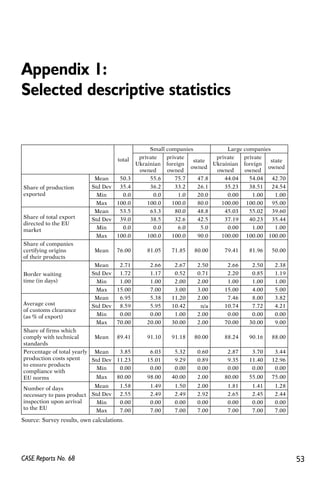
Appendix 1: Selected descriptive statistics . . . . . . . . . . . . . . . . . . . . . . . . . . . . . . . . . 53 
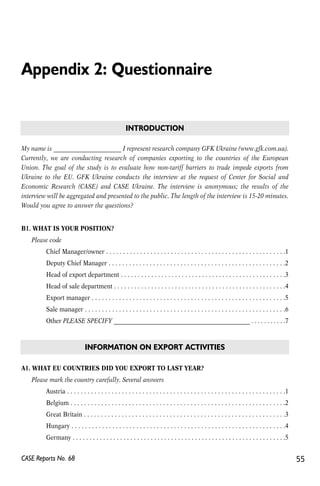
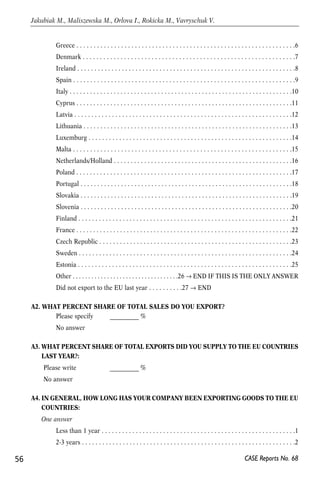
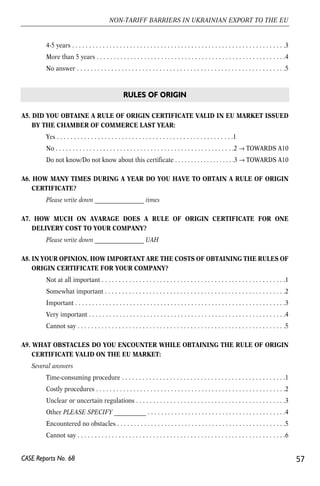
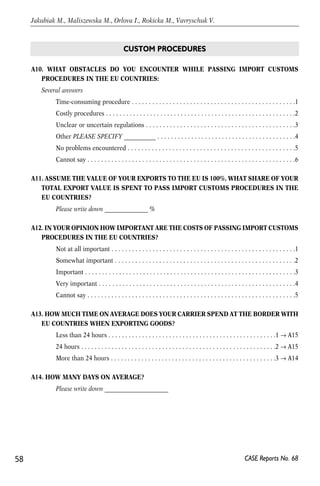
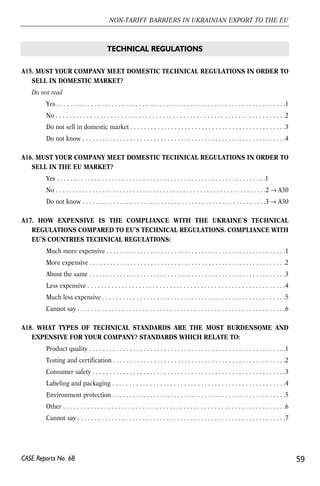
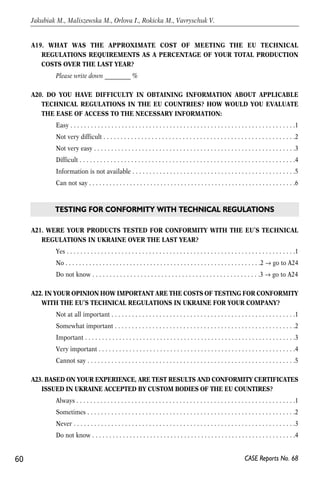
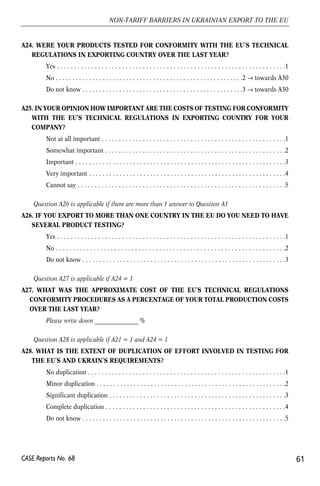
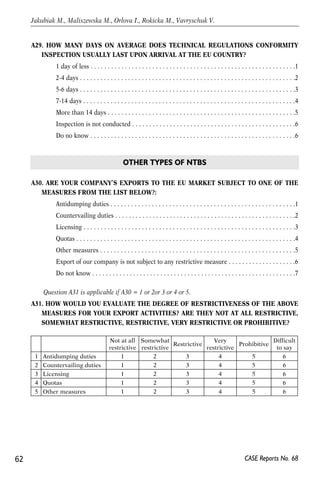
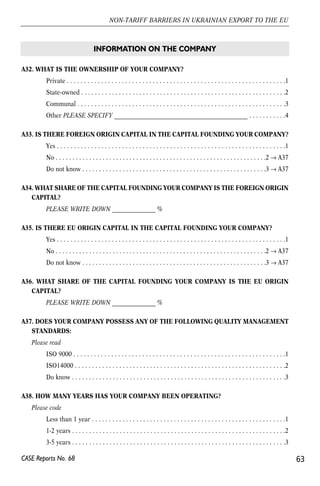
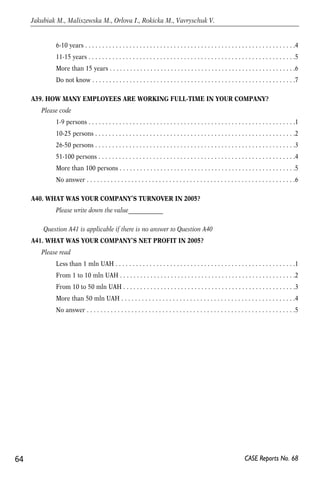
Appendix 2: Questionnaire. . . . . . . . . . . . . . . . . . . . . . . . . . . . . . . . . . . . . . . . . . . . . 55 
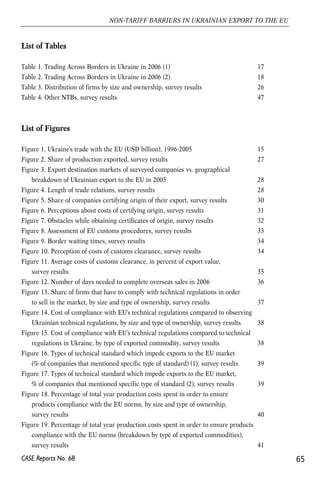
List of Tables . . . . . . . . . . . . . . . . . . . . . . . . . . . . . . . . . . . . . . . . . . . . . . . . . . . . . . . 65 
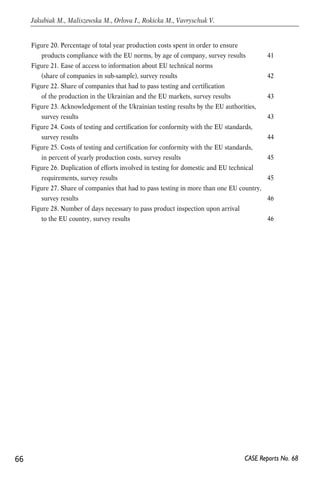
List of Figures . . . . . . . . . . . . . . . . . . . . . . . . . . . . . . . . . . . . . . . . . . . . . . . . . . . . . . 65 
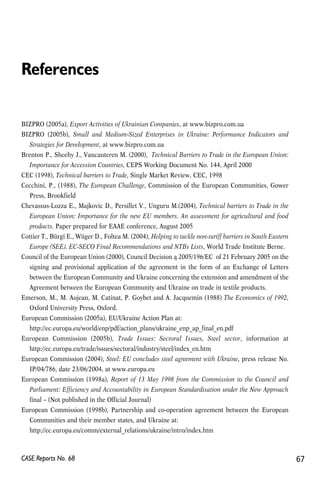
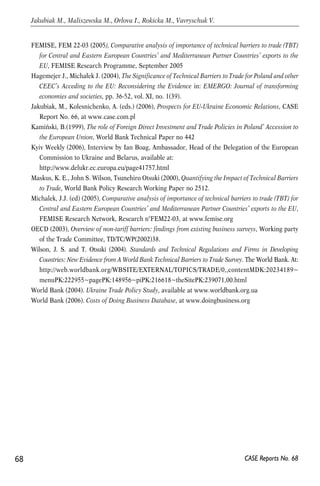
References . . . . . . . . . . . . . . . . . . . . . . . . . . . . . . . . . . . . . . . . . . . . . . . . . . . . . . . . 67 
CASE Reports No. 68 3
The Authors 
Małgorzata Jakubiak graduated from the University of Sussex (UK; 1997) and the 
Department of Economics at the University of Warsaw (1998). Her main areas of 
interest include foreign trade and macroeconomics. She has published articles on 
trade flows, exchange rates, savings and investments in Poland and other CEE 
countries. During 2000-2001 she was working at the CASE mission in Ukraine as 
resident consultant. Since 2002 she has been working on the doctoral thesis entitled 
"Role of trade and foreign investment in the transmission of innovation into Poland". 
She has collaborated with the CASE Foundation since 1997. 
Maryla Maliszewska has been working with the CASE Foundation since 1996. Her 
research interests cover modelling of international trade flows, determinants of real 
exchange rate, location of production and agglomeration externalities in transition. 
Her study on the impact of Poland's accession to the EU within a computable general 
equilibrium framework was rewarded with the second prize at the annual GDN's 
Research Medals Competition for "Outstanding Research in Development" in January 
2004. Between 1997-98 and in 1999, she worked as a CASE representative in the 
ProDemocratia advisory mission in Romania. In 2000 she was a summer intern at the 
World Bank, Washington DC. Maryla Maliszewska graduated from the University of 
Sussex (1996) and Warsaw University's Department of Economics (1997). She 
successfully defended her DPhil thesis at the University of Sussex in 2004. 
Irina Orlova has been working with CASE Ukraine since September 2006. She is a 
graduate of Economics Education and Research Consortium (EERC) ‘2005, MA 
Program in Economics at National University of "Kyiv-Mohyla Academy". Irina's 
research interests lie in the areas of International Trade, Capital Flows, Transition 
Economies. Her studies presented at the international conferences include: "Trading 
Partners and Economic Growth in Transition Economies", "The Effect of Policies on 
FDI Flows: The Case of Transition Countries". 
Magdalena Rokicka graduated from Warsaw University, Department of Economics in 
2001. In 2002 she continued her study at University of Nantes. In 2006 she accomplished 
at Warsaw University post graduate programme in cross cultural relations. Her main 
area of interest consist on: economic growth, FDI, education and macroeconomics. 
Since 2004 she has been working at CASE, as a member of application team, currently, 
as junior researcher, she is taking part in several research projects. 
4 
Jakubiak M., Maliszewska M., Orlova I., Rokicka M., Vavryschuk V. 
CASE Reports No. 68
Vitaliy Vavryschuk is an economist at CASE Ukraine since 2003. He graduated from 
EERC program at National University of "Kyiv-Mohyla Academy" and obtained MA 
degree in economics. Fields of specialization: foreign trade and WTO, European 
integration, macroeconomics. 
5 
NON-TARIFF BARRIERS IN UKRAINIAN EXPORT TO THE EU 
CASE Reports No. 68
List of abbreviations 
6 
Jakubiak M., Maliszewska M., Orlova I., Rokicka M., Vavryschuk V. 
CEEC Central and Eastern European country 
CEN European Committee for Standardisation 
CENELE European Committee for Electrotechnical Standardisation 
CIS Commonwealth of Independent States 
EAA European Association Agreements 
EC European Commission 
ETSI European Telecommunications Standards Institute 
EU European Union 
FTA Free Trade Area 
GATT General Agreement on Tariffs and Trade 
GSP General System of Preferences 
GUAM Georgia, Ukraine, Azerbaijan, and Moldova 
HS harmonized system (nomenclature of products) 
MFN most favoured nation 
MRA Mutual Recognition Agreements 
MRP Mutual Recognition Principle 
NMC New (EU) Member Country 
NTB non-tariff barrier to trade 
OECD Organization for Economic Co-operation and Development 
PCA Partnership and Cooperation Agreement 
PECA Protocols on European Conformity Assessment 
CASE Reports No. 68 
and Acceptance of Industrial Products 
SME small and medium enterprise 
SPS sanitary and phyto-sanitary measure 
TBT technical barrier to trade 
UAH Ukrainian Hryvn a 
UNCTAD United Nations Conference on Trade and Development 
VAT value added tax 
VER voluntary export restraint 
WB World Bank 
WTO World Trade Organization
Introduction 
The economic relations between the EU and Ukraine have intensified in recent 
years. Following the 2004 enlargement, Ukraine became the direct neighbour of the 
EU. At the same time, the country has been developing rapidly and both local 
production capacities and demand for foreign produce have been increasing. Ukraine 
also become more open to external partners. All this is reflected in the gradual 
effective trade integration with the EU; i.e. in growing bilateral trade flows. 
The overall EU tariffs for Ukrainian products are rather low and other tradition 
protection measures apply to selective sectors only. Moreover they are expected to 
disappear gradually within the next few years, following Ukraine WTO entry and 
expected establishment of the free trade area in manufacturing goods between the EU 
and Ukraine. However, there exist other so called ‘non-tariff’ barriers to trade that 
protect and will protect the EU market. For a relatively poorer country these barriers 
may turn to be prohibitive. This is probably the cause that there is general perception 
about Ukrainian export to the EU still being below its potential. The goal of this report 
is to explore whether the non-tariff barriers impede Ukrainian export to the EU and 
to what extent. 
This report is published about the time when the free trade agreement between 
the EU and Ukraine is negotiated. The authors hope that the findings will turn useful 
for designing the extent of this agreement and contribute to the discussion about it by 
showing the extent of non-tariff barriers faced currently by Ukrainian exporters. 
The report starts from the overview of Ukraine trade policy (chapter 1), with the 
special emphasis put on economic relations between the EU and Ukraine. Evolution 
of bilateral trade flows is discussed next (chapter 2). This is supplemented with the 
brief discussion of recently conducted surveys on barriers hampering Ukrainian 
exports (chapter 3). 
The experience of some current EU members from Central and Eastern Europe, 
which together with gradual phasing out of tariff and traditional protection measures 
in the 1990s faced growing non-tariff barriers to trade with the EU, seems to be 
relevant for Ukraine. Chapter 4 reviews the exposure of CEECs exports to the EU’s 
non-tariff barriers, and describes how the countries were changing its trade-related 
legislation towards the EU laws in order to tackle these barriers. Chapter 4 also shows 
CASE Reports No. 68 7
the extent of the EU’s technical barriers to trade in different sectors and how well 
CEE enterprises were prepared to meet them, once the EU commodity markets 
opened up completely for the new EU members in 2004. 
Results of the survey on non-tariff barriers to trade that are faced by Ukrainian 
exporters to the EU are presented in chapter 5. This is the main empirical contribution 
and the focus of this paper. The survey covered such areas as certification of origin, 
customs procedures and technical standards. Finally, chapter 6 concludes with policy 
recommendations. 
The authors are grateful for the assistance received from the State Committee of 
Ukraine for Technical Regulation and Consumer Policy and Association of Light 
Industry Producers of Ukraine. This publication was made possible due to the 
financial support provided by the 2006 Foreign Aid Programme of the Ministry of 
Foreign Affairs of Poland. 
8 
Jakubiak M., Maliszewska M., Orlova I., Rokicka M., Vavryschuk V. 
CASE Reports No. 68
1. Ukraine's trade policy: an overview 
Since 1991 Ukraine gained freedom to conduct external trade policy. This 
coincided with the beginning of severe economic crisis following collapse of the 
command economy. In the early 1990s protectionist approach prevailed and 
government was very cautious in liberalizing external trade. However, since mid 
1990s Ukrainian government switched to systemic and comprehensive 
liberalization of procedures connected with economic activities abroad and new 
institutional setup for foreign economic activities has been established. On the one 
hand, opening of the market was motivated by the necessity to obtain symmetric 
concessions from the major trading partners. On the other hand, it became 
increasingly obvious that higher competition induced by importers had 
substantial positive externalities at the domestic market. 
Export sector remained the main driving force of economic growth in Ukraine 
since 2000 and barrier-free access of Ukrainian producers to international markets is 
vitally important for sustainable economic development. Companies selling abroad 
(especially to developed countries) are motivated to improve quality and safety of their 
products through investing in enlarging their production capacities and in new 
technologies. Thus, government priorities were to facilitate access of Ukrainian 
commodities and services to the markets of Ukraine’s trading partners. 
After disintegration of the Soviet Union the newly-independent countries made 
attempts to restore barrier-free trade regime within the Commonwealth of 
Independent States (CIS) by forming free-trade zone. However, these plans have 
never resulted in a multilateral agreement. The CIS countries switched to bilateral 
free trade zones. Currently (2006) Ukraine has free trade agreements with all the CIS 
countries and Macedonia1. Until 2004 Ukraine had free trade agreements also with 
three Baltic states2. However, these had to be abolished when the partner countries 
entered the EU (common customs territory). As a rule, a number of commodities are 
excluded from the Ukrainian free trade regimes (i.e. sugar, spirits, confectionary etc.) 
under bilateral agreements with trading partners. 
9 
NON-TARIFF BARRIERS IN UKRAINIAN EXPORT TO THE EU 
1 In it’s essence the free trade agreement with Macedonia envisages preferential trade regime, i.e. not all tariff 
barriers are removed for trade between the countries. 
2 Estonia, Latvia, and Lithuania. 
CASE Reports No. 68
In 2004 Ukraine joined Common Economic Area – economic agreement between 
four CIS member countries envisaging formation of economic union in the long run 
perspective. As of January 2007 the progress was rather moderate and countries did 
not manage to implement any provision to ensure deeper economic integration of the 
members’ economies. At the same time Ukraine actively participated in GUAM – 
organization of Georgia, Ukraine, Azerbaijan and Moldova designed to promote 
political and economic relations among the members. The four countries formally 
signed multilateral free trade agreement in May 2006. 
Ukraine applied for the WTO membership in 1993 but the negotiating process was 
frozen until 2000. As of January 2007 the country managed to complete bilateral 
negotiations with all members of the Working Party except for Kyrgyzstan. The most 
awaited bilateral protocols with the EU were signed in March 2003, with the USA and 
Australia in early 2006. The reforms of Ukraine’s trade regime were much driven by 
the necessity to ensure fulfilment of commitments under bilateral protocols and 
harmonization of national legislation with the WTO multilateral agreements. 
Until now the country has implemented majority of reforms in order to fulfil 
commitments fixed in bilateral protocols and to comply with the WTO agreements. In 
particular, since 2004 the parliament passed a dozen of laws harmonizing trade-related 
legislation with the WTO norms. Adopted laws and regulatory acts refer to 
technical standards, antidumping and countervailing practices, customs valuation, 
intellectual property rights etc. During 2005 the parliament amended the law ‘On 
Customs Tariffs’ three times lowering rates for over 70% of lines of the Harmonized 
System. Some of the active tariffs are lower than maximum values under the schedule. 
Ukraine also abolished all restrictions as to the share of foreign capital in statutory 
funds of companies. Two remaining restrictions apply to news agencies (share of 
foreign capital in their statutory funds cannot exceed 35%), and companies distributing 
printed editions (the limit for foreign capital is 30%). The former restriction will be 
preserved; however, the latter should be abolished upon accession to WTO. 
Ukraine’s commitments and concessions fixed in bilateral protocols cover 
effectively the whole nomenclature of commodities and service sectors. According to the 
Ministry of Economy, import tariffs for industrial products will be tied at the average 
level of about 5% by the end of transition period. The average tariff level for agricultural 
products will be more than twice higher. Ukraine will maintain export duties on 
commodities that are subject to export charges today: scrap of ferrous metals and 
alloyed steel, sunflower seeds, live animals, and skins of cattle. Substantial concessions 
will be made in service sector. Ukraine committed to fully liberalize cross border supply 
of services as well as provision of services through consumption abroad. Besides, the 
supply of services through mode 3 (commercial presence) will be completely liberalized 
in 139 out of 155 sectors. Among others Ukraine will open the banking market by 
10 
Jakubiak M., Maliszewska M., Orlova I., Rokicka M., Vavryschuk V. 
CASE Reports No. 68
allowing branches of foreign banks to operate in the country and insurance market by 
allowing non-resident re-insurers dealing with certain kinds of risks. 
The milestone event for Ukraine was granting of the full-fledged market economy 
status by the EU (December 2005) and the USA (February 2006). The market economy 
status enhances position of Ukrainian producers in antidumping investigations 
conducted by the authorities of the partner countries. 
1.1. Trade policy vis-à-vis the EU 
Trade relations between Ukraine and the EU have been formalized in 1994 
through the Partnership and Cooperation Agreement (PCA) which entered into force 
only in 1998 (EC 1998b). The agreement envisaged, among others, basic rules of 
bilateral trade in goods and services. In particular, parties agreed to grant each other 
most-favoured nation treatment in accordance with the GATT provisions. Goods 
originating in Ukraine and the EU were granted access to the market of the other 
party free of quantitative restrictions. Special rules were initially established for trade 
in textiles and steel products through separate agreements. PCA also mentioned the 
establishment of EU-Ukraine free trade area in manufacturing products in the future. 
The textile agreement signed between the parties in 2000 required Ukraine to lower 
the import tariffs on textile and clothing products. In its turn, the EU lifted quotas on 
Ukrainian apparel (Council of the EU 2000). Bilateral agreement provided a good basis 
for successful and systemic dismantling of trade barriers in this sector. Gradual 
liberalization of textile trade created preconditions for smooth adaptation of the economy 
towards functioning under terms agreed during the WTO accession negotiations. 
Supply of steel from Ukraine to the EU market is subject to quotas. The size of the 
quota is negotiated annually and equals about 1.32 million tons for 2007. Quotas have 
been risen for 2005-2006, following the 2004 enlargement (from 0.61 million tons in 
2004, to 0.98 million tonnes in 2005, after EC 2004, EC 2005b). The situation on the 
EU quota front may improve further if Ukraine accedes to the WTO, which will lead 
to removal of the quantitative restrictions in bilateral trade, steel sector including. 
Access of Ukrainian producers to the EU market has been liberalized and current 
tariffs are not a binding obstacle to exports from Ukraine to the EU. According to the 
World Bank estimates, Ukraine benefits substantially from the preferences granted by 
the EU under the Generalized System of Preferences (WB 2004). About one third of 
exports to the EU are tariff-free under the Generalised System of Tariff Preferences 
(GSP), one third is subject to preferential tariffs under the GSP, and only one third is 
subject to MFN rates. 
11 
NON-TARIFF BARRIERS IN UKRAINIAN EXPORT TO THE EU 
CASE Reports No. 68
The PCA has been concluded for the period of ten years (till the end of 2007) and 
currently the parties have an opportunity to negotiate a new framework agreement 
envisaging deeper economic integration. According to the Ukrainian and the EU 
officials, the future agreement will envisage free trade zone in manufacturing goods. 
Simultaneously the parties may negotiate formation of deeper free trade zone (FTA+). 
The FTA+ can envisage several dimensions of possible integration besides abolishment 
of tariffs – reduction of non-tariff barriers, liberalization of trade in services, 
harmonization of trade policy in key spheres, etc. The FTA+ is perceived as a step 
toward full-fledged integration of economies; however it may take as much as two 
decades to implement the plans. Informal consultations on an FTA started in 2006, but 
the EU expects Ukraine to enter the WTO first in order to formally launch the process 
(Kyiv Weekly 2006). 
The EU-Ukraine Action Plan was approved as an element of the European 
Neighbourhood Policy in February 2005 (EC 2005a). The document has been 
concluded for an initial period of three years and identifies key spheres of reforms in 
Ukraine. By signing the document Ukraine committed to accelerate reforms 
necessary for closer relations with the EU. Trade issues are given proper attention in 
the document. As of the end of 2006 the fulfilment of the action plan was especially 
successful in the area of trade policy. Ukraine made progress in reforming the 
customs service, aligning technical standards with the EU regulations, improving 
sanitary and phyto-sanitary institutions. However, much remains to be done by the 
end of the implementation period (Jakubiak, Kolesnichenko 2006). 
1.2. Key trade-related institutions in Ukraine 
Bodies responsible for trade policy. Ministry of the Economy of Ukraine is the 
main body of executive branch dealing with external trade issues. In particular, it 
negotiates trade agreements, leads WTO accession negotiation, conducts economic 
analysis of trade-related decisions and represents Ukrainian producers’ interests in 
other countries. Also, Cabinet of Ministers forms Inter-Agency Trade Commission 
responsible for antidumping and countervailing investigations. 
Customs tariffs. Import tariffs in Ukraine are set by the law ‘On Customs Tariff of 
Ukraine’. Tariffs are set for every commodity at a 10 digit level of classification based 
on HS. The law envisages two different types of import tariffs: privileged rates (on 
commodities subject to MFN regime) and full rates (applicable toward other 
commodities). Export tariffs are set by special laws; currently Ukraine charges export 
tariffs on four commodities: live animals and skins of cattle, scrap of ferrous metals, 
12 
Jakubiak M., Maliszewska M., Orlova I., Rokicka M., Vavryschuk V. 
CASE Reports No. 68
scraps of non-ferrous metals and sunflower seeds. The State Customs Service of 
Ukraine, which is responsible for customs control is an agency within Ukrainian 
government. The head of the Service is appointed by the President. The customs 
service is responsible for customs clearance of traded services and commodities. 
Currently about 92 inland and 220 border customs offices function in Ukraine. 
Technical regulation. The law ‘On Standards, Technical Regulations and 
Conformity Evaluation Procedures’ (adopted in 2005) is the main normative act in the 
sphere of technical regulation in Ukraine. It states that The State Committee of 
Ukraine for Technical Regulation and Consumer Policy (Derzhspozhyvstandart) is 
responsible for the state policy in the sphere of technical regulation. It is authorized 
to develop technical regulations (obligatory rules specifying commodity and 
production process characteristics) which are to be approved by the Cabinet of 
Ministers. Derzhspozhyvstandard is also responsible for assessment of product 
characteristics’ conformity with technical regulations. The assessment is implemented 
through UkeSEPRO () certification system covering about 120 bodies 
throughout Ukraine. 
Rules of origin. The Customs Code of Ukraine envisages the key provisions on 
certification of rules of origin. The rules of origin are used to identify commodities 
which are subject to preferential customs treatment. Cabinet of Ministers delegated 
the right to certify origin of commodities in Ukraine to the Chamber of Commerce. 
The rule of origin certificate is provided for every delivery of commodities. 
Sanitary and phytosanitary regulations. The sphere is regulated by two key laws: 
‘Law on Quality and Safety of Foodstuff and Food Materials’ (the latest version 
approved in September 2006) and law ‘On Veterinary Medicine’ (the latest version 
approved in November 2006). The laws contain provisions on functioning of system 
of sanitary and phyto-sanitary control in Ukraine. The key bodies responsible for 
implementation of the policy in Ukraine are State Department for Veterinary 
Medicine and State Sanitary-Epidemiologic Service of Ukraine. 
13 
NON-TARIFF BARRIERS IN UKRAINIAN EXPORT TO THE EU 
CASE Reports No. 68
14 
Jakubiak M., Maliszewska M., Orlova I., Rokicka M., Vavryschuk V. 
CASE Reports No. 68
2. Ukraine's trade with 
the European Union3 
Ukraine’s trade with the European Union has been steadily growing 
throughout the last decade. In 2006 the EU was the second largest trade partner of 
Ukraine (after CIS – the Commonwealth of Independent States). There was a slight 
downturn in both Ukraine’s exports to the EU and imports from the EU during the 
currency crisis period of 1998-1999, after which trade growth rates with the EU 
have outpaced its pre-crisis levels. The dynamics of Ukraine’s trade in goods with 
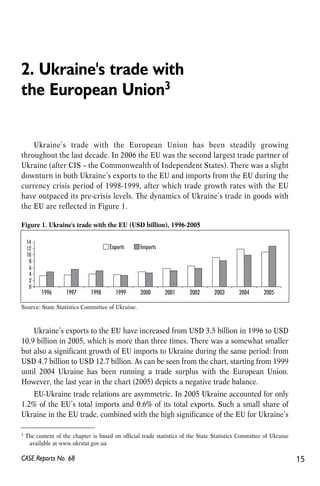
the EU are reflected in Figure 1. 
Figure 1. Ukraine's trade with the EU (USD billion), 1996-2005 
14 
12 
10 
0 2 4 6 8 
Exports Imports 
1996 1997 1998 1999 2000 2001 2002 2003 2004 2005 
Source: State Statistics Committee of Ukraine. 
Ukraine’s exports to the EU have increased from USD 3.5 billion in 1996 to USD 
10.9 billion in 2005, which is more than three times. There was a somewhat smaller 
but also a significant growth of EU imports to Ukraine during the same period: from 
USD 4.7 billion to USD 12.7 billion. As can be seen from the chart, starting from 1999 
until 2004 Ukraine has been running a trade surplus with the European Union. 
However, the last year in the chart (2005) depicts a negative trade balance. 
EU-Ukraine trade relations are asymmetric. In 2005 Ukraine accounted for only 
1.2% of the EU’s total imports and 0.6% of its total exports. Such a small share of 
Ukraine in the EU trade, combined with the high significance of the EU for Ukraine’s 
3 The content of the chapter is based on official trade statistics of the State Statistics Committee of Ukraine 
available at www.ukrstat.gov.ua 
CASE Reports No. 68 15
trade (i.e. 32% in 2005) means that Ukraine will feel much stronger any benefits or 
losses from closer economic cooperation than the EU. 
For the purposes of comparison, we provide some statistics of Ukraine’s trade 
with CIS countries for the same period of 1996-2005. In 1996, Ukrainian exports to 
CIS constituted USD 7.4 billion, which was more than twice as much as its exports to 
the EU. However, throughout the reference period exports to CIS show a declining 
pattern up till 2003 when a significant (almost 140%) increase occurs. As a result, in 
2005 exports to CIS reach USD 10.7 billion, which is less than Ukraine’s exports to 
the EU in the same year. As a matter of fact, starting from 1999 Ukraine has been 
steadily exporting more to the EU than to CIS. The share of exports to the EU in total 
Ukrainian exports has increased from 24% in 1996 to 32% in 2005, reaching its 
maximum of 40% in 2003. Whereas the share of exports to CIS has changed in the 
opposite direction: from 51% in 1996 to 31% in 2005. With imports the situation is a 
bit different because of Ukraine’s dependence on gas imports from the Russian 
Federation. The share of imports from CIS in total Ukrainian imports never went 
below 50% in the reference period, except for the year 2005 (47%); while imports 
from the EU in 2005 comprised only 35% of total imports. 
In 2005, the main trading partners (among EU countries) of Ukraine were Italy, 
Germany and Poland. For example, exports to Italy in 2005 increased by 16.9% 
compared to 2004; however, exports to Germany decreased by 32%. Ukrainian 
imports in 2005 increased from all EU countries except for Malta. 
The largest share in Ukrainian exports to the EU is taken by ferrous metals – 
21.2%, followed by energy-intensive goods, petroleum products – 19.3%, other 
minerals – 6.9%, textiles – 5.7%, wood and wood products – 4%, and ferrous metal 
products – 3.9%. The largest part of ferrous metals export goes to Italy, Germany, and 
Poland; energy-intensive goods, petroleum products – to Italy, Germany, and Cyprus; 
other minerals – Slovakia, Czech Republic, Austria; textiles – Germany, France, 
United Kingdom; wood and wood products – Hungary, Poland, Italy; ferrous metal 
products – Spain, Germany, and Italy. 
As for the structure of Ukrainian imports from the EU, here the largest share 
comprises of mechanical equipment – 18.2%; followed by electric machinery and 
equipment – 11.8%; transport equipment – 10.6%; plastic products – 7.1%; 
pharmaceuticals – 6%; paper and cardboard – 4.8%. Mechanical equipment is mostly 
imported from Germany, Italy, and France; electric machinery – from Germany, 
Sweden, and Czech Republic; transport equipment – Germany, Poland, Hungary; 
plastic products – also Germany, Poland, and Hungary; pharmaceuticals – Germany, 
France, Hungary; paper and cardboard – Poland, Finland, Germany. 
16 
Jakubiak M., Maliszewska M., Orlova I., Rokicka M., Vavryschuk V. 
CASE Reports No. 68
3. NTBs faced by Ukrainian exporters 
– results from other studies 
To our best knowledge the issue of non-tariff barriers to trade for Ukrainian 
exporters was not studied in depth in known academic papers. The only study covering 
issues of barriers to exports is ‘Doing Business’ conducted in 2005 and 2006 by the 
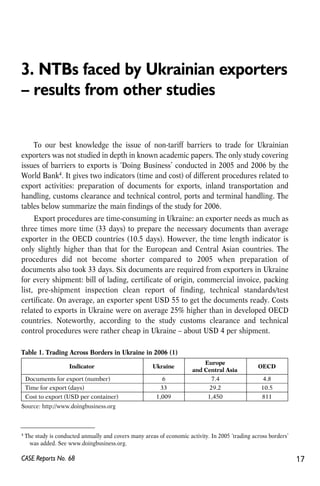
World Bank4. It gives two indicators (time and cost) of different procedures related to 
export activities: preparation of documents for exports, inland transportation and 
handling, customs clearance and technical control, ports and terminal handling. The 
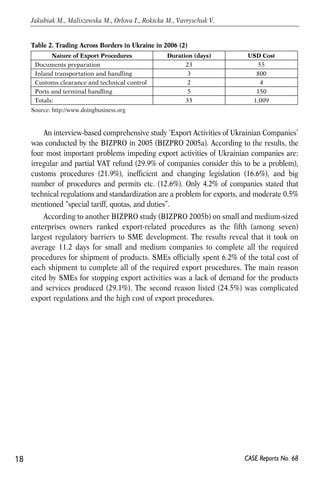
tables below summarize the main findings of the study for 2006. 
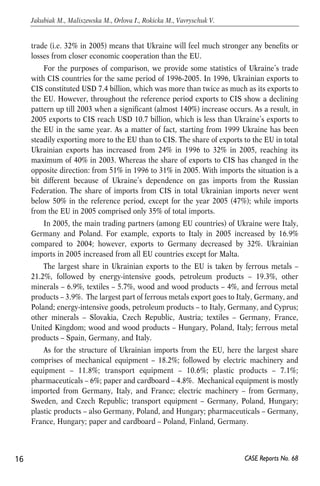
Export procedures are time-consuming in Ukraine: an exporter needs as much as 
three times more time (33 days) to prepare the necessary documents than average 
exporter in the OECD countries (10.5 days). However, the time length indicator is 
only slightly higher than that for the European and Central Asian countries. The 
procedures did not become shorter compared to 2005 when preparation of 
documents also took 33 days. Six documents are required from exporters in Ukraine 
for every shipment: bill of lading, certificate of origin, commercial invoice, packing 
list, pre-shipment inspection clean report of finding, technical standards/test 
certificate. On average, an exporter spent USD 55 to get the documents ready. Costs 
related to exports in Ukraine were on average 25% higher than in developed OECD 
countries. Noteworthy, according to the study customs clearance and technical 
control procedures were rather cheap in Ukraine – about USD 4 per shipment. 
Table 1. Trading Across Borders in Ukraine in 2006 (1) 
Indicator Ukraine 
Documents for export (number) 67 .4 4.8 
Time for export (days) 33 29.2 10.5 
Cost to export (USD per container) 1,009 1,450 811 
Source: http://www.doingbusiness.org 
Europe 
and Central Asia 
OECD 
4 The study is conducted annually and covers many areas of economic activity. In 2005 ‘trading across borders’ 
was added. See www.doingbusiness.org. 
CASE Reports No. 68 17
Table 2. Trading Across Borders in Ukraine in 2006 (2) 
Nature of Export Procedures Duration (days) USD Cost 
Documents preparation 23 55 
Inland transportation and handling 3 800 
Customs clearance and technical control 2 4 
Ports and terminal handling 5 150 
Totals: 33 1,009 
An interview-based comprehensive study ‘Export Activities of Ukrainian Companies’ 
was conducted by the BIZPRO in 2005 (BIZPRO 2005a). According to the results, the 
four most important problems impeding export activities of Ukrainian companies are: 
irregular and partial VAT refund (29.9% of companies consider this to be a problem), 
customs procedures (21.9%), inefficient and changing legislation (16.6%), and big 
number of procedures and permits etc. (12.6%). Only 4.2% of companies stated that 
technical regulations and standardization are a problem for exports, and moderate 0.5% 
mentioned “special tariff, quotas, and duties”. 
According to another BIZPRO study (BIZPRO 2005b) on small and medium-sized 
enterprises owners ranked export-related procedures as the fifth (among seven) 
largest regulatory barriers to SME development. The results reveal that it took on 
average 11.2 days for small and medium companies to complete all the required 
procedures for shipment of products. SMEs officially spent 6.2% of the total cost of 
each shipment to complete all of the required export procedures. The main reason 
cited by SMEs for stopping export activities was a lack of demand for the products 
and services produced (29.1%). The second reason listed (24.5%) was complicated 
export regulations and the high cost of export procedures. 
18 
Jakubiak M., Maliszewska M., Orlova I., Rokicka M., Vavryschuk V. 
CASE Reports No. 68 
Source: http://www.doingbusiness.org
4. Experience of current 
new members: non tariff barriers 
between CEECs and the EU 
Process of transformation of Central and Eastern European countries (CEECs5) 
resulted in the significant adjustment of their trade structure. Not only the scope of 
products for export changed but also its geographical destination. The fall of soviet 
block naturally caused the shift of the CEECs export towards EU countries. These 
changes have been accompanied by the growing liberalisation of trade, and the 
decreasing importance of the traditional protection measures like: tariffs, quotas, and 
voluntary export restraint (VER) agreements. As a result non tariffs barriers to trade, 
mainly: technical regulations and standards (TBT), sanitary and phyto-sanitary (SPS) 
measures, rules of origin, customs rules and procedures, and other administrative 
procedures have become the main impediment for exporters from CEECs countries, 
willing to enter EU market. 
4.1. Legal framework for harmonisation of standards and technical 
regulation 
The process of adjustments and trade liberalisation between CEECs and the EU 
was set in motion by the signature of the European Association Agreements (EAA) in 
1992. These documents established a new framework for CEECs and EU economic 
relationship, including a free trade regime for industrial products and improved access 
for agricultural products. In addition, the EU committed itself to gradually eliminating 
tariffs and increasing quotas on ‘sensitive’ products-mainly textiles, iron, and steel. 
With regard to the technical barriers the EAAs provided that candidate countries 
would set up rules and procedures equivalent to those applied in the EU. It is worth 
5 Term CEECs here refers mainly to the 8 new EU members that joined the Union in 2004 (Czech Republic, 
Estonia, Hungary, Latvia, Lithuania, Poland, Slovakia and Slovenia). 
CASE Reports No. 68 19
to mention that EU approach toward technical regulation and certification is based 
on Mutual Recognition Principle (MRP)6, the new harmonisation approach7 
implemented in 1985, and old approach (detailed harmonisation)8. Beside national 
institutes three European bodies are dealing with the standardisation issues on the 
European level: European Committee for Electrotechnical Standardization – 
CENELEC, European Telecommunications Standards Institute – ETSI, The 
European Committee for Standardization – CEN. 
During 1994-1997, given the complex and non-homogenous EU rules, it was 
claimed that candidates countries used the EAA for protecting their own markets and 
imposing new standardisation norms for importers instead of facilitating the trade 
flow. Seen as ineffective, the negotiations of technical harmonisation with candidate 
countries on the product level were replaced by the introduction of Protocols on 
European Conformity Assessment and Acceptance of Industrial Products (PECA)9. 
PECA were considered as the major instrument of the pre-accession strategy in the 
field of the free movement of goods, they covered following sectors: machinery, 
electrical safety, electromagnetic compatibility, gas appliances, pressure equipment, 
hot water boilers, medical devices, good laboratory practice, and good manufacturing 
for medicinal products, lifts, toys, and construction products. These protocols were 
signed with majority of accession countries, as well as with Romania and Bulgaria. 
4.2. Non-tariff barriers to trade with the EU in 1990s 
Kaminski (1999) evaluated the impact of EAA on Polish and CEE exports. Using 
the UNCTAD classification of non-tariff barriers10 he made distinction between all 
NTBs11, and ‘narrow’ NTBs12, and then analysed various non tariff measures imposed 
by the EU on imports in 1995. He found that Poland and Hungary are the more 
20 
Jakubiak M., Maliszewska M., Orlova I., Rokicka M., Vavryschuk V. 
6 MRP – if product is produced and tested in accordance with the technical regulation of member state it should 
CASE Reports No. 68 
be recognized by other member states, and circulated free within Single Market. 
7 New harmonisation approach: instead of detailed case by case provisions of norms and standards, which 
occurred inefficient and unsatisfactory Community legislation is restricted to establishing the essential 
requirements that products must meet. These requirements fix thresholds or levels of protection for the whole 
of the Community in the area of health and safety. 
8 Old Approach: all agreements require unanimity and have forms of directives, which contain high degree of 
technical detail. Old approach applies mostly to chemicals, motor vehicles, pharmaceuticals, and foodstuff. 
9 Following EC explanation: PECAs are agreements with candidate countries by which mutual recognition 
operates on the basis of the acquis communautaire (i.e., they differ from Mutual Recognition Agreements 
(MRAs) in that they make use of common technical rules and standards). They also provide for the mutual 
acceptance of industrial products that are legally placed on the market in the territory of the parties to them. 
10 These are: para-tariff measures, price control measures, finance measures, automatic licensing measures, 
quantity control, monopolistic measures, and technical measures. 
11 All mentioned above.
sensitive to NTBs of the EU, while comparable low level of exposure was observed for 
the Czech Republic and Slovakia. It should be mentioned that the vulnerability to 
NTBs of each of the CEEC is closely related to its export basket. 
While analysing in details the indices of NTB application to Polish export, he further 
revealed that VERs (voluntary export restrictions) were most common NTBs followed 
by the ‘other extra charges’, which include product certification and standardisation. In 
1995 among the most NTBs affected sectors were: 
• clothing, textiles (97% of trade affected) 
• food (91% of trade affected) 
• animal feeds (almost 65% of exported products were affected by (NTBs). 
This was followed by oils and fats (56%), iron and steel production (49 %), and 
other Polish manufacturing products13 (EU NTBs applied only to 33% of Polish 
manufacturing exports). 
4.3. Technical barriers 
Significant part of the non-tariff measures consists of technical barriers, which as 
mentioned previously are still seen as a major impediment to trade. According to 
Brenton (2000) almost 80% of the intra-EU trade were the subject of technical 
regulations in 1996, and the cost associated with existing technical barriers to trade was 
estimated to be as high as 2-2.4% of EU GDP (Cecchini, 1998; Emerson et al. 1988, EC 
1998a). The situation was even more complex with regard to candidate countries 
exporting to the EU. 
As the availability of the appropriate data for measuring the scope of technical 
barriers to trade (TBTs) for exporters to the EU are limited; several approximations 
were made, and only the sectors generally considered as the most prone to technical 
barriers were analysed. According to the study by Brenton (2000; breakdown of EU 
import for 1998) one third of EU import from Bulgaria and Latvia was carried out 
without any technical restrictions, as the exchange was mainly executed in sectors 
free of restrictions: non ferrous metals, footwear, sawing and processing of wood. In 
contrast Slovenia exported mainly machinery, which was subject to the new approach 
harmonisation, therefore only one fifth of its export was exempted from technical 
regulations. Estonia, Slovakia and Hungary were exporting to the EU mainly: motor 
21 
NON-TARIFF BARRIERS IN UKRAINIAN EXPORT TO THE EU 
12 Narrow NTBs exclude: antidumping and countervailing duties, licensing, price control, health and safety 
regulation, technical standards. 
13 All calculations refer to 1995. 
CASE Reports No. 68
vehicles and parts, prepared meat and petroleum products, which were regulated by 
the harmonisation of the old approach14, and were highly affected by TBTs. 
Sectors where technical barriers were not significant had rather high share of EU 
directed sales from Balkans, Romania and Baltic states. Whereas export from the 
Czech Republic, Hungary, Poland and Slovenia was highly influenced by the EU 
technical regulations. 
Changing export structure (move from predominantly low-technology goods in 
the direction of ‘middle-technology intensive’ products) forced the degree of technical 
restrictions for at least some of the trading partners. As a result of overall 
development and better supply capacities Poland and Hungary shifted their export 
toward more technology-intensive sectors over the last decade. However, these were 
also the sectors to which higher technical control applies and which are mainly 
regulated by the new approach rules. 
4.4. What happened after accession 
After the EU enlargement in 2004, all tariff barriers were removed and free 
movement of goods facilitated. Candidate countries adopted acquis communautaires, 
which led to technical harmonisation of production and significantly reduced the cost 
of trade transactions. However adherence to new standards also imposed costs on 
producers from new member states. 
According to the results of the survey done in Poland for a sample of firms 
producing processed food, electrical appliances and chemical products, 6 months 
after the accession (FEMISE, 2005) the benefits from better market access to the EU 
outweighed costs of adjustment to the EU technical regulations. However the attitude 
towards different TBTs varied by sectors. 
Within food producer group, 54% of the firms claimed the increase of the cost of 
certification as a result of exporting to the EU market, 31% had to redesign their 
product so that it would meet the EU requirements, and this change was also 
associated with significant investments and costs. In addition cost of detailed labelling 
was mentioned as high by 43% of food producers. Notwithstanding this, 48% of the 
exporters in the food industry claimed that the unification of standards in all the EU 
countries was beneficial for their exports to the EU. 
22 
Jakubiak M., Maliszewska M., Orlova I., Rokicka M., Vavryschuk V. 
14 Old approach harmonisation covers following group of products: cosmetics, chemicals, motor vehicles, 
CASE Reports No. 68 
foodstuffs, pharmaceuticals.
Majority of Polish chemical firms did not meet any particular difficulties in trade 
after EU accession. Only 35% of the firms admitted that the cost of certification has 
increased since the implementation of the EU legislation. Also in case of food producers, 
57% of exporters perceived the unification of the technical requirements as beneficial. 
Electrical sector seems to have been the most harmonized with the EU norms and 
standards well before the accession. Only 1% of production was removed from the market 
after 2004, and more than 90% of all respondents admitted that after May 2004 (date of 
the accession) they have not faced any particular difficulties in exporting to EU market. 
In spite of this and similar studies at micro level, various macroeconomic estimations 
based on econometric analysis and equilibrium models were done to measure the impact 
of EU accession for new member states, considering harmonisation of standards and 
lowering of TBTs. According to one simulation (FEMISE 2005) changes in 
standardization policy have large welfare effects, which varied between countries and are 
closely related to the sectoral structure of export. It is claimed that the largest increase of 
GDP as a result of a decrease of the technical barriers to trade will be noticed in 
Lithuania and Latvia. For the Czech Republic, Estonia, Slovakia and Slovenia the 
simulated GDP increases are equal to 1.4% to 1.6%, while only 1% for Poland. 
Although the elimination of NTBs, and especially TBTs is costly, it brings benefits 
which in the longer perspective can overcome the previous inconvenience and 
expenditures. The importance of NTBs in trade with the EU is closely related to 
sectoral structure of the exchange. When analysing the future Ukrainian - EU trade 
relations in the context of NTBs the following of the CEEC’s features should be taken 
into account: 
• the lowest TBTs are generally present in the sectors of: raw materials, low-processed 
products (with the exemption of food and agriculture products) 
• the TBTs remain high, even in intra-EU trade 
• the changes of export structure influence level and type of technical barriers to 
trade that the country has to deal with. Shift from exporting low-technology 
products to more technology-intensive goods (for example: more pharmaceutics, 
chemicals, machinery etc.) increases the number and the character of TBTs for 
exporting country. 
• the harmonisation and mutual recognition of standards reduce non-tariff 
barriers to trade 
• reduction of non-tariff barriers is beneficiary for producers, although costly 
• elimination of non-tariff barriers, especially through harmonisation of standards 
leads to significant welfare gains. 
23 
NON-TARIFF BARRIERS IN UKRAINIAN EXPORT TO THE EU 
CASE Reports No. 68
24 
Jakubiak M., Maliszewska M., Orlova I., Rokicka M., Vavryschuk V. 
CASE Reports No. 68
5. NTBs faced by Ukrainian 
exporters to the EU – survey results 
This section presents the results of the survey of about 500 companies that are 
located in Ukraine and have exported to the EU. The representatives of the companies 
were asked identical questions about their perceptions of non-tariff barriers in the EU. 
The survey was conducted in November and December 200615. 
While drafting the questionnaire (attached as Appendix 2 to this report), existing 
methodologies and results of the research conducted so far for Ukraine, CEECs and 
other countries were used as a starting point. The research team went through 
relatively recent surveys on NTBs such as Wilson and Otsuki (2004) done for 17 
developing countries including some CEECs, and Cottier et al (2004) conducted for 
Balkan countries. The findings regarding NTBs from WB (2006) and BIZPRO (2005a 
and 2005b) for Ukraine and from Michalek (2005) for the CEECs were also considered 
when drafting particular parts. 
The questions initially covered rules of origin of goods, functioning of customs, 
adherence to technical regulations and standards, sanitary and phyto-sanitary measures 
and other NTBs. After some pilot interviews, questions regarding phyto-sanitary norms 
were dropped, for the reason that they mainly referred to agricultural trade and here 
mainly manufacturing exporters were interviewed. As the vast majority of respondents 
were not obliged to comply with phyto-sanitary measures, they did not understand the 
relevant questions and had troubles answering them. Moreover, liberalisation of 
agricultural trade between Ukraine and the EU is not likely to happen very soon, 
contrary to manufacturing trade. Hence the survey focused on questions relevant 
mainly for exporters of manufacturing goods16. Firms were also asked to provide 
general information about the company and about their export markets. The majority of 
the questions have ‘closed’ character, i.e. a respondent was given options to choose 
15 The survey was conducted by GFK Ukraine by the method of telephone interview. 
16 The sample consisted also of 57 companies exporting agricultural products (groups 1-14 of the Harmonised 
System). However, these exporters treated technical and sanitary norms as one group of barriers and it was 
difficult for the interviewers to get separate information on these two set of norms. As a result, the questions 
regarding sanitary norms were dropped. However, the interpretation of technical standards with regard to 
the exporters of the agricultural goods presented later in this report takes into account the fact, that some of 
the answers refer to sanitary and phyto-sanitary norms. 
CASE Reports No. 68 25
from. Also, there was a space for comments. There were also some questions asking 
about numerical estimate of costs (measured in money or time spent) of a particular 
barrier17. The reader is directed to the Appendix 2 for more details. 
5.1. Description of sample 
The sample was composed of 510 exporters to the EU18. The majority of the firms 
(281, 55% percent of the total) were rather small and employed less than 50 workers 
(see Table 3). When looking at the ownership structure, firms owned by Ukrainian 
private capital were the most numerous. They accounted for 62% of the sample (146 
small and 170 large). Foreign-owned firms made up nearly 20% of the total sample (34 
small and 61 large)19. State-owned firms (mostly large) constituted 11% of the sample20. 
Table 3. Distribution of firms by size and ownership, survey results 
Description Number of firms 
small firms foreign-owned 34 
large firms foreign-owned 61 
Total of sub-samples 466 
Whole sample 510 
Source: Survey results. 
private Ukrainian-owned 146 
state-owned 5 
private Ukrainian-owned 170 
state-owned 50 
The division into sub-groups by ownership type and by the firm size is used in the 
following sections of the report. In this way, the researchers could see whether any of 
the analysed barriers are felt stronger by any group. 
About half of production of surveyed companies is exported, mostly to the EU. The 
most export-oriented are foreign-owned firms (especially small foreign-owned firms, 
see Figure 2). On the contrary, state-owned enterprises are oriented predominantly at 
domestic market. 
26 
Jakubiak M., Maliszewska M., Orlova I., Rokicka M., Vavryschuk V. 
17 Statistics covering answers to numerical questions are presented in Appendix 1. 
18 The survey is biased in a sense that it covers only exporters. We do not know how different barriers are 
perceived by those who would like to export to the EU, but find the costs related to compliance with standards 
and regulations as prohibitive. 
19 The division between Ukrainian-owned and foreign-owned firms was by the majority share of the statutory 
capital. If the share of foreign capital was higher than 50%, then the firm was marked as ‘foreign-owned’. It 
was ‘Ukrainian-owned’ otherwise. 
20 Remaining 9% did not provide information either as to the type of ownership or as to the number of workers. 
CASE Reports No. 68 
Therefore, it was not used for making sub-groups.
Figure 2. Share of production exported, survey results 
Source: Survey results. 
Both ‘old’ and ‘new’ EU members are almost equally popular overseas sales 
markets for the surveyed firms. Out of total 510 companies, 604 reported exports to 
EU15, and 557 to EU10 (including 205 firms exporting to Baltic states). Germany 
(36% respondents selling there) and Poland (35%) are two by far most important 
export destinations. Although, if Baltic states are taken together, they account for the 
largest share (40%). 
The sample looks as representative when one takes into account geographical 
distribution of exports. Figure 3 gives the graphical representation of export markets 
of all surveyed firms (left panel). On the right panel there is also geographical 
breakdown of total Ukrainian exports to the EU in 2005. Visual examination reveals 
that the positions of export partners on the two lists on both panels broadly 
correspond to each other. The rank correlation coefficient (between the rank of a 
given export market in the sample and as measured by total value of export flows in 
2005) is 0.85, which allows us to believe that the sample is to a large extent 
representative in regard to geographical distribution of exports21. 
Quite surprisingly, the surveyed companies have long-established trade relations. 
When asked about for how long they had been exporting to the EU, nearly half of them 
answered that for more than 5 years. Figure 4 shows that this is primarily due to state-owned 
companies (nearly 80% of large state-owned companies had trade relations longer 
27 
NON-TARIFF BARRIERS IN UKRAINIAN EXPORT TO THE EU 
CASE Reports No. 68 
0 10 20 30 40 50 60 70 80 
state-owned 
foreign-owned 
private Ukrainian-owned 
state-owned 
foreign-owned 
private Ukrainian-owned 
small firms large firms 
share of production exported (in %) 
21 The use of rank correlation is not perfect for two reasons. Firstly, one compares the fact of exporting to a given 
market with the value of exports to this destination. Secondly, we compare manufacturing exports (sample 
covers exporters of manufacturing goods only) with total exports (covering also agricultural trade). In this 
second situation, the difference should not be significant in this case, though.
that 5 years), which probably operate on long-term contracts. Small privately owned 
companies seem to have the highest percent of ‘fresh’ trade relations among them. 
28 
Jakubiak M., Maliszewska M., Orlova I., Rokicka M., Vavryschuk V. 
Figure 3. Export destination markets of surveyed companies vs. geographical breakdown of 
Ukrainian export to the EU in 2005 
Ukrainian export to the EU in EUR million, 2005: 
CASE Reports No. 68 
Export destination markets, survey results: 
0 50 100 150 200 
Germany 
Poland 
Italy 
Lithuania 
Litvia 
Hungary 
Czech Republic 
France 
Slovakia 
Estonia 
Austria 
Spain 
Netherlands 
UK 
Belgium 
Greece 
Denmark 
Sweden 
Portugal 
Slovenia 
Ireland 
Finland 
Luxemburg 
Cyprus 
Malta 
number of companies exporting to a given market 
Source: Survey results. 
0 50 1 000 1 500 2 000 
Italy 
Germany 
Poland 
Spain 
Czech Republic 
Hungary 
Slovakia 
Austria 
Netherlands 
france 
Belgium 
Greece 
Lithuania 
Latvia 
UK 
Denmark 
Estonia 
Sweden 
Cyprus 
Slovenia 
Finland 
Portugal 
Luxemburg 
Ireland 
Malta 
EUR millions 
Source: Eurostat. 
Figure 4. Length of trade relations, survey results 
Source: Survey results. 
0% 20% 40% 60% 80% 
percent of respondents indicating given option 
more than 5 years 
4-5 years 
2-3 years 
less than 1 year 
state-owned 
foreign-owned 
private Ukrainian-owned 
state-owned 
foreign-owned 
private Ukrainian-owned 
small firms large firms
5.2. Certifying origin of goods 
Significant proportion of Ukrainian goods entering the EU market benefit from 
the General System of Preferences (see also section 1 of this report on Ukraine trade 
policy). The EU's General System of Preferences (GSP) facilitates the access to EU 
market for certain countries, and for specific products. It allows to apply reduced, 
preferential or zero tariffs to goods which were produced or manufactured in a 
beneficiary country. In order to benefit from the EU GSP upon importation into the 
EU, the following conditions must be fulfilled: 
• goods must originate in a beneficiary country in accordance with the EU GSP, 
• goods must be transported directly from the beneficiary country to the EU, and 
• valid proof of origin must be submitted (certificate of origin – issued by the 
competent authorities in the beneficiary country or invoice declaration). 
While interviewing companies, the researchers were trying to find out if exporting 
companies from Ukraine have experienced any difficulties in regards to the above, 
and whether these regulations constituted a nuisance in terms of time and expenses. 
Large number of firms (76% of those who answered, 72% of the total sample) 
obtained certificates of origin during the last year. This means that 76% of firms used 
some kind of trade preferences offered by the EU. Almost 76% of private companies 
with foreign ownership certified the origin of their exports, and percentage was even 
higher in the subgroup of large foreign owned firms; it was 82%. During the same 
period only 29 out of 55 state-owned companies (some 53%) claimed that they applied 
for the proof of origin, which might be partly explained by the specification of their 
sector of production or activity. They may specialise in exporting goods that are not 
subject to trade preferences. In general there was high awareness of the requirements 
for rules of origin in every sub-group. Less than 6% of respondents were either not 
able to answer this question or were not familiar with the subject. 
On average, each company 62 times per year was applying for the certificate of 
origin, although the dispersion was high and ranged between 1 and 3000 times per 
year, with larger companies more often obtaining these certificates. Among 271 
respondents who answered the question: “how often per year do you have to obtain 
the certificate of origin?“ nearly 50% claimed that up to once per month, while only 
22 firms needed this document more than 110 times per year. It is worth to add that 
large privately-owned firms were certifying origins of their exports the most 
frequently. This means that they make frequent deliveries to the EU. 
The questionnaire also asked about the cost of obtaining the certificates of origin. 
Using the approximation given by 269 companies (53% of respondents were able to 
assess it) it was found that the average cost of this certificate to cover one shipment of 
29 
NON-TARIFF BARRIERS IN UKRAINIAN EXPORT TO THE EU 
CASE Reports No. 68
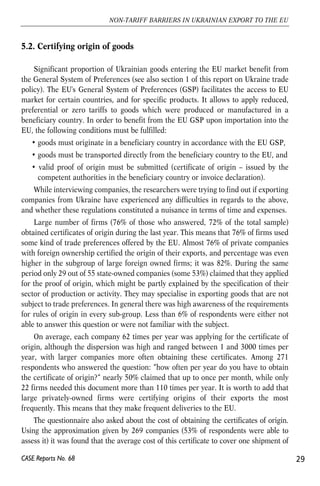
Figure 5. Share of companies certifying origin of their export, survey results 
0% 20% 40% 60% 80% 100% 
% of respondents from each group 
state-owned 
private foreign-owned 
private Ukrainian-owned 
state-owned 
private foreign-owned 
private Ukrainian-owned 
small firms large firms 
Note: Results for small state-owned companies should be treated with caution as the size of sample was 
rather small in comparison to other subgroups. 
Source: Survey results, own calculations. 
the goods reached the level of UAH 273. The distribution was skewed towards lower 
values. For 133 companies the cost of obtaining certificates of rules of origin was less 
than UAH 200 per delivery. At the other end, only 5 companies (2% of those who 
answered) reported that the cost was higher than UAH 1000. In general significant 
differences with regard to the cost of certifying origin of goods between large and small 
companies was noticed. Among the exporters employing less than 50 workers, private 
Ukrainian firms spent the most, on average UAH 366 for certifying each delivery of their 
goods22. According to the respondents from large state owned companies the average 
cost of the proof of origin was about UAH 180, while in large privately owned firms 
(both Ukrainian and foreign) these costs were a bit higher, and oscillated around UAH 
245 per certificate obtained for one transport of goods. The results suggest that larger 
firms use economies of scale and deliver large quantities of rather homogenous products 
(low costs of getting certificates of origins connected with frequent deliveries). While 
small firms cannot deliver as frequently as the large ones (probably because of supply-side 
constraints), but nevertheless face higher costs of certifying origin (meaning either 
more heterogeneous deliveries or higher unofficial payments or both)23. 
30 
Jakubiak M., Maliszewska M., Orlova I., Rokicka M., Vavryschuk V. 
22 In fact, the highest average cost was obtained for small state-owned companies. But this result was due to one 
CASE Reports No. 68 
observation only, so it is treated here as an outlier. 
23 Checking for the relative costs of certifying origins (for example in terms of share in total production) can be 
more informative here. It can indicate the effective barrier to trade connected with certificates of origins. This 
barrier could be lower if, for example, a company would export high-quality goods sold at a higher price. And 
in fact it can be better indicator than a nominal value. However, this requires information on total production 
sold, or turnover. Although the companies were asked about their turnovers (see questionnaire in Appendix
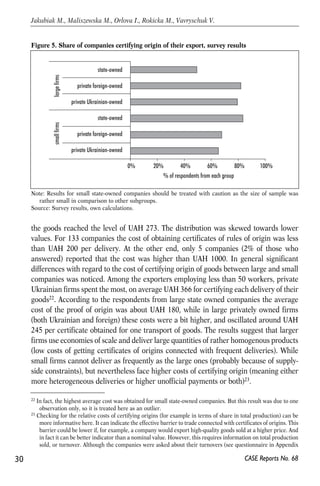
Figure 6. Perceptions of costs of certifying origin, survey results 
Note: Results for small state-owned companies should be treated with caution as the size of sample was 
rather small in comparison to other subgroups. 
Source: Survey results, own calculations. 
While asked about perceptions of costs of certifying origins, large number of 
interviewed companies replied that these costs were insignificant. Only 13 firms (3%) 
reported that those costs were very high and additional 10% claimed that they were 
high. Mostly, these were large firms (see Figure 6). 
The costs of certificates seems to be perceived as the least disturbing by the state-owned 
enterprises (see Figure 6). This comes in line with state-owned enterprises 
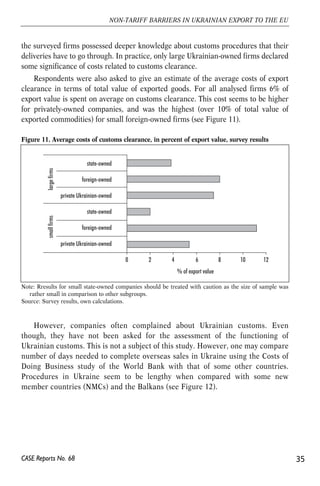
certifying origins of their exports relatively infrequently, and with low costs of it per 
delivery. At the other end lie foreign-owned firms, which are the least optimistic when 
assessing costs of certifying origin. This is the only ownership group where costs of 
certifying origin are considered as small by less than 50% respondents. As a rule, 
small firms assess the costs of certificates as lower than the large firms do, in every 
category of ownership. It is rather unexpected, since it was shown that in fact smaller 
firms pay more per one delivery24. 
When asked about indicating difficulties connected with getting certificates of 
origin, 71% of the respondents (364 firms) answered. Out of this number, only 28% 
(102 companies) faced some difficulties with respect to getting certificates of origin. 
Those firms that faced some difficulties while obtaining documents of origin usually 
31 
NON-TARIFF BARRIERS IN UKRAINIAN EXPORT TO THE EU 
2), the response rate was low. So it was impossible to obtain information on the magnitude of effective barrier 
to trade in the form of getting the certificates of origins. 
24 Perhaps smaller firms sell their products at higher prices (see the previous footnote). Then this barrier may be 
lower for them in relative terms. However, it was impossible to measure here. 
CASE Reports No. 68 
0% 20% 40% 60% 80% 
% of companies that found 
the cost of obtaining certificate 
of origin high 
% of companies that found 
the cost of obtaining certificate 
of origin small 
state-owned 
private foreign-owned 
private Ukrainian-owned 
state-owned 
private foreign-owned 
private Ukrainian-owned 
small firms large firms
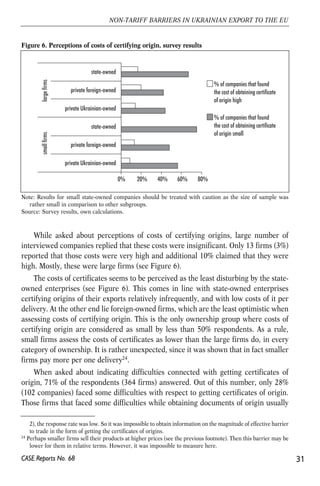
pointed to ‘time-consuming procedure’ (12% of the respondents), as well as to 
complicated and unclear regulations. 
Foreign-owned and large state-owned companies were more concerned about 
time-consuming procedures than the private Ukrainian-owned ones. Smaller firms 
reported difficulties with unclear regulations more frequently. Few companies also 
mentioned as additional obstacles: large number of required documents, which are 
needed to obtain the certificate, and the access to office issuing the certificates. 
Figure 7. Obstacles while obtaining certificates of origin, survey results 
0% 5% 10% 15% 20% 25% 30% 
% of respondents from a given group indicating given obstacle 
Note: Results for small state-owned companies should be treated with caution as the size of sample (here: 4 
About 67% of the interviewed companies did not report any problems connected 
with getting certificates of origin, and such high share was equally observed in all kind 
of companies, ranging from the 71-75% in state-owned firms to 62% in private 
foreign-owned companies. 
In summation, the interviewed companies seem to use extensively the EU trade 
preferences, and are familiar with the procedure of certifying origins of goods. While 
getting the certificate of origin was not considered as an important neither costly 
obstacle to trade, it may be the case that it was more of a barrier to smaller firms. 
However, one needs additional information to prove this. 
32 
Jakubiak M., Maliszewska M., Orlova I., Rokicka M., Vavryschuk V. 
CASE Reports No. 68 
answers) was rather small in comparison to other subgroups. 
Source: Survey results, own calculations. 
Unclear or uncertain regulations 
Time-consuming procedures 
Costly procedures 
Other 
state-owned 
private foreign-owned 
private Ukrainian-owned 
state-owned 
private foreign-owned 
private Ukrainian-owned 
small firms large firms
5.3. Customs procedures 
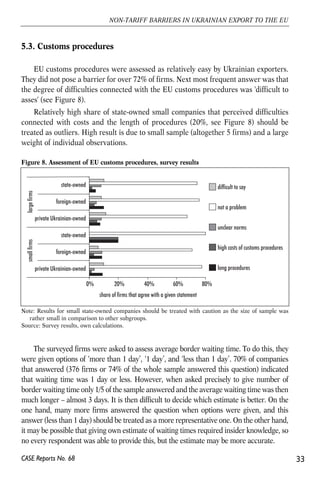
EU customs procedures were assessed as relatively easy by Ukrainian exporters. 
They did not pose a barrier for over 72% of firms. Next most frequent answer was that 
the degree of difficulties connected with the EU customs procedures was 'difficult to 
asses' (see Figure 8). 
Relatively high share of state-owned small companies that perceived difficulties 
connected with costs and the length of procedures (20%, see Figure 8) should be 
treated as outliers. High result is due to small sample (altogether 5 firms) and a large 
weight of individual observations. 
Figure 8. Assessment of EU customs procedures, survey results 
Note: Results for small state-owned companies should be treated with caution as the size of sample was 
rather small in comparison to other subgroups. 
Source: Survey results, own calculations. 
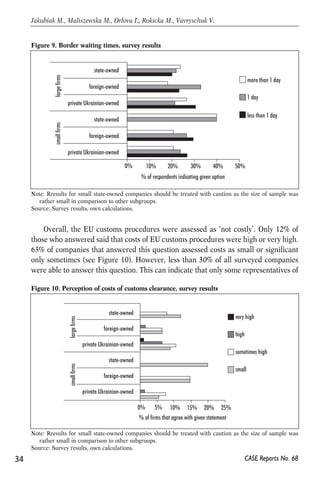
The surveyed firms were asked to assess average border waiting time. To do this, they 
were given options of ‘more than 1 day’, ‘1 day’, and ‘less than 1 day’. 70% of companies 
that answered (376 firms or 74% of the whole sample answered this question) indicated 
that waiting time was 1 day or less. However, when asked precisely to give number of 
border waiting time only 1/5 of the sample answered and the average waiting time was then 
much longer – almost 3 days. It is then difficult to decide which estimate is better. On the 
one hand, many more firms answered the question when options were given, and this 
answer (less than 1 day) should be treated as a more representative one. On the other hand, 
it may be possible that giving own estimate of waiting times required insider knowledge, so 
no every respondent was able to provide this, but the estimate may be more accurate. 
33 
NON-TARIFF BARRIERS IN UKRAINIAN EXPORT TO THE EU 
CASE Reports No. 68 
0% 20% 40% 60% 80% 
share of firms that agree with a given statement 
difficult to say 
not a problem 
unclear norms 
high costs of customs procedures 
long procedures 
small firms large firms 
state-owned 
foreign-owned 
private Ukrainian-owned 
state-owned 
foreign-owned 
private Ukrainian-owned
Figure 9. Border waiting times, survey results 
0% 10% 20% 30% 40% 50% 
Note: Rresults for small state-owned companies should be treated with caution as the size of sample was 
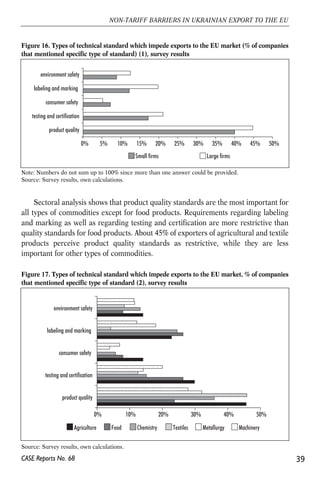
Overall, the EU customs procedures were assessed as ‘not costly’. Only 12% of 
those who answered said that costs of EU customs procedures were high or very high. 
63% of companies that answered this question assessed costs as small or significant 
only sometimes (see Figure 10). However, less than 30% of all surveyed companies 
were able to answer this question. This can indicate that only some representatives of 
34 
Jakubiak M., Maliszewska M., Orlova I., Rokicka M., Vavryschuk V. 
CASE Reports No. 68 
rather small in comparison to other subgroups. 
Source: Survey results, own calculations. 
% of respondents indicating given option 
more than 1 day 
1 day 
less than 1 day 
small firms large firms 
state-owned 
foreign-owned 
private Ukrainian-owned 
state-owned 
foreign-owned 
private Ukrainian-owned 
Figure 10. Perception of costs of customs clearance, survey results 
Note: Rresults for small state-owned companies should be treated with caution as the size of sample was 
rather small in comparison to other subgroups. 
Source: Survey results, own calculations. 
0% 5% 10% 15% 20% 25% 
% of firms that agree with given statement 
very high 
high 
sometimes high 
small 
small firms large firms 
state-owned 
foreign-owned 
private Ukrainian-owned 
state-owned 
foreign-owned 
private Ukrainian-owned
the surveyed firms possessed deeper knowledge about customs procedures that their 
deliveries have to go through. In practice, only large Ukrainian-owned firms declared 
some significance of costs related to customs clearance. 
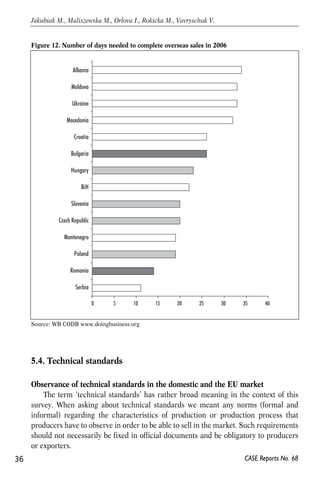
Respondents were also asked to give an estimate of the average costs of export 
clearance in terms of total value of exported goods. For all analysed firms 6% of 
export value is spent on average on customs clearance. This cost seems to be higher 
for privately-owned companies, and was the highest (over 10% of total value of 
exported commodities) for small foreign-owned firms (see Figure 11). 
Figure 11. Average costs of customs clearance, in percent of export value, survey results 
Note: Rresults for small state-owned companies should be treated with caution as the size of sample was 
rather small in comparison to other subgroups. 
Source: Survey results, own calculations. 
However, companies often complained about Ukrainian customs. Even 
though, they have not been asked for the assessment of the functioning of 
Ukrainian customs. This is not a subject of this study. However, one may compare 
number of days needed to complete overseas sales in Ukraine using the Costs of 
Doing Business study of the World Bank with that of some other countries. 
Procedures in Ukraine seem to be lengthy when compared with some new 
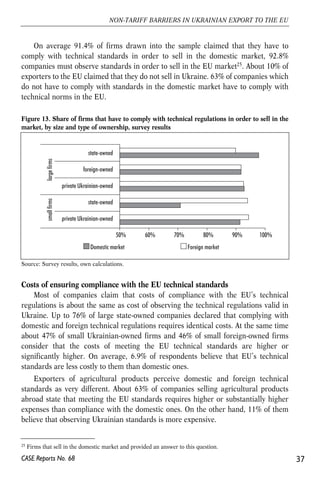
member countries (NMCs) and the Balkans (see Figure 12). 
35 
NON-TARIFF BARRIERS IN UKRAINIAN EXPORT TO THE EU 
CASE Reports No. 68 
0 2 4 6 8 10 12 
% of export value 
small firms large firms 
state-owned 
foreign-owned 
private Ukrainian-owned 
state-owned 
foreign-owned 
private Ukrainian-owned
Figure 12. Number of days needed to complete overseas sales in 2006 
0 5 10 15 20 25 30 35 40 
Albania 
Moldova 
Ukraine 
Macedonia 
Croatia 
Bulgaria 
Hungary 
BiH 
Slovenia 
Czech Republic 
Montenegro 
Poland 
Romania 
Serbia 
5.4. Technical standards 
Observance of technical standards in the domestic and the EU market 
The term ‘technical standards’ has rather broad meaning in the context of this 
survey. When asking about technical standards we meant any norms (formal and 
informal) regarding the characteristics of production or production process that 
producers have to observe in order to be able to sell in the market. Such requirements 
should not necessarily be fixed in official documents and be obligatory to producers 
or exporters. 
36 
Jakubiak M., Maliszewska M., Orlova I., Rokicka M., Vavryschuk V. 
CASE Reports No. 68 
Source: WB CODB www.doingbusiness.org
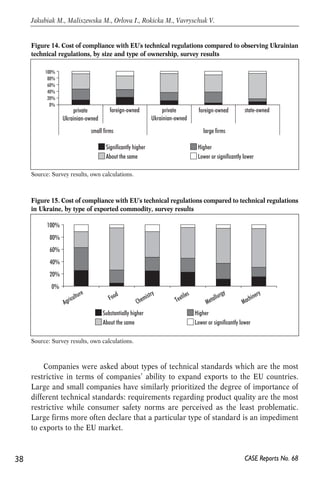
On average 91.4% of firms drawn into the sample claimed that they have to 
comply with technical standards in order to sell in the domestic market, 92.8% 
companies must observe standards in order to sell in the EU market25. About 10% of 
exporters to the EU claimed that they do not sell in Ukraine. 63% of companies which 
do not have to comply with standards in the domestic market have to comply with 
technical norms in the EU. 
Figure 13. Share of firms that have to comply with technical regulations in order to sell in the 
market, by size and type of ownership, survey results 
Source: Survey results, own calculations. 
Costs of ensuring compliance with the EU technical standards 
Most of companies claim that costs of compliance with the EU’s technical 
regulations is about the same as cost of observing the technical regulations valid in 
Ukraine. Up to 76% of large state-owned companies declared that complying with 
domestic and foreign technical regulations requires identical costs. At the same time 
about 47% of small Ukrainian-owned firms and 46% of small foreign-owned firms 
consider that the costs of meeting the EU technical standards are higher or 
significantly higher. On average, 6.9% of respondents believe that EU’s technical 
standards are less costly to them than domestic ones. 
Exporters of agricultural products perceive domestic and foreign technical 
standards as very different. About 63% of companies selling agricultural products 
abroad state that meeting the EU standards requires higher or substantially higher 
expenses than compliance with the domestic ones. On the other hand, 11% of them 
believe that observing Ukrainian standards is more expensive. 
37 
NON-TARIFF BARRIERS IN UKRAINIAN EXPORT TO THE EU 
25 Firms that sell in the domestic market and provided an answer to this question. 
CASE Reports No. 68 
50% 60% 70% 80% 90% 100% 
Domestic market Foreign market 
small firms large firms 
state-owned 
foreign-owned 
private Ukrainian-owned 
state-owned 
private Ukrainian-owned
Figure 14. Cost of compliance with EU's technical regulations compared to observing Ukrainian 
technical regulations, by size and type of ownership, survey results 
Ukrainian-owned 
foreign-owned private state-owned 
small firms large firms 
Significantly higher Higher 
About the same Lower or significantly lower 
100% 
80% 
60% 
40% 
20% 
0% 
private 
Figure 15. Cost of compliance with EU's technical regulations compared to technical regulations 
in Ukraine, by type of exported commodity, survey results 
100% 
80% 
60% 
40% 
20% 
0% 
Agriculture 
Food 
Companies were asked about types of technical standards which are the most 
restrictive in terms of companies’ ability to expand exports to the EU countries. 
Large and small companies have similarly prioritized the degree of importance of 
different technical standards: requirements regarding product quality are the most 
restrictive while consumer safety norms are perceived as the least problematic. 
Large firms more often declare that a particular type of standard is an impediment 
to exports to the EU market. 
38 
Jakubiak M., Maliszewska M., Orlova I., Rokicka M., Vavryschuk V. 
CASE Reports No. 68 
Source: Survey results, own calculations. 
Ukrainian-owned 
foreign-owned 
Source: Survey results, own calculations. 
Chemistry 
Textiles 
Metallurgy 
Machinery 
Substantially higher Higher 
About the same Lower or significantly lower
Figure 16. Types of technical standard which impede exports to the EU market (% of companies 
that mentioned specific type of standard) (1), survey results 
Note: Numbers do not sum up to 100% since more than one answer could be provided. 
Source: Survey results, own calculations. 
Sectoral analysis shows that product quality standards are the most important for 
all types of commodities except for food products. Requirements regarding labeling 
and marking as well as regarding testing and certification are more restrictive than 
quality standards for food products. About 45% of exporters of agricultural and textile 
products perceive product quality standards as restrictive, while they are less 
important for other types of commodities. 
39 
NON-TARIFF BARRIERS IN UKRAINIAN EXPORT TO THE EU 
Figure 17. Types of technical standard which impede exports to the EU market, % of companies 
that mentioned specific type of standard (2), survey results 
environment safety 
labeling and marking 
consumer safety 
testing and certification 
product quality 
Agriculture Food Chemistry Textiles Metallurgy Machinery 
CASE Reports No. 68 
0% 5% 10% 15% 20% 25% 30% 35% 40% 45% 50% 
environment safety 
labeling and marking 
consumer safety 
testing and certification 
product quality 
Small firms Large firms 
0% 10% 20% 30% 40% 50% 
Source: Survey results, own calculations.
The respondents were also asked to provide estimates of the costs incurred by the 
companies during a year before the interview relative to total production costs in 
order to meet the EU technical requirements. The indicator is not easy to evaluate, 
especially during a telephone interview. Thus, numbers should be interpreted 
cautiously – they reflect intuitive estimates rather than calculation-based production 
indicators. Despite the shortcomings of this indicator, that we explicitly recognize, 
several conclusions are true with high degree of certainty. Large foreign-owned firms 
invested the most in order to ensure products’ compliance with the EU norms. While 
average level of costs across the sample equaled 13.9%, large foreign-owned firms’ 
investments constituted about 16.1%. 
Figure 18. Percentage of total year production costs spent in order to ensure products compliance 
with the EU norms, by size and type of ownership, survey results 
0% 5% 10% 15% 20% 
small firms large firms 
state-owned 
foreign-owned 
private Ukrainian-owned 
state-owned 
private Ukrainian-owned 
Breakdown by the type of exported commodities reveals that investment intensity 
across different sectors is uneven. Companies selling products of metallurgy and 
chemistry industries spent the least on upgrading the commodities up to the EU 
requirements. Several hypotheses can be provided for this: (i) EU and Ukrainian 
standards do not differ significantly in these sectors and companies can ensure 
products’ compliance with the EU standards without additional investments, (ii) 
companies in these sectors made the necessary investments earlier. 
Surprisingly, companies producing and selling textile and apparel were the leaders 
in terms of expenses related to meeting the EU requirements. Such a situation probably 
reveals high level of producers’ involvement in international trade through tolling 
40 
Jakubiak M., Maliszewska M., Orlova I., Rokicka M., Vavryschuk V. 
CASE Reports No. 68 
Source: Survey results, own calculations.
Figure 19. Percentage of total year production costs spent in order to ensure products compliance 
with the EU norms (breakdown by type of exported commodities), survey results 
0% 5% 10% 15% 20% 
Machinery 
Metallurgy 
Textiles 
Chemistry 
Food 
Agriculture 
Source: Survey results, own calculations. 
operations. As a result Ukrainian companies have to meet very strict requirements of 
their partners in the EU market. 
One should also note strong relationship between the age of the company and the 
level of the production costs necessary to ensure the products’ compliance with the 
EU norms. The older the company the smaller part of the production costs is spent for 
this purpose. Most likely this reflects the fact that companies with strong experience 
in domestic and international markets are more prepared to meet current technical 
norms. The analysis, however, does not show any relationship between the experience 
of the company in the EU market (expressed as number of years that the company is 
exporting to the EU) and the level of the investment costs. 
41 
NON-TARIFF BARRIERS IN UKRAINIAN EXPORT TO THE EU 
Figure 20. Percentage of total year production costs spent in order to ensure products compliance 
with the EU norms, by age of company, survey results 
Source: Survey results, own calculations. 
CASE Reports No. 68 
0% 5% 10% 15% 20% 25% 
more than 15 years 
11-15 years 
6-10 years 
3-5 years 
less than 2 years
Ease of access to information about technical standards in the EU 
Representatives of most companies claimed that they have no difficulties in 
obtaining information about current technical regulations in the EU. Most of 
respondents evaluated the access to the information as very easy or easy. Still, about 
8.5% of Ukrainian resident companies declared that information about standards in 
the EU market is completely unavailable to them. About 25% of the companies in the 
sample experience difficulties in reaching the necessary information. 
Figure 21. Ease of access to information about EU technical norms (share of companies in sub-sample), 
survey results 
small firms large firms 
state-owned 
foreign-owned 
private Ukrainian-owned 
foreign-owned 
private Ukrainian-owned 
information is not available somewhat difficult or difficult very easy or easy 
Testing and certification 
0% 20% 40% 60% 80% 
Ukrainian exporters are more often obliged to pass testing procedures in the EU 
market than in Ukraine. During a year before the interview about 45% of companies 
had to test their production in the domestic market and close to 65% of companies 
had to pass the respective procedures in the EU market. While in Ukraine the 
frequency of checks of small companies is somewhat lower than that for big 
companies (40% small vs. 47.5% big companies had to test and certify their 
production during a year), companies equally often pass testing in the EU market 
(63.3% of small companies vs. 65.1% of large). 
Most respondents noted that in most cases authorities of the EU countries accept 
test results and conformity certificates issued in Ukraine. About 28% of large 
companies and 21% of small companies answered that acceptance of the Ukrainian 
certificates is selective and sometimes test results are not valid in EU market. Very 
small share of exporter claimed that Ukrainian expertise is not appropriate for the EU 
authorities. The type of product exported to the EU matters for the customs 
42 
Jakubiak M., Maliszewska M., Orlova I., Rokicka M., Vavryschuk V. 
CASE Reports No. 68 
Source: Survey results, own calculations.
Figure 22. Share of companies that had to pass testing and certification of the production in the 
Ukrainian and the EU markets, survey results 
Source: Survey results, own calculations. 
authorities which can either reject or accept the conformity certificate issued in 
Ukraine. None of exporters of metallurgy products claimed that certificates are never 
accepted by the EU authorities (75% of companies explained that domestically-issued 
documents are always accepted in the EU, 25% – periodically). At the same time 17% 
of agricultural exporters and 14% of chemistry products exporters never obtained the 
test results valid in the EU. Only 62% of food exporters have never had problems with 
Ukrainian certificates abroad. 
43 
NON-TARIFF BARRIERS IN UKRAINIAN EXPORT TO THE EU 
Figure 23. Acknowledgement of the Ukrainian testing results by the EU authorities, survey results 
0% 10% 20% 30% 40% 50% 60% 70% 80% 
large firms 
small firms 
CASE Reports No. 68 
0% 20% 40% 60% 80% 
domestic market foreign market 
small firms large firms 
state-owned 
foreign-owned 
private Ukrainian-owned 
foreign-owned 
private Ukrainian-owned 
always sometimes never 
Source: Survey results, own calculations.
Costs of testing and certification 
Representatives of companies claimed that costs of testing and certification are 
higher in Ukraine than in the EU countries. Only 31% of companies perceive that 
costs of testing for product’s conformity with the EU standards in Ukraine is not at all 
important for them, while 40% perceive that testing in the EU in not expensive. 36.2% 
of firms evaluate the costs of testing in Ukraine as important or very important (18.4% 
in the EU). Noteworthy, these numbers reflect subjective opinion of the interviewees 
and are not based on absolute costs values. Probably, absolute costs in the EU are 
really lower. However, it is possible that the price of testing and certification 
procedures is higher in the EU countries, but it is not subjectively perceived as very 
high due to shorter and simpler procedures. 
Figure 24. Costs of testing and certification for conformity with the EU standards, survey results 
0% 10% 20% 30% 40% 50% 60% 
foreign market 
domestic market 
foreign market 
domestic market 
not at all important somewhat important important or very important 
small firms large firms 
Representatives of companies were also asked to evaluate the costs of passing the 
testing and certification procedures as a share of total production costs incurred 
during a year before the interview. On average, they were estimated at the level of 
4.2%. Large private foreign-owned firms managed to complete the testing procedures 
at the lowest price (about 1.5%). On the other hand, small foreign-owned firms paid 
the highest price (in terms of overall production costs) to get through the necessary 
procedures. Sectoral distribution of costs is very uneven. Exporters of metallurgy and 
machinery products spent about 4.1% and 4.4% on testing, respectively. On the other 
hand, textile traders need to spend only 1.1% of total production costs to complete the 
formal procedures. 
44 
Jakubiak M., Maliszewska M., Orlova I., Rokicka M., Vavryschuk V. 
CASE Reports No. 68 
Source: Survey results, own calculations.
Figure 25. Costs of testing and certification for conformity with the EU standards, in percent of 
yearly production costs, survey results 
Source: Survey results, own calculations. 
Duplication of efforts 
Most companies indicate that there is high degree of duplication of their efforts due 
to necessity to test production for both Ukrainian and the EU requirements. As much 
as 32% of small companies and 11% of big companies note that there is complete 
duplication of efforts, i.e. products are independently tested for compliance with the 
domestic and foreign technical norms. 45% of small and 43% of large companies do 
not have to double test the production. 
Companies exporting to more than one EU countries which passed the testing 
procedure in the EU during the last year acknowledged that they had to pass testing 
in the EU more than once in different countries, i.e. the quality conformity documents 
45 
NON-TARIFF BARRIERS IN UKRAINIAN EXPORT TO THE EU 
Figure 26. Duplication of efforts involved in testing for domestic and EU technical requirements, 
survey results 
large firms 
small firms 
CASE Reports No. 68 
0% 1% 2% 3% 4% 5% 6% 7% 
small firms large firms 
state-owned 
foreign-owned 
private Ukrainian-owned 
foreign-owned 
private Ukrainian-owned 
0% 10% 20% 30% 40% 50% 
no duplication some duplication complete duplication 
Source: Survey results, own calculations.
Figure 27. Share of companies that had to pass testing in more than one EU country, survey results 
0% 10% 20% 30% 40% 50% 60% 70% 
large firms 
small firms 
provided in one EU country are not always accepted in other EU countries. The 
problem of multiple testing in the EU in more important for large firms (58% of 
companies complained about it) than for small companies (50%). 
Length of testing 
Production of vast majority of companies is subject to inspection upon arrival to the 
EU country. For 44% of the respondents one day is enough to pass the inspection. About 
24% of companies have to wait more than 5 days to complete the inspection procedures. 
46 
Jakubiak M., Maliszewska M., Orlova I., Rokicka M., Vavryschuk V. 
Figure 28.Number of days necessary to pass product inspection upon arrival to the EU country, 
survey results 
CASE Reports No. 68 
Source: Survey results, own calculations. 
50% 
40% 
30% 
20% 
10% 
0% 
one day 
or less 
2-4 days 5-6 days 7-14 days 15 days 
Source: Survey results, own calculations. 
or more 
inspection 
is not 
required
5.5. Other NTBs 
The questionnaire asked briefly also about other – expected to happen less-frequently 
in the current EU-Ukraine trade – impediments to trade. The respondents 
were asked about the following barriers: 
• antidumping duties, 
• countervailing duties, 
• measures affecting price: minimum import price, voluntary export price, 
• quantitative restrictions through non-automatic licensing, 
• quotas for export/import, 
• quantitative voluntary restraints. 
While asking exporters about their experience with other NTBs the majority - 67% 
replied that they have never faced any of mentioned problems. Additional 20% of 
respondents reported that they are not able to answer the question, as not having 
enough information. 
Among those who pointed at least one additional non tariff barrier, the most 
commonly claimed were licensing (4% of the sample), than quotas (2%) and then 
equally countervailing and antidumping duties (2% of answer for each of the 
measure). None of the other NTBs was perceived as a real barrier, and as a common 
obstacle for Ukrainian exporters. It is worth to highlight that none of the ‘other NTBs’ 
category was reported as taking place by more that 5% of all interviewed companies26. 
Looking closely at the breakdown by size and ownership of companies, one can 
notice that relatively often large state-owned companies declared that quantitative 
restrictions through non-automatic licensing impeded their exchange with the EU. 
47 
NON-TARIFF BARRIERS IN UKRAINIAN EXPORT TO THE EU 
Table 4. Other NTBs, survey results 
Other NTBs 
Note: Percentages denote share of companies indicating given obstacle/answer. 
Source: http://www.doingbusiness.org 
26 This is probably true for the EU manufacturing import from other countries as well. 
CASE Reports No. 68 
State owned 
companies 
Private foreign 
owned companies 
Private Ukrainian 
owned companies 
Antidumping duties 0% 2.0% 2.4% 
Countervailing duties 1.8% 1.0% 2.1% 
Licensing 8.8% 4.0% 3.9% 
Quotas 0% 4.0% 1.8% 
Other obstacles 3.5% 3.0% 2.1% 
No obstacles 68.4% 63.0% 68.6% 
Do not know 17.5% 23.0% 19.0%
Those who mentioned having some troubles with other NTBs were asked to grade 
the restrictiveness of each of the barrier. Licensing was pointed by the largest group 
of companies as important obstacle, while anti-dumping duties were reported by 27% 
of the firms as not very problematic. With regard to countervailing duties, 4 firms 
(36% of those reporting the existence of ‘other NTBs’) assessed it negatively, and 
quotas were seen as the essential barriers for EU trade by 2 firms out of those who 
previously reported it as a barrier. The small amount of firms claiming the existence 
of ‘other NTBs’ does not allow to draw any further conclusions. 
48 
Jakubiak M., Maliszewska M., Orlova I., Rokicka M., Vavryschuk V. 
CASE Reports No. 68
6. Conclusions 
and policy recommendations 
This section briefly summarises policy recommendations for short- and medium-term 
arising from findings of this report. The recommendations can be formulated for 
both external and domestic policies. 
Domestic policies should be formulated in such a way that they are able to 
prepare Ukrainian private sector to withstand high competition from the EU 
enterprises. This means both the competition at the EU market, which will soon 
become more accessible for Ukrainian companies, as well as at the domestic market, 
which will be more penetrated by the EU products in the coming years27. In this view, 
the policies should be based on sound legal system harmonized in trade-related areas 
with the EU laws. This is for the reason that already at the moment trade with the EU 
has relatively high share, and that the EU norms can anchor reforms and economic 
development of Ukraine. 
As the survey results demonstrate, inconsistency of Ukrainian and EU technical 
norms may be a substantial impediment for Ukrainian companies to expand their 
exports to the EU market. Although majority of the companies do not experience 
difficulties connected with meeting technical standards at different stages of overseas 
sales, many respondents claimed that particular trade-related technical regulations 
are burdensome for them. Moreover, the experience of current new EU member 
countries from Central and Eastern Europe shows that together with the 
development of the country and the changing structure of production (and export) 
towards more technologically-advanced products, Ukraine’s exporters will be more 
exposed to the EU technical standards. The standards will be more important in 
relative terms also because of the expected elimination of the traditional protection 
measures like tariffs. This is to say that various EU technical norms may be even 
more of a barrier than they are now. 
There is lot of room to make export-related technical regulations easier and more 
transparent. In particular, the government should ensure that the system of technical 
27 Following the expected gradual fall of protection of the domestic market connected with the WTO entry and 
FTA agreement with the EU. 
CASE Reports No. 68 49
regulation is consistent with the WTO Agreement on Technical Barriers to Trade as 
well as its compliance with the EU regulations. 
This proposition is backed not only by the necessity (as a precondition for the 
expansion of exports) and due to expected increase of importance of technical 
barriers to trade. It should also be pursued because Ukraine already committed to 
ensure alignment with the EU and international regulatory and administrative 
practices in the sphere of standards, technical regulation and conformity 
assessment by signing the EU-Ukraine Action Plan. In particular, Ukraine and the 
EU have to jointly identify priority sectors for alignment with the EU laws as well 
as possible inclusion in an Agreement on Conformity Assessment and Acceptance of 
Industrial Products. This can also be fulfilled with the financial support of the 
European Commission already committed to provide technical assistance within 
short term TAIEX program. 
Moreover, the long term strategy of the adaptation of the technical standards of 
the EU is approved by the Decree of the Cabinet of Ministers of Ukraine ‘On the State 
Program for Standardization for 2006-2010’. The document envisages that 
throughout the implementation period 8570 standard should be developed or 
harmonized in line with the requirements of the EU. 
While designing the harmonization measures policy-makers should remember 
that implementation of new standards may become a challenge for producers. For 
most companies compliance with the EU norms is more expensive than costs of 
observing Ukrainian standards. Thus, implementation of new standards may require 
from companies substantial upfront investment. On average, producers exporting to 
the EU estimated costs incurred in order to ensure compliance with the EU 
requirements at the level of 14% of their total production costs. It can be assumed that 
current exporters to the EU have more advanced technologies and quality control 
systems than producers selling either at domestic or the CIS markets. Thus, costs of 
meeting the EU technical norms for the companies out of the sample covered by our 
survey may be substantially higher. Therefore, any actions that may increase the 
understanding of the EU norms and transparency of the work of standardisation 
bodies are worth pursuing, since they reduce certification costs for entrepreneurs. 
One more thing which requires proper attention of the authorities is product 
testing procedures. Producers acknowledge that costs related to testing in the EU are 
lower than in Ukraine. Although absolute numbers are not known from the survey, the 
perception of the authors of this report is that costs of passing the testing procedures 
are high or very high. All in all producers spent about 4% of their total production 
costs to pass the necessary testing procedures in Ukraine and in the EU. In this view, 
it is recommended that the effort is put into the proper functioning of internationally 
recognizable laboratories certifying production in Ukraine. 
50 
Jakubiak M., Maliszewska M., Orlova I., Rokicka M., Vavryschuk V. 
CASE Reports No. 68
Another action worth to be put for is to stimulate implementation of the EU 
standards among producers in Ukraine. Many producers working for domestic 
market have no incentives to improve the quality of products since compliance with 
domestic norms in enough to stay afloat. The government should develop a credible 
and realistic schedule of the implementation and harmonization of technical norms 
consistent with the EU requirements. This will give producers and exporters a clear 
understanding about how long the transition period may last and by how much they 
should intensify investment activities in order to ensure timely and comfortable 
acceptance of the new regulations. 
There is also a need to improve dissemination of information on existing 
Ukrainian and international (EU) standards among local producers. Ukraine already 
started to systemically implement measures to facilitate access to basic information 
on domestic and foreign technical requirements. Establishment of the WTO Enquiry 
Office at the Ministry of Economy of Ukraine may help in making the access to 
information easier and cheaper. The office accumulates drafts on trade-related 
normative acts of the trading partners and disseminates them among interested 
Ukrainian parties28. However, the office deals mostly with enquiries of the WTO and 
WTO members and local producers do not have an opportunity to enquire about 
information. It seems that the government should consider establishing a specialized 
agency responsible for full and timely dissemination of information on technical 
norms among all interested parties (which is also a requirement of the WTO). 
Although agricultural trade was not a subject of this study, it is worth to 
consider implementation of at least some EU sanitary and phytosanitary norms. 
Ukraine possesses comparative advantage in agricultural trade with the EU, and 
this potential seems to be significantly underutilised. Even though the EU market 
will be for some time still highly protected by tariff and other traditional trade 
barriers, the adoption of sanitary and phytosanitary norms may make total 
effective protection lower, and allow more firms to expand their sales to the EU. 
Taking into account Ukraine's agriculture production (and potential), it may result 
in visible expansion of export. 
There is also a scope for moves in the sphere of simplifying the procedures of 
granting rules of origins. The results of the survey show that although the procedure 
is not perceived as very costly, it is more of a barrier for small firms. 
The reform of the Ukrainian customs service, with its lengthy procedures 
constituting an important obstacle to trade, should be continued. This would shorten 
border waiting times, ensure better cooperation with EU customs and limit 
possibilities for corruption. It seems highly desirable that the EU supports these 
51 
NON-TARIFF BARRIERS IN UKRAINIAN EXPORT TO THE EU 
28 The information on the Center is available at: 
http://www.me.gov.ua/control/uk/publish/category/main?cat_id=90016 
CASE Reports No. 68
reforms. At the moment, it seems particularly important to adopt regulations on 
customs valuation, provide trainings and increase computerisation of customs posts. 
Some of the firms claimed existence of troublesome non-automatic licensing in 
Ukraine. It seems that perhaps a closer look should be given to this restriction and 
perhaps it can be eliminated. 
There can also be a scope for export-support policies. However, one should note 
that the increase in overseas sales is primarily for the private sector to solve. 
Nevertheless, some actions may be worth considering. Among them are programs 
raising export potential awareness among producers, and stimulating trade activity of 
SMEs. Another potential action is an effective support in the form of providing 
insurance to export credits or providing credit guarantees to SMEs, which often 
operate on tight margins and cannot insure their deliveries. The government can also 
support provision of regular information on trade events and changes in trade 
conditions for enterprises and business associations. 
The recommendation for external policies arising from this report are reduced to 
two issues. The first one is to ensure WTO accession in 2007. The second issue relates 
to the coming negotiations on the shape of the EU-Ukraine free trade agreement. In 
its core, the agreement will deal with the gradual liberalisation of tariffs and 
traditional protection measures in manufacturing trade between the two sides. It 
seems desirable, for the reasons listed above, to strengthen it with commitments on 
harmonisation and some reforms to the maximum possible extent. In particular, it 
seems desirable that the agreement covers also support to customs service reform. 
Moreover, it should also relate to harmonisation and mutual recognition of standards 
and to adoption of EU agri-food standards by Ukraine. Liberalisation of Ukraine’s 
financial intermediation sector could also be included, as it supports the development 
of companies and enlarges country’s supply capacity. 
52 
Jakubiak M., Maliszewska M., Orlova I., Rokicka M., Vavryschuk V. 
CASE Reports No. 68
Appendix 1: 
Selected descriptive statistics 
total private 
Mean 50.3 55.6 75.7 47.8 44.04 54.04 42.70 
Std Dev 35.4 36.2 33.2 26.1 35.23 38.51 24.54 
Min 0.0 0.0 1.0 20.0 0.00 1.00 1.00 
Share of production 
exported 
Max 100.0 100.0 100.0 80.0 100.00 100.00 95.00 
Mean 53.5 63.3 80.0 48.8 45.03 55.02 39.60 
Std Dev 39.0 38.5 32.6 42.5 37.19 40.23 35.44 
Min 0.0 0.0 6.0 5.0 0.00 1.00 1.00 
Share of total export 
directed to the EU 
market 
Max 100.0 100.0 100.0 90.0 100.00 100.00 100.00 
Share of companies 
certifying origins 
of their products 
Mean 76.00 81.05 71.85 80.00 79.41 81.96 50.00 
Mean 2.71 2.66 2.67 2.50 2.66 2.50 2.38 
Std Dev 1.72 1.17 0.52 0.71 2.20 0.85 1.19 
Min 1.00 1.00 2.00 2.00 1.00 1.00 1.00 
Border waiting 
time (in days) 
Max 15.00 7.00 3.00 3.00 15.00 4.00 5.00 
Mean 6.95 5.38 11.20 2.00 7.46 8.00 3.82 
Std Dev 8.59 5.95 10.42 n/a 10.74 7.72 4.21 
Min 0.00 0.00 1.00 2.00 0.00 0.00 0.00 
Average cost 
of customs clearance 
(as % of export) 
Max 70.00 20.00 30.00 2.00 70.00 30.00 9.00 
Share of firms which 
comply with technical 
standards 
Mean 89.41 91.10 91.18 80.00 88.24 90.16 88.00 
Percentage of total yearly 
Mean 3.85 6.03 5.32 0.60 2.87 3.70 3.44 
production costs spent 
Std Dev 11.23 15.01 9.29 0.89 9.35 11.40 12.96 
to ensure products 
compliance with 
Min 0.00 0.00 0.00 0.00 0.00 0.00 0.00 
EU norms Max 80.00 98.00 40.00 2.00 80.00 55.00 75.00 
Mean 1.58 1.49 1.50 2.00 1.81 1.41 1.28 
Std Dev 2.55 2.49 2.49 2.92 2.65 2.45 2.44 
Min 0.00 0.00 0.00 0.00 0.00 0.00 0.00 
Number of days 
necessary to pass product 
inspection upon arrival 
to the EU Max 7.00 7.00 7.00 7.00 7.00 7.00 7.00 
Source: Survey results, own calculations. 
Small companies Large companies 
Ukrainian 
owned 
private 
foreign 
owned 
state 
owned 
private 
Ukrainian 
owned 
private 
foreign 
owned 
state 
owned 
CASE Reports No. 68 53
54 
Jakubiak M., Maliszewska M., Orlova I., Rokicka M., Vavryschuk V. 
CASE Reports No. 68
Appendix 2: Questionnaire 
INTRODUCTION 
My name is _______________________ I represent research company GFK Ukraine (www.gfk.com.ua). 
Currently, we are conducting research of companies exporting to the countries of the European 
Union. The goal of the study is to evaluate how non-tariff barriers to trade impede exports from 
Ukraine to the EU. GFK Ukraine conducts the interview at the request of Center for Social and 
Economic Research (CASE) and CASE Ukraine. The interview is anonymous; the results of the 
interview will be aggregated and presented to the public. The length of the interview is 15-20 minutes. 
Would you agree to answer the questions? 
B1. WHAT IS YOUR POSITION? 
Please code 
Chief Manager/owner . . . . . . . . . . . . . . . . . . . . . . . . . . . . . . . . . . . . . . . . . . . . . . . . . . . . .1 
Deputy Chief Manager . . . . . . . . . . . . . . . . . . . . . . . . . . . . . . . . . . . . . . . . . . . . . . . . . . . .2 
Head of export department . . . . . . . . . . . . . . . . . . . . . . . . . . . . . . . . . . . . . . . . . . . . . . . . .3 
Head of sale department . . . . . . . . . . . . . . . . . . . . . . . . . . . . . . . . . . . . . . . . . . . . . . . . . . .4 
Export manager . . . . . . . . . . . . . . . . . . . . . . . . . . . . . . . . . . . . . . . . . . . . . . . . . . . . . . . . .5 
Sale manager . . . . . . . . . . . . . . . . . . . . . . . . . . . . . . . . . . . . . . . . . . . . . . . . . . . . . . . . . . .6 
Other PLEASE SPECIFY _______________________________________________ . . . . . . . . . . .7 
INFORMATION ON EXPORT ACTIVITIES 
A1. WHAT EU COUNTRIES DID YOU EXPORT TO LAST YEAR? 
Please mark the country carefully. Several answers 
Austria . . . . . . . . . . . . . . . . . . . . . . . . . . . . . . . . . . . . . . . . . . . . . . . . . . . . . . . . . . . . . . . .1 
Belgium . . . . . . . . . . . . . . . . . . . . . . . . . . . . . . . . . . . . . . . . . . . . . . . . . . . . . . . . . . . . . . .2 
Great Britain . . . . . . . . . . . . . . . . . . . . . . . . . . . . . . . . . . . . . . . . . . . . . . . . . . . . . . . . . . .3 
Hungary . . . . . . . . . . . . . . . . . . . . . . . . . . . . . . . . . . . . . . . . . . . . . . . . . . . . . . . . . . . . . . .4 
Germany . . . . . . . . . . . . . . . . . . . . . . . . . . . . . . . . . . . . . . . . . . . . . . . . . . . . . . . . . . . . . . .5 
CASE Reports No. 68 55
Greece . . . . . . . . . . . . . . . . . . . . . . . . . . . . . . . . . . . . . . . . . . . . . . . . . . . . . . . . . . . . . . . .6 
Denmark . . . . . . . . . . . . . . . . . . . . . . . . . . . . . . . . . . . . . . . . . . . . . . . . . . . . . . . . . . . . . .7 
Ireland . . . . . . . . . . . . . . . . . . . . . . . . . . . . . . . . . . . . . . . . . . . . . . . . . . . . . . . . . . . . . . . .8 
Spain . . . . . . . . . . . . . . . . . . . . . . . . . . . . . . . . . . . . . . . . . . . . . . . . . . . . . . . . . . . . . . . . .9 
Italy . . . . . . . . . . . . . . . . . . . . . . . . . . . . . . . . . . . . . . . . . . . . . . . . . . . . . . . . . . . . . . . . . .10 
Cyprus . . . . . . . . . . . . . . . . . . . . . . . . . . . . . . . . . . . . . . . . . . . . . . . . . . . . . . . . . . . . . . . .11 
Latvia . . . . . . . . . . . . . . . . . . . . . . . . . . . . . . . . . . . . . . . . . . . . . . . . . . . . . . . . . . . . . . . .12 
Lithuania . . . . . . . . . . . . . . . . . . . . . . . . . . . . . . . . . . . . . . . . . . . . . . . . . . . . . . . . . . . . . .13 
Luxemburg . . . . . . . . . . . . . . . . . . . . . . . . . . . . . . . . . . . . . . . . . . . . . . . . . . . . . . . . . . . .14 
Malta . . . . . . . . . . . . . . . . . . . . . . . . . . . . . . . . . . . . . . . . . . . . . . . . . . . . . . . . . . . . . . . .15 
Netherlands/Holland . . . . . . . . . . . . . . . . . . . . . . . . . . . . . . . . . . . . . . . . . . . . . . . . . . . . .16 
Poland . . . . . . . . . . . . . . . . . . . . . . . . . . . . . . . . . . . . . . . . . . . . . . . . . . . . . . . . . . . . . . . .17 
Portugal . . . . . . . . . . . . . . . . . . . . . . . . . . . . . . . . . . . . . . . . . . . . . . . . . . . . . . . . . . . . . . .18 
Slovakia . . . . . . . . . . . . . . . . . . . . . . . . . . . . . . . . . . . . . . . . . . . . . . . . . . . . . . . . . . . . . . .19 
Slovenia . . . . . . . . . . . . . . . . . . . . . . . . . . . . . . . . . . . . . . . . . . . . . . . . . . . . . . . . . . . . . . .20 
Finland . . . . . . . . . . . . . . . . . . . . . . . . . . . . . . . . . . . . . . . . . . . . . . . . . . . . . . . . . . . . . . .21 
France . . . . . . . . . . . . . . . . . . . . . . . . . . . . . . . . . . . . . . . . . . . . . . . . . . . . . . . . . . . . . . . .22 
Czech Republic . . . . . . . . . . . . . . . . . . . . . . . . . . . . . . . . . . . . . . . . . . . . . . . . . . . . . . . . .23 
Sweden . . . . . . . . . . . . . . . . . . . . . . . . . . . . . . . . . . . . . . . . . . . . . . . . . . . . . . . . . . . . . . .24 
Estonia . . . . . . . . . . . . . . . . . . . . . . . . . . . . . . . . . . . . . . . . . . . . . . . . . . . . . . . . . . . . . . .25 
Other . . . . . . . . . . . . . . . . . . . . . . . . . . . . . . . . . .26 → END IF THIS IS THE ONLY ANSWER 
Did not export to the EU last year . . . . . . . . . .27 → END 
A2. WHAT PERCENT SHARE OF TOTAL SALES DO YOU EXPORT? 
Please specify __________ % 
No answer 
A3. WHAT PERCENT SHARE OF TOTAL EXPORTS DID YOU SUPPLY TO THE EU COUNTRIES 
LAST YEAR?: 
Please write __________ % 
No answer 
A4. IN GENERAL, HOW LONG HAS YOUR COMPANY BEEN EXPORTING GOODS TO THE EU 
COUNTRIES: 
One answer 
Less than 1 year . . . . . . . . . . . . . . . . . . . . . . . . . . . . . . . . . . . . . . . . . . . . . . . . . . . . . . . . .1 
2-3 years . . . . . . . . . . . . . . . . . . . . . . . . . . . . . . . . . . . . . . . . . . . . . . . . . . . . . . . . . . . . . . .2 
56 
Jakubiak M., Maliszewska M., Orlova I., Rokicka M., Vavryschuk V. 
CASE Reports No. 68
4-5 years . . . . . . . . . . . . . . . . . . . . . . . . . . . . . . . . . . . . . . . . . . . . . . . . . . . . . . . . . . . . . . .3 
More than 5 years . . . . . . . . . . . . . . . . . . . . . . . . . . . . . . . . . . . . . . . . . . . . . . . . . . . . . . . .4 
No answer . . . . . . . . . . . . . . . . . . . . . . . . . . . . . . . . . . . . . . . . . . . . . . . . . . . . . . . . . . . . .5 
A5. DID YOU OBTAINE A RULE OF ORIGIN CERTIFICATE VALID IN EU MARKET ISSUED 
BY THE CHAMBER OF COMMERCE LAST YEAR: 
Yes . . . . . . . . . . . . . . . . . . . . . . . . . . . . . . . . . . . . . . . . . . . . . . . . . . . .1 
No . . . . . . . . . . . . . . . . . . . . . . . . . . . . . . . . . . . . . . . . . . . . . . . . . . . . .2 → TOWARDS A10 
Do not know/Do not know about this certificate . . . . . . . . . . . . . . . . . . .3 → TOWARDS A10 
A6. HOW MANY TIMES DURING A YEAR DO YOU HAVE TO OBTAIN A RULE OF ORIGIN 
CERTIFICATE? 
Please write down _________________ times 
A7. HOW MUCH ON AVARAGE DOES A RULE OF ORIGIN CERTIFICATE FOR ONE 
DELIVERY COST TO YOUR COMPANY? 
Please write down _________________ UAH 
A8. IN YOUR OPINION, HOW IMPORTANT ARE THE COSTS OF OBTAINING THE RULES OF 
ORIGIN CERTIFICATE FOR YOUR COMPANY? 
Not at all important . . . . . . . . . . . . . . . . . . . . . . . . . . . . . . . . . . . . . . . . . . . . . . . . . . . . . .1 
Somewhat important . . . . . . . . . . . . . . . . . . . . . . . . . . . . . . . . . . . . . . . . . . . . . . . . . . . . .2 
Important . . . . . . . . . . . . . . . . . . . . . . . . . . . . . . . . . . . . . . . . . . . . . . . . . . . . . . . . . . . . . .3 
Very important . . . . . . . . . . . . . . . . . . . . . . . . . . . . . . . . . . . . . . . . . . . . . . . . . . . . . . . . . .4 
Cannot say . . . . . . . . . . . . . . . . . . . . . . . . . . . . . . . . . . . . . . . . . . . . . . . . . . . . . . . . . . . . .5 
A9. WHAT OBSTACLES DO YOU ENCOUNTER WHILE OBTAINING THE RULE OF ORIGIN 
CERTIFICATE VALID ON THE EU MARKET: 
Several answers 
Time-consuming procedure . . . . . . . . . . . . . . . . . . . . . . . . . . . . . . . . . . . . . . . . . . . . . . . .1 
Costly procedures . . . . . . . . . . . . . . . . . . . . . . . . . . . . . . . . . . . . . . . . . . . . . . . . . . . . . . . .2 
Unclear or uncertain regulations . . . . . . . . . . . . . . . . . . . . . . . . . . . . . . . . . . . . . . . . . . . .3 
Other PLEASE SPECIFY ___________ . . . . . . . . . . . . . . . . . . . . . . . . . . . . . . . . . . . . . . . . .4 
Encountered no obstacles . . . . . . . . . . . . . . . . . . . . . . . . . . . . . . . . . . . . . . . . . . . . . . . . . .5 
Cannot say . . . . . . . . . . . . . . . . . . . . . . . . . . . . . . . . . . . . . . . . . . . . . . . . . . . . . . . . . . . . .6 
57 
NON-TARIFF BARRIERS IN UKRAINIAN EXPORT TO THE EU 
CASE Reports No. 68 
RULES OF ORIGIN
A10. WHAT OBSTACLES DO YOU ENCOUNTER WHILE PASSING IMPORT CUSTOMS 
PROCEDURES IN THE EU COUNTRIES: 
Several answers 
Time-consuming procedure . . . . . . . . . . . . . . . . . . . . . . . . . . . . . . . . . . . . . . . . . . . . . . . .1 
Costly procedures . . . . . . . . . . . . . . . . . . . . . . . . . . . . . . . . . . . . . . . . . . . . . . . . . . . . . . . .2 
Unclear or uncertain regulations . . . . . . . . . . . . . . . . . . . . . . . . . . . . . . . . . . . . . . . . . . . .3 
Other PLEASE SPECIFY ___________ . . . . . . . . . . . . . . . . . . . . . . . . . . . . . . . . . . . . . . . . .4 
No problems encountered . . . . . . . . . . . . . . . . . . . . . . . . . . . . . . . . . . . . . . . . . . . . . . . . .5 
Cannot say . . . . . . . . . . . . . . . . . . . . . . . . . . . . . . . . . . . . . . . . . . . . . . . . . . . . . . . . . . . . .6 
A11. ASSUME THE VALUE OF YOUR EXPORTS TO THE EU IS 100%, WHAT SHARE OF YOUR 
TOTAL EXPORT VALUE IS SPENT TO PASS IMPORT CUSTOMS PROCEDURES IN THE 
EU COUNTRIES? 
Please write down _______________ % 
A12. IN YOUR OPINION HOW IMPORTANT ARE THE COSTS OF PASSING IMPORT CUSTOMS 
PROCEDURES IN THE EU COUNTRIES? 
Not at all important . . . . . . . . . . . . . . . . . . . . . . . . . . . . . . . . . . . . . . . . . . . . . . . . . . . . . .1 
Somewhat important . . . . . . . . . . . . . . . . . . . . . . . . . . . . . . . . . . . . . . . . . . . . . . . . . . . . .2 
Important . . . . . . . . . . . . . . . . . . . . . . . . . . . . . . . . . . . . . . . . . . . . . . . . . . . . . . . . . . . . . .3 
Very important . . . . . . . . . . . . . . . . . . . . . . . . . . . . . . . . . . . . . . . . . . . . . . . . . . . . . . . . . .4 
Cannot say . . . . . . . . . . . . . . . . . . . . . . . . . . . . . . . . . . . . . . . . . . . . . . . . . . . . . . . . . . . . .5 
A13. HOW MUCH TIME ON AVERAGE DOES YOUR CARRIER SPEND AT THE BORDER WITH 
EU COUNTRIES WHEN EXPORTING GOODS? 
Less than 24 hours . . . . . . . . . . . . . . . . . . . . . . . . . . . . . . . . . . . . . . . . . . . . . . . . . .1 → A15 
24 hours . . . . . . . . . . . . . . . . . . . . . . . . . . . . . . . . . . . . . . . . . . . . . . . . . . . . . . . . . .2 → A15 
More than 24 hours . . . . . . . . . . . . . . . . . . . . . . . . . . . . . . . . . . . . . . . . . . . . . . . . .3 → A14 
A14. HOW MANY DAYS ON AVERAGE? 
Please write down ______________________ 
58 
Jakubiak M., Maliszewska M., Orlova I., Rokicka M., Vavryschuk V. 
CASE Reports No. 68 
CUSTOM PROCEDURES
A15. MUST YOUR COMPANY MEET DOMESTIC TECHNICAL REGULATIONS IN ORDER TO 
SELL IN DOMESTIC MARKET? 
Do not read 
Yes . . . . . . . . . . . . . . . . . . . . . . . . . . . . . . . . . . . . . . . . . . . . . . . . . . . . . . . . . . . . . . . . . . .1 
No . . . . . . . . . . . . . . . . . . . . . . . . . . . . . . . . . . . . . . . . . . . . . . . . . . . . . . . . . . . . . . . . . . .2 
Do not sell in domestic market . . . . . . . . . . . . . . . . . . . . . . . . . . . . . . . . . . . . . . . . . . . . . .3 
Do not know . . . . . . . . . . . . . . . . . . . . . . . . . . . . . . . . . . . . . . . . . . . . . . . . . . . . . . . . . . . .4 
A16. MUST YOUR COMPANY MEET DOMESTIC TECHNICAL REGULATIONS IN ORDER TO 
SELL IN THE EU MARKET? 
Yes . . . . . . . . . . . . . . . . . . . . . . . . . . . . . . . . . . . . . . . . . . . . . . . . . . . . . . . . . . . . .1 
No . . . . . . . . . . . . . . . . . . . . . . . . . . . . . . . . . . . . . . . . . . . . . . . . . . . . . . . . . . . . . . .2 → A30 
Do not know . . . . . . . . . . . . . . . . . . . . . . . . . . . . . . . . . . . . . . . . . . . . . . . . . . . . . .3 → A30 
A17. HOW EXPENSIVE IS THE COMPLIANCE WITH THE UKRAINE’S TECHNICAL 
REGULATIONS COMPARED TO EU’S TECHNICAL REGULATIONS. COMPLIANCE WITH 
EU’S COUNTRIES TECHNICAL REGULATIONS: 
Much more expensive . . . . . . . . . . . . . . . . . . . . . . . . . . . . . . . . . . . . . . . . . . . . . . . . . . . . .1 
More expensive . . . . . . . . . . . . . . . . . . . . . . . . . . . . . . . . . . . . . . . . . . . . . . . . . . . . . . . . . .2 
About the same . . . . . . . . . . . . . . . . . . . . . . . . . . . . . . . . . . . . . . . . . . . . . . . . . . . . . . . . . .3 
Less expensive . . . . . . . . . . . . . . . . . . . . . . . . . . . . . . . . . . . . . . . . . . . . . . . . . . . . . . . . . .4 
Much less expensive . . . . . . . . . . . . . . . . . . . . . . . . . . . . . . . . . . . . . . . . . . . . . . . . . . . . . .5 
Cannot say . . . . . . . . . . . . . . . . . . . . . . . . . . . . . . . . . . . . . . . . . . . . . . . . . . . . . . . . . . . . .6 
A18. WHAT TYPES OF TECHNICAL STANDARDS ARE THE MOST BURDENSOME AND 
EXPENSIVE FOR YOUR COMPANY? STANDARDS WHICH RELATE TO: 
Product quality . . . . . . . . . . . . . . . . . . . . . . . . . . . . . . . . . . . . . . . . . . . . . . . . . . . . . . . . . .1 
Testing and certification . . . . . . . . . . . . . . . . . . . . . . . . . . . . . . . . . . . . . . . . . . . . . . . . . . .2 
Consumer safety . . . . . . . . . . . . . . . . . . . . . . . . . . . . . . . . . . . . . . . . . . . . . . . . . . . . . . . . .3 
Labeling and packaging . . . . . . . . . . . . . . . . . . . . . . . . . . . . . . . . . . . . . . . . . . . . . . . . . . .4 
Environment protection . . . . . . . . . . . . . . . . . . . . . . . . . . . . . . . . . . . . . . . . . . . . . . . . . . .5 
Other . . . . . . . . . . . . . . . . . . . . . . . . . . . . . . . . . . . . . . . . . . . . . . . . . . . . . . . . . . . . . . . . .6 
Cannot say . . . . . . . . . . . . . . . . . . . . . . . . . . . . . . . . . . . . . . . . . . . . . . . . . . . . . . . . . . . . .7 
59 
NON-TARIFF BARRIERS IN UKRAINIAN EXPORT TO THE EU 
CASE Reports No. 68 
TECHNICAL REGULATIONS
A19. WHAT WAS THE APPROXIMATE COST OF MEETING THE EU TECHNICAL 
REGULATIONS REQUIREMENTS AS A PERCENTAGE OF YOUR TOTAL PRODUCTION 
COSTS OVER THE LAST YEAR? 
Please write down _________ % 
A20. DO YOU HAVE DIFFICULTY IN OBTAINING INFORMATION ABOUT APPLICABLE 
TECHNICAL REGULATIONS IN THE EU COUNTRIES? HOW WOULD YOU EVALUATE 
THE EASE OF ACCESS TO THE NECESSARY INFORMATION: 
Easy . . . . . . . . . . . . . . . . . . . . . . . . . . . . . . . . . . . . . . . . . . . . . . . . . . . . . . . . . . . . . . . . . .1 
Not very difficult . . . . . . . . . . . . . . . . . . . . . . . . . . . . . . . . . . . . . . . . . . . . . . . . . . . . . . . .2 
Not very easy . . . . . . . . . . . . . . . . . . . . . . . . . . . . . . . . . . . . . . . . . . . . . . . . . . . . . . . . . . .3 
Difficult . . . . . . . . . . . . . . . . . . . . . . . . . . . . . . . . . . . . . . . . . . . . . . . . . . . . . . . . . . . . . . .4 
Information is not available . . . . . . . . . . . . . . . . . . . . . . . . . . . . . . . . . . . . . . . . . . . . . . . .5 
Can not say . . . . . . . . . . . . . . . . . . . . . . . . . . . . . . . . . . . . . . . . . . . . . . . . . . . . . . . . . . . . .6 
TESTING FOR CONFORMITY WITH TECHNICAL REGULATIONS 
A21. WERE YOUR PRODUCTS TESTED FOR CONFORMITY WITH THE EU’S TECHNICAL 
REGULATIONS IN UKRAINE OVER THE LAST YEAR? 
Yes . . . . . . . . . . . . . . . . . . . . . . . . . . . . . . . . . . . . . . . . . . . . . . . . . . . . . . . . . . . . . . . . . . .1 
No . . . . . . . . . . . . . . . . . . . . . . . . . . . . . . . . . . . . . . . . . . . . . . . . . . . . . . . . . .2 → go to A24 
Do not know . . . . . . . . . . . . . . . . . . . . . . . . . . . . . . . . . . . . . . . . . . . . . . . . .3 → go to A24 
A22. IN YOUR OPINION HOW IMPORTANT ARE THE COSTS OF TESTING FOR CONFORMITY 
WITH THE EU’S TECHNICAL REGULATIONS IN UKRAINE FOR YOUR COMPANY? 
Not at all important . . . . . . . . . . . . . . . . . . . . . . . . . . . . . . . . . . . . . . . . . . . . . . . . . . . . . .1 
Somewhat important . . . . . . . . . . . . . . . . . . . . . . . . . . . . . . . . . . . . . . . . . . . . . . . . . . . . .2 
Important . . . . . . . . . . . . . . . . . . . . . . . . . . . . . . . . . . . . . . . . . . . . . . . . . . . . . . . . . . . . . .3 
Very important . . . . . . . . . . . . . . . . . . . . . . . . . . . . . . . . . . . . . . . . . . . . . . . . . . . . . . . . . .4 
Cannot say . . . . . . . . . . . . . . . . . . . . . . . . . . . . . . . . . . . . . . . . . . . . . . . . . . . . . . . . . . . . .5 
A23. BASED ON YOUR EXPERIENCE, ARE TEST RESULTS AND CONFORMITY CERTIFICATES 
ISSUED IN UKRAINE ACCEPTED BY CUSTOM BODIES OF THE EU COUNTIRES? 
Always . . . . . . . . . . . . . . . . . . . . . . . . . . . . . . . . . . . . . . . . . . . . . . . . . . . . . . . . . . . . . . . .1 
Sometimes . . . . . . . . . . . . . . . . . . . . . . . . . . . . . . . . . . . . . . . . . . . . . . . . . . . . . . . . . . . . .2 
Never . . . . . . . . . . . . . . . . . . . . . . . . . . . . . . . . . . . . . . . . . . . . . . . . . . . . . . . . . . . . . . . . .3 
Do not know . . . . . . . . . . . . . . . . . . . . . . . . . . . . . . . . . . . . . . . . . . . . . . . . . . . . . . . . . . . .4 
60 
Jakubiak M., Maliszewska M., Orlova I., Rokicka M., Vavryschuk V. 
CASE Reports No. 68
A24. WERE YOUR PRODUCTS TESTED FOR CONFORMITY WITH THE EU’S TECHNICAL 
REGULATIONS IN EXPORTING COUNTRY OVER THE LAST YEAR? 
Yes . . . . . . . . . . . . . . . . . . . . . . . . . . . . . . . . . . . . . . . . . . . . . . . . . . . . . . . . . . . . . . . . . . .1 
No . . . . . . . . . . . . . . . . . . . . . . . . . . . . . . . . . . . . . . . . . . . . . . . . . . . . . . . .2 → towards A30 
Do not know . . . . . . . . . . . . . . . . . . . . . . . . . . . . . . . . . . . . . . . . . . . . . . . .3 → towards A30 
A25. IN YOUR OPINION HOW IMPORTANT ARE THE COSTS OF TESTING FOR CONFORMITY 
WITH THE EU’S TECHNICAL REGULATIONS IN EXPORTING COUNTRY FOR YOUR 
COMPANY? 
Not at all important . . . . . . . . . . . . . . . . . . . . . . . . . . . . . . . . . . . . . . . . . . . . . . . . . . . . . .1 
Somewhat important . . . . . . . . . . . . . . . . . . . . . . . . . . . . . . . . . . . . . . . . . . . . . . . . . . . . .2 
Important . . . . . . . . . . . . . . . . . . . . . . . . . . . . . . . . . . . . . . . . . . . . . . . . . . . . . . . . . . . . . .3 
Very important . . . . . . . . . . . . . . . . . . . . . . . . . . . . . . . . . . . . . . . . . . . . . . . . . . . . . . . . . .4 
Cannot say . . . . . . . . . . . . . . . . . . . . . . . . . . . . . . . . . . . . . . . . . . . . . . . . . . . . . . . . . . . . .5 
Question A26 is applicable if there are more than 1 answer to Question A1 
A26. IF YOU EXPORT TO MORE THAN ONE COUNTRY IN THE EU DO YOU NEED TO HAVE 
SEVERAL PRODUCT TESTING? 
Yes . . . . . . . . . . . . . . . . . . . . . . . . . . . . . . . . . . . . . . . . . . . . . . . . . . . . . . . . . . . . . . . . . . .1 
No . . . . . . . . . . . . . . . . . . . . . . . . . . . . . . . . . . . . . . . . . . . . . . . . . . . . . . . . . . . . . . . . . . .2 
Do not know . . . . . . . . . . . . . . . . . . . . . . . . . . . . . . . . . . . . . . . . . . . . . . . . . . . . . . . . . . . .3 
Question A27 is applicable if A24 = 1 
A27. WHAT WAS THE APPROXIMATE COST OF THE EU’S TECHNICAL REGULATIONS 
CONFORMITY PROCEDURES AS A PERCENTAGE OF YOUR TOTAL PRODUCTION COSTS 
OVER THE LAST YEAR? 
Please write down _______________ % 
Question A28 is applicable if A21 = 1 and A24 = 1 
A28. WHAT IS THE EXTENT OF DUPLICATION OF EFFORT INVOLVED IN TESTING FOR 
THE EU’S AND UKRAIN’S REQUIREMENTS? 
No duplication . . . . . . . . . . . . . . . . . . . . . . . . . . . . . . . . . . . . . . . . . . . . . . . . . . . . . . . . . .1 
Minor duplication . . . . . . . . . . . . . . . . . . . . . . . . . . . . . . . . . . . . . . . . . . . . . . . . . . . . . . . .2 
Significant duplication . . . . . . . . . . . . . . . . . . . . . . . . . . . . . . . . . . . . . . . . . . . . . . . . . . . .3 
Complete duplication . . . . . . . . . . . . . . . . . . . . . . . . . . . . . . . . . . . . . . . . . . . . . . . . . . . . .4 
Do not know . . . . . . . . . . . . . . . . . . . . . . . . . . . . . . . . . . . . . . . . . . . . . . . . . . . . . . . . . . . .5 
61 
NON-TARIFF BARRIERS IN UKRAINIAN EXPORT TO THE EU 
CASE Reports No. 68
A29. HOW MANY DAYS ON AVERAGE DOES TECHNICAL REGULATIONS CONFORMITY 
INSPECTION USUALLY LAST UPON ARRIVAL AT THE EU COUNTRY? 
1 day of less . . . . . . . . . . . . . . . . . . . . . . . . . . . . . . . . . . . . . . . . . . . . . . . . . . . . . . . . . . . .1 
2-4 days . . . . . . . . . . . . . . . . . . . . . . . . . . . . . . . . . . . . . . . . . . . . . . . . . . . . . . . . . . . . . . .2 
5-6 days . . . . . . . . . . . . . . . . . . . . . . . . . . . . . . . . . . . . . . . . . . . . . . . . . . . . . . . . . . . . . . .3 
7-14 days . . . . . . . . . . . . . . . . . . . . . . . . . . . . . . . . . . . . . . . . . . . . . . . . . . . . . . . . . . . . . .4 
More than 14 days . . . . . . . . . . . . . . . . . . . . . . . . . . . . . . . . . . . . . . . . . . . . . . . . . . . . . . .5 
Inspection is not conducted . . . . . . . . . . . . . . . . . . . . . . . . . . . . . . . . . . . . . . . . . . . . . . . .6 
Do no know . . . . . . . . . . . . . . . . . . . . . . . . . . . . . . . . . . . . . . . . . . . . . . . . . . . . . . . . . . . .6 
A30. ARE YOUR COMPANY’S EXPORTS TO THE EU MARKET SUBJECT TO ONE OF THE 
MEASURES FROM THE LIST BELOW?: 
Antidumping duties . . . . . . . . . . . . . . . . . . . . . . . . . . . . . . . . . . . . . . . . . . . . . . . . . . . . . .1 
Countervailing duties . . . . . . . . . . . . . . . . . . . . . . . . . . . . . . . . . . . . . . . . . . . . . . . . . . . . .2 
Licensing . . . . . . . . . . . . . . . . . . . . . . . . . . . . . . . . . . . . . . . . . . . . . . . . . . . . . . . . . . . . . .3 
Quotas . . . . . . . . . . . . . . . . . . . . . . . . . . . . . . . . . . . . . . . . . . . . . . . . . . . . . . . . . . . . . . . .4 
Other measures . . . . . . . . . . . . . . . . . . . . . . . . . . . . . . . . . . . . . . . . . . . . . . . . . . . . . . . . .5 
Export of our company is not subject to any restrictive measure . . . . . . . . . . . . . . . . . . . .6 
Do not know . . . . . . . . . . . . . . . . . . . . . . . . . . . . . . . . . . . . . . . . . . . . . . . . . . . . . . . . . . . .7 
Question A31 is applicable if A30 = 1 or 2or 3 or 4 or 5. 
A31. HOW WOULD YOU EVALUATE THE DEGREE OF RESTRICTIVENESS OF THE ABOVE 
MEASURES FOR YOUR EXPORT ACTIVITIES? ARE THEY NOT AT ALL RESTRICTIVE, 
SOMEWHAT RESTRICTIVE, RESTRICTIVE, VERY RESTRICTIVE OR PROHIBITIVE? 
62 
Jakubiak M., Maliszewska M., Orlova I., Rokicka M., Vavryschuk V. 
CASE Reports No. 68 
OTHER TYPES OF NTBS 
Not at all 
restrictive 
Somewhat 
restrictive 
Restrictive 
Very 
restrictive 
Prohibitive 
Difficult 
to say 
1 Antidumping duties 1 2 3 4 5 6 
2 Countervailing duties 1 2 3 4 5 6 
3 Licensing 1 2 3 4 5 6 
4 Quotas 1 2 3 4 5 6 
5 Other measures 1 2 3 4 5 6
A32. WHAT IS THE OWNERSHIP OF YOUR COMPANY? 
Private . . . . . . . . . . . . . . . . . . . . . . . . . . . . . . . . . . . . . . . . . . . . . . . . . . . . . . . . . . . . . . . .1 
State-owned . . . . . . . . . . . . . . . . . . . . . . . . . . . . . . . . . . . . . . . . . . . . . . . . . . . . . . . . . . . .2 
Communal . . . . . . . . . . . . . . . . . . . . . . . . . . . . . . . . . . . . . . . . . . . . . . . . . . . . . . . . . . . . .3 
Other PLEASE SPECIFY ______________________________________________ . . . . . . . . . . .4 
A33. IS THERE FOREIGN ORIGIN CAPITAL IN THE CAPITAL FOUNDING YOUR COMPANY? 
Yes . . . . . . . . . . . . . . . . . . . . . . . . . . . . . . . . . . . . . . . . . . . . . . . . . . . . . . . . . . . . . . . . . . .1 
No . . . . . . . . . . . . . . . . . . . . . . . . . . . . . . . . . . . . . . . . . . . . . . . . . . . . . . . . . . . . . . .2 → A37 
Do not know . . . . . . . . . . . . . . . . . . . . . . . . . . . . . . . . . . . . . . . . . . . . . . . . . . . . . . .3 → A37 
A34. WHAT SHARE OF THE CAPITAL FOUNDING YOUR COMPANY IS THE FOREIGN ORIGIN 
CAPITAL? 
PLEASE WRITE DOWN _______________ % 
A35. IS THERE EU ORIGIN CAPITAL IN THE CAPITAL FOUNDING YOUR COMPANY? 
Yes . . . . . . . . . . . . . . . . . . . . . . . . . . . . . . . . . . . . . . . . . . . . . . . . . . . . . . . . . . . . . . . . . . .1 
No . . . . . . . . . . . . . . . . . . . . . . . . . . . . . . . . . . . . . . . . . . . . . . . . . . . . . . . . . . . . . . .2 → A37 
Do not know . . . . . . . . . . . . . . . . . . . . . . . . . . . . . . . . . . . . . . . . . . . . . . . . . . . . . . .3 → A37 
A36. WHAT SHARE OF THE CAPITAL FOUNDING YOUR COMPANY IS THE EU ORIGIN 
CAPITAL? 
PLEASE WRITE DOWN _______________ % 
A37. DOES YOUR COMPANY POSSESS ANY OF THE FOLLOWING QUALITY MANAGEMENT 
STANDARDS: 
Please read 
ISO 9000 . . . . . . . . . . . . . . . . . . . . . . . . . . . . . . . . . . . . . . . . . . . . . . . . . . . . . . . . . . . . . .1 
ISO14000 . . . . . . . . . . . . . . . . . . . . . . . . . . . . . . . . . . . . . . . . . . . . . . . . . . . . . . . . . . . . . .2 
Do know . . . . . . . . . . . . . . . . . . . . . . . . . . . . . . . . . . . . . . . . . . . . . . . . . . . . . . . . . . . . . . .3 
A38. HOW MANY YEARS HAS YOUR COMPANY BEEN OPERATING? 
Please code 
Less than 1 year . . . . . . . . . . . . . . . . . . . . . . . . . . . . . . . . . . . . . . . . . . . . . . . . . . . . . . . . .1 
1-2 years . . . . . . . . . . . . . . . . . . . . . . . . . . . . . . . . . . . . . . . . . . . . . . . . . . . . . . . . . . . . . . .2 
3-5 years . . . . . . . . . . . . . . . . . . . . . . . . . . . . . . . . . . . . . . . . . . . . . . . . . . . . . . . . . . . . . . .3 
63 
NON-TARIFF BARRIERS IN UKRAINIAN EXPORT TO THE EU 
CASE Reports No. 68 
INFORMATION ON THE COMPANY
6-10 years . . . . . . . . . . . . . . . . . . . . . . . . . . . . . . . . . . . . . . . . . . . . . . . . . . . . . . . . . . . . . .4 
11-15 years . . . . . . . . . . . . . . . . . . . . . . . . . . . . . . . . . . . . . . . . . . . . . . . . . . . . . . . . . . . . .5 
More than 15 years . . . . . . . . . . . . . . . . . . . . . . . . . . . . . . . . . . . . . . . . . . . . . . . . . . . . . . .6 
Do not know . . . . . . . . . . . . . . . . . . . . . . . . . . . . . . . . . . . . . . . . . . . . . . . . . . . . . . . . . . . .7 
A39. HOW MANY EMPLOYEES ARE WORKING FULL-TIME IN YOUR COMPANY? 
Please code 
1-9 persons . . . . . . . . . . . . . . . . . . . . . . . . . . . . . . . . . . . . . . . . . . . . . . . . . . . . . . . . . . . . .1 
10-25 persons . . . . . . . . . . . . . . . . . . . . . . . . . . . . . . . . . . . . . . . . . . . . . . . . . . . . . . . . . . .2 
26-50 persons . . . . . . . . . . . . . . . . . . . . . . . . . . . . . . . . . . . . . . . . . . . . . . . . . . . . . . . . . . .3 
51-100 persons . . . . . . . . . . . . . . . . . . . . . . . . . . . . . . . . . . . . . . . . . . . . . . . . . . . . . . . . . .4 
More than 100 persons . . . . . . . . . . . . . . . . . . . . . . . . . . . . . . . . . . . . . . . . . . . . . . . . . . . .5 
No answer . . . . . . . . . . . . . . . . . . . . . . . . . . . . . . . . . . . . . . . . . . . . . . . . . . . . . . . . . . . . .6 
A40. WHAT WAS YOUR COMPANY’S TURNOVER IN 2005? 
Please write down the value____________ 
Question A41 is applicable if there is no answer to Question A40 
A41. WHAT WAS YOUR COMPANY’S NET PROFIT IN 2005? 
Please read 
Less than 1 mln UAH . . . . . . . . . . . . . . . . . . . . . . . . . . . . . . . . . . . . . . . . . . . . . . . . . . . . .1 
From 1 to 10 mln UAH . . . . . . . . . . . . . . . . . . . . . . . . . . . . . . . . . . . . . . . . . . . . . . . . . . . .2 
From 10 to 50 mln UAH . . . . . . . . . . . . . . . . . . . . . . . . . . . . . . . . . . . . . . . . . . . . . . . . . . .3 
More than 50 mln UAH . . . . . . . . . . . . . . . . . . . . . . . . . . . . . . . . . . . . . . . . . . . . . . . . . . .4 
No answer . . . . . . . . . . . . . . . . . . . . . . . . . . . . . . . . . . . . . . . . . . . . . . . . . . . . . . . . . . . . .5 
64 
Jakubiak M., Maliszewska M., Orlova I., Rokicka M., Vavryschuk V. 
CASE Reports No. 68
List of Tables 
NON-TARIFF BARRIERS IN UKRAINIAN EXPORT TO THE EU 
Table 1. Trading Across Borders in Ukraine in 2006 (1) 17 
Table 2. Trading Across Borders in Ukraine in 2006 (2) 18 
Table 3. Distribution of firms by size and ownership, survey results 26 
Table 4. Other NTBs, survey results 47 
List of Figures 
Figure 1. Ukraine's trade with the EU (USD billion), 1996-2005 15 
Figure 2. Share of production exported, survey results 27 
Figure 3. Export destination markets of surveyed companies vs. geographical 
breakdown of Ukrainian export to the EU in 2005 28 
Figure 4. Length of trade relations, survey results 28 
Figure 5. Share of companies certifying origin of their export, survey results 30 
Figure 6. Perceptions about costs of certifying origin, survey results 31 
Figure 7. Obstacles while obtaining certificates of origin, survey results 32 
Figure 8. Assessment of EU customs procedures, survey results 33 
Figure 9. Border waiting times, survey results 34 
Figure 10. Perception of costs of customs clearance, survey results 34 
Figure 11. Average costs of customs clearance, in percent of export value, 
survey results 35 
Figure 12. Number of days needed to complete overseas sales in 200636 
Figure 13. Share of firms that have to comply with technical regulations in order 
to sell in the market, by size and type of ownership, survey results 37 
Figure 14. Cost of compliance with EU's technical regulations compared to observing 
Ukrainian technical regulations, by size and type of ownership, survey results 38 
Figure 15. Cost of compliance with EU's technical regulations compared to technical 
regulations in Ukraine, by type of exported commodity, survey results 38 
Figure 16. Types of technical standard which impede exports to the EU market 
(% of companies that mentioned specific type of standard) (1), survey results 39 
Figure 17. Types of technical standard which impede exports to the EU market, 
% of companies that mentioned specific type of standard (2), survey results 39 
Figure 18. Percentage of total year production costs spent in order to ensure 
products compliance with the EU norms, by size and type of ownership, 
survey results 40 
Figure 19. Percentage of total year production costs spent in order to ensure products 
compliance with the EU norms (breakdown by type of exported commodities), 
survey results 41 
CASE Reports No. 68 65
Figure 20. Percentage of total year production costs spent in order to ensure 
products compliance with the EU norms, by age of company, survey results 41 
Figure 21. Ease of access to information about EU technical norms 
(share of companies in sub-sample), survey results 42 
Figure 22. Share of companies that had to pass testing and certification 
of the production in the Ukrainian and the EU markets, survey results 43 
Figure 23. Acknowledgement of the Ukrainian testing results by the EU authorities, 
survey results 43 
Figure 24. Costs of testing and certification for conformity with the EU standards, 
survey results 44 
Figure 25. Costs of testing and certification for conformity with the EU standards, 
in percent of yearly production costs, survey results 45 
Figure 26. Duplication of efforts involved in testing for domestic and EU technical 
requirements, survey results 45 
Figure 27. Share of companies that had to pass testing in more than one EU country, 
survey results 46 
Figure 28. Number of days necessary to pass product inspection upon arrival 
to the EU country, survey results 46 
66 
Jakubiak M., Maliszewska M., Orlova I., Rokicka M., Vavryschuk V. 
CASE Reports No. 68
References 
BIZPRO (2005a), Export Activities of Ukrainian Companies, at www.bizpro.com.ua 
BIZPRO (2005b), Small and Medium-Sized Enterprises in Ukraine: Performance Indicators and 
Strategies for Development, at www.bizpro.com.ua 
Brenton P., Sheehy J., Vancauteren M. (2000), Technical Barriers to Trade in the European Union: 
Importance for Accession Countries, CEPS Working Document No. 144, April 2000 
CEC (1998), Technical barriers to Trade, Single Market Review, CEC, 1998 
Cecchini, P., (1988), The European Challenge, Commission of the European Communities, Gower 
Press, Brookfield 
Chevassus-Lozza E., Majkovic D., Persillet V., Unguru M.(2004), Technical barriers to Trade in the 
European Union: Importance for the new EU members. An assessment for agricultural and food 
products. Paper prepared for EAAE conference, August 2005 
Cottier T., Bürgi E., Wüger D., Foltea M. (2004), Helping to tackle non-tariff barriers in South Eastern 
Europe (SEE). EC-SECO Final Recommendations and NTBs Lists, World Trade Institute Berne. 
Council of the European Union (2000), Council Decision ą 2005/196/EC of 21 February 2005 on the 
signing and provisional application of the agreement in the form of an Exchange of Letters 
between the European Community and Ukraine concerning the extension and amendment of the 
Agreement between the European Community and Ukraine on trade in textile products. 
Emerson, M., M. Aujean, M. Catinat, P. Goybet and A. Jacquemin (1988) The Economics of 1992, 
Oxford University Press, Oxford. 
European Commission (2005a), EU/Ukraine Action Plan at: 
http://ec.europa.eu/world/enp/pdf/action_plans/ukraine_enp_ap_final_en.pdf 
European Commission (2005b), Trade Issues: Sectoral Issues, Steel sector, information at 
http://ec.europa.eu/trade/issues/sectoral/industry/steel/index_en.htm 
European Commission (2004), Steel: EU concludes steel agreement with Ukraine, press release No. 
IP/04/786, date 23/06/2004, at www.europa.eu 
European Commission (1998a), Report of 13 May 1998 from the Commission to the Council and 
Parliament: Efficiency and Accountability in European Standardisation under the New Approach 
final – (Not published in the Official Journal) 
European Commission (1998b), Partnership and co-operation agreement between the European 
Communities and their member states, and Ukraine at: 
http://ec.europa.eu/comm/external_relations/ukraine/intro/index.htm 
CASE Reports No. 68 67
FEMISE, FEM 22-03 (2005), Comparative analysis of importance of technical barriers to trade (TBT) 
for Central and Eastern European Countries’ and Mediterranean Partner Countries’ exports to the 
EU, FEMISE Research Programme, September 2005 
Hagemejer J., Michałek J. (2004), The Significance of Technical Barriers to Trade for Poland and other 
CEEC’s Acceding to the EU: Reconsidering the Evidence in: EMERGO: Journal of transforming 
economies and societies, pp. 36-52, vol. XI, no. 1(39). 
Jakubiak, M., Kolesnichenko, A. (eds.) (2006), Prospects for EU-Ukraine Economic Relations, CASE 
Report No. 66, at www.case.com.pl 
Kamiński, B.(1999), The role of Foreign Direct Investment and Trade Policies in Poland’ Accession to 
the European Union, World Bank Technical Paper no 442 
Kyiv Weekly (2006), Interview by Ian Boag, Ambassador, Head of the Delegation of the European 
Commission to Ukraine and Belarus, available at: 
http://www.delukr.ec.europa.eu/page41757.html 
Maskus, K. E., John S. Wilson, Tsunehiro Otsuki (2000), Quantifying the Impact of Technical Barriers 
to Trade, World Bank Policy Research Working Paper no 2512. 
Michalek, J.J. (ed) (2005), Comparative analysis of importance of technical barriers to trade (TBT) for 
Central and Eastern European Countries’ and Mediterranean Partner Countries’ exports to the EU, 
FEMISE Research Network, Research n°FEM22-03, at www.femise.org 
OECD (2003), Overview of non-tariff barriers: findings from existing business surveys, Working party 
of the Trade Committee, TD/TC/WP(2002)38. 
Wilson, J. S. and T. Otsuki (2004). Standards and Technical Regulations and Firms in Developing 
Countries: New Evidence from A World Bank Technical Barriers to Trade Survey. The World Bank. At: 
http://web.worldbank.org/WBSITE/EXTERNAL/TOPICS/TRADE/0,,contentMDK:20234189~ 
menuPK:222955~pagePK:148956~piPK:216618~theSitePK:239071,00.html 
World Bank (2004). Ukraine Trade Policy Study, available at www.worldbank.org.ua 
World Bank (2006). Costs of Doing Business Database, at www.doingbusiness.org 
68 
Jakubiak M., Maliszewska M., Orlova I., Rokicka M., Vavryschuk V. 
CASE Reports No. 68

CASE Network Report 68 - Non-tariff barriers in Ukrainian export to the EU

  • 1.
    Center for Socialand Economic Research CASE Reports Non-tariff barriers in Ukrainian export to the EU Ma³gorzata Jakubiak Maryla Maliszewska Irina Orlova Magdalena Rokicka Vitaliy Vavryschuk Warsaw 2006 No. 68/2006
  • 2.
    The views andopinions expressed here reflect the authors' point of view and not necessarily those of the CASE. Publication was financed by the 2006 foreign aid programme of the Ministry of Foreign Affairs of the Republic of Poland Keywords: Ukraine, EU neighbourhood, trade, non-tariff barriers to trade (NTBs), technical barriers to trade (TBTs) © CASE – Center for Social and Economic Research, Warsaw 2006 CASE Reports No. 68 ISBN 978-83-7178-421-7 EAN 9788371784217 Publisher: CASE – Center for Social and Economic Research 12 Sienkiewicza, 00-010 Warsaw, Poland tel.: (48 22) 622 66 27, 828 61 33, fax: (48 22) 828 60 69 e-mail: case@case.com.pl http://www.case.com.pl/
  • 3.
    Table of Contents Introduction. . . . . . . . . . . . . . . . . . . . . . . . . . . . . . . . . . . . . . . . . . . . . . . . . . . . . . . . . 7 1. Ukraine's trade policy: an overview . . . . . . . . . . . . . . . . . . . . . . . . . . . . . . . . . . . . . 9 1.1. Trade policy vis-à-vis the EU. . . . . . . . . . . . . . . . . . . . . . . . . . . . . . . . . . . . . . . . 11 1.2. Key trade-related institutions in Ukraine. . . . . . . . . . . . . . . . . . . . . . . . . . . . . . . 12 2. Ukraine's trade with the European Union . . . . . . . . . . . . . . . . . . . . . . . . . . . . . . . 15 3. NTBs faced by Ukrainian exporters – results from other studies. . . . . . . . . . . . . . 17 4. Experience of current new members: non tariff barriers between CEECs and the EU . . . . . . . . . . . . . . . . . . . . . . . . . . . . . . . . . . . . . . . . . . . . . . . . . . . 19 4.1. Legal framework for harmonisation of standards and technical regulation. . . . . 19 4.2. Non-tariff barriers to trade with the EU in 1990s . . . . . . . . . . . . . . . . . . . . . . . . 20 4.3. Technical barriers . . . . . . . . . . . . . . . . . . . . . . . . . . . . . . . . . . . . . . . . . . . . . . . . 21 4.4. What happened after accession . . . . . . . . . . . . . . . . . . . . . . . . . . . . . . . . . . . . . . 22 5. NTBs faced by Ukrainian exporters to the EU – survey results . . . . . . . . . . . . . . . 25 5.1. Description of sample . . . . . . . . . . . . . . . . . . . . . . . . . . . . . . . . . . . . . . . . . . . . . 26 5.2. Certifying origin of goods . . . . . . . . . . . . . . . . . . . . . . . . . . . . . . . . . . . . . . . . . . 29 5.3. Customs procedures . . . . . . . . . . . . . . . . . . . . . . . . . . . . . . . . . . . . . . . . . . . . . . 33 5.4. Technical standards. . . . . . . . . . . . . . . . . . . . . . . . . . . . . . . . . . . . . . . . . . . . . . . 36 5.5. Other NTBs . . . . . . . . . . . . . . . . . . . . . . . . . . . . . . . . . . . . . . . . . . . . . . . . . . . . . 47 6. Conclusions and policy recommendations . . . . . . . . . . . . . . . . . . . . . . . . . . . . . . . 49 Appendix 1: Selected descriptive statistics . . . . . . . . . . . . . . . . . . . . . . . . . . . . . . . . . 53 Appendix 2: Questionnaire. . . . . . . . . . . . . . . . . . . . . . . . . . . . . . . . . . . . . . . . . . . . . 55 List of Tables . . . . . . . . . . . . . . . . . . . . . . . . . . . . . . . . . . . . . . . . . . . . . . . . . . . . . . . 65 List of Figures . . . . . . . . . . . . . . . . . . . . . . . . . . . . . . . . . . . . . . . . . . . . . . . . . . . . . . 65 References . . . . . . . . . . . . . . . . . . . . . . . . . . . . . . . . . . . . . . . . . . . . . . . . . . . . . . . . 67 CASE Reports No. 68 3
  • 4.
    The Authors MałgorzataJakubiak graduated from the University of Sussex (UK; 1997) and the Department of Economics at the University of Warsaw (1998). Her main areas of interest include foreign trade and macroeconomics. She has published articles on trade flows, exchange rates, savings and investments in Poland and other CEE countries. During 2000-2001 she was working at the CASE mission in Ukraine as resident consultant. Since 2002 she has been working on the doctoral thesis entitled "Role of trade and foreign investment in the transmission of innovation into Poland". She has collaborated with the CASE Foundation since 1997. Maryla Maliszewska has been working with the CASE Foundation since 1996. Her research interests cover modelling of international trade flows, determinants of real exchange rate, location of production and agglomeration externalities in transition. Her study on the impact of Poland's accession to the EU within a computable general equilibrium framework was rewarded with the second prize at the annual GDN's Research Medals Competition for "Outstanding Research in Development" in January 2004. Between 1997-98 and in 1999, she worked as a CASE representative in the ProDemocratia advisory mission in Romania. In 2000 she was a summer intern at the World Bank, Washington DC. Maryla Maliszewska graduated from the University of Sussex (1996) and Warsaw University's Department of Economics (1997). She successfully defended her DPhil thesis at the University of Sussex in 2004. Irina Orlova has been working with CASE Ukraine since September 2006. She is a graduate of Economics Education and Research Consortium (EERC) ‘2005, MA Program in Economics at National University of "Kyiv-Mohyla Academy". Irina's research interests lie in the areas of International Trade, Capital Flows, Transition Economies. Her studies presented at the international conferences include: "Trading Partners and Economic Growth in Transition Economies", "The Effect of Policies on FDI Flows: The Case of Transition Countries". Magdalena Rokicka graduated from Warsaw University, Department of Economics in 2001. In 2002 she continued her study at University of Nantes. In 2006 she accomplished at Warsaw University post graduate programme in cross cultural relations. Her main area of interest consist on: economic growth, FDI, education and macroeconomics. Since 2004 she has been working at CASE, as a member of application team, currently, as junior researcher, she is taking part in several research projects. 4 Jakubiak M., Maliszewska M., Orlova I., Rokicka M., Vavryschuk V. CASE Reports No. 68
  • 5.
    Vitaliy Vavryschuk isan economist at CASE Ukraine since 2003. He graduated from EERC program at National University of "Kyiv-Mohyla Academy" and obtained MA degree in economics. Fields of specialization: foreign trade and WTO, European integration, macroeconomics. 5 NON-TARIFF BARRIERS IN UKRAINIAN EXPORT TO THE EU CASE Reports No. 68
  • 6.
    List of abbreviations 6 Jakubiak M., Maliszewska M., Orlova I., Rokicka M., Vavryschuk V. CEEC Central and Eastern European country CEN European Committee for Standardisation CENELE European Committee for Electrotechnical Standardisation CIS Commonwealth of Independent States EAA European Association Agreements EC European Commission ETSI European Telecommunications Standards Institute EU European Union FTA Free Trade Area GATT General Agreement on Tariffs and Trade GSP General System of Preferences GUAM Georgia, Ukraine, Azerbaijan, and Moldova HS harmonized system (nomenclature of products) MFN most favoured nation MRA Mutual Recognition Agreements MRP Mutual Recognition Principle NMC New (EU) Member Country NTB non-tariff barrier to trade OECD Organization for Economic Co-operation and Development PCA Partnership and Cooperation Agreement PECA Protocols on European Conformity Assessment CASE Reports No. 68 and Acceptance of Industrial Products SME small and medium enterprise SPS sanitary and phyto-sanitary measure TBT technical barrier to trade UAH Ukrainian Hryvn a UNCTAD United Nations Conference on Trade and Development VAT value added tax VER voluntary export restraint WB World Bank WTO World Trade Organization
  • 7.
    Introduction The economicrelations between the EU and Ukraine have intensified in recent years. Following the 2004 enlargement, Ukraine became the direct neighbour of the EU. At the same time, the country has been developing rapidly and both local production capacities and demand for foreign produce have been increasing. Ukraine also become more open to external partners. All this is reflected in the gradual effective trade integration with the EU; i.e. in growing bilateral trade flows. The overall EU tariffs for Ukrainian products are rather low and other tradition protection measures apply to selective sectors only. Moreover they are expected to disappear gradually within the next few years, following Ukraine WTO entry and expected establishment of the free trade area in manufacturing goods between the EU and Ukraine. However, there exist other so called ‘non-tariff’ barriers to trade that protect and will protect the EU market. For a relatively poorer country these barriers may turn to be prohibitive. This is probably the cause that there is general perception about Ukrainian export to the EU still being below its potential. The goal of this report is to explore whether the non-tariff barriers impede Ukrainian export to the EU and to what extent. This report is published about the time when the free trade agreement between the EU and Ukraine is negotiated. The authors hope that the findings will turn useful for designing the extent of this agreement and contribute to the discussion about it by showing the extent of non-tariff barriers faced currently by Ukrainian exporters. The report starts from the overview of Ukraine trade policy (chapter 1), with the special emphasis put on economic relations between the EU and Ukraine. Evolution of bilateral trade flows is discussed next (chapter 2). This is supplemented with the brief discussion of recently conducted surveys on barriers hampering Ukrainian exports (chapter 3). The experience of some current EU members from Central and Eastern Europe, which together with gradual phasing out of tariff and traditional protection measures in the 1990s faced growing non-tariff barriers to trade with the EU, seems to be relevant for Ukraine. Chapter 4 reviews the exposure of CEECs exports to the EU’s non-tariff barriers, and describes how the countries were changing its trade-related legislation towards the EU laws in order to tackle these barriers. Chapter 4 also shows CASE Reports No. 68 7
  • 8.
    the extent ofthe EU’s technical barriers to trade in different sectors and how well CEE enterprises were prepared to meet them, once the EU commodity markets opened up completely for the new EU members in 2004. Results of the survey on non-tariff barriers to trade that are faced by Ukrainian exporters to the EU are presented in chapter 5. This is the main empirical contribution and the focus of this paper. The survey covered such areas as certification of origin, customs procedures and technical standards. Finally, chapter 6 concludes with policy recommendations. The authors are grateful for the assistance received from the State Committee of Ukraine for Technical Regulation and Consumer Policy and Association of Light Industry Producers of Ukraine. This publication was made possible due to the financial support provided by the 2006 Foreign Aid Programme of the Ministry of Foreign Affairs of Poland. 8 Jakubiak M., Maliszewska M., Orlova I., Rokicka M., Vavryschuk V. CASE Reports No. 68
  • 9.
    1. Ukraine's tradepolicy: an overview Since 1991 Ukraine gained freedom to conduct external trade policy. This coincided with the beginning of severe economic crisis following collapse of the command economy. In the early 1990s protectionist approach prevailed and government was very cautious in liberalizing external trade. However, since mid 1990s Ukrainian government switched to systemic and comprehensive liberalization of procedures connected with economic activities abroad and new institutional setup for foreign economic activities has been established. On the one hand, opening of the market was motivated by the necessity to obtain symmetric concessions from the major trading partners. On the other hand, it became increasingly obvious that higher competition induced by importers had substantial positive externalities at the domestic market. Export sector remained the main driving force of economic growth in Ukraine since 2000 and barrier-free access of Ukrainian producers to international markets is vitally important for sustainable economic development. Companies selling abroad (especially to developed countries) are motivated to improve quality and safety of their products through investing in enlarging their production capacities and in new technologies. Thus, government priorities were to facilitate access of Ukrainian commodities and services to the markets of Ukraine’s trading partners. After disintegration of the Soviet Union the newly-independent countries made attempts to restore barrier-free trade regime within the Commonwealth of Independent States (CIS) by forming free-trade zone. However, these plans have never resulted in a multilateral agreement. The CIS countries switched to bilateral free trade zones. Currently (2006) Ukraine has free trade agreements with all the CIS countries and Macedonia1. Until 2004 Ukraine had free trade agreements also with three Baltic states2. However, these had to be abolished when the partner countries entered the EU (common customs territory). As a rule, a number of commodities are excluded from the Ukrainian free trade regimes (i.e. sugar, spirits, confectionary etc.) under bilateral agreements with trading partners. 9 NON-TARIFF BARRIERS IN UKRAINIAN EXPORT TO THE EU 1 In it’s essence the free trade agreement with Macedonia envisages preferential trade regime, i.e. not all tariff barriers are removed for trade between the countries. 2 Estonia, Latvia, and Lithuania. CASE Reports No. 68
  • 10.
    In 2004 Ukrainejoined Common Economic Area – economic agreement between four CIS member countries envisaging formation of economic union in the long run perspective. As of January 2007 the progress was rather moderate and countries did not manage to implement any provision to ensure deeper economic integration of the members’ economies. At the same time Ukraine actively participated in GUAM – organization of Georgia, Ukraine, Azerbaijan and Moldova designed to promote political and economic relations among the members. The four countries formally signed multilateral free trade agreement in May 2006. Ukraine applied for the WTO membership in 1993 but the negotiating process was frozen until 2000. As of January 2007 the country managed to complete bilateral negotiations with all members of the Working Party except for Kyrgyzstan. The most awaited bilateral protocols with the EU were signed in March 2003, with the USA and Australia in early 2006. The reforms of Ukraine’s trade regime were much driven by the necessity to ensure fulfilment of commitments under bilateral protocols and harmonization of national legislation with the WTO multilateral agreements. Until now the country has implemented majority of reforms in order to fulfil commitments fixed in bilateral protocols and to comply with the WTO agreements. In particular, since 2004 the parliament passed a dozen of laws harmonizing trade-related legislation with the WTO norms. Adopted laws and regulatory acts refer to technical standards, antidumping and countervailing practices, customs valuation, intellectual property rights etc. During 2005 the parliament amended the law ‘On Customs Tariffs’ three times lowering rates for over 70% of lines of the Harmonized System. Some of the active tariffs are lower than maximum values under the schedule. Ukraine also abolished all restrictions as to the share of foreign capital in statutory funds of companies. Two remaining restrictions apply to news agencies (share of foreign capital in their statutory funds cannot exceed 35%), and companies distributing printed editions (the limit for foreign capital is 30%). The former restriction will be preserved; however, the latter should be abolished upon accession to WTO. Ukraine’s commitments and concessions fixed in bilateral protocols cover effectively the whole nomenclature of commodities and service sectors. According to the Ministry of Economy, import tariffs for industrial products will be tied at the average level of about 5% by the end of transition period. The average tariff level for agricultural products will be more than twice higher. Ukraine will maintain export duties on commodities that are subject to export charges today: scrap of ferrous metals and alloyed steel, sunflower seeds, live animals, and skins of cattle. Substantial concessions will be made in service sector. Ukraine committed to fully liberalize cross border supply of services as well as provision of services through consumption abroad. Besides, the supply of services through mode 3 (commercial presence) will be completely liberalized in 139 out of 155 sectors. Among others Ukraine will open the banking market by 10 Jakubiak M., Maliszewska M., Orlova I., Rokicka M., Vavryschuk V. CASE Reports No. 68
  • 11.
    allowing branches offoreign banks to operate in the country and insurance market by allowing non-resident re-insurers dealing with certain kinds of risks. The milestone event for Ukraine was granting of the full-fledged market economy status by the EU (December 2005) and the USA (February 2006). The market economy status enhances position of Ukrainian producers in antidumping investigations conducted by the authorities of the partner countries. 1.1. Trade policy vis-à-vis the EU Trade relations between Ukraine and the EU have been formalized in 1994 through the Partnership and Cooperation Agreement (PCA) which entered into force only in 1998 (EC 1998b). The agreement envisaged, among others, basic rules of bilateral trade in goods and services. In particular, parties agreed to grant each other most-favoured nation treatment in accordance with the GATT provisions. Goods originating in Ukraine and the EU were granted access to the market of the other party free of quantitative restrictions. Special rules were initially established for trade in textiles and steel products through separate agreements. PCA also mentioned the establishment of EU-Ukraine free trade area in manufacturing products in the future. The textile agreement signed between the parties in 2000 required Ukraine to lower the import tariffs on textile and clothing products. In its turn, the EU lifted quotas on Ukrainian apparel (Council of the EU 2000). Bilateral agreement provided a good basis for successful and systemic dismantling of trade barriers in this sector. Gradual liberalization of textile trade created preconditions for smooth adaptation of the economy towards functioning under terms agreed during the WTO accession negotiations. Supply of steel from Ukraine to the EU market is subject to quotas. The size of the quota is negotiated annually and equals about 1.32 million tons for 2007. Quotas have been risen for 2005-2006, following the 2004 enlargement (from 0.61 million tons in 2004, to 0.98 million tonnes in 2005, after EC 2004, EC 2005b). The situation on the EU quota front may improve further if Ukraine accedes to the WTO, which will lead to removal of the quantitative restrictions in bilateral trade, steel sector including. Access of Ukrainian producers to the EU market has been liberalized and current tariffs are not a binding obstacle to exports from Ukraine to the EU. According to the World Bank estimates, Ukraine benefits substantially from the preferences granted by the EU under the Generalized System of Preferences (WB 2004). About one third of exports to the EU are tariff-free under the Generalised System of Tariff Preferences (GSP), one third is subject to preferential tariffs under the GSP, and only one third is subject to MFN rates. 11 NON-TARIFF BARRIERS IN UKRAINIAN EXPORT TO THE EU CASE Reports No. 68
  • 12.
    The PCA hasbeen concluded for the period of ten years (till the end of 2007) and currently the parties have an opportunity to negotiate a new framework agreement envisaging deeper economic integration. According to the Ukrainian and the EU officials, the future agreement will envisage free trade zone in manufacturing goods. Simultaneously the parties may negotiate formation of deeper free trade zone (FTA+). The FTA+ can envisage several dimensions of possible integration besides abolishment of tariffs – reduction of non-tariff barriers, liberalization of trade in services, harmonization of trade policy in key spheres, etc. The FTA+ is perceived as a step toward full-fledged integration of economies; however it may take as much as two decades to implement the plans. Informal consultations on an FTA started in 2006, but the EU expects Ukraine to enter the WTO first in order to formally launch the process (Kyiv Weekly 2006). The EU-Ukraine Action Plan was approved as an element of the European Neighbourhood Policy in February 2005 (EC 2005a). The document has been concluded for an initial period of three years and identifies key spheres of reforms in Ukraine. By signing the document Ukraine committed to accelerate reforms necessary for closer relations with the EU. Trade issues are given proper attention in the document. As of the end of 2006 the fulfilment of the action plan was especially successful in the area of trade policy. Ukraine made progress in reforming the customs service, aligning technical standards with the EU regulations, improving sanitary and phyto-sanitary institutions. However, much remains to be done by the end of the implementation period (Jakubiak, Kolesnichenko 2006). 1.2. Key trade-related institutions in Ukraine Bodies responsible for trade policy. Ministry of the Economy of Ukraine is the main body of executive branch dealing with external trade issues. In particular, it negotiates trade agreements, leads WTO accession negotiation, conducts economic analysis of trade-related decisions and represents Ukrainian producers’ interests in other countries. Also, Cabinet of Ministers forms Inter-Agency Trade Commission responsible for antidumping and countervailing investigations. Customs tariffs. Import tariffs in Ukraine are set by the law ‘On Customs Tariff of Ukraine’. Tariffs are set for every commodity at a 10 digit level of classification based on HS. The law envisages two different types of import tariffs: privileged rates (on commodities subject to MFN regime) and full rates (applicable toward other commodities). Export tariffs are set by special laws; currently Ukraine charges export tariffs on four commodities: live animals and skins of cattle, scrap of ferrous metals, 12 Jakubiak M., Maliszewska M., Orlova I., Rokicka M., Vavryschuk V. CASE Reports No. 68
  • 13.
    scraps of non-ferrousmetals and sunflower seeds. The State Customs Service of Ukraine, which is responsible for customs control is an agency within Ukrainian government. The head of the Service is appointed by the President. The customs service is responsible for customs clearance of traded services and commodities. Currently about 92 inland and 220 border customs offices function in Ukraine. Technical regulation. The law ‘On Standards, Technical Regulations and Conformity Evaluation Procedures’ (adopted in 2005) is the main normative act in the sphere of technical regulation in Ukraine. It states that The State Committee of Ukraine for Technical Regulation and Consumer Policy (Derzhspozhyvstandart) is responsible for the state policy in the sphere of technical regulation. It is authorized to develop technical regulations (obligatory rules specifying commodity and production process characteristics) which are to be approved by the Cabinet of Ministers. Derzhspozhyvstandard is also responsible for assessment of product characteristics’ conformity with technical regulations. The assessment is implemented through UkeSEPRO () certification system covering about 120 bodies throughout Ukraine. Rules of origin. The Customs Code of Ukraine envisages the key provisions on certification of rules of origin. The rules of origin are used to identify commodities which are subject to preferential customs treatment. Cabinet of Ministers delegated the right to certify origin of commodities in Ukraine to the Chamber of Commerce. The rule of origin certificate is provided for every delivery of commodities. Sanitary and phytosanitary regulations. The sphere is regulated by two key laws: ‘Law on Quality and Safety of Foodstuff and Food Materials’ (the latest version approved in September 2006) and law ‘On Veterinary Medicine’ (the latest version approved in November 2006). The laws contain provisions on functioning of system of sanitary and phyto-sanitary control in Ukraine. The key bodies responsible for implementation of the policy in Ukraine are State Department for Veterinary Medicine and State Sanitary-Epidemiologic Service of Ukraine. 13 NON-TARIFF BARRIERS IN UKRAINIAN EXPORT TO THE EU CASE Reports No. 68
  • 14.
    14 Jakubiak M.,Maliszewska M., Orlova I., Rokicka M., Vavryschuk V. CASE Reports No. 68
  • 15.
    2. Ukraine's tradewith the European Union3 Ukraine’s trade with the European Union has been steadily growing throughout the last decade. In 2006 the EU was the second largest trade partner of Ukraine (after CIS – the Commonwealth of Independent States). There was a slight downturn in both Ukraine’s exports to the EU and imports from the EU during the currency crisis period of 1998-1999, after which trade growth rates with the EU have outpaced its pre-crisis levels. The dynamics of Ukraine’s trade in goods with the EU are reflected in Figure 1. Figure 1. Ukraine's trade with the EU (USD billion), 1996-2005 14 12 10 0 2 4 6 8 Exports Imports 1996 1997 1998 1999 2000 2001 2002 2003 2004 2005 Source: State Statistics Committee of Ukraine. Ukraine’s exports to the EU have increased from USD 3.5 billion in 1996 to USD 10.9 billion in 2005, which is more than three times. There was a somewhat smaller but also a significant growth of EU imports to Ukraine during the same period: from USD 4.7 billion to USD 12.7 billion. As can be seen from the chart, starting from 1999 until 2004 Ukraine has been running a trade surplus with the European Union. However, the last year in the chart (2005) depicts a negative trade balance. EU-Ukraine trade relations are asymmetric. In 2005 Ukraine accounted for only 1.2% of the EU’s total imports and 0.6% of its total exports. Such a small share of Ukraine in the EU trade, combined with the high significance of the EU for Ukraine’s 3 The content of the chapter is based on official trade statistics of the State Statistics Committee of Ukraine available at www.ukrstat.gov.ua CASE Reports No. 68 15
  • 16.
    trade (i.e. 32%in 2005) means that Ukraine will feel much stronger any benefits or losses from closer economic cooperation than the EU. For the purposes of comparison, we provide some statistics of Ukraine’s trade with CIS countries for the same period of 1996-2005. In 1996, Ukrainian exports to CIS constituted USD 7.4 billion, which was more than twice as much as its exports to the EU. However, throughout the reference period exports to CIS show a declining pattern up till 2003 when a significant (almost 140%) increase occurs. As a result, in 2005 exports to CIS reach USD 10.7 billion, which is less than Ukraine’s exports to the EU in the same year. As a matter of fact, starting from 1999 Ukraine has been steadily exporting more to the EU than to CIS. The share of exports to the EU in total Ukrainian exports has increased from 24% in 1996 to 32% in 2005, reaching its maximum of 40% in 2003. Whereas the share of exports to CIS has changed in the opposite direction: from 51% in 1996 to 31% in 2005. With imports the situation is a bit different because of Ukraine’s dependence on gas imports from the Russian Federation. The share of imports from CIS in total Ukrainian imports never went below 50% in the reference period, except for the year 2005 (47%); while imports from the EU in 2005 comprised only 35% of total imports. In 2005, the main trading partners (among EU countries) of Ukraine were Italy, Germany and Poland. For example, exports to Italy in 2005 increased by 16.9% compared to 2004; however, exports to Germany decreased by 32%. Ukrainian imports in 2005 increased from all EU countries except for Malta. The largest share in Ukrainian exports to the EU is taken by ferrous metals – 21.2%, followed by energy-intensive goods, petroleum products – 19.3%, other minerals – 6.9%, textiles – 5.7%, wood and wood products – 4%, and ferrous metal products – 3.9%. The largest part of ferrous metals export goes to Italy, Germany, and Poland; energy-intensive goods, petroleum products – to Italy, Germany, and Cyprus; other minerals – Slovakia, Czech Republic, Austria; textiles – Germany, France, United Kingdom; wood and wood products – Hungary, Poland, Italy; ferrous metal products – Spain, Germany, and Italy. As for the structure of Ukrainian imports from the EU, here the largest share comprises of mechanical equipment – 18.2%; followed by electric machinery and equipment – 11.8%; transport equipment – 10.6%; plastic products – 7.1%; pharmaceuticals – 6%; paper and cardboard – 4.8%. Mechanical equipment is mostly imported from Germany, Italy, and France; electric machinery – from Germany, Sweden, and Czech Republic; transport equipment – Germany, Poland, Hungary; plastic products – also Germany, Poland, and Hungary; pharmaceuticals – Germany, France, Hungary; paper and cardboard – Poland, Finland, Germany. 16 Jakubiak M., Maliszewska M., Orlova I., Rokicka M., Vavryschuk V. CASE Reports No. 68
  • 17.
    3. NTBs facedby Ukrainian exporters – results from other studies To our best knowledge the issue of non-tariff barriers to trade for Ukrainian exporters was not studied in depth in known academic papers. The only study covering issues of barriers to exports is ‘Doing Business’ conducted in 2005 and 2006 by the World Bank4. It gives two indicators (time and cost) of different procedures related to export activities: preparation of documents for exports, inland transportation and handling, customs clearance and technical control, ports and terminal handling. The tables below summarize the main findings of the study for 2006. Export procedures are time-consuming in Ukraine: an exporter needs as much as three times more time (33 days) to prepare the necessary documents than average exporter in the OECD countries (10.5 days). However, the time length indicator is only slightly higher than that for the European and Central Asian countries. The procedures did not become shorter compared to 2005 when preparation of documents also took 33 days. Six documents are required from exporters in Ukraine for every shipment: bill of lading, certificate of origin, commercial invoice, packing list, pre-shipment inspection clean report of finding, technical standards/test certificate. On average, an exporter spent USD 55 to get the documents ready. Costs related to exports in Ukraine were on average 25% higher than in developed OECD countries. Noteworthy, according to the study customs clearance and technical control procedures were rather cheap in Ukraine – about USD 4 per shipment. Table 1. Trading Across Borders in Ukraine in 2006 (1) Indicator Ukraine Documents for export (number) 67 .4 4.8 Time for export (days) 33 29.2 10.5 Cost to export (USD per container) 1,009 1,450 811 Source: http://www.doingbusiness.org Europe and Central Asia OECD 4 The study is conducted annually and covers many areas of economic activity. In 2005 ‘trading across borders’ was added. See www.doingbusiness.org. CASE Reports No. 68 17
  • 18.
    Table 2. TradingAcross Borders in Ukraine in 2006 (2) Nature of Export Procedures Duration (days) USD Cost Documents preparation 23 55 Inland transportation and handling 3 800 Customs clearance and technical control 2 4 Ports and terminal handling 5 150 Totals: 33 1,009 An interview-based comprehensive study ‘Export Activities of Ukrainian Companies’ was conducted by the BIZPRO in 2005 (BIZPRO 2005a). According to the results, the four most important problems impeding export activities of Ukrainian companies are: irregular and partial VAT refund (29.9% of companies consider this to be a problem), customs procedures (21.9%), inefficient and changing legislation (16.6%), and big number of procedures and permits etc. (12.6%). Only 4.2% of companies stated that technical regulations and standardization are a problem for exports, and moderate 0.5% mentioned “special tariff, quotas, and duties”. According to another BIZPRO study (BIZPRO 2005b) on small and medium-sized enterprises owners ranked export-related procedures as the fifth (among seven) largest regulatory barriers to SME development. The results reveal that it took on average 11.2 days for small and medium companies to complete all the required procedures for shipment of products. SMEs officially spent 6.2% of the total cost of each shipment to complete all of the required export procedures. The main reason cited by SMEs for stopping export activities was a lack of demand for the products and services produced (29.1%). The second reason listed (24.5%) was complicated export regulations and the high cost of export procedures. 18 Jakubiak M., Maliszewska M., Orlova I., Rokicka M., Vavryschuk V. CASE Reports No. 68 Source: http://www.doingbusiness.org
  • 19.
    4. Experience ofcurrent new members: non tariff barriers between CEECs and the EU Process of transformation of Central and Eastern European countries (CEECs5) resulted in the significant adjustment of their trade structure. Not only the scope of products for export changed but also its geographical destination. The fall of soviet block naturally caused the shift of the CEECs export towards EU countries. These changes have been accompanied by the growing liberalisation of trade, and the decreasing importance of the traditional protection measures like: tariffs, quotas, and voluntary export restraint (VER) agreements. As a result non tariffs barriers to trade, mainly: technical regulations and standards (TBT), sanitary and phyto-sanitary (SPS) measures, rules of origin, customs rules and procedures, and other administrative procedures have become the main impediment for exporters from CEECs countries, willing to enter EU market. 4.1. Legal framework for harmonisation of standards and technical regulation The process of adjustments and trade liberalisation between CEECs and the EU was set in motion by the signature of the European Association Agreements (EAA) in 1992. These documents established a new framework for CEECs and EU economic relationship, including a free trade regime for industrial products and improved access for agricultural products. In addition, the EU committed itself to gradually eliminating tariffs and increasing quotas on ‘sensitive’ products-mainly textiles, iron, and steel. With regard to the technical barriers the EAAs provided that candidate countries would set up rules and procedures equivalent to those applied in the EU. It is worth 5 Term CEECs here refers mainly to the 8 new EU members that joined the Union in 2004 (Czech Republic, Estonia, Hungary, Latvia, Lithuania, Poland, Slovakia and Slovenia). CASE Reports No. 68 19
  • 20.
    to mention thatEU approach toward technical regulation and certification is based on Mutual Recognition Principle (MRP)6, the new harmonisation approach7 implemented in 1985, and old approach (detailed harmonisation)8. Beside national institutes three European bodies are dealing with the standardisation issues on the European level: European Committee for Electrotechnical Standardization – CENELEC, European Telecommunications Standards Institute – ETSI, The European Committee for Standardization – CEN. During 1994-1997, given the complex and non-homogenous EU rules, it was claimed that candidates countries used the EAA for protecting their own markets and imposing new standardisation norms for importers instead of facilitating the trade flow. Seen as ineffective, the negotiations of technical harmonisation with candidate countries on the product level were replaced by the introduction of Protocols on European Conformity Assessment and Acceptance of Industrial Products (PECA)9. PECA were considered as the major instrument of the pre-accession strategy in the field of the free movement of goods, they covered following sectors: machinery, electrical safety, electromagnetic compatibility, gas appliances, pressure equipment, hot water boilers, medical devices, good laboratory practice, and good manufacturing for medicinal products, lifts, toys, and construction products. These protocols were signed with majority of accession countries, as well as with Romania and Bulgaria. 4.2. Non-tariff barriers to trade with the EU in 1990s Kaminski (1999) evaluated the impact of EAA on Polish and CEE exports. Using the UNCTAD classification of non-tariff barriers10 he made distinction between all NTBs11, and ‘narrow’ NTBs12, and then analysed various non tariff measures imposed by the EU on imports in 1995. He found that Poland and Hungary are the more 20 Jakubiak M., Maliszewska M., Orlova I., Rokicka M., Vavryschuk V. 6 MRP – if product is produced and tested in accordance with the technical regulation of member state it should CASE Reports No. 68 be recognized by other member states, and circulated free within Single Market. 7 New harmonisation approach: instead of detailed case by case provisions of norms and standards, which occurred inefficient and unsatisfactory Community legislation is restricted to establishing the essential requirements that products must meet. These requirements fix thresholds or levels of protection for the whole of the Community in the area of health and safety. 8 Old Approach: all agreements require unanimity and have forms of directives, which contain high degree of technical detail. Old approach applies mostly to chemicals, motor vehicles, pharmaceuticals, and foodstuff. 9 Following EC explanation: PECAs are agreements with candidate countries by which mutual recognition operates on the basis of the acquis communautaire (i.e., they differ from Mutual Recognition Agreements (MRAs) in that they make use of common technical rules and standards). They also provide for the mutual acceptance of industrial products that are legally placed on the market in the territory of the parties to them. 10 These are: para-tariff measures, price control measures, finance measures, automatic licensing measures, quantity control, monopolistic measures, and technical measures. 11 All mentioned above.
  • 21.
    sensitive to NTBsof the EU, while comparable low level of exposure was observed for the Czech Republic and Slovakia. It should be mentioned that the vulnerability to NTBs of each of the CEEC is closely related to its export basket. While analysing in details the indices of NTB application to Polish export, he further revealed that VERs (voluntary export restrictions) were most common NTBs followed by the ‘other extra charges’, which include product certification and standardisation. In 1995 among the most NTBs affected sectors were: • clothing, textiles (97% of trade affected) • food (91% of trade affected) • animal feeds (almost 65% of exported products were affected by (NTBs). This was followed by oils and fats (56%), iron and steel production (49 %), and other Polish manufacturing products13 (EU NTBs applied only to 33% of Polish manufacturing exports). 4.3. Technical barriers Significant part of the non-tariff measures consists of technical barriers, which as mentioned previously are still seen as a major impediment to trade. According to Brenton (2000) almost 80% of the intra-EU trade were the subject of technical regulations in 1996, and the cost associated with existing technical barriers to trade was estimated to be as high as 2-2.4% of EU GDP (Cecchini, 1998; Emerson et al. 1988, EC 1998a). The situation was even more complex with regard to candidate countries exporting to the EU. As the availability of the appropriate data for measuring the scope of technical barriers to trade (TBTs) for exporters to the EU are limited; several approximations were made, and only the sectors generally considered as the most prone to technical barriers were analysed. According to the study by Brenton (2000; breakdown of EU import for 1998) one third of EU import from Bulgaria and Latvia was carried out without any technical restrictions, as the exchange was mainly executed in sectors free of restrictions: non ferrous metals, footwear, sawing and processing of wood. In contrast Slovenia exported mainly machinery, which was subject to the new approach harmonisation, therefore only one fifth of its export was exempted from technical regulations. Estonia, Slovakia and Hungary were exporting to the EU mainly: motor 21 NON-TARIFF BARRIERS IN UKRAINIAN EXPORT TO THE EU 12 Narrow NTBs exclude: antidumping and countervailing duties, licensing, price control, health and safety regulation, technical standards. 13 All calculations refer to 1995. CASE Reports No. 68
  • 22.
    vehicles and parts,prepared meat and petroleum products, which were regulated by the harmonisation of the old approach14, and were highly affected by TBTs. Sectors where technical barriers were not significant had rather high share of EU directed sales from Balkans, Romania and Baltic states. Whereas export from the Czech Republic, Hungary, Poland and Slovenia was highly influenced by the EU technical regulations. Changing export structure (move from predominantly low-technology goods in the direction of ‘middle-technology intensive’ products) forced the degree of technical restrictions for at least some of the trading partners. As a result of overall development and better supply capacities Poland and Hungary shifted their export toward more technology-intensive sectors over the last decade. However, these were also the sectors to which higher technical control applies and which are mainly regulated by the new approach rules. 4.4. What happened after accession After the EU enlargement in 2004, all tariff barriers were removed and free movement of goods facilitated. Candidate countries adopted acquis communautaires, which led to technical harmonisation of production and significantly reduced the cost of trade transactions. However adherence to new standards also imposed costs on producers from new member states. According to the results of the survey done in Poland for a sample of firms producing processed food, electrical appliances and chemical products, 6 months after the accession (FEMISE, 2005) the benefits from better market access to the EU outweighed costs of adjustment to the EU technical regulations. However the attitude towards different TBTs varied by sectors. Within food producer group, 54% of the firms claimed the increase of the cost of certification as a result of exporting to the EU market, 31% had to redesign their product so that it would meet the EU requirements, and this change was also associated with significant investments and costs. In addition cost of detailed labelling was mentioned as high by 43% of food producers. Notwithstanding this, 48% of the exporters in the food industry claimed that the unification of standards in all the EU countries was beneficial for their exports to the EU. 22 Jakubiak M., Maliszewska M., Orlova I., Rokicka M., Vavryschuk V. 14 Old approach harmonisation covers following group of products: cosmetics, chemicals, motor vehicles, CASE Reports No. 68 foodstuffs, pharmaceuticals.
  • 23.
    Majority of Polishchemical firms did not meet any particular difficulties in trade after EU accession. Only 35% of the firms admitted that the cost of certification has increased since the implementation of the EU legislation. Also in case of food producers, 57% of exporters perceived the unification of the technical requirements as beneficial. Electrical sector seems to have been the most harmonized with the EU norms and standards well before the accession. Only 1% of production was removed from the market after 2004, and more than 90% of all respondents admitted that after May 2004 (date of the accession) they have not faced any particular difficulties in exporting to EU market. In spite of this and similar studies at micro level, various macroeconomic estimations based on econometric analysis and equilibrium models were done to measure the impact of EU accession for new member states, considering harmonisation of standards and lowering of TBTs. According to one simulation (FEMISE 2005) changes in standardization policy have large welfare effects, which varied between countries and are closely related to the sectoral structure of export. It is claimed that the largest increase of GDP as a result of a decrease of the technical barriers to trade will be noticed in Lithuania and Latvia. For the Czech Republic, Estonia, Slovakia and Slovenia the simulated GDP increases are equal to 1.4% to 1.6%, while only 1% for Poland. Although the elimination of NTBs, and especially TBTs is costly, it brings benefits which in the longer perspective can overcome the previous inconvenience and expenditures. The importance of NTBs in trade with the EU is closely related to sectoral structure of the exchange. When analysing the future Ukrainian - EU trade relations in the context of NTBs the following of the CEEC’s features should be taken into account: • the lowest TBTs are generally present in the sectors of: raw materials, low-processed products (with the exemption of food and agriculture products) • the TBTs remain high, even in intra-EU trade • the changes of export structure influence level and type of technical barriers to trade that the country has to deal with. Shift from exporting low-technology products to more technology-intensive goods (for example: more pharmaceutics, chemicals, machinery etc.) increases the number and the character of TBTs for exporting country. • the harmonisation and mutual recognition of standards reduce non-tariff barriers to trade • reduction of non-tariff barriers is beneficiary for producers, although costly • elimination of non-tariff barriers, especially through harmonisation of standards leads to significant welfare gains. 23 NON-TARIFF BARRIERS IN UKRAINIAN EXPORT TO THE EU CASE Reports No. 68
  • 24.
    24 Jakubiak M.,Maliszewska M., Orlova I., Rokicka M., Vavryschuk V. CASE Reports No. 68
  • 25.
    5. NTBs facedby Ukrainian exporters to the EU – survey results This section presents the results of the survey of about 500 companies that are located in Ukraine and have exported to the EU. The representatives of the companies were asked identical questions about their perceptions of non-tariff barriers in the EU. The survey was conducted in November and December 200615. While drafting the questionnaire (attached as Appendix 2 to this report), existing methodologies and results of the research conducted so far for Ukraine, CEECs and other countries were used as a starting point. The research team went through relatively recent surveys on NTBs such as Wilson and Otsuki (2004) done for 17 developing countries including some CEECs, and Cottier et al (2004) conducted for Balkan countries. The findings regarding NTBs from WB (2006) and BIZPRO (2005a and 2005b) for Ukraine and from Michalek (2005) for the CEECs were also considered when drafting particular parts. The questions initially covered rules of origin of goods, functioning of customs, adherence to technical regulations and standards, sanitary and phyto-sanitary measures and other NTBs. After some pilot interviews, questions regarding phyto-sanitary norms were dropped, for the reason that they mainly referred to agricultural trade and here mainly manufacturing exporters were interviewed. As the vast majority of respondents were not obliged to comply with phyto-sanitary measures, they did not understand the relevant questions and had troubles answering them. Moreover, liberalisation of agricultural trade between Ukraine and the EU is not likely to happen very soon, contrary to manufacturing trade. Hence the survey focused on questions relevant mainly for exporters of manufacturing goods16. Firms were also asked to provide general information about the company and about their export markets. The majority of the questions have ‘closed’ character, i.e. a respondent was given options to choose 15 The survey was conducted by GFK Ukraine by the method of telephone interview. 16 The sample consisted also of 57 companies exporting agricultural products (groups 1-14 of the Harmonised System). However, these exporters treated technical and sanitary norms as one group of barriers and it was difficult for the interviewers to get separate information on these two set of norms. As a result, the questions regarding sanitary norms were dropped. However, the interpretation of technical standards with regard to the exporters of the agricultural goods presented later in this report takes into account the fact, that some of the answers refer to sanitary and phyto-sanitary norms. CASE Reports No. 68 25
  • 26.
    from. Also, therewas a space for comments. There were also some questions asking about numerical estimate of costs (measured in money or time spent) of a particular barrier17. The reader is directed to the Appendix 2 for more details. 5.1. Description of sample The sample was composed of 510 exporters to the EU18. The majority of the firms (281, 55% percent of the total) were rather small and employed less than 50 workers (see Table 3). When looking at the ownership structure, firms owned by Ukrainian private capital were the most numerous. They accounted for 62% of the sample (146 small and 170 large). Foreign-owned firms made up nearly 20% of the total sample (34 small and 61 large)19. State-owned firms (mostly large) constituted 11% of the sample20. Table 3. Distribution of firms by size and ownership, survey results Description Number of firms small firms foreign-owned 34 large firms foreign-owned 61 Total of sub-samples 466 Whole sample 510 Source: Survey results. private Ukrainian-owned 146 state-owned 5 private Ukrainian-owned 170 state-owned 50 The division into sub-groups by ownership type and by the firm size is used in the following sections of the report. In this way, the researchers could see whether any of the analysed barriers are felt stronger by any group. About half of production of surveyed companies is exported, mostly to the EU. The most export-oriented are foreign-owned firms (especially small foreign-owned firms, see Figure 2). On the contrary, state-owned enterprises are oriented predominantly at domestic market. 26 Jakubiak M., Maliszewska M., Orlova I., Rokicka M., Vavryschuk V. 17 Statistics covering answers to numerical questions are presented in Appendix 1. 18 The survey is biased in a sense that it covers only exporters. We do not know how different barriers are perceived by those who would like to export to the EU, but find the costs related to compliance with standards and regulations as prohibitive. 19 The division between Ukrainian-owned and foreign-owned firms was by the majority share of the statutory capital. If the share of foreign capital was higher than 50%, then the firm was marked as ‘foreign-owned’. It was ‘Ukrainian-owned’ otherwise. 20 Remaining 9% did not provide information either as to the type of ownership or as to the number of workers. CASE Reports No. 68 Therefore, it was not used for making sub-groups.
  • 27.
    Figure 2. Shareof production exported, survey results Source: Survey results. Both ‘old’ and ‘new’ EU members are almost equally popular overseas sales markets for the surveyed firms. Out of total 510 companies, 604 reported exports to EU15, and 557 to EU10 (including 205 firms exporting to Baltic states). Germany (36% respondents selling there) and Poland (35%) are two by far most important export destinations. Although, if Baltic states are taken together, they account for the largest share (40%). The sample looks as representative when one takes into account geographical distribution of exports. Figure 3 gives the graphical representation of export markets of all surveyed firms (left panel). On the right panel there is also geographical breakdown of total Ukrainian exports to the EU in 2005. Visual examination reveals that the positions of export partners on the two lists on both panels broadly correspond to each other. The rank correlation coefficient (between the rank of a given export market in the sample and as measured by total value of export flows in 2005) is 0.85, which allows us to believe that the sample is to a large extent representative in regard to geographical distribution of exports21. Quite surprisingly, the surveyed companies have long-established trade relations. When asked about for how long they had been exporting to the EU, nearly half of them answered that for more than 5 years. Figure 4 shows that this is primarily due to state-owned companies (nearly 80% of large state-owned companies had trade relations longer 27 NON-TARIFF BARRIERS IN UKRAINIAN EXPORT TO THE EU CASE Reports No. 68 0 10 20 30 40 50 60 70 80 state-owned foreign-owned private Ukrainian-owned state-owned foreign-owned private Ukrainian-owned small firms large firms share of production exported (in %) 21 The use of rank correlation is not perfect for two reasons. Firstly, one compares the fact of exporting to a given market with the value of exports to this destination. Secondly, we compare manufacturing exports (sample covers exporters of manufacturing goods only) with total exports (covering also agricultural trade). In this second situation, the difference should not be significant in this case, though.
  • 28.
    that 5 years),which probably operate on long-term contracts. Small privately owned companies seem to have the highest percent of ‘fresh’ trade relations among them. 28 Jakubiak M., Maliszewska M., Orlova I., Rokicka M., Vavryschuk V. Figure 3. Export destination markets of surveyed companies vs. geographical breakdown of Ukrainian export to the EU in 2005 Ukrainian export to the EU in EUR million, 2005: CASE Reports No. 68 Export destination markets, survey results: 0 50 100 150 200 Germany Poland Italy Lithuania Litvia Hungary Czech Republic France Slovakia Estonia Austria Spain Netherlands UK Belgium Greece Denmark Sweden Portugal Slovenia Ireland Finland Luxemburg Cyprus Malta number of companies exporting to a given market Source: Survey results. 0 50 1 000 1 500 2 000 Italy Germany Poland Spain Czech Republic Hungary Slovakia Austria Netherlands france Belgium Greece Lithuania Latvia UK Denmark Estonia Sweden Cyprus Slovenia Finland Portugal Luxemburg Ireland Malta EUR millions Source: Eurostat. Figure 4. Length of trade relations, survey results Source: Survey results. 0% 20% 40% 60% 80% percent of respondents indicating given option more than 5 years 4-5 years 2-3 years less than 1 year state-owned foreign-owned private Ukrainian-owned state-owned foreign-owned private Ukrainian-owned small firms large firms
  • 29.
    5.2. Certifying originof goods Significant proportion of Ukrainian goods entering the EU market benefit from the General System of Preferences (see also section 1 of this report on Ukraine trade policy). The EU's General System of Preferences (GSP) facilitates the access to EU market for certain countries, and for specific products. It allows to apply reduced, preferential or zero tariffs to goods which were produced or manufactured in a beneficiary country. In order to benefit from the EU GSP upon importation into the EU, the following conditions must be fulfilled: • goods must originate in a beneficiary country in accordance with the EU GSP, • goods must be transported directly from the beneficiary country to the EU, and • valid proof of origin must be submitted (certificate of origin – issued by the competent authorities in the beneficiary country or invoice declaration). While interviewing companies, the researchers were trying to find out if exporting companies from Ukraine have experienced any difficulties in regards to the above, and whether these regulations constituted a nuisance in terms of time and expenses. Large number of firms (76% of those who answered, 72% of the total sample) obtained certificates of origin during the last year. This means that 76% of firms used some kind of trade preferences offered by the EU. Almost 76% of private companies with foreign ownership certified the origin of their exports, and percentage was even higher in the subgroup of large foreign owned firms; it was 82%. During the same period only 29 out of 55 state-owned companies (some 53%) claimed that they applied for the proof of origin, which might be partly explained by the specification of their sector of production or activity. They may specialise in exporting goods that are not subject to trade preferences. In general there was high awareness of the requirements for rules of origin in every sub-group. Less than 6% of respondents were either not able to answer this question or were not familiar with the subject. On average, each company 62 times per year was applying for the certificate of origin, although the dispersion was high and ranged between 1 and 3000 times per year, with larger companies more often obtaining these certificates. Among 271 respondents who answered the question: “how often per year do you have to obtain the certificate of origin?“ nearly 50% claimed that up to once per month, while only 22 firms needed this document more than 110 times per year. It is worth to add that large privately-owned firms were certifying origins of their exports the most frequently. This means that they make frequent deliveries to the EU. The questionnaire also asked about the cost of obtaining the certificates of origin. Using the approximation given by 269 companies (53% of respondents were able to assess it) it was found that the average cost of this certificate to cover one shipment of 29 NON-TARIFF BARRIERS IN UKRAINIAN EXPORT TO THE EU CASE Reports No. 68
  • 30.
    Figure 5. Shareof companies certifying origin of their export, survey results 0% 20% 40% 60% 80% 100% % of respondents from each group state-owned private foreign-owned private Ukrainian-owned state-owned private foreign-owned private Ukrainian-owned small firms large firms Note: Results for small state-owned companies should be treated with caution as the size of sample was rather small in comparison to other subgroups. Source: Survey results, own calculations. the goods reached the level of UAH 273. The distribution was skewed towards lower values. For 133 companies the cost of obtaining certificates of rules of origin was less than UAH 200 per delivery. At the other end, only 5 companies (2% of those who answered) reported that the cost was higher than UAH 1000. In general significant differences with regard to the cost of certifying origin of goods between large and small companies was noticed. Among the exporters employing less than 50 workers, private Ukrainian firms spent the most, on average UAH 366 for certifying each delivery of their goods22. According to the respondents from large state owned companies the average cost of the proof of origin was about UAH 180, while in large privately owned firms (both Ukrainian and foreign) these costs were a bit higher, and oscillated around UAH 245 per certificate obtained for one transport of goods. The results suggest that larger firms use economies of scale and deliver large quantities of rather homogenous products (low costs of getting certificates of origins connected with frequent deliveries). While small firms cannot deliver as frequently as the large ones (probably because of supply-side constraints), but nevertheless face higher costs of certifying origin (meaning either more heterogeneous deliveries or higher unofficial payments or both)23. 30 Jakubiak M., Maliszewska M., Orlova I., Rokicka M., Vavryschuk V. 22 In fact, the highest average cost was obtained for small state-owned companies. But this result was due to one CASE Reports No. 68 observation only, so it is treated here as an outlier. 23 Checking for the relative costs of certifying origins (for example in terms of share in total production) can be more informative here. It can indicate the effective barrier to trade connected with certificates of origins. This barrier could be lower if, for example, a company would export high-quality goods sold at a higher price. And in fact it can be better indicator than a nominal value. However, this requires information on total production sold, or turnover. Although the companies were asked about their turnovers (see questionnaire in Appendix
  • 31.
    Figure 6. Perceptionsof costs of certifying origin, survey results Note: Results for small state-owned companies should be treated with caution as the size of sample was rather small in comparison to other subgroups. Source: Survey results, own calculations. While asked about perceptions of costs of certifying origins, large number of interviewed companies replied that these costs were insignificant. Only 13 firms (3%) reported that those costs were very high and additional 10% claimed that they were high. Mostly, these were large firms (see Figure 6). The costs of certificates seems to be perceived as the least disturbing by the state-owned enterprises (see Figure 6). This comes in line with state-owned enterprises certifying origins of their exports relatively infrequently, and with low costs of it per delivery. At the other end lie foreign-owned firms, which are the least optimistic when assessing costs of certifying origin. This is the only ownership group where costs of certifying origin are considered as small by less than 50% respondents. As a rule, small firms assess the costs of certificates as lower than the large firms do, in every category of ownership. It is rather unexpected, since it was shown that in fact smaller firms pay more per one delivery24. When asked about indicating difficulties connected with getting certificates of origin, 71% of the respondents (364 firms) answered. Out of this number, only 28% (102 companies) faced some difficulties with respect to getting certificates of origin. Those firms that faced some difficulties while obtaining documents of origin usually 31 NON-TARIFF BARRIERS IN UKRAINIAN EXPORT TO THE EU 2), the response rate was low. So it was impossible to obtain information on the magnitude of effective barrier to trade in the form of getting the certificates of origins. 24 Perhaps smaller firms sell their products at higher prices (see the previous footnote). Then this barrier may be lower for them in relative terms. However, it was impossible to measure here. CASE Reports No. 68 0% 20% 40% 60% 80% % of companies that found the cost of obtaining certificate of origin high % of companies that found the cost of obtaining certificate of origin small state-owned private foreign-owned private Ukrainian-owned state-owned private foreign-owned private Ukrainian-owned small firms large firms
  • 32.
    pointed to ‘time-consumingprocedure’ (12% of the respondents), as well as to complicated and unclear regulations. Foreign-owned and large state-owned companies were more concerned about time-consuming procedures than the private Ukrainian-owned ones. Smaller firms reported difficulties with unclear regulations more frequently. Few companies also mentioned as additional obstacles: large number of required documents, which are needed to obtain the certificate, and the access to office issuing the certificates. Figure 7. Obstacles while obtaining certificates of origin, survey results 0% 5% 10% 15% 20% 25% 30% % of respondents from a given group indicating given obstacle Note: Results for small state-owned companies should be treated with caution as the size of sample (here: 4 About 67% of the interviewed companies did not report any problems connected with getting certificates of origin, and such high share was equally observed in all kind of companies, ranging from the 71-75% in state-owned firms to 62% in private foreign-owned companies. In summation, the interviewed companies seem to use extensively the EU trade preferences, and are familiar with the procedure of certifying origins of goods. While getting the certificate of origin was not considered as an important neither costly obstacle to trade, it may be the case that it was more of a barrier to smaller firms. However, one needs additional information to prove this. 32 Jakubiak M., Maliszewska M., Orlova I., Rokicka M., Vavryschuk V. CASE Reports No. 68 answers) was rather small in comparison to other subgroups. Source: Survey results, own calculations. Unclear or uncertain regulations Time-consuming procedures Costly procedures Other state-owned private foreign-owned private Ukrainian-owned state-owned private foreign-owned private Ukrainian-owned small firms large firms
  • 33.
    5.3. Customs procedures EU customs procedures were assessed as relatively easy by Ukrainian exporters. They did not pose a barrier for over 72% of firms. Next most frequent answer was that the degree of difficulties connected with the EU customs procedures was 'difficult to asses' (see Figure 8). Relatively high share of state-owned small companies that perceived difficulties connected with costs and the length of procedures (20%, see Figure 8) should be treated as outliers. High result is due to small sample (altogether 5 firms) and a large weight of individual observations. Figure 8. Assessment of EU customs procedures, survey results Note: Results for small state-owned companies should be treated with caution as the size of sample was rather small in comparison to other subgroups. Source: Survey results, own calculations. The surveyed firms were asked to assess average border waiting time. To do this, they were given options of ‘more than 1 day’, ‘1 day’, and ‘less than 1 day’. 70% of companies that answered (376 firms or 74% of the whole sample answered this question) indicated that waiting time was 1 day or less. However, when asked precisely to give number of border waiting time only 1/5 of the sample answered and the average waiting time was then much longer – almost 3 days. It is then difficult to decide which estimate is better. On the one hand, many more firms answered the question when options were given, and this answer (less than 1 day) should be treated as a more representative one. On the other hand, it may be possible that giving own estimate of waiting times required insider knowledge, so no every respondent was able to provide this, but the estimate may be more accurate. 33 NON-TARIFF BARRIERS IN UKRAINIAN EXPORT TO THE EU CASE Reports No. 68 0% 20% 40% 60% 80% share of firms that agree with a given statement difficult to say not a problem unclear norms high costs of customs procedures long procedures small firms large firms state-owned foreign-owned private Ukrainian-owned state-owned foreign-owned private Ukrainian-owned
  • 34.
    Figure 9. Borderwaiting times, survey results 0% 10% 20% 30% 40% 50% Note: Rresults for small state-owned companies should be treated with caution as the size of sample was Overall, the EU customs procedures were assessed as ‘not costly’. Only 12% of those who answered said that costs of EU customs procedures were high or very high. 63% of companies that answered this question assessed costs as small or significant only sometimes (see Figure 10). However, less than 30% of all surveyed companies were able to answer this question. This can indicate that only some representatives of 34 Jakubiak M., Maliszewska M., Orlova I., Rokicka M., Vavryschuk V. CASE Reports No. 68 rather small in comparison to other subgroups. Source: Survey results, own calculations. % of respondents indicating given option more than 1 day 1 day less than 1 day small firms large firms state-owned foreign-owned private Ukrainian-owned state-owned foreign-owned private Ukrainian-owned Figure 10. Perception of costs of customs clearance, survey results Note: Rresults for small state-owned companies should be treated with caution as the size of sample was rather small in comparison to other subgroups. Source: Survey results, own calculations. 0% 5% 10% 15% 20% 25% % of firms that agree with given statement very high high sometimes high small small firms large firms state-owned foreign-owned private Ukrainian-owned state-owned foreign-owned private Ukrainian-owned
  • 35.
    the surveyed firmspossessed deeper knowledge about customs procedures that their deliveries have to go through. In practice, only large Ukrainian-owned firms declared some significance of costs related to customs clearance. Respondents were also asked to give an estimate of the average costs of export clearance in terms of total value of exported goods. For all analysed firms 6% of export value is spent on average on customs clearance. This cost seems to be higher for privately-owned companies, and was the highest (over 10% of total value of exported commodities) for small foreign-owned firms (see Figure 11). Figure 11. Average costs of customs clearance, in percent of export value, survey results Note: Rresults for small state-owned companies should be treated with caution as the size of sample was rather small in comparison to other subgroups. Source: Survey results, own calculations. However, companies often complained about Ukrainian customs. Even though, they have not been asked for the assessment of the functioning of Ukrainian customs. This is not a subject of this study. However, one may compare number of days needed to complete overseas sales in Ukraine using the Costs of Doing Business study of the World Bank with that of some other countries. Procedures in Ukraine seem to be lengthy when compared with some new member countries (NMCs) and the Balkans (see Figure 12). 35 NON-TARIFF BARRIERS IN UKRAINIAN EXPORT TO THE EU CASE Reports No. 68 0 2 4 6 8 10 12 % of export value small firms large firms state-owned foreign-owned private Ukrainian-owned state-owned foreign-owned private Ukrainian-owned
  • 36.
    Figure 12. Numberof days needed to complete overseas sales in 2006 0 5 10 15 20 25 30 35 40 Albania Moldova Ukraine Macedonia Croatia Bulgaria Hungary BiH Slovenia Czech Republic Montenegro Poland Romania Serbia 5.4. Technical standards Observance of technical standards in the domestic and the EU market The term ‘technical standards’ has rather broad meaning in the context of this survey. When asking about technical standards we meant any norms (formal and informal) regarding the characteristics of production or production process that producers have to observe in order to be able to sell in the market. Such requirements should not necessarily be fixed in official documents and be obligatory to producers or exporters. 36 Jakubiak M., Maliszewska M., Orlova I., Rokicka M., Vavryschuk V. CASE Reports No. 68 Source: WB CODB www.doingbusiness.org
  • 37.
    On average 91.4%of firms drawn into the sample claimed that they have to comply with technical standards in order to sell in the domestic market, 92.8% companies must observe standards in order to sell in the EU market25. About 10% of exporters to the EU claimed that they do not sell in Ukraine. 63% of companies which do not have to comply with standards in the domestic market have to comply with technical norms in the EU. Figure 13. Share of firms that have to comply with technical regulations in order to sell in the market, by size and type of ownership, survey results Source: Survey results, own calculations. Costs of ensuring compliance with the EU technical standards Most of companies claim that costs of compliance with the EU’s technical regulations is about the same as cost of observing the technical regulations valid in Ukraine. Up to 76% of large state-owned companies declared that complying with domestic and foreign technical regulations requires identical costs. At the same time about 47% of small Ukrainian-owned firms and 46% of small foreign-owned firms consider that the costs of meeting the EU technical standards are higher or significantly higher. On average, 6.9% of respondents believe that EU’s technical standards are less costly to them than domestic ones. Exporters of agricultural products perceive domestic and foreign technical standards as very different. About 63% of companies selling agricultural products abroad state that meeting the EU standards requires higher or substantially higher expenses than compliance with the domestic ones. On the other hand, 11% of them believe that observing Ukrainian standards is more expensive. 37 NON-TARIFF BARRIERS IN UKRAINIAN EXPORT TO THE EU 25 Firms that sell in the domestic market and provided an answer to this question. CASE Reports No. 68 50% 60% 70% 80% 90% 100% Domestic market Foreign market small firms large firms state-owned foreign-owned private Ukrainian-owned state-owned private Ukrainian-owned
  • 38.
    Figure 14. Costof compliance with EU's technical regulations compared to observing Ukrainian technical regulations, by size and type of ownership, survey results Ukrainian-owned foreign-owned private state-owned small firms large firms Significantly higher Higher About the same Lower or significantly lower 100% 80% 60% 40% 20% 0% private Figure 15. Cost of compliance with EU's technical regulations compared to technical regulations in Ukraine, by type of exported commodity, survey results 100% 80% 60% 40% 20% 0% Agriculture Food Companies were asked about types of technical standards which are the most restrictive in terms of companies’ ability to expand exports to the EU countries. Large and small companies have similarly prioritized the degree of importance of different technical standards: requirements regarding product quality are the most restrictive while consumer safety norms are perceived as the least problematic. Large firms more often declare that a particular type of standard is an impediment to exports to the EU market. 38 Jakubiak M., Maliszewska M., Orlova I., Rokicka M., Vavryschuk V. CASE Reports No. 68 Source: Survey results, own calculations. Ukrainian-owned foreign-owned Source: Survey results, own calculations. Chemistry Textiles Metallurgy Machinery Substantially higher Higher About the same Lower or significantly lower
  • 39.
    Figure 16. Typesof technical standard which impede exports to the EU market (% of companies that mentioned specific type of standard) (1), survey results Note: Numbers do not sum up to 100% since more than one answer could be provided. Source: Survey results, own calculations. Sectoral analysis shows that product quality standards are the most important for all types of commodities except for food products. Requirements regarding labeling and marking as well as regarding testing and certification are more restrictive than quality standards for food products. About 45% of exporters of agricultural and textile products perceive product quality standards as restrictive, while they are less important for other types of commodities. 39 NON-TARIFF BARRIERS IN UKRAINIAN EXPORT TO THE EU Figure 17. Types of technical standard which impede exports to the EU market, % of companies that mentioned specific type of standard (2), survey results environment safety labeling and marking consumer safety testing and certification product quality Agriculture Food Chemistry Textiles Metallurgy Machinery CASE Reports No. 68 0% 5% 10% 15% 20% 25% 30% 35% 40% 45% 50% environment safety labeling and marking consumer safety testing and certification product quality Small firms Large firms 0% 10% 20% 30% 40% 50% Source: Survey results, own calculations.
  • 40.
    The respondents werealso asked to provide estimates of the costs incurred by the companies during a year before the interview relative to total production costs in order to meet the EU technical requirements. The indicator is not easy to evaluate, especially during a telephone interview. Thus, numbers should be interpreted cautiously – they reflect intuitive estimates rather than calculation-based production indicators. Despite the shortcomings of this indicator, that we explicitly recognize, several conclusions are true with high degree of certainty. Large foreign-owned firms invested the most in order to ensure products’ compliance with the EU norms. While average level of costs across the sample equaled 13.9%, large foreign-owned firms’ investments constituted about 16.1%. Figure 18. Percentage of total year production costs spent in order to ensure products compliance with the EU norms, by size and type of ownership, survey results 0% 5% 10% 15% 20% small firms large firms state-owned foreign-owned private Ukrainian-owned state-owned private Ukrainian-owned Breakdown by the type of exported commodities reveals that investment intensity across different sectors is uneven. Companies selling products of metallurgy and chemistry industries spent the least on upgrading the commodities up to the EU requirements. Several hypotheses can be provided for this: (i) EU and Ukrainian standards do not differ significantly in these sectors and companies can ensure products’ compliance with the EU standards without additional investments, (ii) companies in these sectors made the necessary investments earlier. Surprisingly, companies producing and selling textile and apparel were the leaders in terms of expenses related to meeting the EU requirements. Such a situation probably reveals high level of producers’ involvement in international trade through tolling 40 Jakubiak M., Maliszewska M., Orlova I., Rokicka M., Vavryschuk V. CASE Reports No. 68 Source: Survey results, own calculations.
  • 41.
    Figure 19. Percentageof total year production costs spent in order to ensure products compliance with the EU norms (breakdown by type of exported commodities), survey results 0% 5% 10% 15% 20% Machinery Metallurgy Textiles Chemistry Food Agriculture Source: Survey results, own calculations. operations. As a result Ukrainian companies have to meet very strict requirements of their partners in the EU market. One should also note strong relationship between the age of the company and the level of the production costs necessary to ensure the products’ compliance with the EU norms. The older the company the smaller part of the production costs is spent for this purpose. Most likely this reflects the fact that companies with strong experience in domestic and international markets are more prepared to meet current technical norms. The analysis, however, does not show any relationship between the experience of the company in the EU market (expressed as number of years that the company is exporting to the EU) and the level of the investment costs. 41 NON-TARIFF BARRIERS IN UKRAINIAN EXPORT TO THE EU Figure 20. Percentage of total year production costs spent in order to ensure products compliance with the EU norms, by age of company, survey results Source: Survey results, own calculations. CASE Reports No. 68 0% 5% 10% 15% 20% 25% more than 15 years 11-15 years 6-10 years 3-5 years less than 2 years
  • 42.
    Ease of accessto information about technical standards in the EU Representatives of most companies claimed that they have no difficulties in obtaining information about current technical regulations in the EU. Most of respondents evaluated the access to the information as very easy or easy. Still, about 8.5% of Ukrainian resident companies declared that information about standards in the EU market is completely unavailable to them. About 25% of the companies in the sample experience difficulties in reaching the necessary information. Figure 21. Ease of access to information about EU technical norms (share of companies in sub-sample), survey results small firms large firms state-owned foreign-owned private Ukrainian-owned foreign-owned private Ukrainian-owned information is not available somewhat difficult or difficult very easy or easy Testing and certification 0% 20% 40% 60% 80% Ukrainian exporters are more often obliged to pass testing procedures in the EU market than in Ukraine. During a year before the interview about 45% of companies had to test their production in the domestic market and close to 65% of companies had to pass the respective procedures in the EU market. While in Ukraine the frequency of checks of small companies is somewhat lower than that for big companies (40% small vs. 47.5% big companies had to test and certify their production during a year), companies equally often pass testing in the EU market (63.3% of small companies vs. 65.1% of large). Most respondents noted that in most cases authorities of the EU countries accept test results and conformity certificates issued in Ukraine. About 28% of large companies and 21% of small companies answered that acceptance of the Ukrainian certificates is selective and sometimes test results are not valid in EU market. Very small share of exporter claimed that Ukrainian expertise is not appropriate for the EU authorities. The type of product exported to the EU matters for the customs 42 Jakubiak M., Maliszewska M., Orlova I., Rokicka M., Vavryschuk V. CASE Reports No. 68 Source: Survey results, own calculations.
  • 43.
    Figure 22. Shareof companies that had to pass testing and certification of the production in the Ukrainian and the EU markets, survey results Source: Survey results, own calculations. authorities which can either reject or accept the conformity certificate issued in Ukraine. None of exporters of metallurgy products claimed that certificates are never accepted by the EU authorities (75% of companies explained that domestically-issued documents are always accepted in the EU, 25% – periodically). At the same time 17% of agricultural exporters and 14% of chemistry products exporters never obtained the test results valid in the EU. Only 62% of food exporters have never had problems with Ukrainian certificates abroad. 43 NON-TARIFF BARRIERS IN UKRAINIAN EXPORT TO THE EU Figure 23. Acknowledgement of the Ukrainian testing results by the EU authorities, survey results 0% 10% 20% 30% 40% 50% 60% 70% 80% large firms small firms CASE Reports No. 68 0% 20% 40% 60% 80% domestic market foreign market small firms large firms state-owned foreign-owned private Ukrainian-owned foreign-owned private Ukrainian-owned always sometimes never Source: Survey results, own calculations.
  • 44.
    Costs of testingand certification Representatives of companies claimed that costs of testing and certification are higher in Ukraine than in the EU countries. Only 31% of companies perceive that costs of testing for product’s conformity with the EU standards in Ukraine is not at all important for them, while 40% perceive that testing in the EU in not expensive. 36.2% of firms evaluate the costs of testing in Ukraine as important or very important (18.4% in the EU). Noteworthy, these numbers reflect subjective opinion of the interviewees and are not based on absolute costs values. Probably, absolute costs in the EU are really lower. However, it is possible that the price of testing and certification procedures is higher in the EU countries, but it is not subjectively perceived as very high due to shorter and simpler procedures. Figure 24. Costs of testing and certification for conformity with the EU standards, survey results 0% 10% 20% 30% 40% 50% 60% foreign market domestic market foreign market domestic market not at all important somewhat important important or very important small firms large firms Representatives of companies were also asked to evaluate the costs of passing the testing and certification procedures as a share of total production costs incurred during a year before the interview. On average, they were estimated at the level of 4.2%. Large private foreign-owned firms managed to complete the testing procedures at the lowest price (about 1.5%). On the other hand, small foreign-owned firms paid the highest price (in terms of overall production costs) to get through the necessary procedures. Sectoral distribution of costs is very uneven. Exporters of metallurgy and machinery products spent about 4.1% and 4.4% on testing, respectively. On the other hand, textile traders need to spend only 1.1% of total production costs to complete the formal procedures. 44 Jakubiak M., Maliszewska M., Orlova I., Rokicka M., Vavryschuk V. CASE Reports No. 68 Source: Survey results, own calculations.
  • 45.
    Figure 25. Costsof testing and certification for conformity with the EU standards, in percent of yearly production costs, survey results Source: Survey results, own calculations. Duplication of efforts Most companies indicate that there is high degree of duplication of their efforts due to necessity to test production for both Ukrainian and the EU requirements. As much as 32% of small companies and 11% of big companies note that there is complete duplication of efforts, i.e. products are independently tested for compliance with the domestic and foreign technical norms. 45% of small and 43% of large companies do not have to double test the production. Companies exporting to more than one EU countries which passed the testing procedure in the EU during the last year acknowledged that they had to pass testing in the EU more than once in different countries, i.e. the quality conformity documents 45 NON-TARIFF BARRIERS IN UKRAINIAN EXPORT TO THE EU Figure 26. Duplication of efforts involved in testing for domestic and EU technical requirements, survey results large firms small firms CASE Reports No. 68 0% 1% 2% 3% 4% 5% 6% 7% small firms large firms state-owned foreign-owned private Ukrainian-owned foreign-owned private Ukrainian-owned 0% 10% 20% 30% 40% 50% no duplication some duplication complete duplication Source: Survey results, own calculations.
  • 46.
    Figure 27. Shareof companies that had to pass testing in more than one EU country, survey results 0% 10% 20% 30% 40% 50% 60% 70% large firms small firms provided in one EU country are not always accepted in other EU countries. The problem of multiple testing in the EU in more important for large firms (58% of companies complained about it) than for small companies (50%). Length of testing Production of vast majority of companies is subject to inspection upon arrival to the EU country. For 44% of the respondents one day is enough to pass the inspection. About 24% of companies have to wait more than 5 days to complete the inspection procedures. 46 Jakubiak M., Maliszewska M., Orlova I., Rokicka M., Vavryschuk V. Figure 28.Number of days necessary to pass product inspection upon arrival to the EU country, survey results CASE Reports No. 68 Source: Survey results, own calculations. 50% 40% 30% 20% 10% 0% one day or less 2-4 days 5-6 days 7-14 days 15 days Source: Survey results, own calculations. or more inspection is not required
  • 47.
    5.5. Other NTBs The questionnaire asked briefly also about other – expected to happen less-frequently in the current EU-Ukraine trade – impediments to trade. The respondents were asked about the following barriers: • antidumping duties, • countervailing duties, • measures affecting price: minimum import price, voluntary export price, • quantitative restrictions through non-automatic licensing, • quotas for export/import, • quantitative voluntary restraints. While asking exporters about their experience with other NTBs the majority - 67% replied that they have never faced any of mentioned problems. Additional 20% of respondents reported that they are not able to answer the question, as not having enough information. Among those who pointed at least one additional non tariff barrier, the most commonly claimed were licensing (4% of the sample), than quotas (2%) and then equally countervailing and antidumping duties (2% of answer for each of the measure). None of the other NTBs was perceived as a real barrier, and as a common obstacle for Ukrainian exporters. It is worth to highlight that none of the ‘other NTBs’ category was reported as taking place by more that 5% of all interviewed companies26. Looking closely at the breakdown by size and ownership of companies, one can notice that relatively often large state-owned companies declared that quantitative restrictions through non-automatic licensing impeded their exchange with the EU. 47 NON-TARIFF BARRIERS IN UKRAINIAN EXPORT TO THE EU Table 4. Other NTBs, survey results Other NTBs Note: Percentages denote share of companies indicating given obstacle/answer. Source: http://www.doingbusiness.org 26 This is probably true for the EU manufacturing import from other countries as well. CASE Reports No. 68 State owned companies Private foreign owned companies Private Ukrainian owned companies Antidumping duties 0% 2.0% 2.4% Countervailing duties 1.8% 1.0% 2.1% Licensing 8.8% 4.0% 3.9% Quotas 0% 4.0% 1.8% Other obstacles 3.5% 3.0% 2.1% No obstacles 68.4% 63.0% 68.6% Do not know 17.5% 23.0% 19.0%
  • 48.
    Those who mentionedhaving some troubles with other NTBs were asked to grade the restrictiveness of each of the barrier. Licensing was pointed by the largest group of companies as important obstacle, while anti-dumping duties were reported by 27% of the firms as not very problematic. With regard to countervailing duties, 4 firms (36% of those reporting the existence of ‘other NTBs’) assessed it negatively, and quotas were seen as the essential barriers for EU trade by 2 firms out of those who previously reported it as a barrier. The small amount of firms claiming the existence of ‘other NTBs’ does not allow to draw any further conclusions. 48 Jakubiak M., Maliszewska M., Orlova I., Rokicka M., Vavryschuk V. CASE Reports No. 68
  • 49.
    6. Conclusions andpolicy recommendations This section briefly summarises policy recommendations for short- and medium-term arising from findings of this report. The recommendations can be formulated for both external and domestic policies. Domestic policies should be formulated in such a way that they are able to prepare Ukrainian private sector to withstand high competition from the EU enterprises. This means both the competition at the EU market, which will soon become more accessible for Ukrainian companies, as well as at the domestic market, which will be more penetrated by the EU products in the coming years27. In this view, the policies should be based on sound legal system harmonized in trade-related areas with the EU laws. This is for the reason that already at the moment trade with the EU has relatively high share, and that the EU norms can anchor reforms and economic development of Ukraine. As the survey results demonstrate, inconsistency of Ukrainian and EU technical norms may be a substantial impediment for Ukrainian companies to expand their exports to the EU market. Although majority of the companies do not experience difficulties connected with meeting technical standards at different stages of overseas sales, many respondents claimed that particular trade-related technical regulations are burdensome for them. Moreover, the experience of current new EU member countries from Central and Eastern Europe shows that together with the development of the country and the changing structure of production (and export) towards more technologically-advanced products, Ukraine’s exporters will be more exposed to the EU technical standards. The standards will be more important in relative terms also because of the expected elimination of the traditional protection measures like tariffs. This is to say that various EU technical norms may be even more of a barrier than they are now. There is lot of room to make export-related technical regulations easier and more transparent. In particular, the government should ensure that the system of technical 27 Following the expected gradual fall of protection of the domestic market connected with the WTO entry and FTA agreement with the EU. CASE Reports No. 68 49
  • 50.
    regulation is consistentwith the WTO Agreement on Technical Barriers to Trade as well as its compliance with the EU regulations. This proposition is backed not only by the necessity (as a precondition for the expansion of exports) and due to expected increase of importance of technical barriers to trade. It should also be pursued because Ukraine already committed to ensure alignment with the EU and international regulatory and administrative practices in the sphere of standards, technical regulation and conformity assessment by signing the EU-Ukraine Action Plan. In particular, Ukraine and the EU have to jointly identify priority sectors for alignment with the EU laws as well as possible inclusion in an Agreement on Conformity Assessment and Acceptance of Industrial Products. This can also be fulfilled with the financial support of the European Commission already committed to provide technical assistance within short term TAIEX program. Moreover, the long term strategy of the adaptation of the technical standards of the EU is approved by the Decree of the Cabinet of Ministers of Ukraine ‘On the State Program for Standardization for 2006-2010’. The document envisages that throughout the implementation period 8570 standard should be developed or harmonized in line with the requirements of the EU. While designing the harmonization measures policy-makers should remember that implementation of new standards may become a challenge for producers. For most companies compliance with the EU norms is more expensive than costs of observing Ukrainian standards. Thus, implementation of new standards may require from companies substantial upfront investment. On average, producers exporting to the EU estimated costs incurred in order to ensure compliance with the EU requirements at the level of 14% of their total production costs. It can be assumed that current exporters to the EU have more advanced technologies and quality control systems than producers selling either at domestic or the CIS markets. Thus, costs of meeting the EU technical norms for the companies out of the sample covered by our survey may be substantially higher. Therefore, any actions that may increase the understanding of the EU norms and transparency of the work of standardisation bodies are worth pursuing, since they reduce certification costs for entrepreneurs. One more thing which requires proper attention of the authorities is product testing procedures. Producers acknowledge that costs related to testing in the EU are lower than in Ukraine. Although absolute numbers are not known from the survey, the perception of the authors of this report is that costs of passing the testing procedures are high or very high. All in all producers spent about 4% of their total production costs to pass the necessary testing procedures in Ukraine and in the EU. In this view, it is recommended that the effort is put into the proper functioning of internationally recognizable laboratories certifying production in Ukraine. 50 Jakubiak M., Maliszewska M., Orlova I., Rokicka M., Vavryschuk V. CASE Reports No. 68
  • 51.
    Another action worthto be put for is to stimulate implementation of the EU standards among producers in Ukraine. Many producers working for domestic market have no incentives to improve the quality of products since compliance with domestic norms in enough to stay afloat. The government should develop a credible and realistic schedule of the implementation and harmonization of technical norms consistent with the EU requirements. This will give producers and exporters a clear understanding about how long the transition period may last and by how much they should intensify investment activities in order to ensure timely and comfortable acceptance of the new regulations. There is also a need to improve dissemination of information on existing Ukrainian and international (EU) standards among local producers. Ukraine already started to systemically implement measures to facilitate access to basic information on domestic and foreign technical requirements. Establishment of the WTO Enquiry Office at the Ministry of Economy of Ukraine may help in making the access to information easier and cheaper. The office accumulates drafts on trade-related normative acts of the trading partners and disseminates them among interested Ukrainian parties28. However, the office deals mostly with enquiries of the WTO and WTO members and local producers do not have an opportunity to enquire about information. It seems that the government should consider establishing a specialized agency responsible for full and timely dissemination of information on technical norms among all interested parties (which is also a requirement of the WTO). Although agricultural trade was not a subject of this study, it is worth to consider implementation of at least some EU sanitary and phytosanitary norms. Ukraine possesses comparative advantage in agricultural trade with the EU, and this potential seems to be significantly underutilised. Even though the EU market will be for some time still highly protected by tariff and other traditional trade barriers, the adoption of sanitary and phytosanitary norms may make total effective protection lower, and allow more firms to expand their sales to the EU. Taking into account Ukraine's agriculture production (and potential), it may result in visible expansion of export. There is also a scope for moves in the sphere of simplifying the procedures of granting rules of origins. The results of the survey show that although the procedure is not perceived as very costly, it is more of a barrier for small firms. The reform of the Ukrainian customs service, with its lengthy procedures constituting an important obstacle to trade, should be continued. This would shorten border waiting times, ensure better cooperation with EU customs and limit possibilities for corruption. It seems highly desirable that the EU supports these 51 NON-TARIFF BARRIERS IN UKRAINIAN EXPORT TO THE EU 28 The information on the Center is available at: http://www.me.gov.ua/control/uk/publish/category/main?cat_id=90016 CASE Reports No. 68
  • 52.
    reforms. At themoment, it seems particularly important to adopt regulations on customs valuation, provide trainings and increase computerisation of customs posts. Some of the firms claimed existence of troublesome non-automatic licensing in Ukraine. It seems that perhaps a closer look should be given to this restriction and perhaps it can be eliminated. There can also be a scope for export-support policies. However, one should note that the increase in overseas sales is primarily for the private sector to solve. Nevertheless, some actions may be worth considering. Among them are programs raising export potential awareness among producers, and stimulating trade activity of SMEs. Another potential action is an effective support in the form of providing insurance to export credits or providing credit guarantees to SMEs, which often operate on tight margins and cannot insure their deliveries. The government can also support provision of regular information on trade events and changes in trade conditions for enterprises and business associations. The recommendation for external policies arising from this report are reduced to two issues. The first one is to ensure WTO accession in 2007. The second issue relates to the coming negotiations on the shape of the EU-Ukraine free trade agreement. In its core, the agreement will deal with the gradual liberalisation of tariffs and traditional protection measures in manufacturing trade between the two sides. It seems desirable, for the reasons listed above, to strengthen it with commitments on harmonisation and some reforms to the maximum possible extent. In particular, it seems desirable that the agreement covers also support to customs service reform. Moreover, it should also relate to harmonisation and mutual recognition of standards and to adoption of EU agri-food standards by Ukraine. Liberalisation of Ukraine’s financial intermediation sector could also be included, as it supports the development of companies and enlarges country’s supply capacity. 52 Jakubiak M., Maliszewska M., Orlova I., Rokicka M., Vavryschuk V. CASE Reports No. 68
  • 53.
    Appendix 1: Selecteddescriptive statistics total private Mean 50.3 55.6 75.7 47.8 44.04 54.04 42.70 Std Dev 35.4 36.2 33.2 26.1 35.23 38.51 24.54 Min 0.0 0.0 1.0 20.0 0.00 1.00 1.00 Share of production exported Max 100.0 100.0 100.0 80.0 100.00 100.00 95.00 Mean 53.5 63.3 80.0 48.8 45.03 55.02 39.60 Std Dev 39.0 38.5 32.6 42.5 37.19 40.23 35.44 Min 0.0 0.0 6.0 5.0 0.00 1.00 1.00 Share of total export directed to the EU market Max 100.0 100.0 100.0 90.0 100.00 100.00 100.00 Share of companies certifying origins of their products Mean 76.00 81.05 71.85 80.00 79.41 81.96 50.00 Mean 2.71 2.66 2.67 2.50 2.66 2.50 2.38 Std Dev 1.72 1.17 0.52 0.71 2.20 0.85 1.19 Min 1.00 1.00 2.00 2.00 1.00 1.00 1.00 Border waiting time (in days) Max 15.00 7.00 3.00 3.00 15.00 4.00 5.00 Mean 6.95 5.38 11.20 2.00 7.46 8.00 3.82 Std Dev 8.59 5.95 10.42 n/a 10.74 7.72 4.21 Min 0.00 0.00 1.00 2.00 0.00 0.00 0.00 Average cost of customs clearance (as % of export) Max 70.00 20.00 30.00 2.00 70.00 30.00 9.00 Share of firms which comply with technical standards Mean 89.41 91.10 91.18 80.00 88.24 90.16 88.00 Percentage of total yearly Mean 3.85 6.03 5.32 0.60 2.87 3.70 3.44 production costs spent Std Dev 11.23 15.01 9.29 0.89 9.35 11.40 12.96 to ensure products compliance with Min 0.00 0.00 0.00 0.00 0.00 0.00 0.00 EU norms Max 80.00 98.00 40.00 2.00 80.00 55.00 75.00 Mean 1.58 1.49 1.50 2.00 1.81 1.41 1.28 Std Dev 2.55 2.49 2.49 2.92 2.65 2.45 2.44 Min 0.00 0.00 0.00 0.00 0.00 0.00 0.00 Number of days necessary to pass product inspection upon arrival to the EU Max 7.00 7.00 7.00 7.00 7.00 7.00 7.00 Source: Survey results, own calculations. Small companies Large companies Ukrainian owned private foreign owned state owned private Ukrainian owned private foreign owned state owned CASE Reports No. 68 53
  • 54.
    54 Jakubiak M.,Maliszewska M., Orlova I., Rokicka M., Vavryschuk V. CASE Reports No. 68
  • 55.
    Appendix 2: Questionnaire INTRODUCTION My name is _______________________ I represent research company GFK Ukraine (www.gfk.com.ua). Currently, we are conducting research of companies exporting to the countries of the European Union. The goal of the study is to evaluate how non-tariff barriers to trade impede exports from Ukraine to the EU. GFK Ukraine conducts the interview at the request of Center for Social and Economic Research (CASE) and CASE Ukraine. The interview is anonymous; the results of the interview will be aggregated and presented to the public. The length of the interview is 15-20 minutes. Would you agree to answer the questions? B1. WHAT IS YOUR POSITION? Please code Chief Manager/owner . . . . . . . . . . . . . . . . . . . . . . . . . . . . . . . . . . . . . . . . . . . . . . . . . . . . .1 Deputy Chief Manager . . . . . . . . . . . . . . . . . . . . . . . . . . . . . . . . . . . . . . . . . . . . . . . . . . . .2 Head of export department . . . . . . . . . . . . . . . . . . . . . . . . . . . . . . . . . . . . . . . . . . . . . . . . .3 Head of sale department . . . . . . . . . . . . . . . . . . . . . . . . . . . . . . . . . . . . . . . . . . . . . . . . . . .4 Export manager . . . . . . . . . . . . . . . . . . . . . . . . . . . . . . . . . . . . . . . . . . . . . . . . . . . . . . . . .5 Sale manager . . . . . . . . . . . . . . . . . . . . . . . . . . . . . . . . . . . . . . . . . . . . . . . . . . . . . . . . . . .6 Other PLEASE SPECIFY _______________________________________________ . . . . . . . . . . .7 INFORMATION ON EXPORT ACTIVITIES A1. WHAT EU COUNTRIES DID YOU EXPORT TO LAST YEAR? Please mark the country carefully. Several answers Austria . . . . . . . . . . . . . . . . . . . . . . . . . . . . . . . . . . . . . . . . . . . . . . . . . . . . . . . . . . . . . . . .1 Belgium . . . . . . . . . . . . . . . . . . . . . . . . . . . . . . . . . . . . . . . . . . . . . . . . . . . . . . . . . . . . . . .2 Great Britain . . . . . . . . . . . . . . . . . . . . . . . . . . . . . . . . . . . . . . . . . . . . . . . . . . . . . . . . . . .3 Hungary . . . . . . . . . . . . . . . . . . . . . . . . . . . . . . . . . . . . . . . . . . . . . . . . . . . . . . . . . . . . . . .4 Germany . . . . . . . . . . . . . . . . . . . . . . . . . . . . . . . . . . . . . . . . . . . . . . . . . . . . . . . . . . . . . . .5 CASE Reports No. 68 55
  • 56.
    Greece . .. . . . . . . . . . . . . . . . . . . . . . . . . . . . . . . . . . . . . . . . . . . . . . . . . . . . . . . . . . . . . .6 Denmark . . . . . . . . . . . . . . . . . . . . . . . . . . . . . . . . . . . . . . . . . . . . . . . . . . . . . . . . . . . . . .7 Ireland . . . . . . . . . . . . . . . . . . . . . . . . . . . . . . . . . . . . . . . . . . . . . . . . . . . . . . . . . . . . . . . .8 Spain . . . . . . . . . . . . . . . . . . . . . . . . . . . . . . . . . . . . . . . . . . . . . . . . . . . . . . . . . . . . . . . . .9 Italy . . . . . . . . . . . . . . . . . . . . . . . . . . . . . . . . . . . . . . . . . . . . . . . . . . . . . . . . . . . . . . . . . .10 Cyprus . . . . . . . . . . . . . . . . . . . . . . . . . . . . . . . . . . . . . . . . . . . . . . . . . . . . . . . . . . . . . . . .11 Latvia . . . . . . . . . . . . . . . . . . . . . . . . . . . . . . . . . . . . . . . . . . . . . . . . . . . . . . . . . . . . . . . .12 Lithuania . . . . . . . . . . . . . . . . . . . . . . . . . . . . . . . . . . . . . . . . . . . . . . . . . . . . . . . . . . . . . .13 Luxemburg . . . . . . . . . . . . . . . . . . . . . . . . . . . . . . . . . . . . . . . . . . . . . . . . . . . . . . . . . . . .14 Malta . . . . . . . . . . . . . . . . . . . . . . . . . . . . . . . . . . . . . . . . . . . . . . . . . . . . . . . . . . . . . . . .15 Netherlands/Holland . . . . . . . . . . . . . . . . . . . . . . . . . . . . . . . . . . . . . . . . . . . . . . . . . . . . .16 Poland . . . . . . . . . . . . . . . . . . . . . . . . . . . . . . . . . . . . . . . . . . . . . . . . . . . . . . . . . . . . . . . .17 Portugal . . . . . . . . . . . . . . . . . . . . . . . . . . . . . . . . . . . . . . . . . . . . . . . . . . . . . . . . . . . . . . .18 Slovakia . . . . . . . . . . . . . . . . . . . . . . . . . . . . . . . . . . . . . . . . . . . . . . . . . . . . . . . . . . . . . . .19 Slovenia . . . . . . . . . . . . . . . . . . . . . . . . . . . . . . . . . . . . . . . . . . . . . . . . . . . . . . . . . . . . . . .20 Finland . . . . . . . . . . . . . . . . . . . . . . . . . . . . . . . . . . . . . . . . . . . . . . . . . . . . . . . . . . . . . . .21 France . . . . . . . . . . . . . . . . . . . . . . . . . . . . . . . . . . . . . . . . . . . . . . . . . . . . . . . . . . . . . . . .22 Czech Republic . . . . . . . . . . . . . . . . . . . . . . . . . . . . . . . . . . . . . . . . . . . . . . . . . . . . . . . . .23 Sweden . . . . . . . . . . . . . . . . . . . . . . . . . . . . . . . . . . . . . . . . . . . . . . . . . . . . . . . . . . . . . . .24 Estonia . . . . . . . . . . . . . . . . . . . . . . . . . . . . . . . . . . . . . . . . . . . . . . . . . . . . . . . . . . . . . . .25 Other . . . . . . . . . . . . . . . . . . . . . . . . . . . . . . . . . .26 → END IF THIS IS THE ONLY ANSWER Did not export to the EU last year . . . . . . . . . .27 → END A2. WHAT PERCENT SHARE OF TOTAL SALES DO YOU EXPORT? Please specify __________ % No answer A3. WHAT PERCENT SHARE OF TOTAL EXPORTS DID YOU SUPPLY TO THE EU COUNTRIES LAST YEAR?: Please write __________ % No answer A4. IN GENERAL, HOW LONG HAS YOUR COMPANY BEEN EXPORTING GOODS TO THE EU COUNTRIES: One answer Less than 1 year . . . . . . . . . . . . . . . . . . . . . . . . . . . . . . . . . . . . . . . . . . . . . . . . . . . . . . . . .1 2-3 years . . . . . . . . . . . . . . . . . . . . . . . . . . . . . . . . . . . . . . . . . . . . . . . . . . . . . . . . . . . . . . .2 56 Jakubiak M., Maliszewska M., Orlova I., Rokicka M., Vavryschuk V. CASE Reports No. 68
  • 57.
    4-5 years .. . . . . . . . . . . . . . . . . . . . . . . . . . . . . . . . . . . . . . . . . . . . . . . . . . . . . . . . . . . . . .3 More than 5 years . . . . . . . . . . . . . . . . . . . . . . . . . . . . . . . . . . . . . . . . . . . . . . . . . . . . . . . .4 No answer . . . . . . . . . . . . . . . . . . . . . . . . . . . . . . . . . . . . . . . . . . . . . . . . . . . . . . . . . . . . .5 A5. DID YOU OBTAINE A RULE OF ORIGIN CERTIFICATE VALID IN EU MARKET ISSUED BY THE CHAMBER OF COMMERCE LAST YEAR: Yes . . . . . . . . . . . . . . . . . . . . . . . . . . . . . . . . . . . . . . . . . . . . . . . . . . . .1 No . . . . . . . . . . . . . . . . . . . . . . . . . . . . . . . . . . . . . . . . . . . . . . . . . . . . .2 → TOWARDS A10 Do not know/Do not know about this certificate . . . . . . . . . . . . . . . . . . .3 → TOWARDS A10 A6. HOW MANY TIMES DURING A YEAR DO YOU HAVE TO OBTAIN A RULE OF ORIGIN CERTIFICATE? Please write down _________________ times A7. HOW MUCH ON AVARAGE DOES A RULE OF ORIGIN CERTIFICATE FOR ONE DELIVERY COST TO YOUR COMPANY? Please write down _________________ UAH A8. IN YOUR OPINION, HOW IMPORTANT ARE THE COSTS OF OBTAINING THE RULES OF ORIGIN CERTIFICATE FOR YOUR COMPANY? Not at all important . . . . . . . . . . . . . . . . . . . . . . . . . . . . . . . . . . . . . . . . . . . . . . . . . . . . . .1 Somewhat important . . . . . . . . . . . . . . . . . . . . . . . . . . . . . . . . . . . . . . . . . . . . . . . . . . . . .2 Important . . . . . . . . . . . . . . . . . . . . . . . . . . . . . . . . . . . . . . . . . . . . . . . . . . . . . . . . . . . . . .3 Very important . . . . . . . . . . . . . . . . . . . . . . . . . . . . . . . . . . . . . . . . . . . . . . . . . . . . . . . . . .4 Cannot say . . . . . . . . . . . . . . . . . . . . . . . . . . . . . . . . . . . . . . . . . . . . . . . . . . . . . . . . . . . . .5 A9. WHAT OBSTACLES DO YOU ENCOUNTER WHILE OBTAINING THE RULE OF ORIGIN CERTIFICATE VALID ON THE EU MARKET: Several answers Time-consuming procedure . . . . . . . . . . . . . . . . . . . . . . . . . . . . . . . . . . . . . . . . . . . . . . . .1 Costly procedures . . . . . . . . . . . . . . . . . . . . . . . . . . . . . . . . . . . . . . . . . . . . . . . . . . . . . . . .2 Unclear or uncertain regulations . . . . . . . . . . . . . . . . . . . . . . . . . . . . . . . . . . . . . . . . . . . .3 Other PLEASE SPECIFY ___________ . . . . . . . . . . . . . . . . . . . . . . . . . . . . . . . . . . . . . . . . .4 Encountered no obstacles . . . . . . . . . . . . . . . . . . . . . . . . . . . . . . . . . . . . . . . . . . . . . . . . . .5 Cannot say . . . . . . . . . . . . . . . . . . . . . . . . . . . . . . . . . . . . . . . . . . . . . . . . . . . . . . . . . . . . .6 57 NON-TARIFF BARRIERS IN UKRAINIAN EXPORT TO THE EU CASE Reports No. 68 RULES OF ORIGIN
  • 58.
    A10. WHAT OBSTACLESDO YOU ENCOUNTER WHILE PASSING IMPORT CUSTOMS PROCEDURES IN THE EU COUNTRIES: Several answers Time-consuming procedure . . . . . . . . . . . . . . . . . . . . . . . . . . . . . . . . . . . . . . . . . . . . . . . .1 Costly procedures . . . . . . . . . . . . . . . . . . . . . . . . . . . . . . . . . . . . . . . . . . . . . . . . . . . . . . . .2 Unclear or uncertain regulations . . . . . . . . . . . . . . . . . . . . . . . . . . . . . . . . . . . . . . . . . . . .3 Other PLEASE SPECIFY ___________ . . . . . . . . . . . . . . . . . . . . . . . . . . . . . . . . . . . . . . . . .4 No problems encountered . . . . . . . . . . . . . . . . . . . . . . . . . . . . . . . . . . . . . . . . . . . . . . . . .5 Cannot say . . . . . . . . . . . . . . . . . . . . . . . . . . . . . . . . . . . . . . . . . . . . . . . . . . . . . . . . . . . . .6 A11. ASSUME THE VALUE OF YOUR EXPORTS TO THE EU IS 100%, WHAT SHARE OF YOUR TOTAL EXPORT VALUE IS SPENT TO PASS IMPORT CUSTOMS PROCEDURES IN THE EU COUNTRIES? Please write down _______________ % A12. IN YOUR OPINION HOW IMPORTANT ARE THE COSTS OF PASSING IMPORT CUSTOMS PROCEDURES IN THE EU COUNTRIES? Not at all important . . . . . . . . . . . . . . . . . . . . . . . . . . . . . . . . . . . . . . . . . . . . . . . . . . . . . .1 Somewhat important . . . . . . . . . . . . . . . . . . . . . . . . . . . . . . . . . . . . . . . . . . . . . . . . . . . . .2 Important . . . . . . . . . . . . . . . . . . . . . . . . . . . . . . . . . . . . . . . . . . . . . . . . . . . . . . . . . . . . . .3 Very important . . . . . . . . . . . . . . . . . . . . . . . . . . . . . . . . . . . . . . . . . . . . . . . . . . . . . . . . . .4 Cannot say . . . . . . . . . . . . . . . . . . . . . . . . . . . . . . . . . . . . . . . . . . . . . . . . . . . . . . . . . . . . .5 A13. HOW MUCH TIME ON AVERAGE DOES YOUR CARRIER SPEND AT THE BORDER WITH EU COUNTRIES WHEN EXPORTING GOODS? Less than 24 hours . . . . . . . . . . . . . . . . . . . . . . . . . . . . . . . . . . . . . . . . . . . . . . . . . .1 → A15 24 hours . . . . . . . . . . . . . . . . . . . . . . . . . . . . . . . . . . . . . . . . . . . . . . . . . . . . . . . . . .2 → A15 More than 24 hours . . . . . . . . . . . . . . . . . . . . . . . . . . . . . . . . . . . . . . . . . . . . . . . . .3 → A14 A14. HOW MANY DAYS ON AVERAGE? Please write down ______________________ 58 Jakubiak M., Maliszewska M., Orlova I., Rokicka M., Vavryschuk V. CASE Reports No. 68 CUSTOM PROCEDURES
  • 59.
    A15. MUST YOURCOMPANY MEET DOMESTIC TECHNICAL REGULATIONS IN ORDER TO SELL IN DOMESTIC MARKET? Do not read Yes . . . . . . . . . . . . . . . . . . . . . . . . . . . . . . . . . . . . . . . . . . . . . . . . . . . . . . . . . . . . . . . . . . .1 No . . . . . . . . . . . . . . . . . . . . . . . . . . . . . . . . . . . . . . . . . . . . . . . . . . . . . . . . . . . . . . . . . . .2 Do not sell in domestic market . . . . . . . . . . . . . . . . . . . . . . . . . . . . . . . . . . . . . . . . . . . . . .3 Do not know . . . . . . . . . . . . . . . . . . . . . . . . . . . . . . . . . . . . . . . . . . . . . . . . . . . . . . . . . . . .4 A16. MUST YOUR COMPANY MEET DOMESTIC TECHNICAL REGULATIONS IN ORDER TO SELL IN THE EU MARKET? Yes . . . . . . . . . . . . . . . . . . . . . . . . . . . . . . . . . . . . . . . . . . . . . . . . . . . . . . . . . . . . .1 No . . . . . . . . . . . . . . . . . . . . . . . . . . . . . . . . . . . . . . . . . . . . . . . . . . . . . . . . . . . . . . .2 → A30 Do not know . . . . . . . . . . . . . . . . . . . . . . . . . . . . . . . . . . . . . . . . . . . . . . . . . . . . . .3 → A30 A17. HOW EXPENSIVE IS THE COMPLIANCE WITH THE UKRAINE’S TECHNICAL REGULATIONS COMPARED TO EU’S TECHNICAL REGULATIONS. COMPLIANCE WITH EU’S COUNTRIES TECHNICAL REGULATIONS: Much more expensive . . . . . . . . . . . . . . . . . . . . . . . . . . . . . . . . . . . . . . . . . . . . . . . . . . . . .1 More expensive . . . . . . . . . . . . . . . . . . . . . . . . . . . . . . . . . . . . . . . . . . . . . . . . . . . . . . . . . .2 About the same . . . . . . . . . . . . . . . . . . . . . . . . . . . . . . . . . . . . . . . . . . . . . . . . . . . . . . . . . .3 Less expensive . . . . . . . . . . . . . . . . . . . . . . . . . . . . . . . . . . . . . . . . . . . . . . . . . . . . . . . . . .4 Much less expensive . . . . . . . . . . . . . . . . . . . . . . . . . . . . . . . . . . . . . . . . . . . . . . . . . . . . . .5 Cannot say . . . . . . . . . . . . . . . . . . . . . . . . . . . . . . . . . . . . . . . . . . . . . . . . . . . . . . . . . . . . .6 A18. WHAT TYPES OF TECHNICAL STANDARDS ARE THE MOST BURDENSOME AND EXPENSIVE FOR YOUR COMPANY? STANDARDS WHICH RELATE TO: Product quality . . . . . . . . . . . . . . . . . . . . . . . . . . . . . . . . . . . . . . . . . . . . . . . . . . . . . . . . . .1 Testing and certification . . . . . . . . . . . . . . . . . . . . . . . . . . . . . . . . . . . . . . . . . . . . . . . . . . .2 Consumer safety . . . . . . . . . . . . . . . . . . . . . . . . . . . . . . . . . . . . . . . . . . . . . . . . . . . . . . . . .3 Labeling and packaging . . . . . . . . . . . . . . . . . . . . . . . . . . . . . . . . . . . . . . . . . . . . . . . . . . .4 Environment protection . . . . . . . . . . . . . . . . . . . . . . . . . . . . . . . . . . . . . . . . . . . . . . . . . . .5 Other . . . . . . . . . . . . . . . . . . . . . . . . . . . . . . . . . . . . . . . . . . . . . . . . . . . . . . . . . . . . . . . . .6 Cannot say . . . . . . . . . . . . . . . . . . . . . . . . . . . . . . . . . . . . . . . . . . . . . . . . . . . . . . . . . . . . .7 59 NON-TARIFF BARRIERS IN UKRAINIAN EXPORT TO THE EU CASE Reports No. 68 TECHNICAL REGULATIONS
  • 60.
    A19. WHAT WASTHE APPROXIMATE COST OF MEETING THE EU TECHNICAL REGULATIONS REQUIREMENTS AS A PERCENTAGE OF YOUR TOTAL PRODUCTION COSTS OVER THE LAST YEAR? Please write down _________ % A20. DO YOU HAVE DIFFICULTY IN OBTAINING INFORMATION ABOUT APPLICABLE TECHNICAL REGULATIONS IN THE EU COUNTRIES? HOW WOULD YOU EVALUATE THE EASE OF ACCESS TO THE NECESSARY INFORMATION: Easy . . . . . . . . . . . . . . . . . . . . . . . . . . . . . . . . . . . . . . . . . . . . . . . . . . . . . . . . . . . . . . . . . .1 Not very difficult . . . . . . . . . . . . . . . . . . . . . . . . . . . . . . . . . . . . . . . . . . . . . . . . . . . . . . . .2 Not very easy . . . . . . . . . . . . . . . . . . . . . . . . . . . . . . . . . . . . . . . . . . . . . . . . . . . . . . . . . . .3 Difficult . . . . . . . . . . . . . . . . . . . . . . . . . . . . . . . . . . . . . . . . . . . . . . . . . . . . . . . . . . . . . . .4 Information is not available . . . . . . . . . . . . . . . . . . . . . . . . . . . . . . . . . . . . . . . . . . . . . . . .5 Can not say . . . . . . . . . . . . . . . . . . . . . . . . . . . . . . . . . . . . . . . . . . . . . . . . . . . . . . . . . . . . .6 TESTING FOR CONFORMITY WITH TECHNICAL REGULATIONS A21. WERE YOUR PRODUCTS TESTED FOR CONFORMITY WITH THE EU’S TECHNICAL REGULATIONS IN UKRAINE OVER THE LAST YEAR? Yes . . . . . . . . . . . . . . . . . . . . . . . . . . . . . . . . . . . . . . . . . . . . . . . . . . . . . . . . . . . . . . . . . . .1 No . . . . . . . . . . . . . . . . . . . . . . . . . . . . . . . . . . . . . . . . . . . . . . . . . . . . . . . . . .2 → go to A24 Do not know . . . . . . . . . . . . . . . . . . . . . . . . . . . . . . . . . . . . . . . . . . . . . . . . .3 → go to A24 A22. IN YOUR OPINION HOW IMPORTANT ARE THE COSTS OF TESTING FOR CONFORMITY WITH THE EU’S TECHNICAL REGULATIONS IN UKRAINE FOR YOUR COMPANY? Not at all important . . . . . . . . . . . . . . . . . . . . . . . . . . . . . . . . . . . . . . . . . . . . . . . . . . . . . .1 Somewhat important . . . . . . . . . . . . . . . . . . . . . . . . . . . . . . . . . . . . . . . . . . . . . . . . . . . . .2 Important . . . . . . . . . . . . . . . . . . . . . . . . . . . . . . . . . . . . . . . . . . . . . . . . . . . . . . . . . . . . . .3 Very important . . . . . . . . . . . . . . . . . . . . . . . . . . . . . . . . . . . . . . . . . . . . . . . . . . . . . . . . . .4 Cannot say . . . . . . . . . . . . . . . . . . . . . . . . . . . . . . . . . . . . . . . . . . . . . . . . . . . . . . . . . . . . .5 A23. BASED ON YOUR EXPERIENCE, ARE TEST RESULTS AND CONFORMITY CERTIFICATES ISSUED IN UKRAINE ACCEPTED BY CUSTOM BODIES OF THE EU COUNTIRES? Always . . . . . . . . . . . . . . . . . . . . . . . . . . . . . . . . . . . . . . . . . . . . . . . . . . . . . . . . . . . . . . . .1 Sometimes . . . . . . . . . . . . . . . . . . . . . . . . . . . . . . . . . . . . . . . . . . . . . . . . . . . . . . . . . . . . .2 Never . . . . . . . . . . . . . . . . . . . . . . . . . . . . . . . . . . . . . . . . . . . . . . . . . . . . . . . . . . . . . . . . .3 Do not know . . . . . . . . . . . . . . . . . . . . . . . . . . . . . . . . . . . . . . . . . . . . . . . . . . . . . . . . . . . .4 60 Jakubiak M., Maliszewska M., Orlova I., Rokicka M., Vavryschuk V. CASE Reports No. 68
  • 61.
    A24. WERE YOURPRODUCTS TESTED FOR CONFORMITY WITH THE EU’S TECHNICAL REGULATIONS IN EXPORTING COUNTRY OVER THE LAST YEAR? Yes . . . . . . . . . . . . . . . . . . . . . . . . . . . . . . . . . . . . . . . . . . . . . . . . . . . . . . . . . . . . . . . . . . .1 No . . . . . . . . . . . . . . . . . . . . . . . . . . . . . . . . . . . . . . . . . . . . . . . . . . . . . . . .2 → towards A30 Do not know . . . . . . . . . . . . . . . . . . . . . . . . . . . . . . . . . . . . . . . . . . . . . . . .3 → towards A30 A25. IN YOUR OPINION HOW IMPORTANT ARE THE COSTS OF TESTING FOR CONFORMITY WITH THE EU’S TECHNICAL REGULATIONS IN EXPORTING COUNTRY FOR YOUR COMPANY? Not at all important . . . . . . . . . . . . . . . . . . . . . . . . . . . . . . . . . . . . . . . . . . . . . . . . . . . . . .1 Somewhat important . . . . . . . . . . . . . . . . . . . . . . . . . . . . . . . . . . . . . . . . . . . . . . . . . . . . .2 Important . . . . . . . . . . . . . . . . . . . . . . . . . . . . . . . . . . . . . . . . . . . . . . . . . . . . . . . . . . . . . .3 Very important . . . . . . . . . . . . . . . . . . . . . . . . . . . . . . . . . . . . . . . . . . . . . . . . . . . . . . . . . .4 Cannot say . . . . . . . . . . . . . . . . . . . . . . . . . . . . . . . . . . . . . . . . . . . . . . . . . . . . . . . . . . . . .5 Question A26 is applicable if there are more than 1 answer to Question A1 A26. IF YOU EXPORT TO MORE THAN ONE COUNTRY IN THE EU DO YOU NEED TO HAVE SEVERAL PRODUCT TESTING? Yes . . . . . . . . . . . . . . . . . . . . . . . . . . . . . . . . . . . . . . . . . . . . . . . . . . . . . . . . . . . . . . . . . . .1 No . . . . . . . . . . . . . . . . . . . . . . . . . . . . . . . . . . . . . . . . . . . . . . . . . . . . . . . . . . . . . . . . . . .2 Do not know . . . . . . . . . . . . . . . . . . . . . . . . . . . . . . . . . . . . . . . . . . . . . . . . . . . . . . . . . . . .3 Question A27 is applicable if A24 = 1 A27. WHAT WAS THE APPROXIMATE COST OF THE EU’S TECHNICAL REGULATIONS CONFORMITY PROCEDURES AS A PERCENTAGE OF YOUR TOTAL PRODUCTION COSTS OVER THE LAST YEAR? Please write down _______________ % Question A28 is applicable if A21 = 1 and A24 = 1 A28. WHAT IS THE EXTENT OF DUPLICATION OF EFFORT INVOLVED IN TESTING FOR THE EU’S AND UKRAIN’S REQUIREMENTS? No duplication . . . . . . . . . . . . . . . . . . . . . . . . . . . . . . . . . . . . . . . . . . . . . . . . . . . . . . . . . .1 Minor duplication . . . . . . . . . . . . . . . . . . . . . . . . . . . . . . . . . . . . . . . . . . . . . . . . . . . . . . . .2 Significant duplication . . . . . . . . . . . . . . . . . . . . . . . . . . . . . . . . . . . . . . . . . . . . . . . . . . . .3 Complete duplication . . . . . . . . . . . . . . . . . . . . . . . . . . . . . . . . . . . . . . . . . . . . . . . . . . . . .4 Do not know . . . . . . . . . . . . . . . . . . . . . . . . . . . . . . . . . . . . . . . . . . . . . . . . . . . . . . . . . . . .5 61 NON-TARIFF BARRIERS IN UKRAINIAN EXPORT TO THE EU CASE Reports No. 68
  • 62.
    A29. HOW MANYDAYS ON AVERAGE DOES TECHNICAL REGULATIONS CONFORMITY INSPECTION USUALLY LAST UPON ARRIVAL AT THE EU COUNTRY? 1 day of less . . . . . . . . . . . . . . . . . . . . . . . . . . . . . . . . . . . . . . . . . . . . . . . . . . . . . . . . . . . .1 2-4 days . . . . . . . . . . . . . . . . . . . . . . . . . . . . . . . . . . . . . . . . . . . . . . . . . . . . . . . . . . . . . . .2 5-6 days . . . . . . . . . . . . . . . . . . . . . . . . . . . . . . . . . . . . . . . . . . . . . . . . . . . . . . . . . . . . . . .3 7-14 days . . . . . . . . . . . . . . . . . . . . . . . . . . . . . . . . . . . . . . . . . . . . . . . . . . . . . . . . . . . . . .4 More than 14 days . . . . . . . . . . . . . . . . . . . . . . . . . . . . . . . . . . . . . . . . . . . . . . . . . . . . . . .5 Inspection is not conducted . . . . . . . . . . . . . . . . . . . . . . . . . . . . . . . . . . . . . . . . . . . . . . . .6 Do no know . . . . . . . . . . . . . . . . . . . . . . . . . . . . . . . . . . . . . . . . . . . . . . . . . . . . . . . . . . . .6 A30. ARE YOUR COMPANY’S EXPORTS TO THE EU MARKET SUBJECT TO ONE OF THE MEASURES FROM THE LIST BELOW?: Antidumping duties . . . . . . . . . . . . . . . . . . . . . . . . . . . . . . . . . . . . . . . . . . . . . . . . . . . . . .1 Countervailing duties . . . . . . . . . . . . . . . . . . . . . . . . . . . . . . . . . . . . . . . . . . . . . . . . . . . . .2 Licensing . . . . . . . . . . . . . . . . . . . . . . . . . . . . . . . . . . . . . . . . . . . . . . . . . . . . . . . . . . . . . .3 Quotas . . . . . . . . . . . . . . . . . . . . . . . . . . . . . . . . . . . . . . . . . . . . . . . . . . . . . . . . . . . . . . . .4 Other measures . . . . . . . . . . . . . . . . . . . . . . . . . . . . . . . . . . . . . . . . . . . . . . . . . . . . . . . . .5 Export of our company is not subject to any restrictive measure . . . . . . . . . . . . . . . . . . . .6 Do not know . . . . . . . . . . . . . . . . . . . . . . . . . . . . . . . . . . . . . . . . . . . . . . . . . . . . . . . . . . . .7 Question A31 is applicable if A30 = 1 or 2or 3 or 4 or 5. A31. HOW WOULD YOU EVALUATE THE DEGREE OF RESTRICTIVENESS OF THE ABOVE MEASURES FOR YOUR EXPORT ACTIVITIES? ARE THEY NOT AT ALL RESTRICTIVE, SOMEWHAT RESTRICTIVE, RESTRICTIVE, VERY RESTRICTIVE OR PROHIBITIVE? 62 Jakubiak M., Maliszewska M., Orlova I., Rokicka M., Vavryschuk V. CASE Reports No. 68 OTHER TYPES OF NTBS Not at all restrictive Somewhat restrictive Restrictive Very restrictive Prohibitive Difficult to say 1 Antidumping duties 1 2 3 4 5 6 2 Countervailing duties 1 2 3 4 5 6 3 Licensing 1 2 3 4 5 6 4 Quotas 1 2 3 4 5 6 5 Other measures 1 2 3 4 5 6
  • 63.
    A32. WHAT ISTHE OWNERSHIP OF YOUR COMPANY? Private . . . . . . . . . . . . . . . . . . . . . . . . . . . . . . . . . . . . . . . . . . . . . . . . . . . . . . . . . . . . . . . .1 State-owned . . . . . . . . . . . . . . . . . . . . . . . . . . . . . . . . . . . . . . . . . . . . . . . . . . . . . . . . . . . .2 Communal . . . . . . . . . . . . . . . . . . . . . . . . . . . . . . . . . . . . . . . . . . . . . . . . . . . . . . . . . . . . .3 Other PLEASE SPECIFY ______________________________________________ . . . . . . . . . . .4 A33. IS THERE FOREIGN ORIGIN CAPITAL IN THE CAPITAL FOUNDING YOUR COMPANY? Yes . . . . . . . . . . . . . . . . . . . . . . . . . . . . . . . . . . . . . . . . . . . . . . . . . . . . . . . . . . . . . . . . . . .1 No . . . . . . . . . . . . . . . . . . . . . . . . . . . . . . . . . . . . . . . . . . . . . . . . . . . . . . . . . . . . . . .2 → A37 Do not know . . . . . . . . . . . . . . . . . . . . . . . . . . . . . . . . . . . . . . . . . . . . . . . . . . . . . . .3 → A37 A34. WHAT SHARE OF THE CAPITAL FOUNDING YOUR COMPANY IS THE FOREIGN ORIGIN CAPITAL? PLEASE WRITE DOWN _______________ % A35. IS THERE EU ORIGIN CAPITAL IN THE CAPITAL FOUNDING YOUR COMPANY? Yes . . . . . . . . . . . . . . . . . . . . . . . . . . . . . . . . . . . . . . . . . . . . . . . . . . . . . . . . . . . . . . . . . . .1 No . . . . . . . . . . . . . . . . . . . . . . . . . . . . . . . . . . . . . . . . . . . . . . . . . . . . . . . . . . . . . . .2 → A37 Do not know . . . . . . . . . . . . . . . . . . . . . . . . . . . . . . . . . . . . . . . . . . . . . . . . . . . . . . .3 → A37 A36. WHAT SHARE OF THE CAPITAL FOUNDING YOUR COMPANY IS THE EU ORIGIN CAPITAL? PLEASE WRITE DOWN _______________ % A37. DOES YOUR COMPANY POSSESS ANY OF THE FOLLOWING QUALITY MANAGEMENT STANDARDS: Please read ISO 9000 . . . . . . . . . . . . . . . . . . . . . . . . . . . . . . . . . . . . . . . . . . . . . . . . . . . . . . . . . . . . . .1 ISO14000 . . . . . . . . . . . . . . . . . . . . . . . . . . . . . . . . . . . . . . . . . . . . . . . . . . . . . . . . . . . . . .2 Do know . . . . . . . . . . . . . . . . . . . . . . . . . . . . . . . . . . . . . . . . . . . . . . . . . . . . . . . . . . . . . . .3 A38. HOW MANY YEARS HAS YOUR COMPANY BEEN OPERATING? Please code Less than 1 year . . . . . . . . . . . . . . . . . . . . . . . . . . . . . . . . . . . . . . . . . . . . . . . . . . . . . . . . .1 1-2 years . . . . . . . . . . . . . . . . . . . . . . . . . . . . . . . . . . . . . . . . . . . . . . . . . . . . . . . . . . . . . . .2 3-5 years . . . . . . . . . . . . . . . . . . . . . . . . . . . . . . . . . . . . . . . . . . . . . . . . . . . . . . . . . . . . . . .3 63 NON-TARIFF BARRIERS IN UKRAINIAN EXPORT TO THE EU CASE Reports No. 68 INFORMATION ON THE COMPANY
  • 64.
    6-10 years .. . . . . . . . . . . . . . . . . . . . . . . . . . . . . . . . . . . . . . . . . . . . . . . . . . . . . . . . . . . . .4 11-15 years . . . . . . . . . . . . . . . . . . . . . . . . . . . . . . . . . . . . . . . . . . . . . . . . . . . . . . . . . . . . .5 More than 15 years . . . . . . . . . . . . . . . . . . . . . . . . . . . . . . . . . . . . . . . . . . . . . . . . . . . . . . .6 Do not know . . . . . . . . . . . . . . . . . . . . . . . . . . . . . . . . . . . . . . . . . . . . . . . . . . . . . . . . . . . .7 A39. HOW MANY EMPLOYEES ARE WORKING FULL-TIME IN YOUR COMPANY? Please code 1-9 persons . . . . . . . . . . . . . . . . . . . . . . . . . . . . . . . . . . . . . . . . . . . . . . . . . . . . . . . . . . . . .1 10-25 persons . . . . . . . . . . . . . . . . . . . . . . . . . . . . . . . . . . . . . . . . . . . . . . . . . . . . . . . . . . .2 26-50 persons . . . . . . . . . . . . . . . . . . . . . . . . . . . . . . . . . . . . . . . . . . . . . . . . . . . . . . . . . . .3 51-100 persons . . . . . . . . . . . . . . . . . . . . . . . . . . . . . . . . . . . . . . . . . . . . . . . . . . . . . . . . . .4 More than 100 persons . . . . . . . . . . . . . . . . . . . . . . . . . . . . . . . . . . . . . . . . . . . . . . . . . . . .5 No answer . . . . . . . . . . . . . . . . . . . . . . . . . . . . . . . . . . . . . . . . . . . . . . . . . . . . . . . . . . . . .6 A40. WHAT WAS YOUR COMPANY’S TURNOVER IN 2005? Please write down the value____________ Question A41 is applicable if there is no answer to Question A40 A41. WHAT WAS YOUR COMPANY’S NET PROFIT IN 2005? Please read Less than 1 mln UAH . . . . . . . . . . . . . . . . . . . . . . . . . . . . . . . . . . . . . . . . . . . . . . . . . . . . .1 From 1 to 10 mln UAH . . . . . . . . . . . . . . . . . . . . . . . . . . . . . . . . . . . . . . . . . . . . . . . . . . . .2 From 10 to 50 mln UAH . . . . . . . . . . . . . . . . . . . . . . . . . . . . . . . . . . . . . . . . . . . . . . . . . . .3 More than 50 mln UAH . . . . . . . . . . . . . . . . . . . . . . . . . . . . . . . . . . . . . . . . . . . . . . . . . . .4 No answer . . . . . . . . . . . . . . . . . . . . . . . . . . . . . . . . . . . . . . . . . . . . . . . . . . . . . . . . . . . . .5 64 Jakubiak M., Maliszewska M., Orlova I., Rokicka M., Vavryschuk V. CASE Reports No. 68
  • 65.
    List of Tables NON-TARIFF BARRIERS IN UKRAINIAN EXPORT TO THE EU Table 1. Trading Across Borders in Ukraine in 2006 (1) 17 Table 2. Trading Across Borders in Ukraine in 2006 (2) 18 Table 3. Distribution of firms by size and ownership, survey results 26 Table 4. Other NTBs, survey results 47 List of Figures Figure 1. Ukraine's trade with the EU (USD billion), 1996-2005 15 Figure 2. Share of production exported, survey results 27 Figure 3. Export destination markets of surveyed companies vs. geographical breakdown of Ukrainian export to the EU in 2005 28 Figure 4. Length of trade relations, survey results 28 Figure 5. Share of companies certifying origin of their export, survey results 30 Figure 6. Perceptions about costs of certifying origin, survey results 31 Figure 7. Obstacles while obtaining certificates of origin, survey results 32 Figure 8. Assessment of EU customs procedures, survey results 33 Figure 9. Border waiting times, survey results 34 Figure 10. Perception of costs of customs clearance, survey results 34 Figure 11. Average costs of customs clearance, in percent of export value, survey results 35 Figure 12. Number of days needed to complete overseas sales in 200636 Figure 13. Share of firms that have to comply with technical regulations in order to sell in the market, by size and type of ownership, survey results 37 Figure 14. Cost of compliance with EU's technical regulations compared to observing Ukrainian technical regulations, by size and type of ownership, survey results 38 Figure 15. Cost of compliance with EU's technical regulations compared to technical regulations in Ukraine, by type of exported commodity, survey results 38 Figure 16. Types of technical standard which impede exports to the EU market (% of companies that mentioned specific type of standard) (1), survey results 39 Figure 17. Types of technical standard which impede exports to the EU market, % of companies that mentioned specific type of standard (2), survey results 39 Figure 18. Percentage of total year production costs spent in order to ensure products compliance with the EU norms, by size and type of ownership, survey results 40 Figure 19. Percentage of total year production costs spent in order to ensure products compliance with the EU norms (breakdown by type of exported commodities), survey results 41 CASE Reports No. 68 65
  • 66.
    Figure 20. Percentageof total year production costs spent in order to ensure products compliance with the EU norms, by age of company, survey results 41 Figure 21. Ease of access to information about EU technical norms (share of companies in sub-sample), survey results 42 Figure 22. Share of companies that had to pass testing and certification of the production in the Ukrainian and the EU markets, survey results 43 Figure 23. Acknowledgement of the Ukrainian testing results by the EU authorities, survey results 43 Figure 24. Costs of testing and certification for conformity with the EU standards, survey results 44 Figure 25. Costs of testing and certification for conformity with the EU standards, in percent of yearly production costs, survey results 45 Figure 26. Duplication of efforts involved in testing for domestic and EU technical requirements, survey results 45 Figure 27. Share of companies that had to pass testing in more than one EU country, survey results 46 Figure 28. Number of days necessary to pass product inspection upon arrival to the EU country, survey results 46 66 Jakubiak M., Maliszewska M., Orlova I., Rokicka M., Vavryschuk V. CASE Reports No. 68
  • 67.
    References BIZPRO (2005a),Export Activities of Ukrainian Companies, at www.bizpro.com.ua BIZPRO (2005b), Small and Medium-Sized Enterprises in Ukraine: Performance Indicators and Strategies for Development, at www.bizpro.com.ua Brenton P., Sheehy J., Vancauteren M. (2000), Technical Barriers to Trade in the European Union: Importance for Accession Countries, CEPS Working Document No. 144, April 2000 CEC (1998), Technical barriers to Trade, Single Market Review, CEC, 1998 Cecchini, P., (1988), The European Challenge, Commission of the European Communities, Gower Press, Brookfield Chevassus-Lozza E., Majkovic D., Persillet V., Unguru M.(2004), Technical barriers to Trade in the European Union: Importance for the new EU members. An assessment for agricultural and food products. Paper prepared for EAAE conference, August 2005 Cottier T., Bürgi E., Wüger D., Foltea M. (2004), Helping to tackle non-tariff barriers in South Eastern Europe (SEE). EC-SECO Final Recommendations and NTBs Lists, World Trade Institute Berne. Council of the European Union (2000), Council Decision ą 2005/196/EC of 21 February 2005 on the signing and provisional application of the agreement in the form of an Exchange of Letters between the European Community and Ukraine concerning the extension and amendment of the Agreement between the European Community and Ukraine on trade in textile products. Emerson, M., M. Aujean, M. Catinat, P. Goybet and A. Jacquemin (1988) The Economics of 1992, Oxford University Press, Oxford. European Commission (2005a), EU/Ukraine Action Plan at: http://ec.europa.eu/world/enp/pdf/action_plans/ukraine_enp_ap_final_en.pdf European Commission (2005b), Trade Issues: Sectoral Issues, Steel sector, information at http://ec.europa.eu/trade/issues/sectoral/industry/steel/index_en.htm European Commission (2004), Steel: EU concludes steel agreement with Ukraine, press release No. IP/04/786, date 23/06/2004, at www.europa.eu European Commission (1998a), Report of 13 May 1998 from the Commission to the Council and Parliament: Efficiency and Accountability in European Standardisation under the New Approach final – (Not published in the Official Journal) European Commission (1998b), Partnership and co-operation agreement between the European Communities and their member states, and Ukraine at: http://ec.europa.eu/comm/external_relations/ukraine/intro/index.htm CASE Reports No. 68 67
  • 68.
    FEMISE, FEM 22-03(2005), Comparative analysis of importance of technical barriers to trade (TBT) for Central and Eastern European Countries’ and Mediterranean Partner Countries’ exports to the EU, FEMISE Research Programme, September 2005 Hagemejer J., Michałek J. (2004), The Significance of Technical Barriers to Trade for Poland and other CEEC’s Acceding to the EU: Reconsidering the Evidence in: EMERGO: Journal of transforming economies and societies, pp. 36-52, vol. XI, no. 1(39). Jakubiak, M., Kolesnichenko, A. (eds.) (2006), Prospects for EU-Ukraine Economic Relations, CASE Report No. 66, at www.case.com.pl Kamiński, B.(1999), The role of Foreign Direct Investment and Trade Policies in Poland’ Accession to the European Union, World Bank Technical Paper no 442 Kyiv Weekly (2006), Interview by Ian Boag, Ambassador, Head of the Delegation of the European Commission to Ukraine and Belarus, available at: http://www.delukr.ec.europa.eu/page41757.html Maskus, K. E., John S. Wilson, Tsunehiro Otsuki (2000), Quantifying the Impact of Technical Barriers to Trade, World Bank Policy Research Working Paper no 2512. Michalek, J.J. (ed) (2005), Comparative analysis of importance of technical barriers to trade (TBT) for Central and Eastern European Countries’ and Mediterranean Partner Countries’ exports to the EU, FEMISE Research Network, Research n°FEM22-03, at www.femise.org OECD (2003), Overview of non-tariff barriers: findings from existing business surveys, Working party of the Trade Committee, TD/TC/WP(2002)38. Wilson, J. S. and T. Otsuki (2004). Standards and Technical Regulations and Firms in Developing Countries: New Evidence from A World Bank Technical Barriers to Trade Survey. The World Bank. At: http://web.worldbank.org/WBSITE/EXTERNAL/TOPICS/TRADE/0,,contentMDK:20234189~ menuPK:222955~pagePK:148956~piPK:216618~theSitePK:239071,00.html World Bank (2004). Ukraine Trade Policy Study, available at www.worldbank.org.ua World Bank (2006). Costs of Doing Business Database, at www.doingbusiness.org 68 Jakubiak M., Maliszewska M., Orlova I., Rokicka M., Vavryschuk V. CASE Reports No. 68