B a n k f o r i n t e r n at i o n a l s e t t l e m e n t s


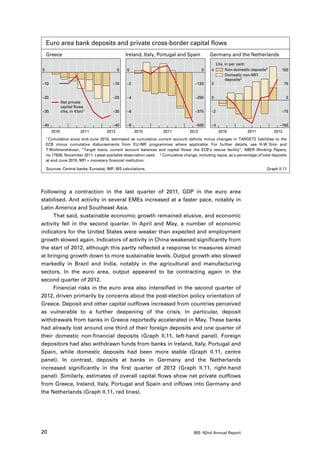
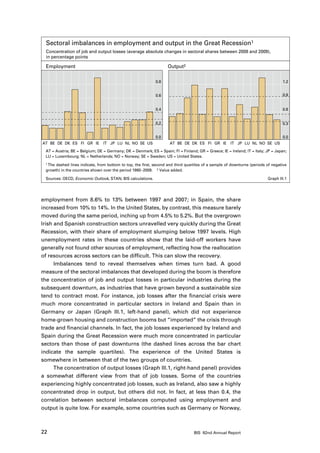
82nd Annual Report
1 A p r i l 2 0 11 – 3 1 M a r c h 2 0 12


Basel, 24 June 2012
Copies of publications are available from:

Bank for International Settlements
Communications
CH-4002 Basel, Switzerland

E-mail: publications@bis.org
Fax: +41 61 280 9100 and +41 61 280 8100

©	 Bank for International Settlements 2012. All rights reserved. Limited extracts
	 may be reproduced or translated provided the source is stated.


ISSN   1021-2477 (print)
ISSN   1682-7708 (online)
ISBN   92-9131-175-8 (print)
ISBN   92-9197-175-8 (online)

Also published in French, German, Italian and Spanish.
Available on the BIS website (www.bis.org).
Contents


Letter of transmittal                     . . . . . . . . . . . . . . . . . . . . . . . . . . . . . . . . . . . . . . . . . . . . .  	   vii


Overview of the economic chapters                                            . . . . . . . . . . . . . . . . . . . . . . . . . . .  	    ix


I. Breaking the vicious cycles . . . . . . . . . . . . . . . . . . . . . . . . . . . . . . . . . . .  	                                   1

Structural challenges persist . . . . . . . . . . . . . . . . . . . . . . . . . . . . . . . . . . . . . . . . . . .                 	     1
Overburdened central banks face risks . . . . . . . . . . . . . . . . . . . . . . . . . . . . . . . . . . .                         	     2
The abysmal fiscal outlook . . . . . . . . . . . . . . . . . . . . . . . . . . . . . . . . . . . . . . . . . . . . .                	     3
The changing financial sphere . . . . . . . . . . . . . . . . . . . . . . . . . . . . . . . . . . . . . . . . . .                   	     5
What now for European monetary union? . . . . . . . . . . . . . . . . . . . . . . . . . . . . . . . .                               	     6
Summing up . . . . . . . . . . . . . . . . . . . . . . . . . . . . . . . . . . . . . . . . . . . . . . . . . . . . . . . . .        	     7


II. The year in retrospect . . . . . . . . . . . . . . . . . . . . . . . . . . . . . . . . . . . . . . . .  	                            10

The global recovery faltered in 2011 . . . . . . . . . . . . . . . . . . . . . . . . . . . . . . . . . . . . .                      	    10
High commodity prices had differential effects around the world . . . . . . . . . . . .                                             	    13
The euro area sovereign debt crisis intensified . . . . . . . . . . . . . . . . . . . . . . . . . . . .                             	    14
European bank funding and credit supply declined . . . . . . . . . . . . . . . . . . . . . . . .                                    	    17
Global growth remained fragile in early 2012 . . . . . . . . . . . . . . . . . . . . . . . . . . . . .                              	    19


III. Rebalancing growth                           . . . . . . . . . . . . . . . . . . . . . . . . . . . . . . . . . . . . . . . . .  	   21

Structural adjustment . . . . . . . . . . . . . . . . . . . . . . . . . . . . . . . . . . . . . . . . . . . . . . . . .             	    21
     Unemployment after the housing bust . . . . . . . . . . . . . . . . . . . . . . . . . . . . . .                                	    21
     Reliance on external demand . . . . . . . . . . . . . . . . . . . . . . . . . . . . . . . . . . . . . .                        	    24
Debt sustainability . . . . . . . . . . . . . . . . . . . . . . . . . . . . . . . . . . . . . . . . . . . . . . . . . . . .         	    26
Policy challenges . . . . . . . . . . . . . . . . . . . . . . . . . . . . . . . . . . . . . . . . . . . . . . . . . . . . .         	    30
Box: Reducing household debt to a sustainable level . . . . . . . . . . . . . . . . . . . . . . .                                   	    32


IV. The limits of monetary policy . . . . . . . . . . . . . . . . . . . . . . . . . . . . . . . 	                                        34

Monetary policy in advanced and emerging market economies . . . . . . . . . . . . . .                                               	    34
     Monetary policy measures taken over the past year . . . . . . . . . . . . . . . . . . .                                        	    34
     Assessment of the monetary policy stance . . . . . . . . . . . . . . . . . . . . . . . . . . .                                 	    39
Prolonged monetary accommodation: scope and limitations . . . . . . . . . . . . . . . .                                             	    41
     Monetary easing and balance sheet repair . . . . . . . . . . . . . . . . . . . . . . . . . . .                                 	    42
Box IV.A: Monetary policy and bank profitability in 2008–10 . . . . . . . . . . . . . . . . .                                       	    44
     Global monetary policy spillovers . . . . . . . . . . . . . . . . . . . . . . . . . . . . . . . . . .                          	    45
Box IV.B: Developments in overnight money markets . . . . . . . . . . . . . . . . . . . . . .                                       	    46
     Longer-term risks for central banks . . . . . . . . . . . . . . . . . . . . . . . . . . . . . . . . .                          	    48
Summing up . . . . . . . . . . . . . . . . . . . . . . . . . . . . . . . . . . . . . . . . . . . . . . . . . . . . . . . . .        	    49


BIS 82nd Annual Report                                                                                                                   iii
V. Restoring fiscal sustainability . . . . . . . . . . . . . . . . . . . . . . . . . . . . . . . . 	                                  50

Why and to what extent have sovereigns lost their risk-free status? . . . . . . . . . .  	                                            50
     Developments in public finances . . . . . . . . . . . . . . . . . . . . . . . . . . . . . . . . . . .  	                         50
Box: The financial cycle, potential output and cyclically adjusted fiscal balances. 	                                                 53
     The impact of the financial crisis on fiscal positions . . . . . . . . . . . . . . . . . . .  	                                  56
     The impact of deteriorating sovereign health on the financial system . . . .  	                                                  57
     Reactions to the deteriorating fiscal health of sovereigns . . . . . . . . . . . . . . .  	                                      58
Implications of sovereigns’ loss of risk-free status . . . . . . . . . . . . . . . . . . . . . . . . .  	                             59
How can sovereigns become risk-free again? . . . . . . . . . . . . . . . . . . . . . . . . . . . . .  	                               60
Summing up . . . . . . . . . . . . . . . . . . . . . . . . . . . . . . . . . . . . . . . . . . . . . . . . . . . . . . . . .  	       63


VI. Post-crisis evolution of the banking sector . . . . . . . . . . . . . . . .  	                                                    64

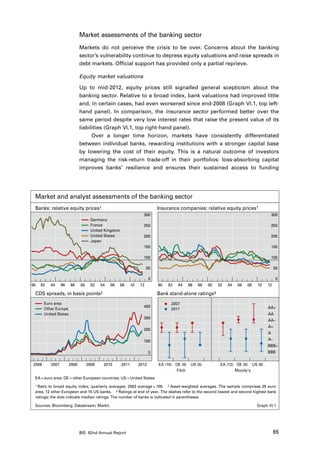
Market assessments of the banking sector . . . . . . . . . . . . . . . . . . . . . . . . . . . . . . . .                        	     65
      Equity market valuations . . . . . . . . . . . . . . . . . . . . . . . . . . . . . . . . . . . . . . . . . .              	     65
      Debt market valuations . . . . . . . . . . . . . . . . . . . . . . . . . . . . . . . . . . . . . . . . . . .              	     66
Banks’ profitability and its sources . . . . . . . . . . . . . . . . . . . . . . . . . . . . . . . . . . . . . .                	     66
Box VI.A: Shadow banking . . . . . . . . . . . . . . . . . . . . . . . . . . . . . . . . . . . . . . . . . . . . .              	     67
Efforts to strengthen balance sheets . . . . . . . . . . . . . . . . . . . . . . . . . . . . . . . . . . . . .                  	     69
      Capital base . . . . . . . . . . . . . . . . . . . . . . . . . . . . . . . . . . . . . . . . . . . . . . . . . . . . .    	     69
      Liquidity positions . . . . . . . . . . . . . . . . . . . . . . . . . . . . . . . . . . . . . . . . . . . . . . . .       	     71
      Asset encumbrance . . . . . . . . . . . . . . . . . . . . . . . . . . . . . . . . . . . . . . . . . . . . . .             	     72
Immediate policy challenges . . . . . . . . . . . . . . . . . . . . . . . . . . . . . . . . . . . . . . . . . . .               	     73
Long-term challenges for banks’ new business model . . . . . . . . . . . . . . . . . . . . . .                                  	     75
      Official support . . . . . . . . . . . . . . . . . . . . . . . . . . . . . . . . . . . . . . . . . . . . . . . . . .      	     75
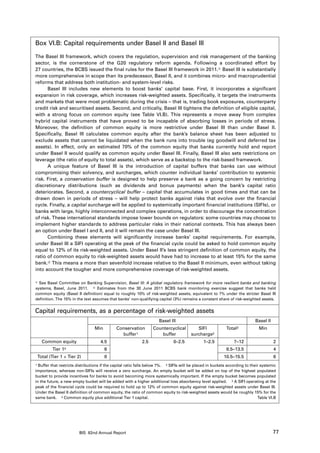
Box VI.B: Capital requirements under Basel II and Basel III . . . . . . . . . . . . . . . . . .                                 	     77
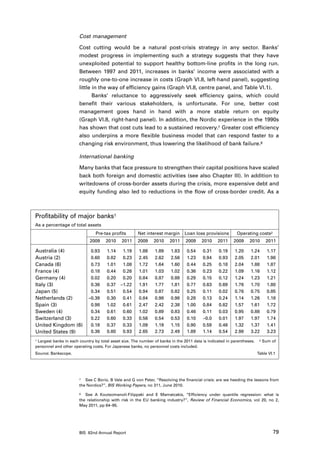
      Cost management . . . . . . . . . . . . . . . . . . . . . . . . . . . . . . . . . . . . . . . . . . . . . . . .           	     79
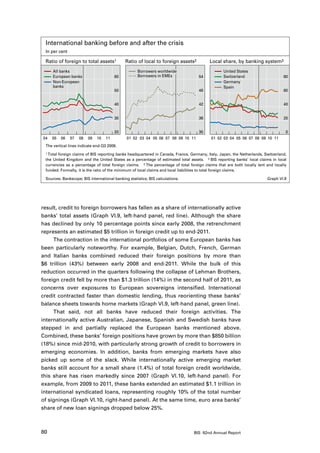
      International banking . . . . . . . . . . . . . . . . . . . . . . . . . . . . . . . . . . . . . . . . . . . . .           	     79
Box VI.C: Reforming OTC derivatives markets . . . . . . . . . . . . . . . . . . . . . . . . . . . . .                           	     81
Summing up . . . . . . . . . . . . . . . . . . . . . . . . . . . . . . . . . . . . . . . . . . . . . . . . . . . . . . . . .    	     83


Organisation of the BIS as at 31 March 2012 . . . . . . . . . . . . . . . . . . . . . . . . . . . . . .  	                            88

The BIS: mission, activities, governance and
financial results . . . . . . . . . . . . . . . . . . . . . . . . . . . . . . . . . . . . . . . . . . . . . . . . . .  	              89

BIS member central banks . . . . . . . . . . . . . . . . . . . . . . . . . . . . . . . . . . . . . . . . . . . . .  	 124

Board of Directors . . . . . . . . . . . . . . . . . . . . . . . . . . . . . . . . . . . . . . . . . . . . . . . . . . . .  	 125

Financial statements                        . . . . . . . . . . . . . . . . . . . . . . . . . . . . . . . . . . . . . . . . . . . .  	 133

Independent auditor’s report                                 . . . . . . . . . . . . . . . . . . . . . . . . . . . . . . . . . . .  	 199

Five-year graphical summary . . . . . . . . . . . . . . . . . . . . . . . . . . . . . . . . . . . 	                                 200


iv                                                                                                      BIS 82nd Annual Report
Graphs
I.1	     Vicious cycles and the burden on central banks . . . . . . . . . . . . . . . . . . . . . . .  	                               8
II.1	 Global economic activity and imbalances . . . . . . . . . . . . . . . . . . . . . . . . . . . .                             	   10
II.2	 Real property prices in selected emerging market cities . . . . . . . . . . . . . . . .                                     	   11
II.3	 Business activity and equity prices . . . . . . . . . . . . . . . . . . . . . . . . . . . . . . . . . .                     	   12
II.4	 Commodity markets and inflation . . . . . . . . . . . . . . . . . . . . . . . . . . . . . . . . . . .                       	   13
II.5	 Euro area sovereign bond yields . . . . . . . . . . . . . . . . . . . . . . . . . . . . . . . . . . .                       	   15
II.6	 Safe and risky assets . . . . . . . . . . . . . . . . . . . . . . . . . . . . . . . . . . . . . . . . . . . . .             	   16
II.7	 Public finances . . . . . . . . . . . . . . . . . . . . . . . . . . . . . . . . . . . . . . . . . . . . . . . . . .         	   16
II.8	 Indicators of banks’ financial strength . . . . . . . . . . . . . . . . . . . . . . . . . . . . . . .                       	   17
II.9	 Bank funding conditions . . . . . . . . . . . . . . . . . . . . . . . . . . . . . . . . . . . . . . . . . .                 	   18
II.10	 Bank credit . . . . . . . . . . . . . . . . . . . . . . . . . . . . . . . . . . . . . . . . . . . . . . . . . . . . . .    	   18
II.11	 Euro area bank deposits and private cross-border capital flows . . . . . . . . .                                           	   20
III.1	   Sectoral imbalances in employment and output in the Great Recession . .                                                  	   22
III.2	   Sectoral imbalances and unemployment . . . . . . . . . . . . . . . . . . . . . . . . . . . . .                           	   23
III.3	   Sectoral imbalances and unemployment, by strength of change in GDP . .                                                   	   24
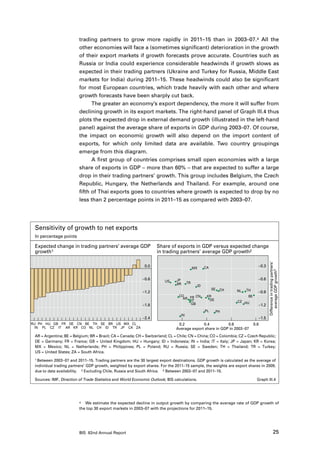
III.4	   Sensitivity of growth to net exports . . . . . . . . . . . . . . . . . . . . . . . . . . . . . . . . .                   	   25
III.5	   Credit growth, GDP growth and credit gaps . . . . . . . . . . . . . . . . . . . . . . . . . .                            	   27
III.6	   Private sector and household debt service ratios in selected economies . .                                               	   29
III.7	   Bank provisioning and non-performing loans . . . . . . . . . . . . . . . . . . . . . . . . .                             	   30
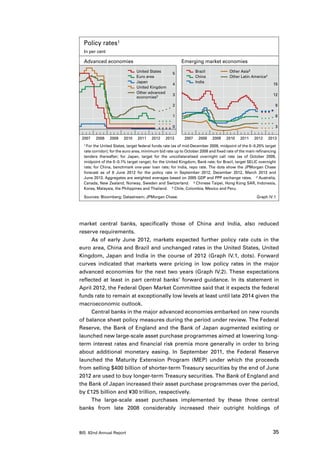
IV.1	 Policy rates . . . . . . . . . . . . . . . . . . . . . . . . . . . . . . . . . . . . . . . . . . . . . . . . . . . . .      	   35
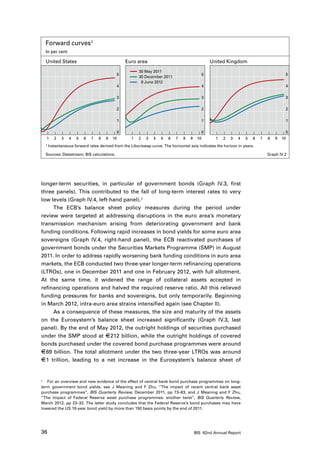
IV.2	 Forward curves . . . . . . . . . . . . . . . . . . . . . . . . . . . . . . . . . . . . . . . . . . . . . . . . . .          	   36
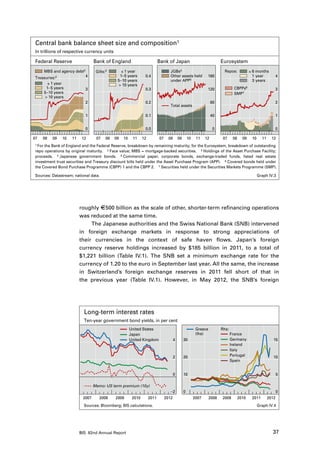
IV.3	 Central bank balance sheet size and composition . . . . . . . . . . . . . . . . . . . . .                                   	   37
IV.4	 Long-term interest rates . . . . . . . . . . . . . . . . . . . . . . . . . . . . . . . . . . . . . . . . . . .              	   37
IV.5	 Real policy rates . . . . . . . . . . . . . . . . . . . . . . . . . . . . . . . . . . . . . . . . . . . . . . . . .         	   39
IV.6	 Policy rate benchmarks . . . . . . . . . . . . . . . . . . . . . . . . . . . . . . . . . . . . . . . . . . .                	   39
IV.7	 Central bank assets . . . . . . . . . . . . . . . . . . . . . . . . . . . . . . . . . . . . . . . . . . . . . . .           	   40
IV.8	 US monetary policy response and crisis dynamics:
	     the Great Depression vs the global financial crisis . . . . . . . . . . . . . . . . . . . . .                               	   41
IV.9	 Commodity and consumer prices and unit labour costs . . . . . . . . . . . . . . . .                                         	   47
IV.10	Long-term inflation expectations . . . . . . . . . . . . . . . . . . . . . . . . . . . . . . . . . . .                      	   48
V.1	     General government fiscal indicators . . . . . . . . . . . . . . . . . . . . . . . . . . . . . . . .                     	   51
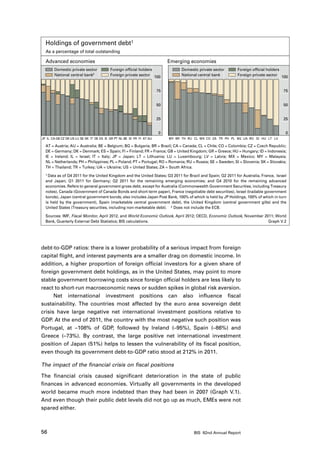
V.2	     Holdings of government debt . . . . . . . . . . . . . . . . . . . . . . . . . . . . . . . . . . . . . .                  	   56
V.3	     Sovereign CDS spreads and credit ratings . . . . . . . . . . . . . . . . . . . . . . . . . . .                           	   59
V.4	     Credit risk profile of the pool of general government debt . . . . . . . . . . . . . .                                   	   60
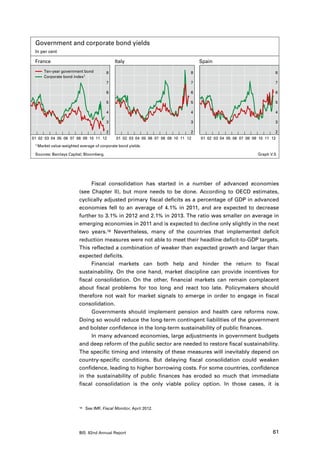
V.5	     Government and corporate bond yields . . . . . . . . . . . . . . . . . . . . . . . . . . . . .                           	   61
VI.1	 Market and analyst assessments of the banking sector . . . . . . . . . . . . . . . . .                                      	   65
VI.2	 Banks’ profitability and payout policy . . . . . . . . . . . . . . . . . . . . . . . . . . . . . . .                        	   69
VI.3	 Loss absorbency of bank balance sheets . . . . . . . . . . . . . . . . . . . . . . . . . . . . .                            	   70
VI.4	 Liquidity and funding of large banks worldwide . . . . . . . . . . . . . . . . . . . . . .                                  	   71
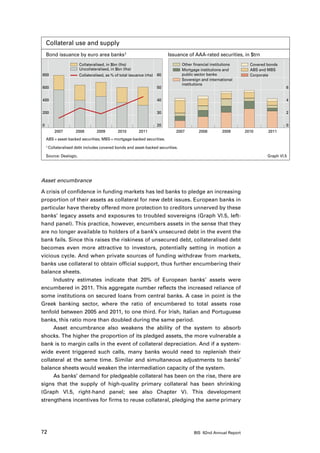
VI.5	 Collateral use and supply . . . . . . . . . . . . . . . . . . . . . . . . . . . . . . . . . . . . . . . . .                 	   72
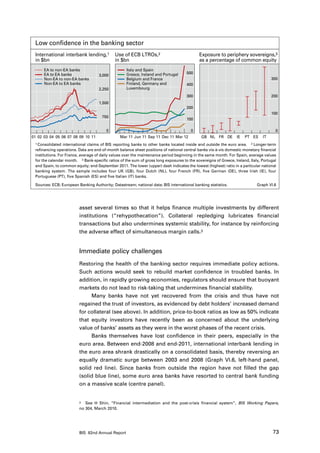
VI.6	 Low confidence in the banking sector . . . . . . . . . . . . . . . . . . . . . . . . . . . . . . .                          	   73
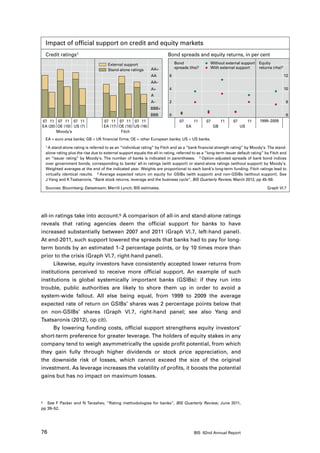
VI.7	 Impact of official support on credit and equity markets . . . . . . . . . . . . . . . .                                     	   76
VI.8	 Cost management and stability of profits . . . . . . . . . . . . . . . . . . . . . . . . . . . .                            	   78
VI.9	 International banking before and after the crisis . . . . . . . . . . . . . . . . . . . . . .                               	   80
VI.10	Emerging market bank lending . . . . . . . . . . . . . . . . . . . . . . . . . . . . . . . . . . . . .                      	   83

Tables
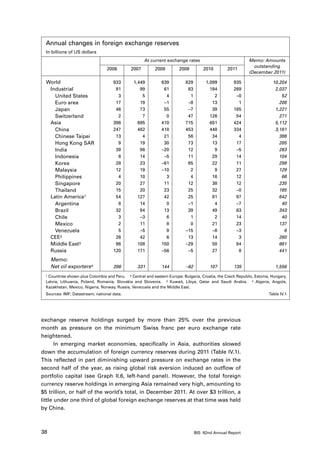
IV.1	 Annual changes in foreign exchange reserves . . . . . . . . . . . . . . . . . . . . . . . . 	38
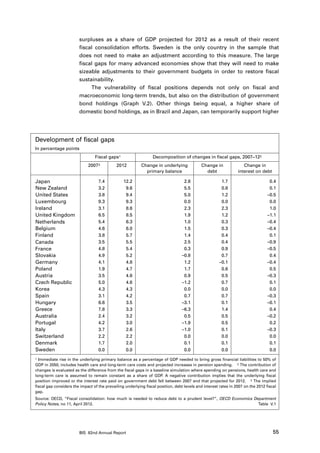
V.1	 Development of fiscal gaps . . . . . . . . . . . . . . . . . . . . . . . . . . . . . . . . . . . . . . . . 	55
VI.1	 Profitability of major banks . . . . . . . . . . . . . . . . . . . . . . . . . . . . . . . . . . . . . . . . 	79


The chapters of this Report went to press on 14–15 June 2012.


BIS 82nd Annual Report                                                                                                                v
Conventions used in this Report
lhs, rhs	   left-hand scale, right-hand scale
billion	    thousand million
...	        not available
.	          not applicable
–	          nil or negligible
$	          US dollar unless specified otherwise


Differences in totals are due to rounding.

The term “country” as used in this publication also covers territorial entities that are
not states as understood by international law and practice but for which data are
separately and independently maintained.


vi                                                                BIS 82nd Annual Report
82nd Annual Report


submitted to the Annual General Meeting
of the Bank for International Settlements
held in Basel on 24 June 2012


Ladies and Gentlemen,
     It is my pleasure to submit to you the 82nd Annual Report of the Bank for
International Settlements for the financial year which ended on 31 March 2012.
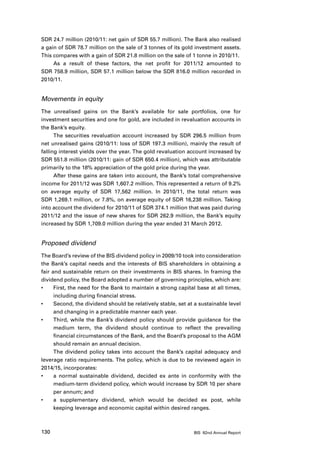
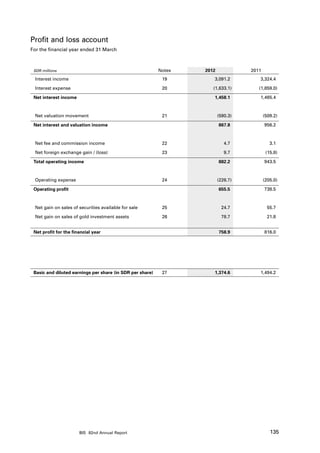
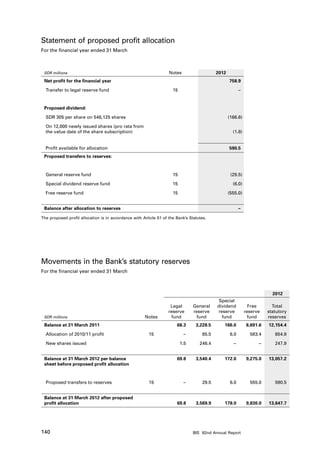
     The net profit for the year amounted to SDR 758.9 million, compared with
SDR 816.0 million for the preceding year. Details of the results for the
financial year 2011/12 may be found on pages 129–32 of this Report under “Net
profit and its distribution”.
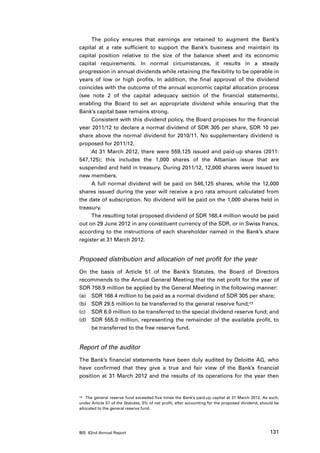
     The Board of Directors proposes, in application of Article 51 of the Bank’s
Statutes, that the present General Meeting pay a dividend of SDR 305 per
share, with the four new shareholders receiving a pro rata share of the
dividend. This dividend would total SDR 168.4 million, payable in any
constituent currency of the SDR, or in Swiss francs.
     The Board further recommends that SDR 29.5 million be transferred to
the general reserve fund, SDR 6.0 million to the special dividend reserve fund
and the remainder – amounting to SDR 555.0 million – to the free reserve fund.
     If these proposals are approved, the Bank’s dividend for the financial year
2011/12 will be payable to shareholders on 29 June 2012.


Basel, 15 June 2012	                                         JAIME CARUANA
	                                                            General Manager


BIS 82nd Annual Report                                                       vii
Overview of the economic chapters


Chapter I: Breaking the vicious cycles
The global economy has yet to overcome the legacies of the financial crisis to
achieve balanced, self-sustaining growth. In different ways, vicious cycles are
hindering the transition for both the advanced and emerging market economies.
After reviewing the past year’s economic developments (Chapter II), the
economic chapters address fundamental aspects of these vicious cycles:
unfinished structural adjustments (Chapter III), risks in the current stances of
monetary (Chapter IV) and fiscal policy (Chapter V), and the ongoing
challenges of financial reform (Chapter VI). Chapter I underscores the themes
and policy conclusions of the latter four chapters, and in a special section
examines them in the context of problems in Europe’s currency union.


Chapter II: The year in retrospect
In the advanced economies, the first months of 2011 seemed to offer the
beginnings of a self-sustaining recovery, a promise that turned out to be a false
dawn. The pattern appears to be repeating itself in 2012, with early signs of
strength gradually fading. The same set of hindrances has been at work in the
past two years. The crisis exposed the weak foundations of government
finances. With budgets in disarray, fiscal authorities have been forced to make
deep budget cuts at the same time as other sectors of the economy continue to
deleverage. In the euro area, the evolution of fiscal strains into a sovereign
debt crisis has severely undermined the confidence of investors and
consumers inside and outside the monetary union. Losses on sovereign bonds
have led many banks to cut lending, thereby further weakening the recovery.
Meanwhile, many emerging market economies have begun to see their
previously vigorous rates of economic activity drop off.


Chapter III: Rebalancing growth
Both advanced and emerging market economies face structural challenges.
Sectoral misallocations that built up during the boom, coupled with high levels
of household and corporate debt, continue to hobble growth in some advanced
economies. These countries must move to repair balance sheets as they
facilitate the rebalancing of resources across sectors. Meanwhile, a number of
other countries, including many emerging market economies, face the risk of
experiencing their own version of the recent boom and bust cycle. Their
rebalancing requires shifting from credit expansion and exports towards
internal sources of growth, especially as growth models that mainly rely on
exports are likely to be less effective than in the past.


BIS 82nd Annual Report                                                         ix
Chapter IV: The limits of monetary policy
The major advanced economies are maintaining extraordinarily accommodative
monetary conditions, which are being transmitted to emerging market
economies (EMEs) in the form of undesirable exchange rate and capital flow
volatility. As a consequence of EME efforts to manage these spillovers, the
stance of monetary policy is highly accommodative globally. There is
widespread agreement that, during the crisis, decisive central bank action was
essential to prevent a financial meltdown and that in the aftermath it has been
supporting faltering economies. Central banks have had little choice but to
maintain monetary ease because governments have failed to quickly and
comprehensively address structural impediments to growth. But the need for
prolonged accommodation has to be carefully weighed against the risk of
generating distortions that will later produce financial and price instability.


Chapter V: Restoring fiscal sustainability
Sovereigns under fiscal pressure have been losing their risk-free status – and
the accompanying economic benefits – at an alarming rate. The broad
availability of safe assets aids the operation of financial markets and the
conduct of monetary policy. And a sovereign whose debt is essentially free of
credit risk has ample room to implement countercyclical policies to support
macroeconomic stability. Restoring the supply of risk-free assets requires that
governments convincingly address high deficits as well as projected increases
in their long-term liabilities. Some countries need to take immediate action to
significantly reform their public sectors and remove structural impediments to
growth. All countries need to prevent adverse feedback loops between the
financial sector and the sovereign and build up fiscal buffers in good times.


Chapter VI: Post-crisis evolution of the banking sector
Banks and prudential authorities still face tough challenges in securing financial
stability. Banks need to further strengthen capital and liquidity positions to
regain markets’ confidence. To expedite this process, authorities should ensure
that institutions recapitalise and recognise losses on problematic investments.
Authorities everywhere must complete their consistent and timely
implementation of the agreed Basel III standards and ensure that robust
regulation extends to currently unregulated intermediaries. Meanwhile,
regulators in rapidly growing economies should be aware of the potentially
destabilising risk-taking encouraged by buoyant local markets. The long-term
objective of policy must be to pave the way to a robust business model of
banking featuring strong and transparent balance sheets, self-sustaining
international operations, and stable profits that do not rely on official support.


x                                                             BIS 82nd Annual Report
I. Breaking the vicious cycles


The world is now five years on from the outbreak of the financial crisis, yet the
global economy is still unbalanced and seemingly becoming more so as
interacting weaknesses continue to amplify each other. The goals of balanced
growth, balanced economic policies and a safe financial system still elude us.
In advanced economies at the centre of the financial crisis, high debt loads
continue to drag down recovery; monetary and fiscal policies still lack a
comprehensive solution to short-term needs and long-term dangers; and
despite the international progress on regulation, the condition of the financial
sector still poses a threat to stability. From time to time, encouraging signs
raise hopes – but they are quickly dashed, delivering another blow to the
confidence of consumers and investors.
      As many advanced economies have been struggling, emerging market
economies have been rising, in some cases fuelled by rapid credit expansion or
a vast wave of export-led growth. This two-speed recovery generates large and
potentially destabilising current account imbalances and volatile gross capital
flows. The export boom in many emerging markets has crowded out the
development of more durable internal sources of growth, leaving countries
more vulnerable as growth begins to slow down. As the economic
developments of the past year (see Chapter II) have demonstrated, a self-
sustaining recovery in the advanced economies and a rebalancing of global
growth remain elusive.
      In short, vicious cycles are distorting both advanced and emerging
economies. How can these vicious cycles be turned into virtuous ones? The
ongoing challenges of structural adjustment, monetary and fiscal policy risks,
and financial reform encompass the broad global threats that are still with us.
These four topics, and the steps needed to set the global economy firmly
on the path to sustainable long-term growth, are the focus of Chapters III–VI
in this Report. In the remainder of this chapter, we highlight the policy
recommendations for the global economy. And, before concluding, we also
discuss the particularly vicious cycles currently bedevilling Europe, where the
monetary union faces the above challenges plus those of an incomplete
institutional setup.


Structural challenges persist
The global economy remains unbalanced, as activity in many advanced
economies continues to falter while economies elsewhere are expanding, in
some cases rapidly (Chapter III). This is unlikely to be sustainable.
      Economies that were at the centre of the financial crisis must face their
crisis legacies of debt and misallocated resources head-on. The leverage-
driven real estate boom left an enormous overhang of debt after the inevitable
implosion. The necessary deleveraging process for households is far from


BIS 82nd Annual Report                                                         1
complete and has been slow by historical standards. Household debt remains
close to 100% of GDP in some countries, including Ireland, Spain and the
United Kingdom; in others, including France and Italy, household and corporate
debt have both increased relative to GDP since 2008.
     An important factor slowing the deleveraging process among households
is the simultaneous need for balance sheet repair and deleveraging in the
financial and government sectors. Unusually slow deleveraging in every major
sector of activity partly explains why the recovery in the advanced economies
has been so weak. And given the ongoing need to improve balance sheets, any
effects from stimulative fiscal policy will be limited by overindebted agents
using additional income to repay debt rather than spend more. As a result,
weak growth is likely to continue.
     Persistent imbalances across industries are also impeding recovery.
Because labour and capital do not easily shift across industries, the
misallocation of resources during the boom tends to work against recovery in
the aftermath of a crisis. Hence, countries where the sectoral imbalances were
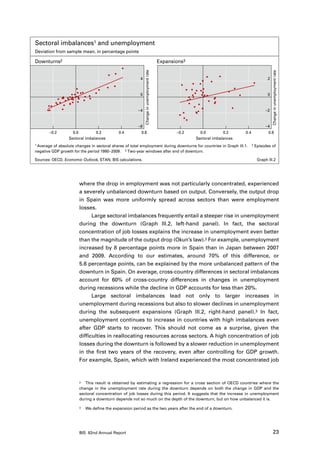
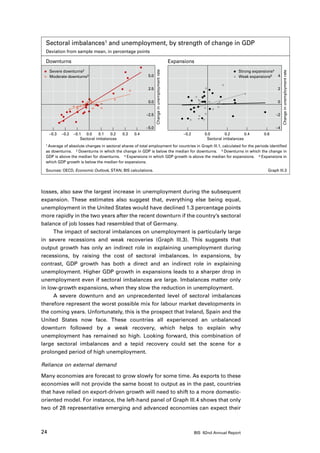
most apparent are facing higher and more protracted unemployment as their
industrial structure only slowly adjusts.
     Meanwhile, countries that are growing rapidly confront the problems of
identifying and reacting to the emergence of financial booms and, in many
cases, of shifting away from a reliance on exports. Evidence of overshooting in
some emerging markets is not hard to find. In several cases, prices for real
estate and other assets have been surging while private indebtedness and debt
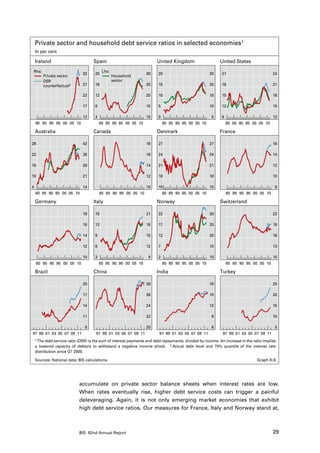
service costs relative to income have been rising far above long-term trends.
The lessons from the hardships now being endured in the advanced economies
in the wake of similar experiences are not lost on today’s emerging market
policymakers, especially given recent signs of a slowdown in emerging market
economies. But with the prospect of continued slow growth in much of the
world, countries whose success has depended on exports would do well to
speed their efforts to build capacity for internal growth.


Overburdened central banks face risks
Over the past year, central banks in the advanced economies have continued
or even expanded their purchases of government bonds and their support of
liquidity in the banking system. At $18 trillion and counting, the aggregate
assets of all central banks now stand at roughly 30% of global GDP, double the
ratio of a decade ago. And real policy interest rates – nominal rates minus
headline inflation – remain substantially negative in most major advanced
economies. The global economy is certainly better off today because central
banks moved forcefully after the 2008 collapse of Lehman Brothers and in the
years since. One of the latest examples of such action was the European
Central Bank’s offer of three-year loans to banks in late 2011 and again in early
2012. That E1 trillion programme, which increased the Eurosystem central
bank balance sheet by roughly E500 billion, was perhaps the single most
important factor halting the freeze in banks’ funding markets and, indirectly,
supporting some euro area government bond markets.


2                                                            BIS 82nd Annual Report
The extraordinary persistence of loose monetary policy is largely the result
of insufficient action by governments in addressing structural problems. Simply
put: central banks are being cornered into prolonging monetary stimulus as
governments drag their feet and adjustment is delayed. As we discuss in
Chapter IV, any positive effects of such central bank efforts may be shrinking,
whereas the negative side effects may be growing. Both conventionally and
unconventionally accommodative monetary policies are palliatives and have
their limits. It would be a mistake to think that central bankers can use their
balance sheets to solve every economic and financial problem: they cannot
induce deleveraging, they cannot correct sectoral imbalances, and they cannot
address solvency problems. In fact, near zero policy rates, combined with
abundant and nearly unconditional liquidity support, weaken incentives for the
private sector to repair balance sheets and for fiscal authorities to limit their
borrowing requirements. They distort the financial system and in turn place
added burdens on supervisors.
      With nominal interest rates staying as low as they can go and central bank
balance sheets continuing to expand, risks are surely building up. To a large
extent they are the risks of unintended consequences, and they must be
anticipated and managed. These consequences could include the wasteful
support of effectively insolvent borrowers and banks – a phenomenon that
haunted Japan in the 1990s – and artificially inflated asset prices that generate
risks to financial stability down the road. One message of the crisis was that
central banks could do much to avert a collapse. An even more important
lesson is that underlying structural problems must be corrected during the
recovery or we risk creating conditions that will lead rapidly to the next crisis.
      In addition, central banks face the risk that, once the time comes to tighten
monetary policy, the sheer size and scale of their unconventional measures will
prevent a timely exit from monetary stimulus, thereby jeopardising price
stability. The result would be a decisive loss of central bank credibility and
possibly even independence.
      Although central banks in many advanced economies may have no choice
but to keep monetary policy relatively accommodative for now, they should use
every opportunity to raise the pressure for deleveraging, balance sheet repair
and structural adjustment by other means. They should also be doubly watchful
for the build-up of new imbalances in asset markets.
      Fast-growing economies are in a different situation. But there too, central
banks are under pressure. The threats to monetary and financial stability in
many emerging market economies have, as noted above, been in evidence for
some time. Monetary policymakers there will need to continue to search for the
right balance, but the task is being made even more difficult by recent signs of
faltering growth combined with extraordinarily accommodative policies in the
advanced economies.


The abysmal fiscal outlook
Since 2007 – the year the financial crisis began – government debt in the
advanced economies has increased on average from about 75% of GDP to


BIS 82nd Annual Report                                                           3
more than 110%. And average government deficits have ballooned from 1.5%
to 6.5% of GDP. One could be forgiven for thinking that, without the financial
crisis, government fiscal foundations today would be fairly sound. But the
seemingly endless growth of tax receipts during the boom years only
temporarily shored up those foundations. By pushing down tax receipts and
driving up the government’s social safety net costs, the financial crisis created
an explosion of deficits and debt that directed the authorities’ attention with
new force to the underlying menace that no longer seemed so far away: the
gross underfunding of governments’ health care and pension obligations and
an unmanageably large public sector.
      In some countries, staggeringly large support programmes for the financial
sector wreaked havoc on government finances. The feedback between the
financial and the government sectors thus made a key contribution to
accelerating fiscal decay; and the connection between banking stress and
market pressures on sovereign credit has tightened considerably in the past
couple of years, especially in Europe.
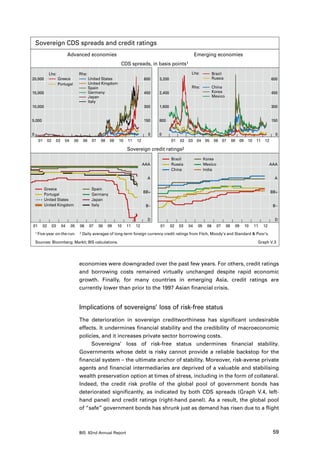
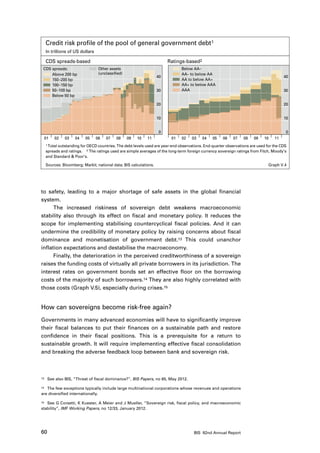
      As we discuss in Chapter V, the fiscal maelstrom has toppled many
sovereigns from their unique perch where the market considered them to be
essentially free of credit risk and, in that sense, riskless. The loss is particularly
worrisome given weak economic conditions and a global banking system still
largely dependent on government support. The shrinking supply of safe assets
is harming the functioning of financial markets and driving up funding costs for
the private sector. And it is helping push banks into risky practices, such as
rehypothecation – that is, the use of the same collateral for multiple obligations.
      Over the past year, much of the world has focused on Europe, where
sovereign debt crises have been erupting at an alarming rate. But, as recently
underscored by credit downgrades of the United States and Japan and rating
agency warnings on the United Kingdom, underlying long-term fiscal
imbalances extend far beyond the euro area.
      Although debt in emerging markets has on average remained fairly stable
relative to GDP, governments there should take heed: credit and asset price
booms in many cases have been masking underlying weaknesses in their fiscal
accounts, much as they did in advanced economies before the financial crisis.
If recent signs of a slowdown persist, the fiscal horizon of emerging market
economies could darken quickly.
      So, governments across the globe need to tackle their fiscal predicaments.
In most advanced economies, the fiscal budget excluding interest payments
would need 20 consecutive years of surpluses exceeding 2% of GDP – starting
now – just to bring the debt-to-GDP ratio back to its pre-crisis level. And every
additional year that budgets continue in deficit makes the recovery period
longer. The question is not whether governments must adjust, but how?
Some say that governments should focus exclusively on resolving the long
term, ignoring the short term. Others say that the only credible consolidation
plan is the one that starts now – anything else risks pushing sovereign
creditworthiness off the cliff.
      In choosing some position between these two extremes, a few points are
clear from the outset. The main priority should be forceful and credible long-


4                                                                BIS 82nd Annual Report
term measures, even when it means making painful choices now. Governments
in the advanced economies will have to convincingly show that they will
adequately manage the costs for pensions and health care as their populations
grow older. Spending cuts and revenue increases may be necessary in the
near term as well. Countries in the deepest trouble will need to do much more,
quickly pushing through significant reform of their public sectors. In many
countries, ongoing deleveraging in the private sector weakens near-term
aggregate demand and hampers fiscal reform. In those cases, authorities
should create sufficient room for manoeuvre to support balance sheet repair in
the private sector, including by recapitalising banks as they recognise losses.
     But trust lost is never easily regained. The road back to risk-free status for
sovereigns is a long one. Some countries have already run out of options and
will have no choice but to take immediate steps to restore fiscal balance.
Others will need to strike the right balance between long- and short-term
measures to be successful. A key challenge for governments as they strive for
that balance is to avoid losing the confidence of investors.
     Economies less affected by the financial crisis should view their current
position of relative strength as an opportunity to put their government finances
on a sustainable long-term path. Doing so sooner rather than later will give
them the flexibility to react when the next crisis inevitably hits. In addition, all
countries will need to stem adverse feedback between the financial sector and
the sovereign. To this end, countries should move swiftly to make their banks
more resilient and make sure that, as conditions improve, they build fiscal
buffers.


The changing financial sphere
While financial institutions struggle to overcome the effects of the crisis, they
also confront a changed market environment and new regulations. In some
places they have made significant progress on recapitalisation but, as we
discuss in Chapter VI, their adjustment to the new conditions has a long way
to go and needs to be pushed ahead. The magnitude of this unfinished
business is clear from investors’ continued distrust of banks: the cost of buying
compensation for a bank default (the spread on bank credit default swaps) is
as high now as it was at the peak of the crisis, and bank equities continue to
lose ground relative to the broad market.
     Despite the progress on recapitalisation, many banks remain highly
leveraged, including those that appear well capitalised but in fact have outsize
derivatives positions. Big banks continue to have an interest in driving up their
leverage without enough regard for the consequences of failure: because of
their systemic weight, they expect the public sector to cover the downside.
Another worrying sign is that trading, after a brief crisis-induced squeeze, has
again become a major source of income for large banks.
     These conditions are moving the financial sector towards the same high-
risk profile it had before the crisis. Recent heavy losses related to derivatives
trading are a reminder of the dangers associated with such a development.
Surely, fundamental progress on the structure of the financial system will be


BIS 82nd Annual Report                                                            5
marked when its largest institutions can fail without the taxpayer having to
respond, and when the overall size of the sector relative to the rest of the
economy stays within tighter limits.
      Some mechanisms can help align market participants’ interests with those
of the public. One is the reform of remuneration policies at banks. Another
involves bank bondholders, who together with the public sector are at risk of
picking up the tab if a financial intermediary’s net worth turns negative. The
incentives of bond investors will be better aligned with the public interest if the
investors see more clearly that they will bear losses if banks get into trouble.
This will require some combination of bail-in bonds – in which bondholders’
losses in resolution are known with some certainty beforehand – and improved
resolution powers. Making risks to investors clearer and ending crisis-related
support for banks, including government guarantees on their bonds, will push
investors to better scrutinise the financial health of banks before investing in
them. Greater transparency has a pivotal role to play here: it will increase
bondholders’ ability to monitor the banks because the risks the institutions are
taking will be more visible.
      In short, public policy must move banks to adopt business models that
are less risky, more sustainable and more clearly in the public interest.
Governments can give the banking sector a healthy push in this direction if
officials make sure that newly agreed regulations are implemented universally
and without delay. Apart from enhancing transparency, this would also ensure
a level playing field for internationally active banks. Most importantly,
authorities should continue forcing banks to bring leverage down – and keep it
there by preventing them from deploying new instruments and tactics that
would push it back up. But such efforts should not stop with traditional banks.
Prudential authorities everywhere still face the challenge of putting in place
robust regulations that extend to the shadow banking sector.


What now for European monetary union?
The world is watching the crisis gripping the euro area with trepidation for
the spillovers it may have. But at its root the European crisis is a potential
harbinger, a virulent and advanced convergence of the problems to be
expected elsewhere if policy fails to break the vicious cycles generated by the
global weaknesses we describe in this Report – sectoral imbalances, excess
leverage, public overindebtedness and overburdened central banks.
     For now, the destructive feedback created by these problems is
concentrated in the euro area, where the fiscal authorities in some countries,
forced to consolidate, can no longer support either their banks or their
economies. The rapid loss of investor confidence in these countries has caused
an equally rapid fragmentation of euro area financial markets. In this
environment, how can the common currency regain its credibility so that
Europe can return to prosperity and continue on the road to further integration?
     In part, the euro area crisis involves underlying problems that were
revealed by the financial crisis and are common to many advanced economies.
Likewise, resolving it will require, in part, corrections that are also common:


6                                                              BIS 82nd Annual Report
private sector balance sheet adjustment, sectoral rebalancing, fiscal
consolidation and banking recapitalisation. Europe has made progress on this
agenda: reforming labour markets and social insurance systems and, through
adoption of the fiscal compact, requiring countries to have general government
budgets in balance or in surplus.
     But full resolution of the euro area crisis also requires strengthening
the institutional foundations of the currency union itself. To understand the
importance of this issue, recall that the European monetary union integrated
financial markets and created a centralised monetary authority so that capital
could flow freely and easily across the common currency area. Yet while the
region’s borders have become irrelevant for finance and for central banking,
authorities in one country still have only limited responsibilities for actions that
a financial intermediary takes in another country. Hence, the public in one
country of the currency union cannot be expected to financially backstop
actions taken elsewhere in the union. The conclusion is hard to escape that
a pan-European financial market and a pan-European central bank require a
pan-European banking system. Put slightly differently, a currency union that
centralises the lender of last resort for banks must unify its banking system.
Banks in Europe must become European banks.
     Recent promising suggestions for movement on the banking front offer
quick progress because they would operate within the existing terms of
the currency union. First, they would unify banking rules now fragmented
along national boundaries. Second, common banking rules would centralise
responsibility in a common regulator, supervisor, deposit insurer and resolution
authority.
     If adopted, these measures will break the adverse feedback between the
banks and the sovereign and other destructive links that are making the crisis
so severe. They will revive interbank lending and sovereign access to funding
markets. They will allow the Eurosystem to withdraw from its unconventional
and undesirable role as an intermediary. And they will restore confidence in
the single currency so that both institutional and retail depositors return to the
banks in their local markets. With day-to-day normality attained through a
unified currency and banking system, leaders will have the time they need to
finish building the broader institutional framework that the monetary union
needs for its long-term viability.


Summing up
Moving the global economy to a path of balanced, self-sustaining growth
remains a difficult and unfinished task. As we argue in this Report, a number of
interacting structural weaknesses are hindering the reforms required in
advanced and emerging market economies. Those hoping for quick fixes will
continue to be disappointed – there are none. And central banks – already
overburdened – cannot repair these weaknesses. All of this is understood by
advanced economy consumers who are reducing debts and are reluctant to
spend; it is understood by firms postponing investment and hiring; and it is
understood by investors wary of the weak and risky outlook – why else would


BIS 82nd Annual Report                                                            7
they accept negative real interest rates on government bonds in many
advanced economies?
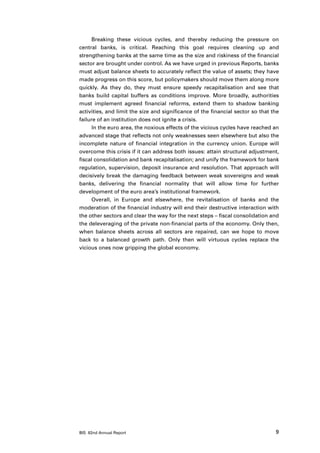
     A look at the economy as a whole shows that three groups need to adjust
(Graph I.1): the financial sector needs to recognise losses and recapitalise;
governments must put fiscal trajectories on a sustainable path; and households
and firms need to deleverage. As things stand, each sector’s burdens and efforts
to adjust are worsening the position of the other two. The financial sector is
putting pressure on the government as well as slowing deleveraging by
households and firms. Governments, with their deteriorating creditworthiness
and need for fiscal consolidation, are hurting the ability of the other sectors
to right themselves. And as households and firms work to reduce their debt
levels, they hamper the recovery of governments and banks. All of these
linkages are creating a variety of vicious cycles.
     Central banks find themselves in the middle of all of this, pushed to use
what power they have to contain the damage: pushed to directly fund the
financial sector and pushed to maintain extraordinarily low interest rates to
ease the strains on fiscal authorities, households and firms. This intense
pressure puts at risk the central banks’ price stability objective, their credibility
and, ultimately, their independence.


    Vicious cycles and the burden on central banks


                                                                                          Graph I.1


8                                                                BIS 82nd Annual Report
Breaking these vicious cycles, and thereby reducing the pressure on
central banks, is critical. Reaching this goal requires cleaning up and
strengthening banks at the same time as the size and riskiness of the financial
sector are brought under control. As we have urged in previous Reports, banks
must adjust balance sheets to accurately reflect the value of assets; they have
made progress on this score, but policymakers should move them along more
quickly. As they do, they must ensure speedy recapitalisation and see that
banks build capital buffers as conditions improve. More broadly, authorities
must implement agreed financial reforms, extend them to shadow banking
activities, and limit the size and significance of the financial sector so that the
failure of an institution does not ignite a crisis.
      In the euro area, the noxious effects of the vicious cycles have reached an
advanced stage that reflects not only weaknesses seen elsewhere but also the
incomplete nature of financial integration in the currency union. Europe will
overcome this crisis if it can address both issues: attain structural adjustment,
fiscal consolidation and bank recapitalisation; and unify the framework for bank
regulation, supervision, deposit insurance and resolution. That approach will
decisively break the damaging feedback between weak sovereigns and weak
banks, delivering the financial normality that will allow time for further
development of the euro area’s institutional framework.
      Overall, in Europe and elsewhere, the revitalisation of banks and the
moderation of the financial industry will end their destructive interaction with
the other sectors and clear the way for the next steps – fiscal consolidation and
the deleveraging of the private non-financial parts of the economy. Only then,
when balance sheets across all sectors are repaired, can we hope to move
back to a balanced growth path. Only then will virtuous cycles replace the
vicious ones now gripping the global economy.


BIS 82nd Annual Report                                                           9
II. The year in retrospect


The global economic recovery faltered over the past year. Rising commodity
prices and the intensification of the euro area sovereign debt crisis hit at the
time when unresolved structural weaknesses were still weighing on the global
economy. Increases in commodity prices had boosted inflation pressures in
fast-growing emerging market economies (EMEs), which prompted tighter
policies to moderate demand growth. In slow-growing advanced economies,
which had more spare capacity, higher commodity prices did not generate as
much inflationary pressure, but they undermined discretionary spending, which
was already subdued because households were paying down debts. The
intensification of the euro area crisis led to a global rise in risk aversion,
growing concerns about exposures to sovereign risk and ultimately to banking
sector stress. Following a new round of central bank interventions, there were
signs of stronger global expansion in the first few months of 2012. But with
sectoral and geographical imbalances still present in the world economy,
sustained growth remained elusive.


The global recovery faltered in 2011
The global economic recovery slowed in 2011. For the year as a whole, world
output grew by 3.9%, slightly slower than the average growth rate of the
decade prior to the financial crisis, but down significantly from 5.3% in 2010.
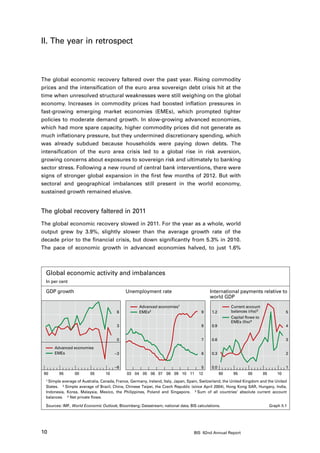
The pace of economic growth in advanced economies halved, to just 1.6%


 Global economic activity and imbalances
 In per cent

 GDP growth                                 Unemployment rate                             International payments relative to
                                                                                          world GDP
                                                   Advanced economies1                                Current account
                                       6           EMEs2                             9     1.2        balances (rhs)3                  5
                                                                                                      Capital flows to
                                                                                                      EMEs (lhs)4
                                       3                                             8     0.9                                         4


                                       0                                             7     0.6                                         3

      Advanced economies
      EMEs                            –3                                             6     0.3                                         2


                                      –6                                             5     0.0                                         1
 90     95      00       05      10          03 04 05 06 07 08 09 10 11             12           90    95      00        05       10
 1 Simpleaverage of Australia, Canada, France, Germany, Ireland, Italy, Japan, Spain, Switzerland, the United Kingdom and the United
 States. 2 Simple average of Brazil, China, Chinese Taipei, the Czech Republic (since April 2004), Hong Kong SAR, Hungary, India,
 Indonesia, Korea, Malaysia, Mexico, the Philippines, Poland and Singapore. 3 Sum of all countries’ absolute current account
 balances. 4 Net private flows.

 Sources: IMF, World Economic Outlook; Bloomberg; Datastream; national data; BIS calculations.                                Graph II.1


10                                                                               BIS 82nd Annual Report
(Graph II.1, left-hand panel). This reflected a significant weakening of the
                           economy in the United States and the United Kingdom and a sharp drop in
                           activity in Japan after the March 2011 earthquake, while growth in the euro
                           area as a whole was broadly unchanged.
                                Overall, the economic momentum in advanced economies was too weak
                           to generate a robust, self-sustaining recovery. The drag on private consumption
                           persisted. Unemployment remained high, or even increased further (Graph II.1,
                           centre panel). Falling property prices and high levels of debt continued to weigh
                           on household balance sheets in the mature economies hit hardest by the
                           financial crisis (see Chapter III). Household sector weakness also weighed on
                           business spending. Very weak public sector finances generally left no room for
                           further fiscal stimulus.
                                Emerging market economies grew by around 6% in 2011, with the pace of
                           growth moderating only slightly from 2010 (Graph II.1, left-hand panel).
                           Emerging Asia grew at 7.8%, led by China (9.2%) and India (7.2%); Latin
                           America grew at 4.5%. Growth in central and eastern Europe was broadly
                           unchanged at 5.3% for 2011 as a whole.
                                During the period under review, rapid growth in EMEs was in many cases
                           associated with signs of domestic overheating, including rising inflation, strong
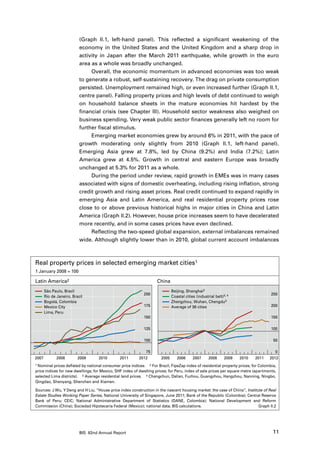
                           credit growth and rising asset prices. Real credit continued to expand rapidly in
                           emerging Asia and Latin America, and real residential property prices rose
                           close to or above previous historical highs in major cities in China and Latin
                           America (Graph II.2). However, house price increases seem to have decelerated
                           more recently, and in some cases prices have even declined.
                                Reflecting the two-speed global expansion, external imbalances remained
                           wide. Although slightly lower than in 2010, global current account imbalances


Real property prices in selected emerging market cities1
1 January 2008 = 100

Latin America2                                                       China
       São Paulo, Brazil                                                      Beijing, Shanghai3
                                                             200                                                                      250
       Rio de Janeiro, Brazil                                                 Coastal cities (industrial belt)3, 4
       Bogotá, Colombia                                                       Zhengzhou, Wuhan, Chengdu3
       Mexico City                                           175              Average of 36 cities                                    200
       Lima, Peru
                                                             150                                                                      150

                                                             125                                                                      100

                                                             100                                                                       50

                                                               75                                                                       0
2007          2008        2009      2010        2011       2012        2005      2006      2007      2008      2009   2010   2011    2012
1 Nominal prices deflated by national consumer price indices.   2 For Brazil, FipeZap index of residential property prices; for Colombia,

price indices for new dwellings; for Mexico, SHF index of dwelling prices; for Peru, index of sale prices per square metre (apartments,
selected Lima districts). 3 Average residential land prices. 4 Changchun, Dalian, Fuzhou, Guangzhou, Hangzhou, Nanning, Ningbo,
Qingdao, Shenyang, Shenzhen and Xiamen.

Sources: J Wu, Y Deng and H Liu, “House price index construction in the nascent housing market: the case of China”, Institute of Real
Estate Studies Working Paper Series, National University of Singapore, June 2011; Bank of the Republic (Colombia); Central Reserve
Bank of Peru; CEIC; National Administrative Department of Statistics (DANE, Colombia); National Development and Reform
Commission (China); Sociedad Hipotecaria Federal (Mexico); national data; BIS calculations.                                Graph II.2


                           BIS 82nd Annual Report                                                                                      11
Business activity and equity prices
 Business activity indices1                   Global equity indices2                      Sectoral equity indices2
         Euro area (lhs)                                                                          Non-cyclical industries3
115                                     55                                          125           Cyclical industries4              125


100                                     50                                          100                                             100


85                                      45                                           75                                              75
                       Rhs:
                              United States                           Advanced
70                            EMEs       40                           economies      50                                              50
                                                                      EMEs

55                                      35                                           25                                              25
      2007 2008 2009 2010 2011 2012            2007   2008   2009   2010   2011   2012     2007   2008   2009    2010   2011     2012
 1 For the euro area, European Commission Economic Sentiment Indicator; for EMEs, weighted average of manufacturing purchasing

 managers’ indices (PMIs) for China, Hungary, India, Mexico, Russia, Singapore, South Africa and Turkey, with weights based on 2005
 GDP and PPP exchange rates; for the United States, simple average of Institute of Supply Management manufacturing and
 non-manufacturing PMIs. 2 1 January 2007 = 100. 3 Consumer goods, consumer services, telecoms and utilities. 4 Basic materials,
 finance, industrials, and oil and gas.

 Sources: Bloomberg; Datastream; national data; BIS calculations.                                                            Graph II.3


remained at about 4% of world GDP, which is high by historical standards
(Graph II.1, right-hand panel, red line). Major advanced economies again
recorded sizeable current account deficits, with the notable exceptions of
Germany and Japan. Current account surpluses in emerging Asia, though
shrinking, remained sizeable. Latin America and central and eastern Europe
ran current account deficits. The net private capital flow into EMEs in 2011 was
still one of the strongest on record (Graph II.1, right-hand panel, green line).
Despite this, few emerging market currencies strengthened significantly against
the major currencies, and many depreciated.
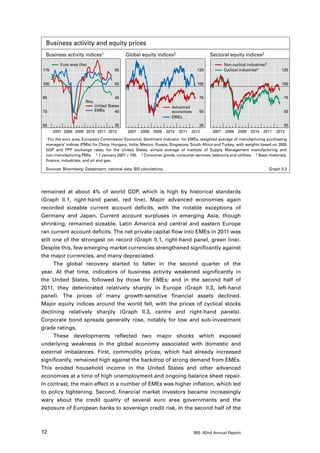
      The global recovery started to falter in the second quarter of the
year. At that time, indicators of business activity weakened significantly in
the United States, followed by those for EMEs; and in the second half of
2011, they deteriorated relatively sharply in Europe (Graph II.3, left-hand
panel). The prices of many growth-sensitive financial assets declined.
Major equity indices around the world fell, with the prices of cyclical stocks
declining relatively sharply (Graph II.3, centre and right-hand panels).
Corporate bond spreads generally rose, notably for low and sub-investment
grade ratings.
      These developments reflected two major shocks which exposed
underlying weakness in the global economy associated with domestic and
external imbalances. First, commodity prices, which had already increased
significantly, remained high against the backdrop of strong demand from EMEs.
This eroded household income in the United States and other advanced
economies at a time of high unemployment and ongoing balance sheet repair.
In contrast, the main effect in a number of EMEs was higher inflation, which led
to policy tightening. Second, financial market investors became increasingly
wary about the credit quality of several euro area governments and the
exposure of European banks to sovereign credit risk. In the second half of the


12                                                                                 BIS 82nd Annual Report
year, a sharp increase in global risk aversion, fiscal restraint and growing
                        deleveraging pressure on banks sapped demand.


                        High commodity prices had differential effects around the world
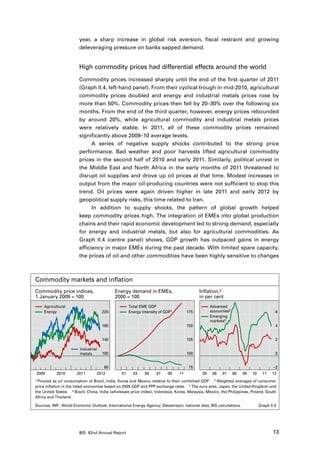
                        Commodity prices increased sharply until the end of the first quarter of 2011
                        (Graph II.4, left-hand panel). From their cyclical trough in mid-2010, agricultural
                        commodity prices doubled and energy and industrial metals prices rose by
                        more than 50%. Commodity prices then fell by 20–30% over the following six
                        months. From the end of the third quarter, however, energy prices rebounded
                        by around 20%, while agricultural commodity and industrial metals prices
                        were relatively stable. In 2011, all of these commodity prices remained
                        significantly above 2009–10 average levels.
                              A series of negative supply shocks contributed to the strong price
                        performance. Bad weather and poor harvests lifted agricultural commodity
                        prices in the second half of 2010 and early 2011. Similarly, political unrest in
                        the Middle East and North Africa in the early months of 2011 threatened to
                        disrupt oil supplies and drove up oil prices at that time. Modest increases in
                        output from the major oil-producing countries were not sufficient to stop this
                        trend. Oil prices were again driven higher in late 2011 and early 2012 by
                        geopolitical supply risks, this time related to Iran.
                              In addition to supply shocks, the pattern of global growth helped
                        keep commodity prices high. The integration of EMEs into global production
                        chains and their rapid economic development led to strong demand, especially
                        for energy and industrial metals, but also for agricultural commodities. As
                        Graph II.4 (centre panel) shows, GDP growth has outpaced gains in energy
                        efficiency in major EMEs during the past decade. With limited spare capacity,
                        the prices of oil and other commodities have been highly sensitive to changes


Commodity markets and inflation
Commodity price indices,                   Energy demand in EMEs,                         Inflation,2
1 January 2009 = 100                       2000 = 100                                     in per cent
    Agricultural                                    Total EME GDP                                Advanced
    Energy                           220            Energy intensity of GDP1        175          economies3                           6
                                                                                                 Emerging
                                                                                                 markets4
                                     180                                            150                                               4


                                     140                                            125                                               2

                        Industrial
                        metals       100                                            100                                               0


                                      60                                             75                                              –2
2009        2010      2011       2012          01     03    05     07    09    11           05    06   07     08   09   10     11   12
1 Proxied  as oil consumption of Brazil, India, Korea and Mexico relative to their combined GDP. 2 Weighted averages of consumer
price inflation in the listed economies based on 2005 GDP and PPP exchange rates. 3 The euro area, Japan, the United Kingdom and
the United States. 4 Brazil, China, India (wholesale price index), Indonesia, Korea, Malaysia, Mexico, the Philippines, Poland, South
Africa and Thailand.

Sources: IMF, World Economic Outlook; International Energy Agency; Datastream; national data; BIS calculations.              Graph II.4


                        BIS 82nd Annual Report                                                                                       13
in growth expectations. In 2011, the associated commodity price movements
tended to act as a brake on the global recovery.
      Strong commodity price gains in early 2011 and tight spare capacity lifted
headline inflation later in the year in EMEs. By mid-2011, average inflation in
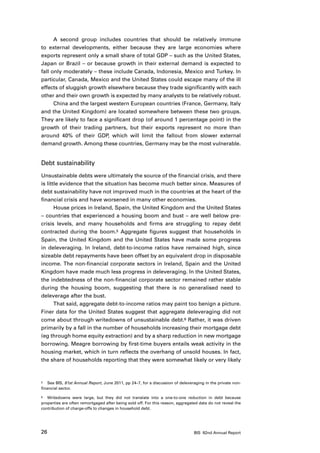
these economies exceeded 6%, one of the highest rates of the past decade
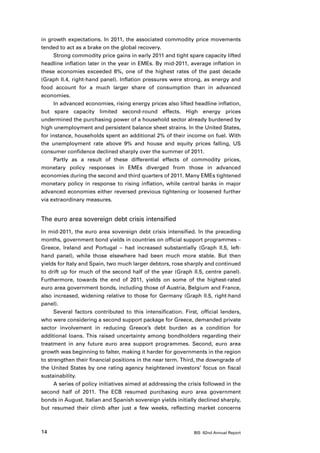
(Graph II.4, right-hand panel). Inflation pressures were strong, as energy and
food account for a much larger share of consumption than in advanced
economies.
      In advanced economies, rising energy prices also lifted headline inflation,

but spare capacity limited second-round effects. High energy prices
undermined the purchasing power of a household sector already burdened by
high unemployment and persistent balance sheet strains. In the United States,
for instance, households spent an additional 2% of their income on fuel. With
the unemployment rate above 9% and house and equity prices falling, US
consumer confidence declined sharply over the summer of 2011.
      Partly as a result of these differential effects of commodity prices,
monetary policy responses in EMEs diverged from those in advanced
economies during the second and third quarters of 2011. Many EMEs tightened
monetary policy in response to rising inflation, while central banks in major
advanced economies either reversed previous tightening or loosened further
via extraordinary measures.


The euro area sovereign debt crisis intensified
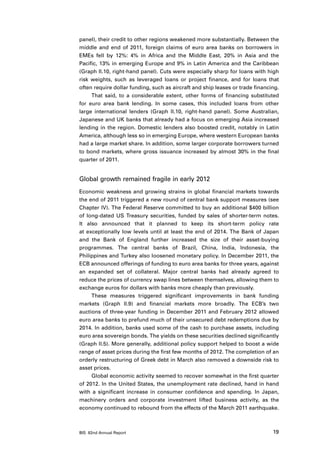
In mid-2011, the euro area sovereign debt crisis intensified. In the preceding
months, government bond yields in countries on official support programmes –
Greece, Ireland and Portugal – had increased substantially (Graph II.5, left-
hand panel), while those elsewhere had been much more stable. But then
yields for Italy and Spain, two much larger debtors, rose sharply and continued
to drift up for much of the second half of the year (Graph II.5, centre panel).
Furthermore, towards the end of 2011, yields on some of the highest-rated
euro area government bonds, including those of Austria, Belgium and France,
also increased, widening relative to those for Germany (Graph II.5, right-hand
panel).
      Several factors contributed to this intensification. First, official lenders,
who were considering a second support package for Greece, demanded private
sector involvement in reducing Greece’s debt burden as a condition for
additional loans. This raised uncertainty among bondholders regarding their
treatment in any future euro area support programmes. Second, euro area
growth was beginning to falter, making it harder for governments in the region
to strengthen their financial positions in the near term. Third, the downgrade of
the United States by one rating agency heightened investors’ focus on fiscal
sustainability.
      A series of policy initiatives aimed at addressing the crisis followed in the
second half of 2011. The ECB resumed purchasing euro area government
bonds in August. Italian and Spanish sovereign yields initially declined sharply,
but resumed their climb after just a few weeks, reflecting market concerns


14                                                             BIS 82nd Annual Report
Euro area sovereign bond yields1
Ten-year yields, in per cent

Greece, Ireland and Portugal2                 Italy and Spain3                                  Other euro area sovereigns
    Greece                                            Italy                                                                       Austria
                                        30                                               7.0                                              6
    Ireland                                           Spain                                                                       Belgium
    Portugal                                                                                                                      France
                                        25                                               6.5                                      Germany 5

                                        20                                               6.0                                                 4

                                        15                                               5.5                                                 3

                                        10                                               5.0                                                 2

                                         5                                               4.5                                                 1
    Jul 11 Oct 11 Jan 12 Apr 12                       Jul 11 Oct 11 Jan 12 Apr 12                       Jul 11   Oct 11   Jan 12 Apr 12
1 The solid vertical lines in each panel mark the dates of: the first official call for private sector involvement in sovereign debt reduction
(6 June 2011); the conclusion of the July 2011 EU summit (21 July 2011), which included a second official support package for Greece
and expanded potential uses of stabilisation funds; the conclusion of the October 2011 EU summit (26 October 2011), which raised the
lending capacity of the stabilisation facility; and the adoption of the EU fiscal compact (9 December 2011), aimed at limiting future
structural budget deficits. 2 The dashed vertical lines mark the dates of: the announcement of a Greek referendum on Greece’s
second official support package (31 October 2011); and the agreement with private sector creditors on a Greek debt swap
(8 March 2012). 3 The dashed vertical lines mark the dates of: the first reported purchases of Italian and Spanish government bonds
by the ECB (5 August 2011); the instalment of a technocratic government in Italy (13 November 2011); and the election in Spain
(20 November 2011).

Sources: Bloomberg; national data.                                                                                                 Graph II.5


                         about the governments’ ability to implement the fiscal consolidation measures
                         agreed with European partners. Expansion of the potential uses of the euro
                         area stabilisation fund in July and of its lending capacity in October appeared
                         to have even less durable effects on yields. Towards the end of 2011, however,
                         the fiscal compact to limit structural budget deficits ushered in more significant
                         and sustained reductions in yields (see Chapter V).
                               The sovereign debt crisis heightened risk aversion in global financial
                         markets. Investors adjusted their portfolios in recognition of greater sovereign
                         risks. For example, when the volatility of portfolios increased in August,
                         international investors started selling emerging market bonds and equities – a
                         shift that continued for much of the second half of 2011 (Graph II.6, left-hand
                         panel). Demand for equities and corporate bonds in advanced economies also
                         declined, leading to lower prices and higher spreads, especially for lower-rated
                         bonds (Graph II.6, centre panel).
                               Some financial assets benefited from safe haven flows. These included
                         Australian, Canadian, German, Nordic, Swiss, UK and US government bonds,
                         whose yields dropped to extremely low levels by historical standards during the
                         second half of 2011 (Graph II.6, right-hand panel). Such was this demand that
                         yields on some shorter-dated bonds became negative for a time. The yen and
                         the Swiss franc also appreciated markedly as a result of portfolio adjustments
                         in favour of safe haven assets. To counter these trends, the Japanese
                         authorities sold yen in the currency markets, with sales reportedly reaching a
                         record volume on one day, while the Swiss National Bank capped the value of
                         the franc against the euro.


                         BIS 82nd Annual Report                                                                                             15
Safe and risky assets
 Net portfolio flows into EMEs                     Corporate bond spreads2                      Government bond yields3
      Portfolio volatility, in per cent1                   BBB        High-yield                                        30 Jun 2011
                                            30                                          1,000                                           5
      Equities, in $bn                                     A                                                            31 Dec 2011
      Bonds, in $bn                                        AA
                                            20             AAA                           800                                            4

                                            10                                           600                                            3

                                             0                                           400                                            2

                                           –10                                           200                                            1

                                           –20                                             0                                            0
           2011                    2012                      2011                2012           AU CA CH DE DK GB NO SE US
 AU = Australia; CA = Canada; CH = Switzerland; DE = Germany; DK = Denmark; GB = United Kingdom; NO = Norway; SE = Sweden;
 US = United States.
 1 Annualised volatility of daily returns, computed over previous 22 business days, on a hypothetical portfolio comprising MSCI world

 equity index (60% weight), Merrill Lynch high-grade global bond index (35% weight) and Merrill Lynch high-yield corporate and
 emerging markets bond index (5% weight). 2 Option-adjusted spreads of yields on indices of global corporate bonds over
 government bonds, in basis points. 3 Ten-year, in per cent.

 Sources: Bloomberg; Datastream; EPFR; Merrill Lynch; BIS calculations.                                                        Graph II.6


     Many advanced and emerging economies tightened their fiscal policies
(Graph II.7, left-hand panel). While advanced economies tightened policies
in response to fiscal sustainability concerns, emerging economies did so
rather to contain domestic demand. Euro area countries experienced the
sharpest tightening. In Greece, Ireland and Portugal, official support
programmes also prescribed substantial fiscal tightening that required deficit
cuts of several percentage points of GDP. Large euro area economies such as


 Public finances
 Change in fiscal stance1                                                                       2011 fiscal tightening and growth2
           2011                                                                                    Advanced
           2012                                                                             9      economies                            4
                                                                                                   EMEs
                  Euro area                      Other advanced           EMEs                                     IE
                                                   economies                                6                                           0


                                                                                                                        GR      PT
                                                                                            3                                          –4


                                                                                            0                                          –8


                                                                                           –3                                          –12
 PT   GR    IE    ES    IT    FR   BE      AT    GB   US   JP     CN MX   BR   IN   TR           –6    –3      0    3      6       9
 AT = Austria; BE = Belgium; BR = Brazil; CN = China; ES = Spain; FR = France; GB = United Kingdom; GR = Greece; IE = Ireland;
 IN = India; IT = Italy; JP = Japan; MX = Mexico; PT = Portugal; TR = Turkey; US = United States.
 1 Fiscal stance measured as cyclically adjusted primary balance for general government, as a percentage of GDP.     2 On the horizontal

 axis, difference between 2011 and 2010 fiscal stance; on the vertical axis, difference between 2011 and 2010 GDP growth, in percentage
 points. The trend line is calculated over the entire sample of countries.

 Sources: IMF, Fiscal Monitor and World Economic Outlook; BIS calculations.                                                    Graph II.7


16                                                                                      BIS 82nd Annual Report
France, Italy and Spain also tightened their fiscal stance substantially. Outside
                       the euro area, the United Kingdom continued to rein in its budget deficit, under
                       a negative outlook from two of the major rating agencies. The United States
                       also tightened its fiscal stance somewhat despite the extension of temporary
                       payroll tax cuts and supplementary unemployment benefits during 2011 and
                       2012. Japan was the only major advanced economy to loosen its fiscal stance,
                       in order to implement post-earthquake reconstruction expenditures. A number
                       of EMEs also tightened fiscal policy moderately in order to contain domestic
                       demand. However, this fiscal consolidation does not seem to have been
                       systematically associated with weaker economic growth in 2011 (Graph II.7,
                       right-hand panel).


                       European bank funding and credit supply declined
                       The euro area sovereign debt crisis put European banks under growing
                       stress in the second half of 2011. This reflected uncertainty about banks’
                       exposure to sovereign credit risk and questions about governments’ ability
                       to support weak banks. European banks’ credit default swap (CDS) premia
                       rose sharply, as their perceived creditworthiness deteriorated (Graph II.8, left-
                       hand panel). Bank equity prices plummeted in countries where the value of
                       sovereign debt had fallen most, and declined sharply elsewhere in the euro
                       area (Graph II.8, centre panel). But the crisis also affected banks elsewhere, as
                       shown by the behaviour of equity prices (Graph II.8, right-hand panel) as well
                       as of CDS premia.
                            Euro area bank funding conditions quickly worsened in autumn 2011.
                       Depositors began to withdraw funds from banks in Spain and, to a lesser
                       extent, Italy, adding to continued deposit outflows from banks in Greece and
                       Ireland. Markets for unsecured debt essentially closed for many euro area
                       banks (Graph II.9, left-hand panel). And the cost of borrowing in the interbank
                       market increased, significantly for euros, but also for dollars and sterling
                       (Graph II.9, centre panel). Dollar funding for euro area banks was in short


Indicators of banks’ financial strength
CDS premia,                                  Euro area bank equity prices,          Bank equity prices in other areas,
in basis points                              1 January 2010 = 100                   1 January 2010 = 100
              EU banks                                   France      Ireland
              North American        500                  Germany     Italy   125                                     125
              banks                                      Greece      Spain
              Asian banks                                Portugal
                                    400                                       100                                    100

                                    300                                        75                                      75
                                                                                          EMEs
                                    200                                        50         Japan                        50
                                                                                          Switzerland
                                                                                          United Kingdom
                                    100                                        25                                      25
                                                                                          United States

                                         0                                      0                                       0
2008   2009     2010    2011     2012            2010        2011            2012       2010          2011      2012
Sources: Datastream; BIS calculations.                                                                        Graph II.8


                       BIS 82nd Annual Report                                                                          17
Bank funding conditions
 Bank bond issuance in the euro                     Three-month Libor-OIS spreads,                   US money market fund claims on
 area, in billions of euros                         in basis points                                  banks2
          GIIPS:1          Unsecured                        US dollar                                            Irish and Portuguese banks
                           Secured          60              Euro                            100                  Belgian and French banks        20
          Other:           Unsecured                        Pound sterling                                       Italian and Spanish banks
                           Secured                                                                               German banks
                                            45                                                  75                                               15


                                            30                                                  50                                               10


                                            15                                                  25                                                   5


                                                0                                                0                                                   0


          Q2 11          Q4 11         Q2 12               2010            2011          2012              2010               2011            2012
 1 Greece, Ireland, Italy, Portugal and Spain. 2 Claims on euro area banks of the 10 largest US prime money market funds, as a
  percentage of the funds’ assets under management. As of 30 April 2012, these 10 funds held $642 billion in assets and all US prime
  money market funds held $1.42 trillion in assets.

  Sources: ECB; Bloomberg; Dealogic; Fitch Ratings.                                                                                     Graph II.9


supply partly because US money market funds cut their exposures (Graph II.9,
right-hand panel).
     Growing deleveraging pressure led to a rising home bias in euro area
bank lending. On balance, euro area banks tightened lending standards for
firms in the final quarter of 2011, more sharply than in the United States
(Graph II.10, left-hand panel). While the growth rate of credit from euro area
banks to domestic non-financial borrowers fell to zero (Graph II.10, centre


 Bank credit
 Lending standards for firms1                       Domestic bank credit growth3                     Foreign claims on emerging
                                                                                                     markets6 in 2011, in $trn
          United States2                                           Advanced economies4                      Euro area banks
                                           100                                                  28          Other banks
          Euro area                                                Euro area
                                                                   Emerging markets5                  Africa &     Asia &    Emerging Latin
                                                                                                21    Middle       Pacific    Europe America &
                                            75                                                                                                 2.0
                                                                                                       East                          Caribbean

                                            50                                                  14                                              1.5

                                            25                                                   7                                              1.0

                                                0                                                0                                              0.5

                                           –25                                                  –7                                              0.0
 05   06      07    08     09    10   11   12         07      08      09     10    11       12       Jun Dec Jun Dec Jun Dec Jun Dec

  1 Netpercentage of bank survey respondents tightening standards. 2 Lending to large and medium-sized firms. 3 Year-on-year
 changes in bank claims on the domestic non-financial sector, weighted by 2005 PPP exchange rates, in per cent. 4 The euro area,
 Japan, the United Kingdom and the United States. 5 Argentina, Brazil, Chile, China, the Czech Republic, Hong Kong SAR, Hungary,
 India, Indonesia, Korea, Malaysia, Mexico, Peru, Poland, Russia, Saudi Arabia, Singapore, South Africa, Thailand and
 Turkey. 6 Foreign claims by nationality of reporting bank on an immediate borrower basis.

  Sources: ECB Bank Lending Survey; Federal Reserve Senior Loan Officer Survey; IMF, International Financial Statistics; Datastream;
  BIS consolidated banking statistics by nationality; national data; BIS calculations.                                    Graph II.10


18                                                                                        BIS 82nd Annual Report
panel), their credit to other regions weakened more substantially. Between the
middle and end of 2011, foreign claims of euro area banks on borrowers in
EMEs fell by 12%: 4% in Africa and the Middle East, 20% in Asia and the
Pacific, 13% in emerging Europe and 9% in Latin America and the Caribbean
(Graph II.10, right-hand panel). Cuts were especially sharp for loans with high
risk weights, such as leveraged loans or project finance, and for loans that
often require dollar funding, such as aircraft and ship leases or trade financing.
     That said, to a considerable extent, other forms of financing substituted
for euro area bank lending. In some cases, this included loans from other
large international lenders (Graph II.10, right-hand panel). Some Australian,
Japanese and UK banks that already had a focus on emerging Asia increased
lending in the region. Domestic lenders also boosted credit, notably in Latin
America, although less so in emerging Europe, where western European banks
had a large market share. In addition, some larger corporate borrowers turned
to bond markets, where gross issuance increased by almost 30% in the final
quarter of 2011.


Global growth remained fragile in early 2012
Economic weakness and growing strains in global financial markets towards
the end of 2011 triggered a new round of central bank support measures (see
Chapter IV). The Federal Reserve committed to buy an additional $400 billion
of long-dated US Treasury securities, funded by sales of shorter-term notes.
It also announced that it planned to keep its short-term policy rate
at exceptionally low levels until at least the end of 2014. The Bank of Japan
and the Bank of England further increased the size of their asset-buying
programmes. The central banks of Brazil, China, India, Indonesia, the
Philippines and Turkey also loosened monetary policy. In December 2011, the
ECB announced offerings of funding to euro area banks for three years, against
an expanded set of collateral. Major central banks had already agreed to
reduce the prices of currency swap lines between themselves, allowing them to
exchange euros for dollars with banks more cheaply than previously.
     These measures triggered significant improvements in bank funding
markets (Graph II.9) and financial markets more broadly. The ECB’s two
auctions of three-year funding in December 2011 and February 2012 allowed
euro area banks to prefund much of their unsecured debt redemptions due by
2014. In addition, banks used some of the cash to purchase assets, including
euro area sovereign bonds. The yields on these securities declined significantly
(Graph II.5). More generally, additional policy support helped to boost a wide
range of asset prices during the first few months of 2012. The completion of an
orderly restructuring of Greek debt in March also removed a downside risk to
asset prices.
     Global economic activity seemed to recover somewhat in the first quarter
of 2012. In the United States, the unemployment rate declined, hand in hand
with a significant increase in consumer confidence and spending. In Japan,
machinery orders and corporate investment lifted business activity, as the
economy continued to rebound from the effects of the March 2011 earthquake.


BIS 82nd Annual Report                                                         19
Euro area bank deposits and private cross-border capital flows
    Greece                                       Ireland, Italy, Portugal and Spain          Germany and the Netherlands
                                                                                                   Lhs, in per cent:
0                                            0   0                                       0    4         Non-domestic deposits2       150
                                                                                                        Domestic non-MFI
                                                                                                        deposits2
–10                                      –10     –2                                  –125     2                                         75


–20                                      –20     –4                                  –250     0                                          0
              Net private
              capital flows
–30           (rhs, in €bn)1             –30     –6                                  –375     –2                                     –75


–40                                      –40     –8                                  –500     –4                                    –150
       2010              2011         2012            2010         2011           2012              2010           2011          2012
    1 Cumulative since end-June 2010, estimated as cumulative current account deficits minus changes in TARGET2 liabilities to the
    ECB minus cumulative disbursements from EU-IMF programmes where applicable. For further details, see H-W Sinn and
    T Wollmershäuser, “Target loans, current account balances and capital flows: the ECB’s rescue facility”, NBER Working Papers,
    no 17626, November 2011. Latest available observation used. 2 Cumulative change, including repos, as a percentage of total deposits
    at end-June 2010. MFI = monetary financial institution.

    Sources: Central banks; Eurostat; IMF; BIS calculations.                                                                 Graph II.11


Following a contraction in the last quarter of 2011, GDP in the euro area
stabilised. And activity in several EMEs increased at a faster pace, notably in
Latin America and Southeast Asia.
      That said, sustainable economic growth remained elusive, and economic
activity fell in the second quarter. In April and May, a number of economic
indicators for the United States were weaker than expected and employment
growth slowed again. Indicators of activity in China weakened significantly from
the start of 2012, although this partly reflected a response to measures aimed
at bringing growth down to more sustainable levels. Output growth also slowed
markedly in Brazil and India, notably in the agricultural and manufacturing
sectors. In the euro area, output appeared to be contracting again in the
second quarter of 2012.
      Financial risks in the euro area also intensified in the second quarter of
2012, driven primarily by concerns about the post-election policy orientation of
Greece. Deposit and other capital outflows increased from countries perceived
as vulnerable to a further deepening of the crisis. In particular, deposit
withdrawals from banks in Greece reportedly accelerated in May. These banks
had already lost around one third of their foreign deposits and one quarter of
their domestic non-financial deposits (Graph II.11, left-hand panel). Foreign
depositors had also withdrawn funds from banks in Ireland, Italy, Portugal and
Spain, while domestic deposits had been more stable (Graph II.11, centre
panel). In contrast, deposits at banks in Germany and the Netherlands
increased significantly in the first quarter of 2012 (Graph II.11, right-hand
panel). Similarly, estimates of overall capital flows show net private outflows
from Greece, Ireland, Italy, Portugal and Spain and inflows into Germany and
the Netherlands (Graph II.11, red lines).


20                                                                                  BIS 82nd Annual Report
III. Rebalancing growth


Five years after the onset of the subprime crisis, global economic growth is still
unbalanced. Among the advanced economies still confronting the fallout of
a major credit and housing bust are, most notably, Ireland, Spain, the United
Kingdom and the United States. The slump in the construction and other real
estate-related sectors has been particularly acute in Ireland and Spain. These
sectoral imbalances are likely to have significant and long-lasting effects on
employment. As households and firms struggle to service their debts, the
banking systems of these countries are staggering under a high volume of non-
performing loans. Credit ratios and debt service costs are also rising in several
countries that escaped a housing bust, although the proportion of troubled
loans remains low. Further, some economies that have relied heavily on export-
led growth are also likely to face challenges soon.
     In this chapter, we first turn to the structural imbalances that must be
corrected before economies can return to a path of steady growth. Then we
focus on private sector debt (see Chapter V for a discussion of public debt)
both in countries that experienced a home-grown financial crisis and in others
that did not. A final section discusses policy implications.


Structural adjustment
Growth models in many countries will need to change. Rising property prices
led to rapid growth in construction and other real estate-related activities in
some countries. These imbalances need to be resolved if these economies are
to grow sustainably. The collapse of the housing sector has also revealed long-
standing structural weaknesses, such as rigid labour or product rules, that
seem insignificant in good times but hinder adjustment when the economy is hit
by a shock.
     Other economies have specialised in exports to countries that are likely to
grow less rapidly in the future. They face a different set of challenges. Some
are highly competitive, at least in certain individual sectors, but they are
nonetheless vulnerable to a growth slowdown in their trading partners.

Unemployment after the housing bust

Unemployment remains high in many advanced economies, not only those hit
by sovereign debt concerns (see Chapter II). One reason for the persistence of
high unemployment is sectoral imbalances built up pre-crisis, the full extent of
which has only now become apparent.1 During the housing boom, the
construction, real estate and finance sectors strongly outgrew the rest of the
economy. In Ireland, for instance, construction increased its share of total


1	   See BIS, 81st Annual Report, June 2011, Chapter II.


BIS 82nd Annual Report                                                         21
Sectoral imbalances in employment and output in the Great Recession1
 Concentration of job and output losses (average absolute changes in sectoral shares between 2008 and 2009),
 in percentage points

 Employment                                                        Output2

                                                             0.8                                                                  1.2


                                                             0.6                                                                  0.9


                                                             0.4                                                                  0.6


                                                             0.2                                                                  0.3


                                                             0.0                                                                  0.0
AT BE DE DK ES FI GR IE         IT JP LU NL NO SE US                AT BE DE DK ES FI GR IE           IT JP LU NL NO SE US
 AT = Austria; BE = Belgium; DE = Germany; DK = Denmark; ES = Spain; FI = Finland; GR = Greece; IE = Ireland; IT = Italy; JP = Japan;
 LU = Luxembourg; NL = Netherlands; NO = Norway; SE = Sweden; US = United States.
 1 Thedashed lines indicate, from bottom to top, the first, second and third quartiles of a sample of downturns (periods of negative
 growth) in the countries shown over the period 1980–2009. 2 Value added.

 Sources: OECD, Economic Outlook, STAN; BIS calculations.                                                                 Graph III.1


employment from 8.6% to 13% between 1997 and 2007; in Spain, the share
increased from 10% to 14%. In the United States, by contrast, this measure barely
moved during the same period, inching up from 4.5% to 5.2%. But the overgrown
Irish and Spanish construction sectors unravelled very quickly during the Great
Recession, with their share of employment slumping below 1997 levels. High
unemployment rates in these countries show that the laid-off workers have
generally not found other sources of employment, reflecting how the reallocation
of resources across sectors can be difficult. This can slow the recovery.
      Imbalances tend to reveal themselves when times turn bad. A good
measure of the sectoral imbalances that developed during the boom is therefore
the concentration of job and output losses in particular industries during the
subsequent downturn, as industries that have grown beyond a sustainable size
tend to contract most. For instance, job losses after the financial crisis were
much more concentrated in particular sectors in Ireland and Spain than in
Germany or Japan (Graph III.1, left-hand panel), which did not experience
home-grown housing and construction booms but “imported” the crisis through
trade and financial channels. In fact, the job losses experienced by Ireland and
Spain during the Great Recession were much more concentrated in particular
sectors than those of past downturns (the dashed lines across the bar chart
indicate the sample quartiles). The experience of the United States is
somewhere in between that of the two groups of countries.
      The concentration of output losses (Graph III.1, right-hand panel) provides
a somewhat different view from that of job losses. Some of the countries
experiencing highly concentrated job losses, such as Ireland, also saw a highly
concentrated drop in output, but others did not. In fact, at less than 0.4, the
correlation between sectoral imbalances computed using employment and
output is quite low. For example, some countries such as Germany or Norway,


22                                                                                BIS 82nd Annual Report
Sectoral imbalances1 and unemployment
Deviation from sample mean, in percentage points

Downturns2                                                                                 Expansions3


                                                             Change in unemployment rate


                                                                                                                                                    Change in unemployment rate
                                                         4                                                                                      2


                                                         0                                                                                      0


                                                       –4                                                                                      –2


                                                       –8                                                                                      –4
       –0.2         0.0         0.2          0.4         0.6                                      –0.2     0.0         0.2     0.4              0.6
                  Sectoral imbalances                                                                    Sectoral imbalances
1 Average of absolute changes in sectoral shares of total employment during downturns for countries in Graph III.1.                  2   Episodes of
negative GDP growth for the period 1980–2009. 3 Two-year windows after end of downturn.

Sources: OECD, Economic Outlook, STAN; BIS calculations.                                                                                  Graph III.2


                       where the drop in employment was not particularly concentrated, experienced
                       a severely unbalanced downturn based on output. Conversely, the output drop
                       in Spain was more uniformly spread across sectors than were employment
                       losses.
                             Large sectoral imbalances frequently entail a steeper rise in unemployment
                       during the downturn (Graph III.2, left-hand panel). In fact, the sectoral
                       concentration of job losses explains the increase in unemployment even better
                       than the magnitude of the output drop (Okun’s law).2 For example, unemployment
                       increased by 8 percentage points more in Spain than in Japan between 2007
                       and 2009. According to our estimates, around 70% of this difference, or
                       5.6 percentage points, can be explained by the more unbalanced pattern of the
                       downturn in Spain. On average, cross-country differences in sectoral imbalances
                       account for 60% of cross-country differences in changes in unemployment
                       during recessions while the decline in GDP accounts for less than 20%.
                             Large sectoral imbalances lead not only to larger increases in
                       unemployment during recessions but also to slower declines in unemployment
                       during the subsequent expansions (Graph III.2, right-hand panel).3 In fact,
                       unemployment continues to increase in countries with high imbalances even
                       after GDP starts to recover. This should not come as a surprise, given the
                       difficulties in reallocating resources across sectors. A high concentration of job
                       losses during the downturn is followed by a slower reduction in unemployment
                       in the first two years of the recovery, even after controlling for GDP growth.
                       For example, Spain, which with Ireland experienced the most concentrated job


                       2	 This result is obtained by estimating a regression for a cross section of OECD countries where the

                       change in the unemployment rate during the downturn depends on both the change in GDP and the
                       sectoral concentration of job losses during this period. It suggests that the increase in unemployment
                       during a downturn depends not so much on the depth of the downturn, but on how unbalanced it is.

                       3	   We define the expansion period as the two years after the end of a downturn.


                       BIS 82nd Annual Report                                                                                                            23
Sectoral imbalances1 and unemployment, by strength of change in GDP
 Deviation from sample mean, in percentage points

 Downturns                                                                                    Expansions
     Severe downturns2                                                                                                           Strong expansions4


                                                                Change in unemployment rate


                                                                                                                                                        Change in unemployment rate
     Moderate downturns3                                  5.0                                                                    Weak expansions5   4


                                                          2.5                                                                                       2


                                                          0.0                                                                                       0


                                                         –2.5                                                                                      –2


                                                         –5.0                                                                                      –4
     –0.3   –0.2   –0.1 0.0      0.1   0.2   0.3   0.4                                             –0.2        0.0        0.2       0.4      0.6
                       Sectoral imbalances                                                                      Sectoral imbalances
 1 Averageof absolute changes in sectoral shares of total employment for countries in Graph III.1, calculated for the periods identified
 as downturns. 2 Downturns in which the change in GDP is below the median for downturns. 3 Downturns in which the change in
 GDP is above the median for downturns. 4 Expansions in which GDP growth is above the median for expansions. 5 Expansions in
 which GDP growth is below the median for expansions.

 Sources: OECD, Economic Outlook, STAN; BIS calculations.                                                                                      Graph III.3


losses, also saw the largest increase in unemployment during the subsequent
expansion. These estimates also suggest that, everything else being equal,
unemployment in the United States would have declined 1.3 percentage points
more rapidly in the two years after the recent downturn if the country’s sectoral
balance of job losses had resembled that of Germany.
     The impact of sectoral imbalances on unemployment is particularly large
in severe recessions and weak recoveries (Graph III.3). This suggests that
output growth has only an indirect role in explaining unemployment during
recessions, by raising the cost of sectoral imbalances. In expansions, by
contrast, GDP growth has both a direct and an indirect role in explaining
unemployment. Higher GDP growth in expansions leads to a sharper drop in
unemployment even if sectoral imbalances are large. Imbalances matter only
in low-growth expansions, when they slow the reduction in unemployment.
     A severe downturn and an unprecedented level of sectoral imbalances
therefore represent the worst possible mix for labour market developments in
the coming years. Unfortunately, this is the prospect that Ireland, Spain and the
United States now face. These countries all experienced an unbalanced
downturn followed by a weak recovery, which helps to explain why
unemployment has remained so high. Looking forward, this combination of
large sectoral imbalances and a tepid recovery could set the scene for a
prolonged period of high unemployment.

Reliance on external demand

Many economies are forecast to grow slowly for some time. As exports to these
economies will not provide the same boost to output as in the past, countries
that have relied on export-driven growth will need to shift to a more domestic-
oriented model. For instance, the left-hand panel of Graph III.4 shows that only
two of 28 representative emerging and advanced economies can expect their


24                                                                                                        BIS 82nd Annual Report
trading partners to grow more rapidly in 2011–15 than in 2003–07.4 All the
                         other economies will face a (sometimes significant) deterioration in the growth
                         of their export markets if growth forecasts prove accurate. Countries such as
                         Russia or India could experience considerable headwinds if growth slows as
                         expected in their trading partners (Ukraine and Turkey for Russia, Middle East
                         markets for India) during 2011–15. These headwinds could also be significant
                         for most European countries, which trade heavily with each other and where
                         growth forecasts have been sharply cut back.
                               The greater an economy’s export dependency, the more it will suffer from
                         declining growth in its export markets. The right-hand panel of Graph III.4 thus
                         plots the expected drop in external demand growth (illustrated in the left-hand
                         panel) against the average share of exports in GDP during 2003–07. Of course,
                         the impact on economic growth will also depend on the import content of
                         exports, for which only limited data are available. Two country groupings
                         emerge from this diagram.
                               A first group of countries comprises small open economies with a large
                         share of exports in GDP – more than 60% – that are expected to suffer a large
                         drop in their trading partners’ growth. This group includes Belgium, the Czech
                         Republic, Hungary, the Netherlands and Thailand. For example, around one
                         fifth of Thai exports goes to countries where growth is expected to drop by no
                         less than 2 percentage points in 2011–15 as compared with 2003–07.


 Sensitivity of growth to net exports
 In percentage points

 Expected change in trading partners’ average GDP                   Share of exports in GDP versus expected change
 growth1                                                            in trading partners’ average GDP growth2


                                                                                                                                        Difference in trading partners’
                                                             0.0                           MX     CA                         –0.3

                                                                                                                                            average GDP growth3
                                                            –0.6               JP                                            –0.6
                                                                        US            TR
                                                                               BR
                                                                                             ID
                                                                                                       SE   CH   NL   TH
                                                            –1.2                                                             –0.9
                                                                                CO       CN        KR                 BE
                                                                                  AR FR             DE
                                                                                      IT                         CZ HU
                                                            –1.8                     GB                                          –1.2
                                                                                                  PL     PH
                                                                                 IN
                                                            –2.4                                                                 –1.5
RU PH HU GB FR DE CN BE TH SE BR US MX CL                                       0.2          0.4          0.6              0.8
  IN PL CZ IT AR KR CO NL CH ID TR JP CA ZA                                    Average export share in GDP in 2003–07
 AR = Argentina; BE = Belgium; BR = Brazil; CA = Canada; CH = Switzerland; CL = Chile; CN = China; CO = Colombia; CZ = Czech Republic;
 DE = Germany; FR = France; GB = United Kingdom; HU = Hungary; ID = Indonesia; IN = India; IT = Italy; JP = Japan; KR = Korea;
 MX = Mexico; NL = Netherlands; PH = Philippines; PL = Poland; RU = Russia; SE = Sweden; TH = Thailand; TR = Turkey;
 US = United States; ZA = South Africa.
 1 Between 2003–07 and 2011–15. Trading partners are the 30 largest export destinations. GDP growth is calculated as the average of

 individual trading partners’ GDP growth, weighted by export shares. For the 2011–15 sample, the weights are export shares in 2009,
 due to data availability. 2 Excluding Chile, Russia and South Africa. 3 Between 2003–07 and 2011–15.

 Sources: IMF, Direction of Trade Statistics and World Economic Outlook; BIS calculations.                                   Graph III.4


                         4	 We estimate the expected decline in output growth by comparing the average rate of GDP growth of

                         the top 30 export markets in 2003–07 with the projections for 2011–15.


                         BIS 82nd Annual Report                                                                                                       25
A second group includes countries that should be relatively immune
to external developments, either because they are large economies where
exports represent only a small share of total GDP – such as the United States,
Japan or Brazil – or because growth in their external demand is expected to
fall only moderately – these include Canada, Indonesia, Mexico and Turkey. In
particular, Canada, Mexico and the United States could escape many of the ill
effects of sluggish growth elsewhere because they trade significantly with each
other and their own growth is expected by many analysts to be relatively robust.
      China and the largest western European countries (France, Germany, Italy
and the United Kingdom) are located somewhere between these two groups.
They are likely to face a significant drop (of around 1 percentage point) in the
growth of their trading partners, but their exports represent no more than
around 40% of their GDP, which will limit the fallout from slower external
demand growth. Among these countries, Germany may be the most vulnerable.


Debt sustainability
Unsustainable debts were ultimately the source of the financial crisis, and there
is little evidence that the situation has become much better since. Measures of
debt sustainability have not improved much in the countries at the heart of the
financial crisis and have worsened in many other economies.
       House prices in Ireland, Spain, the United Kingdom and the United States
– countries that experienced a housing boom and bust – are well below pre-
crisis levels, and many households and firms are struggling to repay debt
contracted during the boom.5 Aggregate figures suggest that households in
Spain, the United Kingdom and the United States have made some progress
in deleveraging. In Ireland, debt-to-income ratios have remained high, since
sizeable debt repayments have been offset by an equivalent drop in disposable
income. The non-financial corporate sectors in Ireland, Spain and the United
Kingdom have made much less progress in deleveraging. In the United States,
the indebtedness of the non-financial corporate sector remained rather stable
during the housing boom, suggesting that there is no generalised need to
deleverage after the bust.
       That said, aggregate debt-to-income ratios may paint too benign a picture.
Finer data for the United States suggest that aggregate deleveraging did not
come about through writedowns of unsustainable debt.6 Rather, it was driven
primarily by a fall in the number of households increasing their mortgage debt
(eg through home equity extraction) and by a sharp reduction in new mortgage
borrowing. Meagre borrowing by first-time buyers entails weak activity in the
housing market, which in turn reflects the overhang of unsold houses. In fact,
the share of households reporting that they were somewhat likely or very likely


5	 See BIS, 81st Annual Report, June 2011, pp 24–7, for a discussion of deleveraging in the private non-

financial sector.

6	 Writedowns were large, but they did not translate into a one-to-one reduction in debt because

properties are often remortgaged after being sold off. For this reason, aggregated data do not reveal the
contribution of charge-offs to changes in household debt.


26                                                                              BIS 82nd Annual Report
to be unable to meet their mortgage payments over the next year has barely
                          fallen. This shows that progress in deleveraging has been limited.7 We are not
                          aware of similar data for Ireland, Spain or the United Kingdom, but the small
                          number of houses bought and sold suggests that the picture is not too different.
                          The lower writedowns on household debt in these countries than in the United
                          States tell a similar story.
                               While the stock of debt to GDP has fallen in the four countries that
                          experienced a housing bust together with a financial crisis, debt-to-GDP ratios
                          have continued to rise in many other economies (Graph III.5, top panel). Credit
                          has burgeoned in several major emerging market economies in recent years.
                          For instance, real credit grew by almost 20% annually over the last three
                          years in China, although it has been slowing recently. Real credit in Turkey,
                          Argentina, Indonesia and Brazil has also far outpaced GDP, and credit growth
                          has even accelerated during the past three years. But it is not only in emerging


 Credit growth, GDP growth and credit gaps
 Credit growth and GDP growth1
                                                         Annualised three-year real credit growth,2 in per cent
                                                                                                                                            15
                                                         Annualised three-year real GDP growth, in per cent
                                                                                                                                            10

                                                                                                                                             5

                                                                                                                                             0

                                                                                                                                            –5
CN   TR AR     ID   BR    IN   TH   PL MY CH        KR MX RU CA           CZ   IE   DE FR     AU    IT   HU JP          ZA US    ES GB

 Credit gaps

                                                                                                                                            15

                                                                                                                                             0

                                                                                                                                           –15

      Credit/GDP gap,3 in percentage points                                                                                                –30

                                                                                                                                          –45
CN TR AR       ID   BR    IN   TH   PL MY CH KR MX RU CA CZ                    IE   DE   FR AU      IT   HU   JP       ZA US ES      GB
 AR = Argentina; AU = Australia; BR = Brazil; CA = Canada; CH = Switzerland; CN = China; CZ = Czech Republic; DE = Germany;
 ES = Spain; FR = France; GB = United Kingdom; HU = Hungary; ID = Indonesia; IE = Ireland; IN = India; IT = Italy; JP = Japan; KR = Korea;
 MX = Mexico; MY = Malaysia; PL = Poland; RU = Russia; TH = Thailand; TR = Turkey; US = United States; ZA = South Africa.

 The shaded area corresponds to credit gaps in excess of 6%.
 1 Compounded three-year growth rate, latest figures.       2 Total credit to the private non-financial sector.    3   Difference between the
 credit/GDP ratio and the trend of the credit/GDP ratio; latest figures.

 Sources: Central banks; OECD, Economic Outlook; national data; BIS calculations.                                                  Graph III.5


                          7	 See N Bhutta, “Mortgage debt and household deleveraging: accounting for the decline in mortgage

                          debt using consumer credit record data”, Federal Reserve Board Finance and Economics Discussion
                          Series, 2012–14, and K Dynan, “Is a household debt overhang holding back consumption?”, Brookings
                          Institution, 2012, mimeo.


                          BIS 82nd Annual Report                                                                                            27
market economies that credit is growing rapidly. Households in several of
the advanced countries that escaped a housing or credit boom but whose
banking systems are nevertheless under stress (eg France, Italy and Switzerland)
have taken on substantial additional debt, much of it to finance real estate. Only
in Germany have households continued to reduce their debt-to-income ratios.
      Rapid credit growth is not necessarily bad. Financial systems in many
emerging economies are still relatively underdeveloped, and many households
and firms are shut out of formal credit markets. Thus, rapid credit expansion
could reflect financial development as much as financial excess. And even in
advanced economies, rapid credit growth need not by itself herald the onset of
financial vulnerabilities.
      That said, financial deepening takes time: credit growth that overwhelms
the capacity of financial institutions to screen and process loans may result in
bad lending decisions and financial stress even when the share of credit in
GDP is low. Similarly, a bloated financial sector can also suck in more than its
share of talent, hampering the development of other sectors.8
      Unfortunately, there is no conclusive way to distinguish between financial
imbalances and financial deepening involving rapid but sustainable credit
growth. But credit growth that is significantly above its long-term trend, opening
up a so-called credit gap, often foreshadows a financial crisis. At present,
several (but not all) of the countries experiencing rapid credit growth have
credit gaps in excess of 6%, levels that in the past have often presaged serious
financial distress (Graph III.5, bottom panel).9
      Asset prices too look increasingly frothy in many emerging economies. In
some important local Brazilian markets, real estate prices have almost doubled
since the onset of the subprime crisis. Appreciation of real estate assets in
China is even more pronounced, with land prices in Beijing and Shanghai
increasing almost fivefold since 2004. Other local markets have not been so
bullish, although prices have risen substantially in many cases (see Chapter II).
In all these emerging markets, imbalances seem to be building up mainly within
certain regions or market segments (eg high-end housing in China). Even so, it
does not necessarily follow that any potential bust will be any less damaging
for the financial system if mortgages are also concentrated in these areas.
      Measures of debt service cost also suggest that high debt levels could
be a problem. The fraction of GDP that households and firms in Brazil, China,
India and Turkey are allocating to debt service stands at its highest level since
the late 1990s, or close to it. This measure could move even higher should
interest rates rise from their current low levels (Graph III.6).10 Debt tends to


8	   See S Cecchetti and E Kharroubi, “Reassessing the impact of finance on growth”, BIS, January 2012, mimeo.

9	  We compute credit gaps as the difference between the outstanding stock of debt to GDP and its long-term
trend as calculated with a Hodrick-Prescott filter with a high smoothing parameter. For details, see C Borio and
M Drehmann, “Assessing the risk of banking crises – revisited”, BIS Quarterly Review, March 2009, pp 29–46.

10	 Our measures for debt service ratios represent estimates using relatively imprecise information on

loan maturity and average interest rates paid on loans. For countries which do not publish these data, we
multiply the current debt ratio by the weighted average of short-term interest rates. This shortcut is quite
effective in explaining the debt service costs of countries for which better data are available.


28                                                                                   BIS 82nd Annual Report
Private sector and household debt service ratios in selected economies1
    In per cent

    Ireland                         Spain                               United Kingdom                     United States
Rhs:                                      Lhs:
                              32     20                           30     20                          25     21                           24
        Private sector                           Household
        DSR                                      sector
        counterfactual2       27     16                           25     15                          20     18                           21

                              22     12                           20     10                          15     15                           18

                              17     8                            15     5                           10     12                           15

                              12     4                            10     0                             5    9                            12
    80 85 90 95 00 05 10                 80 85 90 95 00 05 10                80 85 90 95 00 05 10               80 85 90 95 00 05 10

    Australia                       Canada                              Denmark                            France

28                            42                                  18     27                          27                                  16

22                            35                                  16     24                          24                                  14

16                            28                                  14     21                          21                                  12

10                            21                                  12     18                          18                                  10

4                             14                                  10     15                          15                                   8
    80 85 90 95 00 05 10                 80 85 90 95 00 05 10                80 85 90 95 00 05 10               80 85 90 95 00 05 10

    Germany                         Italy                               Norway                             Switzerland

                              18     15                           21     22                          30                                  22

                              16     12                           18     17                          25                                  19

                              14     9                            15     12                          20                                  16

                              12     6                            12     7                           15                                  13

                              10     3                             9     2                           10                                  10
    80 85 90 95 00 05 10                 80 85 90 95 00 05 10                80 85 90 95 00 05 10               80 85 90 95 00 05 10

    Brazil                          China                               India                              Turkey

                              20                                  28                                 18                                  25

                              17                                  26                                 15                                  20

                              14                                  24                                 12                                  15

                              11                                  22                                   9                                 10

                                8                                 20                                   6                                  5
97 99 01 03 05 07 09 11               97 99 01 03 05 07 09 11            97 99 01 03 05 07 09 11             97 99 01 03 05 07 09 11
    1 The debt service ratio (DSR) is the sum of interest payments and debt repayments, divided by income. An increase in the ratio implies
    a lowered capacity of debtors to withstand a negative income shock. 2 Actual debt level and 75% quantile of the interest rate
    distribution since Q1 2000.

    Sources: National data; BIS calculations.                                                                                   Graph III.6


                            accumulate on private sector balance sheets when interest rates are low.
                            When rates eventually rise, higher debt service costs can trigger a painful
                            deleveraging. Again, it is not only emerging market economies that exhibit
                            high debt service ratios. Our measures for France, Italy and Norway stand at,


                            BIS 82nd Annual Report                                                                                       29
Bank provisioning and non-performing loans
  As a percentage of total loans

                                                 Provisioning for non-performing loans (NPLs), latest1
                                                 NPLs, latest1
                                                 NPLs, 2006–08                                                                     12


                                                                                                                                    8


                                                                                                                                    4


                                                                                                                                    0
 GR   IE     HU    IT   PL   RU   CZ   ES   ZA US GB        FR   DE   BR    TH   TR MY     JP   IN   ID   MX AU   KR   AR CH CA
  AR = Argentina; AU = Australia; BR = Brazil; CA = Canada; CH = Switzerland; CZ = Czech Republic; DE = Germany; ES = Spain;
  FR = France; GB = United Kingdom; GR = Greece; HU = Hungary; ID = Indonesia; IE = Ireland; IN = India; IT = Italy; JP = Japan;
  KR = Korea; MX = Mexico; MY = Malaysia; PL = Poland; RU = Russia; TH = Thailand; TR = Turkey; US = United States; ZA = South
  Africa.
  1 For   Germany, Italy, Japan, Korea and Switzerland, 2010; for all others, 2011.

  Sources: IMF, Financial Soundness Indicators; BIS calculations.                                                         Graph III.7


or close to, their highest levels in 30 years. Much of the debt in the countries
shown in Graph III.6 has relatively short maturities (the main exceptions
being mortgage debt in the United States and, to a lesser extent, France and
Germany). Thus, debt service costs could rise substantially if interest rates
were to return to the levels seen in recent interest cycles, as indicated by the
dotted lines in Graph III.6.
     Rapid credit growth in the emerging markets and advanced economies that
are experiencing a credit boom has not so far resulted in a significant increase
in bad loans. The ratio of non-performing loans to total loans in these countries
generally remains around or below the pre-crisis average (Graph III.7). This is
obviously not true for the countries that are facing high spreads, such as Greece,
Ireland, Italy and Spain. Nor does it hold for some countries in emerging
Europe, such as the Czech Republic, Hungary, Poland and Russia. That said,
experience has shown that non-performing loans are, at best, contemporaneous
signs of financial distress; they do not serve as leading indicators.11


Policy challenges
This chapter has discussed three structural issues that seem to be preventing
the global economy from embarking on a path of sustainable growth. The first
is the legacy of sectoral imbalances built up during the pre-crisis housing and
credit booms. The second is an unhealthy dependence on exports to countries
that are likely to grow more slowly over the coming years. And the third is
unsustainable levels of debt, be it in the form of debt overhangs in countries
that experienced a property boom and bust, or of credit and property


11	 See C Borio and M Drehmann, “Towards an operational framework for financial stability: ‘fuzzy’

measurement and its consequences”, BIS Working Papers, no 284, June 2009.


30                                                                                     BIS 82nd Annual Report
expansions in economies that escaped the previous crisis. In this section, we
will discuss the challenges posed by these three factors.
      First, housing and credit booms lead to a misallocation of resources that
can take a long time to resolve. Overgrown construction and other property-
related sectors need to shrink, which tends to lift unemployment. Propping up
contracting sectors may provide short-run relief but can hamper long-term
growth by slowing the efficient reallocation of resources or adding to public
debt. Identifying which sectors will be the drivers of future growth is hard, if not
impossible, although large current account deficits before the crisis12 suggest
that, in some countries, a rebalancing towards sectors producing tradable
goods or services is desirable. The lifting of restrictions on product and service
markets should help to promote this rebalancing.13 Social safety nets are
important in smoothing the transition, but in many countries they face serious
strains because of rickety public finances (see Chapter V).
      Second, the replacement of export-led growth with a more balanced model
requires major structural adjustments that cannot be implemented overnight.
The most promising starting point is to remove any distorted incentives in the
economy that favour exports over production for the domestic market. The most
obvious such distortions are artificially undervalued exchange rates and (direct
or indirect) export subsidies.14 Less obvious, but probably no less important,
are excessive (or simply inefficient) regulations that constrain domestic activity.
However, fuelling credit and asset prices is the wrong way to stimulate
domestic absorption, creating different but equally damaging distortions.
      The final challenge is to deal with unsustainable debt. High levels of
problem loans in the countries at the epicentre of the crisis show clearly that
a significant part of the debt burden is unsustainable. This hinders growth
through at least two mechanisms. First, households in the countries that
suffered a housing bust have stepped up their saving rates, which will depress
growth until a new equilibrium is reached. Second, the impaired balance sheets
of financial institutions limit their ability to provide new credit to profitable
projects (see Chapter IV). The challenge is to provide incentives for banks and
other credit suppliers to recognise losses fully and write down debt (see box).
Cleaning up bank balance sheets is also important to ensure a smooth flow of
credit to the economy, especially when a sizeable reallocation of resources is
required across sectors.15 Supporting this process may well call for the use of
public sector balance sheets.
      Unsustainable debt could also become problematic in some countries that
are experiencing historically rapid credit growth. Forestalling this will require


12	   See BIS, 81st Annual Report, June 2011, Chapter III.

13	 See OECD, Economic Policy Reforms: Going for Growth 2012, 2012, for a list of obstacles to the

sectoral reallocation of resources.

14	 Needless to say, administrative measures are not the only way to distort exchange rates. Well

intended countercyclical monetary policy may result in equally artificial exchange rates.

15	 See T Hoshi and A Kashyap, “Will the US bank recapitalization succeed? Eight lessons from Japan”,

Journal of Financial Economics, no 97, 2010, pp 398–417, and C Borio, B Vale and G von Peter, “Resolving
the financial crisis: are we heeding the lessons from the Nordics?”, BIS Working Papers, no 311, June 2010.


BIS 82nd Annual Report                                                                                 31
Reducing household debt to a sustainable level

     We argue in the main text that the recovery cannot become self-sustaining until the debt of households
     is brought down to a level that can actually be repaid. Merely waiting for the problem to resolve itself
     as the economy recovers would be very costly. In this box, we sketch some ways in which authorities
     could encourage the restructuring of mortgage borrowing, which accounts for the bulk of unsustainable
     debt.
            The first step authorities can take is to induce lenders to recognise losses and revalue loans at
     market prices. This will reduce the incentive to evergreen lending by rolling over amounts due, and it
     will also cut the additional cost to lenders of debt relief or foreclosure.
            The second step is to create incentives for lenders to restructure loans so that borrowers have a
     realistic chance of repaying their debt. Experience shows that lenders tend to be reluctant to restructure
     loans even if provisions cover all or most of the costs of the associated charge-offs. Instead, they often
     prefer to wait until they are forced by the borrower’s delinquency to foreclose on the collateral property.
     In the United States, 1.9 million houses were in foreclosure in early 2012, only slightly fewer than the
     peak of over 2 million in late 2009. Foreclosure may be optimal from an individual lender’s point of
     view, but it entails important social costs. Foreclosed houses tend to sell at a steep discount to the
     prices obtained through voluntary sales, in part because of vandalism and other types of degradation
     pending foreclosure. Large-scale foreclosures may also drive down house prices in the surrounding
     area, thus undermining the viability of loans that would otherwise have been sound.
            There are several reasons for lenders’ reluctance to restructure loans and provide debt relief. First,
     some loans may recover even after serious delinquency, and this upside is eliminated once the loan is
     restructured. This could be an especially significant disincentive to restructuring in legal systems where
     the lender has recourse to the borrower’s future income as well as to the mortgaged property. Second,
     it is not easy to establish what level of debt is actually sustainable, particularly when the trends of both
     property prices and household incomes are uncertain. As a consequence, many restructured loans
     subsequently go into default. Third, debt relief may encourage further delinquency in the loan
     portfolio if lenders are seen as being soft on problem borrowers. Fourth, the lender’s managers are
     obliged to protect the value of the bank’s asset base. Disregarding that fiduciary duty may expose them
     to litigation.
            Authorities can change the incentives for lenders to restructure loans in several ways. One
     frequently used option is to set up an asset management company to buy up loans at attractive prices,
     ie slightly above current market valuations. Alternatively, authorities can subsidise lenders or guarantee
     the restructured debt when lenders renegotiate loans. In some cases, changes in the legal framework
     may be needed to eliminate technical obstacles to debt restructuring.
            Inducing lenders to recognise losses and incentivising them to restructure loans will impose
     fiscal costs (at least in the short term) and could create moral hazard. For instance, if households that
     borrowed heavily are offered better terms than those that were more prudent, this could encourage
     reckless borrowing in the future. That concern could be addressed by stricter regulation of mortgage
     lending practices. The fiscal costs of helping households to cut their debt burden can be substantial, but
     they may represent a productive use of public funds and one that could support self-sustaining growth
     over time. Loan restructuring and the provision of debt relief in a way that keeps foreclosures to a minimum
     also shore up the banking system, thus helping to break the link from weak banks to the creditworthiness
     of the sovereign (see Chapter V). In the long term, the establishment of an asset management company
     could even benefit the public purse directly, as has happened in many previous episodes.

      See J Campbell, S Giglio and P Pathak, “Forced sales and house prices”, American Economic Review, no 101(5), 2011,

     pp 2108–31.     See M Adelino, K Gerardi and P Willen, “Why don’t lenders renegotiate more home mortgages? Redefaults,
     self-cures and securitization”, NBER Working Papers, no 15159, July 2009. By contrast, the securitised status of many US loans
     does not appear to be a major obstacle to renegotiation.     See L Laeven and F Valencia, “Systemic banking crises: a new
     database”, IMF Working Papers, no WP/08/224, 2008, for examples of asset management companies.     See IMF, World
     Economic Outlook, April 2012, Chapter 3: “Dealing with household debt”, for a discussion of some loan restructuring
     programmes.


two things. First, the rate of credit growth should be held to a level that does
not overwhelm the banking system’s capacity to undertake proper screening of


32                                                                                BIS 82nd Annual Report
creditworthiness. Second, banks and other financial institutions need to be put
on a sound enough footing to withstand temporary upsurges in bad assets. At
a time when interest rates are low in major advanced economies and emerging
markets are experiencing large capital inflows, monetary policy faces a
dilemma. Low interest rates will clearly not slow a credit boom, but high interest
rates may attract even more capital flows and thus fuel a domestic credit boom.
One way out is to accompany higher interest rates with macroprudential
measures such as higher capital ratios or tighter loan-to-value ratios. And,
even if these tools fail to slow credit growth significantly, they should at least
reinforce the financial system against the consequences of a credit bust.
     This chapter has discussed structural problems and structural solutions.
We have not touched upon the crisis of confidence that besets many
economies, particularly in the euro area. Fixing structural problems during a
confidence crisis is both more difficult and more important than it is in better
times. It is more difficult because unemployment is already high and public
funding that could mitigate short-term adjustment costs is scarcer. It is more
important because confidence is unlikely to return until authorities have got to
grips with structural weaknesses.


BIS 82nd Annual Report                                                         33
IV. The limits of monetary policy


In the major advanced economies, policy rates remain very low and central
bank balance sheets continue to expand in the wake of new rounds of balance
sheet policy measures. These extraordinarily accommodative monetary
conditions are being transmitted to emerging market economies in the form of
undesirable exchange rate and capital flow volatility. As a consequence, the
stance of monetary policy is accommodative globally.
      Central banks’ decisive actions to contain the crisis have played a crucial
role in preventing a financial meltdown and in supporting faltering economies.
But there are limits to what monetary policy can do. It can provide liquidity, but
it cannot solve underlying solvency problems. Failing to appreciate the limits of
monetary policy can lead to central banks being overburdened, with potentially
serious adverse consequences. Prolonged and aggressive monetary
accommodation has side effects that may delay the return to a self-sustaining
recovery and may create risks for financial and price stability globally. The
growing gap between what central banks are expected to deliver and what they
can actually deliver could in the longer term undermine their credibility and
operational autonomy.
      This chapter first reviews the main monetary policy measures taken over
the past year by central banks in advanced and emerging market economies
and provides an assessment of the global monetary policy stance. It then
explores the scope and limitations of prolonged and aggressive monetary
accommodation: the implications for effective balance sheet repair in advanced
economies; the consequences of global monetary policy spillovers to emerging
market economies; and the resulting longer-term risks for central banks.


Monetary policy in advanced and emerging market economies

Monetary policy measures taken over the past year

Between June 2011 and the beginning of June 2012, central banks halted or
reversed the tightening of policy rates that had taken place in many advanced
and emerging market economies in the first half of 2011 (Graph IV.1). This
occurred against the backdrop of weakening growth and receding inflationary
pressures. The European Central Bank (ECB) cut its main refinancing rate
back to 1%, while allowing the euro area overnight rate to fall to a level close to
its deposit facility rate, which was reduced to 0.25%. In the other major
advanced economies, policy rates stayed at their effective lower bound. In the
emerging market economies, the Central Bank of Brazil cut rates by 400 basis
points starting in August last year, the Reserve Bank of India lowered policy
rates by 50 basis points in April 2012, and the People’s Bank of China cut its
benchmark one-year loan rate by 25 basis points in early June. Some emerging


34                                                             BIS 82nd Annual Report
Policy rates1
  In per cent

  Advanced economies                                     Emerging market economies
                               United States                      Brazil            Other Asia3
                                                    5
                               Euro area                          China             Other Latin America4
                               Japan                              India
                                                    4                                                        15
                               United Kingdom
                               Other advanced
                                                    3                                                        12
                               economies2

                                                    2                                                         9

                                                    1                                                         6

                                                    0                                                         3

 2007     2008   2009   2010    2011    2012    2013       2007    2008    2009   2010    2011    2012     2013
  1 For the United States, target federal funds rate (as of mid-December 2008, midpoint of the 0–0.25% target
  rate corridor); for the euro area, minimum bid rate up to October 2008 and fixed rate of the main refinancing
  tenders thereafter; for Japan, target for the uncollateralised overnight call rate (as of October 2009,
  midpoint of the 0–0.1% target range); for the United Kingdom, Bank rate; for Brazil, target SELIC overnight
  rate; for China, benchmark one-year loan rate; for India, repo rate. The dots show the JPMorgan Chase
  forecast as of 8 June 2012 for the policy rate in September 2012, December 2012, March 2013 and
  June 2013. Aggregates are weighted averages based on 2005 GDP and PPP exchange rates. 2 Australia,
  Canada, New Zealand, Norway, Sweden and Switzerland. 3 Chinese Taipei, Hong Kong SAR, Indonesia,
  Korea, Malaysia, the Philippines and Thailand. 4 Chile, Colombia, Mexico and Peru.

  Sources: Bloomberg; Datastream; JPMorgan Chase.                                                   Graph IV.1


market central banks, specifically those of China and India, also reduced
reserve requirements.
     As of early June 2012, markets expected further policy rate cuts in the
euro area, China and Brazil and unchanged rates in the United States, United
Kingdom, Japan and India in the course of 2012 (Graph IV.1, dots). Forward
curves indicated that markets were pricing in low policy rates in the major
advanced economies for the next two years (Graph IV.2). These expectations
reflected at least in part central banks’ forward guidance. In its statement in
April 2012, the Federal Open Market Committee said that it expects the federal
funds rate to remain at exceptionally low levels at least until late 2014 given the
macroeconomic outlook.
     Central banks in the major advanced economies embarked on new rounds
of balance sheet policy measures during the period under review. The Federal
Reserve, the Bank of England and the Bank of Japan augmented existing or
launched new large-scale asset purchase programmes aimed at lowering long-
term interest rates and financial risk premia more generally in order to bring
about additional monetary easing. In September 2011, the Federal Reserve
launched the Maturity Extension Program (MEP) under which the proceeds
from selling $400 billion of shorter-term Treasury securities by the end of June
2012 are used to buy longer-term Treasury securities. The Bank of England and
the Bank of Japan increased their asset purchase programmes over the period,
by £125 billion and ¥30 trillion, respectively.
     The large-scale asset purchases implemented by these three central
banks from late 2008 considerably increased their outright holdings of


BIS 82nd Annual Report                                                                                       35
Forward curves1
  In per cent

  United States                                   Euro area                                       United Kingdom
                                                        30 May 2011
                                              5                                               5                                          5
                                                        30 December 2011
                                                         8 June 2012
                                              4                                               4                                          4

                                              3                                               3                                          3

                                              2                                               2                                          2

                                              1                                               1                                          1

                                              0                                               0                                          0
  1   2   3     4    5   6   7   8   9   10         1   2   3   4   5   6   7   8   9    10         1   2   3   4   5   6   7   8   9   10
  1 Instantaneous   forward rates derived from the Libor/swap curve. The horizontal axis indicates the horizon in years.

  Sources: Datastream; BIS calculations.                                                                                        Graph IV.2


longer-term securities, in particular of government bonds (Graph IV.3, first
three panels). This contributed to the fall of long-term interest rates to very
low levels (Graph IV.4, left-hand panel).1
     The ECB’s balance sheet policy measures during the period under
review were targeted at addressing disruptions in the euro area’s monetary
transmission mechanism arising from deteriorating government and bank
funding conditions. Following rapid increases in bond yields for some euro area
sovereigns (Graph IV.4, right-hand panel), the ECB reactivated purchases of
government bonds under the Securities Markets Programme (SMP) in August
2011. In order to address rapidly worsening bank funding conditions in euro area
markets, the ECB conducted two three-year longer-term refinancing operations
(LTROs), one in December 2011 and one in February 2012, with full allotment.
At the same time, it widened the range of collateral assets accepted in
refinancing operations and halved the required reserve ratio. All this relieved
funding pressures for banks and sovereigns, but only temporarily. Beginning
in March 2012, intra-euro area strains intensified again (see Chapter II).
     As a consequence of these measures, the size and maturity of the assets
on the Eurosystem’s balance sheet increased significantly (Graph IV.3, last
panel). By the end of May 2012, the outright holdings of securities purchased
under the SMP stood at E212 billion, while the outright holdings of covered
bonds purchased under the covered bond purchase programmes were around
E69 billion. The total allotment under the two three-year LTROs was around
E1 trillion, leading to a net increase in the Eurosystem’s balance sheet of


1	 For an overview and new evidence of the effect of central bank bond purchase programmes on long-

term government bond yields, see J Meaning and F Zhu, “The impact of recent central bank asset
purchase programmes”, BIS Quarterly Review, December 2011, pp 73–83, and J Meaning and F Zhu,
“The impact of Federal Reserve asset purchase programmes: another twist”, BIS Quarterly Review,
March 2012, pp 23–32. The latter study concludes that the Federal Reserve’s bond purchases may have
lowered the US 10-year bond yield by more than 150 basis points by the end of 2011.


36                                                                                      BIS 82nd Annual Report
Central bank balance sheet size and composition1
 In trillions of respective currency units

 Federal Reserve                    Bank of England                           Bank of Japan                                  Eurosystem
         MBS and agency debt2        Gilts:3       ≤ 1 year                           JGBs4                                    Repos:            ≤ 6 months
 Treasuries:2                   4                 1–5 years        0.4                Other assets held             160                            1 year        4
                                                 5–10 years                           under APP5                                                   3 years
        ≤ 1 year                                 > 10 years
       1–5 years                3                                  0.3                                              120               CBPPs6                     3
     5–10 years                                                                                                                       SMP7
      > 10 years
                                2                                  0.2                                                  80                                       2
                                                                                      Total assets

                                1                                  0.1                                                  40                                       1


                                0                                  0.0                                                   0                                       0

07   08      09   10   11    12      07    08   09   10    11     12          07     08       09       10    11    12         07     08     09    10     11     12
 1 Forthe Bank of England and the Federal Reserve, breakdown by remaining maturity; for the Eurosystem, breakdown of outstanding
 repo operations by original maturity. 2 Face value; MBS = mortgage-backed securities. 3 Holdings of the Asset Purchase Facility;
 proceeds. 4 Japanese government bonds. 5 Commercial paper, corporate bonds, exchange-traded funds, listed real estate
 investment trust securities and Treasury discount bills held under the Asset Purchase Program (APP). 6 Covered bonds held under
 the Covered Bond Purchase Programme (CBPP) 1 and the CBPP 2. 7 Securities held under the Securities Markets Programme (SMP).

 Sources: Datastream; national data.                                                                                                                   Graph IV.3


                            roughly E500 billion as the scale of other, shorter-term refinancing operations
                            was reduced at the same time.
                                 The Japanese authorities and the Swiss National Bank (SNB) intervened
                            in foreign exchange markets in response to strong appreciations of
                            their currencies in the context of safe haven flows. Japan’s foreign
                            currency reserve holdings increased by $185 billion in 2011, to a total of
                            $1,221 billion (Table IV.1). The SNB set a minimum exchange rate for the
                            currency of 1.20 to the euro in September last year. All the same, the increase
                            in Switzerland’s foreign exchange reserves in 2011 fell short of that in
                            the previous year (Table IV.1). However, in May 2012, the SNB’s foreign


                              Long-term interest rates
                              Ten-year government bond yields, in per cent
                                                          United States                                      Greece          Rhs:
                                                          Japan                                              (lhs)                  France
                                                          United Kingdom                  4        30                               Germany                      15
                                                                                                                                    Ireland
                                                                                                                                    Italy
                                                                                          2        20                               Portugal                     10
                                                                                                                                    Spain


                                                                                          0        10                                                                5

                                    Memo: US term premium (10y)
                                                                                      –2           0                                                                 0
                             2007      2008     2009       2010        2011        2012                     2007      2008   2009         2010    2011        2012
                              Sources: Bloomberg; BIS calculations.                                                                                    Graph IV.4


                            BIS 82nd Annual Report                                                                                                              37
Annual changes in foreign exchange reserves
 In billions of US dollars
                                                    At current exchange rates                               Memo: Amounts
                                                                                                              outstanding
                                 2006        2007         2008         2009         2010        2011
                                                                                                            (December 2011)

  World                             933        1,449         639          829        1,099          935                 10,204
  	Industrial                        91           99          61           83          194          269                  2,037
  		United States                     3            5           4            1            2           –0                     52
  		Euro area                        17           19          –1           –8           13            1                    208
  		Japan                            46           73          55           –7           39          185                  1,221
  		Switzerland                       2            7           0           47          126           54                    271
  	Asia                             396          695         410          715          651          424                  5,112
  		China                           247          462         418          453          448          334                  3,181
  		Chinese Taipei                   13            4          21           56           34            4                    386
  		 Hong Kong SAR                    9           19          30           73           13           17                    285
  		India                            39           96         –20           12            9           –5                    263
  		Indonesia                         8           14          –5           11           29           14                    104
  		Korea                            28           23         –61           65           22           11                    298
  		Malaysia                         12           19         –10            2            9           27                    129
  		Philippines                       4           10           3            4           16           12                     66
  		Singapore                        20           27          11           12           38           12                    235
  		Thailand                         15           20          23           25           32           –0                    165
  	 Latin America1                   54          127          42           25           81           97                    642
  		Argentina                         8           14           0           –1            4           –7                     40
  		Brazil                           32           94          13           39           49           63                    343
  		Chile                             3           –3           6            1            2           14                     40
  		Mexico                            2           11           8            0           21           23                    137
  		Venezuela                         5           –5           9          –15           –8           –3                      6
  	CEE2                              26           42           6           13           14            3                    260
  	 Middle East3                     96          108         150          –29           50           84                    661
  	Russia                           120          171         –56           –5           27            8                    441

  	Memo:
  	 Net oil exporters 4             286          331         144          –62          107          135                  1,556
 1Countries shown plus Colombia and Peru. 2 Central and eastern Europe: Bulgaria, Croatia, the Czech Republic, Estonia, Hungary,
 Latvia, Lithuania, Poland, Romania, Slovakia and Slovenia. 3 Kuwait, Libya, Qatar and Saudi Arabia. 4 Algeria, Angola,
 Kazakhstan, Mexico, Nigeria, Norway, Russia, Venezuela and the Middle East.
 Sources: IMF; Datastream; national data.                                                                            Table IV.1


exchange reserve holdings surged by more than 25% over the previous
month as pressure on the minimum Swiss franc per euro exchange rate
heightened.
       In emerging market economies, specifically in Asia, authorities slowed
down the accumulation of foreign currency reserves during 2011 (Table IV.1).
This reflected in part diminishing upward pressure on exchange rates in the
second half of the year, as rising global risk aversion induced an outflow of
portfolio capital (see Graph II.6, left-hand panel). However, the total foreign
currency reserve holdings in emerging Asia remained very high, amounting to
$5 trillion, or half of the world’s total, in December 2011. At over $3 trillion, a
little under one third of global foreign exchange reserves at that time was held
by China.


38                                                                              BIS 82nd Annual Report
Real policy rates
 In per cent

 Global                                       Advanced economies                             Emerging market economies
       Nominal rates deflated by headline
       inflation
                                         4                                              4                                               4
       Nominal rates deflated by core
       inflation
                                         2                                              2                                               2


                                         0                                              0                                               0


    Projection                          –2                                             –2                                              –2


2007 2008 2009 2010 2011 2012                 2007 2008 2009 2010 2011 2012                   2007 2008 2009 2010 2011 2012
 Weighted averages based on 2005 GDP and PPP exchange rates. “Global” comprises the advanced economies (see Graph IV.1) and
 emerging market economies (those in Graph IV.1 plus the Czech Republic, Hungary, Poland and South Africa). Projections (dots) are
 based on forecasts from JPMorgan Chase and Consensus Economics.

 Sources: Bloomberg; © Consensus Economics; national data; BIS calculations.                                                  Graph IV.5


                            Assessment of the monetary policy stance

                            Real (inflation-adjusted) policy rates indicate a very accommodative global
                            monetary policy stance, irrespective of whether core or headline inflation is
                            used to deflate nominal rates (Graph IV.5). As of early 2012, real policy rates


 Policy rate benchmarks1
 In per cent

 Global                                       Advanced economies                             Emerging market economies
                        Policy rate                                   Min and max of
                                         10                           Taylor rule       6                                              15
                        Mean Taylor rule
                                                                      estimates
                                         8                                              4                                              12

                                         6                                              2                                               9

                                         4                                              0                                               6

                                         2                                             –2                                               3

                                         0                                             –4                                               0
2007     2008    2009     2010   2011          2007    2008    2009     2010   2011            2007    2008    2009    2010    2011
 The Taylor rules are calculated as i = c + 1.5(π–π*) + 0.5y, where π is a measure of inflation and y is a measure of the output gap. The
 constant c is defined as the sum of the average inflation rate and real GDP growth since Q1 2000. π* is computed as the average level
 of the inflation rate since Q1 2000. Taylor rules were computed for all combinations of three measures of inflation (headline, core and
 consensus headline forecasts) and measures of the output gap obtained from three different ways to compute potential output
 (HP filter, linear trend and unobserved components). The graph shows the mean, maximum and minimum Taylor rate of all nine
 combinations.
 1 Weighted average based on 2005 PPP weights. “Global” comprises the economies listed here. Advanced economies: Australia,
 Canada, Denmark, the euro area, Japan, New Zealand, Norway, Sweden, Switzerland, the United Kingdom and the United States.
 Emerging economies: Argentina, Brazil, China, Chinese Taipei, the Czech Republic, Hong Kong SAR, Hungary, India, Indonesia, Korea,
 Malaysia, Mexico, Peru, Poland, Singapore, South Africa, Thailand and Turkey.

 Sources: Bloomberg; CEIC; © Consensus Economics; Datastream; national data; BIS calculations.                                Graph IV.6


                            BIS 82nd Annual Report                                                                                     39
Central bank assets
  Total assets,                                         Total assets,
  in trillions of current US dollars                    as a percentage of GDP
         Advanced economies1
         Emerging market economies2               10                                                      40


                                                   8                                                      30


                                                   6                                                      20


                                                   4                                                      10


                                                   2                                                       0
  2007       2008     2009     2010      2011              2007        2008     2009      2010     2011
 1 Totalof major advanced economies (see Graph IV.6).         2   Total of major emerging market economies
 (see Graph IV.6).

 Sources: IMF, International Financial Statistics; Datastream; national data.                     Graph IV.7


were around zero globally. They remained firmly negative in the core advanced
economies. In emerging market economies, they rose slightly, but still look very
low against the background of these economies’ trend output growth rate over
the past several years.
     Interest rates implied by the Taylor rule, which links policy rates in a
mechanical way to inflation and the output gap, present a very similar picture
(Graph IV.6). True, an assessment based on this benchmark is inevitably
complicated by the high degree of uncertainty about the level and growth
rate of potential output. Even so, taking into account all combinations of
different measures of inflation (headline and core) and alternative output gap
estimates (time-varying and constant linear trend), the level of policy rates
appeared unusually accommodative by the end of 2011 (Graph IV.6, left-hand
panel). This result was driven mainly by the emerging market economies
(Graph IV.6, right-hand panel), reflecting the significant role of external factors,
ie concerns about exchange rate and capital flow volatility, in these economies’
monetary policy conduct. In the advanced economies, policy rates were just
below the range of Taylor rule benchmarks, after falling within this range for
most of the period since the outbreak of the crisis (Graph IV.6, centre panel).
     Real interest rates and Taylor rules are of course unable to fully
characterise the stance of monetary policy. Monetary easing might be
overstated to the extent that a number of factors relevant in the current policy
environment are ignored. These include concerns about destabilising capital
inflows, lingering financial headwinds from the crisis and changes in reserve
requirements.
     However, the monetary policy stance looks considerably more
accommodative if one also takes into account the unprecedented expansion of
central bank balance sheets. Total assets held by central banks have more
than doubled over the past four years and stood at approximately $18 trillion at
the end of 2011 (Graph IV.7, left-hand panel). In the advanced economies,


40                                                                                     BIS 82nd Annual Report
central bank assets rose to about 25% of GDP in the wake of balance sheet
policy measures adopted in reaction to the global financial crisis (Graph IV.7,
right-hand panel). This provided additional monetary accommodation, for
instance by contributing to low long-term bond yields.2 In the major emerging
market economies, central bank assets stood at roughly 40% of GDP at the
end of 2011, reflecting the large accumulation of foreign exchange reserves
over the past decade, in particular in emerging Asia. This arguably mitigated
exchange rate appreciation and thereby boosted growth.


Prolonged monetary accommodation: scope and limitations
Decisive action by central banks during the global financial crisis was probably
crucial in preventing a repeat of the experiences of the Great Depression. This
can be tentatively inferred from a comparison of crisis dynamics (Graph IV.8,
right-hand panel) and monetary policy response (Graph IV.8, left-hand panel)
during that period (dashed lines) with those of the recent global financial crisis
(solid lines) in the United States.
     However, while there is widespread agreement that aggressive monetary
easing in the core advanced economies was important to prevent a financial
meltdown, the benefits of prolonged easy monetary conditions are more
controversial. In particular, their implications for effective balance sheet repair


    US monetary policy response and crisis dynamics:
    the Great Depression vs the global financial crisis
    Monetary policy response                                Crisis dynamics2
              Policy rate (lhs)1                                     Real GDP/real GNP3
8                                                    500                                                         150
              Monetary base (rhs)2                                   CPI

6                                                    400             M2                                          125
                                                                     Credit4
4                                                    300                                                         100

2                                                    200                                                          75

0                                                    100                                                          50

     2008      2009      2010      2011     2012             2008       2009      2010       2011       2012
     1929      1930      1931      1932     1933             1929       1930      1931       1932       1933
    The dashed lines refer to the Great Depression (horizontal axis in italics); the solid lines refer to the global
    financial crisis.
    1 In per cent. For the Great Depression, discount rate; for the global financial crisis, federal funds rate

    target. 2 Q1 1929 / Q1 2008 = 100. 3 For the Great Depression, real GNP; for the global financial crisis,
    real GDP. 4 For the Great Depression, nominal bank loans; for the global financial crisis, non-financial
    private debt.

    Sources: Bloomberg; Global Financial Data; NBER; national data.                                     Graph IV.8


2	 For an overview of the financial market impact and the macroeconomic effects of balance sheet

policies by central banks in the major advanced economies, see M Cecioni, G Ferrero and A Secchi,
“Unconventional monetary policy in theory and in practice”, Bank of Italy Occasional Papers, no 102,
September 2011. See the references in footnote 1 for more recent evidence on the effects of central bank
bond purchases.


BIS 82nd Annual Report                                                                                            41
as a precondition for sustained growth, the risks for global financial and price
stability, as well as the longer-term consequences for central banks’ credibility
and operational autonomy, are subject to debate.

Monetary easing and balance sheet repair

Accommodative monetary policy can facilitate private and public sector balance
sheet repair in the short term. It buys time for banks and governments to
address solvency problems and thereby helps prevent disorderly deleveraging
and defaults. Furthermore, it can lower debt servicing costs, prop up asset
prices and support output and employment.
      At the same time, however, in the recovery from a financial crisis
monetary policy is likely to be less effective in stimulating the economy than
otherwise. Overindebted economic agents do not wish to borrow in order to
spend, and an impaired financial system is less effective in transmitting the
policy stance to the rest of the economy. This means that, in order to have the
same short-term effect on aggregate demand, monetary accommodation will
naturally be pushed further. But this cannot substitute for direct corrective
action to address debt burdens and impaired balance sheets. Ultimately, there
is even the risk that prolonged monetary easing delays balance sheet repair
and the return to a self-sustaining recovery through a number of channels.
      First, prolonged unusually accommodative monetary conditions mask
underlying balance sheet problems and reduce incentives to address them
head-on. Necessary fiscal consolidation and structural reform to restore fiscal
sustainability could be delayed. Indeed, as discussed in more detail in
Chapter V, more determined action by sovereigns is needed to restore their
risk-free status, which is essential for both macroeconomic and financial
stability in the longer term.
      Similarly, large-scale asset purchases and unconditional liquidity support
together with very low interest rates can undermine the perceived need to deal
with banks’ impaired assets. Banks are indeed still struggling with the legacy
of the global financial crisis and often depend heavily on central bank funding
(see Chapter VI). And low interest rates reduce the opportunity cost of carrying
non-performing loans and may lead banks to overestimate repayment
capacity. All this could perpetuate weak balance sheets and lead to a
misallocation of credit.3 Evidence that deleveraging by US households came
through a reduction in new loans rather than writedowns of unsustainable
debt (see Chapter III) points to the relevance of such mechanisms at the current
juncture. Similarly, the coexistence of depressed market-to-book ratios for
banks, which are generally well below one, with loan loss provisions that are
low despite weak macroeconomic conditions (see Table VI.1) could indicate
evergreening practices.


3	 There is evidence of widespread evergreening practices in Japan during the long period of low

nominal interest rates in the 1990s. There is also evidence of evergreening in Italy during the first years
of the global financial crisis. See R Caballero, T Hoshi and A Kashyap, “Zombie lending and depressed
restructuring in Japan”, American Economic Review, vol 98, December 2008, pp 1943–77, and
U Albertazzi and D Marchetti, “Credit supply, flight to quality and evergreening: an analysis of bank-firm
relationships after Lehman”, Bank of Italy, Temi di Discussione (Working Papers), no 756, April 2010.


42                                                                               BIS 82nd Annual Report
Second, monetary easing may over time undermine banks’ profitability.
The level of short-term interest rates and the slope of the yield curve are both
positively associated with banks’ net interest income as a result of their positive
effects on deposit margins and on the returns from maturity transformation,
respectively.4 True, there is evidence from a sample of internationally active
banks that, in the period 2008–10, monetary easing boosted banks’
profitability, supporting the rebuilding of capital bases (see Box IV.A on
page 44). The negative effects associated with the reduction in the short-term
policy rate were more than offset by the steepening in the slope of the yield
curve. However, an environment of protracted low interest rates characterised
by both low short-term interest rates and flattened yield curves would
ultimately lead to an erosion of banks’ interest income. Signs of this happening
are already present, as the more recent flattening of the yield curve in the
United States and United Kingdom has gone hand in hand with a drop in
banks’ net interest margin (see Table VI.1).
     Low returns on fixed income assets also create difficulties for life
insurance companies and pension funds. Serious negative profit margin
problems associated with the low interest rate environment contributed to a
number of life insurance company failures in Japan in the late 1990s and early
2000s. Today, insurance companies and pension funds have partly insulated
themselves from these effects, either by hedging interest rate risk, or by
moving towards unit-linked insurance products or defined contribution
schemes.5 These measures, however, eventually shift risks onto households
and other financial institutions.
     Third, low short- and long-term interest rates may create risks of renewed
excessive risk-taking. Countering widespread risk aversion was one important
motivation for the exceptional monetary accommodation provided by central
banks in response to the global financial crisis. However, low interest rates can
over time foster the build-up of financial vulnerabilities by triggering a search
for yield in unwelcome segments. There is ample empirical evidence that this
channel played an important role in the run-up to the financial crisis.6 Recent
large trading losses by some financial institutions may indicate pockets of
excessive risk-taking and require scrutiny.
     Fourth, aggressive and protracted monetary accommodation may distort
financial markets. Low interest rates and central bank balance sheet policy
measures have changed the dynamics of overnight money markets, which may
complicate the exit from monetary accommodation (see Box IV.B on page 46).
Large-scale asset purchases, intended to lower long-term interest rates and


4	 See U Albertazzi and L Gambacorta, “Bank profitability and the business cycle”, Journal of Financial

Stability, vol 5, December 2009, pp 393–409.

5	 For more details, see Committee on the Global Financial System, “Fixed income strategies of

insurance companies and pension funds”, CGFS Papers, no 44, July 2011.

6	 For a review of empirical studies on the risk-taking channel see, amongst others, A Maddaloni and

J-L Peydró (2011), “Bank risk-taking, securitization, supervision, and low interest rates: evidence from the
euro-area and the U.S. lending standards”, Review of Financial Studies, vol 24, June 2011, pp 2121–65,
and Y Altunbas, L Gambacorta and D Marqués, “Do bank characteristics influence the effect of monetary
policy on bank risk?”, Economic Letters, 2012 (forthcoming).


BIS 82nd Annual Report                                                                                  43
Box IV.A: Monetary policy and bank profitability in 2008–10

 This box analyses the link between changes in the interest rate term structure and banks’ profitability
 after Lehman Brothers’ default. We use balance sheet information on 107 large international banks
 headquartered in 14 major advanced economies active in different jurisdictions. For this reason, we
 construct all macroeconomic indicators as a weighted average across the countries in which each bank
 operates, using foreign claims data from the BIS consolidated banking statistics.
        The table below reports simple cross-section regressions on average values over the period 2008–10
 for: (i) the net interest margin (NIM); (ii) the ratio of impaired loans to total assets; and (iii) the return on
 assets (ROA). A reduction in the level of the short-term interest rate and in the slope of the yield curve (in
 both segments, between 0 and 2 years, and between 2 and 10 years) has a negative impact on banks’
 net interest income. However, in 2008–10, for the 14 countries analysed, short-term interest rates
 declined, on average, by 2.44 percentage points, while the two segments of the yield curve increased by
 0.35 percentage points and 1.33 percentage points, respectively. Overall, these changes contributed
 positively to the NIM (0.69 percentage points). Changes in the structure of the yield curve also reduced
 the ratio of impaired loans to total assets (0.17 percentage points), containing the deterioration of the
 quality of the credit portfolio during the downturn. These results also hold after controlling for the
 expansion of central banks’ total assets, business cycle conditions and bank-specific characteristics such
 as size, liquidity, incidence of market funding and the inclusion of a specific dummy for those banks that
 benefited from rescue packages.

                                                                      (i)                    (ii)                      (iii)
                                                                     NIM              Impaired loans /                ROA
 Explanatory variables                                                                  total assets

                                                                 Coeff   Sig             Coeff    Sig             Coeff    Sig
 Short-term interest rate                                        0.258   **              1.651    ***             0.034
                                                               (0.107)                  (0.486)                 (0.226)
 Slope of the yield curve 0–2yrs                                 0.641   ***             1.287                    1.321    ***
                                                               (0.206)                  (0.914)                 (0.272)
 Slope of the yield curve 2–10yrs                                0.820   ***             2.562    ***             0.253
                                                               (0.190)                  (0.993)                 (0.354)
 Change in central bank total assets / GDP                       0.002                  –0.024                    0.005
                                                               (0.006)                  (0.033)                 (0.011)
 Nominal GDP growth                                              0.019                  –0.787 ***                0.151    *
                                                               (0.039)                  (0.180)                 (0.080)
 Market funding ratio                                          –0.021    ***             0.057                  –0.023 ***
                                                               (0.003)                  (0.037)                 (0.006)
 Bank size                                                       –0.01                  –0.899 ***                0.297    ***
                                                               (0.041)                  (0.323)                 (0.097)
 Bank liquidity ratio                                          –0.014    **             –0.019                  –0.001
                                                               (0.006)                  (0.029)                 (0.013)     
 Number of observations                                            107                     107                      107
 R2                                                              0.635                   0.411                    0.311                

 Average values of the dependent variables in 2008–10              1.57%                    2.40%                   0.45%

 All variables are calculated as simple averages over the period 2008–10. We measure bank size as the logarithm of total assets,
 bank liquidity as the ratio of cash and liquidity to total assets, and market funding as the share of assets funded by non-deposit
 liabilities. All ratios are expressed in per cent. Coefficients for the dummy variable indicating those banks that benefited from
 rescue interventions are not reported. Robust standard errors in parenthesis. The symbols *, ** and *** represent significance
 levels of 10%, 5% and 1%, respectively. For more information on the database, see M Brei, L Gambacorta and G von Peter,
 “Rescue packages and bank lending”, BIS Working Papers, no 357, November 2011.


44                                                                              BIS 82nd Annual Report
financial market risk spreads, ultimately also dampen market signals. Long-
term yields on core government bonds are a key benchmark for financial
intermediation. Their exceptionally low level (Graph IV.4) could therefore lead
to financial mispricing more generally and undermine financial markets’
function of fostering an effective intertemporal allocation of resources.
     With policy rates in the core advanced economies at the effective lower
bound for more than three years now and central bank balance sheets
continuing to expand, these possible side effects bear close watching. Indeed,
as discussed in Chapters III, V and VI, the recovery remains fragile due to large
debt overhangs and persistent structural imbalances while measures to ensure
fiscal sustainability and repair balance sheets have not been undertaken with
the necessary vigour.

Global monetary policy spillovers

While prolonged monetary easing probably has only limited potency to rekindle
sustained growth in the advanced economies, its global spillover effects may
be substantial. Persistently large interest rate differentials (Graph IV.1) support
capital and credit flows to fast-growing emerging market economies and have
put upward pressure on their exchange rates. This makes it more difficult for
emerging market central banks to pursue their domestic stabilisation
objectives. Interest rates have been raised only hesitantly in response to
buoyant domestic macroeconomic and financial conditions out of concerns
that this would widen interest rate differentials and further boost capital
inflows. As a result, monetary policy in emerging market economies may be
systematically too loose, as suggested by the large gap between policy rates
and interest rate benchmarks shown in Graph IV.6.
     The prevailing loose global monetary conditions have been fuelling credit
and asset price booms in some emerging market economies for quite some
time now (see Chapter III). This creates risks of rising financial imbalances
similar to those seen in advanced economies in the years immediately
preceding the crisis. Their unwinding would have significant negative
repercussions, also globally as a result of the increased weight of emerging
market economies in the world economy and in investment portfolios.
     Loose global monetary policy has probably also contributed to the strength
of commodity prices since 2009 (Graph IV.9, left-hand panel). Commodity
prices are set in global auction markets and are very sensitive to global
demand conditions, which are in turn shaped by the global monetary policy
stance. The growing role of financial investors in commodity markets may have
further raised the sensitivity of prices to monetary conditions.7
     The effect of higher commodity prices was felt in particular in emerging
market economies. Two bouts of rising inflation in this group of countries since
2006 have been associated with increasing commodity prices (Graph IV.9,
right-hand panel). Inflation rates have dropped since the second half of last
year as commodity prices have declined. As of early 2012, inflation rates in


7	 See BIS, 81st Annual Report, June 2011, Box IV.B, for a more detailed discussion of the financialisation

of commodities and its implications.


BIS 82nd Annual Report                                                                                 45
most emerging market economies were inside central banks’ inflation target
ranges and markets expected them to moderate slightly further in the rest of
the year (Graph IV.9, right-hand panel, dot). However, risks of potential
second-round inflation effects remain, as unit labour costs edged up in the
fourth quarter of 2011 (Graph IV.9, right-hand panel, blue line). Given the
growing importance of emerging market economies in global supply chains,
these developments could also have an impact on inflation in advanced
economies. That said, as of early 2012, price and wage increases in this group


 Box IV.B: Developments in overnight money markets

 Traditionally, central banks have relied on the unsecured overnight money market to implement monetary
 policy. However, the balance sheet policies pursued in many jurisdictions have led to substantial changes
 in market dynamics. To the extent that these new dynamics are not well understood or self-reversing,
 they may pose challenges for the eventual exit and lead to changes in the operational frameworks.
        The expansion of central bank balance sheets has led to a substantial increase in central bank
 reserves (Graph IV.B, left-hand panel). These excess reserves have driven overnight interbank rates
 towards their lower bounds, ie the rates at which central banks remunerate deposits (Graph IV.B, right-
 hand panel). In other words, central banks have abandoned their usual practice of keeping the overnight
 rate close to a target – often the midpoint of the corridor spanned by the rates at which banks can borrow
 from and lend to the central bank, respectively. In the United States and the United Kingdom, the
 overnight rate has even moved below the rate at which reserves are remunerated. In both instances, the
 overnight market includes non-bank entities that do not have direct access to the central bank deposit
 facility. Such market segmentation, as well as limits to arbitrage, allows banks (with access) to offer low
 bids for funds from these entities and consequently drive reported market rates below the rate the central
 bank offers to banks.
        In addition, unsecured market volumes are falling as banks have less need to borrow reserves from
 one another to offset daily liquidity shocks (Graph IV.B., centre panel). For example, in the United Kingdom
 the unsecured trading volumes that form the basis for the SONIA fixing have fallen by more than half since
 2008. In the euro area, the EONIA trading volumes have fallen similarly. Moreover, counterparty
 concerns and regulatory changes have increased the attractiveness of secured markets. In contrast to the
 SONIA, the trading volumes that underlie the secured RONIA fixing in the United Kingdom have, on
 average, remained around the levels that prevailed in 2008. Similar trends are reportedly seen in other
 jurisdictions as well.
        Furthermore, there is evidence that the dynamics of overnight rates are changing. In the United
 States, the pass-through from the unsecured overnight rate to secured rates – a crucial link in the
 transmission of the monetary policy – has weakened during the period of near zero rates. In Sweden,
 the volatility of the overnight rate (tomorrow-next) has been higher than before the crisis since the
 Riksbank’s exit from its balance sheet policies.
        With a view to controlling the overnight rate in an exit scenario, central banks need to have in place
 properly tested tools for controlling reserves. Moreover, they may need to reconsider whether the pre-
 crisis practice of targeting a short-term unsecured market rate is still the most effective.

    See M Bech and E Klee, “The mechanics of a graceful exit: interest on reserves and segmentation in the federal funds market”,
 Journal of Monetary Economics, 58(5), July 2011, pp 415–31.  See Bank of England, Quarterly Bulletin, 2011 Q2. The SONIA
 fixing is the weighted average of all unsecured overnight sterling transactions brokered in London by the members of the
 Wholesale Markets Brokers’ Association (WMBA).  The EONIA (Euro OverNight Index Average) is computed as a weighted
 average of all overnight unsecured lending transactions undertaken in the interbank market, initiated within the euro area by
 contributing banks.  The RONIA fixing is the weighted average interest rate of all secured (ie repo) sterling overnight cash
 transactions conducted via brokers using CREST’s delivery-by-value mechanism, a way of borrowing sterling cash against gilt
 collateral. CREST is a UK central securities depository.  See M Bech, E Klee and V Stebunovs, “Arbitrage, liquidity and exit: the
 repo and federal funds markets before, during, and emerging from the financial crisis”, Federal Reserve Board Finance and
 Economics Discussion Series, 2012–21.  See P Sellin and P Sommar, “The Riksbank’s operational framework for the
 implementation of monetary policy – a review”, Sveriges Riksbank Economic Review, 2012:2.  See eg the welcome address by
 Jürgen Stark at the ECB Workshop on “The post-crisis design of the operational framework for the implementation of monetary
 policy”, Frankfurt, 10 October 2011.


46                                                                              BIS 82nd Annual Report
Changing money market dynamics
    Excess reserves,1                            Overnight market volumes,1                       Overnight rate / deposit rate2
    in billions of local currency units          in billions of local currency units              spread, in basis points
               Fed (lhs)                                             EONIA (lhs)                                 United States
1,500                                      750    60                                         30                                                150
               Eurosystem (rhs)                                      RONIA (rhs)                                 Euro area
               Bank of                                               SONIA (rhs)                                 United Kingdom
1,200          England (rhs)               600    50                                         25                                                100

900                                        450    40                                         20                                                 50

600                                        300    30                                         15                                                   0

300                                        150    20                                         10                                                –50

0                                            0    10                                         5                                              –100
07        08     09     10     11     12                08      09       10        11   12          08      09       10          11       12
    1 28-day moving average.      2 For the United States, interest rate on excess reserves; for the euro area, rate on the standing deposit

    facility; for the United Kingdom, deposit rate up to 4 March 2009, Bank rate thereafter.

    Sources: Bloomberg; Datastream; national data.                                                                                    Graph IV.B


                             of countries were moderate and headline inflation was expected to decline
                             further in the course of the year (Graph IV.9, centre panel).
                                  The growing relevance of monetary policy spillovers suggests that central
                             banks need to take better account of the global implications of their actions. In
                             a highly globalised world, a more global monetary policy perspective is also
                             called for to ensure lasting price and financial stability.8


    Commodity and consumer prices and unit labour costs
    Commodity prices,1 2007 = 100                Advanced economies2                              Emerging market economies2
                   Composite                                           Headline CPI3
                                           160                                            4.5                                                  10
                                                                       Core CPI4
                                                                       Unit labour costs5
                                           140                                            3.0                                                   8

                                           120                                            1.5                                                   6

                                           100                                            0.0                                                   4

                                            80                                          –1.5                                                    2

                                            60                                          –3.0                                                    0
2007     2008    2009   2010   2011   2012        2007 2008 2009 2010 2011 2012                    2007   2008    2009    2010    2011     2012
    1 Standard  Poor’s Goldman Sachs Commodity Index, in US dollar terms.   2 Year-on-year changes, in per cent. Weighted averages

    based on 2005 GDP and PPP exchange rates. Advanced economies: see Graph IV.1. Emerging market economies: Brazil, Chile, China,
    the Czech Republic, Hong Kong SAR, Hungary, India, Indonesia, Korea, Mexico, Poland, Singapore, South Africa, Thailand and
    Turkey. 3 The dots are consensus forecasts as of May 2012 for 2012 average or Dec/Dec inflation. 4 All items excluding food and
    energy. 5 Whole economy, business or manufacturing, depending on data availability; in some cases, estimates based on the ratio of
    total wages or earnings of employees over real GDP; excluding India.

    Sources: OECD, Economic Outlook; © Consensus Economics; Datastream; national data; BIS calculations.                              Graph IV.9


                             8	 See C Borio, “Central banking post-crisis: what compass for uncharted waters?”, BIS Working Papers,

                             no 353, September 2011.


                             BIS 82nd Annual Report                                                                                            47
Long-term inflation expectations
 In per cent

 Market-based1                              Survey-based:                                 Survey-based:
                                            advanced economies2                           emerging market economies2
       United States                                United States                                 Brazil          Korea
       Euro area                       5            Euro area                       3.0           China           Mexico             6
       United Kingdom                               United Kingdom                                India
                                       4            Japan                           2.5                                              5


                                       3                                            2.0                                              4


                                       2                                            1.5                                              3


                                       1                                            1.0                                              2


2007   2008    2009   2010   2011   2012     2007   2008   2009   2010   2011   2012       2007    2008    2009    2010    2011   2012
 1 Five-year inflation expectations five years ahead; monthly averages. 2 Six- to 10-year-ahead mean consensus forecasts of consumer
 price inflation. Half-yearly observations (April and October) converted to quarterly using stepwise interpolation.

 Sources: Bloomberg; © Consensus Economics; BIS calculations.                                                              Graph IV.10


Longer-term risks for central banks

Long-term inflation expectations currently do not signal perceptions of rising
risks to price stability in the major advanced and emerging market economies.
Both market- and survey-based indicators of long-term inflation expectations
(Graph IV.10) have in general remained stable and close to central banks’
inflation goals.
      The stability of long-term inflation expectations indicates that central
banks’ credibility remains high. One could interpret this as suggesting that
central banks still have some leeway to provide further monetary stimulus.
However, the credibility of central banks should not be taken for granted. In
the core advanced economies, if the economy remains weak and underlying
solvency and structural problems remain unresolved, central banks may come
under growing pressure to do more. A vicious circle can develop, with
a widening gap between what central banks are expected to deliver and
what they can actually deliver. This would make the eventual exit from
monetary accommodation harder and may ultimately threaten central banks’
credibility. Likewise, in emerging market economies, continued reliance on
export-led growth strategies may raise doubts about central banks’
determination to pursue price stability and exit from large-scale foreign
exchange interventions. Such doubts could over time gradually unanchor
inflation expectations globally.
      This concern is reinforced by growing political economy risks. Central
banks’ balance sheet policies have blurred the line between monetary and
fiscal policy. Their effects can be properly assessed only as part of the
consolidated public sector balance sheet. And most of these policies could be
replicated by the government. The very meaning of instrument independence
therefore becomes unclear when central banks engage in large-scale balance
sheet policy measures. As a result, protracted reliance on such measures


48                                                                               BIS 82nd Annual Report
raises concerns about possible restrictions on central banks’ operational
autonomy, especially as public debt is on an unsustainable path in many
countries (see Chapter V).
      The growing financial risks in the bloated balance sheets of central banks
may furthermore undermine their financial independence. While financial losses
do not per se hamper central banks’ operational capabilities, they may
undermine operational autonomy if the central bank is no longer able to pursue
its policy objectives without recourse to financial resources from the government.9
      Against the background of these growing longer-term risks for central
banks, the current stability of long-term inflation expectations is no reason for
complacency. If central banks’ credibility were to be eroded and inflation
expectations were to pick up, it would be very difficult and costly to restore
price stability, as the experience of the 1970s has shown.


Summing up
The global monetary policy stance is unusually accommodative. Policy rates
are well below traditional benchmark measures. At the same time, central bank
balance sheets have reached an unprecedented size and continue to expand.
      Against the background of weak growth and high unemployment in many
advanced economies, sustained monetary easing is natural and compelling.
However, there is a growing risk of overburdening monetary policy. By itself,
easy monetary policy cannot solve underlying solvency or deeper structural
problems. It can buy time, but may actually make it easier to waste that time,
thus possibly delaying the return to a self-sustaining recovery. Central banks
need to recognise and communicate the limits of monetary policy, making clear
that it cannot substitute for those policy measures that can address the root
causes of financial fragility and economic weakness.
      The combination of weak growth and exceptionally low interest rates in the
core advanced economies, and efforts to manage the spillovers in emerging
market economies, has helped to spread monetary accommodation globally.
The resulting risks of a build-up of financial imbalances and increasing
inflationary pressures in emerging market economies might have significant
negative repercussions on the global economy. This points to the need for
central banks to take better account of the global spillovers from their domestic
monetary policies to ensure lasting financial and price stability.
      Finally, central banks need to beware of longer-term risks to their
credibility and operational independence. Failing to appreciate the limits of
monetary policy raises the risk of a widening gap between what central banks
are expected to deliver and what they can actually deliver. This would
complicate the eventual exit from monetary accommodation and may ultimately
threaten central banks’ credibility and operational autonomy. This concern is
reinforced by political economy risks arising from the combination of balance
sheet policies that have blurred the line between monetary and fiscal policies,
on the one hand, and the risk of unsustainable fiscal positions, on the other.

9	   See P Stella, “Minimising monetary policy”, BIS Working Papers, no 330, November 2010.


BIS 82nd Annual Report                                                                        49
V. Restoring fiscal sustainability


Fiscal positions in many advanced economies were already on an
unsustainable path before the financial crisis. The crisis led to a significant
further deterioration in fiscal sustainability by increasing fiscal deficits and debt.
As a result, financial markets and credit rating agencies took a more critical
view of sovereign credit risk. Government debt and deficits that had been
tolerated before the crisis were no longer considered sustainable.
      These developments have led to higher sovereign credit default swap
(CDS) spreads and sovereign credit rating downgrades, most notably in the
cases of Greece, Ireland, Italy, Portugal and Spain. But downgrades have also
occurred for sovereigns whose risk-free status is rarely challenged, such as the
United States and Japan, and whose borrowing costs have actually declined as
a result of safe haven flows.
      This has generated concerns about sovereigns losing their risk-free status
or, more specifically, about their liabilities becoming subject to non-negligible
credit risk. To be sure, even from this narrow perspective, full risk-free status is
an ideal goal rather than a realistic objective. Indeed, the worst possible
outcome is treating an asset as risk-free when, in fact, it is not. Arguably, this
was the case for many sovereigns ahead of the recent crisis, and is still the
case for some of them. Here, we use the term “risk-free” to describe assets
associated with a sufficiently high probability of creditors being repaid to allow
credit risk not to be explicitly taken into account by financial market participants
in investment decisions. The existence of such assets contributes to the
smooth and efficient functioning of the financial system.
      A weakening of sovereign creditworthiness adversely affects financial
stability, the conduct and credibility of fiscal and monetary policy, the
functioning of financial markets and private sector borrowing costs. In the
current environment – in which economic growth is anaemic, financial markets
are still fragile and central banks are overextended – sovereigns’ increased
riskiness is particularly worrisome. They must therefore return to sustainable
fiscal positions.
      The next section examines the deterioration in the creditworthiness
of sovereigns and its main causes. The subsequent sections discuss the
consequences of that deterioration and draw policy implications.


Why and to what extent have sovereigns lost their risk-free status?

Developments in public finances

Concerns about the sustainability of fiscal positions in advanced economies were
present long before the start of the recent financial crisis. Governments’ explicit
debt levels (debt-to-GDP ratios) in advanced economies had risen steadily between
the mid-1970s and the mid-1990s. Despite levelling off during the following


50                                                               BIS 82nd Annual Report
General government fiscal indicators
 As a percentage of GDP

 General government gross debt
     Advanced economies1, 2                        United States         Greece                   China            Mexico
     Emerging economies1, 3          125           Japan                 Portugal   250           India            Russia         100
                                                   Germany               Ireland                  Brazil
                                     100           United Kingdom                   200           Korea                            80
                                                   France
                                                   Italy
                                         75        Spain                            150                                            60

                                         50                                         100                                            40

                                         25                                          50                                            20

                                          0                                           0                                              0
70 75 80 85 90 95 00 05 10                    90    95      00      05       10             90     95      00      05       10

 General government fiscal balances
     Advanced economies1, 2                        United States         Greece                   China         Mexico
     Emerging economies1, 3          2.5           Japan                 Portugal                 India         Russia             10
                                                   Germany               Ireland                  Brazil
                                     0.0                                              0           Korea                              5

                                    –2.5                                            –10                                              0

                                    –5.0           United Kingdom                   –20                                            –5
                                                   France
                                                   Italy
                                    –7.5                                            –30                                           –10
                                                   Spain

                                   –10.0                                            –40                                           –15
70 75 80 85 90 95 00 05 10                    90    95      00      05       10             90     95      00      05       10
 The shaded areas represent forecasts.
 1 Weighted average of the economies listed, based on 2005 GDP and PPP exchange rates and available data. 2 Australia, Austria,
 Belgium, Canada, Denmark, Finland, France, Germany, Greece, Ireland, Italy, Japan, the Netherlands, New Zealand, Norway, Portugal,
 Spain, Sweden, Switzerland, the United Kingdom and the United States. 3 Argentina, Brazil, Chile, China, Chinese Taipei, Colombia,
 the Czech Republic, Hong Kong SAR, Hungary, India, Indonesia, Korea, Malaysia, Mexico, Peru, the Philippines, Poland, Russia,
 Singapore, South Africa, Thailand, Turkey and Venezuela.

 Sources: European Commission AMECO database; IMF, World Economic Outlook, April 2012; OECD, Economic Outlook, November 2011.
                                                                                                                   Graph V.1


                        decade thanks to a mixture of robust global economic growth and fiscal
                        consolidation efforts in Europe and the United States, they remained quite high.
                        They then went up sharply in the wake of the global financial crisis (Graph V.1).
                             But explicit government debt tells only part of the story. The fiscal picture
                        becomes even gloomier once one accounts for projected increases in public
                        spending on pensions and health care due to ageing populations.1 In the
                        developed world, those two categories of government spending are projected to
                        rise by an average of 7.9 percentage points of GDP between 2010 and 2050.2


                        1	 See S Cecchetti, M Mohanty and F Zampolli, “The future of public debt: prospects and implications”,
                        BIS Working Papers, no 300, March 2010, and IMF, Global Financial Stability Report, April 2012, Chapter 4.

                        2	 Weighted average based on 2005 GDP and PPP exchange rates for the advanced economies listed in
                        footnote 2 of Graph V.1 where estimates are available in IMF Fiscal Affairs Department, The challenge of public
                        pension reform in advanced and emerging economies, December 2011, and IMF Fiscal Affairs Department,
                        Macro-fiscal implications of health care reform in advanced and emerging economies, December 2010.


                        BIS 82nd Annual Report                                                                                     51
Furthermore, credit and asset price booms before the crisis made the fiscal
positions of some advanced economies look better than they actually were. The
governments of some countries, most notably Ireland and Spain, were lulled
into a false sense of security by the rise in tax revenues that turned out to be
driven exclusively by unsustainable financial booms.3 The associated temporary
increases in tax receipts from the financial and real estate sectors gave a one-off
boost to governments’ fiscal balances relative to what normal cyclical economic
expansions could be expected to produce, leading policymakers to overestimate
structural balances (see box).4 This in turn encouraged more relaxed fiscal
policies, which proved dangerous once the financial booms turned to bust.
     On the surface, the fiscal situation in emerging market economies (EMEs)
looks much better than that in the advanced economies. Fiscal deficits and
government debt as a share of GDP have generally been much lower in these
economies (Graph V.1), and their public debt-to-GDP ratios have been
declining on average since 2010.
     Nevertheless, the underlying fiscal position in EMEs may not be as
uniformly healthy as it appears. As Graph V.1 shows, there is significant
dispersion among their fiscal positions. The government debt-bearing capacity
of EMEs is generally lower than that of advanced economies owing to a variety
of factors, including a history of previous defaults and lower tax-raising
capacity. Just like their advanced economy peers, many emerging market
governments are facing large increases in public spending on pensions and
health care (an average of 7.0 percentage points of GDP between 2010 and
2050) due to ageing populations.5 And the fiscal accounts of a number of EMEs
are being falsely enhanced by potentially unsustainable credit and asset price
booms (see Chapter III).
     One measure of fiscal sustainability, the fiscal gap, is the change in cyclically
adjusted primary fiscal balances needed to bring the government debt-to-GDP
ratio back to a sustainable level over a given horizon.6 While views differ as to
the optimal level of the government debt-to-GDP ratio, as an admittedly rough
guide, the existing empirical evidence suggests that ratios above 85% hurt
growth.7 If correct, and given recent experience, this would suggest that ratios
would have to be well below 85% to allow some room for countercyclical fiscal
policy and a rise in public debt during a recession.
     Allowing such headroom, and as an indicative exercise, one can take a
benchmark long-term ratio of, say, 50% to be reached by 2050. Using this


3	 See J Suárez, “The Spanish crisis: background and policy challenges”, CEPR Discussion Papers,

no 7909, July 2010.

4	   See also BIS, 81st Annual Report, June 2011, Chapter II.

5	 Weighted average based on 2005 GDP and PPP exchange rates for the emerging economies listed in

footnote 3 of Graph V.1 where estimates are available in IMF Fiscal Affairs Department (2011), op cit, and
IMF Fiscal Affairs Department (2010), op cit.

6	 This is an imperfect proxy measure, since fiscal sustainability also depends on factors not captured

by fiscal gaps.

7	 See S Cecchetti, M Mohanty and F Zampolli, “The real effects of debt”, BIS Working Papers, no 352,

September 2011.


52                                                                               BIS 82nd Annual Report
The financial cycle, potential output and cyclically adjusted fiscal balances

 The calibration of macroeconomic policies relies on estimates of potential or sustainable output, which
 allow policymakers to distinguish between cyclical fluctuations and longer-term trends. The difference
 between actual and potential output is generally termed the “output gap”. Potential output, however, is
 not directly observable. This box explains how information about the financial cycle can be used to derive
 such estimates and applies them to the measurement of structural budget balances.
       The most common approach for estimating potential output and the corresponding output gap is to
 extract the long-term trend from actual output using a purely statistical procedure (eg the Hodrick-
 Prescott (HP) filter). This approach is simple, but does not rely on additional information about economic
 relationships. Other approaches are more model-based, and differ significantly in terms of the economic
 information they include. The most common type of information concerns the relationship between
 economic slack and inflation (the Phillips curve), the basic idea being that inflation varies with the size of
 the output gap. Some approaches go even further and also include information about the economy’s
 production function.
       Existing approaches do not embed information about the financial cycle. There are, however, good
 reasons to believe that financial market conditions can have a profound effect on output. This is so
 especially during periods in which credit and asset prices move beyond sustainable ranges, generating
 financial imbalances. These developments can, for instance, go hand in hand with patterns of investment
 and consumption that, over time, lead to serious misallocations in output and the capital stock. Such
 unsustainable booms, while appearing benign in the short term, can undermine sustainable output over
 the longer term. As they proceed, output moves increasingly beyond sustainable levels.
       We address this issue by extending the most widely used statistical approach for estimating
 potential output (the HP filter) to incorporate information about the financial cycle. To facilitate the
 exposition, we only consider information from credit aggregates. Specifically, we use the percentage
 change in inflation-adjusted private sector credit relative to its sample average as a general proxy for
 financial conditions. We gradually increase the weight on this variable as the credit-to-GDP ratio moves
 beyond normal historical ranges, thereby signalling unsustainable developments or the build-up of
 financial imbalances.
       For illustrative purposes, Graph V.A.1 compares the credit-based output gaps for the United States
 and Spain with those obtained by applying the standard HP filter and those reported by the OECD based
 on the production function approach. Graph V.A.1 indicates that credit-based estimates of potential
 output are comparatively much lower during the unsustainable credit booms that preceded the recent
 financial crises in both countries. By contrast, the different approaches yield very similar results during
 periods in which credit moved within narrower ranges, thereby playing a less prominent role. This is, for
 example, the case during the 1970s in the United States – a period of tighter financial market regulation.
       To assess the economic significance of the differences between the output gap estimates, we use
 them to cyclically adjust the government budget balances. Constructing such structural budget balances
 requires estimates of the elasticity of different tax and government expenditure categories with respect to


 Different output gap estimates
 In percentage points

 United States                                                    Spain
                                                                       Output gap:
                                                             3             Credit approach                                 3
                                                                           HP filter
                                                                           Production function
                                                             0                                                             0


                                                             –3                                                            –3


                                                             –6                                                            –6


                                                             –9                                                            –9
70   75      80     85      90    95      00      05    10        70       75        80   85     90   95   00   05    10
 Sources: OECD, Economic Outlook, November 2011; national data; BIS calculations.                               Graph V.A.1


                         BIS 82nd Annual Report                                                                            53
the output gap. For this we use OECD estimates. It should be stressed that we do not correct for the
     additional effects that asset price booms may have on government revenues. Thus, differences between
     the cyclically adjusted budget balances reflect solely those in output gap estimates.
           Graph V.A.2 shows the unadjusted budget balances for the United States and Spain along with the
     cyclical corrections implied by the different output gap estimates. In this context, a difference of more
     than half a percentage point is generally considered to be economically significant. The graph reveals
     that the difference between the credit-based estimates and the rest is generally of such a magnitude.
     Moreover, the credit-based cyclically adjusted balances are lowest during unsustainable credit booms,
     consistent with the view that such booms falsely enhance the fiscal accounts, as subsequent developments
     have confirmed.

      A more elaborate analysis would also include information about asset prices, especially property prices (see Chapter III and

     M Drehmann, C Borio and K Tsatsaronis, “Characterising the financial cycle: don’t lose sight of the medium term!”, BIS
     Working Papers, forthcoming). For technical information about the derivation of the estimates, see C Borio, P Disyatat and
     M Juselius, “Rethinking potential output: embedding information about the financial cycle”, BIS Working Papers, forthcoming.  See
     N Girouard and C André, “Measuring cyclically adjusted budget balances for OECD countries”, OECD Economics Department
     Working Papers, no 434, 2005.


     Budget balances and cyclical adjustments
     United States                                                        Spain
               Unadjusted budget balance (lhs)1                                  Cyclical adjustment (rhs):2
                                                                                      Credit approach
 6                                                                 1.5     6                                                            1.5
                                                                                      HP filter
                                                                                      Production function

 0                                                                 0.0     0                                                            0.0


 –6                                                               –1.5     –6                                                          –1.5


 –12                                                              –3.0     –12                                                         –3.0
            2004   2005   2006   2007      2008   2009    2010                    2004    2005    2006    2007   2008   2009    2010
     1 Asa percentage of GDP.    2   Cyclical correction to the unadjusted budget balance implied by the different output gap estimates; in
     percentage points.

     Sources: OECD, Economic Outlook, November 2011; BIS calculations.                                                         Graph V.A.2


figure as a rough guide would indicate that, accounting for projected increases
in public spending on pensions and health care, most advanced economies
would need to improve their cyclically adjusted primary balances immediately
by 3% of GDP or more, compared with their projected levels for 2012,8
according to OECD estimates (Table V.1).9 In 2012, this measure of the fiscal
gap is particularly large – above 8% of GDP – for Ireland, Japan, the United
Kingdom and the United States. Fiscal gaps for Canada, France and the
Netherlands are not much lower, ranging between 5.4% and 6.3% of GDP. The
current fiscal gaps for Greece, Italy and Portugal are smaller, ranging from
2.6% to 3.3% of GDP, mainly due to larger cyclically adjusted primary


8	    Based on projections made in 2011.

9	 See OECD, “Fiscal consolidation: how much is needed to reduce debt to a prudent level?”, OECD

Economics Department Policy Notes, no 11, April 2012, and R Merola and D Sutherland, “Fiscal
consolidation: Part 3. Long-run projections and fiscal gap calculations”, OECD Economics Department
Working Papers, no 934, January 2012, including for details of the assumptions underlying the
projections.


54                                                                                       BIS 82nd Annual Report
surpluses as a share of GDP projected for 2012 as a result of their recent
                        fiscal consolidation efforts. Sweden is the only country in the sample that
                        does not need to make an adjustment according to this measure. The large
                        fiscal gaps for many advanced economies show that they will need to make
                        sizeable adjustments to their government budgets in order to restore fiscal
                        sustainability.
                             The vulnerability of fiscal positions depends not only on fiscal and
                        macroeconomic long-term trends, but also on the distribution of government
                        bond holdings (Graph V.2). Other things being equal, a higher share of
                        domestic bond holdings, as in Brazil and Japan, can temporarily support higher


Development of fiscal gaps
In percentage points
                                 Fiscal gaps1                    Decomposition of changes in fiscal gaps, 2007–122
                             20073           2012          Change in underlying              Change in              Change in
                                                             primary balance                   debt              interest on debt

Japan                              7.4           12.2                              2.6                  1.7                        0.4
New Zealand                        3.2            9.6                              5.5                  0.8                        0.1
United States                      3.8            9.4                              5.0                  1.2                       –0.5
Luxembourg                         9.3            9.3                              0.0                  0.0                        0.0
Ireland                            3.1            8.6                              2.3                  2.3                        1.0
United Kingdom                     6.5            8.5                              1.9                  1.2                       –1.1
Netherlands                        5.4            6.3                              1.0                  0.3                       –0.4
Belgium                            4.6            6.0                              1.5                  0.3                       –0.4
Finland                            3.8            5.7                              1.4                  0.4                        0.1
Canada                             3.5            5.5                              2.5                  0.4                       –0.9
France                             4.8            5.4                              0.3                  0.9                       –0.5
Slovakia                           4.9            5.2                             –0.8                  0.7                        0.4
Germany                            4.1            4.8                              1.2                 –0.1                       –0.4
Poland                             1.9            4.7                              1.7                  0.6                        0.5
Austria                            3.5            4.6                              0.9                  0.5                       –0.3
Czech Republic                     5.0            4.6                             –1.2                  0.7                        0.1
Korea                              4.3            4.3                              0.0                  0.0                        0.0
Spain                              3.1            4.2                              0.7                  0.7                       –0.3
Hungary                            6.6            3.5                             –3.1                  0.1                       –0.1
Greece                             7.8            3.3                             –6.3                  1.4                        0.4
Australia                          2.4            3.2                              0.5                  0.5                       –0.2
Portugal                           4.2            3.0                             –1.9                  0.5                        0.2
Italy                              3.7            2.6                             –1.0                  0.1                       –0.3
Switzerland                        2.2            2.2                              0.0                  0.0                        0.0
Denmark                            1.7            2.0                              0.1                  0.1                        0.1
Sweden                             0.0            0.0                              0.0                  0.0                        0.0
1 Immediate rise in the underlying primary balance as a percentage of GDP needed to bring gross financial liabilities to 50% of
GDP in 2050; includes health care and long-term care costs and projected increases in pension spending. 2 The contribution of
changes is evaluated as the difference from the fiscal gaps in a baseline simulation where spending on pensions, health care and
long-term care is assumed to remain constant as a share of GDP. A negative contribution implies that the underlying fiscal
position improved or the interest rate paid on government debt fell between 2007 and that projected for 2012. 3 The implied
fiscal gap considers the impact of the prevailing underlying fiscal position, debt levels and interest rates in 2007 on the 2012 fiscal
gap.
Source: OECD, “Fiscal consolidation: how much is needed to reduce debt to a prudent level?”, OECD Economics Department
Policy Notes, no 11, April 2012.                                                                             Table  V.1


                        BIS 82nd Annual Report                                                                                       55
Holdings of government debt1
  As a percentage of total outstanding

  Advanced economies                                                        Emerging economies
       Domestic private sector            Foreign official holders                Domestic private sector    Foreign official holders
       National central bank2             Foreign private sector 100              National central bank      Foreign private sector 100


                                                                       75                                                             75


                                                                       50                                                             50


                                                                       25                                                             25


                                                                       0                                                               0
JP IL CA GB CZ DK US LU SE SK IT DE ES IE GR PT NL BE SI FR FI AT AU        MY BR TH RU CL MX CO ZA TR PH PL BG UA RO ID HU LT LV

  AT = Austria; AU = Australia; BE = Belgium; BG = Bulgaria; BR = Brazil; CA = Canada; CL = Chile; CO = Colombia; CZ = Czech Republic;
  DE = Germany; DK = Denmark; ES = Spain; FI = Finland; FR = France; GB = United Kingdom; GR = Greece; HU = Hungary; ID = Indonesia;
  IE = Ireland; IL = Israel; IT = Italy; JP = Japan; LT = Lithuania; LU = Luxembourg; LV = Latvia; MX = Mexico; MY = Malaysia;
  NL = Netherlands; PH = Philippines; PL = Poland; PT = Portugal; RO = Romania; RU = Russia; SE = Sweden; SI = Slovenia; SK = Slovakia;
  TH = Thailand; TR = Turkey; UA = Ukraine; US = United States; ZA = South Africa.
  1 Data as of Q4 2011 for the United Kingdom and the United States; Q3 2011 for Brazil and Spain; Q2 2011 for Australia, France, Israel
  and Japan; Q1 2011 for Germany; Q2 2011 for the remaining emerging economies; and Q4 2010 for the remaining advanced
  economies. Refers to general government gross debt, except for Australia (Commonwealth Government Securities, including Treasury
  notes), Canada (Government of Canada Bonds and short-term paper), France (negotiable debt securities), Israel (tradable government
  bonds), Japan (central government bonds; also includes Japan Post Bank, 100% of which is held by JP Holdings, 100% of which in turn
  is held by the government), Spain (marketable central government debt), the United Kingdom (central government gilts) and the
  United States (Treasury securities, including non-marketable debt). 2 Does not include the ECB.

  Sources: IMF, Fiscal Monitor, April 2012, and World Economic Outlook, April 2012; OECD, Economic Outlook, November 2011; World
  Bank, Quarterly External Debt Statistics; BIS calculations.                                                          Graph V.2


debt-to-GDP ratios: there is a lower probability of a serious impact from foreign
capital flight, and interest payments are a smaller drag on domestic income. In
addition, a higher proportion of foreign official investors for a given share of
foreign government debt holdings, as in the United States, may point to more
stable government borrowing costs since foreign official holders are less likely to
react to short-run macroeconomic news or sudden spikes in global risk aversion.
      Net international investment positions can also influence fiscal
sustainability. The countries most affected by the euro area sovereign debt
crisis have large negative net international investment positions relative to
GDP. At the end of 2011, the country with the most negative such position was
Portugal, at –108% of GDP, followed by Ireland (–95%), Spain (–86%) and
Greece (–73%). By contrast, the large positive net international investment
position of Japan (51%) helps to lessen the vulnerability of its fiscal position,
even though its government debt-to-GDP ratio stood at 212% in 2011.

The impact of the financial crisis on fiscal positions

The financial crisis caused significant deterioration in the state of public
finances in advanced economies. Virtually all governments in the developed
world became much more indebted than they had been in 2007 (Graph V.1).
And even though their public debt levels did not go up as much, EMEs were not
spared either.


56                                                                                      BIS 82nd Annual Report
We can assess the marginal impact of the financial crisis and its aftermath
on the sustainability of public finances by examining how fiscal gaps evolved.
In several large advanced economies (eg Japan, the United Kingdom and the
United States), fiscal gaps rose substantially due to swelling of fiscal deficits and
debt triggered by the crisis (Table V.1). Ireland and Spain also saw their fiscal
gaps widen between 2007 and 2012, despite their recent fiscal consolidation
efforts. In both instances, the increases were driven in roughly equal measure by
rises in government debt and in cyclically adjusted primary fiscal deficits.
     Several factors drove the large fiscal deficits that governments ran in
response to the crisis. The non-discretionary portions of government budgets
shrank as tax revenues fell and automatic spending rose. Many governments
implemented substantial fiscal stimulus packages to combat the slowdown
in macroeconomic activity. In the immediate aftermath of the crisis, many
sovereigns also provided support to financial institutions headquartered in their
jurisdictions in the form of asset purchase programmes, direct equity injections
and debt guarantees. The financial support programmes were often sizeable,
with upfront costs reaching up to 55% of GDP.10 And, as discussed above, in
countries that had experienced credit and asset price booms prior to the crisis,
tax revenues shrank much more than they would have as a result of a cyclical
decline in macroeconomic activity.

The impact of deteriorating sovereign health on the financial system

The crisis has triggered an adverse feedback loop between bank risk and
sovereign risk. Financial system weakness has hurt public finances while the
deterioration in sovereigns’ perceived creditworthiness has damaged the health
of financial institutions.
      The decline in sovereigns’ perceived creditworthiness has affected the
financial sector through several channels.11 It has depressed the market value
of banks’ holdings of government debt and reduced the availability of high-
quality collateral. This has adversely affected banks’ funding conditions (as
discussed in the next section and Chapter VI). Furthermore, the decline in the
perceived ability of the sovereign to provide a backstop to the financial system
has led to increases in the borrowing costs of financial institutions. This
link has been most obvious in Greece, Italy, Portugal and Spain, where the
lessening of perceived official support for banks over the past year has led to a
fall in their all-in ratings.12 Finally, as sovereigns have lost their perceived risk-
free status, government debt has become a closer substitute for bank debt in
investors’ portfolios, raising the risk of crowding it out. Even though this effect
applies to all private borrowers, it affects banks more given their sizeable
funding needs.


10	 See C Borio, B Vale and G von Peter, “Resolving the financial crisis: are we heeding the lessons from

the Nordics?”, BIS Working Papers, no 311, June 2010.

11	 See Committee on the Global Financial System, “The impact of sovereign credit risk on bank funding

conditions”, CGFS Publications, no 43, July 2011, for further discussion.

12	 See N Tarashev, “Different causes for recent bank downgrades”, BIS Quarterly Review, December 2011,

pp 8–9.


BIS 82nd Annual Report                                                                               57
Market prices clearly reflect the heightened risk of such a negative
feedback loop. Correlations between bank and sovereign CDS spreads
have risen considerably since the start of 2010. This is true not only for
bank/sovereign CDS correlations within the same country, but also for many
cross-country bank/sovereign pairs. For example, the correlation coefficient
between daily changes in French bank and sovereign CDS spreads rose from
0.38 in 2008–09 to 0.79 in 2010–11. Over the same period, bank/sovereign
CDS spread correlation coefficients also increased in Germany (0.33 to 0.66),
Italy (0.53 to 0.78), Spain (0.38 to 0.71) and the United Kingdom (0.34 to 0.71).

Reactions to the deteriorating fiscal health of sovereigns

The long-term borrowing costs of many, but not all, governments in advanced
economies have risen considerably over the past couple of years. Concern
about sovereigns’ creditworthiness has been particularly strong in some euro
area countries. Ten-year government bond yields in Greece, Ireland and
Portugal increased strongly during 2010. Greek and Portuguese yields surged
in 2011 and ended the year at 35.0% and 13.4%, respectively. After being
virtually shut out of markets, each of the three governments concerned asked
for official assistance. The long-term borrowing costs of Italy and Spain, whose
joint government debt in 2011 amounted to around EUR 2.7 trillion, rose to
5.9% and 6.6%, respectively, by end-May 2012. However, 10-year German,
Japanese and US government bond yields fell to 1.2%, 0.8% and 1.6%,
respectively, by end-May 2012 as a result of a flight to safety.
      As reflected in the prices of credit derivatives, the increase in sovereign
credit risk was even more widespread. The sovereign CDS spreads of many
advanced economies reached unprecedented levels towards the end of 2011
and, despite declining somewhat in early 2012, remain very high (Graph V.3,
top left-hand panel). Even debt markets that benefited from a flight to safety
and a decline in borrowing costs saw their sovereign CDS spreads rise.
      The erosion of advanced economies’ perceived creditworthiness also
resulted in widespread credit rating downgrades (Graph V.3, bottom left-hand
panel). Even the United States, the issuer of the world’s most widely held
international reserve currency, saw Standard  Poor’s cut its sovereign credit
rating in August 2011, as the Congressional Joint Committee on Deficit
Reduction failed to reach agreement on a firm medium-term debt reduction
strategy. As with market prices, the downgrades may have reflected not only
the crisis-induced deterioration in public finances, but also a reappraisal of
sovereign risk, with what had been regarded as sustainable before the crisis
being judged as more risky.
      Markets and credit rating agencies have been more positive about
emerging economies. The sovereign CDS spreads of major EMEs were
relatively stable over the past couple of years and, despite rising in the second
half of 2011, remained well below their 2008–09 peaks (Graph V.3, top right-
hand panel). Furthermore, emerging economies’ credit ratings have trended
upwards over the past decade, leading to some convergence with those of
advanced economies (Graph V.3, bottom right-hand panel). Nevertheless, the
picture is not uniform. The credit ratings of some smaller emerging market


58                                                           BIS 82nd Annual Report
Sovereign CDS spreads and credit ratings
                                   Advanced economies                                                            Emerging economies
                                                                      CDS spreads, in basis       points1
               Lhs:                       Rhs:                                                               Lhs:            Brazil
20,000                   Greece                    United States                    600   3,200                              Russia                                    600
                         Portugal                  United Kingdom
                                                   Spain                                                     Rhs:            China
15,000                                             Germany                          450   2,400                              Korea                                     450
                                                   Japan                                                                     Mexico
                                                   Italy
10,000                                                                              300   1,600                                                                        300


5,000                                                                               150   800                                                                          150


0                                                                                     0   0                                                                              0
     01        02        03    04    05       06    07    08    09   10   11   12                 01   02   03    04   05     06     07    08    09    10    11   12

                                                                          Sovereign credit ratings2
                                                                                                  Brazil               Korea
                                                                                    AAA           Russia               Mexico                                          AAA
                                                                                                  China                India

                                                                                      A                                                                                 A

          Greece                                    Spain
                                                                                    BB+                                                                                BB+
          Portugal                                  Germany
          United States                             Japan
          United Kingdom                            Italy                            B–                                                                                 B–


                                                                                      D                                                                                  D
01        02        03        04    05    06       07    08    09    10   11   12         01      02   03   04    05    06      07    08    09        10    11    12
    1 Five-year      on-the-run.          2   Daily averages of long-term foreign currency credit ratings from Fitch, Moody’s and Standard  Poor’s.

    Sources: Bloomberg; Markit; BIS calculations.                                                                                                            Graph V.3


                                          economies were downgraded over the past few years. For others, credit ratings
                                          and borrowing costs remained virtually unchanged despite rapid economic
                                          growth. Finally, for many countries in emerging Asia, credit ratings are
                                          currently lower than prior to the 1997 Asian financial crisis.


                                          Implications of sovereigns’ loss of risk-free status
                                          The deterioration in sovereign creditworthiness has significant undesirable
                                          effects. It undermines financial stability and the credibility of macroeconomic
                                          policies, and it increases private sector borrowing costs.
                                               Sovereigns’ loss of risk-free status undermines financial stability.
                                          Governments whose debt is risky cannot provide a reliable backstop for the
                                          financial system – the ultimate anchor of stability. Moreover, risk-averse private
                                          agents and financial intermediaries are deprived of a valuable and stabilising
                                          wealth preservation option at times of stress, including in the form of collateral.
                                          Indeed, the credit risk profile of the global pool of government bonds has
                                          deteriorated significantly, as indicated by both CDS spreads (Graph V.4, left-
                                          hand panel) and credit ratings (right-hand panel). As a result, the global pool
                                          of “safe” government bonds has shrunk just as demand has risen due to a flight


                                          BIS 82nd Annual Report                                                                                                        59
Credit risk profile of the pool of general government debt1
      In trillions of US dollars

      CDS spreads-based                                                   Ratings-based2
 CDS spreads:                       Other assets                                Below AA–
     Above 200 bp                   (unclassified)                              AA– to below AA
                                                                     40                                                                40
     150–200 bp                                                                 AA to below AA+
     100–150 bp                                                                 AA+ to below AAA
     50–100 bp                                                       30         AAA                                                    30
     Below 50 bp

                                                                     20                                                                20


                                                                     10                                                                10


                                                                      0                                                                 0
  01       02   03    04    05     06   07    08     09   10   11          01   02   03    04   05    06    07   08    09   10    11
      1 Total
            outstanding for OECD countries. The debt levels used are year-end observations. End-quarter observations are used for the CDS
      spreads and ratings. 2 The ratings used are simple averages of the long-term foreign currency sovereign ratings from Fitch, Moody’s
      and Standard  Poor’s.

      Sources: Bloomberg; Markit; national data; BIS calculations.                                                             Graph V.4


to safety, leading to a major shortage of safe assets in the global financial
system.
      The increased riskiness of sovereign debt weakens macroeconomic
stability also through its effect on fiscal and monetary policy. It reduces the
scope for implementing stabilising countercyclical fiscal policies. And it can
undermine the credibility of monetary policy by raising concerns about fiscal
dominance and monetisation of government debt.13 This could unanchor
inflation expectations and destabilise the macroeconomy.
      Finally, the deterioration in the perceived creditworthiness of a sovereign
raises the funding costs of virtually all private borrowers in its jurisdiction. The
interest rates on government bonds set an effective floor on the borrowing
costs of the majority of such borrowers.14 They are also highly correlated with
those costs (Graph V.5), especially during crises.15


How can sovereigns become risk-free again?
Governments in many advanced economies will have to significantly improve
their fiscal balances to put their finances on a sustainable path and restore
confidence in their fiscal positions. This is a prerequisite for a return to
sustainable growth. It will require implementing effective fiscal consolidation
and breaking the adverse feedback loop between bank and sovereign risk.


13	   See also BIS, “Threat of fiscal dominance?”, BIS Papers, no 65, May 2012.

14	 The few exceptions typically include large multinational corporations whose revenues and operations

are diversified internationally.

15	 See G Corsetti, K Kuester, A Meier and J Mueller, “Sovereign risk, fiscal policy, and macroeconomic

stability”, IMF Working Papers, no 12/33, January 2012.


60                                                                                    BIS 82nd Annual Report
Government and corporate bond yields
 In per cent

 France                                         Italy                                  Spain
     Ten-year government bond               8                                      8                                     8
     Corporate bond index1
                                            7                                      7                                     7

                                            6                                      6                                     6

                                            5                                      5                                     5

                                            4                                      4                                     4

                                            3                                      3                                     3

                                            2                                      2                                     2
01 02 03 04 05 06 07 08 09 10 11 12              01 02 03 04 05 06 07 08 09 10 11 12   01 02 03 04 05 06 07 08 09 10 11 12
 1 Market   value-weighted average of corporate bond yields.

 Sources: Barclays Capital; Bloomberg.                                                                           Graph V.5


                                Fiscal consolidation has started in a number of advanced economies
                           (see Chapter II), but more needs to be done. According to OECD estimates,
                           cyclically adjusted primary fiscal deficits as a percentage of GDP in advanced
                           economies fell to an average of 4.1% in 2011, and are expected to decrease
                           further to 3.1% in 2012 and 2.1% in 2013. The ratio was smaller on average in
                           emerging economies in 2011 and is expected to decline only slightly in the next
                           two years.16 Nevertheless, many of the countries that implemented deficit
                           reduction measures were not able to meet their headline deficit-to-GDP targets.
                           This reflected a combination of weaker than expected growth and larger than
                           expected deficits.
                                Financial markets can both help and hinder the return to fiscal
                           sustainability. On the one hand, market discipline can provide incentives for
                           fiscal consolidation. On the other, financial markets can remain complacent
                           about fiscal problems for too long and react too late. Policymakers should
                           therefore not wait for market signals to emerge in order to engage in fiscal
                           consolidation.
                                Governments should implement pension and health care reforms now.
                           Doing so would reduce the long-term contingent liabilities of the government
                           and bolster confidence in the long-term sustainability of public finances.
                                In many advanced economies, large adjustments in government budgets
                           and deep reform of the public sector are needed to restore fiscal sustainability.
                           The specific timing and intensity of these measures will inevitably depend on
                           country-specific conditions. But delaying fiscal consolidation could weaken
                           confidence, leading to higher borrowing costs. For some countries, confidence
                           in the sustainability of public finances has eroded so much that immediate
                           fiscal consolidation is the only viable policy option. In those cases, it is


                           16	   See IMF, Fiscal Monitor, April 2012.


                           BIS 82nd Annual Report                                                                       61
necessary to provide a boost to confidence, which is crucial for reviving
economic growth.
      Policy recommendations differ as to the best timing of fiscal consolidation.
These differences partly reflect the uncertain size of fiscal multipliers, which
may depend on the state of the economy and the constraints on monetary
policy. Recent work suggests that fiscal multipliers may be larger when output
gaps are negative and monetary policy is constrained by the zero lower
bound, as is currently the case in major advanced economies.17 That said,
fiscal multipliers in a balance sheet recession may be lower than in normal
recessions. In particular, in a balance sheet recession, overly indebted agents
– these days, households typically – are likely to allocate a higher fraction of
each additional unit of income to reducing their debt rather than increasing
discretionary spending.
      This also suggests that fiscal consolidation should factor in the potential
use of the available fiscal space to support balance sheet repair of the financial
and non-financial sectors where necessary. In countries where private sector
balance sheet repair is an issue, fiscal space should be made available to
address it, without prejudice to overall fiscal consolidation and debt reduction
(see Chapters III and VI).
      It is important for policymakers to manage the expectations of economic
agents and financial markets by encouraging them to look beyond the very
short term. This means communicating clearly about the likely impact of
planned fiscal consolidation measures at various horizons. Research suggests
that the adverse impact of fiscal tightening on economic activity is temporary.18
      Increasing the flexibility of the economy can dampen any short-run
adverse effects on output and quicken the return to longer-term sustainable
growth. Structural policies, including product and labour market reform, are
especially important. They can facilitate the reallocation of resources, support
competitiveness and boost productivity growth.
      Longer-term, policymakers need to take measures to break the feedback
loop between financial sector and sovereign risk. One key step is encouraging
banks to build capital and liquidity buffers – a priority of the regulatory reforms
under way (see Chapter VI) – which would reduce the probability that
governments would have to bail them out again. Another is for governments
to be especially prudent in good times, building appropriate fiscal buffers, to
be able to provide support for the financial system if needed without denting
their creditworthiness (see the previous section). Finally, the risk weights for
government debt held by banks should be based on a realistic assessment
of sovereign credit risk, as encouraged by the internal ratings-based (IRB)


17	 See A Baum, M Poplawski-Ribeiro and A Weber, “Fiscal multipliers and the state of the economy”,

IMF Working Papers, forthcoming; J DeLong and L Summers, “Fiscal policy in a depressed economy”,
March 2012, mimeo; and R Barrell, D Holland and I Hurst, “Fiscal consolidation: Part 2. Fiscal multipliers
and fiscal consolidations”, OECD Economics Department Working Papers, no 933, February 2012.

18	 See K Clinton, M Kumhof, D Laxton and S Mursula, “Budget consolidation: short-term pain and long-

term gain”, IMF Working Papers, no 10/163, July 2010; C Freedman, M Kumhof, D Laxton, D Muir and
S Mursula, “Global effects of fiscal stimulus during the crisis”, Journal of Monetary Economics, vol 57, no 5,
2010; and IMF, World Economic Outlook, October 2010, Chapter 3.


62                                                                                  BIS 82nd Annual Report
approach of the Basel standards. This would discourage banks from
concentrating their portfolios excessively in sovereign bonds. In contrast to the
spirit of the approach, many banks and supervisors have assigned zero risk
weights to domestic government bonds, increasing the incentive to hold such
assets.19
         Countries less affected by the financial crisis, including many emerging
market economies, could take the opportunity to put their public finances on a
path that is sustainable in the long term. This would better prepare them to deal
with increases in public spending on pensions and health care due to ageing
populations and provide more room for countercyclical fiscal policy in the future.


Summing up
Sovereigns have been losing their risk-free status at an alarming rate. Fiscal
positions were already unsustainable in many advanced economies before
the financial crisis, which in turn led to significant further weakening. The
deterioration of public finances has undermined financial stability, lowered the
credibility of fiscal and monetary policy, impaired the functioning of financial
markets, and increased private sector borrowing costs. Restoring sustainable
fiscal positions will require implementing effective fiscal consolidation,
promoting long-term growth, and breaking the adverse feedback loop between
bank and sovereign risk.


19	 For example, an EU directive stipulates such a zero risk weight on member countries’ government

bonds denominated and funded in the domestic currency of the country. See also H Hannoun,
“Sovereign risk in bank regulation and supervision: where do we stand?”, speech delivered at the
Financial Stability Institute High-Level Meeting, Abu Dhabi, United Arab Emirates, 26 October 2011.


BIS 82nd Annual Report                                                                          63
VI. Post-crisis evolution of the banking sector


The recent financial crisis has conveyed clear messages to market participants
and to regulators entrusted with safeguarding financial stability. One is that
banks had mismanaged their liquidity positions, both domestically and
internationally, and failed to secure stable and diversified sources of income
and to contain costs. Another is that opaque balance sheets significantly
impaired analyses of risk, thus preventing a timely awareness of the weakness
of banks’ capital buffers. And the troubles that beset the banks imposed
material losses on their stakeholders, brought financial intermediation to a halt
and plunged the global economy into recession. The lessons learned from the
crisis have influenced markets’ and analysts’ perception of banks and have led
to new regulatory initiatives that will shape banks’ post-crisis business models.
      In the interim, banks have made efforts to strengthen their resilience, but
have not succeeded in putting their troubles behind them. Prices in the equity
and debt markets indicate that, in 2012, the general conditions in the banking
sector are similar to the conditions that prevailed after the collapse of Lehman
Brothers. Faced with negative market assessments and a crisis of confidence
among peer institutions, many banks depend strongly on central bank funding
and are not in a position to promote economic growth.
      Policymakers have a role to play in improving the robustness of the
banking sector. An immediate priority is to ensure that banks burdened by
legacy assets repair their balance sheets by recognising losses and
recapitalising. This would help restore confidence in the sector, thus reopening
access to traditional funding markets. In parallel, rigorous, through-the-cycle
assessments should shape regulatory measures in rapidly growing economies
where buoyant markets exaggerate the financial strength of banks and
encourage risk-taking. In the long term, the new regulatory environment should
strengthen banks’ incentives to adopt business models that generate
sustainable profits and reduce reliance on official support and that mitigate the
risk of financial distress spreading across borders.
      This chapter reviews the current state of the banking sector and discusses
necessary conditions for the sector’s robust performance in the future. After
reporting market assessments of the sector’s post-crisis evolution, it examines
banks’ balance sheets and sources of profitability. Much of the analysis is
based on a sample of 100 banks, including internationally active institutions
from advanced economies and large banks from emerging markets. The
chapter then recommends policies that public authorities can adopt to help
banks overcome the legacy of the crisis. The chapter concludes with a
discussion of the long-term challenges faced by the banking sector, paying
particular attention to their international dimension.


64                                                           BIS 82nd Annual Report
Market assessments of the banking sector
                              Markets do not perceive the crisis to be over. Concerns about the banking
                              sector’s vulnerability continue to depress equity valuations and raise spreads in
                              debt markets. Official support has provided only a partial reprieve.

                              Equity market valuations

                              Up to mid-2012, equity prices still signalled general scepticism about the
                              banking sector. Relative to a broad index, bank valuations had improved little
                              and, in certain cases, had even worsened since end-2008 (Graph VI.1, top left-
                              hand panel). In comparison, the insurance sector performed better over the
                              same period despite very low interest rates that raise the present value of its
                              liabilities (Graph VI.1, top right-hand panel).
                                    Over a longer time horizon, markets have consistently differentiated
                              between individual banks, rewarding institutions with a stronger capital base
                              by lowering the cost of their equity. This is a natural outcome of investors
                              managing the risk-return trade-off in their portfolios: loss-absorbing capital
                              improves banks’ resilience and ensures their sustained access to funding


 Market and analyst assessments of the banking sector
 Banks: relative equity prices1                                             Insurance companies: relative equity prices1
                                                                   300                                                                   300
                                    Germany
                                    France                         250                                                                   250
                                    United Kingdom
                                    United States                  200                                                                   200
                                    Japan
                                                                   150                                                                   150

                                                                   100                                                                   100

                                                                      50                                                                  50

                                                                        0                                                                  0
90   92    94     96   98     00    02    04   06   08      10   12         90   92   94     96   98   00   02   04   06   08   10   12

 CDS spreads, in basis points2                                              Bank stand-alone ratings3
       Euro area                                                                  2007
                                                                   400                                                               AA+
       Other Europe                                                               2011
       United States                                                                                                                 AA
                                                                   300
                                                                                                                                     AA–
                                                                                                                                     A+
                                                                   200
                                                                                                                                     A

                                                                   100                                                               A–
                                                                                                                                     BBB+
                                                                        0                                                            BBB


2006       2007        2008        2009    2010      2011        2012       EA (10) OE (8)    US (5)         EA (12) OE (8) US (6)
                                                                                    Fitch                           Moody’s
 EA = euro area; OE = other European countries; US = United States.
 1 Ratio to broad equity index; quarterly averages, 2003 average = 100. 2 Asset-weighted averages. The sample comprises 25 euro
 area, 12 other European and 15 US banks. 3 Ratings at end of year. The dashes refer to the second lowest and second highest bank
 ratings; the dots indicate median ratings. The number of banks is indicated in parentheses.

 Sources: Bloomberg; Datastream; Markit.                                                                                        Graph VI.1


                              BIS 82nd Annual Report                                                                                      65
markets. Data since 1990 on 50 actively traded banks reveal that raising the
ratio of total equity to total assets from 2.5% to 5%, while keeping all else the
same, lowers the cost of equity by 80 basis points.1 This relationship persisted
throughout the crisis and, if anything, became slightly stronger.

Debt market valuations

Debt market investors concur with investors in equity markets. Even though
the extraordinary longer-term refinancing operations (LTROs) launched by the
Eurosystem at end-2011 have helped to lower credit default swap (CDS)
spreads for euro area lenders, spread levels in the spring of 2012 were similar
to or even higher than those in the aftermath of Lehman’s collapse (Graph VI.1,
bottom left-hand panel). Only the perceptions of relative credit risk have
changed: while US banks were viewed as being riskier at end-2008, euro area
banks have taken their place since 2010.
     Rating agencies have also indicated increased concerns about banks’
creditworthiness. These concerns have surfaced in “stand-alone” ratings –
assessments of banks’ financial strength in the absence of official support. Not
only have these ratings deteriorated over the past five years for many banks,
but they also signal the growing disparities between banks in terms of financial
health (Graph VI.1, bottom right-hand panel).


Banks’ profitability and its sources
Markets’ and analysts’ views of the state of the banking sector incorporate
assessments of institutions’ profitability. Of particular value are sustainable
profit streams that can support asset growth, thus providing a shield against
adverse external developments. Securing such profits is a key near-term
challenge for many banks. (See Box VI.A on page 67, for a discussion of
shadow banking.)
     The pre-impairment operating profits – ie profits before impairment
charges – of banks headquartered in advanced countries have recovered from
their 2008 troughs (Graph VI.2, left-hand panel). However, the weak earnings
of a number of large banks in the first quarter of 2012 have cast doubt on the
sustainability of profit growth. A key driver of the growth between 2009 and
2011 was trading income, which the crisis exposed as unreliable. By contrast,
net interest income, which had held up during the crisis, barely changed as a
proportion of banks’ assets over the same period.
     The strong reliance of emerging market banks on net interest income sets
them apart from their advanced economy counterparts. Such income has
consistently accounted for three quarters of these banks’ pre-impairment
operating profits, compared with one half in the case of banks from advanced
countries. That said, the net interest income of some emerging market banks
may be unsustainably high. For instance, government-imposed floors on net


1	 J Yang and K Tsatsaronis, “Bank stock returns, leverage and the business cycle”, BIS Quarterly

Review, March 2012, pp 45–59.


66                                                                        BIS 82nd Annual Report
Box VI.A: Shadow banking

 This box provides a brief review of shadow banking, paying particular attention to its increased
 importance in financial intermediation and related policy initiatives. While definitions differ, the term
 “shadow banking” broadly refers to financial activities carried out by non-bank financial institutions that
 create leverage and/or engage in maturity and liquidity transformation. Thus, even though they are
 subject to different regulatory frameworks, shadow and traditional banks operate alongside each other.
 Shadow banking exists because historical and institutional factors, the rapid pace of financial innovation
 and specialisation have all increased the attractiveness of performing certain types of financial
 intermediation outside traditional banking. In normal times, shadow banking enhances the resilience of
 the broader financial system by offering unique financial products and a range of vehicles for managing
 credit, liquidity and maturity risks. But shadow banking also creates risks that can undermine financial
 stability in the absence of prudential safeguards.
       Shadow banking activity can amplify financial cycles since it tends to grow during booms and
 contract during busts. Such was the role of this activity in the global financial crisis as well as in the
 crises in Sweden and Japan in the 1990s. At present, intermediation by shadow banks in China is
 reportedly feeding the credit and asset price boom there. During booms, shadow banking facilitates
 increases in leverage and in liquidity and maturity mismatches, thus contributing to the build-up of
 vulnerabilities. Importantly, the risks associated with non-bank financial intermediation are often not on
 regulators’ radar screens and are beyond the reach of public policy tools, such as deposit insurance,
 bank capital and liquidity requirements, and the provision of central bank funding. These risks may
 threaten the traditional banking system, which provides shadow banking with a range of services such
 as guarantees, credit lines and the “warehousing” of assets for securitisation. In recent years, some of
 the main areas of concern have included the securitisation chain, the repo markets and the activity of
 money market funds (MMFs).
       As shadow banking grows, so does the proportion of financial intermediation that policymakers
 cannot easily assess and control. While data scarcity and inconsistent statistical definitions make it
 difficult to gauge the size and scope of shadow banking activity, rough aggregate measures suggest that
 it expanded during the years preceding the global financial crisis (Graph VI.A, left-hand panel). According
 to data compiled by the Financial Stability Board (FSB), financial assets held by “other financial
 intermediaries” in a sample of advanced economies rose from an estimated $23 trillion in 2002, or around
 23% of total financial system assets, to more than $50 trillion (or 27%) at the end of 2007. While the
 growth of other intermediaries’ assets slowed during the global crisis, driven by a sharp fall in activities
 linked to securitisation and repo markets, its level is still high. At end-2010, structured finance vehicles,
 finance companies, securities brokers and dealers, and MMFs combined accounted for about a third of


 The shadow banking system: size and composition1
 In per cent

 Share of financial system assets,                                    Assets of non-bank financial intermediaries3
 by type of institution2
            Banks (rhs)
                                                                                            Others
            Insurers and pension funds (lhs)
28                                                               48                         Securities brokers and dealers      100
            Other financial intermediaries (lhs)
                                                                                            Finance
                                                                                            companies
24                                                               46                         Structured                           75
                                                                                            finance
                                                                                            vehicles
20                                                               44                         MMFs                                 50
                                                                                            Other
                                                                                            investment
16                                                               42                         funds                                25


12                                                               40                                                               0
     2003    2004   2005    2006    2007   2008    2009   2010                     2005                      2010
 1 The sample comprises institutions in Australia, Canada, France, Germany, Italy, Japan, Korea, the Netherlands, Spain, the United
 Kingdom and the United States. 2 Figures do not add up to 100% because other categories are not shown. 3 As a percentage of total
 financial assets not held by banks, insurance companies or pension funds.

 Sources: FSB calculations; national data; BIS international banking statistics.                                        Graph VI.A


                           BIS 82nd Annual Report                                                                                67
these holdings, and other (non-MMF) investment funds accounted for another third (Graph VI.A, right-
 hand panel).
        Given the size of shadow banking and the rapid pace of financial innovation, recent policy initiatives
 have focused on regular monitoring and targeted interventions guided by broad principles. Driving these
 initiatives is the need to prevent the build-up of leverage and maturity and liquidity mismatches that
 could undermine financial stability. The FSB is working to enhance the monitoring of the shadow banking
 system, and it is examining the regulation of traditional banks’ securitisation activity and securities
 lending as well as their interactions with repo markets, MMFs and other shadow banking entities. Other
 policy initiatives seek to improve reporting standards and increase the available information on non-bank
 financial intermediation.
        The run on MMFs during the crisis, and authorities’ targeted response, show how broad policy
 principles can be applied to specific institutional structures. While MMFs are present in many
 jurisdictions, they have an especially prominent role in the United States, where corporations and retail
 investors use them as vehicles for short-term funding, cash management or investment. In mid-2011,
 MMFs’ assets under management amounted to $2.7 trillion in the United States, $1.5 trillion in Europe
 and some $400 billion in the rest of the world. Because of the way they are structured, most US and
 many European MMFs must maintain a stable net asset value (NAV) – defined as the ratio of the value of
 total assets, net of any liabilities, to the number of fund shares outstanding. While such a structure
 facilitates cash management, it increases the risk of runs by uninsured investors when falling asset
 values threaten to push a fund’s NAV below par. The prospect of a run led several fund sponsors to
 provide emergency support to their funds, both before and after the collapse of Lehman Brothers. And
 US authorities found it necessary to create a series of emergency facilities after Lehman’s collapse in
 order to prevent the problems of the MMF sector from causing further disruption to the financial system.
        The risk of runs on MMFs by uninsured investors reflects the underlying mismatch between the
 liquidity of fund assets, which are generally short-term but have varying degrees of liquidity, and fund
 liabilities, which are highly liquid as most funds promise redemption on demand. In an attempt to
 address the risk posed by this mismatch, in 2010 the US Securities and Exchange Commission adopted
 rules strengthening liquidity and credit risk standards for MMFs. In addition, European securities
 regulators have published harmonised standards for European funds classified as MMFs.
        More recently, an FSB workstream led by the International Organization of Securities Commissions
 (IOSCO) has examined further options for strengthening the regulation of MMFs. Some of the proposals
 under consideration include: mandating that funds have a variable NAV; imposing capital requirements
 on funds that need to maintain a constant NAV; and implementing “hold-back” mechanisms that restrict
 redemptions in the event of a large number of simultaneous redemption requests. In effect, proposals
 such as these, if implemented, would align the regulation of MMFs more closely with that of traditional
 banks.

  “Other financial intermediaries” are those not classified as banks, insurers, pension funds or public financial institutions in flow

 of funds statistics.  See N Baba, R McCauley and S Ramaswamy, “US dollar money market funds and non-US banks”, BIS
 Quarterly Review, March 2009, pp 65–81.


interest margins have boosted the profitability of Chinese banks. Since such
practices depress depositors’ returns, however, banks are vulnerable to a
shrinking deposit base as attractive saving alternatives emerge outside the
banking sector.
     Differences between advanced economy and emerging market banks have
also surfaced in loan and credit impairment charges. For European, Japanese
and US banks, these charges dropped from about 30% of pre-impairment
operating profits in 2008–09 to less than 20% a year later. The ratio for
European banks rose again in 2011, to 25%, which suggests that legacy assets
continue to weigh on them. By contrast, the ratio for emerging market banks
remained below 20% amid rapid credit growth between 2006 and 2011
(Graph VI.2, left-hand panel).


68                                                                                 BIS 82nd Annual Report
Banks’ profitability and payout policy
 In per cent

 Drivers of net income                                                                       Dividend smoothing3
Lhs:1        Trading income                                    Impairment                                      Dividends
             Fees and commissions                                                                                                     12
                                                               charge share (rhs)2                             Retained earnings
             Net interest income
4.5          Impairment                                                                 40                                             9
             charges
3.0                                                                                     30                                             6

1.5                                                                                     20                                             3

0.0                                                                                     10                                             0

–1.5                                                                                     0                                            –3

       06 07 08 09 10 11   06 07 08 09 10 11   06 07 08 09 10 11    06 07 08 09 10 11        2006 2007 2008 2009 2010 2011
           Europe (39)      United States (17)      Japan (6)            EMEs (25)
 1 As a percentage of total assets; averages for banks in a given country or geographical region. The number of banks in the 2010

 sample is indicated in parentheses. Net interest income plus fees and commissions plus trading income equals pre-impairment
 operating profits. Netting of derivatives positions, allowed under US GAAP, inflates the income-to-asset ratio for US banks relative to
 banks reporting under IFRS and Japanese GAAP. 2 In pre-impairment operating profits. 3 As a percentage of total equity. The 2010
 sample includes 82 banks worldwide.

 Sources: Bankscope; BIS estimates.                                                                                          Graph VI.2


                           Efforts to strengthen balance sheets
                           The importance of strong capital and liquidity buffers is difficult to overstate. In
                           the face of losses, better capitalised banks are more likely to remain solvent, to
                           continue providing financial services and to deliver robust returns to their equity
                           investors over the long term. And when market confidence evaporates, it is well
                           managed liquidity positions that support financial intermediation. Even though
                           liquidity risk is inherent in maturity transformation, banks will be in a better
                           position to control this risk if they rely more on stable retail funding than they
                           did prior to the crisis.

                           Capital base

                           Banks worldwide have markedly strengthened their capital base in recent years
                           (Graph VI.3, left-hand panel). Between 2008 and 2011, large European, US and
                           Japanese banks raised their common equity-to-total assets ratios by 20%,
                           33% and 15%, respectively. In the case of emerging market banks, this ratio
                           has trended upwards since 2004.
                                The drivers of improved capital ratios have differed from one banking
                           system to another. Japanese banks, for example, have raised their capital
                           ratios by boosting their common equity by 60% while substantially expanding
                           their balance sheets, by 20% between 2008 and 2011 (Graph VI.3, centre and
                           right-hand panels). By contrast, the slower growth of equity capital at US and
                           European banks has accompanied slower asset expansion at US banks and
                           a shrinkage of assets at European banks. Even though such balance sheet
                           developments have generated headwinds for global economic recovery, they
                           are consistent with a welcome downsizing of the banking sector over the
                           long term.


                           BIS 82nd Annual Report                                                                                     69
Loss absorbency of bank balance sheets1
 Capital ratios, in per cent2                Common equity, 2006–11,                       Total assets, 2006–11,
                                             in billions of US dollars4                    in billions of US dollars4, 5
         Europe                                                                                   Other assets
         United States3               10.0                                           60           Loans                          1,000
         Japan

                                       7.5                                           45                                            750


         Emerging markets              5.0                                           30                                            500


                                       2.5                                           15                                            250


                                       0.0                                            0                                              0
     97 99 01 03 05 07 09 11                  Europe      US        JP      EMEs            Europe      US        JP     EMEs
 1 Forthe sample of banks, see Graph VI.2, left-hand panel. 2 Common equity divided by total assets; averages. 3 Netting of
 derivatives positions, allowed under US GAAP, inflates the capital-to-asset ratio for US banks relative to banks reporting under IFRS
 and Japanese GAAP. 4 Averages. 5 Loans plus other assets equals total assets.

 Sources: Bankscope; BIS estimates.                                                                                        Graph VI.3


     While the growth of banks from advanced economies has slowed, banks
headquartered in emerging markets have been gaining in importance.
Reporting steadily rising common equity, the average emerging market bank
in a sample of large institutions worldwide is on a par with its US counterpart
in terms of loan volumes; it has also substantially increased its securities
investments (Graph VI.3, right-hand panel). Chinese and Indian banks in
particular expanded their balance sheets by roughly 75% between 2008
and 2011.
     Banks’ traditional payout policy, combined with unstable income streams,
undermines their ability to consistently replenish capital cushions out of
earnings. Although retained earnings have been positive since 2008
(Graph VI.2, right-hand panel), this is due largely to trading income, which
tends to disappear at times of financial stress. In addition, banks have
pursued a policy of smoothing dividends, even during the crisis. In 2008, when
their earnings plummeted, banks dug into their already low capital buffers in
order to keep dividend payments at roughly pre-crisis levels (5% of book
equity). This practice could signal that shareholders’ short-term interests were
at odds with the objective to reduce banks’ credit risk. It might also reflect
expectations that official support would be forthcoming if necessary to keep
banks afloat.
     Going forward, regulators will encourage large banks to use a wider range
of instruments, such as convertible bonds, in managing their capital base.
These include bail-in bonds, which protect depositors and taxpayers by
absorbing losses if a bank fails, and contingent convertible instruments
(cocos), which convert to equity if a bank is in distress in order to keep it
solvent and active. Several European banks have already issued cocos with
conversion triggers based on regulatory capital ratios. The role such financial
instruments will play in the future will depend to a large extent on whether they


70                                                                                 BIS 82nd Annual Report
can attract sufficient demand from non-bank investors and whether the
                         conversion mechanism insulates issuer banks from speculative behaviour.

                         Liquidity positions

                         European banks’ reliance on wholesale funding, which proved unstable during
                         the crisis, remains high. Their ratio of (typically illiquid) loans to (stable) retail
                         deposits increased to 130% during the crisis and has hardly fallen since
                         (Graph VI.4, left-hand panel). This is in stark contrast to other banking systems,
                         which reported a loan-to-deposit ratio of roughly 75% in 2011. The stable funding
                         ratio – ie the sum of retail and long-term funding as a percentage of total funding –
                         paints a qualitatively similar picture (Graph VI.4, right-hand panel), suggesting
                         that maturity transformation on European banks’ balance sheets is substantial.
                         As the associated liquidity risks materialised in the course of 2011, banks across
                         the euro area lost access to traditional funding markets, prompting the Eurosystem
                         to conduct extraordinary LTROs in December 2011 and February 2012.
                               Individual banks will soon come under regulatory pressure to improve
                         their liquidity positions. The Basel Committee on Banking Supervision (BCBS)
                         reports that, as of 30 June 2011, around half of the 205 banks included in a
                         quantitative impact study needed to make adjustments to their business
                         activities, reduce maturity mismatches or increase their liquid assets or longer-
                         term funding in order to comply with forthcoming changes in liquidity
                         requirements.2 These banks had shortfalls of E1.76 trillion in liquid assets
                         (which represented 3% of the total assets in the aggregate sample) or
                         E2.78 trillion in stable funding. Of course, the different shortfalls should
                         not simply be added up, as a given action could allow a bank to meet
                         simultaneously different liquidity requirements.


 Liquidity and funding of large banks worldwide
 Weighted averages, in per cent1

 Loan-to-deposit ratio                                                Stable funding ratio2
                             Europe
                             United States
                                                               140                                                                     90
                             Japan
                             Emerging markets
                                                               120                                                                     80


                                                               100                                                                     70


                                                                80                                                                     60


                                                                60                                                                     50
97     99       01      03       05      07      09       11           97      99       01     03      05          07     09      11
 1 Weights are based on banks’ long-term funding. For the sample of banks, see Graph VI. 2, left-hand panel.   2   Customer deposits plus
 long-term funding, as a percentage of total funding.

 Sources: Bankscope; Dealogic; BIS international financial statistics; BIS estimates.                                          Graph VI.4


                         2	 Basel Committee on Banking Supervision, Results of the Basel III monitoring exercise as of June 2011,

                         April 2012.


                         BIS 82nd Annual Report                                                                                        71
Collateral use and supply
    Bond issuance by euro area banks1                                      Issuance of AAA-rated securities, in $trn
                         Collateralised, in $bn (lhs)                             Other financial institutions     Covered bonds
                         Uncollateralised, in $bn (lhs)                           Mortgage institutions and        ABS and MBS
800                      Collateralised, as % of total issuance (rhs) 60          public sector banks              Corporate
                                                                                  Sovereign and international
                                                                                  institutions
600                                                                  50                                                             6


400                                                                  40                                                             4


200                                                                  30                                                             2


0                                                                    20                                                             0
         2007           2008       2009        2010        2011               2007         2008         2009     2010      2011
    ABS = asset-backed securities; MBS = mortgage-backed securities.
    1 Collateralised   debt includes covered bonds and asset-backed securities.

    Source: Dealogic.                                                                                                      Graph VI.5


Asset encumbrance

A crisis of confidence in funding markets has led banks to pledge an increasing
proportion of their assets as collateral for new debt issues. European banks in
particular have thereby offered more protection to creditors unnerved by these
banks’ legacy assets and exposures to troubled sovereigns (Graph VI.5, left-
hand panel). This practice, however, encumbers assets in the sense that they
are no longer available to holders of a bank’s unsecured debt in the event the
bank fails. Since this raises the riskiness of unsecured debt, collateralised debt
becomes even more attractive to investors, potentially setting in motion a
vicious cycle. And when private sources of funding withdraw from markets,
banks use collateral to obtain official support, thus further encumbering their
balance sheets.
     Industry estimates indicate that 20% of European banks’ assets were
encumbered in 2011. This aggregate number reflects the increased reliance of
some institutions on secured loans from central banks. A case in point is the
Greek banking sector, where the ratio of encumbered to total assets rose
tenfold between 2005 and 2011, to one third. For Irish, Italian and Portuguese
banks, this ratio more than doubled during the same period.
     Asset encumbrance also weakens the ability of the system to absorb
shocks. The higher the proportion of its pledged assets, the more vulnerable a
bank is to margin calls in the event of collateral depreciation. And if a system-
wide event triggered such calls, many banks would need to replenish their
collateral at the same time. Similar and simultaneous adjustments to banks’
balance sheets would weaken the intermediation capacity of the system.
     As banks’ demand for pledgeable collateral has been on the rise, there are
signs that the supply of high-quality primary collateral has been shrinking
(Graph VI.5, right-hand panel; see also Chapter V). This development
strengthens incentives for firms to reuse collateral, pledging the same primary


72                                                                                      BIS 82nd Annual Report
Low confidence in the banking sector
 International interbank lending,1           Use of ECB LTROs,2                             Exposure to periphery sovereigns,3
 in $bn                                      in $bn                                         as a percentage of common equity
      EA to non-EA banks                            Italy and Spain
      EA to EA banks                                Greece, Ireland and Portugal     500
                                    3,000
      Non-EA to non-EA banks                        Belgium and France                                                               300
      Non-EA to EA banks                            Finland, Germany and             400
                                    2,250           Luxembourg
                                                                                     300                                             200
                                    1,500
                                                                                     200
                                                                                                                                     100
                                      750
                                                                                     100

                                        0                                               0                                              0
01 02 03 04 05 06 07 08 09 10 11                Mar 11 Jun 11 Sep 11 Dec 11 Mar 12            GB NL FR DE        IE   PT ES     IT
 1 Consolidated international claims of BIS reporting banks to other banks located inside and outside the euro area.     2 Longer-term

 refinancing operations. Data are end-of-month balance sheet positions of national central banks vis-à-vis domestic monetary financial
 institutions. For France, average of daily values over the maintenance period beginning in the same month. For Spain, average values
 for the calendar month. 3 Bank-specific ratios of the sum of gross long exposures to the sovereigns of Greece, Ireland, Italy, Portugal
 and Spain, to common equity; end-September 2011. The lower (upper) dash indicates the lowest (highest) ratio in a particular national
 banking system. The sample includes four UK (GB), four Dutch (NL), four French (FR), five German (DE), three Irish (IE), four
 Portuguese (PT), five Spanish (ES) and five Italian (IT) banks.

 Sources: ECB; European Banking Authority; Datastream; national data; BIS international banking statistics.                  Graph VI.6


                         asset several times so that it helps finance multiple investments by different
                         institutions (“rehypothecation”). Collateral repledging lubricates financial
                         transactions but also undermines systemic stability, for instance by reinforcing
                         the adverse effect of simultaneous margin calls.3


                         Immediate policy challenges
                         Restoring the health of the banking sector requires immediate policy actions.
                         Such actions would seek to rebuild market confidence in troubled banks. In
                         addition, in rapidly growing economies, regulators should ensure that buoyant
                         markets do not lead to risk-taking that undermines financial stability.
                              Many banks have not yet recovered from the crisis and thus have not
                         regained the trust of investors, as evidenced by debt holders’ increased demand
                         for collateral (see above). In addition, price-to-book ratios as low as 50% indicate
                         that equity investors have recently been as concerned about the underlying
                         value of banks’ assets as they were in the worst phases of the recent crisis.
                              Banks themselves have lost confidence in their peers, especially in the
                         euro area. Between end-2008 and end-2011, international interbank lending in
                         the euro area shrank drastically on a consolidated basis, thereby reversing an
                         equally dramatic surge between 2003 and 2008 (Graph VI.6, left-hand panel,
                         solid red line). Since banks from outside the region have not filled the gap
                         (solid blue line), some euro area banks have resorted to central bank funding
                         on a massive scale (centre panel).


                         3	 See H Shin, “Financial intermediation and the post-crisis financial system”, BIS Working Papers,

                         no 304, March 2010.


                         BIS 82nd Annual Report                                                                                       73
Sovereign debt holdings are an important drag on banks’ efforts to regain
the trust of their peers and the markets at large. Of these holdings, exposures
to sovereigns on the euro area’s periphery are perceived as carrying
particularly high credit risk (see Chapter V). And for many banks headquartered
in the periphery countries, such exposures are much higher than common
equity (Graph VI.6, right-hand panel). They are also sizeable in the case of
large national banking sectors in other euro area countries. Thus, getting
sovereign finances in order is a key step towards a healthy banking system.
      Confidence in the banking sector is also undermined by the opaqueness of
banks’ internal ratings models, which measure asset riskiness and guide banks
in setting their equity capital buffers. In a large cross section of big banks that
use internal ratings models, the end-2011 ratio of total equity to total assets
averaged 7% but was below 4% for one fifth of the institutions (for information
on the sample, see Graph VI.2). Given differences in banks’ balance sheets,
such large disparities in the size of capital buffers could be a sign of efficient
risk management if the internal models are correct. Conversely, they could
be a sign of systemic vulnerability if some models deliver overly optimistic
conclusions in order to justify low capital-to-assets ratios. Since the recent
crisis exposed flaws in internal ratings models, the rigorous assessment of
these models and the harmonisation of their application across jurisdictions
and individual institutions have become priorities for the BCBS.
      In order to restore confidence in the banking sector, it is also critical that
policymakers put pressure on institutions to speed up the repair of their
balance sheets, as suggested by the successful resolution of the Nordic crisis
in the 1990s. And public authorities could use fiscal space, where available, to
alleviate the strain on banks. Once banks have recognised losses on troubled
assets and have recapitalised, their balance sheets will become stronger and
more transparent. This will help to reopen banks’ access to private sources of
unsecured funding, thus reducing asset encumbrance.
      In addition, the writedown of bad assets would realign banks’ incentives
with the objective of fostering sustainable economic growth. Japan’s banking
crisis in the 1990s revealed that it may be in banks’ short-term interest to carry
problematic loans on their balance sheets in the hope of potential recovery.
Such forbearance often means that banks offer advantageous terms to their
troubled borrowers in order to keep them afloat as long as possible. In the
process, banks earn profits by overcharging strong borrowers. This practice
distorts relative prices and leads to a misallocation of credit. Signs of similar
forbearance emerged in 2011 in the United Kingdom, in an estimated one third
of commercial real estate loans and 5–10% of household loans, as well as in
the euro area (see also Chapter IV).4


4	   For analysis of the Japanese experience, see J Peek and E Rosengren, “Unnatural selection: perverse
incentives and the misallocation of credit in Japan”, American Economic Review, vol 95, no 4, September 2005,
pp 1144–66, and R Caballero, T Hoshi and A Kashyap, “Zombie lending and depressed restructuring
in Japan”, American Economic Review, vol 98, no 5, December 2008, pp 1943–77. For discussions
of forbearance by European banks in 2011, see Bank of England, Financial Stability Report, no 30,
December 2011, and A Enria: “Supervisory policies and bank deleveraging: a European perspective”, speech
at the 21st Hyman P Minsky Conference on the State of the US and World Economies, 11–12 April 2012.


74                                                                                 BIS 82nd Annual Report
Banks’ stakeholders should bear the burden of losses associated with
balance sheet repair. Such an outcome would improve the credibility of
official commitments to wean banks off government support. In turn, the
loss of government support would strengthen market discipline, as it would
give private investors an incentive to pay closer attention to banks’ inherent
health.
      Despite the good performance of banks headquartered in emerging market
countries, there are questions about their underlying strength as well.
Reminiscent of advanced economies on the eve of the recent crisis, some
emerging market economies have been experiencing credit and asset price
booms (see Chapter III) that have inflated local banks’ results. Questions about
the sustainability of these booms naturally lead to questions about the
sustainability of bank performance. The task of authorities in emerging market
economies is thus to ensure that prudential policy reflects rigorous, through-
the-cycle assessments of the banks’ riskiness.


Long-term challenges for banks’ new business model
To enjoy long-term success, banks will need to adapt to a new financial
environment, shaped by the lessons of the recent crisis. A key challenge
will stem from permanently higher demand for assets that can be pledged
as collateral. As the role of central counterparties increases, for instance,
the collateral they demand for financial transactions is likely to encumber a
growing share of banks’ assets, even after the current crisis of confidence
has ended (see above). High asset encumbrance, together with new resolution
frameworks that will impose greater losses on bondholders in the event of
a bank’s failure, will permanently raise banks’ funding costs, all else being
equal.
     The rest of this section discusses additional long-term challenges. First, it
assesses another source of upward pressure on banks’ funding costs – ie
the withdrawal of official support. Second, it discusses the scope for banks
to offset higher financing costs by managing their operating costs. The
section concludes with a review of the changing landscape of international
banking.

Official support

The withdrawal of official support for banks is still in the early stages. A number
of sovereigns have made explicit commitments to eliminate guarantees
to bank stakeholders; others, with deteriorating finances, are finding it
increasingly difficult to provide such guarantees (see also Chapter V).
Nevertheless, the perception that banks continue to receive substantial official
support persists.
     Rating agencies assess the extent to which official support enhances
banks’ creditworthiness, which in turn lowers banks’ funding costs. Investors in
bank bonds are not directly exposed to borrowers’ inherent riskiness, which is
reflected in stand-alone ratings (Graph VI.1, bottom right-hand panel), because
they enjoy the protection of explicit and implicit government guarantees, which


BIS 82nd Annual Report                                                          75
Impact of official support on credit and equity markets
  Credit ratings1                                                        Bond spreads and equity returns, in per cent
                                      External support                       Bond                Without external support     Equity
                                                               AA+           spreads (lhs)2      With external support        returns (rhs)3
                                      Stand-alone ratings
                                                               AA        6                                                                     12
                                                               AA–
                                                               A+        4                                                                     10
                                                               A
                                                               A–        2                                                                      8
                                                               BBB+
                                                               BBB       0                                                                      6
07 11 07 11 07 11                  07 11 07 11 07 11                            07        11   07        11    07        11   1999–2009
EA (20) OE (10) US (7)             EA (17) OE (10) US (16)                           EA             GB              US
       Moody’s                              Fitch
  EA = euro area banks; GB = UK financial firms; OE = other European banks; US = US banks.
  1 A stand-alone rating is referred to as an “individual rating” by Fitch and as a “bank financial strength rating” by Moody’s. The stand-

  alone rating plus the rise due to external support equals the all-in rating, referred to as a “long-term issuer default rating” by Fitch and
  an “issuer rating” by Moody’s. The number of banks is indicated in parentheses. 2 Option-adjusted spreads of bank bond indices
  over government bonds, corresponding to banks’ all-in ratings (with support) or stand-alone ratings (without support) by Moody’s.
  Weighted averages at the end of the indicated year. Weights are proportional to each bank’s long-term funding. Fitch ratings lead to
  virtually identical results. 3 Average expected return on equity for GSIBs (with support) and non-GSIBs (without support). See
  J Yang and K Tsatsaronis, “Bank stock returns, leverage and the business cycle”, BIS Quarterly Review, March 2012, pp 45–59.

  Sources: Bloomberg; Datastream; Merrill Lynch; BIS estimates.                                                                   Graph VI.7


all-in ratings take into account.5 A comparison of all-in and stand-alone ratings
reveals that rating agencies deem the official support for banks to have
increased substantially between 2007 and 2011 (Graph VI.7, left-hand panel).
At end-2011, such support lowered the spreads that banks had to pay for long-
term bonds by an estimated 1–2 percentage points, or by 10 times more than
prior to the crisis (Graph VI.7, right-hand panel).
      Likewise, equity investors have consistently accepted lower returns from
institutions perceived to receive more official support. An example of such
institutions is global systemically important banks (GSIBs): if they run into
trouble, public authorities are likely to shore them up in order to avoid a
system-wide fallout. All else being equal, from 1999 to 2009 the average
expected rate of return on GSIBs’ shares was 2 percentage points below that
on non-GSIBs’ shares (Graph VI.7, right-hand panel; see also Yang and
Tsatsaronis (2012), op cit).
      By lowering funding costs, official support strengthens equity investors’
short-term preference for greater leverage. The holders of equity stakes in any
company tend to weigh asymmetrically the upside profit potential, from which
they gain fully through higher dividends or stock price appreciation, and
the downside risk of losses, which cannot exceed the size of the original
investment. As leverage increases the volatility of profits, it boosts the potential
gains but has no impact on maximum losses.


5	 See F Packer and N Tarashev, “Rating methodologies for banks”, BIS Quarterly Review, June 2011,

pp 39–52.


76                                                                                        BIS 82nd Annual Report
Box VI.B: Capital requirements under Basel II and Basel III

The Basel III framework, which covers the regulation, supervision and risk management of the banking
sector, is the cornerstone of the G20 regulatory reform agenda. Following a coordinated effort by
27 countries, the BCBS issued the final rules for the Basel III framework in 2011. Basel III is substantially
more comprehensive in scope than its predecessor, Basel II, and it combines micro- and macroprudential
reforms that address both institution- and system-level risks.
      Basel III includes new elements to boost banks’ capital base. First, it incorporates a significant
expansion in risk coverage, which increases risk-weighted assets. Specifically, it targets the instruments
and markets that were most problematic during the crisis – that is, trading book exposures, counterparty
credit risk and securitised assets. Second, and critically, Basel III tightens the definition of eligible capital,
with a strong focus on common equity (see Table VI.B). This represents a move away from complex
hybrid capital instruments that have proved to be incapable of absorbing losses in periods of stress.
Moreover, the definition of common equity is more restrictive under Basel III than under Basel II.
Specifically, Basel III calculates common equity after the bank’s balance sheet has been adjusted to
exclude assets that cannot be liquidated when the bank runs into trouble (eg goodwill and deferred tax
assets). In effect, only an estimated 70% of the common equity that banks currently hold and report
under Basel II would qualify as common equity under Basel III. Finally, Basel III also sets restrictions on
leverage (the ratio of equity to total assets), which serve as a backstop to the risk-based framework.
      A unique feature of Basel III is the introduction of capital buffers that banks can use without
compromising their solvency, and surcharges, which counter individual banks’ contribution to systemic
risk. First, a conservation buffer is designed to help preserve a bank as a going concern by restricting
discretionary distributions (such as dividends and bonus payments) when the bank’s capital ratio
deteriorates. Second, a countercyclical buffer – capital that accumulates in good times and that can be
drawn down in periods of stress – will help protect banks against risks that evolve over the financial
cycle. Finally, a capital surcharge will be applied to systemically important financial institutions (SIFIs), or
banks with large, highly interconnected and complex operations, in order to discourage the concentration
of risk. These international standards impose lower bounds on regulators: some countries may choose to
implement higher standards to address particular risks in their national contexts. This has always been
an option under Basel I and II, and it will remain the case under Basel III.
      Combining these elements will significantly increase banks’ capital requirements. For example,
under Basel III a SIFI operating at the peak of the financial cycle could be asked to hold common equity
equal to 12% of its risk-weighted assets. Under Basel II’s less stringent definition of common equity, the
ratio of common equity to risk-weighted assets would have had to increase to at least 15% for the same
bank. This means a more than sevenfold increase relative to the Basel II minimum, even without taking
into account the tougher and more comprehensive coverage of risk-weighted assets.

 See Basel Committee on Banking Supervision, Basel III: A global regulatory framework for more resilient banks and banking

systems, Basel, June 2011.  Estimates from the 30 June 2011 BCBS bank monitoring exercise suggest that banks held
common equity (Basel II definition) equal to roughly 10% of risk-weighted assets, equivalent to 7% under the stricter Basel III
definition. The 15% in the text assumes that banks’ non-qualifying capital (3%) remains a constant share of risk-weighted assets.


Capital requirements, as a percentage of risk-weighted assets
                                                                     Basel III                                              Basel II
                                 Min         Conservation         Countercyclical          SIFI             Total3            Min
                                               buffer1                buffer            surcharge2
      Common equity                 4.5                     2.5               0–2.5            1–2.5            7–12                   2
           Tier 14                     6                                                                   8.5–13.5                    4
    Total (Tier 1 + Tier 2)            8                                                                  10.5–15.5                    6
1 Buffer that restricts distributions if the capital ratio falls below 7%. 2 SIFIs will be placed in buckets according to their systemic
importance, whereas non-SIFIs will receive a zero surcharge. An empty bucket will be added on top of the highest populated
bucket to provide incentives for banks to avoid becoming more systemically important. If the empty bucket becomes populated
in the future, a new empty bucket will be added with a higher additional loss absorbency level applied. 3 A SIFI operating at the
peak of the financial cycle could be required to hold up to 12% of common equity against risk-weighted assets under Basel III.
Under the Basel II definition of common equity, the ratio of common equity to risk-weighted assets would be roughly 15% for the
same bank. 4 Common equity plus additional Tier 1 capital.                                                                   Table VI.B


                          BIS 82nd Annual Report                                                                                       77
As the crisis demonstrated, equity investors’ preference for higher
leverage is myopic. Over the long term, the higher volatility that comes with
higher leverage erodes short-term gains. Moreover, less leveraged banks have
been more resilient and delivered greater long-term value to their shareholders
as well as other stakeholders.6 Thus, a business model based on lower levels
of official support and on a robust capital base would result in sustainable
profits and should be attractive to the buy-and-hold equity investor. The
ongoing reform agenda aims to embed this principle in the regulatory
framework (see Box VI.B).
      Going forward, a decrease in official support would contribute to a
healthier banking sector by ensuring that banks factor their inherent financial
strength into business decisions. For one, the withdrawal of government
guarantees would lead to stricter market discipline, giving banks an incentive to
behave more prudently. More generally, lower official support would make it
necessary for banks to improve their inherent risk profile in order to conduct
traditional activities. For instance, banks are viable financial intermediaries only
if they secure lower funding costs than their borrowers, which would otherwise
tap markets directly. As funding costs track credit ratings closely, a hypothetical
withdrawal of official support from European and US banks at end-2011 would
have made it difficult for them to obtain funding more cheaply than potential
borrowers rated A– or above (Graph VI.7, left-hand panel). Likewise, lower
ratings would have made it impossible for some banks to act as counterparties
in repo and derivatives transactions and engage in market-making activities
(see also Box VI.C on page 81).


     Cost management and stability of profits
     In per cent

     Cost and income, % of assets1                Cost-to-income ratios1, 2                        Efficiency and return volatility3
              Total income (lhs)                          Euro area
              Operating cost (rhs)                        Other European                     90                                             9
3.5                                        2.5
                                                          United States
                                                                                             80                                             7
                                                                                                                                                RoE volatility


3.0                                        2.0
                                                                                             70                                             5

2.5                                        1.5
                                                                                             60                                             3


2.0                                        1.0                                               50                                             1
         95 97 99 01 03 05 07 09 11                97   99   01   03    05   07   09   11           50   55    60 65 70 75             80
                                                                                                              Cost-to-income ratio
     1 Averages for the sample of banks described in Graph VI.2, left-hand panel.      2 A lower value indicates greater cost efficiency. 3 For

     30 large internationally active banks, from 1994 to 2011. The volatility of return-on-equity (RoE) for a given bank equals the average of
     the absolute deviations of the bank’s RoE from its mean. The cost-to-income ratio is a time average. The positive slope coefficient
     (0.08) of the regression line is significant at the 1% confidence level.

     Sources: Bankscope; BIS estimates.                                                                                              Graph VI.8


6	   See BIS, 80th Annual Report, June 2010.


78                                                                                       BIS 82nd Annual Report
Cost management

                       Cost cutting would be a natural post-crisis strategy in any sector. Banks’
                       modest progress in implementing such a strategy suggests that they have
                       unexploited potential to support healthy bottom-line profits in the long run.
                       Between 1997 and 2011, increases in banks’ income were associated with a
                       roughly one-to-one increase in costs (Graph VI.8, left-hand panel), suggesting
                       little in the way of efficiency gains (Graph VI.8, centre panel, and Table VI.1).
                              Banks’ reluctance to aggressively seek efficiency gains, which could
                       benefit their various stakeholders, is unfortunate. For one, better cost
                       management goes hand in hand with a more stable return on equity
                       (Graph VI.8, right-hand panel). In addition, the Nordic experience in the 1990s
                       has shown that cost cuts lead to a sustained recovery.7 Greater cost efficiency
                       also underpins a more flexible business model that can respond faster to a
                       changing risk environment, thus lowering the likelihood of bank failure.8

                       International banking

                       Many banks that face pressure to strengthen their capital positions have scaled
                       back both foreign and domestic activities (see also Chapter III). In addition to
                       writedowns of cross-border assets during the crisis, more expensive debt and
                       equity funding also led to reductions in the flow of cross-border credit. As a


Profitability of major banks1
As a percentage of total assets
                                Pre-tax profits       Net interest margin      Loan loss provisions        Operating costs2
                             2009    2010     2011    2009     2010    2011     2009    2010     2011    2009     2010        2011

Australia (4)                0.93     1.14    1.19     1.88    1.89     1.83    0.54     0.31    0.19     1.20    1.24         1.17
Austria (2)                  0.60     0.82    0.23     2.45    2.62     2.56    1.23     0.94    0.93     2.05    2.01         1.96
Canada (6)                   0.73     1.01    1.08     1.72    1.64     1.60    0.44     0.25    0.18     2.04    1.88         1.87
France (4)                   0.18     0.44    0.26     1.01    1.03     1.02    0.36     0.23    0.22     1.09    1.16         1.12
Germany (4)                  0.02     0.20    0.20     0.84    0.87     0.88    0.29     0.15    0.12     1.24    1.23         1.21
Italy (3)                    0.36     0.37   –1.22     1.91    1.77     1.81    0.77     0.63    0.69     1.76    1.70         1.80
Japan (5)                    0.34     0.51    0.54     0.94    0.87     0.82    0.25     0.11    0.02     0.76    0.75         0.85
Netherlands (2)             –0.39     0.30    0.41     0.84    0.98     0.98    0.28     0.13    0.24     1.14    1.26         1.18
Spain (3)                    0.98     1.02    0.61     2.47    2.42     2.38    1.00     0.84    0.82     1.57    1.61         1.72
Sweden (4)                   0.34     0.61    0.60     1.02    0.89     0.83    0.46     0.11    0.03     0.95    0.88         0.79
Switzerland (3)              0.22     0.60    0.33     0.56    0.54     0.53    0.10     –0.0    0.01     1.97    1.97         1.74
United Kingdom (6)           0.18     0.37    0.33     1.09    1.19     1.15    0.90     0.59    0.46     1.32    1.37         1.41
United States (9)            0.36     0.80    0.93     2.65    2.73     2.49    1.89     1.14    0.54     2.98    3.22         3.23
1Largest banks in each country by total asset size. The number of banks in the 2011 data is indicated in parentheses.    2   Sum of
personnel and other operating costs. For Japanese banks, no personnel costs included.
Source: Bankscope.	                                                                                                     Table VI.1


                       7	 See C Borio, B Vale and G von Peter, “Resolving the financial crisis: are we heeding the lessons from

                       the Nordics?”, BIS Working Papers, no 311, June 2010.

                       8	 See A Koutsomanoli-Filippaki and E Mamatzakis, “Efficiency under quantile regression: what is

                       the relationship with risk in the EU banking industry?”, Review of Financial Economics, vol 20, no 2,
                       May 2011, pp 84–95.


                       BIS 82nd Annual Report                                                                                    79
International banking before and after the crisis
 In per cent

 Ratio of foreign to total assets1            Ratio of local to foreign assets2           Local share, by banking system3
     All banks                                      Borrowers worldwide                          United States
     European banks                      60         Borrowers in EMEs               54           Switzerland                      80
     Non-European                                                                                Germany
     banks                                                                                       Spain
                                         50                                         48                                            60


                                         40                                         42                                            40


                                         30                                         36                                            20


                                         20                                         30                                             0
04   05    06   07   08   09   10   11        01 02 03 04 05 06 07 08 09 10 11             01 02 03 04 05 06 07 08 09 10 11
 The vertical lines indicate end-Q3 2008.
 1 Total
       foreign claims of BIS reporting banks headquartered in Canada, France, Germany, Italy, Japan, the Netherlands, Switzerland,
 the United Kingdom and the United States as a percentage of estimated total assets. 2 BIS reporting banks’ local claims in local
 currencies as a percentage of total foreign claims. 3 The percentage of total foreign claims that are both locally lent and locally
 funded. Formally, it is the ratio of the minimum of local claims and local liabilities to total foreign claims.

 Sources: Bankscope; BIS international banking statistics; BIS calculations.                                             Graph VI.9


result, credit to foreign borrowers has fallen as a share of internationally active
banks’ total assets (Graph VI.9, left-hand panel, red line). Although the share
has declined by only 10 percentage points since early 2008, the retrenchment
represents an estimated $5 trillion in foreign credit up to end-2011.
     The contraction in the international portfolios of some European banks has
been particularly noteworthy. For example, Belgian, Dutch, French, German
and Italian banks combined reduced their foreign positions by more than
$6 trillion (43%) between early 2008 and end-2011. While the bulk of this
reduction occurred in the quarters following the collapse of Lehman Brothers,
foreign credit fell by more than $1.3 trillion (14%) in the second half of 2011, as
concerns over exposures to European sovereigns intensified. International
credit contracted faster than domestic lending, thus reorienting these banks’
balance sheets towards home markets (Graph VI.9, left-hand panel, green line).
     That said, not all banks have reduced their foreign activities. The
internationally active Australian, Japanese, Spanish and Swedish banks have
stepped in and partially replaced the European banks mentioned above.
Combined, these banks’ foreign positions have grown by more than $850 billion
(18%) since mid-2010, with particularly strong growth of credit to borrowers in
emerging economies. In addition, banks from emerging markets have also
picked up some of the slack. While internationally active emerging market
banks still account for a small share (1.4%) of total foreign credit worldwide,
this share has risen markedly since 2007 (Graph VI.10, left-hand panel). For
example, from 2009 to 2011, these banks extended an estimated $1.1 trillion in
international syndicated loans, representing roughly 10% of the total number
of signings (Graph VI.10, right-hand panel). At the same time, euro area banks’
share of new loan signings dropped below 25%.


80                                                                               BIS 82nd Annual Report
Box VI.C: Reforming OTC derivatives markets

Over-the counter (OTC) derivatives markets were not immune to the counterparty credit risk concerns
that crippled the financial system during the crisis. Positions in these markets – where participants
bilaterally trade interest rate, foreign exchange, credit and other derivatives contracts with each other or
with market-making dealers – grew steadily in the years leading up to the crisis (Graph VI.C, left-hand
panel). Yet the lack of information on how market positioning redistributed risk across the financial
system left authorities and market participants flat-footed when the crisis occurred. This box reviews
international initiatives that aim to address two weaknesses inherent in the bilateral nature of OTC
derivatives markets: counterparty credit risk and lack of transparency.
      OTC derivatives contracts often involve lengthy commitments during which a position can
potentially generate a substantial counterparty credit exposure. At the same time, derivatives can also
embed leverage in balance sheets: large notional exposures often require a small initial outlay of cash,
but small changes in the value of underlying securities can abruptly expand potential liabilities. Thus,
counterparty credit risk can rise dramatically during times of market turbulence. Greater concentration in
these markets since 2007, when several large dealers either failed or left the market, has only
compounded these risks (Graph VI.C, right-hand panel). And the anticipated ratings downgrade of some
dealers could restrict their ability to make markets, thus leading to even greater concentration in the
future.
      OTC derivatives markets are also quite opaque. Prices and quantities are known with certainty only
by the parties to a particular trade. Thus, in the years before the crisis, large concentrations of risk were
able to grow out of participants’ and regulators’ sight. The opacity of these markets also made it
impossible for participants to assess the health of their counterparties when the crisis broke, leading
many to cut back exposures to large dealers, aggravating liquidity shortages.
      The centrepiece of the global reform agenda is the mandatory clearing of standardised derivatives
through central counterparties (CCPs). Central clearing of OTC derivatives through CCPs that meet strong
standards for capitalisation and risk management can reduce counterparty credit risk in at least two
ways.
      First, a CCP can impose multilateral netting of exposures. Bilateral netting, whereby individual pairs
of counterparties agree to net their bilateral positions, can reduce notional exposures substantially; for
example, for CDS contracts, bilateral netting is estimated to reduce exposures tenfold. Multilateral
netting, whereby participants net all (or most) of their positions with a common counterparty, such as a
CCP, would reduce exposures further. However, a critical mass of gross positions is necessary for the risk-
reducing impact of multilateral, relative to bilateral, netting to kick in. Moreover, the benefits of
centralised clearing emerge only if contracts are standardised. Differences in terms and conditions across
traded instruments would make it difficult for a CCP to match and net contracts. This argues for a public
sector role in overcoming such collective action problems by mandating standardisation and central
clearing.
      Second, a CCP can reduce counterparty credit risk by enforcing collateralisation of exposures. To
date, collateral arrangements in OTC derivatives markets vary and not all exposures are collateralised. In
contrast, CCPs can set standardised, risk-based rules for initial and variation margins. They can also keep
track of the collateral provided and owed by each clearing member, and manage the collateral assets.
      A move to CCPs also improves transparency, since CCPs collect data on prices, volumes and
positions for standardised products. This facilitates the monitoring of exposures, enabling the private
and public sectors to track the build-up of certain kinds of risks in the financial system. Disclosure of
information can also aid valuation and price discovery in the markets for non-standardised derivative
products.
      Three additional reform elements, applying to non-centrally cleared OTC derivatives, complement
the shift of standardised contracts to central clearing. First, in order to stem risk-taking by banks, Basel III
regulation imposes higher capital charges on holdings of non-centrally cleared contracts. Second, the
BCBS and IOSCO are considering more stringent standards on margining for non-centrally cleared
derivatives to strengthen risk management. Finally, authorities are seeking to mandate that all OTC
derivatives contracts be reported to trade repositories.
      By design, central clearing concentrates credit and other risks in the CCPs themselves. And, as more
and more trades are transacted through CCPs, the systemic importance of any given CCP will tend to
rise. Managing central counterparty risk requires that standards be put in place to ensure the robustness
and resilience of the CCPs themselves. The CPSS-IOSCO Principles for financial market infrastructures,


                    BIS 82nd Annual Report                                                                    81
published in April 2012, aim to provide these standards. They offer guidelines for ensuring that CCPs are
 strongly capitalised, maintain explicit support agreements with their members and conform to strict
 international standards for risk management.
       Moreover, the FSB is coordinating work on four categories of safeguards, to ensure that global CCPs
 do not introduce new systemic risks. First, there is a need to put in place cooperative oversight
 arrangements, so that authorities have the information and the tools to assess and address risks to their
 home markets. Second, fair and open market access, based on transparent and objective criteria, is
 important to ensure a level playing field across dealers, customers and platforms. Only open access,
 combined with cooperative oversight, will discourage the emergence of smaller, domestic CCPs that
 could contribute to market segmentation without necessarily enhancing efficiency or stability. Third,
 CCPs need liquidity backup arrangements, which first and foremost include self-insurance in the form of
 a portfolio of liquid assets and prearranged credit lines in all of the currencies of the products they clear.
 Finally, robust resolution regimes should be in place to ensure that essential market services are not
 disrupted in the event of a CCP failure.

  For  more information, see CPSS-IOSCO, Principles for financial market infrastructures, April 2012.  Up to end-2011,
 progress was uneven across markets. Roughly half of conventional swaps and overnight index swap (OIS) contracts were
 centrally cleared, but only about one in 10 CDS was.


 Global OTC derivatives
 Notional amounts outstanding, in $trn1                               Herfindahl indices of selected OTC markets2
         Interest rate                Other                                   Interest rate swaps: USD
         Equity                       CDS                                     Interest rate swaps: EUR
         Foreign exchange             Commodities              750            FX swaps                                                  800
                                                                              FX options

                                                               500                                                                      600


                                                               250                                                                      400


                                                                 0                                                                      200
  2006       2007     2008       2009      2010       2011              99 00 01      02 03 04 05 06          07 08 09      10 11
 1 By data type and market risk category. 2 The Herfindahl index of a given market is the sum of the squares of the market shares of
 firms active in the industry. An industry consisting of a single firm will have a Herfindahl index of 10,000, while an industry where each
 of 10 firms has a 10% share will have a Herfindahl index of 1,000.

 Sources: Central banks of the G10 countries, Australia and Spain; BIS international banking statistics.                       Graph VI.C


     These differences in the degree to which banks have pulled back from
foreign markets since the onset of the crisis reflect in part differences across
funding models (Graph VI.9). Persistent differences between these models left
some banks more vulnerable than others to the disruptions in global funding
during the crisis. Indeed, credit that was extended and funded locally, as
opposed to across borders, proved to be more robust, as it was largely
insulated from the disruptions in wholesale funding markets. As a result,
supervisors in many host jurisdictions, who watched cross-border credit
evaporate, are encouraging the establishment of local subsidiaries and are
tightening local funding requirements. Reflecting this policy shift, banks’
tendency to lend to foreign residents from offices in the host country has
become more marked since 2008 at the aggregate level (Graph VI.9, centre
panel). Spanish banks, whose international activities have continued to
expand, extend and fund most of their foreign credit locally. By contrast,


82                                                                                   BIS 82nd Annual Report
Emerging market bank lending
 Share in global lending                                                Syndicated loans3
                                                                              Euro area banks                  US banks
           Foreign claims (lhs)1
                                                                              Other European banks             Emerging market banks
1.4        Total assets (rhs)2                                   18                                                                    40


1.2                                                              15                                                                    30


1.0                                                              12                                                                    20


0.8                                                                 9                                                                  10


0.6                                                                 6                                                                   0
      01   02   03   04    05      06   07   08   09   10   11           01   02   03    04    05    06   07     08   09    10    11
 1 Total foreign claims booked by banks headquartered in Brazil, Chile, Chinese Taipei, India, Malaysia, Mexico and Turkey, as a share
 in the total foreign claims booked by all BIS reporting banks. 2 Emerging market banks’ assets as a percentage of the total assets of
 a sample of large internationally active banks. For a description of this sample, see GraphVI. 2, left-hand panel. 3 Percentage of total
 number of new signings of syndicated loans by nationality of participating banks.

 Sources: BIS international banking statistics; BIS calculations.                                                           Graph VI.10


                          German banks, which experienced large contractions in their international
                          portfolios during the crisis, intermediate primarily across borders.


                          Summing up
                          In the post-crisis period, the banking sector faces both short-term and long-
                          term challenges. In the short term, banks need to repair their balance sheets.
                          This will entail writedowns of bad assets, thus imposing losses on banks’
                          stakeholders, and recapitalisation, which public funds could facilitate. With their
                          balance sheets repaired, banks will be in a better position to regain markets’
                          confidence and strengthen their liquidity positions, both domestically and
                          internationally, by drawing on traditional funding sources. In the long term,
                          banks should have sufficient inherent financial strength to perform key
                          intermediation functions without resorting to official support. And since the new
                          regulatory environment will put pressure on their profitability, banks will need
                          to adopt more aggressive cost management strategies than in the past.


                          BIS 82nd Annual Report                                                                                       83
Contents

Organisation of the BIS as at 31 March 2012 .  .  .  .  .  .  .  .  .  .  .  .  .  .  .  .  .  .  .  .  .  .  .  .  .  .  .  .  .  . 	                                                    88


The BIS: mission, activities, governance and
financial results .  .  .  .  .  .  .  .  .  .  .  .  .  .  .  .  .  .  .  .  .  .  .  .  .  .  .  .  .  .  .  .  .  .  .  .  .  .  .  .  .  .  .  .  .  .  .  .  .  .               	    89

The meetings programmes and the Basel Process .  .  .  .  .  .  .  .  .  .  .  .  .  .  .  .  .  .  .  .  .  .  .  .  .                                                              	    89
    Bimonthly meetings and other regular consultations .  .  .  .  .  .  .  .  .  .  .  .  .  .  .  .  .  .                                                                          	    90
         Global Economy Meeting .  .  .  .  .  .  .  .  .  .  .  .  .  .  .  .  .  .  .  .  .  .  .  .  .  .  .  .  .  .  .  .  .  .  .  .  .                                        	    90
         All Governors’ Meeting .  .  .  .  .  .  .  .  .  .  .  .  .  .  .  .  .  .  .  .  .  .  .  .  .  .  .  .  .  .  .  .  .  .  .  .  .  .  .                                  	    90
         Other regular consultations .  .  .  .  .  .  .  .  .  .  .  .  .  .  .  .  .  .  .  .  .  .  .  .  .  .  .  .  .  .  .  .  .  .  .                                         	    91
    The Basel Process .  .  .  .  .  .  .  .  .  .  .  .  .  .  .  .  .  .  .  .  .  .  .  .  .  .  .  .  .  .  .  .  .  .  .  .  .  .  .  .  .  .  .  .  .  .  .  .                 	    92
         Features of the Basel Process .  .  .  .  .  .  .  .  .  .  .  .  .  .  .  .  .  .  .  .  .  .  .  .  .  .  .  .  .  .  .  .  .                                             	    92
Activities of BIS-hosted groups in 2011/12 .  .  .  .  .  .  .  .  .  .  .  .  .  .  .  .  .  .  .  .  .  .  .  .  .  .  .  .  .  .  .  .                                            	    93
     Financial Stability Board .  .  .  .  .  .  .  .  .  .  .  .  .  .  .  .  .  .  .  .  .  .  .  .  .  .  .  .  .  .  .  .  .  .  .  .  .  .  .  .  .  .                          	    93
            Early warning exercises .  .  .  .  .  .  .  .  .  .  .  .  .  .  .  .  .  .  .  .  .  .  .  .  .  .  .  .  .  .  .  .  .  .  .  .  .  .                                 	    94
            Reducing the moral hazard posed by systemically important
                 financial institutions (SIFIs) .  .  .  .  .  .  .  .  .  .  .  .  .  .  .  .  .  .  .  .  .  .  .  .  .  .  .  .  .  .  .                                          	    95
            Improving the OTC and commodity derivatives markets .  .  .  .  .  .  .  .  .  .  .                                                                                      	    95
            Strengthening the oversight and regulation of shadow banking .  .  .  .                                                                                                  	    96
            Monitoring exchange-traded funds .  .  .  .  .  .  .  .  .  .  .  .  .  .  .  .  .  .  .  .  .  .  .  .  .  .  .  .  .                                                   	    96
            Developing macroprudential frameworks and tools .  .  .  .  .  .  .  .  .  .  .  .  .  .  .                                                                              	    96
            Addressing data gaps .  .  .  .  .  .  .  .  .  .  .  .  .  .  .  .  .  .  .  .  .  .  .  .  .  .  .  .  .  .  .  .  .  .  .  .  .  .  .  .                              	    96
            Advancing transparency through the legal entity identifier .  .  .  .  .  .  .  .  .                                                                                     	    97
            Strengthening accounting standards . .  .  .  .  .  .  .  .  .  .  .  .  .  .  .  .  .  .  .  .  .  .  .  .  .  .  .                                                     	    97
            Monitoring implementation and strengthening adherence
                 to international standards .  .  .  .  .  .  .  .  .  .  .  .  .  .  .  .  .  .  .  .  .  .  .  .  .  .  .  .  .  .  .  .                                           	    97
            Mortgage underwriting principles .  .  .  .  .  .  .  .  .  .  .  .  .  .  .  .  .  .  .  .  .  .  .  .  .  .  .  .  .  .                                                	    98
            Advancing consumer finance protection .  .  .  .  .  .  .  .  .  .  .  .  .  .  .  .  .  .  .  .  .  .  .  .                                                             	    98
            Financial stability issues in emerging market and developing
                 economies .  .  .  .  .  .  .  .  .  .  .  .  .  .  .  .  .  .  .  .  .  .  .  .  .  .  .  .  .  .  .  .  .  .  .  .  .  .  .  .  .  .  .  .  .                     	    98
            Regional consultative groups .  .  .  .  .  .  .  .  .  .  .  .  .  .  .  .  .  .  .  .  .  .  .  .  .  .  .  .  .  .  .  .  .  .                                        	    98
            FSB capacity, resources and governance .  .  .  .  .  .  .  .  .  .  .  .  .  .  .  .  .  .  .  .  .  .  .  .                                                            	    98
     Basel Committee on Banking Supervision . .  .  .  .  .  .  .  .  .  .  .  .  .  .  .  .  .  .  .  .  .  .  .  .  .  .  .                                                        	    99
            Basel regulatory framework and supervisory issues . .  .  .  .  .  .  .  .  .  .  .  .  .  .                                                                             	    99
            Global systemically important banks .  .  .  .  .  .  .  .  .  .  .  .  .  .  .  .  .  .  .  .  .  .  .  .  .  .  .                                                      	    99
            Liquidity .  .  .  .  .  .  .  .  .  .  .  .  .  .  .  .  .  .  .  .  .  .  .  .  .  .  .  .  .  .  .  .  .  .  .  .  .  .  .  .  .  .  .  .  .  .  .  .  .  .  .        	   100
            Derivatives .  .  .  .  .  .  .  .  .  .  .  .  .  .  .  .  .  .  .  .  .  .  .  .  .  .  .  .  .  .  .  .  .  .  .  .  .  .  .  .  .  .  .  .  .  .  .  .  .            	   101
            Own credit risk .  .  .  .  .  .  .  .  .  .  .  .  .  .  .  .  .  .  .  .  .  .  .  .  .  .  .  .  .  .  .  .  .  .  .  .  .  .  .  .  .  .  .  .  .  .                 	   101
            Basel III FAQ .  .  .  .  .  .  .  .  .  .  .  .  .  .  .  .  .  .  .  .  .  .  .  .  .  .  .  .  .  .  .  .  .  .  .  .  .  .  .  .  .  .  .  .  .  .  .  .             	   102
            Monitoring implementation and international consistency .  .  .  .  .  .  .  .  .                                                                                        	   102
            Core principles .  .  .  .  .  .  .  .  .  .  .  .  .  .  .  .  .  .  .  .  .  .  .  .  .  .  .  .  .  .  .  .  .  .  .  .  .  .  .  .  .  .  .  .  .  .                 	   102
            Trading book review .  .  .  .  .  .  .  .  .  .  .  .  .  .  .  .  .  .  .  .  .  .  .  .  .  .  .  .  .  .  .  .  .  .  .  .  .  .  .  .  .                            	   102
            Disclosure .  .  .  .  .  .  .  .  .  .  .  .  .  .  .  .  .  .  .  .  .  .  .  .  .  .  .  .  .  .  .  .  .  .  .  .  .  .  .  .  .  .  .  .  .  .  .  .  .  .          	   103
            Operational risk .  .  .  .  .  .  .  .  .  .  .  .  .  .  .  .  .  .  .  .  .  .  .  .  .  .  .  .  .  .  .  .  .  .  .  .  .  .  .  .  .  .  .  .  .                   	   103
            Trade finance .  .  .  .  .  .  .  .  .  .  .  .  .  .  .  .  .  .  .  .  .  .  .  .  .  .  .  .  .  .  .  .  .  .  .  .  .  .  .  .  .  .  .  .  .  .  .                	   104
            Audit .  .  .  .  .  .  .  .  .  .  .  .  .  .  .  .  .  .  .  .  .  .  .  .  .  .  .  .  .  .  .  .  .  .  .  .  .  .  .  .  .  .  .  .  .  .  .  .  .  .  .  .  .  .   	   104
            Resolution .  .  .  .  .  .  .  .  .  .  .  .  .  .  .  .  .  .  .  .  .  .  .  .  .  .  .  .  .  .  .  .  .  .  .  .  .  .  .  .  .  .  .  .  .  .  .  .  .  .          	   104
            High-cost credit protection .  .  .  .  .  .  .  .  .  .  .  .  .  .  .  .  .  .  .  .  .  .  .  .  .  .  .  .  .  .  .  .  .  .  .  .                                   	   104
     Committee on the Global Financial System .  .  .  .  .  .  .  .  .  .  .  .  .  .  .  .  .  .  .  .  .  .  .  .  .  .                                                           	   104
     Committee on Payment and Settlement Systems .  .  .  .  .  .  .  .  .  .  .  .  .  .  .  .  .  .  .  .  .                                                                       	   105
            New standards .  .  .  .  .  .  .  .  .  .  .  .  .  .  .  .  .  .  .  .  .  .  .  .  .  .  .  .  .  .  .  .  .  .  .  .  .  .  .  .  .  .  .  .  .  .                   	   105
            Over-the-counter (OTC) derivatives data reporting and aggregation .                                                                                                      	   106
            Guidance on foreign exchange settlement risk .  .  .  .  .  .  .  .  .  .  .  .  .  .  .  .  .  .  .                                                                     	   107
            Other activities .  .  .  .  .  .  .  .  .  .  .  .  .  .  .  .  .  .  .  .  .  .  .  .  .  .  .  .  .  .  .  .  .  .  .  .  .  .  .  .  .  .  .  .  .  .                	   107
     Markets Committee . .  .  .  .  .  .  .  .  .  .  .  .  .  .  .  .  .  .  .  .  .  .  .  .  .  .  .  .  .  .  .  .  .  .  .  .  .  .  .  .  .  .  .  .  .  .                    	   107
     Central Bank Governance . .  .  .  .  .  .  .  .  .  .  .  .  .  .  .  .  .  .  .  .  .  .  .  .  .  .  .  .  .  .  .  .  .  .  .  .  .  .  .  .  .                             	   108
     Irving Fisher Committee on Central Bank Statistics .  .  .  .  .  .  .  .  .  .  .  .  .  .  .  .  .  .  .  .                                                                   	   108


BIS 82nd Annual Report                                                                                                                                                                   85
International Association of Deposit Insurers .  .  .  .  .  .  .  .  .  .  .  .  .  .  .  .  .  .  .  .  .  .  .  .  .                                                      	    109
                 Core principles .  .  .  .  .  .  .  .  .  .  .  .  .  .  .  .  .  .  .  .  .  .  .  .  .  .  .  .  .  .  .  .  .  .  .  .  .  .  .  .  .  .  .  .  .  .               	    109
                 Initiatives for enhancing deposit insurance systems worldwide .  .  .  .  .                                                                                            	    109
                 Meetings, seminars and conferences .  .  .  .  .  .  .  .  .  .  .  .  .  .  .  .  .  .  .  .  .  .  .  .  .  .  .                                                     	    110
           International Association of Insurance Supervisors .  .  .  .  .  .  .  .  .  .  .  .  .  .  .  .  .  .  .  .                                                                	    110
                 Financial stability .  .  .  .  .  .  .  .  .  .  .  .  .  .  .  .  .  .  .  .  .  .  .  .  .  .  .  .  .  .  .  .  .  .  .  .  .  .  .  .  .  .  .  .                 	    110
                 Insurance core principles .  .  .  .  .  .  .  .  .  .  .  .  .  .  .  .  .  .  .  .  .  .  .  .  .  .  .  .  .  .  .  .  .  .  .  .  .                                	    111
                 Accounting .  .  .  .  .  .  .  .  .  .  .  .  .  .  .  .  .  .  .  .  .  .  .  .  .  .  .  .  .  .  .  .  .  .  .  .  .  .  .  .  .  .  .  .  .  .  .  .  .           	    111
                 Supervisory Forum .  .  .  .  .  .  .  .  .  .  .  .  .  .  .  .  .  .  .  .  .  .  .  .  .  .  .  .  .  .  .  .  .  .  .  .  .  .  .  .  .  .                         	    111
                 Internationally active insurance groups .  .  .  .  .  .  .  .  .  .  .  .  .  .  .  .  .  .  .  .  .  .  .  .  .                                                      	    111
                 Reinsurance and IAIS market reports .  .  .  .  .  .  .  .  .  .  .  .  .  .  .  .  .  .  .  .  .  .  .  .  .  .  .                                                    	    112
                 Multilateral Memorandum of Understanding . .  .  .  .  .  .  .  .  .  .  .  .  .  .  .  .  .  .  .  .                                                                  	    112
                 Standards observance .  .  .  .  .  .  .  .  .  .  .  .  .  .  .  .  .  .  .  .  .  .  .  .  .  .  .  .  .  .  .  .  .  .  .  .  .  .  .  .                            	    112
           Financial Stability Institute . .  .  .  .  .  .  .  .  .  .  .  .  .  .  .  .  .  .  .  .  .  .  .  .  .  .  .  .  .  .  .  .  .  .  .  .  .  .  .  .                       	    112
                 Meetings, seminars and conferences .  .  .  .  .  .  .  .  .  .  .  .  .  .  .  .  .  .  .  .  .  .  .  .  .  .  .                                                     	    112
                 FSI Connect . . . . . . . . . . . . . . . . . . . . . . . . . . . . . . . . . . . . . . . . . . . . . . . . .                                                          	    113
Research and statistics .  .  .  .  .  .  .  .  .  .  .  .  .  .  .  .  .  .  .  .  .  .  .  .  .  .  .  .  .  .  .  .  .  .  .  .  .  .  .  .  .  .  .  .  .  .  .  . 	 113
    Research focus .  .  .  .  .  .  .  .  .  .  .  .  .  .  .  .  .  .  .  .  .  .  .  .  .  .  .  .  .  .  .  .  .  .  .  .  .  .  .  .  .  .  .  .  .  .  .  .  .  . 	 113
    International statistical initiatives .  .  .  .  .  .  .  .  .  .  .  .  .  .  .  .  .  .  .  .  .  .  .  .  .  .  .  .  .  .  .  .  .  .  . 	 114
Other central bank initiatives to which the BIS lends support .  .  .  .  .  .  .  .  .  .  .  .  .  .  .  . 	 115
Financial services of the Bank .  .  .  .  .  .  .  .  .  .  .  .  .  .  .  .  .  .  .  .  .  .  .  .  .  .  .  .  .  .  .  .  .  .  .  .  .  .  .  .  .  . 	 116
     Scope of services .  .  .  .  .  .  .  .  .  .  .  .  .  .  .  .  .  .  .  .  .  .  .  .  .  .  .  .  .  .  .  .  .  .  .  .  .  .  .  .  .  .  .  .  .  .  .  . 	 116
     Financial operations in 2011/12 . .  .  .  .  .  .  .  .  .  .  .  .  .  .  .  .  .  .  .  .  .  .  .  .  .  .  .  .  .  .  .  .  .  .  .  . 	 117
           Liabilities .  .  .  .  .  .  .  .  .  .  .  .  .  .  .  .  .  .  .  .  .  .  .  .  .  .  .  .  .  .  .  .  .  .  .  .  .  .  .  .  .  .  .  .  .  .  .  .  .  .  . 	 117
                 Graph: Balance sheet total and customer placements by product. 118                                                                                             	
           Assets .  .  .  .  .  .  .  .  .  .  .  .  .  .  .  .  .  .  .  .  .  .  .  .  .  .  .  .  .  .  .  .  .  .  .  .  .  .  .  .  .  .  .  .  .  .  .  .  .  .  .  .  . 	 118
Representative Offices .  .  .  .  .  .  .  .  .  .  .  .  .  .  .  .  .  .  .  .  .  .  .  .  .  .  .  .  .  .  .  .  .  .  .  .  .  .  .  .  .  .  .  .  .  .  .  .                   	    118
     The Asian Office .  .  .  .  .  .  .  .  .  .  .  .  .  .  .  .  .  .  .  .  .  .  .  .  .  .  .  .  .  .  .  .  .  .  .  .  .  .  .  .  .  .  .  .  .  .  .  .  .                 	    118
          The Asian Consultative Council .  .  .  .  .  .  .  .  .  .  .  .  .  .  .  .  .  .  .  .  .  .  .  .  .  .  .  .  .  .  .  .                                                 	    119
          Research .  .  .  .  .  .  .  .  .  .  .  .  .  .  .  .  .  .  .  .  .  .  .  .  .  .  .  .  .  .  .  .  .  .  .  .  .  .  .  .  .  .  .  .  .  .  .  .  .  .  .              	    119
          The Special Governors’ Meeting and other high-level meetings . .  .  .  .                                                                                                     	    119
          Banking activity and the Asian Bond Funds .  .  .  .  .  .  .  .  .  .  .  .  .  .  .  .  .  .  .  .  .  .                                                                    	    120
     The Americas Office .  .  .  .  .  .  .  .  .  .  .  .  .  .  .  .  .  .  .  .  .  .  .  .  .  .  .  .  .  .  .  .  .  .  .  .  .  .  .  .  .  .  .  .  .  .                       	    120
          The Consultative Council for the Americas .  .  .  .  .  .  .  .  .  .  .  .  .  .  .  .  .  .  .  .  .  .                                                                    	    121
Governance and management of the BIS . .  .  .  .  .  .  .  .  .  .  .  .  .  .  .  .  .  .  .  .  .  .  .  .  .  .  .  .  .  .  .  .                                                   	    121
    Membership expansion .  .  .  .  .  .  .  .  .  .  .  .  .  .  .  .  .  .  .  .  .  .  .  .  .  .  .  .  .  .  .  .  .  .  .  .  .  .  .  .  .  .  .                                	    121
    The General Meeting of BIS member central banks . . . . . . . . . . . . . . . . . . . .                                                                                             	    122
    The BIS Board of Directors .  .  .  .  .  .  .  .  .  .  .  .  .  .  .  .  .  .  .  .  .  .  .  .  .  .  .  .  .  .  .  .  .  .  .  .  .  .  .  .                                   	    122
BIS member central banks .  .  .  .  .  .  .  .  .  .  .  .  .  .  .  .  .  .  .  .  .  .  .  .  .  .  .  .  .  .  .  .  .  .  .  .  .  .  .  .  .  .  .  .  . 	 124
Board of Directors .  .  .  .  .  .  .  .  .  .  .  .  .  .  .  .  .  .  .  .  .  .  .  .  .  .  .  .  .  .  .  .  .  .  .  .  .  .  .  .  .  .  .  .  .  .  .  .  .  .  .  .           	    125
          Alternates .  .  .  .  .  .  .  .  .  .  .  .  .  .  .  .  .  .  .  .  .  .  .  .  .  .  .  .  .  .  .  .  .  .  .  .  .  .  .  .  .  .  .  .  .  .  .  .  .  .               	    125
          Committees of the Board of Directors . .  .  .  .  .  .  .  .  .  .  .  .  .  .  .  .  .  .  .  .  .  .  .  .  .  .                                                           	    125
          In memoriam .  .  .  .  .  .  .  .  .  .  .  .  .  .  .  .  .  .  .  .  .  .  .  .  .  .  .  .  .  .  .  .  .  .  .  .  .  .  .  .  .  .  .  .  .  .  .                       	    125
    BIS Management . .  .  .  .  .  .  .  .  .  .  .  .  .  .  .  .  .  .  .  .  .  .  .  .  .  .  .  .  .  .  .  .  .  .  .  .  .  .  .  .  .  .  .  .  .  .  .  .                     	    126
          Bank budget policy .  .  .  .  .  .  .  .  .  .  .  .  .  .  .  .  .  .  .  .  .  .  .  .  .  .  .  .  .  .  .  .  .  .  .  .  .  .  .  .  .  .                               	    126
          Bank remuneration policy . .  .  .  .  .  .  .  .  .  .  .  .  .  .  .  .  .  .  .  .  .  .  .  .  .  .  .  .  .  .  .  .  .  .  .  .                                         	    128
Net profit and its distribution .  .  .  .  .  .  .  .  .  .  .  .  .  .  .  .  .  .  .  .  .  .  .  .  .  .  .  .  .  .  .  .  .  .  .  .  .  .  .  .  .  .  .                         	    129
     Principal factors behind the 2011/12 profit .  .  .  .  .  .  .  .  .  .  .  .  .  .  .  .  .  .  .  .  .  .  .  .  .  .  .                                                        	    129
     Movements in equity .  .  .  .  .  .  .  .  .  .  .  .  .  .  .  .  .  .  .  .  .  .  .  .  .  .  .  .  .  .  .  .  .  .  .  .  .  .  .  .  .  .  .  .  .                          	    130
     Proposed dividend .  .  .  .  .  .  .  .  .  .  .  .  .  .  .  .  .  .  .  .  .  .  .  .  .  .  .  .  .  .  .  .  .  .  .  .  .  .  .  .  .  .  .  .  .  .  .                      	    130
     Proposed distribution and allocation of net profit for the year . .  .  .  .  .  .  .  .  .  .                                                                                     	    131
     Report of the auditor .  .  .  .  .  .  .  .  .  .  .  .  .  .  .  .  .  .  .  .  .  .  .  .  .  .  .  .  .  .  .  .  .  .  .  .  .  .  .  .  .  .  .  .  .                        	    131
           Auditor rotation .  .  .  .  .  .  .  .  .  .  .  .  .  .  .  .  .  .  .  .  .  .  .  .  .  .  .  .  .  .  .  .  .  .  .  .  .  .  .  .  .  .  .  .  .                       	    132


Financial statements                                          .  .  .  .  .  .  .  .  .  .  .  .  .  .  .  .  .  .  .  .  .  .  .  .  .  .  .  .  .  .  .  .  .  .  .  .  .  .  .  .  .  .  .  . 	 133

Balance sheet .  .  .  .  .  .  .  .  .  .  .  .  .  .  .  .  .  .  .  .  .  .  .  .  .  .  .  .  .  .  .  .  .  .  .  .  .  .  .  .  .  .  .  .  .  .  .  .  .  .  .  .  .  .  .  . 	 134
Profit and loss account .  .  .  .  .  .  .  .  .  .  .  .  .  .  .  .  .  .  .  .  .  .  .  .  .  .  .  .  .  .  .  .  .  .  .  .  .  .  .  .  .  .  .  .  .  .  .  . 	 135


86                                                                                                                                                   BIS 82nd Annual Report
Statement of comprehensive income .  .  .  .  .  .  .  .  .  .  .  .  .  .  .  .  .  .  .  .  .  .  .  .  .  .  .  .  .  .  .  .  .  .  .  .                                                 	   136
Statement of cash flows .  .  .  .  .  .  .  .  .  .  .  .  .  .  .  .  .  .  .  .  .  .  .  .  .  .  .  .  .  .  .  .  .  .  .  .  .  .  .  .  .  .  .  .  .  .  .                          	   137
Movements in the Bank’s equity .  .  .  .  .  .  .  .  .  .  .  .  .  .  .  .  .  .  .  .  .  .  .  .  .  .  .  .  .  .  .  .  .  .  .  .  .  .  .  .                                        	   139
Statement of proposed profit allocation .  .  .  .  .  .  .  .  .  .  .  .  .  .  .  .  .  .  .  .  .  .  .  .  .  .  .  .  .  .  .  .  .  .                                                 	   140
Movements in the Bank’s statutory reserves .  .  .  .  .  .  .  .  .  .  .  .  .  .  .  .  .  .  .  .  .  .  .  .  .  .  .  .  .  .                                                          	   140
Accounting policies .  .  .  .  .  .  .  .  .  .  .  .  .  .  .  .  .  .  .  .  .  .  .  .  .  .  .  .  .  .  .  .  .  .  .  .  .  .  .  .  .  .  .  .  .  .  .  .  .  .  .                  	   141
Notes to the financial statements .  .  .  .  .  .  .  .  .  .  .  .  .  .  .  .  .  .  .  .  .  .  .  .  .  .  .  .  .  .  .  .  .  .  .  .  .  .  .                                        	   147
1. 	 Introduction .  .  .  .  .  .  .  .  .  .  .  .  .  .  .  .  .  .  .  .  .  .  .  .  .  .  .  .  .  .  .  .  .  .  .  .  .  .  .  .  .  .  .  .  .  .  .  .  .  .  .  .  .              	   147
2. 	 Use of estimates .  .  .  .  .  .  .  .  .  .  .  .  .  .  .  .  .  .  .  .  .  .  .  .  .  .  .  .  .  .  .  .  .  .  .  .  .  .  .  .  .  .  .  .  .  .  .  .  .                      	   147
3. 	 Cash and sight accounts with banks .  .  .  .  .  .  .  .  .  .  .  .  .  .  .  .  .  .  .  .  .  .  .  .  .  .  .  .  .  .  .  .                                                       	   148
4. 	 Gold and gold loans .  .  .  .  .  .  .  .  .  .  .  .  .  .  .  .  .  .  .  .  .  .  .  .  .  .  .  .  .  .  .  .  .  .  .  .  .  .  .  .  .  .  .  .  .  .                            	   148
5. 	 Currency assets .  .  .  .  .  .  .  .  .  .  .  .  .  .  .  .  .  .  .  .  .  .  .  .  .  .  .  .  .  .  .  .  .  .  .  .  .  .  .  .  .  .  .  .  .  .  .  .  .  .                    	   149
6. 	 Loans and advances .  .  .  .  .  .  .  .  .  .  .  .  .  .  .  .  .  .  .  .  .  .  .  .  .  .  .  .  .  .  .  .  .  .  .  .  .  .  .  .  .  .  .  .  .  .                             	   151
7. 	 Derivative financial instruments .  .  .  .  .  .  .  .  .  .  .  .  .  .  .  .  .  .  .  .  .  .  .  .  .  .  .  .  .  .  .  .  .  .  .  .                                             	   151
8. 	 Accounts receivable .  .  .  .  .  .  .  .  .  .  .  .  .  .  .  .  .  .  .  .  .  .  .  .  .  .  .  .  .  .  .  .  .  .  .  .  .  .  .  .  .  .  .  .  .  .                            	   152
9. 	 Land, buildings and equipment . . . . . . . . . . . . . . . . . . . . . . . . . . . . . . . . . . . . .                                                                                 	   153
10. 	 Currency deposits .  .  .  .  .  .  .  .  .  .  .  .  .  .  .  .  .  .  .  .  .  .  .  .  .  .  .  .  .  .  .  .  .  .  .  .  .  .  .  .  .  .  .  .  .  .  .  .                       	   154
11. 	 Gold deposits .  .  .  .  .  .  .  .  .  .  .  .  .  .  .  .  .  .  .  .  .  .  .  .  .  .  .  .  .  .  .  .  .  .  .  .  .  .  .  .  .  .  .  .  .  .  .  .  .  .  .                  	   155
12. 	 Accounts payable .  .  .  .  .  .  .  .  .  .  .  .  .  .  .  .  .  .  .  .  .  .  .  .  .  .  .  .  .  .  .  .  .  .  .  .  .  .  .  .  .  .  .  .  .  .  .  .                        	   155
13. 	 Other liabilities .  .  .  .  .  .  .  .  .  .  .  .  .  .  .  .  .  .  .  .  .  .  .  .  .  .  .  .  .  .  .  .  .  .  .  .  .  .  .  .  .  .  .  .  .  .  .  .  .  .                 	   155
14. 	 Share capital .  .  .  .  .  .  .  .  .  .  .  .  .  .  .  .  .  .  .  .  .  .  .  .  .  .  .  .  .  .  .  .  .  .  .  .  .  .  .  .  .  .  .  .  .  .  .  .  .  .  .  .               	   156
15. 	 Statutory reserves . .  .  .  .  .  .  .  .  .  .  .  .  .  .  .  .  .  .  .  .  .  .  .  .  .  .  .  .  .  .  .  .  .  .  .  .  .  .  .  .  .  .  .  .  .  .  .                       	   156
16. 	 Shares held in treasury .  .  .  .  .  .  .  .  .  .  .  .  .  .  .  .  .  .  .  .  .  .  .  .  .  .  .  .  .  .  .  .  .  .  .  .  .  .  .  .  .  .  .                                	   157
17. 	 Other equity accounts .  .  .  .  .  .  .  .  .  .  .  .  .  .  .  .  .  .  .  .  .  .  .  .  .  .  .  .  .  .  .  .  .  .  .  .  .  .  .  .  .  .  .  .                               	   157
18. 	 Post-employment benefit obligations . .  .  .  .  .  .  .  .  .  .  .  .  .  .  .  .  .  .  .  .  .  .  .  .  .  .  .  .  .  .  .                                                      	   159
19. 	 Interest income .  .  .  .  .  .  .  .  .  .  .  .  .  .  .  .  .  .  .  .  .  .  .  .  .  .  .  .  .  .  .  .  .  .  .  .  .  .  .  .  .  .  .  .  .  .  .  .  .  .                   	   163
20. 	 Interest expense .  .  .  .  .  .  .  .  .  .  .  .  .  .  .  .  .  .  .  .  .  .  .  .  .  .  .  .  .  .  .  .  .  .  .  .  .  .  .  .  .  .  .  .  .  .  .  .  .                     	   163
21. 	 Net valuation movement .  .  .  .  .  .  .  .  .  .  .  .  .  .  .  .  .  .  .  .  .  .  .  .  .  .  .  .  .  .  .  .  .  .  .  .  .  .  .  .  .  .                                    	   164
22. 	 Net fee and commission income .  .  .  .  .  .  .  .  .  .  .  .  .  .  .  .  .  .  .  .  .  .  .  .  .  .  .  .  .  .  .  .  .  .  .                                                  	   164
23. 	 Net foreign exchange gain / (loss) .  .  .  .  .  .  .  .  .  .  .  .  .  .  .  .  .  .  .  .  .  .  .  .  .  .  .  .  .  .  .  .  .  .                                                	   164
24. 	 Operating expense .  .  .  .  .  .  .  .  .  .  .  .  .  .  .  .  .  .  .  .  .  .  .  .  .  .  .  .  .  .  .  .  .  .  .  .  .  .  .  .  .  .  .  .  .  .  .                          	   165
25. 	 Net gain on sales of securities available for sale .  .  .  .  .  .  .  .  .  .  .  .  .  .  .  .  .  .  .  .  .  .                                                                    	   165
26. 	 Net gain on sales of gold investment assets . . . . . . . . . . . . . . . . . . . . . . . . . .                                                                                        	   166
27. 	 Earnings and dividends per share .  .  .  .  .  .  .  .  .  .  .  .  .  .  .  .  .  .  .  .  .  .  .  .  .  .  .  .  .  .  .  .  .  .                                                  	   166
28. 	 Cash and cash equivalents .  .  .  .  .  .  .  .  .  .  .  .  .  .  .  .  .  .  .  .  .  .  .  .  .  .  .  .  .  .  .  .  .  .  .  .  .  .  .  .                                       	   166
29. 	 Taxes . .  .  .  .  .  .  .  .  .  .  .  .  .  .  .  .  .  .  .  .  .  .  .  .  .  .  .  .  .  .  .  .  .  .  .  .  .  .  .  .  .  .  .  .  .  .  .  .  .  .  .  .  .  .  .  .  .  .   	   166
30. 	 Exchange rates .  .  .  .  .  .  .  .  .  .  .  .  .  .  .  .  .  .  .  .  .  .  .  .  .  .  .  .  .  .  .  .  .  .  .  .  .  .  .  .  .  .  .  .  .  .  .  .  .  .                    	   167
31. 	 Off-balance sheet items .  .  .  .  .  .  .  .  .  .  .  .  .  .  .  .  .  .  .  .  .  .  .  .  .  .  .  .  .  .  .  .  .  .  .  .  .  .  .  .  .  .  .                                	   167
32. 	 Commitments .  .  .  .  .  .  .  .  .  .  .  .  .  .  .  .  .  .  .  .  .  .  .  .  .  .  .  .  .  .  .  .  .  .  .  .  .  .  .  .  .  .  .  .  .  .  .  .  .  .  .                    	   167
33. 	 The fair value hierarchy .  .  .  .  .  .  .  .  .  .  .  .  .  .  .  .  .  .  .  .  .  .  .  .  .  .  .  .  .  .  .  .  .  .  .  .  .  .  .  .  .  .  .                               	   168
34. 	 Effective interest rates .  .  .  .  .  .  .  .  .  .  .  .  .  .  .  .  .  .  .  .  .  .  .  .  .  .  .  .  .  .  .  .  .  .  .  .  .  .  .  .  .  .  .  .                            	   171
35. 	 Geographical analysis .  .  .  .  .  .  .  .  .  .  .  .  .  .  .  .  .  .  .  .  .  .  .  .  .  .  .  .  .  .  .  .  .  .  .  .  .  .  .  .  .  .  .  .                               	   172
36. 	 Related parties . .  .  .  .  .  .  .  .  .  .  .  .  .  .  .  .  .  .  .  .  .  .  .  .  .  .  .  .  .  .  .  .  .  .  .  .  .  .  .  .  .  .  .  .  .  .  .  .  .  .                 	   173
37. 	 Contingent liabilities .  .  .  .  .  .  .  .  .  .  .  .  .  .  .  .  .  .  .  .  .  .  .  .  .  .  .  .  .  .  .  .  .  .  .  .  .  .  .  .  .  .  .  .  .  .                        	   175
Capital adequacy .  .  .  .  .  .  .  .  .  .  .  .  .  .  .  .  .  .  .  .  .  .  .  .  .  .  .  .  .  .  .  .  .  .  .  .  .  .  .  .  .  .  .  .  .  .  .  .  .  .  .  .  .               	 176
1. 	 Capital .  .  .  .  .  .  .  .  .  .  .  .  .  .  .  .  .  .  .  .  .  .  .  .  .  .  .  .  .  .  .  .  .  .  .  .  .  .  .  .  .  .  .  .  .  .  .  .  .  .  .  .  .  .  .  .  .       	 176
2. 	 Economic capital .  .  .  .  .  .  .  .  .  .  .  .  .  .  .  .  .  .  .  .  .  .  .  .  .  .  .  .  .  .  .  .  .  .  .  .  .  .  .  .  .  .  .  .  .  .  .  .  .                      	 176
3. 	 Risk-weighted assets and minimum capital requirements
	    under the Basel II Framework .  .  .  .  .  .  .  .  .  .  .  .  .  .  .  .  .  .  .  .  .  .  .  .  .  .  .  .  .  .  .  .  .  .  .  .  .  .                                           	 177
4. 	 Tier 1 capital ratio .  .  .  .  .  .  .  .  .  .  .  .  .  .  .  .  .  .  .  .  .  .  .  .  .  .  .  .  .  .  .  .  .  .  .  .  .  .  .  .  .  .  .  .  .  .  .  .                     	 178
Risk       management .  .  .  .  .  .  .  .  .  .  .  .  .  .  .  .  .  .  .  .  .  .  .  .  .  .  .  .  .  .  .  .  .  .  .  .  .  .  .  .  .  .  .  .  .  .  .  .  .  .  .  .             	   179
1. 	       Risks faced by the Bank .  .  .  .  .  .  .  .  .  .  .  .  .  .  .  .  .  .  .  .  .  .  .  .  .  .  .  .  .  .  .  .  .  .  .  .  .  .  .  .  .  .  .                           	   179
2. 	       Risk management approach and organisation .  .  .  .  .  .  .  .  .  .  .  .  .  .  .  .  .  .  .  .  .  .  .  .                                                                  	   179
3. 	       Credit risk . .  .  .  .  .  .  .  .  .  .  .  .  .  .  .  .  .  .  .  .  .  .  .  .  .  .  .  .  .  .  .  .  .  .  .  .  .  .  .  .  .  .  .  .  .  .  .  .  .  .  .  .  .  .    	   181
4. 	       Market risk .  .  .  .  .  .  .  .  .  .  .  .  .  .  .  .  .  .  .  .  .  .  .  .  .  .  .  .  .  .  .  .  .  .  .  .  .  .  .  .  .  .  .  .  .  .  .  .  .  .  .  .  .  .      	   189
5. 	       Liquidity risk .  .  .  .  .  .  .  .  .  .  .  .  .  .  .  .  .  .  .  .  .  .  .  .  .  .  .  .  .  .  .  .  .  .  .  .  .  .  .  .  .  .  .  .  .  .  .  .  .  .  .  .         	   194
6. 	       Operational risk .  .  .  .  .  .  .  .  .  .  .  .  .  .  .  .  .  .  .  .  .  .  .  .  .  .  .  .  .  .  .  .  .  .  .  .  .  .  .  .  .  .  .  .  .  .  .  .  .  .             	   197

Independent auditor’s report                                                                .  .  .  .  .  .  .  .  .  .  .  .  .  .  .  .  .  .  .  .  .  .  .  .  .  .  .  .  .  .  .  .  .  .  . 	 199

Five-year graphical summary . . . . . . . . . . . . . . . . . . . . . . . . . . . . . . . . . . . 	                                                                                              200


BIS 82nd Annual Report                                                                                                                                                                             87
Organisation of the BIS as at 31 March 2012


                                                        Board of Directors

                                                      Chairman of the Board

                            Banking
       Audit                and Risk                                                        Administrative                Nomination
     Committee            Management                                                         Committee                    Committee
                           Committee                                     Board
                                                                       Secretariat


                                                        General Manager
                                                                                                                      Legal
      Internal                                                                                                       Service
       Audit                                        Deputy General Manager


                                                General               Monetary and
                           Banking                                      Economic                   Financial               Financial
                          Department           Secretariat                                     Stability Institute      Stability Board
                                                                       Department
                                                                                                                          Secretariat

        Risk               Treasury                                     Policy,
       Control                              Building, Security
                                              and Logistics          Coordination                                       International
                                                                     Administration            Basel Committee            Association
                             Asset                                                               on Banking
                          Management                                                                                       of Deposit
                                                                                                 Supervision                Insurers
                                             Communications            Research 
     Compliance
                                                                       Statistics
                           Banking
     Operational          Operational                                                                                    International
       Risk*               Services             Human                                         Committee on the
                                               Resources                                                                Association of
                                                                                               Global Financial            Insurance
                                                                     Representative                System                Supervisors
                           Financial                                 Office for Asia
      Finance              Analysis            Information           and the Pacific
                                               Management
                                                 Services                                       Committee on
                                                                                                Payment and
                                                                                                 Settlement
                                                                     Representative               Systems
                                             Meeting Services         Office for the
                                                                       Americas

                                                                                                   Markets
                                                                                                  Committee


                                                                                                 Central Bank
                                                                                                 Governance
                                                                                                    Group


                                                                                                 Irving Fisher
                                                                                                  Committee


                                                                 Organisation of the BIS as at 31 March 2012
* The Compliance and Operational Risk Unit has direct access to the Audit Committee on compliance matters.

                                                                              * Direct access to the Audit Committee on compliance matters


88                                                                               BIS 82nd Annual Report
The BIS: mission, activities, governance and
financial results


The mission of the Bank for International Settlements (BIS) is to serve central
banks in their pursuit of monetary and financial stability, to foster international
cooperation in those areas and to act as a bank for central banks.
      In the light of the Bank’s mission, this chapter reviews the activities of the
BIS, and of the groups it hosts, for the financial year 2011/12; describes the
institutional framework that supports their work; and presents the year’s
financial results.
      In broad outline, the BIS pursues its mission by:
•	    promoting discussion and facilitating collaboration among central banks;
•	    supporting dialogue with other authorities that are responsible for
      promoting financial stability;
•	    conducting research on policy issues confronting central banks and
      financial supervisory authorities;
•	    acting as a prime counterparty for central banks in their financial
      transactions; and
•	    serving as an agent or trustee in connection with international financial
      operations.
      The BIS promotes international cooperation on monetary and financial
policy through its meetings programmes for officials from central banks and
financial sector supervisory authorities and through the Basel Process –
hosting international committees and standard-setting bodies and facilitating
their interaction in an efficient and cost-effective way.
      In particular, the BIS hosts the Financial Stability Board (FSB). The BIS
supports the FSB’s objectives, which are to coordinate at the international level
the work of national financial authorities and international standard-setting
bodies in order to develop and promote the implementation of effective
regulatory, supervisory and other financial sector policies and, in collaboration
with the international financial institutions, to address vulnerabilities affecting
financial systems in the interest of global financial stability.
      The BIS research and statistics function addresses the needs of monetary
and supervisory authorities for data and policy insight.
      The BIS banking function provides prime counterparty, agent and trustee
services appropriate to the BIS mission.


The meetings programmes and the Basel Process
The BIS promotes international financial and monetary cooperation in two
major ways:
•	  through hosting bimonthly and other meetings of central bank officials; and
•	  through the Basel Process, which facilitates cooperation among the
    committees and standard-setting bodies hosted by the BIS in Basel.


BIS 82nd Annual Report                                                           89
Bimonthly meetings and other regular consultations
At bimonthly meetings, normally held in Basel, Governors and other senior
officials of BIS member central banks discuss current developments and the
outlook for the world economy and financial markets. They also exchange
views and experiences on issues of special and topical interest to central
banks. In addition to the bimonthly meetings, the Bank regularly hosts
gatherings that variously include public and private sector representatives and
the academic community.
      The two principal bimonthly meetings are the Global Economy Meeting
and the All Governors’ Meeting.

Global Economy Meeting

The Global Economy Meeting (GEM) comprises the Governors from 30 BIS
member central banks in major advanced and emerging market economies
that account for about four fifths of global GDP. Governors from another 19
central banks attend the GEM as observers.1 The GEM has two main roles:
(i) monitoring and assessing developments, risks and opportunities in the
world economy and the global financial system; and (ii) providing guidance to
three Basel-based central bank committees – the Committee on the Global
Financial System, the Committee on Payment and Settlement Systems and the
Markets Committee. The GEM also receives reports from the chairs of those
committees and decides on publication.
     As the Global Economy Meeting is quite large, it is supported by an
informal group called the Economic Consultative Committee (ECC). Limited to
18 participants, the ECC includes all BIS Board member Governors, the central
bank Governors from India and Brazil, and the BIS General Manager. The ECC
assembles proposals for consideration by the GEM. In addition, the ECC
Chairman initiates recommendations to the GEM on the appointment of chairs
of the three central bank committees mentioned above and on the composition
and organisation of those committees.
     Mervyn King, Governor of the Bank of England, was elected by the BIS
Board as Chairman of both the GEM and the ECC with effect from 1 November
2011. He replaced Jean-Claude Trichet, who retired from his post as President
of the ECB with effect from the same date.

All Governors’ Meeting

The All Governors’ Meeting comprises the Governors of the BIS’s 60 member
central banks and is chaired by the BIS Chairman. It convenes during the
bimonthly meetings to discuss selected topics of general interest to its
members. In 2011/12, the topics discussed were:


1	 The members of the GEM are the central bank Governors of Argentina, Australia, Belgium, Brazil,

Canada, China, France, Germany, Hong Kong SAR, India, Indonesia, Italy, Japan, Korea, Malaysia,
Mexico, the Netherlands, Poland, Russia, Saudi Arabia, Singapore, South Africa, Spain, Sweden,
Switzerland, Thailand, Turkey, the United Kingdom and the United States and also the President of the
European Central Bank and the President of the Federal Reserve Bank of New York. The Governors
attending as observers are from Algeria, Austria, Chile, Colombia, the Czech Republic, Denmark, Finland,
Greece, Hungary, Ireland, Israel, Luxembourg, New Zealand, Norway, Peru, the Philippines, Portugal,
Romania and the United Arab Emirates.


90                                                                             BIS 82nd Annual Report
•	  increased investment in commodity-related financial products and how
    this affects commodity markets;
•	  current issues in global liquidity;
•	  indebtedness, risks and growth;
•	  the economic effects of central bank bond purchase programmes;
•	  the policy relevance of central bank finances; and
•	  internet-based economic indicators: implications for central banks.
    The membership of two other groups – the Central Bank Governance
Group, which also meets during the bimonthly meetings, and the Irving Fisher
Committee on Central Bank Statistics – goes beyond that of the GEM, and
hence, by agreement with the GEM and the BIS Board, the All Governors’
Meeting is responsible for overseeing the work of those two groups.

Other regular consultations

During the bimonthly meetings, Governors of central banks in (i) major
emerging markets and (ii) small open economies gather to discuss themes of
special relevance to their economies.
     The Bank hosts regular meetings of the Group of Central Bank Governors
and Heads of Supervision (GHOS), which oversees the work of the Basel
Committee on Banking Supervision. The GHOS met twice during the year to
consider the Basel Committee’s proposed measures for global systemically
important banks (G-SIBs) and for assessing implementation of the Basel
regulatory framework. At its June meeting, the GHOS agreed on a set of G-SIB
proposals, including a methodology for assessing systemic importance, the
additional capital G-SIBs will be required to maintain and the arrangements by
which the requirements will be phased in. At its January meeting, the GHOS
endorsed the Basel Committee’s strategy for identifying differences in member
countries’ approaches that could raise prudential or level playing field
concerns. The strategy is to monitor each member country’s adoption of the
globally agreed rules and review members’ compliance with the international
minimum standards.
     The Bank regularly arranges informal discussions among public and
private sector representatives that focus on their shared interests in promoting
a sound and well functioning international financial system. In addition, for
senior central bank officials, the Bank organises various meetings to which
other financial authorities, the private financial sector and the academic
community are invited to contribute. These meetings include:
•	   the meetings of the working parties on domestic monetary policy, held in
     Basel but also hosted at a regional level by a number of central banks in
     Asia, central and eastern Europe, and Latin America;
•	   the meeting of Deputy Governors of emerging market economies; and
•	   the high-level meetings organised by the Financial Stability Institute in
     various regions of the world for Governors and Deputy Governors and
     heads of supervisory authorities.
     Other meetings this year included two that are organised for senior
central bankers on a less frequent basis:
•	   a special BIS meeting for Caribbean and Latin American central bank


BIS 82nd Annual Report                                                       91
Governors held in Basel on the occasion of the BIS Annual General
     Meeting in June 2011; and
•	   a May 2011 BIS meeting of Governors and senior officials from Africa and
     other regions to discuss the monetary and financial stability issues facing
     Africa in the wake of the global financial crisis.


The Basel Process
The Basel Process refers to the facilitative role of the BIS in hosting and
supporting the work of the international secretariats engaged in standard
setting and the pursuit of financial stability. A key example of the Basel Process
is the support the BIS provides to the Financial Stability Board, which
coordinates the work of national financial authorities and international
standard-setting bodies and whose work programme has been endorsed by
the G20 heads of state and government. Another aspect of the Basel Process is
the mandate given by the BIS to its own Financial Stability Institute (FSI) to
assist financial sector supervisory authorities worldwide in strengthening
oversight of their financial systems.

Features of the Basel Process

The Basel Process is based on four key features: (i) the synergies of co-location;
(ii) flexibility and openness in the exchange of information; (iii) support from
the economic research expertise and banking experience of the BIS; and
(iv) the dissemination of work.

Synergies. The BIS hosts the secretariats of nine groups, including the FSB,
that contribute to the pursuit of financial stability. These groups have their
own governance arrangements and reporting lines.
     Various groupings of central banks and supervisory authorities set the
agendas of the following six:
•	   the Basel Committee on Banking Supervision (BCBS): develops global
     regulatory standards for banks and addresses supervision at the level of
     individual institutions and as it relates to macroprudential supervision;
•	   the Committee on the Global Financial System (CGFS): monitors and
     analyses the broad issues relating to financial markets and systems;
•	   the Committee on Payment and Settlement Systems (CPSS): analyses
     and sets standards for payment, clearing and settlement infrastructures;
•	   the Markets Committee: examines the functioning of financial markets;
•	   the Central Bank Governance Group: examines issues related to the
     design and operation of central banks; and
•	   the Irving Fisher Committee on Central Bank Statistics (IFC): addresses
     statistical issues of concern to central banks, including those relating to
     economic, monetary and financial stability.
The remaining three groups hosted at the BIS are:
•	   the FSB;
•	   the International Association of Deposit Insurers (IADI); and
•	   the International Association of Insurance Supervisors (IAIS).


92                                                            BIS 82nd Annual Report
The physical proximity of these nine groups at the BIS creates synergies
that, regardless of the variation in governance arrangements, produce a broad
and fruitful exchange of ideas. In addition, by limiting costs through economies
of scale, the Basel Process represents a prudent use of public funds.

Flexibility. The limited size of these groups leads to flexibility and openness in
the exchange of information, thereby enhancing the coordination of their work
on financial stability issues and avoiding overlaps and gaps in their work
programmes. At the same time, their output is much larger than their limited
size would suggest, as they are able to leverage the expertise of the
international community of central bankers, financial regulators and
supervisors, and other international and national public authorities.

Supportive BIS expertise and experience. The work of the Basel-based
committees is informed by the BIS’s economic research as well as its banking
experience. The latter is derived from the BIS Banking Department’s working
relationships with market participants and its implementation of regulatory
standards and financial controls for the conduct of its banking operations.

Dissemination. The FSI facilitates the dissemination of the standard-setting
bodies’ work to official organisations.


Activities of BIS-hosted groups in 2011/12
The following pages review the year’s principal activities of the nine groups
hosted at the BIS.


Financial Stability Board
The Financial Stability Board (FSB) coordinates the work of national financial
authorities and international standard-setting bodies and develops policies to
enhance global financial stability. It closely monitors whether these policies
are implemented fully and consistently.
     More specifically, under its mandate from the G20, the FSB:
•	   assesses vulnerabilities affecting the global financial system and identifies
     and reviews the regulatory, supervisory and related actions needed to
     address them, including the outcomes of those actions;
•	   promotes coordination and information exchange among authorities
     responsible for financial stability;
•	   monitors and advises on market developments and their implications for
     regulatory policy;
•	   monitors and advises on best practice in meeting regulatory standards;
•	   undertakes joint strategic reviews of the international standard-setting
     bodies to ensure that their policy development work is timely, coordinated
     and focused on priorities and that it addresses gaps;
•	   supports the establishment of supervisory colleges and sets guidelines
     for them;


BIS 82nd Annual Report                                                         93
•	    supports contingency planning for cross-border crisis management,
      particularly with respect to systemically important firms; and
•	    collaborates with the IMF to conduct early warning exercises.
      The membership of the FSB consists of senior officials from finance
ministries, central banks and financial regulators and supervisors of 24
countries and territories2 as well as from the ECB and the European
Commission. It also includes representatives of international financial
institutions and of international standard-setting and central bank bodies.3
      The FSB was chaired by Mario Draghi, Governor of the Bank of Italy, until
November 2011, when he became President of the ECB. He was succeeded as
Chair of the FSB by Mark Carney, Governor of the Bank of Canada. The FSB
also named a Vice-Chair, Philipp Hildebrand, Chairman of the Swiss National
Bank.4
      The FSB operates through Plenary meetings of its membership; the
Plenary names the Chair of the FSB and appoints a Steering Committee. The
FSB also has three standing committees:
•	    a Standing Committee on Assessment of Vulnerabilities, chaired by
      Jaime Caruana, General Manager of the BIS;
•	    a Standing Committee on Supervisory and Regulatory Cooperation,
      chaired by Adair Turner, Chairman of the UK Financial Services Authority;
      and
•	    a Standing Committee on Standards Implementation, chaired by
      Tiff Macklem, Senior Deputy Governor of the Bank of Canada.
      The Plenary has also established various working groups, which currently
cover a number of technical areas. The work of the FSB is supported by a
Secretariat, located at the BIS, comprising a staff of 24.
      Plenary meetings were held in April, July and October 2011 and in
January 2012. As detailed below, the FSB was active in a wide range of areas
during the year, and several policy initiatives approved at the Plenary meetings
were endorsed in November at the Cannes Summit of the G20 Leaders.

Early warning exercises

As part of its regular activities, the FSB conducted two early warning exercises
in April and September in collaboration with the IMF. The IMF’s International
Monetary and Financial Committee and the G20 finance ministers and
central bank Governors received a confidential presentation of results and
recommended actions; the FSB focused on vulnerabilities and regulatory
challenges in the financial sector, and the IMF covered macroeconomic and
macro-financial vulnerabilities.


2	 The country members of the G20 plus Hong Kong SAR, the Netherlands, Singapore, Spain and

Switzerland.

3	 The international financial institutions are the BIS, IMF, OECD and World Bank. The international

standard-setting and central bank bodies are the BCBS, CGFS, CPSS, International Accounting Standards
Board (IASB), IAIS and International Organization of Securities Commissions (IOSCO).

4	 Mr Hildebrand resigned as Vice-Chair in January 2012 following his resignation from the Swiss

National Bank. A new Vice-Chair has not been appointed.


94                                                                           BIS 82nd Annual Report
Reducing the moral hazard posed by systemically important financial
institutions (SIFIs)

At their 2010 Seoul Summit, the G20 Leaders endorsed the FSB’s framework
to address the systemic and moral hazard risks associated with SIFIs. During
2011, critical policy measures were developed to implement this framework,
and timelines and processes were established to put them into effect.
     These key measures include:
•	   a new international standard to guide consistent reform of national
     resolution regimes so that any failing financial institution can be resolved
     without disruptions to the financial system and without exposing the
     taxpayer to the risk of loss (the standard was announced by the FSB
     on 4 November and published as Key attributes of effective resolution
     regimes for financial institutions);
•	   a mandatory resolvability assessment and a recovery and resolution plan
     for each global SIFI (G-SIFI, an institution that is clearly systemic in a
     global context) as well as a cross-border cooperation agreement between
     relevant authorities for each G-SIFI;
•	   requirements, developed through the BCBS, for global systemically
     important banks (G-SIBs) to hold additional common equity capital above
     the Basel III minimum standards; and
•	   more intensive and effective supervision, including through stronger
     mandates, resources and powers, and higher supervisory expectations
     for firms’ risk management and data aggregation capabilities.
     The international standard set out in Key attributes of effective resolution
regimes addresses deficiencies in existing tools and national legal frameworks
that hinder the resolution of failing systemic firms – including G-SIFIs, which
require cross-border resolution. Implementation will require legislative changes
in many jurisdictions.
     On 4 November, in its Policy measures to address systemically important
financial institutions, the FSB published the names of an initial group of
29 G-SIFIs to which the resolution planning requirements will apply beginning
in 2012. The group of G-SIFIs will be updated annually and published each
November.

Improving the OTC and commodity derivatives markets

The G20 has made commitments to improve the functioning, transparency and
oversight of the over-the-counter (OTC) derivatives market by end-2012 by
means of increased standardisation, central clearing, organised platform trading,
and reporting of all trades to trade repositories. The FSB has established two
groups to monitor and advance these reforms: the OTC Derivatives Working
Group (ODWG) and the OTC Derivatives Coordination Group (ODCG). The
ODWG issued reports in April and October 2011 on the progress of
implementation. The FSB has continued to press member jurisdictions to meet
the end-2012 deadline and to ensure the consistency of implementation across
jurisdictions. The FSB established the ODCG in November 2011 to improve the
coordination and consistency of the various international reform workstreams; it
is composed of the chairs of the BCBS, CGFS, CPSS, FSB and IOSCO.


BIS 82nd Annual Report                                                        95
Strengthening the oversight and regulation of shadow banking

The “shadow banking system” – credit intermediation involving entities and
activities outside the regulated banking system – can be a source of systemic
risk both directly and through its interconnectedness with the regular banking
system. Shadow banking can also create opportunities for arbitrage that
might undermine stricter bank regulation and lead to a build-up of additional
leverage and risks in the financial system as a whole.
     In 2011, the FSB conducted the first in a projected series of regular
comprehensive monitoring exercises to assess risks from the shadow banking
system. In addition, work was set in train to develop, as needed, regulatory
policy recommendations by end-2012 for five key aspects of shadow banking
oversight:
•	   banks’ interactions with shadow banking entities (including consolidated
     supervision, risk-based capital for bank exposures and implicit support);
•	   money market funds and their susceptibility to runs and other systemic
     risks;
•	   the regulation of other shadow banking entities;
•	   securitisation, including retention requirements and transparency; and
•	   securities lending and repurchase agreements (possibly including
     measures on margins and haircuts).

Monitoring exchange-traded funds

In April 2011, the FSB published a note on the potential risks to financial
stability arising from the recent rapid growth and innovation in the market for
exchange-traded funds (ETFs). The note encouraged the financial industry to
adapt its risk management practices, disclosure and transparency to the pace
of innovation in the ETF market. The FSB will continue to closely monitor
developments in the ETF market and will consider policy actions as necessary.

Developing macroprudential frameworks and tools

Responding to a request at the November 2010 G20 Summit, the FSB, IMF and
BIS published a joint progress report in October 2011 on macroprudential
policy frameworks and tools. The main message of the report was that
effective macroprudential frameworks require institutional arrangements that
can: (i) ensure an open and frank dialogue among policymakers on policy
choices that have an impact on systemic risk; (ii) resolve conflicts between
policy objectives and instruments; and (iii) mobilise the right tools to limit
systemic risk.

Addressing data gaps

The data gaps initiative is part of the 20 recommendations set out by the IMF
and FSB in their November 2009 report, The financial crisis and information
gaps. In 2010, the FSB set up a group to develop ways to monitor financial
linkages among G-SIFIs and the concentration of exposures in the financial
system.
     In an October consultation paper, Understanding financial linkages: a
common data template for global systemically important banks, the FSB


96                                                          BIS 82nd Annual Report
proposed a new data template for G-SIBs that would substantially strengthen
the information on linkages among them by detailing their exposures and
funding dependencies by counterparty as well as by market, sector and
instrument. The new template would be introduced in stages.
     Substantive progress has been made in addressing the legal and policy
issues associated with sharing commercially sensitive data. The project’s initial
implementation phase will share data among supervisors only.

Advancing transparency through the legal entity identifier

At their November 2011 Cannes Summit, the G20 Leaders asked the FSB
to recommend a global legal entity identifier (LEI) system for uniquely
identifying parties to financial transactions. The FSB is working towards a
recommendation in time for the G20 Leaders summit in June 2012.

Strengthening accounting standards

The G20 and FSB support the development of a single set of high-quality global
accounting standards. To that end, the FSB continues to encourage the IASB
and the United States’ Financial Accounting Standards Board to complete their
convergence project and is monitoring their progress in implementing specific
G20 and FSB accounting recommendations. The two accounting boards made
progress in 2011, but work remains ongoing in other areas of convergence.

Monitoring implementation and strengthening adherence to international
standards

To enhance its monitoring of agreed G20 and FSB financial reforms, the
FSB in collaboration with the relevant standard-setting bodies established a
Coordination Framework for Implementation Monitoring (CFIM), which was
announced in October and endorsed at the Cannes Summit.
     The CFIM agenda is derived from the FSB Plenary, which determines
areas in which implementation of reforms is particularly important for global
financial stability. The CFIM ensures that these areas are subjected to more-
intensive monitoring and detailed reporting. Current priority areas are the
Basel II, Basel 2.5 and Basel III frameworks; OTC derivatives market reforms;
compensation practices; policy measures for G-SIFIs; resolution frameworks;
and shadow banking.
     The FSB’s most intensive monitoring mechanism is the peer review
programme, undertaken through its Standing Committee on Standards
Implementation, to evaluate member jurisdictions’ adoption of international
financial standards and FSB policies. The FSB previously completed country
peer reviews of Australia, Italy, Mexico and Spain, and in early 2012 it
concluded them for Canada and Switzerland.
     The FSB completed a thematic peer review of deposit insurance systems.
The FSB also conducted a follow-up review of compensation practices, after
which the G20 Leaders asked the FSB for: (i) ongoing monitoring and public
reporting on compensation practices; and (ii) a bilateral complaint handling
process among national authorities to address firms’ concerns regarding
competitive fairness.


BIS 82nd Annual Report                                                        97
In March 2010, the FSB began evaluating and encouraging jurisdictions’
adherence to standards for international supervisory and regulatory
cooperation and information exchange. In November 2011, the FSB published
the list of all jurisdictions evaluated, including those identified as non-
cooperative.

Mortgage underwriting principles

In October, following up on the recommendations of a peer review the
previous March, the FSB issued a consultation paper setting out principles
for sound mortgage underwriting. The final version was scheduled to be
published in April 2012.

Advancing consumer finance protection

An October 2011 FSB report, written in collaboration with the OECD and
other international organisations, covers policy initiatives, new institutional
arrangements and the work of regulators and supervisors in various areas of
consumer finance protection. The report identifies gaps where additional
international work could help advance consumer protection and financial
stability.

Financial stability issues in emerging market and developing economies

In response to a request by the G20, an FSB task force prepared a report on
financial stability issues of particular interest to emerging market and
developing economies. Working with staff members of the IMF and World
Bank and senior policymakers from some of the economies that are not
members of the FSB, the task force set out key issues, which included guidance
in the application of international standards; cross-border supervisory
cooperation; regulating and supervising small-scale non-bank lending and
deposit-taking institutions; managing foreign exchange risks; and developing
domestic capital markets. Endorsed by the G20 Leaders at the Cannes Summit,
the report recommends ways in which national authorities can address these
issues and supportive steps that the international community can take. The
FSB will monitor progress in implementing the recommendations.

Regional consultative groups

To facilitate its interaction with a wider group of countries, the FSB established
six regional consultative groups that bring together FSB members with 64
other jurisdictions in the Americas, Asia, the Commonwealth of Independent
States, Europe, the Middle East and North Africa, and sub-Saharan Africa. The
regional groups discuss vulnerabilities affecting regional and global financial
systems and the financial stability initiatives of the FSB and of the various
jurisdictions. The first meetings of these groups took place in late 2011 and
early 2012.

FSB capacity, resources and governance

The FSB has made improvements to its transparency, public accountability
and internal processes by expanding the information on its website, including


98                                                            BIS 82nd Annual Report
the composition of the Plenary and the Steering and Standing Committees; by
increasing its use of public consultation; and by improving the geographical
and institutional balance in the membership of the Steering Committee.
Addressing a request from the G20 Cannes Summit, the FSB will deliver
proposals at the June 2012 Los Cabos Summit to further strengthen the FSB’s
capacity, resources and governance while maintaining strong links with the BIS.
     FSB: www.financialstabilityboard.org


Basel Committee on Banking Supervision
The Basel Committee on Banking Supervision (BCBS) seeks to enhance
supervisory cooperation and improve the quality of banking supervision
worldwide. It supports supervisors by providing a forum for exchanging
information on national supervisory arrangements, improving the
effectiveness of techniques for supervising international banks and setting
minimum supervisory standards.
     The Committee, which generally meets four times a year, consists of
senior representatives of bank supervisory authorities and central banks
responsible for banking supervision or financial stability issues in the
Committee’s member countries. The Group of Governors and Heads of
Supervision (GHOS) is the Basel Committee’s governing body and consists of
central bank Governors and non-central bank heads of supervision from
member countries.
     The leadership of the GHOS and the Committee changed during 2011. In
November, Mervyn King, Governor of the Bank of England, succeeded Jean-
Claude Trichet as the Chairman of the GHOS; and in July, Stefan Ingves,
Governor of Sveriges Riksbank, succeeded Nout Wellink as Chairman of the
Committee.

Basel regulatory framework and supervisory issues

The Basel III framework, published by the Committee in December 2010,
comprehensively reforms the regulation, supervision and risk management of
the banking sector. The measures strengthen microprudential (bank-level)
regulation, which will help make individual banking institutions more resilient
to periods of stress; and they strengthen oversight of macroprudential
(system-wide) risks, which can build up across the banking sector and become
amplified by each phase of the business cycle. These two approaches to
supervision are complementary, as greater resilience at the bank level reduces
the risk of system-wide shocks. Since its publication of Basel III, the Committee
has focused on implementation of the framework and the further development
of regulatory standards and guidance.

Global systemically important banks

Addressing the dangers posed by global systemically important banks is part
of the broader effort by the G20 Leaders to respond to the financial crisis. The
Basel Committee’s work on G-SIBs, together with related efforts by the FSB
and others, is meant to reduce the “too big to fail” problem associated with


BIS 82nd Annual Report                                                        99
systemically important financial institutions (SIFIs). In November, after a
careful review of public comments, the Committee published final rules that
set out its regulatory framework for G-SIBs. The framework addresses the
methodology for assessing global systemic importance; the magnitude of
additional loss absorbency that G-SIBs should have; and the arrangements by
which the additional loss absorbency will be phased in. The motivation for the
rules was the recognition that cross-border negative externalities created by
G-SIBs needed measures beyond those contained in the Basel III framework.
The rules will enhance the going-concern loss absorbency of G-SIBs and
reduce the probability of their failure.
      The assessment methodology for G-SIBs comprises five broad categories:
size, interconnectedness, lack of readily available substitutes or financial
institution infrastructure, global (cross-jurisdictional) activity and complexity.
      Under the requirement for additional loss absorbency, G-SIBs must hold
common equity in excess of the minimum amount required under Basel III.
Depending on the assessment of a G-SIB’s systemic importance, it must hold
additional Common Equity Tier 1 capital (CET1) in the range of 1 to 2.5% of its
risk-weighted assets (in shorthand, 1 to 2.5% CET1). To discourage G-SIBs
from becoming even more systemically important, the rules specify the
imposition of a capital surcharge of up to 3.5% CET1 should the assessment of
their systemic importance grow materially beyond current levels.
      The requirements for higher loss absorbency will be introduced between
1 January 2016 and end-2018, becoming fully effective on 1 January 2019, a
schedule that matches the timeline for introduction of the Basel III capital
conservation and countercyclical buffers.
      In October, the joint FSB-BCBS Macroeconomic Assessment Group (MAG)
issued the report Assessment of the macroeconomic impact of higher loss
absorbency for global systemically important banks. It concluded that a
stronger capital standard for G-SIBs had a decidedly favourable cost-benefit
trade-off. The standard is likely to have at most a modest, temporary negative
impact on aggregate output during the transition period, whereas it confers a
much larger permanent net benefit by reducing the risk of financial crises,
which can have long-lasting effects on the economy. The MAG estimated that
the Basel III and G-SIB proposals together contribute a permanent annual
benefit of up to 2.5% of GDP – many times the cost of the temporarily slower
annual growth resulting from the reforms.

Liquidity

The central principle of the Basel III liquidity coverage ratio (LCR) is that banks
must have a stock of high-quality liquid assets available to meet their liquidity
needs in times of stress. In January, the GHOS reaffirmed its commitment to
introduce the LCR as a minimum standard in 2015. It also clarified the LCR
rules to emphasise that liquid assets accumulated in normal times are indeed
intended for use in times of stress, and the Committee will develop additional
guidance on the circumstances that would justify the use of those assets.
     The GHOS endorsed the Committee’s approach to addressing specific
concerns regarding the assets qualified to meet the LCR and its investigation


100                                                            BIS 82nd Annual Report
of some issues in the calibration of net cash outflows. The Committee will also
further examine the interaction of central banks with banks during periods of
stress to ensure that the workings of the LCR do not interfere with central bank
objectives. Any modifications to address the issues will not materially change
the framework’s underlying approach. The GHOS directed the Committee to
publish its final package by the end of 2012.
     Upon the completion of its LCR review, the Committee will turn its
attention to the net stable funding ratio (NSFR). Due to be introduced in 2018
as a minimum standard, the NSFR is intended to limit banks’ overreliance on
short-term wholesale funding and to promote a sustainable maturity structure
for assets and liabilities.

Derivatives

During the year, the Committee addressed bank exposures to central
counterparties (CCPs) and to counterparty credit risk in bilateral trades.

CCP exposures. On 2 November, the Committee proposed capital requirements
for banks’ exposures to CCPs. The objective is to promote greater use of CCPs
for derivatives trades while ensuring that banks are appropriately capitalised
against the exposures they face. In considering public comments on the draft,
the Committee will also consider the broader set of reforms being proposed
by other standard setters to ensure that the collective impact provides
incentives for banks to use CCPs in preference to bilateral trades.

Bilateral counterparty credit risk. Basel II addressed the risk of counterparty
default and credit migration risk but not mark-to-market losses due to the
credit valuation adjustment (CVA). During the financial crisis, however, roughly
two thirds of losses attributed to counterparty credit risk were due to CVA and
only about one third were due to actual defaults. Therefore, in June the
Committee finalised the Basel III capital treatment for counterparty credit risk
in bilateral trades. The revised treatment slightly modifies the CVA, which is
the risk of loss caused by changes in the credit quality of a counterparty (also
referred to as the market value of counterparty credit risk).
     The Committee estimates that, with the addition of the CVA risk capital
charge, the capital requirements for counterparty credit risk under Basel III will
approximately double the level required under Basel II (when counterparty
credit risk was capitalised for default risk only).

Own credit risk

The Committee issued a consultative document in December on the
application of own credit risk adjustments to derivatives. The Basel III rules
seek to ensure that deterioration in a bank’s own creditworthiness does not at
the same time lead to an increase in its common equity as a result of a
reduction in the value of the bank’s liabilities. The consultative paper proposed
that debit valuation adjustments (DVAs) for over-the-counter derivatives
transactions and securities financing should be fully deducted in the
calculation of CET1.


BIS 82nd Annual Report                                                        101
Basel III FAQ

After the December 2010 release of Basel III, the Committee issued a set of
frequently asked questions (FAQ) and responses to them. To promote
consistent global implementation of Basel III, the Committee will periodically
update the FAQ and include any necessary technical elaboration and
interpretative guidance in the answers.

Monitoring implementation and international consistency

Through its Standards Implementation Group, the Committee has set up
review systems for the implementation of capital standards for international
consistency and will regularly publish the results. A peer review system will
monitor the timetable for members’ implementation of the Basel regulatory
capital framework, which includes Basel II, Basel 2.5 (related substantially to
trading book exposures) and Basel III. The consistency review will monitor
whether members’ legislation and regulations are consistent with international
minimum standards. Likewise, the Committee will examine the measurement
of risk-weighted assets in both the banking book and the trading book to
ensure that the outcomes of the new rules are consistent in practice across
banks and jurisdictions.
     The Committee’s October 2011 Progress report on Basel III implementation
was updated in April 2012, and regular updates will continue. The status
reports reflect the Committee’s intention that member countries fully and
consistently implement Basel II, Basel 2.5 and Basel III within the agreed
timelines.

Core principles

In December, the Committee issued for consultation a revision of its 2006
Core principles for effective banking supervision and the associated
assessment methodology. The revisions address many of the significant risk
management weaknesses and other vulnerabilities highlighted by the global
financial crisis. They also take account of several key trends and developments
in the past few years of market turmoil: the heightened prominence of
systemically important banks and the greater demand they place on
supervisory resources; the need for a system-wide perspective to address
systemic risk; and the increasing attention to measures for crisis management,
recovery and resolution that will reduce both the probability and
consequences of a bank failure.
     The proposed revision merges the core principles and the assessment
methodology into a single document. The new document sets the principles in
a more logical structure that highlights the difference between what is
expected of supervisors and what supervisors expect of banks. The Committee
expects to publish the final version in 2012.

Trading book review

The Basel Committee is conducting a fundamental review of the regulatory
capital treatment for trading exposures. Such exposures consist of positions in
financial instruments and commodities held either for trading or to hedge


102                                                         BIS 82nd Annual Report
other trading activities. Through the Committee’s market risk framework,
positions in the trading book are subject to capital charges against interest rate
risk, foreign exchange risk, equity position risk and commodities risk. The
Committee expects to conduct a public consultation on its proposals to revise
the market risk framework in 2012.

Disclosure

Definition of capital. During the financial crisis, deficiencies in the disclosure
of banks’ capital positions worsened uncertainties by hampering market
participants and supervisors in their assessments and cross-jurisdictional
comparisons of capital positions. In a consultative paper issued on
19 December, the Basel Committee proposed disclosure rules to improve the
transparency and comparability of a bank’s capital base and thereby enhance
market discipline.

Remuneration. Ensuring that remuneration is effectively aligned with risk and
performance is an essential element of preventing excessive risk-taking. In
practice, making employee compensation account for the risks that employees
take on behalf of their organisation has proved to be challenging. Additional
Pillar 3 requirements on remuneration were issued on 1 July to promote
market discipline by allowing market participants to assess the quality of a
bank’s compensation practices. These requirements should contribute to
greater consistency of disclosures on remuneration. They update the material
in the supplemental Pillar 2 guidance issued by the Committee in July 2009
and take account of the 2009 FSB statement of compensation principles and
related implementation standards.
      In other action on remuneration, the Committee in May 2011 published
Range of methodologies for risk and performance alignment of remuneration,
which focuses on practical and technical issues regarding bonus pools and
compensation schemes. It clarifies the design of risk-adjusted remuneration
and highlights issues that may limit the effectiveness of the risk adjustment
methodologies. Through examples of bank practices and supervisory
experience to date, the report also offers an anecdotal picture of current
remuneration practices in the industry.

Operational risk

The regulatory capital adequacy framework envisages that the operational risk
discipline will continue to mature over time and converge towards a narrower
band of practices for the effective measurement and management of risk.
Towards that end, the Committee in June released two papers. The first,
Principles for the sound management of operational risk, covers three
overarching themes: governance, risk management and disclosure. It
highlights the evolution of industry practice and supervisory experience in
those areas since the release of an earlier version in 2003.
     The second paper, Operational risk – supervisory guidelines for the
advanced measurement approaches, sets out supervisory guidelines relating
to governance, data and modelling.


BIS 82nd Annual Report                                                        103
Trade finance

After evaluating the impact of Basel II and Basel III on trade finance involving
low-income countries, the Committee in October adopted two technical
changes to the Basel regulatory capital adequacy framework. The
modifications are intended to facilitate trade with low-income countries by
improving their access to trade finance and by lowering the cost of trade
finance instruments. The Committee conducted its evaluation in consultation
with the World Bank, World Trade Organization and International Chamber of
Commerce.

Audit

In December, the Committee issued revised supervisory guidance for
assessing the effectiveness of the internal audit function in banks. This work
forms part of the Committee’s ongoing effort to encourage sound practices
within banks. The document updates the 2001 Internal audit in banks and the
supervisor’s relationship with auditors, especially in the light of the global
financial crisis.

Resolution

The Committee published a report in July on the status of changes to national
policies needed to establish effective regimes for the cross-border resolution
of SIFIs. The Committee had issued 10 recommendations on the topic in March
2010, and in November 2010 the FSB called for an assessment of progress.
The report found that progress is lacking in many jurisdictions, and it stressed
the need to accelerate reforms.

High-cost credit protection

Supervisors have become concerned about some recent credit protection
transactions and the potential for regulatory capital arbitrage. In December,
the Committee issued a statement intended to alert banks that supervisors
will be closely scrutinising credit risk transfers. It set out the Committee’s
expectation that supervisors will be reviewing those transfers in two contexts:
the Basel securitisation framework rules, and the broader framework of the
Pillar 2 supervisory review process and assessment of capital adequacy.
      Basel Committee: www.bis.org/bcbs


Committee on the Global Financial System
The Committee on the Global Financial System (CGFS) monitors financial
market developments and analyses their implications for financial stability.
The CGFS is chaired by William C Dudley, President of the Federal Reserve
Bank of New York, who succeeded Mark Carney, Governor of the Bank of
Canada, on 1 January 2012. Committee members consist of the Deputy
Governors and other senior officials from the central banks of 23 advanced
and emerging market economies and the Economic Adviser of the BIS.
     During the year, assessments of the recent sovereign debt problems in
the euro area shaped much of the Committee’s discussions, which included


104                                                          BIS 82nd Annual Report
the analysis of policy initiatives that could stop contagion among sovereigns
and break the link between sovereign risk and bank funding problems.
Committee members also examined the global implications of bank
deleveraging in the advanced economies, including the risk of spillovers to
emerging market economies. The economic and financial implications of the
earthquake disaster in Japan and potential disruptions from the realisation of
other risks were additional important topics.
     To deepen its understanding of current policy issues and investigate
possible policy responses by central banks, the Committee commissioned a
number of in-depth analyses carried out by working groups of central bank
experts. The topics included:
•	   sovereign credit risk and bank funding conditions;
•	   the effects of regulatory and accounting changes on the fixed income
     strategies of institutional investors; and
•	   the macro-financial implications of alternative configurations for access
     to CCPs in over-the-counter derivatives markets.
     The Committee also contributed to ongoing discussions in other policy
forums. For example, for the G20 it helped to shape the evolving debate on
global liquidity with a report that developed a central bank view on relevant
concepts and policy responses. In addition, the CGFS further pursued its plans
to close gaps in statistical data with an agreement on major enhancements to
the BIS international banking statistics, for which it serves as the governing
body. These enhancements will help close the remaining gaps in the data
currently reported as well as improve the usefulness of the statistics in several
key areas:
•	   monitoring the credit exposures of national banking systems;
•	   tracking developments in the supply of bank credit and banks’ funding
     patterns; and
•	   measuring bank funding risk.
     CGFS: www.bis.org/cgfs


Committee on Payment and Settlement Systems
The Committee on Payment and Settlement Systems (CPSS) contributes to
the strengthening of financial market infrastructures by promoting safe and
efficient payment, clearing and settlement arrangements. Comprising senior
officials from 25 central banks, the CPSS is a recognised international standard
setter in this area. The Committee has been chaired by Paul Tucker, the Bank of
England’s Deputy Governor, Financial Stability, since March 2012; the previous
chairman was William C Dudley, President of the Federal Reserve Bank of
New York.

New standards

The CPSS and the International Organization of Securities Commissions
(IOSCO) scheduled for April 2012 the joint release of the final version
of Principles for financial market infrastructures, which had been issued
for public comment in March 2011. The document sets out new


BIS 82nd Annual Report                                                       105
international standards to govern systemically important financial market
infrastructures (FMIs) – payment systems, central securities depositories,
securities settlement systems, CCPs and trade repositories. The 24 principles
reflect the lessons learned from the recent financial crisis as well as
the experience gained from applying existing standards during the past
decade.
      The principles replace the three previous sets of CPSS and CPSS-
IOSCO standards, namely the Core principles for systemically important
payment systems (2001); the Recommendations for securities settlement
systems (2001); and the Recommendations for central counterparties
(2004). The CPSS and IOSCO believe that a single set of principles will
provide greater consistency in the oversight and regulation of FMIs
worldwide.
      Compared with the existing standards, the new principles introduce a
more demanding regime for FMIs. Perhaps the four most crucial areas where
this is the case are the financial resources and risk management procedures
that an FMI uses to cope with the default of a participant; the mitigation of
operational risk; the links and other interdependencies among FMIs through
which operational and financial risks can spread; and the need for participation
criteria that are risk-based and permit fair and open access. Moreover, the new
principles address issues that are not covered by the existing standards,
including segregation and portability, tiered participation and general business
risk.
      The report also contains a set of five responsibilities for the central banks
and other authorities that oversee or regulate the FMIs implementing the
principles. These duties include effective cooperation between authorities
where more than one has responsibility.
      The CPSS and IOSCO have also scheduled two other documents to be
released for consultation. One is a framework for public disclosures by an FMI
that will give participants and others an accurate understanding of the risks
and costs of using it. The other document is an assessment methodology that
can be used to judge an FMI’s observance of the principles and a relevant
authority’s observance of responsibilities.

Over-the-counter (OTC) derivatives data reporting and aggregation

In January 2012, the CPSS and IOSCO jointly released the final version of
OTC derivatives data reporting and aggregation requirements, which had
been issued for public comment in August 2011. The report discusses
data necessary for monitoring the impact of OTC derivatives markets
on financial stability. It specifies minimum requirements for reporting
transaction data to trade repositories, including the acceptable types of
data formats, and discusses access to data by authorities, reporting entities
and the public. The report also addresses tools such as legal entity
identifiers (LEIs), which are needed to aggregate data in a meaningful way.
Finally, it discusses the collection of certain additional data, such as master
agreement details, to help fill data gaps that hinder the assessment of
systemic risk.


106                                                            BIS 82nd Annual Report
Guidance on foreign exchange settlement risk

The Committee is working with the Basel Committee on Banking Supervision
to provide new guidance to supervisors on how banks should manage the
risks relating to settling foreign exchange transactions.

Other activities

In September 2011, the Committee published Payment, clearing and
settlement systems in the CPSS countries, the first of two volumes of a
reference work describing FMIs in member countries. In January 2012, the
Committee published the annual statistical update Statistics on payment,
clearing and settlement systems in the CPSS countries.
     CPSS: www.bis.org/cpss


Markets Committee
The Markets Committee, chaired by Hiroshi Nakaso, Assistant Governor of the
Bank of Japan, is a forum for senior central bank officials to jointly monitor
developments in financial markets and assess their implications for central
banks’ liquidity management operations. Currently, 21 central banks are
represented on the Committee.
      Mounting concerns over sovereign debt and a weakening global
economic outlook shaped the Committee’s discussions during the year. The
Committee closely monitored developments in euro area sovereign debt
markets and examined their impact on the ability of banks to obtain market
funding. A recurring topic was central bank actions to provide liquidity – both
in euros and in US dollars – and to broaden the availability of eligible collateral.
The deterioration in investor confidence in the third quarter of 2011 drew the
Committee’s attention to the heightened volatility in the foreign exchange
market and the related policy responses. And as major central banks rolled out
another round of quantitative and credit easing, the Committee examined its
effects on financial markets and the challenges of communicating policy
commitment in an unconventional policy environment.
      In addition to its regular meetings, the Committee convened the third
meeting of the Working Party on Markets in Latin America in July 2011.
Hosted this time by the Bank of Mexico, the meeting brought together senior
officials in the market operations area of major central banks in Latin America
and their counterparts from outside the region. The agenda covered three
broad topics: (i) recent market developments; (ii) trends in capital flows, their
impact on markets and perspectives on policy responses; and (iii) technical
and policy issues related to the various uses of debt securities in central bank
operations.
      The Committee undertook two projects during the year. One was a fact-
finding study on high-frequency trading to better understand how it has
influenced the structure and functioning of the foreign exchange market in
recent years. The results were presented to Governors and released as a
Markets Committee publication in September 2011. Its second project was part
of the preparation of the 2013 BIS Triennial Central Bank Survey of Foreign


BIS 82nd Annual Report                                                          107
Exchange and Derivatives Market Activity. The Committee established a
technical experts group to: (i) develop a number of refinements to the survey’s
counterparty and execution method categories; and (ii) improve the global
coverage of major emerging market currencies, which are increasingly traded
offshore.
     Markets Committee: www.bis.org/markets


Central Bank Governance
The Central Bank Governance Group, comprising representatives from
nine central banks and chaired by Stanley Fischer, Governor of the Bank
of Israel, serves as a venue for the exchange of views on the design and
operation of central banks as public policy institutions. In addition, it
prioritises the work on this topic that is carried out through the BIS and the
more than 50 central banks that make up the Central Bank Governance
Network. During the past year, the Governance Group addressed the
evolving circumstances of central banks in several ways. It completed a
report on the implications of their new financial stability responsibilities, it
initiated a round of discussions on the challenges arising from changing
mandates and circumstances more broadly, and it conducted work on the
financial strength that central banks need in order to be effective in the post-
crisis world.


Irving Fisher Committee on Central Bank Statistics
The Irving Fisher Committee on Central Bank Statistics (IFC) is a forum for
central bank economists and statisticians to address statistical topics related
to monetary and financial stability. During the year, the IFC:
•	   conducted a workshop on data issues and related policy implications in
     the real estate sector, in cooperation with the Central Bank of Chile, in
     April 2011 in Santiago;
•	   co-sponsored a seminar with the Central Bank of Ireland on bridging data
     gaps, in August 2011 in Dublin;
•	   organised more than 10 sessions at the 58th World Congress of the
     International Statistical Institute, in August 2011 in Dublin; and
•	   surveyed the IFC membership in summer 2011 regarding existing and
     new data collections by central banks as well as actions taken to improve
     data collection and dissemination.
     In its report to the BIS All Governors’ Meeting in November 2011, the
Committee conveyed two key messages:
•	   there is an urgent need to improve data-sharing between organisations at
     the national and international level and to overcome confidentiality
     constraints and obstacles to the exchange of data; and
•	   central banks, individually and collectively, are useful as a catalyst for
     change in a wide range of economic and financial statistics.
     Muhammad Ibrahim, Deputy Governor of the Central Bank of Malaysia,
became the Chairman of the IFC in November 2011. During the year, the


108                                                          BIS 82nd Annual Report
Committee expanded its membership to 76 central banks and international
and regional organisations.
     IFC: www.bis.org/ifc


International Association of Deposit Insurers
The International Association of Deposit Insurers (IADI) provides a forum for
deposit insurers, central banks and international organisations to enhance the
effectiveness of deposit insurance and bank resolution systems and cooperate
on related financial stability issues. Currently, 83 organisations, including 64
deposit insurers, are members of IADI or are affiliated with it as participants.
IADI provides guidance on the establishment or enhancement of effective
deposit insurance systems as well as on training, outreach, educational
programmes and research.

Core principles

IADI representatives participated in an FSB peer review of the deposit insurance
systems of FSB members to assess their alignment with the IADI-BCBS Core
principles for effective deposit insurance systems, which is a document on the
FSB list of key standards for sound financial systems. The IADI representatives
provided valuable input from the practitioners’ perspective. The IMF and World
Bank intend to assess compliance with the core principles in their joint
Financial Sector Assessment Program (FSAP) and in their joint Reports on the
Observance of Standards and Codes (ROSC). In consultation with the BCBS
and other international bodies in this context, IADI will produce a set of papers
to update the core principles and develop new guidance as needed to achieve
compliance and advance best practices for deposit insurance systems.

Initiatives for enhancing deposit insurance systems worldwide

In collaboration with the IMF, the World Bank and the European Forum of Deposit
Insurers (EFDI), IADI presented workshops in Albania and Nigeria during 2011 to
train IADI and EFDI members to assess compliance with the core principles.
      IADI and the FSI continue to collaborate on the creation of in-person and
online training programmes and seminars for deposit insurers, financial sector
supervisors, finance ministries and central banks worldwide. This year, IADI
held seven in-person programmes, including “Core principles assessment
methodology for deposit insurance”, a seminar conducted with the FSI at the
BIS. IADI and the FSI also completed a tutorial on the core principles, and a
tutorial being developed will cover bank resolutions from a deposit insurer’s
perspective. For ease of access to these online training programmes, each IADI
member receives a subscription to FSI’s online resource, FSI Connect.
      IADI conducts research through its Research and Guidance Committee
and jointly with the IMF. IADI work in process covers deposit insurance fund
sufficiency, Islamic deposit insurance, the payout process, early detection and
timely intervention, and the handling of systemic crises. In addition, IADI has
recently completed research papers on deposit insurance mandates and on
claims and recoveries.


BIS 82nd Annual Report                                                       109
In 2010, IADI created a Financial Inclusion and Innovation Subcommittee
(FIIS) within its Research and Guidance Committee to provide a vehicle
for IADI to engage with the G20 and other standard-setting bodies and
international entities on issues related to financial inclusion and deposit
insurance. The FIIS is currently studying ways that issues related to financial
inclusion may interact with IADI’s mandate, and it is documenting IADI
members’ financial inclusion practices.

Meetings, seminars and conferences

IADI’s October 2011 Annual General Meeting and Conference and an Executive
Council Meeting were hosted in Warsaw by the Bank Guarantee Fund of
Poland. More than 200 participants from over 50 countries attended the
conference, which focused on the issue of strengthening financial stability
frameworks. Executive Council meetings and Standing Committee meetings
were also hosted by the BIS, in June 2011 in Basel; and by the Savings Deposit
Insurance Fund of Turkey, in February 2012 in Istanbul.
     In addition, IADI’s eight regional committees and 12 partner organisations
sponsored regional events throughout the year relating to deposit insurance
as a safety net during financial crises. Topics included compliance with, and
assessment of, the core principles; public awareness training; integrated
deposit insurance systems; Islamic deposit insurance; resolution of problem
banks; and purchase-and-assumption arrangements.
     IADI: www.iadi.org


International Association of Insurance Supervisors
The International Association of Insurance Supervisors (IAIS) is the
international standard-setting body for prudential supervision of the insurance
industry. The mission of the IAIS is to promote effective and globally consistent
regulation and supervision of the insurance industry in order to develop and
maintain fair, safe and stable insurance markets for the benefit of policyholders;
and to contribute to global financial stability.

Financial stability

The IAIS is actively assessing the regulatory reforms recommended by the
FSB, including the development of indicators for assessing the systemic
importance of insurers and devising potential related policy measures. The IAIS
made a proposal to the FSB on an assessment methodology for systemically
important insurers, and public consultations have been scheduled. In addition,
the IAIS now monitors the insurance sector’s macroeconomic and financial
market environment. It is developing a framework for macroprudential
surveillance of the insurance sector that differentiates the scope for potential
supervisory action from the powers of central banks. The framework may
include macroeconomic stress testing in the insurance sector.
     On 15 November 2011, the IAIS published a paper, Insurance and
financial stability, showing that insurance underwriting risks are in most
cases not correlated with the business cycle or with financial market


110                                                           BIS 82nd Annual Report
risks. The paper also explains that the magnitude of insurance
liabilities is, in very broad terms, not affected by financial market losses. For
example, although the financial crisis affected insurers, those engaged in
traditional insurance activities were not a concern in terms of systemic risk.
The main concern relates to those insurers engaged in significant non-
traditional and non-insurance activities that in a crisis could generate
systemic effects.

Insurance core principles

At its general meeting on 1 October 2011, the IAIS adopted revisions to its
Insurance core principles, standards, guidance and assessment methodology.
The revised insurance core principles (ICPs) incorporate lessons of the
financial crisis, address FSB recommendations and reflect the evolution
of supervisory and industry practices. The revised document organises
the supervisory material into a hierarchy, with ICPs at the top, standards
for implementation of the ICPs at the next level, and guidance at the third
level.

Accounting

The IAIS has a strong interest in ensuring high-quality financial reporting that
offers a meaningful and economically sound portrayal of insurers’ financial
health. It closely monitors the international financial reporting developments
that will most influence the overall accounting model for regulated insurance
enterprises. The IAIS regularly meets with the IASB to provide input on the
development of rules relating to insurance contracts and other standards of
importance to insurers.

Supervisory Forum

In June 2011, the IAIS established the Supervisory Forum to provide a platform
for insurance supervisors to exchange information on supervisory practices.
The participants, who focus on large insurers and insurance groups, discuss
existing and emerging trends and risks; share ideas and experience
on supervisory methodologies; and evaluate the potential impact of
macroeconomic stress scenarios on large or complex insurers and insurance
groups. The Supervisory Forum also collaborates with other IAIS committees
and provides practical input to IAIS projects.

Internationally active insurance groups

The IAIS continues to develop the Common Framework for the Supervision of
Internationally Active Insurance Groups (ComFrame). ComFrame should lead
to more consistency regarding each jurisdiction’s supervision of internationally
active insurance groups (IAIG). On 1 July 2011, the IAIS circulated its
ComFrame concept paper, inviting comments from IAIS members and
observers about the proposed direction. The IAIS will issue a draft ComFrame
document for comment in mid-2012. The IAIS plans to conclude its
development of ComFrame in 2013, after which it will undertake an impact
assessment and a calibration phase.


BIS 82nd Annual Report                                                       111
Reinsurance and IAIS market reports

In December 2011, the IAIS published the last issue of the Global reinsurance
market report. The report discussed stress testing in insurance and reinsurance
supervision and identified emerging trends, common practices and next steps.
      Global reinsurers – firms that, for a fee or premium, agree to indemnify
an insurer against losses on one or more insurance contracts – are important
for the efficient functioning of sound insurance markets. Reinsurers bolster the
ultimate security of insurers, thereby protecting customers and contributing to
overall financial stability.
      In 2012, the IAIS will introduce the Global insurance market report, which
will cover key developments in both reinsurance and global insurance. The
unified analysis underscores the fact that insurance and reinsurance are two
sides of the same coin.

Multilateral Memorandum of Understanding

The IAIS Multilateral Memorandum of Understanding (MMoU), which became
operational in June 2009, is a framework for cooperation and exchange of
information that aims to improve the effectiveness of cross-border supervision
of insurance companies. It is also expected to contribute to the global efforts
to enhance the regulation of systemically important financial institutions.
This year, participation in the MMoU grew to 22 signatories, and another
22 applications were being validated.

Standards observance

The IAIS Standards Observance Subcommittee, created in October 2010, is in
the process of conducting assessments and coordinating peer reviews on the
implementation of the revised ICPs; it is beginning with the ICPs on Mandate
and Supervisory Powers and on Group-wide Supervision.
     More broadly, the IAIS organises regional seminars and workshops to
assist insurance supervisors in implementing IAIS principles, standards and
guidance in collaboration with the FSI, national insurance supervisory
authorities and other bodies.
     IAIS: www.iaisweb.org


Financial Stability Institute
The mandate of the Financial Stability Institute (FSI) is to assist financial sector
supervisory authorities worldwide in strengthening oversight of their financial
systems. Over the past year, as national authorities began implementing rules
recently developed by the global standard setters for supervision of the
banking and insurance sectors, the FSI intensified its work in assisting them
with the implementation of the new regulatory standards.

Meetings, seminars and conferences

The first main area of FSI outreach is the well established series of high-level
meetings, seminars and conferences targeted at banking and insurance sector
supervisors and central bank financial stability experts. In 2011, the FSI


112                                                             BIS 82nd Annual Report
organised 51 such events at venues around the world, many of which were
held in partnership with regional groups of supervisors. The high-level
meetings for Governors and Deputy Governors of central banks and heads of
supervisory authorities took place in Africa, Asia, central and eastern Europe,
Latin America and the Middle East. The meetings focused on financial stability,
macroprudential tools and policies, regulatory priorities and other key
supervisory issues. As in 2010, the seminars programme focused on financial
regulatory reform. Many of the seminars used the extensive case study
developed by the FSI that implements a range of supervisory concepts
highlighted in Basel III. Approximately 2,000 representatives of central banks
and banking and insurance supervisory authorities participated in FSI events
during 2011.

FSI Connect

The second main area of FSI outreach is FSI Connect, an online information
resource and learning tool for financial sector supervisors at all levels of
experience and expertise. It now includes more than 220 tutorials covering
a wide range of topics. More than 9,000 users from approximately
230 subscribing central banks and supervisory authorities have access to FSI
Connect. In 2011, the FSI expanded to more than 30 the number of tutorials it
offers on insurance sector supervision. It also initiated an extensive two-year
project to update all tutorials that were affected by Basel III.


Research and statistics
Through its research function, the BIS addresses economic and financial
issues important to central banks and financial supervisory authorities. Most
of the resulting research and analysis is published through the Bank’s principal
outlets – the Annual Report, the BIS Quarterly Review, BIS Papers, BIS Working
Papers and the Bank’s website (www.bis.org) – as well as in external
professional publications. In addition, the research function collects, analyses
and disseminates statistical information for central banks and the general
public on key elements of the international financial system. The research
function also supports the BIS mission by developing background material for
meetings of senior central bankers, and it provides secretariat and analytical
services to the various groups hosted by the BIS in Basel.


Research focus
In line with the Bank’s mission, the focus of BIS research is on monetary and
financial stability. As in previous years, a principal theme of the work was the
policy implications of the morphing global financial crisis.
      One strand of work explored the nexus between the international
monetary and financial system and the performance of the global economy. At
issue were the concept, measurement and policy implications of global
liquidity and its relationship with imbalances in the current account. Making
extensive use of the BIS’s unique international financial statistics, the research


BIS 82nd Annual Report                                                        113
included detailed studies on international banking and on segments of the
foreign exchange market.
     A second element of work examined the link between the macroeconomy
and public and private balance sheets. The investigation included in-depth
analysis of the financial cycle and its relationship with the business cycle, and
it explored the interplay between the financial health of the sovereign and that
of the banking sector.
     A third component focused on prudential and structural policies designed
to make the financial system more resilient. The analysis examined strengths
and weaknesses of macroprudential policy instruments such as countercyclical
capital buffers and macro stress tests, and it considered key aspects of the
financial infrastructure, including the architecture of central counterparties.
     The fourth component studied the evolution of monetary policy in the
wake of the global financial crisis. It analysed the effectiveness and limitations
of balance sheet policies at central banks, such as large-scale asset purchases
and the accumulation of foreign exchange reserves, and it assessed changes
in the transmission mechanism of policy.
     The BIS research function annually organises a number of conferences
and workshops in which participation bridges the worlds of policy, research
and business. The leading event is the BIS Annual Conference. In June 2011,
the 10th BIS Annual Conference addressed the implications of fiscal policy
for macroeconomic, monetary and financial stability. In February 2012,
the BIS and the ECB jointly organised a workshop on global liquidity in
the international monetary and financial system.


International statistical initiatives
The BIS has been collecting and disseminating data on cross-border claims
and liabilities of internationally active banks for several decades. This year, it
focused on a multistage process of improving these data according to the
recommendations of a CGFS task force. In the first stage of the process, central
banks will enhance the reporting of residency-based cross-border data by
providing more currency detail, decomposing counterparty data by nationality
of the reporting bank, and introducing positions on residents in domestic
currency. The BIS expects the new data to be initially reported as of the second
quarter of 2012. In the second stage, central banks will report a more detailed
sectoral breakdown in both the locational and consolidated banking statistics.
The latter will also be extended to include the liability positions of banks,
including capital. The target for the second stage of data is as of the fourth
quarter of 2013.
      In June 2011, the BIS began publishing its international banking statistics
via its Webstats online search and retrieval facility. Users can now interactively
search for data and download them in various formats, including SDMX.
The BIS co-sponsors the SDMX (Statistical Data and Metadata Exchange)
programme, which produces and maintains technical standards and content-
oriented guidelines for the exchange of statistical information. Webstats:
http://stats.bis.org; SDMX: www.sdmx.org


114                                                           BIS 82nd Annual Report
Through its public website, the BIS continued to improve the
dissemination of residential and commercial property price indices that it
collects in its Data Bank from national sources. The Data Bank contains key
economic indicators reported by almost all BIS shareholding central banks,
additional detailed macroeconomic series from major advanced and emerging
economies, and data collected by various BIS-hosted groups. More thought is
being given to using the Data Bank for calculating long series of important
economic variables.
      The BIS is represented in a number of other international committees
focused on statistics, including the Inter-Agency Group on Economic and
Financial Statistics (IAG).5 During the year, these committees addressed the
information gaps revealed by the financial crisis, with much of the effort
concentrated on the recommendations to the G20 made by the FSB and the
IMF. Also, the Working Group on Securities Databases, which consists of the
BIS, ECB and IMF, developed the third part of the Handbook on securities
statistics, covering the issuance and holdings of equity securities.
      A long-term BIS project to improve the compilation of international
and domestic statistics on debt securities is nearing completion. The project
envisages three changes: (i) define an “international issue” as a debt security
issued outside the market in which the borrower resides; (ii) align published
breakdowns with the recommendations in the Handbook on securities
statistics; and (iii) make greater use of statistics reported by central banks
to compile data on domestic and total debt securities. The BIS intends to
disseminate improved data on securities issues on its website and to facilitate
the release of additional data from national sources as they become available.


Other central bank initiatives to which the BIS lends support
The BIS contributes to the activities of regional central banks. During the past
year, it supported the events sponsored by the following organisations:
•	   CEMLA   (Center for Latin American Monetary Studies) – banking,
     macroprudential policy, monetary policy, payment and settlement
     systems;
•	   the South East Asian Central Banks (SEACEN) Research and Training
     Centre – central bank communications, financial stability and supervision,
     monetary policy, payment and settlement systems;
•	   the Macroeconomic and Financial Management Institute of Eastern
     and Southern Africa – payment and settlement systems, portfolio
     management, risk management.
     BIS experts also contributed to events organised by the Bank of France’s
International Banking and Finance Institute, the Bank of England’s Centre for
Central Banking Studies and the Bank of Japan.


5	 In addition to the BIS, the IAG comprises the ECB, Eurostat, IMF, OECD, United Nations and World

Bank.


BIS 82nd Annual Report                                                                        115
Financial services of the Bank
The BIS offers a wide range of financial services designed specifically to assist
central banks and other official monetary authorities in the management of
their foreign reserves. Some 140 such institutions, as well as a number of
international organisations, make active use of these services.
     Safety and liquidity are the key features of the BIS’s credit intermediation
services, which are supported by a rigorous internal risk management
framework. Independent control units reporting directly to the BIS Deputy
General Manager monitor and control the related risks. A compliance and
operational risk unit monitors operational risk, while a risk control unit controls
the Bank’s financial risks, ie credit, liquidity and market risks. The risk control
unit is also responsible for coordinating activities in order to provide an
integrated approach to risk management.
     BIS financial services are provided from two linked trading rooms: one in
Basel, at the Bank’s head office; and one in Hong Kong SAR, at its Asian Office.


Scope of services
In response to the diverse and constantly evolving needs of central banks, the
BIS offers an extensive array of investment possibilities in terms of currency
denomination, maturity and liquidity. The Bank offers tradable instruments in
maturities ranging from one week to five years – Fixed-Rate Investments at the
BIS (FIXBIS) and Medium-Term Instruments (MTIs); structured products with
embedded optionality; and traditional money market placements, such as
sight/notice accounts and fixed-term deposits. In addition, the Bank provides
short-term liquidity facilities and extends credit to central banks, usually on a
collateralised basis. The Bank also acts as trustee and collateral agent.
     The Bank transacts foreign exchange and gold on behalf of its customers,
providing access to a large liquidity base in the context of, for example, regular
rebalancing of reserve portfolios or major changes in reserve currency
allocation. The foreign exchange services of the Bank encompass spot
transactions in major currencies and Special Drawing Rights (SDR) as well as
swaps, outright forwards, options and dual currency deposits (DCDs). In
addition, the Bank provides gold services such as sight accounts, fixed-term
deposits, earmarked accounts, upgrading and refining, and location exchanges.
     The BIS provides asset management services in sovereign securities and
high-grade credit fixed income instruments. These may take the form of a
dedicated portfolio mandate negotiated between the BIS and a customer; or the
services may be supplied through an open-end fund structure – the BIS
Investment Pool (BISIP) – that allows customers to invest in a common pool of
assets. Both investment structures are offered as either single currency or
multicurrency mandates in the world’s major reserve currencies: the US dollar,
euro, sterling and yen. For multicurrency mandates, the investor can choose from
portfolios that are either hedged back into the base currency or left unhedged.
     Dedicated mandates are designed according to each customer’s
preferences with regard to investment guidelines and benchmarks. In contrast,
BISIPs are similar to mutual funds or unit funds but specifically cater to the


116                                                            BIS 82nd Annual Report
investment criteria typical of central banks and international institutions.
Separately, EMEAP (Executives’ Meeting of East Asia-Pacific Central Banks)
has mandated the BIS to administer the two Asian Bond Funds, ABF1 and
ABF2, under the BISIP umbrella: ABF1 is managed by the BIS and ABF2 by a
group of external fund managers.
      The BIS, in cooperation with a group of advising central banks, has
established a BISIP in US inflation-protected government securities. The
management of this pool of assets is conducted by a group of external
investment firms, while the administration is performed by the BIS.
      The BIS Banking Department also hosts global and regional meetings,
seminars and workshops on reserve management issues. These meetings
facilitate the exchange of knowledge and experience among reserve managers
and promote the development of investment and risk management capabilities
in central banks and international organisations.


Financial operations in 2011/12
In 2011/12, financial markets were largely driven by the evolution of the euro
area sovereign debt crisis, tighter funding conditions in credit markets and
periods of high volatility. Against this background, the Bank’s balance sheet
total fluctuated between SDR 280 billion and SDR 230 billion. For the year, it
decreased by SDR 5.4 billion, following a marginal increase of SDR 2.2 billion
in the previous year. As a result, the balance sheet total at 31 March 2012 was
SDR 255.7 billion.

Liabilities

Customer placements constitute the largest share of total liabilities (see
graph). On 31 March 2012, customer placements (excluding repurchase
agreements) amounted to SDR 215.4 billion, compared with SDR 228.4 billion
at the end of 2010/11. This net decrease resulted from the contraction of both
customer currency and gold placements.
     About 91% of customer placements are denominated in currencies, with
the remainder in gold. Currency deposits decreased from SDR 207.1 billion a
year ago to SDR 195.8 billion at end-March 2012. That balance represents
some 2.7% of the world’s total foreign exchange reserves – which totalled
nearly SDR 6.6 trillion at end-March 2012, up from SDR 6.4 trillion at end-
March 2011.6 The share of currency placements denominated in US dollars
was 70%, while euro- and sterling-denominated funds accounted for 14% and
7% respectively.
     The net decrease in customer currency placements resulted mainly from
a contraction of 26% in fixed-term deposits, which was partially offset by an
increase of 41% in sight and notice deposit accounts and of 6% in MTIs.
     Gold deposits amounted to SDR 19.6 billion at end-March 2012, a
decrease of SDR 1.6 billion for the financial year.


6	 Funds placed by institutions for which foreign exchange reserves data are not available are excluded

from the calculation.


BIS 82nd Annual Report                                                                            117
Balance sheet total and customer placements by product
 End-quarter figures, in billions of SDR

                               Balance sheet total          FIXBIS
                                                            MTIs
                                                            Gold deposits
                                                            Other instruments                           300


                                                                                                        225


                                                                                                        150


                                                                                                        75


                                                                                                          0
            2009                           2010                             2011                 2012
 The sum of the bars indicates total customer placements.


Assets

As in the previous financial year, most of the assets held by the BIS consist
of government and quasi-government securities plus investments (including
reverse repurchase agreements) with highly rated commercial banks of
international standing. In addition, the Bank owned 116 tonnes of fine gold
at 31 March 2012. The Bank’s credit exposure is managed in a conservative
manner, with almost all of it rated no lower than A– at 31 March 2012 (see note 3,
“Credit risk”, in the “Risk management” section of the financial statements).
      The Bank’s holdings of currency assets totalled SDR 200.2 billion on
31 March 2012, down from SDR 209.3 billion at the end of the previous financial
year (see note 5, “Currency assets”, in “Notes to the financial statements”).
      The Bank uses various derivative instruments to manage its assets and
liabilities efficiently (see note 7, “Derivative financial instruments”, in “Notes
to the financial statements”).


Representative Offices
The BIS has a Representative Office for Asia and the Pacific (the Asian Office),
located in the Hong Kong Special Administrative Region of the People’s
Republic of China; and a Representative Office for the Americas (the Americas
Office), located in Mexico City. The Representative Offices promote
cooperation within each region by organising meetings, conducting policy
research and fostering the exchange of information and data. The Asian Office
also provides banking services to the region’s monetary authorities.


The Asian Office
With strong support from the BIS shareholding central banks in the Asia-
Pacific region, economists in the Asian Office continued to pursue a policy-


118                                                                                BIS 82nd Annual Report
oriented research agenda. The Office likewise maintained its programme of
helping to organise high-level regional meetings and, through its Regional
Treasury, continued to offer specialised banking services.

The Asian Consultative Council

The Asian Consultative Council (ACC), comprising the Governors of the 12 BIS
shareholding central banks in the region,7 guides the activities of the Asian
Office. ACC chair Masaaki Shirakawa, Governor of the Bank of Japan, presided
over the Council’s meetings and reported to the BIS Board on the Office’s
activities. At its June 2011 semiannual meeting in Basel, the ACC supported
the continuation of the four regular Governor-level meetings organised by the
BIS in the region. At its meeting in February in Hong Kong, the ACC endorsed
a topic to serve as the new research focus of the monetary group for the next
two years: “Globalisation and inflation dynamics in Asia and the Pacific”.

Research

Economists in the Asian Office, along with those in Basel, produced research
on two themes – chosen in 2010 – that are highly relevant to ACC central
banks: on the monetary side, the role of central bank balance sheets in
monetary policy and exchange rate issues; and on the financial side, property
prices. A workshop hosted by the Monetary Authority of Singapore in
September helped sharpen the focus of the research on property prices. A
research conference hosted by the Bank of Thailand in Chiang Mai in
December marked the completion of the focus on central bank balance sheets.
     The economists continued to engage in collaborative research with most
BIS shareholding central banks in the region as well as with regional
organisations of central banks. The work has fed into numerous central bank
meetings and has yielded several articles in refereed journals and major BIS
publications.

The Special Governors’ Meeting and other high-level meetings

The Asian Office helped organise 10 high-level BIS policy meetings in the
region during the period. Each meeting was held jointly with a central bank in
the region or with a regional body of central banks, such as the Executives’
Meeting of East Asia-Pacific Central Banks (EMEAP) or the South East Asian
Central Banks (SEACEN) Research and Training Centre.
     The annual Special Governors’ Meeting gathers the Governors of the
major central banks in the region together with other Governors from around
the world to address issues of common concern. This year’s meeting was
organised jointly with the Hong Kong Monetary Authority and held in Hong
Kong in February. For the second time, the event included a meeting with the
chief executive officers of large financial institutions active in the region to
discuss the challenges and threats faced by financial systems in Asia and the
Pacific.


7	 Those of Australia, China, Hong Kong SAR, India, Indonesia, Japan, Korea, Malaysia, New Zealand,

the Philippines, Singapore and Thailand.


BIS 82nd Annual Report                                                                        119
Other high-level events were a meeting in June of the Working Party on
Monetary Policy in Asia, co-hosted by the Hong Kong Monetary Authority in
Hong Kong; in November, the Seventh High-Level Seminar on Financial
Markets, co-hosted by the Bank of Japan in Yokohama; and in January, the
SEACEN-BIS Exco Seminar, co-hosted by the Central Bank of Sri Lanka in
Colombo.

Banking activity and the Asian Bond Funds

Against the background of ongoing concerns about the global economic
and financial environment, central banks in the region maintained a rather
conservative stance in their reserve portfolio operations with the BIS, relying
mainly on short-term liquid instruments. On balance, placements by central
banks from the region in the 2011/12 financial year were down slightly from
those in 2010/11.
     As fund administrator, the BIS continued to support the second Asian
Bond Fund (ABF2), an EMEAP initiative to foster the development of local
currency bond markets. At the end of March 2012, the combined size of the
funds stood at $4.8 billion, an increase of about 21% since the end of March
2011. The total return on the Pan-Asia Bond Index Fund (PAIF) from its
inception on 7 July 2005 to end-March 2012 was 59%, which compared
favourably with the 44% return on a US Treasury index of similar duration.


The Americas Office
The Americas Office, together with the BIS head office, is currently studying
the way capital inflows may be influencing regional monetary policy; also
under review are the local effects of recent recommendations to enhance key
supervisory standards and strengthen financial stability. Within the region, the
Office is disseminating BIS research and analysis on these and related topics
and is assisting Basel-based departments and groupings in their outreach
efforts and analysis.
     The Office’s work with BIS member banks, other central banks, regulatory
authorities and the academic community generated several papers on
economic topics this year. Most of the papers are available on the Americas
Office pages of the BIS website.
     The Office supported meetings at regional central banks. These included
the October 2011 meeting of the Working Party on Monetary Policy in Latin
America, convened at the Central Bank of Argentina, and the July 2011
gathering of the Markets Committee Working Party on Markets in Latin
America, hosted by the Bank of Mexico. The Americas Office also supported
several training events organised by the FSI in cooperation with regional
groupings of supervisors.
     The Office provided speakers to, or participated in, various other
conferences and meetings convened by regional central banks and
international organisations and groupings. For example, it supported the
November 2011 annual meeting of the Latin American and Caribbean
Economic Association (LACEA). In December 2011, it hosted, together


120                                                          BIS 82nd Annual Report
with the Bank of Mexico and CEMLA (Center for Latin American Monetary
Studies), a roundtable on external factors and monetary policy. And in March
2012, the Office contributed to a joint meeting on international banking after
the crisis, convened at the Central Reserve Bank of Peru in cooperation with
CEMLA.

The Consultative Council for the Americas

The Office serves as the secretariat to the Consultative Council for the
Americas (CCA). The CCA, which comprises the Governors of the eight BIS
member central banks in the Americas,8 was established in May 2008 as an
advisory committee to the BIS Board of Directors. CCA members are regularly
informed of the work of the BIS and the Americas Office in the region and
provide guidance on current and possible future work at the BIS of interest
to the Americas. It is currently sponsoring cooperative efforts in economic
research among its member central banks, including a series of research
conferences. The second such conference was held at the Bank of Canada in
May 2011.
     José de Gregorio chaired the CCA from January 2011 until December
2011, the end of his term as Governor of the Central Bank of Chile. In January
2012, the BIS Board appointed Agustín Carstens, Governor of the Bank of
Mexico, to a two-year term as chair beginning 10 January.


Governance and management of the BIS
The governance and management of the Bank are conducted at three principal
levels:
•	   the General Meeting of BIS member central banks;
•	   the BIS Board of Directors; and
•	   BIS Management.
     The BIS has its head office in Basel, Switzerland. At the end of the 2011/12
financial year, the BIS employed 616 staff members from 54 countries.


Membership expansion
With a view to further strengthening central bank cooperation, the Board of
Directors decided on 26 June 2011 to invite an additional four central banks
to become members of the Bank in accordance with Article 8.3 of the BIS
Statutes. The Bank of the Republic (Colombia), the Central Bank of
Luxembourg, the Central Reserve Bank of Peru and the Central Bank of the
United Arab Emirates were each invited to subscribe 3,000 shares of the third
tranche of the capital of the BIS. By the close of the subscription period at end-
2011, all four central banks had taken up the Board’s offer to become members
of the BIS.
     At its meeting in June 2011, the Board fixed the issue price per share at
SDR 21,904. As the Bank’s authorised nominal capital of SDR 5,000 per share is

8	   Those of Argentina, Brazil, Canada, Chile, Colombia, Mexico, Peru and the United States.


BIS 82nd Annual Report                                                                          121
paid up by members to the extent of 25%, or SDR 1,250 per share, the issue
price of SDR 21,904 included a premium of SDR 20,654 per share. At 31 March
2012, following the subscription by the four new members totalling 12,000
shares, the number of the Bank’s issued shares rose to 559,125, and the paid-
up capital of the Bank in the balance sheet increased by SDR 15 million (at
SDR 1,250 per share) to SDR 699 million. The aggregate premium received
from the four new central bank members amounted to SDR 247.8 million, of
which SDR 1.5 million was allocated to the legal reserve fund and SDR 246.3
million to the general reserve fund.


The General Meeting of BIS member central banks
Sixty central banks and monetary authorities are currently members of the BIS
and have rights of voting and representation at General Meetings. The Annual
General Meeting (AGM) is held no later than four months after 31 March, the
end of the BIS financial year. The AGM decides the distribution of the dividend
and profit of the BIS, approves the annual report and the accounts of the Bank,
makes adjustments in the allowances paid to Board members and selects the
Bank’s external auditor.


The BIS Board of Directors
Consisting of 19 members, the Board of Directors is assisted by four committees
of Board members: the Administrative Committee, the Audit Committee, the
Banking and Risk Management Committee, and the Nomination Committee.
The main responsibilities of the Board are determining the strategic and policy
direction of the BIS and supervising the Bank’s Management.
     Nout Wellink retired as President of the Netherlands Bank at the end of
June 2011 and therefore stepped down as a member of the BIS Board. He had
been a member of the Board since 1997 and had served as its Chairman from
March 2002 to February 2006. Mr Wellink’s successor as President of the
Netherlands Bank, Klaas Knot, was elected by the Board at its meeting in
September 2011 to fill the remainder of Mr Wellink’s BIS Board term, which
ends on 30 June 2012.
     Jean-Claude Trichet retired as President of the ECB, and therefore as a
member of the BIS Board, at the end of October 2011. With effect from
1 November 2011, Mario Draghi stepped down as Governor of the Bank of Italy,
thereby vacating his seat on the Board, to take up his new position as President
of the ECB. Ignazio Visco succeeded Mr Draghi at the Bank of Italy and became
an ex officio member of the Board. At its September 2011 meeting, the BIS
Board elected Mario Draghi to fill the remainder of Mr Trichet’s BIS Board
term, which ends on 30 June 2012.
     Paul Tucker, Deputy Governor, Financial Stability, of the Bank of England,
stepped down as a member of the Board at the end of December 2011.
     With effect from 1 January 2012, Jens Weidmann, President of the
Deutsche Bundesbank, appointed Andreas Dombret, of the Executive Board of
the Deutsche Bundesbank, to the BIS Board.


122                                                          BIS 82nd Annual Report
Following the retirement of Jean-Pierre Landau from the Board, Christian
Noyer, Governor of the Bank of France, appointed Anne Le Lorier, First Deputy
Governor of the Bank of France, to the BIS Board with effect from 1 January
2012.
      On 9 January 2012, Philipp Hildebrand resigned as Chairman of the
Governing Board of the Swiss National Bank and therefore also from the BIS
Board and as Chairman of its Administrative Committee. His successor at the
Swiss National Bank, Thomas Jordan, was elected to the BIS Board of
Directors on 7 May 2012 for the remainder of Mr Hildebrand’s term, which
ends on 31 March 2013. Agustín Carstens, Governor of the Bank of Mexico,
was elected to succeed Mr Hildebrand as Chairman of the Administrative
Committee with effect from 5 March 2012.
      BIS shareholding institutions and members of the BIS Board of Directors
are listed on the following pages.


BIS 82nd Annual Report                                                    123
BIS member central banks


Bank of Algeria                           Bank of Lithuania

Central Bank of Argentina                 Central Bank of Luxembourg

Reserve Bank of Australia                 National Bank of the Republic of 		
                                          	Macedonia
Central Bank of the Republic of Austria
                                          Central Bank of Malaysia
National Bank of Belgium
                                          Bank of Mexico
Central Bank of Bosnia and Herzegovina
                                          Netherlands Bank
Central Bank of Brazil
                                          Reserve Bank of New Zealand
Bulgarian National Bank
                                          Central Bank of Norway
Bank of Canada
                                          Central Reserve Bank of Peru
Central Bank of Chile
                                          Bangko Sentral ng Pilipinas 		
People’s Bank of China
                                          	(Philippines)
Bank of the Republic (Colombia)
                                          National Bank of Poland
Croatian National Bank
                                          Bank of Portugal
Czech National Bank
                                          National Bank of Romania
National Bank of Denmark
                                          Central Bank of the Russian Federation
Bank of Estonia
                                          Saudi Arabian Monetary Agency
European Central Bank
                                          National Bank of Serbia
Bank of Finland
                                          Monetary Authority of Singapore
Bank of France
                                          National Bank of Slovakia
Deutsche Bundesbank (Germany)
                                          Bank of Slovenia
Bank of Greece
                                          South African Reserve Bank
Hong Kong Monetary Authority
                                          Bank of Spain
Magyar Nemzeti Bank (Hungary)
                                          Sveriges Riksbank (Sweden)
Central Bank of Iceland
                                          Swiss National Bank
Reserve Bank of India
                                          Bank of Thailand
Bank Indonesia
                                          Central Bank of the Republic of Turkey
Central Bank of Ireland
                                          Central Bank of the United Arab 		
Bank of Israel                            	Emirates

Bank of Italy                             Bank of England

Bank of Japan                             Board of Governors of the Federal 	
                                          	 Reserve System (United States)
Bank of Korea

Bank of Latvia


124                                                           BIS 82nd Annual Report
Board of Directors
Christian Noyer, Paris
	Chairman

Masaaki Shirakawa, Tokyo
	Vice-Chairman

Ben S Bernanke, Washington
Mark Carney, Ottawa
Agustín Carstens, Mexico City
Luc Coene, Brussels
Andreas Dombret, Frankfurt am Main
Mario Draghi, Frankfurt am Main
William C Dudley, New York
Stefan Ingves, Stockholm
Thomas Jordan, Zurich9
Mervyn King, London
Klaas Knot, Amsterdam
Anne Le Lorier, Paris
Guy Quaden, Brussels
Fabrizio Saccomanni, Rome
Ignazio Visco, Rome
Jens Weidmann, Frankfurt am Main
Zhou Xiaochuan, Beijing

Alternates

Mathias Dewatripont or Jan Smets, Brussels
Pierre Jaillet or Christian Durand, Paris
Joachim Nagel or Karlheinz Bischofberger, Frankfurt am Main
Fabio Panetta, Rome
Paul Tucker or Paul Fisher, London
Janet L Yellen or Steven B Kamin, Washington

Committees of the Board of Directors

Administrative Committee, chaired by Agustín Carstens
Audit Committee, chaired by Mark Carney
Banking and Risk Management Committee, chaired by Stefan Ingves
Nomination Committee, chaired by Christian Noyer

In memoriam

The Board noted with deep regret the death on 15 April 2012 of Yasushi Mieno,
former Governor of the Bank of Japan. He was 88. In September 1994, towards
the end of his tenure as Governor, the Bank of Japan joined the Board;
Mr Mieno thereupon became a member and served for three months.

9	   Elected to the BIS Board on 7 May 2012.


BIS 82nd Annual Report                                                   125
BIS Management
BIS Management is under the overall direction of the General Manager, who is
responsible to the Board of Directors for the conduct of the Bank. The General
Manager is advised by the Executive Committee of the BIS, which consists of
six members: the General Manager as chair; the Deputy General Manager; the
Heads of the three BIS departments – the General Secretariat, the Monetary
and Economic Department and the Banking Department – and the General
Counsel.
     Other senior officials are the Deputy Heads of the departments and the
Chairman of the Financial Stability Institute.

General Manager	                                 Jaime Caruana

Deputy General Manager	                          Hervé Hannoun

Secretary General and Head of General 	          Peter Dittus
	Secretariat	

Economic Adviser and Head of Monetary 	          Stephen G Cecchetti
	 and Economic Department	

Head of Banking Department	                      Günter Pleines

General Counsel 	                                Diego Devos

Deputy Secretary General 	                       Jim Etherington

Deputy Head of Banking Department	               Louis de Montpellier

Deputy Head of Monetary and Economic 	           Claudio Borio
	 Department (Research and Statistics)	

Deputy Head of Monetary and Economic 	           Philip Turner
	 Department (Policy, Coordination and 	
	Administration)	

Chairman, Financial Stability Institute 	        Josef Tošovský


Bank budget policy

The process of formulating the Bank’s expenditure budget for the next financial
year starts about six months in advance with the setting by Management of a
broad business orientation and financial framework. Within this context,
business areas specify their plans and the corresponding resource
requirements. The process of reconciling detailed business plans, objectives
and overall resource availability culminates in a draft financial budget, which
must be approved by the Board before the start of the financial year.
     The budget distinguishes between administrative and capital
expenditures. In common with organisations similar to the BIS, Management
and staff expenditure – including remuneration, pensions, and health and
accident insurance – amounts to around 70% of administrative expenditure.
The other major expenditure categories, each accounting for about 10% of
administrative spending, are information technology (IT), buildings and


126                                                         BIS 82nd Annual Report
equipment, and general operational costs. Capital spending, relating mainly to
buildings and IT investment, can vary significantly from year to year depending
on the projects in progress.
     Administrative and capital expenditure for 2011/12 reflected the Bank’s
priority of responding to the global financial crisis. Additional staff positions
were allocated to the Financial Stability Board (FSB), the Basel Committee on
Banking Supervision (BCBS), the Committee on Payment and Settlement
Systems (CPSS) and the Financial Stability Institute (FSI). At the same time,
IT projects were undertaken to enhance statistical and research systems as
well as to improve the dissemination of the Basel III package. In addition,
the Banking Department completed work on improving the IT infrastructure
for its asset management activities, which involved enhancements to data
management, compliance checking, portfolio analysis, order management and
trade processing.
     For the financial year 2011/12, overall administrative expenditure on
the Bank’s budget basis of accounting10 amounted to CHF 255.0 million, or
CHF 13.5 million (5.0%) lower than the budget. It was CHF 1.3 million (0.5%)
above actual administrative expenditure in 2010/11.
     Capital expenditure was CHF 26.2 million, or CHF 0.4 million (1.5%) below
the budget. It was CHF 4.5 million (20.7%) above actual capital expenditure in
2010/11.
     Total expenditure was CHF 281.2 million, or CHF 13.9 million (4.7%) below
budget. It was CHF 5.8 million (2.1%) above the actual expenditure in 2010/11.
     For 2012/13, the Bank’s business plan builds on the achievements in
2011/12, continuing to give priority to further enhancing financial stability
activities. It allocates additional human and financial resources to deal with the
expanding financial stability workload, particularly in the FSB, the BCBS and
the statistical and long-term research sections of the Monetary and Economic
Department. The additional work includes disseminating the Basel III package
to the global community of central banks and financial supervisors and
enhancing the Bank’s statistical capacity for the monitoring of financial
markets and institutions. Strengthening the resilience of BIS banking activities,
based on appropriate levels of profitability and financial risk over the medium
term, will continue to be the main priority of the Banking Department and the
Risk Control, Finance and Compliance units. Additional resources were also
made available in the budget to upgrade the Banking Department’s main
IT system.
     In March 2012, the Board approved a 3.5% increase in the administrative
budget for the financial year 2012/13, to CHF 277.4 million. It also approved a
capital budget of CHF 23.3 million. The total budget of CHF 300.7 million is
CHF 5.6 million (1.9%) higher than in 2011/12.


10	 The Bank’s budget excludes financial accounting adjustments relating to post-employment benefit

obligations for pensions and health and accident insurance. The expense for the next financial year
depends on the actuarial valuations as at 31 March each year, which are not finalised until April, after the
budget has been set by the Board. For similar reasons, certain extraordinary items are also excluded
from the budget. These additional factors are included under “Operating expense” in the profit and loss
account (see “Net profit and its distribution”).


BIS 82nd Annual Report                                                                                 127
Bank remuneration policy

The jobs performed by BIS staff members are assessed on the basis of a
number of objective criteria, including qualifications, experience and
responsibilities, and classified into distinct job grades. The job grades are
associated with a structure of salary ranges. Salaries of individual staff
members move within the ranges of the salary structure on the basis of
performance. Every three years, a comprehensive survey benchmarks BIS
salaries (in Swiss francs) against compensation in comparable institutions
and market segments. In benchmarking, the Bank focuses on the upper half
of market compensation in order to attract highly qualified staff. The analysis
takes into account differences in the taxation of compensation at the surveyed
institutions. In the most recent survey, which took place in the second half of
2010, the benchmark data reflected the comparator market as of 1 July 2010.
As of 1 July 2011, the midpoints of the Bank’s salary ranges were aligned with
those observed market benchmarks and with the estimated change in external
market salaries in the preceding year. The latter adjustment, based on the rate
of inflation in Switzerland and the weighted average change in real wages in
advanced economies, amounted to an increase of 1.4%.
      Through the Bank, BIS staff members have access to a contributory health
insurance plan and a contributory defined benefit pension plan. Non-locally
hired, non-Swiss staff members recruited for a position at the Bank’s
headquarters, including senior officials, are entitled to an expatriation
allowance. The allowance currently amounts to 14% of annual salary for
unmarried staff members and 18% for married staff members, subject to a
ceiling. Expatriate staff members are also entitled to receive an education
allowance for their children, subject to certain conditions. In the Representative
Offices, the BIS makes a distinction between staff members on an international
assignment from the headquarters and staff members recruited directly for a
position in a Representative Office. The employment conditions of the former
are determined in accordance with the Bank’s international assignment policy.
For staff recruited directly, employment conditions are aligned with those in
the market in which the Office is located, but they include access to the same
health insurance and pension plans available to staff employed at the Bank’s
headquarters.
      The salaries of senior officials are regularly benchmarked against
compensation in comparable institutions and market segments. As with the
survey for other staff, the most recent executive compensation survey took
place in the second half of 2010. The results confirmed the appropriateness of
the current practice of annually adjusting the salaries of senior officials for the
rate of Swiss inflation.
      As of 1 July 2011, the annual remuneration of senior officials, before
expatriation allowances, is based on the salary structure (in Swiss francs) of
763,930 for the General Manager;11 646,400 for the Deputy General Manager;
and 587,640 for Heads of Department.


11	 In addition to the basic salary, the General Manager receives an annual representation allowance and

enhanced pension rights.


128                                                                            BIS 82nd Annual Report
The Annual General Meeting approves the remuneration of members
of the Board of Directors, with adjustments taking place at regular intervals.
The total fixed annual remuneration paid to the Board of Directors was
1,049,520 Swiss francs as of 1 April 2012. In addition, Board members receive
an attendance fee for each Board meeting in which they participate. Assuming
the full Board is represented in all Board meetings, the annual total of these
attendance fees amounts to 973,788 Swiss francs.


Net profit and its distribution
The Bank recorded a net profit of SDR 758.9 million for its 82nd financial year,
ended 31 March 2012. This result is 7% lower than the previous year, reflecting
a lower average balance sheet as well as the difficult market conditions that
prevailed for most of the year.


Principal factors behind the 2011/12 profit
The financial year 2011/12 included periods of rising and falling market
tension. The first half of the financial year saw a challenging combination of
widening credit spreads, heightened distortions in money markets and risk
aversion among investors. Market conditions improved slightly in October
before deteriorating sharply in November. The last four months of the financial
year then saw narrowing credit spreads together with relative stability in
foreign exchange and money markets.
     Against this backdrop, net interest income amounted to SDR 1,458.1
million in 2011/12, compared with SDR 1,465.4 million in the preceding
financial year. This reflected an almost unchanged average volume of currency
deposits from customers.
     Net valuation losses amounted to SDR 590.3 million, compared with a
loss of SDR 509.2 million in the preceding financial year. These losses were
mainly attributable to widening credit spreads on euro area debt instruments
held in the Bank’s credit portfolios.
     Operating expenses amounted to SDR 226.7 million, 10.6% above the
2010/11 figure of SDR 205.0 million.12
     After taking into account the above factors, the Bank’s operating
profit amounted to SDR 655.5 million, which was SDR 83 million below the
SDR 738.5 million recorded in 2010/11.
     The Bank’s available for sale portfolios, one for investment securities and
one for gold, hold positions for which valuation gains are recognised in the
profit and loss account only on disposal. During 2011/12, the Bank continued to
manage its portfolio of available for sale investment securities with a benchmark
duration of three years, with disposals in this portfolio realising a net gain of


12	 See the earlier section “Bank budget policy” for details on this year’s BIS budget, including the

treatment of operating expenses. Because most of the Bank’s administrative and capital expenditure is
incurred in Swiss francs, the budget is expressed and controlled in that currency. As the Bank’s financial
statements are presented in SDR, they include the effect of the 11% appreciation of the Swiss franc
against the SDR during the year.


BIS 82nd Annual Report                                                                               129
SDR 24.7 million (2010/11: net gain of SDR 55.7 million). The Bank also realised
a gain of SDR 78.7 million on the sale of 3 tonnes of its gold investment assets.
This compares with a gain of SDR 21.8 million on the sale of 1 tonne in 2010/11.
     As a result of these factors, the net profit for 2011/12 amounted to
SDR 758.9 million, SDR 57.1 million below the SDR 816.0 million recorded in
2010/11.


Movements in equity
The unrealised gains on the Bank’s available for sale portfolios, one for
investment securities and one for gold, are included in revaluation accounts in
the Bank’s equity.
      The securities revaluation account increased by SDR 296.5 million from
net unrealised gains (2010/11: loss of SDR 197.3 million), mainly the result of
falling interest yields over the year. The gold revaluation account increased by
SDR 551.8 million (2010/11: gain of SDR 650.4 million), which was attributable
primarily to the 18% appreciation of the gold price during the year.
      After these gains are taken into account, the Bank’s total comprehensive
income for 2011/12 was SDR 1,607.2 million. This represented a return of 9.2%
on average equity of SDR 17,562 million. In 2010/11, the total return was
SDR 1,269.1 million, or 7.8%, on average equity of SDR 16,238 million. Taking
into account the dividend for 2010/11 of SDR 374.1 million that was paid during
2011/12 and the issue of new shares for SDR 262.9 million, the Bank’s equity
increased by SDR 1,709.0 million during the year ended 31 March 2012.


Proposed dividend
The Board’s review of the BIS dividend policy in 2009/10 took into consideration
the Bank’s capital needs and the interests of BIS shareholders in obtaining a
fair and sustainable return on their investments in BIS shares. In framing the
dividend policy, the Board adopted a number of governing principles, which are:
•	    First, the need for the Bank to maintain a strong capital base at all times,
      including during financial stress.
•	    Second, the dividend should be relatively stable, set at a sustainable level
      and changing in a predictable manner each year.
•	    Third, while the Bank’s dividend policy should provide guidance for the
      medium term, the dividend should continue to reflect the prevailing
      financial circumstances of the Bank, and the Board’s proposal to the AGM
      should remain an annual decision.
      The dividend policy takes into account the Bank’s capital adequacy and
leverage ratio requirements. The policy, which is due to be reviewed again in
2014/15, incorporates:
•	    a normal sustainable dividend, decided ex ante in conformity with the
      medium-term dividend policy, which would increase by SDR 10 per share
      per annum; and
•	    a supplementary dividend, which would be decided ex post, while
      keeping leverage and economic capital within desired ranges.


130                                                           BIS 82nd Annual Report
The policy ensures that earnings are retained to augment the Bank’s
capital at a rate sufficient to support the Bank’s business and maintain its
capital position relative to the size of the balance sheet and its economic
capital requirements. In normal circumstances, it results in a steady
progression in annual dividends while retaining the flexibility to be operable in
years of low or high profits. In addition, the final approval of the dividend
coincides with the outcome of the annual economic capital allocation process
(see note 2 of the capital adequacy section of the financial statements),
enabling the Board to set an appropriate dividend while ensuring that the
Bank’s capital base remains strong.
     Consistent with this dividend policy, the Board proposes for the financial
year 2011/12 to declare a normal dividend of SDR 305 per share, SDR 10 per
share above the normal dividend for 2010/11. No supplementary dividend is
proposed for 2011/12.
     At 31 March 2012, there were 559,125 issued and paid-up shares (2011:
547,125); this includes the 1,000 shares of the Albanian issue that are
suspended and held in treasury. During 2011/12, 12,000 shares were issued to
new members.
     A full normal dividend will be paid on 546,125 shares, while the 12,000
shares issued during the year will receive a pro rata amount calculated from
the date of subscription. No dividend will be paid on the 1,000 shares held in
treasury.
     The resulting total proposed dividend of SDR 168.4 million would be paid
out on 29 June 2012 in any constituent currency of the SDR, or in Swiss francs,
according to the instructions of each shareholder named in the Bank’s share
register at 31 March 2012.


Proposed distribution and allocation of net profit for the year
On the basis of Article 51 of the Bank’s Statutes, the Board of Directors
recommends to the Annual General Meeting that the net profit for the year of
SDR 758.9 million be applied by the General Meeting in the following manner:
(a)	 SDR 168.4 million to be paid as a normal dividend of SDR 305 per share;
(b)	 SDR 29.5 million to be transferred to the general reserve fund;13
(c)	 SDR 6.0 million to be transferred to the special dividend reserve fund; and
(d)	 SDR 555.0 million, representing the remainder of the available profit, to
     be transferred to the free reserve fund.


Report of the auditor
The Bank’s financial statements have been duly audited by Deloitte AG, who
have confirmed that they give a true and fair view of the Bank’s financial
position at 31 March 2012 and the results of its operations for the year then


13	 The general reserve fund exceeded five times the Bank’s paid-up capital at 31 March 2012. As such,

under Article 51 of the Statutes, 5% of net profit, after accounting for the proposed dividend, should be
allocated to the general reserve fund.


BIS 82nd Annual Report                                                                              131
ended. The Deloitte report is to be found immediately following the financial
statements.

Auditor rotation

In line with the Board policy on auditor rotation, Deloitte AG will resign as
auditor after the year-end, having served for a term of seven years. A selection
process involving the Bank’s Management and the Audit Committee having
been concluded, it is intended that Ernst  Young will become the Bank’s new
auditor; a resolution to appoint them for 2012/13 will be presented to the
Annual General Meeting.


132                                                          BIS 82nd Annual Report
Financial statements

as at 31 March 2012


The financial statements on pages 134–98 for the financial year ended
31 March 2012 were approved on 7 May 2012 for presentation to the
Annual General Meeting on 24 June 2012. They are presented in a form
approved by the Board of Directors pursuant to Article 49 of the Bank’s
Statutes and are subject to approval by the shareholders at the Annual
General Meeting.


	Jaime Caruana	                                    Hervé Hannoun
G
	 eneral Manager	                              Deputy General Manager


BIS 82nd Annual Report                                             133
Balance sheet
As at 31 March 	 	


 SDR millions                                   Notes             2012            2011
 Assets

 Cash and sight accounts with banks               3                    4,077.8           329.8

 Gold and gold loans                              4                  35,912.7       36,637.2

 Treasury bills                                   5                  53,492.3       76,932.1

 Securities purchased under resale agreements     5                  46,210.8       51,464.0

 Loans and advances                               6                  22,757.1       24,170.4

 Government and other securities                  5                  77,877.7       56,987.9

 Derivative financial instruments                 7                    7,303.9       5,790.3

 Accounts receivable                              8                    7,845.5       8,616.3

 Land, buildings and equipment                    9                      193.0           190.8


 Total assets                                                       255,670.8      261,118.8


 Liabilities

 Currency deposits                               10                 195,778.5      207,085.6

 Gold deposits                                   11                  19,624.0       21,269.9

 Derivative financial instruments                 7                    4,727.0       6,959.5

 Accounts payable                                12                  16,745.5        8,758.1

 Other liabilities                               13                      416.5           375.4


 Total liabilities                                                  237,291.5      244,448.5


 Shareholders’ equity

 Share capital                                   14                      698.9           683.9

 Statutory reserves                              15                  13,057.2       12,154.4

 Profit and loss account                                                 758.9           816.0

 Less: shares held in treasury                   16                       (1.7)           (1.7)

 Other equity accounts                           17                    3,866.0       3,017.7


 Total equity                                                        18,379.3       16,670.3


 Total liabilities and equity                                       255,670.8      261,118.8


134                                                     BIS 82nd Annual Report
Profit and loss account
For the financial year ended 31 March


 SDR millions                                              Notes   2012             2011
 Interest income                                            19        3,091.2          3,324.4

 Interest expense                                           20        (1,633.1)        (1,859.0)

 Net interest income                                                  1,458.1          1,465.4


 Net valuation movement                                     21            (590.3)          (509.2)

 Net interest and valuation income                                        867.8            956.2


 Net fee and commission income                              22               4.7              3.1

 Net foreign exchange gain / (loss)                         23               9.7            (15.8)

 Total operating income                                                   882.2            943.5


 Operating expense                                          24            (226.7)          (205.0)

 Operating profit                                                         655.5            738.5


 Net gain on sales of securities available for sale         25             24.7             55.7

 Net gain on sales of gold investment assets                26             78.7             21.8


 Net profit for the financial year                                        758.9            816.0


 Basic and diluted earnings per share (in SDR per share)    27        1,374.6          1,494.2


                       BIS 82nd Annual Report                                                 135
Statement of comprehensive income
For the financial year ended 31 March	        	         	


 SDR millions                                                Notes             2012           2011
 Net profit for the financial year                                                    758.9          816.0

 Unrealised gain / (loss) on securities available for sale   17A                      296.5          (197.3)

 Unrealised gain on gold investment assets                   17B                      551.8          650.4


 Total comprehensive income for the financial year                                  1,607.2      1,269.1


136                                                                  BIS 82nd Annual Report
Statement of cash flows
For the financial year ended 31 March	           	     	


 SDR millions                                              Notes   2012             2011
 Cash flow from / (used in) operating activities

 Interest and similar income received                                 3,676.2          3,591.1

 Interest and similar expenses paid                                   (1,625.4)        (1,769.2)

 Net fee and commission income                              22               4.7              3.1

 Net foreign exchange transaction gain                      23             14.4             21.5

 Operating expenses paid                                                  (210.4)          (190.8)

 Non-cash flow items included in operating profit

 Valuation movements on operating assets and
 liabilities                                                21            (590.3)          (509.2)

 Net foreign exchange translation loss                      23              (4.7)           (37.3)

 Release of impairment provision on gold loans                             34.7                 –

 Change in accruals and amortisation                                      (627.4)          (356.5)

 Change in operating assets and liabilities

 Currency deposit liabilities held at fair value
 through profit and loss                                             (18,980.9)       17,500.9

 Currency banking assets                                             19,630.1         (10,882.2)

 Sight and notice deposit account liabilities                         7,251.1         (11,022.2)

 Gold deposit liabilities                                             (1,645.9)       (10,794.2)

 Gold and gold loan banking assets                                    1,291.5          7,042.6

  Accounts receivable                                                       (2.0)             1.5

  Other liabilities / accounts payable                                     41.1            (332.7)

  Net derivative financial instruments                                (3,746.1)        7,096.5

 Net cash flow from / (used in) operating activities                  4,510.7              (637.1)


 Cash flow from / (used in) investment activities

  Net change in currency investment
  assets available for sale                                 5B            (923.0)          (829.8)

  Net change in currency investment
  assets held at fair value through profit and loss                        (51.7)           (82.9)

  Net change in gold investment assets                      4B              63.5             32.2

  Net purchase of land, buildings and equipment              9             (18.9)           (15.1)

 Net cash flow used in investment activities                              (930.1)          (895.6)


                        BIS 82nd Annual Report                                                137
SDR millions                                          Notes             2012             2011
 Cash flow from / (used in) financing activities

 Issue of shares                                                                262.9                 –

 Dividends paid                                                                 (161.1)          (374.1)

 Net cash flow from / (used in) financing activities                            101.8            (374.1)


 Total net cash flow                                                          3,682.4        (1,906.8)


 Net effect of exchange rate changes on cash
 and cash equivalents                                                              1.1           178.4

 Net movement in cash and cash equivalents                                    3,681.3        (2,085.2)

 Net change in cash and cash equivalents                                      3,682.4        (1,906.8)


 Cash and cash equivalents, beginning of year           28                      582.0        2,488.8

 Cash and cash equivalents, end of year                 28                    4,264.4            582.0


138                                                            BIS 82nd Annual Report
Movements in the Bank’s equity
For the financial year ended 31 March


                                                                                             Shares   Other
                                                          Share     Statutory Profit         held in  equity          Total
 SDR millions                                  Notes      capital   reserves and loss       treasury accounts        equity
 Equity at 31 March 2010                                    683.9   10,668.7     1,859.8        (1.7)   2,564.6     15,775.3


  Total comprehensive income                     17             –           –      816.0           –      453.1      1,269.1

  Payment of 2009/10 normal dividend                            –           –     (155.6)          –            –     (155.6)

  Payment of 2009/10 supplementary
  dividend                                                      –           –     (218.5)          –            –     (218.5)

  Allocation of 2009/10 profit                                  –    1,485.7    (1,485.7)          –            –          –

 Equity at 31 March 2011                                    683.9   12,154.4       816.0        (1.7)   3,017.7     16,670.3


  Total comprehensive income                     17             –           –      758.9           –      848.3      1,607.2

  Payment of 2010/11 dividend                                   –           –     (161.1)          –            –     (161.1)

  Issue of shares                                            15.0      247.9           –           –            –     262.9

  Allocation of 2010/11 profit                                  –      654.9      (654.9)          –            –          –

 Equity at 31 March 2012 per balance
 sheet before proposed profit allocation                    698.9   13,057.2       758.9        (1.7)   3,866.0     18,379.3


  Proposed dividend                                             –           –     (168.4)          –            –     (168.4)

  Proposed transfers to reserves                                –      590.5      (590.5)          –            –          –

 Equity at 31 March 2012 after
 proposed profit allocation                                 698.9   13,647.7           –        (1.7)   3,866.0     18,210.9

At 31 March 2012 statutory reserves included share premiums of SDR 1,059.6 million (2011: SDR 811.7 million).


                        BIS 82nd Annual Report                                                                           139
Statement of proposed profit allocation
For the financial year ended 31 March	             	


 SDR millions                                                      Notes                          2012
 Net profit for the financial year                                                                       758.9

  Transfer to legal reserve fund                                     15                                         –


 Proposed dividend:

  SDR 305 per share on 546,125 shares                                                                    (166.6)

  On 12,000 newly issued shares (pro rata from
  the value date of the share subscription)                                                                (1.8)


  Profit available for allocation                                                                        590.5
 Proposed transfers to reserves:


  General reserve fund                                               15                                   (29.5)

  Special dividend reserve fund                                      15                                    (6.0)

  Free reserve fund                                                  15                                  (555.0)


 Balance after allocation to reserves                                                                           –

The proposed profit allocation is in accordance with Article 51 of the Bank’s Statutes.	


Movements in the Bank’s statutory reserves
For the financial year ended 31 March	             	           	          	           	           	


                                                                                                                                 2012
                                                                                                   Special
                                                                    Legal           General       dividend            Free       Total
                                                                   reserve          reserve       reserve           reserve    statutory
 SDR millions                                          Notes         fund             fund          fund              fund     reserves
 Balance at 31 March 2011                                              68.3          3,228.5          166.0          8,691.6   12,154.4

  Allocation of 2010/11 profit                          15                     –           65.5           6.0         583.4       654.9

  New shares issued                                                           1.5         246.4            –              –       247.9


 Balance at 31 March 2012 per balance                                  69.8          3,540.4          172.0          9,275.0   13,057.2
 sheet before proposed profit allocation


  Proposed transfers to reserves                        15                     –           29.5           6.0         555.0       590.5


 Balance at 31 March 2012 after proposed
 profit allocation                                                     69.8          3,569.9          178.0          9,830.0   13,647.7


140                                                                                 BIS 82nd Annual Report
Accounting policies


The accounting policies set out below have been applied         assets and liabilities are recorded in SDR at the exchange
to both of the financial years presented unless otherwise       rates ruling at the date of the transaction. Profits and
stated.                                                         losses are translated into SDR at an average rate. Exchange
                                                                differences arising from the retranslation of monetary
                                                                assets and liabilities and from the settlement of transactions
                                                                are included as net foreign exchange gains or losses in the
                                                                profit and loss account.


1. Scope of the financial statements

These financial statements contain all assets and liabilities
that are controlled by the Bank and in respect of which the
economic benefits as well as the rights and obligations lie     4. Designation of financial instruments
with the Bank.
Assets and liabilities in the name of but not controlled by     Upon initial recognition the Bank allocates each financial
the Bank and in respect of which the economic benefits as       instrument to one of the following categories:
well as the rights and obligations do not lie with the Bank     •	   Loans and receivables
are not included in these financial statements. Information
                                                                •	   Financial assets and financial liabilities held at fair
on off-balance sheet assets and liabilities is disclosed in     	    value through profit and loss
note 31.
                                                                •	   Available for sale financial assets
                                                                •	   Financial liabilities measured at amortised cost
                                                                The allocation to these categories is dependent on the
                                                                nature of the financial instrument and the purpose for
                                                                which it was entered into, as described in Section 5 below.
2. Functional and presentation currency                         The resulting designation of each financial instrument
                                                                determines the accounting methodology that is applied, as
The functional and presentation currency of the Bank is the     described in the accounting policies below. Where the
Special Drawing Right (SDR) as defined by the International     financial instrument is designated as held at fair value
Monetary Fund (IMF).                                            through profit and loss, the Bank does not subsequently
The SDR is calculated from a basket of major trading            change this designation.
currencies according to Rule O–1 as adopted by the
Executive Board of the IMF on 30 December 2010 and
effective 1 January 2011. As currently calculated, one
SDR is equivalent to the sum of USD 0.660, EUR 0.423,
JPY 12.1 and GBP 0.111. Prior to 1 January 2011, one
SDR was equivalent to the sum of USD 0.632, EUR 0.410,          5. Asset and liability structure
JPY 18.4 and GBP 0.0903. The change in the composition
of the SDR basket was such that the values of the SDR           Assets and liabilities are organised into two sets of
under the old and new baskets were equivalent at                portfolios:
31 December 2010 and no significant gains or losses
resulted from the change in the weights of the currencies.
The composition of the SDR currency basket is subject to
                                                                A. Banking portfolios
review every five years by the IMF; the next review is due
to be undertaken in December 2015.
                                                                These comprise currency and gold deposit liabilities and
All figures in these financial statements are presented in      related banking assets and derivatives.
SDR millions unless otherwise stated.
                                                                The Bank operates a banking business in currency and
                                                                gold on behalf of its customers. In this business the Bank
                                                                takes limited gold price, interest rate and foreign currency
                                                                risk.
                                                                The Bank designates all currency financial instruments in
                                                                its banking portfolios (other than cash and sight and notice
3. Currency translation                                         accounts with banks, and sight and notice deposit account
                                                                liabilities) as held at fair value through profit and loss. The
Monetary assets and liabilities are translated into SDR at
                                                                use of fair values in the currency banking portfolios is
the exchange rates ruling at the balance sheet date. Other
                                                                described in Section 9 below.


                          BIS 82nd Annual Report                                                                         141
All gold financial assets in these portfolios are designated      8. Sight and notice deposit account liabilities
as loans and receivables and all gold financial liabilities are
designated as financial liabilities measured at amortised         Sight and notice deposit accounts are short-term monetary
cost.                                                             liabilities. They typically have notice periods of three days
                                                                  or less and are included under the balance sheet heading
                                                                  “Currency deposits”.
B. Investment portfolios                                          Due to their short-term nature, these financial instruments
                                                                  are designated as financial liabilities measured at
These comprise assets, liabilities and derivatives relating       amortised cost. They are included in the balance sheet at
principally to the investment of the Bank’s equity.               their principal value plus accrued interest. Interest is
The Bank holds most of its equity in financial instruments        included in interest expense on an accruals basis.
denominated in the constituent currencies of the SDR,
which are managed using a fixed duration benchmark of
bonds.
Except for the currency assets described in the next
paragraph, currency assets (other than cash and sight and
notice accounts with banks) are designated as available           9. Use of fair values in the currency banking
for sale. Related securities sold under repurchase                portfolios
agreements are designated as financial liabilities
measured at amortised cost.                                       In operating its currency banking business, the Bank acts
                                                                  as a market-maker in certain of its currency deposit
In addition, the Bank maintains some of its equity in more
                                                                  liabilities. As a result of this activity the Bank incurs
actively traded portfolios. The currency investment assets
                                                                  realised profits and losses on these liabilities.
in these portfolios are trading assets and as such are
designated as held at fair value through profit and loss.         In accordance with the Bank’s risk management policies,
                                                                  the market risk inherent in this activity is managed on an
The remainder of the Bank’s equity is held in gold. The
                                                                  overall fair value basis, combining all the relevant assets,
Bank’s own gold holdings are designated as available for
                                                                  liabilities and derivatives in its currency banking portfolios.
sale.
                                                                  The realised and unrealised profits or losses on currency
                                                                  deposit liabilities are thus largely offset by realised and
                                                                  unrealised losses or profits on the related currency
                                                                  banking assets and derivatives, or on other currency
                                                                  deposit liabilities.

6. Cash and sight accounts with banks                             To reduce the accounting inconsistency that would arise
                                                                  from recognising realised and unrealised gains and losses
                                                                  on different bases, the Bank designates the relevant assets,
Cash and sight accounts with banks are included in the
                                                                  liabilities and derivatives in its currency banking portfolios
balance sheet at their principal value plus accrued interest
                                                                  as held at fair value through profit and loss.
where applicable.


7. Notice accounts                                                10. Currency deposit liabilities held at fair value
                                                                  through profit and loss
Notice accounts are short-term monetary assets. They
typically have notice periods of three days or less and are       As described above, all currency deposit liabilities, with
included under the balance sheet heading “Loans and               the exception of sight and notice deposit account liabilities,
advances”. They are considered to be cash equivalents for         are designated as held at fair value through profit and loss.
the purposes of the cash flow statement.                          These currency deposit liabilities are initially included in
Due to their short-term nature, these financial instruments       the balance sheet on a trade date basis at cost. The
are designated as loans and receivables. They are included        subsequent accrual of interest to be paid and amortisation
in the balance sheet at their principal value plus accrued        of premiums received and discounts paid are included
interest. Interest is included in interest income on an           under the profit and loss account heading “Interest
accruals basis.                                                   expense” on an effective interest rate basis.
                                                                  After trade date, the currency deposit liabilities are
                                                                  revalued to fair value, with all realised and unrealised
                                                                  movements in fair value included under “Net valuation
                                                                  movement”.


142                                                                       BIS 82nd Annual Report
11. Currency assets held at fair value through                 13. Short positions in currency assets
profit and loss
                                                               Short positions in currency assets are included in the
Currency assets include treasury bills, securities purchased   balance sheet under the heading “Other liabilities” at fair
under resale agreements, loans and advances, and               value on a trade date basis.
government and other securities.
As described above, the Bank designates all of the relevant
assets in its currency banking portfolios as held at fair
value through profit and loss. In addition, the Bank
maintains certain actively traded investment portfolios.
The currency investment assets in these portfolios are         14. Gold
trading assets and as such are designated as held at fair
value through profit and loss.                                 Gold comprises gold bar assets held in custody at central
These currency assets are initially included in the balance    banks and sight accounts denominated in gold. Gold is
sheet on a trade date basis at cost. The subsequent            considered by the Bank to be a financial instrument.
accrual of interest and amortisation of premiums paid and      Gold is included in the balance sheet at its weight in gold
discounts received are included in the profit and loss         (translated at the gold market price and USD exchange
account under “Interest income” on an effective interest       rate into SDR). Purchases and sales of gold are accounted
rate basis.                                                    for on a settlement date basis. Forward purchases or sales
After trade date, the currency assets are revalued to fair     of gold are treated as derivatives prior to the settlement
value, with all realised and unrealised movements in fair      date.
value included under “Net valuation movement”.                 The treatment of realised and unrealised gains or losses
                                                               on gold is described in Section 17 below.


12. Currency investment assets available
for sale                                                       15. Gold loans

Currency assets include treasury bills, securities purchased   Gold loans comprise fixed-term gold loans. Gold loans are
under resale agreements, loans and advances, and               included in the balance sheet on a trade date basis at
government and other securities.                               their weight in gold (translated at the gold market price
                                                               and USD exchange rate into SDR) plus accrued interest.
As described above, the Bank designates as available for
sale all of the relevant assets in its currency investment     Accrued interest on gold loans is included in the profit and
portfolios, except for those assets in the Bank’s more         loss account under “Interest income” on an effective
actively traded investment portfolios.                         interest rate basis.

These currency investment assets are initially included in
the balance sheet on a trade date basis at cost. The
subsequent accrual of interest and amortisation of
premiums paid and discounts received are included in the
profit and loss account under “Interest income” on an
effective interest rate basis.                                 16. Gold deposits
After trade date, the currency investment assets are
                                                               Gold deposits comprise unallocated sight and fixed-term
revalued to fair value, with unrealised gains or losses
                                                               deposits of gold from central banks.
included in the securities revaluation account, which is
reported under the balance sheet heading “Other equity         Unallocated gold deposits provide customers with a
accounts”. The movement in fair value is included in the       general claim on the Bank for delivery of gold of the same
statement of comprehensive income under the heading            weight and quality as that delivered by the customer to the
“Unrealised gain / (loss) on securities available for sale”.   Bank, but do not provide the right to specific gold bars.
Realised profits on disposal are included in the profit and    Unallocated gold deposits are included in the balance sheet
loss account under “Net gain on sales of securities            on a trade date basis at their weight in gold (translated at
available for sale”.                                           the gold market price and USD exchange rate into SDR)
                                                               plus accrued interest. Accrued interest on gold deposits is
                                                               included in the profit and loss account under “Interest
                                                               expense” on an effective interest rate basis.
                                                               Allocated (or “earmarked”) gold deposits provide
                                                               depositors with a claim for delivery of the specific gold
                                                               bars deposited by the customer with the Bank on a
                                                               custody basis. Beneficial ownership and risk remain with
                                                               the customer. As such, allocated gold deposit liabilities


                         BIS 82nd Annual Report                                                                       143
and the related gold bar assets are not included on the        18. Securities sold under repurchase agreements
Bank’s balance sheet. They are disclosed as off-balance
sheet items (see note 31).                                     Where these liabilities are associated with the
                                                               management of currency assets held at fair value through
                                                               profit and loss, they are designated as financial
                                                               instruments held at fair value through profit and loss.
                                                               Where these liabilities are associated with currency assets
                                                               available for sale, they are designated as financial
17. Realised and unrealised gains or losses                    liabilities measured at amortised cost.
on gold                                                        They are initially included in the balance sheet on a trade
                                                               date basis at cost. The subsequent accrual of interest is
The treatment of realised and unrealised gains or losses       included in the profit and loss account under “Interest
on gold depends on the designation as described below:         expense” on an effective interest rate basis.
                                                               After trade date, those liabilities that are designated as
                                                               held at fair value through profit and loss are revalued to
A. Banking portfolios, comprising gold deposits and            fair value, with unrealised gains or losses included under
related gold banking assets                                    “Net valuation movement”.


The Bank designates gold loans in its banking portfolios
as loans and receivables and gold deposits as financial
liabilities measured at amortised cost. The gold derivatives
included in the portfolios are designated as held at fair
value through profit and loss.                                 19. Derivatives
Gains or losses on these transactions in gold are included
in the profit and loss account under “Net foreign exchange     Derivatives are used either to manage the Bank’s market
gain / (loss)” as net transaction gains or losses.             risk or for trading purposes. They are designated as
Gains or losses on the retranslation of the net position in    financial instruments held at fair value through profit and
gold in the banking portfolios are included under “Net         loss.
foreign exchange gain / (loss)” as net translation gains or    Derivatives are initially included in the balance sheet on a
losses.                                                        trade date basis at cost. The subsequent accrual of
                                                               interest and amortisation of premiums paid and discounts
                                                               received are included in the profit and loss account under
                                                               “Interest income” on an effective interest rate basis.
B. Investment portfolios, comprising gold
investment assets                                              After trade date, derivatives are revalued to fair value,
                                                               with all realised and unrealised movements in value
The Bank’s own holdings of gold are designated and             included under “Net valuation movement”.
accounted for as available for sale assets.                    Derivatives are included as either assets or liabilities,
Unrealised gains or losses on the Bank’s gold investment       depending on whether the contract has a positive or a
assets over their deemed cost are taken to the gold            negative fair value for the Bank.
revaluation account in equity, which is reported under         Where a derivative contract is embedded within a host
the balance sheet heading “Other equity accounts”. The         contract which is not accounted for as held at fair value
movement in fair value is included in the statement of         through profit and loss, it is separated from the host
comprehensive income under the heading “Unrealised             contract for accounting purposes and treated as though it
gain on gold investment assets”.                               were a standalone derivative as described above.
For gold investment assets held on 31 March 2003 (when
the Bank changed its functional and presentation currency
from the gold franc to the SDR) the deemed cost is
approximately SDR 151 per ounce, based on the value of
USD 208 that was applied from 1979 to 2003 following a
decision by the Bank’s Board of Directors, translated at the   20. Valuation policy
31 March 2003 exchange rate.
Realised gains or losses on disposal of gold investment        The Bank’s valuation policy has been approved by the
assets are included in the profit and loss account as “Net     Board of Directors. In this policy the Bank defines how
gain on sales of gold investment assets”.                      financial instruments are designated, which determines
                                                               their valuation basis and accounting treatment. This policy
                                                               is supplemented with detailed valuation procedures.
                                                               The majority of the financial instruments on the balance
                                                               sheet are included at fair value. The Bank defines the fair
                                                               value of a financial instrument as the amount at which the
                                                               instrument could be exchanged between knowledgeable,
                                                               willing parties in an arm’s length transaction.


144                                                                    BIS 82nd Annual Report
The use of fair values ensures that the financial reporting        22. Accounts receivable and accounts payable
to the Board and shareholders reflects the way in which
the banking business is managed and is consistent with             Accounts receivable and accounts payable are principally
the risk management and economic performance figures               very short-term amounts relating to the settlement of
reported to Management.                                            financial transactions. They are initially recognised at fair
The Bank considers published price quotations in active            value and subsequently included in the balance sheet at
markets as the best evidence of fair value. Where no               amortised cost.
published price quotations exist, the Bank determines fair
values using a valuation technique appropriate to the
particular financial instrument. Such valuation techniques
may involve using market prices of recent arm’s length
market transactions in similar instruments or may make
use of financial models. Where financial models are used,          23. Land, buildings and equipment
the Bank aims at making maximum use of observable
market inputs (eg interest rates and volatilities) as              The cost of the Bank’s buildings and equipment is
appropriate, and relies as little as possible on its own           capitalised and depreciated on a straight line basis over
estimates. Such valuation models comprise discounted               the estimated useful lives of the assets concerned, as
cash flow analyses and option pricing models.                      follows:
Where valuation techniques are used to determine fair              •	   Buildings – 50 years
values, the valuation models are subject to initial approval
                                                                   •	   Building installations and machinery – 15 years
and periodic review in line with the requirements of the
Bank’s model validation policy.                                    •	   Information technology equipment – up to 4 years

The Bank has an independent valuation control function             •	   Other equipment – 4 to 10 years
which periodically reviews the value of its financial              The Bank’s land is not depreciated. The Bank undertakes
instruments, taking into account both the accuracy of the          an annual review of impairment of land, buildings and
valuations and the valuation methodologies used. Other             equipment. Where the carrying amount of an asset is
valuation controls include the review and analysis of daily        greater than its estimated recoverable amount, it is written
profit and loss.                                                   down to that amount.
The Bank values its assets at the bid price and its
liabilities at the offer price. Derivative financial instruments
are valued on a bid-offer basis, with valuation reserves,
where necessary, included in derivative financial liabilities.
Financial assets and liabilities that are not valued at fair
value are included in the balance sheet at amortised cost.         24. Provisions

                                                                   Provisions are recognised when the Bank has a present
                                                                   legal or constructive obligation as a result of events arising
                                                                   before the balance sheet date and it is probable that
                                                                   economic resources will be required to settle the obligation,
21. Impairment of financial assets                                 provided that a reliable estimate can be made of the
                                                                   amount of the obligation. Best estimates and assumptions
Financial assets, other than those designated as held at           are used when determining the amount to be recognised
fair value through profit and loss, are assessed for               as a provision.
indications of impairment at each balance sheet date. A
financial asset is impaired when there is objective evidence
that the estimated future cash flows of the asset have been
reduced as a result of one or more events that occurred
after the initial recognition of the asset. Evidence of
impairment could include significant financial difficulty,         25. Post-employment benefit obligations
default, or probable bankruptcy / financial reorganisation
of the counterparty or issuer.                                     The Bank operates three post-employment benefit
Impairment losses are recognised to the extent that a              arrangements for staff pensions, Directors’ pensions, and
decline in fair value below amortised cost is considered           health and accident insurance for current and former staff
other than temporary. Impairment of currency assets is             members. An independent actuarial valuation is performed
included in the profit and loss account under “Net valuation       annually for each arrangement.
movement”, with impairment of gold loans included under
“Interest income”. If the amount of the impairment loss
decreases in a subsequent period, the previously recognised        A. Staff pensions
impairment loss is reversed through profit and loss to the
extent that the carrying amount of the investment does not         The Bank provides a final salary defined benefit pension
exceed that which it would have been had the impairment            arrangement for its staff, based on a fund without separate
not been recognised.                                               legal personality, out of which benefits are paid. The fund


                           BIS 82nd Annual Report                                                                           145
assets are administered by the Bank for the sole benefit of      the corridor is amortised over the expected remaining
current and former members of staff who participate in the       service period of the staff concerned.
arrangement. The Bank remains ultimately liable for all
benefits due under the arrangement.
The liability in respect of the staff pension fund is based on
the present value of the defined benefit obligation at the
balance sheet date, less the fair value of the fund assets at
the balance sheet date, together with adjustments for            26. Cash flow statement
unrecognised actuarial gains and losses and past service
costs. The defined benefit obligation is calculated using        The Bank’s cash flow statement is prepared using an
the projected unit credit method. The present value of the       indirect method. It is based on the movements in the
defined benefit obligation is determined from the estimated      Bank’s balance sheet, adjusted for changes in financial
future cash outflows. The rate used to discount the cash         transactions awaiting settlement.
flows is determined by the Bank based on the market yield        Cash and cash equivalents consist of cash and sight and
of highly rated corporate debt securities in Swiss francs        notice accounts with banks, which are very short-term
which have terms to maturity approximating the terms of          financial assets that typically have notice periods of three
the related liability.                                           days or less.
The amount charged to the profit and loss account
represents the sum of the current service cost of the
benefits accruing for the year under the scheme, and
interest at the discount rate on the defined benefit
obligation. In addition, actuarial gains and losses arising
from experience adjustments (where the actual outcome is
different from the actuarial assumptions previously made),
changes in actuarial assumptions and amendments to the
pension fund regulations are charged to the profit and loss
account over the service period of staff concerned in
accordance with the “corridor accounting” methodology
described below. The resulting liabilities are included
under the heading “Other liabilities” in the balance sheet.


B. Directors’ pensions

The Bank provides an unfunded defined benefit
arrangement for Directors’ pensions. The liability, defined
benefit obligation and amount charged to the profit and loss
account in respect of the Directors’ pension arrangement
are calculated on a similar basis to that used for the staff
pension fund.


C. Post-employment health and accident benefits

The Bank provides an unfunded post-employment health
and accident benefit arrangement for its staff. The liability,
benefit obligation and amount charged to the profit and
loss account in respect of the health and accident benefit
arrangement are calculated on a similar basis to that used
for the staff pension fund.


D. Corridor accounting

Actuarial gains or losses arise from experience
adjustments (where the actual outcome is different from
the actuarial assumptions previously made), changes in
actuarial assumptions and amendments to the pension
fund regulations. Where the cumulative unrecognised
actuarial gains or losses exceed the higher of the benefit
obligation or any assets used to fund the obligation by
more than a corridor of 10%, the resulting excess outside


146                                                                      BIS 82nd Annual Report
Notes to the financial statements


1. Introduction

The Bank for International Settlements (BIS, “the Bank”) is an international financial institution which was established pursuant
to the Hague Agreements of 20 January 1930, the Bank’s Constituent Charter and its Statutes. The headquarters of the Bank are
at Centralbahnplatz 2, 4002 Basel, Switzerland. The Bank maintains representative offices in Hong Kong, Special Administrative
Region of the People’s Republic of China (for Asia and the Pacific) and in Mexico City, Mexico (for the Americas).
The objectives of the BIS, as laid down in Article 3 of its Statutes, are to promote cooperation among central banks, to provide
additional facilities for international financial operations and to act as trustee or agent for international financial settlements. Sixty
central banks are currently members of the Bank. Rights of representation and voting at General Meetings are exercised in
proportion to the number of BIS shares issued in the respective countries. The Board of Directors of the BIS is composed of the
Governors and appointed Directors from the Bank’s founding central banks, being those of Belgium, France, Germany, Italy, the
United Kingdom and the United States of America, as well as the Governors of the central banks of Canada, China, Japan, Mexico,
the Netherlands and Sweden, and the President of the European Central Bank.


2. Use of estimates

The preparation of the financial statements requires the Bank’s Management to make some estimates in arriving at the reported
amounts of assets and liabilities and disclosure of contingent assets and liabilities at the date of the financial statements, and the
reported amounts of income and expenses during the financial year. To arrive at these estimates, Management uses available
information, makes assumptions and exercises judgment.
Assumptions include forward-looking estimates, for example relating to the valuation of assets and liabilities, the assessment of
post-employment benefit obligations and the assessment of provisions and contingent liabilities.
Judgment is exercised when selecting and applying the Bank’s accounting policies. The judgments relating to the designation and
valuation of financial instruments are another key element in the preparation of these financial statements. In particular, the
valuation of derivative financial instruments involves a significant amount of judgment over the discount curve to be used and
the adjustments necessary to allow for credit risk and collateral.
Subsequent actual results could differ materially from those estimates.


A. The valuation of financial assets and liabilities

There is no active secondary market for certain of the Bank’s financial assets and financial liabilities. Such assets and liabilities
are valued using valuation techniques which require judgment to determine appropriate valuation parameters. Changes in
assumptions about these parameters could materially affect the reported fair values. The valuation impact of a 1 basis point
change in spread assumptions is shown in the table below:


For the financial year ended 31 March

SDR millions                                                                                   2012                       2011

Treasury bills                                                                                            0.1                        0.2
Securities purchased under resale agreements                                                              0.1                        0.3
Loans and advances                                                                                        0.2                        0.5
Government and other securities                                                                          11.3                       10.2
Currency deposits                                                                                        13.5                       14.3
Derivative financial instruments                                                                          4.1                        4.3


                           BIS 82nd Annual Report                                                                                    147
B. Impairment provision on financial assets

The Bank conducts an annual review for impairment at the date of each balance sheet. At 31 March 2012 the Bank did not have
any financial assets that were considered to be impaired (31 March 2011: SDR 29.0 million).


C. Actuarial assumptions

The valuation of the Bank’s pension fund and health care arrangements relies on actuarial assumptions which include expectations
of inflation, interest rates, medical cost inflation and retirement age and life expectancy of participants. Changes to these
assumptions have an impact on the valuation of the Bank’s pension fund liabilities and the amounts recognised in the financial
statements.


3. Cash and sight accounts with banks

Cash and sight accounts with banks consist of cash balances with central banks and commercial banks that are available to the
Bank on demand.


4. Gold and gold loans

A. Total gold holdings

The composition of the Bank’s total gold holdings was as follows:


As at 31 March

SDR millions                                                                            2012                     2011

Gold                                                                                           34,831.9                 35,401.7
Gold loans                                                                                      1,080.8                  1,235.5

Total gold and gold loan assets                                                                35,912.7                 36,637.2

Comprising:
Gold investment assets                                                                          4,018.2                  3,451.2
Gold and gold loan banking assets                                                              31,894.5                 33,186.0


Included in “Gold” is SDR 12,262.8 million (355 tonnes) of gold (2011: SDR 11,940.5 million; 409 tonnes) that the Bank holds in
connection with its gold swap contracts. Under such contracts the Bank exchanges currencies for physical gold, and has an
obligation to return the gold at the end of the contract. See note 7 for more details on gold swap transactions.


B. Gold investment assets

The Bank’s gold investment assets are included in the balance sheet at their weight in gold (translated at the gold market price
and USD exchange rate into SDR) plus accrued interest. The excess of this value over the deemed cost value is included in the
gold revaluation account, which is reported under the balance sheet heading “Other equity accounts”; the movement in this value
is included in the statement of comprehensive income under the heading “Unrealised gain on gold investment assets”. Realised
gains or losses on the disposal of gold investment assets are recognised in the profit and loss account under the heading “Net
gain on sales of gold investment assets”.


148                                                                           BIS 82nd Annual Report
Note 17B provides further analysis of the gold revaluation account. Note 26 provides further analysis of the net gain on sales of
gold investment assets.
The table below analyses the movements in the Bank’s gold investment assets:


For the financial year ended 31 March
SDR millions                                                                               2012                      2011

Balance at beginning of year                                                                      3,451.2                   2,811.2


Net change in gold investment assets
 Disposals of gold                                                                                  (93.3)                    (26.7)
 Maturities, sight account and other net movements                                                   (4.9)                     (5.5)
 Release of impairment provision                                                                     34.7                         – 
                                                                                                    (63.5)                    (32.2)


Gold price movement                                                                                 630.5                     672.2

Balance at end of year                                                                            4,018.2                   3,451.2


At 31 March 2011 the Bank’s gold and gold loans included an impairment provision of SDR 29.0 million. This provision was
released when the related gold loans were repaid in full during the financial year ended 31 March 2012. The gain of SDR 5.7
million between 31 March 2011 and the release date was due to changes in gold prices and exchange rates.
At 31 March 2012 the Bank’s gold investment assets amounted to 116 tonnes of fine gold (2011: 119 tonnes).


5. Currency assets

A. Total holdings

Currency assets comprise treasury bills, securities purchased under resale agreements, fixed-term loans and advances, and
government and other securities.
Currency assets held at fair value through profit and loss comprise those currency banking assets that represent the reinvestment
of currency deposit liabilities along with currency investment assets that are part of more actively traded portfolios. The remaining
part of the Bank’s currency investment assets are categorised as available for sale and, together with the gold investment assets,
largely represent the investment of the Bank’s equity.
Treasury bills are short-term debt securities issued by governments on a discount basis.
Securities purchased under resale agreements (“reverse repurchase agreements”) are usually short-term transactions under
which the Bank makes a fixed-term loan to a counterparty which provides collateral in the form of securities. The rate on the loan
is fixed at the beginning of the transaction, and there is an irrevocable commitment to return the equivalent securities subject to
the repayment of the loan. During the term of the agreement the Bank monitors the fair value of the collateral securities and may
call for additional collateral or be required to return collateral based on the movement in its market value.
Fixed-term loans are primarily investments made with commercial banks. Also included in this category are investments made
with central banks, international institutions and other public sector organisations. This includes advances made as part of
committed and uncommitted standby facilities. These loans are recognised in the balance sheet total “Loans and advances”,
which also includes notice accounts (see note 6).
Government and other securities are debt securities issued by governments, international institutions, other public sector
institutions, commercial banks and corporates. They include commercial paper, certificates of deposit, fixed and floating rate
bonds, covered bonds and asset-backed securities.
The tables below analyse the Bank’s holdings of currency assets:


                          BIS 82nd Annual Report                                                                                149
As at 31 March 2012                               Banking                         Investment assets                  Total currency
                                                   assets                                                                assets
                                                 Held at fair    Available for       Held at fair     Total
                                               value through         sale          value through
SDR millions                                   profit and loss                     profit and loss

Treasury bills                                       53,338.3                –              154.0           154.0         53,492.3

Securities purchased under resale agreements         46,210.8                –                  –               –         46,210.8

Fixed-term loans and advances                        22,570.5                –                  –               –         22,570.5

Government and other securities
Government                                           35,885.9         13,181.9              130.9      13,312.8           49,198.7
Financial institutions                               15,790.4            201.9                  –           201.9         15,992.3
Other                                                12,099.9             94.8              492.0           586.8         12,686.7
                                                     63,776.2         13,478.6              622.9      14,101.5           77,877.7


Total currency assets                              185,895.8          13,478.6              776.9      14,255.5          200,151.3


As at 31 March 2011                               Banking                         Investment assets                  Total currency
                                                   assets                                                                assets
                                                 Held at fair    Available for       Held at fair     Total
                                               value through         sale          value through
SDR millions                                   profit and loss                     profit and loss

Treasury bills                                       76,739.3                –              192.8           192.8         76,932.1

Securities purchased under resale agreements         51,464.0                –                  –               –         51,464.0

Fixed-term loans and advances                        23,918.2                –                  –               –         23,918.2

Government and other securities
Government                                           11,498.1         11,083.5                  –      11,083.5           22,581.6
Financial institutions                               18,933.2            226.9              601.6           828.5         19,761.7
Other                                                13,808.6            836.0                  –           836.0         14,644.6
                                                     44,239.9         12,146.4              601.6      12,748.0           56,987.9


Total currency assets                              196,361.4          12,146.4              794.4      12,940.8          209,302.2


150                                                                                BIS 82nd Annual Report
B. Currency investment assets available for sale

The Bank’s currency investment assets relate principally to the investment of its equity. They are designated as available for sale
unless they are part of an actively traded portfolio.
The table below analyses the movements in the Bank’s currency investment assets available for sale:


For the financial year ended 31 March

SDR millions                                                                              2012                     2011

Balance at beginning of year                                                                     12,146.4                 11,556.2


Net change in currency investment assets available for sale
Additions                                                                                         4,086.5                  5,299.8
Disposals                                                                                        (2,132.0)                (2,996.5)
Other net movements                                                                              (1,031.5)                (1,473.5)
                                                                                                   923.0                    829.8


Net change in transactions awaiting settlement                                                       88.0                    (98.0)
Fair value and other movements                                                                     321.2                    (141.6)

Balance at end of year                                                                           13,478.6                 12,146.4


6. Loans and advances

Loans and advances comprise fixed-term loans to commercial banks, advances and notice accounts. Advances relate to committed
and uncommitted standby facilities which the Bank provides for its customers. Notice accounts are very short-term financial
assets, typically having a notice period of three days or less.
Fixed-term loans and advances are designated as held at fair value through profit and loss. Notice accounts are designated as
loans and receivables and are included in the balance sheet at amortised cost.


As at 31 March

SDR millions                                                                              2012                     2011

Fixed-term loans and advances                                                                    22,570.5                 23,918.2
Notice accounts                                                                                    186.6                    252.2

Total loans and advances                                                                         22,757.1                 24,170.4


The amount of the change in fair value recognised in the profit and loss account on fixed-term loans and advances is SDR –1.7
million (2011: SDR 12.3 million).


7. Derivative financial instruments

The Bank uses the following types of derivative instruments for economic hedging and trading purposes.
Interest rate and bond futures are contractual agreements to receive or pay a net amount based on changes in interest rates or
bond prices on a future date. Futures contracts are settled daily with the exchange. Associated margin payments are settled by
cash or marketable securities.
Currency and gold options are contractual agreements under which the seller grants the purchaser the right, but not the obligation,
to either buy (call option) or sell (put option), by or on a set date, a specific amount of a currency or gold at a predetermined
price. In consideration, the seller receives a premium from the purchaser.


                           BIS 82nd Annual Report                                                                             151
Currency and gold swaps, cross-currency interest rate swaps and interest rate swaps are bilateral contractual agreements to
exchange cash flows related to currencies, gold or interest rates (for example, fixed rate for floating rate). Cross-currency interest
rate swaps involve the exchange of cash flows related to a combination of interest rates and foreign exchange rates. Except for
certain currency and gold swaps and cross-currency interest rate swaps, no exchange of principal takes place.
Currency and gold forwards are bilateral contractual agreements involving the exchange of foreign currencies or gold at a future
date. This includes undelivered spot transactions.
Forward rate agreements are bilateral interest rate forward contracts that result in cash settlement at a future date for the
difference between a contracted rate of interest and the prevailing market rate.
Swaptions are bilateral options under which the seller grants the purchaser the right, but not the obligation, to enter into a
currency or interest rate swap at a predetermined price by or on a set date. In consideration, the seller receives a premium from
the purchaser.
In addition, the Bank sells products to its customers which contain embedded derivatives (see note 10). Where the host contract
is not accounted for as held at fair value, embedded derivatives are separated from the host contract for accounting purposes
and treated as though they are regular derivatives. As such, the gold currency options embedded in gold dual currency deposits
are included within derivatives as currency and gold options.
The table below analyses the fair value of derivative financial instruments:


As at 31 March                                                 2012                                            2011
                                              Notional             Fair values               Notional               Fair values
                                              amounts                                        amounts
SDR millions                                                  Assets        Liabilities                        Assets           Liabilities

Bond futures                                     1,023.8              0.2            (0.2)     1,095.0                0.5               (0.4)
Cross-currency interest rate swaps               1,456.3              0.1         (275.4)      1,597.0                4.8            (314.8)
Currency and gold forwards                         950.2              7.0            (2.6)     2,747.7             13.6                (25.2)
Currency and gold options                          115.2               –             (0.2)     3,430.0             43.7                (43.8)
Currency and gold swaps                        116,556.3        2,381.9           (945.0)    128,060.9            766.9             (3,711.9)
Forward rate agreements                         15,881.2              4.1            (4.0)    18,945.7                6.3               (5.1)
Interest rate futures                            4,722.1              0.1               –      7,559.2                0.1                  – 
Interest rate swaps                            304,954.9        4,910.5          (3,496.6)   304,357.4          4,954.4             (2,853.3)
Swaptions                                        1,446.9               –             (3.0)          773.4               –               (5.0)

Total derivative financial instruments
at end of year                                 447,106.9        7,303.9          (4,727.0)   468,566.3          5,790.3             (6,959.5)
Net derivative financial instruments
at end of year                                                                   2,576.9                                            (1,169.2)


8. Accounts receivable

As at 31 March

SDR millions                                                                                 2012                            2011

Financial transactions awaiting settlement                                                           7,833.2                         8,606.0
Other assets                                                                                            12.3                            10.3

Total accounts receivable                                                                            7,845.5                         8,616.3


“Financial transactions awaiting settlement” relates to short-term receivables (typically due in three days or less) where
transactions have been effected but cash has not yet been transferred. This includes assets that have been sold and liabilities that
have been issued.


152                                                                                 BIS 82nd Annual Report
9. Land, buildings and equipment

For the financial year ended 31 March                                                                 2012            2011
                                                     Land           Buildings        IT and other     Total           Total
SDR millions                                                                          equipment

Historical cost
Balance at beginning of year                                41.2          250.2               92.9        384.3           373.7
Capital expenditure                                            –            7.5               11.4            18.9            15.1
Disposals and retirements                                      –                –             (1.6)           (1.6)           (4.5)

Balance at end of year                                      41.2          257.7             102.7         401.6           384.3


Depreciation
Balance at beginning of year                                   –          123.0               70.5        193.5           183.8
Depreciation                                                   –            7.7                9.0            16.7            14.2
Disposals and retirements                                      –                –             (1.6)           (1.6)           (4.5)

Balance at end of year                                         –          130.7               77.9        208.6           193.5

Net book value at end of year                               41.2          127.0               24.8        193.0           190.8


The depreciation charge for the financial year ended 31 March 2012 includes an additional charge of SDR 1.6 million for IT and
other equipment following an impairment review (2011: SDR 1.0 million).


                            BIS 82nd Annual Report                                                                            153
10. Currency deposits

Currency deposits are book entry claims on the Bank. The currency deposit instruments are analysed in the table below:


As at 31 March

SDR millions                                                                              2012                      2011

Deposit instruments repayable at one to two days’ notice
Medium-Term Instruments (MTIs)                                                                    57,867.3                  54,453.9
Callable MTIs                                                                                      2,016.5                   1,556.7
Fixed Rate Investments of the BIS (FIXBIS)                                                        43,507.5                  42,751.3
                                                                                                 103,391.3                  98,761.9


Other currency deposits
Floating Rate Investments of the BIS (FRIBIS)                                                       731.8                     962.8
Fixed-term deposits                                                                               66,560.0                  89,550.9
Dual Currency Deposits (DCDs)                                                                       119.9                       85.7
Sight and notice deposit accounts                                                                 24,975.5                  17,724.3
                                                                                                  92,387.2                 108,323.7

Total currency deposits                                                                          195,778.5                 207,085.6


Comprising:
Designated as held at fair value through profit and loss                                         170,803.1                 189,361.3
Designated as financial liabilities measured at amortised cost                                    24,975.4                  17,724.3


Medium-Term Instruments (MTIs) are fixed rate investments at the BIS for quarterly maturities of up to 10 years.
Callable MTIs are MTIs that are callable at the option of the Bank at an exercise price of par, with call dates between September
2012 and March 2013 (2011: June 2011 and December 2011). The balance sheet total for callable MTIs includes the fair value of
the embedded interest rate option.
FIXBIS are fixed rate investments at the Bank for any maturities between one week and one year.
FRIBIS are floating rate investments at the Bank with maturities of one year or longer for which the interest rate is reset in line
with prevailing market conditions.
Fixed-term deposits are fixed rate investments at the BIS, typically with a maturity of less than one year.
Dual Currency Deposits (DCDs) are fixed-term deposits that are repayable on the maturity date either in the original currency or
at a fixed amount in a different currency at the option of the Bank. The balance sheet total for DCDs includes the fair value of the
embedded foreign exchange option. These deposits all mature in April 2012 or May 2012 (2011: in April 2011 or May 2011).
Sight and notice deposit accounts are very short-term financial liabilities, typically having a notice period of three days or less.
They are designated as financial liabilities measured at amortised cost.
The Bank acts as the sole market-maker in certain of its currency deposit liabilities and has undertaken to repay some of these
financial instruments at fair value, in whole or in part, at one to two business days’ notice.


A. Valuation of currency deposits

Currency deposits (other than sight and notice deposit accounts) are included in the balance sheet at fair value. This value differs
from the amount that the Bank is contractually obliged to pay at maturity to the holder of the deposit. The amount the Bank is
contractually obliged to pay at maturity in respect of its total currency deposits (including accrued interest to 31 March 2012) is
SDR 194,313.6 million (2011: SDR 206,432.4 million).
The Bank uses valuation techniques to estimate the fair value of its currency deposits. These valuation techniques comprise
discounted cash flow models and option pricing models. The discounted cash flow models value the expected cash flows of
financial instruments using discount factors that are partly derived from quoted interest rates (eg Libor and swap rates) and partly
based on assumptions about spreads at which each product is offered to and repurchased from customers.


154                                                                             BIS 82nd Annual Report
The spread assumptions are based on recent market transactions in each product. Where the product series has been closed to
new investors (and thus there are no recent market transactions) the Bank uses the latest quoted spread for the series as the basis
for determining the appropriate model inputs.
The option pricing models include assumptions about volatilities that are derived from market quotes.


B. Impact of changes in the Bank’s creditworthiness

The fair value of the Bank’s liabilities would be affected by any change in its creditworthiness. If the Bank’s creditworthiness
deteriorated, the value of its liabilities would decrease, and the change in value would be reflected as a valuation movement in
the profit and loss account. The Bank regularly assesses its creditworthiness as part of its risk management processes. The Bank’s
assessment of its creditworthiness did not indicate a change which could have had an impact on the fair value of the Bank’s
liabilities during the period under review.


11. Gold deposits

Gold deposits placed with the Bank originate entirely from central banks. They are all designated as financial liabilities measured
at amortised cost.


12. Accounts payable

Accounts payable consist of financial transactions awaiting settlement, relating to short-term payables (typically payable within
three days or less) where transactions have been effected but cash has not yet been transferred. This includes assets that have
been purchased and liabilities that have been repurchased.


13. Other liabilities

The Bank’s other liabilities consist of:


As at 31 March

SDR millions                                                                              2012                     2011

Post-employment benefit obligations (see note 18)
 Staff pensions                                                                                    30.0                      22.7
 Directors’ pensions                                                                                6.4                       5.9
 Health and accident benefits                                                                     287.0                     258.3
Short positions in currency assets                                                                 69.7                      65.7
Payable to former shareholders                                                                      0.6                       0.6
Other                                                                                              22.8                      22.2

Total other liabilities                                                                           416.5                     375.4


                           BIS 82nd Annual Report                                                                             155
14. Share capital

The Bank’s share capital consists of:


As at 31 March

SDR millions                                                                              2012                      2011

Authorised capital: 600,000 shares, each of SDR 5,000 par value,
of which SDR 1,250 is paid up                                                                    3,000.0                   3,000.0


Issued capital: 559,125 shares (2011: 547,125)                                                   2,795.6                   2,735.6


Paid-up capital (25%)                                                                              698.9                     683.9


During the financial year ended 31 March 2012 the Bank issued 3,000 shares each to the Bank of the Republic (Colombia), the
Central Bank of Luxembourg, the Central Reserve Bank of Peru and the Central Bank of the United Arab Emirates. This increased
the number of member central banks to 60 (31 March 2011: 56).
The number of shares eligible for dividend is:


As at 31 March                                                                            2012                      2011

Issued shares                                                                                    559,125                   547,125
Less: shares held in treasury                                                                     (1,000)                   (1,000)

Outstanding shares eligible for dividend                                                         558,125                   546,125

Of which:
Eligible for full dividend                                                                       546,125                   546,125
New shares eligible for dividend pro rata from the value date of subscription                     12,000 	– 


15. Statutory reserves

The Bank’s Statutes provide for application of the Bank’s annual net profit by the Annual General Meeting on the proposal of the
Board of Directors to three specific reserve funds: the legal reserve fund, the general reserve fund and the special dividend
reserve fund; the remainder of the net profit after payment of any dividend is generally allocated to the free reserve fund.
Legal reserve fund. This fund is currently fully funded at 10% of the Bank’s paid-up capital.
General reserve fund. After payment of any dividend, 5% of the remainder of the Bank’s annual net profit currently must be
allocated to the general reserve fund.
Special dividend reserve fund. A portion of the remainder of the annual net profit may be allocated to the special dividend reserve
fund, which shall be available, in case of need, for paying the whole or any part of a declared dividend. Dividends are normally
paid out of the Bank’s net profit.
Free reserve fund. After the above allocations have been made, any remaining unallocated net profit is generally transferred to
the free reserve fund.
Receipts from the subscription of the Bank’s shares are allocated to the legal reserve fund as necessary to keep it fully funded,
with the remainder being credited to the general reserve fund.
The free reserve fund, general reserve fund and legal reserve fund are available, in that order, to meet any losses incurred by the
Bank. In the event of liquidation of the Bank, the balances of the reserve funds (after the discharge of the liabilities of the Bank
and the costs of liquidation) would be divided among the Bank’s shareholders.


156                                                                             BIS 82nd Annual Report
16. Shares held in treasury

For the financial year ended 31 March                                                     2012                      2011

Number of shares at beginning of year                                                              1,000                     1,000
Movements during the year                                                       	– 
                                                                                  	– 

Number of shares at end of year                                                                    1,000                     1,000


The shares held in treasury consist of 1,000 shares of the Albanian issue which were suspended in 1977.


17. Other equity accounts

Other equity accounts represent the revaluation accounts of the currency assets available for sale and gold investment assets,
which are further described in notes 4 and 5.
Other equity accounts comprise:


As at 31 March

SDR millions                                                                              2012                      2011

Securities revaluation account                                                                     417.8                     121.3
Gold revaluation account                                                                         3,448.2                   2,896.4

Total other equity accounts                                                                      3,866.0                   3,017.7


A. Securities revaluation account

This account contains the difference between the fair value and the amortised cost of the Bank’s currency assets available for sale.
The movements in the securities revaluation account were as follows:


For the financial year ended 31 March

SDR millions                                                                              2012                      2011

Balance at beginning of year                                                                       121.3                     318.6


Net valuation movement
Net gain on sales                                                                                  (24.7)                    (55.7)
Fair value and other movements                                                                     321.2                    (141.6)
                                                                                                   296.5                    (197.3)

Balance at end of year                                                                             417.8                     121.3


                           BIS 82nd Annual Report                                                                              157
The table below analyses the balance in the securities revaluation account, which relates to government and other securities:


                                               Fair value of   Historical cost       Securities       Gross gains     Gross losses
                                                  assets                            revaluation
SDR millions                                                                          account

As at 31 March 2012                                 13,478.6         13,060.8              417.8              422.7             (4.9)
As at 31 March 2011                                 12,146.4         12,025.1              121.3              190.4           (69.1)


B. Gold revaluation account

This account contains the difference between the book value and the deemed cost of the Bank’s gold investment assets. For gold
investment assets held on 31 March 2003 (when the Bank changed its functional and presentation currency from the gold franc
to the SDR) the deemed cost is approximately SDR 151 per ounce, based on the value of USD 208 that was applied from 1979 to
2003 in accordance with a decision by the Bank’s Board of Directors, translated at the 31 March 2003 exchange rate.
The movements in the gold revaluation account were as follows:


For the financial year ended 31 March

SDR millions                                                                              2012                        2011

Balance at beginning of year                                                                       2,896.4                   2,246.0


Net valuation movement
Net gain on sales                                                                                    (78.7)                    (21.8)
Gold price movement                                                                                 630.5                     672.2
                                                                                                    551.8                     650.4

Balance at end of year                                                                             3,448.2                   2,896.4


158                                                                              BIS 82nd Annual Report
18. Post-employment benefit obligations

The Bank operates three post-employment arrangements:
1. A final salary defined benefit pension arrangement for its staff. The pension arrangement is based on a fund without separate
legal personality, out of which benefits are paid. The fund assets are administered by the Bank for the sole benefit of current and
former members of staff who participate in the arrangement. The Bank remains ultimately liable for all benefits due under the
arrangement.
2. An unfunded defined benefit arrangement for its Directors, whose entitlement is based on a minimum service period of four
years.
3. An unfunded post-employment health and accident benefit arrangement for its staff. Entitlement to this arrangement is based
in principle on the employee remaining in service up to 50 years of age and the completion of a minimum service period of 10
years.
All arrangements are valued annually by independent actuaries.


A. Amounts recognised in the balance sheet

As at 31 March                                                                             Staff pensions

SDR millions                                           2012              2011                   2010            2009           2008

Present value of obligation                             (1,264.5)          (1,039.1)               (913.1)         (747.4)        (709.7)
Fair value of fund assets                                 929.2               881.9                 762.4          619.6          714.3
Funded status                                             (335.3)            (157.2)               (150.7)         (127.8)              4.6
Unrecognised actuarial losses                             305.3               134.5                 138.6          125.4              41.2
Unrecognised past service cost                                    –                 –                      –              –           (45.8)

Liability at end of year                                      (30.0)            (22.7)                 (12.1)          (2.4)              – 


As at 31 March                                                                           Directors’ pensions

SDR millions                                           2012              2011                   2010            2009           2008

Present value of obligation                                    (8.6)             (7.2)                  (6.5)          (5.7)           (5.4)
Fair value of fund assets                                         –                 –                      –              –               – 
Funded status                                                  (8.6)             (7.2)                  (6.5)          (5.7)           (5.4)
Unrecognised actuarial losses                                   2.2               1.3                    1.3            0.9             0.6
Unrecognised past service cost                                    –                 –                      –              –               – 

Liability at end of year                                       (6.4)             (5.9)                  (5.2)          (4.8)           (4.8)


As at 31 March                                                         Post-employment health and accident benefits

SDR millions                                           2012              2011                   2010            2009           2008

Present value of obligation                               (434.3)            (316.7)               (284.2)         (225.4)        (208.0)
Fair value of fund assets                                         –                 –                      –              –               – 
Funded status                                             (434.3)            (316.7)               (284.2)         (225.4)        (208.0)
Unrecognised actuarial losses                             151.2                 63.3                   72.3            40.1           30.3
Unrecognised past service cost                                 (3.9)             (4.9)                  (5.6)          (6.3)           (7.7)

Liability at end of year                                  (287.0)            (258.3)               (217.5)         (191.6)        (185.4)


                              BIS 82nd Annual Report                                                                                   159
B. Present value of defined benefit obligation

The reconciliation of the opening and closing amounts of the present value of the benefit obligation is as follows:


As at 31 March                                   Staff pensions                     Directors’ pensions                   Post-employment health and
                                                                                                                                accident benefits

SDR millions                        2012             2011         2010        2012               2011        2010          2012          2011        2010

Present value of obligation at
beginning of year                   1,039.1           913.1        747.4           7.2              6.5         5.7         316.7         284.2       225.4
Current service cost                    45.6            40.1        32.0           0.4              0.3         0.2          11.3           9.4         8.5
Employee contributions                     6.0           5.2         4.5             –                  –           –              –            –           – 
Interest cost                           29.5            25.6        24.5           0.2              0.2         0.2               9.0       8.1         7.5
Actuarial loss / (gain)               146.8            (11.8)       84.3           1.0                  –           –        88.9         (11.9)       30.2
Benefit payments                      (40.0)           (29.0)      (28.3)          (0.4)           (0.4)       (0.3)             (2.6)     (2.5)       (2.2)
Exchange differences                    37.5            95.9        48.7           0.3              0.6         0.7          11.0          29.4        14.8

Present value of obligation at
end of year                         1,264.5          1,039.1       913.1           8.7              7.2         6.5         434.3         316.7       284.2


C. Fair value of fund assets for staff pensions

The reconciliation of the opening and closing amounts of the fair value of fund assets for the staff pension arrangement is as
follows:


For the financial year ended 31 March

SDR millions                                                                2012                             2011                           2010

Fair value of fund assets at beginning of year                                       881.9                               762.4                        619.6
Expected return on fund assets                                                            46.2                            39.4                         31.8
Actuarial gain / (loss)                                                               (23.9)                               0.9                         74.4
Employer contributions                                                                    25.7                            22.0                         20.0
Employee contributions                                                                     6.0                             5.2                          4.5
Benefit payments                                                                      (40.0)                             (29.0)                       (28.3)
Exchange differences                                                                      33.3                            81.0                         40.4

Fair value of fund assets at end of year                                             929.2                               881.9                        762.4


160                                                                                               BIS 82nd Annual Report
D. Amounts recognised in the profit and loss account

For the financial year                         Staff pensions                  Directors’ pensions                 Post-employment health and
ended 31 March                                                                                                           accident benefits

SDR millions                         2012          2011         2010        2012        2011        2010           2012         2011        2010

Current service cost                   45.6           40.1        32.0         0.4         0.3         0.2              11.3       9.4         8.5
Interest cost                          29.5           25.6        24.5         0.2         0.2         0.2               9.0       8.1         7.5
Less: expected return                  (46.2)        (39.4)      (31.8)            –           –            –              –           –           – 
on fund assets
Less: past service cost                     –             –            –           –           –            –           (1.3)     (1.2)       (1.1)
Net actuarial losses recognised          2.9           4.2         4.4         0.1         0.1         0.1               2.9       3.5         1.4
in year

Total included in operating
expense                                31.8           30.5        29.1         0.7         0.6         0.5              21.9      19.8        16.3


The Bank expects to make a contribution to its post-employment arrangements of SDR 28.8 million in 2012/13.


E. Major categories of fund assets as a percentage of total fund assets

As at 31 March

Percentages                                                                                          2012                          2011

European equities                                                                                                12.7                       14.6
Other equities                                                                                                   30.4                       32.0
European fixed income                                                                                            28.8                       16.3
Other fixed income                                                                                               22.3                       30.1
Other assets                                                                                                      5.8                        7.0

Actual return on fund assets                                                                                      2.4%                       4.9%


The staff pension fund does not invest in financial instruments issued by the Bank.


                              BIS 82nd Annual Report                                                                                          161
F. Principal actuarial assumptions used in these financial statements

As at 31 March                                                                           2012                      2011

Applicable to all three post-employment benefit arrangements
Discount rate – market rate of highly rated Swiss corporate bonds                                2.00%                    2.75%


Applicable to staff and Directors’ pension arrangements
Assumed increase in pensions payable                                                             1.50%                    1.50%


Applicable to staff pension arrangement only
Expected return on fund assets                                                                   5.00%                    5.00%
Assumed salary increase rate                                                                     4.10%                    4.10%


Applicable to Directors’ pension arrangement only
Assumed Directors’ pensionable remuneration increase rate                                        1.50%                    1.50%


Applicable to post-employment health and accident benefit arrangement only
Long-term medical cost inflation assumption                                                      5.00%                    5.00%


The assumed increases in staff salaries, Directors’ pensionable remuneration and pensions payable incorporate an inflation
assumption of 1.5% at 31 March 2012 (2011: 1.5%).
The expected rate of return on fund assets is based on long-term expectations for inflation, interest rates, risk premia and asset
allocations. The estimate takes into consideration historical returns and is determined in conjunction with the fund’s independent
actuaries.
The assumption for medical inflation has a significant effect on the amounts recognised in the profit and loss account. A 1%
change in the assumption for medical inflation compared to that used for the 2011/12 calculation would have the following effects:


For the financial year ended 31 March

SDR millions                                                                             2012                      2011

Increase / (decrease) of the total service and interest cost
6% medical inflation                                                                                7.7                      5.6
4% medical inflation                                                                               (5.4)                    (4.1)


As at 31 March

SDR millions                                                                             2012                      2011

Increase / (decrease) of the benefit obligation
6% medical inflation                                                                             104.0                      70.6
4% medical inflation                                                                              (77.6)                   (53.6)


162                                                                            BIS 82nd Annual Report
19. Interest income

For the financial year ended 31 March

SDR millions                                                                  2012             2011

Currency assets available for sale
Government and other securities                                                       288.9            299.9
                                                                                      288.9            299.9


Currency assets held at fair value through profit and loss
Treasury bills                                                                        304.6            335.6
Securities purchased under resale agreements                                          235.8            188.3
Loans and advances                                                                    209.0            123.9
Government and other securities                                                       862.9            838.7
                                                                                     1,612.3          1,486.5


Assets designated as loans and receivables
Sight and notice accounts                                                                2.2              2.8
Gold investment assets                                                                   1.0              1.2
Gold banking assets                                                                      1.6              2.2
Release of impairment provision on repayment in full of related                        34.7                – 
gold banking assets
                                                                                       39.5               6.2


Derivative financial instruments held at fair value through profit and loss          1,150.5          1,531.8


Total interest income                                                                3,091.2          3,324.4


20. Interest expense

For the financial year ended 31 March

SDR millions                                                                  2012             2011

Liabilities held at fair value through profit and loss
Currency deposits                                                                    1,564.8          1,811.0


Liabilities designated as financial liabilities measured at amortised cost
Sight and notice deposit accounts                                                      67.3             46.6
Gold deposits                                                                            1.0              1.4
                                                                                       68.3             48.0

Total interest expense                                                               1,633.1          1,859.0


                            BIS 82nd Annual Report                                                       163
21. Net valuation movement

The net valuation movement arises entirely on financial instruments designated as held at fair value through profit and loss.
Included in the table is a credit loss of SDR 31.9 million (2011: nil) relating to a sovereign debt restructuring.


For the financial year ended 31 March

SDR millions                                                                          2012                    2011

Currency assets held at fair value through profit and loss
Unrealised valuation movements on currency assets                                             530.1                   (473.7)
Realised gains on currency assets                                                              52.9                   108.5
                                                                                              583.0                   (365.2)


Currency liabilities held at fair value through profit and loss
Unrealised valuation movements on financial liabilities                                      (258.0)                  646.4
Realised losses on financial liabilities                                                     (185.1)                  (292.4)
                                                                                             (443.1)                  354.0


Valuation movements on derivative financial instruments                                      (730.2)                  (498.0)


Net valuation movement                                                                       (590.3)                  (509.2)


22. Net fee and commission income

For the financial year ended 31 March

SDR millions                                                                          2012                    2011

Fee and commission income                                                                      14.5                    12.1
Fee and commission expense                                                                     (9.8)                    (9.0)

Net fee and commission income                                                                   4.7                      3.1


23. Net foreign exchange gain / (loss)

For the financial year ended 31 March

SDR millions                                                                          2012                    2011

Net transaction gain                                                                           14.4                    21.5
Net translation loss                                                                           (4.7)                   (37.3)

Net foreign exchange gain / (loss)                                                              9.7                    (15.8)


164                                                                         BIS 82nd Annual Report
24. Operating expense

The following table analyses the Bank’s operating expense in Swiss francs (CHF), the currency in which most expenditure is
incurred:


For the financial year ended 31 March

CHF millions                                                                         2012                    2011

Board of Directors
Directors’ fees                                                                                  1.9                      2.2
Pensions to former Directors                                                                     0.9                      0.6
Travel, external Board meetings and other costs                                                  1.2                      1.2
                                                                                                 4.0                      4.0


Management and staff
Remuneration                                                                                  122.2                   120.4
Pensions                                                                                       46.2                    50.8
Other personnel-related expense                                                                48.1                    48.3
                                                                                              216.5                   219.5


Office and other expense                                                                       70.0                    71.3

Administrative expense in CHF millions                                                        290.5                   294.8


Administrative expense in SDR millions                                                        210.0                   190.8
Depreciation in SDR millions                                                                   16.7                    14.2

Operating expense in SDR millions                                                             226.7                   205.0


The average number of full-time equivalent employees during the financial year ended 31 March 2012 was 554 (2011: 547).


25. Net gain on sales of securities available for sale

For the financial year ended 31 March

SDR millions                                                                         2012                    2011

Disposal proceeds                                                                           2,132.0                 3,038.7
Amortised cost                                                                              (2,107.3)               (2,983.0)

Net gain on sales of securities available for sale                                             24.7                    55.7


Comprising:
Gross realised gains                                                                           39.5                    69.9
Gross realised losses                                                                          (14.8)                  (14.2)


                            BIS 82nd Annual Report                                                                        165
26. Net gain on sales of gold investment assets

For the financial year ended 31 March

SDR millions                                                                              2012                     2011

Disposal proceeds                                                                                   93.2                     26.7
Deemed cost (see note 17B)                                                                         (14.5)                    (4.9)

Net gain on sales of gold investment assets                                                         78.7                     21.8


27. Earnings and dividends per share

For the financial year ended 31 March                                                     2012                     2011

Net profit for the financial year (SDR millions)                                                   758.9                    816.0
Weighted average number of shares entitled to dividend                                           552,076                  546,125
Basic and diluted earnings per share (SDR per share)                                             1,374.6                  1,494.2


Dividends per share (SDR per share)
Normal                                                                                              305                       295


The Bank’s dividend policy incorporates two elements: a normal sustainable dividend that is intended to change in a predictable
manner from year to year, and a supplementary dividend that is appropriate when profits are high and the Bank’s capital
requirements are met. Only a normal dividend will be paid this financial year.


28. Cash and cash equivalents

The cash and cash equivalents in the cash flow statement comprise:


As at 31 March

SDR millions                                                                              2012                     2011

Cash and sight accounts with banks                                                               4,077.8                    329.8
Notice accounts                                                                                    186.6                    252.2

Total cash and cash equivalents                                                                  4,264.4                    582.0


29. Taxes

The Bank’s special legal status in Switzerland is set out principally in its Headquarters Agreement with the Swiss Federal Council.
Under the terms of this document the Bank is exempted from virtually all direct and indirect taxes at both federal and local
government level in Switzerland.
Similar agreements exist with the government of the People’s Republic of China for the Asian Office in Hong Kong SAR and with
the Mexican government for the Americas Office.


166                                                                            BIS 82nd Annual Report
30. Exchange rates

The following table shows the principal rates and prices used to translate balances in foreign currency and gold into SDR:


                                        Spot rate as at 31 March                        Average rate for the financial year

                                     2012                      2011                      2012                        2011

USD                                           0.646                     0.631                      0.636                        0.654
EUR                                           0.861                     0.895                      0.875                        0.864
JPY                                         0.00784                   0.00762                    0.00806                      0.00764
GBP                                           1.033                     1.013                      1.015                        1.016
CHF                                           0.715                     0.689                      0.723                        0.647
Gold (in ounces)                            1,074.7                     907.5                    1,046.3                        844.9


31. Off-balance sheet items

Fiduciary transactions are effected in the Bank’s name on behalf of, and at the risk of, the Bank’s customers without recourse to
the other assets of the Bank. They are not included in the Bank’s balance sheet and comprise:


As at 31 March

SDR millions                                                                              2012                       2011

Safe custody arrangements                                                                        11,167.9                     11,260.6
Collateral pledge agreements                                                                         34.7                         33.9
Portfolio management mandates                                                                    11,341.6                     10,507.9
Gold bars held under earmark                                                                     11,176.2                      8,671.1

Total                                                                                            33,720.4                     30,473.5


The above table includes the nominal value of securities held under safe custody and collateral pledge arrangements, and the net
asset value of portfolio management mandates. Portfolio management mandates include BIS Investment Pools (BISIPs), which
are collective investment arrangements for central banks, and dedicated mandates for single central bank investors.
Gold bars held under earmark comprise specific gold bars which have been deposited with the Bank on a custody basis. They are
included at their weight in gold (translated at the gold market price and the USD exchange rate into SDR). At 31 March 2012 gold
bars held under earmark amounted to 323 tonnes of fine gold (2011: 297 tonnes).
The financial instruments listed above are deposited with external custodians, either central banks or commercial institutions.
In addition to the off-balance sheet items listed above, the Bank also manages portfolios of BIS currency deposits on behalf of its
customers. These totalled SDR 6,253.2 million at 31 March 2012 (2011: SDR 5,776.7 million). The assets in these portfolios are
included in the balance sheet under the heading “Currency deposits”.


32. Commitments

The Bank provides a number of committed standby facilities for its customers on a collateralised or uncollateralised basis. As at
31 March 2012 the outstanding commitments to extend credit under these committed standby facilities amounted to
SDR 2,570.6 million (2011: SDR 2,287.7 million), of which SDR 193.8 million was uncollateralised (2011: SDR 189.4 million).


                         BIS 82nd Annual Report                                                                                   167
33. The fair value hierarchy

The Bank categorises its financial instrument fair value measurements using a hierarchy that reflects the significance of inputs
used in measuring fair value. The valuation is categorised at the lowest level of input that is significant to the fair value
measurement in its entirety. The fair value hierarchy used by the Bank comprises the following levels:
Level 1 – inputs are unadjusted quoted prices in active markets for identical financial instruments.
Level 2 – inputs, other than those listed in level 1, are observable for the financial instrument either directly (ie as a price) or
indirectly (ie derived from prices for similar financial instruments). This includes observable interest rates, spreads and volatilities.
Level 3 – inputs are not observable in financial markets.


A. Assets measured at fair value

As at 31 March 2012

SDR millions                                                           Level 1            Level 2         Level 3            Total

Financial assets held at fair value through profit and loss
Treasury bills                                                            51,306.1            2,186.2                –         53,492.3
Securities purchased under resale agreements                                     –          46,210.8                 –         46,210.8
Fixed-term loans                                                                 –          22,570.5                 –         22,570.5
Government and other securities                                           36,620.2          27,770.6                8.3        64,399.1
Derivative financial instruments                                              20.9            7,283.0                –          7,303.9


Financial assets designated as available for sale
Government and other securities                                           13,361.1             117.5                 –         13,478.6

Total financial assets accounted for at fair value                       101,308.3         106,138.6                8.3       207,455.2


Financial liabilities held at fair value through profit and loss
Currency deposits                                                                –         (170,803.1)               –       (170,803.1)
Derivative financial instruments                                             (35.6)          (4,691.4)               –         (4,727.0)
Other liabilities (short positions in currency assets)                           –              (69.7)               –               (69.7)

Total financial liabilities accounted for at fair value                      (35.6)        (175,564.2)               –       (175,599.8)


168                                                                                   BIS 82nd Annual Report
As at 31 March 2011

SDR millions                                                        Level 1         Level 2          Level 3           Total

Financial assets held at fair value through profit and loss
Treasury bills                                                        71,198.0          5,734.2                –        76,932.1
Securities purchased under resale agreements                                   –       51,464.0                –        51,464.0
Fixed-term loans                                                               –       23,918.2                –        23,918.2
Government and other securities                                       18,401.2         26,376.2            64.1         44,841.5
Derivative financial instruments                                              5.5       5,784.8                –          5,790.3


Financial assets designated as available for sale
Government and other securities
                                                                      11,862.1            284.4                –        12,146.4
Total financial assets accounted for at fair value                   101,466.7        113,561.7            64.1        215,092.5


Financial liabilities held at fair value through profit and loss
Currency deposits                                                              –     (189,361.3)               –       (189,361.3)
Derivative financial instruments                                         (16.5)        (6,943.0)               –         (6,959.5)
Other liabilities (short positions in currency assets)                         –          (65.7)               –               (65.7)

Total financial liabilities accounted for at fair value                  (16.5)      (196,370.0)               –       (196,386.5)


The Bank considers published price quotations in active markets as the best evidence of fair value. The financial instruments
using active market quote inputs are categorised as level 1.
Where reliable published price quotations are not available for a financial instrument, the Bank determines fair value by using
market standard valuation techniques. These valuation techniques include the use of discounted cash flow models as well as
other standard market valuation methods. Where financial models are used, the Bank aims at making maximum use of observable
market inputs. The financial instruments valued in this manner are categorised as level 2.
A small percentage of the Bank’s financial instruments valuations are produced using valuation techniques that utilise significant
unobservable inputs. The financial instruments valued in this manner are categorised as level 3. The financial instruments
categorised as level 3 at 31 March 2012 and at 31 March 2011 comprise illiquid bonds.
The accuracy of the Bank’s valuations is ensured through an independent price verification exercise performed by the valuation
control function.


                             BIS 82nd Annual Report                                                                             169
B. Reconciliation of assets and liabilities measured at fair value level 3

As at 31 March 2012
                                                                Financial assets held at         Financial assets       Total
                                                                fair value through profit    designated as available
SDR millions                                                             and loss                    for sale

Balance at beginning of year                                                        64.1                           –            64.1
 Gains in profit or loss                                                             1.3                           –              1.3
Gains in equity                                                                        –                           –                – 

Total gains                                                                          1.3                           –              1.3


Disposals                                                                          (27.4)                          –            (27.4)
Transfers out of level 3                                                           (38.0)                          –            (38.0)
Transfers into level 3                                                               8.3                           –              8.3

Balance at end of year                                                               8.3                           –              8.3


Gains / (losses) in profit or loss for assets and liabilities
held at end of year                                                                (20.0)                          –            (20.0)


As at 31 March 2011
                                                                Financial assets held at         Financial assets       Total
                                                                fair value through profit    designated as available
SDR millions                                                             and loss                    for sale

Balance at beginning of year                                                        91.4                           –            91.4
Gains in profit or loss                                                              0.7                           –              0.7

Total gains                                                                          0.7                           –              0.7


Disposals                                                                          (11.4)                          –            (11.4)
Transfers out of level 3                                                           (31.7)                          –            (31.7)
Transfers into level 3                                                              15.1                           –            15.1

Balance at end of year                                                              64.1                           –            64.1


Gains in profit or loss for assets and liabilities
held at end of year                                                                  1.0                           –              1.0


170                                                                                         BIS 82nd Annual Report
34. Effective interest rates

The effective interest rate is the rate that discounts the expected future cash flows of a financial instrument to the current book
value.
The tables below summarise the effective interest rate by major currency for applicable financial instruments:


As at 31 March 2012
                                                    USD               EUR              GBP               JPY            Other
Percentages                                                                                                           currencies

Assets
 Gold loans                                            –                –                 –                 –              0.50
 Treasury bills                                     0.12              0.85             0.45              0.09              0.59
 Securities purchased under resale agreements       0.07              0.07             0.39              0.05                – 
 Loans and advances                                 0.24              0.46             0.71              0.09              0.15
 Government and other securities                    1.15              1.76             2.00              0.35              4.72


Liabilities
 Currency deposits                                  0.57              0.68             0.72              0.03              0.77
 Gold deposits                                         –                –                 –                 –              0.42
 Short positions in currency assets                 4.33                –                 –                 –                – 


As at 31 March 2011
                                                    USD               EUR              GBP               JPY            Other
Percentages                                                                                                           currencies

Assets
 Gold loans                                            –                –                 –                 –              0.46
 Treasury bills                                     0.26              0.93             0.60              0.11              0.82
 Securities purchased under resale agreements       0.08              0.60             0.53              0.04                 – 
 Loans and advances                                 0.28              0.94             0.68              0.10              0.16
 Government and other securities                    1.54              2.64             2.08              0.51              5.07


Liabilities
 Currency deposits                                  0.82              1.02             1.06              0.04              0.56
 Gold deposits                                         –                –                 –                 –              0.38
 Short positions in currency assets                 4.53                –                 –                 –                 – 


                           BIS 82nd Annual Report                                                                             171
35. Geographical analysis

A. Total liabilities

As at 31 March

SDR millions                                                                            2012                      2011

Africa and Europe                                                                               80,509.2                  76,200.4
Asia-Pacific                                                                                    99,805.3                 105,303.5
Americas                                                                                        42,594.0                  48,847.3
International organisations                                                                     14,383.0                  14,097.3

Total                                                                                          237,291.5                 244,448.5


B. Off-balance sheet items

As at 31 March

SDR millions                                                                            2012                      2011

Africa and Europe                                                                                7,972.9                   7,652.0
Asia-Pacific                                                                                    20,144.4                  18,918.4
Americas                                                                                         5,603.1                   3,903.1

Total                                                                                           33,720.4                  30,473.5


Note 31 provides further analysis of the Bank’s off-balance sheet items. A geographical analysis of the Bank’s assets is provided
in the “Risk management” section below (note 3B).


C. Credit commitments

As at 31 March

SDR millions                                                                            2012                      2011

Africa and Europe                                                                                      –                    179.1
Asia-Pacific                                                                                     2,570.6                   2,108.6

Total                                                                                            2,570.6                   2,287.7


Note 32 provides further analysis of the Bank’s credit commitments.


172                                                                           BIS 82nd Annual Report
36. Related parties

The Bank considers the following to be its related parties:
•	   the members of the Board of Directors;
•	   the senior officials of the Bank;
•	   close family members of the above individuals;
•	   enterprises which could exert significant influence over a member of the Board of Directors or senior official, and enterprises
	    over which one of these individuals could exert significant influence;
•	   the Bank’s post-employment benefit arrangements; and
•	   central banks whose Governor is a member of the Board of Directors and institutions that are connected with these central banks.
A listing of the members of the Board of Directors and senior officials is shown in the sections of the Annual Report entitled
“Board of Directors” and “BIS Management”. Note 18 provides details of the Bank’s post-employment benefit arrangements.


A. Related party individuals

The total compensation of the Board of Directors and senior officials recognised in the profit and loss account amounted to:


For the financial year ended 31 March

CHF millions                                                                               2012                      2011

Salaries, allowances and medical cover                                                                7.7                       7.7
Post-employment benefits                                                                              2.1                       2.2

Total compensation                                                                                    9.8                       9.9


SDR equivalent                                                                                        7.1                       6.8


Note 24 provides details of the total compensation of the Board of Directors.
The Bank offers personal deposit accounts for all staff members and its Directors. The accounts bear interest at a rate determined
by the Bank based on the rate offered by the Swiss National Bank on staff accounts. The movements and total balance on
personal deposit accounts relating to members of the Board of Directors and the senior officials of the Bank were as follows:


For the financial year ended 31 March

CHF millions                                                                               2012                      2011

Balance at beginning of year                                                                         21.7                      19.7
Deposits taken including interest income (net of withholding tax)                                     4.2                       4.2
Withdrawals                                                                                           (1.8)                    (2.2)

Balance at end of year                                                                               24.1                      21.7

SDR equivalent                                                                                       17.2                      15.0


Interest expense on deposits in CHF millions                                                          0.5                       0.5
SDR equivalent                                                                                        0.4                       0.3


Balances related to individuals who are appointed as members of the Board of Directors or as senior officials of the Bank during
the financial year are included in the table above along with other deposits taken. Balances related to individuals who cease to
be members of the Board of Directors or senior officials of the Bank during the financial year are included in the table above along
with other withdrawals.
In addition, the Bank operates a blocked personal deposit account for certain staff members who were previously members of
the Bank’s savings fund, which closed on 1 April 2003. The terms of these blocked accounts are such that staff members cannot
make further deposits or withdrawals and the balances are paid out when they leave the Bank. The accounts bear interest at a
rate determined by the Bank based on the rate offered by the Swiss National Bank on staff accounts plus 1%. The total balance
of blocked accounts at 31 March 2012 was SDR 19.4 million (2011: SDR 20.9 million). They are reported under the balance sheet
heading “Currency deposits”.


                           BIS 82nd Annual Report                                                                               173
B. Related party central banks and connected institutions

The BIS provides banking services to its customers, which are predominantly central banks, monetary authorities and international
financial institutions. In fulfilling this role, the Bank in the normal course of business enters into transactions with related party
central banks and connected institutions. These transactions include making advances, and taking currency and gold deposits.
It is the Bank’s policy to enter into transactions with related party central banks and connected institutions on similar terms and
conditions to transactions with other, non-related party customers.


Currency deposits from related party central banks and connected institutions


For the financial year ended 31 March

SDR millions                                                                                2012                      2011

Balance at beginning of year                                                                        47,156.3                  57,512.6
Deposits taken                                                                                     290,890.7                 362,877.5
Maturities, repayments and fair value movements                                                 (289,823.8)               (370,954.6)
Net movement on notice accounts                                                                      1,205.6                  (2,279.2)

Balance at end of year                                                                              49,428.8                  47,156.3


Percentage of total currency deposits at end of year                                                  25.2%                     22.8%


Gold deposit liabilities from related central banks and connected institutions


For the financial year ended 31 March

SDR millions                                                                                2012                      2011

Balance at beginning of year                                                                        15,536.0                  27,688.7
Net movement on gold sight accounts                                                                 (1,768.9)                (12,152.7)

Balance at end of year                                                                              13,767.1                  15,536.0


Percentage of total gold deposits at end of year                                                      70.2%                     73.0%


Securities purchased under resale transactions with related party central banks and connected institutions


For the financial year ended 31 March

SDR millions                                                                                2012                      2011

Balance at beginning of year                                                                         5,947.0                   4,942.7
Collateralised deposits placed                                                                 1,569,113.8               1,176,076.2
Maturities and fair value movements                                                           (1,569,300.2)             (1,175,071.9)

Balance at end of year                                                                               5,760.6                   5,947.0


Percentage of total securities purchased under resale agreements at end of year                       12.5%                     11.6%


Derivatives transactions with related party central banks and connected institutions
The BIS enters into derivatives transactions with related party central banks and connected institutions, including foreign exchange
deals and interest rate swaps. The total nominal value of these transactions with related party central banks and connected
institutions during the year ended 31 March 2012 was SDR 16,196.5 million (2011: SDR 22,669.5 million).


174                                                                               BIS 82nd Annual Report
Other balances and transactions with related party central banks and connected institutions
The Bank maintains sight accounts in currencies with related party central banks and connected institutions, the total balance of
which was SDR 4,061.8 million as at 31 March 2012 (2011: SDR 314.6 million). Gold held with related party central banks and
connected institutions totalled SDR 34,816.2 million as at 31 March 2012 (2011: SDR 35,383.0 million).
During the year ended 31 March 2012 the Bank acquired SDR 34,276.9 million of securities issued by related party central banks
and connected institutions (2011: SDR 6,013.5 million). A total of SDR 36,724.0 million of such securities matured or were sold
during the financial year (2011: SDR 2,535.8 million). As at 31 March 2012 the Bank held SDR 1,167.8 million of related party
securities (2011: SDR 3,614.8 million).
During the financial year, the Bank purchased third-party securities from central banks and connected institutions amounting to
SDR 131.1 million, all of which were subsequently disposed of before the end of the year (2011: nil).


37. Contingent liabilities

In the opinion of the Bank’s Management there were no material contingent liabilities at 31 March 2012.


                         BIS 82nd Annual Report                                                                             175
Capital adequacy


1. Capital

The table below shows the composition of the Bank’s Tier 1 and total capital.


As at 31 March

SDR millions                                                                                2012                       2011

Share capital                                                                                        698.9                      683.9
Statutory reserves per balance sheet                                                               13,057.2                   12,154.4
Less: shares held in treasury                                                                          (1.7)                      (1.7)


Tier 1 capital                                                                                     13,754.4                   12,836.6


Profit and loss account                                                                              758.9                      816.0
Other equity accounts                                                                               3,866.0                    3,017.7

Total equity                                                                                       18,379.3                   16,670.3


The Bank assesses its capital adequacy continuously. The assessment is supported by an annual capital and business planning
process.
The Bank has implemented a risk framework that is consistent with the revised International Convergence of Capital Measurement
and Capital Standards (Basel II Framework) issued by the Basel Committee on Banking Supervision in June 2006. The
implementation includes all three pillars of the Framework, and takes the particular scope and nature of the Bank’s activities into
account. Since the Bank is not subject to national banking supervisory regulation, the application of Pillar 2 is limited to the Bank’s
own assessment of capital adequacy. This assessment is based primarily on an economic capital methodology which is more
comprehensive and geared to a substantially higher solvency level than the minimum Pillar 1 capital level required by the
Basel II Framework.


2. Economic capital

The Bank’s own assessment of its capital adequacy is performed on the basis of its economic capital frameworks for market risk,
credit risk, operational risk and other risks. These are designed to determine the amount of equity needed to absorb losses arising
from its exposures to a statistical level of confidence consistent with the objective of maintaining superior credit quality. The
Bank’s economic capital frameworks measure economic capital to a 99.995% confidence level assuming a one-year horizon,
except for settlement risk (included in the utilisation for credit risk) and other risks. The amount of economic capital set aside for
settlement risk and other risks, ie risks which are not, or not fully, reflected in the Bank’s economic capital calculations, is based
on an assessment by Management.
The following table summarises the Bank’s economic capital utilisation for credit risk, market risk, operational risk and other risks:


As at 31 March

SDR millions                                                                                2012                       2011

Credit risk                                                                                         6,886.2                    5,974.2
Market risk                                                                                         3,287.9                    2,836.5
Operational risk                                                                                     700.0                      700.0
Other risks                                                                                          300.0                      300.0

Total economic capital utilisation                                                                 11,174.1                    9,810.7


176                                                                               BIS 82nd Annual Report
3. Risk-weighted assets and minimum capital requirements under the Basel II Framework

The Basel II Framework includes several approaches for calculating risk-weighted assets and the corresponding minimum capital
requirements. In principle, the minimum capital requirements are determined by taking 8% of the risk-weighted assets.
The following table summarises the relevant exposure types and approaches as well as the risk-weighted assets and related
minimum capital requirements for credit risk, market risk and operational risk.


As at 31 March                                                    2012                                       2011
                             Approach used       Amount of        Risk-       Minimum       Amount of       Risk-       Minimum
                                                  exposure      weighted        capital      exposure     weighted        capital
                                                                 assets      requirement                   assets      requirement
SDR millions                                                       (A)            (B)                        (A)            (B)

Credit risk
Exposure to                  Advanced internal
sovereigns, banks            ratings-based
and corporates               approach, where
                             (B) is derived as
                             (A) x 8%              153,430.0     10,041.9         803.4      158,491.3       7,538.3         603.1
Securitisation exposures,    Standardised
externally managed           approach, where
portfolios and               (B) is derived as
other assets                 (A) x 8%                1,853.2       1,107.8         88.6         2,256.6      1,190.0          95.2


Market risk
Exposure to                  Internal models
foreign exchange risk        approach, where
and gold price risk          (A) is derived as
                             (B) / 8%                     –      16,005.8        1,280.5             –      10,806.2         864.5


Operational risk             Advanced
                             measurement
                             approach, where
                             (A) is derived as
                             (B) / 8%                     –        4,270.3        341.6              –       3,760.4         300.8

Total                                                            31,425.8        2,514.0                    23,294.9       1,863.6


For credit risk, the Bank has adopted the advanced internal ratings-based approach for the majority of its exposures. Under this
approach, the risk weighting for a transaction is determined by the relevant Basel II risk weight function using the Bank’s own
estimates for key inputs. For certain exposures, the Bank has adopted the standardised approach. Under this approach, risk
weightings are mapped to exposure types.
Risk-weighted assets for market risk are derived following an internal models approach. For operational risk, the advanced
measurement approach is used. Both these approaches rely on value-at-risk (VaR) methodologies. The minimum capital
requirements are derived from the VaR figures and are translated into risk-weighted assets taking into account the 8% minimum
capital requirement.
More details on the assumptions underlying the calculations are provided in the sections on credit risk, market risk and operational
risk.


                            BIS 82nd Annual Report                                                                             177
4. Tier 1 capital ratio

The capital ratio measures capital adequacy by comparing the Bank’s Tier 1 capital with its risk-weighted assets. The table below
shows the Bank’s Tier 1 capital ratio, consistent with the Basel II Framework.


As at 31 March

SDR millions                                                                            2012                      2011

Tier 1 capital                                                                              13,754.3                  12,836.6
Expected loss                                                                                   (24.3)                      – 


Tier 1 capital net of expected loss (A)                                                     13,730.0                  12,836.6
Total risk-weighted assets (B)                                                              31,425.8                  23,294.9

Tier 1 capital ratio (A) / (B)                                                                  43.7%                     55.1%


As required by the Basel II Framework, expected loss is calculated for credit risk exposures subject to the advanced internal
ratings-based approach. The expected loss is calculated at the balance sheet date taking into account any impairment provision
which is reflected in the Bank’s financial statements. At 31 March 2011 the Bank had an impairment provision of SDR 29.0 million
relating to gold loan assets. The Bank had no impaired financial assets at 31 March 2012. Note 2B to the financial statements
provides details of the impairment provision that was recorded at 31 March 2011. In accordance with the requirements of the
Basel II Framework, the expected loss is compared with the impairment provision and any shortfall is deducted from the Bank’s
Tier 1 capital.
The Bank maintains a very high creditworthiness and performs a comprehensive capital assessment considering its specific
characteristics. As such, it maintains a capital position substantially in excess of the minimum requirement.


178                                                                           BIS 82nd Annual Report
Risk management


1. Risks faced by the Bank

The Bank supports its customers, predominantly central banks, monetary authorities and international financial institutions, in the
management of their reserves and related financial activities.
Banking activities form an essential element of meeting the Bank’s objectives and ensure its financial strength and independence.
The BIS engages in banking activities that are customer-related as well as activities that are related to the investment of its equity,
each of which may give rise to financial risk comprising credit risk, market risk and liquidity risk. The Bank is also exposed to
operational risk.
Within the risk framework defined by the Board of Directors, the Management of the Bank has established risk management
policies designed to ensure that risks are identified, appropriately measured and controlled as well as monitored and reported.


2. Risk management approach and organisation

The Bank maintains superior credit quality and adopts a prudent approach to financial risk-taking, by:
•	   maintaining an exceptionally strong capital position;
•	   investing its assets predominantly in high credit quality financial instruments;
•	   seeking to diversify its assets across a range of sectors;
•	   adopting a conservative approach to its tactical market risk-taking and carefully managing market risk associated with the
	    Bank’s strategic positions, which include its gold holdings; and
•	   maintaining a high level of liquidity.


A. Organisation

Under Article 39 of the Bank’s Statutes, the General Manager is responsible to the Board for the management of the Bank, and is
assisted by the Deputy General Manager. The Deputy General Manager is responsible for the Bank’s independent risk control and
compliance functions. The General Manager and the Deputy General Manager are supported by senior management advisory
committees.
The key advisory committees are the Executive Committee, the Finance Committee and the Compliance and Operational Risk
Committee. The first two committees are chaired by the General Manager and the third by the Deputy General Manager, and all
include other senior members of the Bank’s Management. The Executive Committee advises the General Manager primarily on
the Bank’s strategic planning and the allocation of resources, as well as on decisions related to the broad financial objectives for
the banking activities and operational risk management. The Finance Committee advises the General Manager on the financial
management and policy issues related to the banking business, including the allocation of economic capital to risk categories.
The Compliance and Operational Risk Committee acts as an advisory committee to the Deputy General Manager and ensures the
coordination of compliance matters and operational risk management throughout the Bank.
The independent risk control function for financial risks is performed by the Risk Control unit. The independent operational risk
control function is shared between Risk Control, which maintains the operational risk quantification, and the Compliance and
Operational Risk Unit. Both units report directly to the Deputy General Manager.
The Bank’s compliance function is performed by the Compliance and Operational Risk Unit. The objective of this function is to
provide reasonable assurance that the activities of the Bank and its staff conform to applicable laws and regulations, the BIS
Statutes, the Bank’s Code of Conduct and other internal rules, policies and relevant standards of sound practice.
The Compliance and Operational Risk Unit identifies and assesses compliance risks and guides and educates staff on compliance
issues. The Head of the Compliance and Operational Risk Unit also has a direct reporting line to the Audit Committee, which is
an advisory committee to the Board of Directors.
The Finance unit and the Legal Service complement the Bank’s risk management. The Finance unit operates an independent
valuation control function, produces the Bank’s financial statements and controls the Bank’s expenditure by setting and monitoring
the annual budget. The objective of the independent valuation control function is to ensure that the Bank’s valuations comply with
its valuation policy and procedures, and that the processes and procedures which influence the Bank’s valuations conform to best
practice guidelines. The Finance unit reports to the Deputy General Manager and the Secretary General.


                           BIS 82nd Annual Report                                                                                 179
The Legal Service provides legal advice and support covering a wide range of issues relating to the Bank’s activities. The Legal
Service has a direct reporting line to the General Manager.
The Internal Audit function reviews internal control procedures and reports on how they comply with internal standards and
industry best practices. The scope of internal audit work includes the review of risk management procedures, internal control
systems, information systems and governance processes. Internal Audit has a direct reporting line to the Audit Committee and is
responsible to the General Manager and the Deputy General Manager.


B. Risk monitoring and reporting

The Bank’s financial and operational risk profile, position and performance are monitored on an ongoing basis by the relevant
units. Financial risk and compliance reports aimed at various management levels are regularly provided to enable Management
to adequately assess the Bank’s risk profile and financial condition.
Management reports financial and risk information to the Board of Directors on a monthly and a quarterly basis. Furthermore,
the Audit Committee receives regular reports from Internal Audit, the Compliance and Operational Risk Unit and the Finance unit.
The Banking and Risk Management Committee, another advisory committee to the Board, receives an annual report from the Risk
Control unit. The preparation of reports is subject to comprehensive policies and procedures, thus ensuring strong controls.


C. Risk methodologies

The Bank revalues virtually all of its financial assets to fair value on a daily basis and reviews its valuations monthly, taking into
account necessary adjustments for impairment. It uses a comprehensive range of quantitative methodologies for valuing financial
instruments and for measuring risk to its net profit and equity. The Bank reassesses its quantitative methodologies in the light of
its changing risk environment and evolving best practice.
The Bank’s model validation policy defines the roles and responsibilities and processes related to the implementation of new or
materially changed risk models.
A key methodology used by the Bank to measure and manage risk is the calculation of economic capital based on value-at-risk
(VaR) techniques. VaR expresses the statistical estimate of the maximum potential loss on the current positions of the Bank
measured to a specified level of confidence and a specified time horizon.
The Bank’s economic capital calculation is designed to measure the amount of equity needed to absorb losses arising from its
exposures to a statistical level of confidence determined by the Bank’s aim to remain of the highest creditworthiness.
The Bank assesses its capital adequacy on the basis of economic capital frameworks for market risk, credit risk, operational risk
and other risks, supplemented by sensitivity and risk factor analyses. The Bank’s economic capital frameworks measure economic
capital to a 99.995% confidence interval assuming a one-year holding period.
The Bank allocates economic capital to the above risk categories. An additional amount of economic capital is set aside based on
Management’s assessment of risks which are not, or not fully, reflected in the economic capital calculations.
A comprehensive stress testing framework complements the Bank’s risk assessment including its VaR and economic capital
calculations for financial risk. The Bank’s key market risk factors and credit exposures are stress-tested. The stress testing includes
the analysis of severe historical and adverse hypothetical macroeconomic scenarios, as well as sensitivity tests of extreme but
still plausible movements of the key risk factors identified. The Bank also performs stress tests related to liquidity risk.


180                                                                               BIS 82nd Annual Report
3. Credit risk

Credit risk arises because a counterparty may fail to meet its obligations in accordance with the agreed contractual terms and
conditions. A financial asset is considered past due when a counterparty fails to make a payment on the contractual due date.
The Bank manages credit risk within a framework and policies set by the Board of Directors and Management. These are
complemented by more detailed guidelines and procedures at the level of the independent risk control function.


A. Credit risk assessment

Credit risk is continuously controlled at both a counterparty and an aggregated level. As part of the independent risk control
function, individual counterparty credit assessments are performed subject to a well defined internal rating process, involving 18
rating grades. As part of this process, counterparty financial statements and market information are analysed. The rating
methodologies depend on the nature of the counterparty. Based on the internal rating and specific counterparty features, the Bank
sets a series of credit limits covering individual counterparties and countries. Internal ratings are assigned to all counterparties.
In principle, the ratings and related limits are reviewed at least annually. The main assessment criterion in these reviews is the
ability of the counterparties to meet interest and principal repayment obligations in a timely manner.
Credit risk limits at the counterparty level are approved by the Bank’s Management and fit within a framework set by the Board
of Directors.
On an aggregated level credit risk, including default and country transfer risk, is measured, monitored and controlled based on
the Bank’s economic capital calculation for credit risk. To calculate economic capital for credit risk, the Bank uses a portfolio VaR
model. Management limits the Bank’s overall exposure to credit risk by allocating an amount of economic capital to credit risk.


B. Default risk

The following tables show the exposure of the Bank to default risk, without taking into account any collateral held or other credit
enhancements available to the Bank. Credit risk is further mitigated through the use of collateral and legally enforceable netting
or setoff agreements. The corresponding assets and liabilities are not offset on the balance sheet.
The exposures set out in the tables below are based on the carrying value of the assets on the balance sheet as categorised by
sector, geographical region and credit quality. The carrying value is the fair value of the financial instruments, including derivatives,
except in the case of very short-term financial instruments (sight and notice accounts) and gold, which are shown at amortised
cost net of any impairment charge. Commitments are reported at their notional amounts. Gold and gold loans exclude gold bar
assets held in custody, and accounts receivable do not include unsettled liability issues, because these items do not represent
credit exposures of the Bank.
The vast majority of the Bank’s assets are invested in securities issued by G10 governments and financial institutions rated A– or
above by at least one of the major external credit assessment institutions. Limitations on the number of high-quality counterparties
in these sectors mean that the Bank is exposed to single-name concentration risk.
The Bank conducts an annual review for impairment at the date of each balance sheet. At 31 March 2012 the Bank did not have
any financial assets that were considered to be impaired (31 March 2011: SDR 29.0 million). As at 31 March 2012 no financial
assets were considered past due (31 March 2011: nil). During the period under review, the Bank recorded a credit loss of
SDR 31.9 million (2011: nil) due to a sovereign debt restructuring.


                          BIS 82nd Annual Report                                                                                    181
Default risk by asset class and issuer type

The following tables show the exposure of the Bank to default risk by asset class and issuer type. “Public sector” includes
international and other public sector institutions.


As at 31 March 2012
                                      Sovereign and     Public sector   Banks         Corporate        Securitisation   Total
SDR millions                          central banks

On-balance sheet exposures
Cash and sight accounts with banks            4,064.5              –        11.9             1.4                   –      4,077.8
Gold and gold loans                                –               –      1,096.5                 –                –      1,096.5
Treasury bills                            53,492.3                 –             –                –                –     53,492.3
Securities purchased under resale
agreements                                    5,760.6              –    40,450.2                  –                –     46,210.8
Loans and advances                            4,520.6          391.6    17,844.9                  –                –     22,757.1
Government and other securities           49,198.7          15,588.9      7,617.7        4,467.4             1,005.0     77,877.7
Derivatives                                     49.1           139.8      7,114.6            0.4                   –      7,303.9
Accounts receivable                             10.0           337.5        20.6             9.6                   –       377.7

Total on-balance sheet exposure          117,095.8          16,457.8    74,156.4         4,478.8             1,005.0    213,193.8


Commitments
Undrawn unsecured facilities                   193.8               –             –                –                –       193.8
Undrawn secured facilities                    2,376.8              –             –                –                –      2,376.8

Total commitments                             2,570.6              –             –                –                –      2,570.6


Total exposure                           119,666.4          16,457.8     74,156.4        4,478.8             1,005.0    215,764.4


As at 31 March 2011
                                      Sovereign and     Public sector   Banks         Corporate        Securitisation   Total
SDR millions                          central banks

On-balance sheet exposures
Cash and sight accounts with banks             316.7               –            6.8          6.3                   –       329.8
Gold and gold loans                                –               –      1,225.1           29.1                   –      1,254.2
Treasury bills                            76,932.1                 –             –                –                –     76,932.1
Securities purchased under resale
agreements                                    5,947.0              –    45,517.0                  –                –     51,464.0
Loans and advances                            1,182.5          424.2    22,563.7                  –                –     24,170.4
Government and other securities           28,467.5          14,375.1      9,206.9        3,589.2             1,349.2     56,987.9
Derivatives                                    156.2            31.4      5,602.1            0.6                   –      5,790.3
Accounts receivable                               2.0          434.9       131.5             8.0                   –       576.4

Total on-balance sheet exposure          113,004.0          15,265.6     84,253.1        3,633.2             1,349.2    217,505.1


Commitments
Undrawn unsecured facilities                   189.4               –             –                –                –       189.4
Undrawn secured facilities                    2,098.3              –             –                –                –      2098.3

Total commitments                             2,287.7              –             –                –                –      2,287.7


Total exposure                           115,291.7          15,265.6     84,253.1        3,633.2             1,349.2    219,792.8


182                                                                         BIS 82nd Annual Report
Default risk by geographical region

The following tables represent the exposure of the Bank to default risk by geographical region. The Bank has allocated exposures
to regions based on the country of incorporation of each legal entity to which the Bank has exposures.


As at 31 March 2012
                                          Africa and        Asia-Pacific      Americas         International        Total
SDR millions                               Europe                                               institutions

On-balance sheet exposures
Cash and sight accounts with banks              4,063.9                7.7               6.2                   –       4,077.8
Gold and gold loans                              782.5                68.9           245.1                     –       1,096.5
Treasury bills                                14,394.7           37,072.8          2,024.8                     –      53,492.3
Securities purchased under resale
agreements                                    39,158.3             5,252.6         1,799.9                     –      46,210.8
Loans and advances                            14,584.2             6,799.0         1,227.8              146.1         22,757.1
Government and other securities               39,858.2             4,411.6        25,233.2            8,374.7         77,877.7
Derivatives                                     5,613.2               94.8         1,595.8                0.1          7,303.9
Accounts receivable                               31.6                 0.9           345.2                     –            377.7

Total on-balance sheet exposure              118,486.6           53,708.3         32,478.0            8,520.9        213,193.8


Commitments
Undrawn unsecured facilities                           –            193.8                 –                    –            193.8
Undrawn secured facilities                             –           2,376.8                –                    –       2,376.8

Total commitments                                      –           2,570.6                –                    –       2,570.6


Total exposure                               118,486.6           56,278.9         32,478.0            8,520.9        215,764.4


As at 31 March 2011
                                          Africa and        Asia-Pacific      Americas         International        Total
SDR millions                               Europe                                               institutions

On-balance sheet exposures
Cash and sight accounts with banks               315.1                 1.2            13.5                     –            329.8
Gold and gold loans                              901.8                58.3           294.1                     –       1,254.2
Treasury bills                                37,831.2           36,796.9          2,304.0                     –      76,932.1
Securities purchased under resale
agreements                                    45,359.2             5,710.0           394.8                     –      51,464.0
Loans and advances                            19,224.0             3,429.6         1,345.2              171.6         24,170.4
Government and other securities               31,368.7             3,427.6        13,667.5            8,524.1         56,987.9
Derivatives                                     4,082.8             175.1          1,532.1                0.3          5,790.3
Accounts receivable                              140.6                 0.8             435                     –            576.4

Total on-balance sheet exposure              139,223.4           49,599.5         19,986.2            8,696.0        217,505.1


Commitments
Undrawn unsecured facilities                           –            189.4                 –                    –            189.4
Undrawn secured facilities                       179.1             1,919.2                –                    –       2,098.3

Total commitments                                179.1             2,108.6                –                    –       2,287.7


Total exposure                               139,402.5           51,708.1         19,986.2            8,696.0        219,792.8


                         BIS 82nd Annual Report                                                                              183
Default risk by counterparty / issuer rating

The following tables show the exposure of the Bank to default risk by class of financial asset. The ratings shown reflect the Bank’s
internal ratings expressed as equivalent external ratings.


As at 31 March 2012
                                           AAA           AA            A           BBB         BB and       Unrated        Total
SDR millions                                                                                   below

On-balance sheet exposures
Cash and sight accounts with banks        3,969.7          97.8            9.4        0.3           0.3          0.3      4,077.8
Gold and gold loans                              –         83.3      1,013.2             –            –            –      1,096.5
Treasury bills                            6,160.9      43,461.9      3,310.6        558.9             –            –     53,492.3
Securities purchased under resale
agreements                                       –      5,760.6     39,287.8      1,162.4             –            –     46,210.8
Loans and advances                        1,101.0       4,360.9     15,913.0        800.8        581.4             –     22,757.1
Government and other securities          24,965.8      42,492.8      7,471.8      2,029.8        917.5             –     77,877.7
Derivatives                                 107.9       1,472.0      5,723.0             –          0.6          0.4      7,303.9
Accounts receivable                              –       345.5          25.0          0.5           0.2          6.5        377.7

Total on-balance sheet exposure          36,305.3      98,074.8     72,753.8      4,552.7       1,500.0          7.2    213,193.8


Percentages                                  17.0%         46.0%        34.1%         2.1%          0.8%         0.0%       100.0%


Commitments
Undrawn unsecured facilities                     –            –             –       193.8            –             –        193.8
Undrawn secured facilities                       –       771.3         784.4        261.4        559.7             –      2,376.8

Total commitments                                –       771.3         784.4        455.2        559.7             –      2,570.6


Total exposure                           36,305.3      98,846.1     73,538.2      5,007.9       2,059.7          7.2    215,764.4


184                                                                              BIS 82nd Annual Report
As at 31 March 2011
                                           AAA            AA                  A               BBB            BB and         Unrated            Total
SDR millions                                                                                                 below

On-balance sheet exposures
Cash and sight accounts with banks          315.3           11.7                  2.1                0.3         0.1              0.3            329.8
Gold and gold loans                               –        303.8              921.3              29.1              –                 –         1,254.2
Treasury bills                           28,360.2       41,532.1         7,039.8                      –            –                 –        76,932.1
Securities purchased under resale
agreements                                  237.0       13,499.4        37,727.6                      –            –                 –        51,464.0
Loans and advances                        1,543.6        7,498.1        15,128.7                      –            –                 –        24,170.4
Government and other securities          36,427.9       12,321.0         7,501.6                686.5           50.9                 –        56,987.9
Derivatives                                    31.3        798.3         4,914.0                     0.1        46.0              0.6          5,790.3
Accounts receivable                         435.0            0.3              134.9                  0.3         1.4              4.5            576.4

Total on-balance sheet exposure          67,350.3       75,964.7        73,370.0                716.3           98.4              5.4       217,505.1


Percentages                                    31.0%        34.9%              33.7%                 0.3%        0.1%             0.0%           100.0%


Commitments
Undrawn unsecured facilities                     –             –                   –            189.4              –                 –           189.4
Undrawn secured facilities                       –         710.0              721.8             419.7          246.8                 –         2,098.3

Total commitments                                –         710.0              721.8             609.1          246.8                 –         2,287.7


Total exposure                           67,350.3       76,674.7        74,091.8              1,325.4          345.2              5.4       219,792.8


C. Credit risk mitigation

Credit risk is mitigated through the use of collateral and legally enforceable netting or setoff agreements. The corresponding
assets and liabilities are not offset on the balance sheet.
The Bank requires counterparties to provide collateral, under reverse repurchase agreements, some derivative financial instrument
contracts and certain drawn-down facility agreements, to mitigate counterparty default risk in accordance with the respective
policies and procedures. During the term of the agreement, the Bank monitors the fair value of the collateral securities and may
call for further collateral or be required to return collateral based on the movement in its market value.
The Bank mitigates settlement risk by using established clearing centres and by settling transactions where possible through a
delivery versus payment settlement mechanism. Daily settlement risk limits are monitored on a continuous basis.
The table below shows the collateral obtained by the Bank. It excludes transactions which have yet to settle (on which neither
cash nor collateral has been exchanged).


As at 31 March                                                            2012                                                2011
                                                          Fair value of                 Value of               Fair value of              Value of
SDR millions                                           relevant contracts               collateral          relevant contracts            collateral

Collateral obtained for
Securities purchased under resale agreements                    36,567.3                     36,960.2                  45,703.9                45,858.7
Advances                                                            3,811.0                   4,340.4                      63.1                    67.5
Derivatives                                                         2,754.7                   2,938.2                   1,639.8                 1,743.5

Total collateral obtained                                       43,133.0                     44,238.8                  47,406.8                47,669.7


The Bank is allowed to sell or pledge collateral obtained, but must deliver equivalent financial instruments upon expiry of the
contract. The Bank accepts sovereign securities and cash as collateral for derivatives. Eligible collateral for reverse repurchase
agreements comprises sovereign and supranational debt as well as state agency securities. Eligible collateral for loans and
advances includes currency deposits with the Bank as well as units in the BIS Investment Pools (BISIPs) and securities in portfolios
managed by the BIS.


                            BIS 82nd Annual Report                                                                                                     185
As at 31 March 2012 the total amount of undrawn facilities which could be drawn down subject to collateralisation by the
counterparty was SDR 2,376.8 million (2011: SDR 2,098.3 million).
The Bank did not provide collateral on any of its financial instrument contracts as at 31 March 2012 (2011: nil).


D. Economic capital for credit risk

The Bank determines economic capital for credit risk using a VaR methodology on the basis of a portfolio VaR model, assuming
a one-year time horizon and a 99.995% confidence interval, except for settlement risk (included in the utilisation for credit risk
since July 2011). The amount of economic capital set aside for settlement risk reflected in the Bank’s economic capital calculations
is based on an assessment by Management.


For the financial year                            2012                                                  2011
SDR millions                  Average      High          Low       At 31 March    Average        High          Low       At 31 March

Economic capital
utilisation for credit risk    6,504.4      7,131.2      5,602.3      6,886.2       5,807.1      6,315.0       5,345.7      5,974.2


E. Minimum capital requirements for credit risk

Exposure to sovereigns, banks and corporates

For the calculation of risk-weighted assets for exposures to banks, sovereigns and corporates, the Bank has adopted an approach
that is consistent with the advanced internal ratings-based approach.
As a general rule, under this approach risk-weighted assets are determined by multiplying the credit risk exposures with risk
weights derived from the relevant Basel II risk weight function using the Bank’s own estimates for key inputs. These estimates for
key inputs are also relevant to the Bank’s economic capital calculation for credit risk.
The credit risk exposure for a transaction or position is referred to as the exposure at default (EAD). The Bank determines the EAD
as the notional amount of all on- and off-balance sheet credit exposures, except derivative contracts and certain collateralised
exposures. The EAD for derivatives is calculated using an approach consistent with the internal models method proposed under
the Basel II Framework. In line with this methodology, the Bank calculates effective expected positive exposures that are then
multiplied by a factor alpha as set out in the Framework.
Key inputs to the risk weight function are a counterparty’s estimated one-year probability of default (PD) as well as the estimated
loss-given-default (LGD) and maturity for each transaction.
Due to the high credit quality of the Bank’s investments and the conservative credit risk management process at the BIS, the Bank
is not in a position to estimate PDs and LGDs based on its own default experience. The Bank calibrates counterparty PD estimates
through a mapping of internal rating grades to external credit assessments taking external default data into account. Similarly,
LGD estimates are derived from external data. Where appropriate, these estimates are adjusted to reflect the risk-reducing effects
of collateral obtained giving consideration to market price volatility, remargining and revaluation frequency. The recognition of
the risk-reducing effects of collateral obtained for derivative contracts, reverse repurchase agreements and collateralised advances
is accounted for in calculating the EAD.
The table below details the calculation of risk-weighted assets. The exposures are measured taking netting and collateral benefits
into account. The total amount of exposures reported in the table as at 31 March 2012 includes SDR 421.4 million for interest rate
contracts (31 March 2011: SDR 463.0 million) and SDR 726.5 million for FX and gold contracts (31 March 2011: SDR 287.5 million).


186                                                                              BIS 82nd Annual Report
As at 31 March 2012

Internal rating grades expressed as        Amount of          Exposure-          Exposure-         Exposure-          Risk-weighted
equivalent external rating grades           exposure          weighted        weighted average weighted average           assets
                                                                 PD                 LGD           risk weight
SDR millions / percentages                SDR millions           %                   %                 %               SDR millions

AAA                                             34,310.0              0.002              35.6                  1.2              397.8
AA                                              88,287.5              0.02               37.6                  3.9            3,415.5
A                                               26,344.3              0.07               49.5                 15.8            4,158.9
BBB                                              3,530.3              0.15               42.8                 30.1            1,064.2
BB and below                                      957.9               1.32               48.4                105.0            1,005.5

Total                                          153,430.0                                                                     10,041.9


As at 31 March 2011
Internal rating grades expressed as        Amount of          Exposure-          Exposure-         Exposure-          Risk-weighted
equivalent external rating grades           exposure          weighted        weighted average weighted average           assets
                                                                 PD                 LGD           risk weight
SDR millions / percentages                SDR millions           %                   %                 %               SDR millions

AAA                                             63,927.4              0.004              37.8                  1.9            1,197.8
AA                                              61,483.3              0.02               40.7                  4.1            2,496.1
A                                               32,008.5              0.05               48.2                 10.6            3,399.1
BBB                                              1,008.2              0.19               41.7                 39.5              398.1
BB and below                                          63.9            1.00               42.3                 73.7               47.2

Total                                          158,491.3                                                                      7,538.3


The table below summarises the impact of collateral arrangements on the amount of credit exposure after taking netting into
account.


Impact of collateral arrangements
                                                   Amount of exposure              Benefits from            Amount of exposure after
                                                    after taking netting             collateral            taking into account netting
SDR millions                                            into account               arrangements            and collateral arrangements

As at 31 March 2012                                              207,533.6                      54,103.6                    153,430.0
As at 31 March 2011                                              212,964.8                      54,473.5                    158,491.3


                             BIS 82nd Annual Report                                                                               187
F. Securitisation exposures

The Bank invests in highly rated securitisation exposures based on traditional, ie non-synthetic, securitisation structures. Given
the scope of the Bank’s activities, risk-weighted assets under the Basel II Framework are determined according to the standardised
approach for securitisation. Under this approach, external credit assessments of the securities are used to determine the relevant
risk weights. External credit assessment institutions used for this purpose are Moody’s Investors Service, Standard  Poor’s and
Fitch Ratings. Risk-weighted assets are then derived as the product of the notional amounts of the exposures and the associated
risk weights.
The following table shows the Bank’s investments in securitisation analysed by type of securitised assets:


As at 31 March 2012
                                                External rating        Amount of            Risk weight         Risk-weighted
SDR millions                                                            exposure                                    assets

Residential mortgage-backed securities               AAA                           62.8        20%                          12.6
Residential mortgage-backed securities                A                            39.7        50%                          19.9
Securities backed by credit card receivables         AAA                           78.8        20%                          15.8
Securities backed by other receivables
(government-sponsored)                               AAA                        765.5          20%                         153.1

Total                                                                           946.8                                      201.4


As at 31 March 2011
                                                External rating        Amount of            Risk weight         Risk-weighted
SDR millions                                                            exposure                                    assets

Residential mortgage-backed securities               AAA                        161.1          20%                          32.2
Securities backed by credit card receivables         AAA                        376.3          20%                          75.3
Securities backed by other receivables
(government-sponsored)                               AAA                        795.8          20%                         159.2

Total                                                                          1,333.2                                     266.7


188                                                                            BIS 82nd Annual Report
4. Market risk

The Bank is exposed to market risk through adverse movements in market prices. The main components of the Bank’s market risk
are gold price risk, interest rate risk and foreign exchange risk. The Bank measures market risk and calculates economic capital
based on a VaR methodology using a Monte Carlo simulation technique. Risk factor volatilities and correlations are estimated
using a one-year observation period. Furthermore, the Bank computes sensitivities to certain market risk factors.
In line with the Bank’s objective of maintaining its superior credit quality, economic capital is measured at the 99.995% confidence
interval assuming a one-year holding period. The Bank’s Management manages market risk economic capital usage within a
framework set by the Board of Directors. VaR limits are supplemented by operating limits.
VaR models depend on statistical assumptions and the quality of available market data and, while forward-looking, they extrapolate
from past events.
To ensure that models provide a reliable measure of potential losses over the one-year time horizon, the Bank has established a
comprehensive regular backtesting framework, comparing daily performance with corresponding VaR estimates. The results are
analysed and reported to Management.
The Bank also supplements its market risk measurement based on VaR modelling and related economic capital calculations with
a series of stress tests. These include severe historical scenarios, adverse hypothetical macroeconomic scenarios and sensitivity
tests of gold price, interest rate and foreign exchange rate movements.


A. Gold price risk

Gold price risk is the exposure of the Bank’s financial condition to adverse movements in the price of gold.
The Bank is exposed to gold price risk principally through its holdings of gold investment assets, which amount to 116 tonnes
(2011: 119 tonnes). These gold investment assets are held in custody or placed on deposit with commercial banks. At 31 March
2012 the Bank’s net gold investment assets amounted to SDR 4,018.2 million (2011: SDR 3,451.2 million), approximately 22% of
its equity (2011: 21%). The Bank sometimes also has small exposures to gold price risk arising from its banking activities with
central and commercial banks. Gold price risk is measured within the Bank’s VaR methodology, including its economic capital
framework and stress tests.


B. Interest rate risk

Interest rate risk is the exposure of the Bank’s financial condition to adverse movements in interest rates including credit spreads.
The Bank is exposed to interest rate risk through the interest bearing assets relating to the management of its equity held in its
investment portfolios and investments relating to its banking portfolios. The investment portfolios are managed using a fixed
duration benchmark of bonds.
The Bank measures and monitors interest rate risk using a VaR methodology and sensitivity analyses taking into account
movements in relevant money market rates, government bonds, swap rates and credit spreads.
The tables below show the impact on the Bank’s equity of a 1% upward shift in the relevant yield curve per time band:


As at 31 March 2012
                              Up to 6        6 to 12         1 to 2          2 to 3         3 to 4         4 to 5         Over
SDR millions                  months         months          years           years          years          years         5 years

Euro                                (1.2)         (13.6)          (14.0)         (25.6)         (32.4)         (16.7)         (40.0)
Japanese yen                         1.1            (2.7)          (4.2)         (16.3)          (7.3)          (4.0)          (7.2)
Pound sterling                       1.4            (3.7)          (6.0)         (15.2)         (18.0)          (7.6)           0.1
Swiss franc                          6.1            (0.2)          (0.4)          (0.6)          (3.2)          (4.6)           8.6
US dollar                           17.3          (36.2)          (26.9)         (31.2)         (47.8)         (37.9)         (12.4)
Other currencies                    (1.3)           0.4               –           (0.9)              0.4            –           0.1

Total                               23.4          (56.0)          (51.5)         (89.8)        (108.3)         (70.8)         (50.8)


                          BIS 82nd Annual Report                                                                                189
As at 31 March 2011
                             Up to 6        6 to 12         1 to 2         2 to 3        3 to 4         4 to 5         Over 5
SDR millions                 months         months          years          years         years          years          years

Euro                                2.6           (8.6)         (16.9)         (11.0)        (27.4)         (32.1)         (29.3)
Japanese yen                        0.9           (3.3)          (6.1)          (5.2)        (13.7)          (2.8)          (3.2)
Pound sterling                      1.8           (2.9)          (3.5)         (12.8)         (9.5)          (9.1)         (19.9)
Swiss franc                        (1.2)          (0.3)          (0.4)          (0.6)         (0.8)          (5.7)           7.5
US dollar                          19.4          (15.9)         (13.5)         (47.5)        (39.4)         (26.7)          (7.3)
Other currencies                   (0.7)          (5.6)              0.2        (0.6)             0.4            0.3            – 

Total                              22.8          (36.6)         (40.2)         (77.7)        (90.4)         (76.1)         (52.2)


C. Foreign exchange risk

The Bank’s functional currency, the SDR, is a composite currency comprising fixed amounts of USD, EUR, JPY and GBP. Currency
risk is the exposure of the Bank’s financial condition to adverse movements in exchange rates. The Bank is exposed to foreign
exchange risk primarily through the assets relating to the management of its equity. The Bank is also exposed to foreign exchange
risk through managing its customer deposits and through acting as an intermediary in foreign exchange transactions between
central and commercial banks. The Bank reduces its foreign exchange exposures by matching the relevant assets to the constituent
currencies of the SDR on a regular basis, and by limiting currency exposures arising from customer deposits and foreign exchange
transaction intermediation.
Foreign exchange risk is measured and monitored based on the Bank’s VaR methodology and sensitivity analyses considering
movements in key foreign exchange rates.
The following tables show the Bank’s assets and liabilities by currency and gold exposure. The net foreign exchange and gold
position in these tables therefore includes the Bank’s gold investments. To determine the Bank’s net foreign exchange exposure,
the gold amounts need to be removed. The SDR-neutral position is then deducted from the net foreign exchange position
excluding gold to arrive at the net currency exposure of the Bank on an SDR-neutral basis.


190                                                                            BIS 82nd Annual Report
As at 31 March 2012
                              SDR          USD          EUR          GBP          JPY         CHF          Gold          Other        Total
SDR millions                                                                                                           currencies

Assets
 Cash and sight
 accounts with banks                –          6.4       171.6           4.7          0.1    3,883.7              –         11.3      4,077.8
 Gold and gold loans                –          9.7            –            –            –           –    35,903.0           (0.0)    35,912.7
 Treasury bills                     –      1,960.6    12,504.4        322.6     36,439.9     1,108.8              –      1,156.0     53,492.3
 Securities purchased
 under resale agreements            –      2,768.8    27,383.6     10,805.8       5,252.6           –             –            –     46,210.8
 Loans and advances            146.1      11,071.1      8,671.5       679.4        436.4        56.7              –      1,695.9     22,757.1
 Government and
 other securities                   –     37,283.1    30,273.3      5,329.0      2,421.1            –             –      2,571.2     77,877.7
 Derivative financial
 instruments                 1,224.8      50,812.8     (8,337.0)      117.1     (28,957.4)   (1,093.0)    (6,939.9)        476.5      7,303.9
 Accounts receivable                –      7,662.4          0.7            –            –         9.7             –        172.7      7,845.5
 Land, buildings
 and equipment                 189.6             –            –            –            –         3.4             –            –       193.0

Total assets                 1,560.5     111,574.9    70,668.1     17,258.6     15,592.7     3,969.3     28,963.1        6,083.6    255,670.8


Liabilities
 Currency deposits           (7,840.2) (136,634.5)    (27,870.9)   (13,147.3)    (2,798.4)    (514.0)             –     (6,973.2) (195,778.5)
 Gold deposits                      –         (6.4)           –            –            –           –    (19,617.6)            –    (19,624.0)
 Derivative financial
 instruments                 3,793.5      35,928.0    (25,098.0)    (1,185.9)   (10,347.6)   (3,445.0)    (5,324.2)        952.2     (4,727.0)
 Accounts payable                   –     (3,387.4)   (11,585.7)      (925.7)      (783.5)          –             –        (63.2)   (16,745.5)
 Other liabilities                  –        (70.9)           –            –            –     (345.3)             –         (0.3)      (416.5)

Total liabilities            (4,046.7) (104,171.2)    (64,554.6)   (15,258.9)   (13,929.5)   (4,304.3)   (24,941.8)     (6,084.5) (237,291.5)


Net currency and gold
position                     (2,486.2)     7,403.7     6,113.5      1,999.7      1,663.2      (335.0)     4,021.3           (0.9)    18,379.3


 Adjustment for gold
 investment assets                  –            –            –            –            –           –     (4,021.3)            –     (4,021.3)

Net currency position        (2,486.2)     7,403.7     6,113.5      1,999.7      1,663.2      (335.0)             –         (0.9)    14,358.0


 SDR-neutral position        2,486.2      (7,019.0)    (6,378.0)    (1,895.0)    (1,552.2)          –             –            –    (14,358.0)

Net currency exposure
on SDR-neutral basis                –       384.7        (264.5)      104.7        111.0      (335.0)             –         (0.9)             – 


                           BIS 82nd Annual Report                                                                                        191
As at 31 March 2011
                            SDR          USD          EUR          GBP          JPY         CHF          Gold          Other        Total
SDR millions                                                                                                         currencies

Assets
 Cash and sight
 accounts with banks              –        12.6        151.3           8.0            –      151.3              –          6.6       329.8
 Gold and gold loans              –          9.0            –            –            –           –    36,628.2             –      36,637.2
 Treasury bills                   –     2,304.0      29,737.0       397.2     36,796.9     5,337.0              –      2,360.0     76,932.1
 Securities purchased
 under resale agreements          –       394.8      37,559.5      7,799.6      5,710.0           –             –          0.1     51,464.0
 Loans and advances          171.7      8,460.0      10,937.4      1,368.1      1,062.4      544.4              –      1,626.4     24,170.4
 Government and
 other securities                 –    29,061.1      21,378.5     3,769.8      1,209.5        35.3              –      1,533.7     56,987.9
 Derivative financial
 instruments                  (36.5)   23,335.2       8,337.9       (408.9)   (26,700.9)     327.2        (247.0)      1,183.3      5,790.3
 Accounts receivable            0.1     6,969.2        684.9        426.6             –         8.0             –        527.5      8,616.3
 Land, buildings
 and equipment               189.7             –            –            –            –         1.1             –           –        190.8

Total assets                 325.0     70,545.9     108,786.5    13,360.4     18,077.9     6,404.3     36,381.2        7,237.6    261,118.8


Liabilities
 Currency deposits         (7,691.5) (140,478.2)    (38,882.7)   (10,083.1)    (4,667.5)    (680.8)             –     (4,601.8) (207,085.6)
 Gold deposits                    –         (5.6)           –            –            –           –    (21,264.3)           –     (21,269.9)
 Derivative financial
 instruments               4,221.7     79,073.2     (59,048.3)      126.6     (11,840.3)   (5,452.7)   (11,666.5)     (2,373.2)    (6,959.5)
 Accounts payable                 –     (1,964.2)    (4,761.1)    (1,491.8)           –     (275.6)             –       (265.4)    (8,758.1)
 Other liabilities                –        (66.6)        (2.8)           –            –     (305.3)             –         (0.7)      (375.4)

Total liabilities          (3,469.8)   (63,441.4) (102,694.9)    (11,448.3)   (16,507.8)   (6,714.4)   (32,930.8)     (7,241.1) (244,448.5)


Net currency and
gold position              (3,144.8)    7,104.5       6,091.6     1,912.1      1,570.1      (310.1)     3,450.4           (3.5)    16,670.3


 Adjustment for gold
 investment assets                –            –            –            –            –           –     (3,450.4)           –      (3,450.4)

Net currency position      (3,144.8)    7,104.5       6,091.6     1,912.1      1,570.1      (310.1)             –         (3.5)    13,219.9


 SDR-neutral position      3,144.8      (6,818.8)    (6,196.9)    (1,840.6)    (1,508.4)          –             –           –     (13,219.9)

Net currency exposure
on SDR-neutral basis              –       285.7        (105.3)       71.5         61.7      (310.1)             –         (3.5)             – 


192                                                                                 BIS 82nd Annual Report
D. Economic capital for market risk

The Bank measures market risk based on a VaR methodology using a Monte Carlo simulation technique taking correlations
between risk factors into account. Economic capital for market risk is also calculated following this methodology measured to the
99.995% confidence interval and assuming a one-year holding period. The Bank measures its gold price risk relative to changes
in the USD value of gold. The foreign exchange risk component, resulting from changes in the USD exchange rate versus the
SDR, is included in the measurement of foreign exchange risk. The table below shows the key figures of the Bank’s exposure to
market risk in terms of economic capital utilisation over the past two financial years.


For the financial year                             2012                                                          2011
SDR millions                  Average       High          Low         At 31 March         Average       High             Low        At 31 March

Economic capital
utilisation for market risk     3,232.7     3,716.0       2,734.0         3,287.9            2,884.2     3,069.2         2,684.0        2,836.5


The table below provides further analysis of the Bank's market risk exposure by category of risk.


For the financial year                             2012                                                          2011
SDR millions                  Average       High          Low         At 31 March         Average       High             Low        At 31 March

Gold price risk                 2,345.6     2,741.6       1,835.5         2,501.3            1,956.7     2,121.0         1,830.6        1,909.8
Interest rate risk              1,565.2     1,660.6       1,463.6         1,560.4            1,617.7     1,760.7         1,456.1        1,542.2
Foreign exchange risk             923.0     1,095.7           788.9           894.2           797.0       874.6            666.3         814.6
Diversification effects         (1,601.1)   (1,809.2)     (1,403.8)      (1,668.0)          (1,487.1)   (1,711.4)       (1,352.4)      (1,430.1)


E. Minimum capital requirements for market risk

For the calculation of minimum capital requirements for market risk under the Basel II Framework, the Bank has adopted a
banking book approach consistent with the scope and nature of its business activities. Consequently, market risk-weighted assets
are determined for gold price risk and foreign exchange risk, but not interest rate risk. The related minimum capital requirement
is derived using the VaR-based internal models method. Under this method, VaR calculations are performed using the Bank’s VaR
methodology, assuming a 99% confidence interval, a 10-day holding period and a one-year historical observation period.
The actual minimum capital requirement is derived as the higher of the VaR on the calculation date and the average of the daily
VaR measures on each of the preceding 60 business days (including the calculation date) subject to a multiplication factor of three
plus a potential add-on depending on backtesting results. For the period under consideration, the number of backtesting outliers
observed remained within the range where no add-on is required. The table below summarises the market risk development
relevant to the calculation of minimum capital requirements and the related risk-weighted assets over the reporting period.


As at 31 March                                                         2012                                             2011

                                                        VaR             Risk-          Minimum          VaR           Risk-          Minimum
                                                                      weighted           capital                    weighted           capital
                                                                       assets         requirement                    assets         requirement
SDR millions                                                             (A)               (B)                         (A)               (B)

Market risk,
where (A) is derived as (B) / 8%                          426.8        16,005.8           1,280.5        288.2          10,806.2         864.5


                              BIS 82nd Annual Report                                                                                       193
5. Liquidity risk

Liquidity risk arises when the Bank may not be able to meet expected or unexpected current or future cash flows and collateral
needs without affecting its daily operations or its financial condition.
Outstanding balances in the currency and gold deposits from central banks, international organisations and other public
institutions are the key drivers of the size of the Bank’s balance sheet. The Bank has undertaken to repurchase at fair value certain
of its currency deposit instruments at one or two business days’ notice. The Bank has developed a liquidity management
framework based on a statistical model underpinned by conservative assumptions with regard to cash inflows and the liquidity
of liabilities. Within this framework, the Board of Directors has set a limit for the Bank’s liquidity ratio which requires liquid assets
to be at least 100% of the potential liquidity requirement. In addition, liquidity stress tests assuming extreme withdrawal scenarios
are performed. These stress tests specify additional liquidity requirements to be met by holdings of liquid assets. The Bank’s
liquidity has consistently been materially above its minimum liquidity ratio and the requirements of its stress tests.
The Bank’s currency and gold deposits, principally from central banks and international institutions, comprise 91% (2011: 93%) of
its total liabilities. At 31 March 2012 currency and gold deposits originated from 172 depositors (2011: 171). Within these deposits,
there are significant individual customer concentrations, with five customers each contributing in excess of 5% of the total on a
settlement date basis (2011: four customers).
The following tables show the maturity profile of cash flows for assets and liabilities. The amounts disclosed are the undiscounted
cash flows to which the Bank is committed.


194                                                                                BIS 82nd Annual Report
As at 31 March 2012
                            Up to 1      1 to 3       3 to 6       6 to 12       1 to 2         2 to 5        5 to 10        Over 10       Total
SDR millions                month        months       months       months        years          years          years          years

Assets
 Cash and sight
 accounts with banks          4,077.8            –            –            –              –              –              –           –      4,077.8
 Gold and gold loans        35,353.6        137.9        139.5             –              –       284.4                 –           –     35,915.4
 Treasury bills             10,035.9     30,652.9       8,256.7      3,576.1              –              –              –           –     52,521.6
 Securities purchased
 under resale agreements    27,593.1       4,686.9            –            –              –              –              –           –     32,280.0
 Loans and advances         12,204.2       8,127.7      1,142.4            –              –              –              –           –     21,474.3
 Government and
 other securities             3,475.1      8,892.3      9,786.2    20,647.0     10,137.1       22,703.1        3,470.0         983.5      80,094.3

Total assets                92,739.7     52,497.7     19,324.8     24,223.1     10,137.1       22,987.5        3,470.0         983.5     226,363.4


Liabilities
Currency deposits
 Deposit instruments
 repayable at
 1–2 days’ notice            (3,531.3)   (24,460.6)   (17,340.6)   (15,139.2)   (14,964.6)     (23,677.2)       (202.9)             –    (99,316.4)
 Other currency deposits    (56,016.8)   (21,657.6)    (9,272.2)    (2,984.0)             –              –              –           –    (89,930.6)
Gold deposits               (19,204.8)           –       (138.5)           –              –       (282.9)               –           –    (19,626.2)
Securities sold short            61.2          8.0         (0.8)        (1.6)        (3.1)          (9.3)        (15.5)        (124.3)       (85.4)

Total liabilities           (78,691.7)   (46,110.2)   (26,752.1)   (18,124.8)   (14,967.7)     (23,969.4)       (218.4)        (124.3) (208,958.6)


Derivatives
Net settled
 Interest rate contracts         20.1       179.9        313.3        333.4        391.9          240.9          (31.8)             –      1,447.7


Gross settled
 Exchange rate and
 gold price contracts
     Inflows                41,207.3     52,261.0     19,830.5     10,073.7               –              –           –              –    123,372.5
     Outflows               (40,756.6)   (51,444.4)   (19,642.6)   (10,008.9)             –              –           –              –  (121,852.5)

Subtotal                       450.7        816.6        187.9         64.8               –              –           –              –      1,520.0


 Interest rate contracts
     Inflows                      1.1        13.5           2.0       270.7        245.7          788.6              –              –      1,321.6
     Outflows                    (0.3)       (23.4)        (8.5)      (361.3)      (310.3)        (896.0)            –              –     (1,599.8)

Subtotal                          0.8         (9.9)        (6.5)       (90.6)       (64.6)       (107.4)             –              –       (278.2)


Total derivatives              471.6        986.6        494.7        307.6        327.3          133.5          (31.8)             –      2,689.5


Total future
undiscounted
cash flows                  14,519.6      7,374.1      (6,932.6)    6,405.9      (4,503.2)       (848.4)      3,219.8          859.2      20,094.3


                           BIS 82nd Annual Report                                                                                             195
As at 31 March 2011
                            Up to 1     1 to 3       3 to 6       6 to 12       1 to 2         2 to 5        5 to 10        Over 10       Total
SDR millions                month       months       months       months        years          years          years          years

Assets
 Cash and sight
 accounts with banks          329.8             –            –            –              –              –              –           –        329.8
 Gold and gold loans        35,402.2          0.2       116.9        235.6        675.2          241.4                 –           –     36,671.5
 Treasury bills             20,560.7    34,860.3       9,809.3    11,493.0               –              –              –           –     76,723.3
 Securities purchased
 under resale agreements    37,247.3      6,508.0      1,922.6            –              –              –              –           –     45,677.9
 Loans and advances         10,979.7    11,508.3       1,159.4            –              –              –              –           –     23,647.4
 Government and
 other securities            2,714.6      3,182.7      4,433.6    11,945.4     12,101.3       20,634.4        5,019.1         608.1      60,639.2

Total assets               107,234.3    56,059.5     17,441.8     23,674.0     12,776.5       20,875.8        5,019.1         608.1     243,689.1


Liabilities
Currency deposits
 Deposit instruments
 repayable at
 1–2 days’ notice           (7,108.9)   (15,075.9)   (17,684.3)   (16,343.5)   (18,205.4)     (21,450.7)     (2,331.1)             –    (98,199.8)
 Other currency deposits   (63,470.8)   (21,510.5)   (12,675.9)    (7,303.5)        (3.2)               –              –           –  (104,963.9)
Gold deposits              (20,714.5)           –            –        (82.4)      (236.3)        (239.9)               –           –    (21,273.1)
Securities sold short           (0.4)        (0.7)        (1.1)        (2.1)        (4.2)         (12.7)        (21.4)         (71.3)      (113.9)

Total liabilities          (91,294.6)   (36,587.1)   (30,361.3)   (23,731.5)   (18,449.1)     (21,703.3)     (2,352.5)         (71.3) (224,550.7)


Derivatives
Net settled
 Interest rate contracts        99.2       243.4        410.3        447.1        634.0          318.3            4.5              –      2,156.8


Gross settled
 Exchange rate and
 gold price contracts
     Inflows                42,049.4    52,875.9     21,374.8     11,771.3               –              –           –              –    128,071.4
     Outflows              (42,703.7)   (54,108.8)   (21,993.1)   (12,287.9)             –              –           –              –  (131,093.5)

Subtotal                      (654.3)    (1,232.9)      (618.3)      (516.6)             –              –           –              –     (3,022.1)


 Interest rate contracts
     Inflows                     0.8        50.4           1.4        39.1        289.4        1,023.5          25.1               –      1,429.7
     Outflows                      –        (54.5)        (9.9)       (76.8)      (400.7)      (1,215.6)        (34.7)             –     (1,792.2)

Subtotal                         0.8         (4.1)        (8.5)       (37.7)     (111.3)        (192.1)          (9.6)             –       (362.5)


Total derivatives             (554.3)      (993.6)      (216.5)      (107.2)      522.7          126.2           (5.1)             –     (1,227.8)


Total future
undiscounted
cash flows                  15,385.4    18,478.8     (13,136.0)      (164.7)    (5,149.9)       (701.3)      2,661.5          536.8      17,910.6


196                                                                                  BIS 82nd Annual Report
The Bank writes options in the ordinary course of its banking business. The table below discloses the fair value of the written
options analysed by exercise date:


Written options
                            Up to 1      1 to 3      3 to 6      6 to 12      1 to 2        2 to 5        5 to 10          Over      Total
SDR millions                month        months      months      months       years         years          years         10 years

As at 31 March 2012              (0.2)          –           –            –       (0.2)         (2.8)                –           –       (3.2)
As at 31 March 2011             (38.6)       (0.1)          –         (5.1)            –       (5.0)                –           –      (48.8)


The table below shows the contractual expiry date of the credit commitments as at the balance sheet date:


Contractual expiry date
                            Up to 1      1 to 3      3 to 6      6 to 12      1 to 2        2 to 5        5 to 10         Maturity   Total
SDR millions                month        months      months      months       years         years          years         undefined

As at 31 March 2012                 –           –           –        193.8             –             –              –      2,376.8   2,570.6
As at 31 March 2011                 –           –           –        368.4             –             –              –      1,919.2   2,287.7


6. Operational risk

Operational risk is defined by the Bank as the risk of financial loss, or damage to the Bank’s reputation, or both, resulting from
one or more risk causes, as outlined below:
•	   Human factors: insufficient personnel, lack of requisite knowledge, skills or experience, inadequate training and development,
	    inadequate supervision, loss of key personnel, inadequate succession planning, or lack of integrity or ethical standards.
•	   Failed or inadequate processes: a process is poorly designed or unsuitable, or is not properly documented, understood,
	    implemented, followed or enforced.
•	   Failed or inadequate systems: a system is poorly designed, unsuitable or unavailable, or does not operate as intended.
•	   External events: the occurrence of an event having an adverse impact on the Bank but outside its control.
Operational risk includes legal risk, but excludes strategic risk.
The Bank’s operational risk management framework, policies and procedures comprise the management and measurement of
operational risk, including the determination of the relevant key parameters and inputs, business continuity planning and the
monitoring of key risk indicators.
The Bank has established a procedure of immediate reporting for operational risk-related incidents. The Compliance and
Operational Risk Unit develops action plans with the respective units and follows up on their implementation on a regular basis.
For the measurement of operational risk economic capital and operational risk-weighted assets, the Bank has adopted a VaR
approach using a Monte Carlo simulation technique that is consistent with the advanced measurement approach proposed under
the Basel II Framework. In line with the assumptions of the Basel II Framework, the quantification of operational risk does not take
reputational risk into account. Internal and external loss data, scenario estimates and control self-assessments to reflect changes
in the business and control environment of the Bank are key inputs in the calculations. In quantifying its operational risk, the Bank
does not take potential protection it may obtain from insurance into account.


                          BIS 82nd Annual Report                                                                                        197
A. Economic capital for operational risk

Consistent with the parameters used in the calculation of economic capital for financial risk, the Bank measures economic capital
for operational risk to the 99.995% confidence interval assuming a one-year holding period. The table below shows the key figures
of the Bank’s exposure to operational risk in terms of economic capital utilisation over the past two financial years.


For the financial year                          2012                                                        2011
SDR millions               Average       High          Low        At 31 March         Average      High            Low       At 31 March

Economic capital
utilisation for
operational risk               700.0       700.0          700.0           700.0           643.8      700.0           475.0        700.0


B. Minimum capital requirements for operational risk

In line with the key parameters of the Basel II Framework, the calculation of the minimum capital requirement for operational risk
is determined assuming a 99.9% confidence interval and a one-year time horizon. The table below shows the minimum capital
requirements for operational risk and related risk-weighted assets.


As at 31 March                                                     2012                                            2011

                                                    VaR             Risk-          Minimum         VaR           Risk-        Minimum
                                                                  weighted           capital                   weighted         capital
                                                                   assets         requirement                   assets       requirement
SDR millions                                                         (A)               (B)                        (A)             (B)
Operational risk,
where (A) is derived as (B) / 8%                       341.6        4,270.3            341.6        300.8          3,760.4        300.8


198                                                                                   BIS 82nd Annual Report
Independent auditor’s report

to the Board of Directors and to the General Meeting
of the Bank for International Settlements, Basel

We have audited the accompanying financial statements of the Bank for International Settlements,
which comprise the balance sheet as at 31 March 2012, and the profit and loss account, the
statement of cash flows for the year then ended, and a summary of significant accounting policies
and other explanatory information.

Management’s Responsibility for the Financial Statements

Management is responsible for the preparation and fair presentation of these financial statements
in accordance with the Statutes and with the principles of valuation described under significant
accounting policies in the notes, and for such internal control as management determines is
necessary to enable the preparation of financial statements that are free from material
misstatement, whether due to fraud or error.

Auditor’s Responsibility

Our responsibility is to express an opinion on these financial statements based on our audit. We
conducted our audit in accordance with International Standards on Auditing. Those Standards
require that we comply with ethical requirements and plan and perform the audit to obtain
reasonable assurance about whether the financial statements are free from material misstatement.
An audit involves performing procedures to obtain audit evidence about the amounts and
disclosures in the financial statements. The procedures selected depend on the auditor’s judgment,
including the assessment of the risks of material misstatement of the financial statements,
whether due to fraud or error. In making those risk assessments, the auditor considers internal
control relevant to the entity’s preparation and fair presentation of the financial statements in
order to design audit procedures that are appropriate in the circumstances, but not for the
purpose of expressing an opinion on the effectiveness of the entity’s internal control. An audit
also includes evaluating the appropriateness of accounting policies used and the reasonableness
of accounting estimates made by management, as well as evaluating the overall presentation of
the financial statements.
We believe that the audit evidence we have obtained is sufficient and appropriate to provide a
basis for our audit opinion.

Opinion

In our opinion, the financial statements give a true and fair view of the financial position of the
Bank for International Settlements as at 31 March 2012 and of its financial performance and its
cash flows for the year then ended in accordance with the accounting principles described in the
notes to the financial statements and the Statutes of the Bank.

Deloitte AG

Mark D. Ward                                                                         Erich Schärli

Zurich, 7 May 2012


                   BIS 82nd Annual Report                                                      199
Five-year graphical summary
 Operating profit                                                  Net profit
 SDR millions                                                      SDR millions


                                                           1,500                                                                 1,500


                                                           1,000                                                                 1,000


                                                            500                                                                   500


                                                               0                                                                    0
 2007/08    2008/09     2009/10     2010/11    2011/12                2007/08     2008/09    2009/10     2010/11     2011/12

 Net interest earned on currency investments                       Average currency deposits (settlement date basis)
 SDR millions                                                      SDR billions

      On investment of the Bank’s equity
      On the currency banking book
                                                           1,500                                                                  200


                                                           1,000                                                                  150


                                                            500                                                                   100


                                                               0                                                                   50


                                                           –500                                                                     0
 2007/08    2008/09     2009/10     2010/11    2011/12                2007/08     2008/09     2009/10      2010/11     2011/12

 Average number of employees                                       Operating expense
 Full-time equivalent                                              CHF millions

                                                                           Depreciation and adjustments for post-employment
                                                            600            benefits and provisions
                                                                                                                                  400
                                                                           Office and other expenses – budget basis
                                                                           Management and staff – budget basis
                                                            500
                                                                                                                                  320

                                                            400
                                                                                                                                  240
                                                            300

                                                                                                                                  160
                                                            200

                                                                                                                                   80
                                                            100


                                                               0                                                                    0
 2007/08    2008/09      2009/10     2010/11     2011/12              2007/08     2008/09     2009/10      2010/11     2011/12
 The financial information in the top four panels has been restated to reflect a change in the accounting policy made in the previous
 years’ accounts.


200                                                                               BIS 82nd Annual Report
Printed in Switzerland   Werner Druck AG, Basel

Banco de Pagos Internacionales: informe 2012

  • 1.
    B a nk f o r i n t e r n at i o n a l s e t t l e m e n t s 82nd Annual Report 1 A p r i l 2 0 11 – 3 1 M a r c h 2 0 12 Basel, 24 June 2012
  • 2.
    Copies of publicationsare available from: Bank for International Settlements Communications CH-4002 Basel, Switzerland E-mail: publications@bis.org Fax: +41 61 280 9100 and +41 61 280 8100 © Bank for International Settlements 2012. All rights reserved. Limited extracts may be reproduced or translated provided the source is stated. ISSN 1021-2477 (print) ISSN 1682-7708 (online) ISBN 92-9131-175-8 (print) ISBN 92-9197-175-8 (online) Also published in French, German, Italian and Spanish. Available on the BIS website (www.bis.org).
  • 3.
    Contents Letter of transmittal . . . . . . . . . . . . . . . . . . . . . . . . . . . . . . . . . . . . . . . . . . . . . vii Overview of the economic chapters . . . . . . . . . . . . . . . . . . . . . . . . . . . ix I. Breaking the vicious cycles . . . . . . . . . . . . . . . . . . . . . . . . . . . . . . . . . . . 1 Structural challenges persist . . . . . . . . . . . . . . . . . . . . . . . . . . . . . . . . . . . . . . . . . . . 1 Overburdened central banks face risks . . . . . . . . . . . . . . . . . . . . . . . . . . . . . . . . . . . 2 The abysmal fiscal outlook . . . . . . . . . . . . . . . . . . . . . . . . . . . . . . . . . . . . . . . . . . . . . 3 The changing financial sphere . . . . . . . . . . . . . . . . . . . . . . . . . . . . . . . . . . . . . . . . . . 5 What now for European monetary union? . . . . . . . . . . . . . . . . . . . . . . . . . . . . . . . . 6 Summing up . . . . . . . . . . . . . . . . . . . . . . . . . . . . . . . . . . . . . . . . . . . . . . . . . . . . . . . . . 7 II. The year in retrospect . . . . . . . . . . . . . . . . . . . . . . . . . . . . . . . . . . . . . . . . 10 The global recovery faltered in 2011 . . . . . . . . . . . . . . . . . . . . . . . . . . . . . . . . . . . . . 10 High commodity prices had differential effects around the world . . . . . . . . . . . . 13 The euro area sovereign debt crisis intensified . . . . . . . . . . . . . . . . . . . . . . . . . . . . 14 European bank funding and credit supply declined . . . . . . . . . . . . . . . . . . . . . . . . 17 Global growth remained fragile in early 2012 . . . . . . . . . . . . . . . . . . . . . . . . . . . . . 19 III. Rebalancing growth . . . . . . . . . . . . . . . . . . . . . . . . . . . . . . . . . . . . . . . . . 21 Structural adjustment . . . . . . . . . . . . . . . . . . . . . . . . . . . . . . . . . . . . . . . . . . . . . . . . . 21 Unemployment after the housing bust . . . . . . . . . . . . . . . . . . . . . . . . . . . . . . 21 Reliance on external demand . . . . . . . . . . . . . . . . . . . . . . . . . . . . . . . . . . . . . . 24 Debt sustainability . . . . . . . . . . . . . . . . . . . . . . . . . . . . . . . . . . . . . . . . . . . . . . . . . . . . 26 Policy challenges . . . . . . . . . . . . . . . . . . . . . . . . . . . . . . . . . . . . . . . . . . . . . . . . . . . . . 30 Box: Reducing household debt to a sustainable level . . . . . . . . . . . . . . . . . . . . . . . 32 IV. The limits of monetary policy . . . . . . . . . . . . . . . . . . . . . . . . . . . . . . . 34 Monetary policy in advanced and emerging market economies . . . . . . . . . . . . . . 34 Monetary policy measures taken over the past year . . . . . . . . . . . . . . . . . . . 34 Assessment of the monetary policy stance . . . . . . . . . . . . . . . . . . . . . . . . . . . 39 Prolonged monetary accommodation: scope and limitations . . . . . . . . . . . . . . . . 41 Monetary easing and balance sheet repair . . . . . . . . . . . . . . . . . . . . . . . . . . . 42 Box IV.A: Monetary policy and bank profitability in 2008–10 . . . . . . . . . . . . . . . . . 44 Global monetary policy spillovers . . . . . . . . . . . . . . . . . . . . . . . . . . . . . . . . . . 45 Box IV.B: Developments in overnight money markets . . . . . . . . . . . . . . . . . . . . . . 46 Longer-term risks for central banks . . . . . . . . . . . . . . . . . . . . . . . . . . . . . . . . . 48 Summing up . . . . . . . . . . . . . . . . . . . . . . . . . . . . . . . . . . . . . . . . . . . . . . . . . . . . . . . . . 49 BIS 82nd Annual Report iii
  • 4.
    V. Restoring fiscalsustainability . . . . . . . . . . . . . . . . . . . . . . . . . . . . . . . . 50 Why and to what extent have sovereigns lost their risk-free status? . . . . . . . . . . 50 Developments in public finances . . . . . . . . . . . . . . . . . . . . . . . . . . . . . . . . . . . 50 Box: The financial cycle, potential output and cyclically adjusted fiscal balances. 53 The impact of the financial crisis on fiscal positions . . . . . . . . . . . . . . . . . . . 56 The impact of deteriorating sovereign health on the financial system . . . . 57 Reactions to the deteriorating fiscal health of sovereigns . . . . . . . . . . . . . . . 58 Implications of sovereigns’ loss of risk-free status . . . . . . . . . . . . . . . . . . . . . . . . . 59 How can sovereigns become risk-free again? . . . . . . . . . . . . . . . . . . . . . . . . . . . . . 60 Summing up . . . . . . . . . . . . . . . . . . . . . . . . . . . . . . . . . . . . . . . . . . . . . . . . . . . . . . . . . 63 VI. Post-crisis evolution of the banking sector . . . . . . . . . . . . . . . . 64 Market assessments of the banking sector . . . . . . . . . . . . . . . . . . . . . . . . . . . . . . . . 65 Equity market valuations . . . . . . . . . . . . . . . . . . . . . . . . . . . . . . . . . . . . . . . . . . 65 Debt market valuations . . . . . . . . . . . . . . . . . . . . . . . . . . . . . . . . . . . . . . . . . . . 66 Banks’ profitability and its sources . . . . . . . . . . . . . . . . . . . . . . . . . . . . . . . . . . . . . . 66 Box VI.A: Shadow banking . . . . . . . . . . . . . . . . . . . . . . . . . . . . . . . . . . . . . . . . . . . . . 67 Efforts to strengthen balance sheets . . . . . . . . . . . . . . . . . . . . . . . . . . . . . . . . . . . . . 69 Capital base . . . . . . . . . . . . . . . . . . . . . . . . . . . . . . . . . . . . . . . . . . . . . . . . . . . . . 69 Liquidity positions . . . . . . . . . . . . . . . . . . . . . . . . . . . . . . . . . . . . . . . . . . . . . . . . 71 Asset encumbrance . . . . . . . . . . . . . . . . . . . . . . . . . . . . . . . . . . . . . . . . . . . . . . 72 Immediate policy challenges . . . . . . . . . . . . . . . . . . . . . . . . . . . . . . . . . . . . . . . . . . . 73 Long-term challenges for banks’ new business model . . . . . . . . . . . . . . . . . . . . . . 75 Official support . . . . . . . . . . . . . . . . . . . . . . . . . . . . . . . . . . . . . . . . . . . . . . . . . . 75 Box VI.B: Capital requirements under Basel II and Basel III . . . . . . . . . . . . . . . . . . 77 Cost management . . . . . . . . . . . . . . . . . . . . . . . . . . . . . . . . . . . . . . . . . . . . . . . . 79 International banking . . . . . . . . . . . . . . . . . . . . . . . . . . . . . . . . . . . . . . . . . . . . . 79 Box VI.C: Reforming OTC derivatives markets . . . . . . . . . . . . . . . . . . . . . . . . . . . . . 81 Summing up . . . . . . . . . . . . . . . . . . . . . . . . . . . . . . . . . . . . . . . . . . . . . . . . . . . . . . . . . 83 Organisation of the BIS as at 31 March 2012 . . . . . . . . . . . . . . . . . . . . . . . . . . . . . . 88 The BIS: mission, activities, governance and financial results . . . . . . . . . . . . . . . . . . . . . . . . . . . . . . . . . . . . . . . . . . . . . . . . . . 89 BIS member central banks . . . . . . . . . . . . . . . . . . . . . . . . . . . . . . . . . . . . . . . . . . . . . 124 Board of Directors . . . . . . . . . . . . . . . . . . . . . . . . . . . . . . . . . . . . . . . . . . . . . . . . . . . . 125 Financial statements . . . . . . . . . . . . . . . . . . . . . . . . . . . . . . . . . . . . . . . . . . . . 133 Independent auditor’s report . . . . . . . . . . . . . . . . . . . . . . . . . . . . . . . . . . . 199 Five-year graphical summary . . . . . . . . . . . . . . . . . . . . . . . . . . . . . . . . . . . 200 iv BIS 82nd Annual Report
  • 5.
    Graphs I.1 Vicious cycles and the burden on central banks . . . . . . . . . . . . . . . . . . . . . . . 8 II.1 Global economic activity and imbalances . . . . . . . . . . . . . . . . . . . . . . . . . . . . 10 II.2 Real property prices in selected emerging market cities . . . . . . . . . . . . . . . . 11 II.3 Business activity and equity prices . . . . . . . . . . . . . . . . . . . . . . . . . . . . . . . . . . 12 II.4 Commodity markets and inflation . . . . . . . . . . . . . . . . . . . . . . . . . . . . . . . . . . . 13 II.5 Euro area sovereign bond yields . . . . . . . . . . . . . . . . . . . . . . . . . . . . . . . . . . . 15 II.6 Safe and risky assets . . . . . . . . . . . . . . . . . . . . . . . . . . . . . . . . . . . . . . . . . . . . . 16 II.7 Public finances . . . . . . . . . . . . . . . . . . . . . . . . . . . . . . . . . . . . . . . . . . . . . . . . . . 16 II.8 Indicators of banks’ financial strength . . . . . . . . . . . . . . . . . . . . . . . . . . . . . . . 17 II.9 Bank funding conditions . . . . . . . . . . . . . . . . . . . . . . . . . . . . . . . . . . . . . . . . . . 18 II.10 Bank credit . . . . . . . . . . . . . . . . . . . . . . . . . . . . . . . . . . . . . . . . . . . . . . . . . . . . . . 18 II.11 Euro area bank deposits and private cross-border capital flows . . . . . . . . . 20 III.1 Sectoral imbalances in employment and output in the Great Recession . . 22 III.2 Sectoral imbalances and unemployment . . . . . . . . . . . . . . . . . . . . . . . . . . . . . 23 III.3 Sectoral imbalances and unemployment, by strength of change in GDP . . 24 III.4 Sensitivity of growth to net exports . . . . . . . . . . . . . . . . . . . . . . . . . . . . . . . . . 25 III.5 Credit growth, GDP growth and credit gaps . . . . . . . . . . . . . . . . . . . . . . . . . . 27 III.6 Private sector and household debt service ratios in selected economies . . 29 III.7 Bank provisioning and non-performing loans . . . . . . . . . . . . . . . . . . . . . . . . . 30 IV.1 Policy rates . . . . . . . . . . . . . . . . . . . . . . . . . . . . . . . . . . . . . . . . . . . . . . . . . . . . . 35 IV.2 Forward curves . . . . . . . . . . . . . . . . . . . . . . . . . . . . . . . . . . . . . . . . . . . . . . . . . . 36 IV.3 Central bank balance sheet size and composition . . . . . . . . . . . . . . . . . . . . . 37 IV.4 Long-term interest rates . . . . . . . . . . . . . . . . . . . . . . . . . . . . . . . . . . . . . . . . . . . 37 IV.5 Real policy rates . . . . . . . . . . . . . . . . . . . . . . . . . . . . . . . . . . . . . . . . . . . . . . . . . 39 IV.6 Policy rate benchmarks . . . . . . . . . . . . . . . . . . . . . . . . . . . . . . . . . . . . . . . . . . . 39 IV.7 Central bank assets . . . . . . . . . . . . . . . . . . . . . . . . . . . . . . . . . . . . . . . . . . . . . . . 40 IV.8 US monetary policy response and crisis dynamics: the Great Depression vs the global financial crisis . . . . . . . . . . . . . . . . . . . . . 41 IV.9 Commodity and consumer prices and unit labour costs . . . . . . . . . . . . . . . . 47 IV.10 Long-term inflation expectations . . . . . . . . . . . . . . . . . . . . . . . . . . . . . . . . . . . 48 V.1 General government fiscal indicators . . . . . . . . . . . . . . . . . . . . . . . . . . . . . . . . 51 V.2 Holdings of government debt . . . . . . . . . . . . . . . . . . . . . . . . . . . . . . . . . . . . . . 56 V.3 Sovereign CDS spreads and credit ratings . . . . . . . . . . . . . . . . . . . . . . . . . . . 59 V.4 Credit risk profile of the pool of general government debt . . . . . . . . . . . . . . 60 V.5 Government and corporate bond yields . . . . . . . . . . . . . . . . . . . . . . . . . . . . . 61 VI.1 Market and analyst assessments of the banking sector . . . . . . . . . . . . . . . . . 65 VI.2 Banks’ profitability and payout policy . . . . . . . . . . . . . . . . . . . . . . . . . . . . . . . 69 VI.3 Loss absorbency of bank balance sheets . . . . . . . . . . . . . . . . . . . . . . . . . . . . . 70 VI.4 Liquidity and funding of large banks worldwide . . . . . . . . . . . . . . . . . . . . . . 71 VI.5 Collateral use and supply . . . . . . . . . . . . . . . . . . . . . . . . . . . . . . . . . . . . . . . . . 72 VI.6 Low confidence in the banking sector . . . . . . . . . . . . . . . . . . . . . . . . . . . . . . . 73 VI.7 Impact of official support on credit and equity markets . . . . . . . . . . . . . . . . 76 VI.8 Cost management and stability of profits . . . . . . . . . . . . . . . . . . . . . . . . . . . . 78 VI.9 International banking before and after the crisis . . . . . . . . . . . . . . . . . . . . . . 80 VI.10 Emerging market bank lending . . . . . . . . . . . . . . . . . . . . . . . . . . . . . . . . . . . . . 83 Tables IV.1 Annual changes in foreign exchange reserves . . . . . . . . . . . . . . . . . . . . . . . . 38 V.1 Development of fiscal gaps . . . . . . . . . . . . . . . . . . . . . . . . . . . . . . . . . . . . . . . . 55 VI.1 Profitability of major banks . . . . . . . . . . . . . . . . . . . . . . . . . . . . . . . . . . . . . . . . 79 The chapters of this Report went to press on 14–15 June 2012. BIS 82nd Annual Report v
  • 6.
    Conventions used inthis Report lhs, rhs left-hand scale, right-hand scale billion thousand million ... not available . not applicable – nil or negligible $ US dollar unless specified otherwise Differences in totals are due to rounding. The term “country” as used in this publication also covers territorial entities that are not states as understood by international law and practice but for which data are separately and independently maintained. vi BIS 82nd Annual Report
  • 7.
    82nd Annual Report submittedto the Annual General Meeting of the Bank for International Settlements held in Basel on 24 June 2012 Ladies and Gentlemen, It is my pleasure to submit to you the 82nd Annual Report of the Bank for International Settlements for the financial year which ended on 31 March 2012. The net profit for the year amounted to SDR 758.9 million, compared with SDR 816.0 million for the preceding year. Details of the results for the financial year 2011/12 may be found on pages 129–32 of this Report under “Net profit and its distribution”. The Board of Directors proposes, in application of Article 51 of the Bank’s Statutes, that the present General Meeting pay a dividend of SDR 305 per share, with the four new shareholders receiving a pro rata share of the dividend. This dividend would total SDR 168.4 million, payable in any constituent currency of the SDR, or in Swiss francs. The Board further recommends that SDR 29.5 million be transferred to the general reserve fund, SDR 6.0 million to the special dividend reserve fund and the remainder – amounting to SDR 555.0 million – to the free reserve fund. If these proposals are approved, the Bank’s dividend for the financial year 2011/12 will be payable to shareholders on 29 June 2012. Basel, 15 June 2012 JAIME CARUANA General Manager BIS 82nd Annual Report vii
  • 9.
    Overview of theeconomic chapters Chapter I: Breaking the vicious cycles The global economy has yet to overcome the legacies of the financial crisis to achieve balanced, self-sustaining growth. In different ways, vicious cycles are hindering the transition for both the advanced and emerging market economies. After reviewing the past year’s economic developments (Chapter II), the economic chapters address fundamental aspects of these vicious cycles: unfinished structural adjustments (Chapter III), risks in the current stances of monetary (Chapter IV) and fiscal policy (Chapter V), and the ongoing challenges of financial reform (Chapter VI). Chapter I underscores the themes and policy conclusions of the latter four chapters, and in a special section examines them in the context of problems in Europe’s currency union. Chapter II: The year in retrospect In the advanced economies, the first months of 2011 seemed to offer the beginnings of a self-sustaining recovery, a promise that turned out to be a false dawn. The pattern appears to be repeating itself in 2012, with early signs of strength gradually fading. The same set of hindrances has been at work in the past two years. The crisis exposed the weak foundations of government finances. With budgets in disarray, fiscal authorities have been forced to make deep budget cuts at the same time as other sectors of the economy continue to deleverage. In the euro area, the evolution of fiscal strains into a sovereign debt crisis has severely undermined the confidence of investors and consumers inside and outside the monetary union. Losses on sovereign bonds have led many banks to cut lending, thereby further weakening the recovery. Meanwhile, many emerging market economies have begun to see their previously vigorous rates of economic activity drop off. Chapter III: Rebalancing growth Both advanced and emerging market economies face structural challenges. Sectoral misallocations that built up during the boom, coupled with high levels of household and corporate debt, continue to hobble growth in some advanced economies. These countries must move to repair balance sheets as they facilitate the rebalancing of resources across sectors. Meanwhile, a number of other countries, including many emerging market economies, face the risk of experiencing their own version of the recent boom and bust cycle. Their rebalancing requires shifting from credit expansion and exports towards internal sources of growth, especially as growth models that mainly rely on exports are likely to be less effective than in the past. BIS 82nd Annual Report ix
  • 10.
    Chapter IV: Thelimits of monetary policy The major advanced economies are maintaining extraordinarily accommodative monetary conditions, which are being transmitted to emerging market economies (EMEs) in the form of undesirable exchange rate and capital flow volatility. As a consequence of EME efforts to manage these spillovers, the stance of monetary policy is highly accommodative globally. There is widespread agreement that, during the crisis, decisive central bank action was essential to prevent a financial meltdown and that in the aftermath it has been supporting faltering economies. Central banks have had little choice but to maintain monetary ease because governments have failed to quickly and comprehensively address structural impediments to growth. But the need for prolonged accommodation has to be carefully weighed against the risk of generating distortions that will later produce financial and price instability. Chapter V: Restoring fiscal sustainability Sovereigns under fiscal pressure have been losing their risk-free status – and the accompanying economic benefits – at an alarming rate. The broad availability of safe assets aids the operation of financial markets and the conduct of monetary policy. And a sovereign whose debt is essentially free of credit risk has ample room to implement countercyclical policies to support macroeconomic stability. Restoring the supply of risk-free assets requires that governments convincingly address high deficits as well as projected increases in their long-term liabilities. Some countries need to take immediate action to significantly reform their public sectors and remove structural impediments to growth. All countries need to prevent adverse feedback loops between the financial sector and the sovereign and build up fiscal buffers in good times. Chapter VI: Post-crisis evolution of the banking sector Banks and prudential authorities still face tough challenges in securing financial stability. Banks need to further strengthen capital and liquidity positions to regain markets’ confidence. To expedite this process, authorities should ensure that institutions recapitalise and recognise losses on problematic investments. Authorities everywhere must complete their consistent and timely implementation of the agreed Basel III standards and ensure that robust regulation extends to currently unregulated intermediaries. Meanwhile, regulators in rapidly growing economies should be aware of the potentially destabilising risk-taking encouraged by buoyant local markets. The long-term objective of policy must be to pave the way to a robust business model of banking featuring strong and transparent balance sheets, self-sustaining international operations, and stable profits that do not rely on official support. x BIS 82nd Annual Report
  • 11.
    I. Breaking thevicious cycles The world is now five years on from the outbreak of the financial crisis, yet the global economy is still unbalanced and seemingly becoming more so as interacting weaknesses continue to amplify each other. The goals of balanced growth, balanced economic policies and a safe financial system still elude us. In advanced economies at the centre of the financial crisis, high debt loads continue to drag down recovery; monetary and fiscal policies still lack a comprehensive solution to short-term needs and long-term dangers; and despite the international progress on regulation, the condition of the financial sector still poses a threat to stability. From time to time, encouraging signs raise hopes – but they are quickly dashed, delivering another blow to the confidence of consumers and investors. As many advanced economies have been struggling, emerging market economies have been rising, in some cases fuelled by rapid credit expansion or a vast wave of export-led growth. This two-speed recovery generates large and potentially destabilising current account imbalances and volatile gross capital flows. The export boom in many emerging markets has crowded out the development of more durable internal sources of growth, leaving countries more vulnerable as growth begins to slow down. As the economic developments of the past year (see Chapter II) have demonstrated, a self- sustaining recovery in the advanced economies and a rebalancing of global growth remain elusive. In short, vicious cycles are distorting both advanced and emerging economies. How can these vicious cycles be turned into virtuous ones? The ongoing challenges of structural adjustment, monetary and fiscal policy risks, and financial reform encompass the broad global threats that are still with us. These four topics, and the steps needed to set the global economy firmly on the path to sustainable long-term growth, are the focus of Chapters III–VI in this Report. In the remainder of this chapter, we highlight the policy recommendations for the global economy. And, before concluding, we also discuss the particularly vicious cycles currently bedevilling Europe, where the monetary union faces the above challenges plus those of an incomplete institutional setup. Structural challenges persist The global economy remains unbalanced, as activity in many advanced economies continues to falter while economies elsewhere are expanding, in some cases rapidly (Chapter III). This is unlikely to be sustainable. Economies that were at the centre of the financial crisis must face their crisis legacies of debt and misallocated resources head-on. The leverage- driven real estate boom left an enormous overhang of debt after the inevitable implosion. The necessary deleveraging process for households is far from BIS 82nd Annual Report 1
  • 12.
    complete and hasbeen slow by historical standards. Household debt remains close to 100% of GDP in some countries, including Ireland, Spain and the United Kingdom; in others, including France and Italy, household and corporate debt have both increased relative to GDP since 2008. An important factor slowing the deleveraging process among households is the simultaneous need for balance sheet repair and deleveraging in the financial and government sectors. Unusually slow deleveraging in every major sector of activity partly explains why the recovery in the advanced economies has been so weak. And given the ongoing need to improve balance sheets, any effects from stimulative fiscal policy will be limited by overindebted agents using additional income to repay debt rather than spend more. As a result, weak growth is likely to continue. Persistent imbalances across industries are also impeding recovery. Because labour and capital do not easily shift across industries, the misallocation of resources during the boom tends to work against recovery in the aftermath of a crisis. Hence, countries where the sectoral imbalances were most apparent are facing higher and more protracted unemployment as their industrial structure only slowly adjusts. Meanwhile, countries that are growing rapidly confront the problems of identifying and reacting to the emergence of financial booms and, in many cases, of shifting away from a reliance on exports. Evidence of overshooting in some emerging markets is not hard to find. In several cases, prices for real estate and other assets have been surging while private indebtedness and debt service costs relative to income have been rising far above long-term trends. The lessons from the hardships now being endured in the advanced economies in the wake of similar experiences are not lost on today’s emerging market policymakers, especially given recent signs of a slowdown in emerging market economies. But with the prospect of continued slow growth in much of the world, countries whose success has depended on exports would do well to speed their efforts to build capacity for internal growth. Overburdened central banks face risks Over the past year, central banks in the advanced economies have continued or even expanded their purchases of government bonds and their support of liquidity in the banking system. At $18 trillion and counting, the aggregate assets of all central banks now stand at roughly 30% of global GDP, double the ratio of a decade ago. And real policy interest rates – nominal rates minus headline inflation – remain substantially negative in most major advanced economies. The global economy is certainly better off today because central banks moved forcefully after the 2008 collapse of Lehman Brothers and in the years since. One of the latest examples of such action was the European Central Bank’s offer of three-year loans to banks in late 2011 and again in early 2012. That E1 trillion programme, which increased the Eurosystem central bank balance sheet by roughly E500 billion, was perhaps the single most important factor halting the freeze in banks’ funding markets and, indirectly, supporting some euro area government bond markets. 2 BIS 82nd Annual Report
  • 13.
    The extraordinary persistenceof loose monetary policy is largely the result of insufficient action by governments in addressing structural problems. Simply put: central banks are being cornered into prolonging monetary stimulus as governments drag their feet and adjustment is delayed. As we discuss in Chapter IV, any positive effects of such central bank efforts may be shrinking, whereas the negative side effects may be growing. Both conventionally and unconventionally accommodative monetary policies are palliatives and have their limits. It would be a mistake to think that central bankers can use their balance sheets to solve every economic and financial problem: they cannot induce deleveraging, they cannot correct sectoral imbalances, and they cannot address solvency problems. In fact, near zero policy rates, combined with abundant and nearly unconditional liquidity support, weaken incentives for the private sector to repair balance sheets and for fiscal authorities to limit their borrowing requirements. They distort the financial system and in turn place added burdens on supervisors. With nominal interest rates staying as low as they can go and central bank balance sheets continuing to expand, risks are surely building up. To a large extent they are the risks of unintended consequences, and they must be anticipated and managed. These consequences could include the wasteful support of effectively insolvent borrowers and banks – a phenomenon that haunted Japan in the 1990s – and artificially inflated asset prices that generate risks to financial stability down the road. One message of the crisis was that central banks could do much to avert a collapse. An even more important lesson is that underlying structural problems must be corrected during the recovery or we risk creating conditions that will lead rapidly to the next crisis. In addition, central banks face the risk that, once the time comes to tighten monetary policy, the sheer size and scale of their unconventional measures will prevent a timely exit from monetary stimulus, thereby jeopardising price stability. The result would be a decisive loss of central bank credibility and possibly even independence. Although central banks in many advanced economies may have no choice but to keep monetary policy relatively accommodative for now, they should use every opportunity to raise the pressure for deleveraging, balance sheet repair and structural adjustment by other means. They should also be doubly watchful for the build-up of new imbalances in asset markets. Fast-growing economies are in a different situation. But there too, central banks are under pressure. The threats to monetary and financial stability in many emerging market economies have, as noted above, been in evidence for some time. Monetary policymakers there will need to continue to search for the right balance, but the task is being made even more difficult by recent signs of faltering growth combined with extraordinarily accommodative policies in the advanced economies. The abysmal fiscal outlook Since 2007 – the year the financial crisis began – government debt in the advanced economies has increased on average from about 75% of GDP to BIS 82nd Annual Report 3
  • 14.
    more than 110%.And average government deficits have ballooned from 1.5% to 6.5% of GDP. One could be forgiven for thinking that, without the financial crisis, government fiscal foundations today would be fairly sound. But the seemingly endless growth of tax receipts during the boom years only temporarily shored up those foundations. By pushing down tax receipts and driving up the government’s social safety net costs, the financial crisis created an explosion of deficits and debt that directed the authorities’ attention with new force to the underlying menace that no longer seemed so far away: the gross underfunding of governments’ health care and pension obligations and an unmanageably large public sector. In some countries, staggeringly large support programmes for the financial sector wreaked havoc on government finances. The feedback between the financial and the government sectors thus made a key contribution to accelerating fiscal decay; and the connection between banking stress and market pressures on sovereign credit has tightened considerably in the past couple of years, especially in Europe. As we discuss in Chapter V, the fiscal maelstrom has toppled many sovereigns from their unique perch where the market considered them to be essentially free of credit risk and, in that sense, riskless. The loss is particularly worrisome given weak economic conditions and a global banking system still largely dependent on government support. The shrinking supply of safe assets is harming the functioning of financial markets and driving up funding costs for the private sector. And it is helping push banks into risky practices, such as rehypothecation – that is, the use of the same collateral for multiple obligations. Over the past year, much of the world has focused on Europe, where sovereign debt crises have been erupting at an alarming rate. But, as recently underscored by credit downgrades of the United States and Japan and rating agency warnings on the United Kingdom, underlying long-term fiscal imbalances extend far beyond the euro area. Although debt in emerging markets has on average remained fairly stable relative to GDP, governments there should take heed: credit and asset price booms in many cases have been masking underlying weaknesses in their fiscal accounts, much as they did in advanced economies before the financial crisis. If recent signs of a slowdown persist, the fiscal horizon of emerging market economies could darken quickly. So, governments across the globe need to tackle their fiscal predicaments. In most advanced economies, the fiscal budget excluding interest payments would need 20 consecutive years of surpluses exceeding 2% of GDP – starting now – just to bring the debt-to-GDP ratio back to its pre-crisis level. And every additional year that budgets continue in deficit makes the recovery period longer. The question is not whether governments must adjust, but how? Some say that governments should focus exclusively on resolving the long term, ignoring the short term. Others say that the only credible consolidation plan is the one that starts now – anything else risks pushing sovereign creditworthiness off the cliff. In choosing some position between these two extremes, a few points are clear from the outset. The main priority should be forceful and credible long- 4 BIS 82nd Annual Report
  • 15.
    term measures, evenwhen it means making painful choices now. Governments in the advanced economies will have to convincingly show that they will adequately manage the costs for pensions and health care as their populations grow older. Spending cuts and revenue increases may be necessary in the near term as well. Countries in the deepest trouble will need to do much more, quickly pushing through significant reform of their public sectors. In many countries, ongoing deleveraging in the private sector weakens near-term aggregate demand and hampers fiscal reform. In those cases, authorities should create sufficient room for manoeuvre to support balance sheet repair in the private sector, including by recapitalising banks as they recognise losses. But trust lost is never easily regained. The road back to risk-free status for sovereigns is a long one. Some countries have already run out of options and will have no choice but to take immediate steps to restore fiscal balance. Others will need to strike the right balance between long- and short-term measures to be successful. A key challenge for governments as they strive for that balance is to avoid losing the confidence of investors. Economies less affected by the financial crisis should view their current position of relative strength as an opportunity to put their government finances on a sustainable long-term path. Doing so sooner rather than later will give them the flexibility to react when the next crisis inevitably hits. In addition, all countries will need to stem adverse feedback between the financial sector and the sovereign. To this end, countries should move swiftly to make their banks more resilient and make sure that, as conditions improve, they build fiscal buffers. The changing financial sphere While financial institutions struggle to overcome the effects of the crisis, they also confront a changed market environment and new regulations. In some places they have made significant progress on recapitalisation but, as we discuss in Chapter VI, their adjustment to the new conditions has a long way to go and needs to be pushed ahead. The magnitude of this unfinished business is clear from investors’ continued distrust of banks: the cost of buying compensation for a bank default (the spread on bank credit default swaps) is as high now as it was at the peak of the crisis, and bank equities continue to lose ground relative to the broad market. Despite the progress on recapitalisation, many banks remain highly leveraged, including those that appear well capitalised but in fact have outsize derivatives positions. Big banks continue to have an interest in driving up their leverage without enough regard for the consequences of failure: because of their systemic weight, they expect the public sector to cover the downside. Another worrying sign is that trading, after a brief crisis-induced squeeze, has again become a major source of income for large banks. These conditions are moving the financial sector towards the same high- risk profile it had before the crisis. Recent heavy losses related to derivatives trading are a reminder of the dangers associated with such a development. Surely, fundamental progress on the structure of the financial system will be BIS 82nd Annual Report 5
  • 16.
    marked when itslargest institutions can fail without the taxpayer having to respond, and when the overall size of the sector relative to the rest of the economy stays within tighter limits. Some mechanisms can help align market participants’ interests with those of the public. One is the reform of remuneration policies at banks. Another involves bank bondholders, who together with the public sector are at risk of picking up the tab if a financial intermediary’s net worth turns negative. The incentives of bond investors will be better aligned with the public interest if the investors see more clearly that they will bear losses if banks get into trouble. This will require some combination of bail-in bonds – in which bondholders’ losses in resolution are known with some certainty beforehand – and improved resolution powers. Making risks to investors clearer and ending crisis-related support for banks, including government guarantees on their bonds, will push investors to better scrutinise the financial health of banks before investing in them. Greater transparency has a pivotal role to play here: it will increase bondholders’ ability to monitor the banks because the risks the institutions are taking will be more visible. In short, public policy must move banks to adopt business models that are less risky, more sustainable and more clearly in the public interest. Governments can give the banking sector a healthy push in this direction if officials make sure that newly agreed regulations are implemented universally and without delay. Apart from enhancing transparency, this would also ensure a level playing field for internationally active banks. Most importantly, authorities should continue forcing banks to bring leverage down – and keep it there by preventing them from deploying new instruments and tactics that would push it back up. But such efforts should not stop with traditional banks. Prudential authorities everywhere still face the challenge of putting in place robust regulations that extend to the shadow banking sector. What now for European monetary union? The world is watching the crisis gripping the euro area with trepidation for the spillovers it may have. But at its root the European crisis is a potential harbinger, a virulent and advanced convergence of the problems to be expected elsewhere if policy fails to break the vicious cycles generated by the global weaknesses we describe in this Report – sectoral imbalances, excess leverage, public overindebtedness and overburdened central banks. For now, the destructive feedback created by these problems is concentrated in the euro area, where the fiscal authorities in some countries, forced to consolidate, can no longer support either their banks or their economies. The rapid loss of investor confidence in these countries has caused an equally rapid fragmentation of euro area financial markets. In this environment, how can the common currency regain its credibility so that Europe can return to prosperity and continue on the road to further integration? In part, the euro area crisis involves underlying problems that were revealed by the financial crisis and are common to many advanced economies. Likewise, resolving it will require, in part, corrections that are also common: 6 BIS 82nd Annual Report
  • 17.
    private sector balancesheet adjustment, sectoral rebalancing, fiscal consolidation and banking recapitalisation. Europe has made progress on this agenda: reforming labour markets and social insurance systems and, through adoption of the fiscal compact, requiring countries to have general government budgets in balance or in surplus. But full resolution of the euro area crisis also requires strengthening the institutional foundations of the currency union itself. To understand the importance of this issue, recall that the European monetary union integrated financial markets and created a centralised monetary authority so that capital could flow freely and easily across the common currency area. Yet while the region’s borders have become irrelevant for finance and for central banking, authorities in one country still have only limited responsibilities for actions that a financial intermediary takes in another country. Hence, the public in one country of the currency union cannot be expected to financially backstop actions taken elsewhere in the union. The conclusion is hard to escape that a pan-European financial market and a pan-European central bank require a pan-European banking system. Put slightly differently, a currency union that centralises the lender of last resort for banks must unify its banking system. Banks in Europe must become European banks. Recent promising suggestions for movement on the banking front offer quick progress because they would operate within the existing terms of the currency union. First, they would unify banking rules now fragmented along national boundaries. Second, common banking rules would centralise responsibility in a common regulator, supervisor, deposit insurer and resolution authority. If adopted, these measures will break the adverse feedback between the banks and the sovereign and other destructive links that are making the crisis so severe. They will revive interbank lending and sovereign access to funding markets. They will allow the Eurosystem to withdraw from its unconventional and undesirable role as an intermediary. And they will restore confidence in the single currency so that both institutional and retail depositors return to the banks in their local markets. With day-to-day normality attained through a unified currency and banking system, leaders will have the time they need to finish building the broader institutional framework that the monetary union needs for its long-term viability. Summing up Moving the global economy to a path of balanced, self-sustaining growth remains a difficult and unfinished task. As we argue in this Report, a number of interacting structural weaknesses are hindering the reforms required in advanced and emerging market economies. Those hoping for quick fixes will continue to be disappointed – there are none. And central banks – already overburdened – cannot repair these weaknesses. All of this is understood by advanced economy consumers who are reducing debts and are reluctant to spend; it is understood by firms postponing investment and hiring; and it is understood by investors wary of the weak and risky outlook – why else would BIS 82nd Annual Report 7
  • 18.
    they accept negativereal interest rates on government bonds in many advanced economies? A look at the economy as a whole shows that three groups need to adjust (Graph I.1): the financial sector needs to recognise losses and recapitalise; governments must put fiscal trajectories on a sustainable path; and households and firms need to deleverage. As things stand, each sector’s burdens and efforts to adjust are worsening the position of the other two. The financial sector is putting pressure on the government as well as slowing deleveraging by households and firms. Governments, with their deteriorating creditworthiness and need for fiscal consolidation, are hurting the ability of the other sectors to right themselves. And as households and firms work to reduce their debt levels, they hamper the recovery of governments and banks. All of these linkages are creating a variety of vicious cycles. Central banks find themselves in the middle of all of this, pushed to use what power they have to contain the damage: pushed to directly fund the financial sector and pushed to maintain extraordinarily low interest rates to ease the strains on fiscal authorities, households and firms. This intense pressure puts at risk the central banks’ price stability objective, their credibility and, ultimately, their independence. Vicious cycles and the burden on central banks Graph I.1 8 BIS 82nd Annual Report
  • 19.
    Breaking these viciouscycles, and thereby reducing the pressure on central banks, is critical. Reaching this goal requires cleaning up and strengthening banks at the same time as the size and riskiness of the financial sector are brought under control. As we have urged in previous Reports, banks must adjust balance sheets to accurately reflect the value of assets; they have made progress on this score, but policymakers should move them along more quickly. As they do, they must ensure speedy recapitalisation and see that banks build capital buffers as conditions improve. More broadly, authorities must implement agreed financial reforms, extend them to shadow banking activities, and limit the size and significance of the financial sector so that the failure of an institution does not ignite a crisis. In the euro area, the noxious effects of the vicious cycles have reached an advanced stage that reflects not only weaknesses seen elsewhere but also the incomplete nature of financial integration in the currency union. Europe will overcome this crisis if it can address both issues: attain structural adjustment, fiscal consolidation and bank recapitalisation; and unify the framework for bank regulation, supervision, deposit insurance and resolution. That approach will decisively break the damaging feedback between weak sovereigns and weak banks, delivering the financial normality that will allow time for further development of the euro area’s institutional framework. Overall, in Europe and elsewhere, the revitalisation of banks and the moderation of the financial industry will end their destructive interaction with the other sectors and clear the way for the next steps – fiscal consolidation and the deleveraging of the private non-financial parts of the economy. Only then, when balance sheets across all sectors are repaired, can we hope to move back to a balanced growth path. Only then will virtuous cycles replace the vicious ones now gripping the global economy. BIS 82nd Annual Report 9
  • 20.
    II. The yearin retrospect The global economic recovery faltered over the past year. Rising commodity prices and the intensification of the euro area sovereign debt crisis hit at the time when unresolved structural weaknesses were still weighing on the global economy. Increases in commodity prices had boosted inflation pressures in fast-growing emerging market economies (EMEs), which prompted tighter policies to moderate demand growth. In slow-growing advanced economies, which had more spare capacity, higher commodity prices did not generate as much inflationary pressure, but they undermined discretionary spending, which was already subdued because households were paying down debts. The intensification of the euro area crisis led to a global rise in risk aversion, growing concerns about exposures to sovereign risk and ultimately to banking sector stress. Following a new round of central bank interventions, there were signs of stronger global expansion in the first few months of 2012. But with sectoral and geographical imbalances still present in the world economy, sustained growth remained elusive. The global recovery faltered in 2011 The global economic recovery slowed in 2011. For the year as a whole, world output grew by 3.9%, slightly slower than the average growth rate of the decade prior to the financial crisis, but down significantly from 5.3% in 2010. The pace of economic growth in advanced economies halved, to just 1.6% Global economic activity and imbalances In per cent GDP growth Unemployment rate International payments relative to world GDP Advanced economies1 Current account 6 EMEs2 9 1.2 balances (rhs)3 5 Capital flows to EMEs (lhs)4 3 8 0.9 4 0 7 0.6 3 Advanced economies EMEs –3 6 0.3 2 –6 5 0.0 1 90 95 00 05 10 03 04 05 06 07 08 09 10 11 12 90 95 00 05 10 1 Simpleaverage of Australia, Canada, France, Germany, Ireland, Italy, Japan, Spain, Switzerland, the United Kingdom and the United States. 2 Simple average of Brazil, China, Chinese Taipei, the Czech Republic (since April 2004), Hong Kong SAR, Hungary, India, Indonesia, Korea, Malaysia, Mexico, the Philippines, Poland and Singapore. 3 Sum of all countries’ absolute current account balances. 4 Net private flows. Sources: IMF, World Economic Outlook; Bloomberg; Datastream; national data; BIS calculations. Graph II.1 10 BIS 82nd Annual Report
  • 21.
    (Graph II.1, left-handpanel). This reflected a significant weakening of the economy in the United States and the United Kingdom and a sharp drop in activity in Japan after the March 2011 earthquake, while growth in the euro area as a whole was broadly unchanged. Overall, the economic momentum in advanced economies was too weak to generate a robust, self-sustaining recovery. The drag on private consumption persisted. Unemployment remained high, or even increased further (Graph II.1, centre panel). Falling property prices and high levels of debt continued to weigh on household balance sheets in the mature economies hit hardest by the financial crisis (see Chapter III). Household sector weakness also weighed on business spending. Very weak public sector finances generally left no room for further fiscal stimulus. Emerging market economies grew by around 6% in 2011, with the pace of growth moderating only slightly from 2010 (Graph II.1, left-hand panel). Emerging Asia grew at 7.8%, led by China (9.2%) and India (7.2%); Latin America grew at 4.5%. Growth in central and eastern Europe was broadly unchanged at 5.3% for 2011 as a whole. During the period under review, rapid growth in EMEs was in many cases associated with signs of domestic overheating, including rising inflation, strong credit growth and rising asset prices. Real credit continued to expand rapidly in emerging Asia and Latin America, and real residential property prices rose close to or above previous historical highs in major cities in China and Latin America (Graph II.2). However, house price increases seem to have decelerated more recently, and in some cases prices have even declined. Reflecting the two-speed global expansion, external imbalances remained wide. Although slightly lower than in 2010, global current account imbalances Real property prices in selected emerging market cities1 1 January 2008 = 100 Latin America2 China São Paulo, Brazil Beijing, Shanghai3 200 250 Rio de Janeiro, Brazil Coastal cities (industrial belt)3, 4 Bogotá, Colombia Zhengzhou, Wuhan, Chengdu3 Mexico City 175 Average of 36 cities 200 Lima, Peru 150 150 125 100 100 50 75 0 2007 2008 2009 2010 2011 2012 2005 2006 2007 2008 2009 2010 2011 2012 1 Nominal prices deflated by national consumer price indices. 2 For Brazil, FipeZap index of residential property prices; for Colombia, price indices for new dwellings; for Mexico, SHF index of dwelling prices; for Peru, index of sale prices per square metre (apartments, selected Lima districts). 3 Average residential land prices. 4 Changchun, Dalian, Fuzhou, Guangzhou, Hangzhou, Nanning, Ningbo, Qingdao, Shenyang, Shenzhen and Xiamen. Sources: J Wu, Y Deng and H Liu, “House price index construction in the nascent housing market: the case of China”, Institute of Real Estate Studies Working Paper Series, National University of Singapore, June 2011; Bank of the Republic (Colombia); Central Reserve Bank of Peru; CEIC; National Administrative Department of Statistics (DANE, Colombia); National Development and Reform Commission (China); Sociedad Hipotecaria Federal (Mexico); national data; BIS calculations. Graph II.2 BIS 82nd Annual Report 11
  • 22.
    Business activity andequity prices Business activity indices1 Global equity indices2 Sectoral equity indices2 Euro area (lhs) Non-cyclical industries3 115 55 125 Cyclical industries4 125 100 50 100 100 85 45 75 75 Rhs: United States Advanced 70 EMEs 40 economies 50 50 EMEs 55 35 25 25 2007 2008 2009 2010 2011 2012 2007 2008 2009 2010 2011 2012 2007 2008 2009 2010 2011 2012 1 For the euro area, European Commission Economic Sentiment Indicator; for EMEs, weighted average of manufacturing purchasing managers’ indices (PMIs) for China, Hungary, India, Mexico, Russia, Singapore, South Africa and Turkey, with weights based on 2005 GDP and PPP exchange rates; for the United States, simple average of Institute of Supply Management manufacturing and non-manufacturing PMIs. 2 1 January 2007 = 100. 3 Consumer goods, consumer services, telecoms and utilities. 4 Basic materials, finance, industrials, and oil and gas. Sources: Bloomberg; Datastream; national data; BIS calculations. Graph II.3 remained at about 4% of world GDP, which is high by historical standards (Graph II.1, right-hand panel, red line). Major advanced economies again recorded sizeable current account deficits, with the notable exceptions of Germany and Japan. Current account surpluses in emerging Asia, though shrinking, remained sizeable. Latin America and central and eastern Europe ran current account deficits. The net private capital flow into EMEs in 2011 was still one of the strongest on record (Graph II.1, right-hand panel, green line). Despite this, few emerging market currencies strengthened significantly against the major currencies, and many depreciated. The global recovery started to falter in the second quarter of the year. At that time, indicators of business activity weakened significantly in the United States, followed by those for EMEs; and in the second half of 2011, they deteriorated relatively sharply in Europe (Graph II.3, left-hand panel). The prices of many growth-sensitive financial assets declined. Major equity indices around the world fell, with the prices of cyclical stocks declining relatively sharply (Graph II.3, centre and right-hand panels). Corporate bond spreads generally rose, notably for low and sub-investment grade ratings. These developments reflected two major shocks which exposed underlying weakness in the global economy associated with domestic and external imbalances. First, commodity prices, which had already increased significantly, remained high against the backdrop of strong demand from EMEs. This eroded household income in the United States and other advanced economies at a time of high unemployment and ongoing balance sheet repair. In contrast, the main effect in a number of EMEs was higher inflation, which led to policy tightening. Second, financial market investors became increasingly wary about the credit quality of several euro area governments and the exposure of European banks to sovereign credit risk. In the second half of the 12 BIS 82nd Annual Report
  • 23.
    year, a sharpincrease in global risk aversion, fiscal restraint and growing deleveraging pressure on banks sapped demand. High commodity prices had differential effects around the world Commodity prices increased sharply until the end of the first quarter of 2011 (Graph II.4, left-hand panel). From their cyclical trough in mid-2010, agricultural commodity prices doubled and energy and industrial metals prices rose by more than 50%. Commodity prices then fell by 20–30% over the following six months. From the end of the third quarter, however, energy prices rebounded by around 20%, while agricultural commodity and industrial metals prices were relatively stable. In 2011, all of these commodity prices remained significantly above 2009–10 average levels. A series of negative supply shocks contributed to the strong price performance. Bad weather and poor harvests lifted agricultural commodity prices in the second half of 2010 and early 2011. Similarly, political unrest in the Middle East and North Africa in the early months of 2011 threatened to disrupt oil supplies and drove up oil prices at that time. Modest increases in output from the major oil-producing countries were not sufficient to stop this trend. Oil prices were again driven higher in late 2011 and early 2012 by geopolitical supply risks, this time related to Iran. In addition to supply shocks, the pattern of global growth helped keep commodity prices high. The integration of EMEs into global production chains and their rapid economic development led to strong demand, especially for energy and industrial metals, but also for agricultural commodities. As Graph II.4 (centre panel) shows, GDP growth has outpaced gains in energy efficiency in major EMEs during the past decade. With limited spare capacity, the prices of oil and other commodities have been highly sensitive to changes Commodity markets and inflation Commodity price indices, Energy demand in EMEs, Inflation,2 1 January 2009 = 100 2000 = 100 in per cent Agricultural Total EME GDP Advanced Energy 220 Energy intensity of GDP1 175 economies3 6 Emerging markets4 180 150 4 140 125 2 Industrial metals 100 100 0 60 75 –2 2009 2010 2011 2012 01 03 05 07 09 11 05 06 07 08 09 10 11 12 1 Proxied as oil consumption of Brazil, India, Korea and Mexico relative to their combined GDP. 2 Weighted averages of consumer price inflation in the listed economies based on 2005 GDP and PPP exchange rates. 3 The euro area, Japan, the United Kingdom and the United States. 4 Brazil, China, India (wholesale price index), Indonesia, Korea, Malaysia, Mexico, the Philippines, Poland, South Africa and Thailand. Sources: IMF, World Economic Outlook; International Energy Agency; Datastream; national data; BIS calculations. Graph II.4 BIS 82nd Annual Report 13
  • 24.
    in growth expectations.In 2011, the associated commodity price movements tended to act as a brake on the global recovery. Strong commodity price gains in early 2011 and tight spare capacity lifted headline inflation later in the year in EMEs. By mid-2011, average inflation in these economies exceeded 6%, one of the highest rates of the past decade (Graph II.4, right-hand panel). Inflation pressures were strong, as energy and food account for a much larger share of consumption than in advanced economies. In advanced economies, rising energy prices also lifted headline inflation, but spare capacity limited second-round effects. High energy prices undermined the purchasing power of a household sector already burdened by high unemployment and persistent balance sheet strains. In the United States, for instance, households spent an additional 2% of their income on fuel. With the unemployment rate above 9% and house and equity prices falling, US consumer confidence declined sharply over the summer of 2011. Partly as a result of these differential effects of commodity prices, monetary policy responses in EMEs diverged from those in advanced economies during the second and third quarters of 2011. Many EMEs tightened monetary policy in response to rising inflation, while central banks in major advanced economies either reversed previous tightening or loosened further via extraordinary measures. The euro area sovereign debt crisis intensified In mid-2011, the euro area sovereign debt crisis intensified. In the preceding months, government bond yields in countries on official support programmes – Greece, Ireland and Portugal – had increased substantially (Graph II.5, left- hand panel), while those elsewhere had been much more stable. But then yields for Italy and Spain, two much larger debtors, rose sharply and continued to drift up for much of the second half of the year (Graph II.5, centre panel). Furthermore, towards the end of 2011, yields on some of the highest-rated euro area government bonds, including those of Austria, Belgium and France, also increased, widening relative to those for Germany (Graph II.5, right-hand panel). Several factors contributed to this intensification. First, official lenders, who were considering a second support package for Greece, demanded private sector involvement in reducing Greece’s debt burden as a condition for additional loans. This raised uncertainty among bondholders regarding their treatment in any future euro area support programmes. Second, euro area growth was beginning to falter, making it harder for governments in the region to strengthen their financial positions in the near term. Third, the downgrade of the United States by one rating agency heightened investors’ focus on fiscal sustainability. A series of policy initiatives aimed at addressing the crisis followed in the second half of 2011. The ECB resumed purchasing euro area government bonds in August. Italian and Spanish sovereign yields initially declined sharply, but resumed their climb after just a few weeks, reflecting market concerns 14 BIS 82nd Annual Report
  • 25.
    Euro area sovereignbond yields1 Ten-year yields, in per cent Greece, Ireland and Portugal2 Italy and Spain3 Other euro area sovereigns Greece Italy Austria 30 7.0 6 Ireland Spain Belgium Portugal France 25 6.5 Germany 5 20 6.0 4 15 5.5 3 10 5.0 2 5 4.5 1 Jul 11 Oct 11 Jan 12 Apr 12 Jul 11 Oct 11 Jan 12 Apr 12 Jul 11 Oct 11 Jan 12 Apr 12 1 The solid vertical lines in each panel mark the dates of: the first official call for private sector involvement in sovereign debt reduction (6 June 2011); the conclusion of the July 2011 EU summit (21 July 2011), which included a second official support package for Greece and expanded potential uses of stabilisation funds; the conclusion of the October 2011 EU summit (26 October 2011), which raised the lending capacity of the stabilisation facility; and the adoption of the EU fiscal compact (9 December 2011), aimed at limiting future structural budget deficits. 2 The dashed vertical lines mark the dates of: the announcement of a Greek referendum on Greece’s second official support package (31 October 2011); and the agreement with private sector creditors on a Greek debt swap (8 March 2012). 3 The dashed vertical lines mark the dates of: the first reported purchases of Italian and Spanish government bonds by the ECB (5 August 2011); the instalment of a technocratic government in Italy (13 November 2011); and the election in Spain (20 November 2011). Sources: Bloomberg; national data. Graph II.5 about the governments’ ability to implement the fiscal consolidation measures agreed with European partners. Expansion of the potential uses of the euro area stabilisation fund in July and of its lending capacity in October appeared to have even less durable effects on yields. Towards the end of 2011, however, the fiscal compact to limit structural budget deficits ushered in more significant and sustained reductions in yields (see Chapter V). The sovereign debt crisis heightened risk aversion in global financial markets. Investors adjusted their portfolios in recognition of greater sovereign risks. For example, when the volatility of portfolios increased in August, international investors started selling emerging market bonds and equities – a shift that continued for much of the second half of 2011 (Graph II.6, left-hand panel). Demand for equities and corporate bonds in advanced economies also declined, leading to lower prices and higher spreads, especially for lower-rated bonds (Graph II.6, centre panel). Some financial assets benefited from safe haven flows. These included Australian, Canadian, German, Nordic, Swiss, UK and US government bonds, whose yields dropped to extremely low levels by historical standards during the second half of 2011 (Graph II.6, right-hand panel). Such was this demand that yields on some shorter-dated bonds became negative for a time. The yen and the Swiss franc also appreciated markedly as a result of portfolio adjustments in favour of safe haven assets. To counter these trends, the Japanese authorities sold yen in the currency markets, with sales reportedly reaching a record volume on one day, while the Swiss National Bank capped the value of the franc against the euro. BIS 82nd Annual Report 15
  • 26.
    Safe and riskyassets Net portfolio flows into EMEs Corporate bond spreads2 Government bond yields3 Portfolio volatility, in per cent1 BBB High-yield 30 Jun 2011 30 1,000 5 Equities, in $bn A 31 Dec 2011 Bonds, in $bn AA 20 AAA 800 4 10 600 3 0 400 2 –10 200 1 –20 0 0 2011 2012 2011 2012 AU CA CH DE DK GB NO SE US AU = Australia; CA = Canada; CH = Switzerland; DE = Germany; DK = Denmark; GB = United Kingdom; NO = Norway; SE = Sweden; US = United States. 1 Annualised volatility of daily returns, computed over previous 22 business days, on a hypothetical portfolio comprising MSCI world equity index (60% weight), Merrill Lynch high-grade global bond index (35% weight) and Merrill Lynch high-yield corporate and emerging markets bond index (5% weight). 2 Option-adjusted spreads of yields on indices of global corporate bonds over government bonds, in basis points. 3 Ten-year, in per cent. Sources: Bloomberg; Datastream; EPFR; Merrill Lynch; BIS calculations. Graph II.6 Many advanced and emerging economies tightened their fiscal policies (Graph II.7, left-hand panel). While advanced economies tightened policies in response to fiscal sustainability concerns, emerging economies did so rather to contain domestic demand. Euro area countries experienced the sharpest tightening. In Greece, Ireland and Portugal, official support programmes also prescribed substantial fiscal tightening that required deficit cuts of several percentage points of GDP. Large euro area economies such as Public finances Change in fiscal stance1 2011 fiscal tightening and growth2 2011 Advanced 2012 9 economies 4 EMEs Euro area Other advanced EMEs IE economies 6 0 GR PT 3 –4 0 –8 –3 –12 PT GR IE ES IT FR BE AT GB US JP CN MX BR IN TR –6 –3 0 3 6 9 AT = Austria; BE = Belgium; BR = Brazil; CN = China; ES = Spain; FR = France; GB = United Kingdom; GR = Greece; IE = Ireland; IN = India; IT = Italy; JP = Japan; MX = Mexico; PT = Portugal; TR = Turkey; US = United States. 1 Fiscal stance measured as cyclically adjusted primary balance for general government, as a percentage of GDP. 2 On the horizontal axis, difference between 2011 and 2010 fiscal stance; on the vertical axis, difference between 2011 and 2010 GDP growth, in percentage points. The trend line is calculated over the entire sample of countries. Sources: IMF, Fiscal Monitor and World Economic Outlook; BIS calculations. Graph II.7 16 BIS 82nd Annual Report
  • 27.
    France, Italy andSpain also tightened their fiscal stance substantially. Outside the euro area, the United Kingdom continued to rein in its budget deficit, under a negative outlook from two of the major rating agencies. The United States also tightened its fiscal stance somewhat despite the extension of temporary payroll tax cuts and supplementary unemployment benefits during 2011 and 2012. Japan was the only major advanced economy to loosen its fiscal stance, in order to implement post-earthquake reconstruction expenditures. A number of EMEs also tightened fiscal policy moderately in order to contain domestic demand. However, this fiscal consolidation does not seem to have been systematically associated with weaker economic growth in 2011 (Graph II.7, right-hand panel). European bank funding and credit supply declined The euro area sovereign debt crisis put European banks under growing stress in the second half of 2011. This reflected uncertainty about banks’ exposure to sovereign credit risk and questions about governments’ ability to support weak banks. European banks’ credit default swap (CDS) premia rose sharply, as their perceived creditworthiness deteriorated (Graph II.8, left- hand panel). Bank equity prices plummeted in countries where the value of sovereign debt had fallen most, and declined sharply elsewhere in the euro area (Graph II.8, centre panel). But the crisis also affected banks elsewhere, as shown by the behaviour of equity prices (Graph II.8, right-hand panel) as well as of CDS premia. Euro area bank funding conditions quickly worsened in autumn 2011. Depositors began to withdraw funds from banks in Spain and, to a lesser extent, Italy, adding to continued deposit outflows from banks in Greece and Ireland. Markets for unsecured debt essentially closed for many euro area banks (Graph II.9, left-hand panel). And the cost of borrowing in the interbank market increased, significantly for euros, but also for dollars and sterling (Graph II.9, centre panel). Dollar funding for euro area banks was in short Indicators of banks’ financial strength CDS premia, Euro area bank equity prices, Bank equity prices in other areas, in basis points 1 January 2010 = 100 1 January 2010 = 100 EU banks France Ireland North American 500 Germany Italy 125 125 banks Greece Spain Asian banks Portugal 400 100 100 300 75 75 EMEs 200 50 Japan 50 Switzerland United Kingdom 100 25 25 United States 0 0 0 2008 2009 2010 2011 2012 2010 2011 2012 2010 2011 2012 Sources: Datastream; BIS calculations. Graph II.8 BIS 82nd Annual Report 17
  • 28.
    Bank funding conditions Bank bond issuance in the euro Three-month Libor-OIS spreads, US money market fund claims on area, in billions of euros in basis points banks2 GIIPS:1 Unsecured US dollar Irish and Portuguese banks Secured 60 Euro 100 Belgian and French banks 20 Other: Unsecured Pound sterling Italian and Spanish banks Secured German banks 45 75 15 30 50 10 15 25 5 0 0 0 Q2 11 Q4 11 Q2 12 2010 2011 2012 2010 2011 2012 1 Greece, Ireland, Italy, Portugal and Spain. 2 Claims on euro area banks of the 10 largest US prime money market funds, as a percentage of the funds’ assets under management. As of 30 April 2012, these 10 funds held $642 billion in assets and all US prime money market funds held $1.42 trillion in assets. Sources: ECB; Bloomberg; Dealogic; Fitch Ratings. Graph II.9 supply partly because US money market funds cut their exposures (Graph II.9, right-hand panel). Growing deleveraging pressure led to a rising home bias in euro area bank lending. On balance, euro area banks tightened lending standards for firms in the final quarter of 2011, more sharply than in the United States (Graph II.10, left-hand panel). While the growth rate of credit from euro area banks to domestic non-financial borrowers fell to zero (Graph II.10, centre Bank credit Lending standards for firms1 Domestic bank credit growth3 Foreign claims on emerging markets6 in 2011, in $trn United States2 Advanced economies4 Euro area banks 100 28 Other banks Euro area Euro area Emerging markets5 Africa & Asia & Emerging Latin 21 Middle Pacific Europe America & 75 2.0 East Caribbean 50 14 1.5 25 7 1.0 0 0 0.5 –25 –7 0.0 05 06 07 08 09 10 11 12 07 08 09 10 11 12 Jun Dec Jun Dec Jun Dec Jun Dec 1 Netpercentage of bank survey respondents tightening standards. 2 Lending to large and medium-sized firms. 3 Year-on-year changes in bank claims on the domestic non-financial sector, weighted by 2005 PPP exchange rates, in per cent. 4 The euro area, Japan, the United Kingdom and the United States. 5 Argentina, Brazil, Chile, China, the Czech Republic, Hong Kong SAR, Hungary, India, Indonesia, Korea, Malaysia, Mexico, Peru, Poland, Russia, Saudi Arabia, Singapore, South Africa, Thailand and Turkey. 6 Foreign claims by nationality of reporting bank on an immediate borrower basis. Sources: ECB Bank Lending Survey; Federal Reserve Senior Loan Officer Survey; IMF, International Financial Statistics; Datastream; BIS consolidated banking statistics by nationality; national data; BIS calculations. Graph II.10 18 BIS 82nd Annual Report
  • 29.
    panel), their creditto other regions weakened more substantially. Between the middle and end of 2011, foreign claims of euro area banks on borrowers in EMEs fell by 12%: 4% in Africa and the Middle East, 20% in Asia and the Pacific, 13% in emerging Europe and 9% in Latin America and the Caribbean (Graph II.10, right-hand panel). Cuts were especially sharp for loans with high risk weights, such as leveraged loans or project finance, and for loans that often require dollar funding, such as aircraft and ship leases or trade financing. That said, to a considerable extent, other forms of financing substituted for euro area bank lending. In some cases, this included loans from other large international lenders (Graph II.10, right-hand panel). Some Australian, Japanese and UK banks that already had a focus on emerging Asia increased lending in the region. Domestic lenders also boosted credit, notably in Latin America, although less so in emerging Europe, where western European banks had a large market share. In addition, some larger corporate borrowers turned to bond markets, where gross issuance increased by almost 30% in the final quarter of 2011. Global growth remained fragile in early 2012 Economic weakness and growing strains in global financial markets towards the end of 2011 triggered a new round of central bank support measures (see Chapter IV). The Federal Reserve committed to buy an additional $400 billion of long-dated US Treasury securities, funded by sales of shorter-term notes. It also announced that it planned to keep its short-term policy rate at exceptionally low levels until at least the end of 2014. The Bank of Japan and the Bank of England further increased the size of their asset-buying programmes. The central banks of Brazil, China, India, Indonesia, the Philippines and Turkey also loosened monetary policy. In December 2011, the ECB announced offerings of funding to euro area banks for three years, against an expanded set of collateral. Major central banks had already agreed to reduce the prices of currency swap lines between themselves, allowing them to exchange euros for dollars with banks more cheaply than previously. These measures triggered significant improvements in bank funding markets (Graph II.9) and financial markets more broadly. The ECB’s two auctions of three-year funding in December 2011 and February 2012 allowed euro area banks to prefund much of their unsecured debt redemptions due by 2014. In addition, banks used some of the cash to purchase assets, including euro area sovereign bonds. The yields on these securities declined significantly (Graph II.5). More generally, additional policy support helped to boost a wide range of asset prices during the first few months of 2012. The completion of an orderly restructuring of Greek debt in March also removed a downside risk to asset prices. Global economic activity seemed to recover somewhat in the first quarter of 2012. In the United States, the unemployment rate declined, hand in hand with a significant increase in consumer confidence and spending. In Japan, machinery orders and corporate investment lifted business activity, as the economy continued to rebound from the effects of the March 2011 earthquake. BIS 82nd Annual Report 19
  • 30.
    Euro area bankdeposits and private cross-border capital flows Greece Ireland, Italy, Portugal and Spain Germany and the Netherlands Lhs, in per cent: 0 0 0 0 4 Non-domestic deposits2 150 Domestic non-MFI deposits2 –10 –10 –2 –125 2 75 –20 –20 –4 –250 0 0 Net private capital flows –30 (rhs, in €bn)1 –30 –6 –375 –2 –75 –40 –40 –8 –500 –4 –150 2010 2011 2012 2010 2011 2012 2010 2011 2012 1 Cumulative since end-June 2010, estimated as cumulative current account deficits minus changes in TARGET2 liabilities to the ECB minus cumulative disbursements from EU-IMF programmes where applicable. For further details, see H-W Sinn and T Wollmershäuser, “Target loans, current account balances and capital flows: the ECB’s rescue facility”, NBER Working Papers, no 17626, November 2011. Latest available observation used. 2 Cumulative change, including repos, as a percentage of total deposits at end-June 2010. MFI = monetary financial institution. Sources: Central banks; Eurostat; IMF; BIS calculations. Graph II.11 Following a contraction in the last quarter of 2011, GDP in the euro area stabilised. And activity in several EMEs increased at a faster pace, notably in Latin America and Southeast Asia. That said, sustainable economic growth remained elusive, and economic activity fell in the second quarter. In April and May, a number of economic indicators for the United States were weaker than expected and employment growth slowed again. Indicators of activity in China weakened significantly from the start of 2012, although this partly reflected a response to measures aimed at bringing growth down to more sustainable levels. Output growth also slowed markedly in Brazil and India, notably in the agricultural and manufacturing sectors. In the euro area, output appeared to be contracting again in the second quarter of 2012. Financial risks in the euro area also intensified in the second quarter of 2012, driven primarily by concerns about the post-election policy orientation of Greece. Deposit and other capital outflows increased from countries perceived as vulnerable to a further deepening of the crisis. In particular, deposit withdrawals from banks in Greece reportedly accelerated in May. These banks had already lost around one third of their foreign deposits and one quarter of their domestic non-financial deposits (Graph II.11, left-hand panel). Foreign depositors had also withdrawn funds from banks in Ireland, Italy, Portugal and Spain, while domestic deposits had been more stable (Graph II.11, centre panel). In contrast, deposits at banks in Germany and the Netherlands increased significantly in the first quarter of 2012 (Graph II.11, right-hand panel). Similarly, estimates of overall capital flows show net private outflows from Greece, Ireland, Italy, Portugal and Spain and inflows into Germany and the Netherlands (Graph II.11, red lines). 20 BIS 82nd Annual Report
  • 31.
    III. Rebalancing growth Fiveyears after the onset of the subprime crisis, global economic growth is still unbalanced. Among the advanced economies still confronting the fallout of a major credit and housing bust are, most notably, Ireland, Spain, the United Kingdom and the United States. The slump in the construction and other real estate-related sectors has been particularly acute in Ireland and Spain. These sectoral imbalances are likely to have significant and long-lasting effects on employment. As households and firms struggle to service their debts, the banking systems of these countries are staggering under a high volume of non- performing loans. Credit ratios and debt service costs are also rising in several countries that escaped a housing bust, although the proportion of troubled loans remains low. Further, some economies that have relied heavily on export- led growth are also likely to face challenges soon. In this chapter, we first turn to the structural imbalances that must be corrected before economies can return to a path of steady growth. Then we focus on private sector debt (see Chapter V for a discussion of public debt) both in countries that experienced a home-grown financial crisis and in others that did not. A final section discusses policy implications. Structural adjustment Growth models in many countries will need to change. Rising property prices led to rapid growth in construction and other real estate-related activities in some countries. These imbalances need to be resolved if these economies are to grow sustainably. The collapse of the housing sector has also revealed long- standing structural weaknesses, such as rigid labour or product rules, that seem insignificant in good times but hinder adjustment when the economy is hit by a shock. Other economies have specialised in exports to countries that are likely to grow less rapidly in the future. They face a different set of challenges. Some are highly competitive, at least in certain individual sectors, but they are nonetheless vulnerable to a growth slowdown in their trading partners. Unemployment after the housing bust Unemployment remains high in many advanced economies, not only those hit by sovereign debt concerns (see Chapter II). One reason for the persistence of high unemployment is sectoral imbalances built up pre-crisis, the full extent of which has only now become apparent.1 During the housing boom, the construction, real estate and finance sectors strongly outgrew the rest of the economy. In Ireland, for instance, construction increased its share of total 1 See BIS, 81st Annual Report, June 2011, Chapter II. BIS 82nd Annual Report 21
  • 32.
    Sectoral imbalances inemployment and output in the Great Recession1 Concentration of job and output losses (average absolute changes in sectoral shares between 2008 and 2009), in percentage points Employment Output2 0.8 1.2 0.6 0.9 0.4 0.6 0.2 0.3 0.0 0.0 AT BE DE DK ES FI GR IE IT JP LU NL NO SE US AT BE DE DK ES FI GR IE IT JP LU NL NO SE US AT = Austria; BE = Belgium; DE = Germany; DK = Denmark; ES = Spain; FI = Finland; GR = Greece; IE = Ireland; IT = Italy; JP = Japan; LU = Luxembourg; NL = Netherlands; NO = Norway; SE = Sweden; US = United States. 1 Thedashed lines indicate, from bottom to top, the first, second and third quartiles of a sample of downturns (periods of negative growth) in the countries shown over the period 1980–2009. 2 Value added. Sources: OECD, Economic Outlook, STAN; BIS calculations. Graph III.1 employment from 8.6% to 13% between 1997 and 2007; in Spain, the share increased from 10% to 14%. In the United States, by contrast, this measure barely moved during the same period, inching up from 4.5% to 5.2%. But the overgrown Irish and Spanish construction sectors unravelled very quickly during the Great Recession, with their share of employment slumping below 1997 levels. High unemployment rates in these countries show that the laid-off workers have generally not found other sources of employment, reflecting how the reallocation of resources across sectors can be difficult. This can slow the recovery. Imbalances tend to reveal themselves when times turn bad. A good measure of the sectoral imbalances that developed during the boom is therefore the concentration of job and output losses in particular industries during the subsequent downturn, as industries that have grown beyond a sustainable size tend to contract most. For instance, job losses after the financial crisis were much more concentrated in particular sectors in Ireland and Spain than in Germany or Japan (Graph III.1, left-hand panel), which did not experience home-grown housing and construction booms but “imported” the crisis through trade and financial channels. In fact, the job losses experienced by Ireland and Spain during the Great Recession were much more concentrated in particular sectors than those of past downturns (the dashed lines across the bar chart indicate the sample quartiles). The experience of the United States is somewhere in between that of the two groups of countries. The concentration of output losses (Graph III.1, right-hand panel) provides a somewhat different view from that of job losses. Some of the countries experiencing highly concentrated job losses, such as Ireland, also saw a highly concentrated drop in output, but others did not. In fact, at less than 0.4, the correlation between sectoral imbalances computed using employment and output is quite low. For example, some countries such as Germany or Norway, 22 BIS 82nd Annual Report
  • 33.
    Sectoral imbalances1 andunemployment Deviation from sample mean, in percentage points Downturns2 Expansions3 Change in unemployment rate Change in unemployment rate 4 2 0 0 –4 –2 –8 –4 –0.2 0.0 0.2 0.4 0.6 –0.2 0.0 0.2 0.4 0.6 Sectoral imbalances Sectoral imbalances 1 Average of absolute changes in sectoral shares of total employment during downturns for countries in Graph III.1. 2 Episodes of negative GDP growth for the period 1980–2009. 3 Two-year windows after end of downturn. Sources: OECD, Economic Outlook, STAN; BIS calculations. Graph III.2 where the drop in employment was not particularly concentrated, experienced a severely unbalanced downturn based on output. Conversely, the output drop in Spain was more uniformly spread across sectors than were employment losses. Large sectoral imbalances frequently entail a steeper rise in unemployment during the downturn (Graph III.2, left-hand panel). In fact, the sectoral concentration of job losses explains the increase in unemployment even better than the magnitude of the output drop (Okun’s law).2 For example, unemployment increased by 8 percentage points more in Spain than in Japan between 2007 and 2009. According to our estimates, around 70% of this difference, or 5.6 percentage points, can be explained by the more unbalanced pattern of the downturn in Spain. On average, cross-country differences in sectoral imbalances account for 60% of cross-country differences in changes in unemployment during recessions while the decline in GDP accounts for less than 20%. Large sectoral imbalances lead not only to larger increases in unemployment during recessions but also to slower declines in unemployment during the subsequent expansions (Graph III.2, right-hand panel).3 In fact, unemployment continues to increase in countries with high imbalances even after GDP starts to recover. This should not come as a surprise, given the difficulties in reallocating resources across sectors. A high concentration of job losses during the downturn is followed by a slower reduction in unemployment in the first two years of the recovery, even after controlling for GDP growth. For example, Spain, which with Ireland experienced the most concentrated job 2 This result is obtained by estimating a regression for a cross section of OECD countries where the change in the unemployment rate during the downturn depends on both the change in GDP and the sectoral concentration of job losses during this period. It suggests that the increase in unemployment during a downturn depends not so much on the depth of the downturn, but on how unbalanced it is. 3 We define the expansion period as the two years after the end of a downturn. BIS 82nd Annual Report 23
  • 34.
    Sectoral imbalances1 andunemployment, by strength of change in GDP Deviation from sample mean, in percentage points Downturns Expansions Severe downturns2 Strong expansions4 Change in unemployment rate Change in unemployment rate Moderate downturns3 5.0 Weak expansions5 4 2.5 2 0.0 0 –2.5 –2 –5.0 –4 –0.3 –0.2 –0.1 0.0 0.1 0.2 0.3 0.4 –0.2 0.0 0.2 0.4 0.6 Sectoral imbalances Sectoral imbalances 1 Averageof absolute changes in sectoral shares of total employment for countries in Graph III.1, calculated for the periods identified as downturns. 2 Downturns in which the change in GDP is below the median for downturns. 3 Downturns in which the change in GDP is above the median for downturns. 4 Expansions in which GDP growth is above the median for expansions. 5 Expansions in which GDP growth is below the median for expansions. Sources: OECD, Economic Outlook, STAN; BIS calculations. Graph III.3 losses, also saw the largest increase in unemployment during the subsequent expansion. These estimates also suggest that, everything else being equal, unemployment in the United States would have declined 1.3 percentage points more rapidly in the two years after the recent downturn if the country’s sectoral balance of job losses had resembled that of Germany. The impact of sectoral imbalances on unemployment is particularly large in severe recessions and weak recoveries (Graph III.3). This suggests that output growth has only an indirect role in explaining unemployment during recessions, by raising the cost of sectoral imbalances. In expansions, by contrast, GDP growth has both a direct and an indirect role in explaining unemployment. Higher GDP growth in expansions leads to a sharper drop in unemployment even if sectoral imbalances are large. Imbalances matter only in low-growth expansions, when they slow the reduction in unemployment. A severe downturn and an unprecedented level of sectoral imbalances therefore represent the worst possible mix for labour market developments in the coming years. Unfortunately, this is the prospect that Ireland, Spain and the United States now face. These countries all experienced an unbalanced downturn followed by a weak recovery, which helps to explain why unemployment has remained so high. Looking forward, this combination of large sectoral imbalances and a tepid recovery could set the scene for a prolonged period of high unemployment. Reliance on external demand Many economies are forecast to grow slowly for some time. As exports to these economies will not provide the same boost to output as in the past, countries that have relied on export-driven growth will need to shift to a more domestic- oriented model. For instance, the left-hand panel of Graph III.4 shows that only two of 28 representative emerging and advanced economies can expect their 24 BIS 82nd Annual Report
  • 35.
    trading partners togrow more rapidly in 2011–15 than in 2003–07.4 All the other economies will face a (sometimes significant) deterioration in the growth of their export markets if growth forecasts prove accurate. Countries such as Russia or India could experience considerable headwinds if growth slows as expected in their trading partners (Ukraine and Turkey for Russia, Middle East markets for India) during 2011–15. These headwinds could also be significant for most European countries, which trade heavily with each other and where growth forecasts have been sharply cut back. The greater an economy’s export dependency, the more it will suffer from declining growth in its export markets. The right-hand panel of Graph III.4 thus plots the expected drop in external demand growth (illustrated in the left-hand panel) against the average share of exports in GDP during 2003–07. Of course, the impact on economic growth will also depend on the import content of exports, for which only limited data are available. Two country groupings emerge from this diagram. A first group of countries comprises small open economies with a large share of exports in GDP – more than 60% – that are expected to suffer a large drop in their trading partners’ growth. This group includes Belgium, the Czech Republic, Hungary, the Netherlands and Thailand. For example, around one fifth of Thai exports goes to countries where growth is expected to drop by no less than 2 percentage points in 2011–15 as compared with 2003–07. Sensitivity of growth to net exports In percentage points Expected change in trading partners’ average GDP Share of exports in GDP versus expected change growth1 in trading partners’ average GDP growth2 Difference in trading partners’ 0.0 MX CA –0.3 average GDP growth3 –0.6 JP –0.6 US TR BR ID SE CH NL TH –1.2 –0.9 CO CN KR BE AR FR DE IT CZ HU –1.8 GB –1.2 PL PH IN –2.4 –1.5 RU PH HU GB FR DE CN BE TH SE BR US MX CL 0.2 0.4 0.6 0.8 IN PL CZ IT AR KR CO NL CH ID TR JP CA ZA Average export share in GDP in 2003–07 AR = Argentina; BE = Belgium; BR = Brazil; CA = Canada; CH = Switzerland; CL = Chile; CN = China; CO = Colombia; CZ = Czech Republic; DE = Germany; FR = France; GB = United Kingdom; HU = Hungary; ID = Indonesia; IN = India; IT = Italy; JP = Japan; KR = Korea; MX = Mexico; NL = Netherlands; PH = Philippines; PL = Poland; RU = Russia; SE = Sweden; TH = Thailand; TR = Turkey; US = United States; ZA = South Africa. 1 Between 2003–07 and 2011–15. Trading partners are the 30 largest export destinations. GDP growth is calculated as the average of individual trading partners’ GDP growth, weighted by export shares. For the 2011–15 sample, the weights are export shares in 2009, due to data availability. 2 Excluding Chile, Russia and South Africa. 3 Between 2003–07 and 2011–15. Sources: IMF, Direction of Trade Statistics and World Economic Outlook; BIS calculations. Graph III.4 4 We estimate the expected decline in output growth by comparing the average rate of GDP growth of the top 30 export markets in 2003–07 with the projections for 2011–15. BIS 82nd Annual Report 25
  • 36.
    A second groupincludes countries that should be relatively immune to external developments, either because they are large economies where exports represent only a small share of total GDP – such as the United States, Japan or Brazil – or because growth in their external demand is expected to fall only moderately – these include Canada, Indonesia, Mexico and Turkey. In particular, Canada, Mexico and the United States could escape many of the ill effects of sluggish growth elsewhere because they trade significantly with each other and their own growth is expected by many analysts to be relatively robust. China and the largest western European countries (France, Germany, Italy and the United Kingdom) are located somewhere between these two groups. They are likely to face a significant drop (of around 1 percentage point) in the growth of their trading partners, but their exports represent no more than around 40% of their GDP, which will limit the fallout from slower external demand growth. Among these countries, Germany may be the most vulnerable. Debt sustainability Unsustainable debts were ultimately the source of the financial crisis, and there is little evidence that the situation has become much better since. Measures of debt sustainability have not improved much in the countries at the heart of the financial crisis and have worsened in many other economies. House prices in Ireland, Spain, the United Kingdom and the United States – countries that experienced a housing boom and bust – are well below pre- crisis levels, and many households and firms are struggling to repay debt contracted during the boom.5 Aggregate figures suggest that households in Spain, the United Kingdom and the United States have made some progress in deleveraging. In Ireland, debt-to-income ratios have remained high, since sizeable debt repayments have been offset by an equivalent drop in disposable income. The non-financial corporate sectors in Ireland, Spain and the United Kingdom have made much less progress in deleveraging. In the United States, the indebtedness of the non-financial corporate sector remained rather stable during the housing boom, suggesting that there is no generalised need to deleverage after the bust. That said, aggregate debt-to-income ratios may paint too benign a picture. Finer data for the United States suggest that aggregate deleveraging did not come about through writedowns of unsustainable debt.6 Rather, it was driven primarily by a fall in the number of households increasing their mortgage debt (eg through home equity extraction) and by a sharp reduction in new mortgage borrowing. Meagre borrowing by first-time buyers entails weak activity in the housing market, which in turn reflects the overhang of unsold houses. In fact, the share of households reporting that they were somewhat likely or very likely 5 See BIS, 81st Annual Report, June 2011, pp 24–7, for a discussion of deleveraging in the private non- financial sector. 6 Writedowns were large, but they did not translate into a one-to-one reduction in debt because properties are often remortgaged after being sold off. For this reason, aggregated data do not reveal the contribution of charge-offs to changes in household debt. 26 BIS 82nd Annual Report
  • 37.
    to be unableto meet their mortgage payments over the next year has barely fallen. This shows that progress in deleveraging has been limited.7 We are not aware of similar data for Ireland, Spain or the United Kingdom, but the small number of houses bought and sold suggests that the picture is not too different. The lower writedowns on household debt in these countries than in the United States tell a similar story. While the stock of debt to GDP has fallen in the four countries that experienced a housing bust together with a financial crisis, debt-to-GDP ratios have continued to rise in many other economies (Graph III.5, top panel). Credit has burgeoned in several major emerging market economies in recent years. For instance, real credit grew by almost 20% annually over the last three years in China, although it has been slowing recently. Real credit in Turkey, Argentina, Indonesia and Brazil has also far outpaced GDP, and credit growth has even accelerated during the past three years. But it is not only in emerging Credit growth, GDP growth and credit gaps Credit growth and GDP growth1 Annualised three-year real credit growth,2 in per cent 15 Annualised three-year real GDP growth, in per cent 10 5 0 –5 CN TR AR ID BR IN TH PL MY CH KR MX RU CA CZ IE DE FR AU IT HU JP ZA US ES GB Credit gaps 15 0 –15 Credit/GDP gap,3 in percentage points –30 –45 CN TR AR ID BR IN TH PL MY CH KR MX RU CA CZ IE DE FR AU IT HU JP ZA US ES GB AR = Argentina; AU = Australia; BR = Brazil; CA = Canada; CH = Switzerland; CN = China; CZ = Czech Republic; DE = Germany; ES = Spain; FR = France; GB = United Kingdom; HU = Hungary; ID = Indonesia; IE = Ireland; IN = India; IT = Italy; JP = Japan; KR = Korea; MX = Mexico; MY = Malaysia; PL = Poland; RU = Russia; TH = Thailand; TR = Turkey; US = United States; ZA = South Africa. The shaded area corresponds to credit gaps in excess of 6%. 1 Compounded three-year growth rate, latest figures. 2 Total credit to the private non-financial sector. 3 Difference between the credit/GDP ratio and the trend of the credit/GDP ratio; latest figures. Sources: Central banks; OECD, Economic Outlook; national data; BIS calculations. Graph III.5 7 See N Bhutta, “Mortgage debt and household deleveraging: accounting for the decline in mortgage debt using consumer credit record data”, Federal Reserve Board Finance and Economics Discussion Series, 2012–14, and K Dynan, “Is a household debt overhang holding back consumption?”, Brookings Institution, 2012, mimeo. BIS 82nd Annual Report 27
  • 38.
    market economies thatcredit is growing rapidly. Households in several of the advanced countries that escaped a housing or credit boom but whose banking systems are nevertheless under stress (eg France, Italy and Switzerland) have taken on substantial additional debt, much of it to finance real estate. Only in Germany have households continued to reduce their debt-to-income ratios. Rapid credit growth is not necessarily bad. Financial systems in many emerging economies are still relatively underdeveloped, and many households and firms are shut out of formal credit markets. Thus, rapid credit expansion could reflect financial development as much as financial excess. And even in advanced economies, rapid credit growth need not by itself herald the onset of financial vulnerabilities. That said, financial deepening takes time: credit growth that overwhelms the capacity of financial institutions to screen and process loans may result in bad lending decisions and financial stress even when the share of credit in GDP is low. Similarly, a bloated financial sector can also suck in more than its share of talent, hampering the development of other sectors.8 Unfortunately, there is no conclusive way to distinguish between financial imbalances and financial deepening involving rapid but sustainable credit growth. But credit growth that is significantly above its long-term trend, opening up a so-called credit gap, often foreshadows a financial crisis. At present, several (but not all) of the countries experiencing rapid credit growth have credit gaps in excess of 6%, levels that in the past have often presaged serious financial distress (Graph III.5, bottom panel).9 Asset prices too look increasingly frothy in many emerging economies. In some important local Brazilian markets, real estate prices have almost doubled since the onset of the subprime crisis. Appreciation of real estate assets in China is even more pronounced, with land prices in Beijing and Shanghai increasing almost fivefold since 2004. Other local markets have not been so bullish, although prices have risen substantially in many cases (see Chapter II). In all these emerging markets, imbalances seem to be building up mainly within certain regions or market segments (eg high-end housing in China). Even so, it does not necessarily follow that any potential bust will be any less damaging for the financial system if mortgages are also concentrated in these areas. Measures of debt service cost also suggest that high debt levels could be a problem. The fraction of GDP that households and firms in Brazil, China, India and Turkey are allocating to debt service stands at its highest level since the late 1990s, or close to it. This measure could move even higher should interest rates rise from their current low levels (Graph III.6).10 Debt tends to 8 See S Cecchetti and E Kharroubi, “Reassessing the impact of finance on growth”, BIS, January 2012, mimeo. 9 We compute credit gaps as the difference between the outstanding stock of debt to GDP and its long-term trend as calculated with a Hodrick-Prescott filter with a high smoothing parameter. For details, see C Borio and M Drehmann, “Assessing the risk of banking crises – revisited”, BIS Quarterly Review, March 2009, pp 29–46. 10 Our measures for debt service ratios represent estimates using relatively imprecise information on loan maturity and average interest rates paid on loans. For countries which do not publish these data, we multiply the current debt ratio by the weighted average of short-term interest rates. This shortcut is quite effective in explaining the debt service costs of countries for which better data are available. 28 BIS 82nd Annual Report
  • 39.
    Private sector andhousehold debt service ratios in selected economies1 In per cent Ireland Spain United Kingdom United States Rhs: Lhs: 32 20 30 20 25 21 24 Private sector Household DSR sector counterfactual2 27 16 25 15 20 18 21 22 12 20 10 15 15 18 17 8 15 5 10 12 15 12 4 10 0 5 9 12 80 85 90 95 00 05 10 80 85 90 95 00 05 10 80 85 90 95 00 05 10 80 85 90 95 00 05 10 Australia Canada Denmark France 28 42 18 27 27 16 22 35 16 24 24 14 16 28 14 21 21 12 10 21 12 18 18 10 4 14 10 15 15 8 80 85 90 95 00 05 10 80 85 90 95 00 05 10 80 85 90 95 00 05 10 80 85 90 95 00 05 10 Germany Italy Norway Switzerland 18 15 21 22 30 22 16 12 18 17 25 19 14 9 15 12 20 16 12 6 12 7 15 13 10 3 9 2 10 10 80 85 90 95 00 05 10 80 85 90 95 00 05 10 80 85 90 95 00 05 10 80 85 90 95 00 05 10 Brazil China India Turkey 20 28 18 25 17 26 15 20 14 24 12 15 11 22 9 10 8 20 6 5 97 99 01 03 05 07 09 11 97 99 01 03 05 07 09 11 97 99 01 03 05 07 09 11 97 99 01 03 05 07 09 11 1 The debt service ratio (DSR) is the sum of interest payments and debt repayments, divided by income. An increase in the ratio implies a lowered capacity of debtors to withstand a negative income shock. 2 Actual debt level and 75% quantile of the interest rate distribution since Q1 2000. Sources: National data; BIS calculations. Graph III.6 accumulate on private sector balance sheets when interest rates are low. When rates eventually rise, higher debt service costs can trigger a painful deleveraging. Again, it is not only emerging market economies that exhibit high debt service ratios. Our measures for France, Italy and Norway stand at, BIS 82nd Annual Report 29
  • 40.
    Bank provisioning andnon-performing loans As a percentage of total loans Provisioning for non-performing loans (NPLs), latest1 NPLs, latest1 NPLs, 2006–08 12 8 4 0 GR IE HU IT PL RU CZ ES ZA US GB FR DE BR TH TR MY JP IN ID MX AU KR AR CH CA AR = Argentina; AU = Australia; BR = Brazil; CA = Canada; CH = Switzerland; CZ = Czech Republic; DE = Germany; ES = Spain; FR = France; GB = United Kingdom; GR = Greece; HU = Hungary; ID = Indonesia; IE = Ireland; IN = India; IT = Italy; JP = Japan; KR = Korea; MX = Mexico; MY = Malaysia; PL = Poland; RU = Russia; TH = Thailand; TR = Turkey; US = United States; ZA = South Africa. 1 For Germany, Italy, Japan, Korea and Switzerland, 2010; for all others, 2011. Sources: IMF, Financial Soundness Indicators; BIS calculations. Graph III.7 or close to, their highest levels in 30 years. Much of the debt in the countries shown in Graph III.6 has relatively short maturities (the main exceptions being mortgage debt in the United States and, to a lesser extent, France and Germany). Thus, debt service costs could rise substantially if interest rates were to return to the levels seen in recent interest cycles, as indicated by the dotted lines in Graph III.6. Rapid credit growth in the emerging markets and advanced economies that are experiencing a credit boom has not so far resulted in a significant increase in bad loans. The ratio of non-performing loans to total loans in these countries generally remains around or below the pre-crisis average (Graph III.7). This is obviously not true for the countries that are facing high spreads, such as Greece, Ireland, Italy and Spain. Nor does it hold for some countries in emerging Europe, such as the Czech Republic, Hungary, Poland and Russia. That said, experience has shown that non-performing loans are, at best, contemporaneous signs of financial distress; they do not serve as leading indicators.11 Policy challenges This chapter has discussed three structural issues that seem to be preventing the global economy from embarking on a path of sustainable growth. The first is the legacy of sectoral imbalances built up during the pre-crisis housing and credit booms. The second is an unhealthy dependence on exports to countries that are likely to grow more slowly over the coming years. And the third is unsustainable levels of debt, be it in the form of debt overhangs in countries that experienced a property boom and bust, or of credit and property 11 See C Borio and M Drehmann, “Towards an operational framework for financial stability: ‘fuzzy’ measurement and its consequences”, BIS Working Papers, no 284, June 2009. 30 BIS 82nd Annual Report
  • 41.
    expansions in economiesthat escaped the previous crisis. In this section, we will discuss the challenges posed by these three factors. First, housing and credit booms lead to a misallocation of resources that can take a long time to resolve. Overgrown construction and other property- related sectors need to shrink, which tends to lift unemployment. Propping up contracting sectors may provide short-run relief but can hamper long-term growth by slowing the efficient reallocation of resources or adding to public debt. Identifying which sectors will be the drivers of future growth is hard, if not impossible, although large current account deficits before the crisis12 suggest that, in some countries, a rebalancing towards sectors producing tradable goods or services is desirable. The lifting of restrictions on product and service markets should help to promote this rebalancing.13 Social safety nets are important in smoothing the transition, but in many countries they face serious strains because of rickety public finances (see Chapter V). Second, the replacement of export-led growth with a more balanced model requires major structural adjustments that cannot be implemented overnight. The most promising starting point is to remove any distorted incentives in the economy that favour exports over production for the domestic market. The most obvious such distortions are artificially undervalued exchange rates and (direct or indirect) export subsidies.14 Less obvious, but probably no less important, are excessive (or simply inefficient) regulations that constrain domestic activity. However, fuelling credit and asset prices is the wrong way to stimulate domestic absorption, creating different but equally damaging distortions. The final challenge is to deal with unsustainable debt. High levels of problem loans in the countries at the epicentre of the crisis show clearly that a significant part of the debt burden is unsustainable. This hinders growth through at least two mechanisms. First, households in the countries that suffered a housing bust have stepped up their saving rates, which will depress growth until a new equilibrium is reached. Second, the impaired balance sheets of financial institutions limit their ability to provide new credit to profitable projects (see Chapter IV). The challenge is to provide incentives for banks and other credit suppliers to recognise losses fully and write down debt (see box). Cleaning up bank balance sheets is also important to ensure a smooth flow of credit to the economy, especially when a sizeable reallocation of resources is required across sectors.15 Supporting this process may well call for the use of public sector balance sheets. Unsustainable debt could also become problematic in some countries that are experiencing historically rapid credit growth. Forestalling this will require 12 See BIS, 81st Annual Report, June 2011, Chapter III. 13 See OECD, Economic Policy Reforms: Going for Growth 2012, 2012, for a list of obstacles to the sectoral reallocation of resources. 14 Needless to say, administrative measures are not the only way to distort exchange rates. Well intended countercyclical monetary policy may result in equally artificial exchange rates. 15 See T Hoshi and A Kashyap, “Will the US bank recapitalization succeed? Eight lessons from Japan”, Journal of Financial Economics, no 97, 2010, pp 398–417, and C Borio, B Vale and G von Peter, “Resolving the financial crisis: are we heeding the lessons from the Nordics?”, BIS Working Papers, no 311, June 2010. BIS 82nd Annual Report 31
  • 42.
    Reducing household debtto a sustainable level We argue in the main text that the recovery cannot become self-sustaining until the debt of households is brought down to a level that can actually be repaid. Merely waiting for the problem to resolve itself as the economy recovers would be very costly. In this box, we sketch some ways in which authorities could encourage the restructuring of mortgage borrowing, which accounts for the bulk of unsustainable debt. The first step authorities can take is to induce lenders to recognise losses and revalue loans at market prices. This will reduce the incentive to evergreen lending by rolling over amounts due, and it will also cut the additional cost to lenders of debt relief or foreclosure. The second step is to create incentives for lenders to restructure loans so that borrowers have a realistic chance of repaying their debt. Experience shows that lenders tend to be reluctant to restructure loans even if provisions cover all or most of the costs of the associated charge-offs. Instead, they often prefer to wait until they are forced by the borrower’s delinquency to foreclose on the collateral property. In the United States, 1.9 million houses were in foreclosure in early 2012, only slightly fewer than the peak of over 2 million in late 2009. Foreclosure may be optimal from an individual lender’s point of view, but it entails important social costs. Foreclosed houses tend to sell at a steep discount to the prices obtained through voluntary sales, in part because of vandalism and other types of degradation pending foreclosure. Large-scale foreclosures may also drive down house prices in the surrounding area, thus undermining the viability of loans that would otherwise have been sound. There are several reasons for lenders’ reluctance to restructure loans and provide debt relief. First, some loans may recover even after serious delinquency, and this upside is eliminated once the loan is restructured. This could be an especially significant disincentive to restructuring in legal systems where the lender has recourse to the borrower’s future income as well as to the mortgaged property. Second, it is not easy to establish what level of debt is actually sustainable, particularly when the trends of both property prices and household incomes are uncertain. As a consequence, many restructured loans subsequently go into default. Third, debt relief may encourage further delinquency in the loan portfolio if lenders are seen as being soft on problem borrowers. Fourth, the lender’s managers are obliged to protect the value of the bank’s asset base. Disregarding that fiduciary duty may expose them to litigation. Authorities can change the incentives for lenders to restructure loans in several ways. One frequently used option is to set up an asset management company to buy up loans at attractive prices, ie slightly above current market valuations. Alternatively, authorities can subsidise lenders or guarantee the restructured debt when lenders renegotiate loans. In some cases, changes in the legal framework may be needed to eliminate technical obstacles to debt restructuring. Inducing lenders to recognise losses and incentivising them to restructure loans will impose fiscal costs (at least in the short term) and could create moral hazard. For instance, if households that borrowed heavily are offered better terms than those that were more prudent, this could encourage reckless borrowing in the future. That concern could be addressed by stricter regulation of mortgage lending practices. The fiscal costs of helping households to cut their debt burden can be substantial, but they may represent a productive use of public funds and one that could support self-sustaining growth over time. Loan restructuring and the provision of debt relief in a way that keeps foreclosures to a minimum also shore up the banking system, thus helping to break the link from weak banks to the creditworthiness of the sovereign (see Chapter V). In the long term, the establishment of an asset management company could even benefit the public purse directly, as has happened in many previous episodes.  See J Campbell, S Giglio and P Pathak, “Forced sales and house prices”, American Economic Review, no 101(5), 2011, pp 2108–31.     See M Adelino, K Gerardi and P Willen, “Why don’t lenders renegotiate more home mortgages? Redefaults, self-cures and securitization”, NBER Working Papers, no 15159, July 2009. By contrast, the securitised status of many US loans does not appear to be a major obstacle to renegotiation.     See L Laeven and F Valencia, “Systemic banking crises: a new database”, IMF Working Papers, no WP/08/224, 2008, for examples of asset management companies.     See IMF, World Economic Outlook, April 2012, Chapter 3: “Dealing with household debt”, for a discussion of some loan restructuring programmes. two things. First, the rate of credit growth should be held to a level that does not overwhelm the banking system’s capacity to undertake proper screening of 32 BIS 82nd Annual Report
  • 43.
    creditworthiness. Second, banksand other financial institutions need to be put on a sound enough footing to withstand temporary upsurges in bad assets. At a time when interest rates are low in major advanced economies and emerging markets are experiencing large capital inflows, monetary policy faces a dilemma. Low interest rates will clearly not slow a credit boom, but high interest rates may attract even more capital flows and thus fuel a domestic credit boom. One way out is to accompany higher interest rates with macroprudential measures such as higher capital ratios or tighter loan-to-value ratios. And, even if these tools fail to slow credit growth significantly, they should at least reinforce the financial system against the consequences of a credit bust. This chapter has discussed structural problems and structural solutions. We have not touched upon the crisis of confidence that besets many economies, particularly in the euro area. Fixing structural problems during a confidence crisis is both more difficult and more important than it is in better times. It is more difficult because unemployment is already high and public funding that could mitigate short-term adjustment costs is scarcer. It is more important because confidence is unlikely to return until authorities have got to grips with structural weaknesses. BIS 82nd Annual Report 33
  • 44.
    IV. The limitsof monetary policy In the major advanced economies, policy rates remain very low and central bank balance sheets continue to expand in the wake of new rounds of balance sheet policy measures. These extraordinarily accommodative monetary conditions are being transmitted to emerging market economies in the form of undesirable exchange rate and capital flow volatility. As a consequence, the stance of monetary policy is accommodative globally. Central banks’ decisive actions to contain the crisis have played a crucial role in preventing a financial meltdown and in supporting faltering economies. But there are limits to what monetary policy can do. It can provide liquidity, but it cannot solve underlying solvency problems. Failing to appreciate the limits of monetary policy can lead to central banks being overburdened, with potentially serious adverse consequences. Prolonged and aggressive monetary accommodation has side effects that may delay the return to a self-sustaining recovery and may create risks for financial and price stability globally. The growing gap between what central banks are expected to deliver and what they can actually deliver could in the longer term undermine their credibility and operational autonomy. This chapter first reviews the main monetary policy measures taken over the past year by central banks in advanced and emerging market economies and provides an assessment of the global monetary policy stance. It then explores the scope and limitations of prolonged and aggressive monetary accommodation: the implications for effective balance sheet repair in advanced economies; the consequences of global monetary policy spillovers to emerging market economies; and the resulting longer-term risks for central banks. Monetary policy in advanced and emerging market economies Monetary policy measures taken over the past year Between June 2011 and the beginning of June 2012, central banks halted or reversed the tightening of policy rates that had taken place in many advanced and emerging market economies in the first half of 2011 (Graph IV.1). This occurred against the backdrop of weakening growth and receding inflationary pressures. The European Central Bank (ECB) cut its main refinancing rate back to 1%, while allowing the euro area overnight rate to fall to a level close to its deposit facility rate, which was reduced to 0.25%. In the other major advanced economies, policy rates stayed at their effective lower bound. In the emerging market economies, the Central Bank of Brazil cut rates by 400 basis points starting in August last year, the Reserve Bank of India lowered policy rates by 50 basis points in April 2012, and the People’s Bank of China cut its benchmark one-year loan rate by 25 basis points in early June. Some emerging 34 BIS 82nd Annual Report
  • 45.
    Policy rates1 In per cent Advanced economies Emerging market economies United States Brazil Other Asia3 5 Euro area China Other Latin America4 Japan India 4 15 United Kingdom Other advanced 3 12 economies2 2 9 1 6 0 3 2007 2008 2009 2010 2011 2012 2013 2007 2008 2009 2010 2011 2012 2013 1 For the United States, target federal funds rate (as of mid-December 2008, midpoint of the 0–0.25% target rate corridor); for the euro area, minimum bid rate up to October 2008 and fixed rate of the main refinancing tenders thereafter; for Japan, target for the uncollateralised overnight call rate (as of October 2009, midpoint of the 0–0.1% target range); for the United Kingdom, Bank rate; for Brazil, target SELIC overnight rate; for China, benchmark one-year loan rate; for India, repo rate. The dots show the JPMorgan Chase forecast as of 8 June 2012 for the policy rate in September 2012, December 2012, March 2013 and June 2013. Aggregates are weighted averages based on 2005 GDP and PPP exchange rates. 2 Australia, Canada, New Zealand, Norway, Sweden and Switzerland. 3 Chinese Taipei, Hong Kong SAR, Indonesia, Korea, Malaysia, the Philippines and Thailand. 4 Chile, Colombia, Mexico and Peru. Sources: Bloomberg; Datastream; JPMorgan Chase. Graph IV.1 market central banks, specifically those of China and India, also reduced reserve requirements. As of early June 2012, markets expected further policy rate cuts in the euro area, China and Brazil and unchanged rates in the United States, United Kingdom, Japan and India in the course of 2012 (Graph IV.1, dots). Forward curves indicated that markets were pricing in low policy rates in the major advanced economies for the next two years (Graph IV.2). These expectations reflected at least in part central banks’ forward guidance. In its statement in April 2012, the Federal Open Market Committee said that it expects the federal funds rate to remain at exceptionally low levels at least until late 2014 given the macroeconomic outlook. Central banks in the major advanced economies embarked on new rounds of balance sheet policy measures during the period under review. The Federal Reserve, the Bank of England and the Bank of Japan augmented existing or launched new large-scale asset purchase programmes aimed at lowering long- term interest rates and financial risk premia more generally in order to bring about additional monetary easing. In September 2011, the Federal Reserve launched the Maturity Extension Program (MEP) under which the proceeds from selling $400 billion of shorter-term Treasury securities by the end of June 2012 are used to buy longer-term Treasury securities. The Bank of England and the Bank of Japan increased their asset purchase programmes over the period, by £125 billion and ¥30 trillion, respectively. The large-scale asset purchases implemented by these three central banks from late 2008 considerably increased their outright holdings of BIS 82nd Annual Report 35
  • 46.
    Forward curves1 In per cent United States Euro area United Kingdom 30 May 2011 5 5 5 30 December 2011 8 June 2012 4 4 4 3 3 3 2 2 2 1 1 1 0 0 0 1 2 3 4 5 6 7 8 9 10 1 2 3 4 5 6 7 8 9 10 1 2 3 4 5 6 7 8 9 10 1 Instantaneous forward rates derived from the Libor/swap curve. The horizontal axis indicates the horizon in years. Sources: Datastream; BIS calculations. Graph IV.2 longer-term securities, in particular of government bonds (Graph IV.3, first three panels). This contributed to the fall of long-term interest rates to very low levels (Graph IV.4, left-hand panel).1 The ECB’s balance sheet policy measures during the period under review were targeted at addressing disruptions in the euro area’s monetary transmission mechanism arising from deteriorating government and bank funding conditions. Following rapid increases in bond yields for some euro area sovereigns (Graph IV.4, right-hand panel), the ECB reactivated purchases of government bonds under the Securities Markets Programme (SMP) in August 2011. In order to address rapidly worsening bank funding conditions in euro area markets, the ECB conducted two three-year longer-term refinancing operations (LTROs), one in December 2011 and one in February 2012, with full allotment. At the same time, it widened the range of collateral assets accepted in refinancing operations and halved the required reserve ratio. All this relieved funding pressures for banks and sovereigns, but only temporarily. Beginning in March 2012, intra-euro area strains intensified again (see Chapter II). As a consequence of these measures, the size and maturity of the assets on the Eurosystem’s balance sheet increased significantly (Graph IV.3, last panel). By the end of May 2012, the outright holdings of securities purchased under the SMP stood at E212 billion, while the outright holdings of covered bonds purchased under the covered bond purchase programmes were around E69 billion. The total allotment under the two three-year LTROs was around E1 trillion, leading to a net increase in the Eurosystem’s balance sheet of 1 For an overview and new evidence of the effect of central bank bond purchase programmes on long- term government bond yields, see J Meaning and F Zhu, “The impact of recent central bank asset purchase programmes”, BIS Quarterly Review, December 2011, pp 73–83, and J Meaning and F Zhu, “The impact of Federal Reserve asset purchase programmes: another twist”, BIS Quarterly Review, March 2012, pp 23–32. The latter study concludes that the Federal Reserve’s bond purchases may have lowered the US 10-year bond yield by more than 150 basis points by the end of 2011. 36 BIS 82nd Annual Report
  • 47.
    Central bank balancesheet size and composition1 In trillions of respective currency units Federal Reserve Bank of England Bank of Japan Eurosystem MBS and agency debt2 Gilts:3 ≤ 1 year JGBs4 Repos: ≤ 6 months Treasuries:2 4 1–5 years 0.4 Other assets held 160 1 year 4 5–10 years under APP5 3 years ≤ 1 year > 10 years 1–5 years 3 0.3 120 CBPPs6 3 5–10 years SMP7 > 10 years 2 0.2 80 2 Total assets 1 0.1 40 1 0 0.0 0 0 07 08 09 10 11 12 07 08 09 10 11 12 07 08 09 10 11 12 07 08 09 10 11 12 1 Forthe Bank of England and the Federal Reserve, breakdown by remaining maturity; for the Eurosystem, breakdown of outstanding repo operations by original maturity. 2 Face value; MBS = mortgage-backed securities. 3 Holdings of the Asset Purchase Facility; proceeds. 4 Japanese government bonds. 5 Commercial paper, corporate bonds, exchange-traded funds, listed real estate investment trust securities and Treasury discount bills held under the Asset Purchase Program (APP). 6 Covered bonds held under the Covered Bond Purchase Programme (CBPP) 1 and the CBPP 2. 7 Securities held under the Securities Markets Programme (SMP). Sources: Datastream; national data. Graph IV.3 roughly E500 billion as the scale of other, shorter-term refinancing operations was reduced at the same time. The Japanese authorities and the Swiss National Bank (SNB) intervened in foreign exchange markets in response to strong appreciations of their currencies in the context of safe haven flows. Japan’s foreign currency reserve holdings increased by $185 billion in 2011, to a total of $1,221 billion (Table IV.1). The SNB set a minimum exchange rate for the currency of 1.20 to the euro in September last year. All the same, the increase in Switzerland’s foreign exchange reserves in 2011 fell short of that in the previous year (Table IV.1). However, in May 2012, the SNB’s foreign Long-term interest rates Ten-year government bond yields, in per cent United States Greece Rhs: Japan (lhs) France United Kingdom 4 30 Germany 15 Ireland Italy 2 20 Portugal 10 Spain 0 10 5 Memo: US term premium (10y) –2 0 0 2007 2008 2009 2010 2011 2012 2007 2008 2009 2010 2011 2012 Sources: Bloomberg; BIS calculations. Graph IV.4 BIS 82nd Annual Report  37
  • 48.
    Annual changes inforeign exchange reserves In billions of US dollars At current exchange rates Memo: Amounts outstanding 2006 2007 2008 2009 2010 2011 (December 2011) World 933 1,449 639 829 1,099 935 10,204 Industrial 91 99 61 83 194 269 2,037 United States 3 5 4 1 2 –0 52 Euro area 17 19 –1 –8 13 1 208 Japan 46 73 55 –7 39 185 1,221 Switzerland 2 7 0 47 126 54 271 Asia 396 695 410 715 651 424 5,112 China 247 462 418 453 448 334 3,181 Chinese Taipei 13 4 21 56 34 4 386 Hong Kong SAR 9 19 30 73 13 17 285 India 39 96 –20 12 9 –5 263 Indonesia 8 14 –5 11 29 14 104 Korea 28 23 –61 65 22 11 298 Malaysia 12 19 –10 2 9 27 129 Philippines 4 10 3 4 16 12 66 Singapore 20 27 11 12 38 12 235 Thailand 15 20 23 25 32 –0 165 Latin America1 54 127 42 25 81 97 642 Argentina 8 14 0 –1 4 –7 40 Brazil 32 94 13 39 49 63 343 Chile 3 –3 6 1 2 14 40 Mexico 2 11 8 0 21 23 137 Venezuela 5 –5 9 –15 –8 –3 6 CEE2 26 42 6 13 14 3 260 Middle East3 96 108 150 –29 50 84 661 Russia 120 171 –56 –5 27 8 441 Memo: Net oil exporters 4 286 331 144 –62 107 135 1,556 1Countries shown plus Colombia and Peru. 2 Central and eastern Europe: Bulgaria, Croatia, the Czech Republic, Estonia, Hungary, Latvia, Lithuania, Poland, Romania, Slovakia and Slovenia. 3 Kuwait, Libya, Qatar and Saudi Arabia. 4 Algeria, Angola, Kazakhstan, Mexico, Nigeria, Norway, Russia, Venezuela and the Middle East. Sources: IMF; Datastream; national data. Table IV.1 exchange reserve holdings surged by more than 25% over the previous month as pressure on the minimum Swiss franc per euro exchange rate heightened. In emerging market economies, specifically in Asia, authorities slowed down the accumulation of foreign currency reserves during 2011 (Table IV.1). This reflected in part diminishing upward pressure on exchange rates in the second half of the year, as rising global risk aversion induced an outflow of portfolio capital (see Graph II.6, left-hand panel). However, the total foreign currency reserve holdings in emerging Asia remained very high, amounting to $5 trillion, or half of the world’s total, in December 2011. At over $3 trillion, a little under one third of global foreign exchange reserves at that time was held by China. 38 BIS 82nd Annual Report
  • 49.
    Real policy rates In per cent Global Advanced economies Emerging market economies Nominal rates deflated by headline inflation 4 4 4 Nominal rates deflated by core inflation 2 2 2 0 0 0 Projection –2 –2 –2 2007 2008 2009 2010 2011 2012 2007 2008 2009 2010 2011 2012 2007 2008 2009 2010 2011 2012 Weighted averages based on 2005 GDP and PPP exchange rates. “Global” comprises the advanced economies (see Graph IV.1) and emerging market economies (those in Graph IV.1 plus the Czech Republic, Hungary, Poland and South Africa). Projections (dots) are based on forecasts from JPMorgan Chase and Consensus Economics. Sources: Bloomberg; © Consensus Economics; national data; BIS calculations. Graph IV.5 Assessment of the monetary policy stance Real (inflation-adjusted) policy rates indicate a very accommodative global monetary policy stance, irrespective of whether core or headline inflation is used to deflate nominal rates (Graph IV.5). As of early 2012, real policy rates Policy rate benchmarks1 In per cent Global Advanced economies Emerging market economies Policy rate Min and max of 10 Taylor rule 6 15 Mean Taylor rule estimates 8 4 12 6 2 9 4 0 6 2 –2 3 0 –4 0 2007 2008 2009 2010 2011 2007 2008 2009 2010 2011 2007 2008 2009 2010 2011 The Taylor rules are calculated as i = c + 1.5(π–π*) + 0.5y, where π is a measure of inflation and y is a measure of the output gap. The constant c is defined as the sum of the average inflation rate and real GDP growth since Q1 2000. π* is computed as the average level of the inflation rate since Q1 2000. Taylor rules were computed for all combinations of three measures of inflation (headline, core and consensus headline forecasts) and measures of the output gap obtained from three different ways to compute potential output (HP filter, linear trend and unobserved components). The graph shows the mean, maximum and minimum Taylor rate of all nine combinations. 1 Weighted average based on 2005 PPP weights. “Global” comprises the economies listed here. Advanced economies: Australia, Canada, Denmark, the euro area, Japan, New Zealand, Norway, Sweden, Switzerland, the United Kingdom and the United States. Emerging economies: Argentina, Brazil, China, Chinese Taipei, the Czech Republic, Hong Kong SAR, Hungary, India, Indonesia, Korea, Malaysia, Mexico, Peru, Poland, Singapore, South Africa, Thailand and Turkey. Sources: Bloomberg; CEIC; © Consensus Economics; Datastream; national data; BIS calculations. Graph IV.6 BIS 82nd Annual Report 39
  • 50.
    Central bank assets Total assets, Total assets, in trillions of current US dollars as a percentage of GDP Advanced economies1 Emerging market economies2 10 40 8 30 6 20 4 10 2 0 2007 2008 2009 2010 2011 2007 2008 2009 2010 2011 1 Totalof major advanced economies (see Graph IV.6). 2 Total of major emerging market economies (see Graph IV.6). Sources: IMF, International Financial Statistics; Datastream; national data. Graph IV.7 were around zero globally. They remained firmly negative in the core advanced economies. In emerging market economies, they rose slightly, but still look very low against the background of these economies’ trend output growth rate over the past several years. Interest rates implied by the Taylor rule, which links policy rates in a mechanical way to inflation and the output gap, present a very similar picture (Graph IV.6). True, an assessment based on this benchmark is inevitably complicated by the high degree of uncertainty about the level and growth rate of potential output. Even so, taking into account all combinations of different measures of inflation (headline and core) and alternative output gap estimates (time-varying and constant linear trend), the level of policy rates appeared unusually accommodative by the end of 2011 (Graph IV.6, left-hand panel). This result was driven mainly by the emerging market economies (Graph IV.6, right-hand panel), reflecting the significant role of external factors, ie concerns about exchange rate and capital flow volatility, in these economies’ monetary policy conduct. In the advanced economies, policy rates were just below the range of Taylor rule benchmarks, after falling within this range for most of the period since the outbreak of the crisis (Graph IV.6, centre panel). Real interest rates and Taylor rules are of course unable to fully characterise the stance of monetary policy. Monetary easing might be overstated to the extent that a number of factors relevant in the current policy environment are ignored. These include concerns about destabilising capital inflows, lingering financial headwinds from the crisis and changes in reserve requirements. However, the monetary policy stance looks considerably more accommodative if one also takes into account the unprecedented expansion of central bank balance sheets. Total assets held by central banks have more than doubled over the past four years and stood at approximately $18 trillion at the end of 2011 (Graph IV.7, left-hand panel). In the advanced economies, 40 BIS 82nd Annual Report
  • 51.
    central bank assetsrose to about 25% of GDP in the wake of balance sheet policy measures adopted in reaction to the global financial crisis (Graph IV.7, right-hand panel). This provided additional monetary accommodation, for instance by contributing to low long-term bond yields.2 In the major emerging market economies, central bank assets stood at roughly 40% of GDP at the end of 2011, reflecting the large accumulation of foreign exchange reserves over the past decade, in particular in emerging Asia. This arguably mitigated exchange rate appreciation and thereby boosted growth. Prolonged monetary accommodation: scope and limitations Decisive action by central banks during the global financial crisis was probably crucial in preventing a repeat of the experiences of the Great Depression. This can be tentatively inferred from a comparison of crisis dynamics (Graph IV.8, right-hand panel) and monetary policy response (Graph IV.8, left-hand panel) during that period (dashed lines) with those of the recent global financial crisis (solid lines) in the United States. However, while there is widespread agreement that aggressive monetary easing in the core advanced economies was important to prevent a financial meltdown, the benefits of prolonged easy monetary conditions are more controversial. In particular, their implications for effective balance sheet repair US monetary policy response and crisis dynamics: the Great Depression vs the global financial crisis Monetary policy response Crisis dynamics2 Policy rate (lhs)1 Real GDP/real GNP3 8 500 150 Monetary base (rhs)2 CPI 6 400 M2 125 Credit4 4 300 100 2 200 75 0 100 50 2008 2009 2010 2011 2012 2008 2009 2010 2011 2012 1929 1930 1931 1932 1933 1929 1930 1931 1932 1933 The dashed lines refer to the Great Depression (horizontal axis in italics); the solid lines refer to the global financial crisis. 1 In per cent. For the Great Depression, discount rate; for the global financial crisis, federal funds rate target. 2 Q1 1929 / Q1 2008 = 100. 3 For the Great Depression, real GNP; for the global financial crisis, real GDP. 4 For the Great Depression, nominal bank loans; for the global financial crisis, non-financial private debt. Sources: Bloomberg; Global Financial Data; NBER; national data. Graph IV.8 2 For an overview of the financial market impact and the macroeconomic effects of balance sheet policies by central banks in the major advanced economies, see M Cecioni, G Ferrero and A Secchi, “Unconventional monetary policy in theory and in practice”, Bank of Italy Occasional Papers, no 102, September 2011. See the references in footnote 1 for more recent evidence on the effects of central bank bond purchases. BIS 82nd Annual Report 41
  • 52.
    as a preconditionfor sustained growth, the risks for global financial and price stability, as well as the longer-term consequences for central banks’ credibility and operational autonomy, are subject to debate. Monetary easing and balance sheet repair Accommodative monetary policy can facilitate private and public sector balance sheet repair in the short term. It buys time for banks and governments to address solvency problems and thereby helps prevent disorderly deleveraging and defaults. Furthermore, it can lower debt servicing costs, prop up asset prices and support output and employment. At the same time, however, in the recovery from a financial crisis monetary policy is likely to be less effective in stimulating the economy than otherwise. Overindebted economic agents do not wish to borrow in order to spend, and an impaired financial system is less effective in transmitting the policy stance to the rest of the economy. This means that, in order to have the same short-term effect on aggregate demand, monetary accommodation will naturally be pushed further. But this cannot substitute for direct corrective action to address debt burdens and impaired balance sheets. Ultimately, there is even the risk that prolonged monetary easing delays balance sheet repair and the return to a self-sustaining recovery through a number of channels. First, prolonged unusually accommodative monetary conditions mask underlying balance sheet problems and reduce incentives to address them head-on. Necessary fiscal consolidation and structural reform to restore fiscal sustainability could be delayed. Indeed, as discussed in more detail in Chapter V, more determined action by sovereigns is needed to restore their risk-free status, which is essential for both macroeconomic and financial stability in the longer term. Similarly, large-scale asset purchases and unconditional liquidity support together with very low interest rates can undermine the perceived need to deal with banks’ impaired assets. Banks are indeed still struggling with the legacy of the global financial crisis and often depend heavily on central bank funding (see Chapter VI). And low interest rates reduce the opportunity cost of carrying non-performing loans and may lead banks to overestimate repayment capacity. All this could perpetuate weak balance sheets and lead to a misallocation of credit.3 Evidence that deleveraging by US households came through a reduction in new loans rather than writedowns of unsustainable debt (see Chapter III) points to the relevance of such mechanisms at the current juncture. Similarly, the coexistence of depressed market-to-book ratios for banks, which are generally well below one, with loan loss provisions that are low despite weak macroeconomic conditions (see Table VI.1) could indicate evergreening practices. 3 There is evidence of widespread evergreening practices in Japan during the long period of low nominal interest rates in the 1990s. There is also evidence of evergreening in Italy during the first years of the global financial crisis. See R Caballero, T Hoshi and A Kashyap, “Zombie lending and depressed restructuring in Japan”, American Economic Review, vol 98, December 2008, pp 1943–77, and U Albertazzi and D Marchetti, “Credit supply, flight to quality and evergreening: an analysis of bank-firm relationships after Lehman”, Bank of Italy, Temi di Discussione (Working Papers), no 756, April 2010. 42 BIS 82nd Annual Report
  • 53.
    Second, monetary easingmay over time undermine banks’ profitability. The level of short-term interest rates and the slope of the yield curve are both positively associated with banks’ net interest income as a result of their positive effects on deposit margins and on the returns from maturity transformation, respectively.4 True, there is evidence from a sample of internationally active banks that, in the period 2008–10, monetary easing boosted banks’ profitability, supporting the rebuilding of capital bases (see Box IV.A on page 44). The negative effects associated with the reduction in the short-term policy rate were more than offset by the steepening in the slope of the yield curve. However, an environment of protracted low interest rates characterised by both low short-term interest rates and flattened yield curves would ultimately lead to an erosion of banks’ interest income. Signs of this happening are already present, as the more recent flattening of the yield curve in the United States and United Kingdom has gone hand in hand with a drop in banks’ net interest margin (see Table VI.1). Low returns on fixed income assets also create difficulties for life insurance companies and pension funds. Serious negative profit margin problems associated with the low interest rate environment contributed to a number of life insurance company failures in Japan in the late 1990s and early 2000s. Today, insurance companies and pension funds have partly insulated themselves from these effects, either by hedging interest rate risk, or by moving towards unit-linked insurance products or defined contribution schemes.5 These measures, however, eventually shift risks onto households and other financial institutions. Third, low short- and long-term interest rates may create risks of renewed excessive risk-taking. Countering widespread risk aversion was one important motivation for the exceptional monetary accommodation provided by central banks in response to the global financial crisis. However, low interest rates can over time foster the build-up of financial vulnerabilities by triggering a search for yield in unwelcome segments. There is ample empirical evidence that this channel played an important role in the run-up to the financial crisis.6 Recent large trading losses by some financial institutions may indicate pockets of excessive risk-taking and require scrutiny. Fourth, aggressive and protracted monetary accommodation may distort financial markets. Low interest rates and central bank balance sheet policy measures have changed the dynamics of overnight money markets, which may complicate the exit from monetary accommodation (see Box IV.B on page 46). Large-scale asset purchases, intended to lower long-term interest rates and 4 See U Albertazzi and L Gambacorta, “Bank profitability and the business cycle”, Journal of Financial Stability, vol 5, December 2009, pp 393–409. 5 For more details, see Committee on the Global Financial System, “Fixed income strategies of insurance companies and pension funds”, CGFS Papers, no 44, July 2011. 6 For a review of empirical studies on the risk-taking channel see, amongst others, A Maddaloni and J-L Peydró (2011), “Bank risk-taking, securitization, supervision, and low interest rates: evidence from the euro-area and the U.S. lending standards”, Review of Financial Studies, vol 24, June 2011, pp 2121–65, and Y Altunbas, L Gambacorta and D Marqués, “Do bank characteristics influence the effect of monetary policy on bank risk?”, Economic Letters, 2012 (forthcoming). BIS 82nd Annual Report 43
  • 54.
    Box IV.A: Monetarypolicy and bank profitability in 2008–10 This box analyses the link between changes in the interest rate term structure and banks’ profitability after Lehman Brothers’ default. We use balance sheet information on 107 large international banks headquartered in 14 major advanced economies active in different jurisdictions. For this reason, we construct all macroeconomic indicators as a weighted average across the countries in which each bank operates, using foreign claims data from the BIS consolidated banking statistics. The table below reports simple cross-section regressions on average values over the period 2008–10 for: (i) the net interest margin (NIM); (ii) the ratio of impaired loans to total assets; and (iii) the return on assets (ROA). A reduction in the level of the short-term interest rate and in the slope of the yield curve (in both segments, between 0 and 2 years, and between 2 and 10 years) has a negative impact on banks’ net interest income. However, in 2008–10, for the 14 countries analysed, short-term interest rates declined, on average, by 2.44 percentage points, while the two segments of the yield curve increased by 0.35 percentage points and 1.33 percentage points, respectively. Overall, these changes contributed positively to the NIM (0.69 percentage points). Changes in the structure of the yield curve also reduced the ratio of impaired loans to total assets (0.17 percentage points), containing the deterioration of the quality of the credit portfolio during the downturn. These results also hold after controlling for the expansion of central banks’ total assets, business cycle conditions and bank-specific characteristics such as size, liquidity, incidence of market funding and the inclusion of a specific dummy for those banks that benefited from rescue packages. (i) (ii) (iii) NIM Impaired loans / ROA Explanatory variables total assets Coeff Sig Coeff Sig Coeff Sig Short-term interest rate 0.258 ** 1.651 *** 0.034 (0.107) (0.486) (0.226) Slope of the yield curve 0–2yrs 0.641 *** 1.287 1.321 *** (0.206) (0.914) (0.272) Slope of the yield curve 2–10yrs 0.820 *** 2.562 *** 0.253 (0.190) (0.993) (0.354) Change in central bank total assets / GDP 0.002 –0.024 0.005 (0.006) (0.033) (0.011) Nominal GDP growth 0.019 –0.787 *** 0.151 * (0.039) (0.180) (0.080) Market funding ratio –0.021 *** 0.057 –0.023 *** (0.003) (0.037) (0.006) Bank size –0.01 –0.899 *** 0.297 *** (0.041) (0.323) (0.097) Bank liquidity ratio –0.014 ** –0.019 –0.001   (0.006)   (0.029)   (0.013)   Number of observations 107 107 107 R2 0.635   0.411   0.311   Average values of the dependent variables in 2008–10 1.57% 2.40% 0.45% All variables are calculated as simple averages over the period 2008–10. We measure bank size as the logarithm of total assets, bank liquidity as the ratio of cash and liquidity to total assets, and market funding as the share of assets funded by non-deposit liabilities. All ratios are expressed in per cent. Coefficients for the dummy variable indicating those banks that benefited from rescue interventions are not reported. Robust standard errors in parenthesis. The symbols *, ** and *** represent significance levels of 10%, 5% and 1%, respectively. For more information on the database, see M Brei, L Gambacorta and G von Peter, “Rescue packages and bank lending”, BIS Working Papers, no 357, November 2011. 44 BIS 82nd Annual Report
  • 55.
    financial market riskspreads, ultimately also dampen market signals. Long- term yields on core government bonds are a key benchmark for financial intermediation. Their exceptionally low level (Graph IV.4) could therefore lead to financial mispricing more generally and undermine financial markets’ function of fostering an effective intertemporal allocation of resources. With policy rates in the core advanced economies at the effective lower bound for more than three years now and central bank balance sheets continuing to expand, these possible side effects bear close watching. Indeed, as discussed in Chapters III, V and VI, the recovery remains fragile due to large debt overhangs and persistent structural imbalances while measures to ensure fiscal sustainability and repair balance sheets have not been undertaken with the necessary vigour. Global monetary policy spillovers While prolonged monetary easing probably has only limited potency to rekindle sustained growth in the advanced economies, its global spillover effects may be substantial. Persistently large interest rate differentials (Graph IV.1) support capital and credit flows to fast-growing emerging market economies and have put upward pressure on their exchange rates. This makes it more difficult for emerging market central banks to pursue their domestic stabilisation objectives. Interest rates have been raised only hesitantly in response to buoyant domestic macroeconomic and financial conditions out of concerns that this would widen interest rate differentials and further boost capital inflows. As a result, monetary policy in emerging market economies may be systematically too loose, as suggested by the large gap between policy rates and interest rate benchmarks shown in Graph IV.6. The prevailing loose global monetary conditions have been fuelling credit and asset price booms in some emerging market economies for quite some time now (see Chapter III). This creates risks of rising financial imbalances similar to those seen in advanced economies in the years immediately preceding the crisis. Their unwinding would have significant negative repercussions, also globally as a result of the increased weight of emerging market economies in the world economy and in investment portfolios. Loose global monetary policy has probably also contributed to the strength of commodity prices since 2009 (Graph IV.9, left-hand panel). Commodity prices are set in global auction markets and are very sensitive to global demand conditions, which are in turn shaped by the global monetary policy stance. The growing role of financial investors in commodity markets may have further raised the sensitivity of prices to monetary conditions.7 The effect of higher commodity prices was felt in particular in emerging market economies. Two bouts of rising inflation in this group of countries since 2006 have been associated with increasing commodity prices (Graph IV.9, right-hand panel). Inflation rates have dropped since the second half of last year as commodity prices have declined. As of early 2012, inflation rates in 7 See BIS, 81st Annual Report, June 2011, Box IV.B, for a more detailed discussion of the financialisation of commodities and its implications. BIS 82nd Annual Report 45
  • 56.
    most emerging marketeconomies were inside central banks’ inflation target ranges and markets expected them to moderate slightly further in the rest of the year (Graph IV.9, right-hand panel, dot). However, risks of potential second-round inflation effects remain, as unit labour costs edged up in the fourth quarter of 2011 (Graph IV.9, right-hand panel, blue line). Given the growing importance of emerging market economies in global supply chains, these developments could also have an impact on inflation in advanced economies. That said, as of early 2012, price and wage increases in this group Box IV.B: Developments in overnight money markets Traditionally, central banks have relied on the unsecured overnight money market to implement monetary policy. However, the balance sheet policies pursued in many jurisdictions have led to substantial changes in market dynamics. To the extent that these new dynamics are not well understood or self-reversing, they may pose challenges for the eventual exit and lead to changes in the operational frameworks. The expansion of central bank balance sheets has led to a substantial increase in central bank reserves (Graph IV.B, left-hand panel). These excess reserves have driven overnight interbank rates towards their lower bounds, ie the rates at which central banks remunerate deposits (Graph IV.B, right- hand panel). In other words, central banks have abandoned their usual practice of keeping the overnight rate close to a target – often the midpoint of the corridor spanned by the rates at which banks can borrow from and lend to the central bank, respectively. In the United States and the United Kingdom, the overnight rate has even moved below the rate at which reserves are remunerated. In both instances, the overnight market includes non-bank entities that do not have direct access to the central bank deposit facility. Such market segmentation, as well as limits to arbitrage, allows banks (with access) to offer low bids for funds from these entities and consequently drive reported market rates below the rate the central bank offers to banks. In addition, unsecured market volumes are falling as banks have less need to borrow reserves from one another to offset daily liquidity shocks (Graph IV.B., centre panel). For example, in the United Kingdom the unsecured trading volumes that form the basis for the SONIA fixing have fallen by more than half since 2008. In the euro area, the EONIA trading volumes have fallen similarly. Moreover, counterparty concerns and regulatory changes have increased the attractiveness of secured markets. In contrast to the SONIA, the trading volumes that underlie the secured RONIA fixing in the United Kingdom have, on average, remained around the levels that prevailed in 2008. Similar trends are reportedly seen in other jurisdictions as well. Furthermore, there is evidence that the dynamics of overnight rates are changing. In the United States, the pass-through from the unsecured overnight rate to secured rates – a crucial link in the transmission of the monetary policy – has weakened during the period of near zero rates. In Sweden, the volatility of the overnight rate (tomorrow-next) has been higher than before the crisis since the Riksbank’s exit from its balance sheet policies. With a view to controlling the overnight rate in an exit scenario, central banks need to have in place properly tested tools for controlling reserves. Moreover, they may need to reconsider whether the pre- crisis practice of targeting a short-term unsecured market rate is still the most effective.  See M Bech and E Klee, “The mechanics of a graceful exit: interest on reserves and segmentation in the federal funds market”, Journal of Monetary Economics, 58(5), July 2011, pp 415–31.  See Bank of England, Quarterly Bulletin, 2011 Q2. The SONIA fixing is the weighted average of all unsecured overnight sterling transactions brokered in London by the members of the Wholesale Markets Brokers’ Association (WMBA).  The EONIA (Euro OverNight Index Average) is computed as a weighted average of all overnight unsecured lending transactions undertaken in the interbank market, initiated within the euro area by contributing banks.  The RONIA fixing is the weighted average interest rate of all secured (ie repo) sterling overnight cash transactions conducted via brokers using CREST’s delivery-by-value mechanism, a way of borrowing sterling cash against gilt collateral. CREST is a UK central securities depository.  See M Bech, E Klee and V Stebunovs, “Arbitrage, liquidity and exit: the repo and federal funds markets before, during, and emerging from the financial crisis”, Federal Reserve Board Finance and Economics Discussion Series, 2012–21.  See P Sellin and P Sommar, “The Riksbank’s operational framework for the implementation of monetary policy – a review”, Sveriges Riksbank Economic Review, 2012:2.  See eg the welcome address by Jürgen Stark at the ECB Workshop on “The post-crisis design of the operational framework for the implementation of monetary policy”, Frankfurt, 10 October 2011. 46 BIS 82nd Annual Report
  • 57.
    Changing money marketdynamics Excess reserves,1 Overnight market volumes,1 Overnight rate / deposit rate2 in billions of local currency units in billions of local currency units spread, in basis points Fed (lhs) EONIA (lhs) United States 1,500 750 60 30 150 Eurosystem (rhs) RONIA (rhs) Euro area Bank of SONIA (rhs) United Kingdom 1,200 England (rhs) 600 50 25 100 900 450 40 20 50 600 300 30 15 0 300 150 20 10 –50 0 0 10 5 –100 07 08 09 10 11 12 08 09 10 11 12 08 09 10 11 12 1 28-day moving average. 2 For the United States, interest rate on excess reserves; for the euro area, rate on the standing deposit facility; for the United Kingdom, deposit rate up to 4 March 2009, Bank rate thereafter. Sources: Bloomberg; Datastream; national data. Graph IV.B of countries were moderate and headline inflation was expected to decline further in the course of the year (Graph IV.9, centre panel). The growing relevance of monetary policy spillovers suggests that central banks need to take better account of the global implications of their actions. In a highly globalised world, a more global monetary policy perspective is also called for to ensure lasting price and financial stability.8 Commodity and consumer prices and unit labour costs Commodity prices,1 2007 = 100 Advanced economies2 Emerging market economies2 Composite Headline CPI3 160 4.5 10 Core CPI4 Unit labour costs5 140 3.0 8 120 1.5 6 100 0.0 4 80 –1.5 2 60 –3.0 0 2007 2008 2009 2010 2011 2012 2007 2008 2009 2010 2011 2012 2007 2008 2009 2010 2011 2012 1 Standard Poor’s Goldman Sachs Commodity Index, in US dollar terms. 2 Year-on-year changes, in per cent. Weighted averages based on 2005 GDP and PPP exchange rates. Advanced economies: see Graph IV.1. Emerging market economies: Brazil, Chile, China, the Czech Republic, Hong Kong SAR, Hungary, India, Indonesia, Korea, Mexico, Poland, Singapore, South Africa, Thailand and Turkey. 3 The dots are consensus forecasts as of May 2012 for 2012 average or Dec/Dec inflation. 4 All items excluding food and energy. 5 Whole economy, business or manufacturing, depending on data availability; in some cases, estimates based on the ratio of total wages or earnings of employees over real GDP; excluding India. Sources: OECD, Economic Outlook; © Consensus Economics; Datastream; national data; BIS calculations. Graph IV.9 8 See C Borio, “Central banking post-crisis: what compass for uncharted waters?”, BIS Working Papers, no 353, September 2011. BIS 82nd Annual Report 47
  • 58.
    Long-term inflation expectations In per cent Market-based1 Survey-based: Survey-based: advanced economies2 emerging market economies2 United States United States Brazil Korea Euro area 5 Euro area 3.0 China Mexico 6 United Kingdom United Kingdom India 4 Japan 2.5 5 3 2.0 4 2 1.5 3 1 1.0 2 2007 2008 2009 2010 2011 2012 2007 2008 2009 2010 2011 2012 2007 2008 2009 2010 2011 2012 1 Five-year inflation expectations five years ahead; monthly averages. 2 Six- to 10-year-ahead mean consensus forecasts of consumer price inflation. Half-yearly observations (April and October) converted to quarterly using stepwise interpolation. Sources: Bloomberg; © Consensus Economics; BIS calculations. Graph IV.10 Longer-term risks for central banks Long-term inflation expectations currently do not signal perceptions of rising risks to price stability in the major advanced and emerging market economies. Both market- and survey-based indicators of long-term inflation expectations (Graph IV.10) have in general remained stable and close to central banks’ inflation goals. The stability of long-term inflation expectations indicates that central banks’ credibility remains high. One could interpret this as suggesting that central banks still have some leeway to provide further monetary stimulus. However, the credibility of central banks should not be taken for granted. In the core advanced economies, if the economy remains weak and underlying solvency and structural problems remain unresolved, central banks may come under growing pressure to do more. A vicious circle can develop, with a widening gap between what central banks are expected to deliver and what they can actually deliver. This would make the eventual exit from monetary accommodation harder and may ultimately threaten central banks’ credibility. Likewise, in emerging market economies, continued reliance on export-led growth strategies may raise doubts about central banks’ determination to pursue price stability and exit from large-scale foreign exchange interventions. Such doubts could over time gradually unanchor inflation expectations globally. This concern is reinforced by growing political economy risks. Central banks’ balance sheet policies have blurred the line between monetary and fiscal policy. Their effects can be properly assessed only as part of the consolidated public sector balance sheet. And most of these policies could be replicated by the government. The very meaning of instrument independence therefore becomes unclear when central banks engage in large-scale balance sheet policy measures. As a result, protracted reliance on such measures 48 BIS 82nd Annual Report
  • 59.
    raises concerns aboutpossible restrictions on central banks’ operational autonomy, especially as public debt is on an unsustainable path in many countries (see Chapter V). The growing financial risks in the bloated balance sheets of central banks may furthermore undermine their financial independence. While financial losses do not per se hamper central banks’ operational capabilities, they may undermine operational autonomy if the central bank is no longer able to pursue its policy objectives without recourse to financial resources from the government.9 Against the background of these growing longer-term risks for central banks, the current stability of long-term inflation expectations is no reason for complacency. If central banks’ credibility were to be eroded and inflation expectations were to pick up, it would be very difficult and costly to restore price stability, as the experience of the 1970s has shown. Summing up The global monetary policy stance is unusually accommodative. Policy rates are well below traditional benchmark measures. At the same time, central bank balance sheets have reached an unprecedented size and continue to expand. Against the background of weak growth and high unemployment in many advanced economies, sustained monetary easing is natural and compelling. However, there is a growing risk of overburdening monetary policy. By itself, easy monetary policy cannot solve underlying solvency or deeper structural problems. It can buy time, but may actually make it easier to waste that time, thus possibly delaying the return to a self-sustaining recovery. Central banks need to recognise and communicate the limits of monetary policy, making clear that it cannot substitute for those policy measures that can address the root causes of financial fragility and economic weakness. The combination of weak growth and exceptionally low interest rates in the core advanced economies, and efforts to manage the spillovers in emerging market economies, has helped to spread monetary accommodation globally. The resulting risks of a build-up of financial imbalances and increasing inflationary pressures in emerging market economies might have significant negative repercussions on the global economy. This points to the need for central banks to take better account of the global spillovers from their domestic monetary policies to ensure lasting financial and price stability. Finally, central banks need to beware of longer-term risks to their credibility and operational independence. Failing to appreciate the limits of monetary policy raises the risk of a widening gap between what central banks are expected to deliver and what they can actually deliver. This would complicate the eventual exit from monetary accommodation and may ultimately threaten central banks’ credibility and operational autonomy. This concern is reinforced by political economy risks arising from the combination of balance sheet policies that have blurred the line between monetary and fiscal policies, on the one hand, and the risk of unsustainable fiscal positions, on the other. 9 See P Stella, “Minimising monetary policy”, BIS Working Papers, no 330, November 2010. BIS 82nd Annual Report 49
  • 60.
    V. Restoring fiscalsustainability Fiscal positions in many advanced economies were already on an unsustainable path before the financial crisis. The crisis led to a significant further deterioration in fiscal sustainability by increasing fiscal deficits and debt. As a result, financial markets and credit rating agencies took a more critical view of sovereign credit risk. Government debt and deficits that had been tolerated before the crisis were no longer considered sustainable. These developments have led to higher sovereign credit default swap (CDS) spreads and sovereign credit rating downgrades, most notably in the cases of Greece, Ireland, Italy, Portugal and Spain. But downgrades have also occurred for sovereigns whose risk-free status is rarely challenged, such as the United States and Japan, and whose borrowing costs have actually declined as a result of safe haven flows. This has generated concerns about sovereigns losing their risk-free status or, more specifically, about their liabilities becoming subject to non-negligible credit risk. To be sure, even from this narrow perspective, full risk-free status is an ideal goal rather than a realistic objective. Indeed, the worst possible outcome is treating an asset as risk-free when, in fact, it is not. Arguably, this was the case for many sovereigns ahead of the recent crisis, and is still the case for some of them. Here, we use the term “risk-free” to describe assets associated with a sufficiently high probability of creditors being repaid to allow credit risk not to be explicitly taken into account by financial market participants in investment decisions. The existence of such assets contributes to the smooth and efficient functioning of the financial system. A weakening of sovereign creditworthiness adversely affects financial stability, the conduct and credibility of fiscal and monetary policy, the functioning of financial markets and private sector borrowing costs. In the current environment – in which economic growth is anaemic, financial markets are still fragile and central banks are overextended – sovereigns’ increased riskiness is particularly worrisome. They must therefore return to sustainable fiscal positions. The next section examines the deterioration in the creditworthiness of sovereigns and its main causes. The subsequent sections discuss the consequences of that deterioration and draw policy implications. Why and to what extent have sovereigns lost their risk-free status? Developments in public finances Concerns about the sustainability of fiscal positions in advanced economies were present long before the start of the recent financial crisis. Governments’ explicit debt levels (debt-to-GDP ratios) in advanced economies had risen steadily between the mid-1970s and the mid-1990s. Despite levelling off during the following 50 BIS 82nd Annual Report
  • 61.
    General government fiscalindicators As a percentage of GDP General government gross debt Advanced economies1, 2 United States Greece China Mexico Emerging economies1, 3 125 Japan Portugal 250 India Russia 100 Germany Ireland Brazil 100 United Kingdom 200 Korea 80 France Italy 75 Spain 150 60 50 100 40 25 50 20 0 0 0 70 75 80 85 90 95 00 05 10 90 95 00 05 10 90 95 00 05 10 General government fiscal balances Advanced economies1, 2 United States Greece China Mexico Emerging economies1, 3 2.5 Japan Portugal India Russia 10 Germany Ireland Brazil 0.0 0 Korea 5 –2.5 –10 0 –5.0 United Kingdom –20 –5 France Italy –7.5 –30 –10 Spain –10.0 –40 –15 70 75 80 85 90 95 00 05 10 90 95 00 05 10 90 95 00 05 10 The shaded areas represent forecasts. 1 Weighted average of the economies listed, based on 2005 GDP and PPP exchange rates and available data. 2 Australia, Austria, Belgium, Canada, Denmark, Finland, France, Germany, Greece, Ireland, Italy, Japan, the Netherlands, New Zealand, Norway, Portugal, Spain, Sweden, Switzerland, the United Kingdom and the United States. 3 Argentina, Brazil, Chile, China, Chinese Taipei, Colombia, the Czech Republic, Hong Kong SAR, Hungary, India, Indonesia, Korea, Malaysia, Mexico, Peru, the Philippines, Poland, Russia, Singapore, South Africa, Thailand, Turkey and Venezuela. Sources: European Commission AMECO database; IMF, World Economic Outlook, April 2012; OECD, Economic Outlook, November 2011. Graph V.1 decade thanks to a mixture of robust global economic growth and fiscal consolidation efforts in Europe and the United States, they remained quite high. They then went up sharply in the wake of the global financial crisis (Graph V.1). But explicit government debt tells only part of the story. The fiscal picture becomes even gloomier once one accounts for projected increases in public spending on pensions and health care due to ageing populations.1 In the developed world, those two categories of government spending are projected to rise by an average of 7.9 percentage points of GDP between 2010 and 2050.2 1 See S Cecchetti, M Mohanty and F Zampolli, “The future of public debt: prospects and implications”, BIS Working Papers, no 300, March 2010, and IMF, Global Financial Stability Report, April 2012, Chapter 4. 2 Weighted average based on 2005 GDP and PPP exchange rates for the advanced economies listed in footnote 2 of Graph V.1 where estimates are available in IMF Fiscal Affairs Department, The challenge of public pension reform in advanced and emerging economies, December 2011, and IMF Fiscal Affairs Department, Macro-fiscal implications of health care reform in advanced and emerging economies, December 2010. BIS 82nd Annual Report 51
  • 62.
    Furthermore, credit andasset price booms before the crisis made the fiscal positions of some advanced economies look better than they actually were. The governments of some countries, most notably Ireland and Spain, were lulled into a false sense of security by the rise in tax revenues that turned out to be driven exclusively by unsustainable financial booms.3 The associated temporary increases in tax receipts from the financial and real estate sectors gave a one-off boost to governments’ fiscal balances relative to what normal cyclical economic expansions could be expected to produce, leading policymakers to overestimate structural balances (see box).4 This in turn encouraged more relaxed fiscal policies, which proved dangerous once the financial booms turned to bust. On the surface, the fiscal situation in emerging market economies (EMEs) looks much better than that in the advanced economies. Fiscal deficits and government debt as a share of GDP have generally been much lower in these economies (Graph V.1), and their public debt-to-GDP ratios have been declining on average since 2010. Nevertheless, the underlying fiscal position in EMEs may not be as uniformly healthy as it appears. As Graph V.1 shows, there is significant dispersion among their fiscal positions. The government debt-bearing capacity of EMEs is generally lower than that of advanced economies owing to a variety of factors, including a history of previous defaults and lower tax-raising capacity. Just like their advanced economy peers, many emerging market governments are facing large increases in public spending on pensions and health care (an average of 7.0 percentage points of GDP between 2010 and 2050) due to ageing populations.5 And the fiscal accounts of a number of EMEs are being falsely enhanced by potentially unsustainable credit and asset price booms (see Chapter III). One measure of fiscal sustainability, the fiscal gap, is the change in cyclically adjusted primary fiscal balances needed to bring the government debt-to-GDP ratio back to a sustainable level over a given horizon.6 While views differ as to the optimal level of the government debt-to-GDP ratio, as an admittedly rough guide, the existing empirical evidence suggests that ratios above 85% hurt growth.7 If correct, and given recent experience, this would suggest that ratios would have to be well below 85% to allow some room for countercyclical fiscal policy and a rise in public debt during a recession. Allowing such headroom, and as an indicative exercise, one can take a benchmark long-term ratio of, say, 50% to be reached by 2050. Using this 3 See J Suárez, “The Spanish crisis: background and policy challenges”, CEPR Discussion Papers, no 7909, July 2010. 4 See also BIS, 81st Annual Report, June 2011, Chapter II. 5 Weighted average based on 2005 GDP and PPP exchange rates for the emerging economies listed in footnote 3 of Graph V.1 where estimates are available in IMF Fiscal Affairs Department (2011), op cit, and IMF Fiscal Affairs Department (2010), op cit. 6 This is an imperfect proxy measure, since fiscal sustainability also depends on factors not captured by fiscal gaps. 7 See S Cecchetti, M Mohanty and F Zampolli, “The real effects of debt”, BIS Working Papers, no 352, September 2011. 52 BIS 82nd Annual Report
  • 63.
    The financial cycle,potential output and cyclically adjusted fiscal balances The calibration of macroeconomic policies relies on estimates of potential or sustainable output, which allow policymakers to distinguish between cyclical fluctuations and longer-term trends. The difference between actual and potential output is generally termed the “output gap”. Potential output, however, is not directly observable. This box explains how information about the financial cycle can be used to derive such estimates and applies them to the measurement of structural budget balances. The most common approach for estimating potential output and the corresponding output gap is to extract the long-term trend from actual output using a purely statistical procedure (eg the Hodrick- Prescott (HP) filter). This approach is simple, but does not rely on additional information about economic relationships. Other approaches are more model-based, and differ significantly in terms of the economic information they include. The most common type of information concerns the relationship between economic slack and inflation (the Phillips curve), the basic idea being that inflation varies with the size of the output gap. Some approaches go even further and also include information about the economy’s production function. Existing approaches do not embed information about the financial cycle. There are, however, good reasons to believe that financial market conditions can have a profound effect on output. This is so especially during periods in which credit and asset prices move beyond sustainable ranges, generating financial imbalances. These developments can, for instance, go hand in hand with patterns of investment and consumption that, over time, lead to serious misallocations in output and the capital stock. Such unsustainable booms, while appearing benign in the short term, can undermine sustainable output over the longer term. As they proceed, output moves increasingly beyond sustainable levels. We address this issue by extending the most widely used statistical approach for estimating potential output (the HP filter) to incorporate information about the financial cycle. To facilitate the exposition, we only consider information from credit aggregates. Specifically, we use the percentage change in inflation-adjusted private sector credit relative to its sample average as a general proxy for financial conditions. We gradually increase the weight on this variable as the credit-to-GDP ratio moves beyond normal historical ranges, thereby signalling unsustainable developments or the build-up of financial imbalances. For illustrative purposes, Graph V.A.1 compares the credit-based output gaps for the United States and Spain with those obtained by applying the standard HP filter and those reported by the OECD based on the production function approach. Graph V.A.1 indicates that credit-based estimates of potential output are comparatively much lower during the unsustainable credit booms that preceded the recent financial crises in both countries. By contrast, the different approaches yield very similar results during periods in which credit moved within narrower ranges, thereby playing a less prominent role. This is, for example, the case during the 1970s in the United States – a period of tighter financial market regulation. To assess the economic significance of the differences between the output gap estimates, we use them to cyclically adjust the government budget balances. Constructing such structural budget balances requires estimates of the elasticity of different tax and government expenditure categories with respect to Different output gap estimates In percentage points United States Spain Output gap: 3 Credit approach 3 HP filter Production function 0 0 –3 –3 –6 –6 –9 –9 70 75 80 85 90 95 00 05 10 70 75 80 85 90 95 00 05 10 Sources: OECD, Economic Outlook, November 2011; national data; BIS calculations. Graph V.A.1 BIS 82nd Annual Report 53
  • 64.
    the output gap.For this we use OECD estimates. It should be stressed that we do not correct for the additional effects that asset price booms may have on government revenues. Thus, differences between the cyclically adjusted budget balances reflect solely those in output gap estimates. Graph V.A.2 shows the unadjusted budget balances for the United States and Spain along with the cyclical corrections implied by the different output gap estimates. In this context, a difference of more than half a percentage point is generally considered to be economically significant. The graph reveals that the difference between the credit-based estimates and the rest is generally of such a magnitude. Moreover, the credit-based cyclically adjusted balances are lowest during unsustainable credit booms, consistent with the view that such booms falsely enhance the fiscal accounts, as subsequent developments have confirmed.  A more elaborate analysis would also include information about asset prices, especially property prices (see Chapter III and M Drehmann, C Borio and K Tsatsaronis, “Characterising the financial cycle: don’t lose sight of the medium term!”, BIS Working Papers, forthcoming). For technical information about the derivation of the estimates, see C Borio, P Disyatat and M Juselius, “Rethinking potential output: embedding information about the financial cycle”, BIS Working Papers, forthcoming.  See N Girouard and C André, “Measuring cyclically adjusted budget balances for OECD countries”, OECD Economics Department Working Papers, no 434, 2005. Budget balances and cyclical adjustments United States Spain Unadjusted budget balance (lhs)1 Cyclical adjustment (rhs):2 Credit approach 6 1.5 6 1.5 HP filter Production function 0 0.0 0 0.0 –6 –1.5 –6 –1.5 –12 –3.0 –12 –3.0 2004 2005 2006 2007 2008 2009 2010 2004 2005 2006 2007 2008 2009 2010 1 Asa percentage of GDP. 2 Cyclical correction to the unadjusted budget balance implied by the different output gap estimates; in percentage points. Sources: OECD, Economic Outlook, November 2011; BIS calculations. Graph V.A.2 figure as a rough guide would indicate that, accounting for projected increases in public spending on pensions and health care, most advanced economies would need to improve their cyclically adjusted primary balances immediately by 3% of GDP or more, compared with their projected levels for 2012,8 according to OECD estimates (Table V.1).9 In 2012, this measure of the fiscal gap is particularly large – above 8% of GDP – for Ireland, Japan, the United Kingdom and the United States. Fiscal gaps for Canada, France and the Netherlands are not much lower, ranging between 5.4% and 6.3% of GDP. The current fiscal gaps for Greece, Italy and Portugal are smaller, ranging from 2.6% to 3.3% of GDP, mainly due to larger cyclically adjusted primary 8 Based on projections made in 2011. 9 See OECD, “Fiscal consolidation: how much is needed to reduce debt to a prudent level?”, OECD Economics Department Policy Notes, no 11, April 2012, and R Merola and D Sutherland, “Fiscal consolidation: Part 3. Long-run projections and fiscal gap calculations”, OECD Economics Department Working Papers, no 934, January 2012, including for details of the assumptions underlying the projections. 54 BIS 82nd Annual Report
  • 65.
    surpluses as ashare of GDP projected for 2012 as a result of their recent fiscal consolidation efforts. Sweden is the only country in the sample that does not need to make an adjustment according to this measure. The large fiscal gaps for many advanced economies show that they will need to make sizeable adjustments to their government budgets in order to restore fiscal sustainability. The vulnerability of fiscal positions depends not only on fiscal and macroeconomic long-term trends, but also on the distribution of government bond holdings (Graph V.2). Other things being equal, a higher share of domestic bond holdings, as in Brazil and Japan, can temporarily support higher Development of fiscal gaps In percentage points Fiscal gaps1 Decomposition of changes in fiscal gaps, 2007–122 20073 2012 Change in underlying Change in Change in primary balance debt interest on debt Japan 7.4 12.2 2.6 1.7 0.4 New Zealand 3.2 9.6 5.5 0.8 0.1 United States 3.8 9.4 5.0 1.2 –0.5 Luxembourg 9.3 9.3 0.0 0.0 0.0 Ireland 3.1 8.6 2.3 2.3 1.0 United Kingdom 6.5 8.5 1.9 1.2 –1.1 Netherlands 5.4 6.3 1.0 0.3 –0.4 Belgium 4.6 6.0 1.5 0.3 –0.4 Finland 3.8 5.7 1.4 0.4 0.1 Canada 3.5 5.5 2.5 0.4 –0.9 France 4.8 5.4 0.3 0.9 –0.5 Slovakia 4.9 5.2 –0.8 0.7 0.4 Germany 4.1 4.8 1.2 –0.1 –0.4 Poland 1.9 4.7 1.7 0.6 0.5 Austria 3.5 4.6 0.9 0.5 –0.3 Czech Republic 5.0 4.6 –1.2 0.7 0.1 Korea 4.3 4.3 0.0 0.0 0.0 Spain 3.1 4.2 0.7 0.7 –0.3 Hungary 6.6 3.5 –3.1 0.1 –0.1 Greece 7.8 3.3 –6.3 1.4 0.4 Australia 2.4 3.2 0.5 0.5 –0.2 Portugal 4.2 3.0 –1.9 0.5 0.2 Italy 3.7 2.6 –1.0 0.1 –0.3 Switzerland 2.2 2.2 0.0 0.0 0.0 Denmark 1.7 2.0 0.1 0.1 0.1 Sweden 0.0 0.0 0.0 0.0 0.0 1 Immediate rise in the underlying primary balance as a percentage of GDP needed to bring gross financial liabilities to 50% of GDP in 2050; includes health care and long-term care costs and projected increases in pension spending. 2 The contribution of changes is evaluated as the difference from the fiscal gaps in a baseline simulation where spending on pensions, health care and long-term care is assumed to remain constant as a share of GDP. A negative contribution implies that the underlying fiscal position improved or the interest rate paid on government debt fell between 2007 and that projected for 2012. 3 The implied fiscal gap considers the impact of the prevailing underlying fiscal position, debt levels and interest rates in 2007 on the 2012 fiscal gap. Source: OECD, “Fiscal consolidation: how much is needed to reduce debt to a prudent level?”, OECD Economics Department Policy Notes, no 11, April 2012. Table  V.1 BIS 82nd Annual Report 55
  • 66.
    Holdings of governmentdebt1 As a percentage of total outstanding Advanced economies Emerging economies Domestic private sector Foreign official holders Domestic private sector Foreign official holders National central bank2 Foreign private sector 100 National central bank Foreign private sector 100 75 75 50 50 25 25 0 0 JP IL CA GB CZ DK US LU SE SK IT DE ES IE GR PT NL BE SI FR FI AT AU MY BR TH RU CL MX CO ZA TR PH PL BG UA RO ID HU LT LV AT = Austria; AU = Australia; BE = Belgium; BG = Bulgaria; BR = Brazil; CA = Canada; CL = Chile; CO = Colombia; CZ = Czech Republic; DE = Germany; DK = Denmark; ES = Spain; FI = Finland; FR = France; GB = United Kingdom; GR = Greece; HU = Hungary; ID = Indonesia; IE = Ireland; IL = Israel; IT = Italy; JP = Japan; LT = Lithuania; LU = Luxembourg; LV = Latvia; MX = Mexico; MY = Malaysia; NL = Netherlands; PH = Philippines; PL = Poland; PT = Portugal; RO = Romania; RU = Russia; SE = Sweden; SI = Slovenia; SK = Slovakia; TH = Thailand; TR = Turkey; UA = Ukraine; US = United States; ZA = South Africa. 1 Data as of Q4 2011 for the United Kingdom and the United States; Q3 2011 for Brazil and Spain; Q2 2011 for Australia, France, Israel and Japan; Q1 2011 for Germany; Q2 2011 for the remaining emerging economies; and Q4 2010 for the remaining advanced economies. Refers to general government gross debt, except for Australia (Commonwealth Government Securities, including Treasury notes), Canada (Government of Canada Bonds and short-term paper), France (negotiable debt securities), Israel (tradable government bonds), Japan (central government bonds; also includes Japan Post Bank, 100% of which is held by JP Holdings, 100% of which in turn is held by the government), Spain (marketable central government debt), the United Kingdom (central government gilts) and the United States (Treasury securities, including non-marketable debt). 2 Does not include the ECB. Sources: IMF, Fiscal Monitor, April 2012, and World Economic Outlook, April 2012; OECD, Economic Outlook, November 2011; World Bank, Quarterly External Debt Statistics; BIS calculations. Graph V.2 debt-to-GDP ratios: there is a lower probability of a serious impact from foreign capital flight, and interest payments are a smaller drag on domestic income. In addition, a higher proportion of foreign official investors for a given share of foreign government debt holdings, as in the United States, may point to more stable government borrowing costs since foreign official holders are less likely to react to short-run macroeconomic news or sudden spikes in global risk aversion. Net international investment positions can also influence fiscal sustainability. The countries most affected by the euro area sovereign debt crisis have large negative net international investment positions relative to GDP. At the end of 2011, the country with the most negative such position was Portugal, at –108% of GDP, followed by Ireland (–95%), Spain (–86%) and Greece (–73%). By contrast, the large positive net international investment position of Japan (51%) helps to lessen the vulnerability of its fiscal position, even though its government debt-to-GDP ratio stood at 212% in 2011. The impact of the financial crisis on fiscal positions The financial crisis caused significant deterioration in the state of public finances in advanced economies. Virtually all governments in the developed world became much more indebted than they had been in 2007 (Graph V.1). And even though their public debt levels did not go up as much, EMEs were not spared either. 56 BIS 82nd Annual Report
  • 67.
    We can assessthe marginal impact of the financial crisis and its aftermath on the sustainability of public finances by examining how fiscal gaps evolved. In several large advanced economies (eg Japan, the United Kingdom and the United States), fiscal gaps rose substantially due to swelling of fiscal deficits and debt triggered by the crisis (Table V.1). Ireland and Spain also saw their fiscal gaps widen between 2007 and 2012, despite their recent fiscal consolidation efforts. In both instances, the increases were driven in roughly equal measure by rises in government debt and in cyclically adjusted primary fiscal deficits. Several factors drove the large fiscal deficits that governments ran in response to the crisis. The non-discretionary portions of government budgets shrank as tax revenues fell and automatic spending rose. Many governments implemented substantial fiscal stimulus packages to combat the slowdown in macroeconomic activity. In the immediate aftermath of the crisis, many sovereigns also provided support to financial institutions headquartered in their jurisdictions in the form of asset purchase programmes, direct equity injections and debt guarantees. The financial support programmes were often sizeable, with upfront costs reaching up to 55% of GDP.10 And, as discussed above, in countries that had experienced credit and asset price booms prior to the crisis, tax revenues shrank much more than they would have as a result of a cyclical decline in macroeconomic activity. The impact of deteriorating sovereign health on the financial system The crisis has triggered an adverse feedback loop between bank risk and sovereign risk. Financial system weakness has hurt public finances while the deterioration in sovereigns’ perceived creditworthiness has damaged the health of financial institutions. The decline in sovereigns’ perceived creditworthiness has affected the financial sector through several channels.11 It has depressed the market value of banks’ holdings of government debt and reduced the availability of high- quality collateral. This has adversely affected banks’ funding conditions (as discussed in the next section and Chapter VI). Furthermore, the decline in the perceived ability of the sovereign to provide a backstop to the financial system has led to increases in the borrowing costs of financial institutions. This link has been most obvious in Greece, Italy, Portugal and Spain, where the lessening of perceived official support for banks over the past year has led to a fall in their all-in ratings.12 Finally, as sovereigns have lost their perceived risk- free status, government debt has become a closer substitute for bank debt in investors’ portfolios, raising the risk of crowding it out. Even though this effect applies to all private borrowers, it affects banks more given their sizeable funding needs. 10 See C Borio, B Vale and G von Peter, “Resolving the financial crisis: are we heeding the lessons from the Nordics?”, BIS Working Papers, no 311, June 2010. 11 See Committee on the Global Financial System, “The impact of sovereign credit risk on bank funding conditions”, CGFS Publications, no 43, July 2011, for further discussion. 12 See N Tarashev, “Different causes for recent bank downgrades”, BIS Quarterly Review, December 2011, pp 8–9. BIS 82nd Annual Report 57
  • 68.
    Market prices clearlyreflect the heightened risk of such a negative feedback loop. Correlations between bank and sovereign CDS spreads have risen considerably since the start of 2010. This is true not only for bank/sovereign CDS correlations within the same country, but also for many cross-country bank/sovereign pairs. For example, the correlation coefficient between daily changes in French bank and sovereign CDS spreads rose from 0.38 in 2008–09 to 0.79 in 2010–11. Over the same period, bank/sovereign CDS spread correlation coefficients also increased in Germany (0.33 to 0.66), Italy (0.53 to 0.78), Spain (0.38 to 0.71) and the United Kingdom (0.34 to 0.71). Reactions to the deteriorating fiscal health of sovereigns The long-term borrowing costs of many, but not all, governments in advanced economies have risen considerably over the past couple of years. Concern about sovereigns’ creditworthiness has been particularly strong in some euro area countries. Ten-year government bond yields in Greece, Ireland and Portugal increased strongly during 2010. Greek and Portuguese yields surged in 2011 and ended the year at 35.0% and 13.4%, respectively. After being virtually shut out of markets, each of the three governments concerned asked for official assistance. The long-term borrowing costs of Italy and Spain, whose joint government debt in 2011 amounted to around EUR 2.7 trillion, rose to 5.9% and 6.6%, respectively, by end-May 2012. However, 10-year German, Japanese and US government bond yields fell to 1.2%, 0.8% and 1.6%, respectively, by end-May 2012 as a result of a flight to safety. As reflected in the prices of credit derivatives, the increase in sovereign credit risk was even more widespread. The sovereign CDS spreads of many advanced economies reached unprecedented levels towards the end of 2011 and, despite declining somewhat in early 2012, remain very high (Graph V.3, top left-hand panel). Even debt markets that benefited from a flight to safety and a decline in borrowing costs saw their sovereign CDS spreads rise. The erosion of advanced economies’ perceived creditworthiness also resulted in widespread credit rating downgrades (Graph V.3, bottom left-hand panel). Even the United States, the issuer of the world’s most widely held international reserve currency, saw Standard Poor’s cut its sovereign credit rating in August 2011, as the Congressional Joint Committee on Deficit Reduction failed to reach agreement on a firm medium-term debt reduction strategy. As with market prices, the downgrades may have reflected not only the crisis-induced deterioration in public finances, but also a reappraisal of sovereign risk, with what had been regarded as sustainable before the crisis being judged as more risky. Markets and credit rating agencies have been more positive about emerging economies. The sovereign CDS spreads of major EMEs were relatively stable over the past couple of years and, despite rising in the second half of 2011, remained well below their 2008–09 peaks (Graph V.3, top right- hand panel). Furthermore, emerging economies’ credit ratings have trended upwards over the past decade, leading to some convergence with those of advanced economies (Graph V.3, bottom right-hand panel). Nevertheless, the picture is not uniform. The credit ratings of some smaller emerging market 58 BIS 82nd Annual Report
  • 69.
    Sovereign CDS spreadsand credit ratings Advanced economies Emerging economies CDS spreads, in basis points1 Lhs: Rhs: Lhs: Brazil 20,000 Greece United States 600 3,200 Russia 600 Portugal United Kingdom Spain Rhs: China 15,000 Germany 450 2,400 Korea 450 Japan Mexico Italy 10,000 300 1,600 300 5,000 150 800 150 0 0 0 0 01 02 03 04 05 06 07 08 09 10 11 12 01 02 03 04 05 06 07 08 09 10 11 12 Sovereign credit ratings2 Brazil Korea AAA Russia Mexico AAA China India A A Greece Spain BB+ BB+ Portugal Germany United States Japan United Kingdom Italy B– B– D D 01 02 03 04 05 06 07 08 09 10 11 12 01 02 03 04 05 06 07 08 09 10 11 12 1 Five-year on-the-run. 2 Daily averages of long-term foreign currency credit ratings from Fitch, Moody’s and Standard Poor’s. Sources: Bloomberg; Markit; BIS calculations. Graph V.3 economies were downgraded over the past few years. For others, credit ratings and borrowing costs remained virtually unchanged despite rapid economic growth. Finally, for many countries in emerging Asia, credit ratings are currently lower than prior to the 1997 Asian financial crisis. Implications of sovereigns’ loss of risk-free status The deterioration in sovereign creditworthiness has significant undesirable effects. It undermines financial stability and the credibility of macroeconomic policies, and it increases private sector borrowing costs. Sovereigns’ loss of risk-free status undermines financial stability. Governments whose debt is risky cannot provide a reliable backstop for the financial system – the ultimate anchor of stability. Moreover, risk-averse private agents and financial intermediaries are deprived of a valuable and stabilising wealth preservation option at times of stress, including in the form of collateral. Indeed, the credit risk profile of the global pool of government bonds has deteriorated significantly, as indicated by both CDS spreads (Graph V.4, left- hand panel) and credit ratings (right-hand panel). As a result, the global pool of “safe” government bonds has shrunk just as demand has risen due to a flight BIS 82nd Annual Report 59
  • 70.
    Credit risk profileof the pool of general government debt1 In trillions of US dollars CDS spreads-based Ratings-based2 CDS spreads: Other assets Below AA– Above 200 bp (unclassified) AA– to below AA 40 40 150–200 bp AA to below AA+ 100–150 bp AA+ to below AAA 50–100 bp 30 AAA 30 Below 50 bp 20 20 10 10 0 0 01 02 03 04 05 06 07 08 09 10 11 01 02 03 04 05 06 07 08 09 10 11 1 Total outstanding for OECD countries. The debt levels used are year-end observations. End-quarter observations are used for the CDS spreads and ratings. 2 The ratings used are simple averages of the long-term foreign currency sovereign ratings from Fitch, Moody’s and Standard Poor’s. Sources: Bloomberg; Markit; national data; BIS calculations. Graph V.4 to safety, leading to a major shortage of safe assets in the global financial system. The increased riskiness of sovereign debt weakens macroeconomic stability also through its effect on fiscal and monetary policy. It reduces the scope for implementing stabilising countercyclical fiscal policies. And it can undermine the credibility of monetary policy by raising concerns about fiscal dominance and monetisation of government debt.13 This could unanchor inflation expectations and destabilise the macroeconomy. Finally, the deterioration in the perceived creditworthiness of a sovereign raises the funding costs of virtually all private borrowers in its jurisdiction. The interest rates on government bonds set an effective floor on the borrowing costs of the majority of such borrowers.14 They are also highly correlated with those costs (Graph V.5), especially during crises.15 How can sovereigns become risk-free again? Governments in many advanced economies will have to significantly improve their fiscal balances to put their finances on a sustainable path and restore confidence in their fiscal positions. This is a prerequisite for a return to sustainable growth. It will require implementing effective fiscal consolidation and breaking the adverse feedback loop between bank and sovereign risk. 13 See also BIS, “Threat of fiscal dominance?”, BIS Papers, no 65, May 2012. 14 The few exceptions typically include large multinational corporations whose revenues and operations are diversified internationally. 15 See G Corsetti, K Kuester, A Meier and J Mueller, “Sovereign risk, fiscal policy, and macroeconomic stability”, IMF Working Papers, no 12/33, January 2012. 60 BIS 82nd Annual Report
  • 71.
    Government and corporatebond yields In per cent France Italy Spain Ten-year government bond 8 8 8 Corporate bond index1 7 7 7 6 6 6 5 5 5 4 4 4 3 3 3 2 2 2 01 02 03 04 05 06 07 08 09 10 11 12 01 02 03 04 05 06 07 08 09 10 11 12 01 02 03 04 05 06 07 08 09 10 11 12 1 Market value-weighted average of corporate bond yields. Sources: Barclays Capital; Bloomberg. Graph V.5 Fiscal consolidation has started in a number of advanced economies (see Chapter II), but more needs to be done. According to OECD estimates, cyclically adjusted primary fiscal deficits as a percentage of GDP in advanced economies fell to an average of 4.1% in 2011, and are expected to decrease further to 3.1% in 2012 and 2.1% in 2013. The ratio was smaller on average in emerging economies in 2011 and is expected to decline only slightly in the next two years.16 Nevertheless, many of the countries that implemented deficit reduction measures were not able to meet their headline deficit-to-GDP targets. This reflected a combination of weaker than expected growth and larger than expected deficits. Financial markets can both help and hinder the return to fiscal sustainability. On the one hand, market discipline can provide incentives for fiscal consolidation. On the other, financial markets can remain complacent about fiscal problems for too long and react too late. Policymakers should therefore not wait for market signals to emerge in order to engage in fiscal consolidation. Governments should implement pension and health care reforms now. Doing so would reduce the long-term contingent liabilities of the government and bolster confidence in the long-term sustainability of public finances. In many advanced economies, large adjustments in government budgets and deep reform of the public sector are needed to restore fiscal sustainability. The specific timing and intensity of these measures will inevitably depend on country-specific conditions. But delaying fiscal consolidation could weaken confidence, leading to higher borrowing costs. For some countries, confidence in the sustainability of public finances has eroded so much that immediate fiscal consolidation is the only viable policy option. In those cases, it is 16 See IMF, Fiscal Monitor, April 2012. BIS 82nd Annual Report 61
  • 72.
    necessary to providea boost to confidence, which is crucial for reviving economic growth. Policy recommendations differ as to the best timing of fiscal consolidation. These differences partly reflect the uncertain size of fiscal multipliers, which may depend on the state of the economy and the constraints on monetary policy. Recent work suggests that fiscal multipliers may be larger when output gaps are negative and monetary policy is constrained by the zero lower bound, as is currently the case in major advanced economies.17 That said, fiscal multipliers in a balance sheet recession may be lower than in normal recessions. In particular, in a balance sheet recession, overly indebted agents – these days, households typically – are likely to allocate a higher fraction of each additional unit of income to reducing their debt rather than increasing discretionary spending. This also suggests that fiscal consolidation should factor in the potential use of the available fiscal space to support balance sheet repair of the financial and non-financial sectors where necessary. In countries where private sector balance sheet repair is an issue, fiscal space should be made available to address it, without prejudice to overall fiscal consolidation and debt reduction (see Chapters III and VI). It is important for policymakers to manage the expectations of economic agents and financial markets by encouraging them to look beyond the very short term. This means communicating clearly about the likely impact of planned fiscal consolidation measures at various horizons. Research suggests that the adverse impact of fiscal tightening on economic activity is temporary.18 Increasing the flexibility of the economy can dampen any short-run adverse effects on output and quicken the return to longer-term sustainable growth. Structural policies, including product and labour market reform, are especially important. They can facilitate the reallocation of resources, support competitiveness and boost productivity growth. Longer-term, policymakers need to take measures to break the feedback loop between financial sector and sovereign risk. One key step is encouraging banks to build capital and liquidity buffers – a priority of the regulatory reforms under way (see Chapter VI) – which would reduce the probability that governments would have to bail them out again. Another is for governments to be especially prudent in good times, building appropriate fiscal buffers, to be able to provide support for the financial system if needed without denting their creditworthiness (see the previous section). Finally, the risk weights for government debt held by banks should be based on a realistic assessment of sovereign credit risk, as encouraged by the internal ratings-based (IRB) 17 See A Baum, M Poplawski-Ribeiro and A Weber, “Fiscal multipliers and the state of the economy”, IMF Working Papers, forthcoming; J DeLong and L Summers, “Fiscal policy in a depressed economy”, March 2012, mimeo; and R Barrell, D Holland and I Hurst, “Fiscal consolidation: Part 2. Fiscal multipliers and fiscal consolidations”, OECD Economics Department Working Papers, no 933, February 2012. 18 See K Clinton, M Kumhof, D Laxton and S Mursula, “Budget consolidation: short-term pain and long- term gain”, IMF Working Papers, no 10/163, July 2010; C Freedman, M Kumhof, D Laxton, D Muir and S Mursula, “Global effects of fiscal stimulus during the crisis”, Journal of Monetary Economics, vol 57, no 5, 2010; and IMF, World Economic Outlook, October 2010, Chapter 3. 62 BIS 82nd Annual Report
  • 73.
    approach of theBasel standards. This would discourage banks from concentrating their portfolios excessively in sovereign bonds. In contrast to the spirit of the approach, many banks and supervisors have assigned zero risk weights to domestic government bonds, increasing the incentive to hold such assets.19 Countries less affected by the financial crisis, including many emerging market economies, could take the opportunity to put their public finances on a path that is sustainable in the long term. This would better prepare them to deal with increases in public spending on pensions and health care due to ageing populations and provide more room for countercyclical fiscal policy in the future. Summing up Sovereigns have been losing their risk-free status at an alarming rate. Fiscal positions were already unsustainable in many advanced economies before the financial crisis, which in turn led to significant further weakening. The deterioration of public finances has undermined financial stability, lowered the credibility of fiscal and monetary policy, impaired the functioning of financial markets, and increased private sector borrowing costs. Restoring sustainable fiscal positions will require implementing effective fiscal consolidation, promoting long-term growth, and breaking the adverse feedback loop between bank and sovereign risk. 19 For example, an EU directive stipulates such a zero risk weight on member countries’ government bonds denominated and funded in the domestic currency of the country. See also H Hannoun, “Sovereign risk in bank regulation and supervision: where do we stand?”, speech delivered at the Financial Stability Institute High-Level Meeting, Abu Dhabi, United Arab Emirates, 26 October 2011. BIS 82nd Annual Report 63
  • 74.
    VI. Post-crisis evolutionof the banking sector The recent financial crisis has conveyed clear messages to market participants and to regulators entrusted with safeguarding financial stability. One is that banks had mismanaged their liquidity positions, both domestically and internationally, and failed to secure stable and diversified sources of income and to contain costs. Another is that opaque balance sheets significantly impaired analyses of risk, thus preventing a timely awareness of the weakness of banks’ capital buffers. And the troubles that beset the banks imposed material losses on their stakeholders, brought financial intermediation to a halt and plunged the global economy into recession. The lessons learned from the crisis have influenced markets’ and analysts’ perception of banks and have led to new regulatory initiatives that will shape banks’ post-crisis business models. In the interim, banks have made efforts to strengthen their resilience, but have not succeeded in putting their troubles behind them. Prices in the equity and debt markets indicate that, in 2012, the general conditions in the banking sector are similar to the conditions that prevailed after the collapse of Lehman Brothers. Faced with negative market assessments and a crisis of confidence among peer institutions, many banks depend strongly on central bank funding and are not in a position to promote economic growth. Policymakers have a role to play in improving the robustness of the banking sector. An immediate priority is to ensure that banks burdened by legacy assets repair their balance sheets by recognising losses and recapitalising. This would help restore confidence in the sector, thus reopening access to traditional funding markets. In parallel, rigorous, through-the-cycle assessments should shape regulatory measures in rapidly growing economies where buoyant markets exaggerate the financial strength of banks and encourage risk-taking. In the long term, the new regulatory environment should strengthen banks’ incentives to adopt business models that generate sustainable profits and reduce reliance on official support and that mitigate the risk of financial distress spreading across borders. This chapter reviews the current state of the banking sector and discusses necessary conditions for the sector’s robust performance in the future. After reporting market assessments of the sector’s post-crisis evolution, it examines banks’ balance sheets and sources of profitability. Much of the analysis is based on a sample of 100 banks, including internationally active institutions from advanced economies and large banks from emerging markets. The chapter then recommends policies that public authorities can adopt to help banks overcome the legacy of the crisis. The chapter concludes with a discussion of the long-term challenges faced by the banking sector, paying particular attention to their international dimension. 64 BIS 82nd Annual Report
  • 75.
    Market assessments ofthe banking sector Markets do not perceive the crisis to be over. Concerns about the banking sector’s vulnerability continue to depress equity valuations and raise spreads in debt markets. Official support has provided only a partial reprieve. Equity market valuations Up to mid-2012, equity prices still signalled general scepticism about the banking sector. Relative to a broad index, bank valuations had improved little and, in certain cases, had even worsened since end-2008 (Graph VI.1, top left- hand panel). In comparison, the insurance sector performed better over the same period despite very low interest rates that raise the present value of its liabilities (Graph VI.1, top right-hand panel). Over a longer time horizon, markets have consistently differentiated between individual banks, rewarding institutions with a stronger capital base by lowering the cost of their equity. This is a natural outcome of investors managing the risk-return trade-off in their portfolios: loss-absorbing capital improves banks’ resilience and ensures their sustained access to funding Market and analyst assessments of the banking sector Banks: relative equity prices1 Insurance companies: relative equity prices1 300 300 Germany France 250 250 United Kingdom United States 200 200 Japan 150 150 100 100 50 50 0 0 90 92 94 96 98 00 02 04 06 08 10 12 90 92 94 96 98 00 02 04 06 08 10 12 CDS spreads, in basis points2 Bank stand-alone ratings3 Euro area 2007 400 AA+ Other Europe 2011 United States AA 300 AA– A+ 200 A 100 A– BBB+ 0 BBB 2006 2007 2008 2009 2010 2011 2012 EA (10) OE (8) US (5) EA (12) OE (8) US (6) Fitch Moody’s EA = euro area; OE = other European countries; US = United States. 1 Ratio to broad equity index; quarterly averages, 2003 average = 100. 2 Asset-weighted averages. The sample comprises 25 euro area, 12 other European and 15 US banks. 3 Ratings at end of year. The dashes refer to the second lowest and second highest bank ratings; the dots indicate median ratings. The number of banks is indicated in parentheses. Sources: Bloomberg; Datastream; Markit. Graph VI.1 BIS 82nd Annual Report 65
  • 76.
    markets. Data since1990 on 50 actively traded banks reveal that raising the ratio of total equity to total assets from 2.5% to 5%, while keeping all else the same, lowers the cost of equity by 80 basis points.1 This relationship persisted throughout the crisis and, if anything, became slightly stronger. Debt market valuations Debt market investors concur with investors in equity markets. Even though the extraordinary longer-term refinancing operations (LTROs) launched by the Eurosystem at end-2011 have helped to lower credit default swap (CDS) spreads for euro area lenders, spread levels in the spring of 2012 were similar to or even higher than those in the aftermath of Lehman’s collapse (Graph VI.1, bottom left-hand panel). Only the perceptions of relative credit risk have changed: while US banks were viewed as being riskier at end-2008, euro area banks have taken their place since 2010. Rating agencies have also indicated increased concerns about banks’ creditworthiness. These concerns have surfaced in “stand-alone” ratings – assessments of banks’ financial strength in the absence of official support. Not only have these ratings deteriorated over the past five years for many banks, but they also signal the growing disparities between banks in terms of financial health (Graph VI.1, bottom right-hand panel). Banks’ profitability and its sources Markets’ and analysts’ views of the state of the banking sector incorporate assessments of institutions’ profitability. Of particular value are sustainable profit streams that can support asset growth, thus providing a shield against adverse external developments. Securing such profits is a key near-term challenge for many banks. (See Box VI.A on page 67, for a discussion of shadow banking.) The pre-impairment operating profits – ie profits before impairment charges – of banks headquartered in advanced countries have recovered from their 2008 troughs (Graph VI.2, left-hand panel). However, the weak earnings of a number of large banks in the first quarter of 2012 have cast doubt on the sustainability of profit growth. A key driver of the growth between 2009 and 2011 was trading income, which the crisis exposed as unreliable. By contrast, net interest income, which had held up during the crisis, barely changed as a proportion of banks’ assets over the same period. The strong reliance of emerging market banks on net interest income sets them apart from their advanced economy counterparts. Such income has consistently accounted for three quarters of these banks’ pre-impairment operating profits, compared with one half in the case of banks from advanced countries. That said, the net interest income of some emerging market banks may be unsustainably high. For instance, government-imposed floors on net 1 J Yang and K Tsatsaronis, “Bank stock returns, leverage and the business cycle”, BIS Quarterly Review, March 2012, pp 45–59. 66 BIS 82nd Annual Report
  • 77.
    Box VI.A: Shadowbanking This box provides a brief review of shadow banking, paying particular attention to its increased importance in financial intermediation and related policy initiatives. While definitions differ, the term “shadow banking” broadly refers to financial activities carried out by non-bank financial institutions that create leverage and/or engage in maturity and liquidity transformation. Thus, even though they are subject to different regulatory frameworks, shadow and traditional banks operate alongside each other. Shadow banking exists because historical and institutional factors, the rapid pace of financial innovation and specialisation have all increased the attractiveness of performing certain types of financial intermediation outside traditional banking. In normal times, shadow banking enhances the resilience of the broader financial system by offering unique financial products and a range of vehicles for managing credit, liquidity and maturity risks. But shadow banking also creates risks that can undermine financial stability in the absence of prudential safeguards. Shadow banking activity can amplify financial cycles since it tends to grow during booms and contract during busts. Such was the role of this activity in the global financial crisis as well as in the crises in Sweden and Japan in the 1990s. At present, intermediation by shadow banks in China is reportedly feeding the credit and asset price boom there. During booms, shadow banking facilitates increases in leverage and in liquidity and maturity mismatches, thus contributing to the build-up of vulnerabilities. Importantly, the risks associated with non-bank financial intermediation are often not on regulators’ radar screens and are beyond the reach of public policy tools, such as deposit insurance, bank capital and liquidity requirements, and the provision of central bank funding. These risks may threaten the traditional banking system, which provides shadow banking with a range of services such as guarantees, credit lines and the “warehousing” of assets for securitisation. In recent years, some of the main areas of concern have included the securitisation chain, the repo markets and the activity of money market funds (MMFs). As shadow banking grows, so does the proportion of financial intermediation that policymakers cannot easily assess and control. While data scarcity and inconsistent statistical definitions make it difficult to gauge the size and scope of shadow banking activity, rough aggregate measures suggest that it expanded during the years preceding the global financial crisis (Graph VI.A, left-hand panel). According to data compiled by the Financial Stability Board (FSB), financial assets held by “other financial intermediaries” in a sample of advanced economies rose from an estimated $23 trillion in 2002, or around 23% of total financial system assets, to more than $50 trillion (or 27%) at the end of 2007. While the growth of other intermediaries’ assets slowed during the global crisis, driven by a sharp fall in activities linked to securitisation and repo markets, its level is still high. At end-2010, structured finance vehicles, finance companies, securities brokers and dealers, and MMFs combined accounted for about a third of The shadow banking system: size and composition1 In per cent Share of financial system assets, Assets of non-bank financial intermediaries3 by type of institution2 Banks (rhs) Others Insurers and pension funds (lhs) 28 48 Securities brokers and dealers 100 Other financial intermediaries (lhs) Finance companies 24 46 Structured 75 finance vehicles 20 44 MMFs 50 Other investment 16 42 funds 25 12 40 0 2003 2004 2005 2006 2007 2008 2009 2010 2005 2010 1 The sample comprises institutions in Australia, Canada, France, Germany, Italy, Japan, Korea, the Netherlands, Spain, the United Kingdom and the United States. 2 Figures do not add up to 100% because other categories are not shown. 3 As a percentage of total financial assets not held by banks, insurance companies or pension funds. Sources: FSB calculations; national data; BIS international banking statistics. Graph VI.A BIS 82nd Annual Report 67
  • 78.
    these holdings, andother (non-MMF) investment funds accounted for another third (Graph VI.A, right- hand panel). Given the size of shadow banking and the rapid pace of financial innovation, recent policy initiatives have focused on regular monitoring and targeted interventions guided by broad principles. Driving these initiatives is the need to prevent the build-up of leverage and maturity and liquidity mismatches that could undermine financial stability. The FSB is working to enhance the monitoring of the shadow banking system, and it is examining the regulation of traditional banks’ securitisation activity and securities lending as well as their interactions with repo markets, MMFs and other shadow banking entities. Other policy initiatives seek to improve reporting standards and increase the available information on non-bank financial intermediation. The run on MMFs during the crisis, and authorities’ targeted response, show how broad policy principles can be applied to specific institutional structures. While MMFs are present in many jurisdictions, they have an especially prominent role in the United States, where corporations and retail investors use them as vehicles for short-term funding, cash management or investment. In mid-2011, MMFs’ assets under management amounted to $2.7 trillion in the United States, $1.5 trillion in Europe and some $400 billion in the rest of the world. Because of the way they are structured, most US and many European MMFs must maintain a stable net asset value (NAV) – defined as the ratio of the value of total assets, net of any liabilities, to the number of fund shares outstanding. While such a structure facilitates cash management, it increases the risk of runs by uninsured investors when falling asset values threaten to push a fund’s NAV below par. The prospect of a run led several fund sponsors to provide emergency support to their funds, both before and after the collapse of Lehman Brothers. And US authorities found it necessary to create a series of emergency facilities after Lehman’s collapse in order to prevent the problems of the MMF sector from causing further disruption to the financial system. The risk of runs on MMFs by uninsured investors reflects the underlying mismatch between the liquidity of fund assets, which are generally short-term but have varying degrees of liquidity, and fund liabilities, which are highly liquid as most funds promise redemption on demand. In an attempt to address the risk posed by this mismatch, in 2010 the US Securities and Exchange Commission adopted rules strengthening liquidity and credit risk standards for MMFs. In addition, European securities regulators have published harmonised standards for European funds classified as MMFs. More recently, an FSB workstream led by the International Organization of Securities Commissions (IOSCO) has examined further options for strengthening the regulation of MMFs. Some of the proposals under consideration include: mandating that funds have a variable NAV; imposing capital requirements on funds that need to maintain a constant NAV; and implementing “hold-back” mechanisms that restrict redemptions in the event of a large number of simultaneous redemption requests. In effect, proposals such as these, if implemented, would align the regulation of MMFs more closely with that of traditional banks.  “Other financial intermediaries” are those not classified as banks, insurers, pension funds or public financial institutions in flow of funds statistics.  See N Baba, R McCauley and S Ramaswamy, “US dollar money market funds and non-US banks”, BIS Quarterly Review, March 2009, pp 65–81. interest margins have boosted the profitability of Chinese banks. Since such practices depress depositors’ returns, however, banks are vulnerable to a shrinking deposit base as attractive saving alternatives emerge outside the banking sector. Differences between advanced economy and emerging market banks have also surfaced in loan and credit impairment charges. For European, Japanese and US banks, these charges dropped from about 30% of pre-impairment operating profits in 2008–09 to less than 20% a year later. The ratio for European banks rose again in 2011, to 25%, which suggests that legacy assets continue to weigh on them. By contrast, the ratio for emerging market banks remained below 20% amid rapid credit growth between 2006 and 2011 (Graph VI.2, left-hand panel). 68 BIS 82nd Annual Report
  • 79.
    Banks’ profitability andpayout policy In per cent Drivers of net income Dividend smoothing3 Lhs:1 Trading income Impairment Dividends Fees and commissions 12 charge share (rhs)2 Retained earnings Net interest income 4.5 Impairment 40 9 charges 3.0 30 6 1.5 20 3 0.0 10 0 –1.5 0 –3 06 07 08 09 10 11 06 07 08 09 10 11 06 07 08 09 10 11 06 07 08 09 10 11 2006 2007 2008 2009 2010 2011 Europe (39) United States (17) Japan (6) EMEs (25) 1 As a percentage of total assets; averages for banks in a given country or geographical region. The number of banks in the 2010 sample is indicated in parentheses. Net interest income plus fees and commissions plus trading income equals pre-impairment operating profits. Netting of derivatives positions, allowed under US GAAP, inflates the income-to-asset ratio for US banks relative to banks reporting under IFRS and Japanese GAAP. 2 In pre-impairment operating profits. 3 As a percentage of total equity. The 2010 sample includes 82 banks worldwide. Sources: Bankscope; BIS estimates. Graph VI.2 Efforts to strengthen balance sheets The importance of strong capital and liquidity buffers is difficult to overstate. In the face of losses, better capitalised banks are more likely to remain solvent, to continue providing financial services and to deliver robust returns to their equity investors over the long term. And when market confidence evaporates, it is well managed liquidity positions that support financial intermediation. Even though liquidity risk is inherent in maturity transformation, banks will be in a better position to control this risk if they rely more on stable retail funding than they did prior to the crisis. Capital base Banks worldwide have markedly strengthened their capital base in recent years (Graph VI.3, left-hand panel). Between 2008 and 2011, large European, US and Japanese banks raised their common equity-to-total assets ratios by 20%, 33% and 15%, respectively. In the case of emerging market banks, this ratio has trended upwards since 2004. The drivers of improved capital ratios have differed from one banking system to another. Japanese banks, for example, have raised their capital ratios by boosting their common equity by 60% while substantially expanding their balance sheets, by 20% between 2008 and 2011 (Graph VI.3, centre and right-hand panels). By contrast, the slower growth of equity capital at US and European banks has accompanied slower asset expansion at US banks and a shrinkage of assets at European banks. Even though such balance sheet developments have generated headwinds for global economic recovery, they are consistent with a welcome downsizing of the banking sector over the long term. BIS 82nd Annual Report 69
  • 80.
    Loss absorbency ofbank balance sheets1 Capital ratios, in per cent2 Common equity, 2006–11, Total assets, 2006–11, in billions of US dollars4 in billions of US dollars4, 5 Europe Other assets United States3 10.0 60 Loans 1,000 Japan 7.5 45 750 Emerging markets 5.0 30 500 2.5 15 250 0.0 0 0 97 99 01 03 05 07 09 11 Europe US JP EMEs Europe US JP EMEs 1 Forthe sample of banks, see Graph VI.2, left-hand panel. 2 Common equity divided by total assets; averages. 3 Netting of derivatives positions, allowed under US GAAP, inflates the capital-to-asset ratio for US banks relative to banks reporting under IFRS and Japanese GAAP. 4 Averages. 5 Loans plus other assets equals total assets. Sources: Bankscope; BIS estimates. Graph VI.3 While the growth of banks from advanced economies has slowed, banks headquartered in emerging markets have been gaining in importance. Reporting steadily rising common equity, the average emerging market bank in a sample of large institutions worldwide is on a par with its US counterpart in terms of loan volumes; it has also substantially increased its securities investments (Graph VI.3, right-hand panel). Chinese and Indian banks in particular expanded their balance sheets by roughly 75% between 2008 and 2011. Banks’ traditional payout policy, combined with unstable income streams, undermines their ability to consistently replenish capital cushions out of earnings. Although retained earnings have been positive since 2008 (Graph VI.2, right-hand panel), this is due largely to trading income, which tends to disappear at times of financial stress. In addition, banks have pursued a policy of smoothing dividends, even during the crisis. In 2008, when their earnings plummeted, banks dug into their already low capital buffers in order to keep dividend payments at roughly pre-crisis levels (5% of book equity). This practice could signal that shareholders’ short-term interests were at odds with the objective to reduce banks’ credit risk. It might also reflect expectations that official support would be forthcoming if necessary to keep banks afloat. Going forward, regulators will encourage large banks to use a wider range of instruments, such as convertible bonds, in managing their capital base. These include bail-in bonds, which protect depositors and taxpayers by absorbing losses if a bank fails, and contingent convertible instruments (cocos), which convert to equity if a bank is in distress in order to keep it solvent and active. Several European banks have already issued cocos with conversion triggers based on regulatory capital ratios. The role such financial instruments will play in the future will depend to a large extent on whether they 70 BIS 82nd Annual Report
  • 81.
    can attract sufficientdemand from non-bank investors and whether the conversion mechanism insulates issuer banks from speculative behaviour. Liquidity positions European banks’ reliance on wholesale funding, which proved unstable during the crisis, remains high. Their ratio of (typically illiquid) loans to (stable) retail deposits increased to 130% during the crisis and has hardly fallen since (Graph VI.4, left-hand panel). This is in stark contrast to other banking systems, which reported a loan-to-deposit ratio of roughly 75% in 2011. The stable funding ratio – ie the sum of retail and long-term funding as a percentage of total funding – paints a qualitatively similar picture (Graph VI.4, right-hand panel), suggesting that maturity transformation on European banks’ balance sheets is substantial. As the associated liquidity risks materialised in the course of 2011, banks across the euro area lost access to traditional funding markets, prompting the Eurosystem to conduct extraordinary LTROs in December 2011 and February 2012. Individual banks will soon come under regulatory pressure to improve their liquidity positions. The Basel Committee on Banking Supervision (BCBS) reports that, as of 30 June 2011, around half of the 205 banks included in a quantitative impact study needed to make adjustments to their business activities, reduce maturity mismatches or increase their liquid assets or longer- term funding in order to comply with forthcoming changes in liquidity requirements.2 These banks had shortfalls of E1.76 trillion in liquid assets (which represented 3% of the total assets in the aggregate sample) or E2.78 trillion in stable funding. Of course, the different shortfalls should not simply be added up, as a given action could allow a bank to meet simultaneously different liquidity requirements. Liquidity and funding of large banks worldwide Weighted averages, in per cent1 Loan-to-deposit ratio Stable funding ratio2 Europe United States 140 90 Japan Emerging markets 120 80 100 70 80 60 60 50 97 99 01 03 05 07 09 11 97 99 01 03 05 07 09 11 1 Weights are based on banks’ long-term funding. For the sample of banks, see Graph VI. 2, left-hand panel. 2 Customer deposits plus long-term funding, as a percentage of total funding. Sources: Bankscope; Dealogic; BIS international financial statistics; BIS estimates. Graph VI.4 2 Basel Committee on Banking Supervision, Results of the Basel III monitoring exercise as of June 2011, April 2012. BIS 82nd Annual Report 71
  • 82.
    Collateral use andsupply Bond issuance by euro area banks1 Issuance of AAA-rated securities, in $trn Collateralised, in $bn (lhs) Other financial institutions Covered bonds Uncollateralised, in $bn (lhs) Mortgage institutions and ABS and MBS 800 Collateralised, as % of total issuance (rhs) 60 public sector banks Corporate Sovereign and international institutions 600 50 6 400 40 4 200 30 2 0 20 0 2007 2008 2009 2010 2011 2007 2008 2009 2010 2011 ABS = asset-backed securities; MBS = mortgage-backed securities. 1 Collateralised debt includes covered bonds and asset-backed securities. Source: Dealogic. Graph VI.5 Asset encumbrance A crisis of confidence in funding markets has led banks to pledge an increasing proportion of their assets as collateral for new debt issues. European banks in particular have thereby offered more protection to creditors unnerved by these banks’ legacy assets and exposures to troubled sovereigns (Graph VI.5, left- hand panel). This practice, however, encumbers assets in the sense that they are no longer available to holders of a bank’s unsecured debt in the event the bank fails. Since this raises the riskiness of unsecured debt, collateralised debt becomes even more attractive to investors, potentially setting in motion a vicious cycle. And when private sources of funding withdraw from markets, banks use collateral to obtain official support, thus further encumbering their balance sheets. Industry estimates indicate that 20% of European banks’ assets were encumbered in 2011. This aggregate number reflects the increased reliance of some institutions on secured loans from central banks. A case in point is the Greek banking sector, where the ratio of encumbered to total assets rose tenfold between 2005 and 2011, to one third. For Irish, Italian and Portuguese banks, this ratio more than doubled during the same period. Asset encumbrance also weakens the ability of the system to absorb shocks. The higher the proportion of its pledged assets, the more vulnerable a bank is to margin calls in the event of collateral depreciation. And if a system- wide event triggered such calls, many banks would need to replenish their collateral at the same time. Similar and simultaneous adjustments to banks’ balance sheets would weaken the intermediation capacity of the system. As banks’ demand for pledgeable collateral has been on the rise, there are signs that the supply of high-quality primary collateral has been shrinking (Graph VI.5, right-hand panel; see also Chapter V). This development strengthens incentives for firms to reuse collateral, pledging the same primary 72 BIS 82nd Annual Report
  • 83.
    Low confidence inthe banking sector International interbank lending,1 Use of ECB LTROs,2 Exposure to periphery sovereigns,3 in $bn in $bn as a percentage of common equity EA to non-EA banks Italy and Spain EA to EA banks Greece, Ireland and Portugal 500 3,000 Non-EA to non-EA banks Belgium and France 300 Non-EA to EA banks Finland, Germany and 400 2,250 Luxembourg 300 200 1,500 200 100 750 100 0 0 0 01 02 03 04 05 06 07 08 09 10 11 Mar 11 Jun 11 Sep 11 Dec 11 Mar 12 GB NL FR DE IE PT ES IT 1 Consolidated international claims of BIS reporting banks to other banks located inside and outside the euro area. 2 Longer-term refinancing operations. Data are end-of-month balance sheet positions of national central banks vis-à-vis domestic monetary financial institutions. For France, average of daily values over the maintenance period beginning in the same month. For Spain, average values for the calendar month. 3 Bank-specific ratios of the sum of gross long exposures to the sovereigns of Greece, Ireland, Italy, Portugal and Spain, to common equity; end-September 2011. The lower (upper) dash indicates the lowest (highest) ratio in a particular national banking system. The sample includes four UK (GB), four Dutch (NL), four French (FR), five German (DE), three Irish (IE), four Portuguese (PT), five Spanish (ES) and five Italian (IT) banks. Sources: ECB; European Banking Authority; Datastream; national data; BIS international banking statistics. Graph VI.6 asset several times so that it helps finance multiple investments by different institutions (“rehypothecation”). Collateral repledging lubricates financial transactions but also undermines systemic stability, for instance by reinforcing the adverse effect of simultaneous margin calls.3 Immediate policy challenges Restoring the health of the banking sector requires immediate policy actions. Such actions would seek to rebuild market confidence in troubled banks. In addition, in rapidly growing economies, regulators should ensure that buoyant markets do not lead to risk-taking that undermines financial stability. Many banks have not yet recovered from the crisis and thus have not regained the trust of investors, as evidenced by debt holders’ increased demand for collateral (see above). In addition, price-to-book ratios as low as 50% indicate that equity investors have recently been as concerned about the underlying value of banks’ assets as they were in the worst phases of the recent crisis. Banks themselves have lost confidence in their peers, especially in the euro area. Between end-2008 and end-2011, international interbank lending in the euro area shrank drastically on a consolidated basis, thereby reversing an equally dramatic surge between 2003 and 2008 (Graph VI.6, left-hand panel, solid red line). Since banks from outside the region have not filled the gap (solid blue line), some euro area banks have resorted to central bank funding on a massive scale (centre panel). 3 See H Shin, “Financial intermediation and the post-crisis financial system”, BIS Working Papers, no 304, March 2010. BIS 82nd Annual Report 73
  • 84.
    Sovereign debt holdingsare an important drag on banks’ efforts to regain the trust of their peers and the markets at large. Of these holdings, exposures to sovereigns on the euro area’s periphery are perceived as carrying particularly high credit risk (see Chapter V). And for many banks headquartered in the periphery countries, such exposures are much higher than common equity (Graph VI.6, right-hand panel). They are also sizeable in the case of large national banking sectors in other euro area countries. Thus, getting sovereign finances in order is a key step towards a healthy banking system. Confidence in the banking sector is also undermined by the opaqueness of banks’ internal ratings models, which measure asset riskiness and guide banks in setting their equity capital buffers. In a large cross section of big banks that use internal ratings models, the end-2011 ratio of total equity to total assets averaged 7% but was below 4% for one fifth of the institutions (for information on the sample, see Graph VI.2). Given differences in banks’ balance sheets, such large disparities in the size of capital buffers could be a sign of efficient risk management if the internal models are correct. Conversely, they could be a sign of systemic vulnerability if some models deliver overly optimistic conclusions in order to justify low capital-to-assets ratios. Since the recent crisis exposed flaws in internal ratings models, the rigorous assessment of these models and the harmonisation of their application across jurisdictions and individual institutions have become priorities for the BCBS. In order to restore confidence in the banking sector, it is also critical that policymakers put pressure on institutions to speed up the repair of their balance sheets, as suggested by the successful resolution of the Nordic crisis in the 1990s. And public authorities could use fiscal space, where available, to alleviate the strain on banks. Once banks have recognised losses on troubled assets and have recapitalised, their balance sheets will become stronger and more transparent. This will help to reopen banks’ access to private sources of unsecured funding, thus reducing asset encumbrance. In addition, the writedown of bad assets would realign banks’ incentives with the objective of fostering sustainable economic growth. Japan’s banking crisis in the 1990s revealed that it may be in banks’ short-term interest to carry problematic loans on their balance sheets in the hope of potential recovery. Such forbearance often means that banks offer advantageous terms to their troubled borrowers in order to keep them afloat as long as possible. In the process, banks earn profits by overcharging strong borrowers. This practice distorts relative prices and leads to a misallocation of credit. Signs of similar forbearance emerged in 2011 in the United Kingdom, in an estimated one third of commercial real estate loans and 5–10% of household loans, as well as in the euro area (see also Chapter IV).4 4 For analysis of the Japanese experience, see J Peek and E Rosengren, “Unnatural selection: perverse incentives and the misallocation of credit in Japan”, American Economic Review, vol 95, no 4, September 2005, pp 1144–66, and R Caballero, T Hoshi and A Kashyap, “Zombie lending and depressed restructuring in Japan”, American Economic Review, vol 98, no 5, December 2008, pp 1943–77. For discussions of forbearance by European banks in 2011, see Bank of England, Financial Stability Report, no 30, December 2011, and A Enria: “Supervisory policies and bank deleveraging: a European perspective”, speech at the 21st Hyman P Minsky Conference on the State of the US and World Economies, 11–12 April 2012. 74 BIS 82nd Annual Report
  • 85.
    Banks’ stakeholders shouldbear the burden of losses associated with balance sheet repair. Such an outcome would improve the credibility of official commitments to wean banks off government support. In turn, the loss of government support would strengthen market discipline, as it would give private investors an incentive to pay closer attention to banks’ inherent health. Despite the good performance of banks headquartered in emerging market countries, there are questions about their underlying strength as well. Reminiscent of advanced economies on the eve of the recent crisis, some emerging market economies have been experiencing credit and asset price booms (see Chapter III) that have inflated local banks’ results. Questions about the sustainability of these booms naturally lead to questions about the sustainability of bank performance. The task of authorities in emerging market economies is thus to ensure that prudential policy reflects rigorous, through- the-cycle assessments of the banks’ riskiness. Long-term challenges for banks’ new business model To enjoy long-term success, banks will need to adapt to a new financial environment, shaped by the lessons of the recent crisis. A key challenge will stem from permanently higher demand for assets that can be pledged as collateral. As the role of central counterparties increases, for instance, the collateral they demand for financial transactions is likely to encumber a growing share of banks’ assets, even after the current crisis of confidence has ended (see above). High asset encumbrance, together with new resolution frameworks that will impose greater losses on bondholders in the event of a bank’s failure, will permanently raise banks’ funding costs, all else being equal. The rest of this section discusses additional long-term challenges. First, it assesses another source of upward pressure on banks’ funding costs – ie the withdrawal of official support. Second, it discusses the scope for banks to offset higher financing costs by managing their operating costs. The section concludes with a review of the changing landscape of international banking. Official support The withdrawal of official support for banks is still in the early stages. A number of sovereigns have made explicit commitments to eliminate guarantees to bank stakeholders; others, with deteriorating finances, are finding it increasingly difficult to provide such guarantees (see also Chapter V). Nevertheless, the perception that banks continue to receive substantial official support persists. Rating agencies assess the extent to which official support enhances banks’ creditworthiness, which in turn lowers banks’ funding costs. Investors in bank bonds are not directly exposed to borrowers’ inherent riskiness, which is reflected in stand-alone ratings (Graph VI.1, bottom right-hand panel), because they enjoy the protection of explicit and implicit government guarantees, which BIS 82nd Annual Report 75
  • 86.
    Impact of officialsupport on credit and equity markets Credit ratings1 Bond spreads and equity returns, in per cent External support Bond Without external support Equity AA+ spreads (lhs)2 With external support returns (rhs)3 Stand-alone ratings AA 6 12 AA– A+ 4 10 A A– 2 8 BBB+ BBB 0 6 07 11 07 11 07 11 07 11 07 11 07 11 07 11 07 11 07 11 1999–2009 EA (20) OE (10) US (7) EA (17) OE (10) US (16) EA GB US Moody’s Fitch EA = euro area banks; GB = UK financial firms; OE = other European banks; US = US banks. 1 A stand-alone rating is referred to as an “individual rating” by Fitch and as a “bank financial strength rating” by Moody’s. The stand- alone rating plus the rise due to external support equals the all-in rating, referred to as a “long-term issuer default rating” by Fitch and an “issuer rating” by Moody’s. The number of banks is indicated in parentheses. 2 Option-adjusted spreads of bank bond indices over government bonds, corresponding to banks’ all-in ratings (with support) or stand-alone ratings (without support) by Moody’s. Weighted averages at the end of the indicated year. Weights are proportional to each bank’s long-term funding. Fitch ratings lead to virtually identical results. 3 Average expected return on equity for GSIBs (with support) and non-GSIBs (without support). See J Yang and K Tsatsaronis, “Bank stock returns, leverage and the business cycle”, BIS Quarterly Review, March 2012, pp 45–59. Sources: Bloomberg; Datastream; Merrill Lynch; BIS estimates. Graph VI.7 all-in ratings take into account.5 A comparison of all-in and stand-alone ratings reveals that rating agencies deem the official support for banks to have increased substantially between 2007 and 2011 (Graph VI.7, left-hand panel). At end-2011, such support lowered the spreads that banks had to pay for long- term bonds by an estimated 1–2 percentage points, or by 10 times more than prior to the crisis (Graph VI.7, right-hand panel). Likewise, equity investors have consistently accepted lower returns from institutions perceived to receive more official support. An example of such institutions is global systemically important banks (GSIBs): if they run into trouble, public authorities are likely to shore them up in order to avoid a system-wide fallout. All else being equal, from 1999 to 2009 the average expected rate of return on GSIBs’ shares was 2 percentage points below that on non-GSIBs’ shares (Graph VI.7, right-hand panel; see also Yang and Tsatsaronis (2012), op cit). By lowering funding costs, official support strengthens equity investors’ short-term preference for greater leverage. The holders of equity stakes in any company tend to weigh asymmetrically the upside profit potential, from which they gain fully through higher dividends or stock price appreciation, and the downside risk of losses, which cannot exceed the size of the original investment. As leverage increases the volatility of profits, it boosts the potential gains but has no impact on maximum losses. 5 See F Packer and N Tarashev, “Rating methodologies for banks”, BIS Quarterly Review, June 2011, pp 39–52. 76 BIS 82nd Annual Report
  • 87.
    Box VI.B: Capitalrequirements under Basel II and Basel III The Basel III framework, which covers the regulation, supervision and risk management of the banking sector, is the cornerstone of the G20 regulatory reform agenda. Following a coordinated effort by 27 countries, the BCBS issued the final rules for the Basel III framework in 2011. Basel III is substantially more comprehensive in scope than its predecessor, Basel II, and it combines micro- and macroprudential reforms that address both institution- and system-level risks. Basel III includes new elements to boost banks’ capital base. First, it incorporates a significant expansion in risk coverage, which increases risk-weighted assets. Specifically, it targets the instruments and markets that were most problematic during the crisis – that is, trading book exposures, counterparty credit risk and securitised assets. Second, and critically, Basel III tightens the definition of eligible capital, with a strong focus on common equity (see Table VI.B). This represents a move away from complex hybrid capital instruments that have proved to be incapable of absorbing losses in periods of stress. Moreover, the definition of common equity is more restrictive under Basel III than under Basel II. Specifically, Basel III calculates common equity after the bank’s balance sheet has been adjusted to exclude assets that cannot be liquidated when the bank runs into trouble (eg goodwill and deferred tax assets). In effect, only an estimated 70% of the common equity that banks currently hold and report under Basel II would qualify as common equity under Basel III. Finally, Basel III also sets restrictions on leverage (the ratio of equity to total assets), which serve as a backstop to the risk-based framework. A unique feature of Basel III is the introduction of capital buffers that banks can use without compromising their solvency, and surcharges, which counter individual banks’ contribution to systemic risk. First, a conservation buffer is designed to help preserve a bank as a going concern by restricting discretionary distributions (such as dividends and bonus payments) when the bank’s capital ratio deteriorates. Second, a countercyclical buffer – capital that accumulates in good times and that can be drawn down in periods of stress – will help protect banks against risks that evolve over the financial cycle. Finally, a capital surcharge will be applied to systemically important financial institutions (SIFIs), or banks with large, highly interconnected and complex operations, in order to discourage the concentration of risk. These international standards impose lower bounds on regulators: some countries may choose to implement higher standards to address particular risks in their national contexts. This has always been an option under Basel I and II, and it will remain the case under Basel III. Combining these elements will significantly increase banks’ capital requirements. For example, under Basel III a SIFI operating at the peak of the financial cycle could be asked to hold common equity equal to 12% of its risk-weighted assets. Under Basel II’s less stringent definition of common equity, the ratio of common equity to risk-weighted assets would have had to increase to at least 15% for the same bank. This means a more than sevenfold increase relative to the Basel II minimum, even without taking into account the tougher and more comprehensive coverage of risk-weighted assets.  See Basel Committee on Banking Supervision, Basel III: A global regulatory framework for more resilient banks and banking systems, Basel, June 2011.  Estimates from the 30 June 2011 BCBS bank monitoring exercise suggest that banks held common equity (Basel II definition) equal to roughly 10% of risk-weighted assets, equivalent to 7% under the stricter Basel III definition. The 15% in the text assumes that banks’ non-qualifying capital (3%) remains a constant share of risk-weighted assets. Capital requirements, as a percentage of risk-weighted assets Basel III Basel II   Min Conservation Countercyclical SIFI Total3 Min buffer1 buffer surcharge2 Common equity 4.5 2.5 0–2.5 1–2.5 7–12 2 Tier 14 6       8.5–13.5 4 Total (Tier 1 + Tier 2) 8       10.5–15.5 6 1 Buffer that restricts distributions if the capital ratio falls below 7%. 2 SIFIs will be placed in buckets according to their systemic importance, whereas non-SIFIs will receive a zero surcharge. An empty bucket will be added on top of the highest populated bucket to provide incentives for banks to avoid becoming more systemically important. If the empty bucket becomes populated in the future, a new empty bucket will be added with a higher additional loss absorbency level applied. 3 A SIFI operating at the peak of the financial cycle could be required to hold up to 12% of common equity against risk-weighted assets under Basel III. Under the Basel II definition of common equity, the ratio of common equity to risk-weighted assets would be roughly 15% for the same bank. 4 Common equity plus additional Tier 1 capital. Table VI.B BIS 82nd Annual Report 77
  • 88.
    As the crisisdemonstrated, equity investors’ preference for higher leverage is myopic. Over the long term, the higher volatility that comes with higher leverage erodes short-term gains. Moreover, less leveraged banks have been more resilient and delivered greater long-term value to their shareholders as well as other stakeholders.6 Thus, a business model based on lower levels of official support and on a robust capital base would result in sustainable profits and should be attractive to the buy-and-hold equity investor. The ongoing reform agenda aims to embed this principle in the regulatory framework (see Box VI.B). Going forward, a decrease in official support would contribute to a healthier banking sector by ensuring that banks factor their inherent financial strength into business decisions. For one, the withdrawal of government guarantees would lead to stricter market discipline, giving banks an incentive to behave more prudently. More generally, lower official support would make it necessary for banks to improve their inherent risk profile in order to conduct traditional activities. For instance, banks are viable financial intermediaries only if they secure lower funding costs than their borrowers, which would otherwise tap markets directly. As funding costs track credit ratings closely, a hypothetical withdrawal of official support from European and US banks at end-2011 would have made it difficult for them to obtain funding more cheaply than potential borrowers rated A– or above (Graph VI.7, left-hand panel). Likewise, lower ratings would have made it impossible for some banks to act as counterparties in repo and derivatives transactions and engage in market-making activities (see also Box VI.C on page 81). Cost management and stability of profits In per cent Cost and income, % of assets1 Cost-to-income ratios1, 2 Efficiency and return volatility3 Total income (lhs) Euro area Operating cost (rhs) Other European 90 9 3.5 2.5 United States 80 7 RoE volatility 3.0 2.0 70 5 2.5 1.5 60 3 2.0 1.0 50 1 95 97 99 01 03 05 07 09 11 97 99 01 03 05 07 09 11 50 55 60 65 70 75 80 Cost-to-income ratio 1 Averages for the sample of banks described in Graph VI.2, left-hand panel. 2 A lower value indicates greater cost efficiency. 3 For 30 large internationally active banks, from 1994 to 2011. The volatility of return-on-equity (RoE) for a given bank equals the average of the absolute deviations of the bank’s RoE from its mean. The cost-to-income ratio is a time average. The positive slope coefficient (0.08) of the regression line is significant at the 1% confidence level. Sources: Bankscope; BIS estimates. Graph VI.8 6 See BIS, 80th Annual Report, June 2010. 78 BIS 82nd Annual Report
  • 89.
    Cost management Cost cutting would be a natural post-crisis strategy in any sector. Banks’ modest progress in implementing such a strategy suggests that they have unexploited potential to support healthy bottom-line profits in the long run. Between 1997 and 2011, increases in banks’ income were associated with a roughly one-to-one increase in costs (Graph VI.8, left-hand panel), suggesting little in the way of efficiency gains (Graph VI.8, centre panel, and Table VI.1). Banks’ reluctance to aggressively seek efficiency gains, which could benefit their various stakeholders, is unfortunate. For one, better cost management goes hand in hand with a more stable return on equity (Graph VI.8, right-hand panel). In addition, the Nordic experience in the 1990s has shown that cost cuts lead to a sustained recovery.7 Greater cost efficiency also underpins a more flexible business model that can respond faster to a changing risk environment, thus lowering the likelihood of bank failure.8 International banking Many banks that face pressure to strengthen their capital positions have scaled back both foreign and domestic activities (see also Chapter III). In addition to writedowns of cross-border assets during the crisis, more expensive debt and equity funding also led to reductions in the flow of cross-border credit. As a Profitability of major banks1 As a percentage of total assets Pre-tax profits Net interest margin Loan loss provisions Operating costs2 2009 2010 2011 2009 2010 2011 2009 2010 2011 2009 2010 2011 Australia (4) 0.93 1.14 1.19 1.88 1.89 1.83 0.54 0.31 0.19 1.20 1.24 1.17 Austria (2) 0.60 0.82 0.23 2.45 2.62 2.56 1.23 0.94 0.93 2.05 2.01 1.96 Canada (6) 0.73 1.01 1.08 1.72 1.64 1.60 0.44 0.25 0.18 2.04 1.88 1.87 France (4) 0.18 0.44 0.26 1.01 1.03 1.02 0.36 0.23 0.22 1.09 1.16 1.12 Germany (4) 0.02 0.20 0.20 0.84 0.87 0.88 0.29 0.15 0.12 1.24 1.23 1.21 Italy (3) 0.36 0.37 –1.22 1.91 1.77 1.81 0.77 0.63 0.69 1.76 1.70 1.80 Japan (5) 0.34 0.51 0.54 0.94 0.87 0.82 0.25 0.11 0.02 0.76 0.75 0.85 Netherlands (2) –0.39 0.30 0.41 0.84 0.98 0.98 0.28 0.13 0.24 1.14 1.26 1.18 Spain (3) 0.98 1.02 0.61 2.47 2.42 2.38 1.00 0.84 0.82 1.57 1.61 1.72 Sweden (4) 0.34 0.61 0.60 1.02 0.89 0.83 0.46 0.11 0.03 0.95 0.88 0.79 Switzerland (3) 0.22 0.60 0.33 0.56 0.54 0.53 0.10 –0.0 0.01 1.97 1.97 1.74 United Kingdom (6) 0.18 0.37 0.33 1.09 1.19 1.15 0.90 0.59 0.46 1.32 1.37 1.41 United States (9) 0.36 0.80 0.93 2.65 2.73 2.49 1.89 1.14 0.54 2.98 3.22 3.23 1Largest banks in each country by total asset size. The number of banks in the 2011 data is indicated in parentheses. 2 Sum of personnel and other operating costs. For Japanese banks, no personnel costs included. Source: Bankscope. Table VI.1 7 See C Borio, B Vale and G von Peter, “Resolving the financial crisis: are we heeding the lessons from the Nordics?”, BIS Working Papers, no 311, June 2010. 8 See A Koutsomanoli-Filippaki and E Mamatzakis, “Efficiency under quantile regression: what is the relationship with risk in the EU banking industry?”, Review of Financial Economics, vol 20, no 2, May 2011, pp 84–95. BIS 82nd Annual Report 79
  • 90.
    International banking beforeand after the crisis In per cent Ratio of foreign to total assets1 Ratio of local to foreign assets2 Local share, by banking system3 All banks Borrowers worldwide United States European banks 60 Borrowers in EMEs 54 Switzerland 80 Non-European Germany banks Spain 50 48 60 40 42 40 30 36 20 20 30 0 04 05 06 07 08 09 10 11 01 02 03 04 05 06 07 08 09 10 11 01 02 03 04 05 06 07 08 09 10 11 The vertical lines indicate end-Q3 2008. 1 Total foreign claims of BIS reporting banks headquartered in Canada, France, Germany, Italy, Japan, the Netherlands, Switzerland, the United Kingdom and the United States as a percentage of estimated total assets. 2 BIS reporting banks’ local claims in local currencies as a percentage of total foreign claims. 3 The percentage of total foreign claims that are both locally lent and locally funded. Formally, it is the ratio of the minimum of local claims and local liabilities to total foreign claims. Sources: Bankscope; BIS international banking statistics; BIS calculations. Graph VI.9 result, credit to foreign borrowers has fallen as a share of internationally active banks’ total assets (Graph VI.9, left-hand panel, red line). Although the share has declined by only 10 percentage points since early 2008, the retrenchment represents an estimated $5 trillion in foreign credit up to end-2011. The contraction in the international portfolios of some European banks has been particularly noteworthy. For example, Belgian, Dutch, French, German and Italian banks combined reduced their foreign positions by more than $6 trillion (43%) between early 2008 and end-2011. While the bulk of this reduction occurred in the quarters following the collapse of Lehman Brothers, foreign credit fell by more than $1.3 trillion (14%) in the second half of 2011, as concerns over exposures to European sovereigns intensified. International credit contracted faster than domestic lending, thus reorienting these banks’ balance sheets towards home markets (Graph VI.9, left-hand panel, green line). That said, not all banks have reduced their foreign activities. The internationally active Australian, Japanese, Spanish and Swedish banks have stepped in and partially replaced the European banks mentioned above. Combined, these banks’ foreign positions have grown by more than $850 billion (18%) since mid-2010, with particularly strong growth of credit to borrowers in emerging economies. In addition, banks from emerging markets have also picked up some of the slack. While internationally active emerging market banks still account for a small share (1.4%) of total foreign credit worldwide, this share has risen markedly since 2007 (Graph VI.10, left-hand panel). For example, from 2009 to 2011, these banks extended an estimated $1.1 trillion in international syndicated loans, representing roughly 10% of the total number of signings (Graph VI.10, right-hand panel). At the same time, euro area banks’ share of new loan signings dropped below 25%. 80 BIS 82nd Annual Report
  • 91.
    Box VI.C: ReformingOTC derivatives markets Over-the counter (OTC) derivatives markets were not immune to the counterparty credit risk concerns that crippled the financial system during the crisis. Positions in these markets – where participants bilaterally trade interest rate, foreign exchange, credit and other derivatives contracts with each other or with market-making dealers – grew steadily in the years leading up to the crisis (Graph VI.C, left-hand panel). Yet the lack of information on how market positioning redistributed risk across the financial system left authorities and market participants flat-footed when the crisis occurred. This box reviews international initiatives that aim to address two weaknesses inherent in the bilateral nature of OTC derivatives markets: counterparty credit risk and lack of transparency. OTC derivatives contracts often involve lengthy commitments during which a position can potentially generate a substantial counterparty credit exposure. At the same time, derivatives can also embed leverage in balance sheets: large notional exposures often require a small initial outlay of cash, but small changes in the value of underlying securities can abruptly expand potential liabilities. Thus, counterparty credit risk can rise dramatically during times of market turbulence. Greater concentration in these markets since 2007, when several large dealers either failed or left the market, has only compounded these risks (Graph VI.C, right-hand panel). And the anticipated ratings downgrade of some dealers could restrict their ability to make markets, thus leading to even greater concentration in the future. OTC derivatives markets are also quite opaque. Prices and quantities are known with certainty only by the parties to a particular trade. Thus, in the years before the crisis, large concentrations of risk were able to grow out of participants’ and regulators’ sight. The opacity of these markets also made it impossible for participants to assess the health of their counterparties when the crisis broke, leading many to cut back exposures to large dealers, aggravating liquidity shortages. The centrepiece of the global reform agenda is the mandatory clearing of standardised derivatives through central counterparties (CCPs). Central clearing of OTC derivatives through CCPs that meet strong standards for capitalisation and risk management can reduce counterparty credit risk in at least two ways. First, a CCP can impose multilateral netting of exposures. Bilateral netting, whereby individual pairs of counterparties agree to net their bilateral positions, can reduce notional exposures substantially; for example, for CDS contracts, bilateral netting is estimated to reduce exposures tenfold. Multilateral netting, whereby participants net all (or most) of their positions with a common counterparty, such as a CCP, would reduce exposures further. However, a critical mass of gross positions is necessary for the risk- reducing impact of multilateral, relative to bilateral, netting to kick in. Moreover, the benefits of centralised clearing emerge only if contracts are standardised. Differences in terms and conditions across traded instruments would make it difficult for a CCP to match and net contracts. This argues for a public sector role in overcoming such collective action problems by mandating standardisation and central clearing. Second, a CCP can reduce counterparty credit risk by enforcing collateralisation of exposures. To date, collateral arrangements in OTC derivatives markets vary and not all exposures are collateralised. In contrast, CCPs can set standardised, risk-based rules for initial and variation margins. They can also keep track of the collateral provided and owed by each clearing member, and manage the collateral assets. A move to CCPs also improves transparency, since CCPs collect data on prices, volumes and positions for standardised products. This facilitates the monitoring of exposures, enabling the private and public sectors to track the build-up of certain kinds of risks in the financial system. Disclosure of information can also aid valuation and price discovery in the markets for non-standardised derivative products. Three additional reform elements, applying to non-centrally cleared OTC derivatives, complement the shift of standardised contracts to central clearing. First, in order to stem risk-taking by banks, Basel III regulation imposes higher capital charges on holdings of non-centrally cleared contracts. Second, the BCBS and IOSCO are considering more stringent standards on margining for non-centrally cleared derivatives to strengthen risk management. Finally, authorities are seeking to mandate that all OTC derivatives contracts be reported to trade repositories. By design, central clearing concentrates credit and other risks in the CCPs themselves. And, as more and more trades are transacted through CCPs, the systemic importance of any given CCP will tend to rise. Managing central counterparty risk requires that standards be put in place to ensure the robustness and resilience of the CCPs themselves. The CPSS-IOSCO Principles for financial market infrastructures, BIS 82nd Annual Report 81
  • 92.
    published in April2012, aim to provide these standards. They offer guidelines for ensuring that CCPs are strongly capitalised, maintain explicit support agreements with their members and conform to strict international standards for risk management. Moreover, the FSB is coordinating work on four categories of safeguards, to ensure that global CCPs do not introduce new systemic risks. First, there is a need to put in place cooperative oversight arrangements, so that authorities have the information and the tools to assess and address risks to their home markets. Second, fair and open market access, based on transparent and objective criteria, is important to ensure a level playing field across dealers, customers and platforms. Only open access, combined with cooperative oversight, will discourage the emergence of smaller, domestic CCPs that could contribute to market segmentation without necessarily enhancing efficiency or stability. Third, CCPs need liquidity backup arrangements, which first and foremost include self-insurance in the form of a portfolio of liquid assets and prearranged credit lines in all of the currencies of the products they clear. Finally, robust resolution regimes should be in place to ensure that essential market services are not disrupted in the event of a CCP failure.  For more information, see CPSS-IOSCO, Principles for financial market infrastructures, April 2012.  Up to end-2011, progress was uneven across markets. Roughly half of conventional swaps and overnight index swap (OIS) contracts were centrally cleared, but only about one in 10 CDS was. Global OTC derivatives Notional amounts outstanding, in $trn1 Herfindahl indices of selected OTC markets2 Interest rate Other Interest rate swaps: USD Equity CDS Interest rate swaps: EUR Foreign exchange Commodities 750 FX swaps 800 FX options 500 600 250 400 0 200 2006 2007 2008 2009 2010 2011 99 00 01 02 03 04 05 06 07 08 09 10 11 1 By data type and market risk category. 2 The Herfindahl index of a given market is the sum of the squares of the market shares of firms active in the industry. An industry consisting of a single firm will have a Herfindahl index of 10,000, while an industry where each of 10 firms has a 10% share will have a Herfindahl index of 1,000. Sources: Central banks of the G10 countries, Australia and Spain; BIS international banking statistics. Graph VI.C These differences in the degree to which banks have pulled back from foreign markets since the onset of the crisis reflect in part differences across funding models (Graph VI.9). Persistent differences between these models left some banks more vulnerable than others to the disruptions in global funding during the crisis. Indeed, credit that was extended and funded locally, as opposed to across borders, proved to be more robust, as it was largely insulated from the disruptions in wholesale funding markets. As a result, supervisors in many host jurisdictions, who watched cross-border credit evaporate, are encouraging the establishment of local subsidiaries and are tightening local funding requirements. Reflecting this policy shift, banks’ tendency to lend to foreign residents from offices in the host country has become more marked since 2008 at the aggregate level (Graph VI.9, centre panel). Spanish banks, whose international activities have continued to expand, extend and fund most of their foreign credit locally. By contrast, 82 BIS 82nd Annual Report
  • 93.
    Emerging market banklending Share in global lending Syndicated loans3 Euro area banks US banks Foreign claims (lhs)1 Other European banks Emerging market banks 1.4 Total assets (rhs)2 18 40 1.2 15 30 1.0 12 20 0.8 9 10 0.6 6 0 01 02 03 04 05 06 07 08 09 10 11 01 02 03 04 05 06 07 08 09 10 11 1 Total foreign claims booked by banks headquartered in Brazil, Chile, Chinese Taipei, India, Malaysia, Mexico and Turkey, as a share in the total foreign claims booked by all BIS reporting banks. 2 Emerging market banks’ assets as a percentage of the total assets of a sample of large internationally active banks. For a description of this sample, see GraphVI. 2, left-hand panel. 3 Percentage of total number of new signings of syndicated loans by nationality of participating banks. Sources: BIS international banking statistics; BIS calculations. Graph VI.10 German banks, which experienced large contractions in their international portfolios during the crisis, intermediate primarily across borders. Summing up In the post-crisis period, the banking sector faces both short-term and long- term challenges. In the short term, banks need to repair their balance sheets. This will entail writedowns of bad assets, thus imposing losses on banks’ stakeholders, and recapitalisation, which public funds could facilitate. With their balance sheets repaired, banks will be in a better position to regain markets’ confidence and strengthen their liquidity positions, both domestically and internationally, by drawing on traditional funding sources. In the long term, banks should have sufficient inherent financial strength to perform key intermediation functions without resorting to official support. And since the new regulatory environment will put pressure on their profitability, banks will need to adopt more aggressive cost management strategies than in the past. BIS 82nd Annual Report 83
  • 97.
    Contents Organisation of theBIS as at 31 March 2012 . . . . . . . . . . . . . . . . . . . . . . . . . . . . . . 88 The BIS: mission, activities, governance and financial results . . . . . . . . . . . . . . . . . . . . . . . . . . . . . . . . . . . . . . . . . . . . . . . . . . 89 The meetings programmes and the Basel Process . . . . . . . . . . . . . . . . . . . . . . . . . 89 Bimonthly meetings and other regular consultations . . . . . . . . . . . . . . . . . . 90 Global Economy Meeting . . . . . . . . . . . . . . . . . . . . . . . . . . . . . . . . . . . . . 90 All Governors’ Meeting . . . . . . . . . . . . . . . . . . . . . . . . . . . . . . . . . . . . . . . 90 Other regular consultations . . . . . . . . . . . . . . . . . . . . . . . . . . . . . . . . . . . 91 The Basel Process . . . . . . . . . . . . . . . . . . . . . . . . . . . . . . . . . . . . . . . . . . . . . . . . 92 Features of the Basel Process . . . . . . . . . . . . . . . . . . . . . . . . . . . . . . . . . 92 Activities of BIS-hosted groups in 2011/12 . . . . . . . . . . . . . . . . . . . . . . . . . . . . . . . . 93 Financial Stability Board . . . . . . . . . . . . . . . . . . . . . . . . . . . . . . . . . . . . . . . . . . 93 Early warning exercises . . . . . . . . . . . . . . . . . . . . . . . . . . . . . . . . . . . . . . 94 Reducing the moral hazard posed by systemically important financial institutions (SIFIs) . . . . . . . . . . . . . . . . . . . . . . . . . . . . . . . 95 Improving the OTC and commodity derivatives markets . . . . . . . . . . . 95 Strengthening the oversight and regulation of shadow banking . . . . 96 Monitoring exchange-traded funds . . . . . . . . . . . . . . . . . . . . . . . . . . . . . 96 Developing macroprudential frameworks and tools . . . . . . . . . . . . . . . 96 Addressing data gaps . . . . . . . . . . . . . . . . . . . . . . . . . . . . . . . . . . . . . . . . 96 Advancing transparency through the legal entity identifier . . . . . . . . . 97 Strengthening accounting standards . . . . . . . . . . . . . . . . . . . . . . . . . . . . 97 Monitoring implementation and strengthening adherence to international standards . . . . . . . . . . . . . . . . . . . . . . . . . . . . . . . . 97 Mortgage underwriting principles . . . . . . . . . . . . . . . . . . . . . . . . . . . . . . 98 Advancing consumer finance protection . . . . . . . . . . . . . . . . . . . . . . . . 98 Financial stability issues in emerging market and developing economies . . . . . . . . . . . . . . . . . . . . . . . . . . . . . . . . . . . . . . . . . . . . . 98 Regional consultative groups . . . . . . . . . . . . . . . . . . . . . . . . . . . . . . . . . . 98 FSB capacity, resources and governance . . . . . . . . . . . . . . . . . . . . . . . . 98 Basel Committee on Banking Supervision . . . . . . . . . . . . . . . . . . . . . . . . . . . . 99 Basel regulatory framework and supervisory issues . . . . . . . . . . . . . . . 99 Global systemically important banks . . . . . . . . . . . . . . . . . . . . . . . . . . . 99 Liquidity . . . . . . . . . . . . . . . . . . . . . . . . . . . . . . . . . . . . . . . . . . . . . . . . . . . 100 Derivatives . . . . . . . . . . . . . . . . . . . . . . . . . . . . . . . . . . . . . . . . . . . . . . . . . 101 Own credit risk . . . . . . . . . . . . . . . . . . . . . . . . . . . . . . . . . . . . . . . . . . . . . . 101 Basel III FAQ . . . . . . . . . . . . . . . . . . . . . . . . . . . . . . . . . . . . . . . . . . . . . . . . 102 Monitoring implementation and international consistency . . . . . . . . . 102 Core principles . . . . . . . . . . . . . . . . . . . . . . . . . . . . . . . . . . . . . . . . . . . . . . 102 Trading book review . . . . . . . . . . . . . . . . . . . . . . . . . . . . . . . . . . . . . . . . . 102 Disclosure . . . . . . . . . . . . . . . . . . . . . . . . . . . . . . . . . . . . . . . . . . . . . . . . . . 103 Operational risk . . . . . . . . . . . . . . . . . . . . . . . . . . . . . . . . . . . . . . . . . . . . . 103 Trade finance . . . . . . . . . . . . . . . . . . . . . . . . . . . . . . . . . . . . . . . . . . . . . . . 104 Audit . . . . . . . . . . . . . . . . . . . . . . . . . . . . . . . . . . . . . . . . . . . . . . . . . . . . . . 104 Resolution . . . . . . . . . . . . . . . . . . . . . . . . . . . . . . . . . . . . . . . . . . . . . . . . . . 104 High-cost credit protection . . . . . . . . . . . . . . . . . . . . . . . . . . . . . . . . . . . . 104 Committee on the Global Financial System . . . . . . . . . . . . . . . . . . . . . . . . . . 104 Committee on Payment and Settlement Systems . . . . . . . . . . . . . . . . . . . . . 105 New standards . . . . . . . . . . . . . . . . . . . . . . . . . . . . . . . . . . . . . . . . . . . . . . 105 Over-the-counter (OTC) derivatives data reporting and aggregation . 106 Guidance on foreign exchange settlement risk . . . . . . . . . . . . . . . . . . . 107 Other activities . . . . . . . . . . . . . . . . . . . . . . . . . . . . . . . . . . . . . . . . . . . . . . 107 Markets Committee . . . . . . . . . . . . . . . . . . . . . . . . . . . . . . . . . . . . . . . . . . . . . . . 107 Central Bank Governance . . . . . . . . . . . . . . . . . . . . . . . . . . . . . . . . . . . . . . . . . . 108 Irving Fisher Committee on Central Bank Statistics . . . . . . . . . . . . . . . . . . . . 108 BIS 82nd Annual Report 85
  • 98.
    International Association ofDeposit Insurers . . . . . . . . . . . . . . . . . . . . . . . . . 109 Core principles . . . . . . . . . . . . . . . . . . . . . . . . . . . . . . . . . . . . . . . . . . . . . . 109 Initiatives for enhancing deposit insurance systems worldwide . . . . . 109 Meetings, seminars and conferences . . . . . . . . . . . . . . . . . . . . . . . . . . . 110 International Association of Insurance Supervisors . . . . . . . . . . . . . . . . . . . . 110 Financial stability . . . . . . . . . . . . . . . . . . . . . . . . . . . . . . . . . . . . . . . . . . . . 110 Insurance core principles . . . . . . . . . . . . . . . . . . . . . . . . . . . . . . . . . . . . . 111 Accounting . . . . . . . . . . . . . . . . . . . . . . . . . . . . . . . . . . . . . . . . . . . . . . . . . 111 Supervisory Forum . . . . . . . . . . . . . . . . . . . . . . . . . . . . . . . . . . . . . . . . . . 111 Internationally active insurance groups . . . . . . . . . . . . . . . . . . . . . . . . . 111 Reinsurance and IAIS market reports . . . . . . . . . . . . . . . . . . . . . . . . . . . 112 Multilateral Memorandum of Understanding . . . . . . . . . . . . . . . . . . . . . 112 Standards observance . . . . . . . . . . . . . . . . . . . . . . . . . . . . . . . . . . . . . . . . 112 Financial Stability Institute . . . . . . . . . . . . . . . . . . . . . . . . . . . . . . . . . . . . . . . . . 112 Meetings, seminars and conferences . . . . . . . . . . . . . . . . . . . . . . . . . . . 112 FSI Connect . . . . . . . . . . . . . . . . . . . . . . . . . . . . . . . . . . . . . . . . . . . . . . . . . 113 Research and statistics . . . . . . . . . . . . . . . . . . . . . . . . . . . . . . . . . . . . . . . . . . . . . . . . 113 Research focus . . . . . . . . . . . . . . . . . . . . . . . . . . . . . . . . . . . . . . . . . . . . . . . . . . 113 International statistical initiatives . . . . . . . . . . . . . . . . . . . . . . . . . . . . . . . . . . . 114 Other central bank initiatives to which the BIS lends support . . . . . . . . . . . . . . . . 115 Financial services of the Bank . . . . . . . . . . . . . . . . . . . . . . . . . . . . . . . . . . . . . . . . . . 116 Scope of services . . . . . . . . . . . . . . . . . . . . . . . . . . . . . . . . . . . . . . . . . . . . . . . . 116 Financial operations in 2011/12 . . . . . . . . . . . . . . . . . . . . . . . . . . . . . . . . . . . . . 117 Liabilities . . . . . . . . . . . . . . . . . . . . . . . . . . . . . . . . . . . . . . . . . . . . . . . . . . . 117 Graph: Balance sheet total and customer placements by product. 118 Assets . . . . . . . . . . . . . . . . . . . . . . . . . . . . . . . . . . . . . . . . . . . . . . . . . . . . . 118 Representative Offices . . . . . . . . . . . . . . . . . . . . . . . . . . . . . . . . . . . . . . . . . . . . . . . . 118 The Asian Office . . . . . . . . . . . . . . . . . . . . . . . . . . . . . . . . . . . . . . . . . . . . . . . . . 118 The Asian Consultative Council . . . . . . . . . . . . . . . . . . . . . . . . . . . . . . . . 119 Research . . . . . . . . . . . . . . . . . . . . . . . . . . . . . . . . . . . . . . . . . . . . . . . . . . . 119 The Special Governors’ Meeting and other high-level meetings . . . . . 119 Banking activity and the Asian Bond Funds . . . . . . . . . . . . . . . . . . . . . . 120 The Americas Office . . . . . . . . . . . . . . . . . . . . . . . . . . . . . . . . . . . . . . . . . . . . . . 120 The Consultative Council for the Americas . . . . . . . . . . . . . . . . . . . . . . 121 Governance and management of the BIS . . . . . . . . . . . . . . . . . . . . . . . . . . . . . . . . . 121 Membership expansion . . . . . . . . . . . . . . . . . . . . . . . . . . . . . . . . . . . . . . . . . . . 121 The General Meeting of BIS member central banks . . . . . . . . . . . . . . . . . . . . 122 The BIS Board of Directors . . . . . . . . . . . . . . . . . . . . . . . . . . . . . . . . . . . . . . . . 122 BIS member central banks . . . . . . . . . . . . . . . . . . . . . . . . . . . . . . . . . . . . . . . . . . . . . 124 Board of Directors . . . . . . . . . . . . . . . . . . . . . . . . . . . . . . . . . . . . . . . . . . . . . . . . . . . . 125 Alternates . . . . . . . . . . . . . . . . . . . . . . . . . . . . . . . . . . . . . . . . . . . . . . . . . . 125 Committees of the Board of Directors . . . . . . . . . . . . . . . . . . . . . . . . . . . 125 In memoriam . . . . . . . . . . . . . . . . . . . . . . . . . . . . . . . . . . . . . . . . . . . . . . . 125 BIS Management . . . . . . . . . . . . . . . . . . . . . . . . . . . . . . . . . . . . . . . . . . . . . . . . . 126 Bank budget policy . . . . . . . . . . . . . . . . . . . . . . . . . . . . . . . . . . . . . . . . . . 126 Bank remuneration policy . . . . . . . . . . . . . . . . . . . . . . . . . . . . . . . . . . . . . 128 Net profit and its distribution . . . . . . . . . . . . . . . . . . . . . . . . . . . . . . . . . . . . . . . . . . . 129 Principal factors behind the 2011/12 profit . . . . . . . . . . . . . . . . . . . . . . . . . . . 129 Movements in equity . . . . . . . . . . . . . . . . . . . . . . . . . . . . . . . . . . . . . . . . . . . . . 130 Proposed dividend . . . . . . . . . . . . . . . . . . . . . . . . . . . . . . . . . . . . . . . . . . . . . . . 130 Proposed distribution and allocation of net profit for the year . . . . . . . . . . . 131 Report of the auditor . . . . . . . . . . . . . . . . . . . . . . . . . . . . . . . . . . . . . . . . . . . . . 131 Auditor rotation . . . . . . . . . . . . . . . . . . . . . . . . . . . . . . . . . . . . . . . . . . . . . 132 Financial statements . . . . . . . . . . . . . . . . . . . . . . . . . . . . . . . . . . . . . . . . . . . . 133 Balance sheet . . . . . . . . . . . . . . . . . . . . . . . . . . . . . . . . . . . . . . . . . . . . . . . . . . . . . . . . 134 Profit and loss account . . . . . . . . . . . . . . . . . . . . . . . . . . . . . . . . . . . . . . . . . . . . . . . . 135 86 BIS 82nd Annual Report
  • 99.
    Statement of comprehensiveincome . . . . . . . . . . . . . . . . . . . . . . . . . . . . . . . . . . . . 136 Statement of cash flows . . . . . . . . . . . . . . . . . . . . . . . . . . . . . . . . . . . . . . . . . . . . . . . 137 Movements in the Bank’s equity . . . . . . . . . . . . . . . . . . . . . . . . . . . . . . . . . . . . . . . . 139 Statement of proposed profit allocation . . . . . . . . . . . . . . . . . . . . . . . . . . . . . . . . . . 140 Movements in the Bank’s statutory reserves . . . . . . . . . . . . . . . . . . . . . . . . . . . . . . 140 Accounting policies . . . . . . . . . . . . . . . . . . . . . . . . . . . . . . . . . . . . . . . . . . . . . . . . . . . 141 Notes to the financial statements . . . . . . . . . . . . . . . . . . . . . . . . . . . . . . . . . . . . . . . 147 1. Introduction . . . . . . . . . . . . . . . . . . . . . . . . . . . . . . . . . . . . . . . . . . . . . . . . . . . . . 147 2. Use of estimates . . . . . . . . . . . . . . . . . . . . . . . . . . . . . . . . . . . . . . . . . . . . . . . . . 147 3. Cash and sight accounts with banks . . . . . . . . . . . . . . . . . . . . . . . . . . . . . . . . 148 4. Gold and gold loans . . . . . . . . . . . . . . . . . . . . . . . . . . . . . . . . . . . . . . . . . . . . . . 148 5. Currency assets . . . . . . . . . . . . . . . . . . . . . . . . . . . . . . . . . . . . . . . . . . . . . . . . . . 149 6. Loans and advances . . . . . . . . . . . . . . . . . . . . . . . . . . . . . . . . . . . . . . . . . . . . . . 151 7. Derivative financial instruments . . . . . . . . . . . . . . . . . . . . . . . . . . . . . . . . . . . . 151 8. Accounts receivable . . . . . . . . . . . . . . . . . . . . . . . . . . . . . . . . . . . . . . . . . . . . . . 152 9. Land, buildings and equipment . . . . . . . . . . . . . . . . . . . . . . . . . . . . . . . . . . . . . 153 10. Currency deposits . . . . . . . . . . . . . . . . . . . . . . . . . . . . . . . . . . . . . . . . . . . . . . . . 154 11. Gold deposits . . . . . . . . . . . . . . . . . . . . . . . . . . . . . . . . . . . . . . . . . . . . . . . . . . . 155 12. Accounts payable . . . . . . . . . . . . . . . . . . . . . . . . . . . . . . . . . . . . . . . . . . . . . . . . 155 13. Other liabilities . . . . . . . . . . . . . . . . . . . . . . . . . . . . . . . . . . . . . . . . . . . . . . . . . . 155 14. Share capital . . . . . . . . . . . . . . . . . . . . . . . . . . . . . . . . . . . . . . . . . . . . . . . . . . . . 156 15. Statutory reserves . . . . . . . . . . . . . . . . . . . . . . . . . . . . . . . . . . . . . . . . . . . . . . . . 156 16. Shares held in treasury . . . . . . . . . . . . . . . . . . . . . . . . . . . . . . . . . . . . . . . . . . . 157 17. Other equity accounts . . . . . . . . . . . . . . . . . . . . . . . . . . . . . . . . . . . . . . . . . . . . 157 18. Post-employment benefit obligations . . . . . . . . . . . . . . . . . . . . . . . . . . . . . . . . 159 19. Interest income . . . . . . . . . . . . . . . . . . . . . . . . . . . . . . . . . . . . . . . . . . . . . . . . . . 163 20. Interest expense . . . . . . . . . . . . . . . . . . . . . . . . . . . . . . . . . . . . . . . . . . . . . . . . . 163 21. Net valuation movement . . . . . . . . . . . . . . . . . . . . . . . . . . . . . . . . . . . . . . . . . . 164 22. Net fee and commission income . . . . . . . . . . . . . . . . . . . . . . . . . . . . . . . . . . . 164 23. Net foreign exchange gain / (loss) . . . . . . . . . . . . . . . . . . . . . . . . . . . . . . . . . . 164 24. Operating expense . . . . . . . . . . . . . . . . . . . . . . . . . . . . . . . . . . . . . . . . . . . . . . . 165 25. Net gain on sales of securities available for sale . . . . . . . . . . . . . . . . . . . . . . 165 26. Net gain on sales of gold investment assets . . . . . . . . . . . . . . . . . . . . . . . . . . 166 27. Earnings and dividends per share . . . . . . . . . . . . . . . . . . . . . . . . . . . . . . . . . . 166 28. Cash and cash equivalents . . . . . . . . . . . . . . . . . . . . . . . . . . . . . . . . . . . . . . . . 166 29. Taxes . . . . . . . . . . . . . . . . . . . . . . . . . . . . . . . . . . . . . . . . . . . . . . . . . . . . . . . . . . . 166 30. Exchange rates . . . . . . . . . . . . . . . . . . . . . . . . . . . . . . . . . . . . . . . . . . . . . . . . . . 167 31. Off-balance sheet items . . . . . . . . . . . . . . . . . . . . . . . . . . . . . . . . . . . . . . . . . . . 167 32. Commitments . . . . . . . . . . . . . . . . . . . . . . . . . . . . . . . . . . . . . . . . . . . . . . . . . . . 167 33. The fair value hierarchy . . . . . . . . . . . . . . . . . . . . . . . . . . . . . . . . . . . . . . . . . . . 168 34. Effective interest rates . . . . . . . . . . . . . . . . . . . . . . . . . . . . . . . . . . . . . . . . . . . . 171 35. Geographical analysis . . . . . . . . . . . . . . . . . . . . . . . . . . . . . . . . . . . . . . . . . . . . 172 36. Related parties . . . . . . . . . . . . . . . . . . . . . . . . . . . . . . . . . . . . . . . . . . . . . . . . . . . 173 37. Contingent liabilities . . . . . . . . . . . . . . . . . . . . . . . . . . . . . . . . . . . . . . . . . . . . . . 175 Capital adequacy . . . . . . . . . . . . . . . . . . . . . . . . . . . . . . . . . . . . . . . . . . . . . . . . . . . . . 176 1. Capital . . . . . . . . . . . . . . . . . . . . . . . . . . . . . . . . . . . . . . . . . . . . . . . . . . . . . . . . . 176 2. Economic capital . . . . . . . . . . . . . . . . . . . . . . . . . . . . . . . . . . . . . . . . . . . . . . . . . 176 3. Risk-weighted assets and minimum capital requirements under the Basel II Framework . . . . . . . . . . . . . . . . . . . . . . . . . . . . . . . . . . . . . . 177 4. Tier 1 capital ratio . . . . . . . . . . . . . . . . . . . . . . . . . . . . . . . . . . . . . . . . . . . . . . . . 178 Risk management . . . . . . . . . . . . . . . . . . . . . . . . . . . . . . . . . . . . . . . . . . . . . . . . . . . . 179 1. Risks faced by the Bank . . . . . . . . . . . . . . . . . . . . . . . . . . . . . . . . . . . . . . . . . . . 179 2. Risk management approach and organisation . . . . . . . . . . . . . . . . . . . . . . . . 179 3. Credit risk . . . . . . . . . . . . . . . . . . . . . . . . . . . . . . . . . . . . . . . . . . . . . . . . . . . . . . . 181 4. Market risk . . . . . . . . . . . . . . . . . . . . . . . . . . . . . . . . . . . . . . . . . . . . . . . . . . . . . . 189 5. Liquidity risk . . . . . . . . . . . . . . . . . . . . . . . . . . . . . . . . . . . . . . . . . . . . . . . . . . . . 194 6. Operational risk . . . . . . . . . . . . . . . . . . . . . . . . . . . . . . . . . . . . . . . . . . . . . . . . . . 197 Independent auditor’s report . . . . . . . . . . . . . . . . . . . . . . . . . . . . . . . . . . . 199 Five-year graphical summary . . . . . . . . . . . . . . . . . . . . . . . . . . . . . . . . . . . 200 BIS 82nd Annual Report 87
  • 100.
    Organisation of theBIS as at 31 March 2012 Board of Directors Chairman of the Board Banking Audit and Risk Administrative Nomination Committee Management Committee Committee Committee Board Secretariat General Manager Legal Internal Service Audit Deputy General Manager General Monetary and Banking Economic Financial Financial Department Secretariat Stability Institute Stability Board Department Secretariat Risk Treasury Policy, Control Building, Security and Logistics Coordination International Administration Basel Committee Association Asset on Banking Management of Deposit Supervision Insurers Communications Research Compliance Statistics Banking Operational Operational International Risk* Services Human Committee on the Resources Association of Global Financial Insurance Representative System Supervisors Financial Office for Asia Finance Analysis Information and the Pacific Management Services Committee on Payment and Settlement Representative Systems Meeting Services Office for the Americas Markets Committee Central Bank Governance Group Irving Fisher Committee Organisation of the BIS as at 31 March 2012 * The Compliance and Operational Risk Unit has direct access to the Audit Committee on compliance matters. * Direct access to the Audit Committee on compliance matters 88 BIS 82nd Annual Report
  • 101.
    The BIS: mission,activities, governance and financial results The mission of the Bank for International Settlements (BIS) is to serve central banks in their pursuit of monetary and financial stability, to foster international cooperation in those areas and to act as a bank for central banks. In the light of the Bank’s mission, this chapter reviews the activities of the BIS, and of the groups it hosts, for the financial year 2011/12; describes the institutional framework that supports their work; and presents the year’s financial results. In broad outline, the BIS pursues its mission by: • promoting discussion and facilitating collaboration among central banks; • supporting dialogue with other authorities that are responsible for promoting financial stability; • conducting research on policy issues confronting central banks and financial supervisory authorities; • acting as a prime counterparty for central banks in their financial transactions; and • serving as an agent or trustee in connection with international financial operations. The BIS promotes international cooperation on monetary and financial policy through its meetings programmes for officials from central banks and financial sector supervisory authorities and through the Basel Process – hosting international committees and standard-setting bodies and facilitating their interaction in an efficient and cost-effective way. In particular, the BIS hosts the Financial Stability Board (FSB). The BIS supports the FSB’s objectives, which are to coordinate at the international level the work of national financial authorities and international standard-setting bodies in order to develop and promote the implementation of effective regulatory, supervisory and other financial sector policies and, in collaboration with the international financial institutions, to address vulnerabilities affecting financial systems in the interest of global financial stability. The BIS research and statistics function addresses the needs of monetary and supervisory authorities for data and policy insight. The BIS banking function provides prime counterparty, agent and trustee services appropriate to the BIS mission. The meetings programmes and the Basel Process The BIS promotes international financial and monetary cooperation in two major ways: • through hosting bimonthly and other meetings of central bank officials; and • through the Basel Process, which facilitates cooperation among the committees and standard-setting bodies hosted by the BIS in Basel. BIS 82nd Annual Report 89
  • 102.
    Bimonthly meetings andother regular consultations At bimonthly meetings, normally held in Basel, Governors and other senior officials of BIS member central banks discuss current developments and the outlook for the world economy and financial markets. They also exchange views and experiences on issues of special and topical interest to central banks. In addition to the bimonthly meetings, the Bank regularly hosts gatherings that variously include public and private sector representatives and the academic community. The two principal bimonthly meetings are the Global Economy Meeting and the All Governors’ Meeting. Global Economy Meeting The Global Economy Meeting (GEM) comprises the Governors from 30 BIS member central banks in major advanced and emerging market economies that account for about four fifths of global GDP. Governors from another 19 central banks attend the GEM as observers.1 The GEM has two main roles: (i) monitoring and assessing developments, risks and opportunities in the world economy and the global financial system; and (ii) providing guidance to three Basel-based central bank committees – the Committee on the Global Financial System, the Committee on Payment and Settlement Systems and the Markets Committee. The GEM also receives reports from the chairs of those committees and decides on publication. As the Global Economy Meeting is quite large, it is supported by an informal group called the Economic Consultative Committee (ECC). Limited to 18 participants, the ECC includes all BIS Board member Governors, the central bank Governors from India and Brazil, and the BIS General Manager. The ECC assembles proposals for consideration by the GEM. In addition, the ECC Chairman initiates recommendations to the GEM on the appointment of chairs of the three central bank committees mentioned above and on the composition and organisation of those committees. Mervyn King, Governor of the Bank of England, was elected by the BIS Board as Chairman of both the GEM and the ECC with effect from 1 November 2011. He replaced Jean-Claude Trichet, who retired from his post as President of the ECB with effect from the same date. All Governors’ Meeting The All Governors’ Meeting comprises the Governors of the BIS’s 60 member central banks and is chaired by the BIS Chairman. It convenes during the bimonthly meetings to discuss selected topics of general interest to its members. In 2011/12, the topics discussed were: 1 The members of the GEM are the central bank Governors of Argentina, Australia, Belgium, Brazil, Canada, China, France, Germany, Hong Kong SAR, India, Indonesia, Italy, Japan, Korea, Malaysia, Mexico, the Netherlands, Poland, Russia, Saudi Arabia, Singapore, South Africa, Spain, Sweden, Switzerland, Thailand, Turkey, the United Kingdom and the United States and also the President of the European Central Bank and the President of the Federal Reserve Bank of New York. The Governors attending as observers are from Algeria, Austria, Chile, Colombia, the Czech Republic, Denmark, Finland, Greece, Hungary, Ireland, Israel, Luxembourg, New Zealand, Norway, Peru, the Philippines, Portugal, Romania and the United Arab Emirates. 90 BIS 82nd Annual Report
  • 103.
    • increasedinvestment in commodity-related financial products and how this affects commodity markets; • current issues in global liquidity; • indebtedness, risks and growth; • the economic effects of central bank bond purchase programmes; • the policy relevance of central bank finances; and • internet-based economic indicators: implications for central banks. The membership of two other groups – the Central Bank Governance Group, which also meets during the bimonthly meetings, and the Irving Fisher Committee on Central Bank Statistics – goes beyond that of the GEM, and hence, by agreement with the GEM and the BIS Board, the All Governors’ Meeting is responsible for overseeing the work of those two groups. Other regular consultations During the bimonthly meetings, Governors of central banks in (i) major emerging markets and (ii) small open economies gather to discuss themes of special relevance to their economies. The Bank hosts regular meetings of the Group of Central Bank Governors and Heads of Supervision (GHOS), which oversees the work of the Basel Committee on Banking Supervision. The GHOS met twice during the year to consider the Basel Committee’s proposed measures for global systemically important banks (G-SIBs) and for assessing implementation of the Basel regulatory framework. At its June meeting, the GHOS agreed on a set of G-SIB proposals, including a methodology for assessing systemic importance, the additional capital G-SIBs will be required to maintain and the arrangements by which the requirements will be phased in. At its January meeting, the GHOS endorsed the Basel Committee’s strategy for identifying differences in member countries’ approaches that could raise prudential or level playing field concerns. The strategy is to monitor each member country’s adoption of the globally agreed rules and review members’ compliance with the international minimum standards. The Bank regularly arranges informal discussions among public and private sector representatives that focus on their shared interests in promoting a sound and well functioning international financial system. In addition, for senior central bank officials, the Bank organises various meetings to which other financial authorities, the private financial sector and the academic community are invited to contribute. These meetings include: • the meetings of the working parties on domestic monetary policy, held in Basel but also hosted at a regional level by a number of central banks in Asia, central and eastern Europe, and Latin America; • the meeting of Deputy Governors of emerging market economies; and • the high-level meetings organised by the Financial Stability Institute in various regions of the world for Governors and Deputy Governors and heads of supervisory authorities. Other meetings this year included two that are organised for senior central bankers on a less frequent basis: • a special BIS meeting for Caribbean and Latin American central bank BIS 82nd Annual Report 91
  • 104.
    Governors held inBasel on the occasion of the BIS Annual General Meeting in June 2011; and • a May 2011 BIS meeting of Governors and senior officials from Africa and other regions to discuss the monetary and financial stability issues facing Africa in the wake of the global financial crisis. The Basel Process The Basel Process refers to the facilitative role of the BIS in hosting and supporting the work of the international secretariats engaged in standard setting and the pursuit of financial stability. A key example of the Basel Process is the support the BIS provides to the Financial Stability Board, which coordinates the work of national financial authorities and international standard-setting bodies and whose work programme has been endorsed by the G20 heads of state and government. Another aspect of the Basel Process is the mandate given by the BIS to its own Financial Stability Institute (FSI) to assist financial sector supervisory authorities worldwide in strengthening oversight of their financial systems. Features of the Basel Process The Basel Process is based on four key features: (i) the synergies of co-location; (ii) flexibility and openness in the exchange of information; (iii) support from the economic research expertise and banking experience of the BIS; and (iv) the dissemination of work. Synergies. The BIS hosts the secretariats of nine groups, including the FSB, that contribute to the pursuit of financial stability. These groups have their own governance arrangements and reporting lines. Various groupings of central banks and supervisory authorities set the agendas of the following six: • the Basel Committee on Banking Supervision (BCBS): develops global regulatory standards for banks and addresses supervision at the level of individual institutions and as it relates to macroprudential supervision; • the Committee on the Global Financial System (CGFS): monitors and analyses the broad issues relating to financial markets and systems; • the Committee on Payment and Settlement Systems (CPSS): analyses and sets standards for payment, clearing and settlement infrastructures; • the Markets Committee: examines the functioning of financial markets; • the Central Bank Governance Group: examines issues related to the design and operation of central banks; and • the Irving Fisher Committee on Central Bank Statistics (IFC): addresses statistical issues of concern to central banks, including those relating to economic, monetary and financial stability. The remaining three groups hosted at the BIS are: • the FSB; • the International Association of Deposit Insurers (IADI); and • the International Association of Insurance Supervisors (IAIS). 92 BIS 82nd Annual Report
  • 105.
    The physical proximityof these nine groups at the BIS creates synergies that, regardless of the variation in governance arrangements, produce a broad and fruitful exchange of ideas. In addition, by limiting costs through economies of scale, the Basel Process represents a prudent use of public funds. Flexibility. The limited size of these groups leads to flexibility and openness in the exchange of information, thereby enhancing the coordination of their work on financial stability issues and avoiding overlaps and gaps in their work programmes. At the same time, their output is much larger than their limited size would suggest, as they are able to leverage the expertise of the international community of central bankers, financial regulators and supervisors, and other international and national public authorities. Supportive BIS expertise and experience. The work of the Basel-based committees is informed by the BIS’s economic research as well as its banking experience. The latter is derived from the BIS Banking Department’s working relationships with market participants and its implementation of regulatory standards and financial controls for the conduct of its banking operations. Dissemination. The FSI facilitates the dissemination of the standard-setting bodies’ work to official organisations. Activities of BIS-hosted groups in 2011/12 The following pages review the year’s principal activities of the nine groups hosted at the BIS. Financial Stability Board The Financial Stability Board (FSB) coordinates the work of national financial authorities and international standard-setting bodies and develops policies to enhance global financial stability. It closely monitors whether these policies are implemented fully and consistently. More specifically, under its mandate from the G20, the FSB: • assesses vulnerabilities affecting the global financial system and identifies and reviews the regulatory, supervisory and related actions needed to address them, including the outcomes of those actions; • promotes coordination and information exchange among authorities responsible for financial stability; • monitors and advises on market developments and their implications for regulatory policy; • monitors and advises on best practice in meeting regulatory standards; • undertakes joint strategic reviews of the international standard-setting bodies to ensure that their policy development work is timely, coordinated and focused on priorities and that it addresses gaps; • supports the establishment of supervisory colleges and sets guidelines for them; BIS 82nd Annual Report 93
  • 106.
    supports contingency planning for cross-border crisis management, particularly with respect to systemically important firms; and • collaborates with the IMF to conduct early warning exercises. The membership of the FSB consists of senior officials from finance ministries, central banks and financial regulators and supervisors of 24 countries and territories2 as well as from the ECB and the European Commission. It also includes representatives of international financial institutions and of international standard-setting and central bank bodies.3 The FSB was chaired by Mario Draghi, Governor of the Bank of Italy, until November 2011, when he became President of the ECB. He was succeeded as Chair of the FSB by Mark Carney, Governor of the Bank of Canada. The FSB also named a Vice-Chair, Philipp Hildebrand, Chairman of the Swiss National Bank.4 The FSB operates through Plenary meetings of its membership; the Plenary names the Chair of the FSB and appoints a Steering Committee. The FSB also has three standing committees: • a Standing Committee on Assessment of Vulnerabilities, chaired by Jaime Caruana, General Manager of the BIS; • a Standing Committee on Supervisory and Regulatory Cooperation, chaired by Adair Turner, Chairman of the UK Financial Services Authority; and • a Standing Committee on Standards Implementation, chaired by Tiff Macklem, Senior Deputy Governor of the Bank of Canada. The Plenary has also established various working groups, which currently cover a number of technical areas. The work of the FSB is supported by a Secretariat, located at the BIS, comprising a staff of 24. Plenary meetings were held in April, July and October 2011 and in January 2012. As detailed below, the FSB was active in a wide range of areas during the year, and several policy initiatives approved at the Plenary meetings were endorsed in November at the Cannes Summit of the G20 Leaders. Early warning exercises As part of its regular activities, the FSB conducted two early warning exercises in April and September in collaboration with the IMF. The IMF’s International Monetary and Financial Committee and the G20 finance ministers and central bank Governors received a confidential presentation of results and recommended actions; the FSB focused on vulnerabilities and regulatory challenges in the financial sector, and the IMF covered macroeconomic and macro-financial vulnerabilities. 2 The country members of the G20 plus Hong Kong SAR, the Netherlands, Singapore, Spain and Switzerland. 3 The international financial institutions are the BIS, IMF, OECD and World Bank. The international standard-setting and central bank bodies are the BCBS, CGFS, CPSS, International Accounting Standards Board (IASB), IAIS and International Organization of Securities Commissions (IOSCO). 4 Mr Hildebrand resigned as Vice-Chair in January 2012 following his resignation from the Swiss National Bank. A new Vice-Chair has not been appointed. 94 BIS 82nd Annual Report
  • 107.
    Reducing the moralhazard posed by systemically important financial institutions (SIFIs) At their 2010 Seoul Summit, the G20 Leaders endorsed the FSB’s framework to address the systemic and moral hazard risks associated with SIFIs. During 2011, critical policy measures were developed to implement this framework, and timelines and processes were established to put them into effect. These key measures include: • a new international standard to guide consistent reform of national resolution regimes so that any failing financial institution can be resolved without disruptions to the financial system and without exposing the taxpayer to the risk of loss (the standard was announced by the FSB on 4 November and published as Key attributes of effective resolution regimes for financial institutions); • a mandatory resolvability assessment and a recovery and resolution plan for each global SIFI (G-SIFI, an institution that is clearly systemic in a global context) as well as a cross-border cooperation agreement between relevant authorities for each G-SIFI; • requirements, developed through the BCBS, for global systemically important banks (G-SIBs) to hold additional common equity capital above the Basel III minimum standards; and • more intensive and effective supervision, including through stronger mandates, resources and powers, and higher supervisory expectations for firms’ risk management and data aggregation capabilities. The international standard set out in Key attributes of effective resolution regimes addresses deficiencies in existing tools and national legal frameworks that hinder the resolution of failing systemic firms – including G-SIFIs, which require cross-border resolution. Implementation will require legislative changes in many jurisdictions. On 4 November, in its Policy measures to address systemically important financial institutions, the FSB published the names of an initial group of 29 G-SIFIs to which the resolution planning requirements will apply beginning in 2012. The group of G-SIFIs will be updated annually and published each November. Improving the OTC and commodity derivatives markets The G20 has made commitments to improve the functioning, transparency and oversight of the over-the-counter (OTC) derivatives market by end-2012 by means of increased standardisation, central clearing, organised platform trading, and reporting of all trades to trade repositories. The FSB has established two groups to monitor and advance these reforms: the OTC Derivatives Working Group (ODWG) and the OTC Derivatives Coordination Group (ODCG). The ODWG issued reports in April and October 2011 on the progress of implementation. The FSB has continued to press member jurisdictions to meet the end-2012 deadline and to ensure the consistency of implementation across jurisdictions. The FSB established the ODCG in November 2011 to improve the coordination and consistency of the various international reform workstreams; it is composed of the chairs of the BCBS, CGFS, CPSS, FSB and IOSCO. BIS 82nd Annual Report 95
  • 108.
    Strengthening the oversightand regulation of shadow banking The “shadow banking system” – credit intermediation involving entities and activities outside the regulated banking system – can be a source of systemic risk both directly and through its interconnectedness with the regular banking system. Shadow banking can also create opportunities for arbitrage that might undermine stricter bank regulation and lead to a build-up of additional leverage and risks in the financial system as a whole. In 2011, the FSB conducted the first in a projected series of regular comprehensive monitoring exercises to assess risks from the shadow banking system. In addition, work was set in train to develop, as needed, regulatory policy recommendations by end-2012 for five key aspects of shadow banking oversight: • banks’ interactions with shadow banking entities (including consolidated supervision, risk-based capital for bank exposures and implicit support); • money market funds and their susceptibility to runs and other systemic risks; • the regulation of other shadow banking entities; • securitisation, including retention requirements and transparency; and • securities lending and repurchase agreements (possibly including measures on margins and haircuts). Monitoring exchange-traded funds In April 2011, the FSB published a note on the potential risks to financial stability arising from the recent rapid growth and innovation in the market for exchange-traded funds (ETFs). The note encouraged the financial industry to adapt its risk management practices, disclosure and transparency to the pace of innovation in the ETF market. The FSB will continue to closely monitor developments in the ETF market and will consider policy actions as necessary. Developing macroprudential frameworks and tools Responding to a request at the November 2010 G20 Summit, the FSB, IMF and BIS published a joint progress report in October 2011 on macroprudential policy frameworks and tools. The main message of the report was that effective macroprudential frameworks require institutional arrangements that can: (i) ensure an open and frank dialogue among policymakers on policy choices that have an impact on systemic risk; (ii) resolve conflicts between policy objectives and instruments; and (iii) mobilise the right tools to limit systemic risk. Addressing data gaps The data gaps initiative is part of the 20 recommendations set out by the IMF and FSB in their November 2009 report, The financial crisis and information gaps. In 2010, the FSB set up a group to develop ways to monitor financial linkages among G-SIFIs and the concentration of exposures in the financial system. In an October consultation paper, Understanding financial linkages: a common data template for global systemically important banks, the FSB 96 BIS 82nd Annual Report
  • 109.
    proposed a newdata template for G-SIBs that would substantially strengthen the information on linkages among them by detailing their exposures and funding dependencies by counterparty as well as by market, sector and instrument. The new template would be introduced in stages. Substantive progress has been made in addressing the legal and policy issues associated with sharing commercially sensitive data. The project’s initial implementation phase will share data among supervisors only. Advancing transparency through the legal entity identifier At their November 2011 Cannes Summit, the G20 Leaders asked the FSB to recommend a global legal entity identifier (LEI) system for uniquely identifying parties to financial transactions. The FSB is working towards a recommendation in time for the G20 Leaders summit in June 2012. Strengthening accounting standards The G20 and FSB support the development of a single set of high-quality global accounting standards. To that end, the FSB continues to encourage the IASB and the United States’ Financial Accounting Standards Board to complete their convergence project and is monitoring their progress in implementing specific G20 and FSB accounting recommendations. The two accounting boards made progress in 2011, but work remains ongoing in other areas of convergence. Monitoring implementation and strengthening adherence to international standards To enhance its monitoring of agreed G20 and FSB financial reforms, the FSB in collaboration with the relevant standard-setting bodies established a Coordination Framework for Implementation Monitoring (CFIM), which was announced in October and endorsed at the Cannes Summit. The CFIM agenda is derived from the FSB Plenary, which determines areas in which implementation of reforms is particularly important for global financial stability. The CFIM ensures that these areas are subjected to more- intensive monitoring and detailed reporting. Current priority areas are the Basel II, Basel 2.5 and Basel III frameworks; OTC derivatives market reforms; compensation practices; policy measures for G-SIFIs; resolution frameworks; and shadow banking. The FSB’s most intensive monitoring mechanism is the peer review programme, undertaken through its Standing Committee on Standards Implementation, to evaluate member jurisdictions’ adoption of international financial standards and FSB policies. The FSB previously completed country peer reviews of Australia, Italy, Mexico and Spain, and in early 2012 it concluded them for Canada and Switzerland. The FSB completed a thematic peer review of deposit insurance systems. The FSB also conducted a follow-up review of compensation practices, after which the G20 Leaders asked the FSB for: (i) ongoing monitoring and public reporting on compensation practices; and (ii) a bilateral complaint handling process among national authorities to address firms’ concerns regarding competitive fairness. BIS 82nd Annual Report 97
  • 110.
    In March 2010,the FSB began evaluating and encouraging jurisdictions’ adherence to standards for international supervisory and regulatory cooperation and information exchange. In November 2011, the FSB published the list of all jurisdictions evaluated, including those identified as non- cooperative. Mortgage underwriting principles In October, following up on the recommendations of a peer review the previous March, the FSB issued a consultation paper setting out principles for sound mortgage underwriting. The final version was scheduled to be published in April 2012. Advancing consumer finance protection An October 2011 FSB report, written in collaboration with the OECD and other international organisations, covers policy initiatives, new institutional arrangements and the work of regulators and supervisors in various areas of consumer finance protection. The report identifies gaps where additional international work could help advance consumer protection and financial stability. Financial stability issues in emerging market and developing economies In response to a request by the G20, an FSB task force prepared a report on financial stability issues of particular interest to emerging market and developing economies. Working with staff members of the IMF and World Bank and senior policymakers from some of the economies that are not members of the FSB, the task force set out key issues, which included guidance in the application of international standards; cross-border supervisory cooperation; regulating and supervising small-scale non-bank lending and deposit-taking institutions; managing foreign exchange risks; and developing domestic capital markets. Endorsed by the G20 Leaders at the Cannes Summit, the report recommends ways in which national authorities can address these issues and supportive steps that the international community can take. The FSB will monitor progress in implementing the recommendations. Regional consultative groups To facilitate its interaction with a wider group of countries, the FSB established six regional consultative groups that bring together FSB members with 64 other jurisdictions in the Americas, Asia, the Commonwealth of Independent States, Europe, the Middle East and North Africa, and sub-Saharan Africa. The regional groups discuss vulnerabilities affecting regional and global financial systems and the financial stability initiatives of the FSB and of the various jurisdictions. The first meetings of these groups took place in late 2011 and early 2012. FSB capacity, resources and governance The FSB has made improvements to its transparency, public accountability and internal processes by expanding the information on its website, including 98 BIS 82nd Annual Report
  • 111.
    the composition ofthe Plenary and the Steering and Standing Committees; by increasing its use of public consultation; and by improving the geographical and institutional balance in the membership of the Steering Committee. Addressing a request from the G20 Cannes Summit, the FSB will deliver proposals at the June 2012 Los Cabos Summit to further strengthen the FSB’s capacity, resources and governance while maintaining strong links with the BIS. FSB: www.financialstabilityboard.org Basel Committee on Banking Supervision The Basel Committee on Banking Supervision (BCBS) seeks to enhance supervisory cooperation and improve the quality of banking supervision worldwide. It supports supervisors by providing a forum for exchanging information on national supervisory arrangements, improving the effectiveness of techniques for supervising international banks and setting minimum supervisory standards. The Committee, which generally meets four times a year, consists of senior representatives of bank supervisory authorities and central banks responsible for banking supervision or financial stability issues in the Committee’s member countries. The Group of Governors and Heads of Supervision (GHOS) is the Basel Committee’s governing body and consists of central bank Governors and non-central bank heads of supervision from member countries. The leadership of the GHOS and the Committee changed during 2011. In November, Mervyn King, Governor of the Bank of England, succeeded Jean- Claude Trichet as the Chairman of the GHOS; and in July, Stefan Ingves, Governor of Sveriges Riksbank, succeeded Nout Wellink as Chairman of the Committee. Basel regulatory framework and supervisory issues The Basel III framework, published by the Committee in December 2010, comprehensively reforms the regulation, supervision and risk management of the banking sector. The measures strengthen microprudential (bank-level) regulation, which will help make individual banking institutions more resilient to periods of stress; and they strengthen oversight of macroprudential (system-wide) risks, which can build up across the banking sector and become amplified by each phase of the business cycle. These two approaches to supervision are complementary, as greater resilience at the bank level reduces the risk of system-wide shocks. Since its publication of Basel III, the Committee has focused on implementation of the framework and the further development of regulatory standards and guidance. Global systemically important banks Addressing the dangers posed by global systemically important banks is part of the broader effort by the G20 Leaders to respond to the financial crisis. The Basel Committee’s work on G-SIBs, together with related efforts by the FSB and others, is meant to reduce the “too big to fail” problem associated with BIS 82nd Annual Report 99
  • 112.
    systemically important financialinstitutions (SIFIs). In November, after a careful review of public comments, the Committee published final rules that set out its regulatory framework for G-SIBs. The framework addresses the methodology for assessing global systemic importance; the magnitude of additional loss absorbency that G-SIBs should have; and the arrangements by which the additional loss absorbency will be phased in. The motivation for the rules was the recognition that cross-border negative externalities created by G-SIBs needed measures beyond those contained in the Basel III framework. The rules will enhance the going-concern loss absorbency of G-SIBs and reduce the probability of their failure. The assessment methodology for G-SIBs comprises five broad categories: size, interconnectedness, lack of readily available substitutes or financial institution infrastructure, global (cross-jurisdictional) activity and complexity. Under the requirement for additional loss absorbency, G-SIBs must hold common equity in excess of the minimum amount required under Basel III. Depending on the assessment of a G-SIB’s systemic importance, it must hold additional Common Equity Tier 1 capital (CET1) in the range of 1 to 2.5% of its risk-weighted assets (in shorthand, 1 to 2.5% CET1). To discourage G-SIBs from becoming even more systemically important, the rules specify the imposition of a capital surcharge of up to 3.5% CET1 should the assessment of their systemic importance grow materially beyond current levels. The requirements for higher loss absorbency will be introduced between 1 January 2016 and end-2018, becoming fully effective on 1 January 2019, a schedule that matches the timeline for introduction of the Basel III capital conservation and countercyclical buffers. In October, the joint FSB-BCBS Macroeconomic Assessment Group (MAG) issued the report Assessment of the macroeconomic impact of higher loss absorbency for global systemically important banks. It concluded that a stronger capital standard for G-SIBs had a decidedly favourable cost-benefit trade-off. The standard is likely to have at most a modest, temporary negative impact on aggregate output during the transition period, whereas it confers a much larger permanent net benefit by reducing the risk of financial crises, which can have long-lasting effects on the economy. The MAG estimated that the Basel III and G-SIB proposals together contribute a permanent annual benefit of up to 2.5% of GDP – many times the cost of the temporarily slower annual growth resulting from the reforms. Liquidity The central principle of the Basel III liquidity coverage ratio (LCR) is that banks must have a stock of high-quality liquid assets available to meet their liquidity needs in times of stress. In January, the GHOS reaffirmed its commitment to introduce the LCR as a minimum standard in 2015. It also clarified the LCR rules to emphasise that liquid assets accumulated in normal times are indeed intended for use in times of stress, and the Committee will develop additional guidance on the circumstances that would justify the use of those assets. The GHOS endorsed the Committee’s approach to addressing specific concerns regarding the assets qualified to meet the LCR and its investigation 100 BIS 82nd Annual Report
  • 113.
    of some issuesin the calibration of net cash outflows. The Committee will also further examine the interaction of central banks with banks during periods of stress to ensure that the workings of the LCR do not interfere with central bank objectives. Any modifications to address the issues will not materially change the framework’s underlying approach. The GHOS directed the Committee to publish its final package by the end of 2012. Upon the completion of its LCR review, the Committee will turn its attention to the net stable funding ratio (NSFR). Due to be introduced in 2018 as a minimum standard, the NSFR is intended to limit banks’ overreliance on short-term wholesale funding and to promote a sustainable maturity structure for assets and liabilities. Derivatives During the year, the Committee addressed bank exposures to central counterparties (CCPs) and to counterparty credit risk in bilateral trades. CCP exposures. On 2 November, the Committee proposed capital requirements for banks’ exposures to CCPs. The objective is to promote greater use of CCPs for derivatives trades while ensuring that banks are appropriately capitalised against the exposures they face. In considering public comments on the draft, the Committee will also consider the broader set of reforms being proposed by other standard setters to ensure that the collective impact provides incentives for banks to use CCPs in preference to bilateral trades. Bilateral counterparty credit risk. Basel II addressed the risk of counterparty default and credit migration risk but not mark-to-market losses due to the credit valuation adjustment (CVA). During the financial crisis, however, roughly two thirds of losses attributed to counterparty credit risk were due to CVA and only about one third were due to actual defaults. Therefore, in June the Committee finalised the Basel III capital treatment for counterparty credit risk in bilateral trades. The revised treatment slightly modifies the CVA, which is the risk of loss caused by changes in the credit quality of a counterparty (also referred to as the market value of counterparty credit risk). The Committee estimates that, with the addition of the CVA risk capital charge, the capital requirements for counterparty credit risk under Basel III will approximately double the level required under Basel II (when counterparty credit risk was capitalised for default risk only). Own credit risk The Committee issued a consultative document in December on the application of own credit risk adjustments to derivatives. The Basel III rules seek to ensure that deterioration in a bank’s own creditworthiness does not at the same time lead to an increase in its common equity as a result of a reduction in the value of the bank’s liabilities. The consultative paper proposed that debit valuation adjustments (DVAs) for over-the-counter derivatives transactions and securities financing should be fully deducted in the calculation of CET1. BIS 82nd Annual Report 101
  • 114.
    Basel III FAQ Afterthe December 2010 release of Basel III, the Committee issued a set of frequently asked questions (FAQ) and responses to them. To promote consistent global implementation of Basel III, the Committee will periodically update the FAQ and include any necessary technical elaboration and interpretative guidance in the answers. Monitoring implementation and international consistency Through its Standards Implementation Group, the Committee has set up review systems for the implementation of capital standards for international consistency and will regularly publish the results. A peer review system will monitor the timetable for members’ implementation of the Basel regulatory capital framework, which includes Basel II, Basel 2.5 (related substantially to trading book exposures) and Basel III. The consistency review will monitor whether members’ legislation and regulations are consistent with international minimum standards. Likewise, the Committee will examine the measurement of risk-weighted assets in both the banking book and the trading book to ensure that the outcomes of the new rules are consistent in practice across banks and jurisdictions. The Committee’s October 2011 Progress report on Basel III implementation was updated in April 2012, and regular updates will continue. The status reports reflect the Committee’s intention that member countries fully and consistently implement Basel II, Basel 2.5 and Basel III within the agreed timelines. Core principles In December, the Committee issued for consultation a revision of its 2006 Core principles for effective banking supervision and the associated assessment methodology. The revisions address many of the significant risk management weaknesses and other vulnerabilities highlighted by the global financial crisis. They also take account of several key trends and developments in the past few years of market turmoil: the heightened prominence of systemically important banks and the greater demand they place on supervisory resources; the need for a system-wide perspective to address systemic risk; and the increasing attention to measures for crisis management, recovery and resolution that will reduce both the probability and consequences of a bank failure. The proposed revision merges the core principles and the assessment methodology into a single document. The new document sets the principles in a more logical structure that highlights the difference between what is expected of supervisors and what supervisors expect of banks. The Committee expects to publish the final version in 2012. Trading book review The Basel Committee is conducting a fundamental review of the regulatory capital treatment for trading exposures. Such exposures consist of positions in financial instruments and commodities held either for trading or to hedge 102 BIS 82nd Annual Report
  • 115.
    other trading activities.Through the Committee’s market risk framework, positions in the trading book are subject to capital charges against interest rate risk, foreign exchange risk, equity position risk and commodities risk. The Committee expects to conduct a public consultation on its proposals to revise the market risk framework in 2012. Disclosure Definition of capital. During the financial crisis, deficiencies in the disclosure of banks’ capital positions worsened uncertainties by hampering market participants and supervisors in their assessments and cross-jurisdictional comparisons of capital positions. In a consultative paper issued on 19 December, the Basel Committee proposed disclosure rules to improve the transparency and comparability of a bank’s capital base and thereby enhance market discipline. Remuneration. Ensuring that remuneration is effectively aligned with risk and performance is an essential element of preventing excessive risk-taking. In practice, making employee compensation account for the risks that employees take on behalf of their organisation has proved to be challenging. Additional Pillar 3 requirements on remuneration were issued on 1 July to promote market discipline by allowing market participants to assess the quality of a bank’s compensation practices. These requirements should contribute to greater consistency of disclosures on remuneration. They update the material in the supplemental Pillar 2 guidance issued by the Committee in July 2009 and take account of the 2009 FSB statement of compensation principles and related implementation standards. In other action on remuneration, the Committee in May 2011 published Range of methodologies for risk and performance alignment of remuneration, which focuses on practical and technical issues regarding bonus pools and compensation schemes. It clarifies the design of risk-adjusted remuneration and highlights issues that may limit the effectiveness of the risk adjustment methodologies. Through examples of bank practices and supervisory experience to date, the report also offers an anecdotal picture of current remuneration practices in the industry. Operational risk The regulatory capital adequacy framework envisages that the operational risk discipline will continue to mature over time and converge towards a narrower band of practices for the effective measurement and management of risk. Towards that end, the Committee in June released two papers. The first, Principles for the sound management of operational risk, covers three overarching themes: governance, risk management and disclosure. It highlights the evolution of industry practice and supervisory experience in those areas since the release of an earlier version in 2003. The second paper, Operational risk – supervisory guidelines for the advanced measurement approaches, sets out supervisory guidelines relating to governance, data and modelling. BIS 82nd Annual Report 103
  • 116.
    Trade finance After evaluatingthe impact of Basel II and Basel III on trade finance involving low-income countries, the Committee in October adopted two technical changes to the Basel regulatory capital adequacy framework. The modifications are intended to facilitate trade with low-income countries by improving their access to trade finance and by lowering the cost of trade finance instruments. The Committee conducted its evaluation in consultation with the World Bank, World Trade Organization and International Chamber of Commerce. Audit In December, the Committee issued revised supervisory guidance for assessing the effectiveness of the internal audit function in banks. This work forms part of the Committee’s ongoing effort to encourage sound practices within banks. The document updates the 2001 Internal audit in banks and the supervisor’s relationship with auditors, especially in the light of the global financial crisis. Resolution The Committee published a report in July on the status of changes to national policies needed to establish effective regimes for the cross-border resolution of SIFIs. The Committee had issued 10 recommendations on the topic in March 2010, and in November 2010 the FSB called for an assessment of progress. The report found that progress is lacking in many jurisdictions, and it stressed the need to accelerate reforms. High-cost credit protection Supervisors have become concerned about some recent credit protection transactions and the potential for regulatory capital arbitrage. In December, the Committee issued a statement intended to alert banks that supervisors will be closely scrutinising credit risk transfers. It set out the Committee’s expectation that supervisors will be reviewing those transfers in two contexts: the Basel securitisation framework rules, and the broader framework of the Pillar 2 supervisory review process and assessment of capital adequacy. Basel Committee: www.bis.org/bcbs Committee on the Global Financial System The Committee on the Global Financial System (CGFS) monitors financial market developments and analyses their implications for financial stability. The CGFS is chaired by William C Dudley, President of the Federal Reserve Bank of New York, who succeeded Mark Carney, Governor of the Bank of Canada, on 1 January 2012. Committee members consist of the Deputy Governors and other senior officials from the central banks of 23 advanced and emerging market economies and the Economic Adviser of the BIS. During the year, assessments of the recent sovereign debt problems in the euro area shaped much of the Committee’s discussions, which included 104 BIS 82nd Annual Report
  • 117.
    the analysis ofpolicy initiatives that could stop contagion among sovereigns and break the link between sovereign risk and bank funding problems. Committee members also examined the global implications of bank deleveraging in the advanced economies, including the risk of spillovers to emerging market economies. The economic and financial implications of the earthquake disaster in Japan and potential disruptions from the realisation of other risks were additional important topics. To deepen its understanding of current policy issues and investigate possible policy responses by central banks, the Committee commissioned a number of in-depth analyses carried out by working groups of central bank experts. The topics included: • sovereign credit risk and bank funding conditions; • the effects of regulatory and accounting changes on the fixed income strategies of institutional investors; and • the macro-financial implications of alternative configurations for access to CCPs in over-the-counter derivatives markets. The Committee also contributed to ongoing discussions in other policy forums. For example, for the G20 it helped to shape the evolving debate on global liquidity with a report that developed a central bank view on relevant concepts and policy responses. In addition, the CGFS further pursued its plans to close gaps in statistical data with an agreement on major enhancements to the BIS international banking statistics, for which it serves as the governing body. These enhancements will help close the remaining gaps in the data currently reported as well as improve the usefulness of the statistics in several key areas: • monitoring the credit exposures of national banking systems; • tracking developments in the supply of bank credit and banks’ funding patterns; and • measuring bank funding risk. CGFS: www.bis.org/cgfs Committee on Payment and Settlement Systems The Committee on Payment and Settlement Systems (CPSS) contributes to the strengthening of financial market infrastructures by promoting safe and efficient payment, clearing and settlement arrangements. Comprising senior officials from 25 central banks, the CPSS is a recognised international standard setter in this area. The Committee has been chaired by Paul Tucker, the Bank of England’s Deputy Governor, Financial Stability, since March 2012; the previous chairman was William C Dudley, President of the Federal Reserve Bank of New York. New standards The CPSS and the International Organization of Securities Commissions (IOSCO) scheduled for April 2012 the joint release of the final version of Principles for financial market infrastructures, which had been issued for public comment in March 2011. The document sets out new BIS 82nd Annual Report 105
  • 118.
    international standards togovern systemically important financial market infrastructures (FMIs) – payment systems, central securities depositories, securities settlement systems, CCPs and trade repositories. The 24 principles reflect the lessons learned from the recent financial crisis as well as the experience gained from applying existing standards during the past decade. The principles replace the three previous sets of CPSS and CPSS- IOSCO standards, namely the Core principles for systemically important payment systems (2001); the Recommendations for securities settlement systems (2001); and the Recommendations for central counterparties (2004). The CPSS and IOSCO believe that a single set of principles will provide greater consistency in the oversight and regulation of FMIs worldwide. Compared with the existing standards, the new principles introduce a more demanding regime for FMIs. Perhaps the four most crucial areas where this is the case are the financial resources and risk management procedures that an FMI uses to cope with the default of a participant; the mitigation of operational risk; the links and other interdependencies among FMIs through which operational and financial risks can spread; and the need for participation criteria that are risk-based and permit fair and open access. Moreover, the new principles address issues that are not covered by the existing standards, including segregation and portability, tiered participation and general business risk. The report also contains a set of five responsibilities for the central banks and other authorities that oversee or regulate the FMIs implementing the principles. These duties include effective cooperation between authorities where more than one has responsibility. The CPSS and IOSCO have also scheduled two other documents to be released for consultation. One is a framework for public disclosures by an FMI that will give participants and others an accurate understanding of the risks and costs of using it. The other document is an assessment methodology that can be used to judge an FMI’s observance of the principles and a relevant authority’s observance of responsibilities. Over-the-counter (OTC) derivatives data reporting and aggregation In January 2012, the CPSS and IOSCO jointly released the final version of OTC derivatives data reporting and aggregation requirements, which had been issued for public comment in August 2011. The report discusses data necessary for monitoring the impact of OTC derivatives markets on financial stability. It specifies minimum requirements for reporting transaction data to trade repositories, including the acceptable types of data formats, and discusses access to data by authorities, reporting entities and the public. The report also addresses tools such as legal entity identifiers (LEIs), which are needed to aggregate data in a meaningful way. Finally, it discusses the collection of certain additional data, such as master agreement details, to help fill data gaps that hinder the assessment of systemic risk. 106 BIS 82nd Annual Report
  • 119.
    Guidance on foreignexchange settlement risk The Committee is working with the Basel Committee on Banking Supervision to provide new guidance to supervisors on how banks should manage the risks relating to settling foreign exchange transactions. Other activities In September 2011, the Committee published Payment, clearing and settlement systems in the CPSS countries, the first of two volumes of a reference work describing FMIs in member countries. In January 2012, the Committee published the annual statistical update Statistics on payment, clearing and settlement systems in the CPSS countries. CPSS: www.bis.org/cpss Markets Committee The Markets Committee, chaired by Hiroshi Nakaso, Assistant Governor of the Bank of Japan, is a forum for senior central bank officials to jointly monitor developments in financial markets and assess their implications for central banks’ liquidity management operations. Currently, 21 central banks are represented on the Committee. Mounting concerns over sovereign debt and a weakening global economic outlook shaped the Committee’s discussions during the year. The Committee closely monitored developments in euro area sovereign debt markets and examined their impact on the ability of banks to obtain market funding. A recurring topic was central bank actions to provide liquidity – both in euros and in US dollars – and to broaden the availability of eligible collateral. The deterioration in investor confidence in the third quarter of 2011 drew the Committee’s attention to the heightened volatility in the foreign exchange market and the related policy responses. And as major central banks rolled out another round of quantitative and credit easing, the Committee examined its effects on financial markets and the challenges of communicating policy commitment in an unconventional policy environment. In addition to its regular meetings, the Committee convened the third meeting of the Working Party on Markets in Latin America in July 2011. Hosted this time by the Bank of Mexico, the meeting brought together senior officials in the market operations area of major central banks in Latin America and their counterparts from outside the region. The agenda covered three broad topics: (i) recent market developments; (ii) trends in capital flows, their impact on markets and perspectives on policy responses; and (iii) technical and policy issues related to the various uses of debt securities in central bank operations. The Committee undertook two projects during the year. One was a fact- finding study on high-frequency trading to better understand how it has influenced the structure and functioning of the foreign exchange market in recent years. The results were presented to Governors and released as a Markets Committee publication in September 2011. Its second project was part of the preparation of the 2013 BIS Triennial Central Bank Survey of Foreign BIS 82nd Annual Report 107
  • 120.
    Exchange and DerivativesMarket Activity. The Committee established a technical experts group to: (i) develop a number of refinements to the survey’s counterparty and execution method categories; and (ii) improve the global coverage of major emerging market currencies, which are increasingly traded offshore. Markets Committee: www.bis.org/markets Central Bank Governance The Central Bank Governance Group, comprising representatives from nine central banks and chaired by Stanley Fischer, Governor of the Bank of Israel, serves as a venue for the exchange of views on the design and operation of central banks as public policy institutions. In addition, it prioritises the work on this topic that is carried out through the BIS and the more than 50 central banks that make up the Central Bank Governance Network. During the past year, the Governance Group addressed the evolving circumstances of central banks in several ways. It completed a report on the implications of their new financial stability responsibilities, it initiated a round of discussions on the challenges arising from changing mandates and circumstances more broadly, and it conducted work on the financial strength that central banks need in order to be effective in the post- crisis world. Irving Fisher Committee on Central Bank Statistics The Irving Fisher Committee on Central Bank Statistics (IFC) is a forum for central bank economists and statisticians to address statistical topics related to monetary and financial stability. During the year, the IFC: • conducted a workshop on data issues and related policy implications in the real estate sector, in cooperation with the Central Bank of Chile, in April 2011 in Santiago; • co-sponsored a seminar with the Central Bank of Ireland on bridging data gaps, in August 2011 in Dublin; • organised more than 10 sessions at the 58th World Congress of the International Statistical Institute, in August 2011 in Dublin; and • surveyed the IFC membership in summer 2011 regarding existing and new data collections by central banks as well as actions taken to improve data collection and dissemination. In its report to the BIS All Governors’ Meeting in November 2011, the Committee conveyed two key messages: • there is an urgent need to improve data-sharing between organisations at the national and international level and to overcome confidentiality constraints and obstacles to the exchange of data; and • central banks, individually and collectively, are useful as a catalyst for change in a wide range of economic and financial statistics. Muhammad Ibrahim, Deputy Governor of the Central Bank of Malaysia, became the Chairman of the IFC in November 2011. During the year, the 108 BIS 82nd Annual Report
  • 121.
    Committee expanded itsmembership to 76 central banks and international and regional organisations. IFC: www.bis.org/ifc International Association of Deposit Insurers The International Association of Deposit Insurers (IADI) provides a forum for deposit insurers, central banks and international organisations to enhance the effectiveness of deposit insurance and bank resolution systems and cooperate on related financial stability issues. Currently, 83 organisations, including 64 deposit insurers, are members of IADI or are affiliated with it as participants. IADI provides guidance on the establishment or enhancement of effective deposit insurance systems as well as on training, outreach, educational programmes and research. Core principles IADI representatives participated in an FSB peer review of the deposit insurance systems of FSB members to assess their alignment with the IADI-BCBS Core principles for effective deposit insurance systems, which is a document on the FSB list of key standards for sound financial systems. The IADI representatives provided valuable input from the practitioners’ perspective. The IMF and World Bank intend to assess compliance with the core principles in their joint Financial Sector Assessment Program (FSAP) and in their joint Reports on the Observance of Standards and Codes (ROSC). In consultation with the BCBS and other international bodies in this context, IADI will produce a set of papers to update the core principles and develop new guidance as needed to achieve compliance and advance best practices for deposit insurance systems. Initiatives for enhancing deposit insurance systems worldwide In collaboration with the IMF, the World Bank and the European Forum of Deposit Insurers (EFDI), IADI presented workshops in Albania and Nigeria during 2011 to train IADI and EFDI members to assess compliance with the core principles. IADI and the FSI continue to collaborate on the creation of in-person and online training programmes and seminars for deposit insurers, financial sector supervisors, finance ministries and central banks worldwide. This year, IADI held seven in-person programmes, including “Core principles assessment methodology for deposit insurance”, a seminar conducted with the FSI at the BIS. IADI and the FSI also completed a tutorial on the core principles, and a tutorial being developed will cover bank resolutions from a deposit insurer’s perspective. For ease of access to these online training programmes, each IADI member receives a subscription to FSI’s online resource, FSI Connect. IADI conducts research through its Research and Guidance Committee and jointly with the IMF. IADI work in process covers deposit insurance fund sufficiency, Islamic deposit insurance, the payout process, early detection and timely intervention, and the handling of systemic crises. In addition, IADI has recently completed research papers on deposit insurance mandates and on claims and recoveries. BIS 82nd Annual Report 109
  • 122.
    In 2010, IADIcreated a Financial Inclusion and Innovation Subcommittee (FIIS) within its Research and Guidance Committee to provide a vehicle for IADI to engage with the G20 and other standard-setting bodies and international entities on issues related to financial inclusion and deposit insurance. The FIIS is currently studying ways that issues related to financial inclusion may interact with IADI’s mandate, and it is documenting IADI members’ financial inclusion practices. Meetings, seminars and conferences IADI’s October 2011 Annual General Meeting and Conference and an Executive Council Meeting were hosted in Warsaw by the Bank Guarantee Fund of Poland. More than 200 participants from over 50 countries attended the conference, which focused on the issue of strengthening financial stability frameworks. Executive Council meetings and Standing Committee meetings were also hosted by the BIS, in June 2011 in Basel; and by the Savings Deposit Insurance Fund of Turkey, in February 2012 in Istanbul. In addition, IADI’s eight regional committees and 12 partner organisations sponsored regional events throughout the year relating to deposit insurance as a safety net during financial crises. Topics included compliance with, and assessment of, the core principles; public awareness training; integrated deposit insurance systems; Islamic deposit insurance; resolution of problem banks; and purchase-and-assumption arrangements. IADI: www.iadi.org International Association of Insurance Supervisors The International Association of Insurance Supervisors (IAIS) is the international standard-setting body for prudential supervision of the insurance industry. The mission of the IAIS is to promote effective and globally consistent regulation and supervision of the insurance industry in order to develop and maintain fair, safe and stable insurance markets for the benefit of policyholders; and to contribute to global financial stability. Financial stability The IAIS is actively assessing the regulatory reforms recommended by the FSB, including the development of indicators for assessing the systemic importance of insurers and devising potential related policy measures. The IAIS made a proposal to the FSB on an assessment methodology for systemically important insurers, and public consultations have been scheduled. In addition, the IAIS now monitors the insurance sector’s macroeconomic and financial market environment. It is developing a framework for macroprudential surveillance of the insurance sector that differentiates the scope for potential supervisory action from the powers of central banks. The framework may include macroeconomic stress testing in the insurance sector. On 15 November 2011, the IAIS published a paper, Insurance and financial stability, showing that insurance underwriting risks are in most cases not correlated with the business cycle or with financial market 110 BIS 82nd Annual Report
  • 123.
    risks. The paperalso explains that the magnitude of insurance liabilities is, in very broad terms, not affected by financial market losses. For example, although the financial crisis affected insurers, those engaged in traditional insurance activities were not a concern in terms of systemic risk. The main concern relates to those insurers engaged in significant non- traditional and non-insurance activities that in a crisis could generate systemic effects. Insurance core principles At its general meeting on 1 October 2011, the IAIS adopted revisions to its Insurance core principles, standards, guidance and assessment methodology. The revised insurance core principles (ICPs) incorporate lessons of the financial crisis, address FSB recommendations and reflect the evolution of supervisory and industry practices. The revised document organises the supervisory material into a hierarchy, with ICPs at the top, standards for implementation of the ICPs at the next level, and guidance at the third level. Accounting The IAIS has a strong interest in ensuring high-quality financial reporting that offers a meaningful and economically sound portrayal of insurers’ financial health. It closely monitors the international financial reporting developments that will most influence the overall accounting model for regulated insurance enterprises. The IAIS regularly meets with the IASB to provide input on the development of rules relating to insurance contracts and other standards of importance to insurers. Supervisory Forum In June 2011, the IAIS established the Supervisory Forum to provide a platform for insurance supervisors to exchange information on supervisory practices. The participants, who focus on large insurers and insurance groups, discuss existing and emerging trends and risks; share ideas and experience on supervisory methodologies; and evaluate the potential impact of macroeconomic stress scenarios on large or complex insurers and insurance groups. The Supervisory Forum also collaborates with other IAIS committees and provides practical input to IAIS projects. Internationally active insurance groups The IAIS continues to develop the Common Framework for the Supervision of Internationally Active Insurance Groups (ComFrame). ComFrame should lead to more consistency regarding each jurisdiction’s supervision of internationally active insurance groups (IAIG). On 1 July 2011, the IAIS circulated its ComFrame concept paper, inviting comments from IAIS members and observers about the proposed direction. The IAIS will issue a draft ComFrame document for comment in mid-2012. The IAIS plans to conclude its development of ComFrame in 2013, after which it will undertake an impact assessment and a calibration phase. BIS 82nd Annual Report 111
  • 124.
    Reinsurance and IAISmarket reports In December 2011, the IAIS published the last issue of the Global reinsurance market report. The report discussed stress testing in insurance and reinsurance supervision and identified emerging trends, common practices and next steps. Global reinsurers – firms that, for a fee or premium, agree to indemnify an insurer against losses on one or more insurance contracts – are important for the efficient functioning of sound insurance markets. Reinsurers bolster the ultimate security of insurers, thereby protecting customers and contributing to overall financial stability. In 2012, the IAIS will introduce the Global insurance market report, which will cover key developments in both reinsurance and global insurance. The unified analysis underscores the fact that insurance and reinsurance are two sides of the same coin. Multilateral Memorandum of Understanding The IAIS Multilateral Memorandum of Understanding (MMoU), which became operational in June 2009, is a framework for cooperation and exchange of information that aims to improve the effectiveness of cross-border supervision of insurance companies. It is also expected to contribute to the global efforts to enhance the regulation of systemically important financial institutions. This year, participation in the MMoU grew to 22 signatories, and another 22 applications were being validated. Standards observance The IAIS Standards Observance Subcommittee, created in October 2010, is in the process of conducting assessments and coordinating peer reviews on the implementation of the revised ICPs; it is beginning with the ICPs on Mandate and Supervisory Powers and on Group-wide Supervision. More broadly, the IAIS organises regional seminars and workshops to assist insurance supervisors in implementing IAIS principles, standards and guidance in collaboration with the FSI, national insurance supervisory authorities and other bodies. IAIS: www.iaisweb.org Financial Stability Institute The mandate of the Financial Stability Institute (FSI) is to assist financial sector supervisory authorities worldwide in strengthening oversight of their financial systems. Over the past year, as national authorities began implementing rules recently developed by the global standard setters for supervision of the banking and insurance sectors, the FSI intensified its work in assisting them with the implementation of the new regulatory standards. Meetings, seminars and conferences The first main area of FSI outreach is the well established series of high-level meetings, seminars and conferences targeted at banking and insurance sector supervisors and central bank financial stability experts. In 2011, the FSI 112 BIS 82nd Annual Report
  • 125.
    organised 51 suchevents at venues around the world, many of which were held in partnership with regional groups of supervisors. The high-level meetings for Governors and Deputy Governors of central banks and heads of supervisory authorities took place in Africa, Asia, central and eastern Europe, Latin America and the Middle East. The meetings focused on financial stability, macroprudential tools and policies, regulatory priorities and other key supervisory issues. As in 2010, the seminars programme focused on financial regulatory reform. Many of the seminars used the extensive case study developed by the FSI that implements a range of supervisory concepts highlighted in Basel III. Approximately 2,000 representatives of central banks and banking and insurance supervisory authorities participated in FSI events during 2011. FSI Connect The second main area of FSI outreach is FSI Connect, an online information resource and learning tool for financial sector supervisors at all levels of experience and expertise. It now includes more than 220 tutorials covering a wide range of topics. More than 9,000 users from approximately 230 subscribing central banks and supervisory authorities have access to FSI Connect. In 2011, the FSI expanded to more than 30 the number of tutorials it offers on insurance sector supervision. It also initiated an extensive two-year project to update all tutorials that were affected by Basel III. Research and statistics Through its research function, the BIS addresses economic and financial issues important to central banks and financial supervisory authorities. Most of the resulting research and analysis is published through the Bank’s principal outlets – the Annual Report, the BIS Quarterly Review, BIS Papers, BIS Working Papers and the Bank’s website (www.bis.org) – as well as in external professional publications. In addition, the research function collects, analyses and disseminates statistical information for central banks and the general public on key elements of the international financial system. The research function also supports the BIS mission by developing background material for meetings of senior central bankers, and it provides secretariat and analytical services to the various groups hosted by the BIS in Basel. Research focus In line with the Bank’s mission, the focus of BIS research is on monetary and financial stability. As in previous years, a principal theme of the work was the policy implications of the morphing global financial crisis. One strand of work explored the nexus between the international monetary and financial system and the performance of the global economy. At issue were the concept, measurement and policy implications of global liquidity and its relationship with imbalances in the current account. Making extensive use of the BIS’s unique international financial statistics, the research BIS 82nd Annual Report 113
  • 126.
    included detailed studieson international banking and on segments of the foreign exchange market. A second element of work examined the link between the macroeconomy and public and private balance sheets. The investigation included in-depth analysis of the financial cycle and its relationship with the business cycle, and it explored the interplay between the financial health of the sovereign and that of the banking sector. A third component focused on prudential and structural policies designed to make the financial system more resilient. The analysis examined strengths and weaknesses of macroprudential policy instruments such as countercyclical capital buffers and macro stress tests, and it considered key aspects of the financial infrastructure, including the architecture of central counterparties. The fourth component studied the evolution of monetary policy in the wake of the global financial crisis. It analysed the effectiveness and limitations of balance sheet policies at central banks, such as large-scale asset purchases and the accumulation of foreign exchange reserves, and it assessed changes in the transmission mechanism of policy. The BIS research function annually organises a number of conferences and workshops in which participation bridges the worlds of policy, research and business. The leading event is the BIS Annual Conference. In June 2011, the 10th BIS Annual Conference addressed the implications of fiscal policy for macroeconomic, monetary and financial stability. In February 2012, the BIS and the ECB jointly organised a workshop on global liquidity in the international monetary and financial system. International statistical initiatives The BIS has been collecting and disseminating data on cross-border claims and liabilities of internationally active banks for several decades. This year, it focused on a multistage process of improving these data according to the recommendations of a CGFS task force. In the first stage of the process, central banks will enhance the reporting of residency-based cross-border data by providing more currency detail, decomposing counterparty data by nationality of the reporting bank, and introducing positions on residents in domestic currency. The BIS expects the new data to be initially reported as of the second quarter of 2012. In the second stage, central banks will report a more detailed sectoral breakdown in both the locational and consolidated banking statistics. The latter will also be extended to include the liability positions of banks, including capital. The target for the second stage of data is as of the fourth quarter of 2013. In June 2011, the BIS began publishing its international banking statistics via its Webstats online search and retrieval facility. Users can now interactively search for data and download them in various formats, including SDMX. The BIS co-sponsors the SDMX (Statistical Data and Metadata Exchange) programme, which produces and maintains technical standards and content- oriented guidelines for the exchange of statistical information. Webstats: http://stats.bis.org; SDMX: www.sdmx.org 114 BIS 82nd Annual Report
  • 127.
    Through its publicwebsite, the BIS continued to improve the dissemination of residential and commercial property price indices that it collects in its Data Bank from national sources. The Data Bank contains key economic indicators reported by almost all BIS shareholding central banks, additional detailed macroeconomic series from major advanced and emerging economies, and data collected by various BIS-hosted groups. More thought is being given to using the Data Bank for calculating long series of important economic variables. The BIS is represented in a number of other international committees focused on statistics, including the Inter-Agency Group on Economic and Financial Statistics (IAG).5 During the year, these committees addressed the information gaps revealed by the financial crisis, with much of the effort concentrated on the recommendations to the G20 made by the FSB and the IMF. Also, the Working Group on Securities Databases, which consists of the BIS, ECB and IMF, developed the third part of the Handbook on securities statistics, covering the issuance and holdings of equity securities. A long-term BIS project to improve the compilation of international and domestic statistics on debt securities is nearing completion. The project envisages three changes: (i) define an “international issue” as a debt security issued outside the market in which the borrower resides; (ii) align published breakdowns with the recommendations in the Handbook on securities statistics; and (iii) make greater use of statistics reported by central banks to compile data on domestic and total debt securities. The BIS intends to disseminate improved data on securities issues on its website and to facilitate the release of additional data from national sources as they become available. Other central bank initiatives to which the BIS lends support The BIS contributes to the activities of regional central banks. During the past year, it supported the events sponsored by the following organisations: • CEMLA (Center for Latin American Monetary Studies) – banking, macroprudential policy, monetary policy, payment and settlement systems; • the South East Asian Central Banks (SEACEN) Research and Training Centre – central bank communications, financial stability and supervision, monetary policy, payment and settlement systems; • the Macroeconomic and Financial Management Institute of Eastern and Southern Africa – payment and settlement systems, portfolio management, risk management. BIS experts also contributed to events organised by the Bank of France’s International Banking and Finance Institute, the Bank of England’s Centre for Central Banking Studies and the Bank of Japan. 5 In addition to the BIS, the IAG comprises the ECB, Eurostat, IMF, OECD, United Nations and World Bank. BIS 82nd Annual Report 115
  • 128.
    Financial services ofthe Bank The BIS offers a wide range of financial services designed specifically to assist central banks and other official monetary authorities in the management of their foreign reserves. Some 140 such institutions, as well as a number of international organisations, make active use of these services. Safety and liquidity are the key features of the BIS’s credit intermediation services, which are supported by a rigorous internal risk management framework. Independent control units reporting directly to the BIS Deputy General Manager monitor and control the related risks. A compliance and operational risk unit monitors operational risk, while a risk control unit controls the Bank’s financial risks, ie credit, liquidity and market risks. The risk control unit is also responsible for coordinating activities in order to provide an integrated approach to risk management. BIS financial services are provided from two linked trading rooms: one in Basel, at the Bank’s head office; and one in Hong Kong SAR, at its Asian Office. Scope of services In response to the diverse and constantly evolving needs of central banks, the BIS offers an extensive array of investment possibilities in terms of currency denomination, maturity and liquidity. The Bank offers tradable instruments in maturities ranging from one week to five years – Fixed-Rate Investments at the BIS (FIXBIS) and Medium-Term Instruments (MTIs); structured products with embedded optionality; and traditional money market placements, such as sight/notice accounts and fixed-term deposits. In addition, the Bank provides short-term liquidity facilities and extends credit to central banks, usually on a collateralised basis. The Bank also acts as trustee and collateral agent. The Bank transacts foreign exchange and gold on behalf of its customers, providing access to a large liquidity base in the context of, for example, regular rebalancing of reserve portfolios or major changes in reserve currency allocation. The foreign exchange services of the Bank encompass spot transactions in major currencies and Special Drawing Rights (SDR) as well as swaps, outright forwards, options and dual currency deposits (DCDs). In addition, the Bank provides gold services such as sight accounts, fixed-term deposits, earmarked accounts, upgrading and refining, and location exchanges. The BIS provides asset management services in sovereign securities and high-grade credit fixed income instruments. These may take the form of a dedicated portfolio mandate negotiated between the BIS and a customer; or the services may be supplied through an open-end fund structure – the BIS Investment Pool (BISIP) – that allows customers to invest in a common pool of assets. Both investment structures are offered as either single currency or multicurrency mandates in the world’s major reserve currencies: the US dollar, euro, sterling and yen. For multicurrency mandates, the investor can choose from portfolios that are either hedged back into the base currency or left unhedged. Dedicated mandates are designed according to each customer’s preferences with regard to investment guidelines and benchmarks. In contrast, BISIPs are similar to mutual funds or unit funds but specifically cater to the 116 BIS 82nd Annual Report
  • 129.
    investment criteria typicalof central banks and international institutions. Separately, EMEAP (Executives’ Meeting of East Asia-Pacific Central Banks) has mandated the BIS to administer the two Asian Bond Funds, ABF1 and ABF2, under the BISIP umbrella: ABF1 is managed by the BIS and ABF2 by a group of external fund managers. The BIS, in cooperation with a group of advising central banks, has established a BISIP in US inflation-protected government securities. The management of this pool of assets is conducted by a group of external investment firms, while the administration is performed by the BIS. The BIS Banking Department also hosts global and regional meetings, seminars and workshops on reserve management issues. These meetings facilitate the exchange of knowledge and experience among reserve managers and promote the development of investment and risk management capabilities in central banks and international organisations. Financial operations in 2011/12 In 2011/12, financial markets were largely driven by the evolution of the euro area sovereign debt crisis, tighter funding conditions in credit markets and periods of high volatility. Against this background, the Bank’s balance sheet total fluctuated between SDR 280 billion and SDR 230 billion. For the year, it decreased by SDR 5.4 billion, following a marginal increase of SDR 2.2 billion in the previous year. As a result, the balance sheet total at 31 March 2012 was SDR 255.7 billion. Liabilities Customer placements constitute the largest share of total liabilities (see graph). On 31 March 2012, customer placements (excluding repurchase agreements) amounted to SDR 215.4 billion, compared with SDR 228.4 billion at the end of 2010/11. This net decrease resulted from the contraction of both customer currency and gold placements. About 91% of customer placements are denominated in currencies, with the remainder in gold. Currency deposits decreased from SDR 207.1 billion a year ago to SDR 195.8 billion at end-March 2012. That balance represents some 2.7% of the world’s total foreign exchange reserves – which totalled nearly SDR 6.6 trillion at end-March 2012, up from SDR 6.4 trillion at end- March 2011.6 The share of currency placements denominated in US dollars was 70%, while euro- and sterling-denominated funds accounted for 14% and 7% respectively. The net decrease in customer currency placements resulted mainly from a contraction of 26% in fixed-term deposits, which was partially offset by an increase of 41% in sight and notice deposit accounts and of 6% in MTIs. Gold deposits amounted to SDR 19.6 billion at end-March 2012, a decrease of SDR 1.6 billion for the financial year. 6 Funds placed by institutions for which foreign exchange reserves data are not available are excluded from the calculation. BIS 82nd Annual Report 117
  • 130.
    Balance sheet totaland customer placements by product End-quarter figures, in billions of SDR Balance sheet total FIXBIS MTIs Gold deposits Other instruments 300 225 150 75 0 2009 2010 2011 2012 The sum of the bars indicates total customer placements. Assets As in the previous financial year, most of the assets held by the BIS consist of government and quasi-government securities plus investments (including reverse repurchase agreements) with highly rated commercial banks of international standing. In addition, the Bank owned 116 tonnes of fine gold at 31 March 2012. The Bank’s credit exposure is managed in a conservative manner, with almost all of it rated no lower than A– at 31 March 2012 (see note 3, “Credit risk”, in the “Risk management” section of the financial statements). The Bank’s holdings of currency assets totalled SDR 200.2 billion on 31 March 2012, down from SDR 209.3 billion at the end of the previous financial year (see note 5, “Currency assets”, in “Notes to the financial statements”). The Bank uses various derivative instruments to manage its assets and liabilities efficiently (see note 7, “Derivative financial instruments”, in “Notes to the financial statements”). Representative Offices The BIS has a Representative Office for Asia and the Pacific (the Asian Office), located in the Hong Kong Special Administrative Region of the People’s Republic of China; and a Representative Office for the Americas (the Americas Office), located in Mexico City. The Representative Offices promote cooperation within each region by organising meetings, conducting policy research and fostering the exchange of information and data. The Asian Office also provides banking services to the region’s monetary authorities. The Asian Office With strong support from the BIS shareholding central banks in the Asia- Pacific region, economists in the Asian Office continued to pursue a policy- 118 BIS 82nd Annual Report
  • 131.
    oriented research agenda.The Office likewise maintained its programme of helping to organise high-level regional meetings and, through its Regional Treasury, continued to offer specialised banking services. The Asian Consultative Council The Asian Consultative Council (ACC), comprising the Governors of the 12 BIS shareholding central banks in the region,7 guides the activities of the Asian Office. ACC chair Masaaki Shirakawa, Governor of the Bank of Japan, presided over the Council’s meetings and reported to the BIS Board on the Office’s activities. At its June 2011 semiannual meeting in Basel, the ACC supported the continuation of the four regular Governor-level meetings organised by the BIS in the region. At its meeting in February in Hong Kong, the ACC endorsed a topic to serve as the new research focus of the monetary group for the next two years: “Globalisation and inflation dynamics in Asia and the Pacific”. Research Economists in the Asian Office, along with those in Basel, produced research on two themes – chosen in 2010 – that are highly relevant to ACC central banks: on the monetary side, the role of central bank balance sheets in monetary policy and exchange rate issues; and on the financial side, property prices. A workshop hosted by the Monetary Authority of Singapore in September helped sharpen the focus of the research on property prices. A research conference hosted by the Bank of Thailand in Chiang Mai in December marked the completion of the focus on central bank balance sheets. The economists continued to engage in collaborative research with most BIS shareholding central banks in the region as well as with regional organisations of central banks. The work has fed into numerous central bank meetings and has yielded several articles in refereed journals and major BIS publications. The Special Governors’ Meeting and other high-level meetings The Asian Office helped organise 10 high-level BIS policy meetings in the region during the period. Each meeting was held jointly with a central bank in the region or with a regional body of central banks, such as the Executives’ Meeting of East Asia-Pacific Central Banks (EMEAP) or the South East Asian Central Banks (SEACEN) Research and Training Centre. The annual Special Governors’ Meeting gathers the Governors of the major central banks in the region together with other Governors from around the world to address issues of common concern. This year’s meeting was organised jointly with the Hong Kong Monetary Authority and held in Hong Kong in February. For the second time, the event included a meeting with the chief executive officers of large financial institutions active in the region to discuss the challenges and threats faced by financial systems in Asia and the Pacific. 7 Those of Australia, China, Hong Kong SAR, India, Indonesia, Japan, Korea, Malaysia, New Zealand, the Philippines, Singapore and Thailand. BIS 82nd Annual Report 119
  • 132.
    Other high-level eventswere a meeting in June of the Working Party on Monetary Policy in Asia, co-hosted by the Hong Kong Monetary Authority in Hong Kong; in November, the Seventh High-Level Seminar on Financial Markets, co-hosted by the Bank of Japan in Yokohama; and in January, the SEACEN-BIS Exco Seminar, co-hosted by the Central Bank of Sri Lanka in Colombo. Banking activity and the Asian Bond Funds Against the background of ongoing concerns about the global economic and financial environment, central banks in the region maintained a rather conservative stance in their reserve portfolio operations with the BIS, relying mainly on short-term liquid instruments. On balance, placements by central banks from the region in the 2011/12 financial year were down slightly from those in 2010/11. As fund administrator, the BIS continued to support the second Asian Bond Fund (ABF2), an EMEAP initiative to foster the development of local currency bond markets. At the end of March 2012, the combined size of the funds stood at $4.8 billion, an increase of about 21% since the end of March 2011. The total return on the Pan-Asia Bond Index Fund (PAIF) from its inception on 7 July 2005 to end-March 2012 was 59%, which compared favourably with the 44% return on a US Treasury index of similar duration. The Americas Office The Americas Office, together with the BIS head office, is currently studying the way capital inflows may be influencing regional monetary policy; also under review are the local effects of recent recommendations to enhance key supervisory standards and strengthen financial stability. Within the region, the Office is disseminating BIS research and analysis on these and related topics and is assisting Basel-based departments and groupings in their outreach efforts and analysis. The Office’s work with BIS member banks, other central banks, regulatory authorities and the academic community generated several papers on economic topics this year. Most of the papers are available on the Americas Office pages of the BIS website. The Office supported meetings at regional central banks. These included the October 2011 meeting of the Working Party on Monetary Policy in Latin America, convened at the Central Bank of Argentina, and the July 2011 gathering of the Markets Committee Working Party on Markets in Latin America, hosted by the Bank of Mexico. The Americas Office also supported several training events organised by the FSI in cooperation with regional groupings of supervisors. The Office provided speakers to, or participated in, various other conferences and meetings convened by regional central banks and international organisations and groupings. For example, it supported the November 2011 annual meeting of the Latin American and Caribbean Economic Association (LACEA). In December 2011, it hosted, together 120 BIS 82nd Annual Report
  • 133.
    with the Bankof Mexico and CEMLA (Center for Latin American Monetary Studies), a roundtable on external factors and monetary policy. And in March 2012, the Office contributed to a joint meeting on international banking after the crisis, convened at the Central Reserve Bank of Peru in cooperation with CEMLA. The Consultative Council for the Americas The Office serves as the secretariat to the Consultative Council for the Americas (CCA). The CCA, which comprises the Governors of the eight BIS member central banks in the Americas,8 was established in May 2008 as an advisory committee to the BIS Board of Directors. CCA members are regularly informed of the work of the BIS and the Americas Office in the region and provide guidance on current and possible future work at the BIS of interest to the Americas. It is currently sponsoring cooperative efforts in economic research among its member central banks, including a series of research conferences. The second such conference was held at the Bank of Canada in May 2011. José de Gregorio chaired the CCA from January 2011 until December 2011, the end of his term as Governor of the Central Bank of Chile. In January 2012, the BIS Board appointed Agustín Carstens, Governor of the Bank of Mexico, to a two-year term as chair beginning 10 January. Governance and management of the BIS The governance and management of the Bank are conducted at three principal levels: • the General Meeting of BIS member central banks; • the BIS Board of Directors; and • BIS Management. The BIS has its head office in Basel, Switzerland. At the end of the 2011/12 financial year, the BIS employed 616 staff members from 54 countries. Membership expansion With a view to further strengthening central bank cooperation, the Board of Directors decided on 26 June 2011 to invite an additional four central banks to become members of the Bank in accordance with Article 8.3 of the BIS Statutes. The Bank of the Republic (Colombia), the Central Bank of Luxembourg, the Central Reserve Bank of Peru and the Central Bank of the United Arab Emirates were each invited to subscribe 3,000 shares of the third tranche of the capital of the BIS. By the close of the subscription period at end- 2011, all four central banks had taken up the Board’s offer to become members of the BIS. At its meeting in June 2011, the Board fixed the issue price per share at SDR 21,904. As the Bank’s authorised nominal capital of SDR 5,000 per share is 8 Those of Argentina, Brazil, Canada, Chile, Colombia, Mexico, Peru and the United States. BIS 82nd Annual Report 121
  • 134.
    paid up bymembers to the extent of 25%, or SDR 1,250 per share, the issue price of SDR 21,904 included a premium of SDR 20,654 per share. At 31 March 2012, following the subscription by the four new members totalling 12,000 shares, the number of the Bank’s issued shares rose to 559,125, and the paid- up capital of the Bank in the balance sheet increased by SDR 15 million (at SDR 1,250 per share) to SDR 699 million. The aggregate premium received from the four new central bank members amounted to SDR 247.8 million, of which SDR 1.5 million was allocated to the legal reserve fund and SDR 246.3 million to the general reserve fund. The General Meeting of BIS member central banks Sixty central banks and monetary authorities are currently members of the BIS and have rights of voting and representation at General Meetings. The Annual General Meeting (AGM) is held no later than four months after 31 March, the end of the BIS financial year. The AGM decides the distribution of the dividend and profit of the BIS, approves the annual report and the accounts of the Bank, makes adjustments in the allowances paid to Board members and selects the Bank’s external auditor. The BIS Board of Directors Consisting of 19 members, the Board of Directors is assisted by four committees of Board members: the Administrative Committee, the Audit Committee, the Banking and Risk Management Committee, and the Nomination Committee. The main responsibilities of the Board are determining the strategic and policy direction of the BIS and supervising the Bank’s Management. Nout Wellink retired as President of the Netherlands Bank at the end of June 2011 and therefore stepped down as a member of the BIS Board. He had been a member of the Board since 1997 and had served as its Chairman from March 2002 to February 2006. Mr Wellink’s successor as President of the Netherlands Bank, Klaas Knot, was elected by the Board at its meeting in September 2011 to fill the remainder of Mr Wellink’s BIS Board term, which ends on 30 June 2012. Jean-Claude Trichet retired as President of the ECB, and therefore as a member of the BIS Board, at the end of October 2011. With effect from 1 November 2011, Mario Draghi stepped down as Governor of the Bank of Italy, thereby vacating his seat on the Board, to take up his new position as President of the ECB. Ignazio Visco succeeded Mr Draghi at the Bank of Italy and became an ex officio member of the Board. At its September 2011 meeting, the BIS Board elected Mario Draghi to fill the remainder of Mr Trichet’s BIS Board term, which ends on 30 June 2012. Paul Tucker, Deputy Governor, Financial Stability, of the Bank of England, stepped down as a member of the Board at the end of December 2011. With effect from 1 January 2012, Jens Weidmann, President of the Deutsche Bundesbank, appointed Andreas Dombret, of the Executive Board of the Deutsche Bundesbank, to the BIS Board. 122 BIS 82nd Annual Report
  • 135.
    Following the retirementof Jean-Pierre Landau from the Board, Christian Noyer, Governor of the Bank of France, appointed Anne Le Lorier, First Deputy Governor of the Bank of France, to the BIS Board with effect from 1 January 2012. On 9 January 2012, Philipp Hildebrand resigned as Chairman of the Governing Board of the Swiss National Bank and therefore also from the BIS Board and as Chairman of its Administrative Committee. His successor at the Swiss National Bank, Thomas Jordan, was elected to the BIS Board of Directors on 7 May 2012 for the remainder of Mr Hildebrand’s term, which ends on 31 March 2013. Agustín Carstens, Governor of the Bank of Mexico, was elected to succeed Mr Hildebrand as Chairman of the Administrative Committee with effect from 5 March 2012. BIS shareholding institutions and members of the BIS Board of Directors are listed on the following pages. BIS 82nd Annual Report 123
  • 136.
    BIS member centralbanks Bank of Algeria Bank of Lithuania Central Bank of Argentina Central Bank of Luxembourg Reserve Bank of Australia National Bank of the Republic of Macedonia Central Bank of the Republic of Austria Central Bank of Malaysia National Bank of Belgium Bank of Mexico Central Bank of Bosnia and Herzegovina Netherlands Bank Central Bank of Brazil Reserve Bank of New Zealand Bulgarian National Bank Central Bank of Norway Bank of Canada Central Reserve Bank of Peru Central Bank of Chile Bangko Sentral ng Pilipinas People’s Bank of China (Philippines) Bank of the Republic (Colombia) National Bank of Poland Croatian National Bank Bank of Portugal Czech National Bank National Bank of Romania National Bank of Denmark Central Bank of the Russian Federation Bank of Estonia Saudi Arabian Monetary Agency European Central Bank National Bank of Serbia Bank of Finland Monetary Authority of Singapore Bank of France National Bank of Slovakia Deutsche Bundesbank (Germany) Bank of Slovenia Bank of Greece South African Reserve Bank Hong Kong Monetary Authority Bank of Spain Magyar Nemzeti Bank (Hungary) Sveriges Riksbank (Sweden) Central Bank of Iceland Swiss National Bank Reserve Bank of India Bank of Thailand Bank Indonesia Central Bank of the Republic of Turkey Central Bank of Ireland Central Bank of the United Arab Bank of Israel Emirates Bank of Italy Bank of England Bank of Japan Board of Governors of the Federal Reserve System (United States) Bank of Korea Bank of Latvia 124 BIS 82nd Annual Report
  • 137.
    Board of Directors ChristianNoyer, Paris Chairman Masaaki Shirakawa, Tokyo Vice-Chairman Ben S Bernanke, Washington Mark Carney, Ottawa Agustín Carstens, Mexico City Luc Coene, Brussels Andreas Dombret, Frankfurt am Main Mario Draghi, Frankfurt am Main William C Dudley, New York Stefan Ingves, Stockholm Thomas Jordan, Zurich9 Mervyn King, London Klaas Knot, Amsterdam Anne Le Lorier, Paris Guy Quaden, Brussels Fabrizio Saccomanni, Rome Ignazio Visco, Rome Jens Weidmann, Frankfurt am Main Zhou Xiaochuan, Beijing Alternates Mathias Dewatripont or Jan Smets, Brussels Pierre Jaillet or Christian Durand, Paris Joachim Nagel or Karlheinz Bischofberger, Frankfurt am Main Fabio Panetta, Rome Paul Tucker or Paul Fisher, London Janet L Yellen or Steven B Kamin, Washington Committees of the Board of Directors Administrative Committee, chaired by Agustín Carstens Audit Committee, chaired by Mark Carney Banking and Risk Management Committee, chaired by Stefan Ingves Nomination Committee, chaired by Christian Noyer In memoriam The Board noted with deep regret the death on 15 April 2012 of Yasushi Mieno, former Governor of the Bank of Japan. He was 88. In September 1994, towards the end of his tenure as Governor, the Bank of Japan joined the Board; Mr Mieno thereupon became a member and served for three months. 9 Elected to the BIS Board on 7 May 2012. BIS 82nd Annual Report 125
  • 138.
    BIS Management BIS Managementis under the overall direction of the General Manager, who is responsible to the Board of Directors for the conduct of the Bank. The General Manager is advised by the Executive Committee of the BIS, which consists of six members: the General Manager as chair; the Deputy General Manager; the Heads of the three BIS departments – the General Secretariat, the Monetary and Economic Department and the Banking Department – and the General Counsel. Other senior officials are the Deputy Heads of the departments and the Chairman of the Financial Stability Institute. General Manager Jaime Caruana Deputy General Manager Hervé Hannoun Secretary General and Head of General Peter Dittus Secretariat Economic Adviser and Head of Monetary Stephen G Cecchetti and Economic Department Head of Banking Department Günter Pleines General Counsel Diego Devos Deputy Secretary General Jim Etherington Deputy Head of Banking Department Louis de Montpellier Deputy Head of Monetary and Economic Claudio Borio Department (Research and Statistics) Deputy Head of Monetary and Economic Philip Turner Department (Policy, Coordination and Administration) Chairman, Financial Stability Institute Josef Tošovský Bank budget policy The process of formulating the Bank’s expenditure budget for the next financial year starts about six months in advance with the setting by Management of a broad business orientation and financial framework. Within this context, business areas specify their plans and the corresponding resource requirements. The process of reconciling detailed business plans, objectives and overall resource availability culminates in a draft financial budget, which must be approved by the Board before the start of the financial year. The budget distinguishes between administrative and capital expenditures. In common with organisations similar to the BIS, Management and staff expenditure – including remuneration, pensions, and health and accident insurance – amounts to around 70% of administrative expenditure. The other major expenditure categories, each accounting for about 10% of administrative spending, are information technology (IT), buildings and 126 BIS 82nd Annual Report
  • 139.
    equipment, and generaloperational costs. Capital spending, relating mainly to buildings and IT investment, can vary significantly from year to year depending on the projects in progress. Administrative and capital expenditure for 2011/12 reflected the Bank’s priority of responding to the global financial crisis. Additional staff positions were allocated to the Financial Stability Board (FSB), the Basel Committee on Banking Supervision (BCBS), the Committee on Payment and Settlement Systems (CPSS) and the Financial Stability Institute (FSI). At the same time, IT projects were undertaken to enhance statistical and research systems as well as to improve the dissemination of the Basel III package. In addition, the Banking Department completed work on improving the IT infrastructure for its asset management activities, which involved enhancements to data management, compliance checking, portfolio analysis, order management and trade processing. For the financial year 2011/12, overall administrative expenditure on the Bank’s budget basis of accounting10 amounted to CHF 255.0 million, or CHF 13.5 million (5.0%) lower than the budget. It was CHF 1.3 million (0.5%) above actual administrative expenditure in 2010/11. Capital expenditure was CHF 26.2 million, or CHF 0.4 million (1.5%) below the budget. It was CHF 4.5 million (20.7%) above actual capital expenditure in 2010/11. Total expenditure was CHF 281.2 million, or CHF 13.9 million (4.7%) below budget. It was CHF 5.8 million (2.1%) above the actual expenditure in 2010/11. For 2012/13, the Bank’s business plan builds on the achievements in 2011/12, continuing to give priority to further enhancing financial stability activities. It allocates additional human and financial resources to deal with the expanding financial stability workload, particularly in the FSB, the BCBS and the statistical and long-term research sections of the Monetary and Economic Department. The additional work includes disseminating the Basel III package to the global community of central banks and financial supervisors and enhancing the Bank’s statistical capacity for the monitoring of financial markets and institutions. Strengthening the resilience of BIS banking activities, based on appropriate levels of profitability and financial risk over the medium term, will continue to be the main priority of the Banking Department and the Risk Control, Finance and Compliance units. Additional resources were also made available in the budget to upgrade the Banking Department’s main IT system. In March 2012, the Board approved a 3.5% increase in the administrative budget for the financial year 2012/13, to CHF 277.4 million. It also approved a capital budget of CHF 23.3 million. The total budget of CHF 300.7 million is CHF 5.6 million (1.9%) higher than in 2011/12. 10 The Bank’s budget excludes financial accounting adjustments relating to post-employment benefit obligations for pensions and health and accident insurance. The expense for the next financial year depends on the actuarial valuations as at 31 March each year, which are not finalised until April, after the budget has been set by the Board. For similar reasons, certain extraordinary items are also excluded from the budget. These additional factors are included under “Operating expense” in the profit and loss account (see “Net profit and its distribution”). BIS 82nd Annual Report 127
  • 140.
    Bank remuneration policy Thejobs performed by BIS staff members are assessed on the basis of a number of objective criteria, including qualifications, experience and responsibilities, and classified into distinct job grades. The job grades are associated with a structure of salary ranges. Salaries of individual staff members move within the ranges of the salary structure on the basis of performance. Every three years, a comprehensive survey benchmarks BIS salaries (in Swiss francs) against compensation in comparable institutions and market segments. In benchmarking, the Bank focuses on the upper half of market compensation in order to attract highly qualified staff. The analysis takes into account differences in the taxation of compensation at the surveyed institutions. In the most recent survey, which took place in the second half of 2010, the benchmark data reflected the comparator market as of 1 July 2010. As of 1 July 2011, the midpoints of the Bank’s salary ranges were aligned with those observed market benchmarks and with the estimated change in external market salaries in the preceding year. The latter adjustment, based on the rate of inflation in Switzerland and the weighted average change in real wages in advanced economies, amounted to an increase of 1.4%. Through the Bank, BIS staff members have access to a contributory health insurance plan and a contributory defined benefit pension plan. Non-locally hired, non-Swiss staff members recruited for a position at the Bank’s headquarters, including senior officials, are entitled to an expatriation allowance. The allowance currently amounts to 14% of annual salary for unmarried staff members and 18% for married staff members, subject to a ceiling. Expatriate staff members are also entitled to receive an education allowance for their children, subject to certain conditions. In the Representative Offices, the BIS makes a distinction between staff members on an international assignment from the headquarters and staff members recruited directly for a position in a Representative Office. The employment conditions of the former are determined in accordance with the Bank’s international assignment policy. For staff recruited directly, employment conditions are aligned with those in the market in which the Office is located, but they include access to the same health insurance and pension plans available to staff employed at the Bank’s headquarters. The salaries of senior officials are regularly benchmarked against compensation in comparable institutions and market segments. As with the survey for other staff, the most recent executive compensation survey took place in the second half of 2010. The results confirmed the appropriateness of the current practice of annually adjusting the salaries of senior officials for the rate of Swiss inflation. As of 1 July 2011, the annual remuneration of senior officials, before expatriation allowances, is based on the salary structure (in Swiss francs) of 763,930 for the General Manager;11 646,400 for the Deputy General Manager; and 587,640 for Heads of Department. 11 In addition to the basic salary, the General Manager receives an annual representation allowance and enhanced pension rights. 128 BIS 82nd Annual Report
  • 141.
    The Annual GeneralMeeting approves the remuneration of members of the Board of Directors, with adjustments taking place at regular intervals. The total fixed annual remuneration paid to the Board of Directors was 1,049,520 Swiss francs as of 1 April 2012. In addition, Board members receive an attendance fee for each Board meeting in which they participate. Assuming the full Board is represented in all Board meetings, the annual total of these attendance fees amounts to 973,788 Swiss francs. Net profit and its distribution The Bank recorded a net profit of SDR 758.9 million for its 82nd financial year, ended 31 March 2012. This result is 7% lower than the previous year, reflecting a lower average balance sheet as well as the difficult market conditions that prevailed for most of the year. Principal factors behind the 2011/12 profit The financial year 2011/12 included periods of rising and falling market tension. The first half of the financial year saw a challenging combination of widening credit spreads, heightened distortions in money markets and risk aversion among investors. Market conditions improved slightly in October before deteriorating sharply in November. The last four months of the financial year then saw narrowing credit spreads together with relative stability in foreign exchange and money markets. Against this backdrop, net interest income amounted to SDR 1,458.1 million in 2011/12, compared with SDR 1,465.4 million in the preceding financial year. This reflected an almost unchanged average volume of currency deposits from customers. Net valuation losses amounted to SDR 590.3 million, compared with a loss of SDR 509.2 million in the preceding financial year. These losses were mainly attributable to widening credit spreads on euro area debt instruments held in the Bank’s credit portfolios. Operating expenses amounted to SDR 226.7 million, 10.6% above the 2010/11 figure of SDR 205.0 million.12 After taking into account the above factors, the Bank’s operating profit amounted to SDR 655.5 million, which was SDR 83 million below the SDR 738.5 million recorded in 2010/11. The Bank’s available for sale portfolios, one for investment securities and one for gold, hold positions for which valuation gains are recognised in the profit and loss account only on disposal. During 2011/12, the Bank continued to manage its portfolio of available for sale investment securities with a benchmark duration of three years, with disposals in this portfolio realising a net gain of 12 See the earlier section “Bank budget policy” for details on this year’s BIS budget, including the treatment of operating expenses. Because most of the Bank’s administrative and capital expenditure is incurred in Swiss francs, the budget is expressed and controlled in that currency. As the Bank’s financial statements are presented in SDR, they include the effect of the 11% appreciation of the Swiss franc against the SDR during the year. BIS 82nd Annual Report 129
  • 142.
    SDR 24.7 million(2010/11: net gain of SDR 55.7 million). The Bank also realised a gain of SDR 78.7 million on the sale of 3 tonnes of its gold investment assets. This compares with a gain of SDR 21.8 million on the sale of 1 tonne in 2010/11. As a result of these factors, the net profit for 2011/12 amounted to SDR 758.9 million, SDR 57.1 million below the SDR 816.0 million recorded in 2010/11. Movements in equity The unrealised gains on the Bank’s available for sale portfolios, one for investment securities and one for gold, are included in revaluation accounts in the Bank’s equity. The securities revaluation account increased by SDR 296.5 million from net unrealised gains (2010/11: loss of SDR 197.3 million), mainly the result of falling interest yields over the year. The gold revaluation account increased by SDR 551.8 million (2010/11: gain of SDR 650.4 million), which was attributable primarily to the 18% appreciation of the gold price during the year. After these gains are taken into account, the Bank’s total comprehensive income for 2011/12 was SDR 1,607.2 million. This represented a return of 9.2% on average equity of SDR 17,562 million. In 2010/11, the total return was SDR 1,269.1 million, or 7.8%, on average equity of SDR 16,238 million. Taking into account the dividend for 2010/11 of SDR 374.1 million that was paid during 2011/12 and the issue of new shares for SDR 262.9 million, the Bank’s equity increased by SDR 1,709.0 million during the year ended 31 March 2012. Proposed dividend The Board’s review of the BIS dividend policy in 2009/10 took into consideration the Bank’s capital needs and the interests of BIS shareholders in obtaining a fair and sustainable return on their investments in BIS shares. In framing the dividend policy, the Board adopted a number of governing principles, which are: • First, the need for the Bank to maintain a strong capital base at all times, including during financial stress. • Second, the dividend should be relatively stable, set at a sustainable level and changing in a predictable manner each year. • Third, while the Bank’s dividend policy should provide guidance for the medium term, the dividend should continue to reflect the prevailing financial circumstances of the Bank, and the Board’s proposal to the AGM should remain an annual decision. The dividend policy takes into account the Bank’s capital adequacy and leverage ratio requirements. The policy, which is due to be reviewed again in 2014/15, incorporates: • a normal sustainable dividend, decided ex ante in conformity with the medium-term dividend policy, which would increase by SDR 10 per share per annum; and • a supplementary dividend, which would be decided ex post, while keeping leverage and economic capital within desired ranges. 130 BIS 82nd Annual Report
  • 143.
    The policy ensuresthat earnings are retained to augment the Bank’s capital at a rate sufficient to support the Bank’s business and maintain its capital position relative to the size of the balance sheet and its economic capital requirements. In normal circumstances, it results in a steady progression in annual dividends while retaining the flexibility to be operable in years of low or high profits. In addition, the final approval of the dividend coincides with the outcome of the annual economic capital allocation process (see note 2 of the capital adequacy section of the financial statements), enabling the Board to set an appropriate dividend while ensuring that the Bank’s capital base remains strong. Consistent with this dividend policy, the Board proposes for the financial year 2011/12 to declare a normal dividend of SDR 305 per share, SDR 10 per share above the normal dividend for 2010/11. No supplementary dividend is proposed for 2011/12. At 31 March 2012, there were 559,125 issued and paid-up shares (2011: 547,125); this includes the 1,000 shares of the Albanian issue that are suspended and held in treasury. During 2011/12, 12,000 shares were issued to new members. A full normal dividend will be paid on 546,125 shares, while the 12,000 shares issued during the year will receive a pro rata amount calculated from the date of subscription. No dividend will be paid on the 1,000 shares held in treasury. The resulting total proposed dividend of SDR 168.4 million would be paid out on 29 June 2012 in any constituent currency of the SDR, or in Swiss francs, according to the instructions of each shareholder named in the Bank’s share register at 31 March 2012. Proposed distribution and allocation of net profit for the year On the basis of Article 51 of the Bank’s Statutes, the Board of Directors recommends to the Annual General Meeting that the net profit for the year of SDR 758.9 million be applied by the General Meeting in the following manner: (a) SDR 168.4 million to be paid as a normal dividend of SDR 305 per share; (b) SDR 29.5 million to be transferred to the general reserve fund;13 (c) SDR 6.0 million to be transferred to the special dividend reserve fund; and (d) SDR 555.0 million, representing the remainder of the available profit, to be transferred to the free reserve fund. Report of the auditor The Bank’s financial statements have been duly audited by Deloitte AG, who have confirmed that they give a true and fair view of the Bank’s financial position at 31 March 2012 and the results of its operations for the year then 13 The general reserve fund exceeded five times the Bank’s paid-up capital at 31 March 2012. As such, under Article 51 of the Statutes, 5% of net profit, after accounting for the proposed dividend, should be allocated to the general reserve fund. BIS 82nd Annual Report 131
  • 144.
    ended. The Deloittereport is to be found immediately following the financial statements. Auditor rotation In line with the Board policy on auditor rotation, Deloitte AG will resign as auditor after the year-end, having served for a term of seven years. A selection process involving the Bank’s Management and the Audit Committee having been concluded, it is intended that Ernst Young will become the Bank’s new auditor; a resolution to appoint them for 2012/13 will be presented to the Annual General Meeting. 132 BIS 82nd Annual Report
  • 145.
    Financial statements as at31 March 2012 The financial statements on pages 134–98 for the financial year ended 31 March 2012 were approved on 7 May 2012 for presentation to the Annual General Meeting on 24 June 2012. They are presented in a form approved by the Board of Directors pursuant to Article 49 of the Bank’s Statutes and are subject to approval by the shareholders at the Annual General Meeting. Jaime Caruana Hervé Hannoun G eneral Manager Deputy General Manager BIS 82nd Annual Report 133
  • 146.
    Balance sheet As at31 March SDR millions Notes 2012 2011 Assets Cash and sight accounts with banks 3 4,077.8 329.8 Gold and gold loans 4 35,912.7 36,637.2 Treasury bills 5 53,492.3 76,932.1 Securities purchased under resale agreements 5 46,210.8 51,464.0 Loans and advances 6 22,757.1 24,170.4 Government and other securities 5 77,877.7 56,987.9 Derivative financial instruments 7 7,303.9 5,790.3 Accounts receivable 8 7,845.5 8,616.3 Land, buildings and equipment 9 193.0 190.8 Total assets 255,670.8 261,118.8 Liabilities Currency deposits 10 195,778.5 207,085.6 Gold deposits 11 19,624.0 21,269.9 Derivative financial instruments 7 4,727.0 6,959.5 Accounts payable 12 16,745.5 8,758.1 Other liabilities 13 416.5 375.4 Total liabilities 237,291.5 244,448.5 Shareholders’ equity Share capital 14 698.9 683.9 Statutory reserves 15 13,057.2 12,154.4 Profit and loss account 758.9 816.0 Less: shares held in treasury 16 (1.7) (1.7) Other equity accounts 17 3,866.0 3,017.7 Total equity 18,379.3 16,670.3 Total liabilities and equity 255,670.8 261,118.8 134 BIS 82nd Annual Report
  • 147.
    Profit and lossaccount For the financial year ended 31 March SDR millions Notes 2012 2011 Interest income 19 3,091.2 3,324.4 Interest expense 20 (1,633.1) (1,859.0) Net interest income 1,458.1 1,465.4 Net valuation movement 21 (590.3) (509.2) Net interest and valuation income 867.8 956.2 Net fee and commission income 22 4.7 3.1 Net foreign exchange gain / (loss) 23 9.7 (15.8) Total operating income 882.2 943.5 Operating expense 24 (226.7) (205.0) Operating profit 655.5 738.5 Net gain on sales of securities available for sale 25 24.7 55.7 Net gain on sales of gold investment assets 26 78.7 21.8 Net profit for the financial year 758.9 816.0 Basic and diluted earnings per share (in SDR per share) 27 1,374.6 1,494.2 BIS 82nd Annual Report 135
  • 148.
    Statement of comprehensiveincome For the financial year ended 31 March SDR millions Notes 2012 2011 Net profit for the financial year 758.9 816.0 Unrealised gain / (loss) on securities available for sale 17A 296.5 (197.3) Unrealised gain on gold investment assets 17B 551.8 650.4 Total comprehensive income for the financial year 1,607.2 1,269.1 136 BIS 82nd Annual Report
  • 149.
    Statement of cashflows For the financial year ended 31 March SDR millions Notes 2012 2011 Cash flow from / (used in) operating activities Interest and similar income received 3,676.2 3,591.1 Interest and similar expenses paid (1,625.4) (1,769.2) Net fee and commission income 22 4.7 3.1 Net foreign exchange transaction gain 23 14.4 21.5 Operating expenses paid (210.4) (190.8) Non-cash flow items included in operating profit Valuation movements on operating assets and liabilities 21 (590.3) (509.2) Net foreign exchange translation loss 23 (4.7) (37.3) Release of impairment provision on gold loans 34.7 – Change in accruals and amortisation (627.4) (356.5) Change in operating assets and liabilities Currency deposit liabilities held at fair value through profit and loss (18,980.9) 17,500.9 Currency banking assets 19,630.1 (10,882.2) Sight and notice deposit account liabilities 7,251.1 (11,022.2) Gold deposit liabilities (1,645.9) (10,794.2) Gold and gold loan banking assets 1,291.5 7,042.6 Accounts receivable (2.0) 1.5 Other liabilities / accounts payable 41.1 (332.7) Net derivative financial instruments (3,746.1) 7,096.5 Net cash flow from / (used in) operating activities 4,510.7 (637.1) Cash flow from / (used in) investment activities Net change in currency investment assets available for sale 5B (923.0) (829.8) Net change in currency investment assets held at fair value through profit and loss (51.7) (82.9) Net change in gold investment assets 4B 63.5 32.2 Net purchase of land, buildings and equipment 9 (18.9) (15.1) Net cash flow used in investment activities (930.1) (895.6) BIS 82nd Annual Report 137
  • 150.
    SDR millions Notes 2012 2011 Cash flow from / (used in) financing activities Issue of shares 262.9 – Dividends paid (161.1) (374.1) Net cash flow from / (used in) financing activities 101.8 (374.1) Total net cash flow 3,682.4 (1,906.8) Net effect of exchange rate changes on cash and cash equivalents 1.1 178.4 Net movement in cash and cash equivalents 3,681.3 (2,085.2) Net change in cash and cash equivalents 3,682.4 (1,906.8) Cash and cash equivalents, beginning of year 28 582.0 2,488.8 Cash and cash equivalents, end of year 28 4,264.4 582.0 138 BIS 82nd Annual Report
  • 151.
    Movements in theBank’s equity For the financial year ended 31 March Shares Other Share Statutory Profit held in equity Total SDR millions Notes capital reserves and loss treasury accounts equity Equity at 31 March 2010 683.9 10,668.7 1,859.8 (1.7) 2,564.6 15,775.3 Total comprehensive income 17 – – 816.0 – 453.1 1,269.1 Payment of 2009/10 normal dividend – – (155.6) – – (155.6) Payment of 2009/10 supplementary dividend – – (218.5) – – (218.5) Allocation of 2009/10 profit – 1,485.7 (1,485.7) – – – Equity at 31 March 2011 683.9 12,154.4 816.0 (1.7) 3,017.7 16,670.3 Total comprehensive income 17 – – 758.9 – 848.3 1,607.2 Payment of 2010/11 dividend – – (161.1) – – (161.1) Issue of shares 15.0 247.9 – – – 262.9 Allocation of 2010/11 profit – 654.9 (654.9) – – – Equity at 31 March 2012 per balance sheet before proposed profit allocation 698.9 13,057.2 758.9 (1.7) 3,866.0 18,379.3 Proposed dividend – – (168.4) – – (168.4) Proposed transfers to reserves – 590.5 (590.5) – – – Equity at 31 March 2012 after proposed profit allocation 698.9 13,647.7 – (1.7) 3,866.0 18,210.9 At 31 March 2012 statutory reserves included share premiums of SDR 1,059.6 million (2011: SDR 811.7 million). BIS 82nd Annual Report 139
  • 152.
    Statement of proposedprofit allocation For the financial year ended 31 March SDR millions Notes 2012 Net profit for the financial year 758.9 Transfer to legal reserve fund 15 – Proposed dividend: SDR 305 per share on 546,125 shares (166.6) On 12,000 newly issued shares (pro rata from the value date of the share subscription) (1.8) Profit available for allocation 590.5 Proposed transfers to reserves: General reserve fund 15 (29.5) Special dividend reserve fund 15 (6.0) Free reserve fund 15 (555.0) Balance after allocation to reserves – The proposed profit allocation is in accordance with Article 51 of the Bank’s Statutes. Movements in the Bank’s statutory reserves For the financial year ended 31 March 2012 Special Legal General dividend Free Total reserve reserve reserve reserve statutory SDR millions Notes fund fund fund fund reserves Balance at 31 March 2011 68.3 3,228.5 166.0 8,691.6 12,154.4 Allocation of 2010/11 profit 15 – 65.5 6.0 583.4 654.9 New shares issued 1.5 246.4 – – 247.9 Balance at 31 March 2012 per balance 69.8 3,540.4 172.0 9,275.0 13,057.2 sheet before proposed profit allocation Proposed transfers to reserves 15 – 29.5 6.0 555.0 590.5 Balance at 31 March 2012 after proposed profit allocation 69.8 3,569.9 178.0 9,830.0 13,647.7 140 BIS 82nd Annual Report
  • 153.
    Accounting policies The accountingpolicies set out below have been applied assets and liabilities are recorded in SDR at the exchange to both of the financial years presented unless otherwise rates ruling at the date of the transaction. Profits and stated. losses are translated into SDR at an average rate. Exchange differences arising from the retranslation of monetary assets and liabilities and from the settlement of transactions are included as net foreign exchange gains or losses in the profit and loss account. 1. Scope of the financial statements These financial statements contain all assets and liabilities that are controlled by the Bank and in respect of which the economic benefits as well as the rights and obligations lie 4. Designation of financial instruments with the Bank. Assets and liabilities in the name of but not controlled by Upon initial recognition the Bank allocates each financial the Bank and in respect of which the economic benefits as instrument to one of the following categories: well as the rights and obligations do not lie with the Bank • Loans and receivables are not included in these financial statements. Information • Financial assets and financial liabilities held at fair on off-balance sheet assets and liabilities is disclosed in value through profit and loss note 31. • Available for sale financial assets • Financial liabilities measured at amortised cost The allocation to these categories is dependent on the nature of the financial instrument and the purpose for which it was entered into, as described in Section 5 below. 2. Functional and presentation currency The resulting designation of each financial instrument determines the accounting methodology that is applied, as The functional and presentation currency of the Bank is the described in the accounting policies below. Where the Special Drawing Right (SDR) as defined by the International financial instrument is designated as held at fair value Monetary Fund (IMF). through profit and loss, the Bank does not subsequently The SDR is calculated from a basket of major trading change this designation. currencies according to Rule O–1 as adopted by the Executive Board of the IMF on 30 December 2010 and effective 1 January 2011. As currently calculated, one SDR is equivalent to the sum of USD 0.660, EUR 0.423, JPY 12.1 and GBP 0.111. Prior to 1 January 2011, one SDR was equivalent to the sum of USD 0.632, EUR 0.410, 5. Asset and liability structure JPY 18.4 and GBP 0.0903. The change in the composition of the SDR basket was such that the values of the SDR Assets and liabilities are organised into two sets of under the old and new baskets were equivalent at portfolios: 31 December 2010 and no significant gains or losses resulted from the change in the weights of the currencies. The composition of the SDR currency basket is subject to A. Banking portfolios review every five years by the IMF; the next review is due to be undertaken in December 2015. These comprise currency and gold deposit liabilities and All figures in these financial statements are presented in related banking assets and derivatives. SDR millions unless otherwise stated. The Bank operates a banking business in currency and gold on behalf of its customers. In this business the Bank takes limited gold price, interest rate and foreign currency risk. The Bank designates all currency financial instruments in its banking portfolios (other than cash and sight and notice 3. Currency translation accounts with banks, and sight and notice deposit account liabilities) as held at fair value through profit and loss. The Monetary assets and liabilities are translated into SDR at use of fair values in the currency banking portfolios is the exchange rates ruling at the balance sheet date. Other described in Section 9 below. BIS 82nd Annual Report 141
  • 154.
    All gold financialassets in these portfolios are designated 8. Sight and notice deposit account liabilities as loans and receivables and all gold financial liabilities are designated as financial liabilities measured at amortised Sight and notice deposit accounts are short-term monetary cost. liabilities. They typically have notice periods of three days or less and are included under the balance sheet heading “Currency deposits”. B. Investment portfolios Due to their short-term nature, these financial instruments are designated as financial liabilities measured at These comprise assets, liabilities and derivatives relating amortised cost. They are included in the balance sheet at principally to the investment of the Bank’s equity. their principal value plus accrued interest. Interest is The Bank holds most of its equity in financial instruments included in interest expense on an accruals basis. denominated in the constituent currencies of the SDR, which are managed using a fixed duration benchmark of bonds. Except for the currency assets described in the next paragraph, currency assets (other than cash and sight and notice accounts with banks) are designated as available 9. Use of fair values in the currency banking for sale. Related securities sold under repurchase portfolios agreements are designated as financial liabilities measured at amortised cost. In operating its currency banking business, the Bank acts as a market-maker in certain of its currency deposit In addition, the Bank maintains some of its equity in more liabilities. As a result of this activity the Bank incurs actively traded portfolios. The currency investment assets realised profits and losses on these liabilities. in these portfolios are trading assets and as such are designated as held at fair value through profit and loss. In accordance with the Bank’s risk management policies, the market risk inherent in this activity is managed on an The remainder of the Bank’s equity is held in gold. The overall fair value basis, combining all the relevant assets, Bank’s own gold holdings are designated as available for liabilities and derivatives in its currency banking portfolios. sale. The realised and unrealised profits or losses on currency deposit liabilities are thus largely offset by realised and unrealised losses or profits on the related currency banking assets and derivatives, or on other currency deposit liabilities. 6. Cash and sight accounts with banks To reduce the accounting inconsistency that would arise from recognising realised and unrealised gains and losses on different bases, the Bank designates the relevant assets, Cash and sight accounts with banks are included in the liabilities and derivatives in its currency banking portfolios balance sheet at their principal value plus accrued interest as held at fair value through profit and loss. where applicable. 7. Notice accounts 10. Currency deposit liabilities held at fair value through profit and loss Notice accounts are short-term monetary assets. They typically have notice periods of three days or less and are As described above, all currency deposit liabilities, with included under the balance sheet heading “Loans and the exception of sight and notice deposit account liabilities, advances”. They are considered to be cash equivalents for are designated as held at fair value through profit and loss. the purposes of the cash flow statement. These currency deposit liabilities are initially included in Due to their short-term nature, these financial instruments the balance sheet on a trade date basis at cost. The are designated as loans and receivables. They are included subsequent accrual of interest to be paid and amortisation in the balance sheet at their principal value plus accrued of premiums received and discounts paid are included interest. Interest is included in interest income on an under the profit and loss account heading “Interest accruals basis. expense” on an effective interest rate basis. After trade date, the currency deposit liabilities are revalued to fair value, with all realised and unrealised movements in fair value included under “Net valuation movement”. 142 BIS 82nd Annual Report
  • 155.
    11. Currency assetsheld at fair value through 13. Short positions in currency assets profit and loss Short positions in currency assets are included in the Currency assets include treasury bills, securities purchased balance sheet under the heading “Other liabilities” at fair under resale agreements, loans and advances, and value on a trade date basis. government and other securities. As described above, the Bank designates all of the relevant assets in its currency banking portfolios as held at fair value through profit and loss. In addition, the Bank maintains certain actively traded investment portfolios. The currency investment assets in these portfolios are 14. Gold trading assets and as such are designated as held at fair value through profit and loss. Gold comprises gold bar assets held in custody at central These currency assets are initially included in the balance banks and sight accounts denominated in gold. Gold is sheet on a trade date basis at cost. The subsequent considered by the Bank to be a financial instrument. accrual of interest and amortisation of premiums paid and Gold is included in the balance sheet at its weight in gold discounts received are included in the profit and loss (translated at the gold market price and USD exchange account under “Interest income” on an effective interest rate into SDR). Purchases and sales of gold are accounted rate basis. for on a settlement date basis. Forward purchases or sales After trade date, the currency assets are revalued to fair of gold are treated as derivatives prior to the settlement value, with all realised and unrealised movements in fair date. value included under “Net valuation movement”. The treatment of realised and unrealised gains or losses on gold is described in Section 17 below. 12. Currency investment assets available for sale 15. Gold loans Currency assets include treasury bills, securities purchased Gold loans comprise fixed-term gold loans. Gold loans are under resale agreements, loans and advances, and included in the balance sheet on a trade date basis at government and other securities. their weight in gold (translated at the gold market price and USD exchange rate into SDR) plus accrued interest. As described above, the Bank designates as available for sale all of the relevant assets in its currency investment Accrued interest on gold loans is included in the profit and portfolios, except for those assets in the Bank’s more loss account under “Interest income” on an effective actively traded investment portfolios. interest rate basis. These currency investment assets are initially included in the balance sheet on a trade date basis at cost. The subsequent accrual of interest and amortisation of premiums paid and discounts received are included in the profit and loss account under “Interest income” on an effective interest rate basis. 16. Gold deposits After trade date, the currency investment assets are Gold deposits comprise unallocated sight and fixed-term revalued to fair value, with unrealised gains or losses deposits of gold from central banks. included in the securities revaluation account, which is reported under the balance sheet heading “Other equity Unallocated gold deposits provide customers with a accounts”. The movement in fair value is included in the general claim on the Bank for delivery of gold of the same statement of comprehensive income under the heading weight and quality as that delivered by the customer to the “Unrealised gain / (loss) on securities available for sale”. Bank, but do not provide the right to specific gold bars. Realised profits on disposal are included in the profit and Unallocated gold deposits are included in the balance sheet loss account under “Net gain on sales of securities on a trade date basis at their weight in gold (translated at available for sale”. the gold market price and USD exchange rate into SDR) plus accrued interest. Accrued interest on gold deposits is included in the profit and loss account under “Interest expense” on an effective interest rate basis. Allocated (or “earmarked”) gold deposits provide depositors with a claim for delivery of the specific gold bars deposited by the customer with the Bank on a custody basis. Beneficial ownership and risk remain with the customer. As such, allocated gold deposit liabilities BIS 82nd Annual Report 143
  • 156.
    and the relatedgold bar assets are not included on the 18. Securities sold under repurchase agreements Bank’s balance sheet. They are disclosed as off-balance sheet items (see note 31). Where these liabilities are associated with the management of currency assets held at fair value through profit and loss, they are designated as financial instruments held at fair value through profit and loss. Where these liabilities are associated with currency assets available for sale, they are designated as financial 17. Realised and unrealised gains or losses liabilities measured at amortised cost. on gold They are initially included in the balance sheet on a trade date basis at cost. The subsequent accrual of interest is The treatment of realised and unrealised gains or losses included in the profit and loss account under “Interest on gold depends on the designation as described below: expense” on an effective interest rate basis. After trade date, those liabilities that are designated as held at fair value through profit and loss are revalued to A. Banking portfolios, comprising gold deposits and fair value, with unrealised gains or losses included under related gold banking assets “Net valuation movement”. The Bank designates gold loans in its banking portfolios as loans and receivables and gold deposits as financial liabilities measured at amortised cost. The gold derivatives included in the portfolios are designated as held at fair value through profit and loss. 19. Derivatives Gains or losses on these transactions in gold are included in the profit and loss account under “Net foreign exchange Derivatives are used either to manage the Bank’s market gain / (loss)” as net transaction gains or losses. risk or for trading purposes. They are designated as Gains or losses on the retranslation of the net position in financial instruments held at fair value through profit and gold in the banking portfolios are included under “Net loss. foreign exchange gain / (loss)” as net translation gains or Derivatives are initially included in the balance sheet on a losses. trade date basis at cost. The subsequent accrual of interest and amortisation of premiums paid and discounts received are included in the profit and loss account under “Interest income” on an effective interest rate basis. B. Investment portfolios, comprising gold investment assets After trade date, derivatives are revalued to fair value, with all realised and unrealised movements in value The Bank’s own holdings of gold are designated and included under “Net valuation movement”. accounted for as available for sale assets. Derivatives are included as either assets or liabilities, Unrealised gains or losses on the Bank’s gold investment depending on whether the contract has a positive or a assets over their deemed cost are taken to the gold negative fair value for the Bank. revaluation account in equity, which is reported under Where a derivative contract is embedded within a host the balance sheet heading “Other equity accounts”. The contract which is not accounted for as held at fair value movement in fair value is included in the statement of through profit and loss, it is separated from the host comprehensive income under the heading “Unrealised contract for accounting purposes and treated as though it gain on gold investment assets”. were a standalone derivative as described above. For gold investment assets held on 31 March 2003 (when the Bank changed its functional and presentation currency from the gold franc to the SDR) the deemed cost is approximately SDR 151 per ounce, based on the value of USD 208 that was applied from 1979 to 2003 following a decision by the Bank’s Board of Directors, translated at the 20. Valuation policy 31 March 2003 exchange rate. Realised gains or losses on disposal of gold investment The Bank’s valuation policy has been approved by the assets are included in the profit and loss account as “Net Board of Directors. In this policy the Bank defines how gain on sales of gold investment assets”. financial instruments are designated, which determines their valuation basis and accounting treatment. This policy is supplemented with detailed valuation procedures. The majority of the financial instruments on the balance sheet are included at fair value. The Bank defines the fair value of a financial instrument as the amount at which the instrument could be exchanged between knowledgeable, willing parties in an arm’s length transaction. 144 BIS 82nd Annual Report
  • 157.
    The use offair values ensures that the financial reporting 22. Accounts receivable and accounts payable to the Board and shareholders reflects the way in which the banking business is managed and is consistent with Accounts receivable and accounts payable are principally the risk management and economic performance figures very short-term amounts relating to the settlement of reported to Management. financial transactions. They are initially recognised at fair The Bank considers published price quotations in active value and subsequently included in the balance sheet at markets as the best evidence of fair value. Where no amortised cost. published price quotations exist, the Bank determines fair values using a valuation technique appropriate to the particular financial instrument. Such valuation techniques may involve using market prices of recent arm’s length market transactions in similar instruments or may make use of financial models. Where financial models are used, 23. Land, buildings and equipment the Bank aims at making maximum use of observable market inputs (eg interest rates and volatilities) as The cost of the Bank’s buildings and equipment is appropriate, and relies as little as possible on its own capitalised and depreciated on a straight line basis over estimates. Such valuation models comprise discounted the estimated useful lives of the assets concerned, as cash flow analyses and option pricing models. follows: Where valuation techniques are used to determine fair • Buildings – 50 years values, the valuation models are subject to initial approval • Building installations and machinery – 15 years and periodic review in line with the requirements of the Bank’s model validation policy. • Information technology equipment – up to 4 years The Bank has an independent valuation control function • Other equipment – 4 to 10 years which periodically reviews the value of its financial The Bank’s land is not depreciated. The Bank undertakes instruments, taking into account both the accuracy of the an annual review of impairment of land, buildings and valuations and the valuation methodologies used. Other equipment. Where the carrying amount of an asset is valuation controls include the review and analysis of daily greater than its estimated recoverable amount, it is written profit and loss. down to that amount. The Bank values its assets at the bid price and its liabilities at the offer price. Derivative financial instruments are valued on a bid-offer basis, with valuation reserves, where necessary, included in derivative financial liabilities. Financial assets and liabilities that are not valued at fair value are included in the balance sheet at amortised cost. 24. Provisions Provisions are recognised when the Bank has a present legal or constructive obligation as a result of events arising before the balance sheet date and it is probable that economic resources will be required to settle the obligation, 21. Impairment of financial assets provided that a reliable estimate can be made of the amount of the obligation. Best estimates and assumptions Financial assets, other than those designated as held at are used when determining the amount to be recognised fair value through profit and loss, are assessed for as a provision. indications of impairment at each balance sheet date. A financial asset is impaired when there is objective evidence that the estimated future cash flows of the asset have been reduced as a result of one or more events that occurred after the initial recognition of the asset. Evidence of impairment could include significant financial difficulty, 25. Post-employment benefit obligations default, or probable bankruptcy / financial reorganisation of the counterparty or issuer. The Bank operates three post-employment benefit Impairment losses are recognised to the extent that a arrangements for staff pensions, Directors’ pensions, and decline in fair value below amortised cost is considered health and accident insurance for current and former staff other than temporary. Impairment of currency assets is members. An independent actuarial valuation is performed included in the profit and loss account under “Net valuation annually for each arrangement. movement”, with impairment of gold loans included under “Interest income”. If the amount of the impairment loss decreases in a subsequent period, the previously recognised A. Staff pensions impairment loss is reversed through profit and loss to the extent that the carrying amount of the investment does not The Bank provides a final salary defined benefit pension exceed that which it would have been had the impairment arrangement for its staff, based on a fund without separate not been recognised. legal personality, out of which benefits are paid. The fund BIS 82nd Annual Report 145
  • 158.
    assets are administeredby the Bank for the sole benefit of the corridor is amortised over the expected remaining current and former members of staff who participate in the service period of the staff concerned. arrangement. The Bank remains ultimately liable for all benefits due under the arrangement. The liability in respect of the staff pension fund is based on the present value of the defined benefit obligation at the balance sheet date, less the fair value of the fund assets at the balance sheet date, together with adjustments for 26. Cash flow statement unrecognised actuarial gains and losses and past service costs. The defined benefit obligation is calculated using The Bank’s cash flow statement is prepared using an the projected unit credit method. The present value of the indirect method. It is based on the movements in the defined benefit obligation is determined from the estimated Bank’s balance sheet, adjusted for changes in financial future cash outflows. The rate used to discount the cash transactions awaiting settlement. flows is determined by the Bank based on the market yield Cash and cash equivalents consist of cash and sight and of highly rated corporate debt securities in Swiss francs notice accounts with banks, which are very short-term which have terms to maturity approximating the terms of financial assets that typically have notice periods of three the related liability. days or less. The amount charged to the profit and loss account represents the sum of the current service cost of the benefits accruing for the year under the scheme, and interest at the discount rate on the defined benefit obligation. In addition, actuarial gains and losses arising from experience adjustments (where the actual outcome is different from the actuarial assumptions previously made), changes in actuarial assumptions and amendments to the pension fund regulations are charged to the profit and loss account over the service period of staff concerned in accordance with the “corridor accounting” methodology described below. The resulting liabilities are included under the heading “Other liabilities” in the balance sheet. B. Directors’ pensions The Bank provides an unfunded defined benefit arrangement for Directors’ pensions. The liability, defined benefit obligation and amount charged to the profit and loss account in respect of the Directors’ pension arrangement are calculated on a similar basis to that used for the staff pension fund. C. Post-employment health and accident benefits The Bank provides an unfunded post-employment health and accident benefit arrangement for its staff. The liability, benefit obligation and amount charged to the profit and loss account in respect of the health and accident benefit arrangement are calculated on a similar basis to that used for the staff pension fund. D. Corridor accounting Actuarial gains or losses arise from experience adjustments (where the actual outcome is different from the actuarial assumptions previously made), changes in actuarial assumptions and amendments to the pension fund regulations. Where the cumulative unrecognised actuarial gains or losses exceed the higher of the benefit obligation or any assets used to fund the obligation by more than a corridor of 10%, the resulting excess outside 146 BIS 82nd Annual Report
  • 159.
    Notes to thefinancial statements 1. Introduction The Bank for International Settlements (BIS, “the Bank”) is an international financial institution which was established pursuant to the Hague Agreements of 20 January 1930, the Bank’s Constituent Charter and its Statutes. The headquarters of the Bank are at Centralbahnplatz 2, 4002 Basel, Switzerland. The Bank maintains representative offices in Hong Kong, Special Administrative Region of the People’s Republic of China (for Asia and the Pacific) and in Mexico City, Mexico (for the Americas). The objectives of the BIS, as laid down in Article 3 of its Statutes, are to promote cooperation among central banks, to provide additional facilities for international financial operations and to act as trustee or agent for international financial settlements. Sixty central banks are currently members of the Bank. Rights of representation and voting at General Meetings are exercised in proportion to the number of BIS shares issued in the respective countries. The Board of Directors of the BIS is composed of the Governors and appointed Directors from the Bank’s founding central banks, being those of Belgium, France, Germany, Italy, the United Kingdom and the United States of America, as well as the Governors of the central banks of Canada, China, Japan, Mexico, the Netherlands and Sweden, and the President of the European Central Bank. 2. Use of estimates The preparation of the financial statements requires the Bank’s Management to make some estimates in arriving at the reported amounts of assets and liabilities and disclosure of contingent assets and liabilities at the date of the financial statements, and the reported amounts of income and expenses during the financial year. To arrive at these estimates, Management uses available information, makes assumptions and exercises judgment. Assumptions include forward-looking estimates, for example relating to the valuation of assets and liabilities, the assessment of post-employment benefit obligations and the assessment of provisions and contingent liabilities. Judgment is exercised when selecting and applying the Bank’s accounting policies. The judgments relating to the designation and valuation of financial instruments are another key element in the preparation of these financial statements. In particular, the valuation of derivative financial instruments involves a significant amount of judgment over the discount curve to be used and the adjustments necessary to allow for credit risk and collateral. Subsequent actual results could differ materially from those estimates. A. The valuation of financial assets and liabilities There is no active secondary market for certain of the Bank’s financial assets and financial liabilities. Such assets and liabilities are valued using valuation techniques which require judgment to determine appropriate valuation parameters. Changes in assumptions about these parameters could materially affect the reported fair values. The valuation impact of a 1 basis point change in spread assumptions is shown in the table below: For the financial year ended 31 March SDR millions 2012 2011 Treasury bills 0.1 0.2 Securities purchased under resale agreements 0.1 0.3 Loans and advances 0.2 0.5 Government and other securities 11.3 10.2 Currency deposits 13.5 14.3 Derivative financial instruments 4.1 4.3 BIS 82nd Annual Report 147
  • 160.
    B. Impairment provisionon financial assets The Bank conducts an annual review for impairment at the date of each balance sheet. At 31 March 2012 the Bank did not have any financial assets that were considered to be impaired (31 March 2011: SDR 29.0 million). C. Actuarial assumptions The valuation of the Bank’s pension fund and health care arrangements relies on actuarial assumptions which include expectations of inflation, interest rates, medical cost inflation and retirement age and life expectancy of participants. Changes to these assumptions have an impact on the valuation of the Bank’s pension fund liabilities and the amounts recognised in the financial statements. 3. Cash and sight accounts with banks Cash and sight accounts with banks consist of cash balances with central banks and commercial banks that are available to the Bank on demand. 4. Gold and gold loans A. Total gold holdings The composition of the Bank’s total gold holdings was as follows: As at 31 March SDR millions 2012 2011 Gold 34,831.9 35,401.7 Gold loans 1,080.8 1,235.5 Total gold and gold loan assets 35,912.7 36,637.2 Comprising: Gold investment assets 4,018.2 3,451.2 Gold and gold loan banking assets 31,894.5 33,186.0 Included in “Gold” is SDR 12,262.8 million (355 tonnes) of gold (2011: SDR 11,940.5 million; 409 tonnes) that the Bank holds in connection with its gold swap contracts. Under such contracts the Bank exchanges currencies for physical gold, and has an obligation to return the gold at the end of the contract. See note 7 for more details on gold swap transactions. B. Gold investment assets The Bank’s gold investment assets are included in the balance sheet at their weight in gold (translated at the gold market price and USD exchange rate into SDR) plus accrued interest. The excess of this value over the deemed cost value is included in the gold revaluation account, which is reported under the balance sheet heading “Other equity accounts”; the movement in this value is included in the statement of comprehensive income under the heading “Unrealised gain on gold investment assets”. Realised gains or losses on the disposal of gold investment assets are recognised in the profit and loss account under the heading “Net gain on sales of gold investment assets”. 148 BIS 82nd Annual Report
  • 161.
    Note 17B providesfurther analysis of the gold revaluation account. Note 26 provides further analysis of the net gain on sales of gold investment assets. The table below analyses the movements in the Bank’s gold investment assets: For the financial year ended 31 March SDR millions 2012 2011 Balance at beginning of year 3,451.2 2,811.2 Net change in gold investment assets Disposals of gold (93.3) (26.7) Maturities, sight account and other net movements (4.9) (5.5) Release of impairment provision 34.7 –  (63.5) (32.2) Gold price movement 630.5 672.2 Balance at end of year 4,018.2 3,451.2 At 31 March 2011 the Bank’s gold and gold loans included an impairment provision of SDR 29.0 million. This provision was released when the related gold loans were repaid in full during the financial year ended 31 March 2012. The gain of SDR 5.7 million between 31 March 2011 and the release date was due to changes in gold prices and exchange rates. At 31 March 2012 the Bank’s gold investment assets amounted to 116 tonnes of fine gold (2011: 119 tonnes). 5. Currency assets A. Total holdings Currency assets comprise treasury bills, securities purchased under resale agreements, fixed-term loans and advances, and government and other securities. Currency assets held at fair value through profit and loss comprise those currency banking assets that represent the reinvestment of currency deposit liabilities along with currency investment assets that are part of more actively traded portfolios. The remaining part of the Bank’s currency investment assets are categorised as available for sale and, together with the gold investment assets, largely represent the investment of the Bank’s equity. Treasury bills are short-term debt securities issued by governments on a discount basis. Securities purchased under resale agreements (“reverse repurchase agreements”) are usually short-term transactions under which the Bank makes a fixed-term loan to a counterparty which provides collateral in the form of securities. The rate on the loan is fixed at the beginning of the transaction, and there is an irrevocable commitment to return the equivalent securities subject to the repayment of the loan. During the term of the agreement the Bank monitors the fair value of the collateral securities and may call for additional collateral or be required to return collateral based on the movement in its market value. Fixed-term loans are primarily investments made with commercial banks. Also included in this category are investments made with central banks, international institutions and other public sector organisations. This includes advances made as part of committed and uncommitted standby facilities. These loans are recognised in the balance sheet total “Loans and advances”, which also includes notice accounts (see note 6). Government and other securities are debt securities issued by governments, international institutions, other public sector institutions, commercial banks and corporates. They include commercial paper, certificates of deposit, fixed and floating rate bonds, covered bonds and asset-backed securities. The tables below analyse the Bank’s holdings of currency assets: BIS 82nd Annual Report 149
  • 162.
    As at 31March 2012 Banking Investment assets Total currency assets assets Held at fair Available for Held at fair Total value through sale value through SDR millions profit and loss profit and loss Treasury bills 53,338.3 –  154.0 154.0 53,492.3 Securities purchased under resale agreements 46,210.8 –  –  –  46,210.8 Fixed-term loans and advances 22,570.5 –  –  –  22,570.5 Government and other securities Government 35,885.9 13,181.9 130.9 13,312.8 49,198.7 Financial institutions 15,790.4 201.9 –  201.9 15,992.3 Other 12,099.9 94.8 492.0 586.8 12,686.7 63,776.2 13,478.6 622.9 14,101.5 77,877.7 Total currency assets 185,895.8 13,478.6 776.9 14,255.5 200,151.3 As at 31 March 2011 Banking Investment assets Total currency assets assets Held at fair Available for Held at fair Total value through sale value through SDR millions profit and loss profit and loss Treasury bills 76,739.3 –  192.8 192.8 76,932.1 Securities purchased under resale agreements 51,464.0 –  –  –  51,464.0 Fixed-term loans and advances 23,918.2 –  –  –  23,918.2 Government and other securities Government 11,498.1 11,083.5 –  11,083.5 22,581.6 Financial institutions 18,933.2 226.9 601.6 828.5 19,761.7 Other 13,808.6 836.0 –  836.0 14,644.6 44,239.9 12,146.4 601.6 12,748.0 56,987.9 Total currency assets 196,361.4 12,146.4 794.4 12,940.8 209,302.2 150 BIS 82nd Annual Report
  • 163.
    B. Currency investmentassets available for sale The Bank’s currency investment assets relate principally to the investment of its equity. They are designated as available for sale unless they are part of an actively traded portfolio. The table below analyses the movements in the Bank’s currency investment assets available for sale: For the financial year ended 31 March SDR millions 2012 2011 Balance at beginning of year 12,146.4 11,556.2 Net change in currency investment assets available for sale Additions 4,086.5 5,299.8 Disposals (2,132.0) (2,996.5) Other net movements (1,031.5) (1,473.5) 923.0 829.8 Net change in transactions awaiting settlement 88.0 (98.0) Fair value and other movements 321.2 (141.6) Balance at end of year 13,478.6 12,146.4 6. Loans and advances Loans and advances comprise fixed-term loans to commercial banks, advances and notice accounts. Advances relate to committed and uncommitted standby facilities which the Bank provides for its customers. Notice accounts are very short-term financial assets, typically having a notice period of three days or less. Fixed-term loans and advances are designated as held at fair value through profit and loss. Notice accounts are designated as loans and receivables and are included in the balance sheet at amortised cost. As at 31 March SDR millions 2012 2011 Fixed-term loans and advances 22,570.5 23,918.2 Notice accounts 186.6 252.2 Total loans and advances 22,757.1 24,170.4 The amount of the change in fair value recognised in the profit and loss account on fixed-term loans and advances is SDR –1.7 million (2011: SDR 12.3 million). 7. Derivative financial instruments The Bank uses the following types of derivative instruments for economic hedging and trading purposes. Interest rate and bond futures are contractual agreements to receive or pay a net amount based on changes in interest rates or bond prices on a future date. Futures contracts are settled daily with the exchange. Associated margin payments are settled by cash or marketable securities. Currency and gold options are contractual agreements under which the seller grants the purchaser the right, but not the obligation, to either buy (call option) or sell (put option), by or on a set date, a specific amount of a currency or gold at a predetermined price. In consideration, the seller receives a premium from the purchaser. BIS 82nd Annual Report 151
  • 164.
    Currency and goldswaps, cross-currency interest rate swaps and interest rate swaps are bilateral contractual agreements to exchange cash flows related to currencies, gold or interest rates (for example, fixed rate for floating rate). Cross-currency interest rate swaps involve the exchange of cash flows related to a combination of interest rates and foreign exchange rates. Except for certain currency and gold swaps and cross-currency interest rate swaps, no exchange of principal takes place. Currency and gold forwards are bilateral contractual agreements involving the exchange of foreign currencies or gold at a future date. This includes undelivered spot transactions. Forward rate agreements are bilateral interest rate forward contracts that result in cash settlement at a future date for the difference between a contracted rate of interest and the prevailing market rate. Swaptions are bilateral options under which the seller grants the purchaser the right, but not the obligation, to enter into a currency or interest rate swap at a predetermined price by or on a set date. In consideration, the seller receives a premium from the purchaser. In addition, the Bank sells products to its customers which contain embedded derivatives (see note 10). Where the host contract is not accounted for as held at fair value, embedded derivatives are separated from the host contract for accounting purposes and treated as though they are regular derivatives. As such, the gold currency options embedded in gold dual currency deposits are included within derivatives as currency and gold options. The table below analyses the fair value of derivative financial instruments: As at 31 March 2012 2011 Notional Fair values Notional Fair values amounts amounts SDR millions Assets Liabilities Assets Liabilities Bond futures 1,023.8 0.2 (0.2) 1,095.0 0.5 (0.4) Cross-currency interest rate swaps 1,456.3 0.1 (275.4) 1,597.0 4.8 (314.8) Currency and gold forwards 950.2 7.0 (2.6) 2,747.7 13.6 (25.2) Currency and gold options 115.2 –  (0.2) 3,430.0 43.7 (43.8) Currency and gold swaps 116,556.3 2,381.9 (945.0) 128,060.9 766.9 (3,711.9) Forward rate agreements 15,881.2 4.1 (4.0) 18,945.7 6.3 (5.1) Interest rate futures 4,722.1 0.1 –  7,559.2 0.1 –  Interest rate swaps 304,954.9 4,910.5 (3,496.6) 304,357.4 4,954.4 (2,853.3) Swaptions 1,446.9 –  (3.0) 773.4 –  (5.0) Total derivative financial instruments at end of year 447,106.9 7,303.9 (4,727.0) 468,566.3 5,790.3 (6,959.5) Net derivative financial instruments at end of year 2,576.9 (1,169.2) 8. Accounts receivable As at 31 March SDR millions 2012 2011 Financial transactions awaiting settlement 7,833.2 8,606.0 Other assets 12.3 10.3 Total accounts receivable 7,845.5 8,616.3 “Financial transactions awaiting settlement” relates to short-term receivables (typically due in three days or less) where transactions have been effected but cash has not yet been transferred. This includes assets that have been sold and liabilities that have been issued. 152 BIS 82nd Annual Report
  • 165.
    9. Land, buildingsand equipment For the financial year ended 31 March 2012 2011 Land Buildings IT and other Total Total SDR millions equipment Historical cost Balance at beginning of year 41.2 250.2 92.9 384.3 373.7 Capital expenditure –  7.5 11.4 18.9 15.1 Disposals and retirements –  –  (1.6) (1.6) (4.5) Balance at end of year 41.2 257.7 102.7 401.6 384.3 Depreciation Balance at beginning of year –  123.0 70.5 193.5 183.8 Depreciation –  7.7 9.0 16.7 14.2 Disposals and retirements –  –  (1.6) (1.6) (4.5) Balance at end of year –  130.7 77.9 208.6 193.5 Net book value at end of year 41.2 127.0 24.8 193.0 190.8 The depreciation charge for the financial year ended 31 March 2012 includes an additional charge of SDR 1.6 million for IT and other equipment following an impairment review (2011: SDR 1.0 million). BIS 82nd Annual Report 153
  • 166.
    10. Currency deposits Currencydeposits are book entry claims on the Bank. The currency deposit instruments are analysed in the table below: As at 31 March SDR millions 2012 2011 Deposit instruments repayable at one to two days’ notice Medium-Term Instruments (MTIs) 57,867.3 54,453.9 Callable MTIs 2,016.5 1,556.7 Fixed Rate Investments of the BIS (FIXBIS) 43,507.5 42,751.3 103,391.3 98,761.9 Other currency deposits Floating Rate Investments of the BIS (FRIBIS) 731.8 962.8 Fixed-term deposits 66,560.0 89,550.9 Dual Currency Deposits (DCDs) 119.9 85.7 Sight and notice deposit accounts 24,975.5 17,724.3 92,387.2 108,323.7 Total currency deposits 195,778.5 207,085.6 Comprising: Designated as held at fair value through profit and loss 170,803.1 189,361.3 Designated as financial liabilities measured at amortised cost 24,975.4 17,724.3 Medium-Term Instruments (MTIs) are fixed rate investments at the BIS for quarterly maturities of up to 10 years. Callable MTIs are MTIs that are callable at the option of the Bank at an exercise price of par, with call dates between September 2012 and March 2013 (2011: June 2011 and December 2011). The balance sheet total for callable MTIs includes the fair value of the embedded interest rate option. FIXBIS are fixed rate investments at the Bank for any maturities between one week and one year. FRIBIS are floating rate investments at the Bank with maturities of one year or longer for which the interest rate is reset in line with prevailing market conditions. Fixed-term deposits are fixed rate investments at the BIS, typically with a maturity of less than one year. Dual Currency Deposits (DCDs) are fixed-term deposits that are repayable on the maturity date either in the original currency or at a fixed amount in a different currency at the option of the Bank. The balance sheet total for DCDs includes the fair value of the embedded foreign exchange option. These deposits all mature in April 2012 or May 2012 (2011: in April 2011 or May 2011). Sight and notice deposit accounts are very short-term financial liabilities, typically having a notice period of three days or less. They are designated as financial liabilities measured at amortised cost. The Bank acts as the sole market-maker in certain of its currency deposit liabilities and has undertaken to repay some of these financial instruments at fair value, in whole or in part, at one to two business days’ notice. A. Valuation of currency deposits Currency deposits (other than sight and notice deposit accounts) are included in the balance sheet at fair value. This value differs from the amount that the Bank is contractually obliged to pay at maturity to the holder of the deposit. The amount the Bank is contractually obliged to pay at maturity in respect of its total currency deposits (including accrued interest to 31 March 2012) is SDR 194,313.6 million (2011: SDR 206,432.4 million). The Bank uses valuation techniques to estimate the fair value of its currency deposits. These valuation techniques comprise discounted cash flow models and option pricing models. The discounted cash flow models value the expected cash flows of financial instruments using discount factors that are partly derived from quoted interest rates (eg Libor and swap rates) and partly based on assumptions about spreads at which each product is offered to and repurchased from customers. 154 BIS 82nd Annual Report
  • 167.
    The spread assumptionsare based on recent market transactions in each product. Where the product series has been closed to new investors (and thus there are no recent market transactions) the Bank uses the latest quoted spread for the series as the basis for determining the appropriate model inputs. The option pricing models include assumptions about volatilities that are derived from market quotes. B. Impact of changes in the Bank’s creditworthiness The fair value of the Bank’s liabilities would be affected by any change in its creditworthiness. If the Bank’s creditworthiness deteriorated, the value of its liabilities would decrease, and the change in value would be reflected as a valuation movement in the profit and loss account. The Bank regularly assesses its creditworthiness as part of its risk management processes. The Bank’s assessment of its creditworthiness did not indicate a change which could have had an impact on the fair value of the Bank’s liabilities during the period under review. 11. Gold deposits Gold deposits placed with the Bank originate entirely from central banks. They are all designated as financial liabilities measured at amortised cost. 12. Accounts payable Accounts payable consist of financial transactions awaiting settlement, relating to short-term payables (typically payable within three days or less) where transactions have been effected but cash has not yet been transferred. This includes assets that have been purchased and liabilities that have been repurchased. 13. Other liabilities The Bank’s other liabilities consist of: As at 31 March SDR millions 2012 2011 Post-employment benefit obligations (see note 18) Staff pensions 30.0 22.7 Directors’ pensions 6.4 5.9 Health and accident benefits 287.0 258.3 Short positions in currency assets 69.7 65.7 Payable to former shareholders 0.6 0.6 Other 22.8 22.2 Total other liabilities 416.5 375.4 BIS 82nd Annual Report 155
  • 168.
    14. Share capital TheBank’s share capital consists of: As at 31 March SDR millions 2012 2011 Authorised capital: 600,000 shares, each of SDR 5,000 par value, of which SDR 1,250 is paid up 3,000.0 3,000.0 Issued capital: 559,125 shares (2011: 547,125) 2,795.6 2,735.6 Paid-up capital (25%) 698.9 683.9 During the financial year ended 31 March 2012 the Bank issued 3,000 shares each to the Bank of the Republic (Colombia), the Central Bank of Luxembourg, the Central Reserve Bank of Peru and the Central Bank of the United Arab Emirates. This increased the number of member central banks to 60 (31 March 2011: 56). The number of shares eligible for dividend is: As at 31 March 2012 2011 Issued shares 559,125 547,125 Less: shares held in treasury (1,000) (1,000) Outstanding shares eligible for dividend 558,125 546,125 Of which: Eligible for full dividend 546,125 546,125 New shares eligible for dividend pro rata from the value date of subscription 12,000 –  15. Statutory reserves The Bank’s Statutes provide for application of the Bank’s annual net profit by the Annual General Meeting on the proposal of the Board of Directors to three specific reserve funds: the legal reserve fund, the general reserve fund and the special dividend reserve fund; the remainder of the net profit after payment of any dividend is generally allocated to the free reserve fund. Legal reserve fund. This fund is currently fully funded at 10% of the Bank’s paid-up capital. General reserve fund. After payment of any dividend, 5% of the remainder of the Bank’s annual net profit currently must be allocated to the general reserve fund. Special dividend reserve fund. A portion of the remainder of the annual net profit may be allocated to the special dividend reserve fund, which shall be available, in case of need, for paying the whole or any part of a declared dividend. Dividends are normally paid out of the Bank’s net profit. Free reserve fund. After the above allocations have been made, any remaining unallocated net profit is generally transferred to the free reserve fund. Receipts from the subscription of the Bank’s shares are allocated to the legal reserve fund as necessary to keep it fully funded, with the remainder being credited to the general reserve fund. The free reserve fund, general reserve fund and legal reserve fund are available, in that order, to meet any losses incurred by the Bank. In the event of liquidation of the Bank, the balances of the reserve funds (after the discharge of the liabilities of the Bank and the costs of liquidation) would be divided among the Bank’s shareholders. 156 BIS 82nd Annual Report
  • 169.
    16. Shares heldin treasury For the financial year ended 31 March 2012 2011 Number of shares at beginning of year 1,000 1,000 Movements during the year –  –  Number of shares at end of year 1,000 1,000 The shares held in treasury consist of 1,000 shares of the Albanian issue which were suspended in 1977. 17. Other equity accounts Other equity accounts represent the revaluation accounts of the currency assets available for sale and gold investment assets, which are further described in notes 4 and 5. Other equity accounts comprise: As at 31 March SDR millions 2012 2011 Securities revaluation account 417.8 121.3 Gold revaluation account 3,448.2 2,896.4 Total other equity accounts 3,866.0 3,017.7 A. Securities revaluation account This account contains the difference between the fair value and the amortised cost of the Bank’s currency assets available for sale. The movements in the securities revaluation account were as follows: For the financial year ended 31 March SDR millions 2012 2011 Balance at beginning of year 121.3 318.6 Net valuation movement Net gain on sales (24.7) (55.7) Fair value and other movements 321.2 (141.6) 296.5 (197.3) Balance at end of year 417.8 121.3 BIS 82nd Annual Report 157
  • 170.
    The table belowanalyses the balance in the securities revaluation account, which relates to government and other securities: Fair value of Historical cost Securities Gross gains Gross losses assets revaluation SDR millions account As at 31 March 2012 13,478.6 13,060.8 417.8 422.7 (4.9) As at 31 March 2011 12,146.4 12,025.1 121.3 190.4 (69.1) B. Gold revaluation account This account contains the difference between the book value and the deemed cost of the Bank’s gold investment assets. For gold investment assets held on 31 March 2003 (when the Bank changed its functional and presentation currency from the gold franc to the SDR) the deemed cost is approximately SDR 151 per ounce, based on the value of USD 208 that was applied from 1979 to 2003 in accordance with a decision by the Bank’s Board of Directors, translated at the 31 March 2003 exchange rate. The movements in the gold revaluation account were as follows: For the financial year ended 31 March SDR millions 2012 2011 Balance at beginning of year 2,896.4 2,246.0 Net valuation movement Net gain on sales (78.7) (21.8) Gold price movement 630.5 672.2 551.8 650.4 Balance at end of year 3,448.2 2,896.4 158 BIS 82nd Annual Report
  • 171.
    18. Post-employment benefitobligations The Bank operates three post-employment arrangements: 1. A final salary defined benefit pension arrangement for its staff. The pension arrangement is based on a fund without separate legal personality, out of which benefits are paid. The fund assets are administered by the Bank for the sole benefit of current and former members of staff who participate in the arrangement. The Bank remains ultimately liable for all benefits due under the arrangement. 2. An unfunded defined benefit arrangement for its Directors, whose entitlement is based on a minimum service period of four years. 3. An unfunded post-employment health and accident benefit arrangement for its staff. Entitlement to this arrangement is based in principle on the employee remaining in service up to 50 years of age and the completion of a minimum service period of 10 years. All arrangements are valued annually by independent actuaries. A. Amounts recognised in the balance sheet As at 31 March Staff pensions SDR millions 2012 2011 2010 2009 2008 Present value of obligation (1,264.5) (1,039.1) (913.1) (747.4) (709.7) Fair value of fund assets 929.2 881.9 762.4 619.6 714.3 Funded status (335.3) (157.2) (150.7) (127.8) 4.6 Unrecognised actuarial losses 305.3 134.5 138.6 125.4 41.2 Unrecognised past service cost –  –  –  –  (45.8) Liability at end of year (30.0) (22.7) (12.1) (2.4) –  As at 31 March Directors’ pensions SDR millions 2012 2011 2010 2009 2008 Present value of obligation (8.6) (7.2) (6.5) (5.7) (5.4) Fair value of fund assets –  –  –  –  –  Funded status (8.6) (7.2) (6.5) (5.7) (5.4) Unrecognised actuarial losses 2.2 1.3 1.3 0.9 0.6 Unrecognised past service cost –  –  –  –  –  Liability at end of year (6.4) (5.9) (5.2) (4.8) (4.8) As at 31 March Post-employment health and accident benefits SDR millions 2012 2011 2010 2009 2008 Present value of obligation (434.3) (316.7) (284.2) (225.4) (208.0) Fair value of fund assets –  –  –  –  –  Funded status (434.3) (316.7) (284.2) (225.4) (208.0) Unrecognised actuarial losses 151.2 63.3 72.3 40.1 30.3 Unrecognised past service cost (3.9) (4.9) (5.6) (6.3) (7.7) Liability at end of year (287.0) (258.3) (217.5) (191.6) (185.4) BIS 82nd Annual Report 159
  • 172.
    B. Present valueof defined benefit obligation The reconciliation of the opening and closing amounts of the present value of the benefit obligation is as follows: As at 31 March Staff pensions Directors’ pensions Post-employment health and accident benefits SDR millions 2012 2011 2010 2012 2011 2010 2012 2011 2010 Present value of obligation at beginning of year 1,039.1 913.1 747.4 7.2 6.5 5.7 316.7 284.2 225.4 Current service cost 45.6 40.1 32.0 0.4 0.3 0.2 11.3 9.4 8.5 Employee contributions 6.0 5.2 4.5 –  –  –  –  –  –  Interest cost 29.5 25.6 24.5 0.2 0.2 0.2 9.0 8.1 7.5 Actuarial loss / (gain) 146.8 (11.8) 84.3 1.0 –  –  88.9 (11.9) 30.2 Benefit payments (40.0) (29.0) (28.3) (0.4) (0.4) (0.3) (2.6) (2.5) (2.2) Exchange differences 37.5 95.9 48.7 0.3 0.6 0.7 11.0 29.4 14.8 Present value of obligation at end of year 1,264.5 1,039.1 913.1 8.7 7.2 6.5 434.3 316.7 284.2 C. Fair value of fund assets for staff pensions The reconciliation of the opening and closing amounts of the fair value of fund assets for the staff pension arrangement is as follows: For the financial year ended 31 March SDR millions 2012 2011 2010 Fair value of fund assets at beginning of year 881.9 762.4 619.6 Expected return on fund assets 46.2 39.4 31.8 Actuarial gain / (loss) (23.9) 0.9 74.4 Employer contributions 25.7 22.0 20.0 Employee contributions 6.0 5.2 4.5 Benefit payments (40.0) (29.0) (28.3) Exchange differences 33.3 81.0 40.4 Fair value of fund assets at end of year 929.2 881.9 762.4 160 BIS 82nd Annual Report
  • 173.
    D. Amounts recognisedin the profit and loss account For the financial year Staff pensions Directors’ pensions Post-employment health and ended 31 March accident benefits SDR millions 2012 2011 2010 2012 2011 2010 2012 2011 2010 Current service cost 45.6 40.1 32.0 0.4 0.3 0.2 11.3 9.4 8.5 Interest cost 29.5 25.6 24.5 0.2 0.2 0.2 9.0 8.1 7.5 Less: expected return (46.2) (39.4) (31.8) –  –  –  –  –  –  on fund assets Less: past service cost –  –  –  –  –  –  (1.3) (1.2) (1.1) Net actuarial losses recognised 2.9 4.2 4.4 0.1 0.1 0.1 2.9 3.5 1.4 in year Total included in operating expense 31.8 30.5 29.1 0.7 0.6 0.5 21.9 19.8 16.3 The Bank expects to make a contribution to its post-employment arrangements of SDR 28.8 million in 2012/13. E. Major categories of fund assets as a percentage of total fund assets As at 31 March Percentages 2012 2011 European equities 12.7 14.6 Other equities 30.4 32.0 European fixed income 28.8 16.3 Other fixed income 22.3 30.1 Other assets 5.8 7.0 Actual return on fund assets 2.4% 4.9% The staff pension fund does not invest in financial instruments issued by the Bank. BIS 82nd Annual Report 161
  • 174.
    F. Principal actuarialassumptions used in these financial statements As at 31 March 2012 2011 Applicable to all three post-employment benefit arrangements Discount rate – market rate of highly rated Swiss corporate bonds 2.00% 2.75% Applicable to staff and Directors’ pension arrangements Assumed increase in pensions payable 1.50% 1.50% Applicable to staff pension arrangement only Expected return on fund assets 5.00% 5.00% Assumed salary increase rate 4.10% 4.10% Applicable to Directors’ pension arrangement only Assumed Directors’ pensionable remuneration increase rate 1.50% 1.50% Applicable to post-employment health and accident benefit arrangement only Long-term medical cost inflation assumption 5.00% 5.00% The assumed increases in staff salaries, Directors’ pensionable remuneration and pensions payable incorporate an inflation assumption of 1.5% at 31 March 2012 (2011: 1.5%). The expected rate of return on fund assets is based on long-term expectations for inflation, interest rates, risk premia and asset allocations. The estimate takes into consideration historical returns and is determined in conjunction with the fund’s independent actuaries. The assumption for medical inflation has a significant effect on the amounts recognised in the profit and loss account. A 1% change in the assumption for medical inflation compared to that used for the 2011/12 calculation would have the following effects: For the financial year ended 31 March SDR millions 2012 2011 Increase / (decrease) of the total service and interest cost 6% medical inflation 7.7 5.6 4% medical inflation (5.4) (4.1) As at 31 March SDR millions 2012 2011 Increase / (decrease) of the benefit obligation 6% medical inflation 104.0 70.6 4% medical inflation (77.6) (53.6) 162 BIS 82nd Annual Report
  • 175.
    19. Interest income Forthe financial year ended 31 March SDR millions 2012 2011 Currency assets available for sale Government and other securities 288.9 299.9 288.9 299.9 Currency assets held at fair value through profit and loss Treasury bills 304.6 335.6 Securities purchased under resale agreements 235.8 188.3 Loans and advances 209.0 123.9 Government and other securities 862.9 838.7 1,612.3 1,486.5 Assets designated as loans and receivables Sight and notice accounts 2.2 2.8 Gold investment assets 1.0 1.2 Gold banking assets 1.6 2.2 Release of impairment provision on repayment in full of related 34.7 –  gold banking assets 39.5 6.2 Derivative financial instruments held at fair value through profit and loss 1,150.5 1,531.8 Total interest income 3,091.2 3,324.4 20. Interest expense For the financial year ended 31 March SDR millions 2012 2011 Liabilities held at fair value through profit and loss Currency deposits 1,564.8 1,811.0 Liabilities designated as financial liabilities measured at amortised cost Sight and notice deposit accounts 67.3 46.6 Gold deposits 1.0 1.4 68.3 48.0 Total interest expense 1,633.1 1,859.0 BIS 82nd Annual Report 163
  • 176.
    21. Net valuationmovement The net valuation movement arises entirely on financial instruments designated as held at fair value through profit and loss. Included in the table is a credit loss of SDR 31.9 million (2011: nil) relating to a sovereign debt restructuring. For the financial year ended 31 March SDR millions 2012 2011 Currency assets held at fair value through profit and loss Unrealised valuation movements on currency assets 530.1 (473.7) Realised gains on currency assets 52.9 108.5 583.0 (365.2) Currency liabilities held at fair value through profit and loss Unrealised valuation movements on financial liabilities (258.0) 646.4 Realised losses on financial liabilities (185.1) (292.4) (443.1) 354.0 Valuation movements on derivative financial instruments (730.2) (498.0) Net valuation movement (590.3) (509.2) 22. Net fee and commission income For the financial year ended 31 March SDR millions 2012 2011 Fee and commission income 14.5 12.1 Fee and commission expense (9.8) (9.0) Net fee and commission income 4.7 3.1 23. Net foreign exchange gain / (loss) For the financial year ended 31 March SDR millions 2012 2011 Net transaction gain 14.4 21.5 Net translation loss (4.7) (37.3) Net foreign exchange gain / (loss) 9.7 (15.8) 164 BIS 82nd Annual Report
  • 177.
    24. Operating expense Thefollowing table analyses the Bank’s operating expense in Swiss francs (CHF), the currency in which most expenditure is incurred: For the financial year ended 31 March CHF millions 2012 2011 Board of Directors Directors’ fees 1.9 2.2 Pensions to former Directors 0.9 0.6 Travel, external Board meetings and other costs 1.2 1.2 4.0 4.0 Management and staff Remuneration 122.2 120.4 Pensions 46.2 50.8 Other personnel-related expense 48.1 48.3 216.5 219.5 Office and other expense 70.0 71.3 Administrative expense in CHF millions 290.5 294.8 Administrative expense in SDR millions 210.0 190.8 Depreciation in SDR millions 16.7 14.2 Operating expense in SDR millions 226.7 205.0 The average number of full-time equivalent employees during the financial year ended 31 March 2012 was 554 (2011: 547). 25. Net gain on sales of securities available for sale For the financial year ended 31 March SDR millions 2012 2011 Disposal proceeds 2,132.0 3,038.7 Amortised cost (2,107.3) (2,983.0) Net gain on sales of securities available for sale 24.7 55.7 Comprising: Gross realised gains 39.5 69.9 Gross realised losses (14.8) (14.2) BIS 82nd Annual Report 165
  • 178.
    26. Net gainon sales of gold investment assets For the financial year ended 31 March SDR millions 2012 2011 Disposal proceeds 93.2 26.7 Deemed cost (see note 17B) (14.5) (4.9) Net gain on sales of gold investment assets 78.7 21.8 27. Earnings and dividends per share For the financial year ended 31 March 2012 2011 Net profit for the financial year (SDR millions) 758.9 816.0 Weighted average number of shares entitled to dividend 552,076 546,125 Basic and diluted earnings per share (SDR per share) 1,374.6 1,494.2 Dividends per share (SDR per share) Normal 305 295 The Bank’s dividend policy incorporates two elements: a normal sustainable dividend that is intended to change in a predictable manner from year to year, and a supplementary dividend that is appropriate when profits are high and the Bank’s capital requirements are met. Only a normal dividend will be paid this financial year. 28. Cash and cash equivalents The cash and cash equivalents in the cash flow statement comprise: As at 31 March SDR millions 2012 2011 Cash and sight accounts with banks 4,077.8 329.8 Notice accounts 186.6 252.2 Total cash and cash equivalents 4,264.4 582.0 29. Taxes The Bank’s special legal status in Switzerland is set out principally in its Headquarters Agreement with the Swiss Federal Council. Under the terms of this document the Bank is exempted from virtually all direct and indirect taxes at both federal and local government level in Switzerland. Similar agreements exist with the government of the People’s Republic of China for the Asian Office in Hong Kong SAR and with the Mexican government for the Americas Office. 166 BIS 82nd Annual Report
  • 179.
    30. Exchange rates Thefollowing table shows the principal rates and prices used to translate balances in foreign currency and gold into SDR: Spot rate as at 31 March Average rate for the financial year 2012 2011 2012 2011 USD 0.646 0.631 0.636 0.654 EUR 0.861 0.895 0.875 0.864 JPY 0.00784 0.00762 0.00806 0.00764 GBP 1.033 1.013 1.015 1.016 CHF 0.715 0.689 0.723 0.647 Gold (in ounces) 1,074.7 907.5 1,046.3 844.9 31. Off-balance sheet items Fiduciary transactions are effected in the Bank’s name on behalf of, and at the risk of, the Bank’s customers without recourse to the other assets of the Bank. They are not included in the Bank’s balance sheet and comprise: As at 31 March SDR millions 2012 2011 Safe custody arrangements 11,167.9 11,260.6 Collateral pledge agreements 34.7 33.9 Portfolio management mandates 11,341.6 10,507.9 Gold bars held under earmark 11,176.2 8,671.1 Total 33,720.4 30,473.5 The above table includes the nominal value of securities held under safe custody and collateral pledge arrangements, and the net asset value of portfolio management mandates. Portfolio management mandates include BIS Investment Pools (BISIPs), which are collective investment arrangements for central banks, and dedicated mandates for single central bank investors. Gold bars held under earmark comprise specific gold bars which have been deposited with the Bank on a custody basis. They are included at their weight in gold (translated at the gold market price and the USD exchange rate into SDR). At 31 March 2012 gold bars held under earmark amounted to 323 tonnes of fine gold (2011: 297 tonnes). The financial instruments listed above are deposited with external custodians, either central banks or commercial institutions. In addition to the off-balance sheet items listed above, the Bank also manages portfolios of BIS currency deposits on behalf of its customers. These totalled SDR 6,253.2 million at 31 March 2012 (2011: SDR 5,776.7 million). The assets in these portfolios are included in the balance sheet under the heading “Currency deposits”. 32. Commitments The Bank provides a number of committed standby facilities for its customers on a collateralised or uncollateralised basis. As at 31 March 2012 the outstanding commitments to extend credit under these committed standby facilities amounted to SDR 2,570.6 million (2011: SDR 2,287.7 million), of which SDR 193.8 million was uncollateralised (2011: SDR 189.4 million). BIS 82nd Annual Report 167
  • 180.
    33. The fairvalue hierarchy The Bank categorises its financial instrument fair value measurements using a hierarchy that reflects the significance of inputs used in measuring fair value. The valuation is categorised at the lowest level of input that is significant to the fair value measurement in its entirety. The fair value hierarchy used by the Bank comprises the following levels: Level 1 – inputs are unadjusted quoted prices in active markets for identical financial instruments. Level 2 – inputs, other than those listed in level 1, are observable for the financial instrument either directly (ie as a price) or indirectly (ie derived from prices for similar financial instruments). This includes observable interest rates, spreads and volatilities. Level 3 – inputs are not observable in financial markets. A. Assets measured at fair value As at 31 March 2012 SDR millions Level 1 Level 2 Level 3 Total Financial assets held at fair value through profit and loss Treasury bills 51,306.1 2,186.2 –  53,492.3 Securities purchased under resale agreements –  46,210.8 –  46,210.8 Fixed-term loans –  22,570.5 –  22,570.5 Government and other securities 36,620.2 27,770.6 8.3 64,399.1 Derivative financial instruments 20.9 7,283.0 –  7,303.9 Financial assets designated as available for sale Government and other securities 13,361.1 117.5 –  13,478.6 Total financial assets accounted for at fair value 101,308.3 106,138.6 8.3 207,455.2 Financial liabilities held at fair value through profit and loss Currency deposits –  (170,803.1) –  (170,803.1) Derivative financial instruments (35.6) (4,691.4) –  (4,727.0) Other liabilities (short positions in currency assets) –  (69.7) –  (69.7) Total financial liabilities accounted for at fair value (35.6) (175,564.2) –  (175,599.8) 168 BIS 82nd Annual Report
  • 181.
    As at 31March 2011 SDR millions Level 1 Level 2 Level 3 Total Financial assets held at fair value through profit and loss Treasury bills 71,198.0 5,734.2 –  76,932.1 Securities purchased under resale agreements –  51,464.0 –  51,464.0 Fixed-term loans –  23,918.2 –  23,918.2 Government and other securities 18,401.2 26,376.2 64.1 44,841.5 Derivative financial instruments 5.5 5,784.8 –  5,790.3 Financial assets designated as available for sale Government and other securities 11,862.1 284.4 –  12,146.4 Total financial assets accounted for at fair value 101,466.7 113,561.7 64.1 215,092.5 Financial liabilities held at fair value through profit and loss Currency deposits –  (189,361.3) –  (189,361.3) Derivative financial instruments (16.5) (6,943.0) –  (6,959.5) Other liabilities (short positions in currency assets) –  (65.7) –  (65.7) Total financial liabilities accounted for at fair value (16.5) (196,370.0) –  (196,386.5) The Bank considers published price quotations in active markets as the best evidence of fair value. The financial instruments using active market quote inputs are categorised as level 1. Where reliable published price quotations are not available for a financial instrument, the Bank determines fair value by using market standard valuation techniques. These valuation techniques include the use of discounted cash flow models as well as other standard market valuation methods. Where financial models are used, the Bank aims at making maximum use of observable market inputs. The financial instruments valued in this manner are categorised as level 2. A small percentage of the Bank’s financial instruments valuations are produced using valuation techniques that utilise significant unobservable inputs. The financial instruments valued in this manner are categorised as level 3. The financial instruments categorised as level 3 at 31 March 2012 and at 31 March 2011 comprise illiquid bonds. The accuracy of the Bank’s valuations is ensured through an independent price verification exercise performed by the valuation control function. BIS 82nd Annual Report 169
  • 182.
    B. Reconciliation ofassets and liabilities measured at fair value level 3 As at 31 March 2012 Financial assets held at Financial assets Total fair value through profit designated as available SDR millions and loss for sale Balance at beginning of year 64.1 –  64.1 Gains in profit or loss 1.3 –  1.3 Gains in equity –  –  –  Total gains 1.3 –  1.3 Disposals (27.4) –  (27.4) Transfers out of level 3 (38.0) –  (38.0) Transfers into level 3 8.3 –  8.3 Balance at end of year 8.3 –  8.3 Gains / (losses) in profit or loss for assets and liabilities held at end of year (20.0) –  (20.0) As at 31 March 2011 Financial assets held at Financial assets Total fair value through profit designated as available SDR millions and loss for sale Balance at beginning of year 91.4 –  91.4 Gains in profit or loss 0.7 –  0.7 Total gains 0.7 –  0.7 Disposals (11.4) –  (11.4) Transfers out of level 3 (31.7) –  (31.7) Transfers into level 3 15.1 –  15.1 Balance at end of year 64.1 –  64.1 Gains in profit or loss for assets and liabilities held at end of year 1.0 –  1.0 170 BIS 82nd Annual Report
  • 183.
    34. Effective interestrates The effective interest rate is the rate that discounts the expected future cash flows of a financial instrument to the current book value. The tables below summarise the effective interest rate by major currency for applicable financial instruments: As at 31 March 2012 USD EUR GBP JPY Other Percentages currencies Assets Gold loans –  –  –  –  0.50 Treasury bills 0.12 0.85 0.45 0.09 0.59 Securities purchased under resale agreements 0.07 0.07 0.39 0.05 –  Loans and advances 0.24 0.46 0.71 0.09 0.15 Government and other securities 1.15 1.76 2.00 0.35 4.72 Liabilities Currency deposits 0.57 0.68 0.72 0.03 0.77 Gold deposits –  –  –  –  0.42 Short positions in currency assets 4.33 –  –  –  –  As at 31 March 2011 USD EUR GBP JPY Other Percentages currencies Assets Gold loans –  –  –  –  0.46 Treasury bills 0.26 0.93 0.60 0.11 0.82 Securities purchased under resale agreements 0.08 0.60 0.53 0.04 –  Loans and advances 0.28 0.94 0.68 0.10 0.16 Government and other securities 1.54 2.64 2.08 0.51 5.07 Liabilities Currency deposits 0.82 1.02 1.06 0.04 0.56 Gold deposits –  –  –  –  0.38 Short positions in currency assets 4.53 –  –  –  –  BIS 82nd Annual Report 171
  • 184.
    35. Geographical analysis A.Total liabilities As at 31 March SDR millions 2012 2011 Africa and Europe 80,509.2 76,200.4 Asia-Pacific 99,805.3 105,303.5 Americas 42,594.0 48,847.3 International organisations 14,383.0 14,097.3 Total 237,291.5 244,448.5 B. Off-balance sheet items As at 31 March SDR millions 2012 2011 Africa and Europe 7,972.9 7,652.0 Asia-Pacific 20,144.4 18,918.4 Americas 5,603.1 3,903.1 Total 33,720.4 30,473.5 Note 31 provides further analysis of the Bank’s off-balance sheet items. A geographical analysis of the Bank’s assets is provided in the “Risk management” section below (note 3B). C. Credit commitments As at 31 March SDR millions 2012 2011 Africa and Europe –  179.1 Asia-Pacific 2,570.6 2,108.6 Total 2,570.6 2,287.7 Note 32 provides further analysis of the Bank’s credit commitments. 172 BIS 82nd Annual Report
  • 185.
    36. Related parties TheBank considers the following to be its related parties: • the members of the Board of Directors; • the senior officials of the Bank; • close family members of the above individuals; • enterprises which could exert significant influence over a member of the Board of Directors or senior official, and enterprises over which one of these individuals could exert significant influence; • the Bank’s post-employment benefit arrangements; and • central banks whose Governor is a member of the Board of Directors and institutions that are connected with these central banks. A listing of the members of the Board of Directors and senior officials is shown in the sections of the Annual Report entitled “Board of Directors” and “BIS Management”. Note 18 provides details of the Bank’s post-employment benefit arrangements. A. Related party individuals The total compensation of the Board of Directors and senior officials recognised in the profit and loss account amounted to: For the financial year ended 31 March CHF millions 2012 2011 Salaries, allowances and medical cover 7.7 7.7 Post-employment benefits 2.1 2.2 Total compensation 9.8 9.9 SDR equivalent 7.1 6.8 Note 24 provides details of the total compensation of the Board of Directors. The Bank offers personal deposit accounts for all staff members and its Directors. The accounts bear interest at a rate determined by the Bank based on the rate offered by the Swiss National Bank on staff accounts. The movements and total balance on personal deposit accounts relating to members of the Board of Directors and the senior officials of the Bank were as follows: For the financial year ended 31 March CHF millions 2012 2011 Balance at beginning of year 21.7 19.7 Deposits taken including interest income (net of withholding tax) 4.2 4.2 Withdrawals (1.8) (2.2) Balance at end of year 24.1 21.7 SDR equivalent 17.2 15.0 Interest expense on deposits in CHF millions 0.5 0.5 SDR equivalent 0.4 0.3 Balances related to individuals who are appointed as members of the Board of Directors or as senior officials of the Bank during the financial year are included in the table above along with other deposits taken. Balances related to individuals who cease to be members of the Board of Directors or senior officials of the Bank during the financial year are included in the table above along with other withdrawals. In addition, the Bank operates a blocked personal deposit account for certain staff members who were previously members of the Bank’s savings fund, which closed on 1 April 2003. The terms of these blocked accounts are such that staff members cannot make further deposits or withdrawals and the balances are paid out when they leave the Bank. The accounts bear interest at a rate determined by the Bank based on the rate offered by the Swiss National Bank on staff accounts plus 1%. The total balance of blocked accounts at 31 March 2012 was SDR 19.4 million (2011: SDR 20.9 million). They are reported under the balance sheet heading “Currency deposits”. BIS 82nd Annual Report 173
  • 186.
    B. Related partycentral banks and connected institutions The BIS provides banking services to its customers, which are predominantly central banks, monetary authorities and international financial institutions. In fulfilling this role, the Bank in the normal course of business enters into transactions with related party central banks and connected institutions. These transactions include making advances, and taking currency and gold deposits. It is the Bank’s policy to enter into transactions with related party central banks and connected institutions on similar terms and conditions to transactions with other, non-related party customers. Currency deposits from related party central banks and connected institutions For the financial year ended 31 March SDR millions 2012 2011 Balance at beginning of year 47,156.3 57,512.6 Deposits taken 290,890.7 362,877.5 Maturities, repayments and fair value movements (289,823.8) (370,954.6) Net movement on notice accounts 1,205.6 (2,279.2) Balance at end of year 49,428.8 47,156.3 Percentage of total currency deposits at end of year 25.2% 22.8% Gold deposit liabilities from related central banks and connected institutions For the financial year ended 31 March SDR millions 2012 2011 Balance at beginning of year 15,536.0 27,688.7 Net movement on gold sight accounts (1,768.9) (12,152.7) Balance at end of year 13,767.1 15,536.0 Percentage of total gold deposits at end of year 70.2% 73.0% Securities purchased under resale transactions with related party central banks and connected institutions For the financial year ended 31 March SDR millions 2012 2011 Balance at beginning of year 5,947.0 4,942.7 Collateralised deposits placed 1,569,113.8 1,176,076.2 Maturities and fair value movements (1,569,300.2) (1,175,071.9) Balance at end of year 5,760.6 5,947.0 Percentage of total securities purchased under resale agreements at end of year 12.5% 11.6% Derivatives transactions with related party central banks and connected institutions The BIS enters into derivatives transactions with related party central banks and connected institutions, including foreign exchange deals and interest rate swaps. The total nominal value of these transactions with related party central banks and connected institutions during the year ended 31 March 2012 was SDR 16,196.5 million (2011: SDR 22,669.5 million). 174 BIS 82nd Annual Report
  • 187.
    Other balances andtransactions with related party central banks and connected institutions The Bank maintains sight accounts in currencies with related party central banks and connected institutions, the total balance of which was SDR 4,061.8 million as at 31 March 2012 (2011: SDR 314.6 million). Gold held with related party central banks and connected institutions totalled SDR 34,816.2 million as at 31 March 2012 (2011: SDR 35,383.0 million). During the year ended 31 March 2012 the Bank acquired SDR 34,276.9 million of securities issued by related party central banks and connected institutions (2011: SDR 6,013.5 million). A total of SDR 36,724.0 million of such securities matured or were sold during the financial year (2011: SDR 2,535.8 million). As at 31 March 2012 the Bank held SDR 1,167.8 million of related party securities (2011: SDR 3,614.8 million). During the financial year, the Bank purchased third-party securities from central banks and connected institutions amounting to SDR 131.1 million, all of which were subsequently disposed of before the end of the year (2011: nil). 37. Contingent liabilities In the opinion of the Bank’s Management there were no material contingent liabilities at 31 March 2012. BIS 82nd Annual Report 175
  • 188.
    Capital adequacy 1. Capital Thetable below shows the composition of the Bank’s Tier 1 and total capital. As at 31 March SDR millions 2012 2011 Share capital 698.9 683.9 Statutory reserves per balance sheet 13,057.2 12,154.4 Less: shares held in treasury (1.7) (1.7) Tier 1 capital 13,754.4 12,836.6 Profit and loss account 758.9 816.0 Other equity accounts 3,866.0 3,017.7 Total equity 18,379.3 16,670.3 The Bank assesses its capital adequacy continuously. The assessment is supported by an annual capital and business planning process. The Bank has implemented a risk framework that is consistent with the revised International Convergence of Capital Measurement and Capital Standards (Basel II Framework) issued by the Basel Committee on Banking Supervision in June 2006. The implementation includes all three pillars of the Framework, and takes the particular scope and nature of the Bank’s activities into account. Since the Bank is not subject to national banking supervisory regulation, the application of Pillar 2 is limited to the Bank’s own assessment of capital adequacy. This assessment is based primarily on an economic capital methodology which is more comprehensive and geared to a substantially higher solvency level than the minimum Pillar 1 capital level required by the Basel II Framework. 2. Economic capital The Bank’s own assessment of its capital adequacy is performed on the basis of its economic capital frameworks for market risk, credit risk, operational risk and other risks. These are designed to determine the amount of equity needed to absorb losses arising from its exposures to a statistical level of confidence consistent with the objective of maintaining superior credit quality. The Bank’s economic capital frameworks measure economic capital to a 99.995% confidence level assuming a one-year horizon, except for settlement risk (included in the utilisation for credit risk) and other risks. The amount of economic capital set aside for settlement risk and other risks, ie risks which are not, or not fully, reflected in the Bank’s economic capital calculations, is based on an assessment by Management. The following table summarises the Bank’s economic capital utilisation for credit risk, market risk, operational risk and other risks: As at 31 March SDR millions 2012 2011 Credit risk 6,886.2 5,974.2 Market risk 3,287.9 2,836.5 Operational risk 700.0 700.0 Other risks 300.0 300.0 Total economic capital utilisation 11,174.1 9,810.7 176 BIS 82nd Annual Report
  • 189.
    3. Risk-weighted assetsand minimum capital requirements under the Basel II Framework The Basel II Framework includes several approaches for calculating risk-weighted assets and the corresponding minimum capital requirements. In principle, the minimum capital requirements are determined by taking 8% of the risk-weighted assets. The following table summarises the relevant exposure types and approaches as well as the risk-weighted assets and related minimum capital requirements for credit risk, market risk and operational risk. As at 31 March 2012 2011 Approach used Amount of Risk- Minimum Amount of Risk- Minimum exposure weighted capital exposure weighted capital assets requirement assets requirement SDR millions (A) (B) (A) (B) Credit risk Exposure to Advanced internal sovereigns, banks ratings-based and corporates approach, where (B) is derived as (A) x 8% 153,430.0 10,041.9 803.4 158,491.3 7,538.3 603.1 Securitisation exposures, Standardised externally managed approach, where portfolios and (B) is derived as other assets (A) x 8% 1,853.2 1,107.8 88.6 2,256.6 1,190.0 95.2 Market risk Exposure to Internal models foreign exchange risk approach, where and gold price risk (A) is derived as (B) / 8% –  16,005.8 1,280.5 –  10,806.2 864.5 Operational risk Advanced measurement approach, where (A) is derived as (B) / 8% –  4,270.3 341.6 –  3,760.4 300.8 Total 31,425.8 2,514.0 23,294.9 1,863.6 For credit risk, the Bank has adopted the advanced internal ratings-based approach for the majority of its exposures. Under this approach, the risk weighting for a transaction is determined by the relevant Basel II risk weight function using the Bank’s own estimates for key inputs. For certain exposures, the Bank has adopted the standardised approach. Under this approach, risk weightings are mapped to exposure types. Risk-weighted assets for market risk are derived following an internal models approach. For operational risk, the advanced measurement approach is used. Both these approaches rely on value-at-risk (VaR) methodologies. The minimum capital requirements are derived from the VaR figures and are translated into risk-weighted assets taking into account the 8% minimum capital requirement. More details on the assumptions underlying the calculations are provided in the sections on credit risk, market risk and operational risk. BIS 82nd Annual Report 177
  • 190.
    4. Tier 1capital ratio The capital ratio measures capital adequacy by comparing the Bank’s Tier 1 capital with its risk-weighted assets. The table below shows the Bank’s Tier 1 capital ratio, consistent with the Basel II Framework. As at 31 March SDR millions 2012 2011 Tier 1 capital 13,754.3 12,836.6 Expected loss (24.3) –  Tier 1 capital net of expected loss (A) 13,730.0 12,836.6 Total risk-weighted assets (B) 31,425.8 23,294.9 Tier 1 capital ratio (A) / (B) 43.7% 55.1% As required by the Basel II Framework, expected loss is calculated for credit risk exposures subject to the advanced internal ratings-based approach. The expected loss is calculated at the balance sheet date taking into account any impairment provision which is reflected in the Bank’s financial statements. At 31 March 2011 the Bank had an impairment provision of SDR 29.0 million relating to gold loan assets. The Bank had no impaired financial assets at 31 March 2012. Note 2B to the financial statements provides details of the impairment provision that was recorded at 31 March 2011. In accordance with the requirements of the Basel II Framework, the expected loss is compared with the impairment provision and any shortfall is deducted from the Bank’s Tier 1 capital. The Bank maintains a very high creditworthiness and performs a comprehensive capital assessment considering its specific characteristics. As such, it maintains a capital position substantially in excess of the minimum requirement. 178 BIS 82nd Annual Report
  • 191.
    Risk management 1. Risksfaced by the Bank The Bank supports its customers, predominantly central banks, monetary authorities and international financial institutions, in the management of their reserves and related financial activities. Banking activities form an essential element of meeting the Bank’s objectives and ensure its financial strength and independence. The BIS engages in banking activities that are customer-related as well as activities that are related to the investment of its equity, each of which may give rise to financial risk comprising credit risk, market risk and liquidity risk. The Bank is also exposed to operational risk. Within the risk framework defined by the Board of Directors, the Management of the Bank has established risk management policies designed to ensure that risks are identified, appropriately measured and controlled as well as monitored and reported. 2. Risk management approach and organisation The Bank maintains superior credit quality and adopts a prudent approach to financial risk-taking, by: • maintaining an exceptionally strong capital position; • investing its assets predominantly in high credit quality financial instruments; • seeking to diversify its assets across a range of sectors; • adopting a conservative approach to its tactical market risk-taking and carefully managing market risk associated with the Bank’s strategic positions, which include its gold holdings; and • maintaining a high level of liquidity. A. Organisation Under Article 39 of the Bank’s Statutes, the General Manager is responsible to the Board for the management of the Bank, and is assisted by the Deputy General Manager. The Deputy General Manager is responsible for the Bank’s independent risk control and compliance functions. The General Manager and the Deputy General Manager are supported by senior management advisory committees. The key advisory committees are the Executive Committee, the Finance Committee and the Compliance and Operational Risk Committee. The first two committees are chaired by the General Manager and the third by the Deputy General Manager, and all include other senior members of the Bank’s Management. The Executive Committee advises the General Manager primarily on the Bank’s strategic planning and the allocation of resources, as well as on decisions related to the broad financial objectives for the banking activities and operational risk management. The Finance Committee advises the General Manager on the financial management and policy issues related to the banking business, including the allocation of economic capital to risk categories. The Compliance and Operational Risk Committee acts as an advisory committee to the Deputy General Manager and ensures the coordination of compliance matters and operational risk management throughout the Bank. The independent risk control function for financial risks is performed by the Risk Control unit. The independent operational risk control function is shared between Risk Control, which maintains the operational risk quantification, and the Compliance and Operational Risk Unit. Both units report directly to the Deputy General Manager. The Bank’s compliance function is performed by the Compliance and Operational Risk Unit. The objective of this function is to provide reasonable assurance that the activities of the Bank and its staff conform to applicable laws and regulations, the BIS Statutes, the Bank’s Code of Conduct and other internal rules, policies and relevant standards of sound practice. The Compliance and Operational Risk Unit identifies and assesses compliance risks and guides and educates staff on compliance issues. The Head of the Compliance and Operational Risk Unit also has a direct reporting line to the Audit Committee, which is an advisory committee to the Board of Directors. The Finance unit and the Legal Service complement the Bank’s risk management. The Finance unit operates an independent valuation control function, produces the Bank’s financial statements and controls the Bank’s expenditure by setting and monitoring the annual budget. The objective of the independent valuation control function is to ensure that the Bank’s valuations comply with its valuation policy and procedures, and that the processes and procedures which influence the Bank’s valuations conform to best practice guidelines. The Finance unit reports to the Deputy General Manager and the Secretary General. BIS 82nd Annual Report 179
  • 192.
    The Legal Serviceprovides legal advice and support covering a wide range of issues relating to the Bank’s activities. The Legal Service has a direct reporting line to the General Manager. The Internal Audit function reviews internal control procedures and reports on how they comply with internal standards and industry best practices. The scope of internal audit work includes the review of risk management procedures, internal control systems, information systems and governance processes. Internal Audit has a direct reporting line to the Audit Committee and is responsible to the General Manager and the Deputy General Manager. B. Risk monitoring and reporting The Bank’s financial and operational risk profile, position and performance are monitored on an ongoing basis by the relevant units. Financial risk and compliance reports aimed at various management levels are regularly provided to enable Management to adequately assess the Bank’s risk profile and financial condition. Management reports financial and risk information to the Board of Directors on a monthly and a quarterly basis. Furthermore, the Audit Committee receives regular reports from Internal Audit, the Compliance and Operational Risk Unit and the Finance unit. The Banking and Risk Management Committee, another advisory committee to the Board, receives an annual report from the Risk Control unit. The preparation of reports is subject to comprehensive policies and procedures, thus ensuring strong controls. C. Risk methodologies The Bank revalues virtually all of its financial assets to fair value on a daily basis and reviews its valuations monthly, taking into account necessary adjustments for impairment. It uses a comprehensive range of quantitative methodologies for valuing financial instruments and for measuring risk to its net profit and equity. The Bank reassesses its quantitative methodologies in the light of its changing risk environment and evolving best practice. The Bank’s model validation policy defines the roles and responsibilities and processes related to the implementation of new or materially changed risk models. A key methodology used by the Bank to measure and manage risk is the calculation of economic capital based on value-at-risk (VaR) techniques. VaR expresses the statistical estimate of the maximum potential loss on the current positions of the Bank measured to a specified level of confidence and a specified time horizon. The Bank’s economic capital calculation is designed to measure the amount of equity needed to absorb losses arising from its exposures to a statistical level of confidence determined by the Bank’s aim to remain of the highest creditworthiness. The Bank assesses its capital adequacy on the basis of economic capital frameworks for market risk, credit risk, operational risk and other risks, supplemented by sensitivity and risk factor analyses. The Bank’s economic capital frameworks measure economic capital to a 99.995% confidence interval assuming a one-year holding period. The Bank allocates economic capital to the above risk categories. An additional amount of economic capital is set aside based on Management’s assessment of risks which are not, or not fully, reflected in the economic capital calculations. A comprehensive stress testing framework complements the Bank’s risk assessment including its VaR and economic capital calculations for financial risk. The Bank’s key market risk factors and credit exposures are stress-tested. The stress testing includes the analysis of severe historical and adverse hypothetical macroeconomic scenarios, as well as sensitivity tests of extreme but still plausible movements of the key risk factors identified. The Bank also performs stress tests related to liquidity risk. 180 BIS 82nd Annual Report
  • 193.
    3. Credit risk Creditrisk arises because a counterparty may fail to meet its obligations in accordance with the agreed contractual terms and conditions. A financial asset is considered past due when a counterparty fails to make a payment on the contractual due date. The Bank manages credit risk within a framework and policies set by the Board of Directors and Management. These are complemented by more detailed guidelines and procedures at the level of the independent risk control function. A. Credit risk assessment Credit risk is continuously controlled at both a counterparty and an aggregated level. As part of the independent risk control function, individual counterparty credit assessments are performed subject to a well defined internal rating process, involving 18 rating grades. As part of this process, counterparty financial statements and market information are analysed. The rating methodologies depend on the nature of the counterparty. Based on the internal rating and specific counterparty features, the Bank sets a series of credit limits covering individual counterparties and countries. Internal ratings are assigned to all counterparties. In principle, the ratings and related limits are reviewed at least annually. The main assessment criterion in these reviews is the ability of the counterparties to meet interest and principal repayment obligations in a timely manner. Credit risk limits at the counterparty level are approved by the Bank’s Management and fit within a framework set by the Board of Directors. On an aggregated level credit risk, including default and country transfer risk, is measured, monitored and controlled based on the Bank’s economic capital calculation for credit risk. To calculate economic capital for credit risk, the Bank uses a portfolio VaR model. Management limits the Bank’s overall exposure to credit risk by allocating an amount of economic capital to credit risk. B. Default risk The following tables show the exposure of the Bank to default risk, without taking into account any collateral held or other credit enhancements available to the Bank. Credit risk is further mitigated through the use of collateral and legally enforceable netting or setoff agreements. The corresponding assets and liabilities are not offset on the balance sheet. The exposures set out in the tables below are based on the carrying value of the assets on the balance sheet as categorised by sector, geographical region and credit quality. The carrying value is the fair value of the financial instruments, including derivatives, except in the case of very short-term financial instruments (sight and notice accounts) and gold, which are shown at amortised cost net of any impairment charge. Commitments are reported at their notional amounts. Gold and gold loans exclude gold bar assets held in custody, and accounts receivable do not include unsettled liability issues, because these items do not represent credit exposures of the Bank. The vast majority of the Bank’s assets are invested in securities issued by G10 governments and financial institutions rated A– or above by at least one of the major external credit assessment institutions. Limitations on the number of high-quality counterparties in these sectors mean that the Bank is exposed to single-name concentration risk. The Bank conducts an annual review for impairment at the date of each balance sheet. At 31 March 2012 the Bank did not have any financial assets that were considered to be impaired (31 March 2011: SDR 29.0 million). As at 31 March 2012 no financial assets were considered past due (31 March 2011: nil). During the period under review, the Bank recorded a credit loss of SDR 31.9 million (2011: nil) due to a sovereign debt restructuring. BIS 82nd Annual Report 181
  • 194.
    Default risk byasset class and issuer type The following tables show the exposure of the Bank to default risk by asset class and issuer type. “Public sector” includes international and other public sector institutions. As at 31 March 2012 Sovereign and Public sector Banks Corporate Securitisation Total SDR millions central banks On-balance sheet exposures Cash and sight accounts with banks 4,064.5 –  11.9 1.4 –  4,077.8 Gold and gold loans –  –  1,096.5 –  –  1,096.5 Treasury bills 53,492.3 –  –  –  –  53,492.3 Securities purchased under resale agreements 5,760.6 –  40,450.2 –  –  46,210.8 Loans and advances 4,520.6 391.6 17,844.9 –  –  22,757.1 Government and other securities 49,198.7 15,588.9 7,617.7 4,467.4 1,005.0 77,877.7 Derivatives 49.1 139.8 7,114.6 0.4 –  7,303.9 Accounts receivable 10.0 337.5 20.6 9.6 –  377.7 Total on-balance sheet exposure 117,095.8 16,457.8 74,156.4 4,478.8 1,005.0 213,193.8 Commitments Undrawn unsecured facilities 193.8 –  –  –  –  193.8 Undrawn secured facilities 2,376.8 –  –  –  –  2,376.8 Total commitments 2,570.6 –  –  –  –  2,570.6 Total exposure 119,666.4 16,457.8 74,156.4 4,478.8 1,005.0 215,764.4 As at 31 March 2011 Sovereign and Public sector Banks Corporate Securitisation Total SDR millions central banks On-balance sheet exposures Cash and sight accounts with banks 316.7 –  6.8 6.3 –  329.8 Gold and gold loans –  –  1,225.1 29.1 –  1,254.2 Treasury bills 76,932.1 –  –  –  –  76,932.1 Securities purchased under resale agreements 5,947.0 –  45,517.0 –  –  51,464.0 Loans and advances 1,182.5 424.2 22,563.7 –  –  24,170.4 Government and other securities 28,467.5 14,375.1 9,206.9 3,589.2 1,349.2 56,987.9 Derivatives 156.2 31.4 5,602.1 0.6 –  5,790.3 Accounts receivable 2.0 434.9 131.5 8.0 –  576.4 Total on-balance sheet exposure 113,004.0 15,265.6 84,253.1 3,633.2 1,349.2 217,505.1 Commitments Undrawn unsecured facilities 189.4 –  –  –  –  189.4 Undrawn secured facilities 2,098.3 –  –  –  –  2098.3 Total commitments 2,287.7 –  –  –  –  2,287.7 Total exposure 115,291.7 15,265.6 84,253.1 3,633.2 1,349.2 219,792.8 182 BIS 82nd Annual Report
  • 195.
    Default risk bygeographical region The following tables represent the exposure of the Bank to default risk by geographical region. The Bank has allocated exposures to regions based on the country of incorporation of each legal entity to which the Bank has exposures. As at 31 March 2012 Africa and Asia-Pacific Americas International Total SDR millions Europe institutions On-balance sheet exposures Cash and sight accounts with banks 4,063.9 7.7 6.2 –  4,077.8 Gold and gold loans 782.5 68.9 245.1 –  1,096.5 Treasury bills 14,394.7 37,072.8 2,024.8 –  53,492.3 Securities purchased under resale agreements 39,158.3 5,252.6 1,799.9 –  46,210.8 Loans and advances 14,584.2 6,799.0 1,227.8 146.1 22,757.1 Government and other securities 39,858.2 4,411.6 25,233.2 8,374.7 77,877.7 Derivatives 5,613.2 94.8 1,595.8 0.1 7,303.9 Accounts receivable 31.6 0.9 345.2 – 377.7 Total on-balance sheet exposure 118,486.6 53,708.3 32,478.0 8,520.9 213,193.8 Commitments Undrawn unsecured facilities –  193.8 –  –  193.8 Undrawn secured facilities –  2,376.8 –  –  2,376.8 Total commitments –  2,570.6 –  –  2,570.6 Total exposure 118,486.6 56,278.9 32,478.0 8,520.9 215,764.4 As at 31 March 2011 Africa and Asia-Pacific Americas International Total SDR millions Europe institutions On-balance sheet exposures Cash and sight accounts with banks 315.1 1.2 13.5 –  329.8 Gold and gold loans 901.8 58.3 294.1 –  1,254.2 Treasury bills 37,831.2 36,796.9 2,304.0 –  76,932.1 Securities purchased under resale agreements 45,359.2 5,710.0 394.8 –  51,464.0 Loans and advances 19,224.0 3,429.6 1,345.2 171.6 24,170.4 Government and other securities 31,368.7 3,427.6 13,667.5 8,524.1 56,987.9 Derivatives 4,082.8 175.1 1,532.1 0.3 5,790.3 Accounts receivable 140.6 0.8 435 – 576.4 Total on-balance sheet exposure 139,223.4 49,599.5 19,986.2 8,696.0 217,505.1 Commitments Undrawn unsecured facilities –  189.4 –  –  189.4 Undrawn secured facilities 179.1 1,919.2 –  –  2,098.3 Total commitments 179.1 2,108.6 –  –  2,287.7 Total exposure 139,402.5 51,708.1 19,986.2 8,696.0 219,792.8 BIS 82nd Annual Report 183
  • 196.
    Default risk bycounterparty / issuer rating The following tables show the exposure of the Bank to default risk by class of financial asset. The ratings shown reflect the Bank’s internal ratings expressed as equivalent external ratings. As at 31 March 2012 AAA AA A BBB BB and Unrated Total SDR millions below On-balance sheet exposures Cash and sight accounts with banks 3,969.7 97.8 9.4 0.3 0.3 0.3 4,077.8 Gold and gold loans –  83.3 1,013.2 –  –  –  1,096.5 Treasury bills 6,160.9 43,461.9 3,310.6 558.9 –  –  53,492.3 Securities purchased under resale agreements –  5,760.6 39,287.8 1,162.4 –  –  46,210.8 Loans and advances 1,101.0 4,360.9 15,913.0 800.8 581.4 –  22,757.1 Government and other securities 24,965.8 42,492.8 7,471.8 2,029.8 917.5 – 77,877.7 Derivatives 107.9 1,472.0 5,723.0 –  0.6 0.4 7,303.9 Accounts receivable – 345.5 25.0 0.5 0.2 6.5 377.7 Total on-balance sheet exposure 36,305.3 98,074.8 72,753.8 4,552.7 1,500.0 7.2 213,193.8 Percentages 17.0% 46.0% 34.1% 2.1% 0.8% 0.0% 100.0% Commitments Undrawn unsecured facilities –  –  –  193.8 –  –  193.8 Undrawn secured facilities –  771.3 784.4 261.4 559.7 –  2,376.8 Total commitments –  771.3 784.4 455.2 559.7 –  2,570.6 Total exposure 36,305.3 98,846.1 73,538.2 5,007.9 2,059.7 7.2 215,764.4 184 BIS 82nd Annual Report
  • 197.
    As at 31March 2011 AAA AA A BBB BB and Unrated Total SDR millions below On-balance sheet exposures Cash and sight accounts with banks 315.3 11.7 2.1 0.3 0.1 0.3 329.8 Gold and gold loans –  303.8 921.3 29.1 –  –  1,254.2 Treasury bills 28,360.2 41,532.1 7,039.8 –  –  –  76,932.1 Securities purchased under resale agreements 237.0 13,499.4 37,727.6 –  –  –  51,464.0 Loans and advances 1,543.6 7,498.1 15,128.7 –  –  –  24,170.4 Government and other securities 36,427.9 12,321.0 7,501.6 686.5 50.9 –  56,987.9 Derivatives 31.3 798.3 4,914.0 0.1 46.0 0.6 5,790.3 Accounts receivable 435.0 0.3 134.9 0.3 1.4 4.5 576.4 Total on-balance sheet exposure 67,350.3 75,964.7 73,370.0 716.3 98.4 5.4 217,505.1 Percentages 31.0% 34.9% 33.7% 0.3% 0.1% 0.0% 100.0% Commitments Undrawn unsecured facilities –  –  –  189.4 –  –  189.4 Undrawn secured facilities –  710.0 721.8 419.7 246.8 –  2,098.3 Total commitments –  710.0 721.8 609.1 246.8 –  2,287.7 Total exposure 67,350.3 76,674.7 74,091.8 1,325.4 345.2 5.4 219,792.8 C. Credit risk mitigation Credit risk is mitigated through the use of collateral and legally enforceable netting or setoff agreements. The corresponding assets and liabilities are not offset on the balance sheet. The Bank requires counterparties to provide collateral, under reverse repurchase agreements, some derivative financial instrument contracts and certain drawn-down facility agreements, to mitigate counterparty default risk in accordance with the respective policies and procedures. During the term of the agreement, the Bank monitors the fair value of the collateral securities and may call for further collateral or be required to return collateral based on the movement in its market value. The Bank mitigates settlement risk by using established clearing centres and by settling transactions where possible through a delivery versus payment settlement mechanism. Daily settlement risk limits are monitored on a continuous basis. The table below shows the collateral obtained by the Bank. It excludes transactions which have yet to settle (on which neither cash nor collateral has been exchanged). As at 31 March 2012 2011 Fair value of Value of Fair value of Value of SDR millions relevant contracts collateral relevant contracts collateral Collateral obtained for Securities purchased under resale agreements 36,567.3 36,960.2 45,703.9 45,858.7 Advances 3,811.0 4,340.4 63.1 67.5 Derivatives 2,754.7 2,938.2 1,639.8 1,743.5 Total collateral obtained 43,133.0 44,238.8 47,406.8 47,669.7 The Bank is allowed to sell or pledge collateral obtained, but must deliver equivalent financial instruments upon expiry of the contract. The Bank accepts sovereign securities and cash as collateral for derivatives. Eligible collateral for reverse repurchase agreements comprises sovereign and supranational debt as well as state agency securities. Eligible collateral for loans and advances includes currency deposits with the Bank as well as units in the BIS Investment Pools (BISIPs) and securities in portfolios managed by the BIS. BIS 82nd Annual Report 185
  • 198.
    As at 31March 2012 the total amount of undrawn facilities which could be drawn down subject to collateralisation by the counterparty was SDR 2,376.8 million (2011: SDR 2,098.3 million). The Bank did not provide collateral on any of its financial instrument contracts as at 31 March 2012 (2011: nil). D. Economic capital for credit risk The Bank determines economic capital for credit risk using a VaR methodology on the basis of a portfolio VaR model, assuming a one-year time horizon and a 99.995% confidence interval, except for settlement risk (included in the utilisation for credit risk since July 2011). The amount of economic capital set aside for settlement risk reflected in the Bank’s economic capital calculations is based on an assessment by Management. For the financial year 2012 2011 SDR millions Average High Low At 31 March Average High Low At 31 March Economic capital utilisation for credit risk 6,504.4 7,131.2 5,602.3 6,886.2 5,807.1 6,315.0 5,345.7 5,974.2 E. Minimum capital requirements for credit risk Exposure to sovereigns, banks and corporates For the calculation of risk-weighted assets for exposures to banks, sovereigns and corporates, the Bank has adopted an approach that is consistent with the advanced internal ratings-based approach. As a general rule, under this approach risk-weighted assets are determined by multiplying the credit risk exposures with risk weights derived from the relevant Basel II risk weight function using the Bank’s own estimates for key inputs. These estimates for key inputs are also relevant to the Bank’s economic capital calculation for credit risk. The credit risk exposure for a transaction or position is referred to as the exposure at default (EAD). The Bank determines the EAD as the notional amount of all on- and off-balance sheet credit exposures, except derivative contracts and certain collateralised exposures. The EAD for derivatives is calculated using an approach consistent with the internal models method proposed under the Basel II Framework. In line with this methodology, the Bank calculates effective expected positive exposures that are then multiplied by a factor alpha as set out in the Framework. Key inputs to the risk weight function are a counterparty’s estimated one-year probability of default (PD) as well as the estimated loss-given-default (LGD) and maturity for each transaction. Due to the high credit quality of the Bank’s investments and the conservative credit risk management process at the BIS, the Bank is not in a position to estimate PDs and LGDs based on its own default experience. The Bank calibrates counterparty PD estimates through a mapping of internal rating grades to external credit assessments taking external default data into account. Similarly, LGD estimates are derived from external data. Where appropriate, these estimates are adjusted to reflect the risk-reducing effects of collateral obtained giving consideration to market price volatility, remargining and revaluation frequency. The recognition of the risk-reducing effects of collateral obtained for derivative contracts, reverse repurchase agreements and collateralised advances is accounted for in calculating the EAD. The table below details the calculation of risk-weighted assets. The exposures are measured taking netting and collateral benefits into account. The total amount of exposures reported in the table as at 31 March 2012 includes SDR 421.4 million for interest rate contracts (31 March 2011: SDR 463.0 million) and SDR 726.5 million for FX and gold contracts (31 March 2011: SDR 287.5 million). 186 BIS 82nd Annual Report
  • 199.
    As at 31March 2012 Internal rating grades expressed as Amount of Exposure- Exposure- Exposure- Risk-weighted equivalent external rating grades exposure weighted weighted average weighted average assets PD LGD risk weight SDR millions / percentages SDR millions % % % SDR millions AAA 34,310.0 0.002 35.6 1.2 397.8 AA 88,287.5 0.02 37.6 3.9 3,415.5 A 26,344.3 0.07 49.5 15.8 4,158.9 BBB 3,530.3 0.15 42.8 30.1 1,064.2 BB and below 957.9 1.32 48.4 105.0 1,005.5 Total 153,430.0 10,041.9 As at 31 March 2011 Internal rating grades expressed as Amount of Exposure- Exposure- Exposure- Risk-weighted equivalent external rating grades exposure weighted weighted average weighted average assets PD LGD risk weight SDR millions / percentages SDR millions % % % SDR millions AAA 63,927.4 0.004 37.8 1.9 1,197.8 AA 61,483.3 0.02 40.7 4.1 2,496.1 A 32,008.5 0.05 48.2 10.6 3,399.1 BBB 1,008.2 0.19 41.7 39.5 398.1 BB and below 63.9 1.00 42.3 73.7 47.2 Total 158,491.3 7,538.3 The table below summarises the impact of collateral arrangements on the amount of credit exposure after taking netting into account. Impact of collateral arrangements Amount of exposure Benefits from Amount of exposure after after taking netting collateral taking into account netting SDR millions into account arrangements and collateral arrangements As at 31 March 2012 207,533.6 54,103.6 153,430.0 As at 31 March 2011 212,964.8 54,473.5 158,491.3 BIS 82nd Annual Report 187
  • 200.
    F. Securitisation exposures TheBank invests in highly rated securitisation exposures based on traditional, ie non-synthetic, securitisation structures. Given the scope of the Bank’s activities, risk-weighted assets under the Basel II Framework are determined according to the standardised approach for securitisation. Under this approach, external credit assessments of the securities are used to determine the relevant risk weights. External credit assessment institutions used for this purpose are Moody’s Investors Service, Standard Poor’s and Fitch Ratings. Risk-weighted assets are then derived as the product of the notional amounts of the exposures and the associated risk weights. The following table shows the Bank’s investments in securitisation analysed by type of securitised assets: As at 31 March 2012 External rating Amount of Risk weight Risk-weighted SDR millions exposure assets Residential mortgage-backed securities AAA 62.8 20% 12.6 Residential mortgage-backed securities A 39.7 50% 19.9 Securities backed by credit card receivables AAA 78.8 20% 15.8 Securities backed by other receivables (government-sponsored) AAA 765.5 20% 153.1 Total 946.8 201.4 As at 31 March 2011 External rating Amount of Risk weight Risk-weighted SDR millions exposure assets Residential mortgage-backed securities AAA 161.1 20% 32.2 Securities backed by credit card receivables AAA 376.3 20% 75.3 Securities backed by other receivables (government-sponsored) AAA 795.8 20% 159.2 Total 1,333.2 266.7 188 BIS 82nd Annual Report
  • 201.
    4. Market risk TheBank is exposed to market risk through adverse movements in market prices. The main components of the Bank’s market risk are gold price risk, interest rate risk and foreign exchange risk. The Bank measures market risk and calculates economic capital based on a VaR methodology using a Monte Carlo simulation technique. Risk factor volatilities and correlations are estimated using a one-year observation period. Furthermore, the Bank computes sensitivities to certain market risk factors. In line with the Bank’s objective of maintaining its superior credit quality, economic capital is measured at the 99.995% confidence interval assuming a one-year holding period. The Bank’s Management manages market risk economic capital usage within a framework set by the Board of Directors. VaR limits are supplemented by operating limits. VaR models depend on statistical assumptions and the quality of available market data and, while forward-looking, they extrapolate from past events. To ensure that models provide a reliable measure of potential losses over the one-year time horizon, the Bank has established a comprehensive regular backtesting framework, comparing daily performance with corresponding VaR estimates. The results are analysed and reported to Management. The Bank also supplements its market risk measurement based on VaR modelling and related economic capital calculations with a series of stress tests. These include severe historical scenarios, adverse hypothetical macroeconomic scenarios and sensitivity tests of gold price, interest rate and foreign exchange rate movements. A. Gold price risk Gold price risk is the exposure of the Bank’s financial condition to adverse movements in the price of gold. The Bank is exposed to gold price risk principally through its holdings of gold investment assets, which amount to 116 tonnes (2011: 119 tonnes). These gold investment assets are held in custody or placed on deposit with commercial banks. At 31 March 2012 the Bank’s net gold investment assets amounted to SDR 4,018.2 million (2011: SDR 3,451.2 million), approximately 22% of its equity (2011: 21%). The Bank sometimes also has small exposures to gold price risk arising from its banking activities with central and commercial banks. Gold price risk is measured within the Bank’s VaR methodology, including its economic capital framework and stress tests. B. Interest rate risk Interest rate risk is the exposure of the Bank’s financial condition to adverse movements in interest rates including credit spreads. The Bank is exposed to interest rate risk through the interest bearing assets relating to the management of its equity held in its investment portfolios and investments relating to its banking portfolios. The investment portfolios are managed using a fixed duration benchmark of bonds. The Bank measures and monitors interest rate risk using a VaR methodology and sensitivity analyses taking into account movements in relevant money market rates, government bonds, swap rates and credit spreads. The tables below show the impact on the Bank’s equity of a 1% upward shift in the relevant yield curve per time band: As at 31 March 2012 Up to 6 6 to 12 1 to 2 2 to 3 3 to 4 4 to 5 Over SDR millions months months years years years years 5 years Euro (1.2) (13.6) (14.0) (25.6) (32.4) (16.7) (40.0) Japanese yen 1.1 (2.7) (4.2) (16.3) (7.3) (4.0) (7.2) Pound sterling 1.4 (3.7) (6.0) (15.2) (18.0) (7.6) 0.1 Swiss franc 6.1 (0.2) (0.4) (0.6) (3.2) (4.6) 8.6 US dollar 17.3 (36.2) (26.9) (31.2) (47.8) (37.9) (12.4) Other currencies (1.3) 0.4 –  (0.9) 0.4 –  0.1 Total 23.4 (56.0) (51.5) (89.8) (108.3) (70.8) (50.8) BIS 82nd Annual Report 189
  • 202.
    As at 31March 2011 Up to 6 6 to 12 1 to 2 2 to 3 3 to 4 4 to 5 Over 5 SDR millions months months years years years years years Euro 2.6 (8.6) (16.9) (11.0) (27.4) (32.1) (29.3) Japanese yen 0.9 (3.3) (6.1) (5.2) (13.7) (2.8) (3.2) Pound sterling 1.8 (2.9) (3.5) (12.8) (9.5) (9.1) (19.9) Swiss franc (1.2) (0.3) (0.4) (0.6) (0.8) (5.7) 7.5 US dollar 19.4 (15.9) (13.5) (47.5) (39.4) (26.7) (7.3) Other currencies (0.7) (5.6) 0.2 (0.6) 0.4 0.3 –  Total 22.8 (36.6) (40.2) (77.7) (90.4) (76.1) (52.2) C. Foreign exchange risk The Bank’s functional currency, the SDR, is a composite currency comprising fixed amounts of USD, EUR, JPY and GBP. Currency risk is the exposure of the Bank’s financial condition to adverse movements in exchange rates. The Bank is exposed to foreign exchange risk primarily through the assets relating to the management of its equity. The Bank is also exposed to foreign exchange risk through managing its customer deposits and through acting as an intermediary in foreign exchange transactions between central and commercial banks. The Bank reduces its foreign exchange exposures by matching the relevant assets to the constituent currencies of the SDR on a regular basis, and by limiting currency exposures arising from customer deposits and foreign exchange transaction intermediation. Foreign exchange risk is measured and monitored based on the Bank’s VaR methodology and sensitivity analyses considering movements in key foreign exchange rates. The following tables show the Bank’s assets and liabilities by currency and gold exposure. The net foreign exchange and gold position in these tables therefore includes the Bank’s gold investments. To determine the Bank’s net foreign exchange exposure, the gold amounts need to be removed. The SDR-neutral position is then deducted from the net foreign exchange position excluding gold to arrive at the net currency exposure of the Bank on an SDR-neutral basis. 190 BIS 82nd Annual Report
  • 203.
    As at 31March 2012 SDR USD EUR GBP JPY CHF Gold Other Total SDR millions currencies Assets Cash and sight accounts with banks –  6.4 171.6 4.7 0.1 3,883.7 –  11.3 4,077.8 Gold and gold loans –  9.7 –  –  –  –  35,903.0 (0.0) 35,912.7 Treasury bills –  1,960.6 12,504.4 322.6 36,439.9 1,108.8 –  1,156.0 53,492.3 Securities purchased under resale agreements –  2,768.8 27,383.6 10,805.8 5,252.6 –  –  –  46,210.8 Loans and advances 146.1 11,071.1 8,671.5 679.4 436.4 56.7 –  1,695.9 22,757.1 Government and other securities –  37,283.1 30,273.3 5,329.0 2,421.1 –  –  2,571.2 77,877.7 Derivative financial instruments 1,224.8 50,812.8 (8,337.0) 117.1 (28,957.4) (1,093.0) (6,939.9) 476.5 7,303.9 Accounts receivable –  7,662.4 0.7 –  –  9.7 –  172.7 7,845.5 Land, buildings and equipment 189.6 –  –  –  –  3.4 –  –  193.0 Total assets 1,560.5 111,574.9 70,668.1 17,258.6 15,592.7 3,969.3 28,963.1 6,083.6 255,670.8 Liabilities Currency deposits (7,840.2) (136,634.5) (27,870.9) (13,147.3) (2,798.4) (514.0) –  (6,973.2) (195,778.5) Gold deposits –  (6.4) –  –  –  –  (19,617.6) –  (19,624.0) Derivative financial instruments 3,793.5 35,928.0 (25,098.0) (1,185.9) (10,347.6) (3,445.0) (5,324.2) 952.2 (4,727.0) Accounts payable –  (3,387.4) (11,585.7) (925.7) (783.5) –  –  (63.2) (16,745.5) Other liabilities –  (70.9) –  –  –  (345.3) –  (0.3) (416.5) Total liabilities (4,046.7) (104,171.2) (64,554.6) (15,258.9) (13,929.5) (4,304.3) (24,941.8) (6,084.5) (237,291.5) Net currency and gold position (2,486.2) 7,403.7 6,113.5 1,999.7 1,663.2 (335.0) 4,021.3 (0.9) 18,379.3 Adjustment for gold investment assets –  –  –  –  –  –  (4,021.3) –  (4,021.3) Net currency position (2,486.2) 7,403.7 6,113.5 1,999.7 1,663.2 (335.0) –  (0.9) 14,358.0 SDR-neutral position 2,486.2 (7,019.0) (6,378.0) (1,895.0) (1,552.2) –  –  –  (14,358.0) Net currency exposure on SDR-neutral basis –  384.7 (264.5) 104.7 111.0 (335.0) –  (0.9) –  BIS 82nd Annual Report 191
  • 204.
    As at 31March 2011 SDR USD EUR GBP JPY CHF Gold Other Total SDR millions currencies Assets Cash and sight accounts with banks –  12.6 151.3 8.0 –  151.3 –  6.6 329.8 Gold and gold loans –  9.0 –  –  –  –  36,628.2 –  36,637.2 Treasury bills –  2,304.0 29,737.0 397.2 36,796.9 5,337.0 –  2,360.0 76,932.1 Securities purchased under resale agreements –  394.8 37,559.5 7,799.6 5,710.0 –  –  0.1 51,464.0 Loans and advances 171.7 8,460.0 10,937.4 1,368.1 1,062.4 544.4 –  1,626.4 24,170.4 Government and other securities –  29,061.1 21,378.5 3,769.8 1,209.5 35.3 –  1,533.7 56,987.9 Derivative financial instruments (36.5) 23,335.2 8,337.9 (408.9) (26,700.9) 327.2 (247.0) 1,183.3 5,790.3 Accounts receivable 0.1 6,969.2 684.9 426.6 –  8.0 –  527.5 8,616.3 Land, buildings and equipment 189.7 –  –  –  –  1.1 –  –  190.8 Total assets 325.0 70,545.9 108,786.5 13,360.4 18,077.9 6,404.3 36,381.2 7,237.6 261,118.8 Liabilities Currency deposits (7,691.5) (140,478.2) (38,882.7) (10,083.1) (4,667.5) (680.8) –  (4,601.8) (207,085.6) Gold deposits –  (5.6) –  –  –  –  (21,264.3) –  (21,269.9) Derivative financial instruments 4,221.7 79,073.2 (59,048.3) 126.6 (11,840.3) (5,452.7) (11,666.5) (2,373.2) (6,959.5) Accounts payable –  (1,964.2) (4,761.1) (1,491.8) –  (275.6) –  (265.4) (8,758.1) Other liabilities –  (66.6) (2.8) –  –  (305.3) –  (0.7) (375.4) Total liabilities (3,469.8) (63,441.4) (102,694.9) (11,448.3) (16,507.8) (6,714.4) (32,930.8) (7,241.1) (244,448.5) Net currency and gold position (3,144.8) 7,104.5 6,091.6 1,912.1 1,570.1 (310.1) 3,450.4 (3.5) 16,670.3 Adjustment for gold investment assets –  –  –  –  –  –  (3,450.4) –  (3,450.4) Net currency position (3,144.8) 7,104.5 6,091.6 1,912.1 1,570.1 (310.1) –  (3.5) 13,219.9 SDR-neutral position 3,144.8 (6,818.8) (6,196.9) (1,840.6) (1,508.4) –  –  –  (13,219.9) Net currency exposure on SDR-neutral basis –  285.7 (105.3) 71.5 61.7 (310.1) –  (3.5) –  192 BIS 82nd Annual Report
  • 205.
    D. Economic capitalfor market risk The Bank measures market risk based on a VaR methodology using a Monte Carlo simulation technique taking correlations between risk factors into account. Economic capital for market risk is also calculated following this methodology measured to the 99.995% confidence interval and assuming a one-year holding period. The Bank measures its gold price risk relative to changes in the USD value of gold. The foreign exchange risk component, resulting from changes in the USD exchange rate versus the SDR, is included in the measurement of foreign exchange risk. The table below shows the key figures of the Bank’s exposure to market risk in terms of economic capital utilisation over the past two financial years. For the financial year 2012 2011 SDR millions Average High Low At 31 March Average High Low At 31 March Economic capital utilisation for market risk 3,232.7 3,716.0 2,734.0 3,287.9 2,884.2 3,069.2 2,684.0 2,836.5 The table below provides further analysis of the Bank's market risk exposure by category of risk. For the financial year 2012 2011 SDR millions Average High Low At 31 March Average High Low At 31 March Gold price risk 2,345.6 2,741.6 1,835.5 2,501.3 1,956.7 2,121.0 1,830.6 1,909.8 Interest rate risk 1,565.2 1,660.6 1,463.6 1,560.4 1,617.7 1,760.7 1,456.1 1,542.2 Foreign exchange risk 923.0 1,095.7 788.9 894.2 797.0 874.6 666.3 814.6 Diversification effects (1,601.1) (1,809.2) (1,403.8) (1,668.0) (1,487.1) (1,711.4) (1,352.4) (1,430.1) E. Minimum capital requirements for market risk For the calculation of minimum capital requirements for market risk under the Basel II Framework, the Bank has adopted a banking book approach consistent with the scope and nature of its business activities. Consequently, market risk-weighted assets are determined for gold price risk and foreign exchange risk, but not interest rate risk. The related minimum capital requirement is derived using the VaR-based internal models method. Under this method, VaR calculations are performed using the Bank’s VaR methodology, assuming a 99% confidence interval, a 10-day holding period and a one-year historical observation period. The actual minimum capital requirement is derived as the higher of the VaR on the calculation date and the average of the daily VaR measures on each of the preceding 60 business days (including the calculation date) subject to a multiplication factor of three plus a potential add-on depending on backtesting results. For the period under consideration, the number of backtesting outliers observed remained within the range where no add-on is required. The table below summarises the market risk development relevant to the calculation of minimum capital requirements and the related risk-weighted assets over the reporting period. As at 31 March 2012 2011 VaR Risk- Minimum VaR Risk- Minimum weighted capital weighted capital assets requirement assets requirement SDR millions (A) (B) (A) (B) Market risk, where (A) is derived as (B) / 8% 426.8 16,005.8 1,280.5 288.2 10,806.2 864.5 BIS 82nd Annual Report 193
  • 206.
    5. Liquidity risk Liquidityrisk arises when the Bank may not be able to meet expected or unexpected current or future cash flows and collateral needs without affecting its daily operations or its financial condition. Outstanding balances in the currency and gold deposits from central banks, international organisations and other public institutions are the key drivers of the size of the Bank’s balance sheet. The Bank has undertaken to repurchase at fair value certain of its currency deposit instruments at one or two business days’ notice. The Bank has developed a liquidity management framework based on a statistical model underpinned by conservative assumptions with regard to cash inflows and the liquidity of liabilities. Within this framework, the Board of Directors has set a limit for the Bank’s liquidity ratio which requires liquid assets to be at least 100% of the potential liquidity requirement. In addition, liquidity stress tests assuming extreme withdrawal scenarios are performed. These stress tests specify additional liquidity requirements to be met by holdings of liquid assets. The Bank’s liquidity has consistently been materially above its minimum liquidity ratio and the requirements of its stress tests. The Bank’s currency and gold deposits, principally from central banks and international institutions, comprise 91% (2011: 93%) of its total liabilities. At 31 March 2012 currency and gold deposits originated from 172 depositors (2011: 171). Within these deposits, there are significant individual customer concentrations, with five customers each contributing in excess of 5% of the total on a settlement date basis (2011: four customers). The following tables show the maturity profile of cash flows for assets and liabilities. The amounts disclosed are the undiscounted cash flows to which the Bank is committed. 194 BIS 82nd Annual Report
  • 207.
    As at 31March 2012 Up to 1 1 to 3 3 to 6 6 to 12 1 to 2 2 to 5 5 to 10 Over 10 Total SDR millions month months months months years years years years Assets Cash and sight accounts with banks 4,077.8 –  –  –  –  –  –  –  4,077.8 Gold and gold loans 35,353.6 137.9 139.5 –  –  284.4 –  –  35,915.4 Treasury bills 10,035.9 30,652.9 8,256.7 3,576.1 –  –  –  –  52,521.6 Securities purchased under resale agreements 27,593.1 4,686.9 –  –  –  –  –  –  32,280.0 Loans and advances 12,204.2 8,127.7 1,142.4 –  –  –  –  –  21,474.3 Government and other securities 3,475.1 8,892.3 9,786.2 20,647.0 10,137.1 22,703.1 3,470.0 983.5 80,094.3 Total assets 92,739.7 52,497.7 19,324.8 24,223.1 10,137.1 22,987.5 3,470.0 983.5 226,363.4 Liabilities Currency deposits Deposit instruments repayable at 1–2 days’ notice (3,531.3) (24,460.6) (17,340.6) (15,139.2) (14,964.6) (23,677.2) (202.9) –  (99,316.4) Other currency deposits (56,016.8) (21,657.6) (9,272.2) (2,984.0) –  –  –  –  (89,930.6) Gold deposits (19,204.8) –  (138.5) –  –  (282.9) –  –  (19,626.2) Securities sold short 61.2 8.0 (0.8) (1.6) (3.1) (9.3) (15.5) (124.3) (85.4) Total liabilities (78,691.7) (46,110.2) (26,752.1) (18,124.8) (14,967.7) (23,969.4) (218.4) (124.3) (208,958.6) Derivatives Net settled Interest rate contracts 20.1 179.9 313.3 333.4 391.9 240.9 (31.8) –  1,447.7 Gross settled Exchange rate and gold price contracts Inflows 41,207.3 52,261.0 19,830.5 10,073.7 –  –  –  –  123,372.5 Outflows (40,756.6) (51,444.4) (19,642.6) (10,008.9) –  –  –  –  (121,852.5) Subtotal 450.7 816.6 187.9 64.8 –  –  –  –  1,520.0 Interest rate contracts Inflows 1.1 13.5 2.0 270.7 245.7 788.6 –  –  1,321.6 Outflows (0.3) (23.4) (8.5) (361.3) (310.3) (896.0) –  –  (1,599.8) Subtotal 0.8 (9.9) (6.5) (90.6) (64.6) (107.4) –  –  (278.2) Total derivatives 471.6 986.6 494.7 307.6 327.3 133.5 (31.8) –  2,689.5 Total future undiscounted cash flows 14,519.6 7,374.1 (6,932.6) 6,405.9 (4,503.2) (848.4) 3,219.8 859.2 20,094.3 BIS 82nd Annual Report 195
  • 208.
    As at 31March 2011 Up to 1 1 to 3 3 to 6 6 to 12 1 to 2 2 to 5 5 to 10 Over 10 Total SDR millions month months months months years years years years Assets Cash and sight accounts with banks 329.8 –  –  –  –  –  –  –  329.8 Gold and gold loans 35,402.2 0.2 116.9 235.6 675.2 241.4 –  –  36,671.5 Treasury bills 20,560.7 34,860.3 9,809.3 11,493.0 –  –  –  –  76,723.3 Securities purchased under resale agreements 37,247.3 6,508.0 1,922.6 –  –  –  –  –  45,677.9 Loans and advances 10,979.7 11,508.3 1,159.4 –  –  –  –  –  23,647.4 Government and other securities 2,714.6 3,182.7 4,433.6 11,945.4 12,101.3 20,634.4 5,019.1 608.1 60,639.2 Total assets 107,234.3 56,059.5 17,441.8 23,674.0 12,776.5 20,875.8 5,019.1 608.1 243,689.1 Liabilities Currency deposits Deposit instruments repayable at 1–2 days’ notice (7,108.9) (15,075.9) (17,684.3) (16,343.5) (18,205.4) (21,450.7) (2,331.1) –  (98,199.8) Other currency deposits (63,470.8) (21,510.5) (12,675.9) (7,303.5) (3.2) –  –  –  (104,963.9) Gold deposits (20,714.5) –  –  (82.4) (236.3) (239.9) –  –  (21,273.1) Securities sold short (0.4) (0.7) (1.1) (2.1) (4.2) (12.7) (21.4) (71.3) (113.9) Total liabilities (91,294.6) (36,587.1) (30,361.3) (23,731.5) (18,449.1) (21,703.3) (2,352.5) (71.3) (224,550.7) Derivatives Net settled Interest rate contracts 99.2 243.4 410.3 447.1 634.0 318.3 4.5 –  2,156.8 Gross settled Exchange rate and gold price contracts Inflows 42,049.4 52,875.9 21,374.8 11,771.3 –  –  –  –  128,071.4 Outflows (42,703.7) (54,108.8) (21,993.1) (12,287.9) –  –  –  –  (131,093.5) Subtotal (654.3) (1,232.9) (618.3) (516.6) –  –  –  –  (3,022.1) Interest rate contracts Inflows 0.8 50.4 1.4 39.1 289.4 1,023.5 25.1 –  1,429.7 Outflows –  (54.5) (9.9) (76.8) (400.7) (1,215.6) (34.7) –  (1,792.2) Subtotal 0.8 (4.1) (8.5) (37.7) (111.3) (192.1) (9.6) –  (362.5) Total derivatives (554.3) (993.6) (216.5) (107.2) 522.7 126.2 (5.1) –  (1,227.8) Total future undiscounted cash flows 15,385.4 18,478.8 (13,136.0) (164.7) (5,149.9) (701.3) 2,661.5 536.8 17,910.6 196 BIS 82nd Annual Report
  • 209.
    The Bank writesoptions in the ordinary course of its banking business. The table below discloses the fair value of the written options analysed by exercise date: Written options Up to 1 1 to 3 3 to 6 6 to 12 1 to 2 2 to 5 5 to 10 Over Total SDR millions month months months months years years years 10 years As at 31 March 2012 (0.2) –  –  –  (0.2) (2.8) –  –  (3.2) As at 31 March 2011 (38.6) (0.1) –  (5.1) –  (5.0) –  –  (48.8) The table below shows the contractual expiry date of the credit commitments as at the balance sheet date: Contractual expiry date Up to 1 1 to 3 3 to 6 6 to 12 1 to 2 2 to 5 5 to 10 Maturity Total SDR millions month months months months years years years undefined As at 31 March 2012 –  –  –  193.8 –  –  –  2,376.8 2,570.6 As at 31 March 2011 –  –  –  368.4 –  –  –  1,919.2 2,287.7 6. Operational risk Operational risk is defined by the Bank as the risk of financial loss, or damage to the Bank’s reputation, or both, resulting from one or more risk causes, as outlined below: • Human factors: insufficient personnel, lack of requisite knowledge, skills or experience, inadequate training and development, inadequate supervision, loss of key personnel, inadequate succession planning, or lack of integrity or ethical standards. • Failed or inadequate processes: a process is poorly designed or unsuitable, or is not properly documented, understood, implemented, followed or enforced. • Failed or inadequate systems: a system is poorly designed, unsuitable or unavailable, or does not operate as intended. • External events: the occurrence of an event having an adverse impact on the Bank but outside its control. Operational risk includes legal risk, but excludes strategic risk. The Bank’s operational risk management framework, policies and procedures comprise the management and measurement of operational risk, including the determination of the relevant key parameters and inputs, business continuity planning and the monitoring of key risk indicators. The Bank has established a procedure of immediate reporting for operational risk-related incidents. The Compliance and Operational Risk Unit develops action plans with the respective units and follows up on their implementation on a regular basis. For the measurement of operational risk economic capital and operational risk-weighted assets, the Bank has adopted a VaR approach using a Monte Carlo simulation technique that is consistent with the advanced measurement approach proposed under the Basel II Framework. In line with the assumptions of the Basel II Framework, the quantification of operational risk does not take reputational risk into account. Internal and external loss data, scenario estimates and control self-assessments to reflect changes in the business and control environment of the Bank are key inputs in the calculations. In quantifying its operational risk, the Bank does not take potential protection it may obtain from insurance into account. BIS 82nd Annual Report 197
  • 210.
    A. Economic capitalfor operational risk Consistent with the parameters used in the calculation of economic capital for financial risk, the Bank measures economic capital for operational risk to the 99.995% confidence interval assuming a one-year holding period. The table below shows the key figures of the Bank’s exposure to operational risk in terms of economic capital utilisation over the past two financial years. For the financial year 2012 2011 SDR millions Average High Low At 31 March Average High Low At 31 March Economic capital utilisation for operational risk 700.0 700.0 700.0 700.0 643.8 700.0 475.0 700.0 B. Minimum capital requirements for operational risk In line with the key parameters of the Basel II Framework, the calculation of the minimum capital requirement for operational risk is determined assuming a 99.9% confidence interval and a one-year time horizon. The table below shows the minimum capital requirements for operational risk and related risk-weighted assets. As at 31 March 2012 2011 VaR Risk- Minimum VaR Risk- Minimum weighted capital weighted capital assets requirement assets requirement SDR millions (A) (B) (A) (B) Operational risk, where (A) is derived as (B) / 8% 341.6 4,270.3 341.6 300.8 3,760.4 300.8 198 BIS 82nd Annual Report
  • 211.
    Independent auditor’s report tothe Board of Directors and to the General Meeting of the Bank for International Settlements, Basel We have audited the accompanying financial statements of the Bank for International Settlements, which comprise the balance sheet as at 31 March 2012, and the profit and loss account, the statement of cash flows for the year then ended, and a summary of significant accounting policies and other explanatory information. Management’s Responsibility for the Financial Statements Management is responsible for the preparation and fair presentation of these financial statements in accordance with the Statutes and with the principles of valuation described under significant accounting policies in the notes, and for such internal control as management determines is necessary to enable the preparation of financial statements that are free from material misstatement, whether due to fraud or error. Auditor’s Responsibility Our responsibility is to express an opinion on these financial statements based on our audit. We conducted our audit in accordance with International Standards on Auditing. Those Standards require that we comply with ethical requirements and plan and perform the audit to obtain reasonable assurance about whether the financial statements are free from material misstatement. An audit involves performing procedures to obtain audit evidence about the amounts and disclosures in the financial statements. The procedures selected depend on the auditor’s judgment, including the assessment of the risks of material misstatement of the financial statements, whether due to fraud or error. In making those risk assessments, the auditor considers internal control relevant to the entity’s preparation and fair presentation of the financial statements in order to design audit procedures that are appropriate in the circumstances, but not for the purpose of expressing an opinion on the effectiveness of the entity’s internal control. An audit also includes evaluating the appropriateness of accounting policies used and the reasonableness of accounting estimates made by management, as well as evaluating the overall presentation of the financial statements. We believe that the audit evidence we have obtained is sufficient and appropriate to provide a basis for our audit opinion. Opinion In our opinion, the financial statements give a true and fair view of the financial position of the Bank for International Settlements as at 31 March 2012 and of its financial performance and its cash flows for the year then ended in accordance with the accounting principles described in the notes to the financial statements and the Statutes of the Bank. Deloitte AG Mark D. Ward Erich Schärli Zurich, 7 May 2012 BIS 82nd Annual Report 199
  • 212.
    Five-year graphical summary Operating profit Net profit SDR millions SDR millions 1,500 1,500 1,000 1,000 500 500 0 0 2007/08 2008/09 2009/10 2010/11 2011/12 2007/08 2008/09 2009/10 2010/11 2011/12 Net interest earned on currency investments Average currency deposits (settlement date basis) SDR millions SDR billions On investment of the Bank’s equity On the currency banking book 1,500 200 1,000 150 500 100 0 50 –500 0 2007/08 2008/09 2009/10 2010/11 2011/12 2007/08 2008/09 2009/10 2010/11 2011/12 Average number of employees Operating expense Full-time equivalent CHF millions Depreciation and adjustments for post-employment 600 benefits and provisions 400 Office and other expenses – budget basis Management and staff – budget basis 500 320 400 240 300 160 200 80 100 0 0 2007/08 2008/09 2009/10 2010/11 2011/12 2007/08 2008/09 2009/10 2010/11 2011/12 The financial information in the top four panels has been restated to reflect a change in the accounting policy made in the previous years’ accounts. 200 BIS 82nd Annual Report
  • 214.
    Printed in Switzerland  Werner Druck AG, Basel