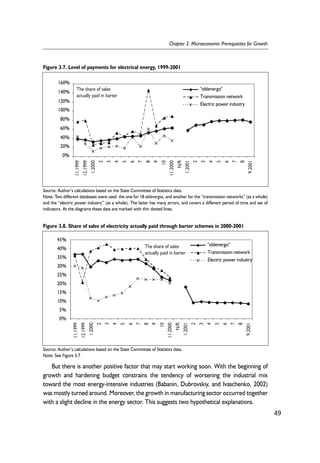
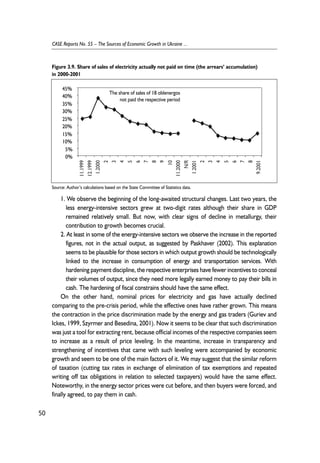
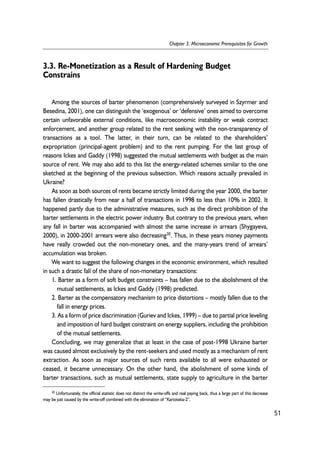
The views and opinions expressed in this publication reflect the Authors' point of view and not 
necessarily that of CASE. 
The study was prepared for the World Bank, ECA Region, ECCU2. 
The typesetting of the report was financed by Rabobank Polska S.A. 
Key words: 
Ukraine, transition, economic growth, economic policies, fiscal policy, monetary policy, privatization, 
energy sector, payment arrears, investment, agriculture, financial system, governance, economic reforms, 
exchange rate, trade flows, growth projections 
Review by Luca Barbone, PhD 
© CASE – Center for Social and Economic Research, Warsaw 2003 
Graphic Design: Agnieszka Natalia Bury 
DTP: CeDeWu Sp. z o.o. 
ISSN 1506-1647, ISBN 83-7178-300-0 
Publisher: 
CASE – Center for Social and Economic Research 
ul. Sienkiewicza 12, 00-944 Warsaw, Poland 
tel.: (48 22) 622 66 27, 828 61 33, fax: (48 22) 828 60 69 
e-mail: case@case.com.pl 
www.case.com.pl
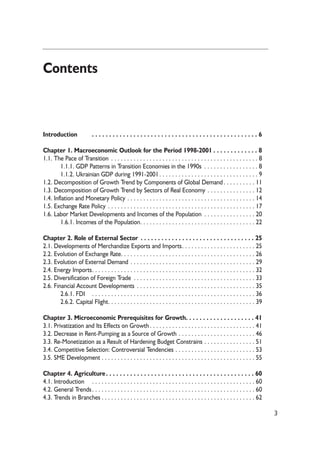
Contents 
Introduction . . . . . . . . . . . . . . . . . . . . . . . . . . . . . . . . . . . . . . . . . . . . . . . . 6 
Chapter 1. Macroeconomic Outlook for the Period 1998-2001 . . . . . . . . . . . . . 8 
1.1. The Pace of Transition . . . . . . . . . . . . . . . . . . . . . . . . . . . . . . . . . . . . . . . . . . . . . . 8 
1.1.1. GDP Patterns in Transition Economies in the 1990s . . . . . . . . . . . . . . . . . 8 
1.1.2. Ukrainian GDP during 1991-2001 . . . . . . . . . . . . . . . . . . . . . . . . . . . . . . . 9 
1.2. Decomposition of Growth Trend by Components of Global Demand . . . . . . . . . . 11 
1.3. Decomposition of Growth Trend by Sectors of Real Economy . . . . . . . . . . . . . . . 12 
1.4. Inflation and Monetary Policy . . . . . . . . . . . . . . . . . . . . . . . . . . . . . . . . . . . . . . . . 14 
1.5. Exchange Rate Policy . . . . . . . . . . . . . . . . . . . . . . . . . . . . . . . . . . . . . . . . . . . . . . 17 
1.6. Labor Market Developments and Incomes of the Population . . . . . . . . . . . . . . . . 20 
1.6.1. Incomes of the Population. . . . . . . . . . . . . . . . . . . . . . . . . . . . . . . . . . . . 22 
Chapter 2. Role of External Sector . . . . . . . . . . . . . . . . . . . . . . . . . . . . . . . . . 25 
2.1. Developments of Merchandize Exports and Imports. . . . . . . . . . . . . . . . . . . . . . . 25 
2.2. Evolution of Exchange Rate. . . . . . . . . . . . . . . . . . . . . . . . . . . . . . . . . . . . . . . . . . 26 
2.3. Evolution of External Demand . . . . . . . . . . . . . . . . . . . . . . . . . . . . . . . . . . . . . . . 29 
2.4. Energy Imports. . . . . . . . . . . . . . . . . . . . . . . . . . . . . . . . . . . . . . . . . . . . . . . . . . . 32 
2.5. Diversification of Foreign Trade . . . . . . . . . . . . . . . . . . . . . . . . . . . . . . . . . . . . . . 33 
2.6. Financial Account Developments . . . . . . . . . . . . . . . . . . . . . . . . . . . . . . . . . . . . . 35 
2.6.1. FDI . . . . . . . . . . . . . . . . . . . . . . . . . . . . . . . . . . . . . . . . . . . . . . . . . . . 36 
2.6.2. Capital Flight. . . . . . . . . . . . . . . . . . . . . . . . . . . . . . . . . . . . . . . . . . . . . . 39 
Chapter 3. Microeconomic Prerequisites for Growth. . . . . . . . . . . . . . . . . . . . 41 
3.1. Privatization and Its Effects on Growth . . . . . . . . . . . . . . . . . . . . . . . . . . . . . . . . . 41 
3.2. Decrease in Rent-Pumping as a Source of Growth . . . . . . . . . . . . . . . . . . . . . . . . 46 
3.3. Re-Monetization as a Result of Hardening Budget Constrains . . . . . . . . . . . . . . . . 51 
3.4. Competitive Selection: Controversial Tendencies . . . . . . . . . . . . . . . . . . . . . . . . . 53 
3.5. SME Development . . . . . . . . . . . . . . . . . . . . . . . . . . . . . . . . . . . . . . . . . . . . . . . . 55 
Chapter 4. Agriculture . . . . . . . . . . . . . . . . . . . . . . . . . . . . . . . . . . . . . . . . . . . 60 
4.1. Introduction . . . . . . . . . . . . . . . . . . . . . . . . . . . . . . . . . . . . . . . . . . . . . . . . . . . 60 
4.2. General Trends . . . . . . . . . . . . . . . . . . . . . . . . . . . . . . . . . . . . . . . . . . . . . . . . . . . 60 
4.3. Trends in Branches . . . . . . . . . . . . . . . . . . . . . . . . . . . . . . . . . . . . . . . . . . . . . . . . 62 
3
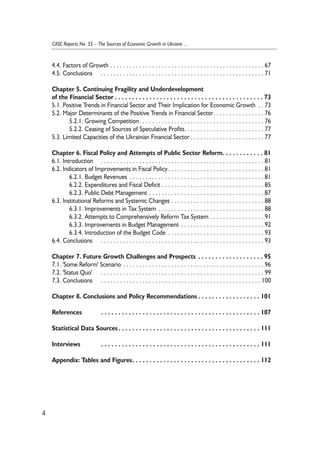
4.4. Factors of Growth . . . . . . . . . . . . . . . . . . . . . . . . . . . . . . . . . . . . . . . . . . . . . . . . 67 
4.5. Conclusions . . . . . . . . . . . . . . . . . . . . . . . . . . . . . . . . . . . . . . . . . . . . . . . . . . . 71 
Chapter 5. Continuing Fragility and Underdevelopment 
of the Financial Sector . . . . . . . . . . . . . . . . . . . . . . . . . . . . . . . . . . . . . . . . . . . 73 
5.1. Positive Trends in Financial Sector and Their Implication for Economic Growth . . 73 
5.2. Major Determinants of the Positive Trends in Financial Sector. . . . . . . . . . . . . . . . 76 
5.2.1. Growing Competition. . . . . . . . . . . . . . . . . . . . . . . . . . . . . . . . . . . . . . . 76 
5.2.2. Ceasing of Sources of Speculative Profits. . . . . . . . . . . . . . . . . . . . . . . . . 77 
5.3. Limited Capacities of the Ukrainian Financial Sector . . . . . . . . . . . . . . . . . . . . . . . 77 
Chapter 6. Fiscal Policy and Attempts of Public Sector Reform. . . . . . . . . . . . 81 
6.1. Introduction . . . . . . . . . . . . . . . . . . . . . . . . . . . . . . . . . . . . . . . . . . . . . . . . . . . 81 
6.2. Indicators of Improvements in Fiscal Policy . . . . . . . . . . . . . . . . . . . . . . . . . . . . . . 81 
6.2.1. Budget Revenues . . . . . . . . . . . . . . . . . . . . . . . . . . . . . . . . . . . . . . . . . . 81 
6.2.2. Expenditures and Fiscal Deficit . . . . . . . . . . . . . . . . . . . . . . . . . . . . . . . . 85 
6.2.3. Public Debt Management . . . . . . . . . . . . . . . . . . . . . . . . . . . . . . . . . . . . 87 
6.3. Institutional Reforms and Systemic Changes . . . . . . . . . . . . . . . . . . . . . . . . . . . . . 88 
6.3.1. Improvements in Tax System . . . . . . . . . . . . . . . . . . . . . . . . . . . . . . . . . 88 
6.3.2. Attempts to Comprehensively Reform Tax System . . . . . . . . . . . . . . . . . 91 
6.3.3. Improvements in Budget Management . . . . . . . . . . . . . . . . . . . . . . . . . . 92 
6.3.4. Introduction of the Budget Code . . . . . . . . . . . . . . . . . . . . . . . . . . . . . . 93 
6.4. Conclusions . . . . . . . . . . . . . . . . . . . . . . . . . . . . . . . . . . . . . . . . . . . . . . . . . . . 93 
Chapter 7. Future Growth Challenges and Prospects . . . . . . . . . . . . . . . . . . . 95 
7.1. 'Some Reform' Scenario . . . . . . . . . . . . . . . . . . . . . . . . . . . . . . . . . . . . . . . . . . . . 96 
7.2. 'Status Quo' . . . . . . . . . . . . . . . . . . . . . . . . . . . . . . . . . . . . . . . . . . . . . . . . . . . 99 
7.3. Conclusions . . . . . . . . . . . . . . . . . . . . . . . . . . . . . . . . . . . . . . . . . . . . . . . . . . 100 
Chapter 8. Conclusions and Policy Recommendations . . . . . . . . . . . . . . . . . . 101 
References . . . . . . . . . . . . . . . . . . . . . . . . . . . . . . . . . . . . . . . . . . . . . . 107 
Statistical Data Sources . . . . . . . . . . . . . . . . . . . . . . . . . . . . . . . . . . . . . . . . . 111 
Interviews . . . . . . . . . . . . . . . . . . . . . . . . . . . . . . . . . . . . . . . . . . . . . . 111 
Appendix: Tables and Figures. . . . . . . . . . . . . . . . . . . . . . . . . . . . . . . . . . . . . 112 
4 
CASE Reports No. 55 – The Sources of Economic Growth in Ukraine ...
Marek D¹browski 
Professor of Economics 
Chairman and one of the founders of the CASE - Center for Social and Economic Research in 
Warsaw 
From 1991 involved in policy advising for governments and central banks of Russia, Ukraine, 
Kyrgyzstan, Kazakhstan, Georgia, Uzbekistan, Mongolia, and Romania; 1989-1990 First 
Deputy Minister of Finance of Poland; 1991-1993 Member of the Sejm (lower house of the 
Polish Parliament); 1991-1996 Chairman of the Council of Ownership Changes, the advisory 
body to the Prime Minister of Poland; 1994-1995 visiting consultant of the World Bank, 
Policy Research Department; from 1998 Member of the Monetary Policy Council of the 
National Bank of Poland. Recently his area of research interest is concentrated on 
macroeconomic policy problems and political economy of transition. 
Ma³gorzata Jakubiak 
Economist at CASE 
Collaborated with CASE from 1997. Her main areas of interest include international 
economics and macroeconomic policies. During 2000-2001 she was working at the CASE 
mission in Ukraine as resident consultant, developing macro-model of the Ukraine's 
economy. She has published articles on trade flows, exchange rates, savings and investments 
in Poland and other CEE countries, and on diffusion of innovation. Graduated from the 
University of Sussex (UK; MA in 1997) and the Department of Economics at the University 
of Warsaw (MA in 1998). 
5 
Authors
6 
Introduction 
The purpose of this study is to analyze the sources of economic growth in Ukraine, which 
has been observed from the second half of 1999. In addition, we intend to answer the 
question what is the sustainability of this growth, i.e. putting in other words, what are the 
chances and conditions for maintaining growth in the future. 
Neither question is easy to answer. Analyzing sources of growth and growth sustainability 
in any transition country is a serious intellectual challenge, for a number of reasons. First, we 
do not have any comprehensive growth theory in transition economies so far. What is 
available, it is a couple of more or less empirically verified hypotheses concerning the 
influence of various macro and microeconomic factors on growth performance. Second, 
statistical data series in transition economies are still rather short and unstable as a result of 
various methodological changes in statistics and structural and institutional changes in the 
economy, which makes serious econometric analysis risky. This argument is particularly 
relevant to the Ukrainian economy, which entered structural and institutional changes with 
significant delay compared to other countries, and where the quality of statistics is below 
regional average. Third, most of transition economies, including the Ukrainian one, are open 
in terms of trade and financial flows. They have thus become sensitive to some external 
factors such as growth fluctuations in the world economy as a whole, varying conditions of 
Ukraine’s major trade partners, changing attitudes of financial investors to emerging markets, 
etc. We have seen that even countries considered as having strong and sustainable growth 
potential can seriously suffer from adverse external shocks as it happened in 1998-1999 with 
the Baltic countries and Poland after the Russian and Ukrainian financial crises. 
Nevertheless, we tried to make an in-depth analysis of both macro- and microeconomic 
factors, which might have influenced the dramatic positive about-turn in growth 
performance of Ukraine shortly after the 1998 currency crisis. Chapter 1 contains the 
macroeconomic outlook for this period. Ma³gorzata Jakubiak, Anna Myoeliñska and Artsem 
Boichanka analyze the growth dynamics and its decomposition, inflation trends, basic 
monetary aggregates, interest rates, exchange rate behavior as well as employment, wages,
and incomes of the population. Chapter 2 looks at the role of the external sector. Yurij 
Kuz’myn analyzes export and import dynamics, the role of major export sectors and 
dominant export markets, energy import, trade and current account balance, and finally 
capital account developments. In Chapter 3 Vladimir Dubrovskiy makes a review of the 
progress achieved in the microsphere with a special emphasis given to privatization, 
hardening budget constraints and payments discipline, easing the entrepreneurial 
environment and development of the SME sector. Chapter 4 of Jacek H. Schirmer discusses 
changes in the agrarian sector. Chapter 5 of Inna Golodniuk reviews the progress achieved 
in the financial sector and its remaining problems. Chapter 6 deals with the very important 
area of fiscal policy and fiscal management. Ma³gorzata Antczak and Magdalena Tomczyñska 
present changes in trends of budget revenues and expenditures, budget deficit, dynamics of 
public debt, changes in tax policy and in the budget management system. In Chapter 7 
Ma³gorzata Jakubiak and Anna Myoeliñska discuss alternative growth scenarios until the end of 
2003 depending on the speed of the further reform process. Chapter 8 written by Marek 
D¹browski and Ma³gorzata Jakubiak contains general conclusions and policy 
recommendations. 
The entire study has been prepared by a joint team of experts from CASE – Center for 
Social and Economic Research in Warsaw and its daughter organization – CASE-Ukraine in 
Kyiv. The authors benefited substantially from previous research and policy-advice projects, 
in the first instance, the USAID-funded Ukraine Macroeconomic Policy Project carried out 
in the period from 1996 to 2001. The regular analytical and forecasting work done for the 
purpose of the quarterly CASE publication ‘Ukrainian Economic Outlook’ has also helped in 
preparing the macroeconomic part of this study. 
All the chapters were written between February and June 2002 basing on data available 
for the end of 2001. The study was then revised and amended in November and December 
2002 in response to reviewers’ comments. However, the basic statistical data and forecasts 
remained as in the first version completed in June 2002. 
We want to express our deep gratitude to Luca Barbone, John Litwack, Mark Davis, 
Larisa Leshchenko and Iain Shuker who reviewed the first version of this study and whose 
valuable comments helped to improve our original analysis. However, the authors accept 
sole responsibility for the quality of each chapter and the entire study. It reflects only the 
authors’ opinions and not necessarily those of the World Bank, CASE or other institutions 
where they are affiliated. 
Marek D¹browski 
7 
Introduction
This chapter gives an overview of the macroeconomic situation in Ukraine during 1998- 
2001. It provides a background for the more in-depth studies presented in the subsequent 
chapters, by analyzing dynamics of the components of Ukrainian GDP, monetary and 
exchange rate policies, as well as trends at the labor market. 
1.1. The Pace of Transition 
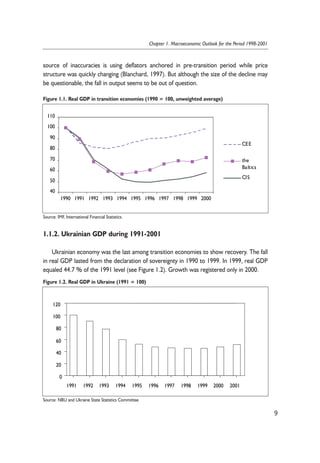
1.1.1. GDP Patterns in Transition Economies in the 1990s 
All transition economies have experienced substantial decrease of real output during the 
first years of transformation. Comparison of different countries shows that the steepest 
output decrease tends to appear during the first year of transition and then the fall continues 
for a few years. According to the relative speed of catching-up, three distinct patterns of 
transitional recession and subsequent output recovery emerge. These are patterns typical 
for: countries of Central and Eastern Europe, the Baltics and the Commonwealth of 
Independent States. Average output decline was the smallest in CEE and the most 
pronounced in CIS. The decline in CIS also lasted longer accumulating over several years 
whereas countries of CEE and the Baltics started recovering after two years of transition 
(see Fischer and Sahay, 2000 for details). In countries of CEE and the Baltics official GDP 
reached its pre-transition level by 1998 whereas CIS did not managed to fully recover even 
in 2001 (World Bank, 2002). 
It can be argued that the officially measured decline was artificially exacerbated by the 
inadequate measurement methods. Some of the economic activities might have been 
unnoticed, such as briskly growing private sector. Enterprises might have tried to hide their 
production instead of overstating it in order to meet plan requirements. Another possible 
8 
CASE Reports No. 55 – The Sources of Economic Growth in Ukraine ... 
Chapter 1 
Macroeconomic Outlook 
for the Period 1998-2001 
Artsem Boichanka, Ma³gorzata Jakubiak, Anna Myoeliñska
source of inaccuracies is using deflators anchored in pre-transition period while price 
structure was quickly changing (Blanchard, 1997). But although the size of the decline may 
be questionable, the fall in output seems to be out of question. 
110 
100 
90 
80 
70 
60 
50 
1.1.2. Ukrainian GDP during 1991-2001 
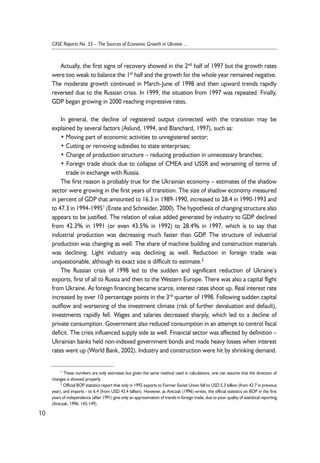
Ukrainian economy was the last among transition economies to show recovery. The fall 
in real GDP lasted from the declaration of sovereignty in 1990 to 1999. In 1999, real GDP 
equaled 44.7 % of the 1991 level (see Figure 1.2). Growth was registered only in 2000. 
9 
Chapter 1. Macroeconomic Outlook for the Period 1998-2001 
Figure 1.1. Real GDP in transition economies (1990 = 100, unweighted average) 
40 
1990 1991 1992 1993 1994 1995 1996 1997 1998 1999 2000 
CEE 
the 
Ba ltics 
CIS 
Source: IMF, International Financial Statistics. 
Figure 1.2. Real GDP in Ukraine (1991 = 100) 
120 
100 
80 
60 
40 
20 
0 
1991 1992 1993 1994 1995 1996 1997 1998 1999 2000 2001 
Source: NBU and Ukraine State Statistics Committee.
Actually, the first signs of recovery showed in the 2nd half of 1997 but the growth rates 
were too weak to balance the 1st half and the growth for the whole year remained negative. 
The moderate growth continued in March-June of 1998 and then upward trends rapidly 
reversed due to the Russian crisis. In 1999, the situation from 1997 was repeated. Finally, 
GDP began growing in 2000 reaching impressive rates. 
In general, the decline of registered output connected with the transition may be 
explained by several factors (Aslund, 1994, and Blanchard, 1997), such as: 
• Moving part of economic activities to unregistered sector; 
• Cutting or removing subsidies to state enterprises; 
• Change of production structure – reducing production in unnecessary branches; 
• Foreign trade shock due to collapse of CMEA and USSR and worsening of terms of 
trade in exchange with Russia. 
The first reason is probably true for the Ukrainian economy – estimates of the shadow 
sector were growing in the first years of transition. The size of shadow economy measured 
in percent of GDP that amounted to 16.3 in 1989-1990, increased to 28.4 in 1990-1993 and 
to 47.3 in 1994-19951 (Enste and Schneider, 2000). The hypothesis of changing structure also 
appears to be justified. The relation of value added generated by industry to GDP declined 
from 42.3% in 1991 (or even 43.5% in 1992) to 28.4% in 1997, which is to say that 
industrial production was decreasing much faster than GDP. The structure of industrial 
production was changing as well. The share of machine building and construction materials 
was declining. Light industry was declining as well. Reduction in foreign trade was 
unquestionable, although its exact size is difficult to estimate.2 
The Russian crisis of 1998 led to the sudden and significant reduction of Ukraine’s 
exports, first of all to Russia and then to the Western Europe. There was also a capital flight 
from Ukraine. As foreign financing became scarce, interest rates shoot up. Real interest rate 
increased by over 10 percentage points in the 3rd quarter of 1998. Following sudden capital 
outflow and worsening of the investment climate (risk of further devaluation and default), 
investments rapidly fell. Wages and salaries decreased sharply, which led to a decline of 
private consumption. Government also reduced consumption in an attempt to control fiscal 
deficit. The crisis influenced supply side as well. Financial sector was affected by definition – 
Ukrainian banks held non-indexed government bonds and made heavy losses when interest 
rates went up (World Bank, 2002). Industry and construction were hit by shrinking demand. 
10 
CASE Reports No. 55 – The Sources of Economic Growth in Ukraine ... 
1 These numbers are only estimates but given the same method used in calculations, one can assume that the direction of 
changes is showed properly. 
2 Official BOP statistics report that only in 1992 exports to Former Soviet Union fell to USD 5.3 billion (from 42.7 in previous 
year), and imports - to 6.4 (from USD 43.4 billion). However, as Antczak (1996) writes, the official statistics on BOP in the first 
years of independence (after 1991) give only an approximation of trends in foreign trade, due to poor quality of statistical reporting 
(Antczak, 1996: 145-149).
At the end of 1999, all negative trends reversed and the country experienced the first year 
of economic growth for a long time. 
1.2. Decomposition of Growth Trend by Components of Global 
Demand 
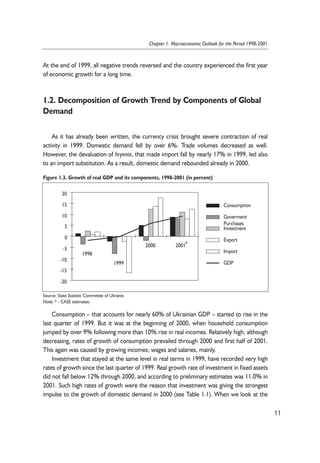
As it has already been written, the currency crisis brought severe contraction of real 
activity in 1999. Domestic demand fell by over 6%. Trade volumes decreased as well. 
However, the devaluation of hryvnia, that made import fall by nearly 17% in 1999, led also 
to an import substitution. As a result, domestic demand rebounded already in 2000. 
20 
15 
10 
5 
0 
-5 
-10 
-15 
Consumption – that accounts for nearly 60% of Ukrainian GDP – started to rise in the 
last quarter of 1999. But it was at the beginning of 2000, when household consumption 
jumped by over 9% following more than 10% rise in real incomes. Relatively high, although 
decreasing, rates of growth of consumption prevailed through 2000 and first half of 2001. 
This again was caused by growing incomes; wages and salaries, mainly. 
Investment that stayed at the same level in real terms in 1999, have recorded very high 
rates of growth since the last quarter of 1999. Real growth rate of investment in fixed assets 
did not fall below 12% through 2000, and according to preliminary estimates was 11.0% in 
2001. Such high rates of growth were the reason that investment was giving the strongest 
impulse to the growth of domestic demand in 2000 (see Table 1.1). When we look at the 
11 
Chapter 1. Macroeconomic Outlook for the Period 1998-2001 
Figure 1.3. Growth of real GDP and its components, 1998-2001 (in percent) 
-20 
1998 
1999 
2000 2001 
Consumption 
Goverment 
Purchases 
Investment 
Export 
Import 
GDP 
* 
Source: State Statistic Committee of Ukraine. 
Note: * - CASE estimates.
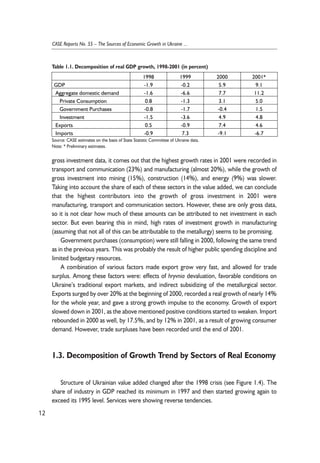
Table 1.1. Decomposition of real GDP growth, 1998-2001 (in percent) 
gross investment data, it comes out that the highest growth rates in 2001 were recorded in 
transport and communication (23%) and manufacturing (almost 20%), while the growth of 
gross investment into mining (15%), construction (14%), and energy (9%) was slower. 
Taking into account the share of each of these sectors in the value added, we can conclude 
that the highest contributors into the growth of gross investment in 2001 were 
manufacturing, transport and communication sectors. However, these are only gross data, 
so it is not clear how much of these amounts can be attributed to net investment in each 
sector. But even bearing this in mind, high rates of investment growth in manufacturing 
(assuming that not all of this can be attributable to the metallurgy) seems to be promising. 
Government purchases (consumption) were still falling in 2000, following the same trend 
as in the previous years. This was probably the result of higher public spending discipline and 
limited budgetary resources. 
A combination of various factors made export grow very fast, and allowed for trade 
surplus. Among these factors were: effects of hryvnia devaluation, favorable conditions on 
Ukraine’s traditional export markets, and indirect subsidizing of the metallurgical sector. 
Exports surged by over 20% at the beginning of 2000, recorded a real growth of nearly 14% 
for the whole year, and gave a strong growth impulse to the economy. Growth of export 
slowed down in 2001, as the above mentioned positive conditions started to weaken. Import 
rebounded in 2000 as well, by 17.5%, and by 12% in 2001, as a result of growing consumer 
demand. However, trade surpluses have been recorded until the end of 2001. 
1.3. Decomposition of Growth Trend by Sectors of Real Economy 
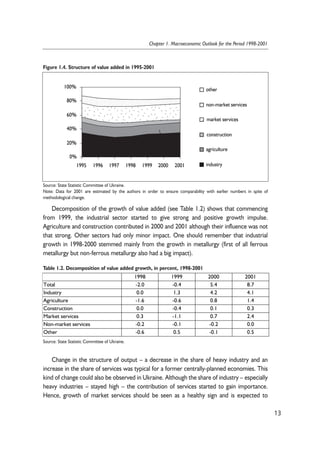
Structure of Ukrainian value added changed after the 1998 crisis (see Figure 1.4). The 
share of industry in GDP reached its minimum in 1997 and then started growing again to 
exceed its 1995 level. Services were showing reverse tendencies. 
12 
CASE Reports No. 55 – The Sources of Economic Growth in Ukraine ... 
1998 1999 2000 2001* 
GDP -1.9 -0.2 5.9 9.1 
Aggregate domestic demand -1.6 -6.6 7.7 11.2 
Private Consumption 0.8 -1.3 3.1 5.0 
Government Purchases -0.8 -1.7 -0.4 1.5 
Investment -1.5 -3.6 4.9 4.8 
Exports 0.5 -0.9 7.4 4.6 
Imports -0.9 7.3 -9.1 -6.7 
Source: CASE estimates on the basis of State Statistic Committee of Ukraine data. 
Note: * Preliminary estimates.
100% 
80% 
60% 
40% 
20% 
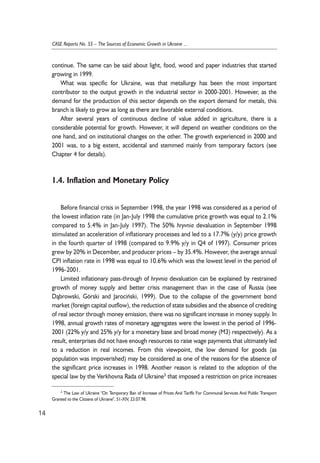
Decomposition of the growth of value added (see Table 1.2) shows that commencing 
from 1999, the industrial sector started to give strong and positive growth impulse. 
Agriculture and construction contributed in 2000 and 2001 although their influence was not 
that strong. Other sectors had only minor impact. One should remember that industrial 
growth in 1998-2000 stemmed mainly from the growth in metallurgy (first of all ferrous 
metallurgy but non-ferrous metallurgy also had a big impact). 
Table 1.2. Decomposition of value added growth, in percent, 1998-2001 
Change in the structure of output – a decrease in the share of heavy industry and an 
increase in the share of services was typical for a former centrally-planned economies. This 
kind of change could also be observed in Ukraine. Although the share of industry – especially 
heavy industries – stayed high – the contribution of services started to gain importance. 
Hence, growth of market services should be seen as a healthy sign and is expected to 
13 
Chapter 1. Macroeconomic Outlook for the Period 1998-2001 
Figure 1.4. Structure of value added in 1995-2001 
0% 
1995 1996 1997 1998 1999 2000 2001 
other 
non-market services 
market services 
construction 
agriculture 
industry 
 
Source: State Statistic Committee of Ukraine. 
Note: Data for 2001 are estimated by the authors in order to ensure comparability with earlier numbers in spite of 
methodological change. 
1998 1999 2000 2001 
Total -2.0 -0.4 5.4 8.7 
Industry 0.0 1.3 4.2 4.1 
Agriculture -1.6 -0.6 0.8 1.4 
Construction 0.0 -0.4 0.1 0.3 
Market services 0.3 -1.1 0.7 2.4 
Non-market services -0.2 -0.1 -0.2 0.0 
Other -0.6 0.5 -0.1 0.5 
Source: State Statistic Committee of Ukraine.
continue. The same can be said about light, food, wood and paper industries that started 
growing in 1999. 
What was specific for Ukraine, was that metallurgy has been the most important 
contributor to the output growth in the industrial sector in 2000-2001. However, as the 
demand for the production of this sector depends on the export demand for metals, this 
branch is likely to grow as long as there are favorable external conditions. 
After several years of continuous decline of value added in agriculture, there is a 
considerable potential for growth. However, it will depend on weather conditions on the 
one hand, and on institutional changes on the other. The growth experienced in 2000 and 
2001 was, to a big extent, accidental and stemmed mainly from temporary factors (see 
Chapter 4 for details). 
1.4. Inflation and Monetary Policy 
Before financial crisis in September 1998, the year 1998 was considered as a period of 
the lowest inflation rate (in Jan-July 1998 the cumulative price growth was equal to 2.1% 
compared to 5.4% in Jan-July 1997). The 50% hryvnia devaluation in September 1998 
stimulated an acceleration of inflationary processes and led to a 17.7% (y/y) price growth 
in the fourth quarter of 1998 (compared to 9.9% y/y in Q4 of 1997). Consumer prices 
grew by 20% in December, and producer prices – by 35.4%. However, the average annual 
CPI inflation rate in 1998 was equal to 10.6% which was the lowest level in the period of 
1996-2001. 
Limited inflationary pass-through of hryvnia devaluation can be explained by restrained 
growth of money supply and better crisis management than in the case of Russia (see 
D¹browski, Górski and Jarociñski, 1999). Due to the collapse of the government bond 
market (foreign capital outflow), the reduction of state subsidies and the absence of crediting 
of real sector through money emission, there was no significant increase in money supply. In 
1998, annual growth rates of monetary aggregates were the lowest in the period of 1996- 
2001 (22% y/y and 25% y/y for a monetary base and broad money (M3) respectively). As a 
result, enterprises did not have enough resources to raise wage payments that ultimately led 
to a reduction in real incomes. From this viewpoint, the low demand for goods (as 
population was impoverished) may be considered as one of the reasons for the absence of 
the significant price increases in 1998. Another reason is related to the adoption of the 
special law by the Verkhovna Rada of Ukraine3 that imposed a restriction on price increases 
14 
CASE Reports No. 55 – The Sources of Economic Growth in Ukraine ... 
3 The Law of Ukraine "On Temporary Ban of Increase of Prices And Tariffs For Communal Services And Public Transport 
Granted to the Citizens of Ukraine", 51-XIV, 23.07.98.
for communal services and public transport, which constituted 70% of the consumer 
services basket. 
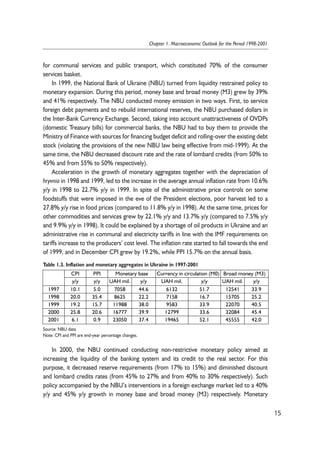
In 1999, the National Bank of Ukraine (NBU) turned from liquidity restrained policy to 
monetary expansion. During this period, money base and broad money (M3) grew by 39% 
and 41% respectively. The NBU conducted money emission in two ways. First, to service 
foreign debt payments and to rebuild international reserves, the NBU purchased dollars in 
the Inter-Bank Currency Exchange. Second, taking into account unattractiveness of OVDPs 
(domestic Treasury bills) for commercial banks, the NBU had to buy them to provide the 
Ministry of Finance with sources for financing budget deficit and rolling-over the existing debt 
stock (violating the provisions of the new NBU law being effective from mid-1999). At the 
same time, the NBU decreased discount rate and the rate of lombard credits (from 50% to 
45% and from 55% to 50% respectively). 
Acceleration in the growth of monetary aggregates together with the depreciation of 
hryvnia in 1998 and 1999, led to the increase in the average annual inflation rate from 10.6% 
y/y in 1998 to 22.7% y/y in 1999. In spite of the administrative price controls on some 
foodstuffs that were imposed in the eve of the President elections, poor harvest led to a 
27.8% y/y rise in food prices (compared to 11.8% y/y in 1998). At the same time, prices for 
other commodities and services grew by 22.1% y/y and 13.7% y/y (compared to 7.5% y/y 
and 9.9% y/y in 1998). It could be explained by a shortage of oil products in Ukraine and an 
administrative rise in communal and electricity tariffs in line with the IMF requirements on 
tariffs increase to the producers’ cost level. The inflation rate started to fall towards the end 
of 1999, and in December CPI grew by 19.2%, while PPI 15.7% on the annual basis. 
Table 1.3. Inflation and monetary aggregates in Ukraine in 1997-2001 
In 2000, the NBU continued conducting non-restrictive monetary policy aimed at 
increasing the liquidity of the banking system and its credit to the real sector. For this 
purpose, it decreased reserve requirements (from 17% to 15%) and diminished discount 
and lombard credits rates (from 45% to 27% and from 40% to 30% respectively). Such 
policy accompanied by the NBU’s interventions in a foreign exchange market led to a 40% 
y/y and 45% y/y growth in money base and broad money (M3) respectively. Monetary 
15 
Chapter 1. Macroeconomic Outlook for the Period 1998-2001 
CPI PPI Monetary base Currency in circulation (M0) Broad money (M3) 
y/y y/y UAH mil. y/y UAH mil. y/y UAH mil. y/y 
1997 10.1 5.0 7058 44.6 6132 51.7 12541 33.9 
1998 20.0 35.4 8625 22.2 7158 16.7 15705 25.2 
1999 19.2 15.7 11988 38.0 9583 33.9 22070 40.5 
2000 25.8 20.6 16777 39.9 12799 33.6 32084 45.4 
2001 6.1 0.9 23050 37.4 19465 52.1 45555 42.0 
Source: NBU data. 
Note: CPI and PPI are end-year percentage changes.
expansion contributed to a further acceleration of average annual CPI growth from 22.7% 
y/y in 1999 to 28.2% y/y in 2000. End-year CPI inflation was 25.8%. A 28.4% y/y rise in 
foodstuff prices recorded in December 2000 was induced partially by the poor harvest in 
1999 and the relatively high demand on food and agricultural products that was stimulated 
by growing incomes of households. At the same time, several administrative rises in tariffs 
for communal and telecommunication services led to a 31.2% y/y increase in prices for 
services in December 2000 compared to 11.9% y/y at the end of 1999. 
To stimulate further the increase of credit to the real sector by commercial banks4, the 
NBU kept its expansionary monetary policy in 2001 as well. The NBU’s interventions in 
foreign exchange market along with the reduction in reserve requirements for commercial 
banks (from 14% to 6%) and of the discount rate (from 27% to 12.5%) contributed to a 
37% y/y and 40% y/y increase in money base and broad money (M3) respectively. However, 
unlike the previous years, such increase in monetary aggregates was accompanied by lower 
rate of inflation. CPI increased by 6.1% in 2001, and PPI by 0.9%. This was much less than 
the end-year inflation for 2000 (when CPI grew by 25.8%) and 1999 (CPI grew by 19.2%). 
The increase in money supply was absorbed by an increase in the demand for domestic 
currency. 
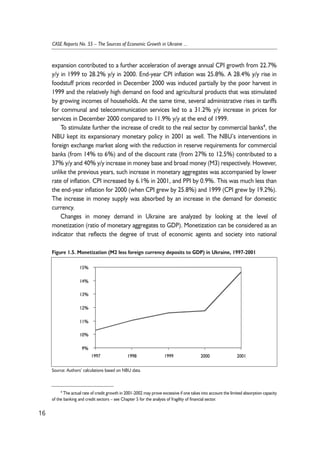
Changes in money demand in Ukraine are analyzed by looking at the level of 
monetization (ratio of monetary aggregates to GDP). Monetization can be considered as an 
indicator that reflects the degree of trust of economic agents and society into national 
16 
CASE Reports No. 55 – The Sources of Economic Growth in Ukraine ... 
Figure 1.5. Monetization (M2 less foreign currency deposits to GDP) in Ukraine, 1997-2001 
15% 
14% 
13% 
12% 
11% 
10% 
9% 
1997 1998 1999 2000 2001 
Source: Authors’ calculations based on NBU data. 
4 The actual rate of credit growth in 2001-2002 may prove excessive if one takes into account the limited absorption capacity 
of the banking and credit sectors – see Chapter 5 for the analysis of fragility of financial sector.
currency and monetary policy conducted by the central bank. Thus, an increase in 
monetization can be interpreted as an increase in the demand for money. A growth in 
monetization demonstrates the ability of the economy to absorb an increase in money supply 
without the pass-through on inflation. 
Figure 1.5 demonstrates levels of monetization (as a ratio of broad money less foreign 
currency deposits to GDP) in Ukraine during 1997-2001. The first observation is that 
Ukrainian economy is monetized to a very small extent. Foreign currency deposits were 
subtracted from the M2 aggregate in order to give a better picture of the hryvnia demand. 
But even when we consider the usual indicator of monetization, that is M2/GDP, it still 
remains low for Ukraine. It reached the level of 22.3% by the end of 2001 (compared to 60- 
70% of GDP in developed countries). Nevertheless, it can be seen from the Figure 1.5 that 
there was a significant acceleration in the increase of the demand for domestic currency in 
2001. Thus, the monetary expansion of 2001 was coupled with the considerable increase in 
the confidence to hryvnia. The high money supply growth in 2001 (52.1% y/y for M0 and 
40% y/y for M3) was absorbed by the increased demand, and the country recorded one of 
the lowest inflation rates in 1997-2001 (6.1% y/y in December 2001). The trend of lowering 
inflation expectations continued through the first months of 2002, and CPI grew on the 
annual basis only by 2.1% in May 2002 (5.6% in January). The open question is whether the 
observed increasing demand for hryvnia reflecting higher confidence to a national currency 
will be sustainable in longer run. 
1.5. Exchange Rate Policy 
To overcome the financial crisis in August 1998 and to prevent significant hryvnia 
devaluation, the NBU introduced a number of restrictions in a foreign exchange market. In 
particular, it reduced a maximum allowed deviations of cash-market exchange rate from the 
official exchange rate, imposed a surrender requirement of 75% for export proceeds and 
restricted access to foreign exchange market for the so-called speculators. In 1998, the 
NBU’s reserves went down by USD billion 1.579 to USD million 761.3. All this allowed the 
NBU to keep the official exchange rate at the almost constant level of UAH/USD 3.43 
beginning from October 1998. Nevertheless, in 1998 hryvnia was devalued against US dollar 
by 80% (to UAH/USD 3.427), and the majority of this change took place during September 
1998. Taking into account lower rate of inflation (about 20%) during the same period, it is 
clear that in 1998 hryvnia was devalued in real terms as well. This real devaluation was playing 
an important role in stimulating Ukrainian exports during the years that followed, which – 
together with import substitution – stimulated economic growth in 2000. The more detailed 
17 
Chapter 1. Macroeconomic Outlook for the Period 1998-2001
6.0 
5.0 
4.0 
3.0 
discussion on this issue can be found in Chapter 2. On the other hand, it contributed to the 
higher rate of inflation at the end of 1998 and 1999. 
At the beginning of February 1999, the NBU announced the new band of UAH/USD 3.4- 
4.6 for 1999. At the same time, the NBU increased reserve requirements, striving for 
reduction of the speculative demand on the foreign exchange market. Following the 
agreement between Ukraine and the IMF, Ukraine had to abolish gradually foreign exchange 
restrictions. In particular, on March 19, 1999, the NBU allowed transactions on the Inter- 
Bank Currency Exchange, which contributed to the convergence of the official and black 
market exchange rates. During the first week of operations on the Inter-Bank Currency 
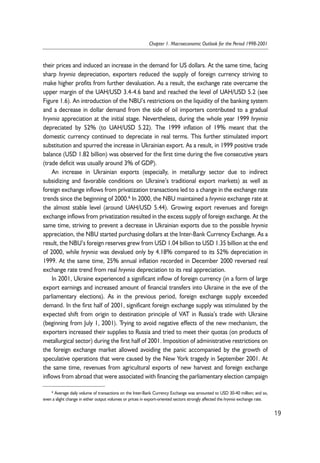
Exchange, the hryvnia depreciated from UAH/USD 3.76 to 3.93 (see Figure 1.6). 
After expanding the maximum allowed deviations of cash-market exchange rate from 
official exchange rate from 5% to 10%, as the next step the NBU eliminated any remaining 
restrictions in this sphere. On the other hand, the NBU maintained the surrender 
requirement of 50% for export proceeds5. This contributed to the excess of the foreign 
exchange supply over importers’ demand and the NBU obtained an opportunity to replenish 
its foreign exchange reserves. In 1999, they grew by USD 285.1 million and reached USD 
1.046 billion level. 
While in the first half of 1999 the NBU’s interventions managed to maintain slight 
fluctuations in hryvnia rate within limits of UAH/USD 3.93 to 3.95, in the second half of 1999 
both the domestic oil market crisis and the monetary expansion stimulated significant hryvnia 
depreciation from UAH/USD 3.95 to 4.46. Shortage of oil products led to the increase in 
18 
CASE Reports No. 55 – The Sources of Economic Growth in Ukraine ... 
Figure 1.6. Nominal exchange rate of hryvnia against US dollar in 1998-2001 
2.0 
Jan-98 Jan-99 Jan-00 Jan-01 
Source: NBU data. 
5 The NBU Board Resolution #139 "On the Introduction of Changes to the Rules of Operations on Inter-Bank Currency 
Exchange of Ukraine" as of March 24, 1999.
their prices and induced an increase in the demand for US dollars. At the same time, facing 
sharp hryvnia depreciation, exporters reduced the supply of foreign currency striving to 
make higher profits from further devaluation. As a result, the exchange rate overcame the 
upper margin of the UAH/USD 3.4-4.6 band and reached the level of UAH/USD 5.2 (see 
Figure 1.6). An introduction of the NBU’s restrictions on the liquidity of the banking system 
and a decrease in dollar demand from the side of oil importers contributed to a gradual 
hryvnia appreciation at the initial stage. Nevertheless, during the whole year 1999 hryvnia 
depreciated by 52% (to UAH/USD 5.22). The 1999 inflation of 19% meant that the 
domestic currency continued to depreciate in real terms. This further stimulated import 
substitution and spurred the increase in Ukrainian export. As a result, in 1999 positive trade 
balance (USD 1.82 billion) was observed for the first time during the five consecutive years 
(trade deficit was usually around 3% of GDP). 
An increase in Ukrainian exports (especially, in metallurgy sector due to indirect 
subsidizing and favorable conditions on Ukraine’s traditional export markets) as well as 
foreign exchange inflows from privatization transactions led to a change in the exchange rate 
trends since the beginning of 2000.6 In 2000, the NBU maintained a hryvnia exchange rate at 
the almost stable level (around UAH/USD 5.44). Growing export revenues and foreign 
exchange inflows from privatization resulted in the excess supply of foreign exchange. At the 
same time, striving to prevent a decrease in Ukrainian exports due to the possible hryvnia 
appreciation, the NBU started purchasing dollars at the Inter-Bank Currency Exchange. As a 
result, the NBU’s foreign reserves grew from USD 1.04 billion to USD 1.35 billion at the end 
of 2000, while hryvnia was devalued only by 4.18% compared to its 52% depreciation in 
1999. At the same time, 25% annual inflation recorded in December 2000 reversed real 
exchange rate trend from real hryvnia depreciation to its real appreciation. 
In 2001, Ukraine experienced a significant inflow of foreign currency (in a form of large 
export earnings and increased amount of financial transfers into Ukraine in the eve of the 
parliamentary elections). As in the previous period, foreign exchange supply exceeded 
demand. In the first half of 2001, significant foreign exchange supply was stimulated by the 
expected shift from origin to destination principle of VAT in Russia’s trade with Ukraine 
(beginning from July 1, 2001). Trying to avoid negative effects of the new mechanism, the 
exporters increased their supplies to Russia and tried to meet their quotas (on products of 
metallurgical sector) during the first half of 2001. Imposition of administrative restrictions on 
the foreign exchange market allowed avoiding the panic accompanied by the growth of 
speculative operations that were caused by the New York tragedy in September 2001. At 
the same time, revenues from agricultural exports of new harvest and foreign exchange 
inflows from abroad that were associated with financing the parliamentary election campaign 
19 
Chapter 1. Macroeconomic Outlook for the Period 1998-2001 
6 Average daily volume of transactions on the Inter-Bank Currency Exchange was amounted to USD 30-40 million; and so, 
even a slight change in either output volumes or prices in export-oriented sectors strongly affected the hryvnia exchange rate.
could be considered as factors that stimulated an increase in foreign exchange supply during 
the second half of 2001. In general, the excess of foreign exchange supply over demand 
made it possible for the NBU to enlarge further its foreign reserves. As a result, at the end 
of 2001, the official NBU’s foreign exchange reserves reached the record level of USD 3 
billion. At the same time, the NBU allowed for nominal hryvnia appreciation by 3% (to 
UAH/USD 5.27) contributing to further strengthening of the real exchange rate. 
From the analysis of monetary and exchange rate policies, it is clear that, notwithstanding 
continued monetary expansion in 1999-2001, inflation went down in 2001. Growing money 
supply was absorbed by increased confidence to the domestic currency (stable exchange 
rate and economic growth were probably the most important factors here). As to the factors 
that contributed to this economic growth, the post-crisis devaluation and hence real 
depreciation of hryvnia were driving the 1999-2000 exports expansion. However, real 
appreciation of hryvnia in 2000 and 2001 demonstrated that future economic growth in 
Ukraine would depend more on improvements in productivity than on price advantages due 
to a real depreciation as it was observed earlier. 
1.6. Labor Market Developments and Incomes of the Population 
Labor market adjustments in the 1990s followed the pattern typical for a CIS economy. 
Decline in employment was significantly smaller than the fall in production and labor demand. 
This was not the actual employment that absorbed the shock connected with the collapse of 
the centrally planned economy, but lower real wages, together with growing wage and pension 
arrears. As a result, the ratio of employed to the working age population remained practically 
unchanged. Unemployment rate dynamics have not been moving together with output. 
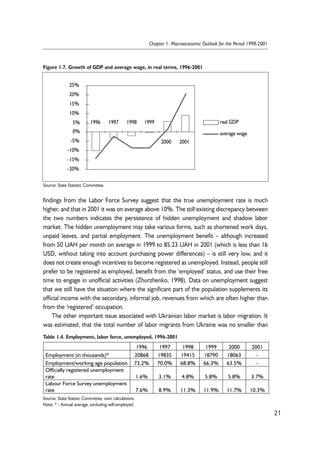
The similar pattern prevailed after the 1998 currency crisis. Neither the actual 
employment, nor its structure changed significantly during 1998-2001. These were mainly 
movements of wages that absorbed the shock and the catch-up that followed. The number 
of employed7 to the working age population was gradually falling throughout 1996-2000, and 
was unresponsive to changes in overall economic conditions. Employment in agriculture 
accounts nearly for 30% of official total employment, and employment in industry has a 
slightly higher share. The rest of employment is accounted for services and people working 
in other sectors of the economy. 
Unemployment rate that stabilized in 1999-2000, decreased a little in 2001, and 
according to the employment office records, was 3.7% at the end of 2001. However, 
20 
CASE Reports No. 55 – The Sources of Economic Growth in Ukraine ... 
7 Officially registered.
25% 
20% 
15% 
10% 
5% 
0% 
-5% 
-10% 
-15% 
findings from the Labor Force Survey suggest that the true unemployment rate is much 
higher, and that in 2001 it was on average above 10%. The still existing discrepancy between 
the two numbers indicates the persistence of hidden unemployment and shadow labor 
market. The hidden unemployment may take various forms, such as shortened work days, 
unpaid leaves, and partial employment. The unemployment benefit – although increased 
from 50 UAH per month on average in 1999 to 85.23 UAH in 2001 (which is less than 16 
USD, without taking into account purchasing power differences) – is still very low, and it 
does not create enough incentives to become registered as unemployed. Instead, people still 
prefer to be registered as employed, benefit from the ‘employed’ status, and use their free 
time to engage in unofficial activities (Zhurzhenko, 1998). Data on unemployment suggest 
that we still have the situation where the significant part of the population supplements its 
official income with the secondary, informal job, revenues from which are often higher than 
from the ‘registered’ occupation. 
The other important issue associated with Ukrainian labor market is labor migration. It 
was estimated, that the total number of labor migrants from Ukraine was no smaller than 
21 
Chapter 1. Macroeconomic Outlook for the Period 1998-2001 
Figure 1.7. Growth of GDP and average wage, in real terms, 1996-2001 
-20% 
1996 1997 1998 1999 
2000 2001 
real G DP 
average wage 
Source: State Statistic Committee. 
Table 1.4. Employment, labor force, unemployed, 1996-2001 
1996 1997 1998 1999 2000 2001 
Employment (in thousands)* 20868 19835 19415 18790 18063 - 
Employment/working age population 73.2% 70.0% 68.8% 66.3% 63.5% - 
Officially registered unemployment 
rate 1.6% 3.1% 4.8% 5.8% 5.8% 3.7% 
Labour Force Survey unemployment 
rate 7.6% 8.9% 11.3% 11.9% 11.7% 10.3% 
Source: State Statisic Committee, own calculations. 
Note: * - Annual average, excluding self-employed.
one million of persons in 2000 (Libanova, Poznyak 2002), which was equal to 4.3% of the 
economically active population (aged 15-70). The majority of migrants (81%) declared to 
hold no constant work in Ukraine at the time of their migration, and only 7% of them were 
on unpaid leave. The migrants were mainly young people with some working experience 
(30-34 age group was most frequently represented), with secondary education, and coming 
from rural areas. More than one half of them traveled to Western and Central Europe 
(among them 1/3 to Poland, then to the Czech Republic and Italy), and over 1/3 to Russia 
(mainly older workers). 
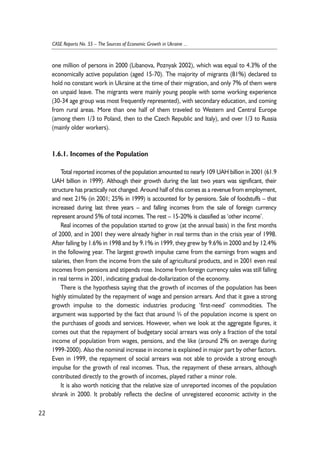
1.6.1. Incomes of the Population 
Total reported incomes of the population amounted to nearly 109 UAH billion in 2001 (61.9 
UAH billion in 1999). Although their growth during the last two years was significant, their 
structure has practically not changed. Around half of this comes as a revenue from employment, 
and next 21% (in 2001; 25% in 1999) is accounted for by pensions. Sale of foodstuffs – that 
increased during last three years – and falling incomes from the sale of foreign currency 
represent around 5% of total incomes. The rest – 15-20% is classified as ‘other income’. 
Real incomes of the population started to grow (at the annual basis) in the first months 
of 2000, and in 2001 they were already higher in real terms than in the crisis year of 1998. 
After falling by 1.6% in 1998 and by 9.1% in 1999, they grew by 9.6% in 2000 and by 12.4% 
in the following year. The largest growth impulse came from the earnings from wages and 
salaries, then from the income from the sale of agricultural products, and in 2001 even real 
incomes from pensions and stipends rose. Income from foreign currency sales was still falling 
in real terms in 2001, indicating gradual de-dollarization of the economy. 
There is the hypothesis saying that the growth of incomes of the population has been 
highly stimulated by the repayment of wage and pension arrears. And that it gave a strong 
growth impulse to the domestic industries producing ‘first-need’ commodities. The 
argument was supported by the fact that around ¾ of the population income is spent on 
the purchases of goods and services. However, when we look at the aggregate figures, it 
comes out that the repayment of budgetary social arrears was only a fraction of the total 
income of population from wages, pensions, and the like (around 2% on average during 
1999-2000). Also the nominal increase in income is explained in major part by other factors. 
Even in 1999, the repayment of social arrears was not able to provide a strong enough 
impulse for the growth of real incomes. Thus, the repayment of these arrears, although 
contributed directly to the growth of incomes, played rather a minor role. 
It is also worth noticing that the relative size of unreported incomes of the population 
shrank in 2000. It probably reflects the decline of unregistered economic activity in the 
22 
CASE Reports No. 55 – The Sources of Economic Growth in Ukraine ...
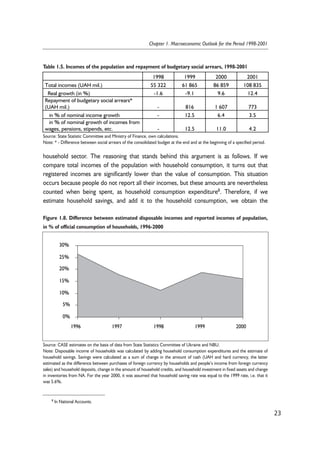
Table 1.5. Incomes of the population and repayment of budgetary social arrears, 1998-2001 
household sector. The reasoning that stands behind this argument is as follows. If we 
compare total incomes of the population with household consumption, it turns out that 
registered incomes are significantly lower than the value of consumption. This situation 
occurs because people do not report all their incomes, but these amounts are nevertheless 
counted when being spent, as household consumption expenditure8. Therefore, if we 
estimate household savings, and add it to the household consumption, we obtain the 
23 
Chapter 1. Macroeconomic Outlook for the Period 1998-2001 
1998 1999 2000 2001 
Total incomes (UAH mil.) 55 322 61 865 86 859 108 835 
Real growth (in %) -1.6 -9.1 9.6 12.4 
Repayment of budgetary social arrears* 
(UAH mil.) - 816 1 607 773 
in % of nominal income growth - 12.5 6.4 3.5 
in % of nominal growth of incomes from 
wages, pensions, stipends, etc. - 12.5 11.0 4.2 
Source: State Statistic Committee and Ministry of Finance, own calculations. 
Note: * - Difference between social arrears of the consolidated budget at the end and at the beginning of a specified period. 
Figure 1.8. Difference between estimated disposable incomes and reported incomes of population, 
in % of official consumption of households, 1996-2000 
30% 
25% 
20% 
15% 
10% 
5% 
0% 
1996 1997 1998 1999 2000 
Source: CASE estimates on the basis of data from State Statistics Committee of Ukraine and NBU. 
Note: Disposable income of households was calculated by adding household consumption expenditures and the estimate of 
household savings. Savings were calculated as a sum of change in the amount of cash (UAH and hard currency, the latter 
estimated as the difference between purchases of foreign currency by households and people’s income from foreign currency 
sales) and household deposits, change in the amount of household credits, and household investment in fixed assets and change 
in inventories from NA. For the year 2000, it was assumed that household saving rate was equal to the 1999 rate, i.e. that it 
was 5.6%. 
8 In National Accounts.
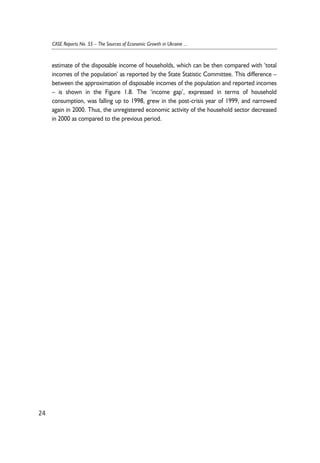
estimate of the disposable income of households, which can be then compared with ‘total 
incomes of the population’ as reported by the State Statistic Committee. This difference – 
between the approximation of disposable incomes of the population and reported incomes 
– is shown in the Figure 1.8. The ‘income gap’, expressed in terms of household 
consumption, was falling up to 1998, grew in the post-crisis year of 1999, and narrowed 
again in 2000. Thus, the unregistered economic activity of the household sector decreased 
in 2000 as compared to the previous period. 
24 
CASE Reports No. 55 – The Sources of Economic Growth in Ukraine ...
25 
Chapter 2 
Role of External Sector 
Yurij Kuz’myn 
2.1. Developments of Merchandize Exports and Imports 
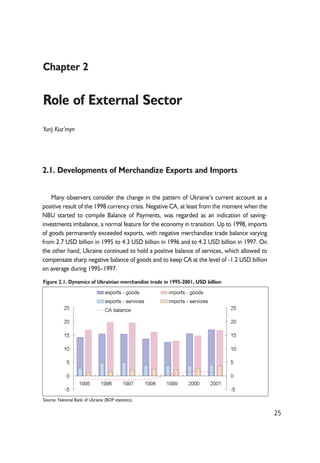
Many observers consider the change in the pattern of Ukraine’s current account as a 
positive result of the 1998 currency crisis. Negative CA, at least from the moment when the 
NBU started to compile Balance of Payments, was regarded as an indication of saving-investments 
imbalance, a normal feature for the economy in transition. Up to 1998, imports 
of goods permanently exceeded exports, with negative merchandize trade balance varying 
from 2.7 USD billion in 1995 to 4.3 USD billion in 1996 and to 4.2 USD billion in 1997. On 
the other hand, Ukraine continued to hold a positive balance of services, which allowed to 
compensate sharp negative balance of goods and to keep CA at the level of -1.2 USD billion 
on average during 1995–1997. 
Figure 2.1. Dynamics of Ukrainian merchandise trade in 1995-2001, USD billion 
Source: National Bank of Ukraine (BOP statistics).
Subsequent years brought, however, a considerable improvement in the balance of 
goods. Merchandise imports fell by 1.2 USD billion in 1998 and by 0.9 USD billion during the 
first half of 1999. This fact – despite shrinking balance of services – caused a positive CA 
balance of 0.8 USD billion in 1998. A fast growth of exports, starting in the second quarter 
of 1999 insured a positive CA during the next three years after the crisis. 
One might think of at least two main factors contributing to the improvements in the CA 
after 1998. The first is the post-crisis depreciation of hryvnia and the second is increased 
external demand. We will now turn to the discussion of these two possible factors 
influencing the pattern of trade flows in 1999-2001. 
2.2. Evolution of Exchange Rate 
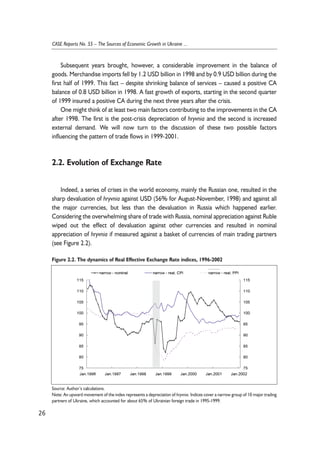
Indeed, a series of crises in the world economy, mainly the Russian one, resulted in the 
sharp devaluation of hryvnia against USD (56% for August-November, 1998) and against all 
the major currencies, but less than the devaluation in Russia which happened earlier. 
Considering the overwhelming share of trade with Russia, nominal appreciation against Ruble 
wiped out the effect of devaluation against other currencies and resulted in nominal 
appreciation of hryvnia if measured against a basket of currencies of main trading partners 
(see Figure 2.2). 
26 
CASE Reports No. 55 – The Sources of Economic Growth in Ukraine ... 
Figure 2.2. The dynamics of Real Effective Exchange Rate indices, 1996-2002 
Source: Author’s calculations. 
Note: An upward movement of the index represents a depreciation of hryvnia. Indices cover a narrow group of 10 major trading 
partners of Ukraine, which accounted for about 65% of Ukrainian foreign trade in 1995-1999.
Since consumer and producer prices reacted differently to changes in exchange rates, the 
indices of real effective exchange rate (REER) based on PPI and CPI exhibited different 
behavior, and, subsequently, articulated reallocation effects of exchange-rate changes 
differently. As a result, a situation had improved for the Ukrainian producers of consumer 
goods and adversely influenced the importers of these goods to Ukraine as hryvnia measured 
in terms of consumer goods slightly devalued in 1999. On the other hand, sharp real 
appreciation of hryvnia in terms of producer goods had worsened significantly the external 
competitiveness of Ukrainian industrial producers while relatively improving the position of 
importers of these goods to Ukraine. Although further real depreciation in the after-crisis 
period has mitigated this fall in competitiveness, one should observe that at the end of 2001 
hryvnia measured in terms of producer good prices was still about 6% stronger than before 
the crisis. 
27 
Chapter 2. Role of External Sector 
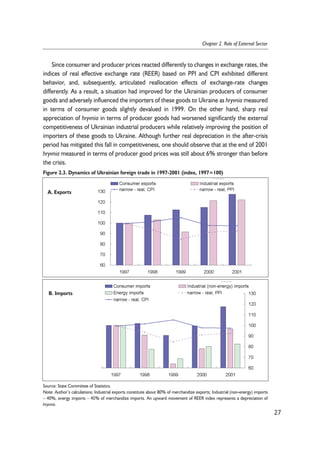
Figure 2.3. Dynamics of Ukrainian foreign trade in 1997-2001 (index, 1997=100) 
A. Exports 
B. Imports 
Source: State Committee of Statistics. 
Note: Author’s calculations; Industrial exports constitute about 80% of merchandize exports; Industrial (non-energy) imports 
– 40%, energy imports – 45% of merchandize imports. An upward movement of REER index represents a depreciation of 
hryvnia.
A year 1999 revealed theoretically predictable increase of exports and decrease of 
imports of consumer goods (see Figure 2.3), given real depreciation of hryvnia. Real 
devaluation, however, might have played a role of unintended ‘expenditures-switching 
policy’, which resulted in the decline of consumer imports in 1999. This switched peoples’ 
demand towards domestically produced consumer goods and stimulated the development 
of consumer industries, like catering, food-processing and light industries. Agriculture was 
also under the spillover effect of such stimulation. One cannot distinguish, however, whether 
it was devaluation or something else that defined the path of exports and imports of the 
consumer goods after 1999. During 2000-2001 it was no longer possible to track the 
correspondence between real appreciation (2000) and relative stability of REER (2001), on 
the one hand, and increasing exports, on the other. Similarly, even if increased import of 
consumer goods in 2000 was a result of real appreciation, this explanation does not work for 
the sharp increase of consumer imports in 2001. 
Applying the same line of arguments to the explanation of trade in industrial goods, one 
should agree that the exchange rate movements were among the factors that influenced this 
part of trade. Real appreciation depressed exports in 1999 and subsequent depreciation 
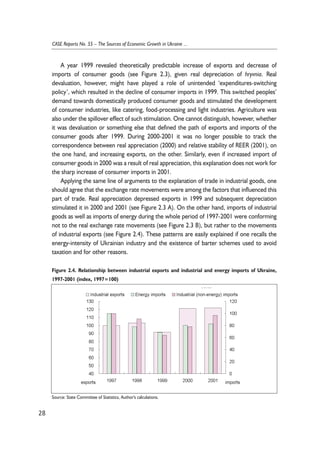
stimulated it in 2000 and 2001 (see Figure 2.3 A). On the other hand, imports of industrial 
goods as well as imports of energy during the whole period of 1997-2001 were conforming 
not to the real exchange rate movements (see Figure 2.3 B), but rather to the movements 
of industrial exports (see Figure 2.4). These patterns are easily explained if one recalls the 
energy-intensity of Ukrainian industry and the existence of barter schemes used to avoid 
taxation and for other reasons. 
28 
CASE Reports No. 55 – The Sources of Economic Growth in Ukraine ... 
Figure 2.4. Relationship between industrial exports and industrial and energy imports of Ukraine, 
1997-2001 (index, 1997=100) 
Source: State Committee of Statistics, Author's calculations.
Conclusion: While real devaluation of hryvnia boosted exports of consumer goods in 1999, 
we did not find substantial support for the hypothesis that real depreciation stimulated 
exports of consumer goods afterwards. Despite devaluation of 1999 has also resulted in the 
growth of import-competing consumer-oriented industries, considering the whole post-crisis 
period, we conclude that RER could explain only a minor portion of fluctuations in foreign 
trade flows, and, therefore, can hardly be named among the major factors influencing 
Ukrainian foreign trade. Therefore, one should be cautious when changing the exchange rate 
to promote exports before knowing the factors influencing the pass-through of the exchange 
rate on consumer and producer prices. 
2.3. Evolution of External Demand 
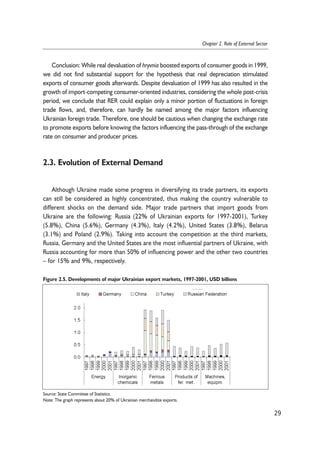
Although Ukraine made some progress in diversifying its trade partners, its exports 
can still be considered as highly concentrated, thus making the country vulnerable to 
different shocks on the demand side. Major trade partners that import goods from 
Ukraine are the following: Russia (22% of Ukrainian exports for 1997-2001), Turkey 
(5.8%), China (5.6%), Germany (4.3%), Italy (4.2%), United States (3.8%), Belarus 
(3.1%) and Poland (2.9%). Taking into account the competition at the third markets, 
Russia, Germany and the United States are the most influential partners of Ukraine, with 
Russia accounting for more than 50% of influencing power and the other two countries 
– for 15% and 9%, respectively. 
29 
Chapter 2. Role of External Sector 
Figure 2.5. Developments of major Ukrainian export markets, 1997-2001, USD billions 
Source: State Committee of Statistics. 
Note: The graph represents about 20% of Ukrainian merchandize exports.
Main groups of goods exported from Ukraine include: ferrous metals (33.5% for 1997- 
2001), machines and mechanical equipment (6%), mineral fuels (5.8%), products of ferrous 
metals (4.6%) and inorganic chemical products (3.9%). Russia, which is ranked the first at 
four out of five major exports markets (see ) along with Turkey and China consume more 
than a third of Ukrainian exports. Since export to these countries is very likely to shape the 
total exports of Ukraine, bellow we will briefly follow their role and perspectives. 
Despite the continuing economic growth, China, the biggest single market for Ukrainian 
ferrous metals, reduced its consumption substantially (see Figure 2.6). This contraction was 
the result of China’s industrial policy aimed at the development of domestic industries, whose 
products would replace imports by the time this country joins WTO and opens its market. 
Similarly to China, various protectionist measures in Russia and Germany resulted in the 
decrease of ferrous-metal exports to these countries in 2001. These measures were 
implemented soon after the successful expansion of Ukrainian exporters into these markets 
in 2000. The other reason for such a tightening was a downturn in the world metal market. 
Italy and Turkey are the only markets in this field, where exports reflected the developments 
of demand, and not of protectionist policies. 
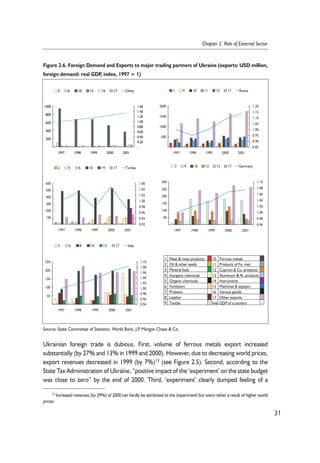
As can be seen from Figure 2.6, the most significant groups of Ukrainian exports (all of which 
are industrial goods) were not responding to changes in foreign demand in a theoretically 
predictable way. On the other hand, all ‘other exports’9 (which include also all consumer goods) 
has shown a relatively nice reaction to foreign demand. These differencies make us think that 
factors that determine development of the particular sectors of Ukrainian economy also shape it 
foreign trade. 
Without going into details (see Chapter 3), we can only suggest that economic results of 
the largest Ukrainian export-oriented industries are determined by domestic micro factors 
(undeveloped and monopolized infrastructure,10 incomplete redistribution of property 
rights,11 selective provisions of tax privileges, etc). Besides, Ukrainian government frequently 
makes efforts to create favorable environment for domestic producers and exporters (often 
under tough lobbyist pressure). A famous example of such policy was the ‘experiment in 
metallurgical sector’ – provision of implicit subsidies to metal producers.12 Its implication for 
30 
CASE Reports No. 55 – The Sources of Economic Growth in Ukraine ... 
9 Under 'other exports' we mean a large number of small provisions of various goods to the foreign markets. 
10 Monopolized railroad transportation continues to adversely influence the exporters. The prominent example of this influence 
was the case when one of the largest metal works in Ukraine had to switch from railroad to truck haulages of its products to the seaport. 
The denial of Railroad Company to deliver cargo for the specific grain exporting company was another case of monopolistic influence. 
11 It is not a rare situation (see for example exports of instruments to Turkey in 2001) when an enterprise starts exporting 
only because it starts producing as a result of completed redistribution of property rights (privatization) or restructuring. 
12 According to the law 'on experiment' adopted in July 1999, metal factories were subject to: a) half of the tax to the state 
innovation fund; b) 70% of penalties for nature pollution; c) elimination of their indebtedness to the state budget accrued before 
July 1, 1999; also granted the right to pay half of the penalties on the tax and duties' arrears accrued during the period of the 
'experiment'; d) were exempted from charges for the construction and maintenance of the roads; e) for the involved enterprise 
the rate of corporate profit tax was established at 9% (vs. 30% for the majority of other enterprises). To be eligible to participate 
in the 'experiment', the metallurgical enterprise had to meet two out of three requirements: a) produce not less than 2% of the 
goods of metallurgical industry; b) have the assets worn out at least by half; c) export not less than 8% of the goods it produces.
1000 
800 
600 
400 
1.60 
1.40 
1.20 
1.00 
0.80 
0.60 
0.40 
0.20 
2000 
1500 
1000 
1.20 
1.15 
1.10 
1.05 
1.00 
0.95 
0.90 
600 
500 
400 
300 
200 
1.06 
1.04 
1.02 
1.00 
0.98 
0.96 
0.94 
300 
250 
200 
150 
100 
1.10 
1.08 
1.06 
1.04 
1.02 
1.00 
0.98 
250 
200 
150 
100 
1.10 
1.08 
1.06 
1.04 
1.02 
1.00 
0.98 
0.96 
Ukrainian foreign trade is dubious. First, volume of ferrous metals export increased 
substantially (by 27% and 13% in 1999 and 2000). However, due to decreasing world prices, 
export revenues decreased in 1999 (by 7%)13 (see Figure 2.5). Second, according to the 
State Tax Administration of Ukraine, “positive impact of the ‘experiment’ on the state budget 
was close to zero” by the end of 2000. Third, ‘experiment’ clearly dumped feeling of a 
31 
Chapter 2. Role of External Sector 
Figure 2.6. Foreign Demand and Exports to major trading partners of Ukraine (exports: USD million, 
foreign demand: real GDP, index, 1997 = 1) 
200 
1997 1998 1999 2000 2001 
- 
5 6 10 15 16 17 China 
500 
1997 1998 1999 2000 2001 
0.85 
1 4 10 11 15 17 Russia 
100 
1997 1998 1999 2000 2001 
0.92 
2 4 6 10 14 17 Turkey 
50 
1997 1998 1999 2000 2001 
0.96 
7 9 10 12 13 17 Germany 
50 
1997 1998 1999 2000 2001 
0.94 
3 6 8 10 13 17 Italy 
1 Meat & meat products 10 Ferrous metals 
2 Oil & other seeds 11 Products of Fe. met. 
3 Mineral fuels 12 Cuprum & Cu. products 
4 Inorganic chemicals 13 Aluminum & Al. products 
5 Organic chemicals 14 Instruments 
6 Fertilizers 15 Machines & equipm. 
7 Proteins 16 Various goods 
8 Leather 17 Other exports 
9 Textile line GDP of a country -- 
Source: State Committee of Statistics. World Bank, J.P. Morgan Chase & Co. 
13 Increased revenues (by 29%) of 2000 can hardly be attributed to the 'experiment' but were rather a result of higher world 
prices.
market in the involved enterprises, as there were weak correlations between the world 
demand and exports from Ukraine. One should expect that enterprises, which increased 
capital investments into metallurgy as a result of the experiment (by 60% over year in 2000) 
under depressed world demand will require additional donations from the budget. Fourth, 
boom of metal exports from Ukraine, as it was already mentioned, resulted in several anti-dumping 
investigations and protectionist measures brought up by Ukrainian trade partners. 
As a result of the above factors, volume of metallurgical exports from Ukraine decreased by 
9%, while revenues decreased by 8% in 2001. 
Again, in our opinion, supply-side factors, which determine the evolution of domestic 
industries, shape also (and, possibly to the major extent) Ukrainian exports. Governmental 
policies aimed to promote exports by explicit or implicit subsidies to the producers so far 
might be called as effective only in the short run, while over the longer period their positive 
impact is not determined. 
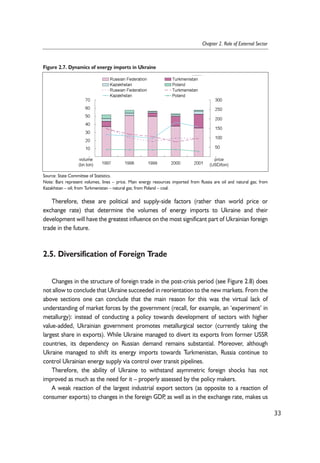
2.4. Energy Imports 
The crisis of 1998 had positive impact on Ukrainian energy imports in a sense that it 
resulted in lower prices for the imported natural gas (see Figure 2.7). This is, probably a 
reason that, despite economic downturn in 1998 and 1999, Ukraine has not significantly 
decreased its consumption of this resource. 
When Ukraine started to shift from Russian to Turkmen gas in 1999, Russia further 
decreased its price. The lowered prices were major reason for the decreases of nominal 
energy imports in 1998-1999. While Ukraine continued to increase the share of the Turkmen 
gas in its imports in 2001, it became unable to decrease the price further because Russia, 
managed to establish control over gas transit through its territory. Also, the Government of 
Ukraine lacked political will to deal with the Ukrainian monopolies being in charge of gas 
imports to Ukraine.14 Another reason for the weak bargaining power and slow progress in 
this sphere is huge debt before Russia for a gas supplied in previous years. 
Economic growth in 2000 and 2001 has not brought, however, proportional increase of 
natural gas imports. This is either an indication for more efficient use of energy by Ukrainian 
enterprises or is merely a result of a shift towards the official economic activity in Ukraine. 
The latter argument favors the hypothesis that economic growth in Ukraine was due to 
change in proportions between shadow and official sectors of the economy. 
32 
CASE Reports No. 55 – The Sources of Economic Growth in Ukraine ... 
14 According to the report of the US Embassy in Kyiv, in 1998-99, Ukraine was buying Russian gas at $80 per 1,000 cu m, 
Turkmen gas at $72 per 1,000 cu m, while Russian Gazprom was selling it at $30 to Belarus and at no more than $56 to European 
countries.
Therefore, these are political and supply-side factors (rather than world price or 
exchange rate) that determine the volumes of energy imports to Ukraine and their 
development will have the greatest influence on the most significant part of Ukrainian foreign 
trade in the future. 
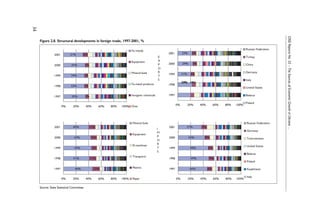
2.5. Diversification of Foreign Trade 
Changes in the structure of foreign trade in the post-crisis period (see Figure 2.8) does 
not allow to conclude that Ukraine succeeded in reorientation to the new markets. From the 
above sections one can conclude that the main reason for this was the virtual lack of 
understanding of market forces by the government (recall, for example, an ‘experiment’ in 
metallurgy): instead of conducting a policy towards development of sectors with higher 
value-added, Ukrainian government promotes metallurgical sector (currently taking the 
largest share in exports). While Ukraine managed to divert its exports from former USSR 
countries, its dependency on Russian demand remains substantial. Moreover, although 
Ukraine managed to shift its energy imports towards Turkmenistan, Russia continue to 
control Ukrainian energy supply via control over transit pipelines. 
Therefore, the ability of Ukraine to withstand asymmetric foreign shocks has not 
improved as much as the need for it – properly assessed by the policy makers. 
A weak reaction of the largest industrial export sectors (as opposite to a reaction of 
consumer exports) to changes in the foreign GDP, as well as in the exchange rate, makes us 
33 
Chapter 2. Role of External Sector 
Figure 2.7. Dynamics of energy imports in Ukraine 
Source: State Committee of Statistics. 
Note: Bars represent volumes, lines – price. Main energy resources imported from Russia are oil and natural gas; from 
Kazakhstan – oil; from Turkmenistan – natural gas; from Poland – coal.
34 
CASE Reports No. 55 – The Sources of Economic Growth in Ukraine ... 
Figure 2.8. Structural developments in foreign trade, 1997-2001, % 
31% 
35% 
34% 
33% 
35% 
8% 
6% 
5% 
6% 
5% 
0% 20% 40% 60% 80% 100% 
2001 
2000 
1999 
1998 
1997 
Fe.metals 
Equipment 
Mineral fuels 
Fe.metal products 
Inorganic chemicals 
Ores 
E 
X 
P 
O 
R 
T 
S 
23% 
24% 
21% 
2203%% 
6% 
6% 
6% 
6%6% 
0% 20% 40% 60% 80% 100% 
2001 
2000 
1999 
1998 
1997 
Russian Federation 
Turkey 
China 
Germany 
Italy 
United States 
Belarus 
Poland 
E 
40% 
43% 
44% 
41% 
46% 
11% 
10% 
9% 
11% 
12% 
0% 20% 40% 60% 80% 100% 
2001 
2000 
1999 
1998 
1997 
Mineral fuels 
Equipment 
El.machines 
Transports 
Plastics 
Paper 
I 
M 
P 
O 
R 
T 
S 
37% 
42% 
48% 
49% 
46% 
8% 
8% 
9% 
8% 
9% 
0% 20% 40% 60% 80% 100% 
2001 
2000 
1999 
1998 
1997 
Russian Federation 
Germany 
Turkmenistan 
United States 
Belarus 
Poland 
Kazakhstan 
Italy 
Source: State Statistical Committee.
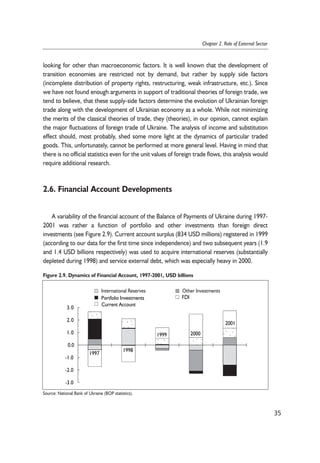
looking for other than macroeconomic factors. It is well known that the development of 
transition economies are restricted not by demand, but rather by supply side factors 
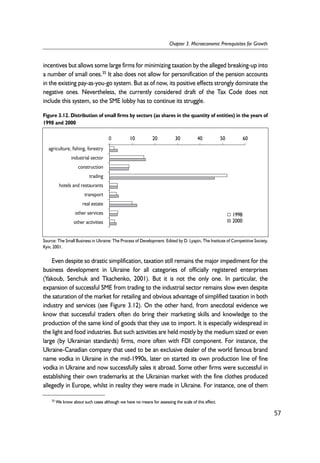
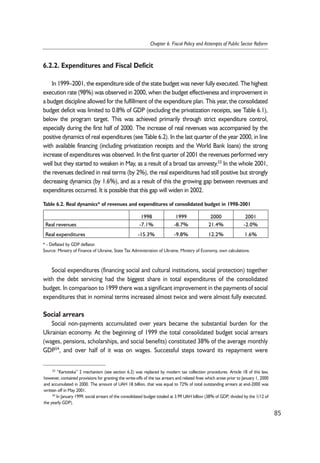
(incomplete distribution of property rights, restructuring, weak infrastructure, etc.). Since 
we have not found enough arguments in support of traditional theories of foreign trade, we 
tend to believe, that these supply-side factors determine the evolution of Ukrainian foreign 
trade along with the development of Ukrainian economy as a whole. While not minimizing 
the merits of the classical theories of trade, they (theories), in our opinion, cannot explain 
the major fluctuations of foreign trade of Ukraine. The analysis of income and substitution 
effect should, most probably, shed some more light at the dynamics of particular traded 
goods. This, unfortunately, cannot be performed at more general level. Having in mind that 
there is no official statistics even for the unit values of foreign trade flows, this analysis would 
require additional research. 
2.6. Financial Account Developments 
A variability of the financial account of the Balance of Payments of Ukraine during 1997- 
2001 was rather a function of portfolio and other investments than foreign direct 
investments (see Figure 2.9). Current account surplus (834 USD millions) registered in 1999 
(according to our data for the first time since independence) and two subsequent years (1.9 
and 1.4 USD billions respectively) was used to acquire international reserves (substantially 
depleted during 1998) and service external debt, which was especially heavy in 2000. 
35 
Chapter 2. Role of External Sector 
Figure 2.9. Dynamics of Financial Account, 1997-2001, USD billions 
3.0 
2.0 
1.0 
0.0 
-1.0 
-2.0 
-3.0 
International Reserves Other Investments 
1997 1998 
1999 2000 
2001 
Portfolio Investments FDI 
Current Account 
Source: National Bank of Ukraine (BOP statistics).
2.6.1. FDI 
Permanent increase in FDI is often perceived as a sign of irrevocable changes in 
investment climate of a home country, and thus, a sign of sustainability of economic growth. 
In Ukraine, FDI has shown modest positive development. First of all, the stock of FDI in 
Ukraine is low: $89 per capita at the beginning of 2002, compared with $253 in the Czech 
Republic and $239 in Hungary in 1998. Second, the inflows of FDI are moderate. In the case 
of a country that has initially low level of foreign-capital engagement and pursues deep and 
comprehensive reforms, one might expect a sharp increase in FDI. This was not the case in 
Ukraine. As one can see from Figure 2.10, a year after the 1998-crisis FDI inflows decreased 
sharply (which was not surprising). Also in 2000 and 2001, when Ukraine experienced 
economic growth, FDI did not increase drastically. 
The reasons for such development lie in excessive regulations and investor doubts concerning 
sustainability of the reform progress in Ukraine. According to the Heritage Index of Economic 
Freedom, Ukraine has bad conditions for attracting FDI: the index is 3.15 The best overall rank 
that Ukraine received was in 2000 (116 out of 155), when the growth has started. Since then, the 
rank has deteriorated, which might be a sign of the beginning of the reverse trend. 
Table 2.1. Selected Indices of Economic Freedom in 2002 
Overall 
Rank 
Country Fiscal 
burden 
Govern-mental 
inter-ventions 
Banking 
and 
finance 
Property 
rights 
Regulation Black 
markets 
45 Poland 4.5 2 2 2 3 3.5 
108 Bulgaria 4.5 3 3 3 4 3.5 
116 ↑ Ukraine-00 4 ↑ 3 4 4 4 4 
122 Ukraine –97 4.5 3 4 3 4 4 
131 Russia 3.5 2.5 4 4 4 4 
137 ↓ Ukraine-02 4.5 ↓ 4 ↓ 4 4 4 4 
148 Belarus 4.5 4 4 4 5 5 
Source: The Heritage Foundation. 
Note: Overall rank out of 155 countries, which were assessed. The smaller is the number, the better are the conditions. 
The low level and negligible inflows of FDI persist in Ukraine, because the domestic 
situation is still perceived as unstable. Therefore, FDI cannot be regarded as a factor, which 
contributed to the economic growth of 2000-2001, but rather as a by-product of the other 
growth-related factors. As can be seen from Figure 2.10, there was a decline in the FDI 
inflows for the majority of activities regarded as competitive (catering, wholesales, financial 
36 
CASE Reports No. 55 – The Sources of Economic Growth in Ukraine ... 
15 1 for very good conditions, 5 – for very bad and this component of index does not change from 1997. The index also 
includes such factors as fiscal burden, government interventions, banking and finance, property rights, regulation and black 
markets, which also have substantial impact on FDI.
services) in 1999. When the situation became more predictable (2000), FDI into these 
industries increased significantly. The opposite developments took place in industries, which 
could be regarded as less competitive. The predictability of economic conditions was not a 
concern for those investing into less competitive industries, which happens, probably 
because they are (or at least they expect to be) powerful enough to keep the situation under 
control. For example, Korean investors were a major investor into the automobile sector 
(DAEWOO), Russian – into oil refineries and Ukrainian oligarchs into ferrous metallurgy (see 
Figure 2.10 and footnote16). While appreciating the fact that any investment is better than no 
37 
Chapter 2. Role of External Sector 
Figure 2.10. Dynamics of FDI in Ukraine by industry of destination and country of origin in 1997-2001, 
USD millions 
1997 1998 1999 2000 2001 
Other 
ind. 
Retail 
trade 
Ferrous 
metals 
Communi-cations 
Commercial 
banks 
ind. Oil 
Whole 
sales 
Auto-mobile 
Non-alcoholic 
beverag. 
refin. 
500 
400 
300 
200 
100 
-100 
500 
400 
300 
200 
100 
-100 
200 
150 
100 
50 
0 
-50 
A. Destination 
Industries 
B. Countries 
of Origin 
Source: State Committee of Statistics. 
UK Netherlands Germany 
Switzerland Cyprus Korea 
Virginian Islands USA Russia 
TOTAL (righ t axis) 
625 
747 
471 
593 
531 
1997 1998 1999 2000 2001 
800 
700 
600 
500 
400 
300 
200 
100 
0 
16 Korea invested about 160 USD millions into AUTOZAZ-DAWOO in 1998, Russia – 30 USD millions and 100 USD millions 
in oil refineries in 1998 and 1999, Virgin Islands (British) – 40 USD millions and 100 USD millions in ferrous metallurgy in 1998 and 
1999 respectively.
investment, we should stress here that the importance of FDI for the country lies not only 
in the amount of capital invested, but also in the managerial skills, technological innovations, 
and business culture brought along with. Taking into account the closed nature of the above 
industries and the origin of FDI, one should doubt ‘quality’ of the above-mentioned inflows. 
Controlling for this type of investments, one could claim that FDI inflows slowed down even 
in the pre-crisis period (to about 610 USD millions in 1998) and further decreased in 1999 
(to about 270 USD millions). Investments into these ‘less-competitive’ industries practically 
stopped after 1999, most probably, as a result of increase in hard budget constraints imposed 
by the government of Yushchenko. 
FDI inflows from the offshore zones (presumably domestic capital which flowed out of 
the country in the previous periods) have continued in 2000 and 2001. However, this capital 
(from Cyprus) has been invested in the wholesale business – a more competitive industry 
comparing to metal and oil ones. The fact that this type of investors started to enter into 
competitive industries, but not monopolized ones (subject to possible ‘governmental 
intervention’) has been the result of equal treatment of investors. The fact that direct 
investments increased in 2000 and decreased in 2001 underlines the importance of this equal 
treatment, together with political and economic stability and predictability for potential 
investors. 
Although there are no available statistics on the so-called ‘Greenfield’ investments in 
Ukraine, our indirect estimates suggest that only about 10-15% of all FDI for the period 1997- 
2001 had a ‘Greenfield’ character.17 This is an indication that investor with a long run intensions 
38 
CASE Reports No. 55 – The Sources of Economic Growth in Ukraine ... 
Figure 2.11. Distribution of investor’s capital stock by the type of organization, USD billions 
1. 6 
1. 4 
1. 2 
1. 0 
0.8 
0.6 
0.4 
0.2 
0.0 
Closed Stock Company 
Enterpr. totally owned by a foreigner 
Subsidiary 
Joint Venture 
Limited partnership 
Open Stock Company 
Others 
1997 1998 1999 2000 2001 
Source: State Committee of Statistics. 
17 We estimate the level of 'Greenfield' investments by assessing a share of enterprises (recipients of FDI), which are 
established in the way that allows for entire control over the activity of the enterprise, i.e. those having a legal status of 'Enterprise 
totally owned by the foreign investor' (see Figure 2.10).
do not consider Ukraine as a prospective country. Considering that about one third of all 
‘Greenfield’ investments in Ukraine were made by one company (Coca-Cola), we cannot 
expect them to contribute significantly to the economic growth in the observable future. 
A popularity of ‘closed stock companies’ remains high mainly because investors want to 
limit the possibility of hostile takeover from domestic partners, which is also a reason for a 
reduction of capital invested into ‘joint ventures’ during the whole period. The increase of 
FDI into ‘open stock companies’, in this respect, is a result of acquisition of a stake in state 
enterprises, which are required to go ‘public’ before they can undergo privatization. 
To sum up, the situation with FDI did not change much despite recent economic growth: 
(1) level of FDI per capita in Ukraine is much lower than in other transition economies, (2) 
FDI inflows during the years of economic growth were not boosting (despite large increase 
of FDI in 2000 compared to 1999, they decreased already in 2001), (3) substantial share of 
FDI comes into ‘sub-competitive’ industries and from ‘offshore zones’, thus, bringing little 
positive externalities into the country, (4) share of ‘Greenfield’ investments remains low. 
Therefore, the analysis of FDI in Ukraine reveals neither clear evidence of sustainability of 
economic growth, nor enough reasons for its continuation in the short run. 
2.6.2. Capital Flight 
The estimates of capital flight from Ukraine are as cumbersome as the issue is. Mirror 
statistics (see Table 2.2) suggests that during 1997-2001 Ukrainians involved in foreign trade 
were constantly over-invoicing its imports and exports (except for 1998) at Ukrainian 
customs comparing to the customs of the partner countries. While over-invoicing of imports 
is an indication of capital outflow, the over-invoicing of exports suggests the reverse transfer. 
This no longer comes as a surprise if one recalls that exporters in Ukraine obtain VAT refund, 
thus, higher exports means also higher refund. A combined estimate provides some evidence 
of the capital outflows, which are decreasing over time. According to mirror statistics, there 
is a proof, however, that capital outflow increased during the crisis year of 1998. 
39 
Chapter 2. Role of External Sector 
Table 2.2. Scope of capital flight in 1997-2000 (USD thousands) 
1997 1998 1999 2000 
Imports - partner 16 178 14 184 11 350 
Imports - domestic 17 114 14 676 11 844 13 956 
Capital outflow (inflow) 936 492 494 
Exports - partner 13 602 12 904 11 238 
Exports - domestic 14 232 12 637 11 582 14 572 
Capital outflow (inflow) (630) 267 (344) 
Total capital outflow (inflow) 306 759 150 
Source: IMF DOTSY 2000.
The guesstimate of capital flight from Ukraine, measured by net errors and omissions of 
the BOP is higher than those measured by mirror statistics (see Figure 2.12). According to 
the BOP statistics, capital flight from Ukraine has decreased considerably in 2000 – the first 
year of economic growth – and increased slightly in the following year. 
Capital flight, as well as the existence of shadow economy, cannot be abandoned simply 
by imposing further restrictions. The only factor that might decrease capital flight besides 
policies aimed at the improvement of domestic conditions is the confidence of economic 
agents in the effectiveness and continuality of these policies. As one can see from Figure 2.12, 
domestic investors, similarly to the foreign ones, perceived investment climate in 2000 as 
promising, which was reflected in the decrease in capital flight. During the next year, the 
vision of economic development held by domestic investors coincided again with the vision 
of the investors abroad, despite a continuation of economic growth registered in the country. 
Therefore, similarly to our conclusions on FDI, the same factors that lead to economic 
growth also induced a decrease of capital flight in 2000. However, considering the 
developments of 2001, we cannot conclude on the sustainability of economic growth in 
Ukraine. 
40 
CASE Reports No. 55 – The Sources of Economic Growth in Ukraine ... 
Figure 2.12. Extent of capital flight in Ukraine, 1995-1999 (USD billion) 
Source: IMF DOTS, National Bank of Ukraine (BOP statistics).
41 
Chapter 3 
Microeconomic Prerequisites 
for Growth 
Vladimir Dubrovskiy 
Economic growth seems to be the natural state for a market economy. Rather the 
permanent eight-years decline of about 60% GDP18 that Ukraine suffered after the USSR’s 
decay in 1991 should be considered as abnormality. Consequently, the elimination of at least 
some factors that caused this unprecedented decline should lead, and not surprisingly has 
led, to the releasing of market forces resulting in rapid growth. Although not so many 
research works were done on the identification of such impediments at the micro level 
particularly in Ukraine, we may generalize factors common for all transition countries as 
follows: weak and vague formal and informal property rights, state’s paternalism, especially 
in the form of soft budget constrains, lack of competitive market selection, high barriers for 
the market entry and exit. Respectively, privatization combined with the discipline imposed 
on the ‘old sector’, and encouragement of the ‘new sector’ (World Bank, 2002) should be, 
and actually was, a remedy. In this Chapter we will analyze the effect of all these measures 
and their mutual interconnections in Ukraine. 
3.1. Privatization and Its Effects on Growth 
Privatization started in 1992 with the adoption of the first law that allowed for the 
insiders’ buy-out through leasing and the legislation for commercialization of state-owned 
enterprises (SOEs). These procedures were limited just to the small and medium-sized firms 
in the ‘non-strategic’ industries. But the executives with some entrepreneurial skills used this 
opportunity, and in 1995 the privatized or commercialized firms of the same industries 
already outperformed fully state-owned ones judging by some important indicators 
18 By official data. See Chapter 1.
(Szyrmer, Dubrovskiy and Shygayeva, 1999). At the same time the cross-section correlation 
between output growth and the depth of privatization by industries was still negative. 
However, according to the same study, these positive signs disappeared in 1996. Estrin and 
Rosevear (1998) conducted their survey of Ukrainian industrial firms that year as well, and 
found almost no positive impact of privatization, and strongly negative one – of the 
commercialization. 
Then, for 1997 Szyrmer, Dubrovskiy and Shygayeva (1999) using the same methodology 
detected some positive, although rather marginal effect again. At least for 1998 (the earlier 
data are not available) Dubrovskiy and Shygayeva (2000) reported the substantial differences 
between SOE and non-state medium and large industrial firms19 in some important 
indicators characterizing the quality of management and economic behavior, and this 
difference upholds in further years (Figure 3.13 in the Appendix). Starting from 1999, non-state 
firms outperformed SOE by the aggregate profit. Finally, in 2000, four years after the 
launch of the mass privatization, the regression between the level of privatization of an 
industry and its rate of growth became positive (Shygayeva, 2001b), which means that the 
most privatized sectors actually led growth (Figure 3.1, Table 3.1). At the same time, the 
intra-industry effect of privatization’s depth20 was insignificant in 2001 (Shygayeva, at 
Dubrovskiy et al., 2001b). 
42 
CASE Reports No. 55 – The Sources of Economic Growth in Ukraine ... 
Figure 3.1 Rates of growth (decline) as a function of the depth of privatization by industries, 2000 
150 
140 
130 
120 
110 
100 
90 
19 Here and after – excluding the energy sector that is subject to special consideration. The data actually used in this work 
and a number of subsequent studies, although representative, are not by individual firms, but at the lowest level of aggregation 
available in Ukraine. See Dubrovskiy et al. (2001a) for the detailed description of data and methodology. 
20 This result is not fully comparable to the opposite tendency observed in 1995 and 1997 because of the difference in 
methodologies. 
R2 = 0.4 
80 
0.0 0.1 0.2 0.3 0.4 0.5 0.6 0.7 
share of privatized assets in total assets of an industry 
the incremental growth in output 
Source: Shygayeva, 2001b.
Table 3.1 Correlations between the incremental increase in output and share of the state property – 
on the cross-section of industries 
The way of assessment of the share First half 2000 2000 as a whole 
of state’s property Pearson’s 
Correlation 
We suggest the explanation for this story as follows. Before 1996 the voluntary 
privatization to insiders strongly dominated. The most attractive firms and these having 
the most entrepreneurial management were self-selected in this process. Not surprisingly, 
they looked better comparing to the general picture of their industries. The insider-oriented 
procedure of privatization used during the first years was more successful, at 
least in the short-run, than it is usually considered to be. Contrary to the theoretical 
arguments developed and supported with empirical evidence for the matured market 
economies, the problem of informational asymmetry and related difficulties in exerting 
corporate control in Ukraine seems to be more severe than the conflict of interests. Estrin 
and Rosevear (2000), and other scholars admitted that insider-owned firms are on average 
more successful in Ukraine. 
On the other hand, this method could hardly be used for the further, much more 
extensive, privatization and had to be succeeded with the voucher one – despite all of the 
notorious disadvantages of the latter. 
The mass voucher privatization was actually launched in 1996, and mixed the newly 
privatized firms with the ones, which already enjoyed this status for a few years. The 
positive improvements brought by the voucher privatization have not been visible for the 
next few years. In addition, the voucher privatization, while being a rapid change in the 
formal institutional arrangement, was not fully supported by the change in people’s 
perception about the new distribution of property rights.21 In addition, it was compensated 
by an increase in the informal residual property rights exercised by bureaucracy.22 1996 was 
probably the worst year in terms of administrative burden imposed on the firms, but the 
best time for the rent- seekers, at least those related to Dnepropetrovsk clan led by Pavlo 
Lazarenko. For instance, the development of SME was also heavily suppressed this year (see 
Figure 3.2). 
43 
Chapter 3. Microeconomic Prerequisites for Growth 
21 For example, even now the society continue to treat the production assets not as the private property of their owners, but 
also as a sort of 'public goods' (since "they were worked out by all of us", or "they provide us with the working places", or "they 
are the state's proud", etc.) 
22 In the form of excessive intervention, regulation etc. 
P-value Pearson’s 
Correlation 
P-value 
By total asets -62.0% 1.4% -78% 0.1% 
By the fixed assets -54.8% 3.4% -76% 0.1% 
By the liquid assets -66.4% 0.7% -78% 0.1% 
By sales -61.8% 1.4% -79% 0.0% 
By costs -58.9% 2.1% -77.2% 0.1% 
Source: Shygayeva and Golovanenko, in Dubrovskiy et al., 2001a.
Figure 3.2. Indexes of industrial output for 8 months of 2001 comparing to the similar period of 2000 (%) 
0.9 1.1 1.2 1.3 1.4 1.5 1.6 
1.19 
1.35 
1.38 
1.01 
1.43 
1.24 
1.51 
1.46 
All 
SOE 
All privatized 
<25% 
25.1÷50% 
50%÷70% 
75.1%÷100% 
70.1%÷100% 
1 
Source: Shygayeva and Golovanenko, at Dubrovskiy et al., 2001b. 
At the same time (up to 2000), the most privatized industries were to a larger extent 
exposed to market conditions. Actually, they were committed to privatization mostly 
because they were less exposed to the government’s paternalism. The most important of 
them, food and light industries, were subject to relatively tough foreign competition, as the 
government failed (fortunately) to protect them with import barriers. Limited possibilities 
for extracting rents were actually one of the reasons for less paternalistic treatment of these 
sectors. Thus, the depth of industry’s privatization can be a rough proxy for the degree of 
state paternalism. Finally, the manufacturing of the final goods that need marketing went in 
greater trouble with the crash of the central planning system. But as a result of all these 
adverse conditions, these firms restructured first and first started to grow. In the year 2000, 
one can see two visibly different groups of industries: mostly state-owned fuel and energy 
sectors that slightly declined (-0.8% of growth)23 and the rest of industry – privatized more 
than average – growing at the astonishing rate of 20.4%. Concluding, this story suggests the 
paternalism and informal control rights were at least not less important than the titular 
ownership was. 
The positive relationship between privatization and growth continues at least for the 
most of 2001 (see Figure 3.2). As Shygayeva (in Dubrovskiy et al. 2001b) has found, 
privatized firms were twice less capital intensive than SOEs and at the same time 
outperformed the SOE in labor productivity, have higher average wages and increased 
employment. Noteworthy, just as in the Central European countries 5-7 years ago, the least 
privatized companies perform even worse than the SOE, while fully privatized ones 
outperform all the rest. Based on the similar evidence, Frydman, Hessel and Rapaczynski 
44 
CASE Reports No. 55 – The Sources of Economic Growth in Ukraine ... 
23 This fact may be a sort of co-incidence. Below we discuss some other reasons for this sector to decline.
(1998) concluded that privatization turned to be the powerful remedy against the 
unfavorable outcomes of exposing firms to market forces (through price liberalization, 
competition, and hardening budget constraints), as output decline and unemployment. The 
same happened in Ukraine, although within the limited sector of the economy. For another 
part of the economy, however, the next factor seems to be more important. 
45 
Chapter 3. Microeconomic Prerequisites for Growth 
Figure 3.3. Labor productivity growth (average for 8 months of 2001) compared to the similar period 
of 2000 
0 8 10 12 
4.03 
6. 73 
8.06 
2.03 
10.36 
4.03 
10.43 
9.36 
All 
SOE 
All privatized 
<25% 
25.1÷50% 
50%÷70% 
75.1%÷100% 
70.1%÷100% 
2 4 6 
Source: Shygayeva and Golovanenko, at Dubrovskiy et al., 2001b. 
Figure 3.4. Ratio of accumulated budget arrears to revenues vs. share of privatized assets of an 
industry (for 1.12.2000)24 
The accumulation of the budget arrears/revenues ratio 
p- value = 0,0% 
R2 = 0.9 
0.07 
0.06 
0.05 
0.04 
0.03 
0.02 
0.01 
0 
-0 .01 
-0 .02 
fuel 
electric power 
0 0.1 0.2 0.3 0.4 0.5 0.6 0.7 
the share of privatized assets in the total assets of an industry 
Source: Shygayeva, 2001b. 
24 See the resume of other possible ways of measuring the same relationship and other kinds of arrears in the Appendix 
(Tables 3.3 and 3.4).
Another way through which privatization facilitated growth was rather indirect. As we 
can see (Figure 3.4, Tables 3.3 and 3.4 in the Appendix), the privatized and even just 
commercialized firms in the industrial sector (excluding the energy and fuel industries) 
almost ceased the accumulation of budget arrears at least by 1998. In the years of 1999- 
2000, SOE have accounted for 96% of the total accumulated budget arrears and for 100% 
of the outstanding payables to the budget and extra budgetary funds (Dubrovskiy et al., 
2001a). Similarly, the most of outstanding payables and receivables belonged to the SOE 
(Shygayeva, 2001b)25. Thus, re-monetization of the Ukrainian economy that occurred in 
2000 became feasible mostly due to the activity of the non-state sector. Now (November 
2002) this tendency seems to continue, with all of the major debtors of State Tax 
Administration belonging to the state-owned sector. 
3.2. Decrease in Rent-Pumping26 as a Source of Growth 
The problems of arrears and barter were closely connected with the rent seeking, as 
they were concentrated mostly in the rent-pumping industries – the energy sector and its 
energy-intensive counterparts. The lion’s share of arrears was accumulated in the energy 
sector mostly due to the weak discipline of payments and the wide use of barter schemes. 
For example, the plausible suggestive scheme of extracting rent in the case of an energy-intensive 
industrial enterprise seems to operate as follows. A firm accumulates arrears to the 
energy supply company (oblenergo) using, if necessary, the administrative power of its 
owners or managers. The oblenergo transfers these arrears to its suppliers, the power plants. 
Lacking funds to purchase enough fuel but having high bargaining power due to the critical 
importance of their production, the power plants (still state-owned) apply to the budget for 
the bailout that comes in various forms, from the appropriation of coal from the State 
Reserve to the ill-famous pocketing of Russian gas. If the arrears are transferred to the coal-mining 
sector, the budget covers them allocating extra subsidies “just to pay back wage 
arrears” in respond to the miners’ strike. As the government cannot credibly commit to 
abstain from bailouts to avoid the technological meltdown of public infrastructure, such 
scheme allows to an indirect theft of public funds. The respective barter scheme operates in 
a similar way, but is even less transparent. 
Unfortunately, privatization of the energy-distributing companies, which took place 
during 1997-1999, has not broken this scheme, if not made it even more operational. Using 
46 
CASE Reports No. 55 – The Sources of Economic Growth in Ukraine ... 
25 Unfortunately, we cannot provide the same kind of evidence for the energy payments due to the unavailability of data. Some 
anecdotal evidence, however, suggest that this relationship is quite strong. 
26 Using an enterprise as a tool for collecting and tunneling rent that actually come from some external source, mostly the 
state budget. See Babanin, Dubrovskiy and Ivaschenko (2002) for the detailed explanation.
the opportunity that government could not allow the state-owned power plants to cease 
energy supply to the distributing companies, neither it could allow for a meltdown, they just 
stopped payments, kept money and transferred them abroad through various channels. The 
same were doing state-owned distribution companies de-facto controlled by the same 
clans. As a result, almost all arrears accumulated in 1999 were made in the energy sector 
despite (or even due to) the privatization of oblenergo. The preliminary inquiry27 suggests 
that at least the depth of privatization measured in the remaining state’s share have no 
effect on the monthly average shares of both non-paid energy and payments in the 
monetary form28. 
However, we have found clear evidence that the improvement of payment discipline was 
politically driven, as its initial bad performance was due to political reasons. The results of the 
analysis of Ukrainian legislation related to the energy consumption and saving made by Babanin, 
Dubrovskiy, and Ivaschenko (2002) are presented in Figure 3.6. It demonstrates the relative 
attention that Ukrainian authorities paid to three possible approaches to the energy problems: 
paternalistic (support of consumption), facilitation of energy saving, and the improvement of 
discipline and transparency. About more than 1,000 of all legislation documents concerning 
energy issues bring the signs of paternalistic treatment of the firms by the state. At the same 
time, just 230 of them can be qualified as hardening the discipline, of which 94 was adopted in 
47 
Chapter 3. Microeconomic Prerequisites for Growth 
Figure 3.5. Overdue receivables by industry in 1998-99 (UAH million) 
8962.3 
2014.6 
-79 -40 -72.4 13.5 289.5 486 
137.1 
-5.3 
1998 
1999 
-347.3 267.1 -13.8 -43.9 -57.5 -101.6 -77.7 -71.5 
-57.9 
-5.8 
-2 
10000 
8000 
6000 
4000 
2000 
0 
-2000 
830.9 
Energy 
Fuel 
Ferrous metallurgy 
Non-ferrous 
metallurgy 
Chemical 
and oil chemical 
Engineering 
Woodprocessing 
Construction 
materials 
Light 
Food 
Flour and cereals 
Source: Shygayeva, 2000. 
27 As of now we have data for 18 out of 31 companies (with possible bias) for Dec.1999 - Sep. 2001. 
28 Not surprisingly, these two shares are correlated at -70%.
Figure 3.6. Composition of energy-related legislation, 1992-2000 
300 
250 
200 
150 
100 
50 
0 
1992 1993 1994 1995 1996 1997 1998 1999 2000 
Hardening of budget constraints Energy saving 
Support of energy consumption 
Source: Babanin, Dubrovskiy and Ivaschenko, 2002. Database of legislation given by the LIGA, Co. 
1999-2000. Another 356 are devoted to the various kind of, often not supported with funds, 
attempts to facilitate energy saving. Thus, there is clear evidence that paternalism strongly 
prevailed in 1992-1998. The initial government’s response to the crisis of 1998 represented the 
same manner. But later, under the threat of energy system meltdown, things started to change. 
Surprisingly, the subsequent reform was not related to the quantitative increase in the 
legislative activity. However, the quality of legislation visibly increased with the appointment of 
Yuschenko’s Cabinet, probably due to some administrative reforms (described by Aslund, 2001) 
that improved the transparency and effectiveness of a legislation process. The effectiveness of 
its implementation may have also improved. Anyway, as a result the level of payments for gas 
duplicated, as well as the share of electricity sales paid in cash, while the respective share of 
barter fall more than three times and non-payments share – more than two times. Due to such 
dramatic improvements the crisis in energy sector, at least in its most severe form, was 
overcome, and growth became more or less sustainable at least for the mid-run (see Figures 3.7 
to 3.9). The positive tendency was once broken in January 2001 – probably due to some 
seasonal factors, but may be because of the Deputy Prime Minister Julia Timoshenko’s dismissal 
and the criminal prosecution. Then, after the Yuschenko’s Cabinet dismissal, the composition of 
payments got stabilized at the level, much better than it used to be, but still far from acceptable, 
and further improvements slowed down. It may reflect the fact that ruling elite having lucky 
escaped the energy crisis in the year of 2000 turned back to its usual reluctance to reforms.29 
48 
CASE Reports No. 55 – The Sources of Economic Growth in Ukraine ... 
29 An alternative explanation in the spirit of the 'diminishing returns' principle is that further improvements in the level of 
payments require imposition of better discipline on the public utility sector (highly corrupted and equipped with outdated controls 
not allowing for the individual billing and switching off the individual non-payers), and hence on the population. Although the latter 
was the most disciplined payer in previous years, with 60-70% paid in time, and exclusively in cash; now this level is actually lower 
than the one of industrial firms, and is already regarded as unsatisfactory.
160% 
140% 
120% 
100% 
80% 
60% 
40% 
20% 
45% 
40% 
35% 
30% 
25% 
20% 
15% 
10% 
5% 
But there is another positive factor that may start working soon. With the beginning of 
growth and hardening budget constrains the tendency of worsening the industrial mix 
toward the most energy-intensive industries (Babanin, Dubrovskiy, and Ivaschenko, 2002) 
was mostly turned around. Moreover, the growth in manufacturing sector occurred together 
with a slight decline in the energy sector. This suggests two hypothetical explanations. 
49 
Chapter 3. Microeconomic Prerequisites for Growth 
Figure 3.7. Level of payments for electrical energy, 1999-2001 
0% 
"oblenergo" 
Transmission network 
Electric power industry 
11.1999 
12.1999 
1.2000 
2 
3 
4 
5 
6 
7 
8 
9 
10 
11.2000 
N/R 
1.2001 
2 
3 
4 
5 
6 
7 
8 
9.2001 
The share of sales 
actually paid in barter 
Source: Author’s calculations based on the State Committee of Statistics data. 
Note: Two different databases were used: the one for 18 oblenergos, and another for the “transmission networks” (as a whole) 
and the “electric power industry” (as a whole). The latter has many errors, and covers a different period of time and set of 
indicators. At the diagrams these data are marked with thin dotted lines. 
Figure 3.8. Share of sales of electricity actually paid through barter schemes in 2000-2001 
0% 
"oblenergo" 
Transmission network 
Electric power industry 
The share of sales 
actually paid in barter 
11.1999 
12.1999 
1.2000 
2 
3 
4 
5 
6 
7 
8 
9 
10 
11.2000 
N/R 
1.2001 
2 
3 
4 
5 
6 
7 
8 
9.2001 
Source: Author’s calculations based on the State Committee of Statistics data. 
Note: See Figure 3.7
45% 
40% 
35% 
30% 
25% 
20% 
15% 
10% 
5% 
1. We observe the beginning of the long-awaited structural changes. Last two years, the 
less energy-intensive sectors grew at two-digit rates although their share in GDP 
remained relatively small. But now, with clear signs of decline in metallurgy, their 
contribution to growth becomes crucial. 
2. At least in some of the energy-intensive sectors we observe the increase in the reported 
figures, not in the actual output, as suggested by Paskhaver (2002). This explanation 
seems to be plausible for those sectors in which output growth should be technologically 
linked to the increase in consumption of energy and transportation services. With 
hardening payment discipline, the respective enterprises have fewer incentives to conceal 
their volumes of output, since they need more legally earned money to pay their bills in 
cash. The hardening of fiscal constrains should have the same effect. 
On the other hand, nominal prices for electricity and gas have actually declined 
comparing to the pre-crisis period, while the effective ones have rather grown. This means 
the contraction in the price discrimination made by the energy and gas traders (Guriev and 
Ickes, 1999, Szyrmer and Besedina, 2001). Now it seems to be clear that such discrimination 
was just a tool for extracting rent, because official incomes of the respective companies seem 
to increase as a result of price leveling. In the meantime, increase in transparency and 
strengthening of incentives that came with such leveling were accompanied by economic 
growth and seem to be one of the main factors of it. We may suggest that the similar reform 
of taxation (cutting tax rates in exchange of elimination of tax exemptions and repeated 
writing off tax obligations in relation to selected taxpayers) would have the same effect. 
Noteworthy, in the energy sector prices were cut before, and then buyers were forced, and 
finally agreed, to pay them in cash. 
50 
CASE Reports No. 55 – The Sources of Economic Growth in Ukraine ... 
Figure 3.9. Share of sales of electricity actually not paid on time (the arrears’ accumulation) 
in 2000-2001 
0% 
The share of sales of 18 oblenergos 
not paid the respective period 
11.1999 
12.1999 
1.2000 
2 
3 
4 
5 
6 
7 
8 
9 
10 
11.2000 
N/R 
1.2001 
2 
3 
4 
5 
6 
7 
8 
9.2001 
Source: Author’s calculations based on the State Committee of Statistics data.
3.3. Re-Monetization as a Result of Hardening Budget 
Constrains 
Among the sources of barter phenomenon (comprehensively surveyed in Szyrmer and 
Besedina, 2001), one can distinguish the ‘exogenous’ or ‘defensive’ ones aimed to overcome 
certain unfavorable external conditions, like macroeconomic instability or weak contract 
enforcement, and another group related to the rent seeking with the non-transparency of 
transactions as a tool. The latter, in their turn, can be related to the shareholders’ 
expropriation (principal-agent problem) and to the rent pumping. For the last group of 
reasons Ickes and Gaddy (1998) suggested the mutual settlements with budget as the main 
source of rent. We may also add to this list the energy-related schemes similar to the one 
sketched at the beginning of the previous subsection. Which reasons actually prevailed in 
Ukraine? 
As soon as both sources of rents became strictly limited during the year 2000, the barter 
has fallen drastically from near a half of transactions in 1998 to less than 10% in 2002. It 
happened partly due to the administrative measures, such as the direct prohibition of the 
barter settlements in the electric power industry. But contrary to the previous years, when 
any fall in barter was accompanied with almost the same increase in arrears (Shygayeva, 
2000), in 2000-2001 arrears were also decreasing30. Thus, in these years money payments 
have really crowded out the non-monetary ones, and the many-years trend of arrears’ 
accumulation was broken. 
We want to suggest the following changes in the economic environment, which resulted 
in such a drastic fall of the share of non-monetary transactions: 
1. Barter as a form of soft budget constraints – has fallen due to the abolishment of the 
mutual settlements, as Ickes and Gaddy (1998) predicted. 
2. Barter as the compensatory mechanism to price distortions – mostly fallen due to the 
fall in energy prices. 
3. As a form of price discrimination (Guriev and Ickes, 1999) – due to partial price leveling 
and imposition of hard budget constraint on energy suppliers, including the prohibition 
of the mutual settlements. 
Concluding, we may generalize that at least in the case of post-1998 Ukraine barter 
was caused almost exclusively by the rent-seekers and used mostly as a mechanism of rent 
extraction. As soon as major sources of such rents available to all were exhausted or 
ceased, it became unnecessary. On the other hand, the abolishment of some kinds of 
barter transactions, such as mutual settlements, state supply to agriculture in the barter 
51 
Chapter 3. Microeconomic Prerequisites for Growth 
30 Unfortunately, the official statistic does not distinct the write-offs and real paying back, thus a large part of this decrease 
may be just caused by the write-off combined with the elimination of “Kartoteka-2”.
form or barter deals in the energy sector, were among the major tools in fighting the 
respective rents. 
To sum up, soft budget constrains were largely contracted during the past three-four 
years. However, this was partly compensated with the increase in the ‘institutionalized’ 
paternalism of the more conventional sort (as subsidies, privileges, especially tax exemptions, 
government purchases, and protectionism), usually conducted under the slogan of the 
‘support (defending) of a domestic producer’. It remains a source of rent, although far more 
controllable by the government, and less available for the majority of firms. 
Coal mining sector and metallurgy seem to be the most illustrative examples. In the 
Donbass region where these sectors are primarily concentrated, the large vertically 
integrated companies closely tied to the authorities still widely use various non-transparent 
schemes of multiple barter transactions; enjoy tremendous state subsidies resulted from the 
political pressure including strikes and marches of the coal miners; and evidently gain huge 
rents. The Yuschenko’s Cabinet attempt to launch a commodity exchange on coal at 2000 
failed, and its initiator, Yulia Timoshenko, soon dismissed – the rumors stubbornly associate 
these two facts. Noteworthy, now (November 2002) all key positions in government and 
parliament involved in income redistribution toward the coal mining sector are controlled by 
the persons originated form Donbass region. 
Underpriced electric energy (tariffs do not cover costs of restoring fixed assets of the 
generation power plants, hence implying their irreversible depreciation) seems to be another 
possible source of hidden subsidies. Low prices for gas supplied in exchange for the partial 
cession of the sovereignty (like the preferential treatment of the Russian companies) can be 
named as another possible source of rent. Controlling the natural sources of rents, as the gas 
pipeline, oil and gas drilling, etc., seems to remain the source of rent too. For example, gas 
transit monopolized by Naftogas is paid exclusively in barter. The Ukrainian-Turkmen gas 
contract is paid in barter in 50%. 
The structure of costs and benefits in the state-owned companies is not transparent. The 
larger is the company, the less transparent is its activity, since the internal transactions are 
not observable at all. Probably, it was one of the reasons for the creation of the giants like 
the Naftogas, Khlib Ukrainy, etc. 
Further cutting the sources of rents needs a close attention on the state purchases – not 
only those made within the budget’s execution, and hence subject to the Treasury’s and the 
Accounting Chamber’s scrutiny; but also the ones of the SOE. The process of such purchases 
should be transparent and strictly controlled, basically the subject of the same rules as the 
purchases made in budget sphere. As well, the complete prohibition of any non-monetary 
payments for the state-owned firms (including all of these where a government still holds 
major shares) seems to be a good idea. Further restructuring of the coal-mining sector and 
contraction of the respective subsidies would also help. The tariffs on electricity should be 
52 
CASE Reports No. 55 – The Sources of Economic Growth in Ukraine ...
audited, and if they indeed do not cover the costs they should be slowly (to let consumers 
adjust) but inevitably risen. The least but not last, improvement in the tax legislation with 
elimination of exemptions not justified with externalities, and simultaneous reduction in the 
tax rates would be a wise step. 
3.4. Competitive Selection: Controversial Tendencies 
Below we present some stylized facts that characterize the quality of factor allocation in 
the Ukrainian economy, as well as the intensity and direction of a competitive selection. 
One can observe the mixed picture: 
1. On the positive side, we see that in 2000, unlike the previous years, investments were 
allocated to the more successful firms rather than to the more capital intensive ones 
(Dubrovskiy and Belotserkovets, in Dubrovskiy et al., 2001b). On the other hand, we 
lack the most recent data to assess the sustainability of this tendency. 
2. We have a confirmation that investment and growth are indeed associated with certain 
positive changes in management (Table 3.2 and Babanin, Dubrovskiy and Ivaschenko, 
2002) measured by the enterprise survey. Not surprisingly, these positive tendencies 
53 
Chapter 3. Microeconomic Prerequisites for Growth 
Table 3.2. Qualitative assessment of intensity and direction of the competitive selection of firms in the 
process of investment 
The sign and strength of the association 
Investments to be Should be in a 
Actually in Ukraine 
associated with: 
competitive economy 
with well performed 
selection mechanism 
Non-State SOE Subsidized 
or subject to 
SBC 
Performance 
(profitability, 
productivity) 
++ + + 0+ 
Output growth ++ ++ 0 0- 
Business planning ++ ++ + 0 
Marketing ++ ++ 0+ 0- 
Enterprise 
+ 0 0 - 
restructuring 
Arrears -- -- - n/a 
Paternalism - 0+ 0+ 0+ 
Source: Dubrovskiy et al., 2001b based on the data from IFC, 200031 and State Statistics Committee of Ukraine. 
Note: The intensities and signs of connections are represented in the 5-grade scale from “--“ to “++”, with 0+ means 
“statistically insignificant, but always positive”, and 0- respectively. “n/a” goes for the case where the selection criterion for the 
category of firms partly coincides with the variable (arrears were considered as hidden subsidies). 
31 The database was provided by IFC for the work of Babanin, Dubrovskiy and Ivaschenko (2002) funded by EERC. Then the 
intermediate results and those not included into the main paper were further developed and used with the permission of EERC.
are concentrated mostly in the non-state sector, and firms reported as getting any 
subsidies or running arrears tolerated by authorities or utility (including energy) 
providers, appeared to be the worst by any meaning32. On the other hand, even these 
‘better’ firms, which grow and invest, are not less paternalistic in their behavior than 
the remaining ones. 
According to Yakoub, Senchuk and Tkachenko (2001), almost three out of four surveyed 
CEOs, and even two-thirds of the startup-businesses leaders among them believe that the 
government should support them if their businesses run into troubles such as losses or lack 
of investments. And more than one-third not only dream of such support but actually relies 
on it (see Figure 3.10). Although we have no data to compare these numbers with other 
countries, they seem to be dangerously high. Giving the absence of improvements in the 
process of competitive selection, Babanin, Dubrovskiy, and Ivaschenko (2002) suggest that 
the threat of returning to the paternalistic practices remains very tangible. 
Figure 3.10. Paternalistic attitudes among the Ukrainian CEOs by categories of firms 
37% 
39% 
29% 
31% 
40% 
58% 
52% 
26% 
30% 
33% 
37% 
37% 
39% 
39% 
35% 
12% 
22% 
34% 
30% 
25% 
15% 
0% 20% 40% 60% 80% 100% 
Average 
State-owned 
Provatized 
Start-ups 
Up to 50 employees 
51-250 employees 
More than 250 employees 
Expect State Support 
Expect State Support but Rely on Themselves 
Rely on Themselves 
Source: Babanin, Dubrovskiy and Ivaschenko (2002), based on the data from IFC Ukrainian business survey (Yakoub, Senchuk, 
and Tkachenko, 2001). 
Actually, the paternalistic policy has been never ceased. Just during the years of 2001- 
2002, the government prohibited individuals to import the foodstuff for more than 50 EUR 
in order to strengthen barriers (which proved to be mostly ineffective before) protecting the 
domestic food producers from competition. The ill-famous AvtoZAZ-Daewoo car factory, 
54 
CASE Reports No. 55 – The Sources of Economic Growth in Ukraine ... 
32 This fact may also be explained by the self-selection of the worst firms, which apply for subsidies or rest on the 
accumulation of arrears. 'Good' firms may have the same opportunities but they just have chosen to ignore them.
which failed to meet the conditions of the extremely protectionist law of 1997, should be 
deprived from its tremendous privileges. Instead it succeeded to lobby the corresponding 
amendments that allowed for the continuation of preferences. The ‘experiment’ in the 
metallurgy and ore sector33 that initially was projected as a suspension of the ‘Kartoteka-2’ 
regime in exchange of strict fiscal discipline (although with substantial tax privileges) was 
prolonged despite the full abolishment of Kartoteka-2, as a mere tax privilege. The state 
support for coal mining still goes mostly to subsidizing output: from UAH 2,782,842 (around 
half a billion USD) assigned for such support in 2002 only 31% goes for the restructuring of 
this industry, and the same amount is assigned for direct state support of the coal mines. 
However, it seems to be some progress comparing to 1998, when the budget expenditures 
for restructuring were 30% of those for support. 
3.5. SME Development 
Despite the essential improvement that took place during the last years, market entry of 
small and medium size enterprises, as well as their business activity, is still impeded not so 
much by the high nominal rate of taxation but the bureaucratic pressure instead. Even in 
1999, when situation essentially improved comparing to the years of 1996-97, Ukraine was 
the worst among all transition countries in terms of the ‘time tax’ imposed on the firms by 
the regulatory bodies (Hellman and Schankerman, 2000), and among the worst in terms of 
the ‘bribe tax’. The high cost of tax compliance due to the unified standards of accounting 
(and the associated fines, up to the criminal prosecution for violations) for all businesses 
regardless to their size was another major obstacle. 
Even though such enormous pressure was in place, SME sector in Ukraine was 
developing not worse comparing to other CIS countries, although in 1996 it became 
stagnating. Not surprisingly, even the initial efforts on deregulation that were undertaken in 
1997-98 under the pressure of the IMF and the World Bank led to substantial improvements: 
the number of small businesses increased for more than 40%. The second leap in growth of 
small business occurred in 1999 due to the implementation of simplified taxation for small 
business and self-employed individuals. 
The new system drastically reduced the discretionary power of tax administration and 
eliminated the very necessity of accounting (along with associated costs) for the 
entrepreneurs that have chosen the lump-sum taxation, and substantially simplified it for some 
other categories, at the same time increasing actual budget revenues. The first law 
amendment that introduced simplified taxation, although for the open-market retailers only, 
55 
Chapter 3. Microeconomic Prerequisites for Growth 
33 More on the 'experiment' can be found in Chapter 2.
was adopted in 1998. Later on, the similar regime was extended for all kinds of micro-businesses 
(up to 10 employees). 10% turnover tax was introduced as an optional single levy 
including VAT for the small (up to 50 employees) legal persons with limited revenues; another 
option of that kind was 6%+VAT scheme. The respective Presidential Decrees were adopted 
in the mid-1999, after the dramatic stubborn struggle of entrepreneurs (including strikes and 
demonstrations) and probably in connection with the forthcoming presidential elections. 
The results were astonishing. Although the turnover tax is not beneficial for trading (the 
most popular activity of SME – see figure 3.12) – about a half of all firms eligible for the 
simplified taxation actually used it in the year of 2000 and another 18.7% intended to shift 
to this form (Yakoub, Senchuk and Tkachenko, 2001). The revenues from the respective 
sectors of business, like open-market retailers, have grown six-fold in two years. At the same 
time, the number of inspections of small businesses has fallen from 78 for the year of 1997 
to 11 in 2000 (IFC, 1997; Yakoub, Senchuk and Tkachenko, 2001)34. The total number of 
small enterprises increased almost by another 40% (Figure 3.11), and more than 1.2 millions 
of individuals became registered as self-employed in 2000. Of course, most of them are not 
the Shumpetrian entrepreneurs, but rather highly paid professionals or small retailers willing 
to legalize their incomes. Some firms might have registered their activity that otherwise 
would have been conducted unofficially. Such an outcome should be definitely considered as 
the desirable one. 
Despite so obvious success, this system has also some shortcomings that may be used as 
tax loopholes. For instance, as every kind of lump-sum taxation it does not account for the 
actual earnings. Such kind of tax is non-distorting from the perspective of economic 
56 
CASE Reports No. 55 – The Sources of Economic Growth in Ukraine ... 
Figure 3.11. Number of small businesses in Ukraine in 1991-2000, thousands of entities* 
47 
68 
85 86 96 96 
136 142 
197 
218 
250 
200 
150 
100 
50 
- 
1991 1992 1993 1994 1995 1996 1997 1998 1999 2000 
Source: State Committee of Statistics. 
Note: * Before 1996 – “small enterprises” + ”cooperatives”. 
34 The results may be not fully comparable due to the difference in samples and methodology used in different years.
incentives but allows some large firms for minimizing taxation by the alleged breaking-up into 
a number of small ones.35 It also does not allow for personification of the pension accounts 
in the existing pay-as-you-go system. But as of now, its positive effects strongly dominate the 
negative ones. Nevertheless, the currently considered draft of the Tax Code does not 
include this system, so the SME lobby has to continue its struggle. 
Figure 3.12. Distribution of small firms by sectors (as shares in the quantity of entities) in the years of 
1998 and 2000 
0 10 20 30 40 50 60 
Even despite so drastic simplification, taxation still remains the major impediment for the 
business development in Ukraine for all categories of officially registered enterprises 
(Yakoub, Senchuk and Tkachenko, 2001). But it is not the only one. In particular, the 
expansion of successful SME from trading to the industrial sector remains slow even despite 
the saturation of the market for retailing and obvious advantage of simplified taxation in both 
industry and services (see Figure 3.12). On the other hand, from anecdotal evidence we 
know that successful traders often do bring their marketing skills and knowledge to the 
production of the same kind of goods that they use to import. It is especially widespread in 
the light and food industries. But such activities are held mostly by the medium sized or even 
large (by Ukrainian standards) firms, more often with FDI component. For instance, the 
Ukraine-Canadian company that used to be an exclusive dealer of the world famous brand 
name vodka in Ukraine in the mid-1990s, later on started its own production line of fine 
vodka in Ukraine and now successfully sales it abroad. Some other firms were successful in 
establishing their own trademarks at the Ukrainian market with the fine clothes produced 
allegedly in Europe, whilst in reality they were made in Ukraine. For instance, one of them 
57 
Chapter 3. Microeconomic Prerequisites for Growth 
35 We know about such cases although we have no means for assessing the scale of this effect. 
1998 
2000 
agriculture, fishing, forestry 
industrial sector 
construction 
trading 
hotels and restaurants 
transport 
real estate 
other services 
other activities 
Source: The Small Business in Ukraine: The Process of Development. Edited by D. Lyapin, The Institute of Competitive Society, 
Kyiv, 2001.
sales its production both at the large stores – under its own trademark, and the open-markets 
– as ‘Made in Italy’, mimicking for the famous Italian brands. 
Unfortunately, there are still few cases when some firms that grown from the small 
traders to more powerful companies have bought or create the industrial plants or factories. 
For a long time the non-transparent insider privatization of medium-sized firms and inability 
of an outsider to buy their shares was considered as the main impediment for such 
expansion. But in the late 1997 Rada adopted an amendment that abolished the prohibition 
for shareholders of closed corporations to sell their shares to outsiders. This opened a way 
for the secondary re-distribution of ownership. As a result, many industrial enterprises, 
especially in the food, light, pharmaceutical and wood-processing industries were bought or 
took over and restructured by the domestic or foreign firms.36 This process, although not 
well-documented due to the notorious non-transparency of the equity market, was one of 
the reasons for the fascinating growth rates in these industries. But we still cannot state that 
the process of the full-fledge entrepreneurship is in force, since the majority of the domestic 
firms engaged in such restructuring can be characterized rather as formal or informal 
financial-industrial groups, like UkrPromInvest or MERX. 
Of course, such firms were in the early 1990s created from scratch, as small enterprises. 
But they have had to acquire substantial financial and political power first, and then expanded 
their activity to the industrial production. It could be owed to the effect of scale that is 
substantial in the industrial sector; or just a co-incidence, for instance due to the general 
diminishing returns in trading caused by increasing competition, or improving conditions in 
the industrial sector. However, if this would be the case, one should expect the simultaneous 
shifting of activities of the business of every size. But as we see from another set of anecdotal 
evidence that the regulatory barriers, often excessive and closely connected to corruption (a 
’grabbing hand’; see Shleifer and Frye, 1997) impose quite strict constrains on such shifting 
of activity in relation to SME. 
An entrepreneur from Ivano-Frankivsk oblast is the brightest example of the direct ‘scale 
discrimination’. She purchased a small (though certified) smokehouse and started production 
having all necessary permissions. But soon the local sanitary authorities recognized that there 
is an old Soviet standard determining the distance between the refrigerators for raw meat 
and finished products that exceeds the mere size of entrepreneur’s land plot, and started to 
58 
CASE Reports No. 55 – The Sources of Economic Growth in Ukraine ... 
36 The investments classified as ‘foreign’ are often made by the offshore companies in fact operating by the domestic owners 
(see Chapter 2). Although they certainly bring the necessary capital, the business culture and technologies that come with it remain 
doubtful. The same should be said about a large part of the Russian capital: while some really profitable and successful Russian 
companies expand their value-creating business to Ukraine; some others look at the country as the one having weaker and 
‘cheaper’ government than it is now in Russia, so they can easier get and hide rent here. Some experts attribute the capital inflows 
of 1999 and subsequent years with desire of the Russian rent seeking business to diversify the political risks, and to its search for 
the sort of ‘preserve’ for the used oligarchs. Another motive for the expansion of Russian capital is vertical re-integration of the 
production links, initially built in Soviet era (as in the cases of pipelines – oil processing; alumina – aluminum works; etc.). This 
process may be beneficial or harmful for the economy depending on the strength of the government in persuading the country's 
interests. Now it seems that corruption and/or political motives generally prevail.
press on her. In many other cases corruption based on the excessive or outdated regulations 
impose fixed costs unaffordable for a small business. The problem of premises is especially 
severe, since due to the specific of Soviet era priorities almost no small or medium size 
industrial structures were built. SME can just rent some parts of idle plant buildings, which 
makes them susceptible to the power of their owners (directors). Usually, the unofficial rent 
exceeds the official one many times. 
However, the old Soviet regulation prohibits using any part of the house premises, even 
officially owned by entrepreneur, for the production activity unless this part is proved to be 
completely unusable for accommodation. But the officials that should assess the proofs and 
issue the permission usually require few thousand of dollars – directly or in the form of, say, 
an insurance fee that should be paid to the particular company. Without such permission an 
entrepreneur has either to work unofficially or remain the open-market trader, as, for 
instance two women – the professional garment designers that still prefer their legal open-market 
sites, though becoming less and less profitable, instead of a more promising sewing 
business because they cannot afford to legalize it. Many others chose to work illegally: by the 
estimation of Ksenia Lyapina, the head of the Private Entrepreneurs Council of Ukraine (who 
also kindly provided us both previous examples), about 80% of the garments at the 
Ukrainian open-markets are indeed of domestic origin, but produced illegally. 
Not surprisingly, the small legally operating (up to 50 employees) greenfield firms value 
the obstacles related to the regulatory issues and corruption higher then other categories 
(Yakoub, Senchuk and Tkachenko, 2001). All of this further magnifies the scale effect in the 
production sector raising the barriers for market entry. And while the small firms report to 
be relatively less suffering from taxation than the medium-sized ones (ibid), most likely 
blessing to the simplified taxation, the necessity of shifting to the general taxation system 
creates an obvious disincentive for expansion as the general tax system remains complicated, 
heavy, discretionary and offensive. Babanin, Dubrovskiy and Ivaschenko (2002) analyzing the 
same database also found the firms using marketing were significantly more affected by 
intervention (regulation) of the local state authorities. 
For all these reasons taken together, the flow of marketing skills from small trade 
business to the medium-sized industrial one in contrary to the expectations takes mostly the 
form of headhunting rather then takeovers. As a result, while in the early 1990s recruiting of 
a really good medium-level manager was difficult, since all ambitious and enterprising 
persons tried themselves in small businesses, now most of them finally rested to managerial 
positions in the larger companies. But they ultimately exploited their marketing skills, thus 
have augmented even oligarchic companies with a certain degree of the famous ‘spirit of the 
free entrepreneurship’ that makes them viable. 
59 
Chapter 3. Microeconomic Prerequisites for Growth
60 
Chapter 4 
Agriculture 
Jacek H. Schirmer 
4.1. Introduction 
The aim of this chapter is to try to answer the following questions: (1) Has agriculture 
registered a real growth after 1998? (2) If yes, what were the sources or factors of this 
growth? (3) Moreover, does this growth mean an overturn of previous (downwards) trend 
in agriculture and the beginning of a new long-term positive growth pattern? As we believe 
that well-founded answers to the second and third questions are not possible without a 
disaggregation of general trends, we analyze the main branches of agriculture to get insights 
into the underlying structure of agricultural activities during the last several years. This 
analysis leads us to conclusions that help provide answers to these questions. 
We should emphasize that there is only one source of almost all primary data concerning 
agriculture at the national level, namely the State Statistics Committee of Ukraine 
(UkrKomStat). The Food and Agriculture Organization of the United Nations (FAO) has 
produced its data on the basis of data furnished by UkrKomStat. Some differences result 
from aggregation methodology. 
UkrKomStat recognizes two sectors: the enterprise sector and the holdings sector. The 
former sector covers 76.6% of agricultural land and provides 35.4% of gross agricultural 
product (in 2000; see AU 2000 pp. 33, 45 and 46). It contains collective farms created from 
former kolkhozes and sovkhozes (33.6%), including a small number of large individually 
owned farms (1.8% of production). The latter sector consists of single-family farms and 
small plots cultivated by individual farmers. 
4.2. General Trends 
Gross output in agriculture during the last decade is presented in Table 4.1 (FAO) 
and Table 4.2 (UkrKomStat). There are marked differences between data presented in
Table 4.1. FAO: Ukraine annual gross agricultural output, constant international dollars, 1989-91 
average prices, 1989-91 (annual average) = 100 
Year 
Item 
1992 1993 1994 1995 1996 1997 1998 1999 2000 2001 
Agriculture 74.1 71.9 58.8 61.7 53.4 55.3 47.2 45.5 49.0 53.0 
Crops 82.8 93.6 68.1 73.7 62.4 72.2 58.7 53.8 63.6 74.3 
Livestock 77.9 67.9 66.4 62.2 55.1 48.4 45.6 45.6 45.9 47.9 
Source: Faostat (updated April 19, 2002). 
Table 4.2. UkrKomStat: Ukraine annual gross agricultural output, constant domestic 1996 prices, 
1990 = 100 
Item Year 
1991 1992 1993 1994 1995 1996 1997 1998 1999 2000 2001 
Agriculture 86.8 79.6 80.8 67.5 65.1 58.9 57.8 52.1 48.5 53.3 58.6 
Crops 83.2 83.7 92.8 71.7 73.7 67.3 71.3 58.9 52.9 64.4 * 
Livestock 90.4 75.5 68.8 63.2 56.4 50.5 44.3 45.3 44.2 42.1 * 
Sources: AU 2000 pp. 25-27 (1991-2000); UKS AOl (2001). 
* No data. 
the two tables due to differences in methodology, definitions, index base year and price 
units. 
Despite some differences between the data presented by these two tables, general 
trends are basically the same: 
• total agriculture: a long term downward trend until 1999 and respectable growth in 
2000-2001, 
• crops: ups and downs related in most cases to weather conditions,37 
• livestock: gradual systematic decline through 1997, followed by output stabilization at 
a low level. 
As both time series – by FAO and UkrKomStat – are based on the same data, there is 
obviously a possibility that output figures may be distorted by one common underlying factor. 
This could be a change in data collection methods or a shift of activities away from the 
shadow economy, i.e., the inclusion in the official statistics of a larger share of output (see 
Section 4.4). However, we have not found sufficient evidence38 to support these hypotheses. 
It seems that the 2000-2001 growth was for real; it was not merely a product of 
‘deshadowization’ or that of ‘creative’ statistics. 
61 
Chapter 4. Agriculture 
37 As a rule the vulnerability to weather declines with capital intensity of agriculture. The large year-on-year shifts in crops 
reflect a declining capital use in the Ukrainian agriculture. 
38 According to Mrs. Olga Sikachina, Deputy Head of the UkrKomStat Agricultural and Ecology Statistics Division, the 
methods of data collection have not changed during the last several years. Other independent experts -- Dr. Sergey L. Feofilov, 
Director of UkrAgroConsult, a leading independent private consulting firm, Kyiv, and Mr. Ludwig Striewe, expert, German 
Advisory Group on Economic Reform, Kyiv, and professor, Agricultural Economics Department, The Göttingen University, 
considered these data as credible enough to be used as a valuable base for an analysis of agricultural dynamics in Ukraine.
4.3. Trends in Branches 
To understand the underlying factors behind the growth in total agriculture we have to 
understand the mechanisms of changes in its particular branches. Table 4.3 provides data on 
contributions of branches to total farm output. 
Table 4.3. Structure of gross farm output, 1996-2000 averages, constant domestic 1996 prices 
The total animal output represented 41.9% (meat 19.8%, milk 16.2%, eggs 4.0%, other 
1.9%). Tables 4.4 and 4.5 provide data on output trends of the most important commodities 
during the last four years. “Industrial crops” are represented by sugar beet and sunflower 
seed, which account for about 90% of output of this branch. 
Table 4.4. Agricultural production, products and branches, 1990=100 
The 2000-2001 growth was neither universal nor durable for individual items. Given the 
relative importance of particular branches (Table 4.3), we can argue that the growth of 
agricultural output in 2000 resulted principally from good harvest of potatoes and, to a much 
lesser measure, of fruits and sunflower. However, all items that registered a significant 
increase in output in 2000, suffered from output declines in 2001. The growth of 2001 
resulted almost entirely from a bumper harvest of grain. The output of all other branches, 
62 
CASE Reports No. 55 – The Sources of Economic Growth in Ukraine ... 
Branch Cereals Pulses Indus-trial 
crops 
Potatoes 
+Vege-tables( 
1) 
Fruits Fodder Other 
crops 
Cattle 
(meat+ 
milk) 
Pigs 
(meat) 
Poultry 
(meat+ 
eggs) 
Sheep+ 
Goats 
(2) 
Other 
animals 
(3) 
Total 
% 15.7 0.4 6.9 24.6 4.4 5.3 0.9 25.3 7.7 6.2 0.5 2.2 100.0 
(1) Potatoes stand for roughly ¾ of group. 
(2) Meat+milk+wool. 
(3) Horses, rabbits, bees, etc. 
Source: Estimations of author based on AU 2000 (especially p. 32) and Faostat (updated April 19, 2002). 
Year Cereals Potato Vegetables Fruits Sugar 
Beets 
Sunflower 
1998 53.8 92.1 77.3 49.9 35.1 88.1 
1999 50.2 76.0 77.8 36.9 31.8 108.7 
2000 49.8 118.6 83.1 67.7 29.8 134.4 
2001 81.3 103.4 83.8 49.8 35.0 87.4 
Year Beef and 
Veal 
Cow Milk Pig 
Meat 
Poultry 
Meat 
Eggs 
1998 40.0 56.2 42.4 28.2 51.0 
1999 39.9 54.5 41.6 28.8 53.7 
2000 38.0 51.6 42.9 27.2 54.1 
2001 37.0 54.8 38.6 26.7 56.7 
Note: For data for 1992-97, see Table 4.6 in Appendix. 
Sources: Estimations of author based on AU 2000, Pidsumki… and Faostat (updated April 19, 2002).
Table 4.5. Agricultural output, products and branches, previous year = 100 
Year Cereals Potato Vegetables Fruits Sugar 
taken together, decreased by 3%. In the 1990s, there were years of good and bad harvests 
of cereals, but the general trend was negative39. It’s not surprising, if one takes into account 
that the inputs decreased much more (for instance, in 2000 the input of fertilizers per 
hectare of sown area fell to 7% of its 1990 level). Output decline did not reduce exports, as 
domestic consumption fell as well; smaller herds needed less feed and the impoverished 
population bought less grain-based products. Despite bad harvests, grain exports in 1998 and 
1999 attained their record levels; this led to the decrease of national reserves by more than 
9 million MT. The year 2000, instead of expected better yields, brought painfully low 
harvests. Finally, the harvest of 2001 attained a very high level as compared to several 
previous years. 
Apparently paradoxically, however well in accordance with economics theory, the 
bad climatic conditions and low yields in previous years indirectly helped the farmers. 
Already since December 1999 Ukraine had to import substantial quantities of wheat and 
wheat flour.40 It pushed up domestic grain prices: from 80 USD/MT in November 1999 
to 150 USD/MT in the early 2000. At the same time, grain prices on the international 
market remained relatively stable and oscillated around 110 USD per MT. The large 
difference between domestic and world prices can be explained by a high, compared to 
initial price, cost of domestic transportation to and from the ports (German Advisory 
Group on Economic Reform, 2001 p. 23). Another factor pushing cereals prices up was 
the cheap hryvnia, thanks to its devaluation in 1998/99. As a result, farm profitability 
increased, but the prices of bread in December 2000 increased by 58%, as compared 
to December 1999, when they were higher by 18% as compared to December 1998 
(StY, 2000 p. 76). 
63 
Chapter 4. Agriculture 
39 The annual statistics on cereals output are shown in Table 4.7 in the Appendix. 
40 N.B., export still existed, but it was principally the export of grain for feed. 
Beets 
Sunflower 
1998 74.7 92.2 104.6 46.5 87.9 98.2 
1999 93.2 82.6 97.8 74.0 90.6 123.3 
2000 99.3 155.9 108.0 183.4 93.8 123.7 
2001 163.3 87.2 100.9 73.6 117.3 65.0 
Year Beef and 
Veal 
Cow Milk Pig 
Meat 
Poultry 
Meat 
Eggs 
1998 85.3 99.9 94.1 107.5 100.7 
1999 99.7 97.1 98.2 102.1 104.1 
2000 95.3 94.6 103.0 94.5 100.8 
2001 97.5 106.1 90.0 97.9 105.6 
Sources: Estimations of author based on AU 2000, Pidsumki… and Faostat (updated April 19, 2002).
The collapse of the grain branch in 2000 had not only economic and social 
consequences, but also important psychological effects, and forced the authorities to change 
their agricultural policy (see Section 4.4). Higher profitability of grain and subsidized bank 
loans provided farms with funds, thanks to which the farmers could acquire the necessary 
inputs they could not afford for a decade. The profitability and new policy incited the farmers 
to develop the culture of grain. The increase in the area under cereals and in the use of 
fertilizers and plant protection chemicals, combined with favorable weather, resulted in the 
substantial increase in the harvest for 2001. Accordingly, during one month 
(August/September), domestic prices of grain plunged from ca. 900 hryvnia/MT (ca. 170 
USD) to less than 500 hryvnia/MT (ca. 95 USD) (Striewe and v. Cramon-Taubadel, 2001). 
Finally, the income of farmers from cereals was smaller than in the previous, bad-harvest, 
year. The repayment of generous bank loans in the spring became doubtful. The exports 
cannot be used as a lucrative alternative for domestic market due to high internal 
transportation costs. 
Are the results of 2001 a beginning of a long-term growth in grain? In 1997, its output 
was 50% higher than that in the previous year, which was followed by three consecutive 
years of bad harvests. The inauguration of the 2001/2002-culture cycle did not have the 
same economic situation as that in the previous year. Even the government predicted in 
March (N.B., before the elections) that the 2002 harvest would be smaller by 3 million 
MT (UDN March 12, 2002). Yet, in March 2000, the government forecasted the harvest 
of 30 million MT, though that year, it actually reached 23 million MT only (UDN March 
22, 2000). 
In contrasts to cereals, where the average output in the last decade fell to two-thirds of 
the 1990 level (and one-half of this level in 1998-2000), potato output has increased if only 
slightly (Table 4.8 in the Appendix). The output of potatoes (second most important 
commodity after meat), as well as its sown area and its harvested area, has been relatively 
stable and did not reveal any long-term changes. The sown area amounted to about 1.5-1.6 
million hectares. Annual shifts in output resulted from changing yields – not from sown area 
– depending on weather conditions. However, per-hectare yields did not register a long-term 
decrease in spite of a significant decline in the use of fertilizers (in 1996-2000 it was 
down to 28% of the 1990 level: AU 2000 p. 64). Every year, 6-7 millions MT were consumed 
as food and 4-5 millions were used as seed. 
There were some similarities between the situation of potatoes and vegetables. Their 
sown area has not changed essentially in comparison to 1990 and remained relatively stable. 
The yields, after a decrease in the early 1990s, likely related to the shrinkage in the use of 
fertilizers (down to 18% in 1996-2000, as compared to 1990; AU 2000 p. 64), were also 
stable. The decrease in vegetables consumption in the early 1990s was not substantial. 
Thereafter, it has registered slight but systematic increase. Unlike with cereals, potato and 
64 
CASE Reports No. 55 – The Sources of Economic Growth in Ukraine ...
vegetables have been almost entirely produced by the holdings sector and their markets 
were almost closed to foreign trade. Foreign trade turnover in potato has never exceeded 
0.3% of its domestic production; this turnover in vegetables amounted to 4% in 1995-97 
and did not exceed 1% in 1998-2000. 
This stability occurred in spite of a long-term deficit and substantial contraction of these 
branches in the enterprise sector (Table 4.8 in the Appendix). The holdings sector produced 
95.8% in 1995 and 98.6% in 2000 of total potato crop. Its share in vegetables output 
expanded in the 1990s – to 67% in 1995 and 80% in 2000. However, in this sector, a large 
fraction of produce of these commodities is not directed toward market; it is used instead 
for household consumption, for feeding its herds and for neighbor-to-neighbor barter 
transactions (such as exchanging potatoes for apples). 
Low price elasticity of supply and low demand flexibility in the case of some agricultural 
products should be emphasized. The following example is meant to illustrate this 
phenomenon. In the wake of a bumper potato harvest in 2000 – 56% more produce than in 
the previous year – the prices of potatoes declined in December by 61% as compared to 
December 1999 (StY, 2000 p. 76). Notwithstanding, the potato sown area in 2001 
diminished only by 1.5%. Generally speaking, the increase in 2000 and the decrease in 2001 
resulted principally from yield changes, provoked mostly by the changes in weather 
conditions, and did not seem to be related to market price shifts. 
There are two important industrial crops in Ukraine: sugar beet and sunflower (Tables 
4.9 and 4.10, respectively, in the Appendix). The cultivation of both crops was concentrated 
in the enterprise sector; however the role of the holdings sector in these branches has 
increased during the last decade. The area under industrial crops, as a whole, was stable, 
although the trends in the two crops were opposite. In 1990-1991 the areas of both were 
almost the same, when in 1999-2001 the area under sunflower was 3-4 times greater than 
under sugar beets. 
Sugar beets registered systematic decrease of sown and harvested areas, yields and 
harvests. The capacities of Ukrainian sugar industry attain 5 million MT (UDN October 1, 
2001) but domestic consumption cannot absorb this amount. Initially, the reduction in local 
consumption was partly compensated by exports. Yet, the bad conjuncture for sugar on the 
international market made this branch not profitable. Since 1996 the export of sugar has 
declined. In 1997 the profitability of sugar beet became negative. Consequently, in 1998- 
2000, the domestic production of sugar failed to meet domestic demand and Ukraine turned 
into a net importer of sugar. Finally, in 2000, the necessity of imports made this branch 
profitable again and the farmers expanded the cultivated area (the harvested area in 2001 
was 14% larger than in 2000). Apparently, the situation of this branch resembles that of 
cereals. However, the Ukrainian refineries are old and inefficient, thus not competitive on 
the international market. For several years, the government has intervened on the sugar 
65 
Chapter 4. Agriculture
market pushing the prices above the world market level. In the opinion of some experts, this 
policy serves the industrial lobby, but is contrary to the interests of consumers and farmers 
(see Benecke, and v. Cramon-Taubadel, 2001) and, in a long term, ineffective. Nevertheless, 
the government has intensified the interventions after the good sugar beet harvest in 2001. 
The sunflower has been the only branch among the main crops, whose culture has 
remained highly profitable throughout the last decade (Table 4.10 in Appendix), thanks to 
large export opportunities. In fact, the sunflower seed and oil became the main agricultural 
export commodity; in 2000 they accounted for almost 30% of its total value and their 
export was 2.7 greater than that in the previous year. The harvests of sunflower seed 
during the last decade kept the same level as in the previous decade. It was obtained by 
the extensification of this culture – the increasing sown area compensated decreasing 
yields. The Government is against its expansion claiming that this culture sterilizes the soil, 
and supports soy instead. Yet, the farmers are reluctant to shift to this new crop. In 
October 1999, a 23% export duty was imposed on oil-bearing crops. The export of 
sunflower seed dropped by almost a half but the farmers did not reduce the sunflower 
sown area. In 2000, the harvest increased greatly, mostly due to favorable weather. And 
“… the companies found a way of exporting sunflower without paying the… duty…The 
International Monetary Fund is insisting on abolition of the export duty, but the Cabinet of 
Ministers and the Parliament have been unable to reach agreement…” (UDN Dec. 29, 
2000). For the 2000/2001 crop cycle, influenced by the drop in prices and fear of an 
expected ban on export under a “give-and-take” arrangement, the farmers reduced the 
sunflower sown area. This, combined with a less favorable weather, resulted in a drop in 
the harvest by 35%. 
The production and cultivated area of pulses and fodder registered a downward trend, 
even more significant in the second half of 1990s, and hence they do not look like good 
candidates for growth contributors. The systematic diminution of fruits plantations and 
vineyard areas excludes the candidatures of these branches. 
Meat is the most important product of the Ukrainian agriculture, representing ca. 20% 
of its total output. Only three animal categories (cattle, pigs and poultry-hens) are important. 
Meat coming from all other animal categories (such as sheep, goats, horses, and rabbits) 
accounts only for 2.5% of total meat, i.e., 0.5% of total farm output (Table 4.11 in 
Appendix). Not only the total meat production, but also the output from all the branches 
taken separately, systematically decreased. The meat prices were not high enough for 
farmers – there was a structural deficit of meat branches in the enterprises sector – but too 
high for impoverished consumers. The very slight increase of poultry meat output in 1998- 
1999, and of pork in 2000, was only temporary. The last one was due to the drastic 
diminution of pigs stocks (for almost 1/4) resulting from substantial increase of feed prices 
(grain!) and not from the development of their breeding. Hence, the meat production cannot 
66 
CASE Reports No. 55 – The Sources of Economic Growth in Ukraine ...
be viewed as a contributor to agricultural growth in 2000-2001. However, since March 2001, 
in anticipation and then as a result of the good harvest, the pigs stocks have increased every 
month: - on May 1, 2002 they attained 110% as compared to the same date in 2001 (UKS 
AOl and UKS As). Today, it is too early to recognize in this increase a long term trend. 
The dairy branch also registered a decrease in the number of cows, as well as of output 
and consumption of milk (Table 4.12 in the Appendix). This milk production became more 
profitable in 2001 (Striewe), among other things thanks to an increase in exports of dairy 
products. Nevertheless, the stocks of cows in the spring 2002 were smaller than in the same 
period previous year. On the other hand, this diminution was not so important as in 2001 or 
2000. 
The only animal product branch experiencing the overturn of previous declining trend 
was egg production (Table 4.5). Since 1998 it has slowly risen. But taking into account the 
share of eggs in total production (4%) and their increase rate (11% in four years), this 
phenomenon could not be a main source of growth. 
To conclude, the situation on the markets of individual commodities confirms our initial 
hypothesis that the role of animal production was not an important contributor to the 2000- 
2001 growth. 
4.4. Factors of Growth 
In this section we evaluate, one by one, the hypothetical growth factors and confront 
them with the real reasons of growth of individual branches and commodities (see previous 
section). It should be stressed that we are not searching for the factors of all changes but for 
the factors of growth only, and specifically of the growth in 2000-2001. 
The institutional changes, especially in the transition period, are often a main driving force 
for economic development. In Ukraine it can be privatization as a whole, and in particular, 
changes in the status of obsolete kolkhozes and sovkhozes, as well as the emergence of a 
market for agricultural land. However, until the end of 1999, these changes were rather 
formal in character and in most cases did not involve any real transformation in ownership 
and institutional status of farms. New names were assigned to an old content. The system of 
enterprise management and decision-making mechanism did not change substantially. Initial 
effect of these changes was destabilization and worsening of law and order. We do not deny 
the positive impact of certain reforms on agricultural production (for instance the gradual 
development of land rental market through the establishment of land share certificates); 
nevertheless, they were timorous and slow. And the slow adaptation of agriculture, 
especially of the enterprise sector, to countrywide economic and social transformations 
67 
Chapter 4. Agriculture
during the last decade might well be the essential cause for the collapse of this branch of the 
national economy. 
The 1999/2000 reforms, the presidential decrees affecting the status of ancient kolkhozes 
and the land market, have been singled out as responsible for the downfall of the grain 
production in 2000. This allegation seems to be of a political nature and does not seem to 
get support from the existing economic evidence. A production cycle for cereals is one year 
while these kinds of institutional reforms produce effects after a 2-3 year period. Yet, by the 
same token, they are unlikely to contribute significantly to output growth in other branches 
that year. Moreover, these decrees have directly affected the sector of enterprises, whose 
total output, according to UkrKomStat, declined by 5.3% in 2000. At the same time, the 
output of the holdings sector increased by 20%. A separate question is the effect of these 
reforms on the 2001 harvest. In fact, the most important step toward privatization was made 
in 2001 when, on October 25, the Parliament approved the Land Code. The effects in 
agriculture of the implementation of this law, however, are not likely to be noticed before 
the summer 2002 or may not even be registered before the summer 2003. 
One of possible ways of output augmentation is an extensive growth, achieved due to an 
increase of production factors: capital, labor and/or land. However, the general trend in 
Ukraine has led to the systematic contraction of labor, agricultural land area, machinery and 
other inputs in agriculture. Those available are not often adapted to the actual needs. Capital 
investment diminished in the whole economy but agriculture was affected much more than 
other sectors. The share of agriculture in total capital investment in the whole economy 
decreased from 21.3% in 1990 to 7.9% in 1995 and 3.7% in 2000. In 2000 it amounted to 
88% of 1999 level in agriculture (while 115% in the whole economy), 81% compared to 
1998 etc. (AU 2000 p. 21 and own estimates). Some successful Ukrainian companies from 
other sectors have started investing into agriculture (Feofilov); however, the level of these 
investments is still too low to be noticed at the aggregate output level. 
The diminution of demand was among the sources of the crisis in agriculture. It shrank 
as a result of the emergence of new state borders separating Ukrainian producers from their 
traditional markets in other former Soviet republics and the decline in domestic consumption 
of foodstuffs. So, the increase of demand, external or domestic, may stimulate growth. 
However, in 2000 total exports of agricultural products declined by 3.4%, compared to 1999 
(Faostat, data of May 31, 2002). The branches whose output increased in 2000 (potatoes, 
vegetables, fruits, pork and eggs) exported insignificant quantities. The only exception was 
sunflower. But high production of the latter was not caused by an emergence of a new 
market, but rather by an adaptation of the enterprises to the existing conjuncture. And the 
proliferation of this crop was finally stopped by the governmental policy; already in 2001 its 
production declined substantially. As concerns cereals in 2001, they were mostly imported 
rather than exported in the wake of the 2000 harvest. The expansion of cereals, a driving 
68 
CASE Reports No. 55 – The Sources of Economic Growth in Ukraine ...
force behind the growth in 2001, was a response to increased prices caused by raising 
imports and not on account of production for export demand. 
As far as the domestic demand is concerned, one should notice decline in the population 
of Ukraine by 2.6 million persons between 1991 and 2001 (StY, 2000, p. 316), or by about 
5%. Another factor is the impoverishment of families which forced them to reduce food 
consumption. Among the main foodstuffs, there was only one, whose consumption has not 
decreased during the last decade – the potatoes. This could be an indicator of significant 
impoverishment and brings to mind the famous phenomenon of 19th-century Ireland, where 
the increase of potato prices caused the increase in potato consumption. 
Some experts have argued that the increase in the urban population’s incomes stimulated 
the increase of demand for food in 2000/2001. This claim is difficult to substantiate. The 
trends in production were often opposite to the previous year’s trends in consumption of 
particular foodstuffs41. On the other hand, higher incomes usually lead to changes in the 
structure of consumption: more meat, less bread and potatoes. We could not perceive this 
phenomenon in Ukraine42. Yet, a mechanism preventing from falling below a certain 
minimum level has been quite effective. Probably it has maintained the potato output at a 
previous level, helped to stop the decline of vegetables and, eventually, of cereals 
production. 
It seems, that the dramatic decline in food consumption during the 1990s (of meat, by 
46%; of milk and milk products, by 51%; of eggs, by 58%; of fruits, by 59%; and of bread, 
by 84%; in 2000, as compared to 1990 (AU 2000, p. 96)) would be much lower, if the 
authorities implemented a real reform of ancient kolkhozes and sovkhozes and of the 
agricultural market. The fear of free market and of food price increases pushed them to 
control agriculture, which resulted in the decrease of output and high food prices, probably 
much higher than those produced by a competitive market if it were given a chance to 
operate. Finally, the grain crisis had its good aspects, as it forced the authorities to introduce 
meaningful reforms promoting real privatization and market liberalization. Thus, indirectly, 
the demand for agricultural goods augmented output and reduced prices. Therefore, the 
general scheme was as follows: decrease of supply → increase in prices → social pressure 
→ reforms → increase in supply → decrease in prices. 
To understand the changes in economic policy leading to those in the economic 
environment affecting agriculture, it is necessary consider first the agricultural policy 
prevailing in Ukraine before 2000. Since there was almost no cash in agriculture, farmers 
could not buy the inputs (machinery, seed, fertilizers, pesticides and other) they needed. 
69 
Chapter 4. Agriculture 
41 The consumption of fruits in 1999 was 22% smaller than previous year and their harvests next year – 83% larger. That 
year their consumption increased by 30% but the harvests next year were 26% smaller. The same for potatoes – 7% decrease 
of 1999 consumption and 56% increase of 2000 output; 10% increase of 2000 consumption and 13% decrease of 2001 output. 
42 The increase of real incomes by 13% in 2001 (Shuker) can stimulate the demand for foodstuffs and consequently the 
agricultural production in 2002, but not in 2001.
Only those received from and rationed by the government were available. The farms, which 
arose out of the former kolkhozes and sovkhozes, received inputs from the state in the spring, 
for which they had to pay with grain in the fall. However, if they failed to produce grain, they 
avoided payments. Otherwise, if they were successful in producing grain, they had to pay by 
delivering grain to the state procurement agencies. Temporizing risked the confiscation of 
harvests, whereas the debts of enterprises in deficit were absorbed by the state. The same 
mechanism applied to taxes. They were high and often paid in grain. Moreover, the policy 
was to keep grain prices at an artificially low level to assure cheap bread for households. This 
system led to the situation, in which the farmers were not very interested in producing grain. 
To guarantee the supplies of grain and other commodities, the local authorities intervened in 
the decision-making process and in personal decisions. Directors, often installed and 
supported by the local authorities, exercised feudal-type control over the members of 
collectivities, formally the owners of farms. This policy led to the systematic decline in 
agricultural production. The grain crisis produced the shock, necessary to abandon these 
perilous policies, and sparked growth. 
The provisions of 2000 made significant changes in the way agriculture operated. Tax 
reform changed the way taxes were calculated and collected. The effective tax rate was 
significantly reduced. Farmers began receiving subsidized bank credits instead of state-supported 
in-kind loans43 and were empowered to make purchasing decisions on their own, 
thus liberated from previous constraints imposed by state-sponsored deliveries. Barter was 
substantially reduced and monetization increased. Authorities softened price controls. 
Administrative controls over farm directors were significantly reduced. 
In the context of economic policies of late 1990s we should mention the devaluation of 
hryvnia in 1998/99. This had a lesser role to play in increasing the access of Ukrainian 
products to foreign market in 2000-2001; yet, it played a positive role as a catalyst in the 
tendency towards import substitution, principally in the case of cereals. However, the 
devaluation did not permit a reduction in agricultural imports; their value did not change in 
1999 and increased 8.5 % in 2000 (Faostat, data of May 31, 2002). 
One suggested explanation for agricultural growth was the shift of output from the 
shadow to the ‘official’ economy. To address this question we should verify which sectors and 
branches were embraced by this phenomenon. The computation of the output of the 
holdings sector is not based on documents but is estimated, taking into account harvested 
area, yields, stock etc. So the existence of the shadow economy in this sector shall not 
influence the official data. The situation is different in the enterprise sector, whose 
production is computed on the basis of official reports. Apparently, a significant fraction of 
grain harvest is not registered and allocated to farmers, who use grain to feed their livestock. 
This serves as an additional unofficial salary. Yet, we lack evidence that in 2001 the amount 
70 
CASE Reports No. 55 – The Sources of Economic Growth in Ukraine ... 
43 Agricultural credit from commercial banks increased from 1.8 million hryvnia in 2000 to 5.8 million hryvnia in 2001 (Shuker).
of this ‘gray’ part of harvests substantially changed. As the grain prices declined, the farmers 
had even greater incentives to feed grain to their herds rather than sell the cereals. 
The shifts in climatic conditions can explain most of the year-to-year yield changes observed 
during the period 1998-2001. And the changing yields had substantial influence on the output. 
Animal production, depending only indirectly on climatic conditions and more on the economic 
environment, was much more stable in its trends. This is so irrespective whether one analyses 
individual commodities or all its branches together. As if, growth was not very significant. The 
climatic conditions had also indirect impact on the amount of production, especially the 
weather of the previous year. The chain: harvest →prices →area under culture next year (+ 
often diverse inputs) → harvest next year, has been described above. 
4.5. Conclusions 
There seems to be enough evidence to claim that in 2000 and 2001 Ukrainian agriculture 
registered real growth, though the exact extent of this growth remains debatable. We lack 
evidence, however, to assert that the 2001 growth was a ‘systemic’ continuation of that in 
2000. Each year saw growth in different branches and in different sectors. In 2000, growth 
occurred predominantly in the holdings sector in such branches as potato, fruits, and 
vegetables; in 2001, growth occurred mostly in the enterprise sector (cereals and sugar 
beet). Hence, one can argue that each case was driven by a different mechanism. 
Doubtless, an important factor of the 2000 growth was the weather – more favorable 
for diverse crops than that in the previous year. In 2001, the mechanism of growth was much 
more complex and less transparent. Policy efforts to maintain low grain prices contributed 
to low grain harvests in 1998-2000. This in turn forced the authorities to liberalize price 
policy and promote privatization and development of a competitive market in agricultural 
inputs and outputs. This policy factor combined with good weather conditions for some 
crops (especially grain) can be taken as responsible for the 2001 growth. 
Two other factors helped this mechanism – the high cost of transportation in Ukraine and 
the devaluation of the hryvnia. Nevertheless, they tended to play a role of catalysts rather 
than factors which had direct impact on agriculture. In foreign trade, they augmented the 
price of imported cereals, which in turn pushed up the price of domestically produced 
cereals and subsequently favored the extension of these crops. What concerns export, the 
impact of devaluation was not significant, since in many cases there are diverse internal 
barriers for export of agricultural commodities. 
Will this growth be durable? It should be stressed that no important branch or important 
product managed to grow in both 2000 and 2001. The growth in 2000 could be a 
71 
Chapter 4. Agriculture
readjustment after the decline of 1998 and 1999. The successful results in cereal production 
in 2001 turned against the farmers. And the profitable exports of sunflower have been 
restrained by the authorities. 
If the trends observed in 1992-1999 do not change radically, Ukrainian agriculture cannot 
expect growth. Only radical reforms may enable it to continue its current growth. No large 
increase in the domestic demand can be expected. And, in its current shape Ukrainian 
agriculture is not ready to be able to successfully compete on the world market. It suffers from 
high production costs and very high domestic transportation costs. Another World Bank study 
has proved that Ukraine has highly inefficient agricultural marketing, input supply and transport 
chains. “This is a major problem for increasing exports, and results in large farm gate price 
swings as the country moves between import parity prices in deficit years to export parity prices 
in surplus years. This is a major source of price risk for primary agriculture and a major source 
of political risk for the Government in terms of keeping the agricultural lobby happy” (Shuker). 
Improvement of transportation infrastructure usually requires a lot of money and time. The state 
lacks funds to increase its investments in agriculture. Nobody from the outside will invest 
substantial means without high probability of returns – certainly not the banks. And agriculture 
itself cannot generate enough means unless further radical reforms will make it profitable. We 
shall not forget that the collapse of Ukrainian agriculture resulted from lack of essential reforms 
allowing this branch to meet the new economic and social conditions. So, only these reforms 
can facilitate growth. The cereal crisis spawned the reforms of last years. These reforms have 
not had yet enough time to bear fruit. But they should be pursued and amplified. 
We can imagine two scenarios for Ukrainian agriculture. According to the first, the 
reforms will be continued and extended. Agricultural land will become entirely private 
property. The owners will enjoy a real right and real possibility to form producer associations 
or to operate individually. They will be enabled to decide whether or not to continue to 
farm, or to lease or sell their plots in an open land market. The authorities at a national, 
oblast’ and rayon levels will not directly intervene into this decision-making process. The 
market of inputs, outputs and credits will not be controlled more than it usually is in the well-developed 
countries.44 Agriculture will slowly recover from its collapse in the 1990s. 
According to the second scenario, the better results and the elimination of a crisis situation 
incite the authorities to return to their previous policy of intervention. By executive regulations, 
new provisions ‘correcting’ the reforms would be issued and by practice, the reforms will end 
up deprived of their rationale. This will lead to a new crisis provoking the activation of a set of 
defense mechanisms leading once more to a new short-term liberalization. This might well 
replicate the style of the NEP strategy introduced in the Soviet Union in the 1920s. 
Today, it is not possible to predict which scenario country leaders will choose. 
72 
CASE Reports No. 55 – The Sources of Economic Growth in Ukraine ... 
44 State intervention in agriculture must be much lower in Ukraine than in highly developed countries because the Ukrainian 
state has less financial resources at its disposal and therefore is not able to finance a far-reaching intervention.
73 
Chapter 5 
Continuing Fragility 
and Underdevelopment 
of the Financial Sector 
Inna Golodniuk 
5.1. Positive Trends in Financial Sector and Their Implication 
for Economic Growth 
Past several years have brought some signs of revival and positive changes in the 
Ukrainian financial sector. First, banks and other financial institutions have become more 
efficient as financial intermediaries. This implies that the overall costs associated with 
transactions through the domestic financial institutions have been declining. Indeed, the 
spread between the interest rates on credits and deposits (widely used as a proxy for the 
degree of efficiency of a bank in acting as an intermediary between savers and borrowers) is 
shrinking (Figure 5.1), thus indicating that banks are becoming more effective in facilitating 
business transactions and channeling resources. 
Figure 5.1. Spread between the interest rates on credits and deposits, percent, 1998-2001 
60 
50 
40 
30 
20 
10 
0 
Interest rate on credits 
Interest rate on deposit 
Q1 98 
Q2 98 
Q3 98 
Q4 98 
Q1 99 
Q2 99 
Q3 99 
Q4 99 
Q1 00 
Q2 00 
Q3 00 
Q4 00 
Q1 01 
Q2 01 
Q3 01 
Q4 01 
Source: National Bank of Ukraine.
The volumes of trade in the stock market have been expanding (Figure 5.2) implying, by 
the same token, reduction of the transaction and information costs related to the allocation 
of capital in the economy. This expansion also contributed to the overall transparency of the 
economic environment, since the stock market helps to create single price for each stock 
traded thus reducing market segmentation and creating favorable prerequisite for economic 
growth. 
Another noticeable trend in the financial sector that contributed to the overall economic 
growth in the post-crisis years is the increased amount of credits to the economy and better 
allocation of credit resources. Consolidated credit portfolio of the Ukrainian banks has 
experienced quite substantial growth for the last three years. For example, in 2001 the 
overall volume of loans provided to enterprises increased by some 45% and in 2000 – by 
about 30% (in dollar terms). In parallel with substantial expansion in the “traditional” 
commercial lending, bankers also witnessed higher demand for more sophisticated credit 
services like overdraft crediting, credit lines and project finance lines. 
Figure 5.2. Volume of trades on the Ukrainian stock market, USD million, 1999-2001 
800 
600 
400 
200 
0 
USD mln 
Q1 99 
Q2 99 
Q3 99 
Q4 99 
Q1 00 
Q2 00 
Q3 00 
Q4 00 
Q1 01 
Q2 01 
Q3 01 
Q4 01 
Source: State Stock Market and Insurance Commission of Ukraine. 
At the same time, many measures indicate that allocative efficiency of credits has 
improved. For example, the share of problem loans in credit portfolio (defined as sum of 
bad, overdue and extended loans) has been diminishing (Figure 5.4). Banks have gradually 
and consistently turned to servicing private businesses, which proved to operate more 
efficiently45 than state enterprises or enterprises having large share in state ownership. At the 
end of 1998, loans to the private sector constituted about 8% of GDP. By the end of 2001 
this number went up to some 12%. This trend suggests additional positive implications for 
economic growth, since numerous empirical studies find positive nexus between credit to 
74 
CASE Reports No. 55 – The Sources of Economic Growth in Ukraine ... 
45 For more details see Szyrmer and Dubrovkiy (2001) and Chapter 3 of this study.
the private sector and economic growth (see Sultan et al., 2001). There are also changes in 
the pattern of credit allocation. Banks tend to focus more on industries processing 
agricultural products, food industry, and trade and catering (Figure 5.3). Loans in these 
sectors seem to be most efficient, since there is a low level of government intervention, and 
the banks allocate credit according to economic rather than political criteria. 
8% 
40 
30 
20 
10 
Therefore, reduced transaction costs and improved efficiency of the banking system in 
allocating credit resources coupled with the increased volumes of credits, appear to be the 
75 
Chapter 5. Continuing Fragility and Underdevelopment of the Financial Sector 
Figure 5.3. Allocation of credit by sectors, percent, inner circle – end of 1998, outer circle 
– end of 2001 
40% 
1% 
6% 
9% 
29% 
4% 
3% 
machine building 
7% 
agriculture 
6% 
other credits 
32% 
fuel industry 
3% 
trade and catering 
33% 
electric power 
3% 
food industry 
8% 
black metalurgy 
8% 
Source: NBU. 
Figure 5.4. Dynamics of problem loans, percent of credit portfolio, 1997 – 2001 
0 
Q4 97 
Q1 98 
Q2 98 
Q3 98 
Q4 98 
Q1 99 
Q2 99 
Q3 99 
Q4 99 
Q1 00 
Q2 00 
Q3 00 
Q4 00 
Q1 01 
Q2 01 
Q3 01 
Q4 01 
% 
Source: NBU.
prevailing trends in the financial sector that facilitated the economic growth observed in 
2000-2001. 
5.2. Major Determinants of the Positive Trends in Financial 
Sector 
5.2.1. Growing Competition 
Growing competition was one of the major reasons behind the discussed positive trends 
in the financial sector. Market share of the ten largest banks has dropped from 63% to 55% 
since mid-1998 (Table 5.1). Besides, the composition of the ‘Big Ten’ and ranking by the size 
of the ten largest banks underwent noticeable change (Table 5.1). One could also observe 
reduction in profit margins of these banks in the post-crisis years. While in 1998 return on 
equity (ROE)46 of about 10% and in some cases much higher (most noticeable is the example 
of Pryvatbank) was considered typical, in recent years the situation changed. By the end of 
76 
CASE Reports No. 55 – The Sources of Economic Growth in Ukraine ... 
Table 5.1. Total assets and ROE of Ukrainian banks and movement in rankings, 1998-2001, end-period 
Bank June 01, 
USD mln 
N June 00, 
USD mln 
N June 99, 
USD mln 
N June 98, 
USD mln 
N ROE, Jun 
98 
ROE, 
Dec 01 
Pryvat 746 1 557 2 560 2 720 3 22.0% 9.6% 
Prominvest 745 2 596 1 647 1 1155 1 7.0% 10.5% 
Aval 725 3 401 3 371 5 459 7 8.6% 1.5% 
Ukreksim 523 4 392 5 393 4 465 6 NA 3.5% 
Oshchadny 507 5 287 7 324 6 576 5 6.2% 1.0% 
Ukrsotsbank 404 6 297 6 320 7 599 4 9.2% 1.9% 
Ukrayina 365 7 395 4 484 3 940 2 2.9% NA 
FUIB 257 8 204 8 138 8 200 8 NA 7.9% 
Ukrsib 203 9 125 9 59 19 106 12 7.8 11.1% 
Brokbiznes 160 10 117 10 113 10 148 10 NA NA 
Total assets of 
4633 3370 3408 5362 
10 banks 
Total assets of 
all Ukr. banks 
8437 5940 5783 8509 
Ten largest, % 
total 
55% 57% 59% 63% 
Source: NBU and Finansoviye Riski (Financial Risks). 
46 Calculated as net profits reported for a time period divided by bank's equity capital at the end of that period.
2001 almost all large banks experienced substantial reduction in profits and returns on 
equity. Table 5.1 provides illustration to this point. Although the ROE for 1998 and 2001 is 
calculated for different time points of a year (middle and end of the year respectively), the 
trend of shrinking profit margins can still be noticed. The latter fact is another evidence to 
the growing competitiveness within the banking system as the more competitive the market 
is, the thinner, ceteris paribus, are the profit margins. 
Because of the increased competition, banks had to offer more attractive terms and a 
better service on traditional operations such as commercial lending, money transfers, 
deposits, etc. On the other hand, banks have been forced to develop new products and 
services. During the past several years fast expansion in volumes of banking cards, consumer 
loans, and microloans was recorded. For example, the total number of Europay and VISA 
banking cards issued by Ukrainian banks comprised some 2 millions as of January 1, 2002, 
which is almost 2.5 as much as that of one year before (the figure cited in Kompanion, #4 
(206) of 2002). In 2001, almost all issuers of banking cards expanded their target markets; 
many of them started working with such clients as students and pensioners. Experts predict 
the market for cards can be growing by about 15% annually for the next 3-4 years. 
One could also witness rapid spread in consumer lending. Consumer loans increased by 
some 70% in dollar terms (from USD 154 mil to USD 262 mil at the end of 1998 and 2001 
respectively). 
5.2.2. Ceasing of Sources of Speculative Profits 
One of the exogenous factors explaining the positive trends in the Ukrainian financial 
sector is ceasing easy profits that existed in the pre-crisis years – that is arbitrage on 
hyperinflation and currency depreciation, T-bills operations, etc. Lack of the credibility to 
the domestic T-bills after the 1998 near-default exhausted a very significant source of 
speculative profits. Moderate inflation and stable exchange rate have had the same influence 
– banks, deprived of possibility to speculate, had to turn to traditional bank operations. 
5.3. Limited Capacities of the Ukrainian Financial Sector 
Despite the positive dynamics in the performance of the domestic financial sector 
discussed and analyzed in sections 5.1 and 5.2, the Ukrainian financial sector remains quite 
shallow and relatively inefficient in comparison to its counterparts in developed and even 
transition economies. The low capacity of the sector limited its ability to support economic 
77 
Chapter 5. Continuing Fragility and Underdevelopment of the Financial Sector
growth. The new net credit (increase of the volume of credits over a year) of the domestic 
financial institutions to the economy over the past five years stayed on average at the level 
of about 2% of GDP47. Figure 5.5 compares relative capacity of the Ukrainian banking 
system to that of some other countries. 
78 
CASE Reports No. 55 – The Sources of Economic Growth in Ukraine ... 
Figure 5.5. Banking assets to GDP ratio: cross-country comparison, percent, end of 2000 
539 
315 
358 
313 
156 154 147 150 
121 125 
54 66 59 
25 25 21 16 
600 
400 
200 
0 
Switzerland 
Belgium 
Netherlands 
Germany 
Spain 
Canada 
France 
Italy 
Denmark 
Czech Republic 
Poland 
Slovenia 
Estonia 
Moldova 
Romania 
Ukraine 
Russia 
Source: Barth et al. (2001). 
Figure 5.6. Volumes of the stock market trades, percent of GDP, end of 2000 
0% 20% 40% 60% 80% 100% 120% 140% 160% 180% 200% 220% 
Great Britain 
USA 
Indonesia 
Corea 
Czech Republic 
Poland 
Hungary 
Russia 
Ukraine 
Source: CASE-Ukraine database. 
47 On the other hand, the high pace of credit expansion in 2001-2002 reported in Chapter 1 involves the risk of deteriorating 
asset portfolio of many banks when economic boom comes to its end.
Likewise, the Ukrainian stock market and non-banking financial institutions are at the 
infant level of development (Figures 5.6 and Table 5.2 respectively). 
Table 5.2. Assets of Non-Bank Financial Institutions, % GDP, June 2000 
There are many factors, which stand behind the continuing fragility of the domestic 
financial institutions. In specific, operations of financial institutions in post-crisis years were 
most adversely impacted by the following factors: 
• Directed lending by commercial banks. As it turned out, loans disbursed by commercial 
banks under administrative pressure or under government guarantees ended up being 
problematic. By estimates of bank managers 60% of problem loans of seven large banks 
in the late 90s were loans to support implementation of different government programs. 
• Costs imposed by the State Tax Administration. Commercial banks have been forced 
to act as free-of-charge agents for tax administration (Kartoteka#2, obligation to 
submit a lot of papers to STA, etc.), which led to dramatic increase in the operational 
and non-operational costs. Besides, enterprises with tax arrears avoided transactions 
through financial institutions what contributes to outflow of funds from the system. 
• Large size of shadow economy and pervasive non-monetary transactions. Banks still 
perform a wide array of controlling functions and households and businesses having 
unofficial earnings or avoiding/evading taxes prefer not to make transactions through 
the financial system and resort to non-monetary or cash deals (including foreign 
exchange cash). 
79 
Chapter 5. Continuing Fragility and Underdevelopment of the Financial Sector 
Country Investment 
Funds 
Pension 
Funds 
Insurance 
Companies 
Mutual 
Funds 
Total 
Czech Republic 6 2 9 2 19 
Estonia 3 0 3 2 8 
Hungary 4 4 3 8 19 
Kazakhstan 2 3 1 0 6 
Latvia 2 0 1 3 6 
Lithuania 4 0 0 2 6 
Poland 6 2 5 2 15 
Romania 8 0 0 0 8 
Russia 1 1 1 1 4 
Slovakia 4 0 4 2 10 
Slovenia 2 0 4 3 9 
Ukraine 0 0 1 0 1 
Germany 22.7 13.0 31.9 4.6 72.2 
Mexico - 2.7 1.7 3.6 8.0 
Portugal 21.2 11.2 9.6 - 45.6 
South Korea 19.5 1.8 15.9 - 37.2 
Turkey 0.5 0.8 0.6 1.9 3.8 
United Kingdom 29.3 101.0 88.9 30.4 249.6 
United States 55.2 89.9 43.1 73.6 261.8 
Source: Roe et al. (2001).
• Low trust of population. Ukrainian financial institutions have long been suffering from 
the low trust of the population. Ukrainians lost almost all life-long savings deposited in 
banks during hyperinflation of the early 90s. The stained reputation was further 
undermined by the financial crisis of 1998 followed by bank runs and outflow of 
deposits from the banking system. At present, there still remains large disparity in the 
rights of tax inspectors and taxpayers. The disparity has many different manifestations, 
like already mentioned ”Kartoteka”, tax collateral mechanism, regulations forcing 
banks to provide tax officers with information on any bank account they need, etc. 
Such regulations have many depressing consequences for the banks, primarily further 
outflow of funds from the system and fading trust of population to the home banks. 
• Ukrainian companies are non-transparent for stockholders and creditors due to 
inconsistencies in legislation, controversial instructions on tax accounting, and double 
accounting that make it possible to manipulate profit accounting. For this reason 
investors and creditors avoid the corporate securities, what undermines operations of 
the Ukrainian stock market. 
• Unprotected rights of stockholders and creditors. The Ukrainian government has yet 
to develop the legal framework for regulating property rights, especially corporate 
property rights, and create an appropriate mechanism that allows shareholders to 
exercise their rights over corporate managers. Current regulations stipulate rather 
symbolic tools, through which stakeholders and creditors can monitor and control 
managers. This adversity is reinforced by weak property rights enforcement and 
unregulated rights of minority stakeholders. It is also very difficult, or almost 
impossible, for outsiders to obtain information about the owners of an enterprise 
because there is no single registry of corporate ownership. 
• Overall scarcity and low mobility of information. For the sake of example, 2000-2001 
saw improved business performance of many enterprises, whose shares are traded in 
the stock market, however, the latter fact did not influence the quotations of their 
respective stocks. 
To summarize, the environment, in which Ukrainian financial institutions operate, has 
been and remains unfriendly, despite some positive trends in this sphere that one could 
observe in the past several years. To appropriately address the issue, the government has to 
put serious reform efforts to neutralize, or at least reduce, the detrimental impact of the 
above discussed factors. If successful, these reforms can substantially improve efficiency and 
capacity of the domestic financial sector, thus making use of its large potential and resources. 
80 
CASE Reports No. 55 – The Sources of Economic Growth in Ukraine ...
81 
Chapter 6 
Fiscal Policy and Attempts of Public Sector 
Reform 
Ma³gorzata Antczak, Magdalena Tomczyñska 
6.1. Introduction 
Fiscal policy in Ukraine remained lax until 1998 with fiscal deficits constantly higher than 
planned and expenditures larger than available revenues. Tax arrears and non-payments of 
wages and other social benefits were notorious. Structural and institutional reforms have 
been implemented only partially. The change in fiscal policy, which happened at the end of 
1998 and in 1999, could be seen as an important determinant of economic growth in Ukraine 
in the following two years. Fiscal deficits decreased because of better execution of the 
budget and relatively higher discipline, effectiveness, and transparency in the entire fiscal 
administration. All these factors are analyzed here first by commenting some fiscal indicators 
and then by referring to institutional reforms. 
Table 6.1. Ukrainian Fiscal Statistics in 1998-2001, percent of GDP 
1998 1999 2000 2001 
Consolidated budget revenues 27.7 24.8 28.4 25.6 
Consolidated budget expenditure 29.7 26.3 27.8 26.4 
Fiscal deficit (+) 2.0 1.5 -0.6 0.8 
Deficit without privatization receipts 2.5 2.1 0.8 1.8 
Public debt 51.5 56.3 43.5 35.5 
Source: Ministry of Finance, Ministry of Economy, CASE-Ukraine “Ukrainian Economic Outlook”, own calculations. 
6.2. Indicators of Improvements in Fiscal Policy 
6.2.1. Budget Revenues 
The consolidated budget revenues increased from 25% of GDP in 1999 to 28% of GDP 
in 2000. In 2001, the revenue-to-GDP ratio dropped to almost 26% (see Table 6.1). After
the period of continuous decreases of real consolidated budget revenues (1997-1999), there 
was an impressive improvement (by over 21%) in 2000 (see Table 6.2). State budget 
revenues increased even stronger, by 23% that year (The Cabinet of Ministries of Ukraine, 
2001). The most important factor influencing the fiscal stability in 2000 was the improvement 
in budget management. In comparison to the previous years, the execution rate of budget 
revenues (compared to planned ones) improved significantly. The execution rate of 
consolidated budget revenues reached the level of 116% in comparison to 96% in 1999 (see 
Figure 6.1). The significant improvement in income tax collection in 2000 was the most 
important factor staying behind this. In spite of meeting the revenue target set in the 2001 
budget law, real revenues decreased slightly what (in line with a real expenditure increase) 
became reflected in a fiscal deficit at the level of 0.8% of GDP.48 
Figure 6.1. Execution of Consolidated Budget Revenues in 1999-2001 
60 
50 
40 
30 
20 
10 
0 
UAH billion 
1999 2000 2001 
Tax revenues 
100.6 
96.0 
116.1 
120 
110 
100 
90 
80 
70 
60 
During 1999-2001 total tax revenues, expressed in percent of GDP, were decreasing, 
despite rapid economic growth. When we look at the real change of tax revenues of the 
consolidated budget – deflated by the GDP deflator – it comes out that tax revenues fell by 
nearly 5% in 2000, yet rose by over 7% in 2001. However, this real growth of tax revenues 
in 2001 took place almost exclusively due to the improvement of personal income tax 
collection. This fact indicates general weakness of Ukrainian tax system. It also has serious 
adverse impact on the budget, as total tax revenues constitute nearly 70% of all revenues of 
the consolidated budget. 
82 
CASE Reports No. 55 – The Sources of Economic Growth in Ukraine ... 
48 According to the Ministry of Finance methodology: including privatization receipts into the budget revenues. 
50 
Budget Law Execution Execution rate in % 
Source: Ministry of Finance of Ukraine.
The figures for the year 2001 probably reflect some positive changes in the sphere of tax 
policy that happened in 2000. However, frequent fluctuations in fiscal policy make any 
predictions of significant improvement in the tax collection very risky. 
Corporate income tax receipts were falling in real terms both in 2000 and in 2001. This 
was the effect of continuous prevalence of the numerous tax privileges, such as tax 
exemptions for agricultural producers or the famous ‘experiment’ for enterprises of the 
metallurgical sector.49 
The poorest collection was observed in the value-added tax. During the analyzed period 
the government was unable to collect planned amounts. The execution rate of VAT 
worsened from 98% in 1999 to 89% in 2001. The VAT to GDP ratio declined over time 
from 6.2% in 1998 to 5% in 2001, and VAT receipts fell in real terms by over 12% in 2000, 
and were almost unchanged one year later50. It should be remembered that VAT constitute 
one third of tax revenues and one fifth of total consolidated budget revenues. The broad tax 
amnesty enacted in 2001, implicitly enhanced nonpayment of this tax during the course of 
the year and the accumulation of arrears. VAT arrears constitute more than half of total tax 
arrears, and this can be potentially threatening to the future fiscal stance. Thus, the 
improvement of collection of this tax is crucial for the future fiscal position of Ukraine. 
Only receipts from personal income tax were following a different trend, and reflected 
positive developments in the economy during 2000-2001. Personal income tax collection 
increased from 3.7% of GDP in 2000 to 4.2% of GDP in 2001 (see Table 6.3 in the 
Appendix). PIT receipts rose by 9% and 26% in real terms in 2000 and in 2001, respectively. 
This was probably the effect of the introduction of simplified taxation for physical persons. 
More detailed discussion on this subject is presented in section 6.2.1. 
Non-tax revenues 
Non-tax revenues constitute more than 25% of total budget revenues. In 2000, the non-tax 
revenues increased enormously in comparison to 1999 (in real terms). The execution 
rate of non-tax revenues amounted to 130% as a consequence of high capital revenues. 
Capital revenues were three times higher than planned in the budget law for this year (capital 
revenues were 1.5 times higher than expected in 2001). Proceeds from other non-tax 
revenues were also higher than expected in 2000 and 2001. The most important type of 
non-tax revenues were privatization receipts, which recorded an impressive growth in 1999- 
2000. After unexpected increase in privatization receipts in 1999 (execution rate of 114%) 
the target of privatization revenues was not met in 2000 (execution rate of 87%). In 2001 
only less than half of planned privatization receipts was collected, which caused a decrease 
in total revenues and fiscal deficit. This trend was a consequence of the slowdown of the 
83 
Chapter 6. Fiscal Policy and Attempts of Public Sector Reform 
49 More on the 'experiment' can be found in Chapter 2. 
50 Deflated by GDP deflator.
privatization process and substantial overestimation of this item in the budget plans51. 
However, it is agreed that six regional electricity distribution companies (oblenergos) sold in 
April 2001, were privatized in a transparent manner. The sale of several high-profile 
enterprises (including 49.9% stake in Ukrtelekom, for which government expected to 
collect about half of the total privatization receipts planned for 2001) and further sales of 
oblenergos have been temporarily suspended. 
Tax arrears 
Non-payment of taxes still remains a problem, although its extent is not as dramatic as it 
used to be in the second half of 1990s. Since August 2000 until January 2002, tax arrears had 
declined twice (see Figure 6.2). The biggest reduction was noticed in the corporate income 
tax arrears, which have decreased three times since August 2000. There was also a 
significant reduction in the excise tax arrears and VAT arrears. Arrears accumulated for gas-transit 
charges were almost eliminated. In the second half of 2001, the total tax arrears 
stabilized at the level of UAH 8 billion with increasing VAT share reaching UAH 3.8 billion in 
January 200252. 
84 
CASE Reports No. 55 – The Sources of Economic Growth in Ukraine ... 
Figure 6.2. Tax Arrears in 2000-2002, in UAH billion 
5.6 5.8 6 6.2 6.3 6.5 6.6 6.6 
5.6 5.7 5.8 6.1 
4.5 
5.1 5.5 5.9 5.7 
16 
14 
12 
10 
8 
6 
4 
2 
51 The budget privatization receipts were smaller than expected also because of overestimation in book values calculation as 
it was in the case of Pipes plant in Kharkov and Crimea sodium plant. As a result of this overestimation in 2000 the privatization 
receipts were actually smaller by almost UAH 600 million. On September 12, 2000, a new book value calculation methodology 
was implemented. Following Western standards, the new methodology is based on market-oriented pricing mechanisms. To 
enhance transparency of the privatization process, ex-post review of operations in 2000 was carried out by independent experts. 
The comprehensive information has been placed on the website of the State Property Fund. 
52 VAT arrears were almost equal to unrealized VAT refunds at the end of 2001. 
4.7 
3.8 3.7 3.5 3.5 3.7 3.6 3.8 
2.4 
2.8 2.8 2.8 
3.3 3.3 3.3 
3.9 
3 2.8 3.2 3.3 
2.7 
3.1 3 3 
2.6 
2.1 
1.2 1.5 1.3 1.2 1.4 1.3 
2.8 
0 
Jan-00 
Mar-00 
May-00 
July-00 
Sept-00 
Nov-00 
Jan-01 
Mar-01 
May-01 
July-01 
Sep-01 
Nov-01 
Jan-02 
Others Gas transit charge VAT Excise tax CIT 
Source: State Tax Administration of Ukraine.
6.2.2. Expenditures and Fiscal Deficit 
In 1999–2001, the expenditure side of the state budget was never fully executed. The highest 
execution rate (98%) was observed in 2000, when the budget effectiveness and improvement in 
a budget discipline allowed for the fulfillment of the expenditure plan. This year, the consolidated 
budget deficit was limited to 0.8% of GDP (excluding the privatization receipts, see Table 6.1), 
below the program target. This was achieved primarily through strict expenditure control, 
especially during the first half of 2000. The increase of real revenues was accompanied by the 
positive dynamics of real expenditures (see Table 6.2). In the last quarter of the year 2000, in line 
with available financing (including privatization receipts and the World Bank loans) the strong 
increase of expenditures was observed. In the first quarter of 2001 the revenues performed very 
well but they started to weaken in May, as a result of a broad tax amnesty.53 In the whole 2001, 
the revenues declined in real terms (by 2%), the real expenditures had still positive but strongly 
decreasing dynamics (by 1.6%), and as a result of this the growing gap between revenues and 
expenditures occurred. It is possible that this gap will widen in 2002. 
Table 6.2. Real dynamics* of revenues and expenditures of consolidated budget in 1998-2001 
Social expenditures (financing social and cultural institutions, social protection) together 
with the debt servicing had the biggest share in total expenditures of the consolidated 
budget. In comparison to 1999 there was a significant improvement in the payments of social 
expenditures that in nominal terms increased almost twice and were almost fully executed. 
Social arrears 
Social non-payments accumulated over years became the substantial burden for the 
Ukrainian economy. At the beginning of 1999 the total consolidated budget social arrears 
(wages, pensions, scholarships, and social benefits) constituted 38% of the average monthly 
GDP54, and over half of it was on wages. Successful steps toward its repayment were 
85 
Chapter 6. Fiscal Policy and Attempts of Public Sector Reform 
53 ”Kartoteka” 2 mechanism (see section 6.2) was replaced by modern tax collection procedures. Article 18 of this law, 
however, contained provisions for granting the write-offs of the tax arrears and related fines which arose prior to January 1, 2000 
and accumulated in 2000. The amount of UAH 18 billion, that was equal to 72% of total outstanding arrears at end-2000 was 
written off in May 2001. 
54 In January 1999, social arrears of the consolidated budget totaled at 3.99 UAH billion (38% of GDP; divided by the 1/12 of 
the yearly GDP). 
1998 1999 2000 2001 
Real revenues -7.1% -8.7% 21.4% -2.0% 
Real expenditures -15.3% -9.8% 12.2% 1.6% 
* - Deflated by GDP deflator. 
Source: Ministry of Finance of Ukraine, State Tax Administration of Ukraine, Ministry of Economy, own calculations.
undertaken, and as a result pension arrears were fully eliminated by September 2000, and 
wage arrears constituted only 6% of the average monthly GDP (see Figure 6.3). Wage 
arrears were fully eliminated in December 2001. At the end of 2001, the only due non-payments 
were Chernobyl benefits that stabilized at the level of UAH 700 million (around 
4% of monthly GDP). 
The payment of overdue wages, pensions and disability benefits supported economic 
growth in Ukraine (see also Chapter 1), primarily because of improved confidence to the 
state. At the same time, it should be stressed that the repayment of social arrears was 
possible due to higher than expected budget revenues, brought about by the revival of 
economic activity. 
Figure 6.3. Consolidated budget social arrears in 1999-2001, UAH million 
4500 
4000 
3500 
3000 
2500 
2000 
1500 
1000 
500 
0 
Mar 99 
Mai 99 
Pensions 
Jul 99 
Sep 99 
Chernobyl benefits 
Wages 
Nov 99 
Jan 00 
Mar 00 
Mai 00 
Jul 00 
Sep 00 
Nov 00 
Jan 01 
Mar 01 
Mai 01 
Jul 01 
Sep 01 
Consolidated Budget debt in other than wages social payments in % of GDP 
Consolidated Budget debt in wages in % of GDP 
Jan 99 
Source: Ministry of Finance of Ukraine. 
Fiscal deficit developments 
30% 
20% 
10% 
0% 
Nov 01 
During the mid-1990s Ukraine experienced huge fiscal deficits of the consolidated budget 
ranging from almost 9% of GDP in 1994 to 5.2% in 1997. Poor tax collection and 
overestimated non-tax proceeds led to the lower than planned revenues, what resulted in 
permanent expenditures sequestration. This negative trend changed in 2000 when the 
Ukrainian economy experienced the outstanding and spectacular in its post-Soviet history 
budget surplus at the level of 0.6% of GDP55. In 2001, consolidated budget deficit amounted 
86 
CASE Reports No. 55 – The Sources of Economic Growth in Ukraine ... 
55 According to the Ministry of Finance methodology. Following the IMF methodology (subtracting privatization receipts from 
the budget revenues, as it is indicated in Table 6.1, and Figure 6.4), there was still a deficit of consolidated budget at the level of 
0.8% of GDP.
0.8 
40 
30 
20 
10 
0 
4.8 
3.6 
2.4 
1.2 
0 
to UAH 1.9 billion (0.8% of GDP), which was a consequence of much lower than planned 
privatization receipts. 
6.2.3. Public Debt Management 
Foreign debt was 3 times higher than domestic one in 1999-2001. In 1999, the public 
debt to GDP ratio increased slightly to 56% of GDP comparing to 52% of GDP in 1998 due 
to increase in the volume of foreign debt (by USD 0.4 billion) and as a result of the currency 
depreciation. Permanent budget deficit did not allow for significant domestic debt 
repayments. However, in 2000 the public debt of Ukraine diminished by USD 1.2 billion (by 
12% of GDP) and in January 2001 it amounted to USD 14.2 billion. As a consequence of 
commercial debt restructuring, foreign debt was slightly reduced, as of May 2000, (see 
Figure 6.5). 
In the following months, public debt was continuously declining both in nominal terms 
and as the GDP ratio (by 12%). However, in USD terms the debts remained almost constant 
till the end of 2001 when it amounted to USD 10 billion (official reserves were 10 times 
smaller). Fiscal surplus of 2000 (according to Ukraine’s budget classification at that time) 
allowed for gradual repayments of domestic debt in 2001. Domestic debt to GDP ratio 
declined from 12.2% in December 2000 to 10% in December 2001, but the total size of the 
debt denominated in USD did not decrease (high rate of GDP growth and real appreciation 
of hryvnia allowed the nominal GDP to “outgrow” the hryvnia equivalent of the public debt 
at current exchange rate). 
87 
Chapter 6. Fiscal Policy and Attempts of Public Sector Reform 
Figure 6.4. Fiscal Deficit Developments as a % of GDP in 1997-2001 
1.5 
0.4 
5.5 
2.1 1.8 
5.2 
-0.6 
2.1 
2.5 
-10 
1997 1998 1999 
2000 
2001 
UAH billion 
-1.2 
Revenues Expenditures 
Deficit (+), right scale Deficit without privatization receipts 
Source: Ministry of Finance of Ukraine.
50 
45 
40 
35 
30 
25 
20 
15 
10 
Total public debt servicing in 2000 amounted to UAH 7.2 billion (UAH 3.3 billion 
domestic debt, and UAH 3.8 billion foreign debt), of which only UAH 2.6 billion was the 
debt repayment and the rest (UAH 4.6 billion) were the interest payments. The 
impressive dynamics of budget revenues in 2000 increased the solvency of Ukrainian 
budget and the capacity to service the public debt repayments from own sources. 
However the future schedule of debt repayments the continuous challenge to fiscal 
policy. 
6.3. Institutional Reforms and Systemic Changes 
6.3.1. Improvements in Tax System 
Since 1998, considerable progress has been made in changing tax system. There have 
been also attempts to improve tax administration and collection. The first factor positively 
influenced environment and conditions for the entrepreneurial sector, the latter contributed 
to increased budget discipline, and effectiveness. 
Most important measures were aimed at both broadening the tax base and equalizing tax 
obligations (for various groups of economic agents) and included the following: 
• refraining from raising taxes and fees as well as from introducing new taxes to balance 
state expenditures; 
88 
CASE Reports No. 55 – The Sources of Economic Growth in Ukraine ... 
Figure 6.5. Public Debt in 1999-2001 
45 
26 
38 
31 
13 11 12 10 
0 5 
Dec-98 
Feb-99 
Apr-99 
Jun-99 
Aug-99 
Oct-99 
Dec-99 
Feb-00 
Apr-00 
Jun-00 
Aug-00 
Oct-00 
Dec-00 
Feb-01 
Apr-01 
Jun-01 
Aug-01 
Oct-01 
Dec-01 
Foreign debt in US$ billion 
Foreign debt as a % of GDP 
Domestic debt in US$ billion 
Domestic debt as a % of GDP 
Source: Ministry of Finance of Ukraine.
• raising VAT rate for energy from zero to the standard level; 
• elimination of special tax treatment of enterprises with foreign capital; 
• elimination of the list of the so-called critical imports exempted from VAT; 
• elimination of special tax treatment for selected companies (e.g., over 300 tax 
privileges granted previously to individual companies were abolished). 
The following actions contributed to improved budget discipline: 
• ban on mutual settlements schemes, which resulted in the decline of non-cash budget 
revenues and increase of cash revenues; 
• prohibition of tax rescheduling and postponing; 
• better tax enforcement and collection, which resulted in the reduction of tax arrears. 
In addition, the following policies contributed to better collection of budget revenues and 
created more favorable conditions for the development of entrepreneurial activities (see also 
Chapter 3 on SME): 
• Introduction of simplified taxation for small and medium sized enterprises. In 2000, the 
right to comply with simplified taxation was granted to 62.2 thousand juridical persons 
and 182.6 thousand physical persons (in 1999, 28.6 thousand and 66.2 thousand 
respectively). The share of tax revenues from this type of taxation in the total revenues 
increased more than five times in 2000. 
• Elimination of “Kartoteka 2” mechanism56, which is expected to result in the following 
positive developments: 
– more transparent tax collection practices; 
– significant limitation of negative influence of tax administration on the operation 
of the real sector of the economy; 
– curbing arbitrariness in taxation; 
– elimination of incentives for the growth of barter operations and shadow 
economy (e.g. tax debtors registered in the “Kartoteka 2” settled transactions 
on the barter basis). 
• Gradual equalization of conditions for domestic and foreign enterprises through the 
elimination of tax privileges for the latter. 
Shortcomings 
The above mentioned developments had positive influence on organization of the public 
finances during recent years. However, majority of these undertakings took place in 200057 
89 
Chapter 6. Fiscal Policy and Attempts of Public Sector Reform 
56 The law On State Tax Authorities sanctioning the “Kartoteka 2” mechanism allowed the tax authorities to automatically 
withdraw tax liabilities from bank accounts of the indebted enterprises. 
57 Measures in the sphere of tax policy constituted an important element of the Reforms Program implemented by the 
Yushchenko government.
only. In addition, positive effects of some of them were reduced by the inconsistencies in the 
implementation process. Beneficial contribution of these measures to the economic 
performance was countervailed by the new arbitrary tax privileges. Thus, the record of tax 
policy changes was rather mixed, and 2001 saw mostly its worsening, which undermined the 
earlier achievements. 
Moreover, political instability, increased pressure of lobbying groups, and forthcoming 
parliament elections directed backward steps. Practically, decisions deteriorating tax 
system were taken each month of 2001 with respect to the following most important 
issues: 
• Creation of the additional free economic zones and priority development territories. 
• Extending tax privileges in the already existing free economic zones. Fiscal incentives 
provided in the special economic zones proved to be very costly – when compared to 
their relatively moderate effectiveness. Their effects took the form of foregone budget 
revenues due to tax exemptions and tax holidays, significant administrative burden, and 
rather questionable increase in the activity being subsidized. 
• Prolonging or extending tax privileges for agro-producers sector (it triggered situation, 
in which the increasing number of companies re-registered themselves as companies 
with predominantly agricultural production in order to be qualified for tax 
exemptions). 
• Continuation of bad practices of writing-offs tax arrears58, ban on restructuring tax 
debts59 notwithstanding. At the beginning of 2001, the law stipulating forgiveness of tax 
debts owed as of December 31, 1999 came into force. Cancellation of tax debts took 
place also with respect to the tax arrears accumulated by agro-producers as of May 1, 
2000. At the end of 2001, proposals to restructure debts between local and state 
budgets were put on to the agenda. The authorities explained the initiation of tax debt 
forgiveness by the willingness to free the real sector of the economy from the financial 
burden of overdue taxes. However, steps undertaken are expected to deteriorate tax 
payment discipline, trigger the accumulation of new tax arrears, and result in the 
eventual decline in budget revenues. 
• Attempts to initiate restructuring of VAT refund arrears60 accumulated by the state 
budget until September 2001. According to the State Tax Administration figures, the 
government’s debt on VAT refunds to exporters totaled over UAH 4 billion as of 
90 
CASE Reports No. 55 – The Sources of Economic Growth in Ukraine ... 
58 In 1997 tax write-off and restructuring amounted to UAH 5.4 billion. In 1998 special decree allowed for writing-off tax 
debts incurred by agricultural enterprises. 
59 Introduced by Budget 2000 clause. 
60 The Cabinet of Ministers planned to pay part of VAT refunds it owed to metallurgical enterprises by offsetting VAT refunds 
against the electricity debts that metallurgical enterprises owed to energy enterprises. According to the Industrial Policy Ministry, 
about UAH 700 million is owed in tax refunds to exporters of metal goods.
September 1, 200161. Discussions and eventual implementation of such measure would 
significantly undermine government credibility in the taxpayers’ eyes. However, there 
are doubts that parliament will approve such scheme as exporters traditionally 
represent strong lobby groups. 
Continuation of discretionary tax policy will pose a threat to the earlier progress in fiscal 
discipline and transparency. 
6.3.2. Attempts to Comprehensively Reform Tax System 
Steps were also taken toward the radical tax reform. The authorities aware of major 
weaknesses of the present tax regime (e.g. high tax burden, numerous loopholes and 
exemptions, complexity, lack of transparency, high administrative costs) undertook attempts 
to carry out a comprehensive reform of the tax system. Works on tax reform were among 
key objectives of fiscal policy after 1998 and resulted in drafting the new Tax Code. 
The most important characteristics of the draft Tax Code were the following: 
• reduction in the number of tax categories both on national and local levels; 
• simplification and reduction of the personal income tax by decreasing the number of 
tax brackets to two: 10% and 20%62; 
• introduction of a tax-free amount (equal to subsistence level) in PIT; 
• reduction of the burden of profit taxation by lowering tax rate from current 30% to 
20%; 
• gradual equalization of tax rates for profits and personal income; 
• moderate taxation of capital gains; 
• lowering VAT rate to 17% (from 20% now); 
• limiting the list of goods subject to excise tax to only five main categories. 
In general, works on the tax reform package should be evaluated as considerable step 
towards the improvement of the tax system, positively influencing its effectiveness, 
neutrality, transparency and simplicity. This, in turn, should strengthen growth capacities of 
the Ukrainian economy. However, the following factors diluted these positive beginnings: (i) 
continuation of generous and controversial PIT social-type exemptions combined with 
radical tax rates reduction, which would result in a very low effective tax rate; (ii) too early 
and extremely sharp VAT rate reduction, hence the threat of fiscally unbalanced outcomes 
of the reform; (iii) announcement of reforms but doubtful and delayed implementation, 
which raised the uncertainty of market participants. 
91 
Chapter 6. Fiscal Policy and Attempts of Public Sector Reform 
61 Solution of VAT refund arrears is subject to dispute with the IMF and condition for the EFF program renewal. 
62 There are currently five tax rates: 10%, 15%, 20%, 30% and 40%.
Shortcomings 
Progress in the tax reform debate was too slow, because of the inability to reach 
consensus over the final shape of tax system. The complete draft Tax Code was ready 
in mid 2000 but accepted by the Parliament in the second reading at the end of 2001 
only. There is a serious threat that prolonging discussions and controversies will further 
weaken the substance of the new tax system. One should hardly expect quick return 
to a serious discussion in this regard. There is even a threat that the new Tax Code 
might not be passed until 2004 and tax reform delayed so much may look completely 
different. 
6.3.3. Improvements in Budget Management 
Since 1998, persistent and considerable efforts have been devoted to improving planning 
and control over budgetary processes. It contributed to more realistic budget formulation, 
increased effectiveness of budget execution, and tightened budget discipline. 
The improved quality of macroeconomic forecasts has created a basis for more 
adequate budget projections and limit uncertainty about economic developments. The use 
of relatively more prudent macroeconomic assumptions in planning budget revenues played 
a primary role in realistic determining the overall level of available resources and enabled 
actual meeting of the planned targets. Hence, the credibility of fiscal policy has been 
increasing year after year63. 
More effective control over budget implementation facilitated, to a large extent 
(however not fully), meeting budget commitments. Consequently, it was manifested in 
gradually diminishing necessity of arbitrary cuts of expenditures (sequestration) and attempts 
to find additional sources of revenues during the fiscal year. Practices of expenditures’ 
sequestration practically ended in 1999. 
Significant progress has been made to bring the budget deficit down since 1998. 
Moreover, attempts to use budget surplus in order to change the structure of the public 
debt, reduce its foreign component, and smooth timetable of debt repayments reduce the 
default risk for future. 
In addition, a considerable institutional improvement has been visible in the sphere of 
public finance. Among others, the implementation of multi-year budget planning starting 
from 2002 appeared to be the essential one. The new multi-year approach should 
considerably improve the process of medium-term planning of consistent economic and 
social strategy. It is an important step toward bringing the annual budgets into consistency 
with acceptable fiscal objectives over years. Thus, it should create a kind of barrier to the 
92 
CASE Reports No. 55 – The Sources of Economic Growth in Ukraine ... 
63 The problems, that remained, were persistently overestimated non-tax revenues – in particular privatization receipts.
ad hoc decisions allocating resources and reflecting current political needs. There is no 
doubt that actual results and effectiveness of the multi year budget procedures will 
depend on the responsibility of policy makers’ and governments’ commitment and 
credibility. 
Important side effect of the introduction of the multi-year budgeting was a meaningful 
change in the classification of privatization receipts. In the 2002 budget, for the first time 
privatization receipts were classified “below the line” as a source of financing and 
excluded from budget revenues (as being unstable and difficult to forecast). Thus, 
Ukraine harmonized its methodology of budget deficit calculation with international 
standards. 
In addition, starting from 2002, the introduction of program principles into a budget 
planning process was expected to strengthen transparency, efficiency and discipline of 
public spending and allow for their future rational planning. However, the political 
consensus over the level and structure of future expenditures is needed to make this 
innovation successful. 
6.3.4. Introduction of the Budget Code 
Reorganization of public finances was complemented by the adoption of the Budget Code 
in 2001, which was expected to improve the inter-governmental fiscal relations. Particularly, 
the Budget Code defined the division of responsibilities and sources of revenues between the 
central and regional governments. In addition, it unified procedure of preparing drafts of central 
and local budgets, set objective criteria of transfers to the regions, and gave the State Treasury 
the sole responsibility in conducting settlements between state and regional budgets. 
Moreover, new legislation introduced deadline (until September 15) for any changes in tax 
legislation, which would constitute the base for budget revenues in the next year. Such solution 
would limit chaotic and discretionary changes in tax regulations and strengthen taxpayer’s 
confidence. However, the inter-governmental fiscal relations were not fully defined, as the 
intention of parliament was to regulate comprehensively these questions in the new Local Self-government 
Code. 
6.4. Conclusions 
Tightening fiscal discipline, improvements in budget management, and attempts to 
reform the tax system were helpful and crucial in balancing the budget during the post-crisis 
93 
Chapter 6. Fiscal Policy and Attempts of Public Sector Reform
period. However, softening budget discipline in 2001, still substantial stock of public debt, its 
high servicing costs, poor collection of some taxes, accumulation of tax arrears, and real 
increase of public expenditures may deteriorate the future fiscal stance and growth 
prospects of the Ukrainian economy. 
94 
CASE Reports No. 55 – The Sources of Economic Growth in Ukraine ...
95 
Chapter 7 
Future Growth Challenges 
and Prospects 
Ma³gorzata Jakubiak, Anna Myoeliñska 
This chapter analyses prospects for achieving macroeconomic stability in Ukraine, and 
formulates projections about the short-term impact of economic policies for the economy. 
It should be remembered that making any long- or even medium-term forecasts for an 
economy such as Ukraine is exceptionally risky. The country underwent radical changes, 
went through the prolonged recession that began in the last years of the Soviet Union, and 
finally started to grow. But since the base for this growth does not seem to be very stable, 
or – of the long-term nature – and given the mixed outlook when considering past economic 
policies, it is difficult to assess what tendency will prevail in the future – the ‘inertial’ or the 
reform-oriented one. 
However, the outlook for the next two years will not change much, and we do not 
foresee any sudden economic downturn. This is for the set of reasons, but mainly because 
some positive changes that happened in 2000-2001 are irreversible. The growth impulse 
gave rise to the sectors of the economy in which Ukraine has probably a comparative 
advantage, and their development will most probably continue. Some positive changes in 
the sphere of fiscal policies and legislation seem impossible to be overturned easily. Higher 
confidence to the central bank and to the government already demonstrated itself in the 
higher demand for cash transactions, and financial sector is developing slowly but steadily. 
In addition, higher incomes of the population will stimulate domestic demand for some 
time. 
Nevertheless, we considered two possible policy scenarios for the close future. As it is 
described below, they are broadly similar when considering their short-run outcomes. 
However, their consequences for the future of the economy are different. If the ruling elite 
decide to support present economic recovery by the next round of necessary reforms, then 
these reforms can create a basis for sustainable growth. It is clear that there is still lot to be 
done in the sphere of tax reform, legislation, reduction of state intervention, improvement 
of transparency, refraining from stop-and-go economic policies, enforcement of the property 
or shareholders rights, and so on. As examples of other transitional, yet more successful
economies show64, only the strong commitment to reforms can assure the transition to a 
relatively well functioning market economy. 
However, if the chance is to be missed, economic potential will not be used, and the 
growth will not continue in the long-term. And we can observe the cyclical pattern of 
prosperity and crises of the Latin American type (of the previous decades). 
7.1. ‘Some Reform’ Scenario 
There was not much change in structural policies during the years 2000-2001. Some of 
the growth impulses resulted from the reform effort undertaken before 1998. Moreover, the 
causality between positive policy changes that happened in 2000 and in 2001 (like balanced 
fiscal policy or improvements in cash payments) and economic growth is not clear. Positive 
structural developments surely enhanced growth, but at least some of them were possible 
because of the revival in economic activity. What is certain now is that subsequent reforms 
should follow. It is possible that during the next two years some progress in the field of 
regulations that improve investment climate and in the sphere of fiscal policy will be 
achieved. 
It has been described in Chapter 3 and 6 what were the beneficial effects brought about 
by the introduction of simplified taxation. However, the impediments that hamper the 
growth of small firms still remain (non-transparent regulation, many ambiguities that provoke 
corruption, etc.). It is assumed here that some progress will be made towards the 
improvement of the legislation that regulates business activity. It is also presupposed that so 
much awaited Tax Code will become effective in 2003, although there are risks that it will 
not happen.65 If effective, it will affect the collection of budget revenues. 
Some progress has been achieved in making the privatization process more transparent. 
It is very feasible that this trend will continue in 2002-2003. As to the completing of the 
planned privatization target for 2002, it is assumed that it will not be met in aggregate terms. 
Nevertheless, it is assumed that fiscal policy will remain under control, and that consolidated 
budget will record the deficits of around 2% of GDP in 2002 and in 2003. 
The relative efficiency and access to information in the financial sector should improve a 
bit. The government already in the first half of 2002 approved the regulation which should 
increase transparency of banking operations. However, it is not foreseen that the level of 
financial intermediation will jump high during the next two years; it will rather see a slow but 
gradual improvement. 
96 
CASE Reports No. 55 – The Sources of Economic Growth in Ukraine ... 
64 Central Europe and the Baltics. 
65 For details see Chapter 6.
Taking into account the situation in the agriculture (described in details in Chapter 4), and 
the insufficient political will of the ruling elite, it is not perceived that any substantial reform 
effort will be directed towards this sector during 2002-2003. As a result, Ukrainian 
agriculture will probably experience difficulties in adjustment to changing market conditions, 
and the growth of the agricultural value added recorded in 2000-2001 will not continue. 
Ukraine’s external position will remain stable and manageable during the next two years. 
The level of external debt, after being rescheduled, remains fairly constant at around 11 
billion USD, which will probably amount to 28% and 26% of Ukrainian GDP in 2002 and in 
2003, respectively. 
It seems that with good performance criteria and some progress in economic policies, 
the country will receive next tranches under the Extended Fund Facility arrangement from 
the IMF, and the second tranche of the Programmatic Adjustment Loan from the World 
Bank. Financing from the European Union will also follow. 
Official reserves will continue to grow as probably there will be positive (or close to 
zero) trade balance in 2002, privatization proceeds will flow in, foreign financing will be 
secured, and all of this will exceed the effects of capital outflows and external debt payments. 
The higher level of usable reserves should be covering short-term external obligations. 
Net foreign assets will rise as reserves will be increasing, while net domestic assets will 
grow as credit is expanded. Therefore, notwithstanding current accommodation of the 
growth of monetary base by higher money demand – as the economy will continue to grow 
and as the cash transactions will be gaining more importance66 – the NBU should curb fast 
credit expansion. We foresee that, due to limited budget deficit, the money supply growth 
will be controlled so that inflation in 2003 will increase only moderately and it will stay at low, 
single-digit levels (see Table 7.2 for details). 
The above listed factors, primarily inflows of foreign capital, positive or close to zero 
trade balance in 2002, and foreign financing will create the appreciation pressure on the 
exchange rate. However, we foresee that with deteriorating net exports, the effect of the 
supply of hard currency will not be as strong as it used to be. Plus, the NBU will probably 
continue buying foreign currencies in order to boost exports, which – according to our 
calculations – should result in hryvnia exchange rate slightly depreciating, but at very 
moderate rates in 2002 and in 2003. The slight depreciation of domestic currency was 
already visible in the first five months of 2002. 
When considering future external conditions for Ukrainian economy, special emphasis 
should be put also on the analysis of the situation in Russia, because of strong trade and 
financial links. Although the growth in the Russian Federation is perceived to continue (see 
Global Economy 2/2002), its rates will decelerate (see Table 7.1), as the domestic demand 
will not compensate for the deteriorating export performance in 2002. 
97 
Chapter 7. Future Growth Challenges and Prospects 
66 As opposed to barter.
Table 7.1. Actual and forecasted rate of real GDP growth of Ukraine’s main trading partners, 1999- 
2003 (% annual change) 
1999 2000 2001e 2002f 2003f 
Russia 5.4 9.0 5.0 3.8 3.7 
USA 4.1 4.1 1.2 2.2 3.5 
European Union 2.6 3.3 1.6 1.0 2.9 
Germany 1.8 3.0 0.6 0.9 2.8 
Italy 1.6 2.9 1.8 1.2 3.0 
China 7.1 8.0 7.3 7.1 7.5 
Turkey -4.7 6.1 -7.4 2.9 4.5 
Poland 4.1 4.0 1.1 1.9 3.0 
Source: Global Economy by CASE (2002). 
The slowdown of demand for Ukrainian exports is expected in 2002 from the side of 
European Union. This will be probably caused by the low economic growth in Italy and 
Germany, coupled by the restrictions put on traditional Ukrainian export goods (metals, 
grain). The outlook for the years 2002-2003 in the US is more optimistic – with the US 
leading global recovery – but the effects of steel war on the Ukrainian metallurgical exports 
to the US are not clear, yet. 
Therefore, it is assumed that Ukrainian exports will grow by 6.2% in 2002 and by 5.6% 
in 2003. Thus, the role of exports as a growth engine will be smaller over time, and much 
different from the period 2000-2001. Negative trade balance is expected to occur in 2003. 
10.0 
8.0 
6.0 
4.0 
2.0 
0.0 
-2.0 
Ukrainian GDP will continue to grow both in 2002 and in 2003, according to the ‘some 
reform’ scenario (see Figure 7.1 and Table 7.2). However, the growth rates will decelerate, 
as the role of net exports as a growth engine will weaken and further expansion of domestic 
98 
CASE Reports No. 55 – The Sources of Economic Growth in Ukraine ... 
Figure 7.1. Past and forecasted growth of real GDP, 1998-2003, in percent 
-4.0 
1998 1999 2000 2001* 2002f 2003f 
reform scenario 
status quo 
Source: State Statistic Committee of Ukraine, CASE forecasts. 
Note: * - estimate; f – forecast.
demand will occur at a slower rate. The deceleration of the growth of investment in fixed 
assets has been already visible in the first quarter of 2002, when the growth rate was 9.6% 
yoy, compared to 23.7% yoy one year earlier. At the same time, real wages and incomes of 
the population continue to grow indicating that the growth of consumption can outperform 
the growth of investment for the whole 2002. 
7.2. Status Quo 
However, if not much in the sphere of economic reforms will be done, and the inertia 
already observed in 2001 prevails, the growth may slow down and even become negative in 
the foreseeable future. For the years 2002-2003, it is demonstrated in slightly higher growth 
in 2002, but then much lower growth one year later. 
It is assumed that fiscal policy will be more expansionary under the ‘status quo’ than in 
the ‘reform’ scenario. Budget deficit is assumed to be higher by hryvnia 1.5 billion in 2002 and 
by 3 billion in 2003. Additional deficit is to be financed by increased emissions of OVDP 
(treasury bills) bought mainly by the NBU. 
99 
Chapter 7. Future Growth Challenges and Prospects 
Table 7.2. Comparison of baseline and pessimistic forecasts, 2002-2003 
Variable Unit ‘some reform’ ‘status quo’ 
2002 2003 2002 2003 
Nominal GDP billion of UAH 216.3 235.3 219.6 243.0 
Real GDP growth % change 3.7% 3.3% 4.1% 2.7% 
GDP deflator % change 3.4% 5.3% 4.5% 7.8% 
private consumption 
growth % change 4.6% 6.1% 4.7% 4.4% 
public consumption growth % change 2.2% 2.8% 4.4% 4.7% 
investment growth % change 10.2% 9.0% 10.3% 7.3% 
exports growth % change 6.2% 5.6% 6.2% 5.6% 
imports growth % change 9.3% 10.0% 10.1% 9.6% 
CPI y/y 3.7% 5.8% 4.9% 8.0% 
PPI y/y 1.5% 2.6% 2.8% 5.1% 
Money base % change 22.1% 14.0% 24.7% 21.0% 
M3 % change 23.6% 15.4% 26.3% 22.5% 
CA million of USD 744 -125 594 -201 
gross reserves 
million of USD, 
end of period 4594 5342 4445 5117 
Budget revenues % of GDP 26.6% 27.5% 26.8% 28.0% 
Budget deficit* % of GDP -2.1% -2.1% -2.7% -3.3% 
Source: CASE forecast. 
Note: * - According to the IMF methodology.
In comparison with the baseline scenario, increased purchases of OVDP by NBU will 
result in faster growth of monetary aggregates, which in turn will lead to higher inflation. Real 
growth of GDP in 2002 will be slightly higher due to enlarged government consumption. 
However, adverse effects of greater inflation will start to prevail in the next year, and the 
economic growth will decline. Higher domestic demand will stimulate growth of imports, 
which will worsen a bit current account and decrease gross reserves. Main indicators for 
both scenarios are presented in Table 7.2. 
7.3. Conclusions 
The short-term projections described in this chapter show that the Ukraine’s outlook for 
the next two years will not change much. The growth will decelerate but still remain 
positive. However, if the chance for reforming the economy created by the favorable 
conditions of 2000-2001 is to be missed, and the inertia already observed in 2001 prevails, 
the growth rates can go down very quickly and even become negative after couple of years. 
100 
CASE Reports No. 55 – The Sources of Economic Growth in Ukraine ...
Chapter 8 
Conclusions and Policy 
Recommendations 
Marek D¹browski, Ma³gorzata Jakubiak 
After almost a decade of deep output decline the high rate of economic growth of 2000- 
2001 came as a surprise to many analysts, including the authors of this study. Now looking 
back for this growth story and basing on a more detailed diagnosis elaborated in the previous 
chapters we can come to the following general conclusions concerning growth sources and 
its nature: 
1. Already in 1997-1998 the long-lasting and deep output decline seemed to come to the 
bottom point and some signs of economic recovery or at least of leveling up of the 
growth trend were observed in the second half of 1997 and the first half 199867. 
Unfortunately, both the September 1998 currency crisis in Ukraine and earlier financial 
crisis in Russia broke down this new trend and output decline continued for another 
year. However, the above facts mean that decline potential (determined both by the 
structural distortions inherited from the Soviet economy and by slow pace of economic 
reforms in 1990s) was already mostly exhausted. 
2. Similarly to neighboring Russia, the currency crisis itself, after the above-mentioned 
additional output decline, gave some growth impulses and helped to restore 
macroeconomic equilibrium although most of them had temporary and windfall 
character (affecting developments in 1999 and partly in 2000). First, the real 
exchange rate of hryvnia was depreciated. However, its positive expansionary impact 
should not be overestimated. It related mainly to decreasing consumer-good imports 
in 1999, and, therefore, stimulating import-substitution production, particularly in 
the food and light industries (these were the most advanced industries in terms of 
ownership and structural changes what helped them to exploit this chance). 
According to our analysis (see Chapter 2) depreciation itself failed to rationalize 
producer imports (particularly energy imports) and has rather limited impact on 
101 
67 The similar developments were observed a half a year earlier in Russia and they gave a very modest 0.9% growth rate in 
1997.
export dynamics. Part of the explanation can relate to the fact that UAH/RUR 
exchange rate appreciated68. Second, correcting saving-investment imbalances on 
the one hand, and cutting off Ukraine from the international financial markets, on the 
other, forced trade-balance and current-account improvement. As we mentioned 
before this unintended ‘expenditures-switching policy’ affected mainly consumer 
import and investments in 1999. In spite of the ‘windfall’ character of this particular 
factor (real depreciation) Ukraine’s economy managed to sustain the new external 
equilibrium for the next two years. Third, the inflationary consequences of hryvnia 
devaluation (although limited, comparing, for example, with Russia) and the lack of 
indexation mechanism allowed for correction of real wages and salaries, pensions, 
social benefits and other budgetary commitments at the end of 1998 and in 1999, 
helping to improve fiscal balance in 1999. 
3. On the top of the ‘windfall’ factors we must mention the additional positive external 
and domestic circumstances, which helped in gaining a growth momentum, particularly 
in 2000. These are increase of international prices of metal products and good weather 
conditions in agriculture. Sometimes the ‘luck’ factor plays important role in economic 
developments. And this was partly the case of Ukraine in 2000-2001. 
4. The ‘luck’ factor also helped in avoiding negative inflationary consequences of a fast 
economic growth in spite of a quite loose monetary policy. Re-monetization of the 
Ukrainian economy occurred to be faster than one could expect two or three years 
ago and some positive microeconomic developments such as reduction of non-monetary 
transactions (see below) played a positive role here. The high rate of GDP 
growth in 2000-2001 meant, ceteris paribus, a serious additional increase in demand 
for money. Favorable balance of trade developments helped to stabilize UAH/USD 
exchange rate in 2000 and even appreciate it slightly in nominal terms in 2001. In 
addition, a good grain harvest in 2001 depressed food prices at the end of 2001 and 
in 2002. 
5. Ukraine is the open economy, at least in terms of its dependence on foreign trade. 
Among the major trade partners, Russia plays still a crucial role. Hence, it is not 
surprising that GDP developments in Ukraine have followed those of Russia with a 
6-9 months time lag. Russia’s economy started to grow at very high rate in the 
second half of 1999 and 2000 partly as result of real ruble depreciation (similarly to 
Ukraine) but mainly due to high international prices of oil, gas and metal products. 
This external-demand factor certainly influenced the growth rate of the Ukrainian 
economy in the second half of 2000 and in 2001. Paradoxically, Ukraine being one of 
the biggest oil and gas importers indirectly benefits from increase of oil and gas 
prices. This is possible due to two important circumstances. First, effective prices of 
102 
CASE Reports No. 55 – The Sources of Economic Growth in Ukraine ... 
68 Depreciation of the Russian ruble was deeper than that of Ukrainian hryvnia.
energy resources imported by Ukraine from Russia and Turkmenistan depend very 
little on the international prices. Second, significant part of the Ukrainian industry is 
depended on Russian market and Russian demand for many Ukrainian producer 
goods is closely dependent on the dynamics of oil, gas, and metallurgy sectors in 
Russia. 
6. In fact, Ukraine’s dependence on Russian market (and, to lesser extent, on other CIS 
markets) is deeper than it can be illustrated by the official foreign trade statistics. Many 
goods exported to Russia/CIS are unsaleable on other markets due to their quality 
parameters, close cooperation (intra-industry) links between Ukrainian and Russian 
enterprises, and protectionist barriers against the Ukrainian export (for example, in 
relation to metallurgy products) in the Western markets. In addition, part of the export 
directed to Western markets has been subsidized by the means of the so-called 
‘experiment’ (in the metallurgical sector) what must be considered as unsustainable 
under any future scenario. 
7. Everything what was said so far does not mean that Ukraine’s growth story of 2000- 
2001 can be explained mostly by the ‘windfall’ factors, external demand boom, natural 
‘take-off’ after the prolonged output decline and simple ‘luck’ factor. Undoubtedly, 
economic reforms carried out in the previous decade although slow and sometimes 
inconsequent, finally started to bring their fruits. However, in order to have a clear 
picture of their influence, durability and future sustainability we will divide them into 
three groups. 
8. The first group relates to the factors having one-off influence (sometimes important) 
on economic growth through a limited period of time only. Later on, this source can 
be simple exhausted. The best example is the observed process of moving part of an 
economic activity from the unregistered to official sector. In the analyzed period it 
affected mainly small enterprises (enjoying positive effects of a simplified taxation). In 
addition, the rest of the economy benefited in similar way from limiting barter and 
netting-out operations, particularly in relation with budget and energy suppliers. This 
also helped to bring a part of economic activity remaining earlier in the ‘gray zone’ 
to the ‘surface’. These kinds of changes do not necessarily mean an increase in the 
entire (i.e. registered and unregistered) economic activity, at least as the first-round 
effect. However, moving from unregistered to registered sector and limiting non-monetary 
forms of transactions can help in improving fiscal and payment discipline, 
budget-revenue collection, economy re-monetization and de-dollarization, and 
create more room for further economic expansion. 
9. Obviously, we do not want to claim that all reserves in the field of deregulation, 
elimination of obvious pathologies, etc. have been already exploited and that we 
cannot think about more informal activity moving to the official sector. However, 
103 
Chapter 8. Conclusions and policy recommendations
every subsequent step going in this direction will need a more effort and will 
probably bring smaller marginal results and with a longer time-lag. 
10. The second group concerns policy steps having a disciplining and deregulating 
character, which could be, however, easily reversed. Most of them have been 
already mentioned in the previous paragraph and relates to enhancing the tax and 
payments discipline, non-tolerating arrears, barter and other kinds of non-monetary 
or quasi-monetary transactions, imposing ‘hard budget constraints’. By its nature, 
they need a continuous political will and effort to be enforced. This kind of political 
determination became stronger and publicly visible under Yushchenko’s 
government and gave quite impressive results. After the change of government and 
the beginning of the election campaign in 2001 the disciplining course of economic 
policy came to a halt (energy sector) and even was partly reversed (in the sphere of 
fiscal policy). 
11. The other area relates to price control. Relaxing this control in relation to agriculture 
products in 2000 gave a positive impact on grain production in 2001. However, there 
is a permanent political temptation to resort to this instrument, particularly before 
subsequent election campaigns. 
12. The third group includes more durable changes, mainly of systemic and institutional 
character, which should bring positive effects in longer-term perspective. 
Privatization process, regardless all controversies around its speed, transparency and 
quality, seems to be the most important example here. The same can be said about 
the development of the financial sector, legislative changes concerning budget 
procedures, inter-governmental fiscal relations, and hopefully agriculture-land 
market. Nevertheless, the list of achievements in this sphere is not impressive 
enough and a large remaining agenda waits for government and parliamentary 
decisions. 
The above general diagnosis makes a bit easier formulating hypotheses about the future 
growth prospect of the economy of Ukraine and factors conditioning this growth. What 
concerns the short-term perspective, i.e. end of 2002 and 2003 the growth momentum 
gained in years 2000-2001 will be probably continued although at much slower pace (what 
is already clear, looking at the growth performance from the last quarter of 2001). The 
‘windfall’ and ‘luck’ factors are already gone, external demand weakened (apart from Russia), 
one-off systemic factors mostly exploited (at this stage), and other reforms need in sustaining 
and new political impulse after a stagnation in 2001 and 2002. If such an impulse does not 
come quickly, the growth trajectory will continuously decelerate and may come to zero or 
even negative rate already in years 2004-2005. 
104 
CASE Reports No. 55 – The Sources of Economic Growth in Ukraine ...
The analysis carried out in this study as well as a comparison with more advanced 
transition economies (those of Central Europe and the Baltic region) allow for finding the 
following policy area, which are absolutely critical for Ukraine’s growth prospects in medium 
and long-term perspective: 
1. In spite of some progress in deregulation in 1999-2000 the Ukrainian economy is still 
overburdened with bureaucratic barriers, which result in widespread administrative 
harassment, oligarchic rent-seeking and corruption practices. All these impediments 
are especially painful for SME sector and its part wanting to grow into bigger firms. The 
SME share in the officially registered employment and value added is still much below 
the level of Central Europe and Baltic countries. 
2. Apart from overregulation the second critical area is the absence of the adequate legal 
and institutional base effectively protecting property rights, including minority 
shareholder rights, creditor rights, contract enforcement, etc. This relates both to 
shortcoming of material law and even more – to law enforcement. Progress in this 
sphere is absolutely critical for bringing more FDI to Ukraine, stopping the capital flight, 
and further development of financial sector and financial markets in Ukraine. 
3. Privatization process must be revitalized, particularly in relation to big enterprises of 
heavy industry and technical infrastructure. Privatization must be much more open and 
transparent than before and maximally friendly in relation to foreign investors. In many 
transition economies it was privatization, which triggered the inflow of FDI. Where 
necessary privatization must be supported by the required regulation/ deregulation 
measures (particularly important in the energy and infrastructure sectors). 
4. Government must finally and definitely give up its paternalistic policy and paternalistic 
practices resulting in direct and indirect subsidization of selected enterprises, tax 
exemptions and privileges, writing-off tax liabilities, tolerating non-payments and 
barter transactions, etc. Although some important progress in this sphere has been 
achieved, mainly in the year 2000, it cannot be considered as being complete and, what 
is even more important – as sustainable. 
5. In spite of a high trade-to-GDP ratio Ukraine cannot be considered as really open 
economy, well integrated with the European and global markets. Moreover, the export 
profile does not guarantee high competitiveness and makes Ukraine heavily exposed to 
external shocks. From this point of view, accelerating Ukraine’s accession to the WTO 
seems to be the highest priority task. 
6. Looking at the situation of individual sectors, three of them need a special attention. 
First, energy sector remains the source of biggest pathologies and inefficiencies. The 
reform policy started in 2000 addressed only part of the existing problems (payment 
discipline) and its results cannot be considered as fully satisfactory and sustainable. 
105 
Chapter 8. Conclusions and policy recommendations
Second, progress in privatizing, restructuring and reforming agriculture is very 
limited yet. The relatively good performance of this sector in year 2001 does not 
necessarily reflect a fundamental reform progress in this sphere but rather good 
weather conditions and some ad-hoc deregulation steps (see Chapter 4). Finally, 
technically weak and heavily monopolized infrastructure services (transportation but 
probably also telecommunication) become increasingly the barrier of economic 
development, foreign trade expansion, creating the single and really competitive 
domestic market, etc. 
106 
CASE Reports No. 55 – The Sources of Economic Growth in Ukraine ...
107 
References 
Antczak, R. (1996), Foreign Trade and Balance of Payments of Ukraine in 1992-1995 [Handel 
zagraniczny i bilans p³atniczy Ukrainy w latach 1992-1995], [in:] M. D¹browski and R. 
Antczak eds., Ukrainian Path to the Market Economy 1991-1995 [Ukraiñska droga do 
gospodarki rynkowej 1991-1995; in Polish], CASE, Warsaw. 
Aslund, A. (2001). Ukraine's Return to Economic Growth. Post-Soviet Geography and Economics, 
Vol. 42 No. 5, pp. 313-328. 
Aslund, A. (1994). Lessons of the First Four Years of Systemic Change in Eastern Europe, Journal 
of Comparative Economics, Vol. 19, No. 1. 
Babanin, O., V. Dubrovskiy and O. Ivaschenko (2002), Ukraine: The Lost Decade … and a 
Coming Boom?. The GDN "Explaining Growth" working paper, In press, Available at: 
http://www.eerc.ru/activ/GDN/. 
Barth, J. R., G., Jr. Caprio, and R. Levine (2001), Bank Regulation and Supervision: What Works 
Best? World Bank Working Paper. 
Benecke Ch., and St. von Cramon-Taubadel (2001), The present and future profitability of 
sugar production in Ukraine, [in:] St. von Cramon-Taubadel, S. Zorya, L. Stiewe (eds.), 
Policies and Agricultural Development in Ukraine, pp. 214-239, Shaker-Verlag: Aachen. 
Blanchard, O. (1997), The Economics of Post-Communist Transition, Clarendon Press: Oxford. 
CASE (2002), Global Economy. Quarterly Outlook, No. 2/2002 (6), CASE, Warsaw. April. At 
www.case.com.pl 
CASE (2000-2001), Quarterly Ukrainian Economic Outlook – Trends, Opinions, Forecasts (in 
Russian), Various editions. 
Cabinet of Ministries of Ukraine (2001), Reformi zaradi dobrobutu v 2000 [Reforms for 
Welfare in 2000], March 2, 2001. 
D¹browski, M. (1994). Ukrainian Way to Hyperinflation, CASE, Studies and Analyses, No. 12, 
Warsaw. 
D¹browski, M., U. Górski, and M. Jarociñski (1999), Inflationary Consequences of Devaluation 
Crisis in Russia and Ukraine: The First Observations, CASE Studies and Analyses, No. 159. 
Dubrovskiy, V. (2001), Economic Transformation in the NIS and Failure of the Washington 
Consensus: More Questions than Answers, [in:] Szyrmer and D. Snelbecker (eds.), Reforms 
in Ukraine: Ideas and Actions, J. Kyiv, Alterpress, pp. 81-103. 
Dubrovskiy, V., T. Shygayeva, O. Bilothsekivets, R. Bondarenko, M. Golovanenko (2001a), 
The Impact of Privatization to the Economic Behavior and Performance of the Firms in the
Context of General Economic Conditions in Ukraine, Analytical Report, funded by SPFU. 
Under the supervision of J. Szyrmer. HIID/CASE, mimeo, http://www.case-ukraine. 
kiev.ua 
Dubrovskiy, V., T. Shygayeva, O. Bilothsekivets, R. Bondarenko, M. Golovanenko (2001b), 
The Impact of Privatization to the Economic Behavior and Performance of the Firms in the 
Context of General Economic Conditions in Ukraine in the years of 2000-2001, Analytical 
Report, funded by SPFU. Under the supervision of J. Szyrmer. HIID/CASE, mimeo, 
http://www.case-ukraine.kiev.ua 
Dubrovskiy, V., and T. Shygayeva (2000), It Would Go Worse Without Privatization: The Analysis 
of Balance Sheets of the Industrial Enterprises Says for the Non-State Sector of the Economy 
(in Russian), Zerkalo Niedeli newspaper (The Mirror Weekly), No. 7(280). 
Dubrovskiy, V. (2001), Privatization and Growth in the Real World: The Case of Ukraine, [in:] A. 
Paskhaver (ed.), The Ukrainian Privatization: Pros and Contras, Alterpress, Kyiv. 
Easterly W., and R. Levine, (2000), It's Not Factor Accumulation: Stylised Facts and Growth 
Models. Mimeo. 
Enste, D., and F. Schneider (2000), Shadow Economies Around the World: Size, Causes and 
Consequences, IMF Working Paper, WP/00/26. 
Estrin, S. and R. Rosevear (2000), The Transformation of Ownership in Ukraine and Policy 
Options, Economic Essays, Institute of Reforms, Kyiv, Available at: www.ir.org.ua (in 
Ukrainian). 
Estrin, S. and R. Rosevear (1998), Enterprise Performance and Corporate Governance in 
Ukraine, paper presented during Workshop on Corporate Governance in Russia, London 
Business School, June. 
Fischer, S., and R. Sahay (2000), The Transition Economies after Ten Years, NBER Working 
Paper No. W7664, April. 
Frydman, R., Ch. Gray, M. Hessel and A. Rapaczynski (1997), Private Ownership and Corporate 
Perormance: Some Lessons from Transition Economies, Research Report RR#97-28. C.V. 
Starr Center for Applied Economics, New York University. 
Frydman, R., M. Hessel, and A. Rapaczynski (1998), Why Ownership Matters? Politicization and 
Enterpreneurship in the Restructuring of Enterprises in Central Europe. Research Report (RR 
98-14). C.V. Starr Center for Applied Economics, New York University. 
German Advisory Group on Economic Reform (2001), Welche Maßnahmen im 
Landwirtschaftsektor führten zum Erfolg? [in:] Die ersten 365 Tage: Ein konstruktiver 
Rückblick auf die Wirtschaftsreformen in der Ukraine im Jahr 2000, Deutscher 
Beratergruppe Wirtschaft bei der ukrainischen Regierung, Kyjiv, January, pp. 18-28. 
Guriev, S., and B. Ickes (2000), Microeconomic Aspects of Economic Growth in the Eastern 
Europe and the Former Soviet Union, 1950-2000, Paper for the Research Project of 
108 
CASE Reports No. 55 – The Sources of Economic Growth in Ukraine ...
Global Development Network, "Explaining Growth", http://www.eerc.ru/activ/ 
GDN/Guriev_IckesPaper.pdf 
Guriev, S., and B. Ikces (1999), Barter in Russia. [in:] P. Seabright (ed.), The Vanishing Ruble: 
Barter and Currency Substitution in Post-Soviet Societies, Cambridge University Press: 
Cambridge, UK. 
Gylfason, T. (2001), Natural Resources and Economic Growth, Paper for the conference "The 
Factors of Sustainable Economic Growth in Ukraine", Kyiv, June 25-26. 
Hellman, J., and M. Schankerman (2000), Intervention, Corruption, and Capture, Economics of 
Transition, Vol. 8(3), 2000, pp.545-576. 
Hellman, Joel S. (1998), Winners Take All. The Politics of Partial Reform in Post-Communist 
Transitions, World Politics 50, pp. 203-234. 
Ickes, B. and Gaddy, (1998), Enterprises in Russia, Paper presented during Academic 
Workshop on Corporate Governance in the Former Soviet Union, London Business 
School, June. 
IER (2002), Monthly Economic Monitor of Ukraine, Monthly outlook by Institute for Economic 
Research and Policy Consulting, Kiev, Various editions, available at www.ier.kiev.ua 
IFC, (1997), 1997 Business Survey, Obstacles to Small Business Development in Ukraine, 
International Financial Corporation, Kyiv. 
IMF (2001), Ukraine. Staff Report for the Fifth and Sixth Reviews Under the Extended 
Arrangement, IMF, Washington, D.C., August. 
Johnson, S., McMillan, J., and C. Woodruff (2000), Property Rights and Finance, MIT Working 
Paper. At http://web.mit.edu/sjohnson/www/home.htm 
Kornai, J. (1986), The Soft Budget Constraint, Kyklos, 39(1) pp. 3-30. 
Libanova, E., O. Poznyak (2002), The Labour Migrations from Ukraine – a New Migration 
Potential from Eastern Countries, Paper presented at Beyond Transition – Development 
Perspectives and Dilemmas CASE conference. Falenty near Warsaw, Poland, April 12-13. 
Lunina, I., and V. Vincetz, (1999), Subsidizing Ukraine's Enterprises, [in:] Ukraine at the 
Crossroads, Springer Verlag, pp.118-132. 
Nelson, R. and S. Winter (1982), An Evolutionary Theory of Economic Change, Harvard 
University Press, Cambridge, MA. 
Paskhaver, A. (2002), Two years of economic growth: more questions than answers, The PiC 
(weekly), #9 (140), 2002, Kyiv (in Ukrainian), http://www.pic.com.ua/9 140/achas/c7.htm 
Paskhaver, A. (1999), Prospects for Entrepreneurship in Ukraine: Privatization and Gains of the 
New Capital, Monitoring of Ukrainian Economy 1/43. 
Roe, A. (ed.) (2001), Ukraine: The Financial Sector and the Economy. The New Policy 
Agenda, World Bank. Available at www.worldbank.org.ua 
Shleifer, A., T. Frye (1997), The Invisible Hand and the Grabbing Hand, American Economic 
Review Papers and Proceedings, May. 
109 
References
Shygayeva, T. (2001a), Industrial Production and Finance, [in:] J. Szyrmer (ed.), Ukraine: 
Monetizing a Transition Economy, Harvard/CASE Ukraine Project, Kyiv. 
Shygayeva, T. (2001b), Industry of Ukraine in 2000, Financial Risks, #1/2001, pp.7-43. 
Shygayeva, T. (2000), Industry of Ukraine in 1999, Financial Risks, #1/2000, Kyiv (in Russian). 
Striewe, L., and St. von Cramon-Taubadel (2001), Ernstfall Rekordernte: Was läuft schief auf 
den Ukrainischen Getreidemärkten? Deutscher Beratergruppe Wirtschaft bei der 
ukrainischen Regierung, Kyiv, September (manuscript). 
Sultan, Khwaja, Dimitar Mishev, and Olga Pogarska, (2001), Finance and Growth, [in:] Janusz 
Szyrmer (ed.), Ukraine: Monetizing a Transition Economy, Harvard/CASE-Ukraine, 
Alterpress, Kyiv. 
Szyrmer, J. (2001), Openness, Distortions and Growth, [in:] J. Szyrmer and D. Snelbecker, 
(eds.), Reforms in Ukraine: Ideas and Actions, pp. 81-103. Alterpress, Kyiv. 
Szyrmer, J. (2001), Post-Soviet Transition: Problems, Lessons and Solutions, [in:] J. Szyrmer and 
D. Snelbecker (eds.), Reforms in Ukraine: Ideas and Actions, pp. 81-103. Alterpress, Kyiv. 
Szyrmer, J., and O. Besedina, (2001), Transactions in Transition: To Barter or Not to Barter, [in:] 
Ukraine: Monetizing a Transition Economy, J. Szyrmer (ed.), Alterpres, Kyiv. 
Szyrmer, J. and V. Dubrovskiy (2001), Influence of Privatization on Behavior and Economic 
Performance of Enterprises in the Context of Economic Situation in 2000-2001, CASE-Ukraine, 
www.case-ukraine.org.ua. 
Szyrmer, J., V. Dubrovskiy, and T. Shygayeva (1999), Is the Private Sector More Efficient? ICPS 
Policy Studies 1, http://www.icps.kiev.ua. 
UDN. Ukraine Daily News. Daily on-line news of Ukrainian News Agency. 
World Bank (2002), Transition. The First Ten Years. Analysis and Lessons for Eastern Europe and 
the Former Soviet Union, The World Bank, Washington, D.C. 
Yakoub, M., B. Senchuk, and T. Tkachenko (2001), Ukrainian Enterprises in 2000: An IFC 
Survey of Ukrainian Business, Report by IFC Ukraine Business Development Project. 
Zhurzhenko, T. (1998), Ukrainian Women in the Transitional Economy, Labour Focus on 
Eastern Europe, No. 60. 
110 
CASE Reports No. 55 – The Sources of Economic Growth in Ukraine ...
Statistical Data Sources 
UKS As – State Statistics Committee of Ukraine. Archives 
UKS AOl – State Statistics Committee of Ukraine. Archive Online 
Faostat – Faostat Database (FAO Statistical Database Online) 
StY 2000 – Statystychnyj Shchorychnyk Ukrainy za 2000 rik, Derzavnyj Komitet Statystyky 
Ukrainy, Kyiv 2001, p. 598 
StY 1994 – Statystychnyj Shchorychnyk Ukrainy za 1994 rik, Derzavnyj Komitet Statystyky 
Ukrainy, Kyiv 1995, p. 518 
AU 2000 – Silske gospodarstvo Ukrainy 2000. Statystychnyj zrynyk. Derzavnyj Komitet 
Statystyky Ukrainy, Kyiv 2001, p. 262 
Ministry of Finance of Ukraine (2002). Budhetnyj utochennyj ogliad 2001 at 
www.minfin.gov.ua 
Pidsumki – Pidsumki zboru vrozayu osnovnyh silskogospodarskyh kultur u 2001 roci. 
Derzavnyj Komitet Statystyky Ukrainy, Ekspres-dopovid 27/12/2001 No. 376, 4 p. 
(online) 
State Tax Administration of Ukraine 
Interviews 
Shuker – Iain Shuker, Senior Economist, Europe and Central Asia Region, World Bank. 
Comments on the preliminary version of this study. 
Sikachina – Olga Sikachina, Deputy Head of the Agricultural and Ecology Statistics Division, 
State Statistics Committee of Ukraine. 
Striewe – Ludwig Striewe, German Advisory Group on Economic Reform with the Ukrainian 
Government, Kyiv/Department of Agricultural Economics, Göttingen University. 
Feofilov – Dr. Sergey L. Feofilov, Director of UkrAgroConsult, independent private 
consulting company, Kyiv. 
Szyrmer – Dr. Janusz M. Szyrmer, executive director of Case Ukraine, Kyiv. 
111
112 
CASE Reports No. 55 – The Sources of Economic Growth in Ukraine ... 
Appendix: Tables and Figures 
Figure 3.13. Comparative analysis of some performance and behavior's indicators of the SOE and non-state 
sectors in the years of 1998-2000 (relative values of the non-weighted averages) 
0% 
17% 
0% 
14% 
1% 
0% 
11% 
0% 
31% 
4% 
Non-State 
State-Owned 
Labor productivity (as a share of 
labor cost in value added) 
Wage arrears/wage liabilities ratio 
Invesments/cash flow ratio 
Budget arrears' ratio to the current 
year's liabilities 
Working capital's turnover rate 
Asset's turnover rate 
Capital's productivity 
Return to assets 
Operational profit margin 
Return to working capital 
0% 
0% 
0% 
0% 
32% 
0% 
0% 
0% 
0% 
0% 
SOE 
Non-State 
Labor productivity (as a share of 
labor cost in value added) 
Wage arrears/wage liabilities ratio 
Invesments/cash flow ratio 
Budget arrears' ratio to the current 
year's liabilities 
Working capital's turnover rate 
Asset's turnover rate 
Capital's productivity 
Return to assets 
Operational profit margin 
Return to working capital 
1998 
1999
113 
Appendix: Tables and Figures 
Figure 3.13. (cont’d) Comparative analysis of some performance and behavior's indicators of the SOE 
and non-State sectors in the years of 1998-2000 (relative values of the non-weighted averages) 
43% 
0% 
0% 
17% 
59% 
0% 
46% 
0% 
8% 
11% 
Labor productivity (as a share of 
labor cost in value added) 
Wage arrears/wage liabilities ratio 
Invesments/cash flow ratio 
Budget arrears' ratio to the current 
year's liabilities 
Working capital's turnover rate 
Asset's turnover rate 
Capital's productivity 
Return to assets 
Operational profit margin 
Return to working capital 
2000 
Non-State 
State-Owned 
Source: Dubrovskiy et al., 2001b. See the original paper for the detailed description of indicators and the data used.
114 
CASE Reports No. 55 – The Sources of Economic Growth in Ukraine ... 
Table 3.3. Increase in the budget arrears in the year 2000 as a function of the depth of privatization 
of industries, cross-section correlations 
Increase in arrears 
State budget - 
receivebles 
State budget - 
payables 
Off-budget funds - 
payables 
total outstand-ing 
total outstand-ing 
total outstand-ing 
The share of 
privatized firms in 
the total assets 
P-value 38.8% 12.6% 0.1% 0.0% 65.6% 35.7% 
Correlation rate 28.9% 49.0% -83.3% -94.7% -15.2% -30.8% 
The share of 
privatized firms in 
the fixed assets 
P-value 56.2% 32.8% 7.1% 0.5% 14.0% 4.6% 
Correlation rate 19.7% 32.6% -56.4% -77.2% -47.5% -61.0% 
The share of 
privatized firms in 
the total sales 
P-value 25.2% 8.9% 0.5% 0.0% 31.4% 9.2% 
Correlation rate 37.8% 53.6% -77.8% -90.4% -33.5% -53.3% 
The share of 
privatized firms in 
the total costs of the 
sold output 
P-value 32.5% 10.6% 0.9% 0.0% 35.6% 9.0% 
Correlation rate 32.8% 51.4% -73.9% -88.9% -30.8% -53.4% 
The share of 
privatized firms in 
the liquid assets 
P-value 14.3% 6.9% 0.3% 0.0% 32.6% 10.8% 
Correlation rate 47.2% 56.6% -79.7% -88.6% -32.7% -51.2% 
The share of 
privatized firms in 
the wages 
P-value 24.9% 8.6% 2.9% 0.1% 33.0% 4.0% 
Correlation rate 38.0% 54.0% -65.3% -85.6% -32.5% -62.3% 
Source: Shygayeva and Golovanenko, at Dubrovskiy et al., 2001a.
115 
Appendix: Tables and Figures 
Table 3.4. Increase in the non-budget arrears in 2000 as a function of the depth of privatization of 
industries, cross-section correlations 
Increase in arrears 
Receivables 
(output) 
Receivables 
(subsidiaries) 
Payables 
(output) 
Payables 
(subsidiaries) 
total outstan 
ding 
total outstan 
ding 
total outstan 
ding 
total outstan 
ding 
The share of 
privatized 
firms in the 
total assets 
P-value 5.5% 4.4% 3.8% 9.1% 1.3% 8.8% 2.3% 4.7% 
Correlation rate -59.1% -61.4% -63.0% -53.4% -71.6% -53.7% -67.3% -60.9% 
The share of 
privatized 
firms in the 
fixed assets 
P-value 10.3% 7.3% 9.0% 18.3% 8.5% 24.2% 4.0% 7.5% 
Correlation rate -51.8% -56.1% -53.4% -43.4% -54.2% -38.5% -62.5% -55.8% 
The share of 
privatized 
firms in the 
total sales 
P-value 5.6% 4.6% 6.5% 13.2% 2.5% 13.4% 2.7% 5.5% 
Correlation rate -59.0% -61.0% -57.3% -48.3% -66.5% -48.1% -66.1% -59.2% 
The share of 
privatized 
firms in the 
total costs of 
the sold 
output 
P-value 7.4% 5.9% 8.6% 17.2% 3.4% 16.7% 4.0% 7.8% 
Correlation rate -55.9% -58.4% -54.0% -44.3% -64.0% -44.8% -62.5% -55.2% 
The share of 
privatized 
firms in the 
liquid assets 
P-value 6.8% 6.7% 7.2% 13.2% 4.2% 16.7% 3.0% 5.5% 
Correlation rate -56.9% -57.0% -56.1% -48.4% -62.0% -44.8% -65.0% -59.2% 
The share of 
privatized 
firms in the 
wages 
P-value 20.7% 17.4% 24.0% 40.7% 7.5% 32.0% 12.5% 20.8% 
Correlation rate -41.3% -44.2% -38.7% -27.9% -55.7% -33.1% -49.1% -41.2% 
Source: Shygayeva and Golovanenko, at Dubrovskiy et al., 2001a.
116 
CASE Reports No. 55 – The Sources of Economic Growth in Ukraine ... 
Table 4.6. Agricultural production, products and branches, 1992-1997*, 1990=100 
Year Cereals Potato Vegeta-bles 
Fruits Sugar 
Beets 
Sun-flower 
Beef 
and 
Veal 
Cow 
Milk 
Pig 
Meat 
Poultry 
Meat 
Eggs 
1992 74.5 121.2 74.5 95.8 65.0 82.7 83.4 78.7 74.9 70.3 82.3 
1993 89.5 125.6 83.4 119.4 76.2 80.7 69.5 75.5 64.3 51.1 71.8 
1994 69.0 96.2 71.4 53.3 63.6 61.0 71.9 74.4 58.1 32.3 61.7 
1995 67.8 88.0 84.4 81.1 67.0 111.2 59.7 70.8 51.2 33.2 57.7 
1996 49.2 110.0 72.8 83.5 52.0 82.6 52.8 64.7 50.1 30.7 53.8 
1997 72.0 99.8 73.0 107.3 39.9 89.8 46.8 56.2 45.1 26.3 50.6 
* For 1998-2001 see Table 4.4. 
Sources: Estimations of author based on AU 2000 and Faostat (updated April 19, 2002). 
Table 4.7. Cereals* 
Year Sown 
Area 
Area 
Harvested 
Yield Harvest Exports Imports Change in 
Stocks 
Profitability** 
1000 ha hg/ha 1000 MT % 
1 2 3 4 5 6 7 8 9 
1990 13 159 13 138 35.1 47 743 275.1 
1991 13 295 13 200 23.5 36 709 166.2 
1992 12 632 12 540 28.3 35 551 1 106 2 896 346.0 
1993 13 066 12 987 32.9 42 725 164 2 279 361.1 
1994 12 325 12 053 27.3 32 960 2 076 768 214.1 
1995 13 032 12 878 25.1 32 360 2 263 591 - 757 85.6 
1996 12 523 11 676 20.1 23 486 3 345 119 - 6 249 64.6 
1997 14 319 13 813 24.9 34 396 1 684 74 + 5 597 37.5 
1998 12 963 12 198 21.1 25 689 4 074 77 - 4 530 1.9 
1999 12 835 11 960 20.0 23 952 6 299 93 - 4 682 12.0 
2000 13 238 12 212 19.5 23 780 1 287 1 021 + 1 329 64.8 
2001 15 200 14 230 27.3 38 837 5 000 
* Without pulses. 
** Including pulses; enterprises only. 
Sources: StY 1994 pp. 208-213 for 1990-94 (2, 3, 5); Faostat (updated Apr. 19, 2002), AU 2000 p. 50-51 and Pidsumki…(4) and 
for 1995-2001 (2, 3, 5); Faostat (updated May 31, 2002) (6, 7); UDN Jan. 21, 2002 for 2001 (6); AU 2000 p. 93 (8); AU 2000 
p. 39 and UKS As (9).
117 
Appendix: Tables and Figures 
Table 4.8. Potatoes and vegetables 
Year Potatoes Vegetables* 
Area 
Harvested. 
Yield Harvest Profitability 
** 
Area 
Harvested 
Yield Harvest Profitability 
** 
1000 ha hg/ha Millions 
MT 
% 1000 ha hg/ha 1000 MT % 
1 2 3 4 5 6 7 8 9 
1990 1 433 117 16.7 + 27.2 559 133 7 458 + 27.6 
1991 1 533 95 14.5 + 150.4 + 60.3 
1992 1 705 119 20.3 + 233.8 523 106 5 556 + 72.8 
1993 1 534 137 21.0 + 68.6 539 118 6 369 + 39.4 
1994 1 527 105 16.1 + 112.1 497 107 5 324 + 106.8 
1995 1 531 96 14.7 + 34.3 578 110 6 377 + 12.8 
1996 1 549 119 18.4 + 6.4 530 102 5 432 - 26.5 
1997 1 577 106 16.7 - 24.1 526 104 5 448 - 37.4 
1998 1 513 102 15.4 - 18.6 503 114 5 756 - 25.2 
1999 1 551 82 12.7 - 12.5 569 102 5 801 - 12.8 
2000 1 631 121 19.8 + 14.0 527 118 6 194 - 1.7 
2001 1 604 108 17.3 563 111 6 246 
* Melons included. 
** Enterprises only, open ground. 
Sources: Faostat (updated April 19, 2002), AU 2000 p. 49, 60 and Pidsumki… (2,3, 4, 6,7,8) ; AU 2OOO p. 39 and UKS As (5,9). 
Table 4.9. Sugar beets 
Year Area Harvested Yield Harvest Sugar* Enterprises 
Output** Exports Imports Harvests Profitability 
1000 ha hg/ha Mill. MT 1000 MT % % 
1 2 3 4 5 6 7 8 9 
1990 1 605 276 44.3 5 388 100.0 + 29.5 
1991 1 550 234 36.2 + 59.9 
1992 1 485 194 28.8 345 362 + 142.9 
1993 1 519 222 33.7 993 368 + 143.5 
1994 1 467 192 28.1 1 200 8 + 66.0 
1995 1 449 205 29.7 3 500 2 119 332 97.4 +31.2 
1996 1 260 183 23.0 2 702 1 548 607 95.5 + 3.8 
1997 1 005 176 17.7 2 034 760 5 95.6 - 10.4 
1998 893 174 15.5 1 876 117 139 93.3 - 12.0 
1999 900 156 14.1 1 640 109 320 90.0 - 14.8 
2000 747 177 13.2 1 552 14 324 87.8 + 6.1 
2001 853 182 15.5 1 657 79.7 
* Total, raw equiv. 
** From sugar beets only. 
Sources: Faostat (updated April 19, 2002), AU 2000 p. 49, 60 and UKS AOl (2, 3, 4); StY 2000 p. 127, for 2001 UKS As (5); 
Faostat (updated May 31, 2002) (6, 7); estimations of author on the basis of AU 2000 p. 61, for 2001 UKS As (8); AU 2OOO 
p. 39 and UKS As (9).
118 
CASE Reports No. 55 – The Sources of Economic Growth in Ukraine ... 
Table 4.10. Sunflower seed 
Year Area Harv. Yield Harvest Exports Imports Enterprises Profitability 
1000 ha hg/ha 1000 MT % % 
1 2 3 4 5 6 7 8 
1990 1 626 15.8 2 571 97.6 + 236.5 
1991 1 588 14.5 2 309 + 307.6 
1992 1 630 13.0 2 127 61 80 + 541.6 
1993 1 629 12.7 2 075 81 100 + 505.6 
1994 1 725 9.1 1 569 325 8 + 224.1 
1995 2 008 14.2 2 860 85 8 95.6 + 170.9 
1996 2 026 10.5 2 123 866 9 95.1 + 53.0 
1997 2 002 11.5 2 308 1074 2 94.9 + 19.4 
1998 2 431 9.3 2 266 908 2 94.9 + 22.0 
1999 2 800 10.0 2 794 433 1 94.2 + 54.5 
2000 2 842 12.2 3 457 834 1 87.5 + 52.2 
2001 2 393 9.4 2 246 81.9 
Sources: Faostat (updated April 19, 2002), AU 2000 p. 49, 60 and Pidsumki… (2, 3, 4); Faostat (updated May 31, 2002) (5, 6); 
estimations of author on the basis of AU 2000 p. 61and, for 2001, UKS As (7); UKS As and AU 2OOO p. 39 (8). 
Table 4.11. Herds and meat* 
Year Meat 
Total 
Cattle 
total 
Beef and Veal Pigs Pork meat Poultry Poultry meat 
Output 
1000 
MT 
Stocks 
1000 
heads 
Output 
1000 
MT 
Profitabi 
lity** 
% 
Stocks 
1000 
heads 
Output 
1000 
MT 
Profitabi 
lity** 
% 
Stocks 
Mill. 
heads 
Output 
1000 
MT 
Profit-ability** 
% 
1 2 3 4 5 6 7 8 9 10 11 
1990 4 358 24 623 1 986 + 20.6 19 427 1 576 + 20.7 708 + 17.0 
1991 4 029 23 728 1 878 + 43.9 17 839 1 421 + 36.0 654 + 2.6 
1992 3 399 22 457 1 656 + 131.2 16 175 1 180 + 95.4 234 498 + 32.0 
1993 2 814 21 607 1 379 + 88.0 15 298 1 013 + 67.0 206 362 + 13.4 
1994 2 676 19 624 1 427 + 29.8 13 946 916 + 31.0 182 264 - 2.3 
1995 2 294 17 557 1 186 - 19.8 13 144 807 - 16.7 157 235 - 18.4 
1996 2 113 15 313 1 048 - 43.1 11 236 789 - 42.1 143 218 - 32.8 
1997 1 875 12 759 930 - 61.5 9 479 710 - 57.4 145 186 - 44.9 
1998 1 706 11 722 793 - 59.3 10 083 668 - 47.4 138 200 - 43.4 
1999 1 696 10 627 791 - 57.9 10 073 656 - 51.0 129 204 - 45.5 
2000 1 667 9 424 754 - 42.3 7 652 676 - 44.3 144 193 - 33.2 
2001 1 571 9 433 735 8 317 609 129 189 
* In slaughter weight. 
** Enterprises only. 
Sources: StY 1994 p. 230 for 1990-91 and Faostat (updated April 19, 2002) for 1992-2001 (2, 4, 7, 10); AU 2000 p. 68 for 1990- 
2000 and UKS AOl for 2001 (3, 6); UKS As and AU 2000 p. 39 (5, 8, 11); Faostat (updated April 19, 2002) (9).
119 
Appendix: Tables and Figures 
Table 4.12. Milk 
Year Cows** Cow Milk Enterprises 
Output Consumption 
* 
Exports* Profitability Cows** Milk 
1000 heads 1000 MT % 
1 2 3 4 5 6 7 8 
1990 8 378 24 300 19 363 + 20.6 73.9 76.0 
1991 8 263 22 200 17 966 + 21.7 74.9 
1992 8 057 18 955 14 835 253 + 39.6 74.3 
1993 8 078 18 199 13 787 233 + 42.0 69.6 
1994 7 818 17 935 13 304 653 - 5.2 69.6 
1995 7 531 17 060 12 549 1 002 - 19.8 61.0 54.7 
1996 6 972 15 592 11 768 554 - 43.1 58.1 48.4 
1997 6 265 13 540 10 669 290 - 61.5 53.4 39.5 
1998 5 841 13 532 10 713 270 - 59.3 49.7 38.2 
1999 5 431 13 140 10 478 278 - 57.9 45.6 35.3 
2000 4 958 12 436 9 789 671 - 42.3 37.3 29.0 
2001 4 918 13 207 34.1 27.0 
* Milk and milk products, milk equiv. 
** Stocks on December 31. 
Sources: AU 2000 p. 68 (2); estimations of author and Faostat (updated Apr. 19, 2002) (3); UKS As and AU 2000 p.92 (4), 
Faostat, updated May 31, 2002 (5); AU 2000 p. 39 (6); estimations of author on the basis of StY 1994 p.229, AU 1994, AU 2000 
and UKS As (7,8).
120 
CASE Reports No. 55 – The Sources of Economic Growth in Ukraine ... 
Table 6.3. Consolidated budget revenues, 2000-2001 
Consolidated 
budget 
revenues in 
2000 and 2001 
2000 2001 Revenues 
dynamics 
2001/2000 
Budget Law Execution Execution Budget Law Execution Execution 
UAH mln UAH mln % of GDP Rate UAH mln UAH mln % of GDP Rate 
Tax revenues 29190.7 31317.5 18.1 107.3 35665.1 36585.4 17.6 102.6 116.8 
Personal 
Income Tax 
4942.0 6377.7 3.7 129.1 6930.0 8746.1 4.2 126.2 137.1 
Profit tax 7109.7 7698.4 4.5 108.3 8487.8 8238.0 4.0 97.1 107.0 
VAT 10065.8 9441.4 5.5 93.8 11628.7 10329.5 5.0 88.8 109.4 
Excise tax 2070.6 2239.7 1.3 108.2 2855.4 2652.4 1.3 92.9 118.4 
Other taxes 5002.7 5560.2 3.2 111.1 5763.2 6619.4 3.2 114.9 119.0 
Non-tax 
9708.1 12652.5 7.3 130.3 16483.8 14881.1 7.2 90.3 117.6 
revenues 
Receipts from 
privatization 
2643.3 2291.1 1.3 86.7 5970.4 2559.8 1.2 42.9 111.7 
Stamp tax 262.1 268.9 0.2 102.6 290.0 237.8 0.1 82.0 88.4 
Rent for Oil & 
Gas & Am. 
Trans. 
1247.9 518.9 0.3 41.6 2714.1 2240.4 1.1 82.5 431.8 
Other non-tax 
revenues 
5554.8 9573.7 5.5 172.3 7509.3 9843.2 4.7 131.1 102.8 
Capital 
revenues 
23.0 68.7 0.0 298.8 290.6 453.8 0.2 156.2 660.3 
State special-purpose 
Funds 
3401.4 5079.2 2.9 149.3 422.4 1063.0 0.5 251.7 20.9 
Total Revenues 42323.2 49117.9 28.4 116.1 52913.6 53204.6 25.6 100.5 108.3 
Source: Ministry of Finance of Ukraine.

CASE Network Reports 55 - The Sources of Economic Growth in Ukraine after 1998 Currency Crisis and the Country's Prospects

  • 2.
    The views andopinions expressed in this publication reflect the Authors' point of view and not necessarily that of CASE. The study was prepared for the World Bank, ECA Region, ECCU2. The typesetting of the report was financed by Rabobank Polska S.A. Key words: Ukraine, transition, economic growth, economic policies, fiscal policy, monetary policy, privatization, energy sector, payment arrears, investment, agriculture, financial system, governance, economic reforms, exchange rate, trade flows, growth projections Review by Luca Barbone, PhD © CASE – Center for Social and Economic Research, Warsaw 2003 Graphic Design: Agnieszka Natalia Bury DTP: CeDeWu Sp. z o.o. ISSN 1506-1647, ISBN 83-7178-300-0 Publisher: CASE – Center for Social and Economic Research ul. Sienkiewicza 12, 00-944 Warsaw, Poland tel.: (48 22) 622 66 27, 828 61 33, fax: (48 22) 828 60 69 e-mail: case@case.com.pl www.case.com.pl
  • 3.
    Contents Introduction .. . . . . . . . . . . . . . . . . . . . . . . . . . . . . . . . . . . . . . . . . . . . . . . 6 Chapter 1. Macroeconomic Outlook for the Period 1998-2001 . . . . . . . . . . . . . 8 1.1. The Pace of Transition . . . . . . . . . . . . . . . . . . . . . . . . . . . . . . . . . . . . . . . . . . . . . . 8 1.1.1. GDP Patterns in Transition Economies in the 1990s . . . . . . . . . . . . . . . . . 8 1.1.2. Ukrainian GDP during 1991-2001 . . . . . . . . . . . . . . . . . . . . . . . . . . . . . . . 9 1.2. Decomposition of Growth Trend by Components of Global Demand . . . . . . . . . . 11 1.3. Decomposition of Growth Trend by Sectors of Real Economy . . . . . . . . . . . . . . . 12 1.4. Inflation and Monetary Policy . . . . . . . . . . . . . . . . . . . . . . . . . . . . . . . . . . . . . . . . 14 1.5. Exchange Rate Policy . . . . . . . . . . . . . . . . . . . . . . . . . . . . . . . . . . . . . . . . . . . . . . 17 1.6. Labor Market Developments and Incomes of the Population . . . . . . . . . . . . . . . . 20 1.6.1. Incomes of the Population. . . . . . . . . . . . . . . . . . . . . . . . . . . . . . . . . . . . 22 Chapter 2. Role of External Sector . . . . . . . . . . . . . . . . . . . . . . . . . . . . . . . . . 25 2.1. Developments of Merchandize Exports and Imports. . . . . . . . . . . . . . . . . . . . . . . 25 2.2. Evolution of Exchange Rate. . . . . . . . . . . . . . . . . . . . . . . . . . . . . . . . . . . . . . . . . . 26 2.3. Evolution of External Demand . . . . . . . . . . . . . . . . . . . . . . . . . . . . . . . . . . . . . . . 29 2.4. Energy Imports. . . . . . . . . . . . . . . . . . . . . . . . . . . . . . . . . . . . . . . . . . . . . . . . . . . 32 2.5. Diversification of Foreign Trade . . . . . . . . . . . . . . . . . . . . . . . . . . . . . . . . . . . . . . 33 2.6. Financial Account Developments . . . . . . . . . . . . . . . . . . . . . . . . . . . . . . . . . . . . . 35 2.6.1. FDI . . . . . . . . . . . . . . . . . . . . . . . . . . . . . . . . . . . . . . . . . . . . . . . . . . . 36 2.6.2. Capital Flight. . . . . . . . . . . . . . . . . . . . . . . . . . . . . . . . . . . . . . . . . . . . . . 39 Chapter 3. Microeconomic Prerequisites for Growth. . . . . . . . . . . . . . . . . . . . 41 3.1. Privatization and Its Effects on Growth . . . . . . . . . . . . . . . . . . . . . . . . . . . . . . . . . 41 3.2. Decrease in Rent-Pumping as a Source of Growth . . . . . . . . . . . . . . . . . . . . . . . . 46 3.3. Re-Monetization as a Result of Hardening Budget Constrains . . . . . . . . . . . . . . . . 51 3.4. Competitive Selection: Controversial Tendencies . . . . . . . . . . . . . . . . . . . . . . . . . 53 3.5. SME Development . . . . . . . . . . . . . . . . . . . . . . . . . . . . . . . . . . . . . . . . . . . . . . . . 55 Chapter 4. Agriculture . . . . . . . . . . . . . . . . . . . . . . . . . . . . . . . . . . . . . . . . . . . 60 4.1. Introduction . . . . . . . . . . . . . . . . . . . . . . . . . . . . . . . . . . . . . . . . . . . . . . . . . . . 60 4.2. General Trends . . . . . . . . . . . . . . . . . . . . . . . . . . . . . . . . . . . . . . . . . . . . . . . . . . . 60 4.3. Trends in Branches . . . . . . . . . . . . . . . . . . . . . . . . . . . . . . . . . . . . . . . . . . . . . . . . 62 3
  • 4.
    4.4. Factors ofGrowth . . . . . . . . . . . . . . . . . . . . . . . . . . . . . . . . . . . . . . . . . . . . . . . . 67 4.5. Conclusions . . . . . . . . . . . . . . . . . . . . . . . . . . . . . . . . . . . . . . . . . . . . . . . . . . . 71 Chapter 5. Continuing Fragility and Underdevelopment of the Financial Sector . . . . . . . . . . . . . . . . . . . . . . . . . . . . . . . . . . . . . . . . . . . 73 5.1. Positive Trends in Financial Sector and Their Implication for Economic Growth . . 73 5.2. Major Determinants of the Positive Trends in Financial Sector. . . . . . . . . . . . . . . . 76 5.2.1. Growing Competition. . . . . . . . . . . . . . . . . . . . . . . . . . . . . . . . . . . . . . . 76 5.2.2. Ceasing of Sources of Speculative Profits. . . . . . . . . . . . . . . . . . . . . . . . . 77 5.3. Limited Capacities of the Ukrainian Financial Sector . . . . . . . . . . . . . . . . . . . . . . . 77 Chapter 6. Fiscal Policy and Attempts of Public Sector Reform. . . . . . . . . . . . 81 6.1. Introduction . . . . . . . . . . . . . . . . . . . . . . . . . . . . . . . . . . . . . . . . . . . . . . . . . . . 81 6.2. Indicators of Improvements in Fiscal Policy . . . . . . . . . . . . . . . . . . . . . . . . . . . . . . 81 6.2.1. Budget Revenues . . . . . . . . . . . . . . . . . . . . . . . . . . . . . . . . . . . . . . . . . . 81 6.2.2. Expenditures and Fiscal Deficit . . . . . . . . . . . . . . . . . . . . . . . . . . . . . . . . 85 6.2.3. Public Debt Management . . . . . . . . . . . . . . . . . . . . . . . . . . . . . . . . . . . . 87 6.3. Institutional Reforms and Systemic Changes . . . . . . . . . . . . . . . . . . . . . . . . . . . . . 88 6.3.1. Improvements in Tax System . . . . . . . . . . . . . . . . . . . . . . . . . . . . . . . . . 88 6.3.2. Attempts to Comprehensively Reform Tax System . . . . . . . . . . . . . . . . . 91 6.3.3. Improvements in Budget Management . . . . . . . . . . . . . . . . . . . . . . . . . . 92 6.3.4. Introduction of the Budget Code . . . . . . . . . . . . . . . . . . . . . . . . . . . . . . 93 6.4. Conclusions . . . . . . . . . . . . . . . . . . . . . . . . . . . . . . . . . . . . . . . . . . . . . . . . . . . 93 Chapter 7. Future Growth Challenges and Prospects . . . . . . . . . . . . . . . . . . . 95 7.1. 'Some Reform' Scenario . . . . . . . . . . . . . . . . . . . . . . . . . . . . . . . . . . . . . . . . . . . . 96 7.2. 'Status Quo' . . . . . . . . . . . . . . . . . . . . . . . . . . . . . . . . . . . . . . . . . . . . . . . . . . . 99 7.3. Conclusions . . . . . . . . . . . . . . . . . . . . . . . . . . . . . . . . . . . . . . . . . . . . . . . . . . 100 Chapter 8. Conclusions and Policy Recommendations . . . . . . . . . . . . . . . . . . 101 References . . . . . . . . . . . . . . . . . . . . . . . . . . . . . . . . . . . . . . . . . . . . . . 107 Statistical Data Sources . . . . . . . . . . . . . . . . . . . . . . . . . . . . . . . . . . . . . . . . . 111 Interviews . . . . . . . . . . . . . . . . . . . . . . . . . . . . . . . . . . . . . . . . . . . . . . 111 Appendix: Tables and Figures. . . . . . . . . . . . . . . . . . . . . . . . . . . . . . . . . . . . . 112 4 CASE Reports No. 55 – The Sources of Economic Growth in Ukraine ...
  • 5.
    Marek D¹browski Professorof Economics Chairman and one of the founders of the CASE - Center for Social and Economic Research in Warsaw From 1991 involved in policy advising for governments and central banks of Russia, Ukraine, Kyrgyzstan, Kazakhstan, Georgia, Uzbekistan, Mongolia, and Romania; 1989-1990 First Deputy Minister of Finance of Poland; 1991-1993 Member of the Sejm (lower house of the Polish Parliament); 1991-1996 Chairman of the Council of Ownership Changes, the advisory body to the Prime Minister of Poland; 1994-1995 visiting consultant of the World Bank, Policy Research Department; from 1998 Member of the Monetary Policy Council of the National Bank of Poland. Recently his area of research interest is concentrated on macroeconomic policy problems and political economy of transition. Ma³gorzata Jakubiak Economist at CASE Collaborated with CASE from 1997. Her main areas of interest include international economics and macroeconomic policies. During 2000-2001 she was working at the CASE mission in Ukraine as resident consultant, developing macro-model of the Ukraine's economy. She has published articles on trade flows, exchange rates, savings and investments in Poland and other CEE countries, and on diffusion of innovation. Graduated from the University of Sussex (UK; MA in 1997) and the Department of Economics at the University of Warsaw (MA in 1998). 5 Authors
  • 6.
    6 Introduction Thepurpose of this study is to analyze the sources of economic growth in Ukraine, which has been observed from the second half of 1999. In addition, we intend to answer the question what is the sustainability of this growth, i.e. putting in other words, what are the chances and conditions for maintaining growth in the future. Neither question is easy to answer. Analyzing sources of growth and growth sustainability in any transition country is a serious intellectual challenge, for a number of reasons. First, we do not have any comprehensive growth theory in transition economies so far. What is available, it is a couple of more or less empirically verified hypotheses concerning the influence of various macro and microeconomic factors on growth performance. Second, statistical data series in transition economies are still rather short and unstable as a result of various methodological changes in statistics and structural and institutional changes in the economy, which makes serious econometric analysis risky. This argument is particularly relevant to the Ukrainian economy, which entered structural and institutional changes with significant delay compared to other countries, and where the quality of statistics is below regional average. Third, most of transition economies, including the Ukrainian one, are open in terms of trade and financial flows. They have thus become sensitive to some external factors such as growth fluctuations in the world economy as a whole, varying conditions of Ukraine’s major trade partners, changing attitudes of financial investors to emerging markets, etc. We have seen that even countries considered as having strong and sustainable growth potential can seriously suffer from adverse external shocks as it happened in 1998-1999 with the Baltic countries and Poland after the Russian and Ukrainian financial crises. Nevertheless, we tried to make an in-depth analysis of both macro- and microeconomic factors, which might have influenced the dramatic positive about-turn in growth performance of Ukraine shortly after the 1998 currency crisis. Chapter 1 contains the macroeconomic outlook for this period. Ma³gorzata Jakubiak, Anna Myoeliñska and Artsem Boichanka analyze the growth dynamics and its decomposition, inflation trends, basic monetary aggregates, interest rates, exchange rate behavior as well as employment, wages,
  • 7.
    and incomes ofthe population. Chapter 2 looks at the role of the external sector. Yurij Kuz’myn analyzes export and import dynamics, the role of major export sectors and dominant export markets, energy import, trade and current account balance, and finally capital account developments. In Chapter 3 Vladimir Dubrovskiy makes a review of the progress achieved in the microsphere with a special emphasis given to privatization, hardening budget constraints and payments discipline, easing the entrepreneurial environment and development of the SME sector. Chapter 4 of Jacek H. Schirmer discusses changes in the agrarian sector. Chapter 5 of Inna Golodniuk reviews the progress achieved in the financial sector and its remaining problems. Chapter 6 deals with the very important area of fiscal policy and fiscal management. Ma³gorzata Antczak and Magdalena Tomczyñska present changes in trends of budget revenues and expenditures, budget deficit, dynamics of public debt, changes in tax policy and in the budget management system. In Chapter 7 Ma³gorzata Jakubiak and Anna Myoeliñska discuss alternative growth scenarios until the end of 2003 depending on the speed of the further reform process. Chapter 8 written by Marek D¹browski and Ma³gorzata Jakubiak contains general conclusions and policy recommendations. The entire study has been prepared by a joint team of experts from CASE – Center for Social and Economic Research in Warsaw and its daughter organization – CASE-Ukraine in Kyiv. The authors benefited substantially from previous research and policy-advice projects, in the first instance, the USAID-funded Ukraine Macroeconomic Policy Project carried out in the period from 1996 to 2001. The regular analytical and forecasting work done for the purpose of the quarterly CASE publication ‘Ukrainian Economic Outlook’ has also helped in preparing the macroeconomic part of this study. All the chapters were written between February and June 2002 basing on data available for the end of 2001. The study was then revised and amended in November and December 2002 in response to reviewers’ comments. However, the basic statistical data and forecasts remained as in the first version completed in June 2002. We want to express our deep gratitude to Luca Barbone, John Litwack, Mark Davis, Larisa Leshchenko and Iain Shuker who reviewed the first version of this study and whose valuable comments helped to improve our original analysis. However, the authors accept sole responsibility for the quality of each chapter and the entire study. It reflects only the authors’ opinions and not necessarily those of the World Bank, CASE or other institutions where they are affiliated. Marek D¹browski 7 Introduction
  • 8.
    This chapter givesan overview of the macroeconomic situation in Ukraine during 1998- 2001. It provides a background for the more in-depth studies presented in the subsequent chapters, by analyzing dynamics of the components of Ukrainian GDP, monetary and exchange rate policies, as well as trends at the labor market. 1.1. The Pace of Transition 1.1.1. GDP Patterns in Transition Economies in the 1990s All transition economies have experienced substantial decrease of real output during the first years of transformation. Comparison of different countries shows that the steepest output decrease tends to appear during the first year of transition and then the fall continues for a few years. According to the relative speed of catching-up, three distinct patterns of transitional recession and subsequent output recovery emerge. These are patterns typical for: countries of Central and Eastern Europe, the Baltics and the Commonwealth of Independent States. Average output decline was the smallest in CEE and the most pronounced in CIS. The decline in CIS also lasted longer accumulating over several years whereas countries of CEE and the Baltics started recovering after two years of transition (see Fischer and Sahay, 2000 for details). In countries of CEE and the Baltics official GDP reached its pre-transition level by 1998 whereas CIS did not managed to fully recover even in 2001 (World Bank, 2002). It can be argued that the officially measured decline was artificially exacerbated by the inadequate measurement methods. Some of the economic activities might have been unnoticed, such as briskly growing private sector. Enterprises might have tried to hide their production instead of overstating it in order to meet plan requirements. Another possible 8 CASE Reports No. 55 – The Sources of Economic Growth in Ukraine ... Chapter 1 Macroeconomic Outlook for the Period 1998-2001 Artsem Boichanka, Ma³gorzata Jakubiak, Anna Myoeliñska
  • 9.
    source of inaccuraciesis using deflators anchored in pre-transition period while price structure was quickly changing (Blanchard, 1997). But although the size of the decline may be questionable, the fall in output seems to be out of question. 110 100 90 80 70 60 50 1.1.2. Ukrainian GDP during 1991-2001 Ukrainian economy was the last among transition economies to show recovery. The fall in real GDP lasted from the declaration of sovereignty in 1990 to 1999. In 1999, real GDP equaled 44.7 % of the 1991 level (see Figure 1.2). Growth was registered only in 2000. 9 Chapter 1. Macroeconomic Outlook for the Period 1998-2001 Figure 1.1. Real GDP in transition economies (1990 = 100, unweighted average) 40 1990 1991 1992 1993 1994 1995 1996 1997 1998 1999 2000 CEE the Ba ltics CIS Source: IMF, International Financial Statistics. Figure 1.2. Real GDP in Ukraine (1991 = 100) 120 100 80 60 40 20 0 1991 1992 1993 1994 1995 1996 1997 1998 1999 2000 2001 Source: NBU and Ukraine State Statistics Committee.
  • 10.
    Actually, the firstsigns of recovery showed in the 2nd half of 1997 but the growth rates were too weak to balance the 1st half and the growth for the whole year remained negative. The moderate growth continued in March-June of 1998 and then upward trends rapidly reversed due to the Russian crisis. In 1999, the situation from 1997 was repeated. Finally, GDP began growing in 2000 reaching impressive rates. In general, the decline of registered output connected with the transition may be explained by several factors (Aslund, 1994, and Blanchard, 1997), such as: • Moving part of economic activities to unregistered sector; • Cutting or removing subsidies to state enterprises; • Change of production structure – reducing production in unnecessary branches; • Foreign trade shock due to collapse of CMEA and USSR and worsening of terms of trade in exchange with Russia. The first reason is probably true for the Ukrainian economy – estimates of the shadow sector were growing in the first years of transition. The size of shadow economy measured in percent of GDP that amounted to 16.3 in 1989-1990, increased to 28.4 in 1990-1993 and to 47.3 in 1994-19951 (Enste and Schneider, 2000). The hypothesis of changing structure also appears to be justified. The relation of value added generated by industry to GDP declined from 42.3% in 1991 (or even 43.5% in 1992) to 28.4% in 1997, which is to say that industrial production was decreasing much faster than GDP. The structure of industrial production was changing as well. The share of machine building and construction materials was declining. Light industry was declining as well. Reduction in foreign trade was unquestionable, although its exact size is difficult to estimate.2 The Russian crisis of 1998 led to the sudden and significant reduction of Ukraine’s exports, first of all to Russia and then to the Western Europe. There was also a capital flight from Ukraine. As foreign financing became scarce, interest rates shoot up. Real interest rate increased by over 10 percentage points in the 3rd quarter of 1998. Following sudden capital outflow and worsening of the investment climate (risk of further devaluation and default), investments rapidly fell. Wages and salaries decreased sharply, which led to a decline of private consumption. Government also reduced consumption in an attempt to control fiscal deficit. The crisis influenced supply side as well. Financial sector was affected by definition – Ukrainian banks held non-indexed government bonds and made heavy losses when interest rates went up (World Bank, 2002). Industry and construction were hit by shrinking demand. 10 CASE Reports No. 55 – The Sources of Economic Growth in Ukraine ... 1 These numbers are only estimates but given the same method used in calculations, one can assume that the direction of changes is showed properly. 2 Official BOP statistics report that only in 1992 exports to Former Soviet Union fell to USD 5.3 billion (from 42.7 in previous year), and imports - to 6.4 (from USD 43.4 billion). However, as Antczak (1996) writes, the official statistics on BOP in the first years of independence (after 1991) give only an approximation of trends in foreign trade, due to poor quality of statistical reporting (Antczak, 1996: 145-149).
  • 11.
    At the endof 1999, all negative trends reversed and the country experienced the first year of economic growth for a long time. 1.2. Decomposition of Growth Trend by Components of Global Demand As it has already been written, the currency crisis brought severe contraction of real activity in 1999. Domestic demand fell by over 6%. Trade volumes decreased as well. However, the devaluation of hryvnia, that made import fall by nearly 17% in 1999, led also to an import substitution. As a result, domestic demand rebounded already in 2000. 20 15 10 5 0 -5 -10 -15 Consumption – that accounts for nearly 60% of Ukrainian GDP – started to rise in the last quarter of 1999. But it was at the beginning of 2000, when household consumption jumped by over 9% following more than 10% rise in real incomes. Relatively high, although decreasing, rates of growth of consumption prevailed through 2000 and first half of 2001. This again was caused by growing incomes; wages and salaries, mainly. Investment that stayed at the same level in real terms in 1999, have recorded very high rates of growth since the last quarter of 1999. Real growth rate of investment in fixed assets did not fall below 12% through 2000, and according to preliminary estimates was 11.0% in 2001. Such high rates of growth were the reason that investment was giving the strongest impulse to the growth of domestic demand in 2000 (see Table 1.1). When we look at the 11 Chapter 1. Macroeconomic Outlook for the Period 1998-2001 Figure 1.3. Growth of real GDP and its components, 1998-2001 (in percent) -20 1998 1999 2000 2001 Consumption Goverment Purchases Investment Export Import GDP * Source: State Statistic Committee of Ukraine. Note: * - CASE estimates.
  • 12.
    Table 1.1. Decompositionof real GDP growth, 1998-2001 (in percent) gross investment data, it comes out that the highest growth rates in 2001 were recorded in transport and communication (23%) and manufacturing (almost 20%), while the growth of gross investment into mining (15%), construction (14%), and energy (9%) was slower. Taking into account the share of each of these sectors in the value added, we can conclude that the highest contributors into the growth of gross investment in 2001 were manufacturing, transport and communication sectors. However, these are only gross data, so it is not clear how much of these amounts can be attributed to net investment in each sector. But even bearing this in mind, high rates of investment growth in manufacturing (assuming that not all of this can be attributable to the metallurgy) seems to be promising. Government purchases (consumption) were still falling in 2000, following the same trend as in the previous years. This was probably the result of higher public spending discipline and limited budgetary resources. A combination of various factors made export grow very fast, and allowed for trade surplus. Among these factors were: effects of hryvnia devaluation, favorable conditions on Ukraine’s traditional export markets, and indirect subsidizing of the metallurgical sector. Exports surged by over 20% at the beginning of 2000, recorded a real growth of nearly 14% for the whole year, and gave a strong growth impulse to the economy. Growth of export slowed down in 2001, as the above mentioned positive conditions started to weaken. Import rebounded in 2000 as well, by 17.5%, and by 12% in 2001, as a result of growing consumer demand. However, trade surpluses have been recorded until the end of 2001. 1.3. Decomposition of Growth Trend by Sectors of Real Economy Structure of Ukrainian value added changed after the 1998 crisis (see Figure 1.4). The share of industry in GDP reached its minimum in 1997 and then started growing again to exceed its 1995 level. Services were showing reverse tendencies. 12 CASE Reports No. 55 – The Sources of Economic Growth in Ukraine ... 1998 1999 2000 2001* GDP -1.9 -0.2 5.9 9.1 Aggregate domestic demand -1.6 -6.6 7.7 11.2 Private Consumption 0.8 -1.3 3.1 5.0 Government Purchases -0.8 -1.7 -0.4 1.5 Investment -1.5 -3.6 4.9 4.8 Exports 0.5 -0.9 7.4 4.6 Imports -0.9 7.3 -9.1 -6.7 Source: CASE estimates on the basis of State Statistic Committee of Ukraine data. Note: * Preliminary estimates.
  • 13.
    100% 80% 60% 40% 20% Decomposition of the growth of value added (see Table 1.2) shows that commencing from 1999, the industrial sector started to give strong and positive growth impulse. Agriculture and construction contributed in 2000 and 2001 although their influence was not that strong. Other sectors had only minor impact. One should remember that industrial growth in 1998-2000 stemmed mainly from the growth in metallurgy (first of all ferrous metallurgy but non-ferrous metallurgy also had a big impact). Table 1.2. Decomposition of value added growth, in percent, 1998-2001 Change in the structure of output – a decrease in the share of heavy industry and an increase in the share of services was typical for a former centrally-planned economies. This kind of change could also be observed in Ukraine. Although the share of industry – especially heavy industries – stayed high – the contribution of services started to gain importance. Hence, growth of market services should be seen as a healthy sign and is expected to 13 Chapter 1. Macroeconomic Outlook for the Period 1998-2001 Figure 1.4. Structure of value added in 1995-2001 0% 1995 1996 1997 1998 1999 2000 2001 other non-market services market services construction agriculture industry Source: State Statistic Committee of Ukraine. Note: Data for 2001 are estimated by the authors in order to ensure comparability with earlier numbers in spite of methodological change. 1998 1999 2000 2001 Total -2.0 -0.4 5.4 8.7 Industry 0.0 1.3 4.2 4.1 Agriculture -1.6 -0.6 0.8 1.4 Construction 0.0 -0.4 0.1 0.3 Market services 0.3 -1.1 0.7 2.4 Non-market services -0.2 -0.1 -0.2 0.0 Other -0.6 0.5 -0.1 0.5 Source: State Statistic Committee of Ukraine.
  • 14.
    continue. The samecan be said about light, food, wood and paper industries that started growing in 1999. What was specific for Ukraine, was that metallurgy has been the most important contributor to the output growth in the industrial sector in 2000-2001. However, as the demand for the production of this sector depends on the export demand for metals, this branch is likely to grow as long as there are favorable external conditions. After several years of continuous decline of value added in agriculture, there is a considerable potential for growth. However, it will depend on weather conditions on the one hand, and on institutional changes on the other. The growth experienced in 2000 and 2001 was, to a big extent, accidental and stemmed mainly from temporary factors (see Chapter 4 for details). 1.4. Inflation and Monetary Policy Before financial crisis in September 1998, the year 1998 was considered as a period of the lowest inflation rate (in Jan-July 1998 the cumulative price growth was equal to 2.1% compared to 5.4% in Jan-July 1997). The 50% hryvnia devaluation in September 1998 stimulated an acceleration of inflationary processes and led to a 17.7% (y/y) price growth in the fourth quarter of 1998 (compared to 9.9% y/y in Q4 of 1997). Consumer prices grew by 20% in December, and producer prices – by 35.4%. However, the average annual CPI inflation rate in 1998 was equal to 10.6% which was the lowest level in the period of 1996-2001. Limited inflationary pass-through of hryvnia devaluation can be explained by restrained growth of money supply and better crisis management than in the case of Russia (see D¹browski, Górski and Jarociñski, 1999). Due to the collapse of the government bond market (foreign capital outflow), the reduction of state subsidies and the absence of crediting of real sector through money emission, there was no significant increase in money supply. In 1998, annual growth rates of monetary aggregates were the lowest in the period of 1996- 2001 (22% y/y and 25% y/y for a monetary base and broad money (M3) respectively). As a result, enterprises did not have enough resources to raise wage payments that ultimately led to a reduction in real incomes. From this viewpoint, the low demand for goods (as population was impoverished) may be considered as one of the reasons for the absence of the significant price increases in 1998. Another reason is related to the adoption of the special law by the Verkhovna Rada of Ukraine3 that imposed a restriction on price increases 14 CASE Reports No. 55 – The Sources of Economic Growth in Ukraine ... 3 The Law of Ukraine "On Temporary Ban of Increase of Prices And Tariffs For Communal Services And Public Transport Granted to the Citizens of Ukraine", 51-XIV, 23.07.98.
  • 15.
    for communal servicesand public transport, which constituted 70% of the consumer services basket. In 1999, the National Bank of Ukraine (NBU) turned from liquidity restrained policy to monetary expansion. During this period, money base and broad money (M3) grew by 39% and 41% respectively. The NBU conducted money emission in two ways. First, to service foreign debt payments and to rebuild international reserves, the NBU purchased dollars in the Inter-Bank Currency Exchange. Second, taking into account unattractiveness of OVDPs (domestic Treasury bills) for commercial banks, the NBU had to buy them to provide the Ministry of Finance with sources for financing budget deficit and rolling-over the existing debt stock (violating the provisions of the new NBU law being effective from mid-1999). At the same time, the NBU decreased discount rate and the rate of lombard credits (from 50% to 45% and from 55% to 50% respectively). Acceleration in the growth of monetary aggregates together with the depreciation of hryvnia in 1998 and 1999, led to the increase in the average annual inflation rate from 10.6% y/y in 1998 to 22.7% y/y in 1999. In spite of the administrative price controls on some foodstuffs that were imposed in the eve of the President elections, poor harvest led to a 27.8% y/y rise in food prices (compared to 11.8% y/y in 1998). At the same time, prices for other commodities and services grew by 22.1% y/y and 13.7% y/y (compared to 7.5% y/y and 9.9% y/y in 1998). It could be explained by a shortage of oil products in Ukraine and an administrative rise in communal and electricity tariffs in line with the IMF requirements on tariffs increase to the producers’ cost level. The inflation rate started to fall towards the end of 1999, and in December CPI grew by 19.2%, while PPI 15.7% on the annual basis. Table 1.3. Inflation and monetary aggregates in Ukraine in 1997-2001 In 2000, the NBU continued conducting non-restrictive monetary policy aimed at increasing the liquidity of the banking system and its credit to the real sector. For this purpose, it decreased reserve requirements (from 17% to 15%) and diminished discount and lombard credits rates (from 45% to 27% and from 40% to 30% respectively). Such policy accompanied by the NBU’s interventions in a foreign exchange market led to a 40% y/y and 45% y/y growth in money base and broad money (M3) respectively. Monetary 15 Chapter 1. Macroeconomic Outlook for the Period 1998-2001 CPI PPI Monetary base Currency in circulation (M0) Broad money (M3) y/y y/y UAH mil. y/y UAH mil. y/y UAH mil. y/y 1997 10.1 5.0 7058 44.6 6132 51.7 12541 33.9 1998 20.0 35.4 8625 22.2 7158 16.7 15705 25.2 1999 19.2 15.7 11988 38.0 9583 33.9 22070 40.5 2000 25.8 20.6 16777 39.9 12799 33.6 32084 45.4 2001 6.1 0.9 23050 37.4 19465 52.1 45555 42.0 Source: NBU data. Note: CPI and PPI are end-year percentage changes.
  • 16.
    expansion contributed toa further acceleration of average annual CPI growth from 22.7% y/y in 1999 to 28.2% y/y in 2000. End-year CPI inflation was 25.8%. A 28.4% y/y rise in foodstuff prices recorded in December 2000 was induced partially by the poor harvest in 1999 and the relatively high demand on food and agricultural products that was stimulated by growing incomes of households. At the same time, several administrative rises in tariffs for communal and telecommunication services led to a 31.2% y/y increase in prices for services in December 2000 compared to 11.9% y/y at the end of 1999. To stimulate further the increase of credit to the real sector by commercial banks4, the NBU kept its expansionary monetary policy in 2001 as well. The NBU’s interventions in foreign exchange market along with the reduction in reserve requirements for commercial banks (from 14% to 6%) and of the discount rate (from 27% to 12.5%) contributed to a 37% y/y and 40% y/y increase in money base and broad money (M3) respectively. However, unlike the previous years, such increase in monetary aggregates was accompanied by lower rate of inflation. CPI increased by 6.1% in 2001, and PPI by 0.9%. This was much less than the end-year inflation for 2000 (when CPI grew by 25.8%) and 1999 (CPI grew by 19.2%). The increase in money supply was absorbed by an increase in the demand for domestic currency. Changes in money demand in Ukraine are analyzed by looking at the level of monetization (ratio of monetary aggregates to GDP). Monetization can be considered as an indicator that reflects the degree of trust of economic agents and society into national 16 CASE Reports No. 55 – The Sources of Economic Growth in Ukraine ... Figure 1.5. Monetization (M2 less foreign currency deposits to GDP) in Ukraine, 1997-2001 15% 14% 13% 12% 11% 10% 9% 1997 1998 1999 2000 2001 Source: Authors’ calculations based on NBU data. 4 The actual rate of credit growth in 2001-2002 may prove excessive if one takes into account the limited absorption capacity of the banking and credit sectors – see Chapter 5 for the analysis of fragility of financial sector.
  • 17.
    currency and monetarypolicy conducted by the central bank. Thus, an increase in monetization can be interpreted as an increase in the demand for money. A growth in monetization demonstrates the ability of the economy to absorb an increase in money supply without the pass-through on inflation. Figure 1.5 demonstrates levels of monetization (as a ratio of broad money less foreign currency deposits to GDP) in Ukraine during 1997-2001. The first observation is that Ukrainian economy is monetized to a very small extent. Foreign currency deposits were subtracted from the M2 aggregate in order to give a better picture of the hryvnia demand. But even when we consider the usual indicator of monetization, that is M2/GDP, it still remains low for Ukraine. It reached the level of 22.3% by the end of 2001 (compared to 60- 70% of GDP in developed countries). Nevertheless, it can be seen from the Figure 1.5 that there was a significant acceleration in the increase of the demand for domestic currency in 2001. Thus, the monetary expansion of 2001 was coupled with the considerable increase in the confidence to hryvnia. The high money supply growth in 2001 (52.1% y/y for M0 and 40% y/y for M3) was absorbed by the increased demand, and the country recorded one of the lowest inflation rates in 1997-2001 (6.1% y/y in December 2001). The trend of lowering inflation expectations continued through the first months of 2002, and CPI grew on the annual basis only by 2.1% in May 2002 (5.6% in January). The open question is whether the observed increasing demand for hryvnia reflecting higher confidence to a national currency will be sustainable in longer run. 1.5. Exchange Rate Policy To overcome the financial crisis in August 1998 and to prevent significant hryvnia devaluation, the NBU introduced a number of restrictions in a foreign exchange market. In particular, it reduced a maximum allowed deviations of cash-market exchange rate from the official exchange rate, imposed a surrender requirement of 75% for export proceeds and restricted access to foreign exchange market for the so-called speculators. In 1998, the NBU’s reserves went down by USD billion 1.579 to USD million 761.3. All this allowed the NBU to keep the official exchange rate at the almost constant level of UAH/USD 3.43 beginning from October 1998. Nevertheless, in 1998 hryvnia was devalued against US dollar by 80% (to UAH/USD 3.427), and the majority of this change took place during September 1998. Taking into account lower rate of inflation (about 20%) during the same period, it is clear that in 1998 hryvnia was devalued in real terms as well. This real devaluation was playing an important role in stimulating Ukrainian exports during the years that followed, which – together with import substitution – stimulated economic growth in 2000. The more detailed 17 Chapter 1. Macroeconomic Outlook for the Period 1998-2001
  • 18.
    6.0 5.0 4.0 3.0 discussion on this issue can be found in Chapter 2. On the other hand, it contributed to the higher rate of inflation at the end of 1998 and 1999. At the beginning of February 1999, the NBU announced the new band of UAH/USD 3.4- 4.6 for 1999. At the same time, the NBU increased reserve requirements, striving for reduction of the speculative demand on the foreign exchange market. Following the agreement between Ukraine and the IMF, Ukraine had to abolish gradually foreign exchange restrictions. In particular, on March 19, 1999, the NBU allowed transactions on the Inter- Bank Currency Exchange, which contributed to the convergence of the official and black market exchange rates. During the first week of operations on the Inter-Bank Currency Exchange, the hryvnia depreciated from UAH/USD 3.76 to 3.93 (see Figure 1.6). After expanding the maximum allowed deviations of cash-market exchange rate from official exchange rate from 5% to 10%, as the next step the NBU eliminated any remaining restrictions in this sphere. On the other hand, the NBU maintained the surrender requirement of 50% for export proceeds5. This contributed to the excess of the foreign exchange supply over importers’ demand and the NBU obtained an opportunity to replenish its foreign exchange reserves. In 1999, they grew by USD 285.1 million and reached USD 1.046 billion level. While in the first half of 1999 the NBU’s interventions managed to maintain slight fluctuations in hryvnia rate within limits of UAH/USD 3.93 to 3.95, in the second half of 1999 both the domestic oil market crisis and the monetary expansion stimulated significant hryvnia depreciation from UAH/USD 3.95 to 4.46. Shortage of oil products led to the increase in 18 CASE Reports No. 55 – The Sources of Economic Growth in Ukraine ... Figure 1.6. Nominal exchange rate of hryvnia against US dollar in 1998-2001 2.0 Jan-98 Jan-99 Jan-00 Jan-01 Source: NBU data. 5 The NBU Board Resolution #139 "On the Introduction of Changes to the Rules of Operations on Inter-Bank Currency Exchange of Ukraine" as of March 24, 1999.
  • 19.
    their prices andinduced an increase in the demand for US dollars. At the same time, facing sharp hryvnia depreciation, exporters reduced the supply of foreign currency striving to make higher profits from further devaluation. As a result, the exchange rate overcame the upper margin of the UAH/USD 3.4-4.6 band and reached the level of UAH/USD 5.2 (see Figure 1.6). An introduction of the NBU’s restrictions on the liquidity of the banking system and a decrease in dollar demand from the side of oil importers contributed to a gradual hryvnia appreciation at the initial stage. Nevertheless, during the whole year 1999 hryvnia depreciated by 52% (to UAH/USD 5.22). The 1999 inflation of 19% meant that the domestic currency continued to depreciate in real terms. This further stimulated import substitution and spurred the increase in Ukrainian export. As a result, in 1999 positive trade balance (USD 1.82 billion) was observed for the first time during the five consecutive years (trade deficit was usually around 3% of GDP). An increase in Ukrainian exports (especially, in metallurgy sector due to indirect subsidizing and favorable conditions on Ukraine’s traditional export markets) as well as foreign exchange inflows from privatization transactions led to a change in the exchange rate trends since the beginning of 2000.6 In 2000, the NBU maintained a hryvnia exchange rate at the almost stable level (around UAH/USD 5.44). Growing export revenues and foreign exchange inflows from privatization resulted in the excess supply of foreign exchange. At the same time, striving to prevent a decrease in Ukrainian exports due to the possible hryvnia appreciation, the NBU started purchasing dollars at the Inter-Bank Currency Exchange. As a result, the NBU’s foreign reserves grew from USD 1.04 billion to USD 1.35 billion at the end of 2000, while hryvnia was devalued only by 4.18% compared to its 52% depreciation in 1999. At the same time, 25% annual inflation recorded in December 2000 reversed real exchange rate trend from real hryvnia depreciation to its real appreciation. In 2001, Ukraine experienced a significant inflow of foreign currency (in a form of large export earnings and increased amount of financial transfers into Ukraine in the eve of the parliamentary elections). As in the previous period, foreign exchange supply exceeded demand. In the first half of 2001, significant foreign exchange supply was stimulated by the expected shift from origin to destination principle of VAT in Russia’s trade with Ukraine (beginning from July 1, 2001). Trying to avoid negative effects of the new mechanism, the exporters increased their supplies to Russia and tried to meet their quotas (on products of metallurgical sector) during the first half of 2001. Imposition of administrative restrictions on the foreign exchange market allowed avoiding the panic accompanied by the growth of speculative operations that were caused by the New York tragedy in September 2001. At the same time, revenues from agricultural exports of new harvest and foreign exchange inflows from abroad that were associated with financing the parliamentary election campaign 19 Chapter 1. Macroeconomic Outlook for the Period 1998-2001 6 Average daily volume of transactions on the Inter-Bank Currency Exchange was amounted to USD 30-40 million; and so, even a slight change in either output volumes or prices in export-oriented sectors strongly affected the hryvnia exchange rate.
  • 20.
    could be consideredas factors that stimulated an increase in foreign exchange supply during the second half of 2001. In general, the excess of foreign exchange supply over demand made it possible for the NBU to enlarge further its foreign reserves. As a result, at the end of 2001, the official NBU’s foreign exchange reserves reached the record level of USD 3 billion. At the same time, the NBU allowed for nominal hryvnia appreciation by 3% (to UAH/USD 5.27) contributing to further strengthening of the real exchange rate. From the analysis of monetary and exchange rate policies, it is clear that, notwithstanding continued monetary expansion in 1999-2001, inflation went down in 2001. Growing money supply was absorbed by increased confidence to the domestic currency (stable exchange rate and economic growth were probably the most important factors here). As to the factors that contributed to this economic growth, the post-crisis devaluation and hence real depreciation of hryvnia were driving the 1999-2000 exports expansion. However, real appreciation of hryvnia in 2000 and 2001 demonstrated that future economic growth in Ukraine would depend more on improvements in productivity than on price advantages due to a real depreciation as it was observed earlier. 1.6. Labor Market Developments and Incomes of the Population Labor market adjustments in the 1990s followed the pattern typical for a CIS economy. Decline in employment was significantly smaller than the fall in production and labor demand. This was not the actual employment that absorbed the shock connected with the collapse of the centrally planned economy, but lower real wages, together with growing wage and pension arrears. As a result, the ratio of employed to the working age population remained practically unchanged. Unemployment rate dynamics have not been moving together with output. The similar pattern prevailed after the 1998 currency crisis. Neither the actual employment, nor its structure changed significantly during 1998-2001. These were mainly movements of wages that absorbed the shock and the catch-up that followed. The number of employed7 to the working age population was gradually falling throughout 1996-2000, and was unresponsive to changes in overall economic conditions. Employment in agriculture accounts nearly for 30% of official total employment, and employment in industry has a slightly higher share. The rest of employment is accounted for services and people working in other sectors of the economy. Unemployment rate that stabilized in 1999-2000, decreased a little in 2001, and according to the employment office records, was 3.7% at the end of 2001. However, 20 CASE Reports No. 55 – The Sources of Economic Growth in Ukraine ... 7 Officially registered.
  • 21.
    25% 20% 15% 10% 5% 0% -5% -10% -15% findings from the Labor Force Survey suggest that the true unemployment rate is much higher, and that in 2001 it was on average above 10%. The still existing discrepancy between the two numbers indicates the persistence of hidden unemployment and shadow labor market. The hidden unemployment may take various forms, such as shortened work days, unpaid leaves, and partial employment. The unemployment benefit – although increased from 50 UAH per month on average in 1999 to 85.23 UAH in 2001 (which is less than 16 USD, without taking into account purchasing power differences) – is still very low, and it does not create enough incentives to become registered as unemployed. Instead, people still prefer to be registered as employed, benefit from the ‘employed’ status, and use their free time to engage in unofficial activities (Zhurzhenko, 1998). Data on unemployment suggest that we still have the situation where the significant part of the population supplements its official income with the secondary, informal job, revenues from which are often higher than from the ‘registered’ occupation. The other important issue associated with Ukrainian labor market is labor migration. It was estimated, that the total number of labor migrants from Ukraine was no smaller than 21 Chapter 1. Macroeconomic Outlook for the Period 1998-2001 Figure 1.7. Growth of GDP and average wage, in real terms, 1996-2001 -20% 1996 1997 1998 1999 2000 2001 real G DP average wage Source: State Statistic Committee. Table 1.4. Employment, labor force, unemployed, 1996-2001 1996 1997 1998 1999 2000 2001 Employment (in thousands)* 20868 19835 19415 18790 18063 - Employment/working age population 73.2% 70.0% 68.8% 66.3% 63.5% - Officially registered unemployment rate 1.6% 3.1% 4.8% 5.8% 5.8% 3.7% Labour Force Survey unemployment rate 7.6% 8.9% 11.3% 11.9% 11.7% 10.3% Source: State Statisic Committee, own calculations. Note: * - Annual average, excluding self-employed.
  • 22.
    one million ofpersons in 2000 (Libanova, Poznyak 2002), which was equal to 4.3% of the economically active population (aged 15-70). The majority of migrants (81%) declared to hold no constant work in Ukraine at the time of their migration, and only 7% of them were on unpaid leave. The migrants were mainly young people with some working experience (30-34 age group was most frequently represented), with secondary education, and coming from rural areas. More than one half of them traveled to Western and Central Europe (among them 1/3 to Poland, then to the Czech Republic and Italy), and over 1/3 to Russia (mainly older workers). 1.6.1. Incomes of the Population Total reported incomes of the population amounted to nearly 109 UAH billion in 2001 (61.9 UAH billion in 1999). Although their growth during the last two years was significant, their structure has practically not changed. Around half of this comes as a revenue from employment, and next 21% (in 2001; 25% in 1999) is accounted for by pensions. Sale of foodstuffs – that increased during last three years – and falling incomes from the sale of foreign currency represent around 5% of total incomes. The rest – 15-20% is classified as ‘other income’. Real incomes of the population started to grow (at the annual basis) in the first months of 2000, and in 2001 they were already higher in real terms than in the crisis year of 1998. After falling by 1.6% in 1998 and by 9.1% in 1999, they grew by 9.6% in 2000 and by 12.4% in the following year. The largest growth impulse came from the earnings from wages and salaries, then from the income from the sale of agricultural products, and in 2001 even real incomes from pensions and stipends rose. Income from foreign currency sales was still falling in real terms in 2001, indicating gradual de-dollarization of the economy. There is the hypothesis saying that the growth of incomes of the population has been highly stimulated by the repayment of wage and pension arrears. And that it gave a strong growth impulse to the domestic industries producing ‘first-need’ commodities. The argument was supported by the fact that around ¾ of the population income is spent on the purchases of goods and services. However, when we look at the aggregate figures, it comes out that the repayment of budgetary social arrears was only a fraction of the total income of population from wages, pensions, and the like (around 2% on average during 1999-2000). Also the nominal increase in income is explained in major part by other factors. Even in 1999, the repayment of social arrears was not able to provide a strong enough impulse for the growth of real incomes. Thus, the repayment of these arrears, although contributed directly to the growth of incomes, played rather a minor role. It is also worth noticing that the relative size of unreported incomes of the population shrank in 2000. It probably reflects the decline of unregistered economic activity in the 22 CASE Reports No. 55 – The Sources of Economic Growth in Ukraine ...
  • 23.
    Table 1.5. Incomesof the population and repayment of budgetary social arrears, 1998-2001 household sector. The reasoning that stands behind this argument is as follows. If we compare total incomes of the population with household consumption, it turns out that registered incomes are significantly lower than the value of consumption. This situation occurs because people do not report all their incomes, but these amounts are nevertheless counted when being spent, as household consumption expenditure8. Therefore, if we estimate household savings, and add it to the household consumption, we obtain the 23 Chapter 1. Macroeconomic Outlook for the Period 1998-2001 1998 1999 2000 2001 Total incomes (UAH mil.) 55 322 61 865 86 859 108 835 Real growth (in %) -1.6 -9.1 9.6 12.4 Repayment of budgetary social arrears* (UAH mil.) - 816 1 607 773 in % of nominal income growth - 12.5 6.4 3.5 in % of nominal growth of incomes from wages, pensions, stipends, etc. - 12.5 11.0 4.2 Source: State Statistic Committee and Ministry of Finance, own calculations. Note: * - Difference between social arrears of the consolidated budget at the end and at the beginning of a specified period. Figure 1.8. Difference between estimated disposable incomes and reported incomes of population, in % of official consumption of households, 1996-2000 30% 25% 20% 15% 10% 5% 0% 1996 1997 1998 1999 2000 Source: CASE estimates on the basis of data from State Statistics Committee of Ukraine and NBU. Note: Disposable income of households was calculated by adding household consumption expenditures and the estimate of household savings. Savings were calculated as a sum of change in the amount of cash (UAH and hard currency, the latter estimated as the difference between purchases of foreign currency by households and people’s income from foreign currency sales) and household deposits, change in the amount of household credits, and household investment in fixed assets and change in inventories from NA. For the year 2000, it was assumed that household saving rate was equal to the 1999 rate, i.e. that it was 5.6%. 8 In National Accounts.
  • 24.
    estimate of thedisposable income of households, which can be then compared with ‘total incomes of the population’ as reported by the State Statistic Committee. This difference – between the approximation of disposable incomes of the population and reported incomes – is shown in the Figure 1.8. The ‘income gap’, expressed in terms of household consumption, was falling up to 1998, grew in the post-crisis year of 1999, and narrowed again in 2000. Thus, the unregistered economic activity of the household sector decreased in 2000 as compared to the previous period. 24 CASE Reports No. 55 – The Sources of Economic Growth in Ukraine ...
  • 25.
    25 Chapter 2 Role of External Sector Yurij Kuz’myn 2.1. Developments of Merchandize Exports and Imports Many observers consider the change in the pattern of Ukraine’s current account as a positive result of the 1998 currency crisis. Negative CA, at least from the moment when the NBU started to compile Balance of Payments, was regarded as an indication of saving-investments imbalance, a normal feature for the economy in transition. Up to 1998, imports of goods permanently exceeded exports, with negative merchandize trade balance varying from 2.7 USD billion in 1995 to 4.3 USD billion in 1996 and to 4.2 USD billion in 1997. On the other hand, Ukraine continued to hold a positive balance of services, which allowed to compensate sharp negative balance of goods and to keep CA at the level of -1.2 USD billion on average during 1995–1997. Figure 2.1. Dynamics of Ukrainian merchandise trade in 1995-2001, USD billion Source: National Bank of Ukraine (BOP statistics).
  • 26.
    Subsequent years brought,however, a considerable improvement in the balance of goods. Merchandise imports fell by 1.2 USD billion in 1998 and by 0.9 USD billion during the first half of 1999. This fact – despite shrinking balance of services – caused a positive CA balance of 0.8 USD billion in 1998. A fast growth of exports, starting in the second quarter of 1999 insured a positive CA during the next three years after the crisis. One might think of at least two main factors contributing to the improvements in the CA after 1998. The first is the post-crisis depreciation of hryvnia and the second is increased external demand. We will now turn to the discussion of these two possible factors influencing the pattern of trade flows in 1999-2001. 2.2. Evolution of Exchange Rate Indeed, a series of crises in the world economy, mainly the Russian one, resulted in the sharp devaluation of hryvnia against USD (56% for August-November, 1998) and against all the major currencies, but less than the devaluation in Russia which happened earlier. Considering the overwhelming share of trade with Russia, nominal appreciation against Ruble wiped out the effect of devaluation against other currencies and resulted in nominal appreciation of hryvnia if measured against a basket of currencies of main trading partners (see Figure 2.2). 26 CASE Reports No. 55 – The Sources of Economic Growth in Ukraine ... Figure 2.2. The dynamics of Real Effective Exchange Rate indices, 1996-2002 Source: Author’s calculations. Note: An upward movement of the index represents a depreciation of hryvnia. Indices cover a narrow group of 10 major trading partners of Ukraine, which accounted for about 65% of Ukrainian foreign trade in 1995-1999.
  • 27.
    Since consumer andproducer prices reacted differently to changes in exchange rates, the indices of real effective exchange rate (REER) based on PPI and CPI exhibited different behavior, and, subsequently, articulated reallocation effects of exchange-rate changes differently. As a result, a situation had improved for the Ukrainian producers of consumer goods and adversely influenced the importers of these goods to Ukraine as hryvnia measured in terms of consumer goods slightly devalued in 1999. On the other hand, sharp real appreciation of hryvnia in terms of producer goods had worsened significantly the external competitiveness of Ukrainian industrial producers while relatively improving the position of importers of these goods to Ukraine. Although further real depreciation in the after-crisis period has mitigated this fall in competitiveness, one should observe that at the end of 2001 hryvnia measured in terms of producer good prices was still about 6% stronger than before the crisis. 27 Chapter 2. Role of External Sector Figure 2.3. Dynamics of Ukrainian foreign trade in 1997-2001 (index, 1997=100) A. Exports B. Imports Source: State Committee of Statistics. Note: Author’s calculations; Industrial exports constitute about 80% of merchandize exports; Industrial (non-energy) imports – 40%, energy imports – 45% of merchandize imports. An upward movement of REER index represents a depreciation of hryvnia.
  • 28.
    A year 1999revealed theoretically predictable increase of exports and decrease of imports of consumer goods (see Figure 2.3), given real depreciation of hryvnia. Real devaluation, however, might have played a role of unintended ‘expenditures-switching policy’, which resulted in the decline of consumer imports in 1999. This switched peoples’ demand towards domestically produced consumer goods and stimulated the development of consumer industries, like catering, food-processing and light industries. Agriculture was also under the spillover effect of such stimulation. One cannot distinguish, however, whether it was devaluation or something else that defined the path of exports and imports of the consumer goods after 1999. During 2000-2001 it was no longer possible to track the correspondence between real appreciation (2000) and relative stability of REER (2001), on the one hand, and increasing exports, on the other. Similarly, even if increased import of consumer goods in 2000 was a result of real appreciation, this explanation does not work for the sharp increase of consumer imports in 2001. Applying the same line of arguments to the explanation of trade in industrial goods, one should agree that the exchange rate movements were among the factors that influenced this part of trade. Real appreciation depressed exports in 1999 and subsequent depreciation stimulated it in 2000 and 2001 (see Figure 2.3 A). On the other hand, imports of industrial goods as well as imports of energy during the whole period of 1997-2001 were conforming not to the real exchange rate movements (see Figure 2.3 B), but rather to the movements of industrial exports (see Figure 2.4). These patterns are easily explained if one recalls the energy-intensity of Ukrainian industry and the existence of barter schemes used to avoid taxation and for other reasons. 28 CASE Reports No. 55 – The Sources of Economic Growth in Ukraine ... Figure 2.4. Relationship between industrial exports and industrial and energy imports of Ukraine, 1997-2001 (index, 1997=100) Source: State Committee of Statistics, Author's calculations.
  • 29.
    Conclusion: While realdevaluation of hryvnia boosted exports of consumer goods in 1999, we did not find substantial support for the hypothesis that real depreciation stimulated exports of consumer goods afterwards. Despite devaluation of 1999 has also resulted in the growth of import-competing consumer-oriented industries, considering the whole post-crisis period, we conclude that RER could explain only a minor portion of fluctuations in foreign trade flows, and, therefore, can hardly be named among the major factors influencing Ukrainian foreign trade. Therefore, one should be cautious when changing the exchange rate to promote exports before knowing the factors influencing the pass-through of the exchange rate on consumer and producer prices. 2.3. Evolution of External Demand Although Ukraine made some progress in diversifying its trade partners, its exports can still be considered as highly concentrated, thus making the country vulnerable to different shocks on the demand side. Major trade partners that import goods from Ukraine are the following: Russia (22% of Ukrainian exports for 1997-2001), Turkey (5.8%), China (5.6%), Germany (4.3%), Italy (4.2%), United States (3.8%), Belarus (3.1%) and Poland (2.9%). Taking into account the competition at the third markets, Russia, Germany and the United States are the most influential partners of Ukraine, with Russia accounting for more than 50% of influencing power and the other two countries – for 15% and 9%, respectively. 29 Chapter 2. Role of External Sector Figure 2.5. Developments of major Ukrainian export markets, 1997-2001, USD billions Source: State Committee of Statistics. Note: The graph represents about 20% of Ukrainian merchandize exports.
  • 30.
    Main groups ofgoods exported from Ukraine include: ferrous metals (33.5% for 1997- 2001), machines and mechanical equipment (6%), mineral fuels (5.8%), products of ferrous metals (4.6%) and inorganic chemical products (3.9%). Russia, which is ranked the first at four out of five major exports markets (see ) along with Turkey and China consume more than a third of Ukrainian exports. Since export to these countries is very likely to shape the total exports of Ukraine, bellow we will briefly follow their role and perspectives. Despite the continuing economic growth, China, the biggest single market for Ukrainian ferrous metals, reduced its consumption substantially (see Figure 2.6). This contraction was the result of China’s industrial policy aimed at the development of domestic industries, whose products would replace imports by the time this country joins WTO and opens its market. Similarly to China, various protectionist measures in Russia and Germany resulted in the decrease of ferrous-metal exports to these countries in 2001. These measures were implemented soon after the successful expansion of Ukrainian exporters into these markets in 2000. The other reason for such a tightening was a downturn in the world metal market. Italy and Turkey are the only markets in this field, where exports reflected the developments of demand, and not of protectionist policies. As can be seen from Figure 2.6, the most significant groups of Ukrainian exports (all of which are industrial goods) were not responding to changes in foreign demand in a theoretically predictable way. On the other hand, all ‘other exports’9 (which include also all consumer goods) has shown a relatively nice reaction to foreign demand. These differencies make us think that factors that determine development of the particular sectors of Ukrainian economy also shape it foreign trade. Without going into details (see Chapter 3), we can only suggest that economic results of the largest Ukrainian export-oriented industries are determined by domestic micro factors (undeveloped and monopolized infrastructure,10 incomplete redistribution of property rights,11 selective provisions of tax privileges, etc). Besides, Ukrainian government frequently makes efforts to create favorable environment for domestic producers and exporters (often under tough lobbyist pressure). A famous example of such policy was the ‘experiment in metallurgical sector’ – provision of implicit subsidies to metal producers.12 Its implication for 30 CASE Reports No. 55 – The Sources of Economic Growth in Ukraine ... 9 Under 'other exports' we mean a large number of small provisions of various goods to the foreign markets. 10 Monopolized railroad transportation continues to adversely influence the exporters. The prominent example of this influence was the case when one of the largest metal works in Ukraine had to switch from railroad to truck haulages of its products to the seaport. The denial of Railroad Company to deliver cargo for the specific grain exporting company was another case of monopolistic influence. 11 It is not a rare situation (see for example exports of instruments to Turkey in 2001) when an enterprise starts exporting only because it starts producing as a result of completed redistribution of property rights (privatization) or restructuring. 12 According to the law 'on experiment' adopted in July 1999, metal factories were subject to: a) half of the tax to the state innovation fund; b) 70% of penalties for nature pollution; c) elimination of their indebtedness to the state budget accrued before July 1, 1999; also granted the right to pay half of the penalties on the tax and duties' arrears accrued during the period of the 'experiment'; d) were exempted from charges for the construction and maintenance of the roads; e) for the involved enterprise the rate of corporate profit tax was established at 9% (vs. 30% for the majority of other enterprises). To be eligible to participate in the 'experiment', the metallurgical enterprise had to meet two out of three requirements: a) produce not less than 2% of the goods of metallurgical industry; b) have the assets worn out at least by half; c) export not less than 8% of the goods it produces.
  • 31.
    1000 800 600 400 1.60 1.40 1.20 1.00 0.80 0.60 0.40 0.20 2000 1500 1000 1.20 1.15 1.10 1.05 1.00 0.95 0.90 600 500 400 300 200 1.06 1.04 1.02 1.00 0.98 0.96 0.94 300 250 200 150 100 1.10 1.08 1.06 1.04 1.02 1.00 0.98 250 200 150 100 1.10 1.08 1.06 1.04 1.02 1.00 0.98 0.96 Ukrainian foreign trade is dubious. First, volume of ferrous metals export increased substantially (by 27% and 13% in 1999 and 2000). However, due to decreasing world prices, export revenues decreased in 1999 (by 7%)13 (see Figure 2.5). Second, according to the State Tax Administration of Ukraine, “positive impact of the ‘experiment’ on the state budget was close to zero” by the end of 2000. Third, ‘experiment’ clearly dumped feeling of a 31 Chapter 2. Role of External Sector Figure 2.6. Foreign Demand and Exports to major trading partners of Ukraine (exports: USD million, foreign demand: real GDP, index, 1997 = 1) 200 1997 1998 1999 2000 2001 - 5 6 10 15 16 17 China 500 1997 1998 1999 2000 2001 0.85 1 4 10 11 15 17 Russia 100 1997 1998 1999 2000 2001 0.92 2 4 6 10 14 17 Turkey 50 1997 1998 1999 2000 2001 0.96 7 9 10 12 13 17 Germany 50 1997 1998 1999 2000 2001 0.94 3 6 8 10 13 17 Italy 1 Meat & meat products 10 Ferrous metals 2 Oil & other seeds 11 Products of Fe. met. 3 Mineral fuels 12 Cuprum & Cu. products 4 Inorganic chemicals 13 Aluminum & Al. products 5 Organic chemicals 14 Instruments 6 Fertilizers 15 Machines & equipm. 7 Proteins 16 Various goods 8 Leather 17 Other exports 9 Textile line GDP of a country -- Source: State Committee of Statistics. World Bank, J.P. Morgan Chase & Co. 13 Increased revenues (by 29%) of 2000 can hardly be attributed to the 'experiment' but were rather a result of higher world prices.
  • 32.
    market in theinvolved enterprises, as there were weak correlations between the world demand and exports from Ukraine. One should expect that enterprises, which increased capital investments into metallurgy as a result of the experiment (by 60% over year in 2000) under depressed world demand will require additional donations from the budget. Fourth, boom of metal exports from Ukraine, as it was already mentioned, resulted in several anti-dumping investigations and protectionist measures brought up by Ukrainian trade partners. As a result of the above factors, volume of metallurgical exports from Ukraine decreased by 9%, while revenues decreased by 8% in 2001. Again, in our opinion, supply-side factors, which determine the evolution of domestic industries, shape also (and, possibly to the major extent) Ukrainian exports. Governmental policies aimed to promote exports by explicit or implicit subsidies to the producers so far might be called as effective only in the short run, while over the longer period their positive impact is not determined. 2.4. Energy Imports The crisis of 1998 had positive impact on Ukrainian energy imports in a sense that it resulted in lower prices for the imported natural gas (see Figure 2.7). This is, probably a reason that, despite economic downturn in 1998 and 1999, Ukraine has not significantly decreased its consumption of this resource. When Ukraine started to shift from Russian to Turkmen gas in 1999, Russia further decreased its price. The lowered prices were major reason for the decreases of nominal energy imports in 1998-1999. While Ukraine continued to increase the share of the Turkmen gas in its imports in 2001, it became unable to decrease the price further because Russia, managed to establish control over gas transit through its territory. Also, the Government of Ukraine lacked political will to deal with the Ukrainian monopolies being in charge of gas imports to Ukraine.14 Another reason for the weak bargaining power and slow progress in this sphere is huge debt before Russia for a gas supplied in previous years. Economic growth in 2000 and 2001 has not brought, however, proportional increase of natural gas imports. This is either an indication for more efficient use of energy by Ukrainian enterprises or is merely a result of a shift towards the official economic activity in Ukraine. The latter argument favors the hypothesis that economic growth in Ukraine was due to change in proportions between shadow and official sectors of the economy. 32 CASE Reports No. 55 – The Sources of Economic Growth in Ukraine ... 14 According to the report of the US Embassy in Kyiv, in 1998-99, Ukraine was buying Russian gas at $80 per 1,000 cu m, Turkmen gas at $72 per 1,000 cu m, while Russian Gazprom was selling it at $30 to Belarus and at no more than $56 to European countries.
  • 33.
    Therefore, these arepolitical and supply-side factors (rather than world price or exchange rate) that determine the volumes of energy imports to Ukraine and their development will have the greatest influence on the most significant part of Ukrainian foreign trade in the future. 2.5. Diversification of Foreign Trade Changes in the structure of foreign trade in the post-crisis period (see Figure 2.8) does not allow to conclude that Ukraine succeeded in reorientation to the new markets. From the above sections one can conclude that the main reason for this was the virtual lack of understanding of market forces by the government (recall, for example, an ‘experiment’ in metallurgy): instead of conducting a policy towards development of sectors with higher value-added, Ukrainian government promotes metallurgical sector (currently taking the largest share in exports). While Ukraine managed to divert its exports from former USSR countries, its dependency on Russian demand remains substantial. Moreover, although Ukraine managed to shift its energy imports towards Turkmenistan, Russia continue to control Ukrainian energy supply via control over transit pipelines. Therefore, the ability of Ukraine to withstand asymmetric foreign shocks has not improved as much as the need for it – properly assessed by the policy makers. A weak reaction of the largest industrial export sectors (as opposite to a reaction of consumer exports) to changes in the foreign GDP, as well as in the exchange rate, makes us 33 Chapter 2. Role of External Sector Figure 2.7. Dynamics of energy imports in Ukraine Source: State Committee of Statistics. Note: Bars represent volumes, lines – price. Main energy resources imported from Russia are oil and natural gas; from Kazakhstan – oil; from Turkmenistan – natural gas; from Poland – coal.
  • 34.
    34 CASE ReportsNo. 55 – The Sources of Economic Growth in Ukraine ... Figure 2.8. Structural developments in foreign trade, 1997-2001, % 31% 35% 34% 33% 35% 8% 6% 5% 6% 5% 0% 20% 40% 60% 80% 100% 2001 2000 1999 1998 1997 Fe.metals Equipment Mineral fuels Fe.metal products Inorganic chemicals Ores E X P O R T S 23% 24% 21% 2203%% 6% 6% 6% 6%6% 0% 20% 40% 60% 80% 100% 2001 2000 1999 1998 1997 Russian Federation Turkey China Germany Italy United States Belarus Poland E 40% 43% 44% 41% 46% 11% 10% 9% 11% 12% 0% 20% 40% 60% 80% 100% 2001 2000 1999 1998 1997 Mineral fuels Equipment El.machines Transports Plastics Paper I M P O R T S 37% 42% 48% 49% 46% 8% 8% 9% 8% 9% 0% 20% 40% 60% 80% 100% 2001 2000 1999 1998 1997 Russian Federation Germany Turkmenistan United States Belarus Poland Kazakhstan Italy Source: State Statistical Committee.
  • 35.
    looking for otherthan macroeconomic factors. It is well known that the development of transition economies are restricted not by demand, but rather by supply side factors (incomplete distribution of property rights, restructuring, weak infrastructure, etc.). Since we have not found enough arguments in support of traditional theories of foreign trade, we tend to believe, that these supply-side factors determine the evolution of Ukrainian foreign trade along with the development of Ukrainian economy as a whole. While not minimizing the merits of the classical theories of trade, they (theories), in our opinion, cannot explain the major fluctuations of foreign trade of Ukraine. The analysis of income and substitution effect should, most probably, shed some more light at the dynamics of particular traded goods. This, unfortunately, cannot be performed at more general level. Having in mind that there is no official statistics even for the unit values of foreign trade flows, this analysis would require additional research. 2.6. Financial Account Developments A variability of the financial account of the Balance of Payments of Ukraine during 1997- 2001 was rather a function of portfolio and other investments than foreign direct investments (see Figure 2.9). Current account surplus (834 USD millions) registered in 1999 (according to our data for the first time since independence) and two subsequent years (1.9 and 1.4 USD billions respectively) was used to acquire international reserves (substantially depleted during 1998) and service external debt, which was especially heavy in 2000. 35 Chapter 2. Role of External Sector Figure 2.9. Dynamics of Financial Account, 1997-2001, USD billions 3.0 2.0 1.0 0.0 -1.0 -2.0 -3.0 International Reserves Other Investments 1997 1998 1999 2000 2001 Portfolio Investments FDI Current Account Source: National Bank of Ukraine (BOP statistics).
  • 36.
    2.6.1. FDI Permanentincrease in FDI is often perceived as a sign of irrevocable changes in investment climate of a home country, and thus, a sign of sustainability of economic growth. In Ukraine, FDI has shown modest positive development. First of all, the stock of FDI in Ukraine is low: $89 per capita at the beginning of 2002, compared with $253 in the Czech Republic and $239 in Hungary in 1998. Second, the inflows of FDI are moderate. In the case of a country that has initially low level of foreign-capital engagement and pursues deep and comprehensive reforms, one might expect a sharp increase in FDI. This was not the case in Ukraine. As one can see from Figure 2.10, a year after the 1998-crisis FDI inflows decreased sharply (which was not surprising). Also in 2000 and 2001, when Ukraine experienced economic growth, FDI did not increase drastically. The reasons for such development lie in excessive regulations and investor doubts concerning sustainability of the reform progress in Ukraine. According to the Heritage Index of Economic Freedom, Ukraine has bad conditions for attracting FDI: the index is 3.15 The best overall rank that Ukraine received was in 2000 (116 out of 155), when the growth has started. Since then, the rank has deteriorated, which might be a sign of the beginning of the reverse trend. Table 2.1. Selected Indices of Economic Freedom in 2002 Overall Rank Country Fiscal burden Govern-mental inter-ventions Banking and finance Property rights Regulation Black markets 45 Poland 4.5 2 2 2 3 3.5 108 Bulgaria 4.5 3 3 3 4 3.5 116 ↑ Ukraine-00 4 ↑ 3 4 4 4 4 122 Ukraine –97 4.5 3 4 3 4 4 131 Russia 3.5 2.5 4 4 4 4 137 ↓ Ukraine-02 4.5 ↓ 4 ↓ 4 4 4 4 148 Belarus 4.5 4 4 4 5 5 Source: The Heritage Foundation. Note: Overall rank out of 155 countries, which were assessed. The smaller is the number, the better are the conditions. The low level and negligible inflows of FDI persist in Ukraine, because the domestic situation is still perceived as unstable. Therefore, FDI cannot be regarded as a factor, which contributed to the economic growth of 2000-2001, but rather as a by-product of the other growth-related factors. As can be seen from Figure 2.10, there was a decline in the FDI inflows for the majority of activities regarded as competitive (catering, wholesales, financial 36 CASE Reports No. 55 – The Sources of Economic Growth in Ukraine ... 15 1 for very good conditions, 5 – for very bad and this component of index does not change from 1997. The index also includes such factors as fiscal burden, government interventions, banking and finance, property rights, regulation and black markets, which also have substantial impact on FDI.
  • 37.
    services) in 1999.When the situation became more predictable (2000), FDI into these industries increased significantly. The opposite developments took place in industries, which could be regarded as less competitive. The predictability of economic conditions was not a concern for those investing into less competitive industries, which happens, probably because they are (or at least they expect to be) powerful enough to keep the situation under control. For example, Korean investors were a major investor into the automobile sector (DAEWOO), Russian – into oil refineries and Ukrainian oligarchs into ferrous metallurgy (see Figure 2.10 and footnote16). While appreciating the fact that any investment is better than no 37 Chapter 2. Role of External Sector Figure 2.10. Dynamics of FDI in Ukraine by industry of destination and country of origin in 1997-2001, USD millions 1997 1998 1999 2000 2001 Other ind. Retail trade Ferrous metals Communi-cations Commercial banks ind. Oil Whole sales Auto-mobile Non-alcoholic beverag. refin. 500 400 300 200 100 -100 500 400 300 200 100 -100 200 150 100 50 0 -50 A. Destination Industries B. Countries of Origin Source: State Committee of Statistics. UK Netherlands Germany Switzerland Cyprus Korea Virginian Islands USA Russia TOTAL (righ t axis) 625 747 471 593 531 1997 1998 1999 2000 2001 800 700 600 500 400 300 200 100 0 16 Korea invested about 160 USD millions into AUTOZAZ-DAWOO in 1998, Russia – 30 USD millions and 100 USD millions in oil refineries in 1998 and 1999, Virgin Islands (British) – 40 USD millions and 100 USD millions in ferrous metallurgy in 1998 and 1999 respectively.
  • 38.
    investment, we shouldstress here that the importance of FDI for the country lies not only in the amount of capital invested, but also in the managerial skills, technological innovations, and business culture brought along with. Taking into account the closed nature of the above industries and the origin of FDI, one should doubt ‘quality’ of the above-mentioned inflows. Controlling for this type of investments, one could claim that FDI inflows slowed down even in the pre-crisis period (to about 610 USD millions in 1998) and further decreased in 1999 (to about 270 USD millions). Investments into these ‘less-competitive’ industries practically stopped after 1999, most probably, as a result of increase in hard budget constraints imposed by the government of Yushchenko. FDI inflows from the offshore zones (presumably domestic capital which flowed out of the country in the previous periods) have continued in 2000 and 2001. However, this capital (from Cyprus) has been invested in the wholesale business – a more competitive industry comparing to metal and oil ones. The fact that this type of investors started to enter into competitive industries, but not monopolized ones (subject to possible ‘governmental intervention’) has been the result of equal treatment of investors. The fact that direct investments increased in 2000 and decreased in 2001 underlines the importance of this equal treatment, together with political and economic stability and predictability for potential investors. Although there are no available statistics on the so-called ‘Greenfield’ investments in Ukraine, our indirect estimates suggest that only about 10-15% of all FDI for the period 1997- 2001 had a ‘Greenfield’ character.17 This is an indication that investor with a long run intensions 38 CASE Reports No. 55 – The Sources of Economic Growth in Ukraine ... Figure 2.11. Distribution of investor’s capital stock by the type of organization, USD billions 1. 6 1. 4 1. 2 1. 0 0.8 0.6 0.4 0.2 0.0 Closed Stock Company Enterpr. totally owned by a foreigner Subsidiary Joint Venture Limited partnership Open Stock Company Others 1997 1998 1999 2000 2001 Source: State Committee of Statistics. 17 We estimate the level of 'Greenfield' investments by assessing a share of enterprises (recipients of FDI), which are established in the way that allows for entire control over the activity of the enterprise, i.e. those having a legal status of 'Enterprise totally owned by the foreign investor' (see Figure 2.10).
  • 39.
    do not considerUkraine as a prospective country. Considering that about one third of all ‘Greenfield’ investments in Ukraine were made by one company (Coca-Cola), we cannot expect them to contribute significantly to the economic growth in the observable future. A popularity of ‘closed stock companies’ remains high mainly because investors want to limit the possibility of hostile takeover from domestic partners, which is also a reason for a reduction of capital invested into ‘joint ventures’ during the whole period. The increase of FDI into ‘open stock companies’, in this respect, is a result of acquisition of a stake in state enterprises, which are required to go ‘public’ before they can undergo privatization. To sum up, the situation with FDI did not change much despite recent economic growth: (1) level of FDI per capita in Ukraine is much lower than in other transition economies, (2) FDI inflows during the years of economic growth were not boosting (despite large increase of FDI in 2000 compared to 1999, they decreased already in 2001), (3) substantial share of FDI comes into ‘sub-competitive’ industries and from ‘offshore zones’, thus, bringing little positive externalities into the country, (4) share of ‘Greenfield’ investments remains low. Therefore, the analysis of FDI in Ukraine reveals neither clear evidence of sustainability of economic growth, nor enough reasons for its continuation in the short run. 2.6.2. Capital Flight The estimates of capital flight from Ukraine are as cumbersome as the issue is. Mirror statistics (see Table 2.2) suggests that during 1997-2001 Ukrainians involved in foreign trade were constantly over-invoicing its imports and exports (except for 1998) at Ukrainian customs comparing to the customs of the partner countries. While over-invoicing of imports is an indication of capital outflow, the over-invoicing of exports suggests the reverse transfer. This no longer comes as a surprise if one recalls that exporters in Ukraine obtain VAT refund, thus, higher exports means also higher refund. A combined estimate provides some evidence of the capital outflows, which are decreasing over time. According to mirror statistics, there is a proof, however, that capital outflow increased during the crisis year of 1998. 39 Chapter 2. Role of External Sector Table 2.2. Scope of capital flight in 1997-2000 (USD thousands) 1997 1998 1999 2000 Imports - partner 16 178 14 184 11 350 Imports - domestic 17 114 14 676 11 844 13 956 Capital outflow (inflow) 936 492 494 Exports - partner 13 602 12 904 11 238 Exports - domestic 14 232 12 637 11 582 14 572 Capital outflow (inflow) (630) 267 (344) Total capital outflow (inflow) 306 759 150 Source: IMF DOTSY 2000.
  • 40.
    The guesstimate ofcapital flight from Ukraine, measured by net errors and omissions of the BOP is higher than those measured by mirror statistics (see Figure 2.12). According to the BOP statistics, capital flight from Ukraine has decreased considerably in 2000 – the first year of economic growth – and increased slightly in the following year. Capital flight, as well as the existence of shadow economy, cannot be abandoned simply by imposing further restrictions. The only factor that might decrease capital flight besides policies aimed at the improvement of domestic conditions is the confidence of economic agents in the effectiveness and continuality of these policies. As one can see from Figure 2.12, domestic investors, similarly to the foreign ones, perceived investment climate in 2000 as promising, which was reflected in the decrease in capital flight. During the next year, the vision of economic development held by domestic investors coincided again with the vision of the investors abroad, despite a continuation of economic growth registered in the country. Therefore, similarly to our conclusions on FDI, the same factors that lead to economic growth also induced a decrease of capital flight in 2000. However, considering the developments of 2001, we cannot conclude on the sustainability of economic growth in Ukraine. 40 CASE Reports No. 55 – The Sources of Economic Growth in Ukraine ... Figure 2.12. Extent of capital flight in Ukraine, 1995-1999 (USD billion) Source: IMF DOTS, National Bank of Ukraine (BOP statistics).
  • 41.
    41 Chapter 3 Microeconomic Prerequisites for Growth Vladimir Dubrovskiy Economic growth seems to be the natural state for a market economy. Rather the permanent eight-years decline of about 60% GDP18 that Ukraine suffered after the USSR’s decay in 1991 should be considered as abnormality. Consequently, the elimination of at least some factors that caused this unprecedented decline should lead, and not surprisingly has led, to the releasing of market forces resulting in rapid growth. Although not so many research works were done on the identification of such impediments at the micro level particularly in Ukraine, we may generalize factors common for all transition countries as follows: weak and vague formal and informal property rights, state’s paternalism, especially in the form of soft budget constrains, lack of competitive market selection, high barriers for the market entry and exit. Respectively, privatization combined with the discipline imposed on the ‘old sector’, and encouragement of the ‘new sector’ (World Bank, 2002) should be, and actually was, a remedy. In this Chapter we will analyze the effect of all these measures and their mutual interconnections in Ukraine. 3.1. Privatization and Its Effects on Growth Privatization started in 1992 with the adoption of the first law that allowed for the insiders’ buy-out through leasing and the legislation for commercialization of state-owned enterprises (SOEs). These procedures were limited just to the small and medium-sized firms in the ‘non-strategic’ industries. But the executives with some entrepreneurial skills used this opportunity, and in 1995 the privatized or commercialized firms of the same industries already outperformed fully state-owned ones judging by some important indicators 18 By official data. See Chapter 1.
  • 42.
    (Szyrmer, Dubrovskiy andShygayeva, 1999). At the same time the cross-section correlation between output growth and the depth of privatization by industries was still negative. However, according to the same study, these positive signs disappeared in 1996. Estrin and Rosevear (1998) conducted their survey of Ukrainian industrial firms that year as well, and found almost no positive impact of privatization, and strongly negative one – of the commercialization. Then, for 1997 Szyrmer, Dubrovskiy and Shygayeva (1999) using the same methodology detected some positive, although rather marginal effect again. At least for 1998 (the earlier data are not available) Dubrovskiy and Shygayeva (2000) reported the substantial differences between SOE and non-state medium and large industrial firms19 in some important indicators characterizing the quality of management and economic behavior, and this difference upholds in further years (Figure 3.13 in the Appendix). Starting from 1999, non-state firms outperformed SOE by the aggregate profit. Finally, in 2000, four years after the launch of the mass privatization, the regression between the level of privatization of an industry and its rate of growth became positive (Shygayeva, 2001b), which means that the most privatized sectors actually led growth (Figure 3.1, Table 3.1). At the same time, the intra-industry effect of privatization’s depth20 was insignificant in 2001 (Shygayeva, at Dubrovskiy et al., 2001b). 42 CASE Reports No. 55 – The Sources of Economic Growth in Ukraine ... Figure 3.1 Rates of growth (decline) as a function of the depth of privatization by industries, 2000 150 140 130 120 110 100 90 19 Here and after – excluding the energy sector that is subject to special consideration. The data actually used in this work and a number of subsequent studies, although representative, are not by individual firms, but at the lowest level of aggregation available in Ukraine. See Dubrovskiy et al. (2001a) for the detailed description of data and methodology. 20 This result is not fully comparable to the opposite tendency observed in 1995 and 1997 because of the difference in methodologies. R2 = 0.4 80 0.0 0.1 0.2 0.3 0.4 0.5 0.6 0.7 share of privatized assets in total assets of an industry the incremental growth in output Source: Shygayeva, 2001b.
  • 43.
    Table 3.1 Correlationsbetween the incremental increase in output and share of the state property – on the cross-section of industries The way of assessment of the share First half 2000 2000 as a whole of state’s property Pearson’s Correlation We suggest the explanation for this story as follows. Before 1996 the voluntary privatization to insiders strongly dominated. The most attractive firms and these having the most entrepreneurial management were self-selected in this process. Not surprisingly, they looked better comparing to the general picture of their industries. The insider-oriented procedure of privatization used during the first years was more successful, at least in the short-run, than it is usually considered to be. Contrary to the theoretical arguments developed and supported with empirical evidence for the matured market economies, the problem of informational asymmetry and related difficulties in exerting corporate control in Ukraine seems to be more severe than the conflict of interests. Estrin and Rosevear (2000), and other scholars admitted that insider-owned firms are on average more successful in Ukraine. On the other hand, this method could hardly be used for the further, much more extensive, privatization and had to be succeeded with the voucher one – despite all of the notorious disadvantages of the latter. The mass voucher privatization was actually launched in 1996, and mixed the newly privatized firms with the ones, which already enjoyed this status for a few years. The positive improvements brought by the voucher privatization have not been visible for the next few years. In addition, the voucher privatization, while being a rapid change in the formal institutional arrangement, was not fully supported by the change in people’s perception about the new distribution of property rights.21 In addition, it was compensated by an increase in the informal residual property rights exercised by bureaucracy.22 1996 was probably the worst year in terms of administrative burden imposed on the firms, but the best time for the rent- seekers, at least those related to Dnepropetrovsk clan led by Pavlo Lazarenko. For instance, the development of SME was also heavily suppressed this year (see Figure 3.2). 43 Chapter 3. Microeconomic Prerequisites for Growth 21 For example, even now the society continue to treat the production assets not as the private property of their owners, but also as a sort of 'public goods' (since "they were worked out by all of us", or "they provide us with the working places", or "they are the state's proud", etc.) 22 In the form of excessive intervention, regulation etc. P-value Pearson’s Correlation P-value By total asets -62.0% 1.4% -78% 0.1% By the fixed assets -54.8% 3.4% -76% 0.1% By the liquid assets -66.4% 0.7% -78% 0.1% By sales -61.8% 1.4% -79% 0.0% By costs -58.9% 2.1% -77.2% 0.1% Source: Shygayeva and Golovanenko, in Dubrovskiy et al., 2001a.
  • 44.
    Figure 3.2. Indexesof industrial output for 8 months of 2001 comparing to the similar period of 2000 (%) 0.9 1.1 1.2 1.3 1.4 1.5 1.6 1.19 1.35 1.38 1.01 1.43 1.24 1.51 1.46 All SOE All privatized <25% 25.1÷50% 50%÷70% 75.1%÷100% 70.1%÷100% 1 Source: Shygayeva and Golovanenko, at Dubrovskiy et al., 2001b. At the same time (up to 2000), the most privatized industries were to a larger extent exposed to market conditions. Actually, they were committed to privatization mostly because they were less exposed to the government’s paternalism. The most important of them, food and light industries, were subject to relatively tough foreign competition, as the government failed (fortunately) to protect them with import barriers. Limited possibilities for extracting rents were actually one of the reasons for less paternalistic treatment of these sectors. Thus, the depth of industry’s privatization can be a rough proxy for the degree of state paternalism. Finally, the manufacturing of the final goods that need marketing went in greater trouble with the crash of the central planning system. But as a result of all these adverse conditions, these firms restructured first and first started to grow. In the year 2000, one can see two visibly different groups of industries: mostly state-owned fuel and energy sectors that slightly declined (-0.8% of growth)23 and the rest of industry – privatized more than average – growing at the astonishing rate of 20.4%. Concluding, this story suggests the paternalism and informal control rights were at least not less important than the titular ownership was. The positive relationship between privatization and growth continues at least for the most of 2001 (see Figure 3.2). As Shygayeva (in Dubrovskiy et al. 2001b) has found, privatized firms were twice less capital intensive than SOEs and at the same time outperformed the SOE in labor productivity, have higher average wages and increased employment. Noteworthy, just as in the Central European countries 5-7 years ago, the least privatized companies perform even worse than the SOE, while fully privatized ones outperform all the rest. Based on the similar evidence, Frydman, Hessel and Rapaczynski 44 CASE Reports No. 55 – The Sources of Economic Growth in Ukraine ... 23 This fact may be a sort of co-incidence. Below we discuss some other reasons for this sector to decline.
  • 45.
    (1998) concluded thatprivatization turned to be the powerful remedy against the unfavorable outcomes of exposing firms to market forces (through price liberalization, competition, and hardening budget constraints), as output decline and unemployment. The same happened in Ukraine, although within the limited sector of the economy. For another part of the economy, however, the next factor seems to be more important. 45 Chapter 3. Microeconomic Prerequisites for Growth Figure 3.3. Labor productivity growth (average for 8 months of 2001) compared to the similar period of 2000 0 8 10 12 4.03 6. 73 8.06 2.03 10.36 4.03 10.43 9.36 All SOE All privatized <25% 25.1÷50% 50%÷70% 75.1%÷100% 70.1%÷100% 2 4 6 Source: Shygayeva and Golovanenko, at Dubrovskiy et al., 2001b. Figure 3.4. Ratio of accumulated budget arrears to revenues vs. share of privatized assets of an industry (for 1.12.2000)24 The accumulation of the budget arrears/revenues ratio p- value = 0,0% R2 = 0.9 0.07 0.06 0.05 0.04 0.03 0.02 0.01 0 -0 .01 -0 .02 fuel electric power 0 0.1 0.2 0.3 0.4 0.5 0.6 0.7 the share of privatized assets in the total assets of an industry Source: Shygayeva, 2001b. 24 See the resume of other possible ways of measuring the same relationship and other kinds of arrears in the Appendix (Tables 3.3 and 3.4).
  • 46.
    Another way throughwhich privatization facilitated growth was rather indirect. As we can see (Figure 3.4, Tables 3.3 and 3.4 in the Appendix), the privatized and even just commercialized firms in the industrial sector (excluding the energy and fuel industries) almost ceased the accumulation of budget arrears at least by 1998. In the years of 1999- 2000, SOE have accounted for 96% of the total accumulated budget arrears and for 100% of the outstanding payables to the budget and extra budgetary funds (Dubrovskiy et al., 2001a). Similarly, the most of outstanding payables and receivables belonged to the SOE (Shygayeva, 2001b)25. Thus, re-monetization of the Ukrainian economy that occurred in 2000 became feasible mostly due to the activity of the non-state sector. Now (November 2002) this tendency seems to continue, with all of the major debtors of State Tax Administration belonging to the state-owned sector. 3.2. Decrease in Rent-Pumping26 as a Source of Growth The problems of arrears and barter were closely connected with the rent seeking, as they were concentrated mostly in the rent-pumping industries – the energy sector and its energy-intensive counterparts. The lion’s share of arrears was accumulated in the energy sector mostly due to the weak discipline of payments and the wide use of barter schemes. For example, the plausible suggestive scheme of extracting rent in the case of an energy-intensive industrial enterprise seems to operate as follows. A firm accumulates arrears to the energy supply company (oblenergo) using, if necessary, the administrative power of its owners or managers. The oblenergo transfers these arrears to its suppliers, the power plants. Lacking funds to purchase enough fuel but having high bargaining power due to the critical importance of their production, the power plants (still state-owned) apply to the budget for the bailout that comes in various forms, from the appropriation of coal from the State Reserve to the ill-famous pocketing of Russian gas. If the arrears are transferred to the coal-mining sector, the budget covers them allocating extra subsidies “just to pay back wage arrears” in respond to the miners’ strike. As the government cannot credibly commit to abstain from bailouts to avoid the technological meltdown of public infrastructure, such scheme allows to an indirect theft of public funds. The respective barter scheme operates in a similar way, but is even less transparent. Unfortunately, privatization of the energy-distributing companies, which took place during 1997-1999, has not broken this scheme, if not made it even more operational. Using 46 CASE Reports No. 55 – The Sources of Economic Growth in Ukraine ... 25 Unfortunately, we cannot provide the same kind of evidence for the energy payments due to the unavailability of data. Some anecdotal evidence, however, suggest that this relationship is quite strong. 26 Using an enterprise as a tool for collecting and tunneling rent that actually come from some external source, mostly the state budget. See Babanin, Dubrovskiy and Ivaschenko (2002) for the detailed explanation.
  • 47.
    the opportunity thatgovernment could not allow the state-owned power plants to cease energy supply to the distributing companies, neither it could allow for a meltdown, they just stopped payments, kept money and transferred them abroad through various channels. The same were doing state-owned distribution companies de-facto controlled by the same clans. As a result, almost all arrears accumulated in 1999 were made in the energy sector despite (or even due to) the privatization of oblenergo. The preliminary inquiry27 suggests that at least the depth of privatization measured in the remaining state’s share have no effect on the monthly average shares of both non-paid energy and payments in the monetary form28. However, we have found clear evidence that the improvement of payment discipline was politically driven, as its initial bad performance was due to political reasons. The results of the analysis of Ukrainian legislation related to the energy consumption and saving made by Babanin, Dubrovskiy, and Ivaschenko (2002) are presented in Figure 3.6. It demonstrates the relative attention that Ukrainian authorities paid to three possible approaches to the energy problems: paternalistic (support of consumption), facilitation of energy saving, and the improvement of discipline and transparency. About more than 1,000 of all legislation documents concerning energy issues bring the signs of paternalistic treatment of the firms by the state. At the same time, just 230 of them can be qualified as hardening the discipline, of which 94 was adopted in 47 Chapter 3. Microeconomic Prerequisites for Growth Figure 3.5. Overdue receivables by industry in 1998-99 (UAH million) 8962.3 2014.6 -79 -40 -72.4 13.5 289.5 486 137.1 -5.3 1998 1999 -347.3 267.1 -13.8 -43.9 -57.5 -101.6 -77.7 -71.5 -57.9 -5.8 -2 10000 8000 6000 4000 2000 0 -2000 830.9 Energy Fuel Ferrous metallurgy Non-ferrous metallurgy Chemical and oil chemical Engineering Woodprocessing Construction materials Light Food Flour and cereals Source: Shygayeva, 2000. 27 As of now we have data for 18 out of 31 companies (with possible bias) for Dec.1999 - Sep. 2001. 28 Not surprisingly, these two shares are correlated at -70%.
  • 48.
    Figure 3.6. Compositionof energy-related legislation, 1992-2000 300 250 200 150 100 50 0 1992 1993 1994 1995 1996 1997 1998 1999 2000 Hardening of budget constraints Energy saving Support of energy consumption Source: Babanin, Dubrovskiy and Ivaschenko, 2002. Database of legislation given by the LIGA, Co. 1999-2000. Another 356 are devoted to the various kind of, often not supported with funds, attempts to facilitate energy saving. Thus, there is clear evidence that paternalism strongly prevailed in 1992-1998. The initial government’s response to the crisis of 1998 represented the same manner. But later, under the threat of energy system meltdown, things started to change. Surprisingly, the subsequent reform was not related to the quantitative increase in the legislative activity. However, the quality of legislation visibly increased with the appointment of Yuschenko’s Cabinet, probably due to some administrative reforms (described by Aslund, 2001) that improved the transparency and effectiveness of a legislation process. The effectiveness of its implementation may have also improved. Anyway, as a result the level of payments for gas duplicated, as well as the share of electricity sales paid in cash, while the respective share of barter fall more than three times and non-payments share – more than two times. Due to such dramatic improvements the crisis in energy sector, at least in its most severe form, was overcome, and growth became more or less sustainable at least for the mid-run (see Figures 3.7 to 3.9). The positive tendency was once broken in January 2001 – probably due to some seasonal factors, but may be because of the Deputy Prime Minister Julia Timoshenko’s dismissal and the criminal prosecution. Then, after the Yuschenko’s Cabinet dismissal, the composition of payments got stabilized at the level, much better than it used to be, but still far from acceptable, and further improvements slowed down. It may reflect the fact that ruling elite having lucky escaped the energy crisis in the year of 2000 turned back to its usual reluctance to reforms.29 48 CASE Reports No. 55 – The Sources of Economic Growth in Ukraine ... 29 An alternative explanation in the spirit of the 'diminishing returns' principle is that further improvements in the level of payments require imposition of better discipline on the public utility sector (highly corrupted and equipped with outdated controls not allowing for the individual billing and switching off the individual non-payers), and hence on the population. Although the latter was the most disciplined payer in previous years, with 60-70% paid in time, and exclusively in cash; now this level is actually lower than the one of industrial firms, and is already regarded as unsatisfactory.
  • 49.
    160% 140% 120% 100% 80% 60% 40% 20% 45% 40% 35% 30% 25% 20% 15% 10% 5% But there is another positive factor that may start working soon. With the beginning of growth and hardening budget constrains the tendency of worsening the industrial mix toward the most energy-intensive industries (Babanin, Dubrovskiy, and Ivaschenko, 2002) was mostly turned around. Moreover, the growth in manufacturing sector occurred together with a slight decline in the energy sector. This suggests two hypothetical explanations. 49 Chapter 3. Microeconomic Prerequisites for Growth Figure 3.7. Level of payments for electrical energy, 1999-2001 0% "oblenergo" Transmission network Electric power industry 11.1999 12.1999 1.2000 2 3 4 5 6 7 8 9 10 11.2000 N/R 1.2001 2 3 4 5 6 7 8 9.2001 The share of sales actually paid in barter Source: Author’s calculations based on the State Committee of Statistics data. Note: Two different databases were used: the one for 18 oblenergos, and another for the “transmission networks” (as a whole) and the “electric power industry” (as a whole). The latter has many errors, and covers a different period of time and set of indicators. At the diagrams these data are marked with thin dotted lines. Figure 3.8. Share of sales of electricity actually paid through barter schemes in 2000-2001 0% "oblenergo" Transmission network Electric power industry The share of sales actually paid in barter 11.1999 12.1999 1.2000 2 3 4 5 6 7 8 9 10 11.2000 N/R 1.2001 2 3 4 5 6 7 8 9.2001 Source: Author’s calculations based on the State Committee of Statistics data. Note: See Figure 3.7
  • 50.
    45% 40% 35% 30% 25% 20% 15% 10% 5% 1. We observe the beginning of the long-awaited structural changes. Last two years, the less energy-intensive sectors grew at two-digit rates although their share in GDP remained relatively small. But now, with clear signs of decline in metallurgy, their contribution to growth becomes crucial. 2. At least in some of the energy-intensive sectors we observe the increase in the reported figures, not in the actual output, as suggested by Paskhaver (2002). This explanation seems to be plausible for those sectors in which output growth should be technologically linked to the increase in consumption of energy and transportation services. With hardening payment discipline, the respective enterprises have fewer incentives to conceal their volumes of output, since they need more legally earned money to pay their bills in cash. The hardening of fiscal constrains should have the same effect. On the other hand, nominal prices for electricity and gas have actually declined comparing to the pre-crisis period, while the effective ones have rather grown. This means the contraction in the price discrimination made by the energy and gas traders (Guriev and Ickes, 1999, Szyrmer and Besedina, 2001). Now it seems to be clear that such discrimination was just a tool for extracting rent, because official incomes of the respective companies seem to increase as a result of price leveling. In the meantime, increase in transparency and strengthening of incentives that came with such leveling were accompanied by economic growth and seem to be one of the main factors of it. We may suggest that the similar reform of taxation (cutting tax rates in exchange of elimination of tax exemptions and repeated writing off tax obligations in relation to selected taxpayers) would have the same effect. Noteworthy, in the energy sector prices were cut before, and then buyers were forced, and finally agreed, to pay them in cash. 50 CASE Reports No. 55 – The Sources of Economic Growth in Ukraine ... Figure 3.9. Share of sales of electricity actually not paid on time (the arrears’ accumulation) in 2000-2001 0% The share of sales of 18 oblenergos not paid the respective period 11.1999 12.1999 1.2000 2 3 4 5 6 7 8 9 10 11.2000 N/R 1.2001 2 3 4 5 6 7 8 9.2001 Source: Author’s calculations based on the State Committee of Statistics data.
  • 51.
    3.3. Re-Monetization asa Result of Hardening Budget Constrains Among the sources of barter phenomenon (comprehensively surveyed in Szyrmer and Besedina, 2001), one can distinguish the ‘exogenous’ or ‘defensive’ ones aimed to overcome certain unfavorable external conditions, like macroeconomic instability or weak contract enforcement, and another group related to the rent seeking with the non-transparency of transactions as a tool. The latter, in their turn, can be related to the shareholders’ expropriation (principal-agent problem) and to the rent pumping. For the last group of reasons Ickes and Gaddy (1998) suggested the mutual settlements with budget as the main source of rent. We may also add to this list the energy-related schemes similar to the one sketched at the beginning of the previous subsection. Which reasons actually prevailed in Ukraine? As soon as both sources of rents became strictly limited during the year 2000, the barter has fallen drastically from near a half of transactions in 1998 to less than 10% in 2002. It happened partly due to the administrative measures, such as the direct prohibition of the barter settlements in the electric power industry. But contrary to the previous years, when any fall in barter was accompanied with almost the same increase in arrears (Shygayeva, 2000), in 2000-2001 arrears were also decreasing30. Thus, in these years money payments have really crowded out the non-monetary ones, and the many-years trend of arrears’ accumulation was broken. We want to suggest the following changes in the economic environment, which resulted in such a drastic fall of the share of non-monetary transactions: 1. Barter as a form of soft budget constraints – has fallen due to the abolishment of the mutual settlements, as Ickes and Gaddy (1998) predicted. 2. Barter as the compensatory mechanism to price distortions – mostly fallen due to the fall in energy prices. 3. As a form of price discrimination (Guriev and Ickes, 1999) – due to partial price leveling and imposition of hard budget constraint on energy suppliers, including the prohibition of the mutual settlements. Concluding, we may generalize that at least in the case of post-1998 Ukraine barter was caused almost exclusively by the rent-seekers and used mostly as a mechanism of rent extraction. As soon as major sources of such rents available to all were exhausted or ceased, it became unnecessary. On the other hand, the abolishment of some kinds of barter transactions, such as mutual settlements, state supply to agriculture in the barter 51 Chapter 3. Microeconomic Prerequisites for Growth 30 Unfortunately, the official statistic does not distinct the write-offs and real paying back, thus a large part of this decrease may be just caused by the write-off combined with the elimination of “Kartoteka-2”.
  • 52.
    form or barterdeals in the energy sector, were among the major tools in fighting the respective rents. To sum up, soft budget constrains were largely contracted during the past three-four years. However, this was partly compensated with the increase in the ‘institutionalized’ paternalism of the more conventional sort (as subsidies, privileges, especially tax exemptions, government purchases, and protectionism), usually conducted under the slogan of the ‘support (defending) of a domestic producer’. It remains a source of rent, although far more controllable by the government, and less available for the majority of firms. Coal mining sector and metallurgy seem to be the most illustrative examples. In the Donbass region where these sectors are primarily concentrated, the large vertically integrated companies closely tied to the authorities still widely use various non-transparent schemes of multiple barter transactions; enjoy tremendous state subsidies resulted from the political pressure including strikes and marches of the coal miners; and evidently gain huge rents. The Yuschenko’s Cabinet attempt to launch a commodity exchange on coal at 2000 failed, and its initiator, Yulia Timoshenko, soon dismissed – the rumors stubbornly associate these two facts. Noteworthy, now (November 2002) all key positions in government and parliament involved in income redistribution toward the coal mining sector are controlled by the persons originated form Donbass region. Underpriced electric energy (tariffs do not cover costs of restoring fixed assets of the generation power plants, hence implying their irreversible depreciation) seems to be another possible source of hidden subsidies. Low prices for gas supplied in exchange for the partial cession of the sovereignty (like the preferential treatment of the Russian companies) can be named as another possible source of rent. Controlling the natural sources of rents, as the gas pipeline, oil and gas drilling, etc., seems to remain the source of rent too. For example, gas transit monopolized by Naftogas is paid exclusively in barter. The Ukrainian-Turkmen gas contract is paid in barter in 50%. The structure of costs and benefits in the state-owned companies is not transparent. The larger is the company, the less transparent is its activity, since the internal transactions are not observable at all. Probably, it was one of the reasons for the creation of the giants like the Naftogas, Khlib Ukrainy, etc. Further cutting the sources of rents needs a close attention on the state purchases – not only those made within the budget’s execution, and hence subject to the Treasury’s and the Accounting Chamber’s scrutiny; but also the ones of the SOE. The process of such purchases should be transparent and strictly controlled, basically the subject of the same rules as the purchases made in budget sphere. As well, the complete prohibition of any non-monetary payments for the state-owned firms (including all of these where a government still holds major shares) seems to be a good idea. Further restructuring of the coal-mining sector and contraction of the respective subsidies would also help. The tariffs on electricity should be 52 CASE Reports No. 55 – The Sources of Economic Growth in Ukraine ...
  • 53.
    audited, and ifthey indeed do not cover the costs they should be slowly (to let consumers adjust) but inevitably risen. The least but not last, improvement in the tax legislation with elimination of exemptions not justified with externalities, and simultaneous reduction in the tax rates would be a wise step. 3.4. Competitive Selection: Controversial Tendencies Below we present some stylized facts that characterize the quality of factor allocation in the Ukrainian economy, as well as the intensity and direction of a competitive selection. One can observe the mixed picture: 1. On the positive side, we see that in 2000, unlike the previous years, investments were allocated to the more successful firms rather than to the more capital intensive ones (Dubrovskiy and Belotserkovets, in Dubrovskiy et al., 2001b). On the other hand, we lack the most recent data to assess the sustainability of this tendency. 2. We have a confirmation that investment and growth are indeed associated with certain positive changes in management (Table 3.2 and Babanin, Dubrovskiy and Ivaschenko, 2002) measured by the enterprise survey. Not surprisingly, these positive tendencies 53 Chapter 3. Microeconomic Prerequisites for Growth Table 3.2. Qualitative assessment of intensity and direction of the competitive selection of firms in the process of investment The sign and strength of the association Investments to be Should be in a Actually in Ukraine associated with: competitive economy with well performed selection mechanism Non-State SOE Subsidized or subject to SBC Performance (profitability, productivity) ++ + + 0+ Output growth ++ ++ 0 0- Business planning ++ ++ + 0 Marketing ++ ++ 0+ 0- Enterprise + 0 0 - restructuring Arrears -- -- - n/a Paternalism - 0+ 0+ 0+ Source: Dubrovskiy et al., 2001b based on the data from IFC, 200031 and State Statistics Committee of Ukraine. Note: The intensities and signs of connections are represented in the 5-grade scale from “--“ to “++”, with 0+ means “statistically insignificant, but always positive”, and 0- respectively. “n/a” goes for the case where the selection criterion for the category of firms partly coincides with the variable (arrears were considered as hidden subsidies). 31 The database was provided by IFC for the work of Babanin, Dubrovskiy and Ivaschenko (2002) funded by EERC. Then the intermediate results and those not included into the main paper were further developed and used with the permission of EERC.
  • 54.
    are concentrated mostlyin the non-state sector, and firms reported as getting any subsidies or running arrears tolerated by authorities or utility (including energy) providers, appeared to be the worst by any meaning32. On the other hand, even these ‘better’ firms, which grow and invest, are not less paternalistic in their behavior than the remaining ones. According to Yakoub, Senchuk and Tkachenko (2001), almost three out of four surveyed CEOs, and even two-thirds of the startup-businesses leaders among them believe that the government should support them if their businesses run into troubles such as losses or lack of investments. And more than one-third not only dream of such support but actually relies on it (see Figure 3.10). Although we have no data to compare these numbers with other countries, they seem to be dangerously high. Giving the absence of improvements in the process of competitive selection, Babanin, Dubrovskiy, and Ivaschenko (2002) suggest that the threat of returning to the paternalistic practices remains very tangible. Figure 3.10. Paternalistic attitudes among the Ukrainian CEOs by categories of firms 37% 39% 29% 31% 40% 58% 52% 26% 30% 33% 37% 37% 39% 39% 35% 12% 22% 34% 30% 25% 15% 0% 20% 40% 60% 80% 100% Average State-owned Provatized Start-ups Up to 50 employees 51-250 employees More than 250 employees Expect State Support Expect State Support but Rely on Themselves Rely on Themselves Source: Babanin, Dubrovskiy and Ivaschenko (2002), based on the data from IFC Ukrainian business survey (Yakoub, Senchuk, and Tkachenko, 2001). Actually, the paternalistic policy has been never ceased. Just during the years of 2001- 2002, the government prohibited individuals to import the foodstuff for more than 50 EUR in order to strengthen barriers (which proved to be mostly ineffective before) protecting the domestic food producers from competition. The ill-famous AvtoZAZ-Daewoo car factory, 54 CASE Reports No. 55 – The Sources of Economic Growth in Ukraine ... 32 This fact may also be explained by the self-selection of the worst firms, which apply for subsidies or rest on the accumulation of arrears. 'Good' firms may have the same opportunities but they just have chosen to ignore them.
  • 55.
    which failed tomeet the conditions of the extremely protectionist law of 1997, should be deprived from its tremendous privileges. Instead it succeeded to lobby the corresponding amendments that allowed for the continuation of preferences. The ‘experiment’ in the metallurgy and ore sector33 that initially was projected as a suspension of the ‘Kartoteka-2’ regime in exchange of strict fiscal discipline (although with substantial tax privileges) was prolonged despite the full abolishment of Kartoteka-2, as a mere tax privilege. The state support for coal mining still goes mostly to subsidizing output: from UAH 2,782,842 (around half a billion USD) assigned for such support in 2002 only 31% goes for the restructuring of this industry, and the same amount is assigned for direct state support of the coal mines. However, it seems to be some progress comparing to 1998, when the budget expenditures for restructuring were 30% of those for support. 3.5. SME Development Despite the essential improvement that took place during the last years, market entry of small and medium size enterprises, as well as their business activity, is still impeded not so much by the high nominal rate of taxation but the bureaucratic pressure instead. Even in 1999, when situation essentially improved comparing to the years of 1996-97, Ukraine was the worst among all transition countries in terms of the ‘time tax’ imposed on the firms by the regulatory bodies (Hellman and Schankerman, 2000), and among the worst in terms of the ‘bribe tax’. The high cost of tax compliance due to the unified standards of accounting (and the associated fines, up to the criminal prosecution for violations) for all businesses regardless to their size was another major obstacle. Even though such enormous pressure was in place, SME sector in Ukraine was developing not worse comparing to other CIS countries, although in 1996 it became stagnating. Not surprisingly, even the initial efforts on deregulation that were undertaken in 1997-98 under the pressure of the IMF and the World Bank led to substantial improvements: the number of small businesses increased for more than 40%. The second leap in growth of small business occurred in 1999 due to the implementation of simplified taxation for small business and self-employed individuals. The new system drastically reduced the discretionary power of tax administration and eliminated the very necessity of accounting (along with associated costs) for the entrepreneurs that have chosen the lump-sum taxation, and substantially simplified it for some other categories, at the same time increasing actual budget revenues. The first law amendment that introduced simplified taxation, although for the open-market retailers only, 55 Chapter 3. Microeconomic Prerequisites for Growth 33 More on the 'experiment' can be found in Chapter 2.
  • 56.
    was adopted in1998. Later on, the similar regime was extended for all kinds of micro-businesses (up to 10 employees). 10% turnover tax was introduced as an optional single levy including VAT for the small (up to 50 employees) legal persons with limited revenues; another option of that kind was 6%+VAT scheme. The respective Presidential Decrees were adopted in the mid-1999, after the dramatic stubborn struggle of entrepreneurs (including strikes and demonstrations) and probably in connection with the forthcoming presidential elections. The results were astonishing. Although the turnover tax is not beneficial for trading (the most popular activity of SME – see figure 3.12) – about a half of all firms eligible for the simplified taxation actually used it in the year of 2000 and another 18.7% intended to shift to this form (Yakoub, Senchuk and Tkachenko, 2001). The revenues from the respective sectors of business, like open-market retailers, have grown six-fold in two years. At the same time, the number of inspections of small businesses has fallen from 78 for the year of 1997 to 11 in 2000 (IFC, 1997; Yakoub, Senchuk and Tkachenko, 2001)34. The total number of small enterprises increased almost by another 40% (Figure 3.11), and more than 1.2 millions of individuals became registered as self-employed in 2000. Of course, most of them are not the Shumpetrian entrepreneurs, but rather highly paid professionals or small retailers willing to legalize their incomes. Some firms might have registered their activity that otherwise would have been conducted unofficially. Such an outcome should be definitely considered as the desirable one. Despite so obvious success, this system has also some shortcomings that may be used as tax loopholes. For instance, as every kind of lump-sum taxation it does not account for the actual earnings. Such kind of tax is non-distorting from the perspective of economic 56 CASE Reports No. 55 – The Sources of Economic Growth in Ukraine ... Figure 3.11. Number of small businesses in Ukraine in 1991-2000, thousands of entities* 47 68 85 86 96 96 136 142 197 218 250 200 150 100 50 - 1991 1992 1993 1994 1995 1996 1997 1998 1999 2000 Source: State Committee of Statistics. Note: * Before 1996 – “small enterprises” + ”cooperatives”. 34 The results may be not fully comparable due to the difference in samples and methodology used in different years.
  • 57.
    incentives but allowssome large firms for minimizing taxation by the alleged breaking-up into a number of small ones.35 It also does not allow for personification of the pension accounts in the existing pay-as-you-go system. But as of now, its positive effects strongly dominate the negative ones. Nevertheless, the currently considered draft of the Tax Code does not include this system, so the SME lobby has to continue its struggle. Figure 3.12. Distribution of small firms by sectors (as shares in the quantity of entities) in the years of 1998 and 2000 0 10 20 30 40 50 60 Even despite so drastic simplification, taxation still remains the major impediment for the business development in Ukraine for all categories of officially registered enterprises (Yakoub, Senchuk and Tkachenko, 2001). But it is not the only one. In particular, the expansion of successful SME from trading to the industrial sector remains slow even despite the saturation of the market for retailing and obvious advantage of simplified taxation in both industry and services (see Figure 3.12). On the other hand, from anecdotal evidence we know that successful traders often do bring their marketing skills and knowledge to the production of the same kind of goods that they use to import. It is especially widespread in the light and food industries. But such activities are held mostly by the medium sized or even large (by Ukrainian standards) firms, more often with FDI component. For instance, the Ukraine-Canadian company that used to be an exclusive dealer of the world famous brand name vodka in Ukraine in the mid-1990s, later on started its own production line of fine vodka in Ukraine and now successfully sales it abroad. Some other firms were successful in establishing their own trademarks at the Ukrainian market with the fine clothes produced allegedly in Europe, whilst in reality they were made in Ukraine. For instance, one of them 57 Chapter 3. Microeconomic Prerequisites for Growth 35 We know about such cases although we have no means for assessing the scale of this effect. 1998 2000 agriculture, fishing, forestry industrial sector construction trading hotels and restaurants transport real estate other services other activities Source: The Small Business in Ukraine: The Process of Development. Edited by D. Lyapin, The Institute of Competitive Society, Kyiv, 2001.
  • 58.
    sales its productionboth at the large stores – under its own trademark, and the open-markets – as ‘Made in Italy’, mimicking for the famous Italian brands. Unfortunately, there are still few cases when some firms that grown from the small traders to more powerful companies have bought or create the industrial plants or factories. For a long time the non-transparent insider privatization of medium-sized firms and inability of an outsider to buy their shares was considered as the main impediment for such expansion. But in the late 1997 Rada adopted an amendment that abolished the prohibition for shareholders of closed corporations to sell their shares to outsiders. This opened a way for the secondary re-distribution of ownership. As a result, many industrial enterprises, especially in the food, light, pharmaceutical and wood-processing industries were bought or took over and restructured by the domestic or foreign firms.36 This process, although not well-documented due to the notorious non-transparency of the equity market, was one of the reasons for the fascinating growth rates in these industries. But we still cannot state that the process of the full-fledge entrepreneurship is in force, since the majority of the domestic firms engaged in such restructuring can be characterized rather as formal or informal financial-industrial groups, like UkrPromInvest or MERX. Of course, such firms were in the early 1990s created from scratch, as small enterprises. But they have had to acquire substantial financial and political power first, and then expanded their activity to the industrial production. It could be owed to the effect of scale that is substantial in the industrial sector; or just a co-incidence, for instance due to the general diminishing returns in trading caused by increasing competition, or improving conditions in the industrial sector. However, if this would be the case, one should expect the simultaneous shifting of activities of the business of every size. But as we see from another set of anecdotal evidence that the regulatory barriers, often excessive and closely connected to corruption (a ’grabbing hand’; see Shleifer and Frye, 1997) impose quite strict constrains on such shifting of activity in relation to SME. An entrepreneur from Ivano-Frankivsk oblast is the brightest example of the direct ‘scale discrimination’. She purchased a small (though certified) smokehouse and started production having all necessary permissions. But soon the local sanitary authorities recognized that there is an old Soviet standard determining the distance between the refrigerators for raw meat and finished products that exceeds the mere size of entrepreneur’s land plot, and started to 58 CASE Reports No. 55 – The Sources of Economic Growth in Ukraine ... 36 The investments classified as ‘foreign’ are often made by the offshore companies in fact operating by the domestic owners (see Chapter 2). Although they certainly bring the necessary capital, the business culture and technologies that come with it remain doubtful. The same should be said about a large part of the Russian capital: while some really profitable and successful Russian companies expand their value-creating business to Ukraine; some others look at the country as the one having weaker and ‘cheaper’ government than it is now in Russia, so they can easier get and hide rent here. Some experts attribute the capital inflows of 1999 and subsequent years with desire of the Russian rent seeking business to diversify the political risks, and to its search for the sort of ‘preserve’ for the used oligarchs. Another motive for the expansion of Russian capital is vertical re-integration of the production links, initially built in Soviet era (as in the cases of pipelines – oil processing; alumina – aluminum works; etc.). This process may be beneficial or harmful for the economy depending on the strength of the government in persuading the country's interests. Now it seems that corruption and/or political motives generally prevail.
  • 59.
    press on her.In many other cases corruption based on the excessive or outdated regulations impose fixed costs unaffordable for a small business. The problem of premises is especially severe, since due to the specific of Soviet era priorities almost no small or medium size industrial structures were built. SME can just rent some parts of idle plant buildings, which makes them susceptible to the power of their owners (directors). Usually, the unofficial rent exceeds the official one many times. However, the old Soviet regulation prohibits using any part of the house premises, even officially owned by entrepreneur, for the production activity unless this part is proved to be completely unusable for accommodation. But the officials that should assess the proofs and issue the permission usually require few thousand of dollars – directly or in the form of, say, an insurance fee that should be paid to the particular company. Without such permission an entrepreneur has either to work unofficially or remain the open-market trader, as, for instance two women – the professional garment designers that still prefer their legal open-market sites, though becoming less and less profitable, instead of a more promising sewing business because they cannot afford to legalize it. Many others chose to work illegally: by the estimation of Ksenia Lyapina, the head of the Private Entrepreneurs Council of Ukraine (who also kindly provided us both previous examples), about 80% of the garments at the Ukrainian open-markets are indeed of domestic origin, but produced illegally. Not surprisingly, the small legally operating (up to 50 employees) greenfield firms value the obstacles related to the regulatory issues and corruption higher then other categories (Yakoub, Senchuk and Tkachenko, 2001). All of this further magnifies the scale effect in the production sector raising the barriers for market entry. And while the small firms report to be relatively less suffering from taxation than the medium-sized ones (ibid), most likely blessing to the simplified taxation, the necessity of shifting to the general taxation system creates an obvious disincentive for expansion as the general tax system remains complicated, heavy, discretionary and offensive. Babanin, Dubrovskiy and Ivaschenko (2002) analyzing the same database also found the firms using marketing were significantly more affected by intervention (regulation) of the local state authorities. For all these reasons taken together, the flow of marketing skills from small trade business to the medium-sized industrial one in contrary to the expectations takes mostly the form of headhunting rather then takeovers. As a result, while in the early 1990s recruiting of a really good medium-level manager was difficult, since all ambitious and enterprising persons tried themselves in small businesses, now most of them finally rested to managerial positions in the larger companies. But they ultimately exploited their marketing skills, thus have augmented even oligarchic companies with a certain degree of the famous ‘spirit of the free entrepreneurship’ that makes them viable. 59 Chapter 3. Microeconomic Prerequisites for Growth
  • 60.
    60 Chapter 4 Agriculture Jacek H. Schirmer 4.1. Introduction The aim of this chapter is to try to answer the following questions: (1) Has agriculture registered a real growth after 1998? (2) If yes, what were the sources or factors of this growth? (3) Moreover, does this growth mean an overturn of previous (downwards) trend in agriculture and the beginning of a new long-term positive growth pattern? As we believe that well-founded answers to the second and third questions are not possible without a disaggregation of general trends, we analyze the main branches of agriculture to get insights into the underlying structure of agricultural activities during the last several years. This analysis leads us to conclusions that help provide answers to these questions. We should emphasize that there is only one source of almost all primary data concerning agriculture at the national level, namely the State Statistics Committee of Ukraine (UkrKomStat). The Food and Agriculture Organization of the United Nations (FAO) has produced its data on the basis of data furnished by UkrKomStat. Some differences result from aggregation methodology. UkrKomStat recognizes two sectors: the enterprise sector and the holdings sector. The former sector covers 76.6% of agricultural land and provides 35.4% of gross agricultural product (in 2000; see AU 2000 pp. 33, 45 and 46). It contains collective farms created from former kolkhozes and sovkhozes (33.6%), including a small number of large individually owned farms (1.8% of production). The latter sector consists of single-family farms and small plots cultivated by individual farmers. 4.2. General Trends Gross output in agriculture during the last decade is presented in Table 4.1 (FAO) and Table 4.2 (UkrKomStat). There are marked differences between data presented in
  • 61.
    Table 4.1. FAO:Ukraine annual gross agricultural output, constant international dollars, 1989-91 average prices, 1989-91 (annual average) = 100 Year Item 1992 1993 1994 1995 1996 1997 1998 1999 2000 2001 Agriculture 74.1 71.9 58.8 61.7 53.4 55.3 47.2 45.5 49.0 53.0 Crops 82.8 93.6 68.1 73.7 62.4 72.2 58.7 53.8 63.6 74.3 Livestock 77.9 67.9 66.4 62.2 55.1 48.4 45.6 45.6 45.9 47.9 Source: Faostat (updated April 19, 2002). Table 4.2. UkrKomStat: Ukraine annual gross agricultural output, constant domestic 1996 prices, 1990 = 100 Item Year 1991 1992 1993 1994 1995 1996 1997 1998 1999 2000 2001 Agriculture 86.8 79.6 80.8 67.5 65.1 58.9 57.8 52.1 48.5 53.3 58.6 Crops 83.2 83.7 92.8 71.7 73.7 67.3 71.3 58.9 52.9 64.4 * Livestock 90.4 75.5 68.8 63.2 56.4 50.5 44.3 45.3 44.2 42.1 * Sources: AU 2000 pp. 25-27 (1991-2000); UKS AOl (2001). * No data. the two tables due to differences in methodology, definitions, index base year and price units. Despite some differences between the data presented by these two tables, general trends are basically the same: • total agriculture: a long term downward trend until 1999 and respectable growth in 2000-2001, • crops: ups and downs related in most cases to weather conditions,37 • livestock: gradual systematic decline through 1997, followed by output stabilization at a low level. As both time series – by FAO and UkrKomStat – are based on the same data, there is obviously a possibility that output figures may be distorted by one common underlying factor. This could be a change in data collection methods or a shift of activities away from the shadow economy, i.e., the inclusion in the official statistics of a larger share of output (see Section 4.4). However, we have not found sufficient evidence38 to support these hypotheses. It seems that the 2000-2001 growth was for real; it was not merely a product of ‘deshadowization’ or that of ‘creative’ statistics. 61 Chapter 4. Agriculture 37 As a rule the vulnerability to weather declines with capital intensity of agriculture. The large year-on-year shifts in crops reflect a declining capital use in the Ukrainian agriculture. 38 According to Mrs. Olga Sikachina, Deputy Head of the UkrKomStat Agricultural and Ecology Statistics Division, the methods of data collection have not changed during the last several years. Other independent experts -- Dr. Sergey L. Feofilov, Director of UkrAgroConsult, a leading independent private consulting firm, Kyiv, and Mr. Ludwig Striewe, expert, German Advisory Group on Economic Reform, Kyiv, and professor, Agricultural Economics Department, The Göttingen University, considered these data as credible enough to be used as a valuable base for an analysis of agricultural dynamics in Ukraine.
  • 62.
    4.3. Trends inBranches To understand the underlying factors behind the growth in total agriculture we have to understand the mechanisms of changes in its particular branches. Table 4.3 provides data on contributions of branches to total farm output. Table 4.3. Structure of gross farm output, 1996-2000 averages, constant domestic 1996 prices The total animal output represented 41.9% (meat 19.8%, milk 16.2%, eggs 4.0%, other 1.9%). Tables 4.4 and 4.5 provide data on output trends of the most important commodities during the last four years. “Industrial crops” are represented by sugar beet and sunflower seed, which account for about 90% of output of this branch. Table 4.4. Agricultural production, products and branches, 1990=100 The 2000-2001 growth was neither universal nor durable for individual items. Given the relative importance of particular branches (Table 4.3), we can argue that the growth of agricultural output in 2000 resulted principally from good harvest of potatoes and, to a much lesser measure, of fruits and sunflower. However, all items that registered a significant increase in output in 2000, suffered from output declines in 2001. The growth of 2001 resulted almost entirely from a bumper harvest of grain. The output of all other branches, 62 CASE Reports No. 55 – The Sources of Economic Growth in Ukraine ... Branch Cereals Pulses Indus-trial crops Potatoes +Vege-tables( 1) Fruits Fodder Other crops Cattle (meat+ milk) Pigs (meat) Poultry (meat+ eggs) Sheep+ Goats (2) Other animals (3) Total % 15.7 0.4 6.9 24.6 4.4 5.3 0.9 25.3 7.7 6.2 0.5 2.2 100.0 (1) Potatoes stand for roughly ¾ of group. (2) Meat+milk+wool. (3) Horses, rabbits, bees, etc. Source: Estimations of author based on AU 2000 (especially p. 32) and Faostat (updated April 19, 2002). Year Cereals Potato Vegetables Fruits Sugar Beets Sunflower 1998 53.8 92.1 77.3 49.9 35.1 88.1 1999 50.2 76.0 77.8 36.9 31.8 108.7 2000 49.8 118.6 83.1 67.7 29.8 134.4 2001 81.3 103.4 83.8 49.8 35.0 87.4 Year Beef and Veal Cow Milk Pig Meat Poultry Meat Eggs 1998 40.0 56.2 42.4 28.2 51.0 1999 39.9 54.5 41.6 28.8 53.7 2000 38.0 51.6 42.9 27.2 54.1 2001 37.0 54.8 38.6 26.7 56.7 Note: For data for 1992-97, see Table 4.6 in Appendix. Sources: Estimations of author based on AU 2000, Pidsumki… and Faostat (updated April 19, 2002).
  • 63.
    Table 4.5. Agriculturaloutput, products and branches, previous year = 100 Year Cereals Potato Vegetables Fruits Sugar taken together, decreased by 3%. In the 1990s, there were years of good and bad harvests of cereals, but the general trend was negative39. It’s not surprising, if one takes into account that the inputs decreased much more (for instance, in 2000 the input of fertilizers per hectare of sown area fell to 7% of its 1990 level). Output decline did not reduce exports, as domestic consumption fell as well; smaller herds needed less feed and the impoverished population bought less grain-based products. Despite bad harvests, grain exports in 1998 and 1999 attained their record levels; this led to the decrease of national reserves by more than 9 million MT. The year 2000, instead of expected better yields, brought painfully low harvests. Finally, the harvest of 2001 attained a very high level as compared to several previous years. Apparently paradoxically, however well in accordance with economics theory, the bad climatic conditions and low yields in previous years indirectly helped the farmers. Already since December 1999 Ukraine had to import substantial quantities of wheat and wheat flour.40 It pushed up domestic grain prices: from 80 USD/MT in November 1999 to 150 USD/MT in the early 2000. At the same time, grain prices on the international market remained relatively stable and oscillated around 110 USD per MT. The large difference between domestic and world prices can be explained by a high, compared to initial price, cost of domestic transportation to and from the ports (German Advisory Group on Economic Reform, 2001 p. 23). Another factor pushing cereals prices up was the cheap hryvnia, thanks to its devaluation in 1998/99. As a result, farm profitability increased, but the prices of bread in December 2000 increased by 58%, as compared to December 1999, when they were higher by 18% as compared to December 1998 (StY, 2000 p. 76). 63 Chapter 4. Agriculture 39 The annual statistics on cereals output are shown in Table 4.7 in the Appendix. 40 N.B., export still existed, but it was principally the export of grain for feed. Beets Sunflower 1998 74.7 92.2 104.6 46.5 87.9 98.2 1999 93.2 82.6 97.8 74.0 90.6 123.3 2000 99.3 155.9 108.0 183.4 93.8 123.7 2001 163.3 87.2 100.9 73.6 117.3 65.0 Year Beef and Veal Cow Milk Pig Meat Poultry Meat Eggs 1998 85.3 99.9 94.1 107.5 100.7 1999 99.7 97.1 98.2 102.1 104.1 2000 95.3 94.6 103.0 94.5 100.8 2001 97.5 106.1 90.0 97.9 105.6 Sources: Estimations of author based on AU 2000, Pidsumki… and Faostat (updated April 19, 2002).
  • 64.
    The collapse ofthe grain branch in 2000 had not only economic and social consequences, but also important psychological effects, and forced the authorities to change their agricultural policy (see Section 4.4). Higher profitability of grain and subsidized bank loans provided farms with funds, thanks to which the farmers could acquire the necessary inputs they could not afford for a decade. The profitability and new policy incited the farmers to develop the culture of grain. The increase in the area under cereals and in the use of fertilizers and plant protection chemicals, combined with favorable weather, resulted in the substantial increase in the harvest for 2001. Accordingly, during one month (August/September), domestic prices of grain plunged from ca. 900 hryvnia/MT (ca. 170 USD) to less than 500 hryvnia/MT (ca. 95 USD) (Striewe and v. Cramon-Taubadel, 2001). Finally, the income of farmers from cereals was smaller than in the previous, bad-harvest, year. The repayment of generous bank loans in the spring became doubtful. The exports cannot be used as a lucrative alternative for domestic market due to high internal transportation costs. Are the results of 2001 a beginning of a long-term growth in grain? In 1997, its output was 50% higher than that in the previous year, which was followed by three consecutive years of bad harvests. The inauguration of the 2001/2002-culture cycle did not have the same economic situation as that in the previous year. Even the government predicted in March (N.B., before the elections) that the 2002 harvest would be smaller by 3 million MT (UDN March 12, 2002). Yet, in March 2000, the government forecasted the harvest of 30 million MT, though that year, it actually reached 23 million MT only (UDN March 22, 2000). In contrasts to cereals, where the average output in the last decade fell to two-thirds of the 1990 level (and one-half of this level in 1998-2000), potato output has increased if only slightly (Table 4.8 in the Appendix). The output of potatoes (second most important commodity after meat), as well as its sown area and its harvested area, has been relatively stable and did not reveal any long-term changes. The sown area amounted to about 1.5-1.6 million hectares. Annual shifts in output resulted from changing yields – not from sown area – depending on weather conditions. However, per-hectare yields did not register a long-term decrease in spite of a significant decline in the use of fertilizers (in 1996-2000 it was down to 28% of the 1990 level: AU 2000 p. 64). Every year, 6-7 millions MT were consumed as food and 4-5 millions were used as seed. There were some similarities between the situation of potatoes and vegetables. Their sown area has not changed essentially in comparison to 1990 and remained relatively stable. The yields, after a decrease in the early 1990s, likely related to the shrinkage in the use of fertilizers (down to 18% in 1996-2000, as compared to 1990; AU 2000 p. 64), were also stable. The decrease in vegetables consumption in the early 1990s was not substantial. Thereafter, it has registered slight but systematic increase. Unlike with cereals, potato and 64 CASE Reports No. 55 – The Sources of Economic Growth in Ukraine ...
  • 65.
    vegetables have beenalmost entirely produced by the holdings sector and their markets were almost closed to foreign trade. Foreign trade turnover in potato has never exceeded 0.3% of its domestic production; this turnover in vegetables amounted to 4% in 1995-97 and did not exceed 1% in 1998-2000. This stability occurred in spite of a long-term deficit and substantial contraction of these branches in the enterprise sector (Table 4.8 in the Appendix). The holdings sector produced 95.8% in 1995 and 98.6% in 2000 of total potato crop. Its share in vegetables output expanded in the 1990s – to 67% in 1995 and 80% in 2000. However, in this sector, a large fraction of produce of these commodities is not directed toward market; it is used instead for household consumption, for feeding its herds and for neighbor-to-neighbor barter transactions (such as exchanging potatoes for apples). Low price elasticity of supply and low demand flexibility in the case of some agricultural products should be emphasized. The following example is meant to illustrate this phenomenon. In the wake of a bumper potato harvest in 2000 – 56% more produce than in the previous year – the prices of potatoes declined in December by 61% as compared to December 1999 (StY, 2000 p. 76). Notwithstanding, the potato sown area in 2001 diminished only by 1.5%. Generally speaking, the increase in 2000 and the decrease in 2001 resulted principally from yield changes, provoked mostly by the changes in weather conditions, and did not seem to be related to market price shifts. There are two important industrial crops in Ukraine: sugar beet and sunflower (Tables 4.9 and 4.10, respectively, in the Appendix). The cultivation of both crops was concentrated in the enterprise sector; however the role of the holdings sector in these branches has increased during the last decade. The area under industrial crops, as a whole, was stable, although the trends in the two crops were opposite. In 1990-1991 the areas of both were almost the same, when in 1999-2001 the area under sunflower was 3-4 times greater than under sugar beets. Sugar beets registered systematic decrease of sown and harvested areas, yields and harvests. The capacities of Ukrainian sugar industry attain 5 million MT (UDN October 1, 2001) but domestic consumption cannot absorb this amount. Initially, the reduction in local consumption was partly compensated by exports. Yet, the bad conjuncture for sugar on the international market made this branch not profitable. Since 1996 the export of sugar has declined. In 1997 the profitability of sugar beet became negative. Consequently, in 1998- 2000, the domestic production of sugar failed to meet domestic demand and Ukraine turned into a net importer of sugar. Finally, in 2000, the necessity of imports made this branch profitable again and the farmers expanded the cultivated area (the harvested area in 2001 was 14% larger than in 2000). Apparently, the situation of this branch resembles that of cereals. However, the Ukrainian refineries are old and inefficient, thus not competitive on the international market. For several years, the government has intervened on the sugar 65 Chapter 4. Agriculture
  • 66.
    market pushing theprices above the world market level. In the opinion of some experts, this policy serves the industrial lobby, but is contrary to the interests of consumers and farmers (see Benecke, and v. Cramon-Taubadel, 2001) and, in a long term, ineffective. Nevertheless, the government has intensified the interventions after the good sugar beet harvest in 2001. The sunflower has been the only branch among the main crops, whose culture has remained highly profitable throughout the last decade (Table 4.10 in Appendix), thanks to large export opportunities. In fact, the sunflower seed and oil became the main agricultural export commodity; in 2000 they accounted for almost 30% of its total value and their export was 2.7 greater than that in the previous year. The harvests of sunflower seed during the last decade kept the same level as in the previous decade. It was obtained by the extensification of this culture – the increasing sown area compensated decreasing yields. The Government is against its expansion claiming that this culture sterilizes the soil, and supports soy instead. Yet, the farmers are reluctant to shift to this new crop. In October 1999, a 23% export duty was imposed on oil-bearing crops. The export of sunflower seed dropped by almost a half but the farmers did not reduce the sunflower sown area. In 2000, the harvest increased greatly, mostly due to favorable weather. And “… the companies found a way of exporting sunflower without paying the… duty…The International Monetary Fund is insisting on abolition of the export duty, but the Cabinet of Ministers and the Parliament have been unable to reach agreement…” (UDN Dec. 29, 2000). For the 2000/2001 crop cycle, influenced by the drop in prices and fear of an expected ban on export under a “give-and-take” arrangement, the farmers reduced the sunflower sown area. This, combined with a less favorable weather, resulted in a drop in the harvest by 35%. The production and cultivated area of pulses and fodder registered a downward trend, even more significant in the second half of 1990s, and hence they do not look like good candidates for growth contributors. The systematic diminution of fruits plantations and vineyard areas excludes the candidatures of these branches. Meat is the most important product of the Ukrainian agriculture, representing ca. 20% of its total output. Only three animal categories (cattle, pigs and poultry-hens) are important. Meat coming from all other animal categories (such as sheep, goats, horses, and rabbits) accounts only for 2.5% of total meat, i.e., 0.5% of total farm output (Table 4.11 in Appendix). Not only the total meat production, but also the output from all the branches taken separately, systematically decreased. The meat prices were not high enough for farmers – there was a structural deficit of meat branches in the enterprises sector – but too high for impoverished consumers. The very slight increase of poultry meat output in 1998- 1999, and of pork in 2000, was only temporary. The last one was due to the drastic diminution of pigs stocks (for almost 1/4) resulting from substantial increase of feed prices (grain!) and not from the development of their breeding. Hence, the meat production cannot 66 CASE Reports No. 55 – The Sources of Economic Growth in Ukraine ...
  • 67.
    be viewed asa contributor to agricultural growth in 2000-2001. However, since March 2001, in anticipation and then as a result of the good harvest, the pigs stocks have increased every month: - on May 1, 2002 they attained 110% as compared to the same date in 2001 (UKS AOl and UKS As). Today, it is too early to recognize in this increase a long term trend. The dairy branch also registered a decrease in the number of cows, as well as of output and consumption of milk (Table 4.12 in the Appendix). This milk production became more profitable in 2001 (Striewe), among other things thanks to an increase in exports of dairy products. Nevertheless, the stocks of cows in the spring 2002 were smaller than in the same period previous year. On the other hand, this diminution was not so important as in 2001 or 2000. The only animal product branch experiencing the overturn of previous declining trend was egg production (Table 4.5). Since 1998 it has slowly risen. But taking into account the share of eggs in total production (4%) and their increase rate (11% in four years), this phenomenon could not be a main source of growth. To conclude, the situation on the markets of individual commodities confirms our initial hypothesis that the role of animal production was not an important contributor to the 2000- 2001 growth. 4.4. Factors of Growth In this section we evaluate, one by one, the hypothetical growth factors and confront them with the real reasons of growth of individual branches and commodities (see previous section). It should be stressed that we are not searching for the factors of all changes but for the factors of growth only, and specifically of the growth in 2000-2001. The institutional changes, especially in the transition period, are often a main driving force for economic development. In Ukraine it can be privatization as a whole, and in particular, changes in the status of obsolete kolkhozes and sovkhozes, as well as the emergence of a market for agricultural land. However, until the end of 1999, these changes were rather formal in character and in most cases did not involve any real transformation in ownership and institutional status of farms. New names were assigned to an old content. The system of enterprise management and decision-making mechanism did not change substantially. Initial effect of these changes was destabilization and worsening of law and order. We do not deny the positive impact of certain reforms on agricultural production (for instance the gradual development of land rental market through the establishment of land share certificates); nevertheless, they were timorous and slow. And the slow adaptation of agriculture, especially of the enterprise sector, to countrywide economic and social transformations 67 Chapter 4. Agriculture
  • 68.
    during the lastdecade might well be the essential cause for the collapse of this branch of the national economy. The 1999/2000 reforms, the presidential decrees affecting the status of ancient kolkhozes and the land market, have been singled out as responsible for the downfall of the grain production in 2000. This allegation seems to be of a political nature and does not seem to get support from the existing economic evidence. A production cycle for cereals is one year while these kinds of institutional reforms produce effects after a 2-3 year period. Yet, by the same token, they are unlikely to contribute significantly to output growth in other branches that year. Moreover, these decrees have directly affected the sector of enterprises, whose total output, according to UkrKomStat, declined by 5.3% in 2000. At the same time, the output of the holdings sector increased by 20%. A separate question is the effect of these reforms on the 2001 harvest. In fact, the most important step toward privatization was made in 2001 when, on October 25, the Parliament approved the Land Code. The effects in agriculture of the implementation of this law, however, are not likely to be noticed before the summer 2002 or may not even be registered before the summer 2003. One of possible ways of output augmentation is an extensive growth, achieved due to an increase of production factors: capital, labor and/or land. However, the general trend in Ukraine has led to the systematic contraction of labor, agricultural land area, machinery and other inputs in agriculture. Those available are not often adapted to the actual needs. Capital investment diminished in the whole economy but agriculture was affected much more than other sectors. The share of agriculture in total capital investment in the whole economy decreased from 21.3% in 1990 to 7.9% in 1995 and 3.7% in 2000. In 2000 it amounted to 88% of 1999 level in agriculture (while 115% in the whole economy), 81% compared to 1998 etc. (AU 2000 p. 21 and own estimates). Some successful Ukrainian companies from other sectors have started investing into agriculture (Feofilov); however, the level of these investments is still too low to be noticed at the aggregate output level. The diminution of demand was among the sources of the crisis in agriculture. It shrank as a result of the emergence of new state borders separating Ukrainian producers from their traditional markets in other former Soviet republics and the decline in domestic consumption of foodstuffs. So, the increase of demand, external or domestic, may stimulate growth. However, in 2000 total exports of agricultural products declined by 3.4%, compared to 1999 (Faostat, data of May 31, 2002). The branches whose output increased in 2000 (potatoes, vegetables, fruits, pork and eggs) exported insignificant quantities. The only exception was sunflower. But high production of the latter was not caused by an emergence of a new market, but rather by an adaptation of the enterprises to the existing conjuncture. And the proliferation of this crop was finally stopped by the governmental policy; already in 2001 its production declined substantially. As concerns cereals in 2001, they were mostly imported rather than exported in the wake of the 2000 harvest. The expansion of cereals, a driving 68 CASE Reports No. 55 – The Sources of Economic Growth in Ukraine ...
  • 69.
    force behind thegrowth in 2001, was a response to increased prices caused by raising imports and not on account of production for export demand. As far as the domestic demand is concerned, one should notice decline in the population of Ukraine by 2.6 million persons between 1991 and 2001 (StY, 2000, p. 316), or by about 5%. Another factor is the impoverishment of families which forced them to reduce food consumption. Among the main foodstuffs, there was only one, whose consumption has not decreased during the last decade – the potatoes. This could be an indicator of significant impoverishment and brings to mind the famous phenomenon of 19th-century Ireland, where the increase of potato prices caused the increase in potato consumption. Some experts have argued that the increase in the urban population’s incomes stimulated the increase of demand for food in 2000/2001. This claim is difficult to substantiate. The trends in production were often opposite to the previous year’s trends in consumption of particular foodstuffs41. On the other hand, higher incomes usually lead to changes in the structure of consumption: more meat, less bread and potatoes. We could not perceive this phenomenon in Ukraine42. Yet, a mechanism preventing from falling below a certain minimum level has been quite effective. Probably it has maintained the potato output at a previous level, helped to stop the decline of vegetables and, eventually, of cereals production. It seems, that the dramatic decline in food consumption during the 1990s (of meat, by 46%; of milk and milk products, by 51%; of eggs, by 58%; of fruits, by 59%; and of bread, by 84%; in 2000, as compared to 1990 (AU 2000, p. 96)) would be much lower, if the authorities implemented a real reform of ancient kolkhozes and sovkhozes and of the agricultural market. The fear of free market and of food price increases pushed them to control agriculture, which resulted in the decrease of output and high food prices, probably much higher than those produced by a competitive market if it were given a chance to operate. Finally, the grain crisis had its good aspects, as it forced the authorities to introduce meaningful reforms promoting real privatization and market liberalization. Thus, indirectly, the demand for agricultural goods augmented output and reduced prices. Therefore, the general scheme was as follows: decrease of supply → increase in prices → social pressure → reforms → increase in supply → decrease in prices. To understand the changes in economic policy leading to those in the economic environment affecting agriculture, it is necessary consider first the agricultural policy prevailing in Ukraine before 2000. Since there was almost no cash in agriculture, farmers could not buy the inputs (machinery, seed, fertilizers, pesticides and other) they needed. 69 Chapter 4. Agriculture 41 The consumption of fruits in 1999 was 22% smaller than previous year and their harvests next year – 83% larger. That year their consumption increased by 30% but the harvests next year were 26% smaller. The same for potatoes – 7% decrease of 1999 consumption and 56% increase of 2000 output; 10% increase of 2000 consumption and 13% decrease of 2001 output. 42 The increase of real incomes by 13% in 2001 (Shuker) can stimulate the demand for foodstuffs and consequently the agricultural production in 2002, but not in 2001.
  • 70.
    Only those receivedfrom and rationed by the government were available. The farms, which arose out of the former kolkhozes and sovkhozes, received inputs from the state in the spring, for which they had to pay with grain in the fall. However, if they failed to produce grain, they avoided payments. Otherwise, if they were successful in producing grain, they had to pay by delivering grain to the state procurement agencies. Temporizing risked the confiscation of harvests, whereas the debts of enterprises in deficit were absorbed by the state. The same mechanism applied to taxes. They were high and often paid in grain. Moreover, the policy was to keep grain prices at an artificially low level to assure cheap bread for households. This system led to the situation, in which the farmers were not very interested in producing grain. To guarantee the supplies of grain and other commodities, the local authorities intervened in the decision-making process and in personal decisions. Directors, often installed and supported by the local authorities, exercised feudal-type control over the members of collectivities, formally the owners of farms. This policy led to the systematic decline in agricultural production. The grain crisis produced the shock, necessary to abandon these perilous policies, and sparked growth. The provisions of 2000 made significant changes in the way agriculture operated. Tax reform changed the way taxes were calculated and collected. The effective tax rate was significantly reduced. Farmers began receiving subsidized bank credits instead of state-supported in-kind loans43 and were empowered to make purchasing decisions on their own, thus liberated from previous constraints imposed by state-sponsored deliveries. Barter was substantially reduced and monetization increased. Authorities softened price controls. Administrative controls over farm directors were significantly reduced. In the context of economic policies of late 1990s we should mention the devaluation of hryvnia in 1998/99. This had a lesser role to play in increasing the access of Ukrainian products to foreign market in 2000-2001; yet, it played a positive role as a catalyst in the tendency towards import substitution, principally in the case of cereals. However, the devaluation did not permit a reduction in agricultural imports; their value did not change in 1999 and increased 8.5 % in 2000 (Faostat, data of May 31, 2002). One suggested explanation for agricultural growth was the shift of output from the shadow to the ‘official’ economy. To address this question we should verify which sectors and branches were embraced by this phenomenon. The computation of the output of the holdings sector is not based on documents but is estimated, taking into account harvested area, yields, stock etc. So the existence of the shadow economy in this sector shall not influence the official data. The situation is different in the enterprise sector, whose production is computed on the basis of official reports. Apparently, a significant fraction of grain harvest is not registered and allocated to farmers, who use grain to feed their livestock. This serves as an additional unofficial salary. Yet, we lack evidence that in 2001 the amount 70 CASE Reports No. 55 – The Sources of Economic Growth in Ukraine ... 43 Agricultural credit from commercial banks increased from 1.8 million hryvnia in 2000 to 5.8 million hryvnia in 2001 (Shuker).
  • 71.
    of this ‘gray’part of harvests substantially changed. As the grain prices declined, the farmers had even greater incentives to feed grain to their herds rather than sell the cereals. The shifts in climatic conditions can explain most of the year-to-year yield changes observed during the period 1998-2001. And the changing yields had substantial influence on the output. Animal production, depending only indirectly on climatic conditions and more on the economic environment, was much more stable in its trends. This is so irrespective whether one analyses individual commodities or all its branches together. As if, growth was not very significant. The climatic conditions had also indirect impact on the amount of production, especially the weather of the previous year. The chain: harvest →prices →area under culture next year (+ often diverse inputs) → harvest next year, has been described above. 4.5. Conclusions There seems to be enough evidence to claim that in 2000 and 2001 Ukrainian agriculture registered real growth, though the exact extent of this growth remains debatable. We lack evidence, however, to assert that the 2001 growth was a ‘systemic’ continuation of that in 2000. Each year saw growth in different branches and in different sectors. In 2000, growth occurred predominantly in the holdings sector in such branches as potato, fruits, and vegetables; in 2001, growth occurred mostly in the enterprise sector (cereals and sugar beet). Hence, one can argue that each case was driven by a different mechanism. Doubtless, an important factor of the 2000 growth was the weather – more favorable for diverse crops than that in the previous year. In 2001, the mechanism of growth was much more complex and less transparent. Policy efforts to maintain low grain prices contributed to low grain harvests in 1998-2000. This in turn forced the authorities to liberalize price policy and promote privatization and development of a competitive market in agricultural inputs and outputs. This policy factor combined with good weather conditions for some crops (especially grain) can be taken as responsible for the 2001 growth. Two other factors helped this mechanism – the high cost of transportation in Ukraine and the devaluation of the hryvnia. Nevertheless, they tended to play a role of catalysts rather than factors which had direct impact on agriculture. In foreign trade, they augmented the price of imported cereals, which in turn pushed up the price of domestically produced cereals and subsequently favored the extension of these crops. What concerns export, the impact of devaluation was not significant, since in many cases there are diverse internal barriers for export of agricultural commodities. Will this growth be durable? It should be stressed that no important branch or important product managed to grow in both 2000 and 2001. The growth in 2000 could be a 71 Chapter 4. Agriculture
  • 72.
    readjustment after thedecline of 1998 and 1999. The successful results in cereal production in 2001 turned against the farmers. And the profitable exports of sunflower have been restrained by the authorities. If the trends observed in 1992-1999 do not change radically, Ukrainian agriculture cannot expect growth. Only radical reforms may enable it to continue its current growth. No large increase in the domestic demand can be expected. And, in its current shape Ukrainian agriculture is not ready to be able to successfully compete on the world market. It suffers from high production costs and very high domestic transportation costs. Another World Bank study has proved that Ukraine has highly inefficient agricultural marketing, input supply and transport chains. “This is a major problem for increasing exports, and results in large farm gate price swings as the country moves between import parity prices in deficit years to export parity prices in surplus years. This is a major source of price risk for primary agriculture and a major source of political risk for the Government in terms of keeping the agricultural lobby happy” (Shuker). Improvement of transportation infrastructure usually requires a lot of money and time. The state lacks funds to increase its investments in agriculture. Nobody from the outside will invest substantial means without high probability of returns – certainly not the banks. And agriculture itself cannot generate enough means unless further radical reforms will make it profitable. We shall not forget that the collapse of Ukrainian agriculture resulted from lack of essential reforms allowing this branch to meet the new economic and social conditions. So, only these reforms can facilitate growth. The cereal crisis spawned the reforms of last years. These reforms have not had yet enough time to bear fruit. But they should be pursued and amplified. We can imagine two scenarios for Ukrainian agriculture. According to the first, the reforms will be continued and extended. Agricultural land will become entirely private property. The owners will enjoy a real right and real possibility to form producer associations or to operate individually. They will be enabled to decide whether or not to continue to farm, or to lease or sell their plots in an open land market. The authorities at a national, oblast’ and rayon levels will not directly intervene into this decision-making process. The market of inputs, outputs and credits will not be controlled more than it usually is in the well-developed countries.44 Agriculture will slowly recover from its collapse in the 1990s. According to the second scenario, the better results and the elimination of a crisis situation incite the authorities to return to their previous policy of intervention. By executive regulations, new provisions ‘correcting’ the reforms would be issued and by practice, the reforms will end up deprived of their rationale. This will lead to a new crisis provoking the activation of a set of defense mechanisms leading once more to a new short-term liberalization. This might well replicate the style of the NEP strategy introduced in the Soviet Union in the 1920s. Today, it is not possible to predict which scenario country leaders will choose. 72 CASE Reports No. 55 – The Sources of Economic Growth in Ukraine ... 44 State intervention in agriculture must be much lower in Ukraine than in highly developed countries because the Ukrainian state has less financial resources at its disposal and therefore is not able to finance a far-reaching intervention.
  • 73.
    73 Chapter 5 Continuing Fragility and Underdevelopment of the Financial Sector Inna Golodniuk 5.1. Positive Trends in Financial Sector and Their Implication for Economic Growth Past several years have brought some signs of revival and positive changes in the Ukrainian financial sector. First, banks and other financial institutions have become more efficient as financial intermediaries. This implies that the overall costs associated with transactions through the domestic financial institutions have been declining. Indeed, the spread between the interest rates on credits and deposits (widely used as a proxy for the degree of efficiency of a bank in acting as an intermediary between savers and borrowers) is shrinking (Figure 5.1), thus indicating that banks are becoming more effective in facilitating business transactions and channeling resources. Figure 5.1. Spread between the interest rates on credits and deposits, percent, 1998-2001 60 50 40 30 20 10 0 Interest rate on credits Interest rate on deposit Q1 98 Q2 98 Q3 98 Q4 98 Q1 99 Q2 99 Q3 99 Q4 99 Q1 00 Q2 00 Q3 00 Q4 00 Q1 01 Q2 01 Q3 01 Q4 01 Source: National Bank of Ukraine.
  • 74.
    The volumes oftrade in the stock market have been expanding (Figure 5.2) implying, by the same token, reduction of the transaction and information costs related to the allocation of capital in the economy. This expansion also contributed to the overall transparency of the economic environment, since the stock market helps to create single price for each stock traded thus reducing market segmentation and creating favorable prerequisite for economic growth. Another noticeable trend in the financial sector that contributed to the overall economic growth in the post-crisis years is the increased amount of credits to the economy and better allocation of credit resources. Consolidated credit portfolio of the Ukrainian banks has experienced quite substantial growth for the last three years. For example, in 2001 the overall volume of loans provided to enterprises increased by some 45% and in 2000 – by about 30% (in dollar terms). In parallel with substantial expansion in the “traditional” commercial lending, bankers also witnessed higher demand for more sophisticated credit services like overdraft crediting, credit lines and project finance lines. Figure 5.2. Volume of trades on the Ukrainian stock market, USD million, 1999-2001 800 600 400 200 0 USD mln Q1 99 Q2 99 Q3 99 Q4 99 Q1 00 Q2 00 Q3 00 Q4 00 Q1 01 Q2 01 Q3 01 Q4 01 Source: State Stock Market and Insurance Commission of Ukraine. At the same time, many measures indicate that allocative efficiency of credits has improved. For example, the share of problem loans in credit portfolio (defined as sum of bad, overdue and extended loans) has been diminishing (Figure 5.4). Banks have gradually and consistently turned to servicing private businesses, which proved to operate more efficiently45 than state enterprises or enterprises having large share in state ownership. At the end of 1998, loans to the private sector constituted about 8% of GDP. By the end of 2001 this number went up to some 12%. This trend suggests additional positive implications for economic growth, since numerous empirical studies find positive nexus between credit to 74 CASE Reports No. 55 – The Sources of Economic Growth in Ukraine ... 45 For more details see Szyrmer and Dubrovkiy (2001) and Chapter 3 of this study.
  • 75.
    the private sectorand economic growth (see Sultan et al., 2001). There are also changes in the pattern of credit allocation. Banks tend to focus more on industries processing agricultural products, food industry, and trade and catering (Figure 5.3). Loans in these sectors seem to be most efficient, since there is a low level of government intervention, and the banks allocate credit according to economic rather than political criteria. 8% 40 30 20 10 Therefore, reduced transaction costs and improved efficiency of the banking system in allocating credit resources coupled with the increased volumes of credits, appear to be the 75 Chapter 5. Continuing Fragility and Underdevelopment of the Financial Sector Figure 5.3. Allocation of credit by sectors, percent, inner circle – end of 1998, outer circle – end of 2001 40% 1% 6% 9% 29% 4% 3% machine building 7% agriculture 6% other credits 32% fuel industry 3% trade and catering 33% electric power 3% food industry 8% black metalurgy 8% Source: NBU. Figure 5.4. Dynamics of problem loans, percent of credit portfolio, 1997 – 2001 0 Q4 97 Q1 98 Q2 98 Q3 98 Q4 98 Q1 99 Q2 99 Q3 99 Q4 99 Q1 00 Q2 00 Q3 00 Q4 00 Q1 01 Q2 01 Q3 01 Q4 01 % Source: NBU.
  • 76.
    prevailing trends inthe financial sector that facilitated the economic growth observed in 2000-2001. 5.2. Major Determinants of the Positive Trends in Financial Sector 5.2.1. Growing Competition Growing competition was one of the major reasons behind the discussed positive trends in the financial sector. Market share of the ten largest banks has dropped from 63% to 55% since mid-1998 (Table 5.1). Besides, the composition of the ‘Big Ten’ and ranking by the size of the ten largest banks underwent noticeable change (Table 5.1). One could also observe reduction in profit margins of these banks in the post-crisis years. While in 1998 return on equity (ROE)46 of about 10% and in some cases much higher (most noticeable is the example of Pryvatbank) was considered typical, in recent years the situation changed. By the end of 76 CASE Reports No. 55 – The Sources of Economic Growth in Ukraine ... Table 5.1. Total assets and ROE of Ukrainian banks and movement in rankings, 1998-2001, end-period Bank June 01, USD mln N June 00, USD mln N June 99, USD mln N June 98, USD mln N ROE, Jun 98 ROE, Dec 01 Pryvat 746 1 557 2 560 2 720 3 22.0% 9.6% Prominvest 745 2 596 1 647 1 1155 1 7.0% 10.5% Aval 725 3 401 3 371 5 459 7 8.6% 1.5% Ukreksim 523 4 392 5 393 4 465 6 NA 3.5% Oshchadny 507 5 287 7 324 6 576 5 6.2% 1.0% Ukrsotsbank 404 6 297 6 320 7 599 4 9.2% 1.9% Ukrayina 365 7 395 4 484 3 940 2 2.9% NA FUIB 257 8 204 8 138 8 200 8 NA 7.9% Ukrsib 203 9 125 9 59 19 106 12 7.8 11.1% Brokbiznes 160 10 117 10 113 10 148 10 NA NA Total assets of 4633 3370 3408 5362 10 banks Total assets of all Ukr. banks 8437 5940 5783 8509 Ten largest, % total 55% 57% 59% 63% Source: NBU and Finansoviye Riski (Financial Risks). 46 Calculated as net profits reported for a time period divided by bank's equity capital at the end of that period.
  • 77.
    2001 almost alllarge banks experienced substantial reduction in profits and returns on equity. Table 5.1 provides illustration to this point. Although the ROE for 1998 and 2001 is calculated for different time points of a year (middle and end of the year respectively), the trend of shrinking profit margins can still be noticed. The latter fact is another evidence to the growing competitiveness within the banking system as the more competitive the market is, the thinner, ceteris paribus, are the profit margins. Because of the increased competition, banks had to offer more attractive terms and a better service on traditional operations such as commercial lending, money transfers, deposits, etc. On the other hand, banks have been forced to develop new products and services. During the past several years fast expansion in volumes of banking cards, consumer loans, and microloans was recorded. For example, the total number of Europay and VISA banking cards issued by Ukrainian banks comprised some 2 millions as of January 1, 2002, which is almost 2.5 as much as that of one year before (the figure cited in Kompanion, #4 (206) of 2002). In 2001, almost all issuers of banking cards expanded their target markets; many of them started working with such clients as students and pensioners. Experts predict the market for cards can be growing by about 15% annually for the next 3-4 years. One could also witness rapid spread in consumer lending. Consumer loans increased by some 70% in dollar terms (from USD 154 mil to USD 262 mil at the end of 1998 and 2001 respectively). 5.2.2. Ceasing of Sources of Speculative Profits One of the exogenous factors explaining the positive trends in the Ukrainian financial sector is ceasing easy profits that existed in the pre-crisis years – that is arbitrage on hyperinflation and currency depreciation, T-bills operations, etc. Lack of the credibility to the domestic T-bills after the 1998 near-default exhausted a very significant source of speculative profits. Moderate inflation and stable exchange rate have had the same influence – banks, deprived of possibility to speculate, had to turn to traditional bank operations. 5.3. Limited Capacities of the Ukrainian Financial Sector Despite the positive dynamics in the performance of the domestic financial sector discussed and analyzed in sections 5.1 and 5.2, the Ukrainian financial sector remains quite shallow and relatively inefficient in comparison to its counterparts in developed and even transition economies. The low capacity of the sector limited its ability to support economic 77 Chapter 5. Continuing Fragility and Underdevelopment of the Financial Sector
  • 78.
    growth. The newnet credit (increase of the volume of credits over a year) of the domestic financial institutions to the economy over the past five years stayed on average at the level of about 2% of GDP47. Figure 5.5 compares relative capacity of the Ukrainian banking system to that of some other countries. 78 CASE Reports No. 55 – The Sources of Economic Growth in Ukraine ... Figure 5.5. Banking assets to GDP ratio: cross-country comparison, percent, end of 2000 539 315 358 313 156 154 147 150 121 125 54 66 59 25 25 21 16 600 400 200 0 Switzerland Belgium Netherlands Germany Spain Canada France Italy Denmark Czech Republic Poland Slovenia Estonia Moldova Romania Ukraine Russia Source: Barth et al. (2001). Figure 5.6. Volumes of the stock market trades, percent of GDP, end of 2000 0% 20% 40% 60% 80% 100% 120% 140% 160% 180% 200% 220% Great Britain USA Indonesia Corea Czech Republic Poland Hungary Russia Ukraine Source: CASE-Ukraine database. 47 On the other hand, the high pace of credit expansion in 2001-2002 reported in Chapter 1 involves the risk of deteriorating asset portfolio of many banks when economic boom comes to its end.
  • 79.
    Likewise, the Ukrainianstock market and non-banking financial institutions are at the infant level of development (Figures 5.6 and Table 5.2 respectively). Table 5.2. Assets of Non-Bank Financial Institutions, % GDP, June 2000 There are many factors, which stand behind the continuing fragility of the domestic financial institutions. In specific, operations of financial institutions in post-crisis years were most adversely impacted by the following factors: • Directed lending by commercial banks. As it turned out, loans disbursed by commercial banks under administrative pressure or under government guarantees ended up being problematic. By estimates of bank managers 60% of problem loans of seven large banks in the late 90s were loans to support implementation of different government programs. • Costs imposed by the State Tax Administration. Commercial banks have been forced to act as free-of-charge agents for tax administration (Kartoteka#2, obligation to submit a lot of papers to STA, etc.), which led to dramatic increase in the operational and non-operational costs. Besides, enterprises with tax arrears avoided transactions through financial institutions what contributes to outflow of funds from the system. • Large size of shadow economy and pervasive non-monetary transactions. Banks still perform a wide array of controlling functions and households and businesses having unofficial earnings or avoiding/evading taxes prefer not to make transactions through the financial system and resort to non-monetary or cash deals (including foreign exchange cash). 79 Chapter 5. Continuing Fragility and Underdevelopment of the Financial Sector Country Investment Funds Pension Funds Insurance Companies Mutual Funds Total Czech Republic 6 2 9 2 19 Estonia 3 0 3 2 8 Hungary 4 4 3 8 19 Kazakhstan 2 3 1 0 6 Latvia 2 0 1 3 6 Lithuania 4 0 0 2 6 Poland 6 2 5 2 15 Romania 8 0 0 0 8 Russia 1 1 1 1 4 Slovakia 4 0 4 2 10 Slovenia 2 0 4 3 9 Ukraine 0 0 1 0 1 Germany 22.7 13.0 31.9 4.6 72.2 Mexico - 2.7 1.7 3.6 8.0 Portugal 21.2 11.2 9.6 - 45.6 South Korea 19.5 1.8 15.9 - 37.2 Turkey 0.5 0.8 0.6 1.9 3.8 United Kingdom 29.3 101.0 88.9 30.4 249.6 United States 55.2 89.9 43.1 73.6 261.8 Source: Roe et al. (2001).
  • 80.
    • Low trustof population. Ukrainian financial institutions have long been suffering from the low trust of the population. Ukrainians lost almost all life-long savings deposited in banks during hyperinflation of the early 90s. The stained reputation was further undermined by the financial crisis of 1998 followed by bank runs and outflow of deposits from the banking system. At present, there still remains large disparity in the rights of tax inspectors and taxpayers. The disparity has many different manifestations, like already mentioned ”Kartoteka”, tax collateral mechanism, regulations forcing banks to provide tax officers with information on any bank account they need, etc. Such regulations have many depressing consequences for the banks, primarily further outflow of funds from the system and fading trust of population to the home banks. • Ukrainian companies are non-transparent for stockholders and creditors due to inconsistencies in legislation, controversial instructions on tax accounting, and double accounting that make it possible to manipulate profit accounting. For this reason investors and creditors avoid the corporate securities, what undermines operations of the Ukrainian stock market. • Unprotected rights of stockholders and creditors. The Ukrainian government has yet to develop the legal framework for regulating property rights, especially corporate property rights, and create an appropriate mechanism that allows shareholders to exercise their rights over corporate managers. Current regulations stipulate rather symbolic tools, through which stakeholders and creditors can monitor and control managers. This adversity is reinforced by weak property rights enforcement and unregulated rights of minority stakeholders. It is also very difficult, or almost impossible, for outsiders to obtain information about the owners of an enterprise because there is no single registry of corporate ownership. • Overall scarcity and low mobility of information. For the sake of example, 2000-2001 saw improved business performance of many enterprises, whose shares are traded in the stock market, however, the latter fact did not influence the quotations of their respective stocks. To summarize, the environment, in which Ukrainian financial institutions operate, has been and remains unfriendly, despite some positive trends in this sphere that one could observe in the past several years. To appropriately address the issue, the government has to put serious reform efforts to neutralize, or at least reduce, the detrimental impact of the above discussed factors. If successful, these reforms can substantially improve efficiency and capacity of the domestic financial sector, thus making use of its large potential and resources. 80 CASE Reports No. 55 – The Sources of Economic Growth in Ukraine ...
  • 81.
    81 Chapter 6 Fiscal Policy and Attempts of Public Sector Reform Ma³gorzata Antczak, Magdalena Tomczyñska 6.1. Introduction Fiscal policy in Ukraine remained lax until 1998 with fiscal deficits constantly higher than planned and expenditures larger than available revenues. Tax arrears and non-payments of wages and other social benefits were notorious. Structural and institutional reforms have been implemented only partially. The change in fiscal policy, which happened at the end of 1998 and in 1999, could be seen as an important determinant of economic growth in Ukraine in the following two years. Fiscal deficits decreased because of better execution of the budget and relatively higher discipline, effectiveness, and transparency in the entire fiscal administration. All these factors are analyzed here first by commenting some fiscal indicators and then by referring to institutional reforms. Table 6.1. Ukrainian Fiscal Statistics in 1998-2001, percent of GDP 1998 1999 2000 2001 Consolidated budget revenues 27.7 24.8 28.4 25.6 Consolidated budget expenditure 29.7 26.3 27.8 26.4 Fiscal deficit (+) 2.0 1.5 -0.6 0.8 Deficit without privatization receipts 2.5 2.1 0.8 1.8 Public debt 51.5 56.3 43.5 35.5 Source: Ministry of Finance, Ministry of Economy, CASE-Ukraine “Ukrainian Economic Outlook”, own calculations. 6.2. Indicators of Improvements in Fiscal Policy 6.2.1. Budget Revenues The consolidated budget revenues increased from 25% of GDP in 1999 to 28% of GDP in 2000. In 2001, the revenue-to-GDP ratio dropped to almost 26% (see Table 6.1). After
  • 82.
    the period ofcontinuous decreases of real consolidated budget revenues (1997-1999), there was an impressive improvement (by over 21%) in 2000 (see Table 6.2). State budget revenues increased even stronger, by 23% that year (The Cabinet of Ministries of Ukraine, 2001). The most important factor influencing the fiscal stability in 2000 was the improvement in budget management. In comparison to the previous years, the execution rate of budget revenues (compared to planned ones) improved significantly. The execution rate of consolidated budget revenues reached the level of 116% in comparison to 96% in 1999 (see Figure 6.1). The significant improvement in income tax collection in 2000 was the most important factor staying behind this. In spite of meeting the revenue target set in the 2001 budget law, real revenues decreased slightly what (in line with a real expenditure increase) became reflected in a fiscal deficit at the level of 0.8% of GDP.48 Figure 6.1. Execution of Consolidated Budget Revenues in 1999-2001 60 50 40 30 20 10 0 UAH billion 1999 2000 2001 Tax revenues 100.6 96.0 116.1 120 110 100 90 80 70 60 During 1999-2001 total tax revenues, expressed in percent of GDP, were decreasing, despite rapid economic growth. When we look at the real change of tax revenues of the consolidated budget – deflated by the GDP deflator – it comes out that tax revenues fell by nearly 5% in 2000, yet rose by over 7% in 2001. However, this real growth of tax revenues in 2001 took place almost exclusively due to the improvement of personal income tax collection. This fact indicates general weakness of Ukrainian tax system. It also has serious adverse impact on the budget, as total tax revenues constitute nearly 70% of all revenues of the consolidated budget. 82 CASE Reports No. 55 – The Sources of Economic Growth in Ukraine ... 48 According to the Ministry of Finance methodology: including privatization receipts into the budget revenues. 50 Budget Law Execution Execution rate in % Source: Ministry of Finance of Ukraine.
  • 83.
    The figures forthe year 2001 probably reflect some positive changes in the sphere of tax policy that happened in 2000. However, frequent fluctuations in fiscal policy make any predictions of significant improvement in the tax collection very risky. Corporate income tax receipts were falling in real terms both in 2000 and in 2001. This was the effect of continuous prevalence of the numerous tax privileges, such as tax exemptions for agricultural producers or the famous ‘experiment’ for enterprises of the metallurgical sector.49 The poorest collection was observed in the value-added tax. During the analyzed period the government was unable to collect planned amounts. The execution rate of VAT worsened from 98% in 1999 to 89% in 2001. The VAT to GDP ratio declined over time from 6.2% in 1998 to 5% in 2001, and VAT receipts fell in real terms by over 12% in 2000, and were almost unchanged one year later50. It should be remembered that VAT constitute one third of tax revenues and one fifth of total consolidated budget revenues. The broad tax amnesty enacted in 2001, implicitly enhanced nonpayment of this tax during the course of the year and the accumulation of arrears. VAT arrears constitute more than half of total tax arrears, and this can be potentially threatening to the future fiscal stance. Thus, the improvement of collection of this tax is crucial for the future fiscal position of Ukraine. Only receipts from personal income tax were following a different trend, and reflected positive developments in the economy during 2000-2001. Personal income tax collection increased from 3.7% of GDP in 2000 to 4.2% of GDP in 2001 (see Table 6.3 in the Appendix). PIT receipts rose by 9% and 26% in real terms in 2000 and in 2001, respectively. This was probably the effect of the introduction of simplified taxation for physical persons. More detailed discussion on this subject is presented in section 6.2.1. Non-tax revenues Non-tax revenues constitute more than 25% of total budget revenues. In 2000, the non-tax revenues increased enormously in comparison to 1999 (in real terms). The execution rate of non-tax revenues amounted to 130% as a consequence of high capital revenues. Capital revenues were three times higher than planned in the budget law for this year (capital revenues were 1.5 times higher than expected in 2001). Proceeds from other non-tax revenues were also higher than expected in 2000 and 2001. The most important type of non-tax revenues were privatization receipts, which recorded an impressive growth in 1999- 2000. After unexpected increase in privatization receipts in 1999 (execution rate of 114%) the target of privatization revenues was not met in 2000 (execution rate of 87%). In 2001 only less than half of planned privatization receipts was collected, which caused a decrease in total revenues and fiscal deficit. This trend was a consequence of the slowdown of the 83 Chapter 6. Fiscal Policy and Attempts of Public Sector Reform 49 More on the 'experiment' can be found in Chapter 2. 50 Deflated by GDP deflator.
  • 84.
    privatization process andsubstantial overestimation of this item in the budget plans51. However, it is agreed that six regional electricity distribution companies (oblenergos) sold in April 2001, were privatized in a transparent manner. The sale of several high-profile enterprises (including 49.9% stake in Ukrtelekom, for which government expected to collect about half of the total privatization receipts planned for 2001) and further sales of oblenergos have been temporarily suspended. Tax arrears Non-payment of taxes still remains a problem, although its extent is not as dramatic as it used to be in the second half of 1990s. Since August 2000 until January 2002, tax arrears had declined twice (see Figure 6.2). The biggest reduction was noticed in the corporate income tax arrears, which have decreased three times since August 2000. There was also a significant reduction in the excise tax arrears and VAT arrears. Arrears accumulated for gas-transit charges were almost eliminated. In the second half of 2001, the total tax arrears stabilized at the level of UAH 8 billion with increasing VAT share reaching UAH 3.8 billion in January 200252. 84 CASE Reports No. 55 – The Sources of Economic Growth in Ukraine ... Figure 6.2. Tax Arrears in 2000-2002, in UAH billion 5.6 5.8 6 6.2 6.3 6.5 6.6 6.6 5.6 5.7 5.8 6.1 4.5 5.1 5.5 5.9 5.7 16 14 12 10 8 6 4 2 51 The budget privatization receipts were smaller than expected also because of overestimation in book values calculation as it was in the case of Pipes plant in Kharkov and Crimea sodium plant. As a result of this overestimation in 2000 the privatization receipts were actually smaller by almost UAH 600 million. On September 12, 2000, a new book value calculation methodology was implemented. Following Western standards, the new methodology is based on market-oriented pricing mechanisms. To enhance transparency of the privatization process, ex-post review of operations in 2000 was carried out by independent experts. The comprehensive information has been placed on the website of the State Property Fund. 52 VAT arrears were almost equal to unrealized VAT refunds at the end of 2001. 4.7 3.8 3.7 3.5 3.5 3.7 3.6 3.8 2.4 2.8 2.8 2.8 3.3 3.3 3.3 3.9 3 2.8 3.2 3.3 2.7 3.1 3 3 2.6 2.1 1.2 1.5 1.3 1.2 1.4 1.3 2.8 0 Jan-00 Mar-00 May-00 July-00 Sept-00 Nov-00 Jan-01 Mar-01 May-01 July-01 Sep-01 Nov-01 Jan-02 Others Gas transit charge VAT Excise tax CIT Source: State Tax Administration of Ukraine.
  • 85.
    6.2.2. Expenditures andFiscal Deficit In 1999–2001, the expenditure side of the state budget was never fully executed. The highest execution rate (98%) was observed in 2000, when the budget effectiveness and improvement in a budget discipline allowed for the fulfillment of the expenditure plan. This year, the consolidated budget deficit was limited to 0.8% of GDP (excluding the privatization receipts, see Table 6.1), below the program target. This was achieved primarily through strict expenditure control, especially during the first half of 2000. The increase of real revenues was accompanied by the positive dynamics of real expenditures (see Table 6.2). In the last quarter of the year 2000, in line with available financing (including privatization receipts and the World Bank loans) the strong increase of expenditures was observed. In the first quarter of 2001 the revenues performed very well but they started to weaken in May, as a result of a broad tax amnesty.53 In the whole 2001, the revenues declined in real terms (by 2%), the real expenditures had still positive but strongly decreasing dynamics (by 1.6%), and as a result of this the growing gap between revenues and expenditures occurred. It is possible that this gap will widen in 2002. Table 6.2. Real dynamics* of revenues and expenditures of consolidated budget in 1998-2001 Social expenditures (financing social and cultural institutions, social protection) together with the debt servicing had the biggest share in total expenditures of the consolidated budget. In comparison to 1999 there was a significant improvement in the payments of social expenditures that in nominal terms increased almost twice and were almost fully executed. Social arrears Social non-payments accumulated over years became the substantial burden for the Ukrainian economy. At the beginning of 1999 the total consolidated budget social arrears (wages, pensions, scholarships, and social benefits) constituted 38% of the average monthly GDP54, and over half of it was on wages. Successful steps toward its repayment were 85 Chapter 6. Fiscal Policy and Attempts of Public Sector Reform 53 ”Kartoteka” 2 mechanism (see section 6.2) was replaced by modern tax collection procedures. Article 18 of this law, however, contained provisions for granting the write-offs of the tax arrears and related fines which arose prior to January 1, 2000 and accumulated in 2000. The amount of UAH 18 billion, that was equal to 72% of total outstanding arrears at end-2000 was written off in May 2001. 54 In January 1999, social arrears of the consolidated budget totaled at 3.99 UAH billion (38% of GDP; divided by the 1/12 of the yearly GDP). 1998 1999 2000 2001 Real revenues -7.1% -8.7% 21.4% -2.0% Real expenditures -15.3% -9.8% 12.2% 1.6% * - Deflated by GDP deflator. Source: Ministry of Finance of Ukraine, State Tax Administration of Ukraine, Ministry of Economy, own calculations.
  • 86.
    undertaken, and asa result pension arrears were fully eliminated by September 2000, and wage arrears constituted only 6% of the average monthly GDP (see Figure 6.3). Wage arrears were fully eliminated in December 2001. At the end of 2001, the only due non-payments were Chernobyl benefits that stabilized at the level of UAH 700 million (around 4% of monthly GDP). The payment of overdue wages, pensions and disability benefits supported economic growth in Ukraine (see also Chapter 1), primarily because of improved confidence to the state. At the same time, it should be stressed that the repayment of social arrears was possible due to higher than expected budget revenues, brought about by the revival of economic activity. Figure 6.3. Consolidated budget social arrears in 1999-2001, UAH million 4500 4000 3500 3000 2500 2000 1500 1000 500 0 Mar 99 Mai 99 Pensions Jul 99 Sep 99 Chernobyl benefits Wages Nov 99 Jan 00 Mar 00 Mai 00 Jul 00 Sep 00 Nov 00 Jan 01 Mar 01 Mai 01 Jul 01 Sep 01 Consolidated Budget debt in other than wages social payments in % of GDP Consolidated Budget debt in wages in % of GDP Jan 99 Source: Ministry of Finance of Ukraine. Fiscal deficit developments 30% 20% 10% 0% Nov 01 During the mid-1990s Ukraine experienced huge fiscal deficits of the consolidated budget ranging from almost 9% of GDP in 1994 to 5.2% in 1997. Poor tax collection and overestimated non-tax proceeds led to the lower than planned revenues, what resulted in permanent expenditures sequestration. This negative trend changed in 2000 when the Ukrainian economy experienced the outstanding and spectacular in its post-Soviet history budget surplus at the level of 0.6% of GDP55. In 2001, consolidated budget deficit amounted 86 CASE Reports No. 55 – The Sources of Economic Growth in Ukraine ... 55 According to the Ministry of Finance methodology. Following the IMF methodology (subtracting privatization receipts from the budget revenues, as it is indicated in Table 6.1, and Figure 6.4), there was still a deficit of consolidated budget at the level of 0.8% of GDP.
  • 87.
    0.8 40 30 20 10 0 4.8 3.6 2.4 1.2 0 to UAH 1.9 billion (0.8% of GDP), which was a consequence of much lower than planned privatization receipts. 6.2.3. Public Debt Management Foreign debt was 3 times higher than domestic one in 1999-2001. In 1999, the public debt to GDP ratio increased slightly to 56% of GDP comparing to 52% of GDP in 1998 due to increase in the volume of foreign debt (by USD 0.4 billion) and as a result of the currency depreciation. Permanent budget deficit did not allow for significant domestic debt repayments. However, in 2000 the public debt of Ukraine diminished by USD 1.2 billion (by 12% of GDP) and in January 2001 it amounted to USD 14.2 billion. As a consequence of commercial debt restructuring, foreign debt was slightly reduced, as of May 2000, (see Figure 6.5). In the following months, public debt was continuously declining both in nominal terms and as the GDP ratio (by 12%). However, in USD terms the debts remained almost constant till the end of 2001 when it amounted to USD 10 billion (official reserves were 10 times smaller). Fiscal surplus of 2000 (according to Ukraine’s budget classification at that time) allowed for gradual repayments of domestic debt in 2001. Domestic debt to GDP ratio declined from 12.2% in December 2000 to 10% in December 2001, but the total size of the debt denominated in USD did not decrease (high rate of GDP growth and real appreciation of hryvnia allowed the nominal GDP to “outgrow” the hryvnia equivalent of the public debt at current exchange rate). 87 Chapter 6. Fiscal Policy and Attempts of Public Sector Reform Figure 6.4. Fiscal Deficit Developments as a % of GDP in 1997-2001 1.5 0.4 5.5 2.1 1.8 5.2 -0.6 2.1 2.5 -10 1997 1998 1999 2000 2001 UAH billion -1.2 Revenues Expenditures Deficit (+), right scale Deficit without privatization receipts Source: Ministry of Finance of Ukraine.
  • 88.
    50 45 40 35 30 25 20 15 10 Total public debt servicing in 2000 amounted to UAH 7.2 billion (UAH 3.3 billion domestic debt, and UAH 3.8 billion foreign debt), of which only UAH 2.6 billion was the debt repayment and the rest (UAH 4.6 billion) were the interest payments. The impressive dynamics of budget revenues in 2000 increased the solvency of Ukrainian budget and the capacity to service the public debt repayments from own sources. However the future schedule of debt repayments the continuous challenge to fiscal policy. 6.3. Institutional Reforms and Systemic Changes 6.3.1. Improvements in Tax System Since 1998, considerable progress has been made in changing tax system. There have been also attempts to improve tax administration and collection. The first factor positively influenced environment and conditions for the entrepreneurial sector, the latter contributed to increased budget discipline, and effectiveness. Most important measures were aimed at both broadening the tax base and equalizing tax obligations (for various groups of economic agents) and included the following: • refraining from raising taxes and fees as well as from introducing new taxes to balance state expenditures; 88 CASE Reports No. 55 – The Sources of Economic Growth in Ukraine ... Figure 6.5. Public Debt in 1999-2001 45 26 38 31 13 11 12 10 0 5 Dec-98 Feb-99 Apr-99 Jun-99 Aug-99 Oct-99 Dec-99 Feb-00 Apr-00 Jun-00 Aug-00 Oct-00 Dec-00 Feb-01 Apr-01 Jun-01 Aug-01 Oct-01 Dec-01 Foreign debt in US$ billion Foreign debt as a % of GDP Domestic debt in US$ billion Domestic debt as a % of GDP Source: Ministry of Finance of Ukraine.
  • 89.
    • raising VATrate for energy from zero to the standard level; • elimination of special tax treatment of enterprises with foreign capital; • elimination of the list of the so-called critical imports exempted from VAT; • elimination of special tax treatment for selected companies (e.g., over 300 tax privileges granted previously to individual companies were abolished). The following actions contributed to improved budget discipline: • ban on mutual settlements schemes, which resulted in the decline of non-cash budget revenues and increase of cash revenues; • prohibition of tax rescheduling and postponing; • better tax enforcement and collection, which resulted in the reduction of tax arrears. In addition, the following policies contributed to better collection of budget revenues and created more favorable conditions for the development of entrepreneurial activities (see also Chapter 3 on SME): • Introduction of simplified taxation for small and medium sized enterprises. In 2000, the right to comply with simplified taxation was granted to 62.2 thousand juridical persons and 182.6 thousand physical persons (in 1999, 28.6 thousand and 66.2 thousand respectively). The share of tax revenues from this type of taxation in the total revenues increased more than five times in 2000. • Elimination of “Kartoteka 2” mechanism56, which is expected to result in the following positive developments: – more transparent tax collection practices; – significant limitation of negative influence of tax administration on the operation of the real sector of the economy; – curbing arbitrariness in taxation; – elimination of incentives for the growth of barter operations and shadow economy (e.g. tax debtors registered in the “Kartoteka 2” settled transactions on the barter basis). • Gradual equalization of conditions for domestic and foreign enterprises through the elimination of tax privileges for the latter. Shortcomings The above mentioned developments had positive influence on organization of the public finances during recent years. However, majority of these undertakings took place in 200057 89 Chapter 6. Fiscal Policy and Attempts of Public Sector Reform 56 The law On State Tax Authorities sanctioning the “Kartoteka 2” mechanism allowed the tax authorities to automatically withdraw tax liabilities from bank accounts of the indebted enterprises. 57 Measures in the sphere of tax policy constituted an important element of the Reforms Program implemented by the Yushchenko government.
  • 90.
    only. In addition,positive effects of some of them were reduced by the inconsistencies in the implementation process. Beneficial contribution of these measures to the economic performance was countervailed by the new arbitrary tax privileges. Thus, the record of tax policy changes was rather mixed, and 2001 saw mostly its worsening, which undermined the earlier achievements. Moreover, political instability, increased pressure of lobbying groups, and forthcoming parliament elections directed backward steps. Practically, decisions deteriorating tax system were taken each month of 2001 with respect to the following most important issues: • Creation of the additional free economic zones and priority development territories. • Extending tax privileges in the already existing free economic zones. Fiscal incentives provided in the special economic zones proved to be very costly – when compared to their relatively moderate effectiveness. Their effects took the form of foregone budget revenues due to tax exemptions and tax holidays, significant administrative burden, and rather questionable increase in the activity being subsidized. • Prolonging or extending tax privileges for agro-producers sector (it triggered situation, in which the increasing number of companies re-registered themselves as companies with predominantly agricultural production in order to be qualified for tax exemptions). • Continuation of bad practices of writing-offs tax arrears58, ban on restructuring tax debts59 notwithstanding. At the beginning of 2001, the law stipulating forgiveness of tax debts owed as of December 31, 1999 came into force. Cancellation of tax debts took place also with respect to the tax arrears accumulated by agro-producers as of May 1, 2000. At the end of 2001, proposals to restructure debts between local and state budgets were put on to the agenda. The authorities explained the initiation of tax debt forgiveness by the willingness to free the real sector of the economy from the financial burden of overdue taxes. However, steps undertaken are expected to deteriorate tax payment discipline, trigger the accumulation of new tax arrears, and result in the eventual decline in budget revenues. • Attempts to initiate restructuring of VAT refund arrears60 accumulated by the state budget until September 2001. According to the State Tax Administration figures, the government’s debt on VAT refunds to exporters totaled over UAH 4 billion as of 90 CASE Reports No. 55 – The Sources of Economic Growth in Ukraine ... 58 In 1997 tax write-off and restructuring amounted to UAH 5.4 billion. In 1998 special decree allowed for writing-off tax debts incurred by agricultural enterprises. 59 Introduced by Budget 2000 clause. 60 The Cabinet of Ministers planned to pay part of VAT refunds it owed to metallurgical enterprises by offsetting VAT refunds against the electricity debts that metallurgical enterprises owed to energy enterprises. According to the Industrial Policy Ministry, about UAH 700 million is owed in tax refunds to exporters of metal goods.
  • 91.
    September 1, 200161.Discussions and eventual implementation of such measure would significantly undermine government credibility in the taxpayers’ eyes. However, there are doubts that parliament will approve such scheme as exporters traditionally represent strong lobby groups. Continuation of discretionary tax policy will pose a threat to the earlier progress in fiscal discipline and transparency. 6.3.2. Attempts to Comprehensively Reform Tax System Steps were also taken toward the radical tax reform. The authorities aware of major weaknesses of the present tax regime (e.g. high tax burden, numerous loopholes and exemptions, complexity, lack of transparency, high administrative costs) undertook attempts to carry out a comprehensive reform of the tax system. Works on tax reform were among key objectives of fiscal policy after 1998 and resulted in drafting the new Tax Code. The most important characteristics of the draft Tax Code were the following: • reduction in the number of tax categories both on national and local levels; • simplification and reduction of the personal income tax by decreasing the number of tax brackets to two: 10% and 20%62; • introduction of a tax-free amount (equal to subsistence level) in PIT; • reduction of the burden of profit taxation by lowering tax rate from current 30% to 20%; • gradual equalization of tax rates for profits and personal income; • moderate taxation of capital gains; • lowering VAT rate to 17% (from 20% now); • limiting the list of goods subject to excise tax to only five main categories. In general, works on the tax reform package should be evaluated as considerable step towards the improvement of the tax system, positively influencing its effectiveness, neutrality, transparency and simplicity. This, in turn, should strengthen growth capacities of the Ukrainian economy. However, the following factors diluted these positive beginnings: (i) continuation of generous and controversial PIT social-type exemptions combined with radical tax rates reduction, which would result in a very low effective tax rate; (ii) too early and extremely sharp VAT rate reduction, hence the threat of fiscally unbalanced outcomes of the reform; (iii) announcement of reforms but doubtful and delayed implementation, which raised the uncertainty of market participants. 91 Chapter 6. Fiscal Policy and Attempts of Public Sector Reform 61 Solution of VAT refund arrears is subject to dispute with the IMF and condition for the EFF program renewal. 62 There are currently five tax rates: 10%, 15%, 20%, 30% and 40%.
  • 92.
    Shortcomings Progress inthe tax reform debate was too slow, because of the inability to reach consensus over the final shape of tax system. The complete draft Tax Code was ready in mid 2000 but accepted by the Parliament in the second reading at the end of 2001 only. There is a serious threat that prolonging discussions and controversies will further weaken the substance of the new tax system. One should hardly expect quick return to a serious discussion in this regard. There is even a threat that the new Tax Code might not be passed until 2004 and tax reform delayed so much may look completely different. 6.3.3. Improvements in Budget Management Since 1998, persistent and considerable efforts have been devoted to improving planning and control over budgetary processes. It contributed to more realistic budget formulation, increased effectiveness of budget execution, and tightened budget discipline. The improved quality of macroeconomic forecasts has created a basis for more adequate budget projections and limit uncertainty about economic developments. The use of relatively more prudent macroeconomic assumptions in planning budget revenues played a primary role in realistic determining the overall level of available resources and enabled actual meeting of the planned targets. Hence, the credibility of fiscal policy has been increasing year after year63. More effective control over budget implementation facilitated, to a large extent (however not fully), meeting budget commitments. Consequently, it was manifested in gradually diminishing necessity of arbitrary cuts of expenditures (sequestration) and attempts to find additional sources of revenues during the fiscal year. Practices of expenditures’ sequestration practically ended in 1999. Significant progress has been made to bring the budget deficit down since 1998. Moreover, attempts to use budget surplus in order to change the structure of the public debt, reduce its foreign component, and smooth timetable of debt repayments reduce the default risk for future. In addition, a considerable institutional improvement has been visible in the sphere of public finance. Among others, the implementation of multi-year budget planning starting from 2002 appeared to be the essential one. The new multi-year approach should considerably improve the process of medium-term planning of consistent economic and social strategy. It is an important step toward bringing the annual budgets into consistency with acceptable fiscal objectives over years. Thus, it should create a kind of barrier to the 92 CASE Reports No. 55 – The Sources of Economic Growth in Ukraine ... 63 The problems, that remained, were persistently overestimated non-tax revenues – in particular privatization receipts.
  • 93.
    ad hoc decisionsallocating resources and reflecting current political needs. There is no doubt that actual results and effectiveness of the multi year budget procedures will depend on the responsibility of policy makers’ and governments’ commitment and credibility. Important side effect of the introduction of the multi-year budgeting was a meaningful change in the classification of privatization receipts. In the 2002 budget, for the first time privatization receipts were classified “below the line” as a source of financing and excluded from budget revenues (as being unstable and difficult to forecast). Thus, Ukraine harmonized its methodology of budget deficit calculation with international standards. In addition, starting from 2002, the introduction of program principles into a budget planning process was expected to strengthen transparency, efficiency and discipline of public spending and allow for their future rational planning. However, the political consensus over the level and structure of future expenditures is needed to make this innovation successful. 6.3.4. Introduction of the Budget Code Reorganization of public finances was complemented by the adoption of the Budget Code in 2001, which was expected to improve the inter-governmental fiscal relations. Particularly, the Budget Code defined the division of responsibilities and sources of revenues between the central and regional governments. In addition, it unified procedure of preparing drafts of central and local budgets, set objective criteria of transfers to the regions, and gave the State Treasury the sole responsibility in conducting settlements between state and regional budgets. Moreover, new legislation introduced deadline (until September 15) for any changes in tax legislation, which would constitute the base for budget revenues in the next year. Such solution would limit chaotic and discretionary changes in tax regulations and strengthen taxpayer’s confidence. However, the inter-governmental fiscal relations were not fully defined, as the intention of parliament was to regulate comprehensively these questions in the new Local Self-government Code. 6.4. Conclusions Tightening fiscal discipline, improvements in budget management, and attempts to reform the tax system were helpful and crucial in balancing the budget during the post-crisis 93 Chapter 6. Fiscal Policy and Attempts of Public Sector Reform
  • 94.
    period. However, softeningbudget discipline in 2001, still substantial stock of public debt, its high servicing costs, poor collection of some taxes, accumulation of tax arrears, and real increase of public expenditures may deteriorate the future fiscal stance and growth prospects of the Ukrainian economy. 94 CASE Reports No. 55 – The Sources of Economic Growth in Ukraine ...
  • 95.
    95 Chapter 7 Future Growth Challenges and Prospects Ma³gorzata Jakubiak, Anna Myoeliñska This chapter analyses prospects for achieving macroeconomic stability in Ukraine, and formulates projections about the short-term impact of economic policies for the economy. It should be remembered that making any long- or even medium-term forecasts for an economy such as Ukraine is exceptionally risky. The country underwent radical changes, went through the prolonged recession that began in the last years of the Soviet Union, and finally started to grow. But since the base for this growth does not seem to be very stable, or – of the long-term nature – and given the mixed outlook when considering past economic policies, it is difficult to assess what tendency will prevail in the future – the ‘inertial’ or the reform-oriented one. However, the outlook for the next two years will not change much, and we do not foresee any sudden economic downturn. This is for the set of reasons, but mainly because some positive changes that happened in 2000-2001 are irreversible. The growth impulse gave rise to the sectors of the economy in which Ukraine has probably a comparative advantage, and their development will most probably continue. Some positive changes in the sphere of fiscal policies and legislation seem impossible to be overturned easily. Higher confidence to the central bank and to the government already demonstrated itself in the higher demand for cash transactions, and financial sector is developing slowly but steadily. In addition, higher incomes of the population will stimulate domestic demand for some time. Nevertheless, we considered two possible policy scenarios for the close future. As it is described below, they are broadly similar when considering their short-run outcomes. However, their consequences for the future of the economy are different. If the ruling elite decide to support present economic recovery by the next round of necessary reforms, then these reforms can create a basis for sustainable growth. It is clear that there is still lot to be done in the sphere of tax reform, legislation, reduction of state intervention, improvement of transparency, refraining from stop-and-go economic policies, enforcement of the property or shareholders rights, and so on. As examples of other transitional, yet more successful
  • 96.
    economies show64, onlythe strong commitment to reforms can assure the transition to a relatively well functioning market economy. However, if the chance is to be missed, economic potential will not be used, and the growth will not continue in the long-term. And we can observe the cyclical pattern of prosperity and crises of the Latin American type (of the previous decades). 7.1. ‘Some Reform’ Scenario There was not much change in structural policies during the years 2000-2001. Some of the growth impulses resulted from the reform effort undertaken before 1998. Moreover, the causality between positive policy changes that happened in 2000 and in 2001 (like balanced fiscal policy or improvements in cash payments) and economic growth is not clear. Positive structural developments surely enhanced growth, but at least some of them were possible because of the revival in economic activity. What is certain now is that subsequent reforms should follow. It is possible that during the next two years some progress in the field of regulations that improve investment climate and in the sphere of fiscal policy will be achieved. It has been described in Chapter 3 and 6 what were the beneficial effects brought about by the introduction of simplified taxation. However, the impediments that hamper the growth of small firms still remain (non-transparent regulation, many ambiguities that provoke corruption, etc.). It is assumed here that some progress will be made towards the improvement of the legislation that regulates business activity. It is also presupposed that so much awaited Tax Code will become effective in 2003, although there are risks that it will not happen.65 If effective, it will affect the collection of budget revenues. Some progress has been achieved in making the privatization process more transparent. It is very feasible that this trend will continue in 2002-2003. As to the completing of the planned privatization target for 2002, it is assumed that it will not be met in aggregate terms. Nevertheless, it is assumed that fiscal policy will remain under control, and that consolidated budget will record the deficits of around 2% of GDP in 2002 and in 2003. The relative efficiency and access to information in the financial sector should improve a bit. The government already in the first half of 2002 approved the regulation which should increase transparency of banking operations. However, it is not foreseen that the level of financial intermediation will jump high during the next two years; it will rather see a slow but gradual improvement. 96 CASE Reports No. 55 – The Sources of Economic Growth in Ukraine ... 64 Central Europe and the Baltics. 65 For details see Chapter 6.
  • 97.
    Taking into accountthe situation in the agriculture (described in details in Chapter 4), and the insufficient political will of the ruling elite, it is not perceived that any substantial reform effort will be directed towards this sector during 2002-2003. As a result, Ukrainian agriculture will probably experience difficulties in adjustment to changing market conditions, and the growth of the agricultural value added recorded in 2000-2001 will not continue. Ukraine’s external position will remain stable and manageable during the next two years. The level of external debt, after being rescheduled, remains fairly constant at around 11 billion USD, which will probably amount to 28% and 26% of Ukrainian GDP in 2002 and in 2003, respectively. It seems that with good performance criteria and some progress in economic policies, the country will receive next tranches under the Extended Fund Facility arrangement from the IMF, and the second tranche of the Programmatic Adjustment Loan from the World Bank. Financing from the European Union will also follow. Official reserves will continue to grow as probably there will be positive (or close to zero) trade balance in 2002, privatization proceeds will flow in, foreign financing will be secured, and all of this will exceed the effects of capital outflows and external debt payments. The higher level of usable reserves should be covering short-term external obligations. Net foreign assets will rise as reserves will be increasing, while net domestic assets will grow as credit is expanded. Therefore, notwithstanding current accommodation of the growth of monetary base by higher money demand – as the economy will continue to grow and as the cash transactions will be gaining more importance66 – the NBU should curb fast credit expansion. We foresee that, due to limited budget deficit, the money supply growth will be controlled so that inflation in 2003 will increase only moderately and it will stay at low, single-digit levels (see Table 7.2 for details). The above listed factors, primarily inflows of foreign capital, positive or close to zero trade balance in 2002, and foreign financing will create the appreciation pressure on the exchange rate. However, we foresee that with deteriorating net exports, the effect of the supply of hard currency will not be as strong as it used to be. Plus, the NBU will probably continue buying foreign currencies in order to boost exports, which – according to our calculations – should result in hryvnia exchange rate slightly depreciating, but at very moderate rates in 2002 and in 2003. The slight depreciation of domestic currency was already visible in the first five months of 2002. When considering future external conditions for Ukrainian economy, special emphasis should be put also on the analysis of the situation in Russia, because of strong trade and financial links. Although the growth in the Russian Federation is perceived to continue (see Global Economy 2/2002), its rates will decelerate (see Table 7.1), as the domestic demand will not compensate for the deteriorating export performance in 2002. 97 Chapter 7. Future Growth Challenges and Prospects 66 As opposed to barter.
  • 98.
    Table 7.1. Actualand forecasted rate of real GDP growth of Ukraine’s main trading partners, 1999- 2003 (% annual change) 1999 2000 2001e 2002f 2003f Russia 5.4 9.0 5.0 3.8 3.7 USA 4.1 4.1 1.2 2.2 3.5 European Union 2.6 3.3 1.6 1.0 2.9 Germany 1.8 3.0 0.6 0.9 2.8 Italy 1.6 2.9 1.8 1.2 3.0 China 7.1 8.0 7.3 7.1 7.5 Turkey -4.7 6.1 -7.4 2.9 4.5 Poland 4.1 4.0 1.1 1.9 3.0 Source: Global Economy by CASE (2002). The slowdown of demand for Ukrainian exports is expected in 2002 from the side of European Union. This will be probably caused by the low economic growth in Italy and Germany, coupled by the restrictions put on traditional Ukrainian export goods (metals, grain). The outlook for the years 2002-2003 in the US is more optimistic – with the US leading global recovery – but the effects of steel war on the Ukrainian metallurgical exports to the US are not clear, yet. Therefore, it is assumed that Ukrainian exports will grow by 6.2% in 2002 and by 5.6% in 2003. Thus, the role of exports as a growth engine will be smaller over time, and much different from the period 2000-2001. Negative trade balance is expected to occur in 2003. 10.0 8.0 6.0 4.0 2.0 0.0 -2.0 Ukrainian GDP will continue to grow both in 2002 and in 2003, according to the ‘some reform’ scenario (see Figure 7.1 and Table 7.2). However, the growth rates will decelerate, as the role of net exports as a growth engine will weaken and further expansion of domestic 98 CASE Reports No. 55 – The Sources of Economic Growth in Ukraine ... Figure 7.1. Past and forecasted growth of real GDP, 1998-2003, in percent -4.0 1998 1999 2000 2001* 2002f 2003f reform scenario status quo Source: State Statistic Committee of Ukraine, CASE forecasts. Note: * - estimate; f – forecast.
  • 99.
    demand will occurat a slower rate. The deceleration of the growth of investment in fixed assets has been already visible in the first quarter of 2002, when the growth rate was 9.6% yoy, compared to 23.7% yoy one year earlier. At the same time, real wages and incomes of the population continue to grow indicating that the growth of consumption can outperform the growth of investment for the whole 2002. 7.2. Status Quo However, if not much in the sphere of economic reforms will be done, and the inertia already observed in 2001 prevails, the growth may slow down and even become negative in the foreseeable future. For the years 2002-2003, it is demonstrated in slightly higher growth in 2002, but then much lower growth one year later. It is assumed that fiscal policy will be more expansionary under the ‘status quo’ than in the ‘reform’ scenario. Budget deficit is assumed to be higher by hryvnia 1.5 billion in 2002 and by 3 billion in 2003. Additional deficit is to be financed by increased emissions of OVDP (treasury bills) bought mainly by the NBU. 99 Chapter 7. Future Growth Challenges and Prospects Table 7.2. Comparison of baseline and pessimistic forecasts, 2002-2003 Variable Unit ‘some reform’ ‘status quo’ 2002 2003 2002 2003 Nominal GDP billion of UAH 216.3 235.3 219.6 243.0 Real GDP growth % change 3.7% 3.3% 4.1% 2.7% GDP deflator % change 3.4% 5.3% 4.5% 7.8% private consumption growth % change 4.6% 6.1% 4.7% 4.4% public consumption growth % change 2.2% 2.8% 4.4% 4.7% investment growth % change 10.2% 9.0% 10.3% 7.3% exports growth % change 6.2% 5.6% 6.2% 5.6% imports growth % change 9.3% 10.0% 10.1% 9.6% CPI y/y 3.7% 5.8% 4.9% 8.0% PPI y/y 1.5% 2.6% 2.8% 5.1% Money base % change 22.1% 14.0% 24.7% 21.0% M3 % change 23.6% 15.4% 26.3% 22.5% CA million of USD 744 -125 594 -201 gross reserves million of USD, end of period 4594 5342 4445 5117 Budget revenues % of GDP 26.6% 27.5% 26.8% 28.0% Budget deficit* % of GDP -2.1% -2.1% -2.7% -3.3% Source: CASE forecast. Note: * - According to the IMF methodology.
  • 100.
    In comparison withthe baseline scenario, increased purchases of OVDP by NBU will result in faster growth of monetary aggregates, which in turn will lead to higher inflation. Real growth of GDP in 2002 will be slightly higher due to enlarged government consumption. However, adverse effects of greater inflation will start to prevail in the next year, and the economic growth will decline. Higher domestic demand will stimulate growth of imports, which will worsen a bit current account and decrease gross reserves. Main indicators for both scenarios are presented in Table 7.2. 7.3. Conclusions The short-term projections described in this chapter show that the Ukraine’s outlook for the next two years will not change much. The growth will decelerate but still remain positive. However, if the chance for reforming the economy created by the favorable conditions of 2000-2001 is to be missed, and the inertia already observed in 2001 prevails, the growth rates can go down very quickly and even become negative after couple of years. 100 CASE Reports No. 55 – The Sources of Economic Growth in Ukraine ...
  • 101.
    Chapter 8 Conclusionsand Policy Recommendations Marek D¹browski, Ma³gorzata Jakubiak After almost a decade of deep output decline the high rate of economic growth of 2000- 2001 came as a surprise to many analysts, including the authors of this study. Now looking back for this growth story and basing on a more detailed diagnosis elaborated in the previous chapters we can come to the following general conclusions concerning growth sources and its nature: 1. Already in 1997-1998 the long-lasting and deep output decline seemed to come to the bottom point and some signs of economic recovery or at least of leveling up of the growth trend were observed in the second half of 1997 and the first half 199867. Unfortunately, both the September 1998 currency crisis in Ukraine and earlier financial crisis in Russia broke down this new trend and output decline continued for another year. However, the above facts mean that decline potential (determined both by the structural distortions inherited from the Soviet economy and by slow pace of economic reforms in 1990s) was already mostly exhausted. 2. Similarly to neighboring Russia, the currency crisis itself, after the above-mentioned additional output decline, gave some growth impulses and helped to restore macroeconomic equilibrium although most of them had temporary and windfall character (affecting developments in 1999 and partly in 2000). First, the real exchange rate of hryvnia was depreciated. However, its positive expansionary impact should not be overestimated. It related mainly to decreasing consumer-good imports in 1999, and, therefore, stimulating import-substitution production, particularly in the food and light industries (these were the most advanced industries in terms of ownership and structural changes what helped them to exploit this chance). According to our analysis (see Chapter 2) depreciation itself failed to rationalize producer imports (particularly energy imports) and has rather limited impact on 101 67 The similar developments were observed a half a year earlier in Russia and they gave a very modest 0.9% growth rate in 1997.
  • 102.
    export dynamics. Partof the explanation can relate to the fact that UAH/RUR exchange rate appreciated68. Second, correcting saving-investment imbalances on the one hand, and cutting off Ukraine from the international financial markets, on the other, forced trade-balance and current-account improvement. As we mentioned before this unintended ‘expenditures-switching policy’ affected mainly consumer import and investments in 1999. In spite of the ‘windfall’ character of this particular factor (real depreciation) Ukraine’s economy managed to sustain the new external equilibrium for the next two years. Third, the inflationary consequences of hryvnia devaluation (although limited, comparing, for example, with Russia) and the lack of indexation mechanism allowed for correction of real wages and salaries, pensions, social benefits and other budgetary commitments at the end of 1998 and in 1999, helping to improve fiscal balance in 1999. 3. On the top of the ‘windfall’ factors we must mention the additional positive external and domestic circumstances, which helped in gaining a growth momentum, particularly in 2000. These are increase of international prices of metal products and good weather conditions in agriculture. Sometimes the ‘luck’ factor plays important role in economic developments. And this was partly the case of Ukraine in 2000-2001. 4. The ‘luck’ factor also helped in avoiding negative inflationary consequences of a fast economic growth in spite of a quite loose monetary policy. Re-monetization of the Ukrainian economy occurred to be faster than one could expect two or three years ago and some positive microeconomic developments such as reduction of non-monetary transactions (see below) played a positive role here. The high rate of GDP growth in 2000-2001 meant, ceteris paribus, a serious additional increase in demand for money. Favorable balance of trade developments helped to stabilize UAH/USD exchange rate in 2000 and even appreciate it slightly in nominal terms in 2001. In addition, a good grain harvest in 2001 depressed food prices at the end of 2001 and in 2002. 5. Ukraine is the open economy, at least in terms of its dependence on foreign trade. Among the major trade partners, Russia plays still a crucial role. Hence, it is not surprising that GDP developments in Ukraine have followed those of Russia with a 6-9 months time lag. Russia’s economy started to grow at very high rate in the second half of 1999 and 2000 partly as result of real ruble depreciation (similarly to Ukraine) but mainly due to high international prices of oil, gas and metal products. This external-demand factor certainly influenced the growth rate of the Ukrainian economy in the second half of 2000 and in 2001. Paradoxically, Ukraine being one of the biggest oil and gas importers indirectly benefits from increase of oil and gas prices. This is possible due to two important circumstances. First, effective prices of 102 CASE Reports No. 55 – The Sources of Economic Growth in Ukraine ... 68 Depreciation of the Russian ruble was deeper than that of Ukrainian hryvnia.
  • 103.
    energy resources importedby Ukraine from Russia and Turkmenistan depend very little on the international prices. Second, significant part of the Ukrainian industry is depended on Russian market and Russian demand for many Ukrainian producer goods is closely dependent on the dynamics of oil, gas, and metallurgy sectors in Russia. 6. In fact, Ukraine’s dependence on Russian market (and, to lesser extent, on other CIS markets) is deeper than it can be illustrated by the official foreign trade statistics. Many goods exported to Russia/CIS are unsaleable on other markets due to their quality parameters, close cooperation (intra-industry) links between Ukrainian and Russian enterprises, and protectionist barriers against the Ukrainian export (for example, in relation to metallurgy products) in the Western markets. In addition, part of the export directed to Western markets has been subsidized by the means of the so-called ‘experiment’ (in the metallurgical sector) what must be considered as unsustainable under any future scenario. 7. Everything what was said so far does not mean that Ukraine’s growth story of 2000- 2001 can be explained mostly by the ‘windfall’ factors, external demand boom, natural ‘take-off’ after the prolonged output decline and simple ‘luck’ factor. Undoubtedly, economic reforms carried out in the previous decade although slow and sometimes inconsequent, finally started to bring their fruits. However, in order to have a clear picture of their influence, durability and future sustainability we will divide them into three groups. 8. The first group relates to the factors having one-off influence (sometimes important) on economic growth through a limited period of time only. Later on, this source can be simple exhausted. The best example is the observed process of moving part of an economic activity from the unregistered to official sector. In the analyzed period it affected mainly small enterprises (enjoying positive effects of a simplified taxation). In addition, the rest of the economy benefited in similar way from limiting barter and netting-out operations, particularly in relation with budget and energy suppliers. This also helped to bring a part of economic activity remaining earlier in the ‘gray zone’ to the ‘surface’. These kinds of changes do not necessarily mean an increase in the entire (i.e. registered and unregistered) economic activity, at least as the first-round effect. However, moving from unregistered to registered sector and limiting non-monetary forms of transactions can help in improving fiscal and payment discipline, budget-revenue collection, economy re-monetization and de-dollarization, and create more room for further economic expansion. 9. Obviously, we do not want to claim that all reserves in the field of deregulation, elimination of obvious pathologies, etc. have been already exploited and that we cannot think about more informal activity moving to the official sector. However, 103 Chapter 8. Conclusions and policy recommendations
  • 104.
    every subsequent stepgoing in this direction will need a more effort and will probably bring smaller marginal results and with a longer time-lag. 10. The second group concerns policy steps having a disciplining and deregulating character, which could be, however, easily reversed. Most of them have been already mentioned in the previous paragraph and relates to enhancing the tax and payments discipline, non-tolerating arrears, barter and other kinds of non-monetary or quasi-monetary transactions, imposing ‘hard budget constraints’. By its nature, they need a continuous political will and effort to be enforced. This kind of political determination became stronger and publicly visible under Yushchenko’s government and gave quite impressive results. After the change of government and the beginning of the election campaign in 2001 the disciplining course of economic policy came to a halt (energy sector) and even was partly reversed (in the sphere of fiscal policy). 11. The other area relates to price control. Relaxing this control in relation to agriculture products in 2000 gave a positive impact on grain production in 2001. However, there is a permanent political temptation to resort to this instrument, particularly before subsequent election campaigns. 12. The third group includes more durable changes, mainly of systemic and institutional character, which should bring positive effects in longer-term perspective. Privatization process, regardless all controversies around its speed, transparency and quality, seems to be the most important example here. The same can be said about the development of the financial sector, legislative changes concerning budget procedures, inter-governmental fiscal relations, and hopefully agriculture-land market. Nevertheless, the list of achievements in this sphere is not impressive enough and a large remaining agenda waits for government and parliamentary decisions. The above general diagnosis makes a bit easier formulating hypotheses about the future growth prospect of the economy of Ukraine and factors conditioning this growth. What concerns the short-term perspective, i.e. end of 2002 and 2003 the growth momentum gained in years 2000-2001 will be probably continued although at much slower pace (what is already clear, looking at the growth performance from the last quarter of 2001). The ‘windfall’ and ‘luck’ factors are already gone, external demand weakened (apart from Russia), one-off systemic factors mostly exploited (at this stage), and other reforms need in sustaining and new political impulse after a stagnation in 2001 and 2002. If such an impulse does not come quickly, the growth trajectory will continuously decelerate and may come to zero or even negative rate already in years 2004-2005. 104 CASE Reports No. 55 – The Sources of Economic Growth in Ukraine ...
  • 105.
    The analysis carriedout in this study as well as a comparison with more advanced transition economies (those of Central Europe and the Baltic region) allow for finding the following policy area, which are absolutely critical for Ukraine’s growth prospects in medium and long-term perspective: 1. In spite of some progress in deregulation in 1999-2000 the Ukrainian economy is still overburdened with bureaucratic barriers, which result in widespread administrative harassment, oligarchic rent-seeking and corruption practices. All these impediments are especially painful for SME sector and its part wanting to grow into bigger firms. The SME share in the officially registered employment and value added is still much below the level of Central Europe and Baltic countries. 2. Apart from overregulation the second critical area is the absence of the adequate legal and institutional base effectively protecting property rights, including minority shareholder rights, creditor rights, contract enforcement, etc. This relates both to shortcoming of material law and even more – to law enforcement. Progress in this sphere is absolutely critical for bringing more FDI to Ukraine, stopping the capital flight, and further development of financial sector and financial markets in Ukraine. 3. Privatization process must be revitalized, particularly in relation to big enterprises of heavy industry and technical infrastructure. Privatization must be much more open and transparent than before and maximally friendly in relation to foreign investors. In many transition economies it was privatization, which triggered the inflow of FDI. Where necessary privatization must be supported by the required regulation/ deregulation measures (particularly important in the energy and infrastructure sectors). 4. Government must finally and definitely give up its paternalistic policy and paternalistic practices resulting in direct and indirect subsidization of selected enterprises, tax exemptions and privileges, writing-off tax liabilities, tolerating non-payments and barter transactions, etc. Although some important progress in this sphere has been achieved, mainly in the year 2000, it cannot be considered as being complete and, what is even more important – as sustainable. 5. In spite of a high trade-to-GDP ratio Ukraine cannot be considered as really open economy, well integrated with the European and global markets. Moreover, the export profile does not guarantee high competitiveness and makes Ukraine heavily exposed to external shocks. From this point of view, accelerating Ukraine’s accession to the WTO seems to be the highest priority task. 6. Looking at the situation of individual sectors, three of them need a special attention. First, energy sector remains the source of biggest pathologies and inefficiencies. The reform policy started in 2000 addressed only part of the existing problems (payment discipline) and its results cannot be considered as fully satisfactory and sustainable. 105 Chapter 8. Conclusions and policy recommendations
  • 106.
    Second, progress inprivatizing, restructuring and reforming agriculture is very limited yet. The relatively good performance of this sector in year 2001 does not necessarily reflect a fundamental reform progress in this sphere but rather good weather conditions and some ad-hoc deregulation steps (see Chapter 4). Finally, technically weak and heavily monopolized infrastructure services (transportation but probably also telecommunication) become increasingly the barrier of economic development, foreign trade expansion, creating the single and really competitive domestic market, etc. 106 CASE Reports No. 55 – The Sources of Economic Growth in Ukraine ...
  • 107.
    107 References Antczak,R. (1996), Foreign Trade and Balance of Payments of Ukraine in 1992-1995 [Handel zagraniczny i bilans p³atniczy Ukrainy w latach 1992-1995], [in:] M. D¹browski and R. Antczak eds., Ukrainian Path to the Market Economy 1991-1995 [Ukraiñska droga do gospodarki rynkowej 1991-1995; in Polish], CASE, Warsaw. Aslund, A. (2001). Ukraine's Return to Economic Growth. Post-Soviet Geography and Economics, Vol. 42 No. 5, pp. 313-328. Aslund, A. (1994). Lessons of the First Four Years of Systemic Change in Eastern Europe, Journal of Comparative Economics, Vol. 19, No. 1. Babanin, O., V. Dubrovskiy and O. Ivaschenko (2002), Ukraine: The Lost Decade … and a Coming Boom?. The GDN "Explaining Growth" working paper, In press, Available at: http://www.eerc.ru/activ/GDN/. Barth, J. R., G., Jr. Caprio, and R. Levine (2001), Bank Regulation and Supervision: What Works Best? World Bank Working Paper. Benecke Ch., and St. von Cramon-Taubadel (2001), The present and future profitability of sugar production in Ukraine, [in:] St. von Cramon-Taubadel, S. Zorya, L. Stiewe (eds.), Policies and Agricultural Development in Ukraine, pp. 214-239, Shaker-Verlag: Aachen. Blanchard, O. (1997), The Economics of Post-Communist Transition, Clarendon Press: Oxford. CASE (2002), Global Economy. Quarterly Outlook, No. 2/2002 (6), CASE, Warsaw. April. At www.case.com.pl CASE (2000-2001), Quarterly Ukrainian Economic Outlook – Trends, Opinions, Forecasts (in Russian), Various editions. Cabinet of Ministries of Ukraine (2001), Reformi zaradi dobrobutu v 2000 [Reforms for Welfare in 2000], March 2, 2001. D¹browski, M. (1994). Ukrainian Way to Hyperinflation, CASE, Studies and Analyses, No. 12, Warsaw. D¹browski, M., U. Górski, and M. Jarociñski (1999), Inflationary Consequences of Devaluation Crisis in Russia and Ukraine: The First Observations, CASE Studies and Analyses, No. 159. Dubrovskiy, V. (2001), Economic Transformation in the NIS and Failure of the Washington Consensus: More Questions than Answers, [in:] Szyrmer and D. Snelbecker (eds.), Reforms in Ukraine: Ideas and Actions, J. Kyiv, Alterpress, pp. 81-103. Dubrovskiy, V., T. Shygayeva, O. Bilothsekivets, R. Bondarenko, M. Golovanenko (2001a), The Impact of Privatization to the Economic Behavior and Performance of the Firms in the
  • 108.
    Context of GeneralEconomic Conditions in Ukraine, Analytical Report, funded by SPFU. Under the supervision of J. Szyrmer. HIID/CASE, mimeo, http://www.case-ukraine. kiev.ua Dubrovskiy, V., T. Shygayeva, O. Bilothsekivets, R. Bondarenko, M. Golovanenko (2001b), The Impact of Privatization to the Economic Behavior and Performance of the Firms in the Context of General Economic Conditions in Ukraine in the years of 2000-2001, Analytical Report, funded by SPFU. Under the supervision of J. Szyrmer. HIID/CASE, mimeo, http://www.case-ukraine.kiev.ua Dubrovskiy, V., and T. Shygayeva (2000), It Would Go Worse Without Privatization: The Analysis of Balance Sheets of the Industrial Enterprises Says for the Non-State Sector of the Economy (in Russian), Zerkalo Niedeli newspaper (The Mirror Weekly), No. 7(280). Dubrovskiy, V. (2001), Privatization and Growth in the Real World: The Case of Ukraine, [in:] A. Paskhaver (ed.), The Ukrainian Privatization: Pros and Contras, Alterpress, Kyiv. Easterly W., and R. Levine, (2000), It's Not Factor Accumulation: Stylised Facts and Growth Models. Mimeo. Enste, D., and F. Schneider (2000), Shadow Economies Around the World: Size, Causes and Consequences, IMF Working Paper, WP/00/26. Estrin, S. and R. Rosevear (2000), The Transformation of Ownership in Ukraine and Policy Options, Economic Essays, Institute of Reforms, Kyiv, Available at: www.ir.org.ua (in Ukrainian). Estrin, S. and R. Rosevear (1998), Enterprise Performance and Corporate Governance in Ukraine, paper presented during Workshop on Corporate Governance in Russia, London Business School, June. Fischer, S., and R. Sahay (2000), The Transition Economies after Ten Years, NBER Working Paper No. W7664, April. Frydman, R., Ch. Gray, M. Hessel and A. Rapaczynski (1997), Private Ownership and Corporate Perormance: Some Lessons from Transition Economies, Research Report RR#97-28. C.V. Starr Center for Applied Economics, New York University. Frydman, R., M. Hessel, and A. Rapaczynski (1998), Why Ownership Matters? Politicization and Enterpreneurship in the Restructuring of Enterprises in Central Europe. Research Report (RR 98-14). C.V. Starr Center for Applied Economics, New York University. German Advisory Group on Economic Reform (2001), Welche Maßnahmen im Landwirtschaftsektor führten zum Erfolg? [in:] Die ersten 365 Tage: Ein konstruktiver Rückblick auf die Wirtschaftsreformen in der Ukraine im Jahr 2000, Deutscher Beratergruppe Wirtschaft bei der ukrainischen Regierung, Kyjiv, January, pp. 18-28. Guriev, S., and B. Ickes (2000), Microeconomic Aspects of Economic Growth in the Eastern Europe and the Former Soviet Union, 1950-2000, Paper for the Research Project of 108 CASE Reports No. 55 – The Sources of Economic Growth in Ukraine ...
  • 109.
    Global Development Network,"Explaining Growth", http://www.eerc.ru/activ/ GDN/Guriev_IckesPaper.pdf Guriev, S., and B. Ikces (1999), Barter in Russia. [in:] P. Seabright (ed.), The Vanishing Ruble: Barter and Currency Substitution in Post-Soviet Societies, Cambridge University Press: Cambridge, UK. Gylfason, T. (2001), Natural Resources and Economic Growth, Paper for the conference "The Factors of Sustainable Economic Growth in Ukraine", Kyiv, June 25-26. Hellman, J., and M. Schankerman (2000), Intervention, Corruption, and Capture, Economics of Transition, Vol. 8(3), 2000, pp.545-576. Hellman, Joel S. (1998), Winners Take All. The Politics of Partial Reform in Post-Communist Transitions, World Politics 50, pp. 203-234. Ickes, B. and Gaddy, (1998), Enterprises in Russia, Paper presented during Academic Workshop on Corporate Governance in the Former Soviet Union, London Business School, June. IER (2002), Monthly Economic Monitor of Ukraine, Monthly outlook by Institute for Economic Research and Policy Consulting, Kiev, Various editions, available at www.ier.kiev.ua IFC, (1997), 1997 Business Survey, Obstacles to Small Business Development in Ukraine, International Financial Corporation, Kyiv. IMF (2001), Ukraine. Staff Report for the Fifth and Sixth Reviews Under the Extended Arrangement, IMF, Washington, D.C., August. Johnson, S., McMillan, J., and C. Woodruff (2000), Property Rights and Finance, MIT Working Paper. At http://web.mit.edu/sjohnson/www/home.htm Kornai, J. (1986), The Soft Budget Constraint, Kyklos, 39(1) pp. 3-30. Libanova, E., O. Poznyak (2002), The Labour Migrations from Ukraine – a New Migration Potential from Eastern Countries, Paper presented at Beyond Transition – Development Perspectives and Dilemmas CASE conference. Falenty near Warsaw, Poland, April 12-13. Lunina, I., and V. Vincetz, (1999), Subsidizing Ukraine's Enterprises, [in:] Ukraine at the Crossroads, Springer Verlag, pp.118-132. Nelson, R. and S. Winter (1982), An Evolutionary Theory of Economic Change, Harvard University Press, Cambridge, MA. Paskhaver, A. (2002), Two years of economic growth: more questions than answers, The PiC (weekly), #9 (140), 2002, Kyiv (in Ukrainian), http://www.pic.com.ua/9 140/achas/c7.htm Paskhaver, A. (1999), Prospects for Entrepreneurship in Ukraine: Privatization and Gains of the New Capital, Monitoring of Ukrainian Economy 1/43. Roe, A. (ed.) (2001), Ukraine: The Financial Sector and the Economy. The New Policy Agenda, World Bank. Available at www.worldbank.org.ua Shleifer, A., T. Frye (1997), The Invisible Hand and the Grabbing Hand, American Economic Review Papers and Proceedings, May. 109 References
  • 110.
    Shygayeva, T. (2001a),Industrial Production and Finance, [in:] J. Szyrmer (ed.), Ukraine: Monetizing a Transition Economy, Harvard/CASE Ukraine Project, Kyiv. Shygayeva, T. (2001b), Industry of Ukraine in 2000, Financial Risks, #1/2001, pp.7-43. Shygayeva, T. (2000), Industry of Ukraine in 1999, Financial Risks, #1/2000, Kyiv (in Russian). Striewe, L., and St. von Cramon-Taubadel (2001), Ernstfall Rekordernte: Was läuft schief auf den Ukrainischen Getreidemärkten? Deutscher Beratergruppe Wirtschaft bei der ukrainischen Regierung, Kyiv, September (manuscript). Sultan, Khwaja, Dimitar Mishev, and Olga Pogarska, (2001), Finance and Growth, [in:] Janusz Szyrmer (ed.), Ukraine: Monetizing a Transition Economy, Harvard/CASE-Ukraine, Alterpress, Kyiv. Szyrmer, J. (2001), Openness, Distortions and Growth, [in:] J. Szyrmer and D. Snelbecker, (eds.), Reforms in Ukraine: Ideas and Actions, pp. 81-103. Alterpress, Kyiv. Szyrmer, J. (2001), Post-Soviet Transition: Problems, Lessons and Solutions, [in:] J. Szyrmer and D. Snelbecker (eds.), Reforms in Ukraine: Ideas and Actions, pp. 81-103. Alterpress, Kyiv. Szyrmer, J., and O. Besedina, (2001), Transactions in Transition: To Barter or Not to Barter, [in:] Ukraine: Monetizing a Transition Economy, J. Szyrmer (ed.), Alterpres, Kyiv. Szyrmer, J. and V. Dubrovskiy (2001), Influence of Privatization on Behavior and Economic Performance of Enterprises in the Context of Economic Situation in 2000-2001, CASE-Ukraine, www.case-ukraine.org.ua. Szyrmer, J., V. Dubrovskiy, and T. Shygayeva (1999), Is the Private Sector More Efficient? ICPS Policy Studies 1, http://www.icps.kiev.ua. UDN. Ukraine Daily News. Daily on-line news of Ukrainian News Agency. World Bank (2002), Transition. The First Ten Years. Analysis and Lessons for Eastern Europe and the Former Soviet Union, The World Bank, Washington, D.C. Yakoub, M., B. Senchuk, and T. Tkachenko (2001), Ukrainian Enterprises in 2000: An IFC Survey of Ukrainian Business, Report by IFC Ukraine Business Development Project. Zhurzhenko, T. (1998), Ukrainian Women in the Transitional Economy, Labour Focus on Eastern Europe, No. 60. 110 CASE Reports No. 55 – The Sources of Economic Growth in Ukraine ...
  • 111.
    Statistical Data Sources UKS As – State Statistics Committee of Ukraine. Archives UKS AOl – State Statistics Committee of Ukraine. Archive Online Faostat – Faostat Database (FAO Statistical Database Online) StY 2000 – Statystychnyj Shchorychnyk Ukrainy za 2000 rik, Derzavnyj Komitet Statystyky Ukrainy, Kyiv 2001, p. 598 StY 1994 – Statystychnyj Shchorychnyk Ukrainy za 1994 rik, Derzavnyj Komitet Statystyky Ukrainy, Kyiv 1995, p. 518 AU 2000 – Silske gospodarstvo Ukrainy 2000. Statystychnyj zrynyk. Derzavnyj Komitet Statystyky Ukrainy, Kyiv 2001, p. 262 Ministry of Finance of Ukraine (2002). Budhetnyj utochennyj ogliad 2001 at www.minfin.gov.ua Pidsumki – Pidsumki zboru vrozayu osnovnyh silskogospodarskyh kultur u 2001 roci. Derzavnyj Komitet Statystyky Ukrainy, Ekspres-dopovid 27/12/2001 No. 376, 4 p. (online) State Tax Administration of Ukraine Interviews Shuker – Iain Shuker, Senior Economist, Europe and Central Asia Region, World Bank. Comments on the preliminary version of this study. Sikachina – Olga Sikachina, Deputy Head of the Agricultural and Ecology Statistics Division, State Statistics Committee of Ukraine. Striewe – Ludwig Striewe, German Advisory Group on Economic Reform with the Ukrainian Government, Kyiv/Department of Agricultural Economics, Göttingen University. Feofilov – Dr. Sergey L. Feofilov, Director of UkrAgroConsult, independent private consulting company, Kyiv. Szyrmer – Dr. Janusz M. Szyrmer, executive director of Case Ukraine, Kyiv. 111
  • 112.
    112 CASE ReportsNo. 55 – The Sources of Economic Growth in Ukraine ... Appendix: Tables and Figures Figure 3.13. Comparative analysis of some performance and behavior's indicators of the SOE and non-state sectors in the years of 1998-2000 (relative values of the non-weighted averages) 0% 17% 0% 14% 1% 0% 11% 0% 31% 4% Non-State State-Owned Labor productivity (as a share of labor cost in value added) Wage arrears/wage liabilities ratio Invesments/cash flow ratio Budget arrears' ratio to the current year's liabilities Working capital's turnover rate Asset's turnover rate Capital's productivity Return to assets Operational profit margin Return to working capital 0% 0% 0% 0% 32% 0% 0% 0% 0% 0% SOE Non-State Labor productivity (as a share of labor cost in value added) Wage arrears/wage liabilities ratio Invesments/cash flow ratio Budget arrears' ratio to the current year's liabilities Working capital's turnover rate Asset's turnover rate Capital's productivity Return to assets Operational profit margin Return to working capital 1998 1999
  • 113.
    113 Appendix: Tablesand Figures Figure 3.13. (cont’d) Comparative analysis of some performance and behavior's indicators of the SOE and non-State sectors in the years of 1998-2000 (relative values of the non-weighted averages) 43% 0% 0% 17% 59% 0% 46% 0% 8% 11% Labor productivity (as a share of labor cost in value added) Wage arrears/wage liabilities ratio Invesments/cash flow ratio Budget arrears' ratio to the current year's liabilities Working capital's turnover rate Asset's turnover rate Capital's productivity Return to assets Operational profit margin Return to working capital 2000 Non-State State-Owned Source: Dubrovskiy et al., 2001b. See the original paper for the detailed description of indicators and the data used.
  • 114.
    114 CASE ReportsNo. 55 – The Sources of Economic Growth in Ukraine ... Table 3.3. Increase in the budget arrears in the year 2000 as a function of the depth of privatization of industries, cross-section correlations Increase in arrears State budget - receivebles State budget - payables Off-budget funds - payables total outstand-ing total outstand-ing total outstand-ing The share of privatized firms in the total assets P-value 38.8% 12.6% 0.1% 0.0% 65.6% 35.7% Correlation rate 28.9% 49.0% -83.3% -94.7% -15.2% -30.8% The share of privatized firms in the fixed assets P-value 56.2% 32.8% 7.1% 0.5% 14.0% 4.6% Correlation rate 19.7% 32.6% -56.4% -77.2% -47.5% -61.0% The share of privatized firms in the total sales P-value 25.2% 8.9% 0.5% 0.0% 31.4% 9.2% Correlation rate 37.8% 53.6% -77.8% -90.4% -33.5% -53.3% The share of privatized firms in the total costs of the sold output P-value 32.5% 10.6% 0.9% 0.0% 35.6% 9.0% Correlation rate 32.8% 51.4% -73.9% -88.9% -30.8% -53.4% The share of privatized firms in the liquid assets P-value 14.3% 6.9% 0.3% 0.0% 32.6% 10.8% Correlation rate 47.2% 56.6% -79.7% -88.6% -32.7% -51.2% The share of privatized firms in the wages P-value 24.9% 8.6% 2.9% 0.1% 33.0% 4.0% Correlation rate 38.0% 54.0% -65.3% -85.6% -32.5% -62.3% Source: Shygayeva and Golovanenko, at Dubrovskiy et al., 2001a.
  • 115.
    115 Appendix: Tablesand Figures Table 3.4. Increase in the non-budget arrears in 2000 as a function of the depth of privatization of industries, cross-section correlations Increase in arrears Receivables (output) Receivables (subsidiaries) Payables (output) Payables (subsidiaries) total outstan ding total outstan ding total outstan ding total outstan ding The share of privatized firms in the total assets P-value 5.5% 4.4% 3.8% 9.1% 1.3% 8.8% 2.3% 4.7% Correlation rate -59.1% -61.4% -63.0% -53.4% -71.6% -53.7% -67.3% -60.9% The share of privatized firms in the fixed assets P-value 10.3% 7.3% 9.0% 18.3% 8.5% 24.2% 4.0% 7.5% Correlation rate -51.8% -56.1% -53.4% -43.4% -54.2% -38.5% -62.5% -55.8% The share of privatized firms in the total sales P-value 5.6% 4.6% 6.5% 13.2% 2.5% 13.4% 2.7% 5.5% Correlation rate -59.0% -61.0% -57.3% -48.3% -66.5% -48.1% -66.1% -59.2% The share of privatized firms in the total costs of the sold output P-value 7.4% 5.9% 8.6% 17.2% 3.4% 16.7% 4.0% 7.8% Correlation rate -55.9% -58.4% -54.0% -44.3% -64.0% -44.8% -62.5% -55.2% The share of privatized firms in the liquid assets P-value 6.8% 6.7% 7.2% 13.2% 4.2% 16.7% 3.0% 5.5% Correlation rate -56.9% -57.0% -56.1% -48.4% -62.0% -44.8% -65.0% -59.2% The share of privatized firms in the wages P-value 20.7% 17.4% 24.0% 40.7% 7.5% 32.0% 12.5% 20.8% Correlation rate -41.3% -44.2% -38.7% -27.9% -55.7% -33.1% -49.1% -41.2% Source: Shygayeva and Golovanenko, at Dubrovskiy et al., 2001a.
  • 116.
    116 CASE ReportsNo. 55 – The Sources of Economic Growth in Ukraine ... Table 4.6. Agricultural production, products and branches, 1992-1997*, 1990=100 Year Cereals Potato Vegeta-bles Fruits Sugar Beets Sun-flower Beef and Veal Cow Milk Pig Meat Poultry Meat Eggs 1992 74.5 121.2 74.5 95.8 65.0 82.7 83.4 78.7 74.9 70.3 82.3 1993 89.5 125.6 83.4 119.4 76.2 80.7 69.5 75.5 64.3 51.1 71.8 1994 69.0 96.2 71.4 53.3 63.6 61.0 71.9 74.4 58.1 32.3 61.7 1995 67.8 88.0 84.4 81.1 67.0 111.2 59.7 70.8 51.2 33.2 57.7 1996 49.2 110.0 72.8 83.5 52.0 82.6 52.8 64.7 50.1 30.7 53.8 1997 72.0 99.8 73.0 107.3 39.9 89.8 46.8 56.2 45.1 26.3 50.6 * For 1998-2001 see Table 4.4. Sources: Estimations of author based on AU 2000 and Faostat (updated April 19, 2002). Table 4.7. Cereals* Year Sown Area Area Harvested Yield Harvest Exports Imports Change in Stocks Profitability** 1000 ha hg/ha 1000 MT % 1 2 3 4 5 6 7 8 9 1990 13 159 13 138 35.1 47 743 275.1 1991 13 295 13 200 23.5 36 709 166.2 1992 12 632 12 540 28.3 35 551 1 106 2 896 346.0 1993 13 066 12 987 32.9 42 725 164 2 279 361.1 1994 12 325 12 053 27.3 32 960 2 076 768 214.1 1995 13 032 12 878 25.1 32 360 2 263 591 - 757 85.6 1996 12 523 11 676 20.1 23 486 3 345 119 - 6 249 64.6 1997 14 319 13 813 24.9 34 396 1 684 74 + 5 597 37.5 1998 12 963 12 198 21.1 25 689 4 074 77 - 4 530 1.9 1999 12 835 11 960 20.0 23 952 6 299 93 - 4 682 12.0 2000 13 238 12 212 19.5 23 780 1 287 1 021 + 1 329 64.8 2001 15 200 14 230 27.3 38 837 5 000 * Without pulses. ** Including pulses; enterprises only. Sources: StY 1994 pp. 208-213 for 1990-94 (2, 3, 5); Faostat (updated Apr. 19, 2002), AU 2000 p. 50-51 and Pidsumki…(4) and for 1995-2001 (2, 3, 5); Faostat (updated May 31, 2002) (6, 7); UDN Jan. 21, 2002 for 2001 (6); AU 2000 p. 93 (8); AU 2000 p. 39 and UKS As (9).
  • 117.
    117 Appendix: Tablesand Figures Table 4.8. Potatoes and vegetables Year Potatoes Vegetables* Area Harvested. Yield Harvest Profitability ** Area Harvested Yield Harvest Profitability ** 1000 ha hg/ha Millions MT % 1000 ha hg/ha 1000 MT % 1 2 3 4 5 6 7 8 9 1990 1 433 117 16.7 + 27.2 559 133 7 458 + 27.6 1991 1 533 95 14.5 + 150.4 + 60.3 1992 1 705 119 20.3 + 233.8 523 106 5 556 + 72.8 1993 1 534 137 21.0 + 68.6 539 118 6 369 + 39.4 1994 1 527 105 16.1 + 112.1 497 107 5 324 + 106.8 1995 1 531 96 14.7 + 34.3 578 110 6 377 + 12.8 1996 1 549 119 18.4 + 6.4 530 102 5 432 - 26.5 1997 1 577 106 16.7 - 24.1 526 104 5 448 - 37.4 1998 1 513 102 15.4 - 18.6 503 114 5 756 - 25.2 1999 1 551 82 12.7 - 12.5 569 102 5 801 - 12.8 2000 1 631 121 19.8 + 14.0 527 118 6 194 - 1.7 2001 1 604 108 17.3 563 111 6 246 * Melons included. ** Enterprises only, open ground. Sources: Faostat (updated April 19, 2002), AU 2000 p. 49, 60 and Pidsumki… (2,3, 4, 6,7,8) ; AU 2OOO p. 39 and UKS As (5,9). Table 4.9. Sugar beets Year Area Harvested Yield Harvest Sugar* Enterprises Output** Exports Imports Harvests Profitability 1000 ha hg/ha Mill. MT 1000 MT % % 1 2 3 4 5 6 7 8 9 1990 1 605 276 44.3 5 388 100.0 + 29.5 1991 1 550 234 36.2 + 59.9 1992 1 485 194 28.8 345 362 + 142.9 1993 1 519 222 33.7 993 368 + 143.5 1994 1 467 192 28.1 1 200 8 + 66.0 1995 1 449 205 29.7 3 500 2 119 332 97.4 +31.2 1996 1 260 183 23.0 2 702 1 548 607 95.5 + 3.8 1997 1 005 176 17.7 2 034 760 5 95.6 - 10.4 1998 893 174 15.5 1 876 117 139 93.3 - 12.0 1999 900 156 14.1 1 640 109 320 90.0 - 14.8 2000 747 177 13.2 1 552 14 324 87.8 + 6.1 2001 853 182 15.5 1 657 79.7 * Total, raw equiv. ** From sugar beets only. Sources: Faostat (updated April 19, 2002), AU 2000 p. 49, 60 and UKS AOl (2, 3, 4); StY 2000 p. 127, for 2001 UKS As (5); Faostat (updated May 31, 2002) (6, 7); estimations of author on the basis of AU 2000 p. 61, for 2001 UKS As (8); AU 2OOO p. 39 and UKS As (9).
  • 118.
    118 CASE ReportsNo. 55 – The Sources of Economic Growth in Ukraine ... Table 4.10. Sunflower seed Year Area Harv. Yield Harvest Exports Imports Enterprises Profitability 1000 ha hg/ha 1000 MT % % 1 2 3 4 5 6 7 8 1990 1 626 15.8 2 571 97.6 + 236.5 1991 1 588 14.5 2 309 + 307.6 1992 1 630 13.0 2 127 61 80 + 541.6 1993 1 629 12.7 2 075 81 100 + 505.6 1994 1 725 9.1 1 569 325 8 + 224.1 1995 2 008 14.2 2 860 85 8 95.6 + 170.9 1996 2 026 10.5 2 123 866 9 95.1 + 53.0 1997 2 002 11.5 2 308 1074 2 94.9 + 19.4 1998 2 431 9.3 2 266 908 2 94.9 + 22.0 1999 2 800 10.0 2 794 433 1 94.2 + 54.5 2000 2 842 12.2 3 457 834 1 87.5 + 52.2 2001 2 393 9.4 2 246 81.9 Sources: Faostat (updated April 19, 2002), AU 2000 p. 49, 60 and Pidsumki… (2, 3, 4); Faostat (updated May 31, 2002) (5, 6); estimations of author on the basis of AU 2000 p. 61and, for 2001, UKS As (7); UKS As and AU 2OOO p. 39 (8). Table 4.11. Herds and meat* Year Meat Total Cattle total Beef and Veal Pigs Pork meat Poultry Poultry meat Output 1000 MT Stocks 1000 heads Output 1000 MT Profitabi lity** % Stocks 1000 heads Output 1000 MT Profitabi lity** % Stocks Mill. heads Output 1000 MT Profit-ability** % 1 2 3 4 5 6 7 8 9 10 11 1990 4 358 24 623 1 986 + 20.6 19 427 1 576 + 20.7 708 + 17.0 1991 4 029 23 728 1 878 + 43.9 17 839 1 421 + 36.0 654 + 2.6 1992 3 399 22 457 1 656 + 131.2 16 175 1 180 + 95.4 234 498 + 32.0 1993 2 814 21 607 1 379 + 88.0 15 298 1 013 + 67.0 206 362 + 13.4 1994 2 676 19 624 1 427 + 29.8 13 946 916 + 31.0 182 264 - 2.3 1995 2 294 17 557 1 186 - 19.8 13 144 807 - 16.7 157 235 - 18.4 1996 2 113 15 313 1 048 - 43.1 11 236 789 - 42.1 143 218 - 32.8 1997 1 875 12 759 930 - 61.5 9 479 710 - 57.4 145 186 - 44.9 1998 1 706 11 722 793 - 59.3 10 083 668 - 47.4 138 200 - 43.4 1999 1 696 10 627 791 - 57.9 10 073 656 - 51.0 129 204 - 45.5 2000 1 667 9 424 754 - 42.3 7 652 676 - 44.3 144 193 - 33.2 2001 1 571 9 433 735 8 317 609 129 189 * In slaughter weight. ** Enterprises only. Sources: StY 1994 p. 230 for 1990-91 and Faostat (updated April 19, 2002) for 1992-2001 (2, 4, 7, 10); AU 2000 p. 68 for 1990- 2000 and UKS AOl for 2001 (3, 6); UKS As and AU 2000 p. 39 (5, 8, 11); Faostat (updated April 19, 2002) (9).
  • 119.
    119 Appendix: Tablesand Figures Table 4.12. Milk Year Cows** Cow Milk Enterprises Output Consumption * Exports* Profitability Cows** Milk 1000 heads 1000 MT % 1 2 3 4 5 6 7 8 1990 8 378 24 300 19 363 + 20.6 73.9 76.0 1991 8 263 22 200 17 966 + 21.7 74.9 1992 8 057 18 955 14 835 253 + 39.6 74.3 1993 8 078 18 199 13 787 233 + 42.0 69.6 1994 7 818 17 935 13 304 653 - 5.2 69.6 1995 7 531 17 060 12 549 1 002 - 19.8 61.0 54.7 1996 6 972 15 592 11 768 554 - 43.1 58.1 48.4 1997 6 265 13 540 10 669 290 - 61.5 53.4 39.5 1998 5 841 13 532 10 713 270 - 59.3 49.7 38.2 1999 5 431 13 140 10 478 278 - 57.9 45.6 35.3 2000 4 958 12 436 9 789 671 - 42.3 37.3 29.0 2001 4 918 13 207 34.1 27.0 * Milk and milk products, milk equiv. ** Stocks on December 31. Sources: AU 2000 p. 68 (2); estimations of author and Faostat (updated Apr. 19, 2002) (3); UKS As and AU 2000 p.92 (4), Faostat, updated May 31, 2002 (5); AU 2000 p. 39 (6); estimations of author on the basis of StY 1994 p.229, AU 1994, AU 2000 and UKS As (7,8).
  • 120.
    120 CASE ReportsNo. 55 – The Sources of Economic Growth in Ukraine ... Table 6.3. Consolidated budget revenues, 2000-2001 Consolidated budget revenues in 2000 and 2001 2000 2001 Revenues dynamics 2001/2000 Budget Law Execution Execution Budget Law Execution Execution UAH mln UAH mln % of GDP Rate UAH mln UAH mln % of GDP Rate Tax revenues 29190.7 31317.5 18.1 107.3 35665.1 36585.4 17.6 102.6 116.8 Personal Income Tax 4942.0 6377.7 3.7 129.1 6930.0 8746.1 4.2 126.2 137.1 Profit tax 7109.7 7698.4 4.5 108.3 8487.8 8238.0 4.0 97.1 107.0 VAT 10065.8 9441.4 5.5 93.8 11628.7 10329.5 5.0 88.8 109.4 Excise tax 2070.6 2239.7 1.3 108.2 2855.4 2652.4 1.3 92.9 118.4 Other taxes 5002.7 5560.2 3.2 111.1 5763.2 6619.4 3.2 114.9 119.0 Non-tax 9708.1 12652.5 7.3 130.3 16483.8 14881.1 7.2 90.3 117.6 revenues Receipts from privatization 2643.3 2291.1 1.3 86.7 5970.4 2559.8 1.2 42.9 111.7 Stamp tax 262.1 268.9 0.2 102.6 290.0 237.8 0.1 82.0 88.4 Rent for Oil & Gas & Am. Trans. 1247.9 518.9 0.3 41.6 2714.1 2240.4 1.1 82.5 431.8 Other non-tax revenues 5554.8 9573.7 5.5 172.3 7509.3 9843.2 4.7 131.1 102.8 Capital revenues 23.0 68.7 0.0 298.8 290.6 453.8 0.2 156.2 660.3 State special-purpose Funds 3401.4 5079.2 2.9 149.3 422.4 1063.0 0.5 251.7 20.9 Total Revenues 42323.2 49117.9 28.4 116.1 52913.6 53204.6 25.6 100.5 108.3 Source: Ministry of Finance of Ukraine.