G e o r g y G a n e v, M a r e k J a r o c i ñ s k i , 
Ro s s i t z a L u b e n o v a , Pr z e m y s ³ a w Wo Ÿ n i a k 
Credibility of the Exchange Rate Policy 
in Transition Countries 
W a r s a w , 22 0 0 1 No. 38
The views and opinions expressed in this publication reflect 
Authors’ point of view and not necessarily that of CASE. 
This publication was made possible by support 
from Freedom House under the auspices 
of the Regional Networking Project, which is funded 
by the U.S. Agency for International Development. 
The opinions expressed herein are those of the authors 
and do not necessarily reflect the views of Freedom House 
and USAID. 
DTP: CeDeWu Sp. z o.o. 
Graphic Design – Agnieszka Natalia Bury 
© CASE – Center for Social and Economic Research, 
Warsaw 2001 
All rights reserved. No part of this publication may be 
reproduced, stored in a retrieval system, or transmitted in any 
form or by any means, without prior permission in writing 
from the author and the CASE Foundation. 
ISSN 1506-1647 ISBN 83-7178-242-X 
Publisher: 
CASE – Center for Social and Economic Research 
ul. Sienkiewicza 12, 00-944 Warsaw, Poland 
tel.: (48 22) 622 66 27, 828 61 33 
fax (48 22) 828 60 69 
e-mail: case@case.com.pl
3 
Credibility of the Exchange Rate Policy in Transition Countries 
Contents 
Part 1. Introduction . . . . . . . . . . . . . . . . . . . . . . . . . . . . . . . . . . . . . . . . . . . . . . . . . . . . . . . . . . . . . . .7 
Part 2. The Model . . . . . . . . . . . . . . . . . . . . . . . . . . . . . . . . . . . . . . . . . . . . . . . . . . . . . . . . . . . . . . . .8 
2.1. The Assumptions of the Model . . . . . . . . . . . . . . . . . . . . . . . . . . . . . . . . . . . . . . . . . . . . . . . . . . . . .8 
2.2. Dynamic Behavior of the Model . . . . . . . . . . . . . . . . . . . . . . . . . . . . . . . . . . . . . . . . . . . . . . . . . . .11 
2.3. Conclusions from the Model . . . . . . . . . . . . . . . . . . . . . . . . . . . . . . . . . . . . . . . . . . . . . . . . . . . . . .14 
Part 3. Credibility of the Exchange Rate Policy in Poland . . . . . . . . . . . . . . . . . . . . . . . . . . . . . . . . .15 
3.1. Poland's Stabilization Program and the Policy of the National Bank of Poland . . . . . . . . . . . . . . . . . .15 
3.2. Inflation, Exchange Rates and Money . . . . . . . . . . . . . . . . . . . . . . . . . . . . . . . . . . . . . . . . . . . . . . . .15 
3.3. Output Dynamics vs. Broad Money Changes . . . . . . . . . . . . . . . . . . . . . . . . . . . . . . . . . . . . . . . . . .17 
3.4. Evolution of Monetization . . . . . . . . . . . . . . . . . . . . . . . . . . . . . . . . . . . . . . . . . . . . . . . . . . . . . . . .17 
3.5. The "Theta" Indicator . . . . . . . . . . . . . . . . . . . . . . . . . . . . . . . . . . . . . . . . . . . . . . . . . . . . . . . . . . .19 
3.6. Central Bank Foreign Exchange Reserves and Poland's Debt Reduction . . . . . . . . . . . . . . . . . . . . . .20 
3.7. Public Finances and Credibility . . . . . . . . . . . . . . . . . . . . . . . . . . . . . . . . . . . . . . . . . . . . . . . . . . . .20 
3.8. Dollarization of Deposits . . . . . . . . . . . . . . . . . . . . . . . . . . . . . . . . . . . . . . . . . . . . . . . . . . . . . . . . .21 
3.9. Conclusions . . . . . . . . . . . . . . . . . . . . . . . . . . . . . . . . . . . . . . . . . . . . . . . . . . . . . . . . . . . . . . . . . . .22 
Part 4. Credibility of the Exchange Rate Policy in Bulgaria . . . . . . . . . . . . . . . . . . . . . . . . . . . . . . . .23 
4.1. The Policy of the Bulgarian National Bank . . . . . . . . . . . . . . . . . . . . . . . . . . . . . . . . . . . . . . . . . . . .23 
4.2. Inflation, Exchange Rates, and Broad Money . . . . . . . . . . . . . . . . . . . . . . . . . . . . . . . . . . . . . . . . . .23 
4.3. Output Dynamics vs Broad Money Changes . . . . . . . . . . . . . . . . . . . . . . . . . . . . . . . . . . . . . . . . . .24 
4.4. Evolution of Monetization in Bulgaria . . . . . . . . . . . . . . . . . . . . . . . . . . . . . . . . . . . . . . . . . . . . . . . .25 
4.5. Central Bank Foreign Exchange Reserves . . . . . . . . . . . . . . . . . . . . . . . . . . . . . . . . . . . . . . . . . . . .26 
4.6. The "Theta" Indicator . . . . . . . . . . . . . . . . . . . . . . . . . . . . . . . . . . . . . . . . . . . . . . . . . . . . . . . . . . .27 
4.7. Public Finances and Credibility . . . . . . . . . . . . . . . . . . . . . . . . . . . . . . . . . . . . . . . . . . . . . . . . . . . .28 
4.8. Conclusions . . . . . . . . . . . . . . . . . . . . . . . . . . . . . . . . . . . . . . . . . . . . . . . . . . . . . . . . . . . . . . . . . . .30 
Part 5. Credibility of the Exchange Rate Policy in Bulgaria – Extensions . . . . . . . . . . . . . . . . . . . . . .31 
5.1. Justification . . . . . . . . . . . . . . . . . . . . . . . . . . . . . . . . . . . . . . . . . . . . . . . . . . . . . . . . . . . . . . . . . . .31 
5.2. Inclusion of Interest Rates . . . . . . . . . . . . . . . . . . . . . . . . . . . . . . . . . . . . . . . . . . . . . . . . . . . . . . . .31 
5.3. Alternative Economic Activity Data and Frequency . . . . . . . . . . . . . . . . . . . . . . . . . . . . . . . . . . . . .32 
5.4. Conclusions . . . . . . . . . . . . . . . . . . . . . . . . . . . . . . . . . . . . . . . . . . . . . . . . . . . . . . . . . . . . . . . . . . .35 
Part 6. Credibility of the Exchange Rate Policy in Estonia . . . . . . . . . . . . . . . . . . . . . . . . . . . . . . . . .37 
6.1. The Policy of the Bank of Estonia . . . . . . . . . . . . . . . . . . . . . . . . . . . . . . . . . . . . . . . . . . . . . . . . . .37 
6.2. Inflation, Exchange Rates, and Broad Money . . . . . . . . . . . . . . . . . . . . . . . . . . . . . . . . . . . . . . . . . .37 
6.3. Output Dynamics vs Broad Money Changes . . . . . . . . . . . . . . . . . . . . . . . . . . . . . . . . . . . . . . . . . .38 
6.4. Evolution of Monetization in Estonia . . . . . . . . . . . . . . . . . . . . . . . . . . . . . . . . . . . . . . . . . . . . . . . .39 
6.5. Central Bank Foreign Exchange Reserves . . . . . . . . . . . . . . . . . . . . . . . . . . . . . . . . . . . . . . . . . . . .39 
6.6. The "Theta" Indicator . . . . . . . . . . . . . . . . . . . . . . . . . . . . . . . . . . . . . . . . . . . . . . . . . . . . . . . . . . .39 
6.7. Public Finances and Credibility . . . . . . . . . . . . . . . . . . . . . . . . . . . . . . . . . . . . . . . . . . . . . . . . . . . .41 
6.8. Conclusions . . . . . . . . . . . . . . . . . . . . . . . . . . . . . . . . . . . . . . . . . . . . . . . . . . . . . . . . . . . . . . . . . . .42 
CASE Reports No. 38
4 
G. Ganev, M. Jarociñski, R. Lubenova, P. WoŸniak 
Part 7. Credibility of the Exchange Rate Policy in Lithuania . . . . . . . . . . . . . . . . . . . . . . . . . . . . . . .43 
7.1. The Policy of the Bank of Lithuania . . . . . . . . . . . . . . . . . . . . . . . . . . . . . . . . . . . . . . . . . . . . . . . . .43 
7.2. Inflation, Exchange Rates, and Broad Money . . . . . . . . . . . . . . . . . . . . . . . . . . . . . . . . . . . . . . . . . .43 
7.3. Output Dynamics vs Broad Money Changes . . . . . . . . . . . . . . . . . . . . . . . . . . . . . . . . . . . . . . . . . .44 
7.4. Evolution of Monetization in Lithuania . . . . . . . . . . . . . . . . . . . . . . . . . . . . . . . . . . . . . . . . . . . . . . .44 
7.5. Central Bank Foreign Exchange Reserves . . . . . . . . . . . . . . . . . . . . . . . . . . . . . . . . . . . . . . . . . . . .45 
7.6. The "Theta" Indicator . . . . . . . . . . . . . . . . . . . . . . . . . . . . . . . . . . . . . . . . . . . . . . . . . . . . . . . . . . .45 
7.7. Public Finances and Credibility . . . . . . . . . . . . . . . . . . . . . . . . . . . . . . . . . . . . . . . . . . . . . . . . . . . .46 
7.8. Conclusions . . . . . . . . . . . . . . . . . . . . . . . . . . . . . . . . . . . . . . . . . . . . . . . . . . . . . . . . . . . . . . . . . . .47 
Part 8. Credibility of the Exchange Rate Policy in Latvia . . . . . . . . . . . . . . . . . . . . . . . . . . . . . . . . .49 
8.1. The Policy of the Bank of Latvia . . . . . . . . . . . . . . . . . . . . . . . . . . . . . . . . . . . . . . . . . . . . . . . . . . .49 
8.2. Inflation, Exchange Rates, and Broad Money . . . . . . . . . . . . . . . . . . . . . . . . . . . . . . . . . . . . . . . . . .49 
8.3. Output Dynamics vs Broad Money Changes . . . . . . . . . . . . . . . . . . . . . . . . . . . . . . . . . . . . . . . . . .50 
8.4. Evolution of Monetization in Latvia . . . . . . . . . . . . . . . . . . . . . . . . . . . . . . . . . . . . . . . . . . . . . . . . .50 
8.5. Central Bank Foreign Exchange Reserves . . . . . . . . . . . . . . . . . . . . . . . . . . . . . . . . . . . . . . . . . . . .51 
8.6. The "Theta" Indicator . . . . . . . . . . . . . . . . . . . . . . . . . . . . . . . . . . . . . . . . . . . . . . . . . . . . . . . . . . .51 
8.7. Public Finances and Credibility . . . . . . . . . . . . . . . . . . . . . . . . . . . . . . . . . . . . . . . . . . . . . . . . . . . .52 
8.8. Conclusions . . . . . . . . . . . . . . . . . . . . . . . . . . . . . . . . . . . . . . . . . . . . . . . . . . . . . . . . . . . . . . . . . . .53 
Part 9. Credibility of the Exchange Rate Policy in Moldova . . . . . . . . . . . . . . . . . . . . . . . . . . . . . . . .54 
9.1. The Policy of the National Bank of Moldova . . . . . . . . . . . . . . . . . . . . . . . . . . . . . . . . . . . . . . . . . .54 
9.2. Inflation, Exchange Rates and Broad Money . . . . . . . . . . . . . . . . . . . . . . . . . . . . . . . . . . . . . . . . . . .55 
9.3. Output Dynamics vs Broad Money Changes . . . . . . . . . . . . . . . . . . . . . . . . . . . . . . . . . . . . . . . . . .55 
9.4. Evolution of Monetization in Moldova . . . . . . . . . . . . . . . . . . . . . . . . . . . . . . . . . . . . . . . . . . . . . . .56 
9.5. Central Bank Foreign Exchange Reserves . . . . . . . . . . . . . . . . . . . . . . . . . . . . . . . . . . . . . . . . . . . .57 
9.6. The "Theta" Indicator . . . . . . . . . . . . . . . . . . . . . . . . . . . . . . . . . . . . . . . . . . . . . . . . . . . . . . . . . . .58 
9.7. Public Finances and Credibility . . . . . . . . . . . . . . . . . . . . . . . . . . . . . . . . . . . . . . . . . . . . . . . . . . . .58 
9.9. Conclusions . . . . . . . . . . . . . . . . . . . . . . . . . . . . . . . . . . . . . . . . . . . . . . . . . . . . . . . . . . . . . . . . . . .60 
Part 10. Credibility of the Exchange Rate Policy in Georgia . . . . . . . . . . . . . . . . . . . . . . . . . . . . . . . .61 
10.1. The Policy of the National Bank of Georgia . . . . . . . . . . . . . . . . . . . . . . . . . . . . . . . . . . . . . . . . . .61 
10.2. Foreign Exchange Reserves of the NBG . . . . . . . . . . . . . . . . . . . . . . . . . . . . . . . . . . . . . . . . . . . . .62 
10.3. Inflation, Exchange Rates, Broad Money . . . . . . . . . . . . . . . . . . . . . . . . . . . . . . . . . . . . . . . . . . . . .62 
10.4. Output Dynamics vs Broad Money Changes . . . . . . . . . . . . . . . . . . . . . . . . . . . . . . . . . . . . . . . . .62 
10.5. Evolution of Monetization . . . . . . . . . . . . . . . . . . . . . . . . . . . . . . . . . . . . . . . . . . . . . . . . . . . . . . .63 
10.6. The "Theta" Indicator . . . . . . . . . . . . . . . . . . . . . . . . . . . . . . . . . . . . . . . . . . . . . . . . . . . . . . . . . .64 
10.7. Public Finances, Current Account and Credibility . . . . . . . . . . . . . . . . . . . . . . . . . . . . . . . . . . . . .65 
10.8. Conclusions . . . . . . . . . . . . . . . . . . . . . . . . . . . . . . . . . . . . . . . . . . . . . . . . . . . . . . . . . . . . . . . . . .66 
Part 11. Conclusions . . . . . . . . . . . . . . . . . . . . . . . . . . . . . . . . . . . . . . . . . . . . . . . . . . . . . . . . . . . . .67 
References . . . . . . . . . . . . . . . . . . . . . . . . . . . . . . . . . . . . . . . . . . . . . . . . . . . . . . . . . . . . . . . . . . . .68 
CASE Reports No. 38
Georgy Ganev received PhD in Economics from Washington University in St. Louis. He joined the Center for Liberal 
Marek Jarociñski graduated in economics from the Warsaw University, (1998) and K.U.Leuven, Belgium (1997). He par-ticipated 
in advisory missions of CASE in Georgia and Moldova, as a permenent representative. His area of interest is 
Rossitza Lubenova received her MA in Statistics and Econometrics from the University of National and World Econo-my 
in Sofia. She joined the Center for Liberal Strategies in Sofia in 1995. Her research interests focus on the field of macro-economic 
Przemys³aw WoŸniak has worked for the CASE Foundation since 1996. He obtained an MA with distinction in eco-nomics 
from Warsaw University (1997) and has studied at the University of Arizona (1995–1996) and Georgetown Uni-versity 
(1998–1999). His research focus is monetary policy and inflation. 
5 
Credibility of the Exchange Rate Policy in Transition Countries 
Georgy Ganev 
Strategies in Sofia in 1997 and works in the fields of monetary economics and new institutional economics. 
Marek Jarociñski 
macroeconomics. 
Rossitza Lubenova 
statistics. 
Przemys³aw WoŸniak 
CASE Reports No. 38
6 
G. Ganev, M. Jarociñski, R. Lubenova, P. WoŸniak 
CASE Reports No. 38
7 
Credibility of the Exchange Rate Policy in Transition Countries 
Part 1 
Introduction 
Credibility of an exchange rate policy is one of the 
most important factors contributing to success or failure 
of any stabilization program. Authorities usually hope that 
the public will trust official exchange rate commitments 
and take decisions regarding domestic currency holdings 
accordingly. However, as the experience of several coun-tries 
analyzed in this study shows, this is not always the 
case. Economic agents behave in line with their own 
expectations which need not directly reflect central 
bank's commitments but are most often a combination of 
official policy and public's own notions regarding its actu-al 
future course. 
There are clear advantages of high credibility of 
exchange rate policy to the country's disinflation efforts. 
It can help bring inflation down quicker and reduce 
inevitable output losses. Naturally, this prompts the ques-tion 
of whether one can quantify credibility and find fac-tors 
that are affecting it. Various studies found in the lite-rature 
have attempted to find an answer to this problem. 
In line with these efforts, our paper tries to shed new light 
on the issue. It makes use of the new theoretical model 
specially designed to approximate credibility of exchange 
rate policy and provides its empirical application for 
a number of transition economies that have actively used 
exchange rate policy in their stabilization programs during 
the 1990s. For each country we present the model-derived 
coefficient of credibility, draw conclusions from 
the model's predictions and confront it with the behavior 
of other macroeconomic indicators. The resulting analysis 
and discussion enable us to identify a set of possible "inde-pendent" 
factors explaining the developments of credibil-ity. 
Our paper is composed as follows. Chapter 2 pre-sents 
the theoretical model and its dynamics. Subsequent 
chapters are devoted to individual countries and contain 
empirical estimation of the model and the discussion of 
results. Chapters 3–10 contain studies of Poland, Bulgar-ia, 
Estonia, Lithuania, Latvia, Moldova and Georgia. Final-ly, 
chapter 11 concludes with summary of results and 
findings. 
CASE Reports No. 38
8 
G. Ganev, M. Jarociñski, R. Lubenova, P. WoŸniak 
CASE Reports No. 38 
Below we present a simple model of an exchange rate 
based stabilization or, more strictly, of an introduction of 
a new exchange rate commitment. We believe that this 
model captures some crucial aspects of the behavior of 
monetary aggregates and inflation in the discussed circum-stances. 
The construction of the model highlights the 
importance of the credibility of the exchange rate policy. 
The model allows us to formalize the notion of credibility 
and lays the foundation for the empirical analysis in the sub-sequent 
chapters. 
We concentrate on the situation where the government 
sets the exchange rate, and the money supply is endoge-nous. 
The model includes the price setting mechanism and 
the money demand relationship, which determines the 
behavior of the monetary aggregate. To simplify things, the 
model abstracts from the problems of foreign trade and the 
availability of foreign exchange reserves of the Central 
Bank. Furthermore, we ignore the direct influence of the 
deviation from the absolute PPP on domestic prices 
(through tradable goods). In the model, the relative PPP is 
all that matters, because changes in the real exchange rate 
affect depreciation expectations. The balance of payments 
of a country, the level of foreign reserves and the absolute 
level of the real exchange rate are of course important for 
the credibility of the exchange rate policy. Although for the 
sake of simplicity they are missing from the model that fol-lows, 
they will be back in the center of interest when the 
lessons from the model are applied to actual economies. 
2.1. The Assumptions of the Model 
Consider an economy in which the following 5 assump-tions 
are met: 
Assumption 1 
The real product (real GDP) is constant and there are 
no sectoral shocks. Foreign rate of inflation is equal to zero. 
Assumption 2 
At the end of each period the authorities (called here 
"the Government") announce the rate of devaluation of the 
currency for the next period (d per cent per period). 
The time period in question, used mostly in the subse-quent 
empirical analysis, is one quarter. Usually, the devalu-ation 
rate would be the same as in the previous period, with 
one exception: At the end of period "0" the government 
introduces a new, tighter devaluation target and suggests 
that this is also its new inflation target. 
Assumption 3 (Formulating expectations) 
At the end of each period domestic economic agents 
formulate expectations about the next period's inflation and 
devaluation rates in order to set prices of their products 
correspondingly. 
The process of formulating expectations can be parti-tioned 
into two phases: 1) formulation of two pure, 
extreme scenarios (the "believing" scenario and the unbe-lieving 
or "skeptical" scenario); 2) applying subjective prob-ability 
weights to the two extreme cases and calculating the 
final expectation as a sort of expected value of the two sce-narios. 
3.1. According to the "believing" scenario the govern-ment 
will stick to its commitment, and in period t+1 the 
rate of devaluation will really be the declared dt+1. 
(1) 
   
E e 
b t 
t d 
e 
(superscript b refers to the "believing" scenario, e 
denotes the nominal exchange rate) 
In the economy in which authorities conduct the 
exchange rate targeting policy, money supply becomes 
residual and the currency devaluation is the primary source 
of inflation. We abstract from other sources of inflation, like 
the changes in real GDP, Balassa-Samuelson effect or price 
shocks and we assume that the domestic prices are reason-ably 
close to the PPP. Anyway, the Government would not 
admit that it is trying to push the exchange rate out of the 
PPP. Therefore, if one believes the Government, one 
Part 2 
The Model 
1 
1 
+ 
+ = 
   
Δ 
t 
t
9 
Credibility of the Exchange Rate Policy in Transition Countries 
expects that the domestic prices follow the nominal 
exchange rate, so that the current real exchange rate is pre-served. 
Therefore the rate of inflation should also be dt+1. 
   
E P 
b t 
t d 
P 
   
E P 
s t 
t P 
P 
E P 
s t 
+ 
= 
t CASE Reports No. 38 
(2) 
(P denotes the price level) 
3.2. According to the "skeptical" scenario the govern-ment 
commitment is not credible and the government will 
go back on its promise to control the rate of devaluation at 
dt+1. In fact, in this scenario the agents suspect that the go-vernment 
will be unable to control the exchange rate at all 
(e.g. because its reserves are too low, or have to be con-served 
for the servicing of the foreign debt). Instead, the 
monetary expansion will continue at the unchanged rate, 
because the government deficit, which is monetized, will 
not be reduced in line with the announced policy. 
The logic of the "skeptical" scenario goes as follows: 
1) There is no reason to expect that the inflation rate 
will change upwards or downwards, so it remains 
unchanged compared with the recent period: 
(3) 
(superscript s refers to the "skeptical" scenario) 
2) The real exchange rate (RER) will return to the level 
at which it had been before the government started to 
manipulate the exchange rate. 
(4) 
0 
(P* denotes the foreign price level, 0 is the number of the 
period when the new exchange rate commitment was 
announced) 
According to the "skeptical" scenario all government 
interventions in the currency market were only driving the 
nominal (and thus the real) exchange rate away from equi-librium. 
Typically (if the Government is trying to slow down 
the rate of depreciation and inflation) the interventions 
would be in defense of the domestic currency. The real 
exchange rate would appreciate. Indeed, virtually all transi-tion 
economies are undergoing a real appreciation after 
they emerge from the initial high inflation. The real appreci-ation 
that happened since the Government started defend-ing 
the exchange rate determines the potential for depre-ciation, 
if the currency market is left on its own. 
Such expectation is obviously simplistic. There is little 
controversy among professional economists that real 
appreciation is to be expected in an economy 1) to which 
foreign capital flows, 2) where productivity grows (even if 
this results mainly from the growth of unemployment and 
not the volume of GDP), 3) where the currency had been 
significantly undervalued in the past. 
However, this view is hardly ever shared by the wide 
public. It seems that most people tend to treat any changes 
in the RER as deviations from equilibrium. It would be diffi-cult 
to gauge what exactly the equilibrium RER is thought to 
be and what exact criteria should be used to call it equilib-rium 
(even the professional economists cannot agree on 
that), but the popular consensus would probably be that it 
was the past one rather than the present. 
There are psychological reasons for that. People tend to 
be conservative and accept stability more than changes. 
Changes in the real exchange rate require adjustment from 
entrepreneurs (whether they are net importers or 
exporters). Past RER is the one to which they had already 
adjusted, so they tend to treat it as more natural. Also, 
those who are net losers from the real exchange rate 
appreciation, are usually more audible and influence the 
public opinion more, convincing it that the direction of the 
recent change of the exchange rate was away from equilib-rium. 
The model is intended to imitate the first 1–2 years 
since the introduction of the examined exchange rate com-mitment. 
In the real life, if we apply it in the longer run, 
anchoring the depreciation expectation at the initial level of 
the real exchange rate is increasingly problematic. The 
economy adjusts to the new level of the RER and long run 
processes, which lead to a change in the equilibrium PPP, 
take effect. 
3) The expectation of the inflation rate to remain con-stant 
and the RER to return to the value from the outset of 
the stabilization program determines the potential for no-minal 
depreciation (we assume that foreign prices remain 
constant). In the "skeptical" scenario the expected nominal 
depreciation is equal to this potential. We obtain: 
(5) 
 
 
 
 
= 
P 
P 
t t 
1 0 1 − 
 
 
e 
E e 
s t 
t 
3.3 In the second step of formulation of expectations the 
economic agents weigh the two scenarios with their, sub-jectively 
assessed, probabilities to obtain the expected va-lues 
of the forecast variables – inflation and devaluation rates. 
(6) 
E P 1 θ 1 (1 θ ) s t 
1 
E P 
b t 
t 
t P 
(θ denotes the subjective probability of the fulfillment of the 
"believing" scenario and 1-θ is the subjective probability of 
the fulfillment of the "skeptical" scenario) 
(7) 
E e e 
t 
1 θ E b t 
1 (1 θ ) s t 
1 
t e 
The parameter θ is crucial for the behavior of the eco-nomy. 
It represents the credibility of the Government's 
announcement of the exchange rate target. The value of 1 
means that the Government's exchange rate policy is fully 
1 
1 
+ 
+ = 
   
Δ 
t 
t 
1 
1 
− 
+ = Δ 
   
Δ 
t 
t 
t 
P 
P 
0 
* 
0 
1 
* 
1 
1 
P e 
P e 
t t 
   
   
+ + 
1 
0 
  
  
  
  
  
  
   
   
Δ + − 
e 
P 
P 
e 
t 
t 
t 
   
   
+ − Δ 
   
   
= Δ 
   
   
Δ + + + 
t 
t t 
t 
t t 
t 
E P 
P 
P 
   
   
+ − Δ 
   
   
= Δ 
   
   
Δ + + + 
t 
t t 
t 
t t 
t 
E e 
e 
e
10 
G. Ganev, M. Jarociñski, R. Lubenova, P. WoŸniak 
ln M ln P ln y α βE e t 
1 
t t t t e 
CASE Reports No. 38 
credible and the agents adjust their expectations instanta-neously. 
The value of 0 means that the Government com-pletely 
lacks credibility, people ignore its announcements 
and expect the inflation to continue at the previous rate and 
the exchange rate to evolve towards what they perceive as 
equilibrium. The values between 0 and 1 represent the con-tinuum 
of Government credibility, from total distrust to the 
full confidence in the ability of the Government to stick to 
its announced goals. 
For the practical application of the model, the limits of 
{0,1} can occasionally prove too narrow. The two basic sce-narios 
considered by the public represent the situation of 
the fulfillment of the Government's declared goal (the 
"believing" scenario) and the scenario of failure of stabiliza-tion 
(the "skeptical" one). In practice it could happen that the 
situation goes beyond these two cases. Imagine that the cur-rency 
had been depreciating in the past and the Govern-ment 
declares the intention to peg it. In reality the govern-ment 
could even revalue the currency or, at the other 
extreme, devalue it to a level lower than it had been at the 
outset of stabilization (in real terms). As long as we hold 
strictly to the model, such situations cannot be expected by 
the public. However, as we try to apply it to real life cases, 
we cannot rule out such expectations anymore, although 
they should be rare. Then in the first case q would increase 
to more than 1 and in the second it would fall below 0. Of 
course, then it cannot be interpreted as probability anymore 
but it is still interpretable in terms of expectations. 
Assumption 4 
At the end of each period the agents set their prices for 
the next period. The price increases are set in line with the 
expectations regarding the overall inflation, in order to pre-serve 
the relative prices unchanged. 
(8) 
P 1 1 
E P 
t 
t 
The assumption that prices are set in advance, once per 
quarter, reflects a certain rigidity of prices (or of the rate of 
inflation). The rigidity might result from menu costs or from 
problems and delays in obtaining the information about the 
whole economy. 
Assumption 5 
Since the exchange rate is controlled by the Govern-ment, 
the control over money supply is lost and the money 
supply is determined by the money demand relationship: 
(9) 
ln M ln P ln y α βE e t 
1 
t t t t e 
(Mt denotes the money supply/demand, yt – the real GDP, α 
and β are parameters of the money demand function) 
The money market clears instantaneously according to 
the demand function similar to the classical one proposed by 
Cagan. Elasticity of real money demand with respect to real 
output is equal to 1, which guarantees that, if other condi-tions 
are unchanged, the level of monetization (calculated as 
M/Py) will remain constant, regardless of the dynamics of 
the real output. 
The last variable in the equation, the expected devalua-tion, 
represents the alternative cost of holding domestic 
money. Typically, this cost would be measured by the inter-est 
rate on assets alternative to money (e.g. T-bills). How-ever, 
in most transition countries financial markets are shal-low, 
often also nontransparent and the interest rates are of 
dubious relevance for the money demand. The real and very 
popular alternative to holding wealth in domestic money is 
to buy foreign currency. In addition to foreign currency 
deposits, large quantities of cash US dollars and Deutsche 
Marks circulate in transition economies, which makes the 
foreign currency market relatively liquid and efficient. Thus, 
the alternative cost of holding domestic money is repre-sented 
by the expected rate of depreciation of the exchange 
rate, which corresponds to the expected gain on holding 
foreign currency. 
Parameters of the Money Demand Function 
The meaning of the parameters α and β in the money 
demand function can be better understood while working 
with the transformed equation: 
(10) 
The left hand side of the relationship represents the log 
of the monetization level (M/Py), also referred to as the 
Cambridge K (and later denoted by K). 
One can see, that the constant term α is equal to the 
level of monetization which will be reached when the 
expected rate of devaluation is equal to zero, i.e. when the 
stability of the currency is regarded as certain (as in the case 
of a credible currency board). In such a situation currency 
risk does not deter agents from holding all their liquid 
wealth in the domestic currency. Thus, α represents the 
potential, maximum level of monetization to be reached, 
given the structural characteristics of the country (like the 
structure of the financial system, habits of the population, 
share of the "natural" economy in GDP etc.). 
(11) 
 
M =   
 
 
α =  
(Kmax is the potential, maximum value of K or M/Py) 
Parameter β reflects the sensitivity of the money 
demand and the monetization level to the expected depre-ciation. 
As the expected depreciation approaches infinity, K 
tends to zero. 
The size of β can tell us for example what happens to the 
monetization of the model economy during hyperinflation. If 
the rate of inflation is dhyp (equal to 237.5% per quarter or 
50% per month) and the same rate of devaluation is antici- 
   
   
Δ = Δ + + 
t 
t 
t 
P 
P 
( ) ( ) ( ) 
   
  − = + − Δ + 
t 
( ) ( ) ( ) 
   
   
− − = − Δ + 
t 
( max ) 
max 
ln ln K 
Py 
 
  
 
 

11 
Credibility of the Exchange Rate Policy in Transition Countries 
pated, the level of monetization will fall to Khyp which is 
related to β by the relationship: 
β = ln Kmax − ln K 
E P 
Δ Δ Δ Δ 
b t 1 
t 
+ + + + 
E e 
P 
t 1 
E e 
e 
t 1 
Δ Δ Δ 
b t 1 
t 
CASE Reports No. 38 
(12) 
For example, in an economy with the potential level of 
monetization of 50% and a β of 1.65, in hyperinflation the 
monetization level will fall to about 1% of GDP. 
Substituting for α from equation 11 we can express b in 
relation to the two different states of the economy: 
(13). 
2.2. Dynamic Behavior of the Model 
The Initial Equilibrium 
The model remains in equilibrium as long as the rates 
of devaluation and inflation are equal and the devaluation 
potential (considered in the "skeptical" scenario) is zero. 
This is possible when authorities keep their depreciation 
goal constant. Then the "believing" scenario coincides with 
the "skeptical" one and the credibility of the policy 
becomes irrelevant. The RER is constant. Nominal money 
supply grows at the rate d, so that the real money balances 
are constant. 
E P 
s t 1 
t 
M 
s t 1 
t 
(for all t) 
Perfectly Credible Stabilization 
t 1 
Imagine that the model economy is in equilibrium and 
the rate of depreciation is 100%. In period 0 the Govern-ment 
announces its intention to hold the devaluation at a 
new rate 0% beginning with the next period. If that policy is 
perfectly credible, then the expected inflation for period 1 
also falls to 0%. Therefore the actual inflation in period 1 
falls to zero too and the real exchange rate remains the 
same as it had been in period 0. No depreciation potential 
arises and even if the credibility of the policy falls in the next 
period, it is irrelevant, because the economy is already in the 
new equilibrium at the zero inflation. 
If the new exchange rate policy announced at the end of 
period 0 is credible, then by definition the expected depre-ciation 
for period 1 falls down to zero. Therefore, the 
money demand should immediately, already in period 0, 
switch to its potential level (which means that the moneti-zation 
ratio K jumps to exp(α)). 
Stabilization Which Lacks Credibility 
If, in the case of the same policy change, the credibility 
of the Government is zero, then both inflation and depreci-ation 
expectations remain at 100%. Thus, in period 0 
money demand is the same as before and in period 1 infla-tion 
remains at 100%. However, if the exchange rate is real-ly 
held constant during period 1, this means a real apprecia-tion 
of 100%. Depreciation expectations increase, and the 
demand for money falls to an even lower level. If the credi-bility 
remains at zero, in the subsequent periods the real 
exchange rate explodes as the exchange rate and the price 
level diverge. 
In the model there is no constraint on the part of for-eign 
exchange reserves of the authorities, so the scenario 
of the real exchange rate exploding infinitely is sustainable. 
In the real life this scenario corresponds to an exchange 
rate regime which collapses as soon as, or even before, the 
reserves leak out. The reserves are going to leak out, 
because 1) there is speculation against the home currency 
(real money demand falls) and 2) the exploding real 
exchange rate is bound to cause balance of payments 
problems. 
New Policy Gradually Gaining Credibility 
In a typical situation the Government policy would win 
some confidence either immediately, or after some period 
of trial. As the new exchange rate policy is implemented 
consistently and other credibility enhancing policies are rea-lized, 
the confidence would gradually grow. The model 
enables to make a projection of the dynamics of inflation and 
domestic money supply depending on the path of the cre-dibility 
of the Government's exchange rate policy. The 
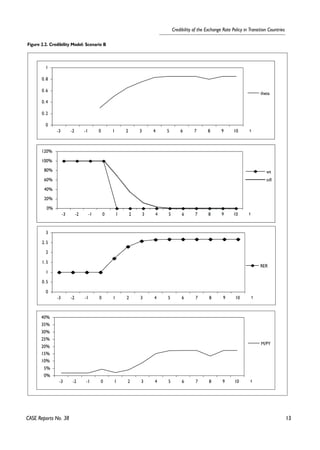
graphs below show the evolution of the model economy 
under two scenarios of θ: scenario A, in which credibility 
grows systematically until it reaches almost 1, and scenario 
B, where credibility grows more slowly and with a setback. 
In both cases the stabilization of inflation is successful. 
The rate of inflation converges to the new rate of deprecia-tion 
which has been set at zero. However, when credibility 
is lower: 
– Disinflation takes longer. 
– Inflation rates during disinflation are higher. 
– As a result, the real appreciation is stronger and the 
new equilibrium is reached at a higher real exchange rate. 
– Money demand grows more slowly and monetization 
is lower. People are reluctant to hold much domestic money 
when because they fear devaluation. 
In fact, when credibility grows slowly enough the level of 
monetization can actually fall in the early phase of stabiliza-tion. 
In scenario B monetization in period 1 is lower than in 
0, although credibility grows in this time. This results from 
the fact, that as the real exchange rate appreciates, the 
depreciation feared by the economic agents under "skepti-cal" 
scenario is deeper. 
ln(Khyp )=α − βd hyp 
( ) ( ) 
hyp 
hyp 
d 
d 
M 
e 
e 
P 
P 
e 
P 
t 
t 
t 
t 
t 
t 
t 
= = 
   
   
= 
   
   
= 
   
   
= 
   
   
= = 
+ + +
12 
G. Ganev, M. Jarociñski, R. Lubenova, P. WoŸniak 
CASE Reports No. 38 
Figure 2.1. Credibility Model: Scenario A 
1 
0. 8 
0. 6 
0. 4 
0. 2 
0 
theta 
120% 
100% 
80% 
60% 
40% 
20% 
0% 
-3 -2 -1 0 1 2 3 4 5 6 7 8 9 10 t 
wt 
infl 
3 
2. 5 
2 
1. 5 
1 
0. 5 
0 
-3 -2 -1 0 1 2 3 4 5 6 7 8 9 10 t 
RER 
40% 
35% 
30% 
25% 
20% 
15% 
10% 
5% 
0% 
-3 -2 -1 0 1 2 3 4 5 6 7 8 9 10 t 
M/PY 
-3 -2 -1 0 1 2 3 4 5 6 7 8 9 10 t
13 
Credibility of the Exchange Rate Policy in Transition Countries 
1 
0. 8 
0. 6 
0. 4 
0. 2 
0 
-3 -2 -1 0 1 2 3 4 5 6 7 8 9 10 t 
120% 
100% 
80% 
60% 
40% 
20% 
3 
2. 5 
2 
1. 5 
1 
0. 5 
40% 
35% 
30% 
25% 
20% 
15% 
10% 
5% 
CASE Reports No. 38 
theta 
0% 
-3 -2 -1 0 1 2 3 4 5 6 7 8 9 10 t 
wt 
infl 
0 
-3 -2 -1 0 1 2 3 4 5 6 7 8 9 10 t 
RER 
0% 
-3 -2 -1 0 1 2 3 4 5 6 7 8 9 10 t 
M/PY 
Figure 2.2. Credibility Model: Scenario B
14 
G. Ganev, M. Jarociñski, R. Lubenova, P. WoŸniak 
CASE Reports No. 38 
2.3. Conclusions from the Model 
The model illustrates how credibility of the exchange 
rate policy affects the performance of an economy under-going 
a stabilization program. A lower credibility leads to a 
slower disinflation and a stronger real appreciation, which 
can increase the output cost of disinflation and undermine 
the credibility of the exchange rate policy in the future 
(although the latter two aspects are not reflected in the 
model). The model is capable of reproducing the pheno-menon 
of a fall of monetization in the early phase of stabi-lization, 
which has puzzled economists [see: DeBroeck 
et al. (1997)]. 
Apart from illustrating the advantages of a more credible 
exchange rate policy, the model has implications for the 
empirical investigation of credibility. It allows to formalize it 
in terms of the parameter θ and examine it in real life 
economies, as long as we accept the model assumptions. 
The model suggests that the speed of disinflation, the 
scope of real appreciation and the dynamics of the level of 
monetization can be used as indicators of credibility. The 
first two factors are difficult to work with in practice, 
because the assumptions of the model are too strong. 
There are many factors, apart from credibility, which can 
influence the speed of disinflation. These are for example: 
exogenous price shocks, institutional arrangements (back-ward 
looking vs. forward looking indexation), relative price 
adjustments in conditions of downward price rigidity. Both 
the behavior of inflation and the real exchange rate will be 
significantly influenced by the degree of over- or undervalu-ation 
of the real exchange rate in the beginning of stabiliza-tion. 
This degree is not straightforward to assess, and the 
Purchasing Power Parity is likely to change along with the 
real transformations underway in the economy. 
More promising is the use of the level of monetization as 
a source of information about credibility. Of course, the 
level of monetization can be, in a real life economy, also 
influenced by factors not featuring in the model: 
The inertia of changing habits of the population, 
entrenched customs regarding the use of domestic and fo-reign 
money can carry over to the level of monetization. It 
should be kept in mind that actual evolution of credibility 
can be more volatile, than what would be implied by the 
evolution of the monetization level. 
Level of development of the banking sector can also 
influence the level of broad money monetization. A more 
efficient, safer and more customer friendly banking sector 
can attract more deposits, and thus contribute to a higher 
broad money monetization. The characteristics of the 
banking sector can evolve over time, influencing the 
dynamics of monetization regardless of depreciation 
expectations. However, in the short and medium term this 
effect should not change the dynamics of monetization in a 
dramatic fashion. 
The third potential problem lies in the speed of clearing 
of the money market. The model bases on the assumption 
that the money market is in equilibrium, i.e. that the money 
supply is adjusted to the money demand (the exchange rate 
is fixed, so money supply becomes endogenous). Violation 
of this condition distorts the information about credibility 
that is inferred from the money demand. This problem can 
be partially controlled for by looking at the rate of inflation. 
A high rate of inflation accompanying a rapidly falling mone-tization 
can mean, that the adjustment of the real money 
balances is not complete, and is occurring both by reducing 
money holding and by a price growth. Such situations hap-pen 
often in the early phase of stabilization. A growth of 
monetization accompanied by a fall in inflation suggests the 
opposite situation: that an upward adjustment of real ba-lances 
might still be underway. 
With these caveats in mind one can check how much 
information on credibility of exchange rate policies is con-tained 
in the monetization figures of transition economies.
15 
Credibility of the Exchange Rate Policy in Transition Countries 
Part 3 
Credibility of the Exchange Rate Policy in Poland 
3.1. Poland's Stabilization Program and 
the Policy of the National Bank of Poland 
Poland's ambitious "shock therapy" was initiated on Ja-nuary 
1st 1990. Along with radical liberalization of prices 
and deregulation of the economy, a number of restrictive 
monetary measures were introduced. One of the pillars of 
the stabilization program was internal convertibility of zloty 
along an stabilizing of the official exchange rate. These were 
augmented by the policies of the central bank aiming to 
control money supply: rationing credit to enterprises, active 
use of reserve requirements and open market operations. 
The stabilization program was designed using the guide-lines 
of the IMF and its approval by the Fund enabled Poland 
to take advantage of the stand-by program in 1990 and sev-eral 
consecutive years. This program besides providing vital 
tranches of credit, undoubtedly gave Polish stabilization 
efforts external credibility. Additionally, the credibility was 
enhanced by establishing the so-called stabilization fund of $ 
1 billion made up of contributions by a number of Western 
countries. By far, the biggest measure supporting and legit-imizing 
Polish path to the free market was a deep cut of Pol-ish 
external debt. The eventual debt reduction of about 
US$20 billion provided a clear signal to institutions world-wide 
and constituted an important pre-condition for 
Poland's long-term external viability and growth [1]. 
The National Bank of Poland was re-established in 1989 
after passing the new Law on the National Bank by the Parlia-ment. 
The main task of the Bank, as outlined in the document, 
is to strengthen the Polish currency and to cooperate with the 
Government in carrying out its economic policy. The Law of 
the National Bank of Poland obliged the Bank to formulate 
"projects of guidelines of the state's monetary policy specifi-cally 
CASE Reports No. 38 
setting growth of money supply, deposit and credit inte-rest 
rates, exchange rate and exchange rate policy and 
policies concerning external credit relations" [2]. Although 
Polish monetary policy was most visibly focused on controlling 
money supply during early 90s, exchange rate policy was 
viewed as extremely important and at times assumed domi-nant 
role. This is particularly understandable in light of recent 
research on transmission mechanisms of monetary policy in 
Poland which indicates that the exchange rate channel is by far 
the strongest and shortest in its impact on inflation [3]. 
3.2. Inflation, Exchange Rates and Money 
Inflation in Poland began to rise significantly as soon as 
1987 but it wasn't until 1989 that it became one of the most 
apparent threats to macroeconomic stability. Figure 3.1 pre-sents 
gradual rise in monthly inflation until its peak in January 
1990. This outburst of inflation was to a significant extent the 
effect of comprehensive price liberalization coupled with 
monetary overhangs that have been built in the form of 
forced savings during years of rationing and shortages. 
Thus, the stabilization program introduced in January 
1990 had inflation curb as one if its main goals. Three major 
disinflation measures were employed: the policy of positive 
interest rate, the special tax on income increases (the so-called 
popiwek) and freezing exchange rate. The latter was 
one of the most significant elements of the stabilization pro-gram 
introduced with the objective to anchor nominal mag-nitudes 
in the economy. The exchange rate was set at 9500 
zloty to 1 US$ with the formal commitment to keep it for 3 
months. The rate at which zloty was anchored was com- 
[1] Gomó³ka (1995). 
[2] Law of the National Bank of Poland in Szpunar (2000, p. 211). 
[3] See for example, Rybiñski (2000).
16 
G. Ganev, M. Jarociñski, R. Lubenova, P. WoŸniak 
1200 
1100 
1000 
900 
800 
700 
600 
500 
400 
300 
200 
100 
Figure 3.2. Exchange Rate Policy Changes in Poland 1990–2000 (Monthly Rate of Crawl and the Width of the Deviation Band) 
CASE Reports No. 38 
1 2 0 
1 1 0 
100 
90 
80 
70 
60 
50 
40 
30 
20 
10 
0 
Jan-89 
Table 3.1. Poland 1990–1999: Selected Economic Indicators (% change) 
1990 1991 1992 1993 1994 1995 1996 1997 1998 
CPI Inflation 249.3 60.3 44.4 37.7 29.4 21.6 17.8 13.2 8.6 
PLN/USD (period average) 560.1 11.3 28.8 32.9 25.4 6.7 11.2 21.6 6.0 
PLN/USD (end of period) 46.2 15.3 43.9 35.4 14.2 1.3 16.5 22.3 -0.4 
Real Effective Exchange Rate -15.8 55.7 6.4 7.3 0.8 8.2 8.8 2.5 6.0 
M2 160.1 37.0 57.5 36.0 38.2 35.0 30.8 29.2 25.2 
Source: Main Statistical Office(GUS), National Bank of Poland, own calculations 
Jan-92 
% 
0 
% 
Jan-90 
Jan-91 
Monthly CPI changes 
(left axis) 
12-month CPI changes 
(right axis) 
Figure 3.1. Inflation in Poland 1989–1992 
Source: National Bank of Poland 
16% 
12% 
8% 
4% 
0% 
-4% 
-8% 
- 12% 
- 16% 
Jan-90 
Jan-94 
Jan-98 
Jan-91 
Jan-95 
Jan-99 
Jan-92 
Jan-96 
Jan-00 
Jan-93 
Jan-97 
Source: National Bank of Poland
17 
Credibility of the Exchange Rate Policy in Transition Countries 
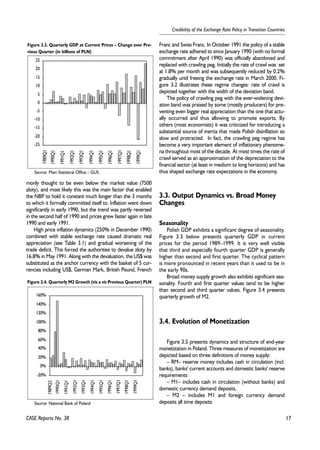
Figure 3.3. Quarterly GDP at Current Prices – Change over Pre-vious 
Quarter (in billions of PLN) 
25 
20 
15 
10 
5 
0 
-5 
-10 
-15 
-20 
monly thought to be even below the market value (7500 
zloty), and most likely this was the main factor that enabled 
the NBP to hold it constant much longer than the 3 months 
to which it formally committed itself to. Inflation went down 
significantly in early 1990, but the trend was partly reversed 
in the second half of 1990 and prices grew faster again in late 
1990 and early 1991. 
High price inflation dynamics (250% in December 1990) 
combined with stable exchange rate caused dramatic real 
appreciation (see Table 3.1) and gradual worsening of the 
trade deficit. This forced the authorities to devalue zloty by 
16.8% in May 1991. Along with the devaluation, the US$ was 
substituted as the anchor currency with the basket of 5 cur-rencies 
including US$, German Mark, British Pound, French 
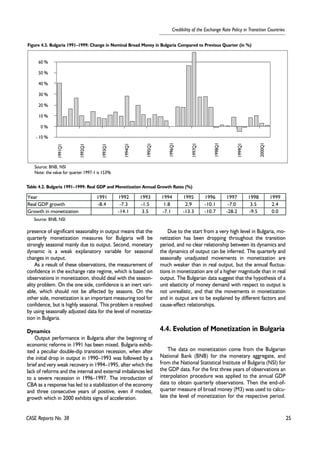
Figure 3.4. Quarterly M2 Growth (vis a vis Previous Quarter) PLN 
160% 
140% 
120% 
100% 
80% 
60% 
40% 
20% 
0% 
CASE Reports No. 38 
Franc and Swiss Franc. In October 1991 the policy of a stable 
exchange rate adhered to since January 1990 (with no formal 
commitment after April 1990) was officially abandoned and 
replaced with crawling peg. Initially the rate of crawl was set 
at 1.8% per month and was subsequently reduced by 0.2% 
gradually until freeing the exchange rate in March 2000. Fi-gure 
3.2 illustrates these regime changes: rate of crawl is 
depicted together with the width of the deviation band. 
The policy of crawling peg with the ever-widening devi-ation 
band was praised by some (mostly producers) for pre-venting 
even bigger real appreciation than the one that actu-ally 
occurred and thus allowing to promote exports. By 
others (most economists) it was criticized for introducing a 
substantial source of inertia that made Polish disinflation so 
slow and protracted. In fact, the crawling peg regime has 
become a very important element of inflationary phenome-na 
throughout most of the decade. At most times the rate of 
crawl served as an approximation of the depreciation to the 
financial sector (at least in medium to long horizons) and has 
thus shaped exchange rate expectations in the economy. 
3.3. Output Dynamics vs. Broad Money 
Changes 
Seasonality 
Polish GDP exhibits a significant degree of seasonality. 
Figure 3.3 below presents quarterly GDP in current 
prices for the period 1989–1999. It is very well visible 
that third and especially fourth quarter GDP is generally 
higher than second and first quarter. The cyclical pattern 
is more pronounced in recent years than it used to be in 
the early 90s. 
Broad money supply growth also exhibits significant sea-sonality. 
Fourth and first quarter values tend to be higher 
than second and third quarter values. Figure 3.4 presents 
quarterly growth of M2. 
3.4. Evolution of Monetization 
Figure 3.5 presents dynamics and structure of end-year 
monetization in Poland. Three measures of monetization are 
depicted based on three definitions of money supply: 
– RM– reserve money includes cash in circulation (incl. 
banks), banks' current accounts and domestic banks' reserve 
requirements 
– M1– includes cash in circulation (without banks) and 
domestic currency demand deposits, 
– M2 – includes M1 and foreign currency demand 
deposits all time deposits. 
-25 
1990Q1 
1991Q1 
1992Q1 
1993Q1 
1994Q1 
1995Q1 
1996Q1 
1997Q1 
1998Q1 
1999Q1 
1989Q1 
Source: Main Statistical Office – GUS 
-20% 
1989Q2 
1990Q1 
1991Q1 
1992Q1 
1993Q1 
1994Q1 
1995Q1 
1996Q1 
1997Q1 
1998Q1 
1999Q1 
Source: National Bank of Poland
18 
G. Ganev, M. Jarociñski, R. Lubenova, P. WoŸniak 
Figure 3.5. Monetization: Share of End-year Reserve Money, 
M1 and M2 in GDP 
0.65 
0.55 
0.45 
0.35 
0.25 
0.15 
Monetization figures calculated using different measures 
of money tell contrasted stories. The broadest measure of 
money, M2 fell as a percent of GDP from 65% in 1989 to a 
record low of 32% in 1991. From then on, monetization got 
on a slow but generally uninterupted long-run growth path. 
Compared to the initial fall in 1990, subsequent increases 
1991–1999 seem rather small. Consequently, the end-1999 
monetization amounts to 43% which is a mere 67% of the 
end-1989 value and only 33% higher than the 1991 low. 
A different picture emerges when one looks at nar-rower 
measures of money. M1 monetization fell from the 
1989–1990 level of 17% to stabilize around 12–13% dur-ing 
1993–1999. On the other hand, reserve money mon-etization 
has been declining consistently during the entire 
decade. Cumulatively it fell from 30% in 1989 to 8% in 
1999 with the biggest fall taking place in the early 1990s. 
The difference between the magnitudes and dynamics 
of monetization figures follows from underlying differ-ences 
in money supply measures (numerator in the formu-la). 
Specifically, large and growing distance between M2 
and other money measures points to the development of 
Polish financial markets and rising level of financial inter-mediation. 
End-year monetization series is free of GDP seasonali-ty 
by construction. Quarterly monetization which is mea-sured 
as a share of money supply in quarterly annualized 
GDP is sensitive to seasonality both in GDP and money 
series. Therefore, the quarterly monetization series has 
been subjected to seasonal adjustment based on multi-plicative 
procedure "ratio to moving average" in Eviews. 
Additionally, for comparison "4-quarter monetization" was 
calculated as a share of money supply in 4-quarter GDP. 
The GDP series is defined as the sum of 4 consecutive 
0.70 
0.60 
0.50 
0.40 
0.30 
Figure 3.6. Quarterly and 4-quarter M2 Monetization 
quarterly GDP values with the last quarter being the index 
for the series. Consequently, 4th quarter values of this 
series correspond to end-year GDP and values of 4th quar-ter 
monetization are identical to the series presented in 
Figure 3.5. Figure 3.6 presents both series. 
Two main messages emerge form the figure: 
– There is considerable and rather systematic difference 
between the two series (4-quarter monetization is above 
quarterly monetization). This distance tends to disappear as 
we move towards the end of the sample but is very pro-nounced 
at the beginning of the sample. 
– Seasonal adjustment did not purge the quarterly mon-etization 
series efficiently. Clear seasonal pattern is easily dis-cernible 
especially from 1996 on. 
The fact that the quarterly monetization series is con-sistently 
below the 4-quarter monetization follows direct-ly 
from the denominator of the indicator, i.e. from the dif-ferences 
in GDP definition. While 4-quarter series uses the 
sum of quarterly GDP in 4 consecutive quarters, the quar-terly 
series uses only the last value and annualizes it(i.e. 
multliplies by 4). Thus, whenever the quarterly GDP series 
(in current prices) exhibits upward trend, annualized GDP 
will always be an upwardly biased estimate of the annual 
(4-quarter) GDP. As a result, monetization based on annu-alized 
GDP will be lower than that based on 4-quarter 
GDP. Specifically, this discrepancy may be responsible for 
the significant difference between the two monetization 
series between 1989Q4–1990Q4 when near-hyperinfla-tion 
drove current-price GDP up (even though real GDP 
was falling). 
In the calculation we will be consistently using monetiza-tion 
figures based on quarterly annualized GDP adjusted for 
seasonality (thick line in Figure 3.6). 
CASE Reports No. 38 
0.05 
1990 
1989 
1991 
1992 
1993 
1994 
1995 
1996 
1997 
1998 
1999 
M1 RM 
M2 
Source: National Bank of Poland, own calculations 
0.20 
1990Q1 
1991Q1 
1992Q1 
1993Q1 
1994Q1 
1995Q1 
1996Q1 
1997Q1 
1998Q1 
1999Q1 
4-Quarter 
monetarization 
Quarterly M2 
monetarization 
Source: National Bank of Poland, own calculations
19 
Credibility of the Exchange Rate Policy in Transition Countries 
3.5 The "Theta" Indicator 
Below we calculate the series of the indicator of credibil-ity, 
θ as suggested by the theoretical model (chapter 2) to 
confront it with other evidence on credibility of exchange 
rate policy in Poland. 
8% 
6% 
4% 
2% 
0% 
- 2% 
Calibration of the parameters of the money demand 
relationship 
α – constant term 
According to the model, we calibrate this parameter as 
the value of monetization to which a country with Poland's 
macroeconomic characteristics would converge in the situ-ation 
of credible exchange rate stability. We take this level of 
monetization to be 70%. This yields the value of α equal to 
-0.35. 
β – elasticity of money demand with respect to 
expected depreciation 
Poland is the only country covered by this study for 
which we managed to obtain data on expected depreciation 
for the 5 years' period of 1994Q4–1999Q4. It is the data 
collected from the Reuters monthly survey of about 25 
major banks operating in Poland in which they are asked 
about, among other things, their expectation of the 
exchange rate at the end of the current month, at the end 
of the current year and in 12 months' time. Our measure of 
quarterly depreciation expectation was obtained from the 
latter series as the respective root of the annual deprecia-tion. 
The resulting series can seen in Figure 3.7 along with 
actually realized depreciation. 
CASE Reports No. 38 
The value of interest, i.e. money demand elasticity 
with respect to expected depreciation can be directly 
obtained from the regression of the log of monetization 
on expected depreciation as the coefficient by expected 
depreciation. Estimation yields a highly statistically signifi-cant 
coefficient of -4.64 (absolute value of the t-statistic 
equals 3.40). 
The "θ" series 
Actual 
depreciation 
The theta series calculated using the above values is plot-ted 
in Figure 3.8 below. 
- 4% 
1995Q1 
1996Q1 
1997Q1 
1998Q1 
1999Q1 
Expected 
depreciation 
Figure 3.7. Expected and Actual Quarterly Depreciation 1994Q4–1999Q4 
Source: Monthly Poll of Selected Economic Indicators, National Bank of Poland, own calculations 
Figure 3.8. Poland 1990–1999: "Theta" – Indicator of Credibility 
of the Policy of Stable Exchange Rate Policy 
1.0 
0.9 
0.8 
0.7 
0.6 
0.5 
0.4 
0.3 
0.2 
0.1 
0.0 
1990Q1 
1993Q1 
1996Q1 
1999Q1 
1991Q1 
1994Q1 
1997Q1 
1992Q1 
1995Q1 
1998Q1 
Source: own calculations
20 
G. Ganev, M. Jarociñski, R. Lubenova, P. WoŸniak 
It is important to bear in mind that the dynamics of the 
model relies on several assumptions: 
– Growth of monetization is ascribed to the growth of 
public confidence in zloty. 
– When inflation slows down, the expectations of deva-luation 
abate. If, nevertheless, monetization does not 
growth correspondingly, this is ascribed to a weak credibili-ty 
of the central bank 
– When inflation accelerates, the risk that the exchange 
rate would become unstable increases. If, nevertheless, eco-nomic 
agents do not reduce their zloty holdings, this is 
ascribed to the growth of public confidence in zloty. 
Even though the above figure presents developments of 
q during the 9-year-long period, our focus should be on the 
first 2–3 years for which the model is suited. Credibility as 
defined by theta, was extremely low at the outset of 
reforms, but grew substantially very quickly. The growth 
path during the first 3 years of stabilization program is virtu-ally 
uninterupted with one minor setback in 1990Q4. Most 
of the growth occurs during first 3 quarters of 1990. 
1991Q1–1992Q4 is the period of slower growth and 
1993Q1–1999Q4 marks near-stabilization at the level slight-ly 
above 0.9. 
The figure suggests that credibility was essentially gained 
during the first year of the shock therapy. The fact that it 
grew so significantly during such a short period of time is the 
consequence of a variety of policies and factors. Some of 
them will be disussed below to augment the analysis. 
3.6. Central Bank Foreign Exchange 
Reserves and Poland's Debt Reduction 
Holdings of foreign reserves are certainly one of the most 
crucial factors in building credibility of any non-floating 
exchange rate regime. In the intial period of reforms they 
amounted to slightly more than 2 billion USD. However, in 
1990 reserves grew by more than 100% and stabilized at this 
level for the next couple of years. In terms of imports, 
reserves grew quickly from the equivalent of 2.2 months of 
imports in December 1989 to 5–6 months throughout 1990. 
Figure 3.9 shows official gross reserves during 1989–1999. 
An invalueable contribution to credibility of the stable 
exchange rate was the so-called stabilization fund set up by 
several Western European governments. The 1 billion USD 
Figure 3.9. National Bank of Poland Official Gross Reserves 
(in billions of USD) 
30 
25 
20 
15 
10 
5 
fund was meant to augment official reserves in the event of 
the endangered stability of zloty. Although such critical situ-ation 
did not materialize and the central bank has never 
made use of the fund, its existence boosted credibility con-siderably. 
Furthermore, continous cooperation with the IMF in 
the form of stand-by and extended facility programs 
raised public and external confidence in the success of 
the Polish stabilization. Also, radical external debt reduc-tion 
by the Paris Club contributed to the overall credibil-ity 
by legitimizing Polish efforts in the eyes of Western 
governments. 
3.7. Public Finances and Credibility 
Table 3.2 presents general government balance as a 
percent of GDP. It indicates that in spite of a deep reces-sion 
of 1990, public finances registered a sizable surplus of 
3.7%. The fiscal situation worsened radically in the sub-sequent 
years resuling in deficits since. Figure 3.10 pre-sents 
the cumulative monthly surplus/deficit in billions of 
zloty to emphasize the budgetary balance dynamics in the 
critical months following the shock therapy. 
CASE Reports No. 38 
Table 3.2. Poland 1989–1999: General Government Balance (as % of GDP) 
1989 1990 1991 1992 1993 1994 1995 
Total Revenues 33.8 47.3 42.3 45.1 47.6 48.3 47.8 
Total Expenditures 39.9 43.6 48.9 51.8 49.9 50.5 49.7 
Budget Balance -6.0 3.7 -6.7 -6.7 -2.3 -2.2 -1.9 
Source: GUS 
0 
1989Q4 
1992Q4 
1995Q4 
1998Q4 
1990Q4 
1991Q4 
1993Q4 
1994Q4 
1996Q4 
1997Q4 
Source: National Bank of Poland
21 
Credibility of the Exchange Rate Policy in Transition Countries 
Figure 3.10. Cumulative General Government Balance 
(in billions of PLN) 
2 
0 
- 2 
- 4 
- 6 
- 8 
Jan 
Feb 
Mar 
Apr 
May 
Juni 
July 
Aug 
Sep 
Oct 
Nov 
Dec 
1990 1991 1992 
Source: GUS 
First 14 months of the operation of the frozen exchange 
rate policy are marked by surpluses. In March 1991 general 
government balance turned negative and remained negative 
thoughout the decade. Deficits came down from relatively 
high levels 1991–1992 (-6.7%) to moderate levels from 
1993 on. 
Thus, general government budget balances provided 
mixed signals of the state of public finances. For all but one 
year, budgets registered deficits that were rather high at 
times. However, during first 14 months of the stabilization 
program, the government managed to generate surpluses 
which might have had conducive effect on the general out-look 
of the economy and thus on the perspectives of the 
program and the overall economic policy. Therefore, we 
can also cautiously ascribe public finances some role in 
enhancing credibility during this crucial period. That subse-quent 
deficits did not visibly harm this credibiliy (as our 
analysis seems to suggest) may be attributed to the fact that 
overall credibility of Poland's economic course (including 
credibility of exchange rate policy) was so firm and unshak-en 
that it became immune to negative signals from public 
finances. 
3.8. Dollarization of Deposits 
One of the most direct signals of trust in the exchange 
rate stability are public's decisions regarding deposits. 
Choosing the deposit currency involves weighing the inter-est 
rate offered on one hand and the depreciation expecta-tion 
on the other. Poland has been traditionally a highly dol-larized 
economy where opening dollar deposits or even 
holding dollar cash was the most common way of fighting 
domestic inflation and political and economic uncertainty. 
Therefore, observing dollarization ratios can be very useful 
as part of investigating credibility. Figure 3.11 presents the 
share of household's deposits in foreign currencies (mainly 
USD and DEM) in all household's deposits. 
The figure points to a very clear pattern of continuously 
falling dollarization, albeit with a period of stabilization. 
Specifically, first quarters of the stabilization program and 
later on 1995–1996 saw a dramatic increase in domestic 
currency deposits relative to foreign currency deposits. On 
the other hand, years 1992–1994 are marked by relative 
stabilization or even increase in dollarization of deposits. 
However, the period of 1989–1991 – crucial from the cre- 
90% 
80% 
70% 
60% 
50% 
40% 
30% 
20% 
10% 
0% 
1990Q1 
CASE Reports No. 38 
1991Q1 
1992Q1 
1993Q1 
1994Q1 
1995Q1 
1996Q1 
1997Q1 
1998Q1 
1999Q1 
Figure 3.11. Dollarization of Deposits* (Share of Foreign Currency Deposits in Total Deposits – %) 
Source: National Bank of Poland 
* Prior to 1991Q4 data on deposits included accrued interest.
22 
G. Ganev, M. Jarociñski, R. Lubenova, P. WoŸniak 
CASE Reports No. 38 
90000 
80000 
70000 
60000 
50000 
40000 
30000 
20000 
10000 
dibility point of view clearly indicates growing trust in the 
announced policy of the stable exchange rate. To investigate 
this period in more detail, figure 3.12 presents develop-ments 
in these two types of deposits along with the dolla-rization 
ratio at monthly frequency during 1989:12–1991:6. 
As a consequence of a stable exchange rate during 
1990:1–1991:4 foreign currency deposits during this period 
can be treated as representing constant "real" value. A sta-ble 
but slow growth path of foreign currency deposits is 
reversed in early 1991. This might suggest that the full year 
of constant exchange rate eventually convinced most house-holds 
that the policy is credible and it pays off to hold zloty. 
Another swing occurred in May 1991– mainly as a result of 
step devaluation made by NBP which increased zloty value 
of foreign currency deposits. Nevertheless, dollarization 
ratio kept going down. 
The time path of dollarization ratios mirrors develop-ments 
in credibility indicator fairly well. Specifically, during 
the first 18 months of the stable exchange rate, surge in θ is 
accompanied by visible reversal of the growth trend of fo-reign 
currency deposits. 
3.9. Conclusions 
Poland has launched its stabilization program in January 
1990 with the end-1989 monetization at a high level of over 
60%. Early 1990 saw a considerable drop in monetization 
after which a slow but consistent re-monetization process 
began. Our model suggests that public confidence in the 
announced stability of zloty rose sharply during a relatively 
short period of time. We believe that these results find sup-port 
in the number of political and economic phenomena: 
– Foreign official reserves increased significantly in 1990 
and 1991 from the very low level of 2 billion USD in the 
beginning of the stabilization program. 
– 1 Billion USD stabilization fund established to support 
zloty was a significant credibility-enhancing factor. Conti-nous 
cooperation with the IMF in the form of stand-by and 
extended facilities programs raised public and external con-fidence 
in the success of the Polish stabilization. Also, radi-cal 
external debt reduction by the Paris Club contributed to 
the overall credibility by legitimizing Polish efforts in the 
eyes of Western governments. 
– Credibility of the stable exchange rate policy might 
have been enhanced by initial budget surpluses. At the same 
time there are no sign of adverse impact of subsequent 
deficts. 
– Dollarization of deposits fell sharply during 1990–1993 
which indicates growth of the public confidence in the sta-bility 
of zloty. 
0 
1990M1 
1990M4 
1990M7 
1990M10 
1991M1 
1991M4 
Zloty 
deposits 
Foreign 
currency deposits 
Ratio of foreign 
currency deposits 
to all deposits 
Figure 3.12. Zloty Deposits, Foreign Currency Deposits and Dollarization Ratio (in billions old zloty) 
Source: National Bank of Poland
23 
Credibility of the Exchange Rate Policy in Transition Countries 
Part 4 
Credibility of the Exchange Rate Policy in Bulgaria 
4.1. The Policy of the Bulgarian National 
Bank 
The Bulgarian banking system was established as a two-tier 
system gradually during the 1980-s, and by 1990 was 
already in place. With the Bulgarian National Bank (BNB) 
Act of 1991 and the Banking and Credit Act of 1992 the sys-tem 
was established with the traditional relationships 
between the national bank and the commercial banks. The 
main goal of BNB was legislatively set to be "to take actions 
to maintain the internal and external stability of the nation-al 
monetary unit" [4]. The BNB was explicitly trying to 
achieve this goal throughout the period 1991–1997, and the 
stability of the exchange rate of the Bulgarian lev was regu-larly 
mentioned as one of the main goals of BNB, even 
though explicit targets were never set during this period. 
In the second half of 1996 and the beginning of 1997 Bul-garia 
experienced a severe financial crisis, which combined 
high inflation, sharp and sustained currency depreciation, 
and failure of a large portion of the banking system. The pol-icy 
response to this development was the introduction of a 
currency board arrangement (CBA) in Bulgaria on July 1, 
1997. The benchmark of the CBA is the extremely institu-tionalized 
fixing of the exchange rate of the Bulgarian lev 
with respect to the Deutsche mark – the nominal exchange 
rate is set in art. 29 of the 1997 BNB Act, and the BNB is 
obliged to sell or buy Deutsche marks at this rate to every-one 
who wants to buy or sell Bulgarian leva. Except for set-ting 
the minimal reserve requirement, the BNB is not able 
to conduct monetary policy, as it is forbidden by law to hold 
assets which are obligations for domestic economic agents 
and therefore cannot give out loans to Bulgarian banks and 
cannot hold a portfolio of Bulgarian treasuries. 
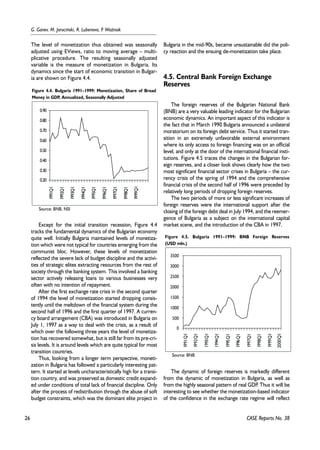
Figure 4.1 shows the dynamics of the BNB interventions 
on the foreign exchange market through most of the transi-tion 
period. It can be seen how the crisis of 1996 was pre-ceded 
by significant net sales of foreign currency, depleting 
BNB's foreign reserves, and how the announcement of the 
CBA, supported by the IMF, led to large net purchases. 
It is obvious, that the behavior of the BNB with respect 
to its support of the national currency went through diffe-rent 
periods and so the confidence of the public in its real 
intent may have varied significantly. 
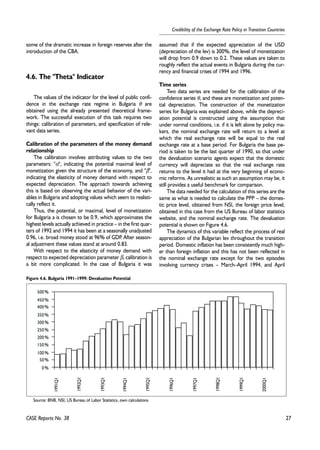
Figure 4.1. Bulgaria 1991–1999: Annual and Semiannual Net 
Purchases of Foreign Currency by the BNB from Customers and 
Banks (in USD million) 
800 
600 
400 
200 
0 
-200 
-400 
4.2. Inflation, Exchange Rates, and Broad 
Money 
Looking at the main macroeconomic indicators of Bul-garia 
shown in Table 4.1, it can be inferred that the basic 
financial indicators exhibit significant instability. Bulgaria has 
CASE Reports No. 37 
-600 
1991 
1993 
1994 
1992 
1995 
1996 
1997 
1998 
1999 
2000 
Source: Source: BNB annual and semiannual reports, 1991–2000 
[4] Art. 2 of the 1991 BNB Act, repealed with the 1997 BNB Act.
24 
G. Ganev, M. Jarociñski, R. Lubenova, P. WoŸniak 
Table 4.1. Bulgaria 1991–1999: Inflation, USD Exchange Rate, Real Exchange Rate, Money (% change) 
Year 1991 1992 1993 1994 1995 1996 1997 1998 1999 
Inflation 335.0 79.5 72.8 95.1 62.8 123.1 1082.2 22.3 0.3 
BG lev/USD 24.0 18.5 96.2 23.8 161.8 853.5 5.0 4.4 
Real eff. exch. rate 34.0 45.2 -5.1 18.5 -10.3 28.3 18.1 -2.0 
broad money 124.8 42.1 47.6 78.6 39.6 124.5 359.3 9.6 11.4 
gone through periods of relative calming down of the indi-cators, 
and through periods of great turbulence and insecu-rity. 
The data, however, suggest several observations, which 
are relevant for the calibration of the public confidence in 
the exchange rate regime. 
Before the introduction of a CBA in 1997, inflation has 
been rampant in Bulgaria. However, it has been growing 
consistently faster that both the nominal exchange rate 
(except during the currency crisis episodes) and the quanti-ty 
of money in the economy. Besides illustrating the process 
of real loss of living standards in the Bulgarian economy, this 
observation indicates that broad money growth exceeded 
inflation only in 1996, when the financial crisis hit the eco-nomy, 
and in 1999, when the economy went through a 
short period of deflation while the financial sector was still 
recovering the public confidence under the CBA. 
Bulgaria started economic reforms in 1991 with the 
declared goal to preserve the exchange rate stable, and 
reconfirmed this goal in 1997 at the introduction of a curren-cy 
board. In both cases these announcements, made in the 
beginning of important structural changes, were followed by 
a significant real appreciation. To make this possible for longer 
periods (more than one or two quarters), it requires a rela-tively 
high confidence on the part of the public, which leaves 
the national currency without speculative attacks. 
It is obvious that the defense of a claim that inflation in 
Bulgaria may have been caused primarily by the movements 
in the money supply is problematic – broad money has grown 
at consistently lower speed than the price level. Bulgaria may 
have been experiencing a severe restructuring of its domestic 
prices, which is consistent with the sharp drop in output in 
the first years of transition. This fact is also consistent with the 
speculation that inflation was a major redistributive tool in the 
early transition period in Bulgaria. At the same time, the start-ing 
level of monetization in the country was relatively high for 
transition country standards, and it was only after the "disap-pearance" 
of a significant amount of deposits, and a large 
chunk of public confidence in the banking sector with them, 
in a series of failed banks in 1996–1997 that the level of mon-etization 
went down to a level quite consistent with the 
standing of the Bulgaria as a transition economy and with its 
level of income per capita. Thus movements in monetization 
may reflect public attitudes to a very large extent. 
4.3. Output Dynamics vs Broad Money 
Changes 
Seasonality 
Bulgarian output is highly seasonal. Even though agri-culture 
constitutes less than 20 percent of GDP through-out 
the transition period with the exception of the crisis 
ridden 1997, the "agricultural" third quarter is regularly 
the strongest, and during the post-crisis period outper-forms 
even the traditionally strongest fourth quarter. 
Figure 4.2. Bulgaria 1994–1999: Quarterly Real GDP Index, 
1997=100 
130 
120 
110 
100 
90 
80 
70 
60 
In terms of making inferences about the level of mo-netization, 
this highly seasonal dynamic of output needs to 
be compared with the seasonality of broad money, which 
is exhibited on Figure 4.3. The movements in nominal 
money do not indicate a strong seasonal pattern. The 
same inference can be made after looking at real money 
growth for the same period. 
The comparison suggests two main things. First, broad 
money in Bulgaria exhibits an uncharacteristic lack of sea-sonality 
[5]. This lack of seasonality in Broad money and 
CASE Reports No. 38 
Source: BNB, National Statistical Institute of Bulgaria (NSI), Bank for International Settlements – Basle 
50 
1994Q1 
1996Q1 
1998Q1 
2000Q1 
1995Q1 
1997Q1 
1999Q1 
Source: NSI 
[5] A formal multiplicative seasonal adjustment procedure yields seasonal factors which are small, and are probably most influenced by a single 
quarter – 1997-1.
25 
Credibility of the Exchange Rate Policy in Transition Countries 
60% 
50% 
40% 
30% 
20% 
10% 
0% 
presence of significant seasonality in output means that the 
quarterly monetization measures for Bulgaria will be 
strongly seasonal mainly due to output. Second, monetary 
dynamic is a weak explanatory variable for seasonal 
changes in output. 
As a result of these observations, the measurement of 
confidence in the exchange rate regime, which is based on 
observations in monetization, should deal with the season-ality 
problem. On the one side, confidence is an inert vari-able, 
which should not be affected by seasons. On the 
other side, monetization is an important measuring tool for 
confidence, but is highly seasonal. This problem is resolved 
by using seasonally adjusted data for the level of monetiza-tion 
in Bulgaria. 
Dynamics 
Output performance in Bulgaria after the beginning of 
economic reforms in 1991 has been mixed. Bulgaria exhib-ited 
a peculiar double-dip transition recession, when after 
the initial drop in output in 1990–1993 was followed by a 
brief and very weak recovery in 1994–1995, after which the 
lack of reforms and the internal and external imbalances led 
to a severe recession in 1996–1997. The introduction of 
CBA as a response has led to a stabilization of the economy 
and three consecutive years of positive, even if modest, 
growth which in 2000 exhibits signs of acceleration. 
CASE Reports No. 38 
Due to the start from a very high level in Bulgaria, mo-netization 
has been dropping throughout the transition 
period, and no clear relationship between its dynamics and 
the dynamics of output can be inferred. The quarterly and 
seasonally unadjusted movements in monetization are 
much weaker than in real output, but the annual fluctua-tions 
in monetization are of a higher magnitude than in real 
output. The Bulgarian data suggest that the hypothesis of a 
unit elasticity of money demand with respect to output is 
not unrealistic, and that the movements in monetization 
and in output are to be explained by different factors and 
cause-effect relationships. 
4.4. Evolution of Monetization in Bulgaria 
The data on monetization come from the Bulgarian 
National Bank (BNB) for the monetary aggregate, and 
from the National Statistical Institute of Bulgaria (NSI) for 
the GDP data. For the first three years of observations an 
interpolation procedure was applied to the annual GDP 
data to obtain quarterly observations. Then the end-of-quarter 
measure of broad money (M3) was used to calcu-late 
the level of monetization for the respective period. 
- 10% 
1991Q1 
1992Q1 
1993Q1 
1994Q1 
1995Q1 
1996Q1 
1997Q1 
1998Q1 
1999Q1 
2000Q1 
Figure 4.3. Bulgaria 1991–1999: Change in Nominal Broad Money in Bulgaria Compared to Previous Quarter (in %) 
Source: BNB, NSI 
Note: the value for quarter 1997-1 is 153% 
Table 4.2. Bulgaria 1991–1999: Real GDP and Monetization Annual Growth Rates (%) 
Year 1991 1992 1993 1994 1995 1996 1997 1998 1999 
Real GDP growth -8.4 -7.3 -1.5 1.8 2.9 -10.1 -7.0 3.5 2.4 
Growth in monetization -14.1 3.5 -7.1 -13.3 -10.7 -28.2 -9.5 0.0 
Source: BNB, NSI
26 
G. Ganev, M. Jarociñski, R. Lubenova, P. WoŸniak 
The level of monetization thus obtained was seasonally 
adjusted using EViews, ratio to moving average – multi-plicative 
procedure. The resulting seasonally adjusted 
variable is the measure of monetization in Bulgaria. Its 
dynamics since the start of economic transition in Bulgar-ia 
are shown on Figure 4.4. 
Figure 4.4. Bulgaria 1991–1999: Monetization, Share of Broad 
Money in GDP, Annualized, Seasonally Adjusted 
0.90 
0.80 
0.70 
0.60 
0.50 
0.40 
0.30 
Except for the initial transition recession, Figure 4.4 
tracks the fundamental dynamics of the Bulgarian economy 
quite well. Initially Bulgaria maintained levels of monetiza-tion 
which were not typical for countries emerging from the 
communist bloc. However, these levels of monetization 
reflected the severe lack of budget discipline and the activi-ties 
of strategic elites extracting resources from the rest of 
society through the banking system. This involved a banking 
sector actively releasing loans to various businesses very 
often with no intention of repayment. 
After the first exchange rate crisis in the second quarter 
of 1994 the level of monetization started dropping consis-tently 
until the meltdown of the financial system during the 
second half of 1996 and the first quarter of 1997. A curren-cy 
board arrangement (CBA) was introduced in Bulgaria on 
July 1, 1997 as a way to deal with the crisis, as a result of 
which over the following three years the level of monetiza-tion 
has recovered somewhat, but is still far from its pre-cri-sis 
levels. It is around levels which are quite typical for most 
transition countries. 
Thus, looking from a longer term perspective, moneti-zation 
in Bulgaria has followed a particularly interesting pat-tern. 
It started at levels uncharacteristically high for a transi-tion 
country, and was preserved as domestic credit expand-ed 
under conditions of total lack of financial discipline. Only 
after the process of redistribution through the abuse of soft 
budget constraints, which was the dominant elite project in 
Bulgaria in the mid-90s, became unsustainable did the poli-cy 
reaction and the ensuing de-monetization take place. 
4.5. Central Bank Foreign Exchange 
Reserves 
The foreign reserves of the Bulgarian National Bank 
(BNB) are a very valuable leading indicator for the Bulgarian 
economic dynamics. An important aspect of this indicator is 
the fact that in March 1990 Bulgaria announced a unilateral 
moratorium on its foreign debt service. Thus it started tran-sition 
in an extremely unfavorable external environment 
where its only access to foreign financing was on an official 
level, and only at the door of the international financial insti-tutions. 
Figure 4.5 traces the changes in the Bulgarian for-eign 
reserves, and a closer look shows clearly how the two 
most significant financial sector crises in Bulgaria – the cur-rency 
crisis of the spring of 1994 and the comprehensive 
financial crisis of the second half of 1996 were preceded by 
relatively long periods of dropping foreign reserves. 
The two periods of more or less significant increases of 
foreign reserves were the international support after the 
closing of the foreign debt deal in July 1994, and the reemer-gence 
of Bulgaria as a subject on the international capital 
market scene, and the introduction of the CBA in 1997. 
Figure 4.5. Bulgaria 1991–1999: BNB Foreign Reserves 
(USD mln.) 
3500 
3000 
2500 
2000 
1500 
1000 
500 
The dynamic of foreign reserves is markedly different 
from the dynamic of monetization in Bulgaria, as well as 
from the highly seasonal pattern of real GDP. Thus it will be 
interesting to see whether the monetization-based indicator 
of the confidence in the exchange rate regime will reflect 
CASE Reports No. 38 
0.20 
1991Q1 
1993Q1 
1995Q1 
1997Q1 
1999Q1 
1992Q1 
1994Q1 
1996Q1 
1998Q1 
Source: BNB, NSI 
0 
1991Q1 
1993Q1 
1995Q1 
1997Q1 
1999Q1 
1992Q1 
1994Q1 
1996Q1 
1998Q1 
2000Q1 
Source: BNB
27 
Credibility of the Exchange Rate Policy in Transition Countries 
some of the dramatic increase in foreign reserves after the 
introduction of the CBA. 
4.6. The "Theta" Indicator 
The values of the indicator for the level of public confi-dence 
in the exchange rate regime in Bulgaria θ are 
obtained using the already presented theoretical frame-work. 
The successful execution of this task requires two 
things: calibration of parameters, and specification of rele-vant 
data series. 
Calibration of the parameters of the money demand 
relationship 
The calibration involves attributing values to the two 
parameters: "α", indicating the potential maximal level of 
monetization given the structure of the economy, and "β", 
indicating the elasticity of money demand with respect to 
expected depreciation. The approach towards achieving 
this is based on observing the actual behavior of the vari-ables 
in Bulgaria and adopting values which seem to realisti-cally 
reflect it. 
Thus, the potential, or maximal, level of monetization 
for Bulgaria a is chosen to be 0.9, which approximates the 
highest levels actually achieved in practice – in the first quar-ters 
of 1992 and 1994 it has been at a seasonally unadjusted 
0.96, i.e. broad money stood at 96% of GDP. After season-al 
adjustment these values stand at around 0.83. 
With respect to the elasticity of money demand with 
respect to expected depreciation parameter β, calibration is 
a bit more complicated. In the case of Bulgaria it was 
assumed that if the expected appreciation of the USD 
(depreciation of the lev) is 300%, the level of monetization 
will drop from 0.9 down to 0.2. These values are taken to 
roughly reflect the actual events in Bulgaria during the cur-rency 
and financial crises of 1994 and 1996. 
Time series 
Two data series are needed for the calibration of the 
confidence series θ, and these are monetization and poten-tial 
depreciation. The construction of the monetization 
series for Bulgaria was explained above, while the depreci-ation 
potential is constructed using the assumption that 
under normal conditions, i.e. if it is left alone by policy ma-kers, 
the nominal exchange rate will return to a level at 
which the real exchange rate will be equal to the real 
exchange rate at a base period. For Bulgaria the base pe-riod 
is taken to be the last quarter of 1990, so that under 
the devaluation scenario agents expect that the domestic 
currency will depreciate so that the real exchange rate 
returns to the level it had at the very beginning of econo-mic 
reforms. As unrealistic as such an assumption may be, it 
still provides a useful benchmark for comparison. 
The data needed for the calculation of this series are the 
same as what is needed to calculate the PPP – the domes-tic 
price level, obtained from NSI, the foreign price level, 
obtained in this case from the US Bureau of labor statistics 
website, and the nominal exchange rate. The devaluation 
potential is shown on Figure 4.6. 
The dynamics of this variable reflect the process of real 
appreciation of the Bulgarian lev throughout the transition 
period. Domestic inflation has been consistently much high-er 
than foreign inflation and this has not been reflected in 
the nominal exchange rate except for the two episodes 
involving currency crises – March–April 1994, and April 
500% 
450% 
400% 
350% 
300% 
250% 
200% 
150% 
100% 
50% 
0% 
1991Q1 
CASE Reports No. 38 
1992Q1 
1993Q1 
1994Q1 
1995Q1 
1996Q1 
1997Q1 
1998Q1 
1999Q1 
2000Q1 
Figure 4.6. Bulgaria 1991–1999: Devaluation Potential 
Source: BNB, NSI, US Bureau of Labor Statistics, own calculations
28 
G. Ganev, M. Jarociñski, R. Lubenova, P. WoŸniak 
1996–February 1997. The tendency for real appreciation 
has been broken after the introduction of a CBA in 1997 and 
especially after the country went through a deflationary 
period in the first half of 1999. 
The last variable needed for the calculation is the 
announced exchange rate policy goals. The stability of the 
exchange rate has always been an explicit goal for the BNB, 
and no crawling pegs or targeted depreciation have been 
announced or can be inferred from the data. For this rea-son, 
the announced exchange rate policy goal has been 
assumed to involve a rate of depreciation equal to 0 for all 
time periods. 
It is important to note once again that the series of the 
indicator θ reflect mostly the assumptions of the theoretical 
model, and that most of the movements in θ are based and 
caused by changes in the monetization level. However, 
macroeconomic variable such as inflation and foreign 
reserves may sieve through. 
The θ indicator series 
The final result of the calibration of the confidence in the 
exchange rate regime in Bulgaria for the period of transition 
are presented on Figure 4.7. Looking at the series so 
obtained, it is obvious that it is strongly correlated with the 
dynamics of monetization, but that there is also a dynamic of 
its own which may tell an interesting story about the public 
confidence in the exchange rate regime in Bulgaria. 
Figure 4.7. Bulgaria 1991–1999: the "θ" indicator of Credibility of 
the Exchange Rate Regime 
100% 
90% 
80% 
70% 
60% 
50% 
40% 
30% 
20% 
10% 
The series presented on Figure 4.7 reflect information 
about several processes in the Bulgarian economy during 
the transition period. These include monetization, inflation, 
exchange rate movements. The dynamic of the confidence 
indicator q follows the dynamic of the monetization variable, 
but only to some extent. The initial rise in confidence in the 
first quarter of 1992 when there was an increase in moneti-zation 
and no marked slowdown change in inflation dyna-mics 
translated into a large jump in the confidence indicator, 
which stayed at relatively high levels and suffered only little 
during the currency crisis of the second quarter of 1994. 
The large and steep drop in confidence in 1996 followed a 
longer period of slower drop in monetization and reflects 
the more and more obvious inability of the BNB to secure a 
stable exchange rate. The recovery in confidence after the 
announcement in the first quarter of 1997 and the actual 
introduction of the CBA in the third quarter of 1997 is, 
again, larger than the rebound in monetization. This deve-lopment 
reflects, first, the fact that public confidence may 
have dropped to an "undeservedly" low level due to the cur-rency 
and banking panic of 1996–1997, and, second, the fact 
that foreign reserves grew at a very high pace and quickly 
exceeded by large amounts even the highest levels ever 
reached during transition. 
Measuring public confidence is by definition a difficult 
task. It involves concepts that are difficult to quantify and 
political developments that may often have nothing to do 
with neoclassical economics. However, the picture drawn 
by the confidence measure for Bulgaria presented in Figure 
4.7 does not seem unrealistic. The measure reflects the 
dynamics of different variables which are to a smaller or 
greater degree dependent on public attitudes and political 
processes, and thus even these difficult-to-measure devel-opments 
sieve through and are reflected, albeit imperfectly, 
in the θ indicator. 
4.7. Public Finances and Credibility 
Public finances reflect to a significant degree the reason-ability 
and the sustainability of different policies and actions 
of the government. They present an image of what public 
attitudes are and of what is politically possible in a given 
society, and when political possibilities are not in harmony 
with economic realities, problems of sustainability usually 
ensue. Tables 4.3 and 4.4 illustrate this point for Bulgaria, 
clearly mapping the country's peculiar foreign debt position. 
Budget deficits in Bulgaria were unsustainable in the 
transition period before the introduction of a CBA. Even the 
two years of economic growth – 1994 and 1995 – witnessed 
deficits of above 6% of GDP. At the same time the country 
was excluded from the international capital markets and 
was unable to borrow from abroad until the second half of 
1994, when the foreign debt was restructured in a Brady 
deal, and Bulgaria received some support from the interna-tional 
financial institutions. So the deficits were financed by 
internal government borrowing, and by the end of 1996 
domestic public debt exceeded 60% of GDP. At the same 
CASE Reports No. 38 
0% 
1991Q2 
1993Q2 
1995Q2 
1997Q2 
1999Q2 
1992Q2 
1994Q2 
1996Q2 
1998Q2 
Source: own calculations
29 
Credibility of the Exchange Rate Policy in Transition Countries 
Table 4.3. Bulgaria 1991–1999: Budget Deficits (in % of GDP) 
Year 1991 1992 1993 1994 1995 1996 1997 1998 1999 
Budget deficit (actual) -6.3 -5.8 -10.8 -6.6 -6.8 -10.9 -3.7 1.3 -1.0 
Source: BNB, National Statistical Institute of Bulgaria (NSI), Bank for International Settlements – Basle. 
Table 4.4. Bulgaria 1991–1999: Foreign and Domestic Debt (in % of GDP) 
Year 1991 1992 1993 1994 1995 1996 1997 1998 1999 
Gross foreign debt 161.1 160.5 130.5 118.1 78.1 102.9 96.0 83.7 81.3 
Domestic public debt 7.2 19.9 37.2 52.1 39.2 60.2 25.8 22.1 22.7 
Source: BNB, Bulgarian Ministry of Finance, own calculations 
time, under the Brady deal Bulgaria could not afford any 
rescheduling of the tight schedule for foreign debt pay-ments. 
In retrospect, the financial crisis of the second half of 
1996 and the hyperinflationary episode of January and Feb-ruary 
1997 seem like a logical and natural consequence. 
Figure 4.8. Bulgaria 1991–1999: Base Interest Rate 
(in percent annually) 
300% 
250% 
200% 
150% 
100% 
50% 
0% 
1991Q1 
1993Q1 
As a response to the highly uncertain and volatile inter-nal 
public finance environment, interest rates were erratic – 
see Figure 4.8. While the BNB was able to overcome the 
currency crisis of 1994 and the ensuing inflation with a sig-nificant, 
but not extreme, tightening of the interest rates, 
the interest rate behavior during the financial crisis of 1996 
exhibits signs of hopelessness. After an initial attempt to 
fight the inevitable by raising the base interest rate up to 
300% in the third quarter of 1996, the BNB eased in the 
following two hyperinflationary quarters and allowed the 
domestic public debt to shrink, devoured by the inflation 
and the extremely low real interest rates. It is only after the 
introduction of a currency board that interest rates quickly 
converged to single digit levels and have even been lower 
than German rates at times. 
Another indicator of the unstable and unsustainable 
development of the financial position of the Bulgarian state 
can be found in the country's balance of payments, shown in 
Table 4.5. 
Before the introduction of a CBA, there were large dis-crepancies 
in the balance of payments due to highly volatile 
current account and to low levels of foreign direct invest-ments 
in Bulgaria. Overall, for the first six years of transition 
a small and unstable country had registered a more than half 
a billion USD balance of payments deficit, while at the same 
time it had experienced a 1/3 drop in real GDP. Only after 
the stabilization of the economy under the CBA, and after a 
clearly and actively expressed political will for actual market 
reforms, Bulgaria became an average attractor of foreign 
investments and, after the initial accumulation of foreign 
reserves, has registered relatively small balance of payments 
imbalances. Presently, the balance of payments gives no rea- 
CASE Reports No. 38 
1995Q1 
1997Q1 
1999Q1 
1992Q1 
1994Q1 
1996Q1 
1998QI 
Source: BNB 
Table 4.5. Bulgaria 1991–1999: Balance of Payments (USD mln) 
Year 1991 1992 1993 1994 1995 1996 1997 1998 1999 
Current account -77.0 -360.5 -1097.9 -31.9 -140.6 -56.5 426.7 -61.4 -664.0 
Capital account 0.0 0.0 0.0 0.0 0.0 65.9 0.0 0.0 -2.4 
Financial account, of which: -428.6 613.4 759.2 1.0 360.0 -699.3 598.6 266.8 725.4 
Direct investments 55.9 41.5 40.0 105.4 90.4 109.0 504.8 537.3 783.0 
Portfolio investments 0.0 0.0 0.0 -231.8 -65.7 -129.4 132.8 -241.4 -199.4 
Reserves* 273.9 -269.7 322.1 -40.8 -478.5 724.2 -1283.3 94.7 -96.2 
Errors, omissions 231.7 16.8 16.7 71.7 259.1 -34.3 258.0 -300.0 37.2 
Source: BNB 
*Note: a negative value for "Reserves" indicates and increase in reserves.
30 
G. Ganev, M. Jarociñski, R. Lubenova, P. WoŸniak 
son to expect that there may be any increased public expec-tations 
for unsustainability of the exchange rate regime and 
for nominal depreciation. 
However, the Bulgarian public remains cautious. As Fig-ure 
4.9 indicates, the percentage (in the case of the Bulgar-ian 
lev this should probably be called "levovization") of all 
deposits which are denominated in the domestic currency, 
relative to those denominated in foreign currencies, has not 
returned to its pre-crisis level. At the same time, the "le-vovization" 
level resembles the Bulgarian θ indicator very 
closely, and for the period of the CBA the two variables 
move almost together, which may mean that they capture 
roughly similar developments in the behavior of the public. 
Figure 4.9. Bulgaria 1991–1999: "Levovization" of Deposits 
(in percent) 
80% 
70% 
60% 
50% 
40% 
30% 
4.8. Conclusions 
Bulgaria has made two attempts at stabilization since the 
beginning of its transition. The first one, started in 1991, can 
be viewed as a good example of reform failure, as it did not 
achieve a drop in inflation, sustainable public finances or 
overall fiscal discipline. The second one started in early 1997 
after a devastating financial crisis and brief hyperinflation 
with the announcement and then the introduction of a cur-rency 
board arrangement. This second attempt proved to 
be successful, and so far the macroeconomic dynamics of 
the country do not exhibit signs of unsustainability. 
The beginning of both stabilization programs was greet-ed 
by the public with sharp rises in public confidence in the 
exchange rate regimes and the related policies. The first sta-bilization 
program crashed due to the preservation of unsus-tainable 
policies including lack of fiscal discipline, continued 
extraction from the state, high budget deficits, low foreign 
investment and the consequent low overall investment and 
de-capitalization of the economy. After the crash of this 
approach to reforms, a much stricter currency board 
regime was introduced, but the level of public confidence in 
the explicit and highly institutionalized currency peg has not 
returned to pre-crisis levels, at least after the first three 
years of its implementation. 
Thus the case of Bulgaria can be characterized with the 
following observations: 
– Bulgaria started transition with very high levels of mon-etization, 
but towards the end of its first attempt at stabi-lization 
this reflected mostly a rampant lack of financial dis-cipline 
and of hard budget constraints. 
– Unsustainable policies led to a currency crisis, and later 
to a comprehensive financial crisis, accompanied by a sharp 
drop in monetization, and even sharper drop in public con-fidence 
in the exchange rate policy. 
– The level of monetization, the θ credibility indicator, 
and the "levovization" of Bulgarian deposits follow a roughly 
very similar path. 
– Presently the Bulgarian economy operates under a 
currency board arrangement, which imposes strict fiscal 
rules and budget constraints on all economic agents, cou-pled 
with an institutionalized commitment to a fixed 
exchange rate. As a result, the macroeconomic data indi-cate 
that the policies have become sustainable, and that 
the level of public confidence has recovered, although not 
completely. 
CASE Reports No. 38 
20% 
1991Q1 
1993Q1 
1995Q1 
1997Q1 
1999Q1 
1992Q1 
1994Q1 
1996Q1 
1998Q1 
Source: BNB
31 
Credibility of the Exchange Rate Policy in Transition Countries 
Part 5 
Credibility of the Exchange Rate Policy in Bulgaria – Extensions 
5.1. Justification 
The values of the indicator θ for the level of public con-fidence 
in the exchange rate regime in Bulgaria obtained in 
the previous section were derived through a calibration 
based on a simple theoretical model and on quarterly GDP 
data representing the level of economic activity. As with any 
other calibration exercise, the results should be taken with 
a necessary degree of caution, since the parameter values 
are strongly dependent on subjective judgement. There 
may be different ways to check whether calibration pro-vides 
acceptable results. Here two of them are used for the 
case of Bulgaria. One involves a slight change in the under-lying 
theoretical equation, and the other involves different 
data representing economic activity. 
The slight change in theory is in fact an addition of domes-tic 
interest rates as a part of the decision of the representative 
agent, more precisely as a variable relevant for the opportuni-ty 
cost of holding domestic money. This addition may make a 
significant difference if interest rates are an important omitted 
variable in the original specification, or if the calibration 
involves unrealistic assumptions about the parameters. 
Changing the data series representing economic activity 
allows for two additional checks. First, it makes it possible 
to use higher frequency observations, which may put the 
realism of the assumptions behind the model and behind the 
assumed parameter values under a more severe test. Se-cond, 
using a different measure for economic activity by 
itself puts the assumed parameters and the obtained results 
to the test by checking whether they are qualitatively 
dependent on the choice of variable. 
5.2. Inclusion of Interest Rates 
Interest rates as a part of domestic money's opportu-nity 
cost 
The reason for the introduction of the currency depre-ciation 
in the money demand equation is to have a repre-sentation 
of the opportunity cost of holding domestic 
money instead of other currencies as a store of value and 
even for everyday transactions. Depreciation increases the 
return on holding foreign currencies. However, domestic 
interest rates, if they are high enough relative to expected 
depreciation, create an incentive to hold domestic currency 
denominated assets. At the same time, assets in foreign cur-rencies 
also bring a yield of their own. Thus, what is rele-vant 
for domestic economic agents, is the differential 
between returns from holding domestic currency denomi-nated 
assets and holding foreign currency denominated 
assets. 
The return on domestic currency denominated assets is 
measured by the domestic interest rate, represented by the 
Bulgarian base interest rate. The return on foreign curren-cy 
denominated assets is a composite one. It consists of the 
return due to the depreciation of domestic currency rela-tive 
to the foreign one, and to the own yield of the asset. In 
the analysis here foreign currency denominated assets are 
represented by USD denominated deposits of Bulgarian 
economic agents in Bulgarian banks, which are by far the 
dominating form of foreign currency saving in Bulgaria. As a 
result, the relevant opportunity cost of holding domestic 
money consists of expected depreciation and of the interest 
rate differential between domestic and dollar deposits. 
It is precisely in this manner that interest rates can be 
introduced in the money demand equation: 
lnM - lnP = α + k lny - n [E{de/e} - (rd - rf)] 
In this specification, "n" is the elasticity of money 
demand with respect to changes in the relative expected 
return on holding foreign currency denominated assets. The 
reason why inclusion of this measure may be relevant for 
measuring confidence in the exchange rate regime is that 
high domestic interest rates may be an important means for 
attracting public holding of domestic currency and over-coming 
the public "nervousness" about the credibility of the 
exchange rate regime. Thus omitting the interest rate dif-ferential 
may lead to an overestimation of the level of pub-lic 
confidence in the exchange rate regime – the public may 
CASE Reports No. 38
32 
G. Ganev, M. Jarociñski, R. Lubenova, P. WoŸniak 
be holding domestic currency deposits not because it 
believes the exchange rate regime, but because of the rela-tively 
high interest rates. 
Formalization 
Provided that the real income elasticity of money 
demand is 1, and that monetization is denoted by "k", the 
resulting expression for the expected rate of depreciation is: 
E{de/e} = [(ln(k) - α)/(-n)] + (rd - rf), 
and the equation for the calculation of the confidence indi-cator 
θ becomes: 
θ = [(ln(k) - α)/(-n) + (rd - rf) - DevScen] / [NoDevScen - 
DevScen] 
It can be seen from this specification how relatively high-er 
domestic interest rates mean that people are holding 
domestic money because of them, and not because of high 
confidence in the sustainability of the exchange rate. Intu-itively, 
the lower the confidence in the domestic currency, 
the higher interest rates are needed to entice domestic eco-nomic 
agents to hold deposits in domestic currency. For-mally, 
the derivative of θ with respect to domestic interest 
rates is negative due to the fact that the denominator 
[NoDevScen-DevScen] is negative. 
Results 
It is to be expected that high domestic interest rates are 
pulling the confidence measure down relative to the mea-sure 
of confidence which ignores the interest rate differen-tial. 
This effect is clearly demonstrated on Figure 5.1, which 
shows the two measures for Bulgaria and makes obvious the 
fact that for the periods when the Bulgarian domestic inte-rest 
rates were significantly higher than foreign currency 
interest rates, the resulting confidence measure is lower 
than the benchmark measure omitting domestic interest 
rates. After the introduction of the currency board arrange-ment 
in Bulgaria and the convergence of Bulgarian interest 
rates to the levels close to the ones characteristic for foreign 
currency deposits, the two measures of public confidence in 
the exchange rate regime become almost overlapping. 
At the same time, the two measurements are not diffe-rent 
enough to lead to qualitatively different results, and 
both of them capture generally the same dynamic, and con-vey 
approximately similar pictures. This means that the gen-eral 
approach is not vulnerable to this slight theoretical 
refinement, and that the choice of parameter values may be 
considered reasonable. 
5.3. Alternative Economic Activity Data 
and Frequency 
Retail sales as a measure of economic activity 
GDP is the usual candidate for a representation of the 
overall level of economic activity, but it does not have to be 
the only one and in the case of transition countries has two 
deficiencies. First, the highest frequency of GDP data is 
quarterly, and many transition countries have a history 
which is not long enough to provide even the opportunity 
for interpolation of earlier annual data using estimated sea-sonal 
factors. Second, transition economies are less stable 
and with less inertia than the more highly developed coun-tries, 
and their internal economic dynamic may involve 
Figure 5.1. Bulgaria 1991–1999: Two Measures of the Confidence Indicator: with Interest Rates and without Interest Rates 
CASE Reports No. 38 
100% 
90% 
80% 
70% 
60% 
50% 
40% 
30% 
20% 
10% 
0% 
1991Q1 
1992Q1 
1993Q1 
1994Q1 
1995Q1 
1996Q1 
1997Q1 
1998Q1 
1999Q1 
2000Q1 
without interest rates 
with interest rates 
Source: own calculations
33 
Credibility of the Exchange Rate Policy in Transition Countries 
important developments within each quarter. Thus the 
measure of public confidence in the exchange rate regime 
presented up to now may be skewed because of few obser-vations 
and may be omitting important for the given econo-my 
changes and shifts. 
This concern is dealt with using Bulgarian data of higher 
frequency. This makes both the number of observations 
greater, and helps capture eventual short term fluctuations. 
The series used is the monthly retail sales. The reasons for 
this choice are several. Retail sales are an approximation for 
the consumption of the public for a given month, while at 
the same time they do not suffer from a severe distortion 
due to the shift in economic structure during transition as, 
for example, industrial output or sales. The data on retail 
sales are monthly, and capture both seasonal fluctuations, 
and short-term changes in the environment which affect 
agents' behavior. Finally, the data are relatively consistent for 
the period of transition in Bulgaria. The series of real retail 
sales is presented in Figure 5.2. 
The retail sales data indicate a very strong seasonality 
throughout the period. It is especially pronounced in 1993, 
1994, and 1995. It is absent in 1996, when the financial cri-sis 
hit the economy, but is resumed, albeit more smoothly, 
in the following years. This is consistent with the fact that 
before 1996 the fourth quarter was the strongest in terms 
of GDP, and after the crisis the third quarter dominates. 
Thus, the retail sales series, similarly to GDP, indicates that 
the monetization data will need seasonal adjustment. 
Data transformations 
The retail sales data needs to become the basis for the 
monetization variable "k" used calculate the confidence indi-cator 
θ, and this requires several transformations. Retail sales 
reflect only partially barely one component of GDP, namely 
consumption. Thus they are significantly smaller in absolute 
value than GDP, which is the most comprehensive measure of 
economic activity. Therefore if the money stock is applied to 
the raw retail sales data, the values will necessarily be much 
larger than the monetization values obtained when the annu-alized 
GDP is used. Here there are two possible approaches. 
The first is to annualize the monthly retail sales data and 
obtain the monetization values regardless of the change in 
the scale, and then change the calibrated parameters so that 
they reflect the fact that retail sales are a proportion of 
overall economic activity. The second is to re-scale the 
retail sales data by a coefficient based on the ratio of retail 
sales to GDP for the given year, and then used the re-scaled 
data to obtain the values for monetization. Both approa-ches 
were used, so that the stability of the approach could 
be additionally tested. 
Under the first approach, which keeps the retail sales 
data completely separate from the values of GDP, the sea-sonally 
adjusted values of monetization often exceed 1, and 
sometimes exceed 2. Given the actual values obtained, the 
parameters α and β were re-scaled to reflect the average 
ratio of GDP to retail sales, which is approximately 2.5 for 
the whole period. Thus the maximal level of monetization ? 
becomes 2.2, and the elasticity of money demand with 
respect to expected depreciation is based on the proposi-tion 
that if the expected appreciation of the USD (depre-ciation 
of the lev) is 300%, the level of monetization will 
drop from 2.2 down to 0.5. 
Under the second approach, the retail sales data are 
multiplied by the ratio of GDP for a given year to the sum 
of retail sales for the same year, and the resulting series is 
used to obtain the seasonally adjusted monetization values. 
Under this approach there is no need to re-scale the para-meters 
α and β. 
3500 
3000 
2500 
2000 
1500 
1000 
500 
0 
1991-03 
CASE Reports No. 38 
1992-03 
1993-03 
1994-03 
1995-03 
1996-03 
1997-03 
1998-03 
1999-03 
Figure 5.2. Bulgaria 1991–1999: Retail Sales (in March 1991 leva) 
Source: NSI
34 
G. Ganev, M. Jarociñski, R. Lubenova, P. WoŸniak 
2.00 
1.60 
1.20 
0.80 
0.40 
The resulting monetization series based on monthly 
retail sales data are adjusted for seasonal fluctuations, and 
are presented on Figure 5.3. 
Having in mind that the series which is not re-scaled to 
GDP is naturally the more volatile of the two, the two series 
are broadly consistent before 1997, but seem to have dif-ferent 
dynamics after that. As will be seen below, this is 
reflected in the respective confidence measures. The major 
reason for this is that retail sales decreased more than over-all 
GDP during the crisis of the second half of 1996 and the 
first quarter of 1997. Especially in January and February 
1997 the economic agents responded to the adverse condi-tions 
by severely limiting consumption, which makes the 
without re-scaling to GDP 
with re-scaling to GDP 
level of monetization measured in this manner increase sig-nificantly 
due to a sharp drop in the denominator. After this 
episode retail sales rebounded, but not to the previous le-vels 
with respect to GDP, which reflects the changing struc-ture 
of GDP towards a greater share of investment and of 
consumption of services. 
Another important observation to be made at this point 
is the similarity in the overall dynamics of the two retail sales 
based monthly monetization measures and in the GDP 
based quarterly measure. In both cases the initial monetiza-tion 
levels are high, then starting with the first currency cri-sis 
of 1994 they begin to decline, bottoming out in the 
beginning of 1997, and then recovering more or less signifi- 
CASE Reports No. 38 
0 
1991-03 
1992-03 
1993-03 
1994-03 
1995-03 
1996-03 
1997-03 
1998-03 
1999-03 
Figure 5.3. Bulgaria 1991–1999: Retail Sales Based Monetization: with and without Re-scaling to GDP 
Source: BNB, NSI, own calculations 
Figure 5.4. Bulgaria 1991–1999: Retail Sales based θ indicator with and without Re-scaling to GDP 
100% 
90% 
80% 
70% 
60% 
50% 
40% 
30% 
20% 
10% 
0% 
1991-03 
1992-03 
1993-03 
1994-03 
1995-03 
1996-03 
1997-03 
1998-03 
1999-03 
without re-scaling to GDP 
with re-scaling to GDP 
Source: own calculations
35 
Credibility of the Exchange Rate Policy in Transition Countries 
cantly before stabilizing at relatively low levels compared 
with the pre-crisis period. This is a preliminary indication 
that using the different, higher frequency data, does not lead 
to qualitatively different results. 
Results 
It should be expected, looking at Figure 5.2, that the 
two measures of the q indicator based on retail sales data 
will be approximately the same until 1997, and then will 
diverge due to the different monetization levels obtained by 
the two approaches. At the same time, given the fact that 
both monetization measures based on retail sales have 
roughly similar dynamics with the monetization measure 
based on GDP data, it is expected that the resulting mea-sures 
of the level of confidence in the exchange rate regime 
based on retail sales data will be similar and will not qualita-tively 
differ from the already obtained measure based on 
quarterly GDP. Both these expectations are confirmed after 
the actual calculation of the two measures of the q indicator 
based on retail sales data, which are presented graphically in 
Figure 5.4. 
The two series are quite close until 1997, when they 
diverge for the first three months of 1997, and then follow 
similar dynamics at different levels. This is due mainly to the 
manner of calculation of the two series. The real drop in 
retail sales in the first two months of 1997 is much more sig-nificant 
than the real drop in money demand, thus sharply 
increasing the level of monetization calculated on the basis 
of simple annualization of monthly retail sales figures. At the 
same time, the drop in retail sales is not so significant, if the 
retail sales data are re-scaled to GDP, and monetization 
does not increase as promptly and as sharply. 
Despite the divergence in the first quarter of 1997, both 
retail sales based measures of the confidence indicator q are 
qualitatively consistent with the results based on quarterly 
GDP data. On the one hand, this means that the approach 
to the measurement is stable under different specifications 
and observation frequencies. On the other, it allows for se-veral 
interesting political-economic observations. 
The monthly θ indicators of the confidence of the 
public in the exchange rate regime show a remarkable 
closeness with both economic and political developments 
in the country. The initial rise in confidence, related to the 
first launching of economic reforms in February 1991 was 
followed by a somewhat skeptical acceptance of the first 
non-communist government in the Bulgarian transition, 
which took office in November 1991. This government 
gradually built up the public confidence, which faltered 
after the government's resignation in October 1992. The 
following government also enjoyed a high degree of trust 
by the public until the first currency crisis which started in 
late March, 1993. Credibility was partially restored with 
the inauguration of a new government in January 1995, 
enjoying a full majority in Parliament. Once again, confi-dence 
started to dwindle approximately a year after the 
government took office, and actually this decline prece-ded 
the beginning of the financial crisis in late April, 1996. 
The financial crisis of 1996–1997 was treated radically in 
Bulgaria, and a currency board arrangement was introduced 
as a way to resolve fundamental structural problems of the 
Bulgarian economy, the most important one being the lack 
of hard budget constraints. This change was met with 
another marked increase in public confidence in the 
exchange rate regime. Thus the Bulgarian public has 
demonstrated a tendency to grant a strong credit of trust to 
new governments. The fact that three times its expecta-tions 
have been disappointed can go a long way towards 
explaining why the level of confidence under the CBA has 
not returned to its historical maxima, and has not reached 
levels which are observed in other transition economies 
with CBA, such as Estonia and Lithuania. Whether this will 
happen remains to be seen. 
5.4. Conclusions 
Two extensions of the original calculation of the level of 
public confidence in the exchange rate regime indicator θ 
for Bulgaria were performed with the purpose to see if the 
results are dramatically changed by slight modifications in 
specification. The general conclusion is that they are not, 
and that the original approach is relatively stable with 
respect to the inclusion of other potentially relevant vari-ables, 
and to the use of higher frequency data for moneti-zation. 
The introduction of an interest rate spread as an addi-tional 
variable defining the opportunity cost for domestic 
economic agents for holding domestic money allows for a 
slight correction in the resulting θ indicator. The correction 
is due to the fact that one response of policymakers in Bul-garia 
during the period in transition before the crisis of 
1996–1997 to pressure on foreign reserves and to dollar-ization 
was to hold interest rates high. Even though this had 
limited impact on money growth, it provided an incentive 
for the public to hold some portion of its deposits in domes-tic 
currency, instead of in hard currency cash. This induce-ment 
resulted in higher monetization, which, however, can-not 
be attributed to high level of confidence in the exchange 
rate regime – agents were very quick to respond to any sign 
of a currency crisis by immediately switching to hard cur-rency 
cash holdings, showing they did not believe the go-vernment 
can preserve the then prevailing exchange rate. 
Including an interest rate spread in the money demand 
equation as a component of the opportunity cost of domes-tic 
money helps separate to some extent the effects of con-fidence 
and of interest rate policy on monetization, and may 
be useful in overcoming a possible upward bias in the origi- 
CASE Reports No. 38
36 
G. Ganev, M. Jarociñski, R. Lubenova, P. WoŸniak 
nally proposed measurement of the θ indicator. At the same 
time, results for Bulgaria indicate that the behavior of the θ 
indicator does not change qualitatively after the introduction 
of an interest rate spread as a relevant variable, and that its 
dynamics remain almost unchanged, thus confirming the 
soundness of the original approach and the relative stability 
of the specification. 
Using monthly retail sales data instead of quarterly GDP 
as a measuring tool for the level of monetization allows for 
two additional checks of the stability of the original specifi-cation. 
First, it provides an opportunity to see if monthly 
dynamics are substantially different from quarterly move-ments 
in the θ indicator. Second, it provides an opportunity 
to see if a different "crop" of data will render both the orig-inally 
calibrated values of the maximum level of monetiza-tion 
and the elasticity of money demand to expected depre-ciation 
parameters unreasonable by leading to widely diver-gent 
results for the confidence indicator. The answer to 
both inquiries is "no" for the case of Bulgaria. The monthly 
dynamics of the θ indicator based on retail sales are broad-ly 
consistent with the quarterly dynamics based on GDP, 
after taking into account some idiosyncrasies of the Bulga-rian 
retail sales variable in the first quarter of 1997. The 
values of the two calibrated parameters remain unchanged, 
and the results are stable. 
At the same time, the monthly data bring to the surface 
an interesting point. The level of public confidence in the 
exchange rate regime in Bulgaria is closely connected with 
political developments. Usually new governments are greeted 
with a credit of trust, which in the pre-CBA period dwin-dled 
away as lack of reforms and lax financial behavior go-vernment. 
Banks and businesses led to continuous difficul-ties 
and pressures on the exchange rate. This link may be 
direct – economic agents observe and react. It may also be 
indirect, resulting from the impact of unreasonable and 
unsustainable policies on other macroeconomic variables, 
such as inflation, depreciation, money supply. 
As a whole, the extensions of the original model for the 
calculation of the level of public confidence in the exchange 
rate regime indicator θ, based on Bulgarian data, provide 
evidence that the original approach is stable and is not qua-litatively 
influenced by different specifications. 
CASE Reports No. 38
37 
Credibility of the Exchange Rate Policy in Transition Countries 
Part 6 
Credibility of the Exchange Rate Policy in Estonia 
6.1. The Policy of the Bank of Estonia 
After the pronouncement of Estonian political indepen-dence 
from the USSR in 1991, the country quickly moved 
towards establishing an independent economic policy and 
implementing reforms. An important component of the 
institutional framework of economic policy was the estab-lishment 
of a currency board arrangement in April 1992. 
The CBA was a major part of the design of the newly estab-lished 
Estonian financial system, and has constituted its inte-gral 
element throughout transition. It is important to note 
that the Estonian CBA was not caused by reform failure or 
by a crisis, but was a political decision made in the wake of 
independence. Achieving public confidence in the newly 
restored Estonian kroon was among the arguments in favor 
of the introduction of this highly institutionalized and com-mitted 
fixed exchange rate regime with automatic adjust-ment 
mechanisms and very few degrees of freedom in 
terms of monetary policy. 
One result of the operation of a currency board is the 
practical loss of ability to conduct monetary policy. The 
exchange rate regime is dominated by a fixing of the 
exchange rate, in the case of Estonia at the level of 8 
kroon to 1 Deutsche mark, which precedes all other 
dimensions in policy, and thus monetary sovereignty is 
lost to the policymakers in the country of the anchor cur-rency. 
The exchange rate regime in Estonia throughout its 
transition has been characterized with a strictly fixed 
exchange rate and the targeted depreciation has been 
explicitly set to 0. 
6.2. Inflation, Exchange Rates, and Broad 
Money 
Estonian financial macroeconomic indicators present an 
interesting picture for a country with a currency board. 
Inflation has been subsiding gradually, and as many as 6 years 
after the introduction of the CBA was still substantially hig-her 
than in the anchor country. The nominal exchange rate, 
naturally, has reflected the changes in the DM to USD 
exchange rate, but the real effective exchange rate has been 
constantly appreciating, reflecting the high inflation. These 
developments are presented in Table 6.1. 
The expansion of broad money in Estonia has been sig-nificant. 
With the exception of the first two years of initial 
stabilization, and 1998 dominated by the Russian crisis, 
money has grown faster than the price level, leading to an 
increasing monetization of the economy. 
Holding other things constant, under a CBA such a 
development of the financial indicators would mean that 
Estonia should experience a deterioration of external bal-ances 
and should go through internal adjustments in the real 
sector through the interest rate channel, when there is a fall 
in foreign reserves followed by a fall in money supply. How-ever, 
other things need not be equal, and rising productivi-ty 
and persistent influx of foreign direct investment may off-set 
the real effective exchange rate appreciation, bringing 
stability to the external balances. This seems to be precise-ly 
the case in Estonia, and even the adjustment during the 
last quarter of 1998, followed by a visible slowdown of infla-tion 
and by a mild recession in 1999, were more likely 
Table 6.1. Estonia 1993–1999: Inflation, USD Exchange Rate, Real Exchange Rate, Money (% change) 
Year 1993 1994 1995 1996 1997 1998 1999 
Inflation 90.1 47.7 29.0 23.1 11.2 8.2 3.3 
EEK/USD -1.8 -11.7 5.0 15.2 1.5 4.3 
Real eff. Exch. Rate 40.8 25.8 19.1 6.9 10.5 1.9 
Broad money 57.7 30.8 30.5 36.6 42.3 0.1 23.6 
Source: Bank of Estonia, Statistical Office of Estonia, Bank for International Settlements – Basle 
CASE Reports No. 38
38 
G. Ganev, M. Jarociñski, R. Lubenova, P. WoŸniak 
caused by the Russian crisis, than by the internal dynamic of 
Estonian financial developments. 
6.3. Output Dynamics vs Broad Money 
Changes 
Seasonality 
Estonian quarterly real GDP is visibly seasonal, with a 
strongest fourth quarter, a very strong second quarter, a 
weaker third quarter, with the first quarter being the weak-est. 
One inference from this observation is that the Esto-nian 
economy follows a pattern consistent with more deve-loped 
industrial economies. This seasonality is visible on Fig-ure 
6.1. 
Figure 6.1. Estonia 1993–1999: Quarterly Real GDP 
(in 1995 kroons) 
14000 
13000 
12000 
11000 
10000 
9000 
To illustrate the highly seasonal character of monetiza-tion, 
the jigsaw pattern of Estonian real GDP needs to be 
compared with the dynamics of Broad Money, which are 
shown on Figure 6.2. 
Due to the relatively low fluctuations in inflation, the 
dynamic of nominal and real broad money are roughly simi-lar. 
While there is a discernible seasonal pattern before 
1998, with the second quarter exhibiting the strongest 
growth in broad money, this pattern seems to have disap-peared, 
or at least visibly changed after the Russian crisis of 
August 1998. The presence of seasonal factors in the 
dynamics of both GDP and money makes a seasonal adjust-ment 
of monetization necessary, if it is to serve as a basis for 
the measurement of a highly inertial concept such as public 
confidence. 
Dynamics 
Output in Estonia has followed a pattern specific for a 
country with a CBA. GDP declined for two consecutive years 
after the introduction of the CBA, which means that the 
desirable effects of the arrangement were affecting the econ-omy 
with a long lag. This, of course, may be entirely attribut-able 
Figure 6.2. Estonia 1993–1999: Change in Nominal Broad Money 
Compared to Previous Quarter (in percent) 
25% 
20% 
15% 
10% 
5% 
0% 
to the usual post-communist recession. Then, four years 
of robust growth in real GDP were recorded, roughly coin-ciding 
with similar levels of growth in monetization [6]. 
The annual data for Estonia indicate a relatively close 
relationship between real GDP and the level of monetiza-tion, 
rendering the assumption of a unit elasticity of money 
demand with respect to output reasonable. 
Table 6.2. Estonia 1993–1999: Real GDP Monetization Annual Growth Tares (% change) 
Year 1993 1994 1995 1996 1997 1998 1999 
Real GDP growth -8.5 -1.8 4.3 4.0 10.6 4.7 -1.1 
Growth in monetization 4.4 3.3 5.1 16.2 -4.5 15.3 
CASE Reports No. 38 
8000 
1993Q1 
1994Q1 
1996Q1 
1997Q1 
1998Q1 
1999Q1 
2000Q1 
1995Q1 
Source: Statistical Office of Estonia 
-5% 
1993Q1 
1994Q1 
1996Q1 
1997Q1 
1998Q1 
1999Q1 
2000Q1 
1995Q1 
Source: Bank of Estonia 
Source: Bank of Estonia, Statistical Office of Estonia 
[6] The discrepancy in 1998 is entirely due to the last quarter, when after the Russian crisis money decreased rapidly relative to GDP, but the weak-ness 
of GDP in the last quarter was not enough to affect the growth for the whole year.
39 
Credibility of the Exchange Rate Policy in Transition Countries 
6.4. Evolution of Monetization in Estonia 
The data on monetization for Estonia come from the 
Bank of Estonia for the monetary aggregate, and from the 
Statistical Office of Estonia for quarterly nominal GDP. The 
end-of-quarter measure of broad money was divided into 
quarterly nominal GDP to calculate the level of monetiza-tion 
for the respective period. This raw calculation of the 
level of monetization was seasonally adjusted using EViews, 
ratio to moving average – multiplicative procedure. The 
seasonally adjusted monetization series is shown on Figure 
6.3, and gives ground for several initial observations about 
the overall process of monetization in Estonia. 
Monetization in Estonia started from a very low level, 
associated with the lack of confidence in the Russian ruble, 
and in the Estonian kroon after its adoption, due to the very 
high inflation during the first year of independence. At the 
same time the trend of monetization has been positive 
throughout the period in review. Within this general trend, 
several periods can be singled out. 
An initial rise in monetization followed the introduction 
of a CBA, and the corresponding increase in confidence due 
to the institutionalization of the exchange rate peg. The 
peak in the third quarter of 1993 is due not so much to a 
rise in broad money, but to a weak quarterly GDP. 1995 and 
most of 1996 saw monetization essentially constant, reflect-ing 
the settling down of the economy, the implementation 
of market reforms, and beginning of growth. The takeoff of 
the Estonian economy in 1997 is coincident with a sharp rise 
in monetization. Under a CBA this means that the country 
has been able to attract enough foreign investment, and 
financial intermediation has developed enough for the mo-netary 
aggregate to grow faster than a quickly rising GDP. 
This trend continues after a brief response to the Russian 
crisis, and by the year 2000 Estonia's monetization is in the 
upper range for a transition country with its level of GDP 
per capita. 
6.5. Central Bank Foreign Exchange 
Reserves 
The dynamics of foreign currency reserves of Estonia 
reflect the successful operation of the CBA. The foreign 
reserves backing the kroon are increasing as a result of the 
credible commitment of the government to the fixed 
exchange rate and of the implementation of market reforms 
which have made Estonia one of the leading candidates for 
EU membership. 
It is noteworthy that after 1997 the fluctuations in the 
upward trend of Estonian foreign reserves are much more 
significant than in the period before 1997. This can be 
attributed to the impact of the Asian and the Russian crises, 
as well as to the fluctuations in the inflow of foreign invest-ment. 
The fact also illustrates the operation of the CBA, 
under which the fundamental adjustment to shocks starts 
with a change in foreign reserves. 
6.6. The "Theta" Indicator 
Obtaining the θ indicator for the level of public confi-dence 
in the exchange rate regime in Estonia according to 
the theoretical framework adopted here requires calibra- 
Figure 6.3. Estonia 1993–1999: Monetization, Share of Broad 
Money in GDP, Annualized, Seasonally Adjusted 
0.45 
0.40 
0.35 
0.30 
0.25 
0.20 
1993Q1 
1994Q1 
CASE Reports No. 38 
1996Q1 
1997Q1 
1998Q1 
1999Q1 
2000Q1 
1995Q1 
Source: Bank of Estonia, Statistical Office of Estonia 
Figure 6.4. Estonia 1994–1999: Foreign Reserves Backing the 
Estonian kroon (in USD million) 
1994Q1 
1996Q1 
1997Q1 
1998Q1 
1999Q1 
2000Q1 
1995Q1 
900 
800 
700 
600 
500 
400 
300 
Source: Bank of Estonia
40 
G. Ganev, M. Jarociñski, R. Lubenova, P. WoŸniak 
tion of parameters and specification of the relevant data 
series. 
Calibration of the parameters of the money demand 
relationship 
Calibration involves assigning values to the parameter α, 
which represents the potential maximal level of monetiza-tion 
for the respective economy, and the parameter β, 
which represents the elasticity of money demand with 
respect to expected depreciation. 
The maximal level of monetization is taken to corre-spond 
to the highest one achieved so far in Estonia, and is 
set at 0.45. This parameter value fits the current sample, but 
since the overall monetization trend in Estonia is positive, it 
may become too restrictive in the near future. 
Selecting a value for β for Estonia necessarily involves a 
high degree of discretion, as over the period of observation 
the country has not had a significant depreciation, nor a 
large drop in monetization. Different values of this parame-ter 
were tried, and none of them changes the results in any 
substantial way, except for the first three observations, for 
which the starting level of confidence was very low and 
changes in the parameter did have a slight impact. The value 
actually chosen corresponds to a relatively high sensitivity of 
the public towards depreciation, corresponding to the rela-tively 
high level of development of the financial system 
which is capable of enabling economic agents to flee in a 
case of a crisis. Thus it is assumed that a certain 30% depre-ciation 
will make monetization drop to one tenth of its 
potentially maximal level. 
Time series 
There are three data series needed for the calculation of 
the confidence indicator θ. The first is the monetization, 
which was derived above. The second is the potential 
depreciation. It is based on the assumption that if left alone 
by policymakers, the nominal exchange rate will return to a 
point where the real exchange rate is equal to the real 
exchange rate of a base period, where the base period is 
chosen to be the beginning of the observed period. This 
choice of a "fall-back" scenario is definitely unrealistic, and 
renders other approaches possible and even desirable, but 
is useful as a starting point for comparison. Any other 
approach would also require some strong assumptions. 
Thus the data needed to calculate the potential deprecia-tion 
coincide with the data needed for the calculation of the 
purchasing power parity, i.e. the domestic price level (taken 
from the Statistical Office of Estonia), the foreign price level 
(US Bureau of labor statistics), and the nominal exchange rate 
(Bank of Estonia). The resulting series is shown on Figure 6.5, 
and presents no surprises given the facts about the inflation 
rate in Estonia after the introduction of the CBA. 
The Estonian kroon has been appreciating in real terms 
consistently during the first three years of observation, and 
then with the slowdown of inflation in Estonia has remained 
at fairly constant levels [7]. Since there have been no 
episodes of significant attack against the kroon, the dyna-mics 
of this series is fairly smooth. 
The last series, needed for the calculation of the confi-dence 
indicator, is the announced exchange rate policy 
goals. Due to the CBA, which has been operational through-out 
the period in question in Estonia, this goal can be 
assumed to be an explicitly stated exchange rate stability, i.e. 
0 percent depreciation in all periods. 
The θ indicator series 
The results of the calibration of the Estonian indicator of 
the level of public confidence in the exchange rate regime 
are presented on Figure 6.6. The series reflects the strong 
commitment of the monetary authority to the adopted CBA 
and the relatively good macroeconomic results achieved by 
the Estonian economy. 
After starting at a very low level, corresponding to the 
political and economic turbulence related to the separation 
from the USSR, and to the restoration of statehood, of the 
currency and of the financial system, confidence grew quick-ly 
to very high levels in 1993, and has been gradually con-verging 
towards full confidence since then. 
It is interesting to note that a very high level of confi-dence 
was reached in periods (i.e. 1993) when the level of 
monetization (Figure 6.3) was still quite low for a transition 
country with the Estonian GDP per capita. This can be 
CASE Reports No. 38 
Figure 6.5. Estonia 1993–1999: Devaluation Potential 
200% 
180% 
160% 
140% 
120% 
100% 
80% 
60% 
40% 
20% 
0% 
1994Q1 
1996Q1 
1997Q1 
1998Q1 
1999Q1 
2000Q1 
1995Q1 
1993Q1 
Source: Bank of Estonia, US Bureau of Labor Statistics, own calcula-tions 
[7] The real depreciation at the end of the observed period is due mainly to the strength of the US dollar relative to other, especially the Euro-pean, 
currencies. The same effect is observed in all other countries whose currencies are not pegged to the US dollar.
41 
Credibility of the Exchange Rate Policy in Transition Countries 
Figure 6.6. Estonia 1993–1999: the "θ" Indicator of Credibility of 
the Exchange Rate Regime 
100% 
90% 
80% 
70% 
60% 
50% 
40% 
30% 
20% 
10% 
0% 
1994Q1 
explained by the overall political environment of the Esto-nian 
exchange rate regime, and by the fact that monetiza-tion 
was increasing even in a period of a still high inflation 
under an explicit currency peg, which indicates that the 
public responded favorably to the introduction of the 
regime. 
Another interesting observation is that confidence in the 
Estonian kroon does not seem to have been affected by the 
Asian and the Russian crises, even though these crises 
caused external imbalances and led to increases in the inte-rest 
rates. The flexibility of internal, mainly financial and the 
labor, markets, as well as the progress toward improving 
the functioning of the market economy and toward EU 
accession were enough to offset the external pressures. 
6.7. Public Finances and Credibility 
One of the reasons for the quick recovery of confidence 
in the exchange rate regime in Estonia, and for its subse-quent 
gradual increase, is the reasonable fiscal stance of the 
Figure 6.7. Estonia 1994–1999: Interbank Money Market Interest 
Rate (in percent annually) 
20% 
18% 
16% 
14% 
12% 
10% 
8% 
6% 
country and the relatively low level of foreign indebtedness. 
As illustrated in Tables 6.3 and 6.4, Estonia has been able to 
sustain a low level of budget deficits, and to hold the 
increase of its gross foreign debt to a manageable level. 
The trend for Estonia to have a relatively balanced budget 
is broken to some extent only in 1999, when the country expe-rienced 
a mild recession after the Russian crisis, and a some-what 
larger, even though still very mild for transition country 
standards, budget deficit was one means for alleviation. 
Under the CBA, the major way for the Estonian econo-my 
to respond to external shocks is through the interest 
rates, shown on Figure 6.7. 
The dynamics of interbank money market rates show that 
the Estonian economy is responding to external difficulties 
precisely in this manner. Both the Asian and the Russian crises 
resulted in sharp increases in short term interbank rates, 
which are quite representative for the Estonian economy. 
These fluctuations indicate that the financial sector bore the 
brunt of the crises, and as a result it was restructured through 
bank purchases by foreign investors in 1998. But this flexibil-ity 
made the adjustment in the real sector relatively mild: real 
GDP was not visibly affected by the Asian crisis, and fell by 
1.1% in the year following the Russian crisis. 
CASE Reports No. 38 
1996Q1 
1997Q1 
1998Q1 
1999Q1 
2000Q1 
1995Q1 
1993Q1 
Source: own calculations 
Table 6.3. Estonia 1993–1999: budget deficits (in % of GDP) 
Year 1993 1994 1995 1996 1997 1998 1999 
Budget deficit (actual) 0.9 0.9 0.3 -1.6 1.6 -1.9 -4.7 
Source: Bank for International Settlements – Basle 
Table 6.4. Estonia 1993–1999: Foreign debt (in % of GDP) 
Year 1994 1995 1996 1997 1998 1999 
Gross foreign debt 8.9 9.4 10.7 25.2 29.0 23.0 
Source: Bank of Estonia 
4% 
1994Q1 
1996Q1 
1997Q1 
1998Q1 
1999Q1 
2000Q1 
1995Q1 
Source: Bank of Estonia
42 
G. Ganev, M. Jarociñski, R. Lubenova, P. WoŸniak 
The Estonian balance of payments, presented in Table 
6.5, offers an interesting look at the sustainability of the 
Estonian growth path. 
Estonia has registered periods of very high current 
account deficits, but they have been always more than off-set 
by significant capital inflows. Thus the real appreciation 
of the kroon has not made the external imbalances unsus-tainable, 
and as a consequence has not been seen as a threat 
to the exchange rate regime. On the contrary, the country's 
openness, relatively flexible financial and labor markets, and 
favorable business climate have made it attractive for capital 
inflows, and this has enhanced its ability not only to manage 
the trade and current account deficits, but to register con-stant 
increases in foreign reserves and to preserve the cred-ibility 
of its commitment to the stable exchange rate. 
6.8. Conclusions 
After the restoration of its independence and of its eco-nomic 
system, Estonia stabilized the economy with the 
introduction of a CBA, and proceeded with the implemen-tation 
of economic reforms aimed at market liberalization 
and EU integration. Estonia has developed as a small and 
very open economy which has been able to sustain relative-ly 
high growth rates, to attract foreign investment, and to 
overcome some significant external shocks such as the Asian 
and the Russian crisis. The financial system has been deve-loping, 
improving intermediation and attracting foreign 
investment as well, and as a result the confidence in the 
Estonian exchange rate regime has been constantly growing. 
Thus the case of Estonia can be characterized with the 
following observations: 
– Estonia started transition in a serious economic crisis 
related to the self-destruction of the ex-USSR, but due to its 
institutionalized exchange rate stabilization it was able to 
restore confidence and implement reforms in a credible and 
successful manner. 
– Economic policies towards liberalization and opening 
of the economy have been sustainable. 
– The θ indicator has recovered more swiftly than mo-netization 
due to the demonstrated ability of the Estonian 
economy to increase foreign reserves despite current 
account deficits due to real appreciation and continued mild 
inflation. 
Table 6.5. Estonia 1993–1999: Balance of Payments (USD mln) 
Year 1993 1994 1995 1996 1997 1998 1999 
Current account 21.6 -166.5 -157.9 -397.9 -563.4 -478.1 -294.4 
Capital account 0.0 -0.6 -0.8 -0.6 -0.3 1.7 1.3 
Financial account, of which: 218.8 167.3 246.1 560.3 784.2 488.0 450.1 
Direct investments 162.2 214.6 201.5 150.5 266.7 580.6 305.1 
Portfolio investments -0.2 -14.1 -22.1 145.4 262.4 -9.7 21.0 
Reserves* -194.7 -30.7 -105.5 -101.0 -196.5 -11.1 -140.7 
Errors, omissions -45.8 30.5 18.1 -30.8 -24.0 -0.5 -16.3 
CASE Reports No. 38 
Source: Bank of Estonia 
*Note: a negative value for "Reserves" indicates and increase in reserves.
43 
Credibility of the Exchange Rate Policy in Transition Countries 
Part 7 
Credibility of the Exchange Rate Policy in Lithuania 
7.1. The Policy of the Bank of Lithuania 
As early as 1990 the Bank of Lithuania was re-estab-lished 
after being a branch of the Soviet Gosbank for 60 
years, with an act of the Lithuanian Parliament. In the fol-lowing 
two years, it was decided to introduce a provisio-nal 
currency (talonas) as a substitute for the Russian Ruble, 
and in 1993 the Lithuanian Litas became the national cur-rency. 
After initially following a policy of a managed float, the 
Lithuanian authorities decided to follow the example of 
Estonia, and to establish a currency board arrangement 
(CBA), with the lit tied to the US dollar at a rate of 4 litas 
for 1 dollar. The Lithuanian currency board was intro-duced 
on April 1, 1994. An interesting feature of the 
Lithuanian CBA is the ability of the central bank to have 
discretion over decisions to appreciate the lit, but not to 
depreciate it. 
Since 1994 the Bank of Lithuania has followed the mon-etary 
rules of the CBA, without appreciating the currency, 
Table 7.1. Lithuania 1993–1999: Inflation, USD Exchange Rate, Real Exchange Rate, Money (% change) 
Year 1993 1994 1995 1996 1997 1998 1999 
inflation 410.2 72.2 39.6 24.6 8.9 5.1 0.8 
LTL/USD -8.2 0.6 0.0 0.0 0.0 0.0 
real eff. exch. rate 250.0 75.6 23.1 25.8 19.9 5.5 3.3 
broad money 100.2 63.0 28.9 -3.5 34.1 14.5 7.7 
Source: Bank of Lithuania, Bank for International Settlements – Basle 
so the exchange rate has remained fixed. However, a weak 
banking sector has continuously caused imbalances in the 
Lithuanian financial system and has contributed to pressures 
on the fixed exchange rate regime. On several occasions the 
political establishment in Lithuania has expressed an inten-tion 
to abandon the CBA [Chankova, 1999], and this beha-vior 
kept the level of uncertainty and from there interest 
rates relatively high. 
7.2. Inflation, Exchange Rates, and Broad 
Money 
In 1993 the Lithuanian economy experienced high 
inflation, resulting from the use of the provisional curren-cy 
and the close ties with the highly inflationary zone of 
the Russian ruble. This performance was one of the rea-sons 
for the adoption of a CBA in 1994. After the start of 
the CBA, inflation subsided significantly, but did not come 
down to single digits annually until 1997. In this manner, as 
illustrated in Table 7.1, Lithuania experienced a real effec-tive 
exchange rate appreciation throughout the period 
under observation. 
At the same time as the price level was growing rela-tively 
quickly, and the Lithuanian currency was appreciat-ing, 
the broad money aggregate was growing at a slower 
pace than prices until 1997, when this trend was reversed. 
As a result the monetization of the economy was decreas-ing 
until 1996, and increasing, albeit more slowly, after 
that. 
Normally, the real appreciation of the currency and the 
dropping monetization may be expected to bring about 
external imbalances, which may hold back, and even suffo-cate 
the growth of the economy. As in the case of Estonia, 
however, Lithuania was able to register robust growth rates 
before the Russian-crisis-ridden 1999, when most of the 
decline of GDP can be attributed to unfavorable external 
factors. 
CASE Reports No. 38
44 
G. Ganev, M. Jarociñski, R. Lubenova, P. WoŸniak 
7.3. Output Dynamics vs Broad Money 
Changes 
Seasonality 
Lithuanian quartely GDP, shown on Figure 7.1, exhibits a 
highly seasonal behavior, with a slow first quarter (the only 
exception being 1994Q1), a very strong third quarter, and 
approximately equal second and third quarters. An interest-ing 
feature of the series is the fact that after the Russian cri-sis 
of the third quarter of 1998, the following two years saw 
a fourth quarter which was weaker that the second quarter. 
As in the case of Bulgaria, the strength of the fourth quarter 
may be attributed to agricultural factors and possibly to 
tourism. 
The seasonal character of quarterly GDP, when com-pared 
to the dynamics of Lithuanian broad money (shown 
on Figure 7.2) suggests that the monetization level is also 
highly seasonal, because broad money growth does not 
exhibit any pattern based on the calendar quarter. Besides a 
roughly observable slow money growth in the first quarter, 
Lithuanian money do not seem to depend on the season. 
The strong presence of seasonal factors in Lithuanian 
GDP dynamics, and the relative lack of seasonality in 
Lithuanian money growth means that the raw monetization 
data will exhibit seasonal patterns which need to be adjus-ted 
before the series can serve as a tool for measuring pub-lic 
confidence in the exchange rate regime. 
Dynamics 
GDP in Lithuania experienced an extremely sharp drop in 
1993 (see Table 7.3). The very low base and the financial sta-bilization 
closely following the introduction of a CBA led to the 
opportunity for the Lithuanian economy to register growth 
immediately after the institutional change, in a way similar to 
which the Bulgarian economy started a recovery simultane-ously 
with the introduction of a CBA three years later. 
Economic growth was not only positive, but accelerating 
between 1994 and 1997, which was later decreased, and was 
negative in 1999. At the same time, monetization was falling 
substantially until 1997, but then was rising faster than output 
in the following three years. Overall, even though for the 
whole period the unit elasticity of money demand with 
respect to output assumption can be maintained, the Lithua-nian 
data exhibit significant differences in individual years. 
7.4. Evolution of Monetization in Lithuania 
The data on monetization for Lithuania come from the 
Bank of Lithuania for the monetary aggregate, and from the 
Figure 7.2. Lithuania 1993–1999: Change in Nominal Broad 
Money Compared to Previous Quarter (in percent) 
CASE Reports No. 38 
Figure 7.1. Lithuania 1994–1999: Quarterly Real GDP Index 
(in 1995 litas) 
8200 
7800 
7400 
7000 
6600 
6200 
5800 
5400 
5000 
1994Q1 
1996Q1 
1997Q1 
1998Q1 
1999Q1 
2000Q1 
1995Q1 
Source: Lithuanian Department of Statistics 
40% 
35% 
30% 
25% 
20% 
15% 
10% 
5% 
0% 
-5% 
-10% 
-15% 
1994Q1 
1996Q1 
1997Q1 
1998Q1 
1999Q1 
2000Q1 
1995Q1 
1993Q1 
Source: Bank of Lithuania 
Table 7.2. Lithuania 1993–1999: Real GDP and Monetization Annual Growth Rates (%) 
Year 1993 1994 1995 1996 1997 1998 1999 
Real GDP growth -30.4 1.0 3.0 4.7 7.3 5.1 -4.2 
Growth in monetization -1.7 -13.6 -23.5 9.4 10.4 10.8 
Source: Bank of Lithuania, Lithuanian Department of Statistics, own calculations
45 
Credibility of the Exchange Rate Policy in Transition Countries 
Lithuanian Department of Statistics for quarterly nominal GDP. 
The value of the monetary aggregate at the end of each quar-ter 
was divided into the value of GDP, and the resulting series 
was seasonally adjusted using Eviews, ratio to moving average 
– multiplicative procedure. The adjusted series representing 
the level of monetization in Lithuania is shown on Figure 7.3. 
Figure 7.3 indicates that monetization in Lithuania was 
very low throughout the period of observation, remaining in 
the range between 15 and 25 percent. Initially, it increased in 
the first three quarters of 1994, reflecting a recovery from a 
deep economic crisis and a period of very high inflation after 
which it was decreasing together with the constant gap 
between money growth and nominal GDP growth. From 
1997 onwards, monetization has been constantly and slowly 
increasing, but by the second quarter of 2000 it was still 
lower than the historical maximum, and remains low by 
international standards for a country of Lithuania's size and 
income level. This has affected the parameters assumed in 
the calculation of the confidence indicator. 
7.5. Central Bank Foreign Exchange 
Reserves 
Lithuania started its independent monetary policy with very 
low level of international reserves, but by the time of introduc-tion 
of the CBA they were high enough to sustain the arrange-ment. 
As a result of the commitment of the monetary author-ities 
to the regime as well as due to reasonable fiscal position 
and economic growth, the reserves have grown constantly and 
substantially. Consequently, by the end of the period under 
observation they are at high levels, even after the drop caused 
by the balance of payments deficit following the Russian crisis 
and the resulting worsening of the external environment. The 
main reason for the growth in reserves, shown in Figure 7.4, is 
the influx of foreign investment. 
7.6. The "Theta" Indicator 
The computation of the θ indicator for Lithuania requires 
calibration of the parameters derived in the theoretical frame-work 
adopted here, and a specification of the relevant data 
series. 
Calibration of the parameters of the money demand 
relationship 
Calibration involves assigning values to the parameter α, 
which represents the potential maximal level of monetiza-tion 
for the respective economy, and the parameter β, 
which represents the elasticity of money demand with 
respect to expected depreciation. 
The potential level of monetization for Lithuania is taken 
to be 0.40. The reason for this choice is not so much the 
history of actual monetization, which has been lower, but 
the necessity to have a more realistic value for the elasticity 
parameter β. It has been assumed to correspond to a drop 
in monetization to one-tenth of its previous level if there is 
a certain future depreciation by 50%. 
Time series 
The first time series, necessary for the calculation of the 
confidence indicator θ, is the already derived level of mon-etization. 
The second series is potential depreciation, 
Figure 7.3. Lithuania 1994–1999: Monetization, Share of Broad 
Money in GDP, Annualized, Seasonally Adjusted 
0.24 
0.23 
0.22 
0.21 
0.20 
0.19 
0.18 
0.17 
0.16 
0.15 
1994Q1 
CASE Reports No. 38 
1996Q1 
1997Q1 
1998Q1 
1999Q1 
2000Q1 
1995Q1 
Source: Bank of Lithuania, Lithuanian Department of Statistics, own 
calculations 
Figure 7.4. Lithuania 1993–1999: International Reserves 
(in USD million) 
1600 
1400 
1200 
1000 
800 
600 
400 
200 
0 
1994Q1 
1996Q1 
1997Q1 
1998Q1 
1999Q1 
2000Q1 
1995Q1 
1993Q1 
Source: Bank of Lithuania
46 
G. Ganev, M. Jarociñski, R. Lubenova, P. WoŸniak 
which, as in other cases, is taken to be equal to the depre-ciation 
necessary to reach the real exchange rate of the ini-tial 
period, so that the series corresponds to a purchasing 
power parity series. This series is shown in Figure 7.5. After 
the fall in Lithuanian inflation since 1998, the series is rela-tively 
constant, reflecting the parity between the lit and the 
US dollar. 
The third necessary series is the announced policy goal 
with respect to the dynamic of the exchange rate, which in the 
case of Lithuania under a currency board is 0 for all periods. 
The θ indicator series 
The results of the calibration of the Lithuanian indicator 
of the level of public confidence in the exchange rate regime 
are presented on Figure 7.6. 
The series reflects the fact that the Lithuanian monetary 
authorities abide by the CBA rules, and are limited in their 
ability to devalue the currency. Thus, after recovering from 
very low levels from the period when the currency was not 
yet established, and the economy was experiencing severe 
problems, the confidence level has been steadily growing 
towards very high values. As in the case of Estonia, the CBA 
is probably the best explanation of this performance of the 
confidence indicator. 
An interesting observation for the case of Lithuania is the 
fact that the dynamic of the confidence indicator (Figure 7.6) 
is different from the dynamic of the monetization series 
(Figure 7.3). More precisely, the fall in monetization in 
1995–1996 did not result in a drop of the θ indicator. Also, 
as in the case of Estonia, the Lithuanian θ indicator does not 
seem to respond in a visible way to the Russian crisis, even 
though the effect of this crisis on the macroeconomic per-formance 
of Lithuania is visible and significant. Again, this 
ability to draw confidence even when other indicators move 
in unfavorable direction, can be attributed to the institution-alization 
of the exchange rate peg under a CBA. 
7.7. Public Finances and Credibility 
One of the consequences of adopting a CBA is that fis-cal 
discipline increases. Similarly to Estonia, Lithuania has 
followed reasonable fiscal policies even before the introduc-tion 
of a CBA, and has not been burdened by a high foreign 
debt – see Tables 7.3 and 7.4. 
Figure 7.6. Lithuania 1994–1999: the "θ" Indicator of Credibility 
of the Exchange Rate Regime 
CASE Reports No. 38 
Figure 7.5. Lithuania 1994–1999: Devaluation Potential 
140% 
120% 
100% 
80% 
60% 
40% 
20% 
0% 
1994Q1 
1996Q1 
1997Q1 
1998Q1 
1999Q1 
2000Q1 
1995Q1 
Source: Bank of Lithuania, US Bureau of Labor Statistics, own calcu-lations 
100% 
90% 
80% 
70% 
60% 
50% 
40% 
30% 
20% 
10% 
0% 
1994Q1 
1996Q1 
1997Q1 
1998Q1 
1999Q1 
2000Q1 
1995Q1 
Source: own calculations 
Table 7.3. Lithuania 1993–1999: Budget Deficits (in % of GDP) 
Year 1993 1994 1995 1996 1997 1998 1999 
Budget deficit (actual) 0.8 -1.8 -1.8 -2.5 -1.0 -1.3 -0.3 
Source: Bank for International Settlements – Basle 
Table 7.4. Lithuania 1995–1999: Government Foreign Debt (in % of GDP) 
Year 1995 1996 1997 1998 1999 
Gross foreign debt 13.9 15.2 14.6 15.0 22.8 
Source: Bank of Lithuania, Lithuanian Department of Statistics, own calculations
47 
Credibility of the Exchange Rate Policy in Transition Countries 
Throughout the observation period, budget deficits in 
Lithuania have existed, but have been small and manage-able. 
Also, even though foreign debt has grown as a per-centage 
of GDP, the proportion remains low and does not 
indicate any difficulties for its servicing. 
Reflecting the fiscal prudence and the strict rule of the 
monetary policy, interest rates in Lithuania have converged 
relatively slowly to low levels – see Figure 7.7. 
As opposed to the Estonian economy, the Lithuanian 
economy has not responded to the shock of the Russian cri-sis 
through a sharp increases in interbank interest rates. 
Obviously, adjustment took another form, which is also 
obvious from the fact that the real GDP drop in Lithuania in 
the year following the crisis was more severe than in Esto-nia. 
This means that the Lithuanian economy preserves 
some rigidities, which make adjustment more pronounced 
in the real sector than on the money market. 
The Lithuanian balance of payments, presented in Table 
7.5, shows that the Lithuanian growth path is defined by the 
ability of the country to attract foreign investment. The 
large current account deficits have been more than covered 
by the influx of foreign investments. This influx has allowed 
the Lithuanian economy to increase its productive capacity, 
its productivity, and from there to preserve its external ba-lances 
despite the real appreciation of the currency. 
A peculiar feature of the Lithuanian public behavior is 
the dollarization of deposits, shown on Figure 7.8. Dollar-ization 
actually decreased together with the drop in mone-tization, 
and then increased with the rise in monetization 
and with economic growth. As opposed to the case of Bul-garia, 
the level of dollarization of deposits does not seem to 
be related to the level of confidence in the exchange rate 
regime. One reason for this is that when the currency is 
pegged to the dollar, and when there is domestic inflation 
causing higher domestic interest rates, the opportunity cost 
for holding dollar deposits increase, and then decreases as 
domestic inflation and interest rates fall. 
7.8. Conclusions 
After achieving its independence, Lithuania introduced 
a CBA as a means of achieving credibility of its monetary po- 
Table 7.5. Lithuania 1993–1999: Balance of Payments items (USD mln) 
Year 1993 1994 1995 1996 1997 1998 1999 
Current account -85.7 -94.0 -614.4 -722.6 -981.4 -1298.1 -1194.1 
Capital account 12.9 -39.0 5.5 4.1 -1.7 -3.3 
Financial account, of which: 17.4 124.5 365.7 662.7 779.6 1014.9 1239.8 
Direct investments 207.22 334.9 645.0 875.2 1256.0 1452.2 1237.1 
Portfolio investments 0.6 4.6 86.7 214.6 180.6 -42.7 507.5 
Reserves* -284.2 -183.8 -231.8 -15.3 -237.8 -399.0 195.7 
Errors, omissions 68.36 -43.42 287.7 54.5 197.7 285.0 -42.4 
Figure 7.7. Lithuania 1995–1999: Interbank Money Market Inter-est 
Rate, in percent annually 
30% 
25% 
20% 
15% 
10% 
5% 
0% 
1996Q1 
CASE Reports No. 38 
1997Q1 
1998Q1 
1999Q1 
2000Q1 
1995Q1 
Source: Bank of Lithuania 
Figure 7.8. Lithuania 1995–1999: Dollarization of Deposits 
(in percent) 
50% 
48% 
46% 
44% 
42% 
40% 
38% 
36% 
34% 
32% 
30% 
1996Q1 
1997Q1 
1998Q1 
1999Q1 
2000Q1 
1995Q1 
Source: Bank of Lithuania 
Source: Bank for International Settlements – Basle 
*Note: a negative value for "Reserves" indicates and increase in reserves.
48 
G. Ganev, M. Jarociñski, R. Lubenova, P. WoŸniak 
licy and of building confidence in its new currency. The reforms 
of the economy, and the demonstrated ability to record eco-nomic 
growth have made Lithuania an attractive place for for-eign 
investment, and as a result the country has been able to 
maintain the fixed exchange rate, and to enjoy a growth in the 
level of public confidence in the exchange rate regime. 
The case of Lithuania can be characterized with the fol-lowing 
observations: 
– After the severe crisis at the start of transition, 
Lithuania has been able to register significant progress in 
reforms, and in economic growth, a part of which can be 
attributed to the following of a simple CBA monetary 
rule. 
– Economic policies have been sustainable, but the data 
indicate that some rigidities may exist which make real 
adjustment to external shocks more pronounced. 
– The Lithuanian θ indicator does not follow monetiza-tion 
dynamics as close as in other countries studied, but is 
closely related to the ability of the country to attract foreign 
investment and to increase its international reserves. 
CASE Reports No. 38
49 
Credibility of the Exchange Rate Policy in Transition Countries 
Part 8 
Credibility of the Exchange Rate Policy in Latvia 
8.1. The Policy of the Bank of Latvia 
The Bank of Latvia was restored as an independent enti-ty 
in 1990, and later assumed the functions of a Latvian cen-tral 
bank in the wake of the dissolution of the former USSR. 
In 1992 Latvia separated itself from the Russian ruble zone, 
and introduced the Latvian ruble as a national currency. This 
currency was completely separated from the Russian ruble 
later as the only legal tender in the same year, and a year 
later a new national currency, the Latvian lat, was intro-duced 
Table 8.1. Latvia 1993–1999: Inflation, USD Exchange Rate, Real Exchange Rate, Money (% change) 
Year 1993 1994 1995 1996 1997 1998 1999 
inflation 109.2 35.9 25.0 17.6 8.4 4.7 2.4 
LVL/USD -17.3 -5.7 4.4 5.4 1.7 -1.0 
real eff. exch. rate 53.0 17.2 13.2 12.4 3.9 5.8 
broad money 47.4 -23.1 19.9 38.7 5.9 8.0 
Source: Bank of Latvia, Bank for International Settlements – Basle 
as a means for the country to implement indepen-dent 
economic policy. 
In 1993 Latvia started a stabilization program anchored 
by the exchange rate, and in February 1994 an explicit peg 
of the Latvian lat to the SDR basket of currencies was intro-duced 
at a level of 1 SDR = 0.8 lats. This rule has been fol-lowed 
since, and the Latvian monetary policy has been 
dominated by the fixed exchange rate regime. An interest-ing 
feature of the Latvian policy is the peg to a basket of cur-rencies, 
and the fact that it is not institutionalized in a cur-rency 
board arrangement as in the other two ex-Soviet 
Baltic republics. This gives ground to expect that due to the 
lack of a tangible anchor currency, and due to the possibili-ty 
of surprisingly reneging the policy, the overall level of 
confidence in the exchange rate regime in Latvia may be 
lower than in Estonia and Lithuania. 
8.2. Inflation, Exchange Rates, and Broad 
Money 
The inherited output drop and inflation from the USSR 
preserved their influence over the Latvian economy in 
1993. However, the start of the exchange rate based stabi-lization 
program saw rapid disinflation and a beginning of 
growth in the real sector. The relative price stabilization and 
the exchange rate peg that followed has meant a stable 
nominal exchange rate, as can be seen in Table 8.1. 
An important observation regarding the success of the 
Latvian stabilization approach is the fact that inflation in 
Latvia after the beginning of stabilization has been lower 
than in Estonia and Lithuania (who have adopted a much 
more rigid currency board arrangement as a policy rule) in 
every year between 1994 and 1999 except for inflation in 
Lithuania in 1999. This means that with its commitment to 
a fixed exchange rate, the Latvian monetary authority, the 
Bank of Latvia, has been able to curb down inflation very 
successfully. 
However, since inflation was still high with respect to the 
SDR currency countries, the Latvian lat experienced real 
appreciation, which may be considered by the public as an 
implicit threat to the Bank of Latvia's commitment to the peg. 
Another important feature of the Latvian macroeconomic 
dynamics is the fact that broad money growth is persistently 
higher than inflation, except for 1995 when the country expe-rienced 
a significant banking crisis. This fact may increase and 
CASE Reports No. 38
50 
G. Ganev, M. Jarociñski, R. Lubenova, P. WoŸniak 
confirm the perception that the fixed rate may become 
unsustainable in the future, although it may reflect a normal 
re-monetization after the crises of the early 1990s. 
8.3. Output Dynamics vs Broad Money 
Changes 
Seasonality 
The seasonal pattern of the Latvian GDP is easy to spot, 
and not very complicated – see Figure 8.1. Its most important 
feature is a weak first quarter and approximately equal other 
three quarters – the only exception is the last quarter of 1998, 
when the Latvian economy reacted to the Russian crisis. 
This pattern suggests that other than a correction for the 
first quarter, the GDP dynamics may not introduce any sea-sonality 
into the level of monetization in Latvia. 
Likewise, the seasonal pattern in broad money growth, 
shown on Figure 8.2, does not indicate a strong seasonality. 
This observation leads to the expectation that the moneti-zation 
obtained by the simple ratio of broad money to GDP 
may not exhibit strong seasonal patterns. 
Dynamics 
Output dynamics in Latvia followed the pattern typical 
for a transition country – sharp recession followed by 
slow resumption of growth (Table 8.2). After a somewhat 
slow stabilization of output in 1994 and 1995, Latvian 
GDP grew robustly in 1996–1998, and registered growth 
even in 1999, which was the year following the Russian 
crisis and in which the other two Baltic countries record-ed 
recessions. 
Except for 1995, when the banking crisis in Latvia [8] 
affected the creation of money and led to a severe drop in 
monetization, the level of monetization has had a similar 
dynamic to the level of output, and the assumption of a 
unit elasticity of the demand for money with respect to 
output can be realistically maintained. 
8.4. Evolution of Monetization in Latvia 
The data for the level of monetization in Latvia come 
from the Bank of Latvia for both the monetary aggregate 
and the nominal quarterly GDP. Seasonal adjustment was 
performed, using the EViews ratio to moving average 
Figure 8.2. Latvia 1995–1999: Change in Nominal Broad Money 
Compared to Previous Quarter (in percent) 
CASE Reports No. 38 
Figure 8.1. Latvia 1994–1999: Quarterly Real GDP Index 
(in 1993 lats) 
460 
440 
420 
400 
380 
360 
340 
320 
1994Q1 
1996Q1 
1997Q1 
1998Q1 
1999Q1 
2000Q1 
1995Q1 
Source: Bank of Latvia 
15% 
10% 
5% 
0% 
-5% 
-10% 
-15% 
-20% 
1996Q1 
1997Q1 
1998Q1 
1999Q1 
2000Q1 
1995Q1 
Source: Bank of Latvia 
Table 8.2. Latvia 1993–1999: Real GDP and Monetization Annual Growth Rates (%) 
Year 1993 1994 1995 1996 1997 1998 1999 
Real GDP growth -14.9 0.6 -0.8 3.3 8.6 3.9 0.1 
Growth in monetization -8.5 -29.5 -0.7 20.2 -2.4 6.0 
Source: Bank of Latvia, own calculations 
[8] The banking crisis was caused mainly by bad lending practices of banks which were not sanctioned in time by the Bank of Latvia and the depo-sitors. 
The results of the crisis were a worsening of the credit conditions and the revoking of 15 bank licenses during the year. See Bank of Latvia 
Annual Report for 1995.
51 
Credibility of the Exchange Rate Policy in Transition Countries 
mulitplicative procedure, to smooth possible seasonalities 
due to the particular dynamic of GDP in the first quarter 
of every year. The resulting series is shown on Figure 8.3. 
Closely following the dynamic of the monetary aggre-gate 
and its nominal growth, monetization in Latvia fell 
sharply as a result of the banking crisis and the restrictions 
to crediting in 1995. Afterwards, it began a recovery which, 
however, has not resulted in levels of monetization as high 
as the ones achieved before the crisis. The overall level of 
monetization in Latvia is somewhat lower than its size and 
income per capita would suggest in light of international 
standards. 
8.5. Central Bank Foreign Exchange 
Reserves 
The international reserves of the Bank of Latvia have 
grown (Figure 8.4) as a result of the ability of the econo-my 
to generate growth and of the continuing market 
reforms, which has raised the level of confidence in the 
economy and has contributed to favorable external 
flows. It should be noted, however, that the overall 
increase in international reserves in Latvia from around 
USD 400 million to around USD 900 million during the 
period under observation is smaller in scale (in per capi-ta 
terms) than in all the currency board countries in tran-sition. 
On the one side, this fact confirms the hypothesis 
that institutionalization of the exchange rate peg brings in 
higher reserves due to higher credibility. On the other 
side, it may mean that the public in Latvia may remain 
more cautious in its expectations about the success of 
the fixed exchange rate regime than if the regime was 
institutionalized more formally. 
8.6. The "Theta" Indicator 
The computation of the θ indicator for Latvia according 
to the theoretical framework adopted here requires cali-bration 
of parameters and specification of the relevant data 
series. 
Calibration of the parameters of the money demand 
relationship 
Calibration involves assigning values to the parameter α, 
which represents the potential maximal level of monetiza-tion 
for the respective economy, and the parameter β, 
which represents the elasticity of money demand with 
respect to expected depreciation. For the case of Latvia, α 
is assumed to be 0.40, reflecting a level which is a little high-er 
than historically achieved levels of monetization, and cor-responds 
to a level of monetization which Latvia may reach 
in the medium term. The parameter β is assumed to have a 
value which corresponds to a drop in the level of monetiza-tion 
to one-tenth of its previous level if a perfectly credible 
50% depreciation is announced. 
Time series 
The seasonally adjusted time series for the level of mon-etization 
was derived using monetary aggregate and nomi-nal 
GDP data in the manner already described. Potential 
depreciation, which is the series describing the depreciation 
scenario entering the economic agents' expectation forma- 
Figure 8.3. Latvia 1995–1999: Monetization, Share of Broad 
Money in GDP, annualized, seasonally adjusted 
0.31 
0.30 
0.29 
0.28 
0.27 
0.26 
0.25 
0.24 
0.23 
0.22 
0.21 
0.20 
0.19 
1996Q1 
CASE Reports No. 38 
1997Q1 
1998Q1 
1999Q1 
2000Q1 
1995Q1 
Source: Bank of Latvia, own calculations 
Figure 8.4. Latvia 1995–1999: International Reserves 
(in USD million) 
1000 
900 
800 
700 
600 
500 
400 
300 
1996Q1 
1997Q1 
1998Q1 
1999Q1 
2000Q1 
1995Q1 
Source: Bank of Latvia
52 
G. Ganev, M. Jarociñski, R. Lubenova, P. WoŸniak 
tion, is provided by the adopted method. It is equal to the 
depreciation necessary to restore the real exchange rate 
from the base period (the first period of observation), and is 
obtained by a calculation of a purchasing power parity vari-able. 
This variable is shown on Figure 8.5. 
The most interesting fact about the potential depreciation 
series for Latvia is the relatively low level of potential depre-ciation, 
which is related to the relatively good inflation per-formance 
in Latvia and the relatively low real appreciation. 
The third series reflects the announced policy scenario, 
which in the case of Latvia is a 0 percent depreciation explic-itly 
announced by the Bank of Latvia. 
The θ indicator series 
The result of the calibration of the θ indicator for Latvia 
is shown on figure 8.6. 
The first impression from the calculated confidence level 
of the public in the exchange rate regime in Latvia is that it 
is quite constant throughout the observation period, with a 
slight upward tendency after 1996. Confidence remains sig-nificantly 
lower and increases in a much less pronounced 
manner in Latvia than in the currency board Baltic countries, 
even though the inflation and growth performance of the 
Latvian economy has been similar or even better. 
The de-monetization and the banking crisis of 1995 did 
lead to a decrease in confidence, but it recovered relatively 
quickly, and was affected only marginally by the Russian cri-sis 
in the third quarter of 1998. Thus in the case of Latvia the 
relatively low levels of monetization according to interna-tional 
standards do result in relatively low levels of the θ 
indicator, which is not the case for the other two Baltic 
countries in transition having similar levels of monetization, 
but operating under a currency board. It seems that the cur-rency 
board Baltic countries enjoy a higher level of confi-dence 
in the exchange rate regime than Latvia, which is fol-lowing 
only an explicit peg. 
In the case of Latvia, the confidence indicator approxi-mately 
follows the dynamics of monetization, with confi-dence 
recovering somewhat more robustly than the level 
of monetization. This can be explained with the fact that 
the banking crisis of 1995 affected the ability of the Latvian 
financial sector to monetize the economy more than it 
affected the confidence of the public in the announced 
exchange rate peg. Also, confidence may be boosted by 
factors other than money growth, such as the relatively sta-ble 
output performance and the continuing market 
reforms, which are reflected in lower inflation and lower 
real appreciation. 
8.7. Public Finances and Credibility 
The confidence of the public in the exchange rate regime 
followed by the Bank of Latvia is receiving substantial back-ing 
by the reasonable fiscal and debt position of the Latvian 
government, which has maintained relatively low deficits 
during the period of observation – see Tables 8.3 and 8.4. 
On one hand, on two occasions (in 1995 and 1999) 
Latvia accepted somewhat high budget deficits, which may 
be seen as a threat to the exchange rate peg, but on the 
other hand government foreign debt has been very low and 
stable as a proportion of GDP. In 1999, though, Latvia expe-rienced 
both a relatively high budget deficit, and an increase 
in the government foreign debt to GDP ratio by 3.7 per-centage 
points. This, combined with the observation that 
the gradual decrease in interbank interest rates (Figure 8.7) 
was not interrupted by a strong interest rate adjustment to 
the Asian and Russian crises (an increase of 3 to 5 percen-tage 
points in both cases) indicates that the adjustment to 
Figure 8.6. Latvia 1995–1999: the "θ" Indicator of Credibility of 
the Exchange Rate Regime 
CASE Reports No. 38 
Figure 8.5. Latvia 1995–1999: Devaluation Potential 
40% 
35% 
30% 
25% 
20% 
15% 
10% 
5% 
0% 
1996Q1 
1997Q1 
1998Q1 
1999Q1 
2000Q1 
1995Q1 
Source: Bank of Latvia, US Bureau of Labor Statistics, own calcula-tions 
100% 
90% 
80% 
70% 
60% 
50% 
40% 
30% 
20% 
10% 
0% 
1996Q1 
1997Q1 
1998Q1 
1999Q1 
2000Q1 
1995Q1 
Source: own calculations
53 
Credibility of the Exchange Rate Policy in Transition Countries 
Table 8.3. Latvia 1993–1999: Budget Deficits (in % of GDP) 
Year 1993 1994 1995 1996 1997 1998 1999 
Budget deficit (actual) -0.2 -1.9 -3.8 -0.8 1.2 0.2 -3.1 
Source: Bank for International Settlements – Basle 
Table 8.4. Latvia 1993–1999: Government Foreign Debt (in % of GDP) 
Year 1993 1994 1995 1996 1997 1998 1999 
Gov. foreign debt 9.5 9.7 9.8 8.0 6.8 6.1 9.8 
Source: Bank of Latvia, own calculations 
the shock in Latvia was through the budget. In this manner 
the budget deficit and the increase in government foreign 
debt may be seen as legitimate policy outcomes. 
Lastly, the level of dollarization of deposits in Latvia (Fig-ure 
8.8) follows closely the dynamics of monetization, and 
of the θ indicator. The public responded to the banking cri-sis 
of 1995 by gradually increasing the proportion of dollar 
denominated deposits, and then as confidence returned and 
the policies gained credibility the level of dollarization grad-ually 
fell. 
8.8. Conclusions 
The approach of Latvia towards its monetary and 
exchange rate policy after the country achieved indepen-dence 
was to set up an exchange rate based stabilization 
program, and to maintain the explicitly announced peg after 
growth resumed. Due to the good inflation performance, 
the recorded growth as well as the progress in market 
reforms, the country has been able to sustain the fixed 
exchange rate regime. 
The case of Latvia can be characterized with the follow-ing 
observations: 
– Besides the initial transition recession, Latvia experi-enced 
a severe banking crisis in 1995, which delayed the 
resumption of economic growth. However, the successful 
stabilization anchored in a fixed exchange rate regime has 
led to growth and enabled the country to adjust relative-ly 
well to external shocks such as the Russian crisis. 
– The economic policies of the Latvian government 
have been sustainable. But the adjustment to the Russian 
crisis, done through the budget may indicate a tendency 
to accept fiscal deficits, which may endanger the sustain-ability. 
– The θ indicator for Latvia follows closely the dynam-ics 
of monetization and the increase in international 
reserves. Its overall lower level than in the other two 
Baltic countries in transition suggests, that the institution-alization 
of the fixed exchange rate regime in a currency 
board arrangement may lead to higher confidence even 
when the general performance of the respective 
economies is similar. 
Figure 8.7. Latvia 1995–1999: Interbank Money Market Interest 
Rate (in percent annually) 
30% 
25% 
20% 
15% 
10% 
5% 
0% 
1996Q1 
CASE Reports No. 38 
1997Q1 
1998Q1 
1999Q1 
2000Q1 
1995Q1 
Source: Bank of Latvia 
Figure 8.8. Latvia 1995–1999: Dollarization of Deposits 
(in percent) 
60% 
58% 
56% 
54% 
52% 
50% 
48% 
46% 
44% 
42% 
40% 
1996Q1 
1997Q1 
1998Q1 
1999Q1 
2000Q1 
1995Q1 
Source: Bank of Latvia
54 
G. Ganev, M. Jarociñski, R. Lubenova, P. WoŸniak 
9.1. The Policy of the National Bank of 
Moldova 
A two tier banking system, with a separate Central 
Bank, had been established in Moldova already in 1991. 
However, until 1993 Moldova belonged to the rouble zone 
and suffered from its chaos and very high inflation (1670% 
in 1992 and 2706% in 1993). The National Bank of Moldo-va 
(NBM) started issuing Moldovan coupons in 1992. Ini-tially 
they were equivalent of roubles and circulated in pa-rallel. 
Only since August 1993 Moldovan rouble coupons 
started to be quoted independently and soon afterwards 
Moldovan Interbank Currency Exchange was founded. 
Starting in the second half of 1993 a stabilization program 
was implemented, with the support of the Standby 
Arrangement with the IMF. In the framework of the pro-gram, 
on November 29, 1993 Moldova introduced the 
national currency: the Moldovan leu. 
The National Bank of Moldova never explicitly 
announced any exchange rate peg. However, the policy of 
stabilizing the exchange rate (which, in conditions of a deep 
current account deficit means mainly intervening in support 
of the leu) was both announced and, as long as the situation 
allowed it, conducted. The 1997 Annual Report of the 
National Bank of Moldova states this clearly: 
"The main objective of the National Bank of Moldova is 
the maintenance of the national currency stability. This 
objective can be achieved through the implementation of a 
severe monetary and credit policy and through the imple-mentation 
of a foreign exchange policy that corresponds to 
the situation of the market of the Republic of Moldova. In 
the condition of deterioration of external balance of payments 
and absence of a durable economic growth, the stability of 
the Moldovan Leu exchange rate is one of the main pillars that 
contribute to the stability of the national currency and 
attraction of foreign investments." (our italics) [9]. 
Reserves of the NBM, used up for the support of the 
exchange rate were being repleted by subsequent tranches 
of the IMF loans. The figure below presents NBM net pur-chases 
of foreign currency on the interbank market (nega-tive 
for most of the period), which were executed in pursue 
of the goal of exchange rate stability. 
We are stressing the above circumstances with two 
goals in mind. First, to defend the analysis of the credibility 
of the Moldovan Central Bank in the context of the fixed 
exchange rate model, although officially the exchange rate 
regime was classified as a managed float. Second, to justify 
the appropriateness of another assumption of the model: 
namely that money supply is fully determined by the 
demand, i.e. by the willingness of people to hold domestic 
currency. As long as the Central Bank had access to financ-ing 
from the IMF it could defend the currency on the forex 
Figure 9.1. NBM Net Purchases of Foreign Currency on the 
Chisinau Interbank Currency Exchange (USD million) 
CASE Reports No. 38 
Part 9 
Credibility of the Exchange Rate Policy in Moldova 
20 
10 
0 
-10 
-20 
-30 
-40 
-50 
-60 
1994Q1 
[9] National Bank of Moldova, 1997 Annual Report, NBM Internet site: http://www.bnm.org 
1996Q1 
1997Q1 
1998Q1 
1999Q1 
1995Q1 
Source: National Bank of Moldova 
Note: The NBM has been a net purchaser of USD in 1999, but the 
exact data for this period is missing.
55 
Credibility of the Exchange Rate Policy in Transition Countries 
market. At the same time nothing prevented (at least tech-nically) 
money creation, so current account deficits did not 
have to lead ultimately (and in fact they did not) to shrink-ing 
of domestic monetary base, although immediately, in the 
moment of intervention, the Central Bank was removing lei 
from circulation. 
9.2. Inflation, Exchange Rates and Broad 
Money 
Basic macroeconomic indicators, interpreted in the con-text 
of the theoretical model presented in chapter 2, sug-gest 
some intuitions about the credibility of the Central 
Bank policy. Table 9.2 presents inflation, nominal exchange 
rate and two measures of the real exchange rate. 
The policy of a stable exchange rate was applied suc-cessfully 
since 1994 until the crisis in 1998. The currency 
peg was not announced and, as can be seen in the table 
above, in fact, in 1994 a 17% devaluation was tolerated. 
However, in the context of the fast inflation rate (above 
100%) the exchange rate was "almost" stable. 
The data suggest that assumption in our model, which 
treats money supply as endogenous, and largely determined 
by the demand, is appropriate. Two significant episodes of 
disconnection between the broad money and inflation can 
be observed: in 1995 and in 1998. In 1995 inflation fell sig-nificantly 
in comparison with the previous year, while the 
exchange rate was stable. Fast money growth in the same 
period seems to be induced by the increased demand, 
which could be plausibly related to the perceived credibility 
of the Central Bank policy. In 1998 broad money was 
shrinking while the exchange rate proved impossible to 
defend, and inflation increased. 
In light of the consistently applied policy of maintain-ing 
the exchange rate almost fixed, the initial disinflation 
success was rather moderate, inflation was more than 
100% per annum during the first year of a "stable" 
exchange rate regime. As a result, the real exchange rate 
appreciated strongly. This poor record can be ascribed to 
low initial credibility of the stabilization policies, although, 
as mentioned in the discussion of the model, other forces 
can be at work here, such as big changes in the relative 
prices structure or some initial real exchange rate mis-alignment 
(although deep current account deficits in that 
period do not suggest an undervaluation). 
Independent movements of inflation and monetary 
aggregates suggest that the dynamics of monetization was 
interesting. Since this is the key parameter in our analysis, 
we discuss it in more detail. First, we turn to output dyna-mics, 
which is connected with the monetization figures and 
thus influences our analysis of policy credibility. 
9.3. Output Dynamics vs Broad Money 
Changes 
Seasonality 
Moldova is an agricultural economy. Agriculture consti-tutes 
around 25% of GDP and exerts an enormous influ-ence 
on the dynamics of quarterly output figures, as it gen-erates 
demand and supplies inputs to other sectors. 
This output dynamics cannot be indifferent to monetary 
phenomena. Inspection of quarterly changes in monetary 
aggregates confirms this. As in most countries, money sup- 
Figure 9.2. Quarterly GDP in 1995 Prices 
3000 
2500 
2000 
1500 
1000 
500 
Table 9.1. Moldova 1993–1998: Inflation, USD Exchange Rate, Real Exchange Rates, M2 (% change) 
Year 1993 1994 1995 1996 1997 1998 
Inflation 2706 105 24 15 11 18 
MDL/USD 778 17 6 3 0 83 
real exchange rate (MDL/USD) 211 70 14 8 9 -36 
REER -17 6 11 -12 
M2 311 128 64 17 35 -22 
Source: Moldovan Economic Trends 
CASE Reports No. 38 
0 
1996Q1 
1997Q1 
1998Q1 
1995Q1 
Source: Moldovan Economic Trends
56 
G. Ganev, M. Jarociñski, R. Lubenova, P. WoŸniak 
ply exhibits a significant degree of seasonality. M2 tends to 
decrease in the first quarter; its growth is strongest in the 
second and third quarters and slows down in the fourth 
quarter. The crisis year 1998 is a striking exception from this 
pattern. 
Monetization figures (M2/GDP), which are important in 
our analysis, are influenced significantly by output seasonali-ty. 
In these figures, the influence of fluctuations of monetary 
aggregates is completely dominated by large seasonal varia-tions 
of output in the denominator. As a result, monetization 
varies greatly from quarter to quarter. Since these changes 
are very regular and completely reversible, we do not 
believe that they convey significant information about evolu-tion 
of money demand and credibility of monetary policy. In 
order to abstract from these seasonal effects and concen-trate 
on the underlying trends in monetization, seasonally 
adjusted data on monetization are used further. 
Medium Term Dynamics of the Real Output 
Output performance in Moldova since independence has 
been very bad. Except for the year 1997, when a 1.6% real 
growth was noted, GDP was falling every year in the exam-ined 
period. The steepest fall was observed in 1994, when 
the real GDP shrank by more than 30%. 
On average, the years of better output performance 
were also periods of the strongest monetization growth 
(the year 1993 is special, as the country was only emerging 
from high inflation). However, in general the Moldovan case 
seems to suggest that bad output performance does not 
prevent some monetization growth, at least in the medium 
term. 
Inspection of co-movements of money and GDP seems 
not to undermine the assumption about unit elasticity of 
money demand with respect to real output made in our 
analyses. In the quarterly frequency, it is obvious from the 
figures that variations of money are much weaker in per-centage 
terms than variations in output. In annual data, 
monetization figures vary much more. The association 
between money and output is irregular and more likely to 
be explained convincingly by influence of third party factors, 
especially the economic policies conducted. 
9.4. Evolution of Monetization in Moldova 
Monetization of Moldovan economy has followed a typi-cal 
pattern: unsustainably high in the period of a fast money 
supply growth, reduced sharply in the moment of stabilization 
and gradually growing afterwards. In 1997 Moldova reached 
the level of monetization of about 20% of GDP, which did not 
differ significantly from many other low-income countries. 
However, stabilization proved to be fragile and after a peak in 
the late 1997 monetization started to decrease again. By mid- 
1999, when the effect of the regional crisis could already be 
Table 9.2. Real GDP Growth and Changes in Monetization, annually, in % w.r.t. the previous year 
Year 1993 1994 1995 1996 1997 1998 
Real GDP Growth -1.2 -30.9 -1.4 -7.8 1.6 -8.6 
Change of monetization -61.8 -12.2 19.8 -1.8 16.2 -23.8 
CASE Reports No. 38 
Source: Moldovan Economic Trends, own calculation 
Figure 9.3. Percentage Change of M2 in Comparison with the Previous Quarter 
80% 
70% 
60% 
50% 
40% 
30% 
20% 
10% 
0% 
-10% 
-20% 
1994Q1 
1996Q1 
1997Q1 
1998Q1 
1999Q1 
1995Q1 
1993Q1 
Source: Moldovan Economic Trends 
Note: 1993Q1 data is missing
57 
Credibility of the Exchange Rate Policy in Transition Countries 
0.80 
0.60 
0.40 
0.20 
0 
1991 
experienced strongly, Moldova was again close to countries 
with the lowest monetization by world standards. 
In the period of fast monetary expansion prior to first 
stabilization attempts Moldova had a high but artificial 
and unsustainable level of monetization. This phenome-non 
has been observed in all transition economies. 
Money supply was growing so fast that growth of prices 
(and, as a result, of nominal GDP) did not fully catch up 
with it. Additionally, price adjustment to money supply 
was distorted by administrative regulations. The increas-ing 
rate of inflation (151% in 1991, 1670% in 1992 and 
2706% in 1993) was a clear signal of the unsustainability 
of the situation. 
In 1993 monetary expansion slowed down for the first 
time (from 348% M2 growth in 1992 to 263% growth in 
1993). This enabled prices to finally reflect all the past 
excessive money supply growth. As a result, inflation 
exceeded significantly the current money growth and thus 
real money balances were reduced (and so was money 
share in GDP). In 1994 inflation was already broadly in line 
with the monetary growth (105% inflation vs. 128% M2 
growth), which means that the equilibrium between money 
supply and demand was more or less restored. The sustain-able 
level of money supply, which corresponded to the 
demand, proved to be very low, less than 10% of GDP. 
Between 1994 and 1997 a gradual growth of monetiza-tion 
has been observed. This means that the rate of inflation 
plus real GDP growth was slower than the rate of money 
supply growth. Part of the monetary expansion was accept-ed 
by the economy without inducing price increases. Sea-sonally 
adjusted data show the fastest remonetization in the 
second half of 1995 and the beginning of 1996. Then the 
trend became less clear, with minor decreases and increas-es. 
In the end of 1997 the peak was reached. 
The Russian crisis triggered a crisis in Moldovan economy 
in the second half of 1998. However, the reversal of the 
remonetization trend happened much earlier, already in the 
end of 1997 / beginning of 1998. It was a clear signal of some 
unfavorable structural change taking place and it provided an 
early warning. We interpret this trend reversal as a strong sig-nal 
of a falling credibility of the policy of the Central Bank. 
9.5. Central Bank Foreign Exchange 
Reserves 
The level of foreign exchange reserves of the Central Bank 
are certainly an important factor of credibility of the exchange 
rate regime. In the beginning of the stabilization program they 
were low, a rapid growth started in the second half of 1995. In 
1996 they were growing gradually. In 1997 the cooperation with 
Figure 9.5. Monetization: Share of M2 and M3 in GDP, annual-ized, 
0.30 
0.25 
0.20 
0.15 
0.10 
0.05 
CASE Reports No. 38 
1992 
1993 
1994 
1995 
1996 
1997 
1998 
1999 
MB 
M2 
M3 
Figure 9.4. Monetization: Share of End Year Monetary Base, M2 and M3 in GDP, 1991–1999 
Source: MET, own calculations 
0.00 
1994Q1 
1996Q1 
M2 
1997Q1 
1998Q1 
1999Q1 
1995Q1 
1993Q1 
M3 
seasonally adjusted 
Source: MET, own calculations
58 
G. Ganev, M. Jarociñski, R. Lubenova, P. WoŸniak 
international financial institutions was suspended and no new 
credit tranches fulfilled the reserve stock. However, Moldova 
managed to attract significant portfolio investments (placed 
Eurobonds) and reserves reached a peak in the late 1997. Since 
the beginning of 1998 they were dropping at a fast rate. 
9.6. The "Theta" Indicator 
Below we apply the framework developed in the con-text 
of the theoretical model. We calculate the values of θ 
for each period. In order to do that we assign values to the 
parameters of the money demand function. 
Calibration of the parameters of the money demand 
relationship 
α – constant term was chosen so that in the situation of 
the credible exchange rate stability monetization increases 
to about 30% of GDP. This value is high in comparison with 
many other post soviet countries and less than average by 
international standards. 
β – elasticity of the money demand with respect to the 
expected depreciation was chosen so, that in the situation of 
a certain 80% quarterly depreciation, monetization 
decreases to 7% of GDP. These values correspond to the 
extreme situation that was observed in the 1993, just before 
the stabilization. 
The series 
Qualitative characteristics of the resulting series of θ 
values do not depend crucially on parameter values in rea-sonable 
range. The series reflects the assumptions of the 
model: 
– Growth of monetization is ascribed to the growth of 
public confidence in leu. 
– When inflation slows down, the bandwagon expecta-tions 
of devaluation abate. If, nevertheless, monetization 
does not growth correspondingly, this is ascribed to a weak 
credibility of the Central Bank 
– When inflation accelerates, the risk that the exchange 
rate would become unstable increases. If, nevertheless, eco-nomic 
agents do not reduce their lei holdings, this is 
ascribed to the growth of public confidence in leu. 
The time series of θ values calculated with all the above 
assumptions is plotted in the Figure 9.7. 
The approach implied by our model allows to combine 
the information on monetization developments, inflation and 
real exchange rate, to draw inferences about credibility of the 
Central Bank policy (conditionally on the validity of the model 
assumptions). According to the calculated theta values, initial-ly 
the performance of the stable exchange rate policy was 
mixed. Confidence was apparently bolstered most strongly in 
the second half of 1995, when inflation fell to very low values. 
The years 1996 and 1997 witnessed a stagnation of the mo-netization 
growth. The peak was reached in late 1997 and 
after this the credibility indicator plunges down. 
The events that have taken place in Moldova since the 
early 1998, prior to the emergence of an open crisis are, in 
our opinion, closely connected with the issue of credibility. 
Below, we present the public finance stance and how it ulti-mately, 
at the end of the discussed period, undermined the 
credibility of the stable exchange rate policy. 
9.7. Public Finances and Credibility 
Data presented in Tables 9.3 and 9.4 leave no doubt that 
the unsustainable fiscal policy and explosion of public debt 
was leading straight to a collapse – a balance of payments 
Figure 9.7. Moldova 1994–1999: the "θ" Indicator of Credibility of 
the Exchange Rate Regime 
CASE Reports No. 38 
Figure 9.6. NBM International Reserves (mln of US dollars) 
400 
350 
300 
250 
200 
150 
100 
50 
0 
1994Q4 
199-Q4 
1997Q4 
1998Q4 
1999Q4 
1995Q4 
1993Q4 
1994Q2 
1996Q2 
1997Q2 
1998Q2 
1999Q2 
1995Q2 
2000Q2 
Source: NBM (website) 
0.9 
0.8 
0.7 
0.6 
0.5 
0.4 
0.3 
0.2 
0.1 
0 
1994Q1 
1996Q1 
1998Q1 
1994Q3 
1996Q3 
1998Q3 
1995Q1 
1997Q1 
1999Q1 
1995Q3 
1997Q3 
Source: own calculations
59 
Credibility of the Exchange Rate Policy in Transition Countries 
crisis. In 1996 and partly in 1997 conditions were favorable 
for raising capital on the world markets, which made it pos-sible 
for Moldova to fall deep into the trap of indebtedness. 
In the middle of 1997 the Asian crisis began and the climate 
on financial markets changed, especially with respect to 
investing in emerging market economies. Radziwi³³ et al. 
(1999) note the following facts that preceded the debt cat-astrophe: 
– In mid–1997 the IMF stopped disbursing credits to 
Moldova, which was followed by the withholding of World 
Bank loans. After that Moldova could rely only on a much 
more expensive commercial capital. Budget deficit was 
financed with the help of the sale of Eurobonds. 
– At the end of 1997 Moldova was forced to reschedule 
credits from Russia, totaling over $30 mln. In 1998 debt 
arrears amounted already to $50 mln and energy payment 
arrears to $103 mln. [IMF, 1999] 
– The spread on Moldovan Eurobonds increased from 
380 basic points to 800 at the end of 1997. 
– Foreign participation on the T-bill market decreased 
from 38% to 22%. 
– Interest rates on 3 month T-bills increased from 21% 
in 1997 Q3 to 31% in 1998 Q1 in spite of stable (only sea-sonally 
fluctuating) inflation. 
Beginning in early 1998 Foreign Assets of the NBM, 
which had been growing since the start of the stabilization 
program, began to leak out. This was immediately accom-panied 
by shrinking of domestic currency in circulation on 
the liability side of the Central Bank balance sheet. 
Direct reasons of the shrinking of Foreign Reserves 
can be found in the Balance of Payments. In the beginning 
of 1998 the Current Account deficit increased and simul-taneously 
the Capital and Financial Account deteriorated. 
An outflow of Portfolio investments, which had begun 
already in the last quarter of 1997, accelerated. The asset 
position under Other Investment, which shows mainly 
non-repatriation of export receipts, increased [10] (with 
the minus sign in the B.o.P.). Part of the increase of the lia-bilities 
position reflects accumulation of arrears. All these 
phenomena are a clear signal of an undermined confi-dence 
in the stability of the Moldovan economy and, 
especially, in its currency. 
Another signal of increasing expectations of depreciation 
was the growth of deposits' dollarization. Early 1998 wit-nessed 
a rapid and unprecedented growth of dollarization. 
So, the credibility crisis: contraction of demand for 
Moldovan leu and outflow of capital, had begun already 
about 8 months before the Russian crisis. Its reasons were, 
therefore, mainly internal and were related to unsustainable 
public finances. 
Table 9.3. Moldova: Budget Deficits (in % of GDP) 
CASE Reports No. 38 
Figure 9.8. Interest Rates on 3-month T-bills (quarterly weighted 
average – % per annum) 
120% 
100% 
80% 
60% 
40% 
20% 
0% 
1995Q1 
1996Q1 
1997Q1 
1998Q1 
1999Q1 
1995Q3 
1996Q3 
1997Q3 
1998Q3 
1999Q3 
Source: MET, own calculations 
1993 1994 1995 1996 1997 1998 1999 
Budget Deficit (cash) -7.5 -5.9 -5.8 -9.7 -7.5 -3.4 -3.0 
Budget Deficit (commitment) -8.9 -8.2 -8.0 -14.3 -4.2 -9.0 -3.1 
Source: MET, expenditure arrears – IMF 
Table 9.4. Foreign and Domestic Debt 1993–1999 
1993 1994 1995 1996 1997 1998 1999 
Foreign debt* USD mln 255 633 840 1070 1286 1390 1462 
% GDP 21% 55% 58% 63% 66% 82% 129% 
Internal debt MDL mln 105 270 477 737 971 1572 1910 
% GDP 6% 6% 7% 9% 11% 17% 16% 
Source: Ministry of Finance 
*Including energy debt 
[10] See: A comment on the Balance of Payments data for 1998 in the NBM internet site: http://www.bnm.org
60 
G. Ganev, M. Jarociñski, R. Lubenova, P. WoŸniak 
Figure 9.9. Dollarization of Deposits (Share of Foreign Currency 
Deposits in Total Deposits – %) 
0.70 
0.60 
0.50 
0.40 
0.30 
0.20 
0.10 
9.9. Conclusions 
Stabilization in Moldova can be labeled as moderately suc-cessful. 
In spite of the heavy defense of the exchange rate, infla-tion 
fell down gradually, which led to a relatively strong real 
appreciation. The credibility indicator of our design translates 
this into a slow and fluctuating growth path of the credibility. 
The persistence of policy paid off with a rapid increase of 
credibility in the year 1995. This was reflected in remonetiza-tion, 
falling inflation (and thus in improvement of our "θ" indica-tor) 
and growth of foreign currency reserves of the National 
Bank of Moldova. In the years 1996–1997 these positive 
processes stagnated. Inflation remained moderate, monetiza-tion 
stopped growing. 
This period saw continuation of unsustainable policies, 
which initially could have been seen as only temporary. Apart 
from causing a macroeconomic disequilibrium, unsustainable 
fiscal policy and rapid growth of debt undermined credibility of 
the attained monetary stabilization. The decrease of confidence 
manifested itself in high interest rates, growing dollarization and 
an outflow of the NBM foreign reserves. All those signals were 
observed long before the open balance of payments crisis 
emerged in the last quarter of 1998. 
For several years preceding the crisis Moldova was on an 
unsustainable path and economic pressures were mounting. 
The Russian crisis was merely a trigger of an open crisis. 
Following observation can be made on the Moldovan case: 
– Deep fiscal deficits and growing debt did not prevent 
certain remonetization and credibility growth, at least as 
long as Moldova's policies were backed by the international 
agencies. 
– In the longer run the irresponsible fiscal policy under-mined 
the credibility of the stable exchange rate policy. When 
the critical level of debt burden had been reached, devalua-tion 
expectations emerged and the remonetization trend 
reversed itself. 
– Monetization level, foreign reserves and "theta" credibili-ty 
indicator all evolved similarly in Moldova in the examined 
period. 
– Stabilization in Moldova lacked an aspect of a positive 
shock. In spite of a consistent monetary policy disinflation was 
relatively slow. Introduction of a new currency did not cause any 
spectacular remonetization. Some devaluation was allowed 
afterwards, in spite of the general commitment to the exchange 
rate stability. The introduction of the currency could have been 
premature. Alternatively, a stronger commitment (an officially 
announced currency peg) could have worked better. 
– Strong seasonality of the GDP figures is not fully matched 
by movements in monetary aggregates. Raw monetization fig-ures 
reflect the seasonal pattern of GDP. We believe that this 
does not convey any information on credibility, so for our analy-sis 
we used seasonally adjusted monetization figures. 
CASE Reports No. 38 
Table 9.5. Moldova – Balance of Payments 1997–1999 (semiannually, $mln) 
97H1 97H2 98H1 98H2 99H1 
Current account -148.6 -118.8 -182.3 -151.4 -14.5 
Capital and financial account 155.0 101.5 179.3 127.1 35.1 
Capital account -0.1 -0.1 0.0 1.5 115.5 
Financial account 155.1 101.6 179.3 125.6 -80.4 
Financial account (excluding change 
177.7 131.1 101.3 -19.0 -49.9 
in Reserves) 
Direct investments (net) 30.2 41.3 45.2 41.1 11.6 
Portfolio investments (net) 236.2 0.4 -12.4 -42.4 -141.7 
Other investments -88.6 89.4 68.5 -17.7 80.2 
assets (net) 0.5 0.2 -22.8 -26.3 -35.5 
liabilities (net) -89.1 89.2 91.3 8.6 115.7 
Reserve assets (net) -22.7 -29.5 78.0 144.6 -30.4 
Errors and omissions -6.3 17.3 3.0 24.3 -20.6 
Source: National Bank of Moldova, http://www.bnm.org 
0.00 
1993Q1 
1994Q1 
1995Q1 
1996Q1 
1997Q1 
1998Q1 
1999Q1 
1993Q3 
1994Q3 
1995Q3 
1996Q3 
1997Q3 
1998Q3 
1999Q3 
Source: MET, own calculations
61 
Credibility of the Exchange Rate Policy in Transition Countries 
Part 10 
Credibility of the Exchange Rate Policy in Georgia 
10.1. The Policy of the National Bank of 
Georgia 
Georgia regained independence in 1991. In the years 
1991–1994 it suffered from a war, rupture of foreign trade 
links and a deep economic contraction. Foreign debt 
exploded from zero to about 150% of GDP in 1994. The 
government was running a deep fiscal deficit. The Natio-nal 
Bank of Georgia was providing almost unlimited cred-its 
to the government and to commercial banks. As 
a result, the growth of prices reached hyperinflationary 
levels (7488% in 1993 and 6474% in 1994). 
First steps towards tightening of the monetary policy 
were taken in the second half of 1994. Beginning with 
December of that year Georgia started a stabilization pro-gram 
in cooperation with the IMF and the World Bank, 
which was supported by the access to the IMF's STF cred-it 
facility (and later the ESAF program). A new law on the 
National Bank of Georgia was adopted, which equipped it 
with full independence from the government and a 
responsibility to maintain price and exchange rate stability. 
Beginning in 1995 the monetary policy of the NBG was 
almost fully determined by the requirements of the pro-gram 
of stabilization and reforms attached to the foreign 
credits. 
Officially, the exchange regime was classified as a man-aged 
float. However, the exchange rate was maintained 
fixed at 1.3 mln coupons per USD between January and 
September 1995. In September a new currency – the lari 
– was introduced. The citizens were massively converting 
rubles and US dollars into the new currency, which result-ed 
in a 4-fold growth of monetary aggregates while the 
exchange rate appreciated in response. 
Since then, until the Russian crisis in the late 1998, the 
policy of the NBG relied on the following. In accordance 
with the agreed program, the Central Bank was financing 
a certain fiscal deficit with its loans. The size of these loans 
was equal to the foreign credits expected in the current 
period. Thus, the NBG was always able to buy back all the 
domestic cash it had created with the dollars it had 
obtained from foreign creditors and thus to sterilize the 
effect of its lending to the government. Although the 
demand for domestic money was gradually rising, the cur-rent 
account deficit was sucking in foreign exchange, and 
the NBG had to intervene and supply dollars almost per-manently. 
This regime, although allowing for small fluctua-tions 
of the exchange rate, was almost equivalent to a 
fixed exchange rate regime. Since the exchange rate sta-bility 
was always the priority, the effective control over 
domestic money was null, as in a fixed exchange rate 
regime. 
Figure 10.1. The NBG Interventions on Tbilisi Interbank 
Exchange Market, USD thousands (net purchases of USD by the 
NBG) 
5000 
0 
-5000 
-10000 
-15000 
The stable exchange rate and the resulting low inflation 
were the symbols of success of the stabilization and reforms 
program. The central question in our investigation is: to what 
extent was the policy of defending the stability of the exchange 
rate credible to economic agents? 
CASE Reports No. 38 
-20000 
1995Q1 
1997Q1 
1999Q1 
1995Q3 
1997Q3 
1999Q3 
1996Q1 
1998Q1 
1996Q3 
1998Q3 
Source: NBG
62 
G. Ganev, M. Jarociñski, R. Lubenova, P. WoŸniak 
10.2. Foreign Exchange Reserves 
of the NBG 
For a central bank, which defends the exchange rate of 
its currency, the crucial factor of feasibility of this policy is 
the availability of foreign exchange reserves. As can be seen 
in the figure below, no direct correlation is visible between 
the changes of reserves and the size of interventions. This is 
because fluctuations of foreign reserves were significantly 
influenced by the operations with the foreign debt. Except 
for the fourth quarter of 1995, the increases in reserves 
were usually related to disbursements of consecutive 
tranches of the IMF and World Bank loans. The decreases 
were, apart from the interventions on the TICEX, related to 
servicing of foreign debt obligations. 
Figure 10.2. Gross Foreign Reserves of the National Bank of 
Georgia, 1994–1999 (USD thousands) 
250000 
200000 
150000 
100000 
50000 
While the balance sheet relationship between the level 
of gross foreign reserves and level of domestic money is 
blurred by the foreign debt operations, one can probably 
more plausibly relate the level of foreign reserves to the 
credibility of stable exchange rate policy. Interpreted in this 
way, dynamics of reserves gives ground for an increase of 
credibility in late 1995. In the subsequent years, reserves 
were fluctuating, with a clear tendency to shrink. Thus, the 
dynamics of reserves by itself suggests that the policy was 
hardly sustainable, and after 1995 stability was not rein-forced 
by the growth of reserves. 
10.3. Inflation, Exchange Rates, Broad 
Money 
An idea of efficiency and thus, indirectly, credibility of the 
monetary policy can be obtained from the basic macroeco-nomic 
data. Inflation has been reduced exceptionally quick-ly, 
from more than 6000% in 1994 to around 57% after the 
first year of the operation of the stable exchange rate poli-cy. 
The real appreciation was significant by measures of 
standard economies, but for a country emerging from 
hyperinflation a 75% real appreciation does not seem much 
(given the possibly high scope of real exchange rate mis-alignment 
in the previous, unstable regime). Even more 
impressive is the fact that such significant slowdown of infla-tion 
was achieved with the accompanying over 3-fold 
increase of monetary aggregates. 
The overview of annual data suggests that the stabiliza-tion 
must have been based on the exchange rate anchor, 
rather than on the money supply policy. It also seems, that 
the policy must have gained significant credibility since the 
beginning. However, deeper insights will be gained below, 
by the analysis of the higher frequency data. 
10.4. Output dynamics vs Broad Money 
Changes 
GDP statistics about Georgia are notoriously unreliable 
because of the record high share of shadow economy in the 
Georgian GDP (according to World Bank estimates: around 
70%). The quarterly GDP series produced by the State 
Department of Statistics used to be highly seasonal. How-ever, 
in 1999 the series were revised, which resulted in a 
much lower seasonality (so we used seasonally unadjusted 
series) and a significant correction downwards. 
Data in the table below allow to informally inspect for 
the possibility of a income elasticity of money demand dif- 
CASE Reports No. 38 
0 
1994Q1 
1995Q1 
1996Q1 
1997Q1 
1998Q1 
1999Q1 
1994Q3 
1995Q3 
1996Q3 
1997Q3 
1998Q3 
1999Q3 
Source: National Bank of Georgia 
Table 10.1. Georgia 1994–1998: Inflation, Nominal Exchange Rate, Real Exchange Rate and M2 (% change) 
Year 1994 1995 1996 1997 1998 
inflation 6474.0 57.4 13.7 7.2 10.7 
GEL/USD 1254.9 -12.4 3.6 2.0 23.1 
real exchange rate (GEL/USD) 1136.0 75.3 6.2 3.3 -11.5 
M2 1796.7 319.2 38.3 35.4 -11.5 
Source: State Department of Statistics, National Bank of Georgia, own calculations
63 
Credibility of the Exchange Rate Policy in Transition Countries 
Table 10.2. Georgia 1994–1999, Real GDP, M2/GDP (% change) 
Year 1994 1995 1996 1997 1998 1999 
Real GDP growth -11.4 2.4 10.5 10.8 2.9 3.0 
M2 monetization change -76.6 148.3 5.4 17.8 -15.9 -2.0 
Source: State Department of Statistics, National Bank of Georgia, own calculations 
fering from unity. The connection between the two figures 
is obviously very loose. A tentative conclusion can be, that 
periods of an improving output performance coincide with 
the periods of remonetization. 
Georgia's growth performance in the discussed period 
was impressive. However, it should be kept in mind that the 
growth started from an extremely low base. 
10.5. Evolution of Monetization 
The figure below presents medium term dynamics and 
structure of monetization in Georgia. The high ratios in the 
hyperinflation period (1993–1994) are obviously unsustain-able 
and can be interpreted merely as one of the manifesta-tions 
of a disequilibrium. Since the growth of prices had 
been extremely fast, the finally reached level of monetiza-tion 
(which we associate with an equilibrium) was extreme-ly 
low and difficult to restore back to "reasonable" levels. 
The quarterly data show that monetization was record 
low (around 2% of GDP) not during hyperinflation, but only 
after the introduction of the stabilization program, when 
inflation already stabilized. Our model explains this possibi-lity, 
connecting it with an initially low level of credibility of 
the stabilization policy. In fact, credibility could have been 
growing, but in conditions of a fast appreciation of the real 
exchange rate, the fear of devaluation rises and prevents 
increased holding of domestic money. The radical change of 
this attitude is visible in the third quarter of 1995, when the 
new currency was introduced with a big success in terms of 
social support and credibility. 
Later, in 1996 the monetization ratios stabilized at a 
level which is higher, but still very low by international le-vels. 
Faster growth is observed in 1997. However, after a 
peak in early 1998 monetization starts to fall. End of 1998 
brings a currency crisis, resignation from the previous stable 
exchange rate policy and rising inflation. However, appar-ently 
there was not much room for further fall in monetiza-tion 
in spite of such adverse conditions. 
The comparison of the levels of monetization for diffe-rent 
monetary aggregates allows to detect two striking fea-tures 
of the Georgian economy: extremely low financial 
intermediation and very high dollarization. 
As can be seen in the Figure 10.4, broad domestic 
money barely differs from the Monetary Base. The level of 
bank deposits is extremely low. The confidence in the bank-ing 
system has been destroyed during the hyperinflation 
years, when most of the banks' clients lost their savings due 
to hyperinflation, or bank bankruptcies. Since then, 
although the banking system underwent a comprehensive 
Figure 10.3. Monetization: Reserve Money, M2, M3 (Broad 
Domestic Money + Foreign Currency Deposits) in Relation to 
GDP 
0.25 
0.20 
0.15 
0.10 
0.05 
0.00 
CASE Reports No. 38 
RM 
M2 
M3 
1993 
1994 
1995 
1996 
1997 
1998 
1999 
Source: National Bank of Georgia, State Department of Statistics, 
own calculation 
Figure 10.4. Monetization in Georgia in 1994–1999, quarterly 
14.0% 
12.0% 
10.0% 
8.0% 
6.0% 
4.0% 
2.0% 
0.0% 
1994Q1 
1995Q1 
1996Q1 
1997Q1 
1998Q1 
1999Q1 
kM0 
kM2 
kM3 
1994Q3 
1995Q3 
1996Q3 
1997Q3 
1998Q3 
1999Q3 
Source: National Bank of Georgia, State Department of Statistics, 
own calculation
64 
G. Ganev, M. Jarociñski, R. Lubenova, P. WoŸniak 
reform, public confidence in it is very low. However, low 
financial intermediation, although often coinciding with the 
low confidence in the stability of the domestic currency, is 
not the same thing, nor are they satisfactory explanations of 
each other. 
The second issue is that of dollarization, which is direct-ly 
related to the credibility of the exchange rate policy. In the 
figures it reflected in the large difference between the 
domestic money monetization (measured by ratios of M0 
and M2 to GDP) and the total Broad Money monetization 
(the aggregate M3 includes also foreign currency deposits). 
Dollarization measured by the share of foreign currency 
deposits in all banking system deposits varied between 40% 
and 80%. After reaching the trough in the end of 1995, fol-lowing 
the successful currency reform, dollarization was 
growing steadily, showing the low trust in the stability of the 
domestic currency. 
Very high dollarization of deposits sheds light also on 
the reasons of low monetization in terms of domestic 
money, as it signals the scope of currency substitution. 
Kakulia et al.(2000) discuss the widespread use of US dol-lars 
for transaction purposes, despite the fact that it is for-bidden 
by the Georgian law. According to them, the use 
of dollars is especially widespread in the real estate, auto-mobiles, 
furniture, imported construction materials mar-kets 
and in wholesale transactions, i.e. in the spheres 
where transactions involve big sums of money. They esti-mate 
the amount of cash dollars circulating in the econo-my 
at the level close to the value of broad domestic 
money. Obviously, growth of credibility could lead to a 
fast or gradual replacement of these by the domestic cur-rency, 
and thus an almost two-fold increase in monetiza-tion. 
This, however has not been observed. 
10.6. The "Theta" Indicator 
Below we calculate the series of the indicator of credi-bility 
suggested by the theoretical model, to confront it with 
other evidence on credibility of the stable exchange rate 
policy. 
Calibration of the parameters of the money demand 
relationship 
α – constant term was chosen so that in the situation of 
the credible exchange rate stability monetization increases 
to about 30% of GDP. 
β – elasticity of the money demand with respect to the 
expected depreciation was chosen so, that in the situation of 
a certain 100% quarterly depreciation, monetization 
decreases to about 1.9% of GDP. These values correspond 
to the extreme situation that was observed in the late 1994, 
just before the stabilization. 
The series 
The resulting series of the "theta" indicator is plotted in 
the Figure 10.6. 
The proposed indicator of credibility takes on negative 
values in the beginning of the stabilization program. This 
result is contrary to the initial inferences based solely on the 
speed of disinflation: since inflation declined very quicky, it 
seems that the exchange rate regime must have been high-ly 
credible. However, according to the model, the result is 
the opposite: since the rate of devaluation fell from more 
than 100% per quarter (as in the first half of 1994) to a ne-gative 
level (an appreciation was noted in the last quarter of 
1994 and the very beginning of 1995) any model of money 
demand would predict a large growth of demand. This was 
not observed, and money aggregates remained broadly con- 
Figure 10.6. "Theta" (Indicator of Credibility of the Policy of Sta-ble 
CASE Reports No. 38 
Figure 10.5. Dollarization of Deposits (Ratio of Foreign Currency 
Deposits to Total Deposits) 
1.00 
0.80 
0.60 
0.40 
0.20 
0.00 
1994Q1 
1995Q1 
1996Q1 
1997Q1 
1998Q1 
1999Q1 
1994Q3 
1995Q3 
1996Q3 
1997Q3 
1998Q3 
1999Q3 
Source: NBG, own calculation 
1 
0.8 
0.6 
0.4 
0.2 
0 
1995Q1 
1996Q1 
1997Q1 
1998Q1 
1999Q1 
1995Q3 
1996Q3 
1997Q3 
1998Q3 
Exchange Rate), Georgia 1995–1998 
Source: own calculations
65 
Credibility of the Exchange Rate Policy in Transition Countries 
stant in the first 3 quarters of 1995. In the model, this 
behavior of money is matched by an expectation of a depre-ciation 
that is much faster than the potential accrued since 
the exchange rate became officially defended. Only the 
introduction of the new national currency provided a stim-ulus 
for a massive growth of demand for domestic money – 
which is reflected in the peak of the "θ" indicator in the last 
quarter of 1995. 
The interpretation based on the model, leading to the 
conclusion that during the first 3 quarters of 1995, when the 
exchange rate was fixed, the stabilization program lacked 
credibility, is confirmed in other analyses. Kakulia et al. 
(2000) point out, that the dollarization, measured as a share 
of USD deposits to broad money reached the all time high 
in the middle of 1995 (43.8%). Wang (1999) observes in 
addition, that inflation started falling before significant cre-dibility 
enhancing events took place. The new law on the 
central bank, and other administrative changes were intro-duced 
only well after inflation started slowing down. When 
the formal IMF support, which is another credibility factor, 
was initiated, inflation was already on a downward path. 
Wang concludes, that "..hyperinflation was stopped by 
removing generalized consumer subsidies and tightening of 
monetary policy, and not by a sudden rush of credibility or 
imposition of an exchange rate anchor." [Wang, 2000, p.1] 
As an alternative indicator of credibility, he analyses the gap 
between the TICEX exchange rate and the average 
exchange rate in the street Foreign Exchange Bureaus. The 
gap has been wide since the beginning of 1995 (signaling the 
expectation of depreciation) and the two rates converged 
on sooner than in October 1995. 
Subsequent lack of growth of the money demand, in 
spite of a still very low level of monetization, stable 
exchange rate and low inflation, is interpreted by the model 
as a loss of credibility. Conclusions, similar to those of the 
model, are drawn by the analysts of the NBG: Kakulia et al. 
(2000) base them on the observation that the growth of fo-reign 
currency deposits outpaced that of lari deposits ever 
after the low of dollarization in end 1995. 
According to the model the credibility performance 
has been mixed afterwards. Following a marked slide 
down beginning in early 1998, when inflation rose and 
monetization fell, a final plunge occurred accompanied by 
the dissolution of the stable exchange rate system in the 
aftermath of the Russian crisis in 1998. The surveys con-ducted 
by the State Department of Statistics in 1998 
revealed that 30–40% of respondents predicted an acce-leration 
of inflation, and another 30% were classified as 
not optimistic in this respect [Kakulia 2000]. Surveys for 
earlier periods, or concerning directly the exchange rate 
expectations, are not available. The one quoted above can 
serve as a rough confirmation of the story told by the 
"theta" indicator. Also, the analysts of the NBG explicitly 
formulate a similar diagnosis: that the credibility has been 
low and did not increase significantly since the currency 
reform [Kakulia 2000, p.9–10]. 
It is worth noting, that the dynamics of the "theta" indica-tor 
is very similar to that of foreign reserves of the central 
bank. 
10.7. Public Finances, Current Account 
and Credibility 
Public finance situation did contribute to enhancing 
credibility of the monetary policy. In the entire period under 
examination budget deficits were high, due to notoriously 
low tax collection. The foreign debt was creeping upwards 
in USD terms, although fast real growth and real apprecia-tion 
contributed to its significant reduction in relation to 
GDP. In spite of a reasonable and stable ratio of foreign debt 
to GDP, the burden was exceptionally high due to a poor 
export performance during the entire period. 
High budget deficits and problems with tax collection 
and expenditure arrears certainly contributed to the weak-ening 
of credibility of the exchange rate regime. Kakulia et 
al.(2000) stress the importance of the 1998 fiscal crisis in 
undermining the confidence in lari. 
The persistent deep current account deficit was also 
putting the credibility of the regime into question. In princi-ple, 
for a relatively small country like Georgia, sustaining a 
Table 10.3. Georgia 1995–1999, Budget Deficit (% of GDP) 
CASE Reports No. 38 
1995 1996 1997 1998 1999 
budget deficit commitments -7.9 -7.4 -7.0 -6.5 -6.7 
budget deficit cash -6.8 -7.2 -6.3 -5.1 -4.9 
Source: IMF Recent Economic Developments, 2000, IMF website 
Table 10.4. Georgia 1994–1999, Foreign Debt (USD mln) 
1993 1994 1995 1996 1997 1998 1999 
total debt outstanding 544 998 1225 1371 1539 1448 1630 
total debt in % of GDP 150.0% 60.0% 44.9% 43.6% 47.9% 62.7% 
Source: IMF 1998b, IMF website (public information notices), NBG, own calculations
66 
G. Ganev, M. Jarociñski, R. Lubenova, P. WoŸniak 
current account of as much as15% of GDP for several years 
with the help of foreign concessional loans is not unfeasible. 
However, this situation certainly did not contribute to cred-ibility, 
constantly providing arguments to people questioning 
the sustainability of the exchange rate. Finally the foreign 
balance improved after the devaluation in the end of 1998, 
in the aftermath of the Russian crisis. 
10.8. Conclusions 
– A rapid disinflation need not always result from a cre-dibility 
of the stabilization program, and need not immedi-ately 
induce credibility in the national currency, even if 
accompanied by strengthening of the central bank indepen-dence 
and support of the international financial organiza-tions. 
Our credibility indicator, as well as other studies, 
reveals a lack of credibility of the fixed exchange rate regime 
in Georgia during the first 3 quarters of 1995. 
– Introduction of the new national currency (lari) pro-vided 
a big boost to confidence in the stability and allowed 
the authorities to discount the credibility enhancing influ-ence 
of the preceding legal and institutional changes. Cred-ibility 
growth was manifested in massive exchanging of USD 
and RUR into lari, which led to 4-fold increase in broad 
domestic money almost without inflationary consequences. 
It is worth noticing, that the lari was introduced after three 
quarters of maintaining a fixed exchange rate and introduc-ing 
other reforms. Judging by the success of the operation, 
the relatively long period of waiting seems to have been a 
right decision. 
– In the years 1996–1998 the economy exhibited two 
negative features: very low monetization ratio and very high 
dollarization of deposits and credits (and, probably, of the 
day to day exchange). Both these features are signals of a 
low credibility of the stable exchange rate regime. Our 
model captures this in a fluctuating time path of the "theta" 
indicator without any growth tendency. 
– The dynamics of the level of foreign exchange reserves 
of the National Bank of Georgia is very similar to the dyna-mics 
of the "theta" indicator of credibility, calculated using 
data on monetary aggregates, output and inflation rate. This 
reinforces interpretation of both data series as reasonable 
indicators of credibility. 
– Permanent fiscal deficits, extremely low tax collection 
and expenditure arrears reinforced the sense of fragility and 
long run unsustainability of the attained stable macroeco-nomic 
situation. This was aggravated by permanent current 
account deficits. 
– On average, periods of better output performance 
coincided with the periods of growing monetization of the 
economy. We attribute this to the credibility-enhancing 
influence of output growth. 
CASE Reports No. 38 
Table 10.5. Georgia 1994–1999: Current Account Balance 
1994 1995 1996 1997 1998 1999 
CAB in USD mln -448 -407 -418 -535 -416 -195 
CAB in % of GDP - -20.2% -14.1% -15.4% -15.4% -7.0% 
Source: IMF (1998b), NBG
67 
Credibility of the Exchange Rate Policy in Transition Countries 
Part 11 
Conclusions 
Our paper attempted to shed new light on analysis of 
credibility of exchange rate policy in transition economies. 
Our intention was to apply the theoretical model to the 
data from 7 countries that actively used exchange rate po-licy 
in their stabilization programs. Although the entire 
group is composed of post-socialist transition economies it 
is far from being uniform. These countries have had differ-ent 
stabilization paths, transition experiences and achieve-ments. 
Some of them are now members of OECD and can-didates 
for EU accession while others still cannot declare 
their macroeconomic stabilization complete and are suffer-ing 
from near-crisis conditions. 
Application of our model to this diverse group of coun-tries 
yielded interesting results. Credibility indicator θ turned 
out to be a very informative measure of public confidence in 
official exchange rate policies. It usually coincided with our 
subjective opinions on the developments of credibility in par-ticular 
countries. The analysis reinforced gene-ral notions 
about high and stable credibility in Poland and the Baltic 
states and proved that the processes of gaining credibility 
were relatively short and generally uninterrupted (with the 
possible excpetion of Latvia). On the other hand, "theta" 
drew a very dynamic and non-monotonic picture of public 
confidence in exchange rate policy in Bulgaria, Moldova and 
Georgia. Tracking the developments of these series helps 
establish interesting and sometimes novel findings about the 
timing, precedence and causality relationships among events 
in the countries' recent economic and political history. 
The diversity of experiences notwithstanding, analysis of 
confidence carried out in this paper makes it possible to dis-cern 
the following facts: 
– Irresponsible fiscal policies lead to lowering of the 
credibility of exchange rate policies. Economic agents are 
usually very sensitive to prolonged and unsustainable budget 
deficits or growing debt burdens and react by turning away 
from domestic currencies. 
– International reserves constitute the most apparent 
tool for enhancing credibility. All countries in the study 
enjoyed increased credibility when they demonstrated the 
ability to accumulate foreign reserves. 
– Support of international organizations such as the 
International Monetary Fund and the World Bank helps 
boost credibility (sometime despite the lack of necessary 
fundamentals, e.g. Moldova). 
– Countries that have enjoyed high and stable credibili-ty 
for longer periods (e.g. Poland, Estonia) are less vulnera-ble 
to adverse impact on credibility of budget and current 
account deficits. 
– For most countries the dynamics of our measure of 
credibility mirrors the dynamics of dollarization ratios and 
monetization. 
CASE Reports No. 38
68 
G. Ganev, M. Jarociñski, R. Lubenova, P. WoŸniak 
References 
Avramov R., J. Sgard, 1996. "Bulgaria: from Enterprise 
Indiscipline to Financial Crisis," MOCT-MOST, no. 4, p. 
71–102. 
Bank for International Settlements, "Economic Indicators 
for Eastern Europe", various issues, 1997–2000, Basle. 
Bank of Estonia, Monthly Bulletin and other periodical 
publications, 1995–2000, various data available at 
http://www.ee/epbe 
Bank of Latvia, Monthly Bulletin and other periodical 
publications, 1992–2000, various data available at 
http://www.lbank.lv 
Bank of Lithuania, various publications and data available 
at http://www.lbank.lt. 
Bulgarian National Bank, Monthly Bulletin, various 
issues, 1991–2000, also various materials and data, 
http://www.bnb.bg 
Chankova S., "Currency Board Arrangements: A Tale of 
Four Countries", mimeo, Department of Economics, Bates 
College. 
CISR, Economic Survey, various issues, Center for 
Strategic Studies and Reforms, World Bank/UNDP Project, 
Chisinau. 
D¹browski M. (ed.) (1995). "Polityka gospodarcza okre-su 
transformacji". CASE-PWN, Warszawa 
Dobrinsky R. (1997). "Transition Failures: Anatomy of 
the Bulgarian Crisis," Vienna Institute for International Eco-nomic 
Studies (WIIW), Research Report no. 236, April. 
Gomó³ka S. (1995). "The IMF-Supported Programs of 
Poland and Russia, 1990–1994: Principles, Errors and 
Results", Studies and Analyses No. 36, CASE, Warsaw. 
GUS, Main Statistical Office, various publications. 
IMF (1998a). "Moldova Recent Economic Develop-ments". 
IMF Country Report CR/98/58. 
IMF (1998b). "Georgia: Recent Economic Develop-ments" 
and Selected Issues, IMF Staff Country Report 
No.98/99. 
IMF (1999). "Moldova Recent Economic Developments". 
IMF Country Report CR/99/110. 
Jarocinski M., A. Jirny (1997). "Monetary Policy and Infla-tion 
in Georgia in 1996–1998". CASE Studies and Analyses 
No.114, Warszawa. 
Kakulia M., N. Aslamazashvili (2000). "Dollarization in 
Georgia: Size of the Problem, Factors and the Says of Solu-tion". 
National Bank of Georgia. 
Lithuanian Statistical Department, various publications 
and data available at http://www.std.lt 
MET. "Moldovan Economic Trends". Various issues, 
TACIS, Chisinau. 
Ministry of Finance of Bulgaria. "Bulgarian Public Debt". 
http://www.minfin.government.bg 
National Bank of Moldova, various materials and data 
from the website www.bnm.org 
National Bank of Poland, various publications and data 
from the website www.nbp.pl 
National Statistical Institute of Bulgaria, various data 
publications, http://www.nsi.bg 
OECD, "Short-term economic indicators – transition 
economies", various issues, 1993–1997. 
Radziwi³³ A., O. Scerbatchi, C. Zaman (1999). "Financial 
Crisis in Moldova – Causes and Consequences". CASE Stud-ies 
and Analyses No.192, Warsaw. 
Rybiñski K. (2000). "The influcence of monetary policy 
on the disinflation process in Poland". Article presented at 
the NBP conference in Zalesie Górne in June 2000. 
Statistical Office of Estonia, various data published at 
http://www.stat.ee 
Szpunar P. (2000). "Polityka Pieniê¿na. Cele i warunki 
skutecznooeci". PWE, Warszawa. 
US Bureau of Labor Statistics, US CPI series, 
http://stats.bls.gov/cpihome.htm 
Wang J-Y. (1999). "The Georgian Hyperinflation and Sta-bilization". 
IMF Working Paper WP/99/65. 
Wellisz S. (1996). "Georgia: A Brief Survey of Macroeco-nomic 
Problems and Policies". CASE Studies and Analyses 
No.87, Warszawa. 
CASE Reports No. 38
69 
Credibility of the Exchange Rate Policy in Transition Countries 
CASE Reports No. 38

CASE Network Report 38 - Credibility of the Exchange Rate Policy in Transition Countries

  • 1.
    G e or g y G a n e v, M a r e k J a r o c i ñ s k i , Ro s s i t z a L u b e n o v a , Pr z e m y s ³ a w Wo Ÿ n i a k Credibility of the Exchange Rate Policy in Transition Countries W a r s a w , 22 0 0 1 No. 38
  • 2.
    The views andopinions expressed in this publication reflect Authors’ point of view and not necessarily that of CASE. This publication was made possible by support from Freedom House under the auspices of the Regional Networking Project, which is funded by the U.S. Agency for International Development. The opinions expressed herein are those of the authors and do not necessarily reflect the views of Freedom House and USAID. DTP: CeDeWu Sp. z o.o. Graphic Design – Agnieszka Natalia Bury © CASE – Center for Social and Economic Research, Warsaw 2001 All rights reserved. No part of this publication may be reproduced, stored in a retrieval system, or transmitted in any form or by any means, without prior permission in writing from the author and the CASE Foundation. ISSN 1506-1647 ISBN 83-7178-242-X Publisher: CASE – Center for Social and Economic Research ul. Sienkiewicza 12, 00-944 Warsaw, Poland tel.: (48 22) 622 66 27, 828 61 33 fax (48 22) 828 60 69 e-mail: case@case.com.pl
  • 3.
    3 Credibility ofthe Exchange Rate Policy in Transition Countries Contents Part 1. Introduction . . . . . . . . . . . . . . . . . . . . . . . . . . . . . . . . . . . . . . . . . . . . . . . . . . . . . . . . . . . . . . .7 Part 2. The Model . . . . . . . . . . . . . . . . . . . . . . . . . . . . . . . . . . . . . . . . . . . . . . . . . . . . . . . . . . . . . . . .8 2.1. The Assumptions of the Model . . . . . . . . . . . . . . . . . . . . . . . . . . . . . . . . . . . . . . . . . . . . . . . . . . . . .8 2.2. Dynamic Behavior of the Model . . . . . . . . . . . . . . . . . . . . . . . . . . . . . . . . . . . . . . . . . . . . . . . . . . .11 2.3. Conclusions from the Model . . . . . . . . . . . . . . . . . . . . . . . . . . . . . . . . . . . . . . . . . . . . . . . . . . . . . .14 Part 3. Credibility of the Exchange Rate Policy in Poland . . . . . . . . . . . . . . . . . . . . . . . . . . . . . . . . .15 3.1. Poland's Stabilization Program and the Policy of the National Bank of Poland . . . . . . . . . . . . . . . . . .15 3.2. Inflation, Exchange Rates and Money . . . . . . . . . . . . . . . . . . . . . . . . . . . . . . . . . . . . . . . . . . . . . . . .15 3.3. Output Dynamics vs. Broad Money Changes . . . . . . . . . . . . . . . . . . . . . . . . . . . . . . . . . . . . . . . . . .17 3.4. Evolution of Monetization . . . . . . . . . . . . . . . . . . . . . . . . . . . . . . . . . . . . . . . . . . . . . . . . . . . . . . . .17 3.5. The "Theta" Indicator . . . . . . . . . . . . . . . . . . . . . . . . . . . . . . . . . . . . . . . . . . . . . . . . . . . . . . . . . . .19 3.6. Central Bank Foreign Exchange Reserves and Poland's Debt Reduction . . . . . . . . . . . . . . . . . . . . . .20 3.7. Public Finances and Credibility . . . . . . . . . . . . . . . . . . . . . . . . . . . . . . . . . . . . . . . . . . . . . . . . . . . .20 3.8. Dollarization of Deposits . . . . . . . . . . . . . . . . . . . . . . . . . . . . . . . . . . . . . . . . . . . . . . . . . . . . . . . . .21 3.9. Conclusions . . . . . . . . . . . . . . . . . . . . . . . . . . . . . . . . . . . . . . . . . . . . . . . . . . . . . . . . . . . . . . . . . . .22 Part 4. Credibility of the Exchange Rate Policy in Bulgaria . . . . . . . . . . . . . . . . . . . . . . . . . . . . . . . .23 4.1. The Policy of the Bulgarian National Bank . . . . . . . . . . . . . . . . . . . . . . . . . . . . . . . . . . . . . . . . . . . .23 4.2. Inflation, Exchange Rates, and Broad Money . . . . . . . . . . . . . . . . . . . . . . . . . . . . . . . . . . . . . . . . . .23 4.3. Output Dynamics vs Broad Money Changes . . . . . . . . . . . . . . . . . . . . . . . . . . . . . . . . . . . . . . . . . .24 4.4. Evolution of Monetization in Bulgaria . . . . . . . . . . . . . . . . . . . . . . . . . . . . . . . . . . . . . . . . . . . . . . . .25 4.5. Central Bank Foreign Exchange Reserves . . . . . . . . . . . . . . . . . . . . . . . . . . . . . . . . . . . . . . . . . . . .26 4.6. The "Theta" Indicator . . . . . . . . . . . . . . . . . . . . . . . . . . . . . . . . . . . . . . . . . . . . . . . . . . . . . . . . . . .27 4.7. Public Finances and Credibility . . . . . . . . . . . . . . . . . . . . . . . . . . . . . . . . . . . . . . . . . . . . . . . . . . . .28 4.8. Conclusions . . . . . . . . . . . . . . . . . . . . . . . . . . . . . . . . . . . . . . . . . . . . . . . . . . . . . . . . . . . . . . . . . . .30 Part 5. Credibility of the Exchange Rate Policy in Bulgaria – Extensions . . . . . . . . . . . . . . . . . . . . . .31 5.1. Justification . . . . . . . . . . . . . . . . . . . . . . . . . . . . . . . . . . . . . . . . . . . . . . . . . . . . . . . . . . . . . . . . . . .31 5.2. Inclusion of Interest Rates . . . . . . . . . . . . . . . . . . . . . . . . . . . . . . . . . . . . . . . . . . . . . . . . . . . . . . . .31 5.3. Alternative Economic Activity Data and Frequency . . . . . . . . . . . . . . . . . . . . . . . . . . . . . . . . . . . . .32 5.4. Conclusions . . . . . . . . . . . . . . . . . . . . . . . . . . . . . . . . . . . . . . . . . . . . . . . . . . . . . . . . . . . . . . . . . . .35 Part 6. Credibility of the Exchange Rate Policy in Estonia . . . . . . . . . . . . . . . . . . . . . . . . . . . . . . . . .37 6.1. The Policy of the Bank of Estonia . . . . . . . . . . . . . . . . . . . . . . . . . . . . . . . . . . . . . . . . . . . . . . . . . .37 6.2. Inflation, Exchange Rates, and Broad Money . . . . . . . . . . . . . . . . . . . . . . . . . . . . . . . . . . . . . . . . . .37 6.3. Output Dynamics vs Broad Money Changes . . . . . . . . . . . . . . . . . . . . . . . . . . . . . . . . . . . . . . . . . .38 6.4. Evolution of Monetization in Estonia . . . . . . . . . . . . . . . . . . . . . . . . . . . . . . . . . . . . . . . . . . . . . . . .39 6.5. Central Bank Foreign Exchange Reserves . . . . . . . . . . . . . . . . . . . . . . . . . . . . . . . . . . . . . . . . . . . .39 6.6. The "Theta" Indicator . . . . . . . . . . . . . . . . . . . . . . . . . . . . . . . . . . . . . . . . . . . . . . . . . . . . . . . . . . .39 6.7. Public Finances and Credibility . . . . . . . . . . . . . . . . . . . . . . . . . . . . . . . . . . . . . . . . . . . . . . . . . . . .41 6.8. Conclusions . . . . . . . . . . . . . . . . . . . . . . . . . . . . . . . . . . . . . . . . . . . . . . . . . . . . . . . . . . . . . . . . . . .42 CASE Reports No. 38
  • 4.
    4 G. Ganev,M. Jarociñski, R. Lubenova, P. WoŸniak Part 7. Credibility of the Exchange Rate Policy in Lithuania . . . . . . . . . . . . . . . . . . . . . . . . . . . . . . .43 7.1. The Policy of the Bank of Lithuania . . . . . . . . . . . . . . . . . . . . . . . . . . . . . . . . . . . . . . . . . . . . . . . . .43 7.2. Inflation, Exchange Rates, and Broad Money . . . . . . . . . . . . . . . . . . . . . . . . . . . . . . . . . . . . . . . . . .43 7.3. Output Dynamics vs Broad Money Changes . . . . . . . . . . . . . . . . . . . . . . . . . . . . . . . . . . . . . . . . . .44 7.4. Evolution of Monetization in Lithuania . . . . . . . . . . . . . . . . . . . . . . . . . . . . . . . . . . . . . . . . . . . . . . .44 7.5. Central Bank Foreign Exchange Reserves . . . . . . . . . . . . . . . . . . . . . . . . . . . . . . . . . . . . . . . . . . . .45 7.6. The "Theta" Indicator . . . . . . . . . . . . . . . . . . . . . . . . . . . . . . . . . . . . . . . . . . . . . . . . . . . . . . . . . . .45 7.7. Public Finances and Credibility . . . . . . . . . . . . . . . . . . . . . . . . . . . . . . . . . . . . . . . . . . . . . . . . . . . .46 7.8. Conclusions . . . . . . . . . . . . . . . . . . . . . . . . . . . . . . . . . . . . . . . . . . . . . . . . . . . . . . . . . . . . . . . . . . .47 Part 8. Credibility of the Exchange Rate Policy in Latvia . . . . . . . . . . . . . . . . . . . . . . . . . . . . . . . . .49 8.1. The Policy of the Bank of Latvia . . . . . . . . . . . . . . . . . . . . . . . . . . . . . . . . . . . . . . . . . . . . . . . . . . .49 8.2. Inflation, Exchange Rates, and Broad Money . . . . . . . . . . . . . . . . . . . . . . . . . . . . . . . . . . . . . . . . . .49 8.3. Output Dynamics vs Broad Money Changes . . . . . . . . . . . . . . . . . . . . . . . . . . . . . . . . . . . . . . . . . .50 8.4. Evolution of Monetization in Latvia . . . . . . . . . . . . . . . . . . . . . . . . . . . . . . . . . . . . . . . . . . . . . . . . .50 8.5. Central Bank Foreign Exchange Reserves . . . . . . . . . . . . . . . . . . . . . . . . . . . . . . . . . . . . . . . . . . . .51 8.6. The "Theta" Indicator . . . . . . . . . . . . . . . . . . . . . . . . . . . . . . . . . . . . . . . . . . . . . . . . . . . . . . . . . . .51 8.7. Public Finances and Credibility . . . . . . . . . . . . . . . . . . . . . . . . . . . . . . . . . . . . . . . . . . . . . . . . . . . .52 8.8. Conclusions . . . . . . . . . . . . . . . . . . . . . . . . . . . . . . . . . . . . . . . . . . . . . . . . . . . . . . . . . . . . . . . . . . .53 Part 9. Credibility of the Exchange Rate Policy in Moldova . . . . . . . . . . . . . . . . . . . . . . . . . . . . . . . .54 9.1. The Policy of the National Bank of Moldova . . . . . . . . . . . . . . . . . . . . . . . . . . . . . . . . . . . . . . . . . .54 9.2. Inflation, Exchange Rates and Broad Money . . . . . . . . . . . . . . . . . . . . . . . . . . . . . . . . . . . . . . . . . . .55 9.3. Output Dynamics vs Broad Money Changes . . . . . . . . . . . . . . . . . . . . . . . . . . . . . . . . . . . . . . . . . .55 9.4. Evolution of Monetization in Moldova . . . . . . . . . . . . . . . . . . . . . . . . . . . . . . . . . . . . . . . . . . . . . . .56 9.5. Central Bank Foreign Exchange Reserves . . . . . . . . . . . . . . . . . . . . . . . . . . . . . . . . . . . . . . . . . . . .57 9.6. The "Theta" Indicator . . . . . . . . . . . . . . . . . . . . . . . . . . . . . . . . . . . . . . . . . . . . . . . . . . . . . . . . . . .58 9.7. Public Finances and Credibility . . . . . . . . . . . . . . . . . . . . . . . . . . . . . . . . . . . . . . . . . . . . . . . . . . . .58 9.9. Conclusions . . . . . . . . . . . . . . . . . . . . . . . . . . . . . . . . . . . . . . . . . . . . . . . . . . . . . . . . . . . . . . . . . . .60 Part 10. Credibility of the Exchange Rate Policy in Georgia . . . . . . . . . . . . . . . . . . . . . . . . . . . . . . . .61 10.1. The Policy of the National Bank of Georgia . . . . . . . . . . . . . . . . . . . . . . . . . . . . . . . . . . . . . . . . . .61 10.2. Foreign Exchange Reserves of the NBG . . . . . . . . . . . . . . . . . . . . . . . . . . . . . . . . . . . . . . . . . . . . .62 10.3. Inflation, Exchange Rates, Broad Money . . . . . . . . . . . . . . . . . . . . . . . . . . . . . . . . . . . . . . . . . . . . .62 10.4. Output Dynamics vs Broad Money Changes . . . . . . . . . . . . . . . . . . . . . . . . . . . . . . . . . . . . . . . . .62 10.5. Evolution of Monetization . . . . . . . . . . . . . . . . . . . . . . . . . . . . . . . . . . . . . . . . . . . . . . . . . . . . . . .63 10.6. The "Theta" Indicator . . . . . . . . . . . . . . . . . . . . . . . . . . . . . . . . . . . . . . . . . . . . . . . . . . . . . . . . . .64 10.7. Public Finances, Current Account and Credibility . . . . . . . . . . . . . . . . . . . . . . . . . . . . . . . . . . . . .65 10.8. Conclusions . . . . . . . . . . . . . . . . . . . . . . . . . . . . . . . . . . . . . . . . . . . . . . . . . . . . . . . . . . . . . . . . . .66 Part 11. Conclusions . . . . . . . . . . . . . . . . . . . . . . . . . . . . . . . . . . . . . . . . . . . . . . . . . . . . . . . . . . . . .67 References . . . . . . . . . . . . . . . . . . . . . . . . . . . . . . . . . . . . . . . . . . . . . . . . . . . . . . . . . . . . . . . . . . . .68 CASE Reports No. 38
  • 5.
    Georgy Ganev receivedPhD in Economics from Washington University in St. Louis. He joined the Center for Liberal Marek Jarociñski graduated in economics from the Warsaw University, (1998) and K.U.Leuven, Belgium (1997). He par-ticipated in advisory missions of CASE in Georgia and Moldova, as a permenent representative. His area of interest is Rossitza Lubenova received her MA in Statistics and Econometrics from the University of National and World Econo-my in Sofia. She joined the Center for Liberal Strategies in Sofia in 1995. Her research interests focus on the field of macro-economic Przemys³aw WoŸniak has worked for the CASE Foundation since 1996. He obtained an MA with distinction in eco-nomics from Warsaw University (1997) and has studied at the University of Arizona (1995–1996) and Georgetown Uni-versity (1998–1999). His research focus is monetary policy and inflation. 5 Credibility of the Exchange Rate Policy in Transition Countries Georgy Ganev Strategies in Sofia in 1997 and works in the fields of monetary economics and new institutional economics. Marek Jarociñski macroeconomics. Rossitza Lubenova statistics. Przemys³aw WoŸniak CASE Reports No. 38
  • 6.
    6 G. Ganev,M. Jarociñski, R. Lubenova, P. WoŸniak CASE Reports No. 38
  • 7.
    7 Credibility ofthe Exchange Rate Policy in Transition Countries Part 1 Introduction Credibility of an exchange rate policy is one of the most important factors contributing to success or failure of any stabilization program. Authorities usually hope that the public will trust official exchange rate commitments and take decisions regarding domestic currency holdings accordingly. However, as the experience of several coun-tries analyzed in this study shows, this is not always the case. Economic agents behave in line with their own expectations which need not directly reflect central bank's commitments but are most often a combination of official policy and public's own notions regarding its actu-al future course. There are clear advantages of high credibility of exchange rate policy to the country's disinflation efforts. It can help bring inflation down quicker and reduce inevitable output losses. Naturally, this prompts the ques-tion of whether one can quantify credibility and find fac-tors that are affecting it. Various studies found in the lite-rature have attempted to find an answer to this problem. In line with these efforts, our paper tries to shed new light on the issue. It makes use of the new theoretical model specially designed to approximate credibility of exchange rate policy and provides its empirical application for a number of transition economies that have actively used exchange rate policy in their stabilization programs during the 1990s. For each country we present the model-derived coefficient of credibility, draw conclusions from the model's predictions and confront it with the behavior of other macroeconomic indicators. The resulting analysis and discussion enable us to identify a set of possible "inde-pendent" factors explaining the developments of credibil-ity. Our paper is composed as follows. Chapter 2 pre-sents the theoretical model and its dynamics. Subsequent chapters are devoted to individual countries and contain empirical estimation of the model and the discussion of results. Chapters 3–10 contain studies of Poland, Bulgar-ia, Estonia, Lithuania, Latvia, Moldova and Georgia. Final-ly, chapter 11 concludes with summary of results and findings. CASE Reports No. 38
  • 8.
    8 G. Ganev,M. Jarociñski, R. Lubenova, P. WoŸniak CASE Reports No. 38 Below we present a simple model of an exchange rate based stabilization or, more strictly, of an introduction of a new exchange rate commitment. We believe that this model captures some crucial aspects of the behavior of monetary aggregates and inflation in the discussed circum-stances. The construction of the model highlights the importance of the credibility of the exchange rate policy. The model allows us to formalize the notion of credibility and lays the foundation for the empirical analysis in the sub-sequent chapters. We concentrate on the situation where the government sets the exchange rate, and the money supply is endoge-nous. The model includes the price setting mechanism and the money demand relationship, which determines the behavior of the monetary aggregate. To simplify things, the model abstracts from the problems of foreign trade and the availability of foreign exchange reserves of the Central Bank. Furthermore, we ignore the direct influence of the deviation from the absolute PPP on domestic prices (through tradable goods). In the model, the relative PPP is all that matters, because changes in the real exchange rate affect depreciation expectations. The balance of payments of a country, the level of foreign reserves and the absolute level of the real exchange rate are of course important for the credibility of the exchange rate policy. Although for the sake of simplicity they are missing from the model that fol-lows, they will be back in the center of interest when the lessons from the model are applied to actual economies. 2.1. The Assumptions of the Model Consider an economy in which the following 5 assump-tions are met: Assumption 1 The real product (real GDP) is constant and there are no sectoral shocks. Foreign rate of inflation is equal to zero. Assumption 2 At the end of each period the authorities (called here "the Government") announce the rate of devaluation of the currency for the next period (d per cent per period). The time period in question, used mostly in the subse-quent empirical analysis, is one quarter. Usually, the devalu-ation rate would be the same as in the previous period, with one exception: At the end of period "0" the government introduces a new, tighter devaluation target and suggests that this is also its new inflation target. Assumption 3 (Formulating expectations) At the end of each period domestic economic agents formulate expectations about the next period's inflation and devaluation rates in order to set prices of their products correspondingly. The process of formulating expectations can be parti-tioned into two phases: 1) formulation of two pure, extreme scenarios (the "believing" scenario and the unbe-lieving or "skeptical" scenario); 2) applying subjective prob-ability weights to the two extreme cases and calculating the final expectation as a sort of expected value of the two sce-narios. 3.1. According to the "believing" scenario the govern-ment will stick to its commitment, and in period t+1 the rate of devaluation will really be the declared dt+1. (1)    E e b t t d e (superscript b refers to the "believing" scenario, e denotes the nominal exchange rate) In the economy in which authorities conduct the exchange rate targeting policy, money supply becomes residual and the currency devaluation is the primary source of inflation. We abstract from other sources of inflation, like the changes in real GDP, Balassa-Samuelson effect or price shocks and we assume that the domestic prices are reason-ably close to the PPP. Anyway, the Government would not admit that it is trying to push the exchange rate out of the PPP. Therefore, if one believes the Government, one Part 2 The Model 1 1 + + =    Δ t t
  • 9.
    9 Credibility ofthe Exchange Rate Policy in Transition Countries expects that the domestic prices follow the nominal exchange rate, so that the current real exchange rate is pre-served. Therefore the rate of inflation should also be dt+1.    E P b t t d P    E P s t t P P E P s t + = t CASE Reports No. 38 (2) (P denotes the price level) 3.2. According to the "skeptical" scenario the govern-ment commitment is not credible and the government will go back on its promise to control the rate of devaluation at dt+1. In fact, in this scenario the agents suspect that the go-vernment will be unable to control the exchange rate at all (e.g. because its reserves are too low, or have to be con-served for the servicing of the foreign debt). Instead, the monetary expansion will continue at the unchanged rate, because the government deficit, which is monetized, will not be reduced in line with the announced policy. The logic of the "skeptical" scenario goes as follows: 1) There is no reason to expect that the inflation rate will change upwards or downwards, so it remains unchanged compared with the recent period: (3) (superscript s refers to the "skeptical" scenario) 2) The real exchange rate (RER) will return to the level at which it had been before the government started to manipulate the exchange rate. (4) 0 (P* denotes the foreign price level, 0 is the number of the period when the new exchange rate commitment was announced) According to the "skeptical" scenario all government interventions in the currency market were only driving the nominal (and thus the real) exchange rate away from equi-librium. Typically (if the Government is trying to slow down the rate of depreciation and inflation) the interventions would be in defense of the domestic currency. The real exchange rate would appreciate. Indeed, virtually all transi-tion economies are undergoing a real appreciation after they emerge from the initial high inflation. The real appreci-ation that happened since the Government started defend-ing the exchange rate determines the potential for depre-ciation, if the currency market is left on its own. Such expectation is obviously simplistic. There is little controversy among professional economists that real appreciation is to be expected in an economy 1) to which foreign capital flows, 2) where productivity grows (even if this results mainly from the growth of unemployment and not the volume of GDP), 3) where the currency had been significantly undervalued in the past. However, this view is hardly ever shared by the wide public. It seems that most people tend to treat any changes in the RER as deviations from equilibrium. It would be diffi-cult to gauge what exactly the equilibrium RER is thought to be and what exact criteria should be used to call it equilib-rium (even the professional economists cannot agree on that), but the popular consensus would probably be that it was the past one rather than the present. There are psychological reasons for that. People tend to be conservative and accept stability more than changes. Changes in the real exchange rate require adjustment from entrepreneurs (whether they are net importers or exporters). Past RER is the one to which they had already adjusted, so they tend to treat it as more natural. Also, those who are net losers from the real exchange rate appreciation, are usually more audible and influence the public opinion more, convincing it that the direction of the recent change of the exchange rate was away from equilib-rium. The model is intended to imitate the first 1–2 years since the introduction of the examined exchange rate com-mitment. In the real life, if we apply it in the longer run, anchoring the depreciation expectation at the initial level of the real exchange rate is increasingly problematic. The economy adjusts to the new level of the RER and long run processes, which lead to a change in the equilibrium PPP, take effect. 3) The expectation of the inflation rate to remain con-stant and the RER to return to the value from the outset of the stabilization program determines the potential for no-minal depreciation (we assume that foreign prices remain constant). In the "skeptical" scenario the expected nominal depreciation is equal to this potential. We obtain: (5)     = P P t t 1 0 1 −   e E e s t t 3.3 In the second step of formulation of expectations the economic agents weigh the two scenarios with their, sub-jectively assessed, probabilities to obtain the expected va-lues of the forecast variables – inflation and devaluation rates. (6) E P 1 θ 1 (1 θ ) s t 1 E P b t t t P (θ denotes the subjective probability of the fulfillment of the "believing" scenario and 1-θ is the subjective probability of the fulfillment of the "skeptical" scenario) (7) E e e t 1 θ E b t 1 (1 θ ) s t 1 t e The parameter θ is crucial for the behavior of the eco-nomy. It represents the credibility of the Government's announcement of the exchange rate target. The value of 1 means that the Government's exchange rate policy is fully 1 1 + + =    Δ t t 1 1 − + = Δ    Δ t t t P P 0 * 0 1 * 1 1 P e P e t t       + + 1 0                   Δ + − e P P e t t t       + − Δ       = Δ       Δ + + + t t t t t t t E P P P       + − Δ       = Δ       Δ + + + t t t t t t t E e e e
  • 10.
    10 G. Ganev,M. Jarociñski, R. Lubenova, P. WoŸniak ln M ln P ln y α βE e t 1 t t t t e CASE Reports No. 38 credible and the agents adjust their expectations instanta-neously. The value of 0 means that the Government com-pletely lacks credibility, people ignore its announcements and expect the inflation to continue at the previous rate and the exchange rate to evolve towards what they perceive as equilibrium. The values between 0 and 1 represent the con-tinuum of Government credibility, from total distrust to the full confidence in the ability of the Government to stick to its announced goals. For the practical application of the model, the limits of {0,1} can occasionally prove too narrow. The two basic sce-narios considered by the public represent the situation of the fulfillment of the Government's declared goal (the "believing" scenario) and the scenario of failure of stabiliza-tion (the "skeptical" one). In practice it could happen that the situation goes beyond these two cases. Imagine that the cur-rency had been depreciating in the past and the Govern-ment declares the intention to peg it. In reality the govern-ment could even revalue the currency or, at the other extreme, devalue it to a level lower than it had been at the outset of stabilization (in real terms). As long as we hold strictly to the model, such situations cannot be expected by the public. However, as we try to apply it to real life cases, we cannot rule out such expectations anymore, although they should be rare. Then in the first case q would increase to more than 1 and in the second it would fall below 0. Of course, then it cannot be interpreted as probability anymore but it is still interpretable in terms of expectations. Assumption 4 At the end of each period the agents set their prices for the next period. The price increases are set in line with the expectations regarding the overall inflation, in order to pre-serve the relative prices unchanged. (8) P 1 1 E P t t The assumption that prices are set in advance, once per quarter, reflects a certain rigidity of prices (or of the rate of inflation). The rigidity might result from menu costs or from problems and delays in obtaining the information about the whole economy. Assumption 5 Since the exchange rate is controlled by the Govern-ment, the control over money supply is lost and the money supply is determined by the money demand relationship: (9) ln M ln P ln y α βE e t 1 t t t t e (Mt denotes the money supply/demand, yt – the real GDP, α and β are parameters of the money demand function) The money market clears instantaneously according to the demand function similar to the classical one proposed by Cagan. Elasticity of real money demand with respect to real output is equal to 1, which guarantees that, if other condi-tions are unchanged, the level of monetization (calculated as M/Py) will remain constant, regardless of the dynamics of the real output. The last variable in the equation, the expected devalua-tion, represents the alternative cost of holding domestic money. Typically, this cost would be measured by the inter-est rate on assets alternative to money (e.g. T-bills). How-ever, in most transition countries financial markets are shal-low, often also nontransparent and the interest rates are of dubious relevance for the money demand. The real and very popular alternative to holding wealth in domestic money is to buy foreign currency. In addition to foreign currency deposits, large quantities of cash US dollars and Deutsche Marks circulate in transition economies, which makes the foreign currency market relatively liquid and efficient. Thus, the alternative cost of holding domestic money is repre-sented by the expected rate of depreciation of the exchange rate, which corresponds to the expected gain on holding foreign currency. Parameters of the Money Demand Function The meaning of the parameters α and β in the money demand function can be better understood while working with the transformed equation: (10) The left hand side of the relationship represents the log of the monetization level (M/Py), also referred to as the Cambridge K (and later denoted by K). One can see, that the constant term α is equal to the level of monetization which will be reached when the expected rate of devaluation is equal to zero, i.e. when the stability of the currency is regarded as certain (as in the case of a credible currency board). In such a situation currency risk does not deter agents from holding all their liquid wealth in the domestic currency. Thus, α represents the potential, maximum level of monetization to be reached, given the structural characteristics of the country (like the structure of the financial system, habits of the population, share of the "natural" economy in GDP etc.). (11)  M =     α =  (Kmax is the potential, maximum value of K or M/Py) Parameter β reflects the sensitivity of the money demand and the monetization level to the expected depre-ciation. As the expected depreciation approaches infinity, K tends to zero. The size of β can tell us for example what happens to the monetization of the model economy during hyperinflation. If the rate of inflation is dhyp (equal to 237.5% per quarter or 50% per month) and the same rate of devaluation is antici-       Δ = Δ + + t t t P P ( ) ( ) ( )      − = + − Δ + t ( ) ( ) ( )       − − = − Δ + t ( max ) max ln ln K Py      
  • 11.
    11 Credibility ofthe Exchange Rate Policy in Transition Countries pated, the level of monetization will fall to Khyp which is related to β by the relationship: β = ln Kmax − ln K E P Δ Δ Δ Δ b t 1 t + + + + E e P t 1 E e e t 1 Δ Δ Δ b t 1 t CASE Reports No. 38 (12) For example, in an economy with the potential level of monetization of 50% and a β of 1.65, in hyperinflation the monetization level will fall to about 1% of GDP. Substituting for α from equation 11 we can express b in relation to the two different states of the economy: (13). 2.2. Dynamic Behavior of the Model The Initial Equilibrium The model remains in equilibrium as long as the rates of devaluation and inflation are equal and the devaluation potential (considered in the "skeptical" scenario) is zero. This is possible when authorities keep their depreciation goal constant. Then the "believing" scenario coincides with the "skeptical" one and the credibility of the policy becomes irrelevant. The RER is constant. Nominal money supply grows at the rate d, so that the real money balances are constant. E P s t 1 t M s t 1 t (for all t) Perfectly Credible Stabilization t 1 Imagine that the model economy is in equilibrium and the rate of depreciation is 100%. In period 0 the Govern-ment announces its intention to hold the devaluation at a new rate 0% beginning with the next period. If that policy is perfectly credible, then the expected inflation for period 1 also falls to 0%. Therefore the actual inflation in period 1 falls to zero too and the real exchange rate remains the same as it had been in period 0. No depreciation potential arises and even if the credibility of the policy falls in the next period, it is irrelevant, because the economy is already in the new equilibrium at the zero inflation. If the new exchange rate policy announced at the end of period 0 is credible, then by definition the expected depre-ciation for period 1 falls down to zero. Therefore, the money demand should immediately, already in period 0, switch to its potential level (which means that the moneti-zation ratio K jumps to exp(α)). Stabilization Which Lacks Credibility If, in the case of the same policy change, the credibility of the Government is zero, then both inflation and depreci-ation expectations remain at 100%. Thus, in period 0 money demand is the same as before and in period 1 infla-tion remains at 100%. However, if the exchange rate is real-ly held constant during period 1, this means a real apprecia-tion of 100%. Depreciation expectations increase, and the demand for money falls to an even lower level. If the credi-bility remains at zero, in the subsequent periods the real exchange rate explodes as the exchange rate and the price level diverge. In the model there is no constraint on the part of for-eign exchange reserves of the authorities, so the scenario of the real exchange rate exploding infinitely is sustainable. In the real life this scenario corresponds to an exchange rate regime which collapses as soon as, or even before, the reserves leak out. The reserves are going to leak out, because 1) there is speculation against the home currency (real money demand falls) and 2) the exploding real exchange rate is bound to cause balance of payments problems. New Policy Gradually Gaining Credibility In a typical situation the Government policy would win some confidence either immediately, or after some period of trial. As the new exchange rate policy is implemented consistently and other credibility enhancing policies are rea-lized, the confidence would gradually grow. The model enables to make a projection of the dynamics of inflation and domestic money supply depending on the path of the cre-dibility of the Government's exchange rate policy. The graphs below show the evolution of the model economy under two scenarios of θ: scenario A, in which credibility grows systematically until it reaches almost 1, and scenario B, where credibility grows more slowly and with a setback. In both cases the stabilization of inflation is successful. The rate of inflation converges to the new rate of deprecia-tion which has been set at zero. However, when credibility is lower: – Disinflation takes longer. – Inflation rates during disinflation are higher. – As a result, the real appreciation is stronger and the new equilibrium is reached at a higher real exchange rate. – Money demand grows more slowly and monetization is lower. People are reluctant to hold much domestic money when because they fear devaluation. In fact, when credibility grows slowly enough the level of monetization can actually fall in the early phase of stabiliza-tion. In scenario B monetization in period 1 is lower than in 0, although credibility grows in this time. This results from the fact, that as the real exchange rate appreciates, the depreciation feared by the economic agents under "skepti-cal" scenario is deeper. ln(Khyp )=α − βd hyp ( ) ( ) hyp hyp d d M e e P P e P t t t t t t t = =       =       =       =       = = + + +
  • 12.
    12 G. Ganev,M. Jarociñski, R. Lubenova, P. WoŸniak CASE Reports No. 38 Figure 2.1. Credibility Model: Scenario A 1 0. 8 0. 6 0. 4 0. 2 0 theta 120% 100% 80% 60% 40% 20% 0% -3 -2 -1 0 1 2 3 4 5 6 7 8 9 10 t wt infl 3 2. 5 2 1. 5 1 0. 5 0 -3 -2 -1 0 1 2 3 4 5 6 7 8 9 10 t RER 40% 35% 30% 25% 20% 15% 10% 5% 0% -3 -2 -1 0 1 2 3 4 5 6 7 8 9 10 t M/PY -3 -2 -1 0 1 2 3 4 5 6 7 8 9 10 t
  • 13.
    13 Credibility ofthe Exchange Rate Policy in Transition Countries 1 0. 8 0. 6 0. 4 0. 2 0 -3 -2 -1 0 1 2 3 4 5 6 7 8 9 10 t 120% 100% 80% 60% 40% 20% 3 2. 5 2 1. 5 1 0. 5 40% 35% 30% 25% 20% 15% 10% 5% CASE Reports No. 38 theta 0% -3 -2 -1 0 1 2 3 4 5 6 7 8 9 10 t wt infl 0 -3 -2 -1 0 1 2 3 4 5 6 7 8 9 10 t RER 0% -3 -2 -1 0 1 2 3 4 5 6 7 8 9 10 t M/PY Figure 2.2. Credibility Model: Scenario B
  • 14.
    14 G. Ganev,M. Jarociñski, R. Lubenova, P. WoŸniak CASE Reports No. 38 2.3. Conclusions from the Model The model illustrates how credibility of the exchange rate policy affects the performance of an economy under-going a stabilization program. A lower credibility leads to a slower disinflation and a stronger real appreciation, which can increase the output cost of disinflation and undermine the credibility of the exchange rate policy in the future (although the latter two aspects are not reflected in the model). The model is capable of reproducing the pheno-menon of a fall of monetization in the early phase of stabi-lization, which has puzzled economists [see: DeBroeck et al. (1997)]. Apart from illustrating the advantages of a more credible exchange rate policy, the model has implications for the empirical investigation of credibility. It allows to formalize it in terms of the parameter θ and examine it in real life economies, as long as we accept the model assumptions. The model suggests that the speed of disinflation, the scope of real appreciation and the dynamics of the level of monetization can be used as indicators of credibility. The first two factors are difficult to work with in practice, because the assumptions of the model are too strong. There are many factors, apart from credibility, which can influence the speed of disinflation. These are for example: exogenous price shocks, institutional arrangements (back-ward looking vs. forward looking indexation), relative price adjustments in conditions of downward price rigidity. Both the behavior of inflation and the real exchange rate will be significantly influenced by the degree of over- or undervalu-ation of the real exchange rate in the beginning of stabiliza-tion. This degree is not straightforward to assess, and the Purchasing Power Parity is likely to change along with the real transformations underway in the economy. More promising is the use of the level of monetization as a source of information about credibility. Of course, the level of monetization can be, in a real life economy, also influenced by factors not featuring in the model: The inertia of changing habits of the population, entrenched customs regarding the use of domestic and fo-reign money can carry over to the level of monetization. It should be kept in mind that actual evolution of credibility can be more volatile, than what would be implied by the evolution of the monetization level. Level of development of the banking sector can also influence the level of broad money monetization. A more efficient, safer and more customer friendly banking sector can attract more deposits, and thus contribute to a higher broad money monetization. The characteristics of the banking sector can evolve over time, influencing the dynamics of monetization regardless of depreciation expectations. However, in the short and medium term this effect should not change the dynamics of monetization in a dramatic fashion. The third potential problem lies in the speed of clearing of the money market. The model bases on the assumption that the money market is in equilibrium, i.e. that the money supply is adjusted to the money demand (the exchange rate is fixed, so money supply becomes endogenous). Violation of this condition distorts the information about credibility that is inferred from the money demand. This problem can be partially controlled for by looking at the rate of inflation. A high rate of inflation accompanying a rapidly falling mone-tization can mean, that the adjustment of the real money balances is not complete, and is occurring both by reducing money holding and by a price growth. Such situations hap-pen often in the early phase of stabilization. A growth of monetization accompanied by a fall in inflation suggests the opposite situation: that an upward adjustment of real ba-lances might still be underway. With these caveats in mind one can check how much information on credibility of exchange rate policies is con-tained in the monetization figures of transition economies.
  • 15.
    15 Credibility ofthe Exchange Rate Policy in Transition Countries Part 3 Credibility of the Exchange Rate Policy in Poland 3.1. Poland's Stabilization Program and the Policy of the National Bank of Poland Poland's ambitious "shock therapy" was initiated on Ja-nuary 1st 1990. Along with radical liberalization of prices and deregulation of the economy, a number of restrictive monetary measures were introduced. One of the pillars of the stabilization program was internal convertibility of zloty along an stabilizing of the official exchange rate. These were augmented by the policies of the central bank aiming to control money supply: rationing credit to enterprises, active use of reserve requirements and open market operations. The stabilization program was designed using the guide-lines of the IMF and its approval by the Fund enabled Poland to take advantage of the stand-by program in 1990 and sev-eral consecutive years. This program besides providing vital tranches of credit, undoubtedly gave Polish stabilization efforts external credibility. Additionally, the credibility was enhanced by establishing the so-called stabilization fund of $ 1 billion made up of contributions by a number of Western countries. By far, the biggest measure supporting and legit-imizing Polish path to the free market was a deep cut of Pol-ish external debt. The eventual debt reduction of about US$20 billion provided a clear signal to institutions world-wide and constituted an important pre-condition for Poland's long-term external viability and growth [1]. The National Bank of Poland was re-established in 1989 after passing the new Law on the National Bank by the Parlia-ment. The main task of the Bank, as outlined in the document, is to strengthen the Polish currency and to cooperate with the Government in carrying out its economic policy. The Law of the National Bank of Poland obliged the Bank to formulate "projects of guidelines of the state's monetary policy specifi-cally CASE Reports No. 38 setting growth of money supply, deposit and credit inte-rest rates, exchange rate and exchange rate policy and policies concerning external credit relations" [2]. Although Polish monetary policy was most visibly focused on controlling money supply during early 90s, exchange rate policy was viewed as extremely important and at times assumed domi-nant role. This is particularly understandable in light of recent research on transmission mechanisms of monetary policy in Poland which indicates that the exchange rate channel is by far the strongest and shortest in its impact on inflation [3]. 3.2. Inflation, Exchange Rates and Money Inflation in Poland began to rise significantly as soon as 1987 but it wasn't until 1989 that it became one of the most apparent threats to macroeconomic stability. Figure 3.1 pre-sents gradual rise in monthly inflation until its peak in January 1990. This outburst of inflation was to a significant extent the effect of comprehensive price liberalization coupled with monetary overhangs that have been built in the form of forced savings during years of rationing and shortages. Thus, the stabilization program introduced in January 1990 had inflation curb as one if its main goals. Three major disinflation measures were employed: the policy of positive interest rate, the special tax on income increases (the so-called popiwek) and freezing exchange rate. The latter was one of the most significant elements of the stabilization pro-gram introduced with the objective to anchor nominal mag-nitudes in the economy. The exchange rate was set at 9500 zloty to 1 US$ with the formal commitment to keep it for 3 months. The rate at which zloty was anchored was com- [1] Gomó³ka (1995). [2] Law of the National Bank of Poland in Szpunar (2000, p. 211). [3] See for example, Rybiñski (2000).
  • 16.
    16 G. Ganev,M. Jarociñski, R. Lubenova, P. WoŸniak 1200 1100 1000 900 800 700 600 500 400 300 200 100 Figure 3.2. Exchange Rate Policy Changes in Poland 1990–2000 (Monthly Rate of Crawl and the Width of the Deviation Band) CASE Reports No. 38 1 2 0 1 1 0 100 90 80 70 60 50 40 30 20 10 0 Jan-89 Table 3.1. Poland 1990–1999: Selected Economic Indicators (% change) 1990 1991 1992 1993 1994 1995 1996 1997 1998 CPI Inflation 249.3 60.3 44.4 37.7 29.4 21.6 17.8 13.2 8.6 PLN/USD (period average) 560.1 11.3 28.8 32.9 25.4 6.7 11.2 21.6 6.0 PLN/USD (end of period) 46.2 15.3 43.9 35.4 14.2 1.3 16.5 22.3 -0.4 Real Effective Exchange Rate -15.8 55.7 6.4 7.3 0.8 8.2 8.8 2.5 6.0 M2 160.1 37.0 57.5 36.0 38.2 35.0 30.8 29.2 25.2 Source: Main Statistical Office(GUS), National Bank of Poland, own calculations Jan-92 % 0 % Jan-90 Jan-91 Monthly CPI changes (left axis) 12-month CPI changes (right axis) Figure 3.1. Inflation in Poland 1989–1992 Source: National Bank of Poland 16% 12% 8% 4% 0% -4% -8% - 12% - 16% Jan-90 Jan-94 Jan-98 Jan-91 Jan-95 Jan-99 Jan-92 Jan-96 Jan-00 Jan-93 Jan-97 Source: National Bank of Poland
  • 17.
    17 Credibility ofthe Exchange Rate Policy in Transition Countries Figure 3.3. Quarterly GDP at Current Prices – Change over Pre-vious Quarter (in billions of PLN) 25 20 15 10 5 0 -5 -10 -15 -20 monly thought to be even below the market value (7500 zloty), and most likely this was the main factor that enabled the NBP to hold it constant much longer than the 3 months to which it formally committed itself to. Inflation went down significantly in early 1990, but the trend was partly reversed in the second half of 1990 and prices grew faster again in late 1990 and early 1991. High price inflation dynamics (250% in December 1990) combined with stable exchange rate caused dramatic real appreciation (see Table 3.1) and gradual worsening of the trade deficit. This forced the authorities to devalue zloty by 16.8% in May 1991. Along with the devaluation, the US$ was substituted as the anchor currency with the basket of 5 cur-rencies including US$, German Mark, British Pound, French Figure 3.4. Quarterly M2 Growth (vis a vis Previous Quarter) PLN 160% 140% 120% 100% 80% 60% 40% 20% 0% CASE Reports No. 38 Franc and Swiss Franc. In October 1991 the policy of a stable exchange rate adhered to since January 1990 (with no formal commitment after April 1990) was officially abandoned and replaced with crawling peg. Initially the rate of crawl was set at 1.8% per month and was subsequently reduced by 0.2% gradually until freeing the exchange rate in March 2000. Fi-gure 3.2 illustrates these regime changes: rate of crawl is depicted together with the width of the deviation band. The policy of crawling peg with the ever-widening devi-ation band was praised by some (mostly producers) for pre-venting even bigger real appreciation than the one that actu-ally occurred and thus allowing to promote exports. By others (most economists) it was criticized for introducing a substantial source of inertia that made Polish disinflation so slow and protracted. In fact, the crawling peg regime has become a very important element of inflationary phenome-na throughout most of the decade. At most times the rate of crawl served as an approximation of the depreciation to the financial sector (at least in medium to long horizons) and has thus shaped exchange rate expectations in the economy. 3.3. Output Dynamics vs. Broad Money Changes Seasonality Polish GDP exhibits a significant degree of seasonality. Figure 3.3 below presents quarterly GDP in current prices for the period 1989–1999. It is very well visible that third and especially fourth quarter GDP is generally higher than second and first quarter. The cyclical pattern is more pronounced in recent years than it used to be in the early 90s. Broad money supply growth also exhibits significant sea-sonality. Fourth and first quarter values tend to be higher than second and third quarter values. Figure 3.4 presents quarterly growth of M2. 3.4. Evolution of Monetization Figure 3.5 presents dynamics and structure of end-year monetization in Poland. Three measures of monetization are depicted based on three definitions of money supply: – RM– reserve money includes cash in circulation (incl. banks), banks' current accounts and domestic banks' reserve requirements – M1– includes cash in circulation (without banks) and domestic currency demand deposits, – M2 – includes M1 and foreign currency demand deposits all time deposits. -25 1990Q1 1991Q1 1992Q1 1993Q1 1994Q1 1995Q1 1996Q1 1997Q1 1998Q1 1999Q1 1989Q1 Source: Main Statistical Office – GUS -20% 1989Q2 1990Q1 1991Q1 1992Q1 1993Q1 1994Q1 1995Q1 1996Q1 1997Q1 1998Q1 1999Q1 Source: National Bank of Poland
  • 18.
    18 G. Ganev,M. Jarociñski, R. Lubenova, P. WoŸniak Figure 3.5. Monetization: Share of End-year Reserve Money, M1 and M2 in GDP 0.65 0.55 0.45 0.35 0.25 0.15 Monetization figures calculated using different measures of money tell contrasted stories. The broadest measure of money, M2 fell as a percent of GDP from 65% in 1989 to a record low of 32% in 1991. From then on, monetization got on a slow but generally uninterupted long-run growth path. Compared to the initial fall in 1990, subsequent increases 1991–1999 seem rather small. Consequently, the end-1999 monetization amounts to 43% which is a mere 67% of the end-1989 value and only 33% higher than the 1991 low. A different picture emerges when one looks at nar-rower measures of money. M1 monetization fell from the 1989–1990 level of 17% to stabilize around 12–13% dur-ing 1993–1999. On the other hand, reserve money mon-etization has been declining consistently during the entire decade. Cumulatively it fell from 30% in 1989 to 8% in 1999 with the biggest fall taking place in the early 1990s. The difference between the magnitudes and dynamics of monetization figures follows from underlying differ-ences in money supply measures (numerator in the formu-la). Specifically, large and growing distance between M2 and other money measures points to the development of Polish financial markets and rising level of financial inter-mediation. End-year monetization series is free of GDP seasonali-ty by construction. Quarterly monetization which is mea-sured as a share of money supply in quarterly annualized GDP is sensitive to seasonality both in GDP and money series. Therefore, the quarterly monetization series has been subjected to seasonal adjustment based on multi-plicative procedure "ratio to moving average" in Eviews. Additionally, for comparison "4-quarter monetization" was calculated as a share of money supply in 4-quarter GDP. The GDP series is defined as the sum of 4 consecutive 0.70 0.60 0.50 0.40 0.30 Figure 3.6. Quarterly and 4-quarter M2 Monetization quarterly GDP values with the last quarter being the index for the series. Consequently, 4th quarter values of this series correspond to end-year GDP and values of 4th quar-ter monetization are identical to the series presented in Figure 3.5. Figure 3.6 presents both series. Two main messages emerge form the figure: – There is considerable and rather systematic difference between the two series (4-quarter monetization is above quarterly monetization). This distance tends to disappear as we move towards the end of the sample but is very pro-nounced at the beginning of the sample. – Seasonal adjustment did not purge the quarterly mon-etization series efficiently. Clear seasonal pattern is easily dis-cernible especially from 1996 on. The fact that the quarterly monetization series is con-sistently below the 4-quarter monetization follows direct-ly from the denominator of the indicator, i.e. from the dif-ferences in GDP definition. While 4-quarter series uses the sum of quarterly GDP in 4 consecutive quarters, the quar-terly series uses only the last value and annualizes it(i.e. multliplies by 4). Thus, whenever the quarterly GDP series (in current prices) exhibits upward trend, annualized GDP will always be an upwardly biased estimate of the annual (4-quarter) GDP. As a result, monetization based on annu-alized GDP will be lower than that based on 4-quarter GDP. Specifically, this discrepancy may be responsible for the significant difference between the two monetization series between 1989Q4–1990Q4 when near-hyperinfla-tion drove current-price GDP up (even though real GDP was falling). In the calculation we will be consistently using monetiza-tion figures based on quarterly annualized GDP adjusted for seasonality (thick line in Figure 3.6). CASE Reports No. 38 0.05 1990 1989 1991 1992 1993 1994 1995 1996 1997 1998 1999 M1 RM M2 Source: National Bank of Poland, own calculations 0.20 1990Q1 1991Q1 1992Q1 1993Q1 1994Q1 1995Q1 1996Q1 1997Q1 1998Q1 1999Q1 4-Quarter monetarization Quarterly M2 monetarization Source: National Bank of Poland, own calculations
  • 19.
    19 Credibility ofthe Exchange Rate Policy in Transition Countries 3.5 The "Theta" Indicator Below we calculate the series of the indicator of credibil-ity, θ as suggested by the theoretical model (chapter 2) to confront it with other evidence on credibility of exchange rate policy in Poland. 8% 6% 4% 2% 0% - 2% Calibration of the parameters of the money demand relationship α – constant term According to the model, we calibrate this parameter as the value of monetization to which a country with Poland's macroeconomic characteristics would converge in the situ-ation of credible exchange rate stability. We take this level of monetization to be 70%. This yields the value of α equal to -0.35. β – elasticity of money demand with respect to expected depreciation Poland is the only country covered by this study for which we managed to obtain data on expected depreciation for the 5 years' period of 1994Q4–1999Q4. It is the data collected from the Reuters monthly survey of about 25 major banks operating in Poland in which they are asked about, among other things, their expectation of the exchange rate at the end of the current month, at the end of the current year and in 12 months' time. Our measure of quarterly depreciation expectation was obtained from the latter series as the respective root of the annual deprecia-tion. The resulting series can seen in Figure 3.7 along with actually realized depreciation. CASE Reports No. 38 The value of interest, i.e. money demand elasticity with respect to expected depreciation can be directly obtained from the regression of the log of monetization on expected depreciation as the coefficient by expected depreciation. Estimation yields a highly statistically signifi-cant coefficient of -4.64 (absolute value of the t-statistic equals 3.40). The "θ" series Actual depreciation The theta series calculated using the above values is plot-ted in Figure 3.8 below. - 4% 1995Q1 1996Q1 1997Q1 1998Q1 1999Q1 Expected depreciation Figure 3.7. Expected and Actual Quarterly Depreciation 1994Q4–1999Q4 Source: Monthly Poll of Selected Economic Indicators, National Bank of Poland, own calculations Figure 3.8. Poland 1990–1999: "Theta" – Indicator of Credibility of the Policy of Stable Exchange Rate Policy 1.0 0.9 0.8 0.7 0.6 0.5 0.4 0.3 0.2 0.1 0.0 1990Q1 1993Q1 1996Q1 1999Q1 1991Q1 1994Q1 1997Q1 1992Q1 1995Q1 1998Q1 Source: own calculations
  • 20.
    20 G. Ganev,M. Jarociñski, R. Lubenova, P. WoŸniak It is important to bear in mind that the dynamics of the model relies on several assumptions: – Growth of monetization is ascribed to the growth of public confidence in zloty. – When inflation slows down, the expectations of deva-luation abate. If, nevertheless, monetization does not growth correspondingly, this is ascribed to a weak credibili-ty of the central bank – When inflation accelerates, the risk that the exchange rate would become unstable increases. If, nevertheless, eco-nomic agents do not reduce their zloty holdings, this is ascribed to the growth of public confidence in zloty. Even though the above figure presents developments of q during the 9-year-long period, our focus should be on the first 2–3 years for which the model is suited. Credibility as defined by theta, was extremely low at the outset of reforms, but grew substantially very quickly. The growth path during the first 3 years of stabilization program is virtu-ally uninterupted with one minor setback in 1990Q4. Most of the growth occurs during first 3 quarters of 1990. 1991Q1–1992Q4 is the period of slower growth and 1993Q1–1999Q4 marks near-stabilization at the level slight-ly above 0.9. The figure suggests that credibility was essentially gained during the first year of the shock therapy. The fact that it grew so significantly during such a short period of time is the consequence of a variety of policies and factors. Some of them will be disussed below to augment the analysis. 3.6. Central Bank Foreign Exchange Reserves and Poland's Debt Reduction Holdings of foreign reserves are certainly one of the most crucial factors in building credibility of any non-floating exchange rate regime. In the intial period of reforms they amounted to slightly more than 2 billion USD. However, in 1990 reserves grew by more than 100% and stabilized at this level for the next couple of years. In terms of imports, reserves grew quickly from the equivalent of 2.2 months of imports in December 1989 to 5–6 months throughout 1990. Figure 3.9 shows official gross reserves during 1989–1999. An invalueable contribution to credibility of the stable exchange rate was the so-called stabilization fund set up by several Western European governments. The 1 billion USD Figure 3.9. National Bank of Poland Official Gross Reserves (in billions of USD) 30 25 20 15 10 5 fund was meant to augment official reserves in the event of the endangered stability of zloty. Although such critical situ-ation did not materialize and the central bank has never made use of the fund, its existence boosted credibility con-siderably. Furthermore, continous cooperation with the IMF in the form of stand-by and extended facility programs raised public and external confidence in the success of the Polish stabilization. Also, radical external debt reduc-tion by the Paris Club contributed to the overall credibil-ity by legitimizing Polish efforts in the eyes of Western governments. 3.7. Public Finances and Credibility Table 3.2 presents general government balance as a percent of GDP. It indicates that in spite of a deep reces-sion of 1990, public finances registered a sizable surplus of 3.7%. The fiscal situation worsened radically in the sub-sequent years resuling in deficits since. Figure 3.10 pre-sents the cumulative monthly surplus/deficit in billions of zloty to emphasize the budgetary balance dynamics in the critical months following the shock therapy. CASE Reports No. 38 Table 3.2. Poland 1989–1999: General Government Balance (as % of GDP) 1989 1990 1991 1992 1993 1994 1995 Total Revenues 33.8 47.3 42.3 45.1 47.6 48.3 47.8 Total Expenditures 39.9 43.6 48.9 51.8 49.9 50.5 49.7 Budget Balance -6.0 3.7 -6.7 -6.7 -2.3 -2.2 -1.9 Source: GUS 0 1989Q4 1992Q4 1995Q4 1998Q4 1990Q4 1991Q4 1993Q4 1994Q4 1996Q4 1997Q4 Source: National Bank of Poland
  • 21.
    21 Credibility ofthe Exchange Rate Policy in Transition Countries Figure 3.10. Cumulative General Government Balance (in billions of PLN) 2 0 - 2 - 4 - 6 - 8 Jan Feb Mar Apr May Juni July Aug Sep Oct Nov Dec 1990 1991 1992 Source: GUS First 14 months of the operation of the frozen exchange rate policy are marked by surpluses. In March 1991 general government balance turned negative and remained negative thoughout the decade. Deficits came down from relatively high levels 1991–1992 (-6.7%) to moderate levels from 1993 on. Thus, general government budget balances provided mixed signals of the state of public finances. For all but one year, budgets registered deficits that were rather high at times. However, during first 14 months of the stabilization program, the government managed to generate surpluses which might have had conducive effect on the general out-look of the economy and thus on the perspectives of the program and the overall economic policy. Therefore, we can also cautiously ascribe public finances some role in enhancing credibility during this crucial period. That subse-quent deficits did not visibly harm this credibiliy (as our analysis seems to suggest) may be attributed to the fact that overall credibility of Poland's economic course (including credibility of exchange rate policy) was so firm and unshak-en that it became immune to negative signals from public finances. 3.8. Dollarization of Deposits One of the most direct signals of trust in the exchange rate stability are public's decisions regarding deposits. Choosing the deposit currency involves weighing the inter-est rate offered on one hand and the depreciation expecta-tion on the other. Poland has been traditionally a highly dol-larized economy where opening dollar deposits or even holding dollar cash was the most common way of fighting domestic inflation and political and economic uncertainty. Therefore, observing dollarization ratios can be very useful as part of investigating credibility. Figure 3.11 presents the share of household's deposits in foreign currencies (mainly USD and DEM) in all household's deposits. The figure points to a very clear pattern of continuously falling dollarization, albeit with a period of stabilization. Specifically, first quarters of the stabilization program and later on 1995–1996 saw a dramatic increase in domestic currency deposits relative to foreign currency deposits. On the other hand, years 1992–1994 are marked by relative stabilization or even increase in dollarization of deposits. However, the period of 1989–1991 – crucial from the cre- 90% 80% 70% 60% 50% 40% 30% 20% 10% 0% 1990Q1 CASE Reports No. 38 1991Q1 1992Q1 1993Q1 1994Q1 1995Q1 1996Q1 1997Q1 1998Q1 1999Q1 Figure 3.11. Dollarization of Deposits* (Share of Foreign Currency Deposits in Total Deposits – %) Source: National Bank of Poland * Prior to 1991Q4 data on deposits included accrued interest.
  • 22.
    22 G. Ganev,M. Jarociñski, R. Lubenova, P. WoŸniak CASE Reports No. 38 90000 80000 70000 60000 50000 40000 30000 20000 10000 dibility point of view clearly indicates growing trust in the announced policy of the stable exchange rate. To investigate this period in more detail, figure 3.12 presents develop-ments in these two types of deposits along with the dolla-rization ratio at monthly frequency during 1989:12–1991:6. As a consequence of a stable exchange rate during 1990:1–1991:4 foreign currency deposits during this period can be treated as representing constant "real" value. A sta-ble but slow growth path of foreign currency deposits is reversed in early 1991. This might suggest that the full year of constant exchange rate eventually convinced most house-holds that the policy is credible and it pays off to hold zloty. Another swing occurred in May 1991– mainly as a result of step devaluation made by NBP which increased zloty value of foreign currency deposits. Nevertheless, dollarization ratio kept going down. The time path of dollarization ratios mirrors develop-ments in credibility indicator fairly well. Specifically, during the first 18 months of the stable exchange rate, surge in θ is accompanied by visible reversal of the growth trend of fo-reign currency deposits. 3.9. Conclusions Poland has launched its stabilization program in January 1990 with the end-1989 monetization at a high level of over 60%. Early 1990 saw a considerable drop in monetization after which a slow but consistent re-monetization process began. Our model suggests that public confidence in the announced stability of zloty rose sharply during a relatively short period of time. We believe that these results find sup-port in the number of political and economic phenomena: – Foreign official reserves increased significantly in 1990 and 1991 from the very low level of 2 billion USD in the beginning of the stabilization program. – 1 Billion USD stabilization fund established to support zloty was a significant credibility-enhancing factor. Conti-nous cooperation with the IMF in the form of stand-by and extended facilities programs raised public and external con-fidence in the success of the Polish stabilization. Also, radi-cal external debt reduction by the Paris Club contributed to the overall credibility by legitimizing Polish efforts in the eyes of Western governments. – Credibility of the stable exchange rate policy might have been enhanced by initial budget surpluses. At the same time there are no sign of adverse impact of subsequent deficts. – Dollarization of deposits fell sharply during 1990–1993 which indicates growth of the public confidence in the sta-bility of zloty. 0 1990M1 1990M4 1990M7 1990M10 1991M1 1991M4 Zloty deposits Foreign currency deposits Ratio of foreign currency deposits to all deposits Figure 3.12. Zloty Deposits, Foreign Currency Deposits and Dollarization Ratio (in billions old zloty) Source: National Bank of Poland
  • 23.
    23 Credibility ofthe Exchange Rate Policy in Transition Countries Part 4 Credibility of the Exchange Rate Policy in Bulgaria 4.1. The Policy of the Bulgarian National Bank The Bulgarian banking system was established as a two-tier system gradually during the 1980-s, and by 1990 was already in place. With the Bulgarian National Bank (BNB) Act of 1991 and the Banking and Credit Act of 1992 the sys-tem was established with the traditional relationships between the national bank and the commercial banks. The main goal of BNB was legislatively set to be "to take actions to maintain the internal and external stability of the nation-al monetary unit" [4]. The BNB was explicitly trying to achieve this goal throughout the period 1991–1997, and the stability of the exchange rate of the Bulgarian lev was regu-larly mentioned as one of the main goals of BNB, even though explicit targets were never set during this period. In the second half of 1996 and the beginning of 1997 Bul-garia experienced a severe financial crisis, which combined high inflation, sharp and sustained currency depreciation, and failure of a large portion of the banking system. The pol-icy response to this development was the introduction of a currency board arrangement (CBA) in Bulgaria on July 1, 1997. The benchmark of the CBA is the extremely institu-tionalized fixing of the exchange rate of the Bulgarian lev with respect to the Deutsche mark – the nominal exchange rate is set in art. 29 of the 1997 BNB Act, and the BNB is obliged to sell or buy Deutsche marks at this rate to every-one who wants to buy or sell Bulgarian leva. Except for set-ting the minimal reserve requirement, the BNB is not able to conduct monetary policy, as it is forbidden by law to hold assets which are obligations for domestic economic agents and therefore cannot give out loans to Bulgarian banks and cannot hold a portfolio of Bulgarian treasuries. Figure 4.1 shows the dynamics of the BNB interventions on the foreign exchange market through most of the transi-tion period. It can be seen how the crisis of 1996 was pre-ceded by significant net sales of foreign currency, depleting BNB's foreign reserves, and how the announcement of the CBA, supported by the IMF, led to large net purchases. It is obvious, that the behavior of the BNB with respect to its support of the national currency went through diffe-rent periods and so the confidence of the public in its real intent may have varied significantly. Figure 4.1. Bulgaria 1991–1999: Annual and Semiannual Net Purchases of Foreign Currency by the BNB from Customers and Banks (in USD million) 800 600 400 200 0 -200 -400 4.2. Inflation, Exchange Rates, and Broad Money Looking at the main macroeconomic indicators of Bul-garia shown in Table 4.1, it can be inferred that the basic financial indicators exhibit significant instability. Bulgaria has CASE Reports No. 37 -600 1991 1993 1994 1992 1995 1996 1997 1998 1999 2000 Source: Source: BNB annual and semiannual reports, 1991–2000 [4] Art. 2 of the 1991 BNB Act, repealed with the 1997 BNB Act.
  • 24.
    24 G. Ganev,M. Jarociñski, R. Lubenova, P. WoŸniak Table 4.1. Bulgaria 1991–1999: Inflation, USD Exchange Rate, Real Exchange Rate, Money (% change) Year 1991 1992 1993 1994 1995 1996 1997 1998 1999 Inflation 335.0 79.5 72.8 95.1 62.8 123.1 1082.2 22.3 0.3 BG lev/USD 24.0 18.5 96.2 23.8 161.8 853.5 5.0 4.4 Real eff. exch. rate 34.0 45.2 -5.1 18.5 -10.3 28.3 18.1 -2.0 broad money 124.8 42.1 47.6 78.6 39.6 124.5 359.3 9.6 11.4 gone through periods of relative calming down of the indi-cators, and through periods of great turbulence and insecu-rity. The data, however, suggest several observations, which are relevant for the calibration of the public confidence in the exchange rate regime. Before the introduction of a CBA in 1997, inflation has been rampant in Bulgaria. However, it has been growing consistently faster that both the nominal exchange rate (except during the currency crisis episodes) and the quanti-ty of money in the economy. Besides illustrating the process of real loss of living standards in the Bulgarian economy, this observation indicates that broad money growth exceeded inflation only in 1996, when the financial crisis hit the eco-nomy, and in 1999, when the economy went through a short period of deflation while the financial sector was still recovering the public confidence under the CBA. Bulgaria started economic reforms in 1991 with the declared goal to preserve the exchange rate stable, and reconfirmed this goal in 1997 at the introduction of a curren-cy board. In both cases these announcements, made in the beginning of important structural changes, were followed by a significant real appreciation. To make this possible for longer periods (more than one or two quarters), it requires a rela-tively high confidence on the part of the public, which leaves the national currency without speculative attacks. It is obvious that the defense of a claim that inflation in Bulgaria may have been caused primarily by the movements in the money supply is problematic – broad money has grown at consistently lower speed than the price level. Bulgaria may have been experiencing a severe restructuring of its domestic prices, which is consistent with the sharp drop in output in the first years of transition. This fact is also consistent with the speculation that inflation was a major redistributive tool in the early transition period in Bulgaria. At the same time, the start-ing level of monetization in the country was relatively high for transition country standards, and it was only after the "disap-pearance" of a significant amount of deposits, and a large chunk of public confidence in the banking sector with them, in a series of failed banks in 1996–1997 that the level of mon-etization went down to a level quite consistent with the standing of the Bulgaria as a transition economy and with its level of income per capita. Thus movements in monetization may reflect public attitudes to a very large extent. 4.3. Output Dynamics vs Broad Money Changes Seasonality Bulgarian output is highly seasonal. Even though agri-culture constitutes less than 20 percent of GDP through-out the transition period with the exception of the crisis ridden 1997, the "agricultural" third quarter is regularly the strongest, and during the post-crisis period outper-forms even the traditionally strongest fourth quarter. Figure 4.2. Bulgaria 1994–1999: Quarterly Real GDP Index, 1997=100 130 120 110 100 90 80 70 60 In terms of making inferences about the level of mo-netization, this highly seasonal dynamic of output needs to be compared with the seasonality of broad money, which is exhibited on Figure 4.3. The movements in nominal money do not indicate a strong seasonal pattern. The same inference can be made after looking at real money growth for the same period. The comparison suggests two main things. First, broad money in Bulgaria exhibits an uncharacteristic lack of sea-sonality [5]. This lack of seasonality in Broad money and CASE Reports No. 38 Source: BNB, National Statistical Institute of Bulgaria (NSI), Bank for International Settlements – Basle 50 1994Q1 1996Q1 1998Q1 2000Q1 1995Q1 1997Q1 1999Q1 Source: NSI [5] A formal multiplicative seasonal adjustment procedure yields seasonal factors which are small, and are probably most influenced by a single quarter – 1997-1.
  • 25.
    25 Credibility ofthe Exchange Rate Policy in Transition Countries 60% 50% 40% 30% 20% 10% 0% presence of significant seasonality in output means that the quarterly monetization measures for Bulgaria will be strongly seasonal mainly due to output. Second, monetary dynamic is a weak explanatory variable for seasonal changes in output. As a result of these observations, the measurement of confidence in the exchange rate regime, which is based on observations in monetization, should deal with the season-ality problem. On the one side, confidence is an inert vari-able, which should not be affected by seasons. On the other side, monetization is an important measuring tool for confidence, but is highly seasonal. This problem is resolved by using seasonally adjusted data for the level of monetiza-tion in Bulgaria. Dynamics Output performance in Bulgaria after the beginning of economic reforms in 1991 has been mixed. Bulgaria exhib-ited a peculiar double-dip transition recession, when after the initial drop in output in 1990–1993 was followed by a brief and very weak recovery in 1994–1995, after which the lack of reforms and the internal and external imbalances led to a severe recession in 1996–1997. The introduction of CBA as a response has led to a stabilization of the economy and three consecutive years of positive, even if modest, growth which in 2000 exhibits signs of acceleration. CASE Reports No. 38 Due to the start from a very high level in Bulgaria, mo-netization has been dropping throughout the transition period, and no clear relationship between its dynamics and the dynamics of output can be inferred. The quarterly and seasonally unadjusted movements in monetization are much weaker than in real output, but the annual fluctua-tions in monetization are of a higher magnitude than in real output. The Bulgarian data suggest that the hypothesis of a unit elasticity of money demand with respect to output is not unrealistic, and that the movements in monetization and in output are to be explained by different factors and cause-effect relationships. 4.4. Evolution of Monetization in Bulgaria The data on monetization come from the Bulgarian National Bank (BNB) for the monetary aggregate, and from the National Statistical Institute of Bulgaria (NSI) for the GDP data. For the first three years of observations an interpolation procedure was applied to the annual GDP data to obtain quarterly observations. Then the end-of-quarter measure of broad money (M3) was used to calcu-late the level of monetization for the respective period. - 10% 1991Q1 1992Q1 1993Q1 1994Q1 1995Q1 1996Q1 1997Q1 1998Q1 1999Q1 2000Q1 Figure 4.3. Bulgaria 1991–1999: Change in Nominal Broad Money in Bulgaria Compared to Previous Quarter (in %) Source: BNB, NSI Note: the value for quarter 1997-1 is 153% Table 4.2. Bulgaria 1991–1999: Real GDP and Monetization Annual Growth Rates (%) Year 1991 1992 1993 1994 1995 1996 1997 1998 1999 Real GDP growth -8.4 -7.3 -1.5 1.8 2.9 -10.1 -7.0 3.5 2.4 Growth in monetization -14.1 3.5 -7.1 -13.3 -10.7 -28.2 -9.5 0.0 Source: BNB, NSI
  • 26.
    26 G. Ganev,M. Jarociñski, R. Lubenova, P. WoŸniak The level of monetization thus obtained was seasonally adjusted using EViews, ratio to moving average – multi-plicative procedure. The resulting seasonally adjusted variable is the measure of monetization in Bulgaria. Its dynamics since the start of economic transition in Bulgar-ia are shown on Figure 4.4. Figure 4.4. Bulgaria 1991–1999: Monetization, Share of Broad Money in GDP, Annualized, Seasonally Adjusted 0.90 0.80 0.70 0.60 0.50 0.40 0.30 Except for the initial transition recession, Figure 4.4 tracks the fundamental dynamics of the Bulgarian economy quite well. Initially Bulgaria maintained levels of monetiza-tion which were not typical for countries emerging from the communist bloc. However, these levels of monetization reflected the severe lack of budget discipline and the activi-ties of strategic elites extracting resources from the rest of society through the banking system. This involved a banking sector actively releasing loans to various businesses very often with no intention of repayment. After the first exchange rate crisis in the second quarter of 1994 the level of monetization started dropping consis-tently until the meltdown of the financial system during the second half of 1996 and the first quarter of 1997. A curren-cy board arrangement (CBA) was introduced in Bulgaria on July 1, 1997 as a way to deal with the crisis, as a result of which over the following three years the level of monetiza-tion has recovered somewhat, but is still far from its pre-cri-sis levels. It is around levels which are quite typical for most transition countries. Thus, looking from a longer term perspective, moneti-zation in Bulgaria has followed a particularly interesting pat-tern. It started at levels uncharacteristically high for a transi-tion country, and was preserved as domestic credit expand-ed under conditions of total lack of financial discipline. Only after the process of redistribution through the abuse of soft budget constraints, which was the dominant elite project in Bulgaria in the mid-90s, became unsustainable did the poli-cy reaction and the ensuing de-monetization take place. 4.5. Central Bank Foreign Exchange Reserves The foreign reserves of the Bulgarian National Bank (BNB) are a very valuable leading indicator for the Bulgarian economic dynamics. An important aspect of this indicator is the fact that in March 1990 Bulgaria announced a unilateral moratorium on its foreign debt service. Thus it started tran-sition in an extremely unfavorable external environment where its only access to foreign financing was on an official level, and only at the door of the international financial insti-tutions. Figure 4.5 traces the changes in the Bulgarian for-eign reserves, and a closer look shows clearly how the two most significant financial sector crises in Bulgaria – the cur-rency crisis of the spring of 1994 and the comprehensive financial crisis of the second half of 1996 were preceded by relatively long periods of dropping foreign reserves. The two periods of more or less significant increases of foreign reserves were the international support after the closing of the foreign debt deal in July 1994, and the reemer-gence of Bulgaria as a subject on the international capital market scene, and the introduction of the CBA in 1997. Figure 4.5. Bulgaria 1991–1999: BNB Foreign Reserves (USD mln.) 3500 3000 2500 2000 1500 1000 500 The dynamic of foreign reserves is markedly different from the dynamic of monetization in Bulgaria, as well as from the highly seasonal pattern of real GDP. Thus it will be interesting to see whether the monetization-based indicator of the confidence in the exchange rate regime will reflect CASE Reports No. 38 0.20 1991Q1 1993Q1 1995Q1 1997Q1 1999Q1 1992Q1 1994Q1 1996Q1 1998Q1 Source: BNB, NSI 0 1991Q1 1993Q1 1995Q1 1997Q1 1999Q1 1992Q1 1994Q1 1996Q1 1998Q1 2000Q1 Source: BNB
  • 27.
    27 Credibility ofthe Exchange Rate Policy in Transition Countries some of the dramatic increase in foreign reserves after the introduction of the CBA. 4.6. The "Theta" Indicator The values of the indicator for the level of public confi-dence in the exchange rate regime in Bulgaria θ are obtained using the already presented theoretical frame-work. The successful execution of this task requires two things: calibration of parameters, and specification of rele-vant data series. Calibration of the parameters of the money demand relationship The calibration involves attributing values to the two parameters: "α", indicating the potential maximal level of monetization given the structure of the economy, and "β", indicating the elasticity of money demand with respect to expected depreciation. The approach towards achieving this is based on observing the actual behavior of the vari-ables in Bulgaria and adopting values which seem to realisti-cally reflect it. Thus, the potential, or maximal, level of monetization for Bulgaria a is chosen to be 0.9, which approximates the highest levels actually achieved in practice – in the first quar-ters of 1992 and 1994 it has been at a seasonally unadjusted 0.96, i.e. broad money stood at 96% of GDP. After season-al adjustment these values stand at around 0.83. With respect to the elasticity of money demand with respect to expected depreciation parameter β, calibration is a bit more complicated. In the case of Bulgaria it was assumed that if the expected appreciation of the USD (depreciation of the lev) is 300%, the level of monetization will drop from 0.9 down to 0.2. These values are taken to roughly reflect the actual events in Bulgaria during the cur-rency and financial crises of 1994 and 1996. Time series Two data series are needed for the calibration of the confidence series θ, and these are monetization and poten-tial depreciation. The construction of the monetization series for Bulgaria was explained above, while the depreci-ation potential is constructed using the assumption that under normal conditions, i.e. if it is left alone by policy ma-kers, the nominal exchange rate will return to a level at which the real exchange rate will be equal to the real exchange rate at a base period. For Bulgaria the base pe-riod is taken to be the last quarter of 1990, so that under the devaluation scenario agents expect that the domestic currency will depreciate so that the real exchange rate returns to the level it had at the very beginning of econo-mic reforms. As unrealistic as such an assumption may be, it still provides a useful benchmark for comparison. The data needed for the calculation of this series are the same as what is needed to calculate the PPP – the domes-tic price level, obtained from NSI, the foreign price level, obtained in this case from the US Bureau of labor statistics website, and the nominal exchange rate. The devaluation potential is shown on Figure 4.6. The dynamics of this variable reflect the process of real appreciation of the Bulgarian lev throughout the transition period. Domestic inflation has been consistently much high-er than foreign inflation and this has not been reflected in the nominal exchange rate except for the two episodes involving currency crises – March–April 1994, and April 500% 450% 400% 350% 300% 250% 200% 150% 100% 50% 0% 1991Q1 CASE Reports No. 38 1992Q1 1993Q1 1994Q1 1995Q1 1996Q1 1997Q1 1998Q1 1999Q1 2000Q1 Figure 4.6. Bulgaria 1991–1999: Devaluation Potential Source: BNB, NSI, US Bureau of Labor Statistics, own calculations
  • 28.
    28 G. Ganev,M. Jarociñski, R. Lubenova, P. WoŸniak 1996–February 1997. The tendency for real appreciation has been broken after the introduction of a CBA in 1997 and especially after the country went through a deflationary period in the first half of 1999. The last variable needed for the calculation is the announced exchange rate policy goals. The stability of the exchange rate has always been an explicit goal for the BNB, and no crawling pegs or targeted depreciation have been announced or can be inferred from the data. For this rea-son, the announced exchange rate policy goal has been assumed to involve a rate of depreciation equal to 0 for all time periods. It is important to note once again that the series of the indicator θ reflect mostly the assumptions of the theoretical model, and that most of the movements in θ are based and caused by changes in the monetization level. However, macroeconomic variable such as inflation and foreign reserves may sieve through. The θ indicator series The final result of the calibration of the confidence in the exchange rate regime in Bulgaria for the period of transition are presented on Figure 4.7. Looking at the series so obtained, it is obvious that it is strongly correlated with the dynamics of monetization, but that there is also a dynamic of its own which may tell an interesting story about the public confidence in the exchange rate regime in Bulgaria. Figure 4.7. Bulgaria 1991–1999: the "θ" indicator of Credibility of the Exchange Rate Regime 100% 90% 80% 70% 60% 50% 40% 30% 20% 10% The series presented on Figure 4.7 reflect information about several processes in the Bulgarian economy during the transition period. These include monetization, inflation, exchange rate movements. The dynamic of the confidence indicator q follows the dynamic of the monetization variable, but only to some extent. The initial rise in confidence in the first quarter of 1992 when there was an increase in moneti-zation and no marked slowdown change in inflation dyna-mics translated into a large jump in the confidence indicator, which stayed at relatively high levels and suffered only little during the currency crisis of the second quarter of 1994. The large and steep drop in confidence in 1996 followed a longer period of slower drop in monetization and reflects the more and more obvious inability of the BNB to secure a stable exchange rate. The recovery in confidence after the announcement in the first quarter of 1997 and the actual introduction of the CBA in the third quarter of 1997 is, again, larger than the rebound in monetization. This deve-lopment reflects, first, the fact that public confidence may have dropped to an "undeservedly" low level due to the cur-rency and banking panic of 1996–1997, and, second, the fact that foreign reserves grew at a very high pace and quickly exceeded by large amounts even the highest levels ever reached during transition. Measuring public confidence is by definition a difficult task. It involves concepts that are difficult to quantify and political developments that may often have nothing to do with neoclassical economics. However, the picture drawn by the confidence measure for Bulgaria presented in Figure 4.7 does not seem unrealistic. The measure reflects the dynamics of different variables which are to a smaller or greater degree dependent on public attitudes and political processes, and thus even these difficult-to-measure devel-opments sieve through and are reflected, albeit imperfectly, in the θ indicator. 4.7. Public Finances and Credibility Public finances reflect to a significant degree the reason-ability and the sustainability of different policies and actions of the government. They present an image of what public attitudes are and of what is politically possible in a given society, and when political possibilities are not in harmony with economic realities, problems of sustainability usually ensue. Tables 4.3 and 4.4 illustrate this point for Bulgaria, clearly mapping the country's peculiar foreign debt position. Budget deficits in Bulgaria were unsustainable in the transition period before the introduction of a CBA. Even the two years of economic growth – 1994 and 1995 – witnessed deficits of above 6% of GDP. At the same time the country was excluded from the international capital markets and was unable to borrow from abroad until the second half of 1994, when the foreign debt was restructured in a Brady deal, and Bulgaria received some support from the interna-tional financial institutions. So the deficits were financed by internal government borrowing, and by the end of 1996 domestic public debt exceeded 60% of GDP. At the same CASE Reports No. 38 0% 1991Q2 1993Q2 1995Q2 1997Q2 1999Q2 1992Q2 1994Q2 1996Q2 1998Q2 Source: own calculations
  • 29.
    29 Credibility ofthe Exchange Rate Policy in Transition Countries Table 4.3. Bulgaria 1991–1999: Budget Deficits (in % of GDP) Year 1991 1992 1993 1994 1995 1996 1997 1998 1999 Budget deficit (actual) -6.3 -5.8 -10.8 -6.6 -6.8 -10.9 -3.7 1.3 -1.0 Source: BNB, National Statistical Institute of Bulgaria (NSI), Bank for International Settlements – Basle. Table 4.4. Bulgaria 1991–1999: Foreign and Domestic Debt (in % of GDP) Year 1991 1992 1993 1994 1995 1996 1997 1998 1999 Gross foreign debt 161.1 160.5 130.5 118.1 78.1 102.9 96.0 83.7 81.3 Domestic public debt 7.2 19.9 37.2 52.1 39.2 60.2 25.8 22.1 22.7 Source: BNB, Bulgarian Ministry of Finance, own calculations time, under the Brady deal Bulgaria could not afford any rescheduling of the tight schedule for foreign debt pay-ments. In retrospect, the financial crisis of the second half of 1996 and the hyperinflationary episode of January and Feb-ruary 1997 seem like a logical and natural consequence. Figure 4.8. Bulgaria 1991–1999: Base Interest Rate (in percent annually) 300% 250% 200% 150% 100% 50% 0% 1991Q1 1993Q1 As a response to the highly uncertain and volatile inter-nal public finance environment, interest rates were erratic – see Figure 4.8. While the BNB was able to overcome the currency crisis of 1994 and the ensuing inflation with a sig-nificant, but not extreme, tightening of the interest rates, the interest rate behavior during the financial crisis of 1996 exhibits signs of hopelessness. After an initial attempt to fight the inevitable by raising the base interest rate up to 300% in the third quarter of 1996, the BNB eased in the following two hyperinflationary quarters and allowed the domestic public debt to shrink, devoured by the inflation and the extremely low real interest rates. It is only after the introduction of a currency board that interest rates quickly converged to single digit levels and have even been lower than German rates at times. Another indicator of the unstable and unsustainable development of the financial position of the Bulgarian state can be found in the country's balance of payments, shown in Table 4.5. Before the introduction of a CBA, there were large dis-crepancies in the balance of payments due to highly volatile current account and to low levels of foreign direct invest-ments in Bulgaria. Overall, for the first six years of transition a small and unstable country had registered a more than half a billion USD balance of payments deficit, while at the same time it had experienced a 1/3 drop in real GDP. Only after the stabilization of the economy under the CBA, and after a clearly and actively expressed political will for actual market reforms, Bulgaria became an average attractor of foreign investments and, after the initial accumulation of foreign reserves, has registered relatively small balance of payments imbalances. Presently, the balance of payments gives no rea- CASE Reports No. 38 1995Q1 1997Q1 1999Q1 1992Q1 1994Q1 1996Q1 1998QI Source: BNB Table 4.5. Bulgaria 1991–1999: Balance of Payments (USD mln) Year 1991 1992 1993 1994 1995 1996 1997 1998 1999 Current account -77.0 -360.5 -1097.9 -31.9 -140.6 -56.5 426.7 -61.4 -664.0 Capital account 0.0 0.0 0.0 0.0 0.0 65.9 0.0 0.0 -2.4 Financial account, of which: -428.6 613.4 759.2 1.0 360.0 -699.3 598.6 266.8 725.4 Direct investments 55.9 41.5 40.0 105.4 90.4 109.0 504.8 537.3 783.0 Portfolio investments 0.0 0.0 0.0 -231.8 -65.7 -129.4 132.8 -241.4 -199.4 Reserves* 273.9 -269.7 322.1 -40.8 -478.5 724.2 -1283.3 94.7 -96.2 Errors, omissions 231.7 16.8 16.7 71.7 259.1 -34.3 258.0 -300.0 37.2 Source: BNB *Note: a negative value for "Reserves" indicates and increase in reserves.
  • 30.
    30 G. Ganev,M. Jarociñski, R. Lubenova, P. WoŸniak son to expect that there may be any increased public expec-tations for unsustainability of the exchange rate regime and for nominal depreciation. However, the Bulgarian public remains cautious. As Fig-ure 4.9 indicates, the percentage (in the case of the Bulgar-ian lev this should probably be called "levovization") of all deposits which are denominated in the domestic currency, relative to those denominated in foreign currencies, has not returned to its pre-crisis level. At the same time, the "le-vovization" level resembles the Bulgarian θ indicator very closely, and for the period of the CBA the two variables move almost together, which may mean that they capture roughly similar developments in the behavior of the public. Figure 4.9. Bulgaria 1991–1999: "Levovization" of Deposits (in percent) 80% 70% 60% 50% 40% 30% 4.8. Conclusions Bulgaria has made two attempts at stabilization since the beginning of its transition. The first one, started in 1991, can be viewed as a good example of reform failure, as it did not achieve a drop in inflation, sustainable public finances or overall fiscal discipline. The second one started in early 1997 after a devastating financial crisis and brief hyperinflation with the announcement and then the introduction of a cur-rency board arrangement. This second attempt proved to be successful, and so far the macroeconomic dynamics of the country do not exhibit signs of unsustainability. The beginning of both stabilization programs was greet-ed by the public with sharp rises in public confidence in the exchange rate regimes and the related policies. The first sta-bilization program crashed due to the preservation of unsus-tainable policies including lack of fiscal discipline, continued extraction from the state, high budget deficits, low foreign investment and the consequent low overall investment and de-capitalization of the economy. After the crash of this approach to reforms, a much stricter currency board regime was introduced, but the level of public confidence in the explicit and highly institutionalized currency peg has not returned to pre-crisis levels, at least after the first three years of its implementation. Thus the case of Bulgaria can be characterized with the following observations: – Bulgaria started transition with very high levels of mon-etization, but towards the end of its first attempt at stabi-lization this reflected mostly a rampant lack of financial dis-cipline and of hard budget constraints. – Unsustainable policies led to a currency crisis, and later to a comprehensive financial crisis, accompanied by a sharp drop in monetization, and even sharper drop in public con-fidence in the exchange rate policy. – The level of monetization, the θ credibility indicator, and the "levovization" of Bulgarian deposits follow a roughly very similar path. – Presently the Bulgarian economy operates under a currency board arrangement, which imposes strict fiscal rules and budget constraints on all economic agents, cou-pled with an institutionalized commitment to a fixed exchange rate. As a result, the macroeconomic data indi-cate that the policies have become sustainable, and that the level of public confidence has recovered, although not completely. CASE Reports No. 38 20% 1991Q1 1993Q1 1995Q1 1997Q1 1999Q1 1992Q1 1994Q1 1996Q1 1998Q1 Source: BNB
  • 31.
    31 Credibility ofthe Exchange Rate Policy in Transition Countries Part 5 Credibility of the Exchange Rate Policy in Bulgaria – Extensions 5.1. Justification The values of the indicator θ for the level of public con-fidence in the exchange rate regime in Bulgaria obtained in the previous section were derived through a calibration based on a simple theoretical model and on quarterly GDP data representing the level of economic activity. As with any other calibration exercise, the results should be taken with a necessary degree of caution, since the parameter values are strongly dependent on subjective judgement. There may be different ways to check whether calibration pro-vides acceptable results. Here two of them are used for the case of Bulgaria. One involves a slight change in the under-lying theoretical equation, and the other involves different data representing economic activity. The slight change in theory is in fact an addition of domes-tic interest rates as a part of the decision of the representative agent, more precisely as a variable relevant for the opportuni-ty cost of holding domestic money. This addition may make a significant difference if interest rates are an important omitted variable in the original specification, or if the calibration involves unrealistic assumptions about the parameters. Changing the data series representing economic activity allows for two additional checks. First, it makes it possible to use higher frequency observations, which may put the realism of the assumptions behind the model and behind the assumed parameter values under a more severe test. Se-cond, using a different measure for economic activity by itself puts the assumed parameters and the obtained results to the test by checking whether they are qualitatively dependent on the choice of variable. 5.2. Inclusion of Interest Rates Interest rates as a part of domestic money's opportu-nity cost The reason for the introduction of the currency depre-ciation in the money demand equation is to have a repre-sentation of the opportunity cost of holding domestic money instead of other currencies as a store of value and even for everyday transactions. Depreciation increases the return on holding foreign currencies. However, domestic interest rates, if they are high enough relative to expected depreciation, create an incentive to hold domestic currency denominated assets. At the same time, assets in foreign cur-rencies also bring a yield of their own. Thus, what is rele-vant for domestic economic agents, is the differential between returns from holding domestic currency denomi-nated assets and holding foreign currency denominated assets. The return on domestic currency denominated assets is measured by the domestic interest rate, represented by the Bulgarian base interest rate. The return on foreign curren-cy denominated assets is a composite one. It consists of the return due to the depreciation of domestic currency rela-tive to the foreign one, and to the own yield of the asset. In the analysis here foreign currency denominated assets are represented by USD denominated deposits of Bulgarian economic agents in Bulgarian banks, which are by far the dominating form of foreign currency saving in Bulgaria. As a result, the relevant opportunity cost of holding domestic money consists of expected depreciation and of the interest rate differential between domestic and dollar deposits. It is precisely in this manner that interest rates can be introduced in the money demand equation: lnM - lnP = α + k lny - n [E{de/e} - (rd - rf)] In this specification, "n" is the elasticity of money demand with respect to changes in the relative expected return on holding foreign currency denominated assets. The reason why inclusion of this measure may be relevant for measuring confidence in the exchange rate regime is that high domestic interest rates may be an important means for attracting public holding of domestic currency and over-coming the public "nervousness" about the credibility of the exchange rate regime. Thus omitting the interest rate dif-ferential may lead to an overestimation of the level of pub-lic confidence in the exchange rate regime – the public may CASE Reports No. 38
  • 32.
    32 G. Ganev,M. Jarociñski, R. Lubenova, P. WoŸniak be holding domestic currency deposits not because it believes the exchange rate regime, but because of the rela-tively high interest rates. Formalization Provided that the real income elasticity of money demand is 1, and that monetization is denoted by "k", the resulting expression for the expected rate of depreciation is: E{de/e} = [(ln(k) - α)/(-n)] + (rd - rf), and the equation for the calculation of the confidence indi-cator θ becomes: θ = [(ln(k) - α)/(-n) + (rd - rf) - DevScen] / [NoDevScen - DevScen] It can be seen from this specification how relatively high-er domestic interest rates mean that people are holding domestic money because of them, and not because of high confidence in the sustainability of the exchange rate. Intu-itively, the lower the confidence in the domestic currency, the higher interest rates are needed to entice domestic eco-nomic agents to hold deposits in domestic currency. For-mally, the derivative of θ with respect to domestic interest rates is negative due to the fact that the denominator [NoDevScen-DevScen] is negative. Results It is to be expected that high domestic interest rates are pulling the confidence measure down relative to the mea-sure of confidence which ignores the interest rate differen-tial. This effect is clearly demonstrated on Figure 5.1, which shows the two measures for Bulgaria and makes obvious the fact that for the periods when the Bulgarian domestic inte-rest rates were significantly higher than foreign currency interest rates, the resulting confidence measure is lower than the benchmark measure omitting domestic interest rates. After the introduction of the currency board arrange-ment in Bulgaria and the convergence of Bulgarian interest rates to the levels close to the ones characteristic for foreign currency deposits, the two measures of public confidence in the exchange rate regime become almost overlapping. At the same time, the two measurements are not diffe-rent enough to lead to qualitatively different results, and both of them capture generally the same dynamic, and con-vey approximately similar pictures. This means that the gen-eral approach is not vulnerable to this slight theoretical refinement, and that the choice of parameter values may be considered reasonable. 5.3. Alternative Economic Activity Data and Frequency Retail sales as a measure of economic activity GDP is the usual candidate for a representation of the overall level of economic activity, but it does not have to be the only one and in the case of transition countries has two deficiencies. First, the highest frequency of GDP data is quarterly, and many transition countries have a history which is not long enough to provide even the opportunity for interpolation of earlier annual data using estimated sea-sonal factors. Second, transition economies are less stable and with less inertia than the more highly developed coun-tries, and their internal economic dynamic may involve Figure 5.1. Bulgaria 1991–1999: Two Measures of the Confidence Indicator: with Interest Rates and without Interest Rates CASE Reports No. 38 100% 90% 80% 70% 60% 50% 40% 30% 20% 10% 0% 1991Q1 1992Q1 1993Q1 1994Q1 1995Q1 1996Q1 1997Q1 1998Q1 1999Q1 2000Q1 without interest rates with interest rates Source: own calculations
  • 33.
    33 Credibility ofthe Exchange Rate Policy in Transition Countries important developments within each quarter. Thus the measure of public confidence in the exchange rate regime presented up to now may be skewed because of few obser-vations and may be omitting important for the given econo-my changes and shifts. This concern is dealt with using Bulgarian data of higher frequency. This makes both the number of observations greater, and helps capture eventual short term fluctuations. The series used is the monthly retail sales. The reasons for this choice are several. Retail sales are an approximation for the consumption of the public for a given month, while at the same time they do not suffer from a severe distortion due to the shift in economic structure during transition as, for example, industrial output or sales. The data on retail sales are monthly, and capture both seasonal fluctuations, and short-term changes in the environment which affect agents' behavior. Finally, the data are relatively consistent for the period of transition in Bulgaria. The series of real retail sales is presented in Figure 5.2. The retail sales data indicate a very strong seasonality throughout the period. It is especially pronounced in 1993, 1994, and 1995. It is absent in 1996, when the financial cri-sis hit the economy, but is resumed, albeit more smoothly, in the following years. This is consistent with the fact that before 1996 the fourth quarter was the strongest in terms of GDP, and after the crisis the third quarter dominates. Thus, the retail sales series, similarly to GDP, indicates that the monetization data will need seasonal adjustment. Data transformations The retail sales data needs to become the basis for the monetization variable "k" used calculate the confidence indi-cator θ, and this requires several transformations. Retail sales reflect only partially barely one component of GDP, namely consumption. Thus they are significantly smaller in absolute value than GDP, which is the most comprehensive measure of economic activity. Therefore if the money stock is applied to the raw retail sales data, the values will necessarily be much larger than the monetization values obtained when the annu-alized GDP is used. Here there are two possible approaches. The first is to annualize the monthly retail sales data and obtain the monetization values regardless of the change in the scale, and then change the calibrated parameters so that they reflect the fact that retail sales are a proportion of overall economic activity. The second is to re-scale the retail sales data by a coefficient based on the ratio of retail sales to GDP for the given year, and then used the re-scaled data to obtain the values for monetization. Both approa-ches were used, so that the stability of the approach could be additionally tested. Under the first approach, which keeps the retail sales data completely separate from the values of GDP, the sea-sonally adjusted values of monetization often exceed 1, and sometimes exceed 2. Given the actual values obtained, the parameters α and β were re-scaled to reflect the average ratio of GDP to retail sales, which is approximately 2.5 for the whole period. Thus the maximal level of monetization ? becomes 2.2, and the elasticity of money demand with respect to expected depreciation is based on the proposi-tion that if the expected appreciation of the USD (depre-ciation of the lev) is 300%, the level of monetization will drop from 2.2 down to 0.5. Under the second approach, the retail sales data are multiplied by the ratio of GDP for a given year to the sum of retail sales for the same year, and the resulting series is used to obtain the seasonally adjusted monetization values. Under this approach there is no need to re-scale the para-meters α and β. 3500 3000 2500 2000 1500 1000 500 0 1991-03 CASE Reports No. 38 1992-03 1993-03 1994-03 1995-03 1996-03 1997-03 1998-03 1999-03 Figure 5.2. Bulgaria 1991–1999: Retail Sales (in March 1991 leva) Source: NSI
  • 34.
    34 G. Ganev,M. Jarociñski, R. Lubenova, P. WoŸniak 2.00 1.60 1.20 0.80 0.40 The resulting monetization series based on monthly retail sales data are adjusted for seasonal fluctuations, and are presented on Figure 5.3. Having in mind that the series which is not re-scaled to GDP is naturally the more volatile of the two, the two series are broadly consistent before 1997, but seem to have dif-ferent dynamics after that. As will be seen below, this is reflected in the respective confidence measures. The major reason for this is that retail sales decreased more than over-all GDP during the crisis of the second half of 1996 and the first quarter of 1997. Especially in January and February 1997 the economic agents responded to the adverse condi-tions by severely limiting consumption, which makes the without re-scaling to GDP with re-scaling to GDP level of monetization measured in this manner increase sig-nificantly due to a sharp drop in the denominator. After this episode retail sales rebounded, but not to the previous le-vels with respect to GDP, which reflects the changing struc-ture of GDP towards a greater share of investment and of consumption of services. Another important observation to be made at this point is the similarity in the overall dynamics of the two retail sales based monthly monetization measures and in the GDP based quarterly measure. In both cases the initial monetiza-tion levels are high, then starting with the first currency cri-sis of 1994 they begin to decline, bottoming out in the beginning of 1997, and then recovering more or less signifi- CASE Reports No. 38 0 1991-03 1992-03 1993-03 1994-03 1995-03 1996-03 1997-03 1998-03 1999-03 Figure 5.3. Bulgaria 1991–1999: Retail Sales Based Monetization: with and without Re-scaling to GDP Source: BNB, NSI, own calculations Figure 5.4. Bulgaria 1991–1999: Retail Sales based θ indicator with and without Re-scaling to GDP 100% 90% 80% 70% 60% 50% 40% 30% 20% 10% 0% 1991-03 1992-03 1993-03 1994-03 1995-03 1996-03 1997-03 1998-03 1999-03 without re-scaling to GDP with re-scaling to GDP Source: own calculations
  • 35.
    35 Credibility ofthe Exchange Rate Policy in Transition Countries cantly before stabilizing at relatively low levels compared with the pre-crisis period. This is a preliminary indication that using the different, higher frequency data, does not lead to qualitatively different results. Results It should be expected, looking at Figure 5.2, that the two measures of the q indicator based on retail sales data will be approximately the same until 1997, and then will diverge due to the different monetization levels obtained by the two approaches. At the same time, given the fact that both monetization measures based on retail sales have roughly similar dynamics with the monetization measure based on GDP data, it is expected that the resulting mea-sures of the level of confidence in the exchange rate regime based on retail sales data will be similar and will not qualita-tively differ from the already obtained measure based on quarterly GDP. Both these expectations are confirmed after the actual calculation of the two measures of the q indicator based on retail sales data, which are presented graphically in Figure 5.4. The two series are quite close until 1997, when they diverge for the first three months of 1997, and then follow similar dynamics at different levels. This is due mainly to the manner of calculation of the two series. The real drop in retail sales in the first two months of 1997 is much more sig-nificant than the real drop in money demand, thus sharply increasing the level of monetization calculated on the basis of simple annualization of monthly retail sales figures. At the same time, the drop in retail sales is not so significant, if the retail sales data are re-scaled to GDP, and monetization does not increase as promptly and as sharply. Despite the divergence in the first quarter of 1997, both retail sales based measures of the confidence indicator q are qualitatively consistent with the results based on quarterly GDP data. On the one hand, this means that the approach to the measurement is stable under different specifications and observation frequencies. On the other, it allows for se-veral interesting political-economic observations. The monthly θ indicators of the confidence of the public in the exchange rate regime show a remarkable closeness with both economic and political developments in the country. The initial rise in confidence, related to the first launching of economic reforms in February 1991 was followed by a somewhat skeptical acceptance of the first non-communist government in the Bulgarian transition, which took office in November 1991. This government gradually built up the public confidence, which faltered after the government's resignation in October 1992. The following government also enjoyed a high degree of trust by the public until the first currency crisis which started in late March, 1993. Credibility was partially restored with the inauguration of a new government in January 1995, enjoying a full majority in Parliament. Once again, confi-dence started to dwindle approximately a year after the government took office, and actually this decline prece-ded the beginning of the financial crisis in late April, 1996. The financial crisis of 1996–1997 was treated radically in Bulgaria, and a currency board arrangement was introduced as a way to resolve fundamental structural problems of the Bulgarian economy, the most important one being the lack of hard budget constraints. This change was met with another marked increase in public confidence in the exchange rate regime. Thus the Bulgarian public has demonstrated a tendency to grant a strong credit of trust to new governments. The fact that three times its expecta-tions have been disappointed can go a long way towards explaining why the level of confidence under the CBA has not returned to its historical maxima, and has not reached levels which are observed in other transition economies with CBA, such as Estonia and Lithuania. Whether this will happen remains to be seen. 5.4. Conclusions Two extensions of the original calculation of the level of public confidence in the exchange rate regime indicator θ for Bulgaria were performed with the purpose to see if the results are dramatically changed by slight modifications in specification. The general conclusion is that they are not, and that the original approach is relatively stable with respect to the inclusion of other potentially relevant vari-ables, and to the use of higher frequency data for moneti-zation. The introduction of an interest rate spread as an addi-tional variable defining the opportunity cost for domestic economic agents for holding domestic money allows for a slight correction in the resulting θ indicator. The correction is due to the fact that one response of policymakers in Bul-garia during the period in transition before the crisis of 1996–1997 to pressure on foreign reserves and to dollar-ization was to hold interest rates high. Even though this had limited impact on money growth, it provided an incentive for the public to hold some portion of its deposits in domes-tic currency, instead of in hard currency cash. This induce-ment resulted in higher monetization, which, however, can-not be attributed to high level of confidence in the exchange rate regime – agents were very quick to respond to any sign of a currency crisis by immediately switching to hard cur-rency cash holdings, showing they did not believe the go-vernment can preserve the then prevailing exchange rate. Including an interest rate spread in the money demand equation as a component of the opportunity cost of domes-tic money helps separate to some extent the effects of con-fidence and of interest rate policy on monetization, and may be useful in overcoming a possible upward bias in the origi- CASE Reports No. 38
  • 36.
    36 G. Ganev,M. Jarociñski, R. Lubenova, P. WoŸniak nally proposed measurement of the θ indicator. At the same time, results for Bulgaria indicate that the behavior of the θ indicator does not change qualitatively after the introduction of an interest rate spread as a relevant variable, and that its dynamics remain almost unchanged, thus confirming the soundness of the original approach and the relative stability of the specification. Using monthly retail sales data instead of quarterly GDP as a measuring tool for the level of monetization allows for two additional checks of the stability of the original specifi-cation. First, it provides an opportunity to see if monthly dynamics are substantially different from quarterly move-ments in the θ indicator. Second, it provides an opportunity to see if a different "crop" of data will render both the orig-inally calibrated values of the maximum level of monetiza-tion and the elasticity of money demand to expected depre-ciation parameters unreasonable by leading to widely diver-gent results for the confidence indicator. The answer to both inquiries is "no" for the case of Bulgaria. The monthly dynamics of the θ indicator based on retail sales are broad-ly consistent with the quarterly dynamics based on GDP, after taking into account some idiosyncrasies of the Bulga-rian retail sales variable in the first quarter of 1997. The values of the two calibrated parameters remain unchanged, and the results are stable. At the same time, the monthly data bring to the surface an interesting point. The level of public confidence in the exchange rate regime in Bulgaria is closely connected with political developments. Usually new governments are greeted with a credit of trust, which in the pre-CBA period dwin-dled away as lack of reforms and lax financial behavior go-vernment. Banks and businesses led to continuous difficul-ties and pressures on the exchange rate. This link may be direct – economic agents observe and react. It may also be indirect, resulting from the impact of unreasonable and unsustainable policies on other macroeconomic variables, such as inflation, depreciation, money supply. As a whole, the extensions of the original model for the calculation of the level of public confidence in the exchange rate regime indicator θ, based on Bulgarian data, provide evidence that the original approach is stable and is not qua-litatively influenced by different specifications. CASE Reports No. 38
  • 37.
    37 Credibility ofthe Exchange Rate Policy in Transition Countries Part 6 Credibility of the Exchange Rate Policy in Estonia 6.1. The Policy of the Bank of Estonia After the pronouncement of Estonian political indepen-dence from the USSR in 1991, the country quickly moved towards establishing an independent economic policy and implementing reforms. An important component of the institutional framework of economic policy was the estab-lishment of a currency board arrangement in April 1992. The CBA was a major part of the design of the newly estab-lished Estonian financial system, and has constituted its inte-gral element throughout transition. It is important to note that the Estonian CBA was not caused by reform failure or by a crisis, but was a political decision made in the wake of independence. Achieving public confidence in the newly restored Estonian kroon was among the arguments in favor of the introduction of this highly institutionalized and com-mitted fixed exchange rate regime with automatic adjust-ment mechanisms and very few degrees of freedom in terms of monetary policy. One result of the operation of a currency board is the practical loss of ability to conduct monetary policy. The exchange rate regime is dominated by a fixing of the exchange rate, in the case of Estonia at the level of 8 kroon to 1 Deutsche mark, which precedes all other dimensions in policy, and thus monetary sovereignty is lost to the policymakers in the country of the anchor cur-rency. The exchange rate regime in Estonia throughout its transition has been characterized with a strictly fixed exchange rate and the targeted depreciation has been explicitly set to 0. 6.2. Inflation, Exchange Rates, and Broad Money Estonian financial macroeconomic indicators present an interesting picture for a country with a currency board. Inflation has been subsiding gradually, and as many as 6 years after the introduction of the CBA was still substantially hig-her than in the anchor country. The nominal exchange rate, naturally, has reflected the changes in the DM to USD exchange rate, but the real effective exchange rate has been constantly appreciating, reflecting the high inflation. These developments are presented in Table 6.1. The expansion of broad money in Estonia has been sig-nificant. With the exception of the first two years of initial stabilization, and 1998 dominated by the Russian crisis, money has grown faster than the price level, leading to an increasing monetization of the economy. Holding other things constant, under a CBA such a development of the financial indicators would mean that Estonia should experience a deterioration of external bal-ances and should go through internal adjustments in the real sector through the interest rate channel, when there is a fall in foreign reserves followed by a fall in money supply. How-ever, other things need not be equal, and rising productivi-ty and persistent influx of foreign direct investment may off-set the real effective exchange rate appreciation, bringing stability to the external balances. This seems to be precise-ly the case in Estonia, and even the adjustment during the last quarter of 1998, followed by a visible slowdown of infla-tion and by a mild recession in 1999, were more likely Table 6.1. Estonia 1993–1999: Inflation, USD Exchange Rate, Real Exchange Rate, Money (% change) Year 1993 1994 1995 1996 1997 1998 1999 Inflation 90.1 47.7 29.0 23.1 11.2 8.2 3.3 EEK/USD -1.8 -11.7 5.0 15.2 1.5 4.3 Real eff. Exch. Rate 40.8 25.8 19.1 6.9 10.5 1.9 Broad money 57.7 30.8 30.5 36.6 42.3 0.1 23.6 Source: Bank of Estonia, Statistical Office of Estonia, Bank for International Settlements – Basle CASE Reports No. 38
  • 38.
    38 G. Ganev,M. Jarociñski, R. Lubenova, P. WoŸniak caused by the Russian crisis, than by the internal dynamic of Estonian financial developments. 6.3. Output Dynamics vs Broad Money Changes Seasonality Estonian quarterly real GDP is visibly seasonal, with a strongest fourth quarter, a very strong second quarter, a weaker third quarter, with the first quarter being the weak-est. One inference from this observation is that the Esto-nian economy follows a pattern consistent with more deve-loped industrial economies. This seasonality is visible on Fig-ure 6.1. Figure 6.1. Estonia 1993–1999: Quarterly Real GDP (in 1995 kroons) 14000 13000 12000 11000 10000 9000 To illustrate the highly seasonal character of monetiza-tion, the jigsaw pattern of Estonian real GDP needs to be compared with the dynamics of Broad Money, which are shown on Figure 6.2. Due to the relatively low fluctuations in inflation, the dynamic of nominal and real broad money are roughly simi-lar. While there is a discernible seasonal pattern before 1998, with the second quarter exhibiting the strongest growth in broad money, this pattern seems to have disap-peared, or at least visibly changed after the Russian crisis of August 1998. The presence of seasonal factors in the dynamics of both GDP and money makes a seasonal adjust-ment of monetization necessary, if it is to serve as a basis for the measurement of a highly inertial concept such as public confidence. Dynamics Output in Estonia has followed a pattern specific for a country with a CBA. GDP declined for two consecutive years after the introduction of the CBA, which means that the desirable effects of the arrangement were affecting the econ-omy with a long lag. This, of course, may be entirely attribut-able Figure 6.2. Estonia 1993–1999: Change in Nominal Broad Money Compared to Previous Quarter (in percent) 25% 20% 15% 10% 5% 0% to the usual post-communist recession. Then, four years of robust growth in real GDP were recorded, roughly coin-ciding with similar levels of growth in monetization [6]. The annual data for Estonia indicate a relatively close relationship between real GDP and the level of monetiza-tion, rendering the assumption of a unit elasticity of money demand with respect to output reasonable. Table 6.2. Estonia 1993–1999: Real GDP Monetization Annual Growth Tares (% change) Year 1993 1994 1995 1996 1997 1998 1999 Real GDP growth -8.5 -1.8 4.3 4.0 10.6 4.7 -1.1 Growth in monetization 4.4 3.3 5.1 16.2 -4.5 15.3 CASE Reports No. 38 8000 1993Q1 1994Q1 1996Q1 1997Q1 1998Q1 1999Q1 2000Q1 1995Q1 Source: Statistical Office of Estonia -5% 1993Q1 1994Q1 1996Q1 1997Q1 1998Q1 1999Q1 2000Q1 1995Q1 Source: Bank of Estonia Source: Bank of Estonia, Statistical Office of Estonia [6] The discrepancy in 1998 is entirely due to the last quarter, when after the Russian crisis money decreased rapidly relative to GDP, but the weak-ness of GDP in the last quarter was not enough to affect the growth for the whole year.
  • 39.
    39 Credibility ofthe Exchange Rate Policy in Transition Countries 6.4. Evolution of Monetization in Estonia The data on monetization for Estonia come from the Bank of Estonia for the monetary aggregate, and from the Statistical Office of Estonia for quarterly nominal GDP. The end-of-quarter measure of broad money was divided into quarterly nominal GDP to calculate the level of monetiza-tion for the respective period. This raw calculation of the level of monetization was seasonally adjusted using EViews, ratio to moving average – multiplicative procedure. The seasonally adjusted monetization series is shown on Figure 6.3, and gives ground for several initial observations about the overall process of monetization in Estonia. Monetization in Estonia started from a very low level, associated with the lack of confidence in the Russian ruble, and in the Estonian kroon after its adoption, due to the very high inflation during the first year of independence. At the same time the trend of monetization has been positive throughout the period in review. Within this general trend, several periods can be singled out. An initial rise in monetization followed the introduction of a CBA, and the corresponding increase in confidence due to the institutionalization of the exchange rate peg. The peak in the third quarter of 1993 is due not so much to a rise in broad money, but to a weak quarterly GDP. 1995 and most of 1996 saw monetization essentially constant, reflect-ing the settling down of the economy, the implementation of market reforms, and beginning of growth. The takeoff of the Estonian economy in 1997 is coincident with a sharp rise in monetization. Under a CBA this means that the country has been able to attract enough foreign investment, and financial intermediation has developed enough for the mo-netary aggregate to grow faster than a quickly rising GDP. This trend continues after a brief response to the Russian crisis, and by the year 2000 Estonia's monetization is in the upper range for a transition country with its level of GDP per capita. 6.5. Central Bank Foreign Exchange Reserves The dynamics of foreign currency reserves of Estonia reflect the successful operation of the CBA. The foreign reserves backing the kroon are increasing as a result of the credible commitment of the government to the fixed exchange rate and of the implementation of market reforms which have made Estonia one of the leading candidates for EU membership. It is noteworthy that after 1997 the fluctuations in the upward trend of Estonian foreign reserves are much more significant than in the period before 1997. This can be attributed to the impact of the Asian and the Russian crises, as well as to the fluctuations in the inflow of foreign invest-ment. The fact also illustrates the operation of the CBA, under which the fundamental adjustment to shocks starts with a change in foreign reserves. 6.6. The "Theta" Indicator Obtaining the θ indicator for the level of public confi-dence in the exchange rate regime in Estonia according to the theoretical framework adopted here requires calibra- Figure 6.3. Estonia 1993–1999: Monetization, Share of Broad Money in GDP, Annualized, Seasonally Adjusted 0.45 0.40 0.35 0.30 0.25 0.20 1993Q1 1994Q1 CASE Reports No. 38 1996Q1 1997Q1 1998Q1 1999Q1 2000Q1 1995Q1 Source: Bank of Estonia, Statistical Office of Estonia Figure 6.4. Estonia 1994–1999: Foreign Reserves Backing the Estonian kroon (in USD million) 1994Q1 1996Q1 1997Q1 1998Q1 1999Q1 2000Q1 1995Q1 900 800 700 600 500 400 300 Source: Bank of Estonia
  • 40.
    40 G. Ganev,M. Jarociñski, R. Lubenova, P. WoŸniak tion of parameters and specification of the relevant data series. Calibration of the parameters of the money demand relationship Calibration involves assigning values to the parameter α, which represents the potential maximal level of monetiza-tion for the respective economy, and the parameter β, which represents the elasticity of money demand with respect to expected depreciation. The maximal level of monetization is taken to corre-spond to the highest one achieved so far in Estonia, and is set at 0.45. This parameter value fits the current sample, but since the overall monetization trend in Estonia is positive, it may become too restrictive in the near future. Selecting a value for β for Estonia necessarily involves a high degree of discretion, as over the period of observation the country has not had a significant depreciation, nor a large drop in monetization. Different values of this parame-ter were tried, and none of them changes the results in any substantial way, except for the first three observations, for which the starting level of confidence was very low and changes in the parameter did have a slight impact. The value actually chosen corresponds to a relatively high sensitivity of the public towards depreciation, corresponding to the rela-tively high level of development of the financial system which is capable of enabling economic agents to flee in a case of a crisis. Thus it is assumed that a certain 30% depre-ciation will make monetization drop to one tenth of its potentially maximal level. Time series There are three data series needed for the calculation of the confidence indicator θ. The first is the monetization, which was derived above. The second is the potential depreciation. It is based on the assumption that if left alone by policymakers, the nominal exchange rate will return to a point where the real exchange rate is equal to the real exchange rate of a base period, where the base period is chosen to be the beginning of the observed period. This choice of a "fall-back" scenario is definitely unrealistic, and renders other approaches possible and even desirable, but is useful as a starting point for comparison. Any other approach would also require some strong assumptions. Thus the data needed to calculate the potential deprecia-tion coincide with the data needed for the calculation of the purchasing power parity, i.e. the domestic price level (taken from the Statistical Office of Estonia), the foreign price level (US Bureau of labor statistics), and the nominal exchange rate (Bank of Estonia). The resulting series is shown on Figure 6.5, and presents no surprises given the facts about the inflation rate in Estonia after the introduction of the CBA. The Estonian kroon has been appreciating in real terms consistently during the first three years of observation, and then with the slowdown of inflation in Estonia has remained at fairly constant levels [7]. Since there have been no episodes of significant attack against the kroon, the dyna-mics of this series is fairly smooth. The last series, needed for the calculation of the confi-dence indicator, is the announced exchange rate policy goals. Due to the CBA, which has been operational through-out the period in question in Estonia, this goal can be assumed to be an explicitly stated exchange rate stability, i.e. 0 percent depreciation in all periods. The θ indicator series The results of the calibration of the Estonian indicator of the level of public confidence in the exchange rate regime are presented on Figure 6.6. The series reflects the strong commitment of the monetary authority to the adopted CBA and the relatively good macroeconomic results achieved by the Estonian economy. After starting at a very low level, corresponding to the political and economic turbulence related to the separation from the USSR, and to the restoration of statehood, of the currency and of the financial system, confidence grew quick-ly to very high levels in 1993, and has been gradually con-verging towards full confidence since then. It is interesting to note that a very high level of confi-dence was reached in periods (i.e. 1993) when the level of monetization (Figure 6.3) was still quite low for a transition country with the Estonian GDP per capita. This can be CASE Reports No. 38 Figure 6.5. Estonia 1993–1999: Devaluation Potential 200% 180% 160% 140% 120% 100% 80% 60% 40% 20% 0% 1994Q1 1996Q1 1997Q1 1998Q1 1999Q1 2000Q1 1995Q1 1993Q1 Source: Bank of Estonia, US Bureau of Labor Statistics, own calcula-tions [7] The real depreciation at the end of the observed period is due mainly to the strength of the US dollar relative to other, especially the Euro-pean, currencies. The same effect is observed in all other countries whose currencies are not pegged to the US dollar.
  • 41.
    41 Credibility ofthe Exchange Rate Policy in Transition Countries Figure 6.6. Estonia 1993–1999: the "θ" Indicator of Credibility of the Exchange Rate Regime 100% 90% 80% 70% 60% 50% 40% 30% 20% 10% 0% 1994Q1 explained by the overall political environment of the Esto-nian exchange rate regime, and by the fact that monetiza-tion was increasing even in a period of a still high inflation under an explicit currency peg, which indicates that the public responded favorably to the introduction of the regime. Another interesting observation is that confidence in the Estonian kroon does not seem to have been affected by the Asian and the Russian crises, even though these crises caused external imbalances and led to increases in the inte-rest rates. The flexibility of internal, mainly financial and the labor, markets, as well as the progress toward improving the functioning of the market economy and toward EU accession were enough to offset the external pressures. 6.7. Public Finances and Credibility One of the reasons for the quick recovery of confidence in the exchange rate regime in Estonia, and for its subse-quent gradual increase, is the reasonable fiscal stance of the Figure 6.7. Estonia 1994–1999: Interbank Money Market Interest Rate (in percent annually) 20% 18% 16% 14% 12% 10% 8% 6% country and the relatively low level of foreign indebtedness. As illustrated in Tables 6.3 and 6.4, Estonia has been able to sustain a low level of budget deficits, and to hold the increase of its gross foreign debt to a manageable level. The trend for Estonia to have a relatively balanced budget is broken to some extent only in 1999, when the country expe-rienced a mild recession after the Russian crisis, and a some-what larger, even though still very mild for transition country standards, budget deficit was one means for alleviation. Under the CBA, the major way for the Estonian econo-my to respond to external shocks is through the interest rates, shown on Figure 6.7. The dynamics of interbank money market rates show that the Estonian economy is responding to external difficulties precisely in this manner. Both the Asian and the Russian crises resulted in sharp increases in short term interbank rates, which are quite representative for the Estonian economy. These fluctuations indicate that the financial sector bore the brunt of the crises, and as a result it was restructured through bank purchases by foreign investors in 1998. But this flexibil-ity made the adjustment in the real sector relatively mild: real GDP was not visibly affected by the Asian crisis, and fell by 1.1% in the year following the Russian crisis. CASE Reports No. 38 1996Q1 1997Q1 1998Q1 1999Q1 2000Q1 1995Q1 1993Q1 Source: own calculations Table 6.3. Estonia 1993–1999: budget deficits (in % of GDP) Year 1993 1994 1995 1996 1997 1998 1999 Budget deficit (actual) 0.9 0.9 0.3 -1.6 1.6 -1.9 -4.7 Source: Bank for International Settlements – Basle Table 6.4. Estonia 1993–1999: Foreign debt (in % of GDP) Year 1994 1995 1996 1997 1998 1999 Gross foreign debt 8.9 9.4 10.7 25.2 29.0 23.0 Source: Bank of Estonia 4% 1994Q1 1996Q1 1997Q1 1998Q1 1999Q1 2000Q1 1995Q1 Source: Bank of Estonia
  • 42.
    42 G. Ganev,M. Jarociñski, R. Lubenova, P. WoŸniak The Estonian balance of payments, presented in Table 6.5, offers an interesting look at the sustainability of the Estonian growth path. Estonia has registered periods of very high current account deficits, but they have been always more than off-set by significant capital inflows. Thus the real appreciation of the kroon has not made the external imbalances unsus-tainable, and as a consequence has not been seen as a threat to the exchange rate regime. On the contrary, the country's openness, relatively flexible financial and labor markets, and favorable business climate have made it attractive for capital inflows, and this has enhanced its ability not only to manage the trade and current account deficits, but to register con-stant increases in foreign reserves and to preserve the cred-ibility of its commitment to the stable exchange rate. 6.8. Conclusions After the restoration of its independence and of its eco-nomic system, Estonia stabilized the economy with the introduction of a CBA, and proceeded with the implemen-tation of economic reforms aimed at market liberalization and EU integration. Estonia has developed as a small and very open economy which has been able to sustain relative-ly high growth rates, to attract foreign investment, and to overcome some significant external shocks such as the Asian and the Russian crisis. The financial system has been deve-loping, improving intermediation and attracting foreign investment as well, and as a result the confidence in the Estonian exchange rate regime has been constantly growing. Thus the case of Estonia can be characterized with the following observations: – Estonia started transition in a serious economic crisis related to the self-destruction of the ex-USSR, but due to its institutionalized exchange rate stabilization it was able to restore confidence and implement reforms in a credible and successful manner. – Economic policies towards liberalization and opening of the economy have been sustainable. – The θ indicator has recovered more swiftly than mo-netization due to the demonstrated ability of the Estonian economy to increase foreign reserves despite current account deficits due to real appreciation and continued mild inflation. Table 6.5. Estonia 1993–1999: Balance of Payments (USD mln) Year 1993 1994 1995 1996 1997 1998 1999 Current account 21.6 -166.5 -157.9 -397.9 -563.4 -478.1 -294.4 Capital account 0.0 -0.6 -0.8 -0.6 -0.3 1.7 1.3 Financial account, of which: 218.8 167.3 246.1 560.3 784.2 488.0 450.1 Direct investments 162.2 214.6 201.5 150.5 266.7 580.6 305.1 Portfolio investments -0.2 -14.1 -22.1 145.4 262.4 -9.7 21.0 Reserves* -194.7 -30.7 -105.5 -101.0 -196.5 -11.1 -140.7 Errors, omissions -45.8 30.5 18.1 -30.8 -24.0 -0.5 -16.3 CASE Reports No. 38 Source: Bank of Estonia *Note: a negative value for "Reserves" indicates and increase in reserves.
  • 43.
    43 Credibility ofthe Exchange Rate Policy in Transition Countries Part 7 Credibility of the Exchange Rate Policy in Lithuania 7.1. The Policy of the Bank of Lithuania As early as 1990 the Bank of Lithuania was re-estab-lished after being a branch of the Soviet Gosbank for 60 years, with an act of the Lithuanian Parliament. In the fol-lowing two years, it was decided to introduce a provisio-nal currency (talonas) as a substitute for the Russian Ruble, and in 1993 the Lithuanian Litas became the national cur-rency. After initially following a policy of a managed float, the Lithuanian authorities decided to follow the example of Estonia, and to establish a currency board arrangement (CBA), with the lit tied to the US dollar at a rate of 4 litas for 1 dollar. The Lithuanian currency board was intro-duced on April 1, 1994. An interesting feature of the Lithuanian CBA is the ability of the central bank to have discretion over decisions to appreciate the lit, but not to depreciate it. Since 1994 the Bank of Lithuania has followed the mon-etary rules of the CBA, without appreciating the currency, Table 7.1. Lithuania 1993–1999: Inflation, USD Exchange Rate, Real Exchange Rate, Money (% change) Year 1993 1994 1995 1996 1997 1998 1999 inflation 410.2 72.2 39.6 24.6 8.9 5.1 0.8 LTL/USD -8.2 0.6 0.0 0.0 0.0 0.0 real eff. exch. rate 250.0 75.6 23.1 25.8 19.9 5.5 3.3 broad money 100.2 63.0 28.9 -3.5 34.1 14.5 7.7 Source: Bank of Lithuania, Bank for International Settlements – Basle so the exchange rate has remained fixed. However, a weak banking sector has continuously caused imbalances in the Lithuanian financial system and has contributed to pressures on the fixed exchange rate regime. On several occasions the political establishment in Lithuania has expressed an inten-tion to abandon the CBA [Chankova, 1999], and this beha-vior kept the level of uncertainty and from there interest rates relatively high. 7.2. Inflation, Exchange Rates, and Broad Money In 1993 the Lithuanian economy experienced high inflation, resulting from the use of the provisional curren-cy and the close ties with the highly inflationary zone of the Russian ruble. This performance was one of the rea-sons for the adoption of a CBA in 1994. After the start of the CBA, inflation subsided significantly, but did not come down to single digits annually until 1997. In this manner, as illustrated in Table 7.1, Lithuania experienced a real effec-tive exchange rate appreciation throughout the period under observation. At the same time as the price level was growing rela-tively quickly, and the Lithuanian currency was appreciat-ing, the broad money aggregate was growing at a slower pace than prices until 1997, when this trend was reversed. As a result the monetization of the economy was decreas-ing until 1996, and increasing, albeit more slowly, after that. Normally, the real appreciation of the currency and the dropping monetization may be expected to bring about external imbalances, which may hold back, and even suffo-cate the growth of the economy. As in the case of Estonia, however, Lithuania was able to register robust growth rates before the Russian-crisis-ridden 1999, when most of the decline of GDP can be attributed to unfavorable external factors. CASE Reports No. 38
  • 44.
    44 G. Ganev,M. Jarociñski, R. Lubenova, P. WoŸniak 7.3. Output Dynamics vs Broad Money Changes Seasonality Lithuanian quartely GDP, shown on Figure 7.1, exhibits a highly seasonal behavior, with a slow first quarter (the only exception being 1994Q1), a very strong third quarter, and approximately equal second and third quarters. An interest-ing feature of the series is the fact that after the Russian cri-sis of the third quarter of 1998, the following two years saw a fourth quarter which was weaker that the second quarter. As in the case of Bulgaria, the strength of the fourth quarter may be attributed to agricultural factors and possibly to tourism. The seasonal character of quarterly GDP, when com-pared to the dynamics of Lithuanian broad money (shown on Figure 7.2) suggests that the monetization level is also highly seasonal, because broad money growth does not exhibit any pattern based on the calendar quarter. Besides a roughly observable slow money growth in the first quarter, Lithuanian money do not seem to depend on the season. The strong presence of seasonal factors in Lithuanian GDP dynamics, and the relative lack of seasonality in Lithuanian money growth means that the raw monetization data will exhibit seasonal patterns which need to be adjus-ted before the series can serve as a tool for measuring pub-lic confidence in the exchange rate regime. Dynamics GDP in Lithuania experienced an extremely sharp drop in 1993 (see Table 7.3). The very low base and the financial sta-bilization closely following the introduction of a CBA led to the opportunity for the Lithuanian economy to register growth immediately after the institutional change, in a way similar to which the Bulgarian economy started a recovery simultane-ously with the introduction of a CBA three years later. Economic growth was not only positive, but accelerating between 1994 and 1997, which was later decreased, and was negative in 1999. At the same time, monetization was falling substantially until 1997, but then was rising faster than output in the following three years. Overall, even though for the whole period the unit elasticity of money demand with respect to output assumption can be maintained, the Lithua-nian data exhibit significant differences in individual years. 7.4. Evolution of Monetization in Lithuania The data on monetization for Lithuania come from the Bank of Lithuania for the monetary aggregate, and from the Figure 7.2. Lithuania 1993–1999: Change in Nominal Broad Money Compared to Previous Quarter (in percent) CASE Reports No. 38 Figure 7.1. Lithuania 1994–1999: Quarterly Real GDP Index (in 1995 litas) 8200 7800 7400 7000 6600 6200 5800 5400 5000 1994Q1 1996Q1 1997Q1 1998Q1 1999Q1 2000Q1 1995Q1 Source: Lithuanian Department of Statistics 40% 35% 30% 25% 20% 15% 10% 5% 0% -5% -10% -15% 1994Q1 1996Q1 1997Q1 1998Q1 1999Q1 2000Q1 1995Q1 1993Q1 Source: Bank of Lithuania Table 7.2. Lithuania 1993–1999: Real GDP and Monetization Annual Growth Rates (%) Year 1993 1994 1995 1996 1997 1998 1999 Real GDP growth -30.4 1.0 3.0 4.7 7.3 5.1 -4.2 Growth in monetization -1.7 -13.6 -23.5 9.4 10.4 10.8 Source: Bank of Lithuania, Lithuanian Department of Statistics, own calculations
  • 45.
    45 Credibility ofthe Exchange Rate Policy in Transition Countries Lithuanian Department of Statistics for quarterly nominal GDP. The value of the monetary aggregate at the end of each quar-ter was divided into the value of GDP, and the resulting series was seasonally adjusted using Eviews, ratio to moving average – multiplicative procedure. The adjusted series representing the level of monetization in Lithuania is shown on Figure 7.3. Figure 7.3 indicates that monetization in Lithuania was very low throughout the period of observation, remaining in the range between 15 and 25 percent. Initially, it increased in the first three quarters of 1994, reflecting a recovery from a deep economic crisis and a period of very high inflation after which it was decreasing together with the constant gap between money growth and nominal GDP growth. From 1997 onwards, monetization has been constantly and slowly increasing, but by the second quarter of 2000 it was still lower than the historical maximum, and remains low by international standards for a country of Lithuania's size and income level. This has affected the parameters assumed in the calculation of the confidence indicator. 7.5. Central Bank Foreign Exchange Reserves Lithuania started its independent monetary policy with very low level of international reserves, but by the time of introduc-tion of the CBA they were high enough to sustain the arrange-ment. As a result of the commitment of the monetary author-ities to the regime as well as due to reasonable fiscal position and economic growth, the reserves have grown constantly and substantially. Consequently, by the end of the period under observation they are at high levels, even after the drop caused by the balance of payments deficit following the Russian crisis and the resulting worsening of the external environment. The main reason for the growth in reserves, shown in Figure 7.4, is the influx of foreign investment. 7.6. The "Theta" Indicator The computation of the θ indicator for Lithuania requires calibration of the parameters derived in the theoretical frame-work adopted here, and a specification of the relevant data series. Calibration of the parameters of the money demand relationship Calibration involves assigning values to the parameter α, which represents the potential maximal level of monetiza-tion for the respective economy, and the parameter β, which represents the elasticity of money demand with respect to expected depreciation. The potential level of monetization for Lithuania is taken to be 0.40. The reason for this choice is not so much the history of actual monetization, which has been lower, but the necessity to have a more realistic value for the elasticity parameter β. It has been assumed to correspond to a drop in monetization to one-tenth of its previous level if there is a certain future depreciation by 50%. Time series The first time series, necessary for the calculation of the confidence indicator θ, is the already derived level of mon-etization. The second series is potential depreciation, Figure 7.3. Lithuania 1994–1999: Monetization, Share of Broad Money in GDP, Annualized, Seasonally Adjusted 0.24 0.23 0.22 0.21 0.20 0.19 0.18 0.17 0.16 0.15 1994Q1 CASE Reports No. 38 1996Q1 1997Q1 1998Q1 1999Q1 2000Q1 1995Q1 Source: Bank of Lithuania, Lithuanian Department of Statistics, own calculations Figure 7.4. Lithuania 1993–1999: International Reserves (in USD million) 1600 1400 1200 1000 800 600 400 200 0 1994Q1 1996Q1 1997Q1 1998Q1 1999Q1 2000Q1 1995Q1 1993Q1 Source: Bank of Lithuania
  • 46.
    46 G. Ganev,M. Jarociñski, R. Lubenova, P. WoŸniak which, as in other cases, is taken to be equal to the depre-ciation necessary to reach the real exchange rate of the ini-tial period, so that the series corresponds to a purchasing power parity series. This series is shown in Figure 7.5. After the fall in Lithuanian inflation since 1998, the series is rela-tively constant, reflecting the parity between the lit and the US dollar. The third necessary series is the announced policy goal with respect to the dynamic of the exchange rate, which in the case of Lithuania under a currency board is 0 for all periods. The θ indicator series The results of the calibration of the Lithuanian indicator of the level of public confidence in the exchange rate regime are presented on Figure 7.6. The series reflects the fact that the Lithuanian monetary authorities abide by the CBA rules, and are limited in their ability to devalue the currency. Thus, after recovering from very low levels from the period when the currency was not yet established, and the economy was experiencing severe problems, the confidence level has been steadily growing towards very high values. As in the case of Estonia, the CBA is probably the best explanation of this performance of the confidence indicator. An interesting observation for the case of Lithuania is the fact that the dynamic of the confidence indicator (Figure 7.6) is different from the dynamic of the monetization series (Figure 7.3). More precisely, the fall in monetization in 1995–1996 did not result in a drop of the θ indicator. Also, as in the case of Estonia, the Lithuanian θ indicator does not seem to respond in a visible way to the Russian crisis, even though the effect of this crisis on the macroeconomic per-formance of Lithuania is visible and significant. Again, this ability to draw confidence even when other indicators move in unfavorable direction, can be attributed to the institution-alization of the exchange rate peg under a CBA. 7.7. Public Finances and Credibility One of the consequences of adopting a CBA is that fis-cal discipline increases. Similarly to Estonia, Lithuania has followed reasonable fiscal policies even before the introduc-tion of a CBA, and has not been burdened by a high foreign debt – see Tables 7.3 and 7.4. Figure 7.6. Lithuania 1994–1999: the "θ" Indicator of Credibility of the Exchange Rate Regime CASE Reports No. 38 Figure 7.5. Lithuania 1994–1999: Devaluation Potential 140% 120% 100% 80% 60% 40% 20% 0% 1994Q1 1996Q1 1997Q1 1998Q1 1999Q1 2000Q1 1995Q1 Source: Bank of Lithuania, US Bureau of Labor Statistics, own calcu-lations 100% 90% 80% 70% 60% 50% 40% 30% 20% 10% 0% 1994Q1 1996Q1 1997Q1 1998Q1 1999Q1 2000Q1 1995Q1 Source: own calculations Table 7.3. Lithuania 1993–1999: Budget Deficits (in % of GDP) Year 1993 1994 1995 1996 1997 1998 1999 Budget deficit (actual) 0.8 -1.8 -1.8 -2.5 -1.0 -1.3 -0.3 Source: Bank for International Settlements – Basle Table 7.4. Lithuania 1995–1999: Government Foreign Debt (in % of GDP) Year 1995 1996 1997 1998 1999 Gross foreign debt 13.9 15.2 14.6 15.0 22.8 Source: Bank of Lithuania, Lithuanian Department of Statistics, own calculations
  • 47.
    47 Credibility ofthe Exchange Rate Policy in Transition Countries Throughout the observation period, budget deficits in Lithuania have existed, but have been small and manage-able. Also, even though foreign debt has grown as a per-centage of GDP, the proportion remains low and does not indicate any difficulties for its servicing. Reflecting the fiscal prudence and the strict rule of the monetary policy, interest rates in Lithuania have converged relatively slowly to low levels – see Figure 7.7. As opposed to the Estonian economy, the Lithuanian economy has not responded to the shock of the Russian cri-sis through a sharp increases in interbank interest rates. Obviously, adjustment took another form, which is also obvious from the fact that the real GDP drop in Lithuania in the year following the crisis was more severe than in Esto-nia. This means that the Lithuanian economy preserves some rigidities, which make adjustment more pronounced in the real sector than on the money market. The Lithuanian balance of payments, presented in Table 7.5, shows that the Lithuanian growth path is defined by the ability of the country to attract foreign investment. The large current account deficits have been more than covered by the influx of foreign investments. This influx has allowed the Lithuanian economy to increase its productive capacity, its productivity, and from there to preserve its external ba-lances despite the real appreciation of the currency. A peculiar feature of the Lithuanian public behavior is the dollarization of deposits, shown on Figure 7.8. Dollar-ization actually decreased together with the drop in mone-tization, and then increased with the rise in monetization and with economic growth. As opposed to the case of Bul-garia, the level of dollarization of deposits does not seem to be related to the level of confidence in the exchange rate regime. One reason for this is that when the currency is pegged to the dollar, and when there is domestic inflation causing higher domestic interest rates, the opportunity cost for holding dollar deposits increase, and then decreases as domestic inflation and interest rates fall. 7.8. Conclusions After achieving its independence, Lithuania introduced a CBA as a means of achieving credibility of its monetary po- Table 7.5. Lithuania 1993–1999: Balance of Payments items (USD mln) Year 1993 1994 1995 1996 1997 1998 1999 Current account -85.7 -94.0 -614.4 -722.6 -981.4 -1298.1 -1194.1 Capital account 12.9 -39.0 5.5 4.1 -1.7 -3.3 Financial account, of which: 17.4 124.5 365.7 662.7 779.6 1014.9 1239.8 Direct investments 207.22 334.9 645.0 875.2 1256.0 1452.2 1237.1 Portfolio investments 0.6 4.6 86.7 214.6 180.6 -42.7 507.5 Reserves* -284.2 -183.8 -231.8 -15.3 -237.8 -399.0 195.7 Errors, omissions 68.36 -43.42 287.7 54.5 197.7 285.0 -42.4 Figure 7.7. Lithuania 1995–1999: Interbank Money Market Inter-est Rate, in percent annually 30% 25% 20% 15% 10% 5% 0% 1996Q1 CASE Reports No. 38 1997Q1 1998Q1 1999Q1 2000Q1 1995Q1 Source: Bank of Lithuania Figure 7.8. Lithuania 1995–1999: Dollarization of Deposits (in percent) 50% 48% 46% 44% 42% 40% 38% 36% 34% 32% 30% 1996Q1 1997Q1 1998Q1 1999Q1 2000Q1 1995Q1 Source: Bank of Lithuania Source: Bank for International Settlements – Basle *Note: a negative value for "Reserves" indicates and increase in reserves.
  • 48.
    48 G. Ganev,M. Jarociñski, R. Lubenova, P. WoŸniak licy and of building confidence in its new currency. The reforms of the economy, and the demonstrated ability to record eco-nomic growth have made Lithuania an attractive place for for-eign investment, and as a result the country has been able to maintain the fixed exchange rate, and to enjoy a growth in the level of public confidence in the exchange rate regime. The case of Lithuania can be characterized with the fol-lowing observations: – After the severe crisis at the start of transition, Lithuania has been able to register significant progress in reforms, and in economic growth, a part of which can be attributed to the following of a simple CBA monetary rule. – Economic policies have been sustainable, but the data indicate that some rigidities may exist which make real adjustment to external shocks more pronounced. – The Lithuanian θ indicator does not follow monetiza-tion dynamics as close as in other countries studied, but is closely related to the ability of the country to attract foreign investment and to increase its international reserves. CASE Reports No. 38
  • 49.
    49 Credibility ofthe Exchange Rate Policy in Transition Countries Part 8 Credibility of the Exchange Rate Policy in Latvia 8.1. The Policy of the Bank of Latvia The Bank of Latvia was restored as an independent enti-ty in 1990, and later assumed the functions of a Latvian cen-tral bank in the wake of the dissolution of the former USSR. In 1992 Latvia separated itself from the Russian ruble zone, and introduced the Latvian ruble as a national currency. This currency was completely separated from the Russian ruble later as the only legal tender in the same year, and a year later a new national currency, the Latvian lat, was intro-duced Table 8.1. Latvia 1993–1999: Inflation, USD Exchange Rate, Real Exchange Rate, Money (% change) Year 1993 1994 1995 1996 1997 1998 1999 inflation 109.2 35.9 25.0 17.6 8.4 4.7 2.4 LVL/USD -17.3 -5.7 4.4 5.4 1.7 -1.0 real eff. exch. rate 53.0 17.2 13.2 12.4 3.9 5.8 broad money 47.4 -23.1 19.9 38.7 5.9 8.0 Source: Bank of Latvia, Bank for International Settlements – Basle as a means for the country to implement indepen-dent economic policy. In 1993 Latvia started a stabilization program anchored by the exchange rate, and in February 1994 an explicit peg of the Latvian lat to the SDR basket of currencies was intro-duced at a level of 1 SDR = 0.8 lats. This rule has been fol-lowed since, and the Latvian monetary policy has been dominated by the fixed exchange rate regime. An interest-ing feature of the Latvian policy is the peg to a basket of cur-rencies, and the fact that it is not institutionalized in a cur-rency board arrangement as in the other two ex-Soviet Baltic republics. This gives ground to expect that due to the lack of a tangible anchor currency, and due to the possibili-ty of surprisingly reneging the policy, the overall level of confidence in the exchange rate regime in Latvia may be lower than in Estonia and Lithuania. 8.2. Inflation, Exchange Rates, and Broad Money The inherited output drop and inflation from the USSR preserved their influence over the Latvian economy in 1993. However, the start of the exchange rate based stabi-lization program saw rapid disinflation and a beginning of growth in the real sector. The relative price stabilization and the exchange rate peg that followed has meant a stable nominal exchange rate, as can be seen in Table 8.1. An important observation regarding the success of the Latvian stabilization approach is the fact that inflation in Latvia after the beginning of stabilization has been lower than in Estonia and Lithuania (who have adopted a much more rigid currency board arrangement as a policy rule) in every year between 1994 and 1999 except for inflation in Lithuania in 1999. This means that with its commitment to a fixed exchange rate, the Latvian monetary authority, the Bank of Latvia, has been able to curb down inflation very successfully. However, since inflation was still high with respect to the SDR currency countries, the Latvian lat experienced real appreciation, which may be considered by the public as an implicit threat to the Bank of Latvia's commitment to the peg. Another important feature of the Latvian macroeconomic dynamics is the fact that broad money growth is persistently higher than inflation, except for 1995 when the country expe-rienced a significant banking crisis. This fact may increase and CASE Reports No. 38
  • 50.
    50 G. Ganev,M. Jarociñski, R. Lubenova, P. WoŸniak confirm the perception that the fixed rate may become unsustainable in the future, although it may reflect a normal re-monetization after the crises of the early 1990s. 8.3. Output Dynamics vs Broad Money Changes Seasonality The seasonal pattern of the Latvian GDP is easy to spot, and not very complicated – see Figure 8.1. Its most important feature is a weak first quarter and approximately equal other three quarters – the only exception is the last quarter of 1998, when the Latvian economy reacted to the Russian crisis. This pattern suggests that other than a correction for the first quarter, the GDP dynamics may not introduce any sea-sonality into the level of monetization in Latvia. Likewise, the seasonal pattern in broad money growth, shown on Figure 8.2, does not indicate a strong seasonality. This observation leads to the expectation that the moneti-zation obtained by the simple ratio of broad money to GDP may not exhibit strong seasonal patterns. Dynamics Output dynamics in Latvia followed the pattern typical for a transition country – sharp recession followed by slow resumption of growth (Table 8.2). After a somewhat slow stabilization of output in 1994 and 1995, Latvian GDP grew robustly in 1996–1998, and registered growth even in 1999, which was the year following the Russian crisis and in which the other two Baltic countries record-ed recessions. Except for 1995, when the banking crisis in Latvia [8] affected the creation of money and led to a severe drop in monetization, the level of monetization has had a similar dynamic to the level of output, and the assumption of a unit elasticity of the demand for money with respect to output can be realistically maintained. 8.4. Evolution of Monetization in Latvia The data for the level of monetization in Latvia come from the Bank of Latvia for both the monetary aggregate and the nominal quarterly GDP. Seasonal adjustment was performed, using the EViews ratio to moving average Figure 8.2. Latvia 1995–1999: Change in Nominal Broad Money Compared to Previous Quarter (in percent) CASE Reports No. 38 Figure 8.1. Latvia 1994–1999: Quarterly Real GDP Index (in 1993 lats) 460 440 420 400 380 360 340 320 1994Q1 1996Q1 1997Q1 1998Q1 1999Q1 2000Q1 1995Q1 Source: Bank of Latvia 15% 10% 5% 0% -5% -10% -15% -20% 1996Q1 1997Q1 1998Q1 1999Q1 2000Q1 1995Q1 Source: Bank of Latvia Table 8.2. Latvia 1993–1999: Real GDP and Monetization Annual Growth Rates (%) Year 1993 1994 1995 1996 1997 1998 1999 Real GDP growth -14.9 0.6 -0.8 3.3 8.6 3.9 0.1 Growth in monetization -8.5 -29.5 -0.7 20.2 -2.4 6.0 Source: Bank of Latvia, own calculations [8] The banking crisis was caused mainly by bad lending practices of banks which were not sanctioned in time by the Bank of Latvia and the depo-sitors. The results of the crisis were a worsening of the credit conditions and the revoking of 15 bank licenses during the year. See Bank of Latvia Annual Report for 1995.
  • 51.
    51 Credibility ofthe Exchange Rate Policy in Transition Countries mulitplicative procedure, to smooth possible seasonalities due to the particular dynamic of GDP in the first quarter of every year. The resulting series is shown on Figure 8.3. Closely following the dynamic of the monetary aggre-gate and its nominal growth, monetization in Latvia fell sharply as a result of the banking crisis and the restrictions to crediting in 1995. Afterwards, it began a recovery which, however, has not resulted in levels of monetization as high as the ones achieved before the crisis. The overall level of monetization in Latvia is somewhat lower than its size and income per capita would suggest in light of international standards. 8.5. Central Bank Foreign Exchange Reserves The international reserves of the Bank of Latvia have grown (Figure 8.4) as a result of the ability of the econo-my to generate growth and of the continuing market reforms, which has raised the level of confidence in the economy and has contributed to favorable external flows. It should be noted, however, that the overall increase in international reserves in Latvia from around USD 400 million to around USD 900 million during the period under observation is smaller in scale (in per capi-ta terms) than in all the currency board countries in tran-sition. On the one side, this fact confirms the hypothesis that institutionalization of the exchange rate peg brings in higher reserves due to higher credibility. On the other side, it may mean that the public in Latvia may remain more cautious in its expectations about the success of the fixed exchange rate regime than if the regime was institutionalized more formally. 8.6. The "Theta" Indicator The computation of the θ indicator for Latvia according to the theoretical framework adopted here requires cali-bration of parameters and specification of the relevant data series. Calibration of the parameters of the money demand relationship Calibration involves assigning values to the parameter α, which represents the potential maximal level of monetiza-tion for the respective economy, and the parameter β, which represents the elasticity of money demand with respect to expected depreciation. For the case of Latvia, α is assumed to be 0.40, reflecting a level which is a little high-er than historically achieved levels of monetization, and cor-responds to a level of monetization which Latvia may reach in the medium term. The parameter β is assumed to have a value which corresponds to a drop in the level of monetiza-tion to one-tenth of its previous level if a perfectly credible 50% depreciation is announced. Time series The seasonally adjusted time series for the level of mon-etization was derived using monetary aggregate and nomi-nal GDP data in the manner already described. Potential depreciation, which is the series describing the depreciation scenario entering the economic agents' expectation forma- Figure 8.3. Latvia 1995–1999: Monetization, Share of Broad Money in GDP, annualized, seasonally adjusted 0.31 0.30 0.29 0.28 0.27 0.26 0.25 0.24 0.23 0.22 0.21 0.20 0.19 1996Q1 CASE Reports No. 38 1997Q1 1998Q1 1999Q1 2000Q1 1995Q1 Source: Bank of Latvia, own calculations Figure 8.4. Latvia 1995–1999: International Reserves (in USD million) 1000 900 800 700 600 500 400 300 1996Q1 1997Q1 1998Q1 1999Q1 2000Q1 1995Q1 Source: Bank of Latvia
  • 52.
    52 G. Ganev,M. Jarociñski, R. Lubenova, P. WoŸniak tion, is provided by the adopted method. It is equal to the depreciation necessary to restore the real exchange rate from the base period (the first period of observation), and is obtained by a calculation of a purchasing power parity vari-able. This variable is shown on Figure 8.5. The most interesting fact about the potential depreciation series for Latvia is the relatively low level of potential depre-ciation, which is related to the relatively good inflation per-formance in Latvia and the relatively low real appreciation. The third series reflects the announced policy scenario, which in the case of Latvia is a 0 percent depreciation explic-itly announced by the Bank of Latvia. The θ indicator series The result of the calibration of the θ indicator for Latvia is shown on figure 8.6. The first impression from the calculated confidence level of the public in the exchange rate regime in Latvia is that it is quite constant throughout the observation period, with a slight upward tendency after 1996. Confidence remains sig-nificantly lower and increases in a much less pronounced manner in Latvia than in the currency board Baltic countries, even though the inflation and growth performance of the Latvian economy has been similar or even better. The de-monetization and the banking crisis of 1995 did lead to a decrease in confidence, but it recovered relatively quickly, and was affected only marginally by the Russian cri-sis in the third quarter of 1998. Thus in the case of Latvia the relatively low levels of monetization according to interna-tional standards do result in relatively low levels of the θ indicator, which is not the case for the other two Baltic countries in transition having similar levels of monetization, but operating under a currency board. It seems that the cur-rency board Baltic countries enjoy a higher level of confi-dence in the exchange rate regime than Latvia, which is fol-lowing only an explicit peg. In the case of Latvia, the confidence indicator approxi-mately follows the dynamics of monetization, with confi-dence recovering somewhat more robustly than the level of monetization. This can be explained with the fact that the banking crisis of 1995 affected the ability of the Latvian financial sector to monetize the economy more than it affected the confidence of the public in the announced exchange rate peg. Also, confidence may be boosted by factors other than money growth, such as the relatively sta-ble output performance and the continuing market reforms, which are reflected in lower inflation and lower real appreciation. 8.7. Public Finances and Credibility The confidence of the public in the exchange rate regime followed by the Bank of Latvia is receiving substantial back-ing by the reasonable fiscal and debt position of the Latvian government, which has maintained relatively low deficits during the period of observation – see Tables 8.3 and 8.4. On one hand, on two occasions (in 1995 and 1999) Latvia accepted somewhat high budget deficits, which may be seen as a threat to the exchange rate peg, but on the other hand government foreign debt has been very low and stable as a proportion of GDP. In 1999, though, Latvia expe-rienced both a relatively high budget deficit, and an increase in the government foreign debt to GDP ratio by 3.7 per-centage points. This, combined with the observation that the gradual decrease in interbank interest rates (Figure 8.7) was not interrupted by a strong interest rate adjustment to the Asian and Russian crises (an increase of 3 to 5 percen-tage points in both cases) indicates that the adjustment to Figure 8.6. Latvia 1995–1999: the "θ" Indicator of Credibility of the Exchange Rate Regime CASE Reports No. 38 Figure 8.5. Latvia 1995–1999: Devaluation Potential 40% 35% 30% 25% 20% 15% 10% 5% 0% 1996Q1 1997Q1 1998Q1 1999Q1 2000Q1 1995Q1 Source: Bank of Latvia, US Bureau of Labor Statistics, own calcula-tions 100% 90% 80% 70% 60% 50% 40% 30% 20% 10% 0% 1996Q1 1997Q1 1998Q1 1999Q1 2000Q1 1995Q1 Source: own calculations
  • 53.
    53 Credibility ofthe Exchange Rate Policy in Transition Countries Table 8.3. Latvia 1993–1999: Budget Deficits (in % of GDP) Year 1993 1994 1995 1996 1997 1998 1999 Budget deficit (actual) -0.2 -1.9 -3.8 -0.8 1.2 0.2 -3.1 Source: Bank for International Settlements – Basle Table 8.4. Latvia 1993–1999: Government Foreign Debt (in % of GDP) Year 1993 1994 1995 1996 1997 1998 1999 Gov. foreign debt 9.5 9.7 9.8 8.0 6.8 6.1 9.8 Source: Bank of Latvia, own calculations the shock in Latvia was through the budget. In this manner the budget deficit and the increase in government foreign debt may be seen as legitimate policy outcomes. Lastly, the level of dollarization of deposits in Latvia (Fig-ure 8.8) follows closely the dynamics of monetization, and of the θ indicator. The public responded to the banking cri-sis of 1995 by gradually increasing the proportion of dollar denominated deposits, and then as confidence returned and the policies gained credibility the level of dollarization grad-ually fell. 8.8. Conclusions The approach of Latvia towards its monetary and exchange rate policy after the country achieved indepen-dence was to set up an exchange rate based stabilization program, and to maintain the explicitly announced peg after growth resumed. Due to the good inflation performance, the recorded growth as well as the progress in market reforms, the country has been able to sustain the fixed exchange rate regime. The case of Latvia can be characterized with the follow-ing observations: – Besides the initial transition recession, Latvia experi-enced a severe banking crisis in 1995, which delayed the resumption of economic growth. However, the successful stabilization anchored in a fixed exchange rate regime has led to growth and enabled the country to adjust relative-ly well to external shocks such as the Russian crisis. – The economic policies of the Latvian government have been sustainable. But the adjustment to the Russian crisis, done through the budget may indicate a tendency to accept fiscal deficits, which may endanger the sustain-ability. – The θ indicator for Latvia follows closely the dynam-ics of monetization and the increase in international reserves. Its overall lower level than in the other two Baltic countries in transition suggests, that the institution-alization of the fixed exchange rate regime in a currency board arrangement may lead to higher confidence even when the general performance of the respective economies is similar. Figure 8.7. Latvia 1995–1999: Interbank Money Market Interest Rate (in percent annually) 30% 25% 20% 15% 10% 5% 0% 1996Q1 CASE Reports No. 38 1997Q1 1998Q1 1999Q1 2000Q1 1995Q1 Source: Bank of Latvia Figure 8.8. Latvia 1995–1999: Dollarization of Deposits (in percent) 60% 58% 56% 54% 52% 50% 48% 46% 44% 42% 40% 1996Q1 1997Q1 1998Q1 1999Q1 2000Q1 1995Q1 Source: Bank of Latvia
  • 54.
    54 G. Ganev,M. Jarociñski, R. Lubenova, P. WoŸniak 9.1. The Policy of the National Bank of Moldova A two tier banking system, with a separate Central Bank, had been established in Moldova already in 1991. However, until 1993 Moldova belonged to the rouble zone and suffered from its chaos and very high inflation (1670% in 1992 and 2706% in 1993). The National Bank of Moldo-va (NBM) started issuing Moldovan coupons in 1992. Ini-tially they were equivalent of roubles and circulated in pa-rallel. Only since August 1993 Moldovan rouble coupons started to be quoted independently and soon afterwards Moldovan Interbank Currency Exchange was founded. Starting in the second half of 1993 a stabilization program was implemented, with the support of the Standby Arrangement with the IMF. In the framework of the pro-gram, on November 29, 1993 Moldova introduced the national currency: the Moldovan leu. The National Bank of Moldova never explicitly announced any exchange rate peg. However, the policy of stabilizing the exchange rate (which, in conditions of a deep current account deficit means mainly intervening in support of the leu) was both announced and, as long as the situation allowed it, conducted. The 1997 Annual Report of the National Bank of Moldova states this clearly: "The main objective of the National Bank of Moldova is the maintenance of the national currency stability. This objective can be achieved through the implementation of a severe monetary and credit policy and through the imple-mentation of a foreign exchange policy that corresponds to the situation of the market of the Republic of Moldova. In the condition of deterioration of external balance of payments and absence of a durable economic growth, the stability of the Moldovan Leu exchange rate is one of the main pillars that contribute to the stability of the national currency and attraction of foreign investments." (our italics) [9]. Reserves of the NBM, used up for the support of the exchange rate were being repleted by subsequent tranches of the IMF loans. The figure below presents NBM net pur-chases of foreign currency on the interbank market (nega-tive for most of the period), which were executed in pursue of the goal of exchange rate stability. We are stressing the above circumstances with two goals in mind. First, to defend the analysis of the credibility of the Moldovan Central Bank in the context of the fixed exchange rate model, although officially the exchange rate regime was classified as a managed float. Second, to justify the appropriateness of another assumption of the model: namely that money supply is fully determined by the demand, i.e. by the willingness of people to hold domestic currency. As long as the Central Bank had access to financ-ing from the IMF it could defend the currency on the forex Figure 9.1. NBM Net Purchases of Foreign Currency on the Chisinau Interbank Currency Exchange (USD million) CASE Reports No. 38 Part 9 Credibility of the Exchange Rate Policy in Moldova 20 10 0 -10 -20 -30 -40 -50 -60 1994Q1 [9] National Bank of Moldova, 1997 Annual Report, NBM Internet site: http://www.bnm.org 1996Q1 1997Q1 1998Q1 1999Q1 1995Q1 Source: National Bank of Moldova Note: The NBM has been a net purchaser of USD in 1999, but the exact data for this period is missing.
  • 55.
    55 Credibility ofthe Exchange Rate Policy in Transition Countries market. At the same time nothing prevented (at least tech-nically) money creation, so current account deficits did not have to lead ultimately (and in fact they did not) to shrink-ing of domestic monetary base, although immediately, in the moment of intervention, the Central Bank was removing lei from circulation. 9.2. Inflation, Exchange Rates and Broad Money Basic macroeconomic indicators, interpreted in the con-text of the theoretical model presented in chapter 2, sug-gest some intuitions about the credibility of the Central Bank policy. Table 9.2 presents inflation, nominal exchange rate and two measures of the real exchange rate. The policy of a stable exchange rate was applied suc-cessfully since 1994 until the crisis in 1998. The currency peg was not announced and, as can be seen in the table above, in fact, in 1994 a 17% devaluation was tolerated. However, in the context of the fast inflation rate (above 100%) the exchange rate was "almost" stable. The data suggest that assumption in our model, which treats money supply as endogenous, and largely determined by the demand, is appropriate. Two significant episodes of disconnection between the broad money and inflation can be observed: in 1995 and in 1998. In 1995 inflation fell sig-nificantly in comparison with the previous year, while the exchange rate was stable. Fast money growth in the same period seems to be induced by the increased demand, which could be plausibly related to the perceived credibility of the Central Bank policy. In 1998 broad money was shrinking while the exchange rate proved impossible to defend, and inflation increased. In light of the consistently applied policy of maintain-ing the exchange rate almost fixed, the initial disinflation success was rather moderate, inflation was more than 100% per annum during the first year of a "stable" exchange rate regime. As a result, the real exchange rate appreciated strongly. This poor record can be ascribed to low initial credibility of the stabilization policies, although, as mentioned in the discussion of the model, other forces can be at work here, such as big changes in the relative prices structure or some initial real exchange rate mis-alignment (although deep current account deficits in that period do not suggest an undervaluation). Independent movements of inflation and monetary aggregates suggest that the dynamics of monetization was interesting. Since this is the key parameter in our analysis, we discuss it in more detail. First, we turn to output dyna-mics, which is connected with the monetization figures and thus influences our analysis of policy credibility. 9.3. Output Dynamics vs Broad Money Changes Seasonality Moldova is an agricultural economy. Agriculture consti-tutes around 25% of GDP and exerts an enormous influ-ence on the dynamics of quarterly output figures, as it gen-erates demand and supplies inputs to other sectors. This output dynamics cannot be indifferent to monetary phenomena. Inspection of quarterly changes in monetary aggregates confirms this. As in most countries, money sup- Figure 9.2. Quarterly GDP in 1995 Prices 3000 2500 2000 1500 1000 500 Table 9.1. Moldova 1993–1998: Inflation, USD Exchange Rate, Real Exchange Rates, M2 (% change) Year 1993 1994 1995 1996 1997 1998 Inflation 2706 105 24 15 11 18 MDL/USD 778 17 6 3 0 83 real exchange rate (MDL/USD) 211 70 14 8 9 -36 REER -17 6 11 -12 M2 311 128 64 17 35 -22 Source: Moldovan Economic Trends CASE Reports No. 38 0 1996Q1 1997Q1 1998Q1 1995Q1 Source: Moldovan Economic Trends
  • 56.
    56 G. Ganev,M. Jarociñski, R. Lubenova, P. WoŸniak ply exhibits a significant degree of seasonality. M2 tends to decrease in the first quarter; its growth is strongest in the second and third quarters and slows down in the fourth quarter. The crisis year 1998 is a striking exception from this pattern. Monetization figures (M2/GDP), which are important in our analysis, are influenced significantly by output seasonali-ty. In these figures, the influence of fluctuations of monetary aggregates is completely dominated by large seasonal varia-tions of output in the denominator. As a result, monetization varies greatly from quarter to quarter. Since these changes are very regular and completely reversible, we do not believe that they convey significant information about evolu-tion of money demand and credibility of monetary policy. In order to abstract from these seasonal effects and concen-trate on the underlying trends in monetization, seasonally adjusted data on monetization are used further. Medium Term Dynamics of the Real Output Output performance in Moldova since independence has been very bad. Except for the year 1997, when a 1.6% real growth was noted, GDP was falling every year in the exam-ined period. The steepest fall was observed in 1994, when the real GDP shrank by more than 30%. On average, the years of better output performance were also periods of the strongest monetization growth (the year 1993 is special, as the country was only emerging from high inflation). However, in general the Moldovan case seems to suggest that bad output performance does not prevent some monetization growth, at least in the medium term. Inspection of co-movements of money and GDP seems not to undermine the assumption about unit elasticity of money demand with respect to real output made in our analyses. In the quarterly frequency, it is obvious from the figures that variations of money are much weaker in per-centage terms than variations in output. In annual data, monetization figures vary much more. The association between money and output is irregular and more likely to be explained convincingly by influence of third party factors, especially the economic policies conducted. 9.4. Evolution of Monetization in Moldova Monetization of Moldovan economy has followed a typi-cal pattern: unsustainably high in the period of a fast money supply growth, reduced sharply in the moment of stabilization and gradually growing afterwards. In 1997 Moldova reached the level of monetization of about 20% of GDP, which did not differ significantly from many other low-income countries. However, stabilization proved to be fragile and after a peak in the late 1997 monetization started to decrease again. By mid- 1999, when the effect of the regional crisis could already be Table 9.2. Real GDP Growth and Changes in Monetization, annually, in % w.r.t. the previous year Year 1993 1994 1995 1996 1997 1998 Real GDP Growth -1.2 -30.9 -1.4 -7.8 1.6 -8.6 Change of monetization -61.8 -12.2 19.8 -1.8 16.2 -23.8 CASE Reports No. 38 Source: Moldovan Economic Trends, own calculation Figure 9.3. Percentage Change of M2 in Comparison with the Previous Quarter 80% 70% 60% 50% 40% 30% 20% 10% 0% -10% -20% 1994Q1 1996Q1 1997Q1 1998Q1 1999Q1 1995Q1 1993Q1 Source: Moldovan Economic Trends Note: 1993Q1 data is missing
  • 57.
    57 Credibility ofthe Exchange Rate Policy in Transition Countries 0.80 0.60 0.40 0.20 0 1991 experienced strongly, Moldova was again close to countries with the lowest monetization by world standards. In the period of fast monetary expansion prior to first stabilization attempts Moldova had a high but artificial and unsustainable level of monetization. This phenome-non has been observed in all transition economies. Money supply was growing so fast that growth of prices (and, as a result, of nominal GDP) did not fully catch up with it. Additionally, price adjustment to money supply was distorted by administrative regulations. The increas-ing rate of inflation (151% in 1991, 1670% in 1992 and 2706% in 1993) was a clear signal of the unsustainability of the situation. In 1993 monetary expansion slowed down for the first time (from 348% M2 growth in 1992 to 263% growth in 1993). This enabled prices to finally reflect all the past excessive money supply growth. As a result, inflation exceeded significantly the current money growth and thus real money balances were reduced (and so was money share in GDP). In 1994 inflation was already broadly in line with the monetary growth (105% inflation vs. 128% M2 growth), which means that the equilibrium between money supply and demand was more or less restored. The sustain-able level of money supply, which corresponded to the demand, proved to be very low, less than 10% of GDP. Between 1994 and 1997 a gradual growth of monetiza-tion has been observed. This means that the rate of inflation plus real GDP growth was slower than the rate of money supply growth. Part of the monetary expansion was accept-ed by the economy without inducing price increases. Sea-sonally adjusted data show the fastest remonetization in the second half of 1995 and the beginning of 1996. Then the trend became less clear, with minor decreases and increas-es. In the end of 1997 the peak was reached. The Russian crisis triggered a crisis in Moldovan economy in the second half of 1998. However, the reversal of the remonetization trend happened much earlier, already in the end of 1997 / beginning of 1998. It was a clear signal of some unfavorable structural change taking place and it provided an early warning. We interpret this trend reversal as a strong sig-nal of a falling credibility of the policy of the Central Bank. 9.5. Central Bank Foreign Exchange Reserves The level of foreign exchange reserves of the Central Bank are certainly an important factor of credibility of the exchange rate regime. In the beginning of the stabilization program they were low, a rapid growth started in the second half of 1995. In 1996 they were growing gradually. In 1997 the cooperation with Figure 9.5. Monetization: Share of M2 and M3 in GDP, annual-ized, 0.30 0.25 0.20 0.15 0.10 0.05 CASE Reports No. 38 1992 1993 1994 1995 1996 1997 1998 1999 MB M2 M3 Figure 9.4. Monetization: Share of End Year Monetary Base, M2 and M3 in GDP, 1991–1999 Source: MET, own calculations 0.00 1994Q1 1996Q1 M2 1997Q1 1998Q1 1999Q1 1995Q1 1993Q1 M3 seasonally adjusted Source: MET, own calculations
  • 58.
    58 G. Ganev,M. Jarociñski, R. Lubenova, P. WoŸniak international financial institutions was suspended and no new credit tranches fulfilled the reserve stock. However, Moldova managed to attract significant portfolio investments (placed Eurobonds) and reserves reached a peak in the late 1997. Since the beginning of 1998 they were dropping at a fast rate. 9.6. The "Theta" Indicator Below we apply the framework developed in the con-text of the theoretical model. We calculate the values of θ for each period. In order to do that we assign values to the parameters of the money demand function. Calibration of the parameters of the money demand relationship α – constant term was chosen so that in the situation of the credible exchange rate stability monetization increases to about 30% of GDP. This value is high in comparison with many other post soviet countries and less than average by international standards. β – elasticity of the money demand with respect to the expected depreciation was chosen so, that in the situation of a certain 80% quarterly depreciation, monetization decreases to 7% of GDP. These values correspond to the extreme situation that was observed in the 1993, just before the stabilization. The series Qualitative characteristics of the resulting series of θ values do not depend crucially on parameter values in rea-sonable range. The series reflects the assumptions of the model: – Growth of monetization is ascribed to the growth of public confidence in leu. – When inflation slows down, the bandwagon expecta-tions of devaluation abate. If, nevertheless, monetization does not growth correspondingly, this is ascribed to a weak credibility of the Central Bank – When inflation accelerates, the risk that the exchange rate would become unstable increases. If, nevertheless, eco-nomic agents do not reduce their lei holdings, this is ascribed to the growth of public confidence in leu. The time series of θ values calculated with all the above assumptions is plotted in the Figure 9.7. The approach implied by our model allows to combine the information on monetization developments, inflation and real exchange rate, to draw inferences about credibility of the Central Bank policy (conditionally on the validity of the model assumptions). According to the calculated theta values, initial-ly the performance of the stable exchange rate policy was mixed. Confidence was apparently bolstered most strongly in the second half of 1995, when inflation fell to very low values. The years 1996 and 1997 witnessed a stagnation of the mo-netization growth. The peak was reached in late 1997 and after this the credibility indicator plunges down. The events that have taken place in Moldova since the early 1998, prior to the emergence of an open crisis are, in our opinion, closely connected with the issue of credibility. Below, we present the public finance stance and how it ulti-mately, at the end of the discussed period, undermined the credibility of the stable exchange rate policy. 9.7. Public Finances and Credibility Data presented in Tables 9.3 and 9.4 leave no doubt that the unsustainable fiscal policy and explosion of public debt was leading straight to a collapse – a balance of payments Figure 9.7. Moldova 1994–1999: the "θ" Indicator of Credibility of the Exchange Rate Regime CASE Reports No. 38 Figure 9.6. NBM International Reserves (mln of US dollars) 400 350 300 250 200 150 100 50 0 1994Q4 199-Q4 1997Q4 1998Q4 1999Q4 1995Q4 1993Q4 1994Q2 1996Q2 1997Q2 1998Q2 1999Q2 1995Q2 2000Q2 Source: NBM (website) 0.9 0.8 0.7 0.6 0.5 0.4 0.3 0.2 0.1 0 1994Q1 1996Q1 1998Q1 1994Q3 1996Q3 1998Q3 1995Q1 1997Q1 1999Q1 1995Q3 1997Q3 Source: own calculations
  • 59.
    59 Credibility ofthe Exchange Rate Policy in Transition Countries crisis. In 1996 and partly in 1997 conditions were favorable for raising capital on the world markets, which made it pos-sible for Moldova to fall deep into the trap of indebtedness. In the middle of 1997 the Asian crisis began and the climate on financial markets changed, especially with respect to investing in emerging market economies. Radziwi³³ et al. (1999) note the following facts that preceded the debt cat-astrophe: – In mid–1997 the IMF stopped disbursing credits to Moldova, which was followed by the withholding of World Bank loans. After that Moldova could rely only on a much more expensive commercial capital. Budget deficit was financed with the help of the sale of Eurobonds. – At the end of 1997 Moldova was forced to reschedule credits from Russia, totaling over $30 mln. In 1998 debt arrears amounted already to $50 mln and energy payment arrears to $103 mln. [IMF, 1999] – The spread on Moldovan Eurobonds increased from 380 basic points to 800 at the end of 1997. – Foreign participation on the T-bill market decreased from 38% to 22%. – Interest rates on 3 month T-bills increased from 21% in 1997 Q3 to 31% in 1998 Q1 in spite of stable (only sea-sonally fluctuating) inflation. Beginning in early 1998 Foreign Assets of the NBM, which had been growing since the start of the stabilization program, began to leak out. This was immediately accom-panied by shrinking of domestic currency in circulation on the liability side of the Central Bank balance sheet. Direct reasons of the shrinking of Foreign Reserves can be found in the Balance of Payments. In the beginning of 1998 the Current Account deficit increased and simul-taneously the Capital and Financial Account deteriorated. An outflow of Portfolio investments, which had begun already in the last quarter of 1997, accelerated. The asset position under Other Investment, which shows mainly non-repatriation of export receipts, increased [10] (with the minus sign in the B.o.P.). Part of the increase of the lia-bilities position reflects accumulation of arrears. All these phenomena are a clear signal of an undermined confi-dence in the stability of the Moldovan economy and, especially, in its currency. Another signal of increasing expectations of depreciation was the growth of deposits' dollarization. Early 1998 wit-nessed a rapid and unprecedented growth of dollarization. So, the credibility crisis: contraction of demand for Moldovan leu and outflow of capital, had begun already about 8 months before the Russian crisis. Its reasons were, therefore, mainly internal and were related to unsustainable public finances. Table 9.3. Moldova: Budget Deficits (in % of GDP) CASE Reports No. 38 Figure 9.8. Interest Rates on 3-month T-bills (quarterly weighted average – % per annum) 120% 100% 80% 60% 40% 20% 0% 1995Q1 1996Q1 1997Q1 1998Q1 1999Q1 1995Q3 1996Q3 1997Q3 1998Q3 1999Q3 Source: MET, own calculations 1993 1994 1995 1996 1997 1998 1999 Budget Deficit (cash) -7.5 -5.9 -5.8 -9.7 -7.5 -3.4 -3.0 Budget Deficit (commitment) -8.9 -8.2 -8.0 -14.3 -4.2 -9.0 -3.1 Source: MET, expenditure arrears – IMF Table 9.4. Foreign and Domestic Debt 1993–1999 1993 1994 1995 1996 1997 1998 1999 Foreign debt* USD mln 255 633 840 1070 1286 1390 1462 % GDP 21% 55% 58% 63% 66% 82% 129% Internal debt MDL mln 105 270 477 737 971 1572 1910 % GDP 6% 6% 7% 9% 11% 17% 16% Source: Ministry of Finance *Including energy debt [10] See: A comment on the Balance of Payments data for 1998 in the NBM internet site: http://www.bnm.org
  • 60.
    60 G. Ganev,M. Jarociñski, R. Lubenova, P. WoŸniak Figure 9.9. Dollarization of Deposits (Share of Foreign Currency Deposits in Total Deposits – %) 0.70 0.60 0.50 0.40 0.30 0.20 0.10 9.9. Conclusions Stabilization in Moldova can be labeled as moderately suc-cessful. In spite of the heavy defense of the exchange rate, infla-tion fell down gradually, which led to a relatively strong real appreciation. The credibility indicator of our design translates this into a slow and fluctuating growth path of the credibility. The persistence of policy paid off with a rapid increase of credibility in the year 1995. This was reflected in remonetiza-tion, falling inflation (and thus in improvement of our "θ" indica-tor) and growth of foreign currency reserves of the National Bank of Moldova. In the years 1996–1997 these positive processes stagnated. Inflation remained moderate, monetiza-tion stopped growing. This period saw continuation of unsustainable policies, which initially could have been seen as only temporary. Apart from causing a macroeconomic disequilibrium, unsustainable fiscal policy and rapid growth of debt undermined credibility of the attained monetary stabilization. The decrease of confidence manifested itself in high interest rates, growing dollarization and an outflow of the NBM foreign reserves. All those signals were observed long before the open balance of payments crisis emerged in the last quarter of 1998. For several years preceding the crisis Moldova was on an unsustainable path and economic pressures were mounting. The Russian crisis was merely a trigger of an open crisis. Following observation can be made on the Moldovan case: – Deep fiscal deficits and growing debt did not prevent certain remonetization and credibility growth, at least as long as Moldova's policies were backed by the international agencies. – In the longer run the irresponsible fiscal policy under-mined the credibility of the stable exchange rate policy. When the critical level of debt burden had been reached, devalua-tion expectations emerged and the remonetization trend reversed itself. – Monetization level, foreign reserves and "theta" credibili-ty indicator all evolved similarly in Moldova in the examined period. – Stabilization in Moldova lacked an aspect of a positive shock. In spite of a consistent monetary policy disinflation was relatively slow. Introduction of a new currency did not cause any spectacular remonetization. Some devaluation was allowed afterwards, in spite of the general commitment to the exchange rate stability. The introduction of the currency could have been premature. Alternatively, a stronger commitment (an officially announced currency peg) could have worked better. – Strong seasonality of the GDP figures is not fully matched by movements in monetary aggregates. Raw monetization fig-ures reflect the seasonal pattern of GDP. We believe that this does not convey any information on credibility, so for our analy-sis we used seasonally adjusted monetization figures. CASE Reports No. 38 Table 9.5. Moldova – Balance of Payments 1997–1999 (semiannually, $mln) 97H1 97H2 98H1 98H2 99H1 Current account -148.6 -118.8 -182.3 -151.4 -14.5 Capital and financial account 155.0 101.5 179.3 127.1 35.1 Capital account -0.1 -0.1 0.0 1.5 115.5 Financial account 155.1 101.6 179.3 125.6 -80.4 Financial account (excluding change 177.7 131.1 101.3 -19.0 -49.9 in Reserves) Direct investments (net) 30.2 41.3 45.2 41.1 11.6 Portfolio investments (net) 236.2 0.4 -12.4 -42.4 -141.7 Other investments -88.6 89.4 68.5 -17.7 80.2 assets (net) 0.5 0.2 -22.8 -26.3 -35.5 liabilities (net) -89.1 89.2 91.3 8.6 115.7 Reserve assets (net) -22.7 -29.5 78.0 144.6 -30.4 Errors and omissions -6.3 17.3 3.0 24.3 -20.6 Source: National Bank of Moldova, http://www.bnm.org 0.00 1993Q1 1994Q1 1995Q1 1996Q1 1997Q1 1998Q1 1999Q1 1993Q3 1994Q3 1995Q3 1996Q3 1997Q3 1998Q3 1999Q3 Source: MET, own calculations
  • 61.
    61 Credibility ofthe Exchange Rate Policy in Transition Countries Part 10 Credibility of the Exchange Rate Policy in Georgia 10.1. The Policy of the National Bank of Georgia Georgia regained independence in 1991. In the years 1991–1994 it suffered from a war, rupture of foreign trade links and a deep economic contraction. Foreign debt exploded from zero to about 150% of GDP in 1994. The government was running a deep fiscal deficit. The Natio-nal Bank of Georgia was providing almost unlimited cred-its to the government and to commercial banks. As a result, the growth of prices reached hyperinflationary levels (7488% in 1993 and 6474% in 1994). First steps towards tightening of the monetary policy were taken in the second half of 1994. Beginning with December of that year Georgia started a stabilization pro-gram in cooperation with the IMF and the World Bank, which was supported by the access to the IMF's STF cred-it facility (and later the ESAF program). A new law on the National Bank of Georgia was adopted, which equipped it with full independence from the government and a responsibility to maintain price and exchange rate stability. Beginning in 1995 the monetary policy of the NBG was almost fully determined by the requirements of the pro-gram of stabilization and reforms attached to the foreign credits. Officially, the exchange regime was classified as a man-aged float. However, the exchange rate was maintained fixed at 1.3 mln coupons per USD between January and September 1995. In September a new currency – the lari – was introduced. The citizens were massively converting rubles and US dollars into the new currency, which result-ed in a 4-fold growth of monetary aggregates while the exchange rate appreciated in response. Since then, until the Russian crisis in the late 1998, the policy of the NBG relied on the following. In accordance with the agreed program, the Central Bank was financing a certain fiscal deficit with its loans. The size of these loans was equal to the foreign credits expected in the current period. Thus, the NBG was always able to buy back all the domestic cash it had created with the dollars it had obtained from foreign creditors and thus to sterilize the effect of its lending to the government. Although the demand for domestic money was gradually rising, the cur-rent account deficit was sucking in foreign exchange, and the NBG had to intervene and supply dollars almost per-manently. This regime, although allowing for small fluctua-tions of the exchange rate, was almost equivalent to a fixed exchange rate regime. Since the exchange rate sta-bility was always the priority, the effective control over domestic money was null, as in a fixed exchange rate regime. Figure 10.1. The NBG Interventions on Tbilisi Interbank Exchange Market, USD thousands (net purchases of USD by the NBG) 5000 0 -5000 -10000 -15000 The stable exchange rate and the resulting low inflation were the symbols of success of the stabilization and reforms program. The central question in our investigation is: to what extent was the policy of defending the stability of the exchange rate credible to economic agents? CASE Reports No. 38 -20000 1995Q1 1997Q1 1999Q1 1995Q3 1997Q3 1999Q3 1996Q1 1998Q1 1996Q3 1998Q3 Source: NBG
  • 62.
    62 G. Ganev,M. Jarociñski, R. Lubenova, P. WoŸniak 10.2. Foreign Exchange Reserves of the NBG For a central bank, which defends the exchange rate of its currency, the crucial factor of feasibility of this policy is the availability of foreign exchange reserves. As can be seen in the figure below, no direct correlation is visible between the changes of reserves and the size of interventions. This is because fluctuations of foreign reserves were significantly influenced by the operations with the foreign debt. Except for the fourth quarter of 1995, the increases in reserves were usually related to disbursements of consecutive tranches of the IMF and World Bank loans. The decreases were, apart from the interventions on the TICEX, related to servicing of foreign debt obligations. Figure 10.2. Gross Foreign Reserves of the National Bank of Georgia, 1994–1999 (USD thousands) 250000 200000 150000 100000 50000 While the balance sheet relationship between the level of gross foreign reserves and level of domestic money is blurred by the foreign debt operations, one can probably more plausibly relate the level of foreign reserves to the credibility of stable exchange rate policy. Interpreted in this way, dynamics of reserves gives ground for an increase of credibility in late 1995. In the subsequent years, reserves were fluctuating, with a clear tendency to shrink. Thus, the dynamics of reserves by itself suggests that the policy was hardly sustainable, and after 1995 stability was not rein-forced by the growth of reserves. 10.3. Inflation, Exchange Rates, Broad Money An idea of efficiency and thus, indirectly, credibility of the monetary policy can be obtained from the basic macroeco-nomic data. Inflation has been reduced exceptionally quick-ly, from more than 6000% in 1994 to around 57% after the first year of the operation of the stable exchange rate poli-cy. The real appreciation was significant by measures of standard economies, but for a country emerging from hyperinflation a 75% real appreciation does not seem much (given the possibly high scope of real exchange rate mis-alignment in the previous, unstable regime). Even more impressive is the fact that such significant slowdown of infla-tion was achieved with the accompanying over 3-fold increase of monetary aggregates. The overview of annual data suggests that the stabiliza-tion must have been based on the exchange rate anchor, rather than on the money supply policy. It also seems, that the policy must have gained significant credibility since the beginning. However, deeper insights will be gained below, by the analysis of the higher frequency data. 10.4. Output dynamics vs Broad Money Changes GDP statistics about Georgia are notoriously unreliable because of the record high share of shadow economy in the Georgian GDP (according to World Bank estimates: around 70%). The quarterly GDP series produced by the State Department of Statistics used to be highly seasonal. How-ever, in 1999 the series were revised, which resulted in a much lower seasonality (so we used seasonally unadjusted series) and a significant correction downwards. Data in the table below allow to informally inspect for the possibility of a income elasticity of money demand dif- CASE Reports No. 38 0 1994Q1 1995Q1 1996Q1 1997Q1 1998Q1 1999Q1 1994Q3 1995Q3 1996Q3 1997Q3 1998Q3 1999Q3 Source: National Bank of Georgia Table 10.1. Georgia 1994–1998: Inflation, Nominal Exchange Rate, Real Exchange Rate and M2 (% change) Year 1994 1995 1996 1997 1998 inflation 6474.0 57.4 13.7 7.2 10.7 GEL/USD 1254.9 -12.4 3.6 2.0 23.1 real exchange rate (GEL/USD) 1136.0 75.3 6.2 3.3 -11.5 M2 1796.7 319.2 38.3 35.4 -11.5 Source: State Department of Statistics, National Bank of Georgia, own calculations
  • 63.
    63 Credibility ofthe Exchange Rate Policy in Transition Countries Table 10.2. Georgia 1994–1999, Real GDP, M2/GDP (% change) Year 1994 1995 1996 1997 1998 1999 Real GDP growth -11.4 2.4 10.5 10.8 2.9 3.0 M2 monetization change -76.6 148.3 5.4 17.8 -15.9 -2.0 Source: State Department of Statistics, National Bank of Georgia, own calculations fering from unity. The connection between the two figures is obviously very loose. A tentative conclusion can be, that periods of an improving output performance coincide with the periods of remonetization. Georgia's growth performance in the discussed period was impressive. However, it should be kept in mind that the growth started from an extremely low base. 10.5. Evolution of Monetization The figure below presents medium term dynamics and structure of monetization in Georgia. The high ratios in the hyperinflation period (1993–1994) are obviously unsustain-able and can be interpreted merely as one of the manifesta-tions of a disequilibrium. Since the growth of prices had been extremely fast, the finally reached level of monetiza-tion (which we associate with an equilibrium) was extreme-ly low and difficult to restore back to "reasonable" levels. The quarterly data show that monetization was record low (around 2% of GDP) not during hyperinflation, but only after the introduction of the stabilization program, when inflation already stabilized. Our model explains this possibi-lity, connecting it with an initially low level of credibility of the stabilization policy. In fact, credibility could have been growing, but in conditions of a fast appreciation of the real exchange rate, the fear of devaluation rises and prevents increased holding of domestic money. The radical change of this attitude is visible in the third quarter of 1995, when the new currency was introduced with a big success in terms of social support and credibility. Later, in 1996 the monetization ratios stabilized at a level which is higher, but still very low by international le-vels. Faster growth is observed in 1997. However, after a peak in early 1998 monetization starts to fall. End of 1998 brings a currency crisis, resignation from the previous stable exchange rate policy and rising inflation. However, appar-ently there was not much room for further fall in monetiza-tion in spite of such adverse conditions. The comparison of the levels of monetization for diffe-rent monetary aggregates allows to detect two striking fea-tures of the Georgian economy: extremely low financial intermediation and very high dollarization. As can be seen in the Figure 10.4, broad domestic money barely differs from the Monetary Base. The level of bank deposits is extremely low. The confidence in the bank-ing system has been destroyed during the hyperinflation years, when most of the banks' clients lost their savings due to hyperinflation, or bank bankruptcies. Since then, although the banking system underwent a comprehensive Figure 10.3. Monetization: Reserve Money, M2, M3 (Broad Domestic Money + Foreign Currency Deposits) in Relation to GDP 0.25 0.20 0.15 0.10 0.05 0.00 CASE Reports No. 38 RM M2 M3 1993 1994 1995 1996 1997 1998 1999 Source: National Bank of Georgia, State Department of Statistics, own calculation Figure 10.4. Monetization in Georgia in 1994–1999, quarterly 14.0% 12.0% 10.0% 8.0% 6.0% 4.0% 2.0% 0.0% 1994Q1 1995Q1 1996Q1 1997Q1 1998Q1 1999Q1 kM0 kM2 kM3 1994Q3 1995Q3 1996Q3 1997Q3 1998Q3 1999Q3 Source: National Bank of Georgia, State Department of Statistics, own calculation
  • 64.
    64 G. Ganev,M. Jarociñski, R. Lubenova, P. WoŸniak reform, public confidence in it is very low. However, low financial intermediation, although often coinciding with the low confidence in the stability of the domestic currency, is not the same thing, nor are they satisfactory explanations of each other. The second issue is that of dollarization, which is direct-ly related to the credibility of the exchange rate policy. In the figures it reflected in the large difference between the domestic money monetization (measured by ratios of M0 and M2 to GDP) and the total Broad Money monetization (the aggregate M3 includes also foreign currency deposits). Dollarization measured by the share of foreign currency deposits in all banking system deposits varied between 40% and 80%. After reaching the trough in the end of 1995, fol-lowing the successful currency reform, dollarization was growing steadily, showing the low trust in the stability of the domestic currency. Very high dollarization of deposits sheds light also on the reasons of low monetization in terms of domestic money, as it signals the scope of currency substitution. Kakulia et al.(2000) discuss the widespread use of US dol-lars for transaction purposes, despite the fact that it is for-bidden by the Georgian law. According to them, the use of dollars is especially widespread in the real estate, auto-mobiles, furniture, imported construction materials mar-kets and in wholesale transactions, i.e. in the spheres where transactions involve big sums of money. They esti-mate the amount of cash dollars circulating in the econo-my at the level close to the value of broad domestic money. Obviously, growth of credibility could lead to a fast or gradual replacement of these by the domestic cur-rency, and thus an almost two-fold increase in monetiza-tion. This, however has not been observed. 10.6. The "Theta" Indicator Below we calculate the series of the indicator of credi-bility suggested by the theoretical model, to confront it with other evidence on credibility of the stable exchange rate policy. Calibration of the parameters of the money demand relationship α – constant term was chosen so that in the situation of the credible exchange rate stability monetization increases to about 30% of GDP. β – elasticity of the money demand with respect to the expected depreciation was chosen so, that in the situation of a certain 100% quarterly depreciation, monetization decreases to about 1.9% of GDP. These values correspond to the extreme situation that was observed in the late 1994, just before the stabilization. The series The resulting series of the "theta" indicator is plotted in the Figure 10.6. The proposed indicator of credibility takes on negative values in the beginning of the stabilization program. This result is contrary to the initial inferences based solely on the speed of disinflation: since inflation declined very quicky, it seems that the exchange rate regime must have been high-ly credible. However, according to the model, the result is the opposite: since the rate of devaluation fell from more than 100% per quarter (as in the first half of 1994) to a ne-gative level (an appreciation was noted in the last quarter of 1994 and the very beginning of 1995) any model of money demand would predict a large growth of demand. This was not observed, and money aggregates remained broadly con- Figure 10.6. "Theta" (Indicator of Credibility of the Policy of Sta-ble CASE Reports No. 38 Figure 10.5. Dollarization of Deposits (Ratio of Foreign Currency Deposits to Total Deposits) 1.00 0.80 0.60 0.40 0.20 0.00 1994Q1 1995Q1 1996Q1 1997Q1 1998Q1 1999Q1 1994Q3 1995Q3 1996Q3 1997Q3 1998Q3 1999Q3 Source: NBG, own calculation 1 0.8 0.6 0.4 0.2 0 1995Q1 1996Q1 1997Q1 1998Q1 1999Q1 1995Q3 1996Q3 1997Q3 1998Q3 Exchange Rate), Georgia 1995–1998 Source: own calculations
  • 65.
    65 Credibility ofthe Exchange Rate Policy in Transition Countries stant in the first 3 quarters of 1995. In the model, this behavior of money is matched by an expectation of a depre-ciation that is much faster than the potential accrued since the exchange rate became officially defended. Only the introduction of the new national currency provided a stim-ulus for a massive growth of demand for domestic money – which is reflected in the peak of the "θ" indicator in the last quarter of 1995. The interpretation based on the model, leading to the conclusion that during the first 3 quarters of 1995, when the exchange rate was fixed, the stabilization program lacked credibility, is confirmed in other analyses. Kakulia et al. (2000) point out, that the dollarization, measured as a share of USD deposits to broad money reached the all time high in the middle of 1995 (43.8%). Wang (1999) observes in addition, that inflation started falling before significant cre-dibility enhancing events took place. The new law on the central bank, and other administrative changes were intro-duced only well after inflation started slowing down. When the formal IMF support, which is another credibility factor, was initiated, inflation was already on a downward path. Wang concludes, that "..hyperinflation was stopped by removing generalized consumer subsidies and tightening of monetary policy, and not by a sudden rush of credibility or imposition of an exchange rate anchor." [Wang, 2000, p.1] As an alternative indicator of credibility, he analyses the gap between the TICEX exchange rate and the average exchange rate in the street Foreign Exchange Bureaus. The gap has been wide since the beginning of 1995 (signaling the expectation of depreciation) and the two rates converged on sooner than in October 1995. Subsequent lack of growth of the money demand, in spite of a still very low level of monetization, stable exchange rate and low inflation, is interpreted by the model as a loss of credibility. Conclusions, similar to those of the model, are drawn by the analysts of the NBG: Kakulia et al. (2000) base them on the observation that the growth of fo-reign currency deposits outpaced that of lari deposits ever after the low of dollarization in end 1995. According to the model the credibility performance has been mixed afterwards. Following a marked slide down beginning in early 1998, when inflation rose and monetization fell, a final plunge occurred accompanied by the dissolution of the stable exchange rate system in the aftermath of the Russian crisis in 1998. The surveys con-ducted by the State Department of Statistics in 1998 revealed that 30–40% of respondents predicted an acce-leration of inflation, and another 30% were classified as not optimistic in this respect [Kakulia 2000]. Surveys for earlier periods, or concerning directly the exchange rate expectations, are not available. The one quoted above can serve as a rough confirmation of the story told by the "theta" indicator. Also, the analysts of the NBG explicitly formulate a similar diagnosis: that the credibility has been low and did not increase significantly since the currency reform [Kakulia 2000, p.9–10]. It is worth noting, that the dynamics of the "theta" indica-tor is very similar to that of foreign reserves of the central bank. 10.7. Public Finances, Current Account and Credibility Public finance situation did contribute to enhancing credibility of the monetary policy. In the entire period under examination budget deficits were high, due to notoriously low tax collection. The foreign debt was creeping upwards in USD terms, although fast real growth and real apprecia-tion contributed to its significant reduction in relation to GDP. In spite of a reasonable and stable ratio of foreign debt to GDP, the burden was exceptionally high due to a poor export performance during the entire period. High budget deficits and problems with tax collection and expenditure arrears certainly contributed to the weak-ening of credibility of the exchange rate regime. Kakulia et al.(2000) stress the importance of the 1998 fiscal crisis in undermining the confidence in lari. The persistent deep current account deficit was also putting the credibility of the regime into question. In princi-ple, for a relatively small country like Georgia, sustaining a Table 10.3. Georgia 1995–1999, Budget Deficit (% of GDP) CASE Reports No. 38 1995 1996 1997 1998 1999 budget deficit commitments -7.9 -7.4 -7.0 -6.5 -6.7 budget deficit cash -6.8 -7.2 -6.3 -5.1 -4.9 Source: IMF Recent Economic Developments, 2000, IMF website Table 10.4. Georgia 1994–1999, Foreign Debt (USD mln) 1993 1994 1995 1996 1997 1998 1999 total debt outstanding 544 998 1225 1371 1539 1448 1630 total debt in % of GDP 150.0% 60.0% 44.9% 43.6% 47.9% 62.7% Source: IMF 1998b, IMF website (public information notices), NBG, own calculations
  • 66.
    66 G. Ganev,M. Jarociñski, R. Lubenova, P. WoŸniak current account of as much as15% of GDP for several years with the help of foreign concessional loans is not unfeasible. However, this situation certainly did not contribute to cred-ibility, constantly providing arguments to people questioning the sustainability of the exchange rate. Finally the foreign balance improved after the devaluation in the end of 1998, in the aftermath of the Russian crisis. 10.8. Conclusions – A rapid disinflation need not always result from a cre-dibility of the stabilization program, and need not immedi-ately induce credibility in the national currency, even if accompanied by strengthening of the central bank indepen-dence and support of the international financial organiza-tions. Our credibility indicator, as well as other studies, reveals a lack of credibility of the fixed exchange rate regime in Georgia during the first 3 quarters of 1995. – Introduction of the new national currency (lari) pro-vided a big boost to confidence in the stability and allowed the authorities to discount the credibility enhancing influ-ence of the preceding legal and institutional changes. Cred-ibility growth was manifested in massive exchanging of USD and RUR into lari, which led to 4-fold increase in broad domestic money almost without inflationary consequences. It is worth noticing, that the lari was introduced after three quarters of maintaining a fixed exchange rate and introduc-ing other reforms. Judging by the success of the operation, the relatively long period of waiting seems to have been a right decision. – In the years 1996–1998 the economy exhibited two negative features: very low monetization ratio and very high dollarization of deposits and credits (and, probably, of the day to day exchange). Both these features are signals of a low credibility of the stable exchange rate regime. Our model captures this in a fluctuating time path of the "theta" indicator without any growth tendency. – The dynamics of the level of foreign exchange reserves of the National Bank of Georgia is very similar to the dyna-mics of the "theta" indicator of credibility, calculated using data on monetary aggregates, output and inflation rate. This reinforces interpretation of both data series as reasonable indicators of credibility. – Permanent fiscal deficits, extremely low tax collection and expenditure arrears reinforced the sense of fragility and long run unsustainability of the attained stable macroeco-nomic situation. This was aggravated by permanent current account deficits. – On average, periods of better output performance coincided with the periods of growing monetization of the economy. We attribute this to the credibility-enhancing influence of output growth. CASE Reports No. 38 Table 10.5. Georgia 1994–1999: Current Account Balance 1994 1995 1996 1997 1998 1999 CAB in USD mln -448 -407 -418 -535 -416 -195 CAB in % of GDP - -20.2% -14.1% -15.4% -15.4% -7.0% Source: IMF (1998b), NBG
  • 67.
    67 Credibility ofthe Exchange Rate Policy in Transition Countries Part 11 Conclusions Our paper attempted to shed new light on analysis of credibility of exchange rate policy in transition economies. Our intention was to apply the theoretical model to the data from 7 countries that actively used exchange rate po-licy in their stabilization programs. Although the entire group is composed of post-socialist transition economies it is far from being uniform. These countries have had differ-ent stabilization paths, transition experiences and achieve-ments. Some of them are now members of OECD and can-didates for EU accession while others still cannot declare their macroeconomic stabilization complete and are suffer-ing from near-crisis conditions. Application of our model to this diverse group of coun-tries yielded interesting results. Credibility indicator θ turned out to be a very informative measure of public confidence in official exchange rate policies. It usually coincided with our subjective opinions on the developments of credibility in par-ticular countries. The analysis reinforced gene-ral notions about high and stable credibility in Poland and the Baltic states and proved that the processes of gaining credibility were relatively short and generally uninterrupted (with the possible excpetion of Latvia). On the other hand, "theta" drew a very dynamic and non-monotonic picture of public confidence in exchange rate policy in Bulgaria, Moldova and Georgia. Tracking the developments of these series helps establish interesting and sometimes novel findings about the timing, precedence and causality relationships among events in the countries' recent economic and political history. The diversity of experiences notwithstanding, analysis of confidence carried out in this paper makes it possible to dis-cern the following facts: – Irresponsible fiscal policies lead to lowering of the credibility of exchange rate policies. Economic agents are usually very sensitive to prolonged and unsustainable budget deficits or growing debt burdens and react by turning away from domestic currencies. – International reserves constitute the most apparent tool for enhancing credibility. All countries in the study enjoyed increased credibility when they demonstrated the ability to accumulate foreign reserves. – Support of international organizations such as the International Monetary Fund and the World Bank helps boost credibility (sometime despite the lack of necessary fundamentals, e.g. Moldova). – Countries that have enjoyed high and stable credibili-ty for longer periods (e.g. Poland, Estonia) are less vulnera-ble to adverse impact on credibility of budget and current account deficits. – For most countries the dynamics of our measure of credibility mirrors the dynamics of dollarization ratios and monetization. CASE Reports No. 38
  • 68.
    68 G. Ganev,M. Jarociñski, R. Lubenova, P. WoŸniak References Avramov R., J. Sgard, 1996. "Bulgaria: from Enterprise Indiscipline to Financial Crisis," MOCT-MOST, no. 4, p. 71–102. Bank for International Settlements, "Economic Indicators for Eastern Europe", various issues, 1997–2000, Basle. Bank of Estonia, Monthly Bulletin and other periodical publications, 1995–2000, various data available at http://www.ee/epbe Bank of Latvia, Monthly Bulletin and other periodical publications, 1992–2000, various data available at http://www.lbank.lv Bank of Lithuania, various publications and data available at http://www.lbank.lt. Bulgarian National Bank, Monthly Bulletin, various issues, 1991–2000, also various materials and data, http://www.bnb.bg Chankova S., "Currency Board Arrangements: A Tale of Four Countries", mimeo, Department of Economics, Bates College. CISR, Economic Survey, various issues, Center for Strategic Studies and Reforms, World Bank/UNDP Project, Chisinau. D¹browski M. (ed.) (1995). "Polityka gospodarcza okre-su transformacji". CASE-PWN, Warszawa Dobrinsky R. (1997). "Transition Failures: Anatomy of the Bulgarian Crisis," Vienna Institute for International Eco-nomic Studies (WIIW), Research Report no. 236, April. Gomó³ka S. (1995). "The IMF-Supported Programs of Poland and Russia, 1990–1994: Principles, Errors and Results", Studies and Analyses No. 36, CASE, Warsaw. GUS, Main Statistical Office, various publications. IMF (1998a). "Moldova Recent Economic Develop-ments". IMF Country Report CR/98/58. IMF (1998b). "Georgia: Recent Economic Develop-ments" and Selected Issues, IMF Staff Country Report No.98/99. IMF (1999). "Moldova Recent Economic Developments". IMF Country Report CR/99/110. Jarocinski M., A. Jirny (1997). "Monetary Policy and Infla-tion in Georgia in 1996–1998". CASE Studies and Analyses No.114, Warszawa. Kakulia M., N. Aslamazashvili (2000). "Dollarization in Georgia: Size of the Problem, Factors and the Says of Solu-tion". National Bank of Georgia. Lithuanian Statistical Department, various publications and data available at http://www.std.lt MET. "Moldovan Economic Trends". Various issues, TACIS, Chisinau. Ministry of Finance of Bulgaria. "Bulgarian Public Debt". http://www.minfin.government.bg National Bank of Moldova, various materials and data from the website www.bnm.org National Bank of Poland, various publications and data from the website www.nbp.pl National Statistical Institute of Bulgaria, various data publications, http://www.nsi.bg OECD, "Short-term economic indicators – transition economies", various issues, 1993–1997. Radziwi³³ A., O. Scerbatchi, C. Zaman (1999). "Financial Crisis in Moldova – Causes and Consequences". CASE Stud-ies and Analyses No.192, Warsaw. Rybiñski K. (2000). "The influcence of monetary policy on the disinflation process in Poland". Article presented at the NBP conference in Zalesie Górne in June 2000. Statistical Office of Estonia, various data published at http://www.stat.ee Szpunar P. (2000). "Polityka Pieniê¿na. Cele i warunki skutecznooeci". PWE, Warszawa. US Bureau of Labor Statistics, US CPI series, http://stats.bls.gov/cpihome.htm Wang J-Y. (1999). "The Georgian Hyperinflation and Sta-bilization". IMF Working Paper WP/99/65. Wellisz S. (1996). "Georgia: A Brief Survey of Macroeco-nomic Problems and Policies". CASE Studies and Analyses No.87, Warszawa. CASE Reports No. 38
  • 69.
    69 Credibility ofthe Exchange Rate Policy in Transition Countries CASE Reports No. 38