PRESENTED BY:
PRATIKSHA RAI
MBA
Presentation on :
RESERVE BANK OF INDIA
CENTRAL BANK
“A Central Bank is a bank that the government set
up to handle its transactions to coordinate and
control the commercial banks and most important
to help and control the nation’s money and credit
conditions.”
-Prof. Samuelson
INTRODUCTION
• Reserve Bank of India is
central bank of India and was
established on “1st April
1935” under the Reserve
bank of India Act, 1934.
• Its Headquarter is in
Mumbai(Maharashtra).
• Its present governor is Urjit
Patel(24th Governor –Since
September 2016).
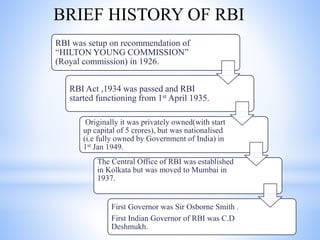
BRIEF HISTORY OF RBI
RBI was setup on recommendation of
“HILTON YOUNG COMMISSION”
(Royal commission) in 1926.
RBI Act ,1934 was passed and RBI
started functioning from 1st April 1935.
Originally it was privately owned(with start
up capital of 5 crores), but was nationalised
(i.e fully owned by Government of India) in
1st Jan 1949.
The Central Office of RBI was established
in Kolkata but was moved to Mumbai in
1937.
First Governor was Sir Osborne Smith .
First Indian Governor of RBI was C.D
Deshmukh.
PREAMBLE
The Preamble of the Reserve Bank of India describes the
basic functions of the Reserve Bank as:
"to regulate the issue of Bank notes and keeping of reserves
with a view to securing monetary stability in India and
generally to operate the currency and credit system of the
country to its advantage; to have a modern monetary policy
framework to meet the challenge of an increasingly
complex economy, to maintain price stability while keeping
in mind the objective of growth."
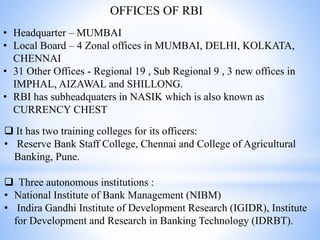
OFFICES OF RBI
• Headquarter – MUMBAI
• Local Board – 4 Zonal offices in MUMBAI, DELHI, KOLKATA,
CHENNAI
• 31 Other Offices - Regional 19 , Sub Regional 9 , 3 new offices in
IMPHAL, AIZAWAL and SHILLONG.
• RBI has subheadquaters in NASIK which is also known as
CURRENCY CHEST
 It has two training colleges for its officers:
• Reserve Bank Staff College, Chennai and College of Agricultural
Banking, Pune.
 Three autonomous institutions :
• National Institute of Bank Management (NIBM)
• Indira Gandhi Institute of Development Research (IGIDR), Institute
for Development and Research in Banking Technology (IDRBT).
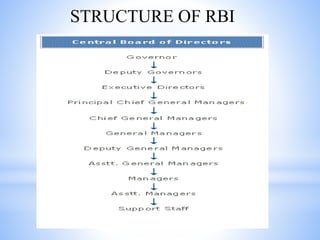
STRUCTURE OF RBI
FUNCTIONS OF RBI
1. Issue of Notes
2. Banker’s Bank and Lender of Last
Resort
3. Government’s Bank
4. Foreign Exchange Control
5. Clearing House System
6. Formulate Monetary Policy
7. Credit control(open market operation,
bank rate policies,CRR,SLR etc.)
• Cannot participate in any business, trade or
industry, nor can it extend financial help directly
to such business, trade or industry.
• Can neither sell its own share nor can buy shares
of other banks or firms.
• Cannot buy immovable property , nor can it grant
loan against the securities of any such immovable
property.
• Cannot grant loan to any party without proper
security.
PROHIBITED FUNCTIONS OF
RBI
SUBSIDIARIES OF RBI
FULLY OWNED
• National Housing Bank (NHB) – It was set up on
July 9, 1988.
• Bharatiya Reserve Bank Note Mudran Private
Limited (BRBNMPL) – Established in February
1995.
• Deposit Insurance and Credit Guarantee
Corporation (DICGC) – Came into existence on
July 15,1978
MAJOR STAKES
• National Bank for Agriculture and Rural
Development (NABARD) – Established on July 12,
1982
RELATION BETWEEN RBI AND
SBI
• The SBI came into existence on 1st July 1955.
• The SBI acts as agent of RBI in all those places
where RBI does not maintain its own branches.
• Thus relation between RBI and SBI is that of
principal and agent.
• The SBI is paid commission (rate of commission is
fixed by agreement) by RBI for various functions it
performs on behalf of RBI.
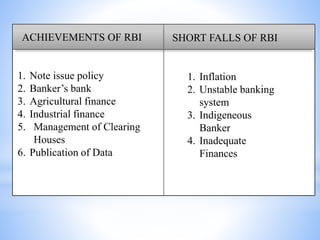
ACHIEVEMENTS OF RBI SHORT FALLS OF RBI
1. Note issue policy
2. Banker’s bank
3. Agricultural finance
4. Industrial finance
5. Management of Clearing
Houses
6. Publication of Data
1. Inflation
2. Unstable banking
system
3. Indigeneous
Banker
4. Inadequate
Finances
• RBI WEBSITE-
https://www.rbi.org.in/Scripts/AboutusDisplay.aspx
• Retrieved From- https://bq.training/blog/history-and-
role-of-rbi/
• Indian Banking System Book –I.V Trivedi & C.M.
Chaudhary
SOURCES
THANK YOU

RBI

  • 1.
  • 2.
    CENTRAL BANK “A CentralBank is a bank that the government set up to handle its transactions to coordinate and control the commercial banks and most important to help and control the nation’s money and credit conditions.” -Prof. Samuelson
  • 3.
    INTRODUCTION • Reserve Bankof India is central bank of India and was established on “1st April 1935” under the Reserve bank of India Act, 1934. • Its Headquarter is in Mumbai(Maharashtra). • Its present governor is Urjit Patel(24th Governor –Since September 2016).
  • 4.
    BRIEF HISTORY OFRBI RBI was setup on recommendation of “HILTON YOUNG COMMISSION” (Royal commission) in 1926. RBI Act ,1934 was passed and RBI started functioning from 1st April 1935. Originally it was privately owned(with start up capital of 5 crores), but was nationalised (i.e fully owned by Government of India) in 1st Jan 1949. The Central Office of RBI was established in Kolkata but was moved to Mumbai in 1937. First Governor was Sir Osborne Smith . First Indian Governor of RBI was C.D Deshmukh.
  • 5.
    PREAMBLE The Preamble ofthe Reserve Bank of India describes the basic functions of the Reserve Bank as: "to regulate the issue of Bank notes and keeping of reserves with a view to securing monetary stability in India and generally to operate the currency and credit system of the country to its advantage; to have a modern monetary policy framework to meet the challenge of an increasingly complex economy, to maintain price stability while keeping in mind the objective of growth."
  • 6.
    OFFICES OF RBI •Headquarter – MUMBAI • Local Board – 4 Zonal offices in MUMBAI, DELHI, KOLKATA, CHENNAI • 31 Other Offices - Regional 19 , Sub Regional 9 , 3 new offices in IMPHAL, AIZAWAL and SHILLONG. • RBI has subheadquaters in NASIK which is also known as CURRENCY CHEST  It has two training colleges for its officers: • Reserve Bank Staff College, Chennai and College of Agricultural Banking, Pune.  Three autonomous institutions : • National Institute of Bank Management (NIBM) • Indira Gandhi Institute of Development Research (IGIDR), Institute for Development and Research in Banking Technology (IDRBT).
  • 7.
  • 8.
    FUNCTIONS OF RBI 1.Issue of Notes 2. Banker’s Bank and Lender of Last Resort 3. Government’s Bank 4. Foreign Exchange Control 5. Clearing House System 6. Formulate Monetary Policy 7. Credit control(open market operation, bank rate policies,CRR,SLR etc.)
  • 9.
    • Cannot participatein any business, trade or industry, nor can it extend financial help directly to such business, trade or industry. • Can neither sell its own share nor can buy shares of other banks or firms. • Cannot buy immovable property , nor can it grant loan against the securities of any such immovable property. • Cannot grant loan to any party without proper security. PROHIBITED FUNCTIONS OF RBI
  • 10.
    SUBSIDIARIES OF RBI FULLYOWNED • National Housing Bank (NHB) – It was set up on July 9, 1988. • Bharatiya Reserve Bank Note Mudran Private Limited (BRBNMPL) – Established in February 1995. • Deposit Insurance and Credit Guarantee Corporation (DICGC) – Came into existence on July 15,1978 MAJOR STAKES • National Bank for Agriculture and Rural Development (NABARD) – Established on July 12, 1982
  • 11.
    RELATION BETWEEN RBIAND SBI • The SBI came into existence on 1st July 1955. • The SBI acts as agent of RBI in all those places where RBI does not maintain its own branches. • Thus relation between RBI and SBI is that of principal and agent. • The SBI is paid commission (rate of commission is fixed by agreement) by RBI for various functions it performs on behalf of RBI.
  • 12.
    ACHIEVEMENTS OF RBISHORT FALLS OF RBI 1. Note issue policy 2. Banker’s bank 3. Agricultural finance 4. Industrial finance 5. Management of Clearing Houses 6. Publication of Data 1. Inflation 2. Unstable banking system 3. Indigeneous Banker 4. Inadequate Finances
  • 13.
    • RBI WEBSITE- https://www.rbi.org.in/Scripts/AboutusDisplay.aspx •Retrieved From- https://bq.training/blog/history-and- role-of-rbi/ • Indian Banking System Book –I.V Trivedi & C.M. Chaudhary SOURCES
  • 14.