RBI
 By
 Shraddha visariya
 Sybms (sem-3)
 Roll no- 39
Preamble
The Preamble of the Reserve Bank of India
describes the basic functions of the Reserve
Bank as:

“...to regulate the issue of Bank Notes and
keeping of reserves with a view to securing
monetary stability in India and generally to
operate the currency and credit system of
the country to its advantage.”
Background
Established under RBI Account of 1934
Started functioning from April 1, 1935
It was nationalized in January , 1, 1949
Share capital Rs.5.00 Cr of Rs.100.00
each
Government held nominal shares of
Rs.2.22 lac
At the time of Nationalization Govt. paid
Rs.118.58ps per share of Rs.10.00
objectives
The Objective of any Central Bank is-
   to stabilize the monitory unit
   It has monopoly of note issuing
   It is not a profit center
   It will not compete with the commercial
   banks
   It is a Bank of Issue
   It is a Banker to the government
   Custodians of Nations Credit
   Controller of Credit
RBI SHARE CERTIFICATE
Central Board
The Reserve Bank's affairs are governed by a central board
of directors. The board is appointed by the Government of
India in keeping with the Reserve Bank of India Act.
Appointed/nominated for a period of four years
Constitution:
  Official Directors
      •Full-time : Governor and not more than four Deputy
      Governors
   Non-Official Directors
      •Nominated by Government: ten Directors from
      various fields and one government Official
      •Others: four Directors - one each from four local
      boards
Functions : General superintendence and direction of the
Bank's affairs
CB CONTINUED…..
Dr. Y.V.Reddy – Governor
                    Dr. Rakesh Mohan – Deputy Governor


                     Shri. V.Leeladhar – Deputy Governor


Smt.Shyamala Gopinath – Deputy Governor


                      Smt. Usha Thorat – Deputy Governor
Local Boards
One each for the four regions of the country in
Mumbai, Calcutta, Chennai and New Delhi
Membership:
consist of five members each
appointed by the Central Government
for a term of four years

Functions : To advise the Central Board on local matters
and to represent territorial and economic interests of
local cooperative and indigenous banks; to perform such
other functions as delegated by Central Board from time
to time.
Powers and
             responsibilities
of RBI in respect of regulation
of banks
The Reserve Bank of India has been entrusted
with the responsibility under the Banking
Regulation Act, 1949 to regulate and supervise
banks' activities in India and their branches
abroad. While the regulatory provisions of this
Act prescribe the policy framework to be
followed by banks, the supervisory framework
provides the mechanism to ensure banks'
compliance with the policy prescription.
Banking Supervision
Organisation of the Supervision Function
Supervision of overseas branches of
Indian banks
Uniform     guidelines     on     Write-off/
compromise settlements
Checklist for Inspecting Officers
Study of large value bank frauds
Nostro Accounts- Reconciliation
Non- SLR Investments
Transparency and Disclosure
Internal controls and housekeeping in
banks
Note Issuing
The assets of the Issue Department
against which bank notes are issued
are….
Gold coins and Bullions
Foreign Securities
Rupee Coins
Government of India Rupee Securities
The Bills of Exchange and Promissory
notes payable in India, which are eligible
for purchase by the bank under Sec22 of
RBI act
Minimum Reserve System since 1957
Rs.200 Crore of which Rs.115 crore in gold
RBI Monetary Policy
Monitory Policy refers to the policy of the
central bank to control money supply, credit
and inflation in economy

Monetary policy is a part of        overall
economic policy

To accelerate economic development to
raise national income and standard of living

to control inflationary pressures in the
economy
RBI’s CREDIT CONTROl
               Measures
RBI has various tools to use to
maintain monetary stability--
 Quantitative Controls – to
  regulate the volume of total credit

  Qualitative(Selective Credit)
  Controls – to regulate the flow of
  credit to    various    uses   and
  purposes
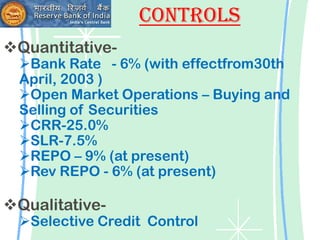
Controls
Quantitative-
  Bank Rate - 6% (with effectfrom30th
  April, 2003 )
  Open Market Operations – Buying and
  Selling of Securities
  CRR-25.0%
  SLR-7.5%
  REPO – 9% (at present)
  Rev REPO - 6% (at present)

Qualitative-
  Selective Credit Control
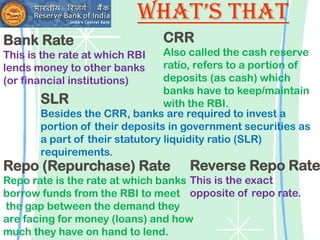
WHAT’s THAT
Bank Rate                       CRR
This is the rate at which RBI    Also called the cash reserve
lends money to other banks       ratio, refers to a portion of
(or financial institutions)      deposits (as cash) which
                                 banks have to keep/maintain
       SLR                       with the RBI.
       Besides the CRR, banks are required to invest a
       portion of their deposits in government securities as
       a part of their statutory liquidity ratio (SLR)
       requirements.
Repo (Repurchase) Rate               Reverse Repo Rate
Repo rate is the rate at which banks This is the exact
borrow funds from the RBI to meet opposite of repo rate.
the gap between the demand they
are facing for money (loans) and how
much they have on hand to lend.
Presentation on RBI

Presentation on RBI

  • 1.
    RBI By Shraddhavisariya Sybms (sem-3) Roll no- 39
  • 2.
    Preamble The Preamble ofthe Reserve Bank of India describes the basic functions of the Reserve Bank as: “...to regulate the issue of Bank Notes and keeping of reserves with a view to securing monetary stability in India and generally to operate the currency and credit system of the country to its advantage.”
  • 3.
    Background Established under RBIAccount of 1934 Started functioning from April 1, 1935 It was nationalized in January , 1, 1949 Share capital Rs.5.00 Cr of Rs.100.00 each Government held nominal shares of Rs.2.22 lac At the time of Nationalization Govt. paid Rs.118.58ps per share of Rs.10.00
  • 4.
    objectives The Objective ofany Central Bank is- to stabilize the monitory unit It has monopoly of note issuing It is not a profit center It will not compete with the commercial banks It is a Bank of Issue It is a Banker to the government Custodians of Nations Credit Controller of Credit
  • 5.
  • 6.
    Central Board The ReserveBank's affairs are governed by a central board of directors. The board is appointed by the Government of India in keeping with the Reserve Bank of India Act. Appointed/nominated for a period of four years Constitution: Official Directors •Full-time : Governor and not more than four Deputy Governors Non-Official Directors •Nominated by Government: ten Directors from various fields and one government Official •Others: four Directors - one each from four local boards Functions : General superintendence and direction of the Bank's affairs
  • 7.
    CB CONTINUED….. Dr. Y.V.Reddy– Governor Dr. Rakesh Mohan – Deputy Governor Shri. V.Leeladhar – Deputy Governor Smt.Shyamala Gopinath – Deputy Governor Smt. Usha Thorat – Deputy Governor
  • 8.
    Local Boards One eachfor the four regions of the country in Mumbai, Calcutta, Chennai and New Delhi Membership: consist of five members each appointed by the Central Government for a term of four years Functions : To advise the Central Board on local matters and to represent territorial and economic interests of local cooperative and indigenous banks; to perform such other functions as delegated by Central Board from time to time.
  • 9.
    Powers and responsibilities of RBI in respect of regulation of banks The Reserve Bank of India has been entrusted with the responsibility under the Banking Regulation Act, 1949 to regulate and supervise banks' activities in India and their branches abroad. While the regulatory provisions of this Act prescribe the policy framework to be followed by banks, the supervisory framework provides the mechanism to ensure banks' compliance with the policy prescription.
  • 10.
    Banking Supervision Organisation ofthe Supervision Function Supervision of overseas branches of Indian banks Uniform guidelines on Write-off/ compromise settlements Checklist for Inspecting Officers Study of large value bank frauds Nostro Accounts- Reconciliation Non- SLR Investments Transparency and Disclosure Internal controls and housekeeping in banks
  • 11.
    Note Issuing The assetsof the Issue Department against which bank notes are issued are…. Gold coins and Bullions Foreign Securities Rupee Coins Government of India Rupee Securities The Bills of Exchange and Promissory notes payable in India, which are eligible for purchase by the bank under Sec22 of RBI act Minimum Reserve System since 1957 Rs.200 Crore of which Rs.115 crore in gold
  • 12.
    RBI Monetary Policy MonitoryPolicy refers to the policy of the central bank to control money supply, credit and inflation in economy Monetary policy is a part of overall economic policy To accelerate economic development to raise national income and standard of living to control inflationary pressures in the economy
  • 13.
    RBI’s CREDIT CONTROl Measures RBI has various tools to use to maintain monetary stability-- Quantitative Controls – to regulate the volume of total credit Qualitative(Selective Credit) Controls – to regulate the flow of credit to various uses and purposes
  • 14.
    Controls Quantitative- BankRate - 6% (with effectfrom30th April, 2003 ) Open Market Operations – Buying and Selling of Securities CRR-25.0% SLR-7.5% REPO – 9% (at present) Rev REPO - 6% (at present) Qualitative- Selective Credit Control
  • 15.
    WHAT’s THAT Bank Rate CRR This is the rate at which RBI Also called the cash reserve lends money to other banks ratio, refers to a portion of (or financial institutions) deposits (as cash) which banks have to keep/maintain SLR with the RBI. Besides the CRR, banks are required to invest a portion of their deposits in government securities as a part of their statutory liquidity ratio (SLR) requirements. Repo (Repurchase) Rate Reverse Repo Rate Repo rate is the rate at which banks This is the exact borrow funds from the RBI to meet opposite of repo rate. the gap between the demand they are facing for money (loans) and how much they have on hand to lend.