Rattans
(non –wood forest products)
M.SC BOTANY
BOTANICAL
DESCRIPTION
OF RATTANS
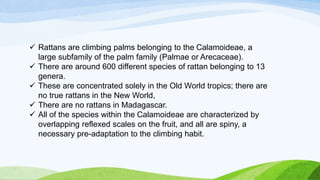
 Rattans are climbing palms belonging to the Calamoideae, a
large subfamily of the palm family (Palmae or Arecaceae).
 There are around 600 different species of rattan belonging to 13
genera.
 These are concentrated solely in the Old World tropics; there are
no true rattans in the New World,
 There are no rattans in Madagascar.
 All of the species within the Calamoideae are characterized by
overlapping reflexed scales on the fruit, and all are spiny, a
necessary pre-adaptation to the climbing habit.
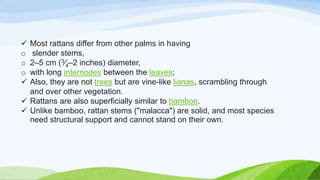
 Most rattans differ from other palms in having
o slender stems,
o 2–5 cm (3⁄4–2 inches) diameter,
o with long internodes between the leaves;
 Also, they are not trees but are vine-like lianas, scrambling through
and over other vegetation.
 Rattans are also superficially similar to bamboo.
 Unlike bamboo, rattan stems ("malacca") are solid, and most species
need structural support and cannot stand on their own.
 Many rattans have spines which act as hooks to aid climbing over
other plants, and to deter herbivores.
 Rattans have been known to grow up to hundreds of metres long.
Most (70%) of the world's rattan population exist in
o Indonesia,
o distributed among the islands Borneo,
o Sulawesi, and
o Sumbawa.
 The rest of the world's supply comes from the
o Philippines,
o Sri Lanka,
o Malaysia, and
o Bangladesh
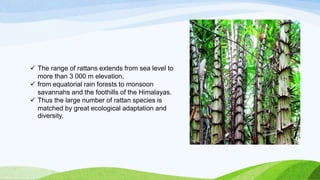
 The range of rattans extends from sea level to
more than 3 000 m elevation,
 from equatorial rain forests to monsoon
savannahs and the foothills of the Himalayas.
 Thus the large number of rattan species is
matched by great ecological adaptation and
diversity.
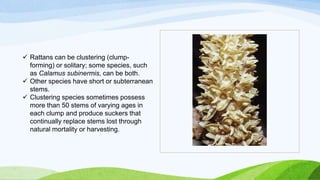
 Rattans can be clustering (clump-
forming) or solitary; some species, such
as Calamus subinermis, can be both.
 Other species have short or subterranean
stems.
 Clustering species sometimes possess
more than 50 stems of varying ages in
each clump and produce suckers that
continually replace stems lost through
natural mortality or harvesting.
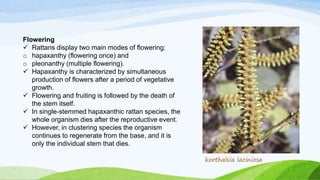
Flowering
 Rattans display two main modes of flowering:
o hapaxanthy (flowering once) and
o pleonanthy (multiple flowering).
 Hapaxanthy is characterized by simultaneous
production of flowers after a period of vegetative
growth.
 Flowering and fruiting is followed by the death of
the stem itself.
 In single-stemmed hapaxanthic rattan species, the
whole organism dies after the reproductive event.
 However, in clustering species the organism
continues to regenerate from the base, and it is
only the individual stem that dies.
korthalsia laciniosa
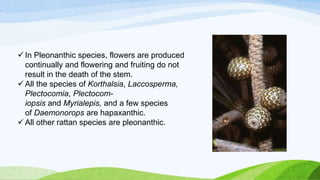
 In Pleonanthic species, flowers are produced
continually and flowering and fruiting do not
result in the death of the stem.
 All the species of Korthalsia, Laccosperma,
Plectocomia, Plectocom-
iopsis and Myrialepis, and a few species
of Daemonorops are hapaxanthic.
 All other rattan species are pleonanthic.
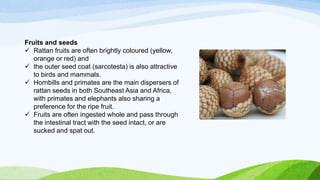
Fruits and seeds
 Rattan fruits are often brightly coloured (yellow,
orange or red) and
 the outer seed coat (sarcotesta) is also attractive
to birds and mammals.
 Hornbills and primates are the main dispersers of
rattan seeds in both Southeast Asia and Africa,
with primates and elephants also sharing a
preference for the ripe fruit.
 Fruits are often ingested whole and pass through
the intestinal tract with the seed intact, or are
sucked and spat out.
CULTIVATION
OF RATTANS
 Climate plays an important role on the growth of rattans, under low
temperature of 15°C, and monthly precipitation less than 25 mm growth
remained poor.
 Rattans are vigorous climbers with relatively high growth rates, and are thus
able to be harvested on a short cycle.
 For the majority of rattans, stem production from the rosette stage (and the
seedling bank) is initiated by exposure to adequate light.
 Stem elongation is also affected by light and, whilst continuous, varies, usually
on a seasonal basis.
 Whilst no data on the growth rates of rattans in the wild exists, long-term
studies have been undertaken in cultivation.
Growth Rates
 The harvesting techniques employed in the extraction of rattan have an impact
on potential sustainability, particularly for clustering species.
 The mature stems selected for harvesting are those without lower leaves (i.e.
where the leaf sheaths have sloughed off) and
o usually only the basal 10-20m is harvested;
o the upper "green" part of the cane is too soft and inflexible for transformation
and is often left in the canopy.
 In many instances, all the stems in a clustering species may be cut in order to
obtain access to the mature stems, even those that are not yet mature enough
for exploitation and sale.
 This is particularly an issue where resource tenure is weak.
Two simple interventions can be implemented to improve upon rattan
harvesting practices:
For clustering species:
• Younger stems, often indiscriminately cut during harvesting should be left
to regenerate and provide future sources of cane.
• Rotational harvesting systems could be increased if this was the case.
• However, better "stool management" relies on adequate resource tenure.
For all species:
· Harvest intensity and rotation should be based on long-term assessments
of growth rates and recruitment.
ECONOMIC IMPORTANCE
OF RATTANS
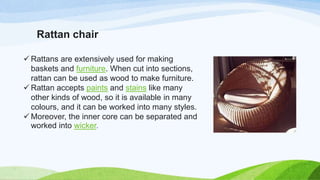
Rattan chair
 Rattans are extensively used for making
baskets and furniture. When cut into sections,
rattan can be used as wood to make furniture.
 Rattan accepts paints and stains like many
other kinds of wood, so it is available in many
colours, and it can be worked into many styles.
 Moreover, the inner core can be separated and
worked into wicker.
Clothing
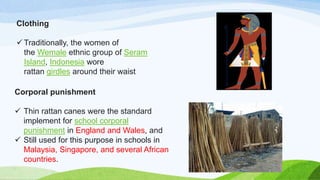
 Traditionally, the women of
the Wemale ethnic group of Seram
Island, Indonesia wore
rattan girdles around their waist
Corporal punishment
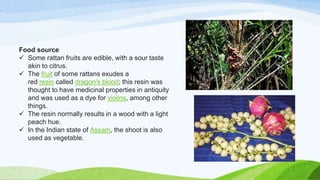
 Thin rattan canes were the standard
implement for school corporal
punishment in England and Wales, and
 Still used for this purpose in schools in
Malaysia, Singapore, and several African
countries.
Food source
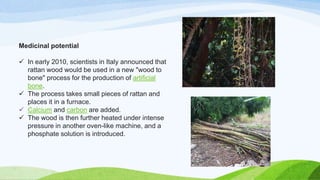
 Some rattan fruits are edible, with a sour taste
akin to citrus.
 The fruit of some rattans exudes a
red resin called dragon's blood; this resin was
thought to have medicinal properties in antiquity
and was used as a dye for violins, among other
things.
 The resin normally results in a wood with a light
peach hue.
 In the Indian state of Assam, the shoot is also
used as vegetable.
Medicinal potential
 In early 2010, scientists in Italy announced that
rattan wood would be used in a new "wood to
bone" process for the production of artificial
bone.
 The process takes small pieces of rattan and
places it in a furnace.
 Calcium and carbon are added.
 The wood is then further heated under intense
pressure in another oven-like machine, and a
phosphate solution is introduced.
Handicraft and arts
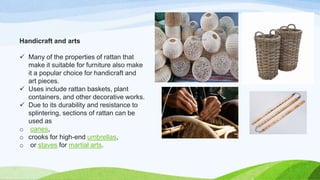
 Many of the properties of rattan that
make it suitable for furniture also make
it a popular choice for handicraft and
art pieces.
 Uses include rattan baskets, plant
containers, and other decorative works.
 Due to its durability and resistance to
splintering, sections of rattan can be
used as
o canes,
o crooks for high-end umbrellas,
o or staves for martial arts.
Shelter material
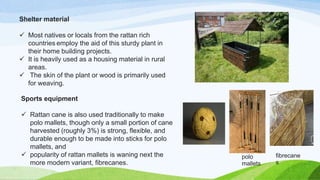
 Most natives or locals from the rattan rich
countries employ the aid of this sturdy plant in
their home building projects.
 It is heavily used as a housing material in rural
areas.
 The skin of the plant or wood is primarily used
for weaving.
Sports equipment
 Rattan cane is also used traditionally to make
polo mallets, though only a small portion of cane
harvested (roughly 3%) is strong, flexible, and
durable enough to be made into sticks for polo
mallets, and
 popularity of rattan mallets is waning next the
more modern variant, fibrecanes.
polo
mallets
fibrecane
s
Rattans (Economic botany)

Rattans (Economic botany)

  • 1.
    Rattans (non –wood forestproducts) M.SC BOTANY
  • 2.
  • 3.
     Rattans areclimbing palms belonging to the Calamoideae, a large subfamily of the palm family (Palmae or Arecaceae).  There are around 600 different species of rattan belonging to 13 genera.  These are concentrated solely in the Old World tropics; there are no true rattans in the New World,  There are no rattans in Madagascar.  All of the species within the Calamoideae are characterized by overlapping reflexed scales on the fruit, and all are spiny, a necessary pre-adaptation to the climbing habit.
  • 4.
     Most rattansdiffer from other palms in having o slender stems, o 2–5 cm (3⁄4–2 inches) diameter, o with long internodes between the leaves;  Also, they are not trees but are vine-like lianas, scrambling through and over other vegetation.  Rattans are also superficially similar to bamboo.  Unlike bamboo, rattan stems ("malacca") are solid, and most species need structural support and cannot stand on their own.
  • 6.
     Many rattanshave spines which act as hooks to aid climbing over other plants, and to deter herbivores.  Rattans have been known to grow up to hundreds of metres long. Most (70%) of the world's rattan population exist in o Indonesia, o distributed among the islands Borneo, o Sulawesi, and o Sumbawa.  The rest of the world's supply comes from the o Philippines, o Sri Lanka, o Malaysia, and o Bangladesh
  • 7.
     The rangeof rattans extends from sea level to more than 3 000 m elevation,  from equatorial rain forests to monsoon savannahs and the foothills of the Himalayas.  Thus the large number of rattan species is matched by great ecological adaptation and diversity.
  • 8.
     Rattans canbe clustering (clump- forming) or solitary; some species, such as Calamus subinermis, can be both.  Other species have short or subterranean stems.  Clustering species sometimes possess more than 50 stems of varying ages in each clump and produce suckers that continually replace stems lost through natural mortality or harvesting.
  • 9.
    Flowering  Rattans displaytwo main modes of flowering: o hapaxanthy (flowering once) and o pleonanthy (multiple flowering).  Hapaxanthy is characterized by simultaneous production of flowers after a period of vegetative growth.  Flowering and fruiting is followed by the death of the stem itself.  In single-stemmed hapaxanthic rattan species, the whole organism dies after the reproductive event.  However, in clustering species the organism continues to regenerate from the base, and it is only the individual stem that dies. korthalsia laciniosa
  • 10.
     In Pleonanthicspecies, flowers are produced continually and flowering and fruiting do not result in the death of the stem.  All the species of Korthalsia, Laccosperma, Plectocomia, Plectocom- iopsis and Myrialepis, and a few species of Daemonorops are hapaxanthic.  All other rattan species are pleonanthic.
  • 11.
    Fruits and seeds Rattan fruits are often brightly coloured (yellow, orange or red) and  the outer seed coat (sarcotesta) is also attractive to birds and mammals.  Hornbills and primates are the main dispersers of rattan seeds in both Southeast Asia and Africa, with primates and elephants also sharing a preference for the ripe fruit.  Fruits are often ingested whole and pass through the intestinal tract with the seed intact, or are sucked and spat out.
  • 12.
  • 14.
     Climate playsan important role on the growth of rattans, under low temperature of 15°C, and monthly precipitation less than 25 mm growth remained poor.  Rattans are vigorous climbers with relatively high growth rates, and are thus able to be harvested on a short cycle.  For the majority of rattans, stem production from the rosette stage (and the seedling bank) is initiated by exposure to adequate light.  Stem elongation is also affected by light and, whilst continuous, varies, usually on a seasonal basis.  Whilst no data on the growth rates of rattans in the wild exists, long-term studies have been undertaken in cultivation. Growth Rates
  • 15.
     The harvestingtechniques employed in the extraction of rattan have an impact on potential sustainability, particularly for clustering species.  The mature stems selected for harvesting are those without lower leaves (i.e. where the leaf sheaths have sloughed off) and o usually only the basal 10-20m is harvested; o the upper "green" part of the cane is too soft and inflexible for transformation and is often left in the canopy.  In many instances, all the stems in a clustering species may be cut in order to obtain access to the mature stems, even those that are not yet mature enough for exploitation and sale.  This is particularly an issue where resource tenure is weak.
  • 16.
    Two simple interventionscan be implemented to improve upon rattan harvesting practices: For clustering species: • Younger stems, often indiscriminately cut during harvesting should be left to regenerate and provide future sources of cane. • Rotational harvesting systems could be increased if this was the case. • However, better "stool management" relies on adequate resource tenure. For all species: · Harvest intensity and rotation should be based on long-term assessments of growth rates and recruitment.
  • 17.
  • 18.
    Rattan chair  Rattansare extensively used for making baskets and furniture. When cut into sections, rattan can be used as wood to make furniture.  Rattan accepts paints and stains like many other kinds of wood, so it is available in many colours, and it can be worked into many styles.  Moreover, the inner core can be separated and worked into wicker.
  • 19.
    Clothing  Traditionally, thewomen of the Wemale ethnic group of Seram Island, Indonesia wore rattan girdles around their waist Corporal punishment  Thin rattan canes were the standard implement for school corporal punishment in England and Wales, and  Still used for this purpose in schools in Malaysia, Singapore, and several African countries.
  • 20.
    Food source  Somerattan fruits are edible, with a sour taste akin to citrus.  The fruit of some rattans exudes a red resin called dragon's blood; this resin was thought to have medicinal properties in antiquity and was used as a dye for violins, among other things.  The resin normally results in a wood with a light peach hue.  In the Indian state of Assam, the shoot is also used as vegetable.
  • 21.
    Medicinal potential  Inearly 2010, scientists in Italy announced that rattan wood would be used in a new "wood to bone" process for the production of artificial bone.  The process takes small pieces of rattan and places it in a furnace.  Calcium and carbon are added.  The wood is then further heated under intense pressure in another oven-like machine, and a phosphate solution is introduced.
  • 22.
    Handicraft and arts Many of the properties of rattan that make it suitable for furniture also make it a popular choice for handicraft and art pieces.  Uses include rattan baskets, plant containers, and other decorative works.  Due to its durability and resistance to splintering, sections of rattan can be used as o canes, o crooks for high-end umbrellas, o or staves for martial arts.
  • 23.
    Shelter material  Mostnatives or locals from the rattan rich countries employ the aid of this sturdy plant in their home building projects.  It is heavily used as a housing material in rural areas.  The skin of the plant or wood is primarily used for weaving. Sports equipment  Rattan cane is also used traditionally to make polo mallets, though only a small portion of cane harvested (roughly 3%) is strong, flexible, and durable enough to be made into sticks for polo mallets, and  popularity of rattan mallets is waning next the more modern variant, fibrecanes. polo mallets fibrecane s