REVAMPING RASNA
BY
RAMU POKHREL
ARUN BORA
VIJAYLAKSHMI
CHAITALI
INTRODUCTION
• Rasna is a soft drink concentrate brand owned by Pioma Industries which
is based in Ahmedabad, India
• Piruz Khambatta is Chairman and managing director of Rasna.
• The brand name was changed to Rasna in 1979
• Rasna claims 92.7% market share in non-carbonated soft drinks
concentrate powder.
• It has manufacturing facilities outside India in Bangladesh, Dubai, Saudi
Arabia and Egypt as well.
• Rasna Pvt Ltd. is a proud family owned company and a global benchmark
in Taste and Quality.
• Awarded with ITQI (International Taste & Quality Awards), Belgium for
its unbeatable taste & Quality.
TIMELINE OF RASNA
• 1976-: Introduced SDC under the brand name “JAFFE”
•
• 1979-: Brand name change to “RASNA”
• 1980-:1990 -: Ruled the market by the tag line “I LOVE U RASNA”
• 1991- : Decline in sale due to the enter of competitors i.e. Coca-Cola, Pepsi etc.
• 1993-: Launched product of 2 categories at global level i.e. “Rasna Beverage ,foods &
Rasna ethnic basket”.
• 1996-: Launched Rasna international & Rasna royal as pre sweetened mix drink.
• 1999-: Launched 2 new flavour ”Rasna Yorker & Rasna Aqua Fun”
• 2000- Launched ORANJOLT aerated drink but soon fail.
• 2001-: Company name changed to Rasna ltd.
• 2002-: Launched RASNA UTSAV & RASNA ROJANA as juice products.
• 2013-: Rasna enter ready to drink beverage segment with the brand name “RASNA JU-
C”.
SELLING ENVIRONMENT
• Pioma was the first company to introduce the concept of soft
drink concentrates (SDC) in India
• Pioma thus launched an SDC under the brand name 'Jaffe' in
1976 and marketed it with the help of Voltas
• Rasna’s SDC comprised a powder sachet and a small bottle of
thick, coloured liquid.
• Competitors like Cola and MNC cola prevailed in the market.
MARKETING AND ADVERTISING STRATEGY
• Tagline- “I love you Rasna”
• Shop sampling
• Gift offers to customers and other trade schemes.
• House-to-house calls
• Direct interaction
• Live demos (Events)
• Ad in Doordharshan
• Used Asha Bhonsle for ad song.
REASON FOR INITIAL SUCCESS
Many flavours, real fruit-like flavour and taste
Easy to prepare
Priced at 50 paisa per glass- (used the production concept)
Do it yourself concept
Strong R&D and supplier chain
Sales and distribution network
Modern packing technology
Advanced world-class technology was used for packaging.
• Planned for entering global market by 1993
• Produced new beverages and ready to eat foods.
• Priced high, targeted at the upper end of the market who were
health conscious consumers.
• Realised potential for ethnic Indian food
• Rasna ethnic basket and Rasna beverages and foods.
MARKET DYNAMIC
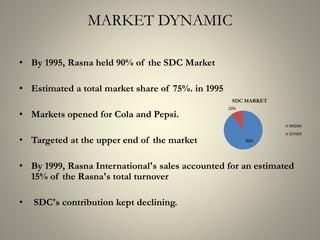
• By 1995, Rasna held 90% of the SDC Market
• Estimated a total market share of 75%. in 1995
• Markets opened for Cola and Pepsi.
• Targeted at the upper end of the market
• By 1999, Rasna International's sales accounted for an estimated
15% of the Rasna's total turnover
• SDC's contribution kept declining.
90%
10%
SDC MARKET
RASNA
OTHER
DECLINE IN PIOMA’S FORTUNES
• Decline starts mainly due to the short sightedness
• Failure to understand changing customer preferences
• Do it yourself concept
• Advent of fruit juices in tetra packs and Aerated drinks in plastic
bottles.
• Failed to sustain its stronghold in the lower-income segment.
• Focus on children had significantly contributed to Rasna's downgrade
• Govt. policies(Introduction of MNC)
BRAND EXTENSION
• Rasna International nutritious and vitamin-enriched version of
the regular Rasna SDC version.
• Rasna Royal a vitamin enriched version of Rasna SDC in 1996.
• Launched new flavours Rasna Yorker and Rasna Aqua fun in
1999.
• Launched of Oranjolt in 2000, an aerated fruit drink
• Rasna was made available in many local flavours such as 'Kala
Khatta' (tangy), 'Khus' and 'Rose' .
PRODUCT FAILURE
• Products were priced at the higher end.
• The failure of Aqua Fun was attributed mainly to its blue
colour.
• Weak distribution network of Oranjolt
• The short shelf life of the Oranjolt also contributed to its
failure.
PARALLEL HURDLES/REVAMPING NEED
• Volume shrinks by 7% every year
• Late 90’s priced between Rs.22-24
• Growing awareness between natural and synthetic flavours.
• Tetra pack category increased
THREAT OF SUBSTITUTE
Coke & Pepsi were the main substitutes.
People preferred readymade rather than products like RASNA which ought to be prepared.
Fruit juices in tetra packs and aerated drinks in plastic bottles .
RESTRUCTURING PLAN
POSITIONING STRATEGY
Available at price range of Rs 80 paisa to Rs 4 per glass.
Create brand awareness
Reach out masses
Increase the target segments
Positioned as an International brand
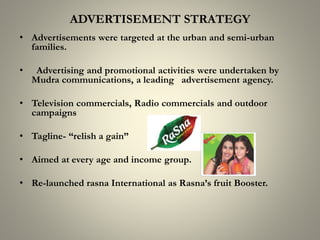
ADVERTISEMENT STRATEGY
• Advertisements were targeted at the urban and semi-urban
families.
• Advertising and promotional activities were undertaken by
Mudra communications, a leading advertisement agency.
• Television commercials, Radio commercials and outdoor
campaigns
• Tagline- “relish a gain”
• Aimed at every age and income group.
• Re-launched rasna International as Rasna’s fruit Booster.
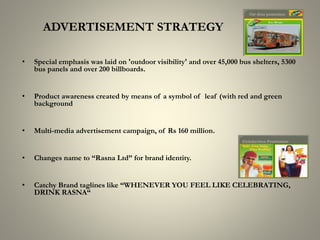
ADVERTISEMENT STRATEGY
• Special emphasis was laid on 'outdoor visibility' and over 45,000 bus shelters, 5300
bus panels and over 200 billboards.
• Product awareness created by means of a symbol of leaf (with red and green
background
• Multi-media advertisement campaign, of Rs 160 million.
• Changes name to “Rasna Ltd” for brand identity.
• Catchy Brand taglines like “WHENEVER YOU FEEL LIKE CELEBRATING,
DRINK RASNA“
DISTRIBUTION STRATEGY
• Rasna planned to reach an estimated 7,00,000 retailers annually.
• The company appointed 47 additional sales personnel, 350 cycle
salesmen, and 145 pilot salesmen
• 500 vans for the coverage of rural areas.
• The company had 24 warehouses in various parts of the country,
24 distributors and 2000 stockists.
REVAMPING OUTCOME
• The revamping exercise was fruitful
• In 2002, Rasna was the most widely distributed product
• Emerged as a Mass Brand across socio-economic barriers
• Ranked 7th in F&B category in India, in 2002
• Rated as the 21st among the most recalled brands in India.
• As of 2009, Rasna had a 93% market share in the soft drink
concentrate market in India
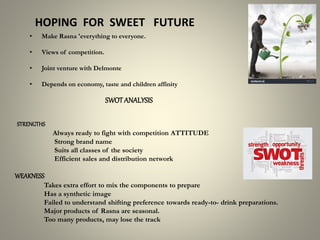
HOPING FOR SWEET FUTURE
• Make Rasna 'everything to everyone.
• Views of competition.
• Joint venture with Delmonte
• Depends on economy, taste and children affinity
SWOTANALYSIS
STRENGTHS
Always ready to fight with competition ATTITUDE
Strong brand name
Suits all classes of the society
Efficient sales and distribution network
WEAKNESS
Takes extra effort to mix the components to prepare
Has a synthetic image
Failed to understand shifting preference towards ready-to- drink preparations.
Major products of Rasna are seasonal.
Too many products, may lose the track
OPPORTUNITY
Opportunity to enter into ready drink section
Entering into glucose section is definitely a good initiative
Entering into global markets
Also concentrating on rural markets
Mass market as a target
THREATS
Entrance of soft-drink brands like Coke and Pepsi etc
Other competitor brands like HUL,PARLE etc
Colas getting belligerent and their prices coming down
New regulations & policies
Conceptual change
CONCLUSION
• Rasna owned by Pioma industries
• The tagline “ I love you Rasna “ was popular among masses
• Main reason for success- Do it yourself concept
• Started by 1976 when no MNC players were there
• Went for globalization.
• Entry of Competitors by 1990’s
• Starts losing market share by every quarter
• Decide on new strategically decisions
• Plans on revamping by 2002 and reasons for the same
• A major foresight helped the company to reach the masses
• Pricing was done using penetration strategy
• Could not understand the changing market dynamics immediately
• A complete restructuring helped it regain its position THANK YOU

Rasna ppt

  • 1.
    REVAMPING RASNA BY RAMU POKHREL ARUNBORA VIJAYLAKSHMI CHAITALI
  • 2.
    INTRODUCTION • Rasna isa soft drink concentrate brand owned by Pioma Industries which is based in Ahmedabad, India • Piruz Khambatta is Chairman and managing director of Rasna. • The brand name was changed to Rasna in 1979 • Rasna claims 92.7% market share in non-carbonated soft drinks concentrate powder. • It has manufacturing facilities outside India in Bangladesh, Dubai, Saudi Arabia and Egypt as well. • Rasna Pvt Ltd. is a proud family owned company and a global benchmark in Taste and Quality. • Awarded with ITQI (International Taste & Quality Awards), Belgium for its unbeatable taste & Quality.
  • 3.
    TIMELINE OF RASNA •1976-: Introduced SDC under the brand name “JAFFE” • • 1979-: Brand name change to “RASNA” • 1980-:1990 -: Ruled the market by the tag line “I LOVE U RASNA” • 1991- : Decline in sale due to the enter of competitors i.e. Coca-Cola, Pepsi etc. • 1993-: Launched product of 2 categories at global level i.e. “Rasna Beverage ,foods & Rasna ethnic basket”. • 1996-: Launched Rasna international & Rasna royal as pre sweetened mix drink. • 1999-: Launched 2 new flavour ”Rasna Yorker & Rasna Aqua Fun” • 2000- Launched ORANJOLT aerated drink but soon fail. • 2001-: Company name changed to Rasna ltd. • 2002-: Launched RASNA UTSAV & RASNA ROJANA as juice products. • 2013-: Rasna enter ready to drink beverage segment with the brand name “RASNA JU- C”.
  • 4.
    SELLING ENVIRONMENT • Piomawas the first company to introduce the concept of soft drink concentrates (SDC) in India • Pioma thus launched an SDC under the brand name 'Jaffe' in 1976 and marketed it with the help of Voltas • Rasna’s SDC comprised a powder sachet and a small bottle of thick, coloured liquid. • Competitors like Cola and MNC cola prevailed in the market.
  • 5.
    MARKETING AND ADVERTISINGSTRATEGY • Tagline- “I love you Rasna” • Shop sampling • Gift offers to customers and other trade schemes. • House-to-house calls • Direct interaction • Live demos (Events) • Ad in Doordharshan • Used Asha Bhonsle for ad song.
  • 6.
    REASON FOR INITIALSUCCESS Many flavours, real fruit-like flavour and taste Easy to prepare Priced at 50 paisa per glass- (used the production concept) Do it yourself concept Strong R&D and supplier chain Sales and distribution network Modern packing technology Advanced world-class technology was used for packaging.
  • 7.
    • Planned forentering global market by 1993 • Produced new beverages and ready to eat foods. • Priced high, targeted at the upper end of the market who were health conscious consumers. • Realised potential for ethnic Indian food • Rasna ethnic basket and Rasna beverages and foods.
  • 8.
    MARKET DYNAMIC • By1995, Rasna held 90% of the SDC Market • Estimated a total market share of 75%. in 1995 • Markets opened for Cola and Pepsi. • Targeted at the upper end of the market • By 1999, Rasna International's sales accounted for an estimated 15% of the Rasna's total turnover • SDC's contribution kept declining. 90% 10% SDC MARKET RASNA OTHER
  • 9.
    DECLINE IN PIOMA’SFORTUNES • Decline starts mainly due to the short sightedness • Failure to understand changing customer preferences • Do it yourself concept • Advent of fruit juices in tetra packs and Aerated drinks in plastic bottles. • Failed to sustain its stronghold in the lower-income segment. • Focus on children had significantly contributed to Rasna's downgrade • Govt. policies(Introduction of MNC)
  • 10.
    BRAND EXTENSION • RasnaInternational nutritious and vitamin-enriched version of the regular Rasna SDC version. • Rasna Royal a vitamin enriched version of Rasna SDC in 1996. • Launched new flavours Rasna Yorker and Rasna Aqua fun in 1999. • Launched of Oranjolt in 2000, an aerated fruit drink • Rasna was made available in many local flavours such as 'Kala Khatta' (tangy), 'Khus' and 'Rose' .
  • 11.
    PRODUCT FAILURE • Productswere priced at the higher end. • The failure of Aqua Fun was attributed mainly to its blue colour. • Weak distribution network of Oranjolt • The short shelf life of the Oranjolt also contributed to its failure.
  • 12.
    PARALLEL HURDLES/REVAMPING NEED •Volume shrinks by 7% every year • Late 90’s priced between Rs.22-24 • Growing awareness between natural and synthetic flavours. • Tetra pack category increased THREAT OF SUBSTITUTE Coke & Pepsi were the main substitutes. People preferred readymade rather than products like RASNA which ought to be prepared. Fruit juices in tetra packs and aerated drinks in plastic bottles .
  • 13.
    RESTRUCTURING PLAN POSITIONING STRATEGY Availableat price range of Rs 80 paisa to Rs 4 per glass. Create brand awareness Reach out masses Increase the target segments Positioned as an International brand
  • 14.
    ADVERTISEMENT STRATEGY • Advertisementswere targeted at the urban and semi-urban families. • Advertising and promotional activities were undertaken by Mudra communications, a leading advertisement agency. • Television commercials, Radio commercials and outdoor campaigns • Tagline- “relish a gain” • Aimed at every age and income group. • Re-launched rasna International as Rasna’s fruit Booster.
  • 15.
    ADVERTISEMENT STRATEGY • Specialemphasis was laid on 'outdoor visibility' and over 45,000 bus shelters, 5300 bus panels and over 200 billboards. • Product awareness created by means of a symbol of leaf (with red and green background • Multi-media advertisement campaign, of Rs 160 million. • Changes name to “Rasna Ltd” for brand identity. • Catchy Brand taglines like “WHENEVER YOU FEEL LIKE CELEBRATING, DRINK RASNA“
  • 16.
    DISTRIBUTION STRATEGY • Rasnaplanned to reach an estimated 7,00,000 retailers annually. • The company appointed 47 additional sales personnel, 350 cycle salesmen, and 145 pilot salesmen • 500 vans for the coverage of rural areas. • The company had 24 warehouses in various parts of the country, 24 distributors and 2000 stockists.
  • 17.
    REVAMPING OUTCOME • Therevamping exercise was fruitful • In 2002, Rasna was the most widely distributed product • Emerged as a Mass Brand across socio-economic barriers • Ranked 7th in F&B category in India, in 2002 • Rated as the 21st among the most recalled brands in India. • As of 2009, Rasna had a 93% market share in the soft drink concentrate market in India
  • 18.
    HOPING FOR SWEETFUTURE • Make Rasna 'everything to everyone. • Views of competition. • Joint venture with Delmonte • Depends on economy, taste and children affinity SWOTANALYSIS STRENGTHS Always ready to fight with competition ATTITUDE Strong brand name Suits all classes of the society Efficient sales and distribution network WEAKNESS Takes extra effort to mix the components to prepare Has a synthetic image Failed to understand shifting preference towards ready-to- drink preparations. Major products of Rasna are seasonal. Too many products, may lose the track
  • 19.
    OPPORTUNITY Opportunity to enterinto ready drink section Entering into glucose section is definitely a good initiative Entering into global markets Also concentrating on rural markets Mass market as a target THREATS Entrance of soft-drink brands like Coke and Pepsi etc Other competitor brands like HUL,PARLE etc Colas getting belligerent and their prices coming down New regulations & policies Conceptual change
  • 20.
    CONCLUSION • Rasna ownedby Pioma industries • The tagline “ I love you Rasna “ was popular among masses • Main reason for success- Do it yourself concept • Started by 1976 when no MNC players were there • Went for globalization. • Entry of Competitors by 1990’s • Starts losing market share by every quarter • Decide on new strategically decisions • Plans on revamping by 2002 and reasons for the same • A major foresight helped the company to reach the masses • Pricing was done using penetration strategy • Could not understand the changing market dynamics immediately • A complete restructuring helped it regain its position THANK YOU