

The KIDNEY - RPGN
DR. ROOPAM JAIN
PROFESSOR & HEAD, PATHOLOGY
Rapidly Progressive Glomerulonephritis
(Synonyms: RPGN, Crescentic GN,
Extracapillary GN)
RPGN
• RPGN presents with an acute reduction in renal function resulting in
acute renal failure in a few weeks or months.
• It is characterised by formation of ‘crescents’ (crescentic GN) outside the
glomerular capillaries (extracapillary GN)
• RPGN occurs most frequently in adults
• slight male preponderance.
• Prognosis of RPGN in general is dismal.
RPGN - ETIOPATHOGENESIS
• A number of primary glomerular and systemic diseases are characterised
by formation of crescents.
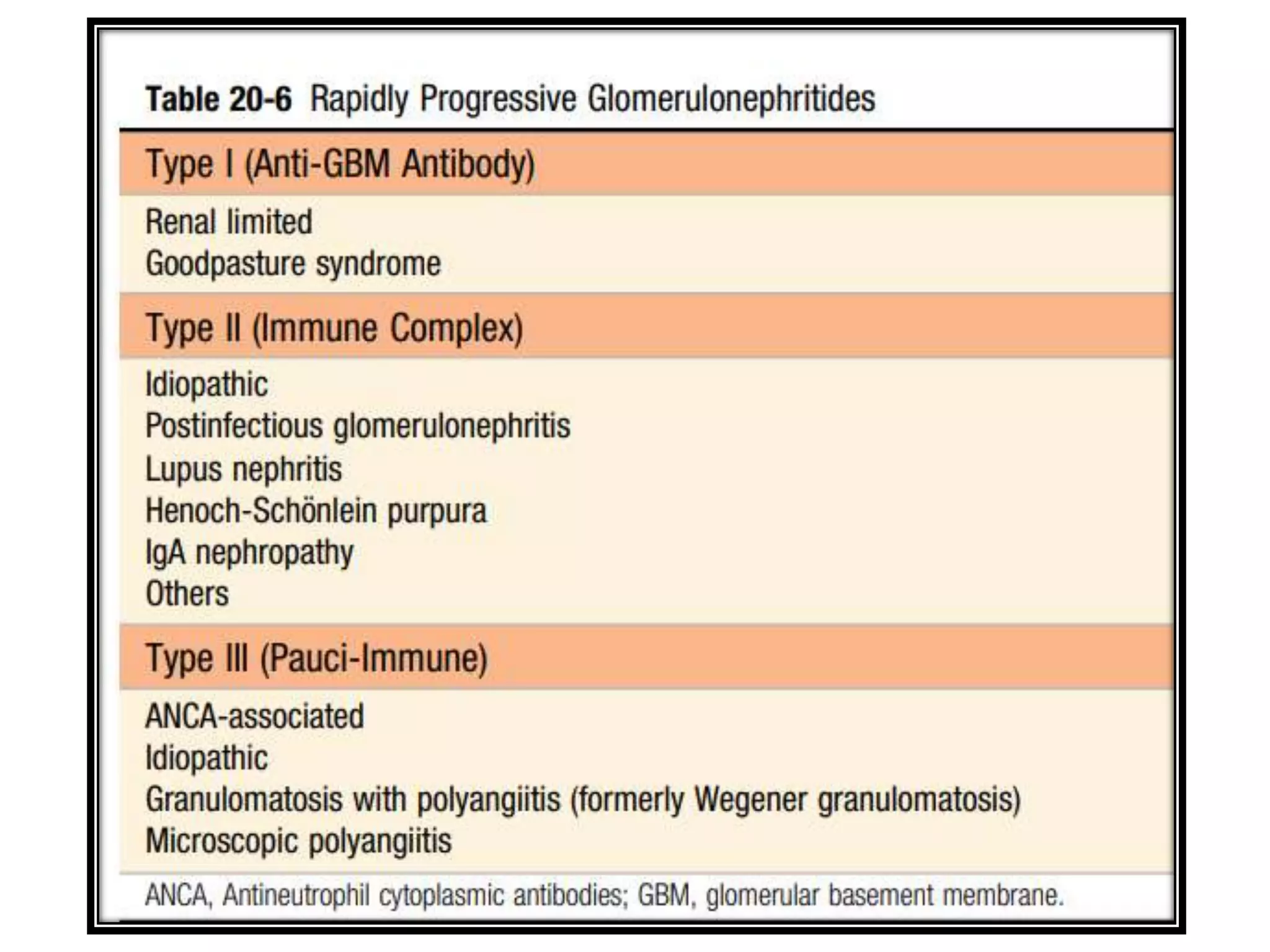
• Based on the etiologic agents and pathogenetic mechanism, patients
with RPGN are divided into 3 groups (Table):
• 1. RPGN in systemic diseases (anti-GBM type)
• 2. Post-infectious RPGN (immune-complex type)
• 3. Pauci-immune RPGN.
• Following three serologic markers are used for categorising RPGN:
• i) serum C3 level,
• ii) anti-GBM antibody; and
• iii) anti-neutrophil cytoplasmic antibody (ANCA)
Distinguishing features of 3 main
categories of RPGN
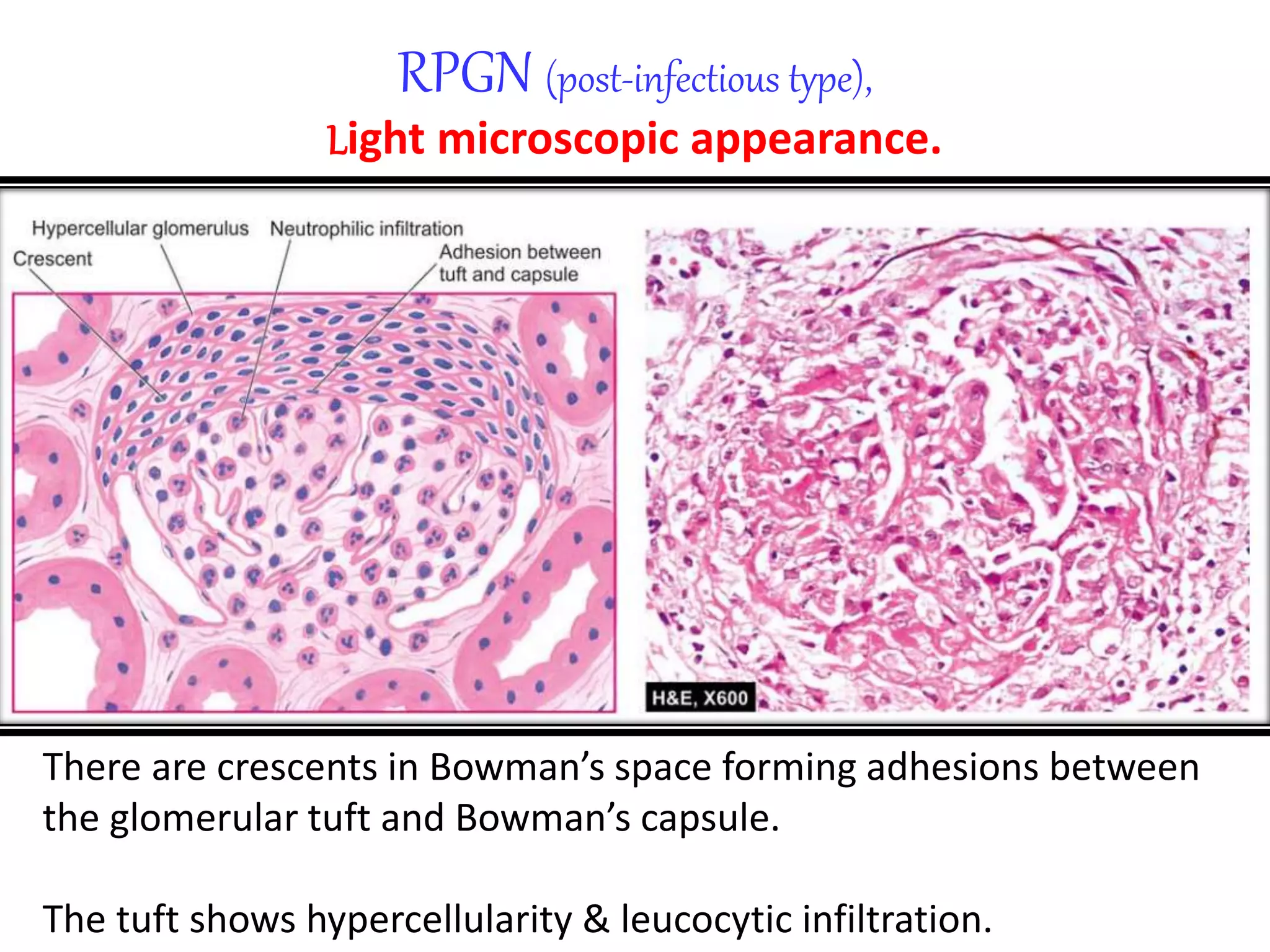
RPGN (post-infectious type),
Light microscopic appearance.
There are crescents in Bowman’s space forming adhesions between
the glomerular tuft and Bowman’s capsule.
The tuft shows hypercellularity & leucocytic infiltration.
RPGN
diagrammatic representation of ultrastructure of a portion of glomerular
lobule showing epithelial crescent formation & subepithelial granular
deposits.
RPGN CLINICAL FEATURES
• Generally, the features of postinfectious RPGN are similar to those of
acute GN, presenting as acute renal failure.
• The patients of Goodpasture’s syndrome may present as acute renal
failure and/or associated intrapulmonary haemorrhage
producing recurrent haemoptysis.
• Prognosis of all forms of RPGN is poor.
• However, post-infectious cases have somewhat better outcome and
may show recovery.
Rapidly Progressive Glomerulonephritis , RPGN, Crescentic GN, Extracapillary GN)

Rapidly Progressive Glomerulonephritis , RPGN, Crescentic GN, Extracapillary GN)

  • 1.
    The KIDNEY -RPGN DR. ROOPAM JAIN PROFESSOR & HEAD, PATHOLOGY
  • 2.
    Rapidly Progressive Glomerulonephritis (Synonyms:RPGN, Crescentic GN, Extracapillary GN)
  • 3.
    RPGN • RPGN presentswith an acute reduction in renal function resulting in acute renal failure in a few weeks or months. • It is characterised by formation of ‘crescents’ (crescentic GN) outside the glomerular capillaries (extracapillary GN) • RPGN occurs most frequently in adults • slight male preponderance. • Prognosis of RPGN in general is dismal.
  • 4.
    RPGN - ETIOPATHOGENESIS •A number of primary glomerular and systemic diseases are characterised by formation of crescents. • Based on the etiologic agents and pathogenetic mechanism, patients with RPGN are divided into 3 groups (Table): • 1. RPGN in systemic diseases (anti-GBM type) • 2. Post-infectious RPGN (immune-complex type) • 3. Pauci-immune RPGN. • Following three serologic markers are used for categorising RPGN: • i) serum C3 level, • ii) anti-GBM antibody; and • iii) anti-neutrophil cytoplasmic antibody (ANCA)
  • 5.
    Distinguishing features of3 main categories of RPGN
  • 7.
    RPGN (post-infectious type), Lightmicroscopic appearance. There are crescents in Bowman’s space forming adhesions between the glomerular tuft and Bowman’s capsule. The tuft shows hypercellularity & leucocytic infiltration.
  • 8.
    RPGN diagrammatic representation ofultrastructure of a portion of glomerular lobule showing epithelial crescent formation & subepithelial granular deposits.
  • 9.
    RPGN CLINICAL FEATURES •Generally, the features of postinfectious RPGN are similar to those of acute GN, presenting as acute renal failure. • The patients of Goodpasture’s syndrome may present as acute renal failure and/or associated intrapulmonary haemorrhage producing recurrent haemoptysis. • Prognosis of all forms of RPGN is poor. • However, post-infectious cases have somewhat better outcome and may show recovery.