Reporting in the Rational Solution for Software and Systems Delivery


Passing Internal and External Audits with
Reporting and Dashboards
 Geoff Rosenthal
 NA Practice Lead – Reporting Segment
 November 2011


                                                                       © 2011 IBM Corporation
IBM Software


Agenda

   The Reporting Domain
   Why does development intelligence matter?
   Reporting technologies to best meet the needs of each reporting domain
   Demo


2                                                                            © 2011 IBM Corporation
The Reporting Domain


3                          © 2011 IBM Corporation
IBM Software


Reporting IS a Domain in Software and Systems Delivery

 Just like any other one of our domains (Requirements Management, Change and
  Configuration Management, Quality, Management, etc.), Reporting is
    – A important/integral domain for the Software and Systems Delivery Lifecycle (SDLC)
    – It has complexity, but so does every domain!
 Reporting is not just a by-product of a set of tools
    – The business value of Rational tools is realized by the insights that can be drawn from
      using those tools


4                                                                                   © 2011 IBM Corporation
IBM Software


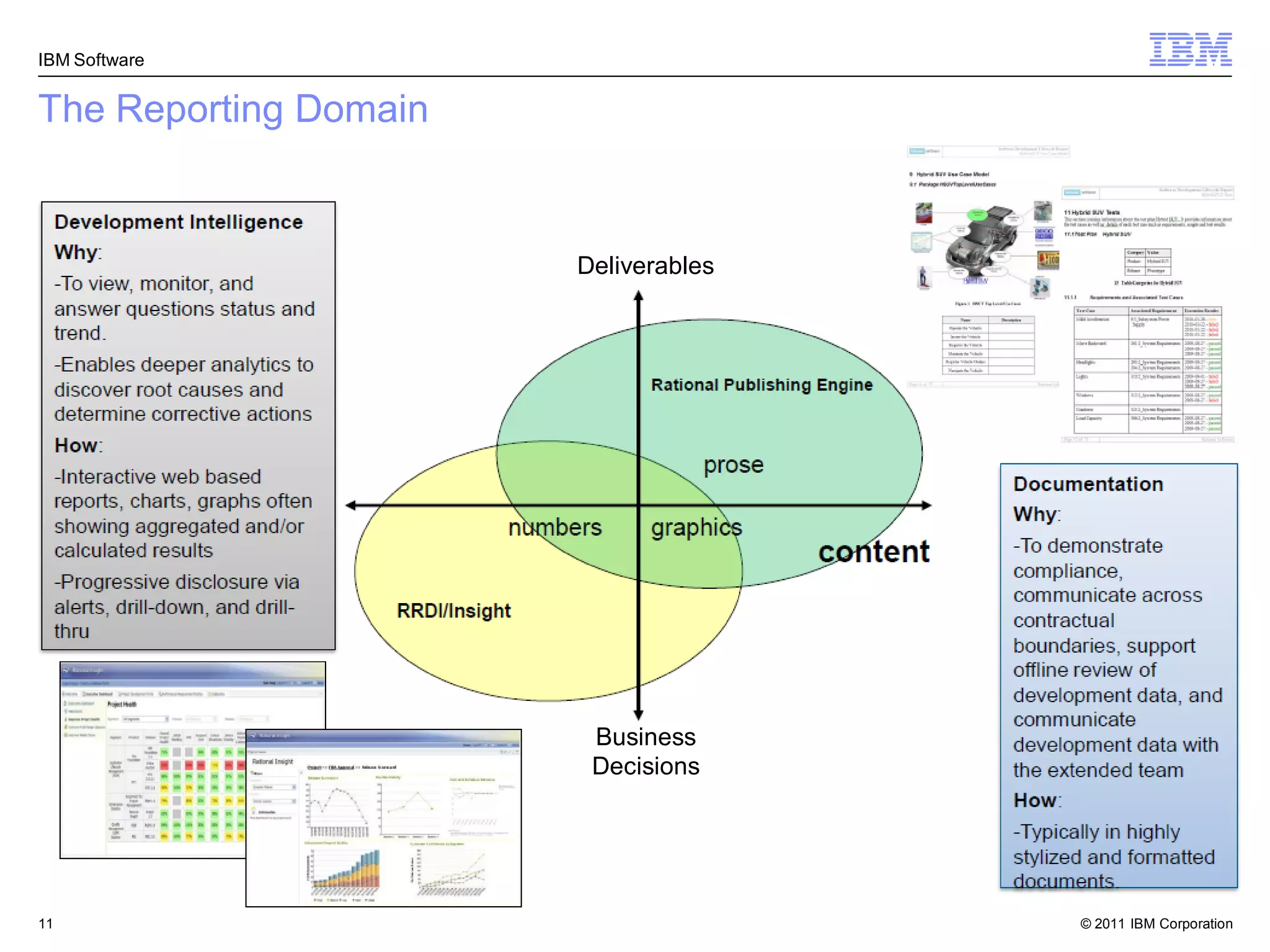
The Development Intelligence (DI) Space

 The application of Business Intelligence techniques in the development space

 Development Intelligence reports are generally used as insight for business decisions
   – The reports help to communicate status, monitor progress, diagnose problems, identify
     corrective actions, etc.
   – They are a key decision support tool for managing processes

 Traditional Business Intelligence techniques can help us understand the data
   – Crosstabs/pivots – How does the data break down?
   – Drill up/down/through – How is the data interrelated?
   – Dashboards – What is the big picture?
   – Data warehouses – How are we trending over time? How can I related disparate data
      sources?


5                                                                                © 2011 IBM Corporation
IBM Software


                     The Development Intelligence (DI) Space
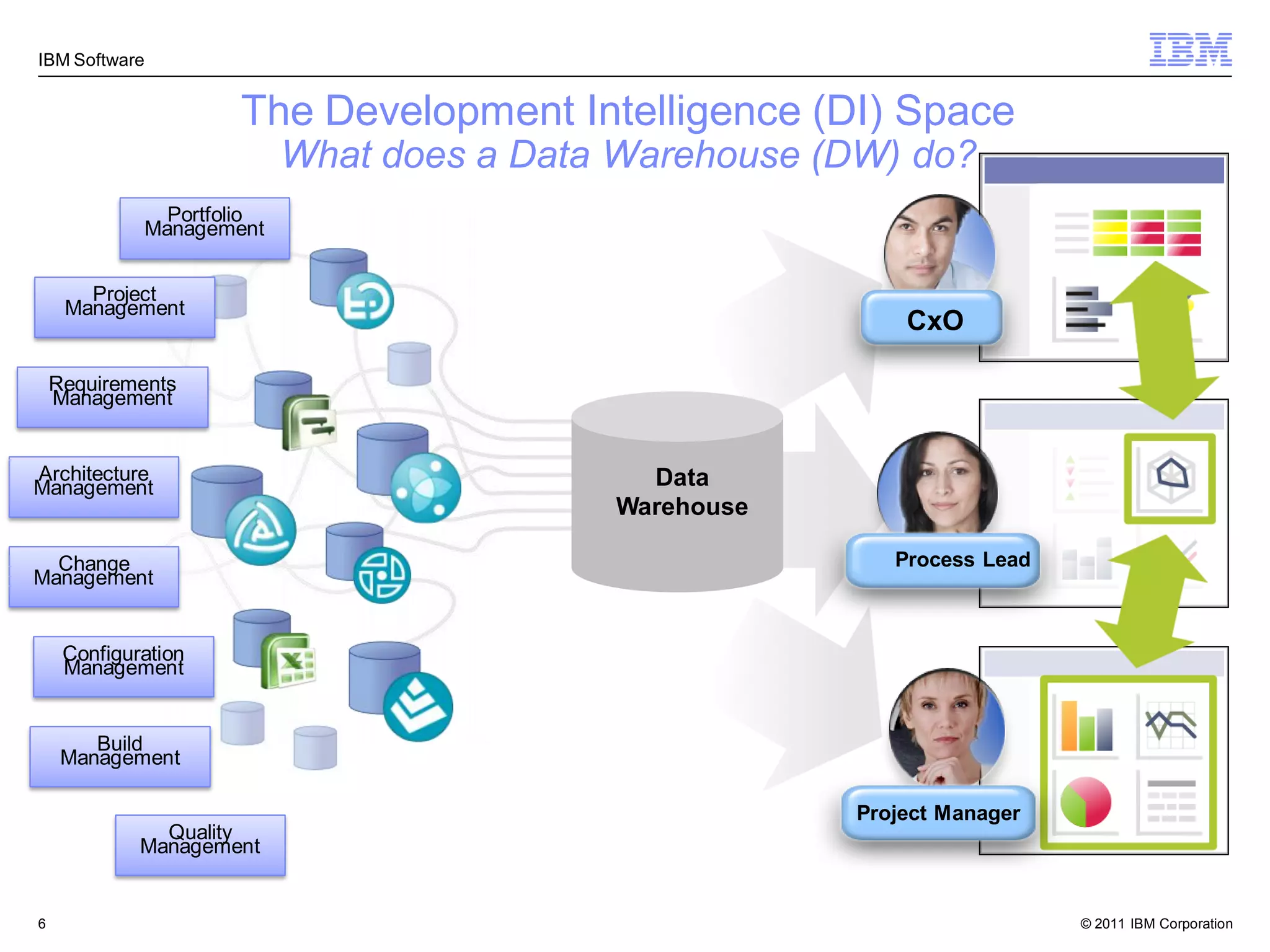
                           What does a Data Warehouse (DW) do?
               Portfolio
             Management


       Project
     Management
                                                           CxO

    Requirements
    Management


Architecture                                 Data
Management
                                           Warehouse

  Change                                                  Process Lead
Management


     Configuration
     Management


        Build
     Management

                                                       Project Manager
               Quality
             Management


6                                                                        © 2011 IBM Corporation
IBM Software


         The Development Intelligence (DI) Space
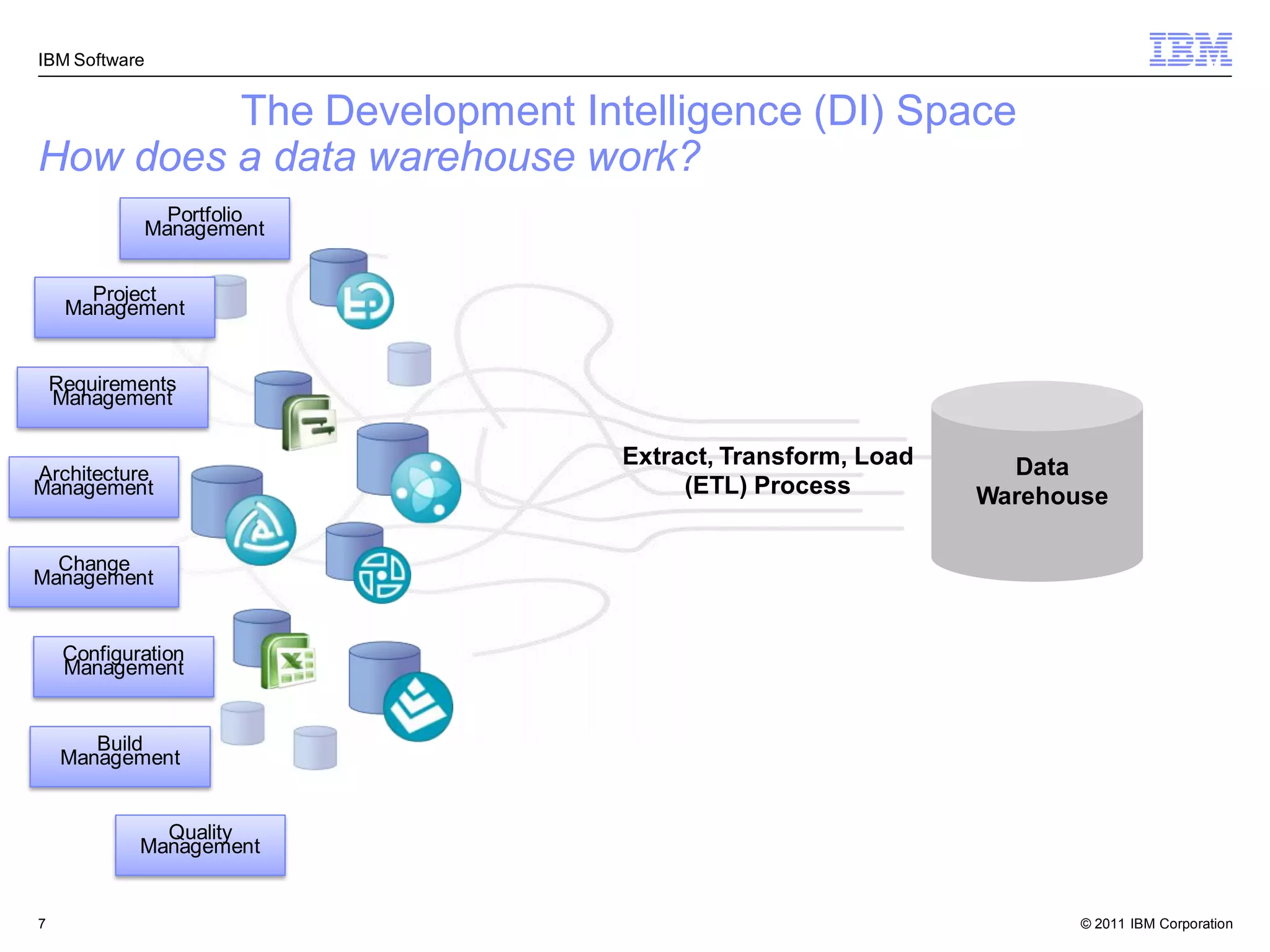
How does a data warehouse work?
               Portfolio
             Management


       Project
     Management


    Requirements
    Management

                            Extract, Transform, Load     Data
Architecture
Management                       (ETL) Process         Warehouse

  Change
Management


     Configuration
     Management


        Build
     Management


               Quality
             Management


7                                                             © 2011 IBM Corporation
IBM Software


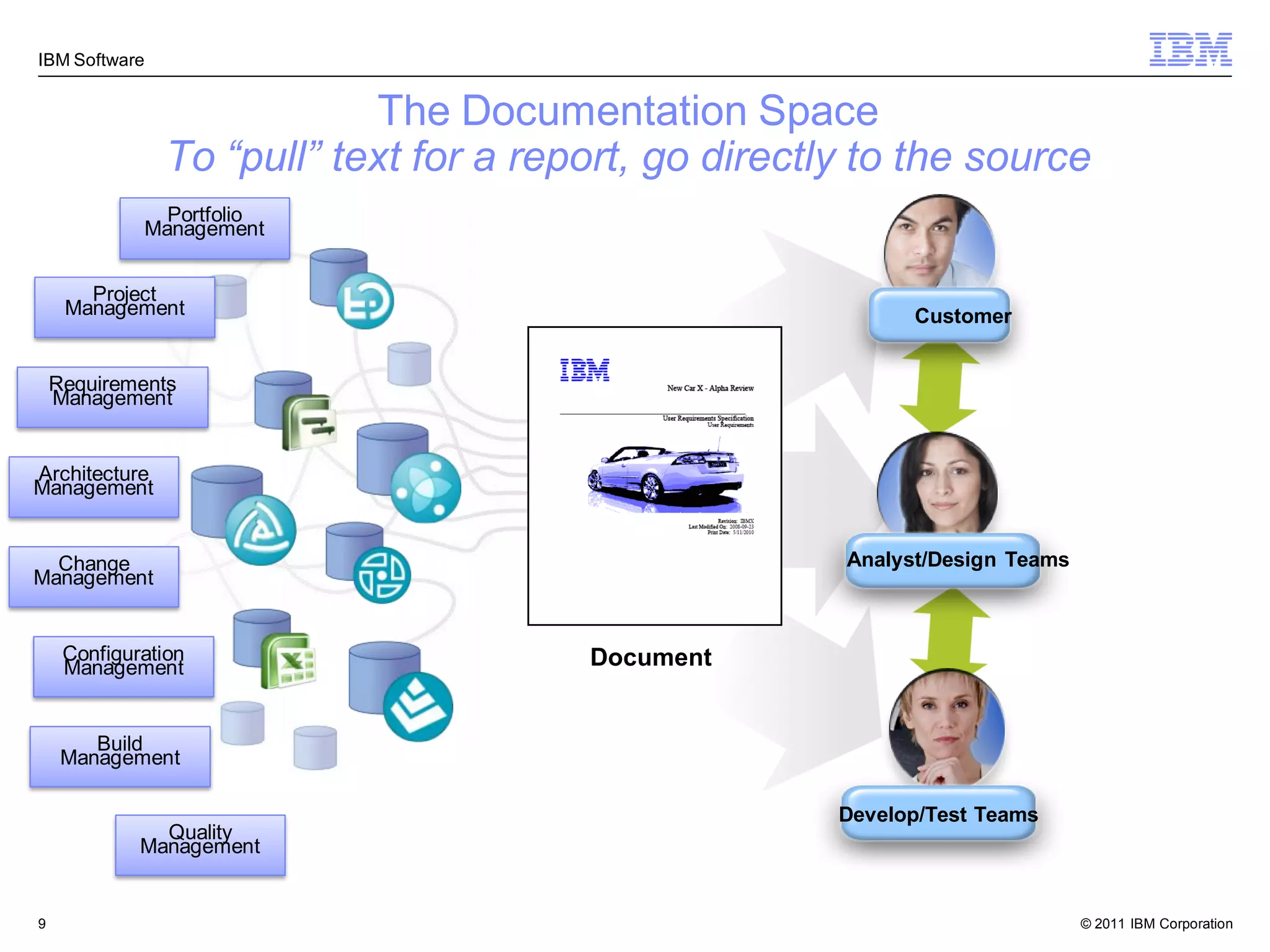
The Documentation Space
 Documentation is most often a deliverable
    – Specifications are often written in one project phase and then passed into the following
      phase
    – Documents may be contractual deliverables
    – Documents often form the basis of a contractual relationship
    – Specifications may have to comply with standards/requirements in both structure and
      styling
 Documentation is most often not authored using a word processor, but instead is generated
  from point sources
    – Repositories used for local or distributed authoring and management of artifacts
      (requirements, models, etc.) i.e. our Rational tools
    – Static files


8                                                                                   © 2011 IBM Corporation
IBM Software


                           The Documentation Space
               To “pull” text for a report, go directly to the source
               Portfolio
             Management


       Project
     Management                                             Customer


    Requirements
    Management


Architecture
Management


  Change                                              Analyst/Design Teams
Management


     Configuration                     Document
     Management


        Build
     Management

                                                      Develop/Test Teams
               Quality
             Management


9                                                                            © 2011 IBM Corporation
IBM Software


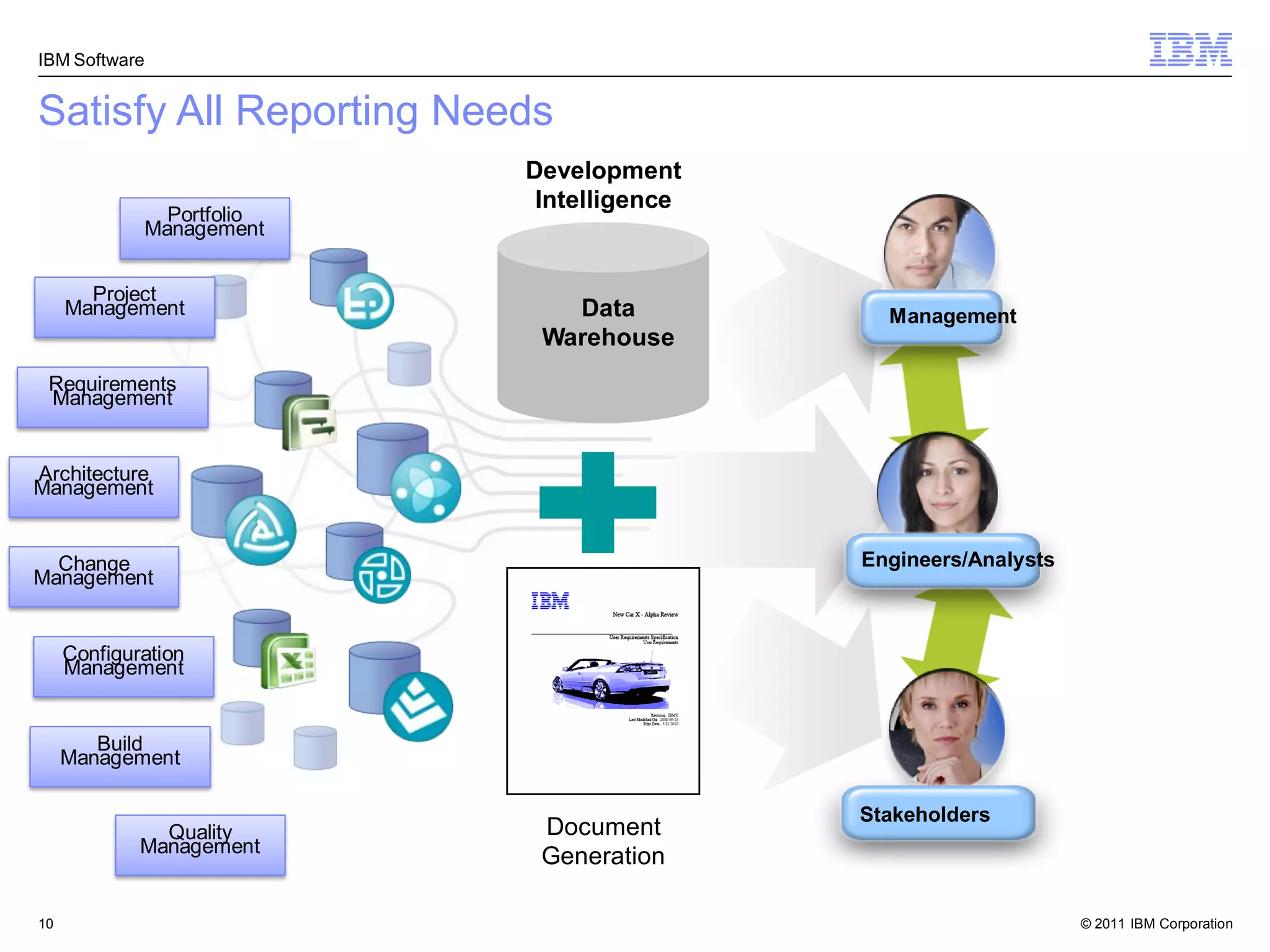
Satisfy All Reporting Needs
                           Development
                            Intelligence
               Portfolio
             Management


       Project
     Management               Data           Management
                            Warehouse
 Requirements
 Management


Architecture
Management


  Change                                   Engineers/Analysts
Management


     Configuration
     Management


        Build
     Management

                                           Stakeholders
               Quality      Document
             Management
                            Generation

10                                                              © 2011 IBM Corporation
IBM Software


The Reporting Domain


                       Deliverables


                        Business
                        Decisions


11                                    © 2011 IBM Corporation11
Why does Development Intelligence
     matter?


12                                       © 2011 IBM Corporation
IBM Software


The Essential CIO Report – IBM GBS C-Studies


 Reflecting face-to-face conversations with over 3,000 CIOs from
  organizations of every size, sector and region!!
 CIOs are now increasingly in step with CEOs‟ top priorities
 CIOs agree on the criticality to derive insight from the huge volumes of
  data
   –Must turn insights into competitive advantage with tangible business
     benefits


13                                                                  © 2011 IBM Corporation
IBM Software


CIO Report Highlights

 CIOs are highly focused on insight provided by data
 CIOs/CEOs identified insight and intelligence as one of their top priorities
  over the next three to five years
 CEOs increasingly rely on CIOs to turn data into usable information,
  information into intelligence, and intelligence into better decisions


14                                                                   © 2011 IBM Corporation
IBM Software

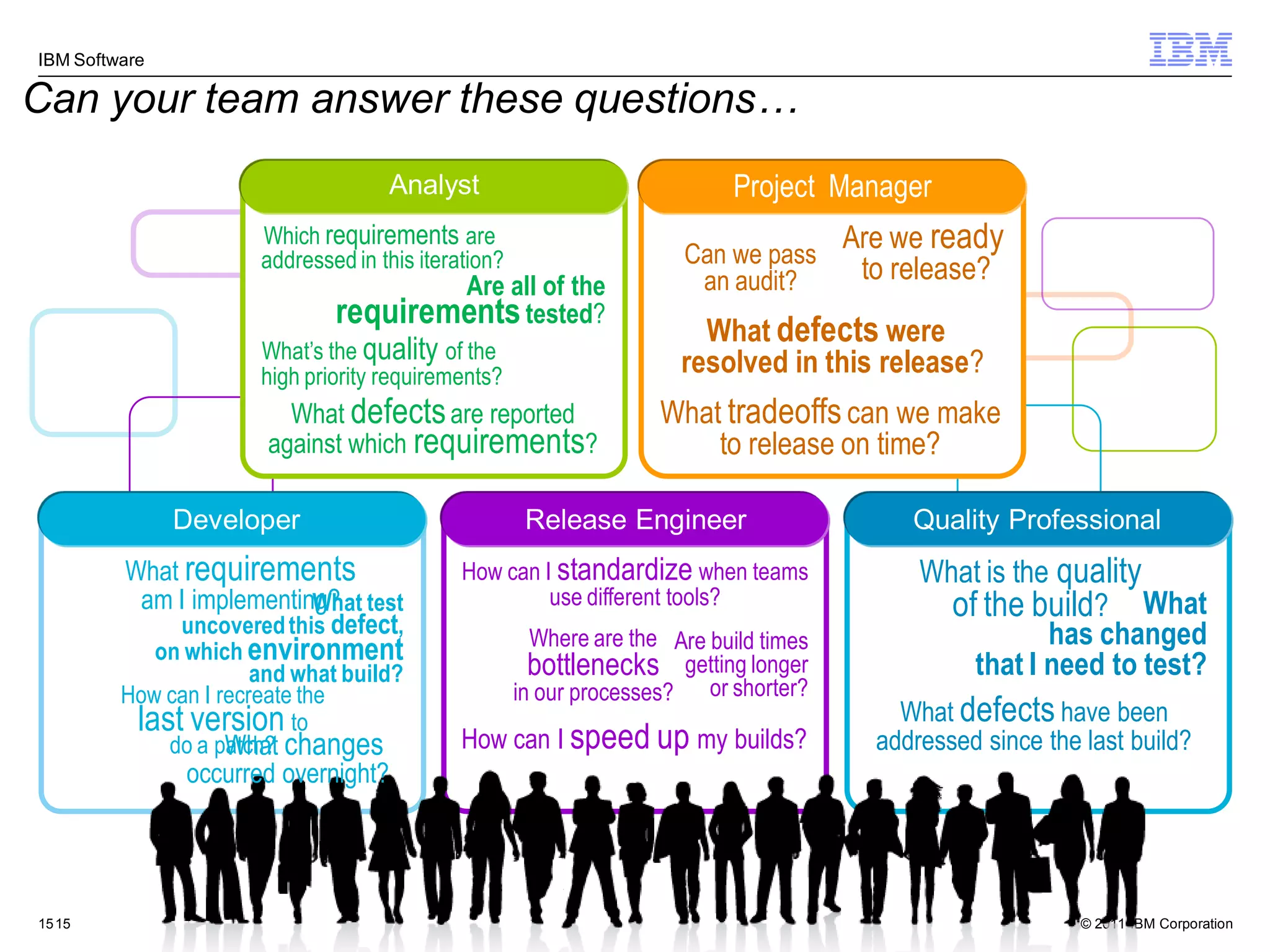
Can your team answer these questions…
                                     Analyst                                 Project Manager
                       Which requirements are
                                                                       Can we pass
                                                                                        Are we ready
                       addressed in this iteration?                                      to release?
                                       Are all of the                   an audit?
                               requirements tested?
                                                                         What defects were
                       What’s the quality of the
                       high priority requirements?                     resolved in this release?
                          What defects are reported                  What tradeoffs can we make
                        against which requirements?                      to release on time?

               Developer                               Release Engineer                      Quality Professional
         What requirements                    How can I standardize when teams                What is the quality
          am I implementing? test
                          What                         use different tools?                     of the build? What
             uncovered this defect,                                                                      has changed
                                                        Where are the Are build times
            on which environment
                       and what build?                  bottlenecks getting longer                that I need to test?
         How can I recreate the                       in our processes? or shorter?
          last version to                                                                   What defects have been
             do a patch? changes
                    What                      How can I speed up my builds?               addressed since the last build?
               occurred overnight?


15 15                                                                                                         © 2011 IBM Corporation
IBM Software


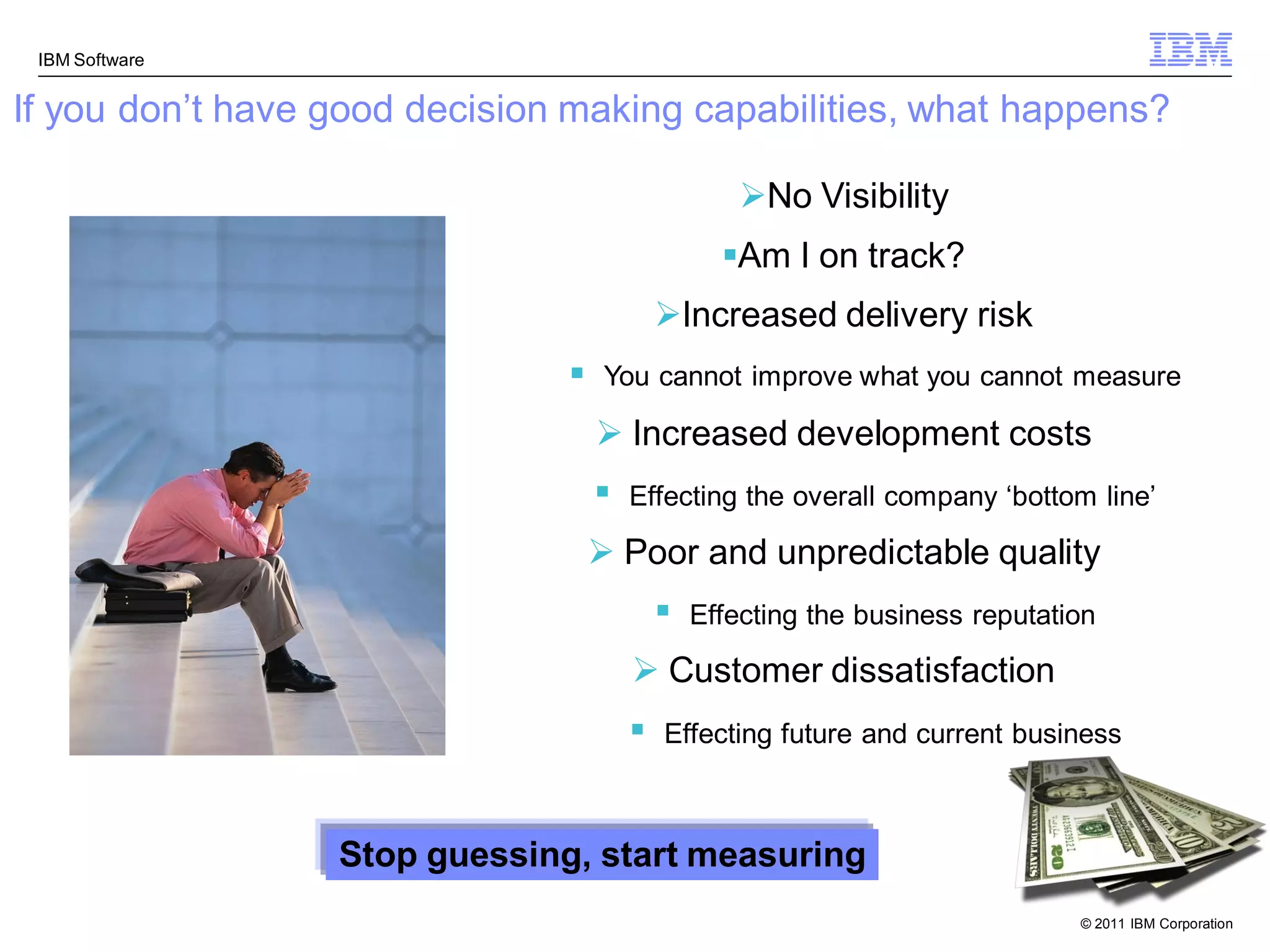
If you don‟t have good decision making capabilities, what happens?

                                                   No Visibility
                                                 Am I on track?
                                           Increased delivery risk
                                   You cannot improve what you cannot measure

                                    Increased development costs
                                      Effecting the overall company „bottom line‟

                                    Poor and unpredictable quality
                                              Effecting the business reputation

                                        Customer dissatisfaction
                                          Effecting future and current business


                  Stop guessing, start measuring
                                                                              © 2011 IBM Corporation
CLM Reporting Technologies


     Reporting Technologies to Best Meet Each
     Reporting Domain


17                                      © 2011 IBM Corporation
IBM Software

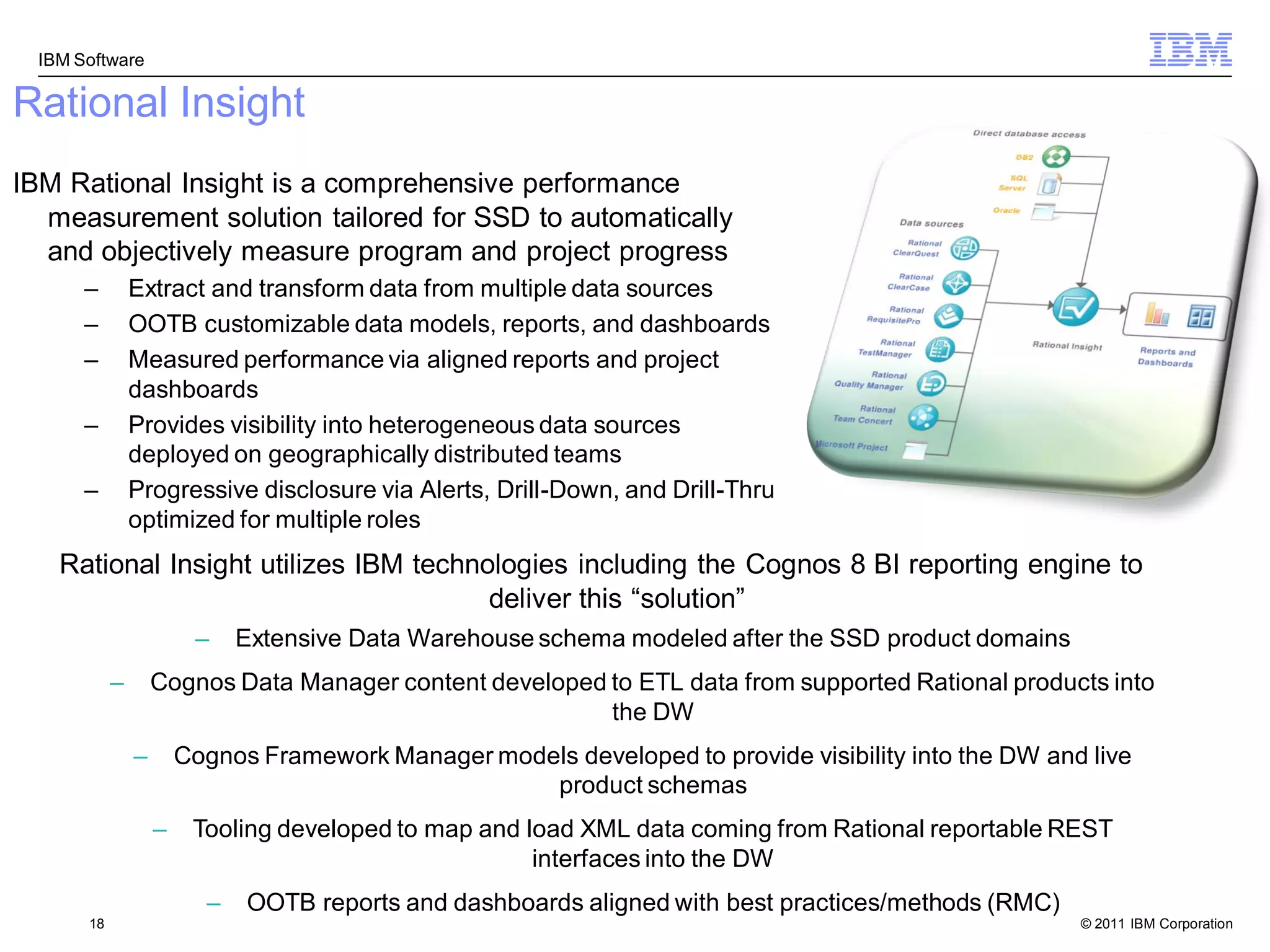
Rational Insight
IBM Rational Insight is a comprehensive performance
  measurement solution tailored for SSD to automatically
  and objectively measure program and project progress
      –        Extract and transform data from multiple data sources
      –        OOTB customizable data models, reports, and dashboards
      –        Measured performance via aligned reports and project
               dashboards
      –        Provides visibility into heterogeneous data sources
               deployed on geographically distributed teams
      –        Progressive disclosure via Alerts, Drill-Down, and Drill-Thru
               optimized for multiple roles
   Rational Insight utilizes IBM technologies including the Cognos 8 BI reporting engine to
                                       deliver this “solution”
                        –    Extensive Data Warehouse schema modeled after the SSD product domains
           –       Cognos Data Manager content developed to ETL data from supported Rational products into
                                                         the DW
               –       Cognos Framework Manager models developed to provide visibility into the DW and live
                                                    product schemas
                   –    Tooling developed to map and load XML data coming from Rational reportable REST
                                                      interfaces into the DW
                         –   OOTB reports and dashboards aligned with best practices/methods (RMC)
      18                                                                                              © 2011 IBM Corporation18
IBM Software


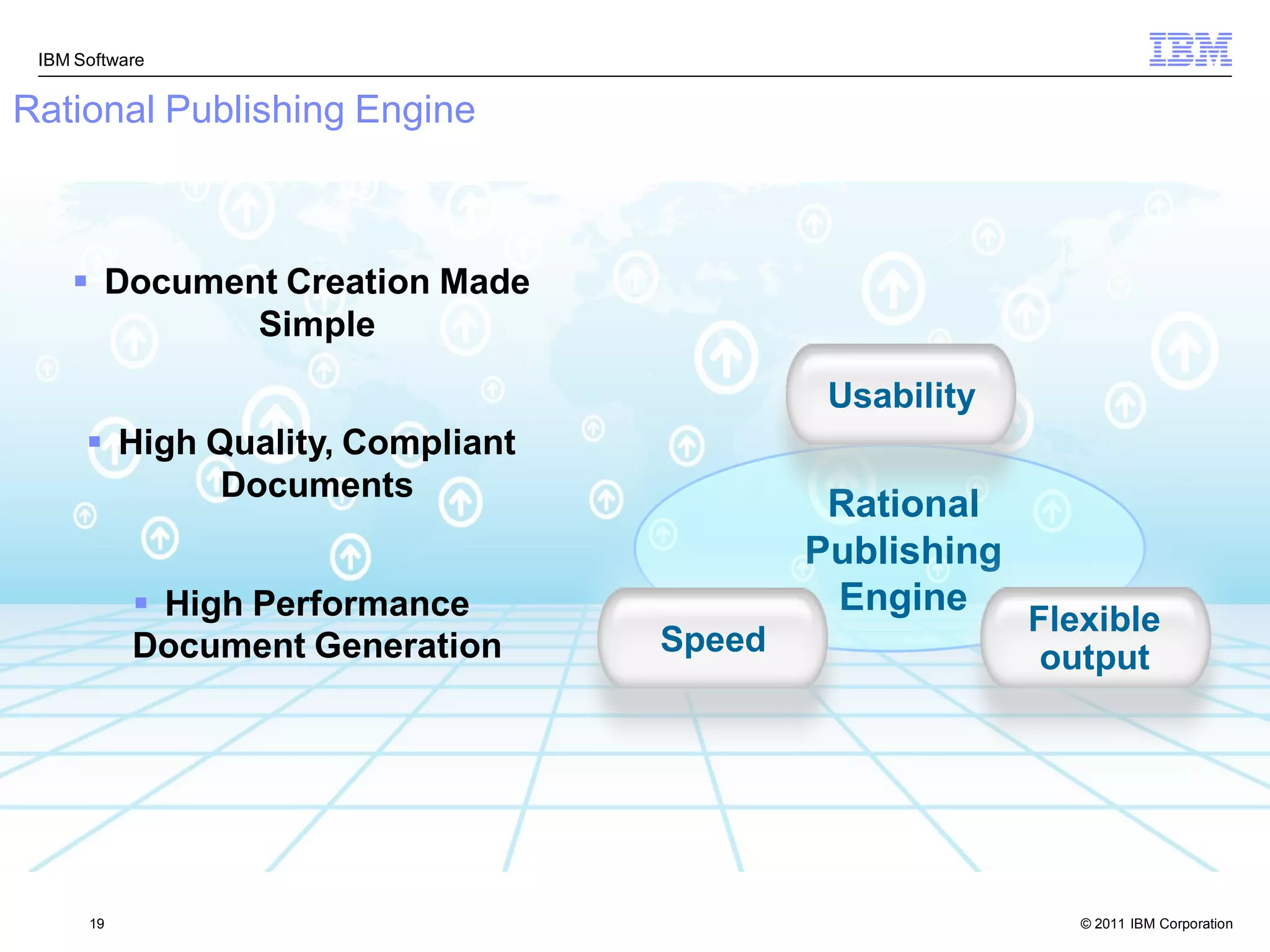
Rational Publishing Engine


     Document Creation Made
             Simple

                                           Usability
       High Quality, Compliant
              Documents
                                           Rational
                                          Publishing
            High Performance              Engine
                                                       Flexible
           Document Generation    Speed
                                                        output


      19                                                  © 2011 IBM Corporation19
IBM Software


Componentizing Robust, Proven Technologies for Jazz CLM

 Rational Reporting for Development Intelligence (RRDI) is based off of the Rational Insight
  technology
    – RRDI includes the same report authoring components (Report Studio and Query Studio)
      that are included in Insight.
    – RRDI includes a set of reports for the Jazz CLM domains as well as cross-domain
      reports.
    – RRDI does NOT include functionality to tailor/customize the data warehouse or database
      extraction process.

 Rational Reporting for Document Generation (RRDG) is based off of the Rational Publishing
  Engine (RPE) technology
   – RRDG includes a document generation interface to generate documents based upon
      pre-defined templates.
   – RRDG includes a set of document templates.
   – RRDG does NOT include the template authoring studio for document template authors


     20                                                                           © 2011 IBM Corporation
CLM Reporting Technologies


     Demo


21                                © 2011 IBM Corporation
IBM Software


        ITALIAN            HINDI     FRENCH           JAPANESE          BRAZILIAN PORTUGUESE     SIMPLIFIED CHINESE


 TRADITIONAL CHINESE   SPANISH     RUSSIAN    TAMIL              THAI               GERMAN                ARABIC


22                                                                                             © 2011 IBM Corporation

Passing internal and external audits with reporting and dashboards nov 2011

  • 1.
    Reporting in theRational Solution for Software and Systems Delivery Passing Internal and External Audits with Reporting and Dashboards Geoff Rosenthal NA Practice Lead – Reporting Segment November 2011 © 2011 IBM Corporation
  • 2.
    IBM Software Agenda  The Reporting Domain  Why does development intelligence matter?  Reporting technologies to best meet the needs of each reporting domain  Demo 2 © 2011 IBM Corporation
  • 3.
    The Reporting Domain 3 © 2011 IBM Corporation
  • 4.
    IBM Software Reporting ISa Domain in Software and Systems Delivery  Just like any other one of our domains (Requirements Management, Change and Configuration Management, Quality, Management, etc.), Reporting is – A important/integral domain for the Software and Systems Delivery Lifecycle (SDLC) – It has complexity, but so does every domain!  Reporting is not just a by-product of a set of tools – The business value of Rational tools is realized by the insights that can be drawn from using those tools 4 © 2011 IBM Corporation
  • 5.
    IBM Software The DevelopmentIntelligence (DI) Space  The application of Business Intelligence techniques in the development space  Development Intelligence reports are generally used as insight for business decisions – The reports help to communicate status, monitor progress, diagnose problems, identify corrective actions, etc. – They are a key decision support tool for managing processes  Traditional Business Intelligence techniques can help us understand the data – Crosstabs/pivots – How does the data break down? – Drill up/down/through – How is the data interrelated? – Dashboards – What is the big picture? – Data warehouses – How are we trending over time? How can I related disparate data sources? 5 © 2011 IBM Corporation
  • 6.
    IBM Software The Development Intelligence (DI) Space What does a Data Warehouse (DW) do? Portfolio Management Project Management CxO Requirements Management Architecture Data Management Warehouse Change Process Lead Management Configuration Management Build Management Project Manager Quality Management 6 © 2011 IBM Corporation
  • 7.
    IBM Software The Development Intelligence (DI) Space How does a data warehouse work? Portfolio Management Project Management Requirements Management Extract, Transform, Load Data Architecture Management (ETL) Process Warehouse Change Management Configuration Management Build Management Quality Management 7 © 2011 IBM Corporation
  • 8.
    IBM Software The DocumentationSpace  Documentation is most often a deliverable – Specifications are often written in one project phase and then passed into the following phase – Documents may be contractual deliverables – Documents often form the basis of a contractual relationship – Specifications may have to comply with standards/requirements in both structure and styling  Documentation is most often not authored using a word processor, but instead is generated from point sources – Repositories used for local or distributed authoring and management of artifacts (requirements, models, etc.) i.e. our Rational tools – Static files 8 © 2011 IBM Corporation
  • 9.
    IBM Software The Documentation Space To “pull” text for a report, go directly to the source Portfolio Management Project Management Customer Requirements Management Architecture Management Change Analyst/Design Teams Management Configuration Document Management Build Management Develop/Test Teams Quality Management 9 © 2011 IBM Corporation
  • 10.
    IBM Software Satisfy AllReporting Needs Development Intelligence Portfolio Management Project Management Data Management Warehouse Requirements Management Architecture Management Change Engineers/Analysts Management Configuration Management Build Management Stakeholders Quality Document Management Generation 10 © 2011 IBM Corporation
  • 11.
    IBM Software The ReportingDomain Deliverables Business Decisions 11 © 2011 IBM Corporation11
  • 12.
    Why does DevelopmentIntelligence matter? 12 © 2011 IBM Corporation
  • 13.
    IBM Software The EssentialCIO Report – IBM GBS C-Studies  Reflecting face-to-face conversations with over 3,000 CIOs from organizations of every size, sector and region!!  CIOs are now increasingly in step with CEOs‟ top priorities  CIOs agree on the criticality to derive insight from the huge volumes of data –Must turn insights into competitive advantage with tangible business benefits 13 © 2011 IBM Corporation
  • 14.
    IBM Software CIO ReportHighlights  CIOs are highly focused on insight provided by data  CIOs/CEOs identified insight and intelligence as one of their top priorities over the next three to five years  CEOs increasingly rely on CIOs to turn data into usable information, information into intelligence, and intelligence into better decisions 14 © 2011 IBM Corporation
  • 15.
    IBM Software Can yourteam answer these questions… Analyst Project Manager Which requirements are Can we pass Are we ready addressed in this iteration? to release? Are all of the an audit? requirements tested? What defects were What’s the quality of the high priority requirements? resolved in this release? What defects are reported What tradeoffs can we make against which requirements? to release on time? Developer Release Engineer Quality Professional What requirements How can I standardize when teams What is the quality am I implementing? test What use different tools? of the build? What uncovered this defect, has changed Where are the Are build times on which environment and what build? bottlenecks getting longer that I need to test? How can I recreate the in our processes? or shorter? last version to What defects have been do a patch? changes What How can I speed up my builds? addressed since the last build? occurred overnight? 15 15 © 2011 IBM Corporation
  • 16.
    IBM Software If youdon‟t have good decision making capabilities, what happens? No Visibility Am I on track? Increased delivery risk  You cannot improve what you cannot measure  Increased development costs  Effecting the overall company „bottom line‟  Poor and unpredictable quality  Effecting the business reputation  Customer dissatisfaction  Effecting future and current business Stop guessing, start measuring © 2011 IBM Corporation
  • 17.
    CLM Reporting Technologies Reporting Technologies to Best Meet Each Reporting Domain 17 © 2011 IBM Corporation
  • 18.
    IBM Software Rational Insight IBMRational Insight is a comprehensive performance measurement solution tailored for SSD to automatically and objectively measure program and project progress – Extract and transform data from multiple data sources – OOTB customizable data models, reports, and dashboards – Measured performance via aligned reports and project dashboards – Provides visibility into heterogeneous data sources deployed on geographically distributed teams – Progressive disclosure via Alerts, Drill-Down, and Drill-Thru optimized for multiple roles Rational Insight utilizes IBM technologies including the Cognos 8 BI reporting engine to deliver this “solution” – Extensive Data Warehouse schema modeled after the SSD product domains – Cognos Data Manager content developed to ETL data from supported Rational products into the DW – Cognos Framework Manager models developed to provide visibility into the DW and live product schemas – Tooling developed to map and load XML data coming from Rational reportable REST interfaces into the DW – OOTB reports and dashboards aligned with best practices/methods (RMC) 18 © 2011 IBM Corporation18
  • 19.
    IBM Software Rational PublishingEngine  Document Creation Made Simple Usability  High Quality, Compliant Documents Rational Publishing  High Performance Engine Flexible Document Generation Speed output 19 © 2011 IBM Corporation19
  • 20.
    IBM Software Componentizing Robust,Proven Technologies for Jazz CLM  Rational Reporting for Development Intelligence (RRDI) is based off of the Rational Insight technology – RRDI includes the same report authoring components (Report Studio and Query Studio) that are included in Insight. – RRDI includes a set of reports for the Jazz CLM domains as well as cross-domain reports. – RRDI does NOT include functionality to tailor/customize the data warehouse or database extraction process.  Rational Reporting for Document Generation (RRDG) is based off of the Rational Publishing Engine (RPE) technology – RRDG includes a document generation interface to generate documents based upon pre-defined templates. – RRDG includes a set of document templates. – RRDG does NOT include the template authoring studio for document template authors 20 © 2011 IBM Corporation
  • 21.
    CLM Reporting Technologies Demo 21 © 2011 IBM Corporation
  • 22.
    IBM Software ITALIAN HINDI FRENCH JAPANESE BRAZILIAN PORTUGUESE SIMPLIFIED CHINESE TRADITIONAL CHINESE SPANISH RUSSIAN TAMIL THAI GERMAN ARABIC 22 © 2011 IBM Corporation