Rapid Deployment  of BMC Remedy Solutions  Antonio Rolle VP of Professional Services generationE Technologies 01/21/12
Agenda Issues Affecting BMC Remedy Deployments A Case for a Rapid Deployment Methodology The generationE BMC Remedy Rapid Deployment Methodology Case Study Review 01/21/12 ©2006 BMC Software
Issues Affecting BMC Remedy Deployments Developer Productivity (Backlogs) Skills Shortage Time to Market Complexity Momentum 01/21/12 ©2006 BMC Software
Agenda generationE Technologies Overview Issues Affecting BMC Remedy Deployments A Case for a Rapid Deployment Methodology The generationE BMC Remedy Rapid Deployment Methodology Case Study Review 01/21/12 ©2006 BMC Software
What is Rapid Application Development? “ Rapid Application Development (RAD) is a development lifecycle designed to give much faster development and higher-quality results than those achieved with the traditional lifecycle. It is designed to take the maximum advantage of powerful development software that has evolved recently.”  - James Martin  Information Engineering: Introduction . Prentice Hall, 1991  01/21/12 ©2006 BMC Software
What is Rapid Application Development? RAD is a methodology for compressing the analysis, design, build and test phases into a series of short, iterative development cycles. RAD proposes that products can be developed faster and of higher quality by:  Using workshops or focus groups to gather requirements  Prototyping and user testing of designs  Re-using software components Following a schedule that defers design improvements to the next product version Keeping review meetings and other team communication informal  01/21/12 ©2006 BMC Software
RAD – Goals & Properties Bring together the power of IT Help to deliver on the promise of ‘Activate the Business’ Manage the future Place emphasis on user involvement and responsibility throughout the development Properties Specification is fluid Must be delivered in 2 - 6 months  Split into increments if necessary  Each increment is implemented separately with frequent delivery of working parts of system. 01/21/12 ©2006 BMC Software
A Case for a BMC Remedy Rapid Deployment Methodology Time to Adoption Time to Market Cost (Vilfredo Pareto’s 80/20 Rule) Leveraging “out of the box” functionality Extensibility Partner Commitment 01/21/12 ©2006 BMC Software
A Case Against RAD… PROJECT SCOPE Broad scope where the business objectives are obscure or broad PROJECT DECISIONS Many people must be involved in the decisions on the project, the decision makers are not available on a timely basis or they are geographically dispersed PROJECT TEAM The project team is large, or there are multiple teams whose work needs to be coordinated 01/21/12 ©2006 BMC Software
Agenda generationE Technologies Overview Issues Affecting BMC Remedy Deployments A Case for a Rapid Deployment Methodology The generationE BMC Remedy Rapid Deployment Methodology Case Study Review 01/21/12 ©2006 BMC Software
Traditional Development Cycle Planning Analysis Design Build Test Deploy 01/21/12 ©2006 BMC Software
Traditional Development Cycle Effective project management Appropriate & Current Documentation  Requirements Specifications Appropriate Maintainability Testing Quality Assurance Designs Reuse 01/21/12 ©2006 BMC Software Although quality and speed of delivery are paramount, this does not mean what is good in traditional system development is thrown away. There must be:
RAD Core Elements Prototyping Iterative development Time boxing Team members Management approach RAD tools 01/21/12 ©2006 BMC Software
RAD Core Elements: Prototyping The construction of a feature-light, reduced-scalability application in a short amount of time. The objective is to create a working application to help a user flesh out requirements. The characteristics of prototyping can be summarized as: Involves versions of part of a software system Evaluation is done in collaboration with users to optimize quality A joint learning process between users and developers Facilitation of the discovery of errors (testing)  01/21/12 ©2006 BMC Software
RAD Core Elements: Interactive Development The creation of increasingly feature-rich versions of applications in short development cycles, where each release produces user requirements that feed the next release Involves splitting projects into smaller mini-projects Requires initial research and analysis of the project as whole Increments are self-contained systems, which are developed documented  delivered Each increment typically involves iterative development and prototyping 01/21/12 ©2006 BMC Software
RAD Core Elements: Time Boxing Supports iterative development by pushing off features to future versions in order to complete iterative cycles as quickly as possible. Time boxing is extremely important to help reduce scope creep, but it requires watchful and involved management. 01/21/12 ©2006 BMC Software
RAD Core Elements: Team Members Teams should be small and should consist of experienced, versatile, and motivated members that are able to perform multiple roles. These roles consist of: User Good inter‑personal skills Personal confidence A non‑parochial view Representative of the user community Developer Patience, diplomacy, perception, acceptability, objectivity, non‑ intimidating  Good communication skills, patience, interpersonal skills, empathy with user  Accepts criticism humbly Project Manager Open minded, prepared to be flexible, and dynamic Possess excellent leadership skills 01/21/12 ©2006 BMC Software
RAD Core Elements: Management Approach Specifies that management should be very involved in keeping development cycles short and enforcing deadlines. Furthermore management should help keep high team motivation, and should focus on clearing bureaucratic or political obstacles. 01/21/12 ©2006 BMC Software
RAD Core Elements: RAD Tools Specifies that development speed is more important than cost of tools and so the latest technologies should be used to increase development speed 01/21/12 ©2006 BMC Software
BMC Remedy RAD Processes Pre-Project Activities Requirements Planning User Design Construction Implementation Post-Project Activities 01/21/12 ©2006 BMC Software
BMC Remedy RAD Processes: Pre-Project Activities Develop Project Management Plan Identify Risks and Mitigation Strategies Define the Development Schedule Identify Milestones and Deliverables Identify Desired End Results Identify Project Constraints Identify Financial Considerations 01/21/12 ©2006 BMC Software
BMC Remedy RAD Processes: Requirements Planning Activities Research the Current Situation Gather Requirements and Perform Quick Design  Build Prototype (Basic Interface, Demo System, Proof-of-Concept) Review Prototype Refine Prototype & Design Specifications Deliverables Design Specifications Prototype 01/21/12 ©2006 BMC Software
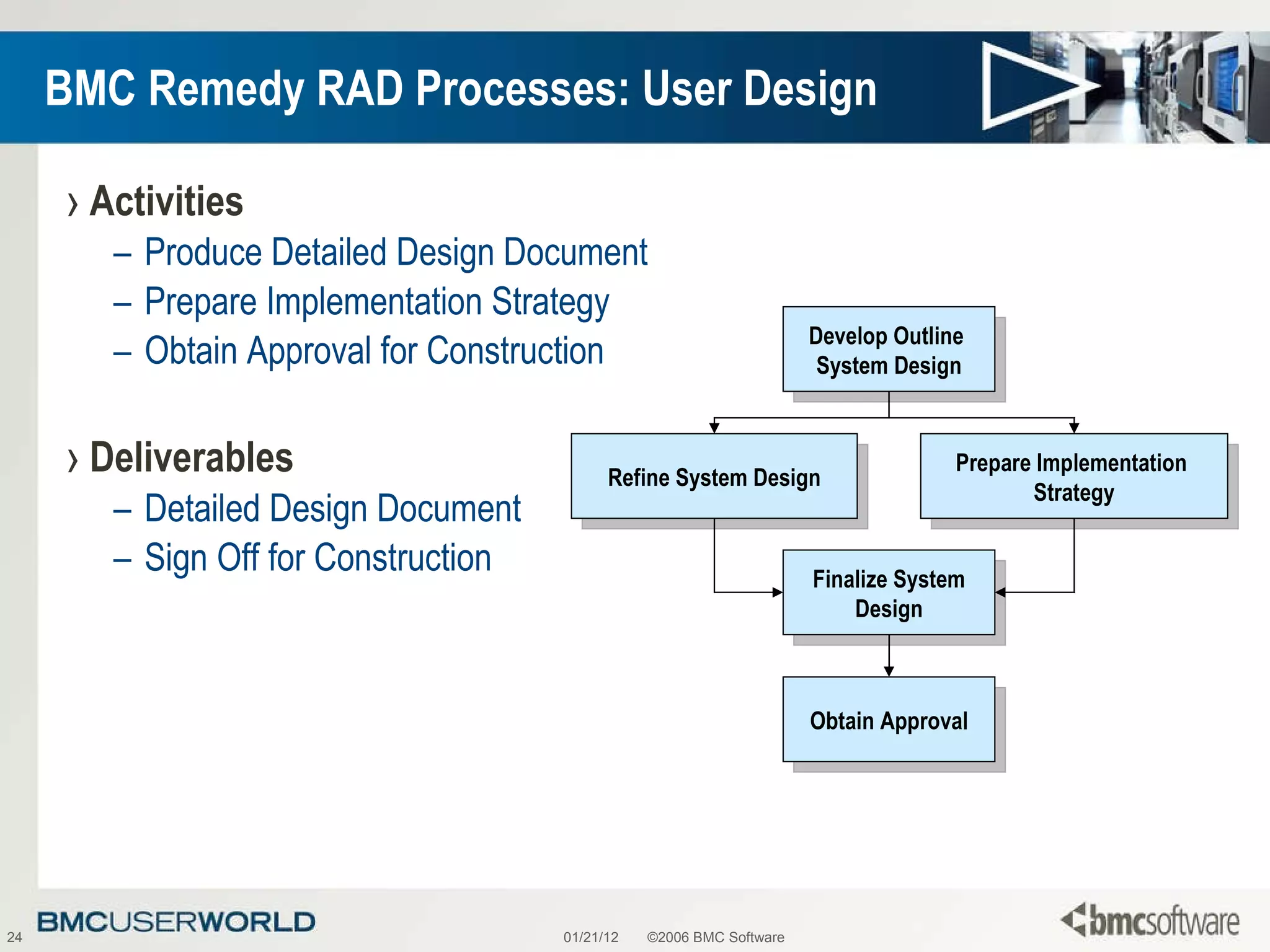
BMC Remedy RAD Processes: User Design Activities Produce Detailed Design Document Prepare Implementation Strategy Obtain Approval for Construction Deliverables Detailed Design Document Sign Off for Construction 01/21/12 ©2006 BMC Software Develop Outline  System Design Refine System Design Prepare Implementation  Strategy Obtain Approval Finalize System Design
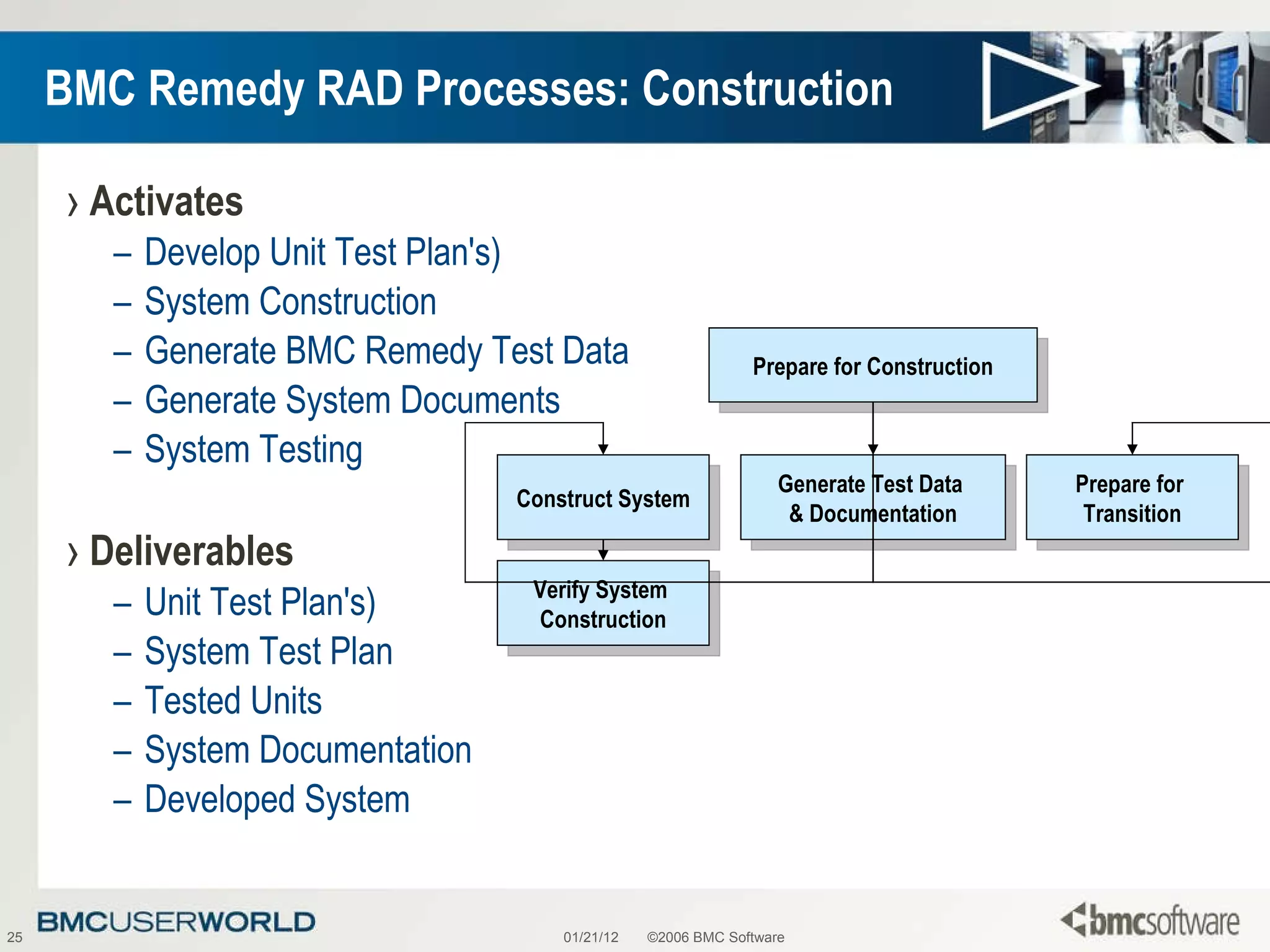
BMC Remedy RAD Processes: Construction Activates Develop Unit Test Plan's) System Construction Generate BMC Remedy Test Data Generate System Documents System Testing Deliverables Unit Test Plan's) System Test Plan Tested Units System Documentation Developed System 01/21/12 ©2006 BMC Software Prepare for Construction Construct System Generate Test Data  & Documentation Prepare for  Transition Verify System  Construction
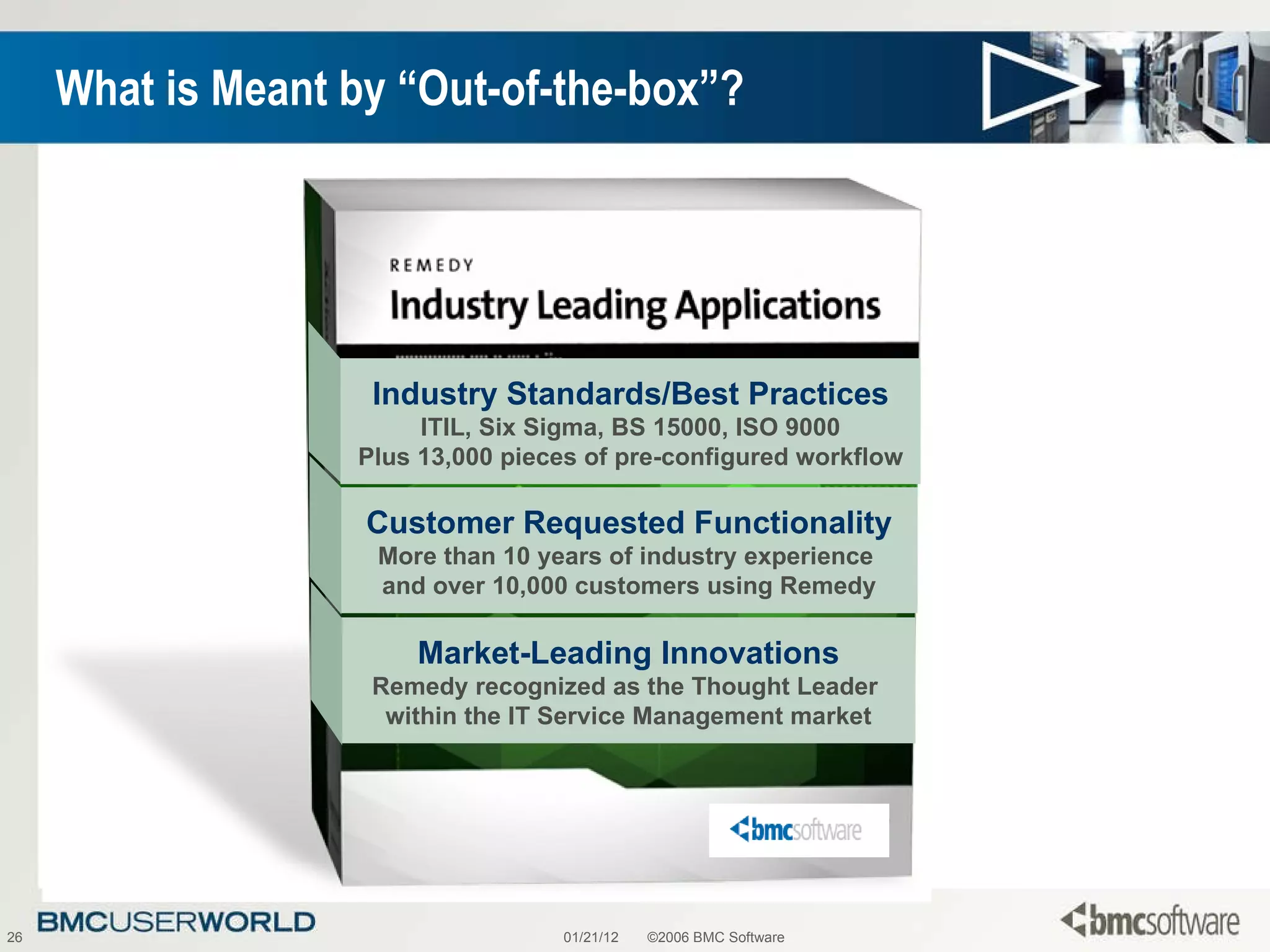
What is Meant by “Out-of-the-box”? 01/21/12 ©2006 BMC Software Industry Standards/Best Practices ITIL, Six Sigma, BS 15000, ISO 9000 Plus 13,000 pieces of pre-configured workflow Customer Requested Functionality More than 10 years of industry experience  and over 10,000 customers using Remedy Market-Leading Innovations Remedy recognized as the Thought Leader  within the IT Service Management market
IT Service Management Solutions  from BMC Remedy Built in best practices, combined with high adaptability, allow customers to rapidly achieve value, improve operational efficiency and continue to optimize to their unique needs Solutions that fit any size business – around the corner  and around the world Automate internal business-related IT service and  support processes Best practices, like Information Technology Infrastructure Library (ITIL), are built-in, leading to faster time-to-value Easily adapted to optimize to customers unique needs 01/21/12 ©2006 BMC Software
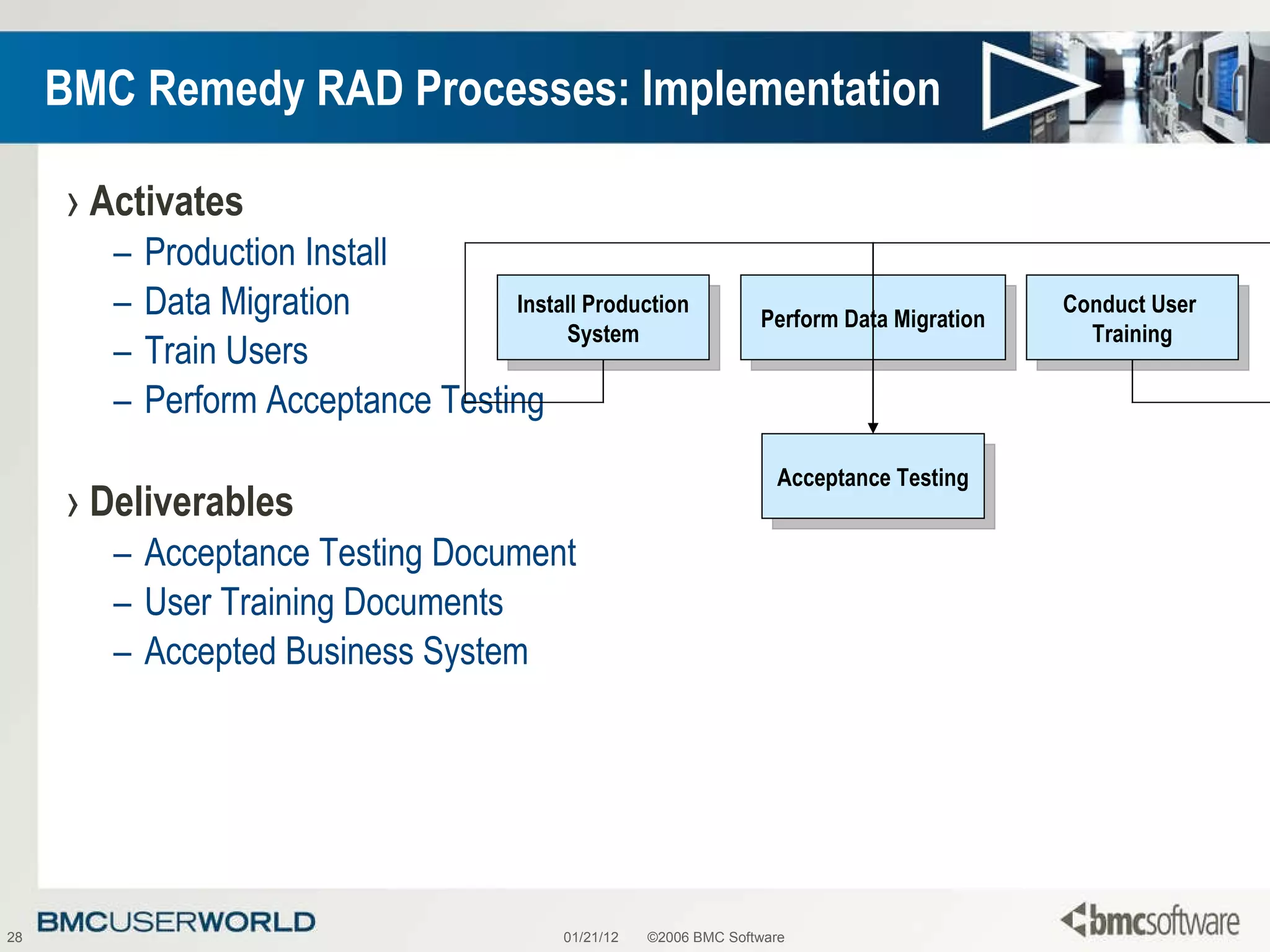
BMC Remedy RAD Processes: Implementation Activates Production Install Data Migration Train Users Perform Acceptance Testing Deliverables Acceptance Testing Document User Training Documents Accepted Business System 01/21/12 ©2006 BMC Software Install Production System Perform Data Migration Conduct User  Training Acceptance Testing
BMC Remedy RAD Processes: Post- Project Activities Activities Review & Document Project Metrics Organize and Store Project Assets Prepare Lessons Learned Document Deliverables Document Store Lessons Learned Document 01/21/12 ©2006 BMC Software
Agenda generationE Technologies Overview Issues Affecting BMC Remedy Deployments A Case for a Rapid Deployment Methodology The generationE BMC Remedy Rapid Deployment Methodology Case Study Review 01/21/12 ©2006 BMC Software
Case Study “ There are only two things of importance. One is the customer, and the other is the product. If you take care of customers, they come back. If you take care of the product, it doesn’t come back. It’s just that simple. And it’s just that difficult.”   –  Stanley Marcus, Neiman Marcus 01/21/12 ©2006 BMC Software
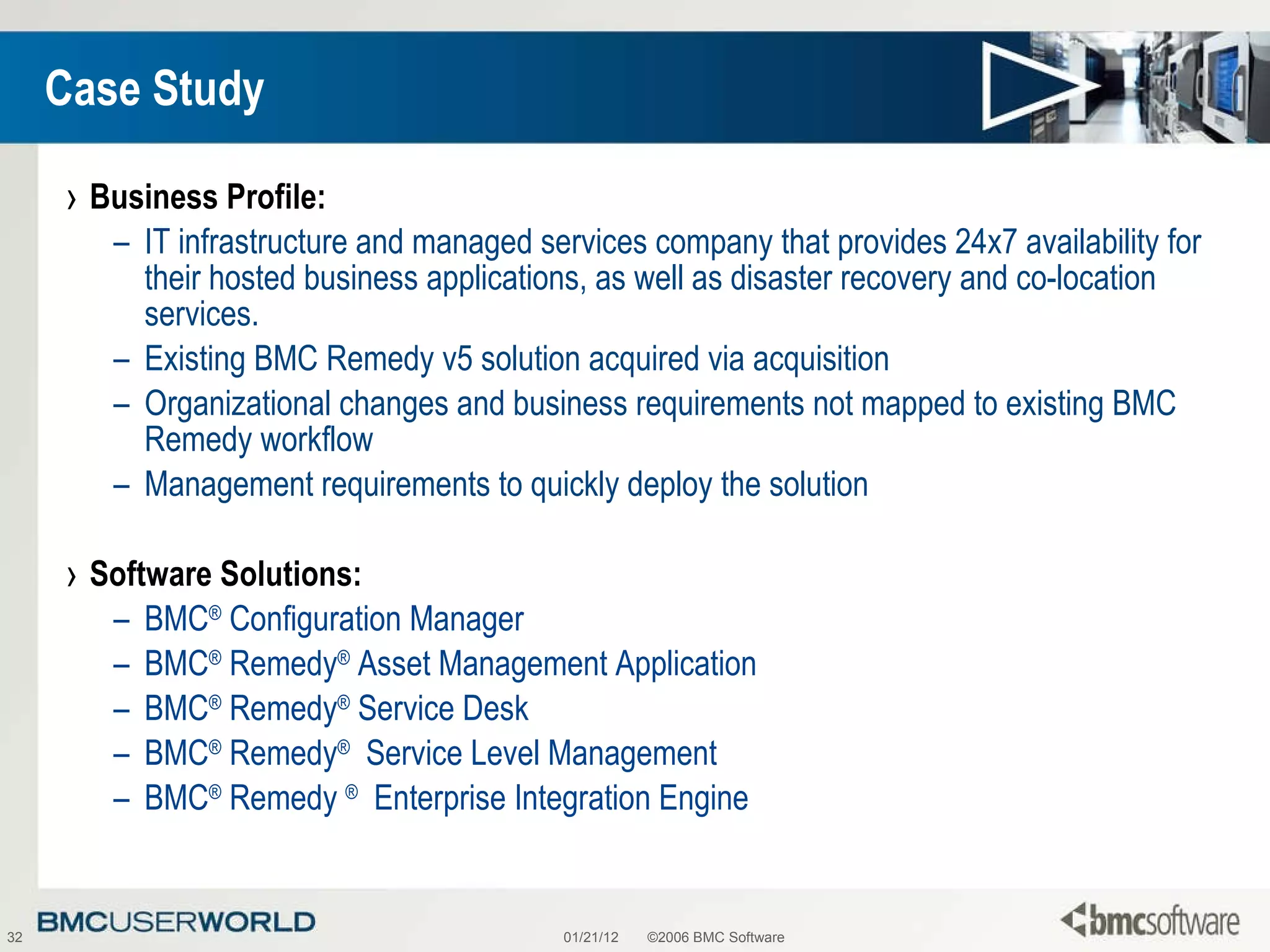
Case Study Business Profile: IT infrastructure and managed services company that provides 24x7 availability for their hosted business applications, as well as disaster recovery and co-location services.  Existing BMC Remedy v5 solution acquired via acquisition Organizational changes and business requirements not mapped to existing BMC Remedy workflow Management requirements to quickly deploy the solution Software Solutions: BMC ®  Configuration Manager BMC ®  Remedy ®  Asset Management Application BMC ®  Remedy ®  Service Desk BMC ®  Remedy ®   Service Level Management BMC ®  Remedy  ®   Enterprise Integration Engine 01/21/12 ©2006 BMC Software
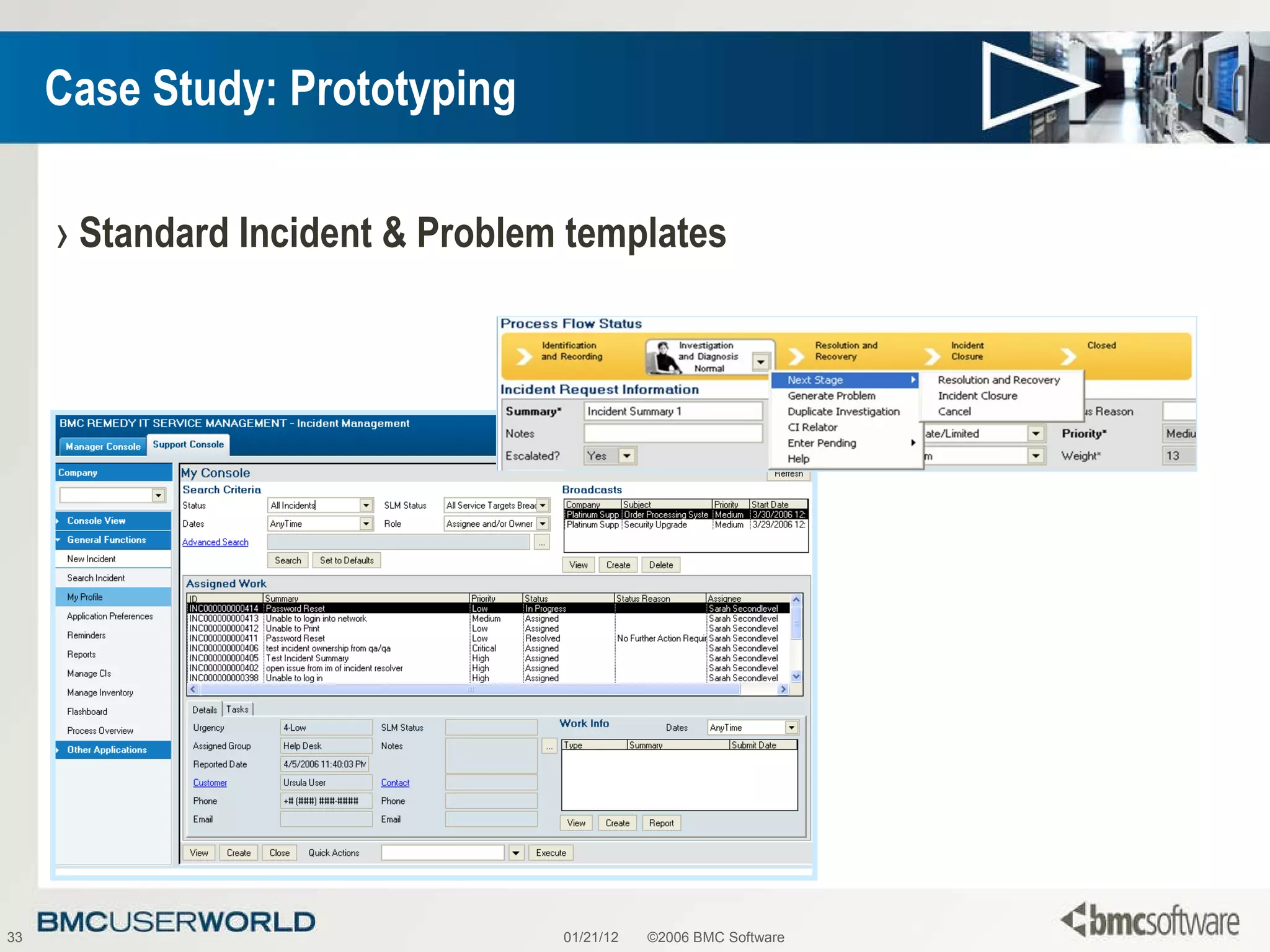
Case Study: Prototyping Standard Incident & Problem templates 01/21/12 ©2006 BMC Software
Case Study: Interactive Development & Time Boxing Leverage BMC Remedy “Out of the Box” features Split project in multiple phases Mapping of business requirements to ITIL best practices and BMC Remedy work flow Vilfred Pareto’s 80/20 Rule for each phase Strict project management procedures 01/21/12 ©2006 BMC Software
Case Study: Team Members & Management Approach Team managed by business objectives Focus on team contribution Individuals co-operate Deliver the best business solution Developments work along side users Doubtful business functions were excluded Quality is measured against business benefit 01/21/12 ©2006 BMC Software
Case Study: Lessons Learned Prototype meetings were key to success Motivated users can lead to excellent systems Uncritical users will lead to systems failing Communication can be markedly improved Incremental delivery motivates users Documentation need not be a problem Boundaries will shift Control and estimation is difficult Short delivery times can irritate developers 01/21/12 ©2006 BMC Software
Other Methodologies XP methodology breaks a project into tiny phases, and developers cannot continue on to the next phase until the first phase is complete Agile methodology A form of XP, aims for customer satisfaction through early and continuous delivery of useful software components Agile is similar to XP but with less focus on team coding and more on limiting project scope An agile project sets a minimum number of requirements and turns them into a deliverable product 01/21/12 ©2006 BMC Software

Remedy rapid deployment 1

  • 1.
    Rapid Deployment of BMC Remedy Solutions  Antonio Rolle VP of Professional Services generationE Technologies 01/21/12
  • 2.
    Agenda Issues AffectingBMC Remedy Deployments A Case for a Rapid Deployment Methodology The generationE BMC Remedy Rapid Deployment Methodology Case Study Review 01/21/12 ©2006 BMC Software
  • 3.
    Agenda Issues AffectingBMC Remedy Deployments A Case for a Rapid Deployment Methodology The generationE BMC Remedy Rapid Deployment Methodology Case Study Review 01/21/12 ©2006 BMC Software
  • 4.
    Issues Affecting BMCRemedy Deployments Developer Productivity (Backlogs) Skills Shortage Time to Market Complexity Momentum 01/21/12 ©2006 BMC Software
  • 5.
    Agenda generationE TechnologiesOverview Issues Affecting BMC Remedy Deployments A Case for a Rapid Deployment Methodology The generationE BMC Remedy Rapid Deployment Methodology Case Study Review 01/21/12 ©2006 BMC Software
  • 6.
    What is RapidApplication Development? “ Rapid Application Development (RAD) is a development lifecycle designed to give much faster development and higher-quality results than those achieved with the traditional lifecycle. It is designed to take the maximum advantage of powerful development software that has evolved recently.” - James Martin Information Engineering: Introduction . Prentice Hall, 1991 01/21/12 ©2006 BMC Software
  • 7.
    What is RapidApplication Development? RAD is a methodology for compressing the analysis, design, build and test phases into a series of short, iterative development cycles. RAD proposes that products can be developed faster and of higher quality by: Using workshops or focus groups to gather requirements Prototyping and user testing of designs Re-using software components Following a schedule that defers design improvements to the next product version Keeping review meetings and other team communication informal 01/21/12 ©2006 BMC Software
  • 8.
    RAD – Goals& Properties Bring together the power of IT Help to deliver on the promise of ‘Activate the Business’ Manage the future Place emphasis on user involvement and responsibility throughout the development Properties Specification is fluid Must be delivered in 2 - 6 months Split into increments if necessary Each increment is implemented separately with frequent delivery of working parts of system. 01/21/12 ©2006 BMC Software
  • 9.
    A Case fora BMC Remedy Rapid Deployment Methodology Time to Adoption Time to Market Cost (Vilfredo Pareto’s 80/20 Rule) Leveraging “out of the box” functionality Extensibility Partner Commitment 01/21/12 ©2006 BMC Software
  • 10.
    A Case AgainstRAD… PROJECT SCOPE Broad scope where the business objectives are obscure or broad PROJECT DECISIONS Many people must be involved in the decisions on the project, the decision makers are not available on a timely basis or they are geographically dispersed PROJECT TEAM The project team is large, or there are multiple teams whose work needs to be coordinated 01/21/12 ©2006 BMC Software
  • 11.
    Agenda generationE TechnologiesOverview Issues Affecting BMC Remedy Deployments A Case for a Rapid Deployment Methodology The generationE BMC Remedy Rapid Deployment Methodology Case Study Review 01/21/12 ©2006 BMC Software
  • 12.
    Traditional Development CyclePlanning Analysis Design Build Test Deploy 01/21/12 ©2006 BMC Software
  • 13.
    Traditional Development CycleEffective project management Appropriate & Current Documentation Requirements Specifications Appropriate Maintainability Testing Quality Assurance Designs Reuse 01/21/12 ©2006 BMC Software Although quality and speed of delivery are paramount, this does not mean what is good in traditional system development is thrown away. There must be:
  • 14.
    RAD Core ElementsPrototyping Iterative development Time boxing Team members Management approach RAD tools 01/21/12 ©2006 BMC Software
  • 15.
    RAD Core Elements:Prototyping The construction of a feature-light, reduced-scalability application in a short amount of time. The objective is to create a working application to help a user flesh out requirements. The characteristics of prototyping can be summarized as: Involves versions of part of a software system Evaluation is done in collaboration with users to optimize quality A joint learning process between users and developers Facilitation of the discovery of errors (testing) 01/21/12 ©2006 BMC Software
  • 16.
    RAD Core Elements:Interactive Development The creation of increasingly feature-rich versions of applications in short development cycles, where each release produces user requirements that feed the next release Involves splitting projects into smaller mini-projects Requires initial research and analysis of the project as whole Increments are self-contained systems, which are developed documented delivered Each increment typically involves iterative development and prototyping 01/21/12 ©2006 BMC Software
  • 17.
    RAD Core Elements:Time Boxing Supports iterative development by pushing off features to future versions in order to complete iterative cycles as quickly as possible. Time boxing is extremely important to help reduce scope creep, but it requires watchful and involved management. 01/21/12 ©2006 BMC Software
  • 18.
    RAD Core Elements:Team Members Teams should be small and should consist of experienced, versatile, and motivated members that are able to perform multiple roles. These roles consist of: User Good inter‑personal skills Personal confidence A non‑parochial view Representative of the user community Developer Patience, diplomacy, perception, acceptability, objectivity, non‑ intimidating Good communication skills, patience, interpersonal skills, empathy with user Accepts criticism humbly Project Manager Open minded, prepared to be flexible, and dynamic Possess excellent leadership skills 01/21/12 ©2006 BMC Software
  • 19.
    RAD Core Elements:Management Approach Specifies that management should be very involved in keeping development cycles short and enforcing deadlines. Furthermore management should help keep high team motivation, and should focus on clearing bureaucratic or political obstacles. 01/21/12 ©2006 BMC Software
  • 20.
    RAD Core Elements:RAD Tools Specifies that development speed is more important than cost of tools and so the latest technologies should be used to increase development speed 01/21/12 ©2006 BMC Software
  • 21.
    BMC Remedy RADProcesses Pre-Project Activities Requirements Planning User Design Construction Implementation Post-Project Activities 01/21/12 ©2006 BMC Software
  • 22.
    BMC Remedy RADProcesses: Pre-Project Activities Develop Project Management Plan Identify Risks and Mitigation Strategies Define the Development Schedule Identify Milestones and Deliverables Identify Desired End Results Identify Project Constraints Identify Financial Considerations 01/21/12 ©2006 BMC Software
  • 23.
    BMC Remedy RADProcesses: Requirements Planning Activities Research the Current Situation Gather Requirements and Perform Quick Design Build Prototype (Basic Interface, Demo System, Proof-of-Concept) Review Prototype Refine Prototype & Design Specifications Deliverables Design Specifications Prototype 01/21/12 ©2006 BMC Software
  • 24.
    BMC Remedy RADProcesses: User Design Activities Produce Detailed Design Document Prepare Implementation Strategy Obtain Approval for Construction Deliverables Detailed Design Document Sign Off for Construction 01/21/12 ©2006 BMC Software Develop Outline System Design Refine System Design Prepare Implementation Strategy Obtain Approval Finalize System Design
  • 25.
    BMC Remedy RADProcesses: Construction Activates Develop Unit Test Plan's) System Construction Generate BMC Remedy Test Data Generate System Documents System Testing Deliverables Unit Test Plan's) System Test Plan Tested Units System Documentation Developed System 01/21/12 ©2006 BMC Software Prepare for Construction Construct System Generate Test Data & Documentation Prepare for Transition Verify System Construction
  • 26.
    What is Meantby “Out-of-the-box”? 01/21/12 ©2006 BMC Software Industry Standards/Best Practices ITIL, Six Sigma, BS 15000, ISO 9000 Plus 13,000 pieces of pre-configured workflow Customer Requested Functionality More than 10 years of industry experience and over 10,000 customers using Remedy Market-Leading Innovations Remedy recognized as the Thought Leader within the IT Service Management market
  • 27.
    IT Service ManagementSolutions from BMC Remedy Built in best practices, combined with high adaptability, allow customers to rapidly achieve value, improve operational efficiency and continue to optimize to their unique needs Solutions that fit any size business – around the corner and around the world Automate internal business-related IT service and support processes Best practices, like Information Technology Infrastructure Library (ITIL), are built-in, leading to faster time-to-value Easily adapted to optimize to customers unique needs 01/21/12 ©2006 BMC Software
  • 28.
    BMC Remedy RADProcesses: Implementation Activates Production Install Data Migration Train Users Perform Acceptance Testing Deliverables Acceptance Testing Document User Training Documents Accepted Business System 01/21/12 ©2006 BMC Software Install Production System Perform Data Migration Conduct User Training Acceptance Testing
  • 29.
    BMC Remedy RADProcesses: Post- Project Activities Activities Review & Document Project Metrics Organize and Store Project Assets Prepare Lessons Learned Document Deliverables Document Store Lessons Learned Document 01/21/12 ©2006 BMC Software
  • 30.
    Agenda generationE TechnologiesOverview Issues Affecting BMC Remedy Deployments A Case for a Rapid Deployment Methodology The generationE BMC Remedy Rapid Deployment Methodology Case Study Review 01/21/12 ©2006 BMC Software
  • 31.
    Case Study “There are only two things of importance. One is the customer, and the other is the product. If you take care of customers, they come back. If you take care of the product, it doesn’t come back. It’s just that simple. And it’s just that difficult.” – Stanley Marcus, Neiman Marcus 01/21/12 ©2006 BMC Software
  • 32.
    Case Study BusinessProfile: IT infrastructure and managed services company that provides 24x7 availability for their hosted business applications, as well as disaster recovery and co-location services. Existing BMC Remedy v5 solution acquired via acquisition Organizational changes and business requirements not mapped to existing BMC Remedy workflow Management requirements to quickly deploy the solution Software Solutions: BMC ® Configuration Manager BMC ® Remedy ® Asset Management Application BMC ® Remedy ® Service Desk BMC ® Remedy ® Service Level Management BMC ® Remedy ® Enterprise Integration Engine 01/21/12 ©2006 BMC Software
  • 33.
    Case Study: PrototypingStandard Incident & Problem templates 01/21/12 ©2006 BMC Software
  • 34.
    Case Study: InteractiveDevelopment & Time Boxing Leverage BMC Remedy “Out of the Box” features Split project in multiple phases Mapping of business requirements to ITIL best practices and BMC Remedy work flow Vilfred Pareto’s 80/20 Rule for each phase Strict project management procedures 01/21/12 ©2006 BMC Software
  • 35.
    Case Study: TeamMembers & Management Approach Team managed by business objectives Focus on team contribution Individuals co-operate Deliver the best business solution Developments work along side users Doubtful business functions were excluded Quality is measured against business benefit 01/21/12 ©2006 BMC Software
  • 36.
    Case Study: LessonsLearned Prototype meetings were key to success Motivated users can lead to excellent systems Uncritical users will lead to systems failing Communication can be markedly improved Incremental delivery motivates users Documentation need not be a problem Boundaries will shift Control and estimation is difficult Short delivery times can irritate developers 01/21/12 ©2006 BMC Software
  • 37.
    Other Methodologies XPmethodology breaks a project into tiny phases, and developers cannot continue on to the next phase until the first phase is complete Agile methodology A form of XP, aims for customer satisfaction through early and continuous delivery of useful software components Agile is similar to XP but with less focus on team coding and more on limiting project scope An agile project sets a minimum number of requirements and turns them into a deliverable product 01/21/12 ©2006 BMC Software

Editor's Notes

  • #7 The RAD methodology is not as popular today as agile methodologies such as eXtreme Programming (XP), but it is still a valuable methodology in the right circumstances. Today RAD has been embodied in a number of methodologies including Agile development, extreme programming, and test-driven development. While these have different names, they all share a common theme: Deliver software into the hands of users as soon as possible.
  • #10 RAD is a manifestation of Vilfred Pareto's law known as the 80 - 20 Rule.  It states that 80% of XX is caused by 20% of YY.  More specifically, 80% of the costs of a complete system are due to 20% of the features included in the system.  Conversely, 20% of the system costs are due to 80% of the system features.  RAD methodology allows the most important 80% of the system features to rise to the top of the list and be integrated into the system - at a cost of 20% of the complete system. The RAD methodology is not as popular today as agile methodologies such as eXtreme Programming (XP), but it is still a valuable methodology in the right circumstances. RAD is more applicable to organizations because World market place is competitive, need right system at the right time to get competitive edge Organizations are dynamic and evolving, requirements change as a system is built, a frozen specifications become outdated IT now viewed as a cost centre not a resource, once system delivered it starts earning money Systems are used by users, if jointly developed by users then more likely to be accepted
  • #16 Prototyping takes place during any activity where clients and developers review and refine systems by use of working software Prototyping is viewed to be used for one of 2 scenarios where interfaces are built, evaluated and thrown away or to be part of an iterative or evolutionary building of software with user collaboration
  • #23 As with any project it is vital to identify the details of the project up front in some form of document such as a Project Management Plan (PMP). All parties should agree up front on details such as potential risks and mitigation strategies, a development schedule including resources, milestones and deliverables such as a completed data model or types of documentation to deliver, an approach including standards, tools, and technologies to be used, a desired end result, terms and constraints and financial considerations including budget and cost of tools.
  • #24 Develop a problem statement A narrative of the management perspective
  • #25 The Design Document will contain: Process Flow Charts/Swim Diagrams/Activity Diagrams Use Cases Collaboration Diagram Sequence Diagram GUI Mock Ups
  • #26 Develop the prototype(s) Release/Iteration Plan Release Plan Test Plan ITIL Release Management The goals of Release Management are: to plan and oversee the successful rollout of software and related hardware to design and implement efficient procedures for the distribution and installation of Changes to IT systems to ensure that hardware and software being changed is traceable, secure and that only correct, authorized and tested versions are installed to communicate and manage expectations of the Customer during the planning and rollout of new Releases to agree the exact content and rollout plan for the Release, through liaison with Change management to implement new software Releases or hardware into the operational environment using the controlling processes of Configuration management and Change Management – a Release should be under Change Management and may consist of any combination of hardware, software, firmware and document CIs to ensure that master copies of all software are secured in the Definitive software library (DSL) and that the Configuration management database (CMDB) is updated to ensure that all hardware being rolled out or changed is secure and traceable, using the services of Configuration Management. The focus of Release Management is the protection of the live environment and its services through the use of formal procedures and checks. The goals of Release Management are: to plan and oversee the successful rollout of software and related hardware to design and implement efficient procedures for the distribution and installation of Changes to IT systems to ensure that hardware and software being changed is traceable, secure and that only correct, authorized and tested versions are installed to communicate and manage expectations of the Customer during the planning and rollout of new Releases to agree the exact content and rollout plan for the Release, through liaison with Change management to implement new software Releases or hardware into the operational environment using the controlling processes of Configuration management and Change Management – a Release should be under Change Management and may consist of any combination of hardware, software, firmware and document CIs to ensure that master copies of all software are secured in the Definitive software library (DSL) and that the Configuration management database (CMDB) is updated to ensure that all hardware being rolled out or changed is secure and traceable, using the services of Configuration Management. The focus of Release Management is the protection of the live environment and its services through the use of formal procedures and checks.
  • #27 Remedy’s offers a comprehensive solution of best-practice out of box solution. But, let us tell you more what goes into the “box”: BMC Remedy® solutions incorporate industry standards like ITIL. We have over 10 years of experience of serving over 7500 customers and we listen to them. We continue to incorporate new functionality into our product suites – based upon our customer input. BMC continues to innovate by offering the right technology at the right time – Web Services is a part of the AR System platform, so all of the Remedy applications benefit from it. In addition, the BMC workflow definitions, the functional modules and configuration interface all make it easy for our customers to make the Remedy solution meet their unique needs today and into the future.
  • #29 Components of an Accepted Business System Remedy® with configuration and customization changes Production Data System Test Results System Test Library System Technical Documentation User/Administrator Operations Manual User Documentation
  • #30 As with any project final deliverables should be handed over to the client and such activities should be performed that will benefit future projects. Specifically it is a best practice for a Project Manager to review and document project metrics, organize and store project assets such as reusable code components, Project Plan, Project Management Plan (PMP), and Test Plan. It is also a good practice to prepare a short lessons learned document.