.
.
ViswasVicky
viswasvicky@gmail.com
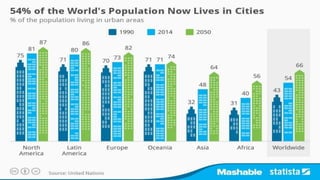
URBANIZATION is the process by which
there is an increase in the proportion of
people living in urban area.
• Urbanization occurs because people
move from rural areas (countryside) to
urban areas (town and cities)
• Amongst the first countries to become
urbanized were Great Britain and some
European countries
• Their urbanization was relatively slow,
allowing governments time to plan and
provide for the needs of increasing urban
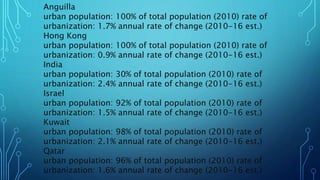
Anguilla
urban population: 100% of total population (2010) rate of
urbanization: 1.7% annual rate of change (2010-16 est.)
Hong Kong
urban population: 100% of total population (2010) rate of
urbanization: 0.9% annual rate of change (2010-16 est.)
India
urban population: 30% of total population (2010) rate of
urbanization: 2.4% annual rate of change (2010-16 est.)
Israel
urban population: 92% of total population (2010) rate of
urbanization: 1.5% annual rate of change (2010-16 est.)
Kuwait
urban population: 98% of total population (2010) rate of
urbanization: 2.1% annual rate of change (2010-16 est.)
Qatar
urban population: 96% of total population (2010) rate of
urbanization: 1.6% annual rate of change (2010-16 est.)
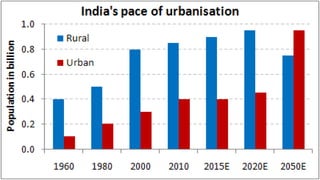
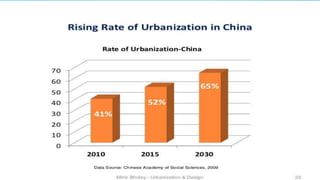
COMPARISON OF URBANIZATION B/W CHINA & INDIA
.China and India are both urbanizing rapidly, but China has
embraced and shaped the process, while India is still waking
up to its urban realities and opportunities.
• China and India are in the vanguard of a wave of urban
expansion that is restoring the global prominence that Asia
enjoyed before the European and North American industrial
revolution.
• In 1950, India 17 % & China 13 %
• In 2005, India 29 % & China 41 %
• Never before in history have two of the largest nations (in
terms of population) urbanized at the same time, and at such
a pace.
COMPARISON OF URBANIZATION B/W CHINA & INDIA China
and India are both urbanizing rapidly, but China has
CAUSES OF URBANIZATION
1.Urbanization occurs naturally from individual &
corporate efforts to reduce time and expense in
commuting and transportation while improving
opportunities for jobs, education, housing, and
transportation.
2. Living in cities permits individuals and families
to take advantage of the opportunities of
proximity, diversity, and market place
competition.
3. It is easy to see why someone living on a farm
might wish to take their chance moving to the
city and make enough money to send back home
to their struggling family.
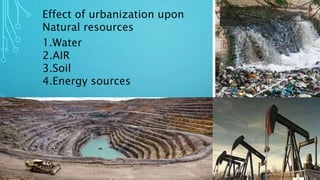
1.Water
2.AIR
3.Soil
4.Energy sources
Effect of urbanization upon
Natural resources
Effect on wild life
World urban forum
1.The world urban forum is an
international forum dedicated to
discussing and creating solutions to
urban issues, faced by cities around the
world.
2. The world urban forum is run by
united nations.
3. The first WUF was held in Nairabi,
Kenya in 2002
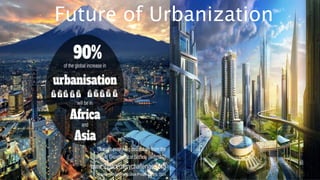
Future of Urbanization
THANK YOU

Rapid Urbanization

  • 1.
  • 2.
    URBANIZATION is theprocess by which there is an increase in the proportion of people living in urban area. • Urbanization occurs because people move from rural areas (countryside) to urban areas (town and cities) • Amongst the first countries to become urbanized were Great Britain and some European countries • Their urbanization was relatively slow, allowing governments time to plan and provide for the needs of increasing urban
  • 3.
    Anguilla urban population: 100%of total population (2010) rate of urbanization: 1.7% annual rate of change (2010-16 est.) Hong Kong urban population: 100% of total population (2010) rate of urbanization: 0.9% annual rate of change (2010-16 est.) India urban population: 30% of total population (2010) rate of urbanization: 2.4% annual rate of change (2010-16 est.) Israel urban population: 92% of total population (2010) rate of urbanization: 1.5% annual rate of change (2010-16 est.) Kuwait urban population: 98% of total population (2010) rate of urbanization: 2.1% annual rate of change (2010-16 est.) Qatar urban population: 96% of total population (2010) rate of urbanization: 1.6% annual rate of change (2010-16 est.)
  • 6.
    COMPARISON OF URBANIZATIONB/W CHINA & INDIA .China and India are both urbanizing rapidly, but China has embraced and shaped the process, while India is still waking up to its urban realities and opportunities. • China and India are in the vanguard of a wave of urban expansion that is restoring the global prominence that Asia enjoyed before the European and North American industrial revolution. • In 1950, India 17 % & China 13 % • In 2005, India 29 % & China 41 % • Never before in history have two of the largest nations (in terms of population) urbanized at the same time, and at such a pace. COMPARISON OF URBANIZATION B/W CHINA & INDIA China and India are both urbanizing rapidly, but China has
  • 7.
    CAUSES OF URBANIZATION 1.Urbanizationoccurs naturally from individual & corporate efforts to reduce time and expense in commuting and transportation while improving opportunities for jobs, education, housing, and transportation. 2. Living in cities permits individuals and families to take advantage of the opportunities of proximity, diversity, and market place competition. 3. It is easy to see why someone living on a farm might wish to take their chance moving to the city and make enough money to send back home to their struggling family.
  • 8.
    1.Water 2.AIR 3.Soil 4.Energy sources Effect ofurbanization upon Natural resources
  • 9.
  • 10.
    World urban forum 1.Theworld urban forum is an international forum dedicated to discussing and creating solutions to urban issues, faced by cities around the world. 2. The world urban forum is run by united nations. 3. The first WUF was held in Nairabi, Kenya in 2002
  • 12.
  • 14.