Baking Science and Technology
Presenting To: Dr Shabir Ahmad
Presenting By: Umm e Habiba
Sobia Akbar
Content
Baking Process &Types of Ovens
• Fat melt, Gases form & expand
• Microorganisms die, Sugar dissolves
• Egg and gluten protein coagulate
• Starches gelatinize, Gases evaporate
• Caramilization & millard browning occur on
crust
• Enzymes are inactivated
• Changes occur to nutrients, Pectin breaks down
• Direct Gas fired oven
• Radiating cyclotherm oven
• Indirect convection oven
• Direct convection oven
• Hybrid oven
• Impingement oven
• Thermal oil oven
Baking Process
• Baking is a method of cooking that uses dry heat in an enclosed space.
• Typically done in an oven, baking occurs when heat makes contact with
dough or batter and causes the starches in the dish to change form.
• This results in the development of a firm, browned surface due to the
Maillard reaction, and a soft inside as a result of moisture getting trapped
within the baked good.
• An enclosed space is necessary for baking in order to uniformly distribute
heat, resulting in evenly cooked baked goods.
Baking
• During baking: – Heat is slowly conducted from the outside in. – Heat
transforms batter/dough from a foam that traps air bubbles to a porous
sponge.
• Term sponge is used whether product has a springy, spongy texture
• Crumb, or grain, of baked goods consists of air cells surrounded by porous
cell walls.
Baking involves at least eleven events
• Events occur concurrently and influence each other.
• Many would never occur at room temperature; heat is required.
• Several have no upper limit; they continue for as long as baked good is in
oven.
• Examples: protein coagulation, starch gelatinization, evaporation of gases.
1. Fats Melt
• Most melt between 90º and 130ºF (30º–55ºC).
• Results in: Increased volume, or rise: trapped steam and air expand.
• The later fats melt, the more rise.
• Increased tenderness: melted fats coat structure builders.
• The sooner fats melt, often the more tenderness. Example: oil and pie pastry
dough.
• Thinned batters and doughs. Example: high-fat cookie dough and spread.
2. Gases Form and Expand
• Starts at room temperature; continues until about 170ºF (75ºC).
• Three most important leavening gases: air, steam, carbon dioxide.
• Results in: Increased volume or rise: expanding gases push on cell walls.
Example: Oven spring
• Increased tenderness: expanding gases thin cells walls, making them easier
to bite.
3. Microorganisms Die
• Microorganisms include: yeast, mold, bacteria, viruses.
• Most die at 135 –140ºF (55–60ºC).
• Depends on microorganism and amount of sugar or salt.
• Results in: Fermentation stopping.
• Safer food, since pathogenic bacteria are killed.
• Examples of pathogens: Salmonella bacteria, hepatitis virus.
4. Sugar Dissolves
• Heat of oven dissolves sugar that did not dissolve during mixing.
• Results in: Moistening, tenderizing, browning, sweetening.
• That is, sugar now acts like sugar.
• Thinned batters and doughs.
• Dissolved sugar pulls water from driers.
• Other solutes that dissolve during baking include acid salts in baking powder
5. Egg and Gluten Proteins Coagulate
• Starts at 140 –160ºF (60–70ºC).
• Egg proteins: Unfold (denature) and bond, forming a network of stretched-
out clusters of egg proteins.
• Heat dries out and stiffens the proteins.
• Results in formation of rigid structure that sets the final size and shape of
baked goods.
6. Starches Gelatinize
• Starts at 120 –140ºF (50–60ºC).
• Starch granules, tightly-packed with starch molecules, swell and soften.
• Results in: Thickening of batter/dough.
• Formation of rigid structure that sets the final size and shape of baked goods.
• Besides heat, water is required.
• Bread dough vs. cookie dough
7. Gases Evaporate
• Starts at about 160ºF (72ºC).
• Rigid cell walls rupture from pressure of expanding gases; gases escape.
• Results in: Formation of dry, hard (white) crust.
• Weight loss.
• Aroma loss.
8. Caramelization and Maillard Browning Occur
on Crust.
• Begins at 300ºF (150ºC) and above.
• Temperature of crust rises only after water evaporation slows.
• Caramelization: breakdown of sugars.
• Maillard browning: breakdown of sugars and proteins together.
• Results in: Brown color, Baked flavors.
9. Enzymes are Inactivated
• By about 160 –180ºF (70–80ºC).
• Below this temperature, rising oven temperatures increase enzyme activity.
• Enzymes are: Proteins, Biological catalysts; they speed up chemical reactions.
• Denatured by heat.
• Example: amylase.
10.Changes Occur to Nutrients
• Examples of nutrients: proteins, fats, carbohydrates, vitamins, minerals.
• Results in: Proteins and starches becoming more digestible.
• Destruction of certain vitamins (Vitamin C and thiamin).
11.Pectin Breaks Down
• Pectin holds fruits together.
• Dissolves when heated.
• Results in softened fruit.
Types of Ovens
Direct gas fired oven
• The direct gas fired oven is used for those products that require great
heating power.
• They can burn natural gas or LPG.
• in each zone, the heat at top and bottom can be independently set by
regulating the two combustion air fans which control the volume of gas fed
to the burners.
• Each zone is managed by a suitable automatic humidity extraction system.
Example applications for direct gas-fired ovens
• Pizzas
• Flatbreads
• Pita bread
• Bread, Rolls, Bagels
• Biscuits, Cookies
• Crackers
Radiating -cyclotherm oven
• The indirect radiating oven – also known as a cyclotherm oven –transfers the
heat to the product by radiation.
• Each zone consists of a set of tubes at the top and at the bottom of the baking
conveyor, through which the hot air, that has been previously heated by a
burner, flows.
• At the end of each baking zone the hot gases are collected by a plenum and
return by a blowing fan to the burner, where they are heated up again to the
working temperature and sent back to the tube circuit.
• The heating system is therefore completely independent, and the products of
combustion in fact never come in contact with the dough being baked.
• Each zone is managed by a suitable automatic humidity extraction system.
Indirect convection oven
• In the indirect convection oven the air is heated up by passing through a
dedicated heat exchanger: the dough under baking never comes in contact
with the products of combustion.
• This type of heating is suitable for baking more delicate products.
• Its baking chamber is constituted by a plenum duct positioned on the top
and bottom of the baking conveyor where hot air is gently blown out of
properly designed slats and comes in contact with the dough.
• The heat transfer is mainly by convection and it has a pronounced drying
effect on the dough.
• Each zone is managed by a suitable automatic humidity extraction system.
Example applications for indirect convection
ovens
• Bread
• Rolls
• Cakes
• Confectionary
Direct convection oven
• In those cases where the fuel available is natural gas and the reduction of the
baking time is a necessity, the direct convection oven is the right choice.
• Its baking chamber is constituted by a plenum
duct positioned on the top and bottom of the baking conveyor where hot gases
are gently blown out of properly designed slats and come in contact with the
dough.
• The heat transfer is mainly by convection and it has a pronounced drying effect
on the dough.
• Each zone is managed by a suitable automatic humidity extraction system.
Hybrid oven
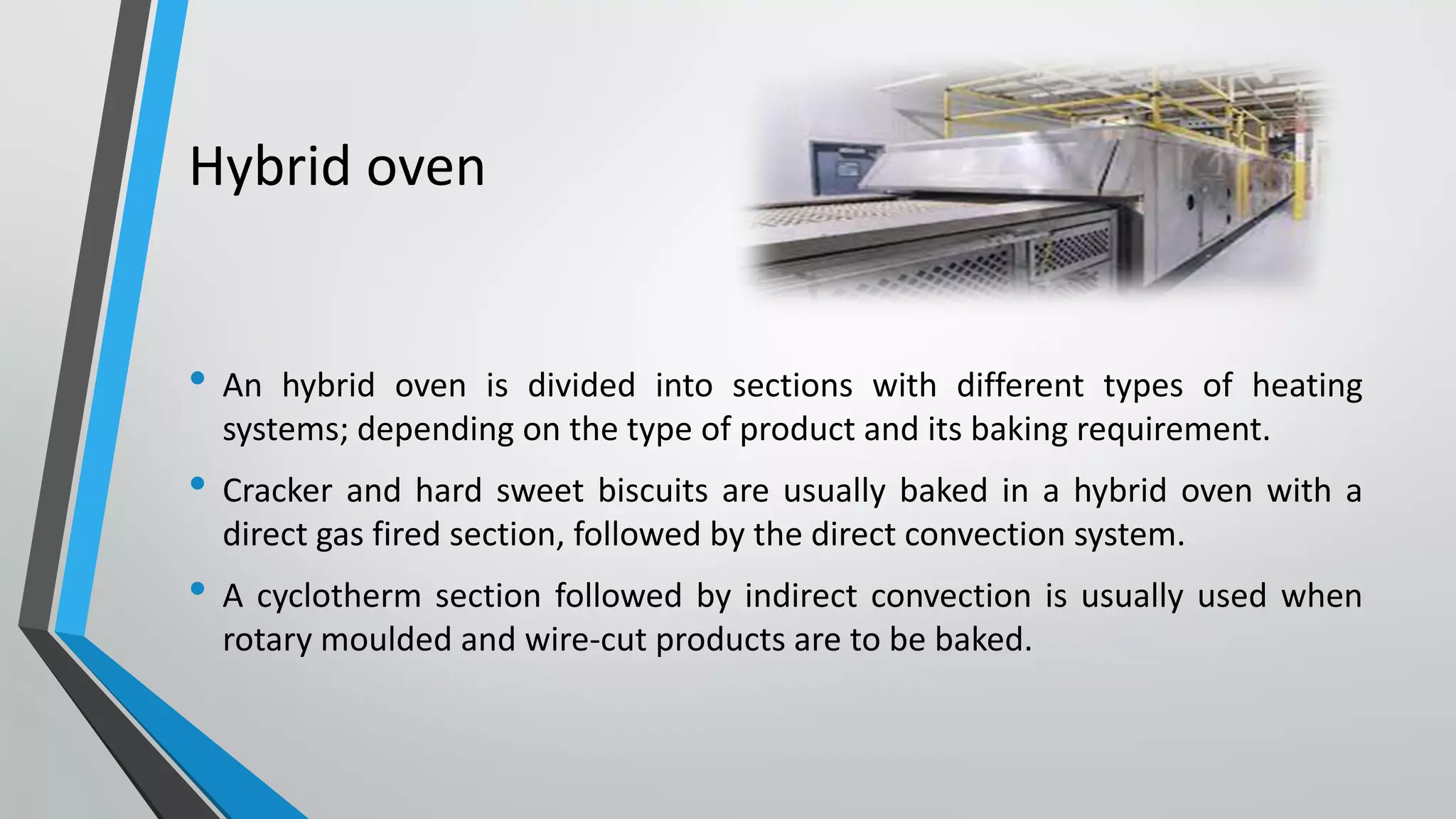
• An hybrid oven is divided into sections with different types of heating
systems; depending on the type of product and its baking requirement.
• Cracker and hard sweet biscuits are usually baked in a hybrid oven with a
direct gas fired section, followed by the direct convection system.
• A cyclotherm section followed by indirect convection is usually used when
rotary moulded and wire-cut products are to be baked.
Impingement ovens
• Impingement ovens are indirect-fired baking solutions, which means that no
combustion products share the baking chamber with the food products.
• Like traditional ovens, impingement ovens surround products with radiant heat,
but they also use pressurized jets of hot air to penetrate the product.
• This design significantly shortens the cooking time by heating product from the
inside as well as from the outside.
• Impingement ovens are best for products that need to be cooked quickly but are
also relatively sturdy — fragile doughs and batters don’t stand up well to the
jets of hot air.
Example applications for impingement ovens
• Pizzas, Calzones
• Flatbreads, Empanadas
• Bread, Breadsticks
• Cakes, Cookies
• Pastries, Muffins, Pies
• Macaroons
• Granola
Thermal oil ovens
• Thermal oil ovens provide the gentle heat transfer necessary to create
artisan-style products at an industrial scale.
• These ovens are hugely popular in Europe and are gaining traction in the
United States because of their ability to handle high moisture doughs and
produce artisan-style crusts.
• Thermal oil ovens also have a high thermal capacity, providing precise
temperature control.
Example applications for thermal oil ovens
• Freestanding products
• Artisan- and rustic-style products
• Bread, Rolls, Pies
• Pita bread, Bagels
• Pretzels, Pastries
Reference
• https://www.masterclass.com/articles/baking-101-5-baking-techniques-plus-
how-to-build-a-perfectly-stocked-home-bakery
• Pdf: chapter 3 Overview of the baking process-how baking works
• https://www.naegele-inc.com/2020/06/25/features-and-types-of-industrial-
baking-ovens
• cat_ Ovens_rev13GEA_MEDIA_min.pdf
7- Baking Process & Ovens Final.pdf

7- Baking Process & Ovens Final.pdf

  • 2.
    Baking Science andTechnology Presenting To: Dr Shabir Ahmad Presenting By: Umm e Habiba Sobia Akbar
  • 3.
    Content Baking Process &Typesof Ovens • Fat melt, Gases form & expand • Microorganisms die, Sugar dissolves • Egg and gluten protein coagulate • Starches gelatinize, Gases evaporate • Caramilization & millard browning occur on crust • Enzymes are inactivated • Changes occur to nutrients, Pectin breaks down • Direct Gas fired oven • Radiating cyclotherm oven • Indirect convection oven • Direct convection oven • Hybrid oven • Impingement oven • Thermal oil oven
  • 4.
    Baking Process • Bakingis a method of cooking that uses dry heat in an enclosed space. • Typically done in an oven, baking occurs when heat makes contact with dough or batter and causes the starches in the dish to change form. • This results in the development of a firm, browned surface due to the Maillard reaction, and a soft inside as a result of moisture getting trapped within the baked good. • An enclosed space is necessary for baking in order to uniformly distribute heat, resulting in evenly cooked baked goods.
  • 5.
    Baking • During baking:– Heat is slowly conducted from the outside in. – Heat transforms batter/dough from a foam that traps air bubbles to a porous sponge. • Term sponge is used whether product has a springy, spongy texture • Crumb, or grain, of baked goods consists of air cells surrounded by porous cell walls.
  • 6.
    Baking involves atleast eleven events • Events occur concurrently and influence each other. • Many would never occur at room temperature; heat is required. • Several have no upper limit; they continue for as long as baked good is in oven. • Examples: protein coagulation, starch gelatinization, evaporation of gases.
  • 7.
    1. Fats Melt •Most melt between 90º and 130ºF (30º–55ºC). • Results in: Increased volume, or rise: trapped steam and air expand. • The later fats melt, the more rise. • Increased tenderness: melted fats coat structure builders. • The sooner fats melt, often the more tenderness. Example: oil and pie pastry dough. • Thinned batters and doughs. Example: high-fat cookie dough and spread.
  • 8.
    2. Gases Formand Expand • Starts at room temperature; continues until about 170ºF (75ºC). • Three most important leavening gases: air, steam, carbon dioxide. • Results in: Increased volume or rise: expanding gases push on cell walls. Example: Oven spring • Increased tenderness: expanding gases thin cells walls, making them easier to bite.
  • 9.
    3. Microorganisms Die •Microorganisms include: yeast, mold, bacteria, viruses. • Most die at 135 –140ºF (55–60ºC). • Depends on microorganism and amount of sugar or salt. • Results in: Fermentation stopping. • Safer food, since pathogenic bacteria are killed. • Examples of pathogens: Salmonella bacteria, hepatitis virus.
  • 10.
    4. Sugar Dissolves •Heat of oven dissolves sugar that did not dissolve during mixing. • Results in: Moistening, tenderizing, browning, sweetening. • That is, sugar now acts like sugar. • Thinned batters and doughs. • Dissolved sugar pulls water from driers. • Other solutes that dissolve during baking include acid salts in baking powder
  • 11.
    5. Egg andGluten Proteins Coagulate • Starts at 140 –160ºF (60–70ºC). • Egg proteins: Unfold (denature) and bond, forming a network of stretched- out clusters of egg proteins. • Heat dries out and stiffens the proteins. • Results in formation of rigid structure that sets the final size and shape of baked goods.
  • 12.
    6. Starches Gelatinize •Starts at 120 –140ºF (50–60ºC). • Starch granules, tightly-packed with starch molecules, swell and soften. • Results in: Thickening of batter/dough. • Formation of rigid structure that sets the final size and shape of baked goods. • Besides heat, water is required. • Bread dough vs. cookie dough
  • 13.
    7. Gases Evaporate •Starts at about 160ºF (72ºC). • Rigid cell walls rupture from pressure of expanding gases; gases escape. • Results in: Formation of dry, hard (white) crust. • Weight loss. • Aroma loss.
  • 14.
    8. Caramelization andMaillard Browning Occur on Crust. • Begins at 300ºF (150ºC) and above. • Temperature of crust rises only after water evaporation slows. • Caramelization: breakdown of sugars. • Maillard browning: breakdown of sugars and proteins together. • Results in: Brown color, Baked flavors.
  • 15.
    9. Enzymes areInactivated • By about 160 –180ºF (70–80ºC). • Below this temperature, rising oven temperatures increase enzyme activity. • Enzymes are: Proteins, Biological catalysts; they speed up chemical reactions. • Denatured by heat. • Example: amylase.
  • 16.
    10.Changes Occur toNutrients • Examples of nutrients: proteins, fats, carbohydrates, vitamins, minerals. • Results in: Proteins and starches becoming more digestible. • Destruction of certain vitamins (Vitamin C and thiamin).
  • 17.
    11.Pectin Breaks Down •Pectin holds fruits together. • Dissolves when heated. • Results in softened fruit.
  • 18.
  • 19.
    Direct gas firedoven • The direct gas fired oven is used for those products that require great heating power. • They can burn natural gas or LPG. • in each zone, the heat at top and bottom can be independently set by regulating the two combustion air fans which control the volume of gas fed to the burners. • Each zone is managed by a suitable automatic humidity extraction system.
  • 20.
    Example applications fordirect gas-fired ovens • Pizzas • Flatbreads • Pita bread • Bread, Rolls, Bagels • Biscuits, Cookies • Crackers
  • 21.
    Radiating -cyclotherm oven •The indirect radiating oven – also known as a cyclotherm oven –transfers the heat to the product by radiation. • Each zone consists of a set of tubes at the top and at the bottom of the baking conveyor, through which the hot air, that has been previously heated by a burner, flows. • At the end of each baking zone the hot gases are collected by a plenum and return by a blowing fan to the burner, where they are heated up again to the working temperature and sent back to the tube circuit. • The heating system is therefore completely independent, and the products of combustion in fact never come in contact with the dough being baked. • Each zone is managed by a suitable automatic humidity extraction system.
  • 22.
    Indirect convection oven •In the indirect convection oven the air is heated up by passing through a dedicated heat exchanger: the dough under baking never comes in contact with the products of combustion. • This type of heating is suitable for baking more delicate products. • Its baking chamber is constituted by a plenum duct positioned on the top and bottom of the baking conveyor where hot air is gently blown out of properly designed slats and comes in contact with the dough. • The heat transfer is mainly by convection and it has a pronounced drying effect on the dough. • Each zone is managed by a suitable automatic humidity extraction system.
  • 23.
    Example applications forindirect convection ovens • Bread • Rolls • Cakes • Confectionary
  • 24.
    Direct convection oven •In those cases where the fuel available is natural gas and the reduction of the baking time is a necessity, the direct convection oven is the right choice. • Its baking chamber is constituted by a plenum duct positioned on the top and bottom of the baking conveyor where hot gases are gently blown out of properly designed slats and come in contact with the dough. • The heat transfer is mainly by convection and it has a pronounced drying effect on the dough. • Each zone is managed by a suitable automatic humidity extraction system.
  • 25.
    Hybrid oven • Anhybrid oven is divided into sections with different types of heating systems; depending on the type of product and its baking requirement. • Cracker and hard sweet biscuits are usually baked in a hybrid oven with a direct gas fired section, followed by the direct convection system. • A cyclotherm section followed by indirect convection is usually used when rotary moulded and wire-cut products are to be baked.
  • 26.
    Impingement ovens • Impingementovens are indirect-fired baking solutions, which means that no combustion products share the baking chamber with the food products. • Like traditional ovens, impingement ovens surround products with radiant heat, but they also use pressurized jets of hot air to penetrate the product. • This design significantly shortens the cooking time by heating product from the inside as well as from the outside. • Impingement ovens are best for products that need to be cooked quickly but are also relatively sturdy — fragile doughs and batters don’t stand up well to the jets of hot air.
  • 27.
    Example applications forimpingement ovens • Pizzas, Calzones • Flatbreads, Empanadas • Bread, Breadsticks • Cakes, Cookies • Pastries, Muffins, Pies • Macaroons • Granola
  • 28.
    Thermal oil ovens •Thermal oil ovens provide the gentle heat transfer necessary to create artisan-style products at an industrial scale. • These ovens are hugely popular in Europe and are gaining traction in the United States because of their ability to handle high moisture doughs and produce artisan-style crusts. • Thermal oil ovens also have a high thermal capacity, providing precise temperature control.
  • 29.
    Example applications forthermal oil ovens • Freestanding products • Artisan- and rustic-style products • Bread, Rolls, Pies • Pita bread, Bagels • Pretzels, Pastries
  • 30.
    Reference • https://www.masterclass.com/articles/baking-101-5-baking-techniques-plus- how-to-build-a-perfectly-stocked-home-bakery • Pdf:chapter 3 Overview of the baking process-how baking works • https://www.naegele-inc.com/2020/06/25/features-and-types-of-industrial- baking-ovens • cat_ Ovens_rev13GEA_MEDIA_min.pdf