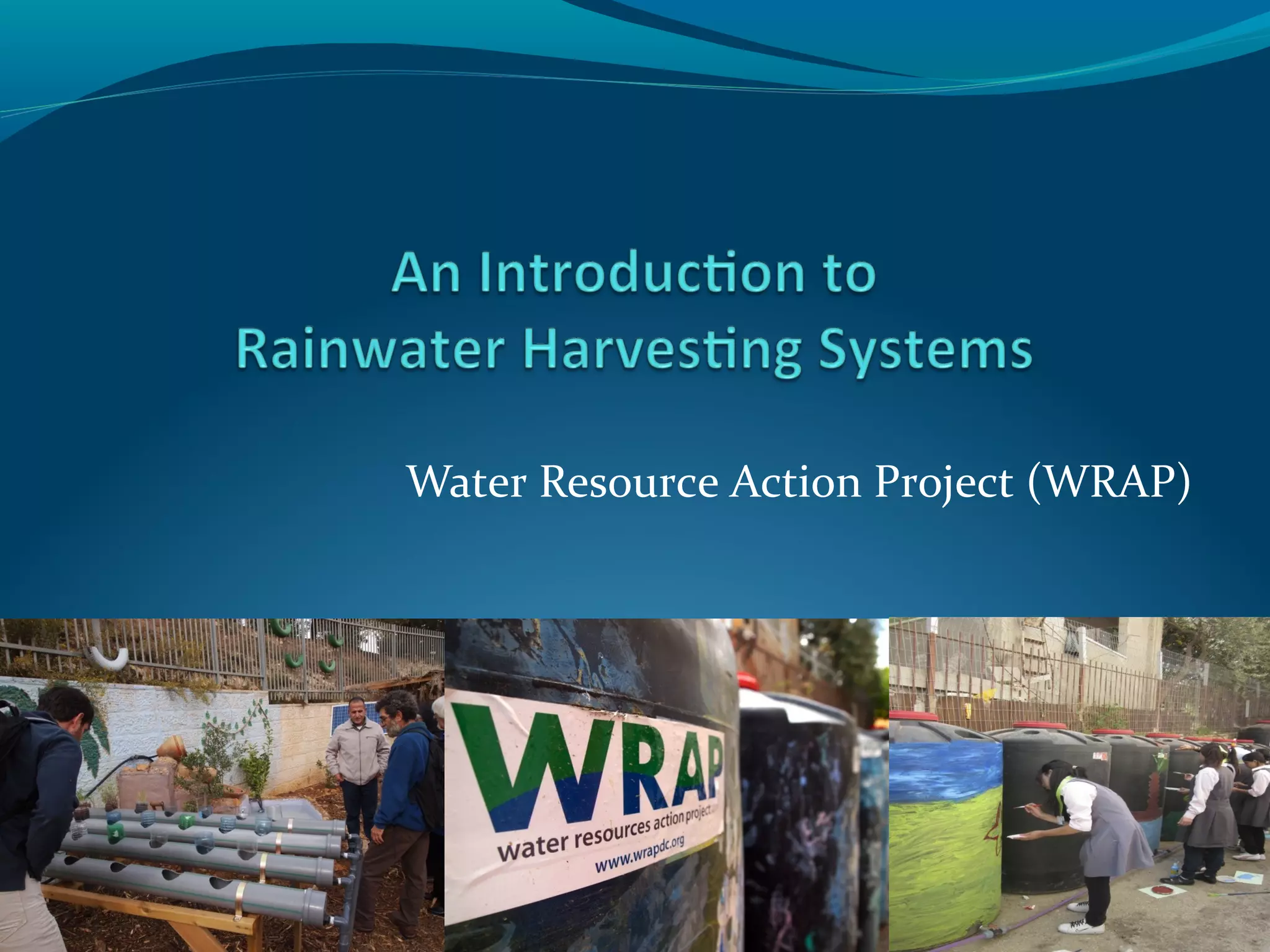
Water Resource Action Project (WRAP)
Why Rainwater Harvesting Systems?
For You, the Middle East, and the Environment
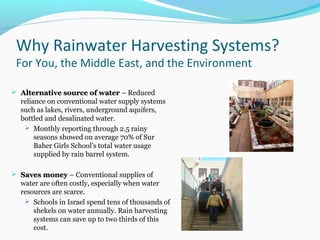
 Alternative source of waterAlternative source of water – Reduced
reliance on conventional water supply systems
such as lakes, rivers, underground aquifers,
bottled and desalinated water.
 Monthly reporting through 2.5 rainy
seasons showed on average 70% of Sur
Baher Girls School’s total water usage
supplied by rain barrel system.
 Saves moneySaves money – Conventional supplies of
water are often costly, especially when water
resources are scarce.
 Schools in Israel spend tens of thousands of
shekels on water annually. Rain harvesting
systems can save up to two thirds of this
cost.
Why Rainwater Harvesting Systems?
For You, the Middle East, and the Environment
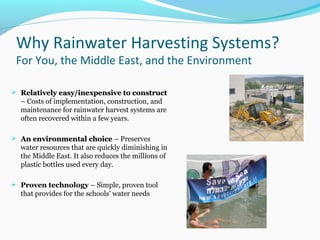
 Relatively easy/inexpensive to constructRelatively easy/inexpensive to construct
– Costs of implementation, construction, and
maintenance for rainwater harvest systems are
often recovered within a few years.
 An environmental choiceAn environmental choice – Preserves
water resources that are quickly diminishing in
the Middle East. It also reduces the millions of
plastic bottles used every day.
 Proven technology – Simple, proven tool
that provides for the schools’ water needs
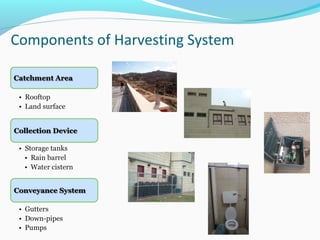
Components of Harvesting System
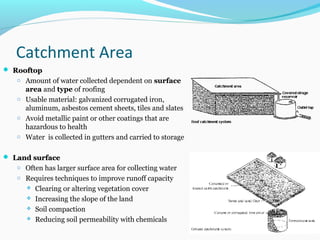
Catchment Area
 RooftopRooftop
o Amount of water collected dependent on surface
area and type of roofing
o Usable material: galvanized corrugated iron,
aluminum, asbestos cement sheets, tiles and slates
o Avoid metallic paint or other coatings that are
hazardous to health
o Water is collected in gutters and carried to storage
 Land surfaceLand surface
o Often has larger surface area for collecting water
o Requires techniques to improve runoff capacity
 Clearing or altering vegetation cover
 Increasing the slope of the land
 Soil compaction
 Reducing soil permeability with chemicals
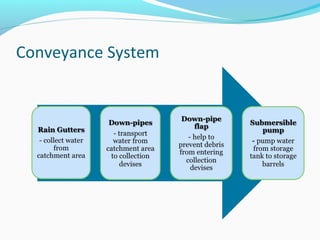
Conveyance System
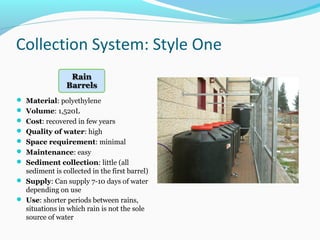
Collection System: Style One
 Material: polyethylene
 Volume: 1,520L
 Cost: recovered in few years
 Quality of water: high
 Space requirement: minimal
 Maintenance: easy
 Sediment collection: little (all
sediment is collected in the first barrel)
 Supply: Can supply 7-10 days of water
depending on use
 Use: shorter periods between rains,
situations in which rain is not the sole
source of water
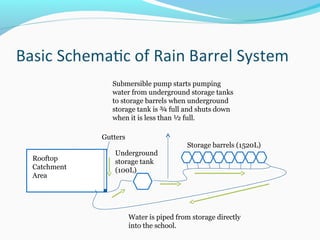
Rooftop
Catchment
Area
Gutters
Underground
storage tank
(100L)
Storage barrels (1520L)
Submersible pump starts pumping
water from underground storage tanks
to storage barrels when underground
storage tank is ¾ full and shuts down
when it is less than ½ full.
Water is piped from storage directly
into the school.
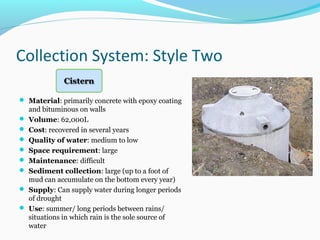
Collection System: Style Two
 Material: primarily concrete with epoxy coating
and bituminous on walls
 Volume: 62,000L
 Cost: recovered in several years
 Quality of water: medium to low
 Space requirement: large
 Maintenance: difficult
 Sediment collection: large (up to a foot of
mud can accumulate on the bottom every year)
 Supply: Can supply water during longer periods
of drought
 Use: summer/ long periods between rains/
situations in which rain is the sole source of
water
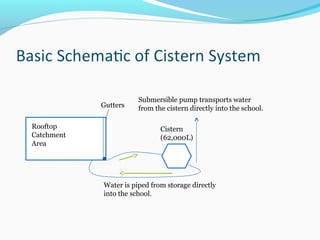
Rooftop
Catchment
Area
Gutters
Cistern
(62,000L)
Submersible pump transports water
from the cistern directly into the school.
Water is piped from storage directly
into the school.
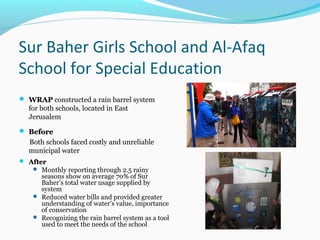
Sur Baher Girls School and Al-Afaq
School for Special Education
 WRAPWRAP constructed a rain barrel system
for both schools, located in East
Jerusalem
 BeforeBefore
Both schools faced costly and unreliable
municipal water
 AfterAfter
 Monthly reporting through 2.5 rainy
seasons show on average 70% of Sur
Baher’s total water usage supplied by
system
 Reduced water bills and provided greater
understanding of water’s value, importance
of conservation
 Recognizing the rain barrel system as a tool
used to meet the needs of the school
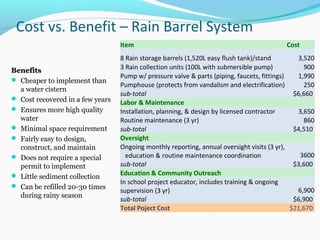
Cost vs. Benefit – Rain Barrel System
BenefitsBenefits
 Cheaper to implement than
a water cistern
 Cost recovered in a few years
 Ensures more high quality
water
 Minimal space requirement
 Fairly easy to design,
construct, and maintain
 Does not require a special
permit to implement
 Little sediment collection
 Can be refilled 20-30 times
during rainy season
Item Cost
8 Rain storage barrels (1,520L easy flush tank)/stand 3,520
3 Rain collection units (100L with submersible pump) 900
Pump w/ pressure valve & parts (piping, faucets, fittings) 1,990
Pumphouse (protects from vandalism and electrification) 250
sub-total $6,660
Labor & Maintenance
Installation, planning, & design by licensed contractor 3,650
Routine maintenance (3 yr) 860
sub-total $4,510
Oversight
Ongoing monthly reporting, annual oversight visits (3 yr),
education & routine maintenance coordination 3600
sub-total $3,600
Education & Community Outreach
In school project educator, includes training & ongoing
supervision (3 yr) 6,900
sub-total $6,900
Total Poject Cost $21,670
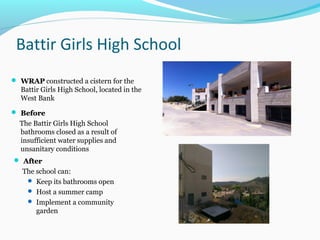
Battir Girls High School
 WRAPWRAP constructed a cistern for the
Battir Girls High School, located in the
West Bank
 BeforeBefore
The Battir Girls High School
bathrooms closed as a result of
insufficient water supplies and
unsanitary conditions
 AfterAfter
The school can:
 Keep its bathrooms open
 Host a summer camp
 Implement a community
garden
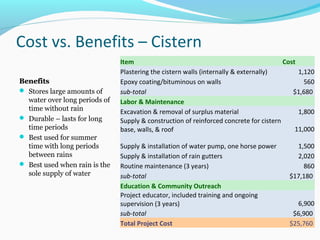
Cost vs. Benefits – Cistern
BenefitsBenefits
 Stores large amounts of
water over long periods of
time without rain
 Durable – lasts for long
time periods
 Best used for summer
time with long periods
between rains
 Best used when rain is the
sole supply of water
Item Cost
Plastering the cistern walls (internally & externally) 1,120
Epoxy coating/bituminous on walls 560
sub-total $1,680
Labor & Maintenance
Excavation & removal of surplus material 1,800
Supply & construction of reinforced concrete for cistern
base, walls, & roof 11,000
Supply & installation of water pump, one horse power 1,500
Supply & installation of rain gutters 2,020
Routine maintenance (3 years) 860
sub-total $17,180
Education & Community Outreach
Project educator, included training and ongoing
supervision (3 years) 6,900
sub-total $6,900
Total Project Cost $25,760
How to Support WRAP
Spread the Word
Tell others about the issues, solutions, and WRAP
Feedback
We welcome it!
Join Us
Become a Member / Own a Project (Start to Finish)
Stay in Touch
Email – info@wrapdc.org
Website – www.wrapdc.org
Like Us on Facebook – www.facebook.com/wrapdc
Follow Us Twitter – @WRAP_DC
Thank You!

An Introduction to Rainwater Harvesting Systems

  • 1.
    Water Resource ActionProject (WRAP)
  • 2.
    Why Rainwater HarvestingSystems? For You, the Middle East, and the Environment  Alternative source of waterAlternative source of water – Reduced reliance on conventional water supply systems such as lakes, rivers, underground aquifers, bottled and desalinated water.  Monthly reporting through 2.5 rainy seasons showed on average 70% of Sur Baher Girls School’s total water usage supplied by rain barrel system.  Saves moneySaves money – Conventional supplies of water are often costly, especially when water resources are scarce.  Schools in Israel spend tens of thousands of shekels on water annually. Rain harvesting systems can save up to two thirds of this cost.
  • 3.
    Why Rainwater HarvestingSystems? For You, the Middle East, and the Environment  Relatively easy/inexpensive to constructRelatively easy/inexpensive to construct – Costs of implementation, construction, and maintenance for rainwater harvest systems are often recovered within a few years.  An environmental choiceAn environmental choice – Preserves water resources that are quickly diminishing in the Middle East. It also reduces the millions of plastic bottles used every day.  Proven technology – Simple, proven tool that provides for the schools’ water needs
  • 4.
  • 5.
    Catchment Area  RooftopRooftop oAmount of water collected dependent on surface area and type of roofing o Usable material: galvanized corrugated iron, aluminum, asbestos cement sheets, tiles and slates o Avoid metallic paint or other coatings that are hazardous to health o Water is collected in gutters and carried to storage  Land surfaceLand surface o Often has larger surface area for collecting water o Requires techniques to improve runoff capacity  Clearing or altering vegetation cover  Increasing the slope of the land  Soil compaction  Reducing soil permeability with chemicals
  • 6.
  • 7.
    Collection System: StyleOne  Material: polyethylene  Volume: 1,520L  Cost: recovered in few years  Quality of water: high  Space requirement: minimal  Maintenance: easy  Sediment collection: little (all sediment is collected in the first barrel)  Supply: Can supply 7-10 days of water depending on use  Use: shorter periods between rains, situations in which rain is not the sole source of water
  • 8.
    Rooftop Catchment Area Gutters Underground storage tank (100L) Storage barrels(1520L) Submersible pump starts pumping water from underground storage tanks to storage barrels when underground storage tank is ¾ full and shuts down when it is less than ½ full. Water is piped from storage directly into the school.
  • 9.
    Collection System: StyleTwo  Material: primarily concrete with epoxy coating and bituminous on walls  Volume: 62,000L  Cost: recovered in several years  Quality of water: medium to low  Space requirement: large  Maintenance: difficult  Sediment collection: large (up to a foot of mud can accumulate on the bottom every year)  Supply: Can supply water during longer periods of drought  Use: summer/ long periods between rains/ situations in which rain is the sole source of water
  • 10.
    Rooftop Catchment Area Gutters Cistern (62,000L) Submersible pump transportswater from the cistern directly into the school. Water is piped from storage directly into the school.
  • 11.
    Sur Baher GirlsSchool and Al-Afaq School for Special Education  WRAPWRAP constructed a rain barrel system for both schools, located in East Jerusalem  BeforeBefore Both schools faced costly and unreliable municipal water  AfterAfter  Monthly reporting through 2.5 rainy seasons show on average 70% of Sur Baher’s total water usage supplied by system  Reduced water bills and provided greater understanding of water’s value, importance of conservation  Recognizing the rain barrel system as a tool used to meet the needs of the school
  • 12.
    Cost vs. Benefit– Rain Barrel System BenefitsBenefits  Cheaper to implement than a water cistern  Cost recovered in a few years  Ensures more high quality water  Minimal space requirement  Fairly easy to design, construct, and maintain  Does not require a special permit to implement  Little sediment collection  Can be refilled 20-30 times during rainy season Item Cost 8 Rain storage barrels (1,520L easy flush tank)/stand 3,520 3 Rain collection units (100L with submersible pump) 900 Pump w/ pressure valve & parts (piping, faucets, fittings) 1,990 Pumphouse (protects from vandalism and electrification) 250 sub-total $6,660 Labor & Maintenance Installation, planning, & design by licensed contractor 3,650 Routine maintenance (3 yr) 860 sub-total $4,510 Oversight Ongoing monthly reporting, annual oversight visits (3 yr), education & routine maintenance coordination 3600 sub-total $3,600 Education & Community Outreach In school project educator, includes training & ongoing supervision (3 yr) 6,900 sub-total $6,900 Total Poject Cost $21,670
  • 13.
    Battir Girls HighSchool  WRAPWRAP constructed a cistern for the Battir Girls High School, located in the West Bank  BeforeBefore The Battir Girls High School bathrooms closed as a result of insufficient water supplies and unsanitary conditions  AfterAfter The school can:  Keep its bathrooms open  Host a summer camp  Implement a community garden
  • 14.
    Cost vs. Benefits– Cistern BenefitsBenefits  Stores large amounts of water over long periods of time without rain  Durable – lasts for long time periods  Best used for summer time with long periods between rains  Best used when rain is the sole supply of water Item Cost Plastering the cistern walls (internally & externally) 1,120 Epoxy coating/bituminous on walls 560 sub-total $1,680 Labor & Maintenance Excavation & removal of surplus material 1,800 Supply & construction of reinforced concrete for cistern base, walls, & roof 11,000 Supply & installation of water pump, one horse power 1,500 Supply & installation of rain gutters 2,020 Routine maintenance (3 years) 860 sub-total $17,180 Education & Community Outreach Project educator, included training and ongoing supervision (3 years) 6,900 sub-total $6,900 Total Project Cost $25,760
  • 15.
    How to SupportWRAP Spread the Word Tell others about the issues, solutions, and WRAP Feedback We welcome it! Join Us Become a Member / Own a Project (Start to Finish) Stay in Touch Email – info@wrapdc.org Website – www.wrapdc.org Like Us on Facebook – www.facebook.com/wrapdc Follow Us Twitter – @WRAP_DC Thank You!