1
INSTITUTE OF RAIL TRANSPORT
1 MULTIMODALISM
CONCEPT,
EVOLUTION,
EXPERIENCE, AND
CURRENT STATUS
THE INVENTION OF CONTAINERS AS A
MODE OF CARRIAGE OF GOODS BY SEA
AND ON LAND EITHER ROAD OR RAIL
Trade and commerce is essentially a concomitant of urbanisation. The
earliest agrarian cultures were largely self sustaining . With the growth of
civilisation and more complex societies, urban townships grew and societies
depended on trade to meet the needs which they could not produce
themselves. Townships tended to be located at some sort of confluence or
meeting points along travel routes established through regular usage. Goods
were carried along these trade routes and through whatever means of
transportation was available. Initially pack animals were used and with the
invention of the wheel various kinds of vehicles. With each development and
improvement in the method of transportation the reach of goods increased.
Initially between nearby towns, then across continents to the ocean’s edge.
With seafaring boats the reach extended across continents. The history of
transportation and technological development is the story of how the world
became a smaller place and how national economies became global
economies because it facilitated the scope and growth of trade. In ancient
times of course the natural dangers and risks enormous, and everything
depended a lot on human manual effort and endeavour. But trade between
continents flourished and the exchange not only of goods but also ideas and
knowledge led to the global civilisation that has evolved over time.
1.0 Concept of Multimodalism /
Intermodalism. International
Trade and Transport
2
As far as logistics go, picture a situation where the predominant form of
transport is by beasts of burden drawing wagons and carts on land, or
carrying goods on their back and boats and ships on sea driven either by
wind or manual labour. On dock at warehouses and transfer points all cargo
is loaded and unloaded through manual labour and packaging, aggregating
disaggregating was an entirely labour intensive process. Some basic
systems were certainly in use to make the process more efficient, such as
the use of rope for bundling timber, sacks for carrying coffee beans, and
pallets for stacking and transporting bags or sacks.
The invention of the steam engine in the 18th
century and then the
combustion engine in the 19th
century resulted in tremendous boost to trade
and commerce as the horsepower of land and sea carriers took a quantum
jump. Railroads and steam ships replaced horse drawn wagons and sail
ships. The industrial revolution and increasing mechanisation led to increased
capacity of ships. The railroad and trucks carried huge volumes of cargo ,
transits improved radically compared to the pre steam age. But
technological advances served to highlight the inadequacies of the cargo
shipping system. Haulage capability and transits improved enormously that
went hand in hand with huge investments in infrastructure by way of modern
highways, ports , rail networks. But the transfer of cargo between trucks ,
trains and ships and vice versa remained a primitively manual driven
system . It would be normal for any form of vehicle to spend as much, if not
more, time stationary for loading and unloading as it took for the actual time in
carriage.
Handling of cargo , the way it was packed and loaded and unloaded
remained labour intensive and largely manual. Not only was the loading and
unloading of cargo on carriers whether on land or sea an enormously time
consuming job, it did not optimise carrying capacity and, more important, it
was subject to the risks of pilferage , loss due to damage because of multiple
handling. The time taken for these activities were also much longer and
necessitated large warehousing facilities at ports and transhipment locations,
more security, detention to expensive ships and so on.
Containerising cargo is an old idea. Containers were used in UK for coal
transportation . The railways in various countries also used containers for
other goods . Before the container shipping industry emerged, boxes of
various types and sizes had often been used in transporting cargo simply
because they were the logical way to move things en masse from one
location to another. However, despite these developments, cargo handling
was almost as labor-intensive after World War II as it had been in the mid-
1800s. But it is Malcolm Maclean’s particular design and concept of the
multimodal container introduced in 1956 that really changed the face of
international trade and logistics.
3
POST -WORLD WAR II INTERNATIONAL
TRADE AND LOGISTICS SCENARIO
The concept of containerising cargo was not completely novel. As early as
1872, boxes similar to modern containers had been used for combined rail-
and horse-drawn transport in England . The US government used small
standard-sized containers during World War II, which proved a means of
quickly and efficiently unloading and distributing supplies. But it was only post
World War II that the concept of containerisation really found true expression
and was implemented .The history of modern containerisation begins at this
point with the story of Malcom P. McLean.
Maclean was a trucking entrepreneur in USA who diversified into shipping.
Having experienced first hand the unproductive waiting that took place while
cargo was loaded and unloaded from trucks he thought the solution lay that
in somehow managing to transfer the entire truck with its cargo onto a ship.
This was a step towards the idea of a moveable box , the cargo carrying body
part of the truck. The moveable trailers however involved too much dead
weight and space .Hence the next step was a box. Thus was born the
concept of multimodal containers - fully loaded boxes which could be
interchanged seamlessly between different modes of transport trucks,
trains, ships and barges. This “ intermodalism” would be a simpler , swifter
and a much cheaper way to transport cargo . In 1956 the first ship, a
converted US navy tanker bought by Maclean, sailed with 58 containers as
well as bulk petroleum and marked the beginning of his company aptly
called Sea- Land Services. This event was the beginning of a paradigm shift
changing forever the dynamics of logistics and cargo transportation and
having a far reaching impact on international trade and national economic
development .The developments in the next 30-40 years would see a
complete revolution in shipping and the way of international trade . This
would influence further the creation of different kinds of infrastructure to deal
with intermodal logistics.
REVOLUTION IN SEA TRANSPORT,
CONTAINER SHIPS AND BOOM IN SHIPPING
Break-bulk shipping refers to a process whereby individual goods are
loaded and unloaded in barrels, sacks and wooden crates from land
transport to ship and back again . It is a slow and cumbersome process and
extremely labour intensive and, eventually, costly. A ship could spend more
time docked for these operations than on sea between destinations
particularly where coastal shipping was concerned. Risk of accidents, loss
and theft and pilferage was also high. But it was the only known way to
transport goods via a ship until the second half of the 20th Century.
4
Intermodal containers were an innovative way to surmount the problems of
break bulk handling. The first ship specifically designed for transporting
containers, Sea-Land’s Gateway City, made its maiden voyage on 4th
October 1957 from Port Newark to Miami. A regular journey was started
between Port Newark, Miami, Houston and Tampa. Only two gangs of
dockworkers were required to load and unload, and could move cargo at the
rate of 264 tons an hour. In 1960, Matson Navigation Company completed
construction of the Hawaiian Citizen, the Pacific’s first full container ship. The
advantages were immediately evident. Shortly afterwards, the Santa Eliana,
operated by Grace Line, became the first fully containerized ship to enter
foreign trade when she set sail for Venezuela in January 1960.
But in order for intermodal transport to be effectively implemented on a mass
scale it was important to integrate all areas of the transport chain . It was not
simply a question of putting cargo in containers. The ships, port terminals,
trucks and trains had to be adapted to handle the containers . Standardisation
provided the key to the transformation.Standardising container sizes enabled
them to be most efficiently stacked and allowed for ships, trains, trucks and
cranes at the port to be specially fitted or built to a single size specification.
This standardization would eventually apply across the global industry.
As early as 1960, international groups already recognized the potential of
container shipping and began discussing what the standard container sizes
should be. In 1961, the International Organization for Standardization (ISO)
set standard sizes. The two most important, and most commonly used sizes
even today, are the 20-foot and 40-foot lengths. The 20-foot container,
referred to as a Twenty-foot Equivalent Unit (TEU) became the industry
standard reference with cargo volume and vessel capacity now measured in
TEUs. The 40-foot length container - literally 2 TEUs - became known as the
Forty-foot Equivalent Unit (FEU) and is the most frequently used container
today.
On 23 April 1966, ten years after the first converted container ship sailed,
Sea-Land’s Fairland sailed from Port Elizabeth in the USA to Rotterdam in the
Netherlands with 236 containers. This was the first international voyage of a
container ship.
The trend received a boost with the US army adopting containerisation as the
most efficient means of transporting supplies in the build up to the Vietnam
War. Internationally container shipping began to prove itself. From this point
on the industry began to grow to the point where it would quickly become the
backbone of global trade. During 1968 and 1969 container shipping industry
boomed. In 1968 alone, 18 container vessels were built, ten of them with a
capacity of 1,000 TEUs which was large for the time. In 1969, 25 ships were
built and the size of the largest ships increased to approaching 2,000 TEUs.
In 1972, the first container ships with a capacity of more than 3,000 TEU were
completed by the Howaldtwerke Shipyard in Germany.
5
An entire industry emerged, demanding unprecedented investment in
vessels, containers, terminals, offices and information technology to manage
the complex logistics.The 1970s through to the 1980s witnessed an
exponential growth in the container shipping industry. There were now
connections between Japan and the US west coast, and Europe and the US
east coast. The Europe–Asia route began to be serviced by consortia (a
group of carriers sharing space on ships) in the early 1970s as well as some
independent services. By the end of the decade, shipping between Europe,
South East and Eastern Asia, South Africa, Australia/New Zealand, North
America and South America were all largely containerized. In 1973, US,
European and Asian containership operators were carrying 4 million TEUs all
over the world. By 1983, this would rise to 12 million TEUs by which time
containers had also arrived in the Middle East, the Indian sub-Continent, and
East and West Africa.
IMPACT ON INTERNATIONAL TRADE AND
WORLD ECONOMIES
The spread of containerisation and its transformation of the shipping industry
had far reaching effects. Worldwide lowering of trade barriers like tariffs and
quotas , as well as the opening of closed economies like China and other
traditionally minor players in the undeveloped world players have certainly
contributed to the explosion in international commerce. But there is another
factor : the lower costs of getting goods to market. A noted economist Mark
Levinson suggests that the container and container shipping are largely
responsible for the growth of global trade (The Box: How the Shipping
Container Made the World Smaller and the World Economy Bigger. By
Mark Levinson)
Globalisation and container shipping enjoy a reciprocal relationship. There is
little doubt that the expansion of global manufacturing systems would have
been impossible without the expansion of international commerce and the
efficiencies and economies that containerisation has brought. Container
shipping is acknowledged to be a facilitator of globalisation.
In 1961 ocean freight costs made up 12% and 10% of the value of U.S.
exports and imports respectively, and were so high for some goods that
international sales were impossible. This is indicative across most developed
countries. The impact of containerisation on cost of transportation has
made itself felt in several ways :
! The cost of loading and unloading a ship dropped dramatically due to
huge reduction in manual labour, and the speed at which ships could
be handled. With the new handling cranes, ships could be emptied
and loaded in hours where earlier it took days.
6
! Pilferage and damage were reduced substantially.
! Inventory cost reduced because transits could be planned more
reliably.
! International commerce used to be dominated by raw materials such
as wheat, wood, and iron ore or processed commodities such as
meat or steel which are bulky and heavy commodities and therefore
costly to carry. Today, world output has shifted into goods whose value
is unrelated to their size and weight. Think, computer discs, mother
boards, garments, CKD kits of many domestic gadgets and so on.
! Finished or manufactured products now dominate the flow of trade
and technology has seen to it that goods are light and not bulky.
The nature of goods therefore aresuch that they are easily containerisable
with lower cost of transportation.
Economies are becoming increasingly interrelated as a result of increasing
trade and the growing trend toward globalization of production. Over the past
half century, most countries have seen an increase in exports as a share of
gross domestic product (GDP) and there has been an increase in vertical
specialization of world trade. In addition, sourcing of raw materials and
finished products has become increasingly globalized, and producers in
various, often distant areas of the world, are increasingly forced to compete
with one another for the same markets.
Manufacturers now concentrate production capacity in fewer locations,
replacing the traditional system of nationally based production with “focused
manufacturing.” Instead of a factory manufacturing a broad range of products
for a local market, the entire production of a particular product for a continent
or, in some cases the world market, is focused at a single location. While this
has enabled companies to maximize economies of scale in the production
operation, it cannot be viable without a extremely efficient logistical system .
The production processes therefore become more transport intensive.
Firms tend to concentrate on their core competencies and outsource or
subcontract non core and assembly processes to contractors . Tasks
traditionally performed at the start or the end of the production line are
increasingly moving away from the main plant to be performed by
manufacturing subcontractors or distribution centres. Preassembly and
sequencing of parts for on-line production chains are activities increasingly
outsourced to specialist logistics providers.Customization of products, which
can range from labelling or repackaging of goods to reconfiguration of items,
is one of the fastest growing areas of logistics outsourcing.
7
Manufacturers have also extended their geographical reach or logistics reach
for outsourcing purposes to span the globe and this is a characteristic trend
of international trade today. Hewlett-Packard, for example, estimates that the
various parts in a computer workstation in a New York office were moved a
total of 96,000 kilometers from their points of production in places such as
Singapore, Japan, France, and the Western United States. Examples of
sourcing alternatives are almost endless. Europe can source fruit juice from
Latin America, Southeast Asia, Australasia, Eastern Mediterranean, Southeast
United States, and Africa. Textile manufacturers can choose their sources
from China, Southeast Asia, the Indian subcontinent, Africa, Eastern Europe,
and a wide variety of other locations.
The sourcing decision depends finally on total delivered cost and quality. Cost
and quality may depend largely on the logistics cost to acquire primary and
intermediate products and deliver the finished products to market. There is no
doubt that containerization as a phenomenon has led to reducing logistics
costs. But the phenomenon in itself has led to radical changes and
development in the entire fields of shipping, port infrastructure, handling
equipment, warehousing, and the development of another new concept -
logistic hubs. In fact the trend towards containerization has spawned such
activity and sophistication in the entire field of logistics that it has now
achieved the status of an industry and supply chain management is a
specialized discipline to deal with it.
The next section deals with the history and development of this sector.
References :
1. The Containership Revolution :Malcolm Maclean’s 1956 Innovation Goes global.
Brian J. Cudahy (2006)
2. Container Shipping &the Economy: Stimulating Trade &Transformation worldwide.
Marc Levinson (2006)
3. History &Impact of the Intermodal Shipping Container. J Tomlinson(2009)
4. Background Note on Containerisation, Global &Indian Scenario . Cygnus India.
(Centrum 2006)
5. Continuing Growth of Containerization Helps world Trade. Peter Hann
inInternational Trade @suite101 (2010)
2.0 Evolution of the concept of
Multimodalism. History
Internationally and in India.
Features of EXIM and Domestic
Intermodalism
1.0 HISTORYANDEVOLUTIONOFCONTAINERS
The concept of containerization is not new. Coal was transported in wooden
tubs or ‘loose boxes’ on barges since 1780 at places like Bridgewater Canal
in the United Kingdom and by 1840 iron boxes were used as well. By 1900s
closed container boxes were used for transportation on road and rail and
several railway companies were using similar boxes. By the 1920s the
Railway Clearing House standardized a container known as the RCH box
which were five or ten feet long and not stackable . But these standards were
confined to the UK.
In the mid-1930s, highway freight trailers began to be carried on flatcars by the
Chicago Great Western Railway and then the New Haven Railroad. By 1953,
CB&Q, the Chicago and Eastern Illinois and the Southern Pacific railroads
were also offering these piggy- back services using surplus flatcars with
reinforced decks.
Towards the end of World War II the United States had started using
containers called “transporter” for moving military supplies. These were rigid
steel reusable containers, 8.5 feet (2.6 m) long, 6.25 feet (1.91 m) wide, and
6.83 feet (2.08 m) high, with a carrying capacity of 9,000 pounds. During the
Korean War the transporter was evaluated for handling sensitive military
equipment and, proving effective, was approved for broader applications.
Then the U.S. Department ofDefense standardized an 8'×8' cross section
container in multiples of 10' lengths for military use. This was rapidly adopted
for shipping purposes.The United Kingdom adopted these standards for
containers, and they largely displaced the wooden containers in the 1950s.In
the USSR railways used their own small containers.
Denmark first ran containers in purpose- built ships in 1951. And the US too
ran shipping services with containers from 1951 between Seattle and
Alaska.The world’s first modern intermodal container system however came
from Canada. The Clifford J. Rodgers, owned by the White Pass and Yukon
8
Routewas a purpose-built container ship, built in Montreal in 1955. It carried
600 containers on its first trip between North Vancouver, British Columbia and
Skagway, Alaska, on November 26, 1955.At the destination inSkagway, the
containers were unloaded to purpose-built railroad cars for transport north to
the Yukon, in the first intermodal service using trucks, ships and railroad cars.
In USA, Malcolm Maclean first introduced the concept of using large
containers that were never opened in transit between shipper and consignee
and that were transferable on an intermodal basis, among trucks, ships and
railroad cars with the maiden voyage of the refitted tanker the Ideal X carrying
58 containers from New York to Houston.
Maclean is usually considered the father of modern containerisation because
he actually developed and patented the design of what became the prototype
of the modern marine container. The corrugated steel and corner castings
which allowed for securing the container on the ship as well as stacking them
on top of each other were part of this original patented design . During its first
20 years, many container sizes and corner fittings were used; there were
dozens of incompatible container systems in the U.S. alone. Among the
biggest operators, the Matson Navigation Company had a fleet of 24-foot (7.3
m) containers while Sea-Land Service, Incwhich was Maclean’s company
used 35-foot (11 m) containers.
While the idea of multimodal transport through containers caught on quickly
amongst ship owners and overland transporters it was very evident that
some sort of standardisation would be essential to smooth operations across
different modes of transportation particularly with the increasing potential to
mechanise container handling.The standard sizes and fitting and
reinforcement norms that exist now evolved out of a series of compromises
among international shipping companies, European railroads, U.S. railroads,
and U.S. trucking companies.
2.0 THE INTERNATIONAL ORGANISATION
FOR STANDARDISATION
This organisation was established in 1961 and was responsible for laying
down standard specifications and quality testing parameters for international
marine containers.
There are more than five million freight containers in service in the world.
Many are owned by shipping companies but a substantial portion are owned
by leasing companies who are in the business of leasing containers to these
same companies wherever required. In fact container inventory management
and supply is itself an important aspect and a business opportunity within the
9
logistics industry. This has become possible principally because of
international standardisation.The standards relate to terminology as well as
technical specifications.
More than five million freight containers are now in service throughout the
world. This became possible principally through the international
standardization. ISO work with regard to freight containers began in 1961. To
date, over twenty International Standards have been developed. They cover
terminology, classification, dimensions, specifications, test methods of series
1 freight containers (including containers for general purposes, thermal
containers, tank containers for dry bulk, platform and platform-based
containers) and of air/surface (intermodal) general purpose containers. The
standards also deal with the handling and securing of containers, their coding,
identification) and marking, information related to containers on board vessels,
container equipment data exchange (CEDEX), etc.
Four important ISO (International Organization for Standardization)
recommendations standardized containerization globally:
! January 1968: R-668 defined the terminology, dimensions and ratings
! July 1968: R-790 defined the identification markings
! January 1970: R-1161 made recommendations about corner fittings
! October 1970: R-1897 set out the minimum internal dimensions of
general purpose freight containers.
There are five common standard lengths, 20-ft (6.1 m), 40-ft (12.2 m), 45-ft
(13.7 m), 48-ft (14.6 m), and 53-ft (16.2 m). United States domestic standard
containers are generally 48 ft (15 m) and 53-ft (rail and truck).
Container capacity is often expressed in twenty-foot equivalent units (TEU, or
sometimes teu). An equivalent unit is a measure of containerized cargo
capacity equal to one standard 20 ft (length) × 8 ft (width) container. As this is
an approximate measure, the height of the box is not considered, for instance
the 9 ft 6 in (2.9 m) High cube and the 4-ft 3-in (1.3 m) half height 20 ft (6.1 m)
containers are also called one TEU.
The maximum gross mass for a 20 ft (6.1 m) dry cargo container is 24,000
kg, and for a 40-ft (including the 2.87 m (9 ft 6 in) high cube container), it is
30,480 kg. Allowing for the tare mass of the container, the maximum payload
mass is therefore reduced to approximately 22,000 kg for 20 ft (6.1 m), and
27,000 kg for 40 ft (12 m) containers.
10
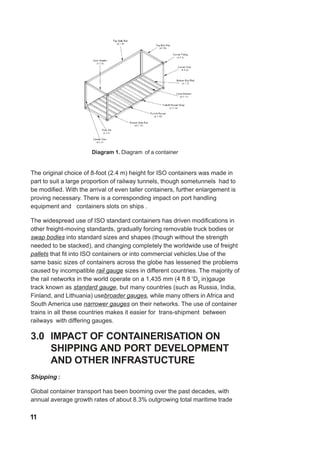
Diagram 1. Diagram of a container
The original choice of 8-foot (2.4 m) height for ISO containers was made in
part to suit a large proportion of railway tunnels, though sometunnels had to
be modified. With the arrival of even taller containers, further enlargement is
proving necessary. There is a corresponding impact on port handling
equipment and containers slots on ships .
The widespread use of ISO standard containers has driven modifications in
other freight-moving standards, gradually forcing removable truck bodies or
swap bodies into standard sizes and shapes (though without the strength
needed to be stacked), and changing completely the worldwide use of freight
pallets that fit into ISO containers or into commercial vehicles.Use of the
same basic sizes of containers across the globe has lessened the problems
caused by incompatible rail gauge sizes in different countries. The majority of
the rail networks in the world operate on a 1,435 mm (4 ft 8 1
D2
in)gauge
track known as standard gauge, but many countries (such as Russia, India,
Finland, and Lithuania) usebroader gauges, while many others in Africa and
South America use narrower gauges on their networks. The use of container
trains in all these countries makes it easier for trans-shipment between
railways with differing gauges.
3.0 IMPACT OF CONTAINERISATION ON
SHIPPING AND PORT DEVELOPMENT
AND OTHER INFRASTUCTURE
Shipping :
Global container transport has been booming over the past decades, with
annual average growth rates of about 8.3% outgrowing total maritime trade
11
volumes) by 5% per annum over the period from 1987 to 1999. Total maritime
trade grew on average by 3.3% per annum. On more than 90% of the
containerisable cargo moves in containers between highly industrialized
countries. This is a remarkable market penetration for a technology that dates
only from the mid- 1950s, when the first converted ship carrying 58
containers made its initial voyage between New York and Houston. Since then
there has been a continual increase in both number and average size of
containerships.
The growth has been accompanied with a large increase in the size of ships
Ships built prior to 1969 were converted from breakbulk ships or tankers. The
first purpose-built containershipsgenerally had capacity in the range of 750 to
1000 TEUs, with about 9 metre draft , and service speeds of 18 to 21 knots.
They were fitted with shipboard cranes to handle the containers.
Subsequently larger and faster containerships were built. Capacity increased
to 1500 TEUS and service speed ranged from 20 to 23 knots. These ships
weredesigned to utilize dockside rather than shipboard cranes. Removing the
cranes increased cargo-handling productivity and allowed more containers to
be stowed on deck. Then came what are known as Panamax containerships
designed to be able to pass through the Panama Canal which limited the
dimensions of a ship to289.5 meters in length and 32.2 metres inbreadth .
Ships built in the early 1970s had capacity in the 1000 to 2500 TEUrange,with
draft up to 10 meters and service speed of 22 to 26 knots.
In the late 1970s/early 1980s containership size increased further , with
capacitymoving into the 1500 to 3000 TEU range, including a number of
Panamax design ships. Some ships were designed to higher service speeds
but with the rise in fuel prices, higher speed was sacrificed to achieve fuel
economy. Subsequent design improvements in the late 80s further
increasedcapacity of Panamax containerships to more than 4000 TEUs.
The important event during the second half of the 1990s was the
introduction of post-Panamax vessels which essentially, are shorter and
wider than the dimensions permitted by the Panama Canal and therefore
couldn’t use this route. Their capacity however became virtually limitless.
The first such vessels acquired by American President Lines could carry
4400 TEU and were used for trans- Pacific service.This increased in the next
decade to 5000TEUs and more.The other advantage to post- Panamax
designs is their relatively cheaper cost of construction due to their shorter
length . Length is the most costly component of a ship. Shorter length is
compensated by the larger width which gives it the additional benefit of
virtually no requirement for ballast. This makes it more fuel efficient. Most of
12
the major linehaul carriers, including Maersk, OOCL,Hanjin, Evergreen,
Hyundai, Cosco, NYK, MOL and NOL ordered Post -Panamax vessels after
the ’ nineties. The most notable orders were those of Maersk and P&O, who
tookdelivery of a string of ships with capacity of more than 6000 TEU,
designed for service speed of 25 knots at maximumdraft of 13.5 meters. In
the late 1990s, Hapag Lloyd ordered seven 4800 TEU containerships with
service speed of 25 knots and draft of13.5 meters, yet designed within the
size limits of the Panama Canal.
The share of ships in excess of 5,000 TEUs increased from 1% in 1996 to 30
% in 2006. The share of post-Panamaxvessels will have increased over the
same period from 15.4 % to 47.1 %.
Improvements in ship designs and capacity have hugely contributed to the
growth of containerisation worldwide. In fact it has been a mutually beneficial
phenomenon as post-WWII ,the boom in ship building has largely been on
account of the demand for container ships.
However containerisation could not succeed without a comparable
development of infrastructure on land , notably of ports and container depots.
Development of Ports
Containerization brought about a completely different set of requirements in
port infrastructure and facilities as compared to the requirements for the
earlier breakbulk cargo. Ports were geared for manual handling of cargo . It
was a labourintensive activity and there was no certainty as to how long it
would take to load or unload a full ship. When first containers were loaded on
Ideal X it was seen that what 20 longshoremen could do in a day was
accomplished by only one of them. Or there was a redundancy of twenty to
one between manual handling of cargo and cargo in containers.
Pre-containerisation ,quay lengths were not required to be very long and it
was necessary to provide large godowns and storage along the docks as
cargo had to be stored till they were loaded or delivered. Since the packages
handled were relatively small ,the circulating areas were smaller. All in all, port
related costs, other than labour costs, were relatively low compared to the
high costs of ocean and inland transport. Hence there was no incentive to
improve the efficiency at ports.
A container port on the other hand first of all required mechanical handling i.e
cranes and while the first container ships carried their own cranes or
derricks,ports realized the advantages of having dockside cranes for speedy
loading and unloading of ships. The cranes naturally required wider passage
along the full length of the ship in order to load evenlyand thereforethe quay
13
lengths had to be much longer. While cargo no longer needed to be stored in
godowns , containers themselves needed sufficient space to be stacked and
moved around near the quay. Circulating areas for truck trailers which
brought in the containers or took them outside the port also required more
space. So the entire design and lay- out of ports needed to change. The
development cost for a modern container port became so capital intensive
that it became an imperative to so manage dockside operations as to achieve
maximum output from the infrastructure . Crane designs were developed to
improve handling time. Container yard management became a critical factor
for smooth operations and best practices and procedures evolved to
maximise productivity of the entire infrastructure. As containerships became
larger to cater to larger volumes of trade , the ports needed larger capacities,
and started moving away from urban centres to more unencumbered
locations. All of these changes and developments in port related activities and
developments in the shipping industry occurred at the same time as the
growth in international trade and economic development.
The impact on port operations has been significant. The contrast with pre-
containerisation is startling. The most important effect of course is that a
ship’s time in port at berth has reduced drastically. Manpower requirements
have been dramatically reduced. In fact during the early days of
containerisation there were many labour protests at the older ports. This in
itself was one of the advantages of shifting port operations to newer locations
in order to start with a completely different work environment.Prior to
containerization, about 200 men, working simultaneously in four gangs, were
typicallyrequired to load and unload a large general cargo ship, which could
take a week to 10 days in port. Containerships require only 50 to 60men to
load and unload cargo.Assuming a four gantry crane operation,a container
ship requires some 30 workers directly allocated to the vessel. However it is
difficult to generalise as a lot depends on the type of terminal operations used
, whether straddle carriers which require more manpower, or rubber-tyre
gantry cranes which require less. Different kinds of equipment have different
productivity under varyingcircumstances .But a typical general cargo berth
can handle roughly130000 to 150000 tons of cargo per yearthroughput while
a modern container berth equipped with four dockside gantry cranes will
handle approx 600000 TEU annually.
Hub ports- shipping routes
Post -WWII international trade has grown to form a much larger slice of
national economies than ever before. This implies that economies are more
and more dependent on huge cross movement to and fro of goods , both raw
materials, semi processed, tofully finished goodsacross the globe.With the
constant cross-movements, increasing fuel costs and expensive ships,
efficiency and productivity measures are being pursued incessantly in the
14
shipping arena. Hence the development of transhipment hubs. Increasingly
goods in containers make their journey over several legs changing vessels
at certain large transhipment points. Large hub ports have developed along
major maritime routeswhich effectively leverage the typical strengths of
different kinds of vessels from huge post- Panamaxships tofeeder and
small coastal vessels. And this is only possible because of the enormous
ease with which containers can be handled today .India itself does not boast
any transhipment hubs. Import and export trade in India is actually served by
the transshipment hubs at Singapore and more recently the newer
Malaysian ports on its eastern side and Salallah and Dubai in the West.
Colombo in Sri Lanka is also a large transhipment hub. The success of hub
ports essentially depend on very high efficiency in terms of detention to
ships and low costs. These two objectives can be achieved only by modern
infrastructure and top class practices and procedures dedicated only to this
end : high and speedy turnover. Indian ports have not been able to compete
with other ports on these parameters.
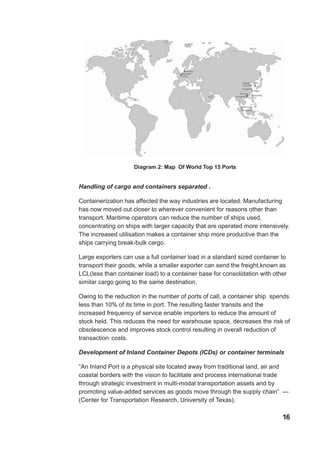
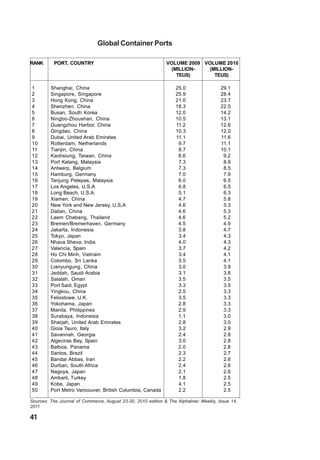
The four largest container ports in the world currently areShanghai,
Singapore, Hong Kong and Shenzhen.Singapore established itself as
theworld’s largest transhipment center as a result of its strategic location
onthe Asia/Europe trade route and its proximity to regional origin and
destinationcentres in Southeast Asia. Colomboand Dubai have established
themselvesas regional hubs for traffic to and from Europe and Asia. Of the
twenty largest ports in the world, four are in Europe, Rotterdam,Hamburg,
Antwerp, and Bremerhaven. Three are in the US while the rest are in Asia.
Pre- containerisation, there was not much competition between ports. As
mentioned earlier, the port- related costs were not significant enough to
make a difference to the total cost of transportation. This has now changed
as profitability of ships depend on how much throughput they carry
compared to the time spent at dock. Maritime routes are formed based on
the efficiency and competitiveness of port services.
Singapore is in increasing rivalry with Port Klangand more recently
TanjungPelapas. Salalah and Aden are now serious rivals to Dubai for the
Arabian Sea andIndian sub-continent transhipment markets. These rivalries
are oftenintense and create substantial pressureon transhipment pricing.
15
Diagram 2: Map Of World Top 15 Ports
Handling of cargo and containers separated .
Containerization has affected the way industries are located. Manufacturing
has now moved out closer to wherever convenient for reasons other than
transport. Maritime operators can reduce the number of ships used,
concentrating on ships with larger capacity that are operated more intensively.
The increased utilisation makes a container ship more productive than the
ships carrying break-bulk cargo.
Large exporters can use a full container load in a standard sized container to
transport their goods, while a smaller exporter can send the freight,known as
LCL(less than container load) to a container base for consolidation with other
similar cargo going to the same destination.
Owing to the reduction in the number of ports of call, a container ship spends
less than 10% of its time in port. The resulting faster transits and the
increased frequency of service enable importers to reduce the amount of
stock held. This reduces the need for warehouse space, decreases the risk of
obsolescence and improves stock control resulting in overall reduction of
transaction costs.
Development of Inland Container Depots (ICDs) or container terminals
“An Inland Port is a physical site located away from traditional land, air and
coastal borders with the vision to facilitate and process international trade
through strategic investment in multi-modal transportation assets and by
promoting value-added services as goods move through the supply chain”. —
(Center for Transportation Research, University of Texas).
16
ICDs are inland intermodal container terminals directly connected by road
or rail to a seaport and operating as a centre for transhipment of sea cargo to
inland destinations.In addition to their role in cargo transhipment, terminals
may also include facilities for storage and consolidation of goods,
maintenance for road or rail cargo carriers and customs clearance services.
The location of these facilities at an inland terminal relieves competition for
storage and customs space at the seaport itself.
Inland container terminals may also be referred to as dry ports or intermodal
hubs.The development of “dry ports” provided with rail terminals linking to
container ports extends the reach of containerisation and inter-modal freight.
Container trains run between the container port and the dry port enabling the
cargo to be cleared by customs at the dry port. The dry portprovides services
of warehousing, documentation and clearance, freight arrangements,
insurance and cargo consolidation.
The idea is to move the time-consuming sorting and processing of containers
inland, away from congested seaports.An inland port could also speed the
flow of cargo between ships and major land transportation networks, which
would carry goods to the rest of the country.
4.0 CONTAINERISATION – INDIAN SCENARIO
India’s international trade wasgradually containerized over the ‘sixties and
‘seventies. It was very early in the ‘eighties that import containers began to
land initially at Cochin,thenat Mumbai Port which was then the important port
in the country . Mumbai Port was geared quintessentially to handle breakbulk
cargo. Mumbai topography meant that space constraints made it difficult to
handle and store containers at the docks and the old city roads made it
difficult to move containers on road. Cargo had to de- stuffed within the port
which meant further chaos.In view of the growing trend a special container
port was planned and developed further away from the city centre and with
better access to the hinterland, at an islandcalled NahvaSheva off the coast
further towards the mainland. The new container port was administered by the
Jawaharlal Nehru Port Trust .
Meanwhile the Indian Railways perceived both the potential and opportunity
of the inevitable growth of containerization in India. The railways had relatively,
the best long distance transport network in the country.They were authorized
to develop customs bonded inland container depots which functioned as dry
ports. They started carrying import containers between Mumbai and Delhi on
improvised flat wagons. By the mid-eighties Indian Railways realized that
containerized logistics in India needed focused attention and initiated the
process of setting up a company for the purpose. In 1989 Container
Corporation of India(CONCOR) was incorporated as a company registered
17
under the Companies Act,under the control of the Indian Railways and took
over operations and infrastructure from its parent. Within the space of 15
odd years it developed more than 55 container terminals, acquired a fleet of
more than 3000 flat wagons , and connected all the ports of the country to its
inland terminals through regular containerized rail services . In 2005, private
operators were also allowed to operate similar services on the rail network.
As on the international scene, development took place simultaneously in all
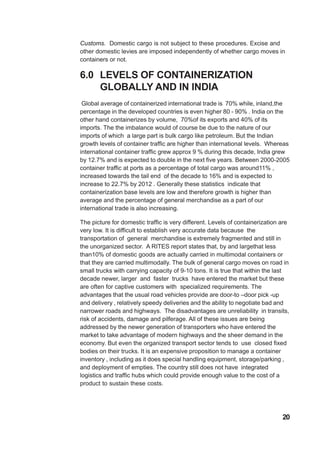
spheres: JNPT enabled the building of two more competing private
container port terminals at NahvaSheva . More private container ports came
up in Mundra and Pipavav in Gujerat, Vizag, Trivandrum, Cochin. Madras Port
and allowed for container handling and further away a modern Port at Ennore
started being developed through the same public -private partnership route.
Diagram 3 : Map of India with Important Ports
18
Containerization in India was essentially driven by the compulsion imposed by
international trade requirements which were increasingly dealing with
containerized cargo.A large proportion of import and export goods were
initially containerized or destuffed at port terminals or at container freight
stations located just outside the port area. Export and import goods moved
break- bulk in trucks from and to the hinterland. With the development of
inland container terminals and regular rail services, the inherent advantages
of inland ports appealed to importers and exporters and bonded movement in
containers directly between ports and factories became widespread.
Customs and excise regulations gradually changed to facilitate and enable
these new developments.
However containerized movement of domestic cargo developed less slowly. It
is necessary here to indicate the essential differences between the two kinds
of cargo.
5.0 CONTAINERIZED CARGO – DOMESTIC
AND INTERNATIONAL
The critical difference lies in the regulatory framework. Imported cargo is
liable for customs duties and is therefore received at notified Customs check
points where it is examined and customs levies are imposed. Export cargo
requires to be checked by Customs to ensure that goods for export are as
permitted by the government policies. Therefore export cargo is also
examined at the same notified checkpoints before being permitted to leave
the country. The Customs department is responsible for ensuring the
implementation of the extant import and export regulations. Since
containerized transportation involves the carriage of goods in containers
which are sealed at origin and not opened en route till final delivery, worldwide,
customs regulations have evolved procedures which take care of customs
responsibilities. Typically once a customs seal is put on a container in its
country of origin, the box moves under a bond provided by the carrier who
assumes liability for safety of the goods. Once landed in India, the box is
delivered to Customs at the manifested final destination where it is
examined, customs duty levied and released. All ports are customs bonded.
Inland container depots which have been customs notified are likewise
customs bonded. In the case of exports, regulations now permit that the
excise seal once placed on a container stuffed at a factory, is accepted by
customs authorities at their discretion and let export order is issued for
dispatch to port and further embarkation. Goods which move under these
circumstances are known to be moving under bond and are known as
import/export cargo. If the sealing/ desealingprocedure isdone at the gateway
port , and the goods nevertheless still move in containerized form between
port and hinterland they move as domestic cargo. They do not move under
bond and do not go through the same stringent procedures prescribed by
19
Customs. Domestic cargo is not subject to these procedures. Excise and
other domestic levies are imposed independently of whether cargo moves in
containers or not.
6.0 LEVELS OF CONTAINERIZATION
GLOBALLY AND IN INDIA
Global average of containerized international trade is 70% while, inland,the
percentage in the developed countries is even higher 80 - 90% . India on the
other hand containerizes by volume, 70%of its exports and 40% of its
imports. The the imbalance would of course be due to the nature of our
imports of which a large part is bulk cargo like petroleum. But the Indian
growth levels of container traffic are higher than international levels. Whereas
international container traffic grew approx 9 % during this decade, India grew
by 12.7% and is expected to double in the next five years. Between 2000-2005
container traffic at ports as a percentage of total cargo was around11% ,
increased towards the tail end of the decade to 16% and is expected to
increase to 22.7% by 2012 . Generally these statistics indicate that
containerization base levels are low and therefore growth is higher than
average and the percentage of general merchandise as a part of our
international trade is also increasing.
The picture for domestic traffic is very different. Levels of containerization are
very low. It is difficult to establish very accurate data because the
transportation of general merchandise is extremely fragmented and still in
the unorganized sector. A RITES report states that, by and largethat less
than10% of domestic goods are actually carried in multimodal containers or
that they are carried multimodally. The bulk of general cargo moves on road in
small trucks with carrying capacity of 9-10 tons. It is true that within the last
decade newer, larger and faster trucks have entered the market but these
are often for captive customers with specialized requirements. The
advantages that the usual road vehicles provide are door-to –door pick -up
and delivery , relatively speedy deliveries and the ability to negotiate bad and
narrower roads and highways. The disadvantages are unreliability in transits,
risk of accidents, damage and pilferage. All of these issues are being
addressed by the newer generation of transporters who have entered the
market to take advantage of modern highways and the sheer demand in the
economy. But even the organized transport sector tends to use closed fixed
bodies on their trucks. It is an expensive proposition to manage a container
inventory , including as it does special handling equipment, storage/parking ,
and deployment of empties. The country still does not have integrated
logistics and traffic hubs which could provide enough value to the cost of a
product to sustain these costs.
20
The alternative mode of carriage is rail which in a bid to maximize operational
efficiency has over the last 30 years almost completely focused on carriage
of bulk goods like coal, iron ore, fertilizers, foodgrains , chemicals, minerals
etc. which can typically move in train loads between two fixed destinations.
Railways carries very little general cargo . Operational economy as well as
the freight pricing structure which favours heavy and high value cargo does
not make rail transportation very attractive to the general cargo market over
and above which it also does not take care of last mile connectivity.
In theory, containerization is perceived to be a via media by which a container
rail operator like CONCOR and others could consolidate and provide
multimodal services on rail. In fact the domestic services offered by these
operators are severely limited. They carry less that 2% of total cargo and the
nature of cargo is in fact confined to a few heavy commodities like finished
steel, sponge iron, billets, white cement, some chemicals etc. which
railways are unable to carry themselves. More important , these movements
though carried in containers on rail are usually never off loaded and are used
much like rail wagons. This cannot be called true multimodal containerized
movement. The jury is still out on whether the state of affairs will improve so
as to give domestic containerization the impetus it needs, as the railway
infrastructure and systems are still not geared to making multimodal
transport in the domestic general cargo segment a very profitable business.
Comparatively in the developed world domestic movement is equally well
containerized. For the retail industry containers are a boon and along with
containerization there has been the growth of a supply chain industry which
depends on logistics hubs and traffic parks which provide all kinds of services
from warehousing andinventory management , to distribution and
consolidation as well as other value added services. Particularly in Europe
multimodalism has truly integrated road, rail and waterways to not only to
provide value in the supply chain but also use resources in more
environmentally sustainable ways in order to maintain a certain standard and
quality of life.
References :
1. Port Evolution &Performance in Changing Logistics Environment. Su- Han
Woo, Stephen Pettit,AnthonyK.C.Beresford. (Maritime &Logistics August
2011)
2. Development of Container Port Systems. Notteboom& J-P Rodrigue (2005)
3. World Bank Report on development of Ports.
4. Ports & Shipping- Issues in Optimisation.ThierryVaneslander (2011)
5. Maritime Containerisation trends Technical Note 19. Euro-Mediterranean
Transport Project( 2005)
21
3.0 Supply Chain Management and
Multimodal Transport Logistics -
Broad features.
Understanding 3PL/4PL
I. SUPPLY CHAIN
A supply chain gets a product from a supplier to a consumer. This is the
simplest definition but the process is actually more complex. A supply chain
works by cooperation between individuals or organisations across disciplines
in introducing source components which go towards the production of a
finished item or service. Many source inputs may enter and exit the supply
chain and re-enter it during production . Inputs may be not only raw materials
and semi finished goods but may also be in the form of services, finances and
information. One of the key services is multimodal transport logistics.The
organisations or individuals engaged in supplying a particular component are
driven by their own profit and viability goals and are not concerned with the
consumer of the ultimate end product or service. Nevertheless they are
collaborators in the entire process. It is important to realise that the individual
activities are part of a process.
Described in this manner it is seen that a supply chain is of paramount
importance in delivering an end product to a customer and without the
collaboration of the individuals or organisations participating in the process ,
the end result would not be achieved.
1.0 Key Components of a Supply Chain
There are six key elements to a supply chain:
! Production
! Supply
! Inventory
! Location
! Transportation, and
! Information
The following describes each of the elements :
1. Production
Strategic decisions regarding production focus on what customers want and
the market demands. Production priorities depend on the market demand. It
22
is also here that decisions regarding what to produce in house and what to
outsource is taken. The strategic decisions regarding production needs also
to focus on capacity, quality and volume of goods, keeping in mind that
customer demand and satisfaction must be met. Operational decisions, on
the other hand, focus on scheduling workloads, maintenance of equipment and
meeting immediate client/market demands. Quality control and workload balancing
are issues which need to be considered when making these decisions.
2. Supply
Next an organisation has to arrange for supply of raw materials and other
inputs to fulfil production requirements as per the decisions made above.
Based on its core strengths there is a strategic mix of raw and semi finished
products. In the current era of super specialisation , some organisations may
choose to outsource a major portion of their components to reliable suppliers
and concentrate on design and assembly only. The automobile industry is a
common example . When choosing a supplier, focus is on developing velocity,
quality , flexibility and reliability while at the same time reducing costs or
maintaining low cost levels. Ease of transportation and easy access play an
important role. Multimodal transport plays its largest role here.
3. Inventory
Further strategic decisions focus on inventory of both input supplies and final
product. Input material inventory has to strike the right balance for smooth
production and high working capital cost of comfortable stock balances.
Inventory carrying costs are significant enough to affect profitability. On the
market side, a delicate balance exists between too much inventory, which can
cost anywhere between 20 and 40 percent of their value, and not enough
inventory to meet market demands. This is a critical issue in effective supply
chain management.
4. Location
Location decisions depend on market demands and determination of
customer satisfaction. Strategic decisions must focus on the placement of
production plants, distribution and stocking facilities, and placing them in
prime locations to the market served. Once customer markets are
determined, long-term commitment must be made to locate production and
stocking facilities as close to the consumer as is practical. In industries where
components are lightweight and market driven, facilities should be located
close to the end-user. In heavier industries, careful consideration must be
made to determine where plants should be located so as to be close to the
raw material source. Decisions concerning location should also take into
consideration tax and tariff issues, especially in inter-state and worldwide
23
distribution. Multimodal transport plays a significant role in determining
location decisions. The pattern has changed radically with the growth of
containerisation as brought out earlier
5. Transportation
Strategic transportation decisions are closely related to inventory decisions as
well as meeting customer demands. Using air transport obviously gets the
product out quicker and to the customer expediently, but the costs are high as
opposed to shipping by boat or rail. Yet using sea or rail often means having
higher levels of inventory in-house to meet quick demands by the customer. It
is wise to keep in mind that since 30% of the cost of a product may be
encompassed by transportation, using the correct transport mode is a critical
strategic decision. Above all, customer service levels must be met, and this
often times determines the mode of transport used. This may often be an
operational decision, but strategically, an organization must have transport
modes in place to ensure a smooth distribution of goods.
6. Information
An effective supply chain can only be maintained with a the help of timely
information flow. Production glitches, supply bottlenecks, and distribution gaps
can only be tackled properly and economically if all collaborators share
information freely and promptly. Supply chain is exactly that : a chain. And
what happens to one link has a ripple effect . Modern telecommunication
services and high speed communication enables through networks and the
internet, a streamlined information flow, consolidates knowledge and
facilitates velocity of products. Modern account management software,
product configurators, enterprise resource planning systems, and global
communications are key components of effective supply chain management
strategy.
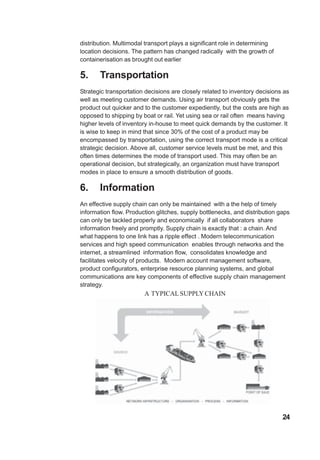
A TYPICALSUPPLYCHAIN
24
II. SUPPLY CHAIN MANAGEMENT
However the efficiency of the supply chain process, its reliability in terms of
repeat performance and the economic value of the end product would
depend on the coordination between the collaborators taking into
consideration all aspects of the production process.
This is where supply chain management comes in. Management of the
supply chain encompasses the planning and management of all activities
involved in sourcing, procurement, conversion, and logistics management. It
also includes the crucial components of coordination and collaboration with
channel partners, which can be suppliers, intermediaries, third party service
providers, and customers.
Fundamentally supply chain management integrates supply and demand
management within and across companies. The purpose of Supply chain
management is a cross-function approach including managing the
movement of raw materials into an organization, certain aspects of the
internal processing of materials into finished goods, and the movement of
finished goods out of the organization and toward the end-consumer.
As organizations strive to focus on core competencies and becoming more
flexible, they reduce their ownership of raw materials sources and
distribution channels. These functions are increasingly being outsourced to
other entities that can perform the activities better or more cost effectively.
The effect is to increase the number of organizations involved in satisfying
customer demand, while reducing management control of daily logistics
operations. Less control and more supply chain partners has led to the
creation of supply chain management concepts.
The following are five basic components of Supply Chain Management
(SCM).
1. Plan—This is the strategic portion of SCM. Companies need a
strategy for managing all the resources that go toward meeting customer
demand for their product or service. A big piece of SCM planning is
developing a set of metrics to monitor the supply chain so that it is efficient,
costs less and delivers high quality and value to customers.
2. Source—Next, companies must choose suppliers to deliver the
goods and services they need to create their product. Therefore, supply
chain managers must develop a set of pricing, delivery and payment
processes with suppliers and create metrics for monitoring and improving
the relationships. And then, SCM managers can put together processes for
managing their goods and services inventory, including receiving and
25
verifying shipments, transferring them to the manufacturing facilities and
authorizing supplier payments.
3. Make—This is the manufacturing step. Supply chain managers
schedule the activities necessary for production, testing, packaging and
preparation for delivery. This is the most metric-intensive portion of the supply
chain—one where companies are able to measure quality levels, production
output and worker productivity.
4. Deliver—This is the part that many SCM insiders refer to as logistics,
where companies coordinate the receipt of orders from customers, develop a
network of warehouses, pick carriers to get products to customers and set
up an invoicing system to receive payments.
5. Return—This can be a problematic part of the supply chain for many
companies. Supply chain planners have to create a responsive and flexible
network for receiving defective and excess products back from their
customers and supporting customers who have problems with delivered
products.
III. BENEFITS OF SUPPLY CHAIN
MANAGEMENT
SCM can help transform a traditional linear supply chain into an adaptive
network with the following benefits.
! The increased visibility into the supply chain and adaptive supply chain
network, helps an organisation to be more responsive. It can sense
and respond quickly to changes and quickly capitalize on new
opportunities.
! By offering a common information framework that supports
communication and collaboration, SCM enables entities to better
adapt to and meet customer demands.
! Tracking and monitoring compliance in areas as environment, health
and safety becomes easier.
! Information transparency and real-time business intelligence can lead
to shorter cash-to-cash cycle times. Reduced inventory levels and
increased inventory turns across the network can lower overall costs.
! With SCM, operational expenses can be lowered with timelier
planning for procurement, manufacturing and transportation. Better
order, product and execution tracking can lead to improvements in
performance and quality - and lower costs. Margins can also improve
through better coordination with business partners.
26
! Tight connection with trading partners keep a supply chain aligned
with current business strategies and priorities, improving an
organization’s overall performance and achievement of goals.
IV. EVOLUTION OF MULTIMODAL
TRANSPORT LOGISTICS AND SUPPLY
CHAIN MANAGEMENT
Organizations increasingly find that they must rely on effective supply chains,
or networks, to compete in the global market and networked economy. In the
newest management paradigms, this concept of business relationships
extends beyond traditional enterprise boundaries and seeks to organize entire
business processes throughout a value chain of multiple companies.
Six major movements can be observed in the evolution of supply chain
management: Creation, Integration, and Globalization, Specialization phases
One and Two, and SCM 2.0.
1.0 Creation Era
The concept of a supply chain in management gained importance in the early
20th century with the creation of the assembly line style of production though
the term supply chain management was first coined by a U.S. industry
consultant in the early 1980s. This era of supply chain management is
characterised by the need for large-scale changes, re-engineering,
downsizing driven by cost reduction programs, and widespread attention to
the Japanese practice of management.
2.0 Integration Era
In the 1960s Electronic Data Interchange (EDI) systems were developed and
was followed by the introduction of Enterprise Resource Planning (ERP)
through the 1990swhich continued to
develop into the 21st century with the expansion of internet-based
collaborative systems. This era of supply chain evolution is characterized by
both increasing value-adding and cost reductions through integration.
3.0 Globalization Era
The hallmark of the third stage of supply chain management development is
the attention given to global systems of supplier relationships and the
expansion of supply chains over national boundaries and into other
continents. Although the use of global sources in the supply chain of
27
organizations can be traced back several decades it was not until the late
1980s that a considerable number of organizations started to integrate global
sources into their core business. This era is characterized by the
globalization of supply chain management in organizations with the goal of
increasing their competitive advantage, value- adding, and reducing costs
through global sourcing.
4.0 Specialization Era—Phase One:
Outsourced Manufacturing and
Distribution
In the 1990s industries began to focus on “core competencies” and adopted a
specialization model. Companies abandoned vertical integration, sold off non-
core operations, and outsourced those functions to other companies.
Management requirements changed as the the supply chain extended well
beyond company walls and management had to cut across specialized
supply chain partnerships. This transition also re-focused the fundamental
perspectives of each respective organization. OEMs became brand owners.
They had to control the entire supply chain from above instead of from within.
Contract manufacturers had to manage bills of material with different part
numbering schemes from multiple OEMs and support customer requests for
work -in-process visibility and vendor-managed inventory (VMI).The
specialization model creates manufacturing and distribution networks
composed of multiple, individual supply chains specific to products, suppliers,
and customers who
work together to design, manufacture, distribute, market, sell, and service a
product.
5.0 Specialization Era—Phase Two: Supply
Chain Management as a Service
Specialization within the supply chain began in the 1980s with the inception of
transportation brokerages, warehouse management, and non-asset-based
carriers and has matured beyond transportation and logistics into aspects of
supply planning,collaboration, execution and performance management.
At any given moment, market forces could demand changes from suppliers,
logistics providers, locations and customers, and from any number of these
specialized participants as components of supply chain networks. This
variability has significant effects on the supply chain infrastructure, from the
basics of establishing and managing the electronic communication between
28
the trading partners to more complex requirements including the configuration
of the processes and work flows that are essential to the management of the
network itself. Supply chain specialization enables companies to improve
their overall competencies in the same way that outsourced manufacturing
and distribution has done; it allows them to focus on their core competencies
and assemble networks of specific, best-in-class partners to contribute to the
overall value chain itself, thereby increasing overall performance and
efficiency. The ability to quickly obtain and deploy this domain-specific supply
chain expertise without developing and maintaining an entirely unique and
complex competency in house is the leading reason why supply chain
specialization is gaining popularity. Outsourced technology in terms of
sophisticated hosting for supply chain solutions debuted in the late 1990s
and has taken root primarily in transportation and collaboration categories.
This has progressed from the Application Service Provider (ASP) model from
approximately 1998 through 2003 to the On-Demand model from
approximately 2003-2006 to the Software as a Service (SaaS) model
currently in focus today.
6.0 Supply Chain Management 2.0 (SCM 2.0)
Building on globalization and specialization, the term SCM 2.0 has been
coined to describe both the changes within the supply chain itself as well as
the evolution of the processes, methods and tools that manage it in this new
“era”. Like Web 2.0, SCM 2.0 is a new generation of technology based supply
chain management concepts solutions and management a combination of
the processes, methodologies, tools and delivery options to guide companies
to their results quickly as the complexity and speed of the supply chain
increase due to the effects of global competition, rapid price fluctuations,
surging oil prices, short product life cycles, expanded specialization, near-/
far- and off-shoring, and talent scarcity.
VI. UNDERSTANDING 3 PL AND 4PL
A number of developments in the 20th
century has converged to transform
multimodal transport logistics services into a separate industry. Logistics
services play a significant role in the supply chain. As we have seen earlier,
the multimodal revolution has transformed transport logistics. It has brought
the world closer and changed the premise of traditional business decisions
like what to produce, where to produce and by what process. Once labour
was more mobile than raw materials. Today it is cheaper to move goods than
to move labour and production facilities have relocated accordingly. Transits,
safety, reliability have all improved so that production lines can function on
slim inventories . Globalization, consolidation, technology advancements and
outsourcing have led to growth in the logistics services market.
29
In this scenario the multimodal transport logistics industry is striving to offer
more value throughout the supply chain. Logistics services is increasingly
coming to cover a range of peripheral services surrounding the core
transportation service. These are services like warehousing, inventory
management, distribution services, services like packaging, labeling , bar
coding and so on.
The capabilities of logistics service providers are growing along with the
changing expecta-tions of their clients. Within the logistics services industry,
as it evolves, competitors are moving away from asset-based commoditized
services to more strategic, information-based approaches. Unable to cope
with complexities across their supply chains, customers are demanding a
“single point of contact” for all logistics services and are looking for “one-stop
logistics shopping” .
The models in logistics industry have evolved over time to address the
changing needs of the market and vary based on scope of service offerings,
degree of collabora-tion, levels of asset intensity and IT capabilities across
the supply chain.
A 3 Party Logistics Service Provider is a company which coordinates all
logistics functions between multiple links across the supply chain . Any
basic transaction involves two parties: the buyer who is the first party and the
seller who is the second party. So if manufacturer wishes to transport his
goods from godown to market, he will engage a transporter to truck his goods
to the desired destination. The trucker typically owns his trucks and
manages the transportation service. The direct service provider of the core
service is called the first or second party as they directly sell a service as
their core competency. The 3PL service provider on the other hand
integrates all logistics functions, such as trucking and warehousing,
aggregating , distribution etc customized to customers’ needs based on
market conditions and the demands and delivery service requirements for
their products and materials. 3 PL service providers normally outsource the
multiple logistics functions from other service providers such as truckers,
warehouse operators ,etc. Typically they do not invest in the assets
associated with the service provided, though given the complexity of
operations , they do have to invest in sophisticated communications and
information network systems. They take responsibility for a range of services
so that their customer does not have to deal with multiple agencies. They are
asset light and usually tend to have high returns; they contract most of their
capacity needs to 2PLs. Normally direct service providers are businesses
which face low returns and high levels of asset intensity but low barriers to
entry. With the increasing need for “one-stop solutions”, many 2PL providers
have evolved into 3PL by adding new logistics capabilities and integrating
30
their opera-tions. While the 2PL puts in hard cash tangible asset, the 3PL
puts in intellectual property.
3 PL Service Providers:
Freight forwarders and courier companies are the earliest examples of 3PL
service providers. They have evolved by extending their range of activities
backward or forward from their core functions. Many truckers have gone into
aggregation and forwarding which also involves some kind of warehousing
services. 3 PL providers could be distinguished as follows:
! The Standard 3PL provider is the most basic form of a 3PL provider.
They would perform activities such as, pick and pack, warehousing,
and distribution – the most basic functions of logistics. The 3PL
function would not be their main activity. They would have a core
asset-base for their operations by way of a transportation fleet, some
warehousing etc.
! The Service developer: this type of 3PL provider will offer their
customers advanced value-added services such as: tracking and
tracing, cross-docking, specific packaging, or providing a unique
security system. The backbone of their service would be a good
technology/ information network.
! The customer adapter: A customer hands over management of his
logistics activities to this 3PL who provides a fully customised service.
The 3PL provider improves the logistics dramatically, but do not
develop a new service. The customer base for this type of 3PL
provider has a small base of customers for whom he performs the
service.
! Complete 3PL: this is the highest level that a 3PL provider can attain
with respect to its processes and activities. This occurs when the 3PL
provider integrates itself with the customer and takes over their entire
logistics function. These providers will have few customers, but will
perform extensive and detailed tasks for them.
Advancements in technology and the associated increases in supply chain
visibility and inter-company communications have given rise to a relatively
new model for third-party logistics operations – the “non-asset based
logistics provider.” A non-assets based provider consists of a team of domain
experts with accumulated freight industry expertise and information
technology assets. They fill a role similar to freight agents or brokers, but
maintain a significantly greater degree of “hands on” involvement in the
transportation of products. Non-asset based providers perform functions
31
such as consultation on packaging and transportation, freight quoting,
financial settlement, auditing, tracking, customer service and issue
resolution. However, they do not employ any truck drivers or warehouse
personnel, and they don’t own any physical freight distribution assets of their
own – no trucks, no storage trailers, no pallets, and no warehousing.
Examples of third party logistics companies as defined above would be C.H.
Robinson Worldwide, Dupré Logistics LLC, J.B. Hunt Transport Services,
FedEx Supply Chain.
4PL service Provider
The concept of 4PL service providers is still evolving. Definitions are still
fluid and cause confusion even amongst professionals from the logistics
industry.
The term 4PL is generally considered to have been introduced by Accenture,
which registered it as a trademark in 1996. Accenture described the 4PL as
an “integrator that assembles the resources, capabilities, and technology of
its own organization and other organizations to design, supply chain
solutions”. The trademark was later abandoned, and the term has become a
part of the public domain.
A general definition states that a fourth-party logistics provider is an
independent, singularly accountable, non-asset based integrator of a client’s
supply and demand chains. What appears to be emerging as the most
significant characteristic of 4PL is based on the concept of neutrality and
conflict of interest. A fourth-party logistics provider must offer services
considering a 360 degree view, which is not focused on its ability to
implement the recommendations it gives, but on all the options available in
the market. As such an IT consulting firm specialized in Supply Chain
Management which is objectively considering all the various SCMs present in
the market is a 4PL. But it cannot represent any specific ERP software
company as then the concept of neutrality is broken. To avoid any conflict of
interest, and maintain neutrality, it is important that a fourth-party logistics
provider be non-asset based, as far as logistics, transportation, and supply
chain management assets are concerned. 4PL use 2PLs and/or 3PLs to
supply service to customers, and own only computer systems and
intellectual capital.
It has been sometimes argued that a 4PL is the same thing as a “non-asset
based 3PL”. This is not the case. Most of the world’s 3PL are “non-asset
based”, but they generate revenues & profits from their “non-asset based”
3PL activities. As such a 3PL cannot be a 4PL in the same time, as this would
lead to conflict of interest for it would then have a tendency to recommend to
customers its “non-asset based” operation as the best possible option.
32
We may therefore consider that 4PL are essentially consulting companies
exclusively specialized in logistics, transportation, and supply chain
management such as SCMO, BMT Limited ,MVA Consulting, TTR,
Intermodality, CPCS, and 3t-Europe, which offer complete ranges of
services, from strategy to implementation.
To maintain clarity at a conceptual level it would be advisable to maintain that
a 4PL is usually a consultant offering logistics solutions suited to a particular
customer’s requirements and that in order offer unbiased and truly objective
assessment he cannot be an operator. A 3PL is an operator, which
specializes in integrated operation, warehousing and transportation services.
These services may be 100% outsourced, as in the case of “non-asset
based 3PL”. It is then a pure 3PL. It may also own part of its operations, such
as warehouses, vans, or trucks. It then is both a 3PL and a 2PL, but is
usually still called a 3PL. It can also offer genuine supply chain consulting
services outside of its usual range of services. It is then both a3PL and a
4PL, but is usually still called a 3PL.
There are obviously some 2PL/3PL who have such advanced systems in
terms of supply chain management that they could offer specialised
consultations to customers, just as there are many 2PL who have extended
their services to cover 3PL as well. Conceptually however the principle of
neutrality, absence of conflict of interest which can be ensured by total lack
of vested interest in assets or non- asset based operations needs to be
maintained to distinguish 3PL and 4PL services.
VII. SCENARIO IN INDIA
Worldwide today, India included, industry is passing through a very trying
phase. Competition is keen and discourages a pass-through of
developmental and inflationary costs to the customer. Modern industry cannot
compromise on Quality and further reduction in manufacturing and sourcing
costs can at best bring marginal gains. Every alternate means to contain
“cost to the customer” needs to be explored. The modern manufacturer is
reluctant to maintain the wide variety of inventory needed by them to cover all
models and variations in product range. The second, third and fourth tier
suppliers are under huge pressure to meet these numerous variations.
Physical distance from the manufacturer and the short notice available to the
supplier for supplying small and odd quantities further complicates the matter.
Third Party Logistics partners can play an important role in solving these
problems. In India unlike Japan or Europe, suppliers are spread over 1000’s
of kilometers and poor and inadequate infrastructure further adds to
transportation delays and transit losses.
33
3PL providers can attempt to bridge this time, space, place and quantity gaps
. In India, 3PL providers are usually transporters who have modified their
traditional asssets i.e. trucks and godowns, to bridge the gap between
suppliers and customers.
These enlightened transporters have understood the opportunity and have
created hubs near major manufacturers. In these hubs, the service provider
maintain the necessary inventory which he also transports from the
manufacturing unit to the hub. The automobile industry in India probably is the
most intensive user of 3PL providers.
He also maintains liaison with the customer and provides him with the exact
materials on time. 3PL suppliers in addition acts as a billing agent besides
providing all the functions that were earlier performed by the C & F
agent.They also manage the containers and other similar materials used to
supply the stocks.The 3PL service providers role is bound to become more
and more critical and vital for the success of any automotive supply-chain.
A recent survey of Indian industry attempted to map the potential for 3PL and
outsourcing of supply chain management in India. The results are probably
give the best picture of the 3PL services in India.
i. Objectives and scope :Apart from discerning the Indian scenario, the
aim of the survey was to identify the critical factors for evaluation, selection
and relationship management of 3PL providers. Also to provide benchmarks
to industry looking to optimize logistics operations. Industry participants were
a cross-section of different sectors, the largest being automotive sector
followed by engineering firms. While the third largest group were a
miscellaneous collection, the chemical and fertilizer, FMCG, Metals, Textiles
were significant blocs in descending order.
The approach of the survey covered basically the following aspects:
a) 3 PL as a strategic tool for corporate growth
b) How much of logistics were outsourced
c) Logistics Costs
d) Implementation and Performance Measurement.
ii. 3PL as strategic tool – why do corporate decide to outsource logistics
functions to a 3PL provider .The survey indicates that corporate focus is
centered first on higher profitability, then increased sales , followed by
enhanced customer satisfaction and reduced costs. Due to the modern
highly competitive environment companies would like to achieve these
34
objectives by focusing on core activities. The primary reason for
outsourcing to 3PL therefore is logistics cost reduction. Other major
reasons is improvement in return on assets and increased inventory
turnaround, productivity improvement and flexibility in operations. Corporates
using 3PL feel that outsourcing does improve business objectives by
improving on time delivery and rendering specialized logistics expertise
improve functions like customer service , sales and purchase .Nevertheless
the major activities which are outsourced are inward and outbound
transportation and clearing & forwarding services. Inventory management,
labeling- packaging are outsourced only in a small way. The comparatively
low level of outsourcing for anything other than transportation reflects in the
attitude of the users.
While 48% of respondents think that 3PL is a critical link in the supply chain,
and 19% even think it is very important , the rest rate its role only average
as much as 26% are indifferent to the role of 3 PL. From corporates which
did not outsource logistics services, two main reasons given were ‘inability
to respond to changing needs and poor infrastructure of the provider along
with a lack of grasp of business goals.
iii. Break-up of logistics costs : For the majority(almost 80%) of
respondents a transportation constitutes 73 % of their logistics cost.
Inventory management, warehousing and distribution and customer
services costs for as many as 40 % of respondents forms over 30 % of the
logistics costs. Other logistics costs are not very significant for the majority
of respondents.
Logistics costs as a percentage of gross sales is given below: For 80%
of respondents logistics cost is not more than 10% of gross sales. For a
small 3% it is even less than 5%.
Under these circumstances it may not be surprising that 3PL as a service
industry, is still in its infancy and not surprisingly given the importance of the
role played by logistics in the final product, the percentage of logistics
actually outsourced by corporates is quite low: only 7% outsource more
than 80% of their logistics while about 8% do 60-80%.But a whopping 64%
outsource less than 20%.
The main factor in choosing to use 3PL provider appears to be cost and
reliability.
iv. Successful implementation out of these concerns emerge some
essentials to a successful implementation of outsourced logistics. First,
requirements should be well defined after which close working relationship
with the involvement of top management is essential in order to give value
35
to the role. While there needs to be demarcation of responsibilities,
management has to provide a joint cross-function team to interact with the
3PL. Systems need to be established along with a strong performance
review.
Challenges to the 3PL is cost control , maintaining customer service levels
and communication.
There results an expectation gap between Provider and User. The provider’s
worst frustrations are convincing internal personnel and sharing of
information.
The user constantly thinks that cost control could have been better.
Actually 69% of managements think that 3PL is effective and 17% even think
they are very effective. But while 14% of managements view 3Pl as
collaborators ,77% think they are merely contractual service providers.
v. Performance Measures: The most common measures are on time
shipment, inventory accuracy, customer complaints, shipment errors,
warehouse cycle time, back orders, stock outs, and fill rates.
Users tend to rate customer complaints , inventory accuracy and shipping
errors as reliable parameters whereas 3PL providers dont regard customer
complaints as truly indicative of their effectiveness.
vi. Role of Information Technology: the role of IT is modern logistics and
supply chain management cannot be denied . In fact there are 4PLs who
specialize only in providing models and tools with which to manage the
complex activities involved in managing a supply chain. It is IT which allows
for real time tracking consignments, reliable information and analytics for
controlling quality and costs, accurate shipping and invoicing etc. Users who
manage to integrate their IT systems with that of their service providers
obtain the benefit of reliable communication which prevents a number of
costly errors.
It is therefore surprising that as much as 24% of corporate managements in
India think that IT is not important and only 26% feel that it is important. As
mentioned earlier exchange of information and working as a team is
important for successful implementation of outsourced logistics services.
The following comparison demonstrates the difference in attitudes towards
3PL in USA and India . Users in India are not too convinced about the
effectiveness of 3PL and the reason appears to be actually the poorly
developed level of 3PL services.
36
vii.Conclusion : In India 55% of users outsource logistics services in some
form or another , though mostly transportation, clearing and forwarding,
comapred to 75% globally. While 3PL services are an outsourced form of
logistics but it is necessary to realise that its success depends on a high
degree of collaboration between service provider and user. Constant flow of
information is also necessary. It would also be fair to consider gain sharing in
order to reap full benefits.
Globally 3PL is recognised and used as a means to maintain a competitive
edge. It cannot be regarded as a mere contractual service . For the 3PL
industry in India to grow and take off to a new level their has to be an
appreciation of its potential to add value to the core activity and the mutual
responsibilityt o make it a success.
PARAMETERS USA INDIA
Usage of 3 PL 71% 55%
Common activities Warehousing (73.7%) Outbound transportation (55%)
outsourced
Outbound transportation (68.4%) Inbound transportation (52%)
Freight bill payment (61.4%) Customs clearing & Forwarding (51%)
Inbound warehousing (56.1%)
Reasons for not Diminishing control (63%) Poor infrastructureof provider (81%)
outsourcing
Cheaper costs (63%) Inability to respond to changing needs (81%)
Inability to meet service Unreliable promises from provider
commitments (48 %) (80%)
Logistics is a core competency (44%) Concerns about cappability of provider (77%)
Collaborative 14 % 82%
relaitionship
Gainsharing is 80 % 6.60 %
important for
relationship
A COMPARATIVE ANALYSIS
37
vii. Conclusion : In India 55% of users outsource logistics services in
some form or another , though mostly transportation, clearing and forwarding,
comapred to 75% globally. While 3PL services are an outsourced form of
logistics but it is necessary to realise that its success depends on a high
degree of collaboration between service provider and user. Constant flow of
information is also necessary. It would also be fair to consider gain sharing in
order to reap full benefits.
Globally 3PL is recognised and used as a means to maintain a competitive
edge. It cannot be regarded as a mere contractual service . For the 3PL
industry in India to grow and take off to a new level their has to be an
appreciation of its potential to add value to the core activity and the mutual
responsibilityt o make it a success.
Bibliography
1. Hertz and Alfredson 2003 Hertz, Susanne; Monica Alfredsson (February
2003). “Strategic development of third party logistics providers”. Industrial
Marketing Management (Elsevier Science)
2. CALM Supply Chain & Logistics Journal, “Fourth Party Logistics: The
Evolution of Supply Chain Outsourcing”, DN Bauknight, JR Miller, 1999.
3 . “4PL”. Toolbox for IT. Juillet 2
4. The Economist Intelligence Unit, “SCMO - The Next Generation”, China Hand
November 2006 – Chapter 11: Distribution, November 2006.
38
Annexure
India Container Traffic Up 3 Percent
Total cargo tonnage fell 1.73 percent in fiscal 2011-12
Container throughput at India’s major ports grew 3 percent year-over-year in
fiscal 2011-12, which ended March 31, the slowest growth rate in three years.
Volume expanded 4.32 percent in 2009-10 and 9.5 percent in 2010-11.The
country’s 13 state-owned gateway ports handled 7.77 million 20-foot
equivalent units in 2011-12, compared with 7.54 million TEUs the previous
year. Containerized tonnage rose 5.36 percent to 120 million tons from 114
million tons, the Indian Ports Association said in a statement on
Monday.Jawaharlal Nehru Port (NhavaSheva), which accounts for more than
60 percent of India’s total container movements, reported its highest-ever
throughput: 4.32 million TEUs, up 1.5 percent from 4.27 million TEUs in 2010-
11. Traffic at Chennai, the second-largest container gateway, increased 3
percent to 1.56 million TEUs from 1.52 million TEUs.Kolkata handled 551,000
TEUs, up from 526,000 TEUs. Tuticorin moved 477,000 TEUs compared with
468,000 TEUs. Volume at Cochin increased to 328,000 TEUs from 312,000
TEUs.The IPA said total cargo tonnage at major ports fell 1.73 percent in
2011-12 to 560 million tons from 570 million tons a year earlier. Kandla topped
cargo volume at 82.5 million tons, followed by Visakhapatnam, at 67.4 million
tons; Nehru, at 65.7 million tons; Mumbai, at 56 million tons; Chennai, at 55.7
million tons; and Paradip, at 54.2 million tons.The dip in overall tonnage
comes as the Indian Shipping Ministry launched a $110 billion maritime plan to
expand the country’s port capacity from the current 1 billion tons to 3.2 billion
tons by 2020.
39
Visakhapatnam 46,736
Kolkata/Haldia 350,000
Chennai 1,120,000
Kandla 177,000
Mumbai 138,201
JNPT/NhavaSheva
International Container Terminal
Gateway Terminals India 3,300,000
New Mangalore 21,460
Mormugao 10,011
Paradip 2,000
Kochi 203,000
Tuticorin 377,102
Ennore -
Port Pipavav 200,000
Mundra 671,000
Port Containers
(TEUs)
FY 2012
References :
1. Hertz and Alfredson 2003 Hertz, Susanne; Monica Alfredsson (February
2003). “Strategic development of third party logistics providers”. Industrial
Marketing Management (Elsevier Science)
2. CALM Supply Chain & Logistics Journal, “Fourth Party Logistics: The
Evolution of Supply Chain Outsourcing”, DN Bauknight, JR Miller, 1999.
3 . “4PL”. Toolbox for IT. Juillet 2
4. The Economist Intelligence Unit, “SCMO - The Next Generation”, China Hand
November 2006 – Chapter 11: Distribution, November 2006.
40
1 Shanghai, China 25.0 29.1
2 Singapore, Singapore 25.9 28.4
3 Hong Kong, China 21.0 23.7
4 Shenzhen, China 18.3 22.5
5 Busan, South Korea 12.0 14.2
6 Ningbo-Zhoushan, China 10.5 13.1
7 Guangzhou Harbor, China 11.2 12.6
8 Qingdao, China 10.3 12.0
9 Dubai, United Arab Emirates 11.1 11.6
10 Rotterdam, Netherlands 9.7 11.1
11 Tianjin, China 8.7 10.1
12 Kaohsiung, Taiwan, China 8.6 9.2
13 Port Kelang, Malaysia 7.3 8.9
14 Antwerp, Belgium 7.3 8.5
15 Hamburg, Germany 7.0 7.9
16 Tanjung Pelepas, Malaysia 6.0 6.5
17 Los Angeles, U.S.A 6.8 6.5
18 Long Beach, U.S.A. 5.1 6.3
19 Xiamen, China 4.7 5.8
20 New York and New Jersey, U.S.A 4.6 5.3
21 Dalian, China 4.6 5.3
22 Laem Chabang, Thailand 4.6 5.2
23 Bremen/Bremerhaven, Germany 4.5 4.9
24 Jakarta, Indonesia 3.8 4.7
25 Tokyo, Japan 3.4 4.3
26 Nhava Sheva, India 4.0 4.3
27 Valencia, Spain 3.7 4.2
28 Ho Chi Minh, Vietnam 3.4 4.1
29 Colombo, Sri Lanka 3.5 4.1
30 Lianyungung, China 3.0 3.9
31 Jeddah, Saudi Arabia 3.1 3.8
32 Salalah, Oman 3.5 3.5
33 Port Said, Egypt 3.3 3.5
34 Yingkou, China 2.5 3.3
35 Felixstowe, U.K. 3.5 3.3
36 Yokohama, Japan 2.8 3.3
37 Manila, Philippines 2.9 3.3
38 Surabaya, Indonesia 1.1 3.0
39 Sharjah, United Arab Emirates 2.8 3.0
40 Gioia Tauro, Italy 3.2 2.9
41 Savannah, Georgia 2.4 2.8
42 Algeciras Bay, Spain 3.0 2.8
43 Balboa, Panama 2.0 2.8
44 Santos, Brazil 2.3 2.7
45 Bandar Abbas, Iran 2.2 2.6
46 Durban, South Africa 2.4 2.6
47 Nagoya, Japan 2.1 2.6
48 Ambarli, Turkey 1.8 2.5
49 Kobe, Japan 4.1 2.5
50 Port Metro Vancouver, British Columbia, Canada 2.2 2.5
Global Container Ports
RANK PORT, COUNTRY VOLUME 2009
(MILLION-
TEUS)
VOLUME 2010
(MILLION-
TEUS)
Sources: The Journal of Commerce, August 23-30, 2010 edition & The Alphaliner Weekly, Issue 14,
2011
41

Block 1.pdf

  • 1.
    1 INSTITUTE OF RAILTRANSPORT 1 MULTIMODALISM CONCEPT, EVOLUTION, EXPERIENCE, AND CURRENT STATUS THE INVENTION OF CONTAINERS AS A MODE OF CARRIAGE OF GOODS BY SEA AND ON LAND EITHER ROAD OR RAIL Trade and commerce is essentially a concomitant of urbanisation. The earliest agrarian cultures were largely self sustaining . With the growth of civilisation and more complex societies, urban townships grew and societies depended on trade to meet the needs which they could not produce themselves. Townships tended to be located at some sort of confluence or meeting points along travel routes established through regular usage. Goods were carried along these trade routes and through whatever means of transportation was available. Initially pack animals were used and with the invention of the wheel various kinds of vehicles. With each development and improvement in the method of transportation the reach of goods increased. Initially between nearby towns, then across continents to the ocean’s edge. With seafaring boats the reach extended across continents. The history of transportation and technological development is the story of how the world became a smaller place and how national economies became global economies because it facilitated the scope and growth of trade. In ancient times of course the natural dangers and risks enormous, and everything depended a lot on human manual effort and endeavour. But trade between continents flourished and the exchange not only of goods but also ideas and knowledge led to the global civilisation that has evolved over time. 1.0 Concept of Multimodalism / Intermodalism. International Trade and Transport
  • 2.
    2 As far aslogistics go, picture a situation where the predominant form of transport is by beasts of burden drawing wagons and carts on land, or carrying goods on their back and boats and ships on sea driven either by wind or manual labour. On dock at warehouses and transfer points all cargo is loaded and unloaded through manual labour and packaging, aggregating disaggregating was an entirely labour intensive process. Some basic systems were certainly in use to make the process more efficient, such as the use of rope for bundling timber, sacks for carrying coffee beans, and pallets for stacking and transporting bags or sacks. The invention of the steam engine in the 18th century and then the combustion engine in the 19th century resulted in tremendous boost to trade and commerce as the horsepower of land and sea carriers took a quantum jump. Railroads and steam ships replaced horse drawn wagons and sail ships. The industrial revolution and increasing mechanisation led to increased capacity of ships. The railroad and trucks carried huge volumes of cargo , transits improved radically compared to the pre steam age. But technological advances served to highlight the inadequacies of the cargo shipping system. Haulage capability and transits improved enormously that went hand in hand with huge investments in infrastructure by way of modern highways, ports , rail networks. But the transfer of cargo between trucks , trains and ships and vice versa remained a primitively manual driven system . It would be normal for any form of vehicle to spend as much, if not more, time stationary for loading and unloading as it took for the actual time in carriage. Handling of cargo , the way it was packed and loaded and unloaded remained labour intensive and largely manual. Not only was the loading and unloading of cargo on carriers whether on land or sea an enormously time consuming job, it did not optimise carrying capacity and, more important, it was subject to the risks of pilferage , loss due to damage because of multiple handling. The time taken for these activities were also much longer and necessitated large warehousing facilities at ports and transhipment locations, more security, detention to expensive ships and so on. Containerising cargo is an old idea. Containers were used in UK for coal transportation . The railways in various countries also used containers for other goods . Before the container shipping industry emerged, boxes of various types and sizes had often been used in transporting cargo simply because they were the logical way to move things en masse from one location to another. However, despite these developments, cargo handling was almost as labor-intensive after World War II as it had been in the mid- 1800s. But it is Malcolm Maclean’s particular design and concept of the multimodal container introduced in 1956 that really changed the face of international trade and logistics.
  • 3.
    3 POST -WORLD WARII INTERNATIONAL TRADE AND LOGISTICS SCENARIO The concept of containerising cargo was not completely novel. As early as 1872, boxes similar to modern containers had been used for combined rail- and horse-drawn transport in England . The US government used small standard-sized containers during World War II, which proved a means of quickly and efficiently unloading and distributing supplies. But it was only post World War II that the concept of containerisation really found true expression and was implemented .The history of modern containerisation begins at this point with the story of Malcom P. McLean. Maclean was a trucking entrepreneur in USA who diversified into shipping. Having experienced first hand the unproductive waiting that took place while cargo was loaded and unloaded from trucks he thought the solution lay that in somehow managing to transfer the entire truck with its cargo onto a ship. This was a step towards the idea of a moveable box , the cargo carrying body part of the truck. The moveable trailers however involved too much dead weight and space .Hence the next step was a box. Thus was born the concept of multimodal containers - fully loaded boxes which could be interchanged seamlessly between different modes of transport trucks, trains, ships and barges. This “ intermodalism” would be a simpler , swifter and a much cheaper way to transport cargo . In 1956 the first ship, a converted US navy tanker bought by Maclean, sailed with 58 containers as well as bulk petroleum and marked the beginning of his company aptly called Sea- Land Services. This event was the beginning of a paradigm shift changing forever the dynamics of logistics and cargo transportation and having a far reaching impact on international trade and national economic development .The developments in the next 30-40 years would see a complete revolution in shipping and the way of international trade . This would influence further the creation of different kinds of infrastructure to deal with intermodal logistics. REVOLUTION IN SEA TRANSPORT, CONTAINER SHIPS AND BOOM IN SHIPPING Break-bulk shipping refers to a process whereby individual goods are loaded and unloaded in barrels, sacks and wooden crates from land transport to ship and back again . It is a slow and cumbersome process and extremely labour intensive and, eventually, costly. A ship could spend more time docked for these operations than on sea between destinations particularly where coastal shipping was concerned. Risk of accidents, loss and theft and pilferage was also high. But it was the only known way to transport goods via a ship until the second half of the 20th Century.
  • 4.
    4 Intermodal containers werean innovative way to surmount the problems of break bulk handling. The first ship specifically designed for transporting containers, Sea-Land’s Gateway City, made its maiden voyage on 4th October 1957 from Port Newark to Miami. A regular journey was started between Port Newark, Miami, Houston and Tampa. Only two gangs of dockworkers were required to load and unload, and could move cargo at the rate of 264 tons an hour. In 1960, Matson Navigation Company completed construction of the Hawaiian Citizen, the Pacific’s first full container ship. The advantages were immediately evident. Shortly afterwards, the Santa Eliana, operated by Grace Line, became the first fully containerized ship to enter foreign trade when she set sail for Venezuela in January 1960. But in order for intermodal transport to be effectively implemented on a mass scale it was important to integrate all areas of the transport chain . It was not simply a question of putting cargo in containers. The ships, port terminals, trucks and trains had to be adapted to handle the containers . Standardisation provided the key to the transformation.Standardising container sizes enabled them to be most efficiently stacked and allowed for ships, trains, trucks and cranes at the port to be specially fitted or built to a single size specification. This standardization would eventually apply across the global industry. As early as 1960, international groups already recognized the potential of container shipping and began discussing what the standard container sizes should be. In 1961, the International Organization for Standardization (ISO) set standard sizes. The two most important, and most commonly used sizes even today, are the 20-foot and 40-foot lengths. The 20-foot container, referred to as a Twenty-foot Equivalent Unit (TEU) became the industry standard reference with cargo volume and vessel capacity now measured in TEUs. The 40-foot length container - literally 2 TEUs - became known as the Forty-foot Equivalent Unit (FEU) and is the most frequently used container today. On 23 April 1966, ten years after the first converted container ship sailed, Sea-Land’s Fairland sailed from Port Elizabeth in the USA to Rotterdam in the Netherlands with 236 containers. This was the first international voyage of a container ship. The trend received a boost with the US army adopting containerisation as the most efficient means of transporting supplies in the build up to the Vietnam War. Internationally container shipping began to prove itself. From this point on the industry began to grow to the point where it would quickly become the backbone of global trade. During 1968 and 1969 container shipping industry boomed. In 1968 alone, 18 container vessels were built, ten of them with a capacity of 1,000 TEUs which was large for the time. In 1969, 25 ships were built and the size of the largest ships increased to approaching 2,000 TEUs. In 1972, the first container ships with a capacity of more than 3,000 TEU were completed by the Howaldtwerke Shipyard in Germany.
  • 5.
    5 An entire industryemerged, demanding unprecedented investment in vessels, containers, terminals, offices and information technology to manage the complex logistics.The 1970s through to the 1980s witnessed an exponential growth in the container shipping industry. There were now connections between Japan and the US west coast, and Europe and the US east coast. The Europe–Asia route began to be serviced by consortia (a group of carriers sharing space on ships) in the early 1970s as well as some independent services. By the end of the decade, shipping between Europe, South East and Eastern Asia, South Africa, Australia/New Zealand, North America and South America were all largely containerized. In 1973, US, European and Asian containership operators were carrying 4 million TEUs all over the world. By 1983, this would rise to 12 million TEUs by which time containers had also arrived in the Middle East, the Indian sub-Continent, and East and West Africa. IMPACT ON INTERNATIONAL TRADE AND WORLD ECONOMIES The spread of containerisation and its transformation of the shipping industry had far reaching effects. Worldwide lowering of trade barriers like tariffs and quotas , as well as the opening of closed economies like China and other traditionally minor players in the undeveloped world players have certainly contributed to the explosion in international commerce. But there is another factor : the lower costs of getting goods to market. A noted economist Mark Levinson suggests that the container and container shipping are largely responsible for the growth of global trade (The Box: How the Shipping Container Made the World Smaller and the World Economy Bigger. By Mark Levinson) Globalisation and container shipping enjoy a reciprocal relationship. There is little doubt that the expansion of global manufacturing systems would have been impossible without the expansion of international commerce and the efficiencies and economies that containerisation has brought. Container shipping is acknowledged to be a facilitator of globalisation. In 1961 ocean freight costs made up 12% and 10% of the value of U.S. exports and imports respectively, and were so high for some goods that international sales were impossible. This is indicative across most developed countries. The impact of containerisation on cost of transportation has made itself felt in several ways : ! The cost of loading and unloading a ship dropped dramatically due to huge reduction in manual labour, and the speed at which ships could be handled. With the new handling cranes, ships could be emptied and loaded in hours where earlier it took days.
  • 6.
    6 ! Pilferage anddamage were reduced substantially. ! Inventory cost reduced because transits could be planned more reliably. ! International commerce used to be dominated by raw materials such as wheat, wood, and iron ore or processed commodities such as meat or steel which are bulky and heavy commodities and therefore costly to carry. Today, world output has shifted into goods whose value is unrelated to their size and weight. Think, computer discs, mother boards, garments, CKD kits of many domestic gadgets and so on. ! Finished or manufactured products now dominate the flow of trade and technology has seen to it that goods are light and not bulky. The nature of goods therefore aresuch that they are easily containerisable with lower cost of transportation. Economies are becoming increasingly interrelated as a result of increasing trade and the growing trend toward globalization of production. Over the past half century, most countries have seen an increase in exports as a share of gross domestic product (GDP) and there has been an increase in vertical specialization of world trade. In addition, sourcing of raw materials and finished products has become increasingly globalized, and producers in various, often distant areas of the world, are increasingly forced to compete with one another for the same markets. Manufacturers now concentrate production capacity in fewer locations, replacing the traditional system of nationally based production with “focused manufacturing.” Instead of a factory manufacturing a broad range of products for a local market, the entire production of a particular product for a continent or, in some cases the world market, is focused at a single location. While this has enabled companies to maximize economies of scale in the production operation, it cannot be viable without a extremely efficient logistical system . The production processes therefore become more transport intensive. Firms tend to concentrate on their core competencies and outsource or subcontract non core and assembly processes to contractors . Tasks traditionally performed at the start or the end of the production line are increasingly moving away from the main plant to be performed by manufacturing subcontractors or distribution centres. Preassembly and sequencing of parts for on-line production chains are activities increasingly outsourced to specialist logistics providers.Customization of products, which can range from labelling or repackaging of goods to reconfiguration of items, is one of the fastest growing areas of logistics outsourcing.
  • 7.
    7 Manufacturers have alsoextended their geographical reach or logistics reach for outsourcing purposes to span the globe and this is a characteristic trend of international trade today. Hewlett-Packard, for example, estimates that the various parts in a computer workstation in a New York office were moved a total of 96,000 kilometers from their points of production in places such as Singapore, Japan, France, and the Western United States. Examples of sourcing alternatives are almost endless. Europe can source fruit juice from Latin America, Southeast Asia, Australasia, Eastern Mediterranean, Southeast United States, and Africa. Textile manufacturers can choose their sources from China, Southeast Asia, the Indian subcontinent, Africa, Eastern Europe, and a wide variety of other locations. The sourcing decision depends finally on total delivered cost and quality. Cost and quality may depend largely on the logistics cost to acquire primary and intermediate products and deliver the finished products to market. There is no doubt that containerization as a phenomenon has led to reducing logistics costs. But the phenomenon in itself has led to radical changes and development in the entire fields of shipping, port infrastructure, handling equipment, warehousing, and the development of another new concept - logistic hubs. In fact the trend towards containerization has spawned such activity and sophistication in the entire field of logistics that it has now achieved the status of an industry and supply chain management is a specialized discipline to deal with it. The next section deals with the history and development of this sector. References : 1. The Containership Revolution :Malcolm Maclean’s 1956 Innovation Goes global. Brian J. Cudahy (2006) 2. Container Shipping &the Economy: Stimulating Trade &Transformation worldwide. Marc Levinson (2006) 3. History &Impact of the Intermodal Shipping Container. J Tomlinson(2009) 4. Background Note on Containerisation, Global &Indian Scenario . Cygnus India. (Centrum 2006) 5. Continuing Growth of Containerization Helps world Trade. Peter Hann inInternational Trade @suite101 (2010)
  • 8.
    2.0 Evolution ofthe concept of Multimodalism. History Internationally and in India. Features of EXIM and Domestic Intermodalism 1.0 HISTORYANDEVOLUTIONOFCONTAINERS The concept of containerization is not new. Coal was transported in wooden tubs or ‘loose boxes’ on barges since 1780 at places like Bridgewater Canal in the United Kingdom and by 1840 iron boxes were used as well. By 1900s closed container boxes were used for transportation on road and rail and several railway companies were using similar boxes. By the 1920s the Railway Clearing House standardized a container known as the RCH box which were five or ten feet long and not stackable . But these standards were confined to the UK. In the mid-1930s, highway freight trailers began to be carried on flatcars by the Chicago Great Western Railway and then the New Haven Railroad. By 1953, CB&Q, the Chicago and Eastern Illinois and the Southern Pacific railroads were also offering these piggy- back services using surplus flatcars with reinforced decks. Towards the end of World War II the United States had started using containers called “transporter” for moving military supplies. These were rigid steel reusable containers, 8.5 feet (2.6 m) long, 6.25 feet (1.91 m) wide, and 6.83 feet (2.08 m) high, with a carrying capacity of 9,000 pounds. During the Korean War the transporter was evaluated for handling sensitive military equipment and, proving effective, was approved for broader applications. Then the U.S. Department ofDefense standardized an 8'×8' cross section container in multiples of 10' lengths for military use. This was rapidly adopted for shipping purposes.The United Kingdom adopted these standards for containers, and they largely displaced the wooden containers in the 1950s.In the USSR railways used their own small containers. Denmark first ran containers in purpose- built ships in 1951. And the US too ran shipping services with containers from 1951 between Seattle and Alaska.The world’s first modern intermodal container system however came from Canada. The Clifford J. Rodgers, owned by the White Pass and Yukon 8
  • 9.
    Routewas a purpose-builtcontainer ship, built in Montreal in 1955. It carried 600 containers on its first trip between North Vancouver, British Columbia and Skagway, Alaska, on November 26, 1955.At the destination inSkagway, the containers were unloaded to purpose-built railroad cars for transport north to the Yukon, in the first intermodal service using trucks, ships and railroad cars. In USA, Malcolm Maclean first introduced the concept of using large containers that were never opened in transit between shipper and consignee and that were transferable on an intermodal basis, among trucks, ships and railroad cars with the maiden voyage of the refitted tanker the Ideal X carrying 58 containers from New York to Houston. Maclean is usually considered the father of modern containerisation because he actually developed and patented the design of what became the prototype of the modern marine container. The corrugated steel and corner castings which allowed for securing the container on the ship as well as stacking them on top of each other were part of this original patented design . During its first 20 years, many container sizes and corner fittings were used; there were dozens of incompatible container systems in the U.S. alone. Among the biggest operators, the Matson Navigation Company had a fleet of 24-foot (7.3 m) containers while Sea-Land Service, Incwhich was Maclean’s company used 35-foot (11 m) containers. While the idea of multimodal transport through containers caught on quickly amongst ship owners and overland transporters it was very evident that some sort of standardisation would be essential to smooth operations across different modes of transportation particularly with the increasing potential to mechanise container handling.The standard sizes and fitting and reinforcement norms that exist now evolved out of a series of compromises among international shipping companies, European railroads, U.S. railroads, and U.S. trucking companies. 2.0 THE INTERNATIONAL ORGANISATION FOR STANDARDISATION This organisation was established in 1961 and was responsible for laying down standard specifications and quality testing parameters for international marine containers. There are more than five million freight containers in service in the world. Many are owned by shipping companies but a substantial portion are owned by leasing companies who are in the business of leasing containers to these same companies wherever required. In fact container inventory management and supply is itself an important aspect and a business opportunity within the 9
  • 10.
    logistics industry. Thishas become possible principally because of international standardisation.The standards relate to terminology as well as technical specifications. More than five million freight containers are now in service throughout the world. This became possible principally through the international standardization. ISO work with regard to freight containers began in 1961. To date, over twenty International Standards have been developed. They cover terminology, classification, dimensions, specifications, test methods of series 1 freight containers (including containers for general purposes, thermal containers, tank containers for dry bulk, platform and platform-based containers) and of air/surface (intermodal) general purpose containers. The standards also deal with the handling and securing of containers, their coding, identification) and marking, information related to containers on board vessels, container equipment data exchange (CEDEX), etc. Four important ISO (International Organization for Standardization) recommendations standardized containerization globally: ! January 1968: R-668 defined the terminology, dimensions and ratings ! July 1968: R-790 defined the identification markings ! January 1970: R-1161 made recommendations about corner fittings ! October 1970: R-1897 set out the minimum internal dimensions of general purpose freight containers. There are five common standard lengths, 20-ft (6.1 m), 40-ft (12.2 m), 45-ft (13.7 m), 48-ft (14.6 m), and 53-ft (16.2 m). United States domestic standard containers are generally 48 ft (15 m) and 53-ft (rail and truck). Container capacity is often expressed in twenty-foot equivalent units (TEU, or sometimes teu). An equivalent unit is a measure of containerized cargo capacity equal to one standard 20 ft (length) × 8 ft (width) container. As this is an approximate measure, the height of the box is not considered, for instance the 9 ft 6 in (2.9 m) High cube and the 4-ft 3-in (1.3 m) half height 20 ft (6.1 m) containers are also called one TEU. The maximum gross mass for a 20 ft (6.1 m) dry cargo container is 24,000 kg, and for a 40-ft (including the 2.87 m (9 ft 6 in) high cube container), it is 30,480 kg. Allowing for the tare mass of the container, the maximum payload mass is therefore reduced to approximately 22,000 kg for 20 ft (6.1 m), and 27,000 kg for 40 ft (12 m) containers. 10
  • 11.
    Diagram 1. Diagramof a container The original choice of 8-foot (2.4 m) height for ISO containers was made in part to suit a large proportion of railway tunnels, though sometunnels had to be modified. With the arrival of even taller containers, further enlargement is proving necessary. There is a corresponding impact on port handling equipment and containers slots on ships . The widespread use of ISO standard containers has driven modifications in other freight-moving standards, gradually forcing removable truck bodies or swap bodies into standard sizes and shapes (though without the strength needed to be stacked), and changing completely the worldwide use of freight pallets that fit into ISO containers or into commercial vehicles.Use of the same basic sizes of containers across the globe has lessened the problems caused by incompatible rail gauge sizes in different countries. The majority of the rail networks in the world operate on a 1,435 mm (4 ft 8 1 D2 in)gauge track known as standard gauge, but many countries (such as Russia, India, Finland, and Lithuania) usebroader gauges, while many others in Africa and South America use narrower gauges on their networks. The use of container trains in all these countries makes it easier for trans-shipment between railways with differing gauges. 3.0 IMPACT OF CONTAINERISATION ON SHIPPING AND PORT DEVELOPMENT AND OTHER INFRASTUCTURE Shipping : Global container transport has been booming over the past decades, with annual average growth rates of about 8.3% outgrowing total maritime trade 11
  • 12.
    volumes) by 5%per annum over the period from 1987 to 1999. Total maritime trade grew on average by 3.3% per annum. On more than 90% of the containerisable cargo moves in containers between highly industrialized countries. This is a remarkable market penetration for a technology that dates only from the mid- 1950s, when the first converted ship carrying 58 containers made its initial voyage between New York and Houston. Since then there has been a continual increase in both number and average size of containerships. The growth has been accompanied with a large increase in the size of ships Ships built prior to 1969 were converted from breakbulk ships or tankers. The first purpose-built containershipsgenerally had capacity in the range of 750 to 1000 TEUs, with about 9 metre draft , and service speeds of 18 to 21 knots. They were fitted with shipboard cranes to handle the containers. Subsequently larger and faster containerships were built. Capacity increased to 1500 TEUS and service speed ranged from 20 to 23 knots. These ships weredesigned to utilize dockside rather than shipboard cranes. Removing the cranes increased cargo-handling productivity and allowed more containers to be stowed on deck. Then came what are known as Panamax containerships designed to be able to pass through the Panama Canal which limited the dimensions of a ship to289.5 meters in length and 32.2 metres inbreadth . Ships built in the early 1970s had capacity in the 1000 to 2500 TEUrange,with draft up to 10 meters and service speed of 22 to 26 knots. In the late 1970s/early 1980s containership size increased further , with capacitymoving into the 1500 to 3000 TEU range, including a number of Panamax design ships. Some ships were designed to higher service speeds but with the rise in fuel prices, higher speed was sacrificed to achieve fuel economy. Subsequent design improvements in the late 80s further increasedcapacity of Panamax containerships to more than 4000 TEUs. The important event during the second half of the 1990s was the introduction of post-Panamax vessels which essentially, are shorter and wider than the dimensions permitted by the Panama Canal and therefore couldn’t use this route. Their capacity however became virtually limitless. The first such vessels acquired by American President Lines could carry 4400 TEU and were used for trans- Pacific service.This increased in the next decade to 5000TEUs and more.The other advantage to post- Panamax designs is their relatively cheaper cost of construction due to their shorter length . Length is the most costly component of a ship. Shorter length is compensated by the larger width which gives it the additional benefit of virtually no requirement for ballast. This makes it more fuel efficient. Most of 12
  • 13.
    the major linehaulcarriers, including Maersk, OOCL,Hanjin, Evergreen, Hyundai, Cosco, NYK, MOL and NOL ordered Post -Panamax vessels after the ’ nineties. The most notable orders were those of Maersk and P&O, who tookdelivery of a string of ships with capacity of more than 6000 TEU, designed for service speed of 25 knots at maximumdraft of 13.5 meters. In the late 1990s, Hapag Lloyd ordered seven 4800 TEU containerships with service speed of 25 knots and draft of13.5 meters, yet designed within the size limits of the Panama Canal. The share of ships in excess of 5,000 TEUs increased from 1% in 1996 to 30 % in 2006. The share of post-Panamaxvessels will have increased over the same period from 15.4 % to 47.1 %. Improvements in ship designs and capacity have hugely contributed to the growth of containerisation worldwide. In fact it has been a mutually beneficial phenomenon as post-WWII ,the boom in ship building has largely been on account of the demand for container ships. However containerisation could not succeed without a comparable development of infrastructure on land , notably of ports and container depots. Development of Ports Containerization brought about a completely different set of requirements in port infrastructure and facilities as compared to the requirements for the earlier breakbulk cargo. Ports were geared for manual handling of cargo . It was a labourintensive activity and there was no certainty as to how long it would take to load or unload a full ship. When first containers were loaded on Ideal X it was seen that what 20 longshoremen could do in a day was accomplished by only one of them. Or there was a redundancy of twenty to one between manual handling of cargo and cargo in containers. Pre-containerisation ,quay lengths were not required to be very long and it was necessary to provide large godowns and storage along the docks as cargo had to be stored till they were loaded or delivered. Since the packages handled were relatively small ,the circulating areas were smaller. All in all, port related costs, other than labour costs, were relatively low compared to the high costs of ocean and inland transport. Hence there was no incentive to improve the efficiency at ports. A container port on the other hand first of all required mechanical handling i.e cranes and while the first container ships carried their own cranes or derricks,ports realized the advantages of having dockside cranes for speedy loading and unloading of ships. The cranes naturally required wider passage along the full length of the ship in order to load evenlyand thereforethe quay 13
  • 14.
    lengths had tobe much longer. While cargo no longer needed to be stored in godowns , containers themselves needed sufficient space to be stacked and moved around near the quay. Circulating areas for truck trailers which brought in the containers or took them outside the port also required more space. So the entire design and lay- out of ports needed to change. The development cost for a modern container port became so capital intensive that it became an imperative to so manage dockside operations as to achieve maximum output from the infrastructure . Crane designs were developed to improve handling time. Container yard management became a critical factor for smooth operations and best practices and procedures evolved to maximise productivity of the entire infrastructure. As containerships became larger to cater to larger volumes of trade , the ports needed larger capacities, and started moving away from urban centres to more unencumbered locations. All of these changes and developments in port related activities and developments in the shipping industry occurred at the same time as the growth in international trade and economic development. The impact on port operations has been significant. The contrast with pre- containerisation is startling. The most important effect of course is that a ship’s time in port at berth has reduced drastically. Manpower requirements have been dramatically reduced. In fact during the early days of containerisation there were many labour protests at the older ports. This in itself was one of the advantages of shifting port operations to newer locations in order to start with a completely different work environment.Prior to containerization, about 200 men, working simultaneously in four gangs, were typicallyrequired to load and unload a large general cargo ship, which could take a week to 10 days in port. Containerships require only 50 to 60men to load and unload cargo.Assuming a four gantry crane operation,a container ship requires some 30 workers directly allocated to the vessel. However it is difficult to generalise as a lot depends on the type of terminal operations used , whether straddle carriers which require more manpower, or rubber-tyre gantry cranes which require less. Different kinds of equipment have different productivity under varyingcircumstances .But a typical general cargo berth can handle roughly130000 to 150000 tons of cargo per yearthroughput while a modern container berth equipped with four dockside gantry cranes will handle approx 600000 TEU annually. Hub ports- shipping routes Post -WWII international trade has grown to form a much larger slice of national economies than ever before. This implies that economies are more and more dependent on huge cross movement to and fro of goods , both raw materials, semi processed, tofully finished goodsacross the globe.With the constant cross-movements, increasing fuel costs and expensive ships, efficiency and productivity measures are being pursued incessantly in the 14
  • 15.
    shipping arena. Hencethe development of transhipment hubs. Increasingly goods in containers make their journey over several legs changing vessels at certain large transhipment points. Large hub ports have developed along major maritime routeswhich effectively leverage the typical strengths of different kinds of vessels from huge post- Panamaxships tofeeder and small coastal vessels. And this is only possible because of the enormous ease with which containers can be handled today .India itself does not boast any transhipment hubs. Import and export trade in India is actually served by the transshipment hubs at Singapore and more recently the newer Malaysian ports on its eastern side and Salallah and Dubai in the West. Colombo in Sri Lanka is also a large transhipment hub. The success of hub ports essentially depend on very high efficiency in terms of detention to ships and low costs. These two objectives can be achieved only by modern infrastructure and top class practices and procedures dedicated only to this end : high and speedy turnover. Indian ports have not been able to compete with other ports on these parameters. The four largest container ports in the world currently areShanghai, Singapore, Hong Kong and Shenzhen.Singapore established itself as theworld’s largest transhipment center as a result of its strategic location onthe Asia/Europe trade route and its proximity to regional origin and destinationcentres in Southeast Asia. Colomboand Dubai have established themselvesas regional hubs for traffic to and from Europe and Asia. Of the twenty largest ports in the world, four are in Europe, Rotterdam,Hamburg, Antwerp, and Bremerhaven. Three are in the US while the rest are in Asia. Pre- containerisation, there was not much competition between ports. As mentioned earlier, the port- related costs were not significant enough to make a difference to the total cost of transportation. This has now changed as profitability of ships depend on how much throughput they carry compared to the time spent at dock. Maritime routes are formed based on the efficiency and competitiveness of port services. Singapore is in increasing rivalry with Port Klangand more recently TanjungPelapas. Salalah and Aden are now serious rivals to Dubai for the Arabian Sea andIndian sub-continent transhipment markets. These rivalries are oftenintense and create substantial pressureon transhipment pricing. 15
  • 16.
    Diagram 2: MapOf World Top 15 Ports Handling of cargo and containers separated . Containerization has affected the way industries are located. Manufacturing has now moved out closer to wherever convenient for reasons other than transport. Maritime operators can reduce the number of ships used, concentrating on ships with larger capacity that are operated more intensively. The increased utilisation makes a container ship more productive than the ships carrying break-bulk cargo. Large exporters can use a full container load in a standard sized container to transport their goods, while a smaller exporter can send the freight,known as LCL(less than container load) to a container base for consolidation with other similar cargo going to the same destination. Owing to the reduction in the number of ports of call, a container ship spends less than 10% of its time in port. The resulting faster transits and the increased frequency of service enable importers to reduce the amount of stock held. This reduces the need for warehouse space, decreases the risk of obsolescence and improves stock control resulting in overall reduction of transaction costs. Development of Inland Container Depots (ICDs) or container terminals “An Inland Port is a physical site located away from traditional land, air and coastal borders with the vision to facilitate and process international trade through strategic investment in multi-modal transportation assets and by promoting value-added services as goods move through the supply chain”. — (Center for Transportation Research, University of Texas). 16
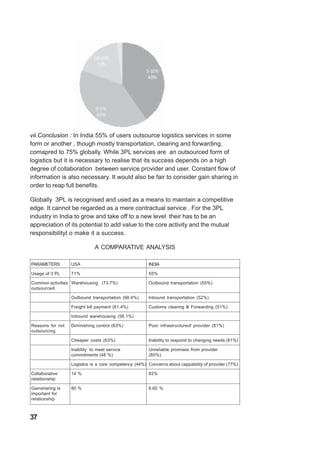
  • 17.
    ICDs are inlandintermodal container terminals directly connected by road or rail to a seaport and operating as a centre for transhipment of sea cargo to inland destinations.In addition to their role in cargo transhipment, terminals may also include facilities for storage and consolidation of goods, maintenance for road or rail cargo carriers and customs clearance services. The location of these facilities at an inland terminal relieves competition for storage and customs space at the seaport itself. Inland container terminals may also be referred to as dry ports or intermodal hubs.The development of “dry ports” provided with rail terminals linking to container ports extends the reach of containerisation and inter-modal freight. Container trains run between the container port and the dry port enabling the cargo to be cleared by customs at the dry port. The dry portprovides services of warehousing, documentation and clearance, freight arrangements, insurance and cargo consolidation. The idea is to move the time-consuming sorting and processing of containers inland, away from congested seaports.An inland port could also speed the flow of cargo between ships and major land transportation networks, which would carry goods to the rest of the country. 4.0 CONTAINERISATION – INDIAN SCENARIO India’s international trade wasgradually containerized over the ‘sixties and ‘seventies. It was very early in the ‘eighties that import containers began to land initially at Cochin,thenat Mumbai Port which was then the important port in the country . Mumbai Port was geared quintessentially to handle breakbulk cargo. Mumbai topography meant that space constraints made it difficult to handle and store containers at the docks and the old city roads made it difficult to move containers on road. Cargo had to de- stuffed within the port which meant further chaos.In view of the growing trend a special container port was planned and developed further away from the city centre and with better access to the hinterland, at an islandcalled NahvaSheva off the coast further towards the mainland. The new container port was administered by the Jawaharlal Nehru Port Trust . Meanwhile the Indian Railways perceived both the potential and opportunity of the inevitable growth of containerization in India. The railways had relatively, the best long distance transport network in the country.They were authorized to develop customs bonded inland container depots which functioned as dry ports. They started carrying import containers between Mumbai and Delhi on improvised flat wagons. By the mid-eighties Indian Railways realized that containerized logistics in India needed focused attention and initiated the process of setting up a company for the purpose. In 1989 Container Corporation of India(CONCOR) was incorporated as a company registered 17
  • 18.
    under the CompaniesAct,under the control of the Indian Railways and took over operations and infrastructure from its parent. Within the space of 15 odd years it developed more than 55 container terminals, acquired a fleet of more than 3000 flat wagons , and connected all the ports of the country to its inland terminals through regular containerized rail services . In 2005, private operators were also allowed to operate similar services on the rail network. As on the international scene, development took place simultaneously in all spheres: JNPT enabled the building of two more competing private container port terminals at NahvaSheva . More private container ports came up in Mundra and Pipavav in Gujerat, Vizag, Trivandrum, Cochin. Madras Port and allowed for container handling and further away a modern Port at Ennore started being developed through the same public -private partnership route. Diagram 3 : Map of India with Important Ports 18
  • 19.
    Containerization in Indiawas essentially driven by the compulsion imposed by international trade requirements which were increasingly dealing with containerized cargo.A large proportion of import and export goods were initially containerized or destuffed at port terminals or at container freight stations located just outside the port area. Export and import goods moved break- bulk in trucks from and to the hinterland. With the development of inland container terminals and regular rail services, the inherent advantages of inland ports appealed to importers and exporters and bonded movement in containers directly between ports and factories became widespread. Customs and excise regulations gradually changed to facilitate and enable these new developments. However containerized movement of domestic cargo developed less slowly. It is necessary here to indicate the essential differences between the two kinds of cargo. 5.0 CONTAINERIZED CARGO – DOMESTIC AND INTERNATIONAL The critical difference lies in the regulatory framework. Imported cargo is liable for customs duties and is therefore received at notified Customs check points where it is examined and customs levies are imposed. Export cargo requires to be checked by Customs to ensure that goods for export are as permitted by the government policies. Therefore export cargo is also examined at the same notified checkpoints before being permitted to leave the country. The Customs department is responsible for ensuring the implementation of the extant import and export regulations. Since containerized transportation involves the carriage of goods in containers which are sealed at origin and not opened en route till final delivery, worldwide, customs regulations have evolved procedures which take care of customs responsibilities. Typically once a customs seal is put on a container in its country of origin, the box moves under a bond provided by the carrier who assumes liability for safety of the goods. Once landed in India, the box is delivered to Customs at the manifested final destination where it is examined, customs duty levied and released. All ports are customs bonded. Inland container depots which have been customs notified are likewise customs bonded. In the case of exports, regulations now permit that the excise seal once placed on a container stuffed at a factory, is accepted by customs authorities at their discretion and let export order is issued for dispatch to port and further embarkation. Goods which move under these circumstances are known to be moving under bond and are known as import/export cargo. If the sealing/ desealingprocedure isdone at the gateway port , and the goods nevertheless still move in containerized form between port and hinterland they move as domestic cargo. They do not move under bond and do not go through the same stringent procedures prescribed by 19
  • 20.
    Customs. Domestic cargois not subject to these procedures. Excise and other domestic levies are imposed independently of whether cargo moves in containers or not. 6.0 LEVELS OF CONTAINERIZATION GLOBALLY AND IN INDIA Global average of containerized international trade is 70% while, inland,the percentage in the developed countries is even higher 80 - 90% . India on the other hand containerizes by volume, 70%of its exports and 40% of its imports. The the imbalance would of course be due to the nature of our imports of which a large part is bulk cargo like petroleum. But the Indian growth levels of container traffic are higher than international levels. Whereas international container traffic grew approx 9 % during this decade, India grew by 12.7% and is expected to double in the next five years. Between 2000-2005 container traffic at ports as a percentage of total cargo was around11% , increased towards the tail end of the decade to 16% and is expected to increase to 22.7% by 2012 . Generally these statistics indicate that containerization base levels are low and therefore growth is higher than average and the percentage of general merchandise as a part of our international trade is also increasing. The picture for domestic traffic is very different. Levels of containerization are very low. It is difficult to establish very accurate data because the transportation of general merchandise is extremely fragmented and still in the unorganized sector. A RITES report states that, by and largethat less than10% of domestic goods are actually carried in multimodal containers or that they are carried multimodally. The bulk of general cargo moves on road in small trucks with carrying capacity of 9-10 tons. It is true that within the last decade newer, larger and faster trucks have entered the market but these are often for captive customers with specialized requirements. The advantages that the usual road vehicles provide are door-to –door pick -up and delivery , relatively speedy deliveries and the ability to negotiate bad and narrower roads and highways. The disadvantages are unreliability in transits, risk of accidents, damage and pilferage. All of these issues are being addressed by the newer generation of transporters who have entered the market to take advantage of modern highways and the sheer demand in the economy. But even the organized transport sector tends to use closed fixed bodies on their trucks. It is an expensive proposition to manage a container inventory , including as it does special handling equipment, storage/parking , and deployment of empties. The country still does not have integrated logistics and traffic hubs which could provide enough value to the cost of a product to sustain these costs. 20
  • 21.
    The alternative modeof carriage is rail which in a bid to maximize operational efficiency has over the last 30 years almost completely focused on carriage of bulk goods like coal, iron ore, fertilizers, foodgrains , chemicals, minerals etc. which can typically move in train loads between two fixed destinations. Railways carries very little general cargo . Operational economy as well as the freight pricing structure which favours heavy and high value cargo does not make rail transportation very attractive to the general cargo market over and above which it also does not take care of last mile connectivity. In theory, containerization is perceived to be a via media by which a container rail operator like CONCOR and others could consolidate and provide multimodal services on rail. In fact the domestic services offered by these operators are severely limited. They carry less that 2% of total cargo and the nature of cargo is in fact confined to a few heavy commodities like finished steel, sponge iron, billets, white cement, some chemicals etc. which railways are unable to carry themselves. More important , these movements though carried in containers on rail are usually never off loaded and are used much like rail wagons. This cannot be called true multimodal containerized movement. The jury is still out on whether the state of affairs will improve so as to give domestic containerization the impetus it needs, as the railway infrastructure and systems are still not geared to making multimodal transport in the domestic general cargo segment a very profitable business. Comparatively in the developed world domestic movement is equally well containerized. For the retail industry containers are a boon and along with containerization there has been the growth of a supply chain industry which depends on logistics hubs and traffic parks which provide all kinds of services from warehousing andinventory management , to distribution and consolidation as well as other value added services. Particularly in Europe multimodalism has truly integrated road, rail and waterways to not only to provide value in the supply chain but also use resources in more environmentally sustainable ways in order to maintain a certain standard and quality of life. References : 1. Port Evolution &Performance in Changing Logistics Environment. Su- Han Woo, Stephen Pettit,AnthonyK.C.Beresford. (Maritime &Logistics August 2011) 2. Development of Container Port Systems. Notteboom& J-P Rodrigue (2005) 3. World Bank Report on development of Ports. 4. Ports & Shipping- Issues in Optimisation.ThierryVaneslander (2011) 5. Maritime Containerisation trends Technical Note 19. Euro-Mediterranean Transport Project( 2005) 21
  • 22.
    3.0 Supply ChainManagement and Multimodal Transport Logistics - Broad features. Understanding 3PL/4PL I. SUPPLY CHAIN A supply chain gets a product from a supplier to a consumer. This is the simplest definition but the process is actually more complex. A supply chain works by cooperation between individuals or organisations across disciplines in introducing source components which go towards the production of a finished item or service. Many source inputs may enter and exit the supply chain and re-enter it during production . Inputs may be not only raw materials and semi finished goods but may also be in the form of services, finances and information. One of the key services is multimodal transport logistics.The organisations or individuals engaged in supplying a particular component are driven by their own profit and viability goals and are not concerned with the consumer of the ultimate end product or service. Nevertheless they are collaborators in the entire process. It is important to realise that the individual activities are part of a process. Described in this manner it is seen that a supply chain is of paramount importance in delivering an end product to a customer and without the collaboration of the individuals or organisations participating in the process , the end result would not be achieved. 1.0 Key Components of a Supply Chain There are six key elements to a supply chain: ! Production ! Supply ! Inventory ! Location ! Transportation, and ! Information The following describes each of the elements : 1. Production Strategic decisions regarding production focus on what customers want and the market demands. Production priorities depend on the market demand. It 22
  • 23.
    is also herethat decisions regarding what to produce in house and what to outsource is taken. The strategic decisions regarding production needs also to focus on capacity, quality and volume of goods, keeping in mind that customer demand and satisfaction must be met. Operational decisions, on the other hand, focus on scheduling workloads, maintenance of equipment and meeting immediate client/market demands. Quality control and workload balancing are issues which need to be considered when making these decisions. 2. Supply Next an organisation has to arrange for supply of raw materials and other inputs to fulfil production requirements as per the decisions made above. Based on its core strengths there is a strategic mix of raw and semi finished products. In the current era of super specialisation , some organisations may choose to outsource a major portion of their components to reliable suppliers and concentrate on design and assembly only. The automobile industry is a common example . When choosing a supplier, focus is on developing velocity, quality , flexibility and reliability while at the same time reducing costs or maintaining low cost levels. Ease of transportation and easy access play an important role. Multimodal transport plays its largest role here. 3. Inventory Further strategic decisions focus on inventory of both input supplies and final product. Input material inventory has to strike the right balance for smooth production and high working capital cost of comfortable stock balances. Inventory carrying costs are significant enough to affect profitability. On the market side, a delicate balance exists between too much inventory, which can cost anywhere between 20 and 40 percent of their value, and not enough inventory to meet market demands. This is a critical issue in effective supply chain management. 4. Location Location decisions depend on market demands and determination of customer satisfaction. Strategic decisions must focus on the placement of production plants, distribution and stocking facilities, and placing them in prime locations to the market served. Once customer markets are determined, long-term commitment must be made to locate production and stocking facilities as close to the consumer as is practical. In industries where components are lightweight and market driven, facilities should be located close to the end-user. In heavier industries, careful consideration must be made to determine where plants should be located so as to be close to the raw material source. Decisions concerning location should also take into consideration tax and tariff issues, especially in inter-state and worldwide 23
  • 24.
    distribution. Multimodal transportplays a significant role in determining location decisions. The pattern has changed radically with the growth of containerisation as brought out earlier 5. Transportation Strategic transportation decisions are closely related to inventory decisions as well as meeting customer demands. Using air transport obviously gets the product out quicker and to the customer expediently, but the costs are high as opposed to shipping by boat or rail. Yet using sea or rail often means having higher levels of inventory in-house to meet quick demands by the customer. It is wise to keep in mind that since 30% of the cost of a product may be encompassed by transportation, using the correct transport mode is a critical strategic decision. Above all, customer service levels must be met, and this often times determines the mode of transport used. This may often be an operational decision, but strategically, an organization must have transport modes in place to ensure a smooth distribution of goods. 6. Information An effective supply chain can only be maintained with a the help of timely information flow. Production glitches, supply bottlenecks, and distribution gaps can only be tackled properly and economically if all collaborators share information freely and promptly. Supply chain is exactly that : a chain. And what happens to one link has a ripple effect . Modern telecommunication services and high speed communication enables through networks and the internet, a streamlined information flow, consolidates knowledge and facilitates velocity of products. Modern account management software, product configurators, enterprise resource planning systems, and global communications are key components of effective supply chain management strategy. A TYPICALSUPPLYCHAIN 24
  • 25.
    II. SUPPLY CHAINMANAGEMENT However the efficiency of the supply chain process, its reliability in terms of repeat performance and the economic value of the end product would depend on the coordination between the collaborators taking into consideration all aspects of the production process. This is where supply chain management comes in. Management of the supply chain encompasses the planning and management of all activities involved in sourcing, procurement, conversion, and logistics management. It also includes the crucial components of coordination and collaboration with channel partners, which can be suppliers, intermediaries, third party service providers, and customers. Fundamentally supply chain management integrates supply and demand management within and across companies. The purpose of Supply chain management is a cross-function approach including managing the movement of raw materials into an organization, certain aspects of the internal processing of materials into finished goods, and the movement of finished goods out of the organization and toward the end-consumer. As organizations strive to focus on core competencies and becoming more flexible, they reduce their ownership of raw materials sources and distribution channels. These functions are increasingly being outsourced to other entities that can perform the activities better or more cost effectively. The effect is to increase the number of organizations involved in satisfying customer demand, while reducing management control of daily logistics operations. Less control and more supply chain partners has led to the creation of supply chain management concepts. The following are five basic components of Supply Chain Management (SCM). 1. Plan—This is the strategic portion of SCM. Companies need a strategy for managing all the resources that go toward meeting customer demand for their product or service. A big piece of SCM planning is developing a set of metrics to monitor the supply chain so that it is efficient, costs less and delivers high quality and value to customers. 2. Source—Next, companies must choose suppliers to deliver the goods and services they need to create their product. Therefore, supply chain managers must develop a set of pricing, delivery and payment processes with suppliers and create metrics for monitoring and improving the relationships. And then, SCM managers can put together processes for managing their goods and services inventory, including receiving and 25
  • 26.
    verifying shipments, transferringthem to the manufacturing facilities and authorizing supplier payments. 3. Make—This is the manufacturing step. Supply chain managers schedule the activities necessary for production, testing, packaging and preparation for delivery. This is the most metric-intensive portion of the supply chain—one where companies are able to measure quality levels, production output and worker productivity. 4. Deliver—This is the part that many SCM insiders refer to as logistics, where companies coordinate the receipt of orders from customers, develop a network of warehouses, pick carriers to get products to customers and set up an invoicing system to receive payments. 5. Return—This can be a problematic part of the supply chain for many companies. Supply chain planners have to create a responsive and flexible network for receiving defective and excess products back from their customers and supporting customers who have problems with delivered products. III. BENEFITS OF SUPPLY CHAIN MANAGEMENT SCM can help transform a traditional linear supply chain into an adaptive network with the following benefits. ! The increased visibility into the supply chain and adaptive supply chain network, helps an organisation to be more responsive. It can sense and respond quickly to changes and quickly capitalize on new opportunities. ! By offering a common information framework that supports communication and collaboration, SCM enables entities to better adapt to and meet customer demands. ! Tracking and monitoring compliance in areas as environment, health and safety becomes easier. ! Information transparency and real-time business intelligence can lead to shorter cash-to-cash cycle times. Reduced inventory levels and increased inventory turns across the network can lower overall costs. ! With SCM, operational expenses can be lowered with timelier planning for procurement, manufacturing and transportation. Better order, product and execution tracking can lead to improvements in performance and quality - and lower costs. Margins can also improve through better coordination with business partners. 26
  • 27.
    ! Tight connectionwith trading partners keep a supply chain aligned with current business strategies and priorities, improving an organization’s overall performance and achievement of goals. IV. EVOLUTION OF MULTIMODAL TRANSPORT LOGISTICS AND SUPPLY CHAIN MANAGEMENT Organizations increasingly find that they must rely on effective supply chains, or networks, to compete in the global market and networked economy. In the newest management paradigms, this concept of business relationships extends beyond traditional enterprise boundaries and seeks to organize entire business processes throughout a value chain of multiple companies. Six major movements can be observed in the evolution of supply chain management: Creation, Integration, and Globalization, Specialization phases One and Two, and SCM 2.0. 1.0 Creation Era The concept of a supply chain in management gained importance in the early 20th century with the creation of the assembly line style of production though the term supply chain management was first coined by a U.S. industry consultant in the early 1980s. This era of supply chain management is characterised by the need for large-scale changes, re-engineering, downsizing driven by cost reduction programs, and widespread attention to the Japanese practice of management. 2.0 Integration Era In the 1960s Electronic Data Interchange (EDI) systems were developed and was followed by the introduction of Enterprise Resource Planning (ERP) through the 1990swhich continued to develop into the 21st century with the expansion of internet-based collaborative systems. This era of supply chain evolution is characterized by both increasing value-adding and cost reductions through integration. 3.0 Globalization Era The hallmark of the third stage of supply chain management development is the attention given to global systems of supplier relationships and the expansion of supply chains over national boundaries and into other continents. Although the use of global sources in the supply chain of 27
  • 28.
    organizations can betraced back several decades it was not until the late 1980s that a considerable number of organizations started to integrate global sources into their core business. This era is characterized by the globalization of supply chain management in organizations with the goal of increasing their competitive advantage, value- adding, and reducing costs through global sourcing. 4.0 Specialization Era—Phase One: Outsourced Manufacturing and Distribution In the 1990s industries began to focus on “core competencies” and adopted a specialization model. Companies abandoned vertical integration, sold off non- core operations, and outsourced those functions to other companies. Management requirements changed as the the supply chain extended well beyond company walls and management had to cut across specialized supply chain partnerships. This transition also re-focused the fundamental perspectives of each respective organization. OEMs became brand owners. They had to control the entire supply chain from above instead of from within. Contract manufacturers had to manage bills of material with different part numbering schemes from multiple OEMs and support customer requests for work -in-process visibility and vendor-managed inventory (VMI).The specialization model creates manufacturing and distribution networks composed of multiple, individual supply chains specific to products, suppliers, and customers who work together to design, manufacture, distribute, market, sell, and service a product. 5.0 Specialization Era—Phase Two: Supply Chain Management as a Service Specialization within the supply chain began in the 1980s with the inception of transportation brokerages, warehouse management, and non-asset-based carriers and has matured beyond transportation and logistics into aspects of supply planning,collaboration, execution and performance management. At any given moment, market forces could demand changes from suppliers, logistics providers, locations and customers, and from any number of these specialized participants as components of supply chain networks. This variability has significant effects on the supply chain infrastructure, from the basics of establishing and managing the electronic communication between 28
  • 29.
    the trading partnersto more complex requirements including the configuration of the processes and work flows that are essential to the management of the network itself. Supply chain specialization enables companies to improve their overall competencies in the same way that outsourced manufacturing and distribution has done; it allows them to focus on their core competencies and assemble networks of specific, best-in-class partners to contribute to the overall value chain itself, thereby increasing overall performance and efficiency. The ability to quickly obtain and deploy this domain-specific supply chain expertise without developing and maintaining an entirely unique and complex competency in house is the leading reason why supply chain specialization is gaining popularity. Outsourced technology in terms of sophisticated hosting for supply chain solutions debuted in the late 1990s and has taken root primarily in transportation and collaboration categories. This has progressed from the Application Service Provider (ASP) model from approximately 1998 through 2003 to the On-Demand model from approximately 2003-2006 to the Software as a Service (SaaS) model currently in focus today. 6.0 Supply Chain Management 2.0 (SCM 2.0) Building on globalization and specialization, the term SCM 2.0 has been coined to describe both the changes within the supply chain itself as well as the evolution of the processes, methods and tools that manage it in this new “era”. Like Web 2.0, SCM 2.0 is a new generation of technology based supply chain management concepts solutions and management a combination of the processes, methodologies, tools and delivery options to guide companies to their results quickly as the complexity and speed of the supply chain increase due to the effects of global competition, rapid price fluctuations, surging oil prices, short product life cycles, expanded specialization, near-/ far- and off-shoring, and talent scarcity. VI. UNDERSTANDING 3 PL AND 4PL A number of developments in the 20th century has converged to transform multimodal transport logistics services into a separate industry. Logistics services play a significant role in the supply chain. As we have seen earlier, the multimodal revolution has transformed transport logistics. It has brought the world closer and changed the premise of traditional business decisions like what to produce, where to produce and by what process. Once labour was more mobile than raw materials. Today it is cheaper to move goods than to move labour and production facilities have relocated accordingly. Transits, safety, reliability have all improved so that production lines can function on slim inventories . Globalization, consolidation, technology advancements and outsourcing have led to growth in the logistics services market. 29
  • 30.
    In this scenariothe multimodal transport logistics industry is striving to offer more value throughout the supply chain. Logistics services is increasingly coming to cover a range of peripheral services surrounding the core transportation service. These are services like warehousing, inventory management, distribution services, services like packaging, labeling , bar coding and so on. The capabilities of logistics service providers are growing along with the changing expecta-tions of their clients. Within the logistics services industry, as it evolves, competitors are moving away from asset-based commoditized services to more strategic, information-based approaches. Unable to cope with complexities across their supply chains, customers are demanding a “single point of contact” for all logistics services and are looking for “one-stop logistics shopping” . The models in logistics industry have evolved over time to address the changing needs of the market and vary based on scope of service offerings, degree of collabora-tion, levels of asset intensity and IT capabilities across the supply chain. A 3 Party Logistics Service Provider is a company which coordinates all logistics functions between multiple links across the supply chain . Any basic transaction involves two parties: the buyer who is the first party and the seller who is the second party. So if manufacturer wishes to transport his goods from godown to market, he will engage a transporter to truck his goods to the desired destination. The trucker typically owns his trucks and manages the transportation service. The direct service provider of the core service is called the first or second party as they directly sell a service as their core competency. The 3PL service provider on the other hand integrates all logistics functions, such as trucking and warehousing, aggregating , distribution etc customized to customers’ needs based on market conditions and the demands and delivery service requirements for their products and materials. 3 PL service providers normally outsource the multiple logistics functions from other service providers such as truckers, warehouse operators ,etc. Typically they do not invest in the assets associated with the service provided, though given the complexity of operations , they do have to invest in sophisticated communications and information network systems. They take responsibility for a range of services so that their customer does not have to deal with multiple agencies. They are asset light and usually tend to have high returns; they contract most of their capacity needs to 2PLs. Normally direct service providers are businesses which face low returns and high levels of asset intensity but low barriers to entry. With the increasing need for “one-stop solutions”, many 2PL providers have evolved into 3PL by adding new logistics capabilities and integrating 30
  • 31.
    their opera-tions. Whilethe 2PL puts in hard cash tangible asset, the 3PL puts in intellectual property. 3 PL Service Providers: Freight forwarders and courier companies are the earliest examples of 3PL service providers. They have evolved by extending their range of activities backward or forward from their core functions. Many truckers have gone into aggregation and forwarding which also involves some kind of warehousing services. 3 PL providers could be distinguished as follows: ! The Standard 3PL provider is the most basic form of a 3PL provider. They would perform activities such as, pick and pack, warehousing, and distribution – the most basic functions of logistics. The 3PL function would not be their main activity. They would have a core asset-base for their operations by way of a transportation fleet, some warehousing etc. ! The Service developer: this type of 3PL provider will offer their customers advanced value-added services such as: tracking and tracing, cross-docking, specific packaging, or providing a unique security system. The backbone of their service would be a good technology/ information network. ! The customer adapter: A customer hands over management of his logistics activities to this 3PL who provides a fully customised service. The 3PL provider improves the logistics dramatically, but do not develop a new service. The customer base for this type of 3PL provider has a small base of customers for whom he performs the service. ! Complete 3PL: this is the highest level that a 3PL provider can attain with respect to its processes and activities. This occurs when the 3PL provider integrates itself with the customer and takes over their entire logistics function. These providers will have few customers, but will perform extensive and detailed tasks for them. Advancements in technology and the associated increases in supply chain visibility and inter-company communications have given rise to a relatively new model for third-party logistics operations – the “non-asset based logistics provider.” A non-assets based provider consists of a team of domain experts with accumulated freight industry expertise and information technology assets. They fill a role similar to freight agents or brokers, but maintain a significantly greater degree of “hands on” involvement in the transportation of products. Non-asset based providers perform functions 31
  • 32.
    such as consultationon packaging and transportation, freight quoting, financial settlement, auditing, tracking, customer service and issue resolution. However, they do not employ any truck drivers or warehouse personnel, and they don’t own any physical freight distribution assets of their own – no trucks, no storage trailers, no pallets, and no warehousing. Examples of third party logistics companies as defined above would be C.H. Robinson Worldwide, Dupré Logistics LLC, J.B. Hunt Transport Services, FedEx Supply Chain. 4PL service Provider The concept of 4PL service providers is still evolving. Definitions are still fluid and cause confusion even amongst professionals from the logistics industry. The term 4PL is generally considered to have been introduced by Accenture, which registered it as a trademark in 1996. Accenture described the 4PL as an “integrator that assembles the resources, capabilities, and technology of its own organization and other organizations to design, supply chain solutions”. The trademark was later abandoned, and the term has become a part of the public domain. A general definition states that a fourth-party logistics provider is an independent, singularly accountable, non-asset based integrator of a client’s supply and demand chains. What appears to be emerging as the most significant characteristic of 4PL is based on the concept of neutrality and conflict of interest. A fourth-party logistics provider must offer services considering a 360 degree view, which is not focused on its ability to implement the recommendations it gives, but on all the options available in the market. As such an IT consulting firm specialized in Supply Chain Management which is objectively considering all the various SCMs present in the market is a 4PL. But it cannot represent any specific ERP software company as then the concept of neutrality is broken. To avoid any conflict of interest, and maintain neutrality, it is important that a fourth-party logistics provider be non-asset based, as far as logistics, transportation, and supply chain management assets are concerned. 4PL use 2PLs and/or 3PLs to supply service to customers, and own only computer systems and intellectual capital. It has been sometimes argued that a 4PL is the same thing as a “non-asset based 3PL”. This is not the case. Most of the world’s 3PL are “non-asset based”, but they generate revenues & profits from their “non-asset based” 3PL activities. As such a 3PL cannot be a 4PL in the same time, as this would lead to conflict of interest for it would then have a tendency to recommend to customers its “non-asset based” operation as the best possible option. 32
  • 33.
    We may thereforeconsider that 4PL are essentially consulting companies exclusively specialized in logistics, transportation, and supply chain management such as SCMO, BMT Limited ,MVA Consulting, TTR, Intermodality, CPCS, and 3t-Europe, which offer complete ranges of services, from strategy to implementation. To maintain clarity at a conceptual level it would be advisable to maintain that a 4PL is usually a consultant offering logistics solutions suited to a particular customer’s requirements and that in order offer unbiased and truly objective assessment he cannot be an operator. A 3PL is an operator, which specializes in integrated operation, warehousing and transportation services. These services may be 100% outsourced, as in the case of “non-asset based 3PL”. It is then a pure 3PL. It may also own part of its operations, such as warehouses, vans, or trucks. It then is both a 3PL and a 2PL, but is usually still called a 3PL. It can also offer genuine supply chain consulting services outside of its usual range of services. It is then both a3PL and a 4PL, but is usually still called a 3PL. There are obviously some 2PL/3PL who have such advanced systems in terms of supply chain management that they could offer specialised consultations to customers, just as there are many 2PL who have extended their services to cover 3PL as well. Conceptually however the principle of neutrality, absence of conflict of interest which can be ensured by total lack of vested interest in assets or non- asset based operations needs to be maintained to distinguish 3PL and 4PL services. VII. SCENARIO IN INDIA Worldwide today, India included, industry is passing through a very trying phase. Competition is keen and discourages a pass-through of developmental and inflationary costs to the customer. Modern industry cannot compromise on Quality and further reduction in manufacturing and sourcing costs can at best bring marginal gains. Every alternate means to contain “cost to the customer” needs to be explored. The modern manufacturer is reluctant to maintain the wide variety of inventory needed by them to cover all models and variations in product range. The second, third and fourth tier suppliers are under huge pressure to meet these numerous variations. Physical distance from the manufacturer and the short notice available to the supplier for supplying small and odd quantities further complicates the matter. Third Party Logistics partners can play an important role in solving these problems. In India unlike Japan or Europe, suppliers are spread over 1000’s of kilometers and poor and inadequate infrastructure further adds to transportation delays and transit losses. 33
  • 34.
    3PL providers canattempt to bridge this time, space, place and quantity gaps . In India, 3PL providers are usually transporters who have modified their traditional asssets i.e. trucks and godowns, to bridge the gap between suppliers and customers. These enlightened transporters have understood the opportunity and have created hubs near major manufacturers. In these hubs, the service provider maintain the necessary inventory which he also transports from the manufacturing unit to the hub. The automobile industry in India probably is the most intensive user of 3PL providers. He also maintains liaison with the customer and provides him with the exact materials on time. 3PL suppliers in addition acts as a billing agent besides providing all the functions that were earlier performed by the C & F agent.They also manage the containers and other similar materials used to supply the stocks.The 3PL service providers role is bound to become more and more critical and vital for the success of any automotive supply-chain. A recent survey of Indian industry attempted to map the potential for 3PL and outsourcing of supply chain management in India. The results are probably give the best picture of the 3PL services in India. i. Objectives and scope :Apart from discerning the Indian scenario, the aim of the survey was to identify the critical factors for evaluation, selection and relationship management of 3PL providers. Also to provide benchmarks to industry looking to optimize logistics operations. Industry participants were a cross-section of different sectors, the largest being automotive sector followed by engineering firms. While the third largest group were a miscellaneous collection, the chemical and fertilizer, FMCG, Metals, Textiles were significant blocs in descending order. The approach of the survey covered basically the following aspects: a) 3 PL as a strategic tool for corporate growth b) How much of logistics were outsourced c) Logistics Costs d) Implementation and Performance Measurement. ii. 3PL as strategic tool – why do corporate decide to outsource logistics functions to a 3PL provider .The survey indicates that corporate focus is centered first on higher profitability, then increased sales , followed by enhanced customer satisfaction and reduced costs. Due to the modern highly competitive environment companies would like to achieve these 34
  • 35.
    objectives by focusingon core activities. The primary reason for outsourcing to 3PL therefore is logistics cost reduction. Other major reasons is improvement in return on assets and increased inventory turnaround, productivity improvement and flexibility in operations. Corporates using 3PL feel that outsourcing does improve business objectives by improving on time delivery and rendering specialized logistics expertise improve functions like customer service , sales and purchase .Nevertheless the major activities which are outsourced are inward and outbound transportation and clearing & forwarding services. Inventory management, labeling- packaging are outsourced only in a small way. The comparatively low level of outsourcing for anything other than transportation reflects in the attitude of the users. While 48% of respondents think that 3PL is a critical link in the supply chain, and 19% even think it is very important , the rest rate its role only average as much as 26% are indifferent to the role of 3 PL. From corporates which did not outsource logistics services, two main reasons given were ‘inability to respond to changing needs and poor infrastructure of the provider along with a lack of grasp of business goals. iii. Break-up of logistics costs : For the majority(almost 80%) of respondents a transportation constitutes 73 % of their logistics cost. Inventory management, warehousing and distribution and customer services costs for as many as 40 % of respondents forms over 30 % of the logistics costs. Other logistics costs are not very significant for the majority of respondents. Logistics costs as a percentage of gross sales is given below: For 80% of respondents logistics cost is not more than 10% of gross sales. For a small 3% it is even less than 5%. Under these circumstances it may not be surprising that 3PL as a service industry, is still in its infancy and not surprisingly given the importance of the role played by logistics in the final product, the percentage of logistics actually outsourced by corporates is quite low: only 7% outsource more than 80% of their logistics while about 8% do 60-80%.But a whopping 64% outsource less than 20%. The main factor in choosing to use 3PL provider appears to be cost and reliability. iv. Successful implementation out of these concerns emerge some essentials to a successful implementation of outsourced logistics. First, requirements should be well defined after which close working relationship with the involvement of top management is essential in order to give value 35
  • 36.
    to the role.While there needs to be demarcation of responsibilities, management has to provide a joint cross-function team to interact with the 3PL. Systems need to be established along with a strong performance review. Challenges to the 3PL is cost control , maintaining customer service levels and communication. There results an expectation gap between Provider and User. The provider’s worst frustrations are convincing internal personnel and sharing of information. The user constantly thinks that cost control could have been better. Actually 69% of managements think that 3PL is effective and 17% even think they are very effective. But while 14% of managements view 3Pl as collaborators ,77% think they are merely contractual service providers. v. Performance Measures: The most common measures are on time shipment, inventory accuracy, customer complaints, shipment errors, warehouse cycle time, back orders, stock outs, and fill rates. Users tend to rate customer complaints , inventory accuracy and shipping errors as reliable parameters whereas 3PL providers dont regard customer complaints as truly indicative of their effectiveness. vi. Role of Information Technology: the role of IT is modern logistics and supply chain management cannot be denied . In fact there are 4PLs who specialize only in providing models and tools with which to manage the complex activities involved in managing a supply chain. It is IT which allows for real time tracking consignments, reliable information and analytics for controlling quality and costs, accurate shipping and invoicing etc. Users who manage to integrate their IT systems with that of their service providers obtain the benefit of reliable communication which prevents a number of costly errors. It is therefore surprising that as much as 24% of corporate managements in India think that IT is not important and only 26% feel that it is important. As mentioned earlier exchange of information and working as a team is important for successful implementation of outsourced logistics services. The following comparison demonstrates the difference in attitudes towards 3PL in USA and India . Users in India are not too convinced about the effectiveness of 3PL and the reason appears to be actually the poorly developed level of 3PL services. 36
  • 37.
    vii.Conclusion : InIndia 55% of users outsource logistics services in some form or another , though mostly transportation, clearing and forwarding, comapred to 75% globally. While 3PL services are an outsourced form of logistics but it is necessary to realise that its success depends on a high degree of collaboration between service provider and user. Constant flow of information is also necessary. It would also be fair to consider gain sharing in order to reap full benefits. Globally 3PL is recognised and used as a means to maintain a competitive edge. It cannot be regarded as a mere contractual service . For the 3PL industry in India to grow and take off to a new level their has to be an appreciation of its potential to add value to the core activity and the mutual responsibilityt o make it a success. PARAMETERS USA INDIA Usage of 3 PL 71% 55% Common activities Warehousing (73.7%) Outbound transportation (55%) outsourced Outbound transportation (68.4%) Inbound transportation (52%) Freight bill payment (61.4%) Customs clearing & Forwarding (51%) Inbound warehousing (56.1%) Reasons for not Diminishing control (63%) Poor infrastructureof provider (81%) outsourcing Cheaper costs (63%) Inability to respond to changing needs (81%) Inability to meet service Unreliable promises from provider commitments (48 %) (80%) Logistics is a core competency (44%) Concerns about cappability of provider (77%) Collaborative 14 % 82% relaitionship Gainsharing is 80 % 6.60 % important for relationship A COMPARATIVE ANALYSIS 37
  • 38.
    vii. Conclusion :In India 55% of users outsource logistics services in some form or another , though mostly transportation, clearing and forwarding, comapred to 75% globally. While 3PL services are an outsourced form of logistics but it is necessary to realise that its success depends on a high degree of collaboration between service provider and user. Constant flow of information is also necessary. It would also be fair to consider gain sharing in order to reap full benefits. Globally 3PL is recognised and used as a means to maintain a competitive edge. It cannot be regarded as a mere contractual service . For the 3PL industry in India to grow and take off to a new level their has to be an appreciation of its potential to add value to the core activity and the mutual responsibilityt o make it a success. Bibliography 1. Hertz and Alfredson 2003 Hertz, Susanne; Monica Alfredsson (February 2003). “Strategic development of third party logistics providers”. Industrial Marketing Management (Elsevier Science) 2. CALM Supply Chain & Logistics Journal, “Fourth Party Logistics: The Evolution of Supply Chain Outsourcing”, DN Bauknight, JR Miller, 1999. 3 . “4PL”. Toolbox for IT. Juillet 2 4. The Economist Intelligence Unit, “SCMO - The Next Generation”, China Hand November 2006 – Chapter 11: Distribution, November 2006. 38
  • 39.
    Annexure India Container TrafficUp 3 Percent Total cargo tonnage fell 1.73 percent in fiscal 2011-12 Container throughput at India’s major ports grew 3 percent year-over-year in fiscal 2011-12, which ended March 31, the slowest growth rate in three years. Volume expanded 4.32 percent in 2009-10 and 9.5 percent in 2010-11.The country’s 13 state-owned gateway ports handled 7.77 million 20-foot equivalent units in 2011-12, compared with 7.54 million TEUs the previous year. Containerized tonnage rose 5.36 percent to 120 million tons from 114 million tons, the Indian Ports Association said in a statement on Monday.Jawaharlal Nehru Port (NhavaSheva), which accounts for more than 60 percent of India’s total container movements, reported its highest-ever throughput: 4.32 million TEUs, up 1.5 percent from 4.27 million TEUs in 2010- 11. Traffic at Chennai, the second-largest container gateway, increased 3 percent to 1.56 million TEUs from 1.52 million TEUs.Kolkata handled 551,000 TEUs, up from 526,000 TEUs. Tuticorin moved 477,000 TEUs compared with 468,000 TEUs. Volume at Cochin increased to 328,000 TEUs from 312,000 TEUs.The IPA said total cargo tonnage at major ports fell 1.73 percent in 2011-12 to 560 million tons from 570 million tons a year earlier. Kandla topped cargo volume at 82.5 million tons, followed by Visakhapatnam, at 67.4 million tons; Nehru, at 65.7 million tons; Mumbai, at 56 million tons; Chennai, at 55.7 million tons; and Paradip, at 54.2 million tons.The dip in overall tonnage comes as the Indian Shipping Ministry launched a $110 billion maritime plan to expand the country’s port capacity from the current 1 billion tons to 3.2 billion tons by 2020. 39
  • 40.
    Visakhapatnam 46,736 Kolkata/Haldia 350,000 Chennai1,120,000 Kandla 177,000 Mumbai 138,201 JNPT/NhavaSheva International Container Terminal Gateway Terminals India 3,300,000 New Mangalore 21,460 Mormugao 10,011 Paradip 2,000 Kochi 203,000 Tuticorin 377,102 Ennore - Port Pipavav 200,000 Mundra 671,000 Port Containers (TEUs) FY 2012 References : 1. Hertz and Alfredson 2003 Hertz, Susanne; Monica Alfredsson (February 2003). “Strategic development of third party logistics providers”. Industrial Marketing Management (Elsevier Science) 2. CALM Supply Chain & Logistics Journal, “Fourth Party Logistics: The Evolution of Supply Chain Outsourcing”, DN Bauknight, JR Miller, 1999. 3 . “4PL”. Toolbox for IT. Juillet 2 4. The Economist Intelligence Unit, “SCMO - The Next Generation”, China Hand November 2006 – Chapter 11: Distribution, November 2006. 40
  • 41.
    1 Shanghai, China25.0 29.1 2 Singapore, Singapore 25.9 28.4 3 Hong Kong, China 21.0 23.7 4 Shenzhen, China 18.3 22.5 5 Busan, South Korea 12.0 14.2 6 Ningbo-Zhoushan, China 10.5 13.1 7 Guangzhou Harbor, China 11.2 12.6 8 Qingdao, China 10.3 12.0 9 Dubai, United Arab Emirates 11.1 11.6 10 Rotterdam, Netherlands 9.7 11.1 11 Tianjin, China 8.7 10.1 12 Kaohsiung, Taiwan, China 8.6 9.2 13 Port Kelang, Malaysia 7.3 8.9 14 Antwerp, Belgium 7.3 8.5 15 Hamburg, Germany 7.0 7.9 16 Tanjung Pelepas, Malaysia 6.0 6.5 17 Los Angeles, U.S.A 6.8 6.5 18 Long Beach, U.S.A. 5.1 6.3 19 Xiamen, China 4.7 5.8 20 New York and New Jersey, U.S.A 4.6 5.3 21 Dalian, China 4.6 5.3 22 Laem Chabang, Thailand 4.6 5.2 23 Bremen/Bremerhaven, Germany 4.5 4.9 24 Jakarta, Indonesia 3.8 4.7 25 Tokyo, Japan 3.4 4.3 26 Nhava Sheva, India 4.0 4.3 27 Valencia, Spain 3.7 4.2 28 Ho Chi Minh, Vietnam 3.4 4.1 29 Colombo, Sri Lanka 3.5 4.1 30 Lianyungung, China 3.0 3.9 31 Jeddah, Saudi Arabia 3.1 3.8 32 Salalah, Oman 3.5 3.5 33 Port Said, Egypt 3.3 3.5 34 Yingkou, China 2.5 3.3 35 Felixstowe, U.K. 3.5 3.3 36 Yokohama, Japan 2.8 3.3 37 Manila, Philippines 2.9 3.3 38 Surabaya, Indonesia 1.1 3.0 39 Sharjah, United Arab Emirates 2.8 3.0 40 Gioia Tauro, Italy 3.2 2.9 41 Savannah, Georgia 2.4 2.8 42 Algeciras Bay, Spain 3.0 2.8 43 Balboa, Panama 2.0 2.8 44 Santos, Brazil 2.3 2.7 45 Bandar Abbas, Iran 2.2 2.6 46 Durban, South Africa 2.4 2.6 47 Nagoya, Japan 2.1 2.6 48 Ambarli, Turkey 1.8 2.5 49 Kobe, Japan 4.1 2.5 50 Port Metro Vancouver, British Columbia, Canada 2.2 2.5 Global Container Ports RANK PORT, COUNTRY VOLUME 2009 (MILLION- TEUS) VOLUME 2010 (MILLION- TEUS) Sources: The Journal of Commerce, August 23-30, 2010 edition & The Alphaliner Weekly, Issue 14, 2011 41