1. Basics Of Railway Engineering
1.1 Railway Transportation system
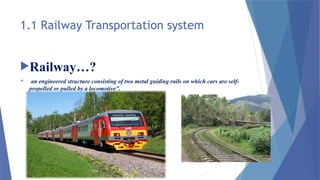
Railway…?
 an engineered structure consisting of two metal guiding rails on which cars are self-
propelled or pulled by a locomotive”.
1.1 Railway Transportation system…
The terms railway and railroad are sometimes used interchangeably
Railway:- will generally refer to the track and other closely associated items, i.e.,
signals, crossings, bridges, etc.
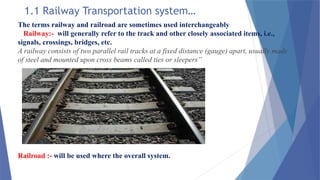
A railway consists of two parallel rail tracks at a fixed distance (gauge) apart, usually made
of steel and mounted upon cross beams called ties or sleepers”
Railroad :- will be used where the overall system.
1.1 Railway Transportation system…
 Railway engineering..?
 Engineering involved in the planning, design, construction, operation and
maintenance of railway land facilities used for the movement of people and
goods serving the social and economic needs of contemporary society and its
successors. The complete railway engineer is active in all aspects of civil
engineering practice, surveying, geotechnics, hydrology, hydraulics,
environmental and sanitary and structural design as well as construction
technology.
1.1 Railway Transportation system…
 Why Railway?...(Advantages)
 It has a high level of passenger or cargo utilization over a limited space
 most efficient energy consumer
 Minimum friction and minimum air resistance
 environmentally friendly
 Mostly electric powered
 dense city agglomerations and mixed land use developments instead of sub-urban sprawl
 Safest mode of land transport with the lowest accident rate
 It offers comfortable ride options such as meal, sleeping and entertainment
1.1 Railway Transportation system…
 Draw Backs?…
 Not so profitable considering the initial investment and operation costs
 Cannot support severe alignments such as steep slopes and sharp curves
 Low flexibility in terms of network operations
 Severity of accidents is high
 Security threat as it is prone to attacks
1.2 Historical Development of Railways
Where did it all begun?..
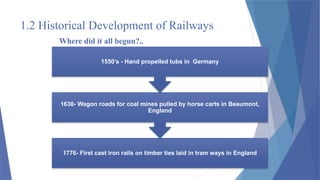
1776- First cast iron rails on timber ties laid in tram ways in England
1630- Wagon roads for coal mines pulled by horse carts in Beaumont,
England
1550’s - Hand propelled tubs in Germany
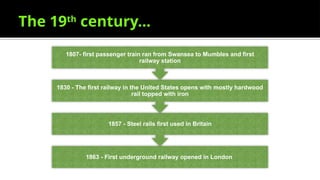
The 19th
century…
1863 - First underground railway opened in London
1857 - Steel rails first used in Britain
1830 - The first railway in the United States opens with mostly hardwood
rail topped with iron
1807- first passenger train ran from Swansea to Mumbles and first
railway station
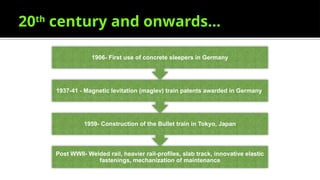
20th
century and onwards…
Post WWII- Welded rail, heavier rail-profiles, slab track, innovative elastic
fastenings, mechanization of maintenance
1959- Construction of the Bullet train in Tokyo, Japan
1937-41 - Magnetic levitation (maglev) train patents awarded in Germany
1906- First use of concrete sleepers in Germany
Historical Development of Railway
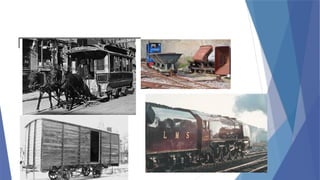
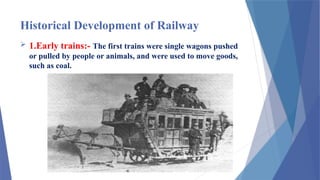
 1.Early trains:- The first trains were single wagons pushed
or pulled by people or animals, and were used to move goods,
such as coal.
Historical Development of Railway
 2.Steam locomotives :- Steam trains were the first type of
trains.
 steam locomotives are fueled by burning combustible material
—usually coal, wood, or oil—to produce steam in a boiler. The
steam is forced through powerful pistons to give the engine the
power to drive the wheels.
 The first steam locomotive was developed in Great Britain in
1804.
 At first, steam engines moved mainly goods, but were soon used
to carry passengers as well. Steam engines are still in use all
over the world, although most have been replaced by diesel or
electric trains.
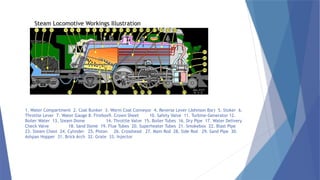
1. Water Compartment 2. Coal Bunker 3. Worm Coal Conveyor 4. Reverse Lever (Johnson Bar) 5. Stoker 6.
Throttle Lever 7. Water Gauge 8. Firebox9. Crown Sheet 10. Safety Valve 11. Turbine-Generator 12.
Boiler Water 13. Steam Dome 14. Throttle Valve 15. Boiler Tubes 16. Dry Pipe 17. Water Delivery
Check Valve 18. Sand Dome 19. Flue Tubes 20. Superheater Tubes 21. Smokebox 22. Blast Pipe
23. Steam Chest 24. Cylinder 25. Piston 26. Crosshead 27. Main Rod 28. Side Rod 29. Sand Pipe 30.
Ashpan Hopper 31. Brick Arch 32. Grate 33. Injector
Steam Locomotive Workings Illustration
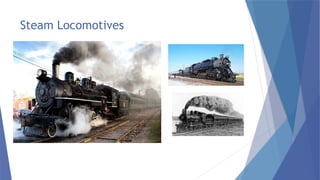
Steam Locomotives
Historical Development of Railway
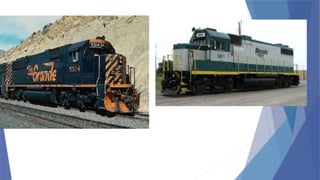
 3.Diesel locomotives:- Diesel locomotives were first
introduced in 1912 in Switzerland .
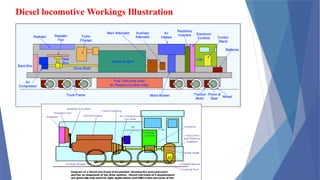
 They were a powerful addition to the railways. Diesel fuel
powers an engine which drives a generator to make
electricity.
 The electricity powers traction motors that turn the wheels.
 Diesel locomotives are used to transport enormous quantities
of materials over huge distances. They are also more efficient
and smoother than steam trains, and carry much heavier
loads.
Diesel locomotive Workings Illustration
Historical Development of Railway
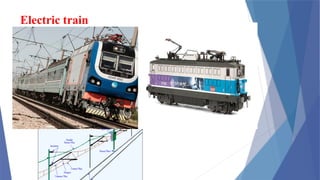
 4. Electric locomotives :- Passenger electric trains were
first introduced in the late 1870’s. The electric engine gets its
power from overhead wires or through an extra third rail.
However, building an electric line is expensive so these trains
are usually found in city areas where the route is busy enough
to pay for the expensive set-up.
 Electric trains are faster, quieter, and simpler to run than the
diesel train. Electric trains are also better for the environment
as they do not discharge exhaust fumes.
 The first electric passenger train was presented by
Werner von Siemens at Berlin in 1879.
Electric train
Historical Development of Railway
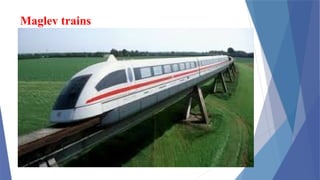
 5. Maglev trains:- derived from magnetic levitation
 is a transport method that uses magnetic levitation to move
vehicles without touching the ground
 Maglev trains do not use an engine to power them; instead they
run in a guideway with magnets in the track ahead of them that
move them along.
 Maglev trains are smooth, fast and environmentally friendly
giving off little noise or exhaust pollution. However, the track is
expensive and there are problems moving the trains from one
track to another.
 A Japanese magnetic levitation train has broken its own world
speed record, hitting 603km/h in a test run near Mount Fuji.
Maglev trains
Railway lines in the world
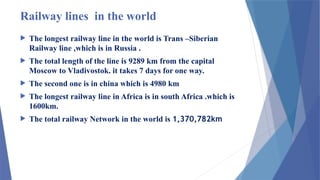
 The longest railway line in the world is Trans –Siberian
Railway line ,which is in Russia .
 The total length of the line is 9289 km from the capital
Moscow to Vladivostok. it takes 7 days for one way.
 The second one is in china which is 4980 km
 The longest railway line in Africa is in south Africa .which is
1600km.
 The total railway Network in the world is 1,370,782km
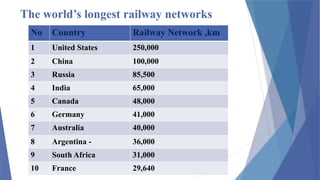
The world’s longest railway networks
No Country Railway Network ,km
1 United States 250,000
2 China 100,000
3 Russia 85,500
4 India 65,000
5 Canada 48,000
6 Germany 41,000
7 Australia 40,000
8 Argentina - 36,000
9 South Africa 31,000
10 France 29,640
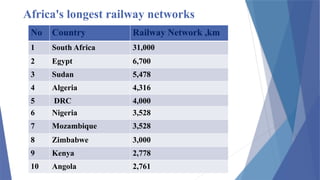
Africa's longest railway networks
No Country Railway Network ,km
1 South Africa 31,000
2 Egypt 6,700
3 Sudan 5,478
4 Algeria 4,316
5 DRC 4,000
6 Nigeria 3,528
7 Mozambique 3,528
8 Zimbabwe 3,000
9 Kenya 2,778
10 Angola 2,761
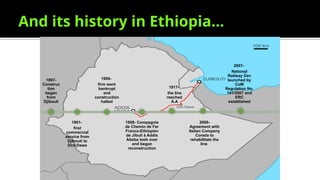
And its history in Ethiopia…
1897-
Construc
tion
began
from
Djibouti
1901-
first
commercial
service from
Djibouti to
Dire Dawa
1906-
firm went
bankrupt
and
construction
halted
1908- Compagnie
de Chemin de Fer
Franco-Ethiopien
de Jibuti à Addis
Abeba took over
and began
reconstruction
1917-
the line
reached
A.A
2006-
Agreement with
Italian Company
Consta to
rehabilitate the
line
2007-
National
Railway Dev
launched by
CoM
Regulation No.
141/2007 and
ERC
established
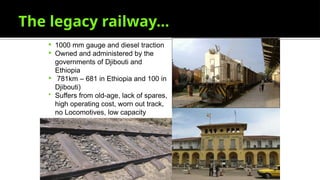
The legacy railway…
 1000 mm gauge and diesel traction
 Owned and administered by the
governments of Djibouti and
Ethiopia
 781km – 681 in Ethiopia and 100 in
Djibouti)
 Suffers from old-age, lack of spares,
high operating cost, worn out track,
no Locomotives, low capacity
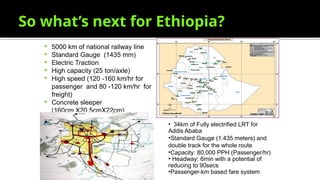
So what’s next for Ethiopia?
 5000 km of national railway line
 Standard Gauge (1435 mm)
 Electric Traction
 High capacity (25 ton/axle)
 High speed (120 -160 km/hr for
passenger and 80 -120 km/hr for
freight)
 Concrete sleeper
(160cm X20.5cmX22cm)
• 34km of Fully electrified LRT for
Addis Ababa
•Standard Gauge (1.435 meters) and
double track for the whole route
•Capacity: 80,000 PPH (Passenger/hr)
• Headway: 6min with a potential of
reducing to 90secs
•Passenger-km based fare system
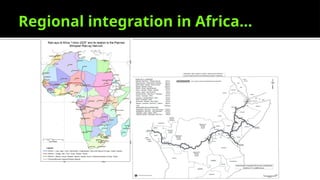
Regional integration in Africa…
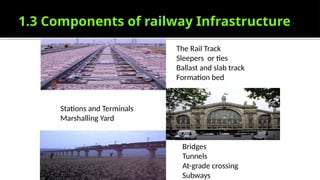
1.3 Components of railway Infrastructure
The Rail Track
Sleepers or ties
Ballast and slab track
Formation bed
Stations and Terminals
Marshalling Yard
Bridges
Tunnels
At-grade crossing
Subways
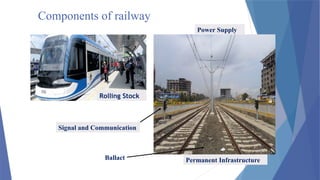
Components of railway
Rolling Stock
Signal and Communication
Permanent Infrastructure
Power Supply
Ballact
1.4 Classification of Railways
 Different countries use different criteria for classification
The most commonly used criterias are Speed and volume of fright.
A. Based on design speed;
- classified in to 7 categories (1-7)
B. Based on volume of fright;
- classified in to 5 groups (A-E)
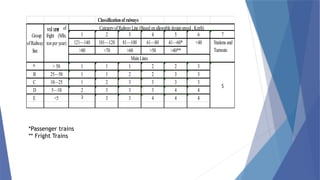
Using these groups and categories as a criteria, railway lines are divided in to 5
classes.
1 2 3 4 5 6 7
121—140 101—120 81—100 61—80 41—60*
>80 >70 >60 >50 >40**
A > 50 1 1 1 2 2 3
В 25—50 1 1 2 2 3 3
C 10—25 1 2 3 3 3 3
D 5—10 2 3 3 3 4 4
Е <5 3 3 3 4 4 4
5
Classificationof raiways
Group
ofRailway
line
volum
e of
fright (Mln.
tonper year)
CategoryofRailwayLine (Based onallowable designspeed , Km/h)
<40 Stations and
Turnouts
MainLines
*Passenger trains
** Fright Trains

Chapter One Basics Of Railway Engineering.pptx

  • 1.
    1. Basics OfRailway Engineering
  • 2.
    1.1 Railway Transportationsystem Railway…?  an engineered structure consisting of two metal guiding rails on which cars are self- propelled or pulled by a locomotive”.
  • 3.
    1.1 Railway Transportationsystem… The terms railway and railroad are sometimes used interchangeably Railway:- will generally refer to the track and other closely associated items, i.e., signals, crossings, bridges, etc. A railway consists of two parallel rail tracks at a fixed distance (gauge) apart, usually made of steel and mounted upon cross beams called ties or sleepers” Railroad :- will be used where the overall system.
  • 4.
    1.1 Railway Transportationsystem…  Railway engineering..?  Engineering involved in the planning, design, construction, operation and maintenance of railway land facilities used for the movement of people and goods serving the social and economic needs of contemporary society and its successors. The complete railway engineer is active in all aspects of civil engineering practice, surveying, geotechnics, hydrology, hydraulics, environmental and sanitary and structural design as well as construction technology.
  • 5.
    1.1 Railway Transportationsystem…  Why Railway?...(Advantages)  It has a high level of passenger or cargo utilization over a limited space  most efficient energy consumer  Minimum friction and minimum air resistance  environmentally friendly  Mostly electric powered  dense city agglomerations and mixed land use developments instead of sub-urban sprawl  Safest mode of land transport with the lowest accident rate  It offers comfortable ride options such as meal, sleeping and entertainment
  • 6.
    1.1 Railway Transportationsystem…  Draw Backs?…  Not so profitable considering the initial investment and operation costs  Cannot support severe alignments such as steep slopes and sharp curves  Low flexibility in terms of network operations  Severity of accidents is high  Security threat as it is prone to attacks
  • 7.
    1.2 Historical Developmentof Railways Where did it all begun?.. 1776- First cast iron rails on timber ties laid in tram ways in England 1630- Wagon roads for coal mines pulled by horse carts in Beaumont, England 1550’s - Hand propelled tubs in Germany
  • 9.
    The 19th century… 1863 -First underground railway opened in London 1857 - Steel rails first used in Britain 1830 - The first railway in the United States opens with mostly hardwood rail topped with iron 1807- first passenger train ran from Swansea to Mumbles and first railway station
  • 10.
    20th century and onwards… PostWWII- Welded rail, heavier rail-profiles, slab track, innovative elastic fastenings, mechanization of maintenance 1959- Construction of the Bullet train in Tokyo, Japan 1937-41 - Magnetic levitation (maglev) train patents awarded in Germany 1906- First use of concrete sleepers in Germany
  • 11.
    Historical Development ofRailway  1.Early trains:- The first trains were single wagons pushed or pulled by people or animals, and were used to move goods, such as coal.
  • 12.
    Historical Development ofRailway  2.Steam locomotives :- Steam trains were the first type of trains.  steam locomotives are fueled by burning combustible material —usually coal, wood, or oil—to produce steam in a boiler. The steam is forced through powerful pistons to give the engine the power to drive the wheels.  The first steam locomotive was developed in Great Britain in 1804.  At first, steam engines moved mainly goods, but were soon used to carry passengers as well. Steam engines are still in use all over the world, although most have been replaced by diesel or electric trains.
  • 13.
    1. Water Compartment2. Coal Bunker 3. Worm Coal Conveyor 4. Reverse Lever (Johnson Bar) 5. Stoker 6. Throttle Lever 7. Water Gauge 8. Firebox9. Crown Sheet 10. Safety Valve 11. Turbine-Generator 12. Boiler Water 13. Steam Dome 14. Throttle Valve 15. Boiler Tubes 16. Dry Pipe 17. Water Delivery Check Valve 18. Sand Dome 19. Flue Tubes 20. Superheater Tubes 21. Smokebox 22. Blast Pipe 23. Steam Chest 24. Cylinder 25. Piston 26. Crosshead 27. Main Rod 28. Side Rod 29. Sand Pipe 30. Ashpan Hopper 31. Brick Arch 32. Grate 33. Injector Steam Locomotive Workings Illustration
  • 14.
  • 15.
    Historical Development ofRailway  3.Diesel locomotives:- Diesel locomotives were first introduced in 1912 in Switzerland .  They were a powerful addition to the railways. Diesel fuel powers an engine which drives a generator to make electricity.  The electricity powers traction motors that turn the wheels.  Diesel locomotives are used to transport enormous quantities of materials over huge distances. They are also more efficient and smoother than steam trains, and carry much heavier loads.
  • 16.
  • 18.
    Historical Development ofRailway  4. Electric locomotives :- Passenger electric trains were first introduced in the late 1870’s. The electric engine gets its power from overhead wires or through an extra third rail. However, building an electric line is expensive so these trains are usually found in city areas where the route is busy enough to pay for the expensive set-up.  Electric trains are faster, quieter, and simpler to run than the diesel train. Electric trains are also better for the environment as they do not discharge exhaust fumes.  The first electric passenger train was presented by Werner von Siemens at Berlin in 1879.
  • 19.
  • 20.
    Historical Development ofRailway  5. Maglev trains:- derived from magnetic levitation  is a transport method that uses magnetic levitation to move vehicles without touching the ground  Maglev trains do not use an engine to power them; instead they run in a guideway with magnets in the track ahead of them that move them along.  Maglev trains are smooth, fast and environmentally friendly giving off little noise or exhaust pollution. However, the track is expensive and there are problems moving the trains from one track to another.  A Japanese magnetic levitation train has broken its own world speed record, hitting 603km/h in a test run near Mount Fuji.
  • 21.
  • 22.
    Railway lines inthe world  The longest railway line in the world is Trans –Siberian Railway line ,which is in Russia .  The total length of the line is 9289 km from the capital Moscow to Vladivostok. it takes 7 days for one way.  The second one is in china which is 4980 km  The longest railway line in Africa is in south Africa .which is 1600km.  The total railway Network in the world is 1,370,782km
  • 23.
    The world’s longestrailway networks No Country Railway Network ,km 1 United States 250,000 2 China 100,000 3 Russia 85,500 4 India 65,000 5 Canada 48,000 6 Germany 41,000 7 Australia 40,000 8 Argentina - 36,000 9 South Africa 31,000 10 France 29,640
  • 24.
    Africa's longest railwaynetworks No Country Railway Network ,km 1 South Africa 31,000 2 Egypt 6,700 3 Sudan 5,478 4 Algeria 4,316 5 DRC 4,000 6 Nigeria 3,528 7 Mozambique 3,528 8 Zimbabwe 3,000 9 Kenya 2,778 10 Angola 2,761
  • 25.
    And its historyin Ethiopia… 1897- Construc tion began from Djibouti 1901- first commercial service from Djibouti to Dire Dawa 1906- firm went bankrupt and construction halted 1908- Compagnie de Chemin de Fer Franco-Ethiopien de Jibuti à Addis Abeba took over and began reconstruction 1917- the line reached A.A 2006- Agreement with Italian Company Consta to rehabilitate the line 2007- National Railway Dev launched by CoM Regulation No. 141/2007 and ERC established
  • 26.
    The legacy railway… 1000 mm gauge and diesel traction  Owned and administered by the governments of Djibouti and Ethiopia  781km – 681 in Ethiopia and 100 in Djibouti)  Suffers from old-age, lack of spares, high operating cost, worn out track, no Locomotives, low capacity
  • 27.
    So what’s nextfor Ethiopia?  5000 km of national railway line  Standard Gauge (1435 mm)  Electric Traction  High capacity (25 ton/axle)  High speed (120 -160 km/hr for passenger and 80 -120 km/hr for freight)  Concrete sleeper (160cm X20.5cmX22cm) • 34km of Fully electrified LRT for Addis Ababa •Standard Gauge (1.435 meters) and double track for the whole route •Capacity: 80,000 PPH (Passenger/hr) • Headway: 6min with a potential of reducing to 90secs •Passenger-km based fare system
  • 28.
  • 29.
    1.3 Components ofrailway Infrastructure The Rail Track Sleepers or ties Ballast and slab track Formation bed Stations and Terminals Marshalling Yard Bridges Tunnels At-grade crossing Subways
  • 30.
    Components of railway RollingStock Signal and Communication Permanent Infrastructure Power Supply Ballact
  • 31.
    1.4 Classification ofRailways  Different countries use different criteria for classification The most commonly used criterias are Speed and volume of fright. A. Based on design speed; - classified in to 7 categories (1-7) B. Based on volume of fright; - classified in to 5 groups (A-E) Using these groups and categories as a criteria, railway lines are divided in to 5 classes.
  • 32.
    1 2 34 5 6 7 121—140 101—120 81—100 61—80 41—60* >80 >70 >60 >50 >40** A > 50 1 1 1 2 2 3 В 25—50 1 1 2 2 3 3 C 10—25 1 2 3 3 3 3 D 5—10 2 3 3 3 4 4 Е <5 3 3 3 4 4 4 5 Classificationof raiways Group ofRailway line volum e of fright (Mln. tonper year) CategoryofRailwayLine (Based onallowable designspeed , Km/h) <40 Stations and Turnouts MainLines *Passenger trains ** Fright Trains