Presentation on
Development of Biscuit Product Using ‘Ragi Flour’
INTRODUCTION
 Millets are group of small food grains compared to common food grains which are cultivated in semi arid areas.
 Millets grains are rich in several nutrition, antioxidants, phytochemicals and micronutrients (Mal et al,2010, Singh et
al 2012)
 The presence of all the required nutrients in millets makes them suitable for large-scale utilization in the
manufacture of food products such as baby foods, snack foods and dietary supplements. (Subramanian et al.,
2007;Liu et al., 2012)
 Millets are rich source of fibre protein minerals irons calcium and have low glycemic index.
 A variety of millets are grown in different regions; like pearl millet, sorghum, foxtail millet, proso millet and finger
millet, kodo millet
 India, China and Nigeria are largest producer of millets (55 percent). In India production of millets has increased
from 14.52 million tons in 2015 – 16 to 17.96 tons in 2020-21. (DA and FW, 2022)
 Production of millets in Chhattisgarh are Kodo Millets, kutki, ragi are produced in around 20 districts of state.
 Target crop production area at 2022-23 has been set at 1.17 lac, at present covers 69000 ha, under millet mission.
Scope of Millet Biscuit
 Bakery industry in stood at value nearly 7.6 billion dollar in 2020, its estimated to grow nearly 12.39 billion dollar by
2026.
 Rapid urbanization involving changes in occupation patterns, life styles, family structures and value system reflected
as changes in practices and in the level of physical activity. A large shift from consumption of coarse grains such as
sorghum, barley, rye, maize and millet to more refined cereals, like polished rice and wheat is seen especially
among the urban population and higher income groups (Vijayakumar et al., 2009).
 The presence of all the required nutrients in millets makes them suitable for large-scale utilization in the
manufacture of food products such as baby foods, snack foods and dietary supplements and, increasingly, millet
wine ,millet biscuits and millet mixes (Subramanian et al., 2007;Liu et al., 2012)
 Scope to enhance the nutritional value of biscuits both quantitatively and qualitatively using nutritious food
ingredients.
 Preparation of biscuit from millets and its fortification with other nutritious ingredients will result in increased
utilization of millet and production of nutritious biscuits (Kumar et al., 2010)
Finger millet
[Kumar et al, S. Nithiyanantham, P. Kalaiselvi 2019]
S no Composition Finger Millet flour Wheat flour
1. Carbohydrate 77.5% 71.2%
2. Fibre 5.5 % 1.2%
3. Protein 9.8 % 11.8
4. Fat 1 to 1.7% 1.93
5. Minerals 2.7% 1.5
6. Energy 328 kcal/100 gm 348 kcal/100 gm
8. Calcium 344 mg/100 gm 41 mg/100 gm
9. Glysemic index 54 - 68 68 - 84
Composite flour v/s refined flour
s. no. Composition (g) Millet composite flour
(millet + wheat flour)
Wheat Flour
1. Moisture 7.82 8.55
2. Protein 13.75 13.00
3. Fat 5.30 1.93
4. Ash 2.30 1.55
5. Crude fibre 3.57 2.87
6. Total dietary fibre 26.65 23.48
7. Carbohydrate 71.34 74.39
8. Energy (kcal) 389.52 367
[Jyoti M Rathod and Sarojini JK,2018]
Health Benefits
1. Gluten free biscuits rich in iron content and had the highest overall acceptability
2. Millets have been proven to be superior to wheat and rice grains accounting to its various beneficial
attributes. Millets are reported to be rich in protein, fiber, calcium and iron and the flavonoids present in
them exhibit therapeutic properties such as anti-inflammatory, diuretic, anti-cancer and antihypertensive
activities (S. Saleh, Q. Zhang, J. Chen, et al.2013)
3. Macro and micronutrients such as iron, zinc, copper, potassium manganese, phosphorous (Manivannan
Selladurai et al 2022).
4. The protein digestibility is also the highest for this grain due to reduced number of cross linked prolamins.
After pearl and foxtail millet (S. Rathore, K. Singh, V et al 2016)
5. Finger millet is rich in micronutrients especially the calcium (364 mg) is significantly higher compared to
other cereals which range between 8.9–39 mg (N.A. Gowda, K. Siliveru, P et al 2022)
6. Useful as anti diabetes and high blood pressure.
7. Natural weight loss, anti ageing, good for hair, bones due to high calcium, good for hemoglobin level
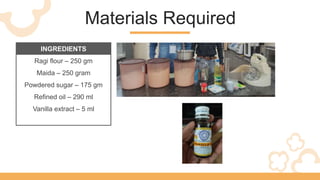
Materials Required
INGREDIENTS
Ragi flour – 250 gm
Maida – 250 gram
Powdered sugar – 175 gm
Refined oil – 290 ml
Vanilla extract – 5 ml
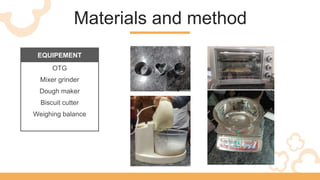
Materials and method
EQUIPEMENT
OTG
Mixer grinder
Dough maker
Biscuit cutter
Weighing balance
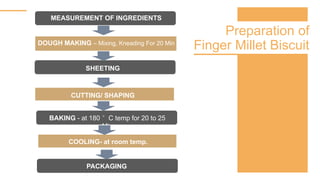
Preparation of
Finger Millet Biscuit
MEASUREMENT OF INGREDIENTS
DOUGH MAKING – Mixing, Kneading For 20 Min
SHEETING
CUTTING/ SHAPING
BAKING - at 180 °C temp for 20 to 25
Min
PACKAGING
COOLING- at room temp.
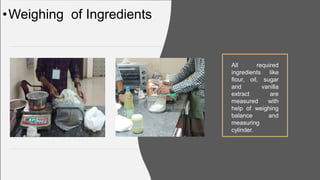
•Weighing of Ingredients
All required
ingredients like
flour, oil, sugar
and vanilla
extract are
measured with
help of weighing
balance and
measuring
cylinder.
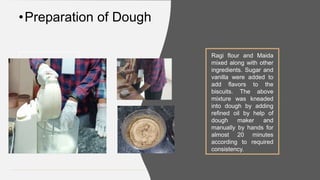
•Preparation of Dough
Ragi flour and Maida
mixed along with other
ingredients. Sugar and
vanilla were added to
add flavors to the
biscuits. The above
mixture was kneaded
into dough by adding
refined oil by help of
dough maker and
manually by hands for
almost 20 minutes
according to required
consistency.
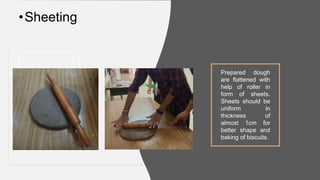
•Sheeting
Prepared dough
are flattened with
help of roller in
form of sheets.
Sheets should be
uniform in
thickness of
almost 1cm for
better shape and
baking of biscuits.
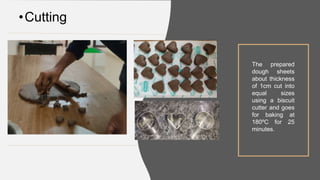
•Cutting
The prepared
dough sheets
about thickness
of 1cm cut into
equal sizes
using a biscuit
cutter and goes
for baking at
180ºC for 25
minutes.
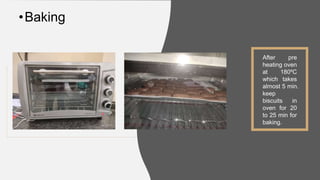
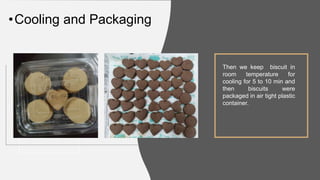
•Baking
After pre
heating oven
at 180ºC
which takes
almost 5 min.
keep
biscuits in
oven for 20
to 25 min for
baking.
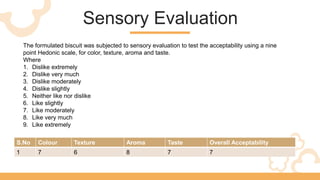
•Cooling and Packaging
Then we keep biscuit in
room temperature for
cooling for 5 to 10 min and
then biscuits were
packaged in air tight plastic
container.
Sensory Evaluation
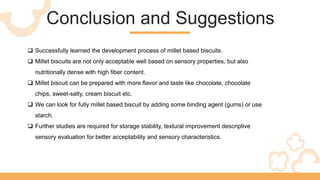
The formulated biscuit was subjected to sensory evaluation to test the acceptability using a nine
point Hedonic scale, for color, texture, aroma and taste.
Where
1. Dislike extremely
2. Dislike very much
3. Dislike moderately
4. Dislike slightly
5. Neither like nor dislike
6. Like slightly
7. Like moderately
8. Like very much
9. Like extremely
S.No Colour Texture Aroma Taste Overall Acceptability
1 7 6 8 7 7
Conclusion and Suggestions
 Successfully learned the development process of millet based biscuits.
 Millet biscuits are not only acceptable well based on sensory properties, but also
nutritionally dense with high fiber content.
 Millet biscuit can be prepared with more flavor and taste like chocolate, chocolate
chips, sweet-salty, cream biscuit etc.
 We can look for fully millet based biscuit by adding some binding agent (gums) or use
starch.
 Further studies are required for storage stability, textural improvement descriptive
sensory evaluation for better acceptability and sensory characteristics.
Thank you
RAGI BISCUIT

Ragi Cookies preparation

  • 1.
    Presentation on Development ofBiscuit Product Using ‘Ragi Flour’
  • 2.
    INTRODUCTION  Millets aregroup of small food grains compared to common food grains which are cultivated in semi arid areas.  Millets grains are rich in several nutrition, antioxidants, phytochemicals and micronutrients (Mal et al,2010, Singh et al 2012)  The presence of all the required nutrients in millets makes them suitable for large-scale utilization in the manufacture of food products such as baby foods, snack foods and dietary supplements. (Subramanian et al., 2007;Liu et al., 2012)  Millets are rich source of fibre protein minerals irons calcium and have low glycemic index.  A variety of millets are grown in different regions; like pearl millet, sorghum, foxtail millet, proso millet and finger millet, kodo millet  India, China and Nigeria are largest producer of millets (55 percent). In India production of millets has increased from 14.52 million tons in 2015 – 16 to 17.96 tons in 2020-21. (DA and FW, 2022)  Production of millets in Chhattisgarh are Kodo Millets, kutki, ragi are produced in around 20 districts of state.  Target crop production area at 2022-23 has been set at 1.17 lac, at present covers 69000 ha, under millet mission.
  • 3.
    Scope of MilletBiscuit  Bakery industry in stood at value nearly 7.6 billion dollar in 2020, its estimated to grow nearly 12.39 billion dollar by 2026.  Rapid urbanization involving changes in occupation patterns, life styles, family structures and value system reflected as changes in practices and in the level of physical activity. A large shift from consumption of coarse grains such as sorghum, barley, rye, maize and millet to more refined cereals, like polished rice and wheat is seen especially among the urban population and higher income groups (Vijayakumar et al., 2009).  The presence of all the required nutrients in millets makes them suitable for large-scale utilization in the manufacture of food products such as baby foods, snack foods and dietary supplements and, increasingly, millet wine ,millet biscuits and millet mixes (Subramanian et al., 2007;Liu et al., 2012)  Scope to enhance the nutritional value of biscuits both quantitatively and qualitatively using nutritious food ingredients.  Preparation of biscuit from millets and its fortification with other nutritious ingredients will result in increased utilization of millet and production of nutritious biscuits (Kumar et al., 2010)
  • 4.
    Finger millet [Kumar etal, S. Nithiyanantham, P. Kalaiselvi 2019] S no Composition Finger Millet flour Wheat flour 1. Carbohydrate 77.5% 71.2% 2. Fibre 5.5 % 1.2% 3. Protein 9.8 % 11.8 4. Fat 1 to 1.7% 1.93 5. Minerals 2.7% 1.5 6. Energy 328 kcal/100 gm 348 kcal/100 gm 8. Calcium 344 mg/100 gm 41 mg/100 gm 9. Glysemic index 54 - 68 68 - 84
  • 5.
    Composite flour v/srefined flour s. no. Composition (g) Millet composite flour (millet + wheat flour) Wheat Flour 1. Moisture 7.82 8.55 2. Protein 13.75 13.00 3. Fat 5.30 1.93 4. Ash 2.30 1.55 5. Crude fibre 3.57 2.87 6. Total dietary fibre 26.65 23.48 7. Carbohydrate 71.34 74.39 8. Energy (kcal) 389.52 367 [Jyoti M Rathod and Sarojini JK,2018]
  • 6.
    Health Benefits 1. Glutenfree biscuits rich in iron content and had the highest overall acceptability 2. Millets have been proven to be superior to wheat and rice grains accounting to its various beneficial attributes. Millets are reported to be rich in protein, fiber, calcium and iron and the flavonoids present in them exhibit therapeutic properties such as anti-inflammatory, diuretic, anti-cancer and antihypertensive activities (S. Saleh, Q. Zhang, J. Chen, et al.2013) 3. Macro and micronutrients such as iron, zinc, copper, potassium manganese, phosphorous (Manivannan Selladurai et al 2022). 4. The protein digestibility is also the highest for this grain due to reduced number of cross linked prolamins. After pearl and foxtail millet (S. Rathore, K. Singh, V et al 2016) 5. Finger millet is rich in micronutrients especially the calcium (364 mg) is significantly higher compared to other cereals which range between 8.9–39 mg (N.A. Gowda, K. Siliveru, P et al 2022) 6. Useful as anti diabetes and high blood pressure. 7. Natural weight loss, anti ageing, good for hair, bones due to high calcium, good for hemoglobin level
  • 7.
    Materials Required INGREDIENTS Ragi flour– 250 gm Maida – 250 gram Powdered sugar – 175 gm Refined oil – 290 ml Vanilla extract – 5 ml
  • 8.
    Materials and method EQUIPEMENT OTG Mixergrinder Dough maker Biscuit cutter Weighing balance
  • 9.
    Preparation of Finger MilletBiscuit MEASUREMENT OF INGREDIENTS DOUGH MAKING – Mixing, Kneading For 20 Min SHEETING CUTTING/ SHAPING BAKING - at 180 °C temp for 20 to 25 Min PACKAGING COOLING- at room temp.
  • 10.
    •Weighing of Ingredients Allrequired ingredients like flour, oil, sugar and vanilla extract are measured with help of weighing balance and measuring cylinder.
  • 11.
    •Preparation of Dough Ragiflour and Maida mixed along with other ingredients. Sugar and vanilla were added to add flavors to the biscuits. The above mixture was kneaded into dough by adding refined oil by help of dough maker and manually by hands for almost 20 minutes according to required consistency.
  • 12.
    •Sheeting Prepared dough are flattenedwith help of roller in form of sheets. Sheets should be uniform in thickness of almost 1cm for better shape and baking of biscuits.
  • 13.
    •Cutting The prepared dough sheets aboutthickness of 1cm cut into equal sizes using a biscuit cutter and goes for baking at 180ºC for 25 minutes.
  • 14.
    •Baking After pre heating oven at180ºC which takes almost 5 min. keep biscuits in oven for 20 to 25 min for baking.
  • 15.
    •Cooling and Packaging Thenwe keep biscuit in room temperature for cooling for 5 to 10 min and then biscuits were packaged in air tight plastic container.
  • 16.
    Sensory Evaluation The formulatedbiscuit was subjected to sensory evaluation to test the acceptability using a nine point Hedonic scale, for color, texture, aroma and taste. Where 1. Dislike extremely 2. Dislike very much 3. Dislike moderately 4. Dislike slightly 5. Neither like nor dislike 6. Like slightly 7. Like moderately 8. Like very much 9. Like extremely S.No Colour Texture Aroma Taste Overall Acceptability 1 7 6 8 7 7
  • 17.
    Conclusion and Suggestions Successfully learned the development process of millet based biscuits.  Millet biscuits are not only acceptable well based on sensory properties, but also nutritionally dense with high fiber content.  Millet biscuit can be prepared with more flavor and taste like chocolate, chocolate chips, sweet-salty, cream biscuit etc.  We can look for fully millet based biscuit by adding some binding agent (gums) or use starch.  Further studies are required for storage stability, textural improvement descriptive sensory evaluation for better acceptability and sensory characteristics.
  • 18.