

RADIOTHERAPY
PLANNING IN
CARCINOMA
URINARY BLADDER
DR. RASHMI
INCIDENCE
• It is 11th most common cancer in the world among males
with an
Incidence rate- 4.5%
Mortality rate- 2.8%
• Men have 3-4 times higher risk of Ca UB than women.
• Median age of diagnosis – 70 years.
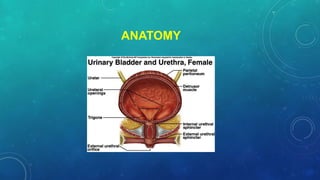
ANATOMY
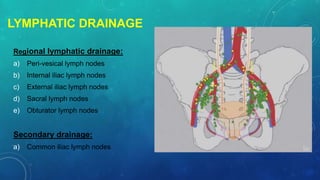
LYMPHATIC DRAINAGE
Regional lymphatic drainage:
a) Peri-vesical lymph nodes
b) Internal iliac lymph nodes
c) External iliac lymph nodes
d) Sacral lymph nodes
e) Obturator lymph nodes
Secondary drainage:
a) Common iliac lymph nodes
EPIDEMIOLOGY
• Median age is 70 yrs.
• Common in males than females
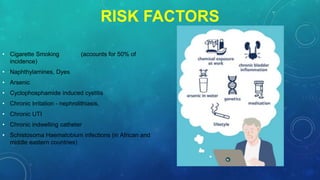
RISK FACTORS
• Cigarette Smoking (accounts for 50% of
incidence)
• Naphthylamines, Dyes
• Arsenic
• Cyclophosphamide induced cystitis
• Chronic Irritation - nephrolithiasis,
• Chronic UTI
• Chronic indwelling catheter
• Schistosoma Haematobium infections (in African and
middle eastern countries)
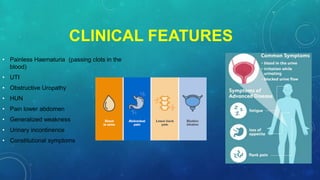
CLINICAL FEATURES
• Painless Haematuria (passing clots in the
blood)
• UTI
• Obstructive Uropathy
• HUN
• Pain lower abdomen
• Generalized weakness
• Urinary incontinence
• Constitutional symptoms
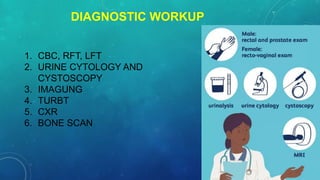
DIAGNOSTIC WORKUP
1. CBC, RFT, LFT
2. URINE CYTOLOGY AND
CYSTOSCOPY
3. IMAGUNG
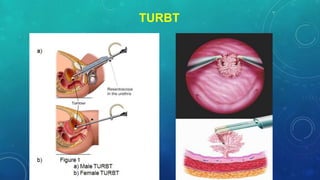
4. TURBT
5. CXR
6. BONE SCAN
TURBT
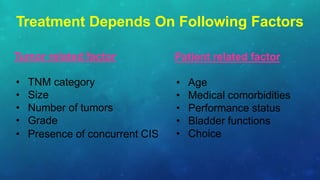
Treatment Depends On Following Factors
Tumor related factor
• TNM category
• Size
• Number of tumors
• Grade
• Presence of concurrent CIS
Patient related factor
• Age
• Medical comorbidities
• Performance status
• Bladder functions
• Choice
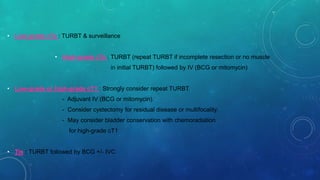
• Low-grade cTa : TURBT & surveillance
• High-grade cTa : TURBT (repeat TURBT if incomplete resection or no muscle
in initial TURBT) followed by IV (BCG or mitomycin)
• Low-grade or high-grade cT1 : Strongly consider repeat TURBT.
- Adjuvant IV (BCG or mitomycin).
- Consider cystectomy for residual disease or multifocality.
- May consider bladder conservation with chemoradiation
for high-grade cT1
• Tis : TURBT followed by BCG +/- IVC
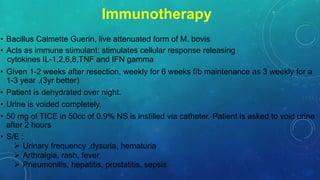
Immunotherapy
• Bacillus Calmette Guerin, live attenuated form of M. bovis
• Acts as immune stimulant: stimulates cellular response releasing
cytokines IL-1,2,6,8,TNF and IFN gamma
• Given 1-2 weeks after resection, weekly for 6 weeks f/b maintenance as 3 weekly for a
1-3 year .(3yr better)
• Patient is dehydrated over night.
• Urine is voided completely.
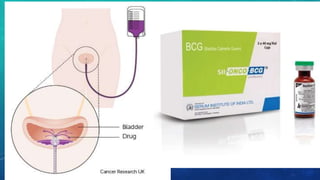
• 50 mg of TICE in 50cc of 0.9% NS is instilled via catheter. Patient is asked to void urine
after 2 hours
• S/E :
 Urinary frequency ,dysuria, hematuria
 Arthralgia, rash, fever
 Pneumonitis, hepatitis, prostatitis, sepsis
Intravesical Chemotherapy
• Chemotherapeutic agents used are
- Mitomycin C,
- Doxorubicin, and
- Gemcitabine.
• Similar efficacy in prolonging time to recurrence.
• Can be used in sequencing with IV BCG
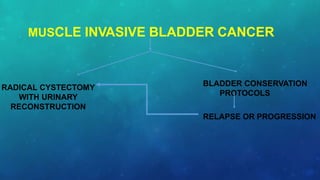
Treatment options: Muscle Invasive Bladder Cancer - MIBC
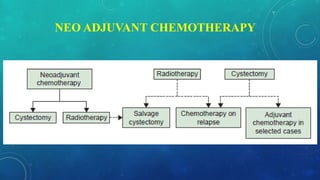
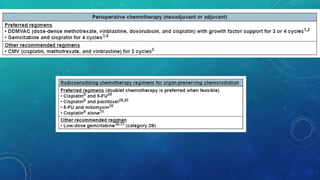
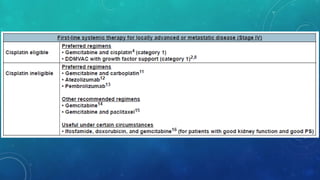
• Neoadjuvant cisplatin-based chemo → radical cystectomy
• Neoadjuvant cisplatin-based chemo → partial cystectomy (selected patients with
small solitary lesion in suitable location and no Tis)
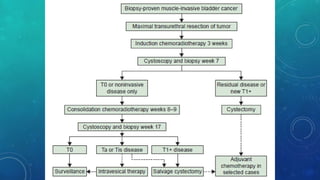
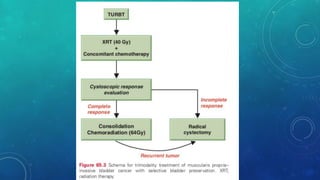
Bladder Preservation with chemo-RT after maximal TURBT. Optimal candidates are:
a) Unifocal, <5 cm,
b) No hydronephrosis,
c) good bladder function,
d) Visibly complete TURBT
e) Consider bladder preservation as a option for all appropriate patients
RT alone (if nonsurgical/not a chemo candidate)
MUSCLE INVASIVE BLADDER CANCER
RADICAL CYSTECTOMY
WITH URINARY
RECONSTRUCTION
BLADDER CONSERVATION
PROTOCOLS
RELAPSE OR PROGRESSION
NEO ADJUVANT CHEMOTHERAPY
RADIOTHERAPY
• Radiation treatment should begin within 8 weeks after maximal TURBT.
• CT simulation: Patient supine with immobilization and empty bladder.
• Treat with empty bladder to ensure reproducibility of bladder volume.
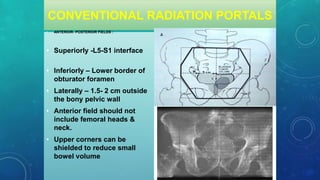
CONVENTIONAL RADIATION PORTALS
• ANTERIOR- POSTERIOR FIELDS :
• Superiorly -L5-S1 interface
• Inferiorly – Lower border of
obturator foramen
• Laterally – 1.5- 2 cm outside
the bony pelvic wall
• Anterior field should not
include femoral heads &
neck.
• Upper corners can be
shielded to reduce small
bowel volume.
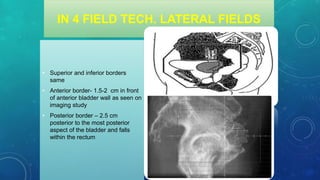
IN 4 FIELD TECH. LATERAL FIELDS
• Superior and inferior borders
same
• Anterior border- 1.5-2 cm in front
of anterior bladder wall as seen on
imaging study
• Posterior border – 2.5 cm
posterior to the most posterior
aspect of the bladder and falls
within the rectum
TWO PHASE APPROACH
Phase I -
• The whole pelvis
• The pelvic lymph nodes
To include
• The whole Bladder
• Proximal urethra
• Any extravesical disease spread
• Any region deemed to be at risk of microscopic disease spread.
BOOST FIELDS
Phase II
• Either The whole bladder or
• Only the involved part of bladder with at least 2 cm
margin
• Techniques
1) 2 lateral fields
2) oblique fields
POST-OP FOR PT3-4 PN0-2
• CTV nodal (all patients, excluding cystectomy bed for negative margins):
obturator, external iliac, internal iliac, distal common iliac, and presacral.
• CTV cystectomy bed included only for +margins.
• PTV includes 0.5–0.7 cm expansion.
RADIOTHERAPY DOSE
T1 high-risk [ CTRT
• PTV - 45 Gy,
• boost up to 61.2 Gy
Bladder preservation.
• PTV - 40–45 Gy, then cone down
• PTV bladder - 54 Gy, then cone down
• PTV tumor bed - 64.8 Gy [with concurrent chemo]
Post-op - pT3-4 pN0-2:
• Pelvic nodes (and cystectomy bed if +margins) to 50.4 Gy.
• Local recurrence after cystectomy
• 45–50 Gy to pelvic nodes,
• 60–65 Gy to gross local recurrence with cisplatin
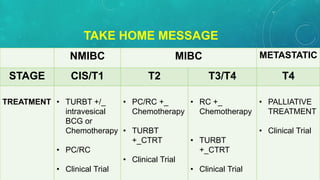
TAKE HOME MESSAGE
NMIBC MIBC METASTATIC
STAGE CIS/T1 T2 T3/T4 T4
TREATMENT • TURBT +/_
intravesical
BCG or
Chemotherapy
• PC/RC
• Clinical Trial
• PC/RC +_
Chemotherapy
• TURBT
+_CTRT
• Clinical Trial
• RC +_
Chemotherapy
• TURBT
+_CTRT
• Clinical Trial
• PALLIATIVE
TREATMENT
• Clinical Trial
THANK YOU

Radiotherapy planning in carcinoma urinary bladder

  • 1.
  • 2.
    INCIDENCE • It is11th most common cancer in the world among males with an Incidence rate- 4.5% Mortality rate- 2.8% • Men have 3-4 times higher risk of Ca UB than women. • Median age of diagnosis – 70 years.
  • 3.
  • 4.
    LYMPHATIC DRAINAGE Regional lymphaticdrainage: a) Peri-vesical lymph nodes b) Internal iliac lymph nodes c) External iliac lymph nodes d) Sacral lymph nodes e) Obturator lymph nodes Secondary drainage: a) Common iliac lymph nodes
  • 5.
    EPIDEMIOLOGY • Median ageis 70 yrs. • Common in males than females
  • 6.
    RISK FACTORS • CigaretteSmoking (accounts for 50% of incidence) • Naphthylamines, Dyes • Arsenic • Cyclophosphamide induced cystitis • Chronic Irritation - nephrolithiasis, • Chronic UTI • Chronic indwelling catheter • Schistosoma Haematobium infections (in African and middle eastern countries)
  • 7.
    CLINICAL FEATURES • PainlessHaematuria (passing clots in the blood) • UTI • Obstructive Uropathy • HUN • Pain lower abdomen • Generalized weakness • Urinary incontinence • Constitutional symptoms
  • 13.
    DIAGNOSTIC WORKUP 1. CBC,RFT, LFT 2. URINE CYTOLOGY AND CYSTOSCOPY 3. IMAGUNG 4. TURBT 5. CXR 6. BONE SCAN
  • 14.
  • 15.
    Treatment Depends OnFollowing Factors Tumor related factor • TNM category • Size • Number of tumors • Grade • Presence of concurrent CIS Patient related factor • Age • Medical comorbidities • Performance status • Bladder functions • Choice
  • 16.
    • Low-grade cTa: TURBT & surveillance • High-grade cTa : TURBT (repeat TURBT if incomplete resection or no muscle in initial TURBT) followed by IV (BCG or mitomycin) • Low-grade or high-grade cT1 : Strongly consider repeat TURBT. - Adjuvant IV (BCG or mitomycin). - Consider cystectomy for residual disease or multifocality. - May consider bladder conservation with chemoradiation for high-grade cT1 • Tis : TURBT followed by BCG +/- IVC
  • 17.
    Immunotherapy • Bacillus CalmetteGuerin, live attenuated form of M. bovis • Acts as immune stimulant: stimulates cellular response releasing cytokines IL-1,2,6,8,TNF and IFN gamma • Given 1-2 weeks after resection, weekly for 6 weeks f/b maintenance as 3 weekly for a 1-3 year .(3yr better) • Patient is dehydrated over night. • Urine is voided completely. • 50 mg of TICE in 50cc of 0.9% NS is instilled via catheter. Patient is asked to void urine after 2 hours • S/E :  Urinary frequency ,dysuria, hematuria  Arthralgia, rash, fever  Pneumonitis, hepatitis, prostatitis, sepsis
  • 19.
    Intravesical Chemotherapy • Chemotherapeuticagents used are - Mitomycin C, - Doxorubicin, and - Gemcitabine. • Similar efficacy in prolonging time to recurrence. • Can be used in sequencing with IV BCG
  • 20.
    Treatment options: MuscleInvasive Bladder Cancer - MIBC • Neoadjuvant cisplatin-based chemo → radical cystectomy • Neoadjuvant cisplatin-based chemo → partial cystectomy (selected patients with small solitary lesion in suitable location and no Tis) Bladder Preservation with chemo-RT after maximal TURBT. Optimal candidates are: a) Unifocal, <5 cm, b) No hydronephrosis, c) good bladder function, d) Visibly complete TURBT e) Consider bladder preservation as a option for all appropriate patients RT alone (if nonsurgical/not a chemo candidate)
  • 21.
    MUSCLE INVASIVE BLADDERCANCER RADICAL CYSTECTOMY WITH URINARY RECONSTRUCTION BLADDER CONSERVATION PROTOCOLS RELAPSE OR PROGRESSION
  • 24.
  • 27.
    RADIOTHERAPY • Radiation treatmentshould begin within 8 weeks after maximal TURBT. • CT simulation: Patient supine with immobilization and empty bladder. • Treat with empty bladder to ensure reproducibility of bladder volume.
  • 28.
    CONVENTIONAL RADIATION PORTALS •ANTERIOR- POSTERIOR FIELDS : • Superiorly -L5-S1 interface • Inferiorly – Lower border of obturator foramen • Laterally – 1.5- 2 cm outside the bony pelvic wall • Anterior field should not include femoral heads & neck. • Upper corners can be shielded to reduce small bowel volume.
  • 29.
    IN 4 FIELDTECH. LATERAL FIELDS • Superior and inferior borders same • Anterior border- 1.5-2 cm in front of anterior bladder wall as seen on imaging study • Posterior border – 2.5 cm posterior to the most posterior aspect of the bladder and falls within the rectum
  • 30.
    TWO PHASE APPROACH PhaseI - • The whole pelvis • The pelvic lymph nodes To include • The whole Bladder • Proximal urethra • Any extravesical disease spread • Any region deemed to be at risk of microscopic disease spread.
  • 31.
    BOOST FIELDS Phase II •Either The whole bladder or • Only the involved part of bladder with at least 2 cm margin • Techniques 1) 2 lateral fields 2) oblique fields
  • 32.
    POST-OP FOR PT3-4PN0-2 • CTV nodal (all patients, excluding cystectomy bed for negative margins): obturator, external iliac, internal iliac, distal common iliac, and presacral. • CTV cystectomy bed included only for +margins. • PTV includes 0.5–0.7 cm expansion.
  • 33.
    RADIOTHERAPY DOSE T1 high-risk[ CTRT • PTV - 45 Gy, • boost up to 61.2 Gy Bladder preservation. • PTV - 40–45 Gy, then cone down • PTV bladder - 54 Gy, then cone down • PTV tumor bed - 64.8 Gy [with concurrent chemo] Post-op - pT3-4 pN0-2: • Pelvic nodes (and cystectomy bed if +margins) to 50.4 Gy. • Local recurrence after cystectomy • 45–50 Gy to pelvic nodes, • 60–65 Gy to gross local recurrence with cisplatin
  • 34.
    TAKE HOME MESSAGE NMIBCMIBC METASTATIC STAGE CIS/T1 T2 T3/T4 T4 TREATMENT • TURBT +/_ intravesical BCG or Chemotherapy • PC/RC • Clinical Trial • PC/RC +_ Chemotherapy • TURBT +_CTRT • Clinical Trial • RC +_ Chemotherapy • TURBT +_CTRT • Clinical Trial • PALLIATIVE TREATMENT • Clinical Trial
  • 35.