Radiosurgery
Introduction
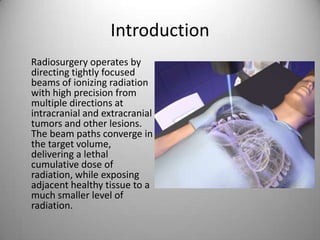
Radiosurgery operates by
directing tightly focused
beams of ionizing radiation
with high precision from
multiple directions at
intracranial and extracranial
tumors and other lesions.
The beam paths converge in
the target volume,
delivering a lethal
cumulative dose of
radiation, while exposing
adjacent healthy tissue to a
much smaller level of
radiation.
Medical uses
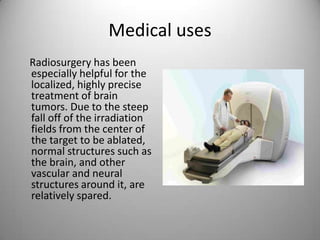
Radiosurgery has been
especially helpful for the
localized, highly precise
treatment of brain
tumors. Due to the steep
fall off of the irradiation
fields from the center of
the target to be ablated,
normal structures such as
the brain, and other
vascular and neural
structures around it, are
relatively spared.
Gamma Knife
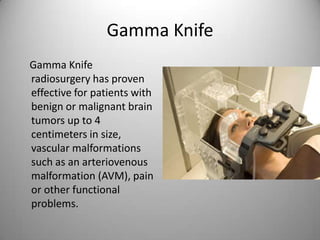
Gamma Knife
radiosurgery has proven
effective for patients with
benign or malignant brain
tumors up to 4
centimeters in size,
vascular malformations
such as an arteriovenous
malformation (AVM), pain
or other functional
problems.
Linear accelerator based therapies
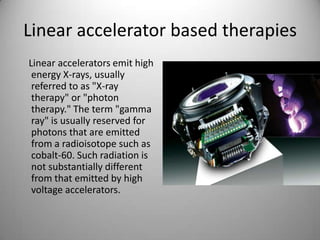
Linear accelerators emit high
energy X-rays, usually
referred to as "X-ray
therapy" or "photon
therapy." The term "gamma
ray" is usually reserved for
photons that are emitted
from a radioisotope such as
cobalt-60. Such radiation is
not substantially different
from that emitted by high
voltage accelerators.
Proton beam therapy
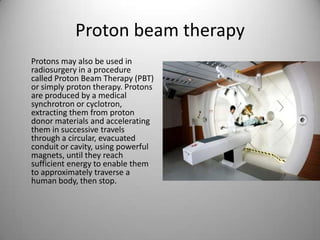
Protons may also be used in
radiosurgery in a procedure
called Proton Beam Therapy (PBT)
or simply proton therapy. Protons
are produced by a medical
synchrotron or cyclotron,
extracting them from proton
donor materials and accelerating
them in successive travels
through a circular, evacuated
conduit or cavity, using powerful
magnets, until they reach
sufficient energy to enable them
to approximately traverse a
human body, then stop.

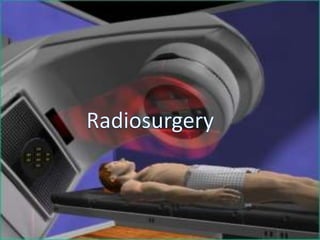
Radiosurgery

  • 1.
  • 2.
    Introduction Radiosurgery operates by directingtightly focused beams of ionizing radiation with high precision from multiple directions at intracranial and extracranial tumors and other lesions. The beam paths converge in the target volume, delivering a lethal cumulative dose of radiation, while exposing adjacent healthy tissue to a much smaller level of radiation.
  • 3.
    Medical uses Radiosurgery hasbeen especially helpful for the localized, highly precise treatment of brain tumors. Due to the steep fall off of the irradiation fields from the center of the target to be ablated, normal structures such as the brain, and other vascular and neural structures around it, are relatively spared.
  • 4.
    Gamma Knife Gamma Knife radiosurgeryhas proven effective for patients with benign or malignant brain tumors up to 4 centimeters in size, vascular malformations such as an arteriovenous malformation (AVM), pain or other functional problems.
  • 5.
    Linear accelerator basedtherapies Linear accelerators emit high energy X-rays, usually referred to as "X-ray therapy" or "photon therapy." The term "gamma ray" is usually reserved for photons that are emitted from a radioisotope such as cobalt-60. Such radiation is not substantially different from that emitted by high voltage accelerators.
  • 6.
    Proton beam therapy Protonsmay also be used in radiosurgery in a procedure called Proton Beam Therapy (PBT) or simply proton therapy. Protons are produced by a medical synchrotron or cyclotron, extracting them from proton donor materials and accelerating them in successive travels through a circular, evacuated conduit or cavity, using powerful magnets, until they reach sufficient energy to enable them to approximately traverse a human body, then stop.