Introduction
The science of photonics includes the
generation, emission, transmission,
modulation, signal processing, switching,
amplification, and detection/sensing of
light. The term photonics thereby
emphasizes that photons are neither
particles nor waves they have both particle
and wave nature.
Applications
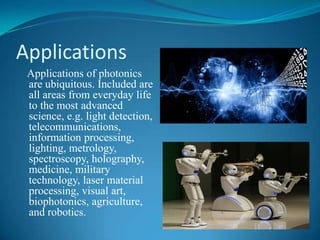
Applications of photonics
are ubiquitous. Included are
all areas from everyday life
to the most advanced
science, e.g. light detection,
telecommunications,
information processing,
lighting, metrology,
spectroscopy, holography,
medicine, military
technology, laser material
processing, visual art,
biophotonics, agriculture,
and robotics.
Overview of Photonics
The science of photonics
includes investigation of the
emission, transmission,
amplification, detection, and
modulation of light.

Photonics

  • 2.
    Introduction The science ofphotonics includes the generation, emission, transmission, modulation, signal processing, switching, amplification, and detection/sensing of light. The term photonics thereby emphasizes that photons are neither particles nor waves they have both particle and wave nature.
  • 3.
    Applications Applications of photonics areubiquitous. Included are all areas from everyday life to the most advanced science, e.g. light detection, telecommunications, information processing, lighting, metrology, spectroscopy, holography, medicine, military technology, laser material processing, visual art, biophotonics, agriculture, and robotics.
  • 4.
    Overview of Photonics Thescience of photonics includes investigation of the emission, transmission, amplification, detection, and modulation of light.