RADIO ENGINEERING
Week 2 Lecture 2
Understand the basics radio communication
MD.Sharif Uddin Shajib
Teaching Assistant
Department of EEE
World University of Bangladesh
Weekly Class Contents
 Basic components of Communication system
 Transmitter
 Receiver
 Channel
Communication:
The communication system is a system that describes the information exchange between two
points. The process of transmission and reception of information is called communication.
Components of Communication:
 The three essential components of a communication system are:
 Transmitter:
 The transmitter modulates the message signal.
 Modulation is the process of converting a signal into a form suitable for transmission.
 A transmitter is a telecommunications electrical device that generates radio waves so that data may
be transferred or received through an antenna.
 The transmitter may generate an alternating current of radio frequency, which is then applied to the
antenna, which radiates it as radio waves.
 Channel:
 A communication channel is a physical transmission channel in telecommunications and computer
networking.
 A channel is a device that delivers data from one or more senders (or transmitters) to one or more
receivers.
 Or in other words, the channel is what connects the output of the transmitter to the receiver
input.
 Receiver:
 The receiver does the demodulation. Demodulation is the process of recovering the correct
message signal.
 The received signal, which is picked up from the broadcast signal at the channel output, is
processed by the receiver to reproduce the original message signal in a recognizable form for
transmission.
 A radio receiver, also known as an FM receiver, is a device that receives radio waves and converts
the data carried by them into useable information.
 The desired frequency waves are caught using an antenna.
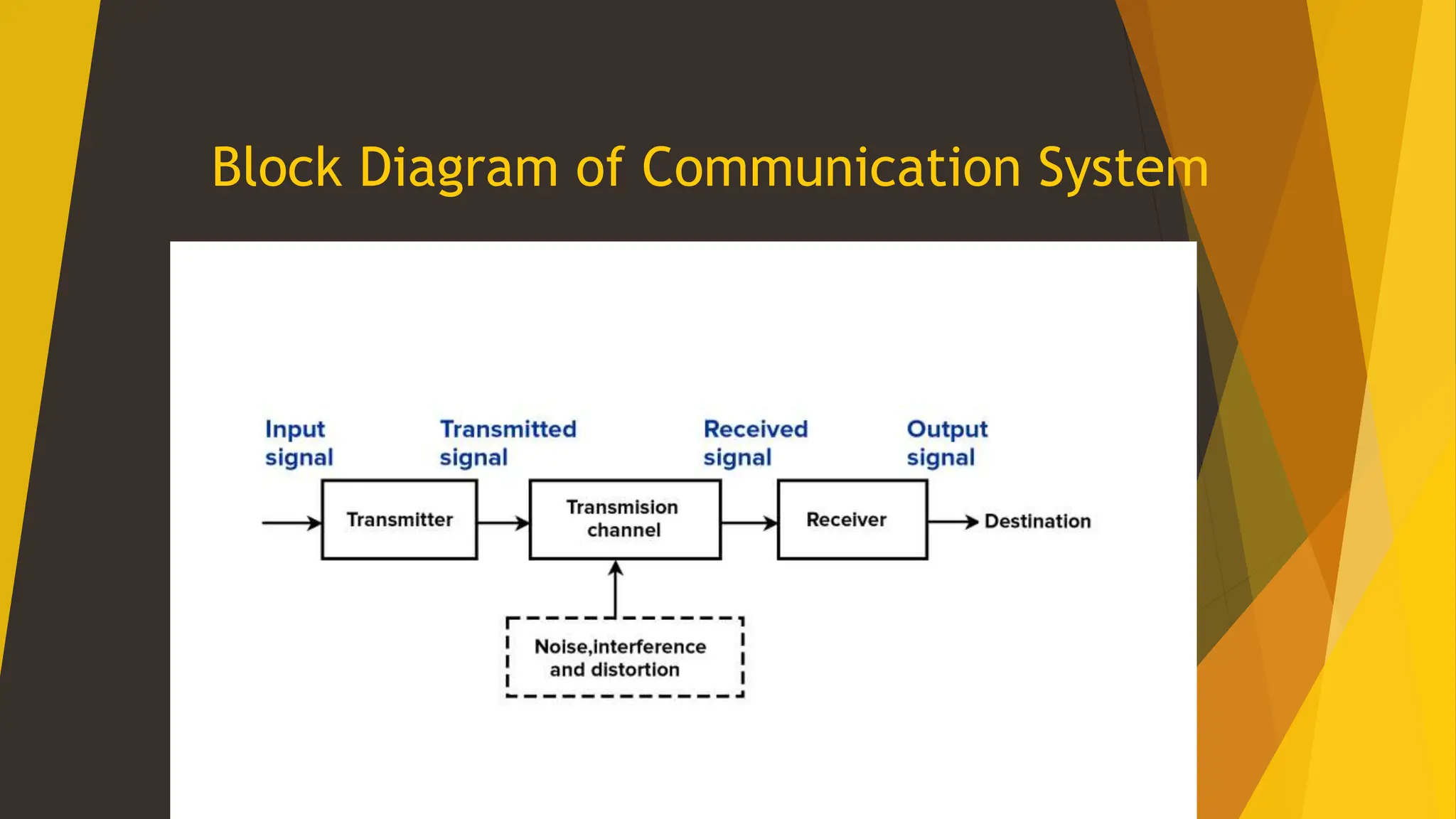
Block Diagram of Communication System
 Depending on the communication channel, the communication system is categorised as
follows:
 1. Wired (Line communication)
 Parallel wire communication
 Twisted wire communication
 Coaxial cable communication
 Optical fibre communication
 2. Wireless (Space communication)
 Ground wave communication
 Skywave communication
 Space wave communication
 Satellite communication

RADIO ENGINEERING Week 2 Lecture 2 Understand the basics radio communication

  • 1.
    RADIO ENGINEERING Week 2Lecture 2 Understand the basics radio communication MD.Sharif Uddin Shajib Teaching Assistant Department of EEE World University of Bangladesh
  • 2.
    Weekly Class Contents Basic components of Communication system  Transmitter  Receiver  Channel
  • 3.
    Communication: The communication systemis a system that describes the information exchange between two points. The process of transmission and reception of information is called communication.
  • 4.
    Components of Communication: The three essential components of a communication system are:  Transmitter:  The transmitter modulates the message signal.  Modulation is the process of converting a signal into a form suitable for transmission.  A transmitter is a telecommunications electrical device that generates radio waves so that data may be transferred or received through an antenna.  The transmitter may generate an alternating current of radio frequency, which is then applied to the antenna, which radiates it as radio waves.
  • 5.
     Channel:  Acommunication channel is a physical transmission channel in telecommunications and computer networking.  A channel is a device that delivers data from one or more senders (or transmitters) to one or more receivers.  Or in other words, the channel is what connects the output of the transmitter to the receiver input.  Receiver:  The receiver does the demodulation. Demodulation is the process of recovering the correct message signal.  The received signal, which is picked up from the broadcast signal at the channel output, is processed by the receiver to reproduce the original message signal in a recognizable form for transmission.  A radio receiver, also known as an FM receiver, is a device that receives radio waves and converts the data carried by them into useable information.  The desired frequency waves are caught using an antenna.
  • 6.
    Block Diagram ofCommunication System
  • 7.
     Depending onthe communication channel, the communication system is categorised as follows:  1. Wired (Line communication)  Parallel wire communication  Twisted wire communication  Coaxial cable communication  Optical fibre communication  2. Wireless (Space communication)  Ground wave communication  Skywave communication  Space wave communication  Satellite communication