RADIO ENGINEERING
Week 9 Lecture 9
various types of antenna
MD.Sharif Uddin Shajib
Teaching Assistant
Department of EEE
World University of Bangladesh
Weekly Class Contents
 Parabolic reflector antenna
 Horn antenna
 Antenna arrays
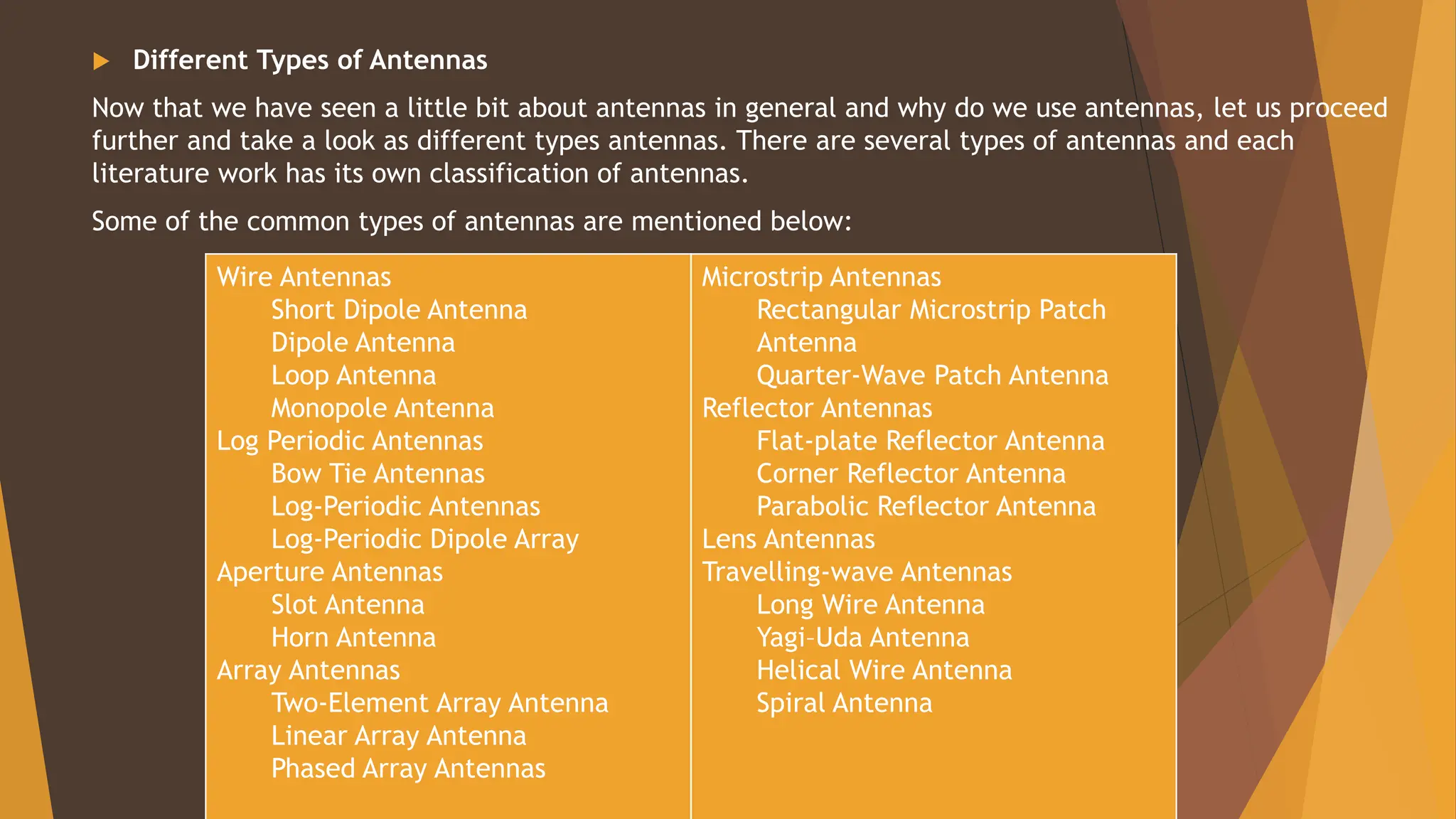
 Different Types of Antennas
Now that we have seen a little bit about antennas in general and why do we use antennas, let us proceed
further and take a look as different types antennas. There are several types of antennas and each
literature work has its own classification of antennas.
Some of the common types of antennas are mentioned below:
Wire Antennas
Short Dipole Antenna
Dipole Antenna
Loop Antenna
Monopole Antenna
Log Periodic Antennas
Bow Tie Antennas
Log-Periodic Antennas
Log-Periodic Dipole Array
Aperture Antennas
Slot Antenna
Horn Antenna
Array Antennas
Two-Element Array Antenna
Linear Array Antenna
Phased Array Antennas
Microstrip Antennas
Rectangular Microstrip Patch
Antenna
Quarter-Wave Patch Antenna
Reflector Antennas
Flat-plate Reflector Antenna
Corner Reflector Antenna
Parabolic Reflector Antenna
Lens Antennas
Travelling-wave Antennas
Long Wire Antenna
Yagi–Uda Antenna
Helical Wire Antenna
Spiral Antenna
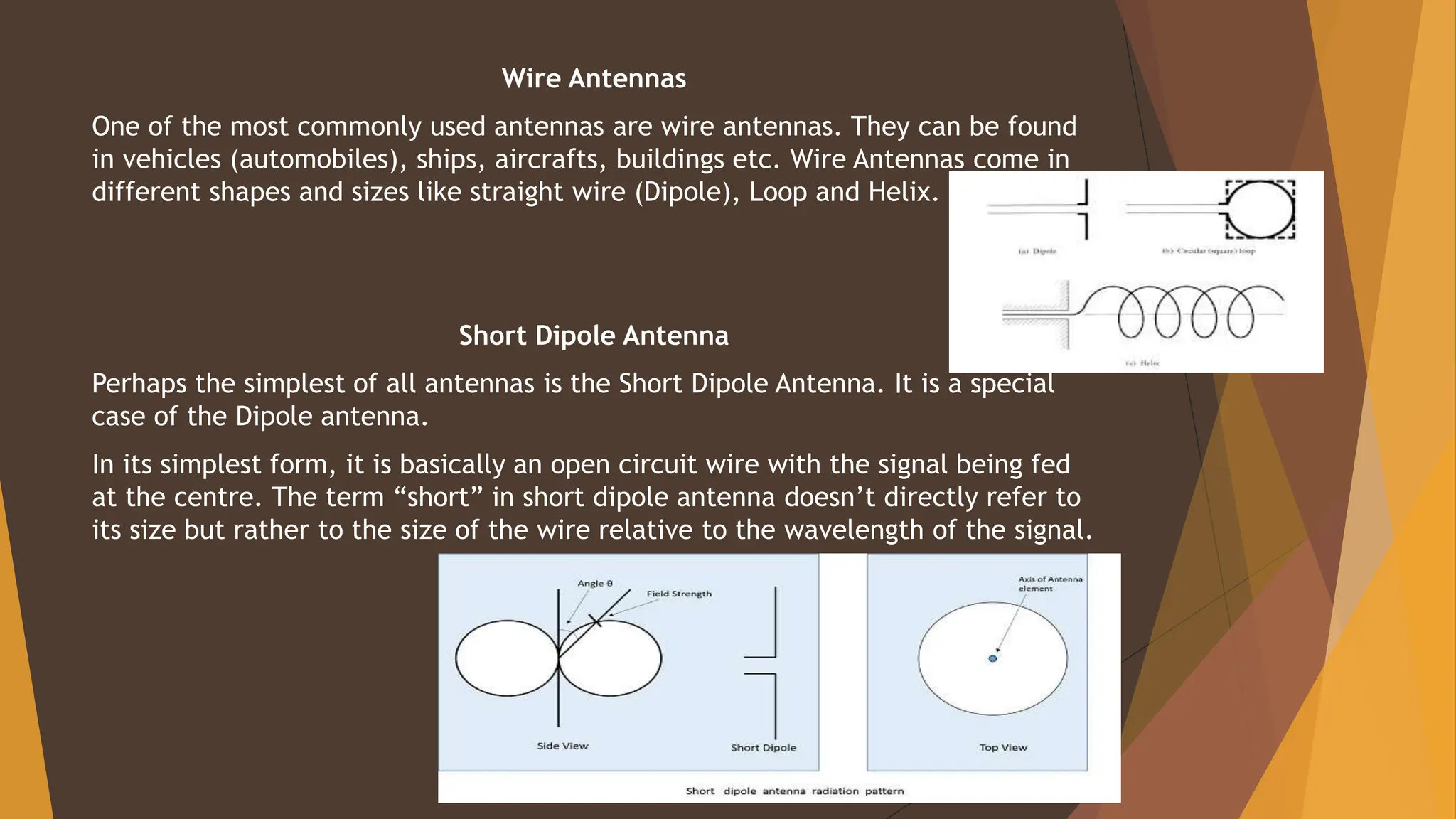
Wire Antennas
One of the most commonly used antennas are wire antennas. They can be found
in vehicles (automobiles), ships, aircrafts, buildings etc. Wire Antennas come in
different shapes and sizes like straight wire (Dipole), Loop and Helix.
Short Dipole Antenna
Perhaps the simplest of all antennas is the Short Dipole Antenna. It is a special
case of the Dipole antenna.
In its simplest form, it is basically an open circuit wire with the signal being fed
at the centre. The term ā€œshortā€ in short dipole antenna doesn’t directly refer to
its size but rather to the size of the wire relative to the wavelength of the signal.
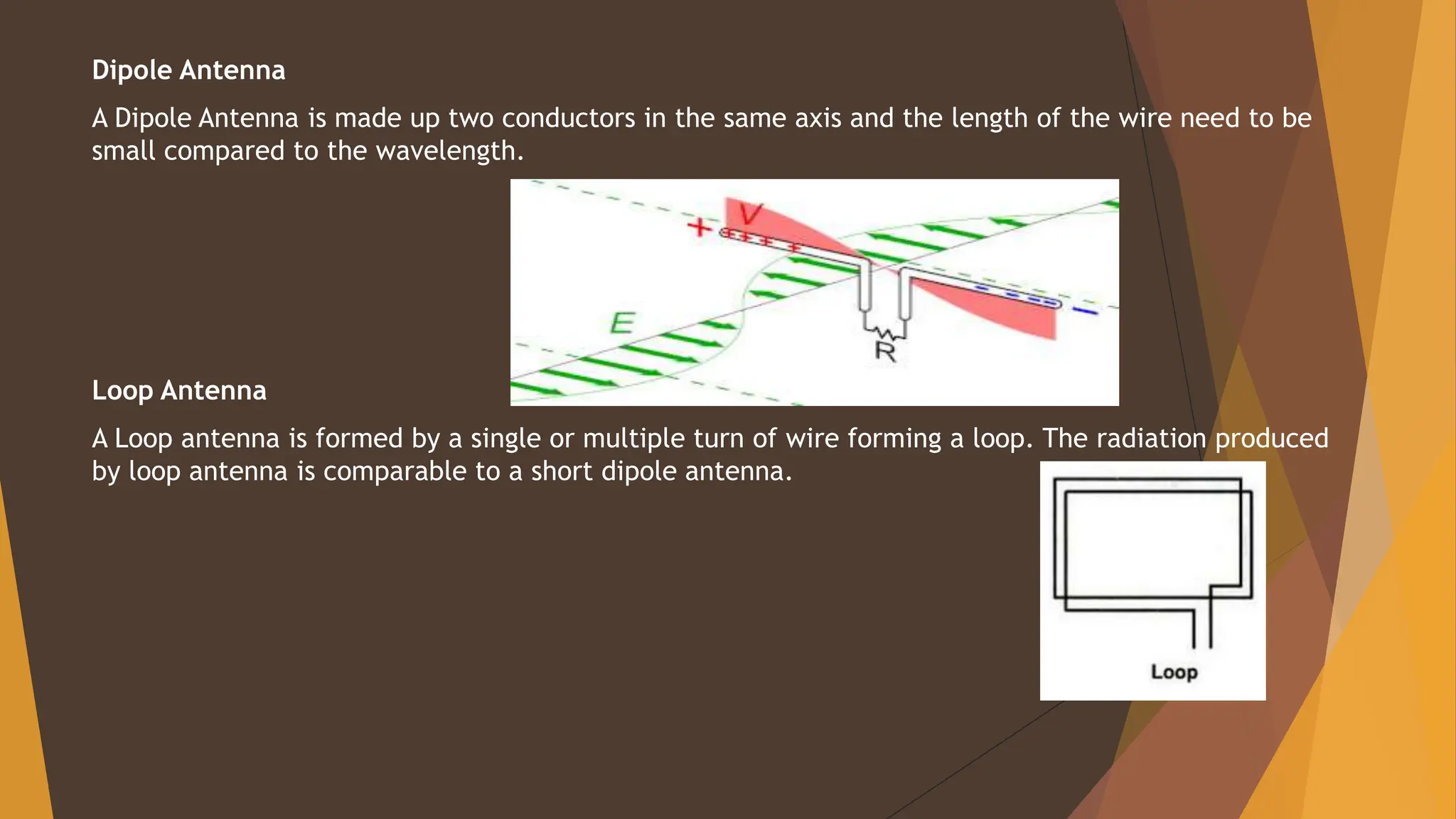
Dipole Antenna
A Dipole Antenna is made up two conductors in the same axis and the length of the wire need to be
small compared to the wavelength.
Loop Antenna
A Loop antenna is formed by a single or multiple turn of wire forming a loop. The radiation produced
by loop antenna is comparable to a short dipole antenna.
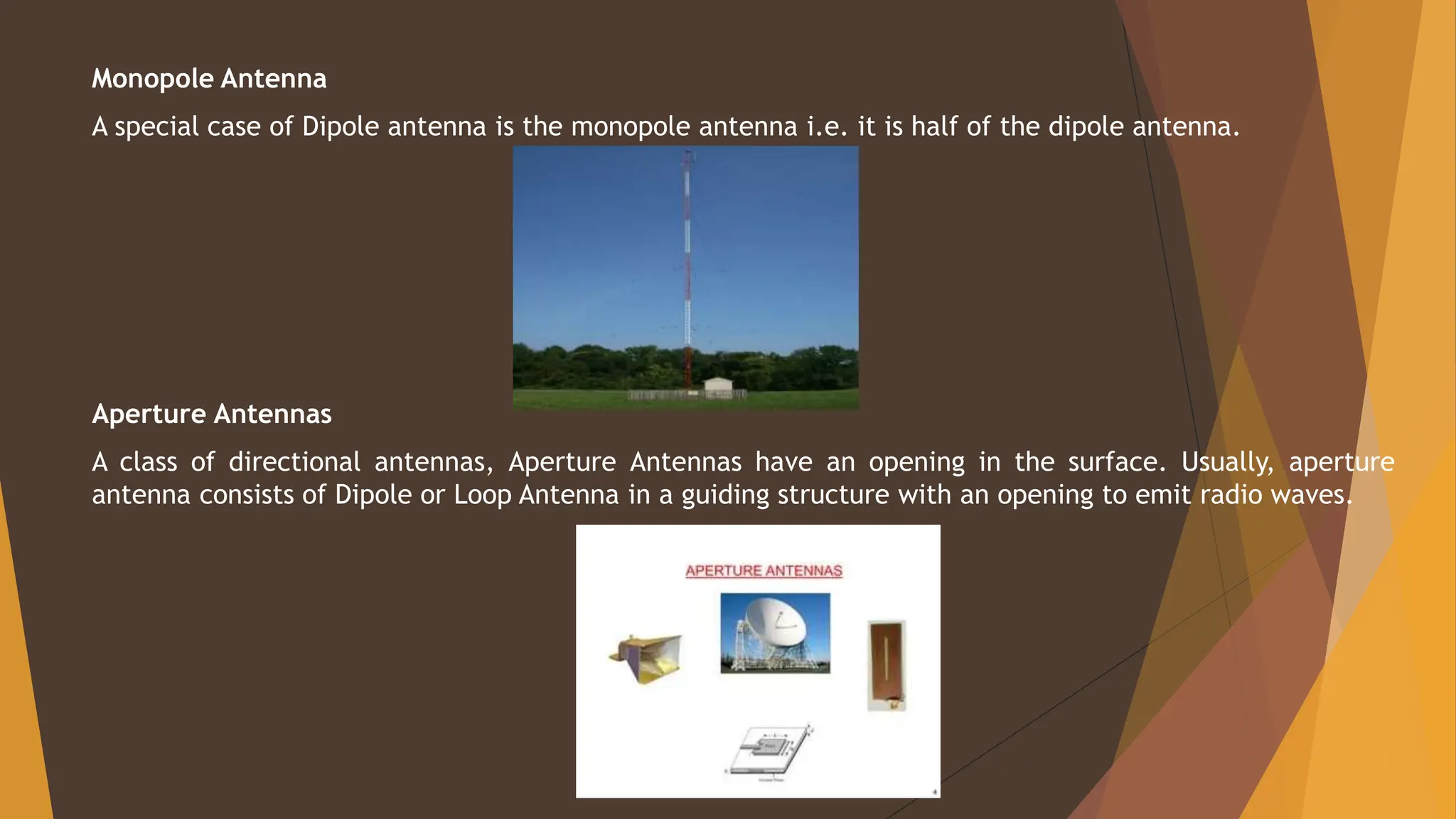
Monopole Antenna
A special case of Dipole antenna is the monopole antenna i.e. it is half of the dipole antenna.
Aperture Antennas
A class of directional antennas, Aperture Antennas have an opening in the surface. Usually, aperture
antenna consists of Dipole or Loop Antenna in a guiding structure with an opening to emit radio waves.
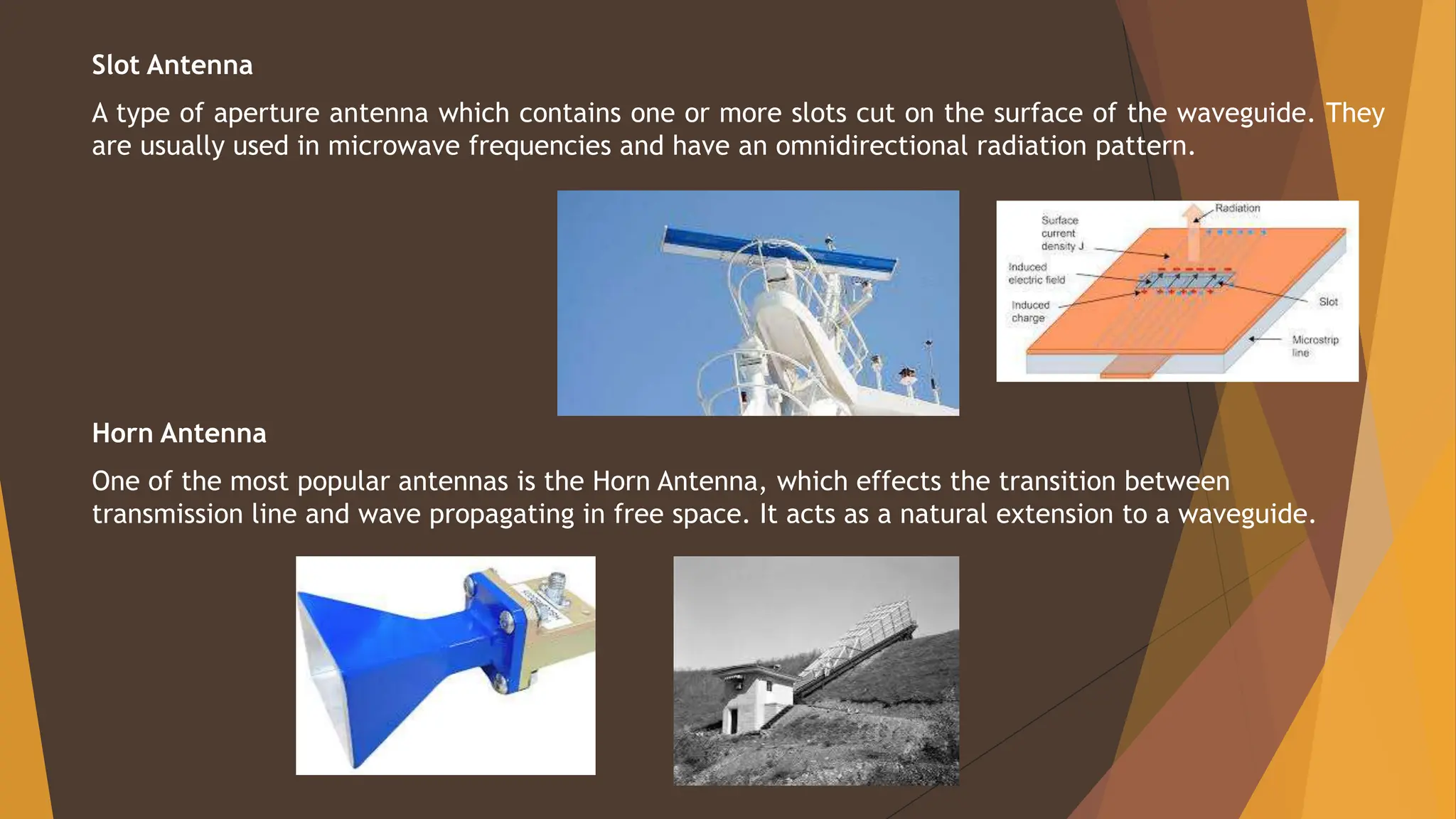
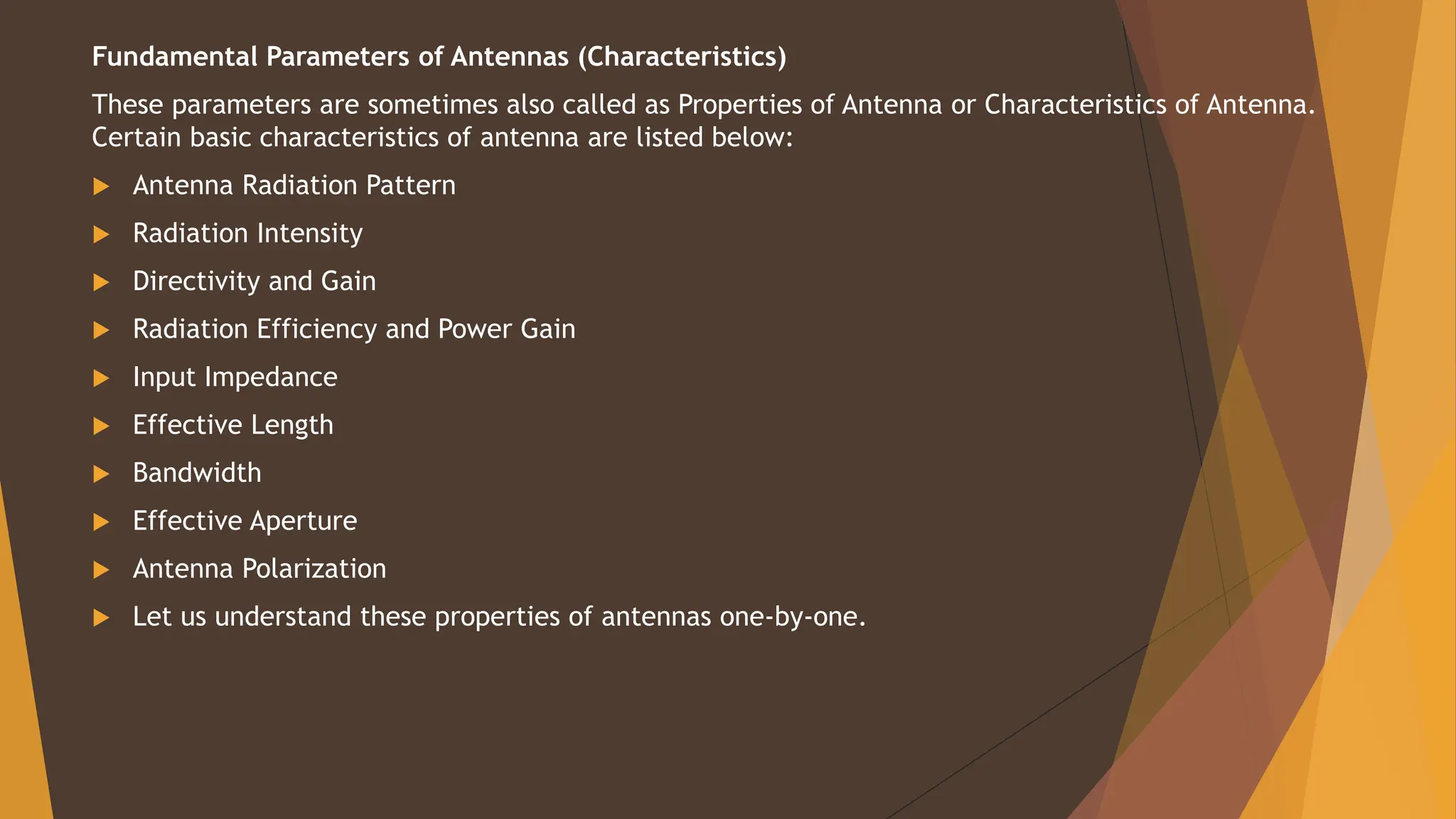
Slot Antenna
A type of aperture antenna which contains one or more slots cut on the surface of the waveguide. They
are usually used in microwave frequencies and have an omnidirectional radiation pattern.
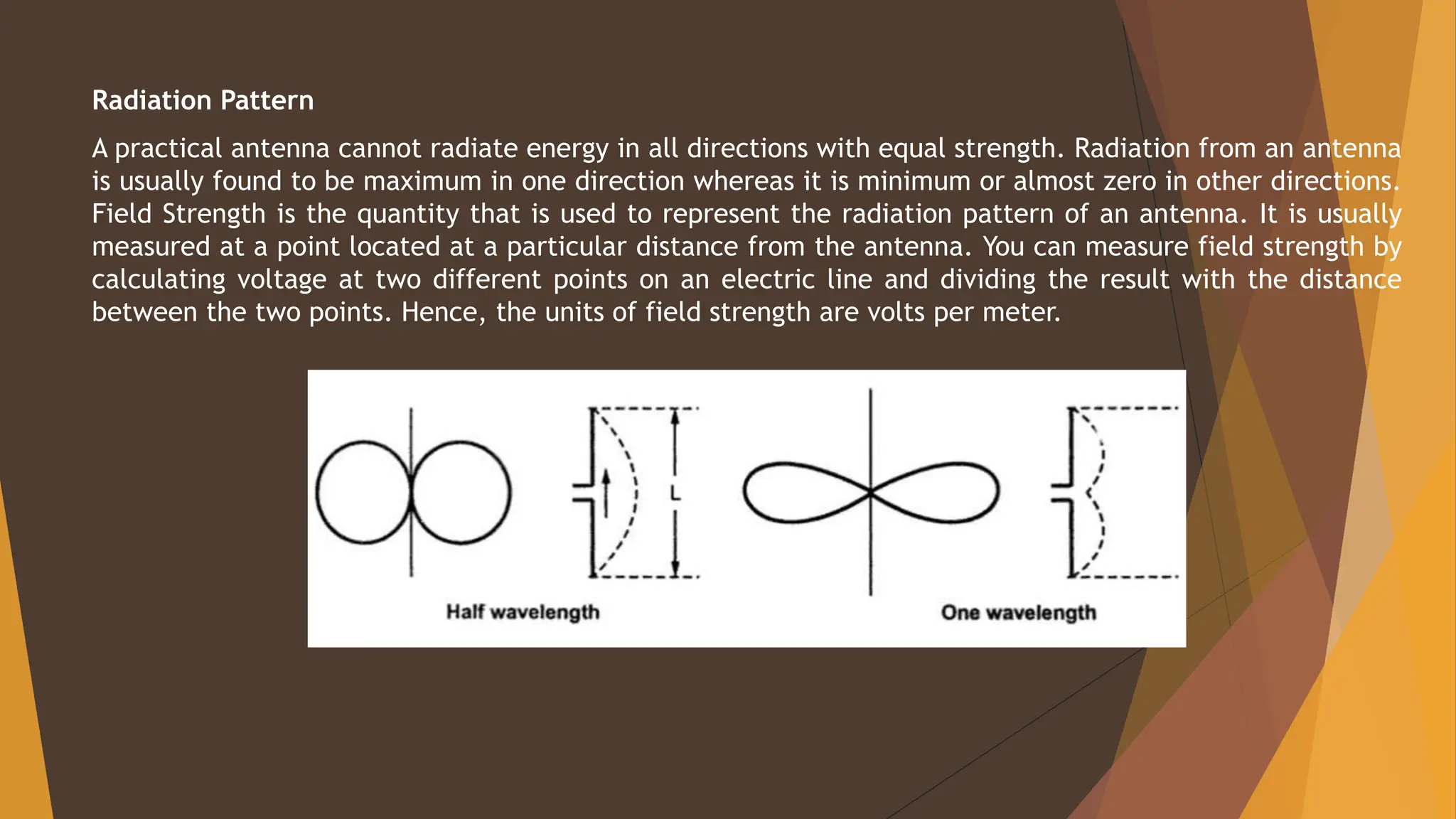
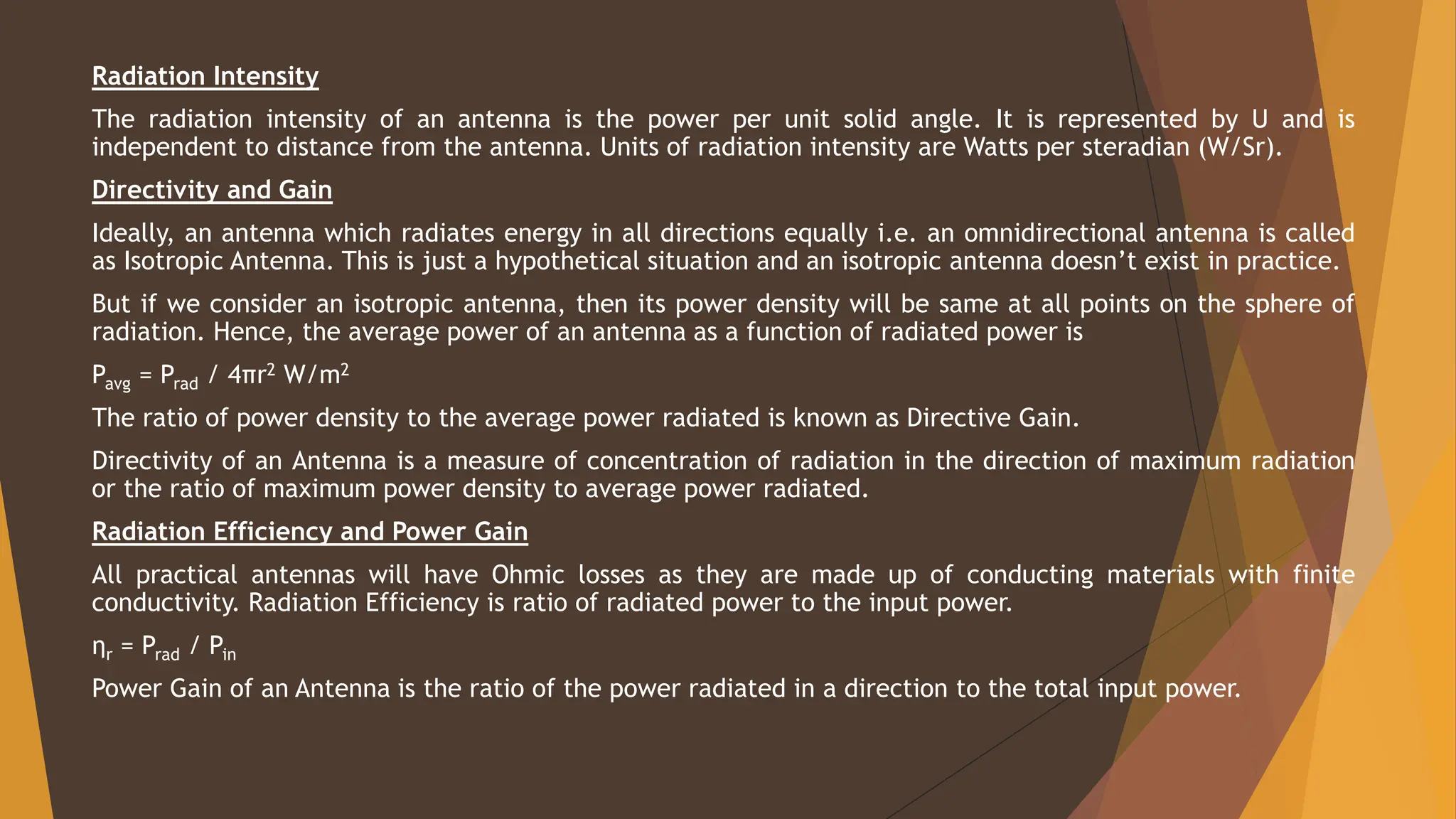
Horn Antenna
One of the most popular antennas is the Horn Antenna, which effects the transition between
transmission line and wave propagating in free space. It acts as a natural extension to a waveguide.
Fundamental Parameters of Antennas (Characteristics)
These parameters are sometimes also called as Properties of Antenna or Characteristics of Antenna.
Certain basic characteristics of antenna are listed below:
 Antenna Radiation Pattern
 Radiation Intensity
 Directivity and Gain
 Radiation Efficiency and Power Gain
 Input Impedance
 Effective Length
 Bandwidth
 Effective Aperture
 Antenna Polarization
 Let us understand these properties of antennas one-by-one.
Radiation Pattern
A practical antenna cannot radiate energy in all directions with equal strength. Radiation from an antenna
is usually found to be maximum in one direction whereas it is minimum or almost zero in other directions.
Field Strength is the quantity that is used to represent the radiation pattern of an antenna. It is usually
measured at a point located at a particular distance from the antenna. You can measure field strength by
calculating voltage at two different points on an electric line and dividing the result with the distance
between the two points. Hence, the units of field strength are volts per meter.
Radiation Intensity
The radiation intensity of an antenna is the power per unit solid angle. It is represented by U and is
independent to distance from the antenna. Units of radiation intensity are Watts per steradian (W/Sr).
Directivity and Gain
Ideally, an antenna which radiates energy in all directions equally i.e. an omnidirectional antenna is called
as Isotropic Antenna. This is just a hypothetical situation and an isotropic antenna doesn’t exist in practice.
But if we consider an isotropic antenna, then its power density will be same at all points on the sphere of
radiation. Hence, the average power of an antenna as a function of radiated power is
Pavg = Prad / 4Ļ€r2 W/m2
The ratio of power density to the average power radiated is known as Directive Gain.
Directivity of an Antenna is a measure of concentration of radiation in the direction of maximum radiation
or the ratio of maximum power density to average power radiated.
Radiation Efficiency and Power Gain
All practical antennas will have Ohmic losses as they are made up of conducting materials with finite
conductivity. Radiation Efficiency is ratio of radiated power to the input power.
Ī·r = Prad / Pin
Power Gain of an Antenna is the ratio of the power radiated in a direction to the total input power.
Input Impedance
We should take care to match the input impedance of the antenna to that of the input transmission line. If
the input impedance doesn’t match, then the system degrades over time due to the reflected power.
Effective Length
The length of an imaginary linear antenna with uniformly distributed current is defined as the Effective
Length of an antenna such that both these antennas have same far field in π/2 plane.
Bandwidth
The bandwidth of antenna is defined as the range of frequencies over which the characteristics of the
antenna are maintained to the specified value. This is because, the requirements for the characteristics of an
antenna like the gain, impedance, standing wave ratio etc. may change during operation.
Effective Aperture
Generally, the term effective aperture or effective area is associated with the receiving antenna. Effective
Aperture or Area of an antenna is the measure of the ability of an antenna to extract energy from the
electromagnetic wave.
Effective Aperture of an antenna is the ratio of the Power Received at the load to the average power density
produced by the antenna.
Antenna Polarization
The Antenna Polarization refers to the physical orientation of the electromagnetic wave radiated in a given
direction. Polarization of an EM Wave is a time varying direction and relative magnitude of the electric field
vector.
If the direction is not specified, then the polarization in the direction of maximum gain is considered.
There are other characteristics like Antenna Temperature, beamwidth, beam efficiency etc. which are also
critical.

RADIO ENGINEERING Week 9 Lecture 9 various types of antenna

  • 1.
    RADIO ENGINEERING Week 9Lecture 9 various types of antenna MD.Sharif Uddin Shajib Teaching Assistant Department of EEE World University of Bangladesh
  • 2.
    Weekly Class Contents Parabolic reflector antenna  Horn antenna  Antenna arrays
  • 3.
     Different Typesof Antennas Now that we have seen a little bit about antennas in general and why do we use antennas, let us proceed further and take a look as different types antennas. There are several types of antennas and each literature work has its own classification of antennas. Some of the common types of antennas are mentioned below: Wire Antennas Short Dipole Antenna Dipole Antenna Loop Antenna Monopole Antenna Log Periodic Antennas Bow Tie Antennas Log-Periodic Antennas Log-Periodic Dipole Array Aperture Antennas Slot Antenna Horn Antenna Array Antennas Two-Element Array Antenna Linear Array Antenna Phased Array Antennas Microstrip Antennas Rectangular Microstrip Patch Antenna Quarter-Wave Patch Antenna Reflector Antennas Flat-plate Reflector Antenna Corner Reflector Antenna Parabolic Reflector Antenna Lens Antennas Travelling-wave Antennas Long Wire Antenna Yagi–Uda Antenna Helical Wire Antenna Spiral Antenna
  • 4.
    Wire Antennas One ofthe most commonly used antennas are wire antennas. They can be found in vehicles (automobiles), ships, aircrafts, buildings etc. Wire Antennas come in different shapes and sizes like straight wire (Dipole), Loop and Helix. Short Dipole Antenna Perhaps the simplest of all antennas is the Short Dipole Antenna. It is a special case of the Dipole antenna. In its simplest form, it is basically an open circuit wire with the signal being fed at the centre. The term ā€œshortā€ in short dipole antenna doesn’t directly refer to its size but rather to the size of the wire relative to the wavelength of the signal.
  • 5.
    Dipole Antenna A DipoleAntenna is made up two conductors in the same axis and the length of the wire need to be small compared to the wavelength. Loop Antenna A Loop antenna is formed by a single or multiple turn of wire forming a loop. The radiation produced by loop antenna is comparable to a short dipole antenna.
  • 6.
    Monopole Antenna A specialcase of Dipole antenna is the monopole antenna i.e. it is half of the dipole antenna. Aperture Antennas A class of directional antennas, Aperture Antennas have an opening in the surface. Usually, aperture antenna consists of Dipole or Loop Antenna in a guiding structure with an opening to emit radio waves.
  • 7.
    Slot Antenna A typeof aperture antenna which contains one or more slots cut on the surface of the waveguide. They are usually used in microwave frequencies and have an omnidirectional radiation pattern. Horn Antenna One of the most popular antennas is the Horn Antenna, which effects the transition between transmission line and wave propagating in free space. It acts as a natural extension to a waveguide.
  • 8.
    Fundamental Parameters ofAntennas (Characteristics) These parameters are sometimes also called as Properties of Antenna or Characteristics of Antenna. Certain basic characteristics of antenna are listed below:  Antenna Radiation Pattern  Radiation Intensity  Directivity and Gain  Radiation Efficiency and Power Gain  Input Impedance  Effective Length  Bandwidth  Effective Aperture  Antenna Polarization  Let us understand these properties of antennas one-by-one.
  • 9.
    Radiation Pattern A practicalantenna cannot radiate energy in all directions with equal strength. Radiation from an antenna is usually found to be maximum in one direction whereas it is minimum or almost zero in other directions. Field Strength is the quantity that is used to represent the radiation pattern of an antenna. It is usually measured at a point located at a particular distance from the antenna. You can measure field strength by calculating voltage at two different points on an electric line and dividing the result with the distance between the two points. Hence, the units of field strength are volts per meter.
  • 10.
    Radiation Intensity The radiationintensity of an antenna is the power per unit solid angle. It is represented by U and is independent to distance from the antenna. Units of radiation intensity are Watts per steradian (W/Sr). Directivity and Gain Ideally, an antenna which radiates energy in all directions equally i.e. an omnidirectional antenna is called as Isotropic Antenna. This is just a hypothetical situation and an isotropic antenna doesn’t exist in practice. But if we consider an isotropic antenna, then its power density will be same at all points on the sphere of radiation. Hence, the average power of an antenna as a function of radiated power is Pavg = Prad / 4Ļ€r2 W/m2 The ratio of power density to the average power radiated is known as Directive Gain. Directivity of an Antenna is a measure of concentration of radiation in the direction of maximum radiation or the ratio of maximum power density to average power radiated. Radiation Efficiency and Power Gain All practical antennas will have Ohmic losses as they are made up of conducting materials with finite conductivity. Radiation Efficiency is ratio of radiated power to the input power. Ī·r = Prad / Pin Power Gain of an Antenna is the ratio of the power radiated in a direction to the total input power.
  • 11.
    Input Impedance We shouldtake care to match the input impedance of the antenna to that of the input transmission line. If the input impedance doesn’t match, then the system degrades over time due to the reflected power. Effective Length The length of an imaginary linear antenna with uniformly distributed current is defined as the Effective Length of an antenna such that both these antennas have same far field in Ļ€/2 plane. Bandwidth The bandwidth of antenna is defined as the range of frequencies over which the characteristics of the antenna are maintained to the specified value. This is because, the requirements for the characteristics of an antenna like the gain, impedance, standing wave ratio etc. may change during operation. Effective Aperture Generally, the term effective aperture or effective area is associated with the receiving antenna. Effective Aperture or Area of an antenna is the measure of the ability of an antenna to extract energy from the electromagnetic wave. Effective Aperture of an antenna is the ratio of the Power Received at the load to the average power density produced by the antenna. Antenna Polarization The Antenna Polarization refers to the physical orientation of the electromagnetic wave radiated in a given direction. Polarization of an EM Wave is a time varying direction and relative magnitude of the electric field vector. If the direction is not specified, then the polarization in the direction of maximum gain is considered. There are other characteristics like Antenna Temperature, beamwidth, beam efficiency etc. which are also critical.