The How To Guide
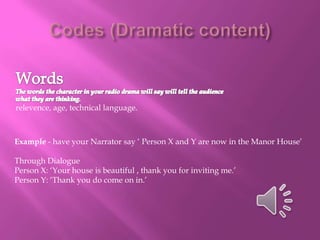
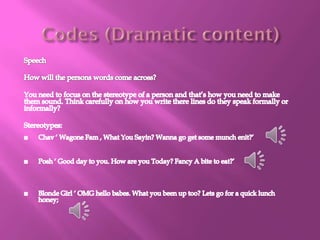
relevence, age, technical language.
Example - have your Narrator say ‘ Person X and Y are now in the Manor House’
Through Dialogue
Person X: ‘Your house is beautiful , thank you for inviting me.’
Person Y: ‘Thank you do come on in.’
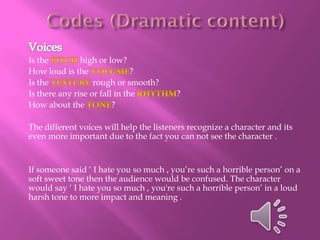
Is the high or low?
How loud is the ?
Is the rough or smooth?
Is there any rise or fall in the ?
How about the ?
The different voices will help the listeners recognize a character and its
even more important due to the fact you can not see the character .
If someone said ‘ I hate you so much , you’re such a horrible person’ on a
soft sweet tone then the audience would be confused. The character
would say ‘ I hate you so much , you're such a horrible person’ in a loud
harsh tone to more impact and meaning .
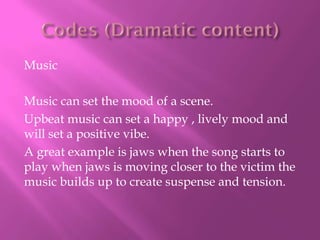
Music
Music can set the mood of a scene.
Upbeat music can set a happy , lively mood and
will set a positive vibe.
A great example is jaws when the song starts to
play when jaws is moving closer to the victim the
music builds up to create suspense and tension.
 Ambience ( background noise )
Ambience is very important when it comes to a
radio drama. For example if you wanted to set the
location of a classroom you would have a
background noise of talking , typing , writing etc.
 Sounds
Sounds in a radio drama can be used to set a
scene for example if you heard the sound of car
engines you would get the scene of outside near a
road. Sound also includes Sound Effects for
example if someone opened a door you would
hear a door squeak to paint a picture of a door.
 Silence
Silence can be used to create a atmosphere and
build tension and it is also mysterious.
Example – If a character shouts ‘Whos there’ and
then there is silence.
 Aural Signposting –
This is a technique used to establish location at
the opening of a scene. This can be done by effects
, spot and also sound effects and sometimes
supported by description.
It is likely that this effect is used before dialolouge
begins.
Example – Scene would open with sea waves to
establish a beach location before the script starts/
 Cliff hanger
Cliff hangers are great to use in a radio drama to
make the listeners want more and tune into the
next show.
It makes the audience curious about what will
happen next.
 Flashback
Flashbacks are a great way to tell a short story it
requires little time but includes a lot of detail.
These are normally used at the beginning of a
radio drama these can explain briefly what
happened in the last episode.
 Use of fades
Fades can be used to show a distance for example
someone falling off a cliff the sound will slowly
fade to show they are getting further and further
away.
You can also use fades to go from on scene to
another in a easy transition.
 Characterisation
To show characters through radio drama you can
do it through speech or sound effects.
 Chronological development
Time in literal manner
 Narration
Narration is normally done by someone who has
a clear voice so the audience can understand
them. The narrator normally speak in third
person as well.
 Direct Speech
Direct speech can be used to get the characters
real opinions it will make the listeners feel more
attached to the character.
Normally used by the main character.
 Credits
Credits are there to show who was involved to
create publicity for themselves and also if the
listeners were interested in finding out who was
involved.
 Appropriateness to target audience
This is making sure the content provided is
suitable for the age group style of person.
 Dramatic reconstruction
This is where an actor will recreate a scene
melodramatically.
 Radio drama styles
E.G Psot-modern , radio drama as ‘theatre of the
mind’, creation of mood or location
(effects,acoustic)
 Duration
How long a piece of footage lasts
 Narrative Structure
It is one easiest and can be the best way to explain
action or plot that is happenign in your radio
drama.
 appropriateness to target audience, dramatic
reconstruction, radio drama styles, eg. Post-
modern, radio drama as ‘theatre of the mind’,
creation of mood or location (effects, acoustic)