Introduction to Documentary
What is a  documentary ?
What is a  documentary ? “ Get  two documentarians  together, and the chances are high that  they will argue about what documentary is . Even though documentary has evolved continuously from its inception, its purview and methods  remain ambiguous , and its  parameters keep enlarging . Uncontested, however, is what remains central to documentary’s spirit – the notion that  documentaries   explore   the mysteries of   actual people in actual situations .” –  Michael Rabinger “Directing The Documentary”
What does a documentary do?   Preserve Persuade Analyze Express Discuss Explore Intervene Enlighten
Documentary’s “Contract”   Agreement between filmmaker and  Audience  Do one’s best to tell the ‘truth’ Authenticity, Truth claim “ None of this is made up” It’s okay to have an opinion
Documentary Modes * Consider how each of these modes/ examples are in dialogue with this contract
Documentary Modes EXPOSITORY Frank Lloyd Wright  (1998, Ken Burns)
Documentary Modes EXPOSITORY Frank Lloyd Wright  (1998, Ken Burns) - “Voice of God” narration - direct presentation of facts - can include all kinds of “evidence”
Documentary Modes OBSERVATIONAL Hoop Dreams  (1994)
Documentary Modes OBSERVATIONAL Hoop Dreams  (1994) -minimal (or no) narration -long takes, real-time, synch-sound -present tense - never (or almost never) see or hear the  filmmakers
Documentary Modes INTERACTIVE Roger and Me  (1989, Michael Moore)
Documentary Modes INTERACTIVE Roger and Me  (1989, Michael Moore) -filmmaker is present on screen -filmmaker makes the action happen
Documentary Modes ESSAYISTIC History and Memory  (1998, Rea Tajiri)
Documentary Modes ESSAYISTIC History and Memory  (1998, Rea Tajiri) -uses “first person” address: “I” -tells personal stories from a personal viewpoint -does not try to be “objective”
Documentary Modes EXPERIMENTAL Tarnation  (2003, Jonathan Caouette)
Documentary Modes EXPERIMENTAL Tarnation  (2003, Jonathan Caouette) -obeys the documentary contract -otherwise, anything goes
When watching documentaries, remember… Everything in a documentary is  intentional Who/what/when/where/why/how are all decided by filmmaker: camera movements, framing, editing, music, etc What are possible biases? Relationship between filmmaker and subject What’s the claim to truth/ authenticity? Relationship between documentary and reality Is subject being represented in a way that won’t harm his/her integrity?
Ethics in   Documentary Filmmaking  Working with the community Collaboration Interview Release Forms
Modes of Representation How do documentaries present ideas?  Combo of visual and audio components Voice- over narration Interviews Related Media Original video (primary footage, b-roll Original images (still photos, graphics, charts, maps, etc) Archival film/ video  Archival images (still photos, graphics, charts, maps) Dramatizations Text SOUND (music, effects, background - room noise)
Production Phases: Your Workflow Pre-Production Research, treatment, write script, storyboard/shot lists, gather photos, set up interviews Production Conduct interviews, record primary/b-roll footage, record voice-over narration (if necessary), edit script Post-Production Edit script, video editing, music, sound effects
Pre-Production: Production Schedule Get in your groups and decide your topic Assign roles to each member according to the syllabus timeline Work to create treatment/script Schedule times for production
Pre-Production: the Treatment Outline what you hope to create as a film (be specific) Introduction of your topic (with a hook!) Specific information that explains the events/issues Conclusion Layout your production plan (use the Production Schedule Worksheets!) What components are going to provide specific information. (Who? When? Where?)
Production Get to it! Record interviews Shoot b-roll film Locate found footage Note: some footage will be created during post-production
Production Crew Roles Director Producer Cinematographer (DP) Sound
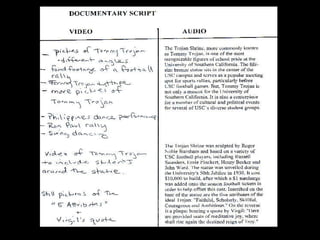
Post-Production Log and organize your footage Create a script that revises the treatment, but considers the footage attained Begin sequencing the footage in Final Cut Pro (Assembly Cut) Go back and forth with the previous 2 steps Record voice-over narration (if necessary)


Stages of your project Assembly Cut Barebones version. It just establishes the information in a sequence First Cut Begin to consider how you want to represent your information Ex: Show interview…use graph…use created footage with text…voice-over narration over b-roll footage
Stages of your project Final Cut Smooth out the modes of representation Smooth transitions between shots Add all music/sound effects and fix audio levels Add text (Check the font, size and spelling) Export as a DVD

Basic Documentary Genres Outline

  • 1.
  • 2.
    What is a documentary ?
  • 3.
    What is a documentary ? “ Get two documentarians together, and the chances are high that they will argue about what documentary is . Even though documentary has evolved continuously from its inception, its purview and methods remain ambiguous , and its parameters keep enlarging . Uncontested, however, is what remains central to documentary’s spirit – the notion that documentaries explore the mysteries of actual people in actual situations .” – Michael Rabinger “Directing The Documentary”
  • 4.
    What does adocumentary do? Preserve Persuade Analyze Express Discuss Explore Intervene Enlighten
  • 5.
    Documentary’s “Contract” Agreement between filmmaker and Audience Do one’s best to tell the ‘truth’ Authenticity, Truth claim “ None of this is made up” It’s okay to have an opinion
  • 6.
    Documentary Modes *Consider how each of these modes/ examples are in dialogue with this contract
  • 7.
    Documentary Modes EXPOSITORYFrank Lloyd Wright (1998, Ken Burns)
  • 8.
    Documentary Modes EXPOSITORYFrank Lloyd Wright (1998, Ken Burns) - “Voice of God” narration - direct presentation of facts - can include all kinds of “evidence”
  • 9.
  • 10.
    Documentary Modes OBSERVATIONALHoop Dreams (1994) -minimal (or no) narration -long takes, real-time, synch-sound -present tense - never (or almost never) see or hear the filmmakers
  • 11.
    Documentary Modes INTERACTIVERoger and Me (1989, Michael Moore)
  • 12.
    Documentary Modes INTERACTIVERoger and Me (1989, Michael Moore) -filmmaker is present on screen -filmmaker makes the action happen
  • 13.
    Documentary Modes ESSAYISTICHistory and Memory (1998, Rea Tajiri)
  • 14.
    Documentary Modes ESSAYISTICHistory and Memory (1998, Rea Tajiri) -uses “first person” address: “I” -tells personal stories from a personal viewpoint -does not try to be “objective”
  • 15.
    Documentary Modes EXPERIMENTALTarnation (2003, Jonathan Caouette)
  • 16.
    Documentary Modes EXPERIMENTALTarnation (2003, Jonathan Caouette) -obeys the documentary contract -otherwise, anything goes
  • 17.
    When watching documentaries,remember… Everything in a documentary is intentional Who/what/when/where/why/how are all decided by filmmaker: camera movements, framing, editing, music, etc What are possible biases? Relationship between filmmaker and subject What’s the claim to truth/ authenticity? Relationship between documentary and reality Is subject being represented in a way that won’t harm his/her integrity?
  • 18.
    Ethics in Documentary Filmmaking Working with the community Collaboration Interview Release Forms
  • 19.
    Modes of RepresentationHow do documentaries present ideas? Combo of visual and audio components Voice- over narration Interviews Related Media Original video (primary footage, b-roll Original images (still photos, graphics, charts, maps, etc) Archival film/ video Archival images (still photos, graphics, charts, maps) Dramatizations Text SOUND (music, effects, background - room noise)
  • 20.
    Production Phases: YourWorkflow Pre-Production Research, treatment, write script, storyboard/shot lists, gather photos, set up interviews Production Conduct interviews, record primary/b-roll footage, record voice-over narration (if necessary), edit script Post-Production Edit script, video editing, music, sound effects
  • 21.
    Pre-Production: Production ScheduleGet in your groups and decide your topic Assign roles to each member according to the syllabus timeline Work to create treatment/script Schedule times for production
  • 22.
    Pre-Production: the TreatmentOutline what you hope to create as a film (be specific) Introduction of your topic (with a hook!) Specific information that explains the events/issues Conclusion Layout your production plan (use the Production Schedule Worksheets!) What components are going to provide specific information. (Who? When? Where?)
  • 23.
    Production Get toit! Record interviews Shoot b-roll film Locate found footage Note: some footage will be created during post-production
  • 24.
    Production Crew RolesDirector Producer Cinematographer (DP) Sound
  • 25.
    Post-Production Log andorganize your footage Create a script that revises the treatment, but considers the footage attained Begin sequencing the footage in Final Cut Pro (Assembly Cut) Go back and forth with the previous 2 steps Record voice-over narration (if necessary)
  • 26.
  • 27.
  • 28.
  • 29.
  • 30.
    Stages of yourproject Assembly Cut Barebones version. It just establishes the information in a sequence First Cut Begin to consider how you want to represent your information Ex: Show interview…use graph…use created footage with text…voice-over narration over b-roll footage
  • 31.
    Stages of yourproject Final Cut Smooth out the modes of representation Smooth transitions between shots Add all music/sound effects and fix audio levels Add text (Check the font, size and spelling) Export as a DVD