Freddie Goring
Silence is used to great effect in radio dramas.
Some radio dramas can be accused of packing
too many words or sounds into the production
without leaving any room for the effects silence
can create. Perhaps the most effective use of
silence is too build suspense, similarly to how it
is done so in television programmes and films.
This element can be greatened by a loud, sharp
noise following a period of silence. An effect
regularly found in horror or thriller style dramas.
Words are the most essential element of a radio
drama.They can progress or unravel a
storyline in just a few seconds.
These can be spoken by the narrator and/or
character in the production, making it an
incredibly versatile part narrative movement.
Music in radio drama can be used for plenty of
different parts. Usually a drama will open with a
them tune that will nicely open the production
and allow the audience to recognise the
production in a instant.The same tune can also
be used to close the production.
Music can also be used as a transition between
scenes to either emphasize and shift in time or
location.
It can also be used to add to the ambience of a
scene that will help the audience to gain a more
vivid picture of the scene being described.
Having a wide range of voices in a radio drama is
very important. However, what is more
important is that the audience will be able to
differentiate the characters by their voices with
ease.
A character or narrators voice leaves lots of room
for creativity, however it needs to suit the genre
and style of the production and actual character.
For example, a young teenager could have deep,
mumbling voice with the use of new urban slang
and language.
Sound effects are subtle elements of a radio
drama that help to add more imagery for the
audience. For example, a shop door bell could
ring to emphasize that a character has just
entered a shop.
Effects can also be used on the voices of
characters. For example, adding
reverberation to a characters voice would
allow to audience to understand the size and
type of room a character is situated.
Signposting is a method of allowing the
audience to gain an understanding of the
location of the scene as it opens.This can be
achieved by Sound FX or even a description
from a narrator. It’s a popular technique used
in many radio dramas to give the audience as
much imagery as possible.
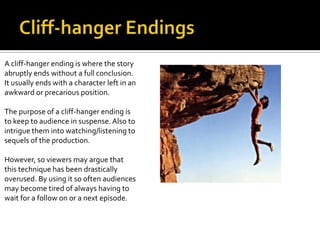
A cliff-hanger ending is where the story
abruptly ends without a full conclusion.
It usually ends with a character left in an
awkward or precarious position.
The purpose of a cliff-hanger ending is
to keep to audience in suspense.Also to
intrigue them into watching/listening to
sequels of the production.
However, so viewers may argue that
this technique has been drastically
overused. By using it so often audiences
may become tired of always having to
wait for a follow on or a next episode.
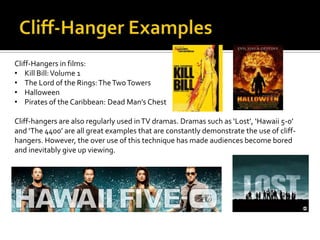
Cliff-Hangers in films:
• Kill Bill:Volume 1
• The Lord of the Rings:TheTwoTowers
• Halloween
• Pirates of the Caribbean: Dead Man’s Chest
Cliff-hangers are also regularly used inTV dramas. Dramas such as ‘Lost’, ‘Hawaii 5-0’
and ‘The 4400’ are all great examples that are constantly demonstrate the use of cliff-
hangers. However, the over use of this technique has made audiences become bored
and inevitably give up viewing.
Radio 4’s, ‘The Archers’, is a long running radio drama that constantly uses the cliff-hanger
effect.
This is an example of the show itself:
http://www.bbc.co.uk/programmes/b01nxw2b
Flashback is an interjected scene that takes the narrative back in time from the current
point the story has reached. Flashbacks are often used to recount events that happened
before the story’s primary sequence of events or to fill in crucial backstory. A character
origin flashback shows key events early in a character's development. In the opposite
direction, a flash-forward (or prolepsis) reveals events that will occur in the future.The
technique is used to create suspense in a story, or develop a character.
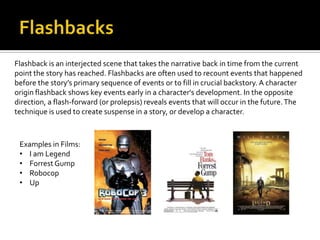
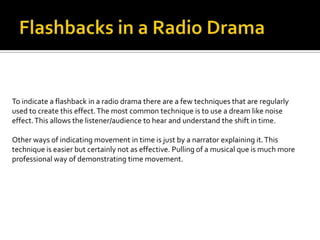
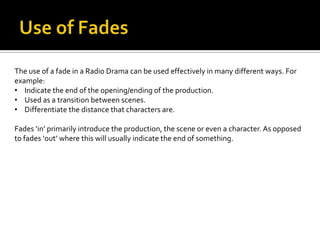
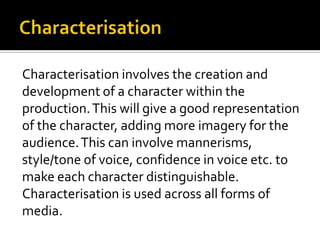
Examples in Films:
• I am Legend
• Forrest Gump
• Robocop
• Up
To indicate a flashback in a radio drama there are a few techniques that are regularly
used to create this effect.The most common technique is to use a dream like noise
effect.This allows the listener/audience to hear and understand the shift in time.
Other ways of indicating movement in time is just by a narrator explaining it.This
technique is easier but certainly not as effective. Pulling of a musical que is much more
professional way of demonstrating time movement.
The use of a fade in a Radio Drama can be used effectively in many different ways. For
example:
• Indicate the end of the opening/ending of the production.
• Used as a transition between scenes.
• Differentiate the distance that characters are.
Fades ‘in’ primarily introduce the production, the scene or even a character. As opposed
to fades ‘out’ where this will usually indicate the end of something.
Characterisation involves the creation and
development of a character within the
production.This will give a good representation
of the character, adding more imagery for the
audience.This can involve mannerisms,
style/tone of voice, confidence in voice etc. to
make each character distinguishable.
Characterisation is used across all forms of
media.
This would include the development of a
character (emotionally or physically) through a
consecutive sequence of time.
Non-chronological develop is the opposite of a
continued lapse of time.The sequence of the
narrative may jump between periods of time
add another element of suspense to the drama.
A narrator is an entity that will tell or describe the story to the
audience. However, there are three types of narrator will distinguish
how the story is being told:
1. First Person –This is when the story is told from an ‘I’
perspective.The narrator will speak from their position, usually a
character in the production.This is the most personal narrator
for the audience as they only know what they know.
2. Second Person –This is a narrator that will speak in ‘we’ terms. It
is not a very common style of narration.
3. Third Person – A third person figure is not a character in the
story, but an ‘all seeing’ observer who is separate to the
storyline. A third-person narrator might be omniscient , but that
is not always the case.Third-person narration may also be
focalized through a particular character, meaning that the
narrator tells us how that character sees the world, but can't, or
at least doesn't, read the mind of all the characters this way.
Speech can be used in many effective ways
within in Radio Drama.The most obvious would
be the speech of the characters within the
drama.This can be differentiated by the
audience from the tone and style of voice used
(see characterisation).
This is a list of members that were involved
with the production of the product. All
members of the crew, cast, production team,
technicians etc. will all be credited.The credits
are a way of giving everyone involved credit
and acknowledgment for the creation of the
drama.Credits are found throughout all types
of media other than radio drama includingTV
programmes, films and even theatre
productions.
Style is decided upon in radio drama by researching into the
audience that the product it targeted at. Stereotyping an audience
can be the key to success in terms of making it appropriate for the
chosen audience.
Dramatic reconstruction will literally recreate imagery of a scene or
emotion within a radio drama. For example, a radio drama may use
the sound of a telephone, printer, coffee machine and a description
from a narrator to recreate the scene of an office environment.
Typically, the most popular types or genres of radio dramas are
horrors/thrillers, murder mysteries and cultured narratives.This is
probably because of they are the easiest to create lots of imagery
for the audience. When it comes to radio dramas, creating vivid
images for the audience to deal with is the most important aspect.
When constructing the structure of a radio drama it is
essential to consider the length of the production. Most
radio dramas last between 20 and 60 minutes.Within the
time limit there needs to be all the elements of a good
narrative (situation, complication, resolution,
denouement).These time constraints are there for a few
reasons. For one, the cost of production can be quite
expensive and since radio dramas are not a very popular
method of receiving media, it could be hard to make
money with them.They also can’t be so long that the
audience lose interest with them.You would need to have
a very good production and patient listener for anyone of
this generation to listen to a radio drama that lasts longer
than an hour.
http://www.youtube.com/watch?v=tzShbpY-Oqg
 Words/Voices – 00:00 – 10:00 minutes
(Throughout)The use as a first person narrator.
 Music – 02:00 – 02:14.The music is used as a
transition to the next scene and imply a shift in
time.
 Fade – 02:14.The music fades so that the voice
can be heard in the next scene.
 Sound Effect – 02:24.The sound effect of a
telephone ringing and being answered.
http://www.youtube.com/watch?v=5uPQE3Pykto
Voices –Throughout the drama, there are few
voices.The woman in the house begins with a
calm voice but slowly becomes more a more
panicked.This really portrays the emotion of the
character.
Silence –There is no specific silence but the silence
of the characters voice adds to the suspense of
the drama. It makes the audience put together
what has happened to the woman as they listen
to the policeman on the phone trying to get hold
of her.
Narrator – 00:00 – 00:30.The first person
narrator opens the drama by explaining the
context of the story.
 Aural Signposting – 07:28. As well as the
characters hinting that they are in a hotel, the
knock on the door and tone of voice used
adds more imagery for the audience.There is
also slightly less depth of the woman behind
the door to insinuate the door is still shut.The
use of the sentence “and how does madam
like the room?” finally lets the audience know
they’re in a hotel.
http://www.rci.rutgers.edu/~jbass/courses/402/402_spr10_sns.htm
http://www.ruyasonic.com/wrt_narration.htm
http://en.wikipedia.org/wiki/Nonlinear_narrative
http://udleditions.cast.org/craft_elm_characterization.html
http://www.irdp.co.uk/scripts.htm
http://dramaresource.com/strategies/flashbacks-and-flash-forwards