BASICS OF SOUNDS
AFEEFUREHMAN VALIYAT
UNIVERSITY OF CALICUT
.
 Today we cannot image a program without sound.
 Good programmes wants to good sounds.
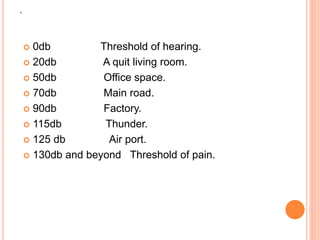
 Intensity of the sound is measured DECIBEL unit.
.
 0db Threshold of hearing.
 20db A quit living room.
 50db Office space.
 70db Main road.
 90db Factory.
 115db Thunder.
 125 db Air port.
 130db and beyond Threshold of pain.
.
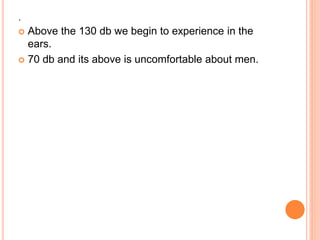
 Above the 130 db we begin to experience in the
ears.
 70 db and its above is uncomfortable about men.
PROPERTIES OF SOUNDS
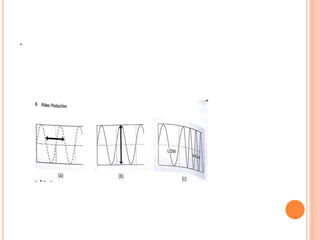
 Sound travels in form of waves.
 Wavelength
 Amplitude.
 Frequency.
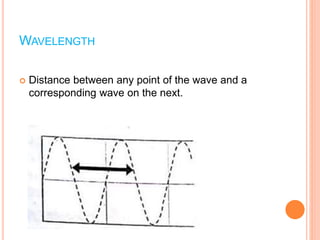
WAVELENGTH
 Distance between any point of the wave and a
corresponding wave on the next.
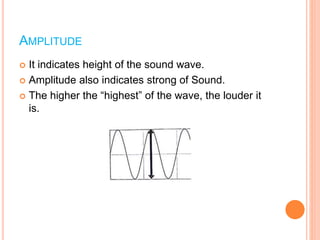
AMPLITUDE
 It indicates height of the sound wave.
 Amplitude also indicates strong of Sound.
 The higher the “highest” of the wave, the louder it
is.
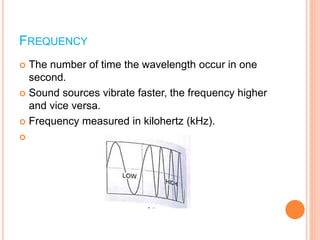
FREQUENCY
 The number of time the wavelength occur in one
second.
 Sound sources vibrate faster, the frequency higher
and vice versa.
 Frequency measured in kilohertz (kHz).

.
TYPES OF PROGRAM SOUNDS
 Each programmes are use separate sounds.
 Sound classified into three categories.
 1. Speech or spoken sound.
2. Sound effects.
3. Music.
.
 Spoken sound can be in the form of on screen
rendering and off screen voice.
 The manner in which the person speak affect the
effectiveness of the spoken word.
 The voice it self, the emphasis on certain word in
inflection, the pitch and the loudness all contribute
immensely to the overall effect.
 Sound is not to be considered incidental to a
programme. It requires conscious planning early on, in
the pre production stage.
.
 Any thing other than the music or the spoken word
is a sound effect. Eg : The creak of a chair, The
bang of a door, a ringtone, falling of books. All are
the example of SFX.
FOLEYING
 The art of manually creating and recording sound
effects in the studio is called foleying.
 It using for simple recording techniques in studio.
.
 Eg :- The sound of walking dry leaves can achieved by
stamping on a few dry leaves.
 The stone by hitting water by throwing pebbles in to a
bucket of water.
 Horses galloping by using dry coconuts shells.
 Munching of biscuits by actually munching them.
.
Sound effect can be broadly classified as follows
 Contextual sound
 Descriptive sound
 Commentative sound
CONTEXTUAL SOUND
 Sound that emanates from and duplicates a sound source
as it is.
 It also termed as synchronous or diegetic sound.
 Contextual sound emerges from a sound source as a
consequence of action.
 Eg:- In a shot that shows a person breaking a mirror in a
fit of anger, the sound of the mirror shattering is
contextual sound, that is, it is the result of an action and
conveys literal meaning.
 The sound of a hammer is the result of a person trying to
nail a hook.
DESCRIPTIVE SOUND
 Describes sonic aspects of a scene not connected to
the main action. See also commentative sound and
narrative sound.
 Effects adds to the mood of the scene.
Eg :- A person is sitting all alone on a rock and throwing
and pebbles in to a pond. The sound of the pebble
hitting the water is contextual.
 However, if you add the sound of the wind it adds to a
feeling of despondence. The sound of the wind
enhances the person’s feeling of loneliness and
sadness.
 Descriptive sound are non-diegetic sounds.
COMMENTATIVE SOUND
 Commentative sound effect, as the name itself suggests,
make a statement and to the overall impact.
 Eg:- In the film Apur Sansar, the whistle of an engine
keeps recurring whenever Apu, the central character, is
confronted with a situation.
DIEGETIC SOUND
 Sound whose source is visible on the screen or whose
source is implied to be present by the action of the film.
 voices of characters.
 sounds made by objects in the story.
 music represented as coming from instruments in the
story space ( source music)
 Diegetic sound is any sound presented as originated
from source within the film's world Digetic sound can
be either on screen or off screen depending on
whatever its source is within the frame or outside the
frame.
 Another term for diegetic sound is actual sound
NON-DIEGETIC SOUND
 Sound whose source is neither visible on the
screen nor has been implied to be present in the
action:
 narrator's commentary
 sound effects which is added for the dramatic effect
 mood music
 Non-diegetic sound is represented as coming
from the a source outside story space.
FUNCTIONS OF SOUND EFFECT
 Sound effects are often used as aural cues linking
visuals and directing the viewer to action.
 Sound effect are used often used to substitute
sound recording while shooting, for correcting the
original, for compensating, and augmenting, or for
adding realism.
FUNCTIONS OF SOUND EFFECT
 A recurring sound become a symbol. The same
soundtrack is played whenever a character is shown
undergoing the same mental trauma.
 Certain sounds track added to the soundtrack
suggest or create certain moods.
 Sound establish space, defining the environment and
the setting, intensifying action, and adding meaning or
providing a counterpoint.
Eg:- A person sitting on a table with a typewriter, while
it is obvious that the person is typing, adding
appropriate background sounds help suggest that the
person the person is in office or at home.
.
 Sound is used as a transition and continuity between
scenes by intelligent sound designers.
 Sound effects help simulate reality when reality,
obviously, has to be simulated.
Eg :- Fake guns and bullets are used in an encounter
between policemen and gangsters. The track is replaced
with gun shots either from a library of effects or foleying
the same in a studio. This helps simulate a real gun fight.
Sound effects also help simulate reality when the sound
recorded on the rushes tape is not clear.
TRANSITION TYPES
 OVERLAP
 LEAD-IN
 SEGUE
OVERLAP
 An overlap is a sound used at one end of a scene
that continues without a pause into the next scene.
LEAD – IN
 The audio that introduces a scene is heard before
the scene actually begin.
SEGUE
 Segue is a cut from one to another with out
breaking continuity.
USING MUSIC
 Music is an important tool in the hands of a sound
designer
 Music used in background to emphasise or intensify
action, set pace, unify transition, indicate time or
evoke a mood.
 Foreground music is diegetic such as some one
playing an instrument or miming to a playback
 Non diegetic music which does not have a source
on screen, they have been added in.
 Eg:- MUSIC, VOICE OVER, SOUND EFFECT.
COMPONENTS OF SOUND
 To understand the effect of the sound and its use in
television production, some of its components must
be understood, such as
1.Pitch
2.timbre.
3.Harmonics.
4.Loudness
5. Rhythm.
6.Attack.
6.Sustain.
5.Decay.
6.Speed
.
 These nine components determine how sound is
perceived.
 Modification or elimination of any one or
combination of these elements can change the
entire effect or even result in totally different sound.
PITCH
 The frequency of a sound determines its pitch.
 Frequencies can be grouped as three types.
1. Low (Bass)(Powerful). Eg:- Thunder and Gun shot.
2. Mid Range (Energetic) . Eg;- Telephone ring.
3. High (Treble). Eg:- Small bells or even shrieks.
TIMBRE
 Timbre is the combination of fundamental frequency
harmonies and overtones.
 It gives each voice, musical instrument and sound
effects it unique colouring and character.
HARMONICS
 When an object vibrates it propagate sound wave
of a certain frequency.
 This frequency in turn sets in motional frequency
waves called Harmonics.
 Greater the number of harmonics the more
intrusting is the sound that is produced.
LOUDNESS
 The loudness of a sound depends on the intensity
of the sound stimulus.
RHYTHM
 Rhythm is a recurring sound that alternates
between strong and weak elements.
 Eg:- Small blocks of wood when rapped with
measured regularity may sound like a marching
troop.
. Two coconut shells struck stone in a rhythmic
fashion recreate.
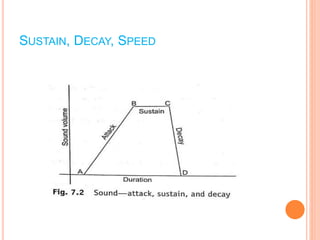
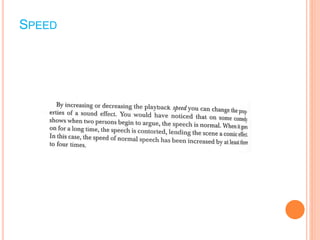
SUSTAIN, DECAY, SPEED
SPEED

Basics of sounds

  • 1.
    BASICS OF SOUNDS AFEEFUREHMANVALIYAT UNIVERSITY OF CALICUT
  • 2.
    .  Today wecannot image a program without sound.  Good programmes wants to good sounds.  Intensity of the sound is measured DECIBEL unit.
  • 3.
    .  0db Thresholdof hearing.  20db A quit living room.  50db Office space.  70db Main road.  90db Factory.  115db Thunder.  125 db Air port.  130db and beyond Threshold of pain.
  • 4.
    .  Above the130 db we begin to experience in the ears.  70 db and its above is uncomfortable about men.
  • 5.
    PROPERTIES OF SOUNDS Sound travels in form of waves.  Wavelength  Amplitude.  Frequency.
  • 6.
    WAVELENGTH  Distance betweenany point of the wave and a corresponding wave on the next.
  • 7.
    AMPLITUDE  It indicatesheight of the sound wave.  Amplitude also indicates strong of Sound.  The higher the “highest” of the wave, the louder it is.
  • 8.
    FREQUENCY  The numberof time the wavelength occur in one second.  Sound sources vibrate faster, the frequency higher and vice versa.  Frequency measured in kilohertz (kHz). 
  • 9.
  • 10.
    TYPES OF PROGRAMSOUNDS  Each programmes are use separate sounds.  Sound classified into three categories.  1. Speech or spoken sound. 2. Sound effects. 3. Music.
  • 11.
    .  Spoken soundcan be in the form of on screen rendering and off screen voice.  The manner in which the person speak affect the effectiveness of the spoken word.  The voice it self, the emphasis on certain word in inflection, the pitch and the loudness all contribute immensely to the overall effect.  Sound is not to be considered incidental to a programme. It requires conscious planning early on, in the pre production stage.
  • 12.
    .  Any thingother than the music or the spoken word is a sound effect. Eg : The creak of a chair, The bang of a door, a ringtone, falling of books. All are the example of SFX. FOLEYING  The art of manually creating and recording sound effects in the studio is called foleying.  It using for simple recording techniques in studio.
  • 13.
    .  Eg :-The sound of walking dry leaves can achieved by stamping on a few dry leaves.  The stone by hitting water by throwing pebbles in to a bucket of water.  Horses galloping by using dry coconuts shells.  Munching of biscuits by actually munching them.
  • 14.
    . Sound effect canbe broadly classified as follows  Contextual sound  Descriptive sound  Commentative sound
  • 15.
    CONTEXTUAL SOUND  Soundthat emanates from and duplicates a sound source as it is.  It also termed as synchronous or diegetic sound.  Contextual sound emerges from a sound source as a consequence of action.  Eg:- In a shot that shows a person breaking a mirror in a fit of anger, the sound of the mirror shattering is contextual sound, that is, it is the result of an action and conveys literal meaning.  The sound of a hammer is the result of a person trying to nail a hook.
  • 16.
    DESCRIPTIVE SOUND  Describessonic aspects of a scene not connected to the main action. See also commentative sound and narrative sound.  Effects adds to the mood of the scene. Eg :- A person is sitting all alone on a rock and throwing and pebbles in to a pond. The sound of the pebble hitting the water is contextual.  However, if you add the sound of the wind it adds to a feeling of despondence. The sound of the wind enhances the person’s feeling of loneliness and sadness.  Descriptive sound are non-diegetic sounds.
  • 17.
    COMMENTATIVE SOUND  Commentativesound effect, as the name itself suggests, make a statement and to the overall impact.  Eg:- In the film Apur Sansar, the whistle of an engine keeps recurring whenever Apu, the central character, is confronted with a situation.
  • 18.
    DIEGETIC SOUND  Soundwhose source is visible on the screen or whose source is implied to be present by the action of the film.  voices of characters.  sounds made by objects in the story.  music represented as coming from instruments in the story space ( source music)  Diegetic sound is any sound presented as originated from source within the film's world Digetic sound can be either on screen or off screen depending on whatever its source is within the frame or outside the frame.  Another term for diegetic sound is actual sound
  • 19.
    NON-DIEGETIC SOUND  Soundwhose source is neither visible on the screen nor has been implied to be present in the action:  narrator's commentary  sound effects which is added for the dramatic effect  mood music  Non-diegetic sound is represented as coming from the a source outside story space.
  • 20.
    FUNCTIONS OF SOUNDEFFECT  Sound effects are often used as aural cues linking visuals and directing the viewer to action.  Sound effect are used often used to substitute sound recording while shooting, for correcting the original, for compensating, and augmenting, or for adding realism.
  • 21.
    FUNCTIONS OF SOUNDEFFECT  A recurring sound become a symbol. The same soundtrack is played whenever a character is shown undergoing the same mental trauma.  Certain sounds track added to the soundtrack suggest or create certain moods.  Sound establish space, defining the environment and the setting, intensifying action, and adding meaning or providing a counterpoint. Eg:- A person sitting on a table with a typewriter, while it is obvious that the person is typing, adding appropriate background sounds help suggest that the person the person is in office or at home.
  • 22.
    .  Sound isused as a transition and continuity between scenes by intelligent sound designers.  Sound effects help simulate reality when reality, obviously, has to be simulated. Eg :- Fake guns and bullets are used in an encounter between policemen and gangsters. The track is replaced with gun shots either from a library of effects or foleying the same in a studio. This helps simulate a real gun fight. Sound effects also help simulate reality when the sound recorded on the rushes tape is not clear.
  • 23.
  • 24.
    OVERLAP  An overlapis a sound used at one end of a scene that continues without a pause into the next scene.
  • 25.
    LEAD – IN The audio that introduces a scene is heard before the scene actually begin.
  • 26.
    SEGUE  Segue isa cut from one to another with out breaking continuity.
  • 27.
    USING MUSIC  Musicis an important tool in the hands of a sound designer  Music used in background to emphasise or intensify action, set pace, unify transition, indicate time or evoke a mood.  Foreground music is diegetic such as some one playing an instrument or miming to a playback  Non diegetic music which does not have a source on screen, they have been added in.  Eg:- MUSIC, VOICE OVER, SOUND EFFECT.
  • 28.
    COMPONENTS OF SOUND To understand the effect of the sound and its use in television production, some of its components must be understood, such as 1.Pitch 2.timbre. 3.Harmonics. 4.Loudness 5. Rhythm. 6.Attack. 6.Sustain. 5.Decay. 6.Speed
  • 29.
    .  These ninecomponents determine how sound is perceived.  Modification or elimination of any one or combination of these elements can change the entire effect or even result in totally different sound.
  • 30.
    PITCH  The frequencyof a sound determines its pitch.  Frequencies can be grouped as three types. 1. Low (Bass)(Powerful). Eg:- Thunder and Gun shot. 2. Mid Range (Energetic) . Eg;- Telephone ring. 3. High (Treble). Eg:- Small bells or even shrieks.
  • 31.
    TIMBRE  Timbre isthe combination of fundamental frequency harmonies and overtones.  It gives each voice, musical instrument and sound effects it unique colouring and character.
  • 32.
    HARMONICS  When anobject vibrates it propagate sound wave of a certain frequency.  This frequency in turn sets in motional frequency waves called Harmonics.  Greater the number of harmonics the more intrusting is the sound that is produced.
  • 33.
    LOUDNESS  The loudnessof a sound depends on the intensity of the sound stimulus.
  • 34.
    RHYTHM  Rhythm isa recurring sound that alternates between strong and weak elements.  Eg:- Small blocks of wood when rapped with measured regularity may sound like a marching troop. . Two coconut shells struck stone in a rhythmic fashion recreate.
  • 35.
  • 36.