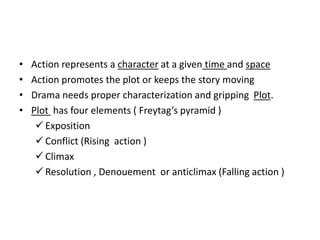
CAPICITY BUILDING TRAINING MODULE
ON RADIO DRAMA.
Developed By: SARDAR ALI KHAN,
(Retired) Station Director, Radio Pakistan
1. Genesis of Drama
There are records of sacred drama in Egypt (2000
B.C). The Psi (600B.C) in the ancient Greece is the
first known playwright.
Then followed Aeschylus (525-456 B.C),
Sophocles (496-406 B.C ).
In the East, Indian culture was influenced by
Buddhism and under this influence plays were
being written and performed for religious
purposes.
In fact classical drama is conventional and
The plays of Kalidas (4th century A.D ) and
Bhavati are lyrical in tone and refined in
feelings. Kalidas’s delicate romantic tales leap
time and space but there is no conflict and
characters are transformed from human
beings in to gods.
Understanding Drama
A story represented by means of words and action.
In words of Bonamy Dobree “ moving literature”.
Action is pivotal to any drama which is basically meant for
performance.
Words were introduced in plays at much lateral stage than
other elements e.g. Mime, dance , Music, costume and
stage décor.
2. Oral half of theatre-Radio Drama
Stage Play vs. Radio Play
Stage Play Radio Play
• Stage décor and lights. Studio acoustics.
• Actors presence visible Voice variations (Sign posting,
with costume ,make up Stress, Pause, Swing)
and voice throw .
• Dance and mime. Stress, Pause , swing and
silence
• Sound Effects & Music . Sound effects & Music .
The Radio Play
• The term “ Play “ applied to Drama indicates that certain
action is displayed or reacted for recreation
• Basically radio play emerged out of Theatre or stage play
• The recreative quality of drama gets more imaginative place
in Radio
• It has ,sometimes, been called “Blind Theatre ” or “ Aural Half
“ of stage play.
• Recreation implies creation of an illusion of a reality, this
phenomenon is called “make believe” or suspension of
disbelief
• Action represents a character at a given time and space
• Action promotes the plot or keeps the story moving
• Drama needs proper characterization and gripping Plot.
• Plot has four elements ( Freytag’s pyramid )
 Exposition
 Conflict (Rising action )
 Climax
 Resolution , Denouement or anticlimax (Falling action )
Plot
• It’s the series of actions and sequences of
the story
• The plot grows from the conflict that arises
when two forces in a play come into
opposition
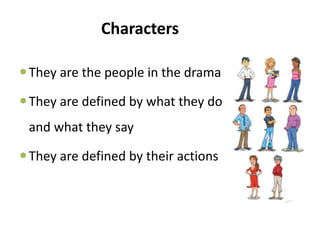
Characters
They are the people in the drama
They are defined by what they do
and what they say
They are defined by their actions
3. Structural Aspect of drama
Freytag's Analysis
3.1 Exposition/Opening
• This usually occurs at the beginning of a story.
Characters are introduced. We also learn about the
setting of the story. Most importantly, listeners are
introduced to the characters and the conflict gets
start.
3.2 Conflict/Rising Action
• This part of the story begins to develop the conflict.
Suspense is created to arise interest as to what is
next.
3.3 Climax
• This is the turning point of the story. Usually the
main character encounters face to face with a
conflict. The major character will change in some
way.
3.4 Resolution or denouement
• All loose ends of the plot are tied up. The conflict(s)
and climax are taken care of.
Further Explanatory notes
• Exposition
 The exposition is the portion of a story that introduces
important background information to the audience
Rising Action
 A series of related incidents builds towards the point of
greatest interest. The rising action of a story is series of
events that begin immediately after exposition
• Climax
 The climax is the turning point, which changes the
protagonist’s fate. If the story is a comedy, things will have
gone badly for the protagonist up to this point.
Falling action
 During the falling action, the conflict between the protagonist
and antagonist unfolds, with the protagonist wining or loosing
against the antagonist. The falling action may contain a
moment of final suspense, in which the final outcome of the
conflict is in doubt.
• Resolution or denouement
 The dénouement comprises events from the end of
the falling action to the actual ending scene of the
drama or narrative. Conflicts are resolved, creating
normality for the characters and a sense of catharsis or
release of tension and anxiety.
• Conflict
 A Struggle between two or more forces that creates
tension which must be resolved. There are two
conflicts namely External and internal.
 The traditional breakdown of the conflict is :
Man vs. man (external)
Man vs. nature (external )
Man vs. society (external )
Man vs. Self ( Internal )
4. Dramaturgy
• Theme
• Story
• Script
• Theme
• Suspense
• Characterization
antagonist
Protagonist
 Direct ( round or explicit, it uses another character, narrator
or the protagonist himself to tell the audience about the
subject)
 Indirect (Flat or implicit, the audience has to deduce for himself
the characteristics of the character by observing his/her own
thought process, behavior , speech, way of talking, appearance
and way of communication with other characters )
• Plot
• Dialogue(s)
5. Getting the work done
 Idea formulation (Research, personal observations, inspirations,
adaptation of popular novels and short stories, discussions with
playwrights, translations )
 Script (Vetting, amendments in consultation with seniors and the
playwright – you have either a solicited or unsolicited script, Reader’s
Report and final approval
 Casting ,booking proposal
 Preliminary production script
 Copies of final script and selection of dramatists
REMEMBER:
• Do not perform the script by your
self in front of the artists.
why?????
what to do?
6. Directional mode
 First Rehearsal ( reading the script by the dramatists
,cues, stresses, pauses, swings, silence, sign posting,
tones, tempo, pace )
 second Rehearsal,
 Final Rehearsal,
 Dress or Mike rehearsal (Microphone distances for sign
posting, in out cues, interactive responses among drama
voices and interaction with the producer through
observation window )
Music blending
 music can capture emotions and images
 It can swing the listeners instantaneously from
entirely one mood to an other mood
 It can, as subtly as a raised eyebrow-give to a phrase
an extra, and as possibly contradictory, level of
meaning
 There happen different kinds of music while
producing a radio play e.g.
 Opening/closing music depending on theme of the
drama, Bridging music, change over or transitional
music for separating different scenes, Bangs, BGM as
continuity etc.
Music has many shades :
suggestive
descriptive
indicative etc.
Sound Effects
 Sound Effects help tell the story in audio. They tell
you where or when the story takes place. They tell
you about the action, how events are unfolding.
 Radio drama is usually recorded in a carefully
sound proofed studio. But voices and script alone
can sound dry and unreal. It’s the studio
manager’s job to add recorded sound effects, and
to create live sound effects.
 The addition of sound effects transforms the clean
audio of voices reading script into a world that is
believable for the listener. Some of these sound
effects happen at a very subconscious level. They can
be as simple as a teaspoon clipping the edge of a cup,
or a door opening – all ordinary noises that happen in
the background of real life, but that have to be
artificially created in the world of radio drama.
Books recommended:
 The Sound Effects Bible - Ric Viers, Michael
Weise Productions, 2008. And excellent book
that covers modern hardware and software,
field recording, sound design, and how to make
specific sounds.
 Radio Sound Effects - Robert L. Mott.
McFarland, 1993.
 Radio and Television Sound Effects - by
Robert B. Turnbull. 1951. Rinehart & Company
Inc.; New York www.suondeffectsbible.com
www.sounddogs.com
7. How to produce a Radio Play
in eight easy steps ?
• Create visual picture. Production of a radio drama requires
you to paint a picture in the audience’s minds. This means
the use of descriptive words to build up images that enable
the listening audience to identify with the characters, the
world the character lives in and the atmosphere for each
scene. Use of color is very important to create the image in
the listener’s mind
• A narrator is very useful in the context of radio: the
narrator play out the scene, explain action sequences and
wrap up the scene.
 If you are working on a serial, the narrator
can summarize the previous episode’s action as recap
 The narrator can switch between scenes
• Create the action through dialogues, since all
you have to work with , is dialogues rather
than props, setting or visual cues, dialogues
will need to work hard on it. It can be used to
describe action as it is taking place
• Make the most of sound effects where
necessary. Too many sound effects can spoil
the broth and can get your listeners
confused. Use astounding sounds- things to
wake up your listeners such as an explosion,
a music bang, a cry, a skidding car, an angry
mob shouting etc.
• You can use effects which are built in to the
mixer desk to help create actualization. When it
comes to producing your play, and if you are
producing it, be sure that you do a sound check
with the effects, to ensure the sound levels and
effects are how you want them.
• Use reverberation- use it to set the acoustics of
a location. For example empty room, an office
full of coworkers, a cave, halls, a court room etc.
• Music in the background can help to set the
mood of your play. Obviously, you can match
music o feelings such as sad music for sad
occasions featuring death or loss; happy
music for good news; suspenseful music for a
scary or worrying moment and fast music for
increased action or a chase. Music also sets
opening/closing tone of a play, serving as
aural curtain….Sky is the limit for a creative
drama producer
• Be precise and clear with spoken words,
always use economy of words without
altering the meaning of a dialogue. Every
thing must be clear because your listener
cannot view a character using facial
expressions, waving arms about or
throwing objects etc; Silence must be used
craft fully so as not to convey an empty
space- meaningful or pregnant pause is
always appreciated
THANK
YOU FOR
YOUR
PATIENCE

Ppt drama final

  • 1.
    CAPICITY BUILDING TRAININGMODULE ON RADIO DRAMA. Developed By: SARDAR ALI KHAN, (Retired) Station Director, Radio Pakistan
  • 2.
    1. Genesis ofDrama There are records of sacred drama in Egypt (2000 B.C). The Psi (600B.C) in the ancient Greece is the first known playwright. Then followed Aeschylus (525-456 B.C), Sophocles (496-406 B.C ). In the East, Indian culture was influenced by Buddhism and under this influence plays were being written and performed for religious purposes. In fact classical drama is conventional and
  • 3.
    The plays ofKalidas (4th century A.D ) and Bhavati are lyrical in tone and refined in feelings. Kalidas’s delicate romantic tales leap time and space but there is no conflict and characters are transformed from human beings in to gods.
  • 4.
    Understanding Drama A storyrepresented by means of words and action. In words of Bonamy Dobree “ moving literature”. Action is pivotal to any drama which is basically meant for performance. Words were introduced in plays at much lateral stage than other elements e.g. Mime, dance , Music, costume and stage décor. 2. Oral half of theatre-Radio Drama
  • 5.
    Stage Play vs.Radio Play Stage Play Radio Play • Stage décor and lights. Studio acoustics. • Actors presence visible Voice variations (Sign posting, with costume ,make up Stress, Pause, Swing) and voice throw . • Dance and mime. Stress, Pause , swing and silence • Sound Effects & Music . Sound effects & Music .
  • 6.
    The Radio Play •The term “ Play “ applied to Drama indicates that certain action is displayed or reacted for recreation • Basically radio play emerged out of Theatre or stage play • The recreative quality of drama gets more imaginative place in Radio • It has ,sometimes, been called “Blind Theatre ” or “ Aural Half “ of stage play. • Recreation implies creation of an illusion of a reality, this phenomenon is called “make believe” or suspension of disbelief
  • 7.
    • Action representsa character at a given time and space • Action promotes the plot or keeps the story moving • Drama needs proper characterization and gripping Plot. • Plot has four elements ( Freytag’s pyramid )  Exposition  Conflict (Rising action )  Climax  Resolution , Denouement or anticlimax (Falling action )
  • 8.
    Plot • It’s theseries of actions and sequences of the story • The plot grows from the conflict that arises when two forces in a play come into opposition
  • 9.
    Characters They are thepeople in the drama They are defined by what they do and what they say They are defined by their actions
  • 10.
    3. Structural Aspectof drama Freytag's Analysis
  • 11.
    3.1 Exposition/Opening • Thisusually occurs at the beginning of a story. Characters are introduced. We also learn about the setting of the story. Most importantly, listeners are introduced to the characters and the conflict gets start.
  • 12.
    3.2 Conflict/Rising Action •This part of the story begins to develop the conflict. Suspense is created to arise interest as to what is next.
  • 13.
    3.3 Climax • Thisis the turning point of the story. Usually the main character encounters face to face with a conflict. The major character will change in some way.
  • 14.
    3.4 Resolution ordenouement • All loose ends of the plot are tied up. The conflict(s) and climax are taken care of.
  • 15.
    Further Explanatory notes •Exposition  The exposition is the portion of a story that introduces important background information to the audience Rising Action  A series of related incidents builds towards the point of greatest interest. The rising action of a story is series of events that begin immediately after exposition
  • 16.
    • Climax  Theclimax is the turning point, which changes the protagonist’s fate. If the story is a comedy, things will have gone badly for the protagonist up to this point. Falling action  During the falling action, the conflict between the protagonist and antagonist unfolds, with the protagonist wining or loosing against the antagonist. The falling action may contain a moment of final suspense, in which the final outcome of the conflict is in doubt.
  • 17.
    • Resolution ordenouement  The dénouement comprises events from the end of the falling action to the actual ending scene of the drama or narrative. Conflicts are resolved, creating normality for the characters and a sense of catharsis or release of tension and anxiety.
  • 18.
    • Conflict  AStruggle between two or more forces that creates tension which must be resolved. There are two conflicts namely External and internal.  The traditional breakdown of the conflict is : Man vs. man (external) Man vs. nature (external ) Man vs. society (external ) Man vs. Self ( Internal )
  • 19.
    4. Dramaturgy • Theme •Story • Script • Theme • Suspense • Characterization antagonist Protagonist  Direct ( round or explicit, it uses another character, narrator or the protagonist himself to tell the audience about the subject)  Indirect (Flat or implicit, the audience has to deduce for himself the characteristics of the character by observing his/her own thought process, behavior , speech, way of talking, appearance and way of communication with other characters ) • Plot • Dialogue(s)
  • 20.
    5. Getting thework done  Idea formulation (Research, personal observations, inspirations, adaptation of popular novels and short stories, discussions with playwrights, translations )  Script (Vetting, amendments in consultation with seniors and the playwright – you have either a solicited or unsolicited script, Reader’s Report and final approval  Casting ,booking proposal  Preliminary production script  Copies of final script and selection of dramatists
  • 21.
    REMEMBER: • Do notperform the script by your self in front of the artists. why????? what to do?
  • 22.
    6. Directional mode First Rehearsal ( reading the script by the dramatists ,cues, stresses, pauses, swings, silence, sign posting, tones, tempo, pace )  second Rehearsal,  Final Rehearsal,  Dress or Mike rehearsal (Microphone distances for sign posting, in out cues, interactive responses among drama voices and interaction with the producer through observation window )
  • 23.
    Music blending  musiccan capture emotions and images  It can swing the listeners instantaneously from entirely one mood to an other mood  It can, as subtly as a raised eyebrow-give to a phrase an extra, and as possibly contradictory, level of meaning  There happen different kinds of music while producing a radio play e.g.  Opening/closing music depending on theme of the drama, Bridging music, change over or transitional music for separating different scenes, Bangs, BGM as continuity etc.
  • 24.
    Music has manyshades : suggestive descriptive indicative etc.
  • 25.
    Sound Effects  SoundEffects help tell the story in audio. They tell you where or when the story takes place. They tell you about the action, how events are unfolding.  Radio drama is usually recorded in a carefully sound proofed studio. But voices and script alone can sound dry and unreal. It’s the studio manager’s job to add recorded sound effects, and to create live sound effects.
  • 26.
     The additionof sound effects transforms the clean audio of voices reading script into a world that is believable for the listener. Some of these sound effects happen at a very subconscious level. They can be as simple as a teaspoon clipping the edge of a cup, or a door opening – all ordinary noises that happen in the background of real life, but that have to be artificially created in the world of radio drama.
  • 27.
    Books recommended:  TheSound Effects Bible - Ric Viers, Michael Weise Productions, 2008. And excellent book that covers modern hardware and software, field recording, sound design, and how to make specific sounds.  Radio Sound Effects - Robert L. Mott. McFarland, 1993.  Radio and Television Sound Effects - by Robert B. Turnbull. 1951. Rinehart & Company Inc.; New York www.suondeffectsbible.com www.sounddogs.com
  • 28.
    7. How toproduce a Radio Play in eight easy steps ? • Create visual picture. Production of a radio drama requires you to paint a picture in the audience’s minds. This means the use of descriptive words to build up images that enable the listening audience to identify with the characters, the world the character lives in and the atmosphere for each scene. Use of color is very important to create the image in the listener’s mind • A narrator is very useful in the context of radio: the narrator play out the scene, explain action sequences and wrap up the scene.  If you are working on a serial, the narrator can summarize the previous episode’s action as recap  The narrator can switch between scenes
  • 29.
    • Create theaction through dialogues, since all you have to work with , is dialogues rather than props, setting or visual cues, dialogues will need to work hard on it. It can be used to describe action as it is taking place
  • 30.
    • Make themost of sound effects where necessary. Too many sound effects can spoil the broth and can get your listeners confused. Use astounding sounds- things to wake up your listeners such as an explosion, a music bang, a cry, a skidding car, an angry mob shouting etc.
  • 31.
    • You canuse effects which are built in to the mixer desk to help create actualization. When it comes to producing your play, and if you are producing it, be sure that you do a sound check with the effects, to ensure the sound levels and effects are how you want them. • Use reverberation- use it to set the acoustics of a location. For example empty room, an office full of coworkers, a cave, halls, a court room etc.
  • 32.
    • Music inthe background can help to set the mood of your play. Obviously, you can match music o feelings such as sad music for sad occasions featuring death or loss; happy music for good news; suspenseful music for a scary or worrying moment and fast music for increased action or a chase. Music also sets opening/closing tone of a play, serving as aural curtain….Sky is the limit for a creative drama producer
  • 33.
    • Be preciseand clear with spoken words, always use economy of words without altering the meaning of a dialogue. Every thing must be clear because your listener cannot view a character using facial expressions, waving arms about or throwing objects etc; Silence must be used craft fully so as not to convey an empty space- meaningful or pregnant pause is always appreciated
  • 34.

Editor's Notes

  • #2 Developed by SARDAR ALI