

















Radical Analytics!
Stéphane Hamel
@SHamel67 #WAQ17
MAIS QU’EST-CE QUI CLOCHE AVEC LE WEB ANALYTICS?
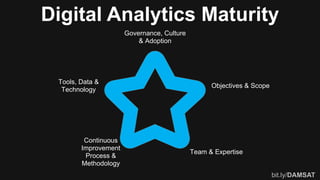
Governance, Culture
& Adoption
Objectives & Scope
Team & Expertise
Continuous
Improvement
Process &
Methodology
Tools, Data &
Technology
Digital Analytics Maturity
bit.ly/DAMSAT
Quel est votre objectif?
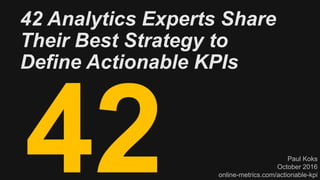
42 Analytics Experts Share
Their Best Strategy to
Define Actionable KPIs
Paul Koks
October 2016
online-metrics.com/actionable-kpi
It’s 2015 — You’d Think We’d
Have Figured Out How To
Measure Web Traffic By Now
Sam Dean
July 2015
fivethirtyeight.com
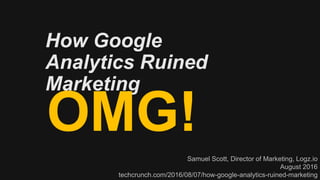
How Google
Analytics Ruined
Marketing
Samuel Scott, Director of Marketing, Logz.io
August 2016
techcrunch.com/2016/08/07/how-google-analytics-ruined-marketing
OMG!
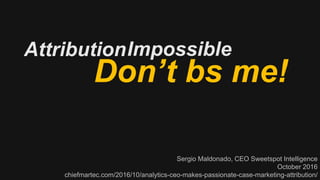
Impossible
Sergio Maldonado, CEO Sweetspot Intelligence
October 2016
chiefmartec.com/2016/10/analytics-ceo-makes-passionate-case-marketing-attribution/
Don’t bs me!
Attribution
Dennis van der Heijden, CEO, Convert.com
February 2017
blog.crazyegg.com/2017/02/09/hard-truth-ab-testing/
We lied to you.
The Hard Truth About A/B
Testing I Had to Swallow
Est-ce difficile?
Bien sur que oui!
PSST… C’EST OK!
RADICAL
adjectif
(latin médiéval radicalis, du latin classique radix, -icis, racine)
Qui appartient à la nature profonde, à l'essence d'un être ou d'une chose.
Qui présente un caractère absolu, total ou définitif.
Se dit d'un genre d'action ou de moyen très énergique, très efficace, dont on use pour
combattre quelque chose.
Larousse
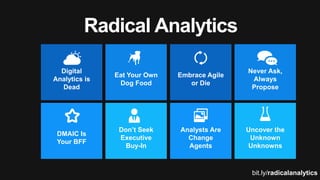
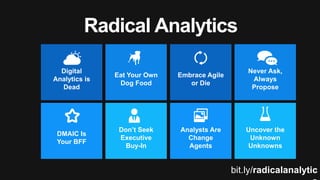
Analysts Are
Change
Agents
Uncover the
Unknown
Unknowns
Embrace Agile
or Die
Never Ask,
Always
Propose
Radical Analytics
DMAIC Is
Your BFF
Don’t Seek
Executive
Buy-In
Digital
Analytics is
Dead
Eat Your Own
Dog Food
bit.ly/radicalanalytics
Digital Analytics
is Dead
Visualization of 90 Gartner Hype Cycles covering 1900 technologies
blogs.gartner.com/hypecyclebook/
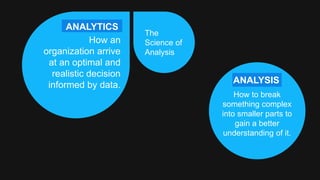
ANALYTICS
The
Science of
Analysis
How an
organization arrive
at an optimal and
realistic decision
informed by data.
How to break
something complex
into smaller parts to
gain a better
understanding of it.
ANALYSIS
Analysts are
Change Agents
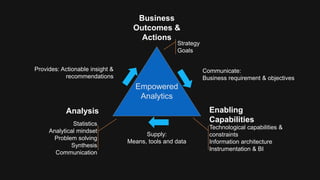
Privilege of Recommendation No Power of Decision
Empowered
Analytics
Business
Outcomes &
Actions
Enabling
Capabilities
Analysis
Provides: Actionable insight &
recommendations
Communicate:
Business requirement & objectives
Supply:
Means, tools and data
Strategy
Goals
Technological capabilities &
constraints
Information architecture
Instrumentation & BI
Statistics
Analytical mindset
Problem solving
Synthesis
Communication
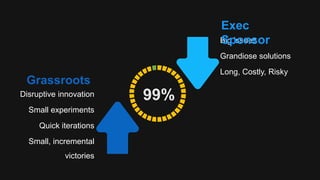
Don’t Seek
Executive
Buy-In
Big issues
Grandiose solutions
Long, Costly, Risky
Exec
Sponsor
Disruptive innovation
Small experiments
Quick iterations
Small, incremental
victories
Grassroots
99%
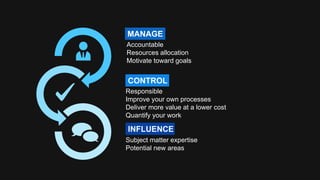
Accountable
Resources allocation
Motivate toward goals
MANAGE
Responsible
Improve your own processes
Deliver more value at a lower cost
Quantify your work
CONTROL
Subject matter expertise
Potential new areas
INFLUENCE
Never Ask,
Always Propose
“WHAT”
vs.
“WHY”
YES
NO
Eat Your Own
Dog Food
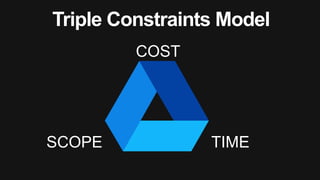
Triple Constraints Model
COST
TIMESCOPE
Never
– ever –
complain
DMAIC is
your BFF
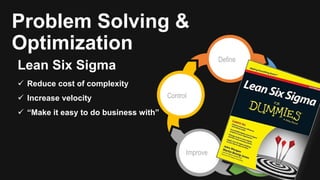
Problem Solving &
Optimization
Lean Six Sigma
 Reduce cost of complexity
 Increase velocity
 “Make it easy to do business with”
Define
AnalyzeImprove
Control Measure
Embrace Agile
or Die
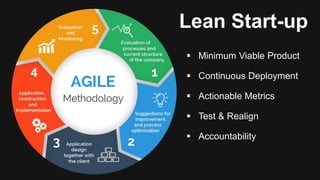
Lean Start-up
 Minimum Viable Product
 Continuous Deployment
 Actionable Metrics
 Test & Realign
 Accountability
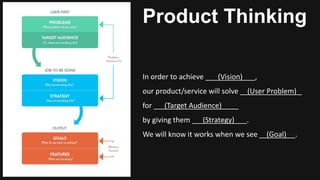
Product Thinking
In order to achieve (Vision) ,
our product/service will solve (User Problem)
for (Target Audience)
by giving them (Strategy) .
We will know it works when we see (Goal) .
Uncover the
Unknown
Unknowns
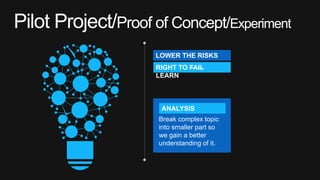
Pilot Project/Proof of Concept/Experiment
LOWER THE RISKS
Break complex topic
into smaller part so
we gain a better
understanding of it.
ANALYSIS
RIGHT TO FAIL
LEARN
Analysts Are
Change
Agents
Uncover the
Unknown
Unknowns
Embrace Agile
or Die
Never Ask,
Always
Propose
Radical Analytics
DMAIC Is
Your BFF
Don’t Seek
Executive
Buy-In
Digital
Analytics is
Dead
Eat Your Own
Dog Food
bit.ly/radicalanalytic
Alors… Qu’est-ce qui cloche?
me@StephaneHamel.net
(the fine prints)
Copyright © 2017 by Stéphane Hamel.
All rights reserved.
No part of this document may be used or reproduced in any manner whatsoever
without the express permission of the author, except in brief quotations
embodied in critical articles and reviews (with proper citation of source). No
commercial use of this material is permitted.
Stéphane Hamel
PO BOX 1123
St-Pierre, Qc G0A4E0
Canada
https://StephaneHamel.net
me@StephaneHamel.net

Radical Analytics, Web à Québec, Mars 2017 (français)

Editor's Notes

  • #2 We have been doing it all wrong… the idea was to gather business requirements from stakeholders, define KPIs, and create a solution design. The thing is… either your stakeholders (if client side) or clients (if agency) do not have a clue or they do not know how to properly articulate their needs. Do not ask them! Instead, take the lead - be the expert; Show them the light; pave the way! In this presentation, Stéphane Hamel, a recognized industry leader and author of the Digital Analytics Maturity Model, will propose a radical new approach to digital analytics. He will share tricks and examples that could transform the way you do your job. Utopia or Nirvana? It will be yours to decide! --- « Marketing strategy », « Big Data », « digital analytics », Internet des Objets… en voulez-vous du data, en v’là! En principe, l’analytique devrait permettre aux gestionnaires marketing et autres de prendre des décisions plus éclairées. Pourtant, après des années à définir des objectifs et des indicateurs de performance, à mesurer, à produire des rapports et des tableaux de bord, la majorité des entreprises tirent le diable par la queue. Peut-être est-ce le temps de changer notre façon de faire?
  • #3 Placeholder for personal intro Why I don’t have a job title… What is a « thought leader », what is a « consultant » vs « academic » vs « practitionner »?
  • #4 Created in 2009 as my eBusiness MBA final paper. Received with lots of skepticism at first… copied many times including by Adobe (without attribution)… now the concept of « maturity » is prevailing as a way to assess strenghts & weaknesses and develop a more realistic roadmap. Source: https://digitalanalyticsmaturity.org/
  • #5 What is the first question we are supposed to ask? Really? What about “How do you define success”, as Sir. Richard Branson puts it… Sir Richard Branson, Founder & Chairman of Virgin Group, was asked Q) “If you lost it all - what would be the first thing you would do to try and rebuild your success?” A) “You have to DEFINE what SUCCESS is.” Source: http://blog.linkedin.com/2013/01/07/richard-bransons-secrets-to-success/
  • #6 Hitchiker’s Guide to the Galaxy! “The number 42 is, in The Hitchhiker's Guide to the Galaxy by Douglas Adams, the "Answer to the Ultimate Question of Life, the Universe, and Everything", calculated by an enormous supercomputer named Deep Thought over a period of 7.5 million years. Unfortunately, no one knows what the question is.” Source: http://online-metrics.com/actionable-kpi/ https://en.wikipedia.org/wiki/Phrases_from_The_Hitchhiker%27s_Guide_to_the_Galaxy#The_number_42 https://en.wikipedia.org/wiki/42_(number)
  • #7 In May, a Vanity Fair article about Bill Simmons’s departure from ESPN said that Grantland had 6 million unique visitors in March but that “ESPN’s internal numbers … had the site reaching 10 million uniques in April.” Late last year, The Wall Street Journal noted that Buzzfeed had 74.6 million monthly uniques, but that its “internal traffic numbers are far higher than the comScore figures … in striking distance of passing 200 million unique viewers per month.” Last fall, Arianna Huffington wrote “100 Million Thank-Yous” to celebrate Huffington Post’s 115 million unique visitors in August but noted that their “internal numbers, at 368 million UVs, are much higher, of course.” Source: http://fivethirtyeight.com/features/why-we-still-cant-agree-on-web-metrics/
  • #8 No one ever said “television marketing” When marketers brainstorm campaigns, they typically ask these questions, in this order: Who is our target audience and what are our goals? What is the best message for that audience? In light of our goals, which strategies within the Promotion Mix — advertising, direct marketing, sales promotion, direct selling and publicity — should we use to communicate that message? What are the best online and/or offline channels for that strategy to reach that audience? What marketing collateral and creatives should we create and transmit based on the answers to the prior four questions? How can we measure the results based on which metrics are relevant to each strategy within the Promotion Mix that we will use? The strategy, message and marketing collateral matter more than the channel. Google Analytics changed the buckets (channel grouping) Google Analytics pushed everyone online: confuse strategies and channels Google Analytics gives only direct ROI Google Analytics hooked us on direct metrics Integrating online and offline channels (lack of) Source: https://techcrunch.com/2016/08/07/how-google-analytics-ruined-marketing/
  • #9 A BLACK HOLE It requires linearity. There is no single, common timeline sheltering all possible initiatives in the vast realm of marketing. Even less so one in which such investments and our desired business outcomes coexist. A fictional “snapshot” is required when cause and effect reside in parallel realities — one that is defined by our even more arbitrary decision-making milestones. It requires causality. Causality does not happen in aggregate, but instead at very granular level. More specifically, at customer, user, fan, visitor, lead level. This means cross-device and cross-media integration at a user level are imperative if attribution is to work. In other words, attribution requires the famous 360-degree view of a statistically significant amount of potential customers. More on that separate fiction in a minute. When pertaining to humans (always the case thus far), the understanding of attribution is limited by the understanding of the human mind. Our culture, life experiences, perceptions… affect a system (human brain) which we do not entirely comprehend. Now, can the human mind ever understand its own intricacies? There is no common timeline. Many campaigns, channels, or media have a longer term impact on true business outcomes that we can even measure. Are you prepared to maintain never-ending conversion funnels so as to properly take into account the long-term impact of social reach and cultural associations? Will you really be able to compute all possible conversions? There is no single customer view. People are less “digitally unique” and traceable every day. First because they choose to be. Second, because they scatter their attention and touchpoints across multiple, isolated environments. Third, because privacy standards or data protection laws prevent further integration. Cross-device… Privacy… Social trend counter to single identity 2. THE LEGITIMATE PURSUIT: FINDING ROI 3. WHAT IS THE ALTERNATIVE? Customer-level intelligence belongs in the space of data-powered automation/optimization/activation (data as an engine), not data-driven decision-making (data as a witness). We love to understand the inner components of every process because that is the world that many of us grew up in. But discerning the pieces is no longer needed to work with the whole. Aggregate data is not inherently inferior to granular data. And there is great power in correlations. Soure: http://chiefmartec.com/2016/10/analytics-ceo-makes-passionate-case-marketing-attribution/ http://www.lsainsider.com/study-3-in-4-euro-marketers-think-perfect-attribution-is-impossible/archives
  • #10 On CrazyEgg website Source: https://www.crazyegg.com/blog/hard-truth-ab-testing/
  • #12 Source: Dictionnaire Larousse en ligne
  • #15 http://blogs.gartner.com/hypecyclebook/ “In 2013 Gartner analysts published over 90 Hype Cycle reports covering different technology domains. There were more than 1900 technology profiles within those charts. I had always wanted to see all that data in one place, at one time.”
  • #26 Close-Ended vs. Open Questions
  • #29 « the Waterfall methodology was established in the 50's and is used successfully across a range of industries including the military, space development and health care.  Such industries are tightly controlled, regulated environments where decisions are made by experts and people's lives depend on decisions being right first time.  There isn't a great deal of "Whoops, that didn't work - hide the dead bodies and let's try this another way". » Source: http://blog.atlascode.com/2012/01/09/techniques-to-reduce-software-project-risk/ Scope: Project size (how many sites? Apps? Social? Back-office?), goals (if defined!), requirements (managing expectations) Time: Task durations (implementation time), dependencies (website or marketing campaign launch), critical path (dependency on access to data sources) Resources: Skilled people, software/services licenses, material Money: Costs, contingencies, profit – notice instead of Cost we should consider Benefits!
  • #30 “Years ago, during the dot-com boom, Jack Welch required each of his businesses to go through an exercise that he called “Destroy Your Business.com” in which he asked them how dot.com competitors could possibly put them out of business.” Source: http://www.processexcellencenetwork.com/business-transformation/articles/the-8-deadly-lean-wastes-downtime https://hbr.org/2012/10/kill-your-business-model-befor.html
  • #32 If there is only one thing to remember, this is it: DMAIC! Why? Because you shouldn’t create your own problem solving and analysis process – others have spent decades thinking about it. Lean Six Sigma and agile development concepts readily apply to our field of expertise – read about it or take a class, there’s a lot of useful knowledge out there!
  • #34 « the Waterfall methodology was established in the 50's and is used successfully across a range of industries including the military, space development and health care.  Such industries are tightly controlled, regulated environments where decisions are made by experts and people's lives depend on decisions being right first time.  There isn't a great deal of "Whoops, that didn't work - hide the dead bodies and let's try this another way". » Source: http://blog.atlascode.com/2012/01/09/techniques-to-reduce-software-project-risk/ Scope: Project size (how many sites? Apps? Social? Back-office?), goals (if defined!), requirements (managing expectations) Time: Task durations (implementation time), dependencies (website or marketing campaign launch), critical path (dependency on access to data sources) Resources: Skilled people, software/services licenses, material Money: Costs, contingencies, profit – notice instead of Cost we should consider Benefits!
  • #41 Stéphane Hamel is a seasoned consultant and distinguished thought leader in the field of digital analytics. Named Most Influential Industry Contributor of 2012 by the Digital Analytics Association, he has made significant contributions to the industry, including creating the Digital Analytics Maturity Model, the Web Analytics Solution Profiler (WASP) quality assurance tool as well as other tools and concepts. Stéphane has previously held board positions with the DAA, taught hundreds of students enrolled in the UBC Award of Achievement in Digital Analytics and graduate-level marketing classes at Laval University. In addition, Stéphane co-manages the largest Google Analytics user community on Google Plus and serve on a number of advisory boards, including award-winning digital data analytics firm Cardinal Path and dashboard solution Klipfolio. He is frequently called upon to speak at conferences around the world and an often-quoted media contributor on the topic of digital intelligence and analysis. Stéphane holds an MBA in eBusiness and work from home in an historical heritage area called Île d’Orléans, near Québec-city, Canada.