Gregory Seltzer
Business Analytics Partner Manager
Agenda
What is Big Data? What is Business Analytics?
Four Pillars
5 Strategies
Importance of Analytics
Internal Processes
External Processes
Case Studies
It is all about InsightDimensions of big data
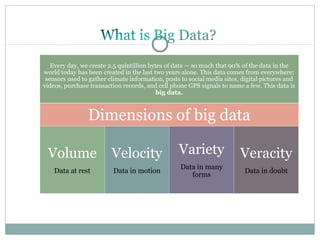
Every day, we create 2.5 quintillion bytes of data — so much that 90% of the data in the
world today has been created in the last two years alone. This data comes from everywhere:
sensors used to gather climate information, posts to social media sites, digital pictures and
videos, purchase transaction records, and cell phone GPS signals to name a few. This data is
big data.
Volume
Data at rest
Velocity
Data in motion
Variety
Data in many
forms
Veracity
Data in doubt
CIO Survey – Key Drivers
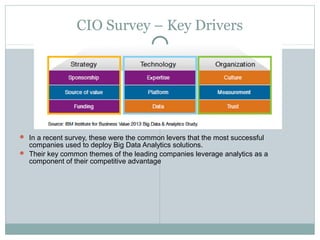
 In a recent survey, these were the common levers that the most successful
companies used to deploy Big Data Analytics solutions.
 Their key common themes of the leading companies leverage analytics as a
component of their competitive advantage
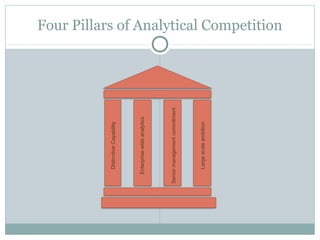
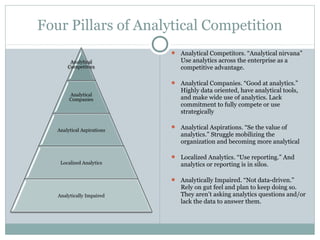
Four Pillars of Analytical Competition
 Analytical Competitors. “Analytical nirvana”
Use analytics across the enterprise as a
competitive advantage.
 Analytical Companies. “Good at analytics.”
Highly data oriented, have analytical tools,
and make wide use of analytics. Lack
commitment to fully compete or use
strategically
 Analytical Aspirations. “Se the value of
analytics.” Struggle mobilizing the
organization and becoming more analytical
 Localized Analytics. “Use reporting.” And
analytics or reporting is in silos.
 Analytically Impaired. “Not data-driven.”
Rely on gut feel and plan to keep doing so.
They aren’t asking analytics questions and/or
lack the data to answer them.
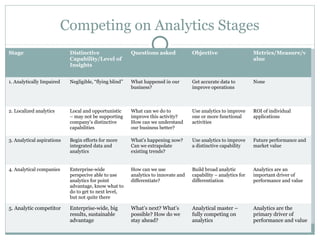
Competing on Analytics Stages
Stage Distinctive
Capability/Level of
Insights
Questions asked Objective Metrics/Measure/v
alue
1. Analytically Impaired Negligible, “flying blind” What happened in our
business?
Get accurate data to
improve operations
None
2. Localized analytics Local and opportunistic
– may not be supporting
company’s distinctive
capabilities
What can we do to
improve this activity?
How can we understand
our business better?
Use analytics to improve
one or more functional
activities
ROI of individual
applications
3. Analytical aspirations Begin efforts for more
integrated data and
analytics
What’s happening now?
Can we extrapolate
existing trends?
Use analytics to improve
a distinctive capability
Future performance and
market value
4. Analytical companies Enterprise-wide
perspecive able to use
analytics for point
advantage, know what to
do to get to next level,
but not quite there
How can we use
analytics to innovate and
differentiate?
Build broad analytic
capability – analytics for
differentiation
Analytics are an
important driver of
performance and value
5. Analytic competitor Enterprise-wide, big
results, sustainable
advantage
What’s next? What’s
possible? How do we
stay ahead?
Analytical master –
fully competing on
analytics
Analytics are the
primary driver of
performance and value
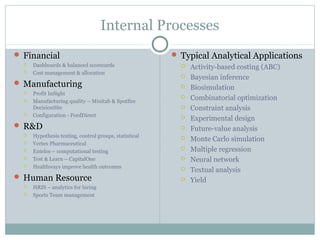
Internal Processes
 Financial
 Dashboards & balanced scorecards
 Cost management & allocation
 Manufacturing
 Profit InSight
 Manufacturing quality – Minitab & Spotfire
DecisionSite
 Configuration - FordDirect
 R&D
 Hypothesis testing, control groups, statistical
 Vertex Pharmaceutical
 Entelos – computational testing
 Test & Learn – CapitalOne
 Healthways improve health outcomes
 Human Resource
 HRIS – analytics for hiring
 Sports Team management
 Typical Analytical Applications
 Activity-based costing (ABC)
 Bayesian inference
 Biosimulation
 Combinatorial optimization
 Constraint analysis
 Experimental design
 Future-value analysis
 Monte Carlo simulation
 Multiple regression
 Neural network
 Textual analysis
 Yield
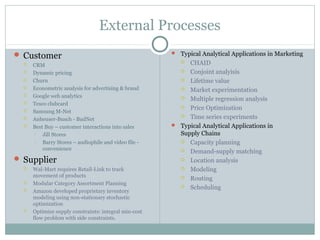
External Processes
 Customer
 CRM
 Dynamic pricing
 Churn
 Econometric analysis for advertising & brand
 Google web analytics
 Tesco clubcard
 Samsung M-Net
 Anheuser-Busch - BudNet
 Best Buy – customer interactions into sales
 Jill Stores
 Barry Stores – audiophile and video file -
convenience
 Supplier
 Wal-Mart requires Retail-Link to track
movement of products
 Modular Category Assortment Planning
 Amazon developed proprietary inventory
modeling using non-stationary stochastic
optimization
 Optimize supply constraints: integral min-cost
flow problem with side constraints.
 Typical Analytical Applications in Marketing
 CHAID
 Conjoint analyisis
 Lifetime value
 Market experimentation
 Multiple regression analysis
 Price Optimization
 Time series experiments
 Typical Analytical Applications in
Supply Chains
 Capacity planning
 Demand-supply matching
 Location analysis
 Modeling
 Routing
 Scheduling
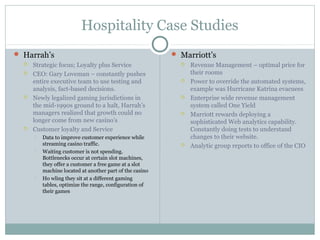
Hospitality Case Studies
 Harrah’s
 Strategic focus; Loyalty plus Service
 CEO: Gary Loveman – constantly pushes
entire executive team to use testing and
analysis, fact-based decisions.
 Newly legalized gaming jurisdictions in
the mid-1990s ground to a halt, Harrah’s
managers realized that growth could no
longer come from new casino’s
 Customer loyalty and Service
 Data to improve customer experience while
streaming casino traffic.
 Waiting customer is not spending.
Bottlenecks occur at certain slot machines,
they offer a customer a free game at a slot
machine located at another part of the casino
 Ho wling they sit at a different gaming
tables, optimize the range, configuration of
their games
 Marriott’s
 Revenue Management – optimal price for
their rooms
 Power to override the automated systems,
example was Hurricane Katrina evacuees
 Enterprise wide revenue management
system called One Yield
 Marriott rewards deploying a
sophisticated Web analytics capability.
Constantly doing tests to understand
changes to their website.
 Analytic group reports to office of the CIO
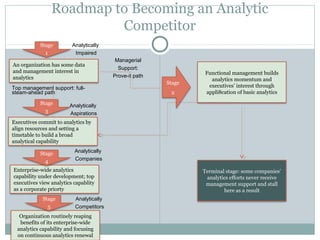
Roadmap to Becoming an Analytic
Competitor
Stage
1
Analytically
Impaired
An organization has some data
and management interest in
analytics
Stage
2
Functional management builds
analytics momentum and
executives’ interest through
appli8cation of basic analytics
Managerial
Support:
Prove-it path
Executives commit to analytics by
align resources and setting a
timetable to build a broad
analytical capability
Enterprise-wide analytics
capability under development; top
executives view analytics capablity
as a corporate priorty
Organization routinely reaping
benefits of its enterprise-wide
analytics capability and focusing
on continuous analytics renewal
Terminal stage: some companies’
analytics efforts never receive
management support and stall
here as a result
Analytically
Aspirations
Analytically
Companies
Analytically
Competitors
Stage
3
Stage
4
Stage
5
Top management support: full-
steam-ahead path
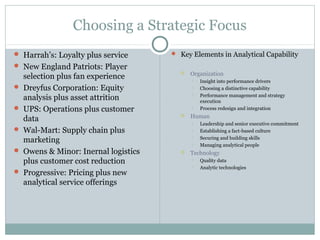
Choosing a Strategic Focus
 Harrah’s: Loyalty plus service
 New England Patriots: Player
selection plus fan experience
 Dreyfus Corporation: Equity
analysis plus asset attrition
 UPS: Operations plus customer
data
 Wal-Mart: Supply chain plus
marketing
 Owens & Minor: Inernal logistics
plus customer cost reduction
 Progressive: Pricing plus new
analytical service offerings
 Key Elements in Analytical Capability
 Organization
 Insight into performance drivers
 Choosing a distinctive capability
 Performance management and strategy
execution
 Process redesign and integration
 Human
 Leadership and senior executive commitment
 Establishing a fact-based culture
 Securing and building skills
 Managing analytical people
 Technology
 Quality data
 Analytic technologies
Where to focus resources
 How can we distinguish ourselves in the marketplace?
 What is our distinctive capability?
 What key decisions in those processes, and elsewhere, need
support from analytical insights?
 What information really matters to the business?
 What are the information and knowledge leverage points of the
firms performance?

Competing on analytics

  • 1.
  • 2.
    Agenda What is BigData? What is Business Analytics? Four Pillars 5 Strategies Importance of Analytics Internal Processes External Processes Case Studies
  • 3.
    It is allabout InsightDimensions of big data Every day, we create 2.5 quintillion bytes of data — so much that 90% of the data in the world today has been created in the last two years alone. This data comes from everywhere: sensors used to gather climate information, posts to social media sites, digital pictures and videos, purchase transaction records, and cell phone GPS signals to name a few. This data is big data. Volume Data at rest Velocity Data in motion Variety Data in many forms Veracity Data in doubt
  • 4.
    CIO Survey –Key Drivers  In a recent survey, these were the common levers that the most successful companies used to deploy Big Data Analytics solutions.  Their key common themes of the leading companies leverage analytics as a component of their competitive advantage
  • 5.
    Four Pillars ofAnalytical Competition
  • 6.
    Four Pillars ofAnalytical Competition  Analytical Competitors. “Analytical nirvana” Use analytics across the enterprise as a competitive advantage.  Analytical Companies. “Good at analytics.” Highly data oriented, have analytical tools, and make wide use of analytics. Lack commitment to fully compete or use strategically  Analytical Aspirations. “Se the value of analytics.” Struggle mobilizing the organization and becoming more analytical  Localized Analytics. “Use reporting.” And analytics or reporting is in silos.  Analytically Impaired. “Not data-driven.” Rely on gut feel and plan to keep doing so. They aren’t asking analytics questions and/or lack the data to answer them.
  • 7.
    Competing on AnalyticsStages Stage Distinctive Capability/Level of Insights Questions asked Objective Metrics/Measure/v alue 1. Analytically Impaired Negligible, “flying blind” What happened in our business? Get accurate data to improve operations None 2. Localized analytics Local and opportunistic – may not be supporting company’s distinctive capabilities What can we do to improve this activity? How can we understand our business better? Use analytics to improve one or more functional activities ROI of individual applications 3. Analytical aspirations Begin efforts for more integrated data and analytics What’s happening now? Can we extrapolate existing trends? Use analytics to improve a distinctive capability Future performance and market value 4. Analytical companies Enterprise-wide perspecive able to use analytics for point advantage, know what to do to get to next level, but not quite there How can we use analytics to innovate and differentiate? Build broad analytic capability – analytics for differentiation Analytics are an important driver of performance and value 5. Analytic competitor Enterprise-wide, big results, sustainable advantage What’s next? What’s possible? How do we stay ahead? Analytical master – fully competing on analytics Analytics are the primary driver of performance and value
  • 8.
    Internal Processes  Financial Dashboards & balanced scorecards  Cost management & allocation  Manufacturing  Profit InSight  Manufacturing quality – Minitab & Spotfire DecisionSite  Configuration - FordDirect  R&D  Hypothesis testing, control groups, statistical  Vertex Pharmaceutical  Entelos – computational testing  Test & Learn – CapitalOne  Healthways improve health outcomes  Human Resource  HRIS – analytics for hiring  Sports Team management  Typical Analytical Applications  Activity-based costing (ABC)  Bayesian inference  Biosimulation  Combinatorial optimization  Constraint analysis  Experimental design  Future-value analysis  Monte Carlo simulation  Multiple regression  Neural network  Textual analysis  Yield
  • 9.
    External Processes  Customer CRM  Dynamic pricing  Churn  Econometric analysis for advertising & brand  Google web analytics  Tesco clubcard  Samsung M-Net  Anheuser-Busch - BudNet  Best Buy – customer interactions into sales  Jill Stores  Barry Stores – audiophile and video file - convenience  Supplier  Wal-Mart requires Retail-Link to track movement of products  Modular Category Assortment Planning  Amazon developed proprietary inventory modeling using non-stationary stochastic optimization  Optimize supply constraints: integral min-cost flow problem with side constraints.  Typical Analytical Applications in Marketing  CHAID  Conjoint analyisis  Lifetime value  Market experimentation  Multiple regression analysis  Price Optimization  Time series experiments  Typical Analytical Applications in Supply Chains  Capacity planning  Demand-supply matching  Location analysis  Modeling  Routing  Scheduling
  • 10.
    Hospitality Case Studies Harrah’s  Strategic focus; Loyalty plus Service  CEO: Gary Loveman – constantly pushes entire executive team to use testing and analysis, fact-based decisions.  Newly legalized gaming jurisdictions in the mid-1990s ground to a halt, Harrah’s managers realized that growth could no longer come from new casino’s  Customer loyalty and Service  Data to improve customer experience while streaming casino traffic.  Waiting customer is not spending. Bottlenecks occur at certain slot machines, they offer a customer a free game at a slot machine located at another part of the casino  Ho wling they sit at a different gaming tables, optimize the range, configuration of their games  Marriott’s  Revenue Management – optimal price for their rooms  Power to override the automated systems, example was Hurricane Katrina evacuees  Enterprise wide revenue management system called One Yield  Marriott rewards deploying a sophisticated Web analytics capability. Constantly doing tests to understand changes to their website.  Analytic group reports to office of the CIO
  • 11.
    Roadmap to Becomingan Analytic Competitor Stage 1 Analytically Impaired An organization has some data and management interest in analytics Stage 2 Functional management builds analytics momentum and executives’ interest through appli8cation of basic analytics Managerial Support: Prove-it path Executives commit to analytics by align resources and setting a timetable to build a broad analytical capability Enterprise-wide analytics capability under development; top executives view analytics capablity as a corporate priorty Organization routinely reaping benefits of its enterprise-wide analytics capability and focusing on continuous analytics renewal Terminal stage: some companies’ analytics efforts never receive management support and stall here as a result Analytically Aspirations Analytically Companies Analytically Competitors Stage 3 Stage 4 Stage 5 Top management support: full- steam-ahead path
  • 12.
    Choosing a StrategicFocus  Harrah’s: Loyalty plus service  New England Patriots: Player selection plus fan experience  Dreyfus Corporation: Equity analysis plus asset attrition  UPS: Operations plus customer data  Wal-Mart: Supply chain plus marketing  Owens & Minor: Inernal logistics plus customer cost reduction  Progressive: Pricing plus new analytical service offerings  Key Elements in Analytical Capability  Organization  Insight into performance drivers  Choosing a distinctive capability  Performance management and strategy execution  Process redesign and integration  Human  Leadership and senior executive commitment  Establishing a fact-based culture  Securing and building skills  Managing analytical people  Technology  Quality data  Analytic technologies
  • 13.
    Where to focusresources  How can we distinguish ourselves in the marketplace?  What is our distinctive capability?  What key decisions in those processes, and elsewhere, need support from analytical insights?  What information really matters to the business?  What are the information and knowledge leverage points of the firms performance?