The data driven process
to identify, prioritize,
launch and monitor your
CRO experiments
What is conversion optimization?
Conversions – Actions you want your visitors to take on your site
◦ Signs up to your newsletter
◦ Buys a product
◦ Downloads a file
◦ Etc.
Conversion optimization – understand your customers, provide them with a better experience
on your site and simplify everything so they can convert more.
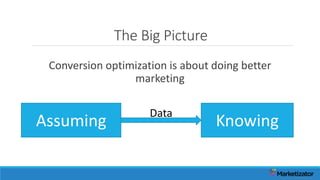
The Big Picture
Conversion optimization is about doing better
marketing
Assuming Knowing
Data
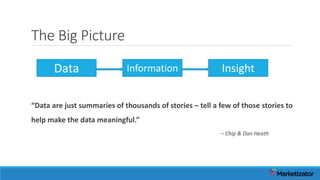
The Big Picture
“Data are just summaries of thousands of stories – tell a few of those stories to
help make the data meaningful.”
– Chip & Dan Heath
Data Information Insight
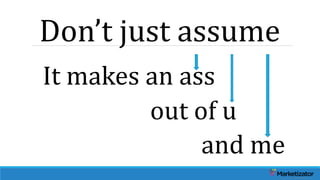
Don’t just assume
It makes an ass
out of u
and me
Mindset of the Optimizer
Rule #1: There is no one size fits all
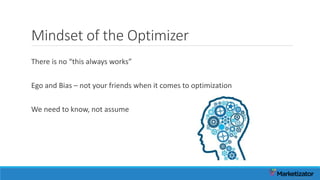
Mindset of the Optimizer
There is no “this always works”
Ego and Bias – not your friends when it comes to optimization
We need to know, not assume
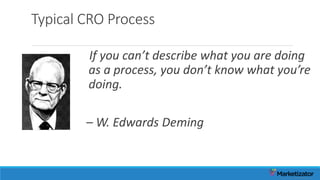
Typical CRO Process
If you can’t describe what you are doing
as a process, you don’t know what you’re
doing.
– W. Edwards Deming
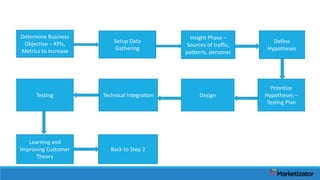
Determine Business
Objective – KPIs,
Metrics to increase
Setup Data
Gathering
Insight Phase –
Sources of traffic,
patterns, personas
Define
Hypotheses
DesignTechnical IntegrationTesting
Learning and
Improving Customer
Theory
Back to Step 2
Prioritize
Hypotheses –
Testing Plan
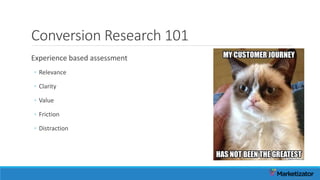
Conversion Research 101
Experience based assessment
◦ Relevance
◦ Clarity
◦ Value
◦ Friction
◦ Distraction
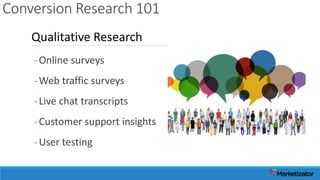
Conversion Research 101
-Online surveys
-Web traffic surveys
-Live chat transcripts
-Customer support insights
-User testing
Qualitative Research
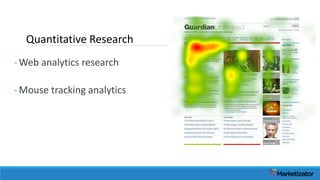
-Web analytics research
-Mouse tracking analytics
Quantitative Research
Developing a hypothesis
With each hypothesis we want to understand:
◦Which problem we’re solving
◦What’s the solution
◦Which metric we are trying to improve with this
Hypothesis Formula
By changing [problem] into [solution] we will increase [metric ]
All hypotheses should come as a result of conversion research: KNOW, don’t GUESS
Prioritizing Experiments
Optimizing the optimization process is often just as important as the tests themselves
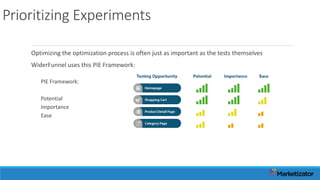
WiderFunnel uses this PIE Framework:
PIE Framework:
Potential
Importance
Ease
T.I.R. Method
◦ Time 1 – longest time 5 – shortest time
◦ Impact 1 – lowest impact 5 – highest impact
◦ Resources 1 – most resources 5 – least resources
Multiply these scores together and start working on the projects that have the highest scores
as those will have the most lift with the least amount of time and the least amount of
resources.
Test It Right
Wait until statistical significance
Make sure your sample size is big enough
Sample size calculator: http://www.evanmiller.org/ab-testing/sample-size.html
Don’t call tests too early
Validity Threats
History effect
Instrumentation effect
Selection effect
Compatibility issues – broken code
Questions?
andra@marketizator.com

Meetup 16 dec data driven process to optimization

  • 1.
    The data drivenprocess to identify, prioritize, launch and monitor your CRO experiments
  • 2.
    What is conversionoptimization? Conversions – Actions you want your visitors to take on your site ◦ Signs up to your newsletter ◦ Buys a product ◦ Downloads a file ◦ Etc. Conversion optimization – understand your customers, provide them with a better experience on your site and simplify everything so they can convert more.
  • 3.
    The Big Picture Conversionoptimization is about doing better marketing Assuming Knowing Data
  • 4.
    The Big Picture “Dataare just summaries of thousands of stories – tell a few of those stories to help make the data meaningful.” – Chip & Dan Heath Data Information Insight
  • 5.
    Don’t just assume Itmakes an ass out of u and me
  • 6.
    Mindset of theOptimizer Rule #1: There is no one size fits all
  • 7.
    Mindset of theOptimizer There is no “this always works” Ego and Bias – not your friends when it comes to optimization We need to know, not assume
  • 8.
    Typical CRO Process Ifyou can’t describe what you are doing as a process, you don’t know what you’re doing. – W. Edwards Deming
  • 9.
    Determine Business Objective –KPIs, Metrics to increase Setup Data Gathering Insight Phase – Sources of traffic, patterns, personas Define Hypotheses DesignTechnical IntegrationTesting Learning and Improving Customer Theory Back to Step 2 Prioritize Hypotheses – Testing Plan
  • 10.
    Conversion Research 101 Experiencebased assessment ◦ Relevance ◦ Clarity ◦ Value ◦ Friction ◦ Distraction
  • 11.
    Conversion Research 101 -Onlinesurveys -Web traffic surveys -Live chat transcripts -Customer support insights -User testing Qualitative Research
  • 12.
    -Web analytics research -Mousetracking analytics Quantitative Research
  • 13.
    Developing a hypothesis Witheach hypothesis we want to understand: ◦Which problem we’re solving ◦What’s the solution ◦Which metric we are trying to improve with this
  • 14.
    Hypothesis Formula By changing[problem] into [solution] we will increase [metric ] All hypotheses should come as a result of conversion research: KNOW, don’t GUESS
  • 15.
    Prioritizing Experiments Optimizing theoptimization process is often just as important as the tests themselves WiderFunnel uses this PIE Framework: PIE Framework: Potential Importance Ease
  • 16.
    T.I.R. Method ◦ Time1 – longest time 5 – shortest time ◦ Impact 1 – lowest impact 5 – highest impact ◦ Resources 1 – most resources 5 – least resources Multiply these scores together and start working on the projects that have the highest scores as those will have the most lift with the least amount of time and the least amount of resources.
  • 17.
    Test It Right Waituntil statistical significance Make sure your sample size is big enough Sample size calculator: http://www.evanmiller.org/ab-testing/sample-size.html Don’t call tests too early
  • 18.
    Validity Threats History effect Instrumentationeffect Selection effect Compatibility issues – broken code
  • 19.