
RADIATION ONCOLOGIST January 2004
TABLE OF CONTENTS Basic information History of oncology Expectations of oncologists Training outside of medical school Personal qualities Skill level Code of Ethics Earnings/benefits Future outlook for prospecting oncologists Other information about oncology/oncologists
BASIC INFORMATION Oncology – the study of the causes, properties, disease progressions and treatments of tumors & cancer Oncologist – physician who specializes in treating cancer Radiation oncologist – oncologist who specializes in using radiation to treat cancer Radiotherapy – use of high energy x-rays, external beams, or radioactive materials placed directly on the tumor
HISTORY OF ONCOLOGY Surgery – oldest known way to cure cancer (Egyptians of Middle Kingdom) Dr. Ephraim MacDowell, Dr. William Halstead, & Dr. Ernst Wertheim – 1 st  successful surgical removals of cancer on different body parts Myth – story of Inanna – her death & resurrection by Enki – used radiation to bring her back to life Röntgen – discovered x-rays in 1895 1 st  x-rays used in 1896
HISTORY CONT. Marie & Pierre Curie, Antoine-Henri Beckquerel – discovered natural forms of radioactivity 1896 – uranium 1898 – radium, polonium Within 10 years of discovery of radioactivity, it was tested against many diseases – some worked but had complications later on 30 years later – much information acquired & some superficial cancers were curable by x-ray & some accessible cancers were curable by radium therapy Modern physics, radiobiology, dosimetry – have made modern radiation therapy an effective method to cure cancer
HISTORY CONT. New advances in radiation oncology – fractionation (how dose is given in time) & high dose rate brachytherapy treatment Also, enhancement of effect by addition of chemotherapy Chemotherapy – newest way to cure cancer Biological manipulations – future of oncology – take killer T-cells from the tumor of a patient – clone many of the cells – enhance the cells with substances that will make them more able to kill cancer cells
EXPECTED DUTIES / PHYSICAL DEMANDS Confirm diagnosis suggested by other medical professionals Study x-rays or other images & reports Discuss with patient & family what is going to be done Decide amount of radiation should be used Treat cancer patients by treating affected body part(s) Monitor & care for patients after treatment No physical abilities needed to be an oncologist
EXPECTED DUTIES CONT. Accurate assessment of your problem Realistic listing of benefits from radiation (cure, control of tumor, relief of symptoms) Knowledge of different treatment options available
EXPECTED  DUTIES CONT. Usually work long hours (10-12), may be on call Appropriate skills to explain your condition & treatment options to you & your family Knowledge & skills to be able to deal with any of your symptoms Typical day: 1 st  – see patients in the hospital 2 nd  – see patients in clinic  (appointments) 3 rd  – lots of paperwork 4 th  – visit really sick people in the hospital
TRAINING/EDUCATION 3-4 years undergraduate school 3-4 years medical school 5 years of training with minimum of 4 years in Radiation Oncology (residency)
TRAINING/EDUCATION CONT. The 4 years of Radiation Oncology training must include 36 months of clinical Radiation Oncology with Pathology & Medical Oncology High school classes – English, foreign languages (Latin is best), humanities, social studies, math, biology, chemistry, physics You use many science & math skills in oncology.  You need to know English well so that you can easily communicate with your patients.
PERSONAL QUALITIES Excellent communication skills Committed to being an oncologist, doing hard work Tact & diplomacy
PERSONAL  QUALITIES CONT. Self-motivated & self-disciplined Accurate & able to work well under pressure Excellent medical skills, technical skills, analyzing/interpreting skills Able to deal with many different kinds of people Sensitive, understanding, trustworthy Ability to make good clinical judgments under difficult & emotional pressure Concerned for others
SKILL LEVEL Licensing that is particular to the state   practicing in Certification – from American Board of Radiology American Board of Radiology in Radiation Oncology requirements: *must be a specialist in Radiation Oncology *recognized by peers to have high moral &      ethical standards *general professional education *special training (residency)
SKILL LEVEL CONT. The 5 th  year must be before the 4 years of RO training – accredited training in Internal Medicine, Pediatrics, Surgery, Obstetrics & Gynecology, Family Practice, Transitional or Categorical Radiation Oncology, or combination of the above Written examination after residency is complete Oral examination after written exam is complete Practice examination after oral exam is complete
SKILL LEVEL CONT. Contents of examinations: Oral – 8 anatomical categories – anatomy, epidemiology, pathology, clinical evaluation, selection of treatment form, radiation therapy planning & technique, results of treatment, complications of treatment Written – physics of radiation therapy, cancer & radiation biology, clinical oncology
CODE OF ETHICS Intended to aid radiation oncologists in maintaining a high level of ethical conduct
CODE OF ETHICS CONT. Section 1 – Principles of Ethics: The main objective of oncologists is the give service with full respect for human dignity & in the best interest of the patient. Always strive to improve their medical knowledge & skill and make the improvements available to their patients. At all times be aware of their limitations & be willing to seek help if needed. Oncologists should follow all laws, keep the dignity & honor in the profession.
CODE OF ETHICS CONT. Responsibilities of oncologists extend to society also (not just the patient).  These responsibilities include the participation in activities which improve the health & well-being of the individual & the community. Oncologists may not reveal things told to them during a meeting with the patient, unless they are required to by law to protect the welfare of the patient or the community. The decision to get service from an oncologist is decided by the patient & their physician in the best interest of the patient. The bond between oncologists & their patients should not be used for personal advantage.
CODE OF ETHICS CONT. Section 2 – Rules of Ethics: 1.  Oncologists should provide x-rays and other images to the patient. 2. Oncologists should provide a consultative opinion in the management of cancer & other disorders treated with radiation. 3. Before practicing in a hospital or other facility, the oncologist should apply & be accepted as a member of that facility’s health care staff, and follow that facility’s staff bylaws in the same way as the other physicians.
CODE OF ETHICS CONT. Oncologists should make sure that the patient is not referred to a health care facility that has a financial interest that is not in the best interest of the patient. Oncologists should relate to other members of the health care team with mutual respect, and they should stay away from harassment or unfair discriminatory behavior. Oncologists should have the right to enter into whatever contract arrangements with health care systems they want to. Oncologists should not enter into an agreement that prohibits the supplying of necessary care or that gives care below acceptable standards.
CODE OF ETHICS CONT. Oncologists should clearly respond to questions from patients regarding costs.  An oncologist should not participate in a billing arrangement which misleads the patient. Oncologists should use extreme caution to make sure that a testimony (if needed) provided is correct and accurate. Radiologic research must be performed with integrity and be honestly reported Oncologists should not claim written/oral (plagiarism) material that is not theirs.
CODE OF ETHICS CONT. Oncologists should not publicize themselves through any form of public communication in an untruthful, misleading, or deceptive manner. Section 3 – Disciplinary Procedures for Violation of Rules of Ethics: States the punishments for violating the rules of ethics.
EARNINGS/BENEFITS Salary varies Starting salary about $100,000/year Starting private practice – $140,000-$160,000/year Cons about oncology – give bad news to people
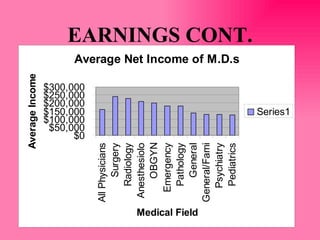
EARNINGS/BENEFITS CONT. Experienced oncologists – $200,000-$300,000/year Experienced private practice – $350,000-$375,000/year Average net income for 1998 - $230,000 Benefits: Satisfaction – cure people, patients have good deaths Feel respected
EARNINGS CONT.
FUTURE   OUTLOOK Faster than average outlook through 2008 Number of oncologists expected to increase moderately over next 4-5 years Number of patients treated every year is going up, leading to higher demand for oncologists Growth of oncologists due to expansion of health care industry Continuing Medical Education requirements: Minimum of 40 credits every 2 years (North Dakota)
FUTURE OUTLOOK CONT. Options for specializing in oncology – gynecological, neurological, radiation, medical, surgical, pediatric, chemotherapy
OTHER INFORMATION Usually work in hospitals, clinics, private practices Equipment used: *medical equipment/instruments *computer *complicated electronic equipment *radioactive materials Dosimetry – science of measuring, computing, calculating, & optimizing the dose of radiation
OTHER INFO CONT. About 0.5% (3,500) of all physicians in the US in 1999 were radiation oncologists No specific dress code – dress nicely No potential hazards, but a lot of mental burn out

Radiation Oncologist

  • 1.
  • 2.
    TABLE OF CONTENTSBasic information History of oncology Expectations of oncologists Training outside of medical school Personal qualities Skill level Code of Ethics Earnings/benefits Future outlook for prospecting oncologists Other information about oncology/oncologists
  • 3.
    BASIC INFORMATION Oncology– the study of the causes, properties, disease progressions and treatments of tumors & cancer Oncologist – physician who specializes in treating cancer Radiation oncologist – oncologist who specializes in using radiation to treat cancer Radiotherapy – use of high energy x-rays, external beams, or radioactive materials placed directly on the tumor
  • 4.
    HISTORY OF ONCOLOGYSurgery – oldest known way to cure cancer (Egyptians of Middle Kingdom) Dr. Ephraim MacDowell, Dr. William Halstead, & Dr. Ernst Wertheim – 1 st successful surgical removals of cancer on different body parts Myth – story of Inanna – her death & resurrection by Enki – used radiation to bring her back to life Röntgen – discovered x-rays in 1895 1 st x-rays used in 1896
  • 5.
    HISTORY CONT. Marie& Pierre Curie, Antoine-Henri Beckquerel – discovered natural forms of radioactivity 1896 – uranium 1898 – radium, polonium Within 10 years of discovery of radioactivity, it was tested against many diseases – some worked but had complications later on 30 years later – much information acquired & some superficial cancers were curable by x-ray & some accessible cancers were curable by radium therapy Modern physics, radiobiology, dosimetry – have made modern radiation therapy an effective method to cure cancer
  • 6.
    HISTORY CONT. Newadvances in radiation oncology – fractionation (how dose is given in time) & high dose rate brachytherapy treatment Also, enhancement of effect by addition of chemotherapy Chemotherapy – newest way to cure cancer Biological manipulations – future of oncology – take killer T-cells from the tumor of a patient – clone many of the cells – enhance the cells with substances that will make them more able to kill cancer cells
  • 7.
    EXPECTED DUTIES /PHYSICAL DEMANDS Confirm diagnosis suggested by other medical professionals Study x-rays or other images & reports Discuss with patient & family what is going to be done Decide amount of radiation should be used Treat cancer patients by treating affected body part(s) Monitor & care for patients after treatment No physical abilities needed to be an oncologist
  • 8.
    EXPECTED DUTIES CONT.Accurate assessment of your problem Realistic listing of benefits from radiation (cure, control of tumor, relief of symptoms) Knowledge of different treatment options available
  • 9.
    EXPECTED DUTIESCONT. Usually work long hours (10-12), may be on call Appropriate skills to explain your condition & treatment options to you & your family Knowledge & skills to be able to deal with any of your symptoms Typical day: 1 st – see patients in the hospital 2 nd – see patients in clinic (appointments) 3 rd – lots of paperwork 4 th – visit really sick people in the hospital
  • 10.
    TRAINING/EDUCATION 3-4 yearsundergraduate school 3-4 years medical school 5 years of training with minimum of 4 years in Radiation Oncology (residency)
  • 11.
    TRAINING/EDUCATION CONT. The4 years of Radiation Oncology training must include 36 months of clinical Radiation Oncology with Pathology & Medical Oncology High school classes – English, foreign languages (Latin is best), humanities, social studies, math, biology, chemistry, physics You use many science & math skills in oncology. You need to know English well so that you can easily communicate with your patients.
  • 12.
    PERSONAL QUALITIES Excellentcommunication skills Committed to being an oncologist, doing hard work Tact & diplomacy
  • 13.
    PERSONAL QUALITIESCONT. Self-motivated & self-disciplined Accurate & able to work well under pressure Excellent medical skills, technical skills, analyzing/interpreting skills Able to deal with many different kinds of people Sensitive, understanding, trustworthy Ability to make good clinical judgments under difficult & emotional pressure Concerned for others
  • 14.
    SKILL LEVEL Licensingthat is particular to the state practicing in Certification – from American Board of Radiology American Board of Radiology in Radiation Oncology requirements: *must be a specialist in Radiation Oncology *recognized by peers to have high moral & ethical standards *general professional education *special training (residency)
  • 15.
    SKILL LEVEL CONT.The 5 th year must be before the 4 years of RO training – accredited training in Internal Medicine, Pediatrics, Surgery, Obstetrics & Gynecology, Family Practice, Transitional or Categorical Radiation Oncology, or combination of the above Written examination after residency is complete Oral examination after written exam is complete Practice examination after oral exam is complete
  • 16.
    SKILL LEVEL CONT.Contents of examinations: Oral – 8 anatomical categories – anatomy, epidemiology, pathology, clinical evaluation, selection of treatment form, radiation therapy planning & technique, results of treatment, complications of treatment Written – physics of radiation therapy, cancer & radiation biology, clinical oncology
  • 17.
    CODE OF ETHICSIntended to aid radiation oncologists in maintaining a high level of ethical conduct
  • 18.
    CODE OF ETHICSCONT. Section 1 – Principles of Ethics: The main objective of oncologists is the give service with full respect for human dignity & in the best interest of the patient. Always strive to improve their medical knowledge & skill and make the improvements available to their patients. At all times be aware of their limitations & be willing to seek help if needed. Oncologists should follow all laws, keep the dignity & honor in the profession.
  • 19.
    CODE OF ETHICSCONT. Responsibilities of oncologists extend to society also (not just the patient). These responsibilities include the participation in activities which improve the health & well-being of the individual & the community. Oncologists may not reveal things told to them during a meeting with the patient, unless they are required to by law to protect the welfare of the patient or the community. The decision to get service from an oncologist is decided by the patient & their physician in the best interest of the patient. The bond between oncologists & their patients should not be used for personal advantage.
  • 20.
    CODE OF ETHICSCONT. Section 2 – Rules of Ethics: 1. Oncologists should provide x-rays and other images to the patient. 2. Oncologists should provide a consultative opinion in the management of cancer & other disorders treated with radiation. 3. Before practicing in a hospital or other facility, the oncologist should apply & be accepted as a member of that facility’s health care staff, and follow that facility’s staff bylaws in the same way as the other physicians.
  • 21.
    CODE OF ETHICSCONT. Oncologists should make sure that the patient is not referred to a health care facility that has a financial interest that is not in the best interest of the patient. Oncologists should relate to other members of the health care team with mutual respect, and they should stay away from harassment or unfair discriminatory behavior. Oncologists should have the right to enter into whatever contract arrangements with health care systems they want to. Oncologists should not enter into an agreement that prohibits the supplying of necessary care or that gives care below acceptable standards.
  • 22.
    CODE OF ETHICSCONT. Oncologists should clearly respond to questions from patients regarding costs. An oncologist should not participate in a billing arrangement which misleads the patient. Oncologists should use extreme caution to make sure that a testimony (if needed) provided is correct and accurate. Radiologic research must be performed with integrity and be honestly reported Oncologists should not claim written/oral (plagiarism) material that is not theirs.
  • 23.
    CODE OF ETHICSCONT. Oncologists should not publicize themselves through any form of public communication in an untruthful, misleading, or deceptive manner. Section 3 – Disciplinary Procedures for Violation of Rules of Ethics: States the punishments for violating the rules of ethics.
  • 24.
    EARNINGS/BENEFITS Salary variesStarting salary about $100,000/year Starting private practice – $140,000-$160,000/year Cons about oncology – give bad news to people
  • 25.
    EARNINGS/BENEFITS CONT. Experiencedoncologists – $200,000-$300,000/year Experienced private practice – $350,000-$375,000/year Average net income for 1998 - $230,000 Benefits: Satisfaction – cure people, patients have good deaths Feel respected
  • 26.
  • 27.
    FUTURE OUTLOOK Faster than average outlook through 2008 Number of oncologists expected to increase moderately over next 4-5 years Number of patients treated every year is going up, leading to higher demand for oncologists Growth of oncologists due to expansion of health care industry Continuing Medical Education requirements: Minimum of 40 credits every 2 years (North Dakota)
  • 28.
    FUTURE OUTLOOK CONT.Options for specializing in oncology – gynecological, neurological, radiation, medical, surgical, pediatric, chemotherapy
  • 29.
    OTHER INFORMATION Usuallywork in hospitals, clinics, private practices Equipment used: *medical equipment/instruments *computer *complicated electronic equipment *radioactive materials Dosimetry – science of measuring, computing, calculating, & optimizing the dose of radiation
  • 30.
    OTHER INFO CONT.About 0.5% (3,500) of all physicians in the US in 1999 were radiation oncologists No specific dress code – dress nicely No potential hazards, but a lot of mental burn out