BIOLOGICAL EFFECTS OF
RADIATION
PRESENTED BY :-
YOGITA JANGHU
M.Sc. RIT {2ND SEM }
220513005
CONTENT
• INTRODUCTION
• RADIATION
• EM SPECTRUM
• SOURCES OF RADIATION
• BIOLOGICAL EFFECT WITH TISSUE
• BIOLOGICAL EFFECT WITH DNA
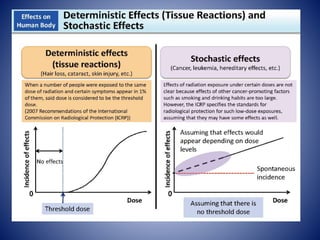
• DETERMINISTIC & STOCHASTIC EFFECT
• ACUTE RADIATION SYNDROME
• RADIATION RISK
• PRINCIPLE OF RADIATION PROTECTION
• CONCLUSION
• MCQ’S
• REFERENCE.
INTRODUCTION
• The harmful effects caused to human
being and other living beings due to their
exposure to radiation is called as
biological effects of radiation.
RADIATION
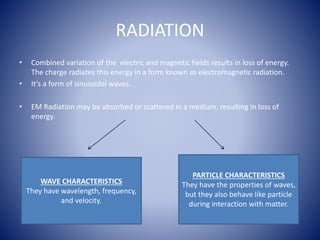
• Combined variation of the electric and magnetic fields results in loss of energy.
The charge radiates this energy in a form known as electromagnetic radiation.
• It’s a form of sinusoidal waves.
• EM Radiation may be absorbed or scattered in a medium, resulting in loss of
energy.
WAVE CHARACTERISTICS
They have wavelength, frequency,
and velocity.
PARTICLE CHARACTERISTICS
They have the properties of waves,
but they also behave like particle
during interaction with matter.
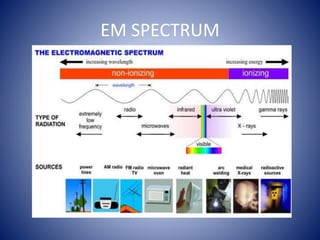
EM SPECTRUM
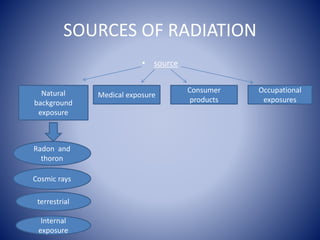
SOURCES OF RADIATION
• source
Natural
background
exposure
Medical exposure
Consumer
products
Occupational
exposures
Radon and
thoron
Cosmic rays
terrestrial
Internal
exposure
DISCOVERY OF BIOLOGICAL EFFECT OF
RADIATION.
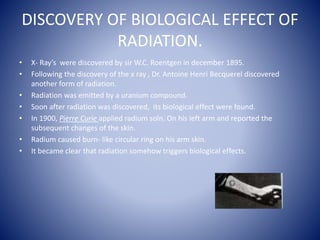
• X- Ray’s were discovered by sir W.C. Roentgen in december 1895.
• Following the discovery of the x ray , Dr. Antoine Henri Becquerel discovered
another form of radiation.
• Radiation was emitted by a uranium compound.
• Soon after radiation was discovered, its biological effect were found.
• In 1900, Pierre Curie applied radium soln. On his left arm and reported the
subsequent changes of the skin.
• Radium caused burn- like circular ring on his arm skin.
• It became clear that radiation somehow triggers biological effects.
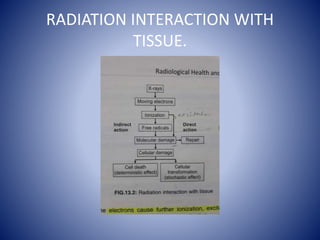
RADIATION INTERACTION WITH
TISSUE.
RADIATION INTERACTION WITH DNA.
• Radiation may induce structural changes in
DNA molecule.
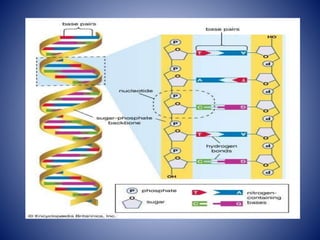
• 1) hydrogen bond break.
• 2) molecular breakage.
• 3) inter and intermolecular cross linking.
• # hydrogen bonds break disturbs the base
pairs, resulting in genetic changes.
CONT…
• Molecular breakage may involve single strand break
and double strand breaks.
• Single strand breaks are mostly repairable. There are
enzymes within cells that will repair the radiation
damage.
• Double strand break are irreparable and cause loss of
base or change of base called mutation. This results in
chromosome aberrations, leading to carcinogenesis.
• High LET radiations are capable of causing double
strand break.
• DNA molecules carry the genetic code , its damage can
result hereditary effects.
Cont…
• High dose of radiation can cause cell death or
cellular transformation.
• An acute dose, delivered in short time, is more
harmful then a chronic dose, delivered over a
period of time.
• The radiation effects which manifest themselves
soon after the irradiation are called early effects.
• Those effects that manifest after a period of time
are called late effects.
PRINCIPLE OF CELLULAR
RADIOSENSITIVITY.
• Principle of Bergonie and Tribondeau.
• Cell radiosensitivity is directly proportional to the rate of cell division and inversely
proportional to the degree of cell differentiation.
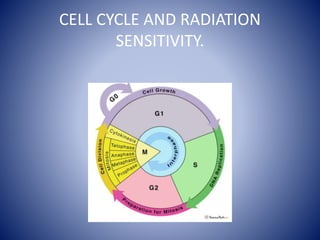
CELL CYCLE AND RADIATION
SENSITIVITY.
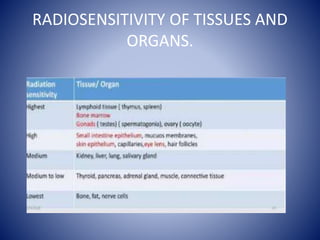
RADIOSENSITIVITY OF TISSUES AND
ORGANS.
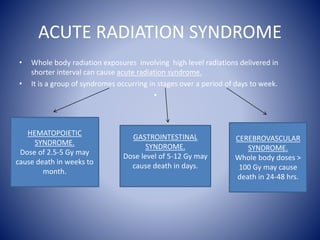
ACUTE RADIATION SYNDROME
• Whole body radiation exposures involving high level radiations delivered in
shorter interval can cause acute radiation syndrome.
• It is a group of syndromes occurring in stages over a period of days to week.
•
HEMATOPOIETIC
SYNDROME.
Dose of 2.5-5 Gy may
cause death in weeks to
month.
GASTROINTESTINAL
SYNDROME.
Dose level of 5-12 Gy may
cause death in days.
CEREBROVASCULAR
SYNDROME.
Whole body doses >
100 Gy may cause
death in 24-48 hrs.
CONT…
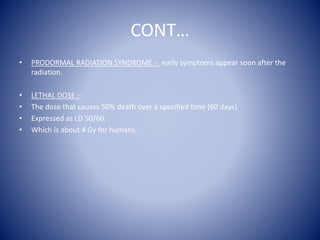
• PRODORMAL RADIATION SYNDROME :- early symptoms appear soon after the
radiation.
• LETHAL DOSE :-
• The dose that causes 50% death over a specified time {60 days}.
• Expressed as LD 50/60.
• Which is about 4 Gy for humans.
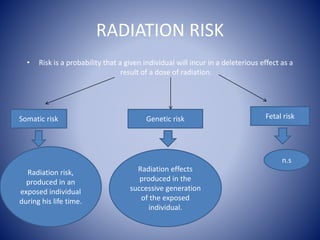
RADIATION RISK
• Risk is a probability that a given individual will incur in a deleterious effect as a
result of a dose of radiation.
Somatic risk Genetic risk Fetal risk
Radiation risk,
produced in an
exposed individual
during his life time.
Radiation effects
produced in the
successive generation
of the exposed
individual.
n.s
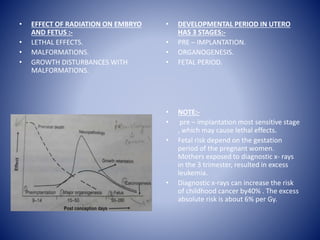
• EFFECT OF RADIATION ON EMBRYO
AND FETUS :-
• LETHAL EFFECTS.
• MALFORMATIONS.
• GROWTH DISTURBANCES WITH
MALFORMATIONS.
• DEVELOPMENTAL PERIOD IN UTERO
HAS 3 STAGES:-
• PRE – IMPLANTATION.
• ORGANOGENESIS.
• FETAL PERIOD.
• NOTE:-
• pre – implantation most sensitive stage
, which may cause lethal effects.
• Fetal risk depend on the gestation
period of the pregnant women.
Mothers exposed to diagnostic x- rays
in the 3 trimester, resulted in excess
leukemia.
• Diagnostic x-rays can increase the risk
of childhood cancer by40% . The excess
absolute risk is about 6% per Gy.
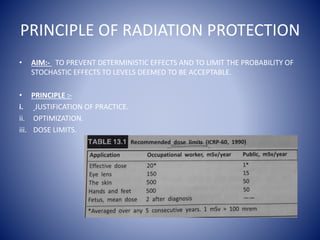
PRINCIPLE OF RADIATION PROTECTION
• AIM:- TO PREVENT DETERMINISTIC EFFECTS AND TO LIMIT THE PROBABILITY OF
STOCHASTIC EFFECTS TO LEVELS DEEMED TO BE ACCEPTABLE.
• PRINCIPLE :-
i. JUSTIFICATION OF PRACTICE.
ii. OPTIMIZATION.
iii. DOSE LIMITS.
3 BASIC FACTORS FOR RADIATION
PROTECTION
• CARDINAL PRINCIPLE:- TDS
• T- TIME
• D- DISTANCE
• S- SHIELDING.
CONCLUSION
• Ionizing radiation generates free radicals. Free
radicals interact with biological tissues, most
importantly DNA. The severity of radiation-
induced damage depends on the cells
sensitivity and the type and dose of radiation.
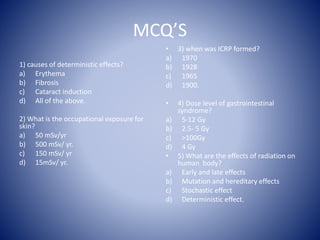
MCQ’S
1) causes of deterministic effects?
a) Erythema
b) Fibrosis
c) Cataract induction
d) All of the above.
2) What is the occupational exposure for
skin?
a) 50 mSv/yr
b) 500 mSv/ yr.
c) 150 mSv/ yr
d) 15mSv/ yr.
• 3) when was ICRP formed?
a) 1970
b) 1928
c) 1965
d) 1900.
• 4) Dose level of gastrointestinal
syndrome?
a) 5-12 Gy
b) 2.5- 5 Gy
c) >100Gy
d) 4 Gy
• 5) What are the effects of radiation on
human body?
a) Early and late effects
b) Mutation and hereditary effects
c) Stochastic effect
d) Deterministic effect.
REFERENCES
• K thayalan
• Slide share
• Research gate
• Medlineplus.gov.
• AERB
BIOLOGICAL%20EFFECTS%20OF%20RADIATION.pptx

BIOLOGICAL%20EFFECTS%20OF%20RADIATION.pptx

  • 1.
    BIOLOGICAL EFFECTS OF RADIATION PRESENTEDBY :- YOGITA JANGHU M.Sc. RIT {2ND SEM } 220513005
  • 2.
    CONTENT • INTRODUCTION • RADIATION •EM SPECTRUM • SOURCES OF RADIATION • BIOLOGICAL EFFECT WITH TISSUE • BIOLOGICAL EFFECT WITH DNA • DETERMINISTIC & STOCHASTIC EFFECT • ACUTE RADIATION SYNDROME • RADIATION RISK • PRINCIPLE OF RADIATION PROTECTION • CONCLUSION • MCQ’S • REFERENCE.
  • 4.
    INTRODUCTION • The harmfuleffects caused to human being and other living beings due to their exposure to radiation is called as biological effects of radiation.
  • 5.
    RADIATION • Combined variationof the electric and magnetic fields results in loss of energy. The charge radiates this energy in a form known as electromagnetic radiation. • It’s a form of sinusoidal waves. • EM Radiation may be absorbed or scattered in a medium, resulting in loss of energy. WAVE CHARACTERISTICS They have wavelength, frequency, and velocity. PARTICLE CHARACTERISTICS They have the properties of waves, but they also behave like particle during interaction with matter.
  • 6.
  • 7.
    SOURCES OF RADIATION •source Natural background exposure Medical exposure Consumer products Occupational exposures Radon and thoron Cosmic rays terrestrial Internal exposure
  • 8.
    DISCOVERY OF BIOLOGICALEFFECT OF RADIATION. • X- Ray’s were discovered by sir W.C. Roentgen in december 1895. • Following the discovery of the x ray , Dr. Antoine Henri Becquerel discovered another form of radiation. • Radiation was emitted by a uranium compound. • Soon after radiation was discovered, its biological effect were found. • In 1900, Pierre Curie applied radium soln. On his left arm and reported the subsequent changes of the skin. • Radium caused burn- like circular ring on his arm skin. • It became clear that radiation somehow triggers biological effects.
  • 9.
  • 10.
    RADIATION INTERACTION WITHDNA. • Radiation may induce structural changes in DNA molecule. • 1) hydrogen bond break. • 2) molecular breakage. • 3) inter and intermolecular cross linking. • # hydrogen bonds break disturbs the base pairs, resulting in genetic changes.
  • 12.
    CONT… • Molecular breakagemay involve single strand break and double strand breaks. • Single strand breaks are mostly repairable. There are enzymes within cells that will repair the radiation damage. • Double strand break are irreparable and cause loss of base or change of base called mutation. This results in chromosome aberrations, leading to carcinogenesis. • High LET radiations are capable of causing double strand break. • DNA molecules carry the genetic code , its damage can result hereditary effects.
  • 13.
    Cont… • High doseof radiation can cause cell death or cellular transformation. • An acute dose, delivered in short time, is more harmful then a chronic dose, delivered over a period of time. • The radiation effects which manifest themselves soon after the irradiation are called early effects. • Those effects that manifest after a period of time are called late effects.
  • 14.
    PRINCIPLE OF CELLULAR RADIOSENSITIVITY. •Principle of Bergonie and Tribondeau. • Cell radiosensitivity is directly proportional to the rate of cell division and inversely proportional to the degree of cell differentiation.
  • 15.
    CELL CYCLE ANDRADIATION SENSITIVITY.
  • 16.
  • 18.
    ACUTE RADIATION SYNDROME •Whole body radiation exposures involving high level radiations delivered in shorter interval can cause acute radiation syndrome. • It is a group of syndromes occurring in stages over a period of days to week. • HEMATOPOIETIC SYNDROME. Dose of 2.5-5 Gy may cause death in weeks to month. GASTROINTESTINAL SYNDROME. Dose level of 5-12 Gy may cause death in days. CEREBROVASCULAR SYNDROME. Whole body doses > 100 Gy may cause death in 24-48 hrs.
  • 19.
    CONT… • PRODORMAL RADIATIONSYNDROME :- early symptoms appear soon after the radiation. • LETHAL DOSE :- • The dose that causes 50% death over a specified time {60 days}. • Expressed as LD 50/60. • Which is about 4 Gy for humans.
  • 20.
    RADIATION RISK • Riskis a probability that a given individual will incur in a deleterious effect as a result of a dose of radiation. Somatic risk Genetic risk Fetal risk Radiation risk, produced in an exposed individual during his life time. Radiation effects produced in the successive generation of the exposed individual. n.s
  • 21.
    • EFFECT OFRADIATION ON EMBRYO AND FETUS :- • LETHAL EFFECTS. • MALFORMATIONS. • GROWTH DISTURBANCES WITH MALFORMATIONS. • DEVELOPMENTAL PERIOD IN UTERO HAS 3 STAGES:- • PRE – IMPLANTATION. • ORGANOGENESIS. • FETAL PERIOD. • NOTE:- • pre – implantation most sensitive stage , which may cause lethal effects. • Fetal risk depend on the gestation period of the pregnant women. Mothers exposed to diagnostic x- rays in the 3 trimester, resulted in excess leukemia. • Diagnostic x-rays can increase the risk of childhood cancer by40% . The excess absolute risk is about 6% per Gy.
  • 22.
    PRINCIPLE OF RADIATIONPROTECTION • AIM:- TO PREVENT DETERMINISTIC EFFECTS AND TO LIMIT THE PROBABILITY OF STOCHASTIC EFFECTS TO LEVELS DEEMED TO BE ACCEPTABLE. • PRINCIPLE :- i. JUSTIFICATION OF PRACTICE. ii. OPTIMIZATION. iii. DOSE LIMITS.
  • 23.
    3 BASIC FACTORSFOR RADIATION PROTECTION • CARDINAL PRINCIPLE:- TDS • T- TIME • D- DISTANCE • S- SHIELDING.
  • 24.
    CONCLUSION • Ionizing radiationgenerates free radicals. Free radicals interact with biological tissues, most importantly DNA. The severity of radiation- induced damage depends on the cells sensitivity and the type and dose of radiation.
  • 25.
    MCQ’S 1) causes ofdeterministic effects? a) Erythema b) Fibrosis c) Cataract induction d) All of the above. 2) What is the occupational exposure for skin? a) 50 mSv/yr b) 500 mSv/ yr. c) 150 mSv/ yr d) 15mSv/ yr. • 3) when was ICRP formed? a) 1970 b) 1928 c) 1965 d) 1900. • 4) Dose level of gastrointestinal syndrome? a) 5-12 Gy b) 2.5- 5 Gy c) >100Gy d) 4 Gy • 5) What are the effects of radiation on human body? a) Early and late effects b) Mutation and hereditary effects c) Stochastic effect d) Deterministic effect.
  • 26.
    REFERENCES • K thayalan •Slide share • Research gate • Medlineplus.gov. • AERB