RADIATION HAZARDS
Presented by:
Dr. Hassan Hameed Malik
(Resident Radiology)
CMH Abbottabad
SUPERVISOR
Brig. Dr. Saerah Iffat Zafar
FRCR (UK), FCPS, MCPS,MBBS
Classified Radiologist
RADIATIONS
Radiation, flow of atomic and subatomic particles
and of waves, such as those that
characterize heat rays, light rays, and X rays.
Radiation may be thought of as energy
in motion either at speeds equal to the speed
of light in free space—approximately
3 × 10¹⁰ centimetres (186,000 miles) per second—or
at speeds less than that of light.
Three things can happen to a photon as it travels
through matter:
1. Transmission
2. Absorption
3. Scatter
The X-ray image is formed by the transmitted
photons. Those that are absorbed or scattered
are said to have been attenuated
Interaction of high energy
photons with matter
Radiations emitted by X-Ray
tube
Radiations emitted by X-Ray tube
HARMFUL EFFECTS OF RADIATIONS
Ionizing Radiation Effects
Absorption of Radiation
Ionization
Chemical Change
Repair or Damage
High Dose Effects
Cell killing
Tissue or organ effects
Whole body effects
Low Dose Effects
Mutations
Cancer
Effects to unborn
Outcomes after Cell Exposure
What harm radiation can do from
X-rays and CT scan ?
Summary of Biological Effects
Radiation Causes Ionizations of:
ATOMS
which may affect
MOLECULES
which may affect
CELLS
which may affect
TISSUES
which may affect
ORGANS
which may affect
THE WHOLE BODY
X-ray passes straight
through cell

No change to cell
X-ray causes a
chemical reaction in
cell, but no damage
done or damage
repaired by cell

No change to cell
DNA damaged in a
“fatal” way”

Cell killed
DNA damaged,

Cancer?
*using
a
c cell to
*
*
Ionizing Radiation Can Cause Chemical
Reactions In The Body’s Cells Which May
 do no harm
 kill the cell
 cause the cell to multiply out of
control (cancer)
 cause the cell to malfunction in some other
way
TYPES OF RADIATION
DAMAGE
DETERMINISTIC (NON-STOCHASTIC) RADIATION EFFECTS I
Deterministic effects result from
the killing of cells which, if the
dose is large enough, causes
sufficient cell loss to impair the
function
exposure
radiation
of the tissue. i.e.
to high doses of
can damage large
number of cells which produce
deterministic effects .
Severity
Radiation Dose
Threshold
Deterministic Health Effects
Organ or tissue
Dose in less
than 2 days, Gy
Deterministic effects
Type of effect
Time of
occurrence
Whole body (bone
marrow)
1
Acute Radiation
Syndrome (ARS)
1 – 2 months
Skin 3 Erythema 1 – 3 weeks
Thyroid 5 Hypothyroidism 1st – several years
Lens of the eye 2 Cataract
6 months - several
years
Gonads 3 Permanent sterility weeks
Damage To The Eye
 Radiation to the lens of the eye can cause cataract.
 The threshold radiation dose for production of
detectable damage to the lens is between 0.5 to 2 Sv,
and for production of visual impairment is about 5 Sv.
Radiation Injuries from Interventional Procedures
Cataract in eye of
interventionalist after repeated
use of old x ray systems and
improper working conditions
related to high levels of
scattered radiation. (E. Vano et al
British Journal of Radiology
1998).
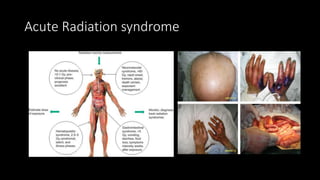
Acute Radiation syndrome
 Chernobyl experience:
 Acute Radiation Syndrome and
Radiation burns
SKIN INJURIES AFTER A SINGLE IRRADIATION
EFFECT Threshold (Gy) Onset
Temporary epilation 3 3 wk
Permament epilation 7 3 wk
Transient erythema 2 hours
Main erythema 6 10 days
Dry desquamation 10 4 wk
Dermal necrosis 18 >10 wk
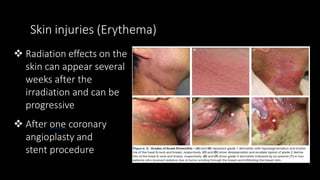
Skin injuries (Erythema)
 Radiation effects on the
skin can appear several
weeks after the
irradiation and can be
progressive
 After one coronary
angioplasty and
stent procedure
Occupational radiation burn following approximately three weeks of exposure
to radiation emitted from nested voltage electron beam accelerator being tested
to kill bacteria.
Radiation Injuries From Interventional Procedures
• Skin injuries (after several PTCA’s) (T. Shope,
Radiographics 1996; 16: 1195-99)
Hypothyroidism
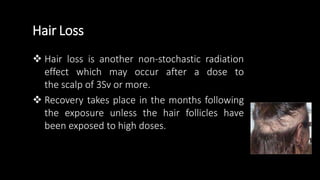
Hair Loss
 Hair loss is another non-stochastic radiation
effect which may occur after a dose to
the scalp of 3Sv or more.
 Recovery takes place in the months following
the exposure unless the hair follicles have
been exposed to high doses.
Sterility
Deterministic (Non-stochastic) Effects In Children
 Radiation dose of less than 0.1 Sv may cause mental
and growth retardation in children. The younger
children were more susceptible to these effects than
the older ones.
Radiation Induced Cancer I
 The production of cancer is the most important stochastic
effect of radiation.
 Modified somatic cells may subsequently, after a prolonged
delay, develop into a cancer.
 There are repair and defence mechanisms that make this a
very improbable outcome.
 The probability of cancer resulting from radiation increases
with increments of dose, probably with no threshold. The
severity of the cancer is not affected by the dose.
Stochastic Effects
 Caused by cell mutation leading to cancer
or hereditary disease
 Current theory says, no threshold
 The bigger the dose, the more likely effect
 So how big is the risk?.
Stochastic Effects Of Radiation
The Stochastic effects of radiation are;
 Production of cancer,
 Genetic effects and
 Effect on life span.
Radiation Dose
Risk
Radiation Induced Cancer I
 The production of cancer is the most important stochastic
effect of radiation.
 Modified somatic cells may subsequently, after a prolonged
delay, develop into a cancer.
 There are repair and defence mechanisms that make this a
very improbable outcome.
 The probability of cancer resulting from radiation increases
with increments of dose, probably with no threshold. The
severity of the cancer is not affected by the dose.
Nominal Risk Of Fatal Cancer
Effect Tissue at risk Cases per million per
m Sv
Male Female
Leukaemia Red bone marrow
Female breast
Lung
Thyroid
Cells on bone
surface
Liver
All other tissues
3 3
Breast cancer - 5
Lung cancer 2 2
Thyroid cancer 1 1
Bone sarcoma 0.5 0.5
Liver cancers 1 1
Other cancers 3 3
Total Whole body 10.5 15.5
Cancer Risk
 For adult worker, average risk of inducing fatal cancer is
4% per Sv
 i.e. risk from 0.1 mSv
 = 0.04 x 0.0001
 = 0.000004
 = 1 in 250,000
Genetic Or Hereditary Effects
 Genetic or hereditary effects are radiation induced mutations
to an individual’s genes and DNA that can contribute to the
birth of defective descendants.
Effect On Life Span
 There have been some suggestions that
exposure to ionizing radiation accelerates the
process of aging and accordingly reduce the
life span.
PRINCIPLES OF RADIATION PROTECTION
JUSTIFICATION
OPTIMIZATION
DOSE LIMITATION
KEY FACTORS TO REDUCE RADIATIONS
1. ATTENTION TO PROTECTION
2. DOUBLING YOUR DISTANCE FROM THE SOURCE OF
RADIATION.
3. ATTENTION TO C-ARM POSITIONING
4. ATTENTION TO IMAGE ACQUISITION
1. ATTENTION TO PROTECTION
2. DOUBLING YOUR DISTANCE FROM THE
SOURCE OF RADIATION
3.ATTENTION TO C-ARM POSITIONING
4. ATTENTION TO IMAGE ACQUISITION
PATIENT WAITING AREA
3.PERSONAL SHIELDING
These aprons protects an individuals only
from secondary radiation, not the primary
beam.
4.PATIENT SHIELDING
PERSONAL MONITORING
1..POCKET DOSIMETER
2..FILM BADGE
RADIATION HAZARDS ....pptx

RADIATION HAZARDS ....pptx

  • 1.
    RADIATION HAZARDS Presented by: Dr.Hassan Hameed Malik (Resident Radiology) CMH Abbottabad SUPERVISOR Brig. Dr. Saerah Iffat Zafar FRCR (UK), FCPS, MCPS,MBBS Classified Radiologist
  • 2.
    RADIATIONS Radiation, flow ofatomic and subatomic particles and of waves, such as those that characterize heat rays, light rays, and X rays. Radiation may be thought of as energy in motion either at speeds equal to the speed of light in free space—approximately 3 × 10¹⁰ centimetres (186,000 miles) per second—or at speeds less than that of light.
  • 3.
    Three things canhappen to a photon as it travels through matter: 1. Transmission 2. Absorption 3. Scatter The X-ray image is formed by the transmitted photons. Those that are absorbed or scattered are said to have been attenuated Interaction of high energy photons with matter
  • 4.
  • 5.
  • 6.
  • 7.
    Ionizing Radiation Effects Absorptionof Radiation Ionization Chemical Change Repair or Damage High Dose Effects Cell killing Tissue or organ effects Whole body effects Low Dose Effects Mutations Cancer Effects to unborn
  • 8.
  • 11.
    What harm radiationcan do from X-rays and CT scan ?
  • 12.
  • 13.
    Radiation Causes Ionizationsof: ATOMS which may affect MOLECULES which may affect CELLS which may affect TISSUES which may affect ORGANS which may affect THE WHOLE BODY
  • 14.
    X-ray passes straight throughcell  No change to cell X-ray causes a chemical reaction in cell, but no damage done or damage repaired by cell  No change to cell DNA damaged in a “fatal” way”  Cell killed DNA damaged,  Cancer? *using a c cell to * *
  • 15.
    Ionizing Radiation CanCause Chemical Reactions In The Body’s Cells Which May  do no harm  kill the cell  cause the cell to multiply out of control (cancer)  cause the cell to malfunction in some other way
  • 18.
  • 19.
    DETERMINISTIC (NON-STOCHASTIC) RADIATIONEFFECTS I Deterministic effects result from the killing of cells which, if the dose is large enough, causes sufficient cell loss to impair the function exposure radiation of the tissue. i.e. to high doses of can damage large number of cells which produce deterministic effects . Severity Radiation Dose Threshold
  • 20.
  • 21.
    Deterministic Health Effects Organor tissue Dose in less than 2 days, Gy Deterministic effects Type of effect Time of occurrence Whole body (bone marrow) 1 Acute Radiation Syndrome (ARS) 1 – 2 months Skin 3 Erythema 1 – 3 weeks Thyroid 5 Hypothyroidism 1st – several years Lens of the eye 2 Cataract 6 months - several years Gonads 3 Permanent sterility weeks
  • 22.
    Damage To TheEye  Radiation to the lens of the eye can cause cataract.  The threshold radiation dose for production of detectable damage to the lens is between 0.5 to 2 Sv, and for production of visual impairment is about 5 Sv.
  • 23.
    Radiation Injuries fromInterventional Procedures Cataract in eye of interventionalist after repeated use of old x ray systems and improper working conditions related to high levels of scattered radiation. (E. Vano et al British Journal of Radiology 1998).
  • 24.
  • 25.
     Chernobyl experience: Acute Radiation Syndrome and Radiation burns
  • 26.
    SKIN INJURIES AFTERA SINGLE IRRADIATION EFFECT Threshold (Gy) Onset Temporary epilation 3 3 wk Permament epilation 7 3 wk Transient erythema 2 hours Main erythema 6 10 days Dry desquamation 10 4 wk Dermal necrosis 18 >10 wk
  • 27.
    Skin injuries (Erythema) Radiation effects on the skin can appear several weeks after the irradiation and can be progressive  After one coronary angioplasty and stent procedure
  • 28.
    Occupational radiation burnfollowing approximately three weeks of exposure to radiation emitted from nested voltage electron beam accelerator being tested to kill bacteria.
  • 33.
    Radiation Injuries FromInterventional Procedures • Skin injuries (after several PTCA’s) (T. Shope, Radiographics 1996; 16: 1195-99)
  • 34.
  • 35.
    Hair Loss  Hairloss is another non-stochastic radiation effect which may occur after a dose to the scalp of 3Sv or more.  Recovery takes place in the months following the exposure unless the hair follicles have been exposed to high doses.
  • 36.
  • 37.
    Deterministic (Non-stochastic) EffectsIn Children  Radiation dose of less than 0.1 Sv may cause mental and growth retardation in children. The younger children were more susceptible to these effects than the older ones.
  • 39.
    Radiation Induced CancerI  The production of cancer is the most important stochastic effect of radiation.  Modified somatic cells may subsequently, after a prolonged delay, develop into a cancer.  There are repair and defence mechanisms that make this a very improbable outcome.  The probability of cancer resulting from radiation increases with increments of dose, probably with no threshold. The severity of the cancer is not affected by the dose.
  • 40.
    Stochastic Effects  Causedby cell mutation leading to cancer or hereditary disease  Current theory says, no threshold  The bigger the dose, the more likely effect  So how big is the risk?.
  • 41.
    Stochastic Effects OfRadiation The Stochastic effects of radiation are;  Production of cancer,  Genetic effects and  Effect on life span. Radiation Dose Risk
  • 42.
    Radiation Induced CancerI  The production of cancer is the most important stochastic effect of radiation.  Modified somatic cells may subsequently, after a prolonged delay, develop into a cancer.  There are repair and defence mechanisms that make this a very improbable outcome.  The probability of cancer resulting from radiation increases with increments of dose, probably with no threshold. The severity of the cancer is not affected by the dose.
  • 43.
    Nominal Risk OfFatal Cancer Effect Tissue at risk Cases per million per m Sv Male Female Leukaemia Red bone marrow Female breast Lung Thyroid Cells on bone surface Liver All other tissues 3 3 Breast cancer - 5 Lung cancer 2 2 Thyroid cancer 1 1 Bone sarcoma 0.5 0.5 Liver cancers 1 1 Other cancers 3 3 Total Whole body 10.5 15.5
  • 44.
    Cancer Risk  Foradult worker, average risk of inducing fatal cancer is 4% per Sv  i.e. risk from 0.1 mSv  = 0.04 x 0.0001  = 0.000004  = 1 in 250,000
  • 45.
    Genetic Or HereditaryEffects  Genetic or hereditary effects are radiation induced mutations to an individual’s genes and DNA that can contribute to the birth of defective descendants.
  • 47.
    Effect On LifeSpan  There have been some suggestions that exposure to ionizing radiation accelerates the process of aging and accordingly reduce the life span.
  • 50.
  • 51.
  • 52.
  • 54.
  • 56.
    KEY FACTORS TOREDUCE RADIATIONS 1. ATTENTION TO PROTECTION 2. DOUBLING YOUR DISTANCE FROM THE SOURCE OF RADIATION. 3. ATTENTION TO C-ARM POSITIONING 4. ATTENTION TO IMAGE ACQUISITION
  • 57.
    1. ATTENTION TOPROTECTION
  • 58.
    2. DOUBLING YOURDISTANCE FROM THE SOURCE OF RADIATION
  • 59.
  • 60.
    4. ATTENTION TOIMAGE ACQUISITION
  • 68.
  • 69.
  • 70.
    These aprons protectsan individuals only from secondary radiation, not the primary beam.
  • 72.
  • 75.
  • 76.

Editor's Notes

  • #7 Somatic:- The effect is primarily suffered by the individual exposed. Since cancer is the primary result, it is sometimes called the Carcinogenic Effect. Genetic :- The effect is suffered by the offspring of the individual exposed.
  • #9 Cancer induction and radiation induced hereditary effects are the two main examples of stochastic effects. Deterministic effects have a threshold dose that must be exceeded for the effects to occur.
  • #10 Stochastic effect is those effect which occur when a person receives a high dose of radiation. These effects have an increase probability of occurrence with increase dose. There is no threshold dose below which is creatively certain that a stochastic effect cannot occur The health effects of radiation, the severity of which vary with the dose and for which a threshold is believed to exist. Radiation-induced cataract formation is an example of a non-stochastic effect (also called a deterministic effect) 
  • #17 HEMATOPOIETIC SYNDROME: Bone marrow syndrome (sometimes referred to as hematopoietic syndrome) the full syndrome will usually occur with a dose between 0.7 and 10 Gy (70 – 1000 rads) though mild symptoms may occur as low as 0.3 Gy or 30 rads4. The survival rate of patients with this syndrome decreases with increasing dose.
  • #18 ACUTE RADIATION SYNDROME: 1-PRODROMAL STAGE : NAUSE VOMITING DIARRHEA
  • #76 POCKET DOSIMETER: estimates GAMA/XRAY dose rate. FILMPOCKET / FILM BADGE : read XRAY/GAMA/BETA radiations. TLD: