Achieving California’s Renewable Energy Goals: Current Issues for Wind Energy Nancy Rader, Executive Director California Wind Energy Association Nancy Rader, Executive Director California Wind Energy Association Clean Energy Conference California Center for Sustainable Energy, San Diego September 16, 2010
Top Issues for CalWEA Continue the RPS to Achieve 33% Renewables / AB 32 Goals Ensure Fair Assessment of Integration Costs and Capacity Value  Promote Transmission Development (without prejudging resource areas) Reduce Siting Costs & Timeline
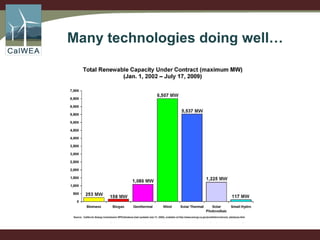
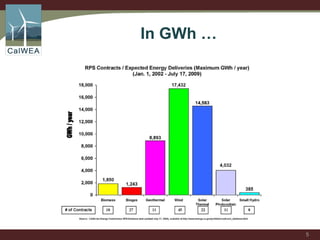
1 . Continue the RPS to Achieve 33% Renewables / AB 32 Goals 20% RPS market has fostered substantial development activity Transmission upgrades underway  California wind energy capacity has increased dramatically 58% increase since 2002 RPS adopted (1,000 MW to date) Another 940 MW coming on line by early 2011 New total: 3,680 MW by early 2011 - 112% increase  Failure to adopt SB 722 RPS = huge cloud
Many technologies doing well…
In GWh …
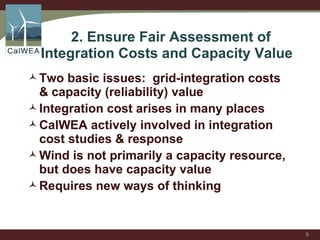
  2. Ensure Fair Assessment of  Integration Costs and Capacity Value  Two basic issues:  grid-integration costs & capacity (reliability) value Integration cost arises in many places CalWEA actively involved in integration cost studies & response Wind is not primarily a capacity resource, but does have capacity value  Requires new ways of thinking
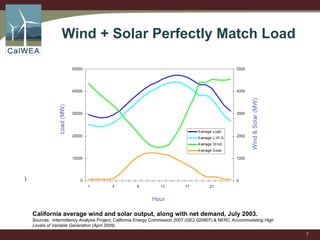
Wind + Solar Perfectly Match Load ) California average wind and solar output, along with net demand, July 2003.   Sources:  Intermittency Analysis Project, California Energy Commission 2007 (GE2 020807) & NERC  Accommodating High Levels of Variable Generation (April 2009)
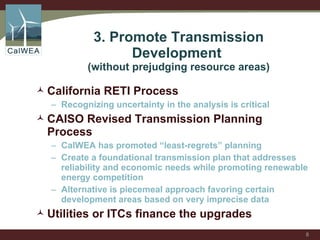
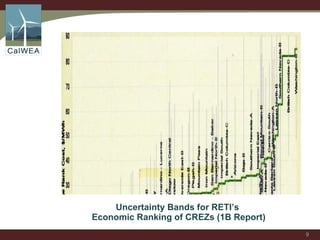
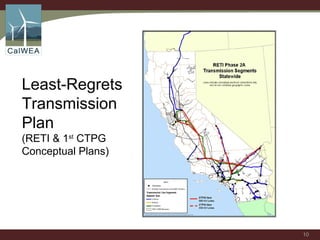
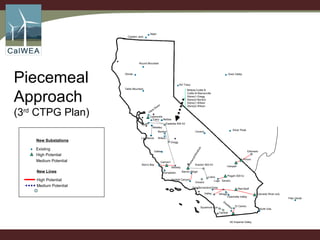
3. Promote Transmission Development  (without prejudging resource areas) California RETI Process Recognizing uncertainty in the analysis is critical CAISO Revised Transmission Planning Process CalWEA has promoted “least-regrets” planning Create a foundational transmission plan that addresses reliability and economic needs while promoting renewable energy competition  Alternative is piecemeal approach favoring certain development areas based on very imprecise data Utilities or ITCs finance the upgrades
Uncertainty Bands for RETI’s  Economic Ranking of CREZs (1B Report)
Least-Regrets Transmission Plan  (RETI & 1 st  CTPG Conceptual Plans)
 Malin Captain Jack Round Mountain Olinda NV Tracy Dixie Valley Table Mountain Tracy Tesla Los Banos Vaca Dixon Valley Morro Bay Midway Gates Carrizo1 Silver Peak Bordon Gregg Control Eldorado Kramer 500 kV Llano Vincent Primm Ivanpah Pisgah 500 kv Lugo Colorado River sub. Red Bluff San Bernardino/Vista IID Imperial Valley Dixieland El Centro Coachella Valley Mirage Devers Sycamore Cyn North Gila Palo Verde Eastside 500 kV Collinsville Piecemeal Approach  (3 rd  CTPG Plan) Westley Wilson Bellota Bellota-Cottle B Cottle B-Warnerville Storey1-Gregg Storey2-Bordon Storey1-Wilson Storey2-Wilson Templeton Whirlwind/Windhub Barren Ridge Haskell Canyon Central High Potential Medium Potential New Lines New Substations Existing High Potential Medium Potential
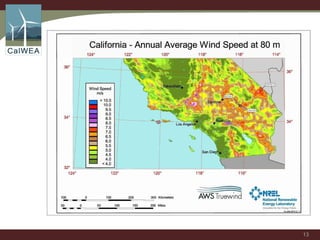
4. Reduce Siting Costs & Timeline  CA permitting process takes 3-6 years, ~$1-3 million per project Desert Renewable Energy Conservation Plan (DRECP) aims to improve that for the CA Desert Area Big Question:  By 2012?  Or 2022? How much of remaining ~12,000 MW  potential  wind resource will remain open?
Courtesy of Oak Creek Energy Systems
For more info … See www.calwea.org  For all of our filings & reports

Rader SD ccse_slides_9-16-10

  • 1.
    Achieving California’s RenewableEnergy Goals: Current Issues for Wind Energy Nancy Rader, Executive Director California Wind Energy Association Nancy Rader, Executive Director California Wind Energy Association Clean Energy Conference California Center for Sustainable Energy, San Diego September 16, 2010
  • 2.
    Top Issues forCalWEA Continue the RPS to Achieve 33% Renewables / AB 32 Goals Ensure Fair Assessment of Integration Costs and Capacity Value Promote Transmission Development (without prejudging resource areas) Reduce Siting Costs & Timeline
  • 3.
    1 . Continuethe RPS to Achieve 33% Renewables / AB 32 Goals 20% RPS market has fostered substantial development activity Transmission upgrades underway California wind energy capacity has increased dramatically 58% increase since 2002 RPS adopted (1,000 MW to date) Another 940 MW coming on line by early 2011 New total: 3,680 MW by early 2011 - 112% increase Failure to adopt SB 722 RPS = huge cloud
  • 4.
  • 5.
  • 6.
    2.Ensure Fair Assessment of Integration Costs and Capacity Value Two basic issues: grid-integration costs & capacity (reliability) value Integration cost arises in many places CalWEA actively involved in integration cost studies & response Wind is not primarily a capacity resource, but does have capacity value Requires new ways of thinking
  • 7.
    Wind + SolarPerfectly Match Load ) California average wind and solar output, along with net demand, July 2003. Sources: Intermittency Analysis Project, California Energy Commission 2007 (GE2 020807) & NERC Accommodating High Levels of Variable Generation (April 2009)
  • 8.
    3. Promote TransmissionDevelopment (without prejudging resource areas) California RETI Process Recognizing uncertainty in the analysis is critical CAISO Revised Transmission Planning Process CalWEA has promoted “least-regrets” planning Create a foundational transmission plan that addresses reliability and economic needs while promoting renewable energy competition Alternative is piecemeal approach favoring certain development areas based on very imprecise data Utilities or ITCs finance the upgrades
  • 9.
    Uncertainty Bands forRETI’s Economic Ranking of CREZs (1B Report)
  • 10.
    Least-Regrets Transmission Plan (RETI & 1 st CTPG Conceptual Plans)
  • 11.
     Malin CaptainJack Round Mountain Olinda NV Tracy Dixie Valley Table Mountain Tracy Tesla Los Banos Vaca Dixon Valley Morro Bay Midway Gates Carrizo1 Silver Peak Bordon Gregg Control Eldorado Kramer 500 kV Llano Vincent Primm Ivanpah Pisgah 500 kv Lugo Colorado River sub. Red Bluff San Bernardino/Vista IID Imperial Valley Dixieland El Centro Coachella Valley Mirage Devers Sycamore Cyn North Gila Palo Verde Eastside 500 kV Collinsville Piecemeal Approach (3 rd CTPG Plan) Westley Wilson Bellota Bellota-Cottle B Cottle B-Warnerville Storey1-Gregg Storey2-Bordon Storey1-Wilson Storey2-Wilson Templeton Whirlwind/Windhub Barren Ridge Haskell Canyon Central High Potential Medium Potential New Lines New Substations Existing High Potential Medium Potential
  • 12.
    4. Reduce SitingCosts & Timeline CA permitting process takes 3-6 years, ~$1-3 million per project Desert Renewable Energy Conservation Plan (DRECP) aims to improve that for the CA Desert Area Big Question: By 2012? Or 2022? How much of remaining ~12,000 MW potential wind resource will remain open?
  • 14.
    Courtesy of OakCreek Energy Systems
  • 15.
    For more info… See www.calwea.org For all of our filings & reports