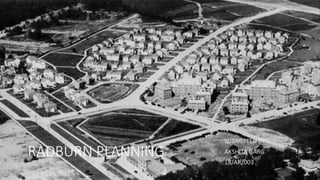
RADBURN PLANNING
SUBMITTED BY :
AKSHITA GARG
18/AR/003
CONTENT
INTRODUCTION
FACTORS INFLUENCED RADBURN'S PLANNING
OBJECTIVES
CONCEPT
PLANNING
HOUSING UNIT LAYOUT
FAILURE
INTRODUCTION
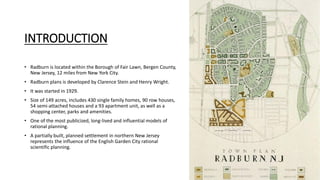
• Radburn is located within the Borough of Fair Lawn, Bergen County,
New Jersey, 12 miles from New York City.
• Radburn plans is developed by Clarence Stein and Henry Wright.
• It was started in 1929.
• Size of 149 acres, includes 430 single family homes, 90 row houses,
54 semi-attached houses and a 93 apartment unit, as well as a
shopping center, parks and amenities.
• One of the most publicized, long-lived and influential models of
rational planning.
• A partially built, planned settlement in northern New Jersey
represents the influence of the English Garden City rational
scientific planning.
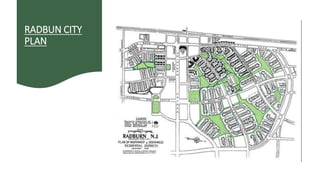
RADBUN CITY
PLAN
FACTORS THAT INFLUENCED RADBURN'S
PLANNING
• Rapid industrialization after World War I.
• Migration of Rural to Cities.
• Dramatic growth of Cities.
• Housing Shortage.
• The need to provide housing and protect from motorized traffic.
OBJECTIVES OF RADBURN
• Decentralized, self-contained settlements, organized to promote environmental considerations by conserving open space, harnessing the
auto and promoting community life;
• Key features:
o Hierarchical transportation systems
o Cul-de-sacs
o Footpath systems
o Underpasses
o Shopping center
o Ideal size of 30,000 people
o Homogeneity
o Large-scale development
o Clustered superblock
o Mixed-use
o Interior park
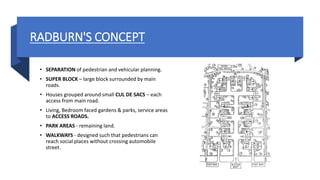
RADBURN'S CONCEPT
• SEPARATION of pedestrian and vehicular planning.
• SUPER BLOCK – large block surrounded by main
roads.
• Houses grouped around small CUL DE SACS – each
access from main road.
• Living, Bedroom faced gardens & parks, service areas
to ACCESS ROADS.
• PARK AREAS - remaining land.
• WALKWAYS - designed such that pedestrians can
reach social places without crossing automobile
street.
PLANNING OF RADNURN
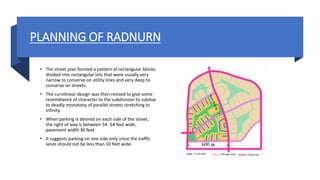
• The street plan formed a pattern of rectangular blocks
divided into rectangular lots that were usually very
narrow to conserve on utility lines and very deep to
conserve on streets.
• The curvilinear design was then revised to give some
resemblance of character to the subdivision to subdue
to deadly monotony of parallel streets stretching to
infinity.
• When parking is desired on each side of the street,
the right of way is between 54- 64 feet wide,
pavement width 36 feet.
• It suggests parking on one side only since the traffic
lanes should not be less than 10 feet wide.
LAYOUT OF HOUSING UNITS
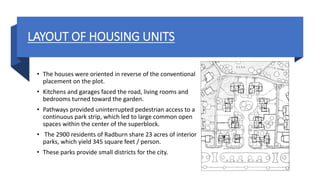
• The houses were oriented in reverse of the conventional
placement on the plot.
• Kitchens and garages faced the road, living rooms and
bedrooms turned toward the garden.
• Pathways provided uninterrupted pedestrian access to a
continuous park strip, which led to large common open
spaces within the center of the superblock.
• The 2900 residents of Radburn share 23 acres of interior
parks, which yield 345 square feet / person.
• These parks provide small districts for the city.
FAILURE OF RADBURN PLANNING
• The design of Radburn believed that people would actively use the front of the houses
facing the greenways.
• In reality, people come and "leave" from the back of the houses and the vehicles, not
pedestrian access.
• More people and children walking and playing in the little driveways and cul-de-sacs than
on the actual greenways.
• Second, the market has repeatedly shown that homeowners prefer more personal land
around their homes to living on tiny lots and sharing a large green space in common.
• The Depression pushed the builder, City Housing Corporation, into bankruptcy.
THANK YOU

RADBURN PLANNING REPORT.pdf

  • 1.
    RADBURN PLANNING SUBMITTED BY: AKSHITA GARG 18/AR/003
  • 2.
    CONTENT INTRODUCTION FACTORS INFLUENCED RADBURN'SPLANNING OBJECTIVES CONCEPT PLANNING HOUSING UNIT LAYOUT FAILURE
  • 3.
    INTRODUCTION • Radburn islocated within the Borough of Fair Lawn, Bergen County, New Jersey, 12 miles from New York City. • Radburn plans is developed by Clarence Stein and Henry Wright. • It was started in 1929. • Size of 149 acres, includes 430 single family homes, 90 row houses, 54 semi-attached houses and a 93 apartment unit, as well as a shopping center, parks and amenities. • One of the most publicized, long-lived and influential models of rational planning. • A partially built, planned settlement in northern New Jersey represents the influence of the English Garden City rational scientific planning.
  • 4.
  • 5.
    FACTORS THAT INFLUENCEDRADBURN'S PLANNING • Rapid industrialization after World War I. • Migration of Rural to Cities. • Dramatic growth of Cities. • Housing Shortage. • The need to provide housing and protect from motorized traffic.
  • 6.
    OBJECTIVES OF RADBURN •Decentralized, self-contained settlements, organized to promote environmental considerations by conserving open space, harnessing the auto and promoting community life; • Key features: o Hierarchical transportation systems o Cul-de-sacs o Footpath systems o Underpasses o Shopping center o Ideal size of 30,000 people o Homogeneity o Large-scale development o Clustered superblock o Mixed-use o Interior park
  • 7.
    RADBURN'S CONCEPT • SEPARATIONof pedestrian and vehicular planning. • SUPER BLOCK – large block surrounded by main roads. • Houses grouped around small CUL DE SACS – each access from main road. • Living, Bedroom faced gardens & parks, service areas to ACCESS ROADS. • PARK AREAS - remaining land. • WALKWAYS - designed such that pedestrians can reach social places without crossing automobile street.
  • 8.
    PLANNING OF RADNURN •The street plan formed a pattern of rectangular blocks divided into rectangular lots that were usually very narrow to conserve on utility lines and very deep to conserve on streets. • The curvilinear design was then revised to give some resemblance of character to the subdivision to subdue to deadly monotony of parallel streets stretching to infinity. • When parking is desired on each side of the street, the right of way is between 54- 64 feet wide, pavement width 36 feet. • It suggests parking on one side only since the traffic lanes should not be less than 10 feet wide.
  • 9.
    LAYOUT OF HOUSINGUNITS • The houses were oriented in reverse of the conventional placement on the plot. • Kitchens and garages faced the road, living rooms and bedrooms turned toward the garden. • Pathways provided uninterrupted pedestrian access to a continuous park strip, which led to large common open spaces within the center of the superblock. • The 2900 residents of Radburn share 23 acres of interior parks, which yield 345 square feet / person. • These parks provide small districts for the city.
  • 10.
    FAILURE OF RADBURNPLANNING • The design of Radburn believed that people would actively use the front of the houses facing the greenways. • In reality, people come and "leave" from the back of the houses and the vehicles, not pedestrian access. • More people and children walking and playing in the little driveways and cul-de-sacs than on the actual greenways. • Second, the market has repeatedly shown that homeowners prefer more personal land around their homes to living on tiny lots and sharing a large green space in common. • The Depression pushed the builder, City Housing Corporation, into bankruptcy.
  • 11.