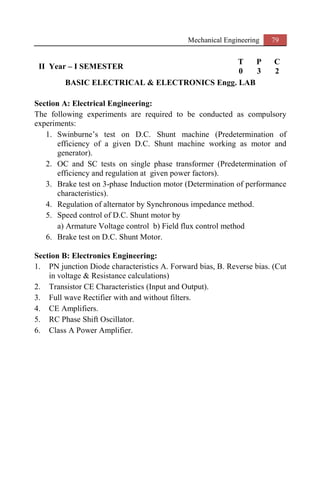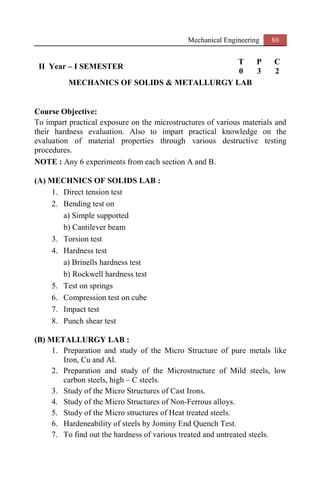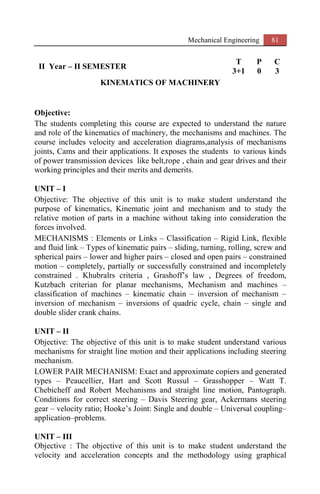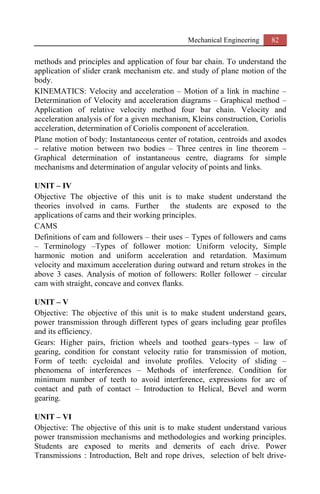

ACADEMIC REGULATIONS
COURSE STRUCTURE
AND
DETAILED SYLLABUS
For
B.Tech., FOUR YEAR DEGREE COURSE
(Applicable for the batches admitted from 2013-14)
JAWAHARLAL NEHRU TECHNOLOGICAL
UNIVERSITY KAKINADA
KAKINADA – 533003, ANDHRA PRADESH, INDIA.
MECHANICAL
ENGINEERING
Mechanical Engineering 3
Academic Regulations (R13) for B. Tech. (Regular)
Applicable for the students of B. Tech. (Regular) from the Academic
Year 2013-14 onwards
1. Award of B. Tech. Degree
A student will be declared eligible for the award of B. Tech. Degree if he
fulfils the following academic regulations :
1. A student shall be declared eligible for the award of the B. Tech
Degree, if he pursues a course of study in not less than four and not
more than eight academic years.
2. The candidate shall register for 180 credits and secure all the 180
credits.
2. Courses of study
The following courses of study are offered at present as specializations
for the B. Tech. Courses :
S.No. Branch
01 Electronics and Communication Engineering
02 Electrical and Electronics Engineering
03 Civil Engineering
04 Mechanical Engineering
05 Computer Science and Engineering
06 Petro Chemical Engineering
07 Information Technology
08 Chemical Engineering
09 Electronics and Instrumentation Engineering
10 Bio-Medical Engineering
11 Aeronautical Engineering
12 Automobile Engineering
13 Bio Technology
14 Electronics and Computer Engineering
15 Mining Engineering
16 Petroleum Engineering
17 Metallurgical Engineering
18 Agricultural Engineering
Mechanical Engineering 4
3. Distribution and Weightage of Marks
(i) The performance of a student in each semester shall be evaluated
subject – wise with a maximum of 100 marks for theory subject and
75 marks for practical subject. The project work shall be evaluated for
200 marks.
(ii) For theory subjects the distribution shall be 30 marks for Internal
Evaluation and 70 marks for the End - Examinations.
(iii) For theory subjects, during the semester there shall be 2 tests. The
weightage of Internal marks for 30 consists of Descriptive – 15,
Assignment - 05 (Theory, Design, Analysis, Simulation, Algorithms,
Drawing, etc. as the case may be) Objective -10 (Conducted at
College level with 20 Multiple choice question with a weightage of ½
Mark each). The objective examination is for 20 minu tes duration.
The subjective examination is for 90 minutes duration conducted for
15 marks. Each subjective type test question paper shall contain 3
questions and all questions need to be answered. The Objective
examination conducted for 10 marks and subjective examination
conducted for 15 marks are to be added to the assignment marks of 5
for finalizing internal marks for 30. The best of the two tests will be
taken for internal marks. As the syllabus is framed for 6 units, the 1st
mid examination (both Objective and Subjective) is conducted in 1-3
units and second test in 4-6 units of each subject in a semester.
(iv) The end semester examination is conducted covering the topics of all
Units for 70 marks. Part – A contains a mandatory question
(Brainstorming / Thought provoking / case study) for 22 marks. Part –
B has 6 questions (One from each Unit). The student has to answer 3
out of 6 questions in Part – B and carries a weightage of 16 marks
each.
(v) For practical subjects there shall be continuous evaluation during the
semester for 25 internal marks and 50 end examination marks. The
internal 25 marks shall be awarded as follows: day to day work - 10
marks, Record-5 marks and the remaining 10 marks to be awarded by
conducting an internal laboratory test. The end examination shall be
conducted by the teacher concerned and external examiner.
(vi) For the subject having design and / or drawing, (such as Engineering
Graphics, Engineering Drawing, Machine Drawing) and estimation,
the distribution shall be 30 marks for internal evaluation ( 20 marks
for day – to – day work, and 10 marks for internal tests) and 70 marks
for end examination. There shall be two internal tests in a Semester
and the better of the two shall be considered for the award of marks
for internal tests.
Mechanical Engineering 5
(vii) For the seminar, the student shall collect the information on a
specialized topic and prepare a technical report, showing his
understanding over the topic, and submit to the department, which
shall be evaluated by the Departmental committee consisting of Head
of the department, seminar supervisor and a senior faculty member.
The seminar report shall be evaluated for 50 marks. There shall be no
external examination for seminar.
(viii) Out of a total of 200 marks for the project work, 60 marks shall be for
Internal Evaluation and 140 marks for the End Semester Examination.
The End Semester Examination (Viva – Voce) shall be conducted by
the committee. The committee consists of an external examiner, Head
of the Department and Supervisor of the Project. The evaluation of
project work shall be conducted at the end of the IV year. The Internal
Evaluation shall be on the basis of two seminars given by each student
on the topic of his project and evaluated by an internal committee.
(ix) Laboratory marks and the internal marks awarded by the College are
not final. The marks are subject to scrutiny and scaling by the
University wherever felt desirable. The internal and laboratory marks
awarded by the College will be referred to a Committee. The
Committee shall arrive at a scaling factor and the marks will be scaled
as per the scaling factor. The recommendations of the Committee are
final and binding. The laboratory records and internal test papers shall
be preserved in the respective departments as per the University norms
and shall be produced to the Committees of the University as and
when they ask for.
4. Attendance Requirements
1. A student is eligible to write the University examinations if he
acquires a minimum of 75% of attendance in aggregate of all the
subjects.
2. Condonation of shortage of attendance in aggregate up to 10%
(65% and above and below 75%) in each semester may be
granted by the College Academic Committee
3. Shortage of Attendance below 65% in aggregate shall not be
condoned.
4. A student who is short of attendance in semester may seek re-
admission into that semester when offered within 4 weeks from
the date of the commencement of class work.
5. Students whose shortage of attendance is not condoned in any
semester are not eligible to write their end semester examination
of that class.
Mechanical Engineering 6
6. A stipulated fee shall be payable towards condonation of
shortage of attendance.
7. A student will be promoted to the next semester if he satisfies the
(i)attendance requirement of the present semester and (ii) credits.
8. If any candidate fulfills the attendance requirement in the present
semester, he shall not be eligible for readmission into the same
class.
5. Minimum Academic Requirements
The following academic requirements have to be satisfied in addition
to the attendance requirements mentioned in item no. 4.
5.1 A student is deemed to have satisfied the minimum academic
requirements if he has earned the credits allotted to each
theory/practical design/drawing subject/project and secures not
less than 35% of marks in the end semester exam, and minimum
40% of marks in the sum total of the internal marks and end
semester examination marks.
5.2 A student shall be promoted from first year to second year if he fulfills
the minimum attendance requirement.
5.3 A student will be promoted from II year to III year if he fulfills the
academic requirement of 40% of the credits up to II year I semester
from all the examinations, whether or not the candidate takes the
examinations and secures prescribed minimum attendance in II
year II semester.
5.4 A student shall be promoted from III year to IV year if he fulfils the
academic requirements of 40% of the credits up to III year I
semester from all the examinations, whether or not the candidate
takes the examinations and secures prescribed minimum
attendance in III year II semester.
5.5 A student shall register and put up minimum attendance in all 180
credits and earn all 180 credits. Marks obtained in all the 180
credits shall be considered for the calculation of percentage of
marks.
6. Course pattern
1. The entire course of study is for four academic years, all the
years are on semester pattern.
2. A student eligible to appear for the end semester examination in
a subject, but absent from it or has failed in the end semester
examination, may write the exam in that subject when conducted
next.
Mechanical Engineering 7
3. When a student is detained for lack of credits / shortage of
attendance, he may be re-admitted into the same semester / year
in which he has been detained. However, the academic
regulations under which he was first admitted shall continues to
be applicable to him.
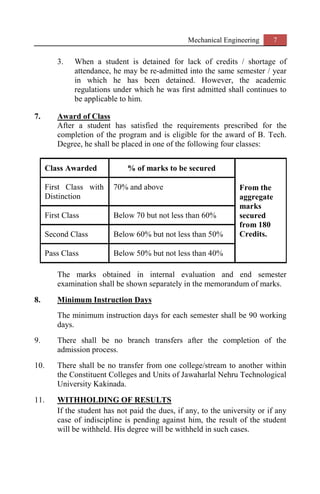
7. Award of Class
After a student has satisfied the requirements prescribed for the
completion of the program and is eligible for the award of B. Tech.
Degree, he shall be placed in one of the following four classes:
Class Awarded % of marks to be secured
From the
aggregate
marks
secured
from 180
Credits.
First Class with
Distinction
70% and above
First Class Below 70 but not less than 60%
Second Class Below 60% but not less than 50%
Pass Class Below 50% but not less than 40%
The marks obtained in internal evaluation and end semester
examination shall be shown separately in the memorandum of marks.
8. Minimum Instruction Days
The minimum instruction days for each semester shall be 90 working
days.
9. There shall be no branch transfers after the completion of the
admission process.
10. There shall be no transfer from one college/stream to another within
the Constituent Colleges and Units of Jawaharlal Nehru Technological
University Kakinada.
11. WITHHOLDING OF RESULTS
If the student has not paid the dues, if any, to the university or if any
case of indiscipline is pending against him, the result of the student
will be withheld. His degree will be withheld in such cases.
Mechanical Engineering 8
12. TRANSITORY REGULATIONS
1. Discontinued or detained candidates are eligible for readmission
as and when next offered.
2. In case of transferred students from other Universities, the credits
shall be transferred to JNTUK as per the academic regulations
and course structure of the JNTUK.
13. General
1. Wherever the words “he”, “him”, “his”, occur in the regulations,
they include “she”, “her”, “hers”.
2. The academic regulation should be read as a whole for the
purpose of any interpretation.
3. In case of any doubt or ambiguity in the interpretation of the
above rules, the decision of the Vice-Chancellor is final.
4. The University may change or amend the academic regulations
or syllabi at any time and the changes or amendments made shall
be applicable to all the students with effect from the dates
notified by the University.
5. The students seeking transfer to colleges affiliated to JNTUK
from various other Universities/ Institutions have to pass the
failed subjects which are equivalent to the subjects of JNTUK,
and also pass the subjects of JNTUK on their own without the
right to sessional marks which the candidates have not studied at
the earlier Institution.
* * * *
Mechanical Engineering 9
Academic Regulations (R13) for B. Tech.
(Lateral entry Scheme)
Applicable for the students admitted into II year B. Tech. from the Academic
Year 2014-15 onwards
1 Award of B. Tech. Degree
A student will be declared eligible for the award of B. Tech. Degree if
he fulfils the following academic regulations:
1.1 A student shall be declared eligible for the award of the B. Tech
Degree, if he pursues a course of study in not less than three
academic years and not more than six academic years.
1.2 The candidate shall register for 132 credits and secure all the 132
credits.
2. The attendance regulations of B. Tech. (Regular) shall be applicable to
B.Tech.
3. Promotion Rule
A student shall be promoted from second year to third year if he fulfills
the minimum attendance requirement.
A student shall be promoted from III year to IV year if he fulfils the
academic requirements of 40% of the credits up to III year I semester
from all the examinations, whether or not the candidate takes the
examinations and secures prescribed minimum attendance in III year II
semester.
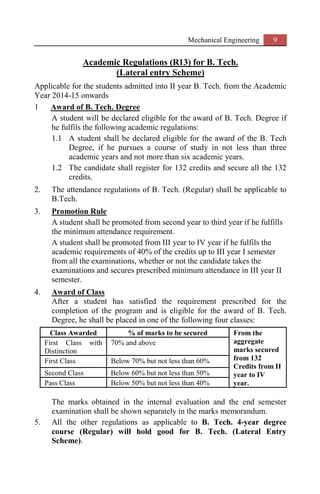
4. Award of Class
After a student has satisfied the requirement prescribed for the
completion of the program and is eligible for the award of B. Tech.
Degree, he shall be placed in one of the following four classes:
Class Awarded % of marks to be secured From the
aggregate
marks secured
from 132
Credits from II
year to IV
year.
First Class with
Distinction
70% and above
First Class Below 70% but not less than 60%
Second Class Below 60% but not less than 50%
Pass Class Below 50% but not less than 40%
The marks obtained in the internal evaluation and the end semester
examination shall be shown separately in the marks memorandum.
5. All the other regulations as applicable to B. Tech. 4-year degree
course (Regular) will hold good for B. Tech. (Lateral Entry
Scheme).
Mechanical Engineering 10
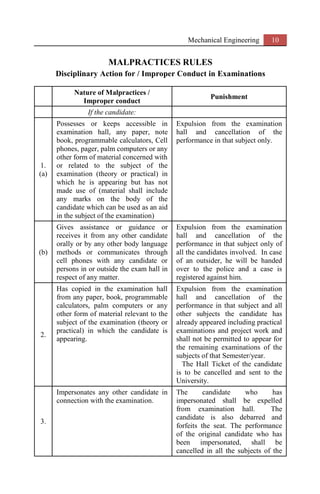
MALPRACTICES RULES
Disciplinary Action for / Improper Conduct in Examinations
Nature of Malpractices /
Improper conduct
Punishment
If the candidate:
1.
(a)
Possesses or keeps accessible in
examination hall, any paper, note
book, programmable calculators, Cell
phones, pager, palm computers or any
other form of material concerned with
or related to the subject of the
examination (theory or practical) in
which he is appearing but has not
made use of (material shall include
any marks on the body of the
candidate which can be used as an aid
in the subject of the examination)
Expulsion from the examination
hall and cancellation of the
performance in that subject only.
(b)
Gives assistance or guidance or
receives it from any other candidate
orally or by any other body language
methods or communicates through
cell phones with any candidate or
persons in or outside the exam hall in
respect of any matter.
Expulsion from the examination
hall and cancellation of the
performance in that subject only of
all the candidates involved. In case
of an outsider, he will be handed
over to the police and a case is
registered against him.
2.
Has copied in the examination hall
from any paper, book, programmable
calculators, palm computers or any
other form of material relevant to the
subject of the examination (theory or
practical) in which the candidate is
appearing.
Expulsion from the examination
hall and cancellation of the
performance in that subject and all
other subjects the candidate has
already appeared including practical
examinations and project work and
shall not be permitted to appear for
the remaining examinations of the
subjects of that Semester/year.
The Hall Ticket of the candidate
is to be cancelled and sent to the
University.
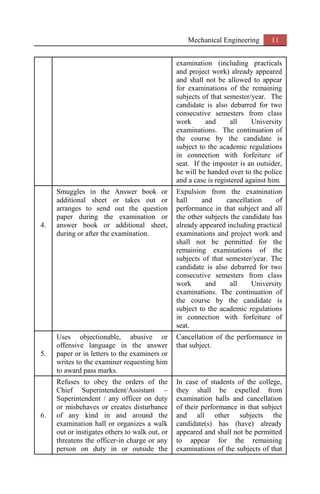
3.
Impersonates any other candidate in
connection with the examination.
The candidate who has
impersonated shall be expelled
from examination hall. The
candidate is also debarred and
forfeits the seat. The performance
of the original candidate who has
been impersonated, shall be
cancelled in all the subjects of the
Mechanical Engineering 11
examination (including practicals
and project work) already appeared
and shall not be allowed to appear
for examinations of the remaining
subjects of that semester/year. The
candidate is also debarred for two
consecutive semesters from class
work and all University
examinations. The continuation of
the course by the candidate is
subject to the academic regulations
in connection with forfeiture of
seat. If the imposter is an outsider,
he will be handed over to the police
and a case is registered against him.
4.
Smuggles in the Answer book or
additional sheet or takes out or
arranges to send out the question
paper during the examination or
answer book or additional sheet,
during or after the examination.
Expulsion from the examination
hall and cancellation of
performance in that subject and all
the other subjects the candidate has
already appeared including practical
examinations and project work and
shall not be permitted for the
remaining examinations of the
subjects of that semester/year. The
candidate is also debarred for two
consecutive semesters from class
work and all University
examinations. The continuation of
the course by the candidate is
subject to the academic regulations
in connection with forfeiture of
seat.
5.
Uses objectionable, abusive or
offensive language in the answer
paper or in letters to the examiners or
writes to the examiner requesting him
to award pass marks.
Cancellation of the performance in
that subject.
6.
Refuses to obey the orders of the
Chief Superintendent/Assistant –
Superintendent / any officer on duty
or misbehaves or creates disturbance
of any kind in and around the
examination hall or organizes a walk
out or instigates others to walk out, or
threatens the officer-in charge or any
person on duty in or outside the
In case of students of the college,
they shall be expelled from
examination halls and cancellation
of their performance in that subject
and all other subjects the
candidate(s) has (have) already
appeared and shall not be permitted
to appear for the remaining
examinations of the subjects of that
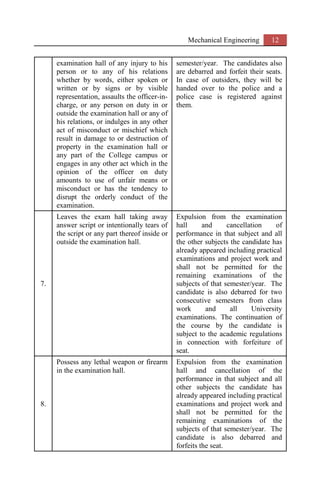
Mechanical Engineering 12
examination hall of any injury to his
person or to any of his relations
whether by words, either spoken or
written or by signs or by visible
representation, assaults the officer-in-
charge, or any person on duty in or
outside the examination hall or any of
his relations, or indulges in any other
act of misconduct or mischief which
result in damage to or destruction of
property in the examination hall or
any part of the College campus or
engages in any other act which in the
opinion of the officer on duty
amounts to use of unfair means or
misconduct or has the tendency to
disrupt the orderly conduct of the
examination.
semester/year. The candidates also
are debarred and forfeit their seats.
In case of outsiders, they will be
handed over to the police and a
police case is registered against
them.
7.
Leaves the exam hall taking away
answer script or intentionally tears of
the script or any part thereof inside or
outside the examination hall.
Expulsion from the examination
hall and cancellation of
performance in that subject and all
the other subjects the candidate has
already appeared including practical
examinations and project work and
shall not be permitted for the
remaining examinations of the
subjects of that semester/year. The
candidate is also debarred for two
consecutive semesters from class
work and all University
examinations. The continuation of
the course by the candidate is
subject to the academic regulations
in connection with forfeiture of
seat.
8.
Possess any lethal weapon or firearm
in the examination hall.
Expulsion from the examination
hall and cancellation of the
performance in that subject and all
other subjects the candidate has
already appeared including practical
examinations and project work and
shall not be permitted for the
remaining examinations of the
subjects of that semester/year. The
candidate is also debarred and
forfeits the seat.
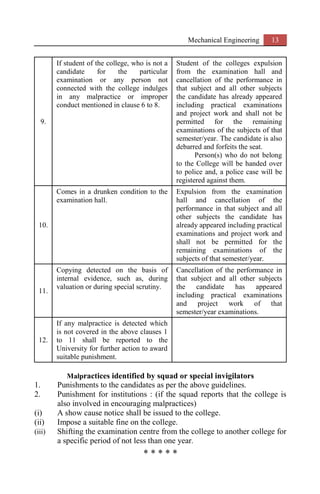
Mechanical Engineering 13
9.
If student of the college, who is not a
candidate for the particular
examination or any person not
connected with the college indulges
in any malpractice or improper
conduct mentioned in clause 6 to 8.
Student of the colleges expulsion
from the examination hall and
cancellation of the performance in
that subject and all other subjects
the candidate has already appeared
including practical examinations
and project work and shall not be
permitted for the remaining
examinations of the subjects of that
semester/year. The candidate is also
debarred and forfeits the seat.
Person(s) who do not belong
to the College will be handed over
to police and, a police case will be
registered against them.
10.
Comes in a drunken condition to the
examination hall.
Expulsion from the examination
hall and cancellation of the
performance in that subject and all
other subjects the candidate has
already appeared including practical
examinations and project work and
shall not be permitted for the
remaining examinations of the
subjects of that semester/year.
11.
Copying detected on the basis of
internal evidence, such as, during
valuation or during special scrutiny.
Cancellation of the performance in
that subject and all other subjects
the candidate has appeared
including practical examinations
and project work of that
semester/year examinations.
12.
If any malpractice is detected which
is not covered in the above clauses 1
to 11 shall be reported to the
University for further action to award
suitable punishment.
Malpractices identified by squad or special invigilators
1. Punishments to the candidates as per the above guidelines.
2. Punishment for institutions : (if the squad reports that the college is
also involved in encouraging malpractices)
(i) A show cause notice shall be issued to the college.
(ii) Impose a suitable fine on the college.
(iii) Shifting the examination centre from the college to another college for
a specific period of not less than one year.
* * * * *
Mechanical Engineering 14
JAWAHARLAL NEHRU TECHNOLOGICAL
UNIVERSITY: KAKINADA
KAKINADA-533003, Andhra Pradesh (India)
For Constituent Colleges and Affiliated Colleges of JNTUK
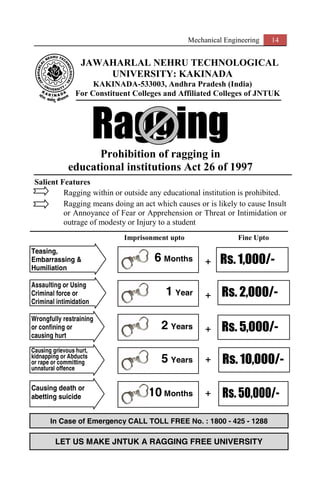
RaggingProhibition of ragging in
educational institutions Act 26 of 1997
Salient Features
Ragging within or outside any educational institution is prohibited.
Ragging means doing an act which causes or is likely to cause Insult
or Annoyance of Fear or Apprehension or Threat or Intimidation or
outrage of modesty or Injury to a student
Imprisonment upto Fine Upto
+
+
+
+
+
Causing death or
abetting suicide
In Case of Emergency CALL TOLL FREE No. : 1800 - 425 - 1288
LET US MAKE JNTUK A RAGGING FREE UNIVERSITY
6 Months
1 Year
2 Years
5 Years
10 Months
Rs. 1,000/-
Teasing,
Embarrassing &
Humiliation
Assaulting or Using
Criminal force or
Criminal intimidation
Rs. 2,000/-
Wrongfully restraining
or confining or
causing hurt
Rs. 5,000/-
Causing grievous hurt,
kidnapping or Abducts
or rape or committing
unnatural offence
Rs. 10,000/-
Rs. 50,000/-
Mechanical Engineering 15
JAWAHARLAL NEHRU TECHNOLOGICAL
UNIVERSITY: KAKINADA
KAKINADA-533003, Andhra Pradesh (India)
For Constituent Colleges and Affiliated Colleges of JNTUK
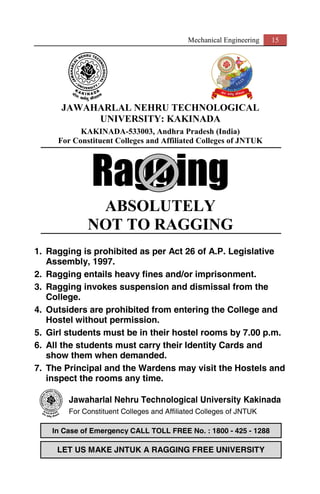
Ragging
ABSOLUTELY
NOT TO RAGGING
1. Ragging is prohibited as per Act 26 of A.P. Legislative
Assembly, 1997.
2. Ragging entails heavy fines and/or imprisonment.
3. Ragging invokes suspension and dismissal from the
College.
4. Outsiders are prohibited from entering the College and
Hostel without permission.
5. Girl students must be in their hostel rooms by 7.00 p.m.
6. All the students must carry their Identity Cards and
show them when demanded.
7. The Principal and the Wardens may visit the Hostels and
inspect the rooms any time.
Jawaharlal Nehru Technological University Kakinada
For Constituent Colleges and Affiliated Colleges of JNTUK
LET US MAKE JNTUK A RAGGING FREE UNIVERSITY
In Case of Emergency CALL TOLL FREE No. : 1800 - 425 - 1288
Mechanical Engineering 16
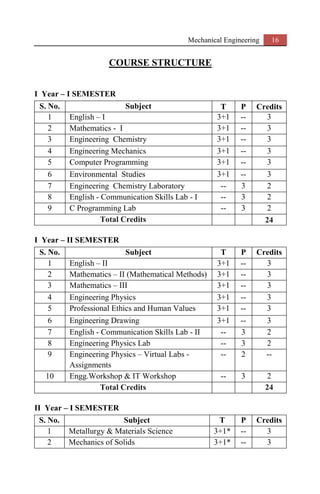
COURSE STRUCTURE
I Year – I SEMESTER
S. No. Subject T P Credits
1 English – I 3+1 -- 3
2 Mathematics - I 3+1 -- 3
3 Engineering Chemistry 3+1 -- 3
4 Engineering Mechanics 3+1 -- 3
5 Computer Programming 3+1 -- 3
6 Environmental Studies 3+1 -- 3
7 Engineering Chemistry Laboratory -- 3 2
8 English - Communication Skills Lab - I -- 3 2
9 C Programming Lab -- 3 2
Total Credits 24
I Year – II SEMESTER
S. No. Subject T P Credits
1 English – II 3+1 -- 3
2 Mathematics – II (Mathematical Methods) 3+1 -- 3
3 Mathematics – III 3+1 -- 3
4 Engineering Physics 3+1 -- 3
5 Professional Ethics and Human Values 3+1 -- 3
6 Engineering Drawing 3+1 -- 3
7 English - Communication Skills Lab - II -- 3 2
8 Engineering Physics Lab -- 3 2
9 Engineering Physics – Virtual Labs -
Assignments
-- 2 --
10 Engg.Workshop & IT Workshop -- 3 2
Total Credits 24
II Year – I SEMESTER
S. No. Subject T P Credits
1 Metallurgy & Materials Science 3+1* -- 3
2 Mechanics of Solids 3+1* -- 3
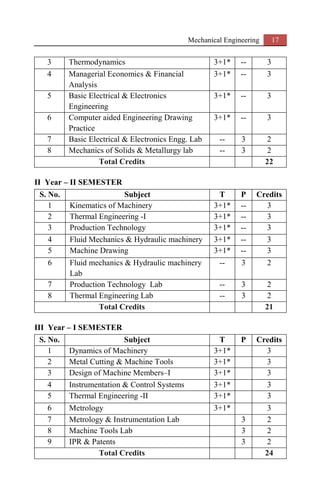
Mechanical Engineering 17
3 Thermodynamics 3+1* -- 3
4 Managerial Economics & Financial
Analysis
3+1* -- 3
5 Basic Electrical & Electronics
Engineering
3+1* -- 3
6 Computer aided Engineering Drawing
Practice
3+1* -- 3
7 Basic Electrical & Electronics Engg. Lab -- 3 2
8 Mechanics of Solids & Metallurgy lab -- 3 2
Total Credits 22
II Year – II SEMESTER
S. No. Subject T P Credits
1 Kinematics of Machinery 3+1* -- 3
2 Thermal Engineering -I 3+1* -- 3
3 Production Technology 3+1* -- 3
4 Fluid Mechanics & Hydraulic machinery 3+1* -- 3
5 Machine Drawing 3+1* -- 3
6 Fluid mechanics & Hydraulic machinery
Lab
-- 3 2
7 Production Technology Lab -- 3 2
8 Thermal Engineering Lab -- 3 2
Total Credits 21
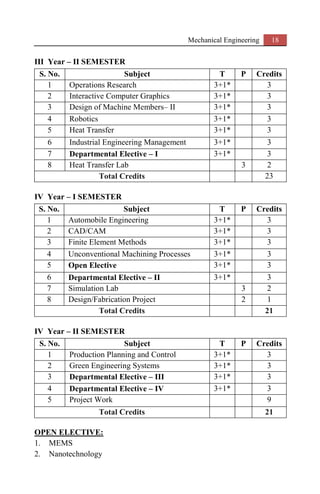
III Year – I SEMESTER
S. No. Subject T P Credits
1 Dynamics of Machinery 3+1* 3
2 Metal Cutting & Machine Tools 3+1* 3
3 Design of Machine Members–I 3+1* 3
4 Instrumentation & Control Systems 3+1* 3
5 Thermal Engineering -II 3+1* 3
6 Metrology 3+1* 3
7 Metrology & Instrumentation Lab 3 2
8 Machine Tools Lab 3 2
9 IPR & Patents 3 2
Total Credits 24
Mechanical Engineering 18
III Year – II SEMESTER
S. No. Subject T P Credits
1 Operations Research 3+1* 3
2 Interactive Computer Graphics 3+1* 3
3 Design of Machine Members– II 3+1* 3
4 Robotics 3+1* 3
5 Heat Transfer 3+1* 3
6 Industrial Engineering Management 3+1* 3
7 Departmental Elective – I 3+1* 3
8 Heat Transfer Lab 3 2
Total Credits 23
IV Year – I SEMESTER
S. No. Subject T P Credits
1 Automobile Engineering 3+1* 3
2 CAD/CAM 3+1* 3
3 Finite Element Methods 3+1* 3
4 Unconventional Machining Processes 3+1* 3
5 Open Elective 3+1* 3
6 Departmental Elective – II 3+1* 3
7 Simulation Lab 3 2
8 Design/Fabrication Project 2 1
Total Credits 21
IV Year – II SEMESTER
S. No. Subject T P Credits
1 Production Planning and Control 3+1* 3
2 Green Engineering Systems 3+1* 3
3 Departmental Elective – III 3+1* 3
4 Departmental Elective – IV 3+1* 3
5 Project Work 9
Total Credits 21
OPEN ELECTIVE:
1. MEMS
2. Nanotechnology
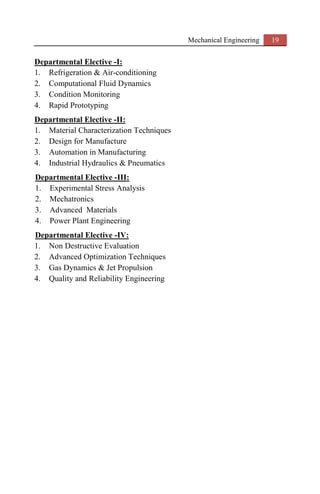
Mechanical Engineering 19
Departmental Elective -I:
1. Refrigeration & Air-conditioning
2. Computational Fluid Dynamics
3. Condition Monitoring
4. Rapid Prototyping
Departmental Elective -II:
1. Material Characterization Techniques
2. Design for Manufacture
3. Automation in Manufacturing
4. Industrial Hydraulics & Pneumatics
Departmental Elective -III:
1. Experimental Stress Analysis
2. Mechatronics
3. Advanced Materials
4. Power Plant Engineering
Departmental Elective -IV:
1. Non Destructive Evaluation
2. Advanced Optimization Techniques
3. Gas Dynamics & Jet Propulsion
4. Quality and Reliability Engineering
Mechanical Engineering 20
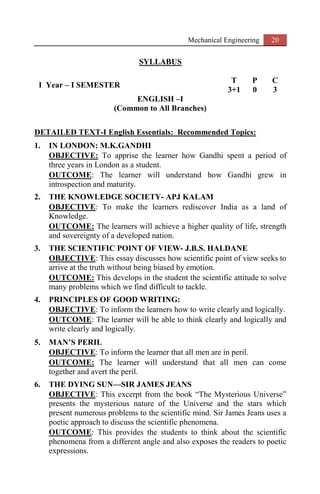
SYLLABUS
I Year – I SEMESTER
T P C
3+1 0 3
ENGLISH –I
(Common to All Branches)
DETAILED TEXT-I English Essentials: Recommended Topics:
1. IN LONDON: M.K.GANDHI
OBJECTIVE: To apprise the learner how Gandhi spent a period of
three years in London as a student.
OUTCOME: The learner will understand how Gandhi grew in
introspection and maturity.
2. THE KNOWLEDGE SOCIETY- APJ KALAM
OBJECTIVE: To make the learners rediscover India as a land of
Knowledge.
OUTCOME: The learners will achieve a higher quality of life, strength
and sovereignty of a developed nation.
3. THE SCIENTIFIC POINT OF VIEW- J.B.S. HALDANE
OBJECTIVE: This essay discusses how scientific point of view seeks to
arrive at the truth without being biased by emotion.
OUTCOME: This develops in the student the scientific attitude to solve
many problems which we find difficult to tackle.
4. PRINCIPLES OF GOOD WRITING:
OBJECTIVE: To inform the learners how to write clearly and logically.
OUTCOME: The learner will be able to think clearly and logically and
write clearly and logically.
5. MAN’S PERIL
OBJECTIVE: To inform the learner that all men are in peril.
OUTCOME: The learner will understand that all men can come
together and avert the peril.
6. THE DYING SUN—SIR JAMES JEANS
OBJECTIVE: This excerpt from the book “The Mysterious Universe”
presents the mysterious nature of the Universe and the stars which
present numerous problems to the scientific mind. Sir James Jeans uses a
poetic approach to discuss the scientific phenomena.
OUTCOME: This provides the students to think about the scientific
phenomena from a different angle and also exposes the readers to poetic
expressions.
Mechanical Engineering 21
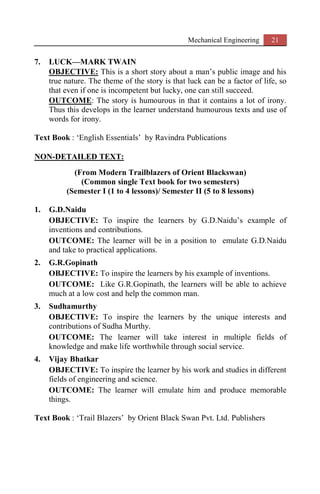
7. LUCK—MARK TWAIN
OBJECTIVE: This is a short story about a man’s public image and his
true nature. The theme of the story is that luck can be a factor of life, so
that even if one is incompetent but lucky, one can still succeed.
OUTCOME: The story is humourous in that it contains a lot of irony.
Thus this develops in the learner understand humourous texts and use of
words for irony.
Text Book : ‘English Essentials’ by Ravindra Publications
NON-DETAILED TEXT:
(From Modern Trailblazers of Orient Blackswan)
(Common single Text book for two semesters)
(Semester I (1 to 4 lessons)/ Semester II (5 to 8 lessons)
1. G.D.Naidu
OBJECTIVE: To inspire the learners by G.D.Naidu’s example of
inventions and contributions.
OUTCOME: The learner will be in a position to emulate G.D.Naidu
and take to practical applications.
2. G.R.Gopinath
OBJECTIVE: To inspire the learners by his example of inventions.
OUTCOME: Like G.R.Gopinath, the learners will be able to achieve
much at a low cost and help the common man.
3. Sudhamurthy
OBJECTIVE: To inspire the learners by the unique interests and
contributions of Sudha Murthy.
OUTCOME: The learner will take interest in multiple fields of
knowledge and make life worthwhile through social service.
4. Vijay Bhatkar
OBJECTIVE: To inspire the learner by his work and studies in different
fields of engineering and science.
OUTCOME: The learner will emulate him and produce memorable
things.
Text Book : ‘Trail Blazers’ by Orient Black Swan Pvt. Ltd. Publishers
Mechanical Engineering 22
I Year – I SEMESTER
T P C
3+1 0 3
MATHEMATICS – I (DIFFERENTIAL EQUATIONS)
(Common to All Branches)
UNIT I: Differential equations of first order and first degree:
Linear-Bernoulli-Exact-Reducible to exact.
Applications : Newton’s Law of cooling-Law of natural growth and decay-
orthogonal trajectories.
Subject Category
ABET Learning Objectives a d e
ABET internal assessments 1 2 6
JNTUK External Evaluation A B E
UNIT II: Linear differential equations of higher order:
Non-homogeneous equations of higher order with constant coefficients with
RHS term of the type e ax
, Sin ax, cos ax, polynomials in x, e ax
V(x), xV(x).
Applications: LCR circuit, Simple Harmonic motion
Subject Category
ABET Learning Objectives a d e
ABET internal assessments 1 2 6
JNTUK External Evaluation A B E
UNIT III Laplace transforms:
Laplace transforms of standard functions-ShiftingTheorems, Transforms of
derivatives and integrals – Unit step function –Dirac’s delta function- Inverse
Laplace transforms– Convolution theorem (with out proof).
Application: Solutions of ordinary differential equations using Laplace
transforms.
Subject Category
ABET Learning Objectives a e
ABET internal assessments 1 2 6
JNTUK External Evaluation A B E
UNIT IV Partial differentiation:
Introduction- Total derivative-Chain rule-Generalized Mean Value theorem
for single variable (without proof)-Taylors and Mc Laurent’s series for two
variables– Functional dependence- Jacobian.
Mechanical Engineering 23
Applications: Maxima and Minima of functions of two variables with
constraints and without constraints.
Subject Category
ABET Learning Objectives a c e
ABET internal assessments 1 2 6
JNTUK External Evaluation A B E
UNIT V First order Partial differential equations:
Formation of partial differential equations by elimination of arbitrary
constants and arbitrary functions –solutions of first order linear (Lagrange)
equation and nonlinear (standard type) equations
Subject Category
ABET Learning Objectives a e
ABET internal assessments 1 2 6
JNTUK External Evaluation A B E
UNIT VI Higher order Partial differential equations:
Solutions of Linear Partial differential equations with constant coefficients-
Method of separation of Variables.
Applications: One- dimensional Wave, Heat equations - two-dimensional
Laplace Equation.
Subject Category
ABET Learning Objectives a e
ABET internal assessments 1 2 6
JNTUK External Evaluation B E
Books:
1. B.S.GREWAL, Higher Engineering Mathematics, 42nd
Edition,
Khanna Publishers
2. ERWIN KREYSZIG, Advanced Engineering Mathematics, 9th
Edition, Wiley-India
3. GREENBERG, Advanced Engineering Mathematics, 2nd
edition,
Pearson edn
4. DEAN G. DUFFY, Advanced engineering mathematics with
MATLAB, CRC Press
5. PETER O’NEIL, advanced Engineering Mathematics, Cengage
Learning.
Mechanical Engineering 24
Subject
Category
ABET Learning
Objectives
ABET
Internal
Assessments
JNTUK
External
Evaluation
Rema
-rks
Theory
Design
Analysis
Algorithm
s
Drawing
Others
a) Apply knowledge of
math, science, &
engineering
b) Design & conduct
experiments, analyze
& interpret data
c) Design a
system/process to
meet desired needs
within economic,
social, political,
ethical, health/safety,
manufacturability, &
sustainability
constraints
d) Function on
multidisciplinary
teams
e) Identify, formulate,
& solve engineering
problems
f) Understand
professional &
ethical
responsibilities
g) Communicate
effectively
h) Understand impact of
engineering solutions
in global, economic,
environmental, &
societal context
i) Recognize need for &
be able to engage in
lifelong learning
j) Know contemporary
issues
k) Use techniques,
skills, modern tools
for engineering
practices
1. Objective
tests
2. Essay
questions
tests
3. Peer
tutoring
based
4. Simulatio
n based
5. Design
oriented
6. Problem
based
7. Experient
ial
(project
based)
based
8. Lab work
or field
work
based
9. Presentati
on based
10. Case
Studies
based
11. Role-play
based
12. Portfolio
based
A. Questions
should
have:
B. Definitions,
Principle of
operation or
philosophy
of concept.
C. Mathematic
al
treatment,
derivations,
analysis,
synthesis,
numerical
problems
with
inference.
D. Design
oriented
problems
E. Trouble
shooting
type of
questions
F. Application
s related
questions
G. Brain
storming
questions
Mechanical Engineering 25
I Year – I SEMESTER
T P C
3+1 0 3
ENGINEERING CHEMISTRY
UNIT-I: WATER TECHNOLOGY
Hard Water – Estimation of hardness by EDTA method – Potable water-
Sterilization and Disinfection – Boiler feed water – Boiler troubles – Priming
and foaming , scale formation, corrosion, caustic embrittlement, turbine
deposits – Softening of water – Lime soda, Zeolite processes – Reverse
osmosis – Electro Dialysis, Ion exchange process.
Objectives : For prospective engineers knowledge about water used in
industries (boilers etc.) and for drinking purposes is useful; hence chemistry
of hard water, boiler troubles and modern methods of softening hard water is
introduced.
UNIT-II : ELECTROCHEMISTRY
Concept of Ionic conductance – Ionic Mobilities – Applications of
Kohlrausch law – Conductometric titrations – Galvanic cells – Electrode
potentials – Nernst equation – Electrochemical series – Potentiometric
titrations – Concentration cells – Ion selective electrode –Glass electrodes –
Fluoride electrode; Batteries and Fuel cells.
Objectives : Knowledge of galvanic cells, electrode potentials, concentration
cells is necessary for engineers to understand corrosion problem and its
control ; also this knowledge helps in understanding modern bio-sensors, fuel
cells and improve them.
UNIT-III : CORROSION
Causes and effects of corrosion – theories of corrosion (dry, chemical and
electrochemical corrosion) – Factors affecting corrosion – Corrosion control
methods – Cathodic protection –Sacrificial Anodic, Impressed current
methods – Surface coatings – Methods of application on metals (Hot dipping,
Galvanizing, tinning , Cladding, Electroplating, Electroless plating) –
Organic surface coatings – Paints – Their constituents and their functions.
Objectives : the problems associated with corrosion are well known and the
engineers must be aware of these problems and also how to counter them.
UNIT-IV : HIGH POLYMERS
Types of Polymerization – Stereo regular Polymers – Physical and
Mechanical properties of polymers – Plastics – Thermoplastics and thermo
setting plastics – Compounding and Fabrication of plastics – Preparation and
Mechanical Engineering 26
properties of Polyethylene, PVC and Bakelite – Elastomers – Rubber and
Vulcanization – Synthetic rubbers – Styrene butadiene rubber – Thiokol –
applications.
Objectives : Plastics are materials used very widely as engineering materials.
An understanding of properties particularly physical and mechanical
properties of polymers / plastics / elastomers helps in selecting suitable
materials for different purposes.
UNIT-V : FUELS
Coal – Proximate and ultimate analysis – Numerical problems based on
analysis – Calorific vaule – HCV and LCV – Problems based on calorific
values; petroleum – Refining – Cracking – Petrol – Diesel knocking; Gaseous
fuels – Natural gas – LPG, CNG – Combustion – Problems on air
requirements.
Objectives : A board understanding of the more important fuels employed on
a large scale is necessary for all engineer to understand energy – related
problems and solve them.
UNIT-VI : CHEMISTRY OF ADVANCED MATERIALS
Nanometerials (Preparation of carbon nanotubes and fullerenes – Properties
of nanomaterials – Engineering applications) – Liquid crystals (Types –
Application in LCD and Engineering Applications) – Fiber reinforced
plastics – Biodegradable polymers – Conducting polymers – Solar cells
(Solar heaters – Photo voltaic cells – Solar reflectors – Green house concepts
– Green chemistry (Methods for green synthesis and Applications) – Cement
– Hardening and setting – Deterioration of cement concrete
Objectives : With the knowledge available now, future engineers should
know at least some of the advanced materials that are becoming available.
Hence some of them are introduced here.
TEXT BOOKSS
1. Jain and Jain (Latest Edition), Engineering Chemistry, Dhanpat Rai
Publishing company Ltd.
2. N.Y.S. Murthy, V. Anuradha, KRamaRao “A Text Book of
Engineering Chemistry”, Maruthi Publications.
3. C.Parameswara Murthy, C.V.Agarwal, Adhra Naidu (2006) Text
Book of Engineering Chemistry, B.S. Publications.
4. B.Sivasankar (2010), Engineering Chemistry, Mc Graw-Hill
companies.
Mechanical Engineering 27
5. Ch.Venkata Ramana Reddy and Ramadevi (2013), Engineering
Chemistry, Cengage Learning.
REFERENCES
1. S.S. Dara (2013) Text Book of Engineering Chemistry, S.Chand
Technical Series.
2. K.Sesha Maheswaramma and Mridula Chugh (2013), Engineering
Chemistry, Pearson Publications.
3. R.Gopalan, D.Venkatappayya, Sulochana Nagarajan (2011), Text
Book of Engineering Chemistry, Vikas Publications.
4. B.Viswanathan and M.Aulice Scibioh (2009), Fuel Cells, Principals
and applications, University Press.
Mechanical Engineering 28
I Year – I SEMESTER
T P C
3+1 0 3
ENGINEERING MECHANICS
Objectives:
The students completing this course are expected to understand the concepts
of forces and its resolution in different planes ,resultant of force system,
Forces acting on a body, their free body diagrams using graphical methods.
They are required to understand the concepts of centre of gravity and
moments of inertia and their application, Analysis of frames and trusses,
different types of motion, friction and application of work - energy method.
UNIT – I
Objectives: The students are to be exposed to the concepts of force and
friction , direction and its application.
Introduction to Engg. Mechanics – Basic Concepts.
Systems of Forces : Coplanar Concurrent Forces – Components in Space –
Resultant – Moment of Force and its Application – Couples and Resultant of
Force Systems. Introduction , limiting friction and impending motion,
coulomb’s laws of dry friction , coefficient of friction, cone of friction
UNIT II
Objectives: The students are to be exposed to application of free body
diagrams. Solution to problems using graphical methods and law of
triangle of forces.
Equilibrium of Systems of Forces : Free Body Diagrams, Equations of
Equilibrium of Coplanar Systems, Spatial Systems for concurrent forces.
Lamis Theorm, Graphical method for the equilibrium of coplanar forces,
Converse of the law of Triangle of forces, converse of the law of polygon of
forces condition of equilibrium.
UNIT – III
Objectives : The students are to be exposed to concepts of centre of
gravity.
Centroid : Centroids of simple figures (from basic principles ) – Centroids of
Composite Figures
Centre of Gravity : Centre of gravity of simple body (from basis principles),
centre of gravity of composite bodies, pappus theorem.
Mechanical Engineering 29
UNIT IV
Objective: The students are to be exposed to concepts of moment of
inertia and polar moment of inertia including transfer methods and their
applications.
Area moments of Inertia : Definition – Polar Moment of Inertia, Transfer
Theorem, Moments of Inertia of Composite Figures, Products of Inertia,
Transfer Formula for Product of Inertia. Mass Moment of Inertia : Moment
of Inertia of Masses, Transfer Formula for Mass Moments of Inertia, mass
moment of inertia of composite bodies.
UNIT – V
Objectives : The students are to be exposed to motion in straight line and
in curvilinear paths, its velocity and acceleration computation and
methods of representing plane motion.
Kinematics : Rectilinear and Curvelinear motions – Velocity and
Acceleration – Motion of Rigid Body – Types and their Analysis in Planar
Motion. Kinetics : Analysis as a Particle and Analysis as a Rigid Body in
Translation – Central Force Motion – Equations of Plane Motion – Fixed
Axis Rotation – Rolling Bodies.
UNIT – VI
Objectives: The students are to be exposed to concepts of work, energy
and particle motion
Work – Energy Method : Equations for Translation, Work-Energy
Applications to Particle Motion, Connected System-Fixed Axis Rotation and
Plane Motion. Impulse momentum method.
TEXT BOOKS:
1. Engg. Mechanics - S.Timoshenko & D.H.Young., 4th
Edn -, Mc Graw
Hill publications.
2. Engineering Mechanics: Statics and Dynamics 3rd
edition, Andrew
Pytel and Jaan Kiusalaas; Cengage Learning publishers.
REFERENCES:
1. Engineering Mechanics statics and dynamics – R.C.Hibbeler, 11th
Edn
– Pearson Publ.
2. Engineering Mechanics, statics – J.L.Meriam, 6th
Edn – Wiley India
Pvt Ltd.
3. Engineering Mechanics, dynamics – J.L.Meriam, 6th
Edn – Wiley
India Pvt. Ltd.
Mechanical Engineering 30
4. Engineering Mechanics, statics and dynamics – I.H.Shames, – Pearson
Publ.
5. Mechanics For Engineers, statics - F.P.Beer & E.R. Johnston – 5th
Edn
Mc Graw Hill Publ.
6. Mechanics For Engineers, dynamics - F.P.Beer & E.R.Johnston – 5th
Edn Mc Graw Hill Publ.
7. Theory & Problems of engineering mechanics, statics & dynamics –
E.W. Nelson, C.L.Best & W.G. McLean, 5th
Edn – Schaum’s outline
series - Mc Graw Hill Publ.
8. Engineering Mechanics, Fedinand. L. Singer, Harper – Collins.
9. Engineering Mechanics statics and dynamics, A Nelson, Mc Graw
Hill publications.
10. Engineering Mechanics, Tayal. Umesh Publ.
Mechanical Engineering 31
I Year – I SEMESTER
T P C
3+1 0 3
COMPUTER PROGRAMMING
Objectives: Formulating algorithmic solutions to problems and
implementing algorithms in C.
UNIT I:
Unit objective: Notion of Operation of a CPU, Notion of an algorithm
and computational procedure, editing and executing programs in Linux
Introduction: Computer systems, Hardware and Software Concepts.
Problem Solving: Algorithm / Pseudo code, flowchart, program
development steps, computer languages: machine, symbolic and highlevel
languages, Creating and Running Programs: Writing, Editing(vi/emacs
editor), Compiling (gcc), Linking and Executing in under Linux.
BASICS OF C: Structure of a C program, identifiers, basic data types and
sizes. Constants, Variables, Arthmetic , relational and logical operators,
increment and decrement operators, conditional operator, assignment
operator, expressions, type conversions, Conditional Expressions, precedence
and order of evaluation, Sample Programs.
UNIT II:
Unit objective: understanding branching, iteration and data
representation using arrays
SELECTION – MAKING DECISION: TWO WAY SELECTION: if-else, null
else, nested if, examples, Multi-way selection: switch, else-if, examples.
ITERATIVE: loops- while, do-while and for statements , break, continue,
initialization and updating, event and counter controlled loops, Looping
applications: Summation, powers, smallest and largest.
ARRAYS: Arrays- concepts, declaration, definition, accessing elements,
storing elements, Strings and String Manipulations, 1-D arrays, 2-D arrays
and character arrays, string manipulations, Multidimensional arrays, array
applications: Matrix operations, checking the symmetricity of a Matrix.
STRINGS: concepts, c strings.
UNIT III:
Objective: Modular programming and recursive solution formulation
FUNCTIONS- MODULAR PROGRAMMING: functions, basics,
parameter passing, storage classes extern, auto, register, static, scope rules,
block structure, user defined functions, standard library functions, recursive
Mechanical Engineering 32
functions, Recursive solutions for fibonacci series, towers of Hanoi, header
files, C Preprocessor, example c programs, Passing 1-D arrays, 2-D arrays to
functions.
UNIT IV:
Objective: Understanding pointers and dynamic memory allocation
POINTERS: pointers- concepts, initialization of pointer variables, pointers
and function arguments, passing by address- dangling memory, address
arithmetic, character pointers and functions, pointers to pointers, pointers and
multi-dimensional arrays, dynamic memory management functions,
command line arguments.
UNIT V:
Objective: Understanding miscellaneous aspects of C
ENUMERATED, STRUCTURE AND UNION TYPES: Derived types-
structures- declaration, definition and initialization of structures, accessing
structures, nested structures, arrays of structures, structures and functions,
pointers to structures, self referential structures, unions, typedef, bit-fields,
program applications.
BIT-WISE OPERATORS: logical, shift, rotation, masks.
UNIT VI:
Objective: Comprehension of file operations
FILE HANDLING: Input and output- concept of a file, text files and binary
files, Formatted I/O, File I/O operations, example programs.
Text Books:
1. Problem Solving and Program Design in C, Hanly, Koffman, 7th
ed,
PERSON.
2. Programming in C, Second Edition Pradip Dey and Manas Ghosh,
OXFORD Higher Education.
3. Programming in C, A practical approach Ajay Mittal PEARSON
4. The C programming Language by Dennis Richie and Brian Kernighan
5. Programming in C, B. L. Juneja, Anith Seth, Cengage Learning.
Reference Books and web links:
1. C Programming, A Problem Solving Approach, Forouzan, Gilberg,
Prasad, CENGAGE.
2. Programming with C, Bichkar, Universities Press
3. Programming in C, Reema Thareja, OXFORD
4. C by Example, Noel Kalicharan, Cambridge
Mechanical Engineering 33
I Year – I SEMESTER
T P C
3+1 0 3
ENVIRONMENTAL STUDIES
Course Learning Objectives:
The objectives of the course is to impart.
1. Overall understanding of the natural resources.
2. Basic understanding of the ecosystem and its diversity.
3. Acquaintance on various environmental challenges induced due to
unplanned anthropogenic activities.
4. An understanding of the environmental impact of developmental
activities.
5. Awareness on the social issues, environmental legislation and global
treaties.
Course Outcomes:
The student should have knowledge on
1. The natural resources and their importance for the sustenance of the life
and recognise the need to conserve the natural resources.
2. The concepts of the ecosystem and its function in the environment. The
need for protecting the producers and consumers in various ecosystems
and their role in the food web.
3. The biodiversity of India and the threats to biodiversity, and
conservation practices to protect the biodiversity.
4. Various attributes of the pollution and their impacts and measures to
reduce or control the pollution along with waste management practices.
5. Social issues both rural and urban environment and the possible means
to combat the challenges.
6. The environmental legislations of India and the first global initiatives
towards sustainable development.
7. About environmental assessment and the stages involved in EIA and the
environmental audit.
Syllabus:
UNIT - I
Multidisciplinary nature of Environmental Studies: Definition, Scope and
Importance – Sustainability: Stockholm and Rio Summit–Global
Environmental Challenges: Global warming and climate change, acid rains,
Mechanical Engineering 34
ozone layer depletion, population growth and explosion, effects. Role of
information Technology in Environment and human health.
Ecosystems: Concept of an ecosystem. - Structure and function of an
ecosystem. - Producers, consumers and decomposers. - Energy flow in the
ecosystem - Ecological succession. - Food chains, food webs and ecological
pyramids. - Introduction, types, characteristic features, structure and function
of Forest ecosystem, Grassland ecosystem, Desert ecosystem, Aquatic
ecosystems.
UNIT - II
Natural Resources: Natural resources and associated problems
Forest resources – Use and over – exploitation, deforestation – Timber
extraction – Mining, dams and other effects on forest and tribal people.
Water resources – Use and over utilization of surface and ground water –
Floods, drought, conflicts over water, dams – benefits and problems.
Mineral resources: Use and exploitation, environmental effects of extracting
and using mineral resources.
Food resources: World food problems, changes caused by non-agriculture
activities-effects of modern agriculture, fertilizer-pesticide problems, water
logging, salinity.
Energy resources: Growing energy needs, renewable and non-renewable
energy sources use of alternate energy sources.
Land resources: Land as a resource, land degradation, Wasteland
reclamation, man induced landslides, soil erosion and desertification. Role of
an individual in conservation of natural resources. Equitable use of resources
for sustainable lifestyles.
UNIT - III
Biodiversity and its conservation: Definition: genetic, species and
ecosystem diversity- classification - Value of biodiversity: consumptive use,
productive use, social-Biodiversity at national and local levels. India as a
mega-diversity nation - Hot-sports of biodiversity - Threats to biodiversity:
habitat loss, man-wildlife conflicts. - Endangered and endemic species of
India – Conservation of biodiversity: conservation of biodiversity.
UNIT - IV
Environmental Pollution: Definition, Cause, effects and control measures
of Air pollution, Water pollution, Soil pollution, Noise pollution, Nuclear
hazards. Role of an individual in prevention of pollution. - Pollution case
studies.
Mechanical Engineering 35
Solid Waste Management: Sources, classification, effects and control
measures of urban and industrial solid wastes. Consumerism and waste
products.
UNIT - V
Social Issues and the Environment: Urban problems related to energy -
Water conservation, rain water harvesting-Resettlement and rehabilitation of
people; its problems and concerns. Environmental ethics: Issues and possible
solutions. Environmental Protection Act -Air (Prevention and Control of
Pollution) Act. –Water (Prevention and control of Pollution) Act -Wildlife
Protection Act -Forest Conservation Act-Issues involved in enforcement of
environmental legislation. -Public awareness.
UNIT - VI
Environmental Management: Impact Assessment and its significance
various stages of EIA, preparation of EMP and EIS, Environmental audit.
Ecotourism.
The student should submit a report individually on any issues related to
Environmental Studies course and make a power point presentation.
Text Books:
1. Environmental Studies by R. Rajagopalan, 2nd
Edition, 2011, Oxford
University Press.
2. A Textbook of Environmental Studies by Shaashi Chawla, TMH, New
Delhi
3. Environmental Studies by P.N. Palanisamy, P. Manikandan, A.
Geetha, and K. Manjula Rani; Pearson Education, Chennai
Reference:
1. Text Book of Environmental Studies by Deeshita Dave & P. Udaya
Bhaskar, Cengage Learning.
2. Environmental Studies by K.V.S.G. Murali Krishna, VGS Publishers,
Vijayawada.
3. Environmental Studies by Benny Joseph, Tata McGraw Hill Co, New
Delhi.
4. Environmental Studies by Piyush Malaviya, Pratibha Singh, Anoop
singh: Acme Learning, New Delhi.
***
Mechanical Engineering 36
I Year – I SEMESTER
T P C
0 3 2
ENGINEERING CHEMISTRY LABORATORY
List of Experiments
1. Introduction to chemistry laboratory – Molarity, Normality,
Primary, Secondary standard solutions, Volumetric titrations,
Quantitative analysis, Quantitative analysis etc.,
2. Trial experiment – Estimation of HCI using standard Na2co3
solutions
3. Estimation of KMnO4 using standard Oxalic acid solution.
4. Estimation of Ferric iron using standard K2Cr2O7 solution.
5. Estimation of Copper using standard K2Cr2O7 solution.
6. Estimation of Total Hardness water using standard EDTA solution.
7. Estimation of Copper using standard EDTA solution.
8. Estimation of Copper using Colorimeter
9. Estimation of pH of the given sample solution using pH meter.
10. Conductometric Titrations between strong acid and strong base
11. Conductometric Titrations between strong acid and Weak base
12. Potentiometric Titrations between strong acid and strong base
13. Potentiometric Titrations between strong acid and Weak base
14. Estimatinog of Zinc using standard potassium ferrocyanide solution
15. Estimation of Vitamin – C
TEXT BOOKSS
1. Dr. Jyotsna Cherukuis(2012)Laboratory Manual of Engineering
Chemistry-II, VGS Techno Series.
2. Chemistry Practical Manual, Lorven Publications.
3. K. Mukkanti (2009) Practical Engineering Chemistry,
B.S.Publication.
Mechanical Engineering 37
I Year – I SEMESTER
T P C
0 3 2
ENGLISH – COMMUNICATION SKILLS LAB – I
Suggested Lab Manuals:
OBJECTIVE: To impart to the learner the skills of grammar as well as
communication through listening, speaking, reading, and writing including
soft, that is life skills.
BASIC COMMUNICATION SKILLS
UNIT 1 A. Greeting and Introductions
B. Pure Vowels
UNIT 2 A. Asking for information and Requests
B. Diphthongs
UNIT 3 A. Invitations
B. Consonants
UNIT 4 A. Commands and Instructions
B. Accent and Rhythm
UNIT 5 A. Suggestions and Opinions
B. Intonation
Text Book:
‘Strengthen your Communication Skills’ Part-A by Maruthi Publications
Reference Books:
1. INFOTECH English (Maruthi Publications).
2. Personality Development and Soft Skills (Oxford University
Press, New Delhi).
Mechanical Engineering 38
I Year – I SEMESTER
T P C
0 3 2
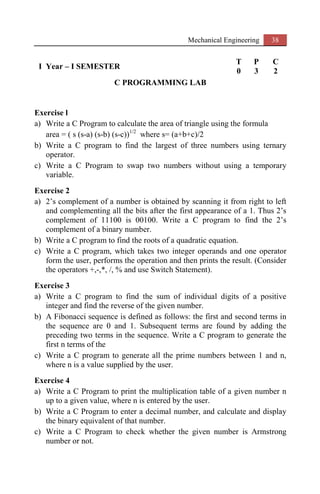
C PROGRAMMING LAB
Exercise l
a) Write a C Program to calculate the area of triangle using the formula
area = ( s (s-a) (s-b) (s-c))1/2
where s= (a+b+c)/2
b) Write a C program to find the largest of three numbers using ternary
operator.
c) Write a C Program to swap two numbers without using a temporary
variable.
Exercise 2
a) 2’s complement of a number is obtained by scanning it from right to left
and complementing all the bits after the first appearance of a 1. Thus 2’s
complement of 11100 is 00100. Write a C program to find the 2’s
complement of a binary number.
b) Write a C program to find the roots of a quadratic equation.
c) Write a C program, which takes two integer operands and one operator
form the user, performs the operation and then prints the result. (Consider
the operators +,-,*, /, % and use Switch Statement).
Exercise 3
a) Write a C program to find the sum of individual digits of a positive
integer and find the reverse of the given number.
b) A Fibonacci sequence is defined as follows: the first and second terms in
the sequence are 0 and 1. Subsequent terms are found by adding the
preceding two terms in the sequence. Write a C program to generate the
first n terms of the
c) Write a C program to generate all the prime numbers between 1 and n,
where n is a value supplied by the user.
Exercise 4
a) Write a C Program to print the multiplication table of a given number n
up to a given value, where n is entered by the user.
b) Write a C Program to enter a decimal number, and calculate and display
the binary equivalent of that number.
c) Write a C Program to check whether the given number is Armstrong
number or not.
Mechanical Engineering 39
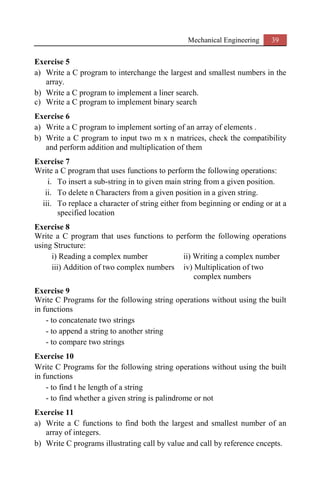
Exercise 5
a) Write a C program to interchange the largest and smallest numbers in the
array.
b) Write a C program to implement a liner search.
c) Write a C program to implement binary search
Exercise 6
a) Write a C program to implement sorting of an array of elements .
b) Write a C program to input two m x n matrices, check the compatibility
and perform addition and multiplication of them
Exercise 7
Write a C program that uses functions to perform the following operations:
i. To insert a sub-string in to given main string from a given position.
ii. To delete n Characters from a given position in a given string.
iii. To replace a character of string either from beginning or ending or at a
specified location
Exercise 8
Write a C program that uses functions to perform the following operations
using Structure:
i) Reading a complex number ii) Writing a complex number
iii) Addition of two complex numbers iv) Multiplication of two
complex numbers
Exercise 9
Write C Programs for the following string operations without using the built
in functions
- to concatenate two strings
- to append a string to another string
- to compare two strings
Exercise 10
Write C Programs for the following string operations without using the built
in functions
- to find t he length of a string
- to find whether a given string is palindrome or not
Exercise 11
a) Write a C functions to find both the largest and smallest number of an
array of integers.
b) Write C programs illustrating call by value and call by reference cncepts.
Mechanical Engineering 40
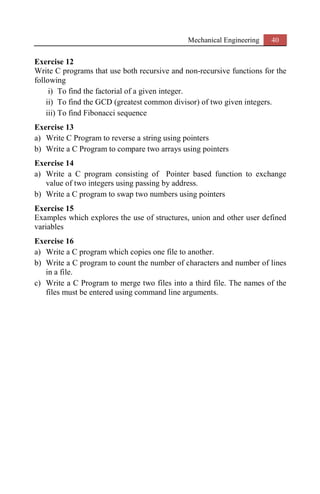
Exercise 12
Write C programs that use both recursive and non-recursive functions for the
following
i) To find the factorial of a given integer.
ii) To find the GCD (greatest common divisor) of two given integers.
iii) To find Fibonacci sequence
Exercise 13
a) Write C Program to reverse a string using pointers
b) Write a C Program to compare two arrays using pointers
Exercise 14
a) Write a C program consisting of Pointer based function to exchange
value of two integers using passing by address.
b) Write a C program to swap two numbers using pointers
Exercise 15
Examples which explores the use of structures, union and other user defined
variables
Exercise 16
a) Write a C program which copies one file to another.
b) Write a C program to count the number of characters and number of lines
in a file.
c) Write a C Program to merge two files into a third file. The names of the
files must be entered using command line arguments.
Mechanical Engineering 41
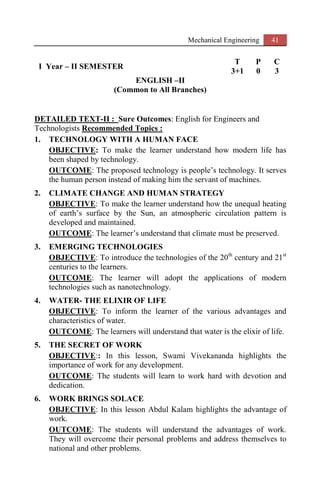
I Year – II SEMESTER
T P C
3+1 0 3
ENGLISH –II
(Common to All Branches)
DETAILED TEXT-II : Sure Outcomes: English for Engineers and
Technologists Recommended Topics :
1. TECHNOLOGY WITH A HUMAN FACE
OBJECTIVE: To make the learner understand how modern life has
been shaped by technology.
OUTCOME: The proposed technology is people’s technology. It serves
the human person instead of making him the servant of machines.
2. CLIMATE CHANGE AND HUMAN STRATEGY
OBJECTIVE: To make the learner understand how the unequal heating
of earth’s surface by the Sun, an atmospheric circulation pattern is
developed and maintained.
OUTCOME: The learner’s understand that climate must be preserved.
3. EMERGING TECHNOLOGIES
OBJECTIVE: To introduce the technologies of the 20th
century and 21st
centuries to the learners.
OUTCOME: The learner will adopt the applications of modern
technologies such as nanotechnology.
4. WATER- THE ELIXIR OF LIFE
OBJECTIVE: To inform the learner of the various advantages and
characteristics of water.
OUTCOME: The learners will understand that water is the elixir of life.
5. THE SECRET OF WORK
OBJECTIVE:: In this lesson, Swami Vivekananda highlights the
importance of work for any development.
OUTCOME: The students will learn to work hard with devotion and
dedication.
6. WORK BRINGS SOLACE
OBJECTIVE: In this lesson Abdul Kalam highlights the advantage of
work.
OUTCOME: The students will understand the advantages of work.
They will overcome their personal problems and address themselves to
national and other problems.
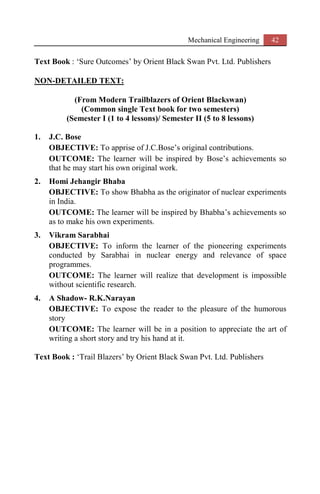
Mechanical Engineering 42
Text Book : ‘Sure Outcomes’ by Orient Black Swan Pvt. Ltd. Publishers
NON-DETAILED TEXT:
(From Modern Trailblazers of Orient Blackswan)
(Common single Text book for two semesters)
(Semester I (1 to 4 lessons)/ Semester II (5 to 8 lessons)
1. J.C. Bose
OBJECTIVE: To apprise of J.C.Bose’s original contributions.
OUTCOME: The learner will be inspired by Bose’s achievements so
that he may start his own original work.
2. Homi Jehangir Bhaba
OBJECTIVE: To show Bhabha as the originator of nuclear experiments
in India.
OUTCOME: The learner will be inspired by Bhabha’s achievements so
as to make his own experiments.
3. Vikram Sarabhai
OBJECTIVE: To inform the learner of the pioneering experiments
conducted by Sarabhai in nuclear energy and relevance of space
programmes.
OUTCOME: The learner will realize that development is impossible
without scientific research.
4. A Shadow- R.K.Narayan
OBJECTIVE: To expose the reader to the pleasure of the humorous
story
OUTCOME: The learner will be in a position to appreciate the art of
writing a short story and try his hand at it.
Text Book : ‘Trail Blazers’ by Orient Black Swan Pvt. Ltd. Publishers
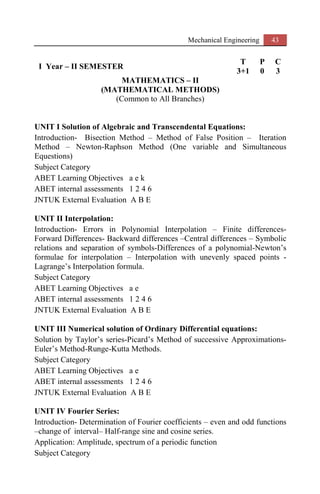
Mechanical Engineering 43
I Year – II SEMESTER
T P C
3+1 0 3
MATHEMATICS – II
(MATHEMATICAL METHODS)
(Common to All Branches)
UNIT I Solution of Algebraic and Transcendental Equations:
Introduction- Bisection Method – Method of False Position – Iteration
Method – Newton-Raphson Method (One variable and Simultaneous
Equestions)
Subject Category
ABET Learning Objectives a e k
ABET internal assessments 1 2 4 6
JNTUK External Evaluation A B E
UNIT II Interpolation:
Introduction- Errors in Polynomial Interpolation – Finite differences-
Forward Differences- Backward differences –Central differences – Symbolic
relations and separation of symbols-Differences of a polynomial-Newton’s
formulae for interpolation – Interpolation with unevenly spaced points -
Lagrange’s Interpolation formula.
Subject Category
ABET Learning Objectives a e
ABET internal assessments 1 2 4 6
JNTUK External Evaluation A B E
UNIT III Numerical solution of Ordinary Differential equations:
Solution by Taylor’s series-Picard’s Method of successive Approximations-
Euler’s Method-Runge-Kutta Methods.
Subject Category
ABET Learning Objectives a e
ABET internal assessments 1 2 4 6
JNTUK External Evaluation A B E
UNIT IV Fourier Series:
Introduction- Determination of Fourier coefficients – even and odd functions
–change of interval– Half-range sine and cosine series.
Application: Amplitude, spectrum of a periodic function
Subject Category
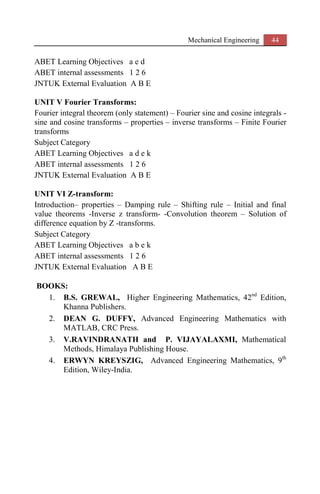
Mechanical Engineering 44
ABET Learning Objectives a e d
ABET internal assessments 1 2 6
JNTUK External Evaluation A B E
UNIT V Fourier Transforms:
Fourier integral theorem (only statement) – Fourier sine and cosine integrals -
sine and cosine transforms – properties – inverse transforms – Finite Fourier
transforms
Subject Category
ABET Learning Objectives a d e k
ABET internal assessments 1 2 6
JNTUK External Evaluation A B E
UNIT VI Z-transform:
Introduction– properties – Damping rule – Shifting rule – Initial and final
value theorems -Inverse z transform- -Convolution theorem – Solution of
difference equation by Z -transforms.
Subject Category
ABET Learning Objectives a b e k
ABET internal assessments 1 2 6
JNTUK External Evaluation A B E
BOOKS:
1. B.S. GREWAL, Higher Engineering Mathematics, 42nd
Edition,
Khanna Publishers.
2. DEAN G. DUFFY, Advanced Engineering Mathematics with
MATLAB, CRC Press.
3. V.RAVINDRANATH and P. VIJAYALAXMI, Mathematical
Methods, Himalaya Publishing House.
4. ERWYN KREYSZIG, Advanced Engineering Mathematics, 9th
Edition, Wiley-India.
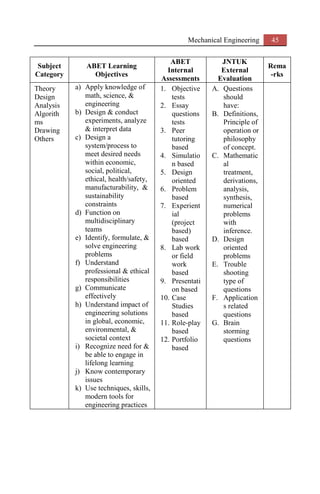
Mechanical Engineering 45
Subject
Category
ABET Learning
Objectives
ABET
Internal
Assessments
JNTUK
External
Evaluation
Rema
-rks
Theory
Design
Analysis
Algorith
ms
Drawing
Others
a) Apply knowledge of
math, science, &
engineering
b) Design & conduct
experiments, analyze
& interpret data
c) Design a
system/process to
meet desired needs
within economic,
social, political,
ethical, health/safety,
manufacturability, &
sustainability
constraints
d) Function on
multidisciplinary
teams
e) Identify, formulate, &
solve engineering
problems
f) Understand
professional & ethical
responsibilities
g) Communicate
effectively
h) Understand impact of
engineering solutions
in global, economic,
environmental, &
societal context
i) Recognize need for &
be able to engage in
lifelong learning
j) Know contemporary
issues
k) Use techniques, skills,
modern tools for
engineering practices
1. Objective
tests
2. Essay
questions
tests
3. Peer
tutoring
based
4. Simulatio
n based
5. Design
oriented
6. Problem
based
7. Experient
ial
(project
based)
based
8. Lab work
or field
work
based
9. Presentati
on based
10. Case
Studies
based
11. Role-play
based
12. Portfolio
based
A. Questions
should
have:
B. Definitions,
Principle of
operation or
philosophy
of concept.
C. Mathematic
al
treatment,
derivations,
analysis,
synthesis,
numerical
problems
with
inference.
D. Design
oriented
problems
E. Trouble
shooting
type of
questions
F. Application
s related
questions
G. Brain
storming
questions
Mechanical Engineering 46
I Year – II SEMESTER
T P C
3+1 0 3
MATHEMATICS – III
(LINEAR ALGEBRA & VECTOR CALCULUS)
(Common to All Branches)
UNIT I Linear systems of equations:
Rank-Echelon form, Normal form – Solution of Linear Systems – Direct
Methods- Gauss Elimination - Gauss Jordon and Gauss Seidal Methods.
Application: Finding the current in a electrical circuit.
Subject Category
ABET Learning Objectives a e k
ABET internal assessments 1 2 6 4
JNTUK External Evaluation A B E
UNIT II Eigen values - Eigen vectors and Quadratic forms:
Eigen values - Eigen vectors– Properties – Cayley-Hamilton Theorem -
Inverse and powers of a matrix by using Cayley-Hamilton theorem-
Quadratic forms- Reduction of quadratic form to canonical form – Rank -
Positive, negative definite - semi definite - index – signature.
Application: Free vibration of a two-mass system.
Subject Category
ABET Learning Objectives a d e k
ABET internal assessments 1 2 4 6
JNTUK External Evaluation A B E
UNIT III Multiple integrals:
Review concepts of Curve tracing (Cartesian - Polar and Parametric curves)-
Applications of Integration to Lengths, Volumes and Surface areas of
revolution in Cartesian and Polar Coordinates.
Multiple integrals - double and triple integrals – change of variables –
Change of order of Integration
Application: Moments of inertia
Subject Category
ABET Learning Objectives a e d
ABET internal assessments 1 2 6
JNTUK External Evaluation A B E
Mechanical Engineering 47
UNIT IV Special functions:
Beta and Gamma functions- Properties - Relation between Beta and Gamma
functions- Evaluation of improper integrals.
Application: Evaluation of integrals
Subject Category
ABET Learning Objectives a e
ABET internal assessments 1 2 6
JNTUK External Evaluation A B E
UNIT V Vector Differentiation:
Gradient- Divergence- Curl - Laplacian and second order operators -Vector
identities.
Application: Equation of continuity, potential surfaces
Subject Category
ABET Learning Objectives a e
ABET internal assessments 1 2 6
JNTUK External Evaluation A B E
UNIT VI Vector Integration:
Line integral – work done – Potential function – area- surface and volume
integrals Vector integral theorems: Greens, Stokes and Gauss Divergence
Theorems (Without proof) and related problems.
application: work done, Force
Subject Category
ABET Learning Objectives a e
ABET internal assessments 1 2 6
JNTUK External Evaluation A B E
BOOKS:
1. GREENBERG, Advanced Engineering Mathematics, 9th
Edition,
Wiley-India.
2. B.V. RAMANA, Higher Engineering Mathematics, Tata
McGrawhill.
3. ERWIN KREYSZIG, Advanced Engineering Mathematics, 9th
Edition, Wiley-India.
4. PETER O’NEIL, Advanced Engineering Mathematics, Cengage
Learning.
5. D.W. JORDAN AND T. SMITH, Mathematical Techniques,
Oxford University Press.
Mechanical Engineering 48
Subject
Category
ABET Learning
Objectives
ABET
Internal
Assessments
JNTUK
External
Evaluation
Rema
-rks
Theory
Design
Analysis
Algorith
ms
Drawing
Others
a) Apply knowledge of
math, science, &
engineering
b) Design & conduct
experiments, analyze &
interpret data
c) Design a
system/process to meet
desired needs within
economic, social,
political, ethical,
health/safety,
manufacturability, &
sustainability
constraints
d) Function on
multidisciplinary teams
e) Identify, formulate, &
solve engineering
problems
f) Understand
professional & ethical
responsibilities
g) Communicate
effectively
h) Understand impact of
engineering solutions in
global, economic,
environmental, &
societal context
i) Recognize need for &
be able to engage in
lifelong learning
j) Know contemporary
issues
k) Use techniques, skills,
modern tools for
engineering practices
1. Objective
tests
2. Essay
questions
tests
3. Peer
tutoring
based
4. Simulatio
n based
5. Design
oriented
6. Problem
based
7. Experient
ial
(project
based)
based
8. Lab work
or field
work
based
9. Presentati
on based
10. Case
Studies
based
11. Role-play
based
12. Portfolio
based
A. Questions
should
have:
B. Definition
s,
Principle
of
operation
or
philosoph
y of
concept.
C. Mathemat
ical
treatment,
derivation
s,
analysis,
synthesis,
numerical
problems
with
inference.
D. Design
oriented
problems
E. Trouble
shooting
type of
questions
F. Applicati
ons
related
questions
G. Brain
storming
questions
Mechanical Engineering 49
I Year – II SEMESTER
T P C
3+1 0 3
ENGINEERING PHYSICS
UNIT-I
PHYSICAL OPTICS FOR INSTRUMENTS
“Objective Designing an instrument and enhancing the resolution for its
operation would be effective as achieved through study of applicational
aspects of physical Optics”
INTERFACE : Introduction – Interference in thin films by reflection –
Newton’s rings.
DIFFRACTION : Introduction – Fraunhofer diffraction - Fraunhofer
diffraction at double slit (qualitative) – Diffraction grating – Grating
spectrum – Resolving power of a grating – Rayleigh’s criterion for resolving
power.
POLARIZATION : Introduction – Types of Polarization – Double
refraction – Quarter wave plate ad Half Wave plate.
UNIT-II
COHERENT OPTICS – COMMUNICATIONS AND STRUCTURE OF
MATERIALS
Objectives while lasers are trusted Non-linear coherent sources established
for the fitness of instrumentation, establishing a structure property
relationship for materials requires allotment of an equivalent footing in
convening the physics knowledge base.
LASERS: Introduction – coherent sources – Characteristics of lasers –
Spontaneous and Stimulated emission of radiation – Einstein’s coefficients –
Population inversion – Three and Four level pumping schemes – Ruby laser
– Helium Neon laser.
FIBER OPTICS : Introduction – Principle of Optical Fiber – Acceptance
angle and acceptance cone – Numerical aperture.
CRYSTALLOGRAPHY : Introduction – Space lattice – Basis – Unit Cell –
Lattice parameters – Bravais lattices – Crystal systems – Structures and
packing fractions of SC,BCC and FCC
X-RAY DIFFRACTION TECHNIQUES : Directions and planes in
crystals – Miller indices – Separation between successive [h k l] planes –
Bragg’s law.
Mechanical Engineering 50
UNIT-III
MAGNETIC, ELECTRIC FIELD RESPONSE OF MATERIALS &
SUPERCONDUCTIVITY
“Objective many of the Electrical or Electronic gadgets are designed basing
on the response of naturally abundant and artificially made materials, while
their response to E- or H- fields controls their performance.
MAGNETIC PROPERTIES : Magnetic permeability – Magnetization –
Organ or magnetic moment – Classification of Magnetic materials – Dir,
para, Ferro, anti ferro and ferri-magnetism – Hysteresis curve
DIELECTRIC PROPERTIES : Introduction – Dielectric constant –
Electronic, ionic and orientational polarization – internal fields – Clausius –
Mossotti equation – Dielectric loss, Breakdown and Strength.
SUPERCONDUCTIVITY : General properties – Meissner effect – Type I
and Type II superconductors – BCS Theory Flux quantization London’s
equations – Penetration depth – DC and AC Josephson effects – SQUIDS.
UNIT – IV
ACOUSTICS AND EM – FIELDS:
Objective: The utility and nuances of ever pervading SHM and its
consequences would be the first hand-on to as it clearly conveyed through the
detailed studies of Acoustics of Buildings, while vectorial concepts of EM
fields paves the student to gear – up for a deeper understanding.
ACOUSTICS: Sound absorption, absorption coefficient and its
measurements, Reverberations time – Sabine’s formula, Eyring’s formula.
ELECTRO-MAGNETIC FIELDS: Gauss and stokes theorems (qualitative)
– Fundamental laws of electromagnetism – Maxwell’s Electromagnetic
Equations (Calculus approach).
UNIT – V
QUANTUM MECHANICS FOR ELECTRONIC TRANSPORT
Objective: The discrepancy between classical estimates and laboratory
observations of physical properties exhibited by materials would be lifted out
through the understanding quantum picture of sub-atomic world dominated
by electron and its presence.
QUANTUM MECHANICS: Introduction to matter waves – Schrodinger
Time Independent and Time Dependent wave equations – Particle in a box.
FREE ELECTRON THEORY: Classical free electron theory – electrical
conductivity – Mean free path – Relaxation time and drifty velocity –
Quantum free electron theory – Fermi – Dirac (analytical) and its dependence
on temperature – Fermi energy – density of states – derivations for current
density.
Mechanical Engineering 51
BAND THEORY OF SOLIDS: Bloch theorem (qualitative) – Kronig –
Penney model – Origin of energy band formation in solids – Classification of
materials into conductors, semi – conductors & insulators – Concepts of
effective mass of electron - concept of hole.
UNIT – VI
SEMICONDUCTOR PHYSICS:
Objective: In the wake of ever increasing demand for the space and power
the watch word “small is beautiful”, understanding the physics of electronic
transport as underlying mechanism for appliances would provide a
knowledge base.
Introduction – Intrinsic semiconductor and carrier concentration – Equation
for conductivity – Extrinsic semiconductor and carrier concentration – Drift
and diffusion – Einstein’s equation – Hall Effect – direct & indirect band gap
semiconductors – Electronic transport Mechanism for LEDs, Photo
conductors and solar cells.
TEXT BOOKS
1. Solid state Physics by A.J. Dekker (Mc Millan India Ltd.)
2. A text book of Engineering Physics by M.N. Avadhanulu & P.G.
Kshirasagar (S. Chand publications)
3. Engineering Physics by M.R. Srinivasan (New Age international
publishers)
REFERENCE BOOKS
1. ‘Introduction to solid state physics’ by Charles Kittle (Willey India
Pvt. Ltd).
2. ‘Applied Physics’ by T. Bhimasenkaram (BSP BH Publications).
3. ‘Applied Physics’ by M.Arumugam (Anuradha Agencies).
4. ‘Engineering Physics’ by Palanisamy (Scitech Publishers).
5. ‘Engineering Physics’ by D.K.Bhattacharya (Oxford University
press).
6. ‘Engineering Physics’ by Mani Naidu S (Pearson Publications).
7. ‘Engineering Physics’ by Sanjay D Jain and Girish G Sahasrabudhe
(University Press).
8. ‘Engineering Physics’ by B.K.Pandey & S. Chaturvedi (Cengage
Learning).
Mechanical Engineering 52
I Year – II SEMESTER
T P C
3+1 0 3
Professional Ethics and Human Values
UNIT I : Human Values:
Morals, Values and Ethics – Integrity – Work Ethics – Service Learning –
Civic Virtue – Respect for others – Living Peacefully – Caring – Sharing –
Honesty –Courage – Value time – Co-operation – Commitment – Empathy –
Self-confidence – Spirituality- Character.
UNIT II : Engineering Ethics:
The History of Ethics-Purposes for Engineering Ethics-Engineering Ethics-
Consensus and Controversy –Professional and Professionalism –Professional
Roles to be played by an Engineer –Self Interest, Customs and Religion-Uses
of Ethical Theories-Professional Ethics-Types of Inquiry – Engineering and
Ethics-Kohlberg’s Theory – Gilligan’s Argument –Heinz’s Dilemma.
UNIT III : Engineering as Social Experimentation:
Comparison with Standard Experiments – Knowledge gained –
Conscientiousness – Relevant Information – Learning from the Past –
Engineers as Managers, Consultants, and Leaders – Accountability – Role of
Codes – Codes and Experimental Nature of Engineering.
UNIT IV : Engineers’ Responsibility for Safety and Risk:
Safety and Risk, Concept of Safety – Types of Risks – Voluntary v/s
Involuntary Risk- Short term v/s Long term Consequences- Expected
Probability- Reversible Effects- Threshold Levels for Risk- Delayed v/s
Immediate Risk- Safety and the Engineer – Designing for Safety – Risk-
Benefit Analysis-Accidents.
UNIT V : Engineers’ Responsibilities and Rights:
Collegiality-Techniques for Achieving Collegiality –Two Senses of Loyalty-
obligations of Loyalty-misguided Loyalty – professionalism and Loyalty-
Professional Rights –Professional Responsibilities – confidential and
proprietary information-Conflict of Interest-solving conflict problems – Self-
interest, Customs and Religion- Ethical egoism-Collective bargaining-
Confidentiality-Acceptance of Bribes/Gifts-when is a Gift and a Bribe-
examples of Gifts v/s Bribes-problem solving-interests in other companies-
Occupational Crimes-industrial espionage-price fixing-endangering lives-
Mechanical Engineering 53
Whistle Blowing-types of whistle blowing-when should it be attempted-
preventing whistle blowing.
UNIT VI : Global Issues:
Globalization- Cross-culture Issues-Environmental Ethics-Computer Ethics-
computers as the instrument of Unethical behaviour-computers as the object
of Unethical Acts-autonomous computers-computer codes of Ethics-
Weapons Development-Ethics and Research-Analysing Ethical Problems in
Research-Intellectual Property Rights.
Text Books:
1. “Engineering Ethics and Human Values” by M.Govindarajan,
S.Natarajan and V.S.SenthilKumar-PHI Learning Pvt. Ltd-2009.
2. “Professional Ethics and Morals” by Prof.A.R.Aryasri, Dharanikota
Suyodhana-Maruthi Publications.
3. “Professional Ethics and Human Values” by A.Alavudeen, R.Kalil
Rahman and M.Jayakumaran- Laxmi Publications.
4. “Professional Ethics and Human Values” by Prof.D.R.Kiran
5. “Indian Culture, Values and Professional Ethics” by PSR Murthy-
BS Publication.
6. “Ethics in Engineering” by Mike W. Martin and Roland Schinzinger
– Tata McGraw-Hill – 2003.
7. “Engineering Ethics” by Harris, Pritchard and Rabins, CENGAGE
Learning, India Edition, 2009.
Mechanical Engineering 54
I Year – II SEMESTER
T P C
3+1 0 3
ENGINEERING DRAWING
Objective:
Engineering drawing being the principle method of communication for
engineers, the objective to introduce the students, the techniques of
constructing the various types of polygons, curves and scales. The objective
is also to visualize and represent the 3D objects in 2D planes with proper
dimensioning, scaling etc.
UNIT I
Objective: The objective is to introduce the use and the application of
drawing instruments and to make the students construct the polygons, curves
and various types of scales. The student will be able to understand the need
to enlarge or reduce the size of objects in representing them.
Polygons, Construction of regular polygons using given length of a side;
Ellipse, arcs of circles and Oblong methods; Scales – Vernier and Diagonal
scales.
UNIT II
Objective: The objective is to introduce orthographic projections and to
project the points and lines parallel to one plane and inclined to other.
Introduction to orthographic projections; projections of points; projections of
straight lines parallel to both the planes; projections of straight lines – parallel
to one plane and inclined to the other plane.
UNIT III
Objective: The objective is to make the students draw the projections of the
lines inclined to both the planes.
Projections of straight lines inclined to both the planes, determination of true
lengths, angle of inclinations and traces.
UNIT IV
Objective: The objective is to make the students draw the projections of the
plane inclined to both the planes.
Projections of planes: regular planes perpendicular/parallel to one plane and
inclined to the other reference plane; inclined to both the reference planes.
Mechanical Engineering 55
UNIT V
Objective: The objective is to make the students draw the projections of the
various types of solids in different positions inclined to one of the planes.
Projections of Solids – Prisms, Pyramids, Cones and Cylinders with the axis
inclined to one of the planes.
UNIT VI
Objective: The objective is to represent the object in 3D view through
isometric views. The student will be able to represent and convert the
isometric view to orthographic view and vice versa.
Conversion of isometric views to orthographic views; Conversion of
orthographic views to isometric views.
TEXT BOOKS:
1. Engineering Drawing by N.D. Butt, Chariot Publications.
2. Engineering Drawing by K.L.Narayana & P. Kannaiah, Scitech
Publishers.
3. Engineering Graphics by PI Varghese, McGrawHill Publishers.
REFERENCE BOOKS:
1. Engineering Graphics for Degree by K.C. John, PHI Publishers.
2. Engineering Drawing by Agarwal & Agarwal, Tata McGraw Hill
Publishers.
3. Engineering Drawing + AutoCad – K Venugopal, V. Prabhu Raja,
New Age.
Mechanical Engineering 56
I Year – II SEMESTER
T P C
0 3 2
ENGLISH – COMMUNICATION SKILLS LAB – II
Suggested Lab Manuals:
OBJECTIVE: To impart to the learner the skills of grammar as well as
communication through listening, speaking, reading, and writing including
soft, that is life skills.
ADVANCED COMMUNICATION SKILLS
UNIT 6 Body language
UNIT 7 Dialogues
UNIT 8 Interviews and Telephonic Interviews
UNIT 9 Group Discussions
UNIT 10 Presentation Skills
UNIT 11 Debates
Text Book:
‘Strengthen your Communication Skills’ Part-B by Maruthi Publications
Reference Books:
1. INFOTECH English (Maruthi Publications).
2. Personality Development and Soft Skills (Oxford University
Press, New Delhi).
Mechanical Engineering 57
I Year – II SEMESTER
T P C
0 3 2
ENGINEERING PHYSICS LAB
List of Experiments
1. Determination of wavelength of a source-Diffraction Grating-
Normal incidence
2. Newton’s rings –Radius of Curvature of Plano_Convex Lens.
3. Determination of thickness of a thin object using parallel
interference fringes.
4. Determination of Rigidity modulus of a material- Torsional
Pendulum.
5. Determination of Acceleration due to Gravity and Radius of
Gyration- Compound Pendulum.
6. Melde’s experiment – Transverse and Longitudinal modes.
7. Verification of laws of stretched string – Sonometer.
8. Determination of velocity of sound – Volume resonator.
9. L C R Senes Resonance Circuit
10. Study of I/V Characteristics of Semiconductor diode.
11. I/V characteristics of Zener diode.
12. Thermistor characteristics – Temperature Coefficient.
13. Magnetic field along the axis of a current carrying coil – Stewart
and Gee’s apparatus.
14. Energy Band gap of a Semiconductor p.n junction.
15. Hall Effect for semiconductor.
REFERENCE:
1. Engineering Physics Lab Manual by Dr.Y. Aparna &
Dr.K.Venkateswarao (V.G.S.Book links)
2. Physics practical manual, Lorven Publications.
Mechanical Engineering 58
I Year – II SEMESTER
T P C
0 2 0
Engineering Physics
Virtual Labs - Assignments
List of Experiments
1. Hall Effect
2. Crystal Structure
3. Hysteresis
4. Brewster’s angle
5. Magnetic Levitation / SQUID
6. Numerical Aperture of Optical fiber
7. Photoelectric Effect
8. Simple Harmonic Motion
9. Damped Harmonic Motion
10. LASER – Beam Divergence and Spot size
URL : WWW.vlab.co.in
Mechanical Engineering 59
I Year – II SEMESTER
T P C
0 3 2
ENGINEERING WORKSHOP & IT WORKSHOP
ENGINEERING WORKSHOP:
Course Objective: To impart hands-on practice on basic engineering trades
and skills.
Note: At least two exercises to be done from each trade.
Trade:
Carpentry 1. T-Lap Joint
2. Cross Lap Joint
3. Dovetail Joint
4. Mortise and Tennon Joint
Fitting 1. Vee Fit
2. Square Fit
3. Half Round Fit
4. Dovetail Fit
Black Smithy 1. Round rod to Square
2. S-Hook
3. Round Rod to Flat Ring
4. Round Rod to Square headed bolt
House Wiring 1. Parallel / Series Connection of three bulbs
2. Stair Case wiring
3. Florescent Lamp Fitting
4. Measurement of Earth Resistance
Tin Smithy 1. Taper Tray
2. Square Box without lid
3. Open Scoop
4. Funnel
IT WORKSHOP:
Objectives: Enabling the student to understand basic hardware and software
tools through practical exposure
PC Hardware:
Identification of basic peripherals, assembling a PC, installation of system
software like MS Windows, device drivers. Troubleshooting Hardware and
software _ some tips and tricks.
Mechanical Engineering 60
Internet & World Wide Web:
Different ways of hooking the PC on to the internet from home and
workplace and effectively usage of the internet, web browsers, email,
newsgroups and discussion forums .Awareness of cyber hygiene( protecting
the personal computer from getting infected with the viruses), worms and
other cyber attacks .
Productivity tools Crafting professional word documents; excel spread
sheets, power point presentations and personal web sites using the Microsoft
suite of office tools
(Note: Student should be thoroughly exposed to minimum of 12 Tasks)
PC Hardware
Task 1: Identification of the peripherals of a computer.
To prepare a report containing the block diagram of the CPU along with the
configuration of each peripheral and its functions. Description of various I/O
Devices.
Task 2 (Optional) : A practice on disassembling the components of a PC
and assembling them to back to working condition.
Task 3: Examples of Operating systems- DOS, MS Windows, Installation of
MS windows on a PC.
Task 4: Introduction to Memory and Storage Devices , I/O Port, Device
Drivers, Assemblers, Compilers, Interpreters, Linkers, Loaders.
Task 5:
Hardware Troubleshooting (Demonstration):
Identification of a problem and fixing a defective PC(improper assembly or
defective peripherals).
Software Troubleshooting (Demonstration): Identification of a problem
and fixing the PC for any software issues.
Internet & Networking Infrastructure
Task 6: Demonstrating Importance of Networking, Transmission Media,
Networking Devices- Gateway, Routers, Hub, Bridge, NIC, Bluetooth
Technology, Wireless Technology, Modem, DSL, Dialup Connection.
Orientation & Connectivity Boot Camp and web browsing: Students are
trained to configure the network settings to connect to the Internet. They are
trained to demonstrate the same through web browsing (including all tool bar
options) and email access.
Task 7: Search Engines & Netiquette:
Students are enabled to use search engines for simple search, academic
search and any other context based search (Bing, Google etc). Students are
Mechanical Engineering 61
acquainted to the principles of micro-blogging, wiki, collaboration using
social networks, participating in online technology forums.
Task 8: Cyber Hygiene (Demonstration): Awareness of various threats on
the internet. Importance of security patch updates and anti-virus solutions.
Ethical Hacking, Firewalls, Multi-factor authentication techniques including
Smartcard, Biometrics are also practiced.
Word
Task 9 : MS Word Orientation:
Accessing, overview of toolbars, saving files, Using help and resources,
rulers, formatting ,Drop Cap , Applying Text effects, Using Character
Spacing, OLE in Word, using templates, Borders and Colors, Inserting
Header and Footer, Using Date and Time option, security features in word,
converting documents while saving.
Task 10: Creating project : Abstract Features to be covered:-Formatting
Styles, Inserting table, Bullets and Numbering, Changing Text Direction,
Cell alignment, Footnote, Hyperlink, Symbols, Spell Check , Track Changes,
Images from files and clipart, Drawing toolbar and Word Art, Formatting
Images, Textboxes and Paragraphs.
Excel
Task 11: Using spread sheet features of EXCEL including the macros,
formulae, pivot tables, graphical representations.
Creating a Scheduler - Features to be covered:- Gridlines, Format Cells,
Summation, auto fill, Formatting Text.
LOOKUP/VLOOKUP
Task 12: Performance Analysis - Features to be covered:- Split cells, freeze
panes, group and outline, Sorting, Boolean and logical operators, Conditional
formatting.
Power Point
Task 13: Students will be working on basic power point utilities and tools
which help them create basic power point presentation. Topic covered during
this week includes :- PPT Orientation, Slide Layouts, Inserting Text, Word
Art, Formatting Text, Bullets and Numbering, Auto Shapes, Lines and
Arrows, Hyperlinks, Inserting –Images, Clip Art, Tables and Charts in
Powerpoint.
Task 14: Focusing on the power and potential of Microsoft power point.
Helps them learn best practices in designing and preparing power point
presentation. Topic covered during this week includes: - Master Layouts
(slide, template, and notes), Types of views (basic, presentation, slide slotter,
Mechanical Engineering 62
notes etc), Inserting – Background, textures, Design Templates, Hidden
slides, OLE in PPT.
TEXT BOOK:
Faculty to consolidate the workshop manuals using the following
references
1. Computer Fundamentals, Anita Goel, Pearson.
2. Scott Mueller’s Upgrading and Repairing PCs, 18/e, Scott. Mueller,
QUE, Pearson, 2008.
3. Information Technology Workshop, 3e, G Praveen Babu, M V
Narayana BS Publications.
4. Comdex Information Technology , Vikas Gupta, dreamtech.
REFERENCE BOOK:
1. Essential Computer and IT Fundamentals for Engineering and Science
Students, Dr. N.B. Venkateswarlu
Mechanical Engineering 63
II Year – I SEMESTER
T P C
3+1 0 3
METALLURGY & MATERIALS SCIENCE
Course Objective:
To understand the basic fundamentals of Material science and Physical
metallurgy. The basic concepts to be taught will help for the improvement,
proper selection and effective utilization of materials which is essential to
satisfy the ever increasing demands of the society.
UNIT – I
Learning Objective: To know the basic concepts of bonds in metals and
alloys. To understand the basic requirements for the formation of solid
solutions and other compounds.
Structure of Metals and Constitution of alloys: Bonds in Solids – Metallic
bond - crystallization of metals, grain and grain boundaries, effect of grain
boundaries on the properties of metal / alloys – determination of grain size.
Necessity of alloying, types of solid solutions, Hume Rotherys rules,
intermediate alloy phases, and electron compounds.
UNIT –II
Learning objectives: To understand the regions of stability of the phases
that can occur in an alloy system in order to solve the problems in practical
metallurgy.
Equilibrium Diagrams : Experimental methods of construction of
equilibrium diagrams, Isomorphous alloy systems, equilibrium cooling and
heating of alloys, Lever rule, coring miscibility gaps, eutectic systems,
congruent melting intermediate phases, peritectic reaction. Transformations
in the solid state – allotropy, eutectoid, peritectoid reactions, phase rule,
relationship between equilibrium diagrams and properties of alloys. Study of
important binary phase diagrams of Cu-Ni-, Al-Cu, Bi-Cd, Cu-An, Cus-Sn
and Fe-Fe3C.
UNIT –III
Learning objectives: To study the basic differences between cast irons and
steels, their properties and practical applications.
Cast Irons and Steels: Structure and properties of White Cast iron,
Malleable Cast iron, grey cast iron, Spheriodal graphite cast iron, Alloy cast
irons. Classification of steels, structure and properties of plain carbon steels,
Low alloy steels, Hadfield manganese steels, tool and die steels.
Mechanical Engineering 64
UNIT – IV
Learning objectives: To study the affect of various alloying elements on
iron-iron carbide system. To understand the various heat treatment and
strengthening processes used in practical applications.
Heat treatment of Alloys: Effect of alloying elements on Fe-Fe3C system,
Annealing, normalizing, Hardening, TTT diagrams, tempering ,
Hardenability, surface - hardening methods, Age hardening treatment,
Cryogenic treatment of alloys.
UNIT – V
Learning objectives: To study the properties and applications of widely used
non-ferrous metals and alloys so as to use the suitable material for practical
applications.
Non-ferrous Metals and Alloys: Structure and properties of copper and its
alloys, Aluminium and its alloys, Titanium and its alloys.
UNIT – VI
Learning objectives: To study the properties and applications of ceramic,
composite and other advanced materials so as to use the suitable material for
practical applications.
Ceramic and composite materials: Crystalline ceramics, glasses, cermaets,
abrasive materials, nanomaterials – definition, properties and applications of
the above.
Classification of composites, various methods of component manufacture of
composites, particle – reinforced materials, fiber reinforced materials, metal
ceramic mixtures, metal – matrix composites and C – C composites.
TEXT BOOKS:
1. Introduction to Physical Metallurgy - Sidney H. Avener - McGrawHill
2. Essential of Materials science and engineering - Donald R.Askeland -
Thomson.
REFERENCES :
1. Material Science and Metallurgy – Dr. V.D.kodgire.
2. Materials Science and engineering - Callister & Baalasubrahmanyam
3. Material Science for Engineering students – Fischer – Elsevier
Publishers.
4. Material science and Engineering - V. Rahghavan
5. Introduction to Material Science and Engineering – Yip-Wah Chung
CRC Press.
6. Material Science and Metallurgy – A V K Suryanarayana – B S
Publications.
7. Material Science and Metallurgy – U. C. Jindal – Pearson Publications
Mechanical Engineering 65
II Year – I SEMESTER
T P C
3+1 0 3
MECHANICS OF SOLIDS
Objective:
The students completing this course are expected to understand the basic
terms like stress, strain, poissons ratio…etc and different stresses induced in
beams, thin cylinders, thick cylinders, columns. Further, the student shall be
able to understand the shear stresses in circular shafts.
UNIT – I
Objective: After studying this unit student will know the basic terms like
stress, strain poissons ratio…etc and stresses in bars of varying cross
sections, composite bars, thermal stress in members, stresses on inclined
planes with analytical approach and graphical approach, strain energy under
different loadings and also problem solving techniques.
SIMPLE STRESSES & STRAINS : Elasticity and plasticity – Types of
stresses & strains–Hooke’s law – stress – strain diagram for mild steel –
Working stress – Factor of safety – Lateral strain, Poisson’s ratio &
volumetric strain – Bars of varying section – composite bars – Temperature
stresses- Complex Stresses - Stresses on an inclined plane under different
uniaxial and biaxial stress conditions - Principal planes and principal stresses
- Mohr’s circle - Relation between elastic constants, Strain energy –
Resilience – Gradual, sudden, impact and shock loadings.
UNIT – II
Objective: After studying this unit student will know the construction of
shear force diagrams and bending moment diagrams to the different loads for
the different support arrangements and also problem solving techniques.
SHEAR FORCE AND BENDING MOMENT : Definition of beam –
Types of beams – Concept of shear force and bending moment – S.F and
B.M diagrams for cantilever, simply supported and overhanging beams
subjected to point loads, u.d.l, uniformly varying loads and combination of
these loads – Point of contra flexure – Relation between S.F., B.M and rate of
loading at a section of a beam.
UNIT – III
Objective: After studying this unit student will know the bending and shear
stress induced in the beams which are made with different cross sections like
Mechanical Engineering 66
rectangular, circular, triangular, I, T angle sections and also problem solving
techniques.
FLEXURAL STRESSES : Theory of simple bending – Assumptions –
Derivation of bending equation: M/ I = f/y = E/R Neutral axis –
Determination bending stresses – section modulus of rectangular and circular
sections (Solid and Hollow), I,T, Angle and Channel sections – Design of
simple beam sections.
SHEAR STRESSES: Derivation of formula – Shear stress distribution
across various beams sections like rectangular, circular, triangular, I, T angle
sections.
UNIT – IV
Objective: After studying this unit student will know how to finding slope
and deflection for different support arrangements by Double integration
method, Macaulay’s method and Moment-Area and also problem solving
techniques.
DEFLECTION OF BEAMS : Bending into a circular arc – slope, deflection
and radius of curvature – Differential equation for the elastic line of a beam –
Double integration and Macaulay’s methods – Determination of slope and
deflection for cantilever and simply supported beams subjected to point
loads, - U.D.L uniformly varying load. Mohr’s theorems – Moment area
method – application to simple cases including overhanging beams.
Brief explanation of Statically Indeterminate Beams and solution
methods.
UNIT – V
Objective: After studying this unit student will know how a cylinder fails,
what kind of stresses induced in cylinders subjected to internal, external
pressures and also problem solving techniques.
THIN CYLINDERS: Thin seamless cylindrical shells – Derivation of
formula for longitudinal and circumferential stresses – hoop, longitudinal and
Volumetric strains – changes in dia, and volume of thin cylinders – Riveted
boiler shells – Thin spherical shells.
THICK CYLINDERS: –lame’s equation – cylinders subjected to inside &
outside pressures –compound cylinders.
UNIT –VI
Objective: After studying this unit student will know shear stresses induced
in circular shafts, discussing columns in stability point of view and columns
with different end conditions.
Mechanical Engineering 67
TORSION: Introduction-Derivation- Torsion of Circular shafts- Pure Shear-
Transmission of power by circular shafts, Shafts in series, Shafts in parallel.
COLUMNS: Buckling and Stability, Columns with Pinned ends, Columns
with other support Conditions, Limitations of Euler’s Formula, Rankine’s
Formula.
TEXT BOOKS:
1. Strength of materials by Bhavikatti, Lakshmi publications.
2. Solid Mechanics, by Popov.
3. Mechanics of Materials by - Ferdinand P Beer, E Russell Johnston,
and John T Dewolf.
REFERENCES :
1. Strength of Materials -By Jindal, Umesh Publications.
2. Analysis of structures by Vazirani and Ratwani.
3. Mechanics of Structures Vol-III, by S.B.Junnarkar.
4. Strength of Materials by S.Timshenko.
5. Strength of Materials by Andrew Pytel and Ferdinond L. Singer
Longman.
Mechanical Engineering 68
II Year – I SEMESTER
T P C
3+1 0 3
THERMODYNAMICS
Course Objectives: To impart the knowledge of the thermodynamic laws
and principles so as to enable the student to prepare an energy audit of any
mechanical system that exchange heat and work with the surroundings.
UNIT – I
Objectives: The student should be able to understand the basic concepts like
thermodynamic system, its boundary and related fundamental definitions.
Distingvision between point function and path function shall be made with
respect to energy, work and Heat.
Intoduction: Basic Concepts : System, Control Volume, Surrounding,
Boundaries, Universe, Types of Systems, Macroscopic and Microscopic
viewpoints, Concept of Continuum, Thermodynamic Equilibrium, State,
Property, Process, Cycle – Reversibility – Quasi – static Process, Irreversible
Process, Causes of Irreversibility – Energy in State and in Transition, Types,
Work and Heat, Point and Path function. Zeroth Law of Thermodynamics –
Concept of Temperature – Principles of Thermometry –Reference Points –
Const. Volume gas Thermometer – Scales of Temperature, Ideal Gas Scale –
PMM I.
UNIT II
Objectives: To learn the first law of thermodynamics, which is also the
energy conservation principle, and should be able to apply to different
thermodynamic systems. To understand the concept of equality of
temperature and the principle of operation of various temperature measuring
devices. To learn the applications of steady flow energy equation to the
various mechanical components.
Joule’s Experiments – First law of Thermodynamics – Corollaries – First law
applied to a Process – applied to a flow system – Steady Flow Energy
Equation. Throttling and free expansion processes – deviations from perfect
gas model – vander Waals equation of state – compressibility charts –
variable specific heats – gas tables.
UNIT – III
Objectives: To understand the second law statements and the associated
terms and should be able to apply the principles to heat engines. Should be
able to analyse the concepts of Carnot cycle, entropy, availability and
Mechanical Engineering 69
irreversibility. Should be able to understand the use of Maxwells relations
and thermodynamic functions.
Limitations of the First Law – Thermal Reservoir, Heat Engine, Heat pump,
Parameters of performance, Second Law of Thermodynamics, Kelvin-Planck
and Clausius Statements and their Equivalence / Corollaries, PMM of Second
kind, Carnot’s principle, Carnot cycle and its specialties, Thermodynamic
scale of Temperature, Clausius Inequality, Entropy, Principle of Entropy
Increase – Energy Equation, Availability and Irreversibility –
Thermodynamic Potentials, Gibbs and Helmholtz Functions, Maxwell
Relations – Elementary Treatment of the Third Law of Thermodynamics.
UNIT IV
Objectives: should understand the process of steam formation and its
representation on property diagrams with various phase changes and should
be able to calculate the quality of steam after its expansion in a steam turbine,
with the help of standard steam tables and charts.
Pure Substances, p-V-T- surfaces, T-S and h-s diagrams, Mollier Charts,
Phase Transformations – Triple point at critical state properties during
change of phase, Dryness Fraction – Clausius – Clapeyron Equation Property
tables. Mollier charts – Various Thermodynamic processes and energy
Transfer – Steam Calorimetry.
UNIT – V
Objectives: Should be able to use Psychrometric chart and calculate various
psychrometric properties of air.
Mixtures of perfect Gases – Mole Fraction, Mass friction Gravimetric and
volumetric Analysis – Dalton’s Law of partial pressure, Avogadro’s Laws of
additive volumes – Mole fraction, Volume fraction and partial pressure,
Equivalent Gas const. And Molecular Internal Energy, Enthalpy, sp. Heats
and Entropy of Mixture of perfect Gases and Vapour, Atmospheric air -
Psychrometric Properties – Dry bulb Temperature, Wet Bulb Temperature,
Dew point Temperature, Thermodynamic Wet Bulb Temperature, Specific
Humidity, Relative Humidity, saturated Air, Vapour pressure, Degree of
saturation – Adiabatic Saturation, Carrier’s Equation – Psychrometric chart.
UNIT - VI
Objectives: To understand the concept of air standard cycles and should be
able to calculate the efficiency and performance parameters of the systems
that use these cycles.
Power Cycles : Otto, Diesel, Dual Combustion cycles, Sterling Cycle,
Atkinson Cycle, Ericcson Cycle, Lenoir Cycle – Description and
Mechanical Engineering 70
representation on P–V and T-S diagram, Thermal Efficiency, Mean Effective
Pressures on Air standard basis – comparison of Cycles.
Refrigeration Cycles : Brayton and Rankine cycles – Performance
Evaluation – combined cycles, Bell- Coleman cycle, Vapour compression
cycle-performance Evaluation.
TEXT BOOKS :
1. Engineering Thermodynamics , PK Nag 4th
Edn , TMH.
2. Thermodynamics – An Engineering Approach with student
resources DVD – Y.A.Cengel & M.A.Boles , 7th
Edn - McGrawHill
REFERENCES :
1. Engineering Thermodynamics – Jones & Dugan PHI
2. Thermodynamics – J.P.Holman , McGrawHill
3. Basic Engineering Thermodynamics – A.Venkatesh – Universities
press.
4. An Introduction to Thermodynamics - Y.V.C.Rao – Universities
press.
5. Thermodynamics – W.Z.Black & J.G.Hartley, 3rd
Edn Pearson Publ.
6. Engineering Thermodynamics – D.P.Misra, Cengage Publ.
7. Engineering Thermodynamics – P.Chattopadhyay – Oxford Higher
Edn Publ.
Mechanical Engineering 71
II Year – I SEMESTER
T P C
3+1 0 3
MANAGERIAL ECONOMICS AND FINANCIAL ANALYSIS
Unit – I:
(*The Learning objective of this Unit is to understand the concept and
nature of Managerial Economic s and its relationship with other
disciplines, Concept of Demand and Demand forecasting)
Introduction to Managerial Economics and demand Analysis:
Definition of Managerial Economics and Scope-Managerial Economics and
its relation with other subjects-Concepts of Demand-Types-Determents-Law
of Demand its Exception-Elasticity of Demand-Types and Measurement-
Demand forecasting and its Methods.
(**The Learner is equipped with the knowledge of estimating the Demand
for a product and the relationship between Price and Demand)
Unit – II:
(*The Learning objective of this Unit is to understand the concept of
Production function, Input Output relationship, different Cost Concepts
and Concept of Cost-Volume-Profit Analysis)
Production and Cost Analyses:
Production function-Isoquants and Isocosts-Law of Variable proportions-
Cobb-Douglas Production function-Economics of Sale-Cost Concepts-
Opportunity Cost-Fixed vs Variable Costs-Explicit Costs vs Implicit Costs-
Out of Pocket Costs vs Imputed Costs-Cost Volume Profit analysis-
Determination of Break-Even Point (Simple Problem).
(**One should understand the Cost Concepts for decision making and to
estimate the least cost combination of inputs).
Unit – III:
(*The Learning Objective of this Unit is t understand the Nature of
Competition, Characteristics of Pricing in the different market structure
and significance of various pricing methods).
Introduction to Markets, Theories of the Firm & Pricing Policies:
Market Structures: Perfect Competition, Monopoly and Monopolistic and
Oligopoly – Features – Price, Output Determination – Managerial Theories
of firm: Maris and Williamson’s models – Methods of Pricing: Limit Pricing,
Market Skimming Pricing, Internet Pricing: Flat Rate Pricing, Usage
sensitive, Transaction based pricing, Priority Pricing.
Mechanical Engineering 72
(** One has to understand the nature of different markets and Price Output
determination under various market conditions)
Unit – IV:
(*The Learning objective of this Unit is to know the different forms of
Business organization and their Merits and Demerits both public &
private Enterprises and the concepts of Business Cycles)
Types of Business Organization and Business Cycles:
Features and Evaluation of Sole Trader – Partnership – Joint Stock Company
– State/Public Enterprises and their forms – Business Cycles – Meaning and
Features – Phases of Business Cycle.
(**One should equipped with the knowledge of different Business Units)
Unit – V:
(*The Learning objective of this Unit is to understand the different
Accounting Systems preparation of Financial Statements and uses of
different tools for performance evaluation).
Introduction to Accounting & Financing Analysis:
Introduction to Double Entry Systems – Preparation of Financial Statements-
Analysis and Interpretation of Financial Statements-Ratio Analysis –
Preparation of Funds flow cash flow statements (Simple Problems).
(**The Learner is able to prepare Financial Statements and the usage of
various Accounting tools for Analysis).
Unit – VI:
(*The Learning objective of this Unit is to understand the concept of Capital,
Capitalization, Capital Budgeting and to know the techniques used to
evaluate Capital Budgeting proposals by using different methods).
Capital and Capital Budgeting: Capital Budgeting: Meaning of Capital-
Capitalization-Meaning of Capital Budgeting-Need for Capital Budgeting-
Techniques of Capital Budgeting-Traditional and Modern Methods.
(**The Learner is able to evaluate various investment project proposals with
the help of capital budgeting techniques for decision making).
Note: *Learning Objective
** Learning Assessment
TEXT BOOKS
1. Dr. N. Appa Rao, Dr. P. Vijay Kumar: ‘Managerial Economics and
Financial Analysis’, Cengage Publications, New Delhi – 2011
Mechanical Engineering 73
2. Dr. A. R. Aryasri – Managerial Economics and Financial Analysis,
TMH 2011
3. Prof. J.V.Prabhakara rao, Prof. P. Venkatarao. ‘Managerial Economics
and Financial Analysis’, Ravindra Publication.
REFERENCES:
1. V. Maheswari : Managerial Economics, Sultan Chand.
2. Suma Damodaran : Managerial Economics, Oxford 2011.
3. Dr. B. Kuberudu and Dr. T. V. Ramana : Managerial Economics &
Financial Analysis, Himalaya Publishing House 2011.
4. Vanitha Agarwal : Managerial Economics, Pearson Publications 2011.
5. Sanjay Dhameja : Financial Accounting for Managers, Pearson.
6. Maheswari : Financial Accounting, Vikas Publications.
7. S. A. Siddiqui & A. S. Siddiqui : Managerial Economics and Financial
Analysis, New Age International Publishers, 2012.
Mechanical Engineering 74
II Year – I SEMESTER
T P C
3+1 0 3
BASIC ELECTRICAL AND ELECTRONICS ENGINEERING
Preamble:
This course covers the topics related to analysis of various electrical circuits,
operation of various electrical machines, various electronic components to
perform well in their respective fields.
Learning Objectives:
i. To learn the basic principles of electrical law’s and analysis of
networks.
ii. To understand the principle of operation and construction details of
DC machines.
iii. To understand the principle of operation and construction details of
transformer.
iv. To understand the principle of operation and construction details of
alternator and 3-Phase induction motor.
v. To study the operation of PN junction diode, half wave, full wave
rectifiers and OP-AMPs.
vi. To learn the operation of PNP and NPN transistors and various
amplifiers.
UNIT - I
ELECTRICAL CIRCUITS: Basic definitions, Types of network elements,
Ohm’s Law, Kirchhoff’s Laws, inductive networks, capacitive networks,
series, parallel circuits and star-delta and delta-star transformations.
UNIT - II
DC MACHINES : Principle of operation of DC generator – emf equation -
types – DC motor types –torque equation – applications – three point starter,
swinburn’s Test, speed control methods.
UNIT - III
TRANSFORMERS: Principle of operation of single phase transformers –
e.m.f equation – losses –efficiency and regulation.
UNIT - IV
AC MACHINES: Principle of operation of alternators – regulation by
Mechanical Engineering 75
synchronous impedance method –principle of operation of 3-Phase induction
motor – slip-torque characteristics - efficiency – applications.
UNIT V
RECTIFIERS & LINEAR ICs: PN junction diodes, diode applications
(Half wave and bridge rectifiers). Characteristics of operation amplifiers (OP-
AMP) - application of OP-AMPs (inverting, non inverting, integrator and
differentiator).
UNIT VI
TRANSISTORS: PNP and NPN junction transistor, transistor as an
amplifier, single stage CE Amplifier, frequency response of CE amplifier,
concepts of feedback amplifier.
Outcomes:
i. Able to analyse the various electrical networks.
ii. Able to understand the operation of DC generators,3-point starter and
conduct the Swinburne’s Test.
iii. Able to analyse the performance of transformer.
iv. Able to explain the operation of 3-phase alternator and 3-phase
induction motors.
v. Able to analyse the operation of half wave, full wave rectifiers and OP-
AMPs.
vi. Able to explain the single stage CE amplifier and concept of feedback
amplifier.
TEXT BOOKS:
1. Electronic Devices and Circuits, R.L. Boylestad and Louis Nashelsky,
9th
edition, PEI/PHI 2006.
2. Electrical Technology by Surinder Pal Bali, Pearson Publications.
3. Electrical Circuit Theory and Technology by John Bird, Routledge
Taylor & Francis Group
REFERENCE BOOKS:
1. Basic Electrical Engineering by M.S.Naidu and S.Kamakshiah,TMH
Publications.
2. Fundamentals of Electrical Engineering by Rajendra Prasad, PHI
Publications, 2nd
edition.
3. Basic Electrical Engineering by Nagsarkar, Sukhija, Oxford
Publications, 2nd
edition.
4. Industrial Electronics by G.K. Mittal, PHI.
Mechanical Engineering 76
II Year – I SEMESTER
T P C
3+1 0 3
COMPUTER AIDED ENGINEERING DRAWING PRACTICE
Course Objective:
To enhance the student’s knowledge and skills in engineering drawing and to
introduce drafting packages and commands for computer aided drawing and
modeling.
Unit-I:
Objective: The knowledge of projections of solids is essential in 3D
modeling and animation. The student will be able to draw projections of
solids. The objective is to enhance the skills they already acquired in their
earlier course in drawing of projection and sections of solids.
PROJECTIONS OF PLANES & SOLIDS : Projections of Regular Solids
inclined to both planes – Auxiliary Views. Sections and Sectional views of
Right Regular Solids – Prism, Cylinder, Pyramid, Cone – Auxiliary views.
Unit-II:
The knowledge of development of surfaces of solids is required in designing
and manufacturing of the objects. Whenever two or more solids combine, a
definite curve is seen at their intersection. The intersection of solids also
plays an important role in designing and manufacturing. The objective is to
impart this knowledge through this topic.
DEVELOPMENT AND INTERPENETRATION OF SOLIDS: Development
of Surfaces of Right Regular Solids – Prisms, Cylinder, Pyramid Cone and
their parts.
Interpenetration of Right Regular Solids – Intersection of Cylinder Vs
Cylinder, Cylinder Vs Prism, Cylinder Vs Cone.
Unit-III:
Isometric projections provide a pictorial view with a real appearance.
Perspective views provides a realistic 3D View of an object. The objective is
to make the students learn the methods of Iso and Perspective views.
Mechanical Engineering 77
ISOMETRIC PROJECTIONS : Principles of Isometric Projection –
Isometric Scale – Isometric Views – Conventions – Isometric Views of
Lines, Plane Figures, Simple and Compound Solids – Isometric Projection of
objects having non- isometric lines. Isometric Projection of Spherical Parts.
Transformation of Projections : Conversion of Isometric Views to
Orthographic Views – Conventions.
PERSPECTIVE PROJECTIONS: Perspective View: Points, Lines, Plane
Figures and Simple Solids, Vanishing Point Methods(General Method only).
In part B computer aided drafting is introduced.
Unit IV:
The objective is to introduce various commands in AutoCAD to draw the
geometric entities and to create 2D and 3D wire frame models.
Introduction to Computer aided Drafting: Generation of points, lines, curves,
polygons, dimensioning. Types of modeling : object selection commands –
edit, zoom, cross hatching, pattern filling, utility commands, 2D wire frame
modeling, 3D wire frame modeling.
Unit V:
By going through this topic the student will be able to understand the paper-
space environment thoroughly. View points and view ports: view point
coordinates and view (s) displayed, examples to exercise different options
like save, restore, delete, joint, single option.
Unit VI:
The objective is to make the students create geometrical model of simple
solids and machine parts and display the same as an Isometric, Orthographic
or Perspective projection.
Computer aided Solid Modeling: Isometric projections, orthographic
projections of isometric projections ,Modeling of simple solids, Modeling of
Machines & Machine Parts.
TEXT BOOKS :
1. Engineering Graphics, K.C. john, PHI Publications
2. Engineering drawing by N.D Bhatt , Charotar publications.
Mechanical Engineering 78
REFERENCES:
1. Mastering Auto CAD 2013 and Auto CAD LT 2013 – George Omura,
Sybex.
2. Auto CAD 2013 fundamentals- Elisemoss, SDC Publ.
3. Engineering Drawing and Graphics using Auto Cad – T Jeyapoovan,
vikas.
4. Engineering Drawing + Auto CAD – K Venugopal, V. Prabhu Raja,
New Age.
5. Engineering Drawing – RK Dhawan, S Chand
6. Engineering Drawing – MB Shaw, BC Rana, Pearson
7. Engineering Drawing – KL Narayana, P Kannaiah, Scitech
8. Engineering Drawing – Agarwal and Agarwal, Mc Graw Hill
9. Engineering Graphics – PI Varghese, Mc Graw Hill.
10. Text book of Engineering Drawing with auto-CAD, K.venkata reddy /
B.S. publications.
Mechanical Engineering 79
II Year – I SEMESTER
T P C
0 3 2
BASIC ELECTRICAL & ELECTRONICS Engg. LAB
Section A: Electrical Engineering:
The following experiments are required to be conducted as compulsory
experiments:
1. Swinburne’s test on D.C. Shunt machine (Predetermination of
efficiency of a given D.C. Shunt machine working as motor and
generator).
2. OC and SC tests on single phase transformer (Predetermination of
efficiency and regulation at given power factors).
3. Brake test on 3-phase Induction motor (Determination of performance
characteristics).
4. Regulation of alternator by Synchronous impedance method.
5. Speed control of D.C. Shunt motor by
a) Armature Voltage control b) Field flux control method
6. Brake test on D.C. Shunt Motor.
Section B: Electronics Engineering:
1. PN junction Diode characteristics A. Forward bias, B. Reverse bias. (Cut
in voltage & Resistance calculations)
2. Transistor CE Characteristics (Input and Output).
3. Full wave Rectifier with and without filters.
4. CE Amplifiers.
5. RC Phase Shift Oscillator.
6. Class A Power Amplifier.
Mechanical Engineering 80
II Year – I SEMESTER
T P C
0 3 2
MECHANICS OF SOLIDS & METALLURGY LAB
Course Objective:
To impart practical exposure on the microstructures of various materials and
their hardness evaluation. Also to impart practical knowledge on the
evaluation of material properties through various destructive testing
procedures.
NOTE : Any 6 experiments from each section A and B.
(A) MECHNICS OF SOLIDS LAB :
1. Direct tension test
2. Bending test on
a) Simple supported
b) Cantilever beam
3. Torsion test
4. Hardness test
a) Brinells hardness test
b) Rockwell hardness test
5. Test on springs
6. Compression test on cube
7. Impact test
8. Punch shear test
(B) METALLURGY LAB :
1. Preparation and study of the Micro Structure of pure metals like
Iron, Cu and Al.
2. Preparation and study of the Microstructure of Mild steels, low
carbon steels, high – C steels.
3. Study of the Micro Structures of Cast Irons.
4. Study of the Micro Structures of Non-Ferrous alloys.
5. Study of the Micro structures of Heat treated steels.
6. Hardeneability of steels by Jominy End Quench Test.
7. To find out the hardness of various treated and untreated steels.
Mechanical Engineering 81
II Year – II SEMESTER
T P C
3+1 0 3
KINEMATICS OF MACHINERY
Objective:
The students completing this course are expected to understand the nature
and role of the kinematics of machinery, the mechanisms and machines. The
course includes velocity and acceleration diagrams,analysis of mechanisms
joints, Cams and their applications. It exposes the students to various kinds
of power transmission devices like belt,rope , chain and gear drives and their
working principles and their merits and demerits.
UNIT – I
Objective: The objective of this unit is to make student understand the
purpose of kinematics, Kinematic joint and mechanism and to study the
relative motion of parts in a machine without taking into consideration the
forces involved.
MECHANISMS : Elements or Links – Classification – Rigid Link, flexible
and fluid link – Types of kinematic pairs – sliding, turning, rolling, screw and
spherical pairs – lower and higher pairs – closed and open pairs – constrained
motion – completely, partially or successfully constrained and incompletely
constrained . Khubralrs criteria , Grashoff’s law , Degrees of freedom,
Kutzbach criterian for planar mechanisms, Mechanism and machines –
classification of machines – kinematic chain – inversion of mechanism –
inversion of mechanism – inversions of quadric cycle, chain – single and
double slider crank chains.
UNIT – II
Objective: The objective of this unit is to make student understand various
mechanisms for straight line motion and their applications including steering
mechanism.
LOWER PAIR MECHANISM: Exact and approximate copiers and generated
types – Peaucellier, Hart and Scott Russul – Grasshopper – Watt T.
Chebicheff and Robert Mechanisms and straight line motion, Pantograph.
Conditions for correct steering – Davis Steering gear, Ackermans steering
gear – velocity ratio; Hooke’s Joint: Single and double – Universal coupling–
application–problems.
UNIT – III
Objective : The objective of this unit is to make student understand the
velocity and acceleration concepts and the methodology using graphical
Mechanical Engineering 82
methods and principles and application of four bar chain. To understand the
application of slider crank mechanism etc. and study of plane motion of the
body.
KINEMATICS: Velocity and acceleration – Motion of a link in machine –
Determination of Velocity and acceleration diagrams – Graphical method –
Application of relative velocity method four bar chain. Velocity and
acceleration analysis of for a given mechanism, Kleins construction, Coriolis
acceleration, determination of Coriolis component of acceleration.
Plane motion of body: Instantaneous center of rotation, centroids and axodes
– relative motion between two bodies – Three centres in line theorem –
Graphical determination of instantaneous centre, diagrams for simple
mechanisms and determination of angular velocity of points and links.
UNIT – IV
Objective The objective of this unit is to make student understand the
theories involved in cams. Further the students are exposed to the
applications of cams and their working principles.
CAMS
Definitions of cam and followers – their uses – Types of followers and cams
– Terminology –Types of follower motion: Uniform velocity, Simple
harmonic motion and uniform acceleration and retardation. Maximum
velocity and maximum acceleration during outward and return strokes in the
above 3 cases. Analysis of motion of followers: Roller follower – circular
cam with straight, concave and convex flanks.
UNIT – V
Objective: The objective of this unit is to make student understand gears,
power transmission through different types of gears including gear profiles
and its efficiency.
Gears: Higher pairs, friction wheels and toothed gears–types – law of
gearing, condition for constant velocity ratio for transmission of motion,
Form of teeth: cycloidal and involute profiles. Velocity of sliding –
phenomena of interferences – Methods of interference. Condition for
minimum number of teeth to avoid interference, expressions for arc of
contact and path of contact – Introduction to Helical, Bevel and worm
gearing.
UNIT – VI
Objective: The objective of this unit is to make student understand various
power transmission mechanisms and methodologies and working principles.
Students are exposed to merits and demerits of each drive. Power
Transmissions : Introduction, Belt and rope drives, selection of belt drive-
Mechanical Engineering 83
types of belt drives,V-belts, materials used for belt and rope drives, velocity
ratio of belt drives, slip of belt, creep of belt, tensions for flat belt drive, angle
of contact, centrifugal tension, maximum tension of belt, Chains- length,
angular speed ratio, classification of chains.
Introduction to gear Trains, Train value, Types – Simple and reverted wheel
train – Epicyclic gear Train. Methods of finding train value or velocity ratio –
Epicyclic gear trains. Selection of gear box-Differential gear for an
automobile.
TEXT BOOKS:
1. Mechanism and Machine Theory by Ashok G. Ambekar, PHI
Publishers.
2. Theory of Machines – S. S Rattan- TMH .
3. Theory of machines and Mechanisms – J.J Uicker, G.R.Pennock &
J.E. Shigley - Oxford publishers.
REFERENCES:
1. Theory of Machines Sadhu Singh Pearsons Edn
2. Theory of machines and Machinery /Vickers /Oxford .
3. Theory of Machines by Thomas Bevan/ CBS
4. Kinematics of Machinery through Hyper Works – J.S. Rao – Springer
Publ.
5. Theory of Mechanisms and machines – A.Ghosh & A.K.Malik – East
West Press Pvt. Ltd.
Mechanical Engineering 84
II Year – II SEMESTER
T P C
3+1 0 3
THERMAL ENGINEERING – I
UNIT – I
Objectives: To make the student learn and understand the reasons and
affects of various losses that occur in the actual engine operation.
Actual Cycles and their Analysis: Introduction, Comparison of Air
Standard and Actual Cycles, Time Loss Factor, Heat Loss Factor, Exhaust
Blowdown-Loss due to Gas exchange process, Volumetric Efficiency. Loss
due to Rubbing Friction, Actual and Fuel-Air Cycles of CI Engines.
UNIT – II
Objectives: To familiarize the student with the various engine systems
along with their function and necessity.
I. C. ENGINES : Classification - Working principles, Valve and Port
Timing Diagrams, - Engine systems – Fuel, Carburetor, Fuel Injection
System, Ignition, Cooling and Lubrication, principle of wankle engine,
principles of supercharging and turbocharging.
UNIT – III
Objectives: To learn about normal combustion phenomenon and
knocking in S.I. and C.I. Engines and to find the several engine
operating parameters that affect the smooth engine operation.
Combustion in S.I. Engines : Normal Combustion and abnormal
combustion – Importance of flame speed and effect of engine variables –
Type of Abnormal combustion, pre-ignition and knocking (explanation of ) –
Fuel requirements and fuel rating, anti knock additives – combustion
chamber – requirements, types.
Combustion in C.I. Engines : Four stages of combustion – Delay period and
its importance – Effect of engine variables – Diesel Knock– Need for air
movement, suction, compression and combustion induced turbulence – open
and divided combustion chambers and nozzles used – fuel requirements and
fuel rating.
UNIT – IV
Objectives: To make the student learn to perform testing on S.I and C.I
Engines for the calculations of performance and emission parameters.
Measurement, Testing and Performance : Parameters of performance -
measurement of cylinder pressure, fuel consumption, air intake, exhaust gas
Mechanical Engineering 85
composition, Brake power – Determination of frictional losses and indicated
power – Performance test – Heat balance sheet and chart.
UNIT – V
Objectives: To make students learn about different types of compressors
and to calculate power and efficiency of reciprocating compressors.
COMPRESSORS – Classification –positive displacement and roto dynamic
machinery – Power producing and power absorbing machines, fan, blower
and compressor – positive displacement and dynamic types – reciprocating
and rotary types.
Reciprocating : Principle of operation, work required, Isothermal efficiency
volumetric efficiency and effect of clearance, stage compression,
undercooling, saving of work, minimum work condition for stage
compression.
UNIT VI
Objectives : To make students learn mechanical details, and to calculate
power and efficiency of rotary compressors
Rotary (Positive displacement type) : Roots Blower, vane sealed
compressor, Lysholm compressor – mechanical details and principle of
working – efficiency considerations.
Dynamic Compressors: Centrifugal compressors: Mechanical details and
principle of operation – velocity and pressure variation. Energy transfer-
impeller blade shape-losses, slip factor, power input factor, pressure
coefficient and adiabatic coefficient – velocity diagrams – power.
Axial Flow Compressors: Mechanical details and principle of operation –
velocity triangles and energy transfer per stage degree of reaction, work done
factor - isentropic efficiency- pressure rise calculations – Polytropic
efficiency.
TEXT BOOKS :
1. I.C. Engines / V. GANESAN- TMH
2. Heat engines, vasandani & Kumar publications Thermal
REFERENCES :
1. IC Engines – M.L. Mathur & R.P. Sharma – Dhanpath Rai & Sons.
2. I.C. Engines – Applied Thermosciences – C.R. Ferguson & A.T.
Kirkpatrick-2nd
Edition-Wiley Publ.
3. I.C. Engines - J.B. Heywood /Mc Graw HIll.
4. Thermal Engineering – R.S.Khurmi & J.S.Gupta- S.Chand Publ.
Mechanical Engineering 86
II Year – II SEMESTER
T P C
3+1 0 3
PRODUCTION TECHNOLOGY
Course Objective:
To impart basic knowledge and understanding about the primary
manufacturing processes such as casting, joining, forming and powder
metallurgy and their relevance in current manufacturing industry; To
introduce processing methods of plastics.
UNIT – I
Objective: To make the students understand fundamentals of casting
CASTING : Steps involved in making a casting – Advantage of casting and
its applications. – Patterns and Pattern making – Types of patterns –
Materials used for patterns, pattern allowances and their construction,
Principles of Gating, Gating ratio and design of Gating systems
UNIT – II
Objective: To provide insight into sand casting and introduce other
casting processes
Methods of melting and types of furnaces, Solidification of castings,
Solidification of pure metals and alloys, short & long freezing range alloys.
Risers – Types, function and design, casting design considerations, Basic
principles and applications of Centrifugal casting, Die casting and Investment
casting.
UNIT – III
Objective: To impart fundamentals of gas welding and arc welding
Welding : Classification of welding processes, types of welded joints and
their
characteristics, Gas welding, Different types of flames and uses, Oxy –
Acetylene Gas cutting.
Basic principles of Arc welding, Manual metal arc welding, Sub merged arc
welding, Inert Gas welding- TIG & MIG welding.
UNIT – IV
Objective: To teach principles of advanced welding processes and their
applications
Resistance welding, Solid state welding processes- Friction welding, Friction
stir welding, Forge welding, Explosive welding; Thermit welding, Plasma
welding, Laser welding, electron beam welding, Soldering & Brazing.
Mechanical Engineering 87
Heat affected zones in welding; pre & post heating, Weldability of metals,
welding defects – causes and remedies – destructive and nondestructive
testing of welds, Design of welded joints.
UNIT – V
Objective: To impart knowledge on bulk forming processes
Plastic deformation in metals and alloys, Hot working and Cold working,
Strain hardening and Annealing.
Bulk forming processes: Forging - Types Forging, Smith forging, Drop
Forging, Roll forging, Forging hammers, Rotary forging, forging defects;
Rolling – fundamentals, types of rolling mills and products, Forces in rolling
and power requirements. Extrusion and its characteristics. Types of extrusion,
Impact extrusion, Hydrostatic extrusion; Wire drawing and Tube drawing.
Introduction to powder metallurgy – compaction and sintering, advantages
and applications
UNIT – VI
Objective: To provide understanding of various sheet metal forming and
processing of plastics.
Sheet metal forming - Blanking and piercing, Forces and power requirement
in these operations,
Deep drawing, Stretch forming, Bending, Springback and its remedies,
Coining, Spinning, Types of presses and press tools.
Processing of Plastics: Types of Plastics, Properties, Applications and their
processing methods,
Blow and Injection molding.
TEXT BOOKS:
1. Manufacturing Processes for Engineering Materials - Kalpakjian S
and Steven R Schmid- Pearson Publ , 5th
Edn.
2. Manufacturing Technology -Vol I- P.N. Rao- TMH
3. Fundamentals of Modern Manufacturing - Mikell P Groover- Wiley
publ – 3rd
Edition.
REFERENCES :
1. Manufacturing Science – A.Ghosh & A.K.Malik – East West Press
Pvt. Ltd.
2. Process and materials of manufacture- Lindberg- PHI
3. Production Technology- R.K. Jain- Khanna
4. Production Technology-P C Sharma-S. Chand
5. Manufacturing Processes- H.S. Shaun- Pearson
6. Manufacturing Processes- J.P. Kaushish- PHI
Mechanical Engineering 88
II Year – II SEMESTER
T P C
3+1 0 3
FLUID MECHANICS & HYDRAULIC MACHINES
Objective:
The students completing this course are expected to understand the properties
of fluids, its kinematic and dynamic behavior through various laws of fluids
like continuity, Euler’s, Bernoulli’s equations, energy and momentum
equations. Further, the student shall be able to understand the theory of
boundary layer, working and performance characteristics of various hydraulic
machines like pumps and turbines.
UNIT I
Objective: After studying this unit student will know the concept of fluid and
its properties, manometry, hydrostatic forces acting on different surfaces and
also problem solving techniques.
Fluid statics: Dimensions and units: physical properties of fluids-
specific gravity, viscosity and its significance, surface tension, capillarity,
vapor pressure. Atmospheric gauge and vacuum pressure – measurement of
pressure. Manometers- Piezometer, U-tube, inverted and differential
manometers. Pascal’s law, hydrostatic law.
Buoyancy and floatation: Meta center, stability of floating body. Submerged
bodies. Calculation of metacenter height. Stability analysis and applications.
UNIT II
Objective: In this unit student will be exposed to the basic laws of fluids,
flow patterns, viscous flow through ducts and their corresponding problems.
Fluid kinematics: Introduction, flow types. Equation of continuity for one
dimensional flow.circulation and vorticity. Stream line, path line and streak
lines and stream tube. Stream function and velocity potential function,
differences and relation between them. Condition for irrotational flow, flow
net, source and sink, doublet and vortex flow.
Fluid dynamics: surface and body forces –Euler’s and Bernoulli’s equations
for flow along a stream line, momentum equation and its applications, force
on pipe bend.
Closed conduit flow: Reynold’s experiment- Darcy Weisbach equation-
Minor losses in pipes- pipes in series and pipes in parallel- total energy line-
hydraulic gradient line.
Mechanical Engineering 89
UNIT III
Objective: At the end of this unit student will be aware of the concepts
related to boundary layer theory, flow separation, basic concepts of velocity
profiles, dimensionless numbers and dimensional analysis.
Boundary Layer Theory: Introduction, momentum integral equation,
displacement, momentum and energy thickness, separation of boundary
layer, control of flow separation, Stream lined body, Bluff body and its
applications, basic concepts of velocity profiles.
Dimensional Analysis: Similitude and modeling – Dimensionless numbers
UNIT IV
Objective: In this unit student will know the hydrodynamic forces acting on
vanes and their performance evaluation.
Basics of turbo machinery: hydrodynamic force of jets on stationary
and moving flat, inclined, and curved vanes, jet striking centrally and at
tip, velocity diagrams, work done and efficiency, flow over radial vanes.
UNIT V
Objective: At the end of this unit student will be aware of the importance,
function and performance of hydro machinery.
Centrifugal pumps: Classification, working, work done – manometric head-
losses and efficiencies- specific speed- pumps in series and parallel-
performance characteristic curves, cavitation & NPSH.
Reciprocating pumps: Working, Discharge, slip, indicator diagrams.
UNIT VI
Objective: After studying this unit student will be in a position to evaluate
the performance characteristics of hydraulic turbines. Also a little knowledge
on hydraulic systems and fluidics is imparted to the student.
Hydraulic Turbines: classification of turbines, impulse and reaction
turbines, Pelton wheel, Francis turbine and Kaplan turbine-working
proportions, work done, efficiencies, hydraulic design –draft tube- theory-
functions and efficiency.
Performance of hydraulic turbines: Geometric similarity, Unit and
specific quantities, characteristic curves, governing of turbines, selection of
type of turbine, cavitation, surge tank, water hammer. Hydraulic systems-
hydraulic ram, hydraulic lift, hydraulic coupling. Fluidics – amplifiers,
sensors and oscillators. Advantages, limitations and applications.
Mechanical Engineering 90
TEXT BOOKS:
1. Hydraulics, fluid mechanics and Hydraulic machinery MODI and SETH.
2. Fluid Mechanics and Hydraulic Machines by Rajput.
REFERENCE BOOKS:
1. Fluid Mechanics and Fluid Power Engineering by D.S. Kumar,
Kotaria & Sons.
2. Fluid Mechanics and Machinery by D. Rama Durgaiah, New Age
International.
3. Hydraulic Machines by Banga & Sharma, Khanna Publishers.
4. Instrumentation for Engineering Measurements by James W. Dally,
William E. Riley, John Wiley & Sons Inc. 2004 (Chapter 12 – Fluid
Flow Measurements)
5. Fluid Mechanics and Hydraulic Machines by Domkundwar &
Domkundwar, Dhanpatrai & Co.
Mechanical Engineering 91
II Year – II SEMESTER
T P C
3+1 0 3
MACHINE DRAWING
Course Objective:
The student will acquire a knowledge of fastening arrangements such as
welding, riveting the different styles of attachment for shaft. The student also
is enabled to prepare the assembly of various machine or engine components
and miscellaneous machine components.
Machine Drawing Conventions :
Need for drawing conventions – introduction to IS conventions
a) Conventional representation of materials, common machine elements
and parts such as screws, nuts, bolts, keys, gears, webs, ribs.
b) Types of sections – selection of section planes and drawing of sections
and auxiliary sectional views. Parts not usually sectioned.
c) Methods of dimensioning, general rules for sizes and placement of
dimensions for holes, centers, curved and tapered features.
d) Title boxes, their size, location and details - common abbreviations &
their liberal usage.
e) Types of Drawings – working drawings for machine parts.
I. Drawing of Machine Elements and simple parts
Objective: To provide basic understanding and drawing practice of various
joint, simple mechanical parts Selection of Views, additional views for the
following machine elements and parts with every drawing proportions.
a) Popular forms of Screw threads, bolts, nuts, stud bolts, tap bolts, set
screws.
b) Keys, cottered joints and knuckle joint.
c) Rivetted joints for plates
d) Shaft coupling, spigot and socket pipe joint.
e) Journal, pivot and collar and foot step bearings.
II. Assembly Drawings:
Objective: The student will be able to draw the assembly from the individual
part drawing.
Drawings of assembled views for the part drawings of the following using
conventions and easy drawing proportions.
Mechanical Engineering 92
a) Engine parts – stuffing boxes, cross heads, Eccentrics, Petrol Engine
connecting rod, piston assembly.
b) Other machine parts - Screws jacks, Machine Vices Plummer block,
Tailstock.
c) Valves : Steam stop valve, spring loaded safety valve, feed check
valve and air cock.
NOTE : First angle projection to be adopted. The student should be able to
provide working drawings of actual parts.
TEXT BOOKS:
1. Machine Drawing – Dhawan, S.Chand Publications
2. Machine Drawing –K.L. Narayana, P.Kannaiah & K. Venkata Reddy /
New Age/ Publishers.
REFERENCES:
1. Machine Drawing – N.Siddeswar, K.Kannaiah & V.V.S.Sastry - TMH
2. Machine Drawing – P.S.Gill,
3. Machine Drawing – Luzzader
4. Machine Drawing – Rajput
5. Machine Drawing – N.D. Junnarkar, Pearson
6. Machine Drawing – Ajeeth Singh, McGraw Hill
7. Machine Drawing – KC John, PHI
8. Machine Drawing – B Battacharya, Oxford
9. Machine Drawing – Gowtham and Gowtham, Pearson
Mechanical Engineering 93
II Year – II SEMESTER
T P C
0 3 2
FLUID MECHANICS & HYDRAULIC MACHINERY LAB
Course Objective: To impart practical exposure on the performance
evaluation methods of various flow measuring equipment and hydraulic
turbines and pumps.
1. Impact of jets on Vanes.
2. Performance Test on Pelton Wheel.
3. Performance Test on Francis Turbine.
4. Performance Test on Kaplan Turbine.
5. Performance Test on Single Stage Centrifugal Pump.
6. Performance Test on Multi Stage Centrifugal Pump.
7. Performance Test on Reciprocating Pump.
8. Calibration of Venturimeter.
9. Calibration of Orifice meter.
10. Determination of friction factor for a given pipe line.
11. Determination of loss of head due to sudden contraction in a
pipeline.
12. Turbine flow meter.
Mechanical Engineering 94
II Year – II SEMESTER
T P C
0 3 2
PRODUCTION TECHNOLOGY LAB
Course Objective: To impart hands-on practical exposure on manufacturing
processes and equipment.
Minimum of 12 Exercises need to be performed
I. METAL CASTING :
1. Pattern Design and making - for one casting drawing.
2. Sand properties testing - for strength and permeability
3. Mould preparation, Melting and Casting
II WELDING:
1. Gas welding
2. Gas cutting
3. Manual metal arc welding - Lap & Butt Joints
4. TIG/MIG Welding
5. Resistance Spot Welding
6. Brazing and soldering
III METAL FORMING AND POWDER METALLURGY:
1. Blanking & Piercing operations and study of simple, compound and
progressive dies.
2. Deep drawing and extrusion operations.
3. Bending and other operations
4. Basic powder compaction and sintering
IV PROCESSING OF PLASTICS
1. Injection Moulding
2. Blow Moulding
Mechanical Engineering 95
II Year – II SEMESTER
T P C
0 3 2
THERMAL ENGINEERING LAB
Objective: To impart practical exposure to the student on the
performance evaluation methods of various types of internal combustion
engines and compressors.
1. I.C. Engines valve / port timing diagrams.
2. I.C. Engines performance test (4 -stroke diesel engines)
3. I.C. Engines performance test on 2-stroke petrol.
4. Evaluation of engine friction by conducting morse test on 4-stroke
multi cylinder petrol engine.
5. Determination of FHP by retardation and motoring test on IC
engine.
6. I.C. Engines heat balance.
7. Economical speed test of an IC engine.
8. Performance test on variable compression ratio engines.
9. Performance test on reciprocating air compressor unit.
10. Study of boilers
11. Dis-assembly / assembly of Engines.
Outcomes:
The student will be able to calculate the various efficiencies, various horse
powers and energy balance for several types of Internal Combustions Engines
and compressors.
Mechanical Engineering 96
III Year – I SEMESTER
T P C
3+1* 0 3
DYNAMICS OF MACHINERY
Course Objectives:
1. To equip the student with fundamental knowledge of dynamics of
machines so that student can appreciate problems of dynamic force
balance, transmissibility of forces, isolation of systems, vibrations.
2. Develop knowledge of analytical and graphical methods for calculating
balancing of rotary and reciprocating masses.
3. Develop understanding of vibrations and its significance on engineering
design.
4. Develop understanding of dynamic balancing, flywheel analysis,
gyroscopic forces and moments.
UNIT – I
PRECESSION: Gyroscopes, effect of precession motion on the stability of
moving vehicles such as motor car, motor cycle, aero planes and ships, static
and dynamic force analysis of planar mechanisms, (Demonstration of models
in video show).
UNIT – II
FRICTION: Inclined plane, friction of screw and nuts, pivot and collar,
uniform pressure, uniform wear, friction circle and friction axis: lubricated
surfaces, boundary friction, film lubrication.
CLUTCHES: Friction clutches- single disc or plate clutch, multiple disc
clutch, cone clutch, centrifugal clutch.
BRAKES AND DYNAMOMETERS: Simple block brakes, internal
expanding brake, band brake of vehicle. General description and operation of
dynamometers: Prony, Rope brake, Epicyclic, Bevis Gibson and belt
transmission,
UNIT – III
TURNING MOMENT DIAGRAMS: Dynamic force analysis of slider
crank mechanism, inertia torque, angular velocity and acceleration of
connecting rod, crank effort and turning moment diagrams – fluctuation of
energy – fly wheels and their design.
UNIT-IV
GOVERNERS: Watt, porter and proell governors, spring loaded governors
Mechanical Engineering 97
– Hartnell and Hartung with auxiliary springs. sensitiveness, isochronism and
hunting.
UNIT – V
BALANCING: Balancing of rotating masses single and multiple – single
and different planes, use analytical and graphical methods. Primary,
secondary, and higher balancing of reciprocating masses. analytical and
graphical methods, unbalanced forces and couples – examination of “V”
multi cylinder in line and radial engines for primary and secondary balancing,
locomotive balancing, hammer blow, swaying couple, variation of tractive
effort.
UNIT – VI
VIBRATIONS: Free Vibration of spring mass system – oscillation of
pendulums, centers of oscillation and suspension. transverse loads, vibrations
of beams with concentrated and distributed loads. Dunkerly’s methods,
Raleigh’s method, whirling of shafts, critical speeds, torsional vibrations, two
and three rotor systems, Simple problems on forced damped vibration,
vibration isolation and transmissibility.
TEXT BOOKS :
1. Theory of Machines / S.S Ratan/ Mc. Graw Hill Publ.
2. Mechanism and machine theory by Ashok G. Ambedkar, PHI
Publications.
REFERENCES :
1. Mechanism and Machine Theory / JS Rao and RV Dukkipati / New
Age.
2. Theory of Machines / Shiegly / MGH
3. Theory of Machines / Thomas Bevan / CBS Publishers
4. Theory of machines / Khurmi / S.Chand.
Course outcomes:
Upon successful completion of this course the student should be able to:
1. Analyze stabilization of sea vehicles, aircrafts and automobile
vehicles.
2. Compute frictional losses, torque transmission of mechanical systsms.
3. Analyze dynamic force analysis of slider crank mechanism and design
of flywheel.
4. Understand how to determine the natural frequencies of continuous
systems starting from the general equation of displacement.
5. Understand balancing of reciprocating and rotary masses.
Mechanical Engineering 98
III Year – I SEMESTER
T P C
3+1* 0 3
METAL CUTTING & MACHINE TOOLS
Course objectives:
1. The course provides students with fundamental knowledge and principles
in material removal processes.
2. In this course, the students apply the fundamentals and principles of metal
cutting to practical applications through multiple labs using lathes,
milling machines, grinding machines, and drill presses, Computer
Numerical Control etc.
3. To demonstrate the fundamentals of machining processes and machine
tools.
4. To develop knowledge and importance of metal cutting parameters.
5. To develop fundamental knowledge on tool materials, cutting fluids and
tool wear mechanisms.
6. To apply knowledge of basic mathematics to calculate the machining
parameters for different machining processes.
UNIT – I
FUNDAMENTALS OF MACHINING:
Elementary treatment of metal cutting theory – element of cutting process –
geometry of single point tool angles, chip formation and types of chips – built
up edge and its effects chip breakers, mechanics of orthogonal cutting –
Merchant’s force diagram, cutting forces, cutting speeds, feed, depth of cut,
tool life, coolants, tool materials.
UNIT – II
LATHE MACHINES:
Engine lathe – principle of working, specification of lathe – types of lathe –
work holders tool holders – box tools taper turning, thread turning – for
lathes and attachments, constructional features of speed gear box and feed
gear box. Turret and capstan lathes – collet chucks – other work holders –
tool holding devices – box and tool layout. Principal features of automatic
lathes – classification – single spindle and multi-spindle automatic lathes –
tool layout and cam design for automats.
Mechanical Engineering 99
UNIT – III
SHAPING, SLOTTING AND PLANNING MACHINES: Principles of
working – principal parts – specifications, operations performed, machining
time calculations.
DRILLING & BORING MACHINES: Principles of working,
specifications, types, operations performed – tool holding devices – twist drill
– Boring Machines – fine Boring Machines – jig boring machine, deep hole
Drilling Machine.
UNIT – IV
MILLING MACHINES: Principles of working – specifications –
classification of Milling Machines – Principle features of horizontal, vertical
and universal Milling Machine, machining operations, types of cutters,
geometry of milling cutters – methods of indexing, accessories to milling
machines.
UNIT –V
FINISHING PROCESSES: Theory of grinding – classification of grinding
machines, cylindrical and surface grinding machines, tool and cutter grinding
machines, different types of abrasives, bonds, specification and selection of a
grinding wheel. Lapping, Honing & Broaching operations, comparison to
grinding.
UNIT - VI
JIGS & FIXTURES: Principles of design of jigs and fixtures and uses,
classification of jigs & fixtures, principles of location and clamping, types of
clamping & work holding devices, typical examples of jigs and fixtures.
CNC MACHINE TOOLS: CNC Machines, working principle,
classification, constructional features of CNC machines, CNC controller,
types of motion controls in CNC machines, applications of CNC machines.
TEXT BOOKS:
1. Production Technology by R.K. Jain and S.C. Gupta.
2. Workshop Technology – B.S.Raghu Vamshi – Vol II
REFERENCES:
1. Metal cutting Principles by M.C. Shaw
2. Metal cutting and machine tools by Boothroyd
3. Production Technology by H.M.T. (Hindustan Machine Tools).
4. Production Engineering, K.C Jain & A.K Chitaley, PHI Publishers
Mechanical Engineering 100
5. Manufacturing technology II, P.N Rao
6. Technology of machine tools, S.F.Krar, A.R. Gill, Peter SMID,
TMH (I)
Course Outcomes :
Upon successful completion of this course, the students will be able to:
1) Apply cutting mechanics to metal machining based on cutting force and
power consumption.
2) Operate lathe, milling machines, drill press, grinding machines, etc.
3) Select cutting tool materials and tool geometries for different metals.
4) Select appropriate machining processes and conditions for different
metals.
5) Learn machine tool structures and machining economics.
6) Write simple CNC programs and conduct CNC machining.
Mechanical Engineering 101
III Year – I SEMESTER
T P C
3+1* 0 3
DESIGN OF MACHINE MEMBERS – I
Course Objectives:
1. The student shall gain appreciation and understanding of the design
function in mechanical engineering, the steps involved in designing
and the relation of design activity with manufacturing activity
2. Selection of proper materials to different machine elements based on
their physical and mechanical properties.
3. Learn and understanding of the different types of failure modes and
criteria.
4. Procedure for the different machine elements such as fasteners,
shafts, couplings, keys, axially loaded joints etc.
UNIT – I
INTRODUCTION: General considerations in the design of Engineering
Materials and their properties – selection –Manufacturing consideration in
design, tolerances and fits –BIS codes of steels.
STRESSES IN MACHINE MEMBERS: Simple stresses – combined
stresses – torsional and bending stresses – impact stresses – stress strain
relation – various theories of failure – factor of safety – design for strength
and rigidity – preferred numbers. the concept of stiffness in tension, bending,
torsion and combined situations – static strength design based on fracture
toughness.
UNIT – II
STRENGTH OF MACHINE ELEMENTS: Stress concentration –
theoretical stress concentration factor – fatigue stress concentration factor
notch sensitivity – design for fluctuating stresses – endurance limit –
estimation of endurance strength – goodman’s line – soderberg’s line –
modified goodman’s line.
UNIT – III
Riveted and welded joints – design of joints with initial stresses – eccentric
loading.
Bolted joints – design of bolts with pre-stresses – design of joints under
eccentric loading – locking devices – both of uniform strength, different
seals.
Mechanical Engineering 102
UNIT – IV
KEYS, COTTERS AND KNUCKLE JOINTS: Design of keys-stresses in
keys-cotter joints-spigot and socket, sleeve and cotter, jib and cotter joints-
knuckle joints.
SHAFTS: Design of solid and hollow shafts for strength and rigidity –
design of shafts for combined bending and axial loads – shaft sizes – BIS
code. Use of internal and external circlips, gaskets and seals (stationary &
rotary).
UNIT – V
SHAFT COUPLING: Rigid couplings – muff, split muff and flange
couplings, flexible couplings – flange coupling (modified).
UNIT – VI
MECHANICAL SPRINGS:
Stresses and deflections of helical springs – extension -compression springs –
springs for fatigue loading, energy storage capacity – helical torsion springs –
co-axial springs, leaf springs.
TEXT BOOKS:
1. Machine Design, V.Bandari, TMH Publishers
2. Machine design – Pandya & Shah
3. Machine Design PSG Data hand book
REFERENCES:
1. Design of Machine Elements / V.M. Faires
2. Machine design / Schaum Series.
3. Data books (1) PSG College of technology (2) Mahadevan
Course outcomes:
Upon successful completion of this course student should be able to:
1. Apply the design procedure to engineering problems, including the
consideration of technical and manufacturing constraints.
2. Select suitable materials and significance of tolerances and fits in
critical design applications.
3. Utilize design data hand book and design the elements for strength,
stiffness and fatigue.
4. Identify the loads, the machine members subjected and calculate static
and dynamic stresses to ensure safe design.
Mechanical Engineering 103
III Year – I SEMESTER
T P C
3+1* 0 3
INSTRUMENTATION & CONTROL SYSTEMS
Course Objectives:
The course focuses on imparting the principles of measurement which
includes the working mechanism of various sensors and devices, that are in
use to measure the important physical variables of various mechatronic
systems.
UNIT – I
Definition – Basic principles of measurement – measurement systems,
generalized configuration and functional descriptions of measuring
instruments – examples. dynamic performance characteristics – sources of
error, classification and elimination of error.
Measurement of Displacement: Theory and construction of various
transducers to measure displacement – piezo electric, inductive, capacitance,
resistance, ionization and photo electric transducers, calibration procedures.
UNIT – II
MEASUREMENT OF TEMPERATURE: Classification – ranges –
various principles of measurement – expansion, electrical resistance –
thermistor – thermocouple – pyrometers – temperature indicators.
MEASUREMENT OF PRESSURE: Units – classification – different
principles used. manometers, piston, bourdon pressure gauges, bellows –
diaphragm gauges. low pressure measurement – thermal conductivity gauges
– ionization pressure gauges, mcleod pressure gauge.
UNIT – III
MEASUREMENT OF LEVEL : Direct method – indirect methods –
capacitative, ultrasonic, magnetic, cryogenic fuel level indicators – bubler
level indicators.
FLOW MEASUREMENT: Rotameter, magnetic, ultrasonic, turbine flow
meter, hot – wire anemometer, laser doppler anemometer (LDA).
MEASUREMENT OF SPEED : Mechanical tachometers – electrical
tachometers – stroboscope, noncontact type of tachometer
Measurement of Acceleration and Vibration: Different simple instruments
– principles of seismic instruments – vibrometer and accelerometer using this
principle.
Mechanical Engineering 104
UNIT – IV
STRESS STRAIN MEASUREMENTS : Various types of stress and strain
measurements – electrical strain gauge – gauge factor – method of usage of
resistance strain gauge for bending compressive and tensile strains – usage
for measuring torque, strain gauge rosettes.
UNIT – V
MEASUREMENT OF HUMIDITY – Moisture content of gases, sling
psychrometer, absorption psychrometer, dew point meter.
MEASUREMENT OF FORCE, TORQUE AND POWER- Elastic force
meters, load cells, torsion meters, dynamometers.
UNIT – VI
ELEMENTS OF CONTROL SYSTEMS : Introduction, importance –
classification – open and closed systems, servomechanisms–examples with
block diagrams–temperature, speed & position control systems.
TEXT BOOKS:
1. Measurement Systems: Applications & design by D.S Kumar.
2. Mechanical Measurements / BeckWith, Marangoni,Linehard, PHI /
PE.
REFERENCES:
1. Measurement systems: Application and design, Doeblin Earnest. O.
Adaptation by Manik and Dhanesh/ TMH.
2. Experimental Methods for Engineers / Holman.
3. Mechanical and Industrial Measurements / R.K. Jain/ Khanna
Publishers.
4. Instrumentation, measurement & analysis by B.C.Nakra &
K.K.Choudhary, TMH.
Course outcomes:
After undergoing the course the student can select appropriate device for the
measurement of parameters like temperature, pressure, speed, stress,
humidity, flow velocity etc., and justify its use through characteristics and
performance.
Mechanical Engineering 105
III Year – I SEMESTER
T P C
3+1* 0 3
THERMAL ENGINEERING – II
(Use of steam tables and Mollier chart is allowed)
Course objectives:
This course is intended to provide basic knowledge of components being
used in steam and gas power plant cycles and to analyse the energy transfers
and transformations in these components including individual performance
evaluation.
UNIT – I
BASIC CONCEPTS: Rankine cycle - schematic layout, thermodynamic
analysis, concept of mean temperature of heat addition, methods to improve
cycle performance – regeneration & reheating. combustion: fuels and
combustion, concepts of heat of reaction, adiabatic flame temperature,
stoichiometry, flue gas analysis.
UNIT II
BOILERS : Classification – working principles of L.P & H.P boilers with
sketches – mountings and accessories – working principles, boiler horse
power, equivalent evaporation, efficiency and heat balance – draught,
classification – height of chimney for given draught and discharge, condition
for maximum discharge, efficiency of chimney – artificial draught, induced
and forced.
UNIT – III
STEAM NOZZLES: Function of a nozzle – applications - types, flow
through nozzles, thermodynamic analysis – assumptions -velocity of fluid at
nozzle exit-Ideal and actual expansion in a nozzle, velocity coefficient,
condition for maximum discharge, critical pressure ratio, criteria to decide
nozzle shape: Super saturated flow, its effects, degree of super saturation and
degree of under cooling - Wilson line.
STEAM TURBINES: Classification – impulse turbine; mechanical details –
velocity diagram – effect of friction – power developed, axial thrust, blade or
diagram efficiency – condition for maximum efficiency. De-laval turbine -
methods to reduce rotor speed-velocity compounding, pressure compounding
and velocity & pressure compounding, velocity and pressure variation along
the flow – combined velocity diagram for a velocity compounded impulse
turbine, condition for maximum efficiency.
Mechanical Engineering 106
UNIT IV
REACTION TURBINE: Mechanical details – principle of operation,
thermodynamic analysis of a stage, degree of reaction –velocity diagram –
Parson’s reaction turbine – condition for maximum efficiency – calculation
of blade height.
STEAM CONDENSERS: Requirements of steam condensing plant –
classification of condensers – working principle of different types – vacuum
efficiency and condenser efficiency – air leakage, sources and its affects, air
pump- cooling water requirement.
UNIT – V
GAS TURBINES: Simple gas turbine plant – ideal cycle, essential
components – parameters of performance – actual cycle – regeneration, inter
cooling and reheating –closed and semi-closed cycles – merits and demerits,
types of combustion chambers.
UNIT – VI
JET PROPULSION : Principle of operation –classification of jet propulsive
engines – working principles with schematic diagrams and representation on
t-s diagram - thrust, thrust power and propulsion efficiency – turbo jet
engines – needs and demands met by turbo jet – schematic diagram,
thermodynamic cycle, performance evaluation, thrust augmentation –
methods.
Rockets : Application – working principle – classification – propellant type –
thrust, propulsive efficiency – specific impulse – solid and liquid propellant
rocket engines.
TEXT BOOKS:
1. Thermodynamics and Heat Engines, Volume 2 - R.Yadav- Central
book depot.
2. Gas Turbines – V.Ganesan /TMH
3. Heat Engineering – V.P Vasandani and D.S Kumar- Metropolitan
Book Company, New Delhi
REFERENCES:
1. Gas Turbines and Propulsive Systems – P.Khajuria & S.P.Dubey -
/Dhanpatrai
2. Gas Turbines / Cohen, Rogers and Saravana Muttoo / Addison Wesley
– Longman
3. Thermal Engineering-R.S Khurmi/JS Gupta/S.Chand.
Mechanical Engineering 107
4. Thermal Engineering-P.L.Bellaney/ Khanna publishers.
5. Thermal Engineering-M.L.Marthur & Mehta/Jain bros
Course outcomes:
After undergoing this course the student is expected to understand the
working of steam and gas power plant cycles and also should be able to
analyze and evaluate the performance of individual components. The student
also should be in a position to understand basic principles of Jet propulsion
and rocket engineering.
Mechanical Engineering 108
III Year – I SEMESTER
T P C
3+1* 0 3
METROLOGY
Course objectives:
The students will learn
1. Inspection of engineering parts with various precision instruments.
2. Design of part, tolerances and fits.
3. Principles of measuring instruments and gauges and their uses.
4. Evaluation and inspection of surface roughness.
5. Inspection of spur gear and thread elements.
6. Machine tool testing to evaluate machine tool quality.
UNIT-I
SYSTEMS OF LIMITS AND FITS: Introduction, nominal size, tolerance,
limits, deviations, fits -Unilateral and bilateral tolerance system, hole and
shaft basis systems- interchangeability, determistic & statistical tolerancing,
selective assembly. International standard system of tolerances, selection of
limits and tolerances for correct functioning.
UNIT-II
LINEAR MEASUREMENT: Length standards, end standards, slip gauges-
calibration of the slip gauges, dial indicators, micrometers.
MEASUREMENT OF ANGLES AND TAPERS:
Different methods – bevel protractor, angle slip gauges- angle dekkor- spirit
levels- sine bar- sine table, rollers and spheres used to measure angles and
tapers.
LIMIT GAUGES:
Taylor’s principle – design of go and no go gauges; plug, ring, snap, gap,
taper, profile and position gauges.
UNIT-III
OPTICAL MEASURING INSTRUMENTS: Tools maker’s microscope
and uses - autocollimators, optical projector, optical flats and their uses.
INTERFEROMETRY:
Interference of light, Michaleson’s interferometer, NPL flatness
interferometer, and NPL gauge interferometer.
UNIT-IV
SURFACE ROUGHNESS MEASUREMENT: Differences between
Mechanical Engineering 109
surface roughness and surface waviness –Numerical assessment of surface
finish-CLA, Rt., R.M.S. Rz, R10 values, Method of measurement of surface
finish – Profilograph, Talysurf, ISI symbols for indication of surface finish.
COMPARATORS: Types - mechanical, optical , electrical and electronic,
pneumatic comparators and their uses.
UNIT – V
GEAR MEASUREMENT: Nomenclature of gear tooth, tooth thickness
measurement with gear tooth vernier & flange micro meter, pitch
measurement, total composite error and tooth to tooth composite errors,
rolling gear tester, involute profile checking.
SCREW THREAD MEASUREMENT: Elements of measurement – errors
in screw threads- concept of virtual effective diameter, measurement of
effective diameter, angle of thread and thread pitch, and profile thread
gauges.
UNIT – VI
FLATNESS MEASUREMENT:
Measurement of flatness of surfaces- instruments used- straight edges-
surface plates – auto collimator.
MACHINE TOOL ALIGNMENT TESTS: Principles of machine tool
alignment testing on lathe, drilling and milling machines.
TEXT BOOKS:
1. Engineering Metrology by R.K.Jain / Khanna Publishers
2. Engineering Metrology by Mahajan / Dhanpat Rai Publishers
REFERENCE BOOKS:
1. Dimensional Metrology, Connie Dotson, Cengage Learning.
2. Engineering Metrology by I.C.Gupta / Dhanpat Rai Publishers.
3. Precision Engineering in Manufacturing by R.L.Murthy / New Age.
4. Engineering Metrology and Measurements by NV Raghavendra, L
Krishna murthy, Oxford publishers.
5. Engineering Metrology by KL Narayana, Scitech publishers.
Course outcomes:
Students will be able to design tolerances and fits for selected product
quality. They can choose appropriate method and instruments for inspection
of various gear elements and thread elements. They can understand the
standards of length, angles, they can understand the evaluation of surface
finish and measure the parts with various comparators. The quality of the
machine tool with alignment test can also be evaluated by them.
Mechanical Engineering 110
III Year – I SEMESTER
T P C
0 3 2
METROLOGY & INSTRUMENTATION LAB
Course Objectives:
The Metrology and instrumentation Laboratory course is designed for
measuring and gauging instruments for inspection of precision linear,
geometric forms, angular and surface finish measurements. The student can
learn the measurements with and calibration of instruments. They also
understand the machine tool alignment test. Instrumentation lab introduces
the students with the theory and methods for conducting experimental work
in the laboratory and calibration of various instruments for measuring
pressure, temperature, displacement, speed, vibration etc.
Note: The students have to conduct at least 8 experiments from each lab.
METROLOGY LAB
1. Measurement of lengths, heights, diameters by vernier calipers,
micrometers etc.
2. Measurement of bores by internal micrometers and dial bore
indicators.
3. Use of gear tooth vernier caliper for tooth thickness inspection and
flange micro meter for checking the chordal thickness of spur gear.
4. Machine tool alignment test on the lathe.
5. Machine tool alignment test on drilling machine.
6. Machine tool alignment test on milling machine.
7. Angle and taper measurements with bevel protractor, Sine bars,
rollers and balls.
8. Use of spirit level in finding the straightness of a bed and flatness of
a surface.
9. Thread inspection with two wire/ three wire method & tool makers
microscope.
10. Surface roughness measurement with roughness measuring
instrument.
INSTRUMENTATION LAB
1. Calibration of pressure gauge.
2. Calibration of transducer for temperature measurement.
3. Study and calibration of LVDT transducer for displacement
measurement.
Mechanical Engineering 111
4. Calibration of strain gauge.
5. Calibration of thermocouple.
6. Calibration of capacitive transducer.
7. Study and calibration of photo and magnetic speed pickups.
8. Calibration of resistance temperature detector.
9. Study and calibration of a rotameter.
10. Study and use of a seismic pickup for the measurement of vibration
amplitude of an engine bed at various loads.
11. Study and calibration of Mcleod gauge for low pressure.
Course outcomes:
Metrology Lab
Student will become familiar with the different instruments that are available
for linear, angular, roundness and roughness measurements they will be able
to select and use the appropriate measuring instrument according to a specific
requirement (in terms of accuracy, etc).
Instrumentation Lab:
Students will be able to select proper measuring instrument and know
requirement of calibration, errors in measurement etc. They can perform
accurate measurements.
Mechanical Engineering 112
III Year – I SEMESTER
T P C
0 3 2
MACHINE TOOLS LAB
Course objectives:
The students are required to understand the parts of various machine tools
and operate them. They are required to understand the different shapes of
products that can be produced on these machine tools.
1. Introduction of general purpose machines -lathe, drilling machine,
milling machine, shaper, planing machine, slotting machine,
cylindrical grinder, surface grinder and tool and cutter grinder.
2. Step turning and taper turning on lathe machine
3. Thread cutting and knurling on -lathe machine.
4. Drilling and tapping
5. Shaping and planning
6. Slotting
7. Milling
8. Cylindrical surface grinding
9. Grinding of tool angles.
Course outcomes:
The students can operate different machine tools with understanding of work
holders and operating principles to produce different part features to the
desired quality.
Mechanical Engineering 113
III Year – I SEMESTER
T P C
0 3 2
INTELLECTUAL PROPERTY RIGHTS AND PATENTS
Unit I
Introduction to Intellectual Property Law – Evolutionary past – Intellectual
Property Law Basics - Types of Intellectual Property - Innovations and
Inventions of Trade related Intellectual Property Rights – Agencies
Responsible for Intellectual Property Registration – Infringement -
Regulatory – Over use or Misuse of Intellectual Property Rights -
Compliance and Liability Issues.
Unit II
Introduction to Copyrights – Principles of Copyright – Subject Matters of
Copyright – Rights Afforded by Copyright Law –Copyright Ownership –
Transfer and Duration – Right to Prepare Derivative Works –Rights of
Distribution – Rights of performers – Copyright Formalities and Registration
– Limitations – Infringement of Copyright – International Copyright Law-
Semiconductor Chip Protection Act.
Unit III
Introduction to Patent Law – Rights and Limitations – Rights under Patent
Law – Patent Requirements – Ownership and Transfer – Patent Application
Process and Granting of Patent – Patent Infringement and Litigation –
International Patent Law – Double Patenting – Patent Searching – Patent
Cooperation Treaty – New developments in Patent Law- Invention
Developers and Promoters.
Unit IV
Introduction to Trade Mark – Trade Mark Registration Process – Post
registration procedures – Trade Mark maintenance – Transfer of rights – Inter
parties Proceedings – Infringement – Dilution of Ownership of Trade Mark –
Likelihood of confusion – Trade Mark claims – Trade Marks Litigation –
International Trade Mark Law.
Unit V
Introduction to Trade Secrets – Maintaining Trade Secret – Physical Security
– Employee Access Limitation – Employee Confidentiality Agreement –
Trade Secret Law – Unfair Competition – Trade Secret Litigation – Breach of
Contract – Applying State Law.
Mechanical Engineering 114
Unit VI
Introduction to Cyber Law – Information Technology Act - Cyber Crime and
E-commerce – Data Security – Confidentiality – Privacy - International
aspects of Computer and Online Crime.
REFERENCE BOOKS:
1. Deborah E.Bouchoux: “Intellectual Property”. Cengage learning ,
New Delhi.
2. Kompal Bansal & Parishit Bansal "Fundamentals of IPR for
Engineers", BS Publications (Press).
3. Cyber Law. Texts & Cases, South-Western’s Special Topics
Collections.
4. Prabhuddha Ganguli: ‘ Intellectual Property Rights” Tata Mc-Graw –
Hill, New Delhi.
5. Richard Stim: "Intellectual Property", Cengage Learning, New Delhi.
6. R. Radha Krishnan, S. Balasubramanian: "Intellectual Property
Rights", Excel Books. New Delhi.
7. M.Ashok Kumar and Mohd.Iqbal Ali: “Intellectual Property Right”
Serials Pub.
Mechanical Engineering 115
III Year – II SEMESTER
T P C
3+1* 0 3
OPERATIONS RESEARCH
Course Objectives:
To learn the importance of Operations Research in the design, planning,
scheduling, manufacturing and business applications and to use the various
techniques of Operations Research in solving such problems.
UNIT – I
Development – definition– characteristics and phases – types of operation
research models – applications.
ALLOCATION: Linear programming problem formulation – graphical
solution – simplex method – artificial variables techniques -two–phase
method, big-M method – duality principle.
UNIT – II
TRANSPORTATION PROBLEM: Formulation – optimal solution,
unbalanced transportation problem – degeneracy, assignment problem –
formulation – optimal solution - variants of assignment problem- traveling
salesman problem.
SEQUENCING – Introduction – flow –shop sequencing – n jobs through
two machines – n jobs through three machines – job shop sequencing – two
jobs through ‘m’ machines.
UNIT – III
REPLACEMENT: Introduction – replacement of items that deteriorate with
time – when money value is not counted and counted – replacement of items
that fail completely, group replacement.
UNIT – IV
THEORY OF GAMES: Introduction – mini. max (max. mini) – criterion
and optimal strategy – solution of games with saddle points – rectangular
games without saddle points – 2 x 2 games – dominance principle – m x 2 &
2 x n games -graphical method.
WAITING LINES: Introduction – single channel – poison arrivals –
exponential service times – with infinite population and finite population
models– multichannel – poison arrivals – exponential service times with
infinite population single channel poison arrivals.
Mechanical Engineering 116
UNIT – V
INVENTORY : Introduction – single item – deterministic models –
purchase inventory models with one price break and multiple price breaks –
shortages are not allowed – stochastic models – demand may be discrete
variable or continuous variable – instantaneous production. Instantaneous
demand and continuous demand and no set up cost. ABC & VED Analysis.
UNIT – VI
DYNAMIC PROGRAMMING: Introduction – Bellman’s principle of
optimality – applications of dynamic programming- capital budgeting
problem – shortest path problem – linear programming problem.
SIMULATION: Definition – types of simulation models – phases of
simulation– applications of simulation – inventory and queuing problems –
advantages and disadvantages – simulation languages.
TEXT BOOKS:
1. Operations Research / S.D.Sharma-Kedarnath
REFERENCES:
1. Introduction to O.R/Hiller & Libermann (TMH).
2. Operations Research / A.M.Natarajan, P. Balasubramani, A.
Tamilarasi / Pearson Education.
3. Operations Research: Methods & Problems / Maurice Saseini, Arhur
Yaspan & Lawrence Friedman.
4. Operations Research / R.Pannerselvam,PHI Publications.
5. Operations Research / Wagner/ PHI Publications.
6. Operation Research /J.K.Sharma/MacMilan.
7. Operations Research/ Pai/ Oxford Publications
8. Operations Research/S Kalavathy / Vikas Publishers
9. Operations Research / DS Cheema/University Science Press
10. Operations Research / Ravindran, Philips, Solberg / Wiley
publishers.
Course Outcomes:
After completion of the course, the student will be able to:
To solve the LP and DP problems.
To solve the Transportation, assignment, game, inventory, replacement,
sequencing, queuing problems.
Mechanical Engineering 117
III Year – II SEMESTER
T P C
3+1* 0 3
INTERACTIVE COMPUTER GRAPHICS
Course objectives:
This course allows the students to:
1. Understand the fundamental concepts and theory of computer
graphics.
2. Understand modeling, and interactive control of 3D computer
graphics applications.
3. The underlying parametric surface concepts be understood.
4. Learn multimedia authoring tools.
UNIT-I
INTRODUCTION: Application areas of computer graphics, overview of
graphic system, video-display devices, raster-scan systems, random scan
systems, graphics monitors and work stations and input devices.
UNIT-II
OUTPUT PRIMITIVES: Points and lines, line drawing algorithms, mid-
point circle algorithm,
Filled area primitives: scan-line polygon fill algorithm, boundary-fill and
flood-fill algorithm.
2-D GEOMETRICAL TRANSFORMATIONS: Translation, scaling,
rotation, reflection and shear transformation matrix representations and
homogeneous co-ordinates, composite transformations, transformations
between coordinates.
UNIT -III
2-D VIEWING : The viewing pipe-line, viewing coordinat4 reference
frame, window to view-port co-ordinate transformations, viewing function,
Cohen-Sutherland and Cyrus-beck line clipping algorithms, Sutherland-
Hodgeman polygon clipping algorithm.
UNIT -IV
3-D OBJECT REPRESENTATION: spline representation, Hermite curve,
Bezier curve and B-spline curve, Polygon surfaces, quadric surfaces, , Solid
modeling Schalars – wire frame, CSG, B-rep. Bezier and B-spline surfaces,
Basic illumination models, shading algorithms.
Mechanical Engineering 118
UNIT -V
3-D GEOMETRIC TRANSFORMATIONS: Translation, rotation, scaling,
reflection and shear transformation and composite transformations. Visible
surface detection methods: Classification, back-face detection, depth-buffer,
scan-line, depth sorting.
UNIT-VI
COMPUTER ANIMATION: Design of animation sequence, general
computer animation functions, raster animation, computer animation
language, key frame system, motion specification.
TEXT BOOKS:
1. “ Computer Graphics C version” Donald Hearn and M. Pauline Baker,
Pearson/PHI
2. “Computer Graphics Principles & practice”, second edition in C,
Foley, VanDam, Feiner and Hughes, Pearson Education.
REFERENCES:
1. “Computer Graphics Second edition”, Zhigand xiang, Roy Plastock,
Schaum’s outlines, Tata Mc-Graw hill edition.
2. Procedural elements for Computer Graphics, David F Rogers, Tata
Mc Graw hill, 2nd edition.
3. “Principles of Interactive Computer Graphics”, Neuman and Sproul,
TMH.
4. Computer Graphics, Steven Harrington, TMH.
Course outcomes:
Upon successful completion of the course, students will be able to:
1. Use the principles and commonly used paradigms and techniques of
computer graphics.
2. Write basic graphics application programs including animation.
3. Design programs to display graphic images to given specifications.
4. Possess in-depth knowledge of display systems, image synthesis, shape
modeling, and interactive control of 3D computer graphics applications.
Mechanical Engineering 119
III Year – II SEMESTER
T P C
3+1* 0 3
DESIGN OF MACHINE MEMBERS– II
Course Objectives:
• This course gives the insight of slider and roller bearings and the life
prediction.
• Learn to design I.C engine parts.
• Design the mechanical systems for power transmission elements
such as gears,belts,ropes,chains, keys and levers.
UNIT – I
BEARINGS: Classification of bearings- applications, types of journal
bearings – lubrication – bearing modulus – full and partial bearings –
clearance ratio – heat dissipation of bearings, bearing materials – journal
bearing design – ball and roller bearings – static loading of ball & roller
bearings, bearing life.
UNIT – II
ENGINE PARTS: Connecting Rod: Thrust in connecting rod – stress due to
whipping action on connecting rod ends – cranks and crank shafts, strength
and proportions of over hung and center cranks – crank pins, crank shafts.
UNIT –III
Pistons, forces acting on piston – construction design and proportions of
piston, cylinder, cylinder liners.
UNIT – IV
Design of curved beams: introduction, stresses in curved beams, expression
for radius of neutral axis for rectangular, circular, trapezoidal and t-section,
design of crane hooks, c –clamps.
UNIT – V
POWER TRANSMISSIONS SYSTEMS, PULLEYS: Transmission of
power by belt and rope drives , transmission efficiencies, belts – flat and v
types – ropes - pulleys for belt and rope drives, materials, chain drives
DESIGN OF POWER SCREWS: Design of screw, square ACME, buttress
screws, design of nut, compound screw, differential screw, ball screw-
possible failures.
Mechanical Engineering 120
UNIT – VI
SPUR & HELICAL GEAR DRIVES: Spur gears- helical gears – load
concentration factor – dynamic load factor, surface compressive strength –
bending strength – design analysis of spur gears – estimation of centre
distance, module and face width, check for plastic deformation, check for
dynamic and wear considerations.
MACHINE TOOL ELEMENTS: Levers and brackets: design of levers –
hand levers-foot lever – cranked lever – lever of a lever loaded safety valve-
rocker arm straight – angular- design of a crank pin – brackets- hangers- wall
boxes.
TEXT BOOKS:
1. Machine Design, V.Bandari, TMH Publishers
2. Machine Design PSG Data hand book
3. Machine Design, Pandya & Shaw, Charotar publishers
REFERENCES:
1. Machine Design / R.N. Norton
2. Data Books : (I) P.S.G. College of Technology (ii) Mahadevan
3. Mech. Engg. Design / JE Shigley
Course outcomes:
At the end of the course
1. The student will able to select the suitable bearing based on the
application of the loads and predict the life of the bearing.
2. Design power transmission elements such as gears, belts, chains,
pulleys, ropes, levers and power screws.
3. Design of IC Engines parts.
Mechanical Engineering 121
III Year – II SEMESTER
T P C
3+1* 0 3
ROBOTICS
Course Objectives:
1. To give students practice in applying their knowledge of mathematics,
science, and Engineering and to expand this knowledge into the vast
area of robotics.
2. The students will be exposed to the concepts of robot kinematics,
Dynamics, Trajectory planning.
3. Mathematical approach to explain how the robotic arm motion can be
described.
4. The students will understand the functioning of sensors and actuators.
UNIT-I
INTRODUCTION: Automation and Robotics, CAD/CAM and Robotics –
An over view of Robotics – present and future applications – classification by
coordinate system and control system.
UNIT – II
COMPONENTS OF THE INDUSTRIAL ROBOTICS: Function line
diagram representation of robot arms, common types of arms. Components,
Architecture, number of degrees of freedom – Requirements and challenges of
end effectors, determination of the end effectors, comparison of Electric,
Hydraulic and Pneumatic types of locomotion devices.
UNIT – III
MOTION ANALYSIS: Homogeneous transformations as applicable to
rotation and translation – problems.
MANIPULATOR KINEMATICS: Specifications of matrices, D-H notation
joint coordinates and world coordinates Forward and inverse kinematics –
problems.
UNIT – IV
Differential transformation and manipulators, Jacobians – problems
Dynamics: Lagrange – Euler and Newton – Euler formulations – Problems.
UNIT V
General considerations in path description and generation. Trajectory
planning and avoidance of obstacles, path planning, Skew motion, joint
Mechanical Engineering 122
integrated motion –straight line motion – Robot programming, languages and
software packages-description of paths with a robot programming language..
UNIT VI
ROBOT ACTUATORS AND FEED BACK COMPONENTS:
Actuators: Pneumatic, Hydraulic actuators, electric & stepper motors.
Feedback components: position sensors – potentiometers, resolvers, encoders
– Velocity sensors.
ROBOT APPLICATIONS IN MANUFACTURING: Material Transfer -
Material handling, loading and unloading- Processing - spot and continuous
arc welding & spray painting - Assembly and Inspection.
TEXT BOOKS:
1. Industrial Robotics / Groover M P /Pearson Edu.
2. Robotics and Control / Mittal R K & Nagrath I J / TMH.
REFERENCES:
1. Robotics / Fu K S/ McGraw Hill.
2. Robotic Engineering / Richard D. Klafter, Prentice Hall.
3. Robot Analysis and Intelligence / Asada and Slow time / Wiley Inter-
Science.
4. Introduction to Robotics / John J Craig / Pearson Edu.
Course outcomes:
Upon successful completion of this course you should be able to:
1. Identify various robot configuration and components.
2. Select appropriate actuators and sensors for a robot based on specific
application.
3. Carry out kinematic and dynamic analysis for simple serial kinematic
chains.
4. Perform trajectory planning for a manipulator by avoiding obstacles.
Mechanical Engineering 123
III Year – II SEMESTER
T P C
3+1* 0 3
HEAT TRANSFER
(Heat transfer data book allowed)
Course Objectives:
This course is intended to impart knowledge of principles of heat transfer and
analyze the heat exchange process in various modes for the evaluation of rate
of heat transfer and the temperature distribution in different configurations.
UNIT – I
INTRODUCTION: Modes and mechanisms of heat transfer – basic laws of
heat transfer –General discussion about applications of heat transfer.
CONDUCTION HEAT TRANSFER: Fourier rate equation – general heat
conduction equation in cartesian, cylindrical and Spherical coordinates.
Steady, unsteady and periodic heat transfer – initial and boundary conditions.
ONE DIMENSIONAL STEADY STATE CONDUCTION HEAT
TRANSFER: Homogeneous slabs, hollow cylinders and spheres – overall
heat transfer coefficient – electrical analogy – critical radius of insulation-
Variable thermal conductivity – systems with heat sources or heat generation.
UNIT – II
extended surface (fins) heat Transfer – long fin, fin with insulated tip and
short fin, application to error measurement of temperature.
ONE DIMENSIONAL TRANSIENT CONDUCTION HEAT
TRANSFER: Systems with negligible internal resistance – significance of
biot and fourier numbers - chart solutions of transient conduction systems.
UNIT – III
CONVECTIVE HEAT TRANSFER: Classification of convective heat
transfer – dimensional analysis as a tool for experimental investigation –
Buckingham Pi Theorem for forced and free convection, application for
developing semi – empirical non- dimensional correlation for convective heat
transfer – Significance of non-dimensional numbers – concepts of continuity,
momentum and Energy Equations.
UNIT –IV
FORCED CONVECTION
EXTERNAL FLOWS: Concepts about hydrodynamic and thermal
Mechanical Engineering 124
boundary layer and use of empirical correlations for convective heat transfer
-flat plates and cylinders.
INTERNAL FLOWS: Concepts about hydrodynamic and thermal entry
lengths – division of internal flow based on this –use of empirical relations
for horizontal pipe flow and annulus flow.
FREE CONVECTION: Development of hydrodynamic and thermal
boundary layer along a vertical plate – use of empirical relations for vertical
plates and pipes.
UNIT V
HEAT TRANSFER WITH PHASE CHANGE
BOILING: Pool boiling – regimes- calculations on nucleate boiling, critical
heat flux and film boiling.
CONDENSATION: Film wise and drop wise condensation –nusselt’s theory
of condensation on a vertical plate - film condensation on vertical and
horizontal cylinders using empirical correlations.
HEAT EXCHANGERS:
Classification of heat exchangers – overall heat transfer coefficient and
fouling factor – concepts of LMTD and NTU methods – Problems.
UNIT VI
RADIATION HEAT TRANSFER:
Emission characteristics and laws of black-body radiation – Irradiation – total
and monochromatic quantities – laws of Planck, Wien, Kirchoff, Lambert,
Stefan and Boltzmann– heat exchange between two black bodies – concepts
of shape factor – Emissivity – heat exchange between grey bodies – radiation
shields – electrical analogy for radiation networks.
TEXT BOOKS:
1. Heat Transfer - HOLMAN/TMH
2. Heat Transfer – P.K.Nag/ TMH
3. Principles of Heat Transfer – Frank Kreith, RM Manglik & MS Bohn,
Cengage learning publishers.
REFERENCE BOOKS:
1. Heat and Mass Transfer – Arora and Domkundwar, Dhanpatrai &
sons.
2. Fundamentals of Engg. Heat and Mass Transfer / R.C.SACHDEVA /
New Age International.
3. Heat and Mass Transfer –Cengel- McGraw Hill.
Mechanical Engineering 125
4. Heat and Mass Transfer – D.S.Kumar / S.K.Kataria & Sons.
Course outcomes:
The student after undergoing this course is expected to know the principles of
heat transfer and be able to apply to practical situations where in heat
exchange takes place through various modes of heat transfer including phase
change.
Mechanical Engineering 126
III Year – II SEMESTER
T P C
3+1* 0 3
INDUSTRIAL ENGINEERING & MANAGEMENT
Course Objectives:
1. To impart fundamental knowledge and skill sets required in the
Industrial Management and Engineering profession, which include
the ability to apply basic knowledge of mathematics, probability and
statistics, and the domain knowledge of Industrial Management and
Engineering.
2. To produce graduates with the ability to adopt a system approach to
design, develop, implement and innovate integrated systems that
include people, materials, information, equipment and energy.
3. To enable students to understand the interactions between
engineering, business, technological and environmental spheres in
the modern society.
4. To enable students to understand their role as engineers and their
impact to society at the national and global context.
Unit – I
INTRODUCTION: Definition of industrial engineering (I.E), development,
applications, role of an industrial engineer, differences between production
management and industrial engineering, quantitative tools of IE and
productivity measurement. concepts of management, importance, functions
of management, scientific management, Taylor’s principles, theory X and
theory Y, Fayol’s principles of management.
Unit – II
PLANT LAYOUT: Factors governing plant location, types of production
layouts, advantages and disadvantages of process layout and product layout,
applications, quantitative techniques for optimal design of layouts, plant
maintenance, preventive and breakdown maintenance.
Unit – III
OPERATIONS MANAGEMENT: Importance, types of production,
applications, workstudy, method study and time study, work sampling,
PMTS, micro-motion study, rating techniques, MTM, work factor system,
principles of Ergonomics, flow process charts, string diagrams and Therbligs.
Mechanical Engineering 127
Unit – IV
STATISTICAL QUALITY CONTROL: Quality control, its importance,
SQC, attribute sampling inspection with single and double sampling, Control
charts – X and R – charts X AND S charts and their applications, numerical
examples.
TOTAL QUALITY MANAGEMENT: zero defect concept, quality circles,
implementation, applications, ISO quality systems. six sigma – definition,
basic concepts
Unit – V
RESOURCE MANAGEMENT: Concept of human resource management,
personnel management and industrial relations, functions of personnel
management, Job-evaluation, its importance and types, merit rating,
quantitative methods, wage incentive plans, types.
Unit - VI
VALUE ANALYSIS: Value engineering, implementation procedure,
enterprise resource planning and supply chain management.
PROJECT MANAGEMENT: PERT, CPM – differences & applications,
critical path, determination of floats, importance, project crashing, smoothing
and numerical examples.
TEXT BOOKS:
1. Industrial Engineering and management by O.P Khanna, Khanna
Publishers.
2. Industrial Engineering and Production Management, Martand
Telsang, S.Chand & Company Ltd. New Delhi.
Reference Books:
1. Industrial Management by Bhattacharya DK, Vikas publishers.
2. Operations Management by J.G Monks, McGrawHill Publishers.
3. Industrial Engineering by Banga & Sharma.
4. Principles of Management by Koontz O’ Donnel, McGraw Hill
Publishers.
5. Statistical Quality Control by Gupta.
6. Industrial Engineering and Management by Raju, Cengage
Publishers.
Mechanical Engineering 128
Course outcome:
Upon successful completion of this course you should be able to:
1. Design and conduct experiments, analyse, interpret data and
synthesise valid conclusions.
2. Design a system, component, or process, and synthesise solutions to
achieve desired needs.
3. Use the techniques, skills, and modern engineering tools necessary for
engineering practice with appropriate considerations for public health
and safety, cultural, societal, and environmental constraints.
4. Function effectively within multi-disciplinary teams and understand
the fundamental precepts of effective project management.
Mechanical Engineering 129
III Year – II SEMESTER
T P C
3+1* 0 3
DEPARTMENTAL ELECTIVE – I
REFRIGERATION & AIR CONDITIONING
(Refrigeration and Psychrometric tables and charts allowed)
Course objectives:
The course is to understand the basic cycles of various refrigerating systems,
their performance evaluation along with details of system components and
refrigerant properties. The course is also aimed at imparting knowledge of
psychrometric properties, processes which are used in airconditioning
systems for comfort and industrial applications.
UNIT – I
INTRODUCTION TO REFRIGERATION: Necessity and applications –
unit of refrigeration and C.O.P. – Mechanical refrigeration – types of ideal
cycles of refrigeration. air refrigeration: bell coleman cycle - open and dense
air systems – refrigeration systems used in air crafts and problems.
UNIT – II
VAPOUR COMPRESSION REFRIGERATION: Working principle and
essential components of the plant – simple vapour compression refrigeration
cycle – COP – representation of cycle on T-S and p-h charts – effect of sub
cooling and super heating – cycle analysis – actual cycle influence of various
parameters on system performance – use of p-h charts – numerical problems.
UNIT III
REFRIGERANTS – Desirable properties – classification - refrigerants used
– nomenclature – ozone depletion – global warming.
VCR SYSTEM COMPONENTS: Compressors – general classification –
comparison – advantages and disadvantages. condensers – classification –
working principles evaporators – classification – working principles
expansion devices – types – working principles.
UNIT IV
VAPOR ABSORPTION SYSTEM: Calculation of maximum COP –
description and working of NH3 – water system and Li Br –water ( Two shell
& Four shell) System, principle of operation three fluid absorption system,
salient features.
Mechanical Engineering 130
STEAM JET REFRIGERATION SYSTEM: Working Principle and basic
components. principle and operation of (i) thermoelectric refrigerator (ii)
vortex tube.
UNIT – V
INTRODUCTION TO AIR CONDITIONING: Psychometric properties &
processes – characterization of sensible and latent heat loads –– need for
ventilation, consideration of infiltration – load concepts of RSHF, GSHF-
problems, concept of ESHF and ADP temperature.
Requirements of human comfort and concept of effective temperature-
comfort chart –comfort air conditioning – requirements of industrial air
conditioning, air conditioning load calculations.
UNIT – VI
AIR CONDITIONING SYSTEMS: Classification of equipment, cooling,
heating humidification and dehumidification, filters, grills and registers, fans
and blowers. heat pump – heat sources – different heat pump circuits.
TEXT BOOKS:
1. A Course in Refrigeration and Air conditioning / SC Arora &
Domkundwar / Dhanpatrai.
2. Refrigeration and Air Conditioning / CP Arora / TMH.
REFERENCES:
1. Refrigeration and Air Conditioning / Manohar Prasad / New Age.
2. Principles of Refrigeration - Dossat / Pearson Education.
3. Basic Refrigeration and Air-Conditioning – Ananthanarayanan / TMH
Course outcomes: At the end of the course the students should be able to:
After undergoing the course the student should be in a position to analyze
various refrigerating cycles and evaluate their performance. The student also
should be able to perform cooling load calculations and select the appropriate
process and equipment for the required comfort and industrial
airconditioning.
Mechanical Engineering 131
COMPUTATIONAL FLUID DYNAMICS
(DEPARTMENTAL ELECTIVE – I)
Course Objectives:
The course aims at providing required numerical and software techniques for
solving various engineering problems involving fluid flow.
UNIT-I
ELEMENTARY DETAILS IN NUMERICAL TECHNIQUES: Number
system and errors, representation of integers, fractions, floating point
arithmetic, loss of significance and error propagation, condition and instability,
computational methods for error estimation, convergence of sequences.
UNIT – II
APPLIED NUMERICAL METHODS: Solution of a system of simultaneous
linear algebraic equations, iterative schemes of matrix inversion, direct methods
for matrix inversion, direct methods for banded matrices.
REVIEW OF EQUATIONS GOVERNING FLUID FLOW AND
HEAT TRANSFER: Introduction, conservation of mass, Newton’s
second law of motion, expanded forms of navier-stokes equations,
conservation of energy principle, special forms of the navier-stokes
equations.
UNIT - III
Steady flow, dimensionless form of momentum and energy
equations, stokes equation, conservative body force fields, stream
function - vorticity formulation.
Finite difference applications in heat conduction and convention – heat
conduction, steady heat conduction in a rectangular geometry, transient heat
conduction, finite difference application in convective heat transfer, closure.
UNIT - IV
Finite differences, discretization, consistency, stability, and
fundamentals of fluid flow modeling: introduction, elementary finite
difference quotients, implementation aspects of finite-difference
equations, consistency, explicit and implicit methods.
UNIT - V
Introduction to first order wave equation, stability of hyperbolic and elliptic
equations, fundamentals of fluid flow modeling, conservative property, the
upwind scheme.
Mechanical Engineering 132
UNIT -VI
FINITE VOLUME METHOD: Approximation of surface integrals,
volume integrals, interpolation and differentiation practices, upwind
interpolation, linear interpolation and quadratic interpolation.
TEXT BOOKS:
1. Numerical heat transfer and fluid flow / Suhas V. Patankar- Butter-worth
Publishers.
2. Computational fluid dynamics - Basics with applications - John. D.
Anderson / Mc Graw Hill.
REFERENCES:
1. Computational Fluid Flow and Heat Transfer/ Niyogi, Pearson
Publications.
2. Fundamentals of Computational Fluid Dynamics – Tapan K. Sengupta /
Universities Press.
3. Computational fluid dynamics, 3rd
edition/Wendt/Springer publishers
Course Outcomes:
After undergoing the course the student shall be able to apply various
numerical tools like finite volume, finite difference etc for solving the
different fluid flow problems.
Mechanical Engineering 133
CONDITION MONITORING
(DEPARTMENTAL ELECTIVE – I)
Course Objectives:
• This course is designed to introduce the benefits and opportunities of
health Monitoring and covers a range of techniques.
• The students will be exposed to a range of techniques from Vibration
based methods, Thermography, Oil conditions, Debris and ultrasonic
monitoring.
• Using overall vibration, vibration limit zones, broadband vibration
bandwidth, alert levels, typical severity guidelines, recording overall
vibration, using overall vibration for fault finding, trending overall
vibration.
Identifying Resonance, Hammer Test, Self Excitation, Exciter Testing.
Reducing Resonance - Effects of Frequency, Stiffness, Mass, Damping,
Isolation.
UNIT-I
BASICS OF VIBRATION: Basic motion: amplitudes, period, frequency,
basic parameters: displacement, velocity, acceleration, units (including dB
scales) and conversions, Mass, spring and damper concept, Introduction to
SDOF and MDOF systems, Natural frequencies and resonance, Forced
response.
UNIT-II
VIBRATION MEASUREMENTS AND ANALYSIS: Transducers and
mounting methods, data acquisition using instrumentation recorders/data
loggers, time domain signal analysis, orbit analysis, Filters, Frequency
domain analysis (Narrow band FFT analysis), Nyquist criteria, Sampling,
aliasing, windowing and averaging.
VIBRATION MEASUREMENT AND ANALYSIS: Use of phase; bode,
polar and water fall plots, constant percentage band width analysis (1/3 and
1/1 Octave analysis), envelope detection /spike energy analysis, cepstral
analysis, advances in analysis (PC based and portable instruments for
vibration analysis).
UNIT-III
Fault Diagnosis, Interpreting vibration measurements for common machine
faults, imbalance, misalignment, mechanical looseness, bearing and gearing
faults, faults in induction motors, resonances, some case studies, static and
Mechanical Engineering 134
dynamic balancing, international standards for vibration condition
monitoring.
UNIT-IV
THERMOGRAPHY: The basics of infrared thermography, differences in
equipment and specific wave length limitations, application of ir to: electrical
inspection, mechanical inspection, energy conservation, how to take good
thermal images, hands-on demonstrations focusing on proper camera settings
and image interpretation, analysis of thermal images and report generation,
study of thermo graphy applications
UNIT-V
OIL AND WEAR DEBRIS ANALYSIS: Basics of oil analysis, monitoring
condition of oil, lubricant analysis, physio – chemical properties, moisture,
tan tbn, wear debris analysis, particle counting, spectroscopy, uses &
limitations, ferrography wear particle analysis, concept of ferrography,
principle particle classification, size, shape, composition, concentration,
analysis procedure, sampling & analytical ferrography equipments, severity
rating.
UNIT-VI
ULTRASONIC MONITORING AND ANALYSIS: Ultrasonic monitoring
(leak, crack and thickness) basics of ultrasonic monitoring , ultrasonic theory,
test taking philosophy, ultrasonic theory, mathematics of ultrasound,
equipment and transducers, inspection parameters and calibration, immersion
theory, equipment quality control, flaw origins and inspection methods, UT
Procedure familiarization, and study recommendations, application of
ultrasound to: air leaks, steam trap testing, bearing lubrication, electrical
inspection, case studies.
TEXT BOOKS:
1. The Vibration Analysis Handbook, J I Taylor (1994)
2. Machinery Vibration Condition Monitoring, Lynn, Butterworth(1989)
REFERENCE BOOKS:
1. Machinery Vibration: Measurement and Analysis. Victor Wowk
(1991).
2. Mechanical fault diagnosis and condition monitoring, RA Collacott
(1977).
3. The Vibration Monitoring Handbook (Coxmoor's Machine & Systems
Condition Monitoring) (1998).
Mechanical Engineering 135
Course outcomes:
• Gaining invaluable insights into the benefits of Condition
Monitoring.
• Understanding the reasons for selecting particular maintenance
strategies.
• Understanding effective methodologies for implementing Condition
Monitoring Techniques.
• Identifying the optimum maintenance strategy for different types of
equipment.
• Gaining practical approaches to minimise the risk of plant and
machinery breakdowns.
• Awareness of International Standards covering asset manageme.
Mechanical Engineering 136
RAPID PROTOTYPING
(DEPARTMENTAL ELECTIVE – I)
Course Objectives:
The course aims at the importance of Rapid Prototyping, classifications,
models, specifications of various Rapid Prototype Techniques. To learn the
different tools, soft-wares required and the applications of Rapid Prototyping.
UNIT – I
INTRODUCTION: Prototyping fundamentals, historical development,
fundamentals of rapid prototyping, advantages and limitations of rapid
prototyping, commonly used terms, classification of RP process.
LIQUID-BASED RAPID PROTOTYPING SYSTEMS: Stereo
lithography Apparatus (SLA): models and specifications, process, working
principle, photopolymers, photo polymerization, layering technology, laser
and laser scanning, applications, advantages and disadvantages, case studies.
Solid Ground Curing (SGC): models and specifications, process, working
principle, applications, advantages and disadvantages, case studies.
UNIT-II
SOLID-BASED RAPID PROTOTYPING SYSTEMS: Laminated object
manufacturing (LOM) - models and specifications, process, working
principle, applications, advantages and disadvantages, case studies. Fused
deposition modeling (FDM) - models and specifications, process, working
principle, applications, advantages and disadvantages, case studies.
UNIT – III
POWDER BASED RAPID PROTOTYPING SYSTEMS: Selective laser
sintering (SLS): models and specifications, process, working principle,
applications, advantages and disadvantages, case studies. three dimensional
printing (3DP): models and specifications, process, working principle,
applications, advantages and disadvantages, case studies.
UNIT-IV
RAPID TOOLING: Introduction to rapid tooling (RT), conventional tooling
Vs RT, Need for RT. rapid tooling classification: indirect rapid tooling
methods: spray metal deposition, RTV epoxy tools, Ceramic tools,
investment casting, spin casting, die casting, sand casting, 3D Keltool
process. Direct rapid tooling: direct AIM, LOM Tools, DTM Rapid Tool
Process, EOS Direct Tool Process and Direct Metal Tooling using 3DP.
Mechanical Engineering 137
UNIT – V
RAPID PROTOTYPING DATA FORMATS: STL Format, STL File
Problems, consequence of building valid and invalid tessellated models, STL
file Repairs: Generic Solution, other Translators, Newly Proposed Formats.
RAPID PROTOTYPING SOFTWARE’S: Features of various RP
software’s like Magics, Mimics, Solid View, View Expert, 3 D View,
Velocity 2, Rhino, STL View 3 Data Expert and 3 D doctor.
UNIT –VI
RP APPLICATIONS: Application in engineering, analysis and planning,
aerospace industry, automotive industry, jewelry industry, coin industry, GIS
application, arts and architecture. RP medical and bioengineering
applications: planning and simulation of complex surgery, customized
implants & prosthesis, design and production of medical devices, forensic
science and anthropology, visualization of bimolecular.
TEXT BOOK:
1. Rapid prototyping: Principles and Applications - Chua C.K., Leong
K.F. and LIM C.S, World Scientific publications.
REFERENCE BOOKS:
1. Rapid Manufacturing – D.T. Pham and S.S. Dimov, Springer.
2. Wholers Report 2000 – Terry Wohlers, Wohlers Associates.
3. Rapid Prototyping & Manufacturing – Paul F.Jacobs, ASME Press.
Course Outcomes:
The student shall be able to identify the use of Rapid Prototyping Techniques
in the manufacturing of complex components that are otherwise very difficult
to manufacture.
Mechanical Engineering 138
III Year – II SEMESTER
T P C
0 3 2
HEAT TRANSFER LAB
Objectives:
The laboratory course is aimed to provide the practical exposure to the
students with regard to the determination of amount of heat exchange in
various modes of heat transfer including condensation & boiling for several
geometries.
1. Determination of overall heat transfer co-efficient of a composite
slab.
2. Determination of heat transfer rate through a lagged pipe.
3. Determination of heat transfer rate through a concentric sphere.
4. Determination of thermal conductivity of a metal rod.
5. Determination of efficiency of a pin-fin.
6. Determination of heat transfer coefficient in forced convection.
7. Determination of heat transfer coefficient in natural convection.
8. Determination of effectiveness of parallel and counter flow heat
exchangers.
9. Determination of emissivity of a given surface.
10. Determination of Stefan Boltzman constant.
11. Determination of heat transfer rate in drop and film wise
condensation.
12. Determination of critical heat flux.
13. Demonstration of heat pipe.
14. Study of two – phase flow.
Outcomes: The student should be able to evaluate the amount of heat
exchange for plane, cylindrical & spherical geometries and should be able to
compare the performance of extended surfaces and heat exchangers.
Mechanical Engineering 139
IV Year – I SEMESTER
T P C
3+1* 0 3
AUTOMOBILE ENGINEERING
Course Objectives:
The course imparts the principles of automobile systems and provides the
salient features of safety, emission and service of automobiles.
UNIT – I
INTRODUCTION: Components of four wheeler automobile – chassis and
body – power unit – power transmission – rear wheel drive, front wheel
drive, 4 wheel drive – types of automobile engines, engine construction,
turbo charging and super charging – engine lubrication, splash and pressure
lubrication systems, oil filters, oil pumps – crank case ventilation – engine
service, reboring, decarbonisation, Nitriding of crank shaft.
UNIT – II
TRANSMISSION SYSTEM: Clutches, principle, types, cone clutch, single
plate clutch, multi plate clutch, magnetic and centrifugal clutches, fluid fly
wheel – gear boxes, types, sliding mesh, construct mesh, synchro mesh gear
boxes, epicyclic gear box, over drive torque converter. propeller shaft –
Hotch – Kiss drive, Torque tube drive, universal joint, differential rear axles
– types – wheels and tyres.
UNIT – III
STEERING SYSTEM: Steering geometry – camber, castor, king pin rake,
combined angle toein, center point steering. types of steering mechanism –
Ackerman steering mechanism, Davis steering mechanism, steering gears –
types, steering linkages.
UNIT – IV
SUSPENSION SYSTEM: Objects of suspension systems – rigid axle
suspension system, torsion bar, shock absorber, Independent suspension
system.
BRAKING SYSTEM: Mechanical brake system, hydraulic brake system,
master cylinder, wheel cylinder tandem master cylinder requirement of brake
fluid, pneumatic and vacuum brakes.
ELECTRICAL SYSTEM: Charging circuit, generator, current – voltage
regulator – starting system, bendix drive mechanism solenoid switch, lighting
Mechanical Engineering 140
systems, horn, wiper, fuel gauge – oil pressure gauge, engine temperature
indicator etc.
UNIT – V
ENGINE SPECIFICATION AND SAFETY SYSTEMS: Introduction-
engine specifications with regard to power, speed, torque, no. of cylinders
and arrangement, lubrication and cooling etc.
Safety: Introduction, safety systems - seat belt, air bags, bumper, anti lock
brake system (ABS), wind shield, suspension sensors, traction control,
mirrors, central locking and electric windows, speed control.
UNIT – VI
ENGINE EMISSION CONTROL: Introduction – types of pollutants,
mechanism of formation, concentration measurement, methods of
controlling-engine modification, exhaust gas treatment-thermal and catalytic
converters-use of alternative fuels for emission control – National and
International pollution standards
ENGINE SERVICE: Introduction, service details of engine cylinder head,
valves and valve mechanism, piston-connecting rod assembly, cylinder
block, crank shaft and main bearings, engine reassembly-precautions.
TEXT BOOKS:
1. Automotive Mechanics – Vol. 1 & Vol. 2 / Kripal Sing, standard
publishers.
2. Automobile Engineering / William Crouse, TMH Distributors .
3. Automobile Engineering- P.S Gill, S.K. Kataria & Sons, New Delhi.
REFERENCES:
1. Automotive Engines Theory and Servicing, James D. Halderman and
Chase D. Mitchell Jr., Pearson education inc.
2. Automotive Engineering / Newton Steeds & Garrett.
3. Automotive Mechanics / Heitner.
Course Outcomes:
The student after undergoing the course, shall visualize the layout of an
automobile and its systems like transmission, steering, suspension, braking,
safety etc and should know the vehicle troubleshooting.
Mechanical Engineering 141
IV Year – I SEMESTER
T P C
3+1* 0 3
CAD/CAM
Course Objectives:
The general objectives of the course are to enable the students to
1. Understand the basic fundamentals of computer aided design and
manufacturing.
2. To learn 2D & 3D transformations of the basic entities like line, circle,
ellipse etc.
3. To understand the different geometric modeling techniques like solid
modeling, surface modeling, feature based modeling etc. and to
visualize how the components look like before its manufacturing or
fabrication.
4. To learn the part programming, importance of group technology,
computer aided process planning, computer aided quality control.
5. To learn the overall configuration and elements of computer integrated
manufacturing systems.
UNIT – I
Computers in industrial manufacturing, product cycle, CAD / CAM
Hardware, basic structure, CPU, memory types, input devices, display
devices, hard copy devices, storage devices.
COMPUTER GRAPHICS: Raster scan graphics coordinate system,
database structure for graphics modeling, transformation of geometry, 3D
transformations, mathematics of projections, clipping, hidden surface
removal.
UNIT – II
GEOMETRIC MODELING: Requirements, geometric models, geometric
construction models, curve representation methods, surface representation
methods, modeling facilities desired.
DRAFTING AND MODELING SYSTEMS: Basic geometric commands,
layers, display control commands, editing, dimensioning, solid modeling.
UNIT – III
PART PROGRAMMING FOR NC MACHINES: NC, NC modes, NC
elements, CNC machine tools, structure of CNC machine tools, features of
Machining center, turning center, CNC Part Programming: fundamentals,
manual part programming methods, Computer Aided Part Programming.
Mechanical Engineering 142
Direct Numerical Control, Adaptive Control.
UNIT – IV
GROUP TECHNOLOGY: Part family, coding and classification,
production flow analysis, types and advantages.
Computer aided processes planning – importance, types.
UNIT – V
COMPUTER AIDED QUALITY CONTROL: Terminology used in
quality control, use of computers in Quality control. Inspection methods-
contact and noncontact types, computer aided testing, integration of CAQC
with CAD/CAM.
UNIT – VI
COMPUTER INTEGRATED MANUFACTURING SYSTEMS: Types
of manufacturing systems, machine tools and related equipment, material
handling systems, material requrirement planning, computer control systems,
human labor in manufacturing systems, CIMS benefits.
TEXT BOOKS:
1. CAD / CAM / CAE E Zimmers & M.Groover/Pearson Education
2. Automation, Production systems & Computer integrated
Manufacturing/ Groover/P.E
REFERENCES:
1. CAD / CAM Theory and Practice / Ibrahim Zeid / TMH.
2. Principles of Computer Aided Design and Manufacturing / Farid
Amirouche / Pearson.
3. Computer Numerical Control Concepts and programming / Warren S
Seames / Thomson.
4. Product manufacturing and cost estimation using CAD/CAE/ Kuang
Hua Chang, Elsevier Publishers.
Course Outcome:
At the end of the course the students shall be able to:
1. Describe the mathematical basis in the technique of representation of
geometric entities including points, lines, and parametric curves,
surfaces and solid, and the technique of transformation of geometric
entities using transformation matrix.
2. Describe the use of GT and CAPP for the product development.
3. Identify the various elements and their activities in the Computer
Integrated Manufacturing Systems.
Mechanical Engineering 143
IV Year – I SEMESTER
T P C
3+1* 0 3
FINITE ELEMENT METHODS
Course Objectives:
1. To learn basic principles of finite element analysis procedure .
2. To learn the theory and characteristics of finite elements that represent
engineering structures.
3. To learn and apply finite element solutions to structural, thermal,
dynamic problem to develop the knowledge and skills needed to
effectively evaluate finite element analyses performed by others.
4. Learn to model complex geometry problems and solution techniques.
UNIT-I
Introduction to finite element method, stress and equilibrium, strain –
displacement relations, stress – strain relations, plane stress and plane strain
conditions, variational and weighted residual methods, concept of potential
energy, one dimensional problems.
UNIT – II
Discretization of domain, element shapes, discretization procedures, assembly of
stiffness matrix, band width, node numbering, mesh generation, interpolation
functions, local and global coordinates, convergence requirements, treatment of
boundary conditions.
UNIT – III
Analysis of Trusses: Finite element modeling, coordinates and shape functions,
assembly of global stiffness matrix and load vector, finite element equations,
treatment of boundary conditions, stress, strain and support reaction
calculations. Analysis of Beams: Element stiffness matrix for Hermite beam
element, derivation of load vector for concentrated and UDL, simple
problems on beams.
UNIT – IV
Finite element modeling of two dimensional stress analysis with constant strain
triangles and treatment of boundary conditions, formulation of axisymmetric
problems.
UNIT-V
Higher order and isoparametric elements: One dimensional quadratic and cubic
Mechanical Engineering 144
elements in natural coordinates, two dimensional four noded isoparametric
elements and numerical integration.
UNIT – VI
Steady state heat transfer analysis : one dimensional analysis of a fin and two
dimensional analysis of thin plate, analysis of a uniform shaft subjected to
torsion. Dynamic Analysis: Formulation of finite element model, element
consistent and lumped mass matrices, evaluation of eigen values and eigen
vectors, free vibration analysis.
TEXT BOOKS:
1. Introduction to Finite Elements in Engineering / Chandraputla,
Ashok and Belegundu / Prentice – Hall.
2. The Finite Element Methods in Engineering / SS Rao / Pergamon.
REFERENCES:
1. Finite Element Method with applications in Engineering / YM Desai,
Eldho & Shah /Pearson publishers.
2. An introduction to Finite Element Method / JN Reddy / McGrawHill.
3. The Finite Element Method for Engineers – Kenneth H. Huebner,
Donald L. Dewhirst, Douglas E. Smith and Ted G. Byrom / John Wiley
& sons (ASIA) Pte Ltd.
4. Finite Element Analysis: Theory and Application with Ansys, Saeed
Moaveniu, Pearson Education.
Course outcomes:
Upon successful completion of this course you should be able to:
1. Understand the concepts behind variational methods and weighted
residual methods in FEM.
2. Identify the application and characteristics of FEA elements such as bars,
beams, plane and isoparametric elements, and 3-D element.
3. Develop element characteristic equation procedure and generation of
global stiffness equation will be applied.
4. Able to apply Suitable boundary conditions to a global structural
equation, and reduce it to a solvable form.
5. Able to identify how the finite element method expands beyond the
structural domain, for problems involving dynamics, heat transfer, and
fluid flow.
Mechanical Engineering 145
IV Year – I SEMESTER
T P C
3+1* 0 3
UN CONVENTIONAL MACHINING PROCESSES
Course Objectives:
• The course aims in identifying the classification of unconventional
machining processes.
• To understand the principle, mechanism of metal removal of various
unconventional machining processes.
• To study the various process parameters and their effect on the
component machined on various unconventional machining processes.
• To understand the applications of different processes.
UNIT – I
INTRODUCTION: Need for non-traditional machining methods-
classification of modern machining processes – considerations in process
selection, applications.
Ultrasonic machining – Elements of the process, mechanics of material
removal, MRR process parameters, economic considerations, applications
and limitations.
UNIT – II
ELECTRO – CHEMICAL MACHINING: Fundamentals of electro
chemical machining, electrochemical grinding, electro chemical honing and
deburring process, metal removal rate in ECM, Tool design, Surface finish
and accuracy, economic aspects of ECM – Simple problems for estimation of
metal removal rate, fundamentals of chemical, machining, advantages and
applications.
UNIT - III
THERMAL METAL REMOVAL PROCESSES: General principle and
applications of Electric Discharge Machining, Electric Discharge Grinding
and wire EDM – Power circuits for EDM, Mechanics of metal removal in
EDM, Process parameters, selection of tool electrode and dielectric fluids,
surface finish and machining accuracy, characteristics of spark eroded
surface.
Mechanical Engineering 146
UNIT – VI
Electron Beam Machining, Laser Beam Machining - Basic principle and
theory, mechanics of material removal, process parameters, efficiency &
accuracy, applications
UNIT-V
Plasma Machining: Application of plasma for machining, metal removal
mechanism, process parameters, accuracy and surface finish and other
applications of plasma in manufacturing industries.
UNIT – VI
Abrasive jet machining, Water jet machining and abrasive water jet
machining: Basic principles, equipments, process variables, mechanics of
material removal, MRR, application and limitations.
Magnetic abrasive finishing, abrasive flow finishing, Electrostream drilling,
shaped tube electrolytic machining.
TEXT BOOK:
1. Advanced machining processes/ VK Jain/ Allied publishers.
REFERENCES:
1. Modern Machining Process / Pandey P.C. and Shah H.S./ TMH.
2. New Technology / Bhattacharya A/ The Institution of Engineers, India
1984.
Course outcomes:
After completion of course, the student shall understand the principle of
working, mechanism of metal removal in the various unconventional
machining process. The student is able to identify the process parameters,
their effect and applications of different processes.
Mechanical Engineering 147
IV Year – I SEMESTER
T P C
3+1* 0 3
OPEN ELECTIVE
MICRO ELECTRO MECHANICAL SYSTEMS (MEMS)
Course Objectives:
1. To learn basics of Micro Electro Mechanical Systems (MEMS).
2. To learn about various sensors and actuators used in MEMS.
3. To learn the principle and various devices of MOEMS, Fluidic, bio
and chemical systems.
Unit – I
INTRODUCTION: Definition of MEMS, MEMS history and development,
micro machining, lithography principles & methods, structural and sacrificial
materials, thin film deposition, impurity doping, etching, surface micro
machining, wafer bonding, LIGA.
MECHANICAL SENSORS AND ACTUATORS: Principles of sensing
and actuation: beam and cantilever, capacitive, piezo electric, strain,
pressure, flow, pressure measurement by micro phone, MEMS gyroscopes,
shear mode piezo actuator, gripping piezo actuator, Inchworm technology.
Unit – II
THERMAL SENSORS AND ACTUATORS: Thermal energy basics and
heat transfer processes, thermisters, thermo devices, thermo couple, micro
machined thermo couple probe, peltier effect heat pumps, thermal flow
sensors, micro hot plate gas sensors, MEMS thermo vessels, pyro electricity,
shape memory alloys (SMA), U-shaped horizontal and vertical electro
thermal actuator, thermally activated MEMS relay, micro spring thermal
actuator, data storage cantilever.
Unit – III
MICRO-OPTO-ELECTRO MECHANICAL SYSTEMS: Principle of
MOEMS technology, properties of light, light modulators, beam splitter,
micro lens, micro mirrors, digital micro mirror device (DMD), light
detectors, grating light valve (GLV), optical switch, wave guide and tuning,
shear stress measurement.
Unit – IV
MAGNETIC SENSORS AND ACTUATORS: Magnetic materials for
MEMS and properties, magnetic sensing and detection, magneto resistive
Mechanical Engineering 148
sensor, more on hall effect, magneto diodes, magneto transistor, MEMS
magnetic sensor, pressure sensor utilizing MOKE, mag MEMS actuators, by
directional micro actuator, feedback circuit integrated magnetic actuator,
large force reluctance actuator, magnetic probe based storage device.
Unit – V
MICRO FLUIDIC SYSTEMS: Applications, considerations on micro scale
fluid, fluid actuation methods, dielectro phoresis (DEP), electro wetting,
electro thermal flow, thermo capillary effect, electro osmosis flow, opto
electro wetting (OEW), tuning using micro fluidics, typical micro fluidic
channel, microfluid dispenser, micro needle, molecular gate, micro pumps.
RADIO FREQUENCY (RF) MEMS: RF – based communication systems,
RF MEMS, MEMS inductors, varactors, tuner/filter, resonator, clarification
of tuner, filter, resonator, MEMS switches, phase shifter.
Unit - VI
CHEMICAL AND BIO MEDICAL MICRO SYSTEMS: Sensing
mechanism & principle, membrane-transducer materials, chem.-lab-on-a-chip
(CLOC) chemoresistors, chemocapacitors, chemotransistors, electronic nose
(E-nose), mass sensitive chemosensors, fluroscence detection, calorimetric
spectroscopy.
TEXT BOOK:
MEMS, Nitaigour Premchand Mahalik, TMH Publishing co.
REFERENCE BOOKS:
1. Foundation of MEMS, Chang Liu, Prentice Hall Ltd.
2. MEMS and NEMS, Sergey Edwrd Lyshevski, CRC Press, Indian
Edition.
3. MEMS and Micro Systems: Design and Manufacture, Tai-Ran Hsu,
TMH Publishers.
4. Introductory MEMS, Thomas M Adams, Richard A Layton, Springer
International Publishers.
Course outcomes:
Upon successful completion of this course the student shall be able to know
the importance and various devices of MEMS and their applications.
Mechanical Engineering 149
NANO TECHNOLOGY
(OPEN ELECTIVE)
Course objective
On successful completion of the course, students should be able to:
Understand the basic cientific concepts of nanoscience. Understand the
properties of nano materials, characterization of materials, synthesis and
fabrication. Understand the applications of nano technology in various
science, engineering and technology fields.
UNIT-I
INTRODUCTION: History of nano science, definition of nano meter, nano
materials, nano technology. Classification of nano materials. Crystal
symmetries, crystal directions, crystal planes. Band structure.
UNIT-II
PROPERTIES OF MATERIALS:
Mechanical properties, electrical properties, dielectric properties, thermal
properties, magnetic properties, opto electronic properties. Effect of size
reduction on properties, electronic structure of nano materials.
UNIT-III
SYNTHESIS AND FABRICATION: Synthesis of bulk polycrystalline
samples, growth of single crystals. Synthesis techniques for preparation of nano
particle – Bottom Up Approach – sol gel synthesis, hydro thermal growth, thin
film growth, PVD and CVD; Top Down Approach – Ball milling, micro
fabrication, lithography. Requirements for realizing semiconductor nano
structures, growth techniques for nano structures.
UNIT-IV
CHARECTERIZATION TECHNIQUES: X-Ray diffraction and Scherrer
method, scanning electron microscopy, transmission electron microscopy,
scanning probe microscopy, atomic force microscopy, piezoresponse
microscopy, X-ray photoelectron spectroscopy, XANES and XAFS, angle
resolved photoemission spectroscopy, diffuse reflectance spectra,
photoluminescence spectra, Raman spectroscopy.
UNIT-V
CARBON NANO TECHNOLOGY:
Characterization of carbon allotropes, synthesis of diamond – nucleation of
diamond, growth and morphology. Applications of nano crystalling diamond
Mechanical Engineering 150
films, grapheme, applications of carbon nano tubes.
UNIT-VI
APPLICATIONS OF NANO TECHNOLOGY:
Applications in material science, biology and medicine, surface science, energy
and environment. Applications of nano structured thin fins, applications of
quantum dots.
TEXT BOOKS:
1. Nano science and nano technology by M.S Ramachandra Rao, Shubra
Singh, Wiley publishers.
REFERENCE BOOKS:
1. Introduction to Nano Technology by Charles P. Poole, Jr., Frank
J.Owens, Wiley publishers.
2. Nanotechnology by Jermy J Ramsden, Elsevier publishers.
3. Nano Materials- A.K.Bandyopadhyay/ New Age Introdu.
4. Nano Essentials- T.Pradeep/TMH.
5. Nanotechnology the Science of Small by M.A Shah, K.A Shah, Wiley
Publishers.
6. Principles of Nanotechnology by Phani Kumar, Scitech.
Course outcomes:
Upon successful completion of this course the student shall be able to:
Identify the essential concepts used in nanotechnology. Identify the materials,
properties, syntheses and fabrication, characterization and applications in
various fields.
Mechanical Engineering 151
IV Year – I SEMESTER
T P C
3+1* 0 3
DEPARTMENTAL ELECTIVE – II
MATERIAL CHARACTERIZATION TECHNIQUES
Course objective: The course presents the principles and methods of
characterizing the structure and other aspects of materials. Various advanced
characterizing techniques and their application will be studied.
UNIT -I
Introduction: Scope of subject, classification of techniques for
characterization, macro and micro - characterization structure of solids.
UNIT -II
Bulk averaging techniques: Thermal analysis, DTA, DSC, TGA, dilatometry,
resistivity/conductivity.
UNIT -III
Optical & X-ray spectroscopy: Atomic absorption spectroscopy, X-ray
spectrometry, infrared spectroscopy and Raman spectroscopy.
UNIT -IV
Metallographic techniques: Optical metallography, image analysis,
quantitative phase estimation.
UNIT -V
Diffraction methods: X-ray diffraction (crystal systems and space groups,
Bravais lattices, direct and reciprocal lattice, Bragg law, powder diffraction
and phase identification, single crystal diffraction, structure factor, X-ray
crystal structure determination).
UNIT -VI
Electron optical methods: Scanning electron microscopy and image
formation in the SEM.
Course outcomes: At the end of the semester, the student should able to
1. Analyze the microstructure of materials.
2. Apply various characterization techniques like XRD, SEM TEM.
3. Identify the phases existing in the material.
4. Analyze the image.
Mechanical Engineering 152
TEXT BOOKS
1. The Principles of metallogrphy laboratory practices –George L.Khel-
Eurasia publishing house (Pvt. Ltd).
2 Transmission electron Microscopy of metals – Garet Thomas.-John
wiley and sons.
REFERENCES:
1. Modern Metallographic Techniques & their application – victor
phillips.
2. Physical Metallurgy, Part – I – RW Chao and P. Haasan.
3. Experimental Techniques in Physical Metallurgy – VT Cherepin and
AK Mallik.
4. Electron Microscopy in the study of materials –P.J. Grundy.
Mechanical Engineering 153
DESIGN FOR MANUFACTURE
(DEPARTMENTAL ELECTIVE – II)
Course Objectives:
1. Understand the design rules and considerations with reference to
various manufacturing processes.
2. To discusses capabilities and limitations of each manufacturing
process in relation to part design and cost.
3. To examine DFM principles including how the design affects
manufacturing cost, lean manufacturing, six sigma, etc.
UNIT - I
Introduction: Design philosophy-steps in design process-general design rules
for manufacturability-basic principles of designing for economical
production - creativity in design.
UNIT - II
Machining processes: Overview of various machining processes-general
design rules for machining-dimensional tolerance and surface roughness-
Design for machining – ease –redesigning of components for machining ease
with suitable examples. General design recommendations for machined parts.
UNIT - III
Metal casting: Appraisal of various casting processes, selection of casting
process,-general design considerations for casting-casting tolerance-use of
solidification, simulation in casting design-product design rules for sand
casting.
UNIT - IV
Metal joining: Appraisal of various welding processes, factors in design of
weldments – general design guidelines-pre and post treatment of welds-
effects of thermal stresses in weld joints-design of brazed joints. Forging:
Design factors for forging – closed die forging design – parting lines of dies –
drop forging die design – general design recommendations.
UNIT – V
Extrusion & Sheet metal work: Design guide lines extruded sections-
design principles for punching, blanking, bending, deep drawing-Keeler
Goodman forging line diagram – component design for blanking.
Mechanical Engineering 154
UNIT – VI
Plastics: Visco elastic and creep behavior in plastics-design guidelines for
plastic components-design considerations for injection moulding – design
guidelines for machining and joining of plastics.
TEXT BOOKS:
1. Design for manufacture, John cobert, Adisson Wesley 1995
2. Design for Manufacture by Boothroyd
3. Design for manufacture, James Bralla
REFERENCE:
1. ASM Hand book Vol.20
Course outcomes:
Upon completion of the course, the student will be able to:
1. Design components for machining.
2. Simulate the casting design and choose the best casting process for a
specific product.
3. Evaluate the effect of thermal stresses in weld joints.
4. Design components for sheet metal work by understanding in depth
the sheet metal processes and their formation mechanisms.
5. Design plastic components for machining and joining and selecting a
proper processes for different joining cases.
Mechanical Engineering 155
AUTOMATION IN MANUFACTURING
(DEPARTMENTAL ELECTIVE – II)
Course objective:
1. To study the types and strategies and various components in
Automated Systems.
2. To understand the automated flow lines, line balancing, material
storage and retrieval and inspection.
UNIT-I
INTRODUCTION: Types and strategies of automation, pneumatic and
hydraulic components, circuits, automation in machine tools, mechanical
feeding and tool changing and machine tool control.
UNIT – II
AUTOMATED FLOW LINES: Methods of part transport, transfer
mechanism, buffer storage, control function, design and fabrication
considerations.
Analysis of automated flow lines - General terminology and analysis of
transfer lines without and with buffer storage, partial automation,
implementation of automated flow lines.
UNIT – III
ASSEMBLY SYSTEM AND LINE BALANCING: Assembly process and
systems, assembly line, line balancing methods, ways of improving line
balance, flexible assembly lines.
UNIT – IV
AUTOMATED MATERIAL HANDLING and STORAGE SYSTEMS:
Types of equipment, functions, analysis and design of material handling
systems, conveyor systems, automated guided vehicle systems. Automated
storage and retrieval systems; work in process storage, interfacing handling
and storage with manufacturing.
UNIT – V
ADAPTIVE CONTROL SYSTEMS: Introduction, adaptive control with
optimization, adaptive control with constraints, application of adaptive
control in machining operations. Consideration of various parameters such as
cutting force, temperatures, vibration and acoustic emission in the adaptive
controls systems.
Mechanical Engineering 156
UNIT – VI
AUTOMATED INSPECTION: Fundamentals, types of inspection
methods and equipment, Coordinate Measuring Machines, Machine Vision.
TEXT BOOK:
1. Automation, Production Systems and Computer Integrated
Manufacturing : M.P. Groover./ PE/PHI.
REFERENCES:
1. Computer Control of Manufacturing Systems by Yoram Coren.
2. CAD / CAM/ CIM by Radhakrishnan.
3. Automation by W. Buekinsham.
Course outcomes:
Upon successful completion of this course student should be able to :
Solve the line balancing problems in the various flow line systems with and
without use buffer storage.
Understand the different automated material handling, storage and retrieval
systems and automated inspection systems.
Use of Adaptive Control principles and implement the same online inspection
and control.
Mechanical Engineering 157
INDUSTRIAL HYDRAULICS & PNEUMATICS
(DEPARTMENTAL ELECTIVE – II)
Course objective
1. Understand the underlying principles of Industrial Hydraulics &
Pneumatic System.
2. Analyze circuits and Enumerate the functions & characteristics of
circuit elements.
3. Attend to troubleshooting in fluid power systems.
4. identify and describe the basic operation of Hydraulic / Pneumatic
systems, the various equipment used in their operation.
UNIT – I
Fundamentals of Fluid Power Systems-Introduction-types advantages,
disadvantages & applications-fluid characteristics-terminologies used in fluid
power-hydraulic symbols-hydraulic systems and components-sources-
pumping theory-gear, vane & piston pumps.
UNIT-II
Fluid Power Actuators: Introduction-hydraulic actuators-hydraulic cylinders-
types, construction, specifications and special types. hydraulic motors-
working principle-selection criteria for various types-hydraulic motors in
circuits- formulae-numerical problems.
UNIT-III
Hydraulic elements in the design of circuits- Introduction-control elements-
direction control valve-check valve-pressure control valve-relief valve-
throttle valve-temperature & pressure compensation-locations of flow control
valve.
UNIT-IV
Accumulators & intensifiers-types, size &function of accumulators-
application & circuits of accumulators- intensifiers-circuit & applications.
Design & drawing of hydraulic circuits-Introduction-case study &
specifications-method of drawing a hydraulic circuit-hydraulic cylinder-quick
return of a hydraulic cylinder.
UNIT-V
Pneumatic systems-Introduction-symbols used-concepts & components-
comparision-types & specifications of compressors-arrangement of a
Mechanical Engineering 158
complete pneumatic system-compressed air behaviour- understanding
pneumatic circuits-direction control valves.
Electro pneumatics- Introduction-Pilot operated solenoid valve-electrical
connections to solenoids-electro pneumatic circuit switches-relays-solenoids-
P.E converter-concept of latching.
UNIT-VI
Applications-servo systems-introduction-closed loop, hydro-mechanical and
electro hydraulic – conventional and proportional valves-characteristics of
proportional and servo valves- PLC applications in fluid power – selected
pneumatic / electro pneumatic circuit problems – failure and trouble shooting
in fluid power systems.
TEXT BOOKS:
1. Introduction to Hydraulics and Pneumatics by S. Ilango and V.
Soundararajan, PHI , New Delhi.
2. Applied hydraulics and pneumatics-T. Sunder Selwyn & R.
Jayendiran, Anuradha Publications.
REFERENCE BOOKS:
1. Oil Hydraulic Systems, S.R .Majumdar, McGrawHill Companies.
2. Pneumatic Systems : Principles and Maintenance, Majumdar, Mc
Graw Hill.
Course outcome:
Upon successful completion of this course student should be able to:
1. understand the general concepts associated with Hydraulic and
Pneumatic equipment as found in industry today.
2. The course describes the various types of Hydraulic / Pneumatic
equipment as well as the different types of Seals used in such
equipment.
3. Understand advantage of fluid power, it provides examples of
applications.
4. Understand the operation of hydraulics & pnuematics circuits and
components typically used in industry.
Mechanical Engineering 159
IV Year – I SEMESTER
T P C
0 3 2
SIMULATION LAB
Course Objectives:
1. To impart the fundamental knowledge on using various analytical
tools like ANSYS, FLUENT, etc., for Engineering Simulation.
2. To know various fields of engineering where these tools can be
effectively used to improve the output of a product.
3. To impart knowledge on how these tools are ued in Industries by
solving some real time problems using these tools..
1. DRAFTING : Development of part drawings for various components in
the form of orthographic andisometric. representation of dimensioning
and tolerances scanning and plotting. study of script, DXE and IGES
files.
2. PART MODELING : Generation of various 3D models through
protrusion, revolve, shell sweep. creation of various features. study of
parent child relation. feature based and boolean based modeling surface
and assembly modeling. study of various standard translators. design
simple components.
3. a) Determination of deflection and stresses in 2D and 3D trusses and
beams.
b) Determination of deflections component and principal and Von-mises
stresses in plane stress, plane strain and Axisymmetric components.
c) Determination of stresses in 3D and shell structures (at least one
example in each case)
d) Estimation of natural frequencies and mode shapes, Harmonic
response of 2D beam.
e) Steady state heat transfer Analysis of plane and Axisymmetric
components.
4. a) Development of process sheets for various components based on
tooling Machines.
b) Development of manufacturing and tool management systems.
c) Study of various post processors used in NC Machines.
d) Development of NC code for free form and sculptured surfaces using
CAM packages.
Mechanical Engineering 160
e) Machining of simple components on NC lathe and Mill by transferring
NC Code / from a CAM package. Through RS 232.
f) Quality Control and inspection.
Packages to be provided to cater to drafting, modeling & analysis from
the following:
Auto CAD, Micro Station, CATIA, Pro-E, I-DEAS, ANSYS, NISA,
CAEFEM, Gibbs CAM, Master CAM etc.
Course outcomes:
Upon successful completion of this course student should be able to:
1. The student will be able to appreciate the utility of the tools like
ANSYS or FLUENT in solving real time problems and day to day
problems.
2. Use of these tools for any engineering and real time applications.
3. Acquire knowledge on utilizing these tools for a better project in their
curriculum as well as they will be prepared to handle industry
problems with confidence when it matters to use these tools in their
employment.
Mechanical Engineering 161
IV Year – I SEMESTER
T P C
0 2 1
DESIGN / FABRICATION PROJECT
Objective:
To develop the ability to conceptualize a product, apply standard/innovative
design techniques and realize the product through fabrication with focus on
design-manufacturing integration.
Course content:
Identification of possible improvements in an existing product,
conceptualization of a new product/part, design of the part using design
methodologies, selection of material(s), preparation of process flow chart for
manufacturing, fabrication of the part using the available in-house facilities,
assembly, testing of the functionality of the product.
The students should come up with their own original and innovative ideas for
product design. The task may be performed by student teams/groups.
Course Outcome:
Through this course the student is expected to learn realization of a product,
conceptualized and designed by him. The student gets hand on experience of
the entire chain of manufacturing steps with an understanding of design-
manufacturing integration.
Mechanical Engineering 162
IV Year – II SEMESTER
T P C
3+1* 0 3
PRODUCTION PLANNING AND CONTROL
Course objectives:
This subject provides students with
1. An understanding of the concepts of production and service systems;
2. The ability to apply principles and techniques in the design, planning
and control of these systems to optimise/make best use of resources in
achieving their objectives.
3. Identify different strategies employed in manufacturing and service
industries to plan production and control inventory.
4. Measure the effectiveness, identify likely areas for improvement,
develop and implement improved planning and control methods for
production systems.
UNIT – I
Introduction: Definition – objectives and functions of production planning
and control – elements of production control – types of production –
organization of production planning and control department – internal
organization of department.
UNIT – II
Forecasting – importance of forecasting – types of forecasting, their uses –
general principles of forecasting – forecasting techniques – qualitative
methods and quantitive methods.
UNIT – III
Inventory management – functions of inventories – relevant inventory costs –
ABC analysis – VED analysis – EOQ model – Inventory control systems –
P–Systems and Q-Systems.
Introduction to MRP I, MRP II, ERP, LOB (Line of Balance), JIT and
KANBAN system.
UNIT – IV
Routing – definition – routing procedure –route sheets – bill of material –
factors affecting routing procedure, schedule –definition – difference with
loading.
Mechanical Engineering 163
UNIT – V
Scheduling policies – techniques, standard scheduling methods.
Line Balancing, aggregate planning, chase planning, expediting, controlling
aspects.
UNIT – VI
Dispatching – activities of dispatcher – dispatching procedure – follow up –
definition – reason for existence of functions – types of follow up,
applications of computer in production planning and control.
TEXT BOOKS:
1. Elements of Production Planning and Control / Samuel Eilon.
2. Manufacturing, Planning and Control, Partik Jonsson Stig-Arne
Mattsson, Tata Mc Graw Hill.
REFERENCES:
1. Inventory Control Theory and Practice / Martin K. Starr and David W.
Miller.
2. Production Planning and Control, Mukhopadyay, PHI.
3. Production Control A Quantitative Approach / John E. Biegel.
4. Production Control / Moore.
Course outcome:
Upon completion of the subject, students will be able to
1. Apply the systems concept for the design of production and service
systems.
2. Make forecasts in the manufacturing and service sectors using
selected quantitative and qualitative techniques.
3. Apply the principles and techniques for planning and control of the
production and service systems to optimize/make best use of
resources.
4. Understand the importance and function of inventory and to be able to
apply selected techniques for its control and management under
dependent and independent demand circumstances.
Mechanical Engineering 164
IV Year – II SEMESTER
T P C
3+1* 0 3
GREEN ENGINEERING SYSTEMS
Course Objective:
The course aims to highlight the significance of alternative sources of energy,
green energy systems and processes and provides the theory and working
principles of probable sources of renewable and green energy systems that
are environmental friendly.
UNIT-I
INTRODUCTION:
SOLAR RADIATION: Role and potential of new and renewable sources, the
solar energy option, Environmental impact of solar power, structure of the sun,
the solar constant, sun-earth relationships, coordinate systems and coordinates
of the sun, extraterrestrial and terrestrial solar radiation, solar radiation on
titled surface, instruments for measuring solar radiation and sun shine, solar
radiation data, numerical problems. Photo voltaic energy conversion – types
of PV cells, I-V characteristics.
SOLAR ENERGY COLLECTION: Flat plate and concentrating collectors,
classification of concentrating collectors, orientation and thermal analysis,
advanced collectors.
UNIT – II
SOLAR ENERGY STORAGE AND APPLICATIONS: Different methods,
sensible, latent heat and stratified storage, solar ponds, solar applications- solar
heating/cooling technique, solar distillation and drying, solar cookers, central
power tower concept and solar chimney.
WIND ENERGY: Sources and potentials, horizontal and vertical axis
windmills, performance characteristics, betz criteria, types of winds, wind data
measurement.
UNIT – III
BIO-MASS: Principles of bio-conversion, anaerobic/aerobic digestion, types of
bio-gas digesters, gas yield, combustion characteristics of bio-gas, utilization
for cooking, bio fuels, I.C. engine operation and economic aspects.
GEOTHERMAL ENERGY: Resources, types of wells, methods of
harnessing the energy, potential in India.
OCEAN ENERGY: OTEC, Principles of utilization, setting of OTEC plants,
Mechanical Engineering 165
thermodynamic cycles. Tidal and wave energy: Potential and conversion
techniques, mini-hydel power plants, and their economics.
UNIT –IV
ENERGY EFFICIENT SYSTEMS:
(A) ELECTRICAL SYSTEMS: Energy efficient motors, energy efficient
lighting and control, selection of luminaire, variable voltage variable
frequency drives (adjustable speed drives), controls for HVAC (heating,
ventilation and air conditioning), demand site management.
(B) MECHANICAL SYSTEMS: Fuel cells- principle, thermodynamic
aspects, selection of fuels & working of various types of fuel cells,
Environmental friendly and Energy efficient compressors and pumps.
UNIT-V
ENERGY EFFICIENT PROCESSES: Environmental impact of the
current manufacturing practices and systems, benefits of green
manufacturing systems, selection of recyclable and environment friendly
materials in manufacturing, design and implementation of efficient and
sustainable green production systems with examples like environmental
friendly machining, vegetable based cutting fluids, alternate casting and
joining techniques, zero waste manufacturing.
UNIT – VI
GREEN BUILDINGS: Definition, features and benefits. Sustainable site
selection and planning of buildings for maximum comfort. Environmental
friendly building materials like bamboo, timber, rammed earth, hollow
blocks, lime & lime pozzolana cement, agro materials and industrial waste,
Ferro cement and Ferro-concrete, alternate roofing systems, paints to reduce
heat gain of the buildings. Energy management.
TEXT BOOKS:
1. Sukhatme S.P. and J.K.Nayak, Solar Energy – Principles of
Thermal Collection and Storage, TMH.
2. Khan B.H., Non-Conventional Energy Resources, Tata McGraw
Hill, New Delhi, 2006.
3. Green Manufacturing Processes and Systems, Edited by J. Paulo
Davim, Springer 2013.
REFERENCES:
1. Alternative Building Materials and Technologies / K.S Jagadeesh,
B.V Venkata Rama Reddy and K.S Nanjunda Ra.
Mechanical Engineering 166
2. Principles of Solar Energy / Frank Krieth & John F Kreider.
3. Non-Conventional Energy / Ashok V Desai /Wiley Eastern.
4. Renewable Energy Technologies /Ramesh & Kumar /Narosa
5. Renewable Energy Technologies/ G.D Roy
Course outcome:
The student shall understand the principles and working of solar, wind,
biomass, geo thermal, ocean energies and green energy systems and
appreciate their significance in view of their importance in the current
scenario and their potential future applications.
Mechanical Engineering 167
IV Year – II SEMESTER
T P C
3+1* 0 3
DEPARTMENTAL ELECTIVE – III
EXPERIMENTAL STRESS ANALYSIS
Course objectives:
Objective of the course is to measure strain through various experimental
methods like strain gauges, photo elasticity techniques, brittle coatings, moiré
methods and birefrigerent coatings to understand the relation between the
mechanics theory and experimental stress analysis to learn usage of the
experimental techniques on the practical problems
UNIT – I
Introduction: Stress, strain, Plane stress and plane strain conditions,
Compatibility conditions. Problems using plane stress and plane strain
conditions, stress functions, mohrs circle for stress strain, Three-dimensional
stress strain relations.
UNIT – II
Strain Measurement and Recordings: Various types of strain gauges,
Electrical Resistance strain gauges, semiconductor strain gauges, strain gauge
circuits. Introduction, static recording and data logging, dynamic recording at
very low frequencies, dynamic recording at intermediate frequencies,
dynamic recording at high frequencies, dynamic recording at very high
frequencies, telemetry systems.
UNIT – III
Photo elasticity: Photo elasticity – Polariscope – Plane and circularly
polarized light, Bright and dark field setups, Photo elastic materials –
Isochromatic fringes – Isoclinics
Three dimensional Photo elasticity : Introduction, locking in model
deformation, materials for three-dimensional photo elasticity, machining
cementing and slicing three-dimensional models, slicing the model and
interpretation of the resulting fringe patterns, effective stresses, the shear-
difference method in three dimensions, applications of the Frozen-stress
method, the scattered-light method.
UNIT – IV
Brittle coatings: Introduction, coating stresses, failure theories, brittle
coating crack patterns, crack detection, ceramic based brittle coatings, resin
Mechanical Engineering 168
based brittle coatings, test procedures for brittle coatings analysis, calibration
procedures, analysis of brittle coating data.
UNIT – V
Moire Methods: Introduction, mechanism of formation of Moire fringes, the
geometrical approach to Moire-Fringe analysis, the displacement field
approach to Moire-Fringe analysis, out of plane displacement measurements,
out of plane slope measurements, sharpening and multiplication of Moire-
Fringes, experimental procedure and techniques.
UNIT – VI
Birefringent Coatings
Introduction, Coating stresses and strains, coating sensitivity, coating
materials, application of coatings, effects of coating thickness, Fringe-order
determinations in coatings, stress separation methods.
TEXT BOOKS :
1. Theory of Elasticity by Timoshenke and Goodier Jr.
2. Experimental stress analysis by Dally and Riley, Mc Graw-Hill.
REFERENCES:
1. A treatise on Mathematical theory of Elasticity by LOVE .A.H.
2. Photo Elasticity by Frocht.
3. Experimental stress analysis, Video course by K.Ramesh / NPTEL.
Course Outcomes:
The intended learning outcomes are that on completion of this course the
student should be able to:
1. Student should be able to chose the appropriate method for measuring
strain.
2. Students should be able to apply optical techniques for measurement
of strain & stress.
3. Analyze the results obtained from coating techniques and corroborated
with theoretical results.
4. Correlate experimental and analytically derived results.
Mechanical Engineering 169
MECHATRONICS
(DEPARTMENTAL ELECTIVE – III)
Course Objective
The main objective of this course is to introduce the integrative nature of
Mechatronics. To describe the different components and devices of
mechatronics systems.
UNIT-I
Mechatronics systems – elements & levels of mechatronics system,
Mechatronics design process, system, measurement systems, control systems,
microprocessor-based controllers, advantages and disadvantages of
mechatronics systems. Sensors and transducers, types, displacement,
position, proximity, velocity, motion, force, acceleration, torque, fluid
pressure, liquid flow, liquid level, temperature and light sensors.
UNIT-II
Solid state electronic devices - PN junction diode, BJT, FET, DIAC, TRIAC
and LEDs. Analog signal conditioning, operational amplifiers, noise
reduction, filtering.
UNIT-III
Hydraulic and pneumatic actuating systems - Fluid systems, Hydraulic
systems, and pneumatic systems, components, control valves, electro-
pneumatic, hydro-pneumatic, electro-hydraulic servo systems. Mechanical
actuating systems and electrical actuating systems – basic principles and
elements.
UNIT-IV
Digital electronics and systems, digital logic control, micro processors and
micro controllers, programming, process controllers, programmable logic
controllers, PLCs versus computers, application of PLCs for control.
UNIT-V
System and interfacing and data acquisition – Data Acquisition Systems,
Analog to Digital and Digital to Analog conversions; Digital Signal
Processing – data flow in DSPs, block diagrams, typical layouts, Interfacing
motor drives.
Mechanical Engineering 170
UNIT -VI
Dynamic models and analogies, System response. Process Controllers –
Digital Controllers, Programmable Logic Controllers, Design of
mechatronics systems & future trends.
TEXT BOOK:
MECHATRONICS Integrated Mechanical Electronics Systems/KP
Ramachandran, GK Vijaya Raghavan & MS Balasundaram/WILEY India
Edition.
REFERENCES:
1 Mechatronics – Smaili A, Mrad F, Oxford Higher Education, Oxford
University Press.
2 Mechatronics Source Book by Newton C Braga, Thomson
Publications, Chennai.
3 Mechatronics – N. Shanmugam / Anuradha Agencies Publishers.
4 Mechatronics System Design / Devdas shetty/Richard/Thomson.
5 Mechatronics/M.D.Singh/J.G.Joshi/PHI.
6 Mechatronics – Electronic Control Systems in Mechanical and
Electrical Engg. 4th
Edition, Pearson, 2012 W. Bolton.
7 Mechatronics – Principles and Application Godfrey C. Onwubolu,
Wlsevier, Indian print.
Course outcomes:
After completion of this course, the student shall be able to use the various
mechatronics systems devices and components in the design of electro
mechanical systems.
Mechanical Engineering 171
ADVANCED MATERIALS
(DEPARTMENTAL ELECTIVE – III)
Course Objectives
The objective for this course is to understand the mechanics of different
materials. This understanding will include concepts such as anisotropic
material behavior, constituent properties and manufacturing processes of
different composites. Suitability of smart and nano materials for engineering
applications.
UNIT-I
INTRODUCTION TO COMPOSITE MATERIALS: Introduction,
classification: Polymer matrix composites, metal matrix composites,
ceramic matrix composites, carbon–carbon composites, fiber- reinforced
composites and nature-made composites, and applications.
REINFORCEMENTS: Fibres- glass, silica, kevlar, carbon, boron, silicon
carbide, and born carbide fibres.
UNIT-II
polymer composites, thermoplastics, thermosetting plastics, manufacturing
of PMC, MMC & CCC and their applications.
UNIT-III
MANUFACTURING METHODS: Autoclave, tape production, moulding
methods, filament winding, man layup, pultrusion, RTM.
UNIT-IV
MACROMECHANICAL ANALYSIS OF A LAMINA: Introduction,
generalized hooke’s law, reduction of hooke’s law in three dimensions
to two dimensions, relationship of compliance and stiffness matrix to
engineering elastic constants of an orthotropic lamina, laminate-laminate
code.
UNIT-V
FUNCTIONALLY GRADED MATERIALS: Types of functionally
graded materials-classification-different systems-preparation-properties and
applications of functionally graded materials.
SHAPE MEMORY ALLOYS: Introduction-shape memory effect-
classification of shape memory alloys-composition-properties and
applications of shape memory alloys.
Mechanical Engineering 172
UNIT-VI
NANO MATERIALS: Introduction-properties at nano scales-advantages &
disadvantages-applications in comparison with bulk materials (nano –
structure, wires, tubes, composites). state of art nano advanced- topic
delivered by student.
TEXT BOOKS:
1. Nano material by A.K. Bandyopadyay, New age Publishers.
2. Material science and Technology- Cahan.
3. Engineering Mechanics of Composite Materials by Isaac and M
Daniel, Oxford University Press.
REFERENCES:
1. R. M. Jones, Mechanics of Composite Materials, Mc Graw Hill
Company, New York, 1975.
2. L. R. Calcote, Analysis of Laminated Composite Structures, Van
Nostrand Rainfold.
3. B. D. Agarwal and L. J. Broutman, Analysis and performance of fibre
Composites, Wiley-Interscience, New York, 1980.
4. Mechanics of Composite Materials, Second Edition (Mechanical
Engineering), Autar K.Kaw, Publisher: CRC.
Course outcomes
Students who successfully complete this course will demonstrate the
following :
• Properties of constituents, classification of composites and their
suitability for the structural applications.
• Manufacturing processes.
• Smart materials and their applications.
• Nano materials in comparison with bulk materials.
Mechanical Engineering 173
POWER PLANT ENGINEERING
(DEPARTMENTAL ELECTIVE – III)
Course Objectives:
The course is aimed at providing knowledge of power generation through
different prime movers viz steam, ICGT, Hydro, nuclear and hybrid systems
along with their economics and environmental considerations.
UNIT – I
Introduction to the sources of energy – resources and development of power
in india.
STEAM POWER PLANT: Plant layout, working of different circuits, fuel
and handling equipments, types of coals, coal handling, choice of handling
equipment, coal storage, ash handling systems. Combustion: properties of
coal – overfeed and underfeed fuel beds, traveling grate stokers, spreader
stokers, retort stokers, pulverized fuel burning system and its components,
combustion needs and draught system, cyclone furnace, design and
construction, dust collectors, cooling towers and heat rejection. corrosion and
feed water treatment.
UNIT – II
INTERNAL COMBUSTION AND GAS TURBINE POWER PLANTS:
DIESEL POWER PLANT: Plant layout with auxiliaries – fuel supply
system, air starting equipment, super charging.
GAS TURBINE PLANT: Introduction – classification - construction –
layout with auxiliaries, combined cycle power plants and comparison.
UNIT – III
HYDRO ELECTRIC POWER PLANT: Water power – hydrological cycle
/ flow measurement – drainage area characteristics – hydrographs – storage
and pondage – classification of dams and spill ways.
HYDRO PROJECTS AND PLANT: Classification – typical layouts –
plant auxiliaries – plant operation pumped storage plants.
UNIT – IV
NUCLEAR POWER STATION: Nuclear fuel – breeding and fertile
materials – nuclear reactor – reactor operation.
TYPES OF REACTORS: Pressurized water reactor, boiling water reactor,
sodium-graphite reactor, fast breeder reactor, homogeneous reactor, gas
cooled reactor, radiation hazards and shielding – radioactive waste disposal.
Mechanical Engineering 174
UNIT – V
COMBINED OPERATIONS OF DIFFERENT POWER PLANTS:
Introduction, advantages of combined working, load division between power
stations, storage type hydro-electric plant in combination with steam plant,
run-of-river plant in combination with steam plant, pump storage plant in
combination with steam or nuclear power plant, co-ordination of hydro-
electric and gas turbine stations, co-ordination of hydro-electric and nuclear
power stations, co-ordination of different types of power plants.
POWER PLANT INSTRUMENTATION AND CONTROL: Importance
of measurement and instrumentation in power plant, measurement of water
purity, gas analysis, O2 and CO2 measurements, measurement of smoke and
dust, measurement of moisture in carbon dioxide circuit, nuclear
measurements.
UNIT – VI
POWER PLANT ECONOMICS AND ENVIRONMENTAL
CONSIDERATIONS: Capital cost, investment of fixed charges, operating
costs, general arrangement of power distribution, load curves, load duration
curve, definitions of connected load, maximum demand, demand factor,
average load, load factor, diversity factor – related exercises. effluents from
power plants and Impact on environment – pollutants and pollution standards
– methods of pollution control.
TEXT BOOKS:
1. A course in Power Plant Engineering – Arora and Domkundwar,
Dhanpatrai & Co.
2. Power Plant Engineering – P.C.Sharma / S.K.Kataria Pub
REFERENCES:
1. Power Plant Engineering: P.K.Nag/ II Edition /TMH.
2. Power station Engineering – ElWakil / McHill.
3. An Introduction to Power Plant Technology / G.D. Rai.
Course outcomes:
After undergoing this course the student can understand various conventional
methods of power generation and principle of operation and performance of
respective prime movers along with their economics and their impact on
environment.
Mechanical Engineering 175
IV Year – II SEMESTER
T P C
3+1* 0 3
DEPARTMENTAL ELECTIVE – IV
NON - DESTRUCTIVE EVALUATION
Course Objectives
• The students are to be exposed to the concepts of various NDE
techniques using radiography, ultrasonics, liquid penetrates, magnetic
patches and Eddy currents.
• They will learn basic principles of these methods and will be able to
select a testing process.
• They will understand the advantages and disadvantages of these
techniques.
UNIT – I
Introduction to non-destructive testing: Radiographic test, Sources of X
and Gamma Rays and their interaction with Matter, Radiographic equipment,
Radiographic Techniques, Safety Aspects of Industrial Radiography
UNIT – II
Ultrasonics test: Principle of Wave Propagation, Reflection, Refraction,
Diffraction, Mode Conversion and Attenuation, Sound Field, Piezo-electric
Effect, Ultrasonic Transducers and their Characteristics, Ultrasonic
Equipment and Variables Affecting Ultrasonic Test, Ultrasonic Testing,
Interpretations and Guidelines for Acceptance, Rejection - Effectiveness and
Limitations of Ultrasonic Testing.
UNIT – III
Liquid Penetrant Test: Liquid Penetrant Test, Basic Concepts, Liquid
Penetrant System, Test Procedure, Effectiveness and Limitations of Liquid
Penetrant Testing
UNIT – IV
Magnetic Particle Test: Magnetic Materials, Magnetization of Materials ,
Demagnetization of Materials,Principle of Magnetic Particle Test, Magnetic
Particle Test Equipment, Magnetic Particle Test Procedure, Standardization
and Calibration, Interpretation and Evaluation, Effective Applications and
Limitations of the Magnetic Particle Test.
Mechanical Engineering 176
UNIT – V
Eddy Current Test: Principle of Eddy Current, Eddy Current Test System,
Applications of Eddy Current Testing Effectiveness of Eddy Current Testing
UNIT – VI
Industrial Applications of NDE: Span of NDE Activities Railways,
Nuclear, Non-nuclear and Chemical Industries, Aircraft and Aerospace
Industries, Automotive Industries, Offshore Gas and Petroleum Projects,
Coal Mining Industry, NDE of pressure vessels, castings, welded
constructions.
TEXT BOOKS:
1. Non-destructive test and evaluation of Materials, J Prasad, GCK Nair,
TMH Publishers.
2. Ultrasonic testing by Krautkramer and Krautkramer.
3. Non-destructive testing, Warress, JMc Gonmade.
REFERENCES:
1. Ultrasonic inspection training for NDT: E. A. Gingel, Prometheus
Press.
2. ASTM Standards, Vol 3.01, Metals and alloys.
3. Non-destructive, Hand Book – R. Hamchand .
Course Outcomes
1. Comprehensive, theory based understanding of the techniques and
methods of non destructive testing.
2. Apply methods knowledge of non destructive testing to evaluate
products of railways, automobiles, aircrafts, chemical industries etc.
Mechanical Engineering 177
ADVANCED OPTIMIZATION TECHNIQUES
(DEPARTMENTAL ELECTIVE – IV)
Course objectives:
To enable the students learn the latest non-linear optimization techniques
such as classical optimization methods, dynamic programming, integer
programming etc. Provide basic knowledge and enough competence to
formulate the optimization problems.
UNIT I
INTRODUCTION TO OPTIMIZATION: Engineering applications of
optimization- statement of an optimization problem- classification of
optimization problem- optimization techniques.
CLASSICAL OPTIMIZATION TECHNIQUES: Single variable
optimization- multivariable optimization with equality constraints-
multivariable optimization with inequality constraints.
UNIT-II
UNCONSTRAINED OPTIMIZATION TECHNIQUES: pattern search
method- rosenbrock's method of rotating coordinates- the simplex method-
descent methods- gradient of function- steepest descent method.
UNIT-III
CONSTRAINED OPTIMIZATION TECHNIQUES: characteristics of a
constrained problem- methods of feasible directions - basic approach in the
penalty function method- interior penalty function method- convex
programming problem- exterior penalty function method.
UNIT-IV
GEOMETRIC PROGRAMMING (G.P): Solution of an unconstrained
geometric programming, differential calculus method and arithmetic method.
primal dual relationship and sufficiency conditions. Solution of a constrained
geometric programming problem (G.P.P). Complimentary geometric
programming (C.G.P).
UNIT-V
DYNAMIC PROGRAMMING (D.P): Multistage decision processes.
concepts of sub optimization, computational procedure in dynamic
programming calculus method and tabular methods. Linear programming as a
case of D.P., Continuous D.P.
Mechanical Engineering 178
UNIT-VI
INTEGER PROGRAMMING (I.P): Graphical representation. Gomory's
cutting plane method. Bala's algorithm for zero-one programming problem.
Integer non linear programming.
TEXT BOOK:
1. Optimization Theory and Applications, by S.S.Rao, Wiley Eastern
Limited, New Delhi.
REFERENCES:
1. Engineering Optimization By Kalyanmanai Deb, Prentice Hall of
India, New Delhi.
2. Optimization Techniques, C.Mohan, Kusum Deep.
3. Operations Research by S.D.Sharma.
Course Out comes:
1. Students at the end of the course learn advanced optimization
techniques to show real-life problems.
2. Students can able to formulate and solve various practical
optimization problems in manufacturing and service organizations.
Mechanical Engineering 179
GAS DYNAMICS AND JET PROPULSION
(DEPARTMENTAL ELECTIVE – IV)
Course objectives:
The purpose of this course is to provide the student with the knowledge of
basic principles of gas dynamics and its importance in jet propulsion
applications.
UNIT-I
Introduction to gas dynamics: control volume and system approaches
acoustic waves and sonic velocity - mach number - classification of fluid
flow based on mach number - mach cone-compressibility factor - general
features of one dimensional flow of a compressible fluid - continuity and
momentum equations for a control volume.
UNIT-II
Isentropic flow of an ideal gas: basic equation - stagnation enthalpy,
temperature, pressure and density-stagnation, acoustic speed - critical speed
of sound- dimensionless velocity-governing equations for isentropic flow of a
perfect gas - critical flow area - stream thrust and impulse function.
Steady one dimensional isentropic flow with area change-effect of area
change on flow parameters- chocking- convergent nozzle - performance of a
nozzle under decreasing back pressure -De lavel nozzle - optimum area ratio
effect of back pressure - nozzle discharge coefficients - nozzle efficiencies.
UNIT- III
Simple frictional flow: adiabatic flow with friction in a constant area duct-
governing equations - fanno line limiting conditions - effect of wall friction
on flow properties in an Isothermal flow with friction in a constant area duct-
governing equations - limiting conditions.
Steady one dimensional flow with heat transfer in constant area ducts-
governing equations - Rayleigh line entropy change caused by heat transfer -
conditions of maximum enthalpy and entropy.
UNIT-IV
Effect of heat transfer on flow parameters: Intersection of Fanno and
Rayleigh lines. Shock waves in perfect gas- properties of flow across a
normal shock - governing equations - Rankine Hugoniat equations - Prandtl's
velocity relationship - converging diverging nozzle flow with shock thickness
- shock strength.
Mechanical Engineering 180
UNIT- V
Propulsion: Air craft propulsion: - types of jet engines - energy flow through
jet engines, thrust, thrust power and propulsive efficiency turbojet
components-diffuser, compressor, combustion chamber, turbines, exhaust
systems.
UNIT-VI
Performance of turbo propeller engines, ramjet and pulsejet, scramjet
engines. Rocket propulsion - rocket engines, Basic theory of equations -
thrust equation - effective jet velocity - specific impulse - rocket engine
performance - solid and liquid propellant rockets - comparison of various
propulsion systems.
TEXT BOOKS:
1. Compressible fluid flow - A. H. Shapiro.
2. Fundamentals of compressible flow with aircraft and rocket
propulsion- S. M. Yahya.
3. Fundamental of Gas dynamics, 2nd
edition– Zucker- Wiley publishers.
REFERENCES
1. Elements of gas dynamics - Liepman & Roshko.
2. Aircraft & Missile propulsion - Zucrow.
3. Gas dynamics - M.J. Zucrow & Joe D.Holfman.
Course outcomes:
Up on successful completion of this course the student should be able to
analyze the gas flow in different situations with and without friction, with
and without heat transfer in particular jet propulsion and rocket engineering
applications.
Mechanical Engineering 181
QUALITY AND RELIABILITY ENGINEERING
(DEPARTMENTAL ELECTIVE – IV)
Course objectives:
1. The aim of this course is to provide students with a basic
understanding of the approaches and techniques to assess and improve
process and/or product quality and reliability.
2. The objectives are to introduce the principles and techniques of
Statistical Quality Control and their practical uses in product and/or
process design and monitoring.
3. To understand techniques of modern reliability engineering tools.
UNIT-I
Quality value and engineering – quality systems – quality engineering in
product design and production process – system design – parameter design –
tolerance design, quality costs – quality improvement.
UNIT-II
Statistical process control	 X , R, p, c charts, other types of control charts,
process capability, process capability analysis, process capability index.
(SQC tables can be used in the examination).
UNIT-III
Acceptance sampling by variables and attributes, design of sampling plans,
single, double, sequential and continuous sampling plans, design of various
sampling plans.
UNIT-IV
Loss function, tolerance design – N type, L type, S type; determination of
tolerance for these types. online quality control – variable characteristics,
attribute characteristics, parameter design.
Quality function deployment – house of quality, QFD matrix, total quality
management concepts. quality information systems, quality circles,
introduction to ISO 9000 standards.
UNIT-V
Reliability – Evaluation of design by tests - Hazard Models, Linear, Releigh,
Weibull. Failure Data Analysis, reliability prediction based on weibull
distribution, Reliability improvement.
Mechanical Engineering 182
UNIT-VI
Complex system, reliability, reliability of series, parallel & standby systems
& complex systems & reliability prediction and system effectiveness.
Maintainability, availability, economics of reliability engineering,
replacement of items, maintenance costing and budgeting, reliability testing.
TEXT BOOKS:
1. G Taguchi, ‘Quality Engineering in Production Systems - Mc Graw
Hill.
2. E. Bala Guruswamy, ‘Reliability Engineering’, Tata McGraw Hill.
3. Montgomery “Statistical Quality Control : A Modern Introduction”
Wiley.
REFERENCE BOOKS:
1. Frank.M.Gryna Jr. “Jurans Quality planning & Analysis”, McGraw
Hill.
2. Philipposs, ‘Taguchi Techniques for Quality Engineering’, Mc Graw
Hill.
3. LS Srinath, ‘Reliability Engineering’, Affiliated East West Pvt. Ltd..
4. Eugene Grant, Richard Leavenworth “Statistical Process Control”,
McGraw Hill.
5. W.A. Taylor, ‘Optimization & Variation Reduction in Quality’, Tata
Mc Graw Hill.
6. Quality and Performance Excellence: James R Evans, Cengage
learning.
Course outcome:
Upon successful completion of this course, students should be able to:
1. Understand quality and reliability concept, beware of some basic
techniques for quality improvement, and acquire fundamental
knowledge of statistics and probability.
2. Apply control charts to analyze and improve the process quality.
3. Design a simple sampling plan, construct its OC curve and evaluate its
effectiveness on a given sampling process.
4. Acquire the concepts of the reliability, and calculate the system
reliability based on the given component connection; calculate the
reliability based on the given failure model.
Mechanical Engineering 183
IV Year – II SEMESTER
T P C
0 0 9
PROJECT WORK
Objectives:
The aim of the course is to make the student perform a comprehensive
project work that involves either or all of the following: optimum design of a
mechanical component or an assembly, thermal analysis, computer aided
design & analysis, cost effective manufacturing process, material selection,
testing procedures or fabrication of components and prepare a detailed
technical thesis report. The completed task should also take into account the
significance of real time applications, energy management and the
environmental affects.
Outcomes:
After completing the project work the student should learn the technical
procedure of planning, scheduling and realizing an engineering product and
further acquire the skills of technical report writing and data collection.
Course content:
The student should work in groups to achieve the aforementioned objectives
and the outcomes.
R13 mechanical syllabus

R13 mechanical syllabus

  • 1.
    ACADEMIC REGULATIONS COURSE STRUCTURE AND DETAILEDSYLLABUS For B.Tech., FOUR YEAR DEGREE COURSE (Applicable for the batches admitted from 2013-14) JAWAHARLAL NEHRU TECHNOLOGICAL UNIVERSITY KAKINADA KAKINADA – 533003, ANDHRA PRADESH, INDIA. MECHANICAL ENGINEERING
  • 3.
    Mechanical Engineering 3 AcademicRegulations (R13) for B. Tech. (Regular) Applicable for the students of B. Tech. (Regular) from the Academic Year 2013-14 onwards 1. Award of B. Tech. Degree A student will be declared eligible for the award of B. Tech. Degree if he fulfils the following academic regulations : 1. A student shall be declared eligible for the award of the B. Tech Degree, if he pursues a course of study in not less than four and not more than eight academic years. 2. The candidate shall register for 180 credits and secure all the 180 credits. 2. Courses of study The following courses of study are offered at present as specializations for the B. Tech. Courses : S.No. Branch 01 Electronics and Communication Engineering 02 Electrical and Electronics Engineering 03 Civil Engineering 04 Mechanical Engineering 05 Computer Science and Engineering 06 Petro Chemical Engineering 07 Information Technology 08 Chemical Engineering 09 Electronics and Instrumentation Engineering 10 Bio-Medical Engineering 11 Aeronautical Engineering 12 Automobile Engineering 13 Bio Technology 14 Electronics and Computer Engineering 15 Mining Engineering 16 Petroleum Engineering 17 Metallurgical Engineering 18 Agricultural Engineering
  • 4.
    Mechanical Engineering 4 3.Distribution and Weightage of Marks (i) The performance of a student in each semester shall be evaluated subject – wise with a maximum of 100 marks for theory subject and 75 marks for practical subject. The project work shall be evaluated for 200 marks. (ii) For theory subjects the distribution shall be 30 marks for Internal Evaluation and 70 marks for the End - Examinations. (iii) For theory subjects, during the semester there shall be 2 tests. The weightage of Internal marks for 30 consists of Descriptive – 15, Assignment - 05 (Theory, Design, Analysis, Simulation, Algorithms, Drawing, etc. as the case may be) Objective -10 (Conducted at College level with 20 Multiple choice question with a weightage of ½ Mark each). The objective examination is for 20 minu tes duration. The subjective examination is for 90 minutes duration conducted for 15 marks. Each subjective type test question paper shall contain 3 questions and all questions need to be answered. The Objective examination conducted for 10 marks and subjective examination conducted for 15 marks are to be added to the assignment marks of 5 for finalizing internal marks for 30. The best of the two tests will be taken for internal marks. As the syllabus is framed for 6 units, the 1st mid examination (both Objective and Subjective) is conducted in 1-3 units and second test in 4-6 units of each subject in a semester. (iv) The end semester examination is conducted covering the topics of all Units for 70 marks. Part – A contains a mandatory question (Brainstorming / Thought provoking / case study) for 22 marks. Part – B has 6 questions (One from each Unit). The student has to answer 3 out of 6 questions in Part – B and carries a weightage of 16 marks each. (v) For practical subjects there shall be continuous evaluation during the semester for 25 internal marks and 50 end examination marks. The internal 25 marks shall be awarded as follows: day to day work - 10 marks, Record-5 marks and the remaining 10 marks to be awarded by conducting an internal laboratory test. The end examination shall be conducted by the teacher concerned and external examiner. (vi) For the subject having design and / or drawing, (such as Engineering Graphics, Engineering Drawing, Machine Drawing) and estimation, the distribution shall be 30 marks for internal evaluation ( 20 marks for day – to – day work, and 10 marks for internal tests) and 70 marks for end examination. There shall be two internal tests in a Semester and the better of the two shall be considered for the award of marks for internal tests.
  • 5.
    Mechanical Engineering 5 (vii)For the seminar, the student shall collect the information on a specialized topic and prepare a technical report, showing his understanding over the topic, and submit to the department, which shall be evaluated by the Departmental committee consisting of Head of the department, seminar supervisor and a senior faculty member. The seminar report shall be evaluated for 50 marks. There shall be no external examination for seminar. (viii) Out of a total of 200 marks for the project work, 60 marks shall be for Internal Evaluation and 140 marks for the End Semester Examination. The End Semester Examination (Viva – Voce) shall be conducted by the committee. The committee consists of an external examiner, Head of the Department and Supervisor of the Project. The evaluation of project work shall be conducted at the end of the IV year. The Internal Evaluation shall be on the basis of two seminars given by each student on the topic of his project and evaluated by an internal committee. (ix) Laboratory marks and the internal marks awarded by the College are not final. The marks are subject to scrutiny and scaling by the University wherever felt desirable. The internal and laboratory marks awarded by the College will be referred to a Committee. The Committee shall arrive at a scaling factor and the marks will be scaled as per the scaling factor. The recommendations of the Committee are final and binding. The laboratory records and internal test papers shall be preserved in the respective departments as per the University norms and shall be produced to the Committees of the University as and when they ask for. 4. Attendance Requirements 1. A student is eligible to write the University examinations if he acquires a minimum of 75% of attendance in aggregate of all the subjects. 2. Condonation of shortage of attendance in aggregate up to 10% (65% and above and below 75%) in each semester may be granted by the College Academic Committee 3. Shortage of Attendance below 65% in aggregate shall not be condoned. 4. A student who is short of attendance in semester may seek re- admission into that semester when offered within 4 weeks from the date of the commencement of class work. 5. Students whose shortage of attendance is not condoned in any semester are not eligible to write their end semester examination of that class.
  • 6.
    Mechanical Engineering 6 6.A stipulated fee shall be payable towards condonation of shortage of attendance. 7. A student will be promoted to the next semester if he satisfies the (i)attendance requirement of the present semester and (ii) credits. 8. If any candidate fulfills the attendance requirement in the present semester, he shall not be eligible for readmission into the same class. 5. Minimum Academic Requirements The following academic requirements have to be satisfied in addition to the attendance requirements mentioned in item no. 4. 5.1 A student is deemed to have satisfied the minimum academic requirements if he has earned the credits allotted to each theory/practical design/drawing subject/project and secures not less than 35% of marks in the end semester exam, and minimum 40% of marks in the sum total of the internal marks and end semester examination marks. 5.2 A student shall be promoted from first year to second year if he fulfills the minimum attendance requirement. 5.3 A student will be promoted from II year to III year if he fulfills the academic requirement of 40% of the credits up to II year I semester from all the examinations, whether or not the candidate takes the examinations and secures prescribed minimum attendance in II year II semester. 5.4 A student shall be promoted from III year to IV year if he fulfils the academic requirements of 40% of the credits up to III year I semester from all the examinations, whether or not the candidate takes the examinations and secures prescribed minimum attendance in III year II semester. 5.5 A student shall register and put up minimum attendance in all 180 credits and earn all 180 credits. Marks obtained in all the 180 credits shall be considered for the calculation of percentage of marks. 6. Course pattern 1. The entire course of study is for four academic years, all the years are on semester pattern. 2. A student eligible to appear for the end semester examination in a subject, but absent from it or has failed in the end semester examination, may write the exam in that subject when conducted next.
  • 7.
    Mechanical Engineering 7 3.When a student is detained for lack of credits / shortage of attendance, he may be re-admitted into the same semester / year in which he has been detained. However, the academic regulations under which he was first admitted shall continues to be applicable to him. 7. Award of Class After a student has satisfied the requirements prescribed for the completion of the program and is eligible for the award of B. Tech. Degree, he shall be placed in one of the following four classes: Class Awarded % of marks to be secured From the aggregate marks secured from 180 Credits. First Class with Distinction 70% and above First Class Below 70 but not less than 60% Second Class Below 60% but not less than 50% Pass Class Below 50% but not less than 40% The marks obtained in internal evaluation and end semester examination shall be shown separately in the memorandum of marks. 8. Minimum Instruction Days The minimum instruction days for each semester shall be 90 working days. 9. There shall be no branch transfers after the completion of the admission process. 10. There shall be no transfer from one college/stream to another within the Constituent Colleges and Units of Jawaharlal Nehru Technological University Kakinada. 11. WITHHOLDING OF RESULTS If the student has not paid the dues, if any, to the university or if any case of indiscipline is pending against him, the result of the student will be withheld. His degree will be withheld in such cases.
  • 8.
    Mechanical Engineering 8 12.TRANSITORY REGULATIONS 1. Discontinued or detained candidates are eligible for readmission as and when next offered. 2. In case of transferred students from other Universities, the credits shall be transferred to JNTUK as per the academic regulations and course structure of the JNTUK. 13. General 1. Wherever the words “he”, “him”, “his”, occur in the regulations, they include “she”, “her”, “hers”. 2. The academic regulation should be read as a whole for the purpose of any interpretation. 3. In case of any doubt or ambiguity in the interpretation of the above rules, the decision of the Vice-Chancellor is final. 4. The University may change or amend the academic regulations or syllabi at any time and the changes or amendments made shall be applicable to all the students with effect from the dates notified by the University. 5. The students seeking transfer to colleges affiliated to JNTUK from various other Universities/ Institutions have to pass the failed subjects which are equivalent to the subjects of JNTUK, and also pass the subjects of JNTUK on their own without the right to sessional marks which the candidates have not studied at the earlier Institution. * * * *
  • 9.
    Mechanical Engineering 9 AcademicRegulations (R13) for B. Tech. (Lateral entry Scheme) Applicable for the students admitted into II year B. Tech. from the Academic Year 2014-15 onwards 1 Award of B. Tech. Degree A student will be declared eligible for the award of B. Tech. Degree if he fulfils the following academic regulations: 1.1 A student shall be declared eligible for the award of the B. Tech Degree, if he pursues a course of study in not less than three academic years and not more than six academic years. 1.2 The candidate shall register for 132 credits and secure all the 132 credits. 2. The attendance regulations of B. Tech. (Regular) shall be applicable to B.Tech. 3. Promotion Rule A student shall be promoted from second year to third year if he fulfills the minimum attendance requirement. A student shall be promoted from III year to IV year if he fulfils the academic requirements of 40% of the credits up to III year I semester from all the examinations, whether or not the candidate takes the examinations and secures prescribed minimum attendance in III year II semester. 4. Award of Class After a student has satisfied the requirement prescribed for the completion of the program and is eligible for the award of B. Tech. Degree, he shall be placed in one of the following four classes: Class Awarded % of marks to be secured From the aggregate marks secured from 132 Credits from II year to IV year. First Class with Distinction 70% and above First Class Below 70% but not less than 60% Second Class Below 60% but not less than 50% Pass Class Below 50% but not less than 40% The marks obtained in the internal evaluation and the end semester examination shall be shown separately in the marks memorandum. 5. All the other regulations as applicable to B. Tech. 4-year degree course (Regular) will hold good for B. Tech. (Lateral Entry Scheme).
  • 10.
    Mechanical Engineering 10 MALPRACTICESRULES Disciplinary Action for / Improper Conduct in Examinations Nature of Malpractices / Improper conduct Punishment If the candidate: 1. (a) Possesses or keeps accessible in examination hall, any paper, note book, programmable calculators, Cell phones, pager, palm computers or any other form of material concerned with or related to the subject of the examination (theory or practical) in which he is appearing but has not made use of (material shall include any marks on the body of the candidate which can be used as an aid in the subject of the examination) Expulsion from the examination hall and cancellation of the performance in that subject only. (b) Gives assistance or guidance or receives it from any other candidate orally or by any other body language methods or communicates through cell phones with any candidate or persons in or outside the exam hall in respect of any matter. Expulsion from the examination hall and cancellation of the performance in that subject only of all the candidates involved. In case of an outsider, he will be handed over to the police and a case is registered against him. 2. Has copied in the examination hall from any paper, book, programmable calculators, palm computers or any other form of material relevant to the subject of the examination (theory or practical) in which the candidate is appearing. Expulsion from the examination hall and cancellation of the performance in that subject and all other subjects the candidate has already appeared including practical examinations and project work and shall not be permitted to appear for the remaining examinations of the subjects of that Semester/year. The Hall Ticket of the candidate is to be cancelled and sent to the University. 3. Impersonates any other candidate in connection with the examination. The candidate who has impersonated shall be expelled from examination hall. The candidate is also debarred and forfeits the seat. The performance of the original candidate who has been impersonated, shall be cancelled in all the subjects of the
  • 11.
    Mechanical Engineering 11 examination(including practicals and project work) already appeared and shall not be allowed to appear for examinations of the remaining subjects of that semester/year. The candidate is also debarred for two consecutive semesters from class work and all University examinations. The continuation of the course by the candidate is subject to the academic regulations in connection with forfeiture of seat. If the imposter is an outsider, he will be handed over to the police and a case is registered against him. 4. Smuggles in the Answer book or additional sheet or takes out or arranges to send out the question paper during the examination or answer book or additional sheet, during or after the examination. Expulsion from the examination hall and cancellation of performance in that subject and all the other subjects the candidate has already appeared including practical examinations and project work and shall not be permitted for the remaining examinations of the subjects of that semester/year. The candidate is also debarred for two consecutive semesters from class work and all University examinations. The continuation of the course by the candidate is subject to the academic regulations in connection with forfeiture of seat. 5. Uses objectionable, abusive or offensive language in the answer paper or in letters to the examiners or writes to the examiner requesting him to award pass marks. Cancellation of the performance in that subject. 6. Refuses to obey the orders of the Chief Superintendent/Assistant – Superintendent / any officer on duty or misbehaves or creates disturbance of any kind in and around the examination hall or organizes a walk out or instigates others to walk out, or threatens the officer-in charge or any person on duty in or outside the In case of students of the college, they shall be expelled from examination halls and cancellation of their performance in that subject and all other subjects the candidate(s) has (have) already appeared and shall not be permitted to appear for the remaining examinations of the subjects of that
  • 12.
    Mechanical Engineering 12 examinationhall of any injury to his person or to any of his relations whether by words, either spoken or written or by signs or by visible representation, assaults the officer-in- charge, or any person on duty in or outside the examination hall or any of his relations, or indulges in any other act of misconduct or mischief which result in damage to or destruction of property in the examination hall or any part of the College campus or engages in any other act which in the opinion of the officer on duty amounts to use of unfair means or misconduct or has the tendency to disrupt the orderly conduct of the examination. semester/year. The candidates also are debarred and forfeit their seats. In case of outsiders, they will be handed over to the police and a police case is registered against them. 7. Leaves the exam hall taking away answer script or intentionally tears of the script or any part thereof inside or outside the examination hall. Expulsion from the examination hall and cancellation of performance in that subject and all the other subjects the candidate has already appeared including practical examinations and project work and shall not be permitted for the remaining examinations of the subjects of that semester/year. The candidate is also debarred for two consecutive semesters from class work and all University examinations. The continuation of the course by the candidate is subject to the academic regulations in connection with forfeiture of seat. 8. Possess any lethal weapon or firearm in the examination hall. Expulsion from the examination hall and cancellation of the performance in that subject and all other subjects the candidate has already appeared including practical examinations and project work and shall not be permitted for the remaining examinations of the subjects of that semester/year. The candidate is also debarred and forfeits the seat.
  • 13.
    Mechanical Engineering 13 9. Ifstudent of the college, who is not a candidate for the particular examination or any person not connected with the college indulges in any malpractice or improper conduct mentioned in clause 6 to 8. Student of the colleges expulsion from the examination hall and cancellation of the performance in that subject and all other subjects the candidate has already appeared including practical examinations and project work and shall not be permitted for the remaining examinations of the subjects of that semester/year. The candidate is also debarred and forfeits the seat. Person(s) who do not belong to the College will be handed over to police and, a police case will be registered against them. 10. Comes in a drunken condition to the examination hall. Expulsion from the examination hall and cancellation of the performance in that subject and all other subjects the candidate has already appeared including practical examinations and project work and shall not be permitted for the remaining examinations of the subjects of that semester/year. 11. Copying detected on the basis of internal evidence, such as, during valuation or during special scrutiny. Cancellation of the performance in that subject and all other subjects the candidate has appeared including practical examinations and project work of that semester/year examinations. 12. If any malpractice is detected which is not covered in the above clauses 1 to 11 shall be reported to the University for further action to award suitable punishment. Malpractices identified by squad or special invigilators 1. Punishments to the candidates as per the above guidelines. 2. Punishment for institutions : (if the squad reports that the college is also involved in encouraging malpractices) (i) A show cause notice shall be issued to the college. (ii) Impose a suitable fine on the college. (iii) Shifting the examination centre from the college to another college for a specific period of not less than one year. * * * * *
  • 14.
    Mechanical Engineering 14 JAWAHARLALNEHRU TECHNOLOGICAL UNIVERSITY: KAKINADA KAKINADA-533003, Andhra Pradesh (India) For Constituent Colleges and Affiliated Colleges of JNTUK RaggingProhibition of ragging in educational institutions Act 26 of 1997 Salient Features Ragging within or outside any educational institution is prohibited. Ragging means doing an act which causes or is likely to cause Insult or Annoyance of Fear or Apprehension or Threat or Intimidation or outrage of modesty or Injury to a student Imprisonment upto Fine Upto + + + + + Causing death or abetting suicide In Case of Emergency CALL TOLL FREE No. : 1800 - 425 - 1288 LET US MAKE JNTUK A RAGGING FREE UNIVERSITY 6 Months 1 Year 2 Years 5 Years 10 Months Rs. 1,000/- Teasing, Embarrassing & Humiliation Assaulting or Using Criminal force or Criminal intimidation Rs. 2,000/- Wrongfully restraining or confining or causing hurt Rs. 5,000/- Causing grievous hurt, kidnapping or Abducts or rape or committing unnatural offence Rs. 10,000/- Rs. 50,000/-
  • 15.
    Mechanical Engineering 15 JAWAHARLALNEHRU TECHNOLOGICAL UNIVERSITY: KAKINADA KAKINADA-533003, Andhra Pradesh (India) For Constituent Colleges and Affiliated Colleges of JNTUK Ragging ABSOLUTELY NOT TO RAGGING 1. Ragging is prohibited as per Act 26 of A.P. Legislative Assembly, 1997. 2. Ragging entails heavy fines and/or imprisonment. 3. Ragging invokes suspension and dismissal from the College. 4. Outsiders are prohibited from entering the College and Hostel without permission. 5. Girl students must be in their hostel rooms by 7.00 p.m. 6. All the students must carry their Identity Cards and show them when demanded. 7. The Principal and the Wardens may visit the Hostels and inspect the rooms any time. Jawaharlal Nehru Technological University Kakinada For Constituent Colleges and Affiliated Colleges of JNTUK LET US MAKE JNTUK A RAGGING FREE UNIVERSITY In Case of Emergency CALL TOLL FREE No. : 1800 - 425 - 1288
  • 16.
    Mechanical Engineering 16 COURSESTRUCTURE I Year – I SEMESTER S. No. Subject T P Credits 1 English – I 3+1 -- 3 2 Mathematics - I 3+1 -- 3 3 Engineering Chemistry 3+1 -- 3 4 Engineering Mechanics 3+1 -- 3 5 Computer Programming 3+1 -- 3 6 Environmental Studies 3+1 -- 3 7 Engineering Chemistry Laboratory -- 3 2 8 English - Communication Skills Lab - I -- 3 2 9 C Programming Lab -- 3 2 Total Credits 24 I Year – II SEMESTER S. No. Subject T P Credits 1 English – II 3+1 -- 3 2 Mathematics – II (Mathematical Methods) 3+1 -- 3 3 Mathematics – III 3+1 -- 3 4 Engineering Physics 3+1 -- 3 5 Professional Ethics and Human Values 3+1 -- 3 6 Engineering Drawing 3+1 -- 3 7 English - Communication Skills Lab - II -- 3 2 8 Engineering Physics Lab -- 3 2 9 Engineering Physics – Virtual Labs - Assignments -- 2 -- 10 Engg.Workshop & IT Workshop -- 3 2 Total Credits 24 II Year – I SEMESTER S. No. Subject T P Credits 1 Metallurgy & Materials Science 3+1* -- 3 2 Mechanics of Solids 3+1* -- 3
  • 17.
    Mechanical Engineering 17 3Thermodynamics 3+1* -- 3 4 Managerial Economics & Financial Analysis 3+1* -- 3 5 Basic Electrical & Electronics Engineering 3+1* -- 3 6 Computer aided Engineering Drawing Practice 3+1* -- 3 7 Basic Electrical & Electronics Engg. Lab -- 3 2 8 Mechanics of Solids & Metallurgy lab -- 3 2 Total Credits 22 II Year – II SEMESTER S. No. Subject T P Credits 1 Kinematics of Machinery 3+1* -- 3 2 Thermal Engineering -I 3+1* -- 3 3 Production Technology 3+1* -- 3 4 Fluid Mechanics & Hydraulic machinery 3+1* -- 3 5 Machine Drawing 3+1* -- 3 6 Fluid mechanics & Hydraulic machinery Lab -- 3 2 7 Production Technology Lab -- 3 2 8 Thermal Engineering Lab -- 3 2 Total Credits 21 III Year – I SEMESTER S. No. Subject T P Credits 1 Dynamics of Machinery 3+1* 3 2 Metal Cutting & Machine Tools 3+1* 3 3 Design of Machine Members–I 3+1* 3 4 Instrumentation & Control Systems 3+1* 3 5 Thermal Engineering -II 3+1* 3 6 Metrology 3+1* 3 7 Metrology & Instrumentation Lab 3 2 8 Machine Tools Lab 3 2 9 IPR & Patents 3 2 Total Credits 24
  • 18.
    Mechanical Engineering 18 IIIYear – II SEMESTER S. No. Subject T P Credits 1 Operations Research 3+1* 3 2 Interactive Computer Graphics 3+1* 3 3 Design of Machine Members– II 3+1* 3 4 Robotics 3+1* 3 5 Heat Transfer 3+1* 3 6 Industrial Engineering Management 3+1* 3 7 Departmental Elective – I 3+1* 3 8 Heat Transfer Lab 3 2 Total Credits 23 IV Year – I SEMESTER S. No. Subject T P Credits 1 Automobile Engineering 3+1* 3 2 CAD/CAM 3+1* 3 3 Finite Element Methods 3+1* 3 4 Unconventional Machining Processes 3+1* 3 5 Open Elective 3+1* 3 6 Departmental Elective – II 3+1* 3 7 Simulation Lab 3 2 8 Design/Fabrication Project 2 1 Total Credits 21 IV Year – II SEMESTER S. No. Subject T P Credits 1 Production Planning and Control 3+1* 3 2 Green Engineering Systems 3+1* 3 3 Departmental Elective – III 3+1* 3 4 Departmental Elective – IV 3+1* 3 5 Project Work 9 Total Credits 21 OPEN ELECTIVE: 1. MEMS 2. Nanotechnology
  • 19.
    Mechanical Engineering 19 DepartmentalElective -I: 1. Refrigeration & Air-conditioning 2. Computational Fluid Dynamics 3. Condition Monitoring 4. Rapid Prototyping Departmental Elective -II: 1. Material Characterization Techniques 2. Design for Manufacture 3. Automation in Manufacturing 4. Industrial Hydraulics & Pneumatics Departmental Elective -III: 1. Experimental Stress Analysis 2. Mechatronics 3. Advanced Materials 4. Power Plant Engineering Departmental Elective -IV: 1. Non Destructive Evaluation 2. Advanced Optimization Techniques 3. Gas Dynamics & Jet Propulsion 4. Quality and Reliability Engineering
  • 20.
    Mechanical Engineering 20 SYLLABUS IYear – I SEMESTER T P C 3+1 0 3 ENGLISH –I (Common to All Branches) DETAILED TEXT-I English Essentials: Recommended Topics: 1. IN LONDON: M.K.GANDHI OBJECTIVE: To apprise the learner how Gandhi spent a period of three years in London as a student. OUTCOME: The learner will understand how Gandhi grew in introspection and maturity. 2. THE KNOWLEDGE SOCIETY- APJ KALAM OBJECTIVE: To make the learners rediscover India as a land of Knowledge. OUTCOME: The learners will achieve a higher quality of life, strength and sovereignty of a developed nation. 3. THE SCIENTIFIC POINT OF VIEW- J.B.S. HALDANE OBJECTIVE: This essay discusses how scientific point of view seeks to arrive at the truth without being biased by emotion. OUTCOME: This develops in the student the scientific attitude to solve many problems which we find difficult to tackle. 4. PRINCIPLES OF GOOD WRITING: OBJECTIVE: To inform the learners how to write clearly and logically. OUTCOME: The learner will be able to think clearly and logically and write clearly and logically. 5. MAN’S PERIL OBJECTIVE: To inform the learner that all men are in peril. OUTCOME: The learner will understand that all men can come together and avert the peril. 6. THE DYING SUN—SIR JAMES JEANS OBJECTIVE: This excerpt from the book “The Mysterious Universe” presents the mysterious nature of the Universe and the stars which present numerous problems to the scientific mind. Sir James Jeans uses a poetic approach to discuss the scientific phenomena. OUTCOME: This provides the students to think about the scientific phenomena from a different angle and also exposes the readers to poetic expressions.
  • 21.
    Mechanical Engineering 21 7.LUCK—MARK TWAIN OBJECTIVE: This is a short story about a man’s public image and his true nature. The theme of the story is that luck can be a factor of life, so that even if one is incompetent but lucky, one can still succeed. OUTCOME: The story is humourous in that it contains a lot of irony. Thus this develops in the learner understand humourous texts and use of words for irony. Text Book : ‘English Essentials’ by Ravindra Publications NON-DETAILED TEXT: (From Modern Trailblazers of Orient Blackswan) (Common single Text book for two semesters) (Semester I (1 to 4 lessons)/ Semester II (5 to 8 lessons) 1. G.D.Naidu OBJECTIVE: To inspire the learners by G.D.Naidu’s example of inventions and contributions. OUTCOME: The learner will be in a position to emulate G.D.Naidu and take to practical applications. 2. G.R.Gopinath OBJECTIVE: To inspire the learners by his example of inventions. OUTCOME: Like G.R.Gopinath, the learners will be able to achieve much at a low cost and help the common man. 3. Sudhamurthy OBJECTIVE: To inspire the learners by the unique interests and contributions of Sudha Murthy. OUTCOME: The learner will take interest in multiple fields of knowledge and make life worthwhile through social service. 4. Vijay Bhatkar OBJECTIVE: To inspire the learner by his work and studies in different fields of engineering and science. OUTCOME: The learner will emulate him and produce memorable things. Text Book : ‘Trail Blazers’ by Orient Black Swan Pvt. Ltd. Publishers
  • 22.
    Mechanical Engineering 22 IYear – I SEMESTER T P C 3+1 0 3 MATHEMATICS – I (DIFFERENTIAL EQUATIONS) (Common to All Branches) UNIT I: Differential equations of first order and first degree: Linear-Bernoulli-Exact-Reducible to exact. Applications : Newton’s Law of cooling-Law of natural growth and decay- orthogonal trajectories. Subject Category ABET Learning Objectives a d e ABET internal assessments 1 2 6 JNTUK External Evaluation A B E UNIT II: Linear differential equations of higher order: Non-homogeneous equations of higher order with constant coefficients with RHS term of the type e ax , Sin ax, cos ax, polynomials in x, e ax V(x), xV(x). Applications: LCR circuit, Simple Harmonic motion Subject Category ABET Learning Objectives a d e ABET internal assessments 1 2 6 JNTUK External Evaluation A B E UNIT III Laplace transforms: Laplace transforms of standard functions-ShiftingTheorems, Transforms of derivatives and integrals – Unit step function –Dirac’s delta function- Inverse Laplace transforms– Convolution theorem (with out proof). Application: Solutions of ordinary differential equations using Laplace transforms. Subject Category ABET Learning Objectives a e ABET internal assessments 1 2 6 JNTUK External Evaluation A B E UNIT IV Partial differentiation: Introduction- Total derivative-Chain rule-Generalized Mean Value theorem for single variable (without proof)-Taylors and Mc Laurent’s series for two variables– Functional dependence- Jacobian.
  • 23.
    Mechanical Engineering 23 Applications:Maxima and Minima of functions of two variables with constraints and without constraints. Subject Category ABET Learning Objectives a c e ABET internal assessments 1 2 6 JNTUK External Evaluation A B E UNIT V First order Partial differential equations: Formation of partial differential equations by elimination of arbitrary constants and arbitrary functions –solutions of first order linear (Lagrange) equation and nonlinear (standard type) equations Subject Category ABET Learning Objectives a e ABET internal assessments 1 2 6 JNTUK External Evaluation A B E UNIT VI Higher order Partial differential equations: Solutions of Linear Partial differential equations with constant coefficients- Method of separation of Variables. Applications: One- dimensional Wave, Heat equations - two-dimensional Laplace Equation. Subject Category ABET Learning Objectives a e ABET internal assessments 1 2 6 JNTUK External Evaluation B E Books: 1. B.S.GREWAL, Higher Engineering Mathematics, 42nd Edition, Khanna Publishers 2. ERWIN KREYSZIG, Advanced Engineering Mathematics, 9th Edition, Wiley-India 3. GREENBERG, Advanced Engineering Mathematics, 2nd edition, Pearson edn 4. DEAN G. DUFFY, Advanced engineering mathematics with MATLAB, CRC Press 5. PETER O’NEIL, advanced Engineering Mathematics, Cengage Learning.
  • 24.
    Mechanical Engineering 24 Subject Category ABETLearning Objectives ABET Internal Assessments JNTUK External Evaluation Rema -rks Theory Design Analysis Algorithm s Drawing Others a) Apply knowledge of math, science, & engineering b) Design & conduct experiments, analyze & interpret data c) Design a system/process to meet desired needs within economic, social, political, ethical, health/safety, manufacturability, & sustainability constraints d) Function on multidisciplinary teams e) Identify, formulate, & solve engineering problems f) Understand professional & ethical responsibilities g) Communicate effectively h) Understand impact of engineering solutions in global, economic, environmental, & societal context i) Recognize need for & be able to engage in lifelong learning j) Know contemporary issues k) Use techniques, skills, modern tools for engineering practices 1. Objective tests 2. Essay questions tests 3. Peer tutoring based 4. Simulatio n based 5. Design oriented 6. Problem based 7. Experient ial (project based) based 8. Lab work or field work based 9. Presentati on based 10. Case Studies based 11. Role-play based 12. Portfolio based A. Questions should have: B. Definitions, Principle of operation or philosophy of concept. C. Mathematic al treatment, derivations, analysis, synthesis, numerical problems with inference. D. Design oriented problems E. Trouble shooting type of questions F. Application s related questions G. Brain storming questions
  • 25.
    Mechanical Engineering 25 IYear – I SEMESTER T P C 3+1 0 3 ENGINEERING CHEMISTRY UNIT-I: WATER TECHNOLOGY Hard Water – Estimation of hardness by EDTA method – Potable water- Sterilization and Disinfection – Boiler feed water – Boiler troubles – Priming and foaming , scale formation, corrosion, caustic embrittlement, turbine deposits – Softening of water – Lime soda, Zeolite processes – Reverse osmosis – Electro Dialysis, Ion exchange process. Objectives : For prospective engineers knowledge about water used in industries (boilers etc.) and for drinking purposes is useful; hence chemistry of hard water, boiler troubles and modern methods of softening hard water is introduced. UNIT-II : ELECTROCHEMISTRY Concept of Ionic conductance – Ionic Mobilities – Applications of Kohlrausch law – Conductometric titrations – Galvanic cells – Electrode potentials – Nernst equation – Electrochemical series – Potentiometric titrations – Concentration cells – Ion selective electrode –Glass electrodes – Fluoride electrode; Batteries and Fuel cells. Objectives : Knowledge of galvanic cells, electrode potentials, concentration cells is necessary for engineers to understand corrosion problem and its control ; also this knowledge helps in understanding modern bio-sensors, fuel cells and improve them. UNIT-III : CORROSION Causes and effects of corrosion – theories of corrosion (dry, chemical and electrochemical corrosion) – Factors affecting corrosion – Corrosion control methods – Cathodic protection –Sacrificial Anodic, Impressed current methods – Surface coatings – Methods of application on metals (Hot dipping, Galvanizing, tinning , Cladding, Electroplating, Electroless plating) – Organic surface coatings – Paints – Their constituents and their functions. Objectives : the problems associated with corrosion are well known and the engineers must be aware of these problems and also how to counter them. UNIT-IV : HIGH POLYMERS Types of Polymerization – Stereo regular Polymers – Physical and Mechanical properties of polymers – Plastics – Thermoplastics and thermo setting plastics – Compounding and Fabrication of plastics – Preparation and
  • 26.
    Mechanical Engineering 26 propertiesof Polyethylene, PVC and Bakelite – Elastomers – Rubber and Vulcanization – Synthetic rubbers – Styrene butadiene rubber – Thiokol – applications. Objectives : Plastics are materials used very widely as engineering materials. An understanding of properties particularly physical and mechanical properties of polymers / plastics / elastomers helps in selecting suitable materials for different purposes. UNIT-V : FUELS Coal – Proximate and ultimate analysis – Numerical problems based on analysis – Calorific vaule – HCV and LCV – Problems based on calorific values; petroleum – Refining – Cracking – Petrol – Diesel knocking; Gaseous fuels – Natural gas – LPG, CNG – Combustion – Problems on air requirements. Objectives : A board understanding of the more important fuels employed on a large scale is necessary for all engineer to understand energy – related problems and solve them. UNIT-VI : CHEMISTRY OF ADVANCED MATERIALS Nanometerials (Preparation of carbon nanotubes and fullerenes – Properties of nanomaterials – Engineering applications) – Liquid crystals (Types – Application in LCD and Engineering Applications) – Fiber reinforced plastics – Biodegradable polymers – Conducting polymers – Solar cells (Solar heaters – Photo voltaic cells – Solar reflectors – Green house concepts – Green chemistry (Methods for green synthesis and Applications) – Cement – Hardening and setting – Deterioration of cement concrete Objectives : With the knowledge available now, future engineers should know at least some of the advanced materials that are becoming available. Hence some of them are introduced here. TEXT BOOKSS 1. Jain and Jain (Latest Edition), Engineering Chemistry, Dhanpat Rai Publishing company Ltd. 2. N.Y.S. Murthy, V. Anuradha, KRamaRao “A Text Book of Engineering Chemistry”, Maruthi Publications. 3. C.Parameswara Murthy, C.V.Agarwal, Adhra Naidu (2006) Text Book of Engineering Chemistry, B.S. Publications. 4. B.Sivasankar (2010), Engineering Chemistry, Mc Graw-Hill companies.
  • 27.
    Mechanical Engineering 27 5.Ch.Venkata Ramana Reddy and Ramadevi (2013), Engineering Chemistry, Cengage Learning. REFERENCES 1. S.S. Dara (2013) Text Book of Engineering Chemistry, S.Chand Technical Series. 2. K.Sesha Maheswaramma and Mridula Chugh (2013), Engineering Chemistry, Pearson Publications. 3. R.Gopalan, D.Venkatappayya, Sulochana Nagarajan (2011), Text Book of Engineering Chemistry, Vikas Publications. 4. B.Viswanathan and M.Aulice Scibioh (2009), Fuel Cells, Principals and applications, University Press.
  • 28.
    Mechanical Engineering 28 IYear – I SEMESTER T P C 3+1 0 3 ENGINEERING MECHANICS Objectives: The students completing this course are expected to understand the concepts of forces and its resolution in different planes ,resultant of force system, Forces acting on a body, their free body diagrams using graphical methods. They are required to understand the concepts of centre of gravity and moments of inertia and their application, Analysis of frames and trusses, different types of motion, friction and application of work - energy method. UNIT – I Objectives: The students are to be exposed to the concepts of force and friction , direction and its application. Introduction to Engg. Mechanics – Basic Concepts. Systems of Forces : Coplanar Concurrent Forces – Components in Space – Resultant – Moment of Force and its Application – Couples and Resultant of Force Systems. Introduction , limiting friction and impending motion, coulomb’s laws of dry friction , coefficient of friction, cone of friction UNIT II Objectives: The students are to be exposed to application of free body diagrams. Solution to problems using graphical methods and law of triangle of forces. Equilibrium of Systems of Forces : Free Body Diagrams, Equations of Equilibrium of Coplanar Systems, Spatial Systems for concurrent forces. Lamis Theorm, Graphical method for the equilibrium of coplanar forces, Converse of the law of Triangle of forces, converse of the law of polygon of forces condition of equilibrium. UNIT – III Objectives : The students are to be exposed to concepts of centre of gravity. Centroid : Centroids of simple figures (from basic principles ) – Centroids of Composite Figures Centre of Gravity : Centre of gravity of simple body (from basis principles), centre of gravity of composite bodies, pappus theorem.
  • 29.
    Mechanical Engineering 29 UNITIV Objective: The students are to be exposed to concepts of moment of inertia and polar moment of inertia including transfer methods and their applications. Area moments of Inertia : Definition – Polar Moment of Inertia, Transfer Theorem, Moments of Inertia of Composite Figures, Products of Inertia, Transfer Formula for Product of Inertia. Mass Moment of Inertia : Moment of Inertia of Masses, Transfer Formula for Mass Moments of Inertia, mass moment of inertia of composite bodies. UNIT – V Objectives : The students are to be exposed to motion in straight line and in curvilinear paths, its velocity and acceleration computation and methods of representing plane motion. Kinematics : Rectilinear and Curvelinear motions – Velocity and Acceleration – Motion of Rigid Body – Types and their Analysis in Planar Motion. Kinetics : Analysis as a Particle and Analysis as a Rigid Body in Translation – Central Force Motion – Equations of Plane Motion – Fixed Axis Rotation – Rolling Bodies. UNIT – VI Objectives: The students are to be exposed to concepts of work, energy and particle motion Work – Energy Method : Equations for Translation, Work-Energy Applications to Particle Motion, Connected System-Fixed Axis Rotation and Plane Motion. Impulse momentum method. TEXT BOOKS: 1. Engg. Mechanics - S.Timoshenko & D.H.Young., 4th Edn -, Mc Graw Hill publications. 2. Engineering Mechanics: Statics and Dynamics 3rd edition, Andrew Pytel and Jaan Kiusalaas; Cengage Learning publishers. REFERENCES: 1. Engineering Mechanics statics and dynamics – R.C.Hibbeler, 11th Edn – Pearson Publ. 2. Engineering Mechanics, statics – J.L.Meriam, 6th Edn – Wiley India Pvt Ltd. 3. Engineering Mechanics, dynamics – J.L.Meriam, 6th Edn – Wiley India Pvt. Ltd.
  • 30.
    Mechanical Engineering 30 4.Engineering Mechanics, statics and dynamics – I.H.Shames, – Pearson Publ. 5. Mechanics For Engineers, statics - F.P.Beer & E.R. Johnston – 5th Edn Mc Graw Hill Publ. 6. Mechanics For Engineers, dynamics - F.P.Beer & E.R.Johnston – 5th Edn Mc Graw Hill Publ. 7. Theory & Problems of engineering mechanics, statics & dynamics – E.W. Nelson, C.L.Best & W.G. McLean, 5th Edn – Schaum’s outline series - Mc Graw Hill Publ. 8. Engineering Mechanics, Fedinand. L. Singer, Harper – Collins. 9. Engineering Mechanics statics and dynamics, A Nelson, Mc Graw Hill publications. 10. Engineering Mechanics, Tayal. Umesh Publ.
  • 31.
    Mechanical Engineering 31 IYear – I SEMESTER T P C 3+1 0 3 COMPUTER PROGRAMMING Objectives: Formulating algorithmic solutions to problems and implementing algorithms in C. UNIT I: Unit objective: Notion of Operation of a CPU, Notion of an algorithm and computational procedure, editing and executing programs in Linux Introduction: Computer systems, Hardware and Software Concepts. Problem Solving: Algorithm / Pseudo code, flowchart, program development steps, computer languages: machine, symbolic and highlevel languages, Creating and Running Programs: Writing, Editing(vi/emacs editor), Compiling (gcc), Linking and Executing in under Linux. BASICS OF C: Structure of a C program, identifiers, basic data types and sizes. Constants, Variables, Arthmetic , relational and logical operators, increment and decrement operators, conditional operator, assignment operator, expressions, type conversions, Conditional Expressions, precedence and order of evaluation, Sample Programs. UNIT II: Unit objective: understanding branching, iteration and data representation using arrays SELECTION – MAKING DECISION: TWO WAY SELECTION: if-else, null else, nested if, examples, Multi-way selection: switch, else-if, examples. ITERATIVE: loops- while, do-while and for statements , break, continue, initialization and updating, event and counter controlled loops, Looping applications: Summation, powers, smallest and largest. ARRAYS: Arrays- concepts, declaration, definition, accessing elements, storing elements, Strings and String Manipulations, 1-D arrays, 2-D arrays and character arrays, string manipulations, Multidimensional arrays, array applications: Matrix operations, checking the symmetricity of a Matrix. STRINGS: concepts, c strings. UNIT III: Objective: Modular programming and recursive solution formulation FUNCTIONS- MODULAR PROGRAMMING: functions, basics, parameter passing, storage classes extern, auto, register, static, scope rules, block structure, user defined functions, standard library functions, recursive
  • 32.
    Mechanical Engineering 32 functions,Recursive solutions for fibonacci series, towers of Hanoi, header files, C Preprocessor, example c programs, Passing 1-D arrays, 2-D arrays to functions. UNIT IV: Objective: Understanding pointers and dynamic memory allocation POINTERS: pointers- concepts, initialization of pointer variables, pointers and function arguments, passing by address- dangling memory, address arithmetic, character pointers and functions, pointers to pointers, pointers and multi-dimensional arrays, dynamic memory management functions, command line arguments. UNIT V: Objective: Understanding miscellaneous aspects of C ENUMERATED, STRUCTURE AND UNION TYPES: Derived types- structures- declaration, definition and initialization of structures, accessing structures, nested structures, arrays of structures, structures and functions, pointers to structures, self referential structures, unions, typedef, bit-fields, program applications. BIT-WISE OPERATORS: logical, shift, rotation, masks. UNIT VI: Objective: Comprehension of file operations FILE HANDLING: Input and output- concept of a file, text files and binary files, Formatted I/O, File I/O operations, example programs. Text Books: 1. Problem Solving and Program Design in C, Hanly, Koffman, 7th ed, PERSON. 2. Programming in C, Second Edition Pradip Dey and Manas Ghosh, OXFORD Higher Education. 3. Programming in C, A practical approach Ajay Mittal PEARSON 4. The C programming Language by Dennis Richie and Brian Kernighan 5. Programming in C, B. L. Juneja, Anith Seth, Cengage Learning. Reference Books and web links: 1. C Programming, A Problem Solving Approach, Forouzan, Gilberg, Prasad, CENGAGE. 2. Programming with C, Bichkar, Universities Press 3. Programming in C, Reema Thareja, OXFORD 4. C by Example, Noel Kalicharan, Cambridge
  • 33.
    Mechanical Engineering 33 IYear – I SEMESTER T P C 3+1 0 3 ENVIRONMENTAL STUDIES Course Learning Objectives: The objectives of the course is to impart. 1. Overall understanding of the natural resources. 2. Basic understanding of the ecosystem and its diversity. 3. Acquaintance on various environmental challenges induced due to unplanned anthropogenic activities. 4. An understanding of the environmental impact of developmental activities. 5. Awareness on the social issues, environmental legislation and global treaties. Course Outcomes: The student should have knowledge on 1. The natural resources and their importance for the sustenance of the life and recognise the need to conserve the natural resources. 2. The concepts of the ecosystem and its function in the environment. The need for protecting the producers and consumers in various ecosystems and their role in the food web. 3. The biodiversity of India and the threats to biodiversity, and conservation practices to protect the biodiversity. 4. Various attributes of the pollution and their impacts and measures to reduce or control the pollution along with waste management practices. 5. Social issues both rural and urban environment and the possible means to combat the challenges. 6. The environmental legislations of India and the first global initiatives towards sustainable development. 7. About environmental assessment and the stages involved in EIA and the environmental audit. Syllabus: UNIT - I Multidisciplinary nature of Environmental Studies: Definition, Scope and Importance – Sustainability: Stockholm and Rio Summit–Global Environmental Challenges: Global warming and climate change, acid rains,
  • 34.
    Mechanical Engineering 34 ozonelayer depletion, population growth and explosion, effects. Role of information Technology in Environment and human health. Ecosystems: Concept of an ecosystem. - Structure and function of an ecosystem. - Producers, consumers and decomposers. - Energy flow in the ecosystem - Ecological succession. - Food chains, food webs and ecological pyramids. - Introduction, types, characteristic features, structure and function of Forest ecosystem, Grassland ecosystem, Desert ecosystem, Aquatic ecosystems. UNIT - II Natural Resources: Natural resources and associated problems Forest resources – Use and over – exploitation, deforestation – Timber extraction – Mining, dams and other effects on forest and tribal people. Water resources – Use and over utilization of surface and ground water – Floods, drought, conflicts over water, dams – benefits and problems. Mineral resources: Use and exploitation, environmental effects of extracting and using mineral resources. Food resources: World food problems, changes caused by non-agriculture activities-effects of modern agriculture, fertilizer-pesticide problems, water logging, salinity. Energy resources: Growing energy needs, renewable and non-renewable energy sources use of alternate energy sources. Land resources: Land as a resource, land degradation, Wasteland reclamation, man induced landslides, soil erosion and desertification. Role of an individual in conservation of natural resources. Equitable use of resources for sustainable lifestyles. UNIT - III Biodiversity and its conservation: Definition: genetic, species and ecosystem diversity- classification - Value of biodiversity: consumptive use, productive use, social-Biodiversity at national and local levels. India as a mega-diversity nation - Hot-sports of biodiversity - Threats to biodiversity: habitat loss, man-wildlife conflicts. - Endangered and endemic species of India – Conservation of biodiversity: conservation of biodiversity. UNIT - IV Environmental Pollution: Definition, Cause, effects and control measures of Air pollution, Water pollution, Soil pollution, Noise pollution, Nuclear hazards. Role of an individual in prevention of pollution. - Pollution case studies.
  • 35.
    Mechanical Engineering 35 SolidWaste Management: Sources, classification, effects and control measures of urban and industrial solid wastes. Consumerism and waste products. UNIT - V Social Issues and the Environment: Urban problems related to energy - Water conservation, rain water harvesting-Resettlement and rehabilitation of people; its problems and concerns. Environmental ethics: Issues and possible solutions. Environmental Protection Act -Air (Prevention and Control of Pollution) Act. –Water (Prevention and control of Pollution) Act -Wildlife Protection Act -Forest Conservation Act-Issues involved in enforcement of environmental legislation. -Public awareness. UNIT - VI Environmental Management: Impact Assessment and its significance various stages of EIA, preparation of EMP and EIS, Environmental audit. Ecotourism. The student should submit a report individually on any issues related to Environmental Studies course and make a power point presentation. Text Books: 1. Environmental Studies by R. Rajagopalan, 2nd Edition, 2011, Oxford University Press. 2. A Textbook of Environmental Studies by Shaashi Chawla, TMH, New Delhi 3. Environmental Studies by P.N. Palanisamy, P. Manikandan, A. Geetha, and K. Manjula Rani; Pearson Education, Chennai Reference: 1. Text Book of Environmental Studies by Deeshita Dave & P. Udaya Bhaskar, Cengage Learning. 2. Environmental Studies by K.V.S.G. Murali Krishna, VGS Publishers, Vijayawada. 3. Environmental Studies by Benny Joseph, Tata McGraw Hill Co, New Delhi. 4. Environmental Studies by Piyush Malaviya, Pratibha Singh, Anoop singh: Acme Learning, New Delhi. ***
  • 36.
    Mechanical Engineering 36 IYear – I SEMESTER T P C 0 3 2 ENGINEERING CHEMISTRY LABORATORY List of Experiments 1. Introduction to chemistry laboratory – Molarity, Normality, Primary, Secondary standard solutions, Volumetric titrations, Quantitative analysis, Quantitative analysis etc., 2. Trial experiment – Estimation of HCI using standard Na2co3 solutions 3. Estimation of KMnO4 using standard Oxalic acid solution. 4. Estimation of Ferric iron using standard K2Cr2O7 solution. 5. Estimation of Copper using standard K2Cr2O7 solution. 6. Estimation of Total Hardness water using standard EDTA solution. 7. Estimation of Copper using standard EDTA solution. 8. Estimation of Copper using Colorimeter 9. Estimation of pH of the given sample solution using pH meter. 10. Conductometric Titrations between strong acid and strong base 11. Conductometric Titrations between strong acid and Weak base 12. Potentiometric Titrations between strong acid and strong base 13. Potentiometric Titrations between strong acid and Weak base 14. Estimatinog of Zinc using standard potassium ferrocyanide solution 15. Estimation of Vitamin – C TEXT BOOKSS 1. Dr. Jyotsna Cherukuis(2012)Laboratory Manual of Engineering Chemistry-II, VGS Techno Series. 2. Chemistry Practical Manual, Lorven Publications. 3. K. Mukkanti (2009) Practical Engineering Chemistry, B.S.Publication.
  • 37.
    Mechanical Engineering 37 IYear – I SEMESTER T P C 0 3 2 ENGLISH – COMMUNICATION SKILLS LAB – I Suggested Lab Manuals: OBJECTIVE: To impart to the learner the skills of grammar as well as communication through listening, speaking, reading, and writing including soft, that is life skills. BASIC COMMUNICATION SKILLS UNIT 1 A. Greeting and Introductions B. Pure Vowels UNIT 2 A. Asking for information and Requests B. Diphthongs UNIT 3 A. Invitations B. Consonants UNIT 4 A. Commands and Instructions B. Accent and Rhythm UNIT 5 A. Suggestions and Opinions B. Intonation Text Book: ‘Strengthen your Communication Skills’ Part-A by Maruthi Publications Reference Books: 1. INFOTECH English (Maruthi Publications). 2. Personality Development and Soft Skills (Oxford University Press, New Delhi).
  • 38.
    Mechanical Engineering 38 IYear – I SEMESTER T P C 0 3 2 C PROGRAMMING LAB Exercise l a) Write a C Program to calculate the area of triangle using the formula area = ( s (s-a) (s-b) (s-c))1/2 where s= (a+b+c)/2 b) Write a C program to find the largest of three numbers using ternary operator. c) Write a C Program to swap two numbers without using a temporary variable. Exercise 2 a) 2’s complement of a number is obtained by scanning it from right to left and complementing all the bits after the first appearance of a 1. Thus 2’s complement of 11100 is 00100. Write a C program to find the 2’s complement of a binary number. b) Write a C program to find the roots of a quadratic equation. c) Write a C program, which takes two integer operands and one operator form the user, performs the operation and then prints the result. (Consider the operators +,-,*, /, % and use Switch Statement). Exercise 3 a) Write a C program to find the sum of individual digits of a positive integer and find the reverse of the given number. b) A Fibonacci sequence is defined as follows: the first and second terms in the sequence are 0 and 1. Subsequent terms are found by adding the preceding two terms in the sequence. Write a C program to generate the first n terms of the c) Write a C program to generate all the prime numbers between 1 and n, where n is a value supplied by the user. Exercise 4 a) Write a C Program to print the multiplication table of a given number n up to a given value, where n is entered by the user. b) Write a C Program to enter a decimal number, and calculate and display the binary equivalent of that number. c) Write a C Program to check whether the given number is Armstrong number or not.
  • 39.
    Mechanical Engineering 39 Exercise5 a) Write a C program to interchange the largest and smallest numbers in the array. b) Write a C program to implement a liner search. c) Write a C program to implement binary search Exercise 6 a) Write a C program to implement sorting of an array of elements . b) Write a C program to input two m x n matrices, check the compatibility and perform addition and multiplication of them Exercise 7 Write a C program that uses functions to perform the following operations: i. To insert a sub-string in to given main string from a given position. ii. To delete n Characters from a given position in a given string. iii. To replace a character of string either from beginning or ending or at a specified location Exercise 8 Write a C program that uses functions to perform the following operations using Structure: i) Reading a complex number ii) Writing a complex number iii) Addition of two complex numbers iv) Multiplication of two complex numbers Exercise 9 Write C Programs for the following string operations without using the built in functions - to concatenate two strings - to append a string to another string - to compare two strings Exercise 10 Write C Programs for the following string operations without using the built in functions - to find t he length of a string - to find whether a given string is palindrome or not Exercise 11 a) Write a C functions to find both the largest and smallest number of an array of integers. b) Write C programs illustrating call by value and call by reference cncepts.
  • 40.
    Mechanical Engineering 40 Exercise12 Write C programs that use both recursive and non-recursive functions for the following i) To find the factorial of a given integer. ii) To find the GCD (greatest common divisor) of two given integers. iii) To find Fibonacci sequence Exercise 13 a) Write C Program to reverse a string using pointers b) Write a C Program to compare two arrays using pointers Exercise 14 a) Write a C program consisting of Pointer based function to exchange value of two integers using passing by address. b) Write a C program to swap two numbers using pointers Exercise 15 Examples which explores the use of structures, union and other user defined variables Exercise 16 a) Write a C program which copies one file to another. b) Write a C program to count the number of characters and number of lines in a file. c) Write a C Program to merge two files into a third file. The names of the files must be entered using command line arguments.
  • 41.
    Mechanical Engineering 41 IYear – II SEMESTER T P C 3+1 0 3 ENGLISH –II (Common to All Branches) DETAILED TEXT-II : Sure Outcomes: English for Engineers and Technologists Recommended Topics : 1. TECHNOLOGY WITH A HUMAN FACE OBJECTIVE: To make the learner understand how modern life has been shaped by technology. OUTCOME: The proposed technology is people’s technology. It serves the human person instead of making him the servant of machines. 2. CLIMATE CHANGE AND HUMAN STRATEGY OBJECTIVE: To make the learner understand how the unequal heating of earth’s surface by the Sun, an atmospheric circulation pattern is developed and maintained. OUTCOME: The learner’s understand that climate must be preserved. 3. EMERGING TECHNOLOGIES OBJECTIVE: To introduce the technologies of the 20th century and 21st centuries to the learners. OUTCOME: The learner will adopt the applications of modern technologies such as nanotechnology. 4. WATER- THE ELIXIR OF LIFE OBJECTIVE: To inform the learner of the various advantages and characteristics of water. OUTCOME: The learners will understand that water is the elixir of life. 5. THE SECRET OF WORK OBJECTIVE:: In this lesson, Swami Vivekananda highlights the importance of work for any development. OUTCOME: The students will learn to work hard with devotion and dedication. 6. WORK BRINGS SOLACE OBJECTIVE: In this lesson Abdul Kalam highlights the advantage of work. OUTCOME: The students will understand the advantages of work. They will overcome their personal problems and address themselves to national and other problems.
  • 42.
    Mechanical Engineering 42 TextBook : ‘Sure Outcomes’ by Orient Black Swan Pvt. Ltd. Publishers NON-DETAILED TEXT: (From Modern Trailblazers of Orient Blackswan) (Common single Text book for two semesters) (Semester I (1 to 4 lessons)/ Semester II (5 to 8 lessons) 1. J.C. Bose OBJECTIVE: To apprise of J.C.Bose’s original contributions. OUTCOME: The learner will be inspired by Bose’s achievements so that he may start his own original work. 2. Homi Jehangir Bhaba OBJECTIVE: To show Bhabha as the originator of nuclear experiments in India. OUTCOME: The learner will be inspired by Bhabha’s achievements so as to make his own experiments. 3. Vikram Sarabhai OBJECTIVE: To inform the learner of the pioneering experiments conducted by Sarabhai in nuclear energy and relevance of space programmes. OUTCOME: The learner will realize that development is impossible without scientific research. 4. A Shadow- R.K.Narayan OBJECTIVE: To expose the reader to the pleasure of the humorous story OUTCOME: The learner will be in a position to appreciate the art of writing a short story and try his hand at it. Text Book : ‘Trail Blazers’ by Orient Black Swan Pvt. Ltd. Publishers
  • 43.
    Mechanical Engineering 43 IYear – II SEMESTER T P C 3+1 0 3 MATHEMATICS – II (MATHEMATICAL METHODS) (Common to All Branches) UNIT I Solution of Algebraic and Transcendental Equations: Introduction- Bisection Method – Method of False Position – Iteration Method – Newton-Raphson Method (One variable and Simultaneous Equestions) Subject Category ABET Learning Objectives a e k ABET internal assessments 1 2 4 6 JNTUK External Evaluation A B E UNIT II Interpolation: Introduction- Errors in Polynomial Interpolation – Finite differences- Forward Differences- Backward differences –Central differences – Symbolic relations and separation of symbols-Differences of a polynomial-Newton’s formulae for interpolation – Interpolation with unevenly spaced points - Lagrange’s Interpolation formula. Subject Category ABET Learning Objectives a e ABET internal assessments 1 2 4 6 JNTUK External Evaluation A B E UNIT III Numerical solution of Ordinary Differential equations: Solution by Taylor’s series-Picard’s Method of successive Approximations- Euler’s Method-Runge-Kutta Methods. Subject Category ABET Learning Objectives a e ABET internal assessments 1 2 4 6 JNTUK External Evaluation A B E UNIT IV Fourier Series: Introduction- Determination of Fourier coefficients – even and odd functions –change of interval– Half-range sine and cosine series. Application: Amplitude, spectrum of a periodic function Subject Category
  • 44.
    Mechanical Engineering 44 ABETLearning Objectives a e d ABET internal assessments 1 2 6 JNTUK External Evaluation A B E UNIT V Fourier Transforms: Fourier integral theorem (only statement) – Fourier sine and cosine integrals - sine and cosine transforms – properties – inverse transforms – Finite Fourier transforms Subject Category ABET Learning Objectives a d e k ABET internal assessments 1 2 6 JNTUK External Evaluation A B E UNIT VI Z-transform: Introduction– properties – Damping rule – Shifting rule – Initial and final value theorems -Inverse z transform- -Convolution theorem – Solution of difference equation by Z -transforms. Subject Category ABET Learning Objectives a b e k ABET internal assessments 1 2 6 JNTUK External Evaluation A B E BOOKS: 1. B.S. GREWAL, Higher Engineering Mathematics, 42nd Edition, Khanna Publishers. 2. DEAN G. DUFFY, Advanced Engineering Mathematics with MATLAB, CRC Press. 3. V.RAVINDRANATH and P. VIJAYALAXMI, Mathematical Methods, Himalaya Publishing House. 4. ERWYN KREYSZIG, Advanced Engineering Mathematics, 9th Edition, Wiley-India.
  • 45.
    Mechanical Engineering 45 Subject Category ABETLearning Objectives ABET Internal Assessments JNTUK External Evaluation Rema -rks Theory Design Analysis Algorith ms Drawing Others a) Apply knowledge of math, science, & engineering b) Design & conduct experiments, analyze & interpret data c) Design a system/process to meet desired needs within economic, social, political, ethical, health/safety, manufacturability, & sustainability constraints d) Function on multidisciplinary teams e) Identify, formulate, & solve engineering problems f) Understand professional & ethical responsibilities g) Communicate effectively h) Understand impact of engineering solutions in global, economic, environmental, & societal context i) Recognize need for & be able to engage in lifelong learning j) Know contemporary issues k) Use techniques, skills, modern tools for engineering practices 1. Objective tests 2. Essay questions tests 3. Peer tutoring based 4. Simulatio n based 5. Design oriented 6. Problem based 7. Experient ial (project based) based 8. Lab work or field work based 9. Presentati on based 10. Case Studies based 11. Role-play based 12. Portfolio based A. Questions should have: B. Definitions, Principle of operation or philosophy of concept. C. Mathematic al treatment, derivations, analysis, synthesis, numerical problems with inference. D. Design oriented problems E. Trouble shooting type of questions F. Application s related questions G. Brain storming questions
  • 46.
    Mechanical Engineering 46 IYear – II SEMESTER T P C 3+1 0 3 MATHEMATICS – III (LINEAR ALGEBRA & VECTOR CALCULUS) (Common to All Branches) UNIT I Linear systems of equations: Rank-Echelon form, Normal form – Solution of Linear Systems – Direct Methods- Gauss Elimination - Gauss Jordon and Gauss Seidal Methods. Application: Finding the current in a electrical circuit. Subject Category ABET Learning Objectives a e k ABET internal assessments 1 2 6 4 JNTUK External Evaluation A B E UNIT II Eigen values - Eigen vectors and Quadratic forms: Eigen values - Eigen vectors– Properties – Cayley-Hamilton Theorem - Inverse and powers of a matrix by using Cayley-Hamilton theorem- Quadratic forms- Reduction of quadratic form to canonical form – Rank - Positive, negative definite - semi definite - index – signature. Application: Free vibration of a two-mass system. Subject Category ABET Learning Objectives a d e k ABET internal assessments 1 2 4 6 JNTUK External Evaluation A B E UNIT III Multiple integrals: Review concepts of Curve tracing (Cartesian - Polar and Parametric curves)- Applications of Integration to Lengths, Volumes and Surface areas of revolution in Cartesian and Polar Coordinates. Multiple integrals - double and triple integrals – change of variables – Change of order of Integration Application: Moments of inertia Subject Category ABET Learning Objectives a e d ABET internal assessments 1 2 6 JNTUK External Evaluation A B E
  • 47.
    Mechanical Engineering 47 UNITIV Special functions: Beta and Gamma functions- Properties - Relation between Beta and Gamma functions- Evaluation of improper integrals. Application: Evaluation of integrals Subject Category ABET Learning Objectives a e ABET internal assessments 1 2 6 JNTUK External Evaluation A B E UNIT V Vector Differentiation: Gradient- Divergence- Curl - Laplacian and second order operators -Vector identities. Application: Equation of continuity, potential surfaces Subject Category ABET Learning Objectives a e ABET internal assessments 1 2 6 JNTUK External Evaluation A B E UNIT VI Vector Integration: Line integral – work done – Potential function – area- surface and volume integrals Vector integral theorems: Greens, Stokes and Gauss Divergence Theorems (Without proof) and related problems. application: work done, Force Subject Category ABET Learning Objectives a e ABET internal assessments 1 2 6 JNTUK External Evaluation A B E BOOKS: 1. GREENBERG, Advanced Engineering Mathematics, 9th Edition, Wiley-India. 2. B.V. RAMANA, Higher Engineering Mathematics, Tata McGrawhill. 3. ERWIN KREYSZIG, Advanced Engineering Mathematics, 9th Edition, Wiley-India. 4. PETER O’NEIL, Advanced Engineering Mathematics, Cengage Learning. 5. D.W. JORDAN AND T. SMITH, Mathematical Techniques, Oxford University Press.
  • 48.
    Mechanical Engineering 48 Subject Category ABETLearning Objectives ABET Internal Assessments JNTUK External Evaluation Rema -rks Theory Design Analysis Algorith ms Drawing Others a) Apply knowledge of math, science, & engineering b) Design & conduct experiments, analyze & interpret data c) Design a system/process to meet desired needs within economic, social, political, ethical, health/safety, manufacturability, & sustainability constraints d) Function on multidisciplinary teams e) Identify, formulate, & solve engineering problems f) Understand professional & ethical responsibilities g) Communicate effectively h) Understand impact of engineering solutions in global, economic, environmental, & societal context i) Recognize need for & be able to engage in lifelong learning j) Know contemporary issues k) Use techniques, skills, modern tools for engineering practices 1. Objective tests 2. Essay questions tests 3. Peer tutoring based 4. Simulatio n based 5. Design oriented 6. Problem based 7. Experient ial (project based) based 8. Lab work or field work based 9. Presentati on based 10. Case Studies based 11. Role-play based 12. Portfolio based A. Questions should have: B. Definition s, Principle of operation or philosoph y of concept. C. Mathemat ical treatment, derivation s, analysis, synthesis, numerical problems with inference. D. Design oriented problems E. Trouble shooting type of questions F. Applicati ons related questions G. Brain storming questions
  • 49.
    Mechanical Engineering 49 IYear – II SEMESTER T P C 3+1 0 3 ENGINEERING PHYSICS UNIT-I PHYSICAL OPTICS FOR INSTRUMENTS “Objective Designing an instrument and enhancing the resolution for its operation would be effective as achieved through study of applicational aspects of physical Optics” INTERFACE : Introduction – Interference in thin films by reflection – Newton’s rings. DIFFRACTION : Introduction – Fraunhofer diffraction - Fraunhofer diffraction at double slit (qualitative) – Diffraction grating – Grating spectrum – Resolving power of a grating – Rayleigh’s criterion for resolving power. POLARIZATION : Introduction – Types of Polarization – Double refraction – Quarter wave plate ad Half Wave plate. UNIT-II COHERENT OPTICS – COMMUNICATIONS AND STRUCTURE OF MATERIALS Objectives while lasers are trusted Non-linear coherent sources established for the fitness of instrumentation, establishing a structure property relationship for materials requires allotment of an equivalent footing in convening the physics knowledge base. LASERS: Introduction – coherent sources – Characteristics of lasers – Spontaneous and Stimulated emission of radiation – Einstein’s coefficients – Population inversion – Three and Four level pumping schemes – Ruby laser – Helium Neon laser. FIBER OPTICS : Introduction – Principle of Optical Fiber – Acceptance angle and acceptance cone – Numerical aperture. CRYSTALLOGRAPHY : Introduction – Space lattice – Basis – Unit Cell – Lattice parameters – Bravais lattices – Crystal systems – Structures and packing fractions of SC,BCC and FCC X-RAY DIFFRACTION TECHNIQUES : Directions and planes in crystals – Miller indices – Separation between successive [h k l] planes – Bragg’s law.
  • 50.
    Mechanical Engineering 50 UNIT-III MAGNETIC,ELECTRIC FIELD RESPONSE OF MATERIALS & SUPERCONDUCTIVITY “Objective many of the Electrical or Electronic gadgets are designed basing on the response of naturally abundant and artificially made materials, while their response to E- or H- fields controls their performance. MAGNETIC PROPERTIES : Magnetic permeability – Magnetization – Organ or magnetic moment – Classification of Magnetic materials – Dir, para, Ferro, anti ferro and ferri-magnetism – Hysteresis curve DIELECTRIC PROPERTIES : Introduction – Dielectric constant – Electronic, ionic and orientational polarization – internal fields – Clausius – Mossotti equation – Dielectric loss, Breakdown and Strength. SUPERCONDUCTIVITY : General properties – Meissner effect – Type I and Type II superconductors – BCS Theory Flux quantization London’s equations – Penetration depth – DC and AC Josephson effects – SQUIDS. UNIT – IV ACOUSTICS AND EM – FIELDS: Objective: The utility and nuances of ever pervading SHM and its consequences would be the first hand-on to as it clearly conveyed through the detailed studies of Acoustics of Buildings, while vectorial concepts of EM fields paves the student to gear – up for a deeper understanding. ACOUSTICS: Sound absorption, absorption coefficient and its measurements, Reverberations time – Sabine’s formula, Eyring’s formula. ELECTRO-MAGNETIC FIELDS: Gauss and stokes theorems (qualitative) – Fundamental laws of electromagnetism – Maxwell’s Electromagnetic Equations (Calculus approach). UNIT – V QUANTUM MECHANICS FOR ELECTRONIC TRANSPORT Objective: The discrepancy between classical estimates and laboratory observations of physical properties exhibited by materials would be lifted out through the understanding quantum picture of sub-atomic world dominated by electron and its presence. QUANTUM MECHANICS: Introduction to matter waves – Schrodinger Time Independent and Time Dependent wave equations – Particle in a box. FREE ELECTRON THEORY: Classical free electron theory – electrical conductivity – Mean free path – Relaxation time and drifty velocity – Quantum free electron theory – Fermi – Dirac (analytical) and its dependence on temperature – Fermi energy – density of states – derivations for current density.
  • 51.
    Mechanical Engineering 51 BANDTHEORY OF SOLIDS: Bloch theorem (qualitative) – Kronig – Penney model – Origin of energy band formation in solids – Classification of materials into conductors, semi – conductors & insulators – Concepts of effective mass of electron - concept of hole. UNIT – VI SEMICONDUCTOR PHYSICS: Objective: In the wake of ever increasing demand for the space and power the watch word “small is beautiful”, understanding the physics of electronic transport as underlying mechanism for appliances would provide a knowledge base. Introduction – Intrinsic semiconductor and carrier concentration – Equation for conductivity – Extrinsic semiconductor and carrier concentration – Drift and diffusion – Einstein’s equation – Hall Effect – direct & indirect band gap semiconductors – Electronic transport Mechanism for LEDs, Photo conductors and solar cells. TEXT BOOKS 1. Solid state Physics by A.J. Dekker (Mc Millan India Ltd.) 2. A text book of Engineering Physics by M.N. Avadhanulu & P.G. Kshirasagar (S. Chand publications) 3. Engineering Physics by M.R. Srinivasan (New Age international publishers) REFERENCE BOOKS 1. ‘Introduction to solid state physics’ by Charles Kittle (Willey India Pvt. Ltd). 2. ‘Applied Physics’ by T. Bhimasenkaram (BSP BH Publications). 3. ‘Applied Physics’ by M.Arumugam (Anuradha Agencies). 4. ‘Engineering Physics’ by Palanisamy (Scitech Publishers). 5. ‘Engineering Physics’ by D.K.Bhattacharya (Oxford University press). 6. ‘Engineering Physics’ by Mani Naidu S (Pearson Publications). 7. ‘Engineering Physics’ by Sanjay D Jain and Girish G Sahasrabudhe (University Press). 8. ‘Engineering Physics’ by B.K.Pandey & S. Chaturvedi (Cengage Learning).
  • 52.
    Mechanical Engineering 52 IYear – II SEMESTER T P C 3+1 0 3 Professional Ethics and Human Values UNIT I : Human Values: Morals, Values and Ethics – Integrity – Work Ethics – Service Learning – Civic Virtue – Respect for others – Living Peacefully – Caring – Sharing – Honesty –Courage – Value time – Co-operation – Commitment – Empathy – Self-confidence – Spirituality- Character. UNIT II : Engineering Ethics: The History of Ethics-Purposes for Engineering Ethics-Engineering Ethics- Consensus and Controversy –Professional and Professionalism –Professional Roles to be played by an Engineer –Self Interest, Customs and Religion-Uses of Ethical Theories-Professional Ethics-Types of Inquiry – Engineering and Ethics-Kohlberg’s Theory – Gilligan’s Argument –Heinz’s Dilemma. UNIT III : Engineering as Social Experimentation: Comparison with Standard Experiments – Knowledge gained – Conscientiousness – Relevant Information – Learning from the Past – Engineers as Managers, Consultants, and Leaders – Accountability – Role of Codes – Codes and Experimental Nature of Engineering. UNIT IV : Engineers’ Responsibility for Safety and Risk: Safety and Risk, Concept of Safety – Types of Risks – Voluntary v/s Involuntary Risk- Short term v/s Long term Consequences- Expected Probability- Reversible Effects- Threshold Levels for Risk- Delayed v/s Immediate Risk- Safety and the Engineer – Designing for Safety – Risk- Benefit Analysis-Accidents. UNIT V : Engineers’ Responsibilities and Rights: Collegiality-Techniques for Achieving Collegiality –Two Senses of Loyalty- obligations of Loyalty-misguided Loyalty – professionalism and Loyalty- Professional Rights –Professional Responsibilities – confidential and proprietary information-Conflict of Interest-solving conflict problems – Self- interest, Customs and Religion- Ethical egoism-Collective bargaining- Confidentiality-Acceptance of Bribes/Gifts-when is a Gift and a Bribe- examples of Gifts v/s Bribes-problem solving-interests in other companies- Occupational Crimes-industrial espionage-price fixing-endangering lives-
  • 53.
    Mechanical Engineering 53 WhistleBlowing-types of whistle blowing-when should it be attempted- preventing whistle blowing. UNIT VI : Global Issues: Globalization- Cross-culture Issues-Environmental Ethics-Computer Ethics- computers as the instrument of Unethical behaviour-computers as the object of Unethical Acts-autonomous computers-computer codes of Ethics- Weapons Development-Ethics and Research-Analysing Ethical Problems in Research-Intellectual Property Rights. Text Books: 1. “Engineering Ethics and Human Values” by M.Govindarajan, S.Natarajan and V.S.SenthilKumar-PHI Learning Pvt. Ltd-2009. 2. “Professional Ethics and Morals” by Prof.A.R.Aryasri, Dharanikota Suyodhana-Maruthi Publications. 3. “Professional Ethics and Human Values” by A.Alavudeen, R.Kalil Rahman and M.Jayakumaran- Laxmi Publications. 4. “Professional Ethics and Human Values” by Prof.D.R.Kiran 5. “Indian Culture, Values and Professional Ethics” by PSR Murthy- BS Publication. 6. “Ethics in Engineering” by Mike W. Martin and Roland Schinzinger – Tata McGraw-Hill – 2003. 7. “Engineering Ethics” by Harris, Pritchard and Rabins, CENGAGE Learning, India Edition, 2009.
  • 54.
    Mechanical Engineering 54 IYear – II SEMESTER T P C 3+1 0 3 ENGINEERING DRAWING Objective: Engineering drawing being the principle method of communication for engineers, the objective to introduce the students, the techniques of constructing the various types of polygons, curves and scales. The objective is also to visualize and represent the 3D objects in 2D planes with proper dimensioning, scaling etc. UNIT I Objective: The objective is to introduce the use and the application of drawing instruments and to make the students construct the polygons, curves and various types of scales. The student will be able to understand the need to enlarge or reduce the size of objects in representing them. Polygons, Construction of regular polygons using given length of a side; Ellipse, arcs of circles and Oblong methods; Scales – Vernier and Diagonal scales. UNIT II Objective: The objective is to introduce orthographic projections and to project the points and lines parallel to one plane and inclined to other. Introduction to orthographic projections; projections of points; projections of straight lines parallel to both the planes; projections of straight lines – parallel to one plane and inclined to the other plane. UNIT III Objective: The objective is to make the students draw the projections of the lines inclined to both the planes. Projections of straight lines inclined to both the planes, determination of true lengths, angle of inclinations and traces. UNIT IV Objective: The objective is to make the students draw the projections of the plane inclined to both the planes. Projections of planes: regular planes perpendicular/parallel to one plane and inclined to the other reference plane; inclined to both the reference planes.
  • 55.
    Mechanical Engineering 55 UNITV Objective: The objective is to make the students draw the projections of the various types of solids in different positions inclined to one of the planes. Projections of Solids – Prisms, Pyramids, Cones and Cylinders with the axis inclined to one of the planes. UNIT VI Objective: The objective is to represent the object in 3D view through isometric views. The student will be able to represent and convert the isometric view to orthographic view and vice versa. Conversion of isometric views to orthographic views; Conversion of orthographic views to isometric views. TEXT BOOKS: 1. Engineering Drawing by N.D. Butt, Chariot Publications. 2. Engineering Drawing by K.L.Narayana & P. Kannaiah, Scitech Publishers. 3. Engineering Graphics by PI Varghese, McGrawHill Publishers. REFERENCE BOOKS: 1. Engineering Graphics for Degree by K.C. John, PHI Publishers. 2. Engineering Drawing by Agarwal & Agarwal, Tata McGraw Hill Publishers. 3. Engineering Drawing + AutoCad – K Venugopal, V. Prabhu Raja, New Age.
  • 56.
    Mechanical Engineering 56 IYear – II SEMESTER T P C 0 3 2 ENGLISH – COMMUNICATION SKILLS LAB – II Suggested Lab Manuals: OBJECTIVE: To impart to the learner the skills of grammar as well as communication through listening, speaking, reading, and writing including soft, that is life skills. ADVANCED COMMUNICATION SKILLS UNIT 6 Body language UNIT 7 Dialogues UNIT 8 Interviews and Telephonic Interviews UNIT 9 Group Discussions UNIT 10 Presentation Skills UNIT 11 Debates Text Book: ‘Strengthen your Communication Skills’ Part-B by Maruthi Publications Reference Books: 1. INFOTECH English (Maruthi Publications). 2. Personality Development and Soft Skills (Oxford University Press, New Delhi).
  • 57.
    Mechanical Engineering 57 IYear – II SEMESTER T P C 0 3 2 ENGINEERING PHYSICS LAB List of Experiments 1. Determination of wavelength of a source-Diffraction Grating- Normal incidence 2. Newton’s rings –Radius of Curvature of Plano_Convex Lens. 3. Determination of thickness of a thin object using parallel interference fringes. 4. Determination of Rigidity modulus of a material- Torsional Pendulum. 5. Determination of Acceleration due to Gravity and Radius of Gyration- Compound Pendulum. 6. Melde’s experiment – Transverse and Longitudinal modes. 7. Verification of laws of stretched string – Sonometer. 8. Determination of velocity of sound – Volume resonator. 9. L C R Senes Resonance Circuit 10. Study of I/V Characteristics of Semiconductor diode. 11. I/V characteristics of Zener diode. 12. Thermistor characteristics – Temperature Coefficient. 13. Magnetic field along the axis of a current carrying coil – Stewart and Gee’s apparatus. 14. Energy Band gap of a Semiconductor p.n junction. 15. Hall Effect for semiconductor. REFERENCE: 1. Engineering Physics Lab Manual by Dr.Y. Aparna & Dr.K.Venkateswarao (V.G.S.Book links) 2. Physics practical manual, Lorven Publications.
  • 58.
    Mechanical Engineering 58 IYear – II SEMESTER T P C 0 2 0 Engineering Physics Virtual Labs - Assignments List of Experiments 1. Hall Effect 2. Crystal Structure 3. Hysteresis 4. Brewster’s angle 5. Magnetic Levitation / SQUID 6. Numerical Aperture of Optical fiber 7. Photoelectric Effect 8. Simple Harmonic Motion 9. Damped Harmonic Motion 10. LASER – Beam Divergence and Spot size URL : WWW.vlab.co.in
  • 59.
    Mechanical Engineering 59 IYear – II SEMESTER T P C 0 3 2 ENGINEERING WORKSHOP & IT WORKSHOP ENGINEERING WORKSHOP: Course Objective: To impart hands-on practice on basic engineering trades and skills. Note: At least two exercises to be done from each trade. Trade: Carpentry 1. T-Lap Joint 2. Cross Lap Joint 3. Dovetail Joint 4. Mortise and Tennon Joint Fitting 1. Vee Fit 2. Square Fit 3. Half Round Fit 4. Dovetail Fit Black Smithy 1. Round rod to Square 2. S-Hook 3. Round Rod to Flat Ring 4. Round Rod to Square headed bolt House Wiring 1. Parallel / Series Connection of three bulbs 2. Stair Case wiring 3. Florescent Lamp Fitting 4. Measurement of Earth Resistance Tin Smithy 1. Taper Tray 2. Square Box without lid 3. Open Scoop 4. Funnel IT WORKSHOP: Objectives: Enabling the student to understand basic hardware and software tools through practical exposure PC Hardware: Identification of basic peripherals, assembling a PC, installation of system software like MS Windows, device drivers. Troubleshooting Hardware and software _ some tips and tricks.
  • 60.
    Mechanical Engineering 60 Internet& World Wide Web: Different ways of hooking the PC on to the internet from home and workplace and effectively usage of the internet, web browsers, email, newsgroups and discussion forums .Awareness of cyber hygiene( protecting the personal computer from getting infected with the viruses), worms and other cyber attacks . Productivity tools Crafting professional word documents; excel spread sheets, power point presentations and personal web sites using the Microsoft suite of office tools (Note: Student should be thoroughly exposed to minimum of 12 Tasks) PC Hardware Task 1: Identification of the peripherals of a computer. To prepare a report containing the block diagram of the CPU along with the configuration of each peripheral and its functions. Description of various I/O Devices. Task 2 (Optional) : A practice on disassembling the components of a PC and assembling them to back to working condition. Task 3: Examples of Operating systems- DOS, MS Windows, Installation of MS windows on a PC. Task 4: Introduction to Memory and Storage Devices , I/O Port, Device Drivers, Assemblers, Compilers, Interpreters, Linkers, Loaders. Task 5: Hardware Troubleshooting (Demonstration): Identification of a problem and fixing a defective PC(improper assembly or defective peripherals). Software Troubleshooting (Demonstration): Identification of a problem and fixing the PC for any software issues. Internet & Networking Infrastructure Task 6: Demonstrating Importance of Networking, Transmission Media, Networking Devices- Gateway, Routers, Hub, Bridge, NIC, Bluetooth Technology, Wireless Technology, Modem, DSL, Dialup Connection. Orientation & Connectivity Boot Camp and web browsing: Students are trained to configure the network settings to connect to the Internet. They are trained to demonstrate the same through web browsing (including all tool bar options) and email access. Task 7: Search Engines & Netiquette: Students are enabled to use search engines for simple search, academic search and any other context based search (Bing, Google etc). Students are
  • 61.
    Mechanical Engineering 61 acquaintedto the principles of micro-blogging, wiki, collaboration using social networks, participating in online technology forums. Task 8: Cyber Hygiene (Demonstration): Awareness of various threats on the internet. Importance of security patch updates and anti-virus solutions. Ethical Hacking, Firewalls, Multi-factor authentication techniques including Smartcard, Biometrics are also practiced. Word Task 9 : MS Word Orientation: Accessing, overview of toolbars, saving files, Using help and resources, rulers, formatting ,Drop Cap , Applying Text effects, Using Character Spacing, OLE in Word, using templates, Borders and Colors, Inserting Header and Footer, Using Date and Time option, security features in word, converting documents while saving. Task 10: Creating project : Abstract Features to be covered:-Formatting Styles, Inserting table, Bullets and Numbering, Changing Text Direction, Cell alignment, Footnote, Hyperlink, Symbols, Spell Check , Track Changes, Images from files and clipart, Drawing toolbar and Word Art, Formatting Images, Textboxes and Paragraphs. Excel Task 11: Using spread sheet features of EXCEL including the macros, formulae, pivot tables, graphical representations. Creating a Scheduler - Features to be covered:- Gridlines, Format Cells, Summation, auto fill, Formatting Text. LOOKUP/VLOOKUP Task 12: Performance Analysis - Features to be covered:- Split cells, freeze panes, group and outline, Sorting, Boolean and logical operators, Conditional formatting. Power Point Task 13: Students will be working on basic power point utilities and tools which help them create basic power point presentation. Topic covered during this week includes :- PPT Orientation, Slide Layouts, Inserting Text, Word Art, Formatting Text, Bullets and Numbering, Auto Shapes, Lines and Arrows, Hyperlinks, Inserting –Images, Clip Art, Tables and Charts in Powerpoint. Task 14: Focusing on the power and potential of Microsoft power point. Helps them learn best practices in designing and preparing power point presentation. Topic covered during this week includes: - Master Layouts (slide, template, and notes), Types of views (basic, presentation, slide slotter,
  • 62.
    Mechanical Engineering 62 notesetc), Inserting – Background, textures, Design Templates, Hidden slides, OLE in PPT. TEXT BOOK: Faculty to consolidate the workshop manuals using the following references 1. Computer Fundamentals, Anita Goel, Pearson. 2. Scott Mueller’s Upgrading and Repairing PCs, 18/e, Scott. Mueller, QUE, Pearson, 2008. 3. Information Technology Workshop, 3e, G Praveen Babu, M V Narayana BS Publications. 4. Comdex Information Technology , Vikas Gupta, dreamtech. REFERENCE BOOK: 1. Essential Computer and IT Fundamentals for Engineering and Science Students, Dr. N.B. Venkateswarlu
  • 63.
    Mechanical Engineering 63 IIYear – I SEMESTER T P C 3+1 0 3 METALLURGY & MATERIALS SCIENCE Course Objective: To understand the basic fundamentals of Material science and Physical metallurgy. The basic concepts to be taught will help for the improvement, proper selection and effective utilization of materials which is essential to satisfy the ever increasing demands of the society. UNIT – I Learning Objective: To know the basic concepts of bonds in metals and alloys. To understand the basic requirements for the formation of solid solutions and other compounds. Structure of Metals and Constitution of alloys: Bonds in Solids – Metallic bond - crystallization of metals, grain and grain boundaries, effect of grain boundaries on the properties of metal / alloys – determination of grain size. Necessity of alloying, types of solid solutions, Hume Rotherys rules, intermediate alloy phases, and electron compounds. UNIT –II Learning objectives: To understand the regions of stability of the phases that can occur in an alloy system in order to solve the problems in practical metallurgy. Equilibrium Diagrams : Experimental methods of construction of equilibrium diagrams, Isomorphous alloy systems, equilibrium cooling and heating of alloys, Lever rule, coring miscibility gaps, eutectic systems, congruent melting intermediate phases, peritectic reaction. Transformations in the solid state – allotropy, eutectoid, peritectoid reactions, phase rule, relationship between equilibrium diagrams and properties of alloys. Study of important binary phase diagrams of Cu-Ni-, Al-Cu, Bi-Cd, Cu-An, Cus-Sn and Fe-Fe3C. UNIT –III Learning objectives: To study the basic differences between cast irons and steels, their properties and practical applications. Cast Irons and Steels: Structure and properties of White Cast iron, Malleable Cast iron, grey cast iron, Spheriodal graphite cast iron, Alloy cast irons. Classification of steels, structure and properties of plain carbon steels, Low alloy steels, Hadfield manganese steels, tool and die steels.
  • 64.
    Mechanical Engineering 64 UNIT– IV Learning objectives: To study the affect of various alloying elements on iron-iron carbide system. To understand the various heat treatment and strengthening processes used in practical applications. Heat treatment of Alloys: Effect of alloying elements on Fe-Fe3C system, Annealing, normalizing, Hardening, TTT diagrams, tempering , Hardenability, surface - hardening methods, Age hardening treatment, Cryogenic treatment of alloys. UNIT – V Learning objectives: To study the properties and applications of widely used non-ferrous metals and alloys so as to use the suitable material for practical applications. Non-ferrous Metals and Alloys: Structure and properties of copper and its alloys, Aluminium and its alloys, Titanium and its alloys. UNIT – VI Learning objectives: To study the properties and applications of ceramic, composite and other advanced materials so as to use the suitable material for practical applications. Ceramic and composite materials: Crystalline ceramics, glasses, cermaets, abrasive materials, nanomaterials – definition, properties and applications of the above. Classification of composites, various methods of component manufacture of composites, particle – reinforced materials, fiber reinforced materials, metal ceramic mixtures, metal – matrix composites and C – C composites. TEXT BOOKS: 1. Introduction to Physical Metallurgy - Sidney H. Avener - McGrawHill 2. Essential of Materials science and engineering - Donald R.Askeland - Thomson. REFERENCES : 1. Material Science and Metallurgy – Dr. V.D.kodgire. 2. Materials Science and engineering - Callister & Baalasubrahmanyam 3. Material Science for Engineering students – Fischer – Elsevier Publishers. 4. Material science and Engineering - V. Rahghavan 5. Introduction to Material Science and Engineering – Yip-Wah Chung CRC Press. 6. Material Science and Metallurgy – A V K Suryanarayana – B S Publications. 7. Material Science and Metallurgy – U. C. Jindal – Pearson Publications
  • 65.
    Mechanical Engineering 65 IIYear – I SEMESTER T P C 3+1 0 3 MECHANICS OF SOLIDS Objective: The students completing this course are expected to understand the basic terms like stress, strain, poissons ratio…etc and different stresses induced in beams, thin cylinders, thick cylinders, columns. Further, the student shall be able to understand the shear stresses in circular shafts. UNIT – I Objective: After studying this unit student will know the basic terms like stress, strain poissons ratio…etc and stresses in bars of varying cross sections, composite bars, thermal stress in members, stresses on inclined planes with analytical approach and graphical approach, strain energy under different loadings and also problem solving techniques. SIMPLE STRESSES & STRAINS : Elasticity and plasticity – Types of stresses & strains–Hooke’s law – stress – strain diagram for mild steel – Working stress – Factor of safety – Lateral strain, Poisson’s ratio & volumetric strain – Bars of varying section – composite bars – Temperature stresses- Complex Stresses - Stresses on an inclined plane under different uniaxial and biaxial stress conditions - Principal planes and principal stresses - Mohr’s circle - Relation between elastic constants, Strain energy – Resilience – Gradual, sudden, impact and shock loadings. UNIT – II Objective: After studying this unit student will know the construction of shear force diagrams and bending moment diagrams to the different loads for the different support arrangements and also problem solving techniques. SHEAR FORCE AND BENDING MOMENT : Definition of beam – Types of beams – Concept of shear force and bending moment – S.F and B.M diagrams for cantilever, simply supported and overhanging beams subjected to point loads, u.d.l, uniformly varying loads and combination of these loads – Point of contra flexure – Relation between S.F., B.M and rate of loading at a section of a beam. UNIT – III Objective: After studying this unit student will know the bending and shear stress induced in the beams which are made with different cross sections like
  • 66.
    Mechanical Engineering 66 rectangular,circular, triangular, I, T angle sections and also problem solving techniques. FLEXURAL STRESSES : Theory of simple bending – Assumptions – Derivation of bending equation: M/ I = f/y = E/R Neutral axis – Determination bending stresses – section modulus of rectangular and circular sections (Solid and Hollow), I,T, Angle and Channel sections – Design of simple beam sections. SHEAR STRESSES: Derivation of formula – Shear stress distribution across various beams sections like rectangular, circular, triangular, I, T angle sections. UNIT – IV Objective: After studying this unit student will know how to finding slope and deflection for different support arrangements by Double integration method, Macaulay’s method and Moment-Area and also problem solving techniques. DEFLECTION OF BEAMS : Bending into a circular arc – slope, deflection and radius of curvature – Differential equation for the elastic line of a beam – Double integration and Macaulay’s methods – Determination of slope and deflection for cantilever and simply supported beams subjected to point loads, - U.D.L uniformly varying load. Mohr’s theorems – Moment area method – application to simple cases including overhanging beams. Brief explanation of Statically Indeterminate Beams and solution methods. UNIT – V Objective: After studying this unit student will know how a cylinder fails, what kind of stresses induced in cylinders subjected to internal, external pressures and also problem solving techniques. THIN CYLINDERS: Thin seamless cylindrical shells – Derivation of formula for longitudinal and circumferential stresses – hoop, longitudinal and Volumetric strains – changes in dia, and volume of thin cylinders – Riveted boiler shells – Thin spherical shells. THICK CYLINDERS: –lame’s equation – cylinders subjected to inside & outside pressures –compound cylinders. UNIT –VI Objective: After studying this unit student will know shear stresses induced in circular shafts, discussing columns in stability point of view and columns with different end conditions.
  • 67.
    Mechanical Engineering 67 TORSION:Introduction-Derivation- Torsion of Circular shafts- Pure Shear- Transmission of power by circular shafts, Shafts in series, Shafts in parallel. COLUMNS: Buckling and Stability, Columns with Pinned ends, Columns with other support Conditions, Limitations of Euler’s Formula, Rankine’s Formula. TEXT BOOKS: 1. Strength of materials by Bhavikatti, Lakshmi publications. 2. Solid Mechanics, by Popov. 3. Mechanics of Materials by - Ferdinand P Beer, E Russell Johnston, and John T Dewolf. REFERENCES : 1. Strength of Materials -By Jindal, Umesh Publications. 2. Analysis of structures by Vazirani and Ratwani. 3. Mechanics of Structures Vol-III, by S.B.Junnarkar. 4. Strength of Materials by S.Timshenko. 5. Strength of Materials by Andrew Pytel and Ferdinond L. Singer Longman.
  • 68.
    Mechanical Engineering 68 IIYear – I SEMESTER T P C 3+1 0 3 THERMODYNAMICS Course Objectives: To impart the knowledge of the thermodynamic laws and principles so as to enable the student to prepare an energy audit of any mechanical system that exchange heat and work with the surroundings. UNIT – I Objectives: The student should be able to understand the basic concepts like thermodynamic system, its boundary and related fundamental definitions. Distingvision between point function and path function shall be made with respect to energy, work and Heat. Intoduction: Basic Concepts : System, Control Volume, Surrounding, Boundaries, Universe, Types of Systems, Macroscopic and Microscopic viewpoints, Concept of Continuum, Thermodynamic Equilibrium, State, Property, Process, Cycle – Reversibility – Quasi – static Process, Irreversible Process, Causes of Irreversibility – Energy in State and in Transition, Types, Work and Heat, Point and Path function. Zeroth Law of Thermodynamics – Concept of Temperature – Principles of Thermometry –Reference Points – Const. Volume gas Thermometer – Scales of Temperature, Ideal Gas Scale – PMM I. UNIT II Objectives: To learn the first law of thermodynamics, which is also the energy conservation principle, and should be able to apply to different thermodynamic systems. To understand the concept of equality of temperature and the principle of operation of various temperature measuring devices. To learn the applications of steady flow energy equation to the various mechanical components. Joule’s Experiments – First law of Thermodynamics – Corollaries – First law applied to a Process – applied to a flow system – Steady Flow Energy Equation. Throttling and free expansion processes – deviations from perfect gas model – vander Waals equation of state – compressibility charts – variable specific heats – gas tables. UNIT – III Objectives: To understand the second law statements and the associated terms and should be able to apply the principles to heat engines. Should be able to analyse the concepts of Carnot cycle, entropy, availability and
  • 69.
    Mechanical Engineering 69 irreversibility.Should be able to understand the use of Maxwells relations and thermodynamic functions. Limitations of the First Law – Thermal Reservoir, Heat Engine, Heat pump, Parameters of performance, Second Law of Thermodynamics, Kelvin-Planck and Clausius Statements and their Equivalence / Corollaries, PMM of Second kind, Carnot’s principle, Carnot cycle and its specialties, Thermodynamic scale of Temperature, Clausius Inequality, Entropy, Principle of Entropy Increase – Energy Equation, Availability and Irreversibility – Thermodynamic Potentials, Gibbs and Helmholtz Functions, Maxwell Relations – Elementary Treatment of the Third Law of Thermodynamics. UNIT IV Objectives: should understand the process of steam formation and its representation on property diagrams with various phase changes and should be able to calculate the quality of steam after its expansion in a steam turbine, with the help of standard steam tables and charts. Pure Substances, p-V-T- surfaces, T-S and h-s diagrams, Mollier Charts, Phase Transformations – Triple point at critical state properties during change of phase, Dryness Fraction – Clausius – Clapeyron Equation Property tables. Mollier charts – Various Thermodynamic processes and energy Transfer – Steam Calorimetry. UNIT – V Objectives: Should be able to use Psychrometric chart and calculate various psychrometric properties of air. Mixtures of perfect Gases – Mole Fraction, Mass friction Gravimetric and volumetric Analysis – Dalton’s Law of partial pressure, Avogadro’s Laws of additive volumes – Mole fraction, Volume fraction and partial pressure, Equivalent Gas const. And Molecular Internal Energy, Enthalpy, sp. Heats and Entropy of Mixture of perfect Gases and Vapour, Atmospheric air - Psychrometric Properties – Dry bulb Temperature, Wet Bulb Temperature, Dew point Temperature, Thermodynamic Wet Bulb Temperature, Specific Humidity, Relative Humidity, saturated Air, Vapour pressure, Degree of saturation – Adiabatic Saturation, Carrier’s Equation – Psychrometric chart. UNIT - VI Objectives: To understand the concept of air standard cycles and should be able to calculate the efficiency and performance parameters of the systems that use these cycles. Power Cycles : Otto, Diesel, Dual Combustion cycles, Sterling Cycle, Atkinson Cycle, Ericcson Cycle, Lenoir Cycle – Description and
  • 70.
    Mechanical Engineering 70 representationon P–V and T-S diagram, Thermal Efficiency, Mean Effective Pressures on Air standard basis – comparison of Cycles. Refrigeration Cycles : Brayton and Rankine cycles – Performance Evaluation – combined cycles, Bell- Coleman cycle, Vapour compression cycle-performance Evaluation. TEXT BOOKS : 1. Engineering Thermodynamics , PK Nag 4th Edn , TMH. 2. Thermodynamics – An Engineering Approach with student resources DVD – Y.A.Cengel & M.A.Boles , 7th Edn - McGrawHill REFERENCES : 1. Engineering Thermodynamics – Jones & Dugan PHI 2. Thermodynamics – J.P.Holman , McGrawHill 3. Basic Engineering Thermodynamics – A.Venkatesh – Universities press. 4. An Introduction to Thermodynamics - Y.V.C.Rao – Universities press. 5. Thermodynamics – W.Z.Black & J.G.Hartley, 3rd Edn Pearson Publ. 6. Engineering Thermodynamics – D.P.Misra, Cengage Publ. 7. Engineering Thermodynamics – P.Chattopadhyay – Oxford Higher Edn Publ.
  • 71.
    Mechanical Engineering 71 IIYear – I SEMESTER T P C 3+1 0 3 MANAGERIAL ECONOMICS AND FINANCIAL ANALYSIS Unit – I: (*The Learning objective of this Unit is to understand the concept and nature of Managerial Economic s and its relationship with other disciplines, Concept of Demand and Demand forecasting) Introduction to Managerial Economics and demand Analysis: Definition of Managerial Economics and Scope-Managerial Economics and its relation with other subjects-Concepts of Demand-Types-Determents-Law of Demand its Exception-Elasticity of Demand-Types and Measurement- Demand forecasting and its Methods. (**The Learner is equipped with the knowledge of estimating the Demand for a product and the relationship between Price and Demand) Unit – II: (*The Learning objective of this Unit is to understand the concept of Production function, Input Output relationship, different Cost Concepts and Concept of Cost-Volume-Profit Analysis) Production and Cost Analyses: Production function-Isoquants and Isocosts-Law of Variable proportions- Cobb-Douglas Production function-Economics of Sale-Cost Concepts- Opportunity Cost-Fixed vs Variable Costs-Explicit Costs vs Implicit Costs- Out of Pocket Costs vs Imputed Costs-Cost Volume Profit analysis- Determination of Break-Even Point (Simple Problem). (**One should understand the Cost Concepts for decision making and to estimate the least cost combination of inputs). Unit – III: (*The Learning Objective of this Unit is t understand the Nature of Competition, Characteristics of Pricing in the different market structure and significance of various pricing methods). Introduction to Markets, Theories of the Firm & Pricing Policies: Market Structures: Perfect Competition, Monopoly and Monopolistic and Oligopoly – Features – Price, Output Determination – Managerial Theories of firm: Maris and Williamson’s models – Methods of Pricing: Limit Pricing, Market Skimming Pricing, Internet Pricing: Flat Rate Pricing, Usage sensitive, Transaction based pricing, Priority Pricing.
  • 72.
    Mechanical Engineering 72 (**One has to understand the nature of different markets and Price Output determination under various market conditions) Unit – IV: (*The Learning objective of this Unit is to know the different forms of Business organization and their Merits and Demerits both public & private Enterprises and the concepts of Business Cycles) Types of Business Organization and Business Cycles: Features and Evaluation of Sole Trader – Partnership – Joint Stock Company – State/Public Enterprises and their forms – Business Cycles – Meaning and Features – Phases of Business Cycle. (**One should equipped with the knowledge of different Business Units) Unit – V: (*The Learning objective of this Unit is to understand the different Accounting Systems preparation of Financial Statements and uses of different tools for performance evaluation). Introduction to Accounting & Financing Analysis: Introduction to Double Entry Systems – Preparation of Financial Statements- Analysis and Interpretation of Financial Statements-Ratio Analysis – Preparation of Funds flow cash flow statements (Simple Problems). (**The Learner is able to prepare Financial Statements and the usage of various Accounting tools for Analysis). Unit – VI: (*The Learning objective of this Unit is to understand the concept of Capital, Capitalization, Capital Budgeting and to know the techniques used to evaluate Capital Budgeting proposals by using different methods). Capital and Capital Budgeting: Capital Budgeting: Meaning of Capital- Capitalization-Meaning of Capital Budgeting-Need for Capital Budgeting- Techniques of Capital Budgeting-Traditional and Modern Methods. (**The Learner is able to evaluate various investment project proposals with the help of capital budgeting techniques for decision making). Note: *Learning Objective ** Learning Assessment TEXT BOOKS 1. Dr. N. Appa Rao, Dr. P. Vijay Kumar: ‘Managerial Economics and Financial Analysis’, Cengage Publications, New Delhi – 2011
  • 73.
    Mechanical Engineering 73 2.Dr. A. R. Aryasri – Managerial Economics and Financial Analysis, TMH 2011 3. Prof. J.V.Prabhakara rao, Prof. P. Venkatarao. ‘Managerial Economics and Financial Analysis’, Ravindra Publication. REFERENCES: 1. V. Maheswari : Managerial Economics, Sultan Chand. 2. Suma Damodaran : Managerial Economics, Oxford 2011. 3. Dr. B. Kuberudu and Dr. T. V. Ramana : Managerial Economics & Financial Analysis, Himalaya Publishing House 2011. 4. Vanitha Agarwal : Managerial Economics, Pearson Publications 2011. 5. Sanjay Dhameja : Financial Accounting for Managers, Pearson. 6. Maheswari : Financial Accounting, Vikas Publications. 7. S. A. Siddiqui & A. S. Siddiqui : Managerial Economics and Financial Analysis, New Age International Publishers, 2012.
  • 74.
    Mechanical Engineering 74 IIYear – I SEMESTER T P C 3+1 0 3 BASIC ELECTRICAL AND ELECTRONICS ENGINEERING Preamble: This course covers the topics related to analysis of various electrical circuits, operation of various electrical machines, various electronic components to perform well in their respective fields. Learning Objectives: i. To learn the basic principles of electrical law’s and analysis of networks. ii. To understand the principle of operation and construction details of DC machines. iii. To understand the principle of operation and construction details of transformer. iv. To understand the principle of operation and construction details of alternator and 3-Phase induction motor. v. To study the operation of PN junction diode, half wave, full wave rectifiers and OP-AMPs. vi. To learn the operation of PNP and NPN transistors and various amplifiers. UNIT - I ELECTRICAL CIRCUITS: Basic definitions, Types of network elements, Ohm’s Law, Kirchhoff’s Laws, inductive networks, capacitive networks, series, parallel circuits and star-delta and delta-star transformations. UNIT - II DC MACHINES : Principle of operation of DC generator – emf equation - types – DC motor types –torque equation – applications – three point starter, swinburn’s Test, speed control methods. UNIT - III TRANSFORMERS: Principle of operation of single phase transformers – e.m.f equation – losses –efficiency and regulation. UNIT - IV AC MACHINES: Principle of operation of alternators – regulation by
  • 75.
    Mechanical Engineering 75 synchronousimpedance method –principle of operation of 3-Phase induction motor – slip-torque characteristics - efficiency – applications. UNIT V RECTIFIERS & LINEAR ICs: PN junction diodes, diode applications (Half wave and bridge rectifiers). Characteristics of operation amplifiers (OP- AMP) - application of OP-AMPs (inverting, non inverting, integrator and differentiator). UNIT VI TRANSISTORS: PNP and NPN junction transistor, transistor as an amplifier, single stage CE Amplifier, frequency response of CE amplifier, concepts of feedback amplifier. Outcomes: i. Able to analyse the various electrical networks. ii. Able to understand the operation of DC generators,3-point starter and conduct the Swinburne’s Test. iii. Able to analyse the performance of transformer. iv. Able to explain the operation of 3-phase alternator and 3-phase induction motors. v. Able to analyse the operation of half wave, full wave rectifiers and OP- AMPs. vi. Able to explain the single stage CE amplifier and concept of feedback amplifier. TEXT BOOKS: 1. Electronic Devices and Circuits, R.L. Boylestad and Louis Nashelsky, 9th edition, PEI/PHI 2006. 2. Electrical Technology by Surinder Pal Bali, Pearson Publications. 3. Electrical Circuit Theory and Technology by John Bird, Routledge Taylor & Francis Group REFERENCE BOOKS: 1. Basic Electrical Engineering by M.S.Naidu and S.Kamakshiah,TMH Publications. 2. Fundamentals of Electrical Engineering by Rajendra Prasad, PHI Publications, 2nd edition. 3. Basic Electrical Engineering by Nagsarkar, Sukhija, Oxford Publications, 2nd edition. 4. Industrial Electronics by G.K. Mittal, PHI.
  • 76.
    Mechanical Engineering 76 IIYear – I SEMESTER T P C 3+1 0 3 COMPUTER AIDED ENGINEERING DRAWING PRACTICE Course Objective: To enhance the student’s knowledge and skills in engineering drawing and to introduce drafting packages and commands for computer aided drawing and modeling. Unit-I: Objective: The knowledge of projections of solids is essential in 3D modeling and animation. The student will be able to draw projections of solids. The objective is to enhance the skills they already acquired in their earlier course in drawing of projection and sections of solids. PROJECTIONS OF PLANES & SOLIDS : Projections of Regular Solids inclined to both planes – Auxiliary Views. Sections and Sectional views of Right Regular Solids – Prism, Cylinder, Pyramid, Cone – Auxiliary views. Unit-II: The knowledge of development of surfaces of solids is required in designing and manufacturing of the objects. Whenever two or more solids combine, a definite curve is seen at their intersection. The intersection of solids also plays an important role in designing and manufacturing. The objective is to impart this knowledge through this topic. DEVELOPMENT AND INTERPENETRATION OF SOLIDS: Development of Surfaces of Right Regular Solids – Prisms, Cylinder, Pyramid Cone and their parts. Interpenetration of Right Regular Solids – Intersection of Cylinder Vs Cylinder, Cylinder Vs Prism, Cylinder Vs Cone. Unit-III: Isometric projections provide a pictorial view with a real appearance. Perspective views provides a realistic 3D View of an object. The objective is to make the students learn the methods of Iso and Perspective views.
  • 77.
    Mechanical Engineering 77 ISOMETRICPROJECTIONS : Principles of Isometric Projection – Isometric Scale – Isometric Views – Conventions – Isometric Views of Lines, Plane Figures, Simple and Compound Solids – Isometric Projection of objects having non- isometric lines. Isometric Projection of Spherical Parts. Transformation of Projections : Conversion of Isometric Views to Orthographic Views – Conventions. PERSPECTIVE PROJECTIONS: Perspective View: Points, Lines, Plane Figures and Simple Solids, Vanishing Point Methods(General Method only). In part B computer aided drafting is introduced. Unit IV: The objective is to introduce various commands in AutoCAD to draw the geometric entities and to create 2D and 3D wire frame models. Introduction to Computer aided Drafting: Generation of points, lines, curves, polygons, dimensioning. Types of modeling : object selection commands – edit, zoom, cross hatching, pattern filling, utility commands, 2D wire frame modeling, 3D wire frame modeling. Unit V: By going through this topic the student will be able to understand the paper- space environment thoroughly. View points and view ports: view point coordinates and view (s) displayed, examples to exercise different options like save, restore, delete, joint, single option. Unit VI: The objective is to make the students create geometrical model of simple solids and machine parts and display the same as an Isometric, Orthographic or Perspective projection. Computer aided Solid Modeling: Isometric projections, orthographic projections of isometric projections ,Modeling of simple solids, Modeling of Machines & Machine Parts. TEXT BOOKS : 1. Engineering Graphics, K.C. john, PHI Publications 2. Engineering drawing by N.D Bhatt , Charotar publications.
  • 78.
    Mechanical Engineering 78 REFERENCES: 1.Mastering Auto CAD 2013 and Auto CAD LT 2013 – George Omura, Sybex. 2. Auto CAD 2013 fundamentals- Elisemoss, SDC Publ. 3. Engineering Drawing and Graphics using Auto Cad – T Jeyapoovan, vikas. 4. Engineering Drawing + Auto CAD – K Venugopal, V. Prabhu Raja, New Age. 5. Engineering Drawing – RK Dhawan, S Chand 6. Engineering Drawing – MB Shaw, BC Rana, Pearson 7. Engineering Drawing – KL Narayana, P Kannaiah, Scitech 8. Engineering Drawing – Agarwal and Agarwal, Mc Graw Hill 9. Engineering Graphics – PI Varghese, Mc Graw Hill. 10. Text book of Engineering Drawing with auto-CAD, K.venkata reddy / B.S. publications.
  • 79.
    Mechanical Engineering 79 IIYear – I SEMESTER T P C 0 3 2 BASIC ELECTRICAL & ELECTRONICS Engg. LAB Section A: Electrical Engineering: The following experiments are required to be conducted as compulsory experiments: 1. Swinburne’s test on D.C. Shunt machine (Predetermination of efficiency of a given D.C. Shunt machine working as motor and generator). 2. OC and SC tests on single phase transformer (Predetermination of efficiency and regulation at given power factors). 3. Brake test on 3-phase Induction motor (Determination of performance characteristics). 4. Regulation of alternator by Synchronous impedance method. 5. Speed control of D.C. Shunt motor by a) Armature Voltage control b) Field flux control method 6. Brake test on D.C. Shunt Motor. Section B: Electronics Engineering: 1. PN junction Diode characteristics A. Forward bias, B. Reverse bias. (Cut in voltage & Resistance calculations) 2. Transistor CE Characteristics (Input and Output). 3. Full wave Rectifier with and without filters. 4. CE Amplifiers. 5. RC Phase Shift Oscillator. 6. Class A Power Amplifier.
  • 80.
    Mechanical Engineering 80 IIYear – I SEMESTER T P C 0 3 2 MECHANICS OF SOLIDS & METALLURGY LAB Course Objective: To impart practical exposure on the microstructures of various materials and their hardness evaluation. Also to impart practical knowledge on the evaluation of material properties through various destructive testing procedures. NOTE : Any 6 experiments from each section A and B. (A) MECHNICS OF SOLIDS LAB : 1. Direct tension test 2. Bending test on a) Simple supported b) Cantilever beam 3. Torsion test 4. Hardness test a) Brinells hardness test b) Rockwell hardness test 5. Test on springs 6. Compression test on cube 7. Impact test 8. Punch shear test (B) METALLURGY LAB : 1. Preparation and study of the Micro Structure of pure metals like Iron, Cu and Al. 2. Preparation and study of the Microstructure of Mild steels, low carbon steels, high – C steels. 3. Study of the Micro Structures of Cast Irons. 4. Study of the Micro Structures of Non-Ferrous alloys. 5. Study of the Micro structures of Heat treated steels. 6. Hardeneability of steels by Jominy End Quench Test. 7. To find out the hardness of various treated and untreated steels.
  • 81.
    Mechanical Engineering 81 IIYear – II SEMESTER T P C 3+1 0 3 KINEMATICS OF MACHINERY Objective: The students completing this course are expected to understand the nature and role of the kinematics of machinery, the mechanisms and machines. The course includes velocity and acceleration diagrams,analysis of mechanisms joints, Cams and their applications. It exposes the students to various kinds of power transmission devices like belt,rope , chain and gear drives and their working principles and their merits and demerits. UNIT – I Objective: The objective of this unit is to make student understand the purpose of kinematics, Kinematic joint and mechanism and to study the relative motion of parts in a machine without taking into consideration the forces involved. MECHANISMS : Elements or Links – Classification – Rigid Link, flexible and fluid link – Types of kinematic pairs – sliding, turning, rolling, screw and spherical pairs – lower and higher pairs – closed and open pairs – constrained motion – completely, partially or successfully constrained and incompletely constrained . Khubralrs criteria , Grashoff’s law , Degrees of freedom, Kutzbach criterian for planar mechanisms, Mechanism and machines – classification of machines – kinematic chain – inversion of mechanism – inversion of mechanism – inversions of quadric cycle, chain – single and double slider crank chains. UNIT – II Objective: The objective of this unit is to make student understand various mechanisms for straight line motion and their applications including steering mechanism. LOWER PAIR MECHANISM: Exact and approximate copiers and generated types – Peaucellier, Hart and Scott Russul – Grasshopper – Watt T. Chebicheff and Robert Mechanisms and straight line motion, Pantograph. Conditions for correct steering – Davis Steering gear, Ackermans steering gear – velocity ratio; Hooke’s Joint: Single and double – Universal coupling– application–problems. UNIT – III Objective : The objective of this unit is to make student understand the velocity and acceleration concepts and the methodology using graphical
  • 82.
    Mechanical Engineering 82 methodsand principles and application of four bar chain. To understand the application of slider crank mechanism etc. and study of plane motion of the body. KINEMATICS: Velocity and acceleration – Motion of a link in machine – Determination of Velocity and acceleration diagrams – Graphical method – Application of relative velocity method four bar chain. Velocity and acceleration analysis of for a given mechanism, Kleins construction, Coriolis acceleration, determination of Coriolis component of acceleration. Plane motion of body: Instantaneous center of rotation, centroids and axodes – relative motion between two bodies – Three centres in line theorem – Graphical determination of instantaneous centre, diagrams for simple mechanisms and determination of angular velocity of points and links. UNIT – IV Objective The objective of this unit is to make student understand the theories involved in cams. Further the students are exposed to the applications of cams and their working principles. CAMS Definitions of cam and followers – their uses – Types of followers and cams – Terminology –Types of follower motion: Uniform velocity, Simple harmonic motion and uniform acceleration and retardation. Maximum velocity and maximum acceleration during outward and return strokes in the above 3 cases. Analysis of motion of followers: Roller follower – circular cam with straight, concave and convex flanks. UNIT – V Objective: The objective of this unit is to make student understand gears, power transmission through different types of gears including gear profiles and its efficiency. Gears: Higher pairs, friction wheels and toothed gears–types – law of gearing, condition for constant velocity ratio for transmission of motion, Form of teeth: cycloidal and involute profiles. Velocity of sliding – phenomena of interferences – Methods of interference. Condition for minimum number of teeth to avoid interference, expressions for arc of contact and path of contact – Introduction to Helical, Bevel and worm gearing. UNIT – VI Objective: The objective of this unit is to make student understand various power transmission mechanisms and methodologies and working principles. Students are exposed to merits and demerits of each drive. Power Transmissions : Introduction, Belt and rope drives, selection of belt drive-
  • 83.
    Mechanical Engineering 83 typesof belt drives,V-belts, materials used for belt and rope drives, velocity ratio of belt drives, slip of belt, creep of belt, tensions for flat belt drive, angle of contact, centrifugal tension, maximum tension of belt, Chains- length, angular speed ratio, classification of chains. Introduction to gear Trains, Train value, Types – Simple and reverted wheel train – Epicyclic gear Train. Methods of finding train value or velocity ratio – Epicyclic gear trains. Selection of gear box-Differential gear for an automobile. TEXT BOOKS: 1. Mechanism and Machine Theory by Ashok G. Ambekar, PHI Publishers. 2. Theory of Machines – S. S Rattan- TMH . 3. Theory of machines and Mechanisms – J.J Uicker, G.R.Pennock & J.E. Shigley - Oxford publishers. REFERENCES: 1. Theory of Machines Sadhu Singh Pearsons Edn 2. Theory of machines and Machinery /Vickers /Oxford . 3. Theory of Machines by Thomas Bevan/ CBS 4. Kinematics of Machinery through Hyper Works – J.S. Rao – Springer Publ. 5. Theory of Mechanisms and machines – A.Ghosh & A.K.Malik – East West Press Pvt. Ltd.
  • 84.
    Mechanical Engineering 84 IIYear – II SEMESTER T P C 3+1 0 3 THERMAL ENGINEERING – I UNIT – I Objectives: To make the student learn and understand the reasons and affects of various losses that occur in the actual engine operation. Actual Cycles and their Analysis: Introduction, Comparison of Air Standard and Actual Cycles, Time Loss Factor, Heat Loss Factor, Exhaust Blowdown-Loss due to Gas exchange process, Volumetric Efficiency. Loss due to Rubbing Friction, Actual and Fuel-Air Cycles of CI Engines. UNIT – II Objectives: To familiarize the student with the various engine systems along with their function and necessity. I. C. ENGINES : Classification - Working principles, Valve and Port Timing Diagrams, - Engine systems – Fuel, Carburetor, Fuel Injection System, Ignition, Cooling and Lubrication, principle of wankle engine, principles of supercharging and turbocharging. UNIT – III Objectives: To learn about normal combustion phenomenon and knocking in S.I. and C.I. Engines and to find the several engine operating parameters that affect the smooth engine operation. Combustion in S.I. Engines : Normal Combustion and abnormal combustion – Importance of flame speed and effect of engine variables – Type of Abnormal combustion, pre-ignition and knocking (explanation of ) – Fuel requirements and fuel rating, anti knock additives – combustion chamber – requirements, types. Combustion in C.I. Engines : Four stages of combustion – Delay period and its importance – Effect of engine variables – Diesel Knock– Need for air movement, suction, compression and combustion induced turbulence – open and divided combustion chambers and nozzles used – fuel requirements and fuel rating. UNIT – IV Objectives: To make the student learn to perform testing on S.I and C.I Engines for the calculations of performance and emission parameters. Measurement, Testing and Performance : Parameters of performance - measurement of cylinder pressure, fuel consumption, air intake, exhaust gas
  • 85.
    Mechanical Engineering 85 composition,Brake power – Determination of frictional losses and indicated power – Performance test – Heat balance sheet and chart. UNIT – V Objectives: To make students learn about different types of compressors and to calculate power and efficiency of reciprocating compressors. COMPRESSORS – Classification –positive displacement and roto dynamic machinery – Power producing and power absorbing machines, fan, blower and compressor – positive displacement and dynamic types – reciprocating and rotary types. Reciprocating : Principle of operation, work required, Isothermal efficiency volumetric efficiency and effect of clearance, stage compression, undercooling, saving of work, minimum work condition for stage compression. UNIT VI Objectives : To make students learn mechanical details, and to calculate power and efficiency of rotary compressors Rotary (Positive displacement type) : Roots Blower, vane sealed compressor, Lysholm compressor – mechanical details and principle of working – efficiency considerations. Dynamic Compressors: Centrifugal compressors: Mechanical details and principle of operation – velocity and pressure variation. Energy transfer- impeller blade shape-losses, slip factor, power input factor, pressure coefficient and adiabatic coefficient – velocity diagrams – power. Axial Flow Compressors: Mechanical details and principle of operation – velocity triangles and energy transfer per stage degree of reaction, work done factor - isentropic efficiency- pressure rise calculations – Polytropic efficiency. TEXT BOOKS : 1. I.C. Engines / V. GANESAN- TMH 2. Heat engines, vasandani & Kumar publications Thermal REFERENCES : 1. IC Engines – M.L. Mathur & R.P. Sharma – Dhanpath Rai & Sons. 2. I.C. Engines – Applied Thermosciences – C.R. Ferguson & A.T. Kirkpatrick-2nd Edition-Wiley Publ. 3. I.C. Engines - J.B. Heywood /Mc Graw HIll. 4. Thermal Engineering – R.S.Khurmi & J.S.Gupta- S.Chand Publ.
  • 86.
    Mechanical Engineering 86 IIYear – II SEMESTER T P C 3+1 0 3 PRODUCTION TECHNOLOGY Course Objective: To impart basic knowledge and understanding about the primary manufacturing processes such as casting, joining, forming and powder metallurgy and their relevance in current manufacturing industry; To introduce processing methods of plastics. UNIT – I Objective: To make the students understand fundamentals of casting CASTING : Steps involved in making a casting – Advantage of casting and its applications. – Patterns and Pattern making – Types of patterns – Materials used for patterns, pattern allowances and their construction, Principles of Gating, Gating ratio and design of Gating systems UNIT – II Objective: To provide insight into sand casting and introduce other casting processes Methods of melting and types of furnaces, Solidification of castings, Solidification of pure metals and alloys, short & long freezing range alloys. Risers – Types, function and design, casting design considerations, Basic principles and applications of Centrifugal casting, Die casting and Investment casting. UNIT – III Objective: To impart fundamentals of gas welding and arc welding Welding : Classification of welding processes, types of welded joints and their characteristics, Gas welding, Different types of flames and uses, Oxy – Acetylene Gas cutting. Basic principles of Arc welding, Manual metal arc welding, Sub merged arc welding, Inert Gas welding- TIG & MIG welding. UNIT – IV Objective: To teach principles of advanced welding processes and their applications Resistance welding, Solid state welding processes- Friction welding, Friction stir welding, Forge welding, Explosive welding; Thermit welding, Plasma welding, Laser welding, electron beam welding, Soldering & Brazing.
  • 87.
    Mechanical Engineering 87 Heataffected zones in welding; pre & post heating, Weldability of metals, welding defects – causes and remedies – destructive and nondestructive testing of welds, Design of welded joints. UNIT – V Objective: To impart knowledge on bulk forming processes Plastic deformation in metals and alloys, Hot working and Cold working, Strain hardening and Annealing. Bulk forming processes: Forging - Types Forging, Smith forging, Drop Forging, Roll forging, Forging hammers, Rotary forging, forging defects; Rolling – fundamentals, types of rolling mills and products, Forces in rolling and power requirements. Extrusion and its characteristics. Types of extrusion, Impact extrusion, Hydrostatic extrusion; Wire drawing and Tube drawing. Introduction to powder metallurgy – compaction and sintering, advantages and applications UNIT – VI Objective: To provide understanding of various sheet metal forming and processing of plastics. Sheet metal forming - Blanking and piercing, Forces and power requirement in these operations, Deep drawing, Stretch forming, Bending, Springback and its remedies, Coining, Spinning, Types of presses and press tools. Processing of Plastics: Types of Plastics, Properties, Applications and their processing methods, Blow and Injection molding. TEXT BOOKS: 1. Manufacturing Processes for Engineering Materials - Kalpakjian S and Steven R Schmid- Pearson Publ , 5th Edn. 2. Manufacturing Technology -Vol I- P.N. Rao- TMH 3. Fundamentals of Modern Manufacturing - Mikell P Groover- Wiley publ – 3rd Edition. REFERENCES : 1. Manufacturing Science – A.Ghosh & A.K.Malik – East West Press Pvt. Ltd. 2. Process and materials of manufacture- Lindberg- PHI 3. Production Technology- R.K. Jain- Khanna 4. Production Technology-P C Sharma-S. Chand 5. Manufacturing Processes- H.S. Shaun- Pearson 6. Manufacturing Processes- J.P. Kaushish- PHI
  • 88.
    Mechanical Engineering 88 IIYear – II SEMESTER T P C 3+1 0 3 FLUID MECHANICS & HYDRAULIC MACHINES Objective: The students completing this course are expected to understand the properties of fluids, its kinematic and dynamic behavior through various laws of fluids like continuity, Euler’s, Bernoulli’s equations, energy and momentum equations. Further, the student shall be able to understand the theory of boundary layer, working and performance characteristics of various hydraulic machines like pumps and turbines. UNIT I Objective: After studying this unit student will know the concept of fluid and its properties, manometry, hydrostatic forces acting on different surfaces and also problem solving techniques. Fluid statics: Dimensions and units: physical properties of fluids- specific gravity, viscosity and its significance, surface tension, capillarity, vapor pressure. Atmospheric gauge and vacuum pressure – measurement of pressure. Manometers- Piezometer, U-tube, inverted and differential manometers. Pascal’s law, hydrostatic law. Buoyancy and floatation: Meta center, stability of floating body. Submerged bodies. Calculation of metacenter height. Stability analysis and applications. UNIT II Objective: In this unit student will be exposed to the basic laws of fluids, flow patterns, viscous flow through ducts and their corresponding problems. Fluid kinematics: Introduction, flow types. Equation of continuity for one dimensional flow.circulation and vorticity. Stream line, path line and streak lines and stream tube. Stream function and velocity potential function, differences and relation between them. Condition for irrotational flow, flow net, source and sink, doublet and vortex flow. Fluid dynamics: surface and body forces –Euler’s and Bernoulli’s equations for flow along a stream line, momentum equation and its applications, force on pipe bend. Closed conduit flow: Reynold’s experiment- Darcy Weisbach equation- Minor losses in pipes- pipes in series and pipes in parallel- total energy line- hydraulic gradient line.
  • 89.
    Mechanical Engineering 89 UNITIII Objective: At the end of this unit student will be aware of the concepts related to boundary layer theory, flow separation, basic concepts of velocity profiles, dimensionless numbers and dimensional analysis. Boundary Layer Theory: Introduction, momentum integral equation, displacement, momentum and energy thickness, separation of boundary layer, control of flow separation, Stream lined body, Bluff body and its applications, basic concepts of velocity profiles. Dimensional Analysis: Similitude and modeling – Dimensionless numbers UNIT IV Objective: In this unit student will know the hydrodynamic forces acting on vanes and their performance evaluation. Basics of turbo machinery: hydrodynamic force of jets on stationary and moving flat, inclined, and curved vanes, jet striking centrally and at tip, velocity diagrams, work done and efficiency, flow over radial vanes. UNIT V Objective: At the end of this unit student will be aware of the importance, function and performance of hydro machinery. Centrifugal pumps: Classification, working, work done – manometric head- losses and efficiencies- specific speed- pumps in series and parallel- performance characteristic curves, cavitation & NPSH. Reciprocating pumps: Working, Discharge, slip, indicator diagrams. UNIT VI Objective: After studying this unit student will be in a position to evaluate the performance characteristics of hydraulic turbines. Also a little knowledge on hydraulic systems and fluidics is imparted to the student. Hydraulic Turbines: classification of turbines, impulse and reaction turbines, Pelton wheel, Francis turbine and Kaplan turbine-working proportions, work done, efficiencies, hydraulic design –draft tube- theory- functions and efficiency. Performance of hydraulic turbines: Geometric similarity, Unit and specific quantities, characteristic curves, governing of turbines, selection of type of turbine, cavitation, surge tank, water hammer. Hydraulic systems- hydraulic ram, hydraulic lift, hydraulic coupling. Fluidics – amplifiers, sensors and oscillators. Advantages, limitations and applications.
  • 90.
    Mechanical Engineering 90 TEXTBOOKS: 1. Hydraulics, fluid mechanics and Hydraulic machinery MODI and SETH. 2. Fluid Mechanics and Hydraulic Machines by Rajput. REFERENCE BOOKS: 1. Fluid Mechanics and Fluid Power Engineering by D.S. Kumar, Kotaria & Sons. 2. Fluid Mechanics and Machinery by D. Rama Durgaiah, New Age International. 3. Hydraulic Machines by Banga & Sharma, Khanna Publishers. 4. Instrumentation for Engineering Measurements by James W. Dally, William E. Riley, John Wiley & Sons Inc. 2004 (Chapter 12 – Fluid Flow Measurements) 5. Fluid Mechanics and Hydraulic Machines by Domkundwar & Domkundwar, Dhanpatrai & Co.
  • 91.
    Mechanical Engineering 91 IIYear – II SEMESTER T P C 3+1 0 3 MACHINE DRAWING Course Objective: The student will acquire a knowledge of fastening arrangements such as welding, riveting the different styles of attachment for shaft. The student also is enabled to prepare the assembly of various machine or engine components and miscellaneous machine components. Machine Drawing Conventions : Need for drawing conventions – introduction to IS conventions a) Conventional representation of materials, common machine elements and parts such as screws, nuts, bolts, keys, gears, webs, ribs. b) Types of sections – selection of section planes and drawing of sections and auxiliary sectional views. Parts not usually sectioned. c) Methods of dimensioning, general rules for sizes and placement of dimensions for holes, centers, curved and tapered features. d) Title boxes, their size, location and details - common abbreviations & their liberal usage. e) Types of Drawings – working drawings for machine parts. I. Drawing of Machine Elements and simple parts Objective: To provide basic understanding and drawing practice of various joint, simple mechanical parts Selection of Views, additional views for the following machine elements and parts with every drawing proportions. a) Popular forms of Screw threads, bolts, nuts, stud bolts, tap bolts, set screws. b) Keys, cottered joints and knuckle joint. c) Rivetted joints for plates d) Shaft coupling, spigot and socket pipe joint. e) Journal, pivot and collar and foot step bearings. II. Assembly Drawings: Objective: The student will be able to draw the assembly from the individual part drawing. Drawings of assembled views for the part drawings of the following using conventions and easy drawing proportions.
  • 92.
    Mechanical Engineering 92 a)Engine parts – stuffing boxes, cross heads, Eccentrics, Petrol Engine connecting rod, piston assembly. b) Other machine parts - Screws jacks, Machine Vices Plummer block, Tailstock. c) Valves : Steam stop valve, spring loaded safety valve, feed check valve and air cock. NOTE : First angle projection to be adopted. The student should be able to provide working drawings of actual parts. TEXT BOOKS: 1. Machine Drawing – Dhawan, S.Chand Publications 2. Machine Drawing –K.L. Narayana, P.Kannaiah & K. Venkata Reddy / New Age/ Publishers. REFERENCES: 1. Machine Drawing – N.Siddeswar, K.Kannaiah & V.V.S.Sastry - TMH 2. Machine Drawing – P.S.Gill, 3. Machine Drawing – Luzzader 4. Machine Drawing – Rajput 5. Machine Drawing – N.D. Junnarkar, Pearson 6. Machine Drawing – Ajeeth Singh, McGraw Hill 7. Machine Drawing – KC John, PHI 8. Machine Drawing – B Battacharya, Oxford 9. Machine Drawing – Gowtham and Gowtham, Pearson
  • 93.
    Mechanical Engineering 93 IIYear – II SEMESTER T P C 0 3 2 FLUID MECHANICS & HYDRAULIC MACHINERY LAB Course Objective: To impart practical exposure on the performance evaluation methods of various flow measuring equipment and hydraulic turbines and pumps. 1. Impact of jets on Vanes. 2. Performance Test on Pelton Wheel. 3. Performance Test on Francis Turbine. 4. Performance Test on Kaplan Turbine. 5. Performance Test on Single Stage Centrifugal Pump. 6. Performance Test on Multi Stage Centrifugal Pump. 7. Performance Test on Reciprocating Pump. 8. Calibration of Venturimeter. 9. Calibration of Orifice meter. 10. Determination of friction factor for a given pipe line. 11. Determination of loss of head due to sudden contraction in a pipeline. 12. Turbine flow meter.
  • 94.
    Mechanical Engineering 94 IIYear – II SEMESTER T P C 0 3 2 PRODUCTION TECHNOLOGY LAB Course Objective: To impart hands-on practical exposure on manufacturing processes and equipment. Minimum of 12 Exercises need to be performed I. METAL CASTING : 1. Pattern Design and making - for one casting drawing. 2. Sand properties testing - for strength and permeability 3. Mould preparation, Melting and Casting II WELDING: 1. Gas welding 2. Gas cutting 3. Manual metal arc welding - Lap & Butt Joints 4. TIG/MIG Welding 5. Resistance Spot Welding 6. Brazing and soldering III METAL FORMING AND POWDER METALLURGY: 1. Blanking & Piercing operations and study of simple, compound and progressive dies. 2. Deep drawing and extrusion operations. 3. Bending and other operations 4. Basic powder compaction and sintering IV PROCESSING OF PLASTICS 1. Injection Moulding 2. Blow Moulding
  • 95.
    Mechanical Engineering 95 IIYear – II SEMESTER T P C 0 3 2 THERMAL ENGINEERING LAB Objective: To impart practical exposure to the student on the performance evaluation methods of various types of internal combustion engines and compressors. 1. I.C. Engines valve / port timing diagrams. 2. I.C. Engines performance test (4 -stroke diesel engines) 3. I.C. Engines performance test on 2-stroke petrol. 4. Evaluation of engine friction by conducting morse test on 4-stroke multi cylinder petrol engine. 5. Determination of FHP by retardation and motoring test on IC engine. 6. I.C. Engines heat balance. 7. Economical speed test of an IC engine. 8. Performance test on variable compression ratio engines. 9. Performance test on reciprocating air compressor unit. 10. Study of boilers 11. Dis-assembly / assembly of Engines. Outcomes: The student will be able to calculate the various efficiencies, various horse powers and energy balance for several types of Internal Combustions Engines and compressors.
  • 96.
    Mechanical Engineering 96 IIIYear – I SEMESTER T P C 3+1* 0 3 DYNAMICS OF MACHINERY Course Objectives: 1. To equip the student with fundamental knowledge of dynamics of machines so that student can appreciate problems of dynamic force balance, transmissibility of forces, isolation of systems, vibrations. 2. Develop knowledge of analytical and graphical methods for calculating balancing of rotary and reciprocating masses. 3. Develop understanding of vibrations and its significance on engineering design. 4. Develop understanding of dynamic balancing, flywheel analysis, gyroscopic forces and moments. UNIT – I PRECESSION: Gyroscopes, effect of precession motion on the stability of moving vehicles such as motor car, motor cycle, aero planes and ships, static and dynamic force analysis of planar mechanisms, (Demonstration of models in video show). UNIT – II FRICTION: Inclined plane, friction of screw and nuts, pivot and collar, uniform pressure, uniform wear, friction circle and friction axis: lubricated surfaces, boundary friction, film lubrication. CLUTCHES: Friction clutches- single disc or plate clutch, multiple disc clutch, cone clutch, centrifugal clutch. BRAKES AND DYNAMOMETERS: Simple block brakes, internal expanding brake, band brake of vehicle. General description and operation of dynamometers: Prony, Rope brake, Epicyclic, Bevis Gibson and belt transmission, UNIT – III TURNING MOMENT DIAGRAMS: Dynamic force analysis of slider crank mechanism, inertia torque, angular velocity and acceleration of connecting rod, crank effort and turning moment diagrams – fluctuation of energy – fly wheels and their design. UNIT-IV GOVERNERS: Watt, porter and proell governors, spring loaded governors
  • 97.
    Mechanical Engineering 97 –Hartnell and Hartung with auxiliary springs. sensitiveness, isochronism and hunting. UNIT – V BALANCING: Balancing of rotating masses single and multiple – single and different planes, use analytical and graphical methods. Primary, secondary, and higher balancing of reciprocating masses. analytical and graphical methods, unbalanced forces and couples – examination of “V” multi cylinder in line and radial engines for primary and secondary balancing, locomotive balancing, hammer blow, swaying couple, variation of tractive effort. UNIT – VI VIBRATIONS: Free Vibration of spring mass system – oscillation of pendulums, centers of oscillation and suspension. transverse loads, vibrations of beams with concentrated and distributed loads. Dunkerly’s methods, Raleigh’s method, whirling of shafts, critical speeds, torsional vibrations, two and three rotor systems, Simple problems on forced damped vibration, vibration isolation and transmissibility. TEXT BOOKS : 1. Theory of Machines / S.S Ratan/ Mc. Graw Hill Publ. 2. Mechanism and machine theory by Ashok G. Ambedkar, PHI Publications. REFERENCES : 1. Mechanism and Machine Theory / JS Rao and RV Dukkipati / New Age. 2. Theory of Machines / Shiegly / MGH 3. Theory of Machines / Thomas Bevan / CBS Publishers 4. Theory of machines / Khurmi / S.Chand. Course outcomes: Upon successful completion of this course the student should be able to: 1. Analyze stabilization of sea vehicles, aircrafts and automobile vehicles. 2. Compute frictional losses, torque transmission of mechanical systsms. 3. Analyze dynamic force analysis of slider crank mechanism and design of flywheel. 4. Understand how to determine the natural frequencies of continuous systems starting from the general equation of displacement. 5. Understand balancing of reciprocating and rotary masses.
  • 98.
    Mechanical Engineering 98 IIIYear – I SEMESTER T P C 3+1* 0 3 METAL CUTTING & MACHINE TOOLS Course objectives: 1. The course provides students with fundamental knowledge and principles in material removal processes. 2. In this course, the students apply the fundamentals and principles of metal cutting to practical applications through multiple labs using lathes, milling machines, grinding machines, and drill presses, Computer Numerical Control etc. 3. To demonstrate the fundamentals of machining processes and machine tools. 4. To develop knowledge and importance of metal cutting parameters. 5. To develop fundamental knowledge on tool materials, cutting fluids and tool wear mechanisms. 6. To apply knowledge of basic mathematics to calculate the machining parameters for different machining processes. UNIT – I FUNDAMENTALS OF MACHINING: Elementary treatment of metal cutting theory – element of cutting process – geometry of single point tool angles, chip formation and types of chips – built up edge and its effects chip breakers, mechanics of orthogonal cutting – Merchant’s force diagram, cutting forces, cutting speeds, feed, depth of cut, tool life, coolants, tool materials. UNIT – II LATHE MACHINES: Engine lathe – principle of working, specification of lathe – types of lathe – work holders tool holders – box tools taper turning, thread turning – for lathes and attachments, constructional features of speed gear box and feed gear box. Turret and capstan lathes – collet chucks – other work holders – tool holding devices – box and tool layout. Principal features of automatic lathes – classification – single spindle and multi-spindle automatic lathes – tool layout and cam design for automats.
  • 99.
    Mechanical Engineering 99 UNIT– III SHAPING, SLOTTING AND PLANNING MACHINES: Principles of working – principal parts – specifications, operations performed, machining time calculations. DRILLING & BORING MACHINES: Principles of working, specifications, types, operations performed – tool holding devices – twist drill – Boring Machines – fine Boring Machines – jig boring machine, deep hole Drilling Machine. UNIT – IV MILLING MACHINES: Principles of working – specifications – classification of Milling Machines – Principle features of horizontal, vertical and universal Milling Machine, machining operations, types of cutters, geometry of milling cutters – methods of indexing, accessories to milling machines. UNIT –V FINISHING PROCESSES: Theory of grinding – classification of grinding machines, cylindrical and surface grinding machines, tool and cutter grinding machines, different types of abrasives, bonds, specification and selection of a grinding wheel. Lapping, Honing & Broaching operations, comparison to grinding. UNIT - VI JIGS & FIXTURES: Principles of design of jigs and fixtures and uses, classification of jigs & fixtures, principles of location and clamping, types of clamping & work holding devices, typical examples of jigs and fixtures. CNC MACHINE TOOLS: CNC Machines, working principle, classification, constructional features of CNC machines, CNC controller, types of motion controls in CNC machines, applications of CNC machines. TEXT BOOKS: 1. Production Technology by R.K. Jain and S.C. Gupta. 2. Workshop Technology – B.S.Raghu Vamshi – Vol II REFERENCES: 1. Metal cutting Principles by M.C. Shaw 2. Metal cutting and machine tools by Boothroyd 3. Production Technology by H.M.T. (Hindustan Machine Tools). 4. Production Engineering, K.C Jain & A.K Chitaley, PHI Publishers
  • 100.
    Mechanical Engineering 100 5.Manufacturing technology II, P.N Rao 6. Technology of machine tools, S.F.Krar, A.R. Gill, Peter SMID, TMH (I) Course Outcomes : Upon successful completion of this course, the students will be able to: 1) Apply cutting mechanics to metal machining based on cutting force and power consumption. 2) Operate lathe, milling machines, drill press, grinding machines, etc. 3) Select cutting tool materials and tool geometries for different metals. 4) Select appropriate machining processes and conditions for different metals. 5) Learn machine tool structures and machining economics. 6) Write simple CNC programs and conduct CNC machining.
  • 101.
    Mechanical Engineering 101 IIIYear – I SEMESTER T P C 3+1* 0 3 DESIGN OF MACHINE MEMBERS – I Course Objectives: 1. The student shall gain appreciation and understanding of the design function in mechanical engineering, the steps involved in designing and the relation of design activity with manufacturing activity 2. Selection of proper materials to different machine elements based on their physical and mechanical properties. 3. Learn and understanding of the different types of failure modes and criteria. 4. Procedure for the different machine elements such as fasteners, shafts, couplings, keys, axially loaded joints etc. UNIT – I INTRODUCTION: General considerations in the design of Engineering Materials and their properties – selection –Manufacturing consideration in design, tolerances and fits –BIS codes of steels. STRESSES IN MACHINE MEMBERS: Simple stresses – combined stresses – torsional and bending stresses – impact stresses – stress strain relation – various theories of failure – factor of safety – design for strength and rigidity – preferred numbers. the concept of stiffness in tension, bending, torsion and combined situations – static strength design based on fracture toughness. UNIT – II STRENGTH OF MACHINE ELEMENTS: Stress concentration – theoretical stress concentration factor – fatigue stress concentration factor notch sensitivity – design for fluctuating stresses – endurance limit – estimation of endurance strength – goodman’s line – soderberg’s line – modified goodman’s line. UNIT – III Riveted and welded joints – design of joints with initial stresses – eccentric loading. Bolted joints – design of bolts with pre-stresses – design of joints under eccentric loading – locking devices – both of uniform strength, different seals.
  • 102.
    Mechanical Engineering 102 UNIT– IV KEYS, COTTERS AND KNUCKLE JOINTS: Design of keys-stresses in keys-cotter joints-spigot and socket, sleeve and cotter, jib and cotter joints- knuckle joints. SHAFTS: Design of solid and hollow shafts for strength and rigidity – design of shafts for combined bending and axial loads – shaft sizes – BIS code. Use of internal and external circlips, gaskets and seals (stationary & rotary). UNIT – V SHAFT COUPLING: Rigid couplings – muff, split muff and flange couplings, flexible couplings – flange coupling (modified). UNIT – VI MECHANICAL SPRINGS: Stresses and deflections of helical springs – extension -compression springs – springs for fatigue loading, energy storage capacity – helical torsion springs – co-axial springs, leaf springs. TEXT BOOKS: 1. Machine Design, V.Bandari, TMH Publishers 2. Machine design – Pandya & Shah 3. Machine Design PSG Data hand book REFERENCES: 1. Design of Machine Elements / V.M. Faires 2. Machine design / Schaum Series. 3. Data books (1) PSG College of technology (2) Mahadevan Course outcomes: Upon successful completion of this course student should be able to: 1. Apply the design procedure to engineering problems, including the consideration of technical and manufacturing constraints. 2. Select suitable materials and significance of tolerances and fits in critical design applications. 3. Utilize design data hand book and design the elements for strength, stiffness and fatigue. 4. Identify the loads, the machine members subjected and calculate static and dynamic stresses to ensure safe design.
  • 103.
    Mechanical Engineering 103 IIIYear – I SEMESTER T P C 3+1* 0 3 INSTRUMENTATION & CONTROL SYSTEMS Course Objectives: The course focuses on imparting the principles of measurement which includes the working mechanism of various sensors and devices, that are in use to measure the important physical variables of various mechatronic systems. UNIT – I Definition – Basic principles of measurement – measurement systems, generalized configuration and functional descriptions of measuring instruments – examples. dynamic performance characteristics – sources of error, classification and elimination of error. Measurement of Displacement: Theory and construction of various transducers to measure displacement – piezo electric, inductive, capacitance, resistance, ionization and photo electric transducers, calibration procedures. UNIT – II MEASUREMENT OF TEMPERATURE: Classification – ranges – various principles of measurement – expansion, electrical resistance – thermistor – thermocouple – pyrometers – temperature indicators. MEASUREMENT OF PRESSURE: Units – classification – different principles used. manometers, piston, bourdon pressure gauges, bellows – diaphragm gauges. low pressure measurement – thermal conductivity gauges – ionization pressure gauges, mcleod pressure gauge. UNIT – III MEASUREMENT OF LEVEL : Direct method – indirect methods – capacitative, ultrasonic, magnetic, cryogenic fuel level indicators – bubler level indicators. FLOW MEASUREMENT: Rotameter, magnetic, ultrasonic, turbine flow meter, hot – wire anemometer, laser doppler anemometer (LDA). MEASUREMENT OF SPEED : Mechanical tachometers – electrical tachometers – stroboscope, noncontact type of tachometer Measurement of Acceleration and Vibration: Different simple instruments – principles of seismic instruments – vibrometer and accelerometer using this principle.
  • 104.
    Mechanical Engineering 104 UNIT– IV STRESS STRAIN MEASUREMENTS : Various types of stress and strain measurements – electrical strain gauge – gauge factor – method of usage of resistance strain gauge for bending compressive and tensile strains – usage for measuring torque, strain gauge rosettes. UNIT – V MEASUREMENT OF HUMIDITY – Moisture content of gases, sling psychrometer, absorption psychrometer, dew point meter. MEASUREMENT OF FORCE, TORQUE AND POWER- Elastic force meters, load cells, torsion meters, dynamometers. UNIT – VI ELEMENTS OF CONTROL SYSTEMS : Introduction, importance – classification – open and closed systems, servomechanisms–examples with block diagrams–temperature, speed & position control systems. TEXT BOOKS: 1. Measurement Systems: Applications & design by D.S Kumar. 2. Mechanical Measurements / BeckWith, Marangoni,Linehard, PHI / PE. REFERENCES: 1. Measurement systems: Application and design, Doeblin Earnest. O. Adaptation by Manik and Dhanesh/ TMH. 2. Experimental Methods for Engineers / Holman. 3. Mechanical and Industrial Measurements / R.K. Jain/ Khanna Publishers. 4. Instrumentation, measurement & analysis by B.C.Nakra & K.K.Choudhary, TMH. Course outcomes: After undergoing the course the student can select appropriate device for the measurement of parameters like temperature, pressure, speed, stress, humidity, flow velocity etc., and justify its use through characteristics and performance.
  • 105.
    Mechanical Engineering 105 IIIYear – I SEMESTER T P C 3+1* 0 3 THERMAL ENGINEERING – II (Use of steam tables and Mollier chart is allowed) Course objectives: This course is intended to provide basic knowledge of components being used in steam and gas power plant cycles and to analyse the energy transfers and transformations in these components including individual performance evaluation. UNIT – I BASIC CONCEPTS: Rankine cycle - schematic layout, thermodynamic analysis, concept of mean temperature of heat addition, methods to improve cycle performance – regeneration & reheating. combustion: fuels and combustion, concepts of heat of reaction, adiabatic flame temperature, stoichiometry, flue gas analysis. UNIT II BOILERS : Classification – working principles of L.P & H.P boilers with sketches – mountings and accessories – working principles, boiler horse power, equivalent evaporation, efficiency and heat balance – draught, classification – height of chimney for given draught and discharge, condition for maximum discharge, efficiency of chimney – artificial draught, induced and forced. UNIT – III STEAM NOZZLES: Function of a nozzle – applications - types, flow through nozzles, thermodynamic analysis – assumptions -velocity of fluid at nozzle exit-Ideal and actual expansion in a nozzle, velocity coefficient, condition for maximum discharge, critical pressure ratio, criteria to decide nozzle shape: Super saturated flow, its effects, degree of super saturation and degree of under cooling - Wilson line. STEAM TURBINES: Classification – impulse turbine; mechanical details – velocity diagram – effect of friction – power developed, axial thrust, blade or diagram efficiency – condition for maximum efficiency. De-laval turbine - methods to reduce rotor speed-velocity compounding, pressure compounding and velocity & pressure compounding, velocity and pressure variation along the flow – combined velocity diagram for a velocity compounded impulse turbine, condition for maximum efficiency.
  • 106.
    Mechanical Engineering 106 UNITIV REACTION TURBINE: Mechanical details – principle of operation, thermodynamic analysis of a stage, degree of reaction –velocity diagram – Parson’s reaction turbine – condition for maximum efficiency – calculation of blade height. STEAM CONDENSERS: Requirements of steam condensing plant – classification of condensers – working principle of different types – vacuum efficiency and condenser efficiency – air leakage, sources and its affects, air pump- cooling water requirement. UNIT – V GAS TURBINES: Simple gas turbine plant – ideal cycle, essential components – parameters of performance – actual cycle – regeneration, inter cooling and reheating –closed and semi-closed cycles – merits and demerits, types of combustion chambers. UNIT – VI JET PROPULSION : Principle of operation –classification of jet propulsive engines – working principles with schematic diagrams and representation on t-s diagram - thrust, thrust power and propulsion efficiency – turbo jet engines – needs and demands met by turbo jet – schematic diagram, thermodynamic cycle, performance evaluation, thrust augmentation – methods. Rockets : Application – working principle – classification – propellant type – thrust, propulsive efficiency – specific impulse – solid and liquid propellant rocket engines. TEXT BOOKS: 1. Thermodynamics and Heat Engines, Volume 2 - R.Yadav- Central book depot. 2. Gas Turbines – V.Ganesan /TMH 3. Heat Engineering – V.P Vasandani and D.S Kumar- Metropolitan Book Company, New Delhi REFERENCES: 1. Gas Turbines and Propulsive Systems – P.Khajuria & S.P.Dubey - /Dhanpatrai 2. Gas Turbines / Cohen, Rogers and Saravana Muttoo / Addison Wesley – Longman 3. Thermal Engineering-R.S Khurmi/JS Gupta/S.Chand.
  • 107.
    Mechanical Engineering 107 4.Thermal Engineering-P.L.Bellaney/ Khanna publishers. 5. Thermal Engineering-M.L.Marthur & Mehta/Jain bros Course outcomes: After undergoing this course the student is expected to understand the working of steam and gas power plant cycles and also should be able to analyze and evaluate the performance of individual components. The student also should be in a position to understand basic principles of Jet propulsion and rocket engineering.
  • 108.
    Mechanical Engineering 108 IIIYear – I SEMESTER T P C 3+1* 0 3 METROLOGY Course objectives: The students will learn 1. Inspection of engineering parts with various precision instruments. 2. Design of part, tolerances and fits. 3. Principles of measuring instruments and gauges and their uses. 4. Evaluation and inspection of surface roughness. 5. Inspection of spur gear and thread elements. 6. Machine tool testing to evaluate machine tool quality. UNIT-I SYSTEMS OF LIMITS AND FITS: Introduction, nominal size, tolerance, limits, deviations, fits -Unilateral and bilateral tolerance system, hole and shaft basis systems- interchangeability, determistic & statistical tolerancing, selective assembly. International standard system of tolerances, selection of limits and tolerances for correct functioning. UNIT-II LINEAR MEASUREMENT: Length standards, end standards, slip gauges- calibration of the slip gauges, dial indicators, micrometers. MEASUREMENT OF ANGLES AND TAPERS: Different methods – bevel protractor, angle slip gauges- angle dekkor- spirit levels- sine bar- sine table, rollers and spheres used to measure angles and tapers. LIMIT GAUGES: Taylor’s principle – design of go and no go gauges; plug, ring, snap, gap, taper, profile and position gauges. UNIT-III OPTICAL MEASURING INSTRUMENTS: Tools maker’s microscope and uses - autocollimators, optical projector, optical flats and their uses. INTERFEROMETRY: Interference of light, Michaleson’s interferometer, NPL flatness interferometer, and NPL gauge interferometer. UNIT-IV SURFACE ROUGHNESS MEASUREMENT: Differences between
  • 109.
    Mechanical Engineering 109 surfaceroughness and surface waviness –Numerical assessment of surface finish-CLA, Rt., R.M.S. Rz, R10 values, Method of measurement of surface finish – Profilograph, Talysurf, ISI symbols for indication of surface finish. COMPARATORS: Types - mechanical, optical , electrical and electronic, pneumatic comparators and their uses. UNIT – V GEAR MEASUREMENT: Nomenclature of gear tooth, tooth thickness measurement with gear tooth vernier & flange micro meter, pitch measurement, total composite error and tooth to tooth composite errors, rolling gear tester, involute profile checking. SCREW THREAD MEASUREMENT: Elements of measurement – errors in screw threads- concept of virtual effective diameter, measurement of effective diameter, angle of thread and thread pitch, and profile thread gauges. UNIT – VI FLATNESS MEASUREMENT: Measurement of flatness of surfaces- instruments used- straight edges- surface plates – auto collimator. MACHINE TOOL ALIGNMENT TESTS: Principles of machine tool alignment testing on lathe, drilling and milling machines. TEXT BOOKS: 1. Engineering Metrology by R.K.Jain / Khanna Publishers 2. Engineering Metrology by Mahajan / Dhanpat Rai Publishers REFERENCE BOOKS: 1. Dimensional Metrology, Connie Dotson, Cengage Learning. 2. Engineering Metrology by I.C.Gupta / Dhanpat Rai Publishers. 3. Precision Engineering in Manufacturing by R.L.Murthy / New Age. 4. Engineering Metrology and Measurements by NV Raghavendra, L Krishna murthy, Oxford publishers. 5. Engineering Metrology by KL Narayana, Scitech publishers. Course outcomes: Students will be able to design tolerances and fits for selected product quality. They can choose appropriate method and instruments for inspection of various gear elements and thread elements. They can understand the standards of length, angles, they can understand the evaluation of surface finish and measure the parts with various comparators. The quality of the machine tool with alignment test can also be evaluated by them.
  • 110.
    Mechanical Engineering 110 IIIYear – I SEMESTER T P C 0 3 2 METROLOGY & INSTRUMENTATION LAB Course Objectives: The Metrology and instrumentation Laboratory course is designed for measuring and gauging instruments for inspection of precision linear, geometric forms, angular and surface finish measurements. The student can learn the measurements with and calibration of instruments. They also understand the machine tool alignment test. Instrumentation lab introduces the students with the theory and methods for conducting experimental work in the laboratory and calibration of various instruments for measuring pressure, temperature, displacement, speed, vibration etc. Note: The students have to conduct at least 8 experiments from each lab. METROLOGY LAB 1. Measurement of lengths, heights, diameters by vernier calipers, micrometers etc. 2. Measurement of bores by internal micrometers and dial bore indicators. 3. Use of gear tooth vernier caliper for tooth thickness inspection and flange micro meter for checking the chordal thickness of spur gear. 4. Machine tool alignment test on the lathe. 5. Machine tool alignment test on drilling machine. 6. Machine tool alignment test on milling machine. 7. Angle and taper measurements with bevel protractor, Sine bars, rollers and balls. 8. Use of spirit level in finding the straightness of a bed and flatness of a surface. 9. Thread inspection with two wire/ three wire method & tool makers microscope. 10. Surface roughness measurement with roughness measuring instrument. INSTRUMENTATION LAB 1. Calibration of pressure gauge. 2. Calibration of transducer for temperature measurement. 3. Study and calibration of LVDT transducer for displacement measurement.
  • 111.
    Mechanical Engineering 111 4.Calibration of strain gauge. 5. Calibration of thermocouple. 6. Calibration of capacitive transducer. 7. Study and calibration of photo and magnetic speed pickups. 8. Calibration of resistance temperature detector. 9. Study and calibration of a rotameter. 10. Study and use of a seismic pickup for the measurement of vibration amplitude of an engine bed at various loads. 11. Study and calibration of Mcleod gauge for low pressure. Course outcomes: Metrology Lab Student will become familiar with the different instruments that are available for linear, angular, roundness and roughness measurements they will be able to select and use the appropriate measuring instrument according to a specific requirement (in terms of accuracy, etc). Instrumentation Lab: Students will be able to select proper measuring instrument and know requirement of calibration, errors in measurement etc. They can perform accurate measurements.
  • 112.
    Mechanical Engineering 112 IIIYear – I SEMESTER T P C 0 3 2 MACHINE TOOLS LAB Course objectives: The students are required to understand the parts of various machine tools and operate them. They are required to understand the different shapes of products that can be produced on these machine tools. 1. Introduction of general purpose machines -lathe, drilling machine, milling machine, shaper, planing machine, slotting machine, cylindrical grinder, surface grinder and tool and cutter grinder. 2. Step turning and taper turning on lathe machine 3. Thread cutting and knurling on -lathe machine. 4. Drilling and tapping 5. Shaping and planning 6. Slotting 7. Milling 8. Cylindrical surface grinding 9. Grinding of tool angles. Course outcomes: The students can operate different machine tools with understanding of work holders and operating principles to produce different part features to the desired quality.
  • 113.
    Mechanical Engineering 113 IIIYear – I SEMESTER T P C 0 3 2 INTELLECTUAL PROPERTY RIGHTS AND PATENTS Unit I Introduction to Intellectual Property Law – Evolutionary past – Intellectual Property Law Basics - Types of Intellectual Property - Innovations and Inventions of Trade related Intellectual Property Rights – Agencies Responsible for Intellectual Property Registration – Infringement - Regulatory – Over use or Misuse of Intellectual Property Rights - Compliance and Liability Issues. Unit II Introduction to Copyrights – Principles of Copyright – Subject Matters of Copyright – Rights Afforded by Copyright Law –Copyright Ownership – Transfer and Duration – Right to Prepare Derivative Works –Rights of Distribution – Rights of performers – Copyright Formalities and Registration – Limitations – Infringement of Copyright – International Copyright Law- Semiconductor Chip Protection Act. Unit III Introduction to Patent Law – Rights and Limitations – Rights under Patent Law – Patent Requirements – Ownership and Transfer – Patent Application Process and Granting of Patent – Patent Infringement and Litigation – International Patent Law – Double Patenting – Patent Searching – Patent Cooperation Treaty – New developments in Patent Law- Invention Developers and Promoters. Unit IV Introduction to Trade Mark – Trade Mark Registration Process – Post registration procedures – Trade Mark maintenance – Transfer of rights – Inter parties Proceedings – Infringement – Dilution of Ownership of Trade Mark – Likelihood of confusion – Trade Mark claims – Trade Marks Litigation – International Trade Mark Law. Unit V Introduction to Trade Secrets – Maintaining Trade Secret – Physical Security – Employee Access Limitation – Employee Confidentiality Agreement – Trade Secret Law – Unfair Competition – Trade Secret Litigation – Breach of Contract – Applying State Law.
  • 114.
    Mechanical Engineering 114 UnitVI Introduction to Cyber Law – Information Technology Act - Cyber Crime and E-commerce – Data Security – Confidentiality – Privacy - International aspects of Computer and Online Crime. REFERENCE BOOKS: 1. Deborah E.Bouchoux: “Intellectual Property”. Cengage learning , New Delhi. 2. Kompal Bansal & Parishit Bansal "Fundamentals of IPR for Engineers", BS Publications (Press). 3. Cyber Law. Texts & Cases, South-Western’s Special Topics Collections. 4. Prabhuddha Ganguli: ‘ Intellectual Property Rights” Tata Mc-Graw – Hill, New Delhi. 5. Richard Stim: "Intellectual Property", Cengage Learning, New Delhi. 6. R. Radha Krishnan, S. Balasubramanian: "Intellectual Property Rights", Excel Books. New Delhi. 7. M.Ashok Kumar and Mohd.Iqbal Ali: “Intellectual Property Right” Serials Pub.
  • 115.
    Mechanical Engineering 115 IIIYear – II SEMESTER T P C 3+1* 0 3 OPERATIONS RESEARCH Course Objectives: To learn the importance of Operations Research in the design, planning, scheduling, manufacturing and business applications and to use the various techniques of Operations Research in solving such problems. UNIT – I Development – definition– characteristics and phases – types of operation research models – applications. ALLOCATION: Linear programming problem formulation – graphical solution – simplex method – artificial variables techniques -two–phase method, big-M method – duality principle. UNIT – II TRANSPORTATION PROBLEM: Formulation – optimal solution, unbalanced transportation problem – degeneracy, assignment problem – formulation – optimal solution - variants of assignment problem- traveling salesman problem. SEQUENCING – Introduction – flow –shop sequencing – n jobs through two machines – n jobs through three machines – job shop sequencing – two jobs through ‘m’ machines. UNIT – III REPLACEMENT: Introduction – replacement of items that deteriorate with time – when money value is not counted and counted – replacement of items that fail completely, group replacement. UNIT – IV THEORY OF GAMES: Introduction – mini. max (max. mini) – criterion and optimal strategy – solution of games with saddle points – rectangular games without saddle points – 2 x 2 games – dominance principle – m x 2 & 2 x n games -graphical method. WAITING LINES: Introduction – single channel – poison arrivals – exponential service times – with infinite population and finite population models– multichannel – poison arrivals – exponential service times with infinite population single channel poison arrivals.
  • 116.
    Mechanical Engineering 116 UNIT– V INVENTORY : Introduction – single item – deterministic models – purchase inventory models with one price break and multiple price breaks – shortages are not allowed – stochastic models – demand may be discrete variable or continuous variable – instantaneous production. Instantaneous demand and continuous demand and no set up cost. ABC & VED Analysis. UNIT – VI DYNAMIC PROGRAMMING: Introduction – Bellman’s principle of optimality – applications of dynamic programming- capital budgeting problem – shortest path problem – linear programming problem. SIMULATION: Definition – types of simulation models – phases of simulation– applications of simulation – inventory and queuing problems – advantages and disadvantages – simulation languages. TEXT BOOKS: 1. Operations Research / S.D.Sharma-Kedarnath REFERENCES: 1. Introduction to O.R/Hiller & Libermann (TMH). 2. Operations Research / A.M.Natarajan, P. Balasubramani, A. Tamilarasi / Pearson Education. 3. Operations Research: Methods & Problems / Maurice Saseini, Arhur Yaspan & Lawrence Friedman. 4. Operations Research / R.Pannerselvam,PHI Publications. 5. Operations Research / Wagner/ PHI Publications. 6. Operation Research /J.K.Sharma/MacMilan. 7. Operations Research/ Pai/ Oxford Publications 8. Operations Research/S Kalavathy / Vikas Publishers 9. Operations Research / DS Cheema/University Science Press 10. Operations Research / Ravindran, Philips, Solberg / Wiley publishers. Course Outcomes: After completion of the course, the student will be able to: To solve the LP and DP problems. To solve the Transportation, assignment, game, inventory, replacement, sequencing, queuing problems.
  • 117.
    Mechanical Engineering 117 IIIYear – II SEMESTER T P C 3+1* 0 3 INTERACTIVE COMPUTER GRAPHICS Course objectives: This course allows the students to: 1. Understand the fundamental concepts and theory of computer graphics. 2. Understand modeling, and interactive control of 3D computer graphics applications. 3. The underlying parametric surface concepts be understood. 4. Learn multimedia authoring tools. UNIT-I INTRODUCTION: Application areas of computer graphics, overview of graphic system, video-display devices, raster-scan systems, random scan systems, graphics monitors and work stations and input devices. UNIT-II OUTPUT PRIMITIVES: Points and lines, line drawing algorithms, mid- point circle algorithm, Filled area primitives: scan-line polygon fill algorithm, boundary-fill and flood-fill algorithm. 2-D GEOMETRICAL TRANSFORMATIONS: Translation, scaling, rotation, reflection and shear transformation matrix representations and homogeneous co-ordinates, composite transformations, transformations between coordinates. UNIT -III 2-D VIEWING : The viewing pipe-line, viewing coordinat4 reference frame, window to view-port co-ordinate transformations, viewing function, Cohen-Sutherland and Cyrus-beck line clipping algorithms, Sutherland- Hodgeman polygon clipping algorithm. UNIT -IV 3-D OBJECT REPRESENTATION: spline representation, Hermite curve, Bezier curve and B-spline curve, Polygon surfaces, quadric surfaces, , Solid modeling Schalars – wire frame, CSG, B-rep. Bezier and B-spline surfaces, Basic illumination models, shading algorithms.
  • 118.
    Mechanical Engineering 118 UNIT-V 3-D GEOMETRIC TRANSFORMATIONS: Translation, rotation, scaling, reflection and shear transformation and composite transformations. Visible surface detection methods: Classification, back-face detection, depth-buffer, scan-line, depth sorting. UNIT-VI COMPUTER ANIMATION: Design of animation sequence, general computer animation functions, raster animation, computer animation language, key frame system, motion specification. TEXT BOOKS: 1. “ Computer Graphics C version” Donald Hearn and M. Pauline Baker, Pearson/PHI 2. “Computer Graphics Principles & practice”, second edition in C, Foley, VanDam, Feiner and Hughes, Pearson Education. REFERENCES: 1. “Computer Graphics Second edition”, Zhigand xiang, Roy Plastock, Schaum’s outlines, Tata Mc-Graw hill edition. 2. Procedural elements for Computer Graphics, David F Rogers, Tata Mc Graw hill, 2nd edition. 3. “Principles of Interactive Computer Graphics”, Neuman and Sproul, TMH. 4. Computer Graphics, Steven Harrington, TMH. Course outcomes: Upon successful completion of the course, students will be able to: 1. Use the principles and commonly used paradigms and techniques of computer graphics. 2. Write basic graphics application programs including animation. 3. Design programs to display graphic images to given specifications. 4. Possess in-depth knowledge of display systems, image synthesis, shape modeling, and interactive control of 3D computer graphics applications.
  • 119.
    Mechanical Engineering 119 IIIYear – II SEMESTER T P C 3+1* 0 3 DESIGN OF MACHINE MEMBERS– II Course Objectives: • This course gives the insight of slider and roller bearings and the life prediction. • Learn to design I.C engine parts. • Design the mechanical systems for power transmission elements such as gears,belts,ropes,chains, keys and levers. UNIT – I BEARINGS: Classification of bearings- applications, types of journal bearings – lubrication – bearing modulus – full and partial bearings – clearance ratio – heat dissipation of bearings, bearing materials – journal bearing design – ball and roller bearings – static loading of ball & roller bearings, bearing life. UNIT – II ENGINE PARTS: Connecting Rod: Thrust in connecting rod – stress due to whipping action on connecting rod ends – cranks and crank shafts, strength and proportions of over hung and center cranks – crank pins, crank shafts. UNIT –III Pistons, forces acting on piston – construction design and proportions of piston, cylinder, cylinder liners. UNIT – IV Design of curved beams: introduction, stresses in curved beams, expression for radius of neutral axis for rectangular, circular, trapezoidal and t-section, design of crane hooks, c –clamps. UNIT – V POWER TRANSMISSIONS SYSTEMS, PULLEYS: Transmission of power by belt and rope drives , transmission efficiencies, belts – flat and v types – ropes - pulleys for belt and rope drives, materials, chain drives DESIGN OF POWER SCREWS: Design of screw, square ACME, buttress screws, design of nut, compound screw, differential screw, ball screw- possible failures.
  • 120.
    Mechanical Engineering 120 UNIT– VI SPUR & HELICAL GEAR DRIVES: Spur gears- helical gears – load concentration factor – dynamic load factor, surface compressive strength – bending strength – design analysis of spur gears – estimation of centre distance, module and face width, check for plastic deformation, check for dynamic and wear considerations. MACHINE TOOL ELEMENTS: Levers and brackets: design of levers – hand levers-foot lever – cranked lever – lever of a lever loaded safety valve- rocker arm straight – angular- design of a crank pin – brackets- hangers- wall boxes. TEXT BOOKS: 1. Machine Design, V.Bandari, TMH Publishers 2. Machine Design PSG Data hand book 3. Machine Design, Pandya & Shaw, Charotar publishers REFERENCES: 1. Machine Design / R.N. Norton 2. Data Books : (I) P.S.G. College of Technology (ii) Mahadevan 3. Mech. Engg. Design / JE Shigley Course outcomes: At the end of the course 1. The student will able to select the suitable bearing based on the application of the loads and predict the life of the bearing. 2. Design power transmission elements such as gears, belts, chains, pulleys, ropes, levers and power screws. 3. Design of IC Engines parts.
  • 121.
    Mechanical Engineering 121 IIIYear – II SEMESTER T P C 3+1* 0 3 ROBOTICS Course Objectives: 1. To give students practice in applying their knowledge of mathematics, science, and Engineering and to expand this knowledge into the vast area of robotics. 2. The students will be exposed to the concepts of robot kinematics, Dynamics, Trajectory planning. 3. Mathematical approach to explain how the robotic arm motion can be described. 4. The students will understand the functioning of sensors and actuators. UNIT-I INTRODUCTION: Automation and Robotics, CAD/CAM and Robotics – An over view of Robotics – present and future applications – classification by coordinate system and control system. UNIT – II COMPONENTS OF THE INDUSTRIAL ROBOTICS: Function line diagram representation of robot arms, common types of arms. Components, Architecture, number of degrees of freedom – Requirements and challenges of end effectors, determination of the end effectors, comparison of Electric, Hydraulic and Pneumatic types of locomotion devices. UNIT – III MOTION ANALYSIS: Homogeneous transformations as applicable to rotation and translation – problems. MANIPULATOR KINEMATICS: Specifications of matrices, D-H notation joint coordinates and world coordinates Forward and inverse kinematics – problems. UNIT – IV Differential transformation and manipulators, Jacobians – problems Dynamics: Lagrange – Euler and Newton – Euler formulations – Problems. UNIT V General considerations in path description and generation. Trajectory planning and avoidance of obstacles, path planning, Skew motion, joint
  • 122.
    Mechanical Engineering 122 integratedmotion –straight line motion – Robot programming, languages and software packages-description of paths with a robot programming language.. UNIT VI ROBOT ACTUATORS AND FEED BACK COMPONENTS: Actuators: Pneumatic, Hydraulic actuators, electric & stepper motors. Feedback components: position sensors – potentiometers, resolvers, encoders – Velocity sensors. ROBOT APPLICATIONS IN MANUFACTURING: Material Transfer - Material handling, loading and unloading- Processing - spot and continuous arc welding & spray painting - Assembly and Inspection. TEXT BOOKS: 1. Industrial Robotics / Groover M P /Pearson Edu. 2. Robotics and Control / Mittal R K & Nagrath I J / TMH. REFERENCES: 1. Robotics / Fu K S/ McGraw Hill. 2. Robotic Engineering / Richard D. Klafter, Prentice Hall. 3. Robot Analysis and Intelligence / Asada and Slow time / Wiley Inter- Science. 4. Introduction to Robotics / John J Craig / Pearson Edu. Course outcomes: Upon successful completion of this course you should be able to: 1. Identify various robot configuration and components. 2. Select appropriate actuators and sensors for a robot based on specific application. 3. Carry out kinematic and dynamic analysis for simple serial kinematic chains. 4. Perform trajectory planning for a manipulator by avoiding obstacles.
  • 123.
    Mechanical Engineering 123 IIIYear – II SEMESTER T P C 3+1* 0 3 HEAT TRANSFER (Heat transfer data book allowed) Course Objectives: This course is intended to impart knowledge of principles of heat transfer and analyze the heat exchange process in various modes for the evaluation of rate of heat transfer and the temperature distribution in different configurations. UNIT – I INTRODUCTION: Modes and mechanisms of heat transfer – basic laws of heat transfer –General discussion about applications of heat transfer. CONDUCTION HEAT TRANSFER: Fourier rate equation – general heat conduction equation in cartesian, cylindrical and Spherical coordinates. Steady, unsteady and periodic heat transfer – initial and boundary conditions. ONE DIMENSIONAL STEADY STATE CONDUCTION HEAT TRANSFER: Homogeneous slabs, hollow cylinders and spheres – overall heat transfer coefficient – electrical analogy – critical radius of insulation- Variable thermal conductivity – systems with heat sources or heat generation. UNIT – II extended surface (fins) heat Transfer – long fin, fin with insulated tip and short fin, application to error measurement of temperature. ONE DIMENSIONAL TRANSIENT CONDUCTION HEAT TRANSFER: Systems with negligible internal resistance – significance of biot and fourier numbers - chart solutions of transient conduction systems. UNIT – III CONVECTIVE HEAT TRANSFER: Classification of convective heat transfer – dimensional analysis as a tool for experimental investigation – Buckingham Pi Theorem for forced and free convection, application for developing semi – empirical non- dimensional correlation for convective heat transfer – Significance of non-dimensional numbers – concepts of continuity, momentum and Energy Equations. UNIT –IV FORCED CONVECTION EXTERNAL FLOWS: Concepts about hydrodynamic and thermal
  • 124.
    Mechanical Engineering 124 boundarylayer and use of empirical correlations for convective heat transfer -flat plates and cylinders. INTERNAL FLOWS: Concepts about hydrodynamic and thermal entry lengths – division of internal flow based on this –use of empirical relations for horizontal pipe flow and annulus flow. FREE CONVECTION: Development of hydrodynamic and thermal boundary layer along a vertical plate – use of empirical relations for vertical plates and pipes. UNIT V HEAT TRANSFER WITH PHASE CHANGE BOILING: Pool boiling – regimes- calculations on nucleate boiling, critical heat flux and film boiling. CONDENSATION: Film wise and drop wise condensation –nusselt’s theory of condensation on a vertical plate - film condensation on vertical and horizontal cylinders using empirical correlations. HEAT EXCHANGERS: Classification of heat exchangers – overall heat transfer coefficient and fouling factor – concepts of LMTD and NTU methods – Problems. UNIT VI RADIATION HEAT TRANSFER: Emission characteristics and laws of black-body radiation – Irradiation – total and monochromatic quantities – laws of Planck, Wien, Kirchoff, Lambert, Stefan and Boltzmann– heat exchange between two black bodies – concepts of shape factor – Emissivity – heat exchange between grey bodies – radiation shields – electrical analogy for radiation networks. TEXT BOOKS: 1. Heat Transfer - HOLMAN/TMH 2. Heat Transfer – P.K.Nag/ TMH 3. Principles of Heat Transfer – Frank Kreith, RM Manglik & MS Bohn, Cengage learning publishers. REFERENCE BOOKS: 1. Heat and Mass Transfer – Arora and Domkundwar, Dhanpatrai & sons. 2. Fundamentals of Engg. Heat and Mass Transfer / R.C.SACHDEVA / New Age International. 3. Heat and Mass Transfer –Cengel- McGraw Hill.
  • 125.
    Mechanical Engineering 125 4.Heat and Mass Transfer – D.S.Kumar / S.K.Kataria & Sons. Course outcomes: The student after undergoing this course is expected to know the principles of heat transfer and be able to apply to practical situations where in heat exchange takes place through various modes of heat transfer including phase change.
  • 126.
    Mechanical Engineering 126 IIIYear – II SEMESTER T P C 3+1* 0 3 INDUSTRIAL ENGINEERING & MANAGEMENT Course Objectives: 1. To impart fundamental knowledge and skill sets required in the Industrial Management and Engineering profession, which include the ability to apply basic knowledge of mathematics, probability and statistics, and the domain knowledge of Industrial Management and Engineering. 2. To produce graduates with the ability to adopt a system approach to design, develop, implement and innovate integrated systems that include people, materials, information, equipment and energy. 3. To enable students to understand the interactions between engineering, business, technological and environmental spheres in the modern society. 4. To enable students to understand their role as engineers and their impact to society at the national and global context. Unit – I INTRODUCTION: Definition of industrial engineering (I.E), development, applications, role of an industrial engineer, differences between production management and industrial engineering, quantitative tools of IE and productivity measurement. concepts of management, importance, functions of management, scientific management, Taylor’s principles, theory X and theory Y, Fayol’s principles of management. Unit – II PLANT LAYOUT: Factors governing plant location, types of production layouts, advantages and disadvantages of process layout and product layout, applications, quantitative techniques for optimal design of layouts, plant maintenance, preventive and breakdown maintenance. Unit – III OPERATIONS MANAGEMENT: Importance, types of production, applications, workstudy, method study and time study, work sampling, PMTS, micro-motion study, rating techniques, MTM, work factor system, principles of Ergonomics, flow process charts, string diagrams and Therbligs.
  • 127.
    Mechanical Engineering 127 Unit– IV STATISTICAL QUALITY CONTROL: Quality control, its importance, SQC, attribute sampling inspection with single and double sampling, Control charts – X and R – charts X AND S charts and their applications, numerical examples. TOTAL QUALITY MANAGEMENT: zero defect concept, quality circles, implementation, applications, ISO quality systems. six sigma – definition, basic concepts Unit – V RESOURCE MANAGEMENT: Concept of human resource management, personnel management and industrial relations, functions of personnel management, Job-evaluation, its importance and types, merit rating, quantitative methods, wage incentive plans, types. Unit - VI VALUE ANALYSIS: Value engineering, implementation procedure, enterprise resource planning and supply chain management. PROJECT MANAGEMENT: PERT, CPM – differences & applications, critical path, determination of floats, importance, project crashing, smoothing and numerical examples. TEXT BOOKS: 1. Industrial Engineering and management by O.P Khanna, Khanna Publishers. 2. Industrial Engineering and Production Management, Martand Telsang, S.Chand & Company Ltd. New Delhi. Reference Books: 1. Industrial Management by Bhattacharya DK, Vikas publishers. 2. Operations Management by J.G Monks, McGrawHill Publishers. 3. Industrial Engineering by Banga & Sharma. 4. Principles of Management by Koontz O’ Donnel, McGraw Hill Publishers. 5. Statistical Quality Control by Gupta. 6. Industrial Engineering and Management by Raju, Cengage Publishers.
  • 128.
    Mechanical Engineering 128 Courseoutcome: Upon successful completion of this course you should be able to: 1. Design and conduct experiments, analyse, interpret data and synthesise valid conclusions. 2. Design a system, component, or process, and synthesise solutions to achieve desired needs. 3. Use the techniques, skills, and modern engineering tools necessary for engineering practice with appropriate considerations for public health and safety, cultural, societal, and environmental constraints. 4. Function effectively within multi-disciplinary teams and understand the fundamental precepts of effective project management.
  • 129.
    Mechanical Engineering 129 IIIYear – II SEMESTER T P C 3+1* 0 3 DEPARTMENTAL ELECTIVE – I REFRIGERATION & AIR CONDITIONING (Refrigeration and Psychrometric tables and charts allowed) Course objectives: The course is to understand the basic cycles of various refrigerating systems, their performance evaluation along with details of system components and refrigerant properties. The course is also aimed at imparting knowledge of psychrometric properties, processes which are used in airconditioning systems for comfort and industrial applications. UNIT – I INTRODUCTION TO REFRIGERATION: Necessity and applications – unit of refrigeration and C.O.P. – Mechanical refrigeration – types of ideal cycles of refrigeration. air refrigeration: bell coleman cycle - open and dense air systems – refrigeration systems used in air crafts and problems. UNIT – II VAPOUR COMPRESSION REFRIGERATION: Working principle and essential components of the plant – simple vapour compression refrigeration cycle – COP – representation of cycle on T-S and p-h charts – effect of sub cooling and super heating – cycle analysis – actual cycle influence of various parameters on system performance – use of p-h charts – numerical problems. UNIT III REFRIGERANTS – Desirable properties – classification - refrigerants used – nomenclature – ozone depletion – global warming. VCR SYSTEM COMPONENTS: Compressors – general classification – comparison – advantages and disadvantages. condensers – classification – working principles evaporators – classification – working principles expansion devices – types – working principles. UNIT IV VAPOR ABSORPTION SYSTEM: Calculation of maximum COP – description and working of NH3 – water system and Li Br –water ( Two shell & Four shell) System, principle of operation three fluid absorption system, salient features.
  • 130.
    Mechanical Engineering 130 STEAMJET REFRIGERATION SYSTEM: Working Principle and basic components. principle and operation of (i) thermoelectric refrigerator (ii) vortex tube. UNIT – V INTRODUCTION TO AIR CONDITIONING: Psychometric properties & processes – characterization of sensible and latent heat loads –– need for ventilation, consideration of infiltration – load concepts of RSHF, GSHF- problems, concept of ESHF and ADP temperature. Requirements of human comfort and concept of effective temperature- comfort chart –comfort air conditioning – requirements of industrial air conditioning, air conditioning load calculations. UNIT – VI AIR CONDITIONING SYSTEMS: Classification of equipment, cooling, heating humidification and dehumidification, filters, grills and registers, fans and blowers. heat pump – heat sources – different heat pump circuits. TEXT BOOKS: 1. A Course in Refrigeration and Air conditioning / SC Arora & Domkundwar / Dhanpatrai. 2. Refrigeration and Air Conditioning / CP Arora / TMH. REFERENCES: 1. Refrigeration and Air Conditioning / Manohar Prasad / New Age. 2. Principles of Refrigeration - Dossat / Pearson Education. 3. Basic Refrigeration and Air-Conditioning – Ananthanarayanan / TMH Course outcomes: At the end of the course the students should be able to: After undergoing the course the student should be in a position to analyze various refrigerating cycles and evaluate their performance. The student also should be able to perform cooling load calculations and select the appropriate process and equipment for the required comfort and industrial airconditioning.
  • 131.
    Mechanical Engineering 131 COMPUTATIONALFLUID DYNAMICS (DEPARTMENTAL ELECTIVE – I) Course Objectives: The course aims at providing required numerical and software techniques for solving various engineering problems involving fluid flow. UNIT-I ELEMENTARY DETAILS IN NUMERICAL TECHNIQUES: Number system and errors, representation of integers, fractions, floating point arithmetic, loss of significance and error propagation, condition and instability, computational methods for error estimation, convergence of sequences. UNIT – II APPLIED NUMERICAL METHODS: Solution of a system of simultaneous linear algebraic equations, iterative schemes of matrix inversion, direct methods for matrix inversion, direct methods for banded matrices. REVIEW OF EQUATIONS GOVERNING FLUID FLOW AND HEAT TRANSFER: Introduction, conservation of mass, Newton’s second law of motion, expanded forms of navier-stokes equations, conservation of energy principle, special forms of the navier-stokes equations. UNIT - III Steady flow, dimensionless form of momentum and energy equations, stokes equation, conservative body force fields, stream function - vorticity formulation. Finite difference applications in heat conduction and convention – heat conduction, steady heat conduction in a rectangular geometry, transient heat conduction, finite difference application in convective heat transfer, closure. UNIT - IV Finite differences, discretization, consistency, stability, and fundamentals of fluid flow modeling: introduction, elementary finite difference quotients, implementation aspects of finite-difference equations, consistency, explicit and implicit methods. UNIT - V Introduction to first order wave equation, stability of hyperbolic and elliptic equations, fundamentals of fluid flow modeling, conservative property, the upwind scheme.
  • 132.
    Mechanical Engineering 132 UNIT-VI FINITE VOLUME METHOD: Approximation of surface integrals, volume integrals, interpolation and differentiation practices, upwind interpolation, linear interpolation and quadratic interpolation. TEXT BOOKS: 1. Numerical heat transfer and fluid flow / Suhas V. Patankar- Butter-worth Publishers. 2. Computational fluid dynamics - Basics with applications - John. D. Anderson / Mc Graw Hill. REFERENCES: 1. Computational Fluid Flow and Heat Transfer/ Niyogi, Pearson Publications. 2. Fundamentals of Computational Fluid Dynamics – Tapan K. Sengupta / Universities Press. 3. Computational fluid dynamics, 3rd edition/Wendt/Springer publishers Course Outcomes: After undergoing the course the student shall be able to apply various numerical tools like finite volume, finite difference etc for solving the different fluid flow problems.
  • 133.
    Mechanical Engineering 133 CONDITIONMONITORING (DEPARTMENTAL ELECTIVE – I) Course Objectives: • This course is designed to introduce the benefits and opportunities of health Monitoring and covers a range of techniques. • The students will be exposed to a range of techniques from Vibration based methods, Thermography, Oil conditions, Debris and ultrasonic monitoring. • Using overall vibration, vibration limit zones, broadband vibration bandwidth, alert levels, typical severity guidelines, recording overall vibration, using overall vibration for fault finding, trending overall vibration. Identifying Resonance, Hammer Test, Self Excitation, Exciter Testing. Reducing Resonance - Effects of Frequency, Stiffness, Mass, Damping, Isolation. UNIT-I BASICS OF VIBRATION: Basic motion: amplitudes, period, frequency, basic parameters: displacement, velocity, acceleration, units (including dB scales) and conversions, Mass, spring and damper concept, Introduction to SDOF and MDOF systems, Natural frequencies and resonance, Forced response. UNIT-II VIBRATION MEASUREMENTS AND ANALYSIS: Transducers and mounting methods, data acquisition using instrumentation recorders/data loggers, time domain signal analysis, orbit analysis, Filters, Frequency domain analysis (Narrow band FFT analysis), Nyquist criteria, Sampling, aliasing, windowing and averaging. VIBRATION MEASUREMENT AND ANALYSIS: Use of phase; bode, polar and water fall plots, constant percentage band width analysis (1/3 and 1/1 Octave analysis), envelope detection /spike energy analysis, cepstral analysis, advances in analysis (PC based and portable instruments for vibration analysis). UNIT-III Fault Diagnosis, Interpreting vibration measurements for common machine faults, imbalance, misalignment, mechanical looseness, bearing and gearing faults, faults in induction motors, resonances, some case studies, static and
  • 134.
    Mechanical Engineering 134 dynamicbalancing, international standards for vibration condition monitoring. UNIT-IV THERMOGRAPHY: The basics of infrared thermography, differences in equipment and specific wave length limitations, application of ir to: electrical inspection, mechanical inspection, energy conservation, how to take good thermal images, hands-on demonstrations focusing on proper camera settings and image interpretation, analysis of thermal images and report generation, study of thermo graphy applications UNIT-V OIL AND WEAR DEBRIS ANALYSIS: Basics of oil analysis, monitoring condition of oil, lubricant analysis, physio – chemical properties, moisture, tan tbn, wear debris analysis, particle counting, spectroscopy, uses & limitations, ferrography wear particle analysis, concept of ferrography, principle particle classification, size, shape, composition, concentration, analysis procedure, sampling & analytical ferrography equipments, severity rating. UNIT-VI ULTRASONIC MONITORING AND ANALYSIS: Ultrasonic monitoring (leak, crack and thickness) basics of ultrasonic monitoring , ultrasonic theory, test taking philosophy, ultrasonic theory, mathematics of ultrasound, equipment and transducers, inspection parameters and calibration, immersion theory, equipment quality control, flaw origins and inspection methods, UT Procedure familiarization, and study recommendations, application of ultrasound to: air leaks, steam trap testing, bearing lubrication, electrical inspection, case studies. TEXT BOOKS: 1. The Vibration Analysis Handbook, J I Taylor (1994) 2. Machinery Vibration Condition Monitoring, Lynn, Butterworth(1989) REFERENCE BOOKS: 1. Machinery Vibration: Measurement and Analysis. Victor Wowk (1991). 2. Mechanical fault diagnosis and condition monitoring, RA Collacott (1977). 3. The Vibration Monitoring Handbook (Coxmoor's Machine & Systems Condition Monitoring) (1998).
  • 135.
    Mechanical Engineering 135 Courseoutcomes: • Gaining invaluable insights into the benefits of Condition Monitoring. • Understanding the reasons for selecting particular maintenance strategies. • Understanding effective methodologies for implementing Condition Monitoring Techniques. • Identifying the optimum maintenance strategy for different types of equipment. • Gaining practical approaches to minimise the risk of plant and machinery breakdowns. • Awareness of International Standards covering asset manageme.
  • 136.
    Mechanical Engineering 136 RAPIDPROTOTYPING (DEPARTMENTAL ELECTIVE – I) Course Objectives: The course aims at the importance of Rapid Prototyping, classifications, models, specifications of various Rapid Prototype Techniques. To learn the different tools, soft-wares required and the applications of Rapid Prototyping. UNIT – I INTRODUCTION: Prototyping fundamentals, historical development, fundamentals of rapid prototyping, advantages and limitations of rapid prototyping, commonly used terms, classification of RP process. LIQUID-BASED RAPID PROTOTYPING SYSTEMS: Stereo lithography Apparatus (SLA): models and specifications, process, working principle, photopolymers, photo polymerization, layering technology, laser and laser scanning, applications, advantages and disadvantages, case studies. Solid Ground Curing (SGC): models and specifications, process, working principle, applications, advantages and disadvantages, case studies. UNIT-II SOLID-BASED RAPID PROTOTYPING SYSTEMS: Laminated object manufacturing (LOM) - models and specifications, process, working principle, applications, advantages and disadvantages, case studies. Fused deposition modeling (FDM) - models and specifications, process, working principle, applications, advantages and disadvantages, case studies. UNIT – III POWDER BASED RAPID PROTOTYPING SYSTEMS: Selective laser sintering (SLS): models and specifications, process, working principle, applications, advantages and disadvantages, case studies. three dimensional printing (3DP): models and specifications, process, working principle, applications, advantages and disadvantages, case studies. UNIT-IV RAPID TOOLING: Introduction to rapid tooling (RT), conventional tooling Vs RT, Need for RT. rapid tooling classification: indirect rapid tooling methods: spray metal deposition, RTV epoxy tools, Ceramic tools, investment casting, spin casting, die casting, sand casting, 3D Keltool process. Direct rapid tooling: direct AIM, LOM Tools, DTM Rapid Tool Process, EOS Direct Tool Process and Direct Metal Tooling using 3DP.
  • 137.
    Mechanical Engineering 137 UNIT– V RAPID PROTOTYPING DATA FORMATS: STL Format, STL File Problems, consequence of building valid and invalid tessellated models, STL file Repairs: Generic Solution, other Translators, Newly Proposed Formats. RAPID PROTOTYPING SOFTWARE’S: Features of various RP software’s like Magics, Mimics, Solid View, View Expert, 3 D View, Velocity 2, Rhino, STL View 3 Data Expert and 3 D doctor. UNIT –VI RP APPLICATIONS: Application in engineering, analysis and planning, aerospace industry, automotive industry, jewelry industry, coin industry, GIS application, arts and architecture. RP medical and bioengineering applications: planning and simulation of complex surgery, customized implants & prosthesis, design and production of medical devices, forensic science and anthropology, visualization of bimolecular. TEXT BOOK: 1. Rapid prototyping: Principles and Applications - Chua C.K., Leong K.F. and LIM C.S, World Scientific publications. REFERENCE BOOKS: 1. Rapid Manufacturing – D.T. Pham and S.S. Dimov, Springer. 2. Wholers Report 2000 – Terry Wohlers, Wohlers Associates. 3. Rapid Prototyping & Manufacturing – Paul F.Jacobs, ASME Press. Course Outcomes: The student shall be able to identify the use of Rapid Prototyping Techniques in the manufacturing of complex components that are otherwise very difficult to manufacture.
  • 138.
    Mechanical Engineering 138 IIIYear – II SEMESTER T P C 0 3 2 HEAT TRANSFER LAB Objectives: The laboratory course is aimed to provide the practical exposure to the students with regard to the determination of amount of heat exchange in various modes of heat transfer including condensation & boiling for several geometries. 1. Determination of overall heat transfer co-efficient of a composite slab. 2. Determination of heat transfer rate through a lagged pipe. 3. Determination of heat transfer rate through a concentric sphere. 4. Determination of thermal conductivity of a metal rod. 5. Determination of efficiency of a pin-fin. 6. Determination of heat transfer coefficient in forced convection. 7. Determination of heat transfer coefficient in natural convection. 8. Determination of effectiveness of parallel and counter flow heat exchangers. 9. Determination of emissivity of a given surface. 10. Determination of Stefan Boltzman constant. 11. Determination of heat transfer rate in drop and film wise condensation. 12. Determination of critical heat flux. 13. Demonstration of heat pipe. 14. Study of two – phase flow. Outcomes: The student should be able to evaluate the amount of heat exchange for plane, cylindrical & spherical geometries and should be able to compare the performance of extended surfaces and heat exchangers.
  • 139.
    Mechanical Engineering 139 IVYear – I SEMESTER T P C 3+1* 0 3 AUTOMOBILE ENGINEERING Course Objectives: The course imparts the principles of automobile systems and provides the salient features of safety, emission and service of automobiles. UNIT – I INTRODUCTION: Components of four wheeler automobile – chassis and body – power unit – power transmission – rear wheel drive, front wheel drive, 4 wheel drive – types of automobile engines, engine construction, turbo charging and super charging – engine lubrication, splash and pressure lubrication systems, oil filters, oil pumps – crank case ventilation – engine service, reboring, decarbonisation, Nitriding of crank shaft. UNIT – II TRANSMISSION SYSTEM: Clutches, principle, types, cone clutch, single plate clutch, multi plate clutch, magnetic and centrifugal clutches, fluid fly wheel – gear boxes, types, sliding mesh, construct mesh, synchro mesh gear boxes, epicyclic gear box, over drive torque converter. propeller shaft – Hotch – Kiss drive, Torque tube drive, universal joint, differential rear axles – types – wheels and tyres. UNIT – III STEERING SYSTEM: Steering geometry – camber, castor, king pin rake, combined angle toein, center point steering. types of steering mechanism – Ackerman steering mechanism, Davis steering mechanism, steering gears – types, steering linkages. UNIT – IV SUSPENSION SYSTEM: Objects of suspension systems – rigid axle suspension system, torsion bar, shock absorber, Independent suspension system. BRAKING SYSTEM: Mechanical brake system, hydraulic brake system, master cylinder, wheel cylinder tandem master cylinder requirement of brake fluid, pneumatic and vacuum brakes. ELECTRICAL SYSTEM: Charging circuit, generator, current – voltage regulator – starting system, bendix drive mechanism solenoid switch, lighting
  • 140.
    Mechanical Engineering 140 systems,horn, wiper, fuel gauge – oil pressure gauge, engine temperature indicator etc. UNIT – V ENGINE SPECIFICATION AND SAFETY SYSTEMS: Introduction- engine specifications with regard to power, speed, torque, no. of cylinders and arrangement, lubrication and cooling etc. Safety: Introduction, safety systems - seat belt, air bags, bumper, anti lock brake system (ABS), wind shield, suspension sensors, traction control, mirrors, central locking and electric windows, speed control. UNIT – VI ENGINE EMISSION CONTROL: Introduction – types of pollutants, mechanism of formation, concentration measurement, methods of controlling-engine modification, exhaust gas treatment-thermal and catalytic converters-use of alternative fuels for emission control – National and International pollution standards ENGINE SERVICE: Introduction, service details of engine cylinder head, valves and valve mechanism, piston-connecting rod assembly, cylinder block, crank shaft and main bearings, engine reassembly-precautions. TEXT BOOKS: 1. Automotive Mechanics – Vol. 1 & Vol. 2 / Kripal Sing, standard publishers. 2. Automobile Engineering / William Crouse, TMH Distributors . 3. Automobile Engineering- P.S Gill, S.K. Kataria & Sons, New Delhi. REFERENCES: 1. Automotive Engines Theory and Servicing, James D. Halderman and Chase D. Mitchell Jr., Pearson education inc. 2. Automotive Engineering / Newton Steeds & Garrett. 3. Automotive Mechanics / Heitner. Course Outcomes: The student after undergoing the course, shall visualize the layout of an automobile and its systems like transmission, steering, suspension, braking, safety etc and should know the vehicle troubleshooting.
  • 141.
    Mechanical Engineering 141 IVYear – I SEMESTER T P C 3+1* 0 3 CAD/CAM Course Objectives: The general objectives of the course are to enable the students to 1. Understand the basic fundamentals of computer aided design and manufacturing. 2. To learn 2D & 3D transformations of the basic entities like line, circle, ellipse etc. 3. To understand the different geometric modeling techniques like solid modeling, surface modeling, feature based modeling etc. and to visualize how the components look like before its manufacturing or fabrication. 4. To learn the part programming, importance of group technology, computer aided process planning, computer aided quality control. 5. To learn the overall configuration and elements of computer integrated manufacturing systems. UNIT – I Computers in industrial manufacturing, product cycle, CAD / CAM Hardware, basic structure, CPU, memory types, input devices, display devices, hard copy devices, storage devices. COMPUTER GRAPHICS: Raster scan graphics coordinate system, database structure for graphics modeling, transformation of geometry, 3D transformations, mathematics of projections, clipping, hidden surface removal. UNIT – II GEOMETRIC MODELING: Requirements, geometric models, geometric construction models, curve representation methods, surface representation methods, modeling facilities desired. DRAFTING AND MODELING SYSTEMS: Basic geometric commands, layers, display control commands, editing, dimensioning, solid modeling. UNIT – III PART PROGRAMMING FOR NC MACHINES: NC, NC modes, NC elements, CNC machine tools, structure of CNC machine tools, features of Machining center, turning center, CNC Part Programming: fundamentals, manual part programming methods, Computer Aided Part Programming.
  • 142.
    Mechanical Engineering 142 DirectNumerical Control, Adaptive Control. UNIT – IV GROUP TECHNOLOGY: Part family, coding and classification, production flow analysis, types and advantages. Computer aided processes planning – importance, types. UNIT – V COMPUTER AIDED QUALITY CONTROL: Terminology used in quality control, use of computers in Quality control. Inspection methods- contact and noncontact types, computer aided testing, integration of CAQC with CAD/CAM. UNIT – VI COMPUTER INTEGRATED MANUFACTURING SYSTEMS: Types of manufacturing systems, machine tools and related equipment, material handling systems, material requrirement planning, computer control systems, human labor in manufacturing systems, CIMS benefits. TEXT BOOKS: 1. CAD / CAM / CAE E Zimmers & M.Groover/Pearson Education 2. Automation, Production systems & Computer integrated Manufacturing/ Groover/P.E REFERENCES: 1. CAD / CAM Theory and Practice / Ibrahim Zeid / TMH. 2. Principles of Computer Aided Design and Manufacturing / Farid Amirouche / Pearson. 3. Computer Numerical Control Concepts and programming / Warren S Seames / Thomson. 4. Product manufacturing and cost estimation using CAD/CAE/ Kuang Hua Chang, Elsevier Publishers. Course Outcome: At the end of the course the students shall be able to: 1. Describe the mathematical basis in the technique of representation of geometric entities including points, lines, and parametric curves, surfaces and solid, and the technique of transformation of geometric entities using transformation matrix. 2. Describe the use of GT and CAPP for the product development. 3. Identify the various elements and their activities in the Computer Integrated Manufacturing Systems.
  • 143.
    Mechanical Engineering 143 IVYear – I SEMESTER T P C 3+1* 0 3 FINITE ELEMENT METHODS Course Objectives: 1. To learn basic principles of finite element analysis procedure . 2. To learn the theory and characteristics of finite elements that represent engineering structures. 3. To learn and apply finite element solutions to structural, thermal, dynamic problem to develop the knowledge and skills needed to effectively evaluate finite element analyses performed by others. 4. Learn to model complex geometry problems and solution techniques. UNIT-I Introduction to finite element method, stress and equilibrium, strain – displacement relations, stress – strain relations, plane stress and plane strain conditions, variational and weighted residual methods, concept of potential energy, one dimensional problems. UNIT – II Discretization of domain, element shapes, discretization procedures, assembly of stiffness matrix, band width, node numbering, mesh generation, interpolation functions, local and global coordinates, convergence requirements, treatment of boundary conditions. UNIT – III Analysis of Trusses: Finite element modeling, coordinates and shape functions, assembly of global stiffness matrix and load vector, finite element equations, treatment of boundary conditions, stress, strain and support reaction calculations. Analysis of Beams: Element stiffness matrix for Hermite beam element, derivation of load vector for concentrated and UDL, simple problems on beams. UNIT – IV Finite element modeling of two dimensional stress analysis with constant strain triangles and treatment of boundary conditions, formulation of axisymmetric problems. UNIT-V Higher order and isoparametric elements: One dimensional quadratic and cubic
  • 144.
    Mechanical Engineering 144 elementsin natural coordinates, two dimensional four noded isoparametric elements and numerical integration. UNIT – VI Steady state heat transfer analysis : one dimensional analysis of a fin and two dimensional analysis of thin plate, analysis of a uniform shaft subjected to torsion. Dynamic Analysis: Formulation of finite element model, element consistent and lumped mass matrices, evaluation of eigen values and eigen vectors, free vibration analysis. TEXT BOOKS: 1. Introduction to Finite Elements in Engineering / Chandraputla, Ashok and Belegundu / Prentice – Hall. 2. The Finite Element Methods in Engineering / SS Rao / Pergamon. REFERENCES: 1. Finite Element Method with applications in Engineering / YM Desai, Eldho & Shah /Pearson publishers. 2. An introduction to Finite Element Method / JN Reddy / McGrawHill. 3. The Finite Element Method for Engineers – Kenneth H. Huebner, Donald L. Dewhirst, Douglas E. Smith and Ted G. Byrom / John Wiley & sons (ASIA) Pte Ltd. 4. Finite Element Analysis: Theory and Application with Ansys, Saeed Moaveniu, Pearson Education. Course outcomes: Upon successful completion of this course you should be able to: 1. Understand the concepts behind variational methods and weighted residual methods in FEM. 2. Identify the application and characteristics of FEA elements such as bars, beams, plane and isoparametric elements, and 3-D element. 3. Develop element characteristic equation procedure and generation of global stiffness equation will be applied. 4. Able to apply Suitable boundary conditions to a global structural equation, and reduce it to a solvable form. 5. Able to identify how the finite element method expands beyond the structural domain, for problems involving dynamics, heat transfer, and fluid flow.
  • 145.
    Mechanical Engineering 145 IVYear – I SEMESTER T P C 3+1* 0 3 UN CONVENTIONAL MACHINING PROCESSES Course Objectives: • The course aims in identifying the classification of unconventional machining processes. • To understand the principle, mechanism of metal removal of various unconventional machining processes. • To study the various process parameters and their effect on the component machined on various unconventional machining processes. • To understand the applications of different processes. UNIT – I INTRODUCTION: Need for non-traditional machining methods- classification of modern machining processes – considerations in process selection, applications. Ultrasonic machining – Elements of the process, mechanics of material removal, MRR process parameters, economic considerations, applications and limitations. UNIT – II ELECTRO – CHEMICAL MACHINING: Fundamentals of electro chemical machining, electrochemical grinding, electro chemical honing and deburring process, metal removal rate in ECM, Tool design, Surface finish and accuracy, economic aspects of ECM – Simple problems for estimation of metal removal rate, fundamentals of chemical, machining, advantages and applications. UNIT - III THERMAL METAL REMOVAL PROCESSES: General principle and applications of Electric Discharge Machining, Electric Discharge Grinding and wire EDM – Power circuits for EDM, Mechanics of metal removal in EDM, Process parameters, selection of tool electrode and dielectric fluids, surface finish and machining accuracy, characteristics of spark eroded surface.
  • 146.
    Mechanical Engineering 146 UNIT– VI Electron Beam Machining, Laser Beam Machining - Basic principle and theory, mechanics of material removal, process parameters, efficiency & accuracy, applications UNIT-V Plasma Machining: Application of plasma for machining, metal removal mechanism, process parameters, accuracy and surface finish and other applications of plasma in manufacturing industries. UNIT – VI Abrasive jet machining, Water jet machining and abrasive water jet machining: Basic principles, equipments, process variables, mechanics of material removal, MRR, application and limitations. Magnetic abrasive finishing, abrasive flow finishing, Electrostream drilling, shaped tube electrolytic machining. TEXT BOOK: 1. Advanced machining processes/ VK Jain/ Allied publishers. REFERENCES: 1. Modern Machining Process / Pandey P.C. and Shah H.S./ TMH. 2. New Technology / Bhattacharya A/ The Institution of Engineers, India 1984. Course outcomes: After completion of course, the student shall understand the principle of working, mechanism of metal removal in the various unconventional machining process. The student is able to identify the process parameters, their effect and applications of different processes.
  • 147.
    Mechanical Engineering 147 IVYear – I SEMESTER T P C 3+1* 0 3 OPEN ELECTIVE MICRO ELECTRO MECHANICAL SYSTEMS (MEMS) Course Objectives: 1. To learn basics of Micro Electro Mechanical Systems (MEMS). 2. To learn about various sensors and actuators used in MEMS. 3. To learn the principle and various devices of MOEMS, Fluidic, bio and chemical systems. Unit – I INTRODUCTION: Definition of MEMS, MEMS history and development, micro machining, lithography principles & methods, structural and sacrificial materials, thin film deposition, impurity doping, etching, surface micro machining, wafer bonding, LIGA. MECHANICAL SENSORS AND ACTUATORS: Principles of sensing and actuation: beam and cantilever, capacitive, piezo electric, strain, pressure, flow, pressure measurement by micro phone, MEMS gyroscopes, shear mode piezo actuator, gripping piezo actuator, Inchworm technology. Unit – II THERMAL SENSORS AND ACTUATORS: Thermal energy basics and heat transfer processes, thermisters, thermo devices, thermo couple, micro machined thermo couple probe, peltier effect heat pumps, thermal flow sensors, micro hot plate gas sensors, MEMS thermo vessels, pyro electricity, shape memory alloys (SMA), U-shaped horizontal and vertical electro thermal actuator, thermally activated MEMS relay, micro spring thermal actuator, data storage cantilever. Unit – III MICRO-OPTO-ELECTRO MECHANICAL SYSTEMS: Principle of MOEMS technology, properties of light, light modulators, beam splitter, micro lens, micro mirrors, digital micro mirror device (DMD), light detectors, grating light valve (GLV), optical switch, wave guide and tuning, shear stress measurement. Unit – IV MAGNETIC SENSORS AND ACTUATORS: Magnetic materials for MEMS and properties, magnetic sensing and detection, magneto resistive
  • 148.
    Mechanical Engineering 148 sensor,more on hall effect, magneto diodes, magneto transistor, MEMS magnetic sensor, pressure sensor utilizing MOKE, mag MEMS actuators, by directional micro actuator, feedback circuit integrated magnetic actuator, large force reluctance actuator, magnetic probe based storage device. Unit – V MICRO FLUIDIC SYSTEMS: Applications, considerations on micro scale fluid, fluid actuation methods, dielectro phoresis (DEP), electro wetting, electro thermal flow, thermo capillary effect, electro osmosis flow, opto electro wetting (OEW), tuning using micro fluidics, typical micro fluidic channel, microfluid dispenser, micro needle, molecular gate, micro pumps. RADIO FREQUENCY (RF) MEMS: RF – based communication systems, RF MEMS, MEMS inductors, varactors, tuner/filter, resonator, clarification of tuner, filter, resonator, MEMS switches, phase shifter. Unit - VI CHEMICAL AND BIO MEDICAL MICRO SYSTEMS: Sensing mechanism & principle, membrane-transducer materials, chem.-lab-on-a-chip (CLOC) chemoresistors, chemocapacitors, chemotransistors, electronic nose (E-nose), mass sensitive chemosensors, fluroscence detection, calorimetric spectroscopy. TEXT BOOK: MEMS, Nitaigour Premchand Mahalik, TMH Publishing co. REFERENCE BOOKS: 1. Foundation of MEMS, Chang Liu, Prentice Hall Ltd. 2. MEMS and NEMS, Sergey Edwrd Lyshevski, CRC Press, Indian Edition. 3. MEMS and Micro Systems: Design and Manufacture, Tai-Ran Hsu, TMH Publishers. 4. Introductory MEMS, Thomas M Adams, Richard A Layton, Springer International Publishers. Course outcomes: Upon successful completion of this course the student shall be able to know the importance and various devices of MEMS and their applications.
  • 149.
    Mechanical Engineering 149 NANOTECHNOLOGY (OPEN ELECTIVE) Course objective On successful completion of the course, students should be able to: Understand the basic cientific concepts of nanoscience. Understand the properties of nano materials, characterization of materials, synthesis and fabrication. Understand the applications of nano technology in various science, engineering and technology fields. UNIT-I INTRODUCTION: History of nano science, definition of nano meter, nano materials, nano technology. Classification of nano materials. Crystal symmetries, crystal directions, crystal planes. Band structure. UNIT-II PROPERTIES OF MATERIALS: Mechanical properties, electrical properties, dielectric properties, thermal properties, magnetic properties, opto electronic properties. Effect of size reduction on properties, electronic structure of nano materials. UNIT-III SYNTHESIS AND FABRICATION: Synthesis of bulk polycrystalline samples, growth of single crystals. Synthesis techniques for preparation of nano particle – Bottom Up Approach – sol gel synthesis, hydro thermal growth, thin film growth, PVD and CVD; Top Down Approach – Ball milling, micro fabrication, lithography. Requirements for realizing semiconductor nano structures, growth techniques for nano structures. UNIT-IV CHARECTERIZATION TECHNIQUES: X-Ray diffraction and Scherrer method, scanning electron microscopy, transmission electron microscopy, scanning probe microscopy, atomic force microscopy, piezoresponse microscopy, X-ray photoelectron spectroscopy, XANES and XAFS, angle resolved photoemission spectroscopy, diffuse reflectance spectra, photoluminescence spectra, Raman spectroscopy. UNIT-V CARBON NANO TECHNOLOGY: Characterization of carbon allotropes, synthesis of diamond – nucleation of diamond, growth and morphology. Applications of nano crystalling diamond
  • 150.
    Mechanical Engineering 150 films,grapheme, applications of carbon nano tubes. UNIT-VI APPLICATIONS OF NANO TECHNOLOGY: Applications in material science, biology and medicine, surface science, energy and environment. Applications of nano structured thin fins, applications of quantum dots. TEXT BOOKS: 1. Nano science and nano technology by M.S Ramachandra Rao, Shubra Singh, Wiley publishers. REFERENCE BOOKS: 1. Introduction to Nano Technology by Charles P. Poole, Jr., Frank J.Owens, Wiley publishers. 2. Nanotechnology by Jermy J Ramsden, Elsevier publishers. 3. Nano Materials- A.K.Bandyopadhyay/ New Age Introdu. 4. Nano Essentials- T.Pradeep/TMH. 5. Nanotechnology the Science of Small by M.A Shah, K.A Shah, Wiley Publishers. 6. Principles of Nanotechnology by Phani Kumar, Scitech. Course outcomes: Upon successful completion of this course the student shall be able to: Identify the essential concepts used in nanotechnology. Identify the materials, properties, syntheses and fabrication, characterization and applications in various fields.
  • 151.
    Mechanical Engineering 151 IVYear – I SEMESTER T P C 3+1* 0 3 DEPARTMENTAL ELECTIVE – II MATERIAL CHARACTERIZATION TECHNIQUES Course objective: The course presents the principles and methods of characterizing the structure and other aspects of materials. Various advanced characterizing techniques and their application will be studied. UNIT -I Introduction: Scope of subject, classification of techniques for characterization, macro and micro - characterization structure of solids. UNIT -II Bulk averaging techniques: Thermal analysis, DTA, DSC, TGA, dilatometry, resistivity/conductivity. UNIT -III Optical & X-ray spectroscopy: Atomic absorption spectroscopy, X-ray spectrometry, infrared spectroscopy and Raman spectroscopy. UNIT -IV Metallographic techniques: Optical metallography, image analysis, quantitative phase estimation. UNIT -V Diffraction methods: X-ray diffraction (crystal systems and space groups, Bravais lattices, direct and reciprocal lattice, Bragg law, powder diffraction and phase identification, single crystal diffraction, structure factor, X-ray crystal structure determination). UNIT -VI Electron optical methods: Scanning electron microscopy and image formation in the SEM. Course outcomes: At the end of the semester, the student should able to 1. Analyze the microstructure of materials. 2. Apply various characterization techniques like XRD, SEM TEM. 3. Identify the phases existing in the material. 4. Analyze the image.
  • 152.
    Mechanical Engineering 152 TEXTBOOKS 1. The Principles of metallogrphy laboratory practices –George L.Khel- Eurasia publishing house (Pvt. Ltd). 2 Transmission electron Microscopy of metals – Garet Thomas.-John wiley and sons. REFERENCES: 1. Modern Metallographic Techniques & their application – victor phillips. 2. Physical Metallurgy, Part – I – RW Chao and P. Haasan. 3. Experimental Techniques in Physical Metallurgy – VT Cherepin and AK Mallik. 4. Electron Microscopy in the study of materials –P.J. Grundy.
  • 153.
    Mechanical Engineering 153 DESIGNFOR MANUFACTURE (DEPARTMENTAL ELECTIVE – II) Course Objectives: 1. Understand the design rules and considerations with reference to various manufacturing processes. 2. To discusses capabilities and limitations of each manufacturing process in relation to part design and cost. 3. To examine DFM principles including how the design affects manufacturing cost, lean manufacturing, six sigma, etc. UNIT - I Introduction: Design philosophy-steps in design process-general design rules for manufacturability-basic principles of designing for economical production - creativity in design. UNIT - II Machining processes: Overview of various machining processes-general design rules for machining-dimensional tolerance and surface roughness- Design for machining – ease –redesigning of components for machining ease with suitable examples. General design recommendations for machined parts. UNIT - III Metal casting: Appraisal of various casting processes, selection of casting process,-general design considerations for casting-casting tolerance-use of solidification, simulation in casting design-product design rules for sand casting. UNIT - IV Metal joining: Appraisal of various welding processes, factors in design of weldments – general design guidelines-pre and post treatment of welds- effects of thermal stresses in weld joints-design of brazed joints. Forging: Design factors for forging – closed die forging design – parting lines of dies – drop forging die design – general design recommendations. UNIT – V Extrusion & Sheet metal work: Design guide lines extruded sections- design principles for punching, blanking, bending, deep drawing-Keeler Goodman forging line diagram – component design for blanking.
  • 154.
    Mechanical Engineering 154 UNIT– VI Plastics: Visco elastic and creep behavior in plastics-design guidelines for plastic components-design considerations for injection moulding – design guidelines for machining and joining of plastics. TEXT BOOKS: 1. Design for manufacture, John cobert, Adisson Wesley 1995 2. Design for Manufacture by Boothroyd 3. Design for manufacture, James Bralla REFERENCE: 1. ASM Hand book Vol.20 Course outcomes: Upon completion of the course, the student will be able to: 1. Design components for machining. 2. Simulate the casting design and choose the best casting process for a specific product. 3. Evaluate the effect of thermal stresses in weld joints. 4. Design components for sheet metal work by understanding in depth the sheet metal processes and their formation mechanisms. 5. Design plastic components for machining and joining and selecting a proper processes for different joining cases.
  • 155.
    Mechanical Engineering 155 AUTOMATIONIN MANUFACTURING (DEPARTMENTAL ELECTIVE – II) Course objective: 1. To study the types and strategies and various components in Automated Systems. 2. To understand the automated flow lines, line balancing, material storage and retrieval and inspection. UNIT-I INTRODUCTION: Types and strategies of automation, pneumatic and hydraulic components, circuits, automation in machine tools, mechanical feeding and tool changing and machine tool control. UNIT – II AUTOMATED FLOW LINES: Methods of part transport, transfer mechanism, buffer storage, control function, design and fabrication considerations. Analysis of automated flow lines - General terminology and analysis of transfer lines without and with buffer storage, partial automation, implementation of automated flow lines. UNIT – III ASSEMBLY SYSTEM AND LINE BALANCING: Assembly process and systems, assembly line, line balancing methods, ways of improving line balance, flexible assembly lines. UNIT – IV AUTOMATED MATERIAL HANDLING and STORAGE SYSTEMS: Types of equipment, functions, analysis and design of material handling systems, conveyor systems, automated guided vehicle systems. Automated storage and retrieval systems; work in process storage, interfacing handling and storage with manufacturing. UNIT – V ADAPTIVE CONTROL SYSTEMS: Introduction, adaptive control with optimization, adaptive control with constraints, application of adaptive control in machining operations. Consideration of various parameters such as cutting force, temperatures, vibration and acoustic emission in the adaptive controls systems.
  • 156.
    Mechanical Engineering 156 UNIT– VI AUTOMATED INSPECTION: Fundamentals, types of inspection methods and equipment, Coordinate Measuring Machines, Machine Vision. TEXT BOOK: 1. Automation, Production Systems and Computer Integrated Manufacturing : M.P. Groover./ PE/PHI. REFERENCES: 1. Computer Control of Manufacturing Systems by Yoram Coren. 2. CAD / CAM/ CIM by Radhakrishnan. 3. Automation by W. Buekinsham. Course outcomes: Upon successful completion of this course student should be able to : Solve the line balancing problems in the various flow line systems with and without use buffer storage. Understand the different automated material handling, storage and retrieval systems and automated inspection systems. Use of Adaptive Control principles and implement the same online inspection and control.
  • 157.
    Mechanical Engineering 157 INDUSTRIALHYDRAULICS & PNEUMATICS (DEPARTMENTAL ELECTIVE – II) Course objective 1. Understand the underlying principles of Industrial Hydraulics & Pneumatic System. 2. Analyze circuits and Enumerate the functions & characteristics of circuit elements. 3. Attend to troubleshooting in fluid power systems. 4. identify and describe the basic operation of Hydraulic / Pneumatic systems, the various equipment used in their operation. UNIT – I Fundamentals of Fluid Power Systems-Introduction-types advantages, disadvantages & applications-fluid characteristics-terminologies used in fluid power-hydraulic symbols-hydraulic systems and components-sources- pumping theory-gear, vane & piston pumps. UNIT-II Fluid Power Actuators: Introduction-hydraulic actuators-hydraulic cylinders- types, construction, specifications and special types. hydraulic motors- working principle-selection criteria for various types-hydraulic motors in circuits- formulae-numerical problems. UNIT-III Hydraulic elements in the design of circuits- Introduction-control elements- direction control valve-check valve-pressure control valve-relief valve- throttle valve-temperature & pressure compensation-locations of flow control valve. UNIT-IV Accumulators & intensifiers-types, size &function of accumulators- application & circuits of accumulators- intensifiers-circuit & applications. Design & drawing of hydraulic circuits-Introduction-case study & specifications-method of drawing a hydraulic circuit-hydraulic cylinder-quick return of a hydraulic cylinder. UNIT-V Pneumatic systems-Introduction-symbols used-concepts & components- comparision-types & specifications of compressors-arrangement of a
  • 158.
    Mechanical Engineering 158 completepneumatic system-compressed air behaviour- understanding pneumatic circuits-direction control valves. Electro pneumatics- Introduction-Pilot operated solenoid valve-electrical connections to solenoids-electro pneumatic circuit switches-relays-solenoids- P.E converter-concept of latching. UNIT-VI Applications-servo systems-introduction-closed loop, hydro-mechanical and electro hydraulic – conventional and proportional valves-characteristics of proportional and servo valves- PLC applications in fluid power – selected pneumatic / electro pneumatic circuit problems – failure and trouble shooting in fluid power systems. TEXT BOOKS: 1. Introduction to Hydraulics and Pneumatics by S. Ilango and V. Soundararajan, PHI , New Delhi. 2. Applied hydraulics and pneumatics-T. Sunder Selwyn & R. Jayendiran, Anuradha Publications. REFERENCE BOOKS: 1. Oil Hydraulic Systems, S.R .Majumdar, McGrawHill Companies. 2. Pneumatic Systems : Principles and Maintenance, Majumdar, Mc Graw Hill. Course outcome: Upon successful completion of this course student should be able to: 1. understand the general concepts associated with Hydraulic and Pneumatic equipment as found in industry today. 2. The course describes the various types of Hydraulic / Pneumatic equipment as well as the different types of Seals used in such equipment. 3. Understand advantage of fluid power, it provides examples of applications. 4. Understand the operation of hydraulics & pnuematics circuits and components typically used in industry.
  • 159.
    Mechanical Engineering 159 IVYear – I SEMESTER T P C 0 3 2 SIMULATION LAB Course Objectives: 1. To impart the fundamental knowledge on using various analytical tools like ANSYS, FLUENT, etc., for Engineering Simulation. 2. To know various fields of engineering where these tools can be effectively used to improve the output of a product. 3. To impart knowledge on how these tools are ued in Industries by solving some real time problems using these tools.. 1. DRAFTING : Development of part drawings for various components in the form of orthographic andisometric. representation of dimensioning and tolerances scanning and plotting. study of script, DXE and IGES files. 2. PART MODELING : Generation of various 3D models through protrusion, revolve, shell sweep. creation of various features. study of parent child relation. feature based and boolean based modeling surface and assembly modeling. study of various standard translators. design simple components. 3. a) Determination of deflection and stresses in 2D and 3D trusses and beams. b) Determination of deflections component and principal and Von-mises stresses in plane stress, plane strain and Axisymmetric components. c) Determination of stresses in 3D and shell structures (at least one example in each case) d) Estimation of natural frequencies and mode shapes, Harmonic response of 2D beam. e) Steady state heat transfer Analysis of plane and Axisymmetric components. 4. a) Development of process sheets for various components based on tooling Machines. b) Development of manufacturing and tool management systems. c) Study of various post processors used in NC Machines. d) Development of NC code for free form and sculptured surfaces using CAM packages.
  • 160.
    Mechanical Engineering 160 e)Machining of simple components on NC lathe and Mill by transferring NC Code / from a CAM package. Through RS 232. f) Quality Control and inspection. Packages to be provided to cater to drafting, modeling & analysis from the following: Auto CAD, Micro Station, CATIA, Pro-E, I-DEAS, ANSYS, NISA, CAEFEM, Gibbs CAM, Master CAM etc. Course outcomes: Upon successful completion of this course student should be able to: 1. The student will be able to appreciate the utility of the tools like ANSYS or FLUENT in solving real time problems and day to day problems. 2. Use of these tools for any engineering and real time applications. 3. Acquire knowledge on utilizing these tools for a better project in their curriculum as well as they will be prepared to handle industry problems with confidence when it matters to use these tools in their employment.
  • 161.
    Mechanical Engineering 161 IVYear – I SEMESTER T P C 0 2 1 DESIGN / FABRICATION PROJECT Objective: To develop the ability to conceptualize a product, apply standard/innovative design techniques and realize the product through fabrication with focus on design-manufacturing integration. Course content: Identification of possible improvements in an existing product, conceptualization of a new product/part, design of the part using design methodologies, selection of material(s), preparation of process flow chart for manufacturing, fabrication of the part using the available in-house facilities, assembly, testing of the functionality of the product. The students should come up with their own original and innovative ideas for product design. The task may be performed by student teams/groups. Course Outcome: Through this course the student is expected to learn realization of a product, conceptualized and designed by him. The student gets hand on experience of the entire chain of manufacturing steps with an understanding of design- manufacturing integration.
  • 162.
    Mechanical Engineering 162 IVYear – II SEMESTER T P C 3+1* 0 3 PRODUCTION PLANNING AND CONTROL Course objectives: This subject provides students with 1. An understanding of the concepts of production and service systems; 2. The ability to apply principles and techniques in the design, planning and control of these systems to optimise/make best use of resources in achieving their objectives. 3. Identify different strategies employed in manufacturing and service industries to plan production and control inventory. 4. Measure the effectiveness, identify likely areas for improvement, develop and implement improved planning and control methods for production systems. UNIT – I Introduction: Definition – objectives and functions of production planning and control – elements of production control – types of production – organization of production planning and control department – internal organization of department. UNIT – II Forecasting – importance of forecasting – types of forecasting, their uses – general principles of forecasting – forecasting techniques – qualitative methods and quantitive methods. UNIT – III Inventory management – functions of inventories – relevant inventory costs – ABC analysis – VED analysis – EOQ model – Inventory control systems – P–Systems and Q-Systems. Introduction to MRP I, MRP II, ERP, LOB (Line of Balance), JIT and KANBAN system. UNIT – IV Routing – definition – routing procedure –route sheets – bill of material – factors affecting routing procedure, schedule –definition – difference with loading.
  • 163.
    Mechanical Engineering 163 UNIT– V Scheduling policies – techniques, standard scheduling methods. Line Balancing, aggregate planning, chase planning, expediting, controlling aspects. UNIT – VI Dispatching – activities of dispatcher – dispatching procedure – follow up – definition – reason for existence of functions – types of follow up, applications of computer in production planning and control. TEXT BOOKS: 1. Elements of Production Planning and Control / Samuel Eilon. 2. Manufacturing, Planning and Control, Partik Jonsson Stig-Arne Mattsson, Tata Mc Graw Hill. REFERENCES: 1. Inventory Control Theory and Practice / Martin K. Starr and David W. Miller. 2. Production Planning and Control, Mukhopadyay, PHI. 3. Production Control A Quantitative Approach / John E. Biegel. 4. Production Control / Moore. Course outcome: Upon completion of the subject, students will be able to 1. Apply the systems concept for the design of production and service systems. 2. Make forecasts in the manufacturing and service sectors using selected quantitative and qualitative techniques. 3. Apply the principles and techniques for planning and control of the production and service systems to optimize/make best use of resources. 4. Understand the importance and function of inventory and to be able to apply selected techniques for its control and management under dependent and independent demand circumstances.
  • 164.
    Mechanical Engineering 164 IVYear – II SEMESTER T P C 3+1* 0 3 GREEN ENGINEERING SYSTEMS Course Objective: The course aims to highlight the significance of alternative sources of energy, green energy systems and processes and provides the theory and working principles of probable sources of renewable and green energy systems that are environmental friendly. UNIT-I INTRODUCTION: SOLAR RADIATION: Role and potential of new and renewable sources, the solar energy option, Environmental impact of solar power, structure of the sun, the solar constant, sun-earth relationships, coordinate systems and coordinates of the sun, extraterrestrial and terrestrial solar radiation, solar radiation on titled surface, instruments for measuring solar radiation and sun shine, solar radiation data, numerical problems. Photo voltaic energy conversion – types of PV cells, I-V characteristics. SOLAR ENERGY COLLECTION: Flat plate and concentrating collectors, classification of concentrating collectors, orientation and thermal analysis, advanced collectors. UNIT – II SOLAR ENERGY STORAGE AND APPLICATIONS: Different methods, sensible, latent heat and stratified storage, solar ponds, solar applications- solar heating/cooling technique, solar distillation and drying, solar cookers, central power tower concept and solar chimney. WIND ENERGY: Sources and potentials, horizontal and vertical axis windmills, performance characteristics, betz criteria, types of winds, wind data measurement. UNIT – III BIO-MASS: Principles of bio-conversion, anaerobic/aerobic digestion, types of bio-gas digesters, gas yield, combustion characteristics of bio-gas, utilization for cooking, bio fuels, I.C. engine operation and economic aspects. GEOTHERMAL ENERGY: Resources, types of wells, methods of harnessing the energy, potential in India. OCEAN ENERGY: OTEC, Principles of utilization, setting of OTEC plants,
  • 165.
    Mechanical Engineering 165 thermodynamiccycles. Tidal and wave energy: Potential and conversion techniques, mini-hydel power plants, and their economics. UNIT –IV ENERGY EFFICIENT SYSTEMS: (A) ELECTRICAL SYSTEMS: Energy efficient motors, energy efficient lighting and control, selection of luminaire, variable voltage variable frequency drives (adjustable speed drives), controls for HVAC (heating, ventilation and air conditioning), demand site management. (B) MECHANICAL SYSTEMS: Fuel cells- principle, thermodynamic aspects, selection of fuels & working of various types of fuel cells, Environmental friendly and Energy efficient compressors and pumps. UNIT-V ENERGY EFFICIENT PROCESSES: Environmental impact of the current manufacturing practices and systems, benefits of green manufacturing systems, selection of recyclable and environment friendly materials in manufacturing, design and implementation of efficient and sustainable green production systems with examples like environmental friendly machining, vegetable based cutting fluids, alternate casting and joining techniques, zero waste manufacturing. UNIT – VI GREEN BUILDINGS: Definition, features and benefits. Sustainable site selection and planning of buildings for maximum comfort. Environmental friendly building materials like bamboo, timber, rammed earth, hollow blocks, lime & lime pozzolana cement, agro materials and industrial waste, Ferro cement and Ferro-concrete, alternate roofing systems, paints to reduce heat gain of the buildings. Energy management. TEXT BOOKS: 1. Sukhatme S.P. and J.K.Nayak, Solar Energy – Principles of Thermal Collection and Storage, TMH. 2. Khan B.H., Non-Conventional Energy Resources, Tata McGraw Hill, New Delhi, 2006. 3. Green Manufacturing Processes and Systems, Edited by J. Paulo Davim, Springer 2013. REFERENCES: 1. Alternative Building Materials and Technologies / K.S Jagadeesh, B.V Venkata Rama Reddy and K.S Nanjunda Ra.
  • 166.
    Mechanical Engineering 166 2.Principles of Solar Energy / Frank Krieth & John F Kreider. 3. Non-Conventional Energy / Ashok V Desai /Wiley Eastern. 4. Renewable Energy Technologies /Ramesh & Kumar /Narosa 5. Renewable Energy Technologies/ G.D Roy Course outcome: The student shall understand the principles and working of solar, wind, biomass, geo thermal, ocean energies and green energy systems and appreciate their significance in view of their importance in the current scenario and their potential future applications.
  • 167.
    Mechanical Engineering 167 IVYear – II SEMESTER T P C 3+1* 0 3 DEPARTMENTAL ELECTIVE – III EXPERIMENTAL STRESS ANALYSIS Course objectives: Objective of the course is to measure strain through various experimental methods like strain gauges, photo elasticity techniques, brittle coatings, moiré methods and birefrigerent coatings to understand the relation between the mechanics theory and experimental stress analysis to learn usage of the experimental techniques on the practical problems UNIT – I Introduction: Stress, strain, Plane stress and plane strain conditions, Compatibility conditions. Problems using plane stress and plane strain conditions, stress functions, mohrs circle for stress strain, Three-dimensional stress strain relations. UNIT – II Strain Measurement and Recordings: Various types of strain gauges, Electrical Resistance strain gauges, semiconductor strain gauges, strain gauge circuits. Introduction, static recording and data logging, dynamic recording at very low frequencies, dynamic recording at intermediate frequencies, dynamic recording at high frequencies, dynamic recording at very high frequencies, telemetry systems. UNIT – III Photo elasticity: Photo elasticity – Polariscope – Plane and circularly polarized light, Bright and dark field setups, Photo elastic materials – Isochromatic fringes – Isoclinics Three dimensional Photo elasticity : Introduction, locking in model deformation, materials for three-dimensional photo elasticity, machining cementing and slicing three-dimensional models, slicing the model and interpretation of the resulting fringe patterns, effective stresses, the shear- difference method in three dimensions, applications of the Frozen-stress method, the scattered-light method. UNIT – IV Brittle coatings: Introduction, coating stresses, failure theories, brittle coating crack patterns, crack detection, ceramic based brittle coatings, resin
  • 168.
    Mechanical Engineering 168 basedbrittle coatings, test procedures for brittle coatings analysis, calibration procedures, analysis of brittle coating data. UNIT – V Moire Methods: Introduction, mechanism of formation of Moire fringes, the geometrical approach to Moire-Fringe analysis, the displacement field approach to Moire-Fringe analysis, out of plane displacement measurements, out of plane slope measurements, sharpening and multiplication of Moire- Fringes, experimental procedure and techniques. UNIT – VI Birefringent Coatings Introduction, Coating stresses and strains, coating sensitivity, coating materials, application of coatings, effects of coating thickness, Fringe-order determinations in coatings, stress separation methods. TEXT BOOKS : 1. Theory of Elasticity by Timoshenke and Goodier Jr. 2. Experimental stress analysis by Dally and Riley, Mc Graw-Hill. REFERENCES: 1. A treatise on Mathematical theory of Elasticity by LOVE .A.H. 2. Photo Elasticity by Frocht. 3. Experimental stress analysis, Video course by K.Ramesh / NPTEL. Course Outcomes: The intended learning outcomes are that on completion of this course the student should be able to: 1. Student should be able to chose the appropriate method for measuring strain. 2. Students should be able to apply optical techniques for measurement of strain & stress. 3. Analyze the results obtained from coating techniques and corroborated with theoretical results. 4. Correlate experimental and analytically derived results.
  • 169.
    Mechanical Engineering 169 MECHATRONICS (DEPARTMENTALELECTIVE – III) Course Objective The main objective of this course is to introduce the integrative nature of Mechatronics. To describe the different components and devices of mechatronics systems. UNIT-I Mechatronics systems – elements & levels of mechatronics system, Mechatronics design process, system, measurement systems, control systems, microprocessor-based controllers, advantages and disadvantages of mechatronics systems. Sensors and transducers, types, displacement, position, proximity, velocity, motion, force, acceleration, torque, fluid pressure, liquid flow, liquid level, temperature and light sensors. UNIT-II Solid state electronic devices - PN junction diode, BJT, FET, DIAC, TRIAC and LEDs. Analog signal conditioning, operational amplifiers, noise reduction, filtering. UNIT-III Hydraulic and pneumatic actuating systems - Fluid systems, Hydraulic systems, and pneumatic systems, components, control valves, electro- pneumatic, hydro-pneumatic, electro-hydraulic servo systems. Mechanical actuating systems and electrical actuating systems – basic principles and elements. UNIT-IV Digital electronics and systems, digital logic control, micro processors and micro controllers, programming, process controllers, programmable logic controllers, PLCs versus computers, application of PLCs for control. UNIT-V System and interfacing and data acquisition – Data Acquisition Systems, Analog to Digital and Digital to Analog conversions; Digital Signal Processing – data flow in DSPs, block diagrams, typical layouts, Interfacing motor drives.
  • 170.
    Mechanical Engineering 170 UNIT-VI Dynamic models and analogies, System response. Process Controllers – Digital Controllers, Programmable Logic Controllers, Design of mechatronics systems & future trends. TEXT BOOK: MECHATRONICS Integrated Mechanical Electronics Systems/KP Ramachandran, GK Vijaya Raghavan & MS Balasundaram/WILEY India Edition. REFERENCES: 1 Mechatronics – Smaili A, Mrad F, Oxford Higher Education, Oxford University Press. 2 Mechatronics Source Book by Newton C Braga, Thomson Publications, Chennai. 3 Mechatronics – N. Shanmugam / Anuradha Agencies Publishers. 4 Mechatronics System Design / Devdas shetty/Richard/Thomson. 5 Mechatronics/M.D.Singh/J.G.Joshi/PHI. 6 Mechatronics – Electronic Control Systems in Mechanical and Electrical Engg. 4th Edition, Pearson, 2012 W. Bolton. 7 Mechatronics – Principles and Application Godfrey C. Onwubolu, Wlsevier, Indian print. Course outcomes: After completion of this course, the student shall be able to use the various mechatronics systems devices and components in the design of electro mechanical systems.
  • 171.
    Mechanical Engineering 171 ADVANCEDMATERIALS (DEPARTMENTAL ELECTIVE – III) Course Objectives The objective for this course is to understand the mechanics of different materials. This understanding will include concepts such as anisotropic material behavior, constituent properties and manufacturing processes of different composites. Suitability of smart and nano materials for engineering applications. UNIT-I INTRODUCTION TO COMPOSITE MATERIALS: Introduction, classification: Polymer matrix composites, metal matrix composites, ceramic matrix composites, carbon–carbon composites, fiber- reinforced composites and nature-made composites, and applications. REINFORCEMENTS: Fibres- glass, silica, kevlar, carbon, boron, silicon carbide, and born carbide fibres. UNIT-II polymer composites, thermoplastics, thermosetting plastics, manufacturing of PMC, MMC & CCC and their applications. UNIT-III MANUFACTURING METHODS: Autoclave, tape production, moulding methods, filament winding, man layup, pultrusion, RTM. UNIT-IV MACROMECHANICAL ANALYSIS OF A LAMINA: Introduction, generalized hooke’s law, reduction of hooke’s law in three dimensions to two dimensions, relationship of compliance and stiffness matrix to engineering elastic constants of an orthotropic lamina, laminate-laminate code. UNIT-V FUNCTIONALLY GRADED MATERIALS: Types of functionally graded materials-classification-different systems-preparation-properties and applications of functionally graded materials. SHAPE MEMORY ALLOYS: Introduction-shape memory effect- classification of shape memory alloys-composition-properties and applications of shape memory alloys.
  • 172.
    Mechanical Engineering 172 UNIT-VI NANOMATERIALS: Introduction-properties at nano scales-advantages & disadvantages-applications in comparison with bulk materials (nano – structure, wires, tubes, composites). state of art nano advanced- topic delivered by student. TEXT BOOKS: 1. Nano material by A.K. Bandyopadyay, New age Publishers. 2. Material science and Technology- Cahan. 3. Engineering Mechanics of Composite Materials by Isaac and M Daniel, Oxford University Press. REFERENCES: 1. R. M. Jones, Mechanics of Composite Materials, Mc Graw Hill Company, New York, 1975. 2. L. R. Calcote, Analysis of Laminated Composite Structures, Van Nostrand Rainfold. 3. B. D. Agarwal and L. J. Broutman, Analysis and performance of fibre Composites, Wiley-Interscience, New York, 1980. 4. Mechanics of Composite Materials, Second Edition (Mechanical Engineering), Autar K.Kaw, Publisher: CRC. Course outcomes Students who successfully complete this course will demonstrate the following : • Properties of constituents, classification of composites and their suitability for the structural applications. • Manufacturing processes. • Smart materials and their applications. • Nano materials in comparison with bulk materials.
  • 173.
    Mechanical Engineering 173 POWERPLANT ENGINEERING (DEPARTMENTAL ELECTIVE – III) Course Objectives: The course is aimed at providing knowledge of power generation through different prime movers viz steam, ICGT, Hydro, nuclear and hybrid systems along with their economics and environmental considerations. UNIT – I Introduction to the sources of energy – resources and development of power in india. STEAM POWER PLANT: Plant layout, working of different circuits, fuel and handling equipments, types of coals, coal handling, choice of handling equipment, coal storage, ash handling systems. Combustion: properties of coal – overfeed and underfeed fuel beds, traveling grate stokers, spreader stokers, retort stokers, pulverized fuel burning system and its components, combustion needs and draught system, cyclone furnace, design and construction, dust collectors, cooling towers and heat rejection. corrosion and feed water treatment. UNIT – II INTERNAL COMBUSTION AND GAS TURBINE POWER PLANTS: DIESEL POWER PLANT: Plant layout with auxiliaries – fuel supply system, air starting equipment, super charging. GAS TURBINE PLANT: Introduction – classification - construction – layout with auxiliaries, combined cycle power plants and comparison. UNIT – III HYDRO ELECTRIC POWER PLANT: Water power – hydrological cycle / flow measurement – drainage area characteristics – hydrographs – storage and pondage – classification of dams and spill ways. HYDRO PROJECTS AND PLANT: Classification – typical layouts – plant auxiliaries – plant operation pumped storage plants. UNIT – IV NUCLEAR POWER STATION: Nuclear fuel – breeding and fertile materials – nuclear reactor – reactor operation. TYPES OF REACTORS: Pressurized water reactor, boiling water reactor, sodium-graphite reactor, fast breeder reactor, homogeneous reactor, gas cooled reactor, radiation hazards and shielding – radioactive waste disposal.
  • 174.
    Mechanical Engineering 174 UNIT– V COMBINED OPERATIONS OF DIFFERENT POWER PLANTS: Introduction, advantages of combined working, load division between power stations, storage type hydro-electric plant in combination with steam plant, run-of-river plant in combination with steam plant, pump storage plant in combination with steam or nuclear power plant, co-ordination of hydro- electric and gas turbine stations, co-ordination of hydro-electric and nuclear power stations, co-ordination of different types of power plants. POWER PLANT INSTRUMENTATION AND CONTROL: Importance of measurement and instrumentation in power plant, measurement of water purity, gas analysis, O2 and CO2 measurements, measurement of smoke and dust, measurement of moisture in carbon dioxide circuit, nuclear measurements. UNIT – VI POWER PLANT ECONOMICS AND ENVIRONMENTAL CONSIDERATIONS: Capital cost, investment of fixed charges, operating costs, general arrangement of power distribution, load curves, load duration curve, definitions of connected load, maximum demand, demand factor, average load, load factor, diversity factor – related exercises. effluents from power plants and Impact on environment – pollutants and pollution standards – methods of pollution control. TEXT BOOKS: 1. A course in Power Plant Engineering – Arora and Domkundwar, Dhanpatrai & Co. 2. Power Plant Engineering – P.C.Sharma / S.K.Kataria Pub REFERENCES: 1. Power Plant Engineering: P.K.Nag/ II Edition /TMH. 2. Power station Engineering – ElWakil / McHill. 3. An Introduction to Power Plant Technology / G.D. Rai. Course outcomes: After undergoing this course the student can understand various conventional methods of power generation and principle of operation and performance of respective prime movers along with their economics and their impact on environment.
  • 175.
    Mechanical Engineering 175 IVYear – II SEMESTER T P C 3+1* 0 3 DEPARTMENTAL ELECTIVE – IV NON - DESTRUCTIVE EVALUATION Course Objectives • The students are to be exposed to the concepts of various NDE techniques using radiography, ultrasonics, liquid penetrates, magnetic patches and Eddy currents. • They will learn basic principles of these methods and will be able to select a testing process. • They will understand the advantages and disadvantages of these techniques. UNIT – I Introduction to non-destructive testing: Radiographic test, Sources of X and Gamma Rays and their interaction with Matter, Radiographic equipment, Radiographic Techniques, Safety Aspects of Industrial Radiography UNIT – II Ultrasonics test: Principle of Wave Propagation, Reflection, Refraction, Diffraction, Mode Conversion and Attenuation, Sound Field, Piezo-electric Effect, Ultrasonic Transducers and their Characteristics, Ultrasonic Equipment and Variables Affecting Ultrasonic Test, Ultrasonic Testing, Interpretations and Guidelines for Acceptance, Rejection - Effectiveness and Limitations of Ultrasonic Testing. UNIT – III Liquid Penetrant Test: Liquid Penetrant Test, Basic Concepts, Liquid Penetrant System, Test Procedure, Effectiveness and Limitations of Liquid Penetrant Testing UNIT – IV Magnetic Particle Test: Magnetic Materials, Magnetization of Materials , Demagnetization of Materials,Principle of Magnetic Particle Test, Magnetic Particle Test Equipment, Magnetic Particle Test Procedure, Standardization and Calibration, Interpretation and Evaluation, Effective Applications and Limitations of the Magnetic Particle Test.
  • 176.
    Mechanical Engineering 176 UNIT– V Eddy Current Test: Principle of Eddy Current, Eddy Current Test System, Applications of Eddy Current Testing Effectiveness of Eddy Current Testing UNIT – VI Industrial Applications of NDE: Span of NDE Activities Railways, Nuclear, Non-nuclear and Chemical Industries, Aircraft and Aerospace Industries, Automotive Industries, Offshore Gas and Petroleum Projects, Coal Mining Industry, NDE of pressure vessels, castings, welded constructions. TEXT BOOKS: 1. Non-destructive test and evaluation of Materials, J Prasad, GCK Nair, TMH Publishers. 2. Ultrasonic testing by Krautkramer and Krautkramer. 3. Non-destructive testing, Warress, JMc Gonmade. REFERENCES: 1. Ultrasonic inspection training for NDT: E. A. Gingel, Prometheus Press. 2. ASTM Standards, Vol 3.01, Metals and alloys. 3. Non-destructive, Hand Book – R. Hamchand . Course Outcomes 1. Comprehensive, theory based understanding of the techniques and methods of non destructive testing. 2. Apply methods knowledge of non destructive testing to evaluate products of railways, automobiles, aircrafts, chemical industries etc.
  • 177.
    Mechanical Engineering 177 ADVANCEDOPTIMIZATION TECHNIQUES (DEPARTMENTAL ELECTIVE – IV) Course objectives: To enable the students learn the latest non-linear optimization techniques such as classical optimization methods, dynamic programming, integer programming etc. Provide basic knowledge and enough competence to formulate the optimization problems. UNIT I INTRODUCTION TO OPTIMIZATION: Engineering applications of optimization- statement of an optimization problem- classification of optimization problem- optimization techniques. CLASSICAL OPTIMIZATION TECHNIQUES: Single variable optimization- multivariable optimization with equality constraints- multivariable optimization with inequality constraints. UNIT-II UNCONSTRAINED OPTIMIZATION TECHNIQUES: pattern search method- rosenbrock's method of rotating coordinates- the simplex method- descent methods- gradient of function- steepest descent method. UNIT-III CONSTRAINED OPTIMIZATION TECHNIQUES: characteristics of a constrained problem- methods of feasible directions - basic approach in the penalty function method- interior penalty function method- convex programming problem- exterior penalty function method. UNIT-IV GEOMETRIC PROGRAMMING (G.P): Solution of an unconstrained geometric programming, differential calculus method and arithmetic method. primal dual relationship and sufficiency conditions. Solution of a constrained geometric programming problem (G.P.P). Complimentary geometric programming (C.G.P). UNIT-V DYNAMIC PROGRAMMING (D.P): Multistage decision processes. concepts of sub optimization, computational procedure in dynamic programming calculus method and tabular methods. Linear programming as a case of D.P., Continuous D.P.
  • 178.
    Mechanical Engineering 178 UNIT-VI INTEGERPROGRAMMING (I.P): Graphical representation. Gomory's cutting plane method. Bala's algorithm for zero-one programming problem. Integer non linear programming. TEXT BOOK: 1. Optimization Theory and Applications, by S.S.Rao, Wiley Eastern Limited, New Delhi. REFERENCES: 1. Engineering Optimization By Kalyanmanai Deb, Prentice Hall of India, New Delhi. 2. Optimization Techniques, C.Mohan, Kusum Deep. 3. Operations Research by S.D.Sharma. Course Out comes: 1. Students at the end of the course learn advanced optimization techniques to show real-life problems. 2. Students can able to formulate and solve various practical optimization problems in manufacturing and service organizations.
  • 179.
    Mechanical Engineering 179 GASDYNAMICS AND JET PROPULSION (DEPARTMENTAL ELECTIVE – IV) Course objectives: The purpose of this course is to provide the student with the knowledge of basic principles of gas dynamics and its importance in jet propulsion applications. UNIT-I Introduction to gas dynamics: control volume and system approaches acoustic waves and sonic velocity - mach number - classification of fluid flow based on mach number - mach cone-compressibility factor - general features of one dimensional flow of a compressible fluid - continuity and momentum equations for a control volume. UNIT-II Isentropic flow of an ideal gas: basic equation - stagnation enthalpy, temperature, pressure and density-stagnation, acoustic speed - critical speed of sound- dimensionless velocity-governing equations for isentropic flow of a perfect gas - critical flow area - stream thrust and impulse function. Steady one dimensional isentropic flow with area change-effect of area change on flow parameters- chocking- convergent nozzle - performance of a nozzle under decreasing back pressure -De lavel nozzle - optimum area ratio effect of back pressure - nozzle discharge coefficients - nozzle efficiencies. UNIT- III Simple frictional flow: adiabatic flow with friction in a constant area duct- governing equations - fanno line limiting conditions - effect of wall friction on flow properties in an Isothermal flow with friction in a constant area duct- governing equations - limiting conditions. Steady one dimensional flow with heat transfer in constant area ducts- governing equations - Rayleigh line entropy change caused by heat transfer - conditions of maximum enthalpy and entropy. UNIT-IV Effect of heat transfer on flow parameters: Intersection of Fanno and Rayleigh lines. Shock waves in perfect gas- properties of flow across a normal shock - governing equations - Rankine Hugoniat equations - Prandtl's velocity relationship - converging diverging nozzle flow with shock thickness - shock strength.
  • 180.
    Mechanical Engineering 180 UNIT-V Propulsion: Air craft propulsion: - types of jet engines - energy flow through jet engines, thrust, thrust power and propulsive efficiency turbojet components-diffuser, compressor, combustion chamber, turbines, exhaust systems. UNIT-VI Performance of turbo propeller engines, ramjet and pulsejet, scramjet engines. Rocket propulsion - rocket engines, Basic theory of equations - thrust equation - effective jet velocity - specific impulse - rocket engine performance - solid and liquid propellant rockets - comparison of various propulsion systems. TEXT BOOKS: 1. Compressible fluid flow - A. H. Shapiro. 2. Fundamentals of compressible flow with aircraft and rocket propulsion- S. M. Yahya. 3. Fundamental of Gas dynamics, 2nd edition– Zucker- Wiley publishers. REFERENCES 1. Elements of gas dynamics - Liepman & Roshko. 2. Aircraft & Missile propulsion - Zucrow. 3. Gas dynamics - M.J. Zucrow & Joe D.Holfman. Course outcomes: Up on successful completion of this course the student should be able to analyze the gas flow in different situations with and without friction, with and without heat transfer in particular jet propulsion and rocket engineering applications.
  • 181.
    Mechanical Engineering 181 QUALITYAND RELIABILITY ENGINEERING (DEPARTMENTAL ELECTIVE – IV) Course objectives: 1. The aim of this course is to provide students with a basic understanding of the approaches and techniques to assess and improve process and/or product quality and reliability. 2. The objectives are to introduce the principles and techniques of Statistical Quality Control and their practical uses in product and/or process design and monitoring. 3. To understand techniques of modern reliability engineering tools. UNIT-I Quality value and engineering – quality systems – quality engineering in product design and production process – system design – parameter design – tolerance design, quality costs – quality improvement. UNIT-II Statistical process control X , R, p, c charts, other types of control charts, process capability, process capability analysis, process capability index. (SQC tables can be used in the examination). UNIT-III Acceptance sampling by variables and attributes, design of sampling plans, single, double, sequential and continuous sampling plans, design of various sampling plans. UNIT-IV Loss function, tolerance design – N type, L type, S type; determination of tolerance for these types. online quality control – variable characteristics, attribute characteristics, parameter design. Quality function deployment – house of quality, QFD matrix, total quality management concepts. quality information systems, quality circles, introduction to ISO 9000 standards. UNIT-V Reliability – Evaluation of design by tests - Hazard Models, Linear, Releigh, Weibull. Failure Data Analysis, reliability prediction based on weibull distribution, Reliability improvement.
  • 182.
    Mechanical Engineering 182 UNIT-VI Complexsystem, reliability, reliability of series, parallel & standby systems & complex systems & reliability prediction and system effectiveness. Maintainability, availability, economics of reliability engineering, replacement of items, maintenance costing and budgeting, reliability testing. TEXT BOOKS: 1. G Taguchi, ‘Quality Engineering in Production Systems - Mc Graw Hill. 2. E. Bala Guruswamy, ‘Reliability Engineering’, Tata McGraw Hill. 3. Montgomery “Statistical Quality Control : A Modern Introduction” Wiley. REFERENCE BOOKS: 1. Frank.M.Gryna Jr. “Jurans Quality planning & Analysis”, McGraw Hill. 2. Philipposs, ‘Taguchi Techniques for Quality Engineering’, Mc Graw Hill. 3. LS Srinath, ‘Reliability Engineering’, Affiliated East West Pvt. Ltd.. 4. Eugene Grant, Richard Leavenworth “Statistical Process Control”, McGraw Hill. 5. W.A. Taylor, ‘Optimization & Variation Reduction in Quality’, Tata Mc Graw Hill. 6. Quality and Performance Excellence: James R Evans, Cengage learning. Course outcome: Upon successful completion of this course, students should be able to: 1. Understand quality and reliability concept, beware of some basic techniques for quality improvement, and acquire fundamental knowledge of statistics and probability. 2. Apply control charts to analyze and improve the process quality. 3. Design a simple sampling plan, construct its OC curve and evaluate its effectiveness on a given sampling process. 4. Acquire the concepts of the reliability, and calculate the system reliability based on the given component connection; calculate the reliability based on the given failure model.
  • 183.
    Mechanical Engineering 183 IVYear – II SEMESTER T P C 0 0 9 PROJECT WORK Objectives: The aim of the course is to make the student perform a comprehensive project work that involves either or all of the following: optimum design of a mechanical component or an assembly, thermal analysis, computer aided design & analysis, cost effective manufacturing process, material selection, testing procedures or fabrication of components and prepare a detailed technical thesis report. The completed task should also take into account the significance of real time applications, energy management and the environmental affects. Outcomes: After completing the project work the student should learn the technical procedure of planning, scheduling and realizing an engineering product and further acquire the skills of technical report writing and data collection. Course content: The student should work in groups to achieve the aforementioned objectives and the outcomes.