WTO – AGRICULTURE A PROJECT COMPILED & SUBMITTED BY ANISHA DAMANIA  ROLL NO 60 MONICA MALIK  ROLL NO 26 SANGEETA NACHANKAR  ROLL NO  29 SMITA NAIR  ROLL NO 31 SAGAR KARMEKAR  ROLL NO 21 VIDYA JOHN  ROLL NO 16 UNDER THE GUIDANCE OF PROF SUJATA JHAMB WTO - AGRICULTURE
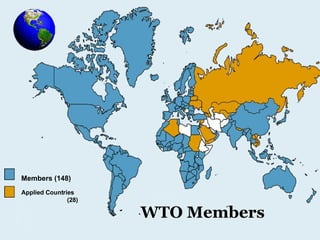
Members (148) Applied Countries  (28) WTO Members
WTO-AoA NEGOTIATIONS CREATING WEALTH FROM  FARM GATE TO FOOD PLATE
GENESIS WTO Came into existence on  1-1-1995  with the conclusion of Uruguay Round Multilateral Trade Negotiations at Marrakesh on 15th April 1994, to :  Provide common institutional framework for conduct of trade relations among members Facilitate the implementation, administration and operation of  Multilateral Trade Agreements Lay down Rules and Procedures Governing Dispute Settlement Provide Trade Policy Review Mechanism
Agreement on Agriculture (AoA) To establish a fair and market oriented agricultural trading system through substantial progressive reduction in agricultural support and protection resulting in correcting and preventing restrictions and distortions in world agricultural markets
AREAS OF COMMITMENTS Domestic  Support Market  Access Export subsidies
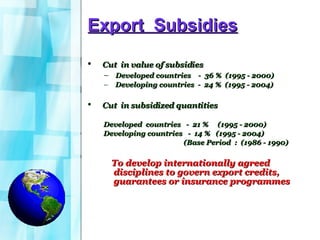
Export  Subsidies Cut  in value of subsidies Developed countries  -  36 %  (1995 - 2000) Developing countries  -  24 %  (1995 - 2004)  Cut  in subsidized quantities Developed  countries  -  21 %  (1995 - 2000)  Developing countries  -  14 %  (1995 - 2004) (Base Period  :  (1986 - 1990)  To develop internationally agreed disciplines to govern export credits, guarantees or insurance programmes
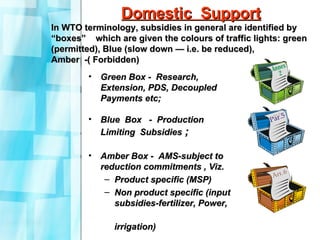
Domestic  Support In WTO terminology, subsidies in general are identified by “boxes”  which are given the colours of traffic lights: green (permitted), Blue (slow down — i.e. be reduced), Amber  -( Forbidden) Green Box -  Research, Extension, PDS, Decoupled Payments etc; Blue  Box  -  Production Limiting  Subsidies  ; Amber Box -  AMS-subject to  reduction commitments , Viz. Product specific (MSP) Non product specific (input subsidies-fertilizer, Power,  irrigation)
Anomaly in WTO Provision   Developed countries still continue to heavily subsidize their agriculture. As per the World Trade Organisation provision these countries were required to reduce their subsidy considerably, so that the developing countries could get a chance to export their products to these countries.
RESULTS OF THESE ANOMALIES There were three problems with the AoA – it ignored the realities of global agricultural markets,  it reinforced industrial agriculture at the expense of sustainable agriculture, and  It failed to acknowledge the widely differing needs of countries at different levels of development.
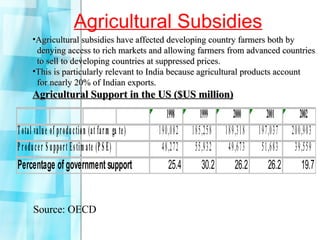
Agricultural Subsidies Source: OECD Agricultural subsidies have affected developing country farmers both by  denying access to rich markets and allowing farmers from advanced countries  to sell to developing countries at suppressed prices. This is particularly relevant to India because agricultural products account for nearly 20% of Indian exports. Agricultural Support in the US ($US million)
INDIA SEEKS Protecting our food and livelihood security by having sufficient flexibility for domestic policy measures. Protecting domestic producers from the surge in imports or significant decline in import prices. Substantial reduction in export subsidies and domestic support to agriculture in the developed countries for greater market access to products of developing countries. Finally, a more equitable &  fair  trading  framework  for  agricultural commodities  MARKET ACCESS ISSUES CAN NOT BE SEEN IN ISOLATION TO SUBSIDY REGIME
Domestic support The negotiations on domestic support should include the following elements: Substantial reductions in all forms of domestic support should be undertaken by the developed countries. Subsidies excluded from the discipline introduced by the AoA, i.e. those appearing in the “Blue Box” and the “Green Box”, need to be re-assessed, particularly from the point of view of their influence on production.    The Peace Clause “Article 13 (a) and 13 (b)” shall not be extended beyond implementation period.
Export Subsidies The negotiations on export subsidies should include the following issues: Countries using export subsides should phase out this form of  farm support within two years of implementation of the  revised disciplines to be followed by countries in the  agricultural sector.        Export subsidies discipline should include all forms of  spending  that enhances the capacities of exporters to  increase trade, e.g. export credit, guarantees and  insurance programmes.        The Peace Clause “Article 13 (c)” shall not be extended beyond implementation period.
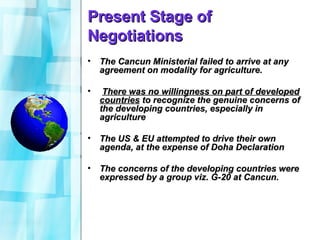
Present Stage of Negotiations The Cancun Ministerial failed to arrive at any agreement on modality for agriculture. There was no willingness on part of developed countries  to recognize the genuine concerns of the developing countries, especially in agriculture The US & EU attempted to drive their own agenda, at the expense of Doha Declaration The concerns of the developing countries were expressed by a group viz. G-20 at Cancun.
Why much of the focus must be on agriculture…   Even though it provides less than 4% of global GDP  and 9% of int’l merchandise trade OECD manufacturing tariffs have fallen by 9/10ths over the past 60 years to <4%, while agricultural protection has risen, Agric. applied (bound) tariffs  now average nearly 5 (10) times manufactures tariffs globally Also, the vast majority of the world’s poor rely on farming for a living, and may be hurt by agric  protection policies of rich countries
Why focus on agriculture True, the harm to some DC farmers from  rich-country agricultural protection is reduced via non-reciprocal preference schemes such  as the ACP’s Lome Agreement, EBA and  AGOA  But those schemes contravene the core WTO rule of non-discrimination In particular, they exclude numerous populous D.C’s (e.g. Brazil, China, India, Indonesia, Pakistan, Vietnam) Hence they may harm more poor farmers (through trade diversion) than they help.
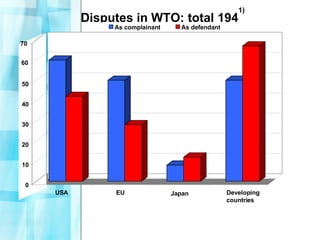
0 10 20 30 40 50 60 70 USA EU Japan Developing countries Disputes in WTO: total 194 1) As complainant As defendant
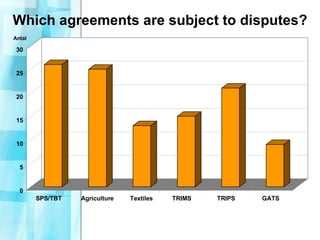
0 5 10 15 20 25 30 Antal SPS/TBT Agriculture Textiles TRIMS TRIPS GATS Which agreements are subject to disputes?
OUR RECOMMENDATIONS Developing countries cannot afford to be silent spectators.  THE DEVELOPING COUNTRIES MUST COLLECTIVELY TAKE A STAND ON THE FOLLOWING:- &quot;Zero-tolerance&quot; on agricultural subsidies Restoration of Quantitative Restriction: Multilateral Agreement Against Hunger:
WHAT WE ALL NEED TO REMEMBER IS THE FACT THAT  : Pre-Independence India suffered repeated famines, drought and food shortages. But following the Green Revolution in the ’60s, yields and food stocks rose manifold. Now, 40 years later, Indian farmers have realised the follies of their tryst with intensive agriculture. Despite 70 per cent of the population being engaged in agriculture and allied activities, declining food grain production and access to food remain the two biggest problems confronting the country. Liberalisation has made things worse: commercial crops are eating into the fertile land tracts meant for essential food grains.  And ELEVEN years after the World Trade Organisation came into existence; the anticipated gains for India from the trade liberalisation process in agriculture  are practically zero.

Presentation Wto Agriculture[1]

  • 1.
    WTO – AGRICULTUREA PROJECT COMPILED & SUBMITTED BY ANISHA DAMANIA ROLL NO 60 MONICA MALIK ROLL NO 26 SANGEETA NACHANKAR ROLL NO 29 SMITA NAIR ROLL NO 31 SAGAR KARMEKAR ROLL NO 21 VIDYA JOHN ROLL NO 16 UNDER THE GUIDANCE OF PROF SUJATA JHAMB WTO - AGRICULTURE
  • 2.
    Members (148) AppliedCountries (28) WTO Members
  • 3.
    WTO-AoA NEGOTIATIONS CREATINGWEALTH FROM FARM GATE TO FOOD PLATE
  • 4.
    GENESIS WTO Cameinto existence on 1-1-1995 with the conclusion of Uruguay Round Multilateral Trade Negotiations at Marrakesh on 15th April 1994, to : Provide common institutional framework for conduct of trade relations among members Facilitate the implementation, administration and operation of Multilateral Trade Agreements Lay down Rules and Procedures Governing Dispute Settlement Provide Trade Policy Review Mechanism
  • 5.
    Agreement on Agriculture(AoA) To establish a fair and market oriented agricultural trading system through substantial progressive reduction in agricultural support and protection resulting in correcting and preventing restrictions and distortions in world agricultural markets
  • 6.
    AREAS OF COMMITMENTSDomestic Support Market Access Export subsidies
  • 7.
    Export SubsidiesCut in value of subsidies Developed countries - 36 % (1995 - 2000) Developing countries - 24 % (1995 - 2004) Cut in subsidized quantities Developed countries - 21 % (1995 - 2000) Developing countries - 14 % (1995 - 2004) (Base Period : (1986 - 1990) To develop internationally agreed disciplines to govern export credits, guarantees or insurance programmes
  • 8.
    Domestic SupportIn WTO terminology, subsidies in general are identified by “boxes” which are given the colours of traffic lights: green (permitted), Blue (slow down — i.e. be reduced), Amber -( Forbidden) Green Box - Research, Extension, PDS, Decoupled Payments etc; Blue Box - Production Limiting Subsidies ; Amber Box - AMS-subject to reduction commitments , Viz. Product specific (MSP) Non product specific (input subsidies-fertilizer, Power, irrigation)
  • 9.
    Anomaly in WTOProvision Developed countries still continue to heavily subsidize their agriculture. As per the World Trade Organisation provision these countries were required to reduce their subsidy considerably, so that the developing countries could get a chance to export their products to these countries.
  • 10.
    RESULTS OF THESEANOMALIES There were three problems with the AoA – it ignored the realities of global agricultural markets, it reinforced industrial agriculture at the expense of sustainable agriculture, and It failed to acknowledge the widely differing needs of countries at different levels of development.
  • 11.
    Agricultural Subsidies Source:OECD Agricultural subsidies have affected developing country farmers both by denying access to rich markets and allowing farmers from advanced countries to sell to developing countries at suppressed prices. This is particularly relevant to India because agricultural products account for nearly 20% of Indian exports. Agricultural Support in the US ($US million)
  • 12.
    INDIA SEEKS Protectingour food and livelihood security by having sufficient flexibility for domestic policy measures. Protecting domestic producers from the surge in imports or significant decline in import prices. Substantial reduction in export subsidies and domestic support to agriculture in the developed countries for greater market access to products of developing countries. Finally, a more equitable & fair trading framework for agricultural commodities MARKET ACCESS ISSUES CAN NOT BE SEEN IN ISOLATION TO SUBSIDY REGIME
  • 13.
    Domestic support Thenegotiations on domestic support should include the following elements: Substantial reductions in all forms of domestic support should be undertaken by the developed countries. Subsidies excluded from the discipline introduced by the AoA, i.e. those appearing in the “Blue Box” and the “Green Box”, need to be re-assessed, particularly from the point of view of their influence on production.   The Peace Clause “Article 13 (a) and 13 (b)” shall not be extended beyond implementation period.
  • 14.
    Export Subsidies Thenegotiations on export subsidies should include the following issues: Countries using export subsides should phase out this form of farm support within two years of implementation of the revised disciplines to be followed by countries in the agricultural sector.       Export subsidies discipline should include all forms of spending that enhances the capacities of exporters to increase trade, e.g. export credit, guarantees and insurance programmes.       The Peace Clause “Article 13 (c)” shall not be extended beyond implementation period.
  • 15.
    Present Stage ofNegotiations The Cancun Ministerial failed to arrive at any agreement on modality for agriculture. There was no willingness on part of developed countries to recognize the genuine concerns of the developing countries, especially in agriculture The US & EU attempted to drive their own agenda, at the expense of Doha Declaration The concerns of the developing countries were expressed by a group viz. G-20 at Cancun.
  • 16.
    Why much ofthe focus must be on agriculture… Even though it provides less than 4% of global GDP and 9% of int’l merchandise trade OECD manufacturing tariffs have fallen by 9/10ths over the past 60 years to <4%, while agricultural protection has risen, Agric. applied (bound) tariffs now average nearly 5 (10) times manufactures tariffs globally Also, the vast majority of the world’s poor rely on farming for a living, and may be hurt by agric protection policies of rich countries
  • 17.
    Why focus onagriculture True, the harm to some DC farmers from rich-country agricultural protection is reduced via non-reciprocal preference schemes such as the ACP’s Lome Agreement, EBA and AGOA But those schemes contravene the core WTO rule of non-discrimination In particular, they exclude numerous populous D.C’s (e.g. Brazil, China, India, Indonesia, Pakistan, Vietnam) Hence they may harm more poor farmers (through trade diversion) than they help.
  • 18.
    0 10 2030 40 50 60 70 USA EU Japan Developing countries Disputes in WTO: total 194 1) As complainant As defendant
  • 19.
    0 5 1015 20 25 30 Antal SPS/TBT Agriculture Textiles TRIMS TRIPS GATS Which agreements are subject to disputes?
  • 20.
    OUR RECOMMENDATIONS Developingcountries cannot afford to be silent spectators. THE DEVELOPING COUNTRIES MUST COLLECTIVELY TAKE A STAND ON THE FOLLOWING:- &quot;Zero-tolerance&quot; on agricultural subsidies Restoration of Quantitative Restriction: Multilateral Agreement Against Hunger:
  • 21.
    WHAT WE ALLNEED TO REMEMBER IS THE FACT THAT : Pre-Independence India suffered repeated famines, drought and food shortages. But following the Green Revolution in the ’60s, yields and food stocks rose manifold. Now, 40 years later, Indian farmers have realised the follies of their tryst with intensive agriculture. Despite 70 per cent of the population being engaged in agriculture and allied activities, declining food grain production and access to food remain the two biggest problems confronting the country. Liberalisation has made things worse: commercial crops are eating into the fertile land tracts meant for essential food grains. And ELEVEN years after the World Trade Organisation came into existence; the anticipated gains for India from the trade liberalisation process in agriculture are practically zero.