Reading Comprehension
Techniques
By
Dr. Anjibabu
Dr.Anjibabu
Reading Comprehension Tips
• Suggestions for reading non-fiction and for
completing reading comprehension tests
Dr.Anjibabu
Reading Strategies Vary
There are many strategies to help with reading
comprehension.
Dr.Anjibabu
How To Pick a Strategy?
• • Which strategies you use will depend on
WHAT you are reading and WHY you are
reading.
Dr.Anjibabu
Non Fiction Reading
• • This presentation focuses on non-fiction
and assumes a testing situation.
Dr.Anjibabu
Overall strategy
When reading non-fiction, you generally want
to read it quickly through one time to get the
overall idea of the text – a technique called
skimming.
Dr.Anjibabu
Purpose of Skimming
Do not try to understand all the words or the
information. Pay attention to any subheadings
or pictures/diagrams.
Dr.Anjibabu
Reading Comprehension Test
If it is a reading comprehension test, read the
questions and find the answers.
• Sometimes, reading the questions first will
help.
Dr.Anjibabu
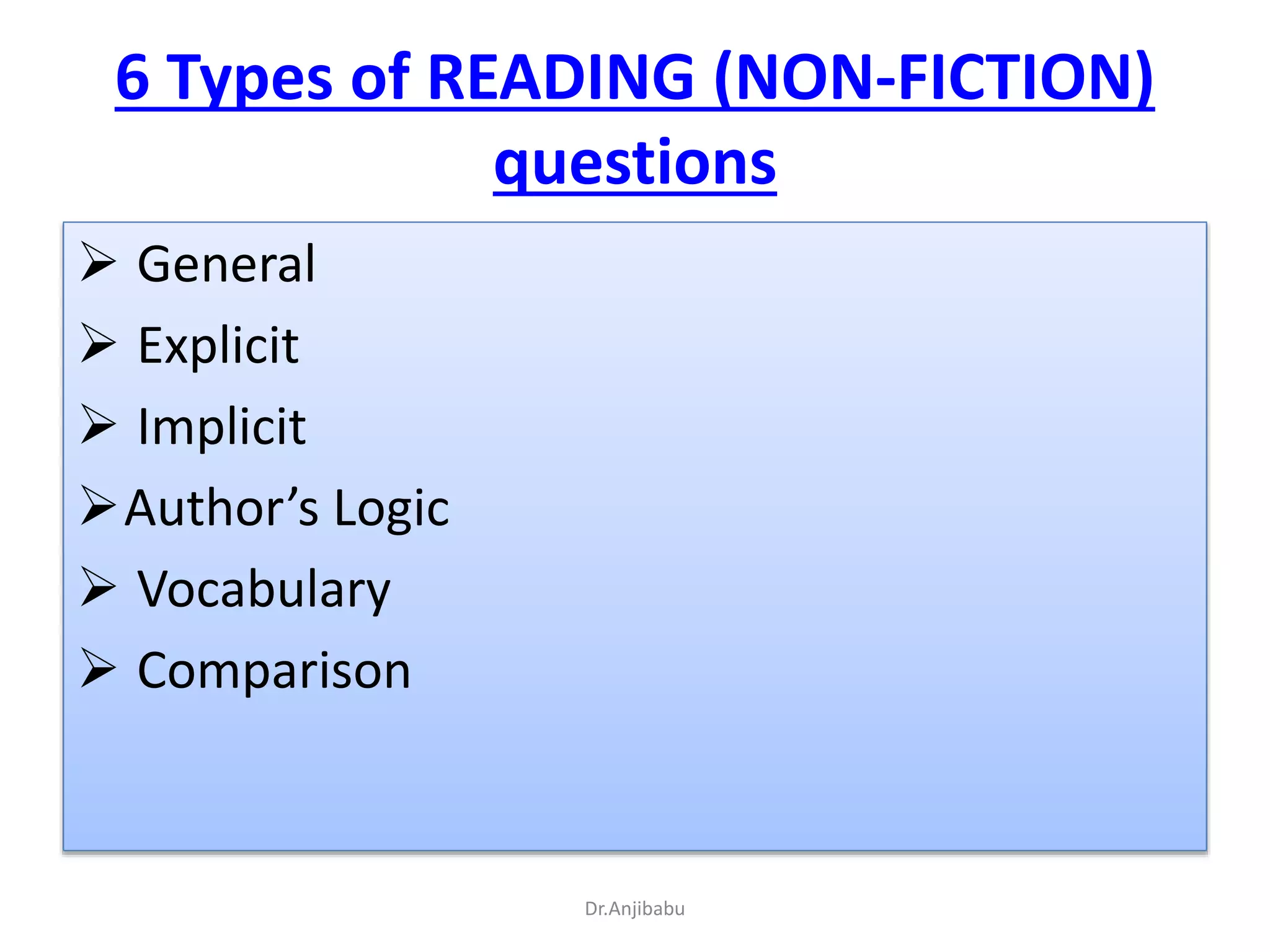
6 Types of READING (NON-FICTION)
questions
 General
 Explicit
 Implicit
Author’s Logic
 Vocabulary
 Comparison
Dr.Anjibabu
1. General Questions
• General questions usually involved: • Finding
the “main idea” of the passage • Related to
the title
Dr.Anjibabu
General Questions cont.
 Answer is found quickly within the passage
 Usually in the first OR last paragraph
 Refer to the title to determine main idea
Dr.Anjibabu
• General questions cont. • Questions may ask
things such as: • The main idea of this
selection is… • What is another possible title
for this article? • The third paragraph is mainly
about…
Dr.Anjibabu
2. Explicit Questions
• • “Explicit” means that it is “obvious”. These
questions are also known as “fact-based”
questions. • Answer is found quickly within
the passage.
Dr.Anjibabu
Explicit continued…
• Choose the KEY word/s in the question and
then scan the passage for those key words.
• Usually the answer is in that sentence or the
line above or below the key words.
Dr.Anjibabu
Explicit continued…
Examples of “explicit” types of questions:
 Who does the author describe as shy?
What was the reason Sam did not like to eat
green eggs and ham?
 When did Wendy stop caring about her
education?
Dr.Anjibabu
3. Implicit Questions
“Implicit” means that it is an inference
question.
• You have to make an educated guess based on
the “clues” to the question
. • You have to “read between the lines”
Dr.Anjibabu
Implicit continued •
• Inference or Implicit Questions ask the reader
to understand ideas that are not directly
stated in the text.
• Don’t assume facts not in the reading – rather
infer what the author is saying about what is
there.
Dr.Anjibabu
Implicit continued
• Readers must infer underlying meaning by
using their own knowledge, ideas, and
judgment. • You can’t infer unless you
understand the main idea & facts, so answer
those questions first.
Dr.Anjibabu
4. Author’s Logic
• These are questions that ask you to put
yourself in the author’s “shoes”
Dr.Anjibabu
Author’s Logic cont.
• • These questions ask about: • Tone •
Purpose • What would go in another
paragraph or chapter? • What sources were
used or could have been used? • What was
the inspiration for this piece?
Dr.Anjibabu
Author’s Logic cont.
• • Answering these questions usually requires
you to • Understand the main idea to
determine purpose, audience, or inspiration
Dr.Anjibabu
Author’s Logic Strategies
Read the first and last paragraphs to decide
“what would come next”
Look at word choice (big words, casual words,
1st or 3rd person) to determine TONE
Dr.Anjibabu
• 5. Questions about Vocabulary • Some
questions might ask you to choose the
synonym of a word from the passage.
Dr.Anjibabu
Connotation
 If you don’t know the meaning of the word,
decide if it sounds negative or positive
 If the word sounds positive, go to the answer
choices and eliminate the negative choices. A
positive sounding word will never have a
negative synonym. (and vice versa)
 It helps to recognize negative prefixes such as
dis-, mis-, un-, etc.
Dr.Anjibabu
Vocabulary Continued
Questions might ask you understand the word
in context of a sentence.
Dr.Anjibabu
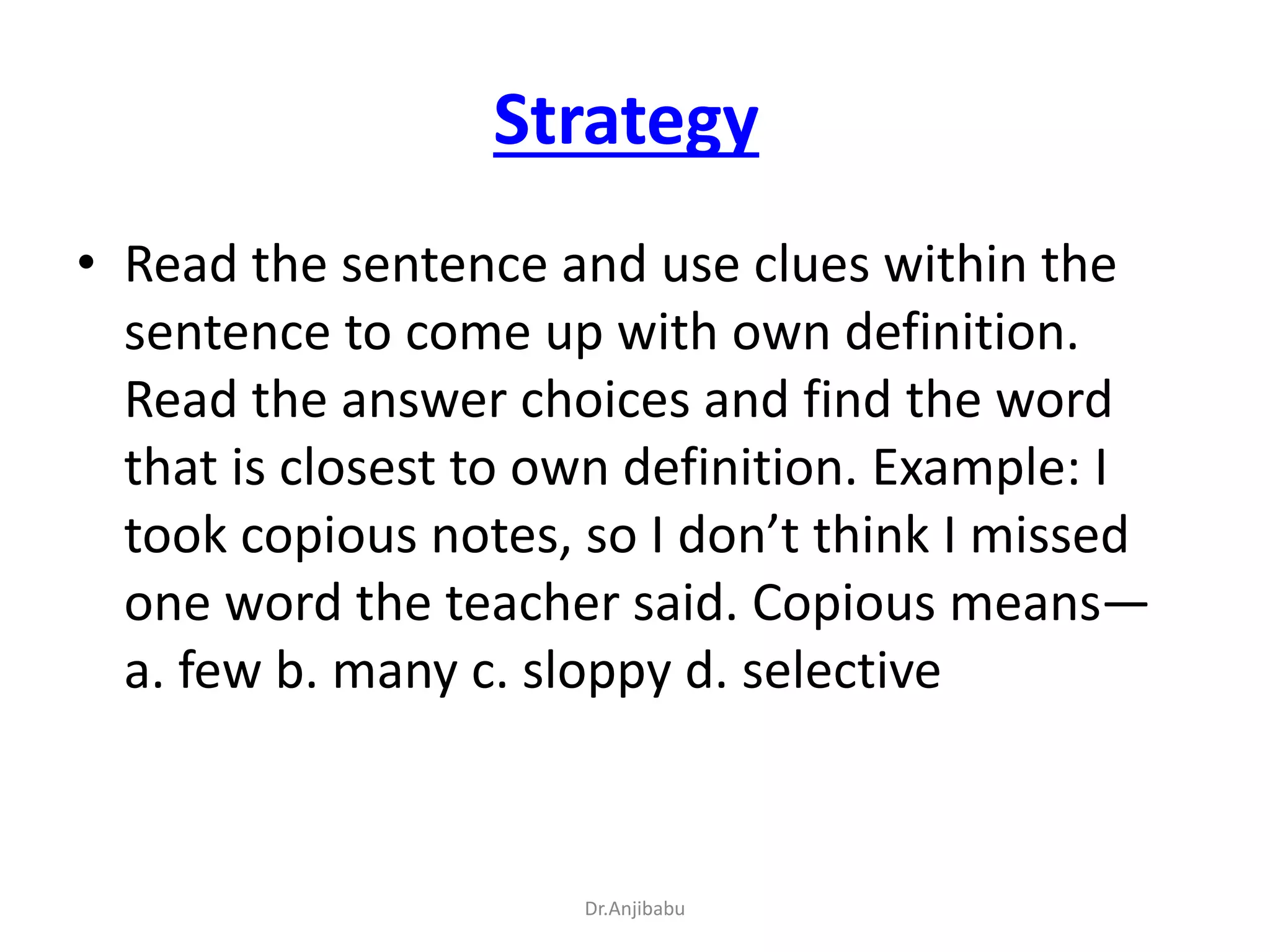
Strategy
• Read the sentence and use clues within the
sentence to come up with own definition.
Read the answer choices and find the word
that is closest to own definition. Example: I
took copious notes, so I don’t think I missed
one word the teacher said. Copious means—
a. few b. many c. sloppy d. selective
Dr.Anjibabu
Vocabulary continued
 Questions might ask you to demonstrate that
you understand multiple meanings of a word.
 You can often figure out vocabulary questions
by finding and then reading the sentence in
which the word is located.
Dr.Anjibabu
6. Comparison Questions
These are usually only used when you are
reading two texts.
These questions ask you to look for similarities
between the texts or explain differences.
Dr.Anjibabu
Comparison Continued
 It might be one of the other types of
questions but about both texts, such as
comparing the sources used in the two texts
Dr.Anjibabu
A review:
• • Read the passage quickly to determine the
main idea. • Read the questions and decide
what type of question is being asked and the
best way to answer. • Apply the strategies
Dr.Anjibabu
• Questions
Dr.Anjibabu

Reading comprehension techniques

  • 1.
  • 2.
    Reading Comprehension Tips •Suggestions for reading non-fiction and for completing reading comprehension tests Dr.Anjibabu
  • 3.
    Reading Strategies Vary Thereare many strategies to help with reading comprehension. Dr.Anjibabu
  • 4.
    How To Picka Strategy? • • Which strategies you use will depend on WHAT you are reading and WHY you are reading. Dr.Anjibabu
  • 5.
    Non Fiction Reading •• This presentation focuses on non-fiction and assumes a testing situation. Dr.Anjibabu
  • 6.
    Overall strategy When readingnon-fiction, you generally want to read it quickly through one time to get the overall idea of the text – a technique called skimming. Dr.Anjibabu
  • 7.
    Purpose of Skimming Donot try to understand all the words or the information. Pay attention to any subheadings or pictures/diagrams. Dr.Anjibabu
  • 8.
    Reading Comprehension Test Ifit is a reading comprehension test, read the questions and find the answers. • Sometimes, reading the questions first will help. Dr.Anjibabu
  • 9.
    6 Types ofREADING (NON-FICTION) questions  General  Explicit  Implicit Author’s Logic  Vocabulary  Comparison Dr.Anjibabu
  • 10.
    1. General Questions •General questions usually involved: • Finding the “main idea” of the passage • Related to the title Dr.Anjibabu
  • 11.
    General Questions cont. Answer is found quickly within the passage  Usually in the first OR last paragraph  Refer to the title to determine main idea Dr.Anjibabu
  • 12.
    • General questionscont. • Questions may ask things such as: • The main idea of this selection is… • What is another possible title for this article? • The third paragraph is mainly about… Dr.Anjibabu
  • 13.
    2. Explicit Questions •• “Explicit” means that it is “obvious”. These questions are also known as “fact-based” questions. • Answer is found quickly within the passage. Dr.Anjibabu
  • 14.
    Explicit continued… • Choosethe KEY word/s in the question and then scan the passage for those key words. • Usually the answer is in that sentence or the line above or below the key words. Dr.Anjibabu
  • 15.
    Explicit continued… Examples of“explicit” types of questions:  Who does the author describe as shy? What was the reason Sam did not like to eat green eggs and ham?  When did Wendy stop caring about her education? Dr.Anjibabu
  • 16.
    3. Implicit Questions “Implicit”means that it is an inference question. • You have to make an educated guess based on the “clues” to the question . • You have to “read between the lines” Dr.Anjibabu
  • 17.
    Implicit continued • •Inference or Implicit Questions ask the reader to understand ideas that are not directly stated in the text. • Don’t assume facts not in the reading – rather infer what the author is saying about what is there. Dr.Anjibabu
  • 18.
    Implicit continued • Readersmust infer underlying meaning by using their own knowledge, ideas, and judgment. • You can’t infer unless you understand the main idea & facts, so answer those questions first. Dr.Anjibabu
  • 19.
    4. Author’s Logic •These are questions that ask you to put yourself in the author’s “shoes” Dr.Anjibabu
  • 20.
    Author’s Logic cont. •• These questions ask about: • Tone • Purpose • What would go in another paragraph or chapter? • What sources were used or could have been used? • What was the inspiration for this piece? Dr.Anjibabu
  • 21.
    Author’s Logic cont. •• Answering these questions usually requires you to • Understand the main idea to determine purpose, audience, or inspiration Dr.Anjibabu
  • 22.
    Author’s Logic Strategies Readthe first and last paragraphs to decide “what would come next” Look at word choice (big words, casual words, 1st or 3rd person) to determine TONE Dr.Anjibabu
  • 23.
    • 5. Questionsabout Vocabulary • Some questions might ask you to choose the synonym of a word from the passage. Dr.Anjibabu
  • 24.
    Connotation  If youdon’t know the meaning of the word, decide if it sounds negative or positive  If the word sounds positive, go to the answer choices and eliminate the negative choices. A positive sounding word will never have a negative synonym. (and vice versa)  It helps to recognize negative prefixes such as dis-, mis-, un-, etc. Dr.Anjibabu
  • 25.
    Vocabulary Continued Questions mightask you understand the word in context of a sentence. Dr.Anjibabu
  • 26.
    Strategy • Read thesentence and use clues within the sentence to come up with own definition. Read the answer choices and find the word that is closest to own definition. Example: I took copious notes, so I don’t think I missed one word the teacher said. Copious means— a. few b. many c. sloppy d. selective Dr.Anjibabu
  • 27.
    Vocabulary continued  Questionsmight ask you to demonstrate that you understand multiple meanings of a word.  You can often figure out vocabulary questions by finding and then reading the sentence in which the word is located. Dr.Anjibabu
  • 28.
    6. Comparison Questions Theseare usually only used when you are reading two texts. These questions ask you to look for similarities between the texts or explain differences. Dr.Anjibabu
  • 29.
    Comparison Continued  Itmight be one of the other types of questions but about both texts, such as comparing the sources used in the two texts Dr.Anjibabu
  • 30.
    A review: • •Read the passage quickly to determine the main idea. • Read the questions and decide what type of question is being asked and the best way to answer. • Apply the strategies Dr.Anjibabu
  • 31.