A market review from
Quoted
Welcome.
As the new year gets under way, there are many pundits predicting
choppy waters to come for investors having to navigate through greater
volatility than ever before. As always we are here to guide you along the
way as markets move or as your requirements change.
The forthcoming weeks and months of the political scene will prove both
fascinating and exciting, leading up to the UK General Election in May.
The addition of UKIP as a more serious contender into the fray brings
a new dimension to the list of possible scenarios post-election, making
predictions for the year even more difficult than usual.
Continuing doubt over the strength of the global economic recovery
coupled with a stream of distressing news from the world’s trouble spots
represent significant further constraints to positive outlook of markets in general.
Here at Walker Crips, our expansion continues since our last edition. Following the addition of two
Investment Managers in Birmingham, we announced the launch of an office in Truro, Cornwall which
will be opening soon manned by an established team with strong local links and knowledge. In our
London head office, the influx of advisers arriving with their own clients is expected to continue and
consequently approximately 47% additional floor space has been secured at our current location in
Bunhill Row, EC1.
This is now our 11th
edition of Quoted magazine which we hope you find both relevant and
stimulating. It is intended and written mainly for clients, but also our wide range of contacts and
friends. I thank all our contributors who regularly convert their thoughts into sensible prose for your
benefit!
Not forgetting the impact of the Budget driven pension reform, the cricket and rugby World Cups on
the horizon, it should be a year to remember in many ways.
Whatever happens, we will still be here aged 100 years and serving clients!
Rodney Fitzgerald
Chief Executive Officer
4)
Interest Rates
Russell Dobbs’ take on recent events surrounding
interest rates.
6)
21)
America
Mark Rushton analyses the strength of the Dollar.
12)
Traded Options
Colin Bramble explains how Traded Options could be
used in your portfolio.
15)
Europe & UK
Mark Rushton talks Europe and the United Kingdom.
18)
The Forecast
We ask the experts what they see ahead.
22)
Market Update
A seasonal overview from Nigel Skelton.
8)
World Barometer
Any changes in economic pressure on the way?
“All is
in flux,
nothing
stays still.”
Heraclitus
535 BC - 475 BC
Japan
Peter finds positives in Japan’s economy.
So far QE has helped ramp up an equity market
that was in any case cheap. On a price to cash flow
basis of 8, it is still cheaper than other developed
markets – average 11 (source BCA Research). It
still amazes me that: starting with the US,
ramping up equity prices above natural levels is
supposed to produce rising consumer spending. I
thought enough academic work, at any rate re the
US, had shown the ‘wealth effect’ of equities to be
minimal – unlike house prices that make houses
handy ATMs. This is especially the case in Japan
as hardly anyone holds any or many equities.
I’m not sure, also, that a 1930s’ style
competitive devaluation race adds much to the
benefit of mankind. Currently Japan has its nose
in front in this game – and, to be fair, the US has
eased off the monetary accelerator, although not
totally (repressed interest rates). The yen is now
well below even its 1970 level in ‘real’ effective
terms. Why? It is likely that, unless this changes,
the pre-tsunami routine trade surplus will
re-build. As mentioned before, however, there is
a negative effect on the so-called need for the
Japanese to ‘consume’ more (Why should they,
if they don’t want to?).
It is worth remembering again that, when
deflation and population growth adjustments are
factored in, which is what counts on any ‘real
GDP’ assessment, Japan has been doing fine (bar
the post tsunami shock). In fact, it has been better
than the US, since 2000. The ‘lost generation’
mantra is plainly rot (I prefer my former
suggestion of a US lost generation!). Further
examples of this are:
1) Unemployment barely exists;
2) Prime working age population labour
participation rate is above the ‘flexible’ US
level at 82% (the US rate is 77%).
3) How many commentators realise that
female participation at 72% exceeds the US
at 70%? (Source: BCA Research)
4) As for the trumpeted deflation. In 15 years
the CPI has fallen only 4%.
Why the need for this wild policy wrenching?
One immediate result is to hit real incomes via
imported inflation – hardly conducive to
encouraging Mr and Mrs Takahashi to spend
more. And people get along together riotlessly
and peaceably. Again, compare this to US society.
What’s not to like?
Yes, yes, yes, there is the 140% of GDP net
government debt heap and the 6% of GDP deficit.
So?
4
J A P A N
Peter Bennett
Peter finds positives
in Japan’s economy.
Plenty for the Japenese to celebrate?
Credit: izamon/
Shutterstock.com
Someone with better understanding than I of
the intricacies of policy-making could surely
think a bit creatively about these facts:
1) The private sector net liquid surplus far
exceeds the accumulated government debt.
Which is nearly all held in Japan. One
pocket to another. The FT suggests
personal savings at $16 trillion (Ed: this
is the same as the US GDP).
2) The personal sector pays little tax – and
even the next VAT hike, only up to an
internationally still modest 10%, seems to
be on hold.
3) The corporate sector continues to print
real genuine money in cascades. So there is
scope there.
4) At the end of the 1990s’ recession I wrote
to the then PM (ok, no reply!) suggesting
the use, as a last resort, of date-limited
spending vouchers. This sort of
money-printing addresses the supposed
need for consumption without all the
distorting effects of wild monetary policy
– i.e. QE – not perfect, but inflicts the
least damage. Having dished out enough,
you could then raise VAT to, say,
Europe-ish levels, which alone would stop
the deficit. A modest soupcon, as it were,
of eau de vie (vouchers) would be in order
because, unlike elsewhere, Japan these
days is not a financial alcoholic. At least
not yet.
5) A small increase in personal taxation
could then, plus the extra VAT and given
the stimulus from spending vouchers,
produce a government surplus. Also,
proposed corporate tax cuts could wait.
One way or another the corporate sector
will have to chip in.
In fact aging work forces tend not to be big
spenders – bar their spending on health. I would
have thought the desired level of inflation might
cause them to save more as a precaution. Lastly, if
5
push comes to shove, the Japanese government
could increase the retirement age (a message
with strong application all over the developed
world). Overall, if one is going to be a bit risqué
and unconventional (and why not – it makes for
an interesting life?) then do so incurring least
damage i.e. not QE. After all, the total financial
position of Japan is that of an immensely strong
creditor. It is merely that the pieces on the
chess-board, so to speak, are in the wrong places.
The BOJ really ‘has got your back’ as Wall
St equity investors have become accustomed to
saying about the Fed. The ‘Greenspan put’
reincarnated. Or so they all say. Such unanimity
scares me. The new ‘instructions’ to the
Government Pension Investment Fund (GPIF
– the $1.4 trillion public pension fund) to buy a
lot more equities adds genuine icing to that
particular cake. And the world-beating cash
flow position of Japanese corporate makes rights
issues seem a low priority. More likely continued
strong dividend increases.
Of course, this is all now the conventional
wisdom, i.e. pretty useless information.
From the investment point of view a trend is
a trend till it stops; and, though no longer
‘absolutely’ cheap, Japanese equities are
‘relatively’ cheap (to other developed markets
– notably the US). Further, as a percentage of
operating cash flow, Japanese corporates only
pay out to shareholders 12%, Europe 42%, US
89%! So there is shareholder friendly scope there
– underlined by the introduction of the 400
share ‘shareholder-friendly’ market Index. And,
per Andrew Smithers, Japanese corporate net
debt is half that of the US. Further, over the last
three years corporate (understated?) profits have
been rising three times faster than (overstated?)
US. I know where I prefer to put money.
A modest commitment is still justified.
Surely even the Monetary Policy Committee’s
two dyed-in-the-wool hawks, Ian McCafferty
and Martin Weale, must be questioning their
hard-line view on interest rates after the recent
inflation figures. Of course, every economist
has a different slant on the subject but against
the current background it is difficult to see any
justification whatsoever for higher interest rates,
so their next prognostications on the subject
will be interesting to hear.
The downward pressure on our inflation
figures is being exerted from a number of
directions and none is going to reverse any
time soon as far as I can see. The most visible,
oil, has fallen precipitately as the Saudis refuse
to cut back on their production and the US
frackers seem of similar mind, and commodities
across the board have begun to descend again
as Chinese economic growth has slipped below
target. This slide has rekindled worries about
global growth which further undermines
commodity prices, and which we can view
as either virtuous or vicious, depending on
how we look at it – great from a consumer’s
standpoint, not so good from a resource
investor’s point of view.
The constant warnings throughout last
year about Euro deflation can now be seen as
entirely justified. According to Eurostat, the
Eurozone actually suffered average price falls
of -0.2% over the year and the decline in some
member states is much worse. The UK is still
a considerable importer of goods from Europe
and those goods have been, and are going to
continue, getting cheaper. The advocate general
to the European Court of Justice has, this week,
advised that European Central Bank QE by
its prospective policy of Outright Monetary
Transactions would be legitimate so, unless the
ECJ defies that advice, which seems unlikely,
the ECB should proceed at some point soon. As
per previous blogs, it will probably be too little
and is already too late, but it is driving the euro
lower versus most currencies, including sterling,
making those imports cheaper by the day.
We have even imported European discount
supermarkets themselves, in the form of
Aldi and Lidl, to perpetuate the deflationary
pressure. They have set off a price war that our
own traditional supermarket groups are fighting
to keep up with and the latter are engaging in
their own price war at their petrol outlets.
Six months ago the MPC hawks warned
of a dangerous house price bubble, pointing
to the increase in the average house price as
being unsustainable. However, these figures,
as I pointed out on several occasions, were
completely distorted by the mammoth increases
in London prices, and were not representative
of the rest of the country. Interest rates,
thankfully, remained untouched but the
government bowed to pressure by introducing
6
BLOGWATCH
I N T E R E S T R A T E S
Russell Dobbs’ take on recent
events surrounding interest rates.
other measures to cool a housing market that,
in reality, had barely got going. In short, there
was no housing bubble outside of London, and
inside it has now been killed by policies targeted
at the super-wealthy international buyers and,
no doubt, Russian oligarchs suffering as a result
of sanctions against that country.
All this is likely to see UK inflation remain at
a negligible level for the foreseeable future and,
therefore, provide no reason to raise interest
rates. In fact, as our companies try to remain
competitive and grow their businesses in a
struggling global economy, such a move would
be completely counter-productive. My last
comments on UK interest rates anticipated no
increase this side of the general election in May.
I believe events have conspired to push any
such increase back considerably further. When
Mark Carney first took the hot seat at the
BoE, he indicated that interest rates might not
need to rise until 2016, before bowing to the
more hawkish commentators and shortening
his horizon. He must now wish he’d stood his
ground because I doubt we’ll see any reason to
raise rates this year.
7
Will we see rate rises from the BoE in 2015?
M A R K E T U P D A T E
Nigel Skelton reviews the Global market and the
conclusion is not, ‘How long is a piece of string..?’
SEASONAL OUTLOOK
As the calendar year 2014 drew to a close
the benign summer conditions were a distant
memory as unexpected events and increasing
volatility took centre stage.
The weakness in global commodity prices
was a feature of the final quarter, with the
falling price of crude oil, in particular, making
many headlines and seemingly being a major
factor in causing global stock markets to fall
sharply, but subsequently recover (again) in
December. However, the price of crude oil has
continued its downward spiral. In December
2014 the UK’s benchmark FTSE 100 Index
fell an astonishing 8.3% over the course of
just six trading days from 6743 on Friday 5th
December to 6182 on Monday 15th December.
Almost as quickly as it fell, the following
seven trading days leading up to and including
Christmas Eve witnessed the usual, so called,
“Santa Rally” which saw the Index climb some
427 points to see in Christmas Day at 6609,
representing a 6.9% increase from its nadir on
15th December. The Index therefore posted a
0.9% decrease over the course of the quarter
to close the calendar year at 6566. Finally, the
FTSE100 had recorded a negative return of
-2.7% for the 2014 year as a whole.
At a sector level the divergence between the
winners and losers has been quite marked with
food retailers and not surprisingly mining
stocks under severe pressure throughout last
year. We will continue to keep a close eye on
these two sectors, together with the oil & gas
sector, which has also endured a torrid time.
For example, the share prices of two of the
FTSE 100 Index’s largest constituents, BP and
Royal Dutch Shell, suffered dramatic swings
during the month of December, falling by over
11% and 10% respectively during the course
of the first two weeks of the month, broadly
tracking, albeit to a lesser extent, the price of
WTI Crude Oil, which fell by more than 16%
over the same period. However, certain sectors
benefited from growing investor appetite for
security and increasing income and market
dynamics as interest rate rise expectations
diminished. The UK-listed utility companies
are a prime example of this, with the large-cap
water companies United Utilities and Severn
Trent seeing their share prices rise by 36.2%
and 17.7% respectively over the year. When
combined with gross dividend yields in excess
of 4.0% each, this ensured total returns for
the year of an astonishing 40.0% and 20.0%
respectively.
Examples of positive sector performance for
2014 included (generally) utilities (quasi bond
behaviour) and life assurers. As cost cutting
measures have probably reached a zenith across
most leading companies we would, once again,
reiterate that merger and acquisition (M&A)
activity may well be a growing feature of
2015 as companies try to grow via bid activity
and the subsequent economies of scale, cost
cutting abilities, synergies etc. In fact, the
largest M&A deal of 2014 was in the insurance
sector, Aviva’s takeover of Friends Life. This
deal represents the biggest transaction in the
insurance industry in the last 15 years and
is a further sign of the generally improving
corporate landscape in the UK and beyond.
Returning to commodity prices, these are
8
widely expected to remain quite ‘soft’ for the
immediate future and possibly throughout
2015 as continued weakness in Europe and
a slowdown in China (one of the world’s
biggest consumers of a range of commodities)
are contributory factors to a ‘dampening’ of
aggregate demand. Additional factors are
(amongst others) the huge increase in supply
exacerbated by the US Shale gas revolution
and also record US harvests of certain critical
commodities such as corn and soybeans.
The Bank of England recently held its base
lending rate at 0.5% for the 70th (!) consecutive
month and consensus expectations now
point toward an increase in the second half of
2015 at the earliest (i.e. after the UK General
Election). Despite the continued (albeit
gradual) economic recovery in the UK (in
terms of GDP growth, which stands at a year
on year rate of 2.6%), the general improvement
in the unemployment rate (6.0% at the time
of writing) and the first tentative signs of
real wage growth (average earnings excluding
bonuses were up 1.6% between August-
October, versus a year earlier) the inflation
outlook remains benign. The disinflationary
environment is primarily due to a combination
of the recent strength of Sterling, the real
prospect of possible deflation in the Eurozone
and extremely weak global commodity prices
including oil. Furthermore, and despite the
low rate of unemployment, there remains some
“slack” in the labour market (e.g. people who
have jobs, but are willing to work longer hours)
and until this situation reaches the point of
exhaustion there will arguably be a lack of
significant sustained upward pressure on wage
growth, so the Bank of England’s rate-setting
committee has a degree of breathing space
before the first increase in interest rates.
Allied to these factors is the still relatively
high debt-to-income ratio in the UK, which
currently stands at approximately 110%,
according to the Bank of England. Whilst this
ratio has fallen from its 2009 peak of just over
130%, it still remains significantly higher than
the approximate 80% level at which it stood for
much of the 1990s.
The recent slight slowdown in the UK
housing market has also contributed to the
disinflationary environment. The introduction
of the Mortgage Market Review (MMR)
in April of 2014 helped to cool the market
somewhat and, despite continuing deferrals of
9
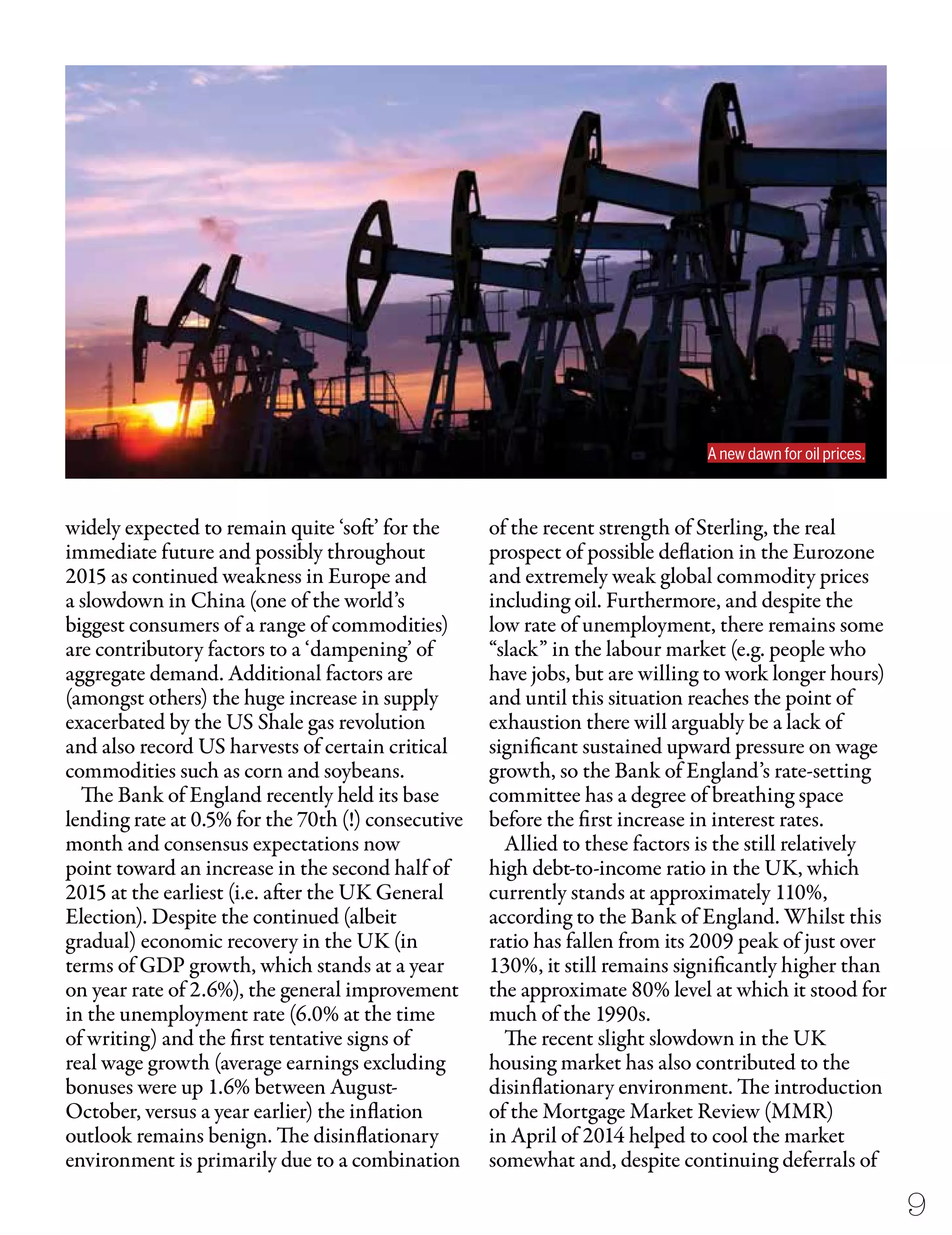
A new dawn for oil prices.
10
interest rate expectations, the housing market
appears to have sufficiently cooled to dampen
concerns of a worsening property “bubble”.
The Government even recently brought
forward its Starter Homes Initiative by six
months as it signed up sixteen national house
builders (including major quoted companies
such as Barratt Developments, Taylor Wimpey
and Bellway) to the Initiative, which offers
first-time buyers under the age of 40 a discount
of 20% on a new-build property. The Initiative
is expected to create 100,000 new homes, (the
first batch is expected to be available later this
year).
The Eurozone is still struggling, despite some
improvement in the periphery (notably Spain
and Ireland) in terms of balance sheet repair.
France and Italy have not yet deleveraged and
therefore continue to negate the improvement
evidenced in Spain and Ireland. As a spin
off, investor negativity towards the Eurozone
remains and the Swiss authorities have recently
imposed an effective interest levy/penalty
for depositors using bank accounts to shelter
funds out with the Eurozone. And the Far
East, despite huge bouts of QE (Quantitative
Easing, or ‘money printing’) in Japan, the
commercial banks have not expanded their
balance sheets and Japan’s real GDP growth
in 2015 is estimated to be only 1.3%.
The final quarter of 2014 evidenced strong
demand for relative “safe haven” Government
Bonds; the 4.75% UK Government Bond
maturing in March 2020 is now offering an
approximate gross redemption yield of only
1.3% from approximately 2.0% at the end of
Q3. Furthermore, the benchmark 10-year UK
Government Bond offers a gross redemption
yield of only approximately 1.8%.
Despite several condundra and unknown
unquantifiable outcomes for the forthcoming
calendar year e.g. General Election, economic
progress, global inflation, commodity prices,
etc., the conclusion is not, ‘How long is a piece
of string?’
1. The UK Economy. Growth in the UK has
been relatively robust (albeit after several
stimuli) and whilst there has been a slight
slowing of momentum, the general recovery
remains on track. Data shows that UK
businesses are committing more to future
investment, which is an encouraging sign as
this planning indicates that the recovery may
be more sustainable than if it were purely
consumption-led. I believe reasonable growth
in UK GDP is, once again, likely.
2. The UK Inflationary Outlook. Despite huge
bouts of “easy” monetary policy around the
globe inflation is seemingly well under control
at present. Furthermore, sustained falls and
continuing low levels for commodity prices are
fiercely negative for several countries whose
economies are dominated by commodity
production. Consequently inflation will not
be a problem in the Eurozone, where deflation
is becoming a growing concern! On the “flip
side” the UK consumer is enjoying the low
energy and low petrol/diesel prices. The low
energy prices are indirectly reducing the threat
of interest rate rises (reducing inflationary
concerns) and hence the onset of higher
mortgage payments. We anticipate modest
inflation levels to prevail throughout 2015.
“From a Global perspective
(and amongst the leading G20
nations), the US continues to
lead the way in terms of GDP
Growth, with “Uncle Sam”
returning towards impressive
former “normalised” levels
of 3.0%-3.5% per annum.”
3. Stockmarkets, Fixed Interest and
Currencies. The outlook for markets in 2015,
based on a gradually improving economic
landscape, a lack of significant inflationary
pressures and the consequent continued low
interest rate environment until later in the year
(if at all) should provide an element of support
to equity markets in the near term. There are
likely to be continued poor returns on cash
savings rates as well as relatively poor income
returns and little to no capital appreciation
on both Government Bonds and the highest
quality investment grade corporate bonds.
However, anticipated large falls across the
fixed interest spectrum may not materialise.
Whilst our £ Sterling may therefore weaken
further against the US Dollar, we see no
reason why the pound will not strengthen a
little against both the Euro and the Japanese
Yen, with both the ECB (European Central
Bank) and the BoJ (Bank of Japan) expected to
continue with their respective asset purchase
programmes whilst also maintaining their
policies of minimal interest rates.
We see continuing value amongst selective
UK equities, although the selection is,
admittedly, diminishing as economic progress
crawls higher. At a global level, we anticipate
monetary tightening in the US possibly as early
as the late Spring/early Summer. Providing any
tightening is handled in a sensible, balanced
manner we expect a reasonable outcome
although we anticipate more stockmarket
volatility throughout this year.
We see FTSE 100 to be broadly trading
between 6200-6900, albeit that volatility will
probably be more prevalent in 2015.
Finally, political uncertainty is definitely
in the ascendancy. Beleaguered Liberal
Democrats seem unlikely to have any material
say in the future leadership of the country and,
while Mr Farage continues to be seen and be
heard, a majority for either Mr Cameron or
Mr Miliband in the forthcoming General
Election is looking increasingly unlikely.
11
“We expect the US Dollar to
strengthen further over the
course of 2015 as relatively
strong GDP Growth will more
than likely lead the US Federal
Reserve to raise short-term
interest rates before most
other major Central Banks
in the second half of 2015.”
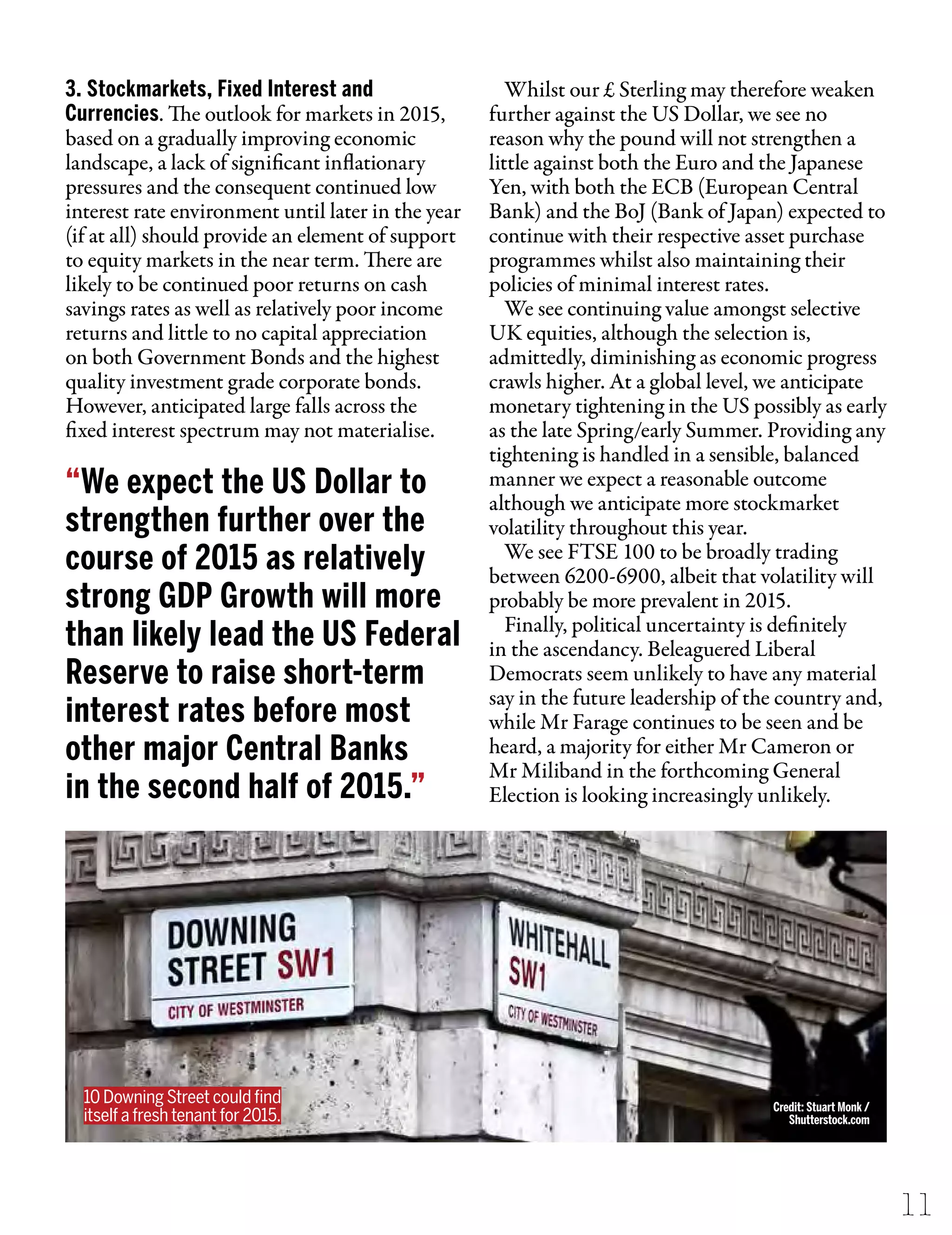
10 Downing Street could find
itself a fresh tenant for 2015.
Credit: Stuart Monk /
Shutterstock.com
12
A M E R I C A
Mark Rushton, Chief Investment Officer, analyses
the strength of the Dollar and its global effect.
UNSTOPPABLE USD.
GOOD OR BAD?
Against a background in which the most
influential central banks are adopting increasingly
divergent approaches with their own versions of
Quantitative Easing and in which weaker global
demand has led to the oil price retreat and lower
commodity prices, the US Dollar has continued
to rise. It has been helped up by a combination of
risk aversion and a relatively strong US economy.
The softness in emerging market currencies echoes
with the crisis of the late 90’s. How does this bode
for 2015? The answer may lie in a brief analysis of
the Dollar.
Some big pronouncements have led to the
Dollar’s current strength: the Federal Open
Market Committee (FOMC) announced the
end of Quantitative Easing 3; the Bank of Japan
announced an increase in its own version of
QE and the Japanese government pension fund
announced that it would be buying equities while
selling Japanese Government Bonds; the European
Central bank has allowed the Euro to be talked
down and announced fresh QE of €60bn per
month. All this has been accompanied by stalling
European growth and weakening growth in China
while the US economy has forged ahead. Ongoing
differences in the major economies and the variety
of policy approaches have led to the recent strength
in the Dollar.
The IMF are forecasting growth for 2015 at
3.6% (up 0.5%) and 3.3% for 2016 – still good
growth figures.
“The US GDP annual growth rate in Q3
2014 was revised to 5%, but the signals
for the Q4 figure are pointing to a much
lower figure.”
2.2
2.4
2.6
2.8
3
2
1.8 1.7
2.6
2.3
2.7
1.6
1.7
1.8
2.3
3.1
1.9
2.6
2.7
2012 2012 2013 2013 2014 2014
UNITED STATES GDP ANNUAL GROWTH RATE
Percentage Change in Gross Domestic Product
1.6
1.4
3.2
2.2
2.4
2.6
2.8
3
2
1.8
1.6
1.4
3.2
Source: www.tradingeconomics.com | US Bureau of economic analysis
13
With recent average GDP at c.2.5%, the
US deficit is at a low this century of 2.2% and
unemployment is on its long-term average of just
under 6%. Indeed, the recent increase in jobs, of
252,000 in December, has confirmed 2014 as
the year with the largest increase in employment
since 1999, up by almost up 3 million jobs to leave
unemployment at 5.6%.
Wages remain unchanged as there still seems to
be a good supply of personnel to fill the increasing
number of jobs. Earnings are up 1.7% since a year
ago, but flat after inflation and average hourly
private wages have eased a little. This data signals
that, while there is much strength in the drivers
of the economy, there is still a drag on real wage
growth. ‘Full employment’ (an acceptable level of
unemployment which is unaffected by demand
cycles) has not yet been achieved; the demand from
employers is not extensive enough for employees to
be able to name their price.
Wage growth is important to the thinking of the
FOMC because it provides the key to the timing
of the right moment to raise rates. Although the
FOMC has indicted that rates could be raised
halfway through 2015, and wages may rise a little
due to the increase in the minimum wages in
January, it is likely that the FOMC would want
to see yet lower unemployment driving increased
wages. Some of those who contributed to the
decline in unemployment are those who are not in
employment, having simply exited the employment
market (and thus the unemployment figures)
through retirement and are no longer looking for
employment. The increase in jobs over the last
“We can look forward to a robust
2015 helped by lower oil prices
and increased spending by the
US consumer.”
Flying the flag for
economic recovery.
14
4 months of 2014 averaged 284,000 whilst the
average for the whole of 2014 was 246,000 so this
evidence of an accelerating improvement in the
US economy that we should not ignore. There are
also positive signs of an increase in better-paid jobs
which is a healthy improvement on earlier phases
of the recovery when the increase was apparent in
part-time and lower-paid roles.
Consumer confidence is being bolstered by low
oil, energy and petrol prices, leading to various
consequent lower prices in household expenditure.
While general investment in oil related industries
decreases with falling oil prices that can have a
knock-on negative effect on employment, a fall
in oil price is, overall, a positive influence on the
economy in US.
The US outlook is extremely good; and this bodes
well for 2015.Or does it?
One of the beneficiaries of this situation is the
Dollar. But here lies the problem. The weight of
emerging market debt in the hands of overseas
investors is a potential cause for concern in and
of itself. If this flow of capital is reversed, another
Asian/Emerging Market crisis might ensue. A
strong Dollar can catalyse this, particularly if those
who have been using cheap Dollar funding for
local currency investment are caught out and need
to reverse their positions.
The expectancy of US tightening monetary
policy exacerbates this situation casting a shadow
that may result in further reductions in risk
appetite and a flight to the Dollar. We will be
caught in a spiral as this in turn causes the Dollar
funded trades (both institutional and in private
credit) to be reversed.
Generous central bank policies have resulted
in huge growth in debt to GDP across the globe
while growth slows outside US and inflation
figures tumble. Servicing debt under these
circumstances is a challenge, particularly to
emerging economies that have taken advantage
of the last few years of apparent stability and the
international market’s ability to continue to absorb
emerging market exposure.
So the resultant threat from a strong Dollar
is two or three steps away, but could lead to an
Asian/Emerging Market crisis that would in turn
affect the Global economy. Contagion of another
type would be difficult to contain.
With the IMF expecting global growth to be
3.5% in 2015) down from the previous estimate
of 3.8% in October) and 3.7% forecast for 2016
we feel the global growth engine has enough fuel
to contain such a risk. Chinas official growth
slowed to 7.4% in 2014 (from 7.7% in 2013), but
the IMF see it being 6.3% in 2015 (from an average
in 80/90/2000’s of 10%.) With Russia due to
contract by 3%... the risk is, as ever, geopolitical.
01/14 04/14 07/14 10/14 01/15
GBP/USD
1.55
1.6
1.65
1.7
1.5
1.45
1.75
1.55
1.6
1.65
1.7
1.5
1.45
1.75
Source: www.tradingeconomics.com | OTC INTERBANK
T H E T E C H N I C A L S
15
The Greeks have taught us one or two things over
the years. I don’t mean how to run a national
budget badly within a politico-economic union of
countries either. Thales of Miletus, born around
600BC and one of the Seven Sages of Greece was
a significant contributor to philosophy in such
subjects as ethics, mathematics, metaphysics and
astronomy. One year, Thales studied the stars and
determined that there would be a good harvest
for olives. He decided to invest in some olive
presses in order to profit from his prediction.
However, he soon worked out that rather than
paying in full for the olive presses, he could pay a
smaller sum of money to a farmer to guarantee a
certain percentage of the harvest, and spread his
investment further throughout more farmers,
gaining a bigger return than if he made outright
purchases of the expensive presses.
Thales had effectively traded the first derivative.
He initiated an ability to gain a larger exposure to
an asset return for a smaller amount of expense, a
concept known as ‘gearing’ or ‘leveraging.’ Thales
had hedged himself to the upside. The farmers
as sellers received a sum of money from Thales in
order to hedge themselves on the downside in case
there was a poor harvest – they had benefitted
from owning an asset but passed off part of its
return in exchange for an advanced payment of
funds. The story goes that there was a good harvest
and Thales cleaned up on his investment.
DerivativesToday
More people use derivatives than they realise.
Many mortgages, loans, hire purchase agreements,
stock margin trades, insurance products... are
derivatives. Farmers have been using derivatives
for years to hedge crop returns. Warren Buffett
famously described derivatives as ‘financial
weapons of mass destruction’ yet his Berkshire
Hathaway fund uses them. Whether it’s dressed up
in modern portfolio thinking, efficient portfolio
management or simple diversification, the general
approach of fund managers is to reduce risk and
provide a return through flattening the extreme
volatility of share price moves. Taking a look at
the finer details of these funds you will find that
the use of derivatives is prevalent in many of them.
Experienced and sophisticated investors have been
using derivatives for decades to hedge portfolios
and enhance returns.
Last year, a TABB Group research survey in the
USA reported that retail investors accounted for
23.7% of industry volume in US listed options
for the whole of 2013. The figure has been higher
in the past, but the emergence of sizable hedge
funds and other institutions investing heavily has
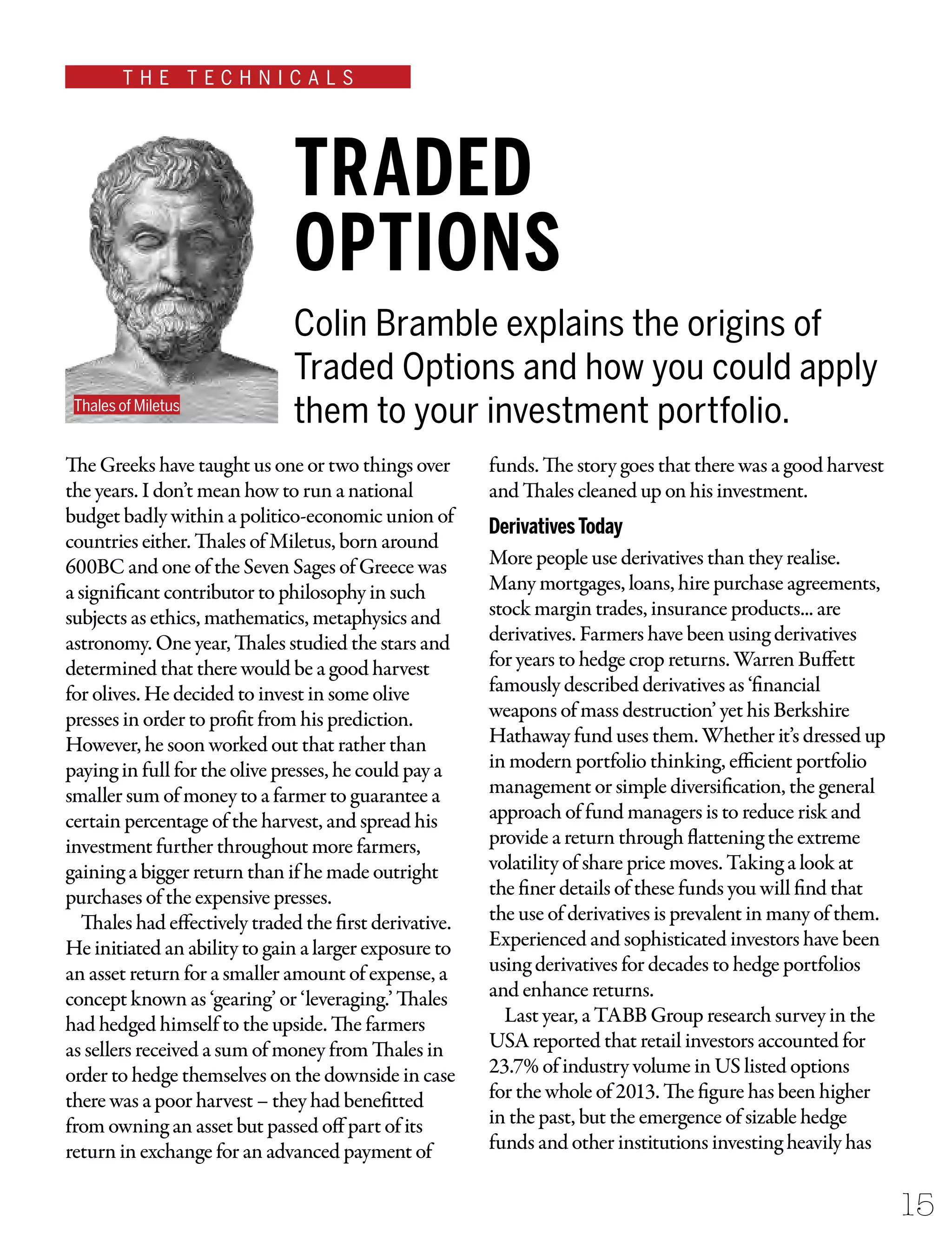
Colin Bramble explains the origins of
Traded Options and how you could apply
them to your investment portfolio.
TRADED
OPTIONS
Thales of Miletus
16
reduced the share. However, it’s still an enormous
percentage and it was up on the previous year.
There are no similar statistics available for the UK
markets, but historically it has always been felt
that UK investors are more reserved about using
such products. Clients have a different attitude in
America, they generally look at stock prices and
options in unison, and a lot of that is down to
education. Recent regulation for retail investors
has been tougher on derivatives because derivatives
are seen as high risk, highly geared complex
instruments and not to be used unless certain
criteria are met by client and broker. However, the
key to it all is knowing and trading within your
understanding and market exposure.
Traded Options
Fortunately,thereareopportunitiesforretailclients
tobenefitfromdealinginonegroupofderivatives
-tradedoptions-inUKshares.TheLondonStock
Exchangebeganquotingoptionsin1978before
theLondonInternationalFinancialFuturesand
OptionsExchange(LIFFE)tookoverin1992.
Aswehaveseenfromthecrisesoverthelastfew
yearstheseexchangetradedproductsoffermore
securitythantheover-the-counterinstruments.In
mostsituations,positionscanbeprotectedbythe
Exchangeitselfintheeventofamemberfirmfailure
(unlikeover-the-counterinwhichthecontracts
aredirectlybetweenfirms).Theexchangeprovides
rulesandstandardisationoflistedproductsand
FCAregulationhashelpedcreateamorerobust
frameworkwithinthemarket.Theexchangeoffers
anoriginationofprices,astartingpointformany
otherinstrumentstobepricedagainst.These
optionsarestockoptionswhichcanbeexercised
directlyintotheshares.Market-makersand
traderscanarbitrageorhedgethemselveswiththe
underlyingshares.Otherproductproviderssuchas
spreadbettersandstructuredproductswillalsofeed
offandrelyuponthismarket.Therearenowmore
companieslistedfortradedoptionsonLIFFEthan
thereeverhavebeen,116,mainlyFTSE100anda
fewFTSE250stocks.
Types of Options
There are two types of options, a call and a put.
A buyer of a call has the right to buyshares.
A buyer of a put has the right to sellshares.
When sharepricesgoup,callpricesgoup,
when sharepricesfall, putpricesgoup. Each
option has a limited life, a predetermined date
on which the option will expire. There is also an
‘exercise price’ or ‘strike price’ which is the price
at which the investor can deal in the underlying
shares. Options are traded on the exchange in the
normal way with a bid and offer price (the price
is often referred to as the ‘premium.’ Options are
traded in parcels of shares, or ‘lots,’ and these have
a standard size of 1000 shares. The Exchange sets
the expiry dates, lot sizes and strike prices, so that
investors can deal in a familiar instrument. Various
factors determine premiums aside from supply
and demand – there is time to expiry, strike prices,
dividends, interest rates and volatility to consider.
Indeed, these factors are referred to, on the back of
mathematical calculations in terms such as ‘Theta,’
‘Delta,’ ‘Gamma’ and so on. These are popularly
known in the industry as ‘theGreeks.’
Buyers of options tend to do so for speculative
reasons, a straight investment on whether shares
are going up or down, similar to the view Thales
took on the olive harvest. The advantage of this
is that the premium paid for the right is the
maximum amount that can the investor can lose,
therefore he knows his exposure.
Call options can also be used to establish a
holding in a stock in the future at a buying price
(perhaps if funds are short in the near term or for
tax reasons). For a selling price, puts can be bought
to protect a portfolio or an individual stock or
just to guarantee a selling price in the future. It’s
avaluableformofinsurance – houses are
insured, cars insured, why not a share portfolio?
If options expire ‘in the money’ they will be
automatically exercised so buyers of options must
always close positions before expiry if they don’t
want the risk of trading the underlying security.
17
Roughly 80 – 85% of options are closed by
expiry, the rest are ‘exercised’ into the underlying.
Remember, these are traded options, positions
can be closed at any time during the life of the
option, a great benefit when adjusting investment
parameters.
Options can also be sold to open a position,
or ‘written.’ Selling the option hands over the
opportunity to exercise the option to the buyer
in return for which the seller receives a premium.
This is where it gets interesting, as clients therefore
have the ability to use existing stock and cash
holdings to generate option premium, like an
additional income, similar to the olive farmers
who traded with Thales.
For example, it’s the middle of January, BAE
Systems stands at 470p, a client is tentatively
interested in buying shares but would rather pay
a bit less, so they sell a March 460 put at 13.5p.
If the shares drift but stay above 460p then the
option expires worthless and the option premium
of 13.5p is kept as profit. If the share price rises
substantially, 13.5p is still the maximum profit.
If the share price falls below 460p at expiry then
the put is exercised and the client buys the shares
at 460p but keeps the 13.5p premium, effectively
buying the shares at 446.5p, a 5% discount to
470p. A useful strategy particularly in a sideways
moving market. Even more so when consideration
is given to the timing of the dividend - the stock
purchase would qualify for the payment which
goes ex in April, last year at 12.1p.
For instance, a buyer of BP here in the middle
of January will pay 384p for the shares and could
sell the March 400 calls at 11p. If the share price
stays below 400p, then the 11p is kept, resulting in
a 2.87% return in 9 weeks. If the shares are above
400p at expiry then the calls will be exercised
and the stock sold at 400p, but the 11p premium
creates an effective selling price of 411p, a 7%
profit. An interim dividend which went ex div last
year on the 12th February at 5.7p, if paid again,
would enhance the attraction of the position.
The investor also has to take into consideration
the costs of dealing when working out their
percentages.
Of course, there are many strategies that can be
used involving different combinations of options
and shares. One of the beauties of using these
products is that they offer the flexibility to adjust
portfolios in a simple way. For instance, when
writing a put, a lower put may be bought to limit
exposure creating a ‘put spread.’ A client may sell a
put and a call together in the belief that the shares
may not move. As long as the client understands
how the products work and their total exposure,
there’s no reason why retail clients shouldn’t be
encouraged to use traded options.
These are complex instruments that involve
gearing and a contingent liability. I would always
suggest that anyone setting out to deal in options
seeks professional advice before trading. Since my
time in the market when I joined in 1986 there
have been countless occasions where simplicity and
caution would have been a better approach than
boldness. As so often is the case, it is a matter of
risk and reward, but with traded options in one’s
armoury there is no need to necessarily fear them
– instead, use the benefit of flexibility, protection
and added premium in one’s portfolio.
“A call seller will offer the right to the
buyer of the option to take shares from
them. By selling a call, the holder of a
stock can therefore fix a selling price as
he wishes, and in return receive option
premium. This is a popular way of using
options, the ‘call write.’ Buying shares
and writing calls simultaneously – a ‘buy
write’ – is one of the most frequently
used strategies by option investors.”
“Note that options may be exercised at
any time. It is therefore imperative that
the investor is aware of ex dividend and
expiry dates.”
18
EUROPE
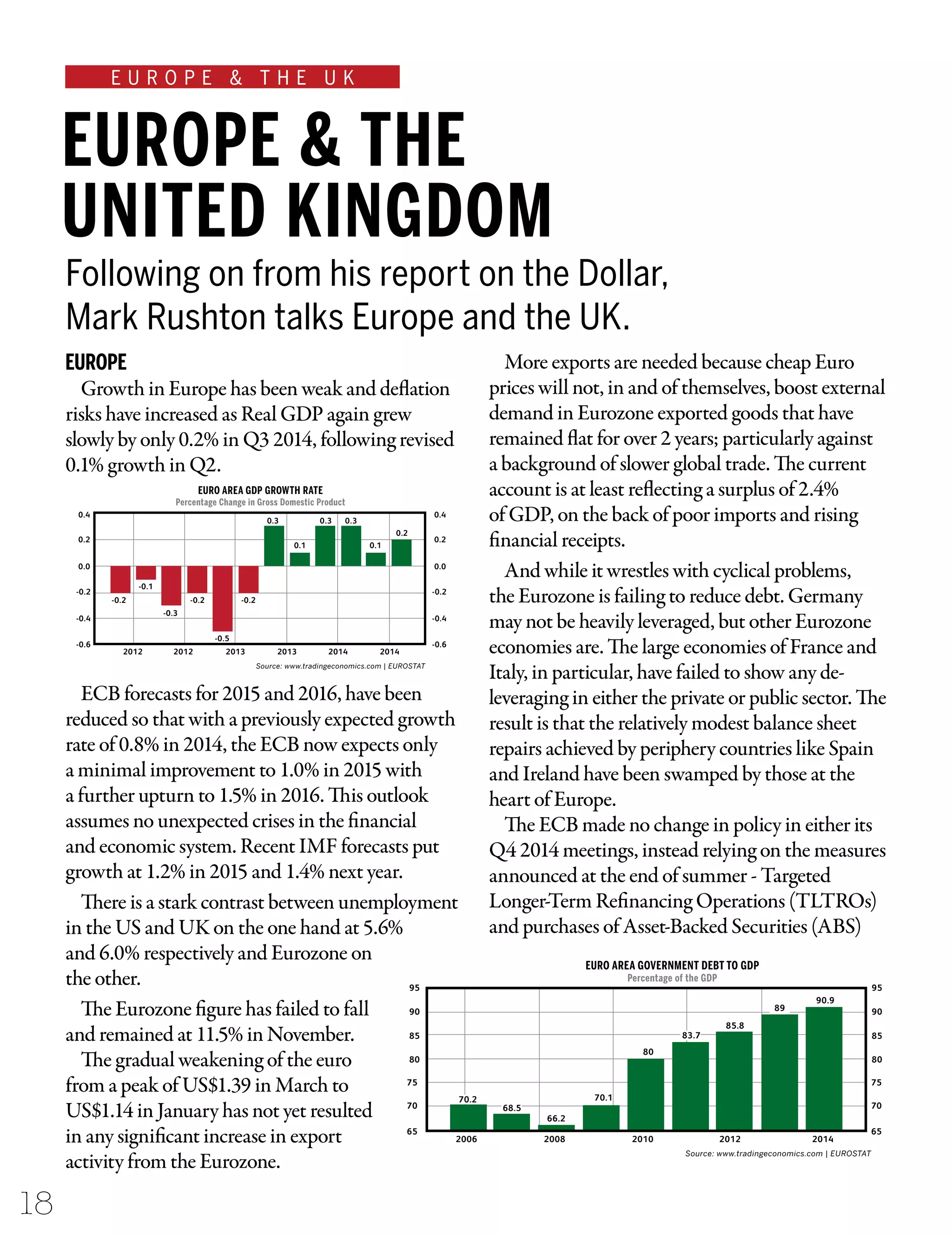
Growth in Europe has been weak and deflation
risks have increased as Real GDP again grew
slowly by only 0.2% in Q3 2014, following revised
0.1% growth in Q2.
ECB forecasts for 2015 and 2016, have been
reduced so that with a previously expected growth
rate of 0.8% in 2014, the ECB now expects only
a minimal improvement to 1.0% in 2015 with
a further upturn to 1.5% in 2016. This outlook
assumes no unexpected crises in the financial
and economic system. Recent IMF forecasts put
growth at 1.2% in 2015 and 1.4% next year.
There is a stark contrast between unemployment
in the US and UK on the one hand at 5.6%
and 6.0% respectively and Eurozone on
the other.
The Eurozone figure has failed to fall
and remained at 11.5% in November.
The gradual weakening of the euro
from a peak of US$1.39 in March to
US$1.14 in January has not yet resulted
in any significant increase in export
activity from the Eurozone.
More exports are needed because cheap Euro
prices will not, in and of themselves, boost external
demand in Eurozone exported goods that have
remained flat for over 2 years; particularly against
a background of slower global trade. The current
account is at least reflecting a surplus of 2.4%
of GDP, on the back of poor imports and rising
financial receipts.
And while it wrestles with cyclical problems,
the Eurozone is failing to reduce debt. Germany
may not be heavily leveraged, but other Eurozone
economies are. The large economies of France and
Italy, in particular, have failed to show any de-
leveraging in either the private or public sector. The
result is that the relatively modest balance sheet
repairs achieved by periphery countries like Spain
and Ireland have been swamped by those at the
heart of Europe.
The ECB made no change in policy in either its
Q4 2014 meetings, instead relying on the measures
announced at the end of summer - Targeted
Longer-Term Refinancing Operations (TLTROs)
and purchases of Asset-Backed Securities (ABS)
0.4
0.2
0.0
-0.2
-0.1
-0.5
-0.2
-0.3
-0.2 -0.2
0.3
0.1 0.1
0.2
0.3 0.3
2012
EURO AREA GDP GROWTH RATE
Percentage Change in Gross Domestic Product
2012 2013 2013 2014 2014
-0.4
-0.6
0.4
0.2
0.0
-0.2
-0.4
-0.6
Source: www.tradingeconomics.com | EUROSTAT
95
85
80
75
70.2
68.5
66.2
70.1
80
83.7
85.8
90.9
2006
EURO AREA GOVERNMENT DEBT TO GDP
Percentage of the GDP
2008 2010 2012 2014
70
65
90
95
85
80
75
70
65
9089
Source: www.tradingeconomics.com | EUROSTAT
E U R O P E & T H E U K
Following on from his report on the Dollar,
Mark Rushton talks Europe and the UK.
EUROPE & THE
UNITED KINGDOM
19
and covered bonds, but let the cat out of the bag
on 22nd January with Mario Draghi’s amount of
€60bn/month of bond purchases - a much needed
(and fairly well leaked boost.) The ECB President,
Mario Draghi, had been politicking hard for
more effective measures before Christmas and
since then the noise and level of ‘leaks’ over the
potential plans has increased. Whilst Germany
maintains her opposition to such initiatives, a
major decision is expected mid-January. It is
becoming increasingly likely that action will be
taken, but, as ever, with an unwieldy political unit
such as the EU (and a relatively impotent ECB), it
may be too late.
Although the OECD (in its Economic Outlook
- November 2014) expects Eurozone inflation to
rise after bottoming out in late 2014/early 2015,
we expect figures in early 2015 to continue to
reveal deflation, after the December -0.2% figure
and this may last a little longer.
The long term outlook for inflation implied by
the 5 year forward swap market has collapsed, but
is currently at just over 1.5%. The fundamental
problem is a lack of aggregate demand in the
economy, a problem that will persist should this
cycle continue. This contrasts with low (but
positive) inflation in the UK which is being caused
by lower input costs from strong Sterling and
falling oil price.
The Federal Reserve and, indeed, the Bank of
England used securities purchased from non-bank
entities which proved a sharper tool. There was
no mechanism for forcing, or even encouraging,
banks to add to their loan or securities books.
The new TLTROs are designed to impose
additional lending obligations on the banks,
but the purchases of ABS or covered bonds will
again be largely from the banks, with limited
consequential loans or investments in non-
banking assets – it is still too blunt a tool.
IftheECB’s(expected)newmeasuresare
unsuccessful(aswealsoexpect)theriskofdeflation
intheEurozoneremains.Furthercurrency
depreciationorincreasedavailabilityofcreditis
essentialifdeflationistobeavoided.Itrequires
firmaction,buttheECBdoesnothavethecourage
orabilitytoprovideit.
Witha70%approvalratinginthepolls,left-
wingparty,Syriza,shouldwintheGreekgeneral
electionon25thJanuary.AlexisTsipras,itspopular
leader,vowstoreformthegovernmentagenda,rid
GreeceofBrusselsausteritymeasuresandnegotiate
arestructuringofGreece’sdebt(currently170%of
GDP).ThishasledtoalikelierGreekdefaultand
possibleGreekEuroexit(althoughTsiprasdoes
notintendtotakethatroute)suchthatyieldson
Greekbondsareabove10%.
THE UNITED KINGDOM
Economic growth is expected to continue at
close to 3.0% per annum in UK. Low rates of
money and credit growth over the past two years
combined with the strength of sterling in 2014,
against the Euro (from EUR110 in early 2010
to EUR120 a year ago and on up to EUR128 in
January 2015) and the Yen (from Y118 in Jan 2012
to JPY170 in January 2014 and up to over Y180
since December 2014), will ensure that import
prices continue to fall and that inflation remains
low through 2015.
One of the most positive aspects of the recovery
has been the strength of investment by business,
which finally indicates that the recovery is not
merely consumption based. It has been growing
steadily and order books have been mostly strong.
Sterling weakness against the US Dollar has also
helped exporting companies to stay competitive.
“The ECB has focused almost
entirely on the banks as
it attempted to pump up
economies and this failed
to reach the household and
corporate sectors.”
20
THE PEG PEGS IT!
The abandonment of the Swiss National
Bank’s peg of the Swiss Franc (CHF) to the
Euro on Thursday 15th January bought chaos
to the foreign exchange markets as CHF
rallied 30% against the Euro and then settled
at 15% up (give or take a few percent, against
Sterling and the US Dollar).
The Swiss had grown weary of competing
with Mario Draghi’s incessant talking down
of the Euro to which the CHF was pegged
by selling CHF. It had started life as a peg
against the Deutschemark, but with the Euro,
the Deutschemark was joined by currencies
from large, but weak economies such as
Italy, Spain and Portugal. Their efforts to sell
CHF were not working as the Euro had fallen
under the weight of the struggling Eurozone
countries.
It was as magnificent a moment as it was
horrific. It had an immediate effect on global
markets, but this will not be lasting. Indeed,
if anything, it reminds all of us that good
central banks have to be economic with the
truth (only days before they had claimed the
peg would stay) in order to do what they want
without leaks. The subsequent chaos was
inevitable, but will blow over (whilst some will
have made and lost fortunes in an instant).
The residual feeling is that the Swiss had lost
patience with a crumbling Euro, an impotent
ECB and poor political consensus within the
EU as the Germans had been “trumped” by
the European Court of Justice’s decision
on Wednesday 14th January to allow the
ECB more freedom to purchase assets. This
decision has acted as a reference point, or
datum, against which the Euro compares
poorly.
More trouble lies ahead for the Euro.
Retail Sales volumes year on year have risen to
6.4% in November 2014, but averages c. 4% over
2014 emphasising the willingness of consumers
to spend. This enthusiasm has been spurred
by increased and earlier Christmas purchases
together with small, but significant Wage Growth
of 1.7%.
And it has been helped by the low rate of
unemployment at 6%. With inflation at 0.5%,
unemployment has just fallen to 5.8% (December
2014). Although I still believe that any eventual
action by the BoE will be “fudge,nudgeand
judge” i.e. fudge – pick the appropriate evidence
to use within Mark Carney’s guidance to explain
the Bank of England’s position, nudge – move
rates by only a little (when the time comes) and
judge – review the outcome and the sensitivity
to the first rate change in nearly 6 years. Forward
guidance has been allied to as many as eighteen
indicators and the strength of the economy has
required a shift to a more pragmatic stance.
This on top of December’s inflation figure (CPI
was 0.5% versus a consensus of 0.7%) gives all
participants more breathing space and pushes
back a potential rate rise well into 2016.
6
5
4
5
3.3
2.8
4.3
3.4
3.2
2.4
3.7
2.3
4.6
6.4
6
01/14 04/14 07/14 10/14
UNITED KINGDOM RETAIL SALES YOY
Change Year-Over-Year
3
2
7
6
5
4
3
2
7
Source: www.tradingeconomics.com | Office for National Statistics
“Reflecting the growth in
population and households
alongside the shortage of new
housing coming in the market,
house prices have continued
to rise.”
90.60% Low (Varies) 227.20%101.50% 90.90% 20.50%
World BarometerKey trends as we start 2015
UK US Europe Asia Australia China Japan
Geo-Political
Situation
Economic Cycle
Position
Consensus
Forecast for
GDP Growth
Current
Inflation Rate
10-year
Benchmark
Bond Yield
Currency
vs. GBP
Beneficiary of
current oil price
Beneficiary of
current metal
prices
2.71% 3.09% 1.35% 3.30% 2.90% 7.09% 0.83%
0.50% 0.80% -0.20% 2.30%1.80% 1.50% 2.40%
1.54% 1.77% 0.40% 3.52%2.55% 0.24%3.50%
1.516 1.306 SDG$2.02 1.84 9.43 177.63
ü ü û ü üüü
6.00% 2.00% 4.10% 3.50%11.50% 6.10%5.60%
Unemployment
Rate
ü ü üüü ü û
22.40%
Net Debt
to GDP
Disinflation/
Recovery
Disinflation/
Recovery
Recovery Disinflation/
Recovery
Disinflation/
Recovery
Disinflation/
Recovery
Disinflation/
Recovery
21
22
T H E F O R E C A S T
We ask the experts what they see ahead
What’snext?
“I think that
decent yields will
continue to be a
key influencer in
stock selection,
especially given the
BOE’s Monetary
Committee recent
vote of 9-0 to
maintain interest
rates at 0.5%. I
also expect oil will
continue to be
unpredictable –
despite what any
‘experts’ may say.”
Jeremy Inskip, Investment Manager
“TheswiftcollapseoftheoilpriceinOctober,coupledwithweakcommodityprices,hascausedpolicymakers
tofocustheirattentiononaslowingglobaleconomyandtheprospectofdeflationandpossiblerecession.
Interestratesrisesarenowdeferreduntilatleastthesecondhalfoftheyearandpossiblylater.Despite
Germany’sobjections,theECB’s€1.1trillionQuantitativeEasingprogramwhichisdestinedtorununtil
September2016hashelpedtounderpinfinancialmarketsandsentimenttowardsequitiesintheshortterm.
Howeverthereareotherheadwindsonthehorizon.
TheresultoftheGreekElectionwillundoubtedlycauseinvestorstoworryoverthefutureoftheEurozone.
TheuncertainoutcomeoftheGeneralElectiondueinMayandtheFederalReserve’scommitmentnotto
raiseinterestratesuntilthesecondhalfof2015willalsocreateanervousenvironmentforinvestorsasthose
deadlinesapproach.
Equitiesstillofferthebestincomestream,butinvestorsshouldexpectmorevolatilityinthesecondquarter.”
Trevor Sumption, Investment Director
“Aftertwodecadesofdeflationandstagnation,Japan’s
PrimeMinisterShinzoAbiembarkedonhismassiveQE
drivelastyearand,I’mprettysurehewilldo“whateverit
takes”togethiseconomygrowingagain.Heishugelygung-
hoaboutinjectinginflationintotheJapaneseeconomy,
buteventhereitisprovingdifficult.Deflationisastubborn
beasttoputtodeath.ItishardtoimaginetheEuropean
taskbeingeasier,withapoliticaltug-o-warandtheGerman
hang-upwitheventhementionofinflation,addingfurther
obstaclestothecourse.Draghi’sprogrammewill,andhas
alreadybegunto,drivetheEurolowerwhichwill,ofcourse,
maketheEurozoneasawholemorecompetitive.However,
Germanyisalreadysuper-competitivewithinthezone,
free,asitis,fromtheconstraintsthatwouldexistifithadits
own,considerablyhigher,currency.Sothiswillnotcurethe
massivecompetitiveimbalancesthatexistwithinthezone.”
Russell Dobbs, Chartered Wealth Manager
Produced by Walker Crips Stockbrokers Limited, Finsbury Tower,
103-105 Bunhill Row, London EC1Y 8LZ. www.wcgplc.co.uk @walkercrips
Production Team
Geri Jacks Group Marketing Manager
Louie Perry Group Marketing Executive
Chris Barker Design & Art Direction
‘Quoted’ Finsbury Tower, 103-105 Bunhill Row, London, EC1Y 8LZ.
020 3100 8000. Quoted@wcgplc.co.uk
Prior to taking an investment decision based on the content of this
publication, investors should seek advice from their Adviser or Broker
on the suitability of the investment for their personal circumstances.
London (Head Office)
Finsbury Tower,
103-105 Bunhill Row,
London, EC1Y 8LZ
020 3100 8000
Bristol
Broad Quay House,
Prince Street,
Bristol, BS1 4DJ
0844 477 9909
Birmingham
126 Colmore Row,
Birmingham, B3 3AP
020 3100 8120
Inverness
2 Ardross Street,
Inverness, IV3 5NN
020 3100 8109
Lincoln
30 Church Lane,
Harmston,
Lincoln, LN5 9SS
020 3100 8289
Northampton
Avon Cottage,
Butchers Lane, Boughton,
Northampton, NN2 8SH
020 3100 8122
Norwich
Haldin House, Old Bank of
England Court, Queen Street
Norwich, NR2 4SX
020 3100 8114
Swansea
Alexandra House,
Alexandra Road,
Swansea, SA1 5ED
0800 160 1608
Ulverston
Ulverston Business Centre,
25 New Market Street,
Ulverston, LA12 7LQ
01229 483993
Wymondham
3 Church Street,
Wymondham,
Norfolk, NR18 0PH
020 3100 8113
York
Foss Islands House,
Foss Islands Road,
York, YO31 7UJ
01904 544300
Important information
This document has been approved as a Financial Promotion in
accordance with Section 21 of the Financial Services and Markets Act
2000 by Walker Crips Stockbrokers Limited (WCSB) which is a member
of the London Stock Exchange and is authorised and regulated by the
Financial Conduct Authority.
This Financial Promotion has not been prepared in accordance with
legal requirements to promote the independence of investment
research and is not subject to prohibitions on dealing ahead of the
distribution of research. Principals and associates of WCSB may have a
position in the securities mentioned herein. Consequently, in line with
the Financial Conduct Authority rules on conflict of interest, WCSB
research in these areas cannot be classified as impartial within the
Financial Conduct Authority’s definition and it should not be relied upon
as independent or objective. Prices and factual details are deemed to be
correct at the time of publication but may change subsequently. This
Financial Promotion has been prepared with all reasonable care and
is not knowingly misleading in whole or in part. Expressions of opinion
are subject to change without notice. You should be aware that the
value of investments and the income from them may vary and you may
realise less than the sum invested. Past performance is not necessarily
a guide to future performance. The tax treatment of investments may
change with future legislation. This document should not be taken
as a recommendation. Investments mentioned may or may not be
suitable for all recipients of this publication. We cannot, however, accept
responsibility for any losses which may be incurred by a client acting on
information contained within this document. This Financial Promotion
is confidential and supplied to you for information purposes only. It
may not (directly or indirectly) be reproduced, further distributed to any
person or published, in whole or in part, for any purpose whatsoever.
Neither this document, nor any copy of it, may be taken or transmitted
into the United States or into any jurisdiction where it would be unlawful
to do so. Any failure to comply with this restriction may constitute a
violation of relevant local security laws. Facts and figures are deemed to
have been correct at the time of publication of the original article.
Walker Crips Stockbrokers Limited is a Limited Company, registered in
England and Wales with registered number 4774117. Authorised and
regulated by the Financial Conduct Authority, 25 North Colonnade,
Canary Wharf, London E14 5HS. FCA Registration Number: 226344
Quoted_11_February 2015

Quoted_11_February 2015

  • 1.
    A market reviewfrom Quoted
  • 2.
    Welcome. As the newyear gets under way, there are many pundits predicting choppy waters to come for investors having to navigate through greater volatility than ever before. As always we are here to guide you along the way as markets move or as your requirements change. The forthcoming weeks and months of the political scene will prove both fascinating and exciting, leading up to the UK General Election in May. The addition of UKIP as a more serious contender into the fray brings a new dimension to the list of possible scenarios post-election, making predictions for the year even more difficult than usual. Continuing doubt over the strength of the global economic recovery coupled with a stream of distressing news from the world’s trouble spots represent significant further constraints to positive outlook of markets in general. Here at Walker Crips, our expansion continues since our last edition. Following the addition of two Investment Managers in Birmingham, we announced the launch of an office in Truro, Cornwall which will be opening soon manned by an established team with strong local links and knowledge. In our London head office, the influx of advisers arriving with their own clients is expected to continue and consequently approximately 47% additional floor space has been secured at our current location in Bunhill Row, EC1. This is now our 11th edition of Quoted magazine which we hope you find both relevant and stimulating. It is intended and written mainly for clients, but also our wide range of contacts and friends. I thank all our contributors who regularly convert their thoughts into sensible prose for your benefit! Not forgetting the impact of the Budget driven pension reform, the cricket and rugby World Cups on the horizon, it should be a year to remember in many ways. Whatever happens, we will still be here aged 100 years and serving clients! Rodney Fitzgerald Chief Executive Officer
  • 3.
    4) Interest Rates Russell Dobbs’take on recent events surrounding interest rates. 6) 21) America Mark Rushton analyses the strength of the Dollar. 12) Traded Options Colin Bramble explains how Traded Options could be used in your portfolio. 15) Europe & UK Mark Rushton talks Europe and the United Kingdom. 18) The Forecast We ask the experts what they see ahead. 22) Market Update A seasonal overview from Nigel Skelton. 8) World Barometer Any changes in economic pressure on the way? “All is in flux, nothing stays still.” Heraclitus 535 BC - 475 BC Japan Peter finds positives in Japan’s economy.
  • 4.
    So far QEhas helped ramp up an equity market that was in any case cheap. On a price to cash flow basis of 8, it is still cheaper than other developed markets – average 11 (source BCA Research). It still amazes me that: starting with the US, ramping up equity prices above natural levels is supposed to produce rising consumer spending. I thought enough academic work, at any rate re the US, had shown the ‘wealth effect’ of equities to be minimal – unlike house prices that make houses handy ATMs. This is especially the case in Japan as hardly anyone holds any or many equities. I’m not sure, also, that a 1930s’ style competitive devaluation race adds much to the benefit of mankind. Currently Japan has its nose in front in this game – and, to be fair, the US has eased off the monetary accelerator, although not totally (repressed interest rates). The yen is now well below even its 1970 level in ‘real’ effective terms. Why? It is likely that, unless this changes, the pre-tsunami routine trade surplus will re-build. As mentioned before, however, there is a negative effect on the so-called need for the Japanese to ‘consume’ more (Why should they, if they don’t want to?). It is worth remembering again that, when deflation and population growth adjustments are factored in, which is what counts on any ‘real GDP’ assessment, Japan has been doing fine (bar the post tsunami shock). In fact, it has been better than the US, since 2000. The ‘lost generation’ mantra is plainly rot (I prefer my former suggestion of a US lost generation!). Further examples of this are: 1) Unemployment barely exists; 2) Prime working age population labour participation rate is above the ‘flexible’ US level at 82% (the US rate is 77%). 3) How many commentators realise that female participation at 72% exceeds the US at 70%? (Source: BCA Research) 4) As for the trumpeted deflation. In 15 years the CPI has fallen only 4%. Why the need for this wild policy wrenching? One immediate result is to hit real incomes via imported inflation – hardly conducive to encouraging Mr and Mrs Takahashi to spend more. And people get along together riotlessly and peaceably. Again, compare this to US society. What’s not to like? Yes, yes, yes, there is the 140% of GDP net government debt heap and the 6% of GDP deficit. So? 4 J A P A N Peter Bennett Peter finds positives in Japan’s economy. Plenty for the Japenese to celebrate? Credit: izamon/ Shutterstock.com
  • 5.
    Someone with betterunderstanding than I of the intricacies of policy-making could surely think a bit creatively about these facts: 1) The private sector net liquid surplus far exceeds the accumulated government debt. Which is nearly all held in Japan. One pocket to another. The FT suggests personal savings at $16 trillion (Ed: this is the same as the US GDP). 2) The personal sector pays little tax – and even the next VAT hike, only up to an internationally still modest 10%, seems to be on hold. 3) The corporate sector continues to print real genuine money in cascades. So there is scope there. 4) At the end of the 1990s’ recession I wrote to the then PM (ok, no reply!) suggesting the use, as a last resort, of date-limited spending vouchers. This sort of money-printing addresses the supposed need for consumption without all the distorting effects of wild monetary policy – i.e. QE – not perfect, but inflicts the least damage. Having dished out enough, you could then raise VAT to, say, Europe-ish levels, which alone would stop the deficit. A modest soupcon, as it were, of eau de vie (vouchers) would be in order because, unlike elsewhere, Japan these days is not a financial alcoholic. At least not yet. 5) A small increase in personal taxation could then, plus the extra VAT and given the stimulus from spending vouchers, produce a government surplus. Also, proposed corporate tax cuts could wait. One way or another the corporate sector will have to chip in. In fact aging work forces tend not to be big spenders – bar their spending on health. I would have thought the desired level of inflation might cause them to save more as a precaution. Lastly, if 5 push comes to shove, the Japanese government could increase the retirement age (a message with strong application all over the developed world). Overall, if one is going to be a bit risqué and unconventional (and why not – it makes for an interesting life?) then do so incurring least damage i.e. not QE. After all, the total financial position of Japan is that of an immensely strong creditor. It is merely that the pieces on the chess-board, so to speak, are in the wrong places. The BOJ really ‘has got your back’ as Wall St equity investors have become accustomed to saying about the Fed. The ‘Greenspan put’ reincarnated. Or so they all say. Such unanimity scares me. The new ‘instructions’ to the Government Pension Investment Fund (GPIF – the $1.4 trillion public pension fund) to buy a lot more equities adds genuine icing to that particular cake. And the world-beating cash flow position of Japanese corporate makes rights issues seem a low priority. More likely continued strong dividend increases. Of course, this is all now the conventional wisdom, i.e. pretty useless information. From the investment point of view a trend is a trend till it stops; and, though no longer ‘absolutely’ cheap, Japanese equities are ‘relatively’ cheap (to other developed markets – notably the US). Further, as a percentage of operating cash flow, Japanese corporates only pay out to shareholders 12%, Europe 42%, US 89%! So there is shareholder friendly scope there – underlined by the introduction of the 400 share ‘shareholder-friendly’ market Index. And, per Andrew Smithers, Japanese corporate net debt is half that of the US. Further, over the last three years corporate (understated?) profits have been rising three times faster than (overstated?) US. I know where I prefer to put money. A modest commitment is still justified.
  • 6.
    Surely even theMonetary Policy Committee’s two dyed-in-the-wool hawks, Ian McCafferty and Martin Weale, must be questioning their hard-line view on interest rates after the recent inflation figures. Of course, every economist has a different slant on the subject but against the current background it is difficult to see any justification whatsoever for higher interest rates, so their next prognostications on the subject will be interesting to hear. The downward pressure on our inflation figures is being exerted from a number of directions and none is going to reverse any time soon as far as I can see. The most visible, oil, has fallen precipitately as the Saudis refuse to cut back on their production and the US frackers seem of similar mind, and commodities across the board have begun to descend again as Chinese economic growth has slipped below target. This slide has rekindled worries about global growth which further undermines commodity prices, and which we can view as either virtuous or vicious, depending on how we look at it – great from a consumer’s standpoint, not so good from a resource investor’s point of view. The constant warnings throughout last year about Euro deflation can now be seen as entirely justified. According to Eurostat, the Eurozone actually suffered average price falls of -0.2% over the year and the decline in some member states is much worse. The UK is still a considerable importer of goods from Europe and those goods have been, and are going to continue, getting cheaper. The advocate general to the European Court of Justice has, this week, advised that European Central Bank QE by its prospective policy of Outright Monetary Transactions would be legitimate so, unless the ECJ defies that advice, which seems unlikely, the ECB should proceed at some point soon. As per previous blogs, it will probably be too little and is already too late, but it is driving the euro lower versus most currencies, including sterling, making those imports cheaper by the day. We have even imported European discount supermarkets themselves, in the form of Aldi and Lidl, to perpetuate the deflationary pressure. They have set off a price war that our own traditional supermarket groups are fighting to keep up with and the latter are engaging in their own price war at their petrol outlets. Six months ago the MPC hawks warned of a dangerous house price bubble, pointing to the increase in the average house price as being unsustainable. However, these figures, as I pointed out on several occasions, were completely distorted by the mammoth increases in London prices, and were not representative of the rest of the country. Interest rates, thankfully, remained untouched but the government bowed to pressure by introducing 6 BLOGWATCH I N T E R E S T R A T E S Russell Dobbs’ take on recent events surrounding interest rates.
  • 7.
    other measures tocool a housing market that, in reality, had barely got going. In short, there was no housing bubble outside of London, and inside it has now been killed by policies targeted at the super-wealthy international buyers and, no doubt, Russian oligarchs suffering as a result of sanctions against that country. All this is likely to see UK inflation remain at a negligible level for the foreseeable future and, therefore, provide no reason to raise interest rates. In fact, as our companies try to remain competitive and grow their businesses in a struggling global economy, such a move would be completely counter-productive. My last comments on UK interest rates anticipated no increase this side of the general election in May. I believe events have conspired to push any such increase back considerably further. When Mark Carney first took the hot seat at the BoE, he indicated that interest rates might not need to rise until 2016, before bowing to the more hawkish commentators and shortening his horizon. He must now wish he’d stood his ground because I doubt we’ll see any reason to raise rates this year. 7 Will we see rate rises from the BoE in 2015?
  • 8.
    M A RK E T U P D A T E Nigel Skelton reviews the Global market and the conclusion is not, ‘How long is a piece of string..?’ SEASONAL OUTLOOK As the calendar year 2014 drew to a close the benign summer conditions were a distant memory as unexpected events and increasing volatility took centre stage. The weakness in global commodity prices was a feature of the final quarter, with the falling price of crude oil, in particular, making many headlines and seemingly being a major factor in causing global stock markets to fall sharply, but subsequently recover (again) in December. However, the price of crude oil has continued its downward spiral. In December 2014 the UK’s benchmark FTSE 100 Index fell an astonishing 8.3% over the course of just six trading days from 6743 on Friday 5th December to 6182 on Monday 15th December. Almost as quickly as it fell, the following seven trading days leading up to and including Christmas Eve witnessed the usual, so called, “Santa Rally” which saw the Index climb some 427 points to see in Christmas Day at 6609, representing a 6.9% increase from its nadir on 15th December. The Index therefore posted a 0.9% decrease over the course of the quarter to close the calendar year at 6566. Finally, the FTSE100 had recorded a negative return of -2.7% for the 2014 year as a whole. At a sector level the divergence between the winners and losers has been quite marked with food retailers and not surprisingly mining stocks under severe pressure throughout last year. We will continue to keep a close eye on these two sectors, together with the oil & gas sector, which has also endured a torrid time. For example, the share prices of two of the FTSE 100 Index’s largest constituents, BP and Royal Dutch Shell, suffered dramatic swings during the month of December, falling by over 11% and 10% respectively during the course of the first two weeks of the month, broadly tracking, albeit to a lesser extent, the price of WTI Crude Oil, which fell by more than 16% over the same period. However, certain sectors benefited from growing investor appetite for security and increasing income and market dynamics as interest rate rise expectations diminished. The UK-listed utility companies are a prime example of this, with the large-cap water companies United Utilities and Severn Trent seeing their share prices rise by 36.2% and 17.7% respectively over the year. When combined with gross dividend yields in excess of 4.0% each, this ensured total returns for the year of an astonishing 40.0% and 20.0% respectively. Examples of positive sector performance for 2014 included (generally) utilities (quasi bond behaviour) and life assurers. As cost cutting measures have probably reached a zenith across most leading companies we would, once again, reiterate that merger and acquisition (M&A) activity may well be a growing feature of 2015 as companies try to grow via bid activity and the subsequent economies of scale, cost cutting abilities, synergies etc. In fact, the largest M&A deal of 2014 was in the insurance sector, Aviva’s takeover of Friends Life. This deal represents the biggest transaction in the insurance industry in the last 15 years and is a further sign of the generally improving corporate landscape in the UK and beyond. Returning to commodity prices, these are 8
  • 9.
    widely expected toremain quite ‘soft’ for the immediate future and possibly throughout 2015 as continued weakness in Europe and a slowdown in China (one of the world’s biggest consumers of a range of commodities) are contributory factors to a ‘dampening’ of aggregate demand. Additional factors are (amongst others) the huge increase in supply exacerbated by the US Shale gas revolution and also record US harvests of certain critical commodities such as corn and soybeans. The Bank of England recently held its base lending rate at 0.5% for the 70th (!) consecutive month and consensus expectations now point toward an increase in the second half of 2015 at the earliest (i.e. after the UK General Election). Despite the continued (albeit gradual) economic recovery in the UK (in terms of GDP growth, which stands at a year on year rate of 2.6%), the general improvement in the unemployment rate (6.0% at the time of writing) and the first tentative signs of real wage growth (average earnings excluding bonuses were up 1.6% between August- October, versus a year earlier) the inflation outlook remains benign. The disinflationary environment is primarily due to a combination of the recent strength of Sterling, the real prospect of possible deflation in the Eurozone and extremely weak global commodity prices including oil. Furthermore, and despite the low rate of unemployment, there remains some “slack” in the labour market (e.g. people who have jobs, but are willing to work longer hours) and until this situation reaches the point of exhaustion there will arguably be a lack of significant sustained upward pressure on wage growth, so the Bank of England’s rate-setting committee has a degree of breathing space before the first increase in interest rates. Allied to these factors is the still relatively high debt-to-income ratio in the UK, which currently stands at approximately 110%, according to the Bank of England. Whilst this ratio has fallen from its 2009 peak of just over 130%, it still remains significantly higher than the approximate 80% level at which it stood for much of the 1990s. The recent slight slowdown in the UK housing market has also contributed to the disinflationary environment. The introduction of the Mortgage Market Review (MMR) in April of 2014 helped to cool the market somewhat and, despite continuing deferrals of 9 A new dawn for oil prices.
  • 10.
    10 interest rate expectations,the housing market appears to have sufficiently cooled to dampen concerns of a worsening property “bubble”. The Government even recently brought forward its Starter Homes Initiative by six months as it signed up sixteen national house builders (including major quoted companies such as Barratt Developments, Taylor Wimpey and Bellway) to the Initiative, which offers first-time buyers under the age of 40 a discount of 20% on a new-build property. The Initiative is expected to create 100,000 new homes, (the first batch is expected to be available later this year). The Eurozone is still struggling, despite some improvement in the periphery (notably Spain and Ireland) in terms of balance sheet repair. France and Italy have not yet deleveraged and therefore continue to negate the improvement evidenced in Spain and Ireland. As a spin off, investor negativity towards the Eurozone remains and the Swiss authorities have recently imposed an effective interest levy/penalty for depositors using bank accounts to shelter funds out with the Eurozone. And the Far East, despite huge bouts of QE (Quantitative Easing, or ‘money printing’) in Japan, the commercial banks have not expanded their balance sheets and Japan’s real GDP growth in 2015 is estimated to be only 1.3%. The final quarter of 2014 evidenced strong demand for relative “safe haven” Government Bonds; the 4.75% UK Government Bond maturing in March 2020 is now offering an approximate gross redemption yield of only 1.3% from approximately 2.0% at the end of Q3. Furthermore, the benchmark 10-year UK Government Bond offers a gross redemption yield of only approximately 1.8%. Despite several condundra and unknown unquantifiable outcomes for the forthcoming calendar year e.g. General Election, economic progress, global inflation, commodity prices, etc., the conclusion is not, ‘How long is a piece of string?’ 1. The UK Economy. Growth in the UK has been relatively robust (albeit after several stimuli) and whilst there has been a slight slowing of momentum, the general recovery remains on track. Data shows that UK businesses are committing more to future investment, which is an encouraging sign as this planning indicates that the recovery may be more sustainable than if it were purely consumption-led. I believe reasonable growth in UK GDP is, once again, likely. 2. The UK Inflationary Outlook. Despite huge bouts of “easy” monetary policy around the globe inflation is seemingly well under control at present. Furthermore, sustained falls and continuing low levels for commodity prices are fiercely negative for several countries whose economies are dominated by commodity production. Consequently inflation will not be a problem in the Eurozone, where deflation is becoming a growing concern! On the “flip side” the UK consumer is enjoying the low energy and low petrol/diesel prices. The low energy prices are indirectly reducing the threat of interest rate rises (reducing inflationary concerns) and hence the onset of higher mortgage payments. We anticipate modest inflation levels to prevail throughout 2015. “From a Global perspective (and amongst the leading G20 nations), the US continues to lead the way in terms of GDP Growth, with “Uncle Sam” returning towards impressive former “normalised” levels of 3.0%-3.5% per annum.”
  • 11.
    3. Stockmarkets, FixedInterest and Currencies. The outlook for markets in 2015, based on a gradually improving economic landscape, a lack of significant inflationary pressures and the consequent continued low interest rate environment until later in the year (if at all) should provide an element of support to equity markets in the near term. There are likely to be continued poor returns on cash savings rates as well as relatively poor income returns and little to no capital appreciation on both Government Bonds and the highest quality investment grade corporate bonds. However, anticipated large falls across the fixed interest spectrum may not materialise. Whilst our £ Sterling may therefore weaken further against the US Dollar, we see no reason why the pound will not strengthen a little against both the Euro and the Japanese Yen, with both the ECB (European Central Bank) and the BoJ (Bank of Japan) expected to continue with their respective asset purchase programmes whilst also maintaining their policies of minimal interest rates. We see continuing value amongst selective UK equities, although the selection is, admittedly, diminishing as economic progress crawls higher. At a global level, we anticipate monetary tightening in the US possibly as early as the late Spring/early Summer. Providing any tightening is handled in a sensible, balanced manner we expect a reasonable outcome although we anticipate more stockmarket volatility throughout this year. We see FTSE 100 to be broadly trading between 6200-6900, albeit that volatility will probably be more prevalent in 2015. Finally, political uncertainty is definitely in the ascendancy. Beleaguered Liberal Democrats seem unlikely to have any material say in the future leadership of the country and, while Mr Farage continues to be seen and be heard, a majority for either Mr Cameron or Mr Miliband in the forthcoming General Election is looking increasingly unlikely. 11 “We expect the US Dollar to strengthen further over the course of 2015 as relatively strong GDP Growth will more than likely lead the US Federal Reserve to raise short-term interest rates before most other major Central Banks in the second half of 2015.” 10 Downing Street could find itself a fresh tenant for 2015. Credit: Stuart Monk / Shutterstock.com
  • 12.
    12 A M ER I C A Mark Rushton, Chief Investment Officer, analyses the strength of the Dollar and its global effect. UNSTOPPABLE USD. GOOD OR BAD? Against a background in which the most influential central banks are adopting increasingly divergent approaches with their own versions of Quantitative Easing and in which weaker global demand has led to the oil price retreat and lower commodity prices, the US Dollar has continued to rise. It has been helped up by a combination of risk aversion and a relatively strong US economy. The softness in emerging market currencies echoes with the crisis of the late 90’s. How does this bode for 2015? The answer may lie in a brief analysis of the Dollar. Some big pronouncements have led to the Dollar’s current strength: the Federal Open Market Committee (FOMC) announced the end of Quantitative Easing 3; the Bank of Japan announced an increase in its own version of QE and the Japanese government pension fund announced that it would be buying equities while selling Japanese Government Bonds; the European Central bank has allowed the Euro to be talked down and announced fresh QE of €60bn per month. All this has been accompanied by stalling European growth and weakening growth in China while the US economy has forged ahead. Ongoing differences in the major economies and the variety of policy approaches have led to the recent strength in the Dollar. The IMF are forecasting growth for 2015 at 3.6% (up 0.5%) and 3.3% for 2016 – still good growth figures. “The US GDP annual growth rate in Q3 2014 was revised to 5%, but the signals for the Q4 figure are pointing to a much lower figure.” 2.2 2.4 2.6 2.8 3 2 1.8 1.7 2.6 2.3 2.7 1.6 1.7 1.8 2.3 3.1 1.9 2.6 2.7 2012 2012 2013 2013 2014 2014 UNITED STATES GDP ANNUAL GROWTH RATE Percentage Change in Gross Domestic Product 1.6 1.4 3.2 2.2 2.4 2.6 2.8 3 2 1.8 1.6 1.4 3.2 Source: www.tradingeconomics.com | US Bureau of economic analysis
  • 13.
    13 With recent averageGDP at c.2.5%, the US deficit is at a low this century of 2.2% and unemployment is on its long-term average of just under 6%. Indeed, the recent increase in jobs, of 252,000 in December, has confirmed 2014 as the year with the largest increase in employment since 1999, up by almost up 3 million jobs to leave unemployment at 5.6%. Wages remain unchanged as there still seems to be a good supply of personnel to fill the increasing number of jobs. Earnings are up 1.7% since a year ago, but flat after inflation and average hourly private wages have eased a little. This data signals that, while there is much strength in the drivers of the economy, there is still a drag on real wage growth. ‘Full employment’ (an acceptable level of unemployment which is unaffected by demand cycles) has not yet been achieved; the demand from employers is not extensive enough for employees to be able to name their price. Wage growth is important to the thinking of the FOMC because it provides the key to the timing of the right moment to raise rates. Although the FOMC has indicted that rates could be raised halfway through 2015, and wages may rise a little due to the increase in the minimum wages in January, it is likely that the FOMC would want to see yet lower unemployment driving increased wages. Some of those who contributed to the decline in unemployment are those who are not in employment, having simply exited the employment market (and thus the unemployment figures) through retirement and are no longer looking for employment. The increase in jobs over the last “We can look forward to a robust 2015 helped by lower oil prices and increased spending by the US consumer.” Flying the flag for economic recovery.
  • 14.
    14 4 months of2014 averaged 284,000 whilst the average for the whole of 2014 was 246,000 so this evidence of an accelerating improvement in the US economy that we should not ignore. There are also positive signs of an increase in better-paid jobs which is a healthy improvement on earlier phases of the recovery when the increase was apparent in part-time and lower-paid roles. Consumer confidence is being bolstered by low oil, energy and petrol prices, leading to various consequent lower prices in household expenditure. While general investment in oil related industries decreases with falling oil prices that can have a knock-on negative effect on employment, a fall in oil price is, overall, a positive influence on the economy in US. The US outlook is extremely good; and this bodes well for 2015.Or does it? One of the beneficiaries of this situation is the Dollar. But here lies the problem. The weight of emerging market debt in the hands of overseas investors is a potential cause for concern in and of itself. If this flow of capital is reversed, another Asian/Emerging Market crisis might ensue. A strong Dollar can catalyse this, particularly if those who have been using cheap Dollar funding for local currency investment are caught out and need to reverse their positions. The expectancy of US tightening monetary policy exacerbates this situation casting a shadow that may result in further reductions in risk appetite and a flight to the Dollar. We will be caught in a spiral as this in turn causes the Dollar funded trades (both institutional and in private credit) to be reversed. Generous central bank policies have resulted in huge growth in debt to GDP across the globe while growth slows outside US and inflation figures tumble. Servicing debt under these circumstances is a challenge, particularly to emerging economies that have taken advantage of the last few years of apparent stability and the international market’s ability to continue to absorb emerging market exposure. So the resultant threat from a strong Dollar is two or three steps away, but could lead to an Asian/Emerging Market crisis that would in turn affect the Global economy. Contagion of another type would be difficult to contain. With the IMF expecting global growth to be 3.5% in 2015) down from the previous estimate of 3.8% in October) and 3.7% forecast for 2016 we feel the global growth engine has enough fuel to contain such a risk. Chinas official growth slowed to 7.4% in 2014 (from 7.7% in 2013), but the IMF see it being 6.3% in 2015 (from an average in 80/90/2000’s of 10%.) With Russia due to contract by 3%... the risk is, as ever, geopolitical. 01/14 04/14 07/14 10/14 01/15 GBP/USD 1.55 1.6 1.65 1.7 1.5 1.45 1.75 1.55 1.6 1.65 1.7 1.5 1.45 1.75 Source: www.tradingeconomics.com | OTC INTERBANK
  • 15.
    T H ET E C H N I C A L S 15 The Greeks have taught us one or two things over the years. I don’t mean how to run a national budget badly within a politico-economic union of countries either. Thales of Miletus, born around 600BC and one of the Seven Sages of Greece was a significant contributor to philosophy in such subjects as ethics, mathematics, metaphysics and astronomy. One year, Thales studied the stars and determined that there would be a good harvest for olives. He decided to invest in some olive presses in order to profit from his prediction. However, he soon worked out that rather than paying in full for the olive presses, he could pay a smaller sum of money to a farmer to guarantee a certain percentage of the harvest, and spread his investment further throughout more farmers, gaining a bigger return than if he made outright purchases of the expensive presses. Thales had effectively traded the first derivative. He initiated an ability to gain a larger exposure to an asset return for a smaller amount of expense, a concept known as ‘gearing’ or ‘leveraging.’ Thales had hedged himself to the upside. The farmers as sellers received a sum of money from Thales in order to hedge themselves on the downside in case there was a poor harvest – they had benefitted from owning an asset but passed off part of its return in exchange for an advanced payment of funds. The story goes that there was a good harvest and Thales cleaned up on his investment. DerivativesToday More people use derivatives than they realise. Many mortgages, loans, hire purchase agreements, stock margin trades, insurance products... are derivatives. Farmers have been using derivatives for years to hedge crop returns. Warren Buffett famously described derivatives as ‘financial weapons of mass destruction’ yet his Berkshire Hathaway fund uses them. Whether it’s dressed up in modern portfolio thinking, efficient portfolio management or simple diversification, the general approach of fund managers is to reduce risk and provide a return through flattening the extreme volatility of share price moves. Taking a look at the finer details of these funds you will find that the use of derivatives is prevalent in many of them. Experienced and sophisticated investors have been using derivatives for decades to hedge portfolios and enhance returns. Last year, a TABB Group research survey in the USA reported that retail investors accounted for 23.7% of industry volume in US listed options for the whole of 2013. The figure has been higher in the past, but the emergence of sizable hedge funds and other institutions investing heavily has Colin Bramble explains the origins of Traded Options and how you could apply them to your investment portfolio. TRADED OPTIONS Thales of Miletus
  • 16.
    16 reduced the share.However, it’s still an enormous percentage and it was up on the previous year. There are no similar statistics available for the UK markets, but historically it has always been felt that UK investors are more reserved about using such products. Clients have a different attitude in America, they generally look at stock prices and options in unison, and a lot of that is down to education. Recent regulation for retail investors has been tougher on derivatives because derivatives are seen as high risk, highly geared complex instruments and not to be used unless certain criteria are met by client and broker. However, the key to it all is knowing and trading within your understanding and market exposure. Traded Options Fortunately,thereareopportunitiesforretailclients tobenefitfromdealinginonegroupofderivatives -tradedoptions-inUKshares.TheLondonStock Exchangebeganquotingoptionsin1978before theLondonInternationalFinancialFuturesand OptionsExchange(LIFFE)tookoverin1992. Aswehaveseenfromthecrisesoverthelastfew yearstheseexchangetradedproductsoffermore securitythantheover-the-counterinstruments.In mostsituations,positionscanbeprotectedbythe Exchangeitselfintheeventofamemberfirmfailure (unlikeover-the-counterinwhichthecontracts aredirectlybetweenfirms).Theexchangeprovides rulesandstandardisationoflistedproductsand FCAregulationhashelpedcreateamorerobust frameworkwithinthemarket.Theexchangeoffers anoriginationofprices,astartingpointformany otherinstrumentstobepricedagainst.These optionsarestockoptionswhichcanbeexercised directlyintotheshares.Market-makersand traderscanarbitrageorhedgethemselveswiththe underlyingshares.Otherproductproviderssuchas spreadbettersandstructuredproductswillalsofeed offandrelyuponthismarket.Therearenowmore companieslistedfortradedoptionsonLIFFEthan thereeverhavebeen,116,mainlyFTSE100anda fewFTSE250stocks. Types of Options There are two types of options, a call and a put. A buyer of a call has the right to buyshares. A buyer of a put has the right to sellshares. When sharepricesgoup,callpricesgoup, when sharepricesfall, putpricesgoup. Each option has a limited life, a predetermined date on which the option will expire. There is also an ‘exercise price’ or ‘strike price’ which is the price at which the investor can deal in the underlying shares. Options are traded on the exchange in the normal way with a bid and offer price (the price is often referred to as the ‘premium.’ Options are traded in parcels of shares, or ‘lots,’ and these have a standard size of 1000 shares. The Exchange sets the expiry dates, lot sizes and strike prices, so that investors can deal in a familiar instrument. Various factors determine premiums aside from supply and demand – there is time to expiry, strike prices, dividends, interest rates and volatility to consider. Indeed, these factors are referred to, on the back of mathematical calculations in terms such as ‘Theta,’ ‘Delta,’ ‘Gamma’ and so on. These are popularly known in the industry as ‘theGreeks.’ Buyers of options tend to do so for speculative reasons, a straight investment on whether shares are going up or down, similar to the view Thales took on the olive harvest. The advantage of this is that the premium paid for the right is the maximum amount that can the investor can lose, therefore he knows his exposure. Call options can also be used to establish a holding in a stock in the future at a buying price (perhaps if funds are short in the near term or for tax reasons). For a selling price, puts can be bought to protect a portfolio or an individual stock or just to guarantee a selling price in the future. It’s avaluableformofinsurance – houses are insured, cars insured, why not a share portfolio? If options expire ‘in the money’ they will be automatically exercised so buyers of options must always close positions before expiry if they don’t want the risk of trading the underlying security.
  • 17.
    17 Roughly 80 –85% of options are closed by expiry, the rest are ‘exercised’ into the underlying. Remember, these are traded options, positions can be closed at any time during the life of the option, a great benefit when adjusting investment parameters. Options can also be sold to open a position, or ‘written.’ Selling the option hands over the opportunity to exercise the option to the buyer in return for which the seller receives a premium. This is where it gets interesting, as clients therefore have the ability to use existing stock and cash holdings to generate option premium, like an additional income, similar to the olive farmers who traded with Thales. For example, it’s the middle of January, BAE Systems stands at 470p, a client is tentatively interested in buying shares but would rather pay a bit less, so they sell a March 460 put at 13.5p. If the shares drift but stay above 460p then the option expires worthless and the option premium of 13.5p is kept as profit. If the share price rises substantially, 13.5p is still the maximum profit. If the share price falls below 460p at expiry then the put is exercised and the client buys the shares at 460p but keeps the 13.5p premium, effectively buying the shares at 446.5p, a 5% discount to 470p. A useful strategy particularly in a sideways moving market. Even more so when consideration is given to the timing of the dividend - the stock purchase would qualify for the payment which goes ex in April, last year at 12.1p. For instance, a buyer of BP here in the middle of January will pay 384p for the shares and could sell the March 400 calls at 11p. If the share price stays below 400p, then the 11p is kept, resulting in a 2.87% return in 9 weeks. If the shares are above 400p at expiry then the calls will be exercised and the stock sold at 400p, but the 11p premium creates an effective selling price of 411p, a 7% profit. An interim dividend which went ex div last year on the 12th February at 5.7p, if paid again, would enhance the attraction of the position. The investor also has to take into consideration the costs of dealing when working out their percentages. Of course, there are many strategies that can be used involving different combinations of options and shares. One of the beauties of using these products is that they offer the flexibility to adjust portfolios in a simple way. For instance, when writing a put, a lower put may be bought to limit exposure creating a ‘put spread.’ A client may sell a put and a call together in the belief that the shares may not move. As long as the client understands how the products work and their total exposure, there’s no reason why retail clients shouldn’t be encouraged to use traded options. These are complex instruments that involve gearing and a contingent liability. I would always suggest that anyone setting out to deal in options seeks professional advice before trading. Since my time in the market when I joined in 1986 there have been countless occasions where simplicity and caution would have been a better approach than boldness. As so often is the case, it is a matter of risk and reward, but with traded options in one’s armoury there is no need to necessarily fear them – instead, use the benefit of flexibility, protection and added premium in one’s portfolio. “A call seller will offer the right to the buyer of the option to take shares from them. By selling a call, the holder of a stock can therefore fix a selling price as he wishes, and in return receive option premium. This is a popular way of using options, the ‘call write.’ Buying shares and writing calls simultaneously – a ‘buy write’ – is one of the most frequently used strategies by option investors.” “Note that options may be exercised at any time. It is therefore imperative that the investor is aware of ex dividend and expiry dates.”
  • 18.
    18 EUROPE Growth in Europehas been weak and deflation risks have increased as Real GDP again grew slowly by only 0.2% in Q3 2014, following revised 0.1% growth in Q2. ECB forecasts for 2015 and 2016, have been reduced so that with a previously expected growth rate of 0.8% in 2014, the ECB now expects only a minimal improvement to 1.0% in 2015 with a further upturn to 1.5% in 2016. This outlook assumes no unexpected crises in the financial and economic system. Recent IMF forecasts put growth at 1.2% in 2015 and 1.4% next year. There is a stark contrast between unemployment in the US and UK on the one hand at 5.6% and 6.0% respectively and Eurozone on the other. The Eurozone figure has failed to fall and remained at 11.5% in November. The gradual weakening of the euro from a peak of US$1.39 in March to US$1.14 in January has not yet resulted in any significant increase in export activity from the Eurozone. More exports are needed because cheap Euro prices will not, in and of themselves, boost external demand in Eurozone exported goods that have remained flat for over 2 years; particularly against a background of slower global trade. The current account is at least reflecting a surplus of 2.4% of GDP, on the back of poor imports and rising financial receipts. And while it wrestles with cyclical problems, the Eurozone is failing to reduce debt. Germany may not be heavily leveraged, but other Eurozone economies are. The large economies of France and Italy, in particular, have failed to show any de- leveraging in either the private or public sector. The result is that the relatively modest balance sheet repairs achieved by periphery countries like Spain and Ireland have been swamped by those at the heart of Europe. The ECB made no change in policy in either its Q4 2014 meetings, instead relying on the measures announced at the end of summer - Targeted Longer-Term Refinancing Operations (TLTROs) and purchases of Asset-Backed Securities (ABS) 0.4 0.2 0.0 -0.2 -0.1 -0.5 -0.2 -0.3 -0.2 -0.2 0.3 0.1 0.1 0.2 0.3 0.3 2012 EURO AREA GDP GROWTH RATE Percentage Change in Gross Domestic Product 2012 2013 2013 2014 2014 -0.4 -0.6 0.4 0.2 0.0 -0.2 -0.4 -0.6 Source: www.tradingeconomics.com | EUROSTAT 95 85 80 75 70.2 68.5 66.2 70.1 80 83.7 85.8 90.9 2006 EURO AREA GOVERNMENT DEBT TO GDP Percentage of the GDP 2008 2010 2012 2014 70 65 90 95 85 80 75 70 65 9089 Source: www.tradingeconomics.com | EUROSTAT E U R O P E & T H E U K Following on from his report on the Dollar, Mark Rushton talks Europe and the UK. EUROPE & THE UNITED KINGDOM
  • 19.
    19 and covered bonds,but let the cat out of the bag on 22nd January with Mario Draghi’s amount of €60bn/month of bond purchases - a much needed (and fairly well leaked boost.) The ECB President, Mario Draghi, had been politicking hard for more effective measures before Christmas and since then the noise and level of ‘leaks’ over the potential plans has increased. Whilst Germany maintains her opposition to such initiatives, a major decision is expected mid-January. It is becoming increasingly likely that action will be taken, but, as ever, with an unwieldy political unit such as the EU (and a relatively impotent ECB), it may be too late. Although the OECD (in its Economic Outlook - November 2014) expects Eurozone inflation to rise after bottoming out in late 2014/early 2015, we expect figures in early 2015 to continue to reveal deflation, after the December -0.2% figure and this may last a little longer. The long term outlook for inflation implied by the 5 year forward swap market has collapsed, but is currently at just over 1.5%. The fundamental problem is a lack of aggregate demand in the economy, a problem that will persist should this cycle continue. This contrasts with low (but positive) inflation in the UK which is being caused by lower input costs from strong Sterling and falling oil price. The Federal Reserve and, indeed, the Bank of England used securities purchased from non-bank entities which proved a sharper tool. There was no mechanism for forcing, or even encouraging, banks to add to their loan or securities books. The new TLTROs are designed to impose additional lending obligations on the banks, but the purchases of ABS or covered bonds will again be largely from the banks, with limited consequential loans or investments in non- banking assets – it is still too blunt a tool. IftheECB’s(expected)newmeasuresare unsuccessful(aswealsoexpect)theriskofdeflation intheEurozoneremains.Furthercurrency depreciationorincreasedavailabilityofcreditis essentialifdeflationistobeavoided.Itrequires firmaction,buttheECBdoesnothavethecourage orabilitytoprovideit. Witha70%approvalratinginthepolls,left- wingparty,Syriza,shouldwintheGreekgeneral electionon25thJanuary.AlexisTsipras,itspopular leader,vowstoreformthegovernmentagenda,rid GreeceofBrusselsausteritymeasuresandnegotiate arestructuringofGreece’sdebt(currently170%of GDP).ThishasledtoalikelierGreekdefaultand possibleGreekEuroexit(althoughTsiprasdoes notintendtotakethatroute)suchthatyieldson Greekbondsareabove10%. THE UNITED KINGDOM Economic growth is expected to continue at close to 3.0% per annum in UK. Low rates of money and credit growth over the past two years combined with the strength of sterling in 2014, against the Euro (from EUR110 in early 2010 to EUR120 a year ago and on up to EUR128 in January 2015) and the Yen (from Y118 in Jan 2012 to JPY170 in January 2014 and up to over Y180 since December 2014), will ensure that import prices continue to fall and that inflation remains low through 2015. One of the most positive aspects of the recovery has been the strength of investment by business, which finally indicates that the recovery is not merely consumption based. It has been growing steadily and order books have been mostly strong. Sterling weakness against the US Dollar has also helped exporting companies to stay competitive. “The ECB has focused almost entirely on the banks as it attempted to pump up economies and this failed to reach the household and corporate sectors.”
  • 20.
    20 THE PEG PEGSIT! The abandonment of the Swiss National Bank’s peg of the Swiss Franc (CHF) to the Euro on Thursday 15th January bought chaos to the foreign exchange markets as CHF rallied 30% against the Euro and then settled at 15% up (give or take a few percent, against Sterling and the US Dollar). The Swiss had grown weary of competing with Mario Draghi’s incessant talking down of the Euro to which the CHF was pegged by selling CHF. It had started life as a peg against the Deutschemark, but with the Euro, the Deutschemark was joined by currencies from large, but weak economies such as Italy, Spain and Portugal. Their efforts to sell CHF were not working as the Euro had fallen under the weight of the struggling Eurozone countries. It was as magnificent a moment as it was horrific. It had an immediate effect on global markets, but this will not be lasting. Indeed, if anything, it reminds all of us that good central banks have to be economic with the truth (only days before they had claimed the peg would stay) in order to do what they want without leaks. The subsequent chaos was inevitable, but will blow over (whilst some will have made and lost fortunes in an instant). The residual feeling is that the Swiss had lost patience with a crumbling Euro, an impotent ECB and poor political consensus within the EU as the Germans had been “trumped” by the European Court of Justice’s decision on Wednesday 14th January to allow the ECB more freedom to purchase assets. This decision has acted as a reference point, or datum, against which the Euro compares poorly. More trouble lies ahead for the Euro. Retail Sales volumes year on year have risen to 6.4% in November 2014, but averages c. 4% over 2014 emphasising the willingness of consumers to spend. This enthusiasm has been spurred by increased and earlier Christmas purchases together with small, but significant Wage Growth of 1.7%. And it has been helped by the low rate of unemployment at 6%. With inflation at 0.5%, unemployment has just fallen to 5.8% (December 2014). Although I still believe that any eventual action by the BoE will be “fudge,nudgeand judge” i.e. fudge – pick the appropriate evidence to use within Mark Carney’s guidance to explain the Bank of England’s position, nudge – move rates by only a little (when the time comes) and judge – review the outcome and the sensitivity to the first rate change in nearly 6 years. Forward guidance has been allied to as many as eighteen indicators and the strength of the economy has required a shift to a more pragmatic stance. This on top of December’s inflation figure (CPI was 0.5% versus a consensus of 0.7%) gives all participants more breathing space and pushes back a potential rate rise well into 2016. 6 5 4 5 3.3 2.8 4.3 3.4 3.2 2.4 3.7 2.3 4.6 6.4 6 01/14 04/14 07/14 10/14 UNITED KINGDOM RETAIL SALES YOY Change Year-Over-Year 3 2 7 6 5 4 3 2 7 Source: www.tradingeconomics.com | Office for National Statistics “Reflecting the growth in population and households alongside the shortage of new housing coming in the market, house prices have continued to rise.”
  • 21.
    90.60% Low (Varies)227.20%101.50% 90.90% 20.50% World BarometerKey trends as we start 2015 UK US Europe Asia Australia China Japan Geo-Political Situation Economic Cycle Position Consensus Forecast for GDP Growth Current Inflation Rate 10-year Benchmark Bond Yield Currency vs. GBP Beneficiary of current oil price Beneficiary of current metal prices 2.71% 3.09% 1.35% 3.30% 2.90% 7.09% 0.83% 0.50% 0.80% -0.20% 2.30%1.80% 1.50% 2.40% 1.54% 1.77% 0.40% 3.52%2.55% 0.24%3.50% 1.516 1.306 SDG$2.02 1.84 9.43 177.63 ü ü û ü üüü 6.00% 2.00% 4.10% 3.50%11.50% 6.10%5.60% Unemployment Rate ü ü üüü ü û 22.40% Net Debt to GDP Disinflation/ Recovery Disinflation/ Recovery Recovery Disinflation/ Recovery Disinflation/ Recovery Disinflation/ Recovery Disinflation/ Recovery 21
  • 22.
    22 T H EF O R E C A S T We ask the experts what they see ahead What’snext? “I think that decent yields will continue to be a key influencer in stock selection, especially given the BOE’s Monetary Committee recent vote of 9-0 to maintain interest rates at 0.5%. I also expect oil will continue to be unpredictable – despite what any ‘experts’ may say.” Jeremy Inskip, Investment Manager “TheswiftcollapseoftheoilpriceinOctober,coupledwithweakcommodityprices,hascausedpolicymakers tofocustheirattentiononaslowingglobaleconomyandtheprospectofdeflationandpossiblerecession. Interestratesrisesarenowdeferreduntilatleastthesecondhalfoftheyearandpossiblylater.Despite Germany’sobjections,theECB’s€1.1trillionQuantitativeEasingprogramwhichisdestinedtorununtil September2016hashelpedtounderpinfinancialmarketsandsentimenttowardsequitiesintheshortterm. Howeverthereareotherheadwindsonthehorizon. TheresultoftheGreekElectionwillundoubtedlycauseinvestorstoworryoverthefutureoftheEurozone. TheuncertainoutcomeoftheGeneralElectiondueinMayandtheFederalReserve’scommitmentnotto raiseinterestratesuntilthesecondhalfof2015willalsocreateanervousenvironmentforinvestorsasthose deadlinesapproach. Equitiesstillofferthebestincomestream,butinvestorsshouldexpectmorevolatilityinthesecondquarter.” Trevor Sumption, Investment Director “Aftertwodecadesofdeflationandstagnation,Japan’s PrimeMinisterShinzoAbiembarkedonhismassiveQE drivelastyearand,I’mprettysurehewilldo“whateverit takes”togethiseconomygrowingagain.Heishugelygung- hoaboutinjectinginflationintotheJapaneseeconomy, buteventhereitisprovingdifficult.Deflationisastubborn beasttoputtodeath.ItishardtoimaginetheEuropean taskbeingeasier,withapoliticaltug-o-warandtheGerman hang-upwitheventhementionofinflation,addingfurther obstaclestothecourse.Draghi’sprogrammewill,andhas alreadybegunto,drivetheEurolowerwhichwill,ofcourse, maketheEurozoneasawholemorecompetitive.However, Germanyisalreadysuper-competitivewithinthezone, free,asitis,fromtheconstraintsthatwouldexistifithadits own,considerablyhigher,currency.Sothiswillnotcurethe massivecompetitiveimbalancesthatexistwithinthezone.” Russell Dobbs, Chartered Wealth Manager
  • 23.
    Produced by WalkerCrips Stockbrokers Limited, Finsbury Tower, 103-105 Bunhill Row, London EC1Y 8LZ. www.wcgplc.co.uk @walkercrips Production Team Geri Jacks Group Marketing Manager Louie Perry Group Marketing Executive Chris Barker Design & Art Direction ‘Quoted’ Finsbury Tower, 103-105 Bunhill Row, London, EC1Y 8LZ. 020 3100 8000. Quoted@wcgplc.co.uk Prior to taking an investment decision based on the content of this publication, investors should seek advice from their Adviser or Broker on the suitability of the investment for their personal circumstances. London (Head Office) Finsbury Tower, 103-105 Bunhill Row, London, EC1Y 8LZ 020 3100 8000 Bristol Broad Quay House, Prince Street, Bristol, BS1 4DJ 0844 477 9909 Birmingham 126 Colmore Row, Birmingham, B3 3AP 020 3100 8120 Inverness 2 Ardross Street, Inverness, IV3 5NN 020 3100 8109 Lincoln 30 Church Lane, Harmston, Lincoln, LN5 9SS 020 3100 8289 Northampton Avon Cottage, Butchers Lane, Boughton, Northampton, NN2 8SH 020 3100 8122 Norwich Haldin House, Old Bank of England Court, Queen Street Norwich, NR2 4SX 020 3100 8114 Swansea Alexandra House, Alexandra Road, Swansea, SA1 5ED 0800 160 1608 Ulverston Ulverston Business Centre, 25 New Market Street, Ulverston, LA12 7LQ 01229 483993 Wymondham 3 Church Street, Wymondham, Norfolk, NR18 0PH 020 3100 8113 York Foss Islands House, Foss Islands Road, York, YO31 7UJ 01904 544300 Important information This document has been approved as a Financial Promotion in accordance with Section 21 of the Financial Services and Markets Act 2000 by Walker Crips Stockbrokers Limited (WCSB) which is a member of the London Stock Exchange and is authorised and regulated by the Financial Conduct Authority. This Financial Promotion has not been prepared in accordance with legal requirements to promote the independence of investment research and is not subject to prohibitions on dealing ahead of the distribution of research. Principals and associates of WCSB may have a position in the securities mentioned herein. Consequently, in line with the Financial Conduct Authority rules on conflict of interest, WCSB research in these areas cannot be classified as impartial within the Financial Conduct Authority’s definition and it should not be relied upon as independent or objective. Prices and factual details are deemed to be correct at the time of publication but may change subsequently. This Financial Promotion has been prepared with all reasonable care and is not knowingly misleading in whole or in part. Expressions of opinion are subject to change without notice. You should be aware that the value of investments and the income from them may vary and you may realise less than the sum invested. Past performance is not necessarily a guide to future performance. The tax treatment of investments may change with future legislation. This document should not be taken as a recommendation. Investments mentioned may or may not be suitable for all recipients of this publication. We cannot, however, accept responsibility for any losses which may be incurred by a client acting on information contained within this document. This Financial Promotion is confidential and supplied to you for information purposes only. It may not (directly or indirectly) be reproduced, further distributed to any person or published, in whole or in part, for any purpose whatsoever. Neither this document, nor any copy of it, may be taken or transmitted into the United States or into any jurisdiction where it would be unlawful to do so. Any failure to comply with this restriction may constitute a violation of relevant local security laws. Facts and figures are deemed to have been correct at the time of publication of the original article. Walker Crips Stockbrokers Limited is a Limited Company, registered in England and Wales with registered number 4774117. Authorised and regulated by the Financial Conduct Authority, 25 North Colonnade, Canary Wharf, London E14 5HS. FCA Registration Number: 226344