By Keith Wade, Azad Zangana
and Craig Botham
F
INANCIAL repression has
intensified since the be-
ginning of the year, with
interest rates falling sig-
nificantly around the
world.
At the latest count, 21 central
banks have cut policy interest rates
in 2015, and long-dated yields have
fallen to unprecedented levels in
the eurozone.
At the time of writing, the Ger-
man yield curve is negative in
bonds up to seven years in maturi-
ty, and JPMorgan estimates that
US$1.9 trillion (30 per cent) of the
euro area bond market is on a nega-
tive yield.
The eurozone has been the prin-
cipal driver of the drop in Group of
Seven (G-7) countries bond yields,
which are now below G-7 core infla-
tion for the first time in 20 years.
It is widely accepted that the
driver has been the European Cen-
tral Bank’s (ECB) decision to start
quantitative easing (QE), which has
created a shortage of low-risk as-
sets in the region and put down-
ward pressure on non-euro mar-
kets as investors have sought yield.
We attribute much of the recent
fall in yields to QE, not just from
the ECB but also the Bank of Japan
(BOJ).
Global liquidity continues to
rise, even though the US Federal Re-
serve brought its asset purchase
programme to an end last year.
However, there is concern that
the latest fall in interest rates is
just another chapter in a long-run-
ning saga of declining yields, and
that the underlying trend is being
driven by secular stagnation.
This occurs when an economy
suffers from a chronic deficiency of
demand such that it requires lower
and lower interest rates to stimu-
late activity. It is an idea that has
been around for many years, but
was recently resurrected by Larry
Summers, the former US Treasury
secretary.
The theory fits many of the facts
as global growth has been disap-
pointingly weak despite the fall in
interest rates to record lows. Some
six years on since the recovery
from the financial crisis began, it is
remarkable that the Fed, Bank of
England, ECB and BOJ all have inter-
est rates at, or close to, zero.
Extraordinary policy stimulus
has delivered less-than-ordinary re-
sults.
Supporters of secular stagnation
see the latest decline in rates as a
continuation of a 30-year trend. If
this is correct, then any recovery
will only be temporary, and we will
relapse into weaker activity further
down the road.
Central banks will have to contin-
ue, or even restart, QE and yields
will trend even lower. Recent US da-
ta has tended to support the stagna-
tion theory with the economy expe-
riencing a torrid first quarter of
2015. After a series of disappoint-
ing data releases, current estimates
suggest that the economy grew a
mere 1.5 per cent (annualised) dur-
ing the period.
One-off effects have played a
role (another bad winter, West
Coast ports strike) but an area of
persistent weakness, which ties in
with the secular stagnation hypoth-
esis, has been business invest-
ment.
Orders for durable goods are
struggling to get back to the levels
reached prior to the financial crisis.
Lack of corporate investment is a
sign that the cost of capital is still
too high despite policy rates being
close to zero.
One of the tenets of secular stag-
nation is that future investment re-
turns are seen as poor such that
central banks cannot reduce the
cost of capital sufficiently to com-
pensate. While there is evidence for
secular stagnation, we would still see
it as being too pessimistic. It was al-
ways the case that the shock to the
banking system would take time to
be overcome as the private sector
went through a period of balance
sheet repair.
QE has helped speed that pro-
cess by keeping interest rates low,
thus easing the burden of debt, and
driving up asset prices, so improv-
ing balance sheets.
The process is quite well ad-
vanced in the US and, to some ex-
tent, the UK, But it is only just get-
ting going in the eurozone.
Balance sheet adjustment
Crucially, the US and UK recapitalised
their banksat an early stage ofthe cri-
sis, but the eurozone has taken
much longer.
Last year’s Asset Quality Review
and stress tests brought this to a
head, and after a period of recapital-
isation and retrenchment, there are
now signs that banks are beginning
to lend again.
At the very least, this would re-
move a considerable headwind on
eurozone activity and should now
provide support to the recovery.
From this perspective, we would
see the world economy in a period
of balance sheet adjustment with
countries emerging at different
rates from the banking crisis.
Rather than a chronic lack of in-
vestment opportunities, the drag
from balance sheet adjustment
means that it takes more time for
those opportunities to be realised.
However, this process is not
without its risks, and we would
identify four factors which will de-
termine the path of the world econ-
omy.
s First, as the eurozone has demon-
strated, if the adjustment takes too
long, there is a danger that the econ-
omy can fall into deflation before
recovery can take hold.
There is then a risk of a debt-de-
flation spiral and, while we believe
that the eurozone can avoid this, it
is critical that the region continues
to see an improvement in growth
and inflation in coming months to
overcome the risk.
s Second, we have seen that the US,
UK and eurozone are making the
necessary adjustments, but there
are others who probably need to fol-
low the same path. In particular,
China has run up significant debts
to support the economy through
the crisis. Although the govern-
ment has a strong fiscal position
and considerable control over the
banks, we would not rule out anoth-
er major recapitalisation of the fi-
nancial system to purge bad debts.
s Third, even where considerable
progress has been made, bank cau-
tion persists. For example, al-
though credit is growing in the US,
it has not picked up significantly in
the crucial housing sector.
New regulation and the legacy of
the crisis have injected considera-
ble risk aversion into the sector
such that even though mortgage
rates are close to all-time lows and
house prices have been recovering,
many find it difficult to get a loan
without a considerable deposit in
the US and UK. This is holding back
the housing recovery, which contin-
ues but with low volumes com-
pared to the past.
s Fourth, opportunities exist – but
will the private sector take them? It
may be that government has to take
a greater role in priming the private
sector to invest again – a theme we
will revisit in the future.
Overall, this suggests that the
weakness of growth in the world
economy is still a consequence of
the crisis; as Reinhart and Rogoff
made clear in their study, recover-
ies from financial crises take con-
siderably longer than those in a nor-
mal cycle. Consequently, we contin-
ue to forecast recovery in the devel-
oped world this year with the US
picking up in the second quarter
and growth in Europe and Japan im-
proving.
Admittedly, though, at present
it is difficult to distinguish this
from a world suffering from secular
stagnation – a factor that will weigh
on long-term rates.
Delayed Fed rate rise
Following the FOMC (Federal Open
Market Committee) meeting which
concluded on March 18, we have
pushed out our forecast for the
first rate rise to September.
Although the committee
changed its language and opened
the door to a June move, it also cut
its forecasts for growth, inflation
and interest rates.
The factor which has swung the
view has been the strength of the
US dollar, which has exceeded even
our bullish expectations.
This may be one reason for the
weakness of durable goods orders
in the US, as the currency hits profit-
ability.
More importantly from the Fed’s
perspective is that dollar strength
is beginning to depress core infla-
tion through lower import prices.
Although the Fed appears to be
looking through the energy-driven
decline in the headline consumer
price index (CPI), it will take ac-
count of a lower core rate, which is
running at 1.7 per cent – a tad be-
low the 2 per cent it would prefer.
Effectively, the dollar has tight-
ened financial conditions for the
Fed.
The writers are respectively
Schroders chief economist, senior
European economist, and emerging
markets economist. Today’s two
articles are excerpts from the
March 30 edition of “Schroders
Economic and Strategy Viewpoint”
By Fiona Lam
I
Fyou aredipping your toes in-
to the markets and are about
to make your first invest-
ment, consider the safer prod-
ucts: bonds, blue chips, ex-
change traded funds (ETFs), and re-
al estate investment trusts (Reits).
That was the advice to under-
graduates from panellists at the Sin-
gapore Financial Conference, organ-
ised by the Nanyang Technological
University’s Investment Interactive
Club on March 27.
Bonds are a good starting point
for new investors, said Lynn
Gaspar, senior vice-president and
head of retail investors at Singa-
pore Exchange (SGX). Bonds are the
first level of assets which are slight-
ly riskier than holding cash but
have coupons that offer some yield.
Equities or stocks, which are risk-
ier and bring higher returns, are al-
so encouraged for at least part of
one’s portfolio if they are within
one’s risk appetite, Ms Gaspar said.
“But that doesn’t mean you
should be playing around in a stock
you know nothing about,” she
warned. Instead, look to companies
that are stable and secure, which
are the blue chip companies, she
said.
ETFs are another option. With a
single purchase, investors can buy
into a fund made up of the shares of
the 30 largest companies in Singa-
pore. ETFs are also a good place to
start from if investors want to focus
on the macro aspects of investing
first, before delving into the micro
side when they become confident,
said Tan Tzu Ping, head of FICC cor-
porate origination, Asia-Pacific glo-
bal markets, Bank of America Mer-
rill Lynch.
Knowing macro aspects entails
understanding the factors influen-
cing economies such as interest
rates and currencies. The strength-
ening US dollar, for instance, is tak-
ing a toll on earnings for US compa-
nies but benefiting European com-
panies with a lot of diversified inter-
national earnings, Mr Tan said.
Most young investors in Singapore
are more interested in income,
which means they want payouts
from assets over time, rather than
growth or asset accumulation,
Ms Gaspar added.
She recommends Reits for these
income investors, taking into ac-
count interest-rate risk – “good” Re-
its in Singapore can give average
payouts of 5 to 6 per cent a year,
she said.
To support the government’s re-
cent initiatives to expand the range
of simple, low-cost products for in-
dividual investors, SGX is boosting
its retail education efforts from this
month, Ms Gaspar said. There will
be new initiatives to make bonds,
blue chips, ETFs and Reits more ac-
cessible to the average retail inves-
tor.
However, Chang Tou Chen, man-
aging director and head of banking
for South-east Asia at HSBC, said
that he would hold his horses if he
were a student with limited funds.
Before all else, he would top up
his Central Provident Fund (CPF)
Special Account (SA) to the maxi-
mum, as the SA pays a return of
4 per cent and is almost risk-free.
After that, insurance would be his
second stage of personal invest-
ment, before he accumulates physi-
cal assets such as a home. Building
his portfolio would come last.
While Ms Gaspar agreed with
Mr Chang that maximising the CPF
SA and insurance is a good first
step, she encouraged investors to
take a little more risk if and when
they become more comfortable
with other assets.
The key to investing successful-
ly boils down to asset allocation, ac-
cording to Alfred Low, director and
cluster head of Greater China at
Credit Suisse. This refers to divi-
ding one’s money among different
asset classes such as bonds, cash
and stocks. The bulk of investment
returns for a portfolio is generated
by asset allocation, whereas only a
small portion comes from what
many investors focus on: timing,
stock picking and gut feeling, he
said.
Larger risk appetites will lead
one to commodities and equities,
and in particular, shares of smaller
companies, Mr Low said. Panel mod-
erator Richard Dyason, general man-
ager of the Securities Investors As-
sociation (Singapore), urged young
investors to invest in knowledge be-
fore anything else. At the end of the
conference, he gave a parting shot
to the 400-odd students.
“Spend,” he said.
“Spend on things that accumu-
late knowledge, because that’s
what’s going to build your wealth in
the future. Don’t worry about how
much money you’ll make later, be-
cause whatever you’re going to
make five years after you work is a
whole lot more than what you have
now. For now, spend wisely and
grow your experience.”
fionalam@sph.com.sg
„„ STARTING YOUNG
How students should invest
Is the world stuck
with low growth?
(From left) Tan Tzu Ping
(head of FICC Corporate
Origination, Asia-Pacific
Global Markets, Bank of
America Merrill Lynch);
Chang Tou Chen
(managing director, head
of Banking, South-east
Asia, HSBC); Alfred Low
(director, cluster head
(Greater China Market),
Credit Suisse AG); Lynn
Gaspar (senior
vice-president and head
of retail investors at SGX).
PHOTO: NTU-IIC
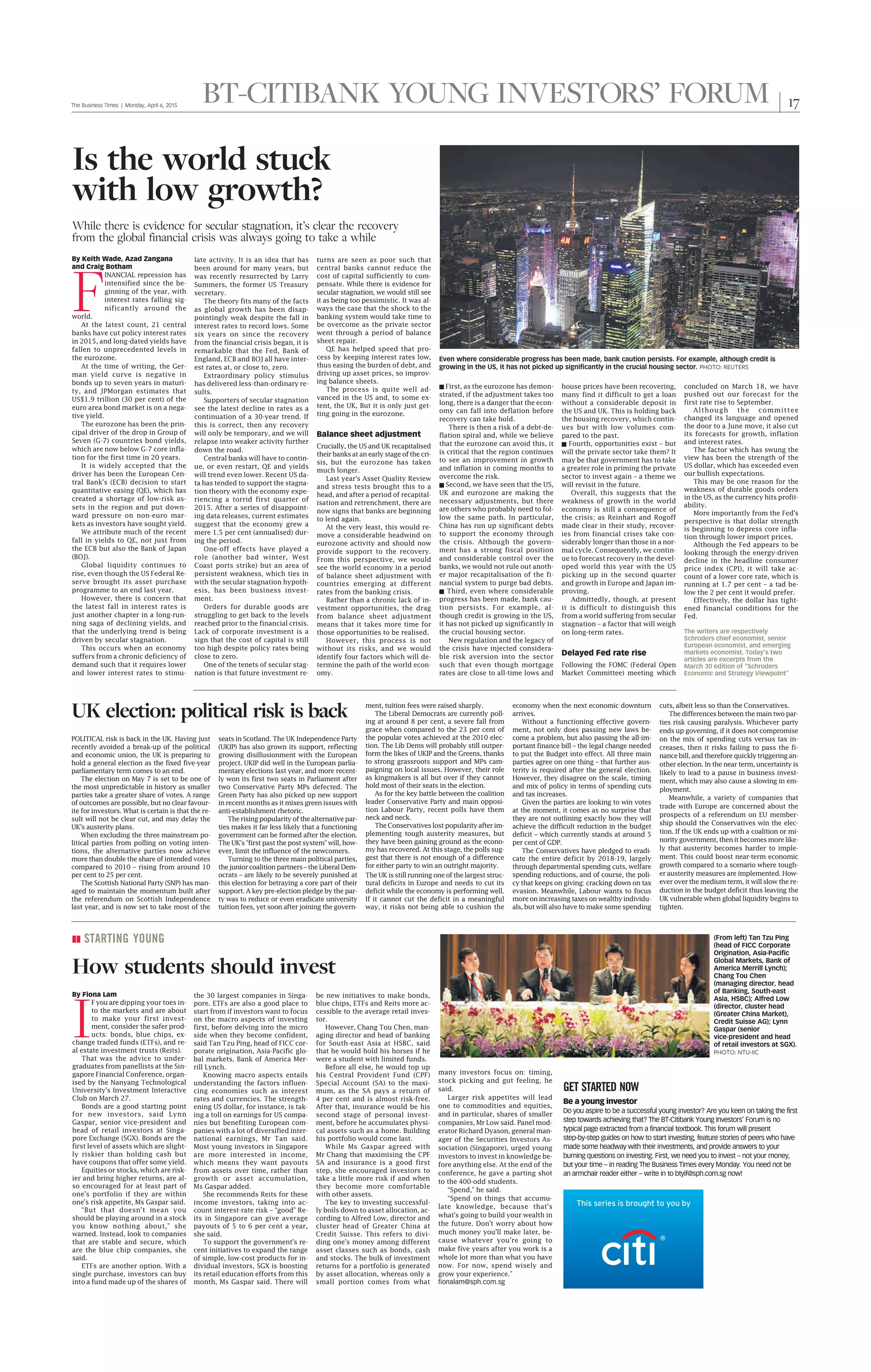
Even where considerable progress has been made, bank caution persists. For example, although credit is
growing in the US, it has not picked up significantly in the crucial housing sector. PHOTO: REUTERS
POLITICAL risk is back in the UK. Having just
recently avoided a break-up of the political
and economic union, the UK is preparing to
hold a general election as the fixed five-year
parliamentary term comes to an end.
The election on May 7 is set to be one of
the most unpredictable in history as smaller
parties take a greater share of votes. A range
of outcomes are possible, but no clear favour-
ite for investors. What is certain is that the re-
sult will not be clear cut, and may delay the
UK’s austerity plans.
When excluding the three mainstream po-
litical parties from polling on voting inten-
tions, the alternative parties now achieve
more than double the share of intended votes
compared to 2010 – rising from around 10
per cent to 25 per cent.
The Scottish National Party (SNP) has man-
aged to maintain the momentum built after
the referendum on Scottish Independence
last year, and is now set to take most of the
seats in Scotland. The UK Independence Party
(UKIP) has also grown its support, reflecting
growing disillusionment with the European
project. UKIP did well in the European parlia-
mentary elections last year, and more recent-
ly won its first two seats in Parliament after
two Conservative Party MPs defected. The
Green Party has also picked up new support
in recent months as it mixes green issues with
anti-establishment rhetoric.
Therisingpopularityofthealternativepar-
ties makes it far less likely that a functioning
government can be formed after the election.
TheUK’s“firstpast thepostsystem”will,how-
ever, limit the influence of the newcomers.
Turning to the three main political parties,
thejuniorcoalitionpartners–theLiberalDem-
ocrats – are likely to be severely punished at
this election for betraying a core part of their
support. A key pre-election pledge by the par-
ty was to reduce or even eradicate university
tuition fees, yet soon after joining the govern-
ment, tuition fees were raised sharply.
The Liberal Democrats are currently poll-
ing at around 8 per cent, a severe fall from
grace when compared to the 23 per cent of
the popular votes achieved at the 2010 elec-
tion. The Lib Dems will probably still outper-
form the likes of UKIP and the Greens, thanks
to strong grassroots support and MPs cam-
paigning on local issues. However, their role
as kingmakers is all but over if they cannot
hold most of their seats in the election.
As for the key battle between the coalition
leader Conservative Party and main opposi-
tion Labour Party, recent polls have them
neck and neck.
TheConservatives lostpopularityafterim-
plementing tough austerity measures, but
they have been gaining ground as the econo-
my has recovered. At this stage, the polls sug-
gest that there is not enough of a difference
for either party to win an outright majority.
TheUK isstillrunningoneofthelargeststruc-
tural deficits in Europe and needs to cut its
deficit while the economy is performing well.
If it cannot cut the deficit in a meaningful
way, it risks not being able to cushion the
economy when the next economic downturn
arrives.
Without a functioning effective govern-
ment, not only does passing new laws be-
come a problem, but also passing the all-im-
portant finance bill – the legal change needed
to put the Budget into effect. All three main
parties agree on one thing – that further aus-
terity is required after the general election.
However, they disagree on the scale, timing
and mix of policy in terms of spending cuts
and tax increases.
Given the parties are looking to win votes
at the moment, it comes as no surprise that
they are not outlining exactly how they will
achieve the difficult reduction in the budget
deficit – which currently stands at around 5
per cent of GDP.
The Conservatives have pledged to eradi-
cate the entire deficit by 2018-19, largely
through departmental spending cuts, welfare
spending reductions, and of course, the poli-
cy that keeps on giving: cracking down on tax
evasion. Meanwhile, Labour wants to focus
moreonincreasing taxeson wealthyindividu-
als, but will also have to make some spending
cuts, albeit less so than the Conservatives.
The differences between the main two par-
ties risk causing paralysis. Whichever party
ends up governing, if it does not compromise
on the mix of spending cuts versus tax in-
creases, then it risks failing to pass the fi-
nancebill,and thereforequicklytriggeringan-
other election. In the near term, uncertainty is
likely to lead to a pause in business invest-
ment, which may also cause a slowing in em-
ployment.
Meanwhile, a variety of companies that
trade with Europe are concerned about the
prospects of a referendum on EU member-
ship should the Conservatives win the elec-
tion. If the UK ends up with a coalition or mi-
noritygovernment,thenitbecomesmorelike-
ly that austerity becomes harder to imple-
ment. This could boost near-term economic
growth compared to a scenario where tough-
er austerity measures are implemented. How-
ever over the medium term, it will slow the re-
duction in the budget deficit thus leaving the
UK vulnerable when global liquidity begins to
tighten.
GET STARTED NOW
Be a young investor
Do you aspire to be a successful young investor? Are you keen on taking the first
step towards achieving that? The BT-Citibank Young Investors’ Forum is no
typical page extracted from a financial textbook. This forum will present
step-by-step guides on how to start investing, feature stories of peers who have
made some headway with their investments, and provide answers to your
burning questions on investing. First, we need you to invest – not your money,
but your time – in reading The Business Times every Monday. You need not be
an armchair reader either – write in to btyif@sph.com.sg now!
UK election: political risk is back
While there is evidence for secular stagnation, it’s clear the recovery
from the global financial crisis was always going to take a while
The Business Times | Monday, April 6, 2015
BT-CITIBANK YOUNG INVESTORS’ FORUM | 17

BT SFC 2015

  • 1.
    By Keith Wade,Azad Zangana and Craig Botham F INANCIAL repression has intensified since the be- ginning of the year, with interest rates falling sig- nificantly around the world. At the latest count, 21 central banks have cut policy interest rates in 2015, and long-dated yields have fallen to unprecedented levels in the eurozone. At the time of writing, the Ger- man yield curve is negative in bonds up to seven years in maturi- ty, and JPMorgan estimates that US$1.9 trillion (30 per cent) of the euro area bond market is on a nega- tive yield. The eurozone has been the prin- cipal driver of the drop in Group of Seven (G-7) countries bond yields, which are now below G-7 core infla- tion for the first time in 20 years. It is widely accepted that the driver has been the European Cen- tral Bank’s (ECB) decision to start quantitative easing (QE), which has created a shortage of low-risk as- sets in the region and put down- ward pressure on non-euro mar- kets as investors have sought yield. We attribute much of the recent fall in yields to QE, not just from the ECB but also the Bank of Japan (BOJ). Global liquidity continues to rise, even though the US Federal Re- serve brought its asset purchase programme to an end last year. However, there is concern that the latest fall in interest rates is just another chapter in a long-run- ning saga of declining yields, and that the underlying trend is being driven by secular stagnation. This occurs when an economy suffers from a chronic deficiency of demand such that it requires lower and lower interest rates to stimu- late activity. It is an idea that has been around for many years, but was recently resurrected by Larry Summers, the former US Treasury secretary. The theory fits many of the facts as global growth has been disap- pointingly weak despite the fall in interest rates to record lows. Some six years on since the recovery from the financial crisis began, it is remarkable that the Fed, Bank of England, ECB and BOJ all have inter- est rates at, or close to, zero. Extraordinary policy stimulus has delivered less-than-ordinary re- sults. Supporters of secular stagnation see the latest decline in rates as a continuation of a 30-year trend. If this is correct, then any recovery will only be temporary, and we will relapse into weaker activity further down the road. Central banks will have to contin- ue, or even restart, QE and yields will trend even lower. Recent US da- ta has tended to support the stagna- tion theory with the economy expe- riencing a torrid first quarter of 2015. After a series of disappoint- ing data releases, current estimates suggest that the economy grew a mere 1.5 per cent (annualised) dur- ing the period. One-off effects have played a role (another bad winter, West Coast ports strike) but an area of persistent weakness, which ties in with the secular stagnation hypoth- esis, has been business invest- ment. Orders for durable goods are struggling to get back to the levels reached prior to the financial crisis. Lack of corporate investment is a sign that the cost of capital is still too high despite policy rates being close to zero. One of the tenets of secular stag- nation is that future investment re- turns are seen as poor such that central banks cannot reduce the cost of capital sufficiently to com- pensate. While there is evidence for secular stagnation, we would still see it as being too pessimistic. It was al- ways the case that the shock to the banking system would take time to be overcome as the private sector went through a period of balance sheet repair. QE has helped speed that pro- cess by keeping interest rates low, thus easing the burden of debt, and driving up asset prices, so improv- ing balance sheets. The process is quite well ad- vanced in the US and, to some ex- tent, the UK, But it is only just get- ting going in the eurozone. Balance sheet adjustment Crucially, the US and UK recapitalised their banksat an early stage ofthe cri- sis, but the eurozone has taken much longer. Last year’s Asset Quality Review and stress tests brought this to a head, and after a period of recapital- isation and retrenchment, there are now signs that banks are beginning to lend again. At the very least, this would re- move a considerable headwind on eurozone activity and should now provide support to the recovery. From this perspective, we would see the world economy in a period of balance sheet adjustment with countries emerging at different rates from the banking crisis. Rather than a chronic lack of in- vestment opportunities, the drag from balance sheet adjustment means that it takes more time for those opportunities to be realised. However, this process is not without its risks, and we would identify four factors which will de- termine the path of the world econ- omy. s First, as the eurozone has demon- strated, if the adjustment takes too long, there is a danger that the econ- omy can fall into deflation before recovery can take hold. There is then a risk of a debt-de- flation spiral and, while we believe that the eurozone can avoid this, it is critical that the region continues to see an improvement in growth and inflation in coming months to overcome the risk. s Second, we have seen that the US, UK and eurozone are making the necessary adjustments, but there are others who probably need to fol- low the same path. In particular, China has run up significant debts to support the economy through the crisis. Although the govern- ment has a strong fiscal position and considerable control over the banks, we would not rule out anoth- er major recapitalisation of the fi- nancial system to purge bad debts. s Third, even where considerable progress has been made, bank cau- tion persists. For example, al- though credit is growing in the US, it has not picked up significantly in the crucial housing sector. New regulation and the legacy of the crisis have injected considera- ble risk aversion into the sector such that even though mortgage rates are close to all-time lows and house prices have been recovering, many find it difficult to get a loan without a considerable deposit in the US and UK. This is holding back the housing recovery, which contin- ues but with low volumes com- pared to the past. s Fourth, opportunities exist – but will the private sector take them? It may be that government has to take a greater role in priming the private sector to invest again – a theme we will revisit in the future. Overall, this suggests that the weakness of growth in the world economy is still a consequence of the crisis; as Reinhart and Rogoff made clear in their study, recover- ies from financial crises take con- siderably longer than those in a nor- mal cycle. Consequently, we contin- ue to forecast recovery in the devel- oped world this year with the US picking up in the second quarter and growth in Europe and Japan im- proving. Admittedly, though, at present it is difficult to distinguish this from a world suffering from secular stagnation – a factor that will weigh on long-term rates. Delayed Fed rate rise Following the FOMC (Federal Open Market Committee) meeting which concluded on March 18, we have pushed out our forecast for the first rate rise to September. Although the committee changed its language and opened the door to a June move, it also cut its forecasts for growth, inflation and interest rates. The factor which has swung the view has been the strength of the US dollar, which has exceeded even our bullish expectations. This may be one reason for the weakness of durable goods orders in the US, as the currency hits profit- ability. More importantly from the Fed’s perspective is that dollar strength is beginning to depress core infla- tion through lower import prices. Although the Fed appears to be looking through the energy-driven decline in the headline consumer price index (CPI), it will take ac- count of a lower core rate, which is running at 1.7 per cent – a tad be- low the 2 per cent it would prefer. Effectively, the dollar has tight- ened financial conditions for the Fed. The writers are respectively Schroders chief economist, senior European economist, and emerging markets economist. Today’s two articles are excerpts from the March 30 edition of “Schroders Economic and Strategy Viewpoint” By Fiona Lam I Fyou aredipping your toes in- to the markets and are about to make your first invest- ment, consider the safer prod- ucts: bonds, blue chips, ex- change traded funds (ETFs), and re- al estate investment trusts (Reits). That was the advice to under- graduates from panellists at the Sin- gapore Financial Conference, organ- ised by the Nanyang Technological University’s Investment Interactive Club on March 27. Bonds are a good starting point for new investors, said Lynn Gaspar, senior vice-president and head of retail investors at Singa- pore Exchange (SGX). Bonds are the first level of assets which are slight- ly riskier than holding cash but have coupons that offer some yield. Equities or stocks, which are risk- ier and bring higher returns, are al- so encouraged for at least part of one’s portfolio if they are within one’s risk appetite, Ms Gaspar said. “But that doesn’t mean you should be playing around in a stock you know nothing about,” she warned. Instead, look to companies that are stable and secure, which are the blue chip companies, she said. ETFs are another option. With a single purchase, investors can buy into a fund made up of the shares of the 30 largest companies in Singa- pore. ETFs are also a good place to start from if investors want to focus on the macro aspects of investing first, before delving into the micro side when they become confident, said Tan Tzu Ping, head of FICC cor- porate origination, Asia-Pacific glo- bal markets, Bank of America Mer- rill Lynch. Knowing macro aspects entails understanding the factors influen- cing economies such as interest rates and currencies. The strength- ening US dollar, for instance, is tak- ing a toll on earnings for US compa- nies but benefiting European com- panies with a lot of diversified inter- national earnings, Mr Tan said. Most young investors in Singapore are more interested in income, which means they want payouts from assets over time, rather than growth or asset accumulation, Ms Gaspar added. She recommends Reits for these income investors, taking into ac- count interest-rate risk – “good” Re- its in Singapore can give average payouts of 5 to 6 per cent a year, she said. To support the government’s re- cent initiatives to expand the range of simple, low-cost products for in- dividual investors, SGX is boosting its retail education efforts from this month, Ms Gaspar said. There will be new initiatives to make bonds, blue chips, ETFs and Reits more ac- cessible to the average retail inves- tor. However, Chang Tou Chen, man- aging director and head of banking for South-east Asia at HSBC, said that he would hold his horses if he were a student with limited funds. Before all else, he would top up his Central Provident Fund (CPF) Special Account (SA) to the maxi- mum, as the SA pays a return of 4 per cent and is almost risk-free. After that, insurance would be his second stage of personal invest- ment, before he accumulates physi- cal assets such as a home. Building his portfolio would come last. While Ms Gaspar agreed with Mr Chang that maximising the CPF SA and insurance is a good first step, she encouraged investors to take a little more risk if and when they become more comfortable with other assets. The key to investing successful- ly boils down to asset allocation, ac- cording to Alfred Low, director and cluster head of Greater China at Credit Suisse. This refers to divi- ding one’s money among different asset classes such as bonds, cash and stocks. The bulk of investment returns for a portfolio is generated by asset allocation, whereas only a small portion comes from what many investors focus on: timing, stock picking and gut feeling, he said. Larger risk appetites will lead one to commodities and equities, and in particular, shares of smaller companies, Mr Low said. Panel mod- erator Richard Dyason, general man- ager of the Securities Investors As- sociation (Singapore), urged young investors to invest in knowledge be- fore anything else. At the end of the conference, he gave a parting shot to the 400-odd students. “Spend,” he said. “Spend on things that accumu- late knowledge, because that’s what’s going to build your wealth in the future. Don’t worry about how much money you’ll make later, be- cause whatever you’re going to make five years after you work is a whole lot more than what you have now. For now, spend wisely and grow your experience.” fionalam@sph.com.sg „„ STARTING YOUNG How students should invest Is the world stuck with low growth? (From left) Tan Tzu Ping (head of FICC Corporate Origination, Asia-Pacific Global Markets, Bank of America Merrill Lynch); Chang Tou Chen (managing director, head of Banking, South-east Asia, HSBC); Alfred Low (director, cluster head (Greater China Market), Credit Suisse AG); Lynn Gaspar (senior vice-president and head of retail investors at SGX). PHOTO: NTU-IIC Even where considerable progress has been made, bank caution persists. For example, although credit is growing in the US, it has not picked up significantly in the crucial housing sector. PHOTO: REUTERS POLITICAL risk is back in the UK. Having just recently avoided a break-up of the political and economic union, the UK is preparing to hold a general election as the fixed five-year parliamentary term comes to an end. The election on May 7 is set to be one of the most unpredictable in history as smaller parties take a greater share of votes. A range of outcomes are possible, but no clear favour- ite for investors. What is certain is that the re- sult will not be clear cut, and may delay the UK’s austerity plans. When excluding the three mainstream po- litical parties from polling on voting inten- tions, the alternative parties now achieve more than double the share of intended votes compared to 2010 – rising from around 10 per cent to 25 per cent. The Scottish National Party (SNP) has man- aged to maintain the momentum built after the referendum on Scottish Independence last year, and is now set to take most of the seats in Scotland. The UK Independence Party (UKIP) has also grown its support, reflecting growing disillusionment with the European project. UKIP did well in the European parlia- mentary elections last year, and more recent- ly won its first two seats in Parliament after two Conservative Party MPs defected. The Green Party has also picked up new support in recent months as it mixes green issues with anti-establishment rhetoric. Therisingpopularityofthealternativepar- ties makes it far less likely that a functioning government can be formed after the election. TheUK’s“firstpast thepostsystem”will,how- ever, limit the influence of the newcomers. Turning to the three main political parties, thejuniorcoalitionpartners–theLiberalDem- ocrats – are likely to be severely punished at this election for betraying a core part of their support. A key pre-election pledge by the par- ty was to reduce or even eradicate university tuition fees, yet soon after joining the govern- ment, tuition fees were raised sharply. The Liberal Democrats are currently poll- ing at around 8 per cent, a severe fall from grace when compared to the 23 per cent of the popular votes achieved at the 2010 elec- tion. The Lib Dems will probably still outper- form the likes of UKIP and the Greens, thanks to strong grassroots support and MPs cam- paigning on local issues. However, their role as kingmakers is all but over if they cannot hold most of their seats in the election. As for the key battle between the coalition leader Conservative Party and main opposi- tion Labour Party, recent polls have them neck and neck. TheConservatives lostpopularityafterim- plementing tough austerity measures, but they have been gaining ground as the econo- my has recovered. At this stage, the polls sug- gest that there is not enough of a difference for either party to win an outright majority. TheUK isstillrunningoneofthelargeststruc- tural deficits in Europe and needs to cut its deficit while the economy is performing well. If it cannot cut the deficit in a meaningful way, it risks not being able to cushion the economy when the next economic downturn arrives. Without a functioning effective govern- ment, not only does passing new laws be- come a problem, but also passing the all-im- portant finance bill – the legal change needed to put the Budget into effect. All three main parties agree on one thing – that further aus- terity is required after the general election. However, they disagree on the scale, timing and mix of policy in terms of spending cuts and tax increases. Given the parties are looking to win votes at the moment, it comes as no surprise that they are not outlining exactly how they will achieve the difficult reduction in the budget deficit – which currently stands at around 5 per cent of GDP. The Conservatives have pledged to eradi- cate the entire deficit by 2018-19, largely through departmental spending cuts, welfare spending reductions, and of course, the poli- cy that keeps on giving: cracking down on tax evasion. Meanwhile, Labour wants to focus moreonincreasing taxeson wealthyindividu- als, but will also have to make some spending cuts, albeit less so than the Conservatives. The differences between the main two par- ties risk causing paralysis. Whichever party ends up governing, if it does not compromise on the mix of spending cuts versus tax in- creases, then it risks failing to pass the fi- nancebill,and thereforequicklytriggeringan- other election. In the near term, uncertainty is likely to lead to a pause in business invest- ment, which may also cause a slowing in em- ployment. Meanwhile, a variety of companies that trade with Europe are concerned about the prospects of a referendum on EU member- ship should the Conservatives win the elec- tion. If the UK ends up with a coalition or mi- noritygovernment,thenitbecomesmorelike- ly that austerity becomes harder to imple- ment. This could boost near-term economic growth compared to a scenario where tough- er austerity measures are implemented. How- ever over the medium term, it will slow the re- duction in the budget deficit thus leaving the UK vulnerable when global liquidity begins to tighten. GET STARTED NOW Be a young investor Do you aspire to be a successful young investor? Are you keen on taking the first step towards achieving that? The BT-Citibank Young Investors’ Forum is no typical page extracted from a financial textbook. This forum will present step-by-step guides on how to start investing, feature stories of peers who have made some headway with their investments, and provide answers to your burning questions on investing. First, we need you to invest – not your money, but your time – in reading The Business Times every Monday. You need not be an armchair reader either – write in to btyif@sph.com.sg now! UK election: political risk is back While there is evidence for secular stagnation, it’s clear the recovery from the global financial crisis was always going to take a while The Business Times | Monday, April 6, 2015 BT-CITIBANK YOUNG INVESTORS’ FORUM | 17