Macro Overview
Redington Teach-in
Wednesday 22nd January 2014
Agenda
1. Global Economic and Macro Outlook 2014 – Gavyn Davies

2. Global Economic Outlook – Neil Williams

3. The End of QE – Gavyn Davies

4. The End of QE – Neil Williams

5. Panel Session – Participants:
Gavyn Davies, Neil Williams, David Bennett

Moderator:
Pete Drewienkiewicz
Macro Overview

For Professional Investors Only

22 January 2014

2
Speakers
Gavyn Davies – Chairman, Fulcrum Asset Management

Neil Williams – Chief Economist, Hermes Fund Managers Ltd

Gavyn is Chairman of Fulcrum Asset Management and Head
of the Fulcrum Investment Committee. Previously, Gavyn was
Chairman of the BBC from 2001 to 2004. He joined
Goldman Sachs in 1986 and was a Partner from 1988 to
2001. He was also the firm’s Chief Economist over that
period and Chairman of the Research Department. He was
repeatedly ranked as the City’s top UK and European
economist in surveys of institutional investors. From 1992 to
1997, he was a member of H.M. Treasury Independent
Forecasting Panel.

Neil joined Hermes Fund Managers in August 2009 and is
responsible for its global economic research. He has over
twenty five years’ experience of providing economic analysis,
and has a forward-looking approach to generate investment
strategy ideas for the company and its clients.

He began as a City Economist, first with Phillips and Drew
from 1979 to 1981, then Simon and Coates from 1981 to
1986. Gavyn graduated in economics from St. John’s
College, Cambridge in 1972. This was followed by two years
of research at Balliol College, Oxford. He joined the Policy
Unit at 10 Downing Street as an Economist in 1974 and was
an Economic Policy Adviser to the Prime Minister from 1976
to 1979.

Neil adopts top-down methods - macro and market analysis
to identify interest rate and credit value, and sovereign
default risk. Neil began his career in 1987 at the
Confederation of British Industry (CBI), becoming its youngest
ever Head of Economic Policy. He went on to hold a number
of senior positions in investment banks - including Director of
Bond Research at UBS, Head of Research at Sumitomo
International, Global Head of Emerging Markets Research at
PaineWebber International, and, before coming to Hermes,
Head of Sovereign Research and Strategy at Mizuho
International. Neil earned an MA in Economics in 1986 from
Manchester University, having the previous year completed
his BSc (Hons), also in Economics, from University College
Swansea.

Gavyn.Davies@fulcrumasset.com

N.Williams@hermes.co.uk

Twitter: @GavynDavies

Twitter: @Hermes_fm

Macro Overview

For Professional Investors Only

22 January 2014

3
Global Economic and Market
Outlook, 2014
Gavyn Davies, Chairman, Fulcrum Asset
Management
Redington Conference, 22 January, 2013

4
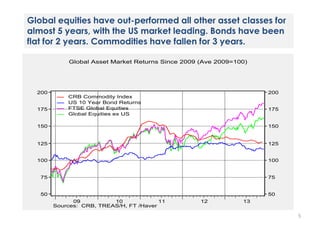
Global equities have out-performed all other asset classes for
almost 5 years, with the US market leading. Bonds have been
flat for 2 years. Commodities have fallen for 3 years.

5
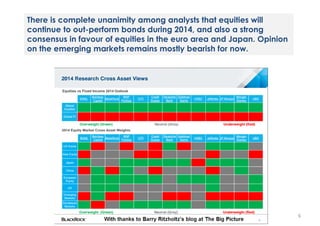
There is complete unanimity among analysts that equities will
continue to out-perform bonds during 2014, and also a strong
consensus in favour of equities in the euro area and Japan. Opinion
on the emerging markets remains mostly bearish for now.

6
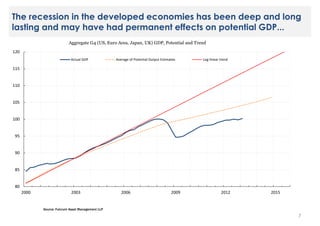
The recession in the developed economies has been deep and long
lasting and may have had permanent effects on potential GDP...
Aggregate G4 (US, Euro Area, Japan, UK) GDP, Potential and Trend

120
Actual GDP

Average of Potential Output Estimates

Log-linear trend

115

110

105

100

95

90

85

80
2000

2003

2006

2009

2012

2015

Source: Fulcrum Asset Management LLP

7
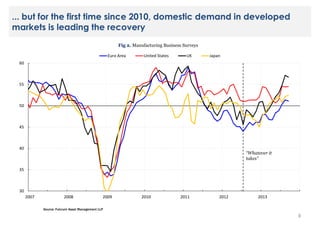
... but for the first time since 2010, domestic demand in developed
markets is leading the recovery
Fig 2. Manufacturing Business Surveys
Euro Area

United States

UK

Japan

60

55

50

45

40

“Whatever it
takes”

35

30

2007

2008

2009

2010

2011

2012

2013

Source: Fulcrum Asset Management LLP

8
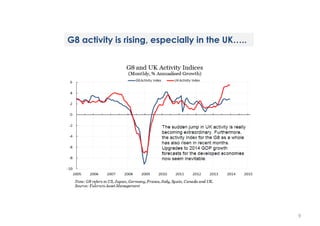
G8 activity is rising, especially in the UK…..

9
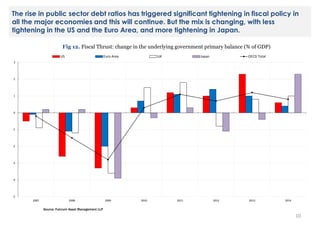
The rise in public sector debt ratios has triggered significant tightening in fiscal policy in
all the major economies and this will continue. But the mix is changing, with less
tightening in the US and the Euro Area, and more tightening in Japan.
Fig 12. Fiscal Thrust: change in the underlying government primary balance (% of GDP)
US

Euro Area

UK

Japan

OECD Total

3

2

1

0

-1

-2

-3

-4

-5
2007

2008

2009

2010

2011

2012

2013

2014

Source: Fulcrum Asset Management LLP

10
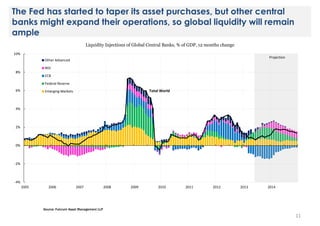
The Fed has started to taper its asset purchases, but other central
banks might expand their operations, so global liquidity will remain
ample
Liquidity Injections of Global Central Banks, % of GDP, 12 months change
10%

Projection

Other Advanced
BOJ
8%

ECB
Federal Reserve

6%

Total World

Emerging Markets

4%

2%

0%

-2%

-4%
2005

2006

2007

2008

2009

2010

2011

2012

2013

2014

Source: Fulcrum Asset Management LLP

11
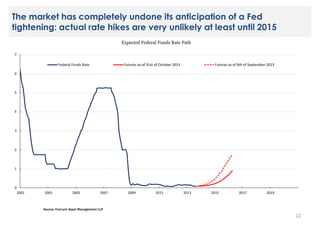
The market has completely undone its anticipation of a Fed
tightening: actual rate hikes are very unlikely at least until 2015
Expected Federal Funds Rate Path
7

Federal Funds Rate

Futures as of 31st of October 2013

Futures as of 9th of September 2013

6

5

4

3

2

1

0
2001

2003

2005

2007

2009

2011

2013

2015

2017

2019

Source: Fulcrum Asset Management LLP

12
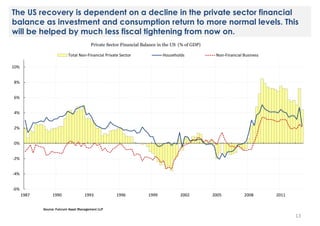
The US recovery is dependent on a decline in the private sector financial
balance as investment and consumption return to more normal levels. This
will be helped by much less fiscal tightening from now on.
Private Sector Financial Balance in the US (% of GDP)
Total Non-Financial Private Sector

Households

Non-Financial Business

10%
8%
6%
4%
2%
0%

-2%
-4%
-6%
1987

1990

1993

1996

1999

2002

2005

2008

2011

Source: Fulcrum Asset Management LLP

13
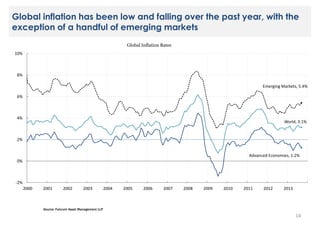
Global inflation has been low and falling over the past year, with the
exception of a handful of emerging markets
Global Inflation Rates
10%

8%
Emerging Markets, 5.4%
6%

4%

World, 3.1%

2%
Advanced Economies, 1.2%

0%

-2%
2000

2001

2002

2003

2004

2005

2006

2007

2008

2009

2010

2011

2012

2013

Source: Fulcrum Asset Management LLP

14
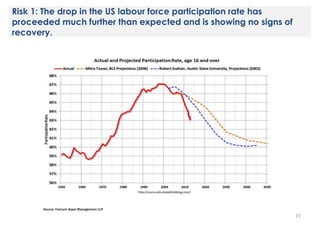
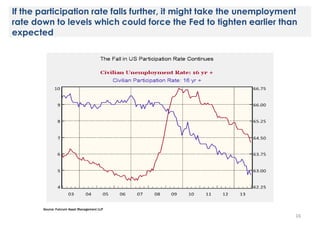
Risk 1: The drop in the US labour force participation rate has
proceeded much further than expected and is showing no signs of
recovery.

Source: Fulcrum Asset Management LLP

15
If the participation rate falls further, it might take the unemployment
rate down to levels which could force the Fed to tighten earlier than
expected

Source: Fulcrum Asset Management LLP

16
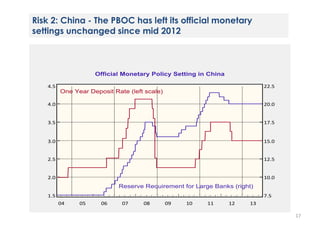
Risk 2: China - The PBOC has left its official monetary
settings unchanged since mid 2012

17
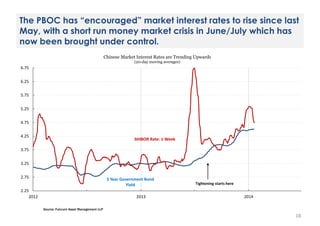
The PBOC has “encouraged” market interest rates to rise since last
May, with a short run money market crisis in June/July which has
now been brought under control.
Chinese Market Interest Rates are Trending Upwards
(20-day moving averages)

6.75
6.25
5.75
5.25
4.75
4.25

SHIBOR Rate: 1-Week

3.75
3.25
2.75

5 Year Government Bond
Yield

2.25
2012

2013

Tightening starts here

2014

Source: Fulcrum Asset Management LLP

18
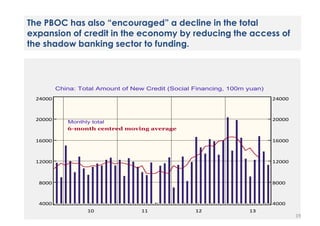
The PBOC has also “encouraged” a decline in the total
expansion of credit in the economy by reducing the access of
the shadow banking sector to funding.

19
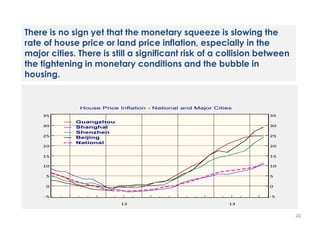
There is no sign yet that the monetary squeeze is slowing the
rate of house price or land price inflation, especially in the
major cities. There is still a significant risk of a collision between
the tightening in monetary conditions and the bubble in
housing.

20
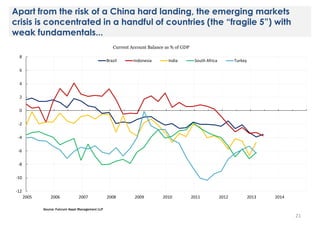
Apart from the risk of a China hard landing, the emerging markets
crisis is concentrated in a handful of countries (the “fragile 5”) with
weak fundamentals...
Current Account Balance as % of GDP
8

Brazil

Indonesia

2008

2009

India

South Africa

Turkey

6

4
2
0
-2
-4
-6
-8
-10
-12
2005

2006

2007

2010

2011

2012

2013

2014

Source: Fulcrum Asset Management LLP

21
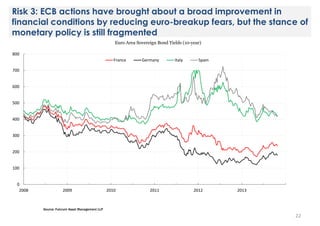
Risk 3: ECB actions have brought about a broad improvement in
financial conditions by reducing euro-breakup fears, but the stance of
monetary policy is still fragmented
Euro Area Sovereign Bond Yields (10-year)
800
France

Germany

Italy

Spain

700

600

500

400

300

200

100

0
2008

2009

2010

2011

2012

2013

Source: Fulcrum Asset Management LLP

22
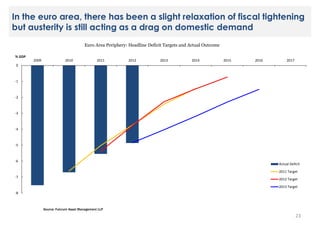
In the euro area, there has been a slight relaxation of fiscal tightening
but austerity is still acting as a drag on domestic demand
Euro Area Periphery: Headline Deficit Targets and Actual Outcome
% GDP

2009

2010

2011

2012

2013

2014

2015

2016

2017

0

-1

-2

-3

-4

-5

-6

Actual Deficit
2011 Target

-7

2012 Target
2013 Target

-8

Source: Fulcrum Asset Management LLP

23
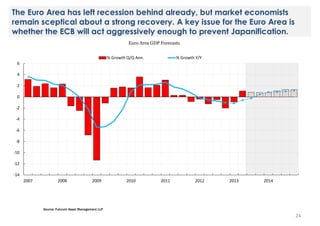
The Euro Area has left recession behind already, but market economists
remain sceptical about a strong recovery. A key issue for the Euro Area is
whether the ECB will act aggressively enough to prevent Japanification.
Euro Area GDP Forecasts
% Growth Q/Q Ann.

% Growth Y/Y

6
4
2
0
-2

-4
-6
-8
-10
-12
-14

2007

2008

2009

2010

2011

2012

2013

2014

Source: Fulcrum Asset Management LLP

24
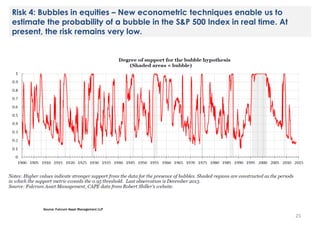
Risk 4: Bubbles in equities – New econometric techniques enable us to
estimate the probability of a bubble in the S&P 500 Index in real time. At
present, the risk remains very low.

Source: Fulcrum Asset Management LLP

25
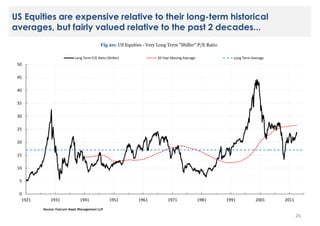
US Equities are expensive relative to their long-term historical
averages, but fairly valued relative to the past 2 decades...
Fig 20: US Equities - Very Long Term "Shiller" P/E Ratio
Long Term P/E Ratio (Shiller)

20 Year Moving Average

Long Term Average

50
45

40
35
30
25
20
15
10

5
0
1921

1931

1941

1951

1961

1971

1981

1991

2001

2011

Source: Fulcrum Asset Management LLP

26
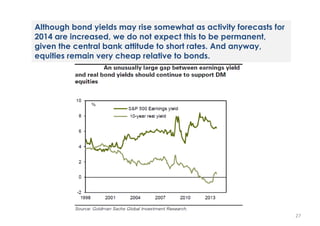
Although bond yields may rise somewhat as activity forecasts for
2014 are increased, we do not expect this to be permanent,
given the central bank attitude to short rates. And anyway,
equities remain very cheap relative to bonds.

27
Disclaimer
This material is for your information only and is not intended to be used by anyone other than you. It is directed at professional clients and eligible counterparties only and is not intended for retail
clients. This is not an offer or solicitation with respect to the purchase or sale of any security. The material is intended only to facilitate your discussions with Fulcrum Asset Management as to the
opportunities available to our clients. The given material is subject to change and, although based upon information which we consider reliable, it is not guaranteed as to accuracy or completeness and it
should not be relied upon as such. The material is not intended to be used as a general guide to investing, or as a source of any specific investment recommendations, and makes no implied or express
recommendations concerning the manner in which any client’s account should or would be handled, as appropriate investment strategies depend upon client’s investment objectives. The price and value of
the investments referred to in this material and the income from them may go down as well as up and investors may not receive back the amount originally invested. Past performance is not a guide to
future performance. Future returns are not guaranteed and a loss of principal may occur.
It is the responsibility of any person or persons in possession of this material to inform themselves of and to observe all applicable laws and regulations of any relevant jurisdiction. Prospective investors
should obtain and review the Fund prospectus carefully and take appropriate advice as to any applicable legal requirements and any applicable taxation and exchange control regulations in the countries of
their citizenship, residence or domicile which might be relevant to the subscription, purchase, holding, exchange, redemption or disposal of any investments. Fulcrum Asset Management does not provide
tax advice to its clients and all investors are strongly advised to consult with their tax advisors regarding any potential investment. Opinions expressed are our current opinions as of the date appearing on
this material only. Any historical price(s) or value(s) are also only as of the date indicated. We will endeavor to update on a reasonable basis the information discussed in this material.
References to market or composite indices, benchmarks or other measures of relative market performance over a specified period of time ("benchmarks") are provided by Fulcrum Asset Management for
your information purposes only. Investors cannot invest directly in indices. Indices are typically unmanaged and the figures for the indices shown herein do not reflect any investment management fees or
transaction expenses. Fulcrum Asset Management does not give any commitment or undertaking that the performance or risk profile of your account(s) will equal, exceed or track any benchmark. The
composition of the benchmark may not reflect the manner in which a portfolio is constructed in relation to expected or achieved returns, portfolio guidelines, restrictions, sectors, correlations,
concentrations, volatility or tracking error targets, all of which are subject to change over time.
Simulated, modeled, or hypothetical performance results have certain inherent limitations. Simulated results are hypothetical and do not represent actual trading, and thus may not reflect material
economic and market factors, such as liquidity constraints, that may have had an impact on actual decision-making. Simulated results are also achieved through retroactive application of a model designed
with the benefit of hindsight. The results shown reflect the reinvestment of dividends and other earnings and other expenses a client would have paid, which would reduce return. No representation is
being made that any client will or is likely to achieve results similar to those shown.
Funds managed by Fulcrum Asset Management LLP are in general managed using quantitative models though, where this is the case, Fulcrum Asset Management LLP can and do make discretionary
decisions on a frequent basis and reserves the right to do so at any point.
Certain transactions, including those involving futures, options and high yield securities and investments in emerging markets may give rise to substantial risk and may not be suitable for all investors.
Foreign currency denominated investments are subject to fluctuations in exchange rates that could have an adverse effect on the value or price of, or income derived from, the investment; such
investments are also subject to the possible imposition of exchange control regulations or other laws or restrictions applicable to such investments. Investments referred to in this material are not
necessarily available in all jurisdictions, may be illiquid and may not be suitable for all investors. Investors should consider whether an investment is suitable for their particular circumstances and seek
advice from their investment adviser.
For US Investors: Shares in the Fund will not be registered under the Securities Act of 1933, the securities laws of any state or the securities laws of any other jurisdiction, and the Fund will not be registered
under the Investment Company Act of 1940. There is no public market for the shares, and no such market is expected to develop in the future. Shares in the Fund may not be sold or transferred except as
permitted under the Fund's articles of association, and unless they are registered under the Securities Act of 1933 or an exemption from registration thereunder and under any other applicable securities
law registration requirements is available. Accordingly, investors will be required to bear the financial risks of an investment in the Fund for an extended period of time.
This material has been approved for issue in the United Kingdom solely for the purposes of Section 21 of the Financial Services and Markets Act 2000 by Fulcrum Asset Management (“Fulcrum”), 6
Chesterfield Gardens, London W1J 5BQ.
Fulcrum Asset Management LLP is authorised and regulated by the Financial Services Authority (No: 230683).
© 2013 Fulcrum Asset Management LLP. All rights reserved.

28
Global Economic Outlook
Redington Teach-in
22 January 2014

Neil Williams
Chief Economist
Outline

 Where are we now?

 Policy environment

 Economic outlook for 2014…

Hermes Fund Managers Ltd I Global Economic Outlook I

Page 30
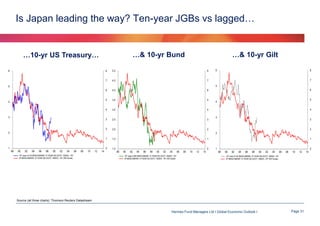
Is Japan leading the way? Ten-year JGBs vs lagged…

…10-yr US Treasury…

…& 10-yr Bund

…& 10-yr Gilt

Source (all three charts): Thomson Reuters Datastream

Hermes Fund Managers Ltd I Global Economic Outlook I

Page 31
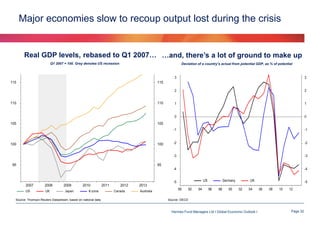
Major economies slow to recoup output lost during the crisis

Real GDP levels, rebased to Q1 2007… …and, there’s a lot of ground to make up
Q1 2007 = 100. Grey denotes US recession

Source: Thomson Reuters Datastream, based on national data

Deviation of a country’s actual from potential GDP, as % of potential

Source: OECD

Hermes Fund Managers Ltd I Global Economic Outlook I

Page 32
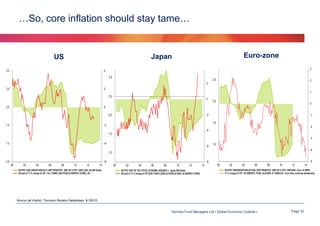
…So, core inflation should stay tame…

US

Japan

Euro-zone

Source (all charts): Thomson Reuters Datastream, & OECD

Hermes Fund Managers Ltd I Global Economic Outlook I

Page 33
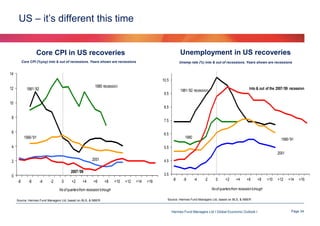
US – it’s different this time

Unemployment in US recoveries

Core CPI in US recoveries
Core CPI (%yoy) into & out of recessions. Years shown are recessions

Unemp rate (%) into & out of recessions. Years shown are recessions

14
10.5

12

1980 recession

1981-'82

Into & out of the 2007-'09 recession

1981-'82 recession

9.5

10
8.5

8

7.5

6

6.5

1990-'91
4

1980

1990-'91

5.5
2001

2001

2

4.5

2007-'09

3.5

0
-8

-6

-4

-2

0

+2

+4

+6

+8

No of quarters from recession's trough
Source: Hermes Fund Managers Ltd, based on BLS, & NBER

+10

+12

+14

+16

-8

-6

-4

-2

0

+2

+4

+6

+8

+10

+12

+14

+16

No of quarters from recession's trough
Source: Hermes Fund Managers Ltd, based on BLS, & NBER

Hermes Fund Managers Ltd I Global Economic Outlook I

Page 34
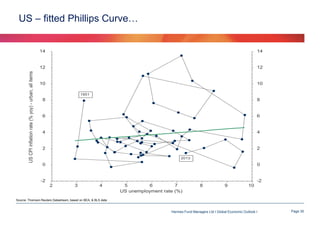
US – fitted Phillips Curve…

Source: Thomson Reuters Datastream, based on BEA, & BLS data

Hermes Fund Managers Ltd I Global Economic Outlook I

Page 35
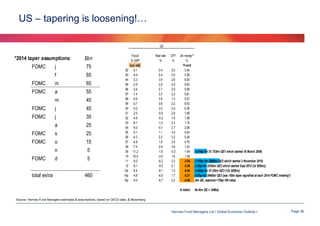
US – tapering is loosening!…
US

*2014 taper assumptions:
FOMC

$bn

j

75

f

65

FOMC

m

65

FOMC

a

55

m

45

FOMC

j

45

FOMC

j

35

a

25

FOMC

s

25

FOMC

o

15

n

5

d

5

FOMC
total extra

460

92
93
94
95
96
97
98
99
00
01
02
03
04
05
06
07
08
09
10
11
12
13e
14p
15p

Fiscal
% GDP
(cyc adj)
-5.1
-4.4
-3.3
-2.5
-2.4
-1.4
-0.6
-0.7
-0.2
-2.0
-4.9
-6.1
-6.0
-5.1
-4.3
-4.8
-7.4
-11.2
-10.5
-9.2
-8.1
-5.4
-4.9
-4.0

Real rate
%

CPI*
%

0.4
0.4
3.9
2.8
2.7
3.5
3.6
3.8
3.0
-0.9
-0.2
-1.2
-0.1
1.1
2.2
1.8
-2.4
-1.6
-3.5
-6.2
-5.5
-6.1
-6.9
-6.7

3.0
3.0
2.6
2.8
2.9
2.3
1.5
2.2
3.4
2.8
1.6
2.3
2.7
3.4
3.2
2.9
3.8
-0.3
1.6
3.2
2.1
1.5
1.7
2.2

3m money**
%
Yr-end
3.44
3.38
6.50
5.63
5.56
5.81
5.07
6.00
6.39
1.88
1.38
1.15
2.56
4.54
5.36
4.70
1.43
-1.94 (-219bp for $1.753trn QE1 which started 18 March 2009)
-1.94
-3.04 (-110bp for $880bn QE2 which started 3 November 2010)
-3.36 (-32bp for $255bn QE3 which started Sept 2012 (3x $85bn))
-4.64 (-128bp for $1.02trn QE3 (12x $85bn))
-5.21 (-57bp for $460bn QE3 (ass -10bn taper signalled at each 2014 FOMC meeting*)
-4.46 (No QE; assumes +75bp ON rates)
In totem:

$4.4trn QE = -546bp

Source: Hermes Fund Managers estimates & assumptions, based on OECD data, & Bloomberg

Hermes Fund Managers Ltd I Global Economic Outlook I

Page 36
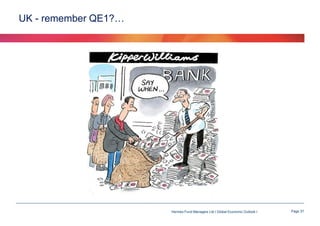
UK - remember QE1?…

Hermes Fund Managers Ltd I Global Economic Outlook I

Page 37
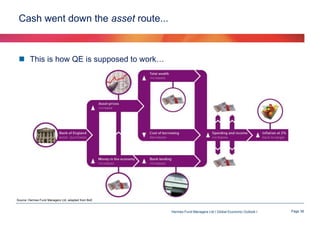
Cash went down the asset route...

 This is how QE is supposed to work…

Source: Hermes Fund Managers Ltd, adapted from BoE

Hermes Fund Managers Ltd I Global Economic Outlook I

Page 38
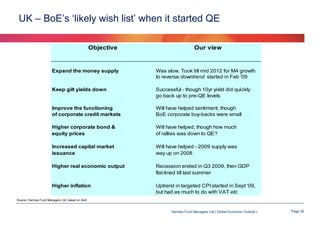
UK – BoE’s ‘likely wish list’ when it started QE
Objective

Our view

Expand the money supply

Was slow. Took till mid 2012 for M4 growth
to reverse downtrend started in Feb '09

Keep gilt yields down

Successful - though 10yr yield did quickly
go back up to pre-QE levels

Improve the functioning
of corporate credit markets

Will have helped sentiment, though
BoE corporate buy-backs were small

Higher corporate bond &
equity prices

Will have helped, though how much
of rallies was down to QE?

Increased capital market
issuance

Will have helped - 2009 supply was
way up on 2008

Higher real economic output

Recession ended in Q3 2009, then GDP
flat-lined till last summer

Higher inflation

Uptrend in targeted CPI started in Sept '09,
but had as much to do with VAT etc

Source: Hermes Fund Managers Ltd, based on BoE

Hermes Fund Managers Ltd I Global Economic Outlook I

Page 39
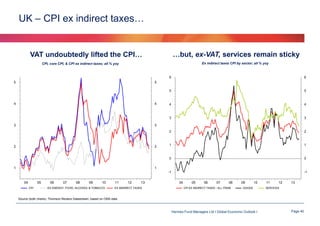
UK – CPI ex indirect taxes…

VAT undoubtedly lifted the CPI…
CPI, core CPI, & CPI ex indirect taxes; all % yoy

…but, ex-VAT, services remain sticky
Ex indirect taxes CPI by sector; all % yoy

Source (both charts): Thomson Reuters Datastream, based on ONS data

Hermes Fund Managers Ltd I Global Economic Outlook I

Page 40
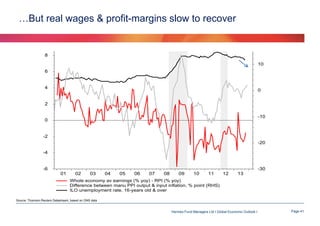
…But real wages & profit-margins slow to recover

Source: Thomson Reuters Datastream, based on ONS data

Hermes Fund Managers Ltd I Global Economic Outlook I

Page 41
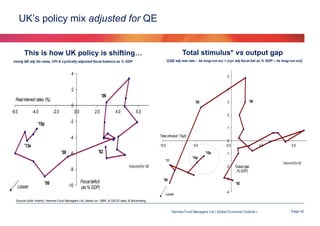
UK’s policy mix adjusted for QE

This is how UK policy is shifting…

Total stimulus* vs output gap
*{(QE adj real rate – its long-run av) + (cyc adj fiscal bal as % GDP – its long-run av)}

Using QE adj 3m rates, CPI & cyclically adjusted fiscal balance as % GDP

4

5

2

4

'06

Real interest rates (%)

'08

0
-6.0

-4.0

-2.0

'15p

0.0

2.0

4.0

6.0

2

-2
1

Total stimulus* (%pt)

-4
'13e

-10.5

'08 -6

'92

'15p

Looser

-10

Fiscal deficit
(as % GDP)

4.5

9.5

-1

'14p

Adjusted for QE

-8

0
-0.5

-5.5

'11

'09

'06

3

-2

Output gap
(% GDP)

Adjusted for QE

-3

'09

'92

Looser

-4

Source (both charts): Hermes Fund Managers Ltd, based on OBR, & OECD data, & Bloomberg

Hermes Fund Managers Ltd I Global Economic Outlook I

Page 42
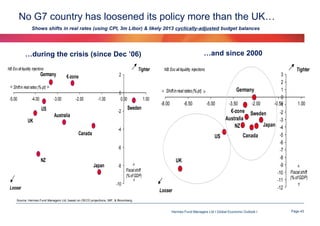
No G7 country has loosened its policy more than the UK…
Shows shifts in real rates (using CPI, 3m Libor) & likely 2013 cyclically-adjusted budget balances

…and since 2000

…during the crisis (since Dec ’06)
NB: Exc all liquidity injections

Germany

Tighter
2

€-zone

Shift in real rates (% pt)

-5.00

-4.00

-3.00

-2.00

-1.00

US

0
0.00

-2

Australia

1.00

Sweden

UK
-4

Canada

-6

NZ
Japan

Looser

-8

Fiscal shift
(% of GDP)

-10

NB: Exc all liquidity injections

3
2
1
Germany
Shift in real rates (% pt)
0
-8.00
-6.50
-5.00
-3.50
-2.00
-0.50
-1
€-zone Sweden
-2
Australia
-3
Japan -4
NZ
-5
Canada
US
-6
-7
-8
UK
-9
-10
-11
-12
Looser

Tighter

1.00

Fiscal shift
(% of GDP)

Source: Hermes Fund Managers Ltd, based on OECD projections, IMF, & Bloomberg

Hermes Fund Managers Ltd I Global Economic Outlook I

Page 43
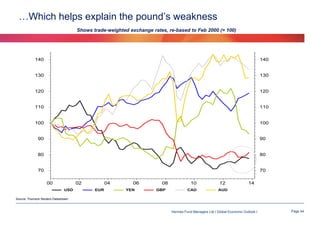
…Which helps explain the pound’s weakness
Shows trade-weighted exchange rates, re-based to Feb 2000 (= 100)

Source: Thomson Reuters Datastream

Hermes Fund Managers Ltd I Global Economic Outlook I

Page 44
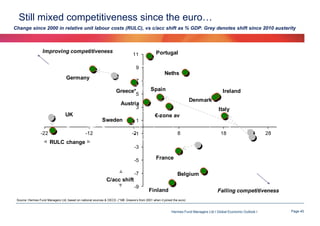
Still mixed competitiveness since the euro…
Change since 2000 in relative unit labour costs (RULC), vs c/acc shift as % GDP. Grey denotes shift since 2010 austerity

Improving competitiveness

11

Portugal

9

Neths

Germany

7

Greece*

5

Spain

Ireland
Denmark

Austria
3

Sweden
-22

-12

Italy
€-zone av

UK
1

-2
-1

8

18

28

RULC change
-3
-5

France

-7

Belgium

C/acc shift
-9

Finland

Falling competitiveness

Source: Hermes Fund Managers Ltd, based on national sources & OECD. (*NB: Greece’s from 2001 when it joined the euro)

Hermes Fund Managers Ltd I Global Economic Outlook I

Page 45
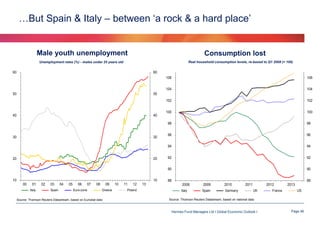
…But Spain & Italy – between ‘a rock & a hard place’

Male youth unemployment
Unemployment rates (%) - males under 25 years old

Source: Thomson Reuters Datastream, based on Eurostat data

Consumption lost
Real household consumption levels, re-based to Q1 2008 (= 100)

Source: Thomson Reuters Datastream, based on national data

Hermes Fund Managers Ltd I Global Economic Outlook I

Page 46
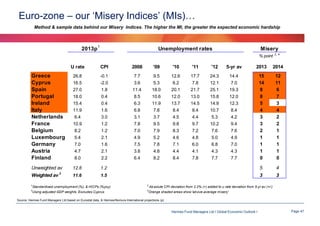
Euro-zone – our ‘Misery Indices’ (MIs)…
Method & sample data behind our Misery Indices. The higher the MI, the greater the expected economic hardship

2013p1

Unemployment rates

Misery
% point

2, 4

U rate

CPI

2008

'09

'10

'11

'12

5-yr av

2013

2014

Greece
Cyprus
Spain
Portugal
Ireland
Italy
Netherlands
France
Belgium
Luxembourg
Germany
Austria
Finland

26.8
16.5

-0.1
-2.0

7.7
3.6

9.5
5.3

12.6
6.2

17.7
7.8

24.3
12.1

14.4
7.0

27.0
18.0
15.4

1.8
0.4
0.4

11.4
8.5
6.3

18.0
10.6
11.9

20.1
12.0
13.7

21.7
13.0
14.5

25.1
15.8
14.9

19.3
12.0
12.3

11.9
6.4

1.6
3.0

6.8
3.1

7.8
3.7

8.4
4.5

8.4
4.4

10.7
5.3

8.4
4.2

10.9
8.2
5.4

1.2
1.2
2.1

7.8
7.0
4.9

9.5
7.9
5.2

9.8
8.3
4.6

9.7
7.2
4.8

10.2
7.6
5.0

9.4
7.6
4.9

7.0
4.7

1.6
2.1

7.5
3.8

7.8
4.8

7.1
4.4

6.0
4.1

6.8
4.3

7.0
4.3

8.0

2.2

6.4

8.2

8.4

7.8

7.7

7.7

15
14
8
8
5
4
3
3
2
1
1
1
0

12
11
6
7
3
4
2
2
1
1
1
1
0

Unweighted av

12.8

1.2

5

4

11.6

1.5

3

3

Weighted av
1
3

3

Standardised unemployment (%), & HICPs (%yoy)
Using adjusted GDP weights. Excludes Cyprus

2
4

Ab solute CPI deviation from 2.2% (+) added to u rate deviation from 5-yr av (+/-)
Orange shaded areas show 'ab ove-average misery'

Source: Hermes Fund Managers Ltd based on Eurostat data, & Hermes/Nomura International projections (p)

Hermes Fund Managers Ltd I Global Economic Outlook I

Page 47
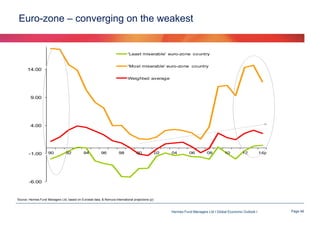
Euro-zone – converging on the weakest

'Least miserable' euro-zone country

'Most miserable' euro-zone country

14.00

Weighted average

9.00

4.00

-1.00

90

92

94

96

98

00

02

04

06

08

10

12

14p

-6.00

Source: Hermes Fund Managers Ltd, based on Eurostat data, & Nomura International projections (p)

Hermes Fund Managers Ltd I Global Economic Outlook I

Page 48
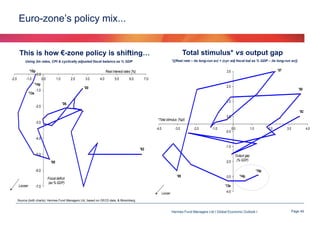
Euro-zone’s policy mix...

This is how €-zone policy is shifting…

Total stimulus* vs output gap
*{(Real rate – its long-run av) + (cyc adj fiscal bal as % GDP – its long-run av)}

Using 3m rates, CPI & cyclically adjusted fiscal balance as % GDP

'15p
-2.0

Real interest rates (%)

0.0

-1.0

0.0

1.0

2.0

'14p
'13e

3.0

4.0

5.0

6.0

7.0
2.5

'00

-1.0

'00

1.5

'06

-2.0

'07

3.5

'92
0.5

*Total stimulus (%pt)

-3.0

-4.0

-3.0

-2.0

-1.0

-0.5

0.0

1.0

2.0

3.0

4.0

-4.0
-1.5

'92
-5.0

-2.5

'09

Output gap
(% GDP)

-3.5

'14p

-6.0

Looser

'15p
'09

Fiscal deficit
(as % GDP)

'13e

-7.0
Looser

-4.5

Source (both charts): Hermes Fund Managers Ltd, based on OECD data, & Bloomberg

Hermes Fund Managers Ltd I Global Economic Outlook I

Page 49
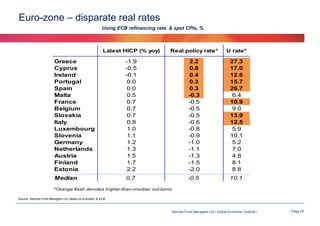
Euro-zone – disparate real rates
Using ECB refinancing rate, & spot CPIs, %

Latest HICP (% yoy)

Real policy rate*

U rate*

Greece
Cyprus
Ireland
Portugal
Spain
Malta
France
Belgium
Slovakia
Italy
Luxembourg
Slovenia
Germany
Netherlands
Austria
Finland
Estonia

-1.9
-0.5
-0.1
0.0
0.0
0.5
0.7
0.7
0.7
0.8
1.0
1.1
1.2
1.3
1.5
1.7
2.2

2.2
0.8
0.4
0.3
0.3
-0.3
-0.5
-0.5
-0.5
-0.6
-0.8
-0.9
-1.0
-1.1
-1.3
-1.5
-2.0

27.3
17.0
12.6
15.7
26.7
6.4
10.9
9.0
13.9
12.5
5.9
10.1
5.2
7.0
4.8
8.1
8.8

Median

0.7

-0.5

10.1

*Orange flash denotes higher-than-m edian out-turns
Source: Hermes Fund Managers Ltd, based on Eurostat, & ECB

Hermes Fund Managers Ltd I Global Economic Outlook I

Page 50
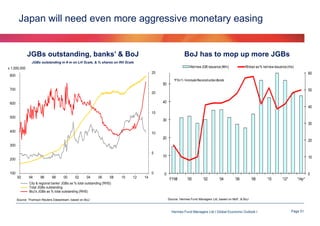
Japan will need even more aggressive monetary easing

JGBs outstanding, banks’ & BoJ

BoJ has to mop up more JGBs

JGBs outstanding in ¥ m on LH Scale, & % shares on RH Scale

Net new JGB issuance (¥trn)

Rinban as % net new issuance (rhs)

60
*FYs11-14 include Reconstruction Bonds

50
50
40
40
30

30

20

20

10

10

0

0
FY98

Source: Thomson Reuters Datastream, based on BoJ

'00

'02

'04

'06

'08

'10

'12*

'14p*

Source: Hermes Fund Managers Ltd, based on MoF, & BoJ

Hermes Fund Managers Ltd I Global Economic Outlook I

Page 51
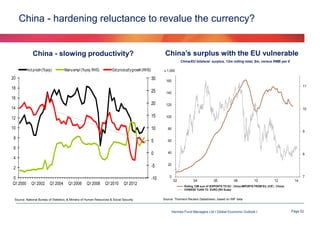
China - hardening reluctance to revalue the currency?

China’s surplus with the EU vulnerable

China - slowing productivity?

China/EU bilateral surplus, 12m rolling total, $m, versus RMB per €

Ind prodn (%yoy)

Manu empl (%yoy, RHS)

Est product'y growth (RHS)

20

30

18

25

16

20
14
12

15

10

10

8

5

6

0
4

-5

2
0
Q1 2000

-10
Q1 2002

Q1 2004

Q1 2006

Q1 2008

Q1 2010

Q1 2012

Source: National Bureau of Statistics, & Ministry of Human Resources & Social Security

Source: Thomson Reuters Datastream, based on IMF data

Hermes Fund Managers Ltd I Global Economic Outlook I

Page 52
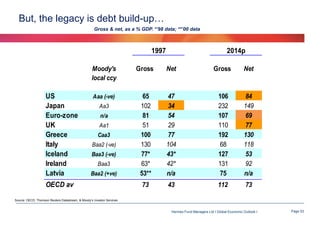
But, the legacy is debt build-up…
Gross & net, as a % GDP. *’98 data; **’00 data

1997

2014p

Moody's
local ccy

US
Japan
Euro-zone
UK
Greece
Italy
Iceland
Ireland
Latvia

Gross

Net

Gross

Net

Aaa (-ve)

65
102
81
51
100
130
77*
63*
53**

47
34
54
29
77
104
43*
42*
n/a

106
232
107
110
192
68
127
131
75

84
149
69
77
130
118
53
92
n/a

73

43

112

73

Aa3
n/a
Aa1
Caa3
Baa2 (-ve)
Baa3 (-ve)
Baa3
Baa2 (+ve)

OECD av
Source: OECD, Thomson Reuters Datastream, & Moody’s Investor Services

Hermes Fund Managers Ltd I Global Economic Outlook I

Page 53
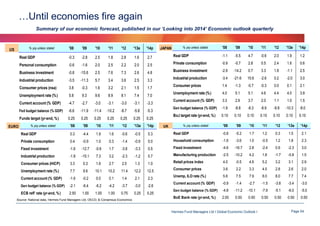
…Until economies fire again
Summary of our economic forecast, published in our ‘Looking into 2014’ Economic outlook quarterly

'08

'09

'10

'11

'12

'13e

'14p

Real GDP

-1.1

-5.5

4.7

-0.6

2.0

1.9

1.2

2.5

Private consumption

-0.9

-0.7

2.8

0.5

2.4

1.6

0.6

2.6

4.8

Business investment

-2.9

-14.2

0.7

3.3

1.8

-1.1

2.5

3.6

2.5

3.3

Industrial production

-3.4

-21.6

15.6

-2.6

0.2

-2.0

3.0

3.2

2.1

1.5

1.7

Consumer prices

1.4

-1.3

-0.7

-0.3

0.0

0.1

2.1

9.6

8.9

8.1

7.4

7.0

Unemployment rate (%)

4.0

5.1

5.1

4.6

4.4

4.0

3.9

-2.7

-3.0

-3.1

-3.0

-3.1

-3.3

Current account (% GDP)

3.3

2.9

3.7

2.0

1.1

1.0

1.5

-6.6

-11.9

-11.4

-10.2

-8.7

-5.8

-5.3

Gen budget balance (% GDP)

-1.9

-8.8

-8.3

-8.9

-9.9

-10.3

-8.0

0.25

0.25

0.25

0.25

0.25

0.25

0.25

BoJ target rate (yr-end, %)

0.10

0.10

0.10

0.10

0.10

0.10

0.10

'08

'09

'10

'11

'12

'13e

'14p

'08

'09

'10

'11

'12

'13e

'14p

Real GDP

0.3

-4.4

1.9

1.6

-0.6

-0.5

0.3

Real GDP

-0.8

-5.2

1.7

1.2

0.3

1.5

2.1

Private consumption

0.4

-0.9

1.0

0.3

-1.4

-0.9

0.0

Household consumption

-1.6

-3.6

1.0

-0.5

1.2

1.8

2.3

Fixed investment

-1.6

-12.7

-0.6

1.7

-3.8

-3.3

0.5

Fixed investment

-4.6

-16.7

2.8

-2.4

0.9

-2.3

3.0

Industrial production

-1.8

-15.1

7.3

3.2

-2.3

-1.2

0.7

Manufacturing production

-2.5

-10.2

4.2

1.8

-1.7

-0.8

1.5

Consumer prices (HICP)

3.3

0.3

1.6

2.7

2.5

1.3

1.0

Retail prices index

4.0

-0.5

4.6

5.2

3.2

3.1

2.9

Unemployment rate (%)

7.7

9.6

10.1

10.2

11.4

12.2

12.5

Consumer prices

3.6

2.2

3.3

4.5

2.8

2.6

2.0

Current account (% GDP)

-1.6

-0.2

0.0

0.1

1.4

2.1

2.3

Unemp, ILO rate (%)

5.6

7.5

7.9

8.0

8.0

7.7

7.4

Gen budget balance (% GDP)

-2.1

-6.4

-6.2

-4.2

-3.7

-3.0

-2.6

Current account (% GDP)

-0.9

-1.4

-2.7

-1.5

-3.8

-3.4

-3.0

ECB refi' rate (yr-end, %)

2.50

1.00

1.00

1.00

0.75

0.25

0.25

Gen budget balance (% GDP)

-4.8

-11.2

-10.1

-7.9

-5.1

-6.0

-5.0

BoE Bank rate (yr-end, %)

2.00

0.50

0.50

0.50

0.50

0.50

0.50

'08

'09

'10

'11

'12

'13e

'14p

Real GDP

-0.3

-2.8

2.5

1.8

2.8

1.6

2.7

Personal consumption

-0.6

-1.6

2.0

2.5

2.2

2.0

Business investment

-0.8

-15.6

2.5

7.6

7.3

Industrial production

-3.5

-11.3

5.7

3.4

Consumer prices (nsa)

3.8

-0.3

1.6

Unemployment rate (%)

5.8

9.3

Current account (% GDP)

-4.7

Fed budget balance (% GDP)

Funds target (yr-end, %)

% yoy unless stated

US

EURO

% yoy unless stated

Source: National data, Hermes Fund Managers Ltd, OECD, & Consensus Economics

JAPAN

UK

% yoy unless stated

% yoy unless stated

Hermes Fund Managers Ltd I Global Economic Outlook I

Page 54
Summary

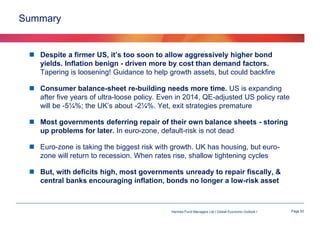
 Despite a firmer US, it’s too soon to allow aggressively higher bond
yields. Inflation benign - driven more by cost than demand factors.
Tapering is loosening! Guidance to help growth assets, but could backfire
 Consumer balance-sheet re-building needs more time. US is expanding
after five years of ultra-loose policy. Even in 2014, QE-adjusted US policy rate
will be -5¼%; the UK’s about -2¼%. Yet, exit strategies premature
 Most governments deferring repair of their own balance sheets - storing
up problems for later. In euro-zone, default-risk is not dead
 Euro-zone is taking the biggest risk with growth. UK has housing, but eurozone will return to recession. When rates rise, shallow tightening cycles
 But, with deficits high, most governments unready to repair fiscally, &
central banks encouraging inflation, bonds no longer a low-risk asset

Hermes Fund Managers Ltd I Global Economic Outlook I

Page 55
Disclaimer

The views and opinions contained herein are those of Neil Williams, director, chief economist & strategist, and may not necessarily represent views expressed or reflected in other Hermes communications,
strategies or products. The information herein is believed to be reliable but Hermes Funds Managers does not warrant its completeness or accuracy. No responsibility can be accepted for errors of fact or
opinion. This material is not intended to provide and should not be relied on for accounting, legal or tax advice, or investment recommendations.
This document has no regard to the specific investment objectives, financial situation or particular needs of any specific recipient. This document is published solely for informational purposes and is not to be
construed as a solicitation or an offer to buy or sell any securities or related financial instruments.
This communication is directed only at recipients who are eligible counterparties or professional clients, as defined in the Glossary to the Financial Conduct Authority’s Handbook of Rules and Guidance. This
communication is issued and approved only for the purposes of section 21 of the Financial Services and Markets Act 2000 by Hermes Investment Management Limited. (“HIML”). Hermes Investment
Management Limited has its registered office at Lloyds Chambers, 1 Portsoken Street, London E1 8HZ. Hermes is a multi-boutique asset manager, independent of any broader financial services organisation.
Each Hermes operating company is either a subsidiary of, or is otherwise affiliated to, Hermes Fund Managers Limited. [CM100322 UK 11/10]
Figures, unless otherwise indicated, are sourced from Hermes.

Hermes Fund Managers Ltd I Global Economic Outlook I

Page 56
The End of QE:
Is it nigh, and what might it mean
for markets?
Recent economic data suggest the UK is finally recovering from the
financial crisis, whilst the Bank of England is preparing investors for
the end of monetary stimulus through the introduction of forward
guidance.
Should the IMF be proved correct in upgrading the UK’s growth
outlook, what might the end of monetary stimulus look like and what
are the potential effects on markets and the end investor?

Macro Overview

For Professional Investors Only

22 January 2014

57
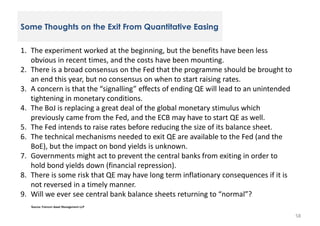
Some Thoughts on the Exit From Quantitative Easing
1. The experiment worked at the beginning, but the benefits have been less
obvious in recent times, and the costs have been mounting.
2. There is a broad consensus on the Fed that the programme should be brought to
an end this year, but no consensus on when to start raising rates.
3. A concern is that the “signalling” effects of ending QE will lead to an unintended
tightening in monetary conditions.
4. The BoJ is replacing a great deal of the global monetary stimulus which
previously came from the Fed, and the ECB may have to start QE as well.
5. The Fed intends to raise rates before reducing the size of its balance sheet.
6. The technical mechanisms needed to exit QE are available to the Fed (and the
BoE), but the impact on bond yields is unknown.
7. Governments might act to prevent the central banks from exiting in order to
hold bond yields down (financial repression).
8. There is some risk that QE may have long term inflationary consequences if it is
not reversed in a timely manner.
9. Will we ever see central bank balance sheets returning to “normal”?
Source: Fulcrum Asset Management LLP

58
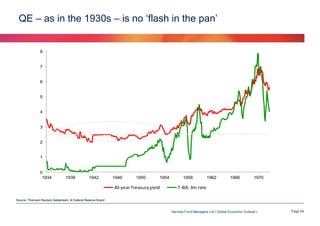
QE – as in the 1930s – is no ‘flash in the pan’

8

7

6

5

4

3

2

1

0
1934

1938

1942

1946

1950

1954

30-year Treasury yield

1958

1962

1966

1970

T-Bill, 3m rate

Source: Thomson Reuters Datastream, & Federal Reserve Board

Hermes Fund Managers Ltd I Global Economic Outlook I

Page 59
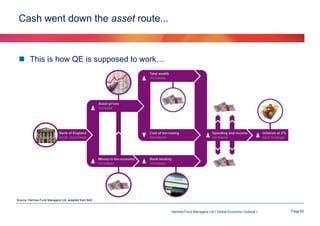
Cash went down the asset route...

 This is how QE is supposed to work…

Source: Hermes Fund Managers Ltd, adapted from BoE

Hermes Fund Managers Ltd I Global Economic Outlook I

Page 60
Panel Discussion
Gavyn Davies, Neil Williams, David Bennett
Moderator : Pete Drewienkiewicz
Austin Friars House, 2-6 Austin Friars, London EC2N 2HD

Telephone : +44 (0) 20 7250 3331

www.redington.co.uk

Contacts
David Bennett

Pete Drewienkiewicz

Gurjit Dehl

Head of Investment Consulting
Direct Line: 0203 326 7147
David.Bennett@redington.co.uk

Head of Manager Research
Direct Line: 0203 326 7138
Pete.Drewienkiewicz@redington.co.uk

Education & Research
Direct Line: 0203 326 7102
Gurjit.Dehl@redington.co.uk

Disclaimer
For professional investors only. Not suitable for private customers.
The information herein was obtained from various sources. We do not guarantee every aspect of its accuracy. The information is for your private information and is for discussion
purposes only. A variety of market factors and assumptions may affect this analysis, and this analysis does not reflect all possible loss scenarios. There is no certainty that the
parameters and assumptions used in this analysis can be duplicated with actual trades. Any historical exchange rates, interest rates or other reference rates or prices which
appear above are not necessarily indicative of future exchange rates, interest rates, or other reference rates or prices. Neither the information, recommendations or opinions
expressed herein constitutes an offer to buy or sell any securities, futures, options, or investment products on your behalf. Unless otherwise stated, any pricing information in this
message is indicative only, is subject to change and is not an offer to transact. Where relevant, the price quoted is exclusive of tax and delivery costs. Any reference to the terms
of executed transactions should be treated as preliminary and subject to further due diligence.
Redington Ltd are investment consultants regulated by the Financial Conduct Authority. We do not advise on all implications of the transactions described herein. This
information is for discussion purposes and prior to undertaking any trade, you should also discuss with your professional tax, accounting and / or other relevant advisers how
such particular trade(s) affect you. All analysis (whether in respect of tax, accounting, law or of any other nature), should be treated as illustrative only and not relied upon as
accurate.
©Redington Limited 2014. All rights reserved. No reproduction, copy, transmission or translation in whole or in part of this presentation may be made without permission.
Application for permission should be made to Redington Limited at the address below.
Redington Limited (6660006) is registered in England and Wales. Registered office: Austin Friars House, 2-6 Austin Friars, London EC2N 2HD
Macro Overview

For Professional Investors Only

22 January 2014

62

Macro Overview

  • 1.
  • 2.
    Agenda 1. Global Economicand Macro Outlook 2014 – Gavyn Davies 2. Global Economic Outlook – Neil Williams 3. The End of QE – Gavyn Davies 4. The End of QE – Neil Williams 5. Panel Session – Participants: Gavyn Davies, Neil Williams, David Bennett Moderator: Pete Drewienkiewicz Macro Overview For Professional Investors Only 22 January 2014 2
  • 3.
    Speakers Gavyn Davies –Chairman, Fulcrum Asset Management Neil Williams – Chief Economist, Hermes Fund Managers Ltd Gavyn is Chairman of Fulcrum Asset Management and Head of the Fulcrum Investment Committee. Previously, Gavyn was Chairman of the BBC from 2001 to 2004. He joined Goldman Sachs in 1986 and was a Partner from 1988 to 2001. He was also the firm’s Chief Economist over that period and Chairman of the Research Department. He was repeatedly ranked as the City’s top UK and European economist in surveys of institutional investors. From 1992 to 1997, he was a member of H.M. Treasury Independent Forecasting Panel. Neil joined Hermes Fund Managers in August 2009 and is responsible for its global economic research. He has over twenty five years’ experience of providing economic analysis, and has a forward-looking approach to generate investment strategy ideas for the company and its clients. He began as a City Economist, first with Phillips and Drew from 1979 to 1981, then Simon and Coates from 1981 to 1986. Gavyn graduated in economics from St. John’s College, Cambridge in 1972. This was followed by two years of research at Balliol College, Oxford. He joined the Policy Unit at 10 Downing Street as an Economist in 1974 and was an Economic Policy Adviser to the Prime Minister from 1976 to 1979. Neil adopts top-down methods - macro and market analysis to identify interest rate and credit value, and sovereign default risk. Neil began his career in 1987 at the Confederation of British Industry (CBI), becoming its youngest ever Head of Economic Policy. He went on to hold a number of senior positions in investment banks - including Director of Bond Research at UBS, Head of Research at Sumitomo International, Global Head of Emerging Markets Research at PaineWebber International, and, before coming to Hermes, Head of Sovereign Research and Strategy at Mizuho International. Neil earned an MA in Economics in 1986 from Manchester University, having the previous year completed his BSc (Hons), also in Economics, from University College Swansea. Gavyn.Davies@fulcrumasset.com N.Williams@hermes.co.uk Twitter: @GavynDavies Twitter: @Hermes_fm Macro Overview For Professional Investors Only 22 January 2014 3
  • 4.
    Global Economic andMarket Outlook, 2014 Gavyn Davies, Chairman, Fulcrum Asset Management Redington Conference, 22 January, 2013 4
  • 5.
    Global equities haveout-performed all other asset classes for almost 5 years, with the US market leading. Bonds have been flat for 2 years. Commodities have fallen for 3 years. 5
  • 6.
    There is completeunanimity among analysts that equities will continue to out-perform bonds during 2014, and also a strong consensus in favour of equities in the euro area and Japan. Opinion on the emerging markets remains mostly bearish for now. 6
  • 7.
    The recession inthe developed economies has been deep and long lasting and may have had permanent effects on potential GDP... Aggregate G4 (US, Euro Area, Japan, UK) GDP, Potential and Trend 120 Actual GDP Average of Potential Output Estimates Log-linear trend 115 110 105 100 95 90 85 80 2000 2003 2006 2009 2012 2015 Source: Fulcrum Asset Management LLP 7
  • 8.
    ... but forthe first time since 2010, domestic demand in developed markets is leading the recovery Fig 2. Manufacturing Business Surveys Euro Area United States UK Japan 60 55 50 45 40 “Whatever it takes” 35 30 2007 2008 2009 2010 2011 2012 2013 Source: Fulcrum Asset Management LLP 8
  • 9.
    G8 activity isrising, especially in the UK….. 9
  • 10.
    The rise inpublic sector debt ratios has triggered significant tightening in fiscal policy in all the major economies and this will continue. But the mix is changing, with less tightening in the US and the Euro Area, and more tightening in Japan. Fig 12. Fiscal Thrust: change in the underlying government primary balance (% of GDP) US Euro Area UK Japan OECD Total 3 2 1 0 -1 -2 -3 -4 -5 2007 2008 2009 2010 2011 2012 2013 2014 Source: Fulcrum Asset Management LLP 10
  • 11.
    The Fed hasstarted to taper its asset purchases, but other central banks might expand their operations, so global liquidity will remain ample Liquidity Injections of Global Central Banks, % of GDP, 12 months change 10% Projection Other Advanced BOJ 8% ECB Federal Reserve 6% Total World Emerging Markets 4% 2% 0% -2% -4% 2005 2006 2007 2008 2009 2010 2011 2012 2013 2014 Source: Fulcrum Asset Management LLP 11
  • 12.
    The market hascompletely undone its anticipation of a Fed tightening: actual rate hikes are very unlikely at least until 2015 Expected Federal Funds Rate Path 7 Federal Funds Rate Futures as of 31st of October 2013 Futures as of 9th of September 2013 6 5 4 3 2 1 0 2001 2003 2005 2007 2009 2011 2013 2015 2017 2019 Source: Fulcrum Asset Management LLP 12
  • 13.
    The US recoveryis dependent on a decline in the private sector financial balance as investment and consumption return to more normal levels. This will be helped by much less fiscal tightening from now on. Private Sector Financial Balance in the US (% of GDP) Total Non-Financial Private Sector Households Non-Financial Business 10% 8% 6% 4% 2% 0% -2% -4% -6% 1987 1990 1993 1996 1999 2002 2005 2008 2011 Source: Fulcrum Asset Management LLP 13
  • 14.
    Global inflation hasbeen low and falling over the past year, with the exception of a handful of emerging markets Global Inflation Rates 10% 8% Emerging Markets, 5.4% 6% 4% World, 3.1% 2% Advanced Economies, 1.2% 0% -2% 2000 2001 2002 2003 2004 2005 2006 2007 2008 2009 2010 2011 2012 2013 Source: Fulcrum Asset Management LLP 14
  • 15.
    Risk 1: Thedrop in the US labour force participation rate has proceeded much further than expected and is showing no signs of recovery. Source: Fulcrum Asset Management LLP 15
  • 16.
    If the participationrate falls further, it might take the unemployment rate down to levels which could force the Fed to tighten earlier than expected Source: Fulcrum Asset Management LLP 16
  • 17.
    Risk 2: China- The PBOC has left its official monetary settings unchanged since mid 2012 17
  • 18.
    The PBOC has“encouraged” market interest rates to rise since last May, with a short run money market crisis in June/July which has now been brought under control. Chinese Market Interest Rates are Trending Upwards (20-day moving averages) 6.75 6.25 5.75 5.25 4.75 4.25 SHIBOR Rate: 1-Week 3.75 3.25 2.75 5 Year Government Bond Yield 2.25 2012 2013 Tightening starts here 2014 Source: Fulcrum Asset Management LLP 18
  • 19.
    The PBOC hasalso “encouraged” a decline in the total expansion of credit in the economy by reducing the access of the shadow banking sector to funding. 19
  • 20.
    There is nosign yet that the monetary squeeze is slowing the rate of house price or land price inflation, especially in the major cities. There is still a significant risk of a collision between the tightening in monetary conditions and the bubble in housing. 20
  • 21.
    Apart from therisk of a China hard landing, the emerging markets crisis is concentrated in a handful of countries (the “fragile 5”) with weak fundamentals... Current Account Balance as % of GDP 8 Brazil Indonesia 2008 2009 India South Africa Turkey 6 4 2 0 -2 -4 -6 -8 -10 -12 2005 2006 2007 2010 2011 2012 2013 2014 Source: Fulcrum Asset Management LLP 21
  • 22.
    Risk 3: ECBactions have brought about a broad improvement in financial conditions by reducing euro-breakup fears, but the stance of monetary policy is still fragmented Euro Area Sovereign Bond Yields (10-year) 800 France Germany Italy Spain 700 600 500 400 300 200 100 0 2008 2009 2010 2011 2012 2013 Source: Fulcrum Asset Management LLP 22
  • 23.
    In the euroarea, there has been a slight relaxation of fiscal tightening but austerity is still acting as a drag on domestic demand Euro Area Periphery: Headline Deficit Targets and Actual Outcome % GDP 2009 2010 2011 2012 2013 2014 2015 2016 2017 0 -1 -2 -3 -4 -5 -6 Actual Deficit 2011 Target -7 2012 Target 2013 Target -8 Source: Fulcrum Asset Management LLP 23
  • 24.
    The Euro Areahas left recession behind already, but market economists remain sceptical about a strong recovery. A key issue for the Euro Area is whether the ECB will act aggressively enough to prevent Japanification. Euro Area GDP Forecasts % Growth Q/Q Ann. % Growth Y/Y 6 4 2 0 -2 -4 -6 -8 -10 -12 -14 2007 2008 2009 2010 2011 2012 2013 2014 Source: Fulcrum Asset Management LLP 24
  • 25.
    Risk 4: Bubblesin equities – New econometric techniques enable us to estimate the probability of a bubble in the S&P 500 Index in real time. At present, the risk remains very low. Source: Fulcrum Asset Management LLP 25
  • 26.
    US Equities areexpensive relative to their long-term historical averages, but fairly valued relative to the past 2 decades... Fig 20: US Equities - Very Long Term "Shiller" P/E Ratio Long Term P/E Ratio (Shiller) 20 Year Moving Average Long Term Average 50 45 40 35 30 25 20 15 10 5 0 1921 1931 1941 1951 1961 1971 1981 1991 2001 2011 Source: Fulcrum Asset Management LLP 26
  • 27.
    Although bond yieldsmay rise somewhat as activity forecasts for 2014 are increased, we do not expect this to be permanent, given the central bank attitude to short rates. And anyway, equities remain very cheap relative to bonds. 27
  • 28.
    Disclaimer This material isfor your information only and is not intended to be used by anyone other than you. It is directed at professional clients and eligible counterparties only and is not intended for retail clients. This is not an offer or solicitation with respect to the purchase or sale of any security. The material is intended only to facilitate your discussions with Fulcrum Asset Management as to the opportunities available to our clients. The given material is subject to change and, although based upon information which we consider reliable, it is not guaranteed as to accuracy or completeness and it should not be relied upon as such. The material is not intended to be used as a general guide to investing, or as a source of any specific investment recommendations, and makes no implied or express recommendations concerning the manner in which any client’s account should or would be handled, as appropriate investment strategies depend upon client’s investment objectives. The price and value of the investments referred to in this material and the income from them may go down as well as up and investors may not receive back the amount originally invested. Past performance is not a guide to future performance. Future returns are not guaranteed and a loss of principal may occur. It is the responsibility of any person or persons in possession of this material to inform themselves of and to observe all applicable laws and regulations of any relevant jurisdiction. Prospective investors should obtain and review the Fund prospectus carefully and take appropriate advice as to any applicable legal requirements and any applicable taxation and exchange control regulations in the countries of their citizenship, residence or domicile which might be relevant to the subscription, purchase, holding, exchange, redemption or disposal of any investments. Fulcrum Asset Management does not provide tax advice to its clients and all investors are strongly advised to consult with their tax advisors regarding any potential investment. Opinions expressed are our current opinions as of the date appearing on this material only. Any historical price(s) or value(s) are also only as of the date indicated. We will endeavor to update on a reasonable basis the information discussed in this material. References to market or composite indices, benchmarks or other measures of relative market performance over a specified period of time ("benchmarks") are provided by Fulcrum Asset Management for your information purposes only. Investors cannot invest directly in indices. Indices are typically unmanaged and the figures for the indices shown herein do not reflect any investment management fees or transaction expenses. Fulcrum Asset Management does not give any commitment or undertaking that the performance or risk profile of your account(s) will equal, exceed or track any benchmark. The composition of the benchmark may not reflect the manner in which a portfolio is constructed in relation to expected or achieved returns, portfolio guidelines, restrictions, sectors, correlations, concentrations, volatility or tracking error targets, all of which are subject to change over time. Simulated, modeled, or hypothetical performance results have certain inherent limitations. Simulated results are hypothetical and do not represent actual trading, and thus may not reflect material economic and market factors, such as liquidity constraints, that may have had an impact on actual decision-making. Simulated results are also achieved through retroactive application of a model designed with the benefit of hindsight. The results shown reflect the reinvestment of dividends and other earnings and other expenses a client would have paid, which would reduce return. No representation is being made that any client will or is likely to achieve results similar to those shown. Funds managed by Fulcrum Asset Management LLP are in general managed using quantitative models though, where this is the case, Fulcrum Asset Management LLP can and do make discretionary decisions on a frequent basis and reserves the right to do so at any point. Certain transactions, including those involving futures, options and high yield securities and investments in emerging markets may give rise to substantial risk and may not be suitable for all investors. Foreign currency denominated investments are subject to fluctuations in exchange rates that could have an adverse effect on the value or price of, or income derived from, the investment; such investments are also subject to the possible imposition of exchange control regulations or other laws or restrictions applicable to such investments. Investments referred to in this material are not necessarily available in all jurisdictions, may be illiquid and may not be suitable for all investors. Investors should consider whether an investment is suitable for their particular circumstances and seek advice from their investment adviser. For US Investors: Shares in the Fund will not be registered under the Securities Act of 1933, the securities laws of any state or the securities laws of any other jurisdiction, and the Fund will not be registered under the Investment Company Act of 1940. There is no public market for the shares, and no such market is expected to develop in the future. Shares in the Fund may not be sold or transferred except as permitted under the Fund's articles of association, and unless they are registered under the Securities Act of 1933 or an exemption from registration thereunder and under any other applicable securities law registration requirements is available. Accordingly, investors will be required to bear the financial risks of an investment in the Fund for an extended period of time. This material has been approved for issue in the United Kingdom solely for the purposes of Section 21 of the Financial Services and Markets Act 2000 by Fulcrum Asset Management (“Fulcrum”), 6 Chesterfield Gardens, London W1J 5BQ. Fulcrum Asset Management LLP is authorised and regulated by the Financial Services Authority (No: 230683). © 2013 Fulcrum Asset Management LLP. All rights reserved. 28
  • 29.
    Global Economic Outlook RedingtonTeach-in 22 January 2014 Neil Williams Chief Economist
  • 30.
    Outline  Where arewe now?  Policy environment  Economic outlook for 2014… Hermes Fund Managers Ltd I Global Economic Outlook I Page 30
  • 31.
    Is Japan leadingthe way? Ten-year JGBs vs lagged… …10-yr US Treasury… …& 10-yr Bund …& 10-yr Gilt Source (all three charts): Thomson Reuters Datastream Hermes Fund Managers Ltd I Global Economic Outlook I Page 31
  • 32.
    Major economies slowto recoup output lost during the crisis Real GDP levels, rebased to Q1 2007… …and, there’s a lot of ground to make up Q1 2007 = 100. Grey denotes US recession Source: Thomson Reuters Datastream, based on national data Deviation of a country’s actual from potential GDP, as % of potential Source: OECD Hermes Fund Managers Ltd I Global Economic Outlook I Page 32
  • 33.
    …So, core inflationshould stay tame… US Japan Euro-zone Source (all charts): Thomson Reuters Datastream, & OECD Hermes Fund Managers Ltd I Global Economic Outlook I Page 33
  • 34.
    US – it’sdifferent this time Unemployment in US recoveries Core CPI in US recoveries Core CPI (%yoy) into & out of recessions. Years shown are recessions Unemp rate (%) into & out of recessions. Years shown are recessions 14 10.5 12 1980 recession 1981-'82 Into & out of the 2007-'09 recession 1981-'82 recession 9.5 10 8.5 8 7.5 6 6.5 1990-'91 4 1980 1990-'91 5.5 2001 2001 2 4.5 2007-'09 3.5 0 -8 -6 -4 -2 0 +2 +4 +6 +8 No of quarters from recession's trough Source: Hermes Fund Managers Ltd, based on BLS, & NBER +10 +12 +14 +16 -8 -6 -4 -2 0 +2 +4 +6 +8 +10 +12 +14 +16 No of quarters from recession's trough Source: Hermes Fund Managers Ltd, based on BLS, & NBER Hermes Fund Managers Ltd I Global Economic Outlook I Page 34
  • 35.
    US – fittedPhillips Curve… Source: Thomson Reuters Datastream, based on BEA, & BLS data Hermes Fund Managers Ltd I Global Economic Outlook I Page 35
  • 36.
    US – taperingis loosening!… US *2014 taper assumptions: FOMC $bn j 75 f 65 FOMC m 65 FOMC a 55 m 45 FOMC j 45 FOMC j 35 a 25 FOMC s 25 FOMC o 15 n 5 d 5 FOMC total extra 460 92 93 94 95 96 97 98 99 00 01 02 03 04 05 06 07 08 09 10 11 12 13e 14p 15p Fiscal % GDP (cyc adj) -5.1 -4.4 -3.3 -2.5 -2.4 -1.4 -0.6 -0.7 -0.2 -2.0 -4.9 -6.1 -6.0 -5.1 -4.3 -4.8 -7.4 -11.2 -10.5 -9.2 -8.1 -5.4 -4.9 -4.0 Real rate % CPI* % 0.4 0.4 3.9 2.8 2.7 3.5 3.6 3.8 3.0 -0.9 -0.2 -1.2 -0.1 1.1 2.2 1.8 -2.4 -1.6 -3.5 -6.2 -5.5 -6.1 -6.9 -6.7 3.0 3.0 2.6 2.8 2.9 2.3 1.5 2.2 3.4 2.8 1.6 2.3 2.7 3.4 3.2 2.9 3.8 -0.3 1.6 3.2 2.1 1.5 1.7 2.2 3m money** % Yr-end 3.44 3.38 6.50 5.63 5.56 5.81 5.07 6.00 6.39 1.88 1.38 1.15 2.56 4.54 5.36 4.70 1.43 -1.94 (-219bp for $1.753trn QE1 which started 18 March 2009) -1.94 -3.04 (-110bp for $880bn QE2 which started 3 November 2010) -3.36 (-32bp for $255bn QE3 which started Sept 2012 (3x $85bn)) -4.64 (-128bp for $1.02trn QE3 (12x $85bn)) -5.21 (-57bp for $460bn QE3 (ass -10bn taper signalled at each 2014 FOMC meeting*) -4.46 (No QE; assumes +75bp ON rates) In totem: $4.4trn QE = -546bp Source: Hermes Fund Managers estimates & assumptions, based on OECD data, & Bloomberg Hermes Fund Managers Ltd I Global Economic Outlook I Page 36
  • 37.
    UK - rememberQE1?… Hermes Fund Managers Ltd I Global Economic Outlook I Page 37
  • 38.
    Cash went downthe asset route...  This is how QE is supposed to work… Source: Hermes Fund Managers Ltd, adapted from BoE Hermes Fund Managers Ltd I Global Economic Outlook I Page 38
  • 39.
    UK – BoE’s‘likely wish list’ when it started QE Objective Our view Expand the money supply Was slow. Took till mid 2012 for M4 growth to reverse downtrend started in Feb '09 Keep gilt yields down Successful - though 10yr yield did quickly go back up to pre-QE levels Improve the functioning of corporate credit markets Will have helped sentiment, though BoE corporate buy-backs were small Higher corporate bond & equity prices Will have helped, though how much of rallies was down to QE? Increased capital market issuance Will have helped - 2009 supply was way up on 2008 Higher real economic output Recession ended in Q3 2009, then GDP flat-lined till last summer Higher inflation Uptrend in targeted CPI started in Sept '09, but had as much to do with VAT etc Source: Hermes Fund Managers Ltd, based on BoE Hermes Fund Managers Ltd I Global Economic Outlook I Page 39
  • 40.
    UK – CPIex indirect taxes… VAT undoubtedly lifted the CPI… CPI, core CPI, & CPI ex indirect taxes; all % yoy …but, ex-VAT, services remain sticky Ex indirect taxes CPI by sector; all % yoy Source (both charts): Thomson Reuters Datastream, based on ONS data Hermes Fund Managers Ltd I Global Economic Outlook I Page 40
  • 41.
    …But real wages& profit-margins slow to recover Source: Thomson Reuters Datastream, based on ONS data Hermes Fund Managers Ltd I Global Economic Outlook I Page 41
  • 42.
    UK’s policy mixadjusted for QE This is how UK policy is shifting… Total stimulus* vs output gap *{(QE adj real rate – its long-run av) + (cyc adj fiscal bal as % GDP – its long-run av)} Using QE adj 3m rates, CPI & cyclically adjusted fiscal balance as % GDP 4 5 2 4 '06 Real interest rates (%) '08 0 -6.0 -4.0 -2.0 '15p 0.0 2.0 4.0 6.0 2 -2 1 Total stimulus* (%pt) -4 '13e -10.5 '08 -6 '92 '15p Looser -10 Fiscal deficit (as % GDP) 4.5 9.5 -1 '14p Adjusted for QE -8 0 -0.5 -5.5 '11 '09 '06 3 -2 Output gap (% GDP) Adjusted for QE -3 '09 '92 Looser -4 Source (both charts): Hermes Fund Managers Ltd, based on OBR, & OECD data, & Bloomberg Hermes Fund Managers Ltd I Global Economic Outlook I Page 42
  • 43.
    No G7 countryhas loosened its policy more than the UK… Shows shifts in real rates (using CPI, 3m Libor) & likely 2013 cyclically-adjusted budget balances …and since 2000 …during the crisis (since Dec ’06) NB: Exc all liquidity injections Germany Tighter 2 €-zone Shift in real rates (% pt) -5.00 -4.00 -3.00 -2.00 -1.00 US 0 0.00 -2 Australia 1.00 Sweden UK -4 Canada -6 NZ Japan Looser -8 Fiscal shift (% of GDP) -10 NB: Exc all liquidity injections 3 2 1 Germany Shift in real rates (% pt) 0 -8.00 -6.50 -5.00 -3.50 -2.00 -0.50 -1 €-zone Sweden -2 Australia -3 Japan -4 NZ -5 Canada US -6 -7 -8 UK -9 -10 -11 -12 Looser Tighter 1.00 Fiscal shift (% of GDP) Source: Hermes Fund Managers Ltd, based on OECD projections, IMF, & Bloomberg Hermes Fund Managers Ltd I Global Economic Outlook I Page 43
  • 44.
    …Which helps explainthe pound’s weakness Shows trade-weighted exchange rates, re-based to Feb 2000 (= 100) Source: Thomson Reuters Datastream Hermes Fund Managers Ltd I Global Economic Outlook I Page 44
  • 45.
    Still mixed competitivenesssince the euro… Change since 2000 in relative unit labour costs (RULC), vs c/acc shift as % GDP. Grey denotes shift since 2010 austerity Improving competitiveness 11 Portugal 9 Neths Germany 7 Greece* 5 Spain Ireland Denmark Austria 3 Sweden -22 -12 Italy €-zone av UK 1 -2 -1 8 18 28 RULC change -3 -5 France -7 Belgium C/acc shift -9 Finland Falling competitiveness Source: Hermes Fund Managers Ltd, based on national sources & OECD. (*NB: Greece’s from 2001 when it joined the euro) Hermes Fund Managers Ltd I Global Economic Outlook I Page 45
  • 46.
    …But Spain &Italy – between ‘a rock & a hard place’ Male youth unemployment Unemployment rates (%) - males under 25 years old Source: Thomson Reuters Datastream, based on Eurostat data Consumption lost Real household consumption levels, re-based to Q1 2008 (= 100) Source: Thomson Reuters Datastream, based on national data Hermes Fund Managers Ltd I Global Economic Outlook I Page 46
  • 47.
    Euro-zone – our‘Misery Indices’ (MIs)… Method & sample data behind our Misery Indices. The higher the MI, the greater the expected economic hardship 2013p1 Unemployment rates Misery % point 2, 4 U rate CPI 2008 '09 '10 '11 '12 5-yr av 2013 2014 Greece Cyprus Spain Portugal Ireland Italy Netherlands France Belgium Luxembourg Germany Austria Finland 26.8 16.5 -0.1 -2.0 7.7 3.6 9.5 5.3 12.6 6.2 17.7 7.8 24.3 12.1 14.4 7.0 27.0 18.0 15.4 1.8 0.4 0.4 11.4 8.5 6.3 18.0 10.6 11.9 20.1 12.0 13.7 21.7 13.0 14.5 25.1 15.8 14.9 19.3 12.0 12.3 11.9 6.4 1.6 3.0 6.8 3.1 7.8 3.7 8.4 4.5 8.4 4.4 10.7 5.3 8.4 4.2 10.9 8.2 5.4 1.2 1.2 2.1 7.8 7.0 4.9 9.5 7.9 5.2 9.8 8.3 4.6 9.7 7.2 4.8 10.2 7.6 5.0 9.4 7.6 4.9 7.0 4.7 1.6 2.1 7.5 3.8 7.8 4.8 7.1 4.4 6.0 4.1 6.8 4.3 7.0 4.3 8.0 2.2 6.4 8.2 8.4 7.8 7.7 7.7 15 14 8 8 5 4 3 3 2 1 1 1 0 12 11 6 7 3 4 2 2 1 1 1 1 0 Unweighted av 12.8 1.2 5 4 11.6 1.5 3 3 Weighted av 1 3 3 Standardised unemployment (%), & HICPs (%yoy) Using adjusted GDP weights. Excludes Cyprus 2 4 Ab solute CPI deviation from 2.2% (+) added to u rate deviation from 5-yr av (+/-) Orange shaded areas show 'ab ove-average misery' Source: Hermes Fund Managers Ltd based on Eurostat data, & Hermes/Nomura International projections (p) Hermes Fund Managers Ltd I Global Economic Outlook I Page 47
  • 48.
    Euro-zone – convergingon the weakest 'Least miserable' euro-zone country 'Most miserable' euro-zone country 14.00 Weighted average 9.00 4.00 -1.00 90 92 94 96 98 00 02 04 06 08 10 12 14p -6.00 Source: Hermes Fund Managers Ltd, based on Eurostat data, & Nomura International projections (p) Hermes Fund Managers Ltd I Global Economic Outlook I Page 48
  • 49.
    Euro-zone’s policy mix... Thisis how €-zone policy is shifting… Total stimulus* vs output gap *{(Real rate – its long-run av) + (cyc adj fiscal bal as % GDP – its long-run av)} Using 3m rates, CPI & cyclically adjusted fiscal balance as % GDP '15p -2.0 Real interest rates (%) 0.0 -1.0 0.0 1.0 2.0 '14p '13e 3.0 4.0 5.0 6.0 7.0 2.5 '00 -1.0 '00 1.5 '06 -2.0 '07 3.5 '92 0.5 *Total stimulus (%pt) -3.0 -4.0 -3.0 -2.0 -1.0 -0.5 0.0 1.0 2.0 3.0 4.0 -4.0 -1.5 '92 -5.0 -2.5 '09 Output gap (% GDP) -3.5 '14p -6.0 Looser '15p '09 Fiscal deficit (as % GDP) '13e -7.0 Looser -4.5 Source (both charts): Hermes Fund Managers Ltd, based on OECD data, & Bloomberg Hermes Fund Managers Ltd I Global Economic Outlook I Page 49
  • 50.
    Euro-zone – disparatereal rates Using ECB refinancing rate, & spot CPIs, % Latest HICP (% yoy) Real policy rate* U rate* Greece Cyprus Ireland Portugal Spain Malta France Belgium Slovakia Italy Luxembourg Slovenia Germany Netherlands Austria Finland Estonia -1.9 -0.5 -0.1 0.0 0.0 0.5 0.7 0.7 0.7 0.8 1.0 1.1 1.2 1.3 1.5 1.7 2.2 2.2 0.8 0.4 0.3 0.3 -0.3 -0.5 -0.5 -0.5 -0.6 -0.8 -0.9 -1.0 -1.1 -1.3 -1.5 -2.0 27.3 17.0 12.6 15.7 26.7 6.4 10.9 9.0 13.9 12.5 5.9 10.1 5.2 7.0 4.8 8.1 8.8 Median 0.7 -0.5 10.1 *Orange flash denotes higher-than-m edian out-turns Source: Hermes Fund Managers Ltd, based on Eurostat, & ECB Hermes Fund Managers Ltd I Global Economic Outlook I Page 50
  • 51.
    Japan will needeven more aggressive monetary easing JGBs outstanding, banks’ & BoJ BoJ has to mop up more JGBs JGBs outstanding in ¥ m on LH Scale, & % shares on RH Scale Net new JGB issuance (¥trn) Rinban as % net new issuance (rhs) 60 *FYs11-14 include Reconstruction Bonds 50 50 40 40 30 30 20 20 10 10 0 0 FY98 Source: Thomson Reuters Datastream, based on BoJ '00 '02 '04 '06 '08 '10 '12* '14p* Source: Hermes Fund Managers Ltd, based on MoF, & BoJ Hermes Fund Managers Ltd I Global Economic Outlook I Page 51
  • 52.
    China - hardeningreluctance to revalue the currency? China’s surplus with the EU vulnerable China - slowing productivity? China/EU bilateral surplus, 12m rolling total, $m, versus RMB per € Ind prodn (%yoy) Manu empl (%yoy, RHS) Est product'y growth (RHS) 20 30 18 25 16 20 14 12 15 10 10 8 5 6 0 4 -5 2 0 Q1 2000 -10 Q1 2002 Q1 2004 Q1 2006 Q1 2008 Q1 2010 Q1 2012 Source: National Bureau of Statistics, & Ministry of Human Resources & Social Security Source: Thomson Reuters Datastream, based on IMF data Hermes Fund Managers Ltd I Global Economic Outlook I Page 52
  • 53.
    But, the legacyis debt build-up… Gross & net, as a % GDP. *’98 data; **’00 data 1997 2014p Moody's local ccy US Japan Euro-zone UK Greece Italy Iceland Ireland Latvia Gross Net Gross Net Aaa (-ve) 65 102 81 51 100 130 77* 63* 53** 47 34 54 29 77 104 43* 42* n/a 106 232 107 110 192 68 127 131 75 84 149 69 77 130 118 53 92 n/a 73 43 112 73 Aa3 n/a Aa1 Caa3 Baa2 (-ve) Baa3 (-ve) Baa3 Baa2 (+ve) OECD av Source: OECD, Thomson Reuters Datastream, & Moody’s Investor Services Hermes Fund Managers Ltd I Global Economic Outlook I Page 53
  • 54.
    …Until economies fireagain Summary of our economic forecast, published in our ‘Looking into 2014’ Economic outlook quarterly '08 '09 '10 '11 '12 '13e '14p Real GDP -1.1 -5.5 4.7 -0.6 2.0 1.9 1.2 2.5 Private consumption -0.9 -0.7 2.8 0.5 2.4 1.6 0.6 2.6 4.8 Business investment -2.9 -14.2 0.7 3.3 1.8 -1.1 2.5 3.6 2.5 3.3 Industrial production -3.4 -21.6 15.6 -2.6 0.2 -2.0 3.0 3.2 2.1 1.5 1.7 Consumer prices 1.4 -1.3 -0.7 -0.3 0.0 0.1 2.1 9.6 8.9 8.1 7.4 7.0 Unemployment rate (%) 4.0 5.1 5.1 4.6 4.4 4.0 3.9 -2.7 -3.0 -3.1 -3.0 -3.1 -3.3 Current account (% GDP) 3.3 2.9 3.7 2.0 1.1 1.0 1.5 -6.6 -11.9 -11.4 -10.2 -8.7 -5.8 -5.3 Gen budget balance (% GDP) -1.9 -8.8 -8.3 -8.9 -9.9 -10.3 -8.0 0.25 0.25 0.25 0.25 0.25 0.25 0.25 BoJ target rate (yr-end, %) 0.10 0.10 0.10 0.10 0.10 0.10 0.10 '08 '09 '10 '11 '12 '13e '14p '08 '09 '10 '11 '12 '13e '14p Real GDP 0.3 -4.4 1.9 1.6 -0.6 -0.5 0.3 Real GDP -0.8 -5.2 1.7 1.2 0.3 1.5 2.1 Private consumption 0.4 -0.9 1.0 0.3 -1.4 -0.9 0.0 Household consumption -1.6 -3.6 1.0 -0.5 1.2 1.8 2.3 Fixed investment -1.6 -12.7 -0.6 1.7 -3.8 -3.3 0.5 Fixed investment -4.6 -16.7 2.8 -2.4 0.9 -2.3 3.0 Industrial production -1.8 -15.1 7.3 3.2 -2.3 -1.2 0.7 Manufacturing production -2.5 -10.2 4.2 1.8 -1.7 -0.8 1.5 Consumer prices (HICP) 3.3 0.3 1.6 2.7 2.5 1.3 1.0 Retail prices index 4.0 -0.5 4.6 5.2 3.2 3.1 2.9 Unemployment rate (%) 7.7 9.6 10.1 10.2 11.4 12.2 12.5 Consumer prices 3.6 2.2 3.3 4.5 2.8 2.6 2.0 Current account (% GDP) -1.6 -0.2 0.0 0.1 1.4 2.1 2.3 Unemp, ILO rate (%) 5.6 7.5 7.9 8.0 8.0 7.7 7.4 Gen budget balance (% GDP) -2.1 -6.4 -6.2 -4.2 -3.7 -3.0 -2.6 Current account (% GDP) -0.9 -1.4 -2.7 -1.5 -3.8 -3.4 -3.0 ECB refi' rate (yr-end, %) 2.50 1.00 1.00 1.00 0.75 0.25 0.25 Gen budget balance (% GDP) -4.8 -11.2 -10.1 -7.9 -5.1 -6.0 -5.0 BoE Bank rate (yr-end, %) 2.00 0.50 0.50 0.50 0.50 0.50 0.50 '08 '09 '10 '11 '12 '13e '14p Real GDP -0.3 -2.8 2.5 1.8 2.8 1.6 2.7 Personal consumption -0.6 -1.6 2.0 2.5 2.2 2.0 Business investment -0.8 -15.6 2.5 7.6 7.3 Industrial production -3.5 -11.3 5.7 3.4 Consumer prices (nsa) 3.8 -0.3 1.6 Unemployment rate (%) 5.8 9.3 Current account (% GDP) -4.7 Fed budget balance (% GDP) Funds target (yr-end, %) % yoy unless stated US EURO % yoy unless stated Source: National data, Hermes Fund Managers Ltd, OECD, & Consensus Economics JAPAN UK % yoy unless stated % yoy unless stated Hermes Fund Managers Ltd I Global Economic Outlook I Page 54
  • 55.
    Summary  Despite afirmer US, it’s too soon to allow aggressively higher bond yields. Inflation benign - driven more by cost than demand factors. Tapering is loosening! Guidance to help growth assets, but could backfire  Consumer balance-sheet re-building needs more time. US is expanding after five years of ultra-loose policy. Even in 2014, QE-adjusted US policy rate will be -5¼%; the UK’s about -2¼%. Yet, exit strategies premature  Most governments deferring repair of their own balance sheets - storing up problems for later. In euro-zone, default-risk is not dead  Euro-zone is taking the biggest risk with growth. UK has housing, but eurozone will return to recession. When rates rise, shallow tightening cycles  But, with deficits high, most governments unready to repair fiscally, & central banks encouraging inflation, bonds no longer a low-risk asset Hermes Fund Managers Ltd I Global Economic Outlook I Page 55
  • 56.
    Disclaimer The views andopinions contained herein are those of Neil Williams, director, chief economist & strategist, and may not necessarily represent views expressed or reflected in other Hermes communications, strategies or products. The information herein is believed to be reliable but Hermes Funds Managers does not warrant its completeness or accuracy. No responsibility can be accepted for errors of fact or opinion. This material is not intended to provide and should not be relied on for accounting, legal or tax advice, or investment recommendations. This document has no regard to the specific investment objectives, financial situation or particular needs of any specific recipient. This document is published solely for informational purposes and is not to be construed as a solicitation or an offer to buy or sell any securities or related financial instruments. This communication is directed only at recipients who are eligible counterparties or professional clients, as defined in the Glossary to the Financial Conduct Authority’s Handbook of Rules and Guidance. This communication is issued and approved only for the purposes of section 21 of the Financial Services and Markets Act 2000 by Hermes Investment Management Limited. (“HIML”). Hermes Investment Management Limited has its registered office at Lloyds Chambers, 1 Portsoken Street, London E1 8HZ. Hermes is a multi-boutique asset manager, independent of any broader financial services organisation. Each Hermes operating company is either a subsidiary of, or is otherwise affiliated to, Hermes Fund Managers Limited. [CM100322 UK 11/10] Figures, unless otherwise indicated, are sourced from Hermes. Hermes Fund Managers Ltd I Global Economic Outlook I Page 56
  • 57.
    The End ofQE: Is it nigh, and what might it mean for markets? Recent economic data suggest the UK is finally recovering from the financial crisis, whilst the Bank of England is preparing investors for the end of monetary stimulus through the introduction of forward guidance. Should the IMF be proved correct in upgrading the UK’s growth outlook, what might the end of monetary stimulus look like and what are the potential effects on markets and the end investor? Macro Overview For Professional Investors Only 22 January 2014 57
  • 58.
    Some Thoughts onthe Exit From Quantitative Easing 1. The experiment worked at the beginning, but the benefits have been less obvious in recent times, and the costs have been mounting. 2. There is a broad consensus on the Fed that the programme should be brought to an end this year, but no consensus on when to start raising rates. 3. A concern is that the “signalling” effects of ending QE will lead to an unintended tightening in monetary conditions. 4. The BoJ is replacing a great deal of the global monetary stimulus which previously came from the Fed, and the ECB may have to start QE as well. 5. The Fed intends to raise rates before reducing the size of its balance sheet. 6. The technical mechanisms needed to exit QE are available to the Fed (and the BoE), but the impact on bond yields is unknown. 7. Governments might act to prevent the central banks from exiting in order to hold bond yields down (financial repression). 8. There is some risk that QE may have long term inflationary consequences if it is not reversed in a timely manner. 9. Will we ever see central bank balance sheets returning to “normal”? Source: Fulcrum Asset Management LLP 58
  • 59.
    QE – asin the 1930s – is no ‘flash in the pan’ 8 7 6 5 4 3 2 1 0 1934 1938 1942 1946 1950 1954 30-year Treasury yield 1958 1962 1966 1970 T-Bill, 3m rate Source: Thomson Reuters Datastream, & Federal Reserve Board Hermes Fund Managers Ltd I Global Economic Outlook I Page 59
  • 60.
    Cash went downthe asset route...  This is how QE is supposed to work… Source: Hermes Fund Managers Ltd, adapted from BoE Hermes Fund Managers Ltd I Global Economic Outlook I Page 60
  • 61.
    Panel Discussion Gavyn Davies,Neil Williams, David Bennett Moderator : Pete Drewienkiewicz
  • 62.
    Austin Friars House,2-6 Austin Friars, London EC2N 2HD Telephone : +44 (0) 20 7250 3331 www.redington.co.uk Contacts David Bennett Pete Drewienkiewicz Gurjit Dehl Head of Investment Consulting Direct Line: 0203 326 7147 David.Bennett@redington.co.uk Head of Manager Research Direct Line: 0203 326 7138 Pete.Drewienkiewicz@redington.co.uk Education & Research Direct Line: 0203 326 7102 Gurjit.Dehl@redington.co.uk Disclaimer For professional investors only. Not suitable for private customers. The information herein was obtained from various sources. We do not guarantee every aspect of its accuracy. The information is for your private information and is for discussion purposes only. A variety of market factors and assumptions may affect this analysis, and this analysis does not reflect all possible loss scenarios. There is no certainty that the parameters and assumptions used in this analysis can be duplicated with actual trades. Any historical exchange rates, interest rates or other reference rates or prices which appear above are not necessarily indicative of future exchange rates, interest rates, or other reference rates or prices. Neither the information, recommendations or opinions expressed herein constitutes an offer to buy or sell any securities, futures, options, or investment products on your behalf. Unless otherwise stated, any pricing information in this message is indicative only, is subject to change and is not an offer to transact. Where relevant, the price quoted is exclusive of tax and delivery costs. Any reference to the terms of executed transactions should be treated as preliminary and subject to further due diligence. Redington Ltd are investment consultants regulated by the Financial Conduct Authority. We do not advise on all implications of the transactions described herein. This information is for discussion purposes and prior to undertaking any trade, you should also discuss with your professional tax, accounting and / or other relevant advisers how such particular trade(s) affect you. All analysis (whether in respect of tax, accounting, law or of any other nature), should be treated as illustrative only and not relied upon as accurate. ©Redington Limited 2014. All rights reserved. No reproduction, copy, transmission or translation in whole or in part of this presentation may be made without permission. Application for permission should be made to Redington Limited at the address below. Redington Limited (6660006) is registered in England and Wales. Registered office: Austin Friars House, 2-6 Austin Friars, London EC2N 2HD Macro Overview For Professional Investors Only 22 January 2014 62