colloque.inra.fr/lcafood2012

Proceedings
8 th International Conference on

Life Cycle Assessment
in the Agri-Food Sector

October 1-4
2012
Saint-Malo
France
GROUP 5, SESSION B: FOOD PRODUCTS

8th Int. Conference on LCA in the
Agri-Food Sector, 1-4 Oct 2012

138. The development of robust Life Cycle Analysis for mycoprotein
and the meat free brand QuornTM
Wayne Martindale1,*, Louise Neville2, Muyiwa Akintoye2, Tim Finnigan2
1

Centre for Food Innovation, Sheffield Hallam University, Sheffield, S1 1WB UK,
Stokesley, UK, 
 Corresponding author. E-mail: w.martindale@shu.ac.uk

2

Quorn Foods Ltd,

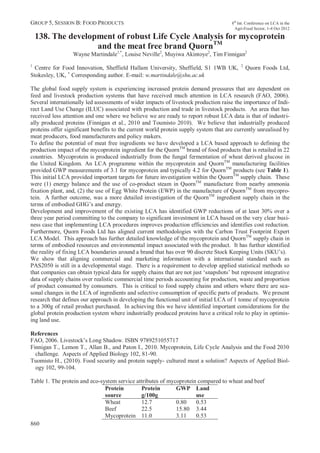
The global food supply system is experiencing increased protein demand pressures that are dependent on
feed and livestock production systems that have received much attention in LCA research (FAO, 2006).
Several internationally led assessments of wider impacts of livestock production raise the importance of Indirect Land Use Change (ILUC) associated with production and trade in livestock products. An area that has
received less attention and one where we believe we are ready to report robust LCA data is that of industrially produced proteins (Finnigan et al., 2010 and Toumisto 2010). We believe that industrially produced
proteins offer significant benefits to the current world protein supply system that are currently unrealised by
meat producers, food manufacturers and policy makers.
To define the potential of meat free ingredients we have developed a LCA based approach to defining the
production impact of the mycoprotein ingredient for the QuornTM brand of food products that is retailed in 22
countries. Mycoprotein is produced industrially from the fungal fermentation of wheat derived glucose in
the United Kingdom. An LCA programme within the mycoprotein and QuornTM manufacturing facilities
provided GWP measurements of 3.1 for mycoprotein and typically 4.2 for QuornTM products (see Table 1).
This initial LCA provided important targets for future investigation within the QuornTM supply chain. These
were (1) energy balance and the use of co-product steam in QuornTM manufacture from nearby ammonia
fixation plant, and, (2) the use of Egg White Protein (EWP) in the manufacture of Quorn TM from mycoprotein. A further outcome, was a more detailed investigation of the QuornTM ingredient supply chain in the
terms of embodied GHG’s and energy.
Development and improvement of the existing LCA has identified GWP reductions of at least 30% over a
three year period committing to the company to significant investment in LCA based on the very clear business case that implementing LCA procedures improves production efficiencies and identifies cost reduction.
Furthermore, Quorn Foods Ltd has aligned current methodologies with the Carbon Trust Footprint Expert
LCA Model. This approach has further detailed knowledge of the mycoprotein and QuornTM supply chain in
terms of embodied resources and environmental impact associated with the product. It has further identified
the reality of fixing LCA boundaries around a brand that has over 90 discrete Stock Keeping Units (SKU’s).
We show that aligning commercial and marketing information with a international standard such as
PAS2050 is still in a developmental stage. There is a requirement to develop applied statistical methods so
that companies can obtain typical data for supply chains that are not just ‘snapshots’ but represent integrative
data of supply chains over realistic commercial time periods accounting for production, waste and proportion
of product consumed by consumers. This is critical to food supply chains and others where there are seasonal changes in the LCA of ingredients and selective consumption of specific parts of products. We present
research that defines our approach in developing the functional unit of initial LCA of 1 tonne of mycoprotein
to a 300g of retail product purchased. In achieving this we have identified important considerations for the
global protein production system where industrially produced proteins have a critical role to play in optimising land use.
References
FAO, 2006. Livestock’s Long Shadow. ISBN 9789251055717
Finnigan T., Lemon T., Allan B., and Paton I., 2010. Mycoprotein, Life Cycle Analysis and the Food 2030
challenge. Aspects of Applied Biology 102, 81-90.
Tuomisto H., (2010). Food security and protein supply- cultured meat a solution? Aspects of Applied Biology 102, 99-104.
Table 1. The protein and eco-system service attributes of mycoprotein compared to wheat and beef
Protein
Protein
GWP Land
source
g/100g
use
Wheat
12.7
0.80
0.53
Beef
22.5
15.80 3.44
Mycoprotein 11.0
3.11
0.53
860

Quorn life cycle analysis

  • 1.
    colloque.inra.fr/lcafood2012 Proceedings 8 th InternationalConference on Life Cycle Assessment in the Agri-Food Sector October 1-4 2012 Saint-Malo France
  • 2.
    GROUP 5, SESSIONB: FOOD PRODUCTS 8th Int. Conference on LCA in the Agri-Food Sector, 1-4 Oct 2012 138. The development of robust Life Cycle Analysis for mycoprotein and the meat free brand QuornTM Wayne Martindale1,*, Louise Neville2, Muyiwa Akintoye2, Tim Finnigan2 1 Centre for Food Innovation, Sheffield Hallam University, Sheffield, S1 1WB UK, Stokesley, UK, Corresponding author. E-mail: w.martindale@shu.ac.uk 2 Quorn Foods Ltd, The global food supply system is experiencing increased protein demand pressures that are dependent on feed and livestock production systems that have received much attention in LCA research (FAO, 2006). Several internationally led assessments of wider impacts of livestock production raise the importance of Indirect Land Use Change (ILUC) associated with production and trade in livestock products. An area that has received less attention and one where we believe we are ready to report robust LCA data is that of industrially produced proteins (Finnigan et al., 2010 and Toumisto 2010). We believe that industrially produced proteins offer significant benefits to the current world protein supply system that are currently unrealised by meat producers, food manufacturers and policy makers. To define the potential of meat free ingredients we have developed a LCA based approach to defining the production impact of the mycoprotein ingredient for the QuornTM brand of food products that is retailed in 22 countries. Mycoprotein is produced industrially from the fungal fermentation of wheat derived glucose in the United Kingdom. An LCA programme within the mycoprotein and QuornTM manufacturing facilities provided GWP measurements of 3.1 for mycoprotein and typically 4.2 for QuornTM products (see Table 1). This initial LCA provided important targets for future investigation within the QuornTM supply chain. These were (1) energy balance and the use of co-product steam in QuornTM manufacture from nearby ammonia fixation plant, and, (2) the use of Egg White Protein (EWP) in the manufacture of Quorn TM from mycoprotein. A further outcome, was a more detailed investigation of the QuornTM ingredient supply chain in the terms of embodied GHG’s and energy. Development and improvement of the existing LCA has identified GWP reductions of at least 30% over a three year period committing to the company to significant investment in LCA based on the very clear business case that implementing LCA procedures improves production efficiencies and identifies cost reduction. Furthermore, Quorn Foods Ltd has aligned current methodologies with the Carbon Trust Footprint Expert LCA Model. This approach has further detailed knowledge of the mycoprotein and QuornTM supply chain in terms of embodied resources and environmental impact associated with the product. It has further identified the reality of fixing LCA boundaries around a brand that has over 90 discrete Stock Keeping Units (SKU’s). We show that aligning commercial and marketing information with a international standard such as PAS2050 is still in a developmental stage. There is a requirement to develop applied statistical methods so that companies can obtain typical data for supply chains that are not just ‘snapshots’ but represent integrative data of supply chains over realistic commercial time periods accounting for production, waste and proportion of product consumed by consumers. This is critical to food supply chains and others where there are seasonal changes in the LCA of ingredients and selective consumption of specific parts of products. We present research that defines our approach in developing the functional unit of initial LCA of 1 tonne of mycoprotein to a 300g of retail product purchased. In achieving this we have identified important considerations for the global protein production system where industrially produced proteins have a critical role to play in optimising land use. References FAO, 2006. Livestock’s Long Shadow. ISBN 9789251055717 Finnigan T., Lemon T., Allan B., and Paton I., 2010. Mycoprotein, Life Cycle Analysis and the Food 2030 challenge. Aspects of Applied Biology 102, 81-90. Tuomisto H., (2010). Food security and protein supply- cultured meat a solution? Aspects of Applied Biology 102, 99-104. Table 1. The protein and eco-system service attributes of mycoprotein compared to wheat and beef Protein Protein GWP Land source g/100g use Wheat 12.7 0.80 0.53 Beef 22.5 15.80 3.44 Mycoprotein 11.0 3.11 0.53 860