This document contains the solutions to two questions from an exam on communication networks.
The first question asks to identify the spanning tree and root ports for bridges in a network. The solution identifies the root bridge and designates the root port and designated ports.
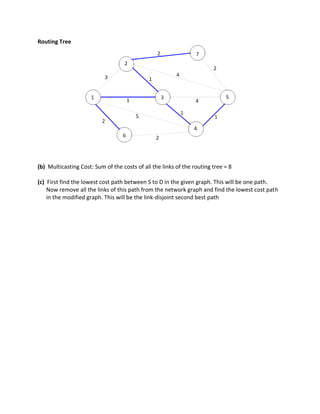
The second question has multiple parts: (a) applies Dijkstra's algorithm to find least cost paths from node 1 to all other nodes, showing steps and forwarding table. (b) asks for cost of multicasting to all nodes using this setup. (c) asks how to find two best paths between two nodes that do not share common links.
![EE 333, Communication Networks
Quiz-II (2013-14S)
Maximum Marks = 10 Time=45 minutes
1. For the network shown (with
costs of individual segments as
indicated), find the spanning tree
that will be obtained by applying
the standard spanning tree
algorithm. Clearly indicate the root
port of each bridge and the
designated port for each LAN
segment. [4]
Solution
P1
P3
Bridge B1
P2
P1
P3
Bridge B2
P2
P1
P3
Bridge B3
P2
P1
Bridge B4
P2
P1
Bridge B5
P2
P1
Bridge B6
P2
Cost=3 Cost=5
Cost=3
Cost=1
Cost=4
Cost=2
Cost=2
Root
Bridge
D
D D R
R
R
R
R
D
D
D](https://image.slidesharecdn.com/quiz-2-solution-150425103700-conversion-gate02/85/Quiz-2-solution-1-320.jpg)
![EE 333, Communication Networks
Quiz-II (2013-14S)
Maximum Marks = 10 Time=45 minutes
1. For the network shown (with
costs of individual segments as
indicated), find the spanning tree
that will be obtained by applying
the standard spanning tree
algorithm. Clearly indicate the root
port of each bridge and the
designated port for each LAN
segment. [4]
Solution
P1
P3
Bridge B1
P2
P1
P3
Bridge B2
P2
P1
P3
Bridge B3
P2
P1
Bridge B4
P2
P1
Bridge B5
P2
P1
Bridge B6
P2
Cost=3 Cost=5
Cost=3
Cost=1
Cost=4
Cost=2
Cost=2
Root
Bridge
D
D D R
R
R
R
R
D
D
D](https://image.slidesharecdn.com/quiz-2-solution-150425103700-conversion-gate02/75/Quiz-2-solution-1-2048.jpg)
![2.
(a) Apply Dijkstra’s Algorithm to the network
shown to find the least cost paths from Node 1 to
all the other nodes of the network. Show all the
steps of the procedure in detail (cost and path at
each step) and draw the corresponding tree from
Node 1 to the other nodes of the network. Give
the forwarding table that Node 1 will use to send
packets to the other nodes. [4]
(b) If Node 1 wants to multicast to all the other nodes, what would be the cost of doing this
using the router set up of (a)? [1]
(c) We would like to find the two best paths from a source S to a destination D (in any general
network) so that the two paths do not share any common link. Suggest a way to do this. [1]
Solution
(a)
{N} D2 D3 D4 D5 D6 D7
{1} 3
[1-2]
1
[1-3]
5
[1-4]
∞ 2
[1-6]
∞
{1,3} 2
[1-3-2]
1
[1-3]
2
[1-3-4]
5
[1-3-5]
2
[1-6]
∞
{1,3,2} 2
[1-3-2]
1
[1-3]
2
[1-3-4]
5
[1-3-5]
2
[1-6]
4
[1-3-2-7]
{1,3,2,4} 2
[1-3-2]
1
[1-3]
2
[1-3-4]
3
[1-3-4-5]
2
[1-6]
4
[1-3-2-7]
{1,3,2,4,6} 2
[1-3-2]
1
[1-3]
2
[1-3-4]
3
[1-3-4-5]
2
[1-6]
4
[1-3-2-7]
{1,3,2,4,6,5} 2
[1-3-2]
1
[1-3]
2
[1-3-4]
3
[1-3-4-5]
2
[1-6]
4
[1-3-2-7]
{1,3,2,4,6,5,7} 2
[1-3-2]
1
[1-3]
2
[1-3-4]
3
[1-3-4-5]
2
[1-6]
4
[1-3-2-7]
Forwarding Table in Node 1
Destination 2 3 4 5 6 7
Next Node 3 3 3 3 6 3](https://image.slidesharecdn.com/quiz-2-solution-150425103700-conversion-gate02/85/Quiz-2-solution-2-320.jpg)


![[Webinar] SharePoint is About to Skyrocket to the Top... Get Ready!](https://cdn.slidesharecdn.com/ss_thumbnails/skyrocketsharepointwebinar-161027144506-thumbnail.jpg?width=640&height=640&fit=bounds)


