The aimof the second questionnairewasto find outmoreabout whatour target
audience are looking for in our promotional package. This was to give us an
insighton whatweshouldincludewhen making ourtrailer, poster and magazine
front cover, and helped us make important decisions. Both open and closed
questions wereincluded, allowing us to get a range of answers. Wehanded this
questionnaire out to twenty people within our target audience, using an
opportunity sample– this means that the questionnairewas given to thosewho
were available at the time.
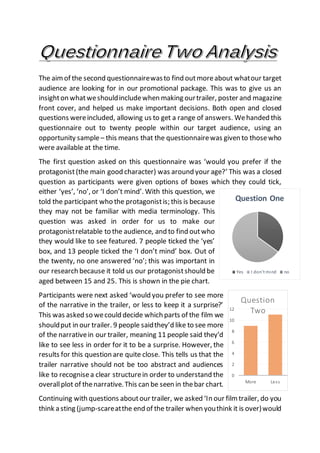
The first question asked on this questionnaire was ‘would you prefer if the
protagonist(the main good character) was around your age?’ This was a closed
question as participants were given options of boxes which they could tick,
either ‘yes’, ‘no’, or ‘I don’t mind’. With this question, we
told the participant who the protagonistis; this is because
they may not be familiar with media terminology. This
question was asked in order for us to make our
protagonistrelatable to the audience, and to find outwho
they would like to see featured. 7 people ticked the ‘yes’
box, and 13 people ticked the ‘I don’t mind’ box. Out of
the twenty, no one answered ‘no’; this was important in
our research because it told us our protagonistshould be
aged between 15 and 25. This is shown in the pie chart.
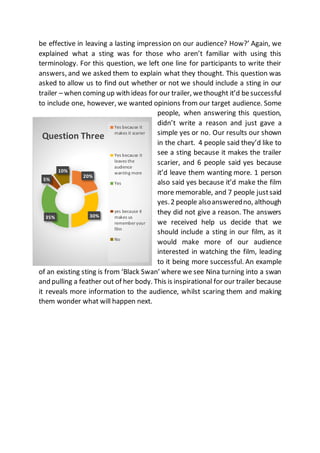
Participants were next asked ‘would you prefer to see more
of the narrative in the trailer, or less to keep it a surprise?’
This was asked so wecould decide which parts of the film we
shouldput in our trailer. 9 people saidthey’d like to see more
of the narrativein our trailer, meaning 11 people said they’d
like to see less in order for it to be a surprise. However, the
results for this question are quite close. This tells us that the
trailer narrative should not be too abstract and audiences
like to recognisea clear structurein order to understand the
overallplot of thenarrative.This can be seen in thebar chart.
Continuing with questions aboutour trailer, we asked ‘In our filmtrailer, do you
think a sting (jump-scareatthe end of the trailer when youthink it is over)would
Question One
Yes I don’t mind no
0
2
4
6
8
10
12
More Less
Question
Two
be effective in leaving a lasting impression on our audience? How?’ Again, we
explained what a sting was for those who aren’t familiar with using this
terminology. For this question, we left one line for participants to write their
answers, and we asked them to explain what they thought. This question was
asked to allow us to find out whether or not we should include a sting in our
trailer – when coming up with ideas for our trailer, wethought it’d besuccessful
to include one, however, we wanted opinions from our target audience. Some
people, when answering this question,
didn’t write a reason and just gave a
simple yes or no. Our results our shown
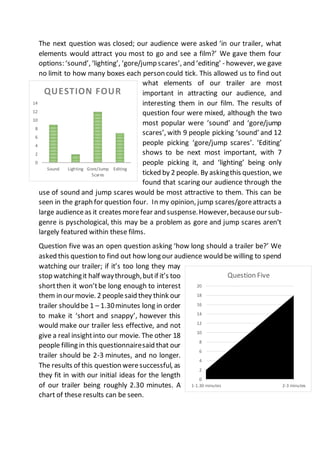
in the chart. 4 people said they’d like to
see a sting because it makes the trailer
scarier, and 6 people said yes because
it’d leave them wanting more. 1 person
also said yes because it’d make the film
more memorable, and 7 people justsaid
yes.2 people alsoansweredno, although
they did not give a reason. The answers
we received help us decide that we
should include a sting in our film, as it
would make more of our audience
interested in watching the film, leading
to it being more successful. An example
of an existing sting is from ‘Black Swan’ where we see Nina turning into a swan
and pulling a feather out of her body. This is inspirational for our trailer because
it reveals more information to the audience, whilst scaring them and making
them wonder what will happen next.
20%
30%35%
5%
10%
Question Three
Yes because it
makes it scarier
Yes because it
leaves the
audience
wanting more
Yes
yes because it
makes us
remember your
film
No
The next question was closed; our audience were asked ‘in our trailer, what
elements would attract you most to go and see a film?’ We gave them four
options: ‘sound’, ‘lighting’, ‘gore/jump scares’, and ‘editing’ - however, we gave
no limit to how many boxes each person could tick. This allowed us to find out
what elements of our trailer are most
important in attracting our audience, and
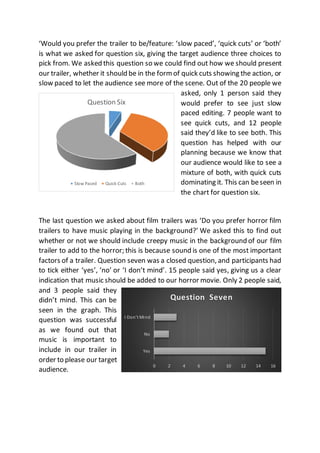
interesting them in our film. The results of
question four were mixed, although the two
most popular were ‘sound’ and ‘gore/jump
scares’, with 9 people picking ‘sound’ and 12
people picking ‘gore/jump scares’. ‘Editing’
shows to be next most important, with 7
people picking it, and ‘lighting’ being only
ticked by 2 people. By askingthis question, we
found that scaring our audience through the
use of sound and jump scares would be most attractive to them. This can be
seen in the graph for question four. In my opinion, jump scares/goreattracts a
large audienceas it creates morefear and suspense.However,becauseoursub-
genre is pyschological, this may be a problem as gore and jump scares aren’t
largely featured within these films.
Question five was an open question asking ‘how long should a trailer be?’ We
asked this question to find out how long our audience would be willing to spend
watching our trailer; if it’s too long they may
stop watchingit half waythrough,butif it’s too
shortthen it won’tbe long enough to interest
them in ourmovie. 2 peoplesaid they think our
trailer shouldbe 1 – 1.30minutes long in order
to make it ‘short and snappy’, however this
would make our trailer less effective, and not
give a real insightinto our movie. The other 18
people filling in this questionnairesaid that our
trailer should be 2-3 minutes, and no longer.
The results of this question weresuccessful, as
they fit in with our initial ideas for the length
of our trailer being roughly 2.30 minutes. A
chart of these results can be seen.
0
2
4
6
8
10
12
14
Sound Lighting Gore/Jump
Scares
Editing
QUESTION FOUR
0
2
4
6
8
10
12
14
16
18
20
1-1.30 minutes 2-3 minutes
Question Five
‘Would you prefer the trailer to be/feature: ‘slow paced’, ‘quick cuts’ or ‘both’
is what we asked for question six, giving the target audience three choices to
pick from. We asked this question so we could find out how we should present
our trailer, whether it should be in the formof quick cuts showing the action, or
slow paced to let the audience see more of the scene. Out of the 20 people we
asked, only 1 person said they
would prefer to see just slow
paced editing. 7 people want to
see quick cuts, and 12 people
said they’d like to see both. This
question has helped with our
planning because we know that
our audience would like to see a
mixture of both, with quick cuts
dominating it. This can beseen in
the chart for question six.
The last question we asked about film trailers was ‘Do you prefer horror film
trailers to have music playing in the background?’ We asked this to find out
whether or not we should include creepy music in the background of our film
trailer to add to the horror; this is because sound is one of the most important
factors of a trailer. Question seven was a closed question, and participants had
to tick either ‘yes’, ‘no’ or ‘I don’t mind’. 15 people said yes, giving us a clear
indication that music should be added to our horror movie. Only 2 people said,
and 3 people said they
didn’t mind. This can be
seen in the graph. This
question was successful
as we found out that
music is important to
include in our trailer in
order to please our target
audience.
Question Six
Slow Paced Quick Cuts Both
0 2 4 6 8 10 12 14 16
Yes
No
I Don’t Mind
Question Seven
We then started asking the next questions aboutfilm posters; this allowed to us
to find out moreaboutwhatshould beincluded in our poster,in orderto attract
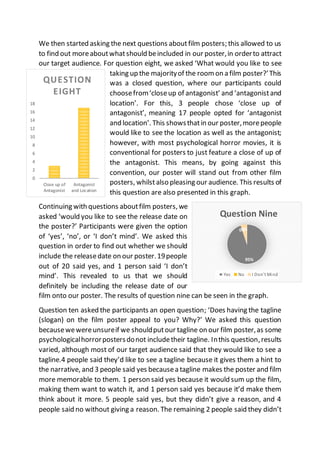
our target audience. For question eight, we asked ‘What would you like to see
taking up the majorityof the roomon a film poster?’This
was a closed question, where our participants could
choosefrom‘closeup of antagonist’ and ‘antagonistand
location’. For this, 3 people chose ‘close up of
antagonist’, meaning 17 people opted for ‘antagonist
and location’. This showsthatin our poster,morepeople
would like to see the location as well as the antagonist;
however, with most psychological horror movies, it is
conventional for posters to just feature a close of up of
the antagonist. This means, by going against this
convention, our poster will stand out from other film
posters, whilstalso pleasing our audience. This results of
this question are also presented in this graph.
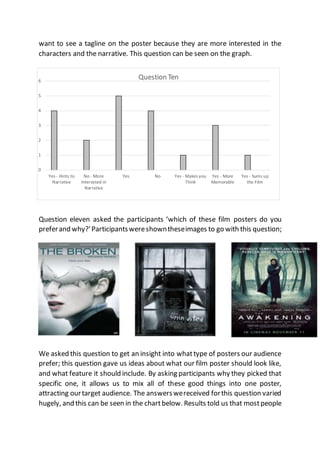
Continuing with questions aboutfilm posters,we
asked ‘would you like to see the release date on
the poster?’ Participants were given the option
of ‘yes’, ‘no’, or ‘I don’t mind’. We asked this
question in order to find out whether we should
include the releasedate on our poster.19people
out of 20 said yes, and 1 person said ‘I don’t
mind’. This revealed to us that we should
definitely be including the release date of our
film onto our poster. The results of question nine can be seen in the graph.
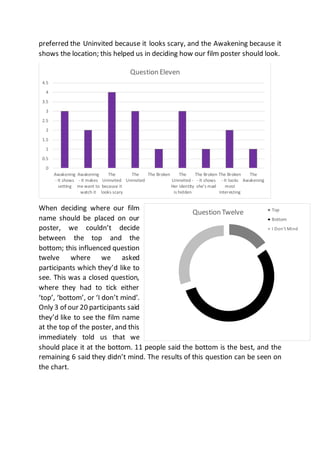
Question ten asked the participants an open question; ‘Does having the tagline
(slogan) on the film poster appeal to you? Why?’ We asked this question
becausewewereunsureif we shouldputour tagline on our film poster,as some
psychologicalhorrorpostersdonot includetheir tagline. Inthis question,results
varied, although most of our target audience said that they would like to see a
tagline.4 people said they’d like to see a tagline because it gives them a hint to
the narrative, and 3 people said yes becausea tagline makes the poster and film
more memorable to them. 1 person said yes because it would sum up the film,
making them want to watch it, and 1 person said yes because it’d make them
think about it more. 5 people said yes, but they didn’t give a reason, and 4
people said no without giving a reason. The remaining 2 people said they didn’t
0
2
4
6
8
10
12
14
16
18
Close up of
Antagonist
Antagonist
and Location
QUESTION
EIGHT
95%
0%5%
Question Nine
Yes No I Don’t Mind
want to see a tagline on the poster because they are more interested in the
characters and the narrative. This question can be seen on the graph.
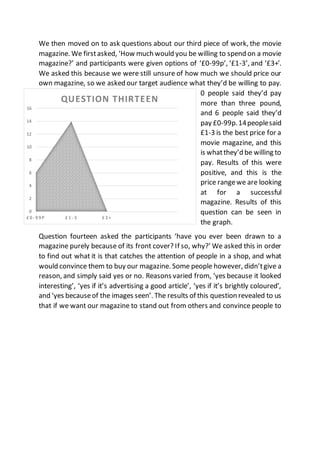
Question eleven asked the participants ‘which of these film posters do you
preferand why?’Participantswereshowntheseimages to go with this question;
We asked this question to get an insight into whattype of posters our audience
prefer; this question gave us ideas about what our film poster should look like,
and what feature it should include. By asking participants why they picked that
specific one, it allows us to mix all of these good things into one poster,
attracting ourtarget audience. The answerswereceived forthis question varied
hugely, and this can be seen in the chartbelow. Results told us that mostpeople
0
1
2
3
4
5
6
Yes - Hints to
Narrative
No - More
Interested in
Narrative
Yes No Yes - Makes you
Think
Yes - More
Memorable
Yes - Sums up
the Film
Question Ten
preferred the Uninvited because it looks scary, and the Awakening because it
shows the location; this helped us in deciding how our film poster should look.
When deciding where our film
name should be placed on our
poster, we couldn’t decide
between the top and the
bottom; this influenced question
twelve where we asked
participants which they’d like to
see. This was a closed question,
where they had to tick either
‘top’, ‘bottom’, or ‘I don’t mind’.
Only 3 of our 20 participants said
they’d like to see the film name
at the top of the poster, and this
immediately told us that we
should place it at the bottom. 11 people said the bottom is the best, and the
remaining 6 said they didn’t mind. The results of this question can be seen on
the chart.
0
0.5
1
1.5
2
2.5
3
3.5
4
4.5
Awakening
- It shows
setting
Awakening
- It makes
me want to
watch it
The
Uninvited
because it
looks scary
The
Uninvited
The Broken The
Uninvited -
Her identity
is hidden
The Broken
- It shows
she's mad
The Broken
- It looks
most
Interesting
The
Awakening
Question Eleven
Question Twelve Top
Bottom
I Don’t Mind
We then moved on to ask questions about our third piece of work, the movie
magazine. We firstasked, ‘How much would you be willing to spend on a movie
magazine?’ and participants were given options of ‘£0-99p’, ‘£1-3’, and ‘£3+’.
We asked this because we were still unsure of how much we should price our
own magazine, so we asked our target audience what they’d be willing to pay.
0 people said they’d pay
more than three pound,
and 6 people said they’d
pay £0-99p.14peoplesaid
£1-3 is the best price for a
movie magazine, and this
is whatthey’d be willing to
pay. Results of this were
positive, and this is the
price rangewe are looking
at for a successful
magazine. Results of this
question can be seen in
the graph.
Question fourteen asked the participants ‘have you ever been drawn to a
magazine purely because of its front cover? If so, why?’ We asked this in order
to find out what it is that catches the attention of people in a shop, and what
would convince them to buy our magazine. Some people however, didn’tgive a
reason, and simply said yes or no. Reasons varied from, ‘yes because it looked
interesting’, ‘yes if it’s advertising a good article’, ‘yes if it’s brightly coloured’,
and ‘yes becauseof the images seen’. The results of this question revealed to us
that if we want our magazine to stand out from others and convince people to
0
2
4
6
8
10
12
14
16
£ 0 - 9 9 P £ 1 - 3 £ 3 +
QUESTION THIRTEEN
buythem, wehaveto ensureit usesbrightcolours,and looksinteresting. Results
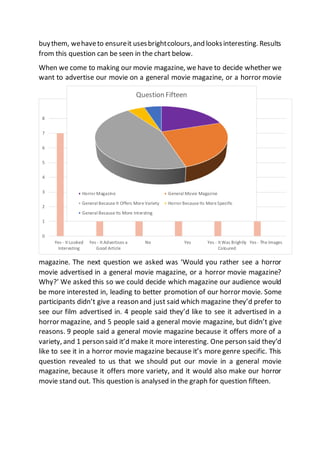
from this question can be seen in the chart below.
When we come to making our movie magazine, we have to decide whether we
want to advertise our movie on a general movie magazine, or a horror movie
magazine. The next question we asked was ‘Would you rather see a horror
movie advertised in a general movie magazine, or a horror movie magazine?
Why?’ We asked this so we could decide which magazine our audience would
be more interested in, leading to better promotion of our horror movie. Some
participants didn’t give a reason and just said which magazine they’d prefer to
see our film advertised in. 4 people said they’d like to see it advertised in a
horror magazine, and 5 people said a general movie magazine, but didn’t give
reasons. 9 people said a general movie magazine because it offers more of a
variety, and 1 person said it’d make it more interesting. One person said they’d
like to see it in a horror movie magazine because it’s more genre specific. This
question revealed to us that we should put our movie in a general movie
magazine, because it offers more variety, and it would also make our horror
movie stand out. This question is analysed in the graph for question fifteen.
0
1
2
3
4
5
6
7
8
Yes - It Looked
Interesting
Yes - It Advertises a
Good Article
No Yes Yes - It Was Brightly
Coloured
Yes - The Images
Question Fourteen
Question Fifteen
HorrorMagazine General Movie Magazine
General Because It Offers More Variety Horror Because Its More Specific
General Because Its More Intersting
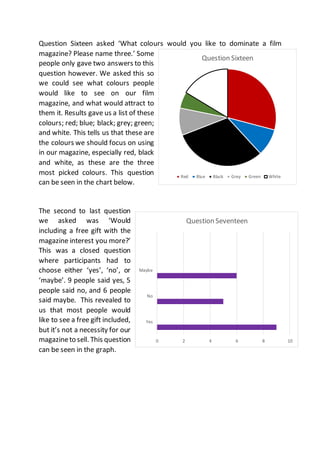
Question Sixteen asked ‘What colours would you like to dominate a film
magazine? Please name three.’ Some
people only gave two answers to this
question however. We asked this so
we could see what colours people
would like to see on our film
magazine, and what would attract to
them it. Results gave us a list of these
colours; red; blue; black; grey; green;
and white. This tells us that these are
the colours we should focus on using
in our magazine, especially red, black
and white, as these are the three
most picked colours. This question
can be seen in the chart below.
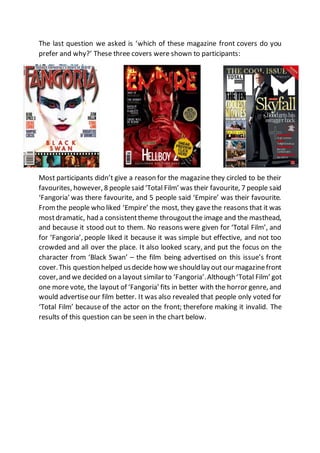
The second to last question
we asked was ‘Would
including a free gift with the
magazine interest you more?’
This was a closed question
where participants had to
choose either ‘yes’, ‘no’, or
‘maybe’. 9 people said yes, 5
people said no, and 6 people
said maybe. This revealed to
us that most people would
like to see a free gift included,
but it’s not a necessity for our
magazineto sell. This question
can be seen in the graph.
Question Sixteen
Red Blue Black Grey Green White
0 2 4 6 8 10
Yes
No
Maybe
Question Seventeen
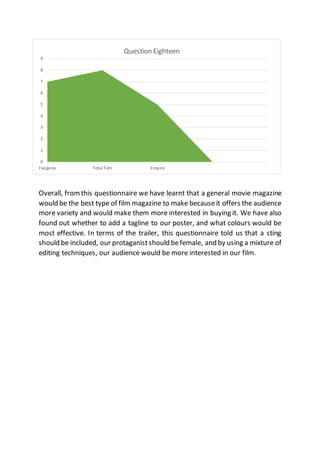
The last question we asked is ‘which of these magazine front covers do you
prefer and why?’ These three covers were shown to participants:
Most participants didn’t give a reason for the magazine they circled to be their
favourites, however, 8 peoplesaid ‘Total Film’ was their favourite, 7 people said
‘Fangoria’ was there favourite, and 5 people said ‘Empire’ was their favourite.
Fromthe people who liked ‘Empire’ the most, they gavethe reasons that it was
mostdramatic, had a consistenttheme througoutthe image and the masthead,
and because it stood out to them. No reasons were given for ‘Total Film’, and
for ‘Fangoria’, people liked it because it was simple but effective, and not too
crowded and all over the place. It also looked scary, and put the focus on the
character from ‘Black Swan’ – the film being advertised on this issue’s front
cover.This question helped usdecide how we shouldlay out our magazinefront
cover,and we decided on a layout similar to ‘Fangoria’.Although‘Total Film’ got
one more vote, the layout of ‘Fangoria’ fits in better with the horror genre, and
would advertiseour film better. It was also revealed that people only voted for
‘Total Film’ because of the actor on the front; therefore making it invalid. The
results of this question can be seen in the chart below.
Overall, fromthis questionnaire we have learnt that a general movie magazine
would be the best type of film magazine to make becauseit offers the audience
more variety and would make them more interested in buying it. We have also
found out whether to add a tagline to our poster, and what colours would be
most effective. In terms of the trailer, this questionnaire told us that a sting
should be included, our protaganistshould befemale, and by using a mixture of
editing techniques, our audience would be more interested in our film.
0
1
2
3
4
5
6
7
8
9
Fangoria Total Film Empire
Question Eighteen

Questionnaire Two analysis

  • 1.
    The aimof thesecond questionnairewasto find outmoreabout whatour target audience are looking for in our promotional package. This was to give us an insighton whatweshouldincludewhen making ourtrailer, poster and magazine front cover, and helped us make important decisions. Both open and closed questions wereincluded, allowing us to get a range of answers. Wehanded this questionnaire out to twenty people within our target audience, using an opportunity sample– this means that the questionnairewas given to thosewho were available at the time. The first question asked on this questionnaire was ‘would you prefer if the protagonist(the main good character) was around your age?’ This was a closed question as participants were given options of boxes which they could tick, either ‘yes’, ‘no’, or ‘I don’t mind’. With this question, we told the participant who the protagonistis; this is because they may not be familiar with media terminology. This question was asked in order for us to make our protagonistrelatable to the audience, and to find outwho they would like to see featured. 7 people ticked the ‘yes’ box, and 13 people ticked the ‘I don’t mind’ box. Out of the twenty, no one answered ‘no’; this was important in our research because it told us our protagonistshould be aged between 15 and 25. This is shown in the pie chart. Participants were next asked ‘would you prefer to see more of the narrative in the trailer, or less to keep it a surprise?’ This was asked so wecould decide which parts of the film we shouldput in our trailer. 9 people saidthey’d like to see more of the narrativein our trailer, meaning 11 people said they’d like to see less in order for it to be a surprise. However, the results for this question are quite close. This tells us that the trailer narrative should not be too abstract and audiences like to recognisea clear structurein order to understand the overallplot of thenarrative.This can be seen in thebar chart. Continuing with questions aboutour trailer, we asked ‘In our filmtrailer, do you think a sting (jump-scareatthe end of the trailer when youthink it is over)would Question One Yes I don’t mind no 0 2 4 6 8 10 12 More Less Question Two
  • 2.
    be effective inleaving a lasting impression on our audience? How?’ Again, we explained what a sting was for those who aren’t familiar with using this terminology. For this question, we left one line for participants to write their answers, and we asked them to explain what they thought. This question was asked to allow us to find out whether or not we should include a sting in our trailer – when coming up with ideas for our trailer, wethought it’d besuccessful to include one, however, we wanted opinions from our target audience. Some people, when answering this question, didn’t write a reason and just gave a simple yes or no. Our results our shown in the chart. 4 people said they’d like to see a sting because it makes the trailer scarier, and 6 people said yes because it’d leave them wanting more. 1 person also said yes because it’d make the film more memorable, and 7 people justsaid yes.2 people alsoansweredno, although they did not give a reason. The answers we received help us decide that we should include a sting in our film, as it would make more of our audience interested in watching the film, leading to it being more successful. An example of an existing sting is from ‘Black Swan’ where we see Nina turning into a swan and pulling a feather out of her body. This is inspirational for our trailer because it reveals more information to the audience, whilst scaring them and making them wonder what will happen next. 20% 30%35% 5% 10% Question Three Yes because it makes it scarier Yes because it leaves the audience wanting more Yes yes because it makes us remember your film No
  • 3.
    The next questionwas closed; our audience were asked ‘in our trailer, what elements would attract you most to go and see a film?’ We gave them four options: ‘sound’, ‘lighting’, ‘gore/jump scares’, and ‘editing’ - however, we gave no limit to how many boxes each person could tick. This allowed us to find out what elements of our trailer are most important in attracting our audience, and interesting them in our film. The results of question four were mixed, although the two most popular were ‘sound’ and ‘gore/jump scares’, with 9 people picking ‘sound’ and 12 people picking ‘gore/jump scares’. ‘Editing’ shows to be next most important, with 7 people picking it, and ‘lighting’ being only ticked by 2 people. By askingthis question, we found that scaring our audience through the use of sound and jump scares would be most attractive to them. This can be seen in the graph for question four. In my opinion, jump scares/goreattracts a large audienceas it creates morefear and suspense.However,becauseoursub- genre is pyschological, this may be a problem as gore and jump scares aren’t largely featured within these films. Question five was an open question asking ‘how long should a trailer be?’ We asked this question to find out how long our audience would be willing to spend watching our trailer; if it’s too long they may stop watchingit half waythrough,butif it’s too shortthen it won’tbe long enough to interest them in ourmovie. 2 peoplesaid they think our trailer shouldbe 1 – 1.30minutes long in order to make it ‘short and snappy’, however this would make our trailer less effective, and not give a real insightinto our movie. The other 18 people filling in this questionnairesaid that our trailer should be 2-3 minutes, and no longer. The results of this question weresuccessful, as they fit in with our initial ideas for the length of our trailer being roughly 2.30 minutes. A chart of these results can be seen. 0 2 4 6 8 10 12 14 Sound Lighting Gore/Jump Scares Editing QUESTION FOUR 0 2 4 6 8 10 12 14 16 18 20 1-1.30 minutes 2-3 minutes Question Five
  • 4.
    ‘Would you preferthe trailer to be/feature: ‘slow paced’, ‘quick cuts’ or ‘both’ is what we asked for question six, giving the target audience three choices to pick from. We asked this question so we could find out how we should present our trailer, whether it should be in the formof quick cuts showing the action, or slow paced to let the audience see more of the scene. Out of the 20 people we asked, only 1 person said they would prefer to see just slow paced editing. 7 people want to see quick cuts, and 12 people said they’d like to see both. This question has helped with our planning because we know that our audience would like to see a mixture of both, with quick cuts dominating it. This can beseen in the chart for question six. The last question we asked about film trailers was ‘Do you prefer horror film trailers to have music playing in the background?’ We asked this to find out whether or not we should include creepy music in the background of our film trailer to add to the horror; this is because sound is one of the most important factors of a trailer. Question seven was a closed question, and participants had to tick either ‘yes’, ‘no’ or ‘I don’t mind’. 15 people said yes, giving us a clear indication that music should be added to our horror movie. Only 2 people said, and 3 people said they didn’t mind. This can be seen in the graph. This question was successful as we found out that music is important to include in our trailer in order to please our target audience. Question Six Slow Paced Quick Cuts Both 0 2 4 6 8 10 12 14 16 Yes No I Don’t Mind Question Seven
  • 5.
    We then startedasking the next questions aboutfilm posters; this allowed to us to find out moreaboutwhatshould beincluded in our poster,in orderto attract our target audience. For question eight, we asked ‘What would you like to see taking up the majorityof the roomon a film poster?’This was a closed question, where our participants could choosefrom‘closeup of antagonist’ and ‘antagonistand location’. For this, 3 people chose ‘close up of antagonist’, meaning 17 people opted for ‘antagonist and location’. This showsthatin our poster,morepeople would like to see the location as well as the antagonist; however, with most psychological horror movies, it is conventional for posters to just feature a close of up of the antagonist. This means, by going against this convention, our poster will stand out from other film posters, whilstalso pleasing our audience. This results of this question are also presented in this graph. Continuing with questions aboutfilm posters,we asked ‘would you like to see the release date on the poster?’ Participants were given the option of ‘yes’, ‘no’, or ‘I don’t mind’. We asked this question in order to find out whether we should include the releasedate on our poster.19people out of 20 said yes, and 1 person said ‘I don’t mind’. This revealed to us that we should definitely be including the release date of our film onto our poster. The results of question nine can be seen in the graph. Question ten asked the participants an open question; ‘Does having the tagline (slogan) on the film poster appeal to you? Why?’ We asked this question becausewewereunsureif we shouldputour tagline on our film poster,as some psychologicalhorrorpostersdonot includetheir tagline. Inthis question,results varied, although most of our target audience said that they would like to see a tagline.4 people said they’d like to see a tagline because it gives them a hint to the narrative, and 3 people said yes becausea tagline makes the poster and film more memorable to them. 1 person said yes because it would sum up the film, making them want to watch it, and 1 person said yes because it’d make them think about it more. 5 people said yes, but they didn’t give a reason, and 4 people said no without giving a reason. The remaining 2 people said they didn’t 0 2 4 6 8 10 12 14 16 18 Close up of Antagonist Antagonist and Location QUESTION EIGHT 95% 0%5% Question Nine Yes No I Don’t Mind
  • 6.
    want to seea tagline on the poster because they are more interested in the characters and the narrative. This question can be seen on the graph. Question eleven asked the participants ‘which of these film posters do you preferand why?’Participantswereshowntheseimages to go with this question; We asked this question to get an insight into whattype of posters our audience prefer; this question gave us ideas about what our film poster should look like, and what feature it should include. By asking participants why they picked that specific one, it allows us to mix all of these good things into one poster, attracting ourtarget audience. The answerswereceived forthis question varied hugely, and this can be seen in the chartbelow. Results told us that mostpeople 0 1 2 3 4 5 6 Yes - Hints to Narrative No - More Interested in Narrative Yes No Yes - Makes you Think Yes - More Memorable Yes - Sums up the Film Question Ten
  • 7.
    preferred the Uninvitedbecause it looks scary, and the Awakening because it shows the location; this helped us in deciding how our film poster should look. When deciding where our film name should be placed on our poster, we couldn’t decide between the top and the bottom; this influenced question twelve where we asked participants which they’d like to see. This was a closed question, where they had to tick either ‘top’, ‘bottom’, or ‘I don’t mind’. Only 3 of our 20 participants said they’d like to see the film name at the top of the poster, and this immediately told us that we should place it at the bottom. 11 people said the bottom is the best, and the remaining 6 said they didn’t mind. The results of this question can be seen on the chart. 0 0.5 1 1.5 2 2.5 3 3.5 4 4.5 Awakening - It shows setting Awakening - It makes me want to watch it The Uninvited because it looks scary The Uninvited The Broken The Uninvited - Her identity is hidden The Broken - It shows she's mad The Broken - It looks most Interesting The Awakening Question Eleven Question Twelve Top Bottom I Don’t Mind
  • 8.
    We then movedon to ask questions about our third piece of work, the movie magazine. We firstasked, ‘How much would you be willing to spend on a movie magazine?’ and participants were given options of ‘£0-99p’, ‘£1-3’, and ‘£3+’. We asked this because we were still unsure of how much we should price our own magazine, so we asked our target audience what they’d be willing to pay. 0 people said they’d pay more than three pound, and 6 people said they’d pay £0-99p.14peoplesaid £1-3 is the best price for a movie magazine, and this is whatthey’d be willing to pay. Results of this were positive, and this is the price rangewe are looking at for a successful magazine. Results of this question can be seen in the graph. Question fourteen asked the participants ‘have you ever been drawn to a magazine purely because of its front cover? If so, why?’ We asked this in order to find out what it is that catches the attention of people in a shop, and what would convince them to buy our magazine. Some people however, didn’tgive a reason, and simply said yes or no. Reasons varied from, ‘yes because it looked interesting’, ‘yes if it’s advertising a good article’, ‘yes if it’s brightly coloured’, and ‘yes becauseof the images seen’. The results of this question revealed to us that if we want our magazine to stand out from others and convince people to 0 2 4 6 8 10 12 14 16 £ 0 - 9 9 P £ 1 - 3 £ 3 + QUESTION THIRTEEN
  • 9.
    buythem, wehaveto ensureitusesbrightcolours,and looksinteresting. Results from this question can be seen in the chart below. When we come to making our movie magazine, we have to decide whether we want to advertise our movie on a general movie magazine, or a horror movie magazine. The next question we asked was ‘Would you rather see a horror movie advertised in a general movie magazine, or a horror movie magazine? Why?’ We asked this so we could decide which magazine our audience would be more interested in, leading to better promotion of our horror movie. Some participants didn’t give a reason and just said which magazine they’d prefer to see our film advertised in. 4 people said they’d like to see it advertised in a horror magazine, and 5 people said a general movie magazine, but didn’t give reasons. 9 people said a general movie magazine because it offers more of a variety, and 1 person said it’d make it more interesting. One person said they’d like to see it in a horror movie magazine because it’s more genre specific. This question revealed to us that we should put our movie in a general movie magazine, because it offers more variety, and it would also make our horror movie stand out. This question is analysed in the graph for question fifteen. 0 1 2 3 4 5 6 7 8 Yes - It Looked Interesting Yes - It Advertises a Good Article No Yes Yes - It Was Brightly Coloured Yes - The Images Question Fourteen Question Fifteen HorrorMagazine General Movie Magazine General Because It Offers More Variety Horror Because Its More Specific General Because Its More Intersting
  • 10.
    Question Sixteen asked‘What colours would you like to dominate a film magazine? Please name three.’ Some people only gave two answers to this question however. We asked this so we could see what colours people would like to see on our film magazine, and what would attract to them it. Results gave us a list of these colours; red; blue; black; grey; green; and white. This tells us that these are the colours we should focus on using in our magazine, especially red, black and white, as these are the three most picked colours. This question can be seen in the chart below. The second to last question we asked was ‘Would including a free gift with the magazine interest you more?’ This was a closed question where participants had to choose either ‘yes’, ‘no’, or ‘maybe’. 9 people said yes, 5 people said no, and 6 people said maybe. This revealed to us that most people would like to see a free gift included, but it’s not a necessity for our magazineto sell. This question can be seen in the graph. Question Sixteen Red Blue Black Grey Green White 0 2 4 6 8 10 Yes No Maybe Question Seventeen
  • 11.
    The last questionwe asked is ‘which of these magazine front covers do you prefer and why?’ These three covers were shown to participants: Most participants didn’t give a reason for the magazine they circled to be their favourites, however, 8 peoplesaid ‘Total Film’ was their favourite, 7 people said ‘Fangoria’ was there favourite, and 5 people said ‘Empire’ was their favourite. Fromthe people who liked ‘Empire’ the most, they gavethe reasons that it was mostdramatic, had a consistenttheme througoutthe image and the masthead, and because it stood out to them. No reasons were given for ‘Total Film’, and for ‘Fangoria’, people liked it because it was simple but effective, and not too crowded and all over the place. It also looked scary, and put the focus on the character from ‘Black Swan’ – the film being advertised on this issue’s front cover.This question helped usdecide how we shouldlay out our magazinefront cover,and we decided on a layout similar to ‘Fangoria’.Although‘Total Film’ got one more vote, the layout of ‘Fangoria’ fits in better with the horror genre, and would advertiseour film better. It was also revealed that people only voted for ‘Total Film’ because of the actor on the front; therefore making it invalid. The results of this question can be seen in the chart below.
  • 12.
    Overall, fromthis questionnairewe have learnt that a general movie magazine would be the best type of film magazine to make becauseit offers the audience more variety and would make them more interested in buying it. We have also found out whether to add a tagline to our poster, and what colours would be most effective. In terms of the trailer, this questionnaire told us that a sting should be included, our protaganistshould befemale, and by using a mixture of editing techniques, our audience would be more interested in our film. 0 1 2 3 4 5 6 7 8 9 Fangoria Total Film Empire Question Eighteen