QUESTION 7: LOOKING BACK AT YOUR PRELIMINARY TASK,
WHAT DO YOU FEEL YOU HAVE LEARNT IN THE
PROGRESSION FROM IT TO THE FULL PRODUCT?
INTRODUCTION
 Since my preliminary task, my knowledge and understanding of magazines as a whole has grown largely.
I now understand what it takes to make a magazine look professional as well as making sure my writing
style fits the audience I am writing for. I have learnt that when using technology for my images on front
pages, going through and changing the exposure and highlights and shadows isn’t always the best way
to go. Sometimes using less filters you can still be creative and have a professional look to your front
page. In my contents page, I now understand the content of the magazine has to be much more than
what I had in the preliminary task contents page. I know now there cannot be any blank space where
there isn’t something going on and also that the font size has to be reasonable.
WHAT DID I LEARN GENERALLY?
 Since starting this process, I have learnt how to manage my time more effectively and making sure I
spread out my workload. Originally, I spent a lot of time Photoshopping my main image for my front
cover and did so too much that I didn’t have time to make a good contents page. Finally, I now have a
good understanding about distributors and how some distributors are more suited for some genres of
magazines than others are.
WHAT SKILLS DID I IMPROVE?
 My skills have improved a lot throughout this course and especially through Photoshop. When looking
back on the work I did for the original preliminary task, I realise that actually I did not create an effective
Photoshop; I added so many layers of different things such as changing the exposure that the image no
longer had any sort of level of verisimilitude. Now my Photoshop, although be it rather “Out there”, is a
lot more suited to the style of magazine I was trying to make. I also was able to fill in the space on the
contents page by using effective line spacing and using a reasonable sized font.
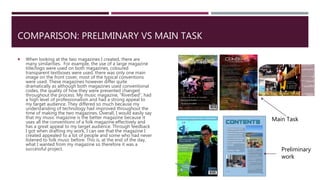
COMPARISON: PRELIMINARY VS MAIN TASK
 When looking at the two magazines I created, there are
many similarities. For example, the use of a large magazine
title/logo were used on both magazines, coloured
transparent textboxes were used, there was only one main
image on the front cover, most of the typical conventions
were used. These magazines however differ quite
dramatically as although both magazines used conventional
codes, the quality of how they were presented changed
throughout the process. My music magazine, “Riverbed”, had
a high level of professionalism and had a strong appeal to
my target audience. They differed so much because my
understanding of technology had improved throughout the
time of making the two magazines. Overall, I would easily say
that my music magazine is the better magazine because it
uses all the conventions of a folk magazine effectively and
has a great appeal to my target audience. Through feedback
I got when drafting my work, I can see that the magazine I
created appealed to a lot of people and some who had never
listened to folk music before. This is, at the end of the day,
what I wanted from my magazine so therefore it was a
successful project. Preliminary
work
Main Task

Question 7

  • 1.
    QUESTION 7: LOOKINGBACK AT YOUR PRELIMINARY TASK, WHAT DO YOU FEEL YOU HAVE LEARNT IN THE PROGRESSION FROM IT TO THE FULL PRODUCT?
  • 2.
    INTRODUCTION  Since mypreliminary task, my knowledge and understanding of magazines as a whole has grown largely. I now understand what it takes to make a magazine look professional as well as making sure my writing style fits the audience I am writing for. I have learnt that when using technology for my images on front pages, going through and changing the exposure and highlights and shadows isn’t always the best way to go. Sometimes using less filters you can still be creative and have a professional look to your front page. In my contents page, I now understand the content of the magazine has to be much more than what I had in the preliminary task contents page. I know now there cannot be any blank space where there isn’t something going on and also that the font size has to be reasonable.
  • 3.
    WHAT DID ILEARN GENERALLY?  Since starting this process, I have learnt how to manage my time more effectively and making sure I spread out my workload. Originally, I spent a lot of time Photoshopping my main image for my front cover and did so too much that I didn’t have time to make a good contents page. Finally, I now have a good understanding about distributors and how some distributors are more suited for some genres of magazines than others are.
  • 4.
    WHAT SKILLS DIDI IMPROVE?  My skills have improved a lot throughout this course and especially through Photoshop. When looking back on the work I did for the original preliminary task, I realise that actually I did not create an effective Photoshop; I added so many layers of different things such as changing the exposure that the image no longer had any sort of level of verisimilitude. Now my Photoshop, although be it rather “Out there”, is a lot more suited to the style of magazine I was trying to make. I also was able to fill in the space on the contents page by using effective line spacing and using a reasonable sized font.
  • 5.
    COMPARISON: PRELIMINARY VSMAIN TASK  When looking at the two magazines I created, there are many similarities. For example, the use of a large magazine title/logo were used on both magazines, coloured transparent textboxes were used, there was only one main image on the front cover, most of the typical conventions were used. These magazines however differ quite dramatically as although both magazines used conventional codes, the quality of how they were presented changed throughout the process. My music magazine, “Riverbed”, had a high level of professionalism and had a strong appeal to my target audience. They differed so much because my understanding of technology had improved throughout the time of making the two magazines. Overall, I would easily say that my music magazine is the better magazine because it uses all the conventions of a folk magazine effectively and has a great appeal to my target audience. Through feedback I got when drafting my work, I can see that the magazine I created appealed to a lot of people and some who had never listened to folk music before. This is, at the end of the day, what I wanted from my magazine so therefore it was a successful project. Preliminary work Main Task